
A English
The Moving Coil Galvanometer (Sensitivity) and Ammeter and Voltmeter Conversion Questions in English
Class 12 Physics · Moving Charges and Magnetism · The Moving Coil Galvanometer (Sensitivity) and Ammeter and Voltmeter Conversion
388+
Questions
English
Language
100%
With Solutions
Showing 50 of 388 questions in English
201
EasyMCQ
Write the equation for the series resistance required to increase the voltage range of a galvanometer by a factor of $n$.
A
$R = G(n-1)$
B
$R = G(n+1)$
C
$R = G/(n-1)$
D
$R = G/(n+1)$
Solution
(A) Let $G$ be the resistance of the galvanometer and $I_g$ be the full-scale deflection current.
The initial voltage range is $V = I_g G$.
To increase the range by a factor of $n$,the new voltage range becomes $V' = nV = n I_g G$.
Let $R$ be the series resistance connected to the galvanometer.
The total resistance of the voltmeter is $(G + R)$.
According to Ohm's law,$V' = I_g(G + R)$.
Substituting $V' = n I_g G$,we get $n I_g G = I_g(G + R)$.
Dividing both sides by $I_g$,we get $nG = G + R$.
Therefore,$R = nG - G = G(n - 1)$.
The initial voltage range is $V = I_g G$.
To increase the range by a factor of $n$,the new voltage range becomes $V' = nV = n I_g G$.
Let $R$ be the series resistance connected to the galvanometer.
The total resistance of the voltmeter is $(G + R)$.
According to Ohm's law,$V' = I_g(G + R)$.
Substituting $V' = n I_g G$,we get $n I_g G = I_g(G + R)$.
Dividing both sides by $I_g$,we get $nG = G + R$.
Therefore,$R = nG - G = G(n - 1)$.
0 likes
View Solution202
Medium
What is voltage sensitivity? Write the equation for voltage sensitivity.
Solution
(N/A) Voltage sensitivity of a galvanometer is defined as the deflection produced per unit voltage applied across it.
It is denoted by $V_s$.
If a voltage $V$ is applied across a galvanometer and it produces a deflection $\theta$,then voltage sensitivity is given by:
$V_s = \frac{\theta}{V}$
Since $V = I R_g$,where $I$ is the current and $R_g$ is the resistance of the galvanometer,we can write:
$V_s = \frac{\theta}{I R_g}$
Since current sensitivity $I_s = \frac{\theta}{I}$,the equation becomes:
$V_s = \frac{I_s}{R_g}$
Where $I_s = \frac{NAB}{k}$ ($N$ is the number of turns,$A$ is the area,$B$ is the magnetic field,and $k$ is the restoring torque per unit twist).
It is denoted by $V_s$.
If a voltage $V$ is applied across a galvanometer and it produces a deflection $\theta$,then voltage sensitivity is given by:
$V_s = \frac{\theta}{V}$
Since $V = I R_g$,where $I$ is the current and $R_g$ is the resistance of the galvanometer,we can write:
$V_s = \frac{\theta}{I R_g}$
Since current sensitivity $I_s = \frac{\theta}{I}$,the equation becomes:
$V_s = \frac{I_s}{R_g}$
Where $I_s = \frac{NAB}{k}$ ($N$ is the number of turns,$A$ is the area,$B$ is the magnetic field,and $k$ is the restoring torque per unit twist).
0 likes
View Solution203
EasyMCQ
“By increasing current sensitivity,voltage sensitivity is also increased”. This statement is true or false.
A
True
B
False
Solution
(B) The current sensitivity of a galvanometer is given by $I_s = \frac{NBA}{k}$,where $N$ is the number of turns,$B$ is the magnetic field,$A$ is the area,and $k$ is the restoring torque per unit twist.
Voltage sensitivity is given by $V_s = \frac{I_s}{R} = \frac{NBA}{kR}$,where $R$ is the resistance of the coil.
If we increase current sensitivity by increasing the number of turns $N$,the resistance $R$ of the coil also increases proportionally because $R = \rho \frac{l}{A_{wire}}$,where $l$ is the length of the wire $(l = N \times \text{circumference})$.
Since $R$ increases as $N$ increases,the voltage sensitivity $V_s$ does not necessarily increase; it may remain constant or even decrease.
Therefore,the statement is false.
Voltage sensitivity is given by $V_s = \frac{I_s}{R} = \frac{NBA}{kR}$,where $R$ is the resistance of the coil.
If we increase current sensitivity by increasing the number of turns $N$,the resistance $R$ of the coil also increases proportionally because $R = \rho \frac{l}{A_{wire}}$,where $l$ is the length of the wire $(l = N \times \text{circumference})$.
Since $R$ increases as $N$ increases,the voltage sensitivity $V_s$ does not necessarily increase; it may remain constant or even decrease.
Therefore,the statement is false.
0 likes
View Solution204
Medium
What is the value of resistance to double the value of number of turns of coil for a galvanometer? Why?
Solution
(N/A) The torque on a current-carrying coil in a magnetic field is given by $\tau = N I A B \sin \theta$. The restoring torque is $\tau_r = k \phi$. In equilibrium,$N I A B = k \phi$,which implies $\phi = (\frac{NAB}{k}) I$. The current sensitivity is $S_i = \frac{\phi}{I} = \frac{NAB}{k}$. If the number of turns $N$ is doubled to $2N$,the length of the wire $l$ also doubles,as $l = N \times (2\pi r)$. Since resistance $R = \rho \frac{l}{A_{wire}}$,doubling the length $l$ results in the resistance $R$ becoming $2R$. Therefore,to double the number of turns,the resistance of the coil becomes $2$ times the original resistance.
0 likes
View Solution205
Medium
$A$ multirange voltmeter can be constructed by using a galvanometer circuit as shown in the figure. We want to construct a voltmeter that can measure $2 \ V$,$20 \ V$,and $200 \ V$ using a galvanometer of resistance $10 \ \Omega$ that produces maximum deflection for a current of $1 \ mA$. Find $R_1$,$R_2$,and $R_3$ that have to be used.
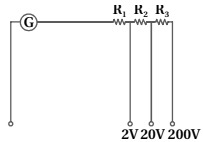
Solution
(N/A) To convert a galvanometer into a voltmeter,connect a high-value resistance in series with the galvanometer.
The governing equation is $I_g(G + R_{total}) = V$,where $I_g$ is the full-scale deflection current,$G$ is the galvanometer resistance,and $R_{total}$ is the total series resistance.
Given: $I_g = 1 \ mA = 10^{-3} \ A$,$G = 10 \ \Omega$.
$1$. For the $2 \ V$ range:
$I_g(G + R_1) = 2$
$10^{-3}(10 + R_1) = 2$
$10 + R_1 = 2000$
$R_1 = 1990 \ \Omega$
$2$. For the $20 \ V$ range:
$I_g(G + R_1 + R_2) = 20$
$10^{-3}(10 + 1990 + R_2) = 20$
$2000 + R_2 = 20000$
$R_2 = 18000 \ \Omega = 18 \ k\Omega$
$3$. For the $200 \ V$ range:
$I_g(G + R_1 + R_2 + R_3) = 200$
$10^{-3}(10 + 1990 + 18000 + R_3) = 200$
$20000 + R_3 = 200000$
$R_3 = 180000 \ \Omega = 180 \ k\Omega$
Thus,$R_1 = 1990 \ \Omega$,$R_2 = 18 \ k\Omega$,and $R_3 = 180 \ k\Omega$.
The governing equation is $I_g(G + R_{total}) = V$,where $I_g$ is the full-scale deflection current,$G$ is the galvanometer resistance,and $R_{total}$ is the total series resistance.
Given: $I_g = 1 \ mA = 10^{-3} \ A$,$G = 10 \ \Omega$.
$1$. For the $2 \ V$ range:
$I_g(G + R_1) = 2$
$10^{-3}(10 + R_1) = 2$
$10 + R_1 = 2000$
$R_1 = 1990 \ \Omega$
$2$. For the $20 \ V$ range:
$I_g(G + R_1 + R_2) = 20$
$10^{-3}(10 + 1990 + R_2) = 20$
$2000 + R_2 = 20000$
$R_2 = 18000 \ \Omega = 18 \ k\Omega$
$3$. For the $200 \ V$ range:
$I_g(G + R_1 + R_2 + R_3) = 200$
$10^{-3}(10 + 1990 + 18000 + R_3) = 200$
$20000 + R_3 = 200000$
$R_3 = 180000 \ \Omega = 180 \ k\Omega$
Thus,$R_1 = 1990 \ \Omega$,$R_2 = 18 \ k\Omega$,and $R_3 = 180 \ k\Omega$.
0 likes
View Solution206
Medium
$A$ multirange current meter can be constructed by using a galvanometer circuit as shown in the figure. We want a current meter that can measure $10 \text{ mA}$,$100 \text{ mA}$,and $1 \text{ A}$ using a galvanometer of resistance $10 \text{ } \Omega$ that produces maximum deflection for a current of $1 \text{ mA}$. Find the values of $S_1, S_2$,and $S_3$ that have to be used.
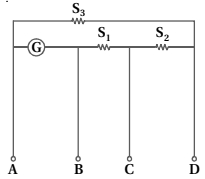
Solution
(D) To convert a galvanometer into an ammeter,a low-value resistance (shunt) is connected in parallel. Let $G = 10 \text{ } \Omega$ be the galvanometer resistance and $I_g = 1 \text{ mA} = 0.001 \text{ A}$ be the full-scale deflection current.
For range $I_1 = 10 \text{ mA} = 0.01 \text{ A}$ (between terminals $A$ and $B$): The shunt resistance is $S_1 + S_2 + S_3$. The current through the shunt is $I_1 - I_g = 0.01 - 0.001 = 0.009 \text{ A}$.
$I_g G = (I_1 - I_g)(S_1 + S_2 + S_3) \implies 0.001 \times 10 = 0.009(S_1 + S_2 + S_3) \implies S_1 + S_2 + S_3 = \frac{10}{9} \approx 1.11 \text{ } \Omega$.
For range $I_2 = 100 \text{ mA} = 0.1 \text{ A}$ (between terminals $A$ and $C$): The shunt resistance is $S_2 + S_3$. The current through the shunt is $I_2 - I_g = 0.1 - 0.001 = 0.099 \text{ A}$.
$I_g(G + S_1) = (I_2 - I_g)(S_2 + S_3) \implies 0.001(10 + S_1) = 0.099(S_2 + S_3)$.
For range $I_3 = 1 \text{ A}$ (between terminals $A$ and $D$): The shunt resistance is $S_3$. The current through the shunt is $I_3 - I_g = 1 - 0.001 = 0.999 \text{ A}$.
$I_g(G + S_1 + S_2) = (I_3 - I_g)S_3 \implies 0.001(10 + S_1 + S_2) = 0.999 S_3$.
Solving these equations simultaneously:
$S_3 = \frac{10}{999} \approx 0.0101 \text{ } \Omega$,
$S_2 = \frac{10}{99} - S_3 \approx 0.101 - 0.0101 = 0.0909 \text{ } \Omega$,
$S_1 = \frac{10}{9} - (S_2 + S_3) = \frac{10}{9} - \frac{10}{99} = \frac{100}{99} \approx 1.0101 \text{ } \Omega$.
For range $I_1 = 10 \text{ mA} = 0.01 \text{ A}$ (between terminals $A$ and $B$): The shunt resistance is $S_1 + S_2 + S_3$. The current through the shunt is $I_1 - I_g = 0.01 - 0.001 = 0.009 \text{ A}$.
$I_g G = (I_1 - I_g)(S_1 + S_2 + S_3) \implies 0.001 \times 10 = 0.009(S_1 + S_2 + S_3) \implies S_1 + S_2 + S_3 = \frac{10}{9} \approx 1.11 \text{ } \Omega$.
For range $I_2 = 100 \text{ mA} = 0.1 \text{ A}$ (between terminals $A$ and $C$): The shunt resistance is $S_2 + S_3$. The current through the shunt is $I_2 - I_g = 0.1 - 0.001 = 0.099 \text{ A}$.
$I_g(G + S_1) = (I_2 - I_g)(S_2 + S_3) \implies 0.001(10 + S_1) = 0.099(S_2 + S_3)$.
For range $I_3 = 1 \text{ A}$ (between terminals $A$ and $D$): The shunt resistance is $S_3$. The current through the shunt is $I_3 - I_g = 1 - 0.001 = 0.999 \text{ A}$.
$I_g(G + S_1 + S_2) = (I_3 - I_g)S_3 \implies 0.001(10 + S_1 + S_2) = 0.999 S_3$.
Solving these equations simultaneously:
$S_3 = \frac{10}{999} \approx 0.0101 \text{ } \Omega$,
$S_2 = \frac{10}{99} - S_3 \approx 0.101 - 0.0101 = 0.0909 \text{ } \Omega$,
$S_1 = \frac{10}{9} - (S_2 + S_3) = \frac{10}{9} - \frac{10}{99} = \frac{100}{99} \approx 1.0101 \text{ } \Omega$.
0 likes
View Solution207
MediumMCQ
$A$ galvanometer is used in the laboratory for the null point in electrical experiments. If,on passing a current of $6 \, mA$,it produces a deflection of $2^{\circ}$,its figure of merit is close to:
A
$3 \times 10^{-3} \, A/\text{div}$
B
$333 \, \text{div}/A$
C
$6 \times 10^{-3} \, A/\text{div}$
D
$666 \, \text{div}/A$
Solution
(A) The figure of merit $(k)$ of a galvanometer is defined as the current required to produce a unit deflection in the galvanometer.
It is given by the formula: $k = \frac{I}{\theta}$
Given:
Current $I = 6 \, mA = 6 \times 10^{-3} \, A$
Deflection $\theta = 2^{\circ}$
Substituting the values:
$k = \frac{6 \times 10^{-3} \, A}{2^{\circ}} = 3 \times 10^{-3} \, A/\text{div}$
Therefore,the figure of merit is $3 \times 10^{-3} \, A/\text{div}$.
It is given by the formula: $k = \frac{I}{\theta}$
Given:
Current $I = 6 \, mA = 6 \times 10^{-3} \, A$
Deflection $\theta = 2^{\circ}$
Substituting the values:
$k = \frac{6 \times 10^{-3} \, A}{2^{\circ}} = 3 \times 10^{-3} \, A/\text{div}$
Therefore,the figure of merit is $3 \times 10^{-3} \, A/\text{div}$.
0 likes
View Solution208
DifficultMCQ
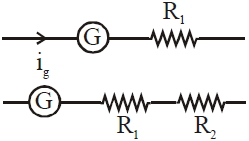
$A$ galvanometer of resistance $G$ is converted into a voltmeter of range $0-1\, V$ by connecting a resistance $R_{1}$ in series with it. The additional resistance that should be connected in series with $R_{1}$ to increase the range of the voltmeter to $0-2\, V$ will be
A
$R_{1}$
B
$R_{1}+G$
C
$R_{1}-G$
D
$G$
Solution
(B) Let $i_{g}$ be the full-scale deflection current of the galvanometer.
For the first case,the range is $0-1\, V$ with resistance $R_{1}$ in series:
$1 = i_{g}(G + R_{1}) \quad \dots(1)$
For the second case,the range is $0-2\, V$ with an additional resistance $R_{2}$ in series:
$2 = i_{g}(G + R_{1} + R_{2}) \quad \dots(2)$
Dividing equation $(2)$ by equation $(1)$:
$\frac{2}{1} = \frac{i_{g}(G + R_{1} + R_{2})}{i_{g}(G + R_{1})}$
$2 = \frac{G + R_{1} + R_{2}}{G + R_{1}}$
$2(G + R_{1}) = G + R_{1} + R_{2}$
$2G + 2R_{1} = G + R_{1} + R_{2}$
$R_{2} = G + R_{1}$
Thus,the additional resistance required is $G + R_{1}$.
For the first case,the range is $0-1\, V$ with resistance $R_{1}$ in series:
$1 = i_{g}(G + R_{1}) \quad \dots(1)$
For the second case,the range is $0-2\, V$ with an additional resistance $R_{2}$ in series:
$2 = i_{g}(G + R_{1} + R_{2}) \quad \dots(2)$
Dividing equation $(2)$ by equation $(1)$:
$\frac{2}{1} = \frac{i_{g}(G + R_{1} + R_{2})}{i_{g}(G + R_{1})}$
$2 = \frac{G + R_{1} + R_{2}}{G + R_{1}}$
$2(G + R_{1}) = G + R_{1} + R_{2}$
$2G + 2R_{1} = G + R_{1} + R_{2}$
$R_{2} = G + R_{1}$
Thus,the additional resistance required is $G + R_{1}$.
0 likes
View Solution209
MediumMCQ
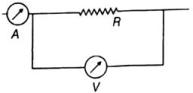
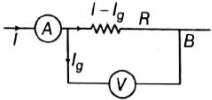
In the adjoining circuit diagram,the readings of the ammeter and voltmeter are $2 \, A$ and $120 \, V$,respectively. If the value of $R$ is $75 \, \Omega$,then the voltmeter resistance will be (in $\Omega$):
A
$100$
B
$150$
C
$300$
D
$75$
Solution
(C) Let $I$ be the total current,$I_g$ be the current through the voltmeter,and $R_v$ be the resistance of the voltmeter.
From the circuit diagram,the total current $I = 2 \, A$ splits into the current through the resistor $R$ and the current through the voltmeter $I_g$.
The voltage across the parallel combination is $V = 120 \, V$.
The current through the resistor $R = 75 \, \Omega$ is given by $I_R = \frac{V}{R} = \frac{120}{75} = 1.6 \, A$.
Since $I = I_R + I_g$,we have $I_g = I - I_R = 2 - 1.6 = 0.4 \, A$.
The resistance of the voltmeter is $R_v = \frac{V}{I_g} = \frac{120}{0.4} = 300 \, \Omega$.
From the circuit diagram,the total current $I = 2 \, A$ splits into the current through the resistor $R$ and the current through the voltmeter $I_g$.
The voltage across the parallel combination is $V = 120 \, V$.
The current through the resistor $R = 75 \, \Omega$ is given by $I_R = \frac{V}{R} = \frac{120}{75} = 1.6 \, A$.
Since $I = I_R + I_g$,we have $I_g = I - I_R = 2 - 1.6 = 0.4 \, A$.
The resistance of the voltmeter is $R_v = \frac{V}{I_g} = \frac{120}{0.4} = 300 \, \Omega$.
0 likes
View Solution210
MediumMCQ
For full scale deflection of total $50$ divisions, $50 \, mV$ voltage is required in a galvanometer. The resistance of the galvanometer, if its current sensitivity is $2 \, div/mA$, will be $..... \Omega$.
A
$1$
B
$5$
C
$4$
D
$2$
Solution
(D) Given:
Total divisions for full scale deflection $(N)$ = $50 \, div$.
Voltage for full scale deflection $(V)$ = $50 \, mV = 50 \times 10^{-3} \, V$.
Current sensitivity $(S_i)$ = $2 \, div/mA = 2 \, div / (10^{-3} \, A) = 2000 \, div/A$.
Step $1$: Calculate the full scale current $(I_{fs})$.
The current sensitivity is defined as $S_i = N / I_{fs}$.
Therefore, $I_{fs} = N / S_i = 50 \, div / (2 \, div/mA) = 25 \, mA = 25 \times 10^{-3} \, A$.
Step $2$: Calculate the resistance of the galvanometer $(G)$.
Using Ohm's law, $V = I_{fs} \times G$.
$G = V / I_{fs} = (50 \times 10^{-3} \, V) / (25 \times 10^{-3} \, A) = 2 \, \Omega$.
Thus, the resistance of the galvanometer is $2 \, \Omega$.
Total divisions for full scale deflection $(N)$ = $50 \, div$.
Voltage for full scale deflection $(V)$ = $50 \, mV = 50 \times 10^{-3} \, V$.
Current sensitivity $(S_i)$ = $2 \, div/mA = 2 \, div / (10^{-3} \, A) = 2000 \, div/A$.
Step $1$: Calculate the full scale current $(I_{fs})$.
The current sensitivity is defined as $S_i = N / I_{fs}$.
Therefore, $I_{fs} = N / S_i = 50 \, div / (2 \, div/mA) = 25 \, mA = 25 \times 10^{-3} \, A$.
Step $2$: Calculate the resistance of the galvanometer $(G)$.
Using Ohm's law, $V = I_{fs} \times G$.
$G = V / I_{fs} = (50 \times 10^{-3} \, V) / (25 \times 10^{-3} \, A) = 2 \, \Omega$.
Thus, the resistance of the galvanometer is $2 \, \Omega$.
0 likes
View Solution211
MediumMCQ
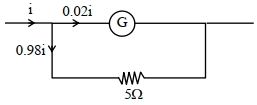
Consider a galvanometer shunted with $5\, \Omega$ resistance and $2\, \%$ of the total current passes through it. What is the resistance of the given galvanometer? (In $\Omega$)
A
$300$
B
$344$
C
$245$
D
$226$
Solution
(C) Let the total current be $i$.
Given that the current through the galvanometer is $I_g = 0.02i$.
Therefore,the current through the shunt resistor $S = 5\, \Omega$ is $I_s = i - 0.02i = 0.98i$.
Since the galvanometer and the shunt resistor are in parallel,the potential difference across them is equal:
$I_g R_g = I_s S$
$0.02i \times R_g = 0.98i \times 5$
$R_g = \frac{0.98 \times 5}{0.02}$
$R_g = 49 \times 5 = 245\, \Omega$.
Given that the current through the galvanometer is $I_g = 0.02i$.
Therefore,the current through the shunt resistor $S = 5\, \Omega$ is $I_s = i - 0.02i = 0.98i$.
Since the galvanometer and the shunt resistor are in parallel,the potential difference across them is equal:
$I_g R_g = I_s S$
$0.02i \times R_g = 0.98i \times 5$
$R_g = \frac{0.98 \times 5}{0.02}$
$R_g = 49 \times 5 = 245\, \Omega$.
0 likes
View Solution212
MediumMCQ
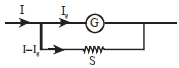
If $n$ represents the actual number of deflections in a converted galvanometer of resistance $G$ and shunt resistance $S$,then the total current $I$ when its figure of merit is $K$ will be:
A
$\frac{KS}{(S + G)}$
B
$\frac{(G + S)}{nKS}$
C
$\frac{nKS}{(G + S)}$
D
$\frac{nK(G + S)}{S}$
Solution
(D) The figure of merit $K$ of a galvanometer is defined as the current required to produce a unit deflection,given by $K = \frac{I_g}{n}$,where $I_g$ is the current through the galvanometer and $n$ is the number of deflections.
Therefore,the current through the galvanometer is $I_g = Kn$.
In a converted galvanometer (ammeter),the shunt resistance $S$ is connected in parallel with the galvanometer resistance $G$.
Using the principle of current division in a parallel circuit,the total current $I$ is given by $I = I_g \left( \frac{G + S}{S} \right)$.
Substituting $I_g = Kn$ into the equation,we get $I = \frac{nK(G + S)}{S}$.
Therefore,the current through the galvanometer is $I_g = Kn$.
In a converted galvanometer (ammeter),the shunt resistance $S$ is connected in parallel with the galvanometer resistance $G$.
Using the principle of current division in a parallel circuit,the total current $I$ is given by $I = I_g \left( \frac{G + S}{S} \right)$.
Substituting $I_g = Kn$ into the equation,we get $I = \frac{nK(G + S)}{S}$.
0 likes
View Solution213
DifficultMCQ
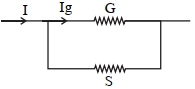
$A$ teacher in his physics laboratory allotted an experiment to determine the resistance $(G)$ of a galvanometer. Students took the observations for $\frac{1}{3}$ deflection in the galvanometer. Which of the following is true for measuring the value of $G$?
A
The $\frac{1}{3}$ deflection method cannot be used for determining the resistance of the galvanometer.
B
The $\frac{1}{3}$ deflection method can be used,and in this case,$G$ equals twice the value of the shunt resistance $(S)$.
C
The $\frac{1}{3}$ deflection method can be used,and in this case,$G$ equals three times the value of the shunt resistance $(S)$.
D
The $\frac{1}{3}$ deflection method can be used,and in this case,$G$ equals the shunt resistance $(S)$.
Solution
(B) In the half-deflection or fractional-deflection method,the galvanometer is connected in parallel with a shunt resistance $S$.
Since the galvanometer and shunt are in parallel,the potential difference across them is the same:
$(I - I_g) S = I_g G$
Where $I$ is the total current,$I_g$ is the current through the galvanometer,and $G$ is the galvanometer resistance.
Rearranging the terms,we get the ratio of currents as:
$\frac{I_g}{I} = \frac{S}{S + G}$
Given that the deflection is $\frac{1}{3}$ of the initial value,the current through the galvanometer becomes $I_g = \frac{1}{3} I$,which implies $\frac{I_g}{I} = \frac{1}{3}$.
Substituting this into the equation:
$\frac{1}{3} = \frac{S}{S + G}$
$S + G = 3S$
$G = 2S$
Thus,the resistance of the galvanometer is twice the value of the shunt resistance used.
Since the galvanometer and shunt are in parallel,the potential difference across them is the same:
$(I - I_g) S = I_g G$
Where $I$ is the total current,$I_g$ is the current through the galvanometer,and $G$ is the galvanometer resistance.
Rearranging the terms,we get the ratio of currents as:
$\frac{I_g}{I} = \frac{S}{S + G}$
Given that the deflection is $\frac{1}{3}$ of the initial value,the current through the galvanometer becomes $I_g = \frac{1}{3} I$,which implies $\frac{I_g}{I} = \frac{1}{3}$.
Substituting this into the equation:
$\frac{1}{3} = \frac{S}{S + G}$
$S + G = 3S$
$G = 2S$
Thus,the resistance of the galvanometer is twice the value of the shunt resistance used.
0 likes
View Solution214
MediumMCQ
$A$ $72 \; \Omega$ galvanometer is shunted by a resistance of $8 \; \Omega$. The percentage of the total current which passes through the galvanometer is $.....$
A
$0.1$
B
$10$
C
$25$
D
$0.25$
Solution
(B) Let $G = 72 \; \Omega$ be the resistance of the galvanometer and $S = 8 \; \Omega$ be the shunt resistance.
The current $I$ divides into $I_g$ (current through the galvanometer) and $I_s$ (current through the shunt).
According to the principle of parallel circuits,the voltage across the galvanometer and the shunt is the same: $I_g G = I_s S$.
Since $I = I_g + I_s$,we have $I_s = I - I_g$.
Substituting this into the equation: $I_g G = (I - I_g) S$.
Rearranging to find the ratio $\frac{I_g}{I}$: $I_g G = I S - I_g S \Rightarrow I_g (G + S) = I S$.
Therefore,$\frac{I_g}{I} = \frac{S}{G + S}$.
Substituting the values: $\frac{I_g}{I} = \frac{8}{72 + 8} = \frac{8}{80} = \frac{1}{10}$.
The percentage of the total current passing through the galvanometer is $\frac{I_g}{I} \times 100 = \frac{1}{10} \times 100 = 10 \%$.
The current $I$ divides into $I_g$ (current through the galvanometer) and $I_s$ (current through the shunt).
According to the principle of parallel circuits,the voltage across the galvanometer and the shunt is the same: $I_g G = I_s S$.
Since $I = I_g + I_s$,we have $I_s = I - I_g$.
Substituting this into the equation: $I_g G = (I - I_g) S$.
Rearranging to find the ratio $\frac{I_g}{I}$: $I_g G = I S - I_g S \Rightarrow I_g (G + S) = I S$.
Therefore,$\frac{I_g}{I} = \frac{S}{G + S}$.
Substituting the values: $\frac{I_g}{I} = \frac{8}{72 + 8} = \frac{8}{80} = \frac{1}{10}$.
The percentage of the total current passing through the galvanometer is $\frac{I_g}{I} \times 100 = \frac{1}{10} \times 100 = 10 \%$.
0 likes
View Solution215
MediumMCQ
The current sensitivity of a galvanometer can be increased by:
$(A)$ decreasing the number of turns
$(B)$ increasing the magnetic field
$(C)$ decreasing the area of the coil
$(D)$ decreasing the torsional constant of the spring
Choose the most appropriate answer from the options given below.
$(A)$ decreasing the number of turns
$(B)$ increasing the magnetic field
$(C)$ decreasing the area of the coil
$(D)$ decreasing the torsional constant of the spring
Choose the most appropriate answer from the options given below.
A
$(B)$ and $(C)$ only
B
$(C)$ and $(D)$ only
C
$(A)$ and $(C)$ only
D
$(B)$ and $(D)$ only
Solution
(D) The current sensitivity $(I_s)$ of a galvanometer is defined as the deflection produced per unit current,given by the formula:
$I_s = \frac{\theta}{i} = \frac{NAB}{K}$
where:
$N$ = number of turns in the coil
$A$ = area of the coil
$B$ = magnetic field strength
$K$ = torsional constant of the spring
From the formula,$I_s \propto N$,$I_s \propto A$,$I_s \propto B$,and $I_s \propto \frac{1}{K}$.
To increase the current sensitivity,we must:
$1$. Increase the number of turns $(N)$.
$2$. Increase the area of the coil $(A)$.
$3$. Increase the magnetic field $(B)$.
$4$. Decrease the torsional constant of the spring $(K)$.
Comparing these requirements with the given options,increasing the magnetic field $(B)$ and decreasing the torsional constant $(D)$ will increase the current sensitivity. Therefore,the correct option is $(B)$ and $(D)$ only.
$I_s = \frac{\theta}{i} = \frac{NAB}{K}$
where:
$N$ = number of turns in the coil
$A$ = area of the coil
$B$ = magnetic field strength
$K$ = torsional constant of the spring
From the formula,$I_s \propto N$,$I_s \propto A$,$I_s \propto B$,and $I_s \propto \frac{1}{K}$.
To increase the current sensitivity,we must:
$1$. Increase the number of turns $(N)$.
$2$. Increase the area of the coil $(A)$.
$3$. Increase the magnetic field $(B)$.
$4$. Decrease the torsional constant of the spring $(K)$.
Comparing these requirements with the given options,increasing the magnetic field $(B)$ and decreasing the torsional constant $(D)$ will increase the current sensitivity. Therefore,the correct option is $(B)$ and $(D)$ only.
0 likes
View Solution216
AdvancedMCQ
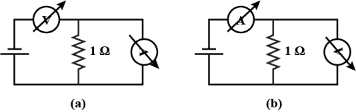
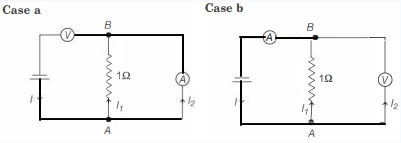
$A$ student uses the resistance of a known resistor $(1 \,\Omega)$ to calibrate a voltmeter and an ammeter using the circuits shown below. The student measures the ratio of the voltage to current to be $1 \times 10^3 \,\Omega$ in circuit $(a)$ and $0.999 \,\Omega$ in circuit $(b)$. From these measurements,the resistance (in $\Omega$) of the voltmeter and ammeter are found to be close to
A
$10^2$ and $10^{-2}$
B
$10^3$ and $10^{-3}$
C
$10^{-2}$ and $10^2$
D
$10^{-2}$ and $10^3$
Solution
(B) In circuit $(a)$,the voltmeter is in series with the $1 \,\Omega$ resistor,and the ammeter is in parallel with the $1 \,\Omega$ resistor. Let $R_V$ be the resistance of the voltmeter and $R_A$ be the resistance of the ammeter. The voltage across the $1 \,\Omega$ resistor is $V = I_1 \times 1$. The current through the ammeter is $I_2 = V / R_A = I_1 / R_A$. The total current $I = I_1 + I_2 = I_1(1 + 1/R_A)$. The voltmeter reading is $V_m = I \times R_V$. The ratio of voltage to current is $V_m / I = R_V = 1000 \,\Omega$ (assuming the voltmeter measures the total voltage drop across the series combination). However,based on the circuit,the ratio $V/I$ given is $1000 \,\Omega$. From the circuit $(a)$,the effective resistance is $R_{eq} = R_V + (1 \parallel R_A) \approx R_V = 1000 \,\Omega$.
In circuit $(b)$,the ammeter is in series with the $1 \,\Omega$ resistor,and the voltmeter is in parallel with the $1 \,\Omega$ resistor. The effective resistance is $R_{eq} = R_A + (1 \parallel R_V) \approx R_A + 1 = 0.999 \,\Omega$. Since $R_V$ is large,$1 \parallel R_V \approx 1 \,\Omega$. Thus $R_A + 1 = 0.999$,which implies $R_A \approx 0$ (or $10^{-3} \,\Omega$).
Thus,$R_V = 10^3 \,\Omega$ and $R_A = 10^{-3} \,\Omega$.
In circuit $(b)$,the ammeter is in series with the $1 \,\Omega$ resistor,and the voltmeter is in parallel with the $1 \,\Omega$ resistor. The effective resistance is $R_{eq} = R_A + (1 \parallel R_V) \approx R_A + 1 = 0.999 \,\Omega$. Since $R_V$ is large,$1 \parallel R_V \approx 1 \,\Omega$. Thus $R_A + 1 = 0.999$,which implies $R_A \approx 0$ (or $10^{-3} \,\Omega$).
Thus,$R_V = 10^3 \,\Omega$ and $R_A = 10^{-3} \,\Omega$.
0 likes
View Solution217
MediumMCQ
The current sensitivity of a moving coil galvanometer increases by $20 \%$ when its resistance is doubled. Calculate,by what factor does the voltage sensitivity change?
A
Becomes $\frac{3}{5}$ times
B
Becomes $\frac{2}{5}$ times
C
No change
D
Decreases by a factor of $\frac{7}{5}$
Solution
(A) Let the initial current sensitivity be $S_{i_1} = \frac{NAB}{k}$ and initial resistance be $R$.
The initial voltage sensitivity is $S_{v_1} = \frac{S_{i_1}}{R} = \frac{NAB}{kR}$.
According to the problem,the new current sensitivity $S_{i_2} = S_{i_1} + 0.20 S_{i_1} = 1.2 S_{i_1}$.
The new resistance is $R' = 2R$.
The new voltage sensitivity is $S_{v_2} = \frac{S_{i_2}}{R'} = \frac{1.2 S_{i_1}}{2R} = 0.6 \left( \frac{S_{i_1}}{R} \right) = 0.6 S_{v_1}$.
Since $0.6 = \frac{6}{10} = \frac{3}{5}$,the voltage sensitivity becomes $\frac{3}{5}$ times the initial value.
The initial voltage sensitivity is $S_{v_1} = \frac{S_{i_1}}{R} = \frac{NAB}{kR}$.
According to the problem,the new current sensitivity $S_{i_2} = S_{i_1} + 0.20 S_{i_1} = 1.2 S_{i_1}$.
The new resistance is $R' = 2R$.
The new voltage sensitivity is $S_{v_2} = \frac{S_{i_2}}{R'} = \frac{1.2 S_{i_1}}{2R} = 0.6 \left( \frac{S_{i_1}}{R} \right) = 0.6 S_{v_1}$.
Since $0.6 = \frac{6}{10} = \frac{3}{5}$,the voltage sensitivity becomes $\frac{3}{5}$ times the initial value.
0 likes
View Solution218
EasyMCQ
The phosphor bronze strip is used in a moving coil galvanometer because
A
Its torsional constant is small
B
It is easily available
C
It is paramagnetic
D
It is diamagnetic
Solution
(A) In a moving coil galvanometer,the phosphor bronze strip is used as a suspension wire.
The restoring torque per unit twist is known as the torsional constant $(k)$.
For a sensitive galvanometer,we require a small restoring torque for a given deflection,which means the torsional constant $(k)$ should be as small as possible.
Phosphor bronze has a very low torsional constant,which allows the coil to rotate even for very small currents,thereby increasing the sensitivity of the instrument.
Additionally,phosphor bronze is non-magnetic and does not oxidize easily,making it ideal for this purpose.
Therefore,the correct option is $A$.
The restoring torque per unit twist is known as the torsional constant $(k)$.
For a sensitive galvanometer,we require a small restoring torque for a given deflection,which means the torsional constant $(k)$ should be as small as possible.
Phosphor bronze has a very low torsional constant,which allows the coil to rotate even for very small currents,thereby increasing the sensitivity of the instrument.
Additionally,phosphor bronze is non-magnetic and does not oxidize easily,making it ideal for this purpose.
Therefore,the correct option is $A$.
0 likes
View Solution219
MediumMCQ
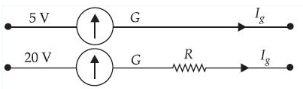
$A$ voltmeter of resistance $20000\,\Omega$ reads $5 \text{ V}$. To make it read $20 \text{ V}$,the extra resistance required is
A
$40000\,\Omega$ in parallel
B
$60000\,\Omega$ in parallel
C
$60000\,\Omega$ in series
D
$40000\,\Omega$ in series
Solution
(C) For a voltmeter,the current $I_g$ passing through it is given by $V = I_g G$,where $G$ is the resistance of the voltmeter.
Initially,for a range of $5 \text{ V}$:
$5 = I_g \times 20000 \quad \dots(i)$
To increase the range to $20 \text{ V}$,we connect an additional resistance $R$ in series with the voltmeter. The new total resistance becomes $(G + R)$.
For the new range of $20 \text{ V}$:
$20 = I_g \times (G + R) \quad \dots(ii)$
Dividing equation $(ii)$ by equation $(i)$:
$\frac{20}{5} = \frac{I_g(G + R)}{I_g G}$
$4 = \frac{G + R}{G}$
$4G = G + R$
$R = 3G$
Given $G = 20000\,\Omega$,we have:
$R = 3 \times 20000 = 60000\,\Omega$
Thus,an extra resistance of $60000\,\Omega$ must be connected in series.
Initially,for a range of $5 \text{ V}$:
$5 = I_g \times 20000 \quad \dots(i)$
To increase the range to $20 \text{ V}$,we connect an additional resistance $R$ in series with the voltmeter. The new total resistance becomes $(G + R)$.
For the new range of $20 \text{ V}$:
$20 = I_g \times (G + R) \quad \dots(ii)$
Dividing equation $(ii)$ by equation $(i)$:
$\frac{20}{5} = \frac{I_g(G + R)}{I_g G}$
$4 = \frac{G + R}{G}$
$4G = G + R$
$R = 3G$
Given $G = 20000\,\Omega$,we have:
$R = 3 \times 20000 = 60000\,\Omega$
Thus,an extra resistance of $60000\,\Omega$ must be connected in series.
0 likes
View Solution220
MediumMCQ
For a moving coil galvanometer,the deflection in the coil is $0.05\,rad$ when a current of $10\,mA$ is passed through it. If the torsional constant of the suspension wire is $4.0 \times 10^{-5}\,Nm\,rad^{-1}$,the magnetic field is $0.01\,T$,and the number of turns in the coil is $200$,the area of each turn (in $cm^2$) is:
A
$2$
B
$1$
C
$1.5$
D
$0.5$
Solution
(B) The torque acting on the coil of a moving coil galvanometer is given by $\tau = NiAB$,where $N$ is the number of turns,$i$ is the current,$A$ is the area,and $B$ is the magnetic field.
The restoring torque provided by the suspension wire is $\tau = K\theta$,where $K$ is the torsional constant and $\theta$ is the deflection.
Equating the two torques: $NiAB = K\theta$.
Rearranging for the area $A$: $A = \frac{K\theta}{NiB}$.
Given values:
$K = 4.0 \times 10^{-5}\,Nm\,rad^{-1}$
$\theta = 0.05\,rad$
$N = 200$
$i = 10\,mA = 10 \times 10^{-3}\,A = 0.01\,A$
$B = 0.01\,T$
Substituting the values:
$A = \frac{4.0 \times 10^{-5} \times 0.05}{200 \times 0.01 \times 0.01}$
$A = \frac{2.0 \times 10^{-6}}{0.02} = 1.0 \times 10^{-4}\,m^2$.
Since $1\,m^2 = 10^4\,cm^2$,we have:
$A = 1.0 \times 10^{-4} \times 10^4\,cm^2 = 1\,cm^2$.
The restoring torque provided by the suspension wire is $\tau = K\theta$,where $K$ is the torsional constant and $\theta$ is the deflection.
Equating the two torques: $NiAB = K\theta$.
Rearranging for the area $A$: $A = \frac{K\theta}{NiB}$.
Given values:
$K = 4.0 \times 10^{-5}\,Nm\,rad^{-1}$
$\theta = 0.05\,rad$
$N = 200$
$i = 10\,mA = 10 \times 10^{-3}\,A = 0.01\,A$
$B = 0.01\,T$
Substituting the values:
$A = \frac{4.0 \times 10^{-5} \times 0.05}{200 \times 0.01 \times 0.01}$
$A = \frac{2.0 \times 10^{-6}}{0.02} = 1.0 \times 10^{-4}\,m^2$.
Since $1\,m^2 = 10^4\,cm^2$,we have:
$A = 1.0 \times 10^{-4} \times 10^4\,cm^2 = 1\,cm^2$.
0 likes
View Solution221
MediumMCQ
The number of turns of the coil of a moving coil galvanometer is increased in order to increase current sensitivity by $50 \%$. The percentage change in voltage sensitivity of the galvanometer will be $..........\%$
A
$100$
B
$50$
C
$75$
D
$0$
Solution
(D) Current sensitivity $(I_s)$ of a moving coil galvanometer is given by $I_s = \frac{NBA}{k}$,where $N$ is the number of turns,$B$ is the magnetic field,$A$ is the area,and $k$ is the torsional constant.
Since $I_s \propto N$,if $I_s$ increases by $50 \%$,the new number of turns $N' = 1.5N$.
Voltage sensitivity $(V_s)$ is given by $V_s = \frac{I_s}{R}$,where $R$ is the resistance of the coil.
Resistance $R$ is proportional to the length of the wire,and length is proportional to the number of turns $(R \propto N)$.
Therefore,$V_s = \frac{I_s}{R} \propto \frac{N}{N} = \text{constant}$.
Since $V_s$ is independent of the number of turns $N$,the voltage sensitivity remains unchanged.
Thus,the percentage change in voltage sensitivity is $0 \%$.
Since $I_s \propto N$,if $I_s$ increases by $50 \%$,the new number of turns $N' = 1.5N$.
Voltage sensitivity $(V_s)$ is given by $V_s = \frac{I_s}{R}$,where $R$ is the resistance of the coil.
Resistance $R$ is proportional to the length of the wire,and length is proportional to the number of turns $(R \propto N)$.
Therefore,$V_s = \frac{I_s}{R} \propto \frac{N}{N} = \text{constant}$.
Since $V_s$ is independent of the number of turns $N$,the voltage sensitivity remains unchanged.
Thus,the percentage change in voltage sensitivity is $0 \%$.
0 likes
View Solution222
MediumMCQ
Given below are two statements: One is labelled as Assertion $A$ and the other is labelled as Reason $R$.
Assertion $A:$ For measuring the potential difference across a resistance of $600\,\Omega$,the voltmeter with resistance $1000\,\Omega$ will be preferred over a voltmeter with resistance $4000\,\Omega$.
Reason $R:$ $A$ voltmeter with higher resistance will draw smaller current than a voltmeter with lower resistance.
In the light of the above statements,choose the most appropriate answer from the options given below.
Assertion $A:$ For measuring the potential difference across a resistance of $600\,\Omega$,the voltmeter with resistance $1000\,\Omega$ will be preferred over a voltmeter with resistance $4000\,\Omega$.
Reason $R:$ $A$ voltmeter with higher resistance will draw smaller current than a voltmeter with lower resistance.
In the light of the above statements,choose the most appropriate answer from the options given below.
A
$A$ is not correct but $R$ is correct
B
Both $A$ and $R$ are correct and $R$ is the correct explanation of $A$
C
Both $A$ and $R$ are correct but $R$ is not the correct explanation of $A$
D
$A$ is correct but $R$ is not correct
Solution
(A) voltmeter is connected in parallel to the component across which the potential difference is to be measured.
To minimize the loading effect and ensure the measured voltage is as close to the actual voltage as possible,the resistance of the voltmeter should be as high as possible.
Assertion $A$ is incorrect because a voltmeter with $4000\,\Omega$ resistance is preferred over one with $1000\,\Omega$ resistance,as higher resistance draws less current from the circuit,thereby reducing the error in measurement.
Reason $R$ is correct because,by Ohm's law $(I = V/R)$,for a given voltage $V$,a higher resistance $R$ results in a smaller current $I$ being drawn by the voltmeter.
Therefore,$A$ is incorrect but $R$ is correct.
To minimize the loading effect and ensure the measured voltage is as close to the actual voltage as possible,the resistance of the voltmeter should be as high as possible.
Assertion $A$ is incorrect because a voltmeter with $4000\,\Omega$ resistance is preferred over one with $1000\,\Omega$ resistance,as higher resistance draws less current from the circuit,thereby reducing the error in measurement.
Reason $R$ is correct because,by Ohm's law $(I = V/R)$,for a given voltage $V$,a higher resistance $R$ results in a smaller current $I$ being drawn by the voltmeter.
Therefore,$A$ is incorrect but $R$ is correct.
0 likes
View Solution223
MediumMCQ
$A$ student is provided with a variable voltage source $V$,a test resistor $R_T=10\,\Omega$,two identical galvanometers $G_1$ and $G_2$,and two additional resistors,$R_1=10\,M\,\Omega$ and $R_2=0.001\,\Omega$. For conducting an experiment to verify Ohm's law,the most suitable circuit is:
A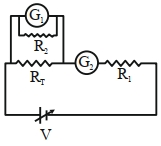
B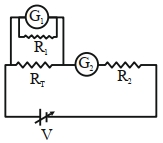
C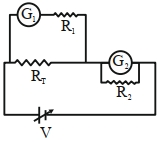
D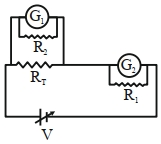
Solution
(C) To verify Ohm's law $(V=IR)$,we need to measure the voltage across the test resistor $R_T$ and the current flowing through it.
$1$. $A$ voltmeter is connected in parallel to the resistor. To convert a galvanometer into a voltmeter,a very high resistance must be connected in series with it. Here,$R_1=10\,M\,\Omega$ is a very high resistance,so $G_1$ in series with $R_1$ acts as a voltmeter.
$2$. An ammeter is connected in series with the resistor. To convert a galvanometer into an ammeter,a very low resistance must be connected in parallel with it. Here,$R_2=0.001\,\Omega$ is a very low resistance,so $G_2$ in parallel with $R_2$ acts as an ammeter.
$3$. In circuit $C$,$G_1$ is in series with $R_1$ (forming a voltmeter) and this combination is in parallel with $R_T$. $G_2$ is in parallel with $R_2$ (forming an ammeter) and this combination is in series with $R_T$. This is the correct configuration for verifying Ohm's law.
$1$. $A$ voltmeter is connected in parallel to the resistor. To convert a galvanometer into a voltmeter,a very high resistance must be connected in series with it. Here,$R_1=10\,M\,\Omega$ is a very high resistance,so $G_1$ in series with $R_1$ acts as a voltmeter.
$2$. An ammeter is connected in series with the resistor. To convert a galvanometer into an ammeter,a very low resistance must be connected in parallel with it. Here,$R_2=0.001\,\Omega$ is a very low resistance,so $G_2$ in parallel with $R_2$ acts as an ammeter.
$3$. In circuit $C$,$G_1$ is in series with $R_1$ (forming a voltmeter) and this combination is in parallel with $R_T$. $G_2$ is in parallel with $R_2$ (forming an ammeter) and this combination is in series with $R_T$. This is the correct configuration for verifying Ohm's law.
0 likes
View Solution224
EasyMCQ
Certain galvanometers have a fixed core made of non-magnetic metallic material. The function of this metallic material is
A
to oscillate the coil in magnetic field for a longer period of time
B
to bring the coil to rest quickly
C
to produce a large deflecting torque on the coil
D
to make the magnetic field radial
Solution
(B) When the coil of the galvanometer moves in the magnetic field,the magnetic flux linked with the non-magnetic metallic core changes.
This change in magnetic flux induces eddy currents in the metallic core.
According to Lenz's law,these eddy currents oppose the motion of the coil.
As a result,the coil is brought to rest quickly,providing electromagnetic damping.
This change in magnetic flux induces eddy currents in the metallic core.
According to Lenz's law,these eddy currents oppose the motion of the coil.
As a result,the coil is brought to rest quickly,providing electromagnetic damping.
0 likes
View Solution225
MediumMCQ
Given below are two statements:
Statement $I$: If the number of turns in the coil of a moving coil galvanometer is doubled,then the current sensitivity becomes double.
Statement $II$: Increasing the current sensitivity of a moving coil galvanometer by only increasing the number of turns in the coil will also increase its voltage sensitivity in the same ratio.
In the light of the above statements,choose the correct answer from the options given below:
Statement $I$: If the number of turns in the coil of a moving coil galvanometer is doubled,then the current sensitivity becomes double.
Statement $II$: Increasing the current sensitivity of a moving coil galvanometer by only increasing the number of turns in the coil will also increase its voltage sensitivity in the same ratio.
In the light of the above statements,choose the correct answer from the options given below:
A
Statement $I$ is false but Statement $II$ is true.
B
Both Statement $I$ and Statement $II$ are true.
C
Both Statement $I$ and Statement $II$ are false.
D
Statement $I$ is true but Statement $II$ is false.
Solution
(D) For a moving coil galvanometer,the torque is given by $\tau = NIAB \sin \theta = k \phi$,where $N$ is the number of turns,$I$ is the current,$A$ is the area,$B$ is the magnetic field,and $k$ is the torsional constant.
The current sensitivity is defined as $S_i = \frac{\phi}{I} = \frac{NBA}{k}$.
If $N$ is doubled,$S_i$ becomes $2 \times \frac{NBA}{k}$,so Statement $I$ is true.
The voltage sensitivity is defined as $S_v = \frac{\phi}{V} = \frac{\phi}{IR} = \frac{S_i}{R} = \frac{NBA}{kR}$.
When the number of turns $N$ is doubled,the length of the wire in the coil also doubles,which means the resistance $R$ of the coil also doubles $(R \propto N)$.
Therefore,$S_v = \frac{(2N)BA}{k(2R)} = \frac{NBA}{kR}$.
Since $S_v$ remains unchanged,Statement $II$ is false.
The current sensitivity is defined as $S_i = \frac{\phi}{I} = \frac{NBA}{k}$.
If $N$ is doubled,$S_i$ becomes $2 \times \frac{NBA}{k}$,so Statement $I$ is true.
The voltage sensitivity is defined as $S_v = \frac{\phi}{V} = \frac{\phi}{IR} = \frac{S_i}{R} = \frac{NBA}{kR}$.
When the number of turns $N$ is doubled,the length of the wire in the coil also doubles,which means the resistance $R$ of the coil also doubles $(R \propto N)$.
Therefore,$S_v = \frac{(2N)BA}{k(2R)} = \frac{NBA}{kR}$.
Since $S_v$ remains unchanged,Statement $II$ is false.
0 likes
View Solution226
MediumMCQ
The current sensitivity of a moving coil galvanometer is increased by $25 \%$. This increase is achieved only by changing the number of turns of the coils and the area of the cross-section of the wire while keeping the resistance of the galvanometer coil constant. The percentage change in the voltage sensitivity will be $...........\%$
A
$+25$
B
$-50$
C
$0$
D
$-25$
Solution
(A) The current sensitivity of a moving coil galvanometer is given by $I_s = \frac{NBA}{C}$,where $N$ is the number of turns,$B$ is the magnetic field,$A$ is the area,and $C$ is the torsional constant.
The voltage sensitivity is given by $V_s = \frac{I_s}{G}$,where $G$ is the resistance of the galvanometer coil.
Given that the resistance $G$ is kept constant,the relationship between voltage sensitivity and current sensitivity is $V_s \propto I_s$.
Since the current sensitivity $I_s$ increases by $25 \%$,the voltage sensitivity $V_s$ will also increase by $25 \%$ because the ratio $\frac{1}{G}$ is constant.
Therefore,the percentage change in voltage sensitivity is $25 \%$.
The voltage sensitivity is given by $V_s = \frac{I_s}{G}$,where $G$ is the resistance of the galvanometer coil.
Given that the resistance $G$ is kept constant,the relationship between voltage sensitivity and current sensitivity is $V_s \propto I_s$.
Since the current sensitivity $I_s$ increases by $25 \%$,the voltage sensitivity $V_s$ will also increase by $25 \%$ because the ratio $\frac{1}{G}$ is constant.
Therefore,the percentage change in voltage sensitivity is $25 \%$.
0 likes
View Solution227
DifficultMCQ
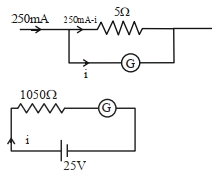
When a resistance of $5\,\Omega$ is shunted with a moving coil galvanometer,it shows a full scale deflection for a current of $250\,mA$. However,when a $1050\,\Omega$ resistance is connected with it in series,it gives full scale deflection for $25\,V$. The resistance of the galvanometer is $......\,\Omega$.
A
$40$
B
$30$
C
$50$
D
$20$
Solution
(C) Let $I_g$ be the full-scale deflection current of the galvanometer and $R_G$ be its resistance.
Case $1$: Shunting with $5\,\Omega$ resistance.
The total current is $I = 250\,mA = 0.25\,A$. The shunt resistance $S = 5\,\Omega$.
Using the current division rule: $I_g = I \times \frac{S}{S + R_G}$
$I_g = 0.25 \times \frac{5}{5 + R_G} \dots(i)$
Case $2$: Connecting $1050\,\Omega$ in series.
The total voltage is $V = 25\,V$. The series resistance $R = 1050\,\Omega$.
Using Ohm's law: $I_g = \frac{V}{R + R_G}$
$I_g = \frac{25}{1050 + R_G} \dots(ii)$
Equating $(i)$ and $(ii)$:
$0.25 \times \frac{5}{5 + R_G} = \frac{25}{1050 + R_G}$
$\frac{1.25}{5 + R_G} = \frac{25}{1050 + R_G}$
$1.25(1050 + R_G) = 25(5 + R_G)$
$1312.5 + 1.25 R_G = 125 + 25 R_G$
$1312.5 - 125 = 25 R_G - 1.25 R_G$
$1187.5 = 23.75 R_G$
$R_G = \frac{1187.5}{23.75} = 50\,\Omega$
Case $1$: Shunting with $5\,\Omega$ resistance.
The total current is $I = 250\,mA = 0.25\,A$. The shunt resistance $S = 5\,\Omega$.
Using the current division rule: $I_g = I \times \frac{S}{S + R_G}$
$I_g = 0.25 \times \frac{5}{5 + R_G} \dots(i)$
Case $2$: Connecting $1050\,\Omega$ in series.
The total voltage is $V = 25\,V$. The series resistance $R = 1050\,\Omega$.
Using Ohm's law: $I_g = \frac{V}{R + R_G}$
$I_g = \frac{25}{1050 + R_G} \dots(ii)$
Equating $(i)$ and $(ii)$:
$0.25 \times \frac{5}{5 + R_G} = \frac{25}{1050 + R_G}$
$\frac{1.25}{5 + R_G} = \frac{25}{1050 + R_G}$
$1.25(1050 + R_G) = 25(5 + R_G)$
$1312.5 + 1.25 R_G = 125 + 25 R_G$
$1312.5 - 125 = 25 R_G - 1.25 R_G$
$1187.5 = 23.75 R_G$
$R_G = \frac{1187.5}{23.75} = 50\,\Omega$
0 likes
View Solution228
MediumMCQ
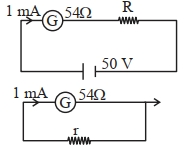
For designing a voltmeter of range $50\,V$ and an ammeter of range $10\,mA$ using a galvanometer which has a coil of resistance $54\,\Omega$ showing a full scale deflection for $1\,mA$ as in figure.
$(A)$ for voltmeter $R \approx 50\,k\Omega$
$(B)$ for ammeter $r \approx 0.2\,\Omega$
$(C)$ for ammeter $r \approx 6\,\Omega$
$(D)$ for voltmeter $R \approx 5\,k \Omega$
$(E)$ for voltmeter $R \approx 500 \Omega$
Choose the correct answer from the options given below
$(A)$ for voltmeter $R \approx 50\,k\Omega$
$(B)$ for ammeter $r \approx 0.2\,\Omega$
$(C)$ for ammeter $r \approx 6\,\Omega$
$(D)$ for voltmeter $R \approx 5\,k \Omega$
$(E)$ for voltmeter $R \approx 500 \Omega$
Choose the correct answer from the options given below
A
$(C)$ and $(E)$
B
$(C)$ and $(D)$
C
$(A)$ and $(C)$
D
$(A)$ and $(B)$
Solution
(C) For the voltmeter:
The resistance $R$ to be connected in series is given by $R = \frac{V}{I_g} - G$.
Given $V = 50\,V$,$I_g = 1\,mA = 10^{-3}\,A$,and $G = 54\,\Omega$.
$R = \frac{50}{10^{-3}} - 54 = 50000 - 54 = 49946\,\Omega \approx 50\,k\Omega$.
Thus,statement $(A)$ is correct.
For the ammeter:
The shunt resistance $r$ to be connected in parallel is given by $r = \frac{I_g G}{I - I_g}$.
Given $I = 10\,mA = 10^{-2}\,A$,$I_g = 1\,mA = 10^{-3}\,A$,and $G = 54\,\Omega$.
$r = \frac{10^{-3} \times 54}{10 \times 10^{-3} - 1 \times 10^{-3}} = \frac{54 \times 10^{-3}}{9 \times 10^{-3}} = 6\,\Omega$.
Thus,statement $(C)$ is correct.
Therefore,the correct option is $(A)$ and $(C)$.
The resistance $R$ to be connected in series is given by $R = \frac{V}{I_g} - G$.
Given $V = 50\,V$,$I_g = 1\,mA = 10^{-3}\,A$,and $G = 54\,\Omega$.
$R = \frac{50}{10^{-3}} - 54 = 50000 - 54 = 49946\,\Omega \approx 50\,k\Omega$.
Thus,statement $(A)$ is correct.
For the ammeter:
The shunt resistance $r$ to be connected in parallel is given by $r = \frac{I_g G}{I - I_g}$.
Given $I = 10\,mA = 10^{-2}\,A$,$I_g = 1\,mA = 10^{-3}\,A$,and $G = 54\,\Omega$.
$r = \frac{10^{-3} \times 54}{10 \times 10^{-3} - 1 \times 10^{-3}} = \frac{54 \times 10^{-3}}{9 \times 10^{-3}} = 6\,\Omega$.
Thus,statement $(C)$ is correct.
Therefore,the correct option is $(A)$ and $(C)$.
0 likes
View Solution229
DifficultMCQ
$A$ current of $200 \ \mu A$ deflects the coil of a moving coil galvanometer through $60^{\circ}$. The current required to cause a deflection of $\frac{\pi}{10}$ radians is: (in $\mu A$)
A
$30$
B
$120$
C
$60$
D
$180$
Solution
(C) In a moving coil galvanometer,the deflection $\theta$ is directly proportional to the current $i$ flowing through the coil,given by $i = k\theta$,where $k$ is the galvanometer constant.
Given:
$i_1 = 200 \ \mu A$
$\theta_1 = 60^{\circ} = 60 \times \frac{\pi}{180} \text{ radians} = \frac{\pi}{3} \text{ radians}$
$\theta_2 = \frac{\pi}{10} \text{ radians}$
Using the proportionality $i \propto \theta$,we have:
$\frac{i_2}{i_1} = \frac{\theta_2}{\theta_1}$
Substituting the values:
$\frac{i_2}{200 \ \mu A} = \frac{\pi / 10}{\pi / 3}$
$\frac{i_2}{200 \ \mu A} = \frac{3}{10}$
Solving for $i_2$:
$i_2 = 200 \ \mu A \times \frac{3}{10} = 60 \ \mu A$
Given:
$i_1 = 200 \ \mu A$
$\theta_1 = 60^{\circ} = 60 \times \frac{\pi}{180} \text{ radians} = \frac{\pi}{3} \text{ radians}$
$\theta_2 = \frac{\pi}{10} \text{ radians}$
Using the proportionality $i \propto \theta$,we have:
$\frac{i_2}{i_1} = \frac{\theta_2}{\theta_1}$
Substituting the values:
$\frac{i_2}{200 \ \mu A} = \frac{\pi / 10}{\pi / 3}$
$\frac{i_2}{200 \ \mu A} = \frac{3}{10}$
Solving for $i_2$:
$i_2 = 200 \ \mu A \times \frac{3}{10} = 60 \ \mu A$
0 likes
View Solution230
DifficultMCQ
$A$ galvanometer having coil resistance $10 \ \Omega$ shows a full scale deflection for a current of $3 \ mA$. For it to measure a current of $8 \ A$,the value of the shunt should be:
A
$3 \times 10^{-3} \ \Omega$
B
$4.85 \times 10^{-3} \ \Omega$
C
$3.75 \times 10^{-3} \ \Omega$
D
$2.75 \times 10^{-3} \ \Omega$
Solution
(C) Given:
Galvanometer resistance,$G = 10 \ \Omega$
Full scale deflection current,$I_g = 3 \ mA = 3 \times 10^{-3} \ A$
Range of ammeter,$I = 8 \ A$
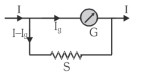
To convert a galvanometer into an ammeter,a shunt resistance $S$ is connected in parallel with the galvanometer.
The potential difference across the galvanometer and the shunt must be equal:
$I_g G = (I - I_g) S$
Rearranging for $S$:
$S = \frac{I_g G}{I - I_g}$
Substituting the values:
$S = \frac{(3 \times 10^{-3} \ A) \times 10 \ \Omega}{8 \ A - 3 \times 10^{-3} \ A}$
$S = \frac{0.03}{8 - 0.003} \ \Omega$
$S = \frac{0.03}{7.997} \ \Omega \approx 3.75 \times 10^{-3} \ \Omega$
Thus,the required shunt resistance is $3.75 \times 10^{-3} \ \Omega$.
Galvanometer resistance,$G = 10 \ \Omega$
Full scale deflection current,$I_g = 3 \ mA = 3 \times 10^{-3} \ A$
Range of ammeter,$I = 8 \ A$
To convert a galvanometer into an ammeter,a shunt resistance $S$ is connected in parallel with the galvanometer.
The potential difference across the galvanometer and the shunt must be equal:
$I_g G = (I - I_g) S$
Rearranging for $S$:
$S = \frac{I_g G}{I - I_g}$
Substituting the values:
$S = \frac{(3 \times 10^{-3} \ A) \times 10 \ \Omega}{8 \ A - 3 \times 10^{-3} \ A}$
$S = \frac{0.03}{8 - 0.003} \ \Omega$
$S = \frac{0.03}{7.997} \ \Omega \approx 3.75 \times 10^{-3} \ \Omega$
Thus,the required shunt resistance is $3.75 \times 10^{-3} \ \Omega$.
0 likes
View Solution231
DifficultMCQ
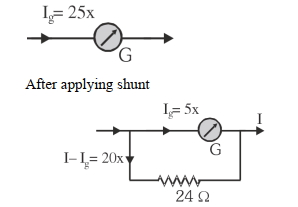
The deflection in a moving coil galvanometer falls from $25$ divisions to $5$ divisions when a shunt of $24\ \Omega$ is applied. The resistance of the galvanometer coil will be: (in $Omega$)
A
$12$
B
$96$
C
$48$
D
$100$
Solution
(B) Let $k$ be the current per division of the galvanometer.
Initially,the total current $I = 25k$ flows through the galvanometer.
When a shunt resistance $S = 24\ \Omega$ is connected in parallel,the deflection becomes $5$ divisions,meaning the current through the galvanometer is $I_g = 5k$.
The remaining current flows through the shunt: $I_s = I - I_g = 25k - 5k = 20k$.
Since the galvanometer and shunt are in parallel,the potential difference across them is the same:
$I_g \times G = I_s \times S$
$(5k) \times G = (20k) \times 24$
$5G = 480$
$G = 96\ \Omega$
Thus,the resistance of the galvanometer coil is $96\ \Omega$.
Initially,the total current $I = 25k$ flows through the galvanometer.
When a shunt resistance $S = 24\ \Omega$ is connected in parallel,the deflection becomes $5$ divisions,meaning the current through the galvanometer is $I_g = 5k$.
The remaining current flows through the shunt: $I_s = I - I_g = 25k - 5k = 20k$.
Since the galvanometer and shunt are in parallel,the potential difference across them is the same:
$I_g \times G = I_s \times S$
$(5k) \times G = (20k) \times 24$
$5G = 480$
$G = 96\ \Omega$
Thus,the resistance of the galvanometer coil is $96\ \Omega$.
0 likes
View Solution232
DifficultMCQ
$A$ galvanometer has a resistance of $50 \ \Omega$ and it allows a maximum current of $5 \ mA$. It can be converted into a voltmeter to measure up to $100 \ V$ by connecting in series a resistor of resistance: (in $Omega$)
A
$5975$
B
$20050$
C
$19950$
D
$19500$
Solution
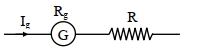
(C) To convert a galvanometer into a voltmeter,a high resistance $R$ is connected in series with the galvanometer.
Given:
Resistance of galvanometer,$R_g = 50 \ \Omega$
Maximum current for full-scale deflection,$I_g = 5 \ mA = 5 \times 10^{-3} \ A$
Required voltage range,$V = 100 \ V$
The formula for the series resistance $R$ is given by:
$V = I_g(R + R_g)$
$R + R_g = \frac{V}{I_g}$
$R = \frac{V}{I_g} - R_g$
Substituting the values:
$R = \frac{100}{5 \times 10^{-3}} - 50$
$R = 20000 - 50$
$R = 19950 \ \Omega$
Given:
Resistance of galvanometer,$R_g = 50 \ \Omega$
Maximum current for full-scale deflection,$I_g = 5 \ mA = 5 \times 10^{-3} \ A$
Required voltage range,$V = 100 \ V$
The formula for the series resistance $R$ is given by:
$V = I_g(R + R_g)$
$R + R_g = \frac{V}{I_g}$
$R = \frac{V}{I_g} - R_g$
Substituting the values:
$R = \frac{100}{5 \times 10^{-3}} - 50$
$R = 20000 - 50$
$R = 19950 \ \Omega$
0 likes
View Solution233
DifficultMCQ
In an ammeter,$5 \%$ of the main current passes through the galvanometer. If the resistance of the galvanometer is $G$,the resistance of the ammeter will be:
A
$\frac{G}{20}$
B
$\frac{G}{199}$
C
$199 G$
D
$200 G$
Solution
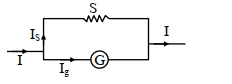
(A) Let the main current be $I$. The current through the galvanometer is $I_g = 5 \% \text{ of } I = \frac{5}{100} I = \frac{I}{20}$.
The current through the shunt resistance $S$ is $I_s = I - I_g = I - \frac{I}{20} = \frac{19I}{20}$.
Since the galvanometer and shunt are in parallel,the potential difference across them is equal: $I_g G = I_s S$.
Substituting the values: $(\frac{I}{20}) G = (\frac{19I}{20}) S$.
Solving for $S$: $S = \frac{G}{19}$.
The total resistance of the ammeter $R_A$ is the equivalent resistance of $G$ and $S$ in parallel: $R_A = \frac{G \cdot S}{G + S}$.
Substituting $S = \frac{G}{19}$: $R_A = \frac{G \cdot (G/19)}{G + (G/19)} = \frac{G^2/19}{20G/19} = \frac{G}{20}$.
The current through the shunt resistance $S$ is $I_s = I - I_g = I - \frac{I}{20} = \frac{19I}{20}$.
Since the galvanometer and shunt are in parallel,the potential difference across them is equal: $I_g G = I_s S$.
Substituting the values: $(\frac{I}{20}) G = (\frac{19I}{20}) S$.
Solving for $S$: $S = \frac{G}{19}$.
The total resistance of the ammeter $R_A$ is the equivalent resistance of $G$ and $S$ in parallel: $R_A = \frac{G \cdot S}{G + S}$.
Substituting $S = \frac{G}{19}$: $R_A = \frac{G \cdot (G/19)}{G + (G/19)} = \frac{G^2/19}{20G/19} = \frac{G}{20}$.
0 likes
View Solution234
DifficultMCQ
$A$ moving coil galvanometer has $100$ turns and each turn has an area of $2.0 \,cm^2$. The magnetic field produced by the magnet is $0.01 \,T$ and the deflection in the coil is $0.05$ radian when a current of $10 \,mA$ is passed through it. The torsional constant of the suspension wire is $x \times 10^{-5} \,N-m / rad$. The value of $x$ is . . . . . . .
A
$8$
B
$7$
C
$4$
D
$3$
Solution
(C) The torque acting on the coil in a magnetic field is given by $\tau = BINA \sin \phi$,where $\phi$ is the angle between the normal to the coil and the magnetic field. In a radial magnetic field,$\phi = 90^{\circ}$,so $\sin 90^{\circ} = 1$.
The restoring torque provided by the suspension wire is $\tau = C \theta$,where $C$ is the torsional constant and $\theta$ is the deflection.
Equating the two torques: $C \theta = BINA$.
Given values: $N = 100$,$A = 2.0 \,cm^2 = 2.0 \times 10^{-4} \,m^2$,$B = 0.01 \,T$,$I = 10 \,mA = 10 \times 10^{-3} \,A$,and $\theta = 0.05 \,rad$.
Substituting these values into the formula for $C$:
$C = \frac{BINA}{\theta} = \frac{0.01 \times 10 \times 10^{-3} \times 100 \times 2.0 \times 10^{-4}}{0.05}$
$C = \frac{0.01 \times 0.01 \times 100 \times 2.0 \times 10^{-4}}{0.05} = \frac{2.0 \times 10^{-6}}{0.05} = 40 \times 10^{-6} = 4 \times 10^{-5} \,N-m/rad$.
Comparing this with $x \times 10^{-5} \,N-m/rad$,we get $x = 4$.
The restoring torque provided by the suspension wire is $\tau = C \theta$,where $C$ is the torsional constant and $\theta$ is the deflection.
Equating the two torques: $C \theta = BINA$.
Given values: $N = 100$,$A = 2.0 \,cm^2 = 2.0 \times 10^{-4} \,m^2$,$B = 0.01 \,T$,$I = 10 \,mA = 10 \times 10^{-3} \,A$,and $\theta = 0.05 \,rad$.
Substituting these values into the formula for $C$:
$C = \frac{BINA}{\theta} = \frac{0.01 \times 10 \times 10^{-3} \times 100 \times 2.0 \times 10^{-4}}{0.05}$
$C = \frac{0.01 \times 0.01 \times 100 \times 2.0 \times 10^{-4}}{0.05} = \frac{2.0 \times 10^{-6}}{0.05} = 40 \times 10^{-6} = 4 \times 10^{-5} \,N-m/rad$.
Comparing this with $x \times 10^{-5} \,N-m/rad$,we get $x = 4$.
0 likes
View Solution235
DifficultMCQ
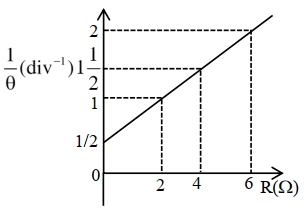
In the experiment to determine the galvanometer resistance by the half-deflection method,the plot of $\frac{1}{\theta}$ vs the resistance $(R)$ of the resistance box is shown in the figure. The figure of merit of the galvanometer is .............. $\times 10^{-1} \text{ A/division}$. [The source has emf $E = 2 \text{ V}$]
A
$5$
B
$6$
C
$7$
D
$8$
Solution
(A) The current $I$ in the galvanometer is given by $I = K \theta$,where $K$ is the figure of merit.
From the circuit,the current is $I = \frac{E}{G+R}$,where $E = 2 \text{ V}$ is the emf of the source,$G$ is the galvanometer resistance,and $R$ is the external resistance.
Equating the two expressions: $K \theta = \frac{E}{G+R} \Rightarrow \frac{1}{\theta} = \frac{G+R}{E} = \frac{1}{E} R + \frac{G}{E}$.
Comparing this with the equation of a straight line $y = mx + c$,we have the slope $m = \frac{1}{E}$.
From the graph,the slope $m = \frac{y_2 - y_1}{x_2 - x_1} = \frac{2 - 1}{6 - 2} = \frac{1}{4} \text{ } \Omega^{-1}$.
Since $m = \frac{K}{E}$,we have $\frac{K}{2} = \frac{1}{4} \Rightarrow K = 0.5 \text{ A/division}$.
Expressing $K$ in terms of $10^{-1}$,we get $K = 5 \times 10^{-1} \text{ A/division}$.
Thus,the correct option is $A$.
From the circuit,the current is $I = \frac{E}{G+R}$,where $E = 2 \text{ V}$ is the emf of the source,$G$ is the galvanometer resistance,and $R$ is the external resistance.
Equating the two expressions: $K \theta = \frac{E}{G+R} \Rightarrow \frac{1}{\theta} = \frac{G+R}{E} = \frac{1}{E} R + \frac{G}{E}$.
Comparing this with the equation of a straight line $y = mx + c$,we have the slope $m = \frac{1}{E}$.
From the graph,the slope $m = \frac{y_2 - y_1}{x_2 - x_1} = \frac{2 - 1}{6 - 2} = \frac{1}{4} \text{ } \Omega^{-1}$.
Since $m = \frac{K}{E}$,we have $\frac{K}{2} = \frac{1}{4} \Rightarrow K = 0.5 \text{ A/division}$.
Expressing $K$ in terms of $10^{-1}$,we get $K = 5 \times 10^{-1} \text{ A/division}$.
Thus,the correct option is $A$.
0 likes
View Solution236
DifficultMCQ
$A$ galvanometer of resistance $100 \Omega$ when connected in series with $400 \Omega$ measures a voltage of up to $10 \ V$. The value of resistance required to convert the galvanometer into an ammeter to read up to $10 \ A$ is $x \times 10^{-2} \Omega$. The value of $x$ is:
A
$2$
B
$800$
C
$20$
D
$200$
Solution
(C) First,calculate the full-scale deflection current $i_g$ of the galvanometer.
Given that the galvanometer (resistance $R_g = 100 \ \Omega$) is in series with $400 \ \Omega$ to measure $10 \ V$:
$i_g = \frac{V}{R_g + R_{series}} = \frac{10}{100 + 400} = \frac{10}{500} = 20 \times 10^{-3} \ A$.
To convert the galvanometer into an ammeter to read up to $I = 10 \ A$,a shunt resistance $S$ is connected in parallel.
The condition for the shunt is $i_g R_g = (I - i_g) S$.
Substituting the values:
$20 \times 10^{-3} \times 100 = (10 - 20 \times 10^{-3}) S$.
Since $20 \times 10^{-3} = 0.02 \ A$,we have:
$2 = (10 - 0.02) S = 9.98 S$.
$S = \frac{2}{9.98} \approx 0.2004 \ \Omega$.
Given the form $x \times 10^{-2} \ \Omega$,we approximate $S \approx 20 \times 10^{-2} \ \Omega$.
Thus,$x = 20$.
Given that the galvanometer (resistance $R_g = 100 \ \Omega$) is in series with $400 \ \Omega$ to measure $10 \ V$:
$i_g = \frac{V}{R_g + R_{series}} = \frac{10}{100 + 400} = \frac{10}{500} = 20 \times 10^{-3} \ A$.
To convert the galvanometer into an ammeter to read up to $I = 10 \ A$,a shunt resistance $S$ is connected in parallel.
The condition for the shunt is $i_g R_g = (I - i_g) S$.
Substituting the values:
$20 \times 10^{-3} \times 100 = (10 - 20 \times 10^{-3}) S$.
Since $20 \times 10^{-3} = 0.02 \ A$,we have:
$2 = (10 - 0.02) S = 9.98 S$.
$S = \frac{2}{9.98} \approx 0.2004 \ \Omega$.
Given the form $x \times 10^{-2} \ \Omega$,we approximate $S \approx 20 \times 10^{-2} \ \Omega$.
Thus,$x = 20$.
0 likes
View Solution237
DifficultMCQ
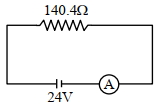
In the given figure,an ammeter $A$ consists of a $240 \Omega$ coil connected in parallel to a $10 \Omega$ shunt. The reading of the ammeter is . . . . . . $mA$.
A
$150$
B
$160$
C
$170$
D
$180$
Solution
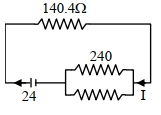
(B) The ammeter consists of a $240 \Omega$ coil in parallel with a $10 \Omega$ shunt. The equivalent resistance of the ammeter $(R_A)$ is given by:
$R_A = \frac{240 \times 10}{240 + 10} = \frac{2400}{250} = 9.6 \Omega$
The total resistance of the circuit $(R_{eq})$ is the sum of the external resistor and the ammeter resistance:
$R_{eq} = 140.4 \Omega + 9.6 \Omega = 150 \Omega$
The current $(I)$ flowing through the circuit is given by Ohm's law:
$I = \frac{V}{R_{eq}} = \frac{24 \text{ V}}{150 \Omega} = 0.16 \text{ A}$
Converting the current to milliamperes $(mA)$:
$I = 0.16 \times 1000 \text{ mA} = 160 \text{ mA}$
Thus,the reading of the ammeter is $160 \text{ mA}$.
$R_A = \frac{240 \times 10}{240 + 10} = \frac{2400}{250} = 9.6 \Omega$
The total resistance of the circuit $(R_{eq})$ is the sum of the external resistor and the ammeter resistance:
$R_{eq} = 140.4 \Omega + 9.6 \Omega = 150 \Omega$
The current $(I)$ flowing through the circuit is given by Ohm's law:
$I = \frac{V}{R_{eq}} = \frac{24 \text{ V}}{150 \Omega} = 0.16 \text{ A}$
Converting the current to milliamperes $(mA)$:
$I = 0.16 \times 1000 \text{ mA} = 160 \text{ mA}$
Thus,the reading of the ammeter is $160 \text{ mA}$.
0 likes
View Solution238
DifficultMCQ
$A$ galvanometer has a coil of resistance $200 \Omega$ with a full scale deflection at $20 \mu A$. The value of resistance to be added to use it as an ammeter of range $(0-20) mA$ is: (in $Omega$)
A
$0.40$
B
$0.20$
C
$0.50$
D
$0.10$
Solution
(B) Given:
Resistance of galvanometer $G = 200 \Omega$
Full scale deflection current $I_g = 20 \mu A = 20 \times 10^{-6} A$
Required range of ammeter $I = 20 mA = 20 \times 10^{-3} A$
To convert a galvanometer into an ammeter,a shunt resistance $S$ is connected in parallel.
The formula for shunt resistance is $S = \frac{I_g G}{I - I_g}$.
Substituting the values:
$S = \frac{20 \times 10^{-6} \times 200}{20 \times 10^{-3} - 20 \times 10^{-6}}$
$S = \frac{4000 \times 10^{-6}}{20 \times 10^{-3} (1 - 0.001)}$
$S = \frac{4 \times 10^{-3}}{20 \times 10^{-3} \times 0.999}$
$S = \frac{4}{20 \times 0.999} = \frac{0.2}{0.999} \approx 0.2002 \Omega$
Thus,the required shunt resistance is approximately $0.20 \Omega$.
Resistance of galvanometer $G = 200 \Omega$
Full scale deflection current $I_g = 20 \mu A = 20 \times 10^{-6} A$
Required range of ammeter $I = 20 mA = 20 \times 10^{-3} A$
To convert a galvanometer into an ammeter,a shunt resistance $S$ is connected in parallel.
The formula for shunt resistance is $S = \frac{I_g G}{I - I_g}$.
Substituting the values:
$S = \frac{20 \times 10^{-6} \times 200}{20 \times 10^{-3} - 20 \times 10^{-6}}$
$S = \frac{4000 \times 10^{-6}}{20 \times 10^{-3} (1 - 0.001)}$
$S = \frac{4 \times 10^{-3}}{20 \times 10^{-3} \times 0.999}$
$S = \frac{4}{20 \times 0.999} = \frac{0.2}{0.999} \approx 0.2002 \Omega$
Thus,the required shunt resistance is approximately $0.20 \Omega$.
0 likes
View Solution239
DifficultMCQ
$STATEMENT-1$: The sensitivity of a moving coil galvanometer is increased by placing a suitable magnetic material as a core inside the coil.
$STATEMENT-2$: Soft iron has a high magnetic permeability and cannot be easily magnetized or demagnetized.
$STATEMENT-2$: Soft iron has a high magnetic permeability and cannot be easily magnetized or demagnetized.
A
$STATEMENT-1$ is True,$STATEMENT-2$ is True; $STATEMENT-2$ is a correct explanation for $STATEMENT-1$.
B
$STATEMENT-1$ is True,$STATEMENT-2$ is True; $STATEMENT-2$ is $NOT$ a correct explanation for $STATEMENT-1$.
C
$STATEMENT-1$ is True,$STATEMENT-2$ is False.
D
$STATEMENT-1$ is False,$STATEMENT-2$ is True.
Solution
(C) In a moving coil galvanometer,a soft iron core is placed inside the coil to increase the magnetic field strength $(B)$ within the coil,which directly increases the sensitivity of the galvanometer.
$STATEMENT-1$ is True because the high magnetic permeability of the soft iron core concentrates the magnetic field lines,thereby increasing the torque on the coil.
$STATEMENT-2$ is False because soft iron is a soft magnetic material,which means it has high magnetic permeability and can be easily magnetized and demagnetized. The statement incorrectly claims that it cannot be easily magnetized or demagnetized.
$STATEMENT-1$ is True because the high magnetic permeability of the soft iron core concentrates the magnetic field lines,thereby increasing the torque on the coil.
$STATEMENT-2$ is False because soft iron is a soft magnetic material,which means it has high magnetic permeability and can be easily magnetized and demagnetized. The statement incorrectly claims that it cannot be easily magnetized or demagnetized.
0 likes
View Solution240
AdvancedMCQ
Consider two identical galvanometers and two identical resistors with resistance $R$. If the internal resistance of the galvanometers is $R_G < R/2$,which of the following configurations yield the maximum voltage range and maximum current range?
A
$B, D$
B
$B, A$
C
$B, C$
D
$A, C$
Solution
(D) For a voltmeter,the range $V = I_g(R_G + R_{ext})$. To maximize $V$,we need to maximize the total resistance $R_{total}$. Connecting all components in series gives $R_{total} = 2R_G + 2R$. This is the maximum possible resistance,so option $(A)$ is correct for voltage range.
For an ammeter,the range $I = I_g(1 + R_G/R_s)$. To maximize $I$,we need to minimize the equivalent resistance of the shunt $R_s$. Connecting all components in parallel gives the minimum equivalent resistance,which maximizes the current range. Thus,option $(C)$ is correct for current range.
Therefore,the correct options are $(A)$ and $(C)$.
For an ammeter,the range $I = I_g(1 + R_G/R_s)$. To maximize $I$,we need to minimize the equivalent resistance of the shunt $R_s$. Connecting all components in parallel gives the minimum equivalent resistance,which maximizes the current range. Thus,option $(C)$ is correct for current range.
Therefore,the correct options are $(A)$ and $(C)$.
0 likes
View Solution241
AdvancedMCQ
To verify Ohm's law,a student is provided with a test resistor $R_T$,a high resistance $R_1$,a small resistance $R_2$,two identical galvanometers $G_1$ and $G_2$,and a variable voltage source $V$. The correct circuit to carry out the experiment is
A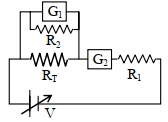
B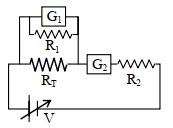
C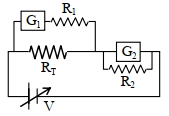
D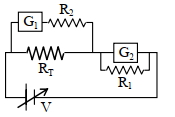
Solution
(C) To verify Ohm's law,we need to measure the potential difference across the resistor $R_T$ and the current flowing through it.
$1$. $A$ voltmeter is connected in parallel to the resistor. $A$ voltmeter is formed by connecting a high resistance in series with a galvanometer. Thus,$G_1$ in series with $R_1$ connected in parallel to $R_T$ acts as a voltmeter.
$2$. An ammeter is connected in series with the resistor. An ammeter is formed by connecting a small resistance (shunt) in parallel with a galvanometer. Thus,$G_2$ in parallel with $R_2$ connected in series with $R_T$ acts as an ammeter.
$3$. Comparing this with the given options,option $C$ shows $G_1$ in series with $R_1$ (voltmeter) across $R_T$ and $G_2$ in parallel with $R_2$ (ammeter) in series with $R_T$.
$1$. $A$ voltmeter is connected in parallel to the resistor. $A$ voltmeter is formed by connecting a high resistance in series with a galvanometer. Thus,$G_1$ in series with $R_1$ connected in parallel to $R_T$ acts as a voltmeter.
$2$. An ammeter is connected in series with the resistor. An ammeter is formed by connecting a small resistance (shunt) in parallel with a galvanometer. Thus,$G_2$ in parallel with $R_2$ connected in series with $R_T$ acts as an ammeter.
$3$. Comparing this with the given options,option $C$ shows $G_1$ in series with $R_1$ (voltmeter) across $R_T$ and $G_2$ in parallel with $R_2$ (ammeter) in series with $R_T$.
0 likes
View Solution242
MediumMCQ
$A$ moving coil galvanometer has $50$ turns and each turn has an area $2 \times 10^{-4} \ m^2$. The magnetic field produced by the magnet inside the galvanometer is $0.02 \ T$. The torsional constant of the suspension wire is $10^{-4} \ N \ m \ rad^{-1}$. When a current flows through the galvanometer,a full-scale deflection occurs if the coil rotates by $0.2 \ rad$. The resistance of the coil of the galvanometer is $50 \ \Omega$. This galvanometer is to be converted into an ammeter capable of measuring current in the range $0-1.0 \ A$. For this purpose,a shunt resistance is to be added in parallel to the galvanometer. The value of this shunt resistance,in ohms,is:
A
$5.40$
B
$5.50$
C
$5.56$
D
$5.60$
Solution
(C) Given:
Number of turns $n = 50$
Area $A = 2 \times 10^{-4} \ m^2$
Magnetic field $B = 0.02 \ T$
Torsional constant $C = 10^{-4} \ N \ m \ rad^{-1}$
Full-scale deflection angle $\theta = 0.2 \ rad$
Galvanometer resistance $G = 50 \ \Omega$
The torque balance equation for a moving coil galvanometer is given by:
$C \theta = n i_g A B$
Where $i_g$ is the full-scale deflection current.
$i_g = \frac{C \theta}{n A B} = \frac{10^{-4} \times 0.2}{50 \times 2 \times 10^{-4} \times 0.02} = \frac{0.2 \times 10^{-4}}{200 \times 10^{-4} \times 0.02} = \frac{0.2}{4} = 0.05 \ A$
Wait,recalculating: $i_g = \frac{0.2 \times 10^{-4}}{50 \times 2 \times 10^{-4} \times 0.02} = \frac{0.2}{50 \times 2 \times 0.02} = \frac{0.2}{2} = 0.1 \ A$
To convert the galvanometer into an ammeter of range $I = 1.0 \ A$,a shunt resistance $S$ is connected in parallel.
The current through the shunt is $I_s = I - i_g = 1.0 - 0.1 = 0.9 \ A$.
Since the galvanometer and shunt are in parallel,the voltage across them is equal:
$i_g G = I_s S$
$0.1 \times 50 = 0.9 \times S$
$S = \frac{5}{0.9} = \frac{50}{9} \approx 5.56 \ \Omega$
Number of turns $n = 50$
Area $A = 2 \times 10^{-4} \ m^2$
Magnetic field $B = 0.02 \ T$
Torsional constant $C = 10^{-4} \ N \ m \ rad^{-1}$
Full-scale deflection angle $\theta = 0.2 \ rad$
Galvanometer resistance $G = 50 \ \Omega$
The torque balance equation for a moving coil galvanometer is given by:
$C \theta = n i_g A B$
Where $i_g$ is the full-scale deflection current.
$i_g = \frac{C \theta}{n A B} = \frac{10^{-4} \times 0.2}{50 \times 2 \times 10^{-4} \times 0.02} = \frac{0.2 \times 10^{-4}}{200 \times 10^{-4} \times 0.02} = \frac{0.2}{4} = 0.05 \ A$
Wait,recalculating: $i_g = \frac{0.2 \times 10^{-4}}{50 \times 2 \times 10^{-4} \times 0.02} = \frac{0.2}{50 \times 2 \times 0.02} = \frac{0.2}{2} = 0.1 \ A$
To convert the galvanometer into an ammeter of range $I = 1.0 \ A$,a shunt resistance $S$ is connected in parallel.
The current through the shunt is $I_s = I - i_g = 1.0 - 0.1 = 0.9 \ A$.
Since the galvanometer and shunt are in parallel,the voltage across them is equal:
$i_g G = I_s S$
$0.1 \times 50 = 0.9 \times S$
$S = \frac{5}{0.9} = \frac{50}{9} \approx 5.56 \ \Omega$
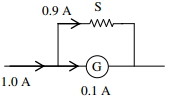
0 likes
View Solution243
MediumMCQ
Two identical moving coil galvanometers have $10 \Omega$ resistance and full scale deflection at $2 \mu A$ current. One of them is converted into a voltmeter of $100 \text{ mV}$ full scale reading and the other into an ammeter of $1 \text{ mA}$ full scale current using appropriate resistors. These are then used to measure the voltage and current in the Ohm's law experiment with $R = 1000 \Omega$ resistor by using an ideal cell. Which of the following statement$(s)$ is/are correct?
$(1)$ The measured value of $R$ will be $980.2 \Omega$.
$(2)$ The resistance of the voltmeter will be $50 \text{ k} \Omega$.
$(3)$ The resistance of the ammeter will be $0.02 \Omega$ (rounded off to the $2^{\text{nd}}$ decimal place).
$(4)$ If the ideal cell is replaced by a cell having internal resistance of $5 \Omega$,then the measured value of $R$ will be more than $1000 \Omega$.
$(1)$ The measured value of $R$ will be $980.2 \Omega$.
$(2)$ The resistance of the voltmeter will be $50 \text{ k} \Omega$.
$(3)$ The resistance of the ammeter will be $0.02 \Omega$ (rounded off to the $2^{\text{nd}}$ decimal place).
$(4)$ If the ideal cell is replaced by a cell having internal resistance of $5 \Omega$,then the measured value of $R$ will be more than $1000 \Omega$.
A
$1, 2$
B
$1, 4$
C
$2, 3$
D
$1, 3$
Solution
(C) $1$. Voltmeter conversion: $V = I_g(R_g + R_v) \implies 0.1 = 2 \times 10^{-6} (10 + R_v) \implies 50000 = 10 + R_v \implies R_v = 49990 \Omega \approx 50 \text{ k} \Omega$. Statement $(2)$ is correct.
$2$. Ammeter conversion: $I_g R_g = (I - I_g) R_s \implies 2 \times 10^{-6} \times 10 = (10^{-3} - 2 \times 10^{-6}) R_s \implies 2 \times 10^{-5} = 0.998 \times 10^{-3} R_s \implies R_s \approx 0.02004 \Omega$. The total resistance of the ammeter is $R_A = \frac{R_g R_s}{R_g + R_s} \approx R_s \approx 0.02 \Omega$. Statement $(3)$ is correct.
$3$. Measured resistance: The voltmeter is in parallel with $R = 1000 \Omega$. The equivalent resistance is $R_{eq} = \frac{R \times R_v}{R + R_v} = \frac{1000 \times 50000}{1000 + 50000} = \frac{50000}{51} \approx 980.39 \Omega$. Statement $(1)$ is incorrect.
$4$. Internal resistance: Adding internal resistance $r = 5 \Omega$ in series with the circuit reduces the total current $x$ flowing through the ammeter,but the measured value of $R$ is determined by the ratio of voltage across the voltmeter to the current through the resistor $R$. Since the voltmeter is in parallel with $R$,the measured resistance remains $R_{eq} \approx 980.39 \Omega$,which is independent of the internal resistance of the cell. Statement $(4)$ is incorrect.
Thus,statements $(2)$ and $(3)$ are correct.
$2$. Ammeter conversion: $I_g R_g = (I - I_g) R_s \implies 2 \times 10^{-6} \times 10 = (10^{-3} - 2 \times 10^{-6}) R_s \implies 2 \times 10^{-5} = 0.998 \times 10^{-3} R_s \implies R_s \approx 0.02004 \Omega$. The total resistance of the ammeter is $R_A = \frac{R_g R_s}{R_g + R_s} \approx R_s \approx 0.02 \Omega$. Statement $(3)$ is correct.
$3$. Measured resistance: The voltmeter is in parallel with $R = 1000 \Omega$. The equivalent resistance is $R_{eq} = \frac{R \times R_v}{R + R_v} = \frac{1000 \times 50000}{1000 + 50000} = \frac{50000}{51} \approx 980.39 \Omega$. Statement $(1)$ is incorrect.
$4$. Internal resistance: Adding internal resistance $r = 5 \Omega$ in series with the circuit reduces the total current $x$ flowing through the ammeter,but the measured value of $R$ is determined by the ratio of voltage across the voltmeter to the current through the resistor $R$. Since the voltmeter is in parallel with $R$,the measured resistance remains $R_{eq} \approx 980.39 \Omega$,which is independent of the internal resistance of the cell. Statement $(4)$ is incorrect.
Thus,statements $(2)$ and $(3)$ are correct.
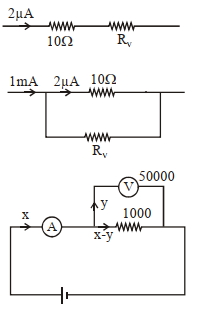
0 likes
View Solution244
DifficultMCQ
$A$ galvanometer gives full scale deflection with $0.006 \ A$ current. By connecting it to a $4990 \ \Omega$ resistance,it can be converted into a voltmeter of range $0-30 \ V$. If connected to a $\frac{2n}{249} \ \Omega$ resistance,it becomes an ammeter of range $0-1.5 \ A$. The value of $n$ is:
A
$2$
B
$3$
C
$4$
D
$5$
Solution
(D) Let $G$ be the resistance of the galvanometer and $I_g = 0.006 \ A$ be the current for full scale deflection.
For a voltmeter of range $V = 30 \ V$ with a series resistance $R = 4990 \ \Omega$:
$V = I_g(G + R)$
$30 = 0.006(G + 4990)$
$G + 4990 = \frac{30}{0.006} = 5000$
$G = 5000 - 4990 = 10 \ \Omega$
For an ammeter of range $I = 1.5 \ A$ with a shunt resistance $S = \frac{2n}{249} \ \Omega$:
$I_g G = (I - I_g) S$
$0.006 \times 10 = (1.5 - 0.006) \times S$
$0.06 = 1.494 \times S$
$S = \frac{0.06}{1.494} = \frac{60}{1494} = \frac{10}{249} \ \Omega$
Equating the shunt resistance:
$\frac{2n}{249} = \frac{10}{249}$
$2n = 10 \Rightarrow n = 5$
For a voltmeter of range $V = 30 \ V$ with a series resistance $R = 4990 \ \Omega$:
$V = I_g(G + R)$
$30 = 0.006(G + 4990)$
$G + 4990 = \frac{30}{0.006} = 5000$
$G = 5000 - 4990 = 10 \ \Omega$
For an ammeter of range $I = 1.5 \ A$ with a shunt resistance $S = \frac{2n}{249} \ \Omega$:
$I_g G = (I - I_g) S$
$0.006 \times 10 = (1.5 - 0.006) \times S$
$0.06 = 1.494 \times S$
$S = \frac{0.06}{1.494} = \frac{60}{1494} = \frac{10}{249} \ \Omega$
Equating the shunt resistance:
$\frac{2n}{249} = \frac{10}{249}$
$2n = 10 \Rightarrow n = 5$
0 likes
View Solution245
MediumMCQ
Consider a moving coil galvanometer $(MCG)$ :
$A :$ The torsional constant in a moving coil galvanometer has dimensions $[ML^2 T^{-2}]$.
$B :$ Increasing the current sensitivity may not necessarily increase the voltage sensitivity.
$C :$ If we increase the number of turns $(N)$ to its double $(2N)$,then the voltage sensitivity doubles.
$D :$ $MCG$ can be converted into an ammeter by introducing a shunt resistance of a large value in parallel with the galvanometer.
$E :$ Current sensitivity of $MCG$ depends inversely on the number of turns of the coil.
Choose the correct answer from the options given below:
$A :$ The torsional constant in a moving coil galvanometer has dimensions $[ML^2 T^{-2}]$.
$B :$ Increasing the current sensitivity may not necessarily increase the voltage sensitivity.
$C :$ If we increase the number of turns $(N)$ to its double $(2N)$,then the voltage sensitivity doubles.
$D :$ $MCG$ can be converted into an ammeter by introducing a shunt resistance of a large value in parallel with the galvanometer.
$E :$ Current sensitivity of $MCG$ depends inversely on the number of turns of the coil.
Choose the correct answer from the options given below:
A
$A, B$ only
B
$A, D$ only
C
$B, D, E$ only
D
$A, B, E$ only
Solution
(A) $A :$ The torque $\tau = C\theta$,where $C$ is the torsional constant. Thus,$[C] = [\tau]/[\theta] = [ML^2 T^{-2}] / [1] = [ML^2 T^{-2}]$. Statement $A$ is correct.
$B :$ Current sensitivity $(I_s) = \frac{NBA}{k}$ and Voltage sensitivity $(V_s) = \frac{I_s}{R} = \frac{NBA}{kR}$. Increasing $N$ increases $I_s$,but $R$ also increases with $N$,so $V_s$ may not increase. Statement $B$ is correct.
$C :$ Since $V_s = \frac{NBA}{kR}$ and $R \propto N$,if $N \to 2N$,then $R \to 2R$. Thus,$V_s' = \frac{(2N)BA}{k(2R)} = V_s$. The voltage sensitivity remains unchanged. Statement $C$ is incorrect.
$D :$ To convert $MCG$ to an ammeter,a small shunt resistance is connected in parallel. Statement $D$ is incorrect.
$E :$ Current sensitivity $I_s = \frac{NBA}{k}$,so $I_s \propto N$. It depends directly on the number of turns. Statement $E$ is incorrect.
Therefore,only $A$ and $B$ are correct.
$B :$ Current sensitivity $(I_s) = \frac{NBA}{k}$ and Voltage sensitivity $(V_s) = \frac{I_s}{R} = \frac{NBA}{kR}$. Increasing $N$ increases $I_s$,but $R$ also increases with $N$,so $V_s$ may not increase. Statement $B$ is correct.
$C :$ Since $V_s = \frac{NBA}{kR}$ and $R \propto N$,if $N \to 2N$,then $R \to 2R$. Thus,$V_s' = \frac{(2N)BA}{k(2R)} = V_s$. The voltage sensitivity remains unchanged. Statement $C$ is incorrect.
$D :$ To convert $MCG$ to an ammeter,a small shunt resistance is connected in parallel. Statement $D$ is incorrect.
$E :$ Current sensitivity $I_s = \frac{NBA}{k}$,so $I_s \propto N$. It depends directly on the number of turns. Statement $E$ is incorrect.
Therefore,only $A$ and $B$ are correct.
0 likes
View Solution246
MediumMCQ
$A$ galvanometer having a coil of resistance $30 \ \Omega$ needs $20 \ \text{mA}$ of current for full-scale deflection. If a maximum current of $3 \ \text{A}$ is to be measured using this galvanometer,the resistance of the shunt to be added to the galvanometer should be $\frac{30}{X} \ \Omega$,where $X$ is
A
$447$
B
$298$
C
$149$
D
$596$
Solution
(C) The condition for the shunt resistance $r_s$ to convert a galvanometer into an ammeter is given by the parallel circuit relation: $I_g R_g = (I - I_g) r_s$.
Given:
Galvanometer resistance $R_g = 30 \ \Omega$
Full-scale deflection current $I_g = 20 \ \text{mA} = 20 \times 10^{-3} \ \text{A} = 0.02 \ \text{A}$
Maximum current to be measured $I = 3 \ \text{A}$
Substituting the values into the formula:
$0.02 \times 30 = (3 - 0.02) \times r_s$
$0.6 = 2.98 \times r_s$
$r_s = \frac{0.6}{2.98} \ \Omega$
We are given that $r_s = \frac{30}{X} \ \Omega$. Therefore:
$\frac{30}{X} = \frac{0.6}{2.98}$
$X = \frac{30 \times 2.98}{0.6}$
$X = 50 \times 2.98 = 149$.
Thus,the value of $X$ is $149$.
Given:
Galvanometer resistance $R_g = 30 \ \Omega$
Full-scale deflection current $I_g = 20 \ \text{mA} = 20 \times 10^{-3} \ \text{A} = 0.02 \ \text{A}$
Maximum current to be measured $I = 3 \ \text{A}$
Substituting the values into the formula:
$0.02 \times 30 = (3 - 0.02) \times r_s$
$0.6 = 2.98 \times r_s$
$r_s = \frac{0.6}{2.98} \ \Omega$
We are given that $r_s = \frac{30}{X} \ \Omega$. Therefore:
$\frac{30}{X} = \frac{0.6}{2.98}$
$X = \frac{30 \times 2.98}{0.6}$
$X = 50 \times 2.98 = 149$.
Thus,the value of $X$ is $149$.
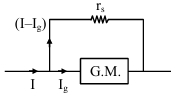
0 likes
View Solution247
MediumMCQ
In a moving coil galvanometer,two moving coils $M_1$ and $M_2$ have the following particulars:
$R_1 = 5 \ \Omega, N_1 = 15, A_1 = 3.6 \times 10^{-3} \ m^2, B_1 = 0.25 \ T$
$R_2 = 7 \ \Omega, N_2 = 21, A_2 = 1.8 \times 10^{-3} \ m^2, B_2 = 0.50 \ T$
Assuming that the torsional constant of the springs is the same for both coils,what will be the ratio of the voltage sensitivity of $M_1$ and $M_2$?
$R_1 = 5 \ \Omega, N_1 = 15, A_1 = 3.6 \times 10^{-3} \ m^2, B_1 = 0.25 \ T$
$R_2 = 7 \ \Omega, N_2 = 21, A_2 = 1.8 \times 10^{-3} \ m^2, B_2 = 0.50 \ T$
Assuming that the torsional constant of the springs is the same for both coils,what will be the ratio of the voltage sensitivity of $M_1$ and $M_2$?
A
$1: 1$
B
$1: 4$
C
$1: 3$
D
$1: 2$
Solution
(A) The voltage sensitivity $(S_V)$ of a moving coil galvanometer is given by the formula:
$S_V = \frac{\theta}{V} = \frac{NAB}{kR}$
where $N$ is the number of turns,$A$ is the area,$B$ is the magnetic field,$k$ is the torsional constant,and $R$ is the resistance.
Given that $k$ is the same for both coils,the ratio of voltage sensitivity is:
$\frac{S_{V1}}{S_{V2}} = \frac{N_1 A_1 B_1}{N_2 A_2 B_2} \times \frac{R_2}{R_1}$
Substituting the given values:
$\frac{S_{V1}}{S_{V2}} = \frac{15 \times 3.6 \times 10^{-3} \times 0.25}{21 \times 1.8 \times 10^{-3} \times 0.50} \times \frac{7}{5}$
$\frac{S_{V1}}{S_{V2}} = \frac{15 \times 3.6 \times 0.25}{21 \times 1.8 \times 0.50} \times \frac{7}{5}$
$\frac{S_{V1}}{S_{V2}} = \frac{13.5}{18.9} \times 1.4 = \frac{13.5}{18.9} \times \frac{7}{5} = \frac{13.5 \times 7}{18.9 \times 5} = \frac{94.5}{94.5} = 1$
Therefore,the ratio is $1: 1$.
$S_V = \frac{\theta}{V} = \frac{NAB}{kR}$
where $N$ is the number of turns,$A$ is the area,$B$ is the magnetic field,$k$ is the torsional constant,and $R$ is the resistance.
Given that $k$ is the same for both coils,the ratio of voltage sensitivity is:
$\frac{S_{V1}}{S_{V2}} = \frac{N_1 A_1 B_1}{N_2 A_2 B_2} \times \frac{R_2}{R_1}$
Substituting the given values:
$\frac{S_{V1}}{S_{V2}} = \frac{15 \times 3.6 \times 10^{-3} \times 0.25}{21 \times 1.8 \times 10^{-3} \times 0.50} \times \frac{7}{5}$
$\frac{S_{V1}}{S_{V2}} = \frac{15 \times 3.6 \times 0.25}{21 \times 1.8 \times 0.50} \times \frac{7}{5}$
$\frac{S_{V1}}{S_{V2}} = \frac{13.5}{18.9} \times 1.4 = \frac{13.5}{18.9} \times \frac{7}{5} = \frac{13.5 \times 7}{18.9 \times 5} = \frac{94.5}{94.5} = 1$
Therefore,the ratio is $1: 1$.
0 likes
View Solution248
MediumMCQ
To verify Ohm's law,a student is provided with a test resistor $R_T,$ a high resistance $R_1,$ a small resistance $R_2,$ two identical galvanometers $G_1$ and $G_2,$ and a variable voltage source $V$. The correct circuit to carry out the experiment is $:-$
A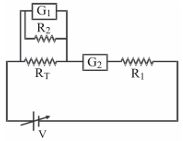
B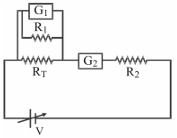
C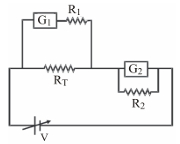
D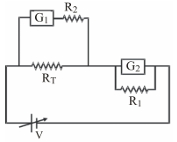
Solution
(C) To verify Ohm's law,we need to measure the potential difference across the test resistor $R_T$ and the current flowing through it.
$1$. $A$ voltmeter is connected in parallel to the resistor $R_T$. $A$ voltmeter is formed by connecting a high resistance $R_1$ in series with a galvanometer $G_1$.
$2$. An ammeter is connected in series with the resistor $R_T$. An ammeter is formed by connecting a small resistance $R_2$ (shunt) in parallel with a galvanometer $G_2$.
$3$. Looking at the options,the circuit in option $C$ shows $G_1$ in series with $R_1$ (forming a voltmeter) connected in parallel to $R_T$,and $G_2$ in parallel with $R_2$ (forming an ammeter) connected in series with $R_T$. Thus,option $C$ is correct.
$1$. $A$ voltmeter is connected in parallel to the resistor $R_T$. $A$ voltmeter is formed by connecting a high resistance $R_1$ in series with a galvanometer $G_1$.
$2$. An ammeter is connected in series with the resistor $R_T$. An ammeter is formed by connecting a small resistance $R_2$ (shunt) in parallel with a galvanometer $G_2$.
$3$. Looking at the options,the circuit in option $C$ shows $G_1$ in series with $R_1$ (forming a voltmeter) connected in parallel to $R_T$,and $G_2$ in parallel with $R_2$ (forming an ammeter) connected in series with $R_T$. Thus,option $C$ is correct.
0 likes
View Solution249
DifficultMCQ
If only $2 \%$ of the main current is to be passed through a galvanometer of resistance $G$,then the resistance of the shunt connected to it will be:
A
$G / 50$
B
$50 \ G$
C
$49 \ G$
D
$G / 49$
Solution
(D) Let the main current be $I$ and the current through the galvanometer be $I_g$.
Given that $I_g = 2 \% \text{ of } I = 0.02 I$.
The resistance of the galvanometer is $G$.
Let the shunt resistance be $S$.
Since the galvanometer and shunt are in parallel,the potential difference across them is equal:
$I_g G = (I - I_g) S$.
Substituting the values:
$0.02 I \cdot G = (I - 0.02 I) S$.
$0.02 I \cdot G = 0.98 I \cdot S$.
$S = \frac{0.02}{0.98} G = \frac{2}{98} G = \frac{G}{49}$.
Thus,the shunt resistance is $G / 49$.
Given that $I_g = 2 \% \text{ of } I = 0.02 I$.
The resistance of the galvanometer is $G$.
Let the shunt resistance be $S$.
Since the galvanometer and shunt are in parallel,the potential difference across them is equal:
$I_g G = (I - I_g) S$.
Substituting the values:
$0.02 I \cdot G = (I - 0.02 I) S$.
$0.02 I \cdot G = 0.98 I \cdot S$.
$S = \frac{0.02}{0.98} G = \frac{2}{98} G = \frac{G}{49}$.
Thus,the shunt resistance is $G / 49$.
0 likes
View Solution250
DifficultMCQ
To find the resistance of a galvanometer by the half-deflection method,the experimental data obtained are given in the table below:
From the above data,the galvanometer resistance $G$ will be near to: (in $\Omega$)
| $S. No.$ | Resistance $R \ (\Omega)$ | Deflection $(\theta)$ | Shunt $S \ (\Omega)$ | Half deflection $(\theta / 2)$ | Galvanometer resistance $(G)$ |
| $1$ | $3300$ | $30$ | $80$ | $15$ | $G_1$ |
| $2$ | $5000$ | $20$ | $80$ | $10$ | $G_2$ |
From the above data,the galvanometer resistance $G$ will be near to: (in $\Omega$)
A
$20$
B
$40$
C
$50$
D
$80$
Solution
(D) In the half-deflection method,the resistance of the galvanometer $G$ is given by the formula:
$G = \frac{RS}{R - S}$
For the first observation:
$G_1 = \frac{3300 \times 80}{3300 - 80} = \frac{264000}{3220} \approx 81.98 \ \Omega \approx 82 \ \Omega$
For the second observation:
$G_2 = \frac{5000 \times 80}{5000 - 80} = \frac{400000}{4920} \approx 81.30 \ \Omega \approx 81 \ \Omega$
The average value of the galvanometer resistance is:
$G = \frac{G_1 + G_2}{2} = \frac{82 + 81}{2} = 81.5 \ \Omega$
Comparing this with the given options,the value is closest to $80 \ \Omega$.
$G = \frac{RS}{R - S}$
For the first observation:
$G_1 = \frac{3300 \times 80}{3300 - 80} = \frac{264000}{3220} \approx 81.98 \ \Omega \approx 82 \ \Omega$
For the second observation:
$G_2 = \frac{5000 \times 80}{5000 - 80} = \frac{400000}{4920} \approx 81.30 \ \Omega \approx 81 \ \Omega$
The average value of the galvanometer resistance is:
$G = \frac{G_1 + G_2}{2} = \frac{82 + 81}{2} = 81.5 \ \Omega$
Comparing this with the given options,the value is closest to $80 \ \Omega$.
0 likes
View SolutionMoving Charges and Magnetism — The Moving Coil Galvanometer (Sensitivity) and Ammeter and Voltmeter Conversion · Frequently Asked Questions
1Are these Moving Charges and Magnetism questions useful for JEE and NEET?
Yes. All questions in this section are mapped to JEE Main and NEET exam patterns. Previous year questions from JEE Main, NEET, GUJCET and state-level exams are included with full solutions.
2Can I switch to Hindi or Gujarati for these questions?
Yes. Use the language tabs in the hero section or the sidebar to view the same questions and solutions in English, Hindi or Gujarati.
3How do I generate a question paper from this subtopic?
Use the Vedclass Exam Paper Generator — select the chapter and subtopic, set difficulty, and generate Sets A, B, C, D automatically. First 3 chapters of every subject are free.
Vedclass Products
For Students
Vedclass Test Series
Mock tests in real JEE/NEET style with performance analysis. 5-day free trial.
Start Free TrialFor Teachers
Exam Paper Generator
Generate Set A/B/C/D papers from this chapter in 2 minutes. 3 chapters free.
Try FreeFor Institutes
Online Exam Module
Live online exams with unlimited students, 360° analytics & white-label branding.
See DemoFor Teachers & Institutes
Generate a Moving Charges and Magnetism Exam Paper in 2 Minutes
Select subtopic & difficulty — Sets A, B, C, D auto-generated with No Repeat logic.
First 3 chapters of every subject are free — no payment required.