
A English
Force on a Current Carrying Conductor Questions in English
Class 12 Physics · Moving Charges and Magnetism · Force on a Current Carrying Conductor
260+
Questions
English
Language
100%
With Solutions
Showing 48 of 260 questions in English
151
MediumMCQ
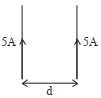
Two $10 \; cm$ long,straight wires,each carrying a current of $5 \; A$,are kept parallel to each other. If each wire experiences a force of $10^{-5} \; N$,then the separation between the wires is $\dots \; cm$.
A
$3$
B
$4$
C
$5$
D
$6$
Solution
(C) The force per unit length between two long parallel wires carrying currents $I_1$ and $I_2$ separated by a distance $d$ is given by $F/L = \frac{\mu_0 I_1 I_2}{2 \pi d}$.
Given:
Length of the wires $L = 10 \; cm = 0.1 \; m$
Current $I_1 = I_2 = 5 \; A$
Force $F = 10^{-5} \; N$
The total force on a wire of length $L$ is $F = \frac{\mu_0 I_1 I_2 L}{2 \pi d}$.
Substituting the values:
$10^{-5} = \frac{(2 \times 10^{-7}) \times 5 \times 5 \times 0.1}{d}$
$d = \frac{2 \times 10^{-7} \times 25 \times 0.1}{10^{-5}}$
$d = \frac{50 \times 10^{-8}}{10^{-5}} = 50 \times 10^{-3} \; m$
$d = 0.05 \; m = 5 \; cm$.
Given:
Length of the wires $L = 10 \; cm = 0.1 \; m$
Current $I_1 = I_2 = 5 \; A$
Force $F = 10^{-5} \; N$
The total force on a wire of length $L$ is $F = \frac{\mu_0 I_1 I_2 L}{2 \pi d}$.
Substituting the values:
$10^{-5} = \frac{(2 \times 10^{-7}) \times 5 \times 5 \times 0.1}{d}$
$d = \frac{2 \times 10^{-7} \times 25 \times 0.1}{10^{-5}}$
$d = \frac{50 \times 10^{-8}}{10^{-5}} = 50 \times 10^{-3} \; m$
$d = 0.05 \; m = 5 \; cm$.
0 likes
View Solution152
MediumMCQ
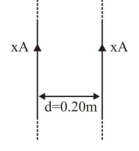
Two parallel,long wires are kept $0.20 \, m$ apart in a vacuum,each carrying a current of $x \, A$ in the same direction. If the force of attraction per meter of each wire is $2 \times 10^{-6} \, N$,then the value of $x$ is approximately:
A
$1$
B
$2.4$
C
$1.4$
D
$2$
Solution
(C) The formula for the force per unit length between two parallel current-carrying wires is given by:
$F/L = \frac{\mu_{0} i_{1} i_{2}}{2 \pi d}$
Given:
$F/L = 2 \times 10^{-6} \, N/m$
$d = 0.20 \, m$
$i_{1} = i_{2} = x \, A$
$\mu_{0} = 4 \pi \times 10^{-7} \, T \cdot m/A$
Substituting the values into the formula:
$2 \times 10^{-6} = \frac{4 \pi \times 10^{-7} \times x^2}{2 \pi \times 0.2}$
Simplifying the equation:
$2 \times 10^{-6} = \frac{2 \times 10^{-7} \times x^2}{0.2}$
$2 \times 10^{-6} = 10^{-6} \times x^2$
$x^2 = 2$
$x = \sqrt{2} \approx 1.414 \, A$
Thus,the value of $x$ is approximately $1.4 \, A$.
$F/L = \frac{\mu_{0} i_{1} i_{2}}{2 \pi d}$
Given:
$F/L = 2 \times 10^{-6} \, N/m$
$d = 0.20 \, m$
$i_{1} = i_{2} = x \, A$
$\mu_{0} = 4 \pi \times 10^{-7} \, T \cdot m/A$
Substituting the values into the formula:
$2 \times 10^{-6} = \frac{4 \pi \times 10^{-7} \times x^2}{2 \pi \times 0.2}$
Simplifying the equation:
$2 \times 10^{-6} = \frac{2 \times 10^{-7} \times x^2}{0.2}$
$2 \times 10^{-6} = 10^{-6} \times x^2$
$x^2 = 2$
$x = \sqrt{2} \approx 1.414 \, A$
Thus,the value of $x$ is approximately $1.4 \, A$.
0 likes
View Solution153
MediumMCQ
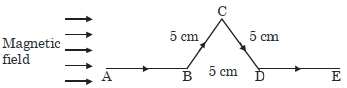
$A$ triangular shaped wire carrying $10 A$ current is placed in a uniform magnetic field of $0.5 T$,as shown in the figure. The magnetic force on segment $CD$ is $.... N$ (Given $BC = CD = BD = 5 cm$).
A
$0.126$
B
$0.312$
C
$0.216$
D
$0.245$
Solution
(C) The magnetic force on a current-carrying conductor is given by $F = I(\vec{L} \times \vec{B})$,where $\vec{L}$ is the vector length of the segment.
For segment $CD$,the length is $L = 5 cm = 0.05 m$.
The magnetic field $B$ is uniform and directed horizontally. The segment $CD$ makes an angle of $60^\circ$ with the horizontal (since $\triangle BCD$ is an equilateral triangle).
The component of the length perpendicular to the magnetic field is $L_{\perp} = L \sin(60^\circ)$.
$L_{\perp} = 0.05 \times \frac{\sqrt{3}}{2} \approx 0.05 \times 0.866 = 0.0433 m$.
The magnetic force is $F = B I L_{\perp} = 0.5 \times 10 \times 0.0433 = 0.2165 N$.
Rounding to the nearest given option,the force is $0.216 N$.
For segment $CD$,the length is $L = 5 cm = 0.05 m$.
The magnetic field $B$ is uniform and directed horizontally. The segment $CD$ makes an angle of $60^\circ$ with the horizontal (since $\triangle BCD$ is an equilateral triangle).
The component of the length perpendicular to the magnetic field is $L_{\perp} = L \sin(60^\circ)$.
$L_{\perp} = 0.05 \times \frac{\sqrt{3}}{2} \approx 0.05 \times 0.866 = 0.0433 m$.
The magnetic force is $F = B I L_{\perp} = 0.5 \times 10 \times 0.0433 = 0.2165 N$.
Rounding to the nearest given option,the force is $0.216 N$.
0 likes
View Solution154
MediumMCQ
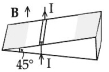
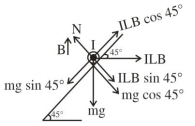
As shown in the figure, a metallic rod of linear density $0.45\,kg\,m^{-1}$ is lying horizontally on a smooth inclined plane which makes an angle of $45^{\circ}$ with the horizontal. The minimum current flowing in the rod required to keep it stationary, when a $0.15\,T$ magnetic field is acting on it in the vertical upward direction, will be $....A$ $\{$Use $g=10\,m/s^2\}$
A
$30$
B
$15$
C
$10$
D
$3$
Solution
(A) The forces acting on the rod are its weight $(mg)$ acting vertically downwards, the normal force $(N)$ perpendicular to the inclined plane, and the magnetic force $(F_m = ILB)$ acting horizontally (since the magnetic field $B$ is vertical and the current $I$ is horizontal).
To keep the rod stationary, the component of the gravitational force along the inclined plane must be balanced by the component of the magnetic force along the inclined plane.
The component of the gravitational force along the incline is $mg \sin 45^{\circ}$.
The magnetic force $F_m = ILB$ acts horizontally. Its component along the inclined plane is $F_m \cos 45^{\circ} = ILB \cos 45^{\circ}$.
Equating these two components for equilibrium:
$mg \sin 45^{\circ} = ILB \cos 45^{\circ}$
Since $\sin 45^{\circ} = \cos 45^{\circ}$, we can simplify the equation:
$mg = ILB$
Given the linear density $\lambda = \frac{m}{L} = 0.45\,kg/m$, $g = 10\,m/s^2$, and $B = 0.15\,T$:
$I = \frac{mg}{LB} = \left(\frac{m}{L}\right) \frac{g}{B}$
Substituting the values:
$I = \frac{0.45 \times 10}{0.15} = \frac{4.5}{0.15} = 30\,A$
Therefore, the minimum current required is $30\,A$.
To keep the rod stationary, the component of the gravitational force along the inclined plane must be balanced by the component of the magnetic force along the inclined plane.
The component of the gravitational force along the incline is $mg \sin 45^{\circ}$.
The magnetic force $F_m = ILB$ acts horizontally. Its component along the inclined plane is $F_m \cos 45^{\circ} = ILB \cos 45^{\circ}$.
Equating these two components for equilibrium:
$mg \sin 45^{\circ} = ILB \cos 45^{\circ}$
Since $\sin 45^{\circ} = \cos 45^{\circ}$, we can simplify the equation:
$mg = ILB$
Given the linear density $\lambda = \frac{m}{L} = 0.45\,kg/m$, $g = 10\,m/s^2$, and $B = 0.15\,T$:
$I = \frac{mg}{LB} = \left(\frac{m}{L}\right) \frac{g}{B}$
Substituting the values:
$I = \frac{0.45 \times 10}{0.15} = \frac{4.5}{0.15} = 30\,A$
Therefore, the minimum current required is $30\,A$.
1 likes
View Solution155
MediumMCQ
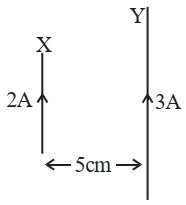
$A$ wire $X$ of length $50 \; cm$ carrying a current of $2 \; A$ is placed parallel to a long wire $Y$ of length $5 \; m$. The wire $Y$ carries a current of $3 \; A$. The distance between the two wires is $5 \; cm$ and the currents flow in the same direction. The force acting on the wire $X$ due to wire $Y$ is:
A
$1.2 \times 10^{-5} \; N$ directed towards wire $Y$.
B
$1.2 \times 10^{-4} \; N$ directed away from wire $Y$.
C
$1.2 \times 10^{-4} \; N$ directed towards wire $Y$.
D
$2.4 \times 10^{-5} \; N$ directed towards wire $Y$.
Solution
(A) The force per unit length between two parallel wires carrying currents $I_1$ and $I_2$ separated by a distance $r$ is given by $f = \frac{\mu_0 I_1 I_2}{2 \pi r}$.
Here,$I_1 = 2 \; A$,$I_2 = 3 \; A$,$r = 5 \; cm = 0.05 \; m$,and the length of wire $X$ is $\ell = 50 \; cm = 0.5 \; m$.
The total force on wire $X$ is $F = f \times \ell = \frac{\mu_0 I_1 I_2 \ell}{2 \pi r}$.
Substituting the values:
$F = \frac{(4 \pi \times 10^{-7} \; T \cdot m/A) \times (2 \; A) \times (3 \; A) \times (0.5 \; m)}{2 \pi \times (0.05 \; m)}$
$F = \frac{2 \times 10^{-7} \times 6 \times 0.5}{0.05} = \frac{6 \times 10^{-7}}{0.05} = 120 \times 10^{-7} = 1.2 \times 10^{-5} \; N$.
Since the currents are in the same direction,the force is attractive,meaning wire $X$ is pulled towards wire $Y$.
Here,$I_1 = 2 \; A$,$I_2 = 3 \; A$,$r = 5 \; cm = 0.05 \; m$,and the length of wire $X$ is $\ell = 50 \; cm = 0.5 \; m$.
The total force on wire $X$ is $F = f \times \ell = \frac{\mu_0 I_1 I_2 \ell}{2 \pi r}$.
Substituting the values:
$F = \frac{(4 \pi \times 10^{-7} \; T \cdot m/A) \times (2 \; A) \times (3 \; A) \times (0.5 \; m)}{2 \pi \times (0.05 \; m)}$
$F = \frac{2 \times 10^{-7} \times 6 \times 0.5}{0.05} = \frac{6 \times 10^{-7}}{0.05} = 120 \times 10^{-7} = 1.2 \times 10^{-5} \; N$.
Since the currents are in the same direction,the force is attractive,meaning wire $X$ is pulled towards wire $Y$.
0 likes
View Solution156
DifficultMCQ
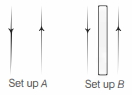
In an experiment,setup $A$ consists of two parallel wires which carry currents in opposite directions as shown in the figure. $A$ second setup $B$ is identical to setup $A$,except that there is a metal plate between the wires. Let $F_A$ and $F_B$ be the magnitude of the force between the two wires in setup $A$ and setup $B$,respectively.
A
$F_A > F_B \neq 0$
B
$F_A < F_B$
C
$F_A = F_B \neq 0$
D
$F_A > F_B = 0$
Solution
(C) The magnetic force between two parallel current-carrying wires is determined by the magnetic field produced by one wire at the location of the other.
According to the Biot-Savart Law and the principle of superposition,the magnetic field produced by a current-carrying wire in free space is not affected by the presence of a non-magnetic material like a metal plate placed between them.
Although the metal plate may experience eddy currents if the magnetic field were changing,in a steady-state $DC$ current scenario,the magnetic field lines pass through the metal plate without being blocked or significantly altered.
Therefore,the magnetic force $F$ between the two wires remains unchanged by the insertion of the metal plate.
Thus,$F_A = F_B \neq 0$.
According to the Biot-Savart Law and the principle of superposition,the magnetic field produced by a current-carrying wire in free space is not affected by the presence of a non-magnetic material like a metal plate placed between them.
Although the metal plate may experience eddy currents if the magnetic field were changing,in a steady-state $DC$ current scenario,the magnetic field lines pass through the metal plate without being blocked or significantly altered.
Therefore,the magnetic force $F$ between the two wires remains unchanged by the insertion of the metal plate.
Thus,$F_A = F_B \neq 0$.
0 likes
View Solution157
EasyMCQ
The net charge in a current-carrying wire is zero,yet a magnetic field exerts a force on it. This is because a magnetic field exerts a force on:
A
Stationary charge
B
Moving charge
C
$A$ positive charge only
D
$A$ negative charge only
Solution
(B) The correct option is $B$.
The magnetic force $F$ on a charge $q$ moving with velocity $v$ in a magnetic field $B$ is given by the Lorentz force formula: $F = q(\vec{v} \times \vec{B})$.
In a current-carrying wire,the net charge is zero because the number of electrons and protons is balanced. However,the electrons are in a state of drift motion (moving charge).
$A$ magnetic field exerts a force only on moving charges,not on stationary charges. Therefore,the magnetic field exerts a force on the moving electrons within the wire,which results in a net force on the wire itself.
The magnetic force $F$ on a charge $q$ moving with velocity $v$ in a magnetic field $B$ is given by the Lorentz force formula: $F = q(\vec{v} \times \vec{B})$.
In a current-carrying wire,the net charge is zero because the number of electrons and protons is balanced. However,the electrons are in a state of drift motion (moving charge).
$A$ magnetic field exerts a force only on moving charges,not on stationary charges. Therefore,the magnetic field exerts a force on the moving electrons within the wire,which results in a net force on the wire itself.
0 likes
View Solution158
MediumMCQ
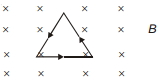
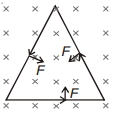
$A$ wire is bent in the form of an equilateral triangle of side $100 \,cm$ and carries a current of $2 \,A$. It is placed in a magnetic field of induction $2.0 \,T$ directed perpendicular into the plane of paper. The direction and magnitude of magnetic force acting on each side of the triangle will be
A
$2 \,N$,normal to the side towards the centre of the triangle
B
$2 \,N$,normal to the side away from the centre of the triangle
C
$4 \,N$,normal to the side towards the centre of the triangle
D
$4 \,N$,normal to the side away from the centre of the triangle
Solution
(C) The magnetic force on a current-carrying wire is given by $\vec{F} = I(\vec{L} \times \vec{B})$.
Given:
Length of each side $L = 100 \,cm = 1 \,m$
Current $I = 2 \,A$
Magnetic field $B = 2.0 \,T$
The magnitude of the force on each side is $F = I L B \sin(\theta)$.
Since the wire is in the plane of the paper and the magnetic field is perpendicular to the plane,the angle $\theta$ between the length vector and the magnetic field is $90^\circ$.
Therefore,$F = 2 \,A \times 1 \,m \times 2.0 \,T \times \sin(90^\circ) = 4 \,N$.
Using Fleming's Left-Hand Rule,the direction of the force on each side is perpendicular to the side and directed towards the centre of the triangle.
Given:
Length of each side $L = 100 \,cm = 1 \,m$
Current $I = 2 \,A$
Magnetic field $B = 2.0 \,T$
The magnitude of the force on each side is $F = I L B \sin(\theta)$.
Since the wire is in the plane of the paper and the magnetic field is perpendicular to the plane,the angle $\theta$ between the length vector and the magnetic field is $90^\circ$.
Therefore,$F = 2 \,A \times 1 \,m \times 2.0 \,T \times \sin(90^\circ) = 4 \,N$.
Using Fleming's Left-Hand Rule,the direction of the force on each side is perpendicular to the side and directed towards the centre of the triangle.
0 likes
View Solution159
EasyMCQ
$A$ conducting circular loop of radius $r$ carries a constant current $i$. It is placed in a uniform magnetic field $B$,such that $B$ is perpendicular to the plane of the loop. The net magnetic force acting on the loop is
A
$i r B$
B
$2 \pi r i B$
C
Zero
D
$\pi r i B$
Solution
(C) The magnetic force on a small current element $d\vec{l}$ is given by $d\vec{F} = i(d\vec{l} \times \vec{B})$.
For a closed loop in a uniform magnetic field,the net force is the vector sum of all such small force elements: $\vec{F}_{net} = \oint i(d\vec{l} \times \vec{B})$.
Since $i$ and $\vec{B}$ are constant,we can write $\vec{F}_{net} = i(\oint d\vec{l}) \times \vec{B}$.
For any closed loop,the vector sum of all length elements $\oint d\vec{l}$ is equal to the zero vector $\vec{0}$.
Therefore,$\vec{F}_{net} = i(\vec{0}) \times \vec{B} = 0$.
Thus,the net magnetic force acting on the loop is zero.
For a closed loop in a uniform magnetic field,the net force is the vector sum of all such small force elements: $\vec{F}_{net} = \oint i(d\vec{l} \times \vec{B})$.
Since $i$ and $\vec{B}$ are constant,we can write $\vec{F}_{net} = i(\oint d\vec{l}) \times \vec{B}$.
For any closed loop,the vector sum of all length elements $\oint d\vec{l}$ is equal to the zero vector $\vec{0}$.
Therefore,$\vec{F}_{net} = i(\vec{0}) \times \vec{B} = 0$.
Thus,the net magnetic force acting on the loop is zero.
0 likes
View Solution160
MediumMCQ
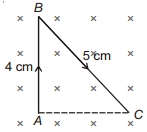
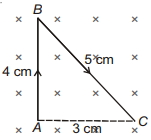
$A$ uniform conducting wire $ABC$ has a mass of $10 \, g$. $A$ current of $2 \, A$ flows through it. The wire is kept in a uniform magnetic field $B = 2 \, T$. The acceleration of the wire will be ............. $m \, s^{-2}$.
A
$0$
B
$12$
C
$1.2$
D
$0.6$
Solution
(B) The force on a current-carrying wire in a uniform magnetic field is given by $\vec{F} = i(\vec{L}_{eff} \times \vec{B})$,where $\vec{L}_{eff}$ is the effective length vector from the starting point to the end point of the wire.
For the wire $ABC$,the effective length is the straight-line distance from $A$ to $C$. From the geometry of the triangle,$AC = \sqrt{BC^2 - AB^2} = \sqrt{5^2 - 4^2} = 3 \, cm = 0.03 \, m$.
The magnitude of the force is $F = i L_{eff} B \sin \theta$. Since the magnetic field is perpendicular to the plane of the wire,$\theta = 90^{\circ}$.
$F = 2 \times 0.03 \times 2 \times \sin 90^{\circ} = 0.12 \, N$.
The mass of the wire is $m = 10 \, g = 0.01 \, kg$.
The acceleration $a$ is given by $a = \frac{F}{m} = \frac{0.12}{0.01} = 12 \, m \, s^{-2}$.
Thus,the correct option is $(b)$.
For the wire $ABC$,the effective length is the straight-line distance from $A$ to $C$. From the geometry of the triangle,$AC = \sqrt{BC^2 - AB^2} = \sqrt{5^2 - 4^2} = 3 \, cm = 0.03 \, m$.
The magnitude of the force is $F = i L_{eff} B \sin \theta$. Since the magnetic field is perpendicular to the plane of the wire,$\theta = 90^{\circ}$.
$F = 2 \times 0.03 \times 2 \times \sin 90^{\circ} = 0.12 \, N$.
The mass of the wire is $m = 10 \, g = 0.01 \, kg$.
The acceleration $a$ is given by $a = \frac{F}{m} = \frac{0.12}{0.01} = 12 \, m \, s^{-2}$.
Thus,the correct option is $(b)$.
0 likes
View Solution161
EasyMCQ
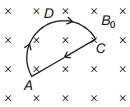
The figure shows a conducting loop $ADCA$ carrying current $i$ and placed in a region of uniform magnetic field $B_0$. The part $ADC$ forms a semicircle of radius $R$. The magnitude of the force on the semicircular part of the loop is equal to
A
$\pi R i B_0$
B
$0$
C
$2 \pi R i B_0$
D
$2 i R B_0$
Solution
(D) The magnetic force on any current-carrying wire segment in a uniform magnetic field is given by $\vec{F} = i(\vec{L} \times \vec{B})$,where $\vec{L}$ is the vector displacement from the start point to the end point of the segment.
For the semicircular part $ADC$,the starting point is $A$ and the ending point is $C$.
The straight-line distance (displacement) between $A$ and $C$ is the diameter of the semicircle,which is $L = 2R$.
Since the magnetic field $B_0$ is uniform and perpendicular to the plane of the loop,the magnitude of the force is $F = iLB_0$.
Substituting $L = 2R$,we get $F = i(2R)B_0 = 2iRB_0$.
Thus,the magnitude of the force on the semicircular part is $2iRB_0$.
For the semicircular part $ADC$,the starting point is $A$ and the ending point is $C$.
The straight-line distance (displacement) between $A$ and $C$ is the diameter of the semicircle,which is $L = 2R$.
Since the magnetic field $B_0$ is uniform and perpendicular to the plane of the loop,the magnitude of the force is $F = iLB_0$.
Substituting $L = 2R$,we get $F = i(2R)B_0 = 2iRB_0$.
Thus,the magnitude of the force on the semicircular part is $2iRB_0$.
0 likes
View Solution162
MediumMCQ
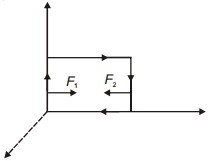
The magnetic field existing in a region is given by $\vec{B} = B_0 \left(1 + \frac{x}{l}\right) \hat{k}$. $A$ square loop of edge length $l$ and carrying a current $i$ is placed with its edges parallel to the $x$ and $y$ axes. Find the magnitude of the net magnetic force experienced by the loop.
A
$\frac{1}{2} i B_0 l$
B
$0$
C
$i B_0 l$
D
$2 i B_0 l$
Solution
(C) The magnetic field is given by $\vec{B} = B_0 \left(1 + \frac{x}{l}\right) \hat{k}$.
For a square loop of side length $l$ placed in the $x-y$ plane with one corner at the origin,the vertical segments are at $x = 0$ and $x = l$.
The force on a current-carrying wire is given by $\vec{F} = i(\vec{L} \times \vec{B})$.
At $x = 0$,the magnetic field is $\vec{B}_1 = B_0 \hat{k}$. The force on the vertical segment of length $l$ (carrying current in the $+y$ direction) is $\vec{F}_1 = i(l \hat{j} \times B_0 \hat{k}) = i l B_0 \hat{i}$.
At $x = l$,the magnetic field is $\vec{B}_2 = B_0 \left(1 + \frac{l}{l}\right) \hat{k} = 2 B_0 \hat{k}$. The force on the vertical segment of length $l$ (carrying current in the $-y$ direction) is $\vec{F}_2 = i(-l \hat{j} \times 2 B_0 \hat{k}) = -2 i l B_0 \hat{i}$.
The horizontal segments experience forces in the $y$-direction which cancel each other out due to symmetry.
The net force is $\vec{F}_{net} = \vec{F}_1 + \vec{F}_2 = i l B_0 \hat{i} - 2 i l B_0 \hat{i} = -i l B_0 \hat{i}$.
The magnitude of the net force is $|\vec{F}_{net}| = i B_0 l$.
For a square loop of side length $l$ placed in the $x-y$ plane with one corner at the origin,the vertical segments are at $x = 0$ and $x = l$.
The force on a current-carrying wire is given by $\vec{F} = i(\vec{L} \times \vec{B})$.
At $x = 0$,the magnetic field is $\vec{B}_1 = B_0 \hat{k}$. The force on the vertical segment of length $l$ (carrying current in the $+y$ direction) is $\vec{F}_1 = i(l \hat{j} \times B_0 \hat{k}) = i l B_0 \hat{i}$.
At $x = l$,the magnetic field is $\vec{B}_2 = B_0 \left(1 + \frac{l}{l}\right) \hat{k} = 2 B_0 \hat{k}$. The force on the vertical segment of length $l$ (carrying current in the $-y$ direction) is $\vec{F}_2 = i(-l \hat{j} \times 2 B_0 \hat{k}) = -2 i l B_0 \hat{i}$.
The horizontal segments experience forces in the $y$-direction which cancel each other out due to symmetry.
The net force is $\vec{F}_{net} = \vec{F}_1 + \vec{F}_2 = i l B_0 \hat{i} - 2 i l B_0 \hat{i} = -i l B_0 \hat{i}$.
The magnitude of the net force is $|\vec{F}_{net}| = i B_0 l$.
0 likes
View Solution163
MediumMCQ
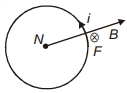
Suppose an isolated north pole is kept at the centre of a circular loop carrying an electric current $i$. The magnetic field due to the north pole at a point on the periphery of the wire is $B$. The radius of the loop is $a$. The force on the wire is
A
Nearly $2 \pi a i B$ perpendicular to the plane of the wire
B
$2 \pi a i B$ in the plane of the wire
C
$\pi a i B$ along the axis of the wire
D
$0$
Solution
(A) The magnetic field $B$ produced by the isolated north pole at any point on the circular loop is directed radially outward from the centre.
The current $i$ flows along the circumference of the loop. For any small element $dl$ of the wire,the magnetic force $dF$ is given by $dF = i(dl \times B)$.
Since the magnetic field $B$ is radial and the current element $dl$ is tangential to the circle,the angle between $dl$ and $B$ is $90^\circ$ at every point.
Thus,the magnitude of the force on a small element is $dF = i dl B \sin(90^\circ) = i B dl$.
By Fleming's left-hand rule,the direction of this force is perpendicular to the plane of the loop (directed into or out of the plane depending on the direction of current).
Since the force on every element is directed in the same direction (perpendicular to the plane),the total force $F$ is the integral of $dF$ over the entire circumference:
$F = \int dF = \int i B dl = i B \int dl = i B (2 \pi a) = 2 \pi a i B$.
Therefore,the total force is $2 \pi a i B$ perpendicular to the plane of the wire.
The current $i$ flows along the circumference of the loop. For any small element $dl$ of the wire,the magnetic force $dF$ is given by $dF = i(dl \times B)$.
Since the magnetic field $B$ is radial and the current element $dl$ is tangential to the circle,the angle between $dl$ and $B$ is $90^\circ$ at every point.
Thus,the magnitude of the force on a small element is $dF = i dl B \sin(90^\circ) = i B dl$.
By Fleming's left-hand rule,the direction of this force is perpendicular to the plane of the loop (directed into or out of the plane depending on the direction of current).
Since the force on every element is directed in the same direction (perpendicular to the plane),the total force $F$ is the integral of $dF$ over the entire circumference:
$F = \int dF = \int i B dl = i B \int dl = i B (2 \pi a) = 2 \pi a i B$.
Therefore,the total force is $2 \pi a i B$ perpendicular to the plane of the wire.
0 likes
View Solution164
MediumMCQ
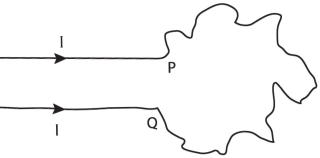
Assertion $(A):$ $A$ wire is bent into an irregular shape with the points $P$ and $Q$ fixed. If a current $I$ is passed through the wire,then the area enclosed by the irregular portion of the wire increases.
Reason $(R):$ Wires carrying currents in opposite directions repel each other.
Reason $(R):$ Wires carrying currents in opposite directions repel each other.
A
If both Assertion and Reason are true and Reason is the correct explanation of Assertion.
B
If both Assertion and Reason are true but Reason is not the correct explanation of Assertion.
C
If Assertion is true but Reason is false.
D
If both Assertion and Reason are false.
Solution
(A) The Assertion is true. When a current $I$ flows through the irregular loop,the segments of the wire that are close to each other carry current in opposite directions. According to the magnetic force law,two parallel wires carrying current in opposite directions repel each other. This repulsive force acts on all parts of the irregular loop,pushing the wire segments outward to maximize the enclosed area,eventually tending to form a circular shape.
The Reason is also true. It is a fundamental principle of electromagnetism that parallel currents in opposite directions exert a repulsive force on each other.
Since the repulsive force between the segments of the wire is the direct cause of the increase in the enclosed area,the Reason is the correct explanation of the Assertion. Therefore,the correct option is $(A)$.
The Reason is also true. It is a fundamental principle of electromagnetism that parallel currents in opposite directions exert a repulsive force on each other.
Since the repulsive force between the segments of the wire is the direct cause of the increase in the enclosed area,the Reason is the correct explanation of the Assertion. Therefore,the correct option is $(A)$.
0 likes
View Solution165
MediumMCQ
Two long straight wires $P$ and $Q$ carrying equal current $10\,A$ each were kept parallel to each other at $5\,cm$ distance. Magnitude of magnetic force experienced by $10\,cm$ length of wire $P$ is $F_1$. If distance between wires is halved and currents on them are doubled,force $F_2$ on $10\,cm$ length of wire $P$ will be :
A
$8 F_1$
B
$10 F_1$
C
$F_1 / 8$
D
$F_1 / 10$
Solution
(A) The magnetic force $F$ between two parallel wires of length $L$ carrying currents $i_1$ and $i_2$ separated by distance $d$ is given by $F = \frac{\mu_0 i_1 i_2 L}{2 \pi d}$.
For the initial case: $F_1 = \frac{\mu_0 (10)(10) L}{2 \pi (5)}$.
For the second case: $i_1' = 20\,A$,$i_2' = 20\,A$,$d' = 2.5\,cm$,and $L$ remains $10\,cm$.
$F_2 = \frac{\mu_0 (20)(20) L}{2 \pi (2.5)}$.
Taking the ratio:
$\frac{F_2}{F_1} = \frac{(20 \times 20) / 2.5}{(10 \times 10) / 5} = \frac{400 / 2.5}{100 / 5} = \frac{160}{20} = 8$.
Therefore,$F_2 = 8 F_1$.
For the initial case: $F_1 = \frac{\mu_0 (10)(10) L}{2 \pi (5)}$.
For the second case: $i_1' = 20\,A$,$i_2' = 20\,A$,$d' = 2.5\,cm$,and $L$ remains $10\,cm$.
$F_2 = \frac{\mu_0 (20)(20) L}{2 \pi (2.5)}$.
Taking the ratio:
$\frac{F_2}{F_1} = \frac{(20 \times 20) / 2.5}{(10 \times 10) / 5} = \frac{400 / 2.5}{100 / 5} = \frac{160}{20} = 8$.
Therefore,$F_2 = 8 F_1$.
0 likes
View Solution166
DifficultMCQ
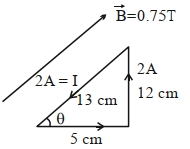
$A$ single turn current loop in the shape of a right-angled triangle with sides $5\,cm$,$12\,cm$,and $13\,cm$ carries a current of $2\,A$. The loop is placed in a uniform magnetic field of magnitude $0.75\,T$,whose direction is parallel to the current in the $13\,cm$ side of the loop. The magnitude of the magnetic force on the $5\,cm$ side is $\frac{x}{130}\,N$. The value of $x$ is $..........$
A
$8$
B
$7$
C
$9$
D
$6$
Solution
(C) The magnetic force on a current-carrying conductor is given by $\vec{F} = I(\vec{L} \times \vec{B})$,or in magnitude,$F = ILB \sin \theta$,where $\theta$ is the angle between the length vector $\vec{L}$ and the magnetic field vector $\vec{B}$.
For the $5\,cm$ side,the length $L = 5 \times 10^{-2}\,m$. The magnetic field $B = 0.75\,T = \frac{3}{4}\,T$.
From the geometry of the right-angled triangle,the angle $\theta$ between the $5\,cm$ side and the $13\,cm$ side (which is parallel to $\vec{B}$) is given by $\cos \theta = \frac{5}{13}$ and $\sin \theta = \frac{12}{13}$.
Substituting these values into the force formula:
$F = (2\,A) \times (5 \times 10^{-2}\,m) \times (0.75\,T) \times \sin \theta$
$F = 2 \times 0.05 \times 0.75 \times \frac{12}{13}$
$F = 0.1 \times 0.75 \times \frac{12}{13} = 0.075 \times \frac{12}{13} = \frac{3}{40} \times \frac{12}{13} = \frac{3 \times 3}{10 \times 13} = \frac{9}{130}\,N$.
Comparing this with $\frac{x}{130}\,N$,we get $x = 9$.
For the $5\,cm$ side,the length $L = 5 \times 10^{-2}\,m$. The magnetic field $B = 0.75\,T = \frac{3}{4}\,T$.
From the geometry of the right-angled triangle,the angle $\theta$ between the $5\,cm$ side and the $13\,cm$ side (which is parallel to $\vec{B}$) is given by $\cos \theta = \frac{5}{13}$ and $\sin \theta = \frac{12}{13}$.
Substituting these values into the force formula:
$F = (2\,A) \times (5 \times 10^{-2}\,m) \times (0.75\,T) \times \sin \theta$
$F = 2 \times 0.05 \times 0.75 \times \frac{12}{13}$
$F = 0.1 \times 0.75 \times \frac{12}{13} = 0.075 \times \frac{12}{13} = \frac{3}{40} \times \frac{12}{13} = \frac{3 \times 3}{10 \times 13} = \frac{9}{130}\,N$.
Comparing this with $\frac{x}{130}\,N$,we get $x = 9$.
0 likes
View Solution167
MediumMCQ
$A$ massless square loop of wire with resistance $10\,\Omega$ supports a mass of $1\,g$. It hangs vertically with one of its sides in a uniform magnetic field of $10^3\,G$,directed outwards in the shaded region. $A$ $DC$ voltage $V$ is applied to the loop. For what value of $V$ will the magnetic force exactly balance the weight of the supporting mass of $1\,g$? (Given: side length of the loop $= 10\,cm$,$g = 10\,m/s^2$)
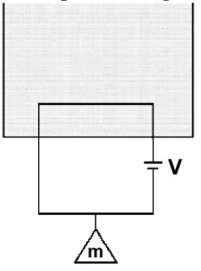
A
$\frac{1}{10}\,V$
B
$1\,V$
C
$100\,V$
D
$10\,V$
Solution
(D) The magnetic force $F_m$ acting on the side of the loop inside the magnetic field must balance the weight $mg$ of the mass.
$F_m = mg$
Since $F_m = ILB$,we have $ILB = mg$.
Using Ohm's law,$I = \frac{V}{R}$,so the equation becomes $\left(\frac{V}{R}\right)LB = mg$.
Rearranging for $V$,we get $V = \frac{mgR}{LB}$.
Given values:
$m = 1\,g = 10^{-3}\,kg$
$g = 10\,m/s^2$
$R = 10\,\Omega$
$L = 10\,cm = 0.1\,m$
$B = 10^3\,G = 10^3 \times 10^{-4}\,T = 0.1\,T$
Substituting these values:
$V = \frac{(10^{-3}\,kg)(10\,m/s^2)(10\,\Omega)}{(0.1\,m)(0.1\,T)} = \frac{10^{-1}}{10^{-2}} = 10\,V$.
$F_m = mg$
Since $F_m = ILB$,we have $ILB = mg$.
Using Ohm's law,$I = \frac{V}{R}$,so the equation becomes $\left(\frac{V}{R}\right)LB = mg$.
Rearranging for $V$,we get $V = \frac{mgR}{LB}$.
Given values:
$m = 1\,g = 10^{-3}\,kg$
$g = 10\,m/s^2$
$R = 10\,\Omega$
$L = 10\,cm = 0.1\,m$
$B = 10^3\,G = 10^3 \times 10^{-4}\,T = 0.1\,T$
Substituting these values:
$V = \frac{(10^{-3}\,kg)(10\,m/s^2)(10\,\Omega)}{(0.1\,m)(0.1\,T)} = \frac{10^{-1}}{10^{-2}} = 10\,V$.
0 likes
View Solution168
MediumMCQ
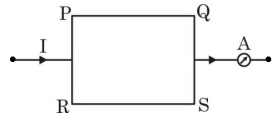
$A$ current-carrying rectangular loop $PQRS$ is made of uniform wire. The lengths are $PR = QS = 5\,cm$ and $PQ = RS = 100\,cm$. If the ammeter current reading changes from $I$ to $2I$,the ratio of magnetic forces per unit length on the wire $PQ$ due to wire $RS$ in the two cases respectively,$f_{PQ}^{I} : f_{PQ}^{2I}$,is:
A
$1: 2$
B
$1: 4$
C
$1: 5$
D
$1: 3$
Solution
(B) The magnetic force per unit length $f$ between two parallel wires carrying currents $I_1$ and $I_2$ separated by a distance $d$ is given by the formula:
$f = \frac{\mu_0 I_1 I_2}{2\pi d}$
In this rectangular loop,the current $I$ flows through both wires $PQ$ and $RS$. Therefore,$I_1 = I_2 = I$ (or $2I$ in the second case).
Thus,the force per unit length is proportional to the square of the current: $f \propto I^2$.
For the first case with current $I$,$f_{PQ}^{I} \propto I^2$.
For the second case with current $2I$,$f_{PQ}^{2I} \propto (2I)^2 = 4I^2$.
Taking the ratio:
$\frac{f_{PQ}^{I}}{f_{PQ}^{2I}} = \frac{I^2}{4I^2} = \frac{1}{4}$.
Therefore,the ratio is $1: 4$.
$f = \frac{\mu_0 I_1 I_2}{2\pi d}$
In this rectangular loop,the current $I$ flows through both wires $PQ$ and $RS$. Therefore,$I_1 = I_2 = I$ (or $2I$ in the second case).
Thus,the force per unit length is proportional to the square of the current: $f \propto I^2$.
For the first case with current $I$,$f_{PQ}^{I} \propto I^2$.
For the second case with current $2I$,$f_{PQ}^{2I} \propto (2I)^2 = 4I^2$.
Taking the ratio:
$\frac{f_{PQ}^{I}}{f_{PQ}^{2I}} = \frac{I^2}{4I^2} = \frac{1}{4}$.
Therefore,the ratio is $1: 4$.
1 likes
View Solution169
EasyMCQ
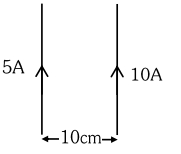
Two very long,straight,parallel conductors $A$ and $B$ carry currents of $5\,A$ and $10\,A$ respectively and are at a distance of $10\,cm$ from each other. The direction of current in the two conductors is the same. The force acting per unit length between the two conductors is: $(\mu_0 = 4\pi \times 10^{-7} \text{ SI unit})$
A
$2 \times 10^{-4} \text{ N/m}$ and is attractive
B
$2 \times 10^{-4} \text{ N/m}$ and is repulsive
C
$1 \times 10^{-4} \text{ N/m}$ and is attractive
D
$1 \times 10^{-4} \text{ N/m}$ and is repulsive
Solution
(C) The formula for the force per unit length between two parallel current-carrying conductors is given by:
$\frac{F}{\ell} = \frac{\mu_0 i_1 i_2}{2 \pi r}$
Given:
$i_1 = 5 \text{ A}$
$i_2 = 10 \text{ A}$
$r = 10 \text{ cm} = 0.1 \text{ m}$
$\mu_0 = 4\pi \times 10^{-7} \text{ T m/A}$
Substituting the values:
$\frac{F}{\ell} = \frac{4\pi \times 10^{-7} \times 5 \times 10}{2\pi \times 0.1}$
$\frac{F}{\ell} = \frac{2 \times 10^{-7} \times 50}{0.1} = \frac{100 \times 10^{-7}}{0.1} = 1000 \times 10^{-7} = 10^{-4} \text{ N/m}$
Since the currents are in the same direction,the force between the conductors is attractive.
$\frac{F}{\ell} = \frac{\mu_0 i_1 i_2}{2 \pi r}$
Given:
$i_1 = 5 \text{ A}$
$i_2 = 10 \text{ A}$
$r = 10 \text{ cm} = 0.1 \text{ m}$
$\mu_0 = 4\pi \times 10^{-7} \text{ T m/A}$
Substituting the values:
$\frac{F}{\ell} = \frac{4\pi \times 10^{-7} \times 5 \times 10}{2\pi \times 0.1}$
$\frac{F}{\ell} = \frac{2 \times 10^{-7} \times 50}{0.1} = \frac{100 \times 10^{-7}}{0.1} = 1000 \times 10^{-7} = 10^{-4} \text{ N/m}$
Since the currents are in the same direction,the force between the conductors is attractive.
0 likes
View Solution170
MediumMCQ
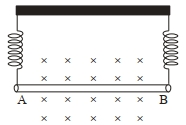
$A$ straight wire $AB$ of mass $40\,g$ and length $50\,cm$ is suspended by a pair of flexible leads in a uniform magnetic field of magnitude $0.40\,T$ as shown in the figure. The magnitude of the current required in the wire to remove the tension in the supporting leads is ...........$A$. (Take $g=10\,ms^{-2}$).
A
$4$
B
$2$
C
$6$
D
$8$
Solution
(B) Given:
Mass of the wire,$m = 40\,g = 40 \times 10^{-3}\,kg$
Length of the wire,$\ell = 50\,cm = 50 \times 10^{-2}\,m = 0.5\,m$
Magnetic field,$B = 0.40\,T$
Acceleration due to gravity,$g = 10\,ms^{-2}$
To remove the tension in the supporting leads,the upward magnetic force on the wire must balance the downward gravitational force (weight) of the wire.
Magnetic force,$F_m = I\ell B$
Weight of the wire,$W = mg$
For equilibrium,$F_m = W$
$I\ell B = mg$
Substituting the values:
$I \times 0.5 \times 0.4 = 40 \times 10^{-3} \times 10$
$I \times 0.2 = 0.4$
$I = \frac{0.4}{0.2} = 2\,A$
Thus,the magnitude of the current required is $2\,A$.
Mass of the wire,$m = 40\,g = 40 \times 10^{-3}\,kg$
Length of the wire,$\ell = 50\,cm = 50 \times 10^{-2}\,m = 0.5\,m$
Magnetic field,$B = 0.40\,T$
Acceleration due to gravity,$g = 10\,ms^{-2}$
To remove the tension in the supporting leads,the upward magnetic force on the wire must balance the downward gravitational force (weight) of the wire.
Magnetic force,$F_m = I\ell B$
Weight of the wire,$W = mg$
For equilibrium,$F_m = W$
$I\ell B = mg$
Substituting the values:
$I \times 0.5 \times 0.4 = 40 \times 10^{-3} \times 10$
$I \times 0.2 = 0.4$
$I = \frac{0.4}{0.2} = 2\,A$
Thus,the magnitude of the current required is $2\,A$.
0 likes
View Solution171
MediumMCQ
$A$ wire carrying a current $I$ along the positive $x$-axis has length $L$. It is kept in a magnetic field $\overrightarrow{B} = (2\hat{i} + 3\hat{j} - 4\hat{k}) \text{ T}$. The magnitude of the magnetic force acting on the wire is $..........IL$.
A
$\sqrt{3}$
B
$3$
C
$\sqrt{5}$
D
$5$
Solution
(D) The magnetic force on a current-carrying wire is given by $\overrightarrow{F} = I(\vec{L} \times \overrightarrow{B})$.
Since the wire is along the positive $x$-axis,its length vector is $\vec{L} = L\hat{i}$.
Given $\overrightarrow{B} = (2\hat{i} + 3\hat{j} - 4\hat{k}) \text{ T}$.
Substituting these into the formula:
$\overrightarrow{F} = I [ (L\hat{i}) \times (2\hat{i} + 3\hat{j} - 4\hat{k}) ]$
$\overrightarrow{F} = IL [ (\hat{i} \times 2\hat{i}) + (\hat{i} \times 3\hat{j}) + (\hat{i} \times -4\hat{k}) ]$
Using cross product rules ($\hat{i} \times \hat{i} = 0$,$\hat{i} \times \hat{j} = \hat{k}$,$\hat{i} \times \hat{k} = -\hat{j}$):
$\overrightarrow{F} = IL [ 0 + 3\hat{k} - 4(-\hat{j}) ]$
$\overrightarrow{F} = IL (4\hat{j} + 3\hat{k})$.
The magnitude of the force is $|\overrightarrow{F}| = IL \sqrt{4^2 + 3^2} = IL \sqrt{16 + 9} = IL \sqrt{25} = 5IL$.
Thus,the magnitude is $5IL$.
Since the wire is along the positive $x$-axis,its length vector is $\vec{L} = L\hat{i}$.
Given $\overrightarrow{B} = (2\hat{i} + 3\hat{j} - 4\hat{k}) \text{ T}$.
Substituting these into the formula:
$\overrightarrow{F} = I [ (L\hat{i}) \times (2\hat{i} + 3\hat{j} - 4\hat{k}) ]$
$\overrightarrow{F} = IL [ (\hat{i} \times 2\hat{i}) + (\hat{i} \times 3\hat{j}) + (\hat{i} \times -4\hat{k}) ]$
Using cross product rules ($\hat{i} \times \hat{i} = 0$,$\hat{i} \times \hat{j} = \hat{k}$,$\hat{i} \times \hat{k} = -\hat{j}$):
$\overrightarrow{F} = IL [ 0 + 3\hat{k} - 4(-\hat{j}) ]$
$\overrightarrow{F} = IL (4\hat{j} + 3\hat{k})$.
The magnitude of the force is $|\overrightarrow{F}| = IL \sqrt{4^2 + 3^2} = IL \sqrt{16 + 9} = IL \sqrt{25} = 5IL$.
Thus,the magnitude is $5IL$.
1 likes
View Solution172
DifficultMCQ
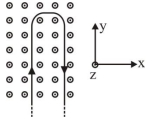
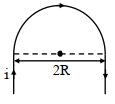
$A$ rigid wire consists of a semicircular portion of radius $R$ and two straight sections. The wire is partially immersed in a perpendicular magnetic field $B = B_0 \hat{k}$ as shown in the figure. The magnetic force on the wire if it carries a current $i$ is:
A
$-i B_0 (2R) \hat{i}$
B
$i B_0 (2R) \hat{i}$
C
$-i B_0 (2R) \hat{j}$
D
$i B_0 (2R) \hat{j}$
Solution
(C) The magnetic force on a current-carrying wire is given by $\vec{F} = i (\vec{L}_{eff} \times \vec{B})$.
Here,the effective length vector $\vec{L}_{eff}$ is the displacement vector from the starting point to the ending point of the wire within the magnetic field.
From the figure,the current enters at the bottom left and exits at the bottom right of the semicircular loop. The displacement vector $\vec{L}_{eff}$ for the semicircular part is $2R \hat{i}$.
The magnetic field is $\vec{B} = B_0 \hat{k}$.
Therefore,$\vec{F} = i (2R \hat{i} \times B_0 \hat{k})$.
Since $\hat{i} \times \hat{k} = -\hat{j}$,we get $\vec{F} = i (2R B_0) (-\hat{j}) = -2 i B_0 R \hat{j}$.
Here,the effective length vector $\vec{L}_{eff}$ is the displacement vector from the starting point to the ending point of the wire within the magnetic field.
From the figure,the current enters at the bottom left and exits at the bottom right of the semicircular loop. The displacement vector $\vec{L}_{eff}$ for the semicircular part is $2R \hat{i}$.
The magnetic field is $\vec{B} = B_0 \hat{k}$.
Therefore,$\vec{F} = i (2R \hat{i} \times B_0 \hat{k})$.
Since $\hat{i} \times \hat{k} = -\hat{j}$,we get $\vec{F} = i (2R B_0) (-\hat{j}) = -2 i B_0 R \hat{j}$.
0 likes
View Solution173
DifficultMCQ
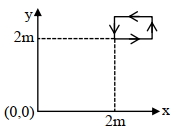
The magnetic field existing in a region is given by $\vec{B} = 0.2(1 + 2x) \hat{k} \text{ T}$. $A$ square loop of edge $50 \text{ cm}$ carrying $0.5 \text{ A}$ current is placed in the $x-y$ plane with its edges parallel to the $x-y$ axes,as shown in the figure. The magnitude of the net magnetic force experienced by the loop is . . . . . . $\text{mN}$.
A
$15$
B
$40$
C
$50$
D
$65$
Solution
(C) The magnetic field is $\vec{B} = 0.2(1 + 2x) \hat{k} \text{ T}$. The loop is a square with side length $L = 0.5 \text{ m}$. The loop is placed from $x = 2 \text{ m}$ to $x = 2.5 \text{ m}$ and $y = 2 \text{ m}$ to $y = 2.5 \text{ m}$.
For the segments parallel to the $x$-axis,the forces are equal and opposite,so they cancel out.
For the segments parallel to the $y$-axis,the force is given by $\vec{F} = I \int (d\vec{l} \times \vec{B})$.
At $x = 2 \text{ m}$,the current flows in the negative $y$-direction: $\vec{F}_1 = I L \hat{j} \times \vec{B}(x=2) = 0.5 \times 0.5 \times [0.2(1 + 2(2))] \hat{j} \times \hat{k} = 0.25 \times 1 \hat{i} = 0.25 \text{ N}$ (in $+x$ direction).
At $x = 2.5 \text{ m}$,the current flows in the positive $y$-direction: $\vec{F}_2 = I L (-\hat{j}) \times \vec{B}(x=2.5) = 0.5 \times 0.5 \times [0.2(1 + 2(2.5))] (-\hat{j}) \times \hat{k} = 0.25 \times 1.2 (-\hat{i}) = -0.30 \text{ N}$ (in $-x$ direction).
The net force is $F_{\text{net}} = |F_1 - F_2| = |0.25 - 0.30| = 0.05 \text{ N} = 50 \text{ mN}$.
For the segments parallel to the $x$-axis,the forces are equal and opposite,so they cancel out.
For the segments parallel to the $y$-axis,the force is given by $\vec{F} = I \int (d\vec{l} \times \vec{B})$.
At $x = 2 \text{ m}$,the current flows in the negative $y$-direction: $\vec{F}_1 = I L \hat{j} \times \vec{B}(x=2) = 0.5 \times 0.5 \times [0.2(1 + 2(2))] \hat{j} \times \hat{k} = 0.25 \times 1 \hat{i} = 0.25 \text{ N}$ (in $+x$ direction).
At $x = 2.5 \text{ m}$,the current flows in the positive $y$-direction: $\vec{F}_2 = I L (-\hat{j}) \times \vec{B}(x=2.5) = 0.5 \times 0.5 \times [0.2(1 + 2(2.5))] (-\hat{j}) \times \hat{k} = 0.25 \times 1.2 (-\hat{i}) = -0.30 \text{ N}$ (in $-x$ direction).
The net force is $F_{\text{net}} = |F_1 - F_2| = |0.25 - 0.30| = 0.05 \text{ N} = 50 \text{ mN}$.
0 likes
View Solution174
DifficultMCQ
$A$ $2 \, A$ current carrying straight metal wire of resistance $1 \, \Omega$, resistivity $2 \times 10^{-6} \, \Omega m$, area of cross-section $10 \, mm^2$ and mass $500 \, g$ is suspended horizontally in mid-air by applying a uniform magnetic field $\vec{B}$. The magnitude of $B$ is . . . . . . . $\times 10^{-1} \, T$ (given, $g=10 \, m/s^2$).
A
$4$
B
$5$
C
$6$
D
$7$
Solution
(B) The resistance of the wire is given by $R = \frac{\rho \ell}{A}$.
Given $R = 1 \, \Omega$, $\rho = 2 \times 10^{-6} \, \Omega m$, and $A = 10 \, mm^2 = 10 \times 10^{-6} \, m^2 = 10^{-5} \, m^2$.
Substituting these values: $1 = \frac{2 \times 10^{-6} \times \ell}{10^{-5}} \Rightarrow 1 = 0.2 \times \ell \Rightarrow \ell = 5 \, m$.
For the wire to be suspended in mid-air, the magnetic force must balance the gravitational force: $F_m = F_g$.
$Bi\ell = mg$.
Given $i = 2 \, A$, $m = 500 \, g = 0.5 \, kg$, $g = 10 \, m/s^2$, and $\ell = 5 \, m$.
$B \times 2 \times 5 = 0.5 \times 10$.
$10B = 5$.
$B = 0.5 \, T = 5 \times 10^{-1} \, T$.
Thus, the magnitude is $5$.
Given $R = 1 \, \Omega$, $\rho = 2 \times 10^{-6} \, \Omega m$, and $A = 10 \, mm^2 = 10 \times 10^{-6} \, m^2 = 10^{-5} \, m^2$.
Substituting these values: $1 = \frac{2 \times 10^{-6} \times \ell}{10^{-5}} \Rightarrow 1 = 0.2 \times \ell \Rightarrow \ell = 5 \, m$.
For the wire to be suspended in mid-air, the magnetic force must balance the gravitational force: $F_m = F_g$.
$Bi\ell = mg$.
Given $i = 2 \, A$, $m = 500 \, g = 0.5 \, kg$, $g = 10 \, m/s^2$, and $\ell = 5 \, m$.
$B \times 2 \times 5 = 0.5 \times 10$.
$10B = 5$.
$B = 0.5 \, T = 5 \times 10^{-1} \, T$.
Thus, the magnitude is $5$.
0 likes
View Solution175
DifficultMCQ
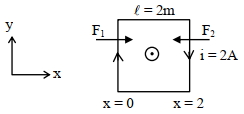
$A$ square loop of edge length $2 \ m$ carrying current of $2 \ A$ is placed with its edges parallel to the $x-y$ axis. $A$ magnetic field is passing through the $x-y$ plane and expressed as $\vec{B}=B_0(1+4x) \hat{k}$,where $B_0=5 \ T$. The net magnetic force experienced by the loop is . . . . . . $N$.
A
$159$
B
$160$
C
$170$
D
$171$
Solution
(B) The magnetic field is given by $\vec{B} = B_0(1+4x) \hat{k}$.
For the vertical wire at $x=0$,the magnetic field is $B(0) = B_0(1+4(0)) = B_0 = 5 \ T$.
The force on this wire is $F_1 = i \ell B(0) = 2 \times 2 \times 5 = 20 \ N$ (directed in the $+x$ direction).
For the vertical wire at $x=2$,the magnetic field is $B(2) = B_0(1+4(2)) = 9B_0 = 9 \times 5 = 45 \ T$.
The force on this wire is $F_2 = i \ell B(2) = 2 \times 2 \times 45 = 180 \ N$ (directed in the $-x$ direction).
The forces on the horizontal wires cancel each other out.
The net force is $F_{net} = F_2 - F_1 = 180 - 20 = 160 \ N$.
For the vertical wire at $x=0$,the magnetic field is $B(0) = B_0(1+4(0)) = B_0 = 5 \ T$.
The force on this wire is $F_1 = i \ell B(0) = 2 \times 2 \times 5 = 20 \ N$ (directed in the $+x$ direction).
For the vertical wire at $x=2$,the magnetic field is $B(2) = B_0(1+4(2)) = 9B_0 = 9 \times 5 = 45 \ T$.
The force on this wire is $F_2 = i \ell B(2) = 2 \times 2 \times 45 = 180 \ N$ (directed in the $-x$ direction).
The forces on the horizontal wires cancel each other out.
The net force is $F_{net} = F_2 - F_1 = 180 - 20 = 160 \ N$.
1 likes
View Solution176
AdvancedMCQ
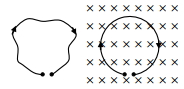
$A$ thin flexible wire of length $L$ is connected to two adjacent fixed points and carries a current $I$ in the clockwise direction,as shown in the figure. When the system is put in a uniform magnetic field of strength $B$ going into the plane of the paper,the wire takes the shape of a circle. The tension in the wire is
A
$IBL$
B
$\frac{IBL}{\pi}$
C
$\frac{IBL}{2 \pi}$
D
$\frac{IBL}{4 \pi}$
Solution
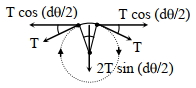
(C) Consider a small element of the wire of length $dl = R d\theta$ subtending an angle $d\theta$ at the center of the circular arc.
The magnetic force on this element is $dF = I (dl) B = I (R d\theta) B$,which acts radially outward.
The tension $T$ in the wire acts at both ends of this element. The net radial force due to tension is $2 T \sin(\frac{d\theta}{2}) \approx T d\theta$ for small $d\theta$.
Equating the radial magnetic force to the radial component of tension:
$T d\theta = I B R d\theta$
$T = I B R$
Since the total length of the wire is $L$,and assuming it forms a complete circle (or nearly so),$L = 2 \pi R$,so $R = \frac{L}{2 \pi}$.
Substituting $R$ into the tension equation:
$T = I B (\frac{L}{2 \pi}) = \frac{IBL}{2 \pi}$
The magnetic force on this element is $dF = I (dl) B = I (R d\theta) B$,which acts radially outward.
The tension $T$ in the wire acts at both ends of this element. The net radial force due to tension is $2 T \sin(\frac{d\theta}{2}) \approx T d\theta$ for small $d\theta$.
Equating the radial magnetic force to the radial component of tension:
$T d\theta = I B R d\theta$
$T = I B R$
Since the total length of the wire is $L$,and assuming it forms a complete circle (or nearly so),$L = 2 \pi R$,so $R = \frac{L}{2 \pi}$.
Substituting $R$ into the tension equation:
$T = I B (\frac{L}{2 \pi}) = \frac{IBL}{2 \pi}$
0 likes
View Solution177
MediumMCQ
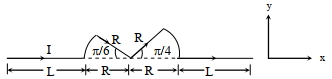
$A$ conductor (shown in the figure) carrying constant current $I$ is kept in the $x-y$ plane in a uniform magnetic field $\vec{B}$. If $F$ is the magnitude of the total magnetic force acting on the conductor,then the correct statement$(s)$ is(are):
A
$(A)$ If $\vec{B}$ is along $\hat{z}$,$F \propto (L+R)$
B
$(B)$ If $\vec{B}$ is along $\hat{x}$,$F = 0$
C
$(C)$ If $\vec{B}$ is along $\hat{y}$,$F \propto (L+R)$
D
$(D)$ If $\vec{B}$ is along $\hat{z}$,$F = 0$
Solution
(A) The magnetic force on a current-carrying wire in a uniform magnetic field is given by $\vec{F} = I(\vec{L}_{eff} \times \vec{B})$,where $\vec{L}_{eff}$ is the vector displacement from the starting point to the end point of the conductor.
Looking at the geometry,the conductor starts at some point and ends at a point displaced by a total horizontal distance of $L + R + R + L = 2(L+R)$ along the $x$-axis.
Thus,$\vec{L}_{eff} = 2(L+R)\hat{i}$.
Therefore,$\vec{F} = I(2(L+R)\hat{i} \times \vec{B}) = 2I(L+R)(\hat{i} \times \vec{B})$.
$(A)$ If $\vec{B} = B\hat{z}$,then $\vec{F} = 2I(L+R)B(\hat{i} \times \hat{z}) = -2I(L+R)B\hat{j}$. The magnitude $F = 2I(L+R)B$,so $F \propto (L+R)$. This is correct.
$(B)$ If $\vec{B} = B\hat{x}$,then $\vec{F} = 2I(L+R)B(\hat{i} \times \hat{x}) = 0$. This is correct.
$(C)$ If $\vec{B} = B\hat{y}$,then $\vec{F} = 2I(L+R)B(\hat{i} \times \hat{y}) = 2I(L+R)B\hat{z}$. The magnitude $F = 2I(L+R)B$,so $F \propto (L+R)$. This is correct.
$(D)$ If $\vec{B} = B\hat{z}$,$F \neq 0$. This is incorrect.
Thus,the correct statements are $(A), (B),$ and $(C)$.
Looking at the geometry,the conductor starts at some point and ends at a point displaced by a total horizontal distance of $L + R + R + L = 2(L+R)$ along the $x$-axis.
Thus,$\vec{L}_{eff} = 2(L+R)\hat{i}$.
Therefore,$\vec{F} = I(2(L+R)\hat{i} \times \vec{B}) = 2I(L+R)(\hat{i} \times \vec{B})$.
$(A)$ If $\vec{B} = B\hat{z}$,then $\vec{F} = 2I(L+R)B(\hat{i} \times \hat{z}) = -2I(L+R)B\hat{j}$. The magnitude $F = 2I(L+R)B$,so $F \propto (L+R)$. This is correct.
$(B)$ If $\vec{B} = B\hat{x}$,then $\vec{F} = 2I(L+R)B(\hat{i} \times \hat{x}) = 0$. This is correct.
$(C)$ If $\vec{B} = B\hat{y}$,then $\vec{F} = 2I(L+R)B(\hat{i} \times \hat{y}) = 2I(L+R)B\hat{z}$. The magnitude $F = 2I(L+R)B$,so $F \propto (L+R)$. This is correct.
$(D)$ If $\vec{B} = B\hat{z}$,$F \neq 0$. This is incorrect.
Thus,the correct statements are $(A), (B),$ and $(C)$.

0 likes
View Solution178
EasyMCQ
$A$ $4.0 \ cm$ long straight wire carrying a current of $8 \ A$ is placed perpendicular to a uniform magnetic field of strength $0.15 \ T$. The magnetic force on the wire is . . . . . . $mN$.
A
$50$
B
$48$
C
$38$
D
$63$
Solution
(B) The magnetic force $F$ on a current-carrying wire is given by the formula $F = I \ell B \sin(\theta)$.
Given:
Current $I = 8 \ A$
Length $\ell = 4.0 \ cm = 0.04 \ m$
Magnetic field $B = 0.15 \ T$
Angle $\theta = 90^{\circ}$ (since the wire is perpendicular to the field),so $\sin(90^{\circ}) = 1$.
Substituting the values:
$F = 8 \times 0.04 \times 0.15 \times 1$
$F = 0.32 \times 0.15 = 0.048 \ N$
To convert to $mN$,multiply by $1000$:
$F = 0.048 \times 1000 \ mN = 48 \ mN$.
Given:
Current $I = 8 \ A$
Length $\ell = 4.0 \ cm = 0.04 \ m$
Magnetic field $B = 0.15 \ T$
Angle $\theta = 90^{\circ}$ (since the wire is perpendicular to the field),so $\sin(90^{\circ}) = 1$.
Substituting the values:
$F = 8 \times 0.04 \times 0.15 \times 1$
$F = 0.32 \times 0.15 = 0.048 \ N$
To convert to $mN$,multiply by $1000$:
$F = 0.048 \times 1000 \ mN = 48 \ mN$.
0 likes
View Solution179
MediumMCQ
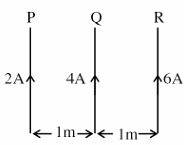
Three long straight wires are carrying current as shown in the diagram. The magnetic force per unit length on wire $Q$ is $..... \times 10^{-7} \ N/m$.
A
$8$
B
$32$
C
$4$
D
$16$
Solution
(B) The force per unit length between two parallel wires carrying currents $I_1$ and $I_2$ separated by distance $r$ is given by $f = \frac{\mu_0 I_1 I_2}{2 \pi r}$.
Wire $P$ carries $2 \ A$,wire $Q$ carries $4 \ A$,and wire $R$ carries $6 \ A$. The distance between $P$ and $Q$ is $1 \ m$,and the distance between $Q$ and $R$ is $1 \ m$.
Since all currents are in the same direction,wire $P$ attracts wire $Q$ towards the left,and wire $R$ attracts wire $Q$ towards the right.
Force per unit length on $Q$ due to $P$ is $f_{QP} = \frac{\mu_0 (4)(2)}{2 \pi (1)} = \frac{8 \mu_0}{2 \pi}$.
Force per unit length on $Q$ due to $R$ is $f_{QR} = \frac{\mu_0 (4)(6)}{2 \pi (1)} = \frac{24 \mu_0}{2 \pi}$.
The net force per unit length on $Q$ is $f_{\text{net}} = f_{QR} - f_{QP} = \frac{\mu_0}{2 \pi} (24 - 8) = \frac{4 \pi \times 10^{-7}}{2 \pi} \times 16 = 2 \times 10^{-7} \times 16 = 32 \times 10^{-7} \ N/m$.
Wire $P$ carries $2 \ A$,wire $Q$ carries $4 \ A$,and wire $R$ carries $6 \ A$. The distance between $P$ and $Q$ is $1 \ m$,and the distance between $Q$ and $R$ is $1 \ m$.
Since all currents are in the same direction,wire $P$ attracts wire $Q$ towards the left,and wire $R$ attracts wire $Q$ towards the right.
Force per unit length on $Q$ due to $P$ is $f_{QP} = \frac{\mu_0 (4)(2)}{2 \pi (1)} = \frac{8 \mu_0}{2 \pi}$.
Force per unit length on $Q$ due to $R$ is $f_{QR} = \frac{\mu_0 (4)(6)}{2 \pi (1)} = \frac{24 \mu_0}{2 \pi}$.
The net force per unit length on $Q$ is $f_{\text{net}} = f_{QR} - f_{QP} = \frac{\mu_0}{2 \pi} (24 - 8) = \frac{4 \pi \times 10^{-7}}{2 \pi} \times 16 = 2 \times 10^{-7} \times 16 = 32 \times 10^{-7} \ N/m$.
0 likes
View Solution180
MediumMCQ
$A$ straight horizontal long wire carries $30 \ A$ current. The linear mass density of the wire is $45 \ g/m$. What is the magnitude of the magnetic field needed to balance the wire in air?
A
$15 \times 10^{-3} \ T$
B
$15 \ T$
C
$15 \times 10^{-4} \ T$
D
$15 \times 10^{-2} \ T$
Solution
(A) To balance the wire in air,the upward magnetic force must equal the downward gravitational force.
The magnetic force on a current-carrying wire is given by $F_m = BI\ell$.
The gravitational force is $F_g = mg$.
Equating the two: $BI\ell = mg$.
Rearranging for the magnetic field $B$: $B = \frac{mg}{I\ell} = \left(\frac{m}{\ell}\right) \frac{g}{I}$.
Given linear mass density $\lambda = \frac{m}{\ell} = 45 \ g/m = 45 \times 10^{-3} \ kg/m$,current $I = 30 \ A$,and taking $g = 10 \ m/s^2$:
$B = (45 \times 10^{-3}) \times \frac{10}{30} = 45 \times 10^{-3} \times \frac{1}{3} = 15 \times 10^{-3} \ T$.
The magnetic force on a current-carrying wire is given by $F_m = BI\ell$.
The gravitational force is $F_g = mg$.
Equating the two: $BI\ell = mg$.
Rearranging for the magnetic field $B$: $B = \frac{mg}{I\ell} = \left(\frac{m}{\ell}\right) \frac{g}{I}$.
Given linear mass density $\lambda = \frac{m}{\ell} = 45 \ g/m = 45 \times 10^{-3} \ kg/m$,current $I = 30 \ A$,and taking $g = 10 \ m/s^2$:
$B = (45 \times 10^{-3}) \times \frac{10}{30} = 45 \times 10^{-3} \times \frac{1}{3} = 15 \times 10^{-3} \ T$.
0 likes
View Solution181
DifficultMCQ
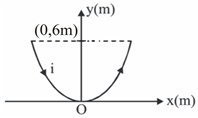
$A$ wire is bent as a parabolic curve and kept in the $x-y$ plane. The curve is described by the equation $x^2 = 6y$. The wire carries a current $i = 2 \ A$. If a uniform magnetic field $\vec{B} = 2 \times 10^{-3} \hat{k} \ T$ is applied,the force experienced by the wire is nearly: (in $hat{j} \ N$)
A
$1.5$
B
$-1.5$
C
$-0.05$
D
$2.5$
Solution
(C) The force on a current-carrying wire in a uniform magnetic field is given by $\vec{F} = i(\vec{L}_{\text{eff}} \times \vec{B})$,where $\vec{L}_{\text{eff}}$ is the vector displacement from the starting point to the ending point of the wire.
From the given figure,the wire starts at $x = -\ell$ and ends at $x = +\ell$ at the height $y = 6 \ m$.
Using the equation $x^2 = 6y$,at $y = 6 \ m$,we have $x^2 = 6(6) = 36$,so $x = \pm 6 \ m$.
Thus,the effective length vector is $\vec{L}_{\text{eff}} = (6 - (-6)) \hat{i} = 12 \hat{i} \ m$.
The current is $i = 2 \ A$ and the magnetic field is $\vec{B} = 2 \times 10^{-3} \hat{k} \ T$.
Substituting these into the force formula:
$\vec{F} = 2 \times (12 \hat{i} \times 2 \times 10^{-3} \hat{k})$
$\vec{F} = 48 \times 10^{-3} (\hat{i} \times \hat{k})$
Since $\hat{i} \times \hat{k} = -\hat{j}$,we get:
$\vec{F} = 48 \times 10^{-3} (-\hat{j}) = -0.048 \hat{j} \ N$.
Rounding this to the nearest value,we get $\vec{F} \simeq -0.05 \hat{j} \ N$.
From the given figure,the wire starts at $x = -\ell$ and ends at $x = +\ell$ at the height $y = 6 \ m$.
Using the equation $x^2 = 6y$,at $y = 6 \ m$,we have $x^2 = 6(6) = 36$,so $x = \pm 6 \ m$.
Thus,the effective length vector is $\vec{L}_{\text{eff}} = (6 - (-6)) \hat{i} = 12 \hat{i} \ m$.
The current is $i = 2 \ A$ and the magnetic field is $\vec{B} = 2 \times 10^{-3} \hat{k} \ T$.
Substituting these into the force formula:
$\vec{F} = 2 \times (12 \hat{i} \times 2 \times 10^{-3} \hat{k})$
$\vec{F} = 48 \times 10^{-3} (\hat{i} \times \hat{k})$
Since $\hat{i} \times \hat{k} = -\hat{j}$,we get:
$\vec{F} = 48 \times 10^{-3} (-\hat{j}) = -0.048 \hat{j} \ N$.
Rounding this to the nearest value,we get $\vec{F} \simeq -0.05 \hat{j} \ N$.
0 likes
View Solution182
MediumMCQ
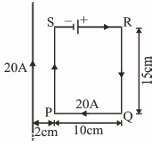
The resultant force on the current loop $PQRS$ due to a long current-carrying conductor will be $..... \times 10^{-4} \text{ N}$.
A
$10$
B
$36$
C
$18$
D
$5$
Solution
(D) The forces on segments $SR$ and $PQ$ are equal in magnitude but opposite in direction,so their net force is zero.
For the segments $PS$ and $QR$ parallel to the long conductor,the force between two parallel conductors carrying currents $I_1$ and $I_2$ is given by:
$F = \frac{\mu_0}{2\pi} \frac{I_1 I_2 \ell}{r} = 2 \times 10^{-7} \frac{I_1 I_2 \ell}{r}$
Here,$I_1 = 20 \text{ A}$ (long conductor),$I_2 = 20 \text{ A}$ (loop),and $\ell = 15 \text{ cm} = 0.15 \text{ m}$.
For segment $PS$,$r_1 = 2 \text{ cm} = 0.02 \text{ m}$. The force is attractive (towards the conductor):
$F_{PS} = \frac{2 \times 10^{-7} \times 20 \times 20 \times 0.15}{0.02} = 6 \times 10^{-4} \text{ N}$.
For segment $QR$,$r_2 = 2 \text{ cm} + 10 \text{ cm} = 12 \text{ cm} = 0.12 \text{ m}$. The force is repulsive (away from the conductor):
$F_{QR} = \frac{2 \times 10^{-7} \times 20 \times 20 \times 0.15}{0.12} = 1 \times 10^{-4} \text{ N}$.
The net force is $F_{net} = F_{PS} - F_{QR} = 6 \times 10^{-4} - 1 \times 10^{-4} = 5 \times 10^{-4} \text{ N}$.
Thus,the value is $5$.
For the segments $PS$ and $QR$ parallel to the long conductor,the force between two parallel conductors carrying currents $I_1$ and $I_2$ is given by:
$F = \frac{\mu_0}{2\pi} \frac{I_1 I_2 \ell}{r} = 2 \times 10^{-7} \frac{I_1 I_2 \ell}{r}$
Here,$I_1 = 20 \text{ A}$ (long conductor),$I_2 = 20 \text{ A}$ (loop),and $\ell = 15 \text{ cm} = 0.15 \text{ m}$.
For segment $PS$,$r_1 = 2 \text{ cm} = 0.02 \text{ m}$. The force is attractive (towards the conductor):
$F_{PS} = \frac{2 \times 10^{-7} \times 20 \times 20 \times 0.15}{0.02} = 6 \times 10^{-4} \text{ N}$.
For segment $QR$,$r_2 = 2 \text{ cm} + 10 \text{ cm} = 12 \text{ cm} = 0.12 \text{ m}$. The force is repulsive (away from the conductor):
$F_{QR} = \frac{2 \times 10^{-7} \times 20 \times 20 \times 0.15}{0.12} = 1 \times 10^{-4} \text{ N}$.
The net force is $F_{net} = F_{PS} - F_{QR} = 6 \times 10^{-4} - 1 \times 10^{-4} = 5 \times 10^{-4} \text{ N}$.
Thus,the value is $5$.
0 likes
View Solution183
MediumMCQ
$A$ current of $10 \ A$ flows through two long parallel wires. The magnetic force per unit length on each wire is $2 \times 10^{-3} \ N/m$. If their currents are doubled and the separation between them is halved,then the magnetic force per unit length of each wire becomes $...... \times 10^{-3} \ N/m$.
A
$16$
B
$8$
C
$4$
D
$32$
Solution
(A) The magnetic force per unit length between two long parallel wires is given by the formula:
$F = \frac{\mu_0 i_1 i_2}{2 \pi d} = 2 \times 10^{-3} \ N/m$
When the currents are doubled ($i_1' = 2i_1$ and $i_2' = 2i_2$) and the separation is halved $(d' = d/2)$,the new force per unit length $F'$ is:
$F' = \frac{\mu_0 (2i_1)(2i_2)}{2 \pi (d/2)}$
$F' = \frac{4 \mu_0 i_1 i_2}{2 \pi (d/2)} = 8 \times \left( \frac{\mu_0 i_1 i_2}{2 \pi d} \right)$
Substituting the initial value of force:
$F' = 8 \times (2 \times 10^{-3} \ N/m) = 16 \times 10^{-3} \ N/m$
Therefore,the new force per unit length is $16 \times 10^{-3} \ N/m$.
$F = \frac{\mu_0 i_1 i_2}{2 \pi d} = 2 \times 10^{-3} \ N/m$
When the currents are doubled ($i_1' = 2i_1$ and $i_2' = 2i_2$) and the separation is halved $(d' = d/2)$,the new force per unit length $F'$ is:
$F' = \frac{\mu_0 (2i_1)(2i_2)}{2 \pi (d/2)}$
$F' = \frac{4 \mu_0 i_1 i_2}{2 \pi (d/2)} = 8 \times \left( \frac{\mu_0 i_1 i_2}{2 \pi d} \right)$
Substituting the initial value of force:
$F' = 8 \times (2 \times 10^{-3} \ N/m) = 16 \times 10^{-3} \ N/m$
Therefore,the new force per unit length is $16 \times 10^{-3} \ N/m$.
0 likes
View Solution184
EasyMCQ
The magnetic force on a current-carrying wire in an external uniform magnetic field depends on:
A
$a, b$
B
$a, b, c, d$
C
$a, b, c$
D
only $d$
Solution
(C) The magnetic force $\overrightarrow{F}_{m}$ on a current-carrying wire of length $\overrightarrow{L}$ in an external uniform magnetic field $\overrightarrow{B}_{ext}$ is given by the formula: $\overrightarrow{F}_{m} = I(\overrightarrow{L} \times \overrightarrow{B}_{ext})$.
Here,$I$ is the current in the wire,$\overrightarrow{L}$ is the vector representing the straight-line distance between the two ends of the wire,and $\overrightarrow{B}_{ext}$ is the external magnetic field.
Since the force depends on $I$,$\overrightarrow{L}$,and $\overrightarrow{B}_{ext}$,it depends on factors $(a)$,$(b)$,and $(c)$.
It does not depend on the mass of the wire $(d)$.
Here,$I$ is the current in the wire,$\overrightarrow{L}$ is the vector representing the straight-line distance between the two ends of the wire,and $\overrightarrow{B}_{ext}$ is the external magnetic field.
Since the force depends on $I$,$\overrightarrow{L}$,and $\overrightarrow{B}_{ext}$,it depends on factors $(a)$,$(b)$,and $(c)$.
It does not depend on the mass of the wire $(d)$.
0 likes
View Solution185
MediumMCQ
$A$ current of $10 \ A$ is flowing in two straight parallel wires in the same direction. The force of attraction between them is $1 \times 10^{-3} \ N$. If the current is doubled in both the wires,the force will be:
A
$1 \times 10^{-3} \ N$
B
$2 \times 10^{-3} \ N$
C
$4 \times 10^{-3} \ N$
D
$0.25 \times 10^{-3} \ N$
Solution
(C) The force per unit length between two parallel wires carrying currents $I_1$ and $I_2$ separated by distance $r$ is given by $F = \frac{\mu_0}{4\pi} \frac{2 I_1 I_2}{r} \cdot l$.
Given the initial force $F = 1 \times 10^{-3} \ N$.
When the current in both wires is doubled,the new currents become $I_1' = 2I_1$ and $I_2' = 2I_2$.
The new force $F'$ is given by $F' = \frac{\mu_0}{4\pi} \frac{2(2I_1)(2I_2)}{r} \cdot l = 4 \times \left( \frac{\mu_0}{4\pi} \frac{2 I_1 I_2}{r} \cdot l \right)$.
Substituting the initial force value: $F' = 4 \times (1 \times 10^{-3} \ N) = 4 \times 10^{-3} \ N$.
Given the initial force $F = 1 \times 10^{-3} \ N$.
When the current in both wires is doubled,the new currents become $I_1' = 2I_1$ and $I_2' = 2I_2$.
The new force $F'$ is given by $F' = \frac{\mu_0}{4\pi} \frac{2(2I_1)(2I_2)}{r} \cdot l = 4 \times \left( \frac{\mu_0}{4\pi} \frac{2 I_1 I_2}{r} \cdot l \right)$.
Substituting the initial force value: $F' = 4 \times (1 \times 10^{-3} \ N) = 4 \times 10^{-3} \ N$.
0 likes
View Solution186
MediumMCQ
Two long straight wires $A$ and $B$ carrying equal current $I$ were kept parallel to each other at distance $d$ apart. The magnitude of the magnetic force experienced by length $L$ of wire $A$ is $F$. If the distance between the wires is halved and the currents are doubled,the force $F_2$ on length $L$ of wire $A$ will be:
A
$2 F$
B
$F$
C
$8 F$
D
$4 F$
Solution
(C) The magnetic force per unit length between two parallel wires carrying currents $I_1$ and $I_2$ separated by distance $d$ is given by $f = \frac{\mu_0 I_1 I_2}{2 \pi d}$.
For length $L$,the force is $F = \frac{\mu_0 I^2 L}{2 \pi d}$.
In the new condition,the distance $d' = \frac{d}{2}$ and the currents $I' = 2I$.
The new force $F_2$ is given by $F_2 = \frac{\mu_0 (2I)(2I) L}{2 \pi (d/2)}$.
Simplifying this,we get $F_2 = \frac{\mu_0 (4I^2) L}{2 \pi (d/2)} = 8 \times \left( \frac{\mu_0 I^2 L}{2 \pi d} \right)$.
Therefore,$F_2 = 8F$.
For length $L$,the force is $F = \frac{\mu_0 I^2 L}{2 \pi d}$.
In the new condition,the distance $d' = \frac{d}{2}$ and the currents $I' = 2I$.
The new force $F_2$ is given by $F_2 = \frac{\mu_0 (2I)(2I) L}{2 \pi (d/2)}$.
Simplifying this,we get $F_2 = \frac{\mu_0 (4I^2) L}{2 \pi (d/2)} = 8 \times \left( \frac{\mu_0 I^2 L}{2 \pi d} \right)$.
Therefore,$F_2 = 8F$.
0 likes
View Solution187
MediumMCQ
Two long conductors separated by a distance '$d$' carry currents '$I_1$' and '$I_2$' in the same directions. They exert a force '$F$' on each other. The distance between them is increased to '$3d$'. If a new force of magnitude '$2/3 F$' is found between these conductors,the required change in the magnitude and direction of one of the currents in the conductor is respectively [length of the conductors is constant].
A
same,reversed.
B
twice,reversed.
C
thrice,same.
D
twice,same.
Solution
(A) The force per unit length between two long parallel conductors is given by $F/L = \frac{\mu_0 I_1 I_2}{2 \pi d}$.
Initially,$F = \frac{\mu_0 I_1 I_2}{2 \pi d}$.
After changing the distance to $3d$,the new force $F'$ is given as $2/3 F$ (repulsive).
Since the original force was attractive (same direction currents),a repulsive force implies the direction of one current must be reversed.
Let the new currents be $I_1$ and $I_2'$. Then $F' = \frac{\mu_0 I_1 I_2'}{2 \pi (3d)} = \frac{2}{3} F$.
Substituting $F = \frac{\mu_0 I_1 I_2}{2 \pi d}$,we get $\frac{\mu_0 I_1 I_2'}{6 \pi d} = \frac{2}{3} \left( \frac{\mu_0 I_1 I_2}{2 \pi d} \right)$.
Simplifying,$\frac{I_2'}{3} = \frac{2}{3} \cdot \frac{I_2}{2} = \frac{I_2}{3}$.
Thus,$I_2' = I_2$. The magnitude remains the same,but the direction is reversed.
Initially,$F = \frac{\mu_0 I_1 I_2}{2 \pi d}$.
After changing the distance to $3d$,the new force $F'$ is given as $2/3 F$ (repulsive).
Since the original force was attractive (same direction currents),a repulsive force implies the direction of one current must be reversed.
Let the new currents be $I_1$ and $I_2'$. Then $F' = \frac{\mu_0 I_1 I_2'}{2 \pi (3d)} = \frac{2}{3} F$.
Substituting $F = \frac{\mu_0 I_1 I_2}{2 \pi d}$,we get $\frac{\mu_0 I_1 I_2'}{6 \pi d} = \frac{2}{3} \left( \frac{\mu_0 I_1 I_2}{2 \pi d} \right)$.
Simplifying,$\frac{I_2'}{3} = \frac{2}{3} \cdot \frac{I_2}{2} = \frac{I_2}{3}$.
Thus,$I_2' = I_2$. The magnitude remains the same,but the direction is reversed.
0 likes
View Solution188
EasyMCQ
$A$ wire of length $L$ carries current $I$ along the $x$-axis. $A$ magnetic field $\vec{B} = B_0(\hat{i} - \hat{j} - \hat{k}) \text{ T}$ acts on the wire. The magnitude of the magnetic force acting on the wire is:
A
$\frac{ILB_0}{2}$
B
$ILB_0$
C
$2 ILB_0$
D
$\sqrt{2} ILB_0$
Solution
(D) The magnetic force on a current-carrying wire is given by the formula $\vec{F} = I(\vec{L} \times \vec{B})$.
Here,the wire is along the $x$-axis,so the length vector is $\vec{L} = L\hat{i}$.
The magnetic field is $\vec{B} = B_0(\hat{i} - \hat{j} - \hat{k})$.
Substituting these into the force equation:
$\vec{F} = I(L\hat{i}) \times B_0(\hat{i} - \hat{j} - \hat{k})$
$\vec{F} = ILB_0 [(\hat{i} \times \hat{i}) - (\hat{i} \times \hat{j}) - (\hat{i} \times \hat{k})]$
Using the cross product rules ($\hat{i} \times \hat{i} = 0$,$\hat{i} \times \hat{j} = \hat{k}$,$\hat{i} \times \hat{k} = -\hat{j}$):
$\vec{F} = ILB_0 [0 - \hat{k} - (-\hat{j})]$
$\vec{F} = ILB_0 (\hat{j} - \hat{k})$
The magnitude of the force is $|\vec{F}| = ILB_0 \sqrt{(1)^2 + (-1)^2} = ILB_0 \sqrt{1 + 1} = \sqrt{2} ILB_0$.
Here,the wire is along the $x$-axis,so the length vector is $\vec{L} = L\hat{i}$.
The magnetic field is $\vec{B} = B_0(\hat{i} - \hat{j} - \hat{k})$.
Substituting these into the force equation:
$\vec{F} = I(L\hat{i}) \times B_0(\hat{i} - \hat{j} - \hat{k})$
$\vec{F} = ILB_0 [(\hat{i} \times \hat{i}) - (\hat{i} \times \hat{j}) - (\hat{i} \times \hat{k})]$
Using the cross product rules ($\hat{i} \times \hat{i} = 0$,$\hat{i} \times \hat{j} = \hat{k}$,$\hat{i} \times \hat{k} = -\hat{j}$):
$\vec{F} = ILB_0 [0 - \hat{k} - (-\hat{j})]$
$\vec{F} = ILB_0 (\hat{j} - \hat{k})$
The magnitude of the force is $|\vec{F}| = ILB_0 \sqrt{(1)^2 + (-1)^2} = ILB_0 \sqrt{1 + 1} = \sqrt{2} ILB_0$.
0 likes
View Solution189
MediumMCQ
$A$ square coil $ABCD$ of side $L$ is carrying a current $I_1$ in the clockwise direction. $A$ straight conductor carrying current $I_2$ (upward direction) is kept parallel to side $AB$ at a distance $\frac{L}{3}$ in the plane of $ABCD$. The net force on the coil $ABCD$ is ($\mu_0 =$ magnetic permeability).
A
$\frac{\mu_0 I_1 I_2}{3 \pi}$
B
$\frac{3 \mu_0 I_1 I_2}{4 \pi}$
C
$\frac{3 \mu_0 I_1 I_2}{8 \pi}$
D
$\frac{9 \mu_0 I_1 I_2}{8 \pi}$
Solution
(D) The magnetic field $B$ due to the straight wire at a distance $r$ is $B = \frac{\mu_0 I_2}{2 \pi r}$.
For side $AB$ (distance $r_1 = L/3$),the force is $F_{AB} = I_1 L B_1 = I_1 L \left( \frac{\mu_0 I_2}{2 \pi (L/3)} \right) = \frac{3 \mu_0 I_1 I_2}{2 \pi}$ (Attractive,towards the wire).
For side $CD$ (distance $r_2 = L/3 + L = 4L/3$),the force is $F_{CD} = I_1 L B_2 = I_1 L \left( \frac{\mu_0 I_2}{2 \pi (4L/3)} \right) = \frac{3 \mu_0 I_1 I_2}{8 \pi}$ (Repulsive,away from the wire).
The sides $BC$ and $AD$ are perpendicular to the wire,and the forces on them cancel each other out due to symmetry.
The net force $F_{net} = F_{AB} - F_{CD} = \frac{3 \mu_0 I_1 I_2}{2 \pi} - \frac{3 \mu_0 I_1 I_2}{8 \pi} = \frac{12 \mu_0 I_1 I_2 - 3 \mu_0 I_1 I_2}{8 \pi} = \frac{9 \mu_0 I_1 I_2}{8 \pi}$.
For side $AB$ (distance $r_1 = L/3$),the force is $F_{AB} = I_1 L B_1 = I_1 L \left( \frac{\mu_0 I_2}{2 \pi (L/3)} \right) = \frac{3 \mu_0 I_1 I_2}{2 \pi}$ (Attractive,towards the wire).
For side $CD$ (distance $r_2 = L/3 + L = 4L/3$),the force is $F_{CD} = I_1 L B_2 = I_1 L \left( \frac{\mu_0 I_2}{2 \pi (4L/3)} \right) = \frac{3 \mu_0 I_1 I_2}{8 \pi}$ (Repulsive,away from the wire).
The sides $BC$ and $AD$ are perpendicular to the wire,and the forces on them cancel each other out due to symmetry.
The net force $F_{net} = F_{AB} - F_{CD} = \frac{3 \mu_0 I_1 I_2}{2 \pi} - \frac{3 \mu_0 I_1 I_2}{8 \pi} = \frac{12 \mu_0 I_1 I_2 - 3 \mu_0 I_1 I_2}{8 \pi} = \frac{9 \mu_0 I_1 I_2}{8 \pi}$.
0 likes
View Solution190
DifficultMCQ
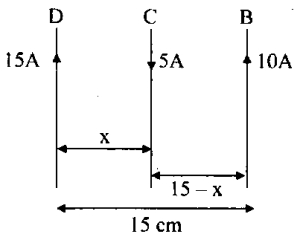
Three long,straight parallel wires carrying currents are arranged as shown. The wire $C$ which carries a current of $5.0 \text{ A}$ is so placed that it experiences no force. The distance of wire $C$ from wire $D$ is (in $cm$)
A
$9$
B
$7$
C
$5$
D
$3$
Solution
(A) For wire $C$ to experience no net force,the magnetic force exerted by wire $D$ must be equal and opposite to the magnetic force exerted by wire $B$.
Let $x$ be the distance of wire $C$ from wire $D$. The distance of wire $C$ from wire $B$ is $(15 - x) \text{ cm}$.
The force per unit length between two parallel wires carrying currents $i_1$ and $i_2$ separated by distance $r$ is given by $F = \frac{\mu_0 i_1 i_2}{2 \pi r}$.
Equating the forces on wire $C$:
$F_{CD} = F_{CB}$
$\frac{\mu_0 i_C i_D}{2 \pi x} = \frac{\mu_0 i_C i_B}{2 \pi (15 - x)}$
$\frac{i_D}{x} = \frac{i_B}{15 - x}$
Substituting the given values $i_D = 15 \text{ A}$,$i_B = 10 \text{ A}$:
$\frac{15}{x} = \frac{10}{15 - x}$
$15(15 - x) = 10x$
$225 - 15x = 10x$
$25x = 225$
$x = 9 \text{ cm}$.
Let $x$ be the distance of wire $C$ from wire $D$. The distance of wire $C$ from wire $B$ is $(15 - x) \text{ cm}$.
The force per unit length between two parallel wires carrying currents $i_1$ and $i_2$ separated by distance $r$ is given by $F = \frac{\mu_0 i_1 i_2}{2 \pi r}$.
Equating the forces on wire $C$:
$F_{CD} = F_{CB}$
$\frac{\mu_0 i_C i_D}{2 \pi x} = \frac{\mu_0 i_C i_B}{2 \pi (15 - x)}$
$\frac{i_D}{x} = \frac{i_B}{15 - x}$
Substituting the given values $i_D = 15 \text{ A}$,$i_B = 10 \text{ A}$:
$\frac{15}{x} = \frac{10}{15 - x}$
$15(15 - x) = 10x$
$225 - 15x = 10x$
$25x = 225$
$x = 9 \text{ cm}$.
0 likes
View Solution191
MediumMCQ
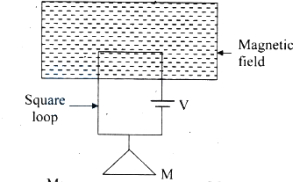
$A$ massless square loop of wire of resistance $R$ supporting a mass $M$ hangs vertically with one of its sides in a uniform magnetic field $B$ directed outwards in the shaded region. $A$ d.c. voltage $V$ is applied to the loop. For what value of $V$ will the magnetic force exactly balance the weight of the supporting mass $M$? (side of loop $= L, g =$ acceleration due to gravity)
A
$\frac{Mg}{LBR}$
B
$\frac{LB}{MgR}$
C
$\frac{MgR}{LB}$
D
$\frac{LR}{MgB}$
Solution
(C) The magnetic force $F$ acting on the side of the loop of length $L$ inside the magnetic field $B$ is given by $F = BIL$,where $I$ is the current in the loop.
For the magnetic force to balance the weight of the mass $M$,we must have $F = Mg$.
Therefore,$BIL = Mg$.
According to Ohm's law,the current $I$ in the loop is given by $I = \frac{V}{R}$,where $V$ is the applied voltage and $R$ is the resistance of the loop.
Substituting the value of $I$ in the force equation,we get $B \left( \frac{V}{R} \right) L = Mg$.
Rearranging the terms to solve for $V$,we get $V = \frac{MgR}{BL}$.
For the magnetic force to balance the weight of the mass $M$,we must have $F = Mg$.
Therefore,$BIL = Mg$.
According to Ohm's law,the current $I$ in the loop is given by $I = \frac{V}{R}$,where $V$ is the applied voltage and $R$ is the resistance of the loop.
Substituting the value of $I$ in the force equation,we get $B \left( \frac{V}{R} \right) L = Mg$.
Rearranging the terms to solve for $V$,we get $V = \frac{MgR}{BL}$.
0 likes
View Solution192
EasyMCQ
Two parallel wires separated by distance '$b$' are carrying equal current '$I$' in the same direction. The force per unit length of the wire is
A
$\frac{\mu_0}{4 \pi}\left(\frac{I}{b^2}\right)$
B
$\frac{\mu_0}{4 \pi}\left(\frac{I^2}{b^2}\right)$
C
$\frac{\mu_0}{4 \pi}\left(\frac{I^2}{b}\right)$
D
$\frac{\mu_0}{4 \pi}\left(\frac{2 I^2}{b}\right)$
Solution
(D) The force per unit length between two parallel current-carrying wires is given by the formula:
$\frac{F}{l} = \frac{\mu_0}{4 \pi} \frac{2 I_1 I_2}{r}$
Here,$I_1 = I_2 = I$ and the distance $r = b$.
Substituting these values into the formula:
$\frac{F}{l} = \frac{\mu_0}{4 \pi} \frac{2 I \cdot I}{b} = \frac{\mu_0}{4 \pi} \frac{2 I^2}{b}$
Thus,the force per unit length is $\frac{\mu_0}{4 \pi} \frac{2 I^2}{b}$.
$\frac{F}{l} = \frac{\mu_0}{4 \pi} \frac{2 I_1 I_2}{r}$
Here,$I_1 = I_2 = I$ and the distance $r = b$.
Substituting these values into the formula:
$\frac{F}{l} = \frac{\mu_0}{4 \pi} \frac{2 I \cdot I}{b} = \frac{\mu_0}{4 \pi} \frac{2 I^2}{b}$
Thus,the force per unit length is $\frac{\mu_0}{4 \pi} \frac{2 I^2}{b}$.
0 likes
View Solution193
MediumMCQ
Three infinite straight wires $A, B$ and $C$ carry currents as shown in the figure. The resultant force on wire $B$ is directed:
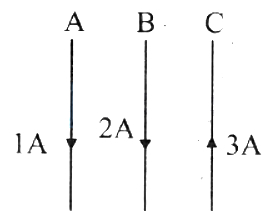
A
towards $A$
B
towards $C$
C
perpendicular to the plane of page
D
upwards
Solution
(A) The force per unit length between two parallel wires carrying currents $I_1$ and $I_2$ separated by distance $d$ is given by $f = \frac{\mu_0 I_1 I_2}{2 \pi d}$.
Parallel currents attract each other,while anti-parallel currents repel each other.
Wire $A$ carries $1 \text{ A}$ downwards,wire $B$ carries $2 \text{ A}$ downwards,and wire $C$ carries $3 \text{ A}$ upwards.
Force on $B$ due to $A$ $(F_{BA})$: Since currents in $A$ and $B$ are in the same direction,they attract. Thus,$F_{BA}$ is directed towards $A$.
Magnitude $F_{BA} \propto (1 \text{ A} \times 2 \text{ A}) = 2$.
Force on $B$ due to $C$ $(F_{BC})$: Since currents in $B$ and $C$ are in opposite directions,they repel. Thus,$F_{BC}$ is directed away from $C$,which is also towards $A$.
Magnitude $F_{BC} \propto (2 \text{ A} \times 3 \text{ A}) = 6$.
Since both forces $F_{BA}$ and $F_{BC}$ are directed towards $A$,the resultant force is directed towards $A$.
Parallel currents attract each other,while anti-parallel currents repel each other.
Wire $A$ carries $1 \text{ A}$ downwards,wire $B$ carries $2 \text{ A}$ downwards,and wire $C$ carries $3 \text{ A}$ upwards.
Force on $B$ due to $A$ $(F_{BA})$: Since currents in $A$ and $B$ are in the same direction,they attract. Thus,$F_{BA}$ is directed towards $A$.
Magnitude $F_{BA} \propto (1 \text{ A} \times 2 \text{ A}) = 2$.
Force on $B$ due to $C$ $(F_{BC})$: Since currents in $B$ and $C$ are in opposite directions,they repel. Thus,$F_{BC}$ is directed away from $C$,which is also towards $A$.
Magnitude $F_{BC} \propto (2 \text{ A} \times 3 \text{ A}) = 6$.
Since both forces $F_{BA}$ and $F_{BC}$ are directed towards $A$,the resultant force is directed towards $A$.
0 likes
View Solution194
MediumMCQ
Two wires $2 \text{ mm}$ apart supply current to a $100 \text{ V}$,$1 \text{ kW}$ heater. The force per metre between the wires is (Given $\mu_0 = 4\pi \times 10^{-7} \text{ T m/A}$)
A
$2 \times 10^{-2} \text{ N}$
B
$4 \times 10^{-3} \text{ N}$
C
$2 \times 10^2 \text{ N}$
D
$10^{-2} \text{ N}$
Solution
(D) Given: Power $P = 1 \text{ kW} = 1000 \text{ W}$,Voltage $V = 100 \text{ V}$,Distance $a = 2 \text{ mm} = 2 \times 10^{-3} \text{ m}$.
First,calculate the current $I$ flowing through the wires using $P = VI$:
$I = \frac{P}{V} = \frac{1000}{100} = 10 \text{ A}$.
The force per unit length $f$ between two parallel wires carrying current $I$ is given by the formula:
$f = \frac{\mu_0 I^2}{2\pi a}$.
Substituting the values:
$f = \frac{(4\pi \times 10^{-7}) \times (10)^2}{2\pi \times (2 \times 10^{-3})}$.
$f = \frac{4\pi \times 10^{-7} \times 100}{4\pi \times 10^{-3}}$.
$f = 10^{-7} \times 10^2 \times 10^3 = 10^{-2} \text{ N/m}$.
Thus,the force per metre is $10^{-2} \text{ N}$.
First,calculate the current $I$ flowing through the wires using $P = VI$:
$I = \frac{P}{V} = \frac{1000}{100} = 10 \text{ A}$.
The force per unit length $f$ between two parallel wires carrying current $I$ is given by the formula:
$f = \frac{\mu_0 I^2}{2\pi a}$.
Substituting the values:
$f = \frac{(4\pi \times 10^{-7}) \times (10)^2}{2\pi \times (2 \times 10^{-3})}$.
$f = \frac{4\pi \times 10^{-7} \times 100}{4\pi \times 10^{-3}}$.
$f = 10^{-7} \times 10^2 \times 10^3 = 10^{-2} \text{ N/m}$.
Thus,the force per metre is $10^{-2} \text{ N}$.
0 likes
View Solution195
MediumMCQ
Two long conductors separated by a distance $d$ carry currents $I_1$ and $I_2$ in the same direction. They exert a force $F$ on each other. Now,the current in one of them is increased to $2$ times and its direction is reversed. The distance between them is also increased to $3d$. The new value of force between them is:
A
$-2F$
B
$\frac{F}{3}$
C
$\frac{-2F}{3}$
D
$\frac{-F}{3}$
Solution
(C) The force per unit length between two parallel long conductors is given by the formula: $F = \frac{\mu_0 I_1 I_2}{2 \pi d}$.
Initially,the force is $F = \frac{\mu_0 I_1 I_2}{2 \pi d}$.
When the current in one conductor is doubled $(I_1' = 2I_1)$ and its direction is reversed,the new current becomes $-2I_1$. The distance is increased to $d' = 3d$.
The new force $F'$ is given by: $F' = \frac{\mu_0 (-2I_1) I_2}{2 \pi (3d)}$.
Simplifying this,we get: $F' = -\frac{2}{3} \left( \frac{\mu_0 I_1 I_2}{2 \pi d} \right)$.
Substituting the initial force $F$,we get: $F' = -\frac{2F}{3}$.
Initially,the force is $F = \frac{\mu_0 I_1 I_2}{2 \pi d}$.
When the current in one conductor is doubled $(I_1' = 2I_1)$ and its direction is reversed,the new current becomes $-2I_1$. The distance is increased to $d' = 3d$.
The new force $F'$ is given by: $F' = \frac{\mu_0 (-2I_1) I_2}{2 \pi (3d)}$.
Simplifying this,we get: $F' = -\frac{2}{3} \left( \frac{\mu_0 I_1 I_2}{2 \pi d} \right)$.
Substituting the initial force $F$,we get: $F' = -\frac{2F}{3}$.
0 likes
View Solution196
DifficultMCQ
$A, B$ and $C$ are three parallel conductors of equal lengths and carry currents $I, I$ and $2I$ respectively as shown in the figure. The distance between $A$ and $B$ and between $B$ and $C$ is $d$. If $F_1$ is the force exerted by $B$ on $A$ and $F_2$ is the force exerted by $C$ on $A$,then:
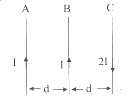
A
$F_1=F_2$
B
$F_1=-F_2$
C
$F_1=2F_2$
D
$F_1=\frac{1}{2}F_2$
Solution
(B) The force per unit length between two parallel current-carrying wires is given by $F = \frac{\mu_0 I_1 I_2}{2 \pi r}$.
For wire $A$ and $B$: Both carry current $I$ in the same direction. The force $F_1$ exerted by $B$ on $A$ is attractive,with magnitude $F_1 = \frac{\mu_0 I^2}{2 \pi d}$.
For wire $A$ and $C$: Wire $A$ carries current $I$ upwards and wire $C$ carries current $2I$ downwards. Since the currents are in opposite directions,the force $F_2$ exerted by $C$ on $A$ is repulsive,with magnitude $F_2 = \frac{\mu_0 I (2I)}{2 \pi (2d)} = \frac{\mu_0 I^2}{2 \pi d}$.
Since the forces $F_1$ and $F_2$ have equal magnitudes but act in opposite directions (one is attractive and the other is repulsive),we have $F_1 = -F_2$.
For wire $A$ and $B$: Both carry current $I$ in the same direction. The force $F_1$ exerted by $B$ on $A$ is attractive,with magnitude $F_1 = \frac{\mu_0 I^2}{2 \pi d}$.
For wire $A$ and $C$: Wire $A$ carries current $I$ upwards and wire $C$ carries current $2I$ downwards. Since the currents are in opposite directions,the force $F_2$ exerted by $C$ on $A$ is repulsive,with magnitude $F_2 = \frac{\mu_0 I (2I)}{2 \pi (2d)} = \frac{\mu_0 I^2}{2 \pi d}$.
Since the forces $F_1$ and $F_2$ have equal magnitudes but act in opposite directions (one is attractive and the other is repulsive),we have $F_1 = -F_2$.
0 likes
View Solution197
DifficultMCQ
Two long parallel wires separated by distance '$d$' carry currents $I_1$ and $I_2$ in the same direction. They exert a force $F$ on each other. Now,the current in one of the wires is increased to three times its initial value and its direction is reversed. The distance between the wires is doubled. The magnitude of the force between them is:
A
$\frac{2 F}{3}$
B
$\frac{3 F}{2}$
C
$3 F$
D
$\frac{F}{2}$
Solution
(B) The force per unit length between two long parallel wires carrying currents $I_1$ and $I_2$ separated by a distance $d$ is given by the formula: $f = \frac{F}{l} = \frac{\mu_0 I_1 I_2}{2 \pi d}$.
Initially,the force is $F = \frac{\mu_0 I_1 I_2 l}{2 \pi d}$.
According to the problem,the new current $I_1' = 3 I_1$,the new distance $d' = 2 d$,and the current $I_2$ remains the same (the direction change only affects the nature of the force,not its magnitude).
The new force $F'$ is given by: $F' = \frac{\mu_0 (3 I_1) I_2 l}{2 \pi (2 d)}$.
Simplifying this expression,we get: $F' = \frac{3}{2} \left( \frac{\mu_0 I_1 I_2 l}{2 \pi d} \right)$.
Substituting the initial force $F$ into the equation,we get: $F' = \frac{3}{2} F$.
Initially,the force is $F = \frac{\mu_0 I_1 I_2 l}{2 \pi d}$.
According to the problem,the new current $I_1' = 3 I_1$,the new distance $d' = 2 d$,and the current $I_2$ remains the same (the direction change only affects the nature of the force,not its magnitude).
The new force $F'$ is given by: $F' = \frac{\mu_0 (3 I_1) I_2 l}{2 \pi (2 d)}$.
Simplifying this expression,we get: $F' = \frac{3}{2} \left( \frac{\mu_0 I_1 I_2 l}{2 \pi d} \right)$.
Substituting the initial force $F$ into the equation,we get: $F' = \frac{3}{2} F$.
0 likes
View Solution198
EasyMCQ
Two thin long parallel wires of the same material are separated by a distance '$r$'. Both carry the same current '$I$' in the same direction. Hence,they will ($\mu_0 =$ permeability of free space.)
A
Attract each other with a force $\frac{\mu_0 I^2}{2r}$ per unit length
B
Repel each other with a force $\frac{\mu_0 I^2}{2\pi r}$ per unit length
C
Attract each other with a force $\frac{\mu_0 I^2}{2\pi r}$ per unit length
D
Repel each other with a force $\frac{\mu_0 I^2}{2r}$ per unit length
Solution
(C) The force per unit length between two long parallel current-carrying conductors is given by the formula $F = \frac{\mu_0 I_1 I_2}{2\pi r}$.
Here,$r$ is the separation distance,and $I_1$ and $I_2$ are the currents in the conductors.
According to the right-hand rule,when two parallel wires carry current in the same direction,they exert an attractive force on each other.
Given that $I_1 = I_2 = I$,the magnitude of the force per unit length is $F = \frac{\mu_0 I^2}{2\pi r}$.
Therefore,the wires attract each other with a force of $\frac{\mu_0 I^2}{2\pi r}$ per unit length.
Here,$r$ is the separation distance,and $I_1$ and $I_2$ are the currents in the conductors.
According to the right-hand rule,when two parallel wires carry current in the same direction,they exert an attractive force on each other.
Given that $I_1 = I_2 = I$,the magnitude of the force per unit length is $F = \frac{\mu_0 I^2}{2\pi r}$.
Therefore,the wires attract each other with a force of $\frac{\mu_0 I^2}{2\pi r}$ per unit length.
0 likes
View SolutionMoving Charges and Magnetism — Force on a Current Carrying Conductor · Frequently Asked Questions
1Are these Moving Charges and Magnetism questions useful for JEE and NEET?
Yes. All questions in this section are mapped to JEE Main and NEET exam patterns. Previous year questions from JEE Main, NEET, GUJCET and state-level exams are included with full solutions.
2Can I switch to Hindi or Gujarati for these questions?
Yes. Use the language tabs in the hero section or the sidebar to view the same questions and solutions in English, Hindi or Gujarati.
3How do I generate a question paper from this subtopic?
Use the Vedclass Exam Paper Generator — select the chapter and subtopic, set difficulty, and generate Sets A, B, C, D automatically. First 3 chapters of every subject are free.
Vedclass Products
For Students
Vedclass Test Series
Mock tests in real JEE/NEET style with performance analysis. 5-day free trial.
Start Free TrialFor Teachers
Exam Paper Generator
Generate Set A/B/C/D papers from this chapter in 2 minutes. 3 chapters free.
Try FreeFor Institutes
Online Exam Module
Live online exams with unlimited students, 360° analytics & white-label branding.
See DemoFor Teachers & Institutes
Generate a Moving Charges and Magnetism Exam Paper in 2 Minutes
Select subtopic & difficulty — Sets A, B, C, D auto-generated with No Repeat logic.
First 3 chapters of every subject are free — no payment required.