
A English
Biot-Savart's Law and its application Questions in English
Class 12 Physics · Moving Charges and Magnetism · Biot-Savart's Law and its application
706+
Questions
English
Language
100%
With Solutions
Showing 49 of 706 questions in English
1
EasyMCQ
Tesla is a unit for measuring
A
Magnetic moment
B
Magnetic induction
C
Magnetic pole strength
D
None of these
Solution
(B) The unit of magnetic field strength or magnetic induction $(B)$ in the $SI$ system is the Tesla $(T)$. One Tesla is defined as one Weber per square meter $(1 \ T = 1 \ Wb/m^2)$. Therefore,Tesla is the unit for measuring magnetic induction.
0 likes
View Solution2
MediumMCQ
The $SI$ unit of magnetic permeability is
A
$Wb\;m^{-2}\;A^{-1}$
B
$Wb\;m^{-1}\;A$
C
$Wb\;m^{-1}\;A^{-1}$
D
$Wb\;m\;A^{-1}$
Solution
(C) The magnetic field $B$ produced by a current element is given by the Biot-Savart Law:
$B = \frac{\mu_0}{4\pi} \frac{I dl \sin(\theta)}{r^2}$
Rearranging for the permeability $\mu_0$:
$\mu_0 = \frac{B \cdot r^2}{I \cdot dl \cdot \sin(\theta)}$
Substituting the $SI$ units:
$B$ is in $Wb/m^2$ (Tesla),
$r$ is in $m$,
$I$ is in $A$,
$dl$ is in $m$.
Therefore,the unit of $\mu_0$ is:
$\text{Unit} = \frac{(Wb/m^2) \cdot m^2}{A \cdot m} = \frac{Wb}{A \cdot m} = Wb\;m^{-1}\;A^{-1}$
$B = \frac{\mu_0}{4\pi} \frac{I dl \sin(\theta)}{r^2}$
Rearranging for the permeability $\mu_0$:
$\mu_0 = \frac{B \cdot r^2}{I \cdot dl \cdot \sin(\theta)}$
Substituting the $SI$ units:
$B$ is in $Wb/m^2$ (Tesla),
$r$ is in $m$,
$I$ is in $A$,
$dl$ is in $m$.
Therefore,the unit of $\mu_0$ is:
$\text{Unit} = \frac{(Wb/m^2) \cdot m^2}{A \cdot m} = \frac{Wb}{A \cdot m} = Wb\;m^{-1}\;A^{-1}$
0 likes
View Solution3
MediumMCQ
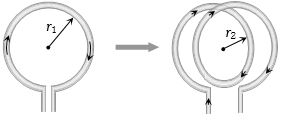
$A$ length $L$ of wire carries a steady current $I$. It is bent first to form a circular plane coil of one turn. The same length is now bent more sharply to give a double loop of smaller radius. The magnetic field at the centre caused by the same current is
A
$A$ quarter of its first value
B
Unaltered
C
Four times of its first value
D
$A$ half of its first value
Solution
(C) The magnetic field $B$ at the centre of a circular coil of $N$ turns and radius $r$ carrying current $I$ is given by $B = \frac{\mu_0 N I}{2r}$.
Since the length of the wire $L$ is constant,$L = 2\pi r_1 N_1 = 2\pi r_2 N_2$.
For the first case,$N_1 = 1$,so $L = 2\pi r_1$,which implies $r_1 = \frac{L}{2\pi}$.
For the second case,$N_2 = 2$,so $L = 2\pi r_2 \times 2$,which implies $r_2 = \frac{L}{4\pi} = \frac{r_1}{2}$.
The magnetic field in the first case is $B_1 = \frac{\mu_0 (1) I}{2r_1}$.
The magnetic field in the second case is $B_2 = \frac{\mu_0 (2) I}{2r_2} = \frac{\mu_0 (2) I}{2(r_1/2)} = \frac{4 \mu_0 I}{2r_1} = 4 B_1$.
Thus,the magnetic field becomes four times its first value.
Since the length of the wire $L$ is constant,$L = 2\pi r_1 N_1 = 2\pi r_2 N_2$.
For the first case,$N_1 = 1$,so $L = 2\pi r_1$,which implies $r_1 = \frac{L}{2\pi}$.
For the second case,$N_2 = 2$,so $L = 2\pi r_2 \times 2$,which implies $r_2 = \frac{L}{4\pi} = \frac{r_1}{2}$.
The magnetic field in the first case is $B_1 = \frac{\mu_0 (1) I}{2r_1}$.
The magnetic field in the second case is $B_2 = \frac{\mu_0 (2) I}{2r_2} = \frac{\mu_0 (2) I}{2(r_1/2)} = \frac{4 \mu_0 I}{2r_1} = 4 B_1$.
Thus,the magnetic field becomes four times its first value.
0 likes
View Solution4
EasyMCQ
$A$ vertical straight conductor carries a current vertically upwards. $A$ point $P$ lies to the east of it at a small distance and another point $Q$ lies to the west at the same distance. The magnetic field at $P$ is
A
Greater than at $Q$
B
Same as at $Q$
C
Less than at $Q$
D
Greater or less than at $Q$ depending upon the strength of the current
Solution
(B) According to the Biot-Savart Law,the magnitude of the magnetic field $B$ produced by a long straight current-carrying conductor at a distance $r$ is given by the formula $B = \frac{\mu_0 I}{2 \pi r}$.
Since both points $P$ and $Q$ are at the same distance $r$ from the conductor,the magnitude of the magnetic field at both points will be equal.
Therefore,the magnetic field at $P$ is the same as the magnetic field at $Q$.
Since both points $P$ and $Q$ are at the same distance $r$ from the conductor,the magnitude of the magnetic field at both points will be equal.
Therefore,the magnetic field at $P$ is the same as the magnetic field at $Q$.
0 likes
View Solution5
EasyMCQ
The magnetic field $d\overrightarrow{B}$ due to a small current element $d\overrightarrow{l}$ at a distance $\overrightarrow{r}$ from an element carrying current $i$ is given by:
A
$d\overrightarrow{B} = \frac{\mu_0}{4\pi} i \left( \frac{d\overrightarrow{l} \times \overrightarrow{r}}{r} \right)$
B
$d\overrightarrow{B} = \frac{\mu_0}{4\pi} i^2 \left( \frac{d\overrightarrow{l} \times \overrightarrow{r}}{r} \right)$
C
$d\overrightarrow{B} = \frac{\mu_0}{4\pi} i^2 \left( \frac{d\overrightarrow{l} \times \overrightarrow{r}}{r^2} \right)$
D
$d\overrightarrow{B} = \frac{\mu_0}{4\pi} i \left( \frac{d\overrightarrow{l} \times \overrightarrow{r}}{r^3} \right)$
Solution
(D) According to the Biot-Savart Law,the magnetic field $dB$ due to a current element $idl$ at a distance $r$ is given by the magnitude: $dB = \frac{\mu_0}{4\pi} \frac{idl \sin \theta}{r^2}$.
In vector form,this is expressed as $d\overrightarrow{B} = \frac{\mu_0}{4\pi} \frac{i(d\overrightarrow{l} \times \widehat{r})}{r^2}$.
Since the unit vector $\widehat{r} = \frac{\overrightarrow{r}}{r}$,we substitute this into the equation:
$d\overrightarrow{B} = \frac{\mu_0}{4\pi} \frac{i(d\overrightarrow{l} \times \overrightarrow{r})}{r^2 \cdot r} = \frac{\mu_0}{4\pi} \frac{i(d\overrightarrow{l} \times \overrightarrow{r})}{r^3}$.
Thus,option $D$ is correct.
In vector form,this is expressed as $d\overrightarrow{B} = \frac{\mu_0}{4\pi} \frac{i(d\overrightarrow{l} \times \widehat{r})}{r^2}$.
Since the unit vector $\widehat{r} = \frac{\overrightarrow{r}}{r}$,we substitute this into the equation:
$d\overrightarrow{B} = \frac{\mu_0}{4\pi} \frac{i(d\overrightarrow{l} \times \overrightarrow{r})}{r^2 \cdot r} = \frac{\mu_0}{4\pi} \frac{i(d\overrightarrow{l} \times \overrightarrow{r})}{r^3}$.
Thus,option $D$ is correct.
0 likes
View Solution6
MediumMCQ
$A$ charge $q$ $C$ moves in a circle at $n$ revolutions per second and the radius of the circle is $r$ $m$. The magnetic field at the centre of the circle is:
A
$\frac{2\pi q}{nr} \times 10^{-7} \text{ N/A} \cdot \text{m}$
B
$\frac{2\pi q}{r} \times 10^{-7} \text{ N/A} \cdot \text{m}$
C
$\frac{2\pi nq}{r} \times 10^{-7} \text{ N/A} \cdot \text{m}$
D
$\frac{2\pi q}{r} \text{ N/A} \cdot \text{m}$
Solution
(C) The current $i$ produced by a charge $q$ moving in a circle with frequency $n$ is given by $i = q \times n$.
The magnetic field $B$ at the centre of a circular loop is given by the formula $B = \frac{\mu_0 i}{2r}$.
Substituting $\frac{\mu_0}{4\pi} = 10^{-7} \text{ T} \cdot \text{m/A}$, we get $\frac{\mu_0}{2} = 2\pi \times 10^{-7}$.
Thus, $B = (2\pi \times 10^{-7}) \times \frac{i}{r}$.
Substituting $i = nq$, we get $B = \frac{2\pi nq}{r} \times 10^{-7} \text{ N/A} \cdot \text{m}$.
The magnetic field $B$ at the centre of a circular loop is given by the formula $B = \frac{\mu_0 i}{2r}$.
Substituting $\frac{\mu_0}{4\pi} = 10^{-7} \text{ T} \cdot \text{m/A}$, we get $\frac{\mu_0}{2} = 2\pi \times 10^{-7}$.
Thus, $B = (2\pi \times 10^{-7}) \times \frac{i}{r}$.
Substituting $i = nq$, we get $B = \frac{2\pi nq}{r} \times 10^{-7} \text{ N/A} \cdot \text{m}$.
0 likes
View Solution7
MediumMCQ
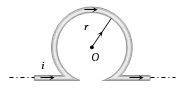
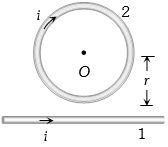
An infinitely long straight conductor is bent into the shape as shown in the figure. It carries a current of $i$ $ampere$ and the radius of the circular loop is $r$ $metre$. Then the magnetic induction at its centre $O$ will be:
A
$\frac{\mu_0}{4\pi} \frac{2i}{r}(\pi + 1)$
B
$\frac{\mu_0}{4\pi} \frac{2i}{r}(\pi - 1)$
C
Zero
D
Infinite
Solution
(B) The magnetic field at the center $O$ is due to two parts: the straight wire and the circular loop.
$1$. The magnetic field due to the circular loop of radius $r$ carrying current $i$ is $B_{loop} = \frac{\mu_0 i}{2r} = \frac{\mu_0}{4\pi} \frac{2\pi i}{r}$,directed into the plane of the paper (using the right-hand rule).
$2$. The magnetic field due to the straight wire at a distance $r$ from it is $B_{wire} = \frac{\mu_0 i}{2\pi r} = \frac{\mu_0}{4\pi} \frac{2i}{r}$,directed out of the plane of the paper.
$3$. Since the fields are in opposite directions,the net magnetic field $B$ at $O$ is $B = B_{loop} - B_{wire} = \frac{\mu_0}{4\pi} \frac{2\pi i}{r} - \frac{\mu_0}{4\pi} \frac{2i}{r} = \frac{\mu_0}{4\pi} \frac{2i}{r}(\pi - 1)$.
$1$. The magnetic field due to the circular loop of radius $r$ carrying current $i$ is $B_{loop} = \frac{\mu_0 i}{2r} = \frac{\mu_0}{4\pi} \frac{2\pi i}{r}$,directed into the plane of the paper (using the right-hand rule).
$2$. The magnetic field due to the straight wire at a distance $r$ from it is $B_{wire} = \frac{\mu_0 i}{2\pi r} = \frac{\mu_0}{4\pi} \frac{2i}{r}$,directed out of the plane of the paper.
$3$. Since the fields are in opposite directions,the net magnetic field $B$ at $O$ is $B = B_{loop} - B_{wire} = \frac{\mu_0}{4\pi} \frac{2\pi i}{r} - \frac{\mu_0}{4\pi} \frac{2i}{r} = \frac{\mu_0}{4\pi} \frac{2i}{r}(\pi - 1)$.
0 likes
View Solution8
MediumMCQ
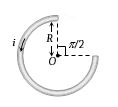
$A$ current $i$ flows in a circular arc of wire of radius $R$,which subtends an angle of $3\pi / 2$ radians at its centre. The magnetic induction at the centre is
A
$\frac{\mu_0 i}{R}$
B
$\frac{\mu_0 i}{2R}$
C
$\frac{2\mu_0 i}{R}$
D
$\frac{3\mu_0 i}{8R}$
Solution
(D) The magnetic field $B$ at the center of a circular arc carrying current $i$ and subtending an angle $\theta$ (in radians) at the center is given by the formula:
$B = \frac{\mu_0 i \theta}{4\pi R}$
Here,the angle subtended by the arc is $\theta = 3\pi / 2$.
Substituting this value into the formula:
$B = \frac{\mu_0 i (3\pi / 2)}{4\pi R}$
$B = \frac{3\mu_0 i \pi}{8\pi R}$
$B = \frac{3\mu_0 i}{8R}$
Thus,the correct option is $(d)$.
$B = \frac{\mu_0 i \theta}{4\pi R}$
Here,the angle subtended by the arc is $\theta = 3\pi / 2$.
Substituting this value into the formula:
$B = \frac{\mu_0 i (3\pi / 2)}{4\pi R}$
$B = \frac{3\mu_0 i \pi}{8\pi R}$
$B = \frac{3\mu_0 i}{8R}$
Thus,the correct option is $(d)$.
0 likes
View Solution9
MediumMCQ
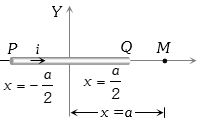
$A$ straight section $PQ$ of a circuit lies along the $X$-axis from $x = -\frac{a}{2}$ to $x = \frac{a}{2}$ and carries a steady current $i$. The magnetic field due to the section $PQ$ at a point $x = a$ on the $X$-axis will be:
A
Proportional to $a$
B
Proportional to $a^2$
C
Proportional to $1/a$
D
Zero
Solution
(D) According to the Biot-Savart law,the magnetic field $d\vec{B}$ due to a current element $i d\vec{l}$ at a position vector $\vec{r}$ is given by $d\vec{B} = \frac{\mu_0}{4\pi} \frac{i (d\vec{l} \times \vec{r})}{r^3}$.
For any point lying on the axis of the current-carrying wire,the current element $d\vec{l}$ and the position vector $\vec{r}$ are collinear (i.e.,the angle between them is $0^\circ$ or $180^\circ$).
Since the cross product of two collinear vectors is zero,the magnetic field at any point on the axis of the wire is zero.
In this problem,the point $x = a$ lies on the $X$-axis,which is the same axis along which the wire $PQ$ is placed.
Therefore,the magnetic field at $x = a$ is zero.
For any point lying on the axis of the current-carrying wire,the current element $d\vec{l}$ and the position vector $\vec{r}$ are collinear (i.e.,the angle between them is $0^\circ$ or $180^\circ$).
Since the cross product of two collinear vectors is zero,the magnetic field at any point on the axis of the wire is zero.
In this problem,the point $x = a$ lies on the $X$-axis,which is the same axis along which the wire $PQ$ is placed.
Therefore,the magnetic field at $x = a$ is zero.
1 likes
View Solution10
MediumMCQ
$A$ helium nucleus makes a full rotation in a circle of radius $0.8 \ m$ in $2 \ s$. The value of the magnetic field $B$ at the centre of the circle will be
A
$\frac{10^{-19}}{\mu_0}$
B
$10^{-19} \mu_0$
C
$2 \times 10^{-10} \mu_0$
D
$\frac{2 \times 10^{-10}}{\mu_0}$
Solution
(B) The charge of a helium nucleus is $q = 2e = 2 \times 1.6 \times 10^{-19} \ C = 3.2 \times 10^{-19} \ C$.
The time period of rotation is $T = 2 \ s$.
The equivalent current $i$ is given by $i = \frac{q}{T} = \frac{3.2 \times 10^{-19}}{2} = 1.6 \times 10^{-19} \ A$.
The magnetic field $B$ at the centre of a circular loop is $B = \frac{\mu_0 i}{2r}$.
Substituting the values,$B = \frac{\mu_0 \times 1.6 \times 10^{-19}}{2 \times 0.8} = \frac{\mu_0 \times 1.6 \times 10^{-19}}{1.6} = 10^{-19} \mu_0 \ T$.
The time period of rotation is $T = 2 \ s$.
The equivalent current $i$ is given by $i = \frac{q}{T} = \frac{3.2 \times 10^{-19}}{2} = 1.6 \times 10^{-19} \ A$.
The magnetic field $B$ at the centre of a circular loop is $B = \frac{\mu_0 i}{2r}$.
Substituting the values,$B = \frac{\mu_0 \times 1.6 \times 10^{-19}}{2 \times 0.8} = \frac{\mu_0 \times 1.6 \times 10^{-19}}{1.6} = 10^{-19} \mu_0 \ T$.
0 likes
View Solution11
EasyMCQ
The magnetic induction at a point $P$ which is distant $4 \, cm$ from a long current-carrying wire is $10^{-8} \, T$. The magnetic field induction at a distance $12 \, cm$ from the same current would be:
A
$3.33 \times 10^{-9} \, T$
B
$1.11 \times 10^{-4} \, T$
C
$3 \times 10^{-3} \, T$
D
$9 \times 10^{-2} \, T$
Solution
(A) The magnetic field $B$ due to a long straight current-carrying wire at a distance $r$ is given by the formula: $B = \frac{\mu_0}{4\pi} \cdot \frac{2i}{r}$.
Since the current $i$ is constant,the magnetic field is inversely proportional to the distance $r$,i.e.,$B \propto \frac{1}{r}$.
Therefore,we can write the ratio: $\frac{B_1}{B_2} = \frac{r_2}{r_1}$.
Given: $B_1 = 10^{-8} \, T$,$r_1 = 4 \, cm$,and $r_2 = 12 \, cm$.
Substituting the values: $\frac{10^{-8}}{B_2} = \frac{12}{4}$.
$\frac{10^{-8}}{B_2} = 3$.
$B_2 = \frac{10^{-8}}{3} = 3.33 \times 10^{-9} \, T$.
Since the current $i$ is constant,the magnetic field is inversely proportional to the distance $r$,i.e.,$B \propto \frac{1}{r}$.
Therefore,we can write the ratio: $\frac{B_1}{B_2} = \frac{r_2}{r_1}$.
Given: $B_1 = 10^{-8} \, T$,$r_1 = 4 \, cm$,and $r_2 = 12 \, cm$.
Substituting the values: $\frac{10^{-8}}{B_2} = \frac{12}{4}$.
$\frac{10^{-8}}{B_2} = 3$.
$B_2 = \frac{10^{-8}}{3} = 3.33 \times 10^{-9} \, T$.
0 likes
View Solution12
EasyMCQ
The strength of the magnetic field at a point $r$ near a long straight current-carrying wire is $B$. The field at a distance $\frac{r}{2}$ will be
A
$\frac{B}{2}$
B
$\frac{B}{4}$
C
$2B$
D
$4B$
Solution
(C) The magnetic field $B$ at a distance $r$ from a long straight current-carrying wire is given by the formula $B = \frac{\mu_0 I}{2\pi r}$.
From this expression,we can see that the magnetic field is inversely proportional to the distance from the wire,i.e.,$B \propto \frac{1}{r}$.
Let $B_1 = B$ at distance $r_1 = r$.
Let $B_2$ be the magnetic field at distance $r_2 = \frac{r}{2}$.
Using the proportionality $B_1 r_1 = B_2 r_2$,we get:
$B \cdot r = B_2 \cdot \frac{r}{2}$.
Solving for $B_2$,we find $B_2 = 2B$.
From this expression,we can see that the magnetic field is inversely proportional to the distance from the wire,i.e.,$B \propto \frac{1}{r}$.
Let $B_1 = B$ at distance $r_1 = r$.
Let $B_2$ be the magnetic field at distance $r_2 = \frac{r}{2}$.
Using the proportionality $B_1 r_1 = B_2 r_2$,we get:
$B \cdot r = B_2 \cdot \frac{r}{2}$.
Solving for $B_2$,we find $B_2 = 2B$.
0 likes
View Solution13
EasyMCQ
The magnetic field at the centre of a circular coil of radius $r$,through which a current $I$ flows,is:
A
Directly proportional to $r$
B
Inversely proportional to $I$
C
Directly proportional to $I$
D
Directly proportional to $I^2$
Solution
(C) The magnetic field $B$ at the centre of a circular coil of radius $r$ carrying a current $I$ is given by the formula:
$B = \frac{\mu_0 I}{2r}$
From this expression,it is clear that $B \propto I$ (directly proportional to the current) and $B \propto \frac{1}{r}$ (inversely proportional to the radius).
Therefore,the magnetic field is directly proportional to the current $I$ flowing through the coil.
Thus,the correct option is $C$.
$B = \frac{\mu_0 I}{2r}$
From this expression,it is clear that $B \propto I$ (directly proportional to the current) and $B \propto \frac{1}{r}$ (inversely proportional to the radius).
Therefore,the magnetic field is directly proportional to the current $I$ flowing through the coil.
Thus,the correct option is $C$.
0 likes
View Solution14
EasyMCQ
$A$ current of $0.1\, A$ circulates around a coil of $100$ turns and having a radius equal to $5\, cm$. The magnetic field set up at the centre of the coil is $({\mu _0} = 4\pi \times {10^{ - 7}}\,T\cdot m/A)$.
A
$4\pi \times {10^{ - 5}}\,T$
B
$8\pi \times {10^{ - 5}}\,T$
C
$4 \times {10^{ - 5}}\,T$
D
$2 \times {10^{ - 5}}\,T$
Solution
(A) The magnetic field $B$ at the centre of a circular coil with $N$ turns is given by the formula:
$B = \frac{{\mu _0}Ni}{2r}$
Given:
Number of turns $N = 100$
Current $i = 0.1\, A$
Radius $r = 5\, cm = 5 \times 10^{-2}\, m$
Permeability $\mu _0 = 4\pi \times 10^{-7}\, T\cdot m/A$
Substituting the values into the formula:
$B = \frac{(4\pi \times 10^{-7}) \times 100 \times 0.1}{2 \times 5 \times 10^{-2}}$
$B = \frac{4\pi \times 10^{-7} \times 10}{10 \times 10^{-2}}$
$B = \frac{4\pi \times 10^{-6}}{10^{-1}}$
$B = 4\pi \times 10^{-5}\, T$
Therefore,the correct option is $A$.
$B = \frac{{\mu _0}Ni}{2r}$
Given:
Number of turns $N = 100$
Current $i = 0.1\, A$
Radius $r = 5\, cm = 5 \times 10^{-2}\, m$
Permeability $\mu _0 = 4\pi \times 10^{-7}\, T\cdot m/A$
Substituting the values into the formula:
$B = \frac{(4\pi \times 10^{-7}) \times 100 \times 0.1}{2 \times 5 \times 10^{-2}}$
$B = \frac{4\pi \times 10^{-7} \times 10}{10 \times 10^{-2}}$
$B = \frac{4\pi \times 10^{-6}}{10^{-1}}$
$B = 4\pi \times 10^{-5}\, T$
Therefore,the correct option is $A$.
0 likes
View Solution15
DifficultMCQ
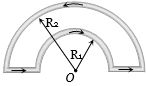
The magnetic induction at the centre $O$ in the figure shown is
A
$\frac{{\mu _0}i}{4}\left( {\frac{1}{{{R_1}}} - \frac{1}{{{R_2}}}} \right)$
B
$\frac{{\mu _0}i}{4}\left( {\frac{1}{{{R_1}}} + \frac{1}{{{R_2}}}} \right)$
C
$\frac{{\mu _0}i}{4}({R_1} - {R_2})$
D
$\frac{{\mu _0}i}{4}({R_1} + {R_2})$
Solution
(A) The magnetic field at the centre $O$ due to a semi-circular arc of radius $R$ carrying current $i$ is given by $B = \frac{{\mu _0}i}{{4R}}$.
In the given figure,the current flows through two semi-circular arcs of radii $R_1$ and $R_2$ and two straight radial segments.
The magnetic field due to the straight radial segments at the centre $O$ is zero because the position vector of the point $O$ is parallel to the current element $idl$ for these segments.
For the inner semi-circular arc of radius $R_1$,the magnetic field $B_1$ at $O$ is directed into the plane of the paper $(\otimes)$ and its magnitude is $B_1 = \frac{{\mu _0}i}{{4R_1}}$.
For the outer semi-circular arc of radius $R_2$,the magnetic field $B_2$ at $O$ is directed out of the plane of the paper $(\odot)$ and its magnitude is $B_2 = \frac{{\mu _0}i}{{4R_2}}$.
Since $R_1$ < $R_2$,the magnitude $B_1$ > $B_2$.
The net magnetic field $B_{net}$ is $B_1 - B_2$ directed into the plane of the paper.
$B_{net} = \frac{{\mu _0}i}{{4R_1}} - \frac{{\mu _0}i}{{4R_2}} = \frac{{\mu _0}i}{4}\left( {\frac{1}{{{R_1}}} - \frac{1}{{{R_2}}}} \right)$.
In the given figure,the current flows through two semi-circular arcs of radii $R_1$ and $R_2$ and two straight radial segments.
The magnetic field due to the straight radial segments at the centre $O$ is zero because the position vector of the point $O$ is parallel to the current element $idl$ for these segments.
For the inner semi-circular arc of radius $R_1$,the magnetic field $B_1$ at $O$ is directed into the plane of the paper $(\otimes)$ and its magnitude is $B_1 = \frac{{\mu _0}i}{{4R_1}}$.
For the outer semi-circular arc of radius $R_2$,the magnetic field $B_2$ at $O$ is directed out of the plane of the paper $(\odot)$ and its magnitude is $B_2 = \frac{{\mu _0}i}{{4R_2}}$.
Since $R_1$ < $R_2$,the magnitude $B_1$ > $B_2$.
The net magnetic field $B_{net}$ is $B_1 - B_2$ directed into the plane of the paper.
$B_{net} = \frac{{\mu _0}i}{{4R_1}} - \frac{{\mu _0}i}{{4R_2}} = \frac{{\mu _0}i}{4}\left( {\frac{1}{{{R_1}}} - \frac{1}{{{R_2}}}} \right)$.
0 likes
View Solution16
EasyMCQ
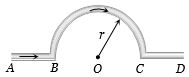
In the figure,the magnetic induction at the centre $O$ due to the current in the straight portion $AB$ will be:
A
$\frac{\mu_0 i}{r}$
B
$\frac{\mu_0 i}{2r}$
C
$\frac{\mu_0 i}{4r}$
D
Zero
Solution
(D) According to the Biot-Savart Law,the magnetic field $dB$ due to a current element $idl$ at a point is given by $dB = \frac{\mu_0}{4\pi} \frac{i(dl \times r)}{r^3}$.
For any point lying on the axis of a straight current-carrying wire,the angle $\theta$ between the current element $dl$ and the position vector $r$ is $0^\circ$ or $180^\circ$.
Since $\sin(0^\circ) = 0$ and $\sin(180^\circ) = 0$,the magnetic field contribution from any such element is zero.
In the given figure,the point $O$ lies on the straight line extending from the segment $AB$. Therefore,the magnetic induction at $O$ due to the current in portion $AB$ is zero.
For any point lying on the axis of a straight current-carrying wire,the angle $\theta$ between the current element $dl$ and the position vector $r$ is $0^\circ$ or $180^\circ$.
Since $\sin(0^\circ) = 0$ and $\sin(180^\circ) = 0$,the magnetic field contribution from any such element is zero.
In the given figure,the point $O$ lies on the straight line extending from the segment $AB$. Therefore,the magnetic induction at $O$ due to the current in portion $AB$ is zero.
0 likes
View Solution17
MediumMCQ
The magnetic induction at $O$ due to the whole length of the conductor is:
A
$\frac{\mu_0 i}{r}$
B
$\frac{\mu_0 i}{2r}$
C
$\frac{\mu_0 i}{4r}$
D
Zero
Solution
(C) The conductor consists of three parts: two straight segments $AB$ and $CD$,and a semicircular arc $BC$ of radius $r$.
For the straight segments $AB$ and $CD$,the point $O$ lies on the axis of the current-carrying wires. According to the Biot-Savart law,the magnetic field $dB = \frac{\mu_0}{4\pi} \frac{i dl \sin \theta}{r^2}$. For these segments,the angle $\theta$ between the current element $dl$ and the position vector is $0^\circ$ or $180^\circ$,so $\sin \theta = 0$. Thus,the magnetic induction due to $AB$ and $CD$ is zero.
For the semicircular arc $BC$,the magnetic field at the center $O$ is given by $B = \frac{1}{2} \left( \frac{\mu_0 i}{2r} \right) = \frac{\mu_0 i}{4r}$.
Therefore,the total magnetic induction at $O$ is $\frac{\mu_0 i}{4r}$.
For the straight segments $AB$ and $CD$,the point $O$ lies on the axis of the current-carrying wires. According to the Biot-Savart law,the magnetic field $dB = \frac{\mu_0}{4\pi} \frac{i dl \sin \theta}{r^2}$. For these segments,the angle $\theta$ between the current element $dl$ and the position vector is $0^\circ$ or $180^\circ$,so $\sin \theta = 0$. Thus,the magnetic induction due to $AB$ and $CD$ is zero.
For the semicircular arc $BC$,the magnetic field at the center $O$ is given by $B = \frac{1}{2} \left( \frac{\mu_0 i}{2r} \right) = \frac{\mu_0 i}{4r}$.
Therefore,the total magnetic induction at $O$ is $\frac{\mu_0 i}{4r}$.
0 likes
View Solution18
MediumMCQ
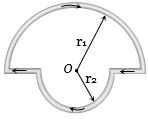
In the figure shown,there are two semicircles of radii $r_1$ and $r_2$ in which a current $i$ is flowing. The magnetic induction at the centre $O$ will be
A
$\frac{{\mu _0 i}}{r}(r_1 + r_2)$
B
$\frac{{\mu _0 i}}{4}(r_1 - r_2)$
C
$\frac{{\mu _0 i}}{4}\left( {\frac{{r_1 + r_2}}{{r_1 r_2}}} \right)$
D
$\frac{{\mu _0 i}}{4}\left( {\frac{{r_2 - r_1}}{{r_1 r_2}}} \right)$
Solution
(C) The magnetic field at the center of a semicircular arc of radius $r$ carrying current $i$ is given by $B = \frac{{\mu _0 i}}{{4r}}$.
In the given figure,there are two semicircular arcs of radii $r_1$ and $r_2$. The current flows in both arcs such that the magnetic field produced by both at the center $O$ is directed into the plane of the paper (using the right-hand thumb rule).
Therefore,the total magnetic induction $B$ at the center $O$ is the sum of the magnetic fields due to both arcs:
$B = B_1 + B_2$
$B = \frac{{\mu _0 i}}{{4r_1}} + \frac{{\mu _0 i}}{{4r_2}}$
$B = \frac{{\mu _0 i}}{4} \left( \frac{1}{r_1} + \frac{1}{r_2} \right)$
$B = \frac{{\mu _0 i}}{4} \left( \frac{r_1 + r_2}{r_1 r_2} \right)$
Thus,the correct option is $C$.
In the given figure,there are two semicircular arcs of radii $r_1$ and $r_2$. The current flows in both arcs such that the magnetic field produced by both at the center $O$ is directed into the plane of the paper (using the right-hand thumb rule).
Therefore,the total magnetic induction $B$ at the center $O$ is the sum of the magnetic fields due to both arcs:
$B = B_1 + B_2$
$B = \frac{{\mu _0 i}}{{4r_1}} + \frac{{\mu _0 i}}{{4r_2}}$
$B = \frac{{\mu _0 i}}{4} \left( \frac{1}{r_1} + \frac{1}{r_2} \right)$
$B = \frac{{\mu _0 i}}{4} \left( \frac{r_1 + r_2}{r_1 r_2} \right)$
Thus,the correct option is $C$.
0 likes
View Solution19
EasyMCQ
Two straight horizontal parallel wires are carrying the same current in the same direction, and $d$ is the distance between the wires. You are provided with a small freely suspended magnetic needle. At which of the following positions will the orientation of the needle be independent of the magnitude of the current in the wires?
A
At a distance $d/2$ from any of the wires
B
At a distance $d/2$ from any of the wires in the horizontal plane
C
Anywhere on the circumference of a vertical circle of radius $d$ and centre halfway between the wires
D
At points halfway between the wires in the horizontal plane
Solution
(D) Let the two wires be placed parallel to each other in the horizontal plane, separated by a distance $d$. Let the current $I$ flow through both wires in the same direction.
At any point $P$ located exactly halfway between the wires, the magnetic field $B_1$ due to the first wire and $B_2$ due to the second wire can be calculated using the right-hand rule.
Since the wires are parallel and carry the same current $I$ in the same direction, at the midpoint, the magnetic field $B_1$ points vertically upwards (or downwards depending on the direction of current), and $B_2$ points in the opposite direction.
Specifically, $B_1 = \frac{\mu_0 I}{2\pi (d/2)}$ and $B_2 = \frac{\mu_0 I}{2\pi (d/2)}$.
Since they are equal in magnitude and opposite in direction, the resultant magnetic field $B_{net} = B_1 - B_2 = 0$.
At this point, because the net magnetic field is zero, the magnetic needle will not experience any torque and its orientation will be independent of the magnitude of the current $I$.
At any point $P$ located exactly halfway between the wires, the magnetic field $B_1$ due to the first wire and $B_2$ due to the second wire can be calculated using the right-hand rule.
Since the wires are parallel and carry the same current $I$ in the same direction, at the midpoint, the magnetic field $B_1$ points vertically upwards (or downwards depending on the direction of current), and $B_2$ points in the opposite direction.
Specifically, $B_1 = \frac{\mu_0 I}{2\pi (d/2)}$ and $B_2 = \frac{\mu_0 I}{2\pi (d/2)}$.
Since they are equal in magnitude and opposite in direction, the resultant magnetic field $B_{net} = B_1 - B_2 = 0$.
At this point, because the net magnetic field is zero, the magnetic needle will not experience any torque and its orientation will be independent of the magnitude of the current $I$.
0 likes
View Solution20
MediumMCQ
$A$ circular coil of radius $R$ carries an electric current. The magnetic field due to the coil at a point on the axis of the coil located at a distance $r$ from the centre of the coil,such that $r \gg R$,varies as:
A
$1/r$
B
$1/r^{3/2}$
C
$1/r^2$
D
$1/r^3$
Solution
(D) The magnetic field $B$ on the axis of a circular coil of radius $R$ carrying current $i$ at a distance $r$ from its center is given by the formula:
$B = \frac{\mu_0 i R^2}{2(R^2 + r^2)^{3/2}}$
Given the condition $r \gg R$,we can neglect $R^2$ in the denominator:
$B \approx \frac{\mu_0 i R^2}{2(r^2)^{3/2}} = \frac{\mu_0 i R^2}{2r^3}$
Since $\mu_0$,$i$,and $R$ are constants,we find that $B \propto \frac{1}{r^3}$.
$B = \frac{\mu_0 i R^2}{2(R^2 + r^2)^{3/2}}$
Given the condition $r \gg R$,we can neglect $R^2$ in the denominator:
$B \approx \frac{\mu_0 i R^2}{2(r^2)^{3/2}} = \frac{\mu_0 i R^2}{2r^3}$
Since $\mu_0$,$i$,and $R$ are constants,we find that $B \propto \frac{1}{r^3}$.
0 likes
View Solution21
MediumMCQ
In a hydrogen atom, an electron is revolving in an orbit of radius $0.53 \, \text{\AA}$ with $6.6 \times 10^{15} \, \text{rotations/second}$. The magnetic field produced at the centre of the orbit is ....... $Wb/m^2$.
A
$0.125$
B
$1.25$
C
$12.5$
D
$125$
Solution
(C) The magnetic field $B$ at the center of a circular current loop is given by $B = \frac{\mu_0 I}{2r}$.
Here, the current $I = q \times \nu$, where $q = 1.6 \times 10^{-19} \, C$ is the charge of the electron and $\nu = 6.6 \times 10^{15} \, Hz$ is the frequency of rotation.
The radius $r = 0.53 \, \text{\AA} = 0.53 \times 10^{-10} \, m$.
Substituting the values:
$B = \frac{4\pi \times 10^{-7} \times (1.6 \times 10^{-19} \times 6.6 \times 10^{15})}{2 \times 0.53 \times 10^{-10}}$
$B = \frac{2 \times 3.14 \times 10^{-7} \times 1.6 \times 6.6 \times 10^{-4}}{0.53 \times 10^{-10}}$
$B \approx 12.5 \, Wb/m^2$.
Here, the current $I = q \times \nu$, where $q = 1.6 \times 10^{-19} \, C$ is the charge of the electron and $\nu = 6.6 \times 10^{15} \, Hz$ is the frequency of rotation.
The radius $r = 0.53 \, \text{\AA} = 0.53 \times 10^{-10} \, m$.
Substituting the values:
$B = \frac{4\pi \times 10^{-7} \times (1.6 \times 10^{-19} \times 6.6 \times 10^{15})}{2 \times 0.53 \times 10^{-10}}$
$B = \frac{2 \times 3.14 \times 10^{-7} \times 1.6 \times 6.6 \times 10^{-4}}{0.53 \times 10^{-10}}$
$B \approx 12.5 \, Wb/m^2$.
1 likes
View Solution22
EasyMCQ
The magnetic induction due to an infinitely long straight wire carrying a current $i$ at a distance $r$ from the wire is given by:
A
$|B| = \left( \frac{\mu_0}{4\pi} \right) \frac{2i}{r}$
B
$|B| = \left( \frac{\mu_0}{4\pi} \right) \frac{r}{2i}$
C
$|B| = \left( \frac{4\pi}{\mu_0} \right) \frac{2i}{r}$
D
$|B| = \left( \frac{4\pi}{\mu_0} \right) \frac{r}{2i}$
Solution
(A) According to the Biot-Savart law or Ampere's circuital law,the magnetic field $B$ at a perpendicular distance $r$ from an infinitely long straight current-carrying wire is given by the formula:
$B = \frac{\mu_0 i}{2\pi r}$
To express this in terms of the constant $\frac{\mu_0}{4\pi}$,we multiply the numerator and denominator by $2$:
$B = \frac{\mu_0 i \times 2}{2\pi r \times 2} = \left( \frac{\mu_0}{4\pi} \right) \frac{2i}{r}$
Thus,the correct option is $A$.
$B = \frac{\mu_0 i}{2\pi r}$
To express this in terms of the constant $\frac{\mu_0}{4\pi}$,we multiply the numerator and denominator by $2$:
$B = \frac{\mu_0 i \times 2}{2\pi r \times 2} = \left( \frac{\mu_0}{4\pi} \right) \frac{2i}{r}$
Thus,the correct option is $A$.
0 likes
View Solution23
EasyMCQ
The magnetic effect of current was discovered by
A
Faraday
B
Oersted
C
Ampere
D
Bohr
Solution
(B) The correct answer is $B$. The magnetic effect of current was discovered by the Danish physicist Hans Christian Oersted in $1820$.
He observed that a magnetic compass needle placed near a current-carrying wire gets deflected.
This observation proved that an electric current produces a magnetic field around it.
This phenomenon is fundamental to electromagnetism and is known as Oersted's experiment.
He observed that a magnetic compass needle placed near a current-carrying wire gets deflected.
This observation proved that an electric current produces a magnetic field around it.
This phenomenon is fundamental to electromagnetism and is known as Oersted's experiment.
1 likes
View Solution24
MediumMCQ
Two concentric circular coils of ten turns each are situated in the same plane. Their radii are $20 \ cm$ and $40 \ cm$ and they carry respectively $0.2 \ A$ and $0.3 \ A$ current in opposite directions. The magnetic field in $Wb/m^2$ at the centre is:
A
$\frac{35}{4} \mu_0$
B
$\frac{\mu_0}{80}$
C
$\frac{7}{80} \mu_0$
D
$\frac{5}{4} \mu_0$
Solution
(D) The magnetic field at the centre of a circular coil of $N$ turns carrying current $i$ with radius $r$ is given by $B = \frac{\mu_0 N i}{2r}$.
Given: $N = 10$,$r_1 = 0.2 \ m$,$i_1 = 0.2 \ A$,$r_2 = 0.4 \ m$,$i_2 = 0.3 \ A$.
Since the currents are in opposite directions,the net magnetic field at the centre is the difference between the two fields:
$B_{net} = |B_1 - B_2| = |\frac{\mu_0 N i_1}{2r_1} - \frac{\mu_0 N i_2}{2r_2}|$
$B_{net} = \frac{\mu_0 \times 10}{2} |\frac{0.2}{0.2} - \frac{0.3}{0.4}|$
$B_{net} = 5 \mu_0 |1 - 0.75|$
$B_{net} = 5 \mu_0 \times 0.25 = 1.25 \mu_0 = \frac{5}{4} \mu_0 \ Wb/m^2$.
Given: $N = 10$,$r_1 = 0.2 \ m$,$i_1 = 0.2 \ A$,$r_2 = 0.4 \ m$,$i_2 = 0.3 \ A$.
Since the currents are in opposite directions,the net magnetic field at the centre is the difference between the two fields:
$B_{net} = |B_1 - B_2| = |\frac{\mu_0 N i_1}{2r_1} - \frac{\mu_0 N i_2}{2r_2}|$
$B_{net} = \frac{\mu_0 \times 10}{2} |\frac{0.2}{0.2} - \frac{0.3}{0.4}|$
$B_{net} = 5 \mu_0 |1 - 0.75|$
$B_{net} = 5 \mu_0 \times 0.25 = 1.25 \mu_0 = \frac{5}{4} \mu_0 \ Wb/m^2$.
0 likes
View Solution25
MediumMCQ
$A$ cell is connected between two points of a uniformly thick circular conductor. The magnetic field at the centre of the loop will be
A
Zero
B
$\frac{\mu_0}{2a}(i_1 - i_2)$
C
$\frac{\mu_0}{2a}(i_1 + i_2)$
D
$\frac{\mu_0}{a}(i_1 + i_2)$ (Here $i_1$ and $i_2$ are the currents flowing in the two parts of the circular conductor of radius $a$ and $\mu_0$ has the usual meaning)
Solution
(A) The magnetic field at the center of a circular arc of radius $r$ carrying current $i$ is given by $B = \frac{\mu_0 i \theta}{4\pi r}$.
Since the two parts of the circular conductor are connected in parallel to the cell,the potential difference $V$ across them is the same.
Let $R_1$ and $R_2$ be the resistances of the two parts with lengths $l_1$ and $l_2$ respectively. Then $V = i_1 R_1 = i_2 R_2$.
Since $R = \rho \frac{l}{A}$,we have $i_1 \rho \frac{l_1}{A} = i_2 \rho \frac{l_2}{A}$,which implies $i_1 l_1 = i_2 l_2$.
The magnetic field due to the first part is $B_1 = \frac{\mu_0 i_1 \theta_1}{4\pi r}$ and due to the second part is $B_2 = \frac{\mu_0 i_2 \theta_2}{4\pi r}$.
Since $l_1 = r \theta_1$ and $l_2 = r \theta_2$,we have $i_1 r \theta_1 = i_2 r \theta_2$,so $i_1 \theta_1 = i_2 \theta_2$.
Thus,$B_1 = \frac{\mu_0}{4\pi r} (i_1 \theta_1)$ and $B_2 = \frac{\mu_0}{4\pi r} (i_2 \theta_2)$.
Since $i_1 \theta_1 = i_2 \theta_2$,the magnitudes are equal $(B_1 = B_2)$.
Because the currents flow in opposite directions around the center,the magnetic fields produced by the two parts are equal in magnitude and opposite in direction.
Therefore,the resultant magnetic field at the center is zero.
Since the two parts of the circular conductor are connected in parallel to the cell,the potential difference $V$ across them is the same.
Let $R_1$ and $R_2$ be the resistances of the two parts with lengths $l_1$ and $l_2$ respectively. Then $V = i_1 R_1 = i_2 R_2$.
Since $R = \rho \frac{l}{A}$,we have $i_1 \rho \frac{l_1}{A} = i_2 \rho \frac{l_2}{A}$,which implies $i_1 l_1 = i_2 l_2$.
The magnetic field due to the first part is $B_1 = \frac{\mu_0 i_1 \theta_1}{4\pi r}$ and due to the second part is $B_2 = \frac{\mu_0 i_2 \theta_2}{4\pi r}$.
Since $l_1 = r \theta_1$ and $l_2 = r \theta_2$,we have $i_1 r \theta_1 = i_2 r \theta_2$,so $i_1 \theta_1 = i_2 \theta_2$.
Thus,$B_1 = \frac{\mu_0}{4\pi r} (i_1 \theta_1)$ and $B_2 = \frac{\mu_0}{4\pi r} (i_2 \theta_2)$.
Since $i_1 \theta_1 = i_2 \theta_2$,the magnitudes are equal $(B_1 = B_2)$.
Because the currents flow in opposite directions around the center,the magnetic fields produced by the two parts are equal in magnitude and opposite in direction.
Therefore,the resultant magnetic field at the center is zero.
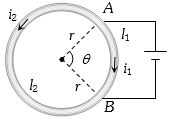
0 likes
View Solution26
MediumMCQ
$A$ battery is connected between two points $A$ and $B$ on the circumference of a uniform conducting ring of radius $r$ and resistance $R$. One of the arcs $AB$ of the ring subtends an angle $\theta$ at the centre. The value of the magnetic induction at the centre due to the current in the ring is
A
Proportional to $2(180^\circ - \theta)$
B
Inversely proportional to $r$
C
Zero,only if $\theta = 180^\circ$
D
Zero for all values of $\theta$
Solution
(D) Let the lengths of the two arcs be $l_1 = r\theta$ and $l_2 = r(2\pi - \theta)$.
Since the ring is uniform,the resistances are $R_1 = \rho \frac{l_1}{A}$ and $R_2 = \rho \frac{l_2}{A}$.
When connected to a battery,the potential difference $V$ across both arcs is the same. Thus,$i_1 R_1 = i_2 R_2$,which implies $i_1 l_1 = i_2 l_2$.
The magnetic field at the center due to an arc of length $l$ carrying current $i$ is $B = \frac{\mu_0 i}{4\pi r^2} l$.
For the two arcs,$B_1 = \frac{\mu_0 i_1 l_1}{4\pi r^2}$ and $B_2 = \frac{\mu_0 i_2 l_2}{4\pi r^2}$.
Since $i_1 l_1 = i_2 l_2$,we have $B_1 = B_2$.
The currents flow in opposite directions around the center,so the magnetic fields produced by the two arcs are equal in magnitude and opposite in direction.
Therefore,the resultant magnetic induction at the center is $B_{net} = B_1 - B_2 = 0$,which is independent of $\theta$.
Since the ring is uniform,the resistances are $R_1 = \rho \frac{l_1}{A}$ and $R_2 = \rho \frac{l_2}{A}$.
When connected to a battery,the potential difference $V$ across both arcs is the same. Thus,$i_1 R_1 = i_2 R_2$,which implies $i_1 l_1 = i_2 l_2$.
The magnetic field at the center due to an arc of length $l$ carrying current $i$ is $B = \frac{\mu_0 i}{4\pi r^2} l$.
For the two arcs,$B_1 = \frac{\mu_0 i_1 l_1}{4\pi r^2}$ and $B_2 = \frac{\mu_0 i_2 l_2}{4\pi r^2}$.
Since $i_1 l_1 = i_2 l_2$,we have $B_1 = B_2$.
The currents flow in opposite directions around the center,so the magnetic fields produced by the two arcs are equal in magnitude and opposite in direction.
Therefore,the resultant magnetic induction at the center is $B_{net} = B_1 - B_2 = 0$,which is independent of $\theta$.
0 likes
View Solution27
EasyMCQ
$A$ current of $I$ $A$ is passed through a straight wire of length $2.0$ $m$. The magnetic field at a point in air at a distance of $3$ $m$ from either end of the wire and lying on the axis of the wire will be:
A
$\frac{\mu_0}{2\pi}$
B
$\frac{\mu_0}{4\pi}$
C
$\frac{\mu_0}{8\pi}$
D
Zero
Solution
(D) The magnetic field $B$ produced by a current-carrying wire at a point is given by the Biot-Savart Law.
According to the Biot-Savart Law,the magnetic field $d\vec{B}$ due to a current element $Id\vec{l}$ at a position vector $\vec{r}$ is given by $d\vec{B} = \frac{\mu_0}{4\pi} \frac{I(d\vec{l} \times \vec{r})}{r^3}$.
For any point lying on the axis of the straight wire,the current element $Id\vec{l}$ and the position vector $\vec{r}$ are collinear (i.e.,the angle between them is $0^\circ$ or $180^\circ$).
Since the cross product of collinear vectors is zero $(d\vec{l} \times \vec{r} = 0)$,the magnetic field at any point on the axis of the wire is zero.
According to the Biot-Savart Law,the magnetic field $d\vec{B}$ due to a current element $Id\vec{l}$ at a position vector $\vec{r}$ is given by $d\vec{B} = \frac{\mu_0}{4\pi} \frac{I(d\vec{l} \times \vec{r})}{r^3}$.
For any point lying on the axis of the straight wire,the current element $Id\vec{l}$ and the position vector $\vec{r}$ are collinear (i.e.,the angle between them is $0^\circ$ or $180^\circ$).
Since the cross product of collinear vectors is zero $(d\vec{l} \times \vec{r} = 0)$,the magnetic field at any point on the axis of the wire is zero.
0 likes
View Solution28
MediumMCQ
$A$ straight wire of length $\pi^2 \, m$ carries a current of $2 \, A$. The magnetic field due to it is measured at a point $1 \, cm$ away from it. If the wire is bent into a circle and carries the same current,what is the ratio of the magnetic field at its centre to the magnetic field measured in the first case?
A
$50:1$
B
$1:50$
C
$100:1$
D
$1:100$
Solution
(B) $1$. For a straight wire of length $L = \pi^2 \, m$ carrying current $i = 2 \, A$,the magnetic field $B_1$ at a distance $d = 1 \, cm = 10^{-2} \, m$ is given by the Biot-Savart law for an infinitely long wire (assuming the point is near the center of the wire): $B_1 = \frac{\mu_0 i}{2\pi d} = \frac{\mu_0 \times 2}{2\pi \times 10^{-2}} = \frac{\mu_0}{\pi \times 10^{-2}}$.
$2$. When the wire is bent into a circle of radius $R$,its circumference is $2\pi R = L = \pi^2$. Thus,$R = \frac{\pi^2}{2\pi} = \frac{\pi}{2} \, m$.
$3$. The magnetic field at the center of this circular loop is $B_2 = \frac{\mu_0 i}{2R} = \frac{\mu_0 \times 2}{2 \times (\pi/2)} = \frac{\mu_0}{\pi/2} = \frac{2\mu_0}{\pi}$.
$4$. The ratio of the magnetic field at the center to the first case is $\frac{B_2}{B_1} = \frac{2\mu_0 / \pi}{\mu_0 / (\pi \times 10^{-2})} = 2 \times 10^{-2} = \frac{2}{100} = \frac{1}{50}$.
$5$. Therefore,the ratio is $1:50$.
$2$. When the wire is bent into a circle of radius $R$,its circumference is $2\pi R = L = \pi^2$. Thus,$R = \frac{\pi^2}{2\pi} = \frac{\pi}{2} \, m$.
$3$. The magnetic field at the center of this circular loop is $B_2 = \frac{\mu_0 i}{2R} = \frac{\mu_0 \times 2}{2 \times (\pi/2)} = \frac{\mu_0}{\pi/2} = \frac{2\mu_0}{\pi}$.
$4$. The ratio of the magnetic field at the center to the first case is $\frac{B_2}{B_1} = \frac{2\mu_0 / \pi}{\mu_0 / (\pi \times 10^{-2})} = 2 \times 10^{-2} = \frac{2}{100} = \frac{1}{50}$.
$5$. Therefore,the ratio is $1:50$.
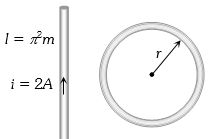
0 likes
View Solution29
EasyMCQ
The direction of magnetic lines of force close to a straight conductor carrying current will be
A
Along the length of the conductor
B
Radially outward
C
Circular in a plane perpendicular to the conductor
D
Helical
Solution
(C) According to the Right-Hand Thumb Rule,when a current $i$ flows through a straight conductor,the magnetic field lines produced around it are concentric circles. These circles lie in a plane that is perpendicular to the axis of the conductor. The direction of these magnetic field lines is determined by the direction of the current,as shown in the figure.
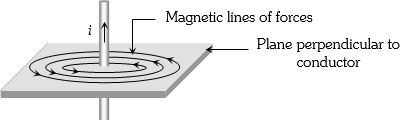
0 likes
View Solution30
EasyMCQ
If the strength of the magnetic field produced $10\,cm$ away from an infinitely long straight conductor is ${10^{ - 5}}\,Wb/m^2$,the value of the current flowing in the conductor will be........$A$.
A
$5$
B
$10$
C
$500$
D
$1000$
Solution
(A) The magnetic field $B$ at a distance $r$ from an infinitely long straight current-carrying conductor is given by the formula:
$B = \frac{\mu_0}{4\pi} \cdot \frac{2i}{r}$
Given:
$B = 10^{-5}\,Wb/m^2$
$r = 10\,cm = 0.1\,m = 10^{-1}\,m$
$\frac{\mu_0}{4\pi} = 10^{-7}\,T\cdot m/A$
Substituting the values into the formula:
$10^{-5} = 10^{-7} \times \frac{2i}{10^{-1}}$
$10^{-5} = 10^{-7} \times 2i \times 10^1$
$10^{-5} = 2i \times 10^{-6}$
$2i = \frac{10^{-5}}{10^{-6}}$
$2i = 10$
$i = 5\,A$
Therefore,the current flowing in the conductor is $5\,A$.
$B = \frac{\mu_0}{4\pi} \cdot \frac{2i}{r}$
Given:
$B = 10^{-5}\,Wb/m^2$
$r = 10\,cm = 0.1\,m = 10^{-1}\,m$
$\frac{\mu_0}{4\pi} = 10^{-7}\,T\cdot m/A$
Substituting the values into the formula:
$10^{-5} = 10^{-7} \times \frac{2i}{10^{-1}}$
$10^{-5} = 10^{-7} \times 2i \times 10^1$
$10^{-5} = 2i \times 10^{-6}$
$2i = \frac{10^{-5}}{10^{-6}}$
$2i = 10$
$i = 5\,A$
Therefore,the current flowing in the conductor is $5\,A$.
0 likes
View Solution31
MediumMCQ
Due to $10 \ A$ of current flowing in a circular coil of $10 \ cm$ radius,the magnetic field produced at its centre is $3.14 \times 10^{-3} \ Wb/m^2$. The number of turns in the coil will be:
A
$5000$
B
$100$
C
$50$
D
$25$
Solution
(C) The magnetic field $B$ at the centre of a circular coil with $N$ turns is given by the formula: $B = \frac{\mu_0 N I}{2r}$.
Given values are: Current $I = 10 \ A$,Radius $r = 10 \ cm = 0.1 \ m$,Magnetic field $B = 3.14 \times 10^{-3} \ Wb/m^2$,and $\mu_0 = 4\pi \times 10^{-7} \ T \cdot m/A$.
Substituting the values into the formula:
$3.14 \times 10^{-3} = \frac{(4\pi \times 10^{-7}) \times N \times 10}{2 \times 0.1}$.
Using $\pi \approx 3.14$,we get:
$3.14 \times 10^{-3} = \frac{4 \times 3.14 \times 10^{-7} \times N \times 10}{0.2}$.
$3.14 \times 10^{-3} = 20 \times 3.14 \times 10^{-6} \times N$.
$10^{-3} = 20 \times 10^{-6} \times N$.
$N = \frac{10^{-3}}{20 \times 10^{-6}} = \frac{1000}{20} = 50$.
Therefore,the number of turns in the coil is $50$.
Given values are: Current $I = 10 \ A$,Radius $r = 10 \ cm = 0.1 \ m$,Magnetic field $B = 3.14 \times 10^{-3} \ Wb/m^2$,and $\mu_0 = 4\pi \times 10^{-7} \ T \cdot m/A$.
Substituting the values into the formula:
$3.14 \times 10^{-3} = \frac{(4\pi \times 10^{-7}) \times N \times 10}{2 \times 0.1}$.
Using $\pi \approx 3.14$,we get:
$3.14 \times 10^{-3} = \frac{4 \times 3.14 \times 10^{-7} \times N \times 10}{0.2}$.
$3.14 \times 10^{-3} = 20 \times 3.14 \times 10^{-6} \times N$.
$10^{-3} = 20 \times 10^{-6} \times N$.
$N = \frac{10^{-3}}{20 \times 10^{-6}} = \frac{1000}{20} = 50$.
Therefore,the number of turns in the coil is $50$.
0 likes
View Solution32
EasyMCQ
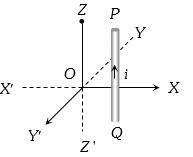
$A$ vertical wire kept in the $Z-X$ plane carries a current from $Q$ to $P$ (see figure). The magnetic field due to the current will have the direction at the origin $O$ along
A
$OX$
B
$OX'$
C
$OY$
D
$OY'$
Solution
(D) To find the direction of the magnetic field at the origin $O$ due to the current flowing in the wire from $Q$ to $P$,we use the Right-Hand Thumb Rule.
$1$. Point the thumb of your right hand in the direction of the current,which is along the positive $Z$-axis (from $Q$ to $P$).
$2$. Curl your fingers around the wire. At the origin $O$,which lies to the left of the wire (along the negative $X$-axis direction relative to the wire),the fingers will point into the plane of the paper.
$3$. In the given coordinate system,the $Y$-axis points out of the plane and the $Y'$-axis points into the plane.
$4$. Therefore,the magnetic field at the origin $O$ is directed along the negative $Y$-axis,which is $OY'$.
$1$. Point the thumb of your right hand in the direction of the current,which is along the positive $Z$-axis (from $Q$ to $P$).
$2$. Curl your fingers around the wire. At the origin $O$,which lies to the left of the wire (along the negative $X$-axis direction relative to the wire),the fingers will point into the plane of the paper.
$3$. In the given coordinate system,the $Y$-axis points out of the plane and the $Y'$-axis points into the plane.
$4$. Therefore,the magnetic field at the origin $O$ is directed along the negative $Y$-axis,which is $OY'$.
0 likes
View Solution33
MediumMCQ
$A$ wire of length $L = 1 \ m$ carries a constant current $I$. The wire is bent to form a single circular loop of radius $R$. The magnetic field at the centre of this loop is $B$. If the same wire is now bent to form a circular loop with $n = 4$ turns,what will be the magnetic field $B'$ at the centre of this new loop?
A
$4 B$
B
$16 B$
C
$B/2$
D
$B/4$
Solution
(B) The magnetic field at the centre of a circular loop with $n$ turns is given by $B = \frac{n \mu_0 I}{2R}$.
For the first case,$n_1 = 1$. The circumference of the loop is $L = 2 \pi R_1$,so $R_1 = \frac{L}{2 \pi}$.
The magnetic field is $B = \frac{1 \cdot \mu_0 I}{2 R_1} = \frac{\mu_0 I}{2 (L / 2 \pi)} = \frac{\mu_0 I \pi}{L}$.
For the second case,the wire is bent into $n_2 = 4$ turns. The total length of the wire is $L = n_2 (2 \pi R_2)$,so $R_2 = \frac{L}{2 \pi n_2} = \frac{L}{8 \pi}$.
The new magnetic field is $B' = \frac{n_2 \mu_0 I}{2 R_2} = \frac{4 \mu_0 I}{2 (L / 8 \pi)} = \frac{4 \mu_0 I \cdot 8 \pi}{2 L} = 16 \left( \frac{\mu_0 I \pi}{L} \right) = 16 B$.
For the first case,$n_1 = 1$. The circumference of the loop is $L = 2 \pi R_1$,so $R_1 = \frac{L}{2 \pi}$.
The magnetic field is $B = \frac{1 \cdot \mu_0 I}{2 R_1} = \frac{\mu_0 I}{2 (L / 2 \pi)} = \frac{\mu_0 I \pi}{L}$.
For the second case,the wire is bent into $n_2 = 4$ turns. The total length of the wire is $L = n_2 (2 \pi R_2)$,so $R_2 = \frac{L}{2 \pi n_2} = \frac{L}{8 \pi}$.
The new magnetic field is $B' = \frac{n_2 \mu_0 I}{2 R_2} = \frac{4 \mu_0 I}{2 (L / 8 \pi)} = \frac{4 \mu_0 I \cdot 8 \pi}{2 L} = 16 \left( \frac{\mu_0 I \pi}{L} \right) = 16 B$.
0 likes
View Solution34
EasyMCQ
In a hydrogen atom,an electron moves in a circular orbit of radius $5.2 \times 10^{-11} \, m$ and produces a magnetic induction of $12.56 \, T$ at its nucleus. The current produced by the motion of the electron will be (Given $\mu_0 = 4\pi \times 10^{-7} \, Wb/A \cdot m$)
A
$6.53 \times 10^{-3} \, A$
B
$13.25 \times 10^{-10} \, A$
C
$9.6 \times 10^{6} \, A$
D
$1.04 \times 10^{-3} \, A$
Solution
(D) The magnetic field $B$ at the center of a circular current loop is given by the formula: $B = \frac{\mu_0 i}{2r}$.
Given values are: $B = 12.56 \, T$,$r = 5.2 \times 10^{-11} \, m$,and $\mu_0 = 4\pi \times 10^{-7} \, T \cdot m/A$.
Substituting these values into the formula:
$12.56 = \frac{(4\pi \times 10^{-7}) \times i}{2 \times 5.2 \times 10^{-11}}$
$12.56 = \frac{2\pi \times 10^{-7} \times i}{5.2 \times 10^{-11}}$
Using $\pi \approx 3.14$,we have $2\pi \approx 6.28$.
$12.56 = \frac{6.28 \times 10^{-7} \times i}{5.2 \times 10^{-11}}$
$i = \frac{12.56 \times 5.2 \times 10^{-11}}{6.28 \times 10^{-7}}$
$i = 2 \times 5.2 \times 10^{-4} \, A$
$i = 10.4 \times 10^{-4} \, A = 1.04 \times 10^{-3} \, A$.
Given values are: $B = 12.56 \, T$,$r = 5.2 \times 10^{-11} \, m$,and $\mu_0 = 4\pi \times 10^{-7} \, T \cdot m/A$.
Substituting these values into the formula:
$12.56 = \frac{(4\pi \times 10^{-7}) \times i}{2 \times 5.2 \times 10^{-11}}$
$12.56 = \frac{2\pi \times 10^{-7} \times i}{5.2 \times 10^{-11}}$
Using $\pi \approx 3.14$,we have $2\pi \approx 6.28$.
$12.56 = \frac{6.28 \times 10^{-7} \times i}{5.2 \times 10^{-11}}$
$i = \frac{12.56 \times 5.2 \times 10^{-11}}{6.28 \times 10^{-7}}$
$i = 2 \times 5.2 \times 10^{-4} \, A$
$i = 10.4 \times 10^{-4} \, A = 1.04 \times 10^{-3} \, A$.
0 likes
View Solution35
EasyMCQ
An arc of a circle of radius $R$ subtends an angle $\frac{\pi}{2}$ at the centre. It carries a current $i$. The magnetic field at the centre will be
A
$\frac{\mu_0 i}{2R}$
B
$\frac{\mu_0 i}{8R}$
C
$\frac{\mu_0 i}{4R}$
D
$\frac{2\mu_0 i}{5R}$
Solution
(B) The magnetic field $B$ at the center of a circular arc of radius $R$ carrying current $i$ that subtends an angle $\theta$ (in radians) at the center is given by the formula:
$B = \frac{\mu_0 i \theta}{4\pi R}$
Given that the angle subtended is $\theta = \frac{\pi}{2}$,we substitute this value into the formula:
$B = \frac{\mu_0 i}{4\pi R} \times \frac{\pi}{2}$
Simplifying the expression:
$B = \frac{\mu_0 i}{8R}$
Thus,the correct option is $B$.
$B = \frac{\mu_0 i \theta}{4\pi R}$
Given that the angle subtended is $\theta = \frac{\pi}{2}$,we substitute this value into the formula:
$B = \frac{\mu_0 i}{4\pi R} \times \frac{\pi}{2}$
Simplifying the expression:
$B = \frac{\mu_0 i}{8R}$
Thus,the correct option is $B$.
0 likes
View Solution36
EasyMCQ
At a distance of $10\, cm$ from a long straight wire carrying current,the magnetic field is $0.04\, T$. At a distance of $40\, cm$,the magnetic field will be....$T$
A
$0.01$
B
$0.02$
C
$0.08$
D
$0.16$
Solution
(A) The magnetic field $B$ at a distance $r$ from a long straight current-carrying wire is given by the formula $B = \frac{\mu_0 I}{2\pi r}$.
This implies that $B \propto \frac{1}{r}$.
Therefore,we can write the ratio as $\frac{B_1}{B_2} = \frac{r_2}{r_1}$.
Given $B_1 = 0.04\, T$,$r_1 = 10\, cm$,and $r_2 = 40\, cm$.
Substituting these values into the equation: $\frac{0.04}{B_2} = \frac{40}{10}$.
$\frac{0.04}{B_2} = 4$.
$B_2 = \frac{0.04}{4} = 0.01\, T$.
This implies that $B \propto \frac{1}{r}$.
Therefore,we can write the ratio as $\frac{B_1}{B_2} = \frac{r_2}{r_1}$.
Given $B_1 = 0.04\, T$,$r_1 = 10\, cm$,and $r_2 = 40\, cm$.
Substituting these values into the equation: $\frac{0.04}{B_2} = \frac{40}{10}$.
$\frac{0.04}{B_2} = 4$.
$B_2 = \frac{0.04}{4} = 0.01\, T$.
0 likes
View Solution37
MediumMCQ
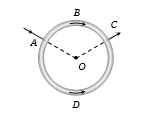
$A$ uniform wire is bent in the form of a circle of radius $R$. $A$ current $I$ enters at $A$ and leaves at $C$ as shown in the figure. If the length $ABC$ is half of the length $ADC$,the magnetic field at the centre $O$ will be
A
Zero
B
$\frac{\mu_0 I}{2R}$
C
$\frac{\mu_0 I}{4R}$
D
$\frac{\mu_0 I}{6R}$
Solution
(A) Let the lengths of the two arcs be $l_1$ (arc $ABC$) and $l_2$ (arc $ADC$). The resistances of these arcs are $R_1 = \rho \frac{l_1}{A_{cross}}$ and $R_2 = \rho \frac{l_2}{A_{cross}}$.
Since the arcs are in parallel,the potential difference across them is the same: $V = I_1 R_1 = I_2 R_2$.
This implies $I_1 l_1 = I_2 l_2$,or $\frac{I_1}{I_2} = \frac{l_2}{l_1}$.
The magnetic field at the center due to an arc of length $l$ carrying current $i$ is $B = \frac{\mu_0 i \theta}{4\pi R} = \frac{\mu_0 i l}{4\pi R^2}$.
For the two arcs,the magnetic fields are $B_1 = \frac{\mu_0 I_1 l_1}{4\pi R^2}$ and $B_2 = \frac{\mu_0 I_2 l_2}{4\pi R^2}$.
Since $I_1 l_1 = I_2 l_2$,we have $B_1 = B_2$.
The currents flow in opposite directions around the center,so the magnetic fields produced by the two arcs are in opposite directions.
Therefore,the resultant magnetic field at the center is $B_{net} = |B_1 - B_2| = 0$.
Since the arcs are in parallel,the potential difference across them is the same: $V = I_1 R_1 = I_2 R_2$.
This implies $I_1 l_1 = I_2 l_2$,or $\frac{I_1}{I_2} = \frac{l_2}{l_1}$.
The magnetic field at the center due to an arc of length $l$ carrying current $i$ is $B = \frac{\mu_0 i \theta}{4\pi R} = \frac{\mu_0 i l}{4\pi R^2}$.
For the two arcs,the magnetic fields are $B_1 = \frac{\mu_0 I_1 l_1}{4\pi R^2}$ and $B_2 = \frac{\mu_0 I_2 l_2}{4\pi R^2}$.
Since $I_1 l_1 = I_2 l_2$,we have $B_1 = B_2$.
The currents flow in opposite directions around the center,so the magnetic fields produced by the two arcs are in opposite directions.
Therefore,the resultant magnetic field at the center is $B_{net} = |B_1 - B_2| = 0$.
0 likes
View Solution38
EasyMCQ
The magnetic induction at any point due to a long straight wire carrying a current is
A
Proportional to the distance from the wire
B
Inversely proportional to the distance from the wire
C
Inversely proportional to the square of the distance from the wire
D
Does not depend on distance
Solution
(B) The magnetic field $B$ at a distance $r$ from a long straight wire carrying current $i$ is given by the formula:
$B = \frac{\mu_0 i}{2\pi r}$
From this expression,it is clear that the magnetic induction $B$ is inversely proportional to the distance $r$ from the wire $(B \propto \frac{1}{r})$.
Therefore,the correct option is $B$.
$B = \frac{\mu_0 i}{2\pi r}$
From this expression,it is clear that the magnetic induction $B$ is inversely proportional to the distance $r$ from the wire $(B \propto \frac{1}{r})$.
Therefore,the correct option is $B$.
0 likes
View Solution39
MediumMCQ
The Earth's magnetic induction at a certain point is $7 \times 10^{-5} \ Wb/m^2$. This is to be annulled by the magnetic induction at the center of a circular conducting loop of radius $5 \ cm$. The required current in the loop is......$A$
A
$0.56$
B
$5.6$
C
$0.28$
D
$2.8$
Solution
(B) The magnetic field at the center of a circular loop is given by $B = \frac{\mu_0 I}{2R}$.
Given,$B = 7 \times 10^{-5} \ Wb/m^2$ and $R = 5 \ cm = 0.05 \ m$.
We know that $\frac{\mu_0}{4\pi} = 10^{-7} \ T \cdot m/A$,so $\mu_0 = 4\pi \times 10^{-7} \ T \cdot m/A$.
Substituting the values into the formula:
$7 \times 10^{-5} = \frac{4\pi \times 10^{-7} \times I}{2 \times 0.05}$
$7 \times 10^{-5} = \frac{2\pi \times 10^{-7} \times I}{0.05}$
$I = \frac{7 \times 10^{-5} \times 0.05}{2 \times 3.14159 \times 10^{-7}}$
$I = \frac{0.35 \times 10^{-5}}{6.283 \times 10^{-7}} = \frac{35}{6.283} \approx 5.57 \ A \approx 5.6 \ A$.
Given,$B = 7 \times 10^{-5} \ Wb/m^2$ and $R = 5 \ cm = 0.05 \ m$.
We know that $\frac{\mu_0}{4\pi} = 10^{-7} \ T \cdot m/A$,so $\mu_0 = 4\pi \times 10^{-7} \ T \cdot m/A$.
Substituting the values into the formula:
$7 \times 10^{-5} = \frac{4\pi \times 10^{-7} \times I}{2 \times 0.05}$
$7 \times 10^{-5} = \frac{2\pi \times 10^{-7} \times I}{0.05}$
$I = \frac{7 \times 10^{-5} \times 0.05}{2 \times 3.14159 \times 10^{-7}}$
$I = \frac{0.35 \times 10^{-5}}{6.283 \times 10^{-7}} = \frac{35}{6.283} \approx 5.57 \ A \approx 5.6 \ A$.
0 likes
View Solution40
EasyMCQ
The magnetic field at the center of a circular coil of radius $0.1\, m$ having $1000$ turns and carrying a current of $0.1\, A$ is:
A
$2 \times 10^{-1}\,T$
B
$4.31 \times 10^{-2}\,T$
C
$6.28 \times 10^{-4}\,T$
D
$9.81 \times 10^{-4}\,T$
Solution
(C) The magnetic field $B$ at the center of a circular coil is given by the formula: $B = \frac{\mu_0 Ni}{2r}$.
Given values are:
Number of turns $N = 1000$
Current $i = 0.1\, A$
Radius $r = 0.1\, m$
Permeability of free space $\mu_0 = 4\pi \times 10^{-7}\, T\cdot m/A$.
Substituting these values into the formula:
$B = \frac{4\pi \times 10^{-7} \times 1000 \times 0.1}{2 \times 0.1}$
$B = \frac{4\pi \times 10^{-7} \times 100}{0.2}$
$B = 2\pi \times 10^{-4}\, T$
Using $\pi \approx 3.14$,we get:
$B = 2 \times 3.14 \times 10^{-4} = 6.28 \times 10^{-4}\, T$.
Given values are:
Number of turns $N = 1000$
Current $i = 0.1\, A$
Radius $r = 0.1\, m$
Permeability of free space $\mu_0 = 4\pi \times 10^{-7}\, T\cdot m/A$.
Substituting these values into the formula:
$B = \frac{4\pi \times 10^{-7} \times 1000 \times 0.1}{2 \times 0.1}$
$B = \frac{4\pi \times 10^{-7} \times 100}{0.2}$
$B = 2\pi \times 10^{-4}\, T$
Using $\pi \approx 3.14$,we get:
$B = 2 \times 3.14 \times 10^{-4} = 6.28 \times 10^{-4}\, T$.
0 likes
View Solution41
MediumMCQ
Magnetic field intensity at the centre of a coil of $50$ turns,radius $0.5\, m$ and carrying a current of $2\, A$ is:
A
$0.5 \times 10^{-5}\,T$
B
$1.25 \times 10^{-4}\,T$
C
$3 \times 10^{-5}\,T$
D
$4 \times 10^{-5}\,T$
Solution
(B) The magnetic field $B$ at the centre of a circular coil is given by the formula: $B = \frac{\mu_0 Ni}{2r}$.
Given values are:
Number of turns $N = 50$
Radius $r = 0.5\, m$
Current $i = 2\, A$
Permeability of free space $\mu_0 = 4\pi \times 10^{-7}\, T\cdot m/A$.
Substituting these values into the formula:
$B = \frac{(4\pi \times 10^{-7}) \times 50 \times 2}{2 \times 0.5}$
$B = \frac{4 \times 3.14159 \times 10^{-7} \times 100}{1}$
$B = 12.566 \times 10^{-5} = 1.2566 \times 10^{-4}\, T$.
Rounding to the nearest option,we get $1.25 \times 10^{-4}\, T$.
Given values are:
Number of turns $N = 50$
Radius $r = 0.5\, m$
Current $i = 2\, A$
Permeability of free space $\mu_0 = 4\pi \times 10^{-7}\, T\cdot m/A$.
Substituting these values into the formula:
$B = \frac{(4\pi \times 10^{-7}) \times 50 \times 2}{2 \times 0.5}$
$B = \frac{4 \times 3.14159 \times 10^{-7} \times 100}{1}$
$B = 12.566 \times 10^{-5} = 1.2566 \times 10^{-4}\, T$.
Rounding to the nearest option,we get $1.25 \times 10^{-4}\, T$.
0 likes
View Solution42
EasyMCQ
$A$ circular coil $A$ has a radius $R$ and the current flowing through it is $I$. Another circular coil $B$ has a radius $2R$ and the current flowing through it is $2I$. The ratio of the magnetic fields at the centre of the circular coils $(B_A : B_B)$ is: (in $:1$)
A
$4$
B
$2$
C
$3$
D
$1$
Solution
(D) The magnetic field at the centre of a circular coil carrying current $I$ with radius $R$ is given by the formula: $B = \frac{\mu_0 I}{2R}$.
For coil $A$: $B_A = \frac{\mu_0 I}{2R}$.
For coil $B$: $B_B = \frac{\mu_0 (2I)}{2(2R)} = \frac{\mu_0 I}{2R}$.
Comparing the two,we get $B_A = B_B$.
Therefore,the ratio $B_A : B_B = 1:1$.
For coil $A$: $B_A = \frac{\mu_0 I}{2R}$.
For coil $B$: $B_B = \frac{\mu_0 (2I)}{2(2R)} = \frac{\mu_0 I}{2R}$.
Comparing the two,we get $B_A = B_B$.
Therefore,the ratio $B_A : B_B = 1:1$.
0 likes
View Solution43
MediumMCQ
The magnetic field at a distance $r$ from a long straight wire carrying current $i$ is $0.4 \ T$. The magnetic field at a distance $2r$ is: (in $T$)
A
$0.2$
B
$0.8$
C
$0.1$
D
$1.6$
Solution
(A) The magnetic field $B$ at a distance $r$ from a long straight current-carrying wire is given by the formula $B = \frac{\mu_0 i}{2\pi r}$.
From this expression,we can see that the magnetic field is inversely proportional to the distance,i.e.,$B \propto \frac{1}{r}$.
Let $B_1 = 0.4 \ T$ at distance $r_1 = r$.
We need to find the magnetic field $B_2$ at distance $r_2 = 2r$.
Using the proportionality $B_1 r_1 = B_2 r_2$,we get:
$0.4 \times r = B_2 \times (2r)$.
$B_2 = \frac{0.4 \times r}{2r} = 0.2 \ T$.
From this expression,we can see that the magnetic field is inversely proportional to the distance,i.e.,$B \propto \frac{1}{r}$.
Let $B_1 = 0.4 \ T$ at distance $r_1 = r$.
We need to find the magnetic field $B_2$ at distance $r_2 = 2r$.
Using the proportionality $B_1 r_1 = B_2 r_2$,we get:
$0.4 \times r = B_2 \times (2r)$.
$B_2 = \frac{0.4 \times r}{2r} = 0.2 \ T$.
0 likes
View Solution44
EasyMCQ
The magnetic field at the centre of a current-carrying circular coil is
A
$\frac{\mu_0 ni}{2r}$
B
$\frac{\mu_0}{2\pi} \cdot \frac{ni}{r}$
C
$\frac{\mu_0 ni}{4r}$
D
$\mu_0 ni$
Solution
(A) The magnetic field $B$ at the centre of a circular coil with $n$ turns,carrying current $i$ and having radius $r$,is given by the Biot-Savart Law.
For a single turn,the magnetic field is $B = \frac{\mu_0 i}{2r}$.
For a coil with $n$ turns,the magnetic field is $B = n \times \frac{\mu_0 i}{2r} = \frac{\mu_0 ni}{2r}$.
For a single turn,the magnetic field is $B = \frac{\mu_0 i}{2r}$.
For a coil with $n$ turns,the magnetic field is $B = n \times \frac{\mu_0 i}{2r} = \frac{\mu_0 ni}{2r}$.
1 likes
View Solution45
EasyMCQ
$A$ straight wire of diameter $0.5\, mm$ carrying a current of $1\, A$ is replaced by another wire of $1\, mm$ diameter carrying the same current. The strength of the magnetic field at a point far away is
A
Twice the earlier value
B
Half of the earlier value
C
Quarter of its earlier value
D
Unchanged
Solution
(D) The magnetic field $B$ at a distance $r$ from a long straight current-carrying wire is given by the formula $B = \frac{\mu_0}{4\pi} \frac{2i}{r}$.
Here,$\mu_0$ is the permeability of free space,$i$ is the current flowing through the wire,and $r$ is the perpendicular distance from the wire.
As per the formula,the magnetic field $B$ depends only on the current $i$ and the distance $r$ from the wire.
It is independent of the radius or diameter of the wire.
Since the current $i$ remains the same and the distance $r$ is considered far away (implying the same observation point),the magnetic field strength remains unchanged.
Here,$\mu_0$ is the permeability of free space,$i$ is the current flowing through the wire,and $r$ is the perpendicular distance from the wire.
As per the formula,the magnetic field $B$ depends only on the current $i$ and the distance $r$ from the wire.
It is independent of the radius or diameter of the wire.
Since the current $i$ remains the same and the distance $r$ is considered far away (implying the same observation point),the magnetic field strength remains unchanged.
0 likes
View Solution46
EasyMCQ
$A$ current-carrying wire in its neighborhood produces:
A
No field
B
Electric field only
C
Magnetic field only
D
Electric and magnetic fields
Solution
(C) When a wire carries a steady current,the net charge density of the wire remains zero because the number of electrons entering a segment equals the number of electrons leaving it.
Since the wire is electrically neutral,it does not produce an electric field in its neighborhood.
However,the flow of charges (current) creates a magnetic field around the wire,as described by the Biot-Savart law or Ampere's circuital law.
Therefore,only a magnetic field exists.
Since the wire is electrically neutral,it does not produce an electric field in its neighborhood.
However,the flow of charges (current) creates a magnetic field around the wire,as described by the Biot-Savart law or Ampere's circuital law.
Therefore,only a magnetic field exists.
0 likes
View Solution47
EasyMCQ
The magnetic induction in air at a point $1\,cm$ away from a long straight wire that carries a current of $1\,A$ will be:
A
$1 \times 10^{-5}\,T$
B
$2 \times 10^{-5}\,T$
C
$3 \times 10^{-5}\,T$
D
$4 \times 10^{-5}\,T$
Solution
(B) The magnetic field $B$ at a distance $r$ from a long straight current-carrying wire is given by the formula:
$B = \frac{\mu_0}{4\pi} \times \frac{2i}{r}$
Given:
Current $i = 1\,A$
Distance $r = 1\,cm = 10^{-2}\,m$
Constant $\frac{\mu_0}{4\pi} = 10^{-7}\,T\cdot m/A$
Substituting the values:
$B = 10^{-7} \times \frac{2 \times 1}{10^{-2}}$
$B = 2 \times 10^{-7} \times 10^2$
$B = 2 \times 10^{-5}\,T$
Therefore,the correct option is $B$.
$B = \frac{\mu_0}{4\pi} \times \frac{2i}{r}$
Given:
Current $i = 1\,A$
Distance $r = 1\,cm = 10^{-2}\,m$
Constant $\frac{\mu_0}{4\pi} = 10^{-7}\,T\cdot m/A$
Substituting the values:
$B = 10^{-7} \times \frac{2 \times 1}{10^{-2}}$
$B = 2 \times 10^{-7} \times 10^2$
$B = 2 \times 10^{-5}\,T$
Therefore,the correct option is $B$.
0 likes
View Solution48
DifficultMCQ
The magnetic field at the centre of a coil of $n$ turns,bent in the form of a square of side $2l$,carrying current $i$,is
A
$\frac{\sqrt{2} \mu_0 n i}{\pi l}$
B
$\frac{\sqrt{2} \mu_0 n i}{2 \pi l}$
C
$\frac{\sqrt{2} \mu_0 n i}{4 \pi l}$
D
$\frac{2 \mu_0 n i}{\pi l}$
Solution
(A) The magnetic field due to a straight wire of length $a$ at a distance $r$ from its center is given by $B = \frac{\mu_0 i}{4 \pi r} (\sin \theta_1 + \sin \theta_2)$.
For a square of side $a = 2l$,the distance from the center to the side is $r = l/2 = l$. The angles at the center are $\theta_1 = \theta_2 = 45^\circ$.
Thus,the field due to one side is $B_1 = \frac{\mu_0 i}{4 \pi l} (\sin 45^\circ + \sin 45^\circ) = \frac{\mu_0 i}{4 \pi l} (\frac{1}{\sqrt{2}} + \frac{1}{\sqrt{2}}) = \frac{\mu_0 i}{4 \pi l} (\frac{2}{\sqrt{2}}) = \frac{\mu_0 i}{2 \sqrt{2} \pi l}$.
Since there are $4$ sides,the total field for one turn is $B = 4 \times B_1 = 4 \times \frac{\mu_0 i}{2 \sqrt{2} \pi l} = \frac{2 \sqrt{2} \mu_0 i}{\pi l}$.
For $n$ turns,the total magnetic field is $B_{net} = n \times B = \frac{2 \sqrt{2} \mu_0 n i}{\pi l}$.
Wait,re-evaluating the geometry: For a square of side $a=2l$,the distance from center to side is $d = l$. The formula $B = \frac{\mu_0 i}{4 \pi d} (\sin 45^\circ + \sin 45^\circ) = \frac{\mu_0 i}{4 \pi l} (\sqrt{2}) = \frac{\sqrt{2} \mu_0 i}{4 \pi l}$.
Total field for $4$ sides is $4 \times \frac{\sqrt{2} \mu_0 i}{4 \pi l} = \frac{\sqrt{2} \mu_0 i}{\pi l}$.
For $n$ turns,$B_{net} = \frac{\sqrt{2} \mu_0 n i}{\pi l}$.
For a square of side $a = 2l$,the distance from the center to the side is $r = l/2 = l$. The angles at the center are $\theta_1 = \theta_2 = 45^\circ$.
Thus,the field due to one side is $B_1 = \frac{\mu_0 i}{4 \pi l} (\sin 45^\circ + \sin 45^\circ) = \frac{\mu_0 i}{4 \pi l} (\frac{1}{\sqrt{2}} + \frac{1}{\sqrt{2}}) = \frac{\mu_0 i}{4 \pi l} (\frac{2}{\sqrt{2}}) = \frac{\mu_0 i}{2 \sqrt{2} \pi l}$.
Since there are $4$ sides,the total field for one turn is $B = 4 \times B_1 = 4 \times \frac{\mu_0 i}{2 \sqrt{2} \pi l} = \frac{2 \sqrt{2} \mu_0 i}{\pi l}$.
For $n$ turns,the total magnetic field is $B_{net} = n \times B = \frac{2 \sqrt{2} \mu_0 n i}{\pi l}$.
Wait,re-evaluating the geometry: For a square of side $a=2l$,the distance from center to side is $d = l$. The formula $B = \frac{\mu_0 i}{4 \pi d} (\sin 45^\circ + \sin 45^\circ) = \frac{\mu_0 i}{4 \pi l} (\sqrt{2}) = \frac{\sqrt{2} \mu_0 i}{4 \pi l}$.
Total field for $4$ sides is $4 \times \frac{\sqrt{2} \mu_0 i}{4 \pi l} = \frac{\sqrt{2} \mu_0 i}{\pi l}$.
For $n$ turns,$B_{net} = \frac{\sqrt{2} \mu_0 n i}{\pi l}$.
0 likes
View Solution49
EasyMCQ
Which of the following gives the value of the magnetic field according to Biot-Savart's law?
A
$\frac{i \Delta l \sin \theta}{r^2}$
B
$\frac{\mu_0}{4\pi} \frac{i \Delta l \sin \theta}{r}$
C
$\frac{\mu_0}{4\pi} \frac{i \Delta l \sin \theta}{r^2}$
D
$\frac{\mu_0}{4\pi} i \Delta l \sin \theta$
Solution
(C) According to Biot-Savart's law,the magnitude of the magnetic field $dB$ due to a small current element $i \Delta l$ at a distance $r$ from the element is given by:
$dB = \frac{\mu_0}{4\pi} \frac{i \Delta l \sin \theta}{r^2}$
where $\mu_0$ is the permeability of free space,$i$ is the current,$\Delta l$ is the length of the element,$\theta$ is the angle between the current element and the position vector,and $r$ is the distance from the element to the point of observation.
Thus,the correct option is $C$.
$dB = \frac{\mu_0}{4\pi} \frac{i \Delta l \sin \theta}{r^2}$
where $\mu_0$ is the permeability of free space,$i$ is the current,$\Delta l$ is the length of the element,$\theta$ is the angle between the current element and the position vector,and $r$ is the distance from the element to the point of observation.
Thus,the correct option is $C$.
0 likes
View SolutionMoving Charges and Magnetism — Biot-Savart's Law and its application · Frequently Asked Questions
1Are these Moving Charges and Magnetism questions useful for JEE and NEET?
Yes. All questions in this section are mapped to JEE Main and NEET exam patterns. Previous year questions from JEE Main, NEET, GUJCET and state-level exams are included with full solutions.
2Can I switch to Hindi or Gujarati for these questions?
Yes. Use the language tabs in the hero section or the sidebar to view the same questions and solutions in English, Hindi or Gujarati.
3How do I generate a question paper from this subtopic?
Use the Vedclass Exam Paper Generator — select the chapter and subtopic, set difficulty, and generate Sets A, B, C, D automatically. First 3 chapters of every subject are free.
Vedclass Products
For Students
Vedclass Test Series
Mock tests in real JEE/NEET style with performance analysis. 5-day free trial.
Start Free TrialFor Teachers
Exam Paper Generator
Generate Set A/B/C/D papers from this chapter in 2 minutes. 3 chapters free.
Try FreeFor Institutes
Online Exam Module
Live online exams with unlimited students, 360° analytics & white-label branding.
See DemoFor Teachers & Institutes
Generate a Moving Charges and Magnetism Exam Paper in 2 Minutes
Select subtopic & difficulty — Sets A, B, C, D auto-generated with No Repeat logic.
First 3 chapters of every subject are free — no payment required.