
A English
Equipotential Surface Questions in English
Class 12 Physics · Electric Potential and Capacitance · Equipotential Surface
89+
Questions
English
Language
100%
With Solutions
Showing 38 of 89 questions in English
51
Medium
Show that the direction of the electric field at a given point is normal to the equipotential surface passing through that point.
Solution
(N/A) If the electric field $\overrightarrow{E}$ were not normal to the equipotential surface,it would have a non-zero component along the surface.
To move a unit test charge against the direction of this component,work would have to be done.
However,this contradicts the definition of an equipotential surface,which states that the potential difference $\Delta V$ between any two points on the surface is zero.
Since work $W = q \Delta V$ and $\Delta V = 0$,the work done $W$ must be $0$.
Also,the work done in an electric field $\overrightarrow{E}$ for a small displacement $\overrightarrow{dl}$ on the surface is given by $W = \overrightarrow{E} \cdot \overrightarrow{dl} = E dl \cos \theta$.
Since $W = 0$,we have $0 = E dl \cos \theta$.
Given that $\overrightarrow{E} \neq 0$ and $\overrightarrow{dl} \neq 0$,it follows that $\cos \theta = 0$,which implies $\theta = \frac{\pi}{2}$ $(90^{\circ})$.
Hence,the electric field $\overrightarrow{E}$ is normal to the equipotential surface at that point.
To move a unit test charge against the direction of this component,work would have to be done.
However,this contradicts the definition of an equipotential surface,which states that the potential difference $\Delta V$ between any two points on the surface is zero.
Since work $W = q \Delta V$ and $\Delta V = 0$,the work done $W$ must be $0$.
Also,the work done in an electric field $\overrightarrow{E}$ for a small displacement $\overrightarrow{dl}$ on the surface is given by $W = \overrightarrow{E} \cdot \overrightarrow{dl} = E dl \cos \theta$.
Since $W = 0$,we have $0 = E dl \cos \theta$.
Given that $\overrightarrow{E} \neq 0$ and $\overrightarrow{dl} \neq 0$,it follows that $\cos \theta = 0$,which implies $\theta = \frac{\pi}{2}$ $(90^{\circ})$.
Hence,the electric field $\overrightarrow{E}$ is normal to the equipotential surface at that point.
0 likes
View Solution52
Easy
Write the characteristics of equipotential surface.
Solution
(N/A) $(1)$ Equipotential surfaces offer an alternative visual representation in addition to the electric field lines around a charge configuration. These surfaces are closer together in regions of strong electric field and farther apart in regions of weak electric field.
$(2)$ No work is done in moving a test charge from one point to another on an equipotential surface because the potential difference between any two points on the surface is zero.
$(3)$ The electric field is always perpendicular (normal) to the equipotential surface at every point.
$(4)$ Two equipotential surfaces can never intersect each other,as that would imply two different values of electric potential at the point of intersection,which is physically impossible.
$(2)$ No work is done in moving a test charge from one point to another on an equipotential surface because the potential difference between any two points on the surface is zero.
$(3)$ The electric field is always perpendicular (normal) to the equipotential surface at every point.
$(4)$ Two equipotential surfaces can never intersect each other,as that would imply two different values of electric potential at the point of intersection,which is physically impossible.
0 likes
View Solution53
Medium
Define an equipotential surface.
Solution
(N/A) An equipotential surface is a surface with a constant value of electric potential at all points on it.
For any charge distribution,the electric potential $V$ is the same at every point on an equipotential surface.
Consequently,the potential difference between any two points on such a surface is zero $(V_A - V_B = 0)$.
Since the work done in moving a test charge $q_0$ between two points on an equipotential surface is given by $W = q_0(V_A - V_B)$,it follows that no work is done in moving a charge along an equipotential surface.
Furthermore,the electric field lines are always perpendicular to the equipotential surface at every point.
For any charge distribution,the electric potential $V$ is the same at every point on an equipotential surface.
Consequently,the potential difference between any two points on such a surface is zero $(V_A - V_B = 0)$.
Since the work done in moving a test charge $q_0$ between two points on an equipotential surface is given by $W = q_0(V_A - V_B)$,it follows that no work is done in moving a charge along an equipotential surface.
Furthermore,the electric field lines are always perpendicular to the equipotential surface at every point.
0 likes
View Solution54
EasyMCQ
Electric field is always ...... to the equipotential surface at every point. (Fill in the gap)
A
Parallel
B
Perpendicular
C
Inclined at $45^{\circ}$
D
Tangent
Solution
(B) By definition,an equipotential surface is a surface where the electric potential is constant at every point.
If the electric field had a component parallel to the surface,it would exert a force on a charge moving along the surface,meaning work would be done.
However,since the potential difference between any two points on an equipotential surface is zero,the work done in moving a charge along the surface is zero.
Therefore,the electric field must be perpendicular to the equipotential surface at every point.
If the electric field had a component parallel to the surface,it would exert a force on a charge moving along the surface,meaning work would be done.
However,since the potential difference between any two points on an equipotential surface is zero,the work done in moving a charge along the surface is zero.
Therefore,the electric field must be perpendicular to the equipotential surface at every point.
0 likes
View Solution55
Medium
Draw an equipotential surface for an electric dipole.
Solution
(N/A) An electric dipole consists of two equal and opposite charges,$+q$ and $-q$,separated by a small distance $d$.
An equipotential surface is a surface where the electric potential $V$ is constant at every point.
For an electric dipole,the equipotential surfaces are not spheres.
Near the charges,the surfaces are roughly spherical and centered around each charge.
As we move further away from the dipole,the surfaces become distorted and eventually take the shape of a surface enclosing both charges.
The potential is zero at the perpendicular bisector of the dipole,which forms a plane of zero potential (an equipotential surface with $V = 0$).
In summary,the surfaces are closer together where the electric field is stronger (near the charges) and further apart where the field is weaker.
An equipotential surface is a surface where the electric potential $V$ is constant at every point.
For an electric dipole,the equipotential surfaces are not spheres.
Near the charges,the surfaces are roughly spherical and centered around each charge.
As we move further away from the dipole,the surfaces become distorted and eventually take the shape of a surface enclosing both charges.
The potential is zero at the perpendicular bisector of the dipole,which forms a plane of zero potential (an equipotential surface with $V = 0$).
In summary,the surfaces are closer together where the electric field is stronger (near the charges) and further apart where the field is weaker.
0 likes
View Solution56
Medium
Draw an equipotential surface of two identical positive charges for small distance.
Solution
(N/A) When two identical positive charges are placed at a small distance from each other,they repel each other. The electric field lines originate from the positive charges and move outwards.
An equipotential surface is a surface where the electric potential is constant at all points.
For two identical positive charges,the equipotential surfaces are not spherical. Near each charge,the surfaces are nearly spherical,but as we move towards the region between the charges,the surfaces distort and merge.
In the region between the two charges,the electric field is weak (the neutral point exists at the midpoint),causing the equipotential surfaces to bulge outwards and eventually form a single surface enclosing both charges at larger distances.
An equipotential surface is a surface where the electric potential is constant at all points.
For two identical positive charges,the equipotential surfaces are not spherical. Near each charge,the surfaces are nearly spherical,but as we move towards the region between the charges,the surfaces distort and merge.
In the region between the two charges,the electric field is weak (the neutral point exists at the midpoint),causing the equipotential surfaces to bulge outwards and eventually form a single surface enclosing both charges at larger distances.
0 likes
View Solution57
Easy
Draw an equipotential surface for a uniform electric field.
Solution
(N/A) For a uniform electric field,the electric field lines are parallel to each other and equally spaced.
An equipotential surface is defined as a surface where the electric potential is the same at every point.
For a uniform electric field directed along the $x$-axis,the equipotential surfaces are planes parallel to the $yz$-plane.
These planes are perpendicular to the direction of the electric field lines.
Thus,for a uniform electric field,the equipotential surfaces are a family of parallel planes.
An equipotential surface is defined as a surface where the electric potential is the same at every point.
For a uniform electric field directed along the $x$-axis,the equipotential surfaces are planes parallel to the $yz$-plane.
These planes are perpendicular to the direction of the electric field lines.
Thus,for a uniform electric field,the equipotential surfaces are a family of parallel planes.
0 likes
View Solution58
Medium
Draw an equipotential surface for a point charge.
Solution
(N/A) An equipotential surface is defined as a surface where the electric potential is the same at every point.
For a point charge $q$,the electric potential $V$ at a distance $r$ is given by the formula $V = \frac{1}{4\pi\epsilon_0} \frac{q}{r}$.
Since $V$ depends only on the distance $r$ from the point charge,all points at a constant distance $r$ from the charge have the same potential.
Therefore,the equipotential surfaces for a point charge are concentric spherical shells centered at the location of the point charge.
In a two-dimensional representation,these surfaces appear as concentric circles surrounding the point charge.
For a point charge $q$,the electric potential $V$ at a distance $r$ is given by the formula $V = \frac{1}{4\pi\epsilon_0} \frac{q}{r}$.
Since $V$ depends only on the distance $r$ from the point charge,all points at a constant distance $r$ from the charge have the same potential.
Therefore,the equipotential surfaces for a point charge are concentric spherical shells centered at the location of the point charge.
In a two-dimensional representation,these surfaces appear as concentric circles surrounding the point charge.
0 likes
View Solution59
Medium
Prove that a closed equipotential surface with no charge within itself must enclose an equipotential volume.
Solution
(N/A) Consider a closed equipotential surface $S$ that encloses a volume $V$ containing no charge $(q_{in} = 0)$.
Assume, for the sake of contradiction, that the potential inside the volume is not constant. If the potential varies, there must exist a non-zero electric field $\vec{E}$ within the volume, given by the relation $\vec{E} = -\nabla V$.
According to Gauss's Law, the flux of the electric field through any closed surface is proportional to the enclosed charge: $\oint_S \vec{E} \cdot d\vec{A} = \frac{q_{in}}{\epsilon_0}$.
Since $q_{in} = 0$, the net flux through the surface must be zero.
If the potential were to vary inside, the electric field lines would have to originate or terminate on charges within the volume. However, since there is no charge inside, any field line entering the volume must also exit it, or the field must be zero everywhere.
If the potential were not constant, there would be local maxima or minima of potential inside the region. According to the properties of harmonic functions (Laplace's equation $\nabla^2 V = 0$), the potential cannot have a local maximum or minimum in a charge-free region.
Therefore, the potential must be constant throughout the volume, meaning the entire volume is equipotential.
Assume, for the sake of contradiction, that the potential inside the volume is not constant. If the potential varies, there must exist a non-zero electric field $\vec{E}$ within the volume, given by the relation $\vec{E} = -\nabla V$.
According to Gauss's Law, the flux of the electric field through any closed surface is proportional to the enclosed charge: $\oint_S \vec{E} \cdot d\vec{A} = \frac{q_{in}}{\epsilon_0}$.
Since $q_{in} = 0$, the net flux through the surface must be zero.
If the potential were to vary inside, the electric field lines would have to originate or terminate on charges within the volume. However, since there is no charge inside, any field line entering the volume must also exit it, or the field must be zero everywhere.
If the potential were not constant, there would be local maxima or minima of potential inside the region. According to the properties of harmonic functions (Laplace's equation $\nabla^2 V = 0$), the potential cannot have a local maximum or minimum in a charge-free region.
Therefore, the potential must be constant throughout the volume, meaning the entire volume is equipotential.
0 likes
View Solution60
Difficult
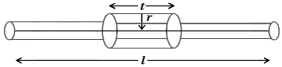
Find the equation of the equipotential surface for an infinite cylinder of radius $r_0$,carrying a charge of linear density $\lambda$.
Solution
(N/A) Using Gauss's law for a cylindrical Gaussian surface of radius $r$ and length $l$:
$\oint \overrightarrow{E} \cdot d\overrightarrow{S} = \frac{q_{enclosed}}{\epsilon_0} = \frac{\lambda l}{\epsilon_0}$
Since the electric field is radial,$E(2\pi rl) = \frac{\lambda l}{\epsilon_0}$,which gives $E = \frac{\lambda}{2\pi\epsilon_0 r}$.
The potential difference between a point at distance $r$ and the surface at $r_0$ is:
$V(r) - V(r_0) = -\int_{r_0}^{r} E dr = -\int_{r_0}^{r} \frac{\lambda}{2\pi\epsilon_0 r} dr$
$V(r) - V(r_0) = -\frac{\lambda}{2\pi\epsilon_0} \ln\left(\frac{r}{r_0}\right)$
For an equipotential surface,$V(r)$ is constant,which implies $r$ must be constant.
Thus,the equation of the equipotential surface is $r = \text{constant}$,which represents a coaxial cylinder.
$\oint \overrightarrow{E} \cdot d\overrightarrow{S} = \frac{q_{enclosed}}{\epsilon_0} = \frac{\lambda l}{\epsilon_0}$
Since the electric field is radial,$E(2\pi rl) = \frac{\lambda l}{\epsilon_0}$,which gives $E = \frac{\lambda}{2\pi\epsilon_0 r}$.
The potential difference between a point at distance $r$ and the surface at $r_0$ is:
$V(r) - V(r_0) = -\int_{r_0}^{r} E dr = -\int_{r_0}^{r} \frac{\lambda}{2\pi\epsilon_0 r} dr$
$V(r) - V(r_0) = -\frac{\lambda}{2\pi\epsilon_0} \ln\left(\frac{r}{r_0}\right)$
For an equipotential surface,$V(r)$ is constant,which implies $r$ must be constant.
Thus,the equation of the equipotential surface is $r = \text{constant}$,which represents a coaxial cylinder.
0 likes
View Solution61
Medium
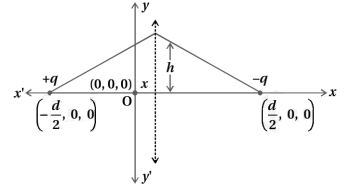
Two point charges of magnitude $+q$ and $-q$ are placed at $\left( -\frac{d}{2}, 0, 0 \right)$ and $\left( \frac{d}{2}, 0, 0 \right)$,respectively. Find the equation of the equipotential surface where the potential is zero.
Solution
(N/A) Let the required plane lie at a distance $x$ from the origin as shown in the figure.
The potential at a general point $P$ on the surface is given by the sum of potentials due to both charges:
$V = \frac{kq}{\sqrt{(x + d/2)^2 + h^2}} - \frac{kq}{\sqrt{(x - d/2)^2 + h^2}} = 0$
$\therefore \frac{1}{\sqrt{(x + d/2)^2 + h^2}} = \frac{1}{\sqrt{(x - d/2)^2 + h^2}}$
Squaring both sides:
$(x - d/2)^2 + h^2 = (x + d/2)^2 + h^2$
Expanding the squares:
$x^2 - xd + \frac{d^2}{4} + h^2 = x^2 + xd + \frac{d^2}{4} + h^2$
Simplifying the equation:
$-xd = xd$
$2xd = 0$
Since $d \neq 0$,we must have $x = 0$.
The equation of the required equipotential surface is $x = 0$,which represents the $yz$-plane.
The potential at a general point $P$ on the surface is given by the sum of potentials due to both charges:
$V = \frac{kq}{\sqrt{(x + d/2)^2 + h^2}} - \frac{kq}{\sqrt{(x - d/2)^2 + h^2}} = 0$
$\therefore \frac{1}{\sqrt{(x + d/2)^2 + h^2}} = \frac{1}{\sqrt{(x - d/2)^2 + h^2}}$
Squaring both sides:
$(x - d/2)^2 + h^2 = (x + d/2)^2 + h^2$
Expanding the squares:
$x^2 - xd + \frac{d^2}{4} + h^2 = x^2 + xd + \frac{d^2}{4} + h^2$
Simplifying the equation:
$-xd = xd$
$2xd = 0$
Since $d \neq 0$,we must have $x = 0$.
The equation of the required equipotential surface is $x = 0$,which represents the $yz$-plane.
0 likes
View Solution62
EasyMCQ
The angle between the electric lines of force and the equipotential surface is (in $^{\circ}$)
A
$45$
B
$90$
C
$180$
D
$0$
Solution
(B) The work done in moving a charge $q$ along an equipotential surface is zero because the potential difference between any two points on the surface is zero.
Work done $W = \int \vec{F} \cdot d\vec{l} = q \int \vec{E} \cdot d\vec{l} = 0$.
Since $q \neq 0$ and $d\vec{l} \neq 0$,it implies that $\vec{E} \cdot d\vec{l} = 0$.
This means the electric field vector $\vec{E}$ must be perpendicular to the displacement vector $d\vec{l}$ on the equipotential surface.
Therefore,the angle between the electric lines of force and the equipotential surface is $90^{\circ}$.
Work done $W = \int \vec{F} \cdot d\vec{l} = q \int \vec{E} \cdot d\vec{l} = 0$.
Since $q \neq 0$ and $d\vec{l} \neq 0$,it implies that $\vec{E} \cdot d\vec{l} = 0$.
This means the electric field vector $\vec{E}$ must be perpendicular to the displacement vector $d\vec{l}$ on the equipotential surface.
Therefore,the angle between the electric lines of force and the equipotential surface is $90^{\circ}$.
0 likes
View Solution63
MediumMCQ
Assertion $(A):$ $A$ spherical equipotential surface is not possible for a point charge.
Reason $(R):$ $A$ spherical equipotential surface is possible inside a spherical capacitor.
Reason $(R):$ $A$ spherical equipotential surface is possible inside a spherical capacitor.
A
If both Assertion and Reason are true and Reason is the correct explanation of Assertion.
B
If both Assertion and Reason are true but Reason is not the correct explanation of Assertion.
C
If Assertion is true but Reason is false.
D
If both Assertion and Reason are false.
Solution
(D) The electric potential $V$ due to a point charge $q$ at a distance $r$ is given by $V = \frac{1}{4\pi\epsilon_0} \frac{q}{r}$.
For a constant potential $V$,the distance $r$ must be constant. This defines a sphere centered at the point charge. Therefore,a spherical equipotential surface is possible for a point charge. Thus,the Assertion $(A)$ is false.
Inside a spherical capacitor,the electric field is radial,and the equipotential surfaces are spherical shells concentric with the capacitor plates. Therefore,the Reason $(R)$ is true.
Since the Assertion is false and the Reason is true,the correct option is $(d)$.
For a constant potential $V$,the distance $r$ must be constant. This defines a sphere centered at the point charge. Therefore,a spherical equipotential surface is possible for a point charge. Thus,the Assertion $(A)$ is false.
Inside a spherical capacitor,the electric field is radial,and the equipotential surfaces are spherical shells concentric with the capacitor plates. Therefore,the Reason $(R)$ is true.
Since the Assertion is false and the Reason is true,the correct option is $(d)$.
0 likes
View Solution64
DifficultMCQ
Given below are two statements: one is labelled as Assertion $(A)$ and the other is labelled as Reason $(R)$.
Assertion $(A)$: Work done by an electric field on moving a positive charge on an equipotential surface is always zero.
Reason $(R)$: Electric lines of force are always perpendicular to equipotential surfaces.
In the light of the above statements,choose the most appropriate answer from the options given below:
Assertion $(A)$: Work done by an electric field on moving a positive charge on an equipotential surface is always zero.
Reason $(R)$: Electric lines of force are always perpendicular to equipotential surfaces.
In the light of the above statements,choose the most appropriate answer from the options given below:
A
Both $(A)$ and $(R)$ are correct but $(R)$ is not the correct explanation of $(A)$.
B
$(A)$ is correct but $(R)$ is not correct.
C
$(A)$ is not correct but $(R)$ is correct.
D
Both $(A)$ and $(R)$ are correct and $(R)$ is the correct explanation of $(A)$.
Solution
(D) The work done $W$ in moving a charge $q$ in an electric field $\vec{E}$ is given by $W = \int \vec{F} \cdot d\vec{l} = \int q\vec{E} \cdot d\vec{l}$.
On an equipotential surface,the potential $V$ is constant,so the potential difference $dV = 0$.
Since $dV = -\vec{E} \cdot d\vec{l} = 0$,it implies that the electric field $\vec{E}$ is always perpendicular to the displacement $d\vec{l}$ on the surface.
This confirms that electric lines of force are perpendicular to equipotential surfaces (Reason $(R)$ is correct).
Because $\vec{E} \perp d\vec{l}$,the dot product $\vec{E} \cdot d\vec{l} = E dl \cos(90^{\circ}) = 0$.
Therefore,the work done is zero (Assertion $(A)$ is correct).
Since the zero work done is a direct consequence of the electric field being perpendicular to the surface,$(R)$ is the correct explanation of $(A)$.
On an equipotential surface,the potential $V$ is constant,so the potential difference $dV = 0$.
Since $dV = -\vec{E} \cdot d\vec{l} = 0$,it implies that the electric field $\vec{E}$ is always perpendicular to the displacement $d\vec{l}$ on the surface.
This confirms that electric lines of force are perpendicular to equipotential surfaces (Reason $(R)$ is correct).
Because $\vec{E} \perp d\vec{l}$,the dot product $\vec{E} \cdot d\vec{l} = E dl \cos(90^{\circ}) = 0$.
Therefore,the work done is zero (Assertion $(A)$ is correct).
Since the zero work done is a direct consequence of the electric field being perpendicular to the surface,$(R)$ is the correct explanation of $(A)$.
0 likes
View Solution65
AdvancedMCQ
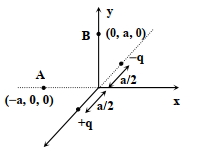
Positive and negative point charges of equal magnitude are kept at $(0, 0, a/2)$ and $(0, 0, -a/2)$,respectively. The work done by the electric field when another positive point charge is moved from $(-a, 0, 0)$ to $(0, a, 0)$ is
A
positive
B
negative
C
zero
D
depends on the path connecting the initial and final positions
Solution
(C) The given arrangement of charges is an electric dipole placed along the $z$-axis,with the positive charge at $(0, 0, a/2)$ and the negative charge at $(0, 0, -a/2)$.
The electric potential $V$ at any point $(x, y, z)$ due to an electric dipole is given by $V = \frac{1}{4\pi\epsilon_0} \frac{\vec{p} \cdot \vec{r}}{r^3}$.
For a dipole centered at the origin,the equatorial plane is the $xy$-plane $(z = 0)$.
At any point on the $xy$-plane,the distance from the positive charge is equal to the distance from the negative charge,so the potential $V$ is zero everywhere on the $xy$-plane.
The initial position is $(-a, 0, 0)$,which lies on the $xy$-plane,so $V_i = 0$.
The final position is $(0, a, 0)$,which also lies on the $xy$-plane,so $V_f = 0$.
The work done by the electric field $W_e$ is given by $W_e = -\Delta U = -q_0(V_f - V_i)$,where $q_0$ is the test charge.
Since $V_f = V_i = 0$,the work done $W_e = -q_0(0 - 0) = 0$.
The electric potential $V$ at any point $(x, y, z)$ due to an electric dipole is given by $V = \frac{1}{4\pi\epsilon_0} \frac{\vec{p} \cdot \vec{r}}{r^3}$.
For a dipole centered at the origin,the equatorial plane is the $xy$-plane $(z = 0)$.
At any point on the $xy$-plane,the distance from the positive charge is equal to the distance from the negative charge,so the potential $V$ is zero everywhere on the $xy$-plane.
The initial position is $(-a, 0, 0)$,which lies on the $xy$-plane,so $V_i = 0$.
The final position is $(0, a, 0)$,which also lies on the $xy$-plane,so $V_f = 0$.
The work done by the electric field $W_e$ is given by $W_e = -\Delta U = -q_0(V_f - V_i)$,where $q_0$ is the test charge.
Since $V_f = V_i = 0$,the work done $W_e = -q_0(0 - 0) = 0$.
0 likes
View Solution66
AdvancedMCQ
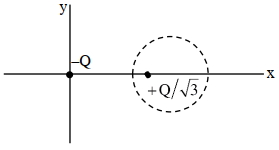
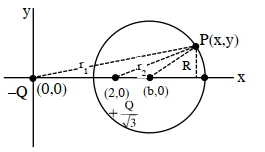
Two point charges $-Q$ and $+Q / \sqrt{3}$ are placed in the $xy$-plane at the origin $(0,0)$ and a point $(2,0)$,respectively,as shown in the figure. This results in an equipotential circle of radius $R$ and potential $V = 0$ in the $xy$-plane with its center at $(b, 0)$. All lengths are measured in meters.
$(1)$ The value of $R$ is. . . . meter.
$(2)$ The value of $b$ is. . . . . .meter.
$(1)$ The value of $R$ is. . . . meter.
$(2)$ The value of $b$ is. . . . . .meter.
A
$1.70, 5$
B
$1.75, 4$
C
$1.73, 3$
D
$1.76, 6$
Solution
(C) Let a point $P(x, y)$ be on the equipotential circle where the potential $V = 0$.
The potential at point $P$ due to charges $-Q$ at $(0,0)$ and $+Q / \sqrt{3}$ at $(2,0)$ is given by:
$V_P = \frac{k(-Q)}{r_1} + \frac{k(Q / \sqrt{3})}{r_2} = 0$
where $r_1 = \sqrt{x^2 + y^2}$ and $r_2 = \sqrt{(x - 2)^2 + y^2}$.
Rearranging the equation:
$\frac{kQ}{r_1} = \frac{kQ}{\sqrt{3} r_2} \implies \frac{1}{\sqrt{x^2 + y^2}} = \frac{1}{\sqrt{3} \sqrt{(x - 2)^2 + y^2}}$
Squaring both sides:
$3((x - 2)^2 + y^2) = x^2 + y^2$
$3(x^2 - 4x + 4 + y^2) = x^2 + y^2$
$3x^2 - 12x + 12 + 3y^2 = x^2 + y^2$
$2x^2 - 12x + 2y^2 + 12 = 0$
Dividing by $2$:
$x^2 - 6x + y^2 + 6 = 0$
Completing the square for $x$:
$(x^2 - 6x + 9) + y^2 = -6 + 9$
$(x - 3)^2 + y^2 = 3 = (\sqrt{3})^2$
Comparing this with the standard circle equation $(x - b)^2 + y^2 = R^2$,we get:
$b = 3$ and $R = \sqrt{3} \approx 1.73$.
Thus,$R = 1.73$ and $b = 3$.
The potential at point $P$ due to charges $-Q$ at $(0,0)$ and $+Q / \sqrt{3}$ at $(2,0)$ is given by:
$V_P = \frac{k(-Q)}{r_1} + \frac{k(Q / \sqrt{3})}{r_2} = 0$
where $r_1 = \sqrt{x^2 + y^2}$ and $r_2 = \sqrt{(x - 2)^2 + y^2}$.
Rearranging the equation:
$\frac{kQ}{r_1} = \frac{kQ}{\sqrt{3} r_2} \implies \frac{1}{\sqrt{x^2 + y^2}} = \frac{1}{\sqrt{3} \sqrt{(x - 2)^2 + y^2}}$
Squaring both sides:
$3((x - 2)^2 + y^2) = x^2 + y^2$
$3(x^2 - 4x + 4 + y^2) = x^2 + y^2$
$3x^2 - 12x + 12 + 3y^2 = x^2 + y^2$
$2x^2 - 12x + 2y^2 + 12 = 0$
Dividing by $2$:
$x^2 - 6x + y^2 + 6 = 0$
Completing the square for $x$:
$(x^2 - 6x + 9) + y^2 = -6 + 9$
$(x - 3)^2 + y^2 = 3 = (\sqrt{3})^2$
Comparing this with the standard circle equation $(x - b)^2 + y^2 = R^2$,we get:
$b = 3$ and $R = \sqrt{3} \approx 1.73$.
Thus,$R = 1.73$ and $b = 3$.
0 likes
View Solution67
DifficultMCQ
Three infinitely long wires with linear charge density $\lambda$ are placed along the $x$-axis,$y$-axis,and $z$-axis respectively. Which of the following denotes an equipotential surface?
A
$xy + yz + zx = \text{constant}$
B
$(x+y)(y+z)(z+x) = \text{constant}$
C
$(x^2+y^2)(y^2+z^2)(z^2+x^2) = \text{constant}$
D
$xyz = \text{constant}$
Solution
(C) The potential $V$ at a distance $r$ from an infinitely long charged wire is given by $V = -\int \vec{E} \cdot d\vec{r} = -\int \frac{2k\lambda}{r} dr = -2k\lambda \ln r + C$.
For the three wires placed along the $x, y,$ and $z$ axes,the distances from the wires to a point $(x, y, z)$ are $r_x = \sqrt{y^2+z^2}$,$r_y = \sqrt{x^2+z^2}$,and $r_z = \sqrt{x^2+y^2}$ respectively.
The net potential $V$ is the sum of the potentials due to each wire:
$V = -2k\lambda \ln(\sqrt{y^2+z^2}) - 2k\lambda \ln(\sqrt{x^2+z^2}) - 2k\lambda \ln(\sqrt{x^2+y^2}) + C$.
$V = -k\lambda \ln[(y^2+z^2)(x^2+z^2)(x^2+y^2)] + C$.
For an equipotential surface,$V = \text{constant}$,which implies that the product $(x^2+y^2)(y^2+z^2)(z^2+x^2)$ must be constant.
For the three wires placed along the $x, y,$ and $z$ axes,the distances from the wires to a point $(x, y, z)$ are $r_x = \sqrt{y^2+z^2}$,$r_y = \sqrt{x^2+z^2}$,and $r_z = \sqrt{x^2+y^2}$ respectively.
The net potential $V$ is the sum of the potentials due to each wire:
$V = -2k\lambda \ln(\sqrt{y^2+z^2}) - 2k\lambda \ln(\sqrt{x^2+z^2}) - 2k\lambda \ln(\sqrt{x^2+y^2}) + C$.
$V = -k\lambda \ln[(y^2+z^2)(x^2+z^2)(x^2+y^2)] + C$.
For an equipotential surface,$V = \text{constant}$,which implies that the product $(x^2+y^2)(y^2+z^2)(z^2+x^2)$ must be constant.
0 likes
View Solution68
MediumMCQ
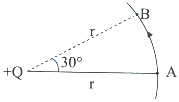
In the electric field due to a charge '$Q$',a charge '$q$' moves from point $A$ to $B$ along an arc of a circle centered at $Q$. The work done is ($\varepsilon_0=$ permittivity of vacuum).
A
$\frac{1}{4 \pi \varepsilon_0} \frac{Qq}{r^2}$
B
$\frac{1}{4 \pi \varepsilon_0} \frac{Qq}{r} \times \frac{\pi}{6}$
C
$\frac{1}{4 \pi \varepsilon_0} \frac{Qq}{r}$
D
Zero
Solution
(D) The electric potential $V$ at a distance $r$ from a point charge $Q$ is given by $V = \frac{1}{4 \pi \varepsilon_0} \frac{Q}{r}$.
Since both points $A$ and $B$ are at the same distance $r$ from the charge $Q$,they lie on the same equipotential surface.
The potential at $A$ $(V_A)$ is equal to the potential at $B$ $(V_B)$.
The work done in moving a charge $q$ from $A$ to $B$ is given by $W = q(V_B - V_A)$.
Since $V_B = V_A$,the work done $W = q(0) = 0$.
Since both points $A$ and $B$ are at the same distance $r$ from the charge $Q$,they lie on the same equipotential surface.
The potential at $A$ $(V_A)$ is equal to the potential at $B$ $(V_B)$.
The work done in moving a charge $q$ from $A$ to $B$ is given by $W = q(V_B - V_A)$.
Since $V_B = V_A$,the work done $W = q(0) = 0$.
0 likes
View Solution69
EasyMCQ
If a unit charge is taken from one point to another point over an equipotential surface,then
A
work is done on the charge.
B
work is done by the charge.
C
work done on the charge is constantly increasing.
D
work done to move a charge is zero.
Solution
(D) The work done $W$ in moving a charge $q$ from one point to another is given by the formula:
$W = q \Delta V$
where $\Delta V$ is the potential difference between the two points.
By definition,an equipotential surface is a surface where the electric potential is the same at every point.
Therefore,for any two points on an equipotential surface,the potential difference $\Delta V = 0$.
Substituting this into the work formula:
$W = q \times 0 = 0$
Thus,the work done to move a charge over an equipotential surface is zero.
$W = q \Delta V$
where $\Delta V$ is the potential difference between the two points.
By definition,an equipotential surface is a surface where the electric potential is the same at every point.
Therefore,for any two points on an equipotential surface,the potential difference $\Delta V = 0$.
Substituting this into the work formula:
$W = q \times 0 = 0$
Thus,the work done to move a charge over an equipotential surface is zero.
0 likes
View Solution70
EasyMCQ
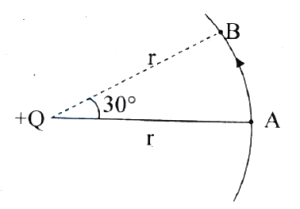
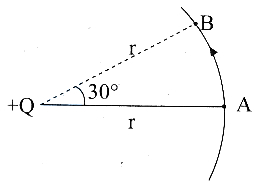
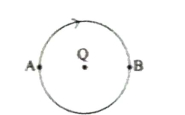
In an electric field due to charge $Q$,a charge $q$ moves from point $A$ to $B$ along an arc of a circle centered at $Q$,as shown in the figure. The work done is ($\varepsilon_0=$ permittivity of free space).
A
$\frac{1}{4 \pi \varepsilon_0} \frac{Qq}{r^2}$
B
$\frac{1}{4 \pi \varepsilon_0} \frac{Qq}{r^2} \frac{\pi}{6}$
C
$\frac{1}{4 \pi \varepsilon_0} \frac{Qq}{r}$
D
zero
Solution
(D) The electric field $\vec{E}$ due to a point charge $Q$ is always directed radially outward.
Since the path from $A$ to $B$ is an arc of a circle centered at $Q$,the displacement vector $d\vec{s}$ at any point on the path is tangent to the circle.
The radial direction (direction of $\vec{E}$) is always perpendicular to the tangent of the circle at any point.
Therefore,the force $\vec{F} = q\vec{E}$ is always perpendicular to the displacement $d\vec{s}$.
The work done $W$ is given by the integral $W = \int_A^B \vec{F} \cdot d\vec{s}$.
Since $\vec{F} \perp d\vec{s}$,the dot product $\vec{F} \cdot d\vec{s} = F \cdot ds \cos 90^{\circ} = 0$.
Thus,the total work done $W = 0$.
Since the path from $A$ to $B$ is an arc of a circle centered at $Q$,the displacement vector $d\vec{s}$ at any point on the path is tangent to the circle.
The radial direction (direction of $\vec{E}$) is always perpendicular to the tangent of the circle at any point.
Therefore,the force $\vec{F} = q\vec{E}$ is always perpendicular to the displacement $d\vec{s}$.
The work done $W$ is given by the integral $W = \int_A^B \vec{F} \cdot d\vec{s}$.
Since $\vec{F} \perp d\vec{s}$,the dot product $\vec{F} \cdot d\vec{s} = F \cdot ds \cos 90^{\circ} = 0$.
Thus,the total work done $W = 0$.
0 likes
View Solution71
EasyMCQ
$A$ charge $Q$ is placed at the centre of a circle of radius $10 \ cm$. Find the work done in moving a charge $q$ between any two points lying on the arc of the circle.
A
$kQq \ J$
B
$0.1 kQq \ J$
C
$0.5 kQq \ J$
D
$0 \ J$
Solution
(D) The electric potential $V$ at any point at a distance $r$ from a point charge $Q$ is given by $V = \frac{kQ}{r}$.
Since all points on the circumference of the circle are at the same distance $r = 10 \ cm$ from the centre where charge $Q$ is placed,the electric potential at any point on the circle is the same.
Let $V_A$ and $V_B$ be the potentials at two points $A$ and $B$ on the circle. Then $V_A = V_B = \frac{kQ}{10 \ cm}$.
The work done $W$ in moving a charge $q$ from point $A$ to point $B$ is given by $W = q(V_B - V_A)$.
Since $V_A = V_B$,the potential difference $(V_B - V_A) = 0$.
Therefore,$W = q(0) = 0 \ J$.
Since all points on the circumference of the circle are at the same distance $r = 10 \ cm$ from the centre where charge $Q$ is placed,the electric potential at any point on the circle is the same.
Let $V_A$ and $V_B$ be the potentials at two points $A$ and $B$ on the circle. Then $V_A = V_B = \frac{kQ}{10 \ cm}$.
The work done $W$ in moving a charge $q$ from point $A$ to point $B$ is given by $W = q(V_B - V_A)$.
Since $V_A = V_B$,the potential difference $(V_B - V_A) = 0$.
Therefore,$W = q(0) = 0 \ J$.
0 likes
View Solution72
EasyMCQ
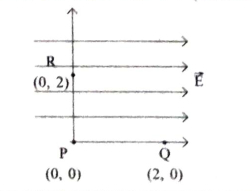
$A$ uniform electric field is prevailing in the $X$-direction in a certain region. The coordinates of points $P$,$Q$,and $R$ are $(0,0)$,$(2,0)$,and $(0,2)$ respectively. Which of the following alternatives is true for the potentials at these points?
A
$V_P = V_Q, V_Q > V_R$
B
$V_P = V_R, V_P > V_Q$
C
$V_P = V_R, V_Q > V_R$
D
$V_P = V_Q, V_P > V_R$
Solution
(B) The electric field $\vec{E}$ is uniform and directed along the $+X$-direction.
Points $P(0,0)$ and $R(0,2)$ lie on the same plane perpendicular to the electric field lines (the $YZ$-plane). Therefore,$P$ and $R$ lie on the same equipotential surface,which implies $V_P = V_R$.
Electric potential decreases in the direction of the electric field. Since point $Q(2,0)$ is further along the $+X$-direction than point $P(0,0)$,the potential at $P$ must be greater than the potential at $Q$,i.e.,$V_P > V_Q$.
Combining these,we get $V_P = V_R$ and $V_P > V_Q$.
Points $P(0,0)$ and $R(0,2)$ lie on the same plane perpendicular to the electric field lines (the $YZ$-plane). Therefore,$P$ and $R$ lie on the same equipotential surface,which implies $V_P = V_R$.
Electric potential decreases in the direction of the electric field. Since point $Q(2,0)$ is further along the $+X$-direction than point $P(0,0)$,the potential at $P$ must be greater than the potential at $Q$,i.e.,$V_P > V_Q$.
Combining these,we get $V_P = V_R$ and $V_P > V_Q$.
0 likes
View Solution73
EasyMCQ
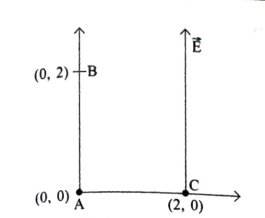
$A$ uniform electric field is directed along the $Y$-axis. Consider point $A$ as the origin $(0,0) \text{ m}$. The coordinates of point $B$ are $(0,2) \text{ m}$. The coordinates of point $C$ are $(2,0) \text{ m}$. If the electric potentials at points $A, B,$ and $C$ are $V_A, V_B,$ and $V_C$ respectively,which of the following options is correct?
A
$V_A = V_C < V_B$
B
$V_A = V_B = V_C$
C
$V_A = V_B > V_C$
D
$V_A = V_C > V_B$
Solution
(D) The electric field $\vec{E}$ is uniform and directed along the positive $Y$-axis.
Points $A(0,0)$ and $C(2,0)$ lie on the $X$-axis,which is perpendicular to the direction of the electric field. Therefore,the electric potential at these points is the same,i.e.,$V_A = V_C$.
The electric potential decreases in the direction of the electric field. Since point $B(0,2)$ is at a higher $Y$-coordinate than points $A$ and $C$,it is at a lower potential.
Thus,$V_A = V_C > V_B$.
Points $A(0,0)$ and $C(2,0)$ lie on the $X$-axis,which is perpendicular to the direction of the electric field. Therefore,the electric potential at these points is the same,i.e.,$V_A = V_C$.
The electric potential decreases in the direction of the electric field. Since point $B(0,2)$ is at a higher $Y$-coordinate than points $A$ and $C$,it is at a lower potential.
Thus,$V_A = V_C > V_B$.
0 likes
View Solution74
EasyMCQ
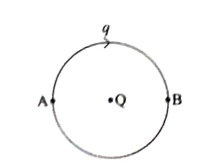
$A$ charge $+Q$ is placed at the centre of a circular path of radius $r$. The work done to bring a charge $+q$ from one end of the diameter to the other end of the circular path in the electric field produced by charge $+Q$ is $.......$
A
$\frac{k Q q}{r}$
B
Zero
C
$\frac{k Q q}{2 r}$
D
$\frac{2 k Q q}{r}$
Solution
(B) The electric potential $V$ at a distance $r$ from a point charge $Q$ is given by $V = \frac{kQ}{r}$.
Since the circular path is centered at $Q$,every point on the circumference is at the same distance $r$ from the charge $Q$.
Therefore,the electric potential at any point on the circular path is constant.
Let $V_A$ be the potential at point $A$ and $V_B$ be the potential at point $B$. Since both points are on the circle,$V_A = V_B = \frac{kQ}{r}$.
The work done $W$ in moving a charge $q$ from point $A$ to point $B$ is given by $W = q(V_B - V_A)$.
Substituting the values,$W = q(\frac{kQ}{r} - \frac{kQ}{r}) = q(0) = 0$.
Thus,the work done is zero.
Since the circular path is centered at $Q$,every point on the circumference is at the same distance $r$ from the charge $Q$.
Therefore,the electric potential at any point on the circular path is constant.
Let $V_A$ be the potential at point $A$ and $V_B$ be the potential at point $B$. Since both points are on the circle,$V_A = V_B = \frac{kQ}{r}$.
The work done $W$ in moving a charge $q$ from point $A$ to point $B$ is given by $W = q(V_B - V_A)$.
Substituting the values,$W = q(\frac{kQ}{r} - \frac{kQ}{r}) = q(0) = 0$.
Thus,the work done is zero.
0 likes
View Solution75
EasyMCQ
Equipotential surfaces at a very large distance from a collection of charges whose total sum is not zero are approximately . . . . . . .
A
planes
B
spheres
C
paraboloids
D
ellipsoids
Solution
(B) The correct option is $(B)$.
For a collection of charges with a non-zero total sum $(Q \neq 0)$,the system behaves like a point charge when viewed from a very large distance $(r \to \infty)$.
The electric potential $V$ due to a point charge $q$ is given by the formula:
$V = \frac{1}{4\pi\epsilon_0} \frac{q}{r}$
This equation shows that the potential $V$ depends only on the distance $r$ from the charge. Therefore,all points at a constant distance $r$ from the charge have the same potential.
The locus of points at a constant distance $r$ from a point source in three-dimensional space forms the surface of a sphere.
Thus,at a very large distance,the equipotential surfaces of such a charge distribution are approximately spheres.
For a collection of charges with a non-zero total sum $(Q \neq 0)$,the system behaves like a point charge when viewed from a very large distance $(r \to \infty)$.
The electric potential $V$ due to a point charge $q$ is given by the formula:
$V = \frac{1}{4\pi\epsilon_0} \frac{q}{r}$
This equation shows that the potential $V$ depends only on the distance $r$ from the charge. Therefore,all points at a constant distance $r$ from the charge have the same potential.
The locus of points at a constant distance $r$ from a point source in three-dimensional space forms the surface of a sphere.
Thus,at a very large distance,the equipotential surfaces of such a charge distribution are approximately spheres.
0 likes
View Solution76
EasyMCQ
Which of the following statements is not true?
A
Work done to move a charge on an equipotential surface is not zero
B
Equipotential surfaces are the surfaces where the potential is constant
C
Equipotential surfaces for a uniform electric field are parallel and equidistant from each other
D
Electric field is always perpendicular to an equipotential surface
Solution
(A) An equipotential surface is defined as a surface where the electric potential is the same at every point.
Since the potential difference $(V_B - V_A)$ between any two points on an equipotential surface is zero,the work done $(W)$ in moving a charge $(q)$ from one point to another is given by $W = q(V_B - V_A) = 0$.
Therefore,the statement that 'Work done to move a charge on an equipotential surface is not zero' is false.
Since the potential difference $(V_B - V_A)$ between any two points on an equipotential surface is zero,the work done $(W)$ in moving a charge $(q)$ from one point to another is given by $W = q(V_B - V_A) = 0$.
Therefore,the statement that 'Work done to move a charge on an equipotential surface is not zero' is false.
0 likes
View Solution77
EasyMCQ
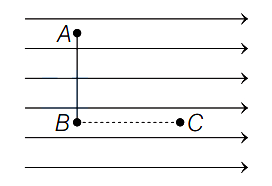
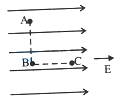
The figure shows three points $A, B$ and $C$ in a region of uniform electric field $E$. The line $A B$ is perpendicular and $B C$ is parallel to the field lines. Then,which of the following holds good? ($V_{A}, V_{B}$ and $V_{C}$ represent the electric potential at points $A, B$ and $C$,respectively)
A
$V_{A}=V_{B}=V_{C}$
B
$V_{A}=V_{B}>V_{C}$
C
$V_{A}=V_{B} < V_{C}$
D
$V_{A}>V_{B}=V_{C}$
Solution
(B) According to the given figure,the line $A B$ is perpendicular to the direction of the electric field lines. Hence,the surface passing through line $A B$ and perpendicular to the electric field lines behaves like an equipotential surface,therefore
$V_{A}=V_{B} \dots (i)$
Electric field and electric potential are related as
$E=-\frac{d V}{d x} \Rightarrow V=-\int E d x$
This indicates that the electric potential decreases in the direction of the electric field,i.e.
$V_{B}>V_{C} \dots (ii)$
From Eqs. $(i)$ and $(ii)$,we have
$V_{A}=V_{B}>V_{C}$
$V_{A}=V_{B} \dots (i)$
Electric field and electric potential are related as
$E=-\frac{d V}{d x} \Rightarrow V=-\int E d x$
This indicates that the electric potential decreases in the direction of the electric field,i.e.
$V_{B}>V_{C} \dots (ii)$
From Eqs. $(i)$ and $(ii)$,we have
$V_{A}=V_{B}>V_{C}$
0 likes
View Solution78
MediumMCQ
The work done to move a charge on an equipotential surface is
A
Infinity
B
Less than $1$
C
Greater than $1$
D
Zero
Solution
(D) An equipotential surface has the same electric potential at all points.
Therefore,the work done in moving a charge $q$ from point $A$ to point $B$ on an equipotential surface is given by the formula:
$W = q(V_{B} - V_{A})$
Since the surface is equipotential,the potential at all points is the same,meaning $V_{A} = V_{B}$.
Substituting this into the equation:
$W = q(V_{A} - V_{A}) = q(0) = 0$
Thus,the work done in moving a charge on an equipotential surface is $0$.
Therefore,the work done in moving a charge $q$ from point $A$ to point $B$ on an equipotential surface is given by the formula:
$W = q(V_{B} - V_{A})$
Since the surface is equipotential,the potential at all points is the same,meaning $V_{A} = V_{B}$.
Substituting this into the equation:
$W = q(V_{A} - V_{A}) = q(0) = 0$
Thus,the work done in moving a charge on an equipotential surface is $0$.
0 likes
View Solution79
EasyMCQ
The nature of the equipotential surface for a point charge is:
A
Ellipsoid with charge at foci.
B
Sphere with charge at the centre of the sphere.
C
Sphere with charge on the surface of the sphere.
D
Plane with charge on the surface.
Solution
(B) The electric potential $V$ due to a point charge $q$ at a distance $r$ is given by the formula $V = \frac{1}{4\pi\epsilon_0} \frac{q}{r}$.
For an equipotential surface,the potential $V$ must be constant.
This implies that $r$ must be constant for a given potential $V$.
The locus of points at a constant distance $r$ from a fixed point charge $q$ is a sphere.
Therefore,the equipotential surface for a point charge is a sphere with the charge at the centre of the sphere.
For an equipotential surface,the potential $V$ must be constant.
This implies that $r$ must be constant for a given potential $V$.
The locus of points at a constant distance $r$ from a fixed point charge $q$ is a sphere.
Therefore,the equipotential surface for a point charge is a sphere with the charge at the centre of the sphere.
0 likes
View Solution80
EasyMCQ
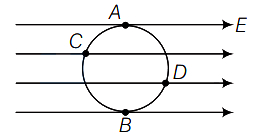
$A$ uniform electric field exists in the plane of the paper as shown. Here $A, B, C$, and $D$ are points on the circle. $V_{A}, V_{B}, V_{C}$, and $V_{D}$ are the potentials at those points respectively. Then:
A
$V_{A}=V_{C}, V_{B}=V_{D}$
B
$V_{A}=V_{C}, V_{B} > V_{D}$
C
$V_{A} > V_{C}, V_{B} > V_{D}$
D
$V_{A}=V_{B}, V_{C} > V_{D}$
Solution
(D) In a uniform electric field, the electric potential $V$ decreases in the direction of the electric field lines. The potential at any point $(x, y)$ in a uniform electric field $\vec{E} = E\hat{i}$ is given by $V = -Ex + \text{constant}$.
Points on the same vertical line (perpendicular to the field lines) have the same potential because they have the same $x$-coordinate.
Looking at the diagram:
$1$. Points $A$ and $B$ are at the same vertical position relative to the field lines, but they are not on the same vertical line. However, the question asks for the relationship between potentials. Let's analyze the $x$-coordinates.
$2$. Point $C$ is at the leftmost position, so it has the smallest $x$-coordinate, meaning $V_{C}$ is the highest.
$3$. Point $D$ is at the rightmost position, so it has the largest $x$-coordinate, meaning $V_{D}$ is the lowest.
$4$. Points $A$ and $B$ have the same $x$-coordinate, so $V_{A} = V_{B}$.
$5$. Since $C$ is to the left of $D$, $V_{C} > V_{D}$.
Thus, the correct relationship is $V_{A} = V_{B}$ and $V_{C} > V_{D}$.
Points on the same vertical line (perpendicular to the field lines) have the same potential because they have the same $x$-coordinate.
Looking at the diagram:
$1$. Points $A$ and $B$ are at the same vertical position relative to the field lines, but they are not on the same vertical line. However, the question asks for the relationship between potentials. Let's analyze the $x$-coordinates.
$2$. Point $C$ is at the leftmost position, so it has the smallest $x$-coordinate, meaning $V_{C}$ is the highest.
$3$. Point $D$ is at the rightmost position, so it has the largest $x$-coordinate, meaning $V_{D}$ is the lowest.
$4$. Points $A$ and $B$ have the same $x$-coordinate, so $V_{A} = V_{B}$.
$5$. Since $C$ is to the left of $D$, $V_{C} > V_{D}$.
Thus, the correct relationship is $V_{A} = V_{B}$ and $V_{C} > V_{D}$.
0 likes
View Solution81
EasyMCQ
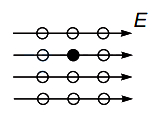
There is a uniform electric field of intensity $E$ as shown in the figure. How many labelled points have the same electric potential as the fully shaded point?
A
$2$
B
$3$
C
$8$
D
$11$
Solution
(A) In a uniform electric field,the electric potential $V$ at a point $(x, y, z)$ is given by $V = -E \cdot r + C$,where $E$ is the electric field vector and $r$ is the position vector.
For a uniform electric field directed along the $x$-axis,the potential depends only on the $x$-coordinate $(V = -Ex + C)$.
Therefore,all points lying on a plane perpendicular to the electric field lines have the same electric potential.
In the given figure,there are $4$ rows of $3$ points each,forming a grid of $12$ points.
The shaded point is in the middle column.
The points that have the same potential as the shaded point are those that lie on the same vertical line (perpendicular to the electric field lines).
There are $3$ points in that vertical column,including the shaded point itself.
Thus,there are $2$ other points that have the same electric potential as the shaded point.
For a uniform electric field directed along the $x$-axis,the potential depends only on the $x$-coordinate $(V = -Ex + C)$.
Therefore,all points lying on a plane perpendicular to the electric field lines have the same electric potential.
In the given figure,there are $4$ rows of $3$ points each,forming a grid of $12$ points.
The shaded point is in the middle column.
The points that have the same potential as the shaded point are those that lie on the same vertical line (perpendicular to the electric field lines).
There are $3$ points in that vertical column,including the shaded point itself.
Thus,there are $2$ other points that have the same electric potential as the shaded point.
0 likes
View Solution82
EasyMCQ
Assertion $(A)$: In a region of constant potential,the electric field is zero and there can be no charge inside the region.
Reason $(R)$: According to Gauss's law,the charge inside the region should be zero if the electric field is zero.
Reason $(R)$: According to Gauss's law,the charge inside the region should be zero if the electric field is zero.
A
Both $(A)$ and $(R)$ are true; $(R)$ is the correct explanation of $(A)$
B
Both $(A)$ and $(R)$ are true; $(R)$ is not the correct explanation of $(A)$
C
$(A)$ is true,$(R)$ is false
D
$(A)$ is false,$(R)$ is true
Solution
(B) For Assertion $(A)$:
The potential difference is given by $dV = -\vec{E} \cdot d\vec{r}$. If the electric field $\vec{E} = 0$,then $dV = 0$,which implies that the potential $V$ is constant throughout the region.
For Reason $(R)$:
According to Gauss's law,the net electric flux $\phi_E$ through a closed surface is given by $\phi_E = \oint \vec{E} \cdot d\vec{A} = \frac{q_{enclosed}}{\epsilon_0}$.
If $\vec{E} = 0$ everywhere in the region,then the flux $\phi_E = 0$,which implies $q_{enclosed} = 0$. Thus,the reason is correct.
However,the reason explains why the charge must be zero if the field is zero,but it does not explain why the potential is constant in that region (which is derived from the relation $E = -\nabla V$). Therefore,$(R)$ is not the correct explanation of $(A)$.
The potential difference is given by $dV = -\vec{E} \cdot d\vec{r}$. If the electric field $\vec{E} = 0$,then $dV = 0$,which implies that the potential $V$ is constant throughout the region.
For Reason $(R)$:
According to Gauss's law,the net electric flux $\phi_E$ through a closed surface is given by $\phi_E = \oint \vec{E} \cdot d\vec{A} = \frac{q_{enclosed}}{\epsilon_0}$.
If $\vec{E} = 0$ everywhere in the region,then the flux $\phi_E = 0$,which implies $q_{enclosed} = 0$. Thus,the reason is correct.
However,the reason explains why the charge must be zero if the field is zero,but it does not explain why the potential is constant in that region (which is derived from the relation $E = -\nabla V$). Therefore,$(R)$ is not the correct explanation of $(A)$.
0 likes
View Solution83
EasyMCQ
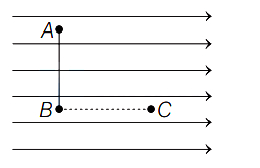
The figure shows three points $A, B$ and $C$ in a uniform electric field $(\overrightarrow{E})$. The line $AB$ is perpendicular to $BC$ and $BC$ is parallel to $\overrightarrow{E}$. If $V_A, V_B$ and $V_C$ are the potentials at $A, B$ and $C$ respectively,then the correct option is
A
$V_{A}=V_{B}=V_{C}$
B
$V_A=V_B>V_C$
C
$V_{A}=V_{B} < V_{C}$
D
$V_A>V_B=V_C$
Solution
(B) In a uniform electric field,the electric potential decreases as we move in the direction of the electric field.
Since $BC$ is parallel to the electric field $\overrightarrow{E}$ and point $C$ is further along the direction of the field than point $B$,we have $V_B > V_C$.
Also,the electric potential remains constant along a line perpendicular to the direction of the electric field.
Since $AB$ is perpendicular to the electric field $\overrightarrow{E}$,the potential at $A$ is equal to the potential at $B$,i.e.,$V_A = V_B$.
Combining these two results,we get $V_A = V_B > V_C$.
Since $BC$ is parallel to the electric field $\overrightarrow{E}$ and point $C$ is further along the direction of the field than point $B$,we have $V_B > V_C$.
Also,the electric potential remains constant along a line perpendicular to the direction of the electric field.
Since $AB$ is perpendicular to the electric field $\overrightarrow{E}$,the potential at $A$ is equal to the potential at $B$,i.e.,$V_A = V_B$.
Combining these two results,we get $V_A = V_B > V_C$.
0 likes
View Solution84
EasyMCQ
What is the direction of the lines of force at any point on the equipotential surface?
A
Parallel to it
B
Normal to it
C
Be inclined
D
Random direction
Solution
(B) By definition,an equipotential surface is a surface where the electric potential is constant at all points.
Since the work done in moving a charge $q$ along the surface is $W = 0$,and $W = \int \vec{F} \cdot d\vec{l} = q \int \vec{E} \cdot d\vec{l} = 0$,it implies that the electric field $\vec{E}$ must be perpendicular to the displacement vector $d\vec{l}$ at every point on the surface.
Therefore,the electric lines of force are always normal (perpendicular) to the equipotential surface.
Since the work done in moving a charge $q$ along the surface is $W = 0$,and $W = \int \vec{F} \cdot d\vec{l} = q \int \vec{E} \cdot d\vec{l} = 0$,it implies that the electric field $\vec{E}$ must be perpendicular to the displacement vector $d\vec{l}$ at every point on the surface.
Therefore,the electric lines of force are always normal (perpendicular) to the equipotential surface.
0 likes
View Solution85
EasyMCQ
If a unit positive charge is taken from one point to another over an equipotential surface,then
A
work is done on the charge
B
work is done by the charge
C
work done is constant
D
no work is done
Solution
(D) An equipotential surface is defined as a surface where the electric potential is the same at every point.
Therefore,the potential difference $(V_1 - V_2)$ between any two points on an equipotential surface is $0$.
By the definition of electric potential,the work done $(W)$ in moving a charge $(q)$ from one point to another is given by $W = q(V_1 - V_2)$.
Since $V_1 - V_2 = 0$,the work done $W = q \times 0 = 0$.
Thus,no work is done in moving a unit positive charge over an equipotential surface.
Therefore,the potential difference $(V_1 - V_2)$ between any two points on an equipotential surface is $0$.
By the definition of electric potential,the work done $(W)$ in moving a charge $(q)$ from one point to another is given by $W = q(V_1 - V_2)$.
Since $V_1 - V_2 = 0$,the work done $W = q \times 0 = 0$.
Thus,no work is done in moving a unit positive charge over an equipotential surface.
0 likes
View Solution86
EasyMCQ
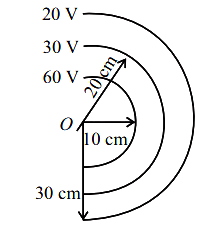
The figure shows equipotential surfaces concentric at $O$. The magnitude of the electric field at a distance $r$ metres from $O$ is
A
$\frac{9}{r^2} \text{ Vm}^{-1}$
B
$\frac{16}{r^2} \text{ Vm}^{-1}$
C
$\frac{2}{r^2} \text{ Vm}^{-1}$
D
$\frac{6}{r^2} \text{ Vm}^{-1}$
Solution
(D) The electric potential $V$ at a distance $r$ from a point charge $q$ is given by $V = \frac{kq}{r}$,where $k = 9 \times 10^9 \text{ Nm}^2\text{C}^{-2}$.
From the figure,for the equipotential surface with potential $V = 60 \text{ V}$,the radius is $r = 10 \text{ cm} = 0.1 \text{ m}$.
Substituting these values into the potential formula:
$60 = \frac{kq}{0.1}$
$kq = 60 \times 0.1 = 6 \text{ Vm}$.
The magnitude of the electric field $E$ at a distance $r$ from a point charge is given by $E = \frac{kq}{r^2}$.
Substituting the value of $kq = 6$ into the electric field formula,we get:
$E = \frac{6}{r^2} \text{ Vm}^{-1}$.
From the figure,for the equipotential surface with potential $V = 60 \text{ V}$,the radius is $r = 10 \text{ cm} = 0.1 \text{ m}$.
Substituting these values into the potential formula:
$60 = \frac{kq}{0.1}$
$kq = 60 \times 0.1 = 6 \text{ Vm}$.
The magnitude of the electric field $E$ at a distance $r$ from a point charge is given by $E = \frac{kq}{r^2}$.
Substituting the value of $kq = 6$ into the electric field formula,we get:
$E = \frac{6}{r^2} \text{ Vm}^{-1}$.
0 likes
View Solution87
EasyMCQ
What is the angle between an equipotential surface and electric lines of force (in $^{\circ}$)?
A
$0$
B
$90$
C
$180$
D
$270$
Solution
(B) An equipotential surface is a surface where the electric potential is the same at every point.
By definition,the work done in moving a charge $q$ along an equipotential surface is zero,because $W = q \Delta V$ and $\Delta V = 0$.
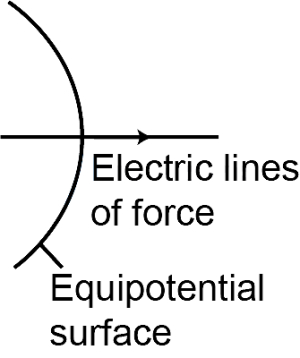
Since the work done is $W = \int \vec{F} \cdot d\vec{l} = q \int \vec{E} \cdot d\vec{l} = 0$,the electric field $\vec{E}$ must be perpendicular to the displacement $d\vec{l}$ along the surface.
Therefore,the electric lines of force are always perpendicular to the equipotential surface,meaning the angle between them is $90^{\circ}$.
By definition,the work done in moving a charge $q$ along an equipotential surface is zero,because $W = q \Delta V$ and $\Delta V = 0$.
Since the work done is $W = \int \vec{F} \cdot d\vec{l} = q \int \vec{E} \cdot d\vec{l} = 0$,the electric field $\vec{E}$ must be perpendicular to the displacement $d\vec{l}$ along the surface.
Therefore,the electric lines of force are always perpendicular to the equipotential surface,meaning the angle between them is $90^{\circ}$.
0 likes
View Solution88
EasyMCQ
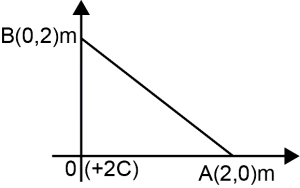
As shown in the figure below,a charge $+2 \text{ C}$ is situated at the origin $O$ and another charge $+5 \text{ C}$ is on the $x$-axis at point $A(2, 0) \text{ m}$. The charge at point $A$ is then moved to point $B(0, 2) \text{ m}$ on the $y$-axis. Calculate the work done. (Given $\frac{1}{4 \pi \varepsilon_{0}} = 9 \times 10^{9} \text{ N m}^2/\text{C}^2$)
A
$45 \times 10^{9} \text{ J}$
B
$90 \times 10^{9} \text{ J}$
C
zero
D
$-45 \times 10^{9} \text{ J}$
Solution
(C) The work done in moving a charge in an electrostatic field is equal to the change in the electrostatic potential energy of the system.
$W = U_{f} - U_{i}$
$U = \frac{1}{4 \pi \varepsilon_{0}} \frac{q_{1} q_{2}}{r}$
Initial potential energy $U_{i}$ when the charge $+5 \text{ C}$ is at $A(2, 0) \text{ m}$:
$U_{i} = \frac{1}{4 \pi \varepsilon_{0}} \frac{(2)(5)}{2} = \frac{1}{4 \pi \varepsilon_{0}} (5)$
Final potential energy $U_{f}$ when the charge $+5 \text{ C}$ is at $B(0, 2) \text{ m}$:
$U_{f} = \frac{1}{4 \pi \varepsilon_{0}} \frac{(2)(5)}{2} = \frac{1}{4 \pi \varepsilon_{0}} (5)$
Since the distance $r$ from the origin $O$ to point $A$ is $2 \text{ m}$ and from the origin $O$ to point $B$ is also $2 \text{ m}$,the potential energy remains the same.
$W = U_{f} - U_{i} = 0 \text{ J}$.
$W = U_{f} - U_{i}$
$U = \frac{1}{4 \pi \varepsilon_{0}} \frac{q_{1} q_{2}}{r}$
Initial potential energy $U_{i}$ when the charge $+5 \text{ C}$ is at $A(2, 0) \text{ m}$:
$U_{i} = \frac{1}{4 \pi \varepsilon_{0}} \frac{(2)(5)}{2} = \frac{1}{4 \pi \varepsilon_{0}} (5)$
Final potential energy $U_{f}$ when the charge $+5 \text{ C}$ is at $B(0, 2) \text{ m}$:
$U_{f} = \frac{1}{4 \pi \varepsilon_{0}} \frac{(2)(5)}{2} = \frac{1}{4 \pi \varepsilon_{0}} (5)$
Since the distance $r$ from the origin $O$ to point $A$ is $2 \text{ m}$ and from the origin $O$ to point $B$ is also $2 \text{ m}$,the potential energy remains the same.
$W = U_{f} - U_{i} = 0 \text{ J}$.
0 likes
View SolutionElectric Potential and Capacitance — Equipotential Surface · Frequently Asked Questions
1Are these Electric Potential and Capacitance questions useful for JEE and NEET?
Yes. All questions in this section are mapped to JEE Main and NEET exam patterns. Previous year questions from JEE Main, NEET, GUJCET and state-level exams are included with full solutions.
2Can I switch to Hindi or Gujarati for these questions?
Yes. Use the language tabs in the hero section or the sidebar to view the same questions and solutions in English, Hindi or Gujarati.
3How do I generate a question paper from this subtopic?
Use the Vedclass Exam Paper Generator — select the chapter and subtopic, set difficulty, and generate Sets A, B, C, D automatically. First 3 chapters of every subject are free.
Vedclass Products
For Students
Vedclass Test Series
Mock tests in real JEE/NEET style with performance analysis. 5-day free trial.
Start Free TrialFor Teachers
Exam Paper Generator
Generate Set A/B/C/D papers from this chapter in 2 minutes. 3 chapters free.
Try FreeFor Institutes
Online Exam Module
Live online exams with unlimited students, 360° analytics & white-label branding.
See DemoFor Teachers & Institutes
Generate a Electric Potential and Capacitance Exam Paper in 2 Minutes
Select subtopic & difficulty — Sets A, B, C, D auto-generated with No Repeat logic.
First 3 chapters of every subject are free — no payment required.