
A English
Conductor, Electrostatic Shielding, Induced Charge and Charge Redistribution on conductor Questions in English
Class 12 Physics · Electric Potential and Capacitance · Conductor, Electrostatic Shielding, Induced Charge and Charge Redistribution on conductor
122+
Questions
English
Language
100%
With Solutions
Showing 50 of 122 questions in English
51
MediumMCQ
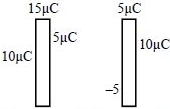
The charges on two plates of a $10\,\mu F$ capacitor are $5\,\mu C$ and $15\,\mu C$. The potential difference across the capacitor plates is........$V$.
A
$0.5$
B
$1$
C
$1.5$
D
$2$
Solution
(A) When two plates of a capacitor have charges $Q_1$ and $Q_2$,the charge $Q$ that appears on the inner facing surfaces is given by $Q = \frac{Q_1 - Q_2}{2}$.
Here,$Q_1 = 15\,\mu C$ and $Q_2 = 5\,\mu C$.
So,the charge on the inner surfaces is $Q = \frac{15\,\mu C - 5\,\mu C}{2} = \frac{10\,\mu C}{2} = 5\,\mu C$.
The potential difference $V$ across the capacitor is given by $V = \frac{Q}{C}$.
Given $C = 10\,\mu F = 10 \times 10^{-6}\,F$ and $Q = 5\,\mu C = 5 \times 10^{-6}\,C$.
Therefore,$V = \frac{5 \times 10^{-6}}{10 \times 10^{-6}} = 0.5\,V$.
Here,$Q_1 = 15\,\mu C$ and $Q_2 = 5\,\mu C$.
So,the charge on the inner surfaces is $Q = \frac{15\,\mu C - 5\,\mu C}{2} = \frac{10\,\mu C}{2} = 5\,\mu C$.
The potential difference $V$ across the capacitor is given by $V = \frac{Q}{C}$.
Given $C = 10\,\mu F = 10 \times 10^{-6}\,F$ and $Q = 5\,\mu C = 5 \times 10^{-6}\,C$.
Therefore,$V = \frac{5 \times 10^{-6}}{10 \times 10^{-6}} = 0.5\,V$.
0 likes
View Solution52
MediumMCQ
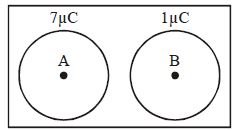
$A$ and $B$ are two identical spheres. The charges on them are $7\,\mu C$ and $1\,\mu C$ respectively. Now,both are connected by a wire. Calculate the flow of charge from $A$ to $B$ in $\mu C$.
A
$8$
B
$4$
C
$3$
D
$1.5$
Solution
(C) Initial charge on sphere $A$ $(q_A)$ $= 7\,\mu C$.
Initial charge on sphere $B$ $(q_B)$ $= 1\,\mu C$.
Since the spheres are identical,when they are connected by a wire,the total charge is redistributed equally between them.
Total charge $Q = q_A + q_B = 7\,\mu C + 1\,\mu C = 8\,\mu C$.
Final charge on each sphere after connection $q' = \frac{Q}{2} = \frac{8\,\mu C}{2} = 4\,\mu C$.
The charge flow from $A$ to $B$ is the difference between the initial and final charge on sphere $A$.
Charge flow $= q_A - q' = 7\,\mu C - 4\,\mu C = 3\,\mu C$.
Initial charge on sphere $B$ $(q_B)$ $= 1\,\mu C$.
Since the spheres are identical,when they are connected by a wire,the total charge is redistributed equally between them.
Total charge $Q = q_A + q_B = 7\,\mu C + 1\,\mu C = 8\,\mu C$.
Final charge on each sphere after connection $q' = \frac{Q}{2} = \frac{8\,\mu C}{2} = 4\,\mu C$.
The charge flow from $A$ to $B$ is the difference between the initial and final charge on sphere $A$.
Charge flow $= q_A - q' = 7\,\mu C - 4\,\mu C = 3\,\mu C$.
0 likes
View Solution53
EasyMCQ
Two conductors of the same shape and size,one of copper and the other of aluminium (which is less conducting),are placed in a uniform electric field. What can be said about the charge induced in the aluminium conductor?
A
Will be less than in copper
B
Will be more than in copper
C
Will be equal to that in copper
D
Will not be connected with copper
Solution
(C) When a conductor is placed in an external uniform electric field,the free electrons within the conductor redistribute themselves until the internal electric field becomes zero.
For any conductor,the induced surface charge density $\sigma$ is given by $\sigma = \epsilon_0 E_n$,where $E_n$ is the component of the external electric field normal to the surface.
Since both conductors have the same shape and size and are placed in the same uniform electric field,the external field $E$ at the surface is identical for both.
Therefore,the total induced charge $q = \int \sigma dA$ will be the same for both the copper and the aluminium conductors,regardless of their material conductivity,as long as they are both conductors.
For any conductor,the induced surface charge density $\sigma$ is given by $\sigma = \epsilon_0 E_n$,where $E_n$ is the component of the external electric field normal to the surface.
Since both conductors have the same shape and size and are placed in the same uniform electric field,the external field $E$ at the surface is identical for both.
Therefore,the total induced charge $q = \int \sigma dA$ will be the same for both the copper and the aluminium conductors,regardless of their material conductivity,as long as they are both conductors.
0 likes
View Solution54
EasyMCQ
$A$ point charge $q$ is placed in a cavity in a metal block. If a charge $Q$ is brought outside the metal,then the electric force experienced by $q$ is
A
proportional to $Q$
B
proportional to $(Q-q)$
C
zero
D
cannot be determined
Solution
(C) According to the principle of electrostatic shielding,the electric field inside a cavity of a conductor is zero,regardless of any external charges or electric fields present outside the conductor.
When a charge $Q$ is brought outside the metal block,the charges on the outer surface of the metal redistribute themselves to ensure that the electric field inside the metal remains zero.
However,the electric field inside the cavity is determined solely by the charge $q$ placed inside it and the induced charges on the inner surface of the cavity.
The external charge $Q$ does not affect the electric field inside the cavity because the metal block acts as an electrostatic shield.
Therefore,the electric force experienced by the point charge $q$ remains unaffected by the external charge $Q$ and is zero if $q$ is at the center of a spherical cavity or depends only on the local configuration of induced charges on the inner wall,but the net force due to external charge $Q$ is zero.
When a charge $Q$ is brought outside the metal block,the charges on the outer surface of the metal redistribute themselves to ensure that the electric field inside the metal remains zero.
However,the electric field inside the cavity is determined solely by the charge $q$ placed inside it and the induced charges on the inner surface of the cavity.
The external charge $Q$ does not affect the electric field inside the cavity because the metal block acts as an electrostatic shield.
Therefore,the electric force experienced by the point charge $q$ remains unaffected by the external charge $Q$ and is zero if $q$ is at the center of a spherical cavity or depends only on the local configuration of induced charges on the inner wall,but the net force due to external charge $Q$ is zero.
0 likes
View Solution55
EasyMCQ
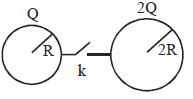
Two spheres of radius $R$ and $2R$ having charge $Q$ and $2Q$ respectively are placed far away from each other. How much charge will flow when key $k$ is pressed?
A
$Q$
B
$\frac{Q}{2}$
C
$\frac{Q}{3}$
D
Zero
Solution
(D) The potential of a charged sphere of radius $r$ with charge $q$ is given by $V = \frac{kq}{r}$.
For the first sphere,the potential is $V_1 = \frac{kQ}{R}$.
For the second sphere,the potential is $V_2 = \frac{k(2Q)}{2R} = \frac{kQ}{R}$.
Since the potentials of both spheres are equal $(V_1 = V_2)$,there is no potential difference between them.
Therefore,when the key $k$ is pressed,no charge will flow between the two spheres.
For the first sphere,the potential is $V_1 = \frac{kQ}{R}$.
For the second sphere,the potential is $V_2 = \frac{k(2Q)}{2R} = \frac{kQ}{R}$.
Since the potentials of both spheres are equal $(V_1 = V_2)$,there is no potential difference between them.
Therefore,when the key $k$ is pressed,no charge will flow between the two spheres.
0 likes
View Solution56
MediumMCQ
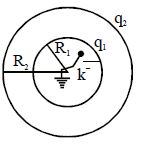
Two concentric spherical shells of radius $R_1$ and $R_2$ have $q_1$ and $q_2$ charge respectively as shown in the figure. How much charge will flow through key $k$ when it is closed?
A
$q_2 \left( \frac{R_1 + R_2}{R_2} \right)$
B
$\frac{q_1 R_2 + q_2 R_1}{R_2}$
C
$q_2 \left( \frac{R_2 - R_1}{R_2} \right)$
D
$-\left( q_1 + q_2 \frac{R_1}{R_2} \right)$
Solution
(D) Let the charge on the inner shell after closing the key be $q_1'$.
Since the inner shell is connected to the ground, its potential becomes zero.
The potential of the inner shell is given by the sum of potentials due to its own charge and the charge on the outer shell:
$V_1 = \frac{k q_1'}{R_1} + \frac{k q_2}{R_2} = 0$
From this, we get:
$\frac{q_1'}{R_1} = -\frac{q_2}{R_2} \implies q_1' = -q_2 \frac{R_1}{R_2}$
The charge that flows through the key is the change in charge on the inner shell:
$\Delta q = q_{final} - q_{initial} = q_1' - q_1$
$\Delta q = -q_2 \frac{R_1}{R_2} - q_1 = -(q_1 + q_2 \frac{R_1}{R_2})$
Thus, the magnitude of charge flowing to the ground is $(q_1 + q_2 \frac{R_1}{R_2})$.
Since the inner shell is connected to the ground, its potential becomes zero.
The potential of the inner shell is given by the sum of potentials due to its own charge and the charge on the outer shell:
$V_1 = \frac{k q_1'}{R_1} + \frac{k q_2}{R_2} = 0$
From this, we get:
$\frac{q_1'}{R_1} = -\frac{q_2}{R_2} \implies q_1' = -q_2 \frac{R_1}{R_2}$
The charge that flows through the key is the change in charge on the inner shell:
$\Delta q = q_{final} - q_{initial} = q_1' - q_1$
$\Delta q = -q_2 \frac{R_1}{R_2} - q_1 = -(q_1 + q_2 \frac{R_1}{R_2})$
Thus, the magnitude of charge flowing to the ground is $(q_1 + q_2 \frac{R_1}{R_2})$.
0 likes
View Solution57
EasyMCQ
Assertion: $A$ metallic shield in the form of a hollow shell may be built to block an electric field.
Reason: In a hollow spherical shield,the electric field inside it is zero at every point.
Reason: In a hollow spherical shield,the electric field inside it is zero at every point.
A
If both Assertion and Reason are correct and the Reason is a correct explanation of the Assertion.
B
If both Assertion and Reason are correct but Reason is not a correct explanation of the Assertion.
C
If the Assertion is correct but Reason is incorrect.
D
If both the Assertion and Reason are incorrect.
Solution
(A) According to the principle of electrostatic shielding,the electric field inside a closed metallic conductor is always zero,regardless of any external electric field.
This phenomenon occurs because the free electrons in the metal redistribute themselves on the surface to cancel out the effect of the external field.
Since the electric field inside the hollow shell is zero,it effectively blocks external electric fields from entering the interior region.
Therefore,the Assertion is correct,and the Reason provides the correct physical explanation for why such a shield works.
This phenomenon occurs because the free electrons in the metal redistribute themselves on the surface to cancel out the effect of the external field.
Since the electric field inside the hollow shell is zero,it effectively blocks external electric fields from entering the interior region.
Therefore,the Assertion is correct,and the Reason provides the correct physical explanation for why such a shield works.
0 likes
View Solution58
EasyMCQ
Assertion : In a cavity within a conductor,the electric field is zero.
Reason : Charges in a conductor reside only at its surface.
Reason : Charges in a conductor reside only at its surface.
A
If both Assertion and Reason are correct and the Reason is a correct explanation of the Assertion.
B
If both Assertion and Reason are correct but Reason is not a correct explanation of the Assertion.
C
If the Assertion is correct but Reason is incorrect.
D
If both the Assertion and Reason are incorrect.
Solution
(A) In a conductor,the net electric field inside the material is zero because the free electrons redistribute themselves to cancel any external electric field.
Due to this redistribution,the net charge inside the volume of the conductor is zero,and all excess charges reside on the outer surface of the conductor.
According to Gauss's Law,if there is no charge enclosed within a cavity inside a conductor,the electric field inside that cavity must also be zero.
Thus,the reason correctly explains why the electric field is zero in the cavity,as the charges reside only on the surface,leaving the interior (including the cavity) field-free.
Due to this redistribution,the net charge inside the volume of the conductor is zero,and all excess charges reside on the outer surface of the conductor.
According to Gauss's Law,if there is no charge enclosed within a cavity inside a conductor,the electric field inside that cavity must also be zero.
Thus,the reason correctly explains why the electric field is zero in the cavity,as the charges reside only on the surface,leaving the interior (including the cavity) field-free.
0 likes
View Solution59
EasyMCQ
Assertion: $A$ positive charge particle is placed in front of a spherical uncharged conductor. The number of lines of force terminating on the sphere will be more than those emerging from it.
Reason: The surface charge density at a point on the sphere nearest to the point charge will be negative and maximum in magnitude compared to other points on the sphere.
Reason: The surface charge density at a point on the sphere nearest to the point charge will be negative and maximum in magnitude compared to other points on the sphere.
A
If both Assertion and Reason are correct and Reason is the correct explanation of Assertion.
B
If both Assertion and Reason are correct, but Reason is not the correct explanation of Assertion.
C
If Assertion is correct but Reason is incorrect.
D
If both the Assertion and Reason are incorrect.
Solution
(D) For any closed surface enclosing a net charge of $0$, the total electric flux through the surface is $0$ according to Gauss's Law $(\Phi = \oint E \cdot dA = q_{enclosed} / \epsilon_0 = 0)$.
This means the number of electric field lines entering the surface must exactly equal the number of lines leaving the surface.
Therefore, the Assertion is incorrect because the number of lines terminating on the sphere cannot be more than those emerging from it.
The Reason is correct because, due to electrostatic induction, the side of the conductor closer to the positive point charge develops a negative induced charge, which has the highest surface charge density in magnitude.
Since the Assertion is incorrect and the Reason is correct, the correct choice is $D$ (based on standard logic for this specific question type).
This means the number of electric field lines entering the surface must exactly equal the number of lines leaving the surface.
Therefore, the Assertion is incorrect because the number of lines terminating on the sphere cannot be more than those emerging from it.
The Reason is correct because, due to electrostatic induction, the side of the conductor closer to the positive point charge develops a negative induced charge, which has the highest surface charge density in magnitude.
Since the Assertion is incorrect and the Reason is correct, the correct choice is $D$ (based on standard logic for this specific question type).
0 likes
View Solution60
MediumMCQ
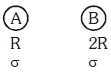
Two metal spheres,one of radius $R$ and the other of radius $2R$,respectively,have the same surface charge density $\sigma$. They are brought in contact and separated. What will be the new surface charge densities on them?
A
$\sigma_{1}=\frac{5}{6} \sigma, \sigma_{2}=\frac{5}{2} \sigma$
B
$\sigma_{1}=\frac{5}{2} \sigma, \sigma_{2}=\frac{5}{6} \sigma$
C
$\sigma_{1}=\frac{5}{2} \sigma, \sigma_{2}=\frac{5}{3} \sigma$
D
$\sigma_{1}=\frac{5}{3} \sigma, \sigma_{2}=\frac{5}{6} \sigma$
Solution
(D) Initial charges on the spheres are $Q_1 = \sigma (4 \pi R^2)$ and $Q_2 = \sigma (4 \pi (2R)^2) = 16 \pi R^2 \sigma$.
Total charge $Q_{total} = Q_1 + Q_2 = 4 \pi R^2 \sigma + 16 \pi R^2 \sigma = 20 \pi R^2 \sigma$.
When the spheres are brought into contact,the total charge is redistributed such that they reach the same potential $V = \frac{k Q_1'}{R} = \frac{k Q_2'}{2R}$.
This implies $Q_2' = 2 Q_1'$.
Since $Q_1' + Q_2' = 20 \pi R^2 \sigma$,we have $Q_1' + 2 Q_1' = 20 \pi R^2 \sigma$,which gives $3 Q_1' = 20 \pi R^2 \sigma$,so $Q_1' = \frac{20}{3} \pi R^2 \sigma$.
Then $Q_2' = 2 \times \frac{20}{3} \pi R^2 \sigma = \frac{40}{3} \pi R^2 \sigma$.
The new surface charge densities are $\sigma_1' = \frac{Q_1'}{4 \pi R^2} = \frac{20/3 \pi R^2 \sigma}{4 \pi R^2} = \frac{5}{3} \sigma$.
And $\sigma_2' = \frac{Q_2'}{4 \pi (2R)^2} = \frac{40/3 \pi R^2 \sigma}{16 \pi R^2} = \frac{40}{48} \sigma = \frac{5}{6} \sigma$.
Total charge $Q_{total} = Q_1 + Q_2 = 4 \pi R^2 \sigma + 16 \pi R^2 \sigma = 20 \pi R^2 \sigma$.
When the spheres are brought into contact,the total charge is redistributed such that they reach the same potential $V = \frac{k Q_1'}{R} = \frac{k Q_2'}{2R}$.
This implies $Q_2' = 2 Q_1'$.
Since $Q_1' + Q_2' = 20 \pi R^2 \sigma$,we have $Q_1' + 2 Q_1' = 20 \pi R^2 \sigma$,which gives $3 Q_1' = 20 \pi R^2 \sigma$,so $Q_1' = \frac{20}{3} \pi R^2 \sigma$.
Then $Q_2' = 2 \times \frac{20}{3} \pi R^2 \sigma = \frac{40}{3} \pi R^2 \sigma$.
The new surface charge densities are $\sigma_1' = \frac{Q_1'}{4 \pi R^2} = \frac{20/3 \pi R^2 \sigma}{4 \pi R^2} = \frac{5}{3} \sigma$.
And $\sigma_2' = \frac{Q_2'}{4 \pi (2R)^2} = \frac{40/3 \pi R^2 \sigma}{16 \pi R^2} = \frac{40}{48} \sigma = \frac{5}{6} \sigma$.
0 likes
View Solution61
Medium
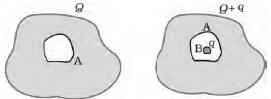
$(a)$ $A$ conductor $A$ with a cavity as shown in Figure $(a)$ is given a charge $Q$. Show that the entire charge must appear on the outer surface of the conductor.
$(b)$ Another conductor $B$ with charge $q$ is inserted into the cavity keeping $B$ insulated from $A$. Show that the total charge on the outside surface of $A$ is $Q+q$ [Figure $(b)$].
$(c)$ $A$ sensitive instrument is to be shielded from the strong electrostatic fields in its environment. Suggest a possible way.
$(b)$ Another conductor $B$ with charge $q$ is inserted into the cavity keeping $B$ insulated from $A$. Show that the total charge on the outside surface of $A$ is $Q+q$ [Figure $(b)$].
$(c)$ $A$ sensitive instrument is to be shielded from the strong electrostatic fields in its environment. Suggest a possible way.
Solution
(N/A) Let us consider a Gaussian surface that is lying wholly within a conductor and enclosing the cavity. The electric field intensity $E$ inside the charged conductor is zero. Let $q_{in}$ be the charge inside the conductor and $\epsilon_{0}$ be the permittivity of free space. According to Gauss's law, the electric flux $\phi$ is given by:
$\phi = \oint E \cdot ds = \frac{q_{in}}{\epsilon_{0}}$
Since $E = 0$ inside the conductor, we have $\frac{q_{in}}{\epsilon_{0}} = 0$, which implies $q_{in} = 0$.
Therefore, the net charge inside the material of the conductor is zero. Consequently, the entire charge $Q$ must reside on the outer surface of the conductor.
$(b)$ The outer surface of conductor $A$ initially has a charge $Q$. When another conductor $B$ with charge $q$ is inserted into the cavity and insulated from $A$, an equal and opposite charge $-q$ is induced on the inner surface of the cavity of $A$ due to electrostatic induction. To conserve the total charge of the isolated conductor $A$, a charge $+q$ must be induced on its outer surface. Thus, the total charge on the outer surface of conductor $A$ becomes $Q+q$.
$(c)$ $A$ sensitive instrument can be shielded from strong electrostatic fields in its environment by enclosing it fully inside a metallic box or cage. This phenomenon is known as electrostatic shielding, where the electric field inside a closed metallic conductor is always zero.
$\phi = \oint E \cdot ds = \frac{q_{in}}{\epsilon_{0}}$
Since $E = 0$ inside the conductor, we have $\frac{q_{in}}{\epsilon_{0}} = 0$, which implies $q_{in} = 0$.
Therefore, the net charge inside the material of the conductor is zero. Consequently, the entire charge $Q$ must reside on the outer surface of the conductor.
$(b)$ The outer surface of conductor $A$ initially has a charge $Q$. When another conductor $B$ with charge $q$ is inserted into the cavity and insulated from $A$, an equal and opposite charge $-q$ is induced on the inner surface of the cavity of $A$ due to electrostatic induction. To conserve the total charge of the isolated conductor $A$, a charge $+q$ must be induced on its outer surface. Thus, the total charge on the outer surface of conductor $A$ becomes $Q+q$.
$(c)$ $A$ sensitive instrument can be shielded from strong electrostatic fields in its environment by enclosing it fully inside a metallic box or cage. This phenomenon is known as electrostatic shielding, where the electric field inside a closed metallic conductor is always zero.
0 likes
View Solution62
Medium
$A$ spherical conducting shell of inner radius $r_1$ and outer radius $r_2$ has a charge $Q$.
$(a)$ $A$ charge $q$ is placed at the centre of the shell. What is the surface charge density on the inner and outer surfaces of the shell?
$(b)$ Is the electric field inside a cavity (with no charge) zero,even if the shell is not spherical,but has any irregular shape? Explain.
$(a)$ $A$ charge $q$ is placed at the centre of the shell. What is the surface charge density on the inner and outer surfaces of the shell?
$(b)$ Is the electric field inside a cavity (with no charge) zero,even if the shell is not spherical,but has any irregular shape? Explain.
Solution
(N/A) The charge placed at the centre of the shell is $+q$. Due to electrostatic induction,a charge of magnitude $-q$ is induced on the inner surface of the shell. Therefore,the total charge on the inner surface is $-q$.
The surface charge density on the inner surface is given by:
$\sigma_{1} = \frac{\text{Total charge}}{\text{Inner surface area}} = \frac{-q}{4 \pi r_{1}^{2}}$
$A$ charge of $+q$ is induced on the outer surface of the shell. Since the shell already has a charge $Q$,the total charge on the outer surface becomes $Q + q$. The surface charge density on the outer surface is:
$\sigma_{2} = \frac{\text{Total charge}}{\text{Outer surface area}} = \frac{Q + q}{4 \pi r_{2}^{2}}$
$(b)$ Yes,the electric field inside a cavity (with no charge) is zero,even if the shell is not spherical and has an irregular shape.
This is because if we consider a closed loop such that a part of it is inside the cavity along a field line and the rest is inside the conductor,the net work done by the electric field in moving a test charge along this closed loop must be zero. Since the electric field inside the conducting material is zero,the field inside the cavity must also be zero to satisfy the conservative nature of the electrostatic field.
The surface charge density on the inner surface is given by:
$\sigma_{1} = \frac{\text{Total charge}}{\text{Inner surface area}} = \frac{-q}{4 \pi r_{1}^{2}}$
$A$ charge of $+q$ is induced on the outer surface of the shell. Since the shell already has a charge $Q$,the total charge on the outer surface becomes $Q + q$. The surface charge density on the outer surface is:
$\sigma_{2} = \frac{\text{Total charge}}{\text{Outer surface area}} = \frac{Q + q}{4 \pi r_{2}^{2}}$
$(b)$ Yes,the electric field inside a cavity (with no charge) is zero,even if the shell is not spherical and has an irregular shape.
This is because if we consider a closed loop such that a part of it is inside the cavity along a field line and the rest is inside the conductor,the net work done by the electric field in moving a test charge along this closed loop must be zero. Since the electric field inside the conducting material is zero,the field inside the cavity must also be zero to satisfy the conservative nature of the electrostatic field.
0 likes
View Solution63
Medium
Two charged conducting spheres of radii $a$ and $b$ are connected to each other by a wire. What is the ratio of electric fields at the surfaces of the two spheres? Use the result obtained to explain why charge density on the sharp and pointed ends of a conductor is higher than on its flatter portions.
Solution
(B) Let $a$ and $b$ be the radii of two conducting spheres $A$ and $B$,respectively. Let $Q_A$ and $Q_B$ be the charges on them,and $V_A$ and $V_B$ be their potentials.
Since the spheres are connected by a wire,they reach the same potential,so $V_A = V_B = V$.
The potential of a conducting sphere is given by $V = \frac{Q}{4 \pi \epsilon_0 R}$.
Thus,$V = \frac{Q_A}{4 \pi \epsilon_0 a} = \frac{Q_B}{4 \pi \epsilon_0 b}$,which implies $\frac{Q_A}{Q_B} = \frac{a}{b}$.
The electric field at the surface of a sphere is $E = \frac{Q}{4 \pi \epsilon_0 R^2}$.
The ratio of the electric fields is $\frac{E_A}{E_B} = \frac{Q_A / (4 \pi \epsilon_0 a^2)}{Q_B / (4 \pi \epsilon_0 b^2)} = \frac{Q_A}{Q_B} \times \frac{b^2}{a^2}$.
Substituting $\frac{Q_A}{Q_B} = \frac{a}{b}$,we get $\frac{E_A}{E_B} = \frac{a}{b} \times \frac{b^2}{a^2} = \frac{b}{a}$.
Since surface charge density $\sigma = \frac{Q}{4 \pi R^2} = \epsilon_0 E$,we have $\sigma \propto E$. For a conductor,the potential is constant throughout. $A$ sharp point has a very small radius of curvature $(R \to 0)$,which implies a very high electric field $(E \propto 1/R)$ and consequently a very high surface charge density $\sigma$ at that point.
Since the spheres are connected by a wire,they reach the same potential,so $V_A = V_B = V$.
The potential of a conducting sphere is given by $V = \frac{Q}{4 \pi \epsilon_0 R}$.
Thus,$V = \frac{Q_A}{4 \pi \epsilon_0 a} = \frac{Q_B}{4 \pi \epsilon_0 b}$,which implies $\frac{Q_A}{Q_B} = \frac{a}{b}$.
The electric field at the surface of a sphere is $E = \frac{Q}{4 \pi \epsilon_0 R^2}$.
The ratio of the electric fields is $\frac{E_A}{E_B} = \frac{Q_A / (4 \pi \epsilon_0 a^2)}{Q_B / (4 \pi \epsilon_0 b^2)} = \frac{Q_A}{Q_B} \times \frac{b^2}{a^2}$.
Substituting $\frac{Q_A}{Q_B} = \frac{a}{b}$,we get $\frac{E_A}{E_B} = \frac{a}{b} \times \frac{b^2}{a^2} = \frac{b}{a}$.
Since surface charge density $\sigma = \frac{Q}{4 \pi R^2} = \epsilon_0 E$,we have $\sigma \propto E$. For a conductor,the potential is constant throughout. $A$ sharp point has a very small radius of curvature $(R \to 0)$,which implies a very high electric field $(E \propto 1/R)$ and consequently a very high surface charge density $\sigma$ at that point.
0 likes
View Solution64
Medium
What is earthing or grounding in household electrical circuits?
Solution
(N/A) When we bring a charged body in contact with the earth,all the excess charge on the body disappears by causing a momentary current to pass to the ground through the connecting conductor. This process of sharing the charges with the earth is called grounding or earthing.
$A$ thick metal plate is buried deep into the earth and thick wires are drawn from this plate; these are used in buildings for the purpose of earthing near the mains supply.
The electric wiring in our houses has three wires: $live$,$neutral$,and $earth$.
The first two carry electric current from the power station and the third is earthed by connecting it to the buried metal plate.
Metallic bodies of electric appliances such as electric iron,refrigerator,and $TV$ are connected to the earth wire. When any fault occurs or a live wire touches the metallic body,the charge flows to the earth without damaging the appliance and without causing any injury to humans.
Earthing provides a safety measure for the human body,electrical circuits,and appliances.
$A$ thick metal plate is buried deep into the earth and thick wires are drawn from this plate; these are used in buildings for the purpose of earthing near the mains supply.
The electric wiring in our houses has three wires: $live$,$neutral$,and $earth$.
The first two carry electric current from the power station and the third is earthed by connecting it to the buried metal plate.
Metallic bodies of electric appliances such as electric iron,refrigerator,and $TV$ are connected to the earth wire. When any fault occurs or a live wire touches the metallic body,the charge flows to the earth without damaging the appliance and without causing any injury to humans.
Earthing provides a safety measure for the human body,electrical circuits,and appliances.
0 likes
View Solution65
EasyMCQ
Is the induced charge on the surface of a metal or inside it?
A
On the surface
B
Inside the metal
C
Both on the surface and inside
D
None of the above
Solution
(A) For a conductor in electrostatic equilibrium,the electric field inside the material is zero. According to Gauss's Law,$\oint E \cdot dA = q_{enclosed} / \epsilon_0$. Since $E = 0$ inside the conductor,the net charge enclosed within any volume inside the conductor must be zero. Therefore,any excess or induced charge must reside entirely on the outer surface of the conductor.
0 likes
View Solution66
Medium
Explain the electrostatics of conductors. Explain the effects produced inside a metallic conductor placed in an external electric field.
Solution
(N/A) In metallic conductors, the charge carriers are electrons. In a metal, the outer (valence) electrons part away from their atoms and are free to move.
These electrons are free from their parent atoms but are not free to leave the metal. Hence, these free electrons form a kind of 'gas'.
Free electrons collide with each other and with the ions, moving randomly in different directions.
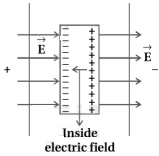
When placed in an external electric field $\vec{E}$, they drift against the direction of the field and get deposited on one surface, while an equal amount of positive charge is left on the opposite surface. This is shown in the figure.
The induced charges produce an internal electric field $\vec{E}_{in}$ inside the conductor in the direction opposite to the external electric field.
When the external electric field and the internal electric field become equal in magnitude, the net electric field inside the conductor becomes zero, and the charges stop depositing on the surface.
These electrons are free from their parent atoms but are not free to leave the metal. Hence, these free electrons form a kind of 'gas'.
Free electrons collide with each other and with the ions, moving randomly in different directions.
When placed in an external electric field $\vec{E}$, they drift against the direction of the field and get deposited on one surface, while an equal amount of positive charge is left on the opposite surface. This is shown in the figure.
The induced charges produce an internal electric field $\vec{E}_{in}$ inside the conductor in the direction opposite to the external electric field.
When the external electric field and the internal electric field become equal in magnitude, the net electric field inside the conductor becomes zero, and the charges stop depositing on the surface.
0 likes
View Solution67
Medium
Write important results regarding the electrostatics of conductors.
Solution
(N/A) The important results regarding the electrostatics of conductors are as follows:
$(1)$ The electrostatic field inside a conductor is zero.
$(2)$ On the outer surface of a charged conductor,the electric field at every point is perpendicular to the surface.
$(3)$ The interior of a conductor can have no excess charge in the static situation; any excess charge resides entirely on its surface.
$(4)$ The electrostatic potential is constant throughout the volume of the conductor and has the same value on its surface as it does inside.
$(5)$ The electric field at the surface of a charged conductor is given by $\vec{E} = \frac{\sigma}{\epsilon_{0}} \hat{n}$,where $\sigma$ is the surface charge density,$\epsilon_{0}$ is the permittivity of free space,and $\hat{n}$ is the unit vector normal to the surface in the outward direction.
$(6)$ The electric field inside the cavity of a conductor is zero,which leads to the phenomenon of electrostatic shielding.
$(1)$ The electrostatic field inside a conductor is zero.
$(2)$ On the outer surface of a charged conductor,the electric field at every point is perpendicular to the surface.
$(3)$ The interior of a conductor can have no excess charge in the static situation; any excess charge resides entirely on its surface.
$(4)$ The electrostatic potential is constant throughout the volume of the conductor and has the same value on its surface as it does inside.
$(5)$ The electric field at the surface of a charged conductor is given by $\vec{E} = \frac{\sigma}{\epsilon_{0}} \hat{n}$,where $\sigma$ is the surface charge density,$\epsilon_{0}$ is the permittivity of free space,and $\hat{n}$ is the unit vector normal to the surface in the outward direction.
$(6)$ The electric field inside the cavity of a conductor is zero,which leads to the phenomenon of electrostatic shielding.
0 likes
View Solution68
Easy
'Inside a conductor,the electrostatic field is zero'. Explain.
Solution
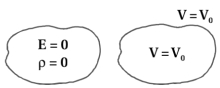
(N/A) In the static situation,when there is no current inside or on the surface of the conductor,the electric field is zero everywhere inside the conductor.
$A$ conductor contains free electrons. If there were an electric field inside,these free charge carriers would experience a force $(F = qE)$ and would drift,creating a current.
In the static situation,the free charges redistribute themselves on the surface of the conductor such that the internal electric field produced by these charges exactly cancels the external applied electric field. Consequently,the net electric field becomes zero everywhere inside the conductor.
$A$ conductor contains free electrons. If there were an electric field inside,these free charge carriers would experience a force $(F = qE)$ and would drift,creating a current.
In the static situation,the free charges redistribute themselves on the surface of the conductor such that the internal electric field produced by these charges exactly cancels the external applied electric field. Consequently,the net electric field becomes zero everywhere inside the conductor.
0 likes
View Solution69
Medium
'At the surface of a charged conductor,the electrostatic field must be normal to the surface at every point'. Explain.
Solution
If the electric field $\vec{E}$ were not normal to the surface,it would have a non-zero tangential component along the surface.
This tangential component would exert a force on the free charges present on the conductor's surface,causing them to move.
Since the conductor is in an electrostatic (stable) state,there can be no net motion of charges.
Therefore,the tangential component of the electric field must be zero.
Thus,the electrostatic field at the surface of a charged conductor must be normal to the surface at every point,given by $\vec{E} = \frac{\sigma}{\epsilon_{0}} \hat{n}$,where $\sigma$ is the surface charge density and $\hat{n}$ is the unit normal vector.
This tangential component would exert a force on the free charges present on the conductor's surface,causing them to move.
Since the conductor is in an electrostatic (stable) state,there can be no net motion of charges.
Therefore,the tangential component of the electric field must be zero.
Thus,the electrostatic field at the surface of a charged conductor must be normal to the surface at every point,given by $\vec{E} = \frac{\sigma}{\epsilon_{0}} \hat{n}$,where $\sigma$ is the surface charge density and $\hat{n}$ is the unit normal vector.
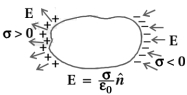
0 likes
View Solution70
Medium
‘The interior of a conductor can have no excess charge in the static situation’. Explain.
Solution
(N/A) neutral conductor has equal amounts of positive and negative charges in every small volume or surface element.
When the conductor is charged,the excess charge can reside only on the surface in the static situation.
Let us consider a Gaussian surface inside the conductor and close to the surface.
At all points inside the conductor $\overrightarrow{E} = 0$,hence from $\phi_{E} = \oint \overrightarrow{E} \cdot d\overrightarrow{S}$,we get $\phi_{E} = 0$.
According to Gauss's law,$\phi_{E} = \frac{q}{\epsilon_{0}}$.
Since $\phi_{E} = 0$,it follows that $q = 0$.
Hence,there is no net charge at any point inside the conductor,and any excess charge must reside on the surface.
When the conductor is charged,the excess charge can reside only on the surface in the static situation.
Let us consider a Gaussian surface inside the conductor and close to the surface.
At all points inside the conductor $\overrightarrow{E} = 0$,hence from $\phi_{E} = \oint \overrightarrow{E} \cdot d\overrightarrow{S}$,we get $\phi_{E} = 0$.
According to Gauss's law,$\phi_{E} = \frac{q}{\epsilon_{0}}$.
Since $\phi_{E} = 0$,it follows that $q = 0$.
Hence,there is no net charge at any point inside the conductor,and any excess charge must reside on the surface.
0 likes
View Solution71
Easy
Show that electrostatic potential is constant throughout the volume of the conductor and has the same value (as inside) on its surface.
Solution
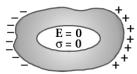
(N/A) In electrostatic equilibrium,the electric field $\vec{E}$ inside a conductor is zero.
Since the electric field is the negative gradient of the potential $(\vec{E} = -\nabla V)$,if $\vec{E} = 0$,then $\nabla V = 0$,which implies that the potential $V$ is constant throughout the volume of the conductor.
Furthermore,at the surface of the conductor,the electric field must be perpendicular to the surface. If there were a tangential component of the electric field,charges would move along the surface until the tangential component becomes zero.
Since there is no tangential component of the electric field on the surface,no work is done in moving a test charge between any two points on the surface. Therefore,the potential on the surface is the same as the potential inside the conductor.
Since the electric field is the negative gradient of the potential $(\vec{E} = -\nabla V)$,if $\vec{E} = 0$,then $\nabla V = 0$,which implies that the potential $V$ is constant throughout the volume of the conductor.
Furthermore,at the surface of the conductor,the electric field must be perpendicular to the surface. If there were a tangential component of the electric field,charges would move along the surface until the tangential component becomes zero.
Since there is no tangential component of the electric field on the surface,no work is done in moving a test charge between any two points on the surface. Therefore,the potential on the surface is the same as the potential inside the conductor.
0 likes
View Solution72
Medium
Explain electrostatic shielding with a necessary diagram.
Solution
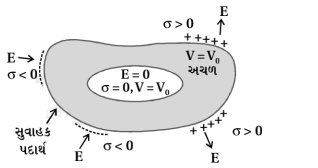
(N/A) Electrostatic shielding is the phenomenon of protecting a certain region of space from an external electric field by surrounding it with a conductor.
Consider a conductor with a cavity as shown in the figure. Regardless of the size and shape of the cavity,if there are no charges inside it,the electric field inside the cavity remains zero.
When a conductor with a cavity is placed in an external electric field,the charges redistribute themselves on the outer surface such that the electric field inside the material of the conductor and within the cavity becomes zero.
Even if the conductor is charged,all excess charges reside only on the outer surface of the conductor. Thus,any cavity in a conductor remains shielded from external electric influences. This is known as electrostatic shielding.
$A$ practical example is sitting inside a car during a thunderstorm. If lightning strikes the car,the metal body of the car acts as an electrostatic shield,ensuring that the electric field inside remains zero,thus keeping the occupants safe.
Consider a conductor with a cavity as shown in the figure. Regardless of the size and shape of the cavity,if there are no charges inside it,the electric field inside the cavity remains zero.
When a conductor with a cavity is placed in an external electric field,the charges redistribute themselves on the outer surface such that the electric field inside the material of the conductor and within the cavity becomes zero.
Even if the conductor is charged,all excess charges reside only on the outer surface of the conductor. Thus,any cavity in a conductor remains shielded from external electric influences. This is known as electrostatic shielding.
$A$ practical example is sitting inside a car during a thunderstorm. If lightning strikes the car,the metal body of the car acts as an electrostatic shield,ensuring that the electric field inside remains zero,thus keeping the occupants safe.
0 likes
View Solution73
Medium
"The electric field inside the hollow region of a conductor in a uniform electric field is zero". Explain.
Solution
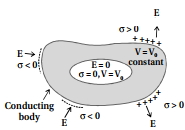
(N/A) Consider a conductor with a cavity as shown in the figure.
There are no charges inside the cavity.
Regardless of the size and shape of the cavity, if a conductor with a cavity is placed in an external electric field, the electric field inside the cavity remains zero.
If the conductor is charged or charges are induced on a neutral conductor by an external field, all charges reside only on the outer surface of the conductor.
Any cavity in a conductor remains shielded from external electric influence. This phenomenon is known as electrostatic shielding.
For example, when we are in a car during a thunderstorm with lightning, we should close all the doors of the car. If lightning strikes the car (or a live current-carrying wire falls on the car), electrostatic shielding develops on the outer surface of the car, and we remain safe inside.
There are no charges inside the cavity.
Regardless of the size and shape of the cavity, if a conductor with a cavity is placed in an external electric field, the electric field inside the cavity remains zero.
If the conductor is charged or charges are induced on a neutral conductor by an external field, all charges reside only on the outer surface of the conductor.
Any cavity in a conductor remains shielded from external electric influence. This phenomenon is known as electrostatic shielding.
For example, when we are in a car during a thunderstorm with lightning, we should close all the doors of the car. If lightning strikes the car (or a live current-carrying wire falls on the car), electrostatic shielding develops on the outer surface of the car, and we remain safe inside.
0 likes
View Solution74
Medium
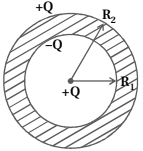
$A$ metallic spherical shell has an inner radius $R_1$ and an outer radius $R_2$. $A$ charge $Q$ is placed at the center of the spherical cavity. What will be the surface charge density on $(i)$ the inner surface,and $(ii)$ the outer surface?
Solution
(N/A) Since the charge in the spherical cavity is $+Q$,the charge induced on the inner surface of the metallic spherical shell will be $-Q$ to ensure the electric field inside the conductor is zero.
Because the shell is metallic and neutral,the total charge on the shell must remain zero. Therefore,a charge of $+Q$ is induced on the outer surface to compensate for the $-Q$ charge on the inner surface.
The surface charge density $\sigma$ is defined as charge per unit area,$\sigma = \frac{q}{A}$.
$(i)$ For the inner surface with radius $R_1$,the surface charge density is $\sigma_1 = \frac{-Q}{4 \pi R_1^2}$.
$(ii)$ For the outer surface with radius $R_2$,the surface charge density is $\sigma_2 = \frac{+Q}{4 \pi R_2^2}$.
Because the shell is metallic and neutral,the total charge on the shell must remain zero. Therefore,a charge of $+Q$ is induced on the outer surface to compensate for the $-Q$ charge on the inner surface.
The surface charge density $\sigma$ is defined as charge per unit area,$\sigma = \frac{q}{A}$.
$(i)$ For the inner surface with radius $R_1$,the surface charge density is $\sigma_1 = \frac{-Q}{4 \pi R_1^2}$.
$(ii)$ For the outer surface with radius $R_2$,the surface charge density is $\sigma_2 = \frac{+Q}{4 \pi R_2^2}$.
0 likes
View Solution75
Difficult
The dimensions of an atom are of the order of an $\mathring{A}$ $(10^{-10} \ m)$. Thus,there must be large electric fields between the protons and electrons. Why,then,is the electrostatic field inside a conductor zero?
Solution
(N/A) In any neutral atom,the number of electrons and protons are equal,and they are bound together to form a stable,electrically neutral system.
Electrostatic fields in a macroscopic conductor arise due to the presence of net excess charges. According to the properties of conductors in electrostatic equilibrium,any excess charge resides only on the outer surface of the conductor.
Since there is no net excess charge inside the bulk of an isolated conductor,the internal electrostatic field is zero. The microscopic fields between protons and electrons within individual atoms cancel out on a macroscopic scale,resulting in no net macroscopic electric field inside the conductor.
Electrostatic fields in a macroscopic conductor arise due to the presence of net excess charges. According to the properties of conductors in electrostatic equilibrium,any excess charge resides only on the outer surface of the conductor.
Since there is no net excess charge inside the bulk of an isolated conductor,the internal electrostatic field is zero. The microscopic fields between protons and electrons within individual atoms cancel out on a macroscopic scale,resulting in no net macroscopic electric field inside the conductor.
0 likes
View Solution76
Difficult
What is a Van de Graaff generator? Explain its principle.
Solution
(N/A) Principle: The Van de Graaff generator is based on two electrostatic principles:
$1$. The property that charge given to a hollow conductor is transferred to its outer surface and spreads uniformly over it.
$2$. The property that the electric potential of a conductor is higher when it is smaller in size.
Mathematical derivation:
Let a charge $Q$ be placed on a spherical shell of radius $R$. The potential at the surface is $V(R) = \frac{1}{4 \pi \epsilon_{0}} \cdot \frac{Q}{R}$.
If a small sphere of radius $r$ carrying charge $q$ is placed inside the shell,the total potential at the surface of the small sphere is $V(r) = \frac{1}{4 \pi \epsilon_{0}} \left( \frac{Q}{R} + \frac{q}{r} \right)$ and at the surface of the large shell is $V(R) = \frac{1}{4 \pi \epsilon_{0}} \left( \frac{Q}{R} + \frac{q}{R} \right)$.
The potential difference is $V(r) - V(R) = \frac{q}{4 \pi \epsilon_{0}} \left( \frac{1}{r} - \frac{1}{R} \right)$.
Since $r < R$,the term $(\frac{1}{r} - \frac{1}{R})$ is positive,meaning the inner sphere is at a higher potential than the outer shell. When connected,charge flows from the inner sphere to the outer shell,allowing the accumulation of a very high potential on the outer shell.
$1$. The property that charge given to a hollow conductor is transferred to its outer surface and spreads uniformly over it.
$2$. The property that the electric potential of a conductor is higher when it is smaller in size.
Mathematical derivation:
Let a charge $Q$ be placed on a spherical shell of radius $R$. The potential at the surface is $V(R) = \frac{1}{4 \pi \epsilon_{0}} \cdot \frac{Q}{R}$.
If a small sphere of radius $r$ carrying charge $q$ is placed inside the shell,the total potential at the surface of the small sphere is $V(r) = \frac{1}{4 \pi \epsilon_{0}} \left( \frac{Q}{R} + \frac{q}{r} \right)$ and at the surface of the large shell is $V(R) = \frac{1}{4 \pi \epsilon_{0}} \left( \frac{Q}{R} + \frac{q}{R} \right)$.
The potential difference is $V(r) - V(R) = \frac{q}{4 \pi \epsilon_{0}} \left( \frac{1}{r} - \frac{1}{R} \right)$.
Since $r < R$,the term $(\frac{1}{r} - \frac{1}{R})$ is positive,meaning the inner sphere is at a higher potential than the outer shell. When connected,charge flows from the inner sphere to the outer shell,allowing the accumulation of a very high potential on the outer shell.
0 likes
View Solution77
Difficult
Explain the construction of a Van de Graaff generator with a diagram and describe its uses.
Solution
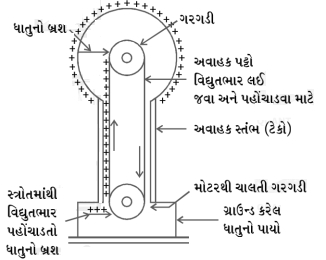
(N/A) Construction: $A$ Van de Graaff generator consists of a large spherical conducting shell supported on an insulating column. $A$ long,narrow,endless belt made of an insulating material like rubber or silk is wound around two pulleys.
As shown in the diagram,one pulley is at the ground level and the other is at the center of the shell. The belt is kept in continuous motion by a motor driving the lower pulley.
$A$ metal brush at the ground level sprays positive charge onto the belt,which is then carried upwards by the belt.
The positive charge reaching the top is transferred to a second metal brush connected to the inner side of the shell.
Consequently,the positive charge spreads uniformly over the outer surface of the shell,creating a high potential.
In this way,a potential difference of $6$ to $8$ million volts relative to the ground can be generated.
Uses: It is used to accelerate charged particles like protons,deuterons,and alpha particles to very high energies,which are then used to probe the structure of atomic nuclei.
As shown in the diagram,one pulley is at the ground level and the other is at the center of the shell. The belt is kept in continuous motion by a motor driving the lower pulley.
$A$ metal brush at the ground level sprays positive charge onto the belt,which is then carried upwards by the belt.
The positive charge reaching the top is transferred to a second metal brush connected to the inner side of the shell.
Consequently,the positive charge spreads uniformly over the outer surface of the shell,creating a high potential.
In this way,a potential difference of $6$ to $8$ million volts relative to the ground can be generated.
Uses: It is used to accelerate charged particles like protons,deuterons,and alpha particles to very high energies,which are then used to probe the structure of atomic nuclei.
0 likes
View Solution78
Medium
Consider two conducting spheres of radii $R_1$ and $R_2$ with $(R_1 > R_2)$. If the two are at the same potential,the larger sphere has more charge than the smaller sphere. State whether the charge density of the smaller sphere is more or less than that of the larger one.
Solution
(B) Both spheres are at the same potential,so $V_1 = V_2$.
Using the formula for potential $V = \frac{kq}{R}$,we have $\frac{kq_1}{R_1} = \frac{kq_2}{R_2}$.
Since the charge $q = \sigma A = \sigma (4\pi R^2)$,we substitute this into the potential equation:
$\frac{k(\sigma_1 4\pi R_1^2)}{R_1} = \frac{k(\sigma_2 4\pi R_2^2)}{R_2}$.
Simplifying this,we get $\sigma_1 R_1 = \sigma_2 R_2$.
Therefore,the ratio of surface charge densities is $\frac{\sigma_1}{\sigma_2} = \frac{R_2}{R_1}$.
Since $R_1 > R_2$,it follows that $\frac{R_2}{R_1} < 1$,which implies $\sigma_1 < \sigma_2$.
Thus,the charge density of the smaller sphere $(R_2)$ is greater than the charge density of the larger sphere $(R_1)$.
Using the formula for potential $V = \frac{kq}{R}$,we have $\frac{kq_1}{R_1} = \frac{kq_2}{R_2}$.
Since the charge $q = \sigma A = \sigma (4\pi R^2)$,we substitute this into the potential equation:
$\frac{k(\sigma_1 4\pi R_1^2)}{R_1} = \frac{k(\sigma_2 4\pi R_2^2)}{R_2}$.
Simplifying this,we get $\sigma_1 R_1 = \sigma_2 R_2$.
Therefore,the ratio of surface charge densities is $\frac{\sigma_1}{\sigma_2} = \frac{R_2}{R_1}$.
Since $R_1 > R_2$,it follows that $\frac{R_2}{R_1} < 1$,which implies $\sigma_1 < \sigma_2$.
Thus,the charge density of the smaller sphere $(R_2)$ is greater than the charge density of the larger sphere $(R_1)$.
0 likes
View Solution79
Medium
Can there be a potential difference between two adjacent conductors carrying the same charge?
Solution
(A) Yes,there can be a potential difference if the sizes or shapes of the conductors are different.
The capacitance $C$ of a conductor is defined by the relation $C = \frac{Q}{V}$,where $Q$ is the charge on the conductor and $V$ is its electric potential.
Rearranging this formula,we get $V = \frac{Q}{C}$.
For a given charge $Q$,the potential $V$ is inversely proportional to the capacitance $C$ $(V \propto \frac{1}{C})$.
Since capacitance depends on the geometry (size and shape) of the conductor,two adjacent conductors with the same charge but different dimensions will have different capacitances,and consequently,different electric potentials.
The capacitance $C$ of a conductor is defined by the relation $C = \frac{Q}{V}$,where $Q$ is the charge on the conductor and $V$ is its electric potential.
Rearranging this formula,we get $V = \frac{Q}{C}$.
For a given charge $Q$,the potential $V$ is inversely proportional to the capacitance $C$ $(V \propto \frac{1}{C})$.
Since capacitance depends on the geometry (size and shape) of the conductor,two adjacent conductors with the same charge but different dimensions will have different capacitances,and consequently,different electric potentials.
0 likes
View Solution80
Medium
Prove that,if an insulated,uncharged conductor is placed near a charged conductor and no other conductors are present,the uncharged body must be intermediate in potential between that of the charged body and that of infinity.
Solution
(N/A) The electric field $E = -\frac{dV}{dr}$ indicates that the electric potential $V$ decreases in the direction of the electric field.
Consider a path starting from the charged conductor and moving towards the uncharged conductor along the direction of the electric field lines. Since the field originates from the charged body,the potential $V$ must decrease along this path. Thus,the potential of the uncharged body $V_u$ is less than the potential of the charged body $V_c$ (assuming $V_c > 0$).
Next,consider a path from the uncharged conductor extending towards infinity. Since the electric field lines continue to point away from the charged system towards infinity,the potential must continue to decrease along this path. By definition,the potential at infinity is $V_{\infty} = 0$.
Therefore,the potential of the uncharged body $V_u$ satisfies the condition $V_{\infty} < V_u < V_c$. This confirms that the uncharged body is intermediate in potential between the charged body and infinity.
Consider a path starting from the charged conductor and moving towards the uncharged conductor along the direction of the electric field lines. Since the field originates from the charged body,the potential $V$ must decrease along this path. Thus,the potential of the uncharged body $V_u$ is less than the potential of the charged body $V_c$ (assuming $V_c > 0$).
Next,consider a path from the uncharged conductor extending towards infinity. Since the electric field lines continue to point away from the charged system towards infinity,the potential must continue to decrease along this path. By definition,the potential at infinity is $V_{\infty} = 0$.
Therefore,the potential of the uncharged body $V_u$ satisfies the condition $V_{\infty} < V_u < V_c$. This confirms that the uncharged body is intermediate in potential between the charged body and infinity.
0 likes
View Solution81
MediumMCQ
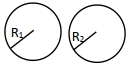
Two charged spherical conductors of radius $R_{1}$ and $R_{2}$ are connected by a wire. Then the ratio of surface charge densities of the spheres $(\sigma_{1} / \sigma_{2})$ is:
A
$\frac{R_{1}}{R_{2}}$
B
$\frac{R_{2}}{R_{1}}$
C
$\sqrt{\frac{R_{1}}{R_{2}}}$
D
$\frac{R_{1}^{2}}{R_{2}^{2}}$
Solution
(B) When two conductors are connected by a wire,charge flows until their potentials become equal.
Let $V_{1}$ and $V_{2}$ be the potentials of the spheres. Since they are connected,$V_{1} = V_{2}$.
The potential of a charged spherical conductor is given by $V = \frac{kQ}{R}$.
Thus,$\frac{kQ_{1}}{R_{1}} = \frac{kQ_{2}}{R_{2}}$,which implies $\frac{Q_{1}}{Q_{2}} = \frac{R_{1}}{R_{2}}$.
The surface charge density $\sigma$ is defined as $\sigma = \frac{Q}{A} = \frac{Q}{4\pi R^{2}}$.
Therefore,the ratio of surface charge densities is:
$\frac{\sigma_{1}}{\sigma_{2}} = \frac{Q_{1} / (4\pi R_{1}^{2})}{Q_{2} / (4\pi R_{2}^{2})} = \frac{Q_{1}}{Q_{2}} \times \frac{R_{2}^{2}}{R_{1}^{2}}$.
Substituting $\frac{Q_{1}}{Q_{2}} = \frac{R_{1}}{R_{2}}$,we get:
$\frac{\sigma_{1}}{\sigma_{2}} = \frac{R_{1}}{R_{2}} \times \frac{R_{2}^{2}}{R_{1}^{2}} = \frac{R_{2}}{R_{1}}$.
Let $V_{1}$ and $V_{2}$ be the potentials of the spheres. Since they are connected,$V_{1} = V_{2}$.
The potential of a charged spherical conductor is given by $V = \frac{kQ}{R}$.
Thus,$\frac{kQ_{1}}{R_{1}} = \frac{kQ_{2}}{R_{2}}$,which implies $\frac{Q_{1}}{Q_{2}} = \frac{R_{1}}{R_{2}}$.
The surface charge density $\sigma$ is defined as $\sigma = \frac{Q}{A} = \frac{Q}{4\pi R^{2}}$.
Therefore,the ratio of surface charge densities is:
$\frac{\sigma_{1}}{\sigma_{2}} = \frac{Q_{1} / (4\pi R_{1}^{2})}{Q_{2} / (4\pi R_{2}^{2})} = \frac{Q_{1}}{Q_{2}} \times \frac{R_{2}^{2}}{R_{1}^{2}}$.
Substituting $\frac{Q_{1}}{Q_{2}} = \frac{R_{1}}{R_{2}}$,we get:
$\frac{\sigma_{1}}{\sigma_{2}} = \frac{R_{1}}{R_{2}} \times \frac{R_{2}^{2}}{R_{1}^{2}} = \frac{R_{2}}{R_{1}}$.
0 likes
View Solution82
MediumMCQ
Two uniformly charged spherical conductors $A$ and $B$ of radii $5 \ mm$ and $10 \ mm$ are separated by a distance of $2 \ cm$. If the spheres are connected by a conducting wire,then in equilibrium condition,the ratio of the magnitudes of the electric fields at the surface of the sphere $A$ and $B$ will be.
A
$1:2$
B
$2:1$
C
$1:1$
D
$1:4$
Solution
(B) When two conductors are connected by a conducting wire,charge flows until their potentials become equal,i.e.,$V_A = V_B$.
Since the potential of a spherical conductor is $V = \frac{KQ}{R}$,we have $\frac{KQ_A}{R_A} = \frac{KQ_B}{R_B}$.
This implies $\frac{Q_A}{Q_B} = \frac{R_A}{R_B} = \frac{5 \ mm}{10 \ mm} = \frac{1}{2}$.
The electric field at the surface of a sphere is given by $E = \frac{KQ}{R^2}$.
Therefore,the ratio of the electric fields is $\frac{E_A}{E_B} = \frac{KQ_A / R_A^2}{KQ_B / R_B^2} = \frac{Q_A}{Q_B} \times \left(\frac{R_B}{R_A}\right)^2$.
Substituting the ratio of charges: $\frac{E_A}{E_B} = \left(\frac{R_A}{R_B}\right) \times \left(\frac{R_B}{R_A}\right)^2 = \frac{R_B}{R_A}$.
Given $R_A = 5 \ mm$ and $R_B = 10 \ mm$,we get $\frac{E_A}{E_B} = \frac{10}{5} = \frac{2}{1}$.
Since the potential of a spherical conductor is $V = \frac{KQ}{R}$,we have $\frac{KQ_A}{R_A} = \frac{KQ_B}{R_B}$.
This implies $\frac{Q_A}{Q_B} = \frac{R_A}{R_B} = \frac{5 \ mm}{10 \ mm} = \frac{1}{2}$.
The electric field at the surface of a sphere is given by $E = \frac{KQ}{R^2}$.
Therefore,the ratio of the electric fields is $\frac{E_A}{E_B} = \frac{KQ_A / R_A^2}{KQ_B / R_B^2} = \frac{Q_A}{Q_B} \times \left(\frac{R_B}{R_A}\right)^2$.
Substituting the ratio of charges: $\frac{E_A}{E_B} = \left(\frac{R_A}{R_B}\right) \times \left(\frac{R_B}{R_A}\right)^2 = \frac{R_B}{R_A}$.
Given $R_A = 5 \ mm$ and $R_B = 10 \ mm$,we get $\frac{E_A}{E_B} = \frac{10}{5} = \frac{2}{1}$.
0 likes
View Solution83
MediumMCQ
Given below are two statements.
Statement $I$ : Electric potential is constant within and at the surface of each conductor.
Statement $II$ : Electric field just outside a charged conductor is perpendicular to the surface of the conductor at every point.
In the light of the above statements,choose the most appropriate answer from the options given below.
Statement $I$ : Electric potential is constant within and at the surface of each conductor.
Statement $II$ : Electric field just outside a charged conductor is perpendicular to the surface of the conductor at every point.
In the light of the above statements,choose the most appropriate answer from the options given below.
A
Both statement $I$ and statement $II$ are correct.
B
Both statement $I$ and statement $II$ are incorrect.
C
Statement $I$ is correct but statement $II$ is incorrect.
D
Statement $I$ is incorrect but statement $II$ is correct.
Solution
(A) Statement $I$ is true: In electrostatic equilibrium,the interior of a conductor has no net electric field $(E = 0)$. Since $E = -dV/dr$,if $E = 0$,then the potential $V$ must be constant throughout the volume and on the surface of the conductor.
Statement $II$ is true: Since the conductor is an equipotential surface,any electric field component tangential to the surface would cause charges to move along the surface. To maintain equilibrium,the electric field must have no tangential component,meaning it must be strictly perpendicular to the surface at every point.
Statement $II$ is true: Since the conductor is an equipotential surface,any electric field component tangential to the surface would cause charges to move along the surface. To maintain equilibrium,the electric field must have no tangential component,meaning it must be strictly perpendicular to the surface at every point.
0 likes
View Solution84
MediumMCQ
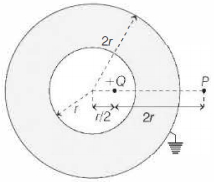
Consider an initially neutral hollow conducting spherical shell with inner radius $r$ and outer radius $2r$. $A$ point charge $+Q$ is now placed inside the shell at a distance $r/2$ from the centre. The shell is then grounded by connecting the outer surface to the earth. $P$ is an external point at a distance $2r$ from the point charge $+Q$ on the line passing through the centre and the point charge $+Q$ as shown in the figure. The magnitude of the force on a test charge $+q$ placed at $P$ will be
A
$\frac{1}{4 \pi \varepsilon_0} \frac{q Q}{4 r^2}$
B
$\frac{1}{4 \pi \varepsilon_0} \frac{9 q Q}{100 r^2}$
C
$\frac{1}{4 \pi \varepsilon_0} \frac{4 q Q}{25 r^2}$
D
$0$
Solution
(D) When a point charge $+Q$ is placed inside the hollow conducting spherical shell,it induces a charge of $-Q$ on the inner surface of the shell due to electrostatic induction.
To maintain the neutrality of the shell,a charge of $+Q$ appears on the outer surface of the shell.
When the outer surface of the shell is connected to the earth (grounded),the positive charge $+Q$ on the outer surface flows to the earth,leaving the outer surface neutral.
According to the property of electrostatic shielding,the electric field produced by the charge $+Q$ inside the shell and the induced charge $-Q$ on the inner surface is confined within the cavity of the shell.
Therefore,the net electric field at any point outside the conducting shell is zero.
Since the electric field at point $P$ (which is outside the shell) is zero,the electrostatic force on a test charge $+q$ placed at $P$ is also zero.
To maintain the neutrality of the shell,a charge of $+Q$ appears on the outer surface of the shell.
When the outer surface of the shell is connected to the earth (grounded),the positive charge $+Q$ on the outer surface flows to the earth,leaving the outer surface neutral.
According to the property of electrostatic shielding,the electric field produced by the charge $+Q$ inside the shell and the induced charge $-Q$ on the inner surface is confined within the cavity of the shell.
Therefore,the net electric field at any point outside the conducting shell is zero.
Since the electric field at point $P$ (which is outside the shell) is zero,the electrostatic force on a test charge $+q$ placed at $P$ is also zero.
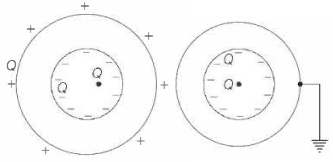
0 likes
View Solution85
DifficultMCQ
Consider three concentric metallic spheres $A, B$ and $C$ of radii $a, b, c$ respectively,where $a < b < c$. $A$ and $B$ are connected,whereas $C$ is grounded. The potential of the middle sphere $B$ is raised to $V$. Then the charge on the sphere $C$ is
A
$-4 \pi \varepsilon_0 V \frac{b c}{c-b}$
B
$+4 \pi \varepsilon_0 V \frac{b c}{c-b}$
C
$-4 \pi \varepsilon_0 V \frac{a c}{c-a}$
D
zero
Solution
(A) Since spheres $A$ and $B$ are connected,they act as a single conductor at the same potential. Let the charge on the combined system $(A+B)$ be $q$ and the charge on sphere $C$ be $Q_C$.
The potential of the system $(A+B)$ is given by:
$V_B = \frac{1}{4 \pi \varepsilon_0} \left( \frac{q}{b} + \frac{Q_C}{c} \right) = V$
Since sphere $C$ is grounded,its potential is zero:
$V_C = \frac{1}{4 \pi \varepsilon_0} \left( \frac{q}{c} + \frac{Q_C}{c} \right) = 0$
From the second equation,we get $q + Q_C = 0$,which implies $q = -Q_C$.
Substituting $q = -Q_C$ into the first equation:
$V = \frac{1}{4 \pi \varepsilon_0} \left( \frac{-Q_C}{b} + \frac{Q_C}{c} \right)$
$V = \frac{Q_C}{4 \pi \varepsilon_0} \left( \frac{1}{c} - \frac{1}{b} \right) = \frac{Q_C}{4 \pi \varepsilon_0} \left( \frac{b-c}{bc} \right)$
Solving for $Q_C$:
$Q_C = 4 \pi \varepsilon_0 V \left( \frac{bc}{b-c} \right) = -4 \pi \varepsilon_0 V \left( \frac{bc}{c-b} \right)$
The potential of the system $(A+B)$ is given by:
$V_B = \frac{1}{4 \pi \varepsilon_0} \left( \frac{q}{b} + \frac{Q_C}{c} \right) = V$
Since sphere $C$ is grounded,its potential is zero:
$V_C = \frac{1}{4 \pi \varepsilon_0} \left( \frac{q}{c} + \frac{Q_C}{c} \right) = 0$
From the second equation,we get $q + Q_C = 0$,which implies $q = -Q_C$.
Substituting $q = -Q_C$ into the first equation:
$V = \frac{1}{4 \pi \varepsilon_0} \left( \frac{-Q_C}{b} + \frac{Q_C}{c} \right)$
$V = \frac{Q_C}{4 \pi \varepsilon_0} \left( \frac{1}{c} - \frac{1}{b} \right) = \frac{Q_C}{4 \pi \varepsilon_0} \left( \frac{b-c}{bc} \right)$
Solving for $Q_C$:
$Q_C = 4 \pi \varepsilon_0 V \left( \frac{bc}{b-c} \right) = -4 \pi \varepsilon_0 V \left( \frac{bc}{c-b} \right)$
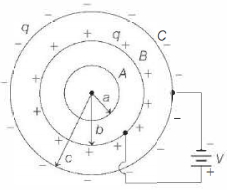
0 likes
View Solution86
MediumMCQ
$A$ charge $+q$ is placed somewhere inside the cavity of a thick conducting spherical shell of inner radius $R_1$ and outer radius $R_2$. $A$ charge $+Q$ is placed at a distance $r > R_2$ from the centre of the shell. Then the electric field in the hollow cavity
A
depends on both $+q$ and $+Q$
B
is zero
C
is only that due to $+Q$
D
is only that due to $+q$
Solution
(D) According to the properties of a conducting shell,the electric field inside the cavity is determined solely by the charge $+q$ placed within the cavity.
The conducting material of the shell redistributes its own charges to shield the cavity from any external electric fields (such as the field produced by $+Q$ outside the shell).
Specifically,the charge $+q$ inside induces a charge $-q$ on the inner surface of the shell,and the external field $+Q$ induces charges on the outer surface of the shell,but these external effects do not penetrate the cavity.
Therefore,the electric field in the hollow cavity is only that due to $+q$.
The conducting material of the shell redistributes its own charges to shield the cavity from any external electric fields (such as the field produced by $+Q$ outside the shell).
Specifically,the charge $+q$ inside induces a charge $-q$ on the inner surface of the shell,and the external field $+Q$ induces charges on the outer surface of the shell,but these external effects do not penetrate the cavity.
Therefore,the electric field in the hollow cavity is only that due to $+q$.
0 likes
View Solution87
MediumMCQ
$A$ dipole consisting of two charges $\pm q$ separated by a distance $2a$ is placed with its centre at a distance $D$ from the center of a grounded conducting sphere of radius $R$ $(D \gg a)$. When the dipole moment vector is perpendicular to the line joining the two centres (those of the dipole and sphere),the total charge induced on the sphere is:
A
$\frac{2aR}{D^2} q$
B
$\frac{aR}{D^2} q$
C
$\frac{aR}{2D^2} q$
D
$0$
Solution
(D) The potential at any point on the surface of a grounded conducting sphere is always zero $(V = 0)$.
The total induced charge $q_{\text{induced}}$ on a grounded sphere due to an external charge distribution can be found using the method of images or by considering the potential at the center of the sphere.
For a dipole placed at a distance $D$ from the center of the sphere,the potential at the center of the sphere due to the dipole is given by $V = \frac{1}{4\pi\epsilon_0} \frac{\vec{p} \cdot \vec{r}}{r^3}$.
Since the dipole moment vector $\vec{p}$ is perpendicular to the line joining the center of the dipole and the center of the sphere (the position vector $\vec{r}$),the dot product $\vec{p} \cdot \vec{r} = 0$.
Therefore,the potential at the center of the sphere due to the dipole is zero. Since the sphere is grounded,the total induced charge on the sphere must be zero to maintain the potential at zero.
The total induced charge $q_{\text{induced}}$ on a grounded sphere due to an external charge distribution can be found using the method of images or by considering the potential at the center of the sphere.
For a dipole placed at a distance $D$ from the center of the sphere,the potential at the center of the sphere due to the dipole is given by $V = \frac{1}{4\pi\epsilon_0} \frac{\vec{p} \cdot \vec{r}}{r^3}$.
Since the dipole moment vector $\vec{p}$ is perpendicular to the line joining the center of the dipole and the center of the sphere (the position vector $\vec{r}$),the dot product $\vec{p} \cdot \vec{r} = 0$.
Therefore,the potential at the center of the sphere due to the dipole is zero. Since the sphere is grounded,the total induced charge on the sphere must be zero to maintain the potential at zero.
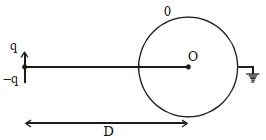
0 likes
View Solution88
EasyMCQ
When a conducting soap bubble is negatively charged,then:
A
Its size starts varying arbitrarily
B
It expands
C
It contracts
D
No change in its size takes place
Solution
(B) When a conducting soap bubble is given a charge (whether positive or negative),the charge distributes itself uniformly over the outer surface of the bubble due to electrostatic repulsion between like charges.
This distribution of charge creates an outward electrostatic pressure on the surface of the bubble.
This outward pressure acts in addition to the existing internal gas pressure,causing the bubble to expand until a new equilibrium is reached between the electrostatic pressure,the internal gas pressure,and the surface tension of the soap film.
This distribution of charge creates an outward electrostatic pressure on the surface of the bubble.
This outward pressure acts in addition to the existing internal gas pressure,causing the bubble to expand until a new equilibrium is reached between the electrostatic pressure,the internal gas pressure,and the surface tension of the soap film.
0 likes
View Solution89
MediumMCQ
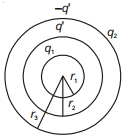
The figure shows three concentric metallic spherical shells. The outermost shell has charge $q_2$,the innermost shell has charge $q_1$,and the middle shell is uncharged. The charge appearing on the inner surface of the outermost shell is
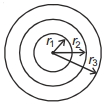
A
$q_1+q_2$
B
$\frac{q_2}{2}$
C
$-q_1$
D
$0$
Solution
(C) Let the charge on the inner surface of the outermost shell (radius $r_3$) be $q'$.
Consider a Gaussian surface inside the material of the outermost shell. Since the electric field inside a conductor in electrostatic equilibrium is zero,the net charge enclosed by this Gaussian surface must be zero.
The total charge enclosed by this surface is the sum of the charge on the innermost shell $(q_1)$,the charge on the middle shell $(0)$,and the charge on the inner surface of the outermost shell $(q')$.
Therefore,$q_1 + 0 + q' = 0$.
This gives $q' = -q_1$.
Consider a Gaussian surface inside the material of the outermost shell. Since the electric field inside a conductor in electrostatic equilibrium is zero,the net charge enclosed by this Gaussian surface must be zero.
The total charge enclosed by this surface is the sum of the charge on the innermost shell $(q_1)$,the charge on the middle shell $(0)$,and the charge on the inner surface of the outermost shell $(q')$.
Therefore,$q_1 + 0 + q' = 0$.
This gives $q' = -q_1$.
0 likes
View Solution90
EasyMCQ
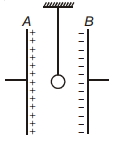
$A$ small conducting sphere is hung by an insulating thread between the plates of a parallel plate capacitor as shown in the figure. The net force on the sphere is
A
Towards plate $A$
B
Towards plate $B$
C
Upwards
D
Zero
Solution
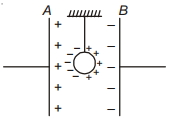
(D) When a neutral conducting sphere is placed in a uniform electric field between the plates of a parallel plate capacitor,the charges on the sphere redistribute due to electrostatic induction.
Negative charges accumulate on the side facing the positively charged plate $A$,and positive charges accumulate on the side facing the negatively charged plate $B$.
The electric field $E$ between the plates is uniform and directed from plate $A$ to plate $B$.
The force on the induced negative charge is $F_- = -qE$ (towards plate $A$),and the force on the induced positive charge is $F_+ = +qE$ (towards plate $B$).
Since the sphere is neutral and the electric field is uniform,the magnitude of the induced charges is equal,and the forces $F_-$ and $F_+$ are equal in magnitude and opposite in direction.
Therefore,the net electrostatic force on the sphere is $F_{net} = F_+ + F_- = 0$.
Thus,the net force on the sphere is zero.
Negative charges accumulate on the side facing the positively charged plate $A$,and positive charges accumulate on the side facing the negatively charged plate $B$.
The electric field $E$ between the plates is uniform and directed from plate $A$ to plate $B$.
The force on the induced negative charge is $F_- = -qE$ (towards plate $A$),and the force on the induced positive charge is $F_+ = +qE$ (towards plate $B$).
Since the sphere is neutral and the electric field is uniform,the magnitude of the induced charges is equal,and the forces $F_-$ and $F_+$ are equal in magnitude and opposite in direction.
Therefore,the net electrostatic force on the sphere is $F_{net} = F_+ + F_- = 0$.
Thus,the net force on the sphere is zero.
0 likes
View Solution91
MediumMCQ
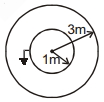
The figure shows a solid conducting sphere of radius $1 \, m$,enclosed by a metallic shell of radius $3 \, m$ such that their centers coincide. If the outer shell is given a charge of $6 \, \mu C$ and the inner sphere is earthed,find the charge on the surface of the inner sphere in $\mu C$.
A
$1$
B
$-2$
C
$4$
D
$6$
Solution
(B) Let the charge on the inner sphere be $q$. Since the inner sphere is earthed,its potential $V$ must be zero.
The potential at the surface of the inner sphere is due to its own charge $q$ and the charge $Q = 6 \, \mu C$ on the outer shell.
The potential $V$ at the inner sphere (radius $r_1 = 1 \, m$) is given by:
$V = \frac{k q}{r_1} + \frac{k Q}{r_2} = 0$
Substituting the given values $r_1 = 1 \, m$,$r_2 = 3 \, m$,and $Q = 6 \, \mu C$:
$\frac{k q}{1} + \frac{k (6)}{3} = 0$
$k q + 2k = 0$
$q = -2 \, \mu C$
Thus,the charge on the inner sphere is $-2 \, \mu C$.
The potential at the surface of the inner sphere is due to its own charge $q$ and the charge $Q = 6 \, \mu C$ on the outer shell.
The potential $V$ at the inner sphere (radius $r_1 = 1 \, m$) is given by:
$V = \frac{k q}{r_1} + \frac{k Q}{r_2} = 0$
Substituting the given values $r_1 = 1 \, m$,$r_2 = 3 \, m$,and $Q = 6 \, \mu C$:
$\frac{k q}{1} + \frac{k (6)}{3} = 0$
$k q + 2k = 0$
$q = -2 \, \mu C$
Thus,the charge on the inner sphere is $-2 \, \mu C$.
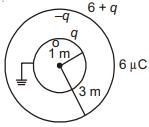
0 likes
View Solution92
EasyMCQ
$A$ charge $q$ is distributed uniformly on the surface of a sphere of radius $R$. It is covered by a concentric hollow conducting sphere of radius $2R$. What will be the charge on the outer surface of the hollow sphere if it is earthed?
A
$q/2$
B
$2q$
C
$4q$
D
Zero
Solution
(D) When a conducting sphere is earthed, its potential becomes $0$.
Let the charge on the inner surface of the hollow sphere be $q_{in}$ and the charge on the outer surface be $q_{out}$.
By the property of induction, $q_{in} = -q$.
Since the outer sphere is earthed, its potential $V$ is the sum of potentials due to the inner sphere (charge $q$) and the hollow sphere (charges $q_{in}$ and $q_{out}$).
The potential at the surface of the outer sphere (radius $2R$) is given by:
$V = \frac{1}{4\pi\epsilon_0} \left( \frac{q}{2R} + \frac{q_{in}}{2R} + \frac{q_{out}}{2R} \right) = 0$.
Substituting $q_{in} = -q$:
$V = \frac{1}{4\pi\epsilon_0} \left( \frac{q}{2R} - \frac{q}{2R} + \frac{q_{out}}{2R} \right) = 0$.
This simplifies to $\frac{q_{out}}{2R} = 0$, which implies $q_{out} = 0$.
Therefore, the charge on the outer surface is $0$.
Let the charge on the inner surface of the hollow sphere be $q_{in}$ and the charge on the outer surface be $q_{out}$.
By the property of induction, $q_{in} = -q$.
Since the outer sphere is earthed, its potential $V$ is the sum of potentials due to the inner sphere (charge $q$) and the hollow sphere (charges $q_{in}$ and $q_{out}$).
The potential at the surface of the outer sphere (radius $2R$) is given by:
$V = \frac{1}{4\pi\epsilon_0} \left( \frac{q}{2R} + \frac{q_{in}}{2R} + \frac{q_{out}}{2R} \right) = 0$.
Substituting $q_{in} = -q$:
$V = \frac{1}{4\pi\epsilon_0} \left( \frac{q}{2R} - \frac{q}{2R} + \frac{q_{out}}{2R} \right) = 0$.
This simplifies to $\frac{q_{out}}{2R} = 0$, which implies $q_{out} = 0$.
Therefore, the charge on the outer surface is $0$.
0 likes
View Solution93
MediumMCQ
$A$ positive point charge $q$ is placed at a distance $2R$ from the surface of a metallic shell of radius $R$. The electric field at the centre of the shell due to the induced charge has a magnitude of:
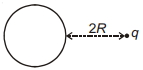
A
Zero
B
$\frac{1}{4 \pi \varepsilon_0} \frac{q}{9 R^2}$
C
$\frac{1}{4 \pi \varepsilon_0} \frac{q}{4 R^2}$
D
$\frac{1}{4 \pi \varepsilon_0} \frac{q}{R^2}$
Solution
(B) Inside a metallic conductor,the net electric field must be zero in electrostatic equilibrium.
Let $\vec{E}_{ext}$ be the electric field at the centre of the shell due to the external point charge $q$.
Let $\vec{E}_{ind}$ be the electric field at the centre of the shell due to the induced charges on the surface of the shell.
Since the net electric field at the centre is zero,we have $\vec{E}_{ext} + \vec{E}_{ind} = 0$,which implies $\vec{E}_{ind} = -\vec{E}_{ext}$.
The magnitude of the electric field due to the point charge $q$ at the centre of the shell (which is at a distance $R + 2R = 3R$ from the charge) is given by $E_{ext} = \frac{1}{4 \pi \varepsilon_0} \frac{q}{(3R)^2} = \frac{1}{4 \pi \varepsilon_0} \frac{q}{9R^2}$.
Therefore,the magnitude of the electric field due to the induced charge is $|\vec{E}_{ind}| = |\vec{E}_{ext}| = \frac{1}{4 \pi \varepsilon_0} \frac{q}{9R^2}$.
Let $\vec{E}_{ext}$ be the electric field at the centre of the shell due to the external point charge $q$.
Let $\vec{E}_{ind}$ be the electric field at the centre of the shell due to the induced charges on the surface of the shell.
Since the net electric field at the centre is zero,we have $\vec{E}_{ext} + \vec{E}_{ind} = 0$,which implies $\vec{E}_{ind} = -\vec{E}_{ext}$.
The magnitude of the electric field due to the point charge $q$ at the centre of the shell (which is at a distance $R + 2R = 3R$ from the charge) is given by $E_{ext} = \frac{1}{4 \pi \varepsilon_0} \frac{q}{(3R)^2} = \frac{1}{4 \pi \varepsilon_0} \frac{q}{9R^2}$.
Therefore,the magnitude of the electric field due to the induced charge is $|\vec{E}_{ind}| = |\vec{E}_{ext}| = \frac{1}{4 \pi \varepsilon_0} \frac{q}{9R^2}$.
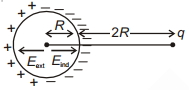
0 likes
View Solution94
EasyMCQ
Two metal spheres $A$ and $B$ of radii $a$ and $b$ $(a < b)$ respectively are at a large distance apart. Each sphere carries a charge of $100 \mu C$. The spheres are connected by a conducting wire,then
A
Charge will flow from $A$ to $B$
B
Charge will flow from $B$ to $A$
C
No charge flows in the wire
D
All charges will reside on the connecting wire
Solution
(A) The electric potential $V$ of a charged conducting sphere of radius $r$ carrying charge $q$ is given by $V = \frac{kq}{r}$,where $k = \frac{1}{4\pi\epsilon_0}$.
For sphere $A$ with radius $a$ and charge $q = 100 \mu C$,the potential is $V_A = \frac{k(100)}{a}$.
For sphere $B$ with radius $b$ and charge $q = 100 \mu C$,the potential is $V_B = \frac{k(100)}{b}$.
Given that $a < b$,it follows that $\frac{1}{a} > \frac{1}{b}$.
Therefore,$V_A > V_B$.
Since charge flows from a region of higher potential to a region of lower potential,charge will flow from sphere $A$ to sphere $B$ until their potentials become equal.
For sphere $A$ with radius $a$ and charge $q = 100 \mu C$,the potential is $V_A = \frac{k(100)}{a}$.
For sphere $B$ with radius $b$ and charge $q = 100 \mu C$,the potential is $V_B = \frac{k(100)}{b}$.
Given that $a < b$,it follows that $\frac{1}{a} > \frac{1}{b}$.
Therefore,$V_A > V_B$.
Since charge flows from a region of higher potential to a region of lower potential,charge will flow from sphere $A$ to sphere $B$ until their potentials become equal.
0 likes
View Solution95
MediumMCQ
Two isolated metallic solid spheres of radii $R$ and $2R$ are charged such that both have the same charge density $\sigma$. The spheres are then connected by a thin conducting wire. If the new charge density of the bigger sphere is $\sigma^{\prime}$,then the ratio $\frac{\sigma^{\prime}}{\sigma}$ is:
A
$\frac{9}{4}$
B
$\frac{4}{3}$
C
$\frac{5}{3}$
D
$\frac{5}{6}$
Solution
(D) Initial charges on the spheres are:
$Q_1 = \sigma(4\pi R^2) = 4\pi R^2\sigma$
$Q_2 = \sigma(4\pi(2R)^2) = 16\pi R^2\sigma$
Total charge $Q = Q_1 + Q_2 = 20\pi R^2\sigma$.
When connected by a wire,the potentials become equal:
$V_1 = V_2 \implies \frac{kQ_1^{\prime}}{R} = \frac{kQ_2^{\prime}}{2R} \implies Q_2^{\prime} = 2Q_1^{\prime}$.
Since charge is conserved,$Q_1^{\prime} + Q_2^{\prime} = 20\pi R^2\sigma$.
Substituting $Q_1^{\prime} = \frac{Q_2^{\prime}}{2}$,we get $\frac{Q_2^{\prime}}{2} + Q_2^{\prime} = 20\pi R^2\sigma \implies \frac{3}{2}Q_2^{\prime} = 20\pi R^2\sigma \implies Q_2^{\prime} = \frac{40}{3}\pi R^2\sigma$.
The new charge density of the bigger sphere is $\sigma^{\prime} = \frac{Q_2^{\prime}}{4\pi(2R)^2} = \frac{Q_2^{\prime}}{16\pi R^2}$.
Substituting $Q_2^{\prime}$,we get $\sigma^{\prime} = \frac{40\pi R^2\sigma}{3 \cdot 16\pi R^2} = \frac{40\sigma}{48} = \frac{5}{6}\sigma$.
Therefore,$\frac{\sigma^{\prime}}{\sigma} = \frac{5}{6}$.
$Q_1 = \sigma(4\pi R^2) = 4\pi R^2\sigma$
$Q_2 = \sigma(4\pi(2R)^2) = 16\pi R^2\sigma$
Total charge $Q = Q_1 + Q_2 = 20\pi R^2\sigma$.
When connected by a wire,the potentials become equal:
$V_1 = V_2 \implies \frac{kQ_1^{\prime}}{R} = \frac{kQ_2^{\prime}}{2R} \implies Q_2^{\prime} = 2Q_1^{\prime}$.
Since charge is conserved,$Q_1^{\prime} + Q_2^{\prime} = 20\pi R^2\sigma$.
Substituting $Q_1^{\prime} = \frac{Q_2^{\prime}}{2}$,we get $\frac{Q_2^{\prime}}{2} + Q_2^{\prime} = 20\pi R^2\sigma \implies \frac{3}{2}Q_2^{\prime} = 20\pi R^2\sigma \implies Q_2^{\prime} = \frac{40}{3}\pi R^2\sigma$.
The new charge density of the bigger sphere is $\sigma^{\prime} = \frac{Q_2^{\prime}}{4\pi(2R)^2} = \frac{Q_2^{\prime}}{16\pi R^2}$.
Substituting $Q_2^{\prime}$,we get $\sigma^{\prime} = \frac{40\pi R^2\sigma}{3 \cdot 16\pi R^2} = \frac{40\sigma}{48} = \frac{5}{6}\sigma$.
Therefore,$\frac{\sigma^{\prime}}{\sigma} = \frac{5}{6}$.
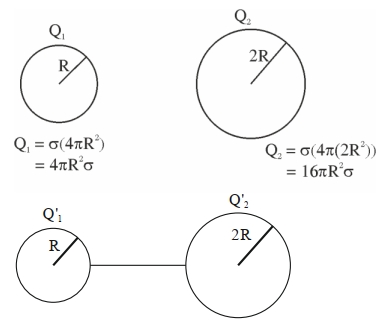
0 likes
View Solution96
MediumMCQ
As shown in the figure,a point charge $Q$ is placed at the centre of a conducting spherical shell of inner radius $a$ and outer radius $b$. The electric field due to charge $Q$ in three different regions $I$,$II$,and $III$ is given by: $(I: r < a, II: a < r < b, III: r > b)$
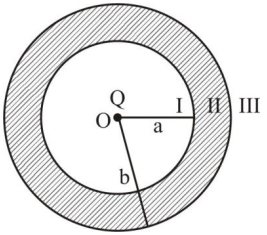
A
$E_{I} = 0, E_{II} = 0, E_{III} \neq 0$
B
$E_{I} \neq 0, E_{II} = 0, E_{III} \neq 0$
C
$E_{I} \neq 0, E_{II} = 0, E_{III} = 0$
D
$E_{I} = 0, E_{II} = 0, E_{III} = 0$
Solution
(B) Region $I$ $(r < a)$: The electric field is due to the point charge $Q$ at the center. By Gauss's Law,$E_I = \frac{1}{4\pi\epsilon_0} \frac{Q}{r^2} \neq 0$.
Region $II$ $(a < r < b)$: This region lies within the material of the conducting shell. In electrostatic equilibrium,the electric field inside the material of a conductor is always zero $(E_{II} = 0)$.
Region $III$ $(r > b)$: The charge $Q$ induces a charge $-Q$ on the inner surface $(r=a)$ and $+Q$ on the outer surface $(r=b)$. The total charge enclosed by a Gaussian surface of radius $r > b$ is $Q + (-Q) + Q = Q$. Thus,$E_{III} = \frac{1}{4\pi\epsilon_0} \frac{Q}{r^2} \neq 0$.
Region $II$ $(a < r < b)$: This region lies within the material of the conducting shell. In electrostatic equilibrium,the electric field inside the material of a conductor is always zero $(E_{II} = 0)$.
Region $III$ $(r > b)$: The charge $Q$ induces a charge $-Q$ on the inner surface $(r=a)$ and $+Q$ on the outer surface $(r=b)$. The total charge enclosed by a Gaussian surface of radius $r > b$ is $Q + (-Q) + Q = Q$. Thus,$E_{III} = \frac{1}{4\pi\epsilon_0} \frac{Q}{r^2} \neq 0$.
0 likes
View Solution97
DifficultMCQ
Two charged conducting spheres of radii $a$ and $b$ are connected to each other by a conducting wire. The ratio of charges of the two spheres respectively is:
A
$\sqrt{ab}$
B
$ab$
C
$\frac{a}{b}$
D
$\frac{b}{a}$
Solution
(C) When two conducting spheres are connected by a conducting wire,charge flows until they reach the same electric potential.
Let $q_1$ and $q_2$ be the charges on the spheres of radii $a$ and $b$ respectively.
The potential $V$ at the surface of a conducting sphere is given by $V = \frac{Kq}{r}$,where $K = \frac{1}{4\pi\epsilon_0}$.
Since the potentials are equal,we have:
$V_1 = V_2$
$\frac{Kq_1}{a} = \frac{Kq_2}{b}$
Rearranging the terms to find the ratio of charges:
$\frac{q_1}{q_2} = \frac{a}{b}$
Thus,the ratio of the charges is $\frac{a}{b}$.
Let $q_1$ and $q_2$ be the charges on the spheres of radii $a$ and $b$ respectively.
The potential $V$ at the surface of a conducting sphere is given by $V = \frac{Kq}{r}$,where $K = \frac{1}{4\pi\epsilon_0}$.
Since the potentials are equal,we have:
$V_1 = V_2$
$\frac{Kq_1}{a} = \frac{Kq_2}{b}$
Rearranging the terms to find the ratio of charges:
$\frac{q_1}{q_2} = \frac{a}{b}$
Thus,the ratio of the charges is $\frac{a}{b}$.
0 likes
View Solution98
DifficultMCQ
$A$ spherical metal shell $A$ of radius $R_A$ and a solid metal sphere $B$ of radius $R_B < R_A$ are kept far apart and each is given charge $+Q$. Now they are connected by a thin metal wire. Then:
$(A)$ $E_A^{\text{inside}} = 0$
$(B)$ $Q_A > Q_B$
$(C)$ $\frac{\sigma_A}{\sigma_B} = \frac{R_B}{R_A}$
$(D)$ $E_A^{\text{on surface}} < E_B^{\text{on surface}}$
$(A)$ $E_A^{\text{inside}} = 0$
$(B)$ $Q_A > Q_B$
$(C)$ $\frac{\sigma_A}{\sigma_B} = \frac{R_B}{R_A}$
$(D)$ $E_A^{\text{on surface}} < E_B^{\text{on surface}}$
A
$(A, B, C)$
B
$(A, B, C, D)$
C
$(A, B, D)$
D
$(B, C, D)$
Solution
(B) When two conductors are connected by a wire,charge flows until their potentials become equal. Let the final charges be $Q_A$ and $Q_B$.
Since $V_A = V_B$,we have $\frac{kQ_A}{R_A} = \frac{kQ_B}{R_B}$,which implies $\frac{Q_A}{Q_B} = \frac{R_A}{R_B}$.
Since $R_A > R_B$,it follows that $Q_A > Q_B$. Thus,$(B)$ is correct.
For a spherical shell,the electric field inside is always zero due to Gauss's Law. Thus,$(A)$ is correct.
The surface charge density is $\sigma = \frac{Q}{4\pi R^2}$. Therefore,$\frac{\sigma_A}{\sigma_B} = \frac{Q_A}{4\pi R_A^2} \cdot \frac{4\pi R_B^2}{Q_B} = \frac{Q_A}{Q_B} \cdot \frac{R_B^2}{R_A^2} = \frac{R_A}{R_B} \cdot \frac{R_B^2}{R_A^2} = \frac{R_B}{R_A}$. Thus,$(C)$ is correct.
The electric field on the surface is $E = \frac{\sigma}{\epsilon_0}$. Since $\frac{\sigma_A}{\sigma_B} = \frac{R_B}{R_A} < 1$,we have $\sigma_A < \sigma_B$,which implies $E_A < E_B$. Thus,$(D)$ is correct.
Therefore,all options $(A, B, C, D)$ are correct.
Since $V_A = V_B$,we have $\frac{kQ_A}{R_A} = \frac{kQ_B}{R_B}$,which implies $\frac{Q_A}{Q_B} = \frac{R_A}{R_B}$.
Since $R_A > R_B$,it follows that $Q_A > Q_B$. Thus,$(B)$ is correct.
For a spherical shell,the electric field inside is always zero due to Gauss's Law. Thus,$(A)$ is correct.
The surface charge density is $\sigma = \frac{Q}{4\pi R^2}$. Therefore,$\frac{\sigma_A}{\sigma_B} = \frac{Q_A}{4\pi R_A^2} \cdot \frac{4\pi R_B^2}{Q_B} = \frac{Q_A}{Q_B} \cdot \frac{R_B^2}{R_A^2} = \frac{R_A}{R_B} \cdot \frac{R_B^2}{R_A^2} = \frac{R_B}{R_A}$. Thus,$(C)$ is correct.
The electric field on the surface is $E = \frac{\sigma}{\epsilon_0}$. Since $\frac{\sigma_A}{\sigma_B} = \frac{R_B}{R_A} < 1$,we have $\sigma_A < \sigma_B$,which implies $E_A < E_B$. Thus,$(D)$ is correct.
Therefore,all options $(A, B, C, D)$ are correct.
0 likes
View Solution99
MediumMCQ
Given below are two statements $:$ one is labelled as Assertion $(A)$ and the other is labelled as Reason $(R)$.
Assertion $(A) :$ The outer body of an aircraft is made of metal which protects persons sitting inside from lightning strikes.
Reason $(R) :$ The electric field inside the cavity enclosed by a conductor is zero.
In the light of the above statements,choose the most appropriate answer from the options given below.
Assertion $(A) :$ The outer body of an aircraft is made of metal which protects persons sitting inside from lightning strikes.
Reason $(R) :$ The electric field inside the cavity enclosed by a conductor is zero.
In the light of the above statements,choose the most appropriate answer from the options given below.
A
Both $(A)$ and $(R)$ are correct and $(R)$ is the correct explanation of $(A)$.
B
$(A)$ is correct but $(R)$ is not correct.
C
Both $(A)$ and $(R)$ are correct but $(R)$ is not the correct explanation of $(A)$.
D
$(A)$ is not correct but $(R)$ is correct.
Solution
(A) The phenomenon described is known as electrostatic shielding. According to the properties of conductors in electrostatic equilibrium,the electric field inside a closed metallic cavity is always zero,regardless of the external electric field or charge distribution. When lightning strikes an aircraft,the metal body acts as a Faraday cage,ensuring that the electric field inside remains zero and the occupants remain safe. Therefore,Assertion $(A)$ is correct because it describes the protective effect,and Reason $(R)$ is the correct scientific explanation for this phenomenon.
0 likes
View Solution100
DifficultMCQ
Two metal spheres of radius $R$ and $3R$ have the same surface charge density $\sigma$. If they are brought in contact and then separated,the surface charge density on the smaller and bigger sphere becomes $\sigma_1$ and $\sigma_2$,respectively. The ratio $\frac{\sigma_1}{\sigma_2}$ is:
A
$\frac{1}{9}$
B
$9$
C
$\frac{1}{3}$
D
$3$
Solution
(D) The potential $V$ of a conducting sphere of radius $r$ with surface charge density $\sigma$ is given by $V = \frac{\sigma r}{\varepsilon_0}$.
When two conducting spheres are brought into contact,charge flows between them until their potentials become equal,i.e.,$V_1 = V_2$.
Substituting the expression for potential,we get $\frac{\sigma_1 r_1}{\varepsilon_0} = \frac{\sigma_2 r_2}{\varepsilon_0}$.
This simplifies to $\sigma_1 r_1 = \sigma_2 r_2$.
Given $r_1 = R$ and $r_2 = 3R$,we have $\sigma_1 R = \sigma_2 (3R)$.
Therefore,the ratio $\frac{\sigma_1}{\sigma_2} = \frac{3R}{R} = 3$.
When two conducting spheres are brought into contact,charge flows between them until their potentials become equal,i.e.,$V_1 = V_2$.
Substituting the expression for potential,we get $\frac{\sigma_1 r_1}{\varepsilon_0} = \frac{\sigma_2 r_2}{\varepsilon_0}$.
This simplifies to $\sigma_1 r_1 = \sigma_2 r_2$.
Given $r_1 = R$ and $r_2 = 3R$,we have $\sigma_1 R = \sigma_2 (3R)$.
Therefore,the ratio $\frac{\sigma_1}{\sigma_2} = \frac{3R}{R} = 3$.
0 likes
View SolutionElectric Potential and Capacitance — Conductor, Electrostatic Shielding, Induced Charge and Charge Redistribution on conductor · Frequently Asked Questions
1Are these Electric Potential and Capacitance questions useful for JEE and NEET?
Yes. All questions in this section are mapped to JEE Main and NEET exam patterns. Previous year questions from JEE Main, NEET, GUJCET and state-level exams are included with full solutions.
2Can I switch to Hindi or Gujarati for these questions?
Yes. Use the language tabs in the hero section or the sidebar to view the same questions and solutions in English, Hindi or Gujarati.
3How do I generate a question paper from this subtopic?
Use the Vedclass Exam Paper Generator — select the chapter and subtopic, set difficulty, and generate Sets A, B, C, D automatically. First 3 chapters of every subject are free.
Vedclass Products
For Students
Vedclass Test Series
Mock tests in real JEE/NEET style with performance analysis. 5-day free trial.
Start Free TrialFor Teachers
Exam Paper Generator
Generate Set A/B/C/D papers from this chapter in 2 minutes. 3 chapters free.
Try FreeFor Institutes
Online Exam Module
Live online exams with unlimited students, 360° analytics & white-label branding.
See DemoFor Teachers & Institutes
Generate a Electric Potential and Capacitance Exam Paper in 2 Minutes
Select subtopic & difficulty — Sets A, B, C, D auto-generated with No Repeat logic.
First 3 chapters of every subject are free — no payment required.