
A English
Conductor, Electrostatic Shielding, Induced Charge and Charge Redistribution on conductor Questions in English
Class 12 Physics · Electric Potential and Capacitance · Conductor, Electrostatic Shielding, Induced Charge and Charge Redistribution on conductor
122+
Questions
English
Language
100%
With Solutions
Showing 22 of 122 questions in English
101
MediumMCQ
Two metallic concentric shells are shown. Before closing the switch,the charge on the inner shell is $Q$ and the charge on the outer shell is $2Q$. The potential at point $A$ is $V$. What will be the potential at the same point after closing the switch?
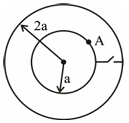
A
$V$
B
$2V$
C
$\frac{3}{4}V$
D
$\frac{2}{3}V$
Solution
(C) Before closing the switch,the potential at point $A$ (on the surface of the inner shell of radius $a$) is due to both shells:
$V_A = \frac{kQ}{a} + \frac{k(2Q)}{2a} = \frac{kQ}{a} + \frac{kQ}{a} = \frac{2kQ}{a} = V$.
Thus,$\frac{kQ}{a} = \frac{V}{2}$.
After closing the switch,the two shells are connected,so the total charge $Q + 2Q = 3Q$ redistributes such that both shells are at the same potential. The potential at the surface of the inner shell (and outer shell) becomes:
$V'_A = \frac{k(Q + 2Q)}{2a} = \frac{3kQ}{2a}$.
Substituting $\frac{kQ}{a} = \frac{V}{2}$ into the expression:
$V'_A = \frac{3}{2} \times \left(\frac{kQ}{a}\right) = \frac{3}{2} \times \frac{V}{2} = \frac{3V}{4}$.
$V_A = \frac{kQ}{a} + \frac{k(2Q)}{2a} = \frac{kQ}{a} + \frac{kQ}{a} = \frac{2kQ}{a} = V$.
Thus,$\frac{kQ}{a} = \frac{V}{2}$.
After closing the switch,the two shells are connected,so the total charge $Q + 2Q = 3Q$ redistributes such that both shells are at the same potential. The potential at the surface of the inner shell (and outer shell) becomes:
$V'_A = \frac{k(Q + 2Q)}{2a} = \frac{3kQ}{2a}$.
Substituting $\frac{kQ}{a} = \frac{V}{2}$ into the expression:
$V'_A = \frac{3}{2} \times \left(\frac{kQ}{a}\right) = \frac{3}{2} \times \frac{V}{2} = \frac{3V}{4}$.
0 likes
View Solution102
DifficultMCQ
Assertion $:-$ The maximum charge that can be given to a conductor of fixed volume depends on its shape.
Reason $:-$ If the electric field near the conductor is sufficient for dielectric breakdown of air,no more charge can be transferred to it.
Reason $:-$ If the electric field near the conductor is sufficient for dielectric breakdown of air,no more charge can be transferred to it.
A
Both Assertion and Reason are true but Reason is $\text{NOT}$ the correct explanation of Assertion.
B
Assertion is true but Reason is false.
C
Assertion is false but Reason is true.
D
Both Assertion and Reason are true and Reason is the correct explanation of Assertion.
Solution
(D) The electric field at the surface of a conductor is given by $E = \frac{\sigma}{\epsilon_0}$,where $\sigma$ is the surface charge density. For a conductor of a fixed volume,the surface charge density $\sigma$ is higher at regions with smaller radii of curvature (sharp points).
When the electric field at the surface exceeds the dielectric strength of the surrounding air (approximately $3 \times 10^6 \ V/m$),the air undergoes dielectric breakdown,causing charge leakage (corona discharge).
Since sharp points reach this critical electric field value at lower total charges compared to smooth surfaces,the maximum charge a conductor can hold depends on its shape. Thus,the Reason correctly explains why the shape affects the maximum charge.
When the electric field at the surface exceeds the dielectric strength of the surrounding air (approximately $3 \times 10^6 \ V/m$),the air undergoes dielectric breakdown,causing charge leakage (corona discharge).
Since sharp points reach this critical electric field value at lower total charges compared to smooth surfaces,the maximum charge a conductor can hold depends on its shape. Thus,the Reason correctly explains why the shape affects the maximum charge.
0 likes
View Solution103
MediumMCQ
$A$ charged spherical conductor of radius $R$ is connected momentarily to another uncharged spherical conductor of radius $r$ by means of a thin conducting wire. Then,the ratio of the surface charge density of the first to the second conductor is:
A
$R: r^2$
B
$R: r$
C
$r: R$
D
$1: 1$
Solution
(C) When two conductors are connected by a thin conducting wire,charge flows until they reach the same potential $V$.
Since $V_1 = V_2$,we have $\frac{k q_1}{R} = \frac{k q_2}{r}$,which implies $\frac{q_1}{q_2} = \frac{R}{r}$.
The surface charge density $\sigma$ is defined as $\sigma = \frac{q}{4 \pi R^2}$.
Therefore,the ratio of the surface charge densities is:
$\frac{\sigma_1}{\sigma_2} = \frac{q_1 / (4 \pi R^2)}{q_2 / (4 \pi r^2)} = \left( \frac{q_1}{q_2} \right) \left( \frac{r^2}{R^2} \right)$.
Substituting $\frac{q_1}{q_2} = \frac{R}{r}$,we get:
$\frac{\sigma_1}{\sigma_2} = \left( \frac{R}{r} \right) \left( \frac{r^2}{R^2} \right) = \frac{r}{R}$.
Thus,the ratio is $r: R$.
Since $V_1 = V_2$,we have $\frac{k q_1}{R} = \frac{k q_2}{r}$,which implies $\frac{q_1}{q_2} = \frac{R}{r}$.
The surface charge density $\sigma$ is defined as $\sigma = \frac{q}{4 \pi R^2}$.
Therefore,the ratio of the surface charge densities is:
$\frac{\sigma_1}{\sigma_2} = \frac{q_1 / (4 \pi R^2)}{q_2 / (4 \pi r^2)} = \left( \frac{q_1}{q_2} \right) \left( \frac{r^2}{R^2} \right)$.
Substituting $\frac{q_1}{q_2} = \frac{R}{r}$,we get:
$\frac{\sigma_1}{\sigma_2} = \left( \frac{R}{r} \right) \left( \frac{r^2}{R^2} \right) = \frac{r}{R}$.
Thus,the ratio is $r: R$.
0 likes
View Solution104
EasyMCQ
Which of the following statements is '$WRONG$' for the conductors?
A
In static situation,the interior of conductor can have no charge.
B
The net electrostatic field is zero in the interior of a conductor.
C
The electrostatic field just outside the surface of a charged conductor must be tangential to the surface at any point.
D
The electrostatic potential is constant within and on the surface of a conductor.
Solution
(C) For a conductor in electrostatic equilibrium,the electric field just outside the surface must be perpendicular to the surface at every point. If it had a tangential component,charges would experience a force and move along the surface,which contradicts the static condition. Therefore,the statement that the field must be tangential is '$WRONG$'.
0 likes
View Solution105
DifficultMCQ
Two charged metallic spheres are joined by a very thin metal wire. If the radius of the larger sphere is four times that of the smaller sphere,the electric field near the larger sphere is
A
twice that near the smaller sphere
B
quarter of that near the smaller sphere
C
same as that near the smaller sphere
D
half of that near smaller sphere
Solution
(B) Since the spheres are joined by a metal wire,their potentials will be the same.
Let the radius of the smaller sphere be $r_1$ and the radius of the larger sphere be $r_2 = 4r_1$.
Since the potentials are equal,$V = \frac{1}{4 \pi \varepsilon_0} \cdot \frac{q_1}{r_1} = \frac{1}{4 \pi \varepsilon_0} \cdot \frac{q_2}{r_2}$.
Therefore,$\frac{q_2}{q_1} = \frac{r_2}{r_1} = 4$.
The electric field near the surface of the spheres is given by $E = \frac{1}{4 \pi \varepsilon_0} \cdot \frac{q}{r^2}$.
Thus,$\frac{E_2}{E_1} = \frac{q_2}{q_1} \cdot \left(\frac{r_1}{r_2}\right)^2 = \left(\frac{r_2}{r_1}\right) \cdot \left(\frac{r_1}{r_2}\right)^2 = \frac{r_1}{r_2}$.
Substituting $r_2 = 4r_1$,we get $\frac{E_2}{E_1} = \frac{r_1}{4r_1} = \frac{1}{4}$.
So,the electric field near the larger sphere is a quarter of that near the smaller sphere.
Let the radius of the smaller sphere be $r_1$ and the radius of the larger sphere be $r_2 = 4r_1$.
Since the potentials are equal,$V = \frac{1}{4 \pi \varepsilon_0} \cdot \frac{q_1}{r_1} = \frac{1}{4 \pi \varepsilon_0} \cdot \frac{q_2}{r_2}$.
Therefore,$\frac{q_2}{q_1} = \frac{r_2}{r_1} = 4$.
The electric field near the surface of the spheres is given by $E = \frac{1}{4 \pi \varepsilon_0} \cdot \frac{q}{r^2}$.
Thus,$\frac{E_2}{E_1} = \frac{q_2}{q_1} \cdot \left(\frac{r_1}{r_2}\right)^2 = \left(\frac{r_2}{r_1}\right) \cdot \left(\frac{r_1}{r_2}\right)^2 = \frac{r_1}{r_2}$.
Substituting $r_2 = 4r_1$,we get $\frac{E_2}{E_1} = \frac{r_1}{4r_1} = \frac{1}{4}$.
So,the electric field near the larger sphere is a quarter of that near the smaller sphere.
0 likes
View Solution106
EasyMCQ
$A$ metallic sphere $A$ isolated from the ground is charged to $+50 \mu C$. This sphere is brought into contact with another isolated metallic sphere $B$ of half the radius of sphere $A$. Then the charge on the two isolated spheres $A$ and $B$ are in the ratio:
A
$1: 2$
B
$2: 1$
C
$4: 1$
D
$1: 1$
Solution
(B) When two isolated metallic spheres are brought into contact,charge flows between them until their potentials become equal.
Let $r_A$ and $r_B$ be the radii of spheres $A$ and $B$ respectively,and $q_A$ and $q_B$ be their final charges.
Given that $r_B = \frac{r_A}{2}$,which implies $r_A = 2r_B$.
Since the potentials are equal,$V_A = V_B$.
Using the formula for potential $V = \frac{1}{4 \pi \varepsilon_0} \frac{q}{r}$,we have:
$\frac{1}{4 \pi \varepsilon_0} \frac{q_A}{r_A} = \frac{1}{4 \pi \varepsilon_0} \frac{q_B}{r_B}$
$\frac{q_A}{q_B} = \frac{r_A}{r_B}$
Substituting $r_A = 2r_B$:
$\frac{q_A}{q_B} = \frac{2r_B}{r_B} = \frac{2}{1}$
Thus,the ratio of the charges on spheres $A$ and $B$ is $2: 1$.
Let $r_A$ and $r_B$ be the radii of spheres $A$ and $B$ respectively,and $q_A$ and $q_B$ be their final charges.
Given that $r_B = \frac{r_A}{2}$,which implies $r_A = 2r_B$.
Since the potentials are equal,$V_A = V_B$.
Using the formula for potential $V = \frac{1}{4 \pi \varepsilon_0} \frac{q}{r}$,we have:
$\frac{1}{4 \pi \varepsilon_0} \frac{q_A}{r_A} = \frac{1}{4 \pi \varepsilon_0} \frac{q_B}{r_B}$
$\frac{q_A}{q_B} = \frac{r_A}{r_B}$
Substituting $r_A = 2r_B$:
$\frac{q_A}{q_B} = \frac{2r_B}{r_B} = \frac{2}{1}$
Thus,the ratio of the charges on spheres $A$ and $B$ is $2: 1$.
0 likes
View Solution107
EasyMCQ
Two charged spheres of radius $R_1$ and $R_2$ respectively are charged and joined by a wire. The ratio of the electric field at the surfaces of the spheres is . . . . . . .
A
$\frac{R_2}{R_1}$
B
$\frac{R_1}{R_2}$
C
$\frac{R_2^2}{R_1^2}$
D
$\frac{R_1^2}{R_2^2}$
Solution
(A) When two charged conducting spheres are connected by a wire,charge flows until their electric potentials become equal.
Therefore,$V_1 = V_2$.
The potential of a charged sphere is given by $V = \frac{KQ}{R}$.
Thus,$\frac{KQ_1}{R_1} = \frac{KQ_2}{R_2}$.
The electric field at the surface of a sphere is $E = \frac{KQ}{R^2}$.
We can rewrite the potential equation as $\frac{KQ_1}{R_1^2} \cdot R_1 = \frac{KQ_2}{R_2^2} \cdot R_2$.
Substituting $E = \frac{KQ}{R^2}$,we get $E_1 R_1 = E_2 R_2$.
Therefore,the ratio of the electric fields is $\frac{E_1}{E_2} = \frac{R_2}{R_1}$.
Therefore,$V_1 = V_2$.
The potential of a charged sphere is given by $V = \frac{KQ}{R}$.
Thus,$\frac{KQ_1}{R_1} = \frac{KQ_2}{R_2}$.
The electric field at the surface of a sphere is $E = \frac{KQ}{R^2}$.
We can rewrite the potential equation as $\frac{KQ_1}{R_1^2} \cdot R_1 = \frac{KQ_2}{R_2^2} \cdot R_2$.
Substituting $E = \frac{KQ}{R^2}$,we get $E_1 R_1 = E_2 R_2$.
Therefore,the ratio of the electric fields is $\frac{E_1}{E_2} = \frac{R_2}{R_1}$.
0 likes
View Solution108
EasyMCQ
Two metallic spheres of radii $a$ and $b$ are placed far away from each other and are connected by a thin conducting wire. The total charge on them is $Q$. Calculate the potential of each sphere.
A
$\frac{k Q}{a-b}$
B
$k Q \left(\frac{b}{a}\right)$
C
$\frac{k Q}{a+b}$
D
$k Q \left(\frac{a}{b}\right)$
Solution
(C) Let the potentials of the spheres with radii $a$ and $b$ be $V_a$ and $V_b$ respectively,and the charges on them be $Q_a$ and $Q_b$.
Since the two spheres are connected by a conducting wire,they must be at the same potential:
$V_a = V_b$
$\frac{k Q_a}{a} = \frac{k Q_b}{b}$
$\frac{Q_a}{Q_b} = \frac{a}{b}$
Using the property of ratios,$\frac{Q_a}{Q_a + Q_b} = \frac{a}{a + b}$.
Since the total charge $Q_a + Q_b = Q$,we have:
$Q_a = \frac{a Q}{a + b}$ and $Q_b = \frac{b Q}{a + b}$.
Now,calculating the potential $V$ of each sphere:
$V = V_a = V_b = \frac{k Q_a}{a} = \frac{k}{a} \left( \frac{a Q}{a + b} \right) = \frac{k Q}{a + b}$.
Since the two spheres are connected by a conducting wire,they must be at the same potential:
$V_a = V_b$
$\frac{k Q_a}{a} = \frac{k Q_b}{b}$
$\frac{Q_a}{Q_b} = \frac{a}{b}$
Using the property of ratios,$\frac{Q_a}{Q_a + Q_b} = \frac{a}{a + b}$.
Since the total charge $Q_a + Q_b = Q$,we have:
$Q_a = \frac{a Q}{a + b}$ and $Q_b = \frac{b Q}{a + b}$.
Now,calculating the potential $V$ of each sphere:
$V = V_a = V_b = \frac{k Q_a}{a} = \frac{k}{a} \left( \frac{a Q}{a + b} \right) = \frac{k Q}{a + b}$.
0 likes
View Solution109
EasyMCQ
By keeping a conductor in an external electric field and from the results obtained by electrostatics,which of the following options is wrong?
A
Inside a conductor,the electrostatic field is zero.
B
The interior of the conductor has excess charge in a static situation.
C
At the surface of a charged conductor,the electric field must be perpendicular to the surface.
D
The electrostatic potential is constant throughout the volume of the conductor.
Solution
(B) In a static situation,the interior of a conductor cannot have any excess charge. According to Gauss's Law,if there were an excess charge $q$ inside a closed surface,there would be a net electric flux $\phi = q/\epsilon_0$ through the surface. However,since the electric field inside a conductor is zero,the flux must be zero,implying that the net charge inside any volume of the conductor is zero. Therefore,any excess charge must reside on the surface of the conductor. Thus,option $B$ is incorrect.
0 likes
View Solution110
DifficultMCQ
Under electrostatic condition of a charged conductor,which among the following statements is true?
A
The electric field on the surface of a charged conductor is $\frac{\sigma}{2 \varepsilon_0}$,where $\sigma$ is the surface charge density.
B
The electric potential inside a charged conductor is always zero.
C
Any excess charge resides on the surface of the conductor.
D
The net electric field is tangential to the surface of the conductor.
Solution
(C) In electrostatic equilibrium,the electric field inside a conductor is zero. According to Gauss's law,any excess charge placed on a conductor must reside entirely on its surface to minimize mutual repulsion.
The electric field just outside the surface of a charged conductor is given by $E = \frac{\sigma}{\varepsilon_0}$,where $\sigma$ is the surface charge density.
The electric potential inside a charged conductor is constant and equal to the potential at its surface,not zero.
The net electric field is always perpendicular (normal) to the surface of the conductor,not tangential.
Therefore,the correct statement is that any excess charge resides on the surface of the conductor.
The electric field just outside the surface of a charged conductor is given by $E = \frac{\sigma}{\varepsilon_0}$,where $\sigma$ is the surface charge density.
The electric potential inside a charged conductor is constant and equal to the potential at its surface,not zero.
The net electric field is always perpendicular (normal) to the surface of the conductor,not tangential.
Therefore,the correct statement is that any excess charge resides on the surface of the conductor.
0 likes
View Solution111
DifficultMCQ
Five identical conducting plates,each of face area $A$,are placed parallel to each other with a separation of $d$ between two adjacent plates as shown in the figure. The plates $M$ and $N$ are given charges $Q_1$ and $Q_2$ respectively and the remaining plates are neutral. If the outermost plates are grounded,the potential difference between the plates $M$ and $N$ is . . . . . .
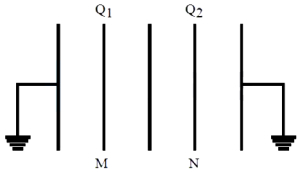
A
$\frac{2 d(Q_1-Q_2)}{\epsilon_0 A}$
B
$\frac{d(Q_1-Q_2)}{2 \epsilon_0 A}$
C
$\frac{4 d(Q_1-Q_2)}{\epsilon_0 A}$
D
$\frac{d(Q_1-Q_2)}{4 \epsilon_0 A}$
Solution
(B) Let the plates be numbered $1, 2, 3, 4, 5$ from left to right. Plate $2$ is $M$ and plate $4$ is $N$.
Since plates $1$ and $5$ are grounded,their potentials are zero. The electric field in the regions outside the system is zero.
Let the charges on the inner and outer surfaces of the plates be $q_1, q_2, q_3, q_4, q_5, q_6, q_7, q_8, q_9, q_{10}$.
Due to grounding,the outer surfaces of plates $1$ and $5$ have zero charge. The total charge on plate $M$ is $Q_1$ and on plate $N$ is $Q_2$.
Using the property that the electric field inside a conductor is zero,the potential difference between plates $M$ and $N$ is given by $V_M - V_N = E \cdot d$,where $E$ is the electric field between them.
For this configuration,the electric field between plates $M$ and $N$ is $E = \frac{Q_1 - Q_2}{2 \epsilon_0 A}$.
Thus,the potential difference is $\Delta V = E \cdot d = \frac{d(Q_1 - Q_2)}{2 \epsilon_0 A}$.
Therefore,the correct option is $B$.
Since plates $1$ and $5$ are grounded,their potentials are zero. The electric field in the regions outside the system is zero.
Let the charges on the inner and outer surfaces of the plates be $q_1, q_2, q_3, q_4, q_5, q_6, q_7, q_8, q_9, q_{10}$.
Due to grounding,the outer surfaces of plates $1$ and $5$ have zero charge. The total charge on plate $M$ is $Q_1$ and on plate $N$ is $Q_2$.
Using the property that the electric field inside a conductor is zero,the potential difference between plates $M$ and $N$ is given by $V_M - V_N = E \cdot d$,where $E$ is the electric field between them.
For this configuration,the electric field between plates $M$ and $N$ is $E = \frac{Q_1 - Q_2}{2 \epsilon_0 A}$.
Thus,the potential difference is $\Delta V = E \cdot d = \frac{d(Q_1 - Q_2)}{2 \epsilon_0 A}$.
Therefore,the correct option is $B$.
0 likes
View Solution112
DifficultMCQ
Two thin conducting concentric shells of radii $R$ and $2R$ are shown in the figure. The outer shell carries a charge $+Q$ and the inner shell is neutral. When the switch $K$ is closed,which of the following statement$(s)$ is/are correct?
$(a)$ The potential on the inner shell becomes zero.
$(b)$ The charge on the inner shell is $\frac{Q}{2}$.
$(a)$ The potential on the inner shell becomes zero.
$(b)$ The charge on the inner shell is $\frac{Q}{2}$.
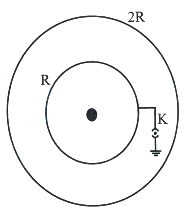
A
$(a)$ and $(b)$ are correct
B
$(a)$ is correct,$(b)$ is wrong
C
$(a)$ is wrong,$(b)$ is correct
D
$(a)$ and $(b)$ are wrong
Solution
(B) Let the charge on the inner shell after the switch is closed be $q$. Since the inner shell is connected to the ground,its potential becomes zero.
The potential at the inner shell of radius $R$ due to its own charge $q$ and the charge $Q$ on the outer shell of radius $2R$ is:
$V_{\text{inner}} = \frac{Kq}{R} + \frac{KQ}{2R} = 0$
Solving for $q$:
$\frac{Kq}{R} = -\frac{KQ}{2R}$
$q = -\frac{Q}{2}$
Thus,the potential of the inner shell becomes zero,making statement $(a)$ correct.
The charge on the inner shell is $-\frac{Q}{2}$,making statement $(b)$ wrong.
Therefore,$(a)$ is correct and $(b)$ is wrong.
The potential at the inner shell of radius $R$ due to its own charge $q$ and the charge $Q$ on the outer shell of radius $2R$ is:
$V_{\text{inner}} = \frac{Kq}{R} + \frac{KQ}{2R} = 0$
Solving for $q$:
$\frac{Kq}{R} = -\frac{KQ}{2R}$
$q = -\frac{Q}{2}$
Thus,the potential of the inner shell becomes zero,making statement $(a)$ correct.
The charge on the inner shell is $-\frac{Q}{2}$,making statement $(b)$ wrong.
Therefore,$(a)$ is correct and $(b)$ is wrong.
0 likes
View Solution113
EasyMCQ
Inside a charged hollow sphere,at any point the electric field $(E)$ and potential $(V)$ are
A
$V=0$ and $E=0$
B
$V$ is constant and $E=0$
C
$V=0$ and $E$ is constant
D
$V$ is constant and $E$ is constant
Solution
(B) For a charged hollow sphere,the electric field $(E)$ inside the sphere is zero because there is no enclosed charge $(q_{enclosed} = 0)$.
According to the relation between electric field and potential,$E = -\frac{dV}{dr}$.
Since $E = 0$,it implies that $\frac{dV}{dr} = 0$,which means the potential $(V)$ must be constant throughout the interior of the sphere.
The value of this constant potential is equal to the potential at the surface of the sphere,given by $V = \frac{1}{4\pi\epsilon_0} \frac{Q}{R}$.
According to the relation between electric field and potential,$E = -\frac{dV}{dr}$.
Since $E = 0$,it implies that $\frac{dV}{dr} = 0$,which means the potential $(V)$ must be constant throughout the interior of the sphere.
The value of this constant potential is equal to the potential at the surface of the sphere,given by $V = \frac{1}{4\pi\epsilon_0} \frac{Q}{R}$.
0 likes
View Solution114
DifficultMCQ
Charge on the outer sphere is $q$ and the inner sphere is grounded. The charge on the inner sphere is $q'$,for $(r_2 > r_1)$. Then
A
$q' r_1 = q r_2$
B
$q' = q$
C
$q' = \frac{r_1}{r_2} q$
D
$q' = - ( \frac{r_1}{r_2} ) q$
Solution
(D) Since the inner sphere is grounded,its potential must be zero due to the charges on both the outer sphere and the inner sphere.
Let $r_1$ be the radius of the inner sphere and $r_2$ be the radius of the outer sphere.
The potential $V$ at the surface of the inner sphere is the sum of the potentials due to its own charge $q'$ and the charge $q$ on the outer sphere.
$V = \frac{k q'}{r_1} + \frac{k q}{r_2} = 0$
Where $k = \frac{1}{4 \pi \epsilon_0}$.
Rearranging the equation:
$\frac{k q'}{r_1} = -\frac{k q}{r_2}$
$q' = -\frac{r_1}{r_2} q$
Let $r_1$ be the radius of the inner sphere and $r_2$ be the radius of the outer sphere.
The potential $V$ at the surface of the inner sphere is the sum of the potentials due to its own charge $q'$ and the charge $q$ on the outer sphere.
$V = \frac{k q'}{r_1} + \frac{k q}{r_2} = 0$
Where $k = \frac{1}{4 \pi \epsilon_0}$.
Rearranging the equation:
$\frac{k q'}{r_1} = -\frac{k q}{r_2}$
$q' = -\frac{r_1}{r_2} q$
0 likes
View Solution115
MediumMCQ
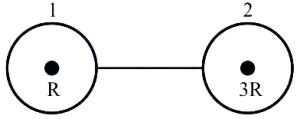
$A$ sphere '$1$' with radius $R$ has charge $q$. Sphere '$2$' with radius $3R$ is far from sphere '$1$' and is initially uncharged. If the two spheres are now connected with a thin conducting wire,then the ratio $\frac{\sigma_1}{\sigma_2}$ of the surface charge densities is
A
$2$
B
$2.5$
C
$3$
D
$9$
Solution
(C) Let $q_1$ and $q_2$ be the final charges on sphere '$1$' and sphere '$2$' respectively.
By the principle of conservation of charge,$q_1 + q_2 = q$.
When connected by a conducting wire,the potentials of the two spheres become equal,so $V_1 = V_2$.
Using the formula for potential $V = \frac{Kq}{R}$,we have $\frac{Kq_1}{R} = \frac{Kq_2}{3R}$.
This simplifies to $q_2 = 3q_1$.
Substituting this into the charge conservation equation: $q_1 + 3q_1 = q \Rightarrow 4q_1 = q \Rightarrow q_1 = \frac{q}{4}$ and $q_2 = \frac{3q}{4}$.
The surface charge density is given by $\sigma = \frac{q}{A} = \frac{q}{4\pi r^2}$.
Therefore,$\sigma_1 = \frac{q_1}{4\pi R^2} = \frac{q/4}{4\pi R^2} = \frac{q}{16\pi R^2}$.
And $\sigma_2 = \frac{q_2}{4\pi (3R)^2} = \frac{3q/4}{4\pi (9R^2)} = \frac{3q}{144\pi R^2} = \frac{q}{48\pi R^2}$.
The ratio is $\frac{\sigma_1}{\sigma_2} = \frac{q / 16\pi R^2}{q / 48\pi R^2} = \frac{48}{16} = 3$.
By the principle of conservation of charge,$q_1 + q_2 = q$.
When connected by a conducting wire,the potentials of the two spheres become equal,so $V_1 = V_2$.
Using the formula for potential $V = \frac{Kq}{R}$,we have $\frac{Kq_1}{R} = \frac{Kq_2}{3R}$.
This simplifies to $q_2 = 3q_1$.
Substituting this into the charge conservation equation: $q_1 + 3q_1 = q \Rightarrow 4q_1 = q \Rightarrow q_1 = \frac{q}{4}$ and $q_2 = \frac{3q}{4}$.
The surface charge density is given by $\sigma = \frac{q}{A} = \frac{q}{4\pi r^2}$.
Therefore,$\sigma_1 = \frac{q_1}{4\pi R^2} = \frac{q/4}{4\pi R^2} = \frac{q}{16\pi R^2}$.
And $\sigma_2 = \frac{q_2}{4\pi (3R)^2} = \frac{3q/4}{4\pi (9R^2)} = \frac{3q}{144\pi R^2} = \frac{q}{48\pi R^2}$.
The ratio is $\frac{\sigma_1}{\sigma_2} = \frac{q / 16\pi R^2}{q / 48\pi R^2} = \frac{48}{16} = 3$.
0 likes
View Solution116
EasyMCQ
Two metal spheres have their radii in the ratio of $4:7$. They are put in contact and a charge $8.8 \times 10^{-7} \text{ C}$ is given to the system. Then they are separated so that each can exert no influence on the other. The potential due to the smaller sphere at $60 \text{ m}$ from it in Volt is
A
$85$
B
$76$
C
$48$
D
$66$
Solution
(C) Let the radii of the two spheres be $R_1 = 4R$ and $R_2 = 7R$. When they are in contact,they reach the same potential $V$.
Since $V = \frac{Kq}{R}$,we have $\frac{Kq_1}{R_1} = \frac{Kq_2}{R_2}$.
This implies $\frac{q_1}{4R} = \frac{q_2}{7R}$,so $\frac{q_1}{q_2} = \frac{4}{7}$.
The total charge $q = q_1 + q_2 = 8.8 \times 10^{-7} \text{ C}$.
Substituting $q_2 = \frac{7}{4}q_1$,we get $q_1 + \frac{7}{4}q_1 = 8.8 \times 10^{-7} \text{ C}$.
$\frac{11}{4}q_1 = 8.8 \times 10^{-7} \text{ C} \Rightarrow q_1 = \frac{4}{11} \times 8.8 \times 10^{-7} = 3.2 \times 10^{-7} \text{ C}$.
The potential at a distance $r = 60 \text{ m}$ from the smaller sphere is $V = \frac{Kq_1}{r}$.
$V = \frac{9 \times 10^9 \times 3.2 \times 10^{-7}}{60} = \frac{28.8 \times 10^2}{60} = 48 \text{ V}$.
Since $V = \frac{Kq}{R}$,we have $\frac{Kq_1}{R_1} = \frac{Kq_2}{R_2}$.
This implies $\frac{q_1}{4R} = \frac{q_2}{7R}$,so $\frac{q_1}{q_2} = \frac{4}{7}$.
The total charge $q = q_1 + q_2 = 8.8 \times 10^{-7} \text{ C}$.
Substituting $q_2 = \frac{7}{4}q_1$,we get $q_1 + \frac{7}{4}q_1 = 8.8 \times 10^{-7} \text{ C}$.
$\frac{11}{4}q_1 = 8.8 \times 10^{-7} \text{ C} \Rightarrow q_1 = \frac{4}{11} \times 8.8 \times 10^{-7} = 3.2 \times 10^{-7} \text{ C}$.
The potential at a distance $r = 60 \text{ m}$ from the smaller sphere is $V = \frac{Kq_1}{r}$.
$V = \frac{9 \times 10^9 \times 3.2 \times 10^{-7}}{60} = \frac{28.8 \times 10^2}{60} = 48 \text{ V}$.
0 likes
View Solution117
EasyMCQ
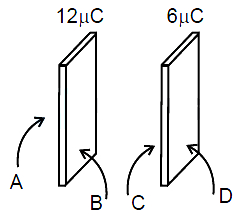
$12 \mu C$ and $6 \mu C$ charges are given to two conducting plates having the same cross-sectional area and placed face to face close to each other as shown in the figure. The resulting charge distribution in $\mu C$ on surfaces $A, B, C$ and $D$ are respectively,
A
$9, 3, -3, 9$
B
$3, 9, -9, 3$
C
$6, 6, -6, 12$
D
$6, 6, 3, 3$
Solution
(A) Let the charges on the two plates be $Q_1 = 12 \mu C$ and $Q_2 = 6 \mu C$.
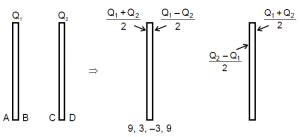
When two large conducting plates are placed parallel to each other,the charge on the outer surfaces is equal to $\frac{Q_1 + Q_2}{2}$ and the charge on the inner surfaces is equal to $\frac{Q_1 - Q_2}{2}$ and $\frac{Q_2 - Q_1}{2}$ respectively.
For surface $A$ (outer surface of first plate): $q_A = \frac{Q_1 + Q_2}{2} = \frac{12 + 6}{2} = \frac{18}{2} = 9 \mu C$.
For surface $B$ (inner surface of first plate): $q_B = \frac{Q_1 - Q_2}{2} = \frac{12 - 6}{2} = \frac{6}{2} = 3 \mu C$.
For surface $C$ (inner surface of second plate): $q_C = \frac{Q_2 - Q_1}{2} = \frac{6 - 12}{2} = \frac{-6}{2} = -3 \mu C$.
For surface $D$ (outer surface of second plate): $q_D = \frac{Q_1 + Q_2}{2} = \frac{12 + 6}{2} = \frac{18}{2} = 9 \mu C$.
Thus,the charge distribution on surfaces $A, B, C$ and $D$ is $9 \mu C, 3 \mu C, -3 \mu C$ and $9 \mu C$ respectively.
When two large conducting plates are placed parallel to each other,the charge on the outer surfaces is equal to $\frac{Q_1 + Q_2}{2}$ and the charge on the inner surfaces is equal to $\frac{Q_1 - Q_2}{2}$ and $\frac{Q_2 - Q_1}{2}$ respectively.
For surface $A$ (outer surface of first plate): $q_A = \frac{Q_1 + Q_2}{2} = \frac{12 + 6}{2} = \frac{18}{2} = 9 \mu C$.
For surface $B$ (inner surface of first plate): $q_B = \frac{Q_1 - Q_2}{2} = \frac{12 - 6}{2} = \frac{6}{2} = 3 \mu C$.
For surface $C$ (inner surface of second plate): $q_C = \frac{Q_2 - Q_1}{2} = \frac{6 - 12}{2} = \frac{-6}{2} = -3 \mu C$.
For surface $D$ (outer surface of second plate): $q_D = \frac{Q_1 + Q_2}{2} = \frac{12 + 6}{2} = \frac{18}{2} = 9 \mu C$.
Thus,the charge distribution on surfaces $A, B, C$ and $D$ is $9 \mu C, 3 \mu C, -3 \mu C$ and $9 \mu C$ respectively.
0 likes
View Solution118
EasyMCQ
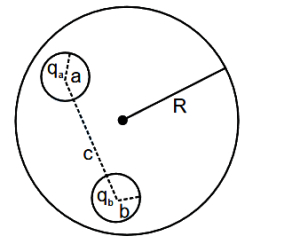
$A$ neutral conducting solid sphere of radius $R$ has two spherical cavities of radius $a$ and $b$ as shown in the figure. The centre-to-centre distance between the two cavities is $c$. Charges $q_a$ and $q_b$ are placed at the centres of the cavities,respectively. The force between $q_a$ and $q_b$ is:
A
$\frac{1}{4 \pi \varepsilon_0} \frac{q_{a} q_{b}}{c^2}$
B
$\frac{1}{4 \pi \varepsilon_0} q_a q_b\left(\frac{1}{a^2}+\frac{1}{b^2}\right)$
C
zero
D
insufficient data
Solution
(C) When a charge $q_a$ is placed inside a cavity of a conducting sphere,it induces a charge $-q_a$ on the inner surface of the cavity and a charge $+q_a$ on the outer surface of the conducting sphere.
Similarly,placing $q_b$ in the other cavity induces $-q_b$ on its inner surface and $+q_b$ on the outer surface of the conducting sphere.
The total charge on the outer surface of the conducting sphere becomes $q_a + q_b$. Since the sphere is conducting,the electric field inside the bulk of the conductor is zero.
The charge $q_a$ experiences a force due to the field produced by the induced charge $-q_b$ on the inner surface of the second cavity and the field produced by the charge distribution on the outer surface of the sphere.
However,due to the electrostatic shielding property of the conductor,the electric field produced by the charges outside the cavity (including the outer surface charge and the other cavity's induced charge) is zero inside the cavity containing $q_a$.
Therefore,the charge $q_a$ only experiences the field produced by the charge $-q_b$ induced on the inner surface of its own cavity,which is zero at its center due to symmetry.
Thus,the net force on $q_a$ due to $q_b$ and the induced charges is zero.
Similarly,placing $q_b$ in the other cavity induces $-q_b$ on its inner surface and $+q_b$ on the outer surface of the conducting sphere.
The total charge on the outer surface of the conducting sphere becomes $q_a + q_b$. Since the sphere is conducting,the electric field inside the bulk of the conductor is zero.
The charge $q_a$ experiences a force due to the field produced by the induced charge $-q_b$ on the inner surface of the second cavity and the field produced by the charge distribution on the outer surface of the sphere.
However,due to the electrostatic shielding property of the conductor,the electric field produced by the charges outside the cavity (including the outer surface charge and the other cavity's induced charge) is zero inside the cavity containing $q_a$.
Therefore,the charge $q_a$ only experiences the field produced by the charge $-q_b$ induced on the inner surface of its own cavity,which is zero at its center due to symmetry.
Thus,the net force on $q_a$ due to $q_b$ and the induced charges is zero.
0 likes
View Solution119
MediumMCQ
$A$ hollow metal sphere of radius $R$ is charged with a charge $Q$. The electric potential and intensity inside the sphere are respectively
A
$\frac{Q}{4 \pi \varepsilon_{0} R^{2}}$ and $\frac{Q}{4 \pi \varepsilon_{0} R}$
B
$\frac{Q}{4 \pi \varepsilon_{0} R}$ and zero
C
zero and zero
D
$\frac{4 \pi \varepsilon_{0} Q}{R}$ and $\frac{Q}{4 \pi \varepsilon_{0} R^{2}}$
Solution
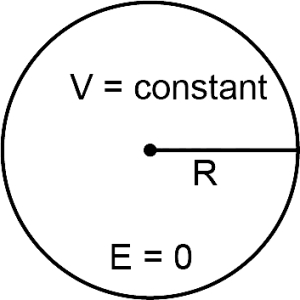
(B) Inside a hollow charged metal sphere,the electric field intensity is always zero because there is no charge enclosed within the Gaussian surface inside the sphere.
$\therefore E = 0$.
However,the electric potential inside the sphere is constant and equal to the potential at its surface.
The potential on the surface of the hollow sphere is given by:
$V = \frac{1}{4 \pi \varepsilon_{0}} \cdot \frac{Q}{R} = \frac{Q}{4 \pi \varepsilon_{0} R}$.
Thus,inside the sphere,the potential is $\frac{Q}{4 \pi \varepsilon_{0} R}$ and the electric field intensity is zero.
$\therefore E = 0$.
However,the electric potential inside the sphere is constant and equal to the potential at its surface.
The potential on the surface of the hollow sphere is given by:
$V = \frac{1}{4 \pi \varepsilon_{0}} \cdot \frac{Q}{R} = \frac{Q}{4 \pi \varepsilon_{0} R}$.
Thus,inside the sphere,the potential is $\frac{Q}{4 \pi \varepsilon_{0} R}$ and the electric field intensity is zero.
0 likes
View Solution120
EasyMCQ
Consider two concentric spherical metal shells of radii $r_{1}$ and $r_{2}$ $(r_{2} > r_{1})$. If the outer shell has a charge $q$ and the inner one is grounded,the charge on the inner shell is
A
$\frac{-r_{2}}{r_{1}} q$
B
zero
C
$\frac{-r_{1}}{r_{2}} q$
D
$-q$
Solution
(C) Let the charge on the inner shell be $q^{\prime}$.
Since the inner shell is grounded,its electric potential must be zero.
The potential at the surface of the inner shell is due to its own charge $q^{\prime}$ and the charge $q$ on the outer shell.
The potential $V_{1}$ at the inner shell is given by $V_{1} = \frac{k q^{\prime}}{r_{1}} + \frac{k q}{r_{2}}$.
Setting $V_{1} = 0$,we get $\frac{k q^{\prime}}{r_{1}} + \frac{k q}{r_{2}} = 0$.
Solving for $q^{\prime}$,we get $\frac{q^{\prime}}{r_{1}} = -\frac{q}{r_{2}}$.
Therefore,$q^{\prime} = -\left(\frac{r_{1}}{r_{2}}\right) q$.
Since the inner shell is grounded,its electric potential must be zero.
The potential at the surface of the inner shell is due to its own charge $q^{\prime}$ and the charge $q$ on the outer shell.
The potential $V_{1}$ at the inner shell is given by $V_{1} = \frac{k q^{\prime}}{r_{1}} + \frac{k q}{r_{2}}$.
Setting $V_{1} = 0$,we get $\frac{k q^{\prime}}{r_{1}} + \frac{k q}{r_{2}} = 0$.
Solving for $q^{\prime}$,we get $\frac{q^{\prime}}{r_{1}} = -\frac{q}{r_{2}}$.
Therefore,$q^{\prime} = -\left(\frac{r_{1}}{r_{2}}\right) q$.
0 likes
View Solution121
DifficultMCQ
Two charged conducting spheres $S_1$ and $S_2$ of radii $8 \text{ cm}$ and $18 \text{ cm}$ are connected to each other by a wire. After equilibrium is established,the ratio of electric fields on $S_1$ and $S_2$ spheres are $E_{S_1}$ and $E_{S_2}$ respectively. The value of $\frac{E_{S_1}}{E_{S_2}}$ is . . . . . . .
A
$\frac{3}{2}$
B
$\frac{2}{3}$
C
$\frac{4}{9}$
D
$\frac{9}{4}$
Solution
(D) When two conductors are connected by a wire,their potentials become equal $(V_1 = V_2)$.
For a conducting sphere of radius $R$ and charge $q$,the potential is $V = \frac{kq}{R}$.
Since the potentials are equal,we have $\frac{kq_1}{R_1} = \frac{kq_2}{R_2}$,which implies $\frac{q_1}{q_2} = \frac{R_1}{R_2}$.
The electric field on the surface of a sphere is $E = \frac{kq}{R^2}$.
Therefore,the ratio of the electric fields is $\frac{E_1}{E_2} = \frac{kq_1/R_1^2}{kq_2/R_2^2} = \frac{q_1}{q_2} \cdot \frac{R_2^2}{R_1^2}$.
Substituting $\frac{q_1}{q_2} = \frac{R_1}{R_2}$ into the equation,we get $\frac{E_1}{E_2} = \frac{R_1}{R_2} \cdot \frac{R_2^2}{R_1^2} = \frac{R_2}{R_1}$.
Given $R_1 = 8 \text{ cm}$ and $R_2 = 18 \text{ cm}$,the ratio is $\frac{E_1}{E_2} = \frac{18}{8} = \frac{9}{4}$.
For a conducting sphere of radius $R$ and charge $q$,the potential is $V = \frac{kq}{R}$.
Since the potentials are equal,we have $\frac{kq_1}{R_1} = \frac{kq_2}{R_2}$,which implies $\frac{q_1}{q_2} = \frac{R_1}{R_2}$.
The electric field on the surface of a sphere is $E = \frac{kq}{R^2}$.
Therefore,the ratio of the electric fields is $\frac{E_1}{E_2} = \frac{kq_1/R_1^2}{kq_2/R_2^2} = \frac{q_1}{q_2} \cdot \frac{R_2^2}{R_1^2}$.
Substituting $\frac{q_1}{q_2} = \frac{R_1}{R_2}$ into the equation,we get $\frac{E_1}{E_2} = \frac{R_1}{R_2} \cdot \frac{R_2^2}{R_1^2} = \frac{R_2}{R_1}$.
Given $R_1 = 8 \text{ cm}$ and $R_2 = 18 \text{ cm}$,the ratio is $\frac{E_1}{E_2} = \frac{18}{8} = \frac{9}{4}$.
0 likes
View Solution122
MediumMCQ
Which of the following statements are correct?
$A$. Inside the conductor,the electrostatic field is zero.
$B$. Electric field at the surface of a charged conductor does not depend on its surface charge density.
$C$. The interior of a charged conductor can have no excess charge in the static situation.
$D$. At the surface of a charged conductor,the electrostatic field must be normal to the surface at every point.
$E$. The electrostatic potential is zero everywhere inside a charged conductor.
Choose the correct answer from the options given below:
$A$. Inside the conductor,the electrostatic field is zero.
$B$. Electric field at the surface of a charged conductor does not depend on its surface charge density.
$C$. The interior of a charged conductor can have no excess charge in the static situation.
$D$. At the surface of a charged conductor,the electrostatic field must be normal to the surface at every point.
$E$. The electrostatic potential is zero everywhere inside a charged conductor.
Choose the correct answer from the options given below:
A
$A, C$ and $D$ only
B
$A, C$ and $E$ only
C
$C, D$ and $E$ only
D
$A, B$ and $D$ only
Solution
(A) is correct: In electrostatic equilibrium,$E = 0$ inside a conductor.
$B$ is incorrect: $E = \frac{\sigma}{\epsilon_0}$ at the surface,so it depends on $\sigma$.
$C$ is correct: Excess charge resides only on the surface of a conductor in static conditions.
$D$ is correct: Field lines must be perpendicular to the surface of a conductor to ensure no tangential force,which would otherwise cause current.
$E$ is incorrect: Potential is constant inside,not zero.
Thus,$A, C$,and $D$ are correct. Option $A$ is correct.
$B$ is incorrect: $E = \frac{\sigma}{\epsilon_0}$ at the surface,so it depends on $\sigma$.
$C$ is correct: Excess charge resides only on the surface of a conductor in static conditions.
$D$ is correct: Field lines must be perpendicular to the surface of a conductor to ensure no tangential force,which would otherwise cause current.
$E$ is incorrect: Potential is constant inside,not zero.
Thus,$A, C$,and $D$ are correct. Option $A$ is correct.
0 likes
View SolutionElectric Potential and Capacitance — Conductor, Electrostatic Shielding, Induced Charge and Charge Redistribution on conductor · Frequently Asked Questions
1Are these Electric Potential and Capacitance questions useful for JEE and NEET?
Yes. All questions in this section are mapped to JEE Main and NEET exam patterns. Previous year questions from JEE Main, NEET, GUJCET and state-level exams are included with full solutions.
2Can I switch to Hindi or Gujarati for these questions?
Yes. Use the language tabs in the hero section or the sidebar to view the same questions and solutions in English, Hindi or Gujarati.
3How do I generate a question paper from this subtopic?
Use the Vedclass Exam Paper Generator — select the chapter and subtopic, set difficulty, and generate Sets A, B, C, D automatically. First 3 chapters of every subject are free.
Vedclass Products
For Students
Vedclass Test Series
Mock tests in real JEE/NEET style with performance analysis. 5-day free trial.
Start Free TrialFor Teachers
Exam Paper Generator
Generate Set A/B/C/D papers from this chapter in 2 minutes. 3 chapters free.
Try FreeFor Institutes
Online Exam Module
Live online exams with unlimited students, 360° analytics & white-label branding.
See DemoFor Teachers & Institutes
Generate a Electric Potential and Capacitance Exam Paper in 2 Minutes
Select subtopic & difficulty — Sets A, B, C, D auto-generated with No Repeat logic.
First 3 chapters of every subject are free — no payment required.