
A English
Mix Examples-Current Electricity Questions in English
Class 12 Physics · Current Electricity · Mix Examples-Current Electricity
255+
Questions
English
Language
100%
With Solutions
Showing 50 of 255 questions in English
51
EasyMCQ
The thermocouple is based on the principle of
A
Seebeck effect
B
Thomson effect
C
Peltier effect
D
Joule effect
Solution
(A) thermocouple is a device that converts temperature difference into electric potential difference. This phenomenon is known as the Seebeck effect,where an electromotive force $(EMF)$ is generated in a circuit consisting of two dissimilar conductors when their junctions are maintained at different temperatures. Therefore,the correct option is $A$.
0 likes
View Solution52
MediumMCQ
For a thermocouple,the neutral temperature is $270\,^\circ C$ and the temperature of its cold junction is $20\,^\circ C$. If there is no deflection in the galvanometer,the temperature of the hot junction should be .............. $^\circ C$
A
$210$
B
$540$
C
$520$
D
$209$
Solution
(C) In a thermocouple,the neutral temperature $\theta_n$ is the arithmetic mean of the cold junction temperature $\theta_c$ and the inversion temperature $\theta_i$. The relation is given by: $\theta_n = \frac{\theta_i + \theta_c}{2}$.
Given that there is no deflection in the galvanometer,the hot junction temperature is at the inversion temperature $\theta_i$.
Given: $\theta_n = 270\,^\circ C$ and $\theta_c = 20\,^\circ C$.
Substituting these values into the formula: $270 = \frac{\theta_i + 20}{2}$.
$540 = \theta_i + 20$.
$\theta_i = 540 - 20 = 520\,^\circ C$.
Given that there is no deflection in the galvanometer,the hot junction temperature is at the inversion temperature $\theta_i$.
Given: $\theta_n = 270\,^\circ C$ and $\theta_c = 20\,^\circ C$.
Substituting these values into the formula: $270 = \frac{\theta_i + 20}{2}$.
$540 = \theta_i + 20$.
$\theta_i = 540 - 20 = 520\,^\circ C$.
0 likes
View Solution53
MediumMCQ
Which of the following statements is true regarding the thermo $e.m.f.$ of a thermocouple?
A
Depends on the nature of metals
B
Depends only on the temperature of the cold junction
C
Depends only on the temperature of the hot junction
D
Depends on the length of the wires used for the thermocouple
Solution
(A) The thermo $e.m.f.$ $(E)$ produced in a thermocouple is given by the relation $E = at + \frac{1}{2}bt^2$,where $t$ is the temperature difference between the junctions.
Here,$a$ and $b$ are constants that depend solely on the nature of the metals used to form the thermocouple.
Therefore,the thermo $e.m.f.$ depends on the nature of the metals and the temperature difference between the junctions,not on the length or cross-section of the wires.
Here,$a$ and $b$ are constants that depend solely on the nature of the metals used to form the thermocouple.
Therefore,the thermo $e.m.f.$ depends on the nature of the metals and the temperature difference between the junctions,not on the length or cross-section of the wires.
0 likes
View Solution54
MediumMCQ
The direction of current in an iron-copper thermocouple is
A
From copper to iron at the hot junction
B
From iron to copper at the hot junction
C
From copper to iron at cold junction
D
No current will flow
Solution
(A) In an iron-copper thermocouple,the thermoelectric current flows from the metal at a higher thermoelectric potential to the metal at a lower thermoelectric potential at the hot junction.
For an iron-copper $(Fe-Cu)$ thermocouple,iron is at a lower thermoelectric potential compared to copper.
Therefore,the current flows from copper to iron at the hot junction.
For an iron-copper $(Fe-Cu)$ thermocouple,iron is at a lower thermoelectric potential compared to copper.
Therefore,the current flows from copper to iron at the hot junction.
0 likes
View Solution55
MediumMCQ
The Peltier coefficient for the junction of a pair of metals is proportional to:
A
$T$ (absolute temperature of the junction)
B
$T^2$ (square of absolute temperature of the junction)
C
$1/T$ (reciprocal of absolute temperature of the junction)
D
$1/T^2$ (reciprocal of square of absolute temperature of the junction)
Solution
(A) The Peltier effect describes the heat evolved or absorbed at the junction of two dissimilar metals when an electric current passes through it.
The Peltier heat $Q$ is given by $Q = \pi I t$, where $\pi$ is the Peltier coefficient, $I$ is the current, and $t$ is the time.
According to the Kelvin relations for thermoelectric effects, the Peltier coefficient $\pi$ is directly proportional to the absolute temperature $T$ of the junction, expressed as $\pi = S T$, where $S$ is the Seebeck coefficient.
Therefore, the Peltier coefficient is proportional to the absolute temperature $T$ of the junction.
The Peltier heat $Q$ is given by $Q = \pi I t$, where $\pi$ is the Peltier coefficient, $I$ is the current, and $t$ is the time.
According to the Kelvin relations for thermoelectric effects, the Peltier coefficient $\pi$ is directly proportional to the absolute temperature $T$ of the junction, expressed as $\pi = S T$, where $S$ is the Seebeck coefficient.
Therefore, the Peltier coefficient is proportional to the absolute temperature $T$ of the junction.
0 likes
View Solution56
MediumMCQ
If for a thermocouple ${T_n}$ is the neutral temperature,${T_c}$ is the temperature of the cold junction,and ${T_i}$ is the temperature of inversion,then:
A
${T_i} = 2{T_n} - {T_c}$
B
${T_n} = {T_i} - 2{T_c}$
C
${T_i} = {T_n} - {T_c}$
D
None of these
Solution
(A) For a thermocouple,the neutral temperature ${T_n}$ is the arithmetic mean of the temperature of the cold junction ${T_c}$ and the temperature of inversion ${T_i}$.
Mathematically,this is expressed as: ${T_n} = \frac{{T_i} + {T_c}}{2}$.
Rearranging this equation to solve for the temperature of inversion ${T_i}$:
${2{T_n} = {T_i} + {T_c}}$
${{T_i} = 2{T_n} - {T_c}}$
Thus,the correct relation is ${T_i} = 2{T_n} - {T_c}$.
Mathematically,this is expressed as: ${T_n} = \frac{{T_i} + {T_c}}{2}$.
Rearranging this equation to solve for the temperature of inversion ${T_i}$:
${2{T_n} = {T_i} + {T_c}}$
${{T_i} = 2{T_n} - {T_c}}$
Thus,the correct relation is ${T_i} = 2{T_n} - {T_c}$.
0 likes
View Solution57
MediumMCQ
For a thermocouple,the temperature of inversion is that temperature at which the thermo $e.m.f.$ is:
A
Zero
B
Maximum
C
Minimum
D
None of the above
Solution
(A) The thermo $e.m.f.$ in a thermocouple is given by the relation $E = \alpha \theta + \frac{1}{2} \beta \theta^2$,where $\theta$ is the temperature difference between the junctions.
At the neutral temperature,the $e.m.f.$ is maximum.
At the temperature of inversion,the thermo $e.m.f.$ becomes zero,and beyond this temperature,the $e.m.f.$ changes its sign.
At the neutral temperature,the $e.m.f.$ is maximum.
At the temperature of inversion,the thermo $e.m.f.$ becomes zero,and beyond this temperature,the $e.m.f.$ changes its sign.
0 likes
View Solution58
MediumMCQ
For a given thermocouple,the thermo $e.m.f.$ can be
A
Zero
B
Positive
C
Negative
D
All of the above
Solution
(D) When the temperature of the hot junction increases while keeping the cold junction at $0 \ ^\circ C$,the thermo $e.m.f.$ increases up to a maximum positive value at the neutral temperature.
Beyond the neutral temperature,the thermo $e.m.f.$ decreases and becomes zero at the inversion temperature.
Beyond the inversion temperature,the direction of the thermo $e.m.f.$ is reversed (becomes negative).
Therefore,for a given thermocouple,the thermo $e.m.f.$ can be positive,negative,or zero.
Beyond the neutral temperature,the thermo $e.m.f.$ decreases and becomes zero at the inversion temperature.
Beyond the inversion temperature,the direction of the thermo $e.m.f.$ is reversed (becomes negative).
Therefore,for a given thermocouple,the thermo $e.m.f.$ can be positive,negative,or zero.
0 likes
View Solution59
MediumMCQ
When current is passed in an antimony-bismuth couple,then:
A
The junction becomes hot when the current flows from bismuth to antimony.
B
The junction becomes hot when the current flows from antimony to bismuth.
C
Both junctions become hot.
D
Both junctions become cold.
Solution
(A) The phenomenon described is the $Peltier$ effect,where heat is absorbed or evolved at the junction of two dissimilar metals when an electric current passes through it. In an antimony-bismuth thermocouple,when the current flows from antimony to bismuth,the junction absorbs heat (becomes cold),and when it flows from bismuth to antimony,the junction evolves heat (becomes hot). Therefore,the junction becomes hot when the current flows from bismuth to antimony.
0 likes
View Solution60
MediumMCQ
$A$ thermocouple is made of $Cu$ and $Fe$. If a battery is connected in it,then
A
Both junctions will be at the same temperature
B
Both junctions will become hot
C
One junction will be hotter than the other
D
None of these
Solution
(C) When a current flows through a circuit consisting of two different metals joined at two junctions,heat is absorbed at one junction and released at the other. This phenomenon is known as the $Peltier$ effect. Therefore,when a battery is connected to a $Cu-Fe$ thermocouple,one junction will become hotter than the other due to the heat exchange at the junctions.
0 likes
View Solution61
MediumMCQ
When a current of $1\, A$ is passed through a conductor whose ends are maintained at a temperature difference of $1\, ^oC$,the amount of heat evolved or absorbed is called:
A
Peltier coefficient
B
Thomson coefficient
C
Thermoelectric power
D
Thermo $e.m.f.$
Solution
(B) The heat $H$ evolved or absorbed in a conductor due to the Thomson effect is given by the formula: $H = \sigma i t \Delta \theta$,where $\sigma$ is the Thomson coefficient,$i$ is the current,$t$ is the time,and $\Delta \theta$ is the temperature difference between the ends of the conductor.
Given the conditions: $i = 1\, A$,$\Delta \theta = 1\, ^oC$,and $t = 1\, s$.
Substituting these values into the equation:
$H = \sigma \times 1 \times 1 \times 1 = \sigma$.
Thus,the amount of heat evolved or absorbed per unit current per unit time for a unit temperature difference is defined as the Thomson coefficient.
Given the conditions: $i = 1\, A$,$\Delta \theta = 1\, ^oC$,and $t = 1\, s$.
Substituting these values into the equation:
$H = \sigma \times 1 \times 1 \times 1 = \sigma$.
Thus,the amount of heat evolved or absorbed per unit current per unit time for a unit temperature difference is defined as the Thomson coefficient.
0 likes
View Solution62
MediumMCQ
In a thermocouple,the temperature that does not depend on the temperature of the cold junction is called
A
Neutral temperature
B
Temperature of inversion
C
Both the above
D
None of the above
Solution
(A) The electromotive force $(E)$ in a thermocouple is given by the relation: $E = \alpha \theta + \frac{1}{2} \beta \theta^2$,where $\theta$ is the temperature difference between the hot and cold junctions.
Neutral temperature $(\theta_n)$ is the temperature of the hot junction at which the thermo-emf is maximum and the thermoelectric power becomes zero. It is a constant property of the pair of metals used and is independent of the temperature of the cold junction $(\theta_c)$.
In contrast,the temperature of inversion $(\theta_i)$ depends on the temperature of the cold junction $(\theta_c)$ according to the relation: $\theta_i - \theta_n = \theta_n - \theta_c$.
Neutral temperature $(\theta_n)$ is the temperature of the hot junction at which the thermo-emf is maximum and the thermoelectric power becomes zero. It is a constant property of the pair of metals used and is independent of the temperature of the cold junction $(\theta_c)$.
In contrast,the temperature of inversion $(\theta_i)$ depends on the temperature of the cold junction $(\theta_c)$ according to the relation: $\theta_i - \theta_n = \theta_n - \theta_c$.
0 likes
View Solution63
MediumMCQ
In a $Cu-Fe$ thermocouple,what is the nature of the current flow at the temperature of inversion?
A
From $Fe$ to $Cu$ through the hot junction
B
From $Cu$ to $Fe$ through the hot junction
C
Maximum
D
None of the above
Solution
(D) The temperature of inversion $(T_i)$ is the temperature at which the thermo-electromotive force (emf) becomes zero and then reverses its direction.
At the temperature of inversion,the net emf in the circuit is zero.
Consequently,the current flow in the circuit becomes zero.
Since the current is zero,it does not flow in any direction.
Therefore,none of the given options describing a direction of current flow are correct.
At the temperature of inversion,the net emf in the circuit is zero.
Consequently,the current flow in the circuit becomes zero.
Since the current is zero,it does not flow in any direction.
Therefore,none of the given options describing a direction of current flow are correct.
0 likes
View Solution64
MediumMCQ
In the Seebeck series,$Sb$ appears before $Bi$. In an $Sb-Bi$ thermocouple,the current flows from:
A
$Sb$ to $Bi$ at the hot junction
B
$Sb$ to $Bi$ at the cold junction
C
$Bi$ to $Sb$ at the cold junction
D
None of the above
Solution
(B) In a thermocouple,the direction of the thermoelectric current is determined by the Seebeck series.
For any two metals in the Seebeck series,the current flows from the metal appearing earlier in the series to the metal appearing later at the cold junction.
Since $Sb$ appears before $Bi$ in the Seebeck series,the current flows from $Sb$ to $Bi$ at the cold junction and from $Bi$ to $Sb$ at the hot junction.
Therefore,the correct option is $B$.
For any two metals in the Seebeck series,the current flows from the metal appearing earlier in the series to the metal appearing later at the cold junction.
Since $Sb$ appears before $Bi$ in the Seebeck series,the current flows from $Sb$ to $Bi$ at the cold junction and from $Bi$ to $Sb$ at the hot junction.
Therefore,the correct option is $B$.
0 likes
View Solution65
MediumMCQ
For a given temperature difference,which of the following pairs will generate maximum thermo $e.m.f.$?
A
Antimony-Bismuth
B
Silver-Gold
C
Iron-Copper
D
Lead-Nickel
Solution
(A) The magnitude of the thermo $e.m.f.$ generated in a thermocouple depends on the position of the metals in the thermoelectric series.
According to the thermoelectric series,the further apart two metals are in the series,the greater the potential difference $(e.m.f.)$ generated for a given temperature difference.
Antimony and Bismuth are located at opposite ends of the thermoelectric series,which results in the largest thermo $e.m.f.$ among the given pairs.
According to the thermoelectric series,the further apart two metals are in the series,the greater the potential difference $(e.m.f.)$ generated for a given temperature difference.
Antimony and Bismuth are located at opposite ends of the thermoelectric series,which results in the largest thermo $e.m.f.$ among the given pairs.
0 likes
View Solution66
MediumMCQ
The cold junction of a thermocouple is maintained at $10\,^{\circ}C$. No thermo $e.m.f.$ is developed when the hot junction is maintained at $530\,^{\circ}C$. The neutral temperature is ................ $^{\circ}C$.
A
$260$
B
$270$
C
$265$
D
$520$
Solution
(B) The thermo $e.m.f.$ $(E)$ in a thermocouple is given by the relation $E = \alpha \theta + \frac{1}{2} \beta \theta^2$,where $\theta$ is the temperature difference between the junctions.
For a thermocouple,the neutral temperature $(T_n)$ is the temperature of the hot junction at which the thermo $e.m.f.$ becomes zero when the cold junction is at a specific temperature $(T_c)$.
The relationship is given by $T_n = \frac{T_i + T_c}{2}$,where $T_i$ is the temperature of the hot junction at which $e.m.f.$ is zero.
Given: Cold junction temperature $T_c = 10\,^{\circ}C$ and $T_i = 530\,^{\circ}C$.
Substituting the values: $T_n = \frac{530 + 10}{2} = \frac{540}{2} = 270\,^{\circ}C$.
For a thermocouple,the neutral temperature $(T_n)$ is the temperature of the hot junction at which the thermo $e.m.f.$ becomes zero when the cold junction is at a specific temperature $(T_c)$.
The relationship is given by $T_n = \frac{T_i + T_c}{2}$,where $T_i$ is the temperature of the hot junction at which $e.m.f.$ is zero.
Given: Cold junction temperature $T_c = 10\,^{\circ}C$ and $T_i = 530\,^{\circ}C$.
Substituting the values: $T_n = \frac{530 + 10}{2} = \frac{540}{2} = 270\,^{\circ}C$.
0 likes
View Solution67
MediumMCQ
As the temperature of the hot junction of a thermocouple is increased (while the cold junction is at a constant temperature), the thermo $e.m.f.$
A
Increases uniformly at a constant rate
B
Increases slowly in the beginning and more rapidly at higher temperatures
C
Increases more rapidly in the beginning but less rapidly at higher temperatures
D
Is minimum at neutral temperature
Solution
(C) The thermo $e.m.f.$ $(E)$ in a thermocouple is given by the relation $E = \alpha \theta + \frac{1}{2} \beta \theta^2$, where $\theta$ is the temperature difference between the hot and cold junctions.
As the temperature of the hot junction increases, the thermo $e.m.f.$ increases parabolically with temperature.
Initially, the rate of increase is higher, but as the temperature approaches the neutral temperature, the rate of increase slows down.
At the neutral temperature, the thermo $e.m.f.$ reaches its maximum value.
Beyond the neutral temperature, the $e.m.f.$ starts to decrease and eventually becomes zero at the temperature of inversion.
As the temperature of the hot junction increases, the thermo $e.m.f.$ increases parabolically with temperature.
Initially, the rate of increase is higher, but as the temperature approaches the neutral temperature, the rate of increase slows down.
At the neutral temperature, the thermo $e.m.f.$ reaches its maximum value.
Beyond the neutral temperature, the $e.m.f.$ starts to decrease and eventually becomes zero at the temperature of inversion.
0 likes
View Solution68
MediumMCQ
The temperature of the cold junction and the neutral temperature of a thermocouple are $15\,^{\circ}C$ and $280\,^{\circ}C$ respectively. The temperature of inversion is .............. $^{\circ}C$.
A
$295$
B
$265$
C
$545$
D
$575$
Solution
(C) The relationship between the neutral temperature $(t_n)$,the temperature of the cold junction $(t_c)$,and the temperature of inversion $(t_i)$ is given by the formula: $t_n = \frac{t_i + t_c}{2}$.
Given: $t_c = 15\,^{\circ}C$ and $t_n = 280\,^{\circ}C$.
Substituting the values into the formula: $280 = \frac{t_i + 15}{2}$.
Multiplying both sides by $2$: $560 = t_i + 15$.
Solving for $t_i$: $t_i = 560 - 15 = 545\,^{\circ}C$.
Therefore,the temperature of inversion is $545\,^{\circ}C$.
Given: $t_c = 15\,^{\circ}C$ and $t_n = 280\,^{\circ}C$.
Substituting the values into the formula: $280 = \frac{t_i + 15}{2}$.
Multiplying both sides by $2$: $560 = t_i + 15$.
Solving for $t_i$: $t_i = 560 - 15 = 545\,^{\circ}C$.
Therefore,the temperature of inversion is $545\,^{\circ}C$.
0 likes
View Solution69
MediumMCQ
Above neutral temperature,thermo $e.m.f.$ in a thermocouple
A
Decreases with rise in temperature
B
Increases with rise in temperature
C
Remains constant
D
Changes sign
Solution
(A) In a thermocouple,the thermo $e.m.f.$ increases with the temperature difference between the junctions until it reaches the neutral temperature,where it is maximum.
After exceeding the neutral temperature,the thermo $e.m.f.$ starts to decrease.
It continues to decrease until it becomes $zero$ at the inversion temperature,after which it changes sign.
After exceeding the neutral temperature,the thermo $e.m.f.$ starts to decrease.
It continues to decrease until it becomes $zero$ at the inversion temperature,after which it changes sign.
0 likes
View Solution70
MediumMCQ
Consider the following two statements $A$ and $B$,and identify the correct choice out of the given answers:
$A$. Thermo $e.m.f.$ is minimum at the neutral temperature of a thermocouple.
$B$. When two junctions made of two different metallic wires are maintained at different temperatures,an electric current is generated in the circuit.
$A$. Thermo $e.m.f.$ is minimum at the neutral temperature of a thermocouple.
$B$. When two junctions made of two different metallic wires are maintained at different temperatures,an electric current is generated in the circuit.
A
$A$ is false and $B$ is true.
B
$A$ is true and $B$ is false.
C
Both $A$ and $B$ are false.
D
Both $A$ and $B$ are true.
Solution
(A) Statement $A$ is false because,in a thermocouple,the thermo $e.m.f.$ reaches its maximum value at the neutral temperature $(T_n)$.
Statement $B$ is true because this describes the Seebeck effect,where a temperature difference between two junctions of dissimilar metals creates an electromotive force,resulting in an electric current in the circuit.
Therefore,$A$ is false and $B$ is true.
Statement $B$ is true because this describes the Seebeck effect,where a temperature difference between two junctions of dissimilar metals creates an electromotive force,resulting in an electric current in the circuit.
Therefore,$A$ is false and $B$ is true.
0 likes
View Solution71
EasyMCQ
The Thomson coefficient of a conductor is $10\,\mu V/K$. The two ends of the conductor are maintained at $50\,^{\circ}C$ and $60\,^{\circ}C$ respectively. The amount of heat absorbed by the conductor when a charge of $10\,C$ flows through it is:
A
$1000\, J$
B
$100\, J$
C
$100\, mJ$
D
$1\, mJ$
Solution
(D) The heat absorbed due to the Thomson effect is given by the formula: $H = \sigma Q \Delta T$,where $\sigma$ is the Thomson coefficient,$Q$ is the charge,and $\Delta T$ is the temperature difference.
Given:
$\sigma = 10\,\mu V/K = 10 \times 10^{-6}\,V/K$
$Q = 10\,C$
$\Delta T = 60\,^{\circ}C - 50\,^{\circ}C = 10\,K$
Substituting the values:
$H = (10 \times 10^{-6}) \times 10 \times 10$
$H = 1000 \times 10^{-6}\,J$
$H = 10^{-3}\,J = 1\,mJ$
Therefore,the correct option is $D$.
Given:
$\sigma = 10\,\mu V/K = 10 \times 10^{-6}\,V/K$
$Q = 10\,C$
$\Delta T = 60\,^{\circ}C - 50\,^{\circ}C = 10\,K$
Substituting the values:
$H = (10 \times 10^{-6}) \times 10 \times 10$
$H = 1000 \times 10^{-6}\,J$
$H = 10^{-3}\,J = 1\,mJ$
Therefore,the correct option is $D$.
0 likes
View Solution72
MediumMCQ
For a thermocouple,the neutral temperature is $270^{\circ}C$ when its cold junction is at $20^{\circ}C$. What will be the neutral temperature and the temperature of inversion when the temperature of the cold junction is increased to $40^{\circ}C$?
A
$290^{\circ}C, 580^{\circ}C$
B
$270^{\circ}C, 580^{\circ}C$
C
$270^{\circ}C, 500^{\circ}C$
D
$290^{\circ}C, 540^{\circ}C$
Solution
(C) The neutral temperature $(t_n)$ is a property of the thermocouple materials and is independent of the cold junction temperature $(t_c)$. Therefore,the neutral temperature remains $270^{\circ}C$.
The temperature of inversion $(t_i)$ is related to the neutral temperature and cold junction temperature by the formula: $t_i = 2t_n - t_c$.
Given $t_n = 270^{\circ}C$ and the new cold junction temperature $t_c = 40^{\circ}C$:
$t_i = 2 \times 270^{\circ}C - 40^{\circ}C$
$t_i = 540^{\circ}C - 40^{\circ}C = 500^{\circ}C$.
Thus,the neutral temperature is $270^{\circ}C$ and the temperature of inversion is $500^{\circ}C$.
The temperature of inversion $(t_i)$ is related to the neutral temperature and cold junction temperature by the formula: $t_i = 2t_n - t_c$.
Given $t_n = 270^{\circ}C$ and the new cold junction temperature $t_c = 40^{\circ}C$:
$t_i = 2 \times 270^{\circ}C - 40^{\circ}C$
$t_i = 540^{\circ}C - 40^{\circ}C = 500^{\circ}C$.
Thus,the neutral temperature is $270^{\circ}C$ and the temperature of inversion is $500^{\circ}C$.
0 likes
View Solution73
MediumMCQ
If the temperature of the cold junction of a thermocouple is lowered,then the neutral temperature
A
Increases
B
Approaches inversion temperature
C
Decreases
D
Remains the same
Solution
(D) The neutral temperature $(T_n)$ of a thermocouple is a characteristic property of the materials used to form the thermocouple junction.
It depends solely on the nature of the metals used and is independent of the temperature of the cold junction $(T_c)$ and the temperature of the hot junction $(T_h)$.
Therefore,if the temperature of the cold junction is lowered,the neutral temperature remains the same.
It depends solely on the nature of the metals used and is independent of the temperature of the cold junction $(T_c)$ and the temperature of the hot junction $(T_h)$.
Therefore,if the temperature of the cold junction is lowered,the neutral temperature remains the same.
0 likes
View Solution74
MediumMCQ
If $E = at + bt^2$,what is the temperature of inversion?
A
$ - \frac{a}{2b} $
B
$ + \frac{a}{2b} $
C
$ - \frac{a}{b} $
D
$ + \frac{a}{b} $
Solution
(A) The thermo-electromotive force $(E)$ in a thermocouple is given by the equation $E = at + bt^2$,where $t$ is the temperature difference between the junctions.
At the temperature of inversion,the thermo-electromotive force $(E)$ reaches its maximum or minimum value,meaning the rate of change of $E$ with respect to $t$ is zero.
Therefore,we set the derivative $\frac{dE}{dt} = 0$.
$\frac{d}{dt}(at + bt^2) = 0$
$a + 2bt = 0$
Solving for $t$,we get $t = -\frac{a}{2b}$.
Thus,the temperature of inversion is $t = -\frac{a}{2b}$.
At the temperature of inversion,the thermo-electromotive force $(E)$ reaches its maximum or minimum value,meaning the rate of change of $E$ with respect to $t$ is zero.
Therefore,we set the derivative $\frac{dE}{dt} = 0$.
$\frac{d}{dt}(at + bt^2) = 0$
$a + 2bt = 0$
Solving for $t$,we get $t = -\frac{a}{2b}$.
Thus,the temperature of inversion is $t = -\frac{a}{2b}$.
0 likes
View Solution75
MediumMCQ
Antimony and bismuth are usually used in a thermocouple,because
A
Negative thermal $e.m.f.$ produced
B
Constant thermal $e.m.f.$ produced
C
Lower thermal $e.m.f.$ produced
D
Higher thermal $e.m.f.$ produced
Solution
(D) thermocouple works on the Seebeck effect,where a temperature difference between two junctions of dissimilar metals produces an electromotive force $(e.m.f.)$.
Antimony $(Sb)$ and bismuth $(Bi)$ are chosen for thermocouples because they are located far apart in the thermoelectric series.
This large separation in the thermoelectric series results in the production of a higher thermal $e.m.f.$ for a given temperature difference compared to most other metal pairs.
Therefore,option $(D)$ is the correct answer.
Antimony $(Sb)$ and bismuth $(Bi)$ are chosen for thermocouples because they are located far apart in the thermoelectric series.
This large separation in the thermoelectric series results in the production of a higher thermal $e.m.f.$ for a given temperature difference compared to most other metal pairs.
Therefore,option $(D)$ is the correct answer.
0 likes
View Solution76
DifficultMCQ
The thermoelectric electromotive force $e$ is given by $e = \alpha t - \frac{1}{2}\beta t^2$. If the temperature of the cold junction is $0 \, ^\circ C$,find the temperature of inversion $t_i$. (Given: $\alpha = 500.0 \, \mu V/^\circ C$,$\beta = 5.0 \, \mu V/^\circ C^2$)
A
$100 \, ^\circ C$
B
$200 \, ^\circ C$
C
$300 \, ^\circ C$
D
$400 \, ^\circ C$
Solution
(B) The thermoelectric $EMF$ is given by $e = \alpha t - \frac{1}{2}\beta t^2$.
For the neutral temperature $t_n$,the $EMF$ is maximum,so $\frac{de}{dt} = 0$.
$\frac{de}{dt} = \alpha - \beta t = 0 \Rightarrow t_n = \frac{\alpha}{\beta}$.
Substituting the given values: $t_n = \frac{500}{5} = 100 \, ^\circ C$.
The relationship between neutral temperature $t_n$,inversion temperature $t_i$,and cold junction temperature $t_c$ is $t_n = \frac{t_i + t_c}{2}$.
Given $t_c = 0 \, ^\circ C$,we have $100 = \frac{t_i + 0}{2}$.
Therefore,$t_i = 200 \, ^\circ C$.
For the neutral temperature $t_n$,the $EMF$ is maximum,so $\frac{de}{dt} = 0$.
$\frac{de}{dt} = \alpha - \beta t = 0 \Rightarrow t_n = \frac{\alpha}{\beta}$.
Substituting the given values: $t_n = \frac{500}{5} = 100 \, ^\circ C$.
The relationship between neutral temperature $t_n$,inversion temperature $t_i$,and cold junction temperature $t_c$ is $t_n = \frac{t_i + t_c}{2}$.
Given $t_c = 0 \, ^\circ C$,we have $100 = \frac{t_i + 0}{2}$.
Therefore,$t_i = 200 \, ^\circ C$.
0 likes
View Solution77
DifficultMCQ
Silver and copper voltameters are connected in parallel with a battery of $e.m.f.$ $12\, V$. In $30$ minutes,$1\, g$ of silver and $1.8\, g$ of copper are liberated. The power supplied by the battery is ...................... $J/s$ ($Z_{Cu} = 6.6 \times 10^{-4}\,g/C$ and $Z_{Ag} = 11.2 \times 10^{-4}\,g/C$).
A
$24.13$
B
$2.413$
C
$0.2413$
D
$2413$
Solution
(A) The current $I_1$ through the silver voltameter is given by Faraday's law of electrolysis: $I_1 = \frac{m_1}{Z_{Ag} t} = \frac{1}{11.2 \times 10^{-4} \times 30 \times 60} \approx 0.496\, A$.
The current $I_2$ through the copper voltameter is: $I_2 = \frac{m_2}{Z_{Cu} t} = \frac{1.8}{6.6 \times 10^{-4} \times 30 \times 60} \approx 1.515\, A$.
The total current $I$ supplied by the battery is $I = I_1 + I_2 = 0.496 + 1.515 = 2.011\, A$.
The power supplied by the battery is $P = I \times V = 2.011 \times 12 = 24.132\, J/s$.
The current $I_2$ through the copper voltameter is: $I_2 = \frac{m_2}{Z_{Cu} t} = \frac{1.8}{6.6 \times 10^{-4} \times 30 \times 60} \approx 1.515\, A$.
The total current $I$ supplied by the battery is $I = I_1 + I_2 = 0.496 + 1.515 = 2.011\, A$.
The power supplied by the battery is $P = I \times V = 2.011 \times 12 = 24.132\, J/s$.
0 likes
View Solution78
DifficultMCQ
The expression for thermo $e.m.f.$ in a thermocouple is given by the relation $E = 40\theta - \frac{\theta^2}{20}$,where $\theta$ is the temperature difference of two junctions. For this,the neutral temperature will be ................... $^oC$.
A
$100$
B
$200$
C
$300$
D
$400$
Solution
(D) The thermo $e.m.f.$ $E$ in a thermocouple is given by the equation $E = a\theta + b\theta^2$.
Comparing the given equation $E = 40\theta - \frac{\theta^2}{20}$ with the standard form,we get $a = 40$ and $b = -\frac{1}{20}$.
The neutral temperature $\theta_n$ is the temperature at which the thermo $e.m.f.$ is maximum,which occurs when $\frac{dE}{d\theta} = 0$.
$\frac{dE}{d\theta} = a + 2b\theta = 0$.
Therefore,$\theta_n = -\frac{a}{2b}$.
Substituting the values: $\theta_n = -\frac{40}{2 \times (-1/20)} = -\frac{40}{-1/10} = 400\,^oC$.
Thus,the neutral temperature is $400\,^oC$.
Comparing the given equation $E = 40\theta - \frac{\theta^2}{20}$ with the standard form,we get $a = 40$ and $b = -\frac{1}{20}$.
The neutral temperature $\theta_n$ is the temperature at which the thermo $e.m.f.$ is maximum,which occurs when $\frac{dE}{d\theta} = 0$.
$\frac{dE}{d\theta} = a + 2b\theta = 0$.
Therefore,$\theta_n = -\frac{a}{2b}$.
Substituting the values: $\theta_n = -\frac{40}{2 \times (-1/20)} = -\frac{40}{-1/10} = 400\,^oC$.
Thus,the neutral temperature is $400\,^oC$.
0 likes
View Solution79
DifficultMCQ
One junction of a certain thermoelectric couple is at a fixed temperature $T_r$ and the other junction is at temperature $T$. The thermo electromotive force for this is expressed by $E = K(T - T_r) \left[ T_0 - \frac{1}{2}(T + T_r) \right]$. At temperature $T = \frac{1}{2}T_0$,the thermoelectric power is
A
$\frac{1}{2} K T_0$
B
$K T_0$
C
$\frac{1}{2} K T_0^2$
D
$\frac{1}{2} K (T_0 - T_r)^2$
Solution
(A) The thermoelectric power $S$ is defined as the rate of change of thermo electromotive force $E$ with respect to temperature $T$,given by $S = \frac{dE}{dT}$.
Given the expression $E = K(T - T_r) \left[ T_0 - \frac{1}{2}(T + T_r) \right]$.
Let $x = (T - T_r)$,then $T = x + T_r$. The expression becomes $E = Kx \left[ T_0 - \frac{1}{2}(x + 2T_r) \right] = K \left[ T_0 x - \frac{1}{2}x^2 - T_r x \right]$.
Differentiating with respect to $T$ (noting $\frac{dx}{dT} = 1$):
$S = \frac{dE}{dT} = K \left[ T_0 - x - T_r \right] = K \left[ T_0 - (T - T_r) - T_r \right] = K(T_0 - T)$.
Substituting $T = \frac{1}{2}T_0$ into the expression for $S$:
$S = K \left( T_0 - \frac{1}{2}T_0 \right) = \frac{1}{2} K T_0$.
Given the expression $E = K(T - T_r) \left[ T_0 - \frac{1}{2}(T + T_r) \right]$.
Let $x = (T - T_r)$,then $T = x + T_r$. The expression becomes $E = Kx \left[ T_0 - \frac{1}{2}(x + 2T_r) \right] = K \left[ T_0 x - \frac{1}{2}x^2 - T_r x \right]$.
Differentiating with respect to $T$ (noting $\frac{dx}{dT} = 1$):
$S = \frac{dE}{dT} = K \left[ T_0 - x - T_r \right] = K \left[ T_0 - (T - T_r) - T_r \right] = K(T_0 - T)$.
Substituting $T = \frac{1}{2}T_0$ into the expression for $S$:
$S = K \left( T_0 - \frac{1}{2}T_0 \right) = \frac{1}{2} K T_0$.
0 likes
View Solution80
DifficultMCQ
The temperature of the cold junction of a thermocouple is $0\,^{\circ}C$ and the temperature of the hot junction is $T\,^{\circ}C$. The e.m.f. is $E = 16T - 0.04T^2 \, \mu\text{V}$. The temperature of inversion is ................ $^{\circ}C$.
A
$200$
B
$400$
C
$100$
D
$300$
Solution
(B) The e.m.f. of a thermocouple is given by the equation $E = \alpha T + \frac{1}{2}\beta T^2$.
Comparing this with the given equation $E = 16T - 0.04T^2$,we get $\alpha = 16$ and $\frac{1}{2}\beta = -0.04$,which implies $\beta = -0.08$.
The neutral temperature $T_n$ is the temperature at which the e.m.f. is maximum,given by $T_n = -\frac{\alpha}{\beta}$.
$T_n = -\frac{16}{-0.08} = 200\,^{\circ}C$.
The temperature of inversion $T_i$ is related to the neutral temperature $T_n$ and the cold junction temperature $T_c$ by the relation $T_i = 2T_n - T_c$.
Given $T_c = 0\,^{\circ}C$,we have $T_i = 2(200) - 0 = 400\,^{\circ}C$.
Comparing this with the given equation $E = 16T - 0.04T^2$,we get $\alpha = 16$ and $\frac{1}{2}\beta = -0.04$,which implies $\beta = -0.08$.
The neutral temperature $T_n$ is the temperature at which the e.m.f. is maximum,given by $T_n = -\frac{\alpha}{\beta}$.
$T_n = -\frac{16}{-0.08} = 200\,^{\circ}C$.
The temperature of inversion $T_i$ is related to the neutral temperature $T_n$ and the cold junction temperature $T_c$ by the relation $T_i = 2T_n - T_c$.
Given $T_c = 0\,^{\circ}C$,we have $T_i = 2(200) - 0 = 400\,^{\circ}C$.
0 likes
View Solution81
DifficultMCQ
The temperature of the cold junction of a thermocouple is $0\,^oC$ and the temperature of the hot junction is $T\,^oC$. The thermo e.m.f. is given by the relation $E = AT - \frac{1}{2}BT^2$ (where $A = 16$ and $B = 0.08$). The temperature of inversion is ............... $^oC$.
A
$100$
B
$300$
C
$400$
D
$500$
Solution
(C) The thermo e.m.f. $E$ is given by $E = AT - \frac{1}{2}BT^2$.
At the temperature of inversion $(T_i)$,the thermo e.m.f. becomes zero.
Setting $E = 0$:
$0 = AT_i - \frac{1}{2}BT_i^2$
$AT_i = \frac{1}{2}BT_i^2$
$T_i = \frac{2A}{B}$
Given $A = 16$ and $B = 0.08$:
$T_i = \frac{2 \times 16}{0.08} = \frac{32}{0.08} = \frac{3200}{8} = 400\,^oC$.
Therefore,the temperature of inversion is $400\,^oC$.
At the temperature of inversion $(T_i)$,the thermo e.m.f. becomes zero.
Setting $E = 0$:
$0 = AT_i - \frac{1}{2}BT_i^2$
$AT_i = \frac{1}{2}BT_i^2$
$T_i = \frac{2A}{B}$
Given $A = 16$ and $B = 0.08$:
$T_i = \frac{2 \times 16}{0.08} = \frac{32}{0.08} = \frac{3200}{8} = 400\,^oC$.
Therefore,the temperature of inversion is $400\,^oC$.
0 likes
View Solution82
MediumMCQ
$A$ thermocouple develops $200\,\mu V$ between $0\,^{\circ}C$ and $100\,^{\circ}C$. If it develops $64\,\mu V$ and $76\,\mu V$ respectively between $(0\,^{\circ}C - 32\,^{\circ}C)$ and $(32\,^{\circ}C - 70\,^{\circ}C)$,then what will be the thermo-emf it develops between $70\,^{\circ}C$ and $100\,^{\circ}C$ in $\mu V$?
A
$65$
B
$60$
C
$55$
D
$50$
Solution
(B) The total thermo-emf generated between two temperatures $T_1$ and $T_3$ is the sum of the thermo-emfs generated between $T_1$ to $T_2$ and $T_2$ to $T_3$.
Mathematically,$e_{T_1}^{T_3} = e_{T_1}^{T_2} + e_{T_2}^{T_3}$.
Given:
$e_{0}^{100} = 200\,\mu V$
$e_{0}^{32} = 64\,\mu V$
$e_{32}^{70} = 76\,\mu V$
We need to find $e_{70}^{100}$.
Using the additive property:
$e_{0}^{100} = e_{0}^{32} + e_{32}^{70} + e_{70}^{100}$
$200 = 64 + 76 + e_{70}^{100}$
$200 = 140 + e_{70}^{100}$
$e_{70}^{100} = 200 - 140 = 60\,\mu V$.
Mathematically,$e_{T_1}^{T_3} = e_{T_1}^{T_2} + e_{T_2}^{T_3}$.
Given:
$e_{0}^{100} = 200\,\mu V$
$e_{0}^{32} = 64\,\mu V$
$e_{32}^{70} = 76\,\mu V$
We need to find $e_{70}^{100}$.
Using the additive property:
$e_{0}^{100} = e_{0}^{32} + e_{32}^{70} + e_{70}^{100}$
$200 = 64 + 76 + e_{70}^{100}$
$200 = 140 + e_{70}^{100}$
$e_{70}^{100} = 200 - 140 = 60\,\mu V$.
0 likes
View Solution83
DifficultMCQ
The Peltier coefficient of a thermocouple is $2 \times 10^{-9} \, V$. How much heat is developed at a junction if a $2.5 \, A$ current flows for $2 \, min$?
A
$6 \, ergs$
B
$6 \times 10^{-7} \, ergs$
C
$16 \, ergs$
D
$6 \times 10^{-3} \, ergs$
Solution
(A) The heat $H$ developed at a junction due to the Peltier effect is given by the formula: $H = \pi I t$,where $\pi$ is the Peltier coefficient,$I$ is the current,and $t$ is the time.
Given: $\pi = 2 \times 10^{-9} \, V$,$I = 2.5 \, A$,and $t = 2 \, min = 120 \, s$.
Substituting the values: $H = (2 \times 10^{-9}) \times 2.5 \times 120 = 600 \times 10^{-9} \, J = 6 \times 10^{-7} \, J$.
Since $1 \, J = 10^7 \, ergs$,we convert the heat into ergs: $H = (6 \times 10^{-7} \, J) \times (10^7 \, ergs/J) = 6 \, ergs$.
Therefore,the correct option is $A$.
Given: $\pi = 2 \times 10^{-9} \, V$,$I = 2.5 \, A$,and $t = 2 \, min = 120 \, s$.
Substituting the values: $H = (2 \times 10^{-9}) \times 2.5 \times 120 = 600 \times 10^{-9} \, J = 6 \times 10^{-7} \, J$.
Since $1 \, J = 10^7 \, ergs$,we convert the heat into ergs: $H = (6 \times 10^{-7} \, J) \times (10^7 \, ergs/J) = 6 \, ergs$.
Therefore,the correct option is $A$.
0 likes
View Solution84
DifficultMCQ
$A$ silver and a copper voltameter are connected in parallel across a $6\,V$ battery of negligible resistance. In half an hour,$1\,g$ of copper and $2\,g$ of silver are deposited. The rate at which energy is supplied by the battery will approximately be ............... $W$ (Given $E.C.E.$ of copper $= 3.294 \times 10^{-4}\,g/C$ and $E.C.E.$ of silver $= 1.118 \times 10^{-3}\,g/C$).
A
$64$
B
$32$
C
$96$
D
$16$
Solution
(D) The mass deposited in a voltameter is given by Faraday's law of electrolysis: $m = Z i t$,where $m$ is the mass,$Z$ is the electrochemical equivalent $(E.C.E.)$,$i$ is the current,and $t$ is the time.
Given time $t = 0.5 \text{ hours} = 1800\,s$.
For the silver voltameter: $i_1 = \frac{m_1}{Z_1 t} = \frac{2}{1.118 \times 10^{-3} \times 1800} \approx 0.994\,A$.
For the copper voltameter: $i_2 = \frac{m_2}{Z_2 t} = \frac{1}{3.294 \times 10^{-4} \times 1800} \approx 1.687\,A$.
Since the voltameters are in parallel,the total current $I = i_1 + i_2 = 0.994 + 1.687 = 2.681\,A$.
The power supplied by the battery is $P = V \times I = 6 \times 2.681 \approx 16.086\,W$.
Thus,the power is approximately $16\,W$.
Given time $t = 0.5 \text{ hours} = 1800\,s$.
For the silver voltameter: $i_1 = \frac{m_1}{Z_1 t} = \frac{2}{1.118 \times 10^{-3} \times 1800} \approx 0.994\,A$.
For the copper voltameter: $i_2 = \frac{m_2}{Z_2 t} = \frac{1}{3.294 \times 10^{-4} \times 1800} \approx 1.687\,A$.
Since the voltameters are in parallel,the total current $I = i_1 + i_2 = 0.994 + 1.687 = 2.681\,A$.
The power supplied by the battery is $P = V \times I = 6 \times 2.681 \approx 16.086\,W$.
Thus,the power is approximately $16\,W$.
0 likes
View Solution85
DifficultMCQ
$A$ coil of wire of resistance $50\,\Omega$ is embedded in a block of ice. If a potential difference of $210\,V$ is applied across the coil,the amount of ice melted per second will be
A
$4.12\,gm$
B
$4.12\,kg$
C
$3.68\,kg$
D
$2.625\,gm$
Solution
(D) The heat produced by the coil per second is given by $H = \frac{V^2}{R}$.
Since the heat is used to melt the ice,we have $H = \frac{m}{t} \times L$,where $L$ is the latent heat of fusion of ice $(L = 80\,cal/g = 336\,J/g)$.
To convert electrical energy in Joules to calories,we use the conversion factor $J = 4.2\,J/cal$.
The rate of melting is $\frac{m}{t} = \frac{V^2}{R \times L \times 4.2}$.
Substituting the values: $\frac{m}{t} = \frac{210^2}{50 \times 80 \times 4.2} = \frac{44100}{16800} = 2.625\,g/s$.
Since the heat is used to melt the ice,we have $H = \frac{m}{t} \times L$,where $L$ is the latent heat of fusion of ice $(L = 80\,cal/g = 336\,J/g)$.
To convert electrical energy in Joules to calories,we use the conversion factor $J = 4.2\,J/cal$.
The rate of melting is $\frac{m}{t} = \frac{V^2}{R \times L \times 4.2}$.
Substituting the values: $\frac{m}{t} = \frac{210^2}{50 \times 80 \times 4.2} = \frac{44100}{16800} = 2.625\,g/s$.
0 likes
View Solution86
DifficultMCQ
$A$ thermocouple uses Bismuth and Tellurium as the dissimilar metals. The sensitivity of Bismuth is $-72\,\mu V/{^oC}$ and that of Tellurium is $500\,\mu V/{^oC}$. If the difference between hot and cold junction is $100\,{^oC}$, then the maximum output will be ............... $mV$.
A
$50$
B
$7.2$
C
$42.8$
D
$57.2$
Solution
(D) The sensitivity of the thermocouple $(S)$ is the difference between the Seebeck coefficients of the two metals:
$S = S_{Te} - S_{Bi}$
$S = 500\,\mu V/{^oC} - (-72\,\mu V/{^oC})$
$S = 500\,\mu V/{^oC} + 72\,\mu V/{^oC} = 572\,\mu V/{^oC}$
Given the temperature difference $(\Delta T)$ is $100\,{^oC}$, the thermo e.m.f. $(E)$ is calculated as:
$E = S \times \Delta T$
$E = 572\,\mu V/{^oC} \times 100\,{^oC}$
$E = 57200\,\mu V$
To convert $\mu V$ to $mV$, we divide by $1000$:
$E = 57200 \times 10^{-6}\,V = 57.2 \times 10^{-3}\,V = 57.2\,mV$.
$S = S_{Te} - S_{Bi}$
$S = 500\,\mu V/{^oC} - (-72\,\mu V/{^oC})$
$S = 500\,\mu V/{^oC} + 72\,\mu V/{^oC} = 572\,\mu V/{^oC}$
Given the temperature difference $(\Delta T)$ is $100\,{^oC}$, the thermo e.m.f. $(E)$ is calculated as:
$E = S \times \Delta T$
$E = 572\,\mu V/{^oC} \times 100\,{^oC}$
$E = 57200\,\mu V$
To convert $\mu V$ to $mV$, we divide by $1000$:
$E = 57200 \times 10^{-6}\,V = 57.2 \times 10^{-3}\,V = 57.2\,mV$.
0 likes
View Solution87
DifficultMCQ
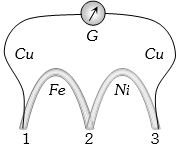
Three wires of copper,iron,and nickel are joined to form three junctions as shown in the figure. When the temperature of junction $1$ is kept at $50\,^{\circ}\text{C}$ with the other two junctions at $0\,^{\circ}\text{C}$,the sensitive galvanometer gives a deflection of $14$ divisions. When the temperature of junction $3$ is kept at $50\,^{\circ}\text{C}$,with the other two junctions at $0\,^{\circ}\text{C}$,the galvanometer gives a deflection of $11$ divisions. Then the deflection given by the galvanometer,when the temperature of junction $2$ is kept at $50\,^{\circ}\text{C}$,with the other two junctions at $0\,^{\circ}\text{C}$,will be (in $div$)
A
$3$
B
$11$
C
$14$
D
$25$
Solution
(D) Let $E_{12}$ be the thermo-emf generated by the junction pair $(1, 2)$ and $E_{23}$ be the thermo-emf generated by the junction pair $(2, 3)$.
According to the law of intermediate temperatures in thermoelectric circuits,the total emf $E$ in the circuit is the algebraic sum of the emfs generated by individual junctions.
When junction $1$ is at $50\,^{\circ}\text{C}$ and junctions $2$ and $3$ are at $0\,^{\circ}\text{C}$,the deflection is proportional to the emf $E_{12} = 14$ divisions.
When junction $3$ is at $50\,^{\circ}\text{C}$ and junctions $1$ and $2$ are at $0\,^{\circ}\text{C}$,the deflection is proportional to the emf $E_{23} = 11$ divisions.
When junction $2$ is at $50\,^{\circ}\text{C}$ and junctions $1$ and $3$ are at $0\,^{\circ}\text{C}$,the circuit effectively acts as two thermocouples in series,where the emf generated is the sum of the emfs of the two junctions,i.e.,$E = E_{12} + E_{23}$.
Therefore,the total deflection is $14 + 11 = 25$ divisions.
According to the law of intermediate temperatures in thermoelectric circuits,the total emf $E$ in the circuit is the algebraic sum of the emfs generated by individual junctions.
When junction $1$ is at $50\,^{\circ}\text{C}$ and junctions $2$ and $3$ are at $0\,^{\circ}\text{C}$,the deflection is proportional to the emf $E_{12} = 14$ divisions.
When junction $3$ is at $50\,^{\circ}\text{C}$ and junctions $1$ and $2$ are at $0\,^{\circ}\text{C}$,the deflection is proportional to the emf $E_{23} = 11$ divisions.
When junction $2$ is at $50\,^{\circ}\text{C}$ and junctions $1$ and $3$ are at $0\,^{\circ}\text{C}$,the circuit effectively acts as two thermocouples in series,where the emf generated is the sum of the emfs of the two junctions,i.e.,$E = E_{12} + E_{23}$.
Therefore,the total deflection is $14 + 11 = 25$ divisions.
0 likes
View Solution88
DifficultMCQ
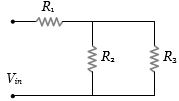
For ensuring the dissipation of the same energy in all three resistors $({R_1}, {R_2}, {R_3})$ connected as shown in the figure,their values must be related as:
A
${R_1} = {R_2} = {R_3}$
B
${R_2} = {R_3}$ and ${R_1} = 4{R_2}$
C
${R_2} = {R_3}$ and ${R_1} = \frac{1}{4}{R_2}$
D
${R_1} = {R_2} + {R_3}$
Solution
(C) Let the energy dissipated in each resistor be $H$. Since the resistors ${R_2}$ and ${R_3}$ are connected in parallel,the potential difference across them is the same. Therefore,the energy dissipated in them is given by $H = \frac{V^2}{R}t$. For the energy to be the same,we must have ${R_2} = {R_3}$.
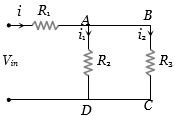
Let the total current flowing through the circuit be $i$. The current ${R_1}$ is $i$. The current splits into ${i_1}$ and ${i_2}$ at the junction. Since ${R_2} = {R_3}$,the current splits equally,so ${i_1} = {i_2} = \frac{i}{2}$.
The energy dissipated in ${R_1}$ is $H = i^2 {R_1} t$.
The energy dissipated in ${R_2}$ is $H = i_1^2 {R_2} t = (\frac{i}{2})^2 {R_2} t = \frac{i^2}{4} {R_2} t$.
Since the energy dissipated in all resistors is the same,we equate the energy in ${R_1}$ and ${R_2}$:
$i^2 {R_1} t = \frac{i^2}{4} {R_2} t$
${R_1} = \frac{{R_2}}{4}$.
Let the total current flowing through the circuit be $i$. The current ${R_1}$ is $i$. The current splits into ${i_1}$ and ${i_2}$ at the junction. Since ${R_2} = {R_3}$,the current splits equally,so ${i_1} = {i_2} = \frac{i}{2}$.
The energy dissipated in ${R_1}$ is $H = i^2 {R_1} t$.
The energy dissipated in ${R_2}$ is $H = i_1^2 {R_2} t = (\frac{i}{2})^2 {R_2} t = \frac{i^2}{4} {R_2} t$.
Since the energy dissipated in all resistors is the same,we equate the energy in ${R_1}$ and ${R_2}$:
$i^2 {R_1} t = \frac{i^2}{4} {R_2} t$
${R_1} = \frac{{R_2}}{4}$.
0 likes
View Solution89
MediumMCQ
Two different metals are joined end to end. One end is kept at a constant temperature and the other end is heated to a very high temperature. The graph depicting the thermo $e.m.f.$ $(E)$ versus temperature $(t)$ is:
A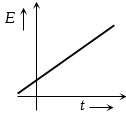
B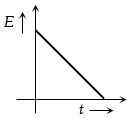
C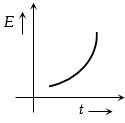
D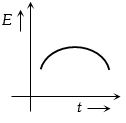
Solution
(D) The thermo $e.m.f.$ $(E)$ in a thermocouple is given by the relation: $E = \alpha \,t + \frac{1}{2}\beta \,{t^2}$,where $t$ is the temperature difference between the junctions,and $\alpha$ and $\beta$ are constants characteristic of the metals used.
This equation represents a parabola.
As the temperature difference $t$ increases,the $e.m.f.$ first increases,reaches a maximum value at the neutral temperature,and then decreases as the temperature increases further.
Therefore,the graph between $E$ and $t$ is a parabolic curve that opens downwards,which is represented by option $D$.
This equation represents a parabola.
As the temperature difference $t$ increases,the $e.m.f.$ first increases,reaches a maximum value at the neutral temperature,and then decreases as the temperature increases further.
Therefore,the graph between $E$ and $t$ is a parabolic curve that opens downwards,which is represented by option $D$.
0 likes
View Solution90
MediumMCQ
When an electric heater is switched on, the current flowing through it $(I)$ is plotted against time $(t)$. Taking into account the variation of resistance with temperature, which of the following best represents the resulting curve?
A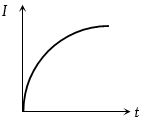
B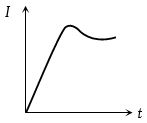
C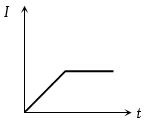
D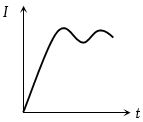
Solution
(A) The resistance $(R)$ of a metallic conductor (like the filament of a heater) increases with an increase in temperature according to the relation $R = R_0(1 + \alpha \Delta T)$.
Initially, when the heater is switched on, the filament is at room temperature, so its resistance is low. According to Ohm's law, $I = V/R$, a low resistance results in a high initial current.
As the filament heats up, its resistance increases. Consequently, the current flowing through the heater decreases over time.
As the heater reaches a steady operating temperature, the resistance also stabilizes, and the current reaches a steady state value.
Among the given options, the graph that shows a high initial current that decreases and then levels off to a constant value is represented by the curve in option $(A)$.
Initially, when the heater is switched on, the filament is at room temperature, so its resistance is low. According to Ohm's law, $I = V/R$, a low resistance results in a high initial current.
As the filament heats up, its resistance increases. Consequently, the current flowing through the heater decreases over time.
As the heater reaches a steady operating temperature, the resistance also stabilizes, and the current reaches a steady state value.
Among the given options, the graph that shows a high initial current that decreases and then levels off to a constant value is represented by the curve in option $(A)$.
0 likes
View Solution91
DifficultMCQ
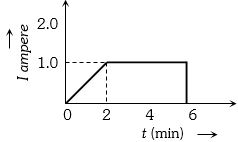
In a copper voltameter,the mass deposited in $6 \text{ min}$ is $m \text{ g}$. If the current-time graph for the voltameter is as shown in the figure,then the $E.C.E.$ of the copper is:
A
$m / 5$
B
$m / 300$
C
$5 m$
D
$m / 18000$
Solution
(B) According to Faraday's law of electrolysis,the mass $m$ deposited is given by $m = Z \cdot q$,where $Z$ is the $E.C.E.$ and $q$ is the total charge passed.
The total charge $q$ is equal to the area under the current-time $(I-t)$ graph.
The time is given in minutes,so we convert it to seconds: $t = 6 \text{ min} = 6 \times 60 \text{ s} = 360 \text{ s}$.
The area under the graph consists of a triangle (from $t = 0$ to $2 \text{ min}$) and a rectangle (from $t = 2 \text{ min}$ to $6 \text{ min}$).
Area of triangle $= \frac{1}{2} \times \text{base} \times \text{height} = \frac{1}{2} \times (2 \times 60 \text{ s}) \times 1 \text{ A} = 60 \text{ C}$.
Area of rectangle $= \text{length} \times \text{width} = (6 - 2) \times 60 \text{ s} \times 1 \text{ A} = 4 \times 60 \text{ C} = 240 \text{ C}$.
Total charge $q = 60 \text{ C} + 240 \text{ C} = 300 \text{ C}$.
Using the formula $m = Z \cdot q$,we get $Z = \frac{m}{q} = \frac{m}{300} \text{ g/C}$.
The total charge $q$ is equal to the area under the current-time $(I-t)$ graph.
The time is given in minutes,so we convert it to seconds: $t = 6 \text{ min} = 6 \times 60 \text{ s} = 360 \text{ s}$.
The area under the graph consists of a triangle (from $t = 0$ to $2 \text{ min}$) and a rectangle (from $t = 2 \text{ min}$ to $6 \text{ min}$).
Area of triangle $= \frac{1}{2} \times \text{base} \times \text{height} = \frac{1}{2} \times (2 \times 60 \text{ s}) \times 1 \text{ A} = 60 \text{ C}$.
Area of rectangle $= \text{length} \times \text{width} = (6 - 2) \times 60 \text{ s} \times 1 \text{ A} = 4 \times 60 \text{ C} = 240 \text{ C}$.
Total charge $q = 60 \text{ C} + 240 \text{ C} = 300 \text{ C}$.
Using the formula $m = Z \cdot q$,we get $Z = \frac{m}{q} = \frac{m}{300} \text{ g/C}$.
0 likes
View Solution92
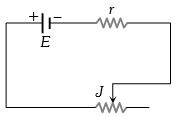
DifficultMCQ
The battery shown in the figure has an $e.m.f.$ $E$ and internal resistance $r$. The current in the circuit can be varied by sliding the contact $J$. If at any instant the current flowing through the circuit is $I$,the potential difference between the terminals of the cell is $V$,and the thermal power generated in the cell is equal to $\eta$ fraction of the total electrical power generated in it,then which of the following graphs is correct?
A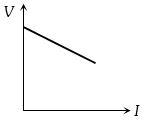
B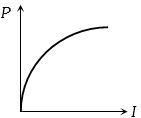
C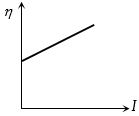
D
All of the above are correct
Solution
(D) $1$. For the terminal voltage $V$: The relation is $V = E - Ir$. This is a linear equation of the form $y = mx + c$,where the slope is $-r$ and the intercept is $E$. Thus,the graph of $V$ versus $I$ is a straight line with a negative slope.
$2$. For the external power $P$: The power dissipated in the external circuit is $P = VI = (E - Ir)I = EI - I^2r$. This is a downward-opening parabola with respect to $I$,passing through the origin $(0,0)$ and $(E/r, 0)$.
$3$. For the fraction $\eta$: The thermal power generated in the cell is $P_{thermal} = I^2r$. The total electrical power generated in the cell is $P_{total} = EI$. The fraction $\eta$ is given by $\eta = \frac{P_{thermal}}{P_{total}} = \frac{I^2r}{EI} = \frac{r}{E}I$. This is a linear equation of the form $y = mx$,representing a straight line passing through the origin.
Since all three relationships are correctly described by their respective graphs,the correct option is $(d)$.
$2$. For the external power $P$: The power dissipated in the external circuit is $P = VI = (E - Ir)I = EI - I^2r$. This is a downward-opening parabola with respect to $I$,passing through the origin $(0,0)$ and $(E/r, 0)$.
$3$. For the fraction $\eta$: The thermal power generated in the cell is $P_{thermal} = I^2r$. The total electrical power generated in the cell is $P_{total} = EI$. The fraction $\eta$ is given by $\eta = \frac{P_{thermal}}{P_{total}} = \frac{I^2r}{EI} = \frac{r}{E}I$. This is a linear equation of the form $y = mx$,representing a straight line passing through the origin.
Since all three relationships are correctly described by their respective graphs,the correct option is $(d)$.
0 likes
View Solution93
MediumMCQ
Which of the following circuits follows Ohm's law?
A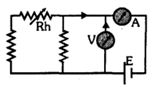
B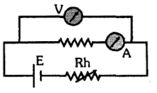
C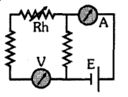
D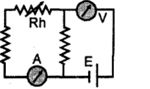
Solution
(B) To verify Ohm's law,the following conditions must be met:
$1$. An ammeter $(A)$ must be connected in series with the resistor to measure the current flowing through it.
$2$. $A$ voltmeter $(V)$ must be connected in parallel across the resistor to measure the potential difference across it.
$3$. $A$ rheostat $(Rh)$ is used to vary the current in the circuit.
Analyzing the given options:
- In option $(A)$,the voltmeter is in parallel with the ammeter,which is incorrect.
- In option $(B)$,the voltmeter is connected in parallel across the resistor,and the ammeter is in series with the resistor. This is the correct configuration for verifying Ohm's law.
- In option $(C)$,the voltmeter is in series with the resistor,which is incorrect.
- In option $(D)$,the ammeter is in series with the resistor,but the voltmeter is not connected across the resistor to measure the potential difference across it correctly.
Therefore,the circuit in option $(B)$ is the correct one.
$1$. An ammeter $(A)$ must be connected in series with the resistor to measure the current flowing through it.
$2$. $A$ voltmeter $(V)$ must be connected in parallel across the resistor to measure the potential difference across it.
$3$. $A$ rheostat $(Rh)$ is used to vary the current in the circuit.
Analyzing the given options:
- In option $(A)$,the voltmeter is in parallel with the ammeter,which is incorrect.
- In option $(B)$,the voltmeter is connected in parallel across the resistor,and the ammeter is in series with the resistor. This is the correct configuration for verifying Ohm's law.
- In option $(C)$,the voltmeter is in series with the resistor,which is incorrect.
- In option $(D)$,the ammeter is in series with the resistor,but the voltmeter is not connected across the resistor to measure the potential difference across it correctly.
Therefore,the circuit in option $(B)$ is the correct one.
0 likes
View Solution94
EasyMCQ
The variation of current flowing through an electric heater with time,when it is switched on,is shown in the figure. Considering the change in resistance with temperature,which of the following graphs is correct?
A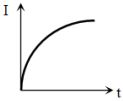
B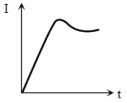
C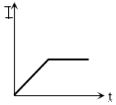
D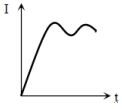
Solution
(A) When an electric heater is switched on,the filament is initially at room temperature,where its resistance is low.
According to Ohm's law,$I = V/R$. Since $R$ is low initially,the current $I$ is high.
As the filament heats up,its temperature increases,which causes its resistance $R$ to increase (since $R = R_0(1 + \alpha \Delta T)$).
As the resistance $R$ increases,the current $I$ decreases.
Eventually,the temperature of the filament reaches a steady state where the heat generated equals the heat lost to the surroundings,and the current becomes constant.
Graph $A$ shows the current starting at a high value and decreasing to a steady state value,which correctly represents this behavior.
According to Ohm's law,$I = V/R$. Since $R$ is low initially,the current $I$ is high.
As the filament heats up,its temperature increases,which causes its resistance $R$ to increase (since $R = R_0(1 + \alpha \Delta T)$).
As the resistance $R$ increases,the current $I$ decreases.
Eventually,the temperature of the filament reaches a steady state where the heat generated equals the heat lost to the surroundings,and the current becomes constant.
Graph $A$ shows the current starting at a high value and decreasing to a steady state value,which correctly represents this behavior.
0 likes
View Solution95
MediumMCQ
Consider the four circuits shown below. In which circuit is the power dissipated the maximum? (Neglect the internal resistance of the applied power source $E$)
A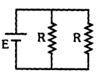
B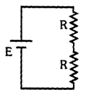
C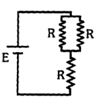
D
Solution
(A) The power dissipated in a circuit is given by $P = \frac{E^2}{R_{eq}}$,where $E$ is the $EMF$ of the source and $R_{eq}$ is the equivalent resistance of the circuit. To maximize power $P$,we need to minimize the equivalent resistance $R_{eq}$.
For circuit $A$: Two resistors $R$ are in parallel. $R_{eq,A} = \frac{R \cdot R}{R + R} = \frac{R}{2} = 0.5R$.
For circuit $B$: Two resistors $R$ are in series. $R_{eq,B} = R + R = 2R$.
For circuit $C$: Two resistors $R$ are in parallel,and this combination is in series with another resistor $R$. $R_{eq,C} = \frac{R}{2} + R = 1.5R$.
For circuit $D$: Two resistors $R$ are in series,and this combination is in parallel with another resistor $R$. $R_{eq,D} = \frac{(2R) \cdot R}{2R + R} = \frac{2R^2}{3R} = \frac{2}{3}R \approx 0.67R$.
Comparing the equivalent resistances: $R_{eq,A} (0.5R) < R_{eq,D} (0.67R) < R_{eq,C} (1.5R) < R_{eq,B} (2R)$.
Since circuit $A$ has the minimum equivalent resistance,it will dissipate the maximum power.
For circuit $A$: Two resistors $R$ are in parallel. $R_{eq,A} = \frac{R \cdot R}{R + R} = \frac{R}{2} = 0.5R$.
For circuit $B$: Two resistors $R$ are in series. $R_{eq,B} = R + R = 2R$.
For circuit $C$: Two resistors $R$ are in parallel,and this combination is in series with another resistor $R$. $R_{eq,C} = \frac{R}{2} + R = 1.5R$.
For circuit $D$: Two resistors $R$ are in series,and this combination is in parallel with another resistor $R$. $R_{eq,D} = \frac{(2R) \cdot R}{2R + R} = \frac{2R^2}{3R} = \frac{2}{3}R \approx 0.67R$.
Comparing the equivalent resistances: $R_{eq,A} (0.5R) < R_{eq,D} (0.67R) < R_{eq,C} (1.5R) < R_{eq,B} (2R)$.
Since circuit $A$ has the minimum equivalent resistance,it will dissipate the maximum power.
0 likes
View Solution96
EasyMCQ
The heat evolved or absorbed at the junction when an electric current passes through the junction of two different metals is known as which effect?
A
Joule effect
B
Seebeck effect
C
Peltier effect
D
Thomson effect
Solution
(C) The phenomenon where heat is evolved or absorbed at the junction of two dissimilar metals when an electric current passes through it is known as the $Peltier$ effect.
This is a reversible process,unlike the $Joule$ heating effect which is irreversible.
This is a reversible process,unlike the $Joule$ heating effect which is irreversible.
0 likes
View Solution97
DifficultMCQ
The current flowing through a copper voltameter is $1.5\ A$. If the surface area of the electrode plate is $50\ cm^2$,the thickness of the copper layer deposited on this surface in $20\ min$ will be: (Density of copper = $9000\ kg/m^3$ and Electrochemical equivalent of copper = $0.00033\ g/C$)
A
$2.6 \times 10^{-5}\ m$
B
$2.6 \times 10^{-4}\ m$
C
$1.3 \times 10^{-5}\ m$
D
$1.3 \times 10^{-4}\ m$
Solution
(C) The mass deposited $m$ is given by Faraday's law of electrolysis: $m = Z i t$.
Also,the mass can be expressed as $m = \rho \times V = \rho \times A \times x$,where $\rho$ is density,$A$ is area,and $x$ is thickness.
Equating the two expressions: $Z i t = \rho A x$.
Solving for thickness $x$: $x = \frac{Z i t}{A \rho}$.
Given: $Z = 0.00033\ g/C = 0.00033 \times 10^{-3}\ kg/C$,$i = 1.5\ A$,$t = 20 \times 60\ s = 1200\ s$,$A = 50\ cm^2 = 50 \times 10^{-4}\ m^2$,$\rho = 9000\ kg/m^3$.
Substituting the values: $x = \frac{0.00033 \times 10^{-3} \times 1.5 \times 1200}{50 \times 10^{-4} \times 9000}$.
$x = \frac{0.00033 \times 1.5 \times 1200}{50 \times 9000} \times 10^{-3} = \frac{0.594}{450000} \times 10^{-3} = 1.32 \times 10^{-6} \times 10 = 1.3 \times 10^{-5}\ m$.
Also,the mass can be expressed as $m = \rho \times V = \rho \times A \times x$,where $\rho$ is density,$A$ is area,and $x$ is thickness.
Equating the two expressions: $Z i t = \rho A x$.
Solving for thickness $x$: $x = \frac{Z i t}{A \rho}$.
Given: $Z = 0.00033\ g/C = 0.00033 \times 10^{-3}\ kg/C$,$i = 1.5\ A$,$t = 20 \times 60\ s = 1200\ s$,$A = 50\ cm^2 = 50 \times 10^{-4}\ m^2$,$\rho = 9000\ kg/m^3$.
Substituting the values: $x = \frac{0.00033 \times 10^{-3} \times 1.5 \times 1200}{50 \times 10^{-4} \times 9000}$.
$x = \frac{0.00033 \times 1.5 \times 1200}{50 \times 9000} \times 10^{-3} = \frac{0.594}{450000} \times 10^{-3} = 1.32 \times 10^{-6} \times 10 = 1.3 \times 10^{-5}\ m$.
0 likes
View Solution98
MediumMCQ
The two ends of a conductor are connected to a cell having an $e.m.f. \ E$ and some internal resistance. Starting from the midpoint $P$ of the conductor,moving in the direction of the current,and returning to point $P$,which of the following graphs best represents the potential $V$ versus the distance $x$ covered along the path?
A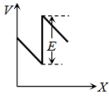
B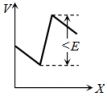
C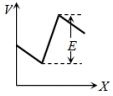
D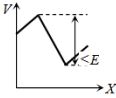
Solution
(B) As we move along the conductor in the direction of the current,the potential $V$ decreases linearly due to the resistance of the conductor $(V = IR)$.
When we cross the cell from the negative terminal to the positive terminal,the potential increases by an amount equal to the terminal voltage of the cell,which is given by $V = E - Ir$,where $r$ is the internal resistance.
Since $Ir > 0$,the increase in potential is strictly less than the $e.m.f. \ E$.
Therefore,the graph must show a linear decrease,followed by a sharp increase of magnitude less than $E$,and then another linear decrease.
Comparing this with the given options,Graph $B$ correctly depicts this behavior.
When we cross the cell from the negative terminal to the positive terminal,the potential increases by an amount equal to the terminal voltage of the cell,which is given by $V = E - Ir$,where $r$ is the internal resistance.
Since $Ir > 0$,the increase in potential is strictly less than the $e.m.f. \ E$.
Therefore,the graph must show a linear decrease,followed by a sharp increase of magnitude less than $E$,and then another linear decrease.
Comparing this with the given options,Graph $B$ correctly depicts this behavior.
0 likes
View Solution99
DifficultMCQ
An ammeter with a zero error is connected in series with a silver voltameter. The ammeter reads $0.54 \ A$. In $1 \ hour$, $2.0124 \ g$ of silver is deposited. If the electrochemical equivalent of silver is $1.118 \times 10^{-3} \ g \ C^{-1}$, then the error in the ammeter reading is ............... $A$.
A
$+ 0.04$
B
$+ 0.02$
C
$- 0.03$
D
$- 0.01$
Solution
(A) According to Faraday's law of electrolysis, the mass $m$ deposited is given by $m = ZIt$, where $Z$ is the electrochemical equivalent, $I$ is the actual current, and $t$ is the time in seconds.
Given: $m = 2.0124 \ g$, $Z = 1.118 \times 10^{-3} \ g \ C^{-1}$, $t = 1 \ hour = 3600 \ s$.
The actual current $I$ is calculated as:
$I = \frac{m}{Zt} = \frac{2.0124}{1.118 \times 10^{-3} \times 3600}$
$I = \frac{2.0124}{4.0248} = 0.5 \ A$.
The ammeter reading is $I_{obs} = 0.54 \ A$.
The error in the ammeter reading is defined as $I_{obs} - I_{actual}$.
Error $= 0.54 \ A - 0.5 \ A = +0.04 \ A$.
Given: $m = 2.0124 \ g$, $Z = 1.118 \times 10^{-3} \ g \ C^{-1}$, $t = 1 \ hour = 3600 \ s$.
The actual current $I$ is calculated as:
$I = \frac{m}{Zt} = \frac{2.0124}{1.118 \times 10^{-3} \times 3600}$
$I = \frac{2.0124}{4.0248} = 0.5 \ A$.
The ammeter reading is $I_{obs} = 0.54 \ A$.
The error in the ammeter reading is defined as $I_{obs} - I_{actual}$.
Error $= 0.54 \ A - 0.5 \ A = +0.04 \ A$.
0 likes
View Solution100
DifficultMCQ
$A$ copper voltameter is connected in parallel with a heater coil of resistance $0.1\,\Omega$. $A$ current is passed for $20\,\text{minutes}$,resulting in the deposition of $0.99\,\text{g}$ of copper on the cathode. If the electrochemical equivalent of copper is $0.00033\,\text{g/C}$,the heat produced in the coil is ........... $J$.
A
$750$
B
$650$
C
$350$
D
$250$
Solution
(A) Given:
Resistance of the coil,$R = 0.1\,\Omega$
Time,$t = 20\,\text{minutes} = 20 \times 60 = 1200\,\text{s}$
Mass of copper deposited,$m = 0.99\,\text{g}$
Electrochemical equivalent,$Z = 0.00033\,\text{g/C}$
Using Faraday's law of electrolysis,$m = Z \times i \times t$:
$i = \frac{m}{Z \times t} = \frac{0.99}{0.00033 \times 1200} = \frac{0.99}{0.396} = 2.5\,\text{A}$
The heat produced in the coil is given by Joule's law of heating,$H = i^2Rt$:
$H = (2.5)^2 \times 0.1 \times 1200$
$H = 6.25 \times 0.1 \times 1200$
$H = 0.625 \times 1200 = 750\,\text{J}$
Resistance of the coil,$R = 0.1\,\Omega$
Time,$t = 20\,\text{minutes} = 20 \times 60 = 1200\,\text{s}$
Mass of copper deposited,$m = 0.99\,\text{g}$
Electrochemical equivalent,$Z = 0.00033\,\text{g/C}$
Using Faraday's law of electrolysis,$m = Z \times i \times t$:
$i = \frac{m}{Z \times t} = \frac{0.99}{0.00033 \times 1200} = \frac{0.99}{0.396} = 2.5\,\text{A}$
The heat produced in the coil is given by Joule's law of heating,$H = i^2Rt$:
$H = (2.5)^2 \times 0.1 \times 1200$
$H = 6.25 \times 0.1 \times 1200$
$H = 0.625 \times 1200 = 750\,\text{J}$
0 likes
View SolutionCurrent Electricity — Mix Examples-Current Electricity · Frequently Asked Questions
1Are these Current Electricity questions useful for JEE and NEET?
Yes. All questions in this section are mapped to JEE Main and NEET exam patterns. Previous year questions from JEE Main, NEET, GUJCET and state-level exams are included with full solutions.
2Can I switch to Hindi or Gujarati for these questions?
Yes. Use the language tabs in the hero section or the sidebar to view the same questions and solutions in English, Hindi or Gujarati.
3How do I generate a question paper from this subtopic?
Use the Vedclass Exam Paper Generator — select the chapter and subtopic, set difficulty, and generate Sets A, B, C, D automatically. First 3 chapters of every subject are free.
Vedclass Products
For Students
Vedclass Test Series
Mock tests in real JEE/NEET style with performance analysis. 5-day free trial.
Start Free TrialFor Teachers
Exam Paper Generator
Generate Set A/B/C/D papers from this chapter in 2 minutes. 3 chapters free.
Try FreeFor Institutes
Online Exam Module
Live online exams with unlimited students, 360° analytics & white-label branding.
See DemoFor Teachers & Institutes
Generate a Current Electricity Exam Paper in 2 Minutes
Select subtopic & difficulty — Sets A, B, C, D auto-generated with No Repeat logic.
First 3 chapters of every subject are free — no payment required.