
A English
Electric Current Questions in English
Class 12 Physics · Current Electricity · Electric Current
78+
Questions
English
Language
100%
With Solutions
Showing 49 of 78 questions in English
1
EasyMCQ
$Ampere-hour$ is a unit of
A
Quantity of electricity
B
Strength of electric current
C
Power
D
Energy
Solution
(A) The unit $Ampere-hour$ $(Ah)$ is derived from the formula for electric charge.
Charge $(Q)$ is equal to the product of current $(I)$ and time $(t)$,expressed as $Q = I \times t$.
Since the unit of current is $Ampere$ $(A)$ and the unit of time is $hour$ $(h)$,the product $Ampere-hour$ represents the total quantity of electricity or electric charge.
Therefore,the correct option is $A$.
Charge $(Q)$ is equal to the product of current $(I)$ and time $(t)$,expressed as $Q = I \times t$.
Since the unit of current is $Ampere$ $(A)$ and the unit of time is $hour$ $(h)$,the product $Ampere-hour$ represents the total quantity of electricity or electric charge.
Therefore,the correct option is $A$.
0 likes
View Solution2
MediumMCQ
The quantity $X = \frac{\varepsilon_0 LV}{t}$,where $\varepsilon_0$ is the permittivity of free space,$L$ is length,$V$ is potential difference,and $t$ is time. The dimensions of $X$ are the same as those of:
A
Resistance
B
Charge
C
Voltage
D
Current
Solution
(D) We know that the capacitance $C$ of a parallel plate capacitor is given by $C = \frac{\varepsilon_0 A}{d}$.
Since $A$ has dimensions of $L^2$ and $d$ has dimensions of $L$,the dimensions of $\varepsilon_0 L$ are equivalent to the dimensions of capacitance $C$.
Substituting this into the expression for $X$:
$X = \frac{(\varepsilon_0 L) V}{t} = \frac{C V}{t}$.
Since $Q = CV$,we have $X = \frac{Q}{t}$.
The rate of flow of charge $Q$ with respect to time $t$ is defined as current $I$.
Therefore,the dimensions of $X$ are the same as those of current.
Since $A$ has dimensions of $L^2$ and $d$ has dimensions of $L$,the dimensions of $\varepsilon_0 L$ are equivalent to the dimensions of capacitance $C$.
Substituting this into the expression for $X$:
$X = \frac{(\varepsilon_0 L) V}{t} = \frac{C V}{t}$.
Since $Q = CV$,we have $X = \frac{Q}{t}$.
The rate of flow of charge $Q$ with respect to time $t$ is defined as current $I$.
Therefore,the dimensions of $X$ are the same as those of current.
0 likes
View Solution3
EasyMCQ
$A$ current of $4.8\,A$ is flowing through a conductor. The number of electrons flowing per second is:
A
$3 \times 10^{19}$
B
$7.68 \times 10^{21}$
C
$7.68 \times 10^{20}$
D
$3 \times 10^{20}$
Solution
(A) The current $I$ is defined as the rate of flow of charge,given by $I = \frac{q}{t}$.
Since the total charge $q$ is the product of the number of electrons $n$ and the elementary charge $e$ $(q = ne)$,we can write $I = \frac{ne}{t}$.
To find the number of electrons per second,we rearrange the formula to solve for $\frac{n}{t}$:
$\frac{n}{t} = \frac{I}{e}$.
Given $I = 4.8\,A$ and $e = 1.6 \times 10^{-19}\,C$,we substitute these values:
$\frac{n}{t} = \frac{4.8}{1.6 \times 10^{-19}} = 3 \times 10^{19}$.
Therefore,the number of electrons flowing per second is $3 \times 10^{19}$.
Since the total charge $q$ is the product of the number of electrons $n$ and the elementary charge $e$ $(q = ne)$,we can write $I = \frac{ne}{t}$.
To find the number of electrons per second,we rearrange the formula to solve for $\frac{n}{t}$:
$\frac{n}{t} = \frac{I}{e}$.
Given $I = 4.8\,A$ and $e = 1.6 \times 10^{-19}\,C$,we substitute these values:
$\frac{n}{t} = \frac{4.8}{1.6 \times 10^{-19}} = 3 \times 10^{19}$.
Therefore,the number of electrons flowing per second is $3 \times 10^{19}$.
0 likes
View Solution4
EasyMCQ
In a conductor,$4$ coulombs of charge flows for $2$ seconds. The value of electric current will be:
A
$4$ $V$
B
$4$ $A$
C
$2$ $A$
D
$2$ $V$
Solution
(C) The electric current $I$ is defined as the rate of flow of charge through a conductor.
It is given by the formula: $I = \frac{q}{t}$
Given:
Charge $q = 4 \, C$
Time $t = 2 \, s$
Substituting the values into the formula:
$I = \frac{4 \, C}{2 \, s} = 2 \, A$
Therefore,the electric current is $2 \, A$.
It is given by the formula: $I = \frac{q}{t}$
Given:
Charge $q = 4 \, C$
Time $t = 2 \, s$
Substituting the values into the formula:
$I = \frac{4 \, C}{2 \, s} = 2 \, A$
Therefore,the electric current is $2 \, A$.
0 likes
View Solution5
EasyMCQ
$62.5 \times 10^{18}$ electrons per second are flowing through a wire of area of cross-section $0.1 \, m^2$. The value of the current flowing will be ............ $A$.
A
$1$
B
$0.1$
C
$10$
D
$0.11$
Solution
(C) The current $I$ is defined as the rate of flow of charge,given by the formula $I = \frac{q}{t}$.
Since $q = ne$,where $n$ is the number of electrons and $e$ is the elementary charge $(1.6 \times 10^{-19} \, C)$,we have $I = \frac{ne}{t}$.
Given $n/t = 62.5 \times 10^{18} \, s^{-1}$ and $e = 1.6 \times 10^{-19} \, C$:
$I = (62.5 \times 10^{18}) \times (1.6 \times 10^{-19}) \, A$
$I = 62.5 \times 1.6 \times 10^{-1} \, A$
$I = 100 \times 10^{-1} \, A = 10 \, A$.
Therefore,the current flowing through the wire is $10 \, A$.
Since $q = ne$,where $n$ is the number of electrons and $e$ is the elementary charge $(1.6 \times 10^{-19} \, C)$,we have $I = \frac{ne}{t}$.
Given $n/t = 62.5 \times 10^{18} \, s^{-1}$ and $e = 1.6 \times 10^{-19} \, C$:
$I = (62.5 \times 10^{18}) \times (1.6 \times 10^{-19}) \, A$
$I = 62.5 \times 1.6 \times 10^{-1} \, A$
$I = 100 \times 10^{-1} \, A = 10 \, A$.
Therefore,the current flowing through the wire is $10 \, A$.
0 likes
View Solution6
MediumMCQ
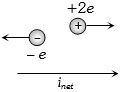
In an electrolyte,$3.2 \times 10^{18}$ bivalent positive ions drift to the right per second,while $3.6 \times 10^{18}$ monovalent negative ions drift to the left per second. Then the current is:
A
$1.6 \, A$ to the left
B
$1.6 \, A$ to the right
C
$0.45 \, A$ to the right
D
$0.45 \, A$ to the left
Solution
(B) The current due to positive ions moving to the right is $i_{(+)} = \frac{n_{(+)} q_{(+)}}{t} = (3.2 \times 10^{18}) \times (2e) / 1 \, s = 6.4 \times 10^{18} \times 1.6 \times 10^{-19} = 1.024 \, A$ (to the right).
The current due to negative ions moving to the left is equivalent to a current of positive charge moving to the right. Thus,$i_{(-)} = \frac{n_{(-)} q_{(-)}}{t} = (3.6 \times 10^{18}) \times (e) / 1 \, s = 3.6 \times 10^{18} \times 1.6 \times 10^{-19} = 0.576 \, A$ (to the right).
The net current is $i_{net} = i_{(+)} + i_{(-)} = 1.024 \, A + 0.576 \, A = 1.6 \, A$ (to the right).
The current due to negative ions moving to the left is equivalent to a current of positive charge moving to the right. Thus,$i_{(-)} = \frac{n_{(-)} q_{(-)}}{t} = (3.6 \times 10^{18}) \times (e) / 1 \, s = 3.6 \times 10^{18} \times 1.6 \times 10^{-19} = 0.576 \, A$ (to the right).
The net current is $i_{net} = i_{(+)} + i_{(-)} = 1.024 \, A + 0.576 \, A = 1.6 \, A$ (to the right).
0 likes
View Solution7
EasyMCQ
$5 \, A$ of current is passed through a metallic conductor. The charge flowing in one minute in coulombs will be:
A
$5$
B
$12$
C
$1/12$
D
$300$
Solution
(D) The relationship between charge $(Q)$,current $(I)$,and time $(t)$ is given by the formula: $Q = I \times t$.
Given:
Current $(I)$ = $5 \, A$
Time $(t)$ = $1 \text{ minute} = 60 \, s$
Substituting the values into the formula:
$Q = 5 \, A \times 60 \, s = 300 \, C$.
Therefore,the charge flowing through the conductor is $300 \, C$.
Given:
Current $(I)$ = $5 \, A$
Time $(t)$ = $1 \text{ minute} = 60 \, s$
Substituting the values into the formula:
$Q = 5 \, A \times 60 \, s = 300 \, C$.
Therefore,the charge flowing through the conductor is $300 \, C$.
0 likes
View Solution8
MediumMCQ
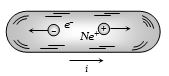
In a neon discharge tube,$2.9 \times 10^{18}$ $Ne^+$ ions move to the right each second,while $1.2 \times 10^{18}$ electrons move to the left per second. The electron charge is $1.6 \times 10^{-19} \, C$. The current in the discharge tube is:
A
$1 \, A$ towards right
B
$0.66 \, A$ towards right
C
$0.66 \, A$ towards left
D
Zero
Solution
(B) The current $i$ is defined as the rate of flow of charge. When both positive and negative charges move in opposite directions,their currents add up in the direction of the positive charge flow.
Let $n_+$ be the number of positive ions moving to the right per second and $n_-$ be the number of electrons moving to the left per second.
The current due to positive ions is $i_+ = \frac{n_+ e}{t} = 2.9 \times 10^{18} \times 1.6 \times 10^{-19} \, A = 0.464 \, A$ (towards the right).
The current due to electrons is $i_- = \frac{n_- e}{t} = 1.2 \times 10^{18} \times 1.6 \times 10^{-19} \, A = 0.192 \, A$ (towards the right,because electrons moving to the left constitute a current to the right).
The total current $i = i_+ + i_- = 0.464 \, A + 0.192 \, A = 0.656 \, A \approx 0.66 \, A$ towards the right.
Let $n_+$ be the number of positive ions moving to the right per second and $n_-$ be the number of electrons moving to the left per second.
The current due to positive ions is $i_+ = \frac{n_+ e}{t} = 2.9 \times 10^{18} \times 1.6 \times 10^{-19} \, A = 0.464 \, A$ (towards the right).
The current due to electrons is $i_- = \frac{n_- e}{t} = 1.2 \times 10^{18} \times 1.6 \times 10^{-19} \, A = 0.192 \, A$ (towards the right,because electrons moving to the left constitute a current to the right).
The total current $i = i_+ + i_- = 0.464 \, A + 0.192 \, A = 0.656 \, A \approx 0.66 \, A$ towards the right.
0 likes
View Solution9
EasyMCQ
$A$ steady current flows in a metallic conductor of non-uniform cross-section. The quantity/quantities constant along the length of the conductor is/are:
A
Current,electric field and drift speed
B
Drift speed only
C
Current and drift speed
D
Current only
Solution
(D) For a steady current $i$ flowing through a conductor,the charge conservation principle implies that the current $i$ must be constant at every cross-section of the conductor.
The current density is given by $j = \frac{i}{A}$,where $A$ is the cross-sectional area. Since $A$ varies along the length,$j$ is not constant.
From Ohm's law in microscopic form,$j = \sigma E$. Since $j$ varies,the electric field $E$ must also vary along the length.
Furthermore,the drift velocity is given by ${v_d} = \frac{j}{ne} = \frac{i}{Ane}$. Since $A$ varies,the drift velocity ${v_d}$ is also not constant.
Therefore,only the current $i$ remains constant along the length of the conductor.
The current density is given by $j = \frac{i}{A}$,where $A$ is the cross-sectional area. Since $A$ varies along the length,$j$ is not constant.
From Ohm's law in microscopic form,$j = \sigma E$. Since $j$ varies,the electric field $E$ must also vary along the length.
Furthermore,the drift velocity is given by ${v_d} = \frac{j}{ne} = \frac{i}{Ane}$. Since $A$ varies,the drift velocity ${v_d}$ is also not constant.
Therefore,only the current $i$ remains constant along the length of the conductor.
0 likes
View Solution10
EasyMCQ
$A$ current of $20\,\mu A$ flows for $30$ seconds in a wire. The total charge transferred will be:
A
$2 \times 10^{-4}\,C$
B
$4 \times 10^{-4}\,C$
C
$6 \times 10^{-4}\,C$
D
$8 \times 10^{-4}\,C$
Solution
(C) The relationship between current $(I)$,time $(t)$,and charge $(Q)$ is given by the formula: $Q = I \times t$.
Given:
Current $(I)$ = $20\,\mu A = 20 \times 10^{-6}\,A$
Time $(t)$ = $30\,s$
Substituting these values into the formula:
$Q = (20 \times 10^{-6}\,A) \times (30\,s)$
$Q = 600 \times 10^{-6}\,C$
$Q = 6 \times 10^{-4}\,C$
Therefore,the correct option is $C$.
Given:
Current $(I)$ = $20\,\mu A = 20 \times 10^{-6}\,A$
Time $(t)$ = $30\,s$
Substituting these values into the formula:
$Q = (20 \times 10^{-6}\,A) \times (30\,s)$
$Q = 600 \times 10^{-6}\,C$
$Q = 6 \times 10^{-4}\,C$
Therefore,the correct option is $C$.
0 likes
View Solution11
EasyMCQ
If a current of $1.6 \, mA$ is flowing in a conducting wire,then the number of electrons flowing per second is:
A
$10^{11}$
B
$10^{16}$
C
$10^{19}$
D
$10^{15}$
Solution
(B) The formula for electric current is $I = \frac{q}{t} = \frac{ne}{t}$,where $I$ is the current,$n$ is the number of electrons,$e$ is the elementary charge,and $t$ is the time.
Given: $I = 1.6 \, mA = 1.6 \times 10^{-3} \, A$,$t = 1 \, s$,and $e = 1.6 \times 10^{-19} \, C$.
Rearranging the formula to solve for $n$: $n = \frac{I \times t}{e}$.
Substituting the values: $n = \frac{1.6 \times 10^{-3} \times 1}{1.6 \times 10^{-19}}$.
$n = 10^{-3} \times 10^{19} = 10^{16}$.
Therefore,the number of electrons flowing per second is $10^{16}$.
Given: $I = 1.6 \, mA = 1.6 \times 10^{-3} \, A$,$t = 1 \, s$,and $e = 1.6 \times 10^{-19} \, C$.
Rearranging the formula to solve for $n$: $n = \frac{I \times t}{e}$.
Substituting the values: $n = \frac{1.6 \times 10^{-3} \times 1}{1.6 \times 10^{-19}}$.
$n = 10^{-3} \times 10^{19} = 10^{16}$.
Therefore,the number of electrons flowing per second is $10^{16}$.
0 likes
View Solution12
EasyMCQ
If an electron revolves in a circular path of radius $0.5 \times 10^{-10} \ m$ at a frequency of $5 \times 10^{15} \ Hz$,the electric current in the circle is .................. $mA$. (Charge of an electron $= 1.6 \times 10^{-19} \ C$)
A
$0.4$
B
$0.8$
C
$1.2$
D
$1.6$
Solution
(B) The electric current $i$ is defined as the rate of flow of charge,given by $i = \frac{q}{T}$.
Since the frequency $\nu = \frac{1}{T}$,we can write the current as $i = q \times \nu$.
Given:
Charge of an electron $q = 1.6 \times 10^{-19} \ C$
Frequency $\nu = 5 \times 10^{15} \ Hz$
Substituting the values:
$i = (1.6 \times 10^{-19} \ C) \times (5 \times 10^{15} \ Hz)$
$i = 8.0 \times 10^{-4} \ A$
To convert the current into $mA$ (milliampere),we multiply by $10^3$:
$i = 8.0 \times 10^{-4} \times 10^3 \ mA = 0.8 \ mA$.
Since the frequency $\nu = \frac{1}{T}$,we can write the current as $i = q \times \nu$.
Given:
Charge of an electron $q = 1.6 \times 10^{-19} \ C$
Frequency $\nu = 5 \times 10^{15} \ Hz$
Substituting the values:
$i = (1.6 \times 10^{-19} \ C) \times (5 \times 10^{15} \ Hz)$
$i = 8.0 \times 10^{-4} \ A$
To convert the current into $mA$ (milliampere),we multiply by $10^3$:
$i = 8.0 \times 10^{-4} \times 10^3 \ mA = 0.8 \ mA$.
0 likes
View Solution13
EasyMCQ
An electron (charge $= 1.6 \times 10^{-19} \text{ C}$) is moving in a circle of radius $5.1 \times 10^{-11} \text{ m}$ at a frequency of $6.8 \times 10^{15} \text{ rev/s}$. The equivalent current is approximately:
A
$5.1 \times 10^{-3} \text{ A}$
B
$6.8 \times 10^{-3} \text{ A}$
C
$1.1 \times 10^{-3} \text{ A}$
D
$2.2 \times 10^{-3} \text{ A}$
Solution
(C) The equivalent current $i$ produced by a revolving charge is given by the formula $i = q \times \nu$,where $q$ is the charge and $\nu$ is the frequency of revolution.
Given:
Charge of electron $q = 1.6 \times 10^{-19} \text{ C}$
Frequency $\nu = 6.8 \times 10^{15} \text{ rev/s}$
Substituting the values:
$i = (1.6 \times 10^{-19} \text{ C}) \times (6.8 \times 10^{15} \text{ s}^{-1})$
$i = 10.88 \times 10^{-4} \text{ A}$
$i \approx 1.1 \times 10^{-3} \text{ A}$
Therefore,the correct option is $C$.
Given:
Charge of electron $q = 1.6 \times 10^{-19} \text{ C}$
Frequency $\nu = 6.8 \times 10^{15} \text{ rev/s}$
Substituting the values:
$i = (1.6 \times 10^{-19} \text{ C}) \times (6.8 \times 10^{15} \text{ s}^{-1})$
$i = 10.88 \times 10^{-4} \text{ A}$
$i \approx 1.1 \times 10^{-3} \text{ A}$
Therefore,the correct option is $C$.
0 likes
View Solution14
EasyMCQ
An electron revolves $6 \times 10^{15}$ times per second in a circular loop. The current in the loop is:
A
$0.96 \, mA$
B
$0.96 \, \mu A$
C
$28.8 \, A$
D
None of these
Solution
(A) The current $i$ in a loop is given by the formula $i = q \times f$,where $q$ is the charge of the electron and $f$ is the frequency of revolution.
Given:
Frequency $f = 6 \times 10^{15} \, \text{Hz}$
Charge of an electron $q = 1.6 \times 10^{-19} \, \text{C}$
Substituting the values:
$i = (1.6 \times 10^{-19} \, \text{C}) \times (6 \times 10^{15} \, \text{Hz})$
$i = 9.6 \times 10^{-4} \, \text{A}$
$i = 0.96 \times 10^{-3} \, \text{A} = 0.96 \, \text{mA}$.
Given:
Frequency $f = 6 \times 10^{15} \, \text{Hz}$
Charge of an electron $q = 1.6 \times 10^{-19} \, \text{C}$
Substituting the values:
$i = (1.6 \times 10^{-19} \, \text{C}) \times (6 \times 10^{15} \, \text{Hz})$
$i = 9.6 \times 10^{-4} \, \text{A}$
$i = 0.96 \times 10^{-3} \, \text{A} = 0.96 \, \text{mA}$.
0 likes
View Solution15
EasyMCQ
The charge of an electron is $1.6 \times 10^{-19} \ C$. How many electrons strike the screen of a cathode ray tube each second when the beam current is $16 \ mA$?
A
$10^{17}$
B
$10^{19}$
C
$10^{-19}$
D
$10^{-17}$
Solution
(A) The formula for electric current is $I = \frac{q}{t}$,where $q = ne$.
Given current $I = 16 \ mA = 16 \times 10^{-3} \ A$ and time $t = 1 \ s$.
The charge of an electron $e = 1.6 \times 10^{-19} \ C$.
Substituting the values into the equation: $16 \times 10^{-3} = \frac{n \times 1.6 \times 10^{-19}}{1}$.
Solving for $n$: $n = \frac{16 \times 10^{-3}}{1.6 \times 10^{-19}} = 10 \times 10^{16} = 10^{17}$.
Therefore,$10^{17}$ electrons strike the screen each second.
Given current $I = 16 \ mA = 16 \times 10^{-3} \ A$ and time $t = 1 \ s$.
The charge of an electron $e = 1.6 \times 10^{-19} \ C$.
Substituting the values into the equation: $16 \times 10^{-3} = \frac{n \times 1.6 \times 10^{-19}}{1}$.
Solving for $n$: $n = \frac{16 \times 10^{-3}}{1.6 \times 10^{-19}} = 10 \times 10^{16} = 10^{17}$.
Therefore,$10^{17}$ electrons strike the screen each second.
0 likes
View Solution16
EasyMCQ
$A$ current of $1\, mA$ is flowing through a copper wire. How many electrons will pass a given point in one second?
A
$6.25 \times 10^{19}$
B
$6.25 \times 10^{15}$
C
$6.25 \times 10^{31}$
D
$6.25 \times 10^{8}$
Solution
(B) The current $I$ is given by $I = \frac{q}{t}$,where $q = ne$.
Given $I = 1\, mA = 1 \times 10^{-3}\, A$ and $t = 1\, s$.
The charge of an electron is $e = 1.6 \times 10^{-19}\, C$.
Using the formula $I = \frac{ne}{t}$,we can solve for the number of electrons $n$:
$n = \frac{I \times t}{e} = \frac{1 \times 10^{-3} \times 1}{1.6 \times 10^{-19}}$
$n = \frac{1}{1.6} \times 10^{16} = 0.625 \times 10^{16} = 6.25 \times 10^{15}$.
Therefore,$6.25 \times 10^{15}$ electrons will pass the point in one second.
Given $I = 1\, mA = 1 \times 10^{-3}\, A$ and $t = 1\, s$.
The charge of an electron is $e = 1.6 \times 10^{-19}\, C$.
Using the formula $I = \frac{ne}{t}$,we can solve for the number of electrons $n$:
$n = \frac{I \times t}{e} = \frac{1 \times 10^{-3} \times 1}{1.6 \times 10^{-19}}$
$n = \frac{1}{1.6} \times 10^{16} = 0.625 \times 10^{16} = 6.25 \times 10^{15}$.
Therefore,$6.25 \times 10^{15}$ electrons will pass the point in one second.
0 likes
View Solution17
EasyMCQ
In a hydrogen discharge tube,it is observed that through a given cross-section,$3.13 \times 10^{15}$ electrons are moving from right to left and $3.12 \times 10^{15}$ protons are moving from left to right per second. What is the electric current in the discharge tube and what is its direction?
A
$1\,mA$ towards right
B
$1\,mA$ towards left
C
$2\,mA$ towards left
D
$2\,mA$ towards right
Solution
(A) The electric current $I$ is defined as the rate of flow of net charge through a cross-section.
Electrons moving from right to left constitute a current from left to right.
Protons moving from left to right constitute a current from left to right.
Since both currents are in the same direction,they add up.
$I = I_e + I_p = (n_e e) + (n_p e) = (n_e + n_p)e$
Given $n_e = 3.13 \times 10^{15}$ and $n_p = 3.12 \times 10^{15}$,and $e = 1.6 \times 10^{-19}\,C$.
$I = (3.13 \times 10^{15} + 3.12 \times 10^{15}) \times 1.6 \times 10^{-19}\,A$
$I = (6.25 \times 10^{15}) \times 1.6 \times 10^{-19}\,A$
$I = 10 \times 10^{-4}\,A = 10^{-3}\,A = 1\,mA$.
Since both components of the current are directed from left to right,the total current is $1\,mA$ towards the right.
Electrons moving from right to left constitute a current from left to right.
Protons moving from left to right constitute a current from left to right.
Since both currents are in the same direction,they add up.
$I = I_e + I_p = (n_e e) + (n_p e) = (n_e + n_p)e$
Given $n_e = 3.13 \times 10^{15}$ and $n_p = 3.12 \times 10^{15}$,and $e = 1.6 \times 10^{-19}\,C$.
$I = (3.13 \times 10^{15} + 3.12 \times 10^{15}) \times 1.6 \times 10^{-19}\,A$
$I = (6.25 \times 10^{15}) \times 1.6 \times 10^{-19}\,A$
$I = 10 \times 10^{-4}\,A = 10^{-3}\,A = 1\,mA$.
Since both components of the current are directed from left to right,the total current is $1\,mA$ towards the right.
0 likes
View Solution18
EasyMCQ
$A$ steady current $i$ is flowing through a conductor of uniform cross-section. Any segment of the conductor has
A
Zero charge
B
Only positive charge
C
Only negative charge
D
Charge proportional to current $i$
Solution
(A) When a steady current $i$ flows through a conductor,the rate of flow of charge into any segment is equal to the rate of flow of charge out of that segment.
Since the number of electrons entering one end of any segment is exactly equal to the number of electrons leaving the other end,the net charge within any segment of the conductor remains constant.
Because the conductor is electrically neutral to begin with,this net charge is zero.
Therefore,any segment of the conductor has zero net charge.
Since the number of electrons entering one end of any segment is exactly equal to the number of electrons leaving the other end,the net charge within any segment of the conductor remains constant.
Because the conductor is electrically neutral to begin with,this net charge is zero.
Therefore,any segment of the conductor has zero net charge.
0 likes
View Solution19
MediumMCQ
$A$ source of $e.m.f.$ $E = 15\,V$ and having negligible internal resistance is connected to a variable resistance so that the current in the circuit increases with time as $i = 1.2t + 3$. Then,the total charge that will flow in the first five seconds will be ............... $C$.
A
$10$
B
$20$
C
$30$
D
$40$
Solution
(C) The relationship between current $i$ and charge $Q$ is given by $i = \frac{dQ}{dt}$.
Therefore,the charge $dQ$ flowing in a small time interval $dt$ is $dQ = i \, dt$.
To find the total charge $Q$ flowing in the first $5$ seconds,we integrate the current with respect to time from $t = 0$ to $t = 5$:
$Q = \int_{0}^{5} i \, dt = \int_{0}^{5} (1.2t + 3) \, dt$
$Q = \left[ \frac{1.2t^2}{2} + 3t \right]_{0}^{5}$
$Q = [0.6t^2 + 3t]_{0}^{5}$
Substituting the limits:
$Q = (0.6 \times 5^2 + 3 \times 5) - (0.6 \times 0^2 + 3 \times 0)$
$Q = (0.6 \times 25 + 15) - 0$
$Q = 15 + 15 = 30\,C$.
Therefore,the charge $dQ$ flowing in a small time interval $dt$ is $dQ = i \, dt$.
To find the total charge $Q$ flowing in the first $5$ seconds,we integrate the current with respect to time from $t = 0$ to $t = 5$:
$Q = \int_{0}^{5} i \, dt = \int_{0}^{5} (1.2t + 3) \, dt$
$Q = \left[ \frac{1.2t^2}{2} + 3t \right]_{0}^{5}$
$Q = [0.6t^2 + 3t]_{0}^{5}$
Substituting the limits:
$Q = (0.6 \times 5^2 + 3 \times 5) - (0.6 \times 0^2 + 3 \times 0)$
$Q = (0.6 \times 25 + 15) - 0$
$Q = 15 + 15 = 30\,C$.
0 likes
View Solution20
MediumMCQ
The current in a conductor varies with time $t$ as $I = 2t + 3t^2$,where $I$ is in ampere and $t$ is in seconds. The electric charge flowing through a section of the conductor during $t = 2 \, s$ to $t = 3 \, s$ is ............. $C$.
A
$10$
B
$24$
C
$33$
D
$44$
Solution
(B) The relationship between current $I$ and charge $Q$ is given by $I = \frac{dQ}{dt}$,which implies $dQ = I \, dt$.
To find the total charge $Q$ flowing between $t = 2 \, s$ and $t = 3 \, s$,we integrate the current with respect to time:
$Q = \int_{2}^{3} I \, dt = \int_{2}^{3} (2t + 3t^2) \, dt$
$Q = \left[ \frac{2t^2}{2} + \frac{3t^3}{3} \right]_{2}^{3} = \left[ t^2 + t^3 \right]_{2}^{3}$
$Q = (3^2 + 3^3) - (2^2 + 2^3)$
$Q = (9 + 27) - (4 + 8)$
$Q = 36 - 12 = 24 \, C$.
To find the total charge $Q$ flowing between $t = 2 \, s$ and $t = 3 \, s$,we integrate the current with respect to time:
$Q = \int_{2}^{3} I \, dt = \int_{2}^{3} (2t + 3t^2) \, dt$
$Q = \left[ \frac{2t^2}{2} + \frac{3t^3}{3} \right]_{2}^{3} = \left[ t^2 + t^3 \right]_{2}^{3}$
$Q = (3^2 + 3^3) - (2^2 + 2^3)$
$Q = (9 + 27) - (4 + 8)$
$Q = 36 - 12 = 24 \, C$.
0 likes
View Solution21
EasyMCQ
$A$ cable of resistance $10\,\Omega$ carries electric power from a generator producing $250\,kW$ at $10000\,V$. The current in the cable is ............. $A$.
A
$25$
B
$250$
C
$100$
D
$1000$
Solution
(A) The electric power $P$ produced by the generator is given by $P = 250\,kW = 250,000\,W$.
The voltage $V$ at which the power is transmitted is $V = 10,000\,V$.
The relationship between power,voltage,and current is given by the formula $P = VI$.
To find the current $I$,we rearrange the formula: $I = \frac{P}{V}$.
Substituting the given values: $I = \frac{250,000\,W}{10,000\,V} = 25\,A$.
Therefore,the current in the cable is $25\,A$.
The voltage $V$ at which the power is transmitted is $V = 10,000\,V$.
The relationship between power,voltage,and current is given by the formula $P = VI$.
To find the current $I$,we rearrange the formula: $I = \frac{P}{V}$.
Substituting the given values: $I = \frac{250,000\,W}{10,000\,V} = 25\,A$.
Therefore,the current in the cable is $25\,A$.
0 likes
View Solution22
EasyMCQ
$A$ $60\,W$ bulb carries a current of $0.5\,A$. The total charge passing through it in $1$ hour is ............ $C$.
A
$3600$
B
$3000$
C
$2400$
D
$1800$
Solution
(D) The formula for electric charge $q$ is given by $q = I \times t$, where $I$ is the current and $t$ is the time in seconds.
Given:
Current $I = 0.5\,A$
Time $t = 1\,hour = 3600\,s$
Substituting the values into the formula:
$q = 0.5\,A \times 3600\,s = 1800\,C$.
Therefore, the total charge passing through the bulb is $1800\,C$.
Given:
Current $I = 0.5\,A$
Time $t = 1\,hour = 3600\,s$
Substituting the values into the formula:
$q = 0.5\,A \times 3600\,s = 1800\,C$.
Therefore, the total charge passing through the bulb is $1800\,C$.
0 likes
View Solution23
EasyMCQ
Which of the following is a scalar quantity?
A
Electric current
B
Velocity
C
Force
D
Acceleration
Solution
(A) scalar quantity is defined as a physical quantity that has only magnitude and no direction.
Electric current has both magnitude and direction,but it does not follow the vector laws of addition (like the parallelogram law).
Instead,it follows the algebraic rules of addition.
Therefore,electric current is classified as a scalar quantity.
In contrast,velocity,force,and acceleration are vector quantities because they possess both magnitude and direction and obey vector addition laws.
Electric current has both magnitude and direction,but it does not follow the vector laws of addition (like the parallelogram law).
Instead,it follows the algebraic rules of addition.
Therefore,electric current is classified as a scalar quantity.
In contrast,velocity,force,and acceleration are vector quantities because they possess both magnitude and direction and obey vector addition laws.
0 likes
View Solution24
MediumMCQ
The electric current in a conductor varies with time $t$ as $I = 2t + 3t^2$,where $I$ is in amperes and $t$ is in seconds. Find the total charge $Q$ (in $C$) that passes through the cross-section of the conductor from $t = 2 \ s$ to $t = 3 \ s$.
A
$10$
B
$24$
C
$33$
D
$44$
Solution
(B) The relationship between current $I$ and charge $Q$ is given by $I = \frac{dQ}{dt}$,which implies $dQ = I \ dt$.
To find the total charge $Q$ passing through the cross-section between time $t_1 = 2 \ s$ and $t_2 = 3 \ s$,we integrate the current with respect to time:
$Q = \int_{2}^{3} I \ dt = \int_{2}^{3} (2t + 3t^2) \ dt$
Performing the integration:
$Q = [t^2 + t^3]_{2}^{3}$
$Q = (3^2 + 3^3) - (2^2 + 2^3)$
$Q = (9 + 27) - (4 + 8)$
$Q = 36 - 12 = 24 \ C$.
Thus,the total charge passed is $24 \ C$.
To find the total charge $Q$ passing through the cross-section between time $t_1 = 2 \ s$ and $t_2 = 3 \ s$,we integrate the current with respect to time:
$Q = \int_{2}^{3} I \ dt = \int_{2}^{3} (2t + 3t^2) \ dt$
Performing the integration:
$Q = [t^2 + t^3]_{2}^{3}$
$Q = (3^2 + 3^3) - (2^2 + 2^3)$
$Q = (9 + 27) - (4 + 8)$
$Q = 36 - 12 = 24 \ C$.
Thus,the total charge passed is $24 \ C$.
0 likes
View Solution25
MediumMCQ
$A$ current of $5\,A$ flows through a resistance of $10\, \Omega$ for $4$ minutes. The total charge in Coulombs and the number of electrons passing through any cross-section of the resistor in this time are, respectively:
A
$75 \times 10^{20}, 600\ C$
B
$75 \times 10^{21}, 600\ C$
C
$75 \times 10^{20}, 1200\ C$
D
$75 \times 10^{19}, 1200\ C$
Solution
(C) Given: Current $I = 5\,A$, Resistance $R = 10\, \Omega$, Time $t = 4\, \text{minutes} = 4 \times 60 = 240\,s$.
First, calculate the total charge $Q$ using the formula $Q = I \times t$:
$Q = 5\,A \times 240\,s = 1200\,C$.
Next, calculate the number of electrons $n$ using the quantization of charge formula $Q = n \times e$, where $e = 1.6 \times 10^{-19}\,C$:
$n = \frac{Q}{e} = \frac{1200}{1.6 \times 10^{-19}} = \frac{12000}{1.6} \times 10^{18} = 7500 \times 10^{18} = 75 \times 10^{20}$.
Thus, the number of electrons is $75 \times 10^{20}$ and the charge is $1200\,C$.
First, calculate the total charge $Q$ using the formula $Q = I \times t$:
$Q = 5\,A \times 240\,s = 1200\,C$.
Next, calculate the number of electrons $n$ using the quantization of charge formula $Q = n \times e$, where $e = 1.6 \times 10^{-19}\,C$:
$n = \frac{Q}{e} = \frac{1200}{1.6 \times 10^{-19}} = \frac{12000}{1.6} \times 10^{18} = 7500 \times 10^{18} = 75 \times 10^{20}$.
Thus, the number of electrons is $75 \times 10^{20}$ and the charge is $1200\,C$.
0 likes
View Solution26
MediumMCQ
The current flowing through a wire varies with time according to the formula $I = 3t^2 + 2t + 5$. The total charge passing through a cross-section of the wire in the interval from $t = 0$ to $t = 2$ seconds is ........... $C$.
A
$22$
B
$20$
C
$18$
D
$5$
Solution
(A) The relationship between current $I$ and charge $q$ is given by $I = \frac{dq}{dt}$.
Therefore,the charge $dq$ is $dq = I \, dt = (3t^2 + 2t + 5) \, dt$.
To find the total charge $q$ passing through the cross-section from $t = 0$ to $t = 2$ seconds,we integrate the expression:
$q = \int_{0}^{2} (3t^2 + 2t + 5) \, dt$
$q = [t^3 + t^2 + 5t]_{0}^{2}$
Substituting the limits:
$q = (2^3 + 2^2 + 5(2)) - (0^3 + 0^2 + 5(0))$
$q = (8 + 4 + 10) - 0 = 22 \, C$.
Thus,the total charge is $22 \, C$.
Therefore,the charge $dq$ is $dq = I \, dt = (3t^2 + 2t + 5) \, dt$.
To find the total charge $q$ passing through the cross-section from $t = 0$ to $t = 2$ seconds,we integrate the expression:
$q = \int_{0}^{2} (3t^2 + 2t + 5) \, dt$
$q = [t^3 + t^2 + 5t]_{0}^{2}$
Substituting the limits:
$q = (2^3 + 2^2 + 5(2)) - (0^3 + 0^2 + 5(0))$
$q = (8 + 4 + 10) - 0 = 22 \, C$.
Thus,the total charge is $22 \, C$.
0 likes
View Solution27
DifficultMCQ
The current passing through a copper voltameter is $3.2 \ A$. The number of copper ions $(Cu^{2+})$ deposited at the cathode per minute is:
A
$0.5 \times 10^{20}$
B
$1.5 \times 10^{20}$
C
$3 \times 10^{20}$
D
$6 \times 10^{20}$
Solution
(D) The charge flowing per minute is given by $Q = I \times t$.
Given $I = 3.2 \ A$ and $t = 60 \ s$,we have $Q = 3.2 \times 60 = 192 \ C$.
Each copper ion $(Cu^{2+})$ requires $2$ electrons to be deposited at the cathode.
The charge of one electron is $e = 1.6 \times 10^{-19} \ C$.
Therefore,the charge required per ion is $2e = 2 \times 1.6 \times 10^{-19} = 3.2 \times 10^{-19} \ C$.
The number of ions $n$ deposited is $n = \frac{Q}{2e}$.
$n = \frac{192}{3.2 \times 10^{-19}} = 60 \times 10^{19} = 6 \times 10^{20}$ ions.
Given $I = 3.2 \ A$ and $t = 60 \ s$,we have $Q = 3.2 \times 60 = 192 \ C$.
Each copper ion $(Cu^{2+})$ requires $2$ electrons to be deposited at the cathode.
The charge of one electron is $e = 1.6 \times 10^{-19} \ C$.
Therefore,the charge required per ion is $2e = 2 \times 1.6 \times 10^{-19} = 3.2 \times 10^{-19} \ C$.
The number of ions $n$ deposited is $n = \frac{Q}{2e}$.
$n = \frac{192}{3.2 \times 10^{-19}} = 60 \times 10^{19} = 6 \times 10^{20}$ ions.
0 likes
View Solution28
MediumMCQ
The electric current in a wire varies with time as $i = (2 + 3t) \text{ A}$. Calculate the charge that passes through the cross-section of the wire in $10 \text{ s}$.
A
$170$
B
$100$
C
$20$
D
$150$
Solution
(A) The relationship between current $i$ and charge $q$ is given by $i = \frac{dq}{dt}$.
Therefore,$dq = i \cdot dt = (2 + 3t) \cdot dt$.
To find the total charge $Q$ passed in $10 \text{ s}$,we integrate from $t = 0$ to $t = 10 \text{ s}$:
$Q = \int_{0}^{10} (2 + 3t) \cdot dt$
$Q = [2t + \frac{3t^2}{2}]_{0}^{10}$
Substituting the limits:
$Q = (2(10) + \frac{3(10)^2}{2}) - (0 + 0)$
$Q = 20 + \frac{3 \times 100}{2}$
$Q = 20 + 150 = 170 \text{ C}$.
Therefore,$dq = i \cdot dt = (2 + 3t) \cdot dt$.
To find the total charge $Q$ passed in $10 \text{ s}$,we integrate from $t = 0$ to $t = 10 \text{ s}$:
$Q = \int_{0}^{10} (2 + 3t) \cdot dt$
$Q = [2t + \frac{3t^2}{2}]_{0}^{10}$
Substituting the limits:
$Q = (2(10) + \frac{3(10)^2}{2}) - (0 + 0)$
$Q = 20 + \frac{3 \times 100}{2}$
$Q = 20 + 150 = 170 \text{ C}$.
0 likes
View Solution29
MediumMCQ
In a closed circuit,the current at time $t$ is given by $I = 4 - 0.08t$. The number of electrons passing through the cross-section of the conductor in $50 \ s$ will be:
A
$1.25 \times 10^{19}$
B
$6.25 \times 10^{20}$
C
$5.25 \times 10^{19}$
D
$2.25 \times 10^{20}$
Solution
(B) The current is defined as the rate of flow of charge: $I = \frac{dQ}{dt} = 4 - 0.08t$.
To find the total charge $Q$ passing through the cross-section in $50 \ s$,we integrate the current with respect to time from $t = 0$ to $t = 50 \ s$:
$Q = \int_{0}^{50} (4 - 0.08t) dt = [4t - \frac{0.08t^2}{2}]_{0}^{50} = [4(50) - 0.04(50)^2] = 200 - 0.04(2500) = 200 - 100 = 100 \ C$.
Using the quantization of charge formula $Q = ne$,where $e = 1.6 \times 10^{-19} \ C$ is the charge of an electron:
$n = \frac{Q}{e} = \frac{100}{1.6 \times 10^{-19}} = 6.25 \times 10^{20}$ electrons.
To find the total charge $Q$ passing through the cross-section in $50 \ s$,we integrate the current with respect to time from $t = 0$ to $t = 50 \ s$:
$Q = \int_{0}^{50} (4 - 0.08t) dt = [4t - \frac{0.08t^2}{2}]_{0}^{50} = [4(50) - 0.04(50)^2] = 200 - 0.04(2500) = 200 - 100 = 100 \ C$.
Using the quantization of charge formula $Q = ne$,where $e = 1.6 \times 10^{-19} \ C$ is the charge of an electron:
$n = \frac{Q}{e} = \frac{100}{1.6 \times 10^{-19}} = 6.25 \times 10^{20}$ electrons.
0 likes
View Solution30
EasyMCQ
If a current of $8 \ A$ flows through a heater wire,what is the number of electrons passing through it in one minute?
A
$5 \times 10^{21}$ electrons
B
$3 \times 10^{21}$ electrons
C
$4.3 \times 10^{21}$ electrons
D
$2.4 \times 10^{21}$ electrons
Solution
(B) The formula for electric current is $I = \frac{q}{t} = \frac{Ne}{t}$,where $I$ is the current,$N$ is the number of electrons,$e$ is the elementary charge,and $t$ is the time.
Given: $I = 8 \ A$,$t = 1 \ \text{minute} = 60 \ s$,and $e = 1.6 \times 10^{-19} \ C$.
Rearranging the formula to solve for $N$: $N = \frac{I \times t}{e}$.
Substituting the values: $N = \frac{8 \times 60}{1.6 \times 10^{-19}}$.
$N = \frac{480}{1.6 \times 10^{-19}} = 300 \times 10^{19} = 3 \times 10^{21}$ electrons.
Given: $I = 8 \ A$,$t = 1 \ \text{minute} = 60 \ s$,and $e = 1.6 \times 10^{-19} \ C$.
Rearranging the formula to solve for $N$: $N = \frac{I \times t}{e}$.
Substituting the values: $N = \frac{8 \times 60}{1.6 \times 10^{-19}}$.
$N = \frac{480}{1.6 \times 10^{-19}} = 300 \times 10^{19} = 3 \times 10^{21}$ electrons.
0 likes
View Solution31
DifficultMCQ
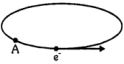
An electron moves with a constant speed of $4 \times 10^6 \, m/s$ in a circle of radius $10 \, cm$. Find the electric current at any point on the circle.
A
$1 \times 10^{-12} \, A$
B
$2.5 \times 10^{-12} \, A$
C
$1 \times 10^{11} \, A$
D
$3 \times 10^{12} \, A$
Solution
(A) Consider a point $A$ on the circle. The electron passes through this point in every revolution. The number of revolutions per second made by the electron is given by the frequency $f$.
$f = \frac{v}{2\pi r} = \frac{4 \times 10^6}{2\pi \times 10 \times 10^{-2}} = \frac{2}{\pi} \times 10^7 \, \text{rev/sec}$.
The electric current $I$ is defined as the charge passing through a point per unit time:
$I = \frac{q}{t} = f \times e$
$I = \left( \frac{2}{\pi} \times 10^7 \right) \times (1.6 \times 10^{-19}) \, A$
$I = \frac{3.2}{\pi} \times 10^{-12} \, A$
Since $\pi \approx 3.14$,we get $I \approx 1.019 \times 10^{-12} \, A \approx 1 \times 10^{-12} \, A$.
$f = \frac{v}{2\pi r} = \frac{4 \times 10^6}{2\pi \times 10 \times 10^{-2}} = \frac{2}{\pi} \times 10^7 \, \text{rev/sec}$.
The electric current $I$ is defined as the charge passing through a point per unit time:
$I = \frac{q}{t} = f \times e$
$I = \left( \frac{2}{\pi} \times 10^7 \right) \times (1.6 \times 10^{-19}) \, A$
$I = \frac{3.2}{\pi} \times 10^{-12} \, A$
Since $\pi \approx 3.14$,we get $I \approx 1.019 \times 10^{-12} \, A \approx 1 \times 10^{-12} \, A$.
0 likes
View Solution32
MediumMCQ
$A$ metallic conductor of non-uniform cross-sectional area is subjected to a constant potential difference. Which of the following quantities remains constant along the conductor?
A
Current
B
Drift velocity
C
Electric field
D
Current density
Solution
(A) For a metallic conductor connected to a constant potential difference $V$,the current $I$ flowing through any cross-section must be the same due to the principle of conservation of charge (steady state condition).
Since $I = nAev_d$,where $n$ is the number density of electrons,$A$ is the cross-sectional area,$e$ is the charge of an electron,and $v_d$ is the drift velocity,if $A$ varies,$v_d$ must also vary to keep $I$ constant.
Similarly,current density $J = I/A$ varies with $A$,and since $J = \sigma E$,the electric field $E$ also varies along the conductor.
Therefore,the current $I$ is the only quantity that remains constant.
Since $I = nAev_d$,where $n$ is the number density of electrons,$A$ is the cross-sectional area,$e$ is the charge of an electron,and $v_d$ is the drift velocity,if $A$ varies,$v_d$ must also vary to keep $I$ constant.
Similarly,current density $J = I/A$ varies with $A$,and since $J = \sigma E$,the electric field $E$ also varies along the conductor.
Therefore,the current $I$ is the only quantity that remains constant.
0 likes
View Solution33
EasyMCQ
Across a metallic conductor of non-uniform cross-section, a constant potential difference is applied. The quantity which remains constant along the conductor is
A
current density
B
current
C
drift velocity
D
electric field
Solution
(B) For a metallic conductor, the total current $I$ flowing through any cross-section must be the same due to the principle of conservation of charge (steady state flow).
Since $I = nAev_d$ and $J = I/A = nev_d$, if the cross-sectional area $A$ varies, the current density $J$ and drift velocity $v_d$ must also vary to keep $I$ constant.
The electric field $E = J/\sigma$ also varies with the cross-sectional area.
Therefore, the current $I$ is the only quantity that remains constant along the conductor.
Since $I = nAev_d$ and $J = I/A = nev_d$, if the cross-sectional area $A$ varies, the current density $J$ and drift velocity $v_d$ must also vary to keep $I$ constant.
The electric field $E = J/\sigma$ also varies with the cross-sectional area.
Therefore, the current $I$ is the only quantity that remains constant along the conductor.
0 likes
View Solution34
MediumMCQ
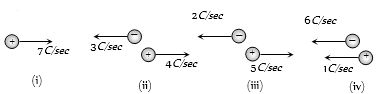
The following figure shows four situations in which positive and negative charges move horizontally through a region and gives the rate at which each charge moves. Rank the situations according to the effective current through the region,greatest first.
A
$i = ii = iii = iv$
B
$i > ii > iii > iv$
C
$i = ii = iii > iv$
D
$i = ii = iii < iv$
Solution
(C) The effective current $I$ is defined as the net rate of flow of charge. $A$ positive charge moving in one direction is equivalent to a current in that direction,while a negative charge moving in the same direction is equivalent to a current in the opposite direction.
For figure $(i)$: $A$ positive charge moves to the right at $7 \ C/s$. Thus,$I_1 = 7 \ A$.
For figure $(ii)$: $A$ positive charge moves to the right at $4 \ C/s$ and a negative charge moves to the left at $3 \ C/s$. Both contribute to a current to the right. Thus,$I_2 = 4 + 3 = 7 \ A$.
For figure $(iii)$: $A$ positive charge moves to the right at $5 \ C/s$ and a negative charge moves to the left at $2 \ C/s$. Both contribute to a current to the right. Thus,$I_3 = 5 + 2 = 7 \ A$.
For figure $(iv)$: $A$ negative charge moves to the left at $6 \ C/s$ (equivalent to $6 \ A$ to the right) and a positive charge moves to the left at $1 \ C/s$ (equivalent to $1 \ A$ to the left). Thus,$I_4 = 6 - 1 = 5 \ A$.
Comparing the values,we get $I_1 = I_2 = I_3 = 7 \ A$ and $I_4 = 5 \ A$. Therefore,$i = ii = iii > iv$.
For figure $(i)$: $A$ positive charge moves to the right at $7 \ C/s$. Thus,$I_1 = 7 \ A$.
For figure $(ii)$: $A$ positive charge moves to the right at $4 \ C/s$ and a negative charge moves to the left at $3 \ C/s$. Both contribute to a current to the right. Thus,$I_2 = 4 + 3 = 7 \ A$.
For figure $(iii)$: $A$ positive charge moves to the right at $5 \ C/s$ and a negative charge moves to the left at $2 \ C/s$. Both contribute to a current to the right. Thus,$I_3 = 5 + 2 = 7 \ A$.
For figure $(iv)$: $A$ negative charge moves to the left at $6 \ C/s$ (equivalent to $6 \ A$ to the right) and a positive charge moves to the left at $1 \ C/s$ (equivalent to $1 \ A$ to the left). Thus,$I_4 = 6 - 1 = 5 \ A$.
Comparing the values,we get $I_1 = I_2 = I_3 = 7 \ A$ and $I_4 = 5 \ A$. Therefore,$i = ii = iii > iv$.
0 likes
View Solution35
EasyMCQ
Identify the set in which all the three materials are good conductors of electricity.
A
$Cu, Ag$ and $Au$
B
$Cu, Si$ and $diamond$
C
$Cu, Ge$ and $Hg$
D
$Cu, Hg$ and $NaCl$
Solution
(A) Good conductors of electricity are materials that allow electric current to flow through them easily due to the presence of free electrons.
Metals like $Cu$ (Copper),$Ag$ (Silver),and $Au$ (Gold) have a large number of free electrons in their metallic lattice,making them excellent conductors.
$Si$ (Silicon) and $Ge$ (Germanium) are semiconductors.
$Diamond$ is an insulator.
$NaCl$ (Sodium Chloride) is an ionic solid that conducts electricity only in a molten state or aqueous solution,not in its solid state.
Therefore,the set containing $Cu, Ag$,and $Au$ consists entirely of good conductors.
Metals like $Cu$ (Copper),$Ag$ (Silver),and $Au$ (Gold) have a large number of free electrons in their metallic lattice,making them excellent conductors.
$Si$ (Silicon) and $Ge$ (Germanium) are semiconductors.
$Diamond$ is an insulator.
$NaCl$ (Sodium Chloride) is an ionic solid that conducts electricity only in a molten state or aqueous solution,not in its solid state.
Therefore,the set containing $Cu, Ag$,and $Au$ consists entirely of good conductors.
0 likes
View Solution36
MediumMCQ
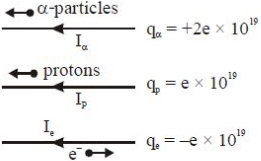
In a region,$10^{19}$ $\alpha$-particles and $10^{19}$ protons per second move to the left,while $10^{19}$ electrons move to the right per second. The current is
A
$3.2 \, A$ towards left
B
$3.2 \, A$ towards right
C
$6.4 \, A$ towards left
D
$6.4 \, A$ towards right
Solution
(C) The current $I$ is defined as the rate of flow of charge,$I = \frac{dq}{dt}$. By convention,the direction of current is the direction of flow of positive charge.
$1$. For $\alpha$-particles: Each $\alpha$-particle has a charge of $+2e$. Since $10^{19}$ $\alpha$-particles move to the left per second,the current $I_{\alpha} = (10^{19} \times 2e) \, C/s$ towards the left.
$2$. For protons: Each proton has a charge of $+e$. Since $10^{19}$ protons move to the left per second,the current $I_p = (10^{19} \times e) \, C/s$ towards the left.
$3$. For electrons: Each electron has a charge of $-e$. Since $10^{19}$ electrons move to the right per second,the current $I_e$ is in the opposite direction of the electron flow,i.e.,towards the left. The magnitude is $I_e = (10^{19} \times e) \, C/s$ towards the left.
Total current $I = I_{\alpha} + I_p + I_e = (2e + e + e) \times 10^{19} \, C/s = 4e \times 10^{19} \, C/s$.
Substituting $e = 1.6 \times 10^{-19} \, C$:
$I = 4 \times 1.6 \times 10^{-19} \times 10^{19} \, A = 6.4 \, A$.
Since all components contribute to current towards the left,the total current is $6.4 \, A$ towards the left.
$1$. For $\alpha$-particles: Each $\alpha$-particle has a charge of $+2e$. Since $10^{19}$ $\alpha$-particles move to the left per second,the current $I_{\alpha} = (10^{19} \times 2e) \, C/s$ towards the left.
$2$. For protons: Each proton has a charge of $+e$. Since $10^{19}$ protons move to the left per second,the current $I_p = (10^{19} \times e) \, C/s$ towards the left.
$3$. For electrons: Each electron has a charge of $-e$. Since $10^{19}$ electrons move to the right per second,the current $I_e$ is in the opposite direction of the electron flow,i.e.,towards the left. The magnitude is $I_e = (10^{19} \times e) \, C/s$ towards the left.
Total current $I = I_{\alpha} + I_p + I_e = (2e + e + e) \times 10^{19} \, C/s = 4e \times 10^{19} \, C/s$.
Substituting $e = 1.6 \times 10^{-19} \, C$:
$I = 4 \times 1.6 \times 10^{-19} \times 10^{19} \, A = 6.4 \, A$.
Since all components contribute to current towards the left,the total current is $6.4 \, A$ towards the left.
0 likes
View Solution37
MediumMCQ
The current in a wire varies with time according to the relation $I = 4 + 2t$. The quantity of charge which has passed through a cross-section of the wire during the time $t = 2 \, s$ to $t = 6 \, s$ will be .............. $C$.
A
$24$
B
$48$
C
$36$
D
$60$
Solution
(B) The charge $q$ passing through a cross-section is given by the integral of current $I$ with respect to time $t$:
$q = \int_{t_1}^{t_2} I \, dt$
Given $I = 4 + 2t$,$t_1 = 2 \, s$,and $t_2 = 6 \, s$:
$q = \int_{2}^{6} (4 + 2t) \, dt$
$q = [4t + t^2]_{2}^{6}$
$q = (4(6) + (6)^2) - (4(2) + (2)^2)$
$q = (24 + 36) - (8 + 4)$
$q = 60 - 12 = 48 \, C$
Thus,the total charge passed is $48 \, C$.
$q = \int_{t_1}^{t_2} I \, dt$
Given $I = 4 + 2t$,$t_1 = 2 \, s$,and $t_2 = 6 \, s$:
$q = \int_{2}^{6} (4 + 2t) \, dt$
$q = [4t + t^2]_{2}^{6}$
$q = (4(6) + (6)^2) - (4(2) + (2)^2)$
$q = (24 + 36) - (8 + 4)$
$q = 60 - 12 = 48 \, C$
Thus,the total charge passed is $48 \, C$.
0 likes
View Solution38
MediumMCQ
$A$ copper rod of cross-sectional area $A$ carries a uniform current $I$ through it. At temperature $T$,if the volume charge density of the rod is $\rho$,how long will the charges take to travel a distance $d$?
A
$\frac{2\rho dA}{IT}$
B
$\frac{2\rho dA}{I}$
C
$\frac{\rho dA}{I}$
D
$\frac{\rho dA}{IT}$
Solution
(C) The volume charge density $\rho$ is defined as the total charge $q$ per unit volume $V$. For a rod of length $d$ and cross-sectional area $A$,the volume is $V = A d$.
Thus,$\rho = \frac{q}{V} = \frac{q}{A d}$,which implies $q = \rho A d$.
Since current $I$ is defined as the rate of flow of charge,$I = \frac{q}{t}$,where $t$ is the time taken for the charge $q$ to pass through a cross-section.
Rearranging for time $t$,we get $t = \frac{q}{I}$.
Substituting the expression for $q$,we get $t = \frac{\rho A d}{I}$.
Thus,$\rho = \frac{q}{V} = \frac{q}{A d}$,which implies $q = \rho A d$.
Since current $I$ is defined as the rate of flow of charge,$I = \frac{q}{t}$,where $t$ is the time taken for the charge $q$ to pass through a cross-section.
Rearranging for time $t$,we get $t = \frac{q}{I}$.
Substituting the expression for $q$,we get $t = \frac{\rho A d}{I}$.
0 likes
View Solution39
EasyMCQ
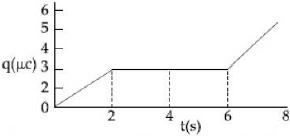
The charge on a capacitor plate in a circuit,as a function of time,is shown in the figure. What is the value of current at $t = 4 \, s$ ? ............... $\mu A$
A
$0$
B
$3$
C
$2$
D
$1.5$
Solution
(A) The electric current $I$ is defined as the rate of flow of charge,which is given by the slope of the $q-t$ graph: $I = \frac{dq}{dt}$.
From the given graph,between $t = 2 \, s$ and $t = 6 \, s$,the charge $q$ on the capacitor plate is constant at $3 \, \mu C$.
Since the charge is constant,the slope of the graph in this interval is zero.
Therefore,the current at $t = 4 \, s$ is $I = 0 \, \mu A$.
From the given graph,between $t = 2 \, s$ and $t = 6 \, s$,the charge $q$ on the capacitor plate is constant at $3 \, \mu C$.
Since the charge is constant,the slope of the graph in this interval is zero.
Therefore,the current at $t = 4 \, s$ is $I = 0 \, \mu A$.
0 likes
View Solution40
MediumMCQ
The current through a wire depends on time as $i = (2+3t)\, mA$. The charge crossing through a section of the wire in $1\, min$ is .............. $C$.
A
$0.552$
B
$5.52$
C
$0.1275$
D
$55.2$
Solution
(B) The current is given by $i = (2 + 3t) \times 10^{-3} \, A$.
To find the total charge $q$ crossing a section in time $t = 0$ to $t = 60 \, s$,we use the relation $q = \int i \, dt$.
$q = \int_{0}^{60} (2 + 3t) \times 10^{-3} \, dt$.
$q = 10^{-3} \left[ 2t + \frac{3t^2}{2} \right]_{0}^{60}$.
$q = 10^{-3} \left[ 2(60) + \frac{3(60)^2}{2} \right]$.
$q = 10^{-3} [120 + 5400]$.
$q = 10^{-3} \times 5520 = 5.52 \, C$.
To find the total charge $q$ crossing a section in time $t = 0$ to $t = 60 \, s$,we use the relation $q = \int i \, dt$.
$q = \int_{0}^{60} (2 + 3t) \times 10^{-3} \, dt$.
$q = 10^{-3} \left[ 2t + \frac{3t^2}{2} \right]_{0}^{60}$.
$q = 10^{-3} \left[ 2(60) + \frac{3(60)^2}{2} \right]$.
$q = 10^{-3} [120 + 5400]$.
$q = 10^{-3} \times 5520 = 5.52 \, C$.
0 likes
View Solution41
MediumMCQ
The charge flowing in a conductor varies with time as $Q = at - bt^2$. Then for current,which statement is incorrect?
$(A)$ decreases linearly with time
$(B)$ reaches a maximum and then decreases
$(C)$ falls to zero after time $t = a/2b$
$(D)$ changes at a rate $-2b$
$(A)$ decreases linearly with time
$(B)$ reaches a maximum and then decreases
$(C)$ falls to zero after time $t = a/2b$
$(D)$ changes at a rate $-2b$
A
$A, B, C$
B
$A, C, D$
C
$B, C$
D
Only $B$
Solution
(D) The current $I$ is defined as the rate of flow of charge: $I = \frac{dQ}{dt}$.
Given $Q = at - bt^2$,differentiating with respect to $t$ gives $I = a - 2bt$.
$(i)$ Since $I = a - 2bt$,the current decreases linearly with time. Thus,statement $(A)$ is correct.
$(ii)$ The current starts at $I = a$ at $t = 0$ and decreases continuously. It does not reach a maximum after $t = 0$. Thus,statement $(B)$ is incorrect.
$(iii)$ Setting $I = 0$,we get $a - 2bt = 0$,which implies $t = a/2b$. Thus,statement $(C)$ is correct.
$(iv)$ The rate of change of current is $\frac{dI}{dt} = \frac{d}{dt}(a - 2bt) = -2b$. Thus,statement $(D)$ is correct.
Since only statement $(B)$ is incorrect,the correct option is $(D)$.
Given $Q = at - bt^2$,differentiating with respect to $t$ gives $I = a - 2bt$.
$(i)$ Since $I = a - 2bt$,the current decreases linearly with time. Thus,statement $(A)$ is correct.
$(ii)$ The current starts at $I = a$ at $t = 0$ and decreases continuously. It does not reach a maximum after $t = 0$. Thus,statement $(B)$ is incorrect.
$(iii)$ Setting $I = 0$,we get $a - 2bt = 0$,which implies $t = a/2b$. Thus,statement $(C)$ is correct.
$(iv)$ The rate of change of current is $\frac{dI}{dt} = \frac{d}{dt}(a - 2bt) = -2b$. Thus,statement $(D)$ is correct.
Since only statement $(B)$ is incorrect,the correct option is $(D)$.
0 likes
View Solution42
EasyMCQ
$A$ flow of $10^{7}$ electrons per second in a conducting wire constitutes a current of
A
$1.6 \times 10^{12} \; A$
B
$1.6 \times 10^{26} \; A$
C
$1.6 \times 10^{-26} \; A$
D
$1.6 \times 10^{-12} \; A$
Solution
(D) The number of electrons flowing per unit time is given by $\frac{n}{t} = 10^{7} \; s^{-1}$.
The electric current $I$ is defined as the rate of flow of charge,$I = \frac{q}{t}$.
Since $q = ne$,where $e$ is the elementary charge $(e = 1.6 \times 10^{-19} \; C)$,we have $I = \frac{ne}{t} = \left(\frac{n}{t}\right) \times e$.
Substituting the given values: $I = 10^{7} \times (1.6 \times 10^{-19} \; C) = 1.6 \times 10^{-12} \; A$.
The electric current $I$ is defined as the rate of flow of charge,$I = \frac{q}{t}$.
Since $q = ne$,where $e$ is the elementary charge $(e = 1.6 \times 10^{-19} \; C)$,we have $I = \frac{ne}{t} = \left(\frac{n}{t}\right) \times e$.
Substituting the given values: $I = 10^{7} \times (1.6 \times 10^{-19} \; C) = 1.6 \times 10^{-12} \; A$.
0 likes
View Solution43
Easy
Explain how electric current is formed. Give a suitable example.
Solution
(N/A) Electric current is defined as the rate of flow of electric charge through a cross-section of a conductor. When charges (typically electrons in a metal) move in a specific direction due to an applied electric field,an electric current is formed.
Electric charge is of two types:
$(1)$ Positive charge
$(2)$ Negative charge
In nature,electric current can be produced under certain conditions. For example,lightning in the sky is a natural phenomenon where a large amount of charge flows between clouds or between a cloud and the earth. However,this is not a steady flow of charge.
In devices used in our day-to-day life,such as a torch or a battery-operated clock,a steady flow of charge is maintained by a source of electromotive force (like a cell or battery),which results in a constant electric current.
Electric charge is of two types:
$(1)$ Positive charge
$(2)$ Negative charge
In nature,electric current can be produced under certain conditions. For example,lightning in the sky is a natural phenomenon where a large amount of charge flows between clouds or between a cloud and the earth. However,this is not a steady flow of charge.
In devices used in our day-to-day life,such as a torch or a battery-operated clock,a steady flow of charge is maintained by a source of electromotive force (like a cell or battery),which results in a constant electric current.
0 likes
View Solution44
Easy
When is an electric current produced? Explain.
Solution
(N/A) An electric current is produced when there is a net flow of electric charge through a cross-section of a conductor over a period of time.
$1$. In a conductor,free electrons are in random motion due to thermal energy,resulting in no net flow of charge.
$2$. When an external electric field $(E)$ is applied across the conductor,the free electrons experience an electric force $(F = -eE)$,causing them to drift in the direction opposite to the applied field.
$3$. This directed motion of charge carriers constitutes an electric current $(I)$.
$4$. Mathematically,current is defined as the rate of flow of charge: $I = \frac{dq}{dt}$,where $dq$ is the net charge passing through a cross-section in time $dt$.
$1$. In a conductor,free electrons are in random motion due to thermal energy,resulting in no net flow of charge.
$2$. When an external electric field $(E)$ is applied across the conductor,the free electrons experience an electric force $(F = -eE)$,causing them to drift in the direction opposite to the applied field.
$3$. This directed motion of charge carriers constitutes an electric current $(I)$.
$4$. Mathematically,current is defined as the rate of flow of charge: $I = \frac{dq}{dt}$,where $dq$ is the net charge passing through a cross-section in time $dt$.
0 likes
View Solution45
EasyMCQ
“In lightning in the sky,there is a steady flow of charge”. -True or False?
A
True
B
False
Solution
(B) The statement is $False$.
Lightning is an example of a transient or non-steady discharge of electricity.
In a steady flow of charge (direct current),the rate of flow of charge remains constant over time.
Lightning involves a massive,instantaneous discharge of accumulated static electricity between clouds or between a cloud and the ground,which lasts for a very short duration and is not a continuous or steady current.
Lightning is an example of a transient or non-steady discharge of electricity.
In a steady flow of charge (direct current),the rate of flow of charge remains constant over time.
Lightning involves a massive,instantaneous discharge of accumulated static electricity between clouds or between a cloud and the ground,which lasts for a very short duration and is not a continuous or steady current.
0 likes
View Solution46
Medium
Define electric current and explain it. Write its $SI$ unit.
Solution
(N/A) Electric current is defined as the net flow of charge through a cross-section of a conductor per unit time.
Consider a cross-section of a conductor where a net charge $q$ flows in time $t$. For a steady current,the current $I$ is given by $I = \frac{q}{t}$.
When the flow of charge changes with time,the instantaneous current $I$ is defined as the limit of the average current as the time interval approaches zero:
$I = \lim_{\Delta t \rightarrow 0} \frac{\Delta Q}{\Delta t} = \frac{dQ}{dt}$.
The direction of conventional current is taken to be the direction of motion of positive charge. Since positive charges do not flow in metallic conductors,the direction of current is taken opposite to the direction of motion of electrons.
The $SI$ unit of electric current is the Ampere $(A)$,where $1 \text{ Ampere} = 1 \text{ Coulomb/second}$.
One Ampere is defined as the current flowing through a cross-section of a conductor when $1 \text{ Coulomb}$ of charge flows through it in $1 \text{ second}$ ($6.25 \times 10^{18}$ electrons).
Consider a cross-section of a conductor where a net charge $q$ flows in time $t$. For a steady current,the current $I$ is given by $I = \frac{q}{t}$.
When the flow of charge changes with time,the instantaneous current $I$ is defined as the limit of the average current as the time interval approaches zero:
$I = \lim_{\Delta t \rightarrow 0} \frac{\Delta Q}{\Delta t} = \frac{dQ}{dt}$.
The direction of conventional current is taken to be the direction of motion of positive charge. Since positive charges do not flow in metallic conductors,the direction of current is taken opposite to the direction of motion of electrons.
The $SI$ unit of electric current is the Ampere $(A)$,where $1 \text{ Ampere} = 1 \text{ Coulomb/second}$.
One Ampere is defined as the current flowing through a cross-section of a conductor when $1 \text{ Coulomb}$ of charge flows through it in $1 \text{ second}$ ($6.25 \times 10^{18}$ electrons).
0 likes
View Solution47
Medium
Define electric current when there is no steady flow of charge.
Solution
(N/A) When the flow of charge is not steady,the electric current at any instant $t$ is defined as the rate of flow of charge through a cross-section of the conductor at that specific instant.
Mathematically,it is expressed as the limit of the ratio of the small amount of charge $\Delta q$ passing through a cross-section in a small time interval $\Delta t$ as $\Delta t$ approaches zero:
$I(t) = \lim_{\Delta t \to 0} \frac{\Delta q}{\Delta t} = \frac{dq}{dt}$
Here,$I(t)$ represents the instantaneous current,and $\frac{dq}{dt}$ is the time derivative of the charge $q$.
Mathematically,it is expressed as the limit of the ratio of the small amount of charge $\Delta q$ passing through a cross-section in a small time interval $\Delta t$ as $\Delta t$ approaches zero:
$I(t) = \lim_{\Delta t \to 0} \frac{\Delta q}{\Delta t} = \frac{dq}{dt}$
Here,$I(t)$ represents the instantaneous current,and $\frac{dq}{dt}$ is the time derivative of the charge $q$.
0 likes
View Solution48
EasyMCQ
What is the direction of conventional current?
A
From negative terminal to positive terminal
B
From positive terminal to negative terminal
C
Random direction
D
No specific direction
Solution
(B) By convention,the direction of electric current is defined as the direction in which positive charges would move.
In an external circuit connected to a battery,this corresponds to the flow from the positive terminal to the negative terminal.
Therefore,the conventional current flows from the positive terminal to the negative terminal of the source.
In an external circuit connected to a battery,this corresponds to the flow from the positive terminal to the negative terminal.
Therefore,the conventional current flows from the positive terminal to the negative terminal of the source.
0 likes
View Solution49
MediumMCQ
What is the order of current flowing in the nerves of our body?
A
$10^{-6} \ A$
B
$10^{-3} \ A$
C
$10^{-9} \ A$
D
$10^{-12} \ A$
Solution
(A) The electrical signals in the human nervous system are generated by the movement of ions across nerve cell membranes.
These signals,known as action potentials,involve very small currents.
The typical magnitude of current flowing in the nerves of the human body is on the order of microamperes $(10^{-6} \ A)$.
These signals,known as action potentials,involve very small currents.
The typical magnitude of current flowing in the nerves of the human body is on the order of microamperes $(10^{-6} \ A)$.
0 likes
View SolutionCurrent Electricity — Electric Current · Frequently Asked Questions
1Are these Current Electricity questions useful for JEE and NEET?
Yes. All questions in this section are mapped to JEE Main and NEET exam patterns. Previous year questions from JEE Main, NEET, GUJCET and state-level exams are included with full solutions.
2Can I switch to Hindi or Gujarati for these questions?
Yes. Use the language tabs in the hero section or the sidebar to view the same questions and solutions in English, Hindi or Gujarati.
3How do I generate a question paper from this subtopic?
Use the Vedclass Exam Paper Generator — select the chapter and subtopic, set difficulty, and generate Sets A, B, C, D automatically. First 3 chapters of every subject are free.
Vedclass Products
For Students
Vedclass Test Series
Mock tests in real JEE/NEET style with performance analysis. 5-day free trial.
Start Free TrialFor Teachers
Exam Paper Generator
Generate Set A/B/C/D papers from this chapter in 2 minutes. 3 chapters free.
Try FreeFor Institutes
Online Exam Module
Live online exams with unlimited students, 360° analytics & white-label branding.
See DemoFor Teachers & Institutes
Generate a Current Electricity Exam Paper in 2 Minutes
Select subtopic & difficulty — Sets A, B, C, D auto-generated with No Repeat logic.
First 3 chapters of every subject are free — no payment required.