
A English
Current Density, Drift Velocity and Mobility Questions in English
Class 12 Physics · Current Electricity · Current Density, Drift Velocity and Mobility
187+
Questions
English
Language
100%
With Solutions
Showing 50 of 187 questions in English
1
EasyMCQ
When the current $i$ is flowing through a conductor,the drift velocity is $v$. If $2i$ current is flowed through the same metal but having double the area of cross-section,then the drift velocity will be
A
$v/4$
B
$v/2$
C
$v$
D
$4v$
Solution
(C) The relationship between drift velocity $v_d$ and current $i$ is given by the formula $i = n e A v_d$,where $n$ is the number density of electrons,$e$ is the charge of an electron,and $A$ is the area of cross-section.
From this,the drift velocity is $v_d = \frac{i}{n e A}$.
In the first case,$v_1 = v = \frac{i}{n e A}$.
In the second case,the current is $i' = 2i$ and the area is $A' = 2A$.
Therefore,the new drift velocity $v_2$ is $v_2 = \frac{i'}{n e A'} = \frac{2i}{n e (2A)} = \frac{i}{n e A}$.
Comparing the two,we get $v_2 = v_1 = v$.
From this,the drift velocity is $v_d = \frac{i}{n e A}$.
In the first case,$v_1 = v = \frac{i}{n e A}$.
In the second case,the current is $i' = 2i$ and the area is $A' = 2A$.
Therefore,the new drift velocity $v_2$ is $v_2 = \frac{i'}{n e A'} = \frac{2i}{n e (2A)} = \frac{i}{n e A}$.
Comparing the two,we get $v_2 = v_1 = v$.
0 likes
View Solution2
EasyMCQ
When current flows through a conductor,then the order of drift velocity of electrons will be
A
$10^{10} \, m/s$
B
$10^{-2} \, cm/s$
C
$10^{4} \, cm/s$
D
$10^{-1} \, cm/s$
Solution
(B) The drift velocity $(v_d)$ of electrons in a conductor is given by the relation $v_d = \frac{I}{neA}$,where $I$ is the current,$n$ is the number density of electrons,$e$ is the charge of an electron,and $A$ is the cross-sectional area.
For typical metallic conductors,the drift velocity of electrons is very small,typically in the range of $10^{-4} \, m/s$ to $10^{-5} \, m/s$.
Converting this to $cm/s$: $10^{-4} \, m/s = 10^{-4} \times 10^{2} \, cm/s = 10^{-2} \, cm/s$.
Therefore,the order of drift velocity is $10^{-2} \, cm/s$.
For typical metallic conductors,the drift velocity of electrons is very small,typically in the range of $10^{-4} \, m/s$ to $10^{-5} \, m/s$.
Converting this to $cm/s$: $10^{-4} \, m/s = 10^{-4} \times 10^{2} \, cm/s = 10^{-2} \, cm/s$.
Therefore,the order of drift velocity is $10^{-2} \, cm/s$.
0 likes
View Solution3
DifficultMCQ
Every atom contributes one free electron in copper. If $1.1 \ A$ current is flowing in a copper wire having a $1 \ mm$ diameter,then the drift velocity (approx.) will be (Density of copper $= 9 \times 10^3 \ kg \ m^{-3}$ and atomic weight $= 63$).
A
$0.3 \ mm/s$
B
$0.1 \ mm/s$
C
$0.2 \ mm/s$
D
$0.2 \ cm/s$
Solution
(B) The number of atoms per unit volume $(n)$ is given by $n = \frac{\text{Density} \times N_A}{\text{Atomic Weight}}$.
Given: Density $\rho = 9 \times 10^3 \ kg/m^3$,Atomic weight $M = 63 \times 10^{-3} \ kg/mol$,Avogadro number $N_A = 6.023 \times 10^{23} \ atoms/mol$.
$n = \frac{9 \times 10^3 \times 6.023 \times 10^{23}}{63 \times 10^{-3}} \approx 8.6 \times 10^{28} \ electrons/m^3$.
The drift velocity $v_d$ is given by $v_d = \frac{I}{neA}$,where $I = 1.1 \ A$,$e = 1.6 \times 10^{-19} \ C$,and $A = \pi r^2 = \pi (0.5 \times 10^{-3})^2 \ m^2$.
$v_d = \frac{1.1}{8.6 \times 10^{28} \times 1.6 \times 10^{-19} \times 3.14 \times 0.25 \times 10^{-6}}$.
$v_d \approx \frac{1.1}{1.08 \times 10^4} \approx 1.01 \times 10^{-4} \ m/s = 0.1 \ mm/s$.
Given: Density $\rho = 9 \times 10^3 \ kg/m^3$,Atomic weight $M = 63 \times 10^{-3} \ kg/mol$,Avogadro number $N_A = 6.023 \times 10^{23} \ atoms/mol$.
$n = \frac{9 \times 10^3 \times 6.023 \times 10^{23}}{63 \times 10^{-3}} \approx 8.6 \times 10^{28} \ electrons/m^3$.
The drift velocity $v_d$ is given by $v_d = \frac{I}{neA}$,where $I = 1.1 \ A$,$e = 1.6 \times 10^{-19} \ C$,and $A = \pi r^2 = \pi (0.5 \times 10^{-3})^2 \ m^2$.
$v_d = \frac{1.1}{8.6 \times 10^{28} \times 1.6 \times 10^{-19} \times 3.14 \times 0.25 \times 10^{-6}}$.
$v_d \approx \frac{1.1}{1.08 \times 10^4} \approx 1.01 \times 10^{-4} \ m/s = 0.1 \ mm/s$.
0 likes
View Solution4
EasyMCQ
On increasing the temperature of a conductor,its resistance increases because
A
Relaxation time decreases
B
Mass of the electrons increases
C
Electron density decreases
D
None of the above
Solution
(A) The resistance $R$ of a conductor is given by the formula $R = \frac{ml}{ne^2 \tau A}$,where $m$ is the mass of the electron,$l$ is the length,$n$ is the electron density,$e$ is the charge,$A$ is the cross-sectional area,and $\tau$ is the relaxation time.
From this relation,we see that $R \propto \frac{1}{\tau}$.
When the temperature of a conductor increases,the thermal velocity of the free electrons increases.
This leads to more frequent collisions between the electrons and the lattice ions.
Consequently,the average time between two successive collisions,known as the relaxation time $\tau$,decreases.
Since $R$ is inversely proportional to $\tau$,a decrease in $\tau$ results in an increase in the resistance $R$.
From this relation,we see that $R \propto \frac{1}{\tau}$.
When the temperature of a conductor increases,the thermal velocity of the free electrons increases.
This leads to more frequent collisions between the electrons and the lattice ions.
Consequently,the average time between two successive collisions,known as the relaxation time $\tau$,decreases.
Since $R$ is inversely proportional to $\tau$,a decrease in $\tau$ results in an increase in the resistance $R$.
0 likes
View Solution5
EasyMCQ
When there is an electric current through a conducting wire along its length,then an electric field must exist
A
Outside the wire but normal to it
B
Outside the wire but parallel to it
C
Inside the wire but parallel to it
D
Inside the wire but normal to it
Solution
(C) For a steady electric current to flow through a conducting wire,there must be a potential difference across its ends.
According to the relation $E = V/L$,where $E$ is the electric field,$V$ is the potential difference,and $L$ is the length of the wire,an electric field must be present inside the conductor.
This electric field is responsible for the drift velocity of the charge carriers (electrons).
Since the current flows along the length of the wire,the electric field must also be directed along the length of the wire,i.e.,parallel to it.
Therefore,the correct option is $C$.
According to the relation $E = V/L$,where $E$ is the electric field,$V$ is the potential difference,and $L$ is the length of the wire,an electric field must be present inside the conductor.
This electric field is responsible for the drift velocity of the charge carriers (electrons).
Since the current flows along the length of the wire,the electric field must also be directed along the length of the wire,i.e.,parallel to it.
Therefore,the correct option is $C$.
0 likes
View Solution6
EasyMCQ
$A$ metallic block has no potential difference applied across it. What is the mean velocity of free electrons in terms of $T$ (absolute temperature of the block)?
A
Proportional to $T$
B
Proportional to $\sqrt{T}$
C
Zero
D
Finite but independent of temperature
Solution
(B) In the absence of an external electric field,the free electrons in a metallic block are in random thermal motion.
According to the kinetic theory of gases,the root mean square velocity $(V_{rms})$ of these electrons is given by the formula $V_{rms} = \sqrt{\frac{3KT}{m}}$,where $K$ is the Boltzmann constant,$T$ is the absolute temperature,and $m$ is the mass of an electron.
From this expression,it is clear that $V_{rms} \propto \sqrt{T}$.
Therefore,the mean velocity (specifically the root mean square thermal velocity) is proportional to $\sqrt{T}$.
According to the kinetic theory of gases,the root mean square velocity $(V_{rms})$ of these electrons is given by the formula $V_{rms} = \sqrt{\frac{3KT}{m}}$,where $K$ is the Boltzmann constant,$T$ is the absolute temperature,and $m$ is the mass of an electron.
From this expression,it is clear that $V_{rms} \propto \sqrt{T}$.
Therefore,the mean velocity (specifically the root mean square thermal velocity) is proportional to $\sqrt{T}$.
1 likes
View Solution7
EasyMCQ
There is a current of $20 \, A$ in a copper wire of $10^{-6} \, m^2$ area of cross-section. If the number of free electrons per cubic meter is $10^{29}$,then the drift velocity is:
A
$125 \times 10^{-3} \, m/s$
B
$12.5 \times 10^{-3} \, m/s$
C
$1.25 \times 10^{-3} \, m/s$
D
$1.25 \times 10^{-4} \, m/s$
Solution
(C) The formula for drift velocity $(v_d)$ is given by $v_d = \frac{I}{nAe}$.
Given:
Current $(I)$ = $20 \, A$
Number density of electrons $(n)$ = $10^{29} \, m^{-3}$
Area of cross-section $(A)$ = $10^{-6} \, m^2$
Charge of an electron $(e)$ = $1.6 \times 10^{-19} \, C$
Substituting these values into the formula:
$v_d = \frac{20}{10^{29} \times 10^{-6} \times 1.6 \times 10^{-19}}$
$v_d = \frac{20}{1.6 \times 10^{29-6-19}}$
$v_d = \frac{20}{1.6 \times 10^4}$
$v_d = 12.5 \times 10^{-4} \, m/s = 1.25 \times 10^{-3} \, m/s$.
Given:
Current $(I)$ = $20 \, A$
Number density of electrons $(n)$ = $10^{29} \, m^{-3}$
Area of cross-section $(A)$ = $10^{-6} \, m^2$
Charge of an electron $(e)$ = $1.6 \times 10^{-19} \, C$
Substituting these values into the formula:
$v_d = \frac{20}{10^{29} \times 10^{-6} \times 1.6 \times 10^{-19}}$
$v_d = \frac{20}{1.6 \times 10^{29-6-19}}$
$v_d = \frac{20}{1.6 \times 10^4}$
$v_d = 12.5 \times 10^{-4} \, m/s = 1.25 \times 10^{-3} \, m/s$.
0 likes
View Solution8
EasyMCQ
The electric intensity $E$,current density $j$,and specific resistance $\rho$ (often denoted as $k$ in some texts) are related to each other by the relation:
A
$E = j/\rho$
B
$E = j\rho$
C
$E = \rho/j$
D
$\rho = jE$
Solution
(B) The microscopic form of Ohm's law states that the current density $j$ is proportional to the electric field $E$ applied across a conductor.
Mathematically,this is expressed as $j = \sigma E$,where $\sigma$ is the electrical conductivity.
Since conductivity $\sigma$ is the reciprocal of resistivity (specific resistance) $\rho$,we have $\sigma = 1/\rho$.
Substituting this into the equation,we get $j = E/\rho$.
Rearranging the terms to solve for the electric intensity $E$,we obtain $E = j\rho$.
Therefore,the correct relation is $E = j\rho$ (or $E = jk$ if $k$ represents resistivity).
Mathematically,this is expressed as $j = \sigma E$,where $\sigma$ is the electrical conductivity.
Since conductivity $\sigma$ is the reciprocal of resistivity (specific resistance) $\rho$,we have $\sigma = 1/\rho$.
Substituting this into the equation,we get $j = E/\rho$.
Rearranging the terms to solve for the electric intensity $E$,we obtain $E = j\rho$.
Therefore,the correct relation is $E = j\rho$ (or $E = jk$ if $k$ represents resistivity).
0 likes
View Solution9
EasyMCQ
There is a current of $1.344 \, A$ in a copper wire whose area of cross-section normal to the length of the wire is $1 \, mm^2$. If the number of free electrons per $cm^3$ is $8.4 \times 10^{22}$, then the drift velocity would be
A
$1.0 \, mm/s$
B
$1.0 \, m/s$
C
$0.1 \, mm/s$
D
$0.01 \, mm/s$
Solution
(C) The formula for drift velocity is given by $v_d = \frac{I}{nAe}$.
Given:
$I = 1.344 \, A$
$A = 1 \, mm^2 = 10^{-6} \, m^2$
$n = 8.4 \times 10^{22} \, \text{electrons}/cm^3 = 8.4 \times 10^{28} \, \text{electrons}/m^3$
$e = 1.6 \times 10^{-19} \, C$
Substituting these values into the formula:
$v_d = \frac{1.344}{(8.4 \times 10^{28}) \times (10^{-6}) \times (1.6 \times 10^{-19})}$
$v_d = \frac{1.344}{8.4 \times 1.6 \times 10^3}$
$v_d = \frac{1.344}{13.44 \times 10^3} = 0.1 \times 10^{-3} \, m/s$
$v_d = 0.1 \, mm/s$.
Given:
$I = 1.344 \, A$
$A = 1 \, mm^2 = 10^{-6} \, m^2$
$n = 8.4 \times 10^{22} \, \text{electrons}/cm^3 = 8.4 \times 10^{28} \, \text{electrons}/m^3$
$e = 1.6 \times 10^{-19} \, C$
Substituting these values into the formula:
$v_d = \frac{1.344}{(8.4 \times 10^{28}) \times (10^{-6}) \times (1.6 \times 10^{-19})}$
$v_d = \frac{1.344}{8.4 \times 1.6 \times 10^3}$
$v_d = \frac{1.344}{13.44 \times 10^3} = 0.1 \times 10^{-3} \, m/s$
$v_d = 0.1 \, mm/s$.
0 likes
View Solution10
EasyMCQ
If $n, e, \tau$ and $m$ respectively represent the electron density,charge,relaxation time,and mass of the electron,then the resistance of a wire of length $l$ and area of cross-section $A$ will be
A
$\frac{ml}{ne^2 \tau A}$
B
$\frac{m \tau^2 A}{ne^2 l}$
C
$\frac{ne^2 \tau A}{2ml}$
D
$\frac{ne^2 A}{2m \tau l}$
Solution
(A) The resistance $R$ of a conductor is given by $R = \rho \frac{l}{A}$.
From the microscopic model of current,the resistivity $\rho$ is given by $\rho = \frac{m}{ne^2 \tau}$.
Substituting the expression for $\rho$ into the resistance formula,we get:
$R = \left( \frac{m}{ne^2 \tau} \right) \frac{l}{A} = \frac{ml}{ne^2 \tau A}$.
Thus,the correct option is $A$.
From the microscopic model of current,the resistivity $\rho$ is given by $\rho = \frac{m}{ne^2 \tau}$.
Substituting the expression for $\rho$ into the resistance formula,we get:
$R = \left( \frac{m}{ne^2 \tau} \right) \frac{l}{A} = \frac{ml}{ne^2 \tau A}$.
Thus,the correct option is $A$.
0 likes
View Solution11
EasyMCQ
$A$ copper wire of length $1\, m$ and radius $1\, mm$ is joined in series with an iron wire of length $2\, m$ and radius $3\, mm$ and a current is passed through the wires. The ratio of the current density in the copper and iron wires is
A
$18:1$
B
$9:1$
C
$6:1$
D
$2:3$
Solution
(B) Current density $J$ is defined as the current per unit cross-sectional area,given by $J = \frac{I}{A} = \frac{I}{\pi r^2}$.
Since the copper wire and the iron wire are connected in series,the same amount of current $I$ flows through both wires,i.e.,$I_{Cu} = I_{Fe} = I$.
The ratio of the current density in the copper wire $(J_{Cu})$ to the iron wire $(J_{Fe})$ is given by:
$\frac{J_{Cu}}{J_{Fe}} = \frac{I / (\pi r_{Cu}^2)}{I / (\pi r_{Fe}^2)} = \frac{r_{Fe}^2}{r_{Cu}^2}$.
Given $r_{Cu} = 1\, mm$ and $r_{Fe} = 3\, mm$,we substitute these values:
$\frac{J_{Cu}}{J_{Fe}} = \frac{(3\, mm)^2}{(1\, mm)^2} = \frac{9}{1} = 9:1$.
Thus,the ratio of the current density is $9:1$.
Since the copper wire and the iron wire are connected in series,the same amount of current $I$ flows through both wires,i.e.,$I_{Cu} = I_{Fe} = I$.
The ratio of the current density in the copper wire $(J_{Cu})$ to the iron wire $(J_{Fe})$ is given by:
$\frac{J_{Cu}}{J_{Fe}} = \frac{I / (\pi r_{Cu}^2)}{I / (\pi r_{Fe}^2)} = \frac{r_{Fe}^2}{r_{Cu}^2}$.
Given $r_{Cu} = 1\, mm$ and $r_{Fe} = 3\, mm$,we substitute these values:
$\frac{J_{Cu}}{J_{Fe}} = \frac{(3\, mm)^2}{(1\, mm)^2} = \frac{9}{1} = 9:1$.
Thus,the ratio of the current density is $9:1$.
0 likes
View Solution12
EasyMCQ
$A$ potential difference of $V$ is applied at the ends of a copper wire of length $l$ and diameter $d$. On doubling only $d$,drift velocity
A
Becomes two times
B
Becomes half
C
Does not change
D
Becomes one fourth
Solution
(C) The drift velocity ${v_d}$ of electrons in a conductor is given by the formula: ${v_d} = \frac{eE\tau}{m}$,where $E$ is the electric field,$\tau$ is the relaxation time,$e$ is the charge of an electron,and $m$ is the mass of an electron.
Since the electric field $E = \frac{V}{l}$,we can substitute this into the equation:
${v_d} = \frac{eV\tau}{ml}$.
Here,$V$ is the potential difference,$l$ is the length of the wire,$e$ is the elementary charge,$m$ is the electron mass,and $\tau$ is the relaxation time.
None of these parameters $(V, l, e, m, \tau)$ depend on the diameter $d$ of the wire.
Therefore,changing the diameter $d$ does not affect the drift velocity ${v_d}$ of the electrons.
Thus,the drift velocity remains unchanged.
Since the electric field $E = \frac{V}{l}$,we can substitute this into the equation:
${v_d} = \frac{eV\tau}{ml}$.
Here,$V$ is the potential difference,$l$ is the length of the wire,$e$ is the elementary charge,$m$ is the electron mass,and $\tau$ is the relaxation time.
None of these parameters $(V, l, e, m, \tau)$ depend on the diameter $d$ of the wire.
Therefore,changing the diameter $d$ does not affect the drift velocity ${v_d}$ of the electrons.
Thus,the drift velocity remains unchanged.
0 likes
View Solution13
EasyMCQ
We are able to obtain fairly large currents in a conductor because
A
The electron drift speed is usually very large
B
The number density of free electrons is very high and this can compensate for the low values of the electron drift speed and the very small magnitude of the electron charge
C
The number density of free electrons as well as the electron drift speeds are very large and these compensate for the very small magnitude of the electron charge
D
The very small magnitude of the electron charge has to be divided by the still smaller product of the number density and drift speed to get the electric current
Solution
(B) The electric current $I$ in a conductor is given by the relation $I = nAev_d$, where $n$ is the number density of free electrons, $A$ is the cross-sectional area, $e$ is the magnitude of the electron charge, and $v_d$ is the drift speed.
Although the drift speed $v_d$ is very small (typically $10^{-4} \, m/s$) and the charge $e$ is also very small $(1.6 \times 10^{-19} \, C)$, the number density $n$ of free electrons in a conductor is extremely high (typically $10^{28} \, to \, 10^{29} \, m^{-3}$).
This very high value of $n$ compensates for the small values of $v_d$ and $e$, allowing for the flow of a significant amount of current through the conductor.
Although the drift speed $v_d$ is very small (typically $10^{-4} \, m/s$) and the charge $e$ is also very small $(1.6 \times 10^{-19} \, C)$, the number density $n$ of free electrons in a conductor is extremely high (typically $10^{28} \, to \, 10^{29} \, m^{-3}$).
This very high value of $n$ compensates for the small values of $v_d$ and $e$, allowing for the flow of a significant amount of current through the conductor.
1 likes
View Solution14
EasyMCQ
In a wire of circular cross-section with radius $r$,free electrons travel with a drift velocity $V$ when a current $I$ flows through the wire. What is the current in another wire of half the radius and of the same material when the drift velocity is $2V$?
A
$2I$
B
$I$
C
$I/2$
D
$I/4$
Solution
(C) The current $I$ in a wire is given by the relation $I = neAv_d$,where $n$ is the number density of free electrons,$e$ is the charge of an electron,$A$ is the cross-sectional area,and $v_d$ is the drift velocity.
Since the wire has a circular cross-section,$A = \pi r^2$.
Therefore,$I = ne(\pi r^2)v_d$.
This implies $I \propto r^2 v_d$.
For the first wire,$I_1 = I$,$r_1 = r$,and $v_{d1} = V$.
For the second wire,$r_2 = r/2$ and $v_{d2} = 2V$.
Taking the ratio: $\frac{I_2}{I_1} = \frac{r_2^2 v_{d2}}{r_1^2 v_{d1}} = \frac{(r/2)^2 (2V)}{r^2 V} = \frac{(r^2/4) (2V)}{r^2 V} = \frac{2}{4} = \frac{1}{2}$.
Thus,$I_2 = I_1 / 2 = I/2$.
Since the wire has a circular cross-section,$A = \pi r^2$.
Therefore,$I = ne(\pi r^2)v_d$.
This implies $I \propto r^2 v_d$.
For the first wire,$I_1 = I$,$r_1 = r$,and $v_{d1} = V$.
For the second wire,$r_2 = r/2$ and $v_{d2} = 2V$.
Taking the ratio: $\frac{I_2}{I_1} = \frac{r_2^2 v_{d2}}{r_1^2 v_{d1}} = \frac{(r/2)^2 (2V)}{r^2 V} = \frac{(r^2/4) (2V)}{r^2 V} = \frac{2}{4} = \frac{1}{2}$.
Thus,$I_2 = I_1 / 2 = I/2$.
0 likes
View Solution15
MediumMCQ
$A$ current $I$ is passing through a wire having two sections $P$ and $Q$ of uniform diameters $d$ and $d/2$ respectively. If the mean drift velocity of electrons in sections $P$ and $Q$ is denoted by $v_P$ and $v_Q$ respectively,then
A
$v_P = v_Q$
B
$v_P = \frac{1}{2}v_Q$
C
$v_P = \frac{1}{4}v_Q$
D
$v_P = 2 v_Q$
Solution
(C) The drift velocity $v_d$ of electrons in a conductor is given by the formula $v_d = \frac{I}{neA}$,where $I$ is the current,$n$ is the number density of electrons,$e$ is the charge of an electron,and $A$ is the cross-sectional area.
Since $I$,$n$,and $e$ are constant for both sections,we have $v_d \propto \frac{1}{A}$.
The area of cross-section $A$ is given by $A = \pi r^2 = \pi (d/2)^2 = \frac{\pi d^2}{4}$,which implies $A \propto d^2$.
Therefore,$v_d \propto \frac{1}{d^2}$.
For sections $P$ and $Q$,we have $\frac{v_P}{v_Q} = \left( \frac{d_Q}{d_P} \right)^2$.
Given $d_P = d$ and $d_Q = d/2$,we get $\frac{v_P}{v_Q} = \left( \frac{d/2}{d} \right)^2 = \left( \frac{1}{2} \right)^2 = \frac{1}{4}$.
Thus,$v_P = \frac{1}{4}v_Q$.
Since $I$,$n$,and $e$ are constant for both sections,we have $v_d \propto \frac{1}{A}$.
The area of cross-section $A$ is given by $A = \pi r^2 = \pi (d/2)^2 = \frac{\pi d^2}{4}$,which implies $A \propto d^2$.
Therefore,$v_d \propto \frac{1}{d^2}$.
For sections $P$ and $Q$,we have $\frac{v_P}{v_Q} = \left( \frac{d_Q}{d_P} \right)^2$.
Given $d_P = d$ and $d_Q = d/2$,we get $\frac{v_P}{v_Q} = \left( \frac{d/2}{d} \right)^2 = \left( \frac{1}{2} \right)^2 = \frac{1}{4}$.
Thus,$v_P = \frac{1}{4}v_Q$.
0 likes
View Solution16
EasyMCQ
The drift velocity does not depend upon
A
Cross-section of the wire
B
Length of the wire
C
Number of free electrons
D
Magnitude of the current
Solution
(B) The drift velocity $v_d$ is given by the formula $v_d = \frac{I}{neA}$,where $I$ is the current,$n$ is the number density of free electrons,$e$ is the charge of an electron,and $A$ is the cross-sectional area of the wire.
From this relation,it is clear that $v_d$ depends on the current $(I)$,the number density of free electrons $(n)$,and the cross-sectional area $(A)$.
However,the drift velocity does not depend on the length of the wire $(L)$ for a macroscopic conductor.
Therefore,the correct option is $B$.
From this relation,it is clear that $v_d$ depends on the current $(I)$,the number density of free electrons $(n)$,and the cross-sectional area $(A)$.
However,the drift velocity does not depend on the length of the wire $(L)$ for a macroscopic conductor.
Therefore,the correct option is $B$.
0 likes
View Solution17
EasyMCQ
There is a current of $40 \ A$ in a wire of cross-sectional area $10^{-6} \ m^2$. If the number of free electrons per $m^3$ is $10^{29}$,then the drift velocity will be:
A
$1.25 \times 10^3 \ m/s$
B
$2.50 \times 10^{-3} \ m/s$
C
$25.0 \times 10^{-3} \ m/s$
D
$250 \times 10^{-3} \ m/s$
Solution
(B) The formula for drift velocity $(V_d)$ is given by $V_d = \frac{I}{neA}$.
Given:
Current $(I)$ = $40 \ A$
Number density of electrons $(n)$ = $10^{29} \ m^{-3}$
Area of cross-section $(A)$ = $10^{-6} \ m^2$
Charge of an electron $(e)$ = $1.6 \times 10^{-19} \ C$
Substituting these values into the formula:
$V_d = \frac{40}{10^{29} \times 1.6 \times 10^{-19} \times 10^{-6}}$
$V_d = \frac{40}{1.6 \times 10^{29-19-6}}$
$V_d = \frac{40}{1.6 \times 10^4}$
$V_d = 25 \times 10^{-4} \ m/s = 2.5 \times 10^{-3} \ m/s$.
Given:
Current $(I)$ = $40 \ A$
Number density of electrons $(n)$ = $10^{29} \ m^{-3}$
Area of cross-section $(A)$ = $10^{-6} \ m^2$
Charge of an electron $(e)$ = $1.6 \times 10^{-19} \ C$
Substituting these values into the formula:
$V_d = \frac{40}{10^{29} \times 1.6 \times 10^{-19} \times 10^{-6}}$
$V_d = \frac{40}{1.6 \times 10^{29-19-6}}$
$V_d = \frac{40}{1.6 \times 10^4}$
$V_d = 25 \times 10^{-4} \ m/s = 2.5 \times 10^{-3} \ m/s$.
0 likes
View Solution18
EasyMCQ
At room temperature,copper has a free electron density of $8.4 \times 10^{28} \, m^{-3}$. The copper conductor has a cross-section of $10^{-6} \, m^2$ and carries a current of $5.4 \, A$. The electron drift velocity in copper is:
A
$400 \, m/s$
B
$0.4 \, m/s$
C
$0.4 \, mm/s$
D
$72 \, m/s$
Solution
(C) The formula for drift velocity $(V_d)$ is given by $V_d = \frac{I}{nAe}$.
Given:
$I = 5.4 \, A$
$n = 8.4 \times 10^{28} \, m^{-3}$
$A = 10^{-6} \, m^2$
$e = 1.6 \times 10^{-19} \, C$
Substituting the values:
$V_d = \frac{5.4}{8.4 \times 10^{28} \times 10^{-6} \times 1.6 \times 10^{-19}}$
$V_d = \frac{5.4}{8.4 \times 1.6 \times 10^3}$
$V_d = \frac{5.4}{13.44 \times 10^3} \approx 0.4017 \times 10^{-3} \, m/s$
$V_d \approx 0.4 \, mm/s$.
Given:
$I = 5.4 \, A$
$n = 8.4 \times 10^{28} \, m^{-3}$
$A = 10^{-6} \, m^2$
$e = 1.6 \times 10^{-19} \, C$
Substituting the values:
$V_d = \frac{5.4}{8.4 \times 10^{28} \times 10^{-6} \times 1.6 \times 10^{-19}}$
$V_d = \frac{5.4}{8.4 \times 1.6 \times 10^3}$
$V_d = \frac{5.4}{13.44 \times 10^3} \approx 0.4017 \times 10^{-3} \, m/s$
$V_d \approx 0.4 \, mm/s$.
0 likes
View Solution19
EasyMCQ
Which of the following is a vector quantity?
A
Current density
B
Current
C
Wattless current
D
Power
Solution
(A) Current,wattless current,and power are scalar quantities because they do not follow the laws of vector addition.
Current density $\vec{J} = \frac{I}{A} \hat{n}$ is defined as the current per unit area perpendicular to the flow of charge,and it is a vector quantity directed along the flow of positive charge.
Current density $\vec{J} = \frac{I}{A} \hat{n}$ is defined as the current per unit area perpendicular to the flow of charge,and it is a vector quantity directed along the flow of positive charge.
0 likes
View Solution20
EasyMCQ
The drift velocity of free electrons in a conductor is $v$ when a current $i$ is flowing in it. If both the radius and current are doubled,then the drift velocity will be
A
$v$
B
$\frac{v}{2}$
C
$\frac{v}{4}$
D
$\frac{v}{8}$
Solution
(B) The drift velocity $v_d$ of free electrons in a conductor is given by the formula: $v_d = \frac{i}{neA}$,where $i$ is the current,$n$ is the number density of electrons,$e$ is the charge of an electron,and $A$ is the cross-sectional area of the conductor.
Since the conductor is a wire,the cross-sectional area $A = \pi r^2$,where $r$ is the radius.
Thus,$v_d = \frac{i}{ne\pi r^2}$.
From this,we can see that $v_d \propto \frac{i}{r^2}$.
Let the initial drift velocity be $v_1 = v$,initial current be $i_1 = i$,and initial radius be $r_1 = r$.
Let the new drift velocity be $v_2$,new current be $i_2 = 2i$,and new radius be $r_2 = 2r$.
Using the proportionality $v_d \propto \frac{i}{r^2}$,we get:
$\frac{v_2}{v_1} = \frac{i_2}{i_1} \times \left( \frac{r_1}{r_2} \right)^2$
$\frac{v_2}{v} = \frac{2i}{i} \times \left( \frac{r}{2r} \right)^2$
$\frac{v_2}{v} = 2 \times \left( \frac{1}{2} \right)^2 = 2 \times \frac{1}{4} = \frac{1}{2}$
Therefore,$v_2 = \frac{v}{2}$.
Since the conductor is a wire,the cross-sectional area $A = \pi r^2$,where $r$ is the radius.
Thus,$v_d = \frac{i}{ne\pi r^2}$.
From this,we can see that $v_d \propto \frac{i}{r^2}$.
Let the initial drift velocity be $v_1 = v$,initial current be $i_1 = i$,and initial radius be $r_1 = r$.
Let the new drift velocity be $v_2$,new current be $i_2 = 2i$,and new radius be $r_2 = 2r$.
Using the proportionality $v_d \propto \frac{i}{r^2}$,we get:
$\frac{v_2}{v_1} = \frac{i_2}{i_1} \times \left( \frac{r_1}{r_2} \right)^2$
$\frac{v_2}{v} = \frac{2i}{i} \times \left( \frac{r}{2r} \right)^2$
$\frac{v_2}{v} = 2 \times \left( \frac{1}{2} \right)^2 = 2 \times \frac{1}{4} = \frac{1}{2}$
Therefore,$v_2 = \frac{v}{2}$.
0 likes
View Solution21
EasyMCQ
$A$ copper wire has a square cross-section,$2.0 \, mm$ on a side. It carries a current of $8 \, A$ and the density of free electrons is $8 \times 10^{28} \, m^{-3}$. The drift speed of electrons is equal to
A
$0.156 \times 10^{-3} \, m/s$
B
$0.156 \times 10^{-2} \, m/s$
C
$3.12 \times 10^{-3} \, m/s$
D
$3.12 \times 10^{-2} \, m/s$
Solution
(A) The formula for drift velocity is given by $v_d = \frac{I}{nAe}$.
Here,$I = 8 \, A$,$n = 8 \times 10^{28} \, m^{-3}$,and $e = 1.6 \times 10^{-19} \, C$.
The cross-sectional area $A$ of the square wire is $(2.0 \, mm)^2 = (2.0 \times 10^{-3} \, m)^2 = 4 \times 10^{-6} \, m^2$.
Substituting these values into the formula:
$v_d = \frac{8}{8 \times 10^{28} \times 4 \times 10^{-6} \times 1.6 \times 10^{-19}}$
$v_d = \frac{8}{51.2 \times 10^3} = \frac{1}{6.4} \times 10^{-3} \approx 0.156 \times 10^{-3} \, m/s$.
Here,$I = 8 \, A$,$n = 8 \times 10^{28} \, m^{-3}$,and $e = 1.6 \times 10^{-19} \, C$.
The cross-sectional area $A$ of the square wire is $(2.0 \, mm)^2 = (2.0 \times 10^{-3} \, m)^2 = 4 \times 10^{-6} \, m^2$.
Substituting these values into the formula:
$v_d = \frac{8}{8 \times 10^{28} \times 4 \times 10^{-6} \times 1.6 \times 10^{-19}}$
$v_d = \frac{8}{51.2 \times 10^3} = \frac{1}{6.4} \times 10^{-3} \approx 0.156 \times 10^{-3} \, m/s$.
0 likes
View Solution22
EasyMCQ
When a potential difference is applied across the ends of a linear metallic conductor,
A
The free electrons are accelerated continuously from the lower potential end to the higher potential end of the conductor.
B
The free electrons are accelerated continuously from the higher potential end to the lower potential end of the conductor.
C
The free electrons acquire a constant drift velocity from the lower potential end to the higher potential end of the conductor.
D
The free electrons are set in motion from their position of rest.
Solution
(C) When a potential difference is applied across the ends of a linear metallic conductor,an electric field is established inside the conductor.
This electric field exerts a force on the free electrons,causing them to move.
However,due to frequent collisions with the positive ions of the conductor,the electrons do not accelerate continuously.
Instead,they acquire a small,constant average velocity known as the drift velocity,directed from the lower potential end to the higher potential end of the conductor.
This electric field exerts a force on the free electrons,causing them to move.
However,due to frequent collisions with the positive ions of the conductor,the electrons do not accelerate continuously.
Instead,they acquire a small,constant average velocity known as the drift velocity,directed from the lower potential end to the higher potential end of the conductor.
0 likes
View Solution23
EasyMCQ
$A$ wire of diameter $0.02\,m$ contains $10^{28}$ free electrons per cubic meter. For an electrical current of $100\,A$,the drift velocity of the free electrons in the wire is nearly:
A
$1 \times 10^{-19}\,m/s$
B
$5 \times 10^{-10}\,m/s$
C
$2 \times 10^{-4}\,m/s$
D
$8 \times 10^{3}\,m/s$
Solution
(C) The formula for drift velocity is given by $v_d = \frac{I}{neA}$.
Here,$I = 100\,A$,$n = 10^{28}\,m^{-3}$,and $e = 1.6 \times 10^{-19}\,C$.
The area of cross-section $A = \pi r^2 = \pi (d/2)^2 = \pi (0.01)^2 = \pi \times 10^{-4}\,m^2$.
Substituting these values into the formula:
$v_d = \frac{100}{10^{28} \times 1.6 \times 10^{-19} \times \pi \times 10^{-4}}$
$v_d = \frac{100}{1.6 \times \pi \times 10^5} \approx \frac{100}{5.026 \times 10^5} \approx 1.989 \times 10^{-4}\,m/s$.
Thus,the drift velocity is nearly $2 \times 10^{-4}\,m/s$.
Here,$I = 100\,A$,$n = 10^{28}\,m^{-3}$,and $e = 1.6 \times 10^{-19}\,C$.
The area of cross-section $A = \pi r^2 = \pi (d/2)^2 = \pi (0.01)^2 = \pi \times 10^{-4}\,m^2$.
Substituting these values into the formula:
$v_d = \frac{100}{10^{28} \times 1.6 \times 10^{-19} \times \pi \times 10^{-4}}$
$v_d = \frac{100}{1.6 \times \pi \times 10^5} \approx \frac{100}{5.026 \times 10^5} \approx 1.989 \times 10^{-4}\,m/s$.
Thus,the drift velocity is nearly $2 \times 10^{-4}\,m/s$.
0 likes
View Solution24
EasyMCQ
The electric field $E$,current density $J$ and conductivity $\sigma$ of a conductor are related as
A
$\sigma = E/J$
B
$\sigma = J/E$
C
$\sigma = JE$
D
$\sigma = 1/JE$
Solution
(B) From Ohm's law in microscopic form,the current density $J$ is directly proportional to the electric field $E$ applied across a conductor.
The relationship is given by the equation: $J = \sigma E$,where $\sigma$ is the electrical conductivity of the material.
Rearranging this equation to solve for conductivity $\sigma$,we get:
$\sigma = \frac{J}{E}$
Thus,the correct relation is $\sigma = J/E$.
The relationship is given by the equation: $J = \sigma E$,where $\sigma$ is the electrical conductivity of the material.
Rearranging this equation to solve for conductivity $\sigma$,we get:
$\sigma = \frac{J}{E}$
Thus,the correct relation is $\sigma = J/E$.
0 likes
View Solution25
DifficultMCQ
An ionization chamber with parallel conducting plates as anode and cathode has $5 \times 10^7$ electrons and the same number of singly-charged positive ions per $cm^3$. The electrons are moving at $0.4\, m/s$. The current density from anode to cathode is $4\,\mu A/m^2$. The velocity of positive ions moving towards cathode is ............. $m/s$. [$AIPMT$ $1992$]
A
$0.4$
B
$16$
C
$0$
D
$0.1$
Solution
(D) The total current density $J$ is the sum of the current density due to electrons $(J_e)$ and the current density due to positive ions $(J_i)$.
$J = J_e + J_i = n e v_e + n e v_i = n e (v_e + v_i)$
Given:
$n = 5 \times 10^7\, cm^{-3} = 5 \times 10^7 \times 10^6\, m^{-3} = 5 \times 10^{13}\, m^{-3}$
$e = 1.6 \times 10^{-19}\, C$
$v_e = 0.4\, m/s$
$J = 4\, \mu A/m^2 = 4 \times 10^{-6}\, A/m^2$
First,calculate the current density due to electrons:
$J_e = n e v_e = (5 \times 10^{13}) \times (1.6 \times 10^{-19}) \times 0.4 = 8 \times 10^{-6} \times 0.4 = 3.2 \times 10^{-6}\, A/m^2$
Now,find the current density due to ions:
$J_i = J - J_e = 4 \times 10^{-6} - 3.2 \times 10^{-6} = 0.8 \times 10^{-6}\, A/m^2$
Using $J_i = n e v_i$,we solve for $v_i$:
$v_i = \frac{J_i}{n e} = \frac{0.8 \times 10^{-6}}{(5 \times 10^{13}) \times (1.6 \times 10^{-19})} = \frac{0.8 \times 10^{-6}}{8 \times 10^{-6}} = 0.1\, m/s$.
$J = J_e + J_i = n e v_e + n e v_i = n e (v_e + v_i)$
Given:
$n = 5 \times 10^7\, cm^{-3} = 5 \times 10^7 \times 10^6\, m^{-3} = 5 \times 10^{13}\, m^{-3}$
$e = 1.6 \times 10^{-19}\, C$
$v_e = 0.4\, m/s$
$J = 4\, \mu A/m^2 = 4 \times 10^{-6}\, A/m^2$
First,calculate the current density due to electrons:
$J_e = n e v_e = (5 \times 10^{13}) \times (1.6 \times 10^{-19}) \times 0.4 = 8 \times 10^{-6} \times 0.4 = 3.2 \times 10^{-6}\, A/m^2$
Now,find the current density due to ions:
$J_i = J - J_e = 4 \times 10^{-6} - 3.2 \times 10^{-6} = 0.8 \times 10^{-6}\, A/m^2$
Using $J_i = n e v_i$,we solve for $v_i$:
$v_i = \frac{J_i}{n e} = \frac{0.8 \times 10^{-6}}{(5 \times 10^{13}) \times (1.6 \times 10^{-19})} = \frac{0.8 \times 10^{-6}}{8 \times 10^{-6}} = 0.1\, m/s$.
0 likes
View Solution26
EasyMCQ
The mechanism of the heat produced in a conductor when an electric current flows through it can be explained on the basis of
A
Viscosity
B
Friction
C
Free electron theory
D
Gauss's theorem
Solution
(C) Free electron theory:
In metals,most atoms have loosely bound electrons in their outermost orbits,known as free electrons,as they have a tendency to detach from their parent atom and move freely.
The flow of electric charge occurs due to the movement of these electrons. In the presence of an external electric field,all the free electrons flow in a direction opposite to the field,thus constituting an electric current.
As the electrons move through the metal conductor,they frequently collide with atoms,other electrons,or impurities within the lattice structure.
These collisions result in the transfer of kinetic energy from the electrons to the atoms of the conductor,which increases the vibrational energy of the atoms,thereby generating heat in the conductor.
In metals,most atoms have loosely bound electrons in their outermost orbits,known as free electrons,as they have a tendency to detach from their parent atom and move freely.
The flow of electric charge occurs due to the movement of these electrons. In the presence of an external electric field,all the free electrons flow in a direction opposite to the field,thus constituting an electric current.
As the electrons move through the metal conductor,they frequently collide with atoms,other electrons,or impurities within the lattice structure.
These collisions result in the transfer of kinetic energy from the electrons to the atoms of the conductor,which increases the vibrational energy of the atoms,thereby generating heat in the conductor.
0 likes
View Solution27
EasyMCQ
The electric current passing through a metallic wire produces heat because of
A
Collisions of conduction electrons with each other
B
Collisions of the atoms of the metal with each other
C
The energy released in the ionization of the atoms of the metal
D
Collisions of the conduction electrons with the atoms of the metallic wires
Solution
(D) When an electric potential difference is applied across a metallic wire,the conduction electrons are accelerated by the electric field.
As these electrons move through the lattice,they frequently collide with the vibrating atoms (or ions) of the metal.
During these collisions,the electrons transfer a portion of their kinetic energy to the atoms,causing the atoms to vibrate with greater amplitude.
This increase in the vibrational energy of the atoms manifests as an increase in the temperature of the wire,which is observed as the production of heat.
Therefore,the correct reason for the production of heat is the collisions of the conduction electrons with the atoms of the metallic wire.
As these electrons move through the lattice,they frequently collide with the vibrating atoms (or ions) of the metal.
During these collisions,the electrons transfer a portion of their kinetic energy to the atoms,causing the atoms to vibrate with greater amplitude.
This increase in the vibrational energy of the atoms manifests as an increase in the temperature of the wire,which is observed as the production of heat.
Therefore,the correct reason for the production of heat is the collisions of the conduction electrons with the atoms of the metallic wire.
0 likes
View Solution28
MediumMCQ
$A$ $1 \mu A$ beam of protons with a cross-sectional area of $0.5 \text{ mm}^2$ is moving with a velocity of $3 \times 10^4 \text{ m/s}$. The charge density of the beam is:
A
$6.6 \times 10^{-4} \text{ C/m}^3$
B
$6.6 \times 10^{-5} \text{ C/m}^3$
C
$6.6 \times 10^{-6} \text{ C/m}^3$
D
None of these
Solution
(B) The current $i$ is given as $1 \mu A = 10^{-6} \text{ A}$.
The cross-sectional area $A = 0.5 \text{ mm}^2 = 0.5 \times 10^{-6} \text{ m}^2$.
The velocity of the protons $v = 3 \times 10^4 \text{ m/s}$.
In one second,the length of the beam segment is $L = v \times t = 3 \times 10^4 \times 1 = 3 \times 10^4 \text{ m}$.
The volume of this segment is $V = A \times L = (0.5 \times 10^{-6} \text{ m}^2) \times (3 \times 10^4 \text{ m}) = 1.5 \times 10^{-2} \text{ m}^3$.
The charge flowing in one second is $Q = i \times t = 10^{-6} \text{ C} \times 1 \text{ s} = 10^{-6} \text{ C}$.
Charge density $\rho = \frac{Q}{V} = \frac{10^{-6}}{1.5 \times 10^{-2}} = \frac{1}{1.5} \times 10^{-4} = 0.666 \times 10^{-4} = 6.66 \times 10^{-5} \text{ C/m}^3$.
Thus,the correct option is $B$.
The cross-sectional area $A = 0.5 \text{ mm}^2 = 0.5 \times 10^{-6} \text{ m}^2$.
The velocity of the protons $v = 3 \times 10^4 \text{ m/s}$.
In one second,the length of the beam segment is $L = v \times t = 3 \times 10^4 \times 1 = 3 \times 10^4 \text{ m}$.
The volume of this segment is $V = A \times L = (0.5 \times 10^{-6} \text{ m}^2) \times (3 \times 10^4 \text{ m}) = 1.5 \times 10^{-2} \text{ m}^3$.
The charge flowing in one second is $Q = i \times t = 10^{-6} \text{ C} \times 1 \text{ s} = 10^{-6} \text{ C}$.
Charge density $\rho = \frac{Q}{V} = \frac{10^{-6}}{1.5 \times 10^{-2}} = \frac{1}{1.5} \times 10^{-4} = 0.666 \times 10^{-4} = 6.66 \times 10^{-5} \text{ C/m}^3$.
Thus,the correct option is $B$.
0 likes
View Solution29
EasyMCQ
Electric current is due to the drift of electrons in
A
Metallic conductors
B
Semi-conductors
C
Both $(a)$ and $(b)$
D
None of these
Solution
(C) In metallic conductors,electric current is primarily due to the drift of free electrons under the influence of an external electric field.
In semiconductors,electric current is due to the drift of both free electrons and holes under the influence of an external electric field.
Therefore,electric current in both metallic conductors and semiconductors involves the drift of electrons.
Thus,the correct option is $(c)$.
In semiconductors,electric current is due to the drift of both free electrons and holes under the influence of an external electric field.
Therefore,electric current in both metallic conductors and semiconductors involves the drift of electrons.
Thus,the correct option is $(c)$.
0 likes
View Solution30
EasyMCQ
In the presence of an electric field,is the path of a free electron between two successive collisions a straight line?
A
Yes
B
No
C
Sometimes yes,sometimes no
D
Information is incomplete
Solution
(B) In the absence of an electric field,the free electrons in a conductor move in random directions with random velocities,and their paths between collisions are straight lines.
However,in the presence of an external electric field $E$,the electron experiences an electric force $F = -eE$.
This force causes the electron to undergo constant acceleration $a = -eE/m$.
Due to this constant acceleration,the path of the electron between two successive collisions becomes parabolic,not a straight line.
However,in the presence of an external electric field $E$,the electron experiences an electric force $F = -eE$.
This force causes the electron to undergo constant acceleration $a = -eE/m$.
Due to this constant acceleration,the path of the electron between two successive collisions becomes parabolic,not a straight line.
0 likes
View Solution31
EasyMCQ
The drift velocity of electrons in a conducting wire is of the order of $1 \, mm/s$. However,when the switch is turned on,the bulb glows almost instantaneously. This is because:
A
The random speed of electrons is very high,of the order of $10^6 \, m/s$.
B
Electrons transfer their energy rapidly during collisions.
C
The electric field is established in the wire very rapidly,and the current produced through every cross-section is almost instantaneous.
D
All of the above.
Solution
(C) The drift velocity $v_d$ of electrons is very small (typically $10^{-3} \, m/s$).
However,the electric field is established throughout the entire length of the wire at the speed of light $(c \approx 3 \times 10^8 \, m/s)$ as soon as the switch is closed.
This electric field exerts a force on all free electrons in the wire simultaneously,causing them to drift and establishing a current throughout the circuit almost instantaneously.
Therefore,the bulb glows immediately because the electric field propagates rapidly,not because individual electrons travel from the switch to the bulb.
However,the electric field is established throughout the entire length of the wire at the speed of light $(c \approx 3 \times 10^8 \, m/s)$ as soon as the switch is closed.
This electric field exerts a force on all free electrons in the wire simultaneously,causing them to drift and establishing a current throughout the circuit almost instantaneously.
Therefore,the bulb glows immediately because the electric field propagates rapidly,not because individual electrons travel from the switch to the bulb.
0 likes
View Solution32
EasyMCQ
$A$ potential difference $V$ is applied across the ends of a metallic wire of length $l$. The drift velocity will be doubled if:
A
$V$ is doubled
B
$l$ is doubled
C
The diameter of the wire is doubled
D
The temperature of the wire is doubled
Solution
(A) The drift velocity $v_d$ is given by the formula $v_d = \frac{eV\tau}{ml}$,where $e$ is the charge of an electron,$V$ is the potential difference,$\tau$ is the relaxation time,$m$ is the mass of the electron,and $l$ is the length of the wire.
From the formula,we can see that $v_d \propto V$ and $v_d \propto \frac{1}{l}$.
If the potential difference $V$ is doubled,the drift velocity $v_d$ becomes $v_d' = \frac{e(2V)\tau}{ml} = 2v_d$.
Therefore,the drift velocity is doubled if the potential difference $V$ is doubled.
From the formula,we can see that $v_d \propto V$ and $v_d \propto \frac{1}{l}$.
If the potential difference $V$ is doubled,the drift velocity $v_d$ becomes $v_d' = \frac{e(2V)\tau}{ml} = 2v_d$.
Therefore,the drift velocity is doubled if the potential difference $V$ is doubled.
0 likes
View Solution33
EasyMCQ
The relationship between the electric field $E$ and the current density $J$ is given by:
A
$E \propto J^{-1}$
B
$E \propto J$
C
$E \propto 1/J^2$
D
$E^2 \propto 1/J$
Solution
(B) According to Ohm's law in vector form,the current density $J$ is related to the electric field $E$ by the equation $J = \sigma E$,where $\sigma$ is the electrical conductivity of the material.
Rearranging this equation to solve for the electric field,we get $E = J / \sigma$.
Since the conductivity $\sigma$ is a constant for a given material at a constant temperature,we can conclude that $E \propto J$.
Therefore,the electric field is directly proportional to the current density.
Rearranging this equation to solve for the electric field,we get $E = J / \sigma$.
Since the conductivity $\sigma$ is a constant for a given material at a constant temperature,we can conclude that $E \propto J$.
Therefore,the electric field is directly proportional to the current density.
0 likes
View Solution34
MediumMCQ
$A$ potential difference $V$ is applied across the ends of a copper wire of diameter $d$ and length $L$. If only the diameter $d$ is doubled,the drift velocity becomes:
A
Increases by a factor of $2$
B
Decreases by a factor of $1/2$
C
Remains unchanged
D
Decreases by a factor of $1/4$
Solution
(C) The drift velocity $v_d$ is given by the formula $v_d = \frac{eE\tau}{m}$,where $E$ is the electric field.
Since $E = \frac{V}{L}$,we have $v_d = \frac{eV\tau}{mL}$.
Here,$e$ is the charge of an electron,$V$ is the potential difference,$\tau$ is the relaxation time,$m$ is the mass of the electron,and $L$ is the length of the wire.
Note that the drift velocity $v_d$ depends only on the potential difference $V$,the length $L$,and the material properties (relaxation time $\tau$).
It does not depend on the diameter $d$ or the cross-sectional area $A$ of the wire.
Therefore,if the diameter $d$ is doubled,the drift velocity $v_d$ remains unchanged.
Since $E = \frac{V}{L}$,we have $v_d = \frac{eV\tau}{mL}$.
Here,$e$ is the charge of an electron,$V$ is the potential difference,$\tau$ is the relaxation time,$m$ is the mass of the electron,and $L$ is the length of the wire.
Note that the drift velocity $v_d$ depends only on the potential difference $V$,the length $L$,and the material properties (relaxation time $\tau$).
It does not depend on the diameter $d$ or the cross-sectional area $A$ of the wire.
Therefore,if the diameter $d$ is doubled,the drift velocity $v_d$ remains unchanged.
0 likes
View Solution35
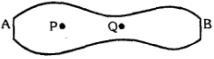
EasyMCQ
$A$ conductor of non-uniform cross-section is connected to a source of constant potential difference as shown in the figure. Then:
A
The electric field intensity is higher at $P$ than at $Q$.
B
The current density is lower at $P$ than at $Q$.
C
The rate of heat production per unit length is higher at $P$ than at $Q$.
D
The average kinetic energy of free electrons is higher at $P$ than at $Q$.
Solution
(B) $1$. The current $I$ flowing through the conductor is constant throughout because it is a series circuit.
$2$. Current density $J = I/A$. Since the cross-sectional area $A_P > A_Q$, the current density $J_P < J_Q$.
$3$. Electric field $E = J/\sigma = I/(A\sigma)$. Since $A_P > A_Q$, $E_P < E_Q$. Thus, the electric field is higher at $Q$ than at $P$.
$4$. The rate of heat production per unit length is $dH/dx = I^2 R/dx = I^2 \rho / A$. Since $A_P > A_Q$, the rate of heat production is lower at $P$ than at $Q$.
$5$. Therefore, the correct statement is that the current density is lower at $P$ than at $Q$ (Option $B$).
$2$. Current density $J = I/A$. Since the cross-sectional area $A_P > A_Q$, the current density $J_P < J_Q$.
$3$. Electric field $E = J/\sigma = I/(A\sigma)$. Since $A_P > A_Q$, $E_P < E_Q$. Thus, the electric field is higher at $Q$ than at $P$.
$4$. The rate of heat production per unit length is $dH/dx = I^2 R/dx = I^2 \rho / A$. Since $A_P > A_Q$, the rate of heat production is lower at $P$ than at $Q$.
$5$. Therefore, the correct statement is that the current density is lower at $P$ than at $Q$ (Option $B$).
0 likes
View Solution36
EasyMCQ
When a potential difference is applied across a linear metallic conductor,then:
A
Free electrons are continuously accelerated from the end at higher potential to the end at lower potential.
B
Free electrons are continuously accelerated from the end at lower potential to the end at higher potential.
C
Free electrons acquire a constant drift velocity from the end at lower potential to the end at higher potential.
D
Free electrons move from a stationary state to a state of motion.
Solution
(C) When a potential difference $V$ is applied across a metallic conductor,an electric field $E$ is established inside the conductor directed from the higher potential end to the lower potential end.
Since electrons are negatively charged,they experience an electric force $F = -eE$ in the direction opposite to the electric field.
Therefore,the free electrons experience a force directed from the lower potential end to the higher potential end.
Due to frequent collisions with the lattice ions,the electrons do not accelerate indefinitely but instead acquire a constant average velocity known as the drift velocity $(v_d)$ in the direction of the force (i.e.,from lower potential to higher potential).
Since electrons are negatively charged,they experience an electric force $F = -eE$ in the direction opposite to the electric field.
Therefore,the free electrons experience a force directed from the lower potential end to the higher potential end.
Due to frequent collisions with the lattice ions,the electrons do not accelerate indefinitely but instead acquire a constant average velocity known as the drift velocity $(v_d)$ in the direction of the force (i.e.,from lower potential to higher potential).
0 likes
View Solution37
EasyMCQ
Two identical conductors are kept at the same temperature. If the ratio of the potential difference across them is $1 : 2$,what will be the ratio of their drift velocities?
A
$1 : 2$
B
$3 : 2$
C
$1 : 1$
D
$1 : 2^{1/2}$
Solution
(A) The drift velocity is given by the formula $\upsilon_d = \frac{e\tau V}{mL}$,where $e$ is the charge of an electron,$\tau$ is the relaxation time,$V$ is the potential difference,$m$ is the mass of the electron,and $L$ is the length of the conductor.
Since the conductors are identical and kept at the same temperature,the relaxation time $\tau$,mass $m$,and length $L$ are constant for both conductors.
Therefore,the drift velocity is directly proportional to the potential difference: $\upsilon_d \propto V$.
Thus,the ratio of the drift velocities is $\frac{\upsilon_{d1}}{\upsilon_{d2}} = \frac{V_1}{V_2}$.
Given the ratio of potential differences is $1 : 2$,the ratio of drift velocities is $1 : 2$.
Since the conductors are identical and kept at the same temperature,the relaxation time $\tau$,mass $m$,and length $L$ are constant for both conductors.
Therefore,the drift velocity is directly proportional to the potential difference: $\upsilon_d \propto V$.
Thus,the ratio of the drift velocities is $\frac{\upsilon_{d1}}{\upsilon_{d2}} = \frac{V_1}{V_2}$.
Given the ratio of potential differences is $1 : 2$,the ratio of drift velocities is $1 : 2$.
0 likes
View Solution38
MediumMCQ
$A$ current of $1.344 \, A$ flows through a copper wire of cross-sectional area $1 \, mm^2$. If the number of free electrons per unit volume is $8.4 \times 10^{22} \, cm^{-3}$,then the drift velocity is:
A
$1.0 \, mm/s$
B
$1.0 \, m/s$
C
$0.1 \, mm/s$
D
$0.01 \, mm/s$
Solution
(C) Given: Current $I = 1.344 \, A$,Area $A = 1 \, mm^2 = 1 \times 10^{-6} \, m^2$,and electron density $n = 8.4 \times 10^{22} \, cm^{-3} = 8.4 \times 10^{28} \, m^{-3}$.
The formula for drift velocity is $v_d = \frac{I}{neA}$.
Substituting the values:
$v_d = \frac{1.344}{(8.4 \times 10^{28}) \times (1.6 \times 10^{-19}) \times (1 \times 10^{-6})}$
$v_d = \frac{1.344}{8.4 \times 1.6 \times 10^{3}}$
$v_d = \frac{1.344}{13.44 \times 10^{3}} = 0.1 \times 10^{-3} \, m/s = 0.1 \, mm/s$.
The formula for drift velocity is $v_d = \frac{I}{neA}$.
Substituting the values:
$v_d = \frac{1.344}{(8.4 \times 10^{28}) \times (1.6 \times 10^{-19}) \times (1 \times 10^{-6})}$
$v_d = \frac{1.344}{8.4 \times 1.6 \times 10^{3}}$
$v_d = \frac{1.344}{13.44 \times 10^{3}} = 0.1 \times 10^{-3} \, m/s = 0.1 \, mm/s$.
0 likes
View Solution39
EasyMCQ
$A$ wire of cross-sectional radius $r$ carries a current $I$ due to free electrons moving with a drift velocity $V$. What will be the current in another wire of the same material having half the radius and a drift velocity of $2V$?
A
$2I$
B
$I$
C
$I/2$
D
$I/4$
Solution
(C) The relationship between current $I$,drift velocity $v_d$,and cross-sectional area $A$ is given by $I = neAv_d$.
Since $A = \pi r^2$,we have $I = ne(\pi r^2)v_d$,which implies $I \propto r^2 v_d$.
For the first wire: $I_1 = I$,$r_1 = r$,$v_{d1} = V$.
For the second wire: $r_2 = r/2$,$v_{d2} = 2V$.
Taking the ratio: $\frac{I_2}{I_1} = \frac{r_2^2 v_{d2}}{r_1^2 v_{d1}} = \frac{(r/2)^2 (2V)}{r^2 V} = \frac{(r^2/4) (2V)}{r^2 V} = \frac{1}{2}$.
Therefore,$I_2 = I_1 / 2 = I/2$.
Since $A = \pi r^2$,we have $I = ne(\pi r^2)v_d$,which implies $I \propto r^2 v_d$.
For the first wire: $I_1 = I$,$r_1 = r$,$v_{d1} = V$.
For the second wire: $r_2 = r/2$,$v_{d2} = 2V$.
Taking the ratio: $\frac{I_2}{I_1} = \frac{r_2^2 v_{d2}}{r_1^2 v_{d1}} = \frac{(r/2)^2 (2V)}{r^2 V} = \frac{(r^2/4) (2V)}{r^2 V} = \frac{1}{2}$.
Therefore,$I_2 = I_1 / 2 = I/2$.
0 likes
View Solution40
MediumMCQ
$A$ copper wire of length $1 \ m$ and radius $1 \ mm$ is connected in series with an iron wire of length $2 \ m$ and radius $3 \ mm$. If a current flows through both wires,the ratio of the current density in the copper wire to that in the iron wire will be:
A
$18 : 1$
B
$9 : 1$
C
$6 : 1$
D
$2 : 3$
Solution
(B) Current density $J$ is defined as $J = I / A$,where $I$ is the current and $A$ is the cross-sectional area.
Since the wires are connected in series,the current $I$ flowing through both wires is the same.
The cross-sectional area $A$ is given by $A = \pi r^2$.
For the copper wire $(1)$: $J_1 = I / (\pi r_1^2)$.
For the iron wire $(2)$: $J_2 = I / (\pi r_2^2)$.
The ratio of current densities is $J_1 / J_2 = (I / \pi r_1^2) / (I / \pi r_2^2) = r_2^2 / r_1^2$.
Given $r_1 = 1 \ mm$ and $r_2 = 3 \ mm$,we have:
$J_1 / J_2 = (3)^2 / (1)^2 = 9 / 1$.
Therefore,the ratio is $9 : 1$.
Since the wires are connected in series,the current $I$ flowing through both wires is the same.
The cross-sectional area $A$ is given by $A = \pi r^2$.
For the copper wire $(1)$: $J_1 = I / (\pi r_1^2)$.
For the iron wire $(2)$: $J_2 = I / (\pi r_2^2)$.
The ratio of current densities is $J_1 / J_2 = (I / \pi r_1^2) / (I / \pi r_2^2) = r_2^2 / r_1^2$.
Given $r_1 = 1 \ mm$ and $r_2 = 3 \ mm$,we have:
$J_1 / J_2 = (3)^2 / (1)^2 = 9 / 1$.
Therefore,the ratio is $9 : 1$.
0 likes
View Solution41
EasyMCQ
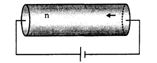
Derive the relation between electric current and drift velocity.
A
$I = Av_d$
B
$I = nev_d$
C
$I = neAv_d$
D
$I = neA$
Solution
(C) Let $v_d$ be the drift velocity,$n$ be the number of free electrons per unit volume,$l$ be the length of the conductor,and $A$ be the cross-sectional area of the conductor.
The total number of free electrons in the conductor is given by $N = n(lA)$.
The total charge $q$ contained in the conductor is $q = Ne = n(lA)e$.
The time $t$ taken by the electrons to cross the length $l$ of the conductor with drift velocity $v_d$ is $t = l / v_d$.
The electric current $I$ is defined as the rate of flow of charge: $I = q / t$.
Substituting the values of $q$ and $t$,we get:
$I = \frac{n(lA)e}{l / v_d} = neAv_d$.
Thus,the relation is $I = neAv_d$.
The total number of free electrons in the conductor is given by $N = n(lA)$.
The total charge $q$ contained in the conductor is $q = Ne = n(lA)e$.
The time $t$ taken by the electrons to cross the length $l$ of the conductor with drift velocity $v_d$ is $t = l / v_d$.
The electric current $I$ is defined as the rate of flow of charge: $I = q / t$.
Substituting the values of $q$ and $t$,we get:
$I = \frac{n(lA)e}{l / v_d} = neAv_d$.
Thus,the relation is $I = neAv_d$.
0 likes
View Solution42
DifficultMCQ
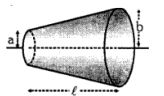
$A$ conductor of length $\ell$ with a circular cross-section is shown in the figure,carrying a current $i$. The radius of the cross-section varies linearly from $a$ to $b$. Assuming $(b - a) << \ell$,calculate the current density at a distance $x$ from the left end.
A
$\frac{i}{\pi \left[ a - \frac{x(b + a)}{\ell} \right]^2}$
B
$\frac{i}{\pi \left[ a + \frac{x(b + a)}{\ell} \right]^2}$
C
$\frac{i}{\pi \left[ a + \frac{x(b - a)}{\ell} \right]}$
D
$\frac{i}{\pi \left[ a + \frac{x(b - a)}{\ell} \right]^2}$
Solution
(D) The radius at the left end is $a$ and at the right end is $b$. Thus,the increase in radius over the length $\ell$ is $(b - a)$.
The rate of increase of radius per unit length is $\frac{b - a}{\ell}$.
The increase in radius at a distance $x$ from the left end is $\left( \frac{b - a}{\ell} \right) x$.
Therefore,the radius $r$ at distance $x$ is $r = a + \left( \frac{b - a}{\ell} \right) x$.
The cross-sectional area at this point is $A = \pi r^2 = \pi \left[ a + \left( \frac{b - a}{\ell} \right) x \right]^2$.
Since the current $i$ is constant throughout the conductor,the current density $J$ is given by $J = \frac{i}{A} = \frac{i}{\pi \left[ a + \frac{x(b - a)}{\ell} \right]^2}$.
The rate of increase of radius per unit length is $\frac{b - a}{\ell}$.
The increase in radius at a distance $x$ from the left end is $\left( \frac{b - a}{\ell} \right) x$.
Therefore,the radius $r$ at distance $x$ is $r = a + \left( \frac{b - a}{\ell} \right) x$.
The cross-sectional area at this point is $A = \pi r^2 = \pi \left[ a + \left( \frac{b - a}{\ell} \right) x \right]^2$.
Since the current $i$ is constant throughout the conductor,the current density $J$ is given by $J = \frac{i}{A} = \frac{i}{\pi \left[ a + \frac{x(b - a)}{\ell} \right]^2}$.
0 likes
View Solution43
MediumMCQ
$A$ copper wire of cross-sectional area $1.0 \ mm^2$ carries a current of $1.34 \ A$. Assuming that each copper atom contributes one free electron,calculate the drift velocity of the free electrons in the wire in $mm/s$. (Given: density of copper = $8990 \ kg/m^3$,atomic mass = $63.50 \ g/mol$)
A
$1.8$
B
$2.1$
C
$0.1$
D
$0.80$
Solution
(C) The mass of $1 \ m^3$ of copper is $8990 \ kg = 8990 \times 10^3 \ g$.
The number of moles in $1 \ m^3$ is $n_{moles} = \frac{8990 \times 10^3}{63.5} \approx 1.415 \times 10^5 \ mol$.
Since each mole contains $N_A = 6.022 \times 10^{23}$ atoms and each atom contributes one free electron,the number density of free electrons $n$ is:
$n = (1.415 \times 10^5) \times (6.022 \times 10^{23}) \approx 8.52 \times 10^{28} \ m^{-3}$.
Using the formula for current $I = neAv_d$,the drift velocity $v_d$ is:
$v_d = \frac{I}{neA}$.
Given $I = 1.34 \ A$,$A = 1.0 \ mm^2 = 10^{-6} \ m^2$,and $e = 1.6 \times 10^{-19} \ C$:
$v_d = \frac{1.34}{(8.52 \times 10^{28}) \times (1.6 \times 10^{-19}) \times (10^{-6})}$
$v_d \approx \frac{1.34}{1.3632 \times 10^4} \approx 0.98 \times 10^{-4} \ m/s$.
Converting to $mm/s$:
$v_d \approx 0.1 \ mm/s$.
The number of moles in $1 \ m^3$ is $n_{moles} = \frac{8990 \times 10^3}{63.5} \approx 1.415 \times 10^5 \ mol$.
Since each mole contains $N_A = 6.022 \times 10^{23}$ atoms and each atom contributes one free electron,the number density of free electrons $n$ is:
$n = (1.415 \times 10^5) \times (6.022 \times 10^{23}) \approx 8.52 \times 10^{28} \ m^{-3}$.
Using the formula for current $I = neAv_d$,the drift velocity $v_d$ is:
$v_d = \frac{I}{neA}$.
Given $I = 1.34 \ A$,$A = 1.0 \ mm^2 = 10^{-6} \ m^2$,and $e = 1.6 \times 10^{-19} \ C$:
$v_d = \frac{1.34}{(8.52 \times 10^{28}) \times (1.6 \times 10^{-19}) \times (10^{-6})}$
$v_d \approx \frac{1.34}{1.3632 \times 10^4} \approx 0.98 \times 10^{-4} \ m/s$.
Converting to $mm/s$:
$v_d \approx 0.1 \ mm/s$.
0 likes
View Solution44
MediumMCQ
$A$ silicon block at $300\,K$ has a length of $10\,cm$ and a cross-sectional area of $1 \times 10^{-4}\,m^2$. If a $2\,V$ battery is connected across its ends parallel to the length,find the current flowing through it. The electron mobility is $0.14\,m^2V^{-1}s^{-1}$ and the electron number density is $1.5 \times 10^{16}\,m^{-3}$.
A
$6.72 \times 10^{-4}\,A$
B
$6.72 \times 10^{-5}\,A$
C
$6.72 \times 10^{-6}\,A$
D
$6.72 \times 10^{-7}\,A$
Solution
(D) Given: Length $l = 10\,cm = 0.1\,m$,Area $A = 1 \times 10^{-4}\,m^2$,Voltage $V = 2\,V$,Mobility $\mu = 0.14\,m^2V^{-1}s^{-1}$,Electron density $n = 1.5 \times 10^{16}\,m^{-3}$,Charge of electron $e = 1.6 \times 10^{-19}\,C$.
The current $I$ is given by $I = neAv_d$,where $v_d$ is the drift velocity.
Since $v_d = \mu E$ and $E = V/l$,we have $v_d = \mu (V/l)$.
Substituting this into the current equation: $I = neA \left( \frac{\mu V}{l} \right)$.
$I = \frac{n e A \mu V}{l} = \frac{(1.5 \times 10^{16}) \times (1.6 \times 10^{-19}) \times (1 \times 10^{-4}) \times 0.14 \times 2}{0.1}$.
$I = \frac{1.5 \times 1.6 \times 0.14 \times 2 \times 10^{16-19-4}}{10^{-1}}$.
$I = \frac{0.672 \times 10^{-7}}{10^{-1}} = 0.672 \times 10^{-6} = 6.72 \times 10^{-7}\,A$.
The current $I$ is given by $I = neAv_d$,where $v_d$ is the drift velocity.
Since $v_d = \mu E$ and $E = V/l$,we have $v_d = \mu (V/l)$.
Substituting this into the current equation: $I = neA \left( \frac{\mu V}{l} \right)$.
$I = \frac{n e A \mu V}{l} = \frac{(1.5 \times 10^{16}) \times (1.6 \times 10^{-19}) \times (1 \times 10^{-4}) \times 0.14 \times 2}{0.1}$.
$I = \frac{1.5 \times 1.6 \times 0.14 \times 2 \times 10^{16-19-4}}{10^{-1}}$.
$I = \frac{0.672 \times 10^{-7}}{10^{-1}} = 0.672 \times 10^{-6} = 6.72 \times 10^{-7}\,A$.
0 likes
View Solution45
EasyMCQ
In a wire with a cross-sectional area of $1 \, cm^2$ carrying a current of $24 \, mA$,the electron number density is $3 \times 10^{23} \, m^{-3}$. What is the drift velocity?
A
$5 \times 10^{-6} \, m/s$
B
$5 \times 10^{-3} \, m/s$
C
$0.5 \, m/s$
D
$5 \times 10^{-2} \, m/s$
Solution
(B) The formula for drift velocity is given by $v_d = \frac{I}{neA}$.
Given:
$I = 24 \, mA = 24 \times 10^{-3} \, A$
$n = 3 \times 10^{23} \, m^{-3}$
$e = 1.6 \times 10^{-19} \, C$
$A = 1 \, cm^2 = 10^{-4} \, m^2$
Substituting these values into the formula:
$v_d = \frac{24 \times 10^{-3}}{3 \times 10^{23} \times 1.6 \times 10^{-19} \times 10^{-4}}$
$v_d = \frac{24 \times 10^{-3}}{4.8 \times 10^{0}}$
$v_d = 5 \times 10^{-3} \, m/s$.
Given:
$I = 24 \, mA = 24 \times 10^{-3} \, A$
$n = 3 \times 10^{23} \, m^{-3}$
$e = 1.6 \times 10^{-19} \, C$
$A = 1 \, cm^2 = 10^{-4} \, m^2$
Substituting these values into the formula:
$v_d = \frac{24 \times 10^{-3}}{3 \times 10^{23} \times 1.6 \times 10^{-19} \times 10^{-4}}$
$v_d = \frac{24 \times 10^{-3}}{4.8 \times 10^{0}}$
$v_d = 5 \times 10^{-3} \, m/s$.
0 likes
View Solution46
EasyMCQ
The drift velocity of electrons in a current-carrying wire of radius $r$ is $v$. If we want a drift velocity of $2v$ in a wire of the same material but with half the radius,what current must be passed through it?
A
$2i$
B
$i$
C
$i/2$
D
$i/4$
Solution
(C) The formula for electric current in terms of drift velocity is $i = neAv_d$,where $A = \pi r^2$ is the cross-sectional area.
Thus,$i = ne \pi r^2 v$.
For the new wire,the radius is $r' = r/2$ and the required drift velocity is $v' = 2v$.
The new current $i'$ is given by $i' = ne \pi (r')^2 v'$.
Substituting the values: $i' = ne \pi (r/2)^2 (2v)$.
$i' = ne \pi (r^2/4) (2v) = \frac{1}{2} (ne \pi r^2 v)$.
Since $i = ne \pi r^2 v$,we get $i' = i/2$.
Thus,$i = ne \pi r^2 v$.
For the new wire,the radius is $r' = r/2$ and the required drift velocity is $v' = 2v$.
The new current $i'$ is given by $i' = ne \pi (r')^2 v'$.
Substituting the values: $i' = ne \pi (r/2)^2 (2v)$.
$i' = ne \pi (r^2/4) (2v) = \frac{1}{2} (ne \pi r^2 v)$.
Since $i = ne \pi r^2 v$,we get $i' = i/2$.
0 likes
View Solution47
EasyMCQ
If the ratio of the radii of two wires of the same material is $1 : 2$ and the ratio of the current flowing through them is $4 : 1$,what is the ratio of their drift velocities?
A
$16 : 1$
B
$1 : 16$
C
$1 : 1$
D
$4 : 1$
Solution
(A) The relationship between current $i$ and drift velocity $v_d$ is given by $i = neA v_d$,where $n$ is the electron density,$e$ is the charge of an electron,and $A$ is the cross-sectional area.
Since the material is the same,$n$ is constant. Thus,$i \propto A v_d$.
Given $A = \pi r^2$,we have $i \propto r^2 v_d$,which implies $v_d \propto \frac{i}{r^2}$.
Therefore,the ratio of drift velocities is $\frac{v_{d1}}{v_{d2}} = \left( \frac{i_1}{i_2} \right) \times \left( \frac{r_2}{r_1} \right)^2$.
Substituting the given values: $\frac{i_1}{i_2} = \frac{4}{1}$ and $\frac{r_1}{r_2} = \frac{1}{2} \Rightarrow \frac{r_2}{r_1} = \frac{2}{1}$.
$\frac{v_{d1}}{v_{d2}} = \left( \frac{4}{1} \right) \times \left( \frac{2}{1} \right)^2 = 4 \times 4 = 16$.
Thus,the ratio is $16 : 1$.
Since the material is the same,$n$ is constant. Thus,$i \propto A v_d$.
Given $A = \pi r^2$,we have $i \propto r^2 v_d$,which implies $v_d \propto \frac{i}{r^2}$.
Therefore,the ratio of drift velocities is $\frac{v_{d1}}{v_{d2}} = \left( \frac{i_1}{i_2} \right) \times \left( \frac{r_2}{r_1} \right)^2$.
Substituting the given values: $\frac{i_1}{i_2} = \frac{4}{1}$ and $\frac{r_1}{r_2} = \frac{1}{2} \Rightarrow \frac{r_2}{r_1} = \frac{2}{1}$.
$\frac{v_{d1}}{v_{d2}} = \left( \frac{4}{1} \right) \times \left( \frac{2}{1} \right)^2 = 4 \times 4 = 16$.
Thus,the ratio is $16 : 1$.
0 likes
View Solution48
MediumMCQ
$A$ beam contains $2 \times 10^8$ doubly charged positive ions per cubic centimeter,all of which are moving with a speed of $10^5 \,m/s$. The current density is ............. $A/m^2$.
A
$6.4$
B
$3.2$
C
$1.6$
D
None of these
Solution
(A) The current density $J$ is given by the formula $J = nqv$,where $n$ is the number density of charge carriers,$q$ is the charge of each carrier,and $v$ is the drift velocity.
Given:
Number density $n = 2 \times 10^8 \text{ ions/cm}^3 = 2 \times 10^8 \times 10^6 \text{ ions/m}^3 = 2 \times 10^{14} \text{ ions/m}^3$.
Charge of a doubly charged ion $q = ze = 2 \times 1.6 \times 10^{-19} \text{ C} = 3.2 \times 10^{-19} \text{ C}$.
Velocity $v = 10^5 \text{ m/s}$.
Substituting these values into the formula:
$J = (2 \times 10^{14}) \times (3.2 \times 10^{-19}) \times 10^5$
$J = 6.4 \times 10^{14-19+5} \text{ A/m}^2$
$J = 6.4 \times 10^0 = 6.4 \text{ A/m}^2$.
Given:
Number density $n = 2 \times 10^8 \text{ ions/cm}^3 = 2 \times 10^8 \times 10^6 \text{ ions/m}^3 = 2 \times 10^{14} \text{ ions/m}^3$.
Charge of a doubly charged ion $q = ze = 2 \times 1.6 \times 10^{-19} \text{ C} = 3.2 \times 10^{-19} \text{ C}$.
Velocity $v = 10^5 \text{ m/s}$.
Substituting these values into the formula:
$J = (2 \times 10^{14}) \times (3.2 \times 10^{-19}) \times 10^5$
$J = 6.4 \times 10^{14-19+5} \text{ A/m}^2$
$J = 6.4 \times 10^0 = 6.4 \text{ A/m}^2$.
0 likes
View Solution49
MediumMCQ
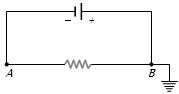
$A$ battery is connected to a uniform resistance wire $AB$ and $B$ is earthed. Which one of the graphs below shows how the current density $J$ varies along $AB$?
A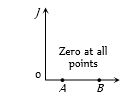
B
C
D
Solution
(D) The wire $AB$ is uniform,meaning its cross-sectional area $A$ is constant throughout its length.
According to the principle of continuity for steady currents,the current $I$ flowing through any cross-section of a series circuit is the same.
The current density $J$ is defined as the current per unit cross-sectional area,given by the formula $J = I/A$.
Since both the current $I$ and the cross-sectional area $A$ are constant for a uniform wire,the current density $J$ must also be constant at every point along the wire $AB$.
Therefore,the graph of $J$ versus the position along $AB$ will be a horizontal straight line.
This corresponds to the graph shown in option $D$.
According to the principle of continuity for steady currents,the current $I$ flowing through any cross-section of a series circuit is the same.
The current density $J$ is defined as the current per unit cross-sectional area,given by the formula $J = I/A$.
Since both the current $I$ and the cross-sectional area $A$ are constant for a uniform wire,the current density $J$ must also be constant at every point along the wire $AB$.
Therefore,the graph of $J$ versus the position along $AB$ will be a horizontal straight line.
This corresponds to the graph shown in option $D$.
0 likes
View Solution50
MediumMCQ
Two wires each of radius of cross section $r$ but of different materials are connected together end to end (in series). If the densities of charge carriers in the two wires are in the ratio $1 : 4$,the drift velocity of electrons in the two wires will be in the ratio:
A
$1 : 2$
B
$2 : 1$
C
$4 : 1$
D
$1 : 4$
Solution
(C) The current $I$ flowing through a conductor is given by the formula $I = n e A V_{d}$,where $n$ is the charge carrier density,$e$ is the elementary charge,$A$ is the cross-sectional area,and $V_{d}$ is the drift velocity.
Since the wires are connected in series,the current $I$ flowing through both wires must be the same.
Given that both wires have the same radius $r$,their cross-sectional areas $A$ are also equal.
Therefore,$n_{1} e A V_{d_{1}} = n_{2} e A V_{d_{2}}$.
This simplifies to $n_{1} V_{d_{1}} = n_{2} V_{d_{2}}$,which implies $\frac{V_{d_{1}}}{V_{d_{2}}} = \frac{n_{2}}{n_{1}}$.
Given the ratio of charge carrier densities is $\frac{n_{1}}{n_{2}} = \frac{1}{4}$,we have $\frac{n_{2}}{n_{1}} = \frac{4}{1}$.
Thus,the ratio of drift velocities is $\frac{V_{d_{1}}}{V_{d_{2}}} = 4 : 1$.
Since the wires are connected in series,the current $I$ flowing through both wires must be the same.
Given that both wires have the same radius $r$,their cross-sectional areas $A$ are also equal.
Therefore,$n_{1} e A V_{d_{1}} = n_{2} e A V_{d_{2}}$.
This simplifies to $n_{1} V_{d_{1}} = n_{2} V_{d_{2}}$,which implies $\frac{V_{d_{1}}}{V_{d_{2}}} = \frac{n_{2}}{n_{1}}$.
Given the ratio of charge carrier densities is $\frac{n_{1}}{n_{2}} = \frac{1}{4}$,we have $\frac{n_{2}}{n_{1}} = \frac{4}{1}$.
Thus,the ratio of drift velocities is $\frac{V_{d_{1}}}{V_{d_{2}}} = 4 : 1$.
0 likes
View SolutionCurrent Electricity — Current Density, Drift Velocity and Mobility · Frequently Asked Questions
1Are these Current Electricity questions useful for JEE and NEET?
Yes. All questions in this section are mapped to JEE Main and NEET exam patterns. Previous year questions from JEE Main, NEET, GUJCET and state-level exams are included with full solutions.
2Can I switch to Hindi or Gujarati for these questions?
Yes. Use the language tabs in the hero section or the sidebar to view the same questions and solutions in English, Hindi or Gujarati.
3How do I generate a question paper from this subtopic?
Use the Vedclass Exam Paper Generator — select the chapter and subtopic, set difficulty, and generate Sets A, B, C, D automatically. First 3 chapters of every subject are free.
Vedclass Products
For Students
Vedclass Test Series
Mock tests in real JEE/NEET style with performance analysis. 5-day free trial.
Start Free TrialFor Teachers
Exam Paper Generator
Generate Set A/B/C/D papers from this chapter in 2 minutes. 3 chapters free.
Try FreeFor Institutes
Online Exam Module
Live online exams with unlimited students, 360° analytics & white-label branding.
See DemoFor Teachers & Institutes
Generate a Current Electricity Exam Paper in 2 Minutes
Select subtopic & difficulty — Sets A, B, C, D auto-generated with No Repeat logic.
First 3 chapters of every subject are free — no payment required.