
A English
Meter Bridge Questions in English
Class 12 Physics · Current Electricity · Meter Bridge
120+
Questions
English
Language
100%
With Solutions
Showing 50 of 120 questions in English
1
MediumMCQ
An unknown resistance $R_1$ is connected in series with a resistance of $10 \,\Omega$. This combination is connected to one gap of a meter bridge while a resistance $R_2$ is connected in the other gap. The balance point is at $50 \, cm$. Now,when the $10 \,\Omega$ resistance is removed,the balance point shifts to $40 \, cm$. The value of $R_1$ is (in $\Omega$):
A
$60$
B
$40$
C
$20$
D
$10$
Solution
(C) In a meter bridge,the balancing condition is given by $\frac{P}{Q} = \frac{l}{100-l}$,where $P$ and $Q$ are resistances in the two gaps and $l$ is the balance length.
Case $1$: $R_1$ is in series with $10 \,\Omega$ in one gap,and $R_2$ is in the other gap. The balance point is at $50 \, cm$.
$\frac{R_1 + 10}{R_2} = \frac{50}{100-50} = \frac{50}{50} = 1$
$\Rightarrow R_2 = R_1 + 10$ --- (Equation $1$)
Case $2$: The $10 \,\Omega$ resistance is removed,so only $R_1$ remains in the first gap. The balance point shifts to $40 \, cm$.
$\frac{R_1}{R_2} = \frac{40}{100-40} = \frac{40}{60} = \frac{2}{3}$
$\Rightarrow 3R_1 = 2R_2$ --- (Equation $2$)
Substitute Equation $1$ into Equation $2$:
$3R_1 = 2(R_1 + 10)$
$3R_1 = 2R_1 + 20$
$R_1 = 20 \,\Omega$.
Case $1$: $R_1$ is in series with $10 \,\Omega$ in one gap,and $R_2$ is in the other gap. The balance point is at $50 \, cm$.
$\frac{R_1 + 10}{R_2} = \frac{50}{100-50} = \frac{50}{50} = 1$
$\Rightarrow R_2 = R_1 + 10$ --- (Equation $1$)
Case $2$: The $10 \,\Omega$ resistance is removed,so only $R_1$ remains in the first gap. The balance point shifts to $40 \, cm$.
$\frac{R_1}{R_2} = \frac{40}{100-40} = \frac{40}{60} = \frac{2}{3}$
$\Rightarrow 3R_1 = 2R_2$ --- (Equation $2$)
Substitute Equation $1$ into Equation $2$:
$3R_1 = 2(R_1 + 10)$
$3R_1 = 2R_1 + 20$
$R_1 = 20 \,\Omega$.
0 likes
View Solution2
EasyMCQ
In a meter bridge or Wheatstone bridge for the measurement of resistance,the known and the unknown resistances are interchanged. The error so removed is
A
End correction
B
Index error
C
Due to temperature effect
D
Random error
Solution
(A) In a meter bridge experiment,it is assumed that the resistance of the $L$-shaped copper strips is negligible,but in reality,they possess some small resistance.
This leads to an error known as the end error.
To eliminate this error,the known resistance (from the resistance box) and the unknown resistance are interchanged,and the mean of the two readings is taken to cancel out the effect of the end resistance.
This leads to an error known as the end error.
To eliminate this error,the known resistance (from the resistance box) and the unknown resistance are interchanged,and the mean of the two readings is taken to cancel out the effect of the end resistance.
0 likes
View Solution3
EasyMCQ
In an experiment of a meter bridge, a null point is obtained at the centre of the bridge wire. When a resistance of $10\, \Omega$ is connected in one gap, the value of resistance in the other gap is ............. $\Omega$.
A
$10$
B
$5$
C
$1/5$
D
$500$
Solution
(A) The meter bridge works on the principle of a Wheatstone bridge.
When the null point is at the center of the wire, the ratio of the resistances in the two gaps is equal to the ratio of the lengths of the wire segments.
Since the null point is at the center, the lengths are equal, i.e., $l_1 = l_2 = 50\, cm$.
The balance condition for a Wheatstone bridge is given by $\frac{P}{Q} = \frac{l_1}{l_2}$.
Given that $P = 10\, \Omega$ and $l_1 = l_2$, we have $\frac{10}{Q} = \frac{50}{50} = 1$.
Therefore, $Q = 10\, \Omega$.
When the null point is at the center of the wire, the ratio of the resistances in the two gaps is equal to the ratio of the lengths of the wire segments.
Since the null point is at the center, the lengths are equal, i.e., $l_1 = l_2 = 50\, cm$.
The balance condition for a Wheatstone bridge is given by $\frac{P}{Q} = \frac{l_1}{l_2}$.
Given that $P = 10\, \Omega$ and $l_1 = l_2$, we have $\frac{10}{Q} = \frac{50}{50} = 1$.
Therefore, $Q = 10\, \Omega$.
0 likes
View Solution4
EasyMCQ
In a meter bridge,the balancing length from the left end (standard resistance of $1 \, \Omega$ is in the right gap) is found to be $20 \, cm$. The value of the unknown resistance is ............... $\Omega$.
A
$0.8$
B
$0.5$
C
$0.4$
D
$0.25$
Solution
(D) In a meter bridge,the balancing condition is given by the formula $\frac{X}{R} = \frac{l}{100 - l}$,where $X$ is the unknown resistance,$R$ is the known resistance,and $l$ is the balancing length from the left end.
Given: $R = 1 \, \Omega$ and $l = 20 \, cm$.
The total length of the wire is $100 \, cm$,so the remaining length is $100 - 20 = 80 \, cm$.
Substituting the values into the formula: $\frac{X}{1} = \frac{20}{80}$.
Simplifying the fraction: $\frac{X}{1} = \frac{1}{4}$.
Therefore,$X = 0.25 \, \Omega$.
Given: $R = 1 \, \Omega$ and $l = 20 \, cm$.
The total length of the wire is $100 \, cm$,so the remaining length is $100 - 20 = 80 \, cm$.
Substituting the values into the formula: $\frac{X}{1} = \frac{20}{80}$.
Simplifying the fraction: $\frac{X}{1} = \frac{1}{4}$.
Therefore,$X = 0.25 \, \Omega$.
0 likes
View Solution5
MediumMCQ
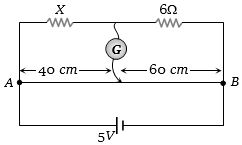
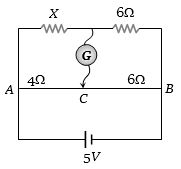
In the circuit shown, a meter bridge is in its balanced state. The meter bridge wire has a resistance of $0.1 \, \Omega/cm$. The value of the unknown resistance $X$ and the current drawn from the battery of negligible internal resistance are:
A
$6 \, \Omega, 5 \, A$
B
$10 \, \Omega, 0.1 \, A$
C
$4 \, \Omega, 1.0 \, A$
D
$12 \, \Omega, 0.5 \, A$
Solution
(C) The resistance of the wire segments $AC$ and $CB$ are calculated as follows:
$R_{AC} = 0.1 \, \Omega/cm \times 40 \, cm = 4 \, \Omega$
$R_{CB} = 0.1 \, \Omega/cm \times 60 \, cm = 6 \, \Omega$
In the balanced condition of the Wheatstone bridge, the ratio of resistances is equal:
$\frac{X}{6 \, \Omega} = \frac{R_{AC}}{R_{CB}} = \frac{4 \, \Omega}{6 \, \Omega}$
$\frac{X}{6} = \frac{4}{6} \implies X = 4 \, \Omega$
The total resistance of the circuit is the sum of the two parallel branches:
Branch $1$: $X + 6 \, \Omega = 4 \, \Omega + 6 \, \Omega = 10 \, \Omega$
Branch $2$: $R_{AC} + R_{CB} = 4 \, \Omega + 6 \, \Omega = 10 \, \Omega$
Since these two branches are in parallel, the equivalent resistance $R_{eq}$ is:
$R_{eq} = \frac{10 \, \Omega \times 10 \, \Omega}{10 \, \Omega + 10 \, \Omega} = 5 \, \Omega$
The current drawn from the battery is $I = \frac{V}{R_{eq}} = \frac{5 \, V}{5 \, \Omega} = 1.0 \, A$.
Thus, $X = 4 \, \Omega$ and $I = 1.0 \, A$.
$R_{AC} = 0.1 \, \Omega/cm \times 40 \, cm = 4 \, \Omega$
$R_{CB} = 0.1 \, \Omega/cm \times 60 \, cm = 6 \, \Omega$
In the balanced condition of the Wheatstone bridge, the ratio of resistances is equal:
$\frac{X}{6 \, \Omega} = \frac{R_{AC}}{R_{CB}} = \frac{4 \, \Omega}{6 \, \Omega}$
$\frac{X}{6} = \frac{4}{6} \implies X = 4 \, \Omega$
The total resistance of the circuit is the sum of the two parallel branches:
Branch $1$: $X + 6 \, \Omega = 4 \, \Omega + 6 \, \Omega = 10 \, \Omega$
Branch $2$: $R_{AC} + R_{CB} = 4 \, \Omega + 6 \, \Omega = 10 \, \Omega$
Since these two branches are in parallel, the equivalent resistance $R_{eq}$ is:
$R_{eq} = \frac{10 \, \Omega \times 10 \, \Omega}{10 \, \Omega + 10 \, \Omega} = 5 \, \Omega$
The current drawn from the battery is $I = \frac{V}{R_{eq}} = \frac{5 \, V}{5 \, \Omega} = 1.0 \, A$.
Thus, $X = 4 \, \Omega$ and $I = 1.0 \, A$.
0 likes
View Solution6
MediumMCQ
Resistance in the two gaps of a meter bridge are $10 \, \Omega$ and $30 \, \Omega$ respectively. If the resistances are interchanged, the balance point shifts by .............. $cm$.
A
$33.3$
B
$66.67$
C
$25$
D
$50$
Solution
(D) The balance condition for a meter bridge is given by $\frac{R}{S} = \frac{l}{100-l}$, where $R$ and $S$ are resistances in the two gaps and $l$ is the balance length from the left end.
Initially, $R = 10 \, \Omega$ and $S = 30 \, \Omega$. Thus, $\frac{10}{30} = \frac{l_1}{100-l_1} \Rightarrow 100 - l_1 = 3l_1 \Rightarrow 4l_1 = 100 \Rightarrow l_1 = 25 \, cm$.
After interchanging, $R = 30 \, \Omega$ and $S = 10 \, \Omega$. Thus, $\frac{30}{10} = \frac{l_2}{100-l_2} \Rightarrow 3(100 - l_2) = l_2 \Rightarrow 300 - 3l_2 = l_2 \Rightarrow 4l_2 = 300 \Rightarrow l_2 = 75 \, cm$.
The shift in the balance point is $|l_2 - l_1| = |75 - 25| = 50 \, cm$.
Initially, $R = 10 \, \Omega$ and $S = 30 \, \Omega$. Thus, $\frac{10}{30} = \frac{l_1}{100-l_1} \Rightarrow 100 - l_1 = 3l_1 \Rightarrow 4l_1 = 100 \Rightarrow l_1 = 25 \, cm$.
After interchanging, $R = 30 \, \Omega$ and $S = 10 \, \Omega$. Thus, $\frac{30}{10} = \frac{l_2}{100-l_2} \Rightarrow 3(100 - l_2) = l_2 \Rightarrow 300 - 3l_2 = l_2 \Rightarrow 4l_2 = 300 \Rightarrow l_2 = 75 \, cm$.
The shift in the balance point is $|l_2 - l_1| = |75 - 25| = 50 \, cm$.
0 likes
View Solution7
MediumMCQ
In a meter bridge experiment,a null point is obtained at $20 \ cm$ from one end of the wire when resistance $X$ is balanced against another resistance $Y$. If $X < Y$,then where will be the new position of the null point from the same end,if one decides to balance a resistance of $4X$ against $Y$ (in $cm$)?
A
$50$
B
$80$
C
$40$
D
$70$
Solution
(A) In a meter bridge,the balancing condition is given by $\frac{R_1}{R_2} = \frac{l}{100 - l}$.
For the first case,$\frac{X}{Y} = \frac{20}{100 - 20} = \frac{20}{80} = \frac{1}{4}$.
So,$\frac{X}{Y} = \frac{1}{4}$,which implies $Y = 4X$.
In the second case,we balance $4X$ against $Y$. Let the new null point be at $l \ cm$.
Then,$\frac{4X}{Y} = \frac{l}{100 - l}$.
Substituting $Y = 4X$ into the equation,we get $\frac{4X}{4X} = \frac{l}{100 - l}$.
$1 = \frac{l}{100 - l} \Rightarrow 100 - l = l \Rightarrow 2l = 100 \Rightarrow l = 50 \ cm$.
For the first case,$\frac{X}{Y} = \frac{20}{100 - 20} = \frac{20}{80} = \frac{1}{4}$.
So,$\frac{X}{Y} = \frac{1}{4}$,which implies $Y = 4X$.
In the second case,we balance $4X$ against $Y$. Let the new null point be at $l \ cm$.
Then,$\frac{4X}{Y} = \frac{l}{100 - l}$.
Substituting $Y = 4X$ into the equation,we get $\frac{4X}{4X} = \frac{l}{100 - l}$.
$1 = \frac{l}{100 - l} \Rightarrow 100 - l = l \Rightarrow 2l = 100 \Rightarrow l = 50 \ cm$.
0 likes
View Solution8
DifficultMCQ
Two resistances are connected in two gaps of a meter bridge. The balance point is $20 \ cm$ from the zero end. $A$ resistance of $15 \ \Omega$ is connected in series with the smaller of the two. The null point shifts to $40 \ cm$. The value of the smaller resistance in $\Omega$ is
A
$3$
B
$6$
C
$9$
D
$12$
Solution
(C) Let $R$ be the smaller resistance and $S$ be the larger resistance connected in the two gaps of the meter bridge.
According to the principle of the meter bridge,the balance condition is given by $\frac{R}{S} = \frac{l}{100 - l}$.
Given $l = 20 \ cm$,we have $\frac{R}{S} = \frac{20}{100 - 20} = \frac{20}{80} = \frac{1}{4}$.
Therefore,$S = 4R$ ..... $(i)$
When a resistance of $15 \ \Omega$ is connected in series with the smaller resistance $R$,the new resistance becomes $(R + 15) \ \Omega$.
The new balance point is at $l' = 40 \ cm$.
Applying the balance condition again: $\frac{R + 15}{S} = \frac{40}{100 - 40} = \frac{40}{60} = \frac{2}{3}$.
Substituting $S = 4R$ from equation $(i)$ into this expression:
$\frac{R + 15}{4R} = \frac{2}{3}$
$3(R + 15) = 2(4R)$
$3R + 45 = 8R$
$5R = 45$
$R = 9 \ \Omega$.
According to the principle of the meter bridge,the balance condition is given by $\frac{R}{S} = \frac{l}{100 - l}$.
Given $l = 20 \ cm$,we have $\frac{R}{S} = \frac{20}{100 - 20} = \frac{20}{80} = \frac{1}{4}$.
Therefore,$S = 4R$ ..... $(i)$
When a resistance of $15 \ \Omega$ is connected in series with the smaller resistance $R$,the new resistance becomes $(R + 15) \ \Omega$.
The new balance point is at $l' = 40 \ cm$.
Applying the balance condition again: $\frac{R + 15}{S} = \frac{40}{100 - 40} = \frac{40}{60} = \frac{2}{3}$.
Substituting $S = 4R$ from equation $(i)$ into this expression:
$\frac{R + 15}{4R} = \frac{2}{3}$
$3(R + 15) = 2(4R)$
$3R + 45 = 8R$
$5R = 45$
$R = 9 \ \Omega$.
0 likes
View Solution9
MediumMCQ
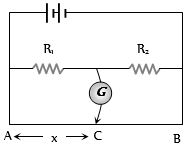
In the shown arrangement of the meter bridge experiment,if the length $AC$ corresponding to the null deflection of the galvanometer is $x$,what would be its value if the radius of the wire $AB$ is doubled?
A
$x$
B
$x/4$
C
$4x$
D
$2x$
Solution
(A) In a meter bridge,the balancing condition is given by the ratio of resistances: $\frac{R_1}{R_2} = \frac{R_{AC}}{R_{CB}}$.
Here,$R_{AC}$ is the resistance of the wire segment $AC$ and $R_{CB}$ is the resistance of the wire segment $CB$.
The resistance of a wire is given by $R = \rho \frac{L}{A}$,where $\rho$ is the resistivity,$L$ is the length,and $A$ is the cross-sectional area.
Substituting this into the balancing condition: $\frac{R_1}{R_2} = \frac{\rho (x) / A}{\rho (100-x) / A} = \frac{x}{100-x}$.
Since the cross-sectional area $A$ cancels out from the numerator and the denominator,the balancing length $x$ depends only on the ratio of the resistors $R_1$ and $R_2$.
Therefore,changing the radius of the wire $AB$ does not affect the balancing length $x$.
Here,$R_{AC}$ is the resistance of the wire segment $AC$ and $R_{CB}$ is the resistance of the wire segment $CB$.
The resistance of a wire is given by $R = \rho \frac{L}{A}$,where $\rho$ is the resistivity,$L$ is the length,and $A$ is the cross-sectional area.
Substituting this into the balancing condition: $\frac{R_1}{R_2} = \frac{\rho (x) / A}{\rho (100-x) / A} = \frac{x}{100-x}$.
Since the cross-sectional area $A$ cancels out from the numerator and the denominator,the balancing length $x$ depends only on the ratio of the resistors $R_1$ and $R_2$.
Therefore,changing the radius of the wire $AB$ does not affect the balancing length $x$.
0 likes
View Solution10
MediumMCQ
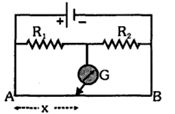
The experimental setup of a meter bridge is shown in the figure. If the null deflection point of the galvanometer is at distance $x$ from end $A$,what will be the new null point if the radius of the wire $AB$ is doubled?
A
$x$
B
$x/4$
C
$4x$
D
$2x$
Solution
(A) In a meter bridge,the null point condition is given by the Wheatstone bridge principle: $\frac{R_1}{R_2} = \frac{P}{Q}$,where $P$ and $Q$ are the resistances of the two segments of the wire $AB$ divided by the jockey.
Let the resistance per unit length of the wire be $\sigma$. If the length of the wire is $L = 100 \ cm$,then $P = \sigma x$ and $Q = \sigma (L - x)$.
The condition becomes $\frac{R_1}{R_2} = \frac{\sigma x}{\sigma (L - x)} = \frac{x}{L - x}$.
Since the resistance per unit length $\sigma = \frac{\rho}{A}$ (where $\rho$ is resistivity and $A$ is the cross-sectional area),$\sigma$ cancels out from the ratio.
Therefore,the null point position $x$ is independent of the radius (and thus the cross-sectional area) of the wire $AB$.
Hence,if the radius of the wire is doubled,the null point position remains unchanged at $x$.
Let the resistance per unit length of the wire be $\sigma$. If the length of the wire is $L = 100 \ cm$,then $P = \sigma x$ and $Q = \sigma (L - x)$.
The condition becomes $\frac{R_1}{R_2} = \frac{\sigma x}{\sigma (L - x)} = \frac{x}{L - x}$.
Since the resistance per unit length $\sigma = \frac{\rho}{A}$ (where $\rho$ is resistivity and $A$ is the cross-sectional area),$\sigma$ cancels out from the ratio.
Therefore,the null point position $x$ is independent of the radius (and thus the cross-sectional area) of the wire $AB$.
Hence,if the radius of the wire is doubled,the null point position remains unchanged at $x$.
0 likes
View Solution11
MediumMCQ
In a meter bridge experiment,the null point is obtained at $20 \ cm$ from one end of the wire when resistance $X$ is balanced against resistance $Y$. If $X < Y$,then the distance of the new null point from the same end when a resistance of $4X$ is balanced against $Y$ will be ............ $cm$.
A
$50$
B
$80$
C
$40$
D
$70$
Solution
(A) In a meter bridge,the balancing condition is given by $\frac{R_1}{R_2} = \frac{l_1}{100 - l_1}$.
Given the initial condition,$\frac{X}{Y} = \frac{20}{100 - 20} = \frac{20}{80} = \frac{1}{4}$.
So,$Y = 4X$.
Now,we replace $X$ with $4X$ and balance it against $Y$. Let the new null point be at distance $l$.
The new condition is $\frac{4X}{Y} = \frac{l}{100 - l}$.
Substituting $Y = 4X$ into the equation,we get $\frac{4X}{4X} = \frac{l}{100 - l}$.
$1 = \frac{l}{100 - l}$.
$100 - l = l$.
$2l = 100$.
$l = 50 \ cm$.
Given the initial condition,$\frac{X}{Y} = \frac{20}{100 - 20} = \frac{20}{80} = \frac{1}{4}$.
So,$Y = 4X$.
Now,we replace $X$ with $4X$ and balance it against $Y$. Let the new null point be at distance $l$.
The new condition is $\frac{4X}{Y} = \frac{l}{100 - l}$.
Substituting $Y = 4X$ into the equation,we get $\frac{4X}{4X} = \frac{l}{100 - l}$.
$1 = \frac{l}{100 - l}$.
$100 - l = l$.
$2l = 100$.
$l = 50 \ cm$.
0 likes
View Solution12
DifficultMCQ
In the given Wheatstone bridge (meter bridge) circuit,the galvanometer shows zero deflection. The value of the unknown resistance $R$ is ................. $\Omega$.
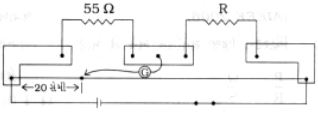
A
$220$
B
$110$
C
$55$
D
$13.75$
Solution
(A) In a meter bridge,the condition for a balanced bridge when the galvanometer shows zero deflection is given by the formula:
$\frac{R_1}{R_2} = \frac{l}{100 - l}$
Here,$R_1 = 55 \, \Omega$,$R_2 = R$,and the balancing length $l = 20 \, \text{cm}$.
Substituting these values into the formula:
$\frac{55}{R} = \frac{20}{100 - 20}$
$\frac{55}{R} = \frac{20}{80}$
$\frac{55}{R} = \frac{1}{4}$
$R = 55 \times 4 = 220 \, \Omega$
Therefore,the value of the unknown resistance $R$ is $220 \, \Omega$.
$\frac{R_1}{R_2} = \frac{l}{100 - l}$
Here,$R_1 = 55 \, \Omega$,$R_2 = R$,and the balancing length $l = 20 \, \text{cm}$.
Substituting these values into the formula:
$\frac{55}{R} = \frac{20}{100 - 20}$
$\frac{55}{R} = \frac{20}{80}$
$\frac{55}{R} = \frac{1}{4}$
$R = 55 \times 4 = 220 \, \Omega$
Therefore,the value of the unknown resistance $R$ is $220 \, \Omega$.
0 likes
View Solution13
MediumMCQ
In a meter bridge experiment,when resistance $X$ is in the left gap and $Y$ is in the right gap,the null point is found at $20 \ cm$ from the left end. If $X < Y$,what will be the new position of the null point from the same end if a resistance of $4X$ is placed in the left gap instead of $X$?
A
$50$
B
$80$
C
$40$
D
$70$
Solution
(A) For a meter bridge,the balancing condition is given by $\frac{X}{Y} = \frac{l}{100 - l}$.
Given $l = 20 \ cm$,we have $\frac{X}{Y} = \frac{20}{100 - 20} = \frac{20}{80} = \frac{1}{4}$.
Now,if $X$ is replaced by $4X$,let the new null point be $l'$.
The new condition is $\frac{4X}{Y} = \frac{l'}{100 - l'}$.
Substituting $\frac{X}{Y} = \frac{1}{4}$,we get $4 \times \frac{1}{4} = \frac{l'}{100 - l'}$.
$1 = \frac{l'}{100 - l'} \Rightarrow 100 - l' = l' \Rightarrow 2l' = 100$.
Therefore,$l' = 50 \ cm$.
Given $l = 20 \ cm$,we have $\frac{X}{Y} = \frac{20}{100 - 20} = \frac{20}{80} = \frac{1}{4}$.
Now,if $X$ is replaced by $4X$,let the new null point be $l'$.
The new condition is $\frac{4X}{Y} = \frac{l'}{100 - l'}$.
Substituting $\frac{X}{Y} = \frac{1}{4}$,we get $4 \times \frac{1}{4} = \frac{l'}{100 - l'}$.
$1 = \frac{l'}{100 - l'} \Rightarrow 100 - l' = l' \Rightarrow 2l' = 100$.
Therefore,$l' = 50 \ cm$.
0 likes
View Solution14
DifficultMCQ
In a meter bridge,the two gaps contain resistances of $10 \, \Omega$ and $30 \, \Omega$ respectively. If these resistances are interchanged,the null point shifts by ..... cm.
A
$25$
B
$33.3$
C
$50$
D
$66.67$
Solution
(C) In a meter bridge,the balance condition is given by $\frac{R_1}{R_2} = \frac{l_1}{100 - l_1}$.
Substituting $R_1 = 10 \, \Omega$ and $R_2 = 30 \, \Omega$:
$\frac{10}{30} = \frac{l_1}{100 - l_1} \implies 100 - l_1 = 3l_1 \implies 4l_1 = 100 \implies l_1 = 25 \, \text{cm}$.
Now,interchanging the resistances,we get $R_1 = 30 \, \Omega$ and $R_2 = 10 \, \Omega$.
$\frac{30}{10} = \frac{l_2}{100 - l_2} \implies 3(100 - l_2) = l_2 \implies 300 - 3l_2 = l_2 \implies 4l_2 = 300 \implies l_2 = 75 \, \text{cm}$.
The shift in the null point is $|l_2 - l_1| = |75 - 25| = 50 \, \text{cm}$.
Substituting $R_1 = 10 \, \Omega$ and $R_2 = 30 \, \Omega$:
$\frac{10}{30} = \frac{l_1}{100 - l_1} \implies 100 - l_1 = 3l_1 \implies 4l_1 = 100 \implies l_1 = 25 \, \text{cm}$.
Now,interchanging the resistances,we get $R_1 = 30 \, \Omega$ and $R_2 = 10 \, \Omega$.
$\frac{30}{10} = \frac{l_2}{100 - l_2} \implies 3(100 - l_2) = l_2 \implies 300 - 3l_2 = l_2 \implies 4l_2 = 300 \implies l_2 = 75 \, \text{cm}$.
The shift in the null point is $|l_2 - l_1| = |75 - 25| = 50 \, \text{cm}$.
0 likes
View Solution15
DifficultMCQ
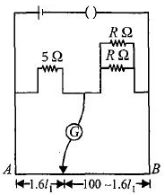
The resistances in the two arms of the meter bridge are $5 \,\Omega$ and $R \,\Omega$ respectively. When the resistance $R$ is shunted with an equal resistance,the new balance point is at $1.6\,l_1$. The resistance $R$ is .................. $\Omega$.
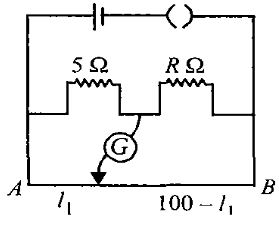
A
$10$
B
$15$
C
$20$
D
$25$
Solution
(B) In the first case,at the balance point:
$\frac{5}{R} = \frac{l_1}{100 - l_1}$ $....(i)$
In the second case,the resistance $R$ is shunted with an equal resistance $R$,so the equivalent resistance becomes $R' = \frac{R \times R}{R + R} = \frac{R}{2}$.
The new balance point is at $1.6\,l_1$. Thus,at the balance point:
$\frac{5}{R/2} = \frac{1.6\,l_1}{100 - 1.6\,l_1}$ $....(ii)$
Dividing equation $(i)$ by equation $(ii)$:
$\frac{5/R}{5/(R/2)} = \frac{l_1 / (100 - l_1)}{1.6\,l_1 / (100 - 1.6\,l_1)}$
$\frac{1}{2} = \frac{l_1}{100 - l_1} \times \frac{100 - 1.6\,l_1}{1.6\,l_1}$
$\frac{1}{2} = \frac{100 - 1.6\,l_1}{1.6(100 - l_1)}$
$0.8(100 - l_1) = 100 - 1.6\,l_1$
$80 - 0.8\,l_1 = 100 - 1.6\,l_1$
$0.8\,l_1 = 20$
$l_1 = 25\,cm$
Substituting $l_1 = 25\,cm$ into equation $(i)$:
$\frac{5}{R} = \frac{25}{100 - 25} = \frac{25}{75} = \frac{1}{3}$
$R = 15\,\Omega$.
$\frac{5}{R} = \frac{l_1}{100 - l_1}$ $....(i)$
In the second case,the resistance $R$ is shunted with an equal resistance $R$,so the equivalent resistance becomes $R' = \frac{R \times R}{R + R} = \frac{R}{2}$.
The new balance point is at $1.6\,l_1$. Thus,at the balance point:
$\frac{5}{R/2} = \frac{1.6\,l_1}{100 - 1.6\,l_1}$ $....(ii)$
Dividing equation $(i)$ by equation $(ii)$:
$\frac{5/R}{5/(R/2)} = \frac{l_1 / (100 - l_1)}{1.6\,l_1 / (100 - 1.6\,l_1)}$
$\frac{1}{2} = \frac{l_1}{100 - l_1} \times \frac{100 - 1.6\,l_1}{1.6\,l_1}$
$\frac{1}{2} = \frac{100 - 1.6\,l_1}{1.6(100 - l_1)}$
$0.8(100 - l_1) = 100 - 1.6\,l_1$
$80 - 0.8\,l_1 = 100 - 1.6\,l_1$
$0.8\,l_1 = 20$
$l_1 = 25\,cm$
Substituting $l_1 = 25\,cm$ into equation $(i)$:
$\frac{5}{R} = \frac{25}{100 - 25} = \frac{25}{75} = \frac{1}{3}$
$R = 15\,\Omega$.
0 likes
View Solution16
MediumMCQ
If the balance point is obtained at the $35^{th} cm$ in a meter bridge,the resistances in the left and right gaps are in the ratio of:
A
$7 : 13$
B
$13 : 7$
C
$9 : 11$
D
$11 : 9$
Solution
(A) In a meter bridge,the Wheatstone bridge principle is used to find the unknown resistance.
According to the principle,the ratio of the resistances in the left gap $(P)$ and the right gap $(Q)$ is equal to the ratio of the lengths of the wire segments on the left $(l)$ and right $(100 - l)$ sides.
Given,the balance point is at $l = 35 \ cm$.
Therefore,the ratio is $\frac{P}{Q} = \frac{l}{100 - l}$.
Substituting the values: $\frac{P}{Q} = \frac{35}{100 - 35} = \frac{35}{65}$.
Simplifying the fraction by dividing both numerator and denominator by $5$,we get $\frac{7}{13}$.
Thus,the ratio is $7 : 13$.
According to the principle,the ratio of the resistances in the left gap $(P)$ and the right gap $(Q)$ is equal to the ratio of the lengths of the wire segments on the left $(l)$ and right $(100 - l)$ sides.
Given,the balance point is at $l = 35 \ cm$.
Therefore,the ratio is $\frac{P}{Q} = \frac{l}{100 - l}$.
Substituting the values: $\frac{P}{Q} = \frac{35}{100 - 35} = \frac{35}{65}$.
Simplifying the fraction by dividing both numerator and denominator by $5$,we get $\frac{7}{13}$.
Thus,the ratio is $7 : 13$.
0 likes
View Solution17
AdvancedMCQ
In the figure shown,for given values of $R_1$ and $R_2$,the balance point for the jockey is at $40\,cm$ from $A$. When $R_2$ is shunted by a resistance of $10\, \Omega$,the balance point shifts to $50\,cm$. Find $R_1$ and $R_2$. $(AB = 1\,m)$
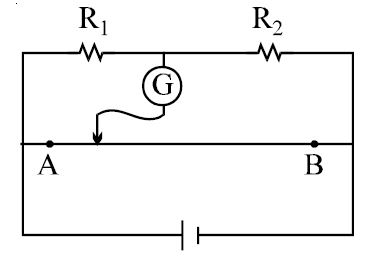
A
$\frac{10}{3}\, \Omega, 5\, \Omega$
B
$20\, \Omega, 30\, \Omega$
C
$10\, \Omega, 15\, \Omega$
D
$5\, \Omega, \frac{15}{2}\, \Omega$
Solution
(A) For a meter bridge,the balancing condition is given by $\frac{R_1}{R_2} = \frac{l}{100-l}$,where $l$ is the distance from end $A$.
In the first case,$l = 40\,cm$:
$\frac{R_1}{R_2} = \frac{40}{100-40} = \frac{40}{60} = \frac{2}{3}$
$R_1 = \frac{2}{3} R_2$ ... $(1)$
In the second case,$R_2$ is shunted by $10\, \Omega$,so the new resistance $R_2'$ is $\frac{10 R_2}{10 + R_2}$. The new balance point is $l' = 50\,cm$:
$\frac{R_1}{R_2'} = \frac{50}{100-50} = \frac{50}{50} = 1$
$R_1 = R_2' = \frac{10 R_2}{10 + R_2}$ ... $(2)$
Equating $(1)$ and $(2)$:
$\frac{2}{3} R_2 = \frac{10 R_2}{10 + R_2}$
$2(10 + R_2) = 30$
$20 + 2 R_2 = 30$
$2 R_2 = 10$
$R_2 = 5\, \Omega$
Substituting $R_2 = 5\, \Omega$ into $(1)$:
$R_1 = \frac{2}{3} \times 5 = \frac{10}{3}\, \Omega$
Thus,$R_1 = \frac{10}{3}\, \Omega$ and $R_2 = 5\, \Omega$.
In the first case,$l = 40\,cm$:
$\frac{R_1}{R_2} = \frac{40}{100-40} = \frac{40}{60} = \frac{2}{3}$
$R_1 = \frac{2}{3} R_2$ ... $(1)$
In the second case,$R_2$ is shunted by $10\, \Omega$,so the new resistance $R_2'$ is $\frac{10 R_2}{10 + R_2}$. The new balance point is $l' = 50\,cm$:
$\frac{R_1}{R_2'} = \frac{50}{100-50} = \frac{50}{50} = 1$
$R_1 = R_2' = \frac{10 R_2}{10 + R_2}$ ... $(2)$
Equating $(1)$ and $(2)$:
$\frac{2}{3} R_2 = \frac{10 R_2}{10 + R_2}$
$2(10 + R_2) = 30$
$20 + 2 R_2 = 30$
$2 R_2 = 10$
$R_2 = 5\, \Omega$
Substituting $R_2 = 5\, \Omega$ into $(1)$:
$R_1 = \frac{2}{3} \times 5 = \frac{10}{3}\, \Omega$
Thus,$R_1 = \frac{10}{3}\, \Omega$ and $R_2 = 5\, \Omega$.
0 likes
View Solution18
DifficultMCQ
The figure shows a meter-bridge circuit,with $AB = 100\, cm$,$X = 12\,\Omega$ and $R = 18\,\Omega$,and the jockey $J$ in the position of balance. If $R$ is now made $8\,\Omega$,through what distance will $J$ have to be moved to obtain balance? .............. $cm$
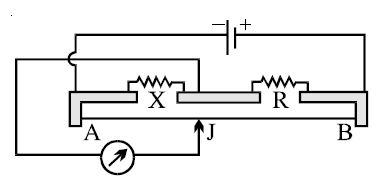
A
$10$
B
$20$
C
$30$
D
$40$
Solution
(B) The balancing condition for a meter bridge is given by:
$\frac{X}{R} = \frac{l_1}{100 - l_1}$
For the initial case where $X = 12\,\Omega$ and $R = 18\,\Omega$:
$\frac{12}{18} = \frac{l_1}{100 - l_1}$
$\frac{2}{3} = \frac{l_1}{100 - l_1}$
$200 - 2l_1 = 3l_1$
$5l_1 = 200$
$l_1 = 40\, cm$
Now,$R$ is changed to $8\,\Omega$. Let the new balancing length be $l_2$:
$\frac{12}{8} = \frac{l_2}{100 - l_2}$
$\frac{3}{2} = \frac{l_2}{100 - l_2}$
$300 - 3l_2 = 2l_2$
$5l_2 = 300$
$l_2 = 60\, cm$
The distance through which the jockey $J$ must be moved is:
$\Delta l = l_2 - l_1 = 60\, cm - 40\, cm = 20\, cm$
$\frac{X}{R} = \frac{l_1}{100 - l_1}$
For the initial case where $X = 12\,\Omega$ and $R = 18\,\Omega$:
$\frac{12}{18} = \frac{l_1}{100 - l_1}$
$\frac{2}{3} = \frac{l_1}{100 - l_1}$
$200 - 2l_1 = 3l_1$
$5l_1 = 200$
$l_1 = 40\, cm$
Now,$R$ is changed to $8\,\Omega$. Let the new balancing length be $l_2$:
$\frac{12}{8} = \frac{l_2}{100 - l_2}$
$\frac{3}{2} = \frac{l_2}{100 - l_2}$
$300 - 3l_2 = 2l_2$
$5l_2 = 300$
$l_2 = 60\, cm$
The distance through which the jockey $J$ must be moved is:
$\Delta l = l_2 - l_1 = 60\, cm - 40\, cm = 20\, cm$
0 likes
View Solution19
EasyMCQ
Shown in the figure below is a meter-bridge set up with null deflection in the galvanometer. The value of the unknown resistor $R$ is ............. $\Omega$.
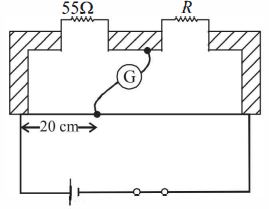
A
$55$
B
$13.75$
C
$220$
D
$110$
Solution
(C) In a meter bridge,the balancing condition is given by the formula: $\frac{P}{Q} = \frac{l_1}{l_2}$,where $P$ and $Q$ are the resistances in the two gaps,and $l_1$ and $l_2$ are the corresponding lengths of the wire.
Given,$P = 55 \, \Omega$ and $l_1 = 20 \, \text{cm}$.
The total length of the meter bridge wire is $100 \, \text{cm}$,so $l_2 = 100 - 20 = 80 \, \text{cm}$.
Substituting these values into the balancing condition:
$\frac{55}{R} = \frac{20}{80}$
$\frac{55}{R} = \frac{1}{4}$
$R = 55 \times 4 = 220 \, \Omega$.
Given,$P = 55 \, \Omega$ and $l_1 = 20 \, \text{cm}$.
The total length of the meter bridge wire is $100 \, \text{cm}$,so $l_2 = 100 - 20 = 80 \, \text{cm}$.
Substituting these values into the balancing condition:
$\frac{55}{R} = \frac{20}{80}$
$\frac{55}{R} = \frac{1}{4}$
$R = 55 \times 4 = 220 \, \Omega$.
0 likes
View Solution20
DifficultMCQ
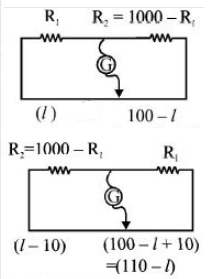
On interchanging the resistances,the balance point of a meter bridge shifts to the left by $10 \, cm$. The resistance of their series combination is $1 \, k\Omega$. How much was the resistance on the left slot before interchanging the resistances? ................... $\Omega$
A
$505$
B
$550$
C
$910$
D
$990$
Solution
(B) Let the resistances be $R_1$ and $R_2$. Given $R_1 + R_2 = 1000 \, \Omega$.
In the first case,the balance point is at length $l$ from the left end:
$\frac{R_1}{R_2} = \frac{l}{100-l} \implies \frac{R_1}{1000-R_1} = \frac{l}{100-l} \quad ... (i)$
After interchanging the resistances,the balance point shifts to the left by $10 \, cm$,so the new balance length is $(l-10) \, cm$:
$\frac{R_2}{R_1} = \frac{l-10}{100-(l-10)} = \frac{l-10}{110-l} \quad ... (ii)$
From $(i)$,$\frac{R_2}{R_1} = \frac{100-l}{l}$. Substituting this into $(ii)$:
$\frac{100-l}{l} = \frac{l-10}{110-l}$
$(100-l)(110-l) = l(l-10)$
$11000 - 100l - 110l + l^2 = l^2 - 10l$
$11000 = 200l \implies l = 55 \, cm$.
Substituting $l = 55$ into $(i)$:
$\frac{R_1}{1000-R_1} = \frac{55}{100-55} = \frac{55}{45} = \frac{11}{9}$
$9R_1 = 11000 - 11R_1$
$20R_1 = 11000 \implies R_1 = 550 \, \Omega$.
In the first case,the balance point is at length $l$ from the left end:
$\frac{R_1}{R_2} = \frac{l}{100-l} \implies \frac{R_1}{1000-R_1} = \frac{l}{100-l} \quad ... (i)$
After interchanging the resistances,the balance point shifts to the left by $10 \, cm$,so the new balance length is $(l-10) \, cm$:
$\frac{R_2}{R_1} = \frac{l-10}{100-(l-10)} = \frac{l-10}{110-l} \quad ... (ii)$
From $(i)$,$\frac{R_2}{R_1} = \frac{100-l}{l}$. Substituting this into $(ii)$:
$\frac{100-l}{l} = \frac{l-10}{110-l}$
$(100-l)(110-l) = l(l-10)$
$11000 - 100l - 110l + l^2 = l^2 - 10l$
$11000 = 200l \implies l = 55 \, cm$.
Substituting $l = 55$ into $(i)$:
$\frac{R_1}{1000-R_1} = \frac{55}{100-55} = \frac{55}{45} = \frac{11}{9}$
$9R_1 = 11000 - 11R_1$
$20R_1 = 11000 \implies R_1 = 550 \, \Omega$.
0 likes
View Solution21
MediumMCQ
In a meter bridge,the point $D$ is the neutral point (null point) as shown in the figure.
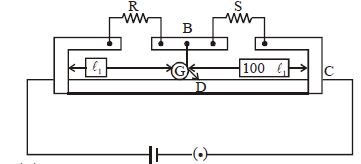
A
The meter bridge can have no other neutral point for this set of resistances.
B
When the jockey contacts a point on the meter wire to the left of $D$,current flows to $B$ from the wire.
C
When the jockey contacts a point on the meter wire to the right of $D$,current flows from $B$ to the wire through the galvanometer.
D
When $R$ is increased,the neutral point shifts to the left.
Solution
(B) In a meter bridge,the balance condition is given by $\frac{R}{S} = \frac{l_1}{100 - l_1}$.
At the null point $D$,the potential at $B$ is equal to the potential at $D$,so no current flows through the galvanometer.
If the jockey is moved to the left of $D$,the resistance of the left segment decreases,making the potential at $D$ higher than at $B$. Thus,current flows from $D$ to $B$ (i.e.,to $B$ from the wire).
If the jockey is moved to the right of $D$,the potential at $D$ becomes lower than at $B$,so current flows from $B$ to $D$ (i.e.,from $B$ to the wire).
Therefore,option $B$ is correct.
At the null point $D$,the potential at $B$ is equal to the potential at $D$,so no current flows through the galvanometer.
If the jockey is moved to the left of $D$,the resistance of the left segment decreases,making the potential at $D$ higher than at $B$. Thus,current flows from $D$ to $B$ (i.e.,to $B$ from the wire).
If the jockey is moved to the right of $D$,the potential at $D$ becomes lower than at $B$,so current flows from $B$ to $D$ (i.e.,from $B$ to the wire).
Therefore,option $B$ is correct.
0 likes
View Solution22
MediumMCQ
$A$ student obtained the following observations in an experiment of a meter bridge to find the unknown resistance of the circuit. The most accurate value of the unknown resistance is ............ $\Omega$.
| $S.No.$ | $R$ | $l$ | $100-l$ | $S = \left( \frac{100-l}{l} \right)R$ |
| $1$ | $20\,\Omega$ | $43$ | $57$ | $26.51\,\Omega$ |
| $2$ | $30\,\Omega$ | $51$ | $49$ | $28.82\,\Omega$ |
| $3$ | $40\,\Omega$ | $59$ | $41$ | $27.80\,\Omega$ |
| $4$ | $60\,\Omega$ | $70$ | $30$ | $25.71\,\Omega$ |
A
$26.51$
B
$28.82$
C
$27.80$
D
$25.71$
Solution
(B) In a meter bridge experiment,the sensitivity is highest when the null point is near the center of the wire (i.e.,$l \approx 50\,cm$).
Looking at the observations:
Observation $1$: $l = 43\,cm$
Observation $2$: $l = 51\,cm$
Observation $3$: $l = 59\,cm$
Observation $4$: $l = 70\,cm$
The null point for observation $2$ $(l = 51\,cm)$ is closest to the center $(50\,cm)$.
Therefore,the value obtained in observation $2$ is the most accurate.
The value is $28.82\,\Omega$.
Looking at the observations:
Observation $1$: $l = 43\,cm$
Observation $2$: $l = 51\,cm$
Observation $3$: $l = 59\,cm$
Observation $4$: $l = 70\,cm$
The null point for observation $2$ $(l = 51\,cm)$ is closest to the center $(50\,cm)$.
Therefore,the value obtained in observation $2$ is the most accurate.
The value is $28.82\,\Omega$.
0 likes
View Solution23
DifficultMCQ
$A$ resistance of $2\,\Omega$ is connected across one gap of a meter-bridge and an unknown resistance,greater than $2\,\Omega$,is connected across the other gap. When these resistances are interchanged,the balance point shifts by $20\,cm$. Neglecting any end correction,the unknown resistance is ................ $\Omega$.
A
$3$
B
$4$
C
$5$
D
$6$
Solution
(A) Let the unknown resistance be $X$. In a meter bridge,the balance condition is given by $\frac{R}{X} = \frac{\ell}{100-\ell}$,where $\ell$ is the balance length in $cm$.
Initially,$\frac{2}{X} = \frac{\ell}{100-\ell} \implies X = \frac{2(100-\ell)}{\ell} \quad (1)$
Since $X > 2$,the balance point shifts when resistances are interchanged. The new balance condition is $\frac{X}{2} = \frac{\ell+20}{100-(\ell+20)} = \frac{\ell+20}{80-\ell} \quad (2)$
Substituting $X$ from $(1)$ into $(2)$:
$\frac{2(100-\ell)}{\ell} \cdot \frac{1}{2} = \frac{\ell+20}{80-\ell}$
$\frac{100-\ell}{\ell} = \frac{\ell+20}{80-\ell}$
$(100-\ell)(80-\ell) = \ell(\ell+20)$
$8000 - 100\ell - 80\ell + \ell^2 = \ell^2 + 20\ell$
$8000 = 200\ell \implies \ell = 40\,cm$
Now,substitute $\ell = 40$ into equation $(1)$:
$X = \frac{2(100-40)}{40} = \frac{2 \times 60}{40} = 3\,\Omega$.
Initially,$\frac{2}{X} = \frac{\ell}{100-\ell} \implies X = \frac{2(100-\ell)}{\ell} \quad (1)$
Since $X > 2$,the balance point shifts when resistances are interchanged. The new balance condition is $\frac{X}{2} = \frac{\ell+20}{100-(\ell+20)} = \frac{\ell+20}{80-\ell} \quad (2)$
Substituting $X$ from $(1)$ into $(2)$:
$\frac{2(100-\ell)}{\ell} \cdot \frac{1}{2} = \frac{\ell+20}{80-\ell}$
$\frac{100-\ell}{\ell} = \frac{\ell+20}{80-\ell}$
$(100-\ell)(80-\ell) = \ell(\ell+20)$
$8000 - 100\ell - 80\ell + \ell^2 = \ell^2 + 20\ell$
$8000 = 200\ell \implies \ell = 40\,cm$
Now,substitute $\ell = 40$ into equation $(1)$:
$X = \frac{2(100-40)}{40} = \frac{2 \times 60}{40} = 3\,\Omega$.
0 likes
View Solution24
EasyMCQ
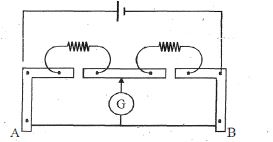
$A$ meter bridge is set up as shown to determine the end corrections at $A$ and $B$. When a resistance of $15\,\Omega$ is used in the left gap and $20\,\Omega$ in the right gap,the null point is obtained at a distance of $42\,cm$ from $A$. When these resistances are interchanged,the null point is obtained at a distance of $57\,cm$ from $A$. The values of the end corrections are:
A
$1\,cm, 2\,cm$
B
$2\,cm, 3\,cm$
C
$3\,cm, 4\,cm$
D
$3\,cm, 2\,cm$
Solution
(D) Let the end corrections at $A$ and $B$ be $\alpha$ and $\beta$ respectively. The total length of the wire is $100\,cm$.
Case $1$: Resistance $P = 15\,\Omega$ is in the left gap and $Q = 20\,\Omega$ is in the right gap. The null point is at $l_1 = 42\,cm$.
The balance condition is: $\frac{P}{Q} = \frac{l_1 + \alpha}{100 - l_1 + \beta}$
$\frac{15}{20} = \frac{42 + \alpha}{100 - 42 + \beta} \Rightarrow \frac{3}{4} = \frac{42 + \alpha}{58 + \beta}$
$3(58 + \beta) = 4(42 + \alpha) \Rightarrow 174 + 3\beta = 168 + 4\alpha \Rightarrow 4\alpha - 3\beta = 6$ ... $(i)$
Case $2$: Resistances are interchanged,so $P = 20\,\Omega$ and $Q = 15\,\Omega$. The null point is at $l_2 = 57\,cm$.
The balance condition is: $\frac{P}{Q} = \frac{l_2 + \alpha}{100 - l_2 + \beta}$
$\frac{20}{15} = \frac{57 + \alpha}{100 - 57 + \beta} \Rightarrow \frac{4}{3} = \frac{57 + \alpha}{43 + \beta}$
$4(43 + \beta) = 3(57 + \alpha) \Rightarrow 172 + 4\beta = 171 + 3\alpha \Rightarrow 3\alpha - 4\beta = 1$ ... $(ii)$
Solving equations $(i)$ and $(ii)$:
Multiply $(i)$ by $4$ and $(ii)$ by $3$:
$16\alpha - 12\beta = 24$
$9\alpha - 12\beta = 3$
Subtracting the two equations: $7\alpha = 21 \Rightarrow \alpha = 3\,cm$.
Substituting $\alpha = 3$ in $(i)$: $4(3) - 3\beta = 6 \Rightarrow 12 - 3\beta = 6 \Rightarrow 3\beta = 6 \Rightarrow \beta = 2\,cm$.
Thus,the end corrections are $3\,cm$ and $2\,cm$.
Case $1$: Resistance $P = 15\,\Omega$ is in the left gap and $Q = 20\,\Omega$ is in the right gap. The null point is at $l_1 = 42\,cm$.
The balance condition is: $\frac{P}{Q} = \frac{l_1 + \alpha}{100 - l_1 + \beta}$
$\frac{15}{20} = \frac{42 + \alpha}{100 - 42 + \beta} \Rightarrow \frac{3}{4} = \frac{42 + \alpha}{58 + \beta}$
$3(58 + \beta) = 4(42 + \alpha) \Rightarrow 174 + 3\beta = 168 + 4\alpha \Rightarrow 4\alpha - 3\beta = 6$ ... $(i)$
Case $2$: Resistances are interchanged,so $P = 20\,\Omega$ and $Q = 15\,\Omega$. The null point is at $l_2 = 57\,cm$.
The balance condition is: $\frac{P}{Q} = \frac{l_2 + \alpha}{100 - l_2 + \beta}$
$\frac{20}{15} = \frac{57 + \alpha}{100 - 57 + \beta} \Rightarrow \frac{4}{3} = \frac{57 + \alpha}{43 + \beta}$
$4(43 + \beta) = 3(57 + \alpha) \Rightarrow 172 + 4\beta = 171 + 3\alpha \Rightarrow 3\alpha - 4\beta = 1$ ... $(ii)$
Solving equations $(i)$ and $(ii)$:
Multiply $(i)$ by $4$ and $(ii)$ by $3$:
$16\alpha - 12\beta = 24$
$9\alpha - 12\beta = 3$
Subtracting the two equations: $7\alpha = 21 \Rightarrow \alpha = 3\,cm$.
Substituting $\alpha = 3$ in $(i)$: $4(3) - 3\beta = 6 \Rightarrow 12 - 3\beta = 6 \Rightarrow 3\beta = 6 \Rightarrow \beta = 2\,cm$.
Thus,the end corrections are $3\,cm$ and $2\,cm$.
0 likes
View Solution25
MediumMCQ
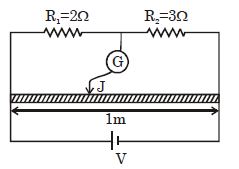
In a meter bridge experiment,initially the jockey is at the null point. Now,resistances $R_1$ and $R_2$ are interchanged. The shift in the position of the jockey is ................ $cm$.
A
$20$
B
$30$
C
$40$
D
$50$
Solution
(A) Initially,the balance condition for the meter bridge is given by $\frac{R_1}{R_2} = \frac{\ell}{100 - \ell}$.
Given $R_1 = 2 \, \Omega$ and $R_2 = 3 \, \Omega$,we have $\frac{2}{3} = \frac{\ell}{100 - \ell}$.
$2(100 - \ell) = 3\ell \Rightarrow 200 - 2\ell = 3\ell \Rightarrow 5\ell = 200 \Rightarrow \ell = 40 \, cm$.
When the resistances are interchanged,the new resistances are $R_1' = 3 \, \Omega$ and $R_2' = 2 \, \Omega$.
The new balance condition is $\frac{R_1'}{R_2'} = \frac{\ell'}{100 - \ell'}$.
$\frac{3}{2} = \frac{\ell'}{100 - \ell'} \Rightarrow 3(100 - \ell') = 2\ell' \Rightarrow 300 - 3\ell' = 2\ell' \Rightarrow 5\ell' = 300 \Rightarrow \ell' = 60 \, cm$.
The shift in the position of the jockey is $|\ell' - \ell| = |60 - 40| = 20 \, cm$.
Given $R_1 = 2 \, \Omega$ and $R_2 = 3 \, \Omega$,we have $\frac{2}{3} = \frac{\ell}{100 - \ell}$.
$2(100 - \ell) = 3\ell \Rightarrow 200 - 2\ell = 3\ell \Rightarrow 5\ell = 200 \Rightarrow \ell = 40 \, cm$.
When the resistances are interchanged,the new resistances are $R_1' = 3 \, \Omega$ and $R_2' = 2 \, \Omega$.
The new balance condition is $\frac{R_1'}{R_2'} = \frac{\ell'}{100 - \ell'}$.
$\frac{3}{2} = \frac{\ell'}{100 - \ell'} \Rightarrow 3(100 - \ell') = 2\ell' \Rightarrow 300 - 3\ell' = 2\ell' \Rightarrow 5\ell' = 300 \Rightarrow \ell' = 60 \, cm$.
The shift in the position of the jockey is $|\ell' - \ell| = |60 - 40| = 20 \, cm$.
0 likes
View Solution26
DifficultMCQ
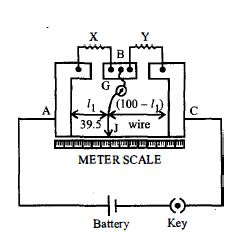
In a meter bridge,as shown in the figure,it is given that resistance $Y = 12.5 \, \Omega$ and the balance point is obtained at a distance $l_1 = 39.5 \, cm$ from end $A$ (by jockey $J$). After interchanging the resistances $X$ and $Y$,a new balance point is found at a distance $l_2$ from end $A$. What are the values of $X$ and $l_2$?
A
$19.15 \, \Omega$ and $39.5 \, cm$
B
$8.16 \, \Omega$ and $60.5 \, cm$
C
$19.15 \, \Omega$ and $60.5 \, cm$
D
$8.16 \, \Omega$ and $39.5 \, cm$
Solution
(B) For a balanced meter bridge,the condition is $\frac{X}{l_1} = \frac{Y}{100 - l_1}$.
Given $Y = 12.5 \, \Omega$ and $l_1 = 39.5 \, cm$,we have:
$\frac{X}{39.5} = \frac{12.5}{100 - 39.5} = \frac{12.5}{60.5}$.
$X = \frac{12.5 \times 39.5}{60.5} \approx 8.16 \, \Omega$.
When resistances $X$ and $Y$ are interchanged,the new balance condition is $\frac{Y}{l_2} = \frac{X}{100 - l_2}$.
Substituting $X = \frac{Y \times l_1}{100 - l_1}$,we get $\frac{Y}{l_2} = \frac{Y \times l_1}{(100 - l_1)(100 - l_2)}$.
This simplifies to $100 - l_2 = l_1 \times \frac{l_2}{100 - l_1}$,which implies $l_2 = 100 - l_1$.
Therefore,$l_2 = 100 - 39.5 = 60.5 \, cm$.
Given $Y = 12.5 \, \Omega$ and $l_1 = 39.5 \, cm$,we have:
$\frac{X}{39.5} = \frac{12.5}{100 - 39.5} = \frac{12.5}{60.5}$.
$X = \frac{12.5 \times 39.5}{60.5} \approx 8.16 \, \Omega$.
When resistances $X$ and $Y$ are interchanged,the new balance condition is $\frac{Y}{l_2} = \frac{X}{100 - l_2}$.
Substituting $X = \frac{Y \times l_1}{100 - l_1}$,we get $\frac{Y}{l_2} = \frac{Y \times l_1}{(100 - l_1)(100 - l_2)}$.
This simplifies to $100 - l_2 = l_1 \times \frac{l_2}{100 - l_1}$,which implies $l_2 = 100 - l_1$.
Therefore,$l_2 = 100 - 39.5 = 60.5 \, cm$.
0 likes
View Solution27
DifficultMCQ
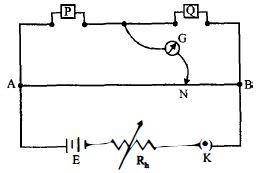
In a meter bridge experiment,resistances are connected as shown in the figure. Initially,resistance $P = 4\,\Omega$ and the null point $N$ is at $60\,cm$ from $A$. Now,an unknown resistance $R$ is connected in series to $P$,and the new position of the null point is at $80\,cm$ from $A$. The value of unknown resistance $R$ is
A
$\frac{33}{5}\,\Omega$
B
$6\,\Omega$
C
$7\,\Omega$
D
$\frac{20}{3}\,\Omega$
Solution
(D) In the balanced position of the meter bridge,the condition is given by $\frac{P}{Q} = \frac{l}{100-l}$,where $l$ is the distance of the null point from end $A$.
Initially,$P = 4\,\Omega$ and $l = 60\,cm$. Therefore,$100-l = 40\,cm$.
Substituting these values into the balance condition:
$\frac{4}{Q} = \frac{60}{40}$
$\frac{4}{Q} = \frac{3}{2}$
$Q = \frac{8}{3}\,\Omega$.
Now,an unknown resistance $R$ is connected in series with $P$,so the new resistance is $P' = P + R = 4 + R$. The new null point is at $l' = 80\,cm$,so $100-l' = 20\,cm$.
Using the balance condition again:
$\frac{4+R}{Q} = \frac{80}{20}$
$\frac{4+R}{8/3} = 4$
$4+R = 4 \times \frac{8}{3}$
$4+R = \frac{32}{3}$
$R = \frac{32}{3} - 4 = \frac{32-12}{3} = \frac{20}{3}\,\Omega$.
Thus,the value of the unknown resistance $R$ is $\frac{20}{3}\,\Omega$.
Initially,$P = 4\,\Omega$ and $l = 60\,cm$. Therefore,$100-l = 40\,cm$.
Substituting these values into the balance condition:
$\frac{4}{Q} = \frac{60}{40}$
$\frac{4}{Q} = \frac{3}{2}$
$Q = \frac{8}{3}\,\Omega$.
Now,an unknown resistance $R$ is connected in series with $P$,so the new resistance is $P' = P + R = 4 + R$. The new null point is at $l' = 80\,cm$,so $100-l' = 20\,cm$.
Using the balance condition again:
$\frac{4+R}{Q} = \frac{80}{20}$
$\frac{4+R}{8/3} = 4$
$4+R = 4 \times \frac{8}{3}$
$4+R = \frac{32}{3}$
$R = \frac{32}{3} - 4 = \frac{32-12}{3} = \frac{20}{3}\,\Omega$.
Thus,the value of the unknown resistance $R$ is $\frac{20}{3}\,\Omega$.
0 likes
View Solution28
DifficultMCQ
In a meter bridge experiment,a null point is obtained at $40 \ cm$ from one end of the wire when resistance $X$ is balanced against another resistance $Y$. If $X < Y$,then the new position of the null point from the same end,if one decides to balance a resistance of $3X$ against $Y$,will be close to .............. $cm$.
A
$80$
B
$75$
C
$67$
D
$50$
Solution
(C) In a meter bridge,the balance condition is given by $\frac{R_1}{R_2} = \frac{l}{100-l}$.
Given $\frac{X}{Y} = \frac{40}{100-40} = \frac{40}{60} = \frac{2}{3}$.
So,$X = \frac{2}{3}Y$.
Now,we balance $3X$ against $Y$. Let the new null point be at $l' \ cm$.
Then,$\frac{3X}{Y} = \frac{l'}{100-l'}$.
Substituting $X = \frac{2}{3}Y$ into the equation:
$\frac{3(\frac{2}{3}Y)}{Y} = \frac{l'}{100-l'}$
$2 = \frac{l'}{100-l'}$
$2(100 - l') = l'$
$200 - 2l' = l'$
$3l' = 200$
$l' = \frac{200}{3} \approx 66.67 \ cm$.
Rounding to the nearest integer,the null point is close to $67 \ cm$.
Given $\frac{X}{Y} = \frac{40}{100-40} = \frac{40}{60} = \frac{2}{3}$.
So,$X = \frac{2}{3}Y$.
Now,we balance $3X$ against $Y$. Let the new null point be at $l' \ cm$.
Then,$\frac{3X}{Y} = \frac{l'}{100-l'}$.
Substituting $X = \frac{2}{3}Y$ into the equation:
$\frac{3(\frac{2}{3}Y)}{Y} = \frac{l'}{100-l'}$
$2 = \frac{l'}{100-l'}$
$2(100 - l') = l'$
$200 - 2l' = l'$
$3l' = 200$
$l' = \frac{200}{3} \approx 66.67 \ cm$.
Rounding to the nearest integer,the null point is close to $67 \ cm$.
0 likes
View Solution29
DifficultMCQ
In a sensitive meter bridge apparatus,the bridge wire should possess:
A
high resistivity and low temperature coefficient
B
low resistivity and high temperature coefficient
C
low resistivity and low temperature coefficient
D
high resistivity and high temperature coefficient
Solution
(A) For a meter bridge to be sensitive,the material of the wire (typically Manganin or Constantan) must have high resistivity so that the resistance per unit length is significant,allowing for precise measurements.
Additionally,it must have a low temperature coefficient of resistance so that the resistance of the wire does not change significantly with small fluctuations in temperature during the experiment,ensuring accuracy and stability.
Additionally,it must have a low temperature coefficient of resistance so that the resistance of the wire does not change significantly with small fluctuations in temperature during the experiment,ensuring accuracy and stability.
0 likes
View Solution30
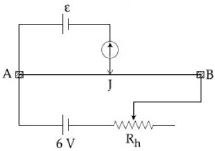
DifficultMCQ
The resistance of the meter bridge wire $AB$ in the given figure is $4\,\Omega$. With a cell of emf $\varepsilon_1 = 0.5\,\text{V}$ and rheostat resistance $R_{h1} = 2\,\Omega$,the null point is obtained at point $J$. When the cell is replaced by another one of emf $\varepsilon_2$,the same null point $J$ is found for $R_{h2} = 6\,\Omega$. The emf $\varepsilon_2$ is ................. $\text{V}$.
A
$0.4$
B
$0.3$
C
$0.6$
D
$0.5$
Solution
(B) Let $R_{AB} = 4\,\Omega$ be the resistance of the wire $AB$. Let $R_{AJ}$ be the resistance of the segment $AJ$. The potential difference across $AJ$ is given by $V_{AJ} = I \cdot R_{AJ}$,where $I$ is the current in the main circuit.
For the first case,the current in the main circuit is $I_1 = \frac{6}{R_{h1} + R_{AB}} = \frac{6}{2 + 4} = 1\,\text{A}$.
The potential drop across $AJ$ is $V_{AJ} = I_1 \cdot R_{AJ} = 1 \cdot R_{AJ} = \varepsilon_1 = 0.5\,\text{V}$.
Thus,$R_{AJ} = 0.5\,\Omega$.
For the second case,the current in the main circuit is $I_2 = \frac{6}{R_{h2} + R_{AB}} = \frac{6}{6 + 4} = 0.6\,\text{A}$.
Since the null point $J$ is the same,the resistance $R_{AJ}$ remains $0.5\,\Omega$.
The emf $\varepsilon_2$ is equal to the potential drop across $AJ$ in the second case:
$\varepsilon_2 = I_2 \cdot R_{AJ} = 0.6 \times 0.5 = 0.3\,\text{V}$.
For the first case,the current in the main circuit is $I_1 = \frac{6}{R_{h1} + R_{AB}} = \frac{6}{2 + 4} = 1\,\text{A}$.
The potential drop across $AJ$ is $V_{AJ} = I_1 \cdot R_{AJ} = 1 \cdot R_{AJ} = \varepsilon_1 = 0.5\,\text{V}$.
Thus,$R_{AJ} = 0.5\,\Omega$.
For the second case,the current in the main circuit is $I_2 = \frac{6}{R_{h2} + R_{AB}} = \frac{6}{6 + 4} = 0.6\,\text{A}$.
Since the null point $J$ is the same,the resistance $R_{AJ}$ remains $0.5\,\Omega$.
The emf $\varepsilon_2$ is equal to the potential drop across $AJ$ in the second case:
$\varepsilon_2 = I_2 \cdot R_{AJ} = 0.6 \times 0.5 = 0.3\,\text{V}$.
0 likes
View Solution31
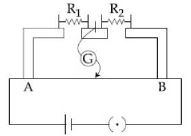
DifficultMCQ
In the experimental setup of a meter bridge shown in the figure,the null point is obtained at a distance of $40\,cm$ from $A$. If a $10\,\Omega$ resistor is connected in series with $R_1$,the null point shifts by $10\,cm$. The resistance that should be connected in parallel with $(R_1 + 10)\,\Omega$ such that the null point shifts back to its initial position is .............. $\Omega$.
A
$20$
B
$40$
C
$60$
D
$30$
Solution
(C) For a meter bridge,the balancing condition is $\frac{R_1}{R_2} = \frac{l}{100-l}$.
Given $l = 40\,cm$,so $\frac{R_1}{R_2} = \frac{40}{60} = \frac{2}{3} \implies R_2 = 1.5 R_1$ .....$(i)$
When $10\,\Omega$ is connected in series with $R_1$,the new resistance is $(R_1 + 10)\,\Omega$. The null point shifts by $10\,cm$. Since $R_1$ increases,the null point shifts towards $B$,so the new length $l' = 40 + 10 = 50\,cm$.
Thus,$\frac{R_1 + 10}{R_2} = \frac{50}{50} = 1 \implies R_1 + 10 = R_2$ .....$(ii)$
Substituting $(i)$ into $(ii)$: $R_1 + 10 = 1.5 R_1 \implies 0.5 R_1 = 10 \implies R_1 = 20\,\Omega$ and $R_2 = 30\,\Omega$.
Now,we need to connect a resistance $R$ in parallel with $(R_1 + 10) = 30\,\Omega$ such that the null point returns to $40\,cm$ (i.e.,ratio remains $\frac{2}{3}$).
Let the equivalent resistance be $R_{eq} = \frac{30R}{30+R}$.
Then $\frac{R_{eq}}{R_2} = \frac{2}{3} \implies \frac{R_{eq}}{30} = \frac{2}{3} \implies R_{eq} = 20\,\Omega$.
So,$\frac{30R}{30+R} = 20 \implies 30R = 600 + 20R \implies 10R = 600 \implies R = 60\,\Omega$.
Given $l = 40\,cm$,so $\frac{R_1}{R_2} = \frac{40}{60} = \frac{2}{3} \implies R_2 = 1.5 R_1$ .....$(i)$
When $10\,\Omega$ is connected in series with $R_1$,the new resistance is $(R_1 + 10)\,\Omega$. The null point shifts by $10\,cm$. Since $R_1$ increases,the null point shifts towards $B$,so the new length $l' = 40 + 10 = 50\,cm$.
Thus,$\frac{R_1 + 10}{R_2} = \frac{50}{50} = 1 \implies R_1 + 10 = R_2$ .....$(ii)$
Substituting $(i)$ into $(ii)$: $R_1 + 10 = 1.5 R_1 \implies 0.5 R_1 = 10 \implies R_1 = 20\,\Omega$ and $R_2 = 30\,\Omega$.
Now,we need to connect a resistance $R$ in parallel with $(R_1 + 10) = 30\,\Omega$ such that the null point returns to $40\,cm$ (i.e.,ratio remains $\frac{2}{3}$).
Let the equivalent resistance be $R_{eq} = \frac{30R}{30+R}$.
Then $\frac{R_{eq}}{R_2} = \frac{2}{3} \implies \frac{R_{eq}}{30} = \frac{2}{3} \implies R_{eq} = 20\,\Omega$.
So,$\frac{30R}{30+R} = 20 \implies 30R = 600 + 20R \implies 10R = 600 \implies R = 60\,\Omega$.
0 likes
View Solution32
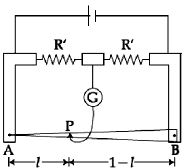
DifficultMCQ
In a meter bridge,the wire of length $1\, m$ has a non-uniform cross-section such that the variation $\frac{dR}{d\ell}$ of its resistance $R$ with length $\ell$ is $\frac{dR}{d\ell} \propto \frac{1}{\sqrt{\ell}}$. Two equal resistances are connected as shown in the figure. The galvanometer has zero deflection when the jockey is at point $P$. What is the length $AP$?
A
$0.2$
B
$0.3$
C
$0.25$
D
$0.35$
Solution
(C) Given $\frac{dR}{d\ell} = \frac{k}{\sqrt{\ell}}$,where $k$ is a constant.
Integrating from $\ell = 0$ to $\ell = 1\, m$,the total resistance $R_{AB}$ of the wire is:
$R_{AB} = \int_{0}^{1} \frac{k}{\sqrt{\ell}} d\ell = k [2\sqrt{\ell}]_{0}^{1} = 2k$.
Let the length $AP = L$. The resistance of segment $AP$ is $R_{AP} = \int_{0}^{L} \frac{k}{\sqrt{\ell}} d\ell = k [2\sqrt{\ell}]_{0}^{L} = 2k\sqrt{L}$.
The resistance of segment $PB$ is $R_{PB} = \int_{L}^{1} \frac{k}{\sqrt{\ell}} d\ell = k [2\sqrt{\ell}]_{L}^{1} = 2k(1 - \sqrt{L})$.
For a balanced meter bridge with equal resistances $R'$ in the gaps,the condition is $\frac{R'}{R_{AP}} = \frac{R'}{R_{PB}}$,which implies $R_{AP} = R_{PB}$.
Therefore,$2k\sqrt{L} = 2k(1 - \sqrt{L})$.
$\sqrt{L} = 1 - \sqrt{L} \implies 2\sqrt{L} = 1 \implies \sqrt{L} = 0.5$.
$L = (0.5)^2 = 0.25\, m$.
Integrating from $\ell = 0$ to $\ell = 1\, m$,the total resistance $R_{AB}$ of the wire is:
$R_{AB} = \int_{0}^{1} \frac{k}{\sqrt{\ell}} d\ell = k [2\sqrt{\ell}]_{0}^{1} = 2k$.
Let the length $AP = L$. The resistance of segment $AP$ is $R_{AP} = \int_{0}^{L} \frac{k}{\sqrt{\ell}} d\ell = k [2\sqrt{\ell}]_{0}^{L} = 2k\sqrt{L}$.
The resistance of segment $PB$ is $R_{PB} = \int_{L}^{1} \frac{k}{\sqrt{\ell}} d\ell = k [2\sqrt{\ell}]_{L}^{1} = 2k(1 - \sqrt{L})$.
For a balanced meter bridge with equal resistances $R'$ in the gaps,the condition is $\frac{R'}{R_{AP}} = \frac{R'}{R_{PB}}$,which implies $R_{AP} = R_{PB}$.
Therefore,$2k\sqrt{L} = 2k(1 - \sqrt{L})$.
$\sqrt{L} = 1 - \sqrt{L} \implies 2\sqrt{L} = 1 \implies \sqrt{L} = 0.5$.
$L = (0.5)^2 = 0.25\, m$.
0 likes
View Solution33
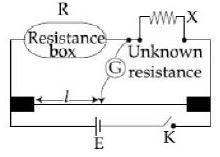
MediumMCQ
In a meter bridge experiment, the circuit diagram and the corresponding observation table are shown in the figure.
Which of the readings is inconsistent?
| $Sl. No.$ | $R \, (\Omega)$ | $l \, (cm)$ |
| $1.$ | $1000$ | $60$ |
| $2.$ | $100$ | $13$ |
| $3.$ | $10$ | $1.5$ |
| $4.$ | $1$ | $1.0$ |
A
$4$
B
$3$
C
$2$
D
$1$
Solution
(A) In a meter bridge, the unknown resistance $X$ is given by the formula $X = R \frac{l_2}{l_1} = R \frac{(100 - l)}{l}$, where $l$ is the balancing length from the left end.
For reading $1$: $X = 1000 \times \frac{(100 - 60)}{60} = 1000 \times \frac{40}{60} \approx 666.67 \, \Omega$.
For reading $2$: $X = 100 \times \frac{(100 - 13)}{13} = 100 \times \frac{87}{13} \approx 669.23 \, \Omega$.
For reading $3$: $X = 10 \times \frac{(100 - 1.5)}{1.5} = 10 \times \frac{98.5}{1.5} \approx 656.67 \, \Omega$.
For reading $4$: $X = 1 \times \frac{(100 - 1)}{1} = 1 \times 99 = 99 \, \Omega$.
Comparing the calculated values of $X$, the values for readings $1, 2,$ and $3$ are consistent (around $660 \, \Omega$), whereas the value for reading $4$ is significantly different. Thus, reading $4$ is inconsistent.
For reading $1$: $X = 1000 \times \frac{(100 - 60)}{60} = 1000 \times \frac{40}{60} \approx 666.67 \, \Omega$.
For reading $2$: $X = 100 \times \frac{(100 - 13)}{13} = 100 \times \frac{87}{13} \approx 669.23 \, \Omega$.
For reading $3$: $X = 10 \times \frac{(100 - 1.5)}{1.5} = 10 \times \frac{98.5}{1.5} \approx 656.67 \, \Omega$.
For reading $4$: $X = 1 \times \frac{(100 - 1)}{1} = 1 \times 99 = 99 \, \Omega$.
Comparing the calculated values of $X$, the values for readings $1, 2,$ and $3$ are consistent (around $660 \, \Omega$), whereas the value for reading $4$ is significantly different. Thus, reading $4$ is inconsistent.
0 likes
View Solution34
DifficultMCQ
The resistances in the two arms of a meter bridge are $5\,\Omega$ and $R\,\Omega$,respectively. When the resistance $R$ is shunted with an equal resistance,the new balance point is at $1.6\,l_1$. The resistance $R$ is ................. $\Omega$.
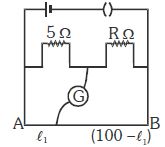
A
$10$
B
$15$
C
$20$
D
$25$
Solution
(B) In a meter bridge,the balance condition is given by $\frac{P}{Q} = \frac{l_1}{100 - l_1}$.
Given $P = 5\,\Omega$ and $Q = R\,\Omega$,we have:
$\frac{5}{R} = \frac{l_1}{100 - l_1} \quad \dots(1)$
When $R$ is shunted with an equal resistance $R$,the equivalent resistance becomes $R' = \frac{R \times R}{R + R} = \frac{R}{2}$.
The new balance point is at $1.6\,l_1$. Thus:
$\frac{5}{R/2} = \frac{1.6\,l_1}{100 - 1.6\,l_1} \Rightarrow \frac{10}{R} = \frac{1.6\,l_1}{100 - 1.6\,l_1} \quad \dots(2)$
Dividing equation $(2)$ by equation $(1)$:
$\frac{10/R}{5/R} = \frac{1.6\,l_1}{100 - 1.6\,l_1} \times \frac{100 - l_1}{l_1}$
$2 = \frac{1.6(100 - l_1)}{100 - 1.6\,l_1}$
$200 - 3.2\,l_1 = 160 - 1.6\,l_1$
$40 = 1.6\,l_1 \Rightarrow l_1 = 25\,cm$.
Substituting $l_1 = 25$ in equation $(1)$:
$\frac{5}{R} = \frac{25}{100 - 25} = \frac{25}{75} = \frac{1}{3}$
$R = 15\,\Omega$.
Given $P = 5\,\Omega$ and $Q = R\,\Omega$,we have:
$\frac{5}{R} = \frac{l_1}{100 - l_1} \quad \dots(1)$
When $R$ is shunted with an equal resistance $R$,the equivalent resistance becomes $R' = \frac{R \times R}{R + R} = \frac{R}{2}$.
The new balance point is at $1.6\,l_1$. Thus:
$\frac{5}{R/2} = \frac{1.6\,l_1}{100 - 1.6\,l_1} \Rightarrow \frac{10}{R} = \frac{1.6\,l_1}{100 - 1.6\,l_1} \quad \dots(2)$
Dividing equation $(2)$ by equation $(1)$:
$\frac{10/R}{5/R} = \frac{1.6\,l_1}{100 - 1.6\,l_1} \times \frac{100 - l_1}{l_1}$
$2 = \frac{1.6(100 - l_1)}{100 - 1.6\,l_1}$
$200 - 3.2\,l_1 = 160 - 1.6\,l_1$
$40 = 1.6\,l_1 \Rightarrow l_1 = 25\,cm$.
Substituting $l_1 = 25$ in equation $(1)$:
$\frac{5}{R} = \frac{25}{100 - 25} = \frac{25}{75} = \frac{1}{3}$
$R = 15\,\Omega$.
0 likes
View Solution35
MediumMCQ
In the shown arrangement of the experiment of the metre bridge,if $AC$ corresponding to null deflection of the galvanometer is $x$,what would be its value if the radius of the wire $AB$ is doubled?
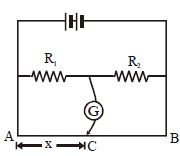
A
$x$
B
$x/4$
C
$4x$
D
$2x$
Solution
(A) In a metre bridge experiment,the null point condition is given by the Wheatstone bridge principle:
$\frac{R_1}{R_2} = \frac{R_{AC}}{R_{CB}}$
Where $R_{AC}$ is the resistance of the wire segment $AC$ and $R_{CB}$ is the resistance of the wire segment $CB$.
Since the resistance of a wire is given by $R = \rho \frac{L}{A}$,where $\rho$ is the resistivity,$L$ is the length,and $A$ is the cross-sectional area $(\pi r^2)$,
$\frac{R_{AC}}{R_{CB}} = \frac{\rho (x) / A}{\rho (100-x) / A} = \frac{x}{100-x}$
Thus,the condition for null deflection is $\frac{R_1}{R_2} = \frac{x}{100-x}$.
This equation shows that the null point position $x$ depends only on the values of the resistors $R_1$ and $R_2$ and the total length of the wire. It is independent of the cross-sectional area (and thus the radius) of the wire $AB$,provided the wire is uniform.
Therefore,if the radius of the wire $AB$ is doubled,the null position $x$ will remain unchanged.
$\frac{R_1}{R_2} = \frac{R_{AC}}{R_{CB}}$
Where $R_{AC}$ is the resistance of the wire segment $AC$ and $R_{CB}$ is the resistance of the wire segment $CB$.
Since the resistance of a wire is given by $R = \rho \frac{L}{A}$,where $\rho$ is the resistivity,$L$ is the length,and $A$ is the cross-sectional area $(\pi r^2)$,
$\frac{R_{AC}}{R_{CB}} = \frac{\rho (x) / A}{\rho (100-x) / A} = \frac{x}{100-x}$
Thus,the condition for null deflection is $\frac{R_1}{R_2} = \frac{x}{100-x}$.
This equation shows that the null point position $x$ depends only on the values of the resistors $R_1$ and $R_2$ and the total length of the wire. It is independent of the cross-sectional area (and thus the radius) of the wire $AB$,provided the wire is uniform.
Therefore,if the radius of the wire $AB$ is doubled,the null position $x$ will remain unchanged.
0 likes
View Solution36
MediumMCQ
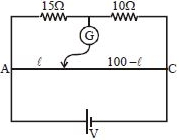
In the meter bridge shown,the length $AB$ for which the deflection in the galvanometer is zero will be ............. $cm$.
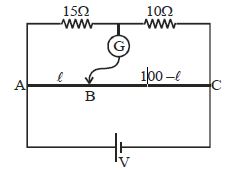
A
$20$
B
$30$
C
$50$
D
$60$
Solution
(D) In a meter bridge,the condition for zero deflection in the galvanometer is given by the Wheatstone bridge principle:
$\frac{P}{Q} = \frac{R}{S}$
Here,$P = 15 \, \Omega$ and $Q = 10 \, \Omega$.
The resistance of the wire segments $AB$ and $BC$ are proportional to their lengths $\ell$ and $(100 - \ell)$ respectively.
Thus,$\frac{15}{10} = \frac{\ell}{100 - \ell}$
$\Rightarrow 1.5 = \frac{\ell}{100 - \ell}$
$\Rightarrow 1.5(100 - \ell) = \ell$
$\Rightarrow 150 - 1.5\ell = \ell$
$\Rightarrow 150 = 2.5\ell$
$\Rightarrow \ell = \frac{150}{2.5} = 60 \, cm$.
Therefore,the length $AB$ is $60 \, cm$.
$\frac{P}{Q} = \frac{R}{S}$
Here,$P = 15 \, \Omega$ and $Q = 10 \, \Omega$.
The resistance of the wire segments $AB$ and $BC$ are proportional to their lengths $\ell$ and $(100 - \ell)$ respectively.
Thus,$\frac{15}{10} = \frac{\ell}{100 - \ell}$
$\Rightarrow 1.5 = \frac{\ell}{100 - \ell}$
$\Rightarrow 1.5(100 - \ell) = \ell$
$\Rightarrow 150 - 1.5\ell = \ell$
$\Rightarrow 150 = 2.5\ell$
$\Rightarrow \ell = \frac{150}{2.5} = 60 \, cm$.
Therefore,the length $AB$ is $60 \, cm$.
0 likes
View Solution37
DifficultMCQ
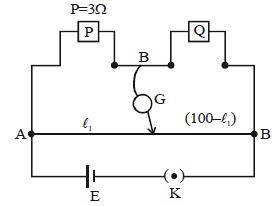
In a meter bridge experiment,resistances are connected as shown in the figure. The balancing length $l_1$ is $55 \, cm$. Now,an unknown resistance $x$ is connected in series with $P$ and the new balancing length is found to be $75 \, cm$. The value of $x$ is
A
$\frac{54}{13} \, \Omega$
B
$\frac{20}{11} \, \Omega$
C
$\frac{48}{11} \, \Omega$
D
$\frac{11}{48} \, \Omega$
Solution
(C) For the given meter bridge,the balancing condition is given by $\frac{P}{Q} = \frac{l_1}{100 - l_1}$.
Given $l_1 = 55 \, cm$,so $100 - l_1 = 45 \, cm$.
Given $P = 3 \, \Omega$,we have $\frac{3}{Q} = \frac{55}{45} = \frac{11}{9}$.
Thus,$Q = 3 \times \frac{9}{11} = \frac{27}{11} \, \Omega$.
When an unknown resistance $x$ is connected in series with $P$,the new balancing length $l_1' = 75 \, cm$,so $100 - l_1' = 25 \, cm$.
The new balance condition is $\frac{P + x}{Q} = \frac{75}{25} = 3$.
Substituting the values,$3 + x = 3 \times Q = 3 \times \frac{27}{11} = \frac{81}{11}$.
Therefore,$x = \frac{81}{11} - 3 = \frac{81 - 33}{11} = \frac{48}{11} \, \Omega$.
Given $l_1 = 55 \, cm$,so $100 - l_1 = 45 \, cm$.
Given $P = 3 \, \Omega$,we have $\frac{3}{Q} = \frac{55}{45} = \frac{11}{9}$.
Thus,$Q = 3 \times \frac{9}{11} = \frac{27}{11} \, \Omega$.
When an unknown resistance $x$ is connected in series with $P$,the new balancing length $l_1' = 75 \, cm$,so $100 - l_1' = 25 \, cm$.
The new balance condition is $\frac{P + x}{Q} = \frac{75}{25} = 3$.
Substituting the values,$3 + x = 3 \times Q = 3 \times \frac{27}{11} = \frac{81}{11}$.
Therefore,$x = \frac{81}{11} - 3 = \frac{81 - 33}{11} = \frac{48}{11} \, \Omega$.
0 likes
View Solution38
MediumMCQ
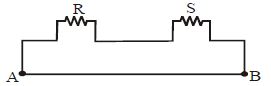
In a meter bridge,the null point is found at a distance of $25\, cm$ from $A$. If now a resistance of $10\,\Omega$ is connected in parallel with $S$,the null point occurs at the midpoint of $AB$. The value of $R$ is ................. $\Omega$. (in $.67$)
A
$6$
B
$1$
C
$2$
D
$4$
Solution
(A) In a meter bridge,the balancing condition is given by $\frac{R}{S} = \frac{l}{100-l}$,where $l$ is the distance of the null point from $A$.
Initially,$l_1 = 25\, cm$. So,$\frac{R}{S} = \frac{25}{100-25} = \frac{25}{75} = \frac{1}{3}$. Thus,$S = 3R$.
When a resistance of $10\,\Omega$ is connected in parallel with $S$,the new resistance $S'$ is given by $\frac{1}{S'} = \frac{1}{S} + \frac{1}{10}$,so $S' = \frac{10S}{S+10}$.
The new null point is at the midpoint,so $l_2 = 50\, cm$. The new balancing condition is $\frac{R}{S'} = \frac{50}{100-50} = 1$,which means $R = S'$.
Substituting $S' = R$ into the equation $R = \frac{10S}{S+10}$,we get $R = \frac{10(3R)}{3R+10}$.
Dividing by $R$ (assuming $R \neq 0$),we get $1 = \frac{30}{3R+10}$.
$3R + 10 = 30$,so $3R = 20$,which gives $R = \frac{20}{3} \approx 6.67\,\Omega$.
Initially,$l_1 = 25\, cm$. So,$\frac{R}{S} = \frac{25}{100-25} = \frac{25}{75} = \frac{1}{3}$. Thus,$S = 3R$.
When a resistance of $10\,\Omega$ is connected in parallel with $S$,the new resistance $S'$ is given by $\frac{1}{S'} = \frac{1}{S} + \frac{1}{10}$,so $S' = \frac{10S}{S+10}$.
The new null point is at the midpoint,so $l_2 = 50\, cm$. The new balancing condition is $\frac{R}{S'} = \frac{50}{100-50} = 1$,which means $R = S'$.
Substituting $S' = R$ into the equation $R = \frac{10S}{S+10}$,we get $R = \frac{10(3R)}{3R+10}$.
Dividing by $R$ (assuming $R \neq 0$),we get $1 = \frac{30}{3R+10}$.
$3R + 10 = 30$,so $3R = 20$,which gives $R = \frac{20}{3} \approx 6.67\,\Omega$.
0 likes
View Solution39
MediumMCQ
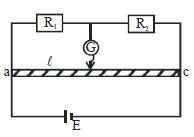
The figure shows a rough sketch of a meter bridge. The galvanometer $(G)$ shows zero deflection at a length $l \, cm$. Now,$R_1$ and $R_2$ are interchanged,and the balancing length increases by $25 \, cm$. Find the ratio $R_1/R_2$.
A
$\frac{3}{5}$
B
$\frac{2}{5}$
C
$\frac{2}{3}$
D
$\frac{5}{2}$
Solution
(A) For a meter bridge,the balancing condition is given by $\frac{R_1}{R_2} = \frac{l}{100-l}$.
When $R_1$ and $R_2$ are interchanged,the new balancing length becomes $l' = l + 25$.
The new condition is $\frac{R_2}{R_1} = \frac{l+25}{100-(l+25)} = \frac{l+25}{75-l}$.
Taking the reciprocal of the first equation,we get $\frac{R_2}{R_1} = \frac{100-l}{l}$.
Equating the two expressions for $\frac{R_2}{R_1}$:
$\frac{100-l}{l} = \frac{l+25}{75-l}$.
$(100-l)(75-l) = l(l+25)$.
$7500 - 100l - 75l + l^2 = l^2 + 25l$.
$7500 - 175l = 25l$.
$200l = 7500 \implies l = 37.5 \, cm$.
Now,substitute $l = 37.5$ into the first equation:
$\frac{R_1}{R_2} = \frac{37.5}{100-37.5} = \frac{37.5}{62.5} = \frac{375}{625} = \frac{3}{5}$.
When $R_1$ and $R_2$ are interchanged,the new balancing length becomes $l' = l + 25$.
The new condition is $\frac{R_2}{R_1} = \frac{l+25}{100-(l+25)} = \frac{l+25}{75-l}$.
Taking the reciprocal of the first equation,we get $\frac{R_2}{R_1} = \frac{100-l}{l}$.
Equating the two expressions for $\frac{R_2}{R_1}$:
$\frac{100-l}{l} = \frac{l+25}{75-l}$.
$(100-l)(75-l) = l(l+25)$.
$7500 - 100l - 75l + l^2 = l^2 + 25l$.
$7500 - 175l = 25l$.
$200l = 7500 \implies l = 37.5 \, cm$.
Now,substitute $l = 37.5$ into the first equation:
$\frac{R_1}{R_2} = \frac{37.5}{100-37.5} = \frac{37.5}{62.5} = \frac{375}{625} = \frac{3}{5}$.
0 likes
View Solution40
MediumMCQ
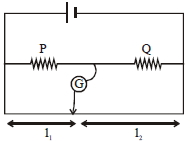
The meter bridge shown is in a balanced position with $\frac{P}{Q} = \frac{l_{1}}{l_{2}}$. If we now interchange the positions of the galvanometer and the cell,will the bridge work? If yes,what will be the balance condition?
A
yes,$\frac{P}{Q} = \frac{l_{2}-l_{1}}{l_{2}+l_{1}}$
B
no,no null point
C
yes,$\frac{P}{Q} = \frac{l_{2}}{l_{1}}$
D
yes,$\frac{P}{Q} = \frac{l_{1}}{l_{2}}$
Solution
(D) According to the principle of the Wheatstone bridge,the condition for balance is independent of the positions of the cell and the galvanometer. This is known as the reciprocity theorem in electrical networks. If the galvanometer and the cell are interchanged,the bridge will still work,and the balance condition will remain the same,i.e.,$\frac{P}{Q} = \frac{l_{1}}{l_{2}}$.
0 likes
View Solution41
DifficultMCQ
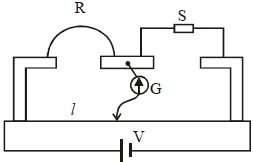
In a meter bridge experiment,$S$ is a standard resistance and $R$ is a resistance wire. It is found that the balancing length is $l = 25 \; cm$. If $R$ is replaced by a wire of half the length and half the diameter of $R$ but of the same material,then the new balancing length $l^{\prime}$ (in $cm$) will be:
A
$36$
B
$37$
C
$33$
D
$40$
Solution
(D) For a meter bridge,the balancing condition is given by $\frac{R}{S} = \frac{l}{100 - l}$.
Given $l = 25 \; cm$,we have $\frac{R}{S} = \frac{25}{100 - 25} = \frac{25}{75} = \frac{1}{3}$.
Thus,$S = 3R$.
The resistance of a wire is given by $R = \rho \frac{l}{A} = \rho \frac{l}{\pi (d/2)^2} = \frac{4 \rho l}{\pi d^2}$.
When the length is halved $(l^{\prime} = l/2)$ and the diameter is halved $(d^{\prime} = d/2)$,the new resistance $R^{\prime}$ becomes:
$R^{\prime} = \frac{4 \rho (l/2)}{\pi (d/2)^2} = \frac{4 \rho l / 2}{\pi d^2 / 4} = 2 \left( \frac{4 \rho l}{\pi d^2} \right) = 2R$.
Now,for the new balancing length $l^{\prime}$,the condition is $\frac{R^{\prime}}{S} = \frac{l^{\prime}}{100 - l^{\prime}}$.
Substituting $R^{\prime} = 2R$ and $S = 3R$:
$\frac{2R}{3R} = \frac{l^{\prime}}{100 - l^{\prime}}$
$\frac{2}{3} = \frac{l^{\prime}}{100 - l^{\prime}}$
$200 - 2l^{\prime} = 3l^{\prime}$
$5l^{\prime} = 200$
$l^{\prime} = 40 \; cm$.
Given $l = 25 \; cm$,we have $\frac{R}{S} = \frac{25}{100 - 25} = \frac{25}{75} = \frac{1}{3}$.
Thus,$S = 3R$.
The resistance of a wire is given by $R = \rho \frac{l}{A} = \rho \frac{l}{\pi (d/2)^2} = \frac{4 \rho l}{\pi d^2}$.
When the length is halved $(l^{\prime} = l/2)$ and the diameter is halved $(d^{\prime} = d/2)$,the new resistance $R^{\prime}$ becomes:
$R^{\prime} = \frac{4 \rho (l/2)}{\pi (d/2)^2} = \frac{4 \rho l / 2}{\pi d^2 / 4} = 2 \left( \frac{4 \rho l}{\pi d^2} \right) = 2R$.
Now,for the new balancing length $l^{\prime}$,the condition is $\frac{R^{\prime}}{S} = \frac{l^{\prime}}{100 - l^{\prime}}$.
Substituting $R^{\prime} = 2R$ and $S = 3R$:
$\frac{2R}{3R} = \frac{l^{\prime}}{100 - l^{\prime}}$
$\frac{2}{3} = \frac{l^{\prime}}{100 - l^{\prime}}$
$200 - 2l^{\prime} = 3l^{\prime}$
$5l^{\prime} = 200$
$l^{\prime} = 40 \; cm$.
0 likes
View Solution42
Medium
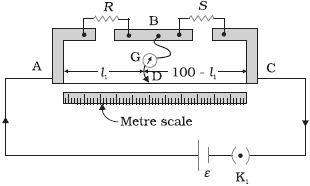
In a meter bridge (Figure), the null point is found at a distance of $33.7 \; cm$ from $A$. If now a resistance of $12 \; \Omega$ is connected in parallel with $S$, the null point occurs at $51.9 \; cm$. Determine the values of $R$ and $S$.
Solution
(N/A) From the first balance point, we get:
$\frac{R}{S} = \frac{33.7}{100 - 33.7} = \frac{33.7}{66.3} \dots (i)$
After $S$ is connected in parallel with a resistance of $12 \; \Omega$, the equivalent resistance $S_{eq}$ is:
$S_{eq} = \frac{12S}{S + 12}$
The new balance condition gives:
$\frac{R}{S_{eq}} = \frac{51.9}{100 - 51.9} = \frac{51.9}{48.1}$
$\frac{R(S + 12)}{12S} = \frac{51.9}{48.1} \dots (ii)$
Substituting $\frac{R}{S} = \frac{33.7}{66.3}$ from $(i)$ into $(ii)$:
$\frac{33.7}{66.3} \cdot \frac{S + 12}{12} = \frac{51.9}{48.1}$
$\frac{S + 12}{S} = \frac{51.9}{48.1} \cdot \frac{66.3}{33.7} \cdot 12 \approx 2.15$
Solving for $S$, we get $S \approx 13.5 \; \Omega$.
Substituting $S$ back into $(i)$:
$R = S \cdot \frac{33.7}{66.3} = 13.5 \cdot 0.508 \approx 6.86 \; \Omega$.
$\frac{R}{S} = \frac{33.7}{100 - 33.7} = \frac{33.7}{66.3} \dots (i)$
After $S$ is connected in parallel with a resistance of $12 \; \Omega$, the equivalent resistance $S_{eq}$ is:
$S_{eq} = \frac{12S}{S + 12}$
The new balance condition gives:
$\frac{R}{S_{eq}} = \frac{51.9}{100 - 51.9} = \frac{51.9}{48.1}$
$\frac{R(S + 12)}{12S} = \frac{51.9}{48.1} \dots (ii)$
Substituting $\frac{R}{S} = \frac{33.7}{66.3}$ from $(i)$ into $(ii)$:
$\frac{33.7}{66.3} \cdot \frac{S + 12}{12} = \frac{51.9}{48.1}$
$\frac{S + 12}{S} = \frac{51.9}{48.1} \cdot \frac{66.3}{33.7} \cdot 12 \approx 2.15$
Solving for $S$, we get $S \approx 13.5 \; \Omega$.
Substituting $S$ back into $(i)$:
$R = S \cdot \frac{33.7}{66.3} = 13.5 \cdot 0.508 \approx 6.86 \; \Omega$.
0 likes
View Solution43
Medium
$(a)$ In a meter bridge,the balance point is found to be at $39.5\; cm$ from the end $A$,when the resistor $Y$ is of $12.5\; \Omega$. Determine the resistance of $X$. Why are the connections between resistors in a Wheatstone or meter bridge made of thick copper strips?
$(b)$ Determine the balance point of the bridge above if $X$ and $Y$ are interchanged.
$(c)$ What happens if the galvanometer and cell are interchanged at the balance point of the bridge? Would the galvanometer show any current?
$(b)$ Determine the balance point of the bridge above if $X$ and $Y$ are interchanged.
$(c)$ What happens if the galvanometer and cell are interchanged at the balance point of the bridge? Would the galvanometer show any current?
Solution
(N/A) meter bridge with resistors $X$ and $Y$ is represented in the given figure.
$(a)$ Balance point from end $A$,$l_{1} = 39.5\; cm$.
Resistance of the resistor $Y = 12.5\; \Omega$.
Condition for the balance is given as:
$\frac{X}{Y} = \frac{l_{1}}{100 - l_{1}}$
$X = Y \times \frac{l_{1}}{100 - l_{1}} = 12.5 \times \frac{39.5}{100 - 39.5} = 12.5 \times \frac{39.5}{60.5} \approx 8.16\; \Omega$.
Therefore,the resistance of resistor $X$ is approximately $8.16\; \Omega$.
The connections between resistors in a Wheatstone or meter bridge are made of thick copper strips to minimize their resistance,which is not taken into consideration in the bridge formula.
$(b)$ If $X$ and $Y$ are interchanged,then $l_{1}$ and $100 - l_{1}$ get interchanged.
The balance point of the bridge will be at $100 - l_{1}$ from $A$.
$100 - l_{1} = 100 - 39.5 = 60.5\; cm$.
Therefore,the balance point is $60.5\; cm$ from $A$.
$(c)$ When the galvanometer and cell are interchanged at the balance point of the bridge,the galvanometer will show no deflection. Hence,no current would flow through the galvanometer.
$(a)$ Balance point from end $A$,$l_{1} = 39.5\; cm$.
Resistance of the resistor $Y = 12.5\; \Omega$.
Condition for the balance is given as:
$\frac{X}{Y} = \frac{l_{1}}{100 - l_{1}}$
$X = Y \times \frac{l_{1}}{100 - l_{1}} = 12.5 \times \frac{39.5}{100 - 39.5} = 12.5 \times \frac{39.5}{60.5} \approx 8.16\; \Omega$.
Therefore,the resistance of resistor $X$ is approximately $8.16\; \Omega$.
The connections between resistors in a Wheatstone or meter bridge are made of thick copper strips to minimize their resistance,which is not taken into consideration in the bridge formula.
$(b)$ If $X$ and $Y$ are interchanged,then $l_{1}$ and $100 - l_{1}$ get interchanged.
The balance point of the bridge will be at $100 - l_{1}$ from $A$.
$100 - l_{1} = 100 - 39.5 = 60.5\; cm$.
Therefore,the balance point is $60.5\; cm$ from $A$.
$(c)$ When the galvanometer and cell are interchanged at the balance point of the bridge,the galvanometer will show no deflection. Hence,no current would flow through the galvanometer.
0 likes
View Solution44
MediumMCQ
In a meter bridge circuit, which part is called the battery arm and which part is called the galvanometer arm?
A
The arm containing the battery is the battery arm; the arm containing the galvanometer is the galvanometer arm.
B
The arm containing the resistors is the battery arm; the arm containing the battery is the galvanometer arm.
C
The arm containing the galvanometer is the battery arm; the arm containing the battery is the galvanometer arm.
D
None of the above.
Solution
(A) In a meter bridge circuit, the branch or arm that connects the source of electromotive force (battery) to the bridge is known as the $battery \text{ } arm$.
The branch or arm that connects the galvanometer between the null point on the wire and the junction of the two resistors is known as the $galvanometer \text{ } arm$.
The branch or arm that connects the galvanometer between the null point on the wire and the junction of the two resistors is known as the $galvanometer \text{ } arm$.
0 likes
View Solution45
Medium
Explain the construction of a meter bridge used in the laboratory.
Solution
(N/A) meter bridge consists of a wire of uniform cross-section and uniform resistivity with a length of $1 \ m$. This wire is stretched between two thick copper strips fixed on a wooden board.
The copper strips are $L$-shaped at the ends,providing terminals for connections. There is a central straight copper strip that provides a gap for connecting a galvanometer.
$A$ meter scale is fixed parallel to the wire to measure the balancing length.
$A$ battery,a key $(K_1)$,and a rheostat are connected in series between the two ends $A$ and $C$ of the wire to maintain a steady current.
$A$ galvanometer $(G)$ is connected between the central terminal $B$ and a jockey. The jockey can be moved along the wire to find the null point $D$ where the galvanometer shows zero deflection.
The copper strips are $L$-shaped at the ends,providing terminals for connections. There is a central straight copper strip that provides a gap for connecting a galvanometer.
$A$ meter scale is fixed parallel to the wire to measure the balancing length.
$A$ battery,a key $(K_1)$,and a rheostat are connected in series between the two ends $A$ and $C$ of the wire to maintain a steady current.
$A$ galvanometer $(G)$ is connected between the central terminal $B$ and a jockey. The jockey can be moved along the wire to find the null point $D$ where the galvanometer shows zero deflection.
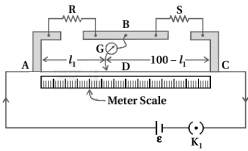
0 likes
View Solution46
Difficult
Explain how the value of an unknown resistor can be obtained by using a meter bridge.
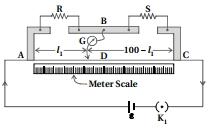
Solution
(N/A) meter bridge is based on the principle of the Wheatstone bridge.
$1$. Connect the unknown resistor $R$ in one gap and a known resistance $S$ from a resistance box in the other gap of the meter bridge.
$2$. $A$ jockey is slid along the wire $AC$ until the galvanometer shows zero deflection at a point $D$. This is called the null point.
$3$. Let the length of the wire $AD$ be $l$. Then the length of the wire $DC$ is $(100 - l) \text{ cm}$.
$4$. Let $\rho$ be the resistance per unit length of the wire. The resistance of segment $AD$ is $P = \rho l$ and the resistance of segment $DC$ is $Q = \rho(100 - l)$.
$5$. According to the Wheatstone bridge principle,at the balanced condition:
$\frac{R}{S} = \frac{P}{Q} = \frac{\rho l}{\rho(100 - l)}$
$6$. Simplifying this,we get:
$\frac{R}{S} = \frac{l}{100 - l}$
$7$. Therefore,the unknown resistance $R$ is given by:
$R = S \left( \frac{l}{100 - l} \right)$
$8$. By measuring the length $l$ and knowing $S$,the value of $R$ can be calculated. To minimize errors,the null point should be obtained near the center of the wire (between $40 \text{ cm}$ and $60 \text{ cm}$).
$1$. Connect the unknown resistor $R$ in one gap and a known resistance $S$ from a resistance box in the other gap of the meter bridge.
$2$. $A$ jockey is slid along the wire $AC$ until the galvanometer shows zero deflection at a point $D$. This is called the null point.
$3$. Let the length of the wire $AD$ be $l$. Then the length of the wire $DC$ is $(100 - l) \text{ cm}$.
$4$. Let $\rho$ be the resistance per unit length of the wire. The resistance of segment $AD$ is $P = \rho l$ and the resistance of segment $DC$ is $Q = \rho(100 - l)$.
$5$. According to the Wheatstone bridge principle,at the balanced condition:
$\frac{R}{S} = \frac{P}{Q} = \frac{\rho l}{\rho(100 - l)}$
$6$. Simplifying this,we get:
$\frac{R}{S} = \frac{l}{100 - l}$
$7$. Therefore,the unknown resistance $R$ is given by:
$R = S \left( \frac{l}{100 - l} \right)$
$8$. By measuring the length $l$ and knowing $S$,the value of $R$ can be calculated. To minimize errors,the null point should be obtained near the center of the wire (between $40 \text{ cm}$ and $60 \text{ cm}$).
0 likes
View Solution47
Medium
To find the value of an unknown resistance by using a meter bridge,why are the positions of $R$ and $S$ interchanged?
Solution
(N/A) In a meter bridge experiment,the positions of the known resistance $(R)$ and the unknown resistance $(S)$ are interchanged to eliminate the end errors.
End errors occur due to the resistance of the copper strips at the ends of the meter bridge wire and the contact resistance at the terminals.
By interchanging the resistances,we take two sets of readings.
Let the true value of the unknown resistance be $S$ and the end errors be $\alpha$ and $\beta$.
In the first case,the balance condition is $\frac{R}{S+\alpha} = \frac{l_1}{100-l_1}$.
In the second case,after interchanging,the condition becomes $\frac{S}{R+\beta} = \frac{l_2}{100-l_2}$.
By taking the average of the two measurements,the systematic errors caused by the end resistance are effectively cancelled out,leading to a more accurate result.
End errors occur due to the resistance of the copper strips at the ends of the meter bridge wire and the contact resistance at the terminals.
By interchanging the resistances,we take two sets of readings.
Let the true value of the unknown resistance be $S$ and the end errors be $\alpha$ and $\beta$.
In the first case,the balance condition is $\frac{R}{S+\alpha} = \frac{l_1}{100-l_1}$.
In the second case,after interchanging,the condition becomes $\frac{S}{R+\beta} = \frac{l_2}{100-l_2}$.
By taking the average of the two measurements,the systematic errors caused by the end resistance are effectively cancelled out,leading to a more accurate result.
0 likes
View Solution48
MediumMCQ
If the null point of a meter bridge is obtained at $50 \ cm$,what will be the value of the unknown resistor $X$ if the known resistor $R$ is $10 \ \Omega$ (in $Omega$)?
A
$5$
B
$10$
C
$20$
D
$50$
Solution
(B) In a meter bridge,the balance condition is given by the formula $\frac{X}{R} = \frac{l}{100 - l}$,where $X$ is the unknown resistance,$R$ is the known resistance,and $l$ is the balancing length from one end.
Given that the null point is at $l = 50 \ cm$,the remaining length is $100 - 50 = 50 \ cm$.
Substituting the values into the formula: $\frac{X}{10} = \frac{50}{50}$.
This simplifies to $\frac{X}{10} = 1$.
Therefore,$X = 10 \ \Omega$.
Given that the null point is at $l = 50 \ cm$,the remaining length is $100 - 50 = 50 \ cm$.
Substituting the values into the formula: $\frac{X}{10} = \frac{50}{50}$.
This simplifies to $\frac{X}{10} = 1$.
Therefore,$X = 10 \ \Omega$.
0 likes
View Solution49
MediumMCQ
$A$ resistance wire connected in the left gap of a meter bridge balances a $10\, \Omega$ resistance in the right gap at a point which divides the bridge wire in the ratio $3: 2$. If the length of the resistance wire is $1.5\, m$,then the length of $1\, \Omega$ of the resistance wire is $....... \times 10^{-2}\, m$.
A
$1.5$
B
$1.0$
C
$10$
D
$15$
Solution
(C) In a meter bridge,the balancing condition is given by $\frac{R}{S} = \frac{\ell_1}{\ell_2}$,where $R$ is the resistance in the left gap and $S$ is the resistance in the right gap.
Given $S = 10\, \Omega$ and the ratio $\frac{\ell_1}{\ell_2} = \frac{3}{2}$.
Substituting these values: $\frac{R}{10} = \frac{3}{2} \implies R = 15\, \Omega$.
The total length of the resistance wire $R$ is $1.5\, m$.
Therefore,the length per unit resistance is $\frac{1.5\, m}{15\, \Omega} = 0.1\, m/\Omega$.
Converting this to the required form: $0.1\, m = 10 \times 10^{-2}\, m$.
Thus,the value is $10$.
Given $S = 10\, \Omega$ and the ratio $\frac{\ell_1}{\ell_2} = \frac{3}{2}$.
Substituting these values: $\frac{R}{10} = \frac{3}{2} \implies R = 15\, \Omega$.
The total length of the resistance wire $R$ is $1.5\, m$.
Therefore,the length per unit resistance is $\frac{1.5\, m}{15\, \Omega} = 0.1\, m/\Omega$.
Converting this to the required form: $0.1\, m = 10 \times 10^{-2}\, m$.
Thus,the value is $10$.
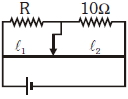
0 likes
View Solution50
MediumMCQ
Consider a $72\, cm$ long wire $AB$ as shown in the figure. The galvanometer jockey is placed at $P$ on $AB$ at a distance $x\, cm$ from $A$. The galvanometer shows zero deflection. The value of $x$,to the nearest integer,is ..... $cm$.
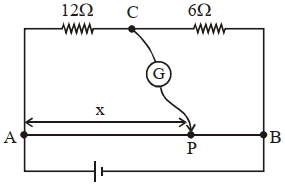
A
$40$
B
$64$
C
$48$
D
$24$
Solution
(C) In a balanced Wheatstone bridge condition,the ratio of resistances in the arms is equal.
Given the resistances $R_1 = 12\, \Omega$ and $R_2 = 6\, \Omega$.
The wire $AB$ has a total length of $72\, cm$. Let the resistance per unit length of the wire be $\lambda$.
The resistance of segment $AP$ is $R_{AP} = \lambda x$ and the resistance of segment $PB$ is $R_{PB} = \lambda (72 - x)$.
For zero deflection in the galvanometer,the bridge is balanced:
$\frac{12}{x} = \frac{6}{72 - x}$
$12(72 - x) = 6x$
$864 - 12x = 6x$
$18x = 864$
$x = \frac{864}{18} = 48\, cm$.
Given the resistances $R_1 = 12\, \Omega$ and $R_2 = 6\, \Omega$.
The wire $AB$ has a total length of $72\, cm$. Let the resistance per unit length of the wire be $\lambda$.
The resistance of segment $AP$ is $R_{AP} = \lambda x$ and the resistance of segment $PB$ is $R_{PB} = \lambda (72 - x)$.
For zero deflection in the galvanometer,the bridge is balanced:
$\frac{12}{x} = \frac{6}{72 - x}$
$12(72 - x) = 6x$
$864 - 12x = 6x$
$18x = 864$
$x = \frac{864}{18} = 48\, cm$.
0 likes
View SolutionCurrent Electricity — Meter Bridge · Frequently Asked Questions
1Are these Current Electricity questions useful for JEE and NEET?
Yes. All questions in this section are mapped to JEE Main and NEET exam patterns. Previous year questions from JEE Main, NEET, GUJCET and state-level exams are included with full solutions.
2Can I switch to Hindi or Gujarati for these questions?
Yes. Use the language tabs in the hero section or the sidebar to view the same questions and solutions in English, Hindi or Gujarati.
3How do I generate a question paper from this subtopic?
Use the Vedclass Exam Paper Generator — select the chapter and subtopic, set difficulty, and generate Sets A, B, C, D automatically. First 3 chapters of every subject are free.
Vedclass Products
For Students
Vedclass Test Series
Mock tests in real JEE/NEET style with performance analysis. 5-day free trial.
Start Free TrialFor Teachers
Exam Paper Generator
Generate Set A/B/C/D papers from this chapter in 2 minutes. 3 chapters free.
Try FreeFor Institutes
Online Exam Module
Live online exams with unlimited students, 360° analytics & white-label branding.
See DemoFor Teachers & Institutes
Generate a Current Electricity Exam Paper in 2 Minutes
Select subtopic & difficulty — Sets A, B, C, D auto-generated with No Repeat logic.
First 3 chapters of every subject are free — no payment required.