
A English
Ohm's Law Questions in English
Class 12 Physics · Current Electricity · Ohm's Law
47+
Questions
English
Language
100%
With Solutions
Showing 47 of 47 questions in English
1
EasyMCQ
Ohm's law is true for which of the following?
A
For metallic conductors at low temperature
B
For metallic conductors at high temperature
C
For electrolytes when current passes through them
D
For diodes when current flows
Solution
(A) Ohm's law states that the current flowing through a conductor is directly proportional to the potential difference across its ends,provided the physical conditions (like temperature) remain constant.
For metallic conductors,Ohm's law holds true as long as the temperature remains constant.
At high temperatures,the resistance of metallic conductors increases,causing the $V-I$ graph to become non-linear,which violates Ohm's law.
Electrolytes and diodes are non-ohmic devices because they do not follow a linear relationship between $V$ and $I$.
Therefore,Ohm's law is primarily applicable to metallic conductors at low or constant temperatures.
For metallic conductors,Ohm's law holds true as long as the temperature remains constant.
At high temperatures,the resistance of metallic conductors increases,causing the $V-I$ graph to become non-linear,which violates Ohm's law.
Electrolytes and diodes are non-ohmic devices because they do not follow a linear relationship between $V$ and $I$.
Therefore,Ohm's law is primarily applicable to metallic conductors at low or constant temperatures.
0 likes
View Solution2
EasyMCQ
An electric wire is connected across a cell of $e.m.f.$ $E$. The current $I$ is measured by an ammeter of resistance $R$. According to Ohm's law,which of the following relations is correct?
A
$E = I^2R$
B
$E = IR$
C
$E = R/I$
D
$E = I/R$
Solution
(B) According to Ohm's law,the potential difference $V$ across a conductor is directly proportional to the current $I$ flowing through it,provided the physical conditions remain constant.
$V = IR$
In this circuit,the cell provides an electromotive force $(e.m.f.)$ $E$,which acts as the potential difference across the resistance $R$ of the ammeter.
Therefore,substituting $E$ for $V$,we get:
$E = IR$
$V = IR$
In this circuit,the cell provides an electromotive force $(e.m.f.)$ $E$,which acts as the potential difference across the resistance $R$ of the ammeter.
Therefore,substituting $E$ for $V$,we get:
$E = IR$
0 likes
View Solution3
EasyMCQ
Which of the following statements is correct?
A
Liquids obey Ohm's law fully.
B
Liquids obey Ohm's law partially.
C
There is no relation between current and potential difference for liquids.
D
None of the above.
Solution
(B) Ohm's law states that the current flowing through a conductor is directly proportional to the potential difference applied across its ends,provided the physical conditions remain constant. This results in a linear $V-I$ graph. For liquids (electrolytes),the relationship between current and potential difference is generally non-linear due to factors like polarization and chemical changes at the electrodes. Therefore,liquids do not follow Ohm's law strictly,meaning they obey it only partially or under specific,limited conditions. Thus,option $B$ is correct.
0 likes
View Solution4
EasyMCQ
For a metallic wire,the ratio $V/i$ ($V =$ the applied potential difference,$i =$ current flowing) is
A
Independent of temperature
B
Increases as the temperature rises
C
Decreases as the temperature rises
D
Increases or decreases as temperature rises,depending upon the metal
Solution
(B) According to Ohm's law,the ratio $V/i$ is equal to the resistance $R$ of the conductor.
For a metallic wire,the resistance $R$ is given by the relation $R_t = R_0(1 + \alpha \Delta T)$,where $\alpha$ is the temperature coefficient of resistance.
For metals,$\alpha$ is positive,which means that as the temperature increases,the resistance $R$ of the metallic wire increases.
Therefore,the ratio $V/i$ increases as the temperature rises.
For a metallic wire,the resistance $R$ is given by the relation $R_t = R_0(1 + \alpha \Delta T)$,where $\alpha$ is the temperature coefficient of resistance.
For metals,$\alpha$ is positive,which means that as the temperature increases,the resistance $R$ of the metallic wire increases.
Therefore,the ratio $V/i$ increases as the temperature rises.
0 likes
View Solution5
EasyMCQ
$A$ solenoid is at a potential difference of $60\, V$ and the current flowing through it is $15\, A$. The resistance of the coil will be ............ $\Omega$.
A
$4$
B
$8$
C
$0.25$
D
$2$
Solution
(A) According to Ohm's Law,the resistance $R$ is given by the ratio of potential difference $V$ to the current $I$.
$R = \frac{V}{I}$
Given:
Potential difference $V = 60\, V$
Current $I = 15\, A$
Substituting the values:
$R = \frac{60}{15} = 4\, \Omega$
Therefore,the resistance of the coil is $4\, \Omega$.
$R = \frac{V}{I}$
Given:
Potential difference $V = 60\, V$
Current $I = 15\, A$
Substituting the values:
$R = \frac{60}{15} = 4\, \Omega$
Therefore,the resistance of the coil is $4\, \Omega$.
0 likes
View Solution6
EasyMCQ
All of the following statements are true except:
A
Conductance is the reciprocal of resistance and is measured in Siemens.
B
Ohm's law is not applicable at very low and very high temperatures.
C
Ohm's law is applicable to semiconductors.
D
Ohm's law is not applicable to electron tubes,discharge tubes,and electrolytes.
Solution
(C) The correct answer is $C$. Ohm's law states that the current flowing through a conductor is directly proportional to the potential difference across its ends,provided physical conditions remain constant.
Semiconductors are non-ohmic devices,meaning they do not follow Ohm's law because the relationship between voltage and current is non-linear.
Therefore,the statement that Ohm's law is applicable to semiconductors is false.
Semiconductors are non-ohmic devices,meaning they do not follow Ohm's law because the relationship between voltage and current is non-linear.
Therefore,the statement that Ohm's law is applicable to semiconductors is false.
0 likes
View Solution7
EasyMCQ
The resistance of a discharge tube is
A
Ohmic
B
Non-ohmic
C
infinity
D
Zero
Solution
(B) discharge tube does not follow Ohm's law,which states that the current is directly proportional to the potential difference for a constant resistance. In a discharge tube,the current-voltage $(I-V)$ relationship is non-linear due to the process of secondary ionization of the gas particles inside the tube. As the potential difference increases,the number of charge carriers increases significantly,causing the resistance to change. Therefore,it is classified as a non-ohmic device.
0 likes
View Solution8
EasyMCQ
Which of the following circuit setups can be used to verify Ohm's law?
A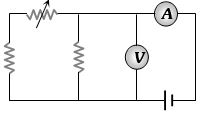
B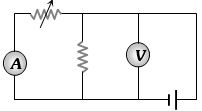
C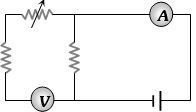
D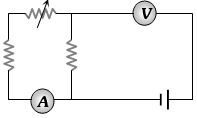
Solution
(B) To verify Ohm's law,we need to measure the current flowing through a resistor and the potential difference across it.
$1$. An ammeter is used to measure current and must be connected in series with the component.
$2$. $A$ voltmeter is used to measure potential difference and must be connected in parallel across the component.
$3$. In the provided options,the correct setup is the one where the ammeter is in series with the resistor and the voltmeter is connected in parallel across the resistor to measure the voltage drop across it.
$4$. Based on standard circuit diagrams for Ohm's law verification,the setup where the ammeter is in series and the voltmeter is in parallel is the correct configuration.
$1$. An ammeter is used to measure current and must be connected in series with the component.
$2$. $A$ voltmeter is used to measure potential difference and must be connected in parallel across the component.
$3$. In the provided options,the correct setup is the one where the ammeter is in series with the resistor and the voltmeter is connected in parallel across the resistor to measure the voltage drop across it.
$4$. Based on standard circuit diagrams for Ohm's law verification,the setup where the ammeter is in series and the voltmeter is in parallel is the correct configuration.
0 likes
View Solution9
EasyMCQ
Which of the following graphs represents an ohmic resistance?
A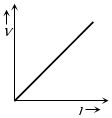
B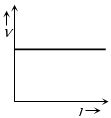
C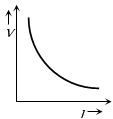
D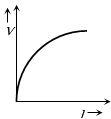
Solution
(A) For an ohmic resistance,the potential difference $V$ is directly proportional to the current $I$ flowing through it,according to Ohm's Law.
This is expressed as $V \propto I$,which can be written as $V = RI$,where $R$ is the resistance and is a constant.
The equation $V = RI$ represents a straight line passing through the origin in a $V$-$I$ graph,where the slope of the line is equal to the resistance $R$.
Therefore,the graph that represents an ohmic resistance is a straight line passing through the origin.
This is expressed as $V \propto I$,which can be written as $V = RI$,where $R$ is the resistance and is a constant.
The equation $V = RI$ represents a straight line passing through the origin in a $V$-$I$ graph,where the slope of the line is equal to the resistance $R$.
Therefore,the graph that represents an ohmic resistance is a straight line passing through the origin.
0 likes
View Solution10
EasyMCQ
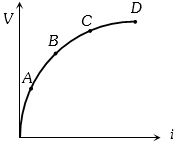
The variation of current $(i)$ passing through a conductor as the voltage $(V)$ applied across its ends is varied is shown in the adjoining diagram. If the resistance $(R)$ is determined at the points $A, B, C$ and $D$,we will find that
A
$R_C = R_D$
B
$R_B > R_A$
C
$R_C > R_B$
D
None of these
Solution
(D) According to Ohm's Law,$V = iR$,which implies $R = V/i$.
In the given $V-i$ graph,the resistance $(R)$ at any point is equal to the slope of the tangent at that point,which is given by $\tan \theta = \frac{dV}{di}$.
As we move from point $A$ to $D$ along the curve,the angle $\theta$ that the tangent makes with the current axis $(i)$ decreases.
Since the slope of the curve decreases as we move from $A$ to $D$,the resistance at these points follows the order $R_A > R_B > R_C > R_D$.
Comparing this with the given options:
$A)$ $R_C = R_D$ is incorrect.
$B)$ $R_B > R_A$ is incorrect as $R_A > R_B$.
$C)$ $R_C > R_B$ is incorrect as $R_B > R_C$.
Therefore,the correct option is $D$.
In the given $V-i$ graph,the resistance $(R)$ at any point is equal to the slope of the tangent at that point,which is given by $\tan \theta = \frac{dV}{di}$.
As we move from point $A$ to $D$ along the curve,the angle $\theta$ that the tangent makes with the current axis $(i)$ decreases.
Since the slope of the curve decreases as we move from $A$ to $D$,the resistance at these points follows the order $R_A > R_B > R_C > R_D$.
Comparing this with the given options:
$A)$ $R_C = R_D$ is incorrect.
$B)$ $R_B > R_A$ is incorrect as $R_A > R_B$.
$C)$ $R_C > R_B$ is incorrect as $R_B > R_C$.
Therefore,the correct option is $D$.
0 likes
View Solution11
EasyMCQ
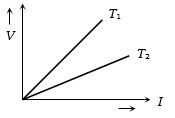
The voltage $V$ and current $I$ graph for a conductor at two different temperatures $T_1$ and $T_2$ are shown in the figure. The relation between $T_1$ and $T_2$ is
A
$T_1 > T_2$
B
$T_1 \approx T_2$
C
$T_1 = T_2$
D
$T_1 < T_2$
Solution
(A) The slope of the $V-I$ graph represents the resistance $R$ of the conductor,as $R = V/I$.
From the given figure,the slope of the line corresponding to temperature $T_1$ is greater than the slope of the line corresponding to temperature $T_2$.
Therefore,$R_{T_1} > R_{T_2}$.
For a metallic conductor,the resistance increases with an increase in temperature.
Since the resistance at $T_1$ is greater than the resistance at $T_2$,it follows that $T_1 > T_2$.
From the given figure,the slope of the line corresponding to temperature $T_1$ is greater than the slope of the line corresponding to temperature $T_2$.
Therefore,$R_{T_1} > R_{T_2}$.
For a metallic conductor,the resistance increases with an increase in temperature.
Since the resistance at $T_1$ is greater than the resistance at $T_2$,it follows that $T_1 > T_2$.
0 likes
View Solution12
EasyMCQ
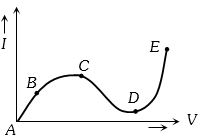
From the graph between current $I$ and voltage $V$ shown below,identify the portion corresponding to negative resistance.
A
$AB$
B
$BC$
C
$CD$
D
$DE$
Solution
(C) The resistance $R$ is defined by the relation $R = V/I$. In an $I-V$ graph,the slope of the curve is given by $dI/dV$,which is equal to $1/R$.
For negative resistance,the slope $dI/dV$ must be negative.
Looking at the graph,in the portion $CD$,as the voltage $V$ increases,the current $I$ decreases.
Therefore,the slope $dI/dV$ is negative in the region $CD$,which corresponds to negative resistance.
For negative resistance,the slope $dI/dV$ must be negative.
Looking at the graph,in the portion $CD$,as the voltage $V$ increases,the current $I$ decreases.
Therefore,the slope $dI/dV$ is negative in the region $CD$,which corresponds to negative resistance.
0 likes
View Solution13
EasyMCQ
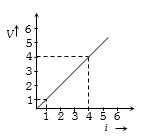
The variation of current $(i)$ and voltage $(V)$ in a conductor is shown in the diagram below. The resistance of the conductor is ........... $\Omega$.
A
$4$
B
$2$
C
$3$
D
$1$
Solution
(D) According to Ohm's Law,$V = iR$,which implies $R = \frac{V}{i}$.
In the given $V-i$ graph,the slope of the straight line represents the resistance $R$.
Taking a point on the graph,for $i = 4 \text{ A}$,the corresponding voltage is $V = 4 \text{ V}$.
Therefore,$R = \frac{V}{i} = \frac{4}{4} = 1 \text{ } \Omega$.
In the given $V-i$ graph,the slope of the straight line represents the resistance $R$.
Taking a point on the graph,for $i = 4 \text{ A}$,the corresponding voltage is $V = 4 \text{ V}$.
Therefore,$R = \frac{V}{i} = \frac{4}{4} = 1 \text{ } \Omega$.
0 likes
View Solution14
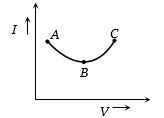
EasyMCQ
The resistance as shown in the figure is negative at
A
$A$
B
$B$
C
$C$
D
None of these
Solution
(A) The resistance $R$ is defined by the relation $R = \frac{V}{I}$.
In a $V-I$ graph, the resistance is given by the slope of the graph, but here the graph is plotted as $I$ versus $V$.
Therefore, the conductance $G = \frac{I}{V}$ is represented by the slope of the $I-V$ graph.
Resistance $R = \frac{1}{\text{slope of } I-V \text{ graph}}$.
At point $A$, the slope of the tangent to the curve is negative (as the current $I$ decreases with increasing voltage $V$).
Since the slope is negative, the resistance $R$ is negative at point $A$.
In a $V-I$ graph, the resistance is given by the slope of the graph, but here the graph is plotted as $I$ versus $V$.
Therefore, the conductance $G = \frac{I}{V}$ is represented by the slope of the $I-V$ graph.
Resistance $R = \frac{1}{\text{slope of } I-V \text{ graph}}$.
At point $A$, the slope of the tangent to the curve is negative (as the current $I$ decreases with increasing voltage $V$).
Since the slope is negative, the resistance $R$ is negative at point $A$.
0 likes
View Solution15
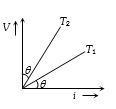
DifficultMCQ
The $V-i$ graph for a conductor at temperatures $T_1$ and $T_2$ are as shown in the figure. $(T_2 - T_1)$ is proportional to
A
$\cos 2\theta$
B
$\sin \theta$
C
$\cot 2\theta$
D
$\tan \theta$
Solution
(C) For a conductor,the resistance $R$ is directly proportional to the temperature $T$,i.e.,$R \propto T$.
In a $V-i$ graph,the slope represents the resistance $R = \frac{V}{i}$.
From the figure,for temperature $T_1$,the slope is $\tan \theta$. Thus,$R_1 = \tan \theta \propto T_1$,which gives $T_1 = k \tan \theta$ for some constant $k$.
For temperature $T_2$,the angle with the $V$-axis is $\theta$,so the angle with the $i$-axis is $(90^\circ - \theta)$. Thus,$R_2 = \tan(90^\circ - \theta) = \cot \theta \propto T_2$,which gives $T_2 = k \cot \theta$.
Now,$(T_2 - T_1) = k(\cot \theta - \tan \theta)$.
Using trigonometric identities:
$(T_2 - T_1) = k \left( \frac{\cos \theta}{\sin \theta} - \frac{\sin \theta}{\cos \theta} \right) = k \left( \frac{\cos^2 \theta - \sin^2 \theta}{\sin \theta \cos \theta} \right) = k \left( \frac{\cos 2\theta}{\frac{1}{2} \sin 2\theta} \right) = 2k \cot 2\theta$.
Therefore,$(T_2 - T_1) \propto \cot 2\theta$.
In a $V-i$ graph,the slope represents the resistance $R = \frac{V}{i}$.
From the figure,for temperature $T_1$,the slope is $\tan \theta$. Thus,$R_1 = \tan \theta \propto T_1$,which gives $T_1 = k \tan \theta$ for some constant $k$.
For temperature $T_2$,the angle with the $V$-axis is $\theta$,so the angle with the $i$-axis is $(90^\circ - \theta)$. Thus,$R_2 = \tan(90^\circ - \theta) = \cot \theta \propto T_2$,which gives $T_2 = k \cot \theta$.
Now,$(T_2 - T_1) = k(\cot \theta - \tan \theta)$.
Using trigonometric identities:
$(T_2 - T_1) = k \left( \frac{\cos \theta}{\sin \theta} - \frac{\sin \theta}{\cos \theta} \right) = k \left( \frac{\cos^2 \theta - \sin^2 \theta}{\sin \theta \cos \theta} \right) = k \left( \frac{\cos 2\theta}{\frac{1}{2} \sin 2\theta} \right) = 2k \cot 2\theta$.
Therefore,$(T_2 - T_1) \propto \cot 2\theta$.
0 likes
View Solution16
MediumMCQ
The $V-i$ graph for a conductor makes an angle $\theta$ with the $V$-axis. Here $V$ denotes the voltage and $i$ denotes the current. The resistance of the conductor is given by:
A
$\sin \theta$
B
$\cos \theta$
C
$\tan \theta$
D
$\cot \theta$
Solution
(D) According to Ohm's Law,$V = iR$,which implies $R = V/i$.
In a $V-i$ graph,the resistance $R$ is represented by the slope of the line with respect to the $i$-axis.
The slope of a line is defined as $\tan(\phi)$,where $\phi$ is the angle the line makes with the $i$-axis.
Given that the graph makes an angle $\theta$ with the $V$-axis,the angle it makes with the $i$-axis is $(90^\circ - \theta)$.
Therefore,the resistance $R = \tan(90^\circ - \theta) = \cot \theta$.
In a $V-i$ graph,the resistance $R$ is represented by the slope of the line with respect to the $i$-axis.
The slope of a line is defined as $\tan(\phi)$,where $\phi$ is the angle the line makes with the $i$-axis.
Given that the graph makes an angle $\theta$ with the $V$-axis,the angle it makes with the $i$-axis is $(90^\circ - \theta)$.
Therefore,the resistance $R = \tan(90^\circ - \theta) = \cot \theta$.
0 likes
View Solution17
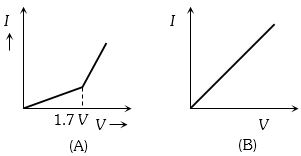
MediumMCQ
The $V-I$ graphs $A$ and $B$ are drawn for two voltameters. Identify each graph.
A
$A$ for water voltameter and $B$ for $Cu$ voltameter
B
$A$ for $Cu$ voltameter and $B$ for water voltameter
C
Both $A$ and $B$ represent $Cu$ voltameter
D
None of these
Solution
(A) $Cu$ voltameter with soluble electrodes obeys Ohm's law,resulting in a linear $V-I$ graph passing through the origin,as shown in graph $B$.
In a water voltameter,there is a back $e.m.f.$ due to polarization. When the applied voltage $V$ is small $(V < 1.7 \, V)$,very little current flows,and the device does not obey Ohm's law.
As soon as $V$ exceeds $1.7 \, V$ (the decomposition voltage),the current increases steadily according to Ohm's law,as shown in graph $A$.
In a water voltameter,there is a back $e.m.f.$ due to polarization. When the applied voltage $V$ is small $(V < 1.7 \, V)$,very little current flows,and the device does not obey Ohm's law.
As soon as $V$ exceeds $1.7 \, V$ (the decomposition voltage),the current increases steadily according to Ohm's law,as shown in graph $A$.
0 likes
View Solution18
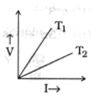
EasyMCQ
The $V-I$ graph for a conductor at two different temperatures $T_1$ and $T_2$ is shown. The relationship between $T_1$ and $T_2$ is:
A
$T_1 > T_2$
B
$T_1 = T_2$
C
$T_1 < T_2$
D
$T_1 \leq T_2$
Solution
(A) The slope of the $V-I$ graph represents the resistance $R$ of the conductor,as $R = \frac{V}{I}$.
From the given graph,the slope for temperature $T_1$ is greater than the slope for temperature $T_2$.
Therefore,$R_1 > R_2$.
For a metallic conductor,the resistance increases with an increase in temperature.
Since $R_1 > R_2$,it follows that $T_1 > T_2$.
From the given graph,the slope for temperature $T_1$ is greater than the slope for temperature $T_2$.
Therefore,$R_1 > R_2$.
For a metallic conductor,the resistance increases with an increase in temperature.
Since $R_1 > R_2$,it follows that $T_1 > T_2$.
0 likes
View Solution19
EasyMCQ
Which of the following graphs represents an ohmic resistor?
A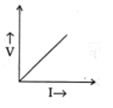
B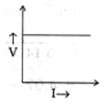
C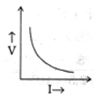
D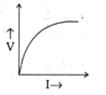
Solution
(A) According to Ohm's law,the potential difference $V$ across a conductor is directly proportional to the current $I$ flowing through it,provided the temperature and other physical conditions remain constant.
$V \propto I$
$V = IR$
Where $R$ is the resistance,which is a constant for an ohmic resistor.
This equation represents a straight line passing through the origin in a $V-I$ graph.
Therefore,the graph showing a linear relationship between $V$ and $I$ represents an ohmic resistor.
$V \propto I$
$V = IR$
Where $R$ is the resistance,which is a constant for an ohmic resistor.
This equation represents a straight line passing through the origin in a $V-I$ graph.
Therefore,the graph showing a linear relationship between $V$ and $I$ represents an ohmic resistor.
0 likes
View Solution20
EasyMCQ
If the resistance of a wire is $50\,\Omega$,the graph between $\log\ V$ and $\log\ I$ is........
A
$A$ straight line
B
$A$ parabola
C
$A$ hyperbola
D
$A$ circle
Solution
(A) According to Ohm's law,$V = IR$.
Taking the logarithm on both sides,we get $\log\ V = \log\ (IR) = \log\ I + \log\ R$.
This equation is of the form $y = mx + c$,where $y = \log\ V$,$x = \log\ I$,slope $m = 1$,and intercept $c = \log\ R$.
Since this is a linear equation,the graph between $\log\ V$ and $\log\ I$ is a straight line.
Taking the logarithm on both sides,we get $\log\ V = \log\ (IR) = \log\ I + \log\ R$.
This equation is of the form $y = mx + c$,where $y = \log\ V$,$x = \log\ I$,slope $m = 1$,and intercept $c = \log\ R$.
Since this is a linear equation,the graph between $\log\ V$ and $\log\ I$ is a straight line.
0 likes
View Solution21
MediumMCQ
$A$ $V-i$ graph for a conductor is given. The resistance is proportional to which of the following?
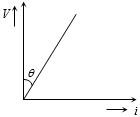
A
$sin \, \theta$
B
$cos \, \theta$
C
$tan \, \theta$
D
$cot \, \theta$
Solution
(D) According to Ohm's law,$V = iR$,so $R = V/i$.
In the given graph,the $V$-axis is vertical and the $i$-axis is horizontal.
The angle $\theta$ is given with the $V$-axis.
Therefore,the slope of the graph with respect to the $i$-axis is $\tan \phi$,where $\phi$ is the angle with the $i$-axis.
Since $\phi = 90^\circ - \theta$,the slope is $\tan(90^\circ - \theta) = \cot \theta$.
Since the slope of a $V-i$ graph represents resistance $R$,we have $R \propto \cot \theta$.
In the given graph,the $V$-axis is vertical and the $i$-axis is horizontal.
The angle $\theta$ is given with the $V$-axis.
Therefore,the slope of the graph with respect to the $i$-axis is $\tan \phi$,where $\phi$ is the angle with the $i$-axis.
Since $\phi = 90^\circ - \theta$,the slope is $\tan(90^\circ - \theta) = \cot \theta$.
Since the slope of a $V-i$ graph represents resistance $R$,we have $R \propto \cot \theta$.
0 likes
View Solution22
MediumMCQ
The current in a metallic conductor is plotted against voltage at two different temperatures $T_1$ and $T_2$. Which of the following is correct?
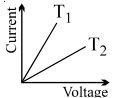
A
$T_1 > T_2$
B
$T_1 < T_2$
C
$T_1 = T_2$
D
None of these
Solution
(B) According to Ohm's law,$R = \frac{V}{I}$.
In the given $I-V$ graph,the slope of the line is $\frac{I}{V} = \frac{1}{R}$.
Since the slope of the line for $T_1$ is greater than the slope of the line for $T_2$,we have $\frac{1}{R_1} > \frac{1}{R_2}$,which implies $R_1 < R_2$.
For a metallic conductor,resistance $R$ increases with an increase in temperature $T$.
Since $R_1 < R_2$,it follows that $T_1 < T_2$.
In the given $I-V$ graph,the slope of the line is $\frac{I}{V} = \frac{1}{R}$.
Since the slope of the line for $T_1$ is greater than the slope of the line for $T_2$,we have $\frac{1}{R_1} > \frac{1}{R_2}$,which implies $R_1 < R_2$.
For a metallic conductor,resistance $R$ increases with an increase in temperature $T$.
Since $R_1 < R_2$,it follows that $T_1 < T_2$.
0 likes
View Solution23
MediumMCQ
The current $(I)$ and voltage $(V)$ graphs for a given metallic wire at two different temperatures $T_1$ and $T_2$ are shown in the figure. It is concluded that
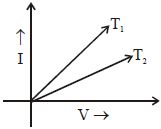
A
$T_1 > T_2$
B
$T_1 = T_2$
C
$T_1 < T_2$
D
$T_1 = 2T_2$
Solution
(C) The slope of the $I-V$ graph is given by $\text{Slope} = \frac{I}{V} = \frac{1}{R}$.
From the graph,the slope of the line corresponding to $T_1$ is greater than the slope of the line corresponding to $T_2$.
Therefore,$\frac{1}{R_1} > \frac{1}{R_2}$,which implies $R_1 < R_2$.
For a metallic wire,resistance increases with an increase in temperature.
Since $R_1 < R_2$,it follows that $T_1 < T_2$.
From the graph,the slope of the line corresponding to $T_1$ is greater than the slope of the line corresponding to $T_2$.
Therefore,$\frac{1}{R_1} > \frac{1}{R_2}$,which implies $R_1 < R_2$.
For a metallic wire,resistance increases with an increase in temperature.
Since $R_1 < R_2$,it follows that $T_1 < T_2$.
0 likes
View Solution24
DifficultMCQ
The correct setup to verify Ohm's law is:
A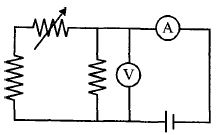
B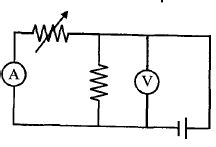
C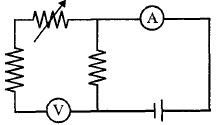
D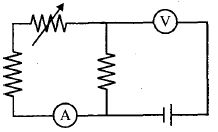
Solution
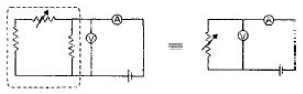
(B) To verify Ohm's law,we use the relation $V = IR$,where $I$ is the current flowing through a resistor and $V$ is the potential difference across that specific resistor.
$1$. An ammeter must be connected in series with the resistor to measure the current $I$ flowing through it.
$2$. $A$ voltmeter must be connected in parallel with the resistor to measure the potential difference $V$ across it.
Looking at the options,the setup in option $(b)$ correctly places the ammeter in series with the resistor and the voltmeter in parallel across the resistor. Therefore,option $(b)$ is the correct setup.
$1$. An ammeter must be connected in series with the resistor to measure the current $I$ flowing through it.
$2$. $A$ voltmeter must be connected in parallel with the resistor to measure the potential difference $V$ across it.
Looking at the options,the setup in option $(b)$ correctly places the ammeter in series with the resistor and the voltmeter in parallel across the resistor. Therefore,option $(b)$ is the correct setup.
0 likes
View Solution25
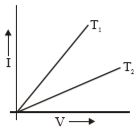
MediumMCQ
The current-voltage $(I-V)$ graphs for a given metallic wire at two different temperatures $T_1$ and $T_2$ are shown in the figure. The temperatures $T_1$ and $T_2$ are related as
A
$T_1 > T_2$
B
$T_1 < T_2$
C
$T_1 = T_2$
D
$T_1 = 2T_2$
Solution
(B) From Ohm's law,$V = IR$,which implies $I = \frac{1}{R} V$.
Comparing this with the equation of a straight line $y = mx$,the slope of the $I-V$ graph is given by $\text{slope} = \frac{dI}{dV} = \frac{1}{R}$.
From the given graph,the slope for temperature $T_1$ is greater than the slope for temperature $T_2$.
Therefore,$\frac{1}{R_1} > \frac{1}{R_2}$,which implies $R_1 < R_2$.
For a metallic wire,resistance increases with an increase in temperature $(R \propto T)$.
Since $R_1 < R_2$,it follows that $T_1 < T_2$.
Comparing this with the equation of a straight line $y = mx$,the slope of the $I-V$ graph is given by $\text{slope} = \frac{dI}{dV} = \frac{1}{R}$.
From the given graph,the slope for temperature $T_1$ is greater than the slope for temperature $T_2$.
Therefore,$\frac{1}{R_1} > \frac{1}{R_2}$,which implies $R_1 < R_2$.
For a metallic wire,resistance increases with an increase in temperature $(R \propto T)$.
Since $R_1 < R_2$,it follows that $T_1 < T_2$.
0 likes
View Solution26
MediumMCQ
Which among the following is true?
A
An alloy of very low resistivity is used to verify Ohm's law.
B
$\vec{E} = \rho \vec{J}$ is the statement of Ohm's law (where $\vec{E}$ is the electric field and $\vec{J}$ is the current density).
C
$V = IR$ can be applied to all materials (where $V$ is the potential difference across the material,$R$ is resistance,and $I$ is the current through the material).
D
All of the above.
Solution
(B) $1$. Option $A$ is incorrect because alloys with low temperature coefficients of resistance (like Manganin or Constantan) are used,not necessarily those with very low resistivity.
$2$. Option $B$ is correct. The microscopic form of Ohm's law is given by $\vec{J} = \sigma \vec{E}$,which can be written as $\vec{E} = \rho \vec{J}$,where $\rho$ is resistivity.
$3$. Option $C$ is incorrect because $V = IR$ is only valid for Ohmic conductors,not for non-Ohmic materials like semiconductors or diodes.
$4$. Therefore,only statement $B$ is true.
$2$. Option $B$ is correct. The microscopic form of Ohm's law is given by $\vec{J} = \sigma \vec{E}$,which can be written as $\vec{E} = \rho \vec{J}$,where $\rho$ is resistivity.
$3$. Option $C$ is incorrect because $V = IR$ is only valid for Ohmic conductors,not for non-Ohmic materials like semiconductors or diodes.
$4$. Therefore,only statement $B$ is true.
0 likes
View Solution27
EasyMCQ
Assertion : Ohm's law is applicable for all conducting elements.
Reason : Ohm's law is a fundamental law.
Reason : Ohm's law is a fundamental law.
A
If both Assertion and Reason are correct and the Reason is a correct explanation of the Assertion.
B
If both Assertion and Reason are correct but Reason is not a correct explanation of the Assertion.
C
If the Assertion is correct but Reason is incorrect.
D
If both the Assertion and Reason are incorrect.
Solution
(D) The Assertion is incorrect because Ohm's law is not applicable to all conducting elements. Materials that obey Ohm's law are called ohmic conductors (e.g.,metallic conductors),while those that do not are called non-ohmic conductors (e.g.,junction diodes,transistors,electrolytes).
The Reason is also incorrect because Ohm's law is not a fundamental law of nature like Newton's laws or Maxwell's equations. It is an empirical relationship that holds true only for certain materials under specific conditions.
Therefore,both the Assertion and the Reason are incorrect.
The Reason is also incorrect because Ohm's law is not a fundamental law of nature like Newton's laws or Maxwell's equations. It is an empirical relationship that holds true only for certain materials under specific conditions.
Therefore,both the Assertion and the Reason are incorrect.
0 likes
View Solution28
Easy
What conclusion can you draw from the following observations on a resistor made of alloy manganin?
| $I (A)$ | $V (V)$ | $I (A)$ | $V (V)$ |
| $0.2$ | $3.94$ | $3.0$ | $59.2$ |
| $0.4$ | $7.87$ | $4.0$ | $78.8$ |
| $0.6$ | $11.8$ | $5.0$ | $98.6$ |
| $0.8$ | $15.7$ | $6.0$ | $118.5$ |
| $1.0$ | $19.7$ | $7.0$ | $138.2$ |
| $2.0$ | $39.4$ | $8.0$ | $158.0$ |
Solution
(N/A) To determine the nature of the conductor,we calculate the ratio $R = V/I$ for several data points:
For $I = 0.2 \, A, V = 3.94 \, V \implies R = 3.94 / 0.2 = 19.7 \, \Omega$.
For $I = 1.0 \, A, V = 19.7 \, V \implies R = 19.7 / 1.0 = 19.7 \, \Omega$.
For $I = 8.0 \, A, V = 158.0 \, V \implies R = 158.0 / 8.0 = 19.7 \, \Omega$.
Since the ratio $V/I$ remains constant at $19.7 \, \Omega$ for all given values,the resistor obeys Ohm's law.
Therefore,we conclude that manganin is an ohmic conductor with a constant resistance of $19.7 \, \Omega$.
For $I = 0.2 \, A, V = 3.94 \, V \implies R = 3.94 / 0.2 = 19.7 \, \Omega$.
For $I = 1.0 \, A, V = 19.7 \, V \implies R = 19.7 / 1.0 = 19.7 \, \Omega$.
For $I = 8.0 \, A, V = 158.0 \, V \implies R = 158.0 / 8.0 = 19.7 \, \Omega$.
Since the ratio $V/I$ remains constant at $19.7 \, \Omega$ for all given values,the resistor obeys Ohm's law.
Therefore,we conclude that manganin is an ohmic conductor with a constant resistance of $19.7 \, \Omega$.
0 likes
View Solution29
Medium
State and explain Ohm's law.
Solution
(N/A) In $1828$, German scientist George Simon Ohm formulated the law as follows:
"Under constant physical conditions, the ratio of the potential difference $(V)$ between two points of a conductor to the current $(I)$ flowing through it is constant."
$\therefore V \propto I$
$\therefore V = RI$, where $R$ is the constant of proportionality.
$\therefore \frac{V}{I} = R$
Here, $R$ is called the resistance of the conductor. The unit of resistance is $\frac{\text{Volt}}{\text{Ampere}} = \text{Ohm} (\Omega)$. The dimensional formula for resistance is $[M^1 L^2 T^{-3} A^{-2}]$.
"Under constant physical conditions, the ratio of the potential difference $(V)$ between two points of a conductor to the current $(I)$ flowing through it is constant."
$\therefore V \propto I$
$\therefore V = RI$, where $R$ is the constant of proportionality.
$\therefore \frac{V}{I} = R$
Here, $R$ is called the resistance of the conductor. The unit of resistance is $\frac{\text{Volt}}{\text{Ampere}} = \text{Ohm} (\Omega)$. The dimensional formula for resistance is $[M^1 L^2 T^{-3} A^{-2}]$.
0 likes
View Solution30
Medium
Write the limitations of Ohm's law.
Solution
(N/A) Ohm's law states that the current flowing through a conductor is directly proportional to the potential difference applied across its ends,provided physical conditions remain constant. However,it has certain limitations:
$(a)$ $V$ and $I$ are not proportional to each other for all materials.
In the provided graph,the dotted line represents the region where Ohm's law is obeyed (linear behavior). The continuous curve indicates where Ohm's law is not obeyed (non-ohmic behavior).
When current flows through a conductor,Joule heating occurs. As the temperature of the conductor increases,its resistance changes. Consequently,for such materials,the $V-I$ graph is a non-linear curve.
Examples: Diodes,Transistors.
$(b)$ The relationship between $I$ and $V$ depends on the polarity of the applied voltage $V$. Thus,for the same magnitude of positive or negative voltage,different current values are obtained.
Example: $PN$ junction diode.
$(a)$ $V$ and $I$ are not proportional to each other for all materials.
In the provided graph,the dotted line represents the region where Ohm's law is obeyed (linear behavior). The continuous curve indicates where Ohm's law is not obeyed (non-ohmic behavior).
When current flows through a conductor,Joule heating occurs. As the temperature of the conductor increases,its resistance changes. Consequently,for such materials,the $V-I$ graph is a non-linear curve.
Examples: Diodes,Transistors.
$(b)$ The relationship between $I$ and $V$ depends on the polarity of the applied voltage $V$. Thus,for the same magnitude of positive or negative voltage,different current values are obtained.
Example: $PN$ junction diode.
0 likes
View Solution31
EasyMCQ
How is the $V-I$ graph of a material following Ohm's law?
A
$A$ straight line passing through the origin
B
$A$ parabola
C
$A$ hyperbola
D
An exponential curve
Solution
(A) Ohm's law states that the current $I$ flowing through a conductor is directly proportional to the potential difference $V$ applied across its ends,provided the physical conditions (like temperature) remain constant.
Mathematically,this is expressed as $V = IR$,where $R$ is the resistance of the conductor.
Since $R$ is constant for an ohmic material,the equation $V = IR$ represents a linear relationship.
Therefore,the graph of $V$ versus $I$ is a straight line passing through the origin $(0,0)$.
Mathematically,this is expressed as $V = IR$,where $R$ is the resistance of the conductor.
Since $R$ is constant for an ohmic material,the equation $V = IR$ represents a linear relationship.
Therefore,the graph of $V$ versus $I$ is a straight line passing through the origin $(0,0)$.
0 likes
View Solution32
Easy
Explain the statement: "$V \to I$ relation is not always a one-one function."
Solution
(A) function is one-one if every input value maps to a unique output value. In the context of electrical circuits, the $V \to I$ relation represents the current $I$ as a function of voltage $V$.
For an Ohmic conductor, the relationship is linear $(V = IR)$, meaning for every $V$, there is a unique $I$, making it a one-one function.
However, for non-Ohmic devices (like $p-n$ junction diodes or thermistors), the $V-I$ characteristic curve is non-linear.
Specifically, in devices exhibiting negative differential resistance (like a tunnel diode), the current $I$ may decrease as voltage $V$ increases over a certain range.
Furthermore, in devices with hysteresis or complex $V-I$ characteristics, multiple values of $V$ might correspond to the same value of $I$, or the relationship may not be strictly monotonic.
Therefore, because the current does not always increase uniquely and monotonically with voltage across all types of materials, the $V \to I$ relation is not universally a one-one function.
For an Ohmic conductor, the relationship is linear $(V = IR)$, meaning for every $V$, there is a unique $I$, making it a one-one function.
However, for non-Ohmic devices (like $p-n$ junction diodes or thermistors), the $V-I$ characteristic curve is non-linear.
Specifically, in devices exhibiting negative differential resistance (like a tunnel diode), the current $I$ may decrease as voltage $V$ increases over a certain range.
Furthermore, in devices with hysteresis or complex $V-I$ characteristics, multiple values of $V$ might correspond to the same value of $I$, or the relationship may not be strictly monotonic.
Therefore, because the current does not always increase uniquely and monotonically with voltage across all types of materials, the $V \to I$ relation is not universally a one-one function.
0 likes
View Solution33
MediumMCQ
$A$ circuit to verify $Ohm's$ law uses an ammeter and a voltmeter. How should they be connected to the resistor?
A
Ammeter is always connected in series and voltmeter in parallel.
B
Both ammeter and voltmeter must be connected in series.
C
Both ammeter and voltmeter must be connected in parallel.
D
Ammeter is always used in parallel and voltmeter in series.
Solution
(A) To verify $Ohm's$ law,we need to measure the current flowing through the resistor and the potential difference across it.
$1$. Ammeter: An ammeter is designed to measure the current flowing through a circuit. To ensure the same current passes through the ammeter as the circuit component,it must be connected in series with the resistor.
$2$. Voltmeter: $A$ voltmeter is designed to measure the potential difference (voltage) between two points. To measure the voltage across a specific resistor,it must be connected in parallel with that resistor.
Therefore,the correct configuration is that the ammeter is connected in series and the voltmeter is connected in parallel.
$1$. Ammeter: An ammeter is designed to measure the current flowing through a circuit. To ensure the same current passes through the ammeter as the circuit component,it must be connected in series with the resistor.
$2$. Voltmeter: $A$ voltmeter is designed to measure the potential difference (voltage) between two points. To measure the voltage across a specific resistor,it must be connected in parallel with that resistor.
Therefore,the correct configuration is that the ammeter is connected in series and the voltmeter is connected in parallel.
0 likes
View Solution34
MediumMCQ
For a wire,$\frac{R}{l} = \frac{1}{2} \, \Omega/cm$ and the length of the wire is $l = 5 \, cm$. If a potential difference of $1 \, V$ is applied across it,the current through the wire will be: $(R = \text{Resistance})$ (in $A$)
A
$0.4$
B
$4$
C
$25$
D
$2.5$
Solution
(A) Given: $\frac{R}{l} = \frac{1}{2} \, \Omega/cm$ and $l = 5 \, cm$.
First,calculate the resistance $R$ of the wire:
$R = \frac{1}{2} \times l = \frac{1}{2} \times 5 = 2.5 \, \Omega$.
Using Ohm's law,the current $i$ is given by:
$i = \frac{V}{R}$.
Given $V = 1 \, V$,we have:
$i = \frac{1}{2.5} = \frac{10}{25} = 0.4 \, A$.
Therefore,the correct current flowing through the wire is $0.4 \, A$.
First,calculate the resistance $R$ of the wire:
$R = \frac{1}{2} \times l = \frac{1}{2} \times 5 = 2.5 \, \Omega$.
Using Ohm's law,the current $i$ is given by:
$i = \frac{V}{R}$.
Given $V = 1 \, V$,we have:
$i = \frac{1}{2.5} = \frac{10}{25} = 0.4 \, A$.
Therefore,the correct current flowing through the wire is $0.4 \, A$.
0 likes
View Solution35
EasyMCQ
$A$ potential difference of $10 \,V$ is applied across a conductor of $1000 \,\Omega$. The number of electrons flowing through the conductor in $300 \,s$ is ..........
A
$1.875 \times 10^{16}$
B
$1.875 \times 10^{17}$
C
$1.875 \times 10^{22}$
D
$1.875 \times 10^{19}$
Solution
(D) Given: Potential difference $V = 10 \,V$,Resistance $R = 1000 \,\Omega$,Time $t = 300 \,s$.
First,calculate the current $I$ using Ohm's law: $I = \frac{V}{R} = \frac{10}{1000} = 0.01 \,A$.
The total charge $Q$ flowing in time $t$ is given by $Q = I \times t = 0.01 \times 300 = 3 \,C$.
The number of electrons $n$ is given by the relation $Q = n \times e$,where $e = 1.6 \times 10^{-19} \,C$.
Therefore,$n = \frac{Q}{e} = \frac{3}{1.6 \times 10^{-19}} = 1.875 \times 10^{19}$ electrons.
First,calculate the current $I$ using Ohm's law: $I = \frac{V}{R} = \frac{10}{1000} = 0.01 \,A$.
The total charge $Q$ flowing in time $t$ is given by $Q = I \times t = 0.01 \times 300 = 3 \,C$.
The number of electrons $n$ is given by the relation $Q = n \times e$,where $e = 1.6 \times 10^{-19} \,C$.
Therefore,$n = \frac{Q}{e} = \frac{3}{1.6 \times 10^{-19}} = 1.875 \times 10^{19}$ electrons.
0 likes
View Solution36
EasyMCQ
$A$ conductor behaves as a superconductor:
A
Above critical temperature
B
At critical temperature
C
At $100^{\circ} C$
D
At boiling point of that metal
Solution
(B) material is defined as a superconductor when its electrical resistance drops to zero.
This phenomenon occurs when the material is cooled below or at a specific temperature known as the critical temperature $(T_c)$.
Therefore,a conductor behaves as a superconductor at or below its critical temperature.
This phenomenon occurs when the material is cooled below or at a specific temperature known as the critical temperature $(T_c)$.
Therefore,a conductor behaves as a superconductor at or below its critical temperature.
0 likes
View Solution37
EasyMCQ
Select the correct statement.
A
Electric current is a vector quantity.
B
Resistivity of a conductor decreases with increase in temperature.
C
Resistance is the opposition to the flow of current.
D
Current density is a scalar quantity.
Solution
(C) The correct statement is that resistance is the opposition to the flow of current.
$A$. Electric current is a scalar quantity,not a vector,because it does not follow vector addition laws.
$B$. For a conductor,resistivity increases with an increase in temperature.
$C$. Resistance is defined as the property of a material to oppose the flow of electric current through it. This is correct.
$D$. Current density is a vector quantity.
$A$. Electric current is a scalar quantity,not a vector,because it does not follow vector addition laws.
$B$. For a conductor,resistivity increases with an increase in temperature.
$C$. Resistance is defined as the property of a material to oppose the flow of electric current through it. This is correct.
$D$. Current density is a vector quantity.
0 likes
View Solution38
EasyMCQ
$E$ is the electric field inside a conductor whose material has conductivity $\sigma$ and resistivity $\rho$. The current density inside the conductor is $J$. The correct form of Ohm's law is
A
$E=\sigma J$
B
$J=\rho E$
C
$E=\rho J$
D
$E \cdot J=\rho$
Solution
(C) We know that Ohm's law is given by $V = I R$.
Substituting $V = E \cdot l$ and $R = \rho \cdot \frac{l}{A}$,where $l$ is the length and $A$ is the cross-sectional area of the conductor,we get:
$E \cdot l = I \cdot \rho \cdot \frac{l}{A}$
Dividing both sides by $l$,we get:
$E = \left( \frac{I}{A} \right) \rho$
Since current density $J = \frac{I}{A}$,we substitute this into the equation:
$E = J \rho$ or $E = \rho J$.
Substituting $V = E \cdot l$ and $R = \rho \cdot \frac{l}{A}$,where $l$ is the length and $A$ is the cross-sectional area of the conductor,we get:
$E \cdot l = I \cdot \rho \cdot \frac{l}{A}$
Dividing both sides by $l$,we get:
$E = \left( \frac{I}{A} \right) \rho$
Since current density $J = \frac{I}{A}$,we substitute this into the equation:
$E = J \rho$ or $E = \rho J$.
0 likes
View Solution39
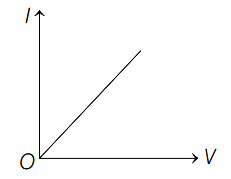
EasyMCQ
$I-V$ characteristic of a copper wire of length $L$ and area of cross-section $A$ is shown in the figure. The slope of the curve becomes
A
More if the experiment is performed at a higher temperature
B
More if a wire of steel of the same dimension is used
C
Less if the area of the wire is increased
D
Less if the length of the wire is increased
Solution
(D) The $I-V$ characteristic of a copper wire of length $L$ and area of cross-section $A$ is shown in the figure.
Since the $I-V$ characteristic is a straight line,it obeys Ohm's law.
The slope of the $I-V$ graph is given by $\text{slope} = \tan \theta = \frac{I}{V}$.
From Ohm's law,$V = IR$,so $\frac{I}{V} = \frac{1}{R}$.
Since $R = \rho \frac{L}{A}$,we have $\text{slope} = \frac{1}{\rho \frac{L}{A}} = \frac{A}{\rho L}$.
$(i)$ If the length $L$ is increased,the slope $\frac{A}{\rho L}$ decreases.
(ii) If the area $A$ is increased,the slope $\frac{A}{\rho L}$ increases.
(iii) If a steel wire of the same dimensions is used,since $\rho_{\text{steel}} > \rho_{\text{copper}}$,the slope $\frac{A}{\rho L}$ decreases.
(iv) If the experiment is performed at a higher temperature,the resistivity $\rho$ of copper increases,so the slope $\frac{A}{\rho L}$ decreases.
Therefore,the correct statement is that the slope becomes less if the length of the wire is increased.
Since the $I-V$ characteristic is a straight line,it obeys Ohm's law.
The slope of the $I-V$ graph is given by $\text{slope} = \tan \theta = \frac{I}{V}$.
From Ohm's law,$V = IR$,so $\frac{I}{V} = \frac{1}{R}$.
Since $R = \rho \frac{L}{A}$,we have $\text{slope} = \frac{1}{\rho \frac{L}{A}} = \frac{A}{\rho L}$.
$(i)$ If the length $L$ is increased,the slope $\frac{A}{\rho L}$ decreases.
(ii) If the area $A$ is increased,the slope $\frac{A}{\rho L}$ increases.
(iii) If a steel wire of the same dimensions is used,since $\rho_{\text{steel}} > \rho_{\text{copper}}$,the slope $\frac{A}{\rho L}$ decreases.
(iv) If the experiment is performed at a higher temperature,the resistivity $\rho$ of copper increases,so the slope $\frac{A}{\rho L}$ decreases.
Therefore,the correct statement is that the slope becomes less if the length of the wire is increased.
0 likes
View Solution40
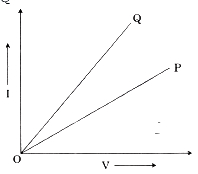
EasyMCQ
The $I-V$ graphs for two different electrical appliances $P$ and $Q$ are shown in the diagram. If $R_P$ and $R_Q$ are the resistances of the devices,then:
A
$R_P = R_Q$
B
$R_P > R_Q$
C
$R_P < R_Q$
D
$R_P = \frac{R_Q}{2}$
Solution
(B) According to Ohm's law,$V = IR$,which can be written as $I = \frac{1}{R}V$.
Comparing this with the equation of a straight line $y = mx$,the slope of the $I-V$ graph is $\frac{I}{V} = \frac{1}{R}$.
Thus,the slope of the $I-V$ graph is inversely proportional to the resistance $(Slope \propto \frac{1}{R})$.
In the given diagram,the slope of line $Q$ is greater than the slope of line $P$ (i.e.,$Slope_Q > Slope_P$).
Therefore,$\frac{1}{R_Q} > \frac{1}{R_P}$.
This implies that $R_P > R_Q$.
Comparing this with the equation of a straight line $y = mx$,the slope of the $I-V$ graph is $\frac{I}{V} = \frac{1}{R}$.
Thus,the slope of the $I-V$ graph is inversely proportional to the resistance $(Slope \propto \frac{1}{R})$.
In the given diagram,the slope of line $Q$ is greater than the slope of line $P$ (i.e.,$Slope_Q > Slope_P$).
Therefore,$\frac{1}{R_Q} > \frac{1}{R_P}$.
This implies that $R_P > R_Q$.
0 likes
View Solution41
EasyMCQ
Ohm's Law is applicable to
A
Diode
B
Transistor
C
Electrolyte
D
Conductor
Solution
(D) Ohm's law is applicable to conductors under constant physical conditions.
Ohm's law states that the current flowing through a conductor is directly proportional to the potential difference applied across its ends,provided the temperature and other physical conditions remain constant.
Mathematically,this is expressed as $V = IR$,where $V$ is the potential difference,$I$ is the current,and $R$ is the resistance.
Since diodes,transistors,and electrolytes are non-ohmic devices,they do not follow this linear relationship.
Ohm's law states that the current flowing through a conductor is directly proportional to the potential difference applied across its ends,provided the temperature and other physical conditions remain constant.
Mathematically,this is expressed as $V = IR$,where $V$ is the potential difference,$I$ is the current,and $R$ is the resistance.
Since diodes,transistors,and electrolytes are non-ohmic devices,they do not follow this linear relationship.
0 likes
View Solution42
EasyMCQ
The voltage $V$ and current $I$ graph for a conductor at two different temperatures $T_{1}$ and $T_{2}$ is shown in the figure. The relation between $T_{1}$ and $T_{2}$ is
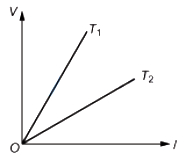
A
$T_{1} > T_{2}$
B
$T_{1} < T_{2}$
C
$T_{1} = T_{2}$
D
$T_{1} = \frac{1}{T_{2}}$
Solution
(A) For a conductor,the resistance $R$ is given by the slope of the $V-I$ graph,where $R = \frac{V}{I}$.
From the figure,the slope of the line corresponding to $T_{1}$ is greater than the slope of the line corresponding to $T_{2}$.
Therefore,$R_{1} > R_{2}$.
For a metallic conductor,the resistance increases with an increase in temperature $(R \propto T)$.
Since $R_{1} > R_{2}$,it follows that $T_{1} > T_{2}$.
From the figure,the slope of the line corresponding to $T_{1}$ is greater than the slope of the line corresponding to $T_{2}$.
Therefore,$R_{1} > R_{2}$.
For a metallic conductor,the resistance increases with an increase in temperature $(R \propto T)$.
Since $R_{1} > R_{2}$,it follows that $T_{1} > T_{2}$.
0 likes
View Solution43
EasyMCQ
Of the following graphs,the one that correctly represents the $I-V$ characteristics of an 'Ohmic device' is:
A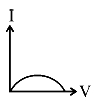
B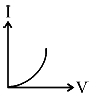
C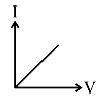
D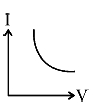
Solution
(C) Ohmic devices obey Ohm's law,which states that the current $I$ flowing through a conductor is directly proportional to the potential difference $V$ applied across its ends,provided the physical conditions (like temperature) remain constant.
This is expressed as $V = IR$,where $R$ is the resistance of the device.
Since $R$ is constant for an Ohmic device,we have $I = (1/R)V$.
This equation represents a straight line passing through the origin $(0,0)$ with a slope of $1/R$.
Among the given options,the graph that shows a straight line passing through the origin is Graph $C$.
This is expressed as $V = IR$,where $R$ is the resistance of the device.
Since $R$ is constant for an Ohmic device,we have $I = (1/R)V$.
This equation represents a straight line passing through the origin $(0,0)$ with a slope of $1/R$.
Among the given options,the graph that shows a straight line passing through the origin is Graph $C$.
0 likes
View Solution44
MediumMCQ
The charge $q$ (in coulomb) passing through a $10 \, \Omega$ resistor as a function of time $t$ (in second) is given by $q = 3t^2 - 2t + 6$. The potential difference across the ends of the resistor at time $t = 5 \, s$ is: (in $V$)
A
$120$
B
$240$
C
$140$
D
$280$
Solution
(D) The charge passing through the resistor is given by $q = 3t^2 - 2t + 6$.
To find the current $I$, we differentiate the charge with respect to time $t$:
$I = \frac{dq}{dt} = \frac{d}{dt}(3t^2 - 2t + 6) = 6t - 2$.
At time $t = 5 \, s$, the current is:
$I = 6(5) - 2 = 30 - 2 = 28 \, A$.
The resistance is given as $R = 10 \, \Omega$.
Using Ohm's law, the potential difference $V$ is:
$V = I \times R = 28 \, A \times 10 \, \Omega = 280 \, V$.
To find the current $I$, we differentiate the charge with respect to time $t$:
$I = \frac{dq}{dt} = \frac{d}{dt}(3t^2 - 2t + 6) = 6t - 2$.
At time $t = 5 \, s$, the current is:
$I = 6(5) - 2 = 30 - 2 = 28 \, A$.
The resistance is given as $R = 10 \, \Omega$.
Using Ohm's law, the potential difference $V$ is:
$V = I \times R = 28 \, A \times 10 \, \Omega = 280 \, V$.
0 likes
View Solution45
EasyMCQ
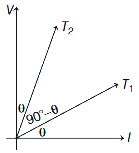
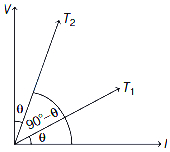
The $V-I$ graph for a conductor at temperatures $T_1$ and $T_2$ is as shown in the figure. $T_2-T_1$ is proportional to
A
$\cos 2 \theta$
B
$\sin 2 \theta$
C
$\cot 2 \theta$
D
$\tan 2 \theta$
Solution
(C) The $V-I$ graph for a conductor at temperatures $T_1$ and $T_2$ is shown in the figure.
We know that the resistance $R$ of a conductor is directly proportional to its temperature $T$ (i.e.,$R \propto T$).
For the $V-I$ graph,the slope represents the resistance $R = \frac{V}{I}$.
From the figure,the slope of the line for $T_1$ with respect to the $I$-axis is $\tan \theta$. Thus,$R_1 \propto \tan \theta \Rightarrow R_1 = K \tan \theta$,where $K$ is a constant.
Similarly,the slope of the line for $T_2$ with respect to the $I$-axis is $\tan(90^{\circ}-\theta) = \cot \theta$. Thus,$R_2 \propto \cot \theta \Rightarrow R_2 = K \cot \theta$.
Therefore,$T_2 - T_1 \propto R_2 - R_1 = K(\cot \theta - \tan \theta)$.
$T_2 - T_1 \propto K \left( \frac{\cos \theta}{\sin \theta} - \frac{\sin \theta}{\cos \theta} \right) = K \left( \frac{\cos^2 \theta - \sin^2 \theta}{\sin \theta \cos \theta} \right)$.
Using trigonometric identities $\cos^2 \theta - \sin^2 \theta = \cos 2 \theta$ and $\sin \theta \cos \theta = \frac{1}{2} \sin 2 \theta$,we get:
$T_2 - T_1 \propto K \left( \frac{\cos 2 \theta}{\frac{1}{2} \sin 2 \theta} \right) = 2K \cot 2 \theta$.
Thus,$T_2 - T_1 \propto \cot 2 \theta$.
We know that the resistance $R$ of a conductor is directly proportional to its temperature $T$ (i.e.,$R \propto T$).
For the $V-I$ graph,the slope represents the resistance $R = \frac{V}{I}$.
From the figure,the slope of the line for $T_1$ with respect to the $I$-axis is $\tan \theta$. Thus,$R_1 \propto \tan \theta \Rightarrow R_1 = K \tan \theta$,where $K$ is a constant.
Similarly,the slope of the line for $T_2$ with respect to the $I$-axis is $\tan(90^{\circ}-\theta) = \cot \theta$. Thus,$R_2 \propto \cot \theta \Rightarrow R_2 = K \cot \theta$.
Therefore,$T_2 - T_1 \propto R_2 - R_1 = K(\cot \theta - \tan \theta)$.
$T_2 - T_1 \propto K \left( \frac{\cos \theta}{\sin \theta} - \frac{\sin \theta}{\cos \theta} \right) = K \left( \frac{\cos^2 \theta - \sin^2 \theta}{\sin \theta \cos \theta} \right)$.
Using trigonometric identities $\cos^2 \theta - \sin^2 \theta = \cos 2 \theta$ and $\sin \theta \cos \theta = \frac{1}{2} \sin 2 \theta$,we get:
$T_2 - T_1 \propto K \left( \frac{\cos 2 \theta}{\frac{1}{2} \sin 2 \theta} \right) = 2K \cot 2 \theta$.
Thus,$T_2 - T_1 \propto \cot 2 \theta$.
0 likes
View Solution46
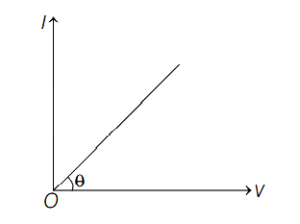
EasyMCQ
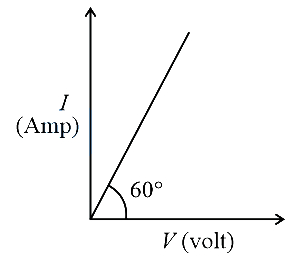
The current flowing through a circuit is shown in the figure. What is the resistance of the circuit?
A
cannot be determined
B
$\frac{1}{\sqrt{3}} \Omega$
C
$\frac{\sqrt{3}}{4} \Omega$
D
$\frac{1}{2} \Omega$
Solution
(B) According to Ohm's Law,$V = IR$,which implies $I = \frac{1}{R} V$.
Comparing this with the equation of a straight line $y = mx$,where $y = I$ and $x = V$,the slope $m$ of the $I-V$ graph is given by $m = \tan \theta = \frac{1}{R}$.
From the given graph,the angle $\theta = 60^{\circ}$.
Therefore,$\tan 60^{\circ} = \frac{1}{R}$.
Since $\tan 60^{\circ} = \sqrt{3}$,we have $\sqrt{3} = \frac{1}{R}$.
Thus,the resistance $R = \frac{1}{\sqrt{3}} \Omega$.
Comparing this with the equation of a straight line $y = mx$,where $y = I$ and $x = V$,the slope $m$ of the $I-V$ graph is given by $m = \tan \theta = \frac{1}{R}$.
From the given graph,the angle $\theta = 60^{\circ}$.
Therefore,$\tan 60^{\circ} = \frac{1}{R}$.
Since $\tan 60^{\circ} = \sqrt{3}$,we have $\sqrt{3} = \frac{1}{R}$.
Thus,the resistance $R = \frac{1}{\sqrt{3}} \Omega$.
0 likes
View Solution47
EasyMCQ
The $I-V$ characteristics of a metal wire at two different temperatures ($T_{1}$ and $T_{2}$) are given in the adjoining figure. Here,we can conclude that:
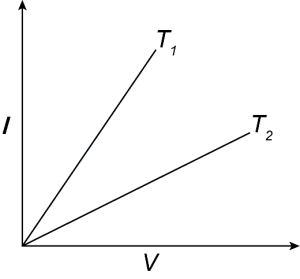
A
$T_{1} > T_{2}$
B
$T_{1} < T_{2}$
C
$T_{1} = T_{2}$
D
$T_{1} = 2T_{2}$
Solution
(B) For a metal wire,the resistance $R$ increases with an increase in temperature.
The slope of the $I-V$ graph is given by $\frac{I}{V} = \frac{1}{R}$.
From the figure,the slope of the line corresponding to $T_{1}$ is greater than the slope of the line corresponding to $T_{2}$.
Therefore,$\frac{1}{R_{1}} > \frac{1}{R_{2}}$,which implies $R_{1} < R_{2}$.
Since resistance increases with temperature,$R_{1} < R_{2}$ implies $T_{1} < T_{2}$.
The slope of the $I-V$ graph is given by $\frac{I}{V} = \frac{1}{R}$.
From the figure,the slope of the line corresponding to $T_{1}$ is greater than the slope of the line corresponding to $T_{2}$.
Therefore,$\frac{1}{R_{1}} > \frac{1}{R_{2}}$,which implies $R_{1} < R_{2}$.
Since resistance increases with temperature,$R_{1} < R_{2}$ implies $T_{1} < T_{2}$.
0 likes
View SolutionCurrent Electricity — Ohm's Law · Frequently Asked Questions
1Are these Current Electricity questions useful for JEE and NEET?
Yes. All questions in this section are mapped to JEE Main and NEET exam patterns. Previous year questions from JEE Main, NEET, GUJCET and state-level exams are included with full solutions.
2Can I switch to Hindi or Gujarati for these questions?
Yes. Use the language tabs in the hero section or the sidebar to view the same questions and solutions in English, Hindi or Gujarati.
3How do I generate a question paper from this subtopic?
Use the Vedclass Exam Paper Generator — select the chapter and subtopic, set difficulty, and generate Sets A, B, C, D automatically. First 3 chapters of every subject are free.
Vedclass Products
For Students
Vedclass Test Series
Mock tests in real JEE/NEET style with performance analysis. 5-day free trial.
Start Free TrialFor Teachers
Exam Paper Generator
Generate Set A/B/C/D papers from this chapter in 2 minutes. 3 chapters free.
Try FreeFor Institutes
Online Exam Module
Live online exams with unlimited students, 360° analytics & white-label branding.
See DemoFor Teachers & Institutes
Generate a Current Electricity Exam Paper in 2 Minutes
Select subtopic & difficulty — Sets A, B, C, D auto-generated with No Repeat logic.
First 3 chapters of every subject are free — no payment required.