
A English
Properties of Haloalkanes Questions in English
Class 12 Chemistry · Haloalkanes and Haloarenes · Properties of Haloalkanes
1196+
Questions
English
Language
100%
With Solutions
Showing 50 of 1196 questions in English
801
MediumMCQ
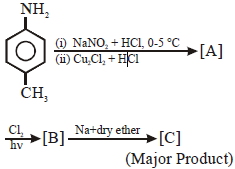
In the following reaction sequence,$[ C ]$ is :
A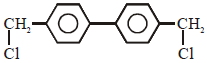
B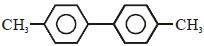
C
D
Solution
(D) $1$. The starting material is $p$-toluidine. Treatment with $NaNO_2 + HCl$ at $0-5 \ ^{\circ}C$ followed by $Cu_2Cl_2 + HCl$ (Sandmeyer reaction) replaces the $-NH_2$ group with a $-Cl$ atom,forming $1$-chloro-$4$-methylbenzene (p-chlorotoluene) as $[ A ]$.
$2$. Reaction of $p$-chlorotoluene with $Cl_2$ in the presence of $h\nu$ (free radical chlorination) occurs at the side-chain methyl group to form $1$-chloro-$4$-(chloromethyl)benzene as $[ B ]$.
$3$. Treatment of $[ B ]$ with $Na$ in dry ether (Wurtz reaction) leads to the coupling of two benzyl groups,resulting in $1,2$-bis($4$-chlorophenyl)ethane as the major product $[ C ]$.
$2$. Reaction of $p$-chlorotoluene with $Cl_2$ in the presence of $h\nu$ (free radical chlorination) occurs at the side-chain methyl group to form $1$-chloro-$4$-(chloromethyl)benzene as $[ B ]$.
$3$. Treatment of $[ B ]$ with $Na$ in dry ether (Wurtz reaction) leads to the coupling of two benzyl groups,resulting in $1,2$-bis($4$-chlorophenyl)ethane as the major product $[ C ]$.
0 likes
View Solution802
MediumMCQ
Which of the following compounds will form the precipitate with aqueous $AgNO_3$ solution most readily?
A
Ethoxymethyl bromide
B
$N$-(Bromomethyl)piperidine
C
$N$-Ethyl-$N$-(bromomethyl)aniline
D
$N$-Ethyl-$N$-($2$-bromoethyl)$-4-$methoxyaniline
Solution
(B) The reaction of an alkyl halide with aqueous $AgNO_3$ proceeds via an $S_N1$ mechanism,where the rate-determining step is the formation of a carbocation: $R-X + aq. AgNO_3 \xrightarrow{RDS} R^{\oplus} + AgX \downarrow (PPT)$.
The rate of precipitate formation depends on the stability of the intermediate carbocation $(R^{\oplus})$.
In the given options,the carbocations formed are:
$(a)$ $CH_3CH_2-O-CH_2^{\oplus}$
$(b)$ Piperidine ring attached to $CH_2^{\oplus}$ (stabilized by resonance from the nitrogen lone pair)
$(c)$ $Ph-N(Et)-CH_2^{\oplus}$
$(d)$ $p-MeO-C_6H_4-N(Et)-CH_2CH_2^{\oplus}$
The carbocation in option $(b)$ is highly stabilized by the resonance effect of the nitrogen lone pair,making it the most stable among the choices. Therefore,$N$-(bromomethyl)piperidine forms the precipitate most readily.
The rate of precipitate formation depends on the stability of the intermediate carbocation $(R^{\oplus})$.
In the given options,the carbocations formed are:
$(a)$ $CH_3CH_2-O-CH_2^{\oplus}$
$(b)$ Piperidine ring attached to $CH_2^{\oplus}$ (stabilized by resonance from the nitrogen lone pair)
$(c)$ $Ph-N(Et)-CH_2^{\oplus}$
$(d)$ $p-MeO-C_6H_4-N(Et)-CH_2CH_2^{\oplus}$
The carbocation in option $(b)$ is highly stabilized by the resonance effect of the nitrogen lone pair,making it the most stable among the choices. Therefore,$N$-(bromomethyl)piperidine forms the precipitate most readily.
0 likes
View Solution803
DifficultMCQ
Among the following compounds,which one has the shortest $C-Cl$ bond?
A
$H_3C-Cl$
B
$(CH_3)_3C-Cl$
C
$CH_2=CH-Cl$
D
$CH_2=CH-CH_2-Cl$
Solution
(C) The $C-Cl$ bond length is shortest in $CH_2=CH-Cl$ (vinyl chloride).
In $CH_2=CH-Cl$,the lone pair of electrons on the chlorine atom is in conjugation with the $\pi$-electrons of the double bond.
This leads to resonance,which gives the $C-Cl$ bond a partial double bond character.
Due to this partial double bond character,the bond length decreases compared to a pure single $C-Cl$ bond found in the other options.
In $CH_2=CH-Cl$,the lone pair of electrons on the chlorine atom is in conjugation with the $\pi$-electrons of the double bond.
This leads to resonance,which gives the $C-Cl$ bond a partial double bond character.
Due to this partial double bond character,the bond length decreases compared to a pure single $C-Cl$ bond found in the other options.
0 likes
View Solution804
MediumMCQ
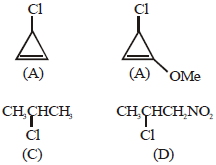
The decreasing order of reactivity of the following organic molecules towards $AgNO_3$ solution is:
A
$A > B > D > C$
B
$A > B > C > D$
C
$B > A > C > D$
D
$C > D > A > B$
Solution
(C) The reactivity towards $AgNO_3$ depends on the stability of the carbocation formed after the removal of the $Cl^-$ ion.
$1$. Molecules $A$ and $B$ form cyclopropenyl cations upon the loss of $Cl^-$. These cations are aromatic ($2\pi$ electrons,$H$ückel's rule). The $-OCH_3$ group in $B$ provides electron density via the $+M$ effect,further stabilizing the cation compared to $A$.
$2$. Molecules $C$ and $D$ form secondary carbocations. $C$ forms a $CH_3-CH^+-CH_3$ cation. $D$ forms a $CH_3-CH^+-CH_2-NO_2$ cation,which is destabilized by the strong $-I$ effect of the $-NO_2$ group.
$3$. Since aromatic carbocations are significantly more stable than non-aromatic secondary carbocations,the order is $B > A > C > D$.
$1$. Molecules $A$ and $B$ form cyclopropenyl cations upon the loss of $Cl^-$. These cations are aromatic ($2\pi$ electrons,$H$ückel's rule). The $-OCH_3$ group in $B$ provides electron density via the $+M$ effect,further stabilizing the cation compared to $A$.
$2$. Molecules $C$ and $D$ form secondary carbocations. $C$ forms a $CH_3-CH^+-CH_3$ cation. $D$ forms a $CH_3-CH^+-CH_2-NO_2$ cation,which is destabilized by the strong $-I$ effect of the $-NO_2$ group.
$3$. Since aromatic carbocations are significantly more stable than non-aromatic secondary carbocations,the order is $B > A > C > D$.
0 likes
View Solution805
MediumMCQ
The increasing order of the boiling points of the major products $A$,$B$ and $C$ of the following reactions will be:
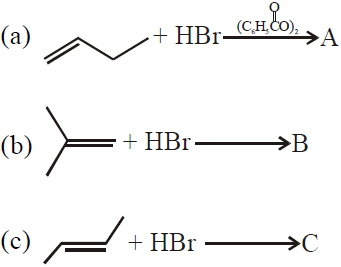
A
$C < A < B$
B
$B < C < A$
C
$A < B < C$
D
$A < C < B$
Solution
(B) The reactions are as follows:
$(a)$ $CH_2=CH-CH_2-CH_3 + HBr \xrightarrow{Peroxide} CH_2Br-CH_2-CH_2-CH_3$ (Product $A$,$1$-bromobutane,Boiling Point $\approx 102 \ ^\circ C$)
$(b)$ $CH_2=C(CH_3)_2 + HBr \rightarrow CH_3-C(Br)(CH_3)_2$ (Product $B$,$2$-bromo-$2$-methylpropane,Boiling Point $\approx 73.3 \ ^\circ C$)
$(c)$ $CH_2=CH-CH_2-CH_3 + HBr \rightarrow CH_3-CH(Br)-CH_2-CH_3$ (Product $C$,$2$-bromobutane,Boiling Point $\approx 91 \ ^\circ C$)
Boiling point is inversely proportional to branching in the carbon chain.
Comparing the structures: $A$ is a straight-chain primary alkyl halide,$C$ is a secondary alkyl halide with less branching than $B$,and $B$ is a tertiary alkyl halide with the most branching.
Therefore,the order of boiling points is $B < C < A$.
$(a)$ $CH_2=CH-CH_2-CH_3 + HBr \xrightarrow{Peroxide} CH_2Br-CH_2-CH_2-CH_3$ (Product $A$,$1$-bromobutane,Boiling Point $\approx 102 \ ^\circ C$)
$(b)$ $CH_2=C(CH_3)_2 + HBr \rightarrow CH_3-C(Br)(CH_3)_2$ (Product $B$,$2$-bromo-$2$-methylpropane,Boiling Point $\approx 73.3 \ ^\circ C$)
$(c)$ $CH_2=CH-CH_2-CH_3 + HBr \rightarrow CH_3-CH(Br)-CH_2-CH_3$ (Product $C$,$2$-bromobutane,Boiling Point $\approx 91 \ ^\circ C$)
Boiling point is inversely proportional to branching in the carbon chain.
Comparing the structures: $A$ is a straight-chain primary alkyl halide,$C$ is a secondary alkyl halide with less branching than $B$,and $B$ is a tertiary alkyl halide with the most branching.
Therefore,the order of boiling points is $B < C < A$.
0 likes
View Solution806
MediumMCQ
The elimination reaction of $2-$bromopentane to form pent$-2-$ene involves:
$a$. $\beta-$Elimination reaction
$b$. Following Zaitsev rule
$c$. Dehydrohalogenation reaction
$d$. Dehydration reaction
$a$. $\beta-$Elimination reaction
$b$. Following Zaitsev rule
$c$. Dehydrohalogenation reaction
$d$. Dehydration reaction
A
$a, b, d$
B
$a, b, c$
C
$a, c, d$
D
$b, c, d$
Solution
(B) The reaction of $2-$bromopentane with a base (like $NaOEt$) to form pent$-2-$ene is a $\beta-$elimination reaction.
In this process,a hydrogen atom is removed from the $\beta-$carbon and a halogen atom is removed from the $\alpha-$carbon,which is known as dehydrohalogenation.
Since the major product formed is the more substituted alkene (pent$-2-$ene),the reaction follows Zaitsev rule.
Dehydration refers to the removal of water,which is not the case here.
Therefore,statements $a$,$b$,and $c$ are correct.
In this process,a hydrogen atom is removed from the $\beta-$carbon and a halogen atom is removed from the $\alpha-$carbon,which is known as dehydrohalogenation.
Since the major product formed is the more substituted alkene (pent$-2-$ene),the reaction follows Zaitsev rule.
Dehydration refers to the removal of water,which is not the case here.
Therefore,statements $a$,$b$,and $c$ are correct.
0 likes
View Solution807
MediumMCQ
Which of the following will $NOT$ undergo $S_{N}1$ reaction with $\text{OH}^-$?
A
$C_6H_5CH_2Cl$
B
$CH_2=CHCH_2Cl$
C
$(CH_3)_3CCl$
D
$C_6H_5CH_2CH_2Cl$
Solution
(D) The $S_{N}1$ reaction mechanism proceeds via the formation of a carbocation intermediate. The stability of the carbocation determines the reactivity towards $S_{N}1$.
$(A)$ $C_6H_5CH_2Cl$ forms a resonance-stabilized benzyl carbocation $(C_6H_5CH_2^+)$.
$(B)$ $CH_2=CHCH_2Cl$ forms a resonance-stabilized allyl carbocation $(CH_2=CHCH_2^+)$.
$(C)$ $(CH_3)_3CCl$ forms a stable tertiary carbocation $((CH_3)_3C^+)$.
$(D)$ $C_6H_5CH_2CH_2Cl$ is a primary alkyl halide. The formation of a primary carbocation $(C_6H_5CH_2CH_2^+)$ is highly unfavorable due to its low stability. Therefore,it does not undergo $S_{N}1$ reaction.
$(A)$ $C_6H_5CH_2Cl$ forms a resonance-stabilized benzyl carbocation $(C_6H_5CH_2^+)$.
$(B)$ $CH_2=CHCH_2Cl$ forms a resonance-stabilized allyl carbocation $(CH_2=CHCH_2^+)$.
$(C)$ $(CH_3)_3CCl$ forms a stable tertiary carbocation $((CH_3)_3C^+)$.
$(D)$ $C_6H_5CH_2CH_2Cl$ is a primary alkyl halide. The formation of a primary carbocation $(C_6H_5CH_2CH_2^+)$ is highly unfavorable due to its low stability. Therefore,it does not undergo $S_{N}1$ reaction.
1 likes
View Solution808
MediumMCQ
Which of the following represents the Wurtz-Fittig reaction?
A
$C_{6}H_{5}I + 2Na + CH_{3}I \rightarrow C_{6}H_{5}CH_{3} + 2NaI$
B
$2C_{6}H_{5}I + 2Na \rightarrow C_{6}H_{5}-C_{6}H_{5} + 2NaI$
C
$2CH_{3}CH_{2}I + 2Na \rightarrow CH_{3}CH_{2}CH_{2}CH_{3} + 2NaI$
D
$CH_{3}Br + AgF \rightarrow CH_{3}F + AgBr$
Solution
(A) The Wurtz-Fittig reaction involves the reaction of an aryl halide with an alkyl halide in the presence of sodium metal to form an alkyl-substituted aromatic compound.
Specifically,$C_{6}H_{5}I + CH_{3}I + 2Na \rightarrow C_{6}H_{5}CH_{3} + 2NaI$ represents the Wurtz-Fittig reaction.
Option $A$ is the correct representation.
Specifically,$C_{6}H_{5}I + CH_{3}I + 2Na \rightarrow C_{6}H_{5}CH_{3} + 2NaI$ represents the Wurtz-Fittig reaction.
Option $A$ is the correct representation.
0 likes
View Solution809
MediumMCQ
$A$ bromoalkane $X$ reacts with magnesium in dry ether to form compound $Y$. The reaction of $Y$ with methanal followed by hydrolysis yields an alcohol having molecular formula $C_{4}H_{10}O$. The compound $X$ is
A
Bromomethane
B
Bromoethane
C
$1-bromopropane$
D
$2-bromopropane$
Solution
(C) The reaction sequence is as follows:
$R-Br + Mg \xrightarrow{\text{Dry ether}} R-MgBr (Y)$
$R-MgBr + HCHO \xrightarrow{\text{Hydrolysis}} R-CH_{2}OH$
Given the product is $C_{4}H_{10}O$,which is a primary alcohol $(R-CH_{2}OH)$,we have $R+CH_{2} = C_{3}H_{7}$.
Thus,$R$ is a propyl group $(C_{3}H_{7}-)$.
Therefore,$X$ is $1-bromopropane$ $(CH_{3}CH_{2}CH_{2}Br)$:
$CH_{3}CH_{2}CH_{2}Br + Mg \xrightarrow{\text{Dry ether}} CH_{3}CH_{2}CH_{2}MgBr$
$CH_{3}CH_{2}CH_{2}MgBr + HCHO \rightarrow CH_{3}CH_{2}CH_{2}CH_{2}OMgBr$
$CH_{3}CH_{2}CH_{2}CH_{2}OMgBr + H_{2}O \rightarrow CH_{3}CH_{2}CH_{2}CH_{2}OH + Mg(OH)Br$
$R-Br + Mg \xrightarrow{\text{Dry ether}} R-MgBr (Y)$
$R-MgBr + HCHO \xrightarrow{\text{Hydrolysis}} R-CH_{2}OH$
Given the product is $C_{4}H_{10}O$,which is a primary alcohol $(R-CH_{2}OH)$,we have $R+CH_{2} = C_{3}H_{7}$.
Thus,$R$ is a propyl group $(C_{3}H_{7}-)$.
Therefore,$X$ is $1-bromopropane$ $(CH_{3}CH_{2}CH_{2}Br)$:
$CH_{3}CH_{2}CH_{2}Br + Mg \xrightarrow{\text{Dry ether}} CH_{3}CH_{2}CH_{2}MgBr$
$CH_{3}CH_{2}CH_{2}MgBr + HCHO \rightarrow CH_{3}CH_{2}CH_{2}CH_{2}OMgBr$
$CH_{3}CH_{2}CH_{2}CH_{2}OMgBr + H_{2}O \rightarrow CH_{3}CH_{2}CH_{2}CH_{2}OH + Mg(OH)Br$
0 likes
View Solution810
MediumMCQ
Among the following rules,the one which is applied in the given reaction is:
$CH_3-CH(Br)-CH_2-CH_3 \xrightarrow{Alc. KOH}$
$I. CH_3-CH=CH-CH_3$ (major product)
$II. CH_2=CH-CH_2-CH_3$ (minor product)
$CH_3-CH(Br)-CH_2-CH_3 \xrightarrow{Alc. KOH}$
$I. CH_3-CH=CH-CH_3$ (major product)
$II. CH_2=CH-CH_2-CH_3$ (minor product)
A
Saytzeff's rule
B
Hofmann's rule
C
Markownikoff's rule
D
Kharasch effect
Solution
(A) In the dehydrohalogenation of $2$-bromobutane with alcoholic $KOH$,the major product is the more substituted alkene $(but-2-ene)$ according to Saytzeff's rule.
Saytzeff's rule states that in dehydrohalogenation reactions,the alkene with the greater number of alkyl groups attached to the doubly bonded carbon atoms is the major product.
Saytzeff's rule states that in dehydrohalogenation reactions,the alkene with the greater number of alkyl groups attached to the doubly bonded carbon atoms is the major product.
0 likes
View Solution811
MediumMCQ
Identify the correct order of reactivity for the reaction with alcoholic $KOH$ for the following compounds:
$(a)$ $2$-bromo-$2,3$-dimethylbutane
$(b)$ $2$-chlorobutane
$(c)$ $2$-bromobutane
$(d)$ $1$-bromopropane
$(a)$ $2$-bromo-$2,3$-dimethylbutane
$(b)$ $2$-chlorobutane
$(c)$ $2$-bromobutane
$(d)$ $1$-bromopropane
A
$a > c > b > d$
B
$a > b > c > d$
C
$d > b > c > a$
D
$a > d > b > c$
Solution
(A) The reaction with alcoholic $KOH$ is an $E2$ elimination reaction.
The reactivity in $E2$ reactions depends on two main factors:
$1$. The stability of the alkene formed (more substituted alkenes are more stable).
$2$. The nature of the leaving group $(I^- > Br^- > Cl^-)$.
Analyzing the compounds:
$(a)$ $2$-bromo-$2,3$-dimethylbutane is a $3^{\circ}$ alkyl bromide. It forms a highly substituted,stable alkene.
$(c)$ $2$-bromobutane is a $2^{\circ}$ alkyl bromide.
$(b)$ $2$-chlorobutane is a $2^{\circ}$ alkyl chloride. Since $Br^-$ is a better leaving group than $Cl^-$,$(c) > (b)$.
$(d)$ $1$-bromopropane is a $1^{\circ}$ alkyl bromide,which is the least reactive towards $E2$ elimination.
Thus,the correct order of reactivity is $(a) > (c) > (b) > (d)$.
The reactivity in $E2$ reactions depends on two main factors:
$1$. The stability of the alkene formed (more substituted alkenes are more stable).
$2$. The nature of the leaving group $(I^- > Br^- > Cl^-)$.
Analyzing the compounds:
$(a)$ $2$-bromo-$2,3$-dimethylbutane is a $3^{\circ}$ alkyl bromide. It forms a highly substituted,stable alkene.
$(c)$ $2$-bromobutane is a $2^{\circ}$ alkyl bromide.
$(b)$ $2$-chlorobutane is a $2^{\circ}$ alkyl chloride. Since $Br^-$ is a better leaving group than $Cl^-$,$(c) > (b)$.
$(d)$ $1$-bromopropane is a $1^{\circ}$ alkyl bromide,which is the least reactive towards $E2$ elimination.
Thus,the correct order of reactivity is $(a) > (c) > (b) > (d)$.
0 likes
View Solution812
MediumMCQ
The compound most reactive towards $S_{N}1$ reaction is :
A
$MeCOCH_{2}Cl$
B
Cyclopropyl chloride
C
$C_{6}H_{5}CH_{2}CH_{2}Cl$
D
$MeOCH_{2}Cl$
Solution
(D) The reactivity towards $S_{N}1$ reaction depends on the stability of the carbocation intermediate formed after the loss of the leaving group $(Cl^-)$.
$1$. For $MeCOCH_{2}Cl$,the carbocation $MeCOCH_{2}^+$ is destabilized by the electron-withdrawing carbonyl group.
$2$. For cyclopropyl chloride,the cyclopropyl cation is highly unstable due to significant angle strain.
$3$. For $C_{6}H_{5}CH_{2}CH_{2}Cl$,the carbocation $C_{6}H_{5}CH_{2}CH_{2}^+$ is a primary carbocation,which is relatively unstable.
$4$. For $MeOCH_{2}Cl$,the carbocation formed is $MeOCH_{2}^+$. This carbocation is resonance-stabilized by the lone pair on the oxygen atom: $Me-O-CH_{2}^+ \leftrightarrow Me-O^+=CH_{2}$. This structure is highly stable because every atom has a complete octet.
Therefore,$MeOCH_{2}Cl$ is the most reactive towards $S_{N}1$ reaction.
$1$. For $MeCOCH_{2}Cl$,the carbocation $MeCOCH_{2}^+$ is destabilized by the electron-withdrawing carbonyl group.
$2$. For cyclopropyl chloride,the cyclopropyl cation is highly unstable due to significant angle strain.
$3$. For $C_{6}H_{5}CH_{2}CH_{2}Cl$,the carbocation $C_{6}H_{5}CH_{2}CH_{2}^+$ is a primary carbocation,which is relatively unstable.
$4$. For $MeOCH_{2}Cl$,the carbocation formed is $MeOCH_{2}^+$. This carbocation is resonance-stabilized by the lone pair on the oxygen atom: $Me-O-CH_{2}^+ \leftrightarrow Me-O^+=CH_{2}$. This structure is highly stable because every atom has a complete octet.
Therefore,$MeOCH_{2}Cl$ is the most reactive towards $S_{N}1$ reaction.
0 likes
View Solution813
MediumMCQ
The correct order of $S_{N}1$ reaction rate for the given compounds is:
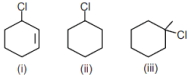
A
$iii > i > ii$
B
$iii > ii > i$
C
$i > iii > ii$
D
$i > ii > iii$
Solution
(C) The rate of $S_{N}1$ reaction depends on the stability of the carbocation intermediate formed after the departure of the leaving group $(Cl^-)$.
$(i)$ Forms an allylic carbocation,which is resonance stabilized.
(ii) Forms a secondary $(2^{\circ})$ cyclohexyl carbocation.
(iii) Forms a tertiary $(3^{\circ})$ carbocation.
Comparing the stability of these carbocations:
$1$. The allylic carbocation (from $i$) is highly stable due to resonance.
$2$. The tertiary carbocation (from $iii$) is stable due to inductive effect and hyperconjugation.
$3$. The secondary carbocation (from $ii$) is the least stable among the three.
Thus,the order of stability of carbocations is $i > iii > ii$. Consequently,the order of $S_{N}1$ reactivity is $i > iii > ii$. However,based on standard textbook problems of this type,the resonance-stabilized allylic carbocation is significantly more reactive. Given the options,$i > iii > ii$ is the correct chemical trend.
$(i)$ Forms an allylic carbocation,which is resonance stabilized.
(ii) Forms a secondary $(2^{\circ})$ cyclohexyl carbocation.
(iii) Forms a tertiary $(3^{\circ})$ carbocation.
Comparing the stability of these carbocations:
$1$. The allylic carbocation (from $i$) is highly stable due to resonance.
$2$. The tertiary carbocation (from $iii$) is stable due to inductive effect and hyperconjugation.
$3$. The secondary carbocation (from $ii$) is the least stable among the three.
Thus,the order of stability of carbocations is $i > iii > ii$. Consequently,the order of $S_{N}1$ reactivity is $i > iii > ii$. However,based on standard textbook problems of this type,the resonance-stabilized allylic carbocation is significantly more reactive. Given the options,$i > iii > ii$ is the correct chemical trend.
0 likes
View Solution814
DifficultMCQ
The products $A$ and $B$ formed in the above reactions are
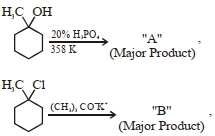
A
$A$ = $1-$methylcyclohexene,$B$ = methylenecyclohexane
B
$A$ = methylenecyclohexane,$B$ = $1-$methylcyclohexene
C
$A$ = $1-$methylcyclohexene,$B$ = $1-$methylcyclohexene
D
$A$ = methylenecyclohexane,$B$ = methylenecyclohexane
Solution
(A) In the first reaction,$1$-methylcyclohexanol undergoes acid-catalyzed dehydration using $20\% \ H_3PO_4$ at $358 \ K$. This follows an $E_1$ mechanism,where the more stable,highly substituted alkene (Saytzeff product) is formed as the major product,which is $1-$methylcyclohexene.
In the second reaction,$1$-chlorocyclohexane reacts with potassium tert-butoxide $(CH_3)_3COK$,which is a bulky base. This reaction proceeds via an $E_2$ mechanism. Due to the steric hindrance of the bulky base,it abstracts a proton from the less hindered position,leading to the formation of the less substituted alkene (Hofmann product) as the major product,which is methylenecyclohexane.
In the second reaction,$1$-chlorocyclohexane reacts with potassium tert-butoxide $(CH_3)_3COK$,which is a bulky base. This reaction proceeds via an $E_2$ mechanism. Due to the steric hindrance of the bulky base,it abstracts a proton from the less hindered position,leading to the formation of the less substituted alkene (Hofmann product) as the major product,which is methylenecyclohexane.
0 likes
View Solution815
MediumMCQ
The correct pair$(s)$ of the ambident nucleophiles is (are):
$(A)$ $AgCN / KCN$
$(B)$ $RCOOAg / RCOOK$
$(C)$ $AgNO_{2} / KNO_{2}$
$(D)$ $AgI / KI$
$(A)$ $AgCN / KCN$
$(B)$ $RCOOAg / RCOOK$
$(C)$ $AgNO_{2} / KNO_{2}$
$(D)$ $AgI / KI$
A
$(B)$ and $(C)$ only
B
$(A)$ only
C
$(A)$ and $(C)$ only
D
$(B)$ only
Solution
(C) An ambident nucleophile is a species that has two or more nucleophilic sites through which it can attack.
$(A)$ $KCN$ and $AgCN$: $CN^-$ is an ambident nucleophile as it can attack through $C$ or $N$.
$(C)$ $AgNO_{2}$ and $KNO_{2}$: $NO_2^-$ is an ambident nucleophile as it can attack through $N$ or $O$.
$(B)$ $RCOOAg / RCOOK$ and $(D)$ $AgI / KI$ do not represent pairs of ambident nucleophiles in the context of typical organic reactions.
Therefore,the correct pairs are $(A)$ and $(C)$.
$(A)$ $KCN$ and $AgCN$: $CN^-$ is an ambident nucleophile as it can attack through $C$ or $N$.
$(C)$ $AgNO_{2}$ and $KNO_{2}$: $NO_2^-$ is an ambident nucleophile as it can attack through $N$ or $O$.
$(B)$ $RCOOAg / RCOOK$ and $(D)$ $AgI / KI$ do not represent pairs of ambident nucleophiles in the context of typical organic reactions.
Therefore,the correct pairs are $(A)$ and $(C)$.
0 likes
View Solution816
MediumMCQ
Given below are two statements:
Statement $I$ : $C_2H_5OH$ and $AgCN$ both can generate nucleophile.
Statement $II$ : $KCN$ and $AgCN$ both will generate nitrile nucleophile with all reaction conditions.
Choose the most appropriate option :
Statement $I$ : $C_2H_5OH$ and $AgCN$ both can generate nucleophile.
Statement $II$ : $KCN$ and $AgCN$ both will generate nitrile nucleophile with all reaction conditions.
Choose the most appropriate option :
A
Statement $I$ is true but statement $II$ is false
B
Both statement $I$ and statement $II$ are true
C
Statement $I$ is false but statement $II$ is true
D
Both statement $I$ and statement $II$ are false
Solution
(A) Statement $I$ is true. $C_2H_5OH$ can act as a nucleophile due to the lone pairs on the oxygen atom. $AgCN$ is a covalent compound where the nitrogen atom has a lone pair,making it an ambident nucleophile.
Statement $II$ is false. $KCN$ is an ionic compound that provides $CN^-$ ions,which act as carbon-centered nucleophiles (forming nitriles). However,$AgCN$ is covalent and primarily acts as a nitrogen-centered nucleophile (forming isonitriles) because the carbon atom is involved in a coordinate bond with silver.
Therefore,Statement $I$ is true and Statement $II$ is false.
Statement $II$ is false. $KCN$ is an ionic compound that provides $CN^-$ ions,which act as carbon-centered nucleophiles (forming nitriles). However,$AgCN$ is covalent and primarily acts as a nitrogen-centered nucleophile (forming isonitriles) because the carbon atom is involved in a coordinate bond with silver.
Therefore,Statement $I$ is true and Statement $II$ is false.
0 likes
View Solution817
MediumMCQ
Identify $A$ and $B$ in the chemical reaction.
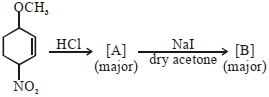
A
$A$ = $1-$methoxy$-2-$chloro$-4-$nitrocyclohexane,$B$ = $1-$methoxy$-2-$chloro$-4-$nitrocyclohexane
B
$A$ = $1-$methoxy$-2-$chloro$-4-$nitrocyclohexane,$B$ = $1-$methoxy$-2-$iodo$-4-$nitrocyclohexane
C
$A$ = $1-$methoxy$-2-$chloro$-4-$nitrocyclohexane,$B$ = $1-$iodo$-2-$chloro$-4-$nitrocyclohexane
D
$A$ = $1-$methoxy$-2-$chloro$-4-$nitrocyclohexane,$B$ = $1-$methoxy$-2-$iodo$-4-$nitrocyclohexane (with different substitution pattern)
Solution
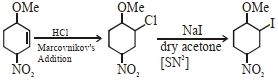
(D) The first step is the electrophilic addition of $HCl$ to the double bond of the cyclohexene ring. According to Markovnikov's rule,the $H^+$ adds to the carbon with more hydrogens,and $Cl^-$ adds to the other carbon,forming the chloro-substituted product $[A]$.
In the second step,the reaction with $NaI$ in dry acetone is a Finkelstein reaction,which is an $S_N2$ substitution where the chlorine atom is replaced by an iodine atom to form the iodo-substituted product $[B]$.
In the second step,the reaction with $NaI$ in dry acetone is a Finkelstein reaction,which is an $S_N2$ substitution where the chlorine atom is replaced by an iodine atom to form the iodo-substituted product $[B]$.
0 likes
View Solution818
EasyMCQ
$A$ $(C_{4}H_{8}Cl_{2})$ $\xrightarrow{\text{Hydrolysis at } 373 \text{ K}}$ $B$ $(C_{4}H_{8}O)$
$B$ reacts with hydroxylamine but does not give Tollen's test. Identify $A$ and $B$.
$B$ reacts with hydroxylamine but does not give Tollen's test. Identify $A$ and $B$.
A
$1,1-$Dichlorobutane and $2-$Butanone
B
$2,2-$Dichlorobutane and Butanal
C
$1,1-$Dichlorobutane and Butanal
D
$2,2-$Dichlorobutane and $2-$Butanone
Solution
(D) The compound $A$ $(C_{4}H_{8}Cl_{2})$ undergoes hydrolysis at $373 \text{ K}$ to form a geminal diol,which is unstable and loses a water molecule to form a carbonyl compound $B$ $(C_{4}H_{8}O)$.
Since $B$ reacts with hydroxylamine,it must be an aldehyde or a ketone.
Since $B$ does not give Tollen's test,it cannot be an aldehyde; therefore,$B$ must be a ketone.
$2,2-$Dichlorobutane on hydrolysis gives $2,2-$butanediol,which loses water to form $2-$butanone $(CH_{3}COCH_{2}CH_{3})$.
$2-$Butanone is a ketone,so it reacts with hydroxylamine and does not give Tollen's test.
Thus,$A$ is $2,2-$dichlorobutane and $B$ is $2-$butanone.
Since $B$ reacts with hydroxylamine,it must be an aldehyde or a ketone.
Since $B$ does not give Tollen's test,it cannot be an aldehyde; therefore,$B$ must be a ketone.
$2,2-$Dichlorobutane on hydrolysis gives $2,2-$butanediol,which loses water to form $2-$butanone $(CH_{3}COCH_{2}CH_{3})$.
$2-$Butanone is a ketone,so it reacts with hydroxylamine and does not give Tollen's test.
Thus,$A$ is $2,2-$dichlorobutane and $B$ is $2-$butanone.
0 likes
View Solution819
EasyMCQ
For the given reaction,what is the major product '$A$'?
$3-\text{ethylbenzonitrile} + Br_2 \xrightarrow{UV \text{ light}} A$
$3-\text{ethylbenzonitrile} + Br_2 \xrightarrow{UV \text{ light}} A$
A
$2-$bromo$-3-$ethylbenzonitrile
B
$4-$bromo$-3-$ethylbenzonitrile
C
$3-$($1$-bromoethyl)benzonitrile
D
$5-$bromo$-3-$ethylbenzonitrile
Solution
(C) The reaction of an alkyl-substituted benzene with $Br_2$ in the presence of $UV$ light (or heat) proceeds via a free radical mechanism.
This reaction is a free radical substitution that occurs at the benzylic position.
The benzylic hydrogen is abstracted to form a stable benzylic radical,which then reacts with $Br_2$ to form the monobrominated product.
In the given molecule,$3-\text{ethylbenzonitrile}$,the benzylic carbon is the $CH_2$ group attached to the benzene ring.
Therefore,the bromine atom will substitute one of the hydrogen atoms on this benzylic carbon,resulting in $3-(1-\text{bromoethyl})benzonitrile$ as the major product.
This reaction is a free radical substitution that occurs at the benzylic position.
The benzylic hydrogen is abstracted to form a stable benzylic radical,which then reacts with $Br_2$ to form the monobrominated product.
In the given molecule,$3-\text{ethylbenzonitrile}$,the benzylic carbon is the $CH_2$ group attached to the benzene ring.
Therefore,the bromine atom will substitute one of the hydrogen atoms on this benzylic carbon,resulting in $3-(1-\text{bromoethyl})benzonitrile$ as the major product.
0 likes
View Solution820
DifficultMCQ
Among the following compounds $I-IV$,which one forms a yellow precipitate on reacting sequentially with $(i)$ $NaOH$,$(ii)$ dil. $HNO_{3}$,and $(iii)$ $AgNO_{3}$?
A
$II$
B
$IV$
C
$I$
D
$III$
Solution
(B) The reaction sequence involves nucleophilic substitution followed by precipitation with silver ions.
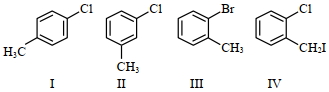
Compound $IV$ contains a benzylic iodide group $(-CH_{2}I)$.
When treated with $NaOH$,the iodide ion $(I^{-})$ is displaced via an $S_{N}2$ mechanism to form an alcohol.
The resulting $I^{-}$ ions react with $AgNO_{3}$ in the presence of $HNO_{3}$ to form a yellow precipitate of silver iodide $(AgI)$.
Compounds $I$,$II$,and $III$ contain aryl halides where the halogen is directly attached to the benzene ring,making them resistant to nucleophilic substitution under these conditions.
Compound $IV$ contains a benzylic iodide group $(-CH_{2}I)$.
When treated with $NaOH$,the iodide ion $(I^{-})$ is displaced via an $S_{N}2$ mechanism to form an alcohol.
The resulting $I^{-}$ ions react with $AgNO_{3}$ in the presence of $HNO_{3}$ to form a yellow precipitate of silver iodide $(AgI)$.
Compounds $I$,$II$,and $III$ contain aryl halides where the halogen is directly attached to the benzene ring,making them resistant to nucleophilic substitution under these conditions.
0 likes
View Solution821
DifficultMCQ
$A$ chloro compound $A$:
$(i)$ forms aldehydes on ozonolysis followed by hydrolysis.
$(ii)$ when vaporized completely,$1.53 \ g$ of $A$ gives $448 \ mL$ of vapour at $STP$.
The number of carbon atoms in a molecule of compound $A$ is ...... .
$(i)$ forms aldehydes on ozonolysis followed by hydrolysis.
$(ii)$ when vaporized completely,$1.53 \ g$ of $A$ gives $448 \ mL$ of vapour at $STP$.
The number of carbon atoms in a molecule of compound $A$ is ...... .
A
$30$
B
$3$
C
$0.3$
D
$4$
Solution
(B) At $STP$,$22400 \ mL$ of gas corresponds to $1 \ mole$.
Given $448 \ mL$ of $A$ weighs $1.53 \ g$.
Therefore,the molar mass of $A = \frac{1.53 \ g}{448 \ mL} \times 22400 \ mL/mol = 76.5 \ g/mol$.
Let the formula be $C_n H_m Cl$.
The molar mass is $12n + m + 35.5 = 76.5$,so $12n + m = 41$.
Since ozonolysis of $A$ yields aldehydes,$A$ must be an alkene (e.g.,$CH_3-CH=CH-Cl$ or similar structure).
For $n=3$,$12(3) + m = 41 \Rightarrow m = 5$.
The compound is $C_3H_5Cl$ $(M.W. = 36 + 5 + 35.5 = 76.5)$.
Thus,the number of carbon atoms is $3$.
Given $448 \ mL$ of $A$ weighs $1.53 \ g$.
Therefore,the molar mass of $A = \frac{1.53 \ g}{448 \ mL} \times 22400 \ mL/mol = 76.5 \ g/mol$.
Let the formula be $C_n H_m Cl$.
The molar mass is $12n + m + 35.5 = 76.5$,so $12n + m = 41$.
Since ozonolysis of $A$ yields aldehydes,$A$ must be an alkene (e.g.,$CH_3-CH=CH-Cl$ or similar structure).
For $n=3$,$12(3) + m = 41 \Rightarrow m = 5$.
The compound is $C_3H_5Cl$ $(M.W. = 36 + 5 + 35.5 = 76.5)$.
Thus,the number of carbon atoms is $3$.
0 likes
View Solution822
MediumMCQ
The major product $(A)$ formed in the reaction given below is:
A
$CH_3-CH_2-CH(C_6H_5)-CH_2Br$
B
$CH_3-CH_2-C(C_6H_5)=CH_2$
C
$CH_3-CH_2-CH(C_6H_5)-CH_2OH$
D
$CH_3-CH_2-CH(C_6H_5)-CH_2OCH_3$
Solution
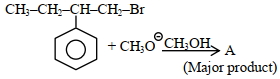
(B) The given reaction involves a primary alkyl halide with a bulky group (phenyl) attached to the $\beta$-carbon,reacting with a strong base/nucleophile $(CH_3O^-)$ in a protic solvent $(CH_3OH)$.
This reaction proceeds via an $E2$ elimination mechanism.
The methoxide ion $(CH_3O^-)$ acts as a base and abstracts a proton from the $\beta$-carbon (the carbon attached to the phenyl group),leading to the formation of a double bond between the $\alpha$ and $\beta$ carbons.
The major product formed is $2$-phenylbut-$1$-ene,which is $CH_3-CH_2-C(C_6H_5)=CH_2$.
This reaction proceeds via an $E2$ elimination mechanism.
The methoxide ion $(CH_3O^-)$ acts as a base and abstracts a proton from the $\beta$-carbon (the carbon attached to the phenyl group),leading to the formation of a double bond between the $\alpha$ and $\beta$ carbons.
The major product formed is $2$-phenylbut-$1$-ene,which is $CH_3-CH_2-C(C_6H_5)=CH_2$.
0 likes
View Solution823
DifficultMCQ
The major product of the following reaction,if it occurs by $S_N2$ mechanism is :
A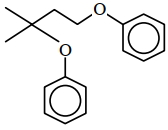
B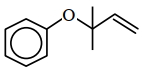
C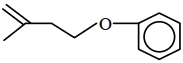
D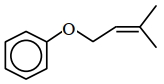
Solution
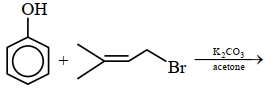
(D) The reaction involves the nucleophilic substitution of an allylic bromide with a phenoxide ion.
$1$. The base $(K_2CO_3)$ deprotonates phenol to form the phenoxide ion $(C_6H_5O^-)$.
$2$. The phenoxide ion acts as a nucleophile and attacks the electrophilic carbon of the allylic bromide ($CH_3)_2C=CH-CH_2Br$ via an $S_N2$ mechanism.
$3$. The bromide ion is displaced as a leaving group,resulting in the formation of an allyl phenyl ether.
$4$. The structure of the product is $(CH_3)_2C=CH-CH_2-O-C_6H_5$.
$1$. The base $(K_2CO_3)$ deprotonates phenol to form the phenoxide ion $(C_6H_5O^-)$.
$2$. The phenoxide ion acts as a nucleophile and attacks the electrophilic carbon of the allylic bromide ($CH_3)_2C=CH-CH_2Br$ via an $S_N2$ mechanism.
$3$. The bromide ion is displaced as a leaving group,resulting in the formation of an allyl phenyl ether.
$4$. The structure of the product is $(CH_3)_2C=CH-CH_2-O-C_6H_5$.
0 likes
View Solution824
EasyMCQ
The correct order of reactivity of the given chlorides with acetate in acetic acid is:
A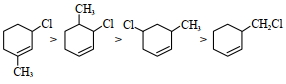
B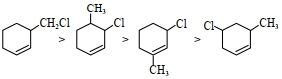
C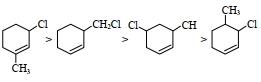
D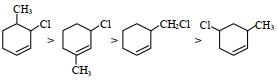
Solution
(A) The reaction of alkyl chlorides with acetate in acetic acid proceeds via an $SN^{1}$ mechanism,which involves the formation of a carbocation intermediate. The rate of the reaction is directly proportional to the stability of the carbocation formed.
$1$. The first compound forms a tertiary allylic carbocation,which is highly stable due to resonance and hyperconjugation.
$2$. The second compound forms a secondary allylic carbocation with an adjacent methyl group,providing stability via hyperconjugation.
$3$. The third compound forms a secondary allylic carbocation.
$4$. The fourth compound forms a primary allylic carbocation,which is the least stable among the given options.
Thus,the order of reactivity is based on the stability of the carbocations: $3^{\circ} \text{ allylic} > 2^{\circ} \text{ allylic (with } CH_3 \text{ group)} > 2^{\circ} \text{ allylic} > 1^{\circ} \text{ allylic}$.
The correct order is shown in option $A$.
$1$. The first compound forms a tertiary allylic carbocation,which is highly stable due to resonance and hyperconjugation.
$2$. The second compound forms a secondary allylic carbocation with an adjacent methyl group,providing stability via hyperconjugation.
$3$. The third compound forms a secondary allylic carbocation.
$4$. The fourth compound forms a primary allylic carbocation,which is the least stable among the given options.
Thus,the order of reactivity is based on the stability of the carbocations: $3^{\circ} \text{ allylic} > 2^{\circ} \text{ allylic (with } CH_3 \text{ group)} > 2^{\circ} \text{ allylic} > 1^{\circ} \text{ allylic}$.
The correct order is shown in option $A$.
0 likes
View Solution825
EasyMCQ
The correct sequence of bond enthalpy of $C-X$ bond is:
A
$CH_{3}-F < CH_{3}-Cl < CH_{3}-Br < CH_{3}-I$
B
$CH_{3}-F > CH_{3}-Cl > CH_{3}-Br > CH_{3}-I$
C
$CH_{3}-F < CH_{3}-Cl > CH_{3}-Br > CH_{3}-I$
D
$CH_{3}-Cl > CH_{3}-F > CH_{3}-Br > CH_{3}-I$
Solution
(B) The bond enthalpy of the $C-X$ bond depends on the bond length.
As we move down the group in the periodic table,the atomic size of the halogen $(X)$ increases.
This leads to an increase in the $C-X$ bond length.
As the bond length increases,the bond strength (and thus bond enthalpy) decreases.
Therefore,the correct order of bond enthalpy is $CH_{3}-F > CH_{3}-Cl > CH_{3}-Br > CH_{3}-I$.
As we move down the group in the periodic table,the atomic size of the halogen $(X)$ increases.
This leads to an increase in the $C-X$ bond length.
As the bond length increases,the bond strength (and thus bond enthalpy) decreases.
Therefore,the correct order of bond enthalpy is $CH_{3}-F > CH_{3}-Cl > CH_{3}-Br > CH_{3}-I$.
0 likes
View Solution826
MediumMCQ
The major product formed in the dehydrohalogenation reaction of $2-Bromopentane$ is $Pent-2-ene$. This product formation is based on?
A
$Saytzeff's \ Rule$
B
$Hund's \ Rule$
C
$Hofmann \ Rule$
D
$Huckel's \ Rule$
Solution
(A) The correct answer is $(A)$.
According to $Saytzeff's \ Rule$,in dehydrohalogenation reactions,the major product is the more highly substituted alkene,which is the one with more alkyl groups attached to the double-bonded carbons.
For $2-Bromopentane$,the elimination of $HBr$ can yield either $Pent-1-ene$ or $Pent-2-ene$.
$Pent-2-ene$ is a disubstituted alkene,whereas $Pent-1-ene$ is a monosubstituted alkene.
Therefore,$Pent-2-ene$ is the more stable and major product.
According to $Saytzeff's \ Rule$,in dehydrohalogenation reactions,the major product is the more highly substituted alkene,which is the one with more alkyl groups attached to the double-bonded carbons.
For $2-Bromopentane$,the elimination of $HBr$ can yield either $Pent-1-ene$ or $Pent-2-ene$.
$Pent-2-ene$ is a disubstituted alkene,whereas $Pent-1-ene$ is a monosubstituted alkene.
Therefore,$Pent-2-ene$ is the more stable and major product.
0 likes
View Solution827
DifficultMCQ
In the given reaction $3-$Bromo$-2,2-$dimethylbutane $\xrightarrow{C_2H_5OH}$ (Major product) $'A'$. Product $A$ is:
A
$2-$Hydroxy$-3,3-$dimethylbutane.
B
$2-$Ethoxy$-2,3-$dimethylbutane.
C
$2-$Ethoxy$-3,3-$dimethylbutane.
D
$1-$Ethoxy$-3,3-$dimethylbutane.
Solution
(B) The reaction proceeds via an $S_N1$ mechanism involving the formation of a carbocation intermediate.
$1$. The starting material $3-$Bromo$-2,2-$dimethylbutane loses a bromide ion to form a secondary $(2^{\circ})$ carbocation.
$2$. This $2^{\circ}$ carbocation undergoes a $1,2-$methyl shift to form a more stable tertiary $(3^{\circ})$ carbocation.
$3$. The nucleophile $C_2H_5OH$ then attacks the stable $3^{\circ}$ carbocation.
$4$. After deprotonation,the final major product formed is $2-$Ethoxy$-2,3-$dimethylbutane.
$1$. The starting material $3-$Bromo$-2,2-$dimethylbutane loses a bromide ion to form a secondary $(2^{\circ})$ carbocation.
$2$. This $2^{\circ}$ carbocation undergoes a $1,2-$methyl shift to form a more stable tertiary $(3^{\circ})$ carbocation.
$3$. The nucleophile $C_2H_5OH$ then attacks the stable $3^{\circ}$ carbocation.
$4$. After deprotonation,the final major product formed is $2-$Ethoxy$-2,3-$dimethylbutane.
0 likes
View Solution828
DifficultMCQ
The major product $P$ of the above reaction is:

A
$4-$($3$-fluoropropyl)bromobenzene
B
$1-$bromo$-4-$($2$-fluoropropyl)benzene
C
$1-$bromo$-4-$($1$-fluoroallyl)benzene
D
$1,4-$difluorobenzene derivative
Solution
(A) The reaction proceeds in two steps:
$1$. The first step is the anti-Markovnikov addition of $HBr$ to the alkene in the presence of a peroxide $((C_6H_5CO)_2O_2)$. This results in the formation of $1-bromo-4-(3-bromopropyl)benzene$.
$2$. The second step involves the reaction with $CoF_2$,which is a Swarts reaction. This reagent replaces the terminal bromine atom with a fluorine atom,yielding $1-bromo-4-(3-fluoropropyl)benzene$ as the major product $P$.
$1$. The first step is the anti-Markovnikov addition of $HBr$ to the alkene in the presence of a peroxide $((C_6H_5CO)_2O_2)$. This results in the formation of $1-bromo-4-(3-bromopropyl)benzene$.
$2$. The second step involves the reaction with $CoF_2$,which is a Swarts reaction. This reagent replaces the terminal bromine atom with a fluorine atom,yielding $1-bromo-4-(3-fluoropropyl)benzene$ as the major product $P$.
0 likes
View Solution829
DifficultMCQ
Consider the reaction sequence shown below:
$Br-CH_2-CHO$ $\xrightarrow[\text{dry } HCl \text{ gas}]{\text{EtOH (excess)}} A$ $\xrightarrow{^tBuO^-K^+} B$
[Where $Et \Rightarrow -C_2H_5$,$^tBu \Rightarrow (CH_3)_3C^-$]
Identify the major products $A$ and $B$ formed respectively.
$Br-CH_2-CHO$ $\xrightarrow[\text{dry } HCl \text{ gas}]{\text{EtOH (excess)}} A$ $\xrightarrow{^tBuO^-K^+} B$
[Where $Et \Rightarrow -C_2H_5$,$^tBu \Rightarrow (CH_3)_3C^-$]
Identify the major products $A$ and $B$ formed respectively.
A
$Br-CH_2-CH(OEt)_2$ and $CH_2=C(OEt)_2$
B
$Br-CH_2-CH(OEt)_2$ and $^tBuO-CH_2-CH(OEt)_2$
C
$EtO-CH_2-CHO$ and $EtO-CH_2-CH(OH)(O^tBu)$
D
$EtO-CH_2-CH(OEt)_2$ and $CH_2=C(OEt)_2$
Solution
(A) Step $1$: Formation of $A$.
The reaction of $Br-CH_2-CHO$ with excess $EtOH$ in the presence of dry $HCl$ gas is an acetal formation reaction. The aldehyde group $(-CHO)$ is converted into an acetal group $(-CH(OEt)_2)$. Thus,$A$ is $Br-CH_2-CH(OEt)_2$.
Step $2$: Formation of $B$.
The product $A$ $(Br-CH_2-CH(OEt)_2)$ is treated with potassium tert-butoxide $(^tBuO^-K^+)$,which is a strong,bulky base. This promotes an $E2$ elimination reaction. The base abstracts a proton from the $\alpha$-carbon (the carbon attached to the bromine atom),leading to the elimination of $HBr$ and the formation of a double bond. The resulting product $B$ is $CH_2=C(OEt)_2$ (a ketene acetal).
Therefore,the major products are $A = Br-CH_2-CH(OEt)_2$ and $B = CH_2=C(OEt)_2$.
The reaction of $Br-CH_2-CHO$ with excess $EtOH$ in the presence of dry $HCl$ gas is an acetal formation reaction. The aldehyde group $(-CHO)$ is converted into an acetal group $(-CH(OEt)_2)$. Thus,$A$ is $Br-CH_2-CH(OEt)_2$.
Step $2$: Formation of $B$.
The product $A$ $(Br-CH_2-CH(OEt)_2)$ is treated with potassium tert-butoxide $(^tBuO^-K^+)$,which is a strong,bulky base. This promotes an $E2$ elimination reaction. The base abstracts a proton from the $\alpha$-carbon (the carbon attached to the bromine atom),leading to the elimination of $HBr$ and the formation of a double bond. The resulting product $B$ is $CH_2=C(OEt)_2$ (a ketene acetal).
Therefore,the major products are $A = Br-CH_2-CH(OEt)_2$ and $B = CH_2=C(OEt)_2$.
0 likes
View Solution830
MediumMCQ
Which of the following will react faster through the $S_N 1$ mechanism?
A
$H_2C=CH-CH_2Cl$
B
Chlorobenzene
C
$CH_2=CHCl$
D
$CH_3CH_2Cl$
Solution
(A) The rate of $S_N 1$ reaction depends on the stability of the carbocation intermediate formed after the departure of the leaving group.
In $H_2C=CH-CH_2Cl$,the carbocation formed is $H_2C=CH-CH_2^+$,which is resonance-stabilized by the adjacent double bond.
Chlorobenzene and $CH_2=CHCl$ are vinylic/aryl halides where the $C-Cl$ bond has partial double bond character,making them very unreactive towards $S_N 1$.
$CH_3CH_2Cl$ forms a primary carbocation,which is less stable than the resonance-stabilized allylic carbocation.
Therefore,$H_2C=CH-CH_2Cl$ reacts fastest.
In $H_2C=CH-CH_2Cl$,the carbocation formed is $H_2C=CH-CH_2^+$,which is resonance-stabilized by the adjacent double bond.
Chlorobenzene and $CH_2=CHCl$ are vinylic/aryl halides where the $C-Cl$ bond has partial double bond character,making them very unreactive towards $S_N 1$.
$CH_3CH_2Cl$ forms a primary carbocation,which is less stable than the resonance-stabilized allylic carbocation.
Therefore,$H_2C=CH-CH_2Cl$ reacts fastest.
0 likes
View Solution831
Medium
Write a note on nucleophilic substitution reactions.
Solution
(N/A) reaction in which a nucleophile replaces an already existing nucleophile in a molecule is called a nucleophilic substitution reaction.
In these reactions,haloalkanes are the substrate and the nucleophile reacts with a substrate having a partial positive charge on the carbon atom bonded to the halogen atom. $A$ substitution reaction takes place and the halogen atom,called a leaving group,departs as a halide ion. Since the substitution reaction is initiated by a nucleophile,it is called a nucleophilic substitution reaction $(S_N)$.
The general reaction is represented as:
$:Nu^- + -C^{\delta+} - X^{\delta-} \rightarrow -C - Nu + X:^-$
The nucleophilic substitution reactions are of two types:
$(i)$ Unimolecular Nucleophilic Substitution reaction $(S_N^1)$.
$(ii)$ Bimolecular Nucleophilic Substitution reaction $(S_N^2)$.
In these reactions,haloalkanes are the substrate and the nucleophile reacts with a substrate having a partial positive charge on the carbon atom bonded to the halogen atom. $A$ substitution reaction takes place and the halogen atom,called a leaving group,departs as a halide ion. Since the substitution reaction is initiated by a nucleophile,it is called a nucleophilic substitution reaction $(S_N)$.
The general reaction is represented as:
$:Nu^- + -C^{\delta+} - X^{\delta-} \rightarrow -C - Nu + X:^-$
The nucleophilic substitution reactions are of two types:
$(i)$ Unimolecular Nucleophilic Substitution reaction $(S_N^1)$.
$(ii)$ Bimolecular Nucleophilic Substitution reaction $(S_N^2)$.
0 likes
View Solution832
Medium
Write a note on $S_{N}2$ mechanism.
Solution
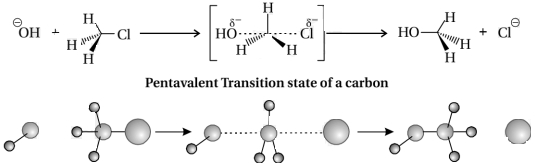
(N/A) The reaction in which the reaction rate depends on the concentration of both the substrate and the nucleophile is called an $S_{N}2$ reaction or substitution nucleophilic bimolecular reaction.
For example,the reaction between $CH_{3}Cl$ and the hydroxide ion $(OH^{-})$ to yield methanol $(CH_{3}OH)$ and the chloride ion $(Cl^{-})$ follows second-order kinetics:
$\text{Rate} = k[CH_{3}Cl][OH^{-}]$
The incoming nucleophile interacts with the alkyl halide,causing the carbon-halide bond to break as a new bond forms between the carbon and the attacking nucleophile. Here,a $C-O$ bond is formed between the $C$ atom and the $-OH$ group. These two processes occur simultaneously in a single step,and no intermediate is formed.
During the reaction,the bond between the incoming nucleophile and the carbon atom starts forming,while the bond between the carbon atom and the leaving group weakens. As a result,the carbon-hydrogen bonds of the substrate start moving away from the nucleophile. In the transition state,all three $C-H$ bonds are in the same plane,and both the attacking and leaving nucleophiles are partially attached to the carbon. Thus,in the transition state,the carbon is bonded to five atoms simultaneously. Such a structure is unstable and cannot be isolated.
As the attacking nucleophile approaches the carbon,the $C-H$ bonds continue to move in the same direction until the nucleophile attaches to the carbon and the leaving group departs. This results in the inversion of configuration,similar to an umbrella turning inside out in a strong wind.
For example,the reaction between $CH_{3}Cl$ and the hydroxide ion $(OH^{-})$ to yield methanol $(CH_{3}OH)$ and the chloride ion $(Cl^{-})$ follows second-order kinetics:
$\text{Rate} = k[CH_{3}Cl][OH^{-}]$
The incoming nucleophile interacts with the alkyl halide,causing the carbon-halide bond to break as a new bond forms between the carbon and the attacking nucleophile. Here,a $C-O$ bond is formed between the $C$ atom and the $-OH$ group. These two processes occur simultaneously in a single step,and no intermediate is formed.
During the reaction,the bond between the incoming nucleophile and the carbon atom starts forming,while the bond between the carbon atom and the leaving group weakens. As a result,the carbon-hydrogen bonds of the substrate start moving away from the nucleophile. In the transition state,all three $C-H$ bonds are in the same plane,and both the attacking and leaving nucleophiles are partially attached to the carbon. Thus,in the transition state,the carbon is bonded to five atoms simultaneously. Such a structure is unstable and cannot be isolated.
As the attacking nucleophile approaches the carbon,the $C-H$ bonds continue to move in the same direction until the nucleophile attaches to the carbon and the leaving group departs. This results in the inversion of configuration,similar to an umbrella turning inside out in a strong wind.
0 likes
View Solution833
Medium
Explain the factors favouring $S_{N}2$ reaction.
Solution
(N/A) The $S_{N}2$ reaction involves the backside attack of a nucleophile on the carbon atom bonded to the leaving group. The following factors favour this reaction:
$1$. Steric Hindrance: The reaction is highly sensitive to steric hindrance. As the number of alkyl groups attached to the carbon bearing the leaving group increases,the approach of the nucleophile is hindered. Thus,the order of reactivity is: $\text{Methyl halide} > 1^{\circ} > 2^{\circ} > 3^{\circ}$.
$2$. Nucleophile Strength: $A$ strong,negatively charged nucleophile increases the rate of the $S_{N}2$ reaction.
$3$. Solvent: Polar aprotic solvents (e.g.,acetone,$DMSO$,$DMF$) are preferred because they do not solvate the nucleophile strongly,keeping it reactive.
$4$. Leaving Group: $A$ good leaving group (e.g.,$I^- > Br^- > Cl^-$) facilitates the reaction by departing easily.
$1$. Steric Hindrance: The reaction is highly sensitive to steric hindrance. As the number of alkyl groups attached to the carbon bearing the leaving group increases,the approach of the nucleophile is hindered. Thus,the order of reactivity is: $\text{Methyl halide} > 1^{\circ} > 2^{\circ} > 3^{\circ}$.
$2$. Nucleophile Strength: $A$ strong,negatively charged nucleophile increases the rate of the $S_{N}2$ reaction.
$3$. Solvent: Polar aprotic solvents (e.g.,acetone,$DMSO$,$DMF$) are preferred because they do not solvate the nucleophile strongly,keeping it reactive.
$4$. Leaving Group: $A$ good leaving group (e.g.,$I^- > Br^- > Cl^-$) facilitates the reaction by departing easily.
0 likes
View Solution834
Medium
Write a note on $S_{N}1$ reaction.
Solution
(N/A) The reaction in which the rate is independent of the concentration of the nucleophile and depends only on the concentration of the substrate is called an $S_{N}1$ reaction. Thus,an $S_{N}1$ reaction follows first-order kinetics.
$(CH_{3})_{3}C-Br + OH^{-} \rightarrow (CH_{3})_{3}C-OH + Br^{-}$
Rate $= k[(CH_{3})_{3}C-Br]$
Mechanism:
Step-$I$: The polarized $C-Br$ bond undergoes cleavage slowly to form a carbocation and a bromide ion. This is the rate-determining step.
$(CH_{3})_{3}C-Br \xrightarrow{\text{slow}} (CH_{3})_{3}C^{+} + Br^{-}$
Step-$II$: The carbocation thus formed is then attacked by the nucleophile rapidly to complete the substitution reaction.
$(CH_{3})_{3}C^{+} + OH^{-} \xrightarrow{\text{fast}} (CH_{3})_{3}C-OH$
$(CH_{3})_{3}C-Br + OH^{-} \rightarrow (CH_{3})_{3}C-OH + Br^{-}$
Rate $= k[(CH_{3})_{3}C-Br]$
Mechanism:
Step-$I$: The polarized $C-Br$ bond undergoes cleavage slowly to form a carbocation and a bromide ion. This is the rate-determining step.
$(CH_{3})_{3}C-Br \xrightarrow{\text{slow}} (CH_{3})_{3}C^{+} + Br^{-}$
Step-$II$: The carbocation thus formed is then attacked by the nucleophile rapidly to complete the substitution reaction.
$(CH_{3})_{3}C^{+} + OH^{-} \xrightarrow{\text{fast}} (CH_{3})_{3}C-OH$
0 likes
View Solution835
Medium
Explain the factors affecting $S_{N}1$ reaction.
Solution
(N/A) In an $S_{N}1$ reaction,the carbocation is an intermediate product. Thus,the greater the stability of the carbocation,the faster the reaction rate.
$1$. Nature of Substrate: In the case of alkyl halides,$3^{\circ}$ alkyl halides undergo $S_{N}1$ reaction very fast because they form highly stable $3^{\circ}$ carbocations. Allylic and benzylic halides also show high reactivity towards $S_{N}1$ as the resulting carbocations are stabilized by resonance.
$2$. Solvent Effect: The presence of polar protic solvents such as $H_{2}O$,$CH_{3}OH$,and $CH_{3}COOH$ favours the ionisation of the $C-X$ bond and thus promotes the $S_{N}1$ reaction.
$3$. Nucleophile: $S_{N}1$ reactions are favoured by weak nucleophiles,as the rate-determining step does not involve the nucleophile.
$4$. Electronic Effects: The presence of any $+M$ (mesomeric) group favours the $S_{N}1$ reaction because it stabilizes the carbocation intermediate.
$1$. Nature of Substrate: In the case of alkyl halides,$3^{\circ}$ alkyl halides undergo $S_{N}1$ reaction very fast because they form highly stable $3^{\circ}$ carbocations. Allylic and benzylic halides also show high reactivity towards $S_{N}1$ as the resulting carbocations are stabilized by resonance.
$2$. Solvent Effect: The presence of polar protic solvents such as $H_{2}O$,$CH_{3}OH$,and $CH_{3}COOH$ favours the ionisation of the $C-X$ bond and thus promotes the $S_{N}1$ reaction.
$3$. Nucleophile: $S_{N}1$ reactions are favoured by weak nucleophiles,as the rate-determining step does not involve the nucleophile.
$4$. Electronic Effects: The presence of any $+M$ (mesomeric) group favours the $S_{N}1$ reaction because it stabilizes the carbocation intermediate.
0 likes
View Solution836
Medium
Enlist the main points of difference between $S_{N}1$ and $S_{N}2$ reactions.
Solution
(N/A)
| $1.$ Reaction rate | $S_{N}1$ depends only on the concentration of alkyl halides,whereas $S_{N}2$ depends on the concentration of both alkyl halides and nucleophiles. |
| $2.$ Order of reaction | $S_{N}1$ is a first-order reaction,while $S_{N}2$ is a second-order reaction. |
| $3.$ Nature of nucleophile | $S_{N}1$ is favored by weak nucleophiles,whereas $S_{N}2$ requires strong nucleophiles. |
| $4.$ Reactivity of alkyl halides | $S_{N}1$ reactivity order is $3^{\circ} > 2^{\circ} > 1^{\circ} > \text{Methyl}$,while $S_{N}2$ is $\text{Methyl} > 1^{\circ} > 2^{\circ} > 3^{\circ}$. |
| $5.$ Intermediate product | $S_{N}1$ involves a carbocation intermediate (rearrangement possible),while $S_{N}2$ proceeds through a pentavalent transition state with no intermediate. |
| $6.$ Nature of solvents | $S_{N}1$ is favored by polar protic solvents (e.g.,$H_{2}O, CH_{3}OH$),while $S_{N}2$ is favored by polar aprotic solvents (e.g.,$\text{DMSO}, (CH_{3})_{2}CO$). |
| $7.$ Stereochemistry | $S_{N}1$ causes partial racemization,whereas $S_{N}2$ always causes Walden inversion of configuration. |
0 likes
View Solution837
Medium
What is retention and inversion of configuration? Explain with suitable examples.
Solution
(N/A) Retention of configuration: If in a chemical reaction,no bonds to the stereocentre (chiral centre) are broken,the product will have the same general spatial arrangement of groups around the stereocentre as that of the reactant. This is called retention of configuration.
Example: The reaction of $(-)-2-$methylbutan$-1-$ol with concentrated $HCl$ proceeds with retention of configuration at the chiral centre:
$(-)-CH_3CH_2CH(CH_3)CH_2OH + HCl \xrightarrow{\Delta} (+)-CH_3CH_2CH(CH_3)CH_2Cl + H_2O$
Inversion of configuration: If the incoming nucleophile attacks the chiral centre from the side opposite to the leaving group,the spatial arrangement of the groups around the chiral centre in the product is opposite to that of the reactant. This is known as Walden inversion or inversion of configuration.
Example: The $S_N2$ reaction of $(R)-2-$bromobutane with $OH^-$ leads to the formation of $(S)-$butan$-2-$ol:
$R-C(C_2H_5)(CH_3)(C_6H_5)Br + OH^- \rightarrow HO-C(C_2H_5)(CH_3)(C_6H_5) + Br^-$
Example: The reaction of $(-)-2-$methylbutan$-1-$ol with concentrated $HCl$ proceeds with retention of configuration at the chiral centre:
$(-)-CH_3CH_2CH(CH_3)CH_2OH + HCl \xrightarrow{\Delta} (+)-CH_3CH_2CH(CH_3)CH_2Cl + H_2O$
Inversion of configuration: If the incoming nucleophile attacks the chiral centre from the side opposite to the leaving group,the spatial arrangement of the groups around the chiral centre in the product is opposite to that of the reactant. This is known as Walden inversion or inversion of configuration.
Example: The $S_N2$ reaction of $(R)-2-$bromobutane with $OH^-$ leads to the formation of $(S)-$butan$-2-$ol:
$R-C(C_2H_5)(CH_3)(C_6H_5)Br + OH^- \rightarrow HO-C(C_2H_5)(CH_3)(C_6H_5) + Br^-$
0 likes
View Solution838
Medium
Explain the stereochemistry of $S_{N}1$ reaction with a suitable example.
Solution
(N/A) In an $S_{N}1$ reaction,if the substrate (i.e.,alkyl halide) is optically active,it results in partial racemisation.
The carbocation formed as an intermediate is planar,allowing the nucleophile to attack from either side.
If the nucleophile attacks from the same side as the leaving group,retention of configuration occurs.
If the nucleophile attacks from the opposite side of the leaving group,inversion of configuration occurs.
Since the attack from the opposite side is slightly more favourable,the product is a mixture of enantiomers in unequal amounts,leading to partial racemisation.
If the enantiomers are obtained in a $50:50$ proportion,it is called a racemic mixture,which is optically inactive and denoted as $(\pm)$.
Example: The hydrolysis of optically active $2-$bromobutane results in the formation of $(\pm)-$butan$-2-$ol.
The carbocation formed as an intermediate is planar,allowing the nucleophile to attack from either side.
If the nucleophile attacks from the same side as the leaving group,retention of configuration occurs.
If the nucleophile attacks from the opposite side of the leaving group,inversion of configuration occurs.
Since the attack from the opposite side is slightly more favourable,the product is a mixture of enantiomers in unequal amounts,leading to partial racemisation.
If the enantiomers are obtained in a $50:50$ proportion,it is called a racemic mixture,which is optically inactive and denoted as $(\pm)$.
Example: The hydrolysis of optically active $2-$bromobutane results in the formation of $(\pm)-$butan$-2-$ol.
0 likes
View Solution839
Medium
Explain the stereochemistry of $S_{N}2$ reaction with a suitable example.
Solution
In the case of optically active alkyl halides,the product formed as a result of $S_{N}2$ reaction has an inverted configuration compared to the reactant.
This occurs because the nucleophile attacks from the side opposite to the one where the halogen atom is present.
For example,when $(-)-2-$bromooctane reacts with a hydroxide ion $(OH^-)$,$(+)-$octan$-2-$ol is formed,where the $-OH$ group occupies the position opposite to the bromide ion.
The reaction is represented as:
$(-)-CH_3CH(Br)C_6H_{13} + OH^- \rightarrow (+)-CH_3CH(OH)C_6H_{13} + Br^-$.
Thus,$S_{N}2$ reactions of optically active halides are accompanied by Walden inversion (inversion of configuration).
This occurs because the nucleophile attacks from the side opposite to the one where the halogen atom is present.
For example,when $(-)-2-$bromooctane reacts with a hydroxide ion $(OH^-)$,$(+)-$octan$-2-$ol is formed,where the $-OH$ group occupies the position opposite to the bromide ion.
The reaction is represented as:
$(-)-CH_3CH(Br)C_6H_{13} + OH^- \rightarrow (+)-CH_3CH(OH)C_6H_{13} + Br^-$.
Thus,$S_{N}2$ reactions of optically active halides are accompanied by Walden inversion (inversion of configuration).
0 likes
View Solution840
Medium
Explain elimination reactions of alkyl halides.
or
Explain dehydrohalogenation ($\beta$-elimination) of alkyl halides.
or
Explain dehydrohalogenation ($\beta$-elimination) of alkyl halides.
Solution
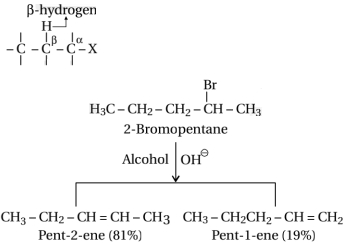
(N/A) When a haloalkane with a $\beta$-hydrogen atom is heated with an alcoholic solution of potassium hydroxide,there is an elimination of a hydrogen atom from the $\beta$-carbon and a halogen atom from the $\alpha$-carbon atom. As a result,an alkene is formed as a product.
Since a $\beta$-hydrogen atom is involved in the elimination,it is often called $\beta$-elimination.
If there is a possibility of the formation of more than one alkene due to the availability of more than one $\beta$-hydrogen atom,usually one alkene is formed as the major product.
These form part of a pattern first observed by the Russian chemist,Alexander Zaitsev. He formulated a rule which can be summarised as:
"In dehydrohalogenation reactions,the preferred product is that alkene which has a greater number of alkyl groups attached to the doubly bonded carbon atoms." Thus,$2-$bromopentane gives $pent-2-$ene as the major product.
Since a $\beta$-hydrogen atom is involved in the elimination,it is often called $\beta$-elimination.
If there is a possibility of the formation of more than one alkene due to the availability of more than one $\beta$-hydrogen atom,usually one alkene is formed as the major product.
These form part of a pattern first observed by the Russian chemist,Alexander Zaitsev. He formulated a rule which can be summarised as:
"In dehydrohalogenation reactions,the preferred product is that alkene which has a greater number of alkyl groups attached to the doubly bonded carbon atoms." Thus,$2-$bromopentane gives $pent-2-$ene as the major product.
0 likes
View Solution841
Medium
Explain how substitution and elimination reactions compete in the same reaction.
Solution
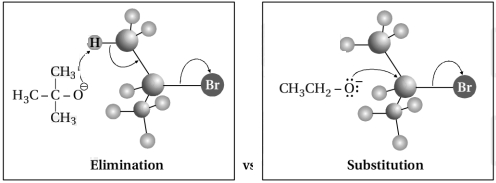
(N/A) Substitution and elimination reactions always take place in competition. The reaction pathway and the product formed depend on the following factors:
$(i)$ Nature of the substrate
$(ii)$ Strength of the nucleophile
$(iii)$ Strength of the base
$(iv)$ Nature of the solvent
$(v)$ Temperature of the reaction
High temperature favours elimination reactions,whereas low temperature favours substitution reactions.
In the case of $3^{\circ}$ alkyl halides,$S_{N}1$ is the major product when substitution and elimination reactions compete in the presence of a weak base.
The tertiary butoxide ion is a strong base but a bulky nucleophile. Therefore,it prefers to abstract a proton from a tertiary halide,causing an elimination reaction to form an alkene as the major product. However,if the alkyl halide is primary,the $S_{N}2$ reaction takes place. The ethoxide ion is a strong nucleophile and also a strong base. With a tertiary halide,it causes both elimination and substitution $(S_{N}1)$ reactions; however,the elimination product (alkene) will be major due to the strong basic character of the ethoxide ion. If the alkyl halide is primary,the ethoxide ion causes an $S_{N}2$ reaction.
$(i)$ Nature of the substrate
$(ii)$ Strength of the nucleophile
$(iii)$ Strength of the base
$(iv)$ Nature of the solvent
$(v)$ Temperature of the reaction
| Nature of substrate and solvents | Nature of Nucleophile or Base and Reaction preferred |
|---|---|
| $3^{\circ}$ alkyl halide,Polar protic solvent | Strong nucleophile but weak base: $S_{N}1$ |
| $3^{\circ}$ alkyl halide,Polar aprotic solvent | Strong base but weak nucleophile (Heat): Elimination $(E2)$ |
| $3^{\circ}$ alkyl halide,Polar protic solvent | Weak base: Elimination $(E1)$ |
| $1^{\circ}$ alkyl halide or methyl,Polar aprotic solvent | Strong nucleophile but weak base: $S_{N}2$ |
High temperature favours elimination reactions,whereas low temperature favours substitution reactions.
In the case of $3^{\circ}$ alkyl halides,$S_{N}1$ is the major product when substitution and elimination reactions compete in the presence of a weak base.
The tertiary butoxide ion is a strong base but a bulky nucleophile. Therefore,it prefers to abstract a proton from a tertiary halide,causing an elimination reaction to form an alkene as the major product. However,if the alkyl halide is primary,the $S_{N}2$ reaction takes place. The ethoxide ion is a strong nucleophile and also a strong base. With a tertiary halide,it causes both elimination and substitution $(S_{N}1)$ reactions; however,the elimination product (alkene) will be major due to the strong basic character of the ethoxide ion. If the alkyl halide is primary,the ethoxide ion causes an $S_{N}2$ reaction.
0 likes
View Solution842
Medium
Write a note on Grignard Reagent.
Solution
(N/A) Most organic chlorides,bromides,and iodides react with certain metals to form compounds containing carbon-metal bonds,known as organometallic compounds.
Victor Grignard discovered an important class of organometallic compounds known as alkyl magnesium halides $(RMgX)$,which are referred to as Grignard reagents.
Grignard reagents are prepared by the reaction of haloalkanes with magnesium metal in the presence of dry ether:
$CH_3CH_2Br + Mg \xrightarrow{\text{dry ether}} CH_3CH_2MgBr$
In a Grignard reagent,the carbon-magnesium bond is covalent but highly polar,with the carbon atom pulling electrons from the electropositive magnesium atom. The magnesium-halogen bond is essentially ionic. The structure is represented as $R^{\delta-} - Mg^{2+}X^{\delta-}$.
Grignard reagents are highly reactive toward moisture and react with water to form hydrocarbons:
$RMgX + H_2O \longrightarrow RH + Mg(OH)X$
Therefore,it is necessary to avoid even traces of moisture,which is why the reaction is carried out in anhydrous (dry) ether. This is a useful method for converting alkyl halides into hydrocarbons.
Victor Grignard discovered an important class of organometallic compounds known as alkyl magnesium halides $(RMgX)$,which are referred to as Grignard reagents.
Grignard reagents are prepared by the reaction of haloalkanes with magnesium metal in the presence of dry ether:
$CH_3CH_2Br + Mg \xrightarrow{\text{dry ether}} CH_3CH_2MgBr$
In a Grignard reagent,the carbon-magnesium bond is covalent but highly polar,with the carbon atom pulling electrons from the electropositive magnesium atom. The magnesium-halogen bond is essentially ionic. The structure is represented as $R^{\delta-} - Mg^{2+}X^{\delta-}$.
Grignard reagents are highly reactive toward moisture and react with water to form hydrocarbons:
$RMgX + H_2O \longrightarrow RH + Mg(OH)X$
Therefore,it is necessary to avoid even traces of moisture,which is why the reaction is carried out in anhydrous (dry) ether. This is a useful method for converting alkyl halides into hydrocarbons.
0 likes
View Solution843
Medium
Write a note on Wurtz Reaction.
Solution
Alkyl halides react with sodium in dry ether to give hydrocarbons containing double the number of carbon atoms present in the halide. This reaction is known as Wurtz reaction.
$2 R-X + 2 Na \longrightarrow R-R + 2 NaX$
$2 CH_3-CH_2-Br + 2 Na \xrightarrow{\text{dry ether}} CH_3-CH_2-CH_2-CH_3 + 2 NaBr$
$2 (CH_3)_2CH-Br + 2 Na \xrightarrow{\text{dry ether}} (CH_3)_2CH-CH(CH_3)_2 + 2 NaBr$
$2 R-X + 2 Na \longrightarrow R-R + 2 NaX$
$2 CH_3-CH_2-Br + 2 Na \xrightarrow{\text{dry ether}} CH_3-CH_2-CH_2-CH_3 + 2 NaBr$
$2 (CH_3)_2CH-Br + 2 Na \xrightarrow{\text{dry ether}} (CH_3)_2CH-CH(CH_3)_2 + 2 NaBr$
0 likes
View Solution844
EasyMCQ
The incorrect statement regarding chirality is :
A
The product obtained by $S_{N}2$ reaction of haloalkane having chirality at the reactive site shows inversion of configuration.
B
Enantiomers are superimposable mirror images on each other.
C
$A$ racemic mixture shows zero optical rotation.
D
$S_{N}1$ reaction yields $1:1$ mixture of both enantiomers.
Solution
(B) Enantiomers are defined as non-superimposable mirror images of each other. Therefore,the statement that they are superimposable is incorrect.
0 likes
View Solution845
EasyMCQ
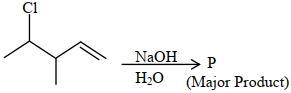
Consider the reaction shown below. The number of $\pi$ electrons present in the major product '$P$' is ...... .
A
$1$
B
$2$
C
$3$
D
$5$
Solution
(B) The reaction of $3$-chloro-$2$-methylpent-$4$-ene with aqueous $NaOH$ is a nucleophilic substitution reaction ($S_N1$ or $S_N2$ depending on conditions,but here it leads to the substitution of $-Cl$ by $-OH$).
The product '$P$' is $3$-methylpent-$4$-en-$2$-ol.
The structure of the product contains one double bond $(C=C)$.
Since each double bond consists of one $\pi$ bond,and each $\pi$ bond contains $2$ electrons,the total number of $\pi$ electrons in the product is $2$.
The product '$P$' is $3$-methylpent-$4$-en-$2$-ol.
The structure of the product contains one double bond $(C=C)$.
Since each double bond consists of one $\pi$ bond,and each $\pi$ bond contains $2$ electrons,the total number of $\pi$ electrons in the product is $2$.
0 likes
View Solution846
MediumMCQ
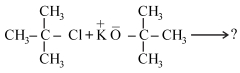
The major product in the reaction is:
A
$t-$Butyl ethyl ether
B
$2,2-$Dimethyl butane
C
$2-$Methyl pent$-1-$ene
D
$2-$Methyl prop$-1-$ene
Solution
(D) The reaction involves $tert-$butyl chloride and potassium $tert-$butoxide $(t-BuOK)$.
$t-BuO^-$ is a bulky base.
Due to steric hindrance,the bulky base cannot attack the electrophilic carbon for substitution $(S_N2)$.
Instead,it abstracts a $\beta-$hydrogen from the $tert-$butyl chloride,leading to an elimination reaction ($E2$ mechanism).
The product formed is $2-$methylprop$-1-$ene.
$t-BuO^-$ is a bulky base.
Due to steric hindrance,the bulky base cannot attack the electrophilic carbon for substitution $(S_N2)$.
Instead,it abstracts a $\beta-$hydrogen from the $tert-$butyl chloride,leading to an elimination reaction ($E2$ mechanism).
The product formed is $2-$methylprop$-1-$ene.
0 likes
View Solution847
MediumMCQ
The product $A$ of the following sequence of reactions is:
Ethylbenzene $\xrightarrow[(b) Cl_2, \Delta]{(a) Br_2, Fe}$ $\xrightarrow{(c) alc. KOH} 'A' \text{ (Major product)}$
Ethylbenzene $\xrightarrow[(b) Cl_2, \Delta]{(a) Br_2, Fe}$ $\xrightarrow{(c) alc. KOH} 'A' \text{ (Major product)}$
A
$1-$bromo$-4-$($1$-chloroethenyl)benzene
B
$1-$bromo$-4-$($1$-bromoethenyl)benzene
C
$1-$chloro$-4-$bromoethynylbenzene
D
$1-$bromo$-4-$ethenylbenzene
Solution
(D) Step $1$: Electrophilic aromatic substitution $(Br_2, Fe)$ on ethylbenzene gives $p$-bromoethylbenzene as the major product due to the ortho/para directing nature of the ethyl group.
Step $2$: Benzylic halogenation $(Cl_2, \Delta)$ occurs at the benzylic position of the ethyl group,yielding $1-(4-bromophenyl)-1-chloroethane$.
Step $3$: Dehydrohalogenation using $alc. KOH$ (elimination reaction) removes $HCl$ from the side chain to form the alkene,resulting in $1-bromo-4-ethenylbenzene$ (also known as $p$-bromostyrene).
Step $2$: Benzylic halogenation $(Cl_2, \Delta)$ occurs at the benzylic position of the ethyl group,yielding $1-(4-bromophenyl)-1-chloroethane$.
Step $3$: Dehydrohalogenation using $alc. KOH$ (elimination reaction) removes $HCl$ from the side chain to form the alkene,resulting in $1-bromo-4-ethenylbenzene$ (also known as $p$-bromostyrene).
0 likes
View Solution848
MediumMCQ
Which one of the following compounds is inactive towards $S_N1$ reaction?
A
$ (CH_3)_3CCl $
B
$ CH_2=CH-CH_2Cl $
C
$1-$Chlorobicyclo[$2.2$.$1$]heptane
D
$ C_6H_5CH(CH_3)Cl $
Solution
(C) $S_N1$ reactions proceed via the formation of a carbocation intermediate. The stability of the carbocation determines the reactivity.
In $1$-chlorobicyclo$[2.2.1]$heptane,the bridgehead carbon atom is involved in the formation of a carbocation. According to Bredt's rule,a double bond or a carbocation cannot exist at the bridgehead position of a small bicyclic system because it would introduce excessive strain and prevent the carbocation from achieving the required planar $sp^2$ hybridization.
Therefore,the formation of the carbocation at the bridgehead position is extremely difficult,making this compound inactive towards $S_N1$ reactions.
In $1$-chlorobicyclo$[2.2.1]$heptane,the bridgehead carbon atom is involved in the formation of a carbocation. According to Bredt's rule,a double bond or a carbocation cannot exist at the bridgehead position of a small bicyclic system because it would introduce excessive strain and prevent the carbocation from achieving the required planar $sp^2$ hybridization.
Therefore,the formation of the carbocation at the bridgehead position is extremely difficult,making this compound inactive towards $S_N1$ reactions.
0 likes
View Solution849
DifficultMCQ
Two isomers $(A)$ and $(B)$ with molar mass $184 \ g/mol$ and elemental composition $C, 52.2 \ \%; H, 4.9 \ \%$ and $Br, 42.9 \ \%$ give benzoic acid and $p$-bromobenzoic acid,respectively,on oxidation with $KMnO_4$. Isomer '$A$' is optically active and gives a pale yellow precipitate when warmed with alcoholic $AgNO_3$. Isomer '$A$' and '$B$' are,respectively .... .
A
$H_3C-CHBr-C_6H_5$ and $2$-methylbenzyl bromide
B
$2$-methylbenzyl bromide and $p$-bromobenzyl bromide
C
$H_3C-CHBr-C_6H_5$ and $p$-bromobenzyl bromide
D
$p$-bromobenzyl bromide and $H_3C-CHBr-C_6H_5$
Solution
(C) $1$. Empirical formula calculation: Moles of $C = 52.2/12 = 4.35$,$H = 4.9/1 = 4.9$,$Br = 42.9/80 = 0.536$. Ratio: $C:H:Br = 8:9:1$. Empirical formula is $C_8H_9Br$. Molar mass is $184 \ g/mol$,which matches $C_8H_9Br$.
$2$. Oxidation with $KMnO_4$: Isomer $(A)$ gives benzoic acid,implying it has an alkyl group attached to the benzene ring at the alpha position (e.g.,$C_6H_5-CH(Br)-CH_3$). Isomer $(B)$ gives $p$-bromobenzoic acid,implying it has an ethyl group at the para position relative to the bromine atom (e.g.,$p-Br-C_6H_4-CH_2CH_3$).
$3$. Isomer $(A)$ is optically active: $C_6H_5-CH(Br)-CH_3$ has a chiral center.
$4$. Isomer $(A)$ gives a precipitate with $AgNO_3$: The benzylic bromide is reactive.
$5$. Therefore,$(A)$ is $1$-bromo-ethylbenzene $(H_3C-CHBr-C_6H_5)$ and $(B)$ is $1$-bromo$-4-$ethylbenzene ($p$-ethylbromobenzene).
$2$. Oxidation with $KMnO_4$: Isomer $(A)$ gives benzoic acid,implying it has an alkyl group attached to the benzene ring at the alpha position (e.g.,$C_6H_5-CH(Br)-CH_3$). Isomer $(B)$ gives $p$-bromobenzoic acid,implying it has an ethyl group at the para position relative to the bromine atom (e.g.,$p-Br-C_6H_4-CH_2CH_3$).
$3$. Isomer $(A)$ is optically active: $C_6H_5-CH(Br)-CH_3$ has a chiral center.
$4$. Isomer $(A)$ gives a precipitate with $AgNO_3$: The benzylic bromide is reactive.
$5$. Therefore,$(A)$ is $1$-bromo-ethylbenzene $(H_3C-CHBr-C_6H_5)$ and $(B)$ is $1$-bromo$-4-$ethylbenzene ($p$-ethylbromobenzene).
0 likes
View Solution850
MediumMCQ
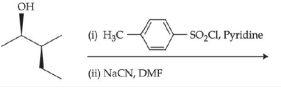
The most stable product of the following reaction is:
A
B
C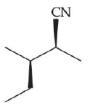
D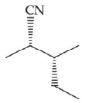
Solution
(C) The reaction proceeds in two steps:
$1$. The reaction of the secondary alcohol with $p$-toluenesulfonyl chloride $(TsCl)$ in the presence of pyridine converts the $-OH$ group into a good leaving group,the tosylate $(-OTs)$ group,with retention of configuration at the chiral center.
$2$. The subsequent reaction with $NaCN$ in $DMF$ is an $S_N2$ reaction. The nucleophile $CN^{-}$ attacks the chiral carbon from the side opposite to the $-OTs$ group,resulting in an inversion of configuration at that center.
Starting with the given stereoisomer,the $-OH$ is on a wedge. After forming the $-OTs$ group (still on a wedge),the $S_N2$ attack by $CN^{-}$ forces it to the dashed position (inversion). Thus,the correct product has the $CN$ group on a dash while the other chiral center remains unchanged.
$1$. The reaction of the secondary alcohol with $p$-toluenesulfonyl chloride $(TsCl)$ in the presence of pyridine converts the $-OH$ group into a good leaving group,the tosylate $(-OTs)$ group,with retention of configuration at the chiral center.
$2$. The subsequent reaction with $NaCN$ in $DMF$ is an $S_N2$ reaction. The nucleophile $CN^{-}$ attacks the chiral carbon from the side opposite to the $-OTs$ group,resulting in an inversion of configuration at that center.
Starting with the given stereoisomer,the $-OH$ is on a wedge. After forming the $-OTs$ group (still on a wedge),the $S_N2$ attack by $CN^{-}$ forces it to the dashed position (inversion). Thus,the correct product has the $CN$ group on a dash while the other chiral center remains unchanged.
0 likes
View SolutionHaloalkanes and Haloarenes — Properties of Haloalkanes · Frequently Asked Questions
1Are these Haloalkanes and Haloarenes questions useful for JEE and NEET?
Yes. All questions in this section are mapped to JEE Main and NEET exam patterns. Previous year questions from JEE Main, NEET, GUJCET and state-level exams are included with full solutions.
2Can I switch to Hindi or Gujarati for these questions?
Yes. Use the language tabs in the hero section or the sidebar to view the same questions and solutions in English, Hindi or Gujarati.
3How do I generate a question paper from this subtopic?
Use the Vedclass Exam Paper Generator — select the chapter and subtopic, set difficulty, and generate Sets A, B, C, D automatically. First 3 chapters of every subject are free.
Vedclass Products
For Students
Vedclass Test Series
Mock tests in real JEE/NEET style with performance analysis. 5-day free trial.
Start Free TrialFor Teachers
Exam Paper Generator
Generate Set A/B/C/D papers from this chapter in 2 minutes. 3 chapters free.
Try FreeFor Institutes
Online Exam Module
Live online exams with unlimited students, 360° analytics & white-label branding.
See DemoFor Teachers & Institutes
Generate a Haloalkanes and Haloarenes Exam Paper in 2 Minutes
Select subtopic & difficulty — Sets A, B, C, D auto-generated with No Repeat logic.
First 3 chapters of every subject are free — no payment required.