
A English
Properties of Haloalkanes Questions in English
Class 12 Chemistry · Haloalkanes and Haloarenes · Properties of Haloalkanes
1196+
Questions
English
Language
100%
With Solutions
Showing 50 of 1196 questions in English
751
Easy
Out of $C_{6}H_{5}CH_{2}Cl$ and $C_{6}H_{5}CHClC_{6}H_{5},$ which is more easily hydrolysed by aqueous $KOH$?
Solution
(C_{6}H_{5}CHCLC_{6}H_{5}) The hydrolysis of alkyl halides by aqueous $KOH$ often proceeds via an $S_{N}1$ mechanism,which involves the formation of a carbocation intermediate.
The stability of the carbocation determines the ease of hydrolysis. $A$ more stable carbocation is formed more readily,leading to faster hydrolysis.
$1$. $C_{6}H_{5}CH_{2}Cl$ ionizes to form a benzyl carbocation $(C_{6}H_{5}CH_{2}^{+})$,which is stabilized by resonance with one phenyl ring.
$2$. $C_{6}H_{5}CHClC_{6}H_{5}$ ionizes to form a diphenylmethyl carbocation $(C_{6}H_{5}CH^{+}C_{6}H_{5})$,which is stabilized by resonance with two phenyl rings.
Since the diphenylmethyl carbocation is more stable due to extended resonance with two phenyl rings compared to the benzyl carbocation,$C_{6}H_{5}CHClC_{6}H_{5}$ undergoes hydrolysis more easily than $C_{6}H_{5}CH_{2}Cl$.
The stability of the carbocation determines the ease of hydrolysis. $A$ more stable carbocation is formed more readily,leading to faster hydrolysis.
$1$. $C_{6}H_{5}CH_{2}Cl$ ionizes to form a benzyl carbocation $(C_{6}H_{5}CH_{2}^{+})$,which is stabilized by resonance with one phenyl ring.
$2$. $C_{6}H_{5}CHClC_{6}H_{5}$ ionizes to form a diphenylmethyl carbocation $(C_{6}H_{5}CH^{+}C_{6}H_{5})$,which is stabilized by resonance with two phenyl rings.
Since the diphenylmethyl carbocation is more stable due to extended resonance with two phenyl rings compared to the benzyl carbocation,$C_{6}H_{5}CHClC_{6}H_{5}$ undergoes hydrolysis more easily than $C_{6}H_{5}CH_{2}Cl$.
0 likes
View Solution752
Easy
The treatment of alkyl chlorides with aqueous $KOH$ leads to the formation of alcohols,but in the presence of alcoholic $KOH$,alkenes are the major products. Explain.
Solution
(N/A) In an aqueous solution,$KOH$ almost completely ionizes to give $OH^{-}$ ions. The $OH^{-}$ ion acts as a strong nucleophile,which leads the alkyl chloride to undergo a nucleophilic substitution reaction ($S_N2$ or $S_N1$) to form an alcohol.
$R-Cl + KOH_{(aq)} \to R-OH + KCl$
On the other hand,an alcoholic solution of $KOH$ contains ethoxide $(C_2H_5O^-)$ ions (if ethanol is used),which are strong bases. These ions abstract a proton from the $\beta$-carbon of the alkyl chloride,leading to a dehydrohalogenation reaction (elimination) to form an alkene.
$R-CH_2(\beta)-CH_2(\alpha)-Cl + KOH_{(alc)} \to R-CH=CH_2 + KCl + H_2O$
In an aqueous medium,the $OH^{-}$ ion is highly solvated by water molecules,which reduces its basicity but allows it to act as a nucleophile. In an alcoholic medium,the base is less solvated and more reactive,favoring the abstraction of a $\beta$-hydrogen atom.
$R-Cl + KOH_{(aq)} \to R-OH + KCl$
On the other hand,an alcoholic solution of $KOH$ contains ethoxide $(C_2H_5O^-)$ ions (if ethanol is used),which are strong bases. These ions abstract a proton from the $\beta$-carbon of the alkyl chloride,leading to a dehydrohalogenation reaction (elimination) to form an alkene.
$R-CH_2(\beta)-CH_2(\alpha)-Cl + KOH_{(alc)} \to R-CH=CH_2 + KCl + H_2O$
In an aqueous medium,the $OH^{-}$ ion is highly solvated by water molecules,which reduces its basicity but allows it to act as a nucleophile. In an alcoholic medium,the base is less solvated and more reactive,favoring the abstraction of a $\beta$-hydrogen atom.
0 likes
View Solution753
Easy
$A$ primary alkyl halide $(a)$ with molecular formula $C_{4}H_{9}Br$ reacts with alcoholic $KOH$ to give compound $(b)$. Compound $(b)$ reacts with $HBr$ to give compound $(c)$,which is an isomer of $(a)$. When $(a)$ reacts with sodium metal,it gives compound $(d)$ with molecular formula $C_{8}H_{18}$,which is different from the compound formed when $n$-butyl bromide reacts with sodium. Identify the structural formula of $(a)$ and write the equations for all the reactions.
Solution
(A) There are two primary alkyl halides with the formula $C_{4}H_{9}Br$: $n$-butyl bromide $(CH_{3}CH_{2}CH_{2}CH_{2}Br)$ and isobutyl bromide $(CH_{3}CH(CH_{3})CH_{2}Br)$.
Since compound $(a)$ reacts with $Na$ to form a product $(d)$ different from the product of $n$-butyl bromide (which is $n$-octane),$(a)$ must be isobutyl bromide.
$1$. Reaction of $(a)$ with $Na$ (Wurtz reaction):
$2CH_{3}CH(CH_{3})CH_{2}Br + 2Na$ $\xrightarrow{\text{dry ether}} CH_{3}CH(CH_{3})CH_{2}CH_{2}CH(CH_{3})CH_{3} (2,5-\text{dimethylhexane}) + 2NaBr$
$2$. Reaction of $(a)$ with alcoholic $KOH$ (Dehydrohalogenation):
$CH_{3}CH(CH_{3})CH_{2}Br + KOH(\text{alc})$ $\xrightarrow{\Delta} CH_{3}C(CH_{3})=CH_{2} (2-\text{methylpropene}) + KBr + H_{2}O$
$3$. Reaction of $(b)$ with $HBr$ (Markovnikov addition):
$CH_{3}C(CH_{3})=CH_{2} + HBr \rightarrow CH_{3}C(Br)(CH_{3})CH_{3} (2-\text{bromo}-2-\text{methylpropane})$
Compound $(c)$ is $2-\text{bromo}-2-\text{methylpropane}$,which is an isomer of $(a)$.
Since compound $(a)$ reacts with $Na$ to form a product $(d)$ different from the product of $n$-butyl bromide (which is $n$-octane),$(a)$ must be isobutyl bromide.
$1$. Reaction of $(a)$ with $Na$ (Wurtz reaction):
$2CH_{3}CH(CH_{3})CH_{2}Br + 2Na$ $\xrightarrow{\text{dry ether}} CH_{3}CH(CH_{3})CH_{2}CH_{2}CH(CH_{3})CH_{3} (2,5-\text{dimethylhexane}) + 2NaBr$
$2$. Reaction of $(a)$ with alcoholic $KOH$ (Dehydrohalogenation):
$CH_{3}CH(CH_{3})CH_{2}Br + KOH(\text{alc})$ $\xrightarrow{\Delta} CH_{3}C(CH_{3})=CH_{2} (2-\text{methylpropene}) + KBr + H_{2}O$
$3$. Reaction of $(b)$ with $HBr$ (Markovnikov addition):
$CH_{3}C(CH_{3})=CH_{2} + HBr \rightarrow CH_{3}C(Br)(CH_{3})CH_{3} (2-\text{bromo}-2-\text{methylpropane})$
Compound $(c)$ is $2-\text{bromo}-2-\text{methylpropane}$,which is an isomer of $(a)$.
0 likes
View Solution754
Difficult
When $3-$methylbutan$-2-$ol is treated with $HBr$,the following reaction takes place:
$CH_3-CH(CH_3)-CH(OH)-CH_3 \xrightarrow{HBr} CH_3-C(Br)(CH_3)-CH_2-CH_3$
Give a mechanism for this reaction.
(Hint : The secondary carbocation formed in step $II$ rearranges to a more stable tertiary carbocation by a hydride ion shift from $3^{rd}$ carbon atom.)
$CH_3-CH(CH_3)-CH(OH)-CH_3 \xrightarrow{HBr} CH_3-C(Br)(CH_3)-CH_2-CH_3$
Give a mechanism for this reaction.
(Hint : The secondary carbocation formed in step $II$ rearranges to a more stable tertiary carbocation by a hydride ion shift from $3^{rd}$ carbon atom.)
Solution
(N/A) The mechanism of the given reaction involves the following steps:
Step $1:$ Protonation
$CH_3-CH(CH_3)-CH(OH)-CH_3 + H^+ \rightarrow CH_3-CH(CH_3)-CH(OH_2^+)-CH_3$
Step $2:$ Formation of $2^{\circ}$ carbocation by the elimination of a water molecule
$CH_3-CH(CH_3)-CH(OH_2^+)-CH_3 \rightarrow CH_3-CH(CH_3)-CH^+-CH_3 + H_2O$
Step $3:$ Rearrangement by the hydride-ion shift
The $2^{\circ}$ carbocation undergoes a $1,2-$hydride shift from the $3^{rd}$ carbon to form a more stable $3^{\circ}$ carbocation:
$CH_3-CH(CH_3)-CH^+-CH_3 \rightarrow CH_3-C^+(CH_3)-CH_2-CH_3$
Step $4:$ Nucleophilic attack
The bromide ion $(Br^-)$ attacks the $3^{\circ}$ carbocation to form the final product:
$CH_3-C^+(CH_3)-CH_2-CH_3 + Br^- \rightarrow CH_3-C(Br)(CH_3)-CH_2-CH_3$ ($2-$bromo$-2-$methylbutane)
Step $1:$ Protonation
$CH_3-CH(CH_3)-CH(OH)-CH_3 + H^+ \rightarrow CH_3-CH(CH_3)-CH(OH_2^+)-CH_3$
Step $2:$ Formation of $2^{\circ}$ carbocation by the elimination of a water molecule
$CH_3-CH(CH_3)-CH(OH_2^+)-CH_3 \rightarrow CH_3-CH(CH_3)-CH^+-CH_3 + H_2O$
Step $3:$ Rearrangement by the hydride-ion shift
The $2^{\circ}$ carbocation undergoes a $1,2-$hydride shift from the $3^{rd}$ carbon to form a more stable $3^{\circ}$ carbocation:
$CH_3-CH(CH_3)-CH^+-CH_3 \rightarrow CH_3-C^+(CH_3)-CH_2-CH_3$
Step $4:$ Nucleophilic attack
The bromide ion $(Br^-)$ attacks the $3^{\circ}$ carbocation to form the final product:
$CH_3-C^+(CH_3)-CH_2-CH_3 + Br^- \rightarrow CH_3-C(Br)(CH_3)-CH_2-CH_3$ ($2-$bromo$-2-$methylbutane)
0 likes
View Solution755
Easy
Will $CCl_4$ give a white precipitate of $AgCl$ on heating it with silver nitrate? Give a reason for your answer.
Solution
(N/A) $CCl_4$ will not give a white precipitate of $AgCl$ on heating it with silver nitrate. This is because the chlorine atoms are covalently bonded to the carbon atom in $CCl_4$. Since the chlorine is not present as $Cl^-$ ions,it does not react with $AgNO_3$ to form $AgCl$. To obtain the precipitate,the covalent bond must be broken,which is typically done by preparing the Lassaigne's extract of $CCl_4$.
0 likes
View Solution756
EasyMCQ
The reaction:
$CH_3CH_2I + KOH_{(aq)} \to CH_3CH_2OH + KI$
is classified as :
$CH_3CH_2I + KOH_{(aq)} \to CH_3CH_2OH + KI$
is classified as :
A
electrophilic substitution
B
nucleophilic substitution
C
elimination
D
addition
Solution
(B) The reaction $CH_3CH_2I + KOH_{(aq)} \to CH_3CH_2OH + KI$ is an example of a nucleophilic substitution reaction.
In this reaction,the hydroxyl group $(OH^-)$ acts as a nucleophile.
It attacks the electrophilic carbon atom bonded to the iodine atom and replaces the iodide ion $(I^-)$,which acts as the leaving group.
In this reaction,the hydroxyl group $(OH^-)$ acts as a nucleophile.
It attacks the electrophilic carbon atom bonded to the iodine atom and replaces the iodide ion $(I^-)$,which acts as the leaving group.
0 likes
View Solution757
Easy
Will $CCl_4$ give a white precipitate of $AgCl$ on heating it with silver nitrate? Give a reason for your answer.
Solution
(N/A) When $CCl_4$ is heated with $AgNO_3$ solution,a white precipitate of $AgCl$ is not formed.
The reason is that $CCl_4$ is a covalent (nonpolar) organic compound.
Therefore,it does not ionize to provide $Cl^-$ ions,which are necessary for the formation of a white precipitate of $AgCl$.
Thus,the reaction $CCl_4 + AgNO_3 \rightarrow \text{No reaction}$ occurs.
The reason is that $CCl_4$ is a covalent (nonpolar) organic compound.
Therefore,it does not ionize to provide $Cl^-$ ions,which are necessary for the formation of a white precipitate of $AgCl$.
Thus,the reaction $CCl_4 + AgNO_3 \rightarrow \text{No reaction}$ occurs.
0 likes
View Solution758
Medium
Describe the color,odor,and density of haloalkanes.
Solution
(N/A) Color: Pure alkyl halides are colorless,but bromides and iodides develop color when exposed to light.
$(b)$ Odor: Many volatile halogenated compounds possess a sweet smell.
$(c)$ Density: Bromo,iodo,and polychloro derivatives of hydrocarbons are heavier than water. The density increases with an increase in the number of carbon atoms,the number of halogen atoms,and the atomic mass of the halogen atoms.
Example: $(i)$ The densities of $n-C_3H_7Cl$,$n-C_3H_7Br$,and $n-C_3H_7I$ are $0.89$,$1.335$,and $1.747 \ g \ mL^{-1}$ respectively,showing an increase due to the increasing atomic mass of the halogens $(Cl, Br, I)$. $(ii)$ The densities of $CH_2Cl_2$,$CHCl_3$,and $CCl_4$ are $1.336$,$1.489$,and $1.595 \ g \ mL^{-1}$ respectively,showing an increase due to the increasing number of $-Cl$ atoms.
$(b)$ Odor: Many volatile halogenated compounds possess a sweet smell.
$(c)$ Density: Bromo,iodo,and polychloro derivatives of hydrocarbons are heavier than water. The density increases with an increase in the number of carbon atoms,the number of halogen atoms,and the atomic mass of the halogen atoms.
Example: $(i)$ The densities of $n-C_3H_7Cl$,$n-C_3H_7Br$,and $n-C_3H_7I$ are $0.89$,$1.335$,and $1.747 \ g \ mL^{-1}$ respectively,showing an increase due to the increasing atomic mass of the halogens $(Cl, Br, I)$. $(ii)$ The densities of $CH_2Cl_2$,$CHCl_3$,and $CCl_4$ are $1.336$,$1.489$,and $1.595 \ g \ mL^{-1}$ respectively,showing an increase due to the increasing number of $-Cl$ atoms.
0 likes
View Solution759
Medium
Explain the solubility of haloalkanes in water and organic solvents.
Solution
(N/A) Solubility of haloalkanes in water: Haloalkanes are very slightly soluble in water (almost insoluble).
To dissolve haloalkanes in water,energy $(x)$ is required to overcome the dipole-dipole attractions between haloalkane molecules and the hydrogen bonds between water molecules.
When haloalkanes dissolve,new attractions are formed between haloalkane and water molecules,releasing solvation energy $(y)$.
This new attraction $(y)$ is not as strong as the original hydrogen bonds $(x)$ in water.
Therefore,the solubility of haloalkanes in water is very low.
Since the solvation energy $(y) < $ hydrogen bond energy $(x)$,haloalkanes remain almost insoluble and form a separate layer.
Solubility of haloalkanes in organic solvents: Haloalkanes tend to be soluble in organic solvents.
This is because the strength of the intermolecular attraction forces formed between polar haloalkane molecules and organic solvent molecules is comparable to the attraction forces between the haloalkane molecules themselves and between the solvent molecules themselves.
To dissolve haloalkanes in water,energy $(x)$ is required to overcome the dipole-dipole attractions between haloalkane molecules and the hydrogen bonds between water molecules.
When haloalkanes dissolve,new attractions are formed between haloalkane and water molecules,releasing solvation energy $(y)$.
This new attraction $(y)$ is not as strong as the original hydrogen bonds $(x)$ in water.
Therefore,the solubility of haloalkanes in water is very low.
Since the solvation energy $(y) < $ hydrogen bond energy $(x)$,haloalkanes remain almost insoluble and form a separate layer.
Solubility of haloalkanes in organic solvents: Haloalkanes tend to be soluble in organic solvents.
This is because the strength of the intermolecular attraction forces formed between polar haloalkane molecules and organic solvent molecules is comparable to the attraction forces between the haloalkane molecules themselves and between the solvent molecules themselves.
0 likes
View Solution760
Medium
Discuss the melting and boiling points of haloalkanes and haloarenes.
Solution
(N/A) At room temperature: Methyl chloride $(CH_3Cl)$,methyl bromide $(CH_3Br)$,ethyl chloride $(CH_3CH_2Cl)$,and some chlorofluoromethanes are gases at room temperature,while higher members are liquids or solids.
$(b)$ Boiling points of organic halogen compounds: Organic halogen compounds are generally polar. Due to $(i)$ greater polarity and $(ii)$ higher molecular mass as compared to the parent hydrocarbons,the intermolecular forces of attraction (dipole-dipole and van der Waals) are stronger in halogen derivatives of alkanes. Consequently,the boiling points of chlorides,bromides,and iodides are considerably higher than those of the hydrocarbons of comparable molecular mass.
$(c)$ Boiling point and attraction forces: As the size and number of electrons in the molecules increase,the magnitude of van der Waals forces of attraction increases,resulting in an increase in boiling points,as shown in the figure.
$(d)$ Order of boiling points of alkyl halides: For the same alkyl group,the decreasing order of boiling points of alkyl halides is $RI > RBr > RCl > RF$. This is because as the mass and size of the halogen atom increase,the magnitude of van der Waals forces of attraction increases.
$(b)$ Boiling points of organic halogen compounds: Organic halogen compounds are generally polar. Due to $(i)$ greater polarity and $(ii)$ higher molecular mass as compared to the parent hydrocarbons,the intermolecular forces of attraction (dipole-dipole and van der Waals) are stronger in halogen derivatives of alkanes. Consequently,the boiling points of chlorides,bromides,and iodides are considerably higher than those of the hydrocarbons of comparable molecular mass.
$(c)$ Boiling point and attraction forces: As the size and number of electrons in the molecules increase,the magnitude of van der Waals forces of attraction increases,resulting in an increase in boiling points,as shown in the figure.
$(d)$ Order of boiling points of alkyl halides: For the same alkyl group,the decreasing order of boiling points of alkyl halides is $RI > RBr > RCl > RF$. This is because as the mass and size of the halogen atom increase,the magnitude of van der Waals forces of attraction increases.
0 likes
View Solution761
Medium
Describe the chemical reactions of haloalkanes.
Solution
(N/A) The reactions of haloalkanes can be broadly classified into three categories:
$(a)$ Nucleophilic substitution reactions
$(b)$ Elimination reactions
$(c)$ Reaction with metals
$(a)$ Nucleophilic substitution reactions
$(b)$ Elimination reactions
$(c)$ Reaction with metals
0 likes
View Solution762
Medium
State the general reactions of alkyl halides $(RX)$ with different nucleophiles.
Solution
(N/A) Alkyl halides $(RX)$ react with various nucleophiles to form different products. The general reaction is: $R - X + Nu^{-} \rightarrow R - Nu + X^{-}$.
The following table summarizes the reactions:
| Nucleophile $(Nu^{-})$ | Reagent | Product $(R-Nu)$ |
| :--- | :--- | :--- |
| $OH^{-}$ | $NaOH_{(aq)} / KOH_{(aq)}$ | $R-OH$ (Alcohol) |
| $OH^{-}$ | $H_{2}O$ | $R-OH$ (Alcohol) |
| $OR'^{-}$ | $NaOR'$ | $R-OR'$ (Ether,Williamson synthesis) |
| $I^{-}$ | $NaI$ | $R-I$ (Iodide,Finkelstein reaction) |
| $NH_{3}$ | $NH_{3}$ | $R-NH_{2}$ ($1^{\circ}$-Amine) |
| $R'NH^{-}$ | $R'-NH_{2}$ | $RNHR'$ ($2^{\circ}$-Amine) |
| $R''NR'$ | $R''-NH-R'$ | $R-N(R')R''$ ($3^{\circ}$-Amine) |
| $CN^{-}$ | $KCN_{(aq)}$ | $R-C \equiv N$ (Cyanide/Nitrile) |
The following table summarizes the reactions:
| Nucleophile $(Nu^{-})$ | Reagent | Product $(R-Nu)$ |
| :--- | :--- | :--- |
| $OH^{-}$ | $NaOH_{(aq)} / KOH_{(aq)}$ | $R-OH$ (Alcohol) |
| $OH^{-}$ | $H_{2}O$ | $R-OH$ (Alcohol) |
| $OR'^{-}$ | $NaOR'$ | $R-OR'$ (Ether,Williamson synthesis) |
| $I^{-}$ | $NaI$ | $R-I$ (Iodide,Finkelstein reaction) |
| $NH_{3}$ | $NH_{3}$ | $R-NH_{2}$ ($1^{\circ}$-Amine) |
| $R'NH^{-}$ | $R'-NH_{2}$ | $RNHR'$ ($2^{\circ}$-Amine) |
| $R''NR'$ | $R''-NH-R'$ | $R-N(R')R''$ ($3^{\circ}$-Amine) |
| $CN^{-}$ | $KCN_{(aq)}$ | $R-C \equiv N$ (Cyanide/Nitrile) |
0 likes
View Solution763
Difficult
What are nucleophiles and nucleophilic substitution reactions? Provide a basic overview of the nucleophilic substitution reaction of haloalkanes.
Solution
(N/A) Nucleophiles: Species that are electron-rich and donate an electron pair to an electron-deficient center are called nucleophiles. Examples include $:CN^-$,$OH^-$,$OR^-$,$NH_3$,$RCOO^-$,$H^-$,etc.
$(b)$ Nucleophilic Substitution Reaction:
$(i)$ $A$ reaction in which a nucleophile replaces an existing nucleophile (leaving group) in a substrate molecule is called a nucleophilic substitution reaction.
$(ii)$ In haloalkanes,the carbon atom bonded to the halogen is partially positively charged due to the electronegativity difference,making it susceptible to nucleophilic attack.
$(iii)$ During the reaction,the halogen atom departs as a halide ion,which is known as the 'leaving group'.
$(iv)$ The general reaction is: $R-X + Nu^- \rightarrow R-Nu + X^-$,where $R-X$ is the haloalkane,$Nu^-$ is the nucleophile,and $X^-$ is the leaving halide ion.
$(b)$ Nucleophilic Substitution Reaction:
$(i)$ $A$ reaction in which a nucleophile replaces an existing nucleophile (leaving group) in a substrate molecule is called a nucleophilic substitution reaction.
$(ii)$ In haloalkanes,the carbon atom bonded to the halogen is partially positively charged due to the electronegativity difference,making it susceptible to nucleophilic attack.
$(iii)$ During the reaction,the halogen atom departs as a halide ion,which is known as the 'leaving group'.
$(iv)$ The general reaction is: $R-X + Nu^- \rightarrow R-Nu + X^-$,where $R-X$ is the haloalkane,$Nu^-$ is the nucleophile,and $X^-$ is the leaving halide ion.
0 likes
View Solution764
Medium
Explain the mechanism of the bimolecular nucleophilic substitution $(S_N2)$ reaction with the example of $CH_3Cl$.
Solution
(N/A) The $S_N2$ reaction mechanism was proposed by Edward $D$. Hughes and Sir Christopher Ingold in $1937$.
Key characteristics of the $S_N2$ reaction:
$(a)$ The reaction is bimolecular,meaning the rate depends on the concentration of both the substrate $(CH_3Cl)$ and the nucleophile $(OH^-)$.
$(b)$ It is a nucleophilic substitution reaction where the leaving group $(-Cl)$ is replaced by the nucleophile $(-OH)$ to form the product $CH_3OH$.
$(c)$ The reaction occurs in a single concerted step. As the nucleophile $(OH^-)$ attacks the carbon atom from the side opposite to the leaving group,the $C-Cl$ bond begins to break while the $C-OH$ bond begins to form. This leads to a transition state where the carbon is pentacoordinate. No intermediate is formed during this process.
Key characteristics of the $S_N2$ reaction:
$(a)$ The reaction is bimolecular,meaning the rate depends on the concentration of both the substrate $(CH_3Cl)$ and the nucleophile $(OH^-)$.
$(b)$ It is a nucleophilic substitution reaction where the leaving group $(-Cl)$ is replaced by the nucleophile $(-OH)$ to form the product $CH_3OH$.
$(c)$ The reaction occurs in a single concerted step. As the nucleophile $(OH^-)$ attacks the carbon atom from the side opposite to the leaving group,the $C-Cl$ bond begins to break while the $C-OH$ bond begins to form. This leads to a transition state where the carbon is pentacoordinate. No intermediate is formed during this process.
0 likes
View Solution765
Difficult
Explain the mechanism of the following reaction: $CH_3Cl + OH^-_{(aq)} \to HO-CH_3 + Cl^-$
Solution
(N/A) The reaction follows an $S_N2$ mechanism.
$1$. Kinetics: The rate of this reaction depends on the concentration of both the substrate $(CH_3Cl)$ and the nucleophile $(OH^-)$. Thus,it is a second-order (bimolecular) reaction: $\text{Rate} = k[CH_3Cl][OH^-]$.
$2$. Mechanism: It is a single-step concerted process. The nucleophile $(OH^-)$ attacks the electrophilic carbon from the side opposite to the leaving group $(Cl^-)$.
$3$. Transition State: As the $C-OH$ bond begins to form,the $C-Cl$ bond begins to break. This leads to a pentacoordinate transition state where the carbon is partially bonded to both the nucleophile and the leaving group.
$4$. Stereochemistry: The process results in the inversion of configuration (Walden inversion) at the carbon atom.
$1$. Kinetics: The rate of this reaction depends on the concentration of both the substrate $(CH_3Cl)$ and the nucleophile $(OH^-)$. Thus,it is a second-order (bimolecular) reaction: $\text{Rate} = k[CH_3Cl][OH^-]$.
$2$. Mechanism: It is a single-step concerted process. The nucleophile $(OH^-)$ attacks the electrophilic carbon from the side opposite to the leaving group $(Cl^-)$.
$3$. Transition State: As the $C-OH$ bond begins to form,the $C-Cl$ bond begins to break. This leads to a pentacoordinate transition state where the carbon is partially bonded to both the nucleophile and the leaving group.
$4$. Stereochemistry: The process results in the inversion of configuration (Walden inversion) at the carbon atom.
0 likes
View Solution766
Medium
Explain the order of reactivity of $1^o$,$2^o$,and $3^o$ halides towards the $S_N2$ reaction.
Solution
(N/A) The order of reactivity for the $S_N2$ reaction is: $CH_3X > 1^o$ halide $> 2^o$ halide $> 3^o$ halide.
In an $S_N2$ reaction,the nucleophile approaches the carbon atom attached to the leaving group. The bulky substituent groups present on this carbon atom create steric hindrance. As the size of these groups increases,the $S_N2$ reaction becomes slower.
Methyl halides react the fastest in $S_N2$ reactions because they only have three small hydrogen atoms attached to the carbon. Tertiary $(3^o)$ alkyl halides are the least reactive in $S_N2$ reactions because the bulky groups provide maximum steric hindrance to the incoming nucleophile.
In an $S_N2$ reaction,the nucleophile approaches the carbon atom attached to the leaving group. The bulky substituent groups present on this carbon atom create steric hindrance. As the size of these groups increases,the $S_N2$ reaction becomes slower.
Methyl halides react the fastest in $S_N2$ reactions because they only have three small hydrogen atoms attached to the carbon. Tertiary $(3^o)$ alkyl halides are the least reactive in $S_N2$ reactions because the bulky groups provide maximum steric hindrance to the incoming nucleophile.
0 likes
View Solution767
Medium
Explain the mechanism of a unimolecular nucleophilic substitution $(S_N1)$ reaction with a suitable example.
Solution
(N/A) The $S_N1$ reaction between tert-butyl bromide and hydroxide ion $(OH^-)$ yields tert-butyl alcohol.
$(CH_3)_3C-Br + OH^- \longrightarrow (CH_3)_3C-OH + Br^-$
Characteristics of $S_N1$ reaction:
$(a)$ Unimolecular kinetics: The rate of reaction depends only on the concentration of the substrate,tert-butyl bromide.
$(b)$ Nucleophilic substitution: The leaving group $Br^-$ is replaced by the nucleophile $OH^-$.
$(c)$ Two-step process: $S_N1$ reactions proceed in two steps.
Step $I$ (Slow step): The $C-Br$ bond undergoes heterolytic cleavage to form a carbocation $(CH_3)_3C^+$ and a bromide ion $Br^-$. This is the rate-determining step.
Step $II$ (Fast step): The nucleophile $OH^-$ attacks the carbocation to form the final product,tert-butyl alcohol.
$(CH_3)_3C-Br + OH^- \longrightarrow (CH_3)_3C-OH + Br^-$
Characteristics of $S_N1$ reaction:
$(a)$ Unimolecular kinetics: The rate of reaction depends only on the concentration of the substrate,tert-butyl bromide.
$(b)$ Nucleophilic substitution: The leaving group $Br^-$ is replaced by the nucleophile $OH^-$.
$(c)$ Two-step process: $S_N1$ reactions proceed in two steps.
Step $I$ (Slow step): The $C-Br$ bond undergoes heterolytic cleavage to form a carbocation $(CH_3)_3C^+$ and a bromide ion $Br^-$. This is the rate-determining step.
Step $II$ (Fast step): The nucleophile $OH^-$ attacks the carbocation to form the final product,tert-butyl alcohol.
0 likes
View Solution768
Medium
On what factors does the rate (reactivity) of the $S_{N}1$ reaction depend? Explain with suitable examples.
Solution
(N/A) The rate of an $S_{N}1$ reaction depends only on the concentration of the substrate. The rate-determining step is the formation of a carbocation. Therefore,the more stable the carbocation formed in the first step,the easier it is for the alkyl halide to form the carbocation,and the higher the rate of the $S_{N}1$ reaction.
$(a)$ Reactivity of $1^{\circ}, 2^{\circ}, 3^{\circ}$ alkyl halides: Tertiary $(3^{\circ})$ halides react fastest in $S_{N}1$ reactions because the $3^{\circ}$ carbocation is the most stable. The order of reactivity is: $3^{\circ} \text{ halide} > 2^{\circ} \text{ halide} > 1^{\circ} \text{ halide}$.
$(b)$ Allylic halides: Allylic halides show high reactivity towards $S_{N}1$ reactions because the allylic carbocation formed in the first step is resonance-stabilized. For example: $CH_{2}=CH-CH_{2}Cl \rightarrow CH_{2}=CH-CH_{2}^{+} + Cl^{-}$.
$(c)$ Benzylic halides: Benzylic halides are highly reactive towards $S_{N}1$ reactions because the benzylic carbocation formed after the departure of $Cl^{-}$ is resonance-stabilized by the benzene ring.
$(a)$ Reactivity of $1^{\circ}, 2^{\circ}, 3^{\circ}$ alkyl halides: Tertiary $(3^{\circ})$ halides react fastest in $S_{N}1$ reactions because the $3^{\circ}$ carbocation is the most stable. The order of reactivity is: $3^{\circ} \text{ halide} > 2^{\circ} \text{ halide} > 1^{\circ} \text{ halide}$.
$(b)$ Allylic halides: Allylic halides show high reactivity towards $S_{N}1$ reactions because the allylic carbocation formed in the first step is resonance-stabilized. For example: $CH_{2}=CH-CH_{2}Cl \rightarrow CH_{2}=CH-CH_{2}^{+} + Cl^{-}$.
$(c)$ Benzylic halides: Benzylic halides are highly reactive towards $S_{N}1$ reactions because the benzylic carbocation formed after the departure of $Cl^{-}$ is resonance-stabilized by the benzene ring.
0 likes
View Solution769
Medium
Explain the concept of retention of configuration in a chemical reaction with an example.
Solution
(N/A) Retention of configuration is the preservation of the spatial arrangement of bonds around a chiral center during a chemical reaction or transformation.
If the bonds to the chiral center are not broken during the reaction,the product will have the same spatial arrangement of groups around the chiral center as the reactant,and the reaction is said to proceed with retention of configuration.
$(i)$ In such reactions,both the reactant and the product contain a chiral carbon,and the configuration remains unchanged.
(ii) Since none of the four bonds to the chiral carbon are broken,the spatial arrangement around the chiral center in the product is identical to that in the reactant.
(iii) Example: The reaction of $(-)-2-\text{methylbutan}-1-\text{ol}$ with $HCl$ to form $(+)-1-\text{chloro}-2-\text{methylbutane}$.
Note: In this example,the configuration at the chiral center is preserved. The four groups attached to the chiral carbon are $-H$,$-CH_3$,$-CH_2CH_3$,and $-CH_2OH$ (or $-CH_2Cl$). Although the configuration is retained,the sign of optical rotation changes from $(-)$ to $(+)$ because the priority of the groups changes due to the conversion of $-CH_2OH$ to $-CH_2Cl$.
If the bonds to the chiral center are not broken during the reaction,the product will have the same spatial arrangement of groups around the chiral center as the reactant,and the reaction is said to proceed with retention of configuration.
$(i)$ In such reactions,both the reactant and the product contain a chiral carbon,and the configuration remains unchanged.
(ii) Since none of the four bonds to the chiral carbon are broken,the spatial arrangement around the chiral center in the product is identical to that in the reactant.
(iii) Example: The reaction of $(-)-2-\text{methylbutan}-1-\text{ol}$ with $HCl$ to form $(+)-1-\text{chloro}-2-\text{methylbutane}$.
Note: In this example,the configuration at the chiral center is preserved. The four groups attached to the chiral carbon are $-H$,$-CH_3$,$-CH_2CH_3$,and $-CH_2OH$ (or $-CH_2Cl$). Although the configuration is retained,the sign of optical rotation changes from $(-)$ to $(+)$ because the priority of the groups changes due to the conversion of $-CH_2OH$ to $-CH_2Cl$.

0 likes
View Solution770
Difficult
Explain retention,inversion,and racemization with an example of $CH_3CH(X)C_2H_5$.
Solution
(N/A) When a bond attached to an asymmetric (chiral) carbon is broken,three outcomes are possible depending on the spatial arrangement of the product.
For example,in $CH_3CH(X)C_2H_5$,the central carbon is chiral. When the $C-X$ bond breaks and a $C-Y$ bond forms,the following three possibilities arise:
$(a)$ Retention:
$(i)$ If the product obtained is only compound $(A)$,the process is called retention of configuration.
$(ii)$ In retention,the spatial arrangement of the reactant and product $(A)$ remains the same,with the $C-Y$ bond occupying the same position in space as the $C-X$ bond.
$(iii)$ The product formed by retention is optically active.
$(b)$ Inversion:
$(i)$ If the product obtained is only compound $(B)$,the process is called inversion of configuration.
$(ii)$ In inversion,the spatial arrangement is not the same as the reactant. The $C-Y$ bond is in the opposite direction relative to the $C-X$ bond.
$(iii)$ The product formed by inversion is optically active,but the sign of optical rotation is reversed (e.g.,$(+) \rightarrow (-)$ or $(-) \rightarrow (+)$).
$(c)$ Racemization:
$(i)$ If the product obtained is a $50:50$ mixture of $(A)$ and $(B)$,the process is called racemization.
$(ii)$ Racemization involves the formation of a $1:1$ mixture of two products with opposite spatial configurations.
$(iii)$ The resulting mixture is optically inactive because the optical rotation of one isomer is cancelled by the equal and opposite rotation of the other.
For example,in $CH_3CH(X)C_2H_5$,the central carbon is chiral. When the $C-X$ bond breaks and a $C-Y$ bond forms,the following three possibilities arise:
$(a)$ Retention:
$(i)$ If the product obtained is only compound $(A)$,the process is called retention of configuration.
$(ii)$ In retention,the spatial arrangement of the reactant and product $(A)$ remains the same,with the $C-Y$ bond occupying the same position in space as the $C-X$ bond.
$(iii)$ The product formed by retention is optically active.
$(b)$ Inversion:
$(i)$ If the product obtained is only compound $(B)$,the process is called inversion of configuration.
$(ii)$ In inversion,the spatial arrangement is not the same as the reactant. The $C-Y$ bond is in the opposite direction relative to the $C-X$ bond.
$(iii)$ The product formed by inversion is optically active,but the sign of optical rotation is reversed (e.g.,$(+) \rightarrow (-)$ or $(-) \rightarrow (+)$).
$(c)$ Racemization:
$(i)$ If the product obtained is a $50:50$ mixture of $(A)$ and $(B)$,the process is called racemization.
$(ii)$ Racemization involves the formation of a $1:1$ mixture of two products with opposite spatial configurations.
$(iii)$ The resulting mixture is optically inactive because the optical rotation of one isomer is cancelled by the equal and opposite rotation of the other.
0 likes
View Solution771
Medium
Discuss the relationship between nucleophilic substitution reactions and optical activity.
Solution
(N/A) Alkyl halides containing an asymmetric carbon atom exhibit optical activity. When optically active halides undergo nucleophilic substitution to form products,the optical activity of the product relative to the reactant depends on the reaction mechanism.
$(a)$ Inversion in $S_{N}2$ mechanism: In an $S_{N}2$ reaction,the configuration of the halide undergoes inversion because the nucleophile attacks from the direction opposite to the leaving halogen atom. Thus,$S_{N}2$ reactions result in a product with inverted optical activity.
Example: When $(-)-2-$bromooctane reacts with sodium hydroxide $(NaOH)$ via an $S_{N}2$ mechanism,the $-OH$ group attaches to the position opposite to the bromide,resulting in $(+)-$octan$-2-$ol. In this reaction,the reactant halide shows $(-)$ rotation and the product alcohol shows $(+)$ rotation.
$(b)$ Racemization in $S_{N}1$ mechanism: In $S_{N}1$ reactions of optically active alkyl halides,racemization occurs.
The first slow step of the $S_{N}1$ reaction involves the formation of a carbocation. The positively charged carbon in the carbocation is $sp^{2}$ hybridized,making it planar.
The nucleophile can attack this planar $sp^{2}$ carbon from either side (above or below the plane),resulting in a mixture of two different stereoisomers. One product has 'retention' of configuration,where the $-OH$ group occupies the same position as the halide ion. The other product has 'inversion' of configuration,where the $-OH$ group occupies the position opposite to the halide ion.
Since the rotations of the retained and inverted products are equal but opposite,and they are formed in a $1:1$ ratio,a racemic mixture $(\pm)$ is obtained. (e.g.,hydrolysis of $2-$bromobutane yields a mixture of $(+)$ and $(-)$ butan$-2-$ol).
$(a)$ Inversion in $S_{N}2$ mechanism: In an $S_{N}2$ reaction,the configuration of the halide undergoes inversion because the nucleophile attacks from the direction opposite to the leaving halogen atom. Thus,$S_{N}2$ reactions result in a product with inverted optical activity.
Example: When $(-)-2-$bromooctane reacts with sodium hydroxide $(NaOH)$ via an $S_{N}2$ mechanism,the $-OH$ group attaches to the position opposite to the bromide,resulting in $(+)-$octan$-2-$ol. In this reaction,the reactant halide shows $(-)$ rotation and the product alcohol shows $(+)$ rotation.
$(b)$ Racemization in $S_{N}1$ mechanism: In $S_{N}1$ reactions of optically active alkyl halides,racemization occurs.
The first slow step of the $S_{N}1$ reaction involves the formation of a carbocation. The positively charged carbon in the carbocation is $sp^{2}$ hybridized,making it planar.
The nucleophile can attack this planar $sp^{2}$ carbon from either side (above or below the plane),resulting in a mixture of two different stereoisomers. One product has 'retention' of configuration,where the $-OH$ group occupies the same position as the halide ion. The other product has 'inversion' of configuration,where the $-OH$ group occupies the position opposite to the halide ion.
Since the rotations of the retained and inverted products are equal but opposite,and they are formed in a $1:1$ ratio,a racemic mixture $(\pm)$ is obtained. (e.g.,hydrolysis of $2-$bromobutane yields a mixture of $(+)$ and $(-)$ butan$-2-$ol).
0 likes
View Solution772
Difficult
Explain the inversion of configuration in $S_{N}2$ reactions and racemization in $S_{N}1$ reactions with examples.
Solution
(N/A) Alkyl halides containing an asymmetric carbon atom exhibit optical activity. When optically active halides undergo nucleophilic substitution,the optical activity of the product depends on the reaction mechanism.
$(a)$ Inversion in $S_{N}2$ mechanism: In an $S_{N}2$ reaction,the configuration of the halide is inverted because the nucleophile attacks from the side opposite to the halogen atom. This leads to a product with opposite optical activity.
Example: When $(-)-2-$bromooctane reacts with sodium hydroxide $(NaOH)$ via the $S_{N}2$ mechanism,the $-OH$ group attaches opposite to the bromide position,resulting in $(+)-$octan$-2-$ol. Here,the reactant halide shows $(-)$ rotation and the product alcohol shows $(+)$ rotation.
$(b)$ Racemization in $S_{N}1$ mechanism: In $S_{N}1$ reactions of optically active alkyl halides,racemization occurs.
The first slow step of the $S_{N}1$ reaction involves the formation of a carbocation. The positively charged carbon in the carbocation is $sp^{2}$ hybridized,making it planar.
The nucleophile can attack this planar $sp^{2}$ carbon from either side (above or below the plane),resulting in a mixture of two enantiomers. One product has 'retention' of configuration (where $-OH$ is at the same position as the halide),and the other has 'inversion' (where $-OH$ is opposite to the halide).
Since the rotations of the retained and inverted products are equal but opposite,and they are formed in a $1:1$ ratio,a racemic mixture $(\pm)$ is obtained. (e.g.,hydrolysis of $2-$bromobutane yields a mixture of $(+)$ and $(-)$ butan$-2-$ol).
$(i)$ Slow step of $C-Br$ bond cleavage: The reaction proceeds through a planar $sp^{2}$ carbocation intermediate.
$(a)$ Inversion in $S_{N}2$ mechanism: In an $S_{N}2$ reaction,the configuration of the halide is inverted because the nucleophile attacks from the side opposite to the halogen atom. This leads to a product with opposite optical activity.
Example: When $(-)-2-$bromooctane reacts with sodium hydroxide $(NaOH)$ via the $S_{N}2$ mechanism,the $-OH$ group attaches opposite to the bromide position,resulting in $(+)-$octan$-2-$ol. Here,the reactant halide shows $(-)$ rotation and the product alcohol shows $(+)$ rotation.
$(b)$ Racemization in $S_{N}1$ mechanism: In $S_{N}1$ reactions of optically active alkyl halides,racemization occurs.
The first slow step of the $S_{N}1$ reaction involves the formation of a carbocation. The positively charged carbon in the carbocation is $sp^{2}$ hybridized,making it planar.
The nucleophile can attack this planar $sp^{2}$ carbon from either side (above or below the plane),resulting in a mixture of two enantiomers. One product has 'retention' of configuration (where $-OH$ is at the same position as the halide),and the other has 'inversion' (where $-OH$ is opposite to the halide).
Since the rotations of the retained and inverted products are equal but opposite,and they are formed in a $1:1$ ratio,a racemic mixture $(\pm)$ is obtained. (e.g.,hydrolysis of $2-$bromobutane yields a mixture of $(+)$ and $(-)$ butan$-2-$ol).
$(i)$ Slow step of $C-Br$ bond cleavage: The reaction proceeds through a planar $sp^{2}$ carbocation intermediate.
0 likes
View Solution773
Medium
Differentiate between the $S_N2$ and $S_N1$ mechanisms of alkyl halides.
Solution
(N/A) The differences between $S_N2$ and $S_N1$ mechanisms are as follows:
| Feature | $S_N2$ Mechanism | $S_N1$ Mechanism |
| :--- | :--- | :--- |
| $(i)$ | Bimolecular nucleophilic substitution | Unimolecular nucleophilic substitution |
| $(ii)$ | Kinetics: Rate depends on both substrate and nucleophile concentration. | Kinetics: Rate depends only on substrate concentration. |
| $(iii)$ | Steps: Single-step process with one transition state. | Steps: Two-step process with two transition states. |
| $(iv)$ | Intermediate: No carbocation intermediate is formed. | Intermediate: Carbocation intermediate is formed. |
| $(v)$ | Reactivity order: $3^\circ < 2^\circ < 1^\circ < CH_3X$ | Reactivity order: $3^\circ > 2^\circ > 1^\circ > CH_3X$ |
| $(vi)$ | Stereochemistry: Inversion of configuration. | Stereochemistry: Racemization ($50:50$ mixture of inversion and retention). |
| $(vii)$ | Optical activity: Can lead to inversion of configuration. | Optical activity: Racemic mixture formed,optically inactive. |
| Feature | $S_N2$ Mechanism | $S_N1$ Mechanism |
| :--- | :--- | :--- |
| $(i)$ | Bimolecular nucleophilic substitution | Unimolecular nucleophilic substitution |
| $(ii)$ | Kinetics: Rate depends on both substrate and nucleophile concentration. | Kinetics: Rate depends only on substrate concentration. |
| $(iii)$ | Steps: Single-step process with one transition state. | Steps: Two-step process with two transition states. |
| $(iv)$ | Intermediate: No carbocation intermediate is formed. | Intermediate: Carbocation intermediate is formed. |
| $(v)$ | Reactivity order: $3^\circ < 2^\circ < 1^\circ < CH_3X$ | Reactivity order: $3^\circ > 2^\circ > 1^\circ > CH_3X$ |
| $(vi)$ | Stereochemistry: Inversion of configuration. | Stereochemistry: Racemization ($50:50$ mixture of inversion and retention). |
| $(vii)$ | Optical activity: Can lead to inversion of configuration. | Optical activity: Racemic mixture formed,optically inactive. |
0 likes
View Solution774
Difficult
Write about the $\beta$-elimination reactions of haloalkane compounds.
Solution
(N/A) $\alpha, \beta$-Hydrogen: The carbon atom to which the halogen is attached is called the $\alpha$-carbon atom,and the carbon atoms adjacent to this $\alpha$-carbon are called $\beta$-carbon atoms. The halogen attached to the $\alpha$-carbon is the $\alpha$-halogen,and the $H$ atoms attached to the $\beta$-carbon are called $\beta$-hydrogen atoms.
$(b)$ Dehydrohalogenation or $\beta$-elimination reaction: When a haloalkane containing $\beta$-hydrogen is heated with an alcoholic solution of potassium hydroxide $(KOH)$,a hydrogen atom from the $\beta$-carbon and a halogen atom $(X)$ from the $\alpha$-carbon are eliminated to form an alkene as the product along with hydrogen halide $(HX)$. This reaction is generally called a $\beta$-elimination or dehydrohalogenation reaction.
$(c)$ Saytzeff rule and $\beta$-elimination: In $1875$,the Russian chemist Alexander Saytzeff proposed a rule to determine the major alkene product formed from haloalkanes containing more than one type of $\beta$-hydrogen.
$(b)$ Dehydrohalogenation or $\beta$-elimination reaction: When a haloalkane containing $\beta$-hydrogen is heated with an alcoholic solution of potassium hydroxide $(KOH)$,a hydrogen atom from the $\beta$-carbon and a halogen atom $(X)$ from the $\alpha$-carbon are eliminated to form an alkene as the product along with hydrogen halide $(HX)$. This reaction is generally called a $\beta$-elimination or dehydrohalogenation reaction.
$(c)$ Saytzeff rule and $\beta$-elimination: In $1875$,the Russian chemist Alexander Saytzeff proposed a rule to determine the major alkene product formed from haloalkanes containing more than one type of $\beta$-hydrogen.
0 likes
View Solution775
Advanced
Explain the following with examples: $(a)$ $\alpha$ and $\beta$-hydrogen,$(b)$ $\beta$-elimination reaction,and $(c)$ Saytzeff rule.
Solution
(N/A) $\alpha, \beta$-Hydrogen: The carbon atom to which the halogen is attached is called the $\alpha$-carbon atom. The carbon atoms adjacent to this $\alpha$-carbon are called $\beta$-carbon atoms. The hydrogen atoms attached to the $\beta$-carbon are called $\beta$-hydrogen atoms.
$(b)$ Dehydrohalogenation or $\beta$-elimination reaction: When a haloalkane containing $\beta$-hydrogen is heated with an alcoholic solution of potassium hydroxide,a hydrogen atom is eliminated from the $\beta$-carbon and a halogen atom $(X)$ is eliminated from the $\alpha$-carbon,resulting in the formation of an alkene and a hydrogen halide $(HX)$. This reaction is generally known as a $\beta$-elimination or dehydrohalogenation reaction.
$(c)$ Saytzeff rule: In $1875$,the Russian chemist Alexander Saytzeff formulated a rule to predict the major alkene product formed from haloalkanes having more than one type of $\beta$-hydrogen. The rule states that in dehydrohalogenation reactions,the preferred product is the alkene that is more highly substituted (i.e.,the more stable alkene). For example,the reaction of $2$-bromobutane with alcoholic $KOH$ yields but-$2$-ene as the major product.
$(b)$ Dehydrohalogenation or $\beta$-elimination reaction: When a haloalkane containing $\beta$-hydrogen is heated with an alcoholic solution of potassium hydroxide,a hydrogen atom is eliminated from the $\beta$-carbon and a halogen atom $(X)$ is eliminated from the $\alpha$-carbon,resulting in the formation of an alkene and a hydrogen halide $(HX)$. This reaction is generally known as a $\beta$-elimination or dehydrohalogenation reaction.
$(c)$ Saytzeff rule: In $1875$,the Russian chemist Alexander Saytzeff formulated a rule to predict the major alkene product formed from haloalkanes having more than one type of $\beta$-hydrogen. The rule states that in dehydrohalogenation reactions,the preferred product is the alkene that is more highly substituted (i.e.,the more stable alkene). For example,the reaction of $2$-bromobutane with alcoholic $KOH$ yields but-$2$-ene as the major product.
0 likes
View Solution776
Medium
Explain: Whether a haloalkane undergoes an elimination reaction or a substitution reaction.
Solution
(N/A) Any chemical reaction is the result of competition between different reaction pathways. When an alkyl halide reacts with a base or a nucleophile,two competitive pathways are possible:
$(A)$ Elimination reaction
$(B)$ Substitution $(S_N1$ and $S_N2)$ reaction
The pathway followed depends on three factors: $(i)$ The nature of the alkyl halide,$(ii)$ The strength or size of the base/nucleophile,and $(iii)$ The reaction conditions.
$\Rightarrow$ Primary halides prefer the $S_N2$ pathway.
$\Rightarrow$ Secondary halides prefer $S_N2$ or elimination depending on the strength of the base/nucleophile,often abstracting an $H$-atom instead of attacking the carbon atom due to steric hindrance.
$\Rightarrow$ Tertiary halides undergo $S_N1$ or elimination based on carbocation stability or the formation of a more substituted alkene,respectively. For example,with $CH_3CHBrCH_3$.
$(A)$ Elimination reaction
$(B)$ Substitution $(S_N1$ and $S_N2)$ reaction
The pathway followed depends on three factors: $(i)$ The nature of the alkyl halide,$(ii)$ The strength or size of the base/nucleophile,and $(iii)$ The reaction conditions.
$\Rightarrow$ Primary halides prefer the $S_N2$ pathway.
$\Rightarrow$ Secondary halides prefer $S_N2$ or elimination depending on the strength of the base/nucleophile,often abstracting an $H$-atom instead of attacking the carbon atom due to steric hindrance.
$\Rightarrow$ Tertiary halides undergo $S_N1$ or elimination based on carbocation stability or the formation of a more substituted alkene,respectively. For example,with $CH_3CHBrCH_3$.
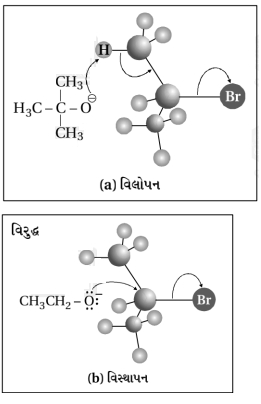
0 likes
View Solution777
MediumMCQ
Which of the compounds will react faster in an $S_N1$ reaction?
$CH_3-CH_2-Cl$ and $C_6H_5-CH_2-Cl$
$CH_3-CH_2-Cl$ and $C_6H_5-CH_2-Cl$
A
$CH_3-CH_2-Cl$
B
$C_6H_5-CH_2-Cl$
C
Both react at the same rate
D
None of the above
Solution
(B) $C_6H_5-CH_2-Cl$ will react faster in an $S_N1$ reaction.
The rate of an $S_N1$ reaction depends on the stability of the carbocation intermediate formed in the rate-determining step.
$CH_3-CH_2-Cl$ forms a primary ethyl carbocation $(CH_3-CH_2^+)$,which is relatively unstable.
$C_6H_5-CH_2-Cl$ forms a benzyl carbocation $(C_6H_5-CH_2^+)$,which is significantly more stable due to resonance stabilization by the benzene ring,as shown in the image.
The rate of an $S_N1$ reaction depends on the stability of the carbocation intermediate formed in the rate-determining step.
$CH_3-CH_2-Cl$ forms a primary ethyl carbocation $(CH_3-CH_2^+)$,which is relatively unstable.
$C_6H_5-CH_2-Cl$ forms a benzyl carbocation $(C_6H_5-CH_2^+)$,which is significantly more stable due to resonance stabilization by the benzene ring,as shown in the image.
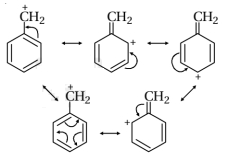
0 likes
View Solution778
Medium
Why is the solubility of haloalkanes in water very low?
Solution
(N/A) Haloalkanes are polar molecules,but they are not able to form hydrogen bonds with water molecules.
For a substance to dissolve in water,the energy released during the formation of new solute-solvent interactions must be sufficient to overcome the energy required to break the existing solute-solute and solvent-solvent interactions.
In the case of haloalkanes,the new intermolecular attractions between haloalkanes and water are much weaker than the strong hydrogen bonds existing between water molecules.
Therefore,the energy required to break the hydrogen bonds in water is not compensated by the energy released during the formation of new interactions,resulting in very low solubility.
For a substance to dissolve in water,the energy released during the formation of new solute-solvent interactions must be sufficient to overcome the energy required to break the existing solute-solute and solvent-solvent interactions.
In the case of haloalkanes,the new intermolecular attractions between haloalkanes and water are much weaker than the strong hydrogen bonds existing between water molecules.
Therefore,the energy required to break the hydrogen bonds in water is not compensated by the energy released during the formation of new interactions,resulting in very low solubility.
0 likes
View Solution779
Advanced
Compound $A$ with molecular formula $C_4H_9Br$ is treated with aqueous $KOH$ solution. The rate of this reaction depends upon the concentration of compound $A$ only. When another optically active isomer $B$ of this compound was treated with aqueous $KOH$ solution,the rate of reaction was found to be dependent on the concentration of both the compound and $KOH$.
$(i)$ Write down the structural formula of both compounds $A$ and $B$.
$(ii)$ Out of these two compounds,which one will be converted to the product with inverted configuration?
$(i)$ Write down the structural formula of both compounds $A$ and $B$.
$(ii)$ Out of these two compounds,which one will be converted to the product with inverted configuration?
Solution
(B) $(i)$ Compound $A$ is $2$-bromo-$2$-methylpropane,$(CH_3)_3CBr$. Its reaction with aqueous $KOH$ follows $S_N1$ mechanism,where the rate depends only on the concentration of the alkyl halide.
Compound $B$ is $2$-bromobutane,$CH_3CH(Br)CH_2CH_3$. It is optically active and its reaction with aqueous $KOH$ follows $S_N2$ mechanism,where the rate depends on the concentration of both the alkyl halide and the nucleophile $(OH^-)$.
$(ii)$ Compound $B$ will be converted to the product with inverted configuration because $S_N2$ reactions proceed with Walden inversion.
Compound $B$ is $2$-bromobutane,$CH_3CH(Br)CH_2CH_3$. It is optically active and its reaction with aqueous $KOH$ follows $S_N2$ mechanism,where the rate depends on the concentration of both the alkyl halide and the nucleophile $(OH^-)$.
$(ii)$ Compound $B$ will be converted to the product with inverted configuration because $S_N2$ reactions proceed with Walden inversion.
0 likes
View Solution780
Medium
Which of the following haloalkanes reacts with aqueous $KOH$ most easily? Explain giving reason.
$(i)$ $1$-Bromobutane
$(ii)$ $2$-Bromobutane
$(iii)$ $2$-Bromo-$2$-methylpropane
$(iv)$ $2$-Chlorobutane
$(i)$ $1$-Bromobutane
$(ii)$ $2$-Bromobutane
$(iii)$ $2$-Bromo-$2$-methylpropane
$(iv)$ $2$-Chlorobutane
Solution
(C) $(iii)$ $2$-Bromo-$2$-methylpropane reacts most easily with aqueous $KOH$.
Reason: The reaction follows the $S_N1$ mechanism. The rate-determining step involves the formation of a carbocation intermediate. Since $2$-Bromo-$2$-methylpropane is a $3^{\circ}$-alkyl halide,it forms a stable $3^{\circ}$-carbocation,which is more stable than the carbocations formed by $1^{\circ}$ or $2^{\circ}$ alkyl halides. Thus,it reacts most readily.
Reason: The reaction follows the $S_N1$ mechanism. The rate-determining step involves the formation of a carbocation intermediate. Since $2$-Bromo-$2$-methylpropane is a $3^{\circ}$-alkyl halide,it forms a stable $3^{\circ}$-carbocation,which is more stable than the carbocations formed by $1^{\circ}$ or $2^{\circ}$ alkyl halides. Thus,it reacts most readily.
0 likes
View Solution781
MediumMCQ
Which of the following compounds would undergo $S_N1$ reaction faster and why?
$(A)$ Cyclohexylmethyl chloride
$(B)$ Benzyl chloride
$(A)$ Cyclohexylmethyl chloride
$(B)$ Benzyl chloride
A
Cyclohexylmethyl chloride
B
Benzyl chloride
Solution
(B) The rate of $S_N1$ reaction depends on the stability of the carbocation intermediate formed during the rate-determining step.
In compound $(B)$ (benzyl chloride),the carbocation formed is the benzyl carbocation $(C_6H_5CH_2^+)$,which is resonance-stabilized by the benzene ring.
In compound $(A)$ (cyclohexylmethyl chloride),the carbocation formed is a primary alkyl carbocation,which is not resonance-stabilized and is less stable than the benzyl carbocation.
Since the benzyl carbocation is more stable,compound $(B)$ will undergo $S_N1$ reaction faster than compound $(A)$.
In compound $(B)$ (benzyl chloride),the carbocation formed is the benzyl carbocation $(C_6H_5CH_2^+)$,which is resonance-stabilized by the benzene ring.
In compound $(A)$ (cyclohexylmethyl chloride),the carbocation formed is a primary alkyl carbocation,which is not resonance-stabilized and is less stable than the benzyl carbocation.
Since the benzyl carbocation is more stable,compound $(B)$ will undergo $S_N1$ reaction faster than compound $(A)$.
0 likes
View Solution782
Medium
Allyl chloride is hydrolysed more readily than $n-$propyl chloride. Why?
Solution
(N/A) Allyl chloride $(CH_2=CH-CH_2Cl)$ undergoes hydrolysis more readily than $n-$propyl chloride $(CH_3-CH_2-CH_2Cl)$ because the carbocation formed from allyl chloride,which is the allyl carbocation $(CH_2=CH-CH_2^+)$,is stabilized by resonance.
The resonance structures are:
$[CH_2=CH-CH_2^+ \leftrightarrow ^+CH_2-CH=CH_2]$
In contrast,the carbocation formed from $n-$propyl chloride is a primary carbocation $(CH_3-CH_2-CH_2^+)$,which lacks such resonance stabilization,making it less stable and thus less reactive towards hydrolysis.
The resonance structures are:
$[CH_2=CH-CH_2^+ \leftrightarrow ^+CH_2-CH=CH_2]$
In contrast,the carbocation formed from $n-$propyl chloride is a primary carbocation $(CH_3-CH_2-CH_2^+)$,which lacks such resonance stabilization,making it less stable and thus less reactive towards hydrolysis.
0 likes
View Solution783
Medium
Why is it necessary to avoid even traces of moisture during the use of a Grignard reagent?
Solution
(N/A) Grignard reagents are highly reactive organometallic compounds. They act as strong bases and react rapidly with even traces of moisture (water) to form the corresponding alkanes.
$R-MgX + H_2O \rightarrow R-H + Mg(OH)X$
$R-MgX + H_2O \rightarrow R-H + Mg(OH)X$
0 likes
View Solution784
Medium
How do polar solvents help in the first step in $S_{N}1$ mechanism?
Solution
(N/A) Polar solvents possess a high dielectric constant,which facilitates the ionization of the $C-X$ bond in alkyl halides to form a carbocation intermediate.
Specifically,the role of the polar solvent is:
$(i)$ To stabilize the transition state and promote the ionization of the alkyl halide to form a carbocation.
$(ii)$ To solvate the resulting ions (carbocation and halide ion) through ion-dipole interactions,thereby preventing their recombination.
Specifically,the role of the polar solvent is:
$(i)$ To stabilize the transition state and promote the ionization of the alkyl halide to form a carbocation.
$(ii)$ To solvate the resulting ions (carbocation and halide ion) through ion-dipole interactions,thereby preventing their recombination.
0 likes
View Solution785
DifficultMCQ
Elimination reactions (especially $\beta$-elimination) are as common as the nucleophilic substitution reaction in the case of alkyl halides. Specify the reagents used in both cases.
A
Substitution: Aqueous $KOH$; Elimination: Alcoholic $KOH$
B
Substitution: Alcoholic $KOH$; Elimination: Aqueous $KOH$
C
Substitution: $NaOC_2H_5$; Elimination: $NaOH$
D
Substitution: $H_2O$; Elimination: $H_2SO_4$
Solution
(A) In the case of alkyl halides,the nature of the reagent determines whether substitution or elimination occurs.
$1$. Nucleophilic substitution: When an alkyl halide is treated with an aqueous solution of a strong base like $KOH$ or $NaOH$,the $OH^-$ ion acts as a nucleophile and replaces the halogen atom,resulting in an alcohol.
$2$. $\beta$-Elimination (Dehydrohalogenation): When an alkyl halide is treated with an alcoholic solution of a strong base like $KOH$,the $OH^-$ ion acts as a base and abstracts a proton from the $\beta$-carbon,leading to the formation of an alkene.
$1$. Nucleophilic substitution: When an alkyl halide is treated with an aqueous solution of a strong base like $KOH$ or $NaOH$,the $OH^-$ ion acts as a nucleophile and replaces the halogen atom,resulting in an alcohol.
$2$. $\beta$-Elimination (Dehydrohalogenation): When an alkyl halide is treated with an alcoholic solution of a strong base like $KOH$,the $OH^-$ ion acts as a base and abstracts a proton from the $\beta$-carbon,leading to the formation of an alkene.
0 likes
View Solution786
Medium
$tert$-Butylbromide reacts with $aq.$ $NaOH$ by $S_N1$ mechanism while $n$-butylbromide reacts by $S_N2$ mechanism. Why?
Solution
(N/A) $tert$-Butylbromide is a tertiary $(3^{\circ})$ alkyl halide. The carbocation formed after the loss of the leaving group $(Br^-)$ is a tertiary carbocation,which is highly stable due to the inductive effect and hyperconjugation of the three methyl groups. Thus,it prefers the $S_N1$ mechanism.
$n$-Butylbromide is a primary $(1^{\circ})$ alkyl halide. The formation of a primary carbocation is energetically unfavorable due to its low stability. Furthermore,the primary carbon is less sterically hindered,allowing the nucleophile $(OH^-)$ to attack from the back side,which is the characteristic step of the $S_N2$ mechanism.
$n$-Butylbromide is a primary $(1^{\circ})$ alkyl halide. The formation of a primary carbocation is energetically unfavorable due to its low stability. Furthermore,the primary carbon is less sterically hindered,allowing the nucleophile $(OH^-)$ to attack from the back side,which is the characteristic step of the $S_N2$ mechanism.
0 likes
View Solution787
Medium
Give the chemical reactions for the following conversions:
$(1)$ Tertiary butyl alcohol from $1-$bromo$-2-$methylpropane
$(2)$ Ethanol from $1,2-$dibromoethane
$(1)$ Tertiary butyl alcohol from $1-$bromo$-2-$methylpropane
$(2)$ Ethanol from $1,2-$dibromoethane
Solution
(N/A) $(1)$ Conversion of $1-$bromo$-2-$methylpropane to tertiary butyl alcohol:
$CH_3-CH(CH_3)-CH_2Br$ $\xrightarrow{\text{alc. KOH}} CH_3-C(CH_3)=CH_2$ $\xrightarrow{H_2O/H^+} CH_3-C(OH)(CH_3)-CH_3$
$(2)$ Conversion of $1,2-$dibromoethane to ethanol:
$CH_2Br-CH_2Br$ $\xrightarrow{Zn, \Delta} CH_2=CH_2$ $\xrightarrow{H_2O/H^+} CH_3-CH_2OH$
$CH_3-CH(CH_3)-CH_2Br$ $\xrightarrow{\text{alc. KOH}} CH_3-C(CH_3)=CH_2$ $\xrightarrow{H_2O/H^+} CH_3-C(OH)(CH_3)-CH_3$
$(2)$ Conversion of $1,2-$dibromoethane to ethanol:
$CH_2Br-CH_2Br$ $\xrightarrow{Zn, \Delta} CH_2=CH_2$ $\xrightarrow{H_2O/H^+} CH_3-CH_2OH$
0 likes
View Solution788
MediumMCQ
Among $CH_3F$,$CH_3Cl$,$CH_3Br$,and $CH_3I$,which one does not give methane on reduction?
A
$CH_3F$
B
$CH_3Cl$
C
$CH_3Br$
D
$CH_3I$
Solution
(A) The reduction of alkyl halides $(RX)$ to alkanes $(RH)$ is typically carried out using reagents like $Zn/HCl$,$HI/Red \ P$,or $LiAlH_4$.
While $CH_3Cl$,$CH_3Br$,and $CH_3I$ are easily reduced to methane $(CH_4)$,$CH_3F$ is not easily reduced under standard laboratory conditions due to the very high bond dissociation energy of the $C-F$ bond.
Therefore,$CH_3F$ does not give methane on reduction.
While $CH_3Cl$,$CH_3Br$,and $CH_3I$ are easily reduced to methane $(CH_4)$,$CH_3F$ is not easily reduced under standard laboratory conditions due to the very high bond dissociation energy of the $C-F$ bond.
Therefore,$CH_3F$ does not give methane on reduction.
0 likes
View Solution789
Medium
What do you mean by dehydrohalogenation?
Solution
(N/A) Dehydrohalogenation is the elimination reaction in which a hydrogen atom and a halogen atom are removed from adjacent carbon atoms of an alkyl halide to form an alkene. The general reaction is: $R-CH_2-CH(X)-R' + KOH (\text{alc.}) \rightarrow R-CH=CH-R' + KX + H_2O$.
0 likes
View Solution790
Medium
Which compounds give $\beta$-elimination reactions? What are their main products?
Solution
(N/A) $(i)$ Alkyl halides and $(ii)$ alcohols undergo $\beta$-elimination reactions. The main product of these reactions is an alkene.
0 likes
View Solution791
Medium
What is dehydrohalogenation?
Solution
(N/A) The process of removal of a hydrogen atom and a halogen atom from adjacent carbon atoms in an alkyl halide,resulting in the formation of an alkene,is called dehydrohalogenation. It involves the elimination of a hydrogen halide molecule $(HX)$.
0 likes
View Solution792
MediumMCQ
Which type of rate is observed in dehydrohalogenation ($\beta$-elimination) reaction of alkyl halide?
A
Rate depends on the nature of the alkyl group: $3^{\circ} > 2^{\circ} > 1^{\circ}$
B
Rate depends on the leaving group: $I > Br > Cl$
C
Both $A$ and $B$
D
None of these
Solution
(C) $(i)$ The rate of dehydrohalogenation reaction for alkyl groups follows the order: $3^{\circ} > 2^{\circ} > 1^{\circ}$ due to the stability of the transition state leading to the more substituted alkene (Saytzeff rule).
$(ii)$ The rate of reaction depends on the leaving group ability of the halogen atom,which follows the order: $I > Br > Cl$.
$(ii)$ The rate of reaction depends on the leaving group ability of the halogen atom,which follows the order: $I > Br > Cl$.
0 likes
View Solution793
Difficult
Some alkyl halides undergo substitution whereas some undergo elimination reaction on treatment with bases. Discuss the structural features of alkyl halides with the help of examples which are responsible for this difference.
Solution
(N/A) The competition between substitution and elimination reactions in alkyl halides depends on several structural and reaction conditions:
$1$. Nature of Alkyl Halide: Primary $(1^{\circ})$ alkyl halides prefer substitution $(S_N2)$ due to less steric hindrance. Tertiary $(3^{\circ})$ alkyl halides prefer elimination $(E2)$ due to high steric hindrance around the electrophilic carbon,which hinders nucleophilic attack but facilitates the removal of a $\beta$-hydrogen by a base.
$2$. Nature of Base: Strong and bulky bases favor elimination,while weaker or less hindered bases favor substitution.
$3$. Solvent and Temperature: High temperatures generally favor elimination (as it is entropy-favored),while lower temperatures favor substitution.
Examples:
- Substitution: $CH_3CH_2Cl + KOH(aq) \rightarrow CH_3CH_2OH + KCl$.
- Elimination: $CH_3CH_2Cl + KOH(alc) \rightarrow CH_2=CH_2 + KCl + H_2O$.
$1$. Nature of Alkyl Halide: Primary $(1^{\circ})$ alkyl halides prefer substitution $(S_N2)$ due to less steric hindrance. Tertiary $(3^{\circ})$ alkyl halides prefer elimination $(E2)$ due to high steric hindrance around the electrophilic carbon,which hinders nucleophilic attack but facilitates the removal of a $\beta$-hydrogen by a base.
$2$. Nature of Base: Strong and bulky bases favor elimination,while weaker or less hindered bases favor substitution.
$3$. Solvent and Temperature: High temperatures generally favor elimination (as it is entropy-favored),while lower temperatures favor substitution.
Examples:
- Substitution: $CH_3CH_2Cl + KOH(aq) \rightarrow CH_3CH_2OH + KCl$.
- Elimination: $CH_3CH_2Cl + KOH(alc) \rightarrow CH_2=CH_2 + KCl + H_2O$.
0 likes
View Solution794
Difficult
Match the $CH_{3}X$ compounds in Column-$(I)$ with their $C-X$ bond length in Column-$(II)$ and dipole moment in Column-$(III)$.
| $(I)$ Compound | $(II)$ $C-X$ Bond Length $(pm)$ | $(III)$ Dipole Moment $(D)$ |
| $(A)$ $H_3C-F$ | $(i)$ $214$ | $(1)$ $1.636$ |
| $(B)$ $H_3C-Cl$ | $(ii)$ $193$ | $(2)$ $1.830$ |
| $(C)$ $H_3C-Br$ | $(iii)$ $178$ | $(3)$ $1.847$ |
| $(D)$ $H_3C-I$ | $(iv)$ $139$ | $(4)$ $1.860$ |
Solution
(A) The bond length increases as the size of the halogen atom increases: $C-I > C-Br > C-Cl > C-F$. Thus, $(A-iv, B-iii, C-ii, D-i)$.
For dipole moment, the order is $CH_3Cl > CH_3F > CH_3Br > CH_3I$ due to the balance between electronegativity and bond length. The values are: $CH_3Cl (1.860 \ D)$, $CH_3F (1.847 \ D)$, $CH_3Br (1.830 \ D)$, $CH_3I (1.636 \ D)$.
Matching the values: $(A-4, B-1, C-2, D-3)$.
Correct matching: $(A-iv, 4; B-iii, 1; C-ii, 2; D-i, 3)$.
For dipole moment, the order is $CH_3Cl > CH_3F > CH_3Br > CH_3I$ due to the balance between electronegativity and bond length. The values are: $CH_3Cl (1.860 \ D)$, $CH_3F (1.847 \ D)$, $CH_3Br (1.830 \ D)$, $CH_3I (1.636 \ D)$.
Matching the values: $(A-4, B-1, C-2, D-3)$.
Correct matching: $(A-iv, 4; B-iii, 1; C-ii, 2; D-i, 3)$.
0 likes
View Solution795
Medium
Explain isomerism in Haloalkanes.
Solution
(N/A) Haloalkanes exhibit three types of isomerism:
$(i)$ Chain isomerism: When two or more haloalkanes with the same molecular formula differ in the length of the carbon chain,they are called chain isomers.
Example: $CH_3-CH_2-CH_2-CH_2-Cl$ ($1$-chlorobutane) and $CH_3-CH(CH_3)-CH_2-Cl$ ($1$-chloro-$2$-methylpropane).
$(ii)$ Position isomerism: When two or more haloalkanes with the same molecular formula differ in the position of the halogen atom attached to the carbon chain,they are called position isomers.
Example: $CH_3-CH_2-CH_2-Cl$ ($1$-chloropropane) and $CH_3-CHCl-CH_3$ ($2$-chloropropane).
$(iii)$ Optical isomerism: Haloalkanes that have the same molecular and structural formula but differ in the spatial arrangement of atoms or groups around a chiral carbon atom,resulting in the rotation of plane-polarized light,are called optical isomers.
Example: The two enantiomers of $2$-chlorobutane.
$(i)$ Chain isomerism: When two or more haloalkanes with the same molecular formula differ in the length of the carbon chain,they are called chain isomers.
Example: $CH_3-CH_2-CH_2-CH_2-Cl$ ($1$-chlorobutane) and $CH_3-CH(CH_3)-CH_2-Cl$ ($1$-chloro-$2$-methylpropane).
$(ii)$ Position isomerism: When two or more haloalkanes with the same molecular formula differ in the position of the halogen atom attached to the carbon chain,they are called position isomers.
Example: $CH_3-CH_2-CH_2-Cl$ ($1$-chloropropane) and $CH_3-CHCl-CH_3$ ($2$-chloropropane).
$(iii)$ Optical isomerism: Haloalkanes that have the same molecular and structural formula but differ in the spatial arrangement of atoms or groups around a chiral carbon atom,resulting in the rotation of plane-polarized light,are called optical isomers.
Example: The two enantiomers of $2$-chlorobutane.
0 likes
View Solution796
MediumMCQ
The major product obtained from $E_{2}$-elimination of $3$-bromo-$2$-fluoropentane is
A
$CH_3CH_2CH(Br)CH=CH_2$
B
$CH_3CH_2C(Br)=CHCH_3$
C
$CH_3CH=CHCH(F)CH_3$
D
$CH_3CH_2CH=C(F)CH_3$
Solution
(D) In $E_{2}$-elimination,a base removes a proton from the $\beta$-carbon while the leaving group departs from the $\alpha$-carbon.
For $3$-bromo-$2$-fluoropentane $(CH_3-CH_2-CH(Br)-CH(F)-CH_3)$,there are two potential $\beta$-carbons: $C_{2}$ (bearing $F$) and $C_{4}$ (bearing $H$).
$Br^-$ is a much better leaving group than $F^-$. Therefore,the elimination occurs primarily at the $C_{3}$ position (where $Br$ is attached) and the $C_{2}$ position (where $H$ is attached).
The base abstracts the more acidic proton from $C_{2}$ (which is adjacent to the electron-withdrawing $F$ atom).
This leads to the formation of $CH_3-CH_2-CH=C(F)-CH_3$ as the major product,which is a stable alkene with $5$ $\alpha$-hydrogens.
For $3$-bromo-$2$-fluoropentane $(CH_3-CH_2-CH(Br)-CH(F)-CH_3)$,there are two potential $\beta$-carbons: $C_{2}$ (bearing $F$) and $C_{4}$ (bearing $H$).
$Br^-$ is a much better leaving group than $F^-$. Therefore,the elimination occurs primarily at the $C_{3}$ position (where $Br$ is attached) and the $C_{2}$ position (where $H$ is attached).
The base abstracts the more acidic proton from $C_{2}$ (which is adjacent to the electron-withdrawing $F$ atom).
This leads to the formation of $CH_3-CH_2-CH=C(F)-CH_3$ as the major product,which is a stable alkene with $5$ $\alpha$-hydrogens.
0 likes
View Solution797
MediumMCQ
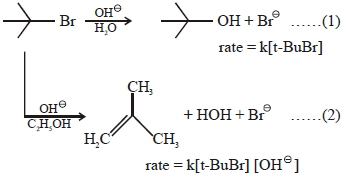
Consider the reaction sequence given below. Which of the following statements is true?
A
Changing the concentration of base will have no effect on reaction $(1)$.
B
Changing the concentration of base will have no effect on reaction $(2)$.
C
Changing the base from $OH^{\ominus}$ to $OR^{\ominus}$ will have no effect on reaction $(2)$.
D
Doubling the concentration of base will double the rate of both the reactions.
Solution
(A) Reaction $(1)$ is an $SN_{1}$ reaction. The rate law is given as $\text{rate} = k[t-BuBr]$. Since the rate is independent of the concentration of the nucleophile/base,changing the concentration of the base will have no effect on reaction $(1)$.
Reaction $(2)$ is an $E_{2}$ reaction. The rate law is given as $\text{rate} = k[t-BuBr][OH^{\ominus}]$. Since the rate depends on the concentration of the base,changing the concentration of the base will affect the rate of reaction $(2)$.
Therefore,the statement that changing the concentration of base will have no effect on reaction $(1)$ is true.
Reaction $(2)$ is an $E_{2}$ reaction. The rate law is given as $\text{rate} = k[t-BuBr][OH^{\ominus}]$. Since the rate depends on the concentration of the base,changing the concentration of the base will affect the rate of reaction $(2)$.
Therefore,the statement that changing the concentration of base will have no effect on reaction $(1)$ is true.
0 likes
View Solution798
MediumMCQ
Which of the following compounds will show retention in configuration on nucleophilic substitution by $OH^{-}$ ion?
A
$CH_3-CH(C_2H_5)-CH_2-Br$
B
$CH_3-CH(C_6H_5)-Br$
C
$CH_3-CH(CH_3)-Br$
D
$CH_3-CH(C_6H_{13})-Br$
Solution
(A) In the compound $CH_3-CH(C_2H_5)-CH_2-Br$,the chiral center is located at the second carbon atom $(C2)$.
The nucleophilic substitution by the $OH^{-}$ ion occurs at the first carbon atom $(C1)$,where the $Br$ atom is attached.
Since the bonds connected to the chiral center are not broken or modified during the reaction,the spatial arrangement (configuration) around the chiral center remains unchanged.
This results in the retention of configuration.
The nucleophilic substitution by the $OH^{-}$ ion occurs at the first carbon atom $(C1)$,where the $Br$ atom is attached.
Since the bonds connected to the chiral center are not broken or modified during the reaction,the spatial arrangement (configuration) around the chiral center remains unchanged.
This results in the retention of configuration.
0 likes
View Solution799
MediumMCQ
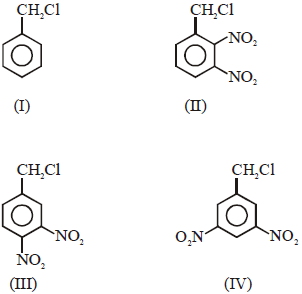
The decreasing order of reactivity of the following compounds towards nucleophilic substitution $(S_{N}2)$ is :
A
$(IV) > (II) > (III) > (I)$
B
$(II) > (III) > (IV) > (I)$
C
$(II) > (III) > (I) > (IV)$
D
$(III) > (II) > (IV) > (I)$
Solution
(B) The reactivity of benzyl halides towards $S_{N}2$ reactions is primarily governed by the electronic effects of substituents on the benzene ring. Electron-withdrawing groups (EWGs) like $-NO_2$ increase the reactivity towards $S_{N}2$ by stabilizing the transition state through their $-I$ (inductive) and $-R$ (resonance) effects.
In compound $(II)$,the two $-NO_2$ groups are at the ortho and meta positions,exerting strong $-I$ and $-R$ effects.
In compound $(III)$,the two $-NO_2$ groups are at the meta and para positions,exerting $-I$ and $-R$ effects,but the overall electron-withdrawing strength is slightly less than in $(II)$ due to the positioning.
In compound $(IV)$,the two $-NO_2$ groups are at the meta positions,exerting only $-I$ effects.
Compound $(I)$ has no electron-withdrawing groups.
Therefore,the decreasing order of reactivity is $(II) > (III) > (IV) > (I)$.
In compound $(II)$,the two $-NO_2$ groups are at the ortho and meta positions,exerting strong $-I$ and $-R$ effects.
In compound $(III)$,the two $-NO_2$ groups are at the meta and para positions,exerting $-I$ and $-R$ effects,but the overall electron-withdrawing strength is slightly less than in $(II)$ due to the positioning.
In compound $(IV)$,the two $-NO_2$ groups are at the meta positions,exerting only $-I$ effects.
Compound $(I)$ has no electron-withdrawing groups.
Therefore,the decreasing order of reactivity is $(II) > (III) > (IV) > (I)$.
1 likes
View Solution800
MediumMCQ
The mechanism of $S_{N}1$ reaction is given as:
$R-X$ $\rightarrow R^{\oplus} X^{\ominus}$ $\rightarrow R^{\oplus} | X^{\ominus}$ $\xrightarrow{Y^{\ominus}} R-Y + X^{\ominus}$
(Ion pair) (Solvent separated ion pair)
$A$ student writes general characteristics based on the given mechanism as:
$(a)$ The reaction is favoured by weak nucleophiles
$(b)$ $R^{\oplus}$ would be easily formed if the substituents are bulky
$(c)$ The reaction is accompanied by racemization
$(d)$ The reaction is favoured by non-polar solvents.
Which observations are correct?
$R-X$ $\rightarrow R^{\oplus} X^{\ominus}$ $\rightarrow R^{\oplus} | X^{\ominus}$ $\xrightarrow{Y^{\ominus}} R-Y + X^{\ominus}$
(Ion pair) (Solvent separated ion pair)
$A$ student writes general characteristics based on the given mechanism as:
$(a)$ The reaction is favoured by weak nucleophiles
$(b)$ $R^{\oplus}$ would be easily formed if the substituents are bulky
$(c)$ The reaction is accompanied by racemization
$(d)$ The reaction is favoured by non-polar solvents.
Which observations are correct?
A
$b$ and $d$
B
$a, b$ and $c$
C
$a$ and $c$
D
$a$ and $b$
Solution
(B) $S_{N}1$ reaction mechanism characteristics:
$(a)$ $S_{N}1$ reactions are favoured by weak nucleophiles because the rate-determining step is the formation of the carbocation,which does not involve the nucleophile.
$(b)$ Bulky substituents around the carbocation center relieve steric strain upon the formation of $R^{\oplus}$ (which is $sp^2$ hybridized),thus facilitating its formation.
$(c)$ Since the carbocation intermediate is planar,the nucleophile can attack from either side,leading to racemization.
$(d)$ $S_{N}1$ reactions are favoured by polar protic solvents,not non-polar solvents,as they stabilize the ionic intermediates ($R^{\oplus}$ and $X^{\ominus}$) through solvation.
Therefore,statements $(a), (b),$ and $(c)$ are correct.
$(a)$ $S_{N}1$ reactions are favoured by weak nucleophiles because the rate-determining step is the formation of the carbocation,which does not involve the nucleophile.
$(b)$ Bulky substituents around the carbocation center relieve steric strain upon the formation of $R^{\oplus}$ (which is $sp^2$ hybridized),thus facilitating its formation.
$(c)$ Since the carbocation intermediate is planar,the nucleophile can attack from either side,leading to racemization.
$(d)$ $S_{N}1$ reactions are favoured by polar protic solvents,not non-polar solvents,as they stabilize the ionic intermediates ($R^{\oplus}$ and $X^{\ominus}$) through solvation.
Therefore,statements $(a), (b),$ and $(c)$ are correct.
0 likes
View SolutionHaloalkanes and Haloarenes — Properties of Haloalkanes · Frequently Asked Questions
1Are these Haloalkanes and Haloarenes questions useful for JEE and NEET?
Yes. All questions in this section are mapped to JEE Main and NEET exam patterns. Previous year questions from JEE Main, NEET, GUJCET and state-level exams are included with full solutions.
2Can I switch to Hindi or Gujarati for these questions?
Yes. Use the language tabs in the hero section or the sidebar to view the same questions and solutions in English, Hindi or Gujarati.
3How do I generate a question paper from this subtopic?
Use the Vedclass Exam Paper Generator — select the chapter and subtopic, set difficulty, and generate Sets A, B, C, D automatically. First 3 chapters of every subject are free.
Vedclass Products
For Students
Vedclass Test Series
Mock tests in real JEE/NEET style with performance analysis. 5-day free trial.
Start Free TrialFor Teachers
Exam Paper Generator
Generate Set A/B/C/D papers from this chapter in 2 minutes. 3 chapters free.
Try FreeFor Institutes
Online Exam Module
Live online exams with unlimited students, 360° analytics & white-label branding.
See DemoFor Teachers & Institutes
Generate a Haloalkanes and Haloarenes Exam Paper in 2 Minutes
Select subtopic & difficulty — Sets A, B, C, D auto-generated with No Repeat logic.
First 3 chapters of every subject are free — no payment required.