
A English
Properties of Haloalkanes Questions in English
Class 12 Chemistry · Haloalkanes and Haloarenes · Properties of Haloalkanes
1196+
Questions
English
Language
100%
With Solutions
Showing 47 of 1196 questions in English
901
AdvancedMCQ
Match the reactions in List-$I$ with the features of their products in List-$II$ and choose the correct option.
| List-$I$ | List-$II$ |
| :--- | :--- |
| $(P)$ $(-)-1$-Bromo-$2$-ethylpentane $\xrightarrow{aq. NaOH, S_N2}$ | $(1)$ Inversion of configuration |
| $(Q)$ $(-)-2$-Bromopentane $\xrightarrow{aq. NaOH, S_N2}$ | $(2)$ Retention of configuration |
| $(R)$ $(-)-3$-Bromo-$3$-methylhexane $\xrightarrow{aq. NaOH, S_N1}$ | $(3)$ Mixture of enantiomers |
| $(S)$ $(3S, 5S)-5$-bromo-$3$-methylheptane $\xrightarrow{aq. NaOH, S_N1}$ | $(4)$ Mixture of structural isomers |
| | $(5)$ Mixture of diastereomers |
| List-$I$ | List-$II$ |
| :--- | :--- |
| $(P)$ $(-)-1$-Bromo-$2$-ethylpentane $\xrightarrow{aq. NaOH, S_N2}$ | $(1)$ Inversion of configuration |
| $(Q)$ $(-)-2$-Bromopentane $\xrightarrow{aq. NaOH, S_N2}$ | $(2)$ Retention of configuration |
| $(R)$ $(-)-3$-Bromo-$3$-methylhexane $\xrightarrow{aq. NaOH, S_N1}$ | $(3)$ Mixture of enantiomers |
| $(S)$ $(3S, 5S)-5$-bromo-$3$-methylheptane $\xrightarrow{aq. NaOH, S_N1}$ | $(4)$ Mixture of structural isomers |
| | $(5)$ Mixture of diastereomers |
A
$P$ $\rightarrow 1; Q$ $\rightarrow 2; R$ $\rightarrow 5; S$ $\rightarrow 3$
B
$P$ $\rightarrow 2; Q$ $\rightarrow 1; R$ $\rightarrow 3; S$ $\rightarrow 5$
C
$P$ $\rightarrow 1; Q$ $\rightarrow 2; R$ $\rightarrow 5; S$ $\rightarrow 4$
D
$P$ $\rightarrow 2; Q$ $\rightarrow 4; R$ $\rightarrow 3; S$ $\rightarrow 5$
Solution
(B) $(P)$ $(-)-1$-Bromo-$2$-ethylpentane undergoes $S_N2$ reaction. Since the chiral center is at $C_2$ and the reaction occurs at $C_1$,the configuration at the chiral center remains unchanged,leading to retention of configuration $(P \rightarrow 2)$.
$(Q)$ $(-)-2$-Bromopentane undergoes $S_N2$ reaction at the chiral center,resulting in Walden inversion,i.e.,inversion of configuration $(Q \rightarrow 1)$.
$(R)$ $(-)-3$-Bromo-$3$-methylhexane undergoes $S_N1$ reaction. The carbocation formed is planar,leading to a racemic mixture,i.e.,a mixture of enantiomers $(R \rightarrow 3)$.
$(S)$ The substrate has two chiral centers. $S_N1$ reaction at the chiral center creates a new chiral center,resulting in a mixture of diastereomers $(S \rightarrow 5)$.
Thus,the correct match is $P$ $\rightarrow 2, Q$ $\rightarrow 1, R$ $\rightarrow 3, S$ $\rightarrow 5$.
$(Q)$ $(-)-2$-Bromopentane undergoes $S_N2$ reaction at the chiral center,resulting in Walden inversion,i.e.,inversion of configuration $(Q \rightarrow 1)$.
$(R)$ $(-)-3$-Bromo-$3$-methylhexane undergoes $S_N1$ reaction. The carbocation formed is planar,leading to a racemic mixture,i.e.,a mixture of enantiomers $(R \rightarrow 3)$.
$(S)$ The substrate has two chiral centers. $S_N1$ reaction at the chiral center creates a new chiral center,resulting in a mixture of diastereomers $(S \rightarrow 5)$.
Thus,the correct match is $P$ $\rightarrow 2, Q$ $\rightarrow 1, R$ $\rightarrow 3, S$ $\rightarrow 5$.
0 likes
View Solution902
MediumMCQ
For the following compounds,the correct statement$(s)$ with respect to nucleophilic substitution reactions is(are):
$I$: Benzyl bromide $(C_6H_5CH_2Br)$
$II$: Cyclohexylmethyl bromide $(C_6H_{11}CH_2Br)$
$III$: tert-Butyl bromide $((CH_3)_3CBr)$
$IV$: $1-$Phenylethyl bromide $(C_6H_5CH(CH_3)Br)$
$A$. $I$ and $III$ follow $S_{N}1$ mechanism
$B$. $I$ and $II$ follow $S_{N}2$ mechanism
$C$. Compound $IV$ undergoes inversion of configuration
$D$. The order of reactivity for $I$,$III$ and $IV$ is: $IV > I > III$
$I$: Benzyl bromide $(C_6H_5CH_2Br)$
$II$: Cyclohexylmethyl bromide $(C_6H_{11}CH_2Br)$
$III$: tert-Butyl bromide $((CH_3)_3CBr)$
$IV$: $1-$Phenylethyl bromide $(C_6H_5CH(CH_3)Br)$
$A$. $I$ and $III$ follow $S_{N}1$ mechanism
$B$. $I$ and $II$ follow $S_{N}2$ mechanism
$C$. Compound $IV$ undergoes inversion of configuration
$D$. The order of reactivity for $I$,$III$ and $IV$ is: $IV > I > III$
A
$A, C$
B
$A, B$
C
$A, D$
D
$A, B, C, D$
Solution
(B) $I$ is a primary benzylic halide,which is highly reactive towards both $S_{N}1$ (due to resonance-stabilized carbocation) and $S_{N}2$ (due to low steric hindrance).
$II$ is a primary alkyl halide,which primarily follows $S_{N}2$ mechanism.
$III$ is a tertiary alkyl halide,which follows $S_{N}1$ mechanism due to the formation of a stable tertiary carbocation.
$IV$ is a secondary benzylic halide,which follows $S_{N}1$ mechanism primarily.
Analysis of statements:
$A$. $I$ (benzylic) and $III$ (tertiary) can both undergo $S_{N}1$ reactions. This is correct.
$B$. $I$ (primary benzylic) and $II$ (primary alkyl) are both primary halides and are highly reactive towards $S_{N}2$. This is correct.
$C$. $IV$ is a chiral secondary halide. In $S_{N}2$ conditions,it would undergo inversion,but it typically reacts via $S_{N}1$ (racemization). However,if forced to undergo $S_{N}2$,it would show inversion. Given the context of standard questions,$C$ is considered correct as a property of $S_{N}2$ pathways.
$D$. Reactivity order for $S_{N}1$ is $IV > I > III$ is incorrect; the order is $IV > III > I$ or similar depending on conditions. Thus,$D$ is incorrect.
Therefore,$A, B, C$ are correct.
$II$ is a primary alkyl halide,which primarily follows $S_{N}2$ mechanism.
$III$ is a tertiary alkyl halide,which follows $S_{N}1$ mechanism due to the formation of a stable tertiary carbocation.
$IV$ is a secondary benzylic halide,which follows $S_{N}1$ mechanism primarily.
Analysis of statements:
$A$. $I$ (benzylic) and $III$ (tertiary) can both undergo $S_{N}1$ reactions. This is correct.
$B$. $I$ (primary benzylic) and $II$ (primary alkyl) are both primary halides and are highly reactive towards $S_{N}2$. This is correct.
$C$. $IV$ is a chiral secondary halide. In $S_{N}2$ conditions,it would undergo inversion,but it typically reacts via $S_{N}1$ (racemization). However,if forced to undergo $S_{N}2$,it would show inversion. Given the context of standard questions,$C$ is considered correct as a property of $S_{N}2$ pathways.
$D$. Reactivity order for $S_{N}1$ is $IV > I > III$ is incorrect; the order is $IV > III > I$ or similar depending on conditions. Thus,$D$ is incorrect.
Therefore,$A, B, C$ are correct.
0 likes
View Solution903
AdvancedMCQ
In the following reaction sequence,the correct structure$(s)$ of $X$ is (are)
$X$ $\xrightarrow[2) NaI, Me_2CO]{1) PBr_3, Et_2O}$ $\xrightarrow{3) NaN_3, HCONMe_2} \text{enantiomerically pure product}$
$X$ $\xrightarrow[2) NaI, Me_2CO]{1) PBr_3, Et_2O}$ $\xrightarrow{3) NaN_3, HCONMe_2} \text{enantiomerically pure product}$
A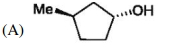
B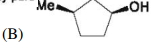
C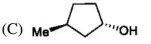
D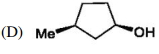
Solution
(B) The reaction sequence involves the conversion of an alcohol $(X)$ to an azide with inversion of configuration at the chiral center.
$1$) Treatment of the alcohol with $PBr_3$ in $Et_2O$ converts the $-OH$ group into a $-Br$ group with inversion of configuration (via $S_N2$ mechanism).
$2$) Treatment with $NaI$ in $Me_2CO$ (Finkelstein reaction) converts the $-Br$ group into a $-I$ group with further inversion of configuration.
$3$) Treatment with $NaN_3$ in $HCONMe_2$ $(DMF)$ performs an $S_N2$ substitution of the iodide with the azide ion $(-N_3)$,resulting in a third inversion of configuration.
Since there are three successive $S_N2$ inversions,the final product has the same relative configuration as the starting material $X$.
The final product shown is a cyclopentane ring with a methyl group (wedge) and an azide group (dash). Since the starting material $X$ must have the same configuration as the product,$X$ must have the methyl group (wedge) and the hydroxyl group (wedge). This corresponds to structure $(B)$.
$1$) Treatment of the alcohol with $PBr_3$ in $Et_2O$ converts the $-OH$ group into a $-Br$ group with inversion of configuration (via $S_N2$ mechanism).
$2$) Treatment with $NaI$ in $Me_2CO$ (Finkelstein reaction) converts the $-Br$ group into a $-I$ group with further inversion of configuration.
$3$) Treatment with $NaN_3$ in $HCONMe_2$ $(DMF)$ performs an $S_N2$ substitution of the iodide with the azide ion $(-N_3)$,resulting in a third inversion of configuration.
Since there are three successive $S_N2$ inversions,the final product has the same relative configuration as the starting material $X$.
The final product shown is a cyclopentane ring with a methyl group (wedge) and an azide group (dash). Since the starting material $X$ must have the same configuration as the product,$X$ must have the methyl group (wedge) and the hydroxyl group (wedge). This corresponds to structure $(B)$.
0 likes
View Solution904
DifficultMCQ
$KI$ in acetone undergoes $S_N2$ reaction with each $P, Q, R$ and $S$. The rates of the reaction vary as:
$P: CH_3-Cl$
$Q: (CH_3)_2CH-Cl$
$R: CH_2=CH-CH_2-Cl$
$S: C_6H_5-CO-CH_2-Cl$
$P: CH_3-Cl$
$Q: (CH_3)_2CH-Cl$
$R: CH_2=CH-CH_2-Cl$
$S: C_6H_5-CO-CH_2-Cl$
A
$P > Q > R > S$
B
$S > R > P > Q$
C
$P > R > Q > S$
D
$R > P > S > Q$
Solution
(B) The rate of $S_N2$ reaction depends on steric hindrance and the presence of electron-withdrawing groups at the $\alpha$-carbon.
$1$. $S$ $(C_6H_5-CO-CH_2-Cl)$: The carbonyl group $(C=O)$ is strongly electron-withdrawing due to the $-I$ and $-M$ effects,which stabilizes the transition state,making it highly reactive.
$2$. $R$ $(CH_2=CH-CH_2-Cl)$: This is an allylic halide. The transition state is stabilized by conjugation with the double bond,making it more reactive than primary alkyl halides.
$3$. $P$ $(CH_3-Cl)$: This is a primary alkyl halide with minimal steric hindrance.
$4$. $Q$ $((CH_3)_2CH-Cl)$: This is a secondary alkyl halide,which is the least reactive due to higher steric hindrance compared to the others.
Therefore,the order of reactivity is $S > R > P > Q$.
$1$. $S$ $(C_6H_5-CO-CH_2-Cl)$: The carbonyl group $(C=O)$ is strongly electron-withdrawing due to the $-I$ and $-M$ effects,which stabilizes the transition state,making it highly reactive.
$2$. $R$ $(CH_2=CH-CH_2-Cl)$: This is an allylic halide. The transition state is stabilized by conjugation with the double bond,making it more reactive than primary alkyl halides.
$3$. $P$ $(CH_3-Cl)$: This is a primary alkyl halide with minimal steric hindrance.
$4$. $Q$ $((CH_3)_2CH-Cl)$: This is a secondary alkyl halide,which is the least reactive due to higher steric hindrance compared to the others.
Therefore,the order of reactivity is $S > R > P > Q$.
0 likes
View Solution905
EasyMCQ
Given below are two statements:
Statement $I$: $(CH_3)_3C-CH_2-Cl$ will undergo $S_N1$ reaction even though it is a primary halide.
Statement $II$: It will not undergo $S_N2$ reaction very easily even though it is a primary halide.
In the light of the above statements,choose the most appropriate answer from the options given below:
Statement $I$: $(CH_3)_3C-CH_2-Cl$ will undergo $S_N1$ reaction even though it is a primary halide.
Statement $II$: It will not undergo $S_N2$ reaction very easily even though it is a primary halide.
In the light of the above statements,choose the most appropriate answer from the options given below:
A
Statement $I$ is incorrect but Statement $II$ is correct.
B
Both Statement $I$ and Statement $II$ are incorrect.
C
Statement $I$ is correct but Statement $II$ is incorrect.
D
Both Statement $I$ and Statement $II$ are correct.
Solution
(A) The compound $(CH_3)_3C-CH_2-Cl$ is neopentyl chloride.
Statement $I$ is incorrect because neopentyl chloride is a primary halide and forms a highly unstable primary carbocation upon the loss of the chloride ion,making $S_N1$ reactions extremely unfavorable.
Statement $II$ is correct because,although it is a primary halide,the bulky tert-butyl group adjacent to the reaction center causes significant steric hindrance,which makes the $S_N2$ transition state very difficult to achieve,resulting in a very slow reaction rate.
Statement $I$ is incorrect because neopentyl chloride is a primary halide and forms a highly unstable primary carbocation upon the loss of the chloride ion,making $S_N1$ reactions extremely unfavorable.
Statement $II$ is correct because,although it is a primary halide,the bulky tert-butyl group adjacent to the reaction center causes significant steric hindrance,which makes the $S_N2$ transition state very difficult to achieve,resulting in a very slow reaction rate.
0 likes
View Solution906
MediumMCQ
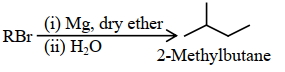
The maximum number of $RBr$ isomers producing $2-$methylbutane by the given sequence of reactions is $...........$ $(Consider the structural isomers only)$
A
$4$
B
$5$
C
$3$
D
$1$
Solution
(A) The reaction sequence $RBr$ $\xrightarrow{(i) Mg, \text{dry ether}} RMgBr$ $\xrightarrow{(ii) H_2O} RH$ represents the formation of an alkane from an alkyl bromide via a Grignard reagent.
To obtain $2-$methylbutane $(C_5H_{12})$ from $RBr$,the alkyl group $R$ must be a $2-$methylbutyl group.
The possible structural isomers of $2-$methylbutyl bromide are:
$1.$ $1-$bromo$-2-$methylbutane
$2.$ $2-$bromo$-2-$methylbutane
$3.$ $2-$bromo$-3-$methylbutane
$4.$ $1-$bromo$-3-$methylbutane
All these isomers,upon reaction with $Mg$ in dry ether followed by hydrolysis with $H_2O$,will yield $2-$methylbutane.
Therefore,the total number of such structural isomers is $4$.
To obtain $2-$methylbutane $(C_5H_{12})$ from $RBr$,the alkyl group $R$ must be a $2-$methylbutyl group.
The possible structural isomers of $2-$methylbutyl bromide are:
$1.$ $1-$bromo$-2-$methylbutane
$2.$ $2-$bromo$-2-$methylbutane
$3.$ $2-$bromo$-3-$methylbutane
$4.$ $1-$bromo$-3-$methylbutane
All these isomers,upon reaction with $Mg$ in dry ether followed by hydrolysis with $H_2O$,will yield $2-$methylbutane.
Therefore,the total number of such structural isomers is $4$.
0 likes
View Solution907
DifficultMCQ
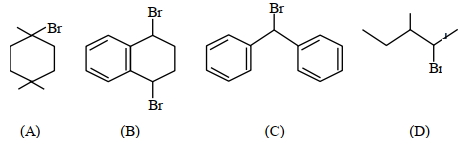
The ascending order of relative rate of solvolysis of the following compounds is:
A
$D < A < B < C$
B
$C < B < A < D$
C
$D < B < A < C$
D
$C < D < B < A$
Solution
(A) The rate of solvolysis (which proceeds via an $S_{N}1$ mechanism) is directly proportional to the stability of the intermediate carbocation formed after the departure of the leaving group (bromide ion).
$1$. Compound $C$ forms a diphenylmethyl carbocation,which is highly stabilized by resonance with two phenyl rings.
$2$. Compound $B$ forms a benzylic carbocation (specifically,a $1-$tetralyl type),which is stabilized by resonance with one benzene ring.
$3$. Compound $A$ forms a tertiary carbocation in a cyclohexane ring,which is stabilized by inductive effects and hyperconjugation.
$4$. Compound $D$ forms a secondary carbocation,which is the least stable among the given options.
Thus,the stability order of the carbocations is $C > B > A > D$. Consequently,the ascending order of the rate of solvolysis is $D < A < B < C$.
$1$. Compound $C$ forms a diphenylmethyl carbocation,which is highly stabilized by resonance with two phenyl rings.
$2$. Compound $B$ forms a benzylic carbocation (specifically,a $1-$tetralyl type),which is stabilized by resonance with one benzene ring.
$3$. Compound $A$ forms a tertiary carbocation in a cyclohexane ring,which is stabilized by inductive effects and hyperconjugation.
$4$. Compound $D$ forms a secondary carbocation,which is the least stable among the given options.
Thus,the stability order of the carbocations is $C > B > A > D$. Consequently,the ascending order of the rate of solvolysis is $D < A < B < C$.
0 likes
View Solution908
DifficultMCQ
Given below are two statements:
Statement $I$: The conversion $CH_3-CH_2-CH_2-CH_2-Cl \xrightarrow{OH^{-}} CH_3-CH_2-CH_2-CH_2-OH + Cl^{-}$ proceeds well in a less polar medium.
Statement $II$: The conversion $(CH_3)_3C-Cl \xrightarrow{OH^{-}} (CH_3)_3C-OH + Cl^{-}$ proceeds well in a more polar medium.
In the light of the above statements,choose the correct answer from the options given below.
Statement $I$: The conversion $CH_3-CH_2-CH_2-CH_2-Cl \xrightarrow{OH^{-}} CH_3-CH_2-CH_2-CH_2-OH + Cl^{-}$ proceeds well in a less polar medium.
Statement $II$: The conversion $(CH_3)_3C-Cl \xrightarrow{OH^{-}} (CH_3)_3C-OH + Cl^{-}$ proceeds well in a more polar medium.
In the light of the above statements,choose the correct answer from the options given below.
A
Both statement $I$ and statement $II$ are true
B
Both statement $I$ and statement $II$ are false
C
Statement $I$ is false but statement $II$ is true
D
Statement $I$ is true but statement $II$ is false
Solution
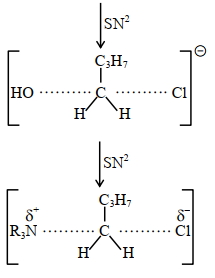
(A) Statement $I$ represents an $S_N2$ reaction of a primary alkyl halide $(1^\circ)$. $S_N2$ reactions are generally favored in less polar or polar aprotic solvents because polar protic solvents solvate the nucleophile,reducing its reactivity.
Statement $II$ represents an $S_N1$ reaction of a tertiary alkyl halide $(3^\circ)$. $S_N1$ reactions are favored in more polar (polar protic) solvents because the polar medium stabilizes the carbocation intermediate and the transition state.
Therefore,both statements are true.
Statement $II$ represents an $S_N1$ reaction of a tertiary alkyl halide $(3^\circ)$. $S_N1$ reactions are favored in more polar (polar protic) solvents because the polar medium stabilizes the carbocation intermediate and the transition state.
Therefore,both statements are true.
0 likes
View Solution909
MediumMCQ
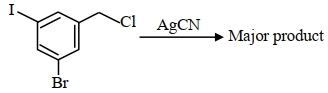
The structure of the major product formed in the following reaction is
A
$1-$bromo$-3-$chloro$-5-$iodobenzene
B
$1-$bromo$-3-$cyano$-5-$iodobenzene
C
$1-$bromo$-3-$iodobenzyl isocyanide
D
$1-$bromo$-3-$iodobenzyl cyanide
Solution
(C) The reaction involves the nucleophilic substitution of a primary alkyl chloride with $AgCN$.
$AgCN$ is a covalent compound. In such cases,the nitrogen atom of the cyanide group acts as the nucleophile because it has a lone pair of electrons available for bonding,while the carbon atom is less nucleophilic due to the covalent nature of the $Ag-C$ bond.
Therefore,the reaction follows an $S_N2$ mechanism where the $-Cl$ group is replaced by an isocyanide $(-NC)$ group.
The reaction is:
$Ar-CH_2Cl + AgCN \rightarrow Ar-CH_2NC + AgCl$
where $Ar$ is the $3-$bromo$-5-$iodophenyl group.
Thus,the major product is $1-$bromo$-3-$iodobenzyl isocyanide.
$AgCN$ is a covalent compound. In such cases,the nitrogen atom of the cyanide group acts as the nucleophile because it has a lone pair of electrons available for bonding,while the carbon atom is less nucleophilic due to the covalent nature of the $Ag-C$ bond.
Therefore,the reaction follows an $S_N2$ mechanism where the $-Cl$ group is replaced by an isocyanide $(-NC)$ group.
The reaction is:
$Ar-CH_2Cl + AgCN \rightarrow Ar-CH_2NC + AgCl$
where $Ar$ is the $3-$bromo$-5-$iodophenyl group.
Thus,the major product is $1-$bromo$-3-$iodobenzyl isocyanide.
0 likes
View Solution910
DifficultMCQ
Given below are two statements:
Statement $I$: $(Et)_2N-CH_2CH_2Cl$ will undergo alkaline hydrolysis at a faster rate than $(Et)_2CH-CH_2CH_2Cl$.
Statement $II$: Intramolecular substitution takes place first by involving the lone pair of electrons on nitrogen.
In the light of the above statements,choose the most appropriate answer from the options given below:
Statement $I$: $(Et)_2N-CH_2CH_2Cl$ will undergo alkaline hydrolysis at a faster rate than $(Et)_2CH-CH_2CH_2Cl$.
Statement $II$: Intramolecular substitution takes place first by involving the lone pair of electrons on nitrogen.
In the light of the above statements,choose the most appropriate answer from the options given below:
A
Both Statement $I$ and Statement $II$ are incorrect
B
Statement $I$ is incorrect but Statement $II$ is correct
C
Both Statement $I$ and Statement $II$ are correct
D
Statement $I$ is correct but Statement $II$ is incorrect
Solution
(C) The compound $(Et)_2N-CH_2CH_2Cl$ contains a nitrogen atom with a lone pair of electrons. This lone pair can attack the carbon atom attached to the chlorine atom,leading to the formation of an aziridinium ion intermediate through an intramolecular nucleophilic substitution reaction (anchimeric assistance).
This process is much faster than the intermolecular nucleophilic substitution that would occur in $(Et)_2CH-CH_2CH_2Cl$,which lacks such an internal nucleophile.
Therefore,Statement $I$ is correct because the rate of hydrolysis is faster for the nitrogen-containing compound.
Statement $II$ is also correct as it describes the mechanism of this intramolecular substitution involving the lone pair on the nitrogen atom.
This process is much faster than the intermolecular nucleophilic substitution that would occur in $(Et)_2CH-CH_2CH_2Cl$,which lacks such an internal nucleophile.
Therefore,Statement $I$ is correct because the rate of hydrolysis is faster for the nitrogen-containing compound.
Statement $II$ is also correct as it describes the mechanism of this intramolecular substitution involving the lone pair on the nitrogen atom.
0 likes
View Solution911
MediumMCQ
The products $A$ and $B$ in the following reactions,respectively,are:
$A \xleftarrow{AgNO_2} CH_3-CH_2-CH_2-Br \xrightarrow{AgCN} B$
$A \xleftarrow{AgNO_2} CH_3-CH_2-CH_2-Br \xrightarrow{AgCN} B$
A
$CH_3-CH_2-CH_2-ONO, CH_3-CH_2-CH_2-NC$
B
$CH_3-CH_2-CH_2-ONO, CH_3-CH_2-CH_2-CN$
C
$CH_3-CH_2-CH_2-NO_2, CH_3-CH_2-CH_2-CN$
D
$CH_3-CH_2-CH_2-NO_2, CH_3-CH_2-CH_2-NC$
Solution
(D) $AgNO_2$ is a covalent compound. The nitrogen atom has a lone pair of electrons,which attacks the alkyl halide to form a nitroalkane $(R-NO_2)$.
Therefore,$CH_3-CH_2-CH_2-Br + AgNO_2 \rightarrow CH_3-CH_2-CH_2-NO_2 (A) + AgBr$.
$AgCN$ is also a covalent compound. The nitrogen atom has a lone pair,but the carbon atom is the nucleophilic site in the cyanide ion. However,due to the covalent nature of $Ag-CN$ bond,the nitrogen atom attacks the alkyl halide to form an isocyanide $(R-NC)$.
Therefore,$CH_3-CH_2-CH_2-Br + AgCN \rightarrow CH_3-CH_2-CH_2-NC (B) + AgBr$.
Thus,the products are $CH_3-CH_2-CH_2-NO_2$ and $CH_3-CH_2-CH_2-NC$.
Therefore,$CH_3-CH_2-CH_2-Br + AgNO_2 \rightarrow CH_3-CH_2-CH_2-NO_2 (A) + AgBr$.
$AgCN$ is also a covalent compound. The nitrogen atom has a lone pair,but the carbon atom is the nucleophilic site in the cyanide ion. However,due to the covalent nature of $Ag-CN$ bond,the nitrogen atom attacks the alkyl halide to form an isocyanide $(R-NC)$.
Therefore,$CH_3-CH_2-CH_2-Br + AgCN \rightarrow CH_3-CH_2-CH_2-NC (B) + AgBr$.
Thus,the products are $CH_3-CH_2-CH_2-NO_2$ and $CH_3-CH_2-CH_2-NC$.
0 likes
View Solution912
MediumMCQ
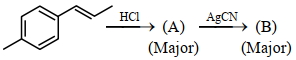
The product $B$ formed in the following reaction sequence is:
A
$1-$($4$-methylphenyl)ethyl isocyanide
B
$1-$($4$-methylphenyl)ethyl isocyanide
C
$1-$($4$-methylphenyl)ethyl cyanide
D
$1-$($4$-methylphenyl)propyl isocyanide
Solution
(D) Step $1$: The reaction of $1-(4-methylphenyl)prop-1-ene$ with $HCl$ follows Markovnikov's rule. The electrophilic addition of $H^+$ to the double bond forms a stable benzylic carbocation at the carbon adjacent to the benzene ring. Then,$Cl^-$ attacks this carbocation to form $1-(4-methylphenyl)-1-chloropropane$ as the major product $(A)$.
Step $2$: The reaction of the alkyl halide $(A)$ with $AgCN$ is a nucleophilic substitution reaction. Since $AgCN$ is a covalent compound,the nitrogen atom acts as the nucleophile,leading to the formation of an isocyanide (isonitrile) as the major product $(B)$.
Thus,the final product is $1-(4-methylphenyl)propyl$ isocyanide.
Step $2$: The reaction of the alkyl halide $(A)$ with $AgCN$ is a nucleophilic substitution reaction. Since $AgCN$ is a covalent compound,the nitrogen atom acts as the nucleophile,leading to the formation of an isocyanide (isonitrile) as the major product $(B)$.
Thus,the final product is $1-(4-methylphenyl)propyl$ isocyanide.
0 likes
View Solution913
EasyMCQ
Which among the following halides will generate the most stable carbocation in a nucleophilic substitution reaction?
A
$CH_2=CH-CH_2-Br$
B
$C_6H_5-CH_2-Br$
C
$C_6H_9-Br$ (cyclohex$-2-$en$-1-$yl bromide)
D
$(C_6H_5)_3C-Br$
Solution
(D) The stability of a carbocation is determined by resonance,hyperconjugation,and the inductive effect.
In the given options,the carbocations formed are:
$A$: Allyl carbocation $(CH_2=CH-CH_2^+)$
$B$: Benzyl carbocation $(C_6H_5-CH_2^+)$
$C$: Cyclohexenyl carbocation
$D$: Triphenylmethyl carbocation $((C_6H_5)_3C^+)$
Among these,the triphenylmethyl carbocation is the most stable because the positive charge is delocalized over three phenyl rings through extensive resonance.
Therefore,$(C_6H_5)_3C-Br$ generates the most stable carbocation.
In the given options,the carbocations formed are:
$A$: Allyl carbocation $(CH_2=CH-CH_2^+)$
$B$: Benzyl carbocation $(C_6H_5-CH_2^+)$
$C$: Cyclohexenyl carbocation
$D$: Triphenylmethyl carbocation $((C_6H_5)_3C^+)$
Among these,the triphenylmethyl carbocation is the most stable because the positive charge is delocalized over three phenyl rings through extensive resonance.
Therefore,$(C_6H_5)_3C-Br$ generates the most stable carbocation.
0 likes
View Solution914
MediumMCQ
Given below are two statements $:$
Statement $(I) :$ Alcohols are formed when alkyl chlorides are treated with aqueous potassium hydroxide by elimination reaction.
Statement $(II) :$ In alcoholic potassium hydroxide,alkyl chlorides form alkenes by abstracting the hydrogen from the $\beta-$carbon.
In the light of the above statements,choose the most appropriate answer from the options given below $:$
Statement $(I) :$ Alcohols are formed when alkyl chlorides are treated with aqueous potassium hydroxide by elimination reaction.
Statement $(II) :$ In alcoholic potassium hydroxide,alkyl chlorides form alkenes by abstracting the hydrogen from the $\beta-$carbon.
In the light of the above statements,choose the most appropriate answer from the options given below $:$
A
Both Statement $I$ and Statement $II$ are incorrect
B
Statement $I$ is incorrect but Statement $II$ is correct
C
Statement $I$ is correct but Statement $II$ is incorrect
D
Both Statement $I$ and Statement $II$ are correct
Solution
(B) Statement $(I) :$ When alkyl chlorides $(R-Cl)$ are treated with aqueous $KOH$,they undergo nucleophilic substitution $(S_N)$ reaction to form alcohols $(R-OH)$. This is not an elimination reaction. Thus,Statement $(I)$ is incorrect.
Statement $(II) :$ When alkyl chlorides are treated with alcoholic $KOH$,they undergo dehydrohalogenation (an elimination reaction) where the base abstracts a hydrogen atom from the $\beta-$carbon to form an alkene. Thus,Statement $(II)$ is correct.
Statement $(II) :$ When alkyl chlorides are treated with alcoholic $KOH$,they undergo dehydrohalogenation (an elimination reaction) where the base abstracts a hydrogen atom from the $\beta-$carbon to form an alkene. Thus,Statement $(II)$ is correct.
0 likes
View Solution915
MediumMCQ
Given below are two statements $:$
Statement $(I) :$ $cis-1,2-dichloroethene$ is more polar than $cis-1,2-dibromoethene$.
Statement $(II) :$ Boiling point of $trans-1,2-dibromoethene$ is lower than $cis-1,2-dibromoethene$ but it is more polar than $cis-1,2-dibromoethene$.
In the light of the above statements,choose the most appropriate answer from the options given below $:$
Statement $(I) :$ $cis-1,2-dichloroethene$ is more polar than $cis-1,2-dibromoethene$.
Statement $(II) :$ Boiling point of $trans-1,2-dibromoethene$ is lower than $cis-1,2-dibromoethene$ but it is more polar than $cis-1,2-dibromoethene$.
In the light of the above statements,choose the most appropriate answer from the options given below $:$
A
Statement $I$ is correct but statement $II$ is incorrect
B
Statement $I$ is incorrect but statement $II$ is correct
C
Both statement $I$ and statement $II$ are incorrect
D
Both statement $I$ and statement $II$ are correct
Solution
(A) Statement $(I)$ is correct. $cis-1,2-dichloroethene$ exhibits greater polarity than $cis-1,2-dibromoethene$ due to the stronger $p\pi-d\pi$ back-bonding in the $C-Cl$ bond compared to the $C-Br$ bond,which enhances the dipole moment.
Statement $(II)$ is incorrect. While the boiling point of $trans-1,2-dibromoethene$ is indeed lower than that of $cis-1,2-dibromoethene$ (because the $cis$ isomer has a net dipole moment $\mu \neq 0$ while the $trans$ isomer has $\mu = 0$),the $trans$ isomer is $NOT$ more polar than the $cis$ isomer. The $trans$ isomer is non-polar $(\mu = 0)$,whereas the $cis$ isomer is polar $(\mu \neq 0)$.
Statement $(II)$ is incorrect. While the boiling point of $trans-1,2-dibromoethene$ is indeed lower than that of $cis-1,2-dibromoethene$ (because the $cis$ isomer has a net dipole moment $\mu \neq 0$ while the $trans$ isomer has $\mu = 0$),the $trans$ isomer is $NOT$ more polar than the $cis$ isomer. The $trans$ isomer is non-polar $(\mu = 0)$,whereas the $cis$ isomer is polar $(\mu \neq 0)$.
0 likes
View Solution916
MediumMCQ
Given below are two statements: one is labelled as Assertion $(A)$ and the other is labelled as Reason $(R)$.
Assertion $(A):$ $R-I$ undergoes $S_N2$ reaction faster than $R-Cl$.
Reason $(R):$ Iodine is a better leaving group because of its large size.
In the light of the above statements,choose the correct answer from the options given below:
Assertion $(A):$ $R-I$ undergoes $S_N2$ reaction faster than $R-Cl$.
Reason $(R):$ Iodine is a better leaving group because of its large size.
In the light of the above statements,choose the correct answer from the options given below:
A
Both $A$ and $R$ are true and $R$ is the correct explanation of $A$.
B
Both $A$ and $R$ are true but $R$ is not the correct explanation of $A$.
C
$A$ is true but $R$ is false.
D
$A$ is false but $R$ is true.
Solution
(A) The rate of $S_N2$ reaction is directly proportional to the leaving group ability of the nucleophile.
Iodide ion $(I^-)$ is a better leaving group than chloride ion $(Cl^-)$ because of its larger size,which results in a weaker $C-I$ bond compared to the $C-Cl$ bond.
Therefore,$R-I$ reacts faster than $R-Cl$ in $S_N2$ reactions.
Both Assertion $(A)$ and Reason $(R)$ are true,and $(R)$ is the correct explanation of $(A)$.
Iodide ion $(I^-)$ is a better leaving group than chloride ion $(Cl^-)$ because of its larger size,which results in a weaker $C-I$ bond compared to the $C-Cl$ bond.
Therefore,$R-I$ reacts faster than $R-Cl$ in $S_N2$ reactions.
Both Assertion $(A)$ and Reason $(R)$ are true,and $(R)$ is the correct explanation of $(A)$.
0 likes
View Solution917
DifficultMCQ
Predict the correct reactivity order of the following compounds towards $S_N1$ reaction:
A
$C_6H_5CH_2Br < C_6H_5CH(CH_3)Br < (C_6H_5)_2CHBr < (C_6H_5)_2C(CH_3)Br$
B
$C_6H_5CH(CH_3)Br < C_6H_5CH_2Br < (C_6H_5)_2CHBr < (C_6H_5)_2C(CH_3)Br$
C
$(C_6H_5)_2CHBr < C_6H_5CH(CH_3)Br < C_6H_5CH_2Br < (C_6H_5)_2C(CH_3)Br$
D
$(C_6H_5)_2C(CH_3)Br < (C_6H_5)_2CHBr < C_6H_5CH(CH_3)Br < C_6H_5CH_2Br$
Solution
(A) The rate of $S_N1$ reaction is directly proportional to the stability of the carbocation intermediate formed after the departure of the leaving group $(Br^-)$.
$1$. $C_6H_5CH_2^+$: Primary benzylic carbocation (stabilized by one phenyl ring).
$2$. $C_6H_5CH(CH_3)^+$: Secondary benzylic carbocation (stabilized by one phenyl ring and one methyl group).
$3$. $(C_6H_5)_2CH^+$: Secondary benzylic carbocation (stabilized by two phenyl rings).
$4$. $(C_6H_5)_2C(CH_3)^+$: Tertiary benzylic carbocation (stabilized by two phenyl rings and one methyl group).
Comparing stability: $C_6H_5CH_2^+ < C_6H_5CH(CH_3)^+ < (C_6H_5)_2CH^+ < (C_6H_5)_2C(CH_3)^+$.
Thus,the reactivity order is $C_6H_5CH_2Br < C_6H_5CH(CH_3)Br < (C_6H_5)_2CHBr < (C_6H_5)_2C(CH_3)Br$.
$1$. $C_6H_5CH_2^+$: Primary benzylic carbocation (stabilized by one phenyl ring).
$2$. $C_6H_5CH(CH_3)^+$: Secondary benzylic carbocation (stabilized by one phenyl ring and one methyl group).
$3$. $(C_6H_5)_2CH^+$: Secondary benzylic carbocation (stabilized by two phenyl rings).
$4$. $(C_6H_5)_2C(CH_3)^+$: Tertiary benzylic carbocation (stabilized by two phenyl rings and one methyl group).
Comparing stability: $C_6H_5CH_2^+ < C_6H_5CH(CH_3)^+ < (C_6H_5)_2CH^+ < (C_6H_5)_2C(CH_3)^+$.
Thus,the reactivity order is $C_6H_5CH_2Br < C_6H_5CH(CH_3)Br < (C_6H_5)_2CHBr < (C_6H_5)_2C(CH_3)Br$.
0 likes
View Solution918
MediumMCQ
$CH_3-CH_2-Cl + NaI \xrightarrow{\text{Acetone}} CH_3-CH_2-I + NaCl$ The above reaction is known as $:-$
A
Swarts reaction
B
Darzen reaction
C
Finkelstein reaction
D
Frankland reaction
Solution
(C) The reaction of alkyl chlorides or bromides with sodium iodide $(NaI)$ in the presence of acetone is known as the Finkelstein reaction.
This is a halogen exchange reaction used to prepare alkyl iodides.
This is a halogen exchange reaction used to prepare alkyl iodides.
0 likes
View Solution919
MediumMCQ
Predict the major product for the following reaction: $CH_3-CH(CH_3)-ONa + (CH_3)_3C-Cl \xrightarrow{\Delta} \text{Major product}$
A
$CH_3-C(CH_3)=CH_2$
B
$CH_3-C(CH_3)_2-O-CH(CH_3)_2$
C
$CH_3-CH(CH_3)-O-C(CH_3)_3$
D
$CH_3-CH(CH_3)-CH_3$
Solution
(A) The reaction involves a strong base/nucleophile,sodium isopropoxide $(CH_3-CH(CH_3)-ONa)$,and a tertiary alkyl halide,tert-butyl chloride $((CH_3)_3C-Cl)$.
Since the alkyl halide is tertiary and the reagent is a strong base,the reaction will proceed via an $E2$ elimination mechanism rather than an $S_N2$ substitution mechanism due to steric hindrance.
The base will abstract a proton from the tert-butyl chloride,leading to the formation of isobutylene ($2$-methylpropene) as the major product.
The reaction is: $(CH_3)_3C-Cl + CH_3-CH(CH_3)-ONa \xrightarrow{\Delta} CH_3-C(CH_3)=CH_2 + CH_3-CH(CH_3)-OH + NaCl$.
Since the alkyl halide is tertiary and the reagent is a strong base,the reaction will proceed via an $E2$ elimination mechanism rather than an $S_N2$ substitution mechanism due to steric hindrance.
The base will abstract a proton from the tert-butyl chloride,leading to the formation of isobutylene ($2$-methylpropene) as the major product.
The reaction is: $(CH_3)_3C-Cl + CH_3-CH(CH_3)-ONa \xrightarrow{\Delta} CH_3-C(CH_3)=CH_2 + CH_3-CH(CH_3)-OH + NaCl$.
0 likes
View Solution920
MediumMCQ
Which among the following will undergo hydrolysis rapidly$:-$
A
Cycloheptatrienyl bromide
B
Cyclopentadienyl bromide
C
Cyclopropyl bromide
D
Bromobenzene
Solution
(A) The rate of hydrolysis of a halide is directly proportional to the stability of the carbocation formed after the departure of the leaving group $(Br^-)$.
$1.$ Cycloheptatrienyl bromide forms a cycloheptatrienyl cation $(C_7H_7^+)$,which is aromatic ($6\pi$ electrons,Huckel's rule $4n+2$ where $n=1$).
$2.$ Cyclopentadienyl bromide forms a cyclopentadienyl cation,which is anti-aromatic ($4\pi$ electrons).
$3.$ Cyclopropyl bromide forms a cyclopropyl cation,which is highly unstable due to ring strain and $sp^2$ hybridization at the ring carbon.
$4.$ Bromobenzene forms a phenyl cation,which is highly unstable.
Since the cycloheptatrienyl cation is aromatic and highly stable,cycloheptatrienyl bromide undergoes hydrolysis most rapidly.
$1.$ Cycloheptatrienyl bromide forms a cycloheptatrienyl cation $(C_7H_7^+)$,which is aromatic ($6\pi$ electrons,Huckel's rule $4n+2$ where $n=1$).
$2.$ Cyclopentadienyl bromide forms a cyclopentadienyl cation,which is anti-aromatic ($4\pi$ electrons).
$3.$ Cyclopropyl bromide forms a cyclopropyl cation,which is highly unstable due to ring strain and $sp^2$ hybridization at the ring carbon.
$4.$ Bromobenzene forms a phenyl cation,which is highly unstable.
Since the cycloheptatrienyl cation is aromatic and highly stable,cycloheptatrienyl bromide undergoes hydrolysis most rapidly.
0 likes
View Solution921
EasyMCQ
In $S_N2$ reactions,the correct order of reactivity for the following compounds: $CH_3Cl$,$CH_3CH_2Cl$,$(CH_3)_2CHCl$,and $(CH_3)_3CCl$ is:
A
$CH_3CH_2Cl > CH_3Cl > (CH_3)_2CHCl > (CH_3)_3CCl$
B
$(CH_3)_2CHCl > CH_3CH_2Cl > CH_3Cl > (CH_3)_3CCl$
C
$CH_3Cl > (CH_3)_2CHCl > CH_3CH_2Cl > (CH_3)_3CCl$
D
$CH_3Cl > CH_3CH_2Cl > (CH_3)_2CHCl > (CH_3)_3CCl$
Solution
(D) The rate of $S_N2$ reactions is inversely proportional to the steric hindrance around the electrophilic carbon atom.
As the number of alkyl groups attached to the carbon bearing the chlorine atom increases,the steric hindrance increases,making the approach of the nucleophile more difficult.
The order of steric hindrance is: $CH_3Cl$ (methyl) < $CH_3CH_2Cl$ (primary) < $(CH_3)_2CHCl$ (secondary) < $(CH_3)_3CCl$ (tertiary).
Therefore,the order of reactivity in $S_N2$ reactions is: $CH_3Cl > CH_3CH_2Cl > (CH_3)_2CHCl > (CH_3)_3CCl$.
As the number of alkyl groups attached to the carbon bearing the chlorine atom increases,the steric hindrance increases,making the approach of the nucleophile more difficult.
The order of steric hindrance is: $CH_3Cl$ (methyl) < $CH_3CH_2Cl$ (primary) < $(CH_3)_2CHCl$ (secondary) < $(CH_3)_3CCl$ (tertiary).
Therefore,the order of reactivity in $S_N2$ reactions is: $CH_3Cl > CH_3CH_2Cl > (CH_3)_2CHCl > (CH_3)_3CCl$.
0 likes
View Solution922
MediumMCQ
Which is correct for the above reaction $:-$

A
$A = \text{Chlorobenzene}$
B
$B = p-\text{Chlorotoluene}$
C
$C = \text{Benzyl cyanide}$
D
$C = \text{Benzyl isocyanide}$
Solution
(D) Step $1$: Benzene reacts with $CH_3Cl$ in the presence of anhydrous $AlCl_3$ (Friedel-Crafts alkylation) to form Toluene $(A)$.
Step $2$: Toluene $(A)$ reacts with $Cl_2$ in the presence of $h\nu$ (free radical substitution) to form Benzyl chloride $(B = C_6H_5CH_2Cl)$.
Step $3$: Benzyl chloride $(B)$ reacts with $AgCN$. Since $AgCN$ is a covalent compound,the nitrogen atom acts as the nucleophile,leading to the formation of Benzyl isocyanide $(C = C_6H_5CH_2NC)$.
Therefore,the correct option is $D$.
Step $2$: Toluene $(A)$ reacts with $Cl_2$ in the presence of $h\nu$ (free radical substitution) to form Benzyl chloride $(B = C_6H_5CH_2Cl)$.
Step $3$: Benzyl chloride $(B)$ reacts with $AgCN$. Since $AgCN$ is a covalent compound,the nitrogen atom acts as the nucleophile,leading to the formation of Benzyl isocyanide $(C = C_6H_5CH_2NC)$.
Therefore,the correct option is $D$.
0 likes
View Solution923
MediumMCQ
In which of the following cases is the yield via $S_{N}2$ mechanism maximum?
A
$(CH_3)_3C-Br + C_2H_5O^{-} \text{ (in } H_2O) \rightarrow$
B
$(CH_3)_2CH-Br + C_2H_5O^{-} \text{ (in } C_6H_6) \rightarrow$
C
$(CH_3)_3C-Br + C_2H_5O^{-} \text{ (in } DMF) \rightarrow$
D
$CH_3CH_2-Br + C_2H_5O^{-} \text{ (in } DMSO) \rightarrow$
Solution
(D) The rate and yield of the $S_{N}2$ reaction are highly dependent on the steric hindrance around the electrophilic carbon atom. The reactivity order for $S_{N}2$ is: $\text{Methyl} > \text{Primary} > \text{Secondary} > \text{Tertiary}$.
- Option $A$ and $C$ involve tertiary alkyl halides,which undergo $E2$ elimination rather than $S_{N}2$ substitution due to high steric hindrance.
- Option $B$ involves a secondary alkyl halide,which is also prone to elimination.
- Option $D$ involves a primary alkyl halide $(CH_3CH_2-Br)$ in a polar aprotic solvent $(DMSO)$,which is the ideal condition for an $S_{N}2$ reaction. Therefore,the yield via $S_{N}2$ is maximum in this case.
- Option $A$ and $C$ involve tertiary alkyl halides,which undergo $E2$ elimination rather than $S_{N}2$ substitution due to high steric hindrance.
- Option $B$ involves a secondary alkyl halide,which is also prone to elimination.
- Option $D$ involves a primary alkyl halide $(CH_3CH_2-Br)$ in a polar aprotic solvent $(DMSO)$,which is the ideal condition for an $S_{N}2$ reaction. Therefore,the yield via $S_{N}2$ is maximum in this case.
0 likes
View Solution924
MediumMCQ
Which of the following major product is not correct $:-$
A
Methylenecyclohexane + $HCl$ $\rightarrow$ $1-$chloro$-1-$methylcyclohexane
B
$1-$methylcyclohexene + $HCl$ $\rightarrow$ $1-$chloro$-1-$methylcyclohexane
C
$3-$methylcyclohexene + $HCl$ $\rightarrow$ $3-$chloro$-1-$methylcyclohexane
D
All are correct
Solution
(C) In option $A$,the reaction of methylenecyclohexane with $HCl$ follows Markovnikov's rule,forming a tertiary carbocation intermediate,which then reacts with $Cl^-$ to give $1-$chloro$-1-$methylcyclohexane. This is correct.
In option $B$,the reaction of $1-$methylcyclohexene with $HCl$ also proceeds via a tertiary carbocation intermediate at the $C-1$ position,leading to $1-$chloro$-1-$methylcyclohexane. This is correct.
In option $C$,the reaction of $3-$methylcyclohexene with $HCl$ involves the formation of a secondary carbocation. Due to the possibility of carbocation rearrangement (hydride shift),the major product is actually $1-$chloro$-1-$methylcyclohexane,not $3-$chloro$-1-$methylcyclohexane. Therefore,the product shown in option $C$ is incorrect.
In option $B$,the reaction of $1-$methylcyclohexene with $HCl$ also proceeds via a tertiary carbocation intermediate at the $C-1$ position,leading to $1-$chloro$-1-$methylcyclohexane. This is correct.
In option $C$,the reaction of $3-$methylcyclohexene with $HCl$ involves the formation of a secondary carbocation. Due to the possibility of carbocation rearrangement (hydride shift),the major product is actually $1-$chloro$-1-$methylcyclohexane,not $3-$chloro$-1-$methylcyclohexane. Therefore,the product shown in option $C$ is incorrect.
0 likes
View Solution925
MediumMCQ
Which of the following haloalkanes would undergo $S_{N}2$ reaction at the fastest rate?
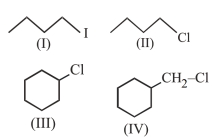
A
$I$
B
$II$
C
$III$
D
$IV$
Solution
(A) The rate of $S_{N}2$ reaction depends on the steric hindrance and the nature of the leaving group.
Steric hindrance follows the order: $primary > secondary > tertiary$.
In the given options:
$(I)$ is $1$-iodobutane (primary alkyl halide with a good leaving group $I^-$).
$(II)$ is $1$-chlorobutane (primary alkyl halide with a poorer leaving group $Cl^-$).
$(III)$ is chlorocyclohexane (secondary alkyl halide).
$(IV)$ is cyclohexylmethyl chloride (primary alkyl halide,but with steric hindrance from the cyclohexane ring near the reaction center).
Comparing $(I)$ and $(II)$,both are primary,but $I^-$ is a better leaving group than $Cl^-$,making $(I)$ more reactive.
Comparing $(I)$ and $(IV)$,$(I)$ is less sterically hindered than $(IV)$.
Therefore,$(I)$ undergoes $S_{N}2$ reaction at the fastest rate.
Steric hindrance follows the order: $primary > secondary > tertiary$.
In the given options:
$(I)$ is $1$-iodobutane (primary alkyl halide with a good leaving group $I^-$).
$(II)$ is $1$-chlorobutane (primary alkyl halide with a poorer leaving group $Cl^-$).
$(III)$ is chlorocyclohexane (secondary alkyl halide).
$(IV)$ is cyclohexylmethyl chloride (primary alkyl halide,but with steric hindrance from the cyclohexane ring near the reaction center).
Comparing $(I)$ and $(II)$,both are primary,but $I^-$ is a better leaving group than $Cl^-$,making $(I)$ more reactive.
Comparing $(I)$ and $(IV)$,$(I)$ is less sterically hindered than $(IV)$.
Therefore,$(I)$ undergoes $S_{N}2$ reaction at the fastest rate.
0 likes
View Solution926
MediumMCQ
Reaction $(A)$:
$Ph-CH=CH-CH_3 \xrightarrow[H_2O_2 / OH^-]{B_2H_6 / THF}$ products.
Reaction $(B)$:
$CH_3-CH=CH-Ph \xrightarrow[NaBH_4]{Hg(OAc)_2 / H_2O}$ products.
Correct statement is:
$Ph-CH=CH-CH_3 \xrightarrow[H_2O_2 / OH^-]{B_2H_6 / THF}$ products.
Reaction $(B)$:
$CH_3-CH=CH-Ph \xrightarrow[NaBH_4]{Hg(OAc)_2 / H_2O}$ products.
Correct statement is:
A
In reaction $(A)$,the product is formed according to the Markownikoff rule.
B
In reaction $(B)$,the product is formed according to the Antimarkownikoff rule.
C
In reaction $(A)$,the product is a meso compound.
D
In reaction $(B)$,the product is a racemic mixture.
Solution
(D) Reaction $(A)$ is Hydroboration-Oxidation,which follows Anti-Markownikoff addition of water across the double bond.
Reaction $(B)$ is Oxymercuration-Demercuration,which follows Markownikoff addition of water across the double bond.
In reaction $(B)$,the starting material $CH_3-CH=CH-Ph$ is an unsymmetrical alkene. The addition of $H_2O$ follows the Markownikoff rule,resulting in the formation of a chiral center at the carbon atom attached to the phenyl group.
Since the reaction proceeds through a cyclic mercurinium ion intermediate,the attack of water can occur from either side,leading to the formation of a racemic mixture of the product $CH_3-CH(OH)-CH_2-Ph$ (or $CH_3-CH_2-CH(OH)-Ph$ depending on regioselectivity,but the formation of a chiral center leads to racemization).
Reaction $(B)$ is Oxymercuration-Demercuration,which follows Markownikoff addition of water across the double bond.
In reaction $(B)$,the starting material $CH_3-CH=CH-Ph$ is an unsymmetrical alkene. The addition of $H_2O$ follows the Markownikoff rule,resulting in the formation of a chiral center at the carbon atom attached to the phenyl group.
Since the reaction proceeds through a cyclic mercurinium ion intermediate,the attack of water can occur from either side,leading to the formation of a racemic mixture of the product $CH_3-CH(OH)-CH_2-Ph$ (or $CH_3-CH_2-CH(OH)-Ph$ depending on regioselectivity,but the formation of a chiral center leads to racemization).
0 likes
View Solution927
MediumMCQ
Chloroform is stored in dark-colored bottles in the presence of $:-$
A
$CH_3COOCH_3$
B
$C_2H_5OH$
C
$CH_3COOH$
D
None of these
Solution
(B) Chloroform $(CHCl_3)$ is slowly oxidized by air in the presence of light to form an extremely poisonous gas called phosgene $(COCl_2)$.
$2CHCl_3 + O_2 \xrightarrow{light} 2COCl_2 + 2HCl$
To prevent this oxidation,chloroform is stored in dark-colored bottles,and a small amount of ethanol $(C_2H_5OH)$ is added to it.
Ethanol acts as a stabilizer by converting any phosgene formed into harmless diethyl carbonate:
$COCl_2 + 2C_2H_5OH \rightarrow (C_2H_5O)_2CO + 2HCl$.
$2CHCl_3 + O_2 \xrightarrow{light} 2COCl_2 + 2HCl$
To prevent this oxidation,chloroform is stored in dark-colored bottles,and a small amount of ethanol $(C_2H_5OH)$ is added to it.
Ethanol acts as a stabilizer by converting any phosgene formed into harmless diethyl carbonate:
$COCl_2 + 2C_2H_5OH \rightarrow (C_2H_5O)_2CO + 2HCl$.
0 likes
View Solution928
MediumMCQ
Identify the product $A$ in the following reaction: $C_2H_5Br + \text{aq. } KOH \rightarrow A + KBr$
A
Potassium ethoxide
B
Ethane
C
Ethanol
D
Ethene
Solution
(C) The reaction of an alkyl halide with aqueous $KOH$ is a nucleophilic substitution reaction.
$C_2H_5Br + \text{aq. } KOH \rightarrow C_2H_5OH + KBr$
Here,the hydroxide ion $(OH^-)$ acts as a nucleophile and replaces the bromide ion $(Br^-)$ to form ethanol $(C_2H_5OH)$.
$C_2H_5Br + \text{aq. } KOH \rightarrow C_2H_5OH + KBr$
Here,the hydroxide ion $(OH^-)$ acts as a nucleophile and replaces the bromide ion $(Br^-)$ to form ethanol $(C_2H_5OH)$.
0 likes
View Solution929
EasyMCQ
Which of the following is likely to undergo racemization during alkaline hydrolysis?
A
$CH_3-CH_2-CH(Cl)-CH_2-CH_3$
B
$CH_3-CH(C_2H_5)-CH_2-Cl$
C
$CH_3-CH(Cl)-CH_3$
D
$CH_3-CH_2-CH(Cl)-CH_3$
Solution
(D) Racemization occurs during the alkaline hydrolysis of an alkyl halide if the reaction proceeds via an $S_N1$ mechanism,which involves the formation of a planar carbocation intermediate. This requires the starting alkyl halide to be chiral (optically active). Among the given options,$CH_3-CH_2-CH(Cl)-CH_3$ ($2$-chlorobutane) is a chiral molecule because the carbon atom attached to the chlorine is bonded to four different groups $(-H, -Cl, -CH_3, -CH_2CH_3)$. Therefore,it can form a planar carbocation and undergo racemization.
0 likes
View Solution930
MediumMCQ
The rate of $S_{N}2$ reaction is maximum when the solvent is
A
$CH_{3}OH$
B
$H_{2}O$
C
$DMSO$
D
$benzene$
Solution
(C) The rate of $S_{N}2$ reactions is significantly enhanced in polar aprotic solvents.
Polar aprotic solvents like $DMSO$ (Dimethyl sulfoxide) do not form hydrogen bonds with the nucleophile,leaving it 'naked' and more reactive.
In contrast,polar protic solvents like $CH_{3}OH$ and $H_{2}O$ solvate the nucleophile through hydrogen bonding,which decreases its nucleophilicity and slows down the $S_{N}2$ reaction.
Polar aprotic solvents like $DMSO$ (Dimethyl sulfoxide) do not form hydrogen bonds with the nucleophile,leaving it 'naked' and more reactive.
In contrast,polar protic solvents like $CH_{3}OH$ and $H_{2}O$ solvate the nucleophile through hydrogen bonding,which decreases its nucleophilicity and slows down the $S_{N}2$ reaction.
0 likes
View Solution931
MediumMCQ
The following reaction,$(CH_3)_3CBr + H_2O \rightarrow (CH_3)_3COH + HBr$,is an example of:
A
elimination reaction
B
free radical substitution
C
nucleophilic substitution
D
electrophilic substitution
Solution
(C) In the given reaction,the bromine atom $(-Br)$ in tert-butyl bromide is replaced by a hydroxyl group $(-OH)$ from water.
Since the incoming group is a nucleophile $(-OH^-)$,this is a nucleophilic substitution reaction.
Specifically,it follows an $S_N1$ mechanism because the substrate is a tertiary alkyl halide.
Since the incoming group is a nucleophile $(-OH^-)$,this is a nucleophilic substitution reaction.
Specifically,it follows an $S_N1$ mechanism because the substrate is a tertiary alkyl halide.
0 likes
View Solution932
MediumMCQ
Identify '$A$' and '$B$' respectively in the following reaction:
$Toluene$ $\xrightarrow{Cl_{2}/hv} A$ $\xrightarrow{H_{2}O/\Delta} B$
$Toluene$ $\xrightarrow{Cl_{2}/hv} A$ $\xrightarrow{H_{2}O/\Delta} B$
A
Benzoyl chloride and benzoic acid
B
Benzoyl chloride and benzaldehyde
C
Benzyl chloride and benzyl alcohol
D
Benzyl chloride and benzaldehyde
Solution
(C) The reaction of toluene with $Cl_{2}$ in the presence of $hv$ (sunlight) is a free radical substitution reaction that occurs at the side chain,producing benzyl chloride $(A)$.
$C_{6}H_{5}CH_{3} + Cl_{2} \xrightarrow{hv} C_{6}H_{5}CH_{2}Cl + HCl$
Here,$A$ is benzyl chloride $(C_{6}H_{5}CH_{2}Cl)$.
When benzyl chloride $(A)$ is treated with $H_{2}O$ (hydrolysis),it undergoes nucleophilic substitution to form benzyl alcohol $(B)$.
$C_{6}H_{5}CH_{2}Cl + H_{2}O \xrightarrow{\Delta} C_{6}H_{5}CH_{2}OH + HCl$
Thus,$A$ is benzyl chloride and $B$ is benzyl alcohol.
$C_{6}H_{5}CH_{3} + Cl_{2} \xrightarrow{hv} C_{6}H_{5}CH_{2}Cl + HCl$
Here,$A$ is benzyl chloride $(C_{6}H_{5}CH_{2}Cl)$.
When benzyl chloride $(A)$ is treated with $H_{2}O$ (hydrolysis),it undergoes nucleophilic substitution to form benzyl alcohol $(B)$.
$C_{6}H_{5}CH_{2}Cl + H_{2}O \xrightarrow{\Delta} C_{6}H_{5}CH_{2}OH + HCl$
Thus,$A$ is benzyl chloride and $B$ is benzyl alcohol.
0 likes
View Solution933
MediumMCQ
In the reaction,$2 A + \text{dry silver oxide} \xrightarrow{\Delta} \text{ether} + 2 \operatorname{Ag} X$,$A$ is a/an
A
primary alcohol
B
acid
C
alkyl halide
D
alcohol
Solution
(C) The reaction of an alkyl halide $(R-X)$ with dry silver oxide $(Ag_2O)$ upon heating is a method for the preparation of ethers (Williamson ether synthesis variant).
The chemical equation is:
$2 R-X + Ag_2O \xrightarrow{\Delta} R-O-R + 2 AgX$
Comparing this with the given reaction $2 A + \text{dry silver oxide} \xrightarrow{\Delta} \text{ether} + 2 \operatorname{Ag} X$,we can conclude that $A$ represents an alkyl halide $(R-X)$.
The chemical equation is:
$2 R-X + Ag_2O \xrightarrow{\Delta} R-O-R + 2 AgX$
Comparing this with the given reaction $2 A + \text{dry silver oxide} \xrightarrow{\Delta} \text{ether} + 2 \operatorname{Ag} X$,we can conclude that $A$ represents an alkyl halide $(R-X)$.
0 likes
View Solution934
MediumMCQ
$A$ dihaloalkane '$X$',having formula $C_{3}H_{6}Cl_{2}$,on hydrolysis gives a compound that can reduce Tollen's reagent. The compound '$X$' is
A
$1,2$-dichloropropane
B
$1,1$-dichloropropane
C
$1,3$-dichloropropane
D
$2,2$-dichloropropane
Solution
(B) Since the obtained compound reduces Tollen's reagent,it must be an aldehyde.
Hydrolysis of a gem-dihalide (where both halogen atoms are on the same carbon) yields a gem-diol,which is unstable and loses a water molecule to form an aldehyde or ketone.
For an aldehyde to be formed,the dihaloalkane must be a terminal gem-dihalide (i.e.,the $-Cl$ atoms are at the $C_{1}$ position).
Thus,$CH_{3}CH_{2}CHCl_{2}$ ($1,1$-dichloropropane) on hydrolysis gives propanal $(CH_{3}CH_{2}CHO)$,which reduces Tollen's reagent.
The reaction is:
$CH_{3}CH_{2}CHCl_{2}$ $\xrightarrow{H_{2}O} CH_{3}CH_{2}CH(OH)_{2}$ $\xrightarrow{-H_{2}O} CH_{3}CH_{2}CHO$ $\xrightarrow{\text{Tollen's reagent}} CH_{3}CH_{2}COOH + Ag \downarrow$
Hydrolysis of a gem-dihalide (where both halogen atoms are on the same carbon) yields a gem-diol,which is unstable and loses a water molecule to form an aldehyde or ketone.
For an aldehyde to be formed,the dihaloalkane must be a terminal gem-dihalide (i.e.,the $-Cl$ atoms are at the $C_{1}$ position).
Thus,$CH_{3}CH_{2}CHCl_{2}$ ($1,1$-dichloropropane) on hydrolysis gives propanal $(CH_{3}CH_{2}CHO)$,which reduces Tollen's reagent.
The reaction is:
$CH_{3}CH_{2}CHCl_{2}$ $\xrightarrow{H_{2}O} CH_{3}CH_{2}CH(OH)_{2}$ $\xrightarrow{-H_{2}O} CH_{3}CH_{2}CHO$ $\xrightarrow{\text{Tollen's reagent}} CH_{3}CH_{2}COOH + Ag \downarrow$
0 likes
View Solution935
MediumMCQ
Which among the following reactions does not occur?
A
$C_2H_5Br + AgNO_2 \rightarrow C_2H_5NO_2 + AgBr$
B
$C_2H_5Br + AgCN \rightarrow C_2H_5NC + AgBr$
C
$C_2H_5Br + KCN \rightarrow C_2H_5NC + KBr$
D
$C_2H_5Br + KNO_2 \rightarrow C_2H_5-O-N=O + KBr$
Solution
(C) $KCN$ is an ionic compound,so it provides $CN^-$ ions which act as an ambident nucleophile. The carbon atom is more nucleophilic,leading to the formation of alkyl cyanide $(C_2H_5CN)$.
Therefore,the reaction $C_2H_5Br + KCN \rightarrow C_2H_5NC + KBr$ does not occur as written; it should produce $C_2H_5CN$ (ethyl cyanide).
$AgCN$ is covalent,so the nitrogen atom is the nucleophilic site,leading to the formation of alkyl isocyanide $(C_2H_5NC)$.
$AgNO_2$ is covalent,leading to nitroalkane $(C_2H_5NO_2)$.
$KNO_2$ is ionic,leading to alkyl nitrite $(C_2H_5ONO)$.
Therefore,the reaction $C_2H_5Br + KCN \rightarrow C_2H_5NC + KBr$ does not occur as written; it should produce $C_2H_5CN$ (ethyl cyanide).
$AgCN$ is covalent,so the nitrogen atom is the nucleophilic site,leading to the formation of alkyl isocyanide $(C_2H_5NC)$.
$AgNO_2$ is covalent,leading to nitroalkane $(C_2H_5NO_2)$.
$KNO_2$ is ionic,leading to alkyl nitrite $(C_2H_5ONO)$.
0 likes
View Solution936
EasyMCQ
What is the bond length between carbon and bromine in $CH_3Br$ molecule (in $pm$)?
A
$193$
B
$214$
C
$139$
D
$178$
Solution
(A) The $C-Br$ bond length in methyl bromide $(CH_3Br)$ is experimentally determined to be approximately $193 \ pm$. This value is consistent with the covalent radii of carbon $(77 \ pm)$ and bromine $(114 \ pm)$.
0 likes
View Solution937
EasyMCQ
Which of the following compounds has the highest boiling point?
A
Chloromethane
B
Fluoromethane
C
Iodomethane
D
Bromomethane
Solution
(C) The boiling point of haloalkanes depends on the magnitude of van der Waals forces,which increase with an increase in the molecular mass of the halogen atom.
Since the molecular mass of iodine is the highest among the given halogens,$CH_3I$ has the strongest intermolecular forces.
Therefore,the order of boiling points is $CH_3I > CH_3Br > CH_3Cl > CH_3F$.
Thus,$CH_3I$ (Iodomethane) has the highest boiling point.
Since the molecular mass of iodine is the highest among the given halogens,$CH_3I$ has the strongest intermolecular forces.
Therefore,the order of boiling points is $CH_3I > CH_3Br > CH_3Cl > CH_3F$.
Thus,$CH_3I$ (Iodomethane) has the highest boiling point.
0 likes
View Solution938
EasyMCQ
Which of the following compounds has the lowest boiling point?
A
Chloromethane
B
Fluoromethane
C
Iodomethane
D
Bromomethane
Solution
(B) For a given alkyl group,the boiling point increases with the increasing atomic mass of the halogen atom.
As the size of the halogen atom increases,the magnitude of van der Waals forces increases,leading to a higher boiling point.
Therefore,the boiling point of the given alkyl halides decreases in the order: $CH_3I > CH_3Br > CH_3Cl > CH_3F$.
Thus,$CH_3F$ (Fluoromethane) has the lowest boiling point.
As the size of the halogen atom increases,the magnitude of van der Waals forces increases,leading to a higher boiling point.
Therefore,the boiling point of the given alkyl halides decreases in the order: $CH_3I > CH_3Br > CH_3Cl > CH_3F$.
Thus,$CH_3F$ (Fluoromethane) has the lowest boiling point.
0 likes
View Solution939
MediumMCQ
The highest peak in the energy profile diagram for the mechanism of alkaline hydrolysis of tertiary butyl bromide represents:
A
transition state of $1^{st}$ step
B
formation of carbocation
C
transition state of $2^{nd}$ step
D
products
Solution
(A) The alkaline hydrolysis of tert-butyl bromide with aqueous alkali such as $NaOH$ or $KOH$ follows an $SN^1$ mechanism.
This is a two-step process:
Step $1$: $(CH_3)_3C-Br \rightarrow (CH_3)_3C^+ + Br^-$ (Slow,rate-determining step)
Step $2$: $(CH_3)_3C^+ + OH^- \rightarrow (CH_3)_3C-OH$ (Fast step)
In an energy profile diagram for a multi-step reaction,the highest peak corresponds to the transition state of the rate-determining step.
Since the first step is the rate-determining step,the highest energy barrier (peak) in the energy profile diagram represents the transition state of the $1^{st}$ step.
This is a two-step process:
Step $1$: $(CH_3)_3C-Br \rightarrow (CH_3)_3C^+ + Br^-$ (Slow,rate-determining step)
Step $2$: $(CH_3)_3C^+ + OH^- \rightarrow (CH_3)_3C-OH$ (Fast step)
In an energy profile diagram for a multi-step reaction,the highest peak corresponds to the transition state of the rate-determining step.
Since the first step is the rate-determining step,the highest energy barrier (peak) in the energy profile diagram represents the transition state of the $1^{st}$ step.
0 likes
View Solution940
EasyMCQ
Which among the following metals is involved in the preparation of a Grignard reagent?
A
Magnesium
B
Sodium
C
Silver
D
Zinc
Solution
(A) The Grignard reagent is an organometallic compound with the general formula $R-Mg-X$,where $R$ is an organic group and $X$ is a halogen. It is prepared by the reaction of an alkyl or aryl halide with metallic magnesium in the presence of dry ether.
0 likes
View Solution941
MediumMCQ
Which of the following compounds has the lower boiling point?
A
Fluoromethane
B
Iodomethane
C
Bromomethane
D
Chloromethane
Solution
(A) The boiling point of haloalkanes increases with an increase in the molecular mass due to the greater magnitude of $Van \ der \ Waals$ forces of attraction.
Since $CH_3F$ (Fluoromethane) has the lowest molecular mass among the given compounds,it experiences the weakest $Van \ der \ Waals$ forces and thus has the lowest boiling point.
Since $CH_3F$ (Fluoromethane) has the lowest molecular mass among the given compounds,it experiences the weakest $Van \ der \ Waals$ forces and thus has the lowest boiling point.
0 likes
View Solution942
EasyMCQ
Identify the chiral molecule from the following.
A
$2-$Chloropropane
B
$2-$Chloro$-2-$methylbutane
C
$3-$Chloro$-3-$methylbutane
D
$2-$Chloropentane
Solution
(D) molecule is chiral if it contains a chiral center,which is a carbon atom bonded to four different groups.
$1$. $2-$Chloropropane: $CH_3-CHCl-CH_3$ (The central carbon is bonded to two identical methyl groups,so it is achiral).
$2$. $2-$Chloro$-2-$methylbutane: $CH_3-CCl(CH_3)-CH_2-CH_3$ (The central carbon is bonded to two identical methyl groups,so it is achiral).
$3$. $3-$Chloro$-3-$methylbutane: $CH_3-CH_2-CCl(CH_3)-CH_3$ (The central carbon is bonded to two identical methyl groups,so it is achiral).
$4$. $2-$Chloropentane: $CH_3-CHCl-CH_2-CH_2-CH_3$ (The $C-2$ carbon is bonded to four different groups: $-H$,$-Cl$,$-CH_3$,and $-CH_2CH_2CH_3$,so it is chiral).
Therefore,the correct option is $D$.
$1$. $2-$Chloropropane: $CH_3-CHCl-CH_3$ (The central carbon is bonded to two identical methyl groups,so it is achiral).
$2$. $2-$Chloro$-2-$methylbutane: $CH_3-CCl(CH_3)-CH_2-CH_3$ (The central carbon is bonded to two identical methyl groups,so it is achiral).
$3$. $3-$Chloro$-3-$methylbutane: $CH_3-CH_2-CCl(CH_3)-CH_3$ (The central carbon is bonded to two identical methyl groups,so it is achiral).
$4$. $2-$Chloropentane: $CH_3-CHCl-CH_2-CH_2-CH_3$ (The $C-2$ carbon is bonded to four different groups: $-H$,$-Cl$,$-CH_3$,and $-CH_2CH_2CH_3$,so it is chiral).
Therefore,the correct option is $D$.
0 likes
View Solution943
MediumMCQ
Identify the chiral molecule from the following.
A
$2-$Iodopropane
B
$2-$Iodo$-2-$methylbutane
C
$2-$Iodo$-3-$methylbutane
D
$3-$Iodopentane
Solution
(C) chiral carbon atom is defined as a carbon atom that is bonded to four different groups or atoms.
Let us analyze the structures:
$A$. $2-$Iodopropane: $CH_3-CH(I)-CH_3$. The central carbon is attached to two identical $-CH_3$ groups,so it is achiral.
$B$. $2-$Iodo$-2-$methylbutane: $CH_3-C(I)(CH_3)-CH_2-CH_3$. The central carbon is attached to two identical $-CH_3$ groups,so it is achiral.
$C$. $2-$Iodo$-3-$methylbutane: $CH_3-CH(I)-CH(CH_3)_2$. The carbon at position $2$ is attached to four different groups: $-H$,$-I$,$-CH_3$,and $-CH(CH_3)_2$. Thus,it is a chiral molecule.
$D$. $3-$Iodopentane: $CH_3-CH_2-CH(I)-CH_2-CH_3$. The carbon at position $3$ is attached to two identical $-CH_2CH_3$ groups,so it is achiral.
Therefore,the correct option is $C$.
Let us analyze the structures:
$A$. $2-$Iodopropane: $CH_3-CH(I)-CH_3$. The central carbon is attached to two identical $-CH_3$ groups,so it is achiral.
$B$. $2-$Iodo$-2-$methylbutane: $CH_3-C(I)(CH_3)-CH_2-CH_3$. The central carbon is attached to two identical $-CH_3$ groups,so it is achiral.
$C$. $2-$Iodo$-3-$methylbutane: $CH_3-CH(I)-CH(CH_3)_2$. The carbon at position $2$ is attached to four different groups: $-H$,$-I$,$-CH_3$,and $-CH(CH_3)_2$. Thus,it is a chiral molecule.
$D$. $3-$Iodopentane: $CH_3-CH_2-CH(I)-CH_2-CH_3$. The carbon at position $3$ is attached to two identical $-CH_2CH_3$ groups,so it is achiral.
Therefore,the correct option is $C$.
0 likes
View Solution944
EasyMCQ
Which of the following isomers of $C_4H_9Br$ is a chiral molecule?
A
$n$-Butyl bromide
B
$sec$-Butyl bromide
C
Isobutyl bromide
D
$tert$-Butyl bromide
Solution
(B) chiral molecule is one that contains at least one chiral carbon atom (a carbon atom bonded to four different groups).
$n$-Butyl bromide: $CH_3-CH_2-CH_2-CH_2Br$ (No chiral carbon).
$sec$-Butyl bromide: $CH_3-CH(Br)-CH_2-CH_3$. The carbon atom marked with an asterisk $({}^*)$ is bonded to four different groups: $-H, -CH_3, -Br, -CH_2CH_3$. Thus,it is chiral.
Isobutyl bromide: $(CH_3)_2CH-CH_2Br$ (No chiral carbon).
$tert$-Butyl bromide: $(CH_3)_3CBr$ (No chiral carbon).
Therefore,$sec$-butyl bromide is the chiral molecule.
$n$-Butyl bromide: $CH_3-CH_2-CH_2-CH_2Br$ (No chiral carbon).
$sec$-Butyl bromide: $CH_3-CH(Br)-CH_2-CH_3$. The carbon atom marked with an asterisk $({}^*)$ is bonded to four different groups: $-H, -CH_3, -Br, -CH_2CH_3$. Thus,it is chiral.
Isobutyl bromide: $(CH_3)_2CH-CH_2Br$ (No chiral carbon).
$tert$-Butyl bromide: $(CH_3)_3CBr$ (No chiral carbon).
Therefore,$sec$-butyl bromide is the chiral molecule.
0 likes
View Solution945
EasyMCQ
Identify the chiral molecule from the following:
A
$2-$Bromopropane
B
$2-$Bromo$-2-$methylbutane
C
$2-$Bromo$-3-$methylbutane
D
$3-$Bromopentane
Solution
(C) molecule is chiral if it contains at least one chiral carbon atom (a carbon atom bonded to four different groups).
$A$. $2-$Bromopropane: $CH_3-CH(Br)-CH_3$. The central carbon is bonded to two identical methyl groups. It is achiral.
$B$. $2-$Bromo$-2-$methylbutane: $CH_3-C(Br)(CH_3)-CH_2-CH_3$. The central carbon is bonded to two identical methyl groups. It is achiral.
$C$. $2-$Bromo$-3-$methylbutane: $CH_3-CH(Br)-CH(CH_3)_2$. The carbon at position $2$ is bonded to four different groups: $-H$,$-Br$,$-CH_3$,and $-CH(CH_3)_2$. Thus,it is chiral.
$D$. $3-$Bromopentane: $CH_3-CH_2-CH(Br)-CH_2-CH_3$. The central carbon is bonded to two identical ethyl groups. It is achiral.
Therefore,the correct option is $C$.
$A$. $2-$Bromopropane: $CH_3-CH(Br)-CH_3$. The central carbon is bonded to two identical methyl groups. It is achiral.
$B$. $2-$Bromo$-2-$methylbutane: $CH_3-C(Br)(CH_3)-CH_2-CH_3$. The central carbon is bonded to two identical methyl groups. It is achiral.
$C$. $2-$Bromo$-3-$methylbutane: $CH_3-CH(Br)-CH(CH_3)_2$. The carbon at position $2$ is bonded to four different groups: $-H$,$-Br$,$-CH_3$,and $-CH(CH_3)_2$. Thus,it is chiral.
$D$. $3-$Bromopentane: $CH_3-CH_2-CH(Br)-CH_2-CH_3$. The central carbon is bonded to two identical ethyl groups. It is achiral.
Therefore,the correct option is $C$.
0 likes
View Solution946
EasyMCQ
Which of the following compounds is optically inactive?
A
$2-$Chloro-$2-$methylbutane
B
$3-$Chlorohexane
C
$2-$Chloro-$3-$methylbutane
D
$2-$Chloropentane
Solution
(A) compound is optically inactive if it does not contain a chiral center (an asymmetric carbon atom bonded to four different groups).
$1.$ $2-$Chloro-$2-$methylbutane: The $C-2$ carbon is bonded to two identical methyl groups,so it is not chiral. Thus,it is optically inactive.
$2.$ $3-$Chlorohexane: The $C-3$ carbon is bonded to $-H$,$-Cl$,$-CH_2CH_3$,and $-CH_2CH_2CH_3$. Since all four groups are different,it is chiral and optically active.
$3.$ $2-$Chloro-$3-$methylbutane: The $C-2$ carbon is bonded to $-H$,$-Cl$,$-CH_3$,and $-CH(CH_3)_2$. Since all four groups are different,it is chiral and optically active.
$4.$ $2-$Chloropentane: The $C-2$ carbon is bonded to $-H$,$-Cl$,$-CH_3$,and $-CH_2CH_2CH_3$. Since all four groups are different,it is chiral and optically active.
Therefore,$2-$Chloro-$2-$methylbutane is the optically inactive compound.
$1.$ $2-$Chloro-$2-$methylbutane: The $C-2$ carbon is bonded to two identical methyl groups,so it is not chiral. Thus,it is optically inactive.
$2.$ $3-$Chlorohexane: The $C-3$ carbon is bonded to $-H$,$-Cl$,$-CH_2CH_3$,and $-CH_2CH_2CH_3$. Since all four groups are different,it is chiral and optically active.
$3.$ $2-$Chloro-$3-$methylbutane: The $C-2$ carbon is bonded to $-H$,$-Cl$,$-CH_3$,and $-CH(CH_3)_2$. Since all four groups are different,it is chiral and optically active.
$4.$ $2-$Chloropentane: The $C-2$ carbon is bonded to $-H$,$-Cl$,$-CH_3$,and $-CH_2CH_2CH_3$. Since all four groups are different,it is chiral and optically active.
Therefore,$2-$Chloro-$2-$methylbutane is the optically inactive compound.
0 likes
View Solution947
EasyMCQ
When $tert$-butyl bromide is heated with silver fluoride,the major product obtained is:
A
$1$-Fluoro-$2$-methylpropane
B
$2$-Fluoro-$2$-methylpropane
C
$1$-Fluorobutane
D
$2$-Fluorobutane
Solution
(B) The reaction of $tert$-butyl bromide $((CH_3)_3CBr)$ with silver fluoride $(AgF)$ is a Swarts reaction,which is used for the synthesis of alkyl fluorides.
However,$tert$-butyl bromide is a tertiary alkyl halide. When heated with $AgF$,it undergoes an $E1$ elimination reaction rather than a nucleophilic substitution ($S_N1$ or $S_N2$) because the tertiary carbocation is highly stable and the fluoride ion acts as a base.
The major product formed is $2$-methylpropene (isobutylene) due to the elimination of $HBr$.
However,$tert$-butyl bromide is a tertiary alkyl halide. When heated with $AgF$,it undergoes an $E1$ elimination reaction rather than a nucleophilic substitution ($S_N1$ or $S_N2$) because the tertiary carbocation is highly stable and the fluoride ion acts as a base.
The major product formed is $2$-methylpropene (isobutylene) due to the elimination of $HBr$.
0 likes
View SolutionHaloalkanes and Haloarenes — Properties of Haloalkanes · Frequently Asked Questions
1Are these Haloalkanes and Haloarenes questions useful for JEE and NEET?
Yes. All questions in this section are mapped to JEE Main and NEET exam patterns. Previous year questions from JEE Main, NEET, GUJCET and state-level exams are included with full solutions.
2Can I switch to Hindi or Gujarati for these questions?
Yes. Use the language tabs in the hero section or the sidebar to view the same questions and solutions in English, Hindi or Gujarati.
3How do I generate a question paper from this subtopic?
Use the Vedclass Exam Paper Generator — select the chapter and subtopic, set difficulty, and generate Sets A, B, C, D automatically. First 3 chapters of every subject are free.
Vedclass Products
For Students
Vedclass Test Series
Mock tests in real JEE/NEET style with performance analysis. 5-day free trial.
Start Free TrialFor Teachers
Exam Paper Generator
Generate Set A/B/C/D papers from this chapter in 2 minutes. 3 chapters free.
Try FreeFor Institutes
Online Exam Module
Live online exams with unlimited students, 360° analytics & white-label branding.
See DemoFor Teachers & Institutes
Generate a Haloalkanes and Haloarenes Exam Paper in 2 Minutes
Select subtopic & difficulty — Sets A, B, C, D auto-generated with No Repeat logic.
First 3 chapters of every subject are free — no payment required.