
A English
Properties of Haloalkanes Questions in English
Class 12 Chemistry · Haloalkanes and Haloarenes · Properties of Haloalkanes
1196+
Questions
English
Language
100%
With Solutions
Showing 50 of 1196 questions in English
851
MediumMCQ
In the above reaction,product $B$ is:
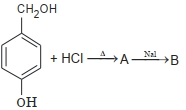
A
$4-$(iodomethyl)phenol
B
$4-$iodophenol
C
$4-$(chloromethyl)phenol
D
$1-$chloro$-4-$iodomethylbenzene
Solution
(A) The reaction proceeds in two steps:
$1$. The reaction of $4$-hydroxybenzyl alcohol with $HCl$ under heating $(\Delta)$ leads to the substitution of the alcoholic $-OH$ group with $-Cl$,forming $4$-(chloromethyl)phenol as product $A$.
$2$. The reaction of $A$ with $NaI$ in acetone (Finkelstein reaction) proceeds via an $S_N2$ mechanism,where the $-Cl$ atom is replaced by an $-I$ atom to form $4$-(iodomethyl)phenol as product $B$.
$1$. The reaction of $4$-hydroxybenzyl alcohol with $HCl$ under heating $(\Delta)$ leads to the substitution of the alcoholic $-OH$ group with $-Cl$,forming $4$-(chloromethyl)phenol as product $A$.
$2$. The reaction of $A$ with $NaI$ in acetone (Finkelstein reaction) proceeds via an $S_N2$ mechanism,where the $-Cl$ atom is replaced by an $-I$ atom to form $4$-(iodomethyl)phenol as product $B$.
0 likes
View Solution852
MediumMCQ
Identify the correct statement for the below given transformation:
$CH_{3}CH_{2}CH_{2}CH(N^{+}(CH_{3})_{3})CH_{3}$ $\xrightarrow{C_{2}H_{5}ONa / C_{2}H_{5}OH} A (\text{major}) + B (\text{minor})$
$CH_{3}CH_{2}CH_{2}CH(N^{+}(CH_{3})_{3})CH_{3}$ $\xrightarrow{C_{2}H_{5}ONa / C_{2}H_{5}OH} A (\text{major}) + B (\text{minor})$
A
$A = CH_{3}CH_{2}CH_{2}CH=CH_{2}$,$B = CH_{3}CH_{2}CH=CHCH_{3}$,$\text{Saytzeff products}$
B
$A = CH_{3}CH_{2}CH_{2}CH=CH_{2}$,$B = CH_{3}CH_{2}CH=CHCH_{3}$,$\text{Hofmann products}$
C
$A = CH_{3}CH_{2}CH=CHCH_{3}$,$B = CH_{3}CH_{2}CH_{2}CH=CH_{2}$,$\text{Hofmann products}$
D
$A = CH_{3}CH_{2}CH=CHCH_{3}$,$B = CH_{3}CH_{2}CH_{2}CH=CH_{2}$,$\text{Saytzeff products}$
Solution
(B) The given reaction is an elimination reaction of a quaternary ammonium salt $(CH_{3}CH_{2}CH_{2}CH(N^{+}(CH_{3})_{3})CH_{3})$ using a base $(C_{2}H_{5}ONa)$.
This is an example of the Hofmann elimination reaction.
In Hofmann elimination,the less substituted alkene is formed as the major product due to steric hindrance caused by the bulky leaving group $(N^{+}(CH_{3})_{3})$.
Therefore,the terminal alkene $CH_{3}CH_{2}CH_{2}CH=CH_{2}$ is the major product $(A)$,and the internal alkene $CH_{3}CH_{2}CH=CHCH_{3}$ is the minor product $(B)$.
This is an example of the Hofmann elimination reaction.
In Hofmann elimination,the less substituted alkene is formed as the major product due to steric hindrance caused by the bulky leaving group $(N^{+}(CH_{3})_{3})$.
Therefore,the terminal alkene $CH_{3}CH_{2}CH_{2}CH=CH_{2}$ is the major product $(A)$,and the internal alkene $CH_{3}CH_{2}CH=CHCH_{3}$ is the minor product $(B)$.
0 likes
View Solution853
DifficultMCQ
Considering the above reactions,the compound $A$ and compound $B$ respectively are:

A
$CH_3CH_2NC, CH_3CH_2CN$
B
$CH_3CH_2CN, CH_3CH_2CN$
C
$CH_3CH_2NC, CH_3CH_2NC$
D
$CH_3CH_2CN, CH_3CH_2NC$
Solution
(A) $NaCN$ is an ionic compound,so it provides $CN^-$ ions in solution. The carbon atom is more nucleophilic than the nitrogen atom,leading to the formation of alkyl cyanide $(R-CN)$ as the major product.
$AgCN$ is a covalent compound. The nitrogen atom has a lone pair of electrons available for nucleophilic attack,while the carbon atom is involved in a covalent bond with silver. This leads to the formation of alkyl isocyanide $(R-NC)$ as the major product.
Therefore,for the reaction with $AgCN$,the product $A$ is $CH_3CH_2NC$ (ethyl isocyanide),and for the reaction with $NaCN$,the product $B$ is $CH_3CH_2CN$ (ethyl cyanide).
$AgCN$ is a covalent compound. The nitrogen atom has a lone pair of electrons available for nucleophilic attack,while the carbon atom is involved in a covalent bond with silver. This leads to the formation of alkyl isocyanide $(R-NC)$ as the major product.
Therefore,for the reaction with $AgCN$,the product $A$ is $CH_3CH_2NC$ (ethyl isocyanide),and for the reaction with $NaCN$,the product $B$ is $CH_3CH_2CN$ (ethyl cyanide).
0 likes
View Solution854
DifficultMCQ
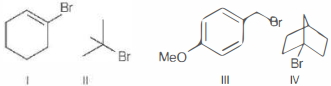
Among the following,the compounds which can undergo an $S_{N}1$ reaction in an aqueous solution are:
A
$I$ and $IV$ only
B
$II$ and $IV$ only
C
$II$ and $III$ only
D
$II, III$ and $IV$ only
Solution
(C) $S_{N}1$ reaction proceeds via the formation of a carbocation intermediate. The rate of $S_{N}1$ reaction depends on the stability of the carbocation formed.
$I$: This is a vinylic halide. The resulting vinylic carbocation is highly unstable due to the $sp$ hybridization of the positively charged carbon.
$II$: This is a tert-butyl bromide. It forms a stable $3^{\circ}$ carbocation,which is stabilized by hyperconjugation.
$III$: This is $p$-methoxybenzyl bromide. It forms a resonance-stabilized benzylic carbocation,which is further stabilized by the electron-donating $+R$ effect of the $-OCH_3$ group.
$IV$: This is a bridgehead bromide ($1$-bromobicyclo[$2.2$.$1$]heptane). Formation of a carbocation at the bridgehead position is highly unstable due to Bredt's rule,which prevents the planar geometry required for the carbocation.
Therefore,only compounds $II$ and $III$ can undergo an $S_{N}1$ reaction.
$I$: This is a vinylic halide. The resulting vinylic carbocation is highly unstable due to the $sp$ hybridization of the positively charged carbon.
$II$: This is a tert-butyl bromide. It forms a stable $3^{\circ}$ carbocation,which is stabilized by hyperconjugation.
$III$: This is $p$-methoxybenzyl bromide. It forms a resonance-stabilized benzylic carbocation,which is further stabilized by the electron-donating $+R$ effect of the $-OCH_3$ group.
$IV$: This is a bridgehead bromide ($1$-bromobicyclo[$2.2$.$1$]heptane). Formation of a carbocation at the bridgehead position is highly unstable due to Bredt's rule,which prevents the planar geometry required for the carbocation.
Therefore,only compounds $II$ and $III$ can undergo an $S_{N}1$ reaction.
0 likes
View Solution855
DifficultMCQ
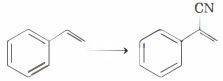
The reagents required for the following two-step transformation are:
A
$(i) \ HBr, \text{benzoyl peroxide}; (ii) \ CH_3CN$
B
$(i) \ HBr; (ii) \ NaCN$
C
$(i) \ Br_2; (ii) \ NaCN$
D
$(i) \ NaBr; (ii) \ NaCN$
Solution
(B) The transformation involves the conversion of styrene to $(1-\text{bromoethyl})\text{benzene}$ followed by nucleophilic substitution to form $(1-\text{cyanoethyl})\text{benzene}$.
Step $1$: Styrene reacts with $HBr$ via electrophilic addition following Markownikoff's rule to yield $(1-\text{bromoethyl})\text{benzene}$.
Step $2$: The resulting alkyl bromide undergoes nucleophilic substitution ($S_N2$ or $S_N1$ depending on conditions,typically $S_N2$ with $NaCN$) to replace the bromine atom with a cyano group $(-CN)$,yielding the final product.
Step $1$: Styrene reacts with $HBr$ via electrophilic addition following Markownikoff's rule to yield $(1-\text{bromoethyl})\text{benzene}$.
Step $2$: The resulting alkyl bromide undergoes nucleophilic substitution ($S_N2$ or $S_N1$ depending on conditions,typically $S_N2$ with $NaCN$) to replace the bromine atom with a cyano group $(-CN)$,yielding the final product.
0 likes
View Solution856
DifficultMCQ
The major product of the reaction between $CH_{3}CH_{2}ONa$ and $(CH_{3})_{3}CCl$ in ethanol is
A
$CH_{3}CH_{2}OC(CH_{3})_{3}$
B
$CH_{2}=C(CH_{3})_{2}$
C
$CH_{3}CH_{2}C(CH_{3})_{3}$
D
$CH_{3}CH=CHCH_{3}$
Solution
(B) The reaction between a tertiary alkyl halide,$(CH_{3})_{3}CCl$,and a strong base,$CH_{3}CH_{2}ONa$,in ethanol primarily undergoes an $E2$ elimination reaction.
Since $(CH_{3})_{3}CCl$ is a tertiary halide,steric hindrance makes substitution difficult.
The strong base $CH_{3}CH_{2}O^-$ abstracts a proton from the $\beta$-carbon,leading to the formation of an alkene.
The reaction is: $(CH_{3})_{3}CCl + CH_{3}CH_{2}ONa \rightarrow CH_{2}=C(CH_{3})_{2} + CH_{3}CH_{2}OH + NaCl$.
The major product is $2$-methylpropene,which corresponds to option $B$.
Since $(CH_{3})_{3}CCl$ is a tertiary halide,steric hindrance makes substitution difficult.
The strong base $CH_{3}CH_{2}O^-$ abstracts a proton from the $\beta$-carbon,leading to the formation of an alkene.
The reaction is: $(CH_{3})_{3}CCl + CH_{3}CH_{2}ONa \rightarrow CH_{2}=C(CH_{3})_{2} + CH_{3}CH_{2}OH + NaCl$.
The major product is $2$-methylpropene,which corresponds to option $B$.
0 likes
View Solution857
MediumMCQ
The order of $S_N 1$ reactivity in aqueous acetic acid solution for the compounds:
$1$. $CH_3-CO-CH_2-Cl$
$2$. $CH_3-CH_2-CH_2-Cl$
$3$. $(CH_3)_3C-Cl$
is
$1$. $CH_3-CO-CH_2-Cl$
$2$. $CH_3-CH_2-CH_2-Cl$
$3$. $(CH_3)_3C-Cl$
is
A
$1 > 2 > 3$
B
$1 > 3 > 2$
C
$3 > 2 > 1$
D
$3 > 1 > 2$
Solution
(C) The $S_N 1$ reaction rate depends upon the stability of the carbocation intermediate formed in the rate-determining step. Higher stability of the carbocation leads to higher reactivity.
The carbocation intermediates formed are:
$1$. $CH_3-CO-CH_2^+$ (Least stable due to the strong electron-withdrawing effect of the carbonyl group).
$2$. $CH_3-CH_2-CH_2^+$ ($1^\circ$ carbocation).
$3$. $(CH_3)_3C^+$ ($3^\circ$ carbocation,most stable due to hyperconjugation and inductive effect).
Thus,the order of stability of the carbocations is $(CH_3)_3C^+ > CH_3-CH_2-CH_2^+ > CH_3-CO-CH_2^+$.
Therefore,the order of $S_N 1$ reactivity is $3 > 2 > 1$.
The carbocation intermediates formed are:
$1$. $CH_3-CO-CH_2^+$ (Least stable due to the strong electron-withdrawing effect of the carbonyl group).
$2$. $CH_3-CH_2-CH_2^+$ ($1^\circ$ carbocation).
$3$. $(CH_3)_3C^+$ ($3^\circ$ carbocation,most stable due to hyperconjugation and inductive effect).
Thus,the order of stability of the carbocations is $(CH_3)_3C^+ > CH_3-CH_2-CH_2^+ > CH_3-CO-CH_2^+$.
Therefore,the order of $S_N 1$ reactivity is $3 > 2 > 1$.
0 likes
View Solution858
MediumMCQ
The major product of the following reaction is
$C_6H_5CH_2CH_3 + (CH_3)_2CHCH_2Cl \xrightarrow{AlCl_3} \text{?}$
$C_6H_5CH_2CH_3 + (CH_3)_2CHCH_2Cl \xrightarrow{AlCl_3} \text{?}$
A
$1-$ethyl$-4-$tert-butylbenzene
B
$1-$ethyl$-4-$isobutylbenzene
C
$1-$ethyl$-3-$($2$-methylpropyl)benzene
D
$1-$ethyl$-2-$tert-butylbenzene
Solution
(A) In the presence of $AlCl_3$,the alkyl halide $(CH_3)_2CHCH_2Cl$ undergoes ionization to form a primary carbocation $(CH_3)_2CHCH_2^+$.
This primary carbocation is unstable and undergoes a $1,2$-hydride shift to form a more stable tertiary carbocation $(CH_3)_2C^+CH_3$.
Ethylbenzene is an ortho/para directing group. Due to steric hindrance at the ortho position,the bulky tert-butyl group attacks the para position of ethylbenzene to form $1$-ethyl-$4$-tert-butylbenzene as the major product.
This primary carbocation is unstable and undergoes a $1,2$-hydride shift to form a more stable tertiary carbocation $(CH_3)_2C^+CH_3$.
Ethylbenzene is an ortho/para directing group. Due to steric hindrance at the ortho position,the bulky tert-butyl group attacks the para position of ethylbenzene to form $1$-ethyl-$4$-tert-butylbenzene as the major product.
0 likes
View Solution859
MediumMCQ
$(R)-2-$bromobutane upon treatment with $aq. \, NaOH$ gives
A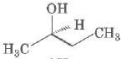
B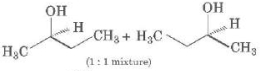
C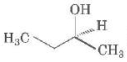
D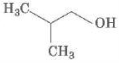
Solution
(B) $(R)-2-$bromobutane is a secondary $(2^{\circ})$ alkyl halide.
When treated with $aq. \, NaOH$,it undergoes a nucleophilic substitution reaction.
Since it is a secondary halide,the reaction proceeds primarily via the $S_N1$ mechanism,which involves the formation of a planar carbocation intermediate.
The nucleophile $(OH^-)$ can attack the carbocation from either side with equal probability,leading to the formation of both $(R)$ and $(S)$ enantiomers of $2-$butanol in equal amounts.
This process is known as racemisation,and the resulting product is a racemic mixture.
When treated with $aq. \, NaOH$,it undergoes a nucleophilic substitution reaction.
Since it is a secondary halide,the reaction proceeds primarily via the $S_N1$ mechanism,which involves the formation of a planar carbocation intermediate.
The nucleophile $(OH^-)$ can attack the carbocation from either side with equal probability,leading to the formation of both $(R)$ and $(S)$ enantiomers of $2-$butanol in equal amounts.
This process is known as racemisation,and the resulting product is a racemic mixture.
0 likes
View Solution860
MediumMCQ
The chlorine atom of the following compound that reacts most readily with $AgNO_3$ to give a precipitate is

A
$Cl^a$
B
$Cl^b$
C
$Cl^c$
D
$Cl^d$
Solution
(A) The reaction between a haloalkane and $AgNO_3$ proceeds via the formation of a carbocation intermediate. The more stable the resulting carbocation,the more readily the reaction occurs to yield a precipitate of $AgCl$.
In the given cyclic ether structure,the $Cl^a$ atom is attached to the carbon atom adjacent to the oxygen atom.
Upon the removal of $Cl^a$ as a chloride ion,the resulting carbocation is an oxocarbenium ion,which is significantly stabilized by the resonance effect of the lone pair of electrons on the adjacent oxygen atom $(O-C^+ \leftrightarrow O^+=C)$.
This resonance stabilization makes the formation of this specific carbocation much faster and more favorable compared to the other positions $(Cl^b, Cl^c, Cl^d)$,which do not benefit from such direct resonance stabilization by the oxygen atom.
Therefore,$Cl^a$ reacts most readily with $AgNO_3$.
In the given cyclic ether structure,the $Cl^a$ atom is attached to the carbon atom adjacent to the oxygen atom.
Upon the removal of $Cl^a$ as a chloride ion,the resulting carbocation is an oxocarbenium ion,which is significantly stabilized by the resonance effect of the lone pair of electrons on the adjacent oxygen atom $(O-C^+ \leftrightarrow O^+=C)$.
This resonance stabilization makes the formation of this specific carbocation much faster and more favorable compared to the other positions $(Cl^b, Cl^c, Cl^d)$,which do not benefit from such direct resonance stabilization by the oxygen atom.
Therefore,$Cl^a$ reacts most readily with $AgNO_3$.
0 likes
View Solution861
DifficultMCQ
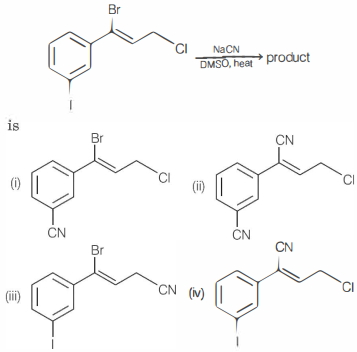
The major product formed in the reaction is:
A
$(i)$
B
$(ii)$
C
$(iii)$
D
$(iv)$
Solution
(C) The reaction involves an $S_{N}2$ mechanism. The nucleophile $CN^{-}$ attacks the primary alkyl chloride carbon,which is the most reactive site for $S_{N}2$ substitution in the given molecule. The $Cl^{-}$ ion acts as the leaving group. The $Br$ atom attached to the $sp^{2}$ carbon of the alkene is not easily substituted under these conditions. Therefore,the $CN$ group replaces the $Cl$ atom,resulting in product $(iii)$.
0 likes
View Solution862
MediumMCQ
Among the following,the compound which undergoes the fastest solvolysis is
A
$Ph-CH_2-CH_2-CH(Br)-CH_3$
B
$Me-CH_2-CH(Br)-CH_2-Ph$
C
$Me-CH(Br)-CH(CH_3)-Ph$
D
$Ph-CH(Br)-CH_2-CH_2-Br$
Solution
(C) The rate of solvolysis is directly proportional to the stability of the carbocation intermediate formed after the departure of the leaving group $(Br^-)$.
In option $C$,the compound is $Me-CH(Br)-CH(CH_3)-Ph$. Upon the loss of $Br^-$,it forms a secondary carbocation adjacent to a phenyl group and a methyl group.
This carbocation is stabilized by the resonance effect of the phenyl group and the inductive effect $(+I)$ of the methyl group,making it the most stable among the given options.
Therefore,the compound in option $C$ undergoes the fastest solvolysis.
In option $C$,the compound is $Me-CH(Br)-CH(CH_3)-Ph$. Upon the loss of $Br^-$,it forms a secondary carbocation adjacent to a phenyl group and a methyl group.
This carbocation is stabilized by the resonance effect of the phenyl group and the inductive effect $(+I)$ of the methyl group,making it the most stable among the given options.
Therefore,the compound in option $C$ undergoes the fastest solvolysis.
0 likes
View Solution863
MediumMCQ
$A$ compound $X$ on heating with alcoholic $AgNO_3$ gives a white precipitate. Oxidation of $X$ gives an acid with the formula $C_8H_6O_4$,which easily forms a cyclic anhydride on heating. The compound $X$ is
A
B
C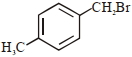
D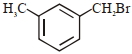
Solution
(A) The compound $X$ reacts with alcoholic $AgNO_3$ to give a white precipitate,indicating the presence of a reactive halogen atom (like a benzylic bromide).
Upon oxidation,$X$ yields an acid with the formula $C_8H_6O_4$. This acid is phthalic acid $(benzene-1,2-dicarboxylic \ acid)$,which is known to form a cyclic anhydride (phthalic anhydride) upon heating.
For $X$ to produce phthalic acid upon oxidation,it must be an ortho-substituted benzene derivative with two side chains that can be oxidized to $-COOH$ groups. The structure corresponding to this is $o-xylene$ derivative,specifically $1-(bromomethyl)-2-methylbenzene$.
Thus,the compound $X$ is $o-methylbenzyl \ bromide$ (or $1-(bromomethyl)-2-methylbenzene$).
Upon oxidation,$X$ yields an acid with the formula $C_8H_6O_4$. This acid is phthalic acid $(benzene-1,2-dicarboxylic \ acid)$,which is known to form a cyclic anhydride (phthalic anhydride) upon heating.
For $X$ to produce phthalic acid upon oxidation,it must be an ortho-substituted benzene derivative with two side chains that can be oxidized to $-COOH$ groups. The structure corresponding to this is $o-xylene$ derivative,specifically $1-(bromomethyl)-2-methylbenzene$.
Thus,the compound $X$ is $o-methylbenzyl \ bromide$ (or $1-(bromomethyl)-2-methylbenzene$).
0 likes
View Solution864
MediumMCQ
Assertion $A:$ Hydrolysis of an alkyl chloride is a slow reaction but in the presence of $NaI$,the rate of the hydrolysis increases.
Reason $R:$ $I^{-}$ is a good nucleophile as well as a good leaving group.
In the light of the above statements,choose the correct answer from the options given below.
Reason $R:$ $I^{-}$ is a good nucleophile as well as a good leaving group.
In the light of the above statements,choose the correct answer from the options given below.
A
$A$ is false but $R$ is true
B
$A$ is true but $R$ is false
C
Both $A$ and $R$ are true and $R$ is the correct explanation of $A$
D
Both $A$ and $R$ are true but $R$ is $NOT$ the correct explanation of $A$
Solution
(C) The hydrolysis of alkyl chloride $(R-Cl)$ is slow because $Cl^-$ is a poor nucleophile.
When $NaI$ is added,$I^-$ acts as a strong nucleophile and attacks the alkyl chloride to form an alkyl iodide $(R-I)$ via an $S_N2$ reaction.
Since $I^-$ is a much better leaving group than $Cl^-$,the subsequent hydrolysis of $R-I$ to form the alcohol $(R-OH)$ occurs much faster.
Thus,$I^-$ acts as a catalyst by converting the alkyl chloride into a more reactive alkyl iodide.
Both $A$ and $R$ are true,and $R$ is the correct explanation of $A$.
When $NaI$ is added,$I^-$ acts as a strong nucleophile and attacks the alkyl chloride to form an alkyl iodide $(R-I)$ via an $S_N2$ reaction.
Since $I^-$ is a much better leaving group than $Cl^-$,the subsequent hydrolysis of $R-I$ to form the alcohol $(R-OH)$ occurs much faster.
Thus,$I^-$ acts as a catalyst by converting the alkyl chloride into a more reactive alkyl iodide.
Both $A$ and $R$ are true,and $R$ is the correct explanation of $A$.
0 likes
View Solution865
DifficultMCQ
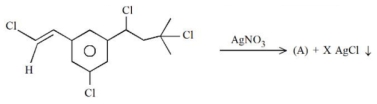
Number of moles of $AgCl$ formed in the following reaction is $X$. Identify $X$ from the given reaction.
A
$4$
B
$6$
C
$2$
D
$8$
Solution
(C) The reaction of organic halides with $AgNO_3$ proceeds via the formation of carbocations.
Only those chlorine atoms that can form stable carbocations (like benzylic or tertiary) or are easily ionizable will react with $AgNO_3$ to precipitate $AgCl$.
$1$. The chlorine atom on the benzene ring (aryl chloride) is not reactive towards $AgNO_3$ due to partial double bond character.
$2$. The vinylic chlorine atom is also not reactive.
$3$. The secondary benzylic chlorine atom forms a stable benzylic carbocation,which reacts with $AgNO_3$ to give $1$ mole of $AgCl$.
$4$. The tertiary alkyl chlorine atom forms a stable tertiary carbocation,which reacts with $AgNO_3$ to give $1$ mole of $AgCl$.
Thus,a total of $2$ moles of $AgCl$ are formed.
Therefore,$X = 2$.
Only those chlorine atoms that can form stable carbocations (like benzylic or tertiary) or are easily ionizable will react with $AgNO_3$ to precipitate $AgCl$.
$1$. The chlorine atom on the benzene ring (aryl chloride) is not reactive towards $AgNO_3$ due to partial double bond character.
$2$. The vinylic chlorine atom is also not reactive.
$3$. The secondary benzylic chlorine atom forms a stable benzylic carbocation,which reacts with $AgNO_3$ to give $1$ mole of $AgCl$.
$4$. The tertiary alkyl chlorine atom forms a stable tertiary carbocation,which reacts with $AgNO_3$ to give $1$ mole of $AgCl$.
Thus,a total of $2$ moles of $AgCl$ are formed.
Therefore,$X = 2$.
0 likes
View Solution866
MediumMCQ
The isomeric deuterated bromide with molecular formula $C_4H_8DBr$ having two chiral carbon atoms is
A
$2-$Bromo$-1-$deuterobutane
B
$2-$Bromo$-2-$deuterobutane
C
$2-$Bromo$-3-$deuterobutane
D
$2-$Bromo$-1-$deutero$-2-$methylpropane
Solution
(C) chiral carbon atom is one that is bonded to four different groups.
Let us analyze the structures:
$A$. $2-$Bromo$-1-$deuterobutane: $CH_3-CH_2-CH(Br)-CH_2D$. Here,$C-2$ is chiral (bonded to $H, Br, CH_3, CH_2D$). Only one chiral center.
$B$. $2-$Bromo$-2-$deuterobutane: $CH_3-CH_2-C(Br)(D)-CH_3$. Here,$C-2$ is chiral (bonded to $Br, D, CH_3, CH_2CH_3$). Only one chiral center.
$C$. $2-$Bromo$-3-$deuterobutane: $CH_3-CH(Br)-CH(D)-CH_3$. Here,$C-2$ is bonded to $H, Br, CH_3, CH(D)CH_3$ (chiral). $C-3$ is bonded to $H, D, CH_3, CH(Br)CH_3$ (chiral). This molecule has two chiral carbon atoms.
$D$. $2-$Bromo$-1-$deutero$-2-$methylpropane: $(CH_3)_2C(Br)-CH_2D$. No chiral carbon atom.
Therefore,the correct option is $C$.
Let us analyze the structures:
$A$. $2-$Bromo$-1-$deuterobutane: $CH_3-CH_2-CH(Br)-CH_2D$. Here,$C-2$ is chiral (bonded to $H, Br, CH_3, CH_2D$). Only one chiral center.
$B$. $2-$Bromo$-2-$deuterobutane: $CH_3-CH_2-C(Br)(D)-CH_3$. Here,$C-2$ is chiral (bonded to $Br, D, CH_3, CH_2CH_3$). Only one chiral center.
$C$. $2-$Bromo$-3-$deuterobutane: $CH_3-CH(Br)-CH(D)-CH_3$. Here,$C-2$ is bonded to $H, Br, CH_3, CH(D)CH_3$ (chiral). $C-3$ is bonded to $H, D, CH_3, CH(Br)CH_3$ (chiral). This molecule has two chiral carbon atoms.
$D$. $2-$Bromo$-1-$deutero$-2-$methylpropane: $(CH_3)_2C(Br)-CH_2D$. No chiral carbon atom.
Therefore,the correct option is $C$.
0 likes
View Solution867
MediumMCQ
Identify the correct order for the given property for the following compounds. Choose the correct answer from the options given below:
$(A)$ Boiling Point: $CH_3CH_2Cl < CH_3CH_2CH_2Cl < CH_3CH_2CH_2CH_2Cl$
$(B)$ Density: $CH_3CH_2Br < CH_3CH_2Cl < CH_3CH_2I$
$(C)$ Boiling Point: $CH_3CH_2Br < (CH_3)_2CHBr < (CH_3)_3CBr$
$(D)$ Density: $CH_3CH(I)Br < CH_3CH_2CH_2Br < CH_3CH(Br)Cl$
$(E)$ Boiling Point: $CH_3CH_2CH_2CH_2Cl > (CH_3)_2CHCH_2Cl > (CH_3)_3CCl$
$(A)$ Boiling Point: $CH_3CH_2Cl < CH_3CH_2CH_2Cl < CH_3CH_2CH_2CH_2Cl$
$(B)$ Density: $CH_3CH_2Br < CH_3CH_2Cl < CH_3CH_2I$
$(C)$ Boiling Point: $CH_3CH_2Br < (CH_3)_2CHBr < (CH_3)_3CBr$
$(D)$ Density: $CH_3CH(I)Br < CH_3CH_2CH_2Br < CH_3CH(Br)Cl$
$(E)$ Boiling Point: $CH_3CH_2CH_2CH_2Cl > (CH_3)_2CHCH_2Cl > (CH_3)_3CCl$
A
$A, C$ and $D$ only
B
$A, B$ and $E$ only
C
$A, C$ and $E$ only
D
$B, C$ and $D$ only
Solution
(B) Analysis of the given statements:
$(A)$ Boiling point increases with an increase in the size of the alkyl group. Thus,$CH_3CH_2Cl < CH_3CH_2CH_2Cl < CH_3CH_2CH_2CH_2Cl$ is correct.
$(B)$ Density increases with the atomic mass of the halogen atom. The order of atomic mass is $Cl < Br < I$. Therefore,the correct order should be $CH_3CH_2Cl < CH_3CH_2Br < CH_3CH_2I$. Statement $(B)$ is incorrect.
$(C)$ Boiling point of isomeric alkyl halides decreases with an increase in branching. Thus,$CH_3CH_2CH_2Br > (CH_3)_2CHBr > (CH_3)_3CBr$. Statement $(C)$ is incorrect.
$(D)$ Density increases with the atomic mass of the halogen atom. Comparing the halogen atoms in the given compounds,the order of density is $CH_3CH_2CH_2Br < CH_3CH(Br)Cl < CH_3CH(I)Br$. Statement $(D)$ is incorrect.
$(E)$ Boiling point of isomeric alkyl halides decreases with an increase in branching. Thus,$n$-butyl chloride $(CH_3CH_2CH_2CH_2Cl)$ > isobutyl chloride $((CH_3)_2CHCH_2Cl)$ > tert-butyl chloride $((CH_3)_3CCl)$. Statement $(E)$ is correct.
Therefore,only statements $(A)$ and $(E)$ are correct. However,based on the provided options,the most appropriate choice is $(B)$ $A, B$ and $E$ only,assuming a potential typo in the question's provided options or the intended order in $(B)$.
$(A)$ Boiling point increases with an increase in the size of the alkyl group. Thus,$CH_3CH_2Cl < CH_3CH_2CH_2Cl < CH_3CH_2CH_2CH_2Cl$ is correct.
$(B)$ Density increases with the atomic mass of the halogen atom. The order of atomic mass is $Cl < Br < I$. Therefore,the correct order should be $CH_3CH_2Cl < CH_3CH_2Br < CH_3CH_2I$. Statement $(B)$ is incorrect.
$(C)$ Boiling point of isomeric alkyl halides decreases with an increase in branching. Thus,$CH_3CH_2CH_2Br > (CH_3)_2CHBr > (CH_3)_3CBr$. Statement $(C)$ is incorrect.
$(D)$ Density increases with the atomic mass of the halogen atom. Comparing the halogen atoms in the given compounds,the order of density is $CH_3CH_2CH_2Br < CH_3CH(Br)Cl < CH_3CH(I)Br$. Statement $(D)$ is incorrect.
$(E)$ Boiling point of isomeric alkyl halides decreases with an increase in branching. Thus,$n$-butyl chloride $(CH_3CH_2CH_2CH_2Cl)$ > isobutyl chloride $((CH_3)_2CHCH_2Cl)$ > tert-butyl chloride $((CH_3)_3CCl)$. Statement $(E)$ is correct.
Therefore,only statements $(A)$ and $(E)$ are correct. However,based on the provided options,the most appropriate choice is $(B)$ $A, B$ and $E$ only,assuming a potential typo in the question's provided options or the intended order in $(B)$.
0 likes
View Solution868
MediumMCQ
The one giving the maximum number of isomeric alkenes on dehydrohalogenation reaction is (excluding rearrangement):
A
$1-$Bromo$-2-$methylbutane
B
$2-$Bromopropane
C
$2-$Bromopentane
D
$2-$Bromo$-3,3-$dimethylpentane
Solution
(C) Dehydrohalogenation involves the removal of $H$ and $X$ from adjacent carbons to form an alkene. We analyze each option:
$A$) $1-$Bromo$-2-$methylbutane $(CH_3-CH_2-CH(CH_3)-CH_2Br)$: Only one $\beta$-hydrogen is available,yielding $2-$methylbut$-1-$ene ($1$ product).
$B$) $2-$Bromopropane $(CH_3-CH(Br)-CH_3)$: Only one type of $\beta$-hydrogen is available,yielding propene ($1$ product).
$C$) $2-$Bromopentane $(CH_3-CH_2-CH_2-CH(Br)-CH_3)$: Two types of $\beta$-hydrogens are available. Removal from $C_1$ gives pent$-1-$ene. Removal from $C_3$ gives pent$-2-$ene,which exists as $cis$ and $trans$ isomers. Total = $3$ products.
$D$) $2-$Bromo$-3,3-$dimethylpentane: Only one $\beta$-hydrogen is available at $C_3$ (if possible) or $C_1$,but given the structure,it yields only $1$ alkene product.
Thus,$2-$Bromopentane gives the maximum number of isomeric alkenes.
$A$) $1-$Bromo$-2-$methylbutane $(CH_3-CH_2-CH(CH_3)-CH_2Br)$: Only one $\beta$-hydrogen is available,yielding $2-$methylbut$-1-$ene ($1$ product).
$B$) $2-$Bromopropane $(CH_3-CH(Br)-CH_3)$: Only one type of $\beta$-hydrogen is available,yielding propene ($1$ product).
$C$) $2-$Bromopentane $(CH_3-CH_2-CH_2-CH(Br)-CH_3)$: Two types of $\beta$-hydrogens are available. Removal from $C_1$ gives pent$-1-$ene. Removal from $C_3$ gives pent$-2-$ene,which exists as $cis$ and $trans$ isomers. Total = $3$ products.
$D$) $2-$Bromo$-3,3-$dimethylpentane: Only one $\beta$-hydrogen is available at $C_3$ (if possible) or $C_1$,but given the structure,it yields only $1$ alkene product.
Thus,$2-$Bromopentane gives the maximum number of isomeric alkenes.
0 likes
View Solution869
MediumMCQ
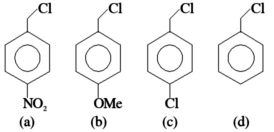
The decreasing order of reactivity towards $S_N 1$ reaction for the following compounds is:
A
$a > c > d > b$
B
$a > b > c > d$
C
$b > d > c > a$
D
$d > b > c > a$
Solution
(C) The rate of $S_N 1$ reaction depends upon the stability of the carbocation intermediate formed after the departure of the leaving group $(Cl^-)$.
Electron-donating groups (like $-OCH_3$) increase the stability of the carbocation,while electron-withdrawing groups (like $-NO_2$ and $-Cl$) decrease its stability.
The stability order of the carbocations is:
$p-methoxybenzyl$ carbocation $(b)$ $>$ $benzyl$ carbocation $(d)$ $>$ $p-chlorobenzyl$ carbocation $(c)$ $>$ $p-nitrobenzyl$ carbocation $(a)$.
Therefore,the decreasing order of reactivity towards $S_N 1$ reaction is:
$(b) > (d) > (c) > (a)$.
Electron-donating groups (like $-OCH_3$) increase the stability of the carbocation,while electron-withdrawing groups (like $-NO_2$ and $-Cl$) decrease its stability.
The stability order of the carbocations is:
$p-methoxybenzyl$ carbocation $(b)$ $>$ $benzyl$ carbocation $(d)$ $>$ $p-chlorobenzyl$ carbocation $(c)$ $>$ $p-nitrobenzyl$ carbocation $(a)$.
Therefore,the decreasing order of reactivity towards $S_N 1$ reaction is:
$(b) > (d) > (c) > (a)$.
0 likes
View Solution870
MediumMCQ
Identify the incorrect option from the following:
A
$CH_3CH_2CH_2Br + KOH(aq) \rightarrow CH_3CH_2CH_2OH + KBr$
B
$(CH_3)_3CCH_2Br + KOH(alc) \rightarrow (CH_3)_3CCH_2OH + KBr$
C
$C_6H_5Cl + CH_3COCl \xrightarrow{anhyd. AlCl_3} C_6H_4(Cl)COCH_3 + HCl$
D
$C_6H_5Cl \xrightarrow[(ii) HCl]{(i) NaOH, 623 K, 300 atm} C_6H_5OH$
Solution
(B) In option $B$,the reaction involves a primary alkyl halide $(CH_3)_3CCH_2Br$ with alcoholic $KOH$. Alcoholic $KOH$ acts as a strong base and promotes an elimination reaction ($E2$ mechanism) to form an alkene. However,the reaction shown is a substitution reaction,which is incorrect for alcoholic $KOH$. Aqueous $KOH$ would be required for substitution to form an alcohol.
0 likes
View Solution871
DifficultMCQ
The graph which represents the following reaction is :
$(C_6H_5)_3C-Cl \xrightarrow{OH^{-} / \text{Pyridine}} (C_6H_5)_3C-OH$
$(C_6H_5)_3C-Cl \xrightarrow{OH^{-} / \text{Pyridine}} (C_6H_5)_3C-OH$
A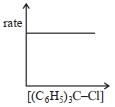
B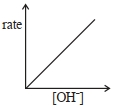
C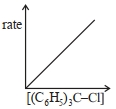
D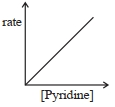
Solution
(C) The given reaction is a nucleophilic substitution reaction of a tertiary alkyl halide,$(C_6H_5)_3C-Cl$,which proceeds via an $SN_1$ mechanism.
In an $SN_1$ reaction,the rate-determining step is the formation of the carbocation,which depends only on the concentration of the alkyl halide.
The rate law for this reaction is: $\text{Rate} = k[(C_6H_5)_3C-Cl]$.
Since the rate is directly proportional to the concentration of the alkyl halide,the graph of rate versus $[(C_6H_5)_3C-Cl]$ should be a straight line passing through the origin,as shown in option $C$.
In an $SN_1$ reaction,the rate-determining step is the formation of the carbocation,which depends only on the concentration of the alkyl halide.
The rate law for this reaction is: $\text{Rate} = k[(C_6H_5)_3C-Cl]$.
Since the rate is directly proportional to the concentration of the alkyl halide,the graph of rate versus $[(C_6H_5)_3C-Cl]$ should be a straight line passing through the origin,as shown in option $C$.
0 likes
View Solution872
MediumMCQ
Predict the order of reactivity of the following four isomers towards $S_{N}2$ reaction.
$(I)$ $CH_{3}CH_{2}CH_{2}CH_{2}Cl$
$(II)$ $CH_{3}CH_{2}CH(Cl)CH_{3}$
$(III)$ $(CH_{3})_{2}CHCH_{2}Cl$
$(IV)$ $(CH_{3})_{3}CCl$
$(I)$ $CH_{3}CH_{2}CH_{2}CH_{2}Cl$
$(II)$ $CH_{3}CH_{2}CH(Cl)CH_{3}$
$(III)$ $(CH_{3})_{2}CHCH_{2}Cl$
$(IV)$ $(CH_{3})_{3}CCl$
A
$IV > III > II > I$
B
$I > II > III > IV$
C
$I > III > II > IV$
D
$IV > II > III > I$
Solution
(C) The reactivity of alkyl halides towards $S_{N}2$ reactions is primarily governed by steric hindrance. The order of reactivity is $Primary > Secondary > Tertiary$.
$(I)$ $CH_{3}CH_{2}CH_{2}CH_{2}Cl$ is a primary alkyl halide with minimal steric hindrance.
$(III)$ $(CH_{3})_{2}CHCH_{2}Cl$ is a primary alkyl halide but has more steric hindrance than $(I)$ due to the branching at the $\beta$-carbon.
$(II)$ $CH_{3}CH_{2}CH(Cl)CH_{3}$ is a secondary alkyl halide.
$(IV)$ $(CH_{3})_{3}CCl$ is a tertiary alkyl halide,which is the least reactive towards $S_{N}2$ due to maximum steric hindrance.
Therefore,the correct order is $I > III > II > IV$.
$(I)$ $CH_{3}CH_{2}CH_{2}CH_{2}Cl$ is a primary alkyl halide with minimal steric hindrance.
$(III)$ $(CH_{3})_{2}CHCH_{2}Cl$ is a primary alkyl halide but has more steric hindrance than $(I)$ due to the branching at the $\beta$-carbon.
$(II)$ $CH_{3}CH_{2}CH(Cl)CH_{3}$ is a secondary alkyl halide.
$(IV)$ $(CH_{3})_{3}CCl$ is a tertiary alkyl halide,which is the least reactive towards $S_{N}2$ due to maximum steric hindrance.
Therefore,the correct order is $I > III > II > IV$.
0 likes
View Solution873
DifficultMCQ
For the reaction:
$RCH_2Br + I^{-} \stackrel{\text{Acetone}}{\longrightarrow} RCH_2I + Br^{-}$
The correct statement is:
$RCH_2Br + I^{-} \stackrel{\text{Acetone}}{\longrightarrow} RCH_2I + Br^{-}$
The correct statement is:
A
The transition state formed in the above reaction is less polar than the localised anion.
B
The reaction can occur in acetic acid also.
C
The solvent used in the reaction solvates the ions formed in the rate-determining step.
D
$Br^{-}$ can act as a competing nucleophile.
Solution
(A) This is the $Finkelstein$ reaction,which proceeds via an $S_N2$ mechanism.
In the $S_N2$ transition state,the negative charge is dispersed over the incoming nucleophile $(I^-)$ and the leaving group $(Br^-)$. Therefore,the transition state is less polar than the localized anion $(I^-)$,which facilitates the reaction in a polar aprotic solvent like acetone.
Acetic acid is a polar protic solvent,which solvates the nucleophile $(I^-)$ through hydrogen bonding,thereby decreasing its nucleophilicity and hindering the $S_N2$ reaction.
Acetone is a polar aprotic solvent; it does not solvate the anion effectively,keeping the nucleophile reactive.
$NaBr$ is insoluble in acetone and precipitates out,which drives the reaction forward according to $Le$ $Chatelier's$ principle,preventing $Br^-$ from acting as a competing nucleophile.
Thus,the correct statement is that the transition state is less polar than the localized anion.
In the $S_N2$ transition state,the negative charge is dispersed over the incoming nucleophile $(I^-)$ and the leaving group $(Br^-)$. Therefore,the transition state is less polar than the localized anion $(I^-)$,which facilitates the reaction in a polar aprotic solvent like acetone.
Acetic acid is a polar protic solvent,which solvates the nucleophile $(I^-)$ through hydrogen bonding,thereby decreasing its nucleophilicity and hindering the $S_N2$ reaction.
Acetone is a polar aprotic solvent; it does not solvate the anion effectively,keeping the nucleophile reactive.
$NaBr$ is insoluble in acetone and precipitates out,which drives the reaction forward according to $Le$ $Chatelier's$ principle,preventing $Br^-$ from acting as a competing nucleophile.
Thus,the correct statement is that the transition state is less polar than the localized anion.
0 likes
View Solution874
MediumMCQ
Choose the halogen which is most reactive towards $SN1$ reaction in the given compounds $(A, B, C, D)$:
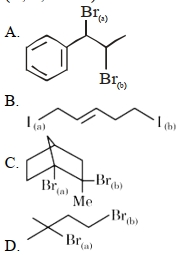
A
$A-Br_{(b)}$; $B-I_{(b)}$; $C-Br_{(b)}$; $D-Br_{(b)}$
B
$A-Br_{(a)}$; $B-I_{(a)}$; $C-Br_{(b)}$; $D-Br_{(a)}$
C
$A-Br_{(b)}$; $B-I_{(a)}$; $C-Br_{(a)}$; $D-Br_{(a)}$
D
$A-Br_{(a)}$; $B-I_{(b)}$; $C-Br_{(a)}$; $D-Br_{(b)}$
Solution
(B) The rate of $SN1$ reaction depends on the stability of the carbocation formed after the departure of the leaving group.
$1$. In compound $A$,$Br_{(a)}$ forms a benzylic carbocation,which is highly stabilized by resonance.
$2$. In compound $B$,$I_{(a)}$ forms an allylic carbocation,which is also resonance stabilized but less than the benzylic one.
$3$. In compound $C$,$Br_{(a)}$ forms a tertiary carbocation.
$4$. In compound $D$,$Br_{(a)}$ forms a tertiary carbocation.
Comparing the stability,the benzylic carbocation formed by $Br_{(a)}$ in compound $A$ is the most stable. Therefore,$A-Br_{(a)}$ is the most reactive towards $SN1$ reaction.
$1$. In compound $A$,$Br_{(a)}$ forms a benzylic carbocation,which is highly stabilized by resonance.
$2$. In compound $B$,$I_{(a)}$ forms an allylic carbocation,which is also resonance stabilized but less than the benzylic one.
$3$. In compound $C$,$Br_{(a)}$ forms a tertiary carbocation.
$4$. In compound $D$,$Br_{(a)}$ forms a tertiary carbocation.
Comparing the stability,the benzylic carbocation formed by $Br_{(a)}$ in compound $A$ is the most stable. Therefore,$A-Br_{(a)}$ is the most reactive towards $SN1$ reaction.
0 likes
View Solution875
MediumMCQ
The major product '$P$' formed in the given reaction is:

A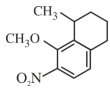
B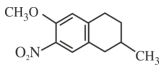
C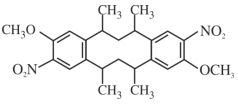
D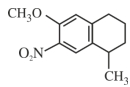
Solution
(D) The reaction is an intramolecular Friedel-Crafts alkylation.
$1$. The Lewis acid $AlCl_3$ reacts with the alkyl chloride to form a carbocation intermediate at the secondary carbon.
$2$. The benzene ring is substituted with a $-OCH_3$ group (activating,ortho/para directing) and a $-NO_2$ group (deactivating,meta directing).
$3$. The $-OCH_3$ group is a stronger directing group than the $-NO_2$ group.
$4$. The ortho position relative to the $-OCH_3$ group is sterically hindered,so the cyclization occurs at the para position relative to the $-OCH_3$ group (which is ortho to the $-NO_2$ group).
$5$. The resulting product is a substituted tetralin derivative as shown in option $D$.
$1$. The Lewis acid $AlCl_3$ reacts with the alkyl chloride to form a carbocation intermediate at the secondary carbon.
$2$. The benzene ring is substituted with a $-OCH_3$ group (activating,ortho/para directing) and a $-NO_2$ group (deactivating,meta directing).
$3$. The $-OCH_3$ group is a stronger directing group than the $-NO_2$ group.
$4$. The ortho position relative to the $-OCH_3$ group is sterically hindered,so the cyclization occurs at the para position relative to the $-OCH_3$ group (which is ortho to the $-NO_2$ group).
$5$. The resulting product is a substituted tetralin derivative as shown in option $D$.
0 likes
View Solution876
MediumMCQ
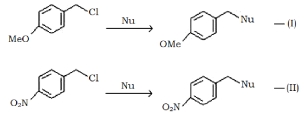
Where $Nu =$ Nucleophile. Find out the correct statement from the options given below for the above $2$ reactions.
A
Reaction $(I)$ is of $2^{nd}$ order and reaction $(II)$ is of $1^{st}$ order
B
Reaction $(I)$ and $(II)$ both are of $2^{nd}$ order
C
Reaction $(I)$ is of $1^{st}$ order and reaction $(II)$ is of $2^{nd}$ order
D
Reactions $(I)$ and $(II)$ both are of $1^{st}$ order
Solution
(C) In reaction $(I)$,the substrate has an electron-donating group $(-OMe)$ at the para position,which stabilizes the carbocation intermediate. This facilitates the $S_N1$ mechanism,which is a $1^{st}$ order reaction.
In reaction $(II)$,the substrate has an electron-withdrawing group $(-NO_2)$ at the para position,which destabilizes the carbocation intermediate,making the $S_N1$ pathway unfavorable. Instead,it proceeds via the $S_N2$ mechanism,which is a $2^{nd}$ order reaction.
Therefore,reaction $(I)$ is of $1^{st}$ order and reaction $(II)$ is of $2^{nd}$ order.
In reaction $(II)$,the substrate has an electron-withdrawing group $(-NO_2)$ at the para position,which destabilizes the carbocation intermediate,making the $S_N1$ pathway unfavorable. Instead,it proceeds via the $S_N2$ mechanism,which is a $2^{nd}$ order reaction.
Therefore,reaction $(I)$ is of $1^{st}$ order and reaction $(II)$ is of $2^{nd}$ order.
0 likes
View Solution877
MediumMCQ
Which of the following compounds will not produce a precipitate on reaction with $AgNO_3$?
A
$1-$Bromocyclohexene
B
Benzyl bromide
C
$3-$Bromocyclopropene
D
$3-$Phenyl$-3-$bromoprop$-1-$ene
Solution
(A) The reaction with $AgNO_3$ involves the formation of a carbocation intermediate. Compounds that form stable carbocations react readily to produce a precipitate of $AgBr$.
$A$. $1$-Bromocyclohexene: The bromine atom is attached to an $sp^2$ hybridized carbon atom of a double bond (vinylic halide). The resulting vinylic carbocation is highly unstable due to the high electronegativity of the $sp^2$ carbon and the inability to stabilize the positive charge through resonance. Therefore,it does not react with $AgNO_3$ to form a precipitate.
$B$. Benzyl bromide: Forms a resonance-stabilized benzyl carbocation,which reacts readily.
$C$. $3$-Bromocyclopropene: Forms a cyclopropenyl cation,which is aromatic ($2\pi$ electrons) and highly stable.
$D$. $3$-Phenyl-$3$-bromoprop-$1$-ene: Forms a resonance-stabilized carbocation (allylic and benzylic stabilization).
Thus,$1$-Bromocyclohexene is the correct answer.
$A$. $1$-Bromocyclohexene: The bromine atom is attached to an $sp^2$ hybridized carbon atom of a double bond (vinylic halide). The resulting vinylic carbocation is highly unstable due to the high electronegativity of the $sp^2$ carbon and the inability to stabilize the positive charge through resonance. Therefore,it does not react with $AgNO_3$ to form a precipitate.
$B$. Benzyl bromide: Forms a resonance-stabilized benzyl carbocation,which reacts readily.
$C$. $3$-Bromocyclopropene: Forms a cyclopropenyl cation,which is aromatic ($2\pi$ electrons) and highly stable.
$D$. $3$-Phenyl-$3$-bromoprop-$1$-ene: Forms a resonance-stabilized carbocation (allylic and benzylic stabilization).
Thus,$1$-Bromocyclohexene is the correct answer.
0 likes
View Solution878
DifficultMCQ
$2-$Methylpropyl bromide reacts with $C_2H_5O^-$ to give $A$,whereas on reaction with $C_2H_5OH$ it gives $B$. The mechanism followed in these reactions and the products $A$ and $B$ respectively are:
A
$S_N2$,$A =$ isobutyl ethyl ether; $S_N1$,$B =$ tert-butyl ethyl ether
B
$S_N1$,$A =$ tert-butyl ethyl ether; $S_N1$,$B = 2-$butyl ethyl ether
C
$S_N1$,$A =$ tert-butyl ethyl ether; $S_N2$,$B =$ isobutyl ethyl ether
D
$S_N2$,$A = 2-$butyl ethyl ether; $S_N2$,$B =$ isobutyl ethyl ether
Solution
(A) Reaction with $C_2H_5O^-$: $C_2H_5O^-$ is a strong nucleophile. $2-$Methylpropyl bromide is a primary alkyl halide. Therefore,it undergoes an $S_N2$ reaction to form isobutyl ethyl ether $(A)$.
Reaction with $C_2H_5OH$: $C_2H_5OH$ is a weak nucleophile. The reaction proceeds via an $S_N1$ mechanism. The primary carbocation formed initially undergoes a $1,2-H$ shift to form a more stable tertiary carbocation,which then reacts with the nucleophile to form tert-butyl ethyl ether $(B)$.
Reaction with $C_2H_5OH$: $C_2H_5OH$ is a weak nucleophile. The reaction proceeds via an $S_N1$ mechanism. The primary carbocation formed initially undergoes a $1,2-H$ shift to form a more stable tertiary carbocation,which then reacts with the nucleophile to form tert-butyl ethyl ether $(B)$.
0 likes
View Solution879
MediumMCQ
Match List-$I$ with List-$II$.
$1$-Bromopropane is reacted with reagents in List-$I$ to give products in List-$II$.
$1$-Bromopropane is reacted with reagents in List-$I$ to give products in List-$II$.
| List-$I$ (Reagent) | List-$II$ (Product) |
|---|---|
| $A$. $KOH$ (alc) | $I$. Nitrile |
| $B$. $KCN$ (alc) | $II$. Ester |
| $C$. $AgNO_2$ | $III$. Alkene |
| $D$. $CH_3COOAg$ | $IV$. Nitroalkane |
A
$A-IV, B-III, C-II, D-I$
B
$A-III, B-I, C-IV, D-II$
C
$A-I, B-II, C-III, D-IV$
D
$A-I, B-III, C-IV, D-II$
Solution
(B) $1$. $CH_3-CH_2-CH_2-Br + KOH \text{ (alc)} \rightarrow CH_3-CH=CH_2$ (Alkene,$III$)
$2$. $CH_3-CH_2-CH_2-Br + KCN \text{ (alc)} \rightarrow CH_3-CH_2-CH_2-CN$ (Nitrile,$I$)
$3$. $CH_3-CH_2-CH_2-Br + AgNO_2 \rightarrow CH_3-CH_2-CH_2-NO_2 + AgBr$ (Nitroalkane,$IV$)
$4$. $CH_3-CH_2-CH_2-Br + CH_3COOAg \rightarrow CH_3COOCH_2-CH_2-CH_3 + AgBr$ (Ester,$II$)
Therefore,the correct matching is $A-III, B-I, C-IV, D-II$.
$2$. $CH_3-CH_2-CH_2-Br + KCN \text{ (alc)} \rightarrow CH_3-CH_2-CH_2-CN$ (Nitrile,$I$)
$3$. $CH_3-CH_2-CH_2-Br + AgNO_2 \rightarrow CH_3-CH_2-CH_2-NO_2 + AgBr$ (Nitroalkane,$IV$)
$4$. $CH_3-CH_2-CH_2-Br + CH_3COOAg \rightarrow CH_3COOCH_2-CH_2-CH_3 + AgBr$ (Ester,$II$)
Therefore,the correct matching is $A-III, B-I, C-IV, D-II$.
0 likes
View Solution880
DifficultMCQ
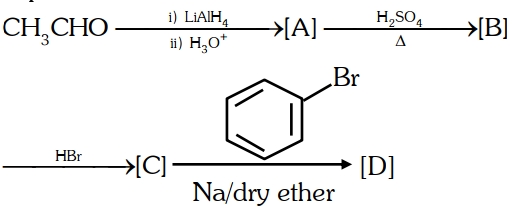
Identify the final product $[D]$ obtained in the following sequence of reactions.
A
$HC \equiv C^{\ominus} Na^{+}$
B
Ethylbenzene
C
Biphenyl
D
$C_4H_{10}$
Solution
(B) The reaction sequence is as follows:
$1$. Reduction of acetaldehyde $(CH_3CHO)$ with $LiAlH_4$ followed by $H_3O^+$ gives ethanol $(CH_3CH_2OH)$ as $[A]$.
$2$. Dehydration of ethanol with $H_2SO_4$ at high temperature gives ethene $(CH_2=CH_2)$ as $[B]$.
$3$. Addition of $HBr$ to ethene gives bromoethane $(CH_3CH_2Br)$ as $[C]$.
$4$. The reaction of bromoethane with bromobenzene in the presence of $Na$ and dry ether is a Wurtz-Fittig reaction,which yields ethylbenzene as the final product $[D]$.
$1$. Reduction of acetaldehyde $(CH_3CHO)$ with $LiAlH_4$ followed by $H_3O^+$ gives ethanol $(CH_3CH_2OH)$ as $[A]$.
$2$. Dehydration of ethanol with $H_2SO_4$ at high temperature gives ethene $(CH_2=CH_2)$ as $[B]$.
$3$. Addition of $HBr$ to ethene gives bromoethane $(CH_3CH_2Br)$ as $[C]$.
$4$. The reaction of bromoethane with bromobenzene in the presence of $Na$ and dry ether is a Wurtz-Fittig reaction,which yields ethylbenzene as the final product $[D]$.
1 likes
View Solution881
DifficultMCQ
The correct statement regarding nucleophilic substitution reaction in a chiral alkyl halide is:
A
Retention occurs in $S_{N}1$ reaction and inversion occurs in $S_{N}2$ reaction.
B
Racemisation occurs in $S_{N}1$ reaction and retention occurs in $S_{N}2$ reaction.
C
Racemisation occurs in both $S_{N}1$ and $S_{N}2$ reactions.
D
Racemisation occurs in $S_{N}1$ reaction and inversion occurs in $S_{N}2$ reaction.
Solution
(D) In an $S_{N}1$ reaction,the carbocation intermediate formed is planar,allowing the nucleophile to attack from either side,which leads to the formation of a racemic mixture (racemisation).
In an $S_{N}2$ reaction,the nucleophile attacks from the side opposite to the leaving group,resulting in the inversion of configuration (Walden inversion).
In an $S_{N}2$ reaction,the nucleophile attacks from the side opposite to the leaving group,resulting in the inversion of configuration (Walden inversion).
0 likes
View Solution882
DifficultMCQ
Which among the following halide$(s)$ will not show $S_{N}1$ reaction:
$(A)$ $H_2C=CH-CH_2Cl$
$(B)$ $CH_3-CH=CHCl$
$(C)$ $C_6H_5CH_2Cl$
$(D)$ $(CH_3)_2CHCl$
Choose the $most\ appropriate$ answer from the options given below:
$(A)$ $H_2C=CH-CH_2Cl$
$(B)$ $CH_3-CH=CHCl$
$(C)$ $C_6H_5CH_2Cl$
$(D)$ $(CH_3)_2CHCl$
Choose the $most\ appropriate$ answer from the options given below:
A
$(A)$,$(B)$ and $(D)$ only
B
$(A)$ and $(B)$ only
C
$(B)$ and $(C)$ only
D
$(B)$ only
Solution
(D) $S_{N}1$ reaction proceeds via the formation of a carbocation intermediate. The stability of the carbocation determines the reactivity.
$(A)$ $H_2C=CH-CH_2Cl$ forms an allyl carbocation $(H_2C=CH-CH_2^+)$,which is resonance stabilized,so it shows $S_{N}1$ reaction.
$(B)$ $CH_3-CH=CHCl$ is a vinylic halide. The carbocation formed $(CH_3-CH=CH^+)$ is highly unstable due to the positive charge on an $sp$-hybridized carbon atom,so it does not show $S_{N}1$ reaction.
$(C)$ $C_6H_5CH_2Cl$ (benzyl chloride) forms a benzyl carbocation $(C_6H_5CH_2^+)$,which is highly resonance stabilized,so it shows $S_{N}1$ reaction.
$(D)$ $(CH_3)_2CHCl$ (isopropyl chloride) forms a secondary carbocation $((CH_3)_2CH^+)$,which is relatively stable due to inductive effect and hyperconjugation,so it shows $S_{N}1$ reaction.
Therefore,only $(B)$ will not show $S_{N}1$ reaction.
$(A)$ $H_2C=CH-CH_2Cl$ forms an allyl carbocation $(H_2C=CH-CH_2^+)$,which is resonance stabilized,so it shows $S_{N}1$ reaction.
$(B)$ $CH_3-CH=CHCl$ is a vinylic halide. The carbocation formed $(CH_3-CH=CH^+)$ is highly unstable due to the positive charge on an $sp$-hybridized carbon atom,so it does not show $S_{N}1$ reaction.
$(C)$ $C_6H_5CH_2Cl$ (benzyl chloride) forms a benzyl carbocation $(C_6H_5CH_2^+)$,which is highly resonance stabilized,so it shows $S_{N}1$ reaction.
$(D)$ $(CH_3)_2CHCl$ (isopropyl chloride) forms a secondary carbocation $((CH_3)_2CH^+)$,which is relatively stable due to inductive effect and hyperconjugation,so it shows $S_{N}1$ reaction.
Therefore,only $(B)$ will not show $S_{N}1$ reaction.
0 likes
View Solution883
DifficultMCQ
Alkyl halide is converted into alkyl isocyanide by reaction with
A
$NaCN$
B
$NH_4CN$
C
$KCN$
D
$AgCN$
Solution
(D) $AgCN$ is a covalent compound. In $AgCN$,the carbon atom is not free to donate its lone pair of electrons because it is involved in a covalent bond with $Ag$. However,the nitrogen atom has a lone pair of electrons available for donation. Therefore,the nucleophilic attack occurs through the nitrogen atom,leading to the formation of alkyl isocyanide $(R-NC)$.
0 likes
View Solution884
DifficultMCQ
Given below are two statements:
Statement-$I$: High concentration of strong nucleophilic reagent with secondary alkyl halides which do not have bulky substituents will follow $S_{N}2$ mechanism.
Statement-$II$: $A$ secondary alkyl halide when treated with a large excess of ethanol follows $S_{N}1$ mechanism.
In the light of the above statements,choose the most appropriate from the options given below:
Statement-$I$: High concentration of strong nucleophilic reagent with secondary alkyl halides which do not have bulky substituents will follow $S_{N}2$ mechanism.
Statement-$II$: $A$ secondary alkyl halide when treated with a large excess of ethanol follows $S_{N}1$ mechanism.
In the light of the above statements,choose the most appropriate from the options given below:
A
Statement-$I$ is true but Statement-$II$ is false.
B
Statement-$I$ is false but Statement-$II$ is true.
C
Both Statement-$I$ and Statement-$II$ are false.
D
Both Statement-$I$ and Statement-$II$ are true.
Solution
(D) Statement-$I$: The rate of $S_{N}2$ reaction is given by $Rate = k[Substrate][Nu^{-}]$.
$S_{N}2$ reactions are favored by high concentrations of strong nucleophiles and minimal steric hindrance in the substrate.
Statement-$II$: Solvolysis reactions,such as the reaction of an alkyl halide with a large excess of a polar protic solvent like ethanol,proceed via the $S_{N}1$ mechanism because the solvent acts as both the nucleophile and the ionizing medium.
Therefore,both statements are correct.
$S_{N}2$ reactions are favored by high concentrations of strong nucleophiles and minimal steric hindrance in the substrate.
Statement-$II$: Solvolysis reactions,such as the reaction of an alkyl halide with a large excess of a polar protic solvent like ethanol,proceed via the $S_{N}1$ mechanism because the solvent acts as both the nucleophile and the ionizing medium.
Therefore,both statements are correct.
0 likes
View Solution885
DifficultMCQ
$2$-chlorobutane $+ Cl_2 \rightarrow C_4H_8Cl_2$ (isomers)
Total number of optically active isomers shown by $C_4H_8Cl_2$,obtained in the above reaction is......................
Total number of optically active isomers shown by $C_4H_8Cl_2$,obtained in the above reaction is......................
A
$6$
B
$7$
C
$8$
D
$9$
Solution
(A) The free radical chlorination of $2$-chlorobutane $(CH_3CHClCH_2CH_3)$ can occur at different positions:
$1$. Substitution at $C_1$: $ClCH_2CHClCH_2CH_3$ ($1$-chloro$-2-$chlorobutane). This has one chiral center at $C_2$,so it exists as $2$ enantiomers.
$2$. Substitution at $C_2$: $CH_3CCl_2CH_2CH_3$ ($2$,$2$-dichlorobutane). This is achiral (optically inactive).
$3$. Substitution at $C_3$: $CH_3CHClCHClCH_3$ ($2$,$3$-dichlorobutane). This has two chiral centers. The meso form is optically inactive,while the $(2R, 3R)$ and $(2S, 3S)$ forms are optically active ($2$ isomers).
$4$. Substitution at $C_4$: $CH_3CHClCH_2CH_2Cl$ ($1$,$3$-dichloro$-2-$chlorobutane is incorrect,it is $1,3-$dichlorobutane or $2,4-$dichlorobutane depending on numbering). The product is $CH_3CHClCH_2CH_2Cl$ ($1$,$3$-dichlorobutane). This has a chiral center at $C_2$,so it exists as $2$ enantiomers.
Total optically active isomers = $2$ (from $1-$chloro$-2-$chlorobutane) + $2$ (from $2,3-$dichlorobutane) + $2$ (from $1,3-$dichlorobutane) = $6$.
$1$. Substitution at $C_1$: $ClCH_2CHClCH_2CH_3$ ($1$-chloro$-2-$chlorobutane). This has one chiral center at $C_2$,so it exists as $2$ enantiomers.
$2$. Substitution at $C_2$: $CH_3CCl_2CH_2CH_3$ ($2$,$2$-dichlorobutane). This is achiral (optically inactive).
$3$. Substitution at $C_3$: $CH_3CHClCHClCH_3$ ($2$,$3$-dichlorobutane). This has two chiral centers. The meso form is optically inactive,while the $(2R, 3R)$ and $(2S, 3S)$ forms are optically active ($2$ isomers).
$4$. Substitution at $C_4$: $CH_3CHClCH_2CH_2Cl$ ($1$,$3$-dichloro$-2-$chlorobutane is incorrect,it is $1,3-$dichlorobutane or $2,4-$dichlorobutane depending on numbering). The product is $CH_3CHClCH_2CH_2Cl$ ($1$,$3$-dichlorobutane). This has a chiral center at $C_2$,so it exists as $2$ enantiomers.
Total optically active isomers = $2$ (from $1-$chloro$-2-$chlorobutane) + $2$ (from $2,3-$dichlorobutane) + $2$ (from $1,3-$dichlorobutane) = $6$.
0 likes
View Solution886
DifficultMCQ
Given below are two statements: one is labelled as Assertion $(A)$ and the other is labelled as Reason $(R)$.
Assertion $(A)$ : Haloalkanes react with $KCN$ to form alkyl cyanides as a main product while with $AgCN$ they form isocyanide as the main product.
Reason $(R)$ : $KCN$ and $AgCN$ both are highly ionic compounds.
In the light of the above statement,choose the most appropriate answer from the options given below:
Assertion $(A)$ : Haloalkanes react with $KCN$ to form alkyl cyanides as a main product while with $AgCN$ they form isocyanide as the main product.
Reason $(R)$ : $KCN$ and $AgCN$ both are highly ionic compounds.
In the light of the above statement,choose the most appropriate answer from the options given below:
A
$(A)$ is correct but $(R)$ is not correct
B
Both $(A)$ and $(R)$ are correct but $(R)$ is not the correct explanation of $(A)$
C
$(A)$ is not correct but $(R)$ is correct
D
Both $(A)$ and $(R)$ are correct and $(R)$ is the correct explanation of $(A)$
Solution
(A) $KCN$ is an ionic compound and provides cyanide ions $(CN^-)$ in solution. Since carbon is more nucleophilic,it attacks the alkyl halide to form alkyl cyanide $(R-CN)$ as the major product.
$AgCN$ is predominantly covalent in nature. In $AgCN$,the carbon atom is linked to silver,making the nitrogen atom the only site available for nucleophilic attack. Therefore,it forms alkyl isocyanide $(R-NC)$ as the major product.
Thus,Assertion $(A)$ is correct,but Reason $(R)$ is incorrect because $AgCN$ is covalent,not ionic.
$AgCN$ is predominantly covalent in nature. In $AgCN$,the carbon atom is linked to silver,making the nitrogen atom the only site available for nucleophilic attack. Therefore,it forms alkyl isocyanide $(R-NC)$ as the major product.
Thus,Assertion $(A)$ is correct,but Reason $(R)$ is incorrect because $AgCN$ is covalent,not ionic.
0 likes
View Solution887
DifficultMCQ
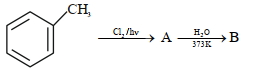
Identify $A$ and $B$ in the following sequence of reaction:
A
$(A) = \text{Benzoyl chloride}, (B) = \text{Benzaldehyde}$
B
$(A) = \text{Benzal chloride}, (B) = \text{Benzaldehyde}$
C
$(A) = \text{Benzyl chloride}, (B) = \text{Benzaldehyde}$
D
$(A) = \text{Benzal chloride}, (B) = \text{Benzoic acid}$
Solution
(B) The reaction of toluene with $Cl_2$ in the presence of light $(hv)$ is a free radical substitution reaction.
It proceeds as follows:
$C_6H_5CH_3 + 2Cl_2 \xrightarrow{hv} C_6H_5CHCl_2 + 2HCl$
Here,$A$ is benzal chloride $(C_6H_5CHCl_2)$.
Next,the hydrolysis of benzal chloride with water at $373 \ K$ yields benzaldehyde:
$C_6H_5CHCl_2 + H_2O \xrightarrow{373 \ K} C_6H_5CHO + 2HCl$
Thus,$A$ is benzal chloride and $B$ is benzaldehyde.
It proceeds as follows:
$C_6H_5CH_3 + 2Cl_2 \xrightarrow{hv} C_6H_5CHCl_2 + 2HCl$
Here,$A$ is benzal chloride $(C_6H_5CHCl_2)$.
Next,the hydrolysis of benzal chloride with water at $373 \ K$ yields benzaldehyde:
$C_6H_5CHCl_2 + H_2O \xrightarrow{373 \ K} C_6H_5CHO + 2HCl$
Thus,$A$ is benzal chloride and $B$ is benzaldehyde.
0 likes
View Solution888
MediumMCQ
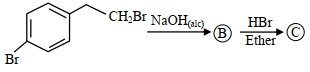
Identify $(B)$ and $(C)$ and how are $(A)$ and $(C)$ related?
A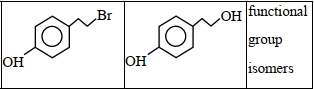
B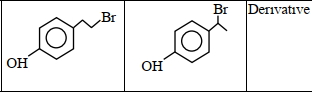
C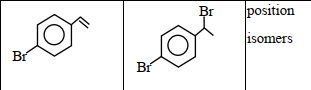
D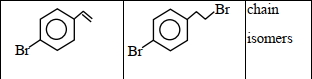
Solution
(C) $1$. The reaction of $(A)$ ($4$-bromophenethyl bromide) with alcoholic $NaOH$ proceeds via an $E2$ elimination mechanism to form $(B)$ ($4$-bromostyrene).
$2$. The reaction of $(B)$ with $HBr$ in ether follows an electrophilic addition mechanism (Markovnikov's rule) to form $(C)$ ($1$-($4$-bromophenyl)$-1-$bromoethane).
$3$. Comparing $(A)$ and $(C)$:
$(A)$ is $1-$bromo$-2-$($4$-bromophenyl)ethane.
$(C)$ is $1-$bromo$-1-$($4$-bromophenyl)ethane.
These are position isomers because the bromine atom on the side chain is at different positions relative to the benzene ring.
$2$. The reaction of $(B)$ with $HBr$ in ether follows an electrophilic addition mechanism (Markovnikov's rule) to form $(C)$ ($1$-($4$-bromophenyl)$-1-$bromoethane).
$3$. Comparing $(A)$ and $(C)$:
$(A)$ is $1-$bromo$-2-$($4$-bromophenyl)ethane.
$(C)$ is $1-$bromo$-1-$($4$-bromophenyl)ethane.
These are position isomers because the bromine atom on the side chain is at different positions relative to the benzene ring.
0 likes
View Solution889
MediumMCQ
$\xrightarrow[\Delta]{KOH \text{ (alc.) }}$ major product $P$
Product $P$ is
Product $P$ is
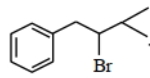
A
$1-$phenyl$-3-$methylbut$-1-$ene
B
$2-$phenyl$-3-$methylbut$-1-$ene
C
$1-$phenyl$-3-$methylbut$-2-$ene
D
$4-$phenyl$-2-$methylbut$-1-$ene
Solution
(A) The reaction is a dehydrohalogenation reaction using alcoholic $KOH$ (an elimination reaction,$E2$).
The substrate is $1\text{-phenyl-2-bromo-3-methylbutane}$.
Elimination of $HBr$ occurs from the $\beta$-carbon atoms adjacent to the carbon bearing the $Br$ atom.
There are two possible $\beta$-hydrogens:
$1$. From $C-1$ (benzylic position),which leads to a conjugated alkene $(1\text{-phenyl-3-methylbut-1-ene})$.
$2$. From $C-3$,which leads to a less substituted alkene $(1\text{-phenyl-3-methylbut-2-ene})$.
According to Saytzeff's rule,the more substituted and conjugated alkene is the major product.
Therefore,the major product $P$ is $1\text{-phenyl-3-methylbut-1-ene}$.
The substrate is $1\text{-phenyl-2-bromo-3-methylbutane}$.
Elimination of $HBr$ occurs from the $\beta$-carbon atoms adjacent to the carbon bearing the $Br$ atom.
There are two possible $\beta$-hydrogens:
$1$. From $C-1$ (benzylic position),which leads to a conjugated alkene $(1\text{-phenyl-3-methylbut-1-ene})$.
$2$. From $C-3$,which leads to a less substituted alkene $(1\text{-phenyl-3-methylbut-2-ene})$.
According to Saytzeff's rule,the more substituted and conjugated alkene is the major product.
Therefore,the major product $P$ is $1\text{-phenyl-3-methylbut-1-ene}$.
0 likes
View Solution890
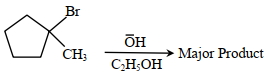
MediumMCQ
Identify the major product in the following reaction.
A
$1-$methylidenecyclopentane
B
$1-$bromocyclopentene
C
$1-$methylcyclopent$-1-$ene
D
methylcyclopentane
Solution
(C) The reaction involves a tertiary alkyl halide ($1$-bromo-$1$-methylcyclopentane) reacting with a strong base $(\text{OH}^-)$ in an alcoholic solvent $(C_2H_5OH)$. This condition favors an $E2$ elimination reaction. The base abstracts a $\beta$-hydrogen atom,leading to the formation of the most stable alkene according to Zaitsev's rule. The most substituted alkene,$1$-methylcyclopent-$1$-ene,is the major product.
0 likes
View Solution891
MediumMCQ
Consider the above chemical reaction. Product $A$ is:
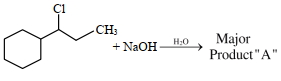
A
$1-$cyclohexylpropan$-2-$ol
B
$1-$propylcyclohexanol
C
$2-$cyclohexylpropan$-1-$ol
D
$1-$cyclohexylpropan$-1-$ol
Solution
(B) The reaction proceeds via an $S_N1$ mechanism because the substrate is a secondary alkyl halide and the solvent is polar protic $(H_2O)$.
$1$. The first step is the formation of a secondary carbocation by the loss of the $Cl^-$ ion.
$2$. This secondary carbocation undergoes a $1,2-H^-$ shift to form a more stable tertiary carbocation.
$3$. The nucleophile ($OH^-$ from $NaOH$) then attacks the tertiary carbocation to form the major product,$1-propylcyclohexanol$.
$1$. The first step is the formation of a secondary carbocation by the loss of the $Cl^-$ ion.
$2$. This secondary carbocation undergoes a $1,2-H^-$ shift to form a more stable tertiary carbocation.
$3$. The nucleophile ($OH^-$ from $NaOH$) then attacks the tertiary carbocation to form the major product,$1-propylcyclohexanol$.
0 likes
View Solution892
MediumMCQ
Which among the following compounds will undergo the fastest $S_{N}2$ reaction?
A
B
C
D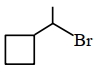
Solution
(C) The rate of $S_{N}2$ reaction depends on the steric hindrance around the electrophilic carbon atom. The order of reactivity is: $Methyl \ halide > 1^{\circ} \ halide > 2^{\circ} \ halide > 3^{\circ} \ halide$.
In the given options:
$(A)$ is a $3^{\circ}$ alkyl halide.
$(B)$ is a $3^{\circ}$ alkyl halide.
$(C)$ is a $1^{\circ}$ alkyl halide (cyclobutyl-methyl bromide).
$(D)$ is a $2^{\circ}$ alkyl halide.
Since $1^{\circ}$ alkyl halides have the least steric hindrance,they undergo $S_{N}2$ reactions the fastest. Therefore,cyclobutyl-methyl bromide will undergo the fastest $S_{N}2$ reaction.
In the given options:
$(A)$ is a $3^{\circ}$ alkyl halide.
$(B)$ is a $3^{\circ}$ alkyl halide.
$(C)$ is a $1^{\circ}$ alkyl halide (cyclobutyl-methyl bromide).
$(D)$ is a $2^{\circ}$ alkyl halide.
Since $1^{\circ}$ alkyl halides have the least steric hindrance,they undergo $S_{N}2$ reactions the fastest. Therefore,cyclobutyl-methyl bromide will undergo the fastest $S_{N}2$ reaction.
0 likes
View Solution893
MediumMCQ
Given below are two statements :
Statement $I$ : $S_N2$ reactions are 'stereospecific',indicating that they result in the formation of only one stereo-isomer as the product.
Statement $II$ : $S_N1$ reactions generally result in the formation of product as racemic mixtures.
In the light of the above statements,choose the correct answer from the options given below :
Statement $I$ : $S_N2$ reactions are 'stereospecific',indicating that they result in the formation of only one stereo-isomer as the product.
Statement $II$ : $S_N1$ reactions generally result in the formation of product as racemic mixtures.
In the light of the above statements,choose the correct answer from the options given below :
A
Statement $I$ is true but Statement $II$ is false
B
Statement $I$ is false but Statement $II$ is true
C
Both Statement $I$ and Statement $II$ are true
D
Both Statement $I$ and Statement $II$ are false
Solution
(C) $S_N2$ reactions proceed via a backside attack,leading to the inversion of configuration (Walden inversion). Since only one specific stereoisomer is formed,they are stereospecific.
$S_N1$ reactions proceed via the formation of a planar carbocation intermediate. The nucleophile can attack from either side with equal probability,leading to the formation of a racemic mixture (a mixture of both enantiomers).
Therefore,both Statement $I$ and Statement $II$ are true.
$S_N1$ reactions proceed via the formation of a planar carbocation intermediate. The nucleophile can attack from either side with equal probability,leading to the formation of a racemic mixture (a mixture of both enantiomers).
Therefore,both Statement $I$ and Statement $II$ are true.
0 likes
View Solution894
MediumMCQ
In the following sequence of reaction,the major products $B$ and $C$ respectively are :
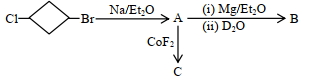
A
$D$-cyclobutylcyclobutane-$D$ and $F$-cyclobutylcyclobutane-$F$
B
$D$-cyclopropylcyclopropane-$D$ and $F$-cyclobutylcyclobutane-$F$
C
$D$-cyclobutylcyclobutane-$D$ and $F$-cyclobutylcyclobutane-$F$
D
$D$-cyclopropylcyclopropane-$D$ and $F$-cyclopropylcyclopropane-$F$
Solution
(A) $1$. The reaction of $1$-bromo-$3$-chlorocyclobutane with $Na/Et_2O$ is a Wurtz reaction. Since the $Br$ atom is a better leaving group than $Cl$,the coupling occurs at the $Br$ position,forming $1,1'$-dichloro-$3,3'$-bicyclobutane (compound $A$).
$2$. Compound $A$ reacts with $(i) Mg/Et_2O$ followed by $(ii) D_2O$. The $Mg$ forms a Grignard reagent with the $Cl$ atoms,which is then quenched by $D_2O$ to replace $Cl$ with $D$,yielding $B$ as $1,1'$-dideuterio-$3,3'$-bicyclobutane.
$3$. Compound $A$ reacts with $CoF_2$ (a fluorinating agent used in the Swarts reaction) to replace the $Cl$ atoms with $F$ atoms,yielding $C$ as $1,1'$-difluoro-$3,3'$-bicyclobutane.
$4$. Therefore,the products $B$ and $C$ are $1,1'$-dideuterio-$3,3'$-bicyclobutane and $1,1'$-difluoro-$3,3'$-bicyclobutane respectively.
$2$. Compound $A$ reacts with $(i) Mg/Et_2O$ followed by $(ii) D_2O$. The $Mg$ forms a Grignard reagent with the $Cl$ atoms,which is then quenched by $D_2O$ to replace $Cl$ with $D$,yielding $B$ as $1,1'$-dideuterio-$3,3'$-bicyclobutane.
$3$. Compound $A$ reacts with $CoF_2$ (a fluorinating agent used in the Swarts reaction) to replace the $Cl$ atoms with $F$ atoms,yielding $C$ as $1,1'$-difluoro-$3,3'$-bicyclobutane.
$4$. Therefore,the products $B$ and $C$ are $1,1'$-dideuterio-$3,3'$-bicyclobutane and $1,1'$-difluoro-$3,3'$-bicyclobutane respectively.
0 likes
View Solution895
MediumMCQ
Given below are two statements: one is labelled as Assertion $(A)$ and the other is labelled as Reason $(R)$ :
Assertion $(A)$ : $S_N2$ reaction of $C_6H_5CH_2Br$ occurs more readily than the $S_N2$ reaction of $CH_3CH_2Br$.
Reason $(R)$ : The partially bonded unhybridized $p$-orbital that develops in the trigonal bipyramidal transition state is stabilized by conjugation with the phenyl ring.
In the light of the above statements,choose the most appropriate answer from the options given below:
Assertion $(A)$ : $S_N2$ reaction of $C_6H_5CH_2Br$ occurs more readily than the $S_N2$ reaction of $CH_3CH_2Br$.
Reason $(R)$ : The partially bonded unhybridized $p$-orbital that develops in the trigonal bipyramidal transition state is stabilized by conjugation with the phenyl ring.
In the light of the above statements,choose the most appropriate answer from the options given below:
A
$(A)$ is not correct but $(R)$ is correct
B
Both $(A)$ and $(R)$ are correct but $(R)$ is not the correct explanation of $(A)$
C
Both $(A)$ and $(R)$ are correct and $(R)$ is the correct explanation of $(A)$
D
$(A)$ is correct but $(R)$ is not correct
Solution
(C) In an $S_N2$ reaction,the nucleophile attacks from the backside of the leaving group,leading to a trigonal bipyramidal transition state.
In the case of benzyl bromide $(C_6H_5CH_2Br)$,the transition state involves a partially bonded unhybridized $p$-orbital at the benzylic carbon.
This $p$-orbital is stabilized by conjugation with the $\pi$-electron system of the phenyl ring,which lowers the activation energy of the reaction.
Therefore,the $S_N2$ reaction of $C_6H_5CH_2Br$ occurs more readily than that of $CH_3CH_2Br$.
Both Assertion $(A)$ and Reason $(R)$ are correct,and $(R)$ is the correct explanation of $(A)$.
In the case of benzyl bromide $(C_6H_5CH_2Br)$,the transition state involves a partially bonded unhybridized $p$-orbital at the benzylic carbon.
This $p$-orbital is stabilized by conjugation with the $\pi$-electron system of the phenyl ring,which lowers the activation energy of the reaction.
Therefore,the $S_N2$ reaction of $C_6H_5CH_2Br$ occurs more readily than that of $CH_3CH_2Br$.
Both Assertion $(A)$ and Reason $(R)$ are correct,and $(R)$ is the correct explanation of $(A)$.
0 likes
View Solution896
MediumMCQ
In the above reaction,the major product '$P$' is:
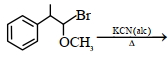
A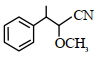
B
C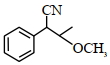
D
Solution
(A) The reaction involves the participation of the phenyl ring in a Neighboring Group Participation $(NGP)$ mechanism.
$1$. The $\pi$-electrons of the phenyl ring assist in the departure of the leaving group $(Br^{-})$.
$2$. This leads to the formation of a phenonium ion intermediate.
$3$. The nucleophile $(CN^{-})$ then attacks the more electrophilic carbon of the phenonium ion.
$4$. This process results in the substitution of the $Br$ atom by the $CN$ group,leading to the product shown in option $A$.
$1$. The $\pi$-electrons of the phenyl ring assist in the departure of the leaving group $(Br^{-})$.
$2$. This leads to the formation of a phenonium ion intermediate.
$3$. The nucleophile $(CN^{-})$ then attacks the more electrophilic carbon of the phenonium ion.
$4$. This process results in the substitution of the $Br$ atom by the $CN$ group,leading to the product shown in option $A$.
0 likes
View Solution897
MediumMCQ
Which of the following compounds can give a positive iodoform test when treated with aqueous $KOH$ solution followed by potassium hypoiodite?
A
$CH_3-CH_2-CO-CH_2-CH_3$
B
$CH_3-CH_2-CCl_2-CH_3$
C
$CH_3-CH_2-CH_2-CHO$
D
$CH_3-CH_2-CH-CH_2$ (epoxide ring)
Solution
(B) The iodoform test is given by compounds containing the $CH_3CO-$ group or compounds that can be oxidized to this group.
Treatment of $CH_3-CH_2-CCl_2-CH_3$ with aqueous $KOH$ leads to the hydrolysis of the gem-dichloride to a gem-diol $(CH_3-CH_2-C(OH)_2-CH_3)$,which is unstable and loses a water molecule to form butan$-2-$one $(CH_3-CH_2-CO-CH_3)$.
Butan$-2-$one contains the $CH_3CO-$ group,which reacts with potassium hypoiodite $(KOI)$ to form iodoform $(CHI_3)$,a yellow precipitate.
Thus,the correct compound is $CH_3-CH_2-CCl_2-CH_3$.
Treatment of $CH_3-CH_2-CCl_2-CH_3$ with aqueous $KOH$ leads to the hydrolysis of the gem-dichloride to a gem-diol $(CH_3-CH_2-C(OH)_2-CH_3)$,which is unstable and loses a water molecule to form butan$-2-$one $(CH_3-CH_2-CO-CH_3)$.
Butan$-2-$one contains the $CH_3CO-$ group,which reacts with potassium hypoiodite $(KOI)$ to form iodoform $(CHI_3)$,a yellow precipitate.
Thus,the correct compound is $CH_3-CH_2-CCl_2-CH_3$.
0 likes
View Solution898
MediumMCQ
The compound that will undergo $S_N 1$ reaction with the fastest rate is
A
Bromocyclohexane
B
Bromobenzene
C
$1-$Phenylethyl bromide
D
(Cyclohexylmethyl) bromide
Solution
(C) The rate of $S_N 1$ reaction depends on the stability of the carbocation intermediate formed in the rate-determining step.
$1$. $1$-Phenylethyl bromide forms a secondary benzylic carbocation,which is highly stabilized by resonance with the benzene ring.
$2$. Bromocyclohexane forms a secondary alkyl carbocation.
$3$. (Cyclohexylmethyl) bromide forms a primary alkyl carbocation.
$4$. Bromobenzene does not undergo $S_N 1$ reaction easily as the $C-Br$ bond has partial double bond character due to resonance.
Since the secondary benzylic carbocation is the most stable among the options,$1$-phenylethyl bromide reacts the fastest.
$1$. $1$-Phenylethyl bromide forms a secondary benzylic carbocation,which is highly stabilized by resonance with the benzene ring.
$2$. Bromocyclohexane forms a secondary alkyl carbocation.
$3$. (Cyclohexylmethyl) bromide forms a primary alkyl carbocation.
$4$. Bromobenzene does not undergo $S_N 1$ reaction easily as the $C-Br$ bond has partial double bond character due to resonance.
Since the secondary benzylic carbocation is the most stable among the options,$1$-phenylethyl bromide reacts the fastest.
0 likes
View Solution899
MediumMCQ
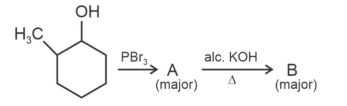
Major products $A$ and $B$ formed in the following reaction sequence are:
A
$A = \text{1-bromo-2-methylcyclohexane}; B = \text{3-methylcyclohexene}$
B
$A = \text{1-bromo-2-methylcyclohexane}; B = \text{1-methylcyclohexene}$
C
$A = \text{2-bromocyclohexanol}; B = \text{3-methylcyclohexene}$
D
$A = \text{2-bromocyclohexanol}; B = \text{1-methylcyclohexene}$
Solution
(B) Step $1$: Reaction of $2$-methylcyclohexanol with $PBr_3$ leads to the formation of $1$-bromo-$2$-methylcyclohexane $(A)$ via an $S_N2$ mechanism.
Step $2$: Treatment of $1$-bromo-$2$-methylcyclohexane $(A)$ with alcoholic $KOH$ (a strong base) results in dehydrohalogenation via an $E2$ mechanism.
Step $3$: According to Zaitsev's rule,the more substituted alkene is the major product. The base abstracts a proton from the $C_2$ position,leading to the formation of $1$-methylcyclohexene $(B)$ as the major product.
Step $2$: Treatment of $1$-bromo-$2$-methylcyclohexane $(A)$ with alcoholic $KOH$ (a strong base) results in dehydrohalogenation via an $E2$ mechanism.
Step $3$: According to Zaitsev's rule,the more substituted alkene is the major product. The base abstracts a proton from the $C_2$ position,leading to the formation of $1$-methylcyclohexene $(B)$ as the major product.
1 likes
View Solution900
AdvancedMCQ
Match the following:
| Column $I$ | Column $II$ |
| $A$. $CH_3-CHBr-CD_3$ on treatment with alc. $KOH$ gives $CH_2=CH-CD_3$ as a major product. | $P$. $E1$ reaction |
| $B$. $Ph-CHBr-CH_3$ reacts faster than $Ph-CHBr-CD_3$. | $Q$. $E2$ reaction |
| $C$. $Ph-CH_2-CH_2Br$ on treatment with $C_2H_5OD / C_2H_5O^-$ gives $Ph-CD=CH_2$ as the major product. | $R$. $E1cb$ reaction |
| $D$. $PhCH_2CH_2Br$ and $PhCD_2CH_2Br$ react with same rate. | $S$. First order reaction |
A
$A-Q; B-P; C-P,S; D-P,Q$
B
$A-Q; B-Q; C-R,S; D-P,S$
C
$A-S; B-S; C-R,P; D-Q,S$
D
$A-P; B-P; C-Q,S; D-R,S$
Solution
(B) . $CH_3-CHBr-CD_3$ undergoes $E2$ elimination with alc. $KOH$ to form $CH_2=CH-CD_3$ $(A-Q)$.
$B$. $Ph-CHBr-CH_3$ shows a primary kinetic isotope effect $(k_H/k_D > 1)$ in $E2$ reactions,so it reacts faster than the deuterated analog $(B-Q)$.
$C$. $Ph-CH_2-CH_2Br$ undergoes $E1cb$ mechanism due to the acidic $\beta$-hydrogens stabilized by the phenyl ring,and it follows first-order kinetics $(C-R,S)$.
$D$. $PhCH_2CH_2Br$ and $PhCD_2CH_2Br$ reacting at the same rate suggests the rate-determining step does not involve $C$-$H$/$C$-$D$ bond breaking,characteristic of $E1$ reactions $(D-P,S)$.
$B$. $Ph-CHBr-CH_3$ shows a primary kinetic isotope effect $(k_H/k_D > 1)$ in $E2$ reactions,so it reacts faster than the deuterated analog $(B-Q)$.
$C$. $Ph-CH_2-CH_2Br$ undergoes $E1cb$ mechanism due to the acidic $\beta$-hydrogens stabilized by the phenyl ring,and it follows first-order kinetics $(C-R,S)$.
$D$. $PhCH_2CH_2Br$ and $PhCD_2CH_2Br$ reacting at the same rate suggests the rate-determining step does not involve $C$-$H$/$C$-$D$ bond breaking,characteristic of $E1$ reactions $(D-P,S)$.
0 likes
View SolutionHaloalkanes and Haloarenes — Properties of Haloalkanes · Frequently Asked Questions
1Are these Haloalkanes and Haloarenes questions useful for JEE and NEET?
Yes. All questions in this section are mapped to JEE Main and NEET exam patterns. Previous year questions from JEE Main, NEET, GUJCET and state-level exams are included with full solutions.
2Can I switch to Hindi or Gujarati for these questions?
Yes. Use the language tabs in the hero section or the sidebar to view the same questions and solutions in English, Hindi or Gujarati.
3How do I generate a question paper from this subtopic?
Use the Vedclass Exam Paper Generator — select the chapter and subtopic, set difficulty, and generate Sets A, B, C, D automatically. First 3 chapters of every subject are free.
Vedclass Products
For Students
Vedclass Test Series
Mock tests in real JEE/NEET style with performance analysis. 5-day free trial.
Start Free TrialFor Teachers
Exam Paper Generator
Generate Set A/B/C/D papers from this chapter in 2 minutes. 3 chapters free.
Try FreeFor Institutes
Online Exam Module
Live online exams with unlimited students, 360° analytics & white-label branding.
See DemoFor Teachers & Institutes
Generate a Haloalkanes and Haloarenes Exam Paper in 2 Minutes
Select subtopic & difficulty — Sets A, B, C, D auto-generated with No Repeat logic.
First 3 chapters of every subject are free — no payment required.