
A English
Properties of Haloalkanes Questions in English
Class 12 Chemistry · Haloalkanes and Haloarenes · Properties of Haloalkanes
1196+
Questions
English
Language
100%
With Solutions
Showing 49 of 1196 questions in English
701
MediumMCQ
Two bottles containing $C_6H_5I$ and $C_6H_5CH_2I$ have lost their original labels. They are labeled as $A$ and $B$ for testing. $A$ and $B$ are taken separately in test tubes and boiled with $NaOH$ solution. The final solution of each test tube is acidified with dilute $HNO_3$ and a little $AgNO_3$ is added. Solution $B$ gives a yellow precipitate. Which of the following statements is correct?
A
$A$ is $C_6H_5CH_2I$.
B
$A$ is $C_6H_5I$.
C
$B$ is $C_6H_5I$.
D
$HNO_3$ was not required to be added.
0 likes
View Solution702
DifficultMCQ
Identify the structure of the major product in the following reaction:
$Ph-CH(Br)-CH(Br)-CHO \xrightarrow[\Delta]{K_2CO_3} ?$
$Ph-CH(Br)-CH(Br)-CHO \xrightarrow[\Delta]{K_2CO_3} ?$
A
$Ph-C \equiv C-CHO$
B
$Ph-CH(OH)-CH(OH)-CHO$
C
$Ph-C(Br)=CH-CHO$
D
$Ph-CH=C(Br)-CHO$
Solution
(D) The reaction involves the dehydrohalogenation of a vicinal dibromide $(Ph-CH(Br)-CH(Br)-CHO)$ in the presence of a base $(K_2CO_3)$ and heat $(\Delta)$.
This is an elimination reaction (specifically $E2$ mechanism).
The base abstracts a proton from the carbon adjacent to the bromine, leading to the formation of a double bond and the elimination of $HBr$.
In the given molecule, the proton on the carbon attached to the aldehyde group ($\alpha$-carbon) is more acidic due to the electron-withdrawing effect of the $-CHO$ group.
Therefore, the elimination occurs to form the conjugated product: $Ph-CH=C(Br)-CHO$.
This is an elimination reaction (specifically $E2$ mechanism).
The base abstracts a proton from the carbon adjacent to the bromine, leading to the formation of a double bond and the elimination of $HBr$.
In the given molecule, the proton on the carbon attached to the aldehyde group ($\alpha$-carbon) is more acidic due to the electron-withdrawing effect of the $-CHO$ group.
Therefore, the elimination occurs to form the conjugated product: $Ph-CH=C(Br)-CHO$.
0 likes
View Solution703
DifficultMCQ
Which of the following compounds undergoes nucleophilic substitution reaction most easily via the $S_{N}1$ mechanism?
A
Benzyl chloride
B
Ethyl chloride
C
Chlorobenzene
D
Isopropyl chloride
Solution
(A) The rate of $S_{N}1$ reaction depends on the stability of the carbocation intermediate formed in the rate-determining step.
Benzyl chloride $(C_6H_5CH_2Cl)$ forms a benzyl carbocation $(C_6H_5CH_2^+)$,which is highly stabilized by resonance with the benzene ring.
Ethyl chloride $(CH_3CH_2Cl)$ forms a primary carbocation,which is less stable.
Chlorobenzene $(C_6H_5Cl)$ does not undergo $S_{N}1$ easily due to partial double bond character between $C$ and $Cl$.
Isopropyl chloride $(CH_3CH(Cl)CH_3)$ forms a secondary carbocation,which is less stable than the resonance-stabilized benzyl carbocation.
Therefore,benzyl chloride reacts most easily via the $S_{N}1$ mechanism.
Benzyl chloride $(C_6H_5CH_2Cl)$ forms a benzyl carbocation $(C_6H_5CH_2^+)$,which is highly stabilized by resonance with the benzene ring.
Ethyl chloride $(CH_3CH_2Cl)$ forms a primary carbocation,which is less stable.
Chlorobenzene $(C_6H_5Cl)$ does not undergo $S_{N}1$ easily due to partial double bond character between $C$ and $Cl$.
Isopropyl chloride $(CH_3CH(Cl)CH_3)$ forms a secondary carbocation,which is less stable than the resonance-stabilized benzyl carbocation.
Therefore,benzyl chloride reacts most easily via the $S_{N}1$ mechanism.
0 likes
View Solution704
DifficultMCQ
The reduction of chloroform with $Zn$ and $HCl$ (alc.) gives ..........
A
Formic acid
B
Chloretone
C
Chloropicrin
D
Methylene chloride
Solution
(D) The reduction of chloroform $(CHCl_3)$ with zinc $(Zn)$ and alcoholic hydrochloric acid $(HCl)$ is a partial reduction process.
The reaction is as follows:
$CHCl_3 + 2[H] \xrightarrow{Zn/HCl(alc.)} CH_2Cl_2 + HCl$
In this reaction,one chlorine atom is replaced by a hydrogen atom,resulting in the formation of methylene chloride $(CH_2Cl_2)$.
The reaction is as follows:
$CHCl_3 + 2[H] \xrightarrow{Zn/HCl(alc.)} CH_2Cl_2 + HCl$
In this reaction,one chlorine atom is replaced by a hydrogen atom,resulting in the formation of methylene chloride $(CH_2Cl_2)$.
0 likes
View Solution705
DifficultMCQ
The reaction of chloroform with concentrated $HNO_3$ yields ........
A
Chloropicrin
B
Nitromethane
C
Picric acid
D
Acetylene
Solution
(A) When chloroform $(CHCl_3)$ is treated with concentrated nitric acid $(HNO_3)$,it undergoes a nitration reaction to form chloropicrin $(CCl_3NO_2)$,which is also known as trichloronitromethane.
The chemical equation is: $CHCl_3 + HNO_3 \rightarrow CCl_3NO_2 + H_2O$.
The chemical equation is: $CHCl_3 + HNO_3 \rightarrow CCl_3NO_2 + H_2O$.
0 likes
View Solution706
MediumMCQ
Chloroform is stored in dark-colored bottles because it ..............
A
is flammable
B
gives peroxide
C
undergoes rapid chlorination
D
is oxidized to poisonous phosgene
Solution
(D) Chloroform $(CHCl_3)$ is sensitive to light and air. When exposed to light and oxygen,it undergoes slow oxidation to form a highly poisonous gas called phosgene $(COCl_2)$.
The chemical reaction is: $2CHCl_3 + O_2 \xrightarrow{light} 2COCl_2 + 2HCl$.
To prevent this oxidation,chloroform is stored in dark-colored bottles,which are filled up to the brim to exclude air.
The chemical reaction is: $2CHCl_3 + O_2 \xrightarrow{light} 2COCl_2 + 2HCl$.
To prevent this oxidation,chloroform is stored in dark-colored bottles,which are filled up to the brim to exclude air.
0 likes
View Solution707
DifficultMCQ
Which of the following processes does $NOT$ occur during the preparation of $CHCl_3$ from $C_2H_5OH$ and bleaching powder?
A
Hydrolysis
B
Oxidation
C
Elimination
D
Chlorination
Solution
(C) The preparation of chloroform $(CHCl_3)$ from ethanol $(C_2H_5OH)$ and bleaching powder $(CaOCl_2)$ involves the following steps:
$1$. Oxidation: Ethanol is oxidized to acetaldehyde $(CH_3CHO)$.
$2$. Chlorination: Acetaldehyde is chlorinated to form trichloroacetaldehyde $(CCl_3CHO)$.
$3$. Hydrolysis: Trichloroacetaldehyde is hydrolyzed by calcium hydroxide to form chloroform $(CHCl_3)$ and calcium formate.
Elimination does not occur in this reaction sequence.
$1$. Oxidation: Ethanol is oxidized to acetaldehyde $(CH_3CHO)$.
$2$. Chlorination: Acetaldehyde is chlorinated to form trichloroacetaldehyde $(CCl_3CHO)$.
$3$. Hydrolysis: Trichloroacetaldehyde is hydrolyzed by calcium hydroxide to form chloroform $(CHCl_3)$ and calcium formate.
Elimination does not occur in this reaction sequence.
0 likes
View Solution708
DifficultMCQ
Before using chloroform as an anesthetic,its sample is tested by ........
A
$AgNO_3$ solution
B
$AgNO_3$ solution after boiling with $alc. \ KOH$
C
Fehling's solution
D
Ammoniacal $Cu_2Cl_2$ solution
Solution
(A) Chloroform $(CHCl_3)$ is oxidized by air in the presence of light to form a highly poisonous gas called phosgene $(COCl_2)$.
$2CHCl_3 + O_2 \xrightarrow{light} 2COCl_2 + 2HCl$
To detect the presence of phosgene,the sample is tested with $AgNO_3$ solution. If phosgene is present,it reacts with $AgNO_3$ to form a white precipitate of $AgCl$.
$COCl_2 + 2AgNO_3 + H_2O \rightarrow 2AgCl(s) + CO_2 + 2HNO_3$
Therefore,$AgNO_3$ solution is used to test the purity of chloroform.
$2CHCl_3 + O_2 \xrightarrow{light} 2COCl_2 + 2HCl$
To detect the presence of phosgene,the sample is tested with $AgNO_3$ solution. If phosgene is present,it reacts with $AgNO_3$ to form a white precipitate of $AgCl$.
$COCl_2 + 2AgNO_3 + H_2O \rightarrow 2AgCl(s) + CO_2 + 2HNO_3$
Therefore,$AgNO_3$ solution is used to test the purity of chloroform.
0 likes
View Solution709
DifficultMCQ
What is the product obtained when $CCl_4$ is boiled with $KOH$?
A
Formic acid
B
Methyl alcohol
C
Formaldehyde
D
Carbon dioxide
Solution
(D) When $CCl_4$ is boiled with an aqueous solution of $KOH$,the chlorine atoms are replaced by hydroxyl groups to form an unstable intermediate,$C(OH)_4$.
This intermediate quickly loses a water molecule to form carbonic acid $(H_2CO_3)$,which further decomposes into $CO_2$ and $H_2O$.
The overall reaction is: $CCl_4 + 4KOH$ $\rightarrow C(OH)_4 + 4KCl$ $\rightarrow H_2CO_3 + 4KCl$ $\rightarrow CO_2 + 2H_2O + 4KCl$.
This intermediate quickly loses a water molecule to form carbonic acid $(H_2CO_3)$,which further decomposes into $CO_2$ and $H_2O$.
The overall reaction is: $CCl_4 + 4KOH$ $\rightarrow C(OH)_4 + 4KCl$ $\rightarrow H_2CO_3 + 4KCl$ $\rightarrow CO_2 + 2H_2O + 4KCl$.
0 likes
View Solution710
DifficultMCQ
The reaction of carbon tetrachloride with water vapor at $500\,^oC$ gives .................
A
$COCl_2$
B
$CHCl_3$
C
Both $(A)$ and $(B)$
D
None of these
Solution
(A) Carbon tetrachloride $(CCl_4)$ reacts with water vapor at $500\,^oC$ to produce carbonyl chloride $(COCl_2)$,which is also known as phosgene.
The chemical equation is: $CCl_4 + H_2O \xrightarrow{500\,^oC} COCl_2 + 2HCl$.
The chemical equation is: $CCl_4 + H_2O \xrightarrow{500\,^oC} COCl_2 + 2HCl$.
0 likes
View Solution711
DifficultMCQ
Iodoform gives a precipitate with $AgNO_3$ on heating,but chloroform does not because ..........
A
Iodoform is ionic
B
Chloroform is covalent
C
The $C-I$ bond in iodoform is weak,whereas the $C-Cl$ bond in chloroform is strong
D
None of these
Solution
(C) The reaction of haloalkanes with $AgNO_3$ depends on the ease of formation of carbocations or the ease of breaking the $C-X$ bond.
In iodoform $(CHI_3)$,the $C-I$ bond is much weaker than the $C-Cl$ bond in chloroform $(CHCl_3)$ due to the larger size of the iodine atom and lower bond dissociation energy.
Therefore,$CHI_3$ easily releases $I^-$ ions which react with $Ag^+$ to form a yellow precipitate of $AgI$,whereas $CHCl_3$ does not readily release $Cl^-$ ions under these conditions.
In iodoform $(CHI_3)$,the $C-I$ bond is much weaker than the $C-Cl$ bond in chloroform $(CHCl_3)$ due to the larger size of the iodine atom and lower bond dissociation energy.
Therefore,$CHI_3$ easily releases $I^-$ ions which react with $Ag^+$ to form a yellow precipitate of $AgI$,whereas $CHCl_3$ does not readily release $Cl^-$ ions under these conditions.
0 likes
View Solution712
DifficultMCQ
Vicinal and geminal dihalides can be distinguished by using:
A
$KOH$ (aq)
B
$KOH$ (alc.)
C
$Zn$ dust
D
None of these
Solution
(C) Vicinal dihalides $(CH_2X-CH_2X)$ react with $Zn$ dust to form alkenes $(CH_2=CH_2)$ and $ZnX_2$.
Geminal dihalides $(CH_3-CHX_2)$ do not undergo this reaction to form alkenes under similar conditions.
Thus,$Zn$ dust is used to distinguish between them.
Geminal dihalides $(CH_3-CHX_2)$ do not undergo this reaction to form alkenes under similar conditions.
Thus,$Zn$ dust is used to distinguish between them.
0 likes
View Solution713
DifficultMCQ
$A$ small amount of alcohol is added to a bottle of $CHCl_3$ because .............
A
It inhibits the anesthetic property of $CHCl_3$
B
It prevents the oxidation of $CHCl_3$ into phosgene
C
It converts the produced phosgene into harmless diethyl carbonate
D
Both $(B)$ and $(C)$
Solution
(D) Chloroform $(CHCl_3)$ is slowly oxidized by air in the presence of light to form an extremely poisonous gas,carbonyl chloride,also known as phosgene $(COCl_2)$.
$2CHCl_3 + O_2 \xrightarrow{light} 2COCl_2 + 2HCl$
To prevent this,a small amount of ethanol $(1\%)$ is added to the bottle.
Ethanol acts as a stabilizer by reacting with any phosgene formed to convert it into non-poisonous diethyl carbonate.
$COCl_2 + 2C_2H_5OH \rightarrow (C_2H_5O)_2CO + 2HCl$
Additionally,ethanol also helps in slowing down the oxidation process of chloroform.
$2CHCl_3 + O_2 \xrightarrow{light} 2COCl_2 + 2HCl$
To prevent this,a small amount of ethanol $(1\%)$ is added to the bottle.
Ethanol acts as a stabilizer by reacting with any phosgene formed to convert it into non-poisonous diethyl carbonate.
$COCl_2 + 2C_2H_5OH \rightarrow (C_2H_5O)_2CO + 2HCl$
Additionally,ethanol also helps in slowing down the oxidation process of chloroform.
0 likes
View Solution714
DifficultMCQ
The hydrogen atom in chloroform $(CHCl_3)$ is ........ .
A
Acidic
B
Basic
C
Neutral
D
None of these
Solution
(A) In chloroform $(CHCl_3)$,the carbon atom is bonded to three highly electronegative chlorine atoms. These chlorine atoms exert a strong $-I$ (inductive) effect,which pulls electron density away from the carbon atom. This makes the $C-H$ bond highly polarized,allowing the hydrogen atom to be released as a proton $(H^+)$ in the presence of a strong base. Therefore,the hydrogen atom in chloroform is acidic in nature.
0 likes
View Solution715
DifficultMCQ
Hydrolysis of a gem-dihalide gives $....$.
A
Acetone
B
Acetaldehyde
C
Ketone
D
Ketone and Aldehyde
Solution
(B) gem-dihalide is a compound where two halogen atoms are attached to the same carbon atom. $R-CH(X)_2 + 2KOH(aq) \rightarrow R-CH(OH)_2 + 2KX$.
Since a geminal diol (having two $-OH$ groups on the same carbon) is unstable,it loses a water molecule to form a carbonyl compound.
If the gem-dihalide is a terminal one $(R-CHX_2)$,it forms an aldehyde.
If the gem-dihalide is a non-terminal one $(R-C(X)_2-R')$,it forms a ketone.
However,in the context of general chemistry questions,the hydrolysis of gem-dihalides is typically associated with the formation of carbonyl compounds (aldehydes or ketones). Given the options,if we consider the simplest gem-dihalide like $CH_3-CHCl_2$ ($1$,$1$-dichloroethane),it yields acetaldehyde. Thus,$B$ is the most specific correct answer.
Since a geminal diol (having two $-OH$ groups on the same carbon) is unstable,it loses a water molecule to form a carbonyl compound.
If the gem-dihalide is a terminal one $(R-CHX_2)$,it forms an aldehyde.
If the gem-dihalide is a non-terminal one $(R-C(X)_2-R')$,it forms a ketone.
However,in the context of general chemistry questions,the hydrolysis of gem-dihalides is typically associated with the formation of carbonyl compounds (aldehydes or ketones). Given the options,if we consider the simplest gem-dihalide like $CH_3-CHCl_2$ ($1$,$1$-dichloroethane),it yields acetaldehyde. Thus,$B$ is the most specific correct answer.
0 likes
View Solution716
MediumMCQ
$CCl_4$ and $CHCl_3$ can be distinguished by .....
A
$R-NH_2 + KOH$ (alc.)
B
$R-CN + KOH$ (alc.)
C
Hydrolysis
D
Burning in air
Solution
(A) $CHCl_3$ (chloroform) reacts with primary amines $(R-NH_2)$ in the presence of alcoholic $KOH$ to form isocyanides (carbylamines),which have a foul smell. This is known as the carbylamine test.
$R-NH_2 + CHCl_3 + 3KOH (alc.) \rightarrow R-NC + 3KCl + 3H_2O$
$CCl_4$ does not give this reaction.
Therefore,$CCl_4$ and $CHCl_3$ can be distinguished by using $R-NH_2 + KOH$ (alc.).
$R-NH_2 + CHCl_3 + 3KOH (alc.) \rightarrow R-NC + 3KCl + 3H_2O$
$CCl_4$ does not give this reaction.
Therefore,$CCl_4$ and $CHCl_3$ can be distinguished by using $R-NH_2 + KOH$ (alc.).
0 likes
View Solution717
DifficultMCQ
Which of the following will give acetaldehyde upon reaction with aqueous $KOH$?
A
$1, 2-$ Dichloroethane
B
$1, 1-$ Dichloroethane
C
Chloroacetic acid
D
Ethyl chloride
Solution
(B) The reaction of $1, 1-$ dichloroethane $(CH_3CHCl_2)$ with aqueous $KOH$ undergoes nucleophilic substitution to form a geminal diol $(CH_3CH(OH)_2)$.
Since geminal diols are unstable,they lose a water molecule to form acetaldehyde $(CH_3CHO)$.
The reaction is: $CH_3CHCl_2 + 2KOH(aq)$ $\rightarrow CH_3CH(OH)_2 + 2KCl$ $\rightarrow CH_3CHO + H_2O + 2KCl$.
Since geminal diols are unstable,they lose a water molecule to form acetaldehyde $(CH_3CHO)$.
The reaction is: $CH_3CHCl_2 + 2KOH(aq)$ $\rightarrow CH_3CH(OH)_2 + 2KCl$ $\rightarrow CH_3CHO + H_2O + 2KCl$.
0 likes
View Solution718
MediumMCQ
Benzene $+ (CH_3CO)_2O$ $\xrightarrow{AlCl_3} X$ $\xrightarrow{Zn-Hg, HCl} Y$ $\xrightarrow{NBS} Z$;
$Z$ is
$Z$ is
A
$1-$bromo$-1-$phenylethane
B
$2-$bromo$-1-$phenylethane
C
$1-$bromo$-3-$ethylbenzene
D
$1-$bromo$-4-$ethylbenzene
Solution
(A) $1$. Friedel-Crafts acylation of benzene with acetic anhydride $(CH_3CO)_2O$ in the presence of $AlCl_3$ gives acetophenone $(X = C_6H_5COCH_3)$.
$2$. Clemmensen reduction of acetophenone $(X)$ using $Zn-Hg, HCl$ reduces the carbonyl group to a methylene group,yielding ethylbenzene $(Y = C_6H_5CH_2CH_3)$.
$3$. Reaction of ethylbenzene $(Y)$ with $N$-bromosuccinimide $(NBS)$ is a radical substitution reaction that occurs at the benzylic position,yielding $1-$bromo$-1-$phenylethane $(Z = C_6H_5CH(Br)CH_3)$.
$2$. Clemmensen reduction of acetophenone $(X)$ using $Zn-Hg, HCl$ reduces the carbonyl group to a methylene group,yielding ethylbenzene $(Y = C_6H_5CH_2CH_3)$.
$3$. Reaction of ethylbenzene $(Y)$ with $N$-bromosuccinimide $(NBS)$ is a radical substitution reaction that occurs at the benzylic position,yielding $1-$bromo$-1-$phenylethane $(Z = C_6H_5CH(Br)CH_3)$.
0 likes
View Solution719
MediumMCQ
Which of the following is a chiral molecule?
A
butan$-2-$ol
B
$2-$bromopentane
C
$2-$bromobutane
D
bromoethane
Solution
(C) molecule is chiral if it contains at least one chiral center (a carbon atom bonded to four different groups).
$A$. Butan$-2-$ol: $CH_3-CH(OH)-CH_2-CH_3$. The carbon at position $2$ is bonded to $-H$,$-OH$,$-CH_3$,and $-CH_2CH_3$. Since all four groups are different,it is a chiral molecule.
$B$. $2$-bromopentane: $CH_3-CH(Br)-CH_2-CH_2-CH_3$. The carbon at position $2$ is bonded to $-H$,$-Br$,$-CH_3$,and $-CH_2CH_2CH_3$. Since all four groups are different,it is a chiral molecule.
$C$. $2$-bromobutane: $CH_3-CH(Br)-CH_2-CH_3$. The carbon at position $2$ is bonded to $-H$,$-Br$,$-CH_3$,and $-CH_2CH_3$. Since all four groups are different,it is a chiral molecule.
$D$. Bromoethane: $CH_3-CH_2Br$. The carbon atom bonded to $Br$ is attached to two hydrogen atoms. Since two groups are identical,it is achiral.
Note: Based on the provided images,all options $A$,$B$,and $C$ represent chiral molecules. However,in standard multiple-choice questions of this type,$2$-bromobutane $(C)$ is the most commonly cited example of a simple chiral molecule.
$A$. Butan$-2-$ol: $CH_3-CH(OH)-CH_2-CH_3$. The carbon at position $2$ is bonded to $-H$,$-OH$,$-CH_3$,and $-CH_2CH_3$. Since all four groups are different,it is a chiral molecule.
$B$. $2$-bromopentane: $CH_3-CH(Br)-CH_2-CH_2-CH_3$. The carbon at position $2$ is bonded to $-H$,$-Br$,$-CH_3$,and $-CH_2CH_2CH_3$. Since all four groups are different,it is a chiral molecule.
$C$. $2$-bromobutane: $CH_3-CH(Br)-CH_2-CH_3$. The carbon at position $2$ is bonded to $-H$,$-Br$,$-CH_3$,and $-CH_2CH_3$. Since all four groups are different,it is a chiral molecule.
$D$. Bromoethane: $CH_3-CH_2Br$. The carbon atom bonded to $Br$ is attached to two hydrogen atoms. Since two groups are identical,it is achiral.
Note: Based on the provided images,all options $A$,$B$,and $C$ represent chiral molecules. However,in standard multiple-choice questions of this type,$2$-bromobutane $(C)$ is the most commonly cited example of a simple chiral molecule.
0 likes
View Solution720
MediumMCQ
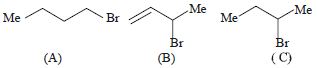
Consider the following bromides.
The correct order of $S_N1$ reactivity is
The correct order of $S_N1$ reactivity is
A
$B > C > A$
B
$B > A > C$
C
$C > B > A$
D
$A > B > C$
Solution
(A) $S_N1$ reactions proceed via the formation of a carbocation intermediate. The rate of $S_N1$ reaction depends on the stability of the carbocation formed.
$(A)$ forms a $1^o$ carbocation $(CH_3CH_2CH_2CH_2^+)$,which is the least stable.
$(B)$ forms an allylic carbocation $(CH_2=CH-CH^+(CH_3))$,which is resonance-stabilized and therefore the most stable.
$(C)$ forms a $2^o$ carbocation $(CH_3CH_2CH^+(CH_3))$,which is more stable than a $1^o$ carbocation but less stable than an allylic carbocation.
Thus,the stability order of the carbocations is $B > C > A$. Consequently,the order of $S_N1$ reactivity is $B > C > A$.
$(A)$ forms a $1^o$ carbocation $(CH_3CH_2CH_2CH_2^+)$,which is the least stable.
$(B)$ forms an allylic carbocation $(CH_2=CH-CH^+(CH_3))$,which is resonance-stabilized and therefore the most stable.
$(C)$ forms a $2^o$ carbocation $(CH_3CH_2CH^+(CH_3))$,which is more stable than a $1^o$ carbocation but less stable than an allylic carbocation.
Thus,the stability order of the carbocations is $B > C > A$. Consequently,the order of $S_N1$ reactivity is $B > C > A$.
0 likes
View Solution721
MediumMCQ
Which of the following would not give $2-$phenylbutane as the major product in a Friedel-Crafts alkylation reaction?
A
$but-1-ene + HF$
B
$butan-2-ol + H_2SO_4$
C
$Butanoyl chloride + AlCl_3$ then $Zn, HCl$
D
$Butyl chloride + AlCl_3$
Solution
(C) Friedel-Crafts alkylation of benzene with $n$-butyl chloride $(CH_3CH_2CH_2CH_2Cl)$ in the presence of $AlCl_3$ leads to rearrangement of the carbocation. The primary carbocation rearranges to a more stable secondary carbocation,resulting in $2-$phenylbutane as the major product.
Similarly,$but-1-ene + HF$ and $butan-2-ol + H_2SO_4$ both generate the $sec-butyl$ carbocation,which yields $2-$phenylbutane.
However,the reaction of $Butanoyl chloride + AlCl_3$ is a Friedel-Crafts acylation,which produces $1-$phenylbutan$-1-$one. Subsequent Clemmensen reduction $(Zn(Hg)/HCl)$ of this ketone yields $n$-butylbenzene ($1-$phenylbutane),not $2-$phenylbutane.
Similarly,$but-1-ene + HF$ and $butan-2-ol + H_2SO_4$ both generate the $sec-butyl$ carbocation,which yields $2-$phenylbutane.
However,the reaction of $Butanoyl chloride + AlCl_3$ is a Friedel-Crafts acylation,which produces $1-$phenylbutan$-1-$one. Subsequent Clemmensen reduction $(Zn(Hg)/HCl)$ of this ketone yields $n$-butylbenzene ($1-$phenylbutane),not $2-$phenylbutane.
0 likes
View Solution722
DifficultMCQ
Assertion: Alkylbenzene is not prepared by Friedel-Crafts alkylation of benzene.
Reason: Alkyl halides are less reactive than acyl halides.
Reason: Alkyl halides are less reactive than acyl halides.
A
If both Assertion and Reason are correct and the Reason is a correct explanation of the Assertion.
B
If both Assertion and Reason are correct but Reason is not a correct explanation of the Assertion.
C
If the Assertion is correct but Reason is incorrect.
D
If both the Assertion and Reason are incorrect.
Solution
(B) The Assertion is correct because Friedel-Crafts alkylation of benzene leads to polyalkylation due to the activating nature of the alkyl group introduced,making the product more reactive than the starting material.
The Reason is also correct because acyl halides $(RCOX)$ are indeed more reactive than alkyl halides $(RX)$ in terms of electrophilic substitution reactions,as the carbonyl carbon is more electron-deficient than the alkyl carbon.
However,the Reason does not explain why alkylation is not used for preparing alkylbenzene; the limitation of alkylation is polyalkylation,not the reactivity of the halide.
Therefore,both statements are true,but the Reason is not the correct explanation of the Assertion.
The Reason is also correct because acyl halides $(RCOX)$ are indeed more reactive than alkyl halides $(RX)$ in terms of electrophilic substitution reactions,as the carbonyl carbon is more electron-deficient than the alkyl carbon.
However,the Reason does not explain why alkylation is not used for preparing alkylbenzene; the limitation of alkylation is polyalkylation,not the reactivity of the halide.
Therefore,both statements are true,but the Reason is not the correct explanation of the Assertion.
0 likes
View Solution723
DifficultMCQ
Assertion: $2-$Bromobutane on reaction with sodium ethoxide in ethanol gives $1-$butene as a major product.
Reason: $1-$Butene is more stable than $2-$butene. According to Saytzeff's rule,$2-$butene should be the product which is more branched or substituted compound and hence,more stable than $1-$butene.
Reason: $1-$Butene is more stable than $2-$butene. According to Saytzeff's rule,$2-$butene should be the product which is more branched or substituted compound and hence,more stable than $1-$butene.
A
If both Assertion and Reason are correct and the Reason is a correct explanation of the Assertion.
B
If both Assertion and Reason are correct but Reason is not a correct explanation of the Assertion.
C
If the Assertion is correct but Reason is incorrect.
D
If both the Assertion and Reason are incorrect.
Solution
(D) $2-$Bromobutane on reaction with sodium ethoxide in ethanol undergoes dehydrohalogenation to give $2-$butene as the major product according to Saytzeff's rule,which states that the more substituted alkene is the preferred product.
Thus,the assertion is incorrect because $1-$butene is the minor product.
$2-$Butene is more stable than $1-$butene due to greater substitution and hyperconjugation.
The reason statement claims $1-$butene is more stable than $2-$butene,which is false.
Therefore,both the assertion and the reason are incorrect.
Thus,the assertion is incorrect because $1-$butene is the minor product.
$2-$Butene is more stable than $1-$butene due to greater substitution and hyperconjugation.
The reason statement claims $1-$butene is more stable than $2-$butene,which is false.
Therefore,both the assertion and the reason are incorrect.
0 likes
View Solution724
DifficultMCQ
The correct increasing order of the reactivity of halides for $S_N1$ reaction is
A
$CH_3-CH_2-X < (CH_3)_2CH-X < CH_2=CH-CH_2-X < PhCH_2-X$
B
$(CH_3)_2CH-X < CH_3-CH_2-X < CH_2=CH-CH_2-X < PhCH_2-X$
C
$PhCH_2-X < (CH_3)_2CH-X < CH_3-CH_2-X < CH_2=CH-CH_2-X$
D
$CH_2=CH-CH_2-X < PhCH_2-X < (CH_3)_2CH-X < CH_3-CH_2-X$
Solution
(A) $S_N1$ reactions proceed via the formation of a carbocation intermediate.
The reactivity toward $S_N1$ is directly proportional to the stability of the carbocation formed.
The stability order of the corresponding carbocations is: $PhCH_2^+ > CH_2=CH-CH_2^+ > (CH_3)_2CH^+ > CH_3-CH_2^+$.
Therefore,the increasing order of reactivity is: $CH_3-CH_2-X < (CH_3)_2CH-X < CH_2=CH-CH_2-X < PhCH_2-X$.
The reactivity toward $S_N1$ is directly proportional to the stability of the carbocation formed.
The stability order of the corresponding carbocations is: $PhCH_2^+ > CH_2=CH-CH_2^+ > (CH_3)_2CH^+ > CH_3-CH_2^+$.
Therefore,the increasing order of reactivity is: $CH_3-CH_2-X < (CH_3)_2CH-X < CH_2=CH-CH_2-X < PhCH_2-X$.
0 likes
View Solution725
MediumMCQ
Which of the following compounds has the highest boiling point?
A
$CH_3CH_2CH_2Cl$
B
$CH_3CH_2CH_2CH_2Cl$
C
$CH_3CH(CH_3)CH_2Cl$
D
$(CH_3)_3CCl$
Solution
(B) The boiling point of haloalkanes depends on the molecular mass and the extent of branching.
As the molecular mass increases,the boiling point increases.
Among isomers,the boiling point decreases with an increase in branching because branching reduces the surface area,leading to weaker van der Waals forces.
Comparing the given compounds:
$CH_3CH_2CH_2CH_2Cl$ (n-butyl chloride) has the highest molecular mass and is a straight-chain isomer with no branching,resulting in the strongest intermolecular forces.
Therefore,it has the highest boiling point.
As the molecular mass increases,the boiling point increases.
Among isomers,the boiling point decreases with an increase in branching because branching reduces the surface area,leading to weaker van der Waals forces.
Comparing the given compounds:
$CH_3CH_2CH_2CH_2Cl$ (n-butyl chloride) has the highest molecular mass and is a straight-chain isomer with no branching,resulting in the strongest intermolecular forces.
Therefore,it has the highest boiling point.
0 likes
View Solution726
MediumMCQ
Which of the following is an example of $S_N2$ reaction?
A
$CH_3Br + OH^{-} \to CH_3OH + Br^{-}$
B
$CH_3-CH(Br)-CH_3 + OH^{-} \to CH_3-CH(OH)-CH_3 + Br^{-}$
C
$CH_3CH_2OH \xrightarrow{-H_2O} CH_2=CH_2$
D
$CH_3-C(CH_3)(Br)-CH_3 + OH^{-} \to CH_3-C(CH_3)(OH)-CH_3 + Br^{-}$
Solution
(A) $S_N2$ (Substitution Nucleophilic Bimolecular) reactions are highly favored by methyl halides and primary $(1^\circ)$ alkyl halides because they have the least steric hindrance,allowing the nucleophile to attack the carbon atom easily from the backside.
$CH_3Br$ is a methyl halide and undergoes $S_N2$ reaction most readily among the given options.
Option $(b)$ is a secondary halide,option $(c)$ is an elimination reaction,and option $(d)$ is a tertiary halide which typically follows the $S_N1$ mechanism.
$CH_3Br$ is a methyl halide and undergoes $S_N2$ reaction most readily among the given options.
Option $(b)$ is a secondary halide,option $(c)$ is an elimination reaction,and option $(d)$ is a tertiary halide which typically follows the $S_N1$ mechanism.
0 likes
View Solution727
DifficultMCQ
Which of the following pairs is/are correctly matched?
| Reaction | Product |
|---|---|
| $I$. $RX + AgCN$ | $RNC$ |
| $II$. $RX + KCN$ | $RCN$ |
| $III$. $RX + KNO_2$ | $RONO$ |
| $IV$. $RX + AgNO_2$ | $RNO_2$ |
A
Only $I$
B
$I$ and $II$
C
$III$ and $IV$
D
$I, II, III$ and $IV$
Solution
(D) $AgCN$ is a covalent compound,so the nucleophilic attack occurs through the nitrogen atom,forming isocyanide $(RNC)$.
$KCN$ is an ionic compound,so the nucleophilic attack occurs through the carbon atom,forming cyanide $(RCN)$.
$KNO_2$ is an ionic compound,so the nucleophilic attack occurs through the oxygen atom,forming alkyl nitrite $(RONO)$.
$AgNO_2$ is a covalent compound,so the nucleophilic attack occurs through the nitrogen atom,forming nitroalkane $(RNO_2)$.
Therefore,all the given pairs are correctly matched.
$KCN$ is an ionic compound,so the nucleophilic attack occurs through the carbon atom,forming cyanide $(RCN)$.
$KNO_2$ is an ionic compound,so the nucleophilic attack occurs through the oxygen atom,forming alkyl nitrite $(RONO)$.
$AgNO_2$ is a covalent compound,so the nucleophilic attack occurs through the nitrogen atom,forming nitroalkane $(RNO_2)$.
Therefore,all the given pairs are correctly matched.
0 likes
View Solution728
AdvancedMCQ
Assertion : $CHCl_3$ is stored in dark bottles.
Reason : $CHCl_3$ is oxidised in dark.
Reason : $CHCl_3$ is oxidised in dark.
A
If both Assertion and Reason are correct and the Reason is a correct explanation of the Assertion.
B
If both Assertion and Reason are correct but Reason is not a correct explanation of the Assertion.
C
If the Assertion is correct but Reason is incorrect.
D
If both the Assertion and Reason are incorrect.
Solution
(C) $CHCl_3$ (chloroform) is stored in dark-colored bottles to prevent its oxidation by atmospheric oxygen in the presence of sunlight.
The reaction is: $2CHCl_3 + O_2 \xrightarrow{\text{sunlight}} 2COCl_2 + 2HCl$.
The product $COCl_2$ (phosgene) is a highly poisonous gas.
Since the oxidation occurs in the presence of light,the Reason statement claiming it is oxidized in the dark is incorrect.
The reaction is: $2CHCl_3 + O_2 \xrightarrow{\text{sunlight}} 2COCl_2 + 2HCl$.
The product $COCl_2$ (phosgene) is a highly poisonous gas.
Since the oxidation occurs in the presence of light,the Reason statement claiming it is oxidized in the dark is incorrect.
0 likes
View Solution729
AdvancedMCQ
Assertion : Benzyl bromide when kept in acetone water,it produces benzyl alcohol.
Reason : The reaction follows $S_{N}2$ mechanism.
Reason : The reaction follows $S_{N}2$ mechanism.
A
If both Assertion and Reason are correct and the Reason is a correct explanation of the Assertion.
B
If both Assertion and Reason are correct but Reason is not a correct explanation of the Assertion.
C
If the Assertion is correct but Reason is incorrect.
D
If both the Assertion and Reason are incorrect.
Solution
(C) The hydrolysis of benzyl bromide in aqueous acetone follows the $S_{N}1$ mechanism.
$1.$ The formation of the benzyl carbocation $(C_{6}H_{5}CH_{2}^{+})$ is the rate-determining step,which is stabilized by resonance.
$2.$ The reaction proceeds via a carbocation intermediate,which is characteristic of the $S_{N}1$ pathway.
Therefore,the Assertion is correct,but the Reason is incorrect.
$1.$ The formation of the benzyl carbocation $(C_{6}H_{5}CH_{2}^{+})$ is the rate-determining step,which is stabilized by resonance.
$2.$ The reaction proceeds via a carbocation intermediate,which is characteristic of the $S_{N}1$ pathway.
Therefore,the Assertion is correct,but the Reason is incorrect.
0 likes
View Solution730
AdvancedMCQ
For the following reactions:
$CH_{3}CH_{2}CH_{2}Br + Z^{-} \xrightarrow[substitution]{k_s} CH_{3}CH_{2}CH_{2}Z + Br^{-}$
$CH_{3}CH_{2}CH_{2}Br + Z^{-} \xrightarrow[elimination]{k_e} CH_{3}CH=CH_{2} + HZ + Br^{-}$
where
$Z^{-} = CH_{3}CH_{2}O^{-} (A)$ or $(CH_{3})_{3}CO^{-} (B)$
$k_s$ and $k_e$ are,respectively,the rate constants for the substitution and elimination,and $\mu = \frac{k_s}{k_e}$,the correct option is:
$CH_{3}CH_{2}CH_{2}Br + Z^{-} \xrightarrow[substitution]{k_s} CH_{3}CH_{2}CH_{2}Z + Br^{-}$
$CH_{3}CH_{2}CH_{2}Br + Z^{-} \xrightarrow[elimination]{k_e} CH_{3}CH=CH_{2} + HZ + Br^{-}$
where
$Z^{-} = CH_{3}CH_{2}O^{-} (A)$ or $(CH_{3})_{3}CO^{-} (B)$
$k_s$ and $k_e$ are,respectively,the rate constants for the substitution and elimination,and $\mu = \frac{k_s}{k_e}$,the correct option is:
A
$\mu_{B} > \mu_{A}$ and $k_e(B) > k_e(A)$
B
$\mu_{B} > \mu_{A}$ and $k_e(A) > k_e(B)$
C
$\mu_{A} > \mu_{B}$ and $k_e(B) > k_e(A)$
D
$\mu_{A} > \mu_{B}$ and $k_e(A) > k_e(B)$
Solution
(C) The nucleophile $Z^{-}$ can act as a base to cause elimination or as a nucleophile to cause substitution.
$CH_{3}CH_{2}O^{-}$ $(A)$ is a smaller,less sterically hindered nucleophile/base compared to $(CH_{3})_{3}CO^{-}$ $(B)$.
Because $(CH_{3})_{3}CO^{-}$ $(B)$ is bulky,it experiences significant steric hindrance when attacking the carbon atom for substitution $(S_N2)$,making $k_s(B) < k_s(A)$.
However,$(CH_{3})_{3}CO^{-}$ $(B)$ is a strong base and can easily abstract a proton for elimination,making $k_e(B) > k_e(A)$.
Since $\mu = \frac{k_s}{k_e}$,and $k_s(B) < k_s(A)$ while $k_e(B) > k_e(A)$,it follows that $\mu_{A} = \frac{k_s(A)}{k_e(A)}$ is greater than $\mu_{B} = \frac{k_s(B)}{k_e(B)}$.
Therefore,$\mu_{A} > \mu_{B}$ and $k_e(B) > k_e(A)$.
$CH_{3}CH_{2}O^{-}$ $(A)$ is a smaller,less sterically hindered nucleophile/base compared to $(CH_{3})_{3}CO^{-}$ $(B)$.
Because $(CH_{3})_{3}CO^{-}$ $(B)$ is bulky,it experiences significant steric hindrance when attacking the carbon atom for substitution $(S_N2)$,making $k_s(B) < k_s(A)$.
However,$(CH_{3})_{3}CO^{-}$ $(B)$ is a strong base and can easily abstract a proton for elimination,making $k_e(B) > k_e(A)$.
Since $\mu = \frac{k_s}{k_e}$,and $k_s(B) < k_s(A)$ while $k_e(B) > k_e(A)$,it follows that $\mu_{A} = \frac{k_s(A)}{k_e(A)}$ is greater than $\mu_{B} = \frac{k_s(B)}{k_e(B)}$.
Therefore,$\mu_{A} > \mu_{B}$ and $k_e(B) > k_e(A)$.
0 likes
View Solution731
DifficultMCQ
$1$-methyl ethylene oxide (propylene oxide) when treated with an excess of $HBr$ produces:
A
$CH_3-C(Br)(CH_3)-CH_2Br$
B
$CH_3-CH(Br)-CH_2Br$
C
$CH_3-CH=CH-Br$
D
$CH_3-CH(Br)-CH_2OH$
Solution
(B) The reaction of $1$-methyl ethylene oxide (propylene oxide) with an excess of $HBr$ proceeds as follows:
$1$. The oxygen atom of the epoxide ring gets protonated by $H^+$,forming a cyclic oxonium ion.
$2$. The bromide ion $(Br^-)$ attacks the more substituted carbon atom of the epoxide ring due to the development of partial positive charge character,which is more stable at the more substituted carbon.
$3$. This leads to the opening of the ring,forming a bromohydrin intermediate $(CH_3-CH(OH)-CH_2Br)$.
$4$. Since $HBr$ is in excess,the hydroxyl group $(-OH)$ is further protonated and replaced by another bromide ion $(Br^-)$ via an $S_N2$ mechanism,resulting in a vicinal dibromide.
$5$. The final product is $1,2$-dibromopropane,which is $CH_3-CH(Br)-CH_2Br$.
$1$. The oxygen atom of the epoxide ring gets protonated by $H^+$,forming a cyclic oxonium ion.
$2$. The bromide ion $(Br^-)$ attacks the more substituted carbon atom of the epoxide ring due to the development of partial positive charge character,which is more stable at the more substituted carbon.
$3$. This leads to the opening of the ring,forming a bromohydrin intermediate $(CH_3-CH(OH)-CH_2Br)$.
$4$. Since $HBr$ is in excess,the hydroxyl group $(-OH)$ is further protonated and replaced by another bromide ion $(Br^-)$ via an $S_N2$ mechanism,resulting in a vicinal dibromide.
$5$. The final product is $1,2$-dibromopropane,which is $CH_3-CH(Br)-CH_2Br$.
0 likes
View Solution732
AdvancedMCQ
Consider the following reactions:
$(a) \; (CH_3)_3CCH(OH)CH_3 \xrightarrow{conc. H_2SO_4} $
$(b) \; (CH_3)_2CHCH(Br)CH_3 \xrightarrow{alc. KOH} $
$(c) \; (CH_3)_2CHCH(Br)CH_3 \xrightarrow{(CH_3)_3CO^{-}K^{+}} $
$(d) \; (CH_3)_2C(OH)CH_2CHO \xrightarrow{\Delta} $
Which of these reaction$(s)$ will not produce Saytzeff product?
$(a) \; (CH_3)_3CCH(OH)CH_3 \xrightarrow{conc. H_2SO_4} $
$(b) \; (CH_3)_2CHCH(Br)CH_3 \xrightarrow{alc. KOH} $
$(c) \; (CH_3)_2CHCH(Br)CH_3 \xrightarrow{(CH_3)_3CO^{-}K^{+}} $
$(d) \; (CH_3)_2C(OH)CH_2CHO \xrightarrow{\Delta} $
Which of these reaction$(s)$ will not produce Saytzeff product?
A
$(c)$ only
B
$(a), (c)$ and $(d)$
C
$(d)$ only
D
$(b)$ and $(d)$
Solution
(A) The Saytzeff rule states that in elimination reactions,the more substituted alkene (the one with more alkyl groups attached to the double-bonded carbons) is the major product.
$(a)$ $(CH_3)_3CCH(OH)CH_3$ $\xrightarrow{H^+} (CH_3)_3CCH^+(CH_3)$ $\xrightarrow{1,2-methyl shift} (CH_3)_2C^+(CH_2CH_3)CH_3$ $\xrightarrow{-H^+} (CH_3)_2C=C(CH_3)_2$. This is a highly substituted alkene,which is the Saytzeff product.
$(b)$ $(CH_3)_2CHCH(Br)CH_3 \xrightarrow{alc. KOH} (CH_3)_2C=CHCH_3$. This is the more substituted alkene,which is the Saytzeff product.
$(c)$ $(CH_3)_2CHCH(Br)CH_3 \xrightarrow{(CH_3)_3CO^-K^+} (CH_3)_2CHCH=CH_2$. The bulky base $(CH_3)_3CO^-$ abstracts the less hindered proton,leading to the less substituted alkene,which is the Hofmann product.
$(d)$ $(CH_3)_2C(OH)CH_2CHO \xrightarrow{\Delta} (CH_3)_2C=CHCHO$. This is the more substituted alkene (conjugated with the carbonyl group),which is the Saytzeff product.
Thus,only reaction $(c)$ does not produce the Saytzeff product as the major product.
$(a)$ $(CH_3)_3CCH(OH)CH_3$ $\xrightarrow{H^+} (CH_3)_3CCH^+(CH_3)$ $\xrightarrow{1,2-methyl shift} (CH_3)_2C^+(CH_2CH_3)CH_3$ $\xrightarrow{-H^+} (CH_3)_2C=C(CH_3)_2$. This is a highly substituted alkene,which is the Saytzeff product.
$(b)$ $(CH_3)_2CHCH(Br)CH_3 \xrightarrow{alc. KOH} (CH_3)_2C=CHCH_3$. This is the more substituted alkene,which is the Saytzeff product.
$(c)$ $(CH_3)_2CHCH(Br)CH_3 \xrightarrow{(CH_3)_3CO^-K^+} (CH_3)_2CHCH=CH_2$. The bulky base $(CH_3)_3CO^-$ abstracts the less hindered proton,leading to the less substituted alkene,which is the Hofmann product.
$(d)$ $(CH_3)_2C(OH)CH_2CHO \xrightarrow{\Delta} (CH_3)_2C=CHCHO$. This is the more substituted alkene (conjugated with the carbonyl group),which is the Saytzeff product.
Thus,only reaction $(c)$ does not produce the Saytzeff product as the major product.
0 likes
View Solution733
DifficultMCQ
The decreasing order of reactivity towards dehydrohalogenation $(E_1)$ reaction of the following compounds is:
$(A)$ $CH_3CH_2CH_2CH_2Cl$
$(B)$ $CH_2=CHCH_2CH_2Cl$
$(C)$ $CH_3CH_2CHClCH_3$
$(D)$ $CH_2=CHCHClCH_3$
$(A)$ $CH_3CH_2CH_2CH_2Cl$
$(B)$ $CH_2=CHCH_2CH_2Cl$
$(C)$ $CH_3CH_2CHClCH_3$
$(D)$ $CH_2=CHCHClCH_3$
A
$B > D > A > C$
B
$B > D > C > A$
C
$D > B > C > A$
D
$B > A > D > C$
Solution
(C) The reactivity towards $E_1$ reaction depends on the stability of the carbocation intermediate formed after the loss of the leaving group $(Cl^-)$.
$(A)$ $CH_3CH_2CH_2CH_2^+$ (Primary carbocation,least stable)
$(B)$ $CH_2=CHCH_2CH_2^+$ (Primary allylic carbocation,stabilized by resonance)
$(C)$ $CH_3CH_2CH^+CH_3$ (Secondary carbocation)
$(D)$ $CH_2=CHCH^+CH_3$ (Secondary allylic carbocation,highly stabilized by resonance)
Comparing the stability: The secondary allylic carbocation $(D)$ is more stable than the primary allylic carbocation $(B)$,which is more stable than the secondary alkyl carbocation $(C)$,which is more stable than the primary alkyl carbocation $(A)$.
Therefore,the order of reactivity is $D > B > C > A$.
$(A)$ $CH_3CH_2CH_2CH_2^+$ (Primary carbocation,least stable)
$(B)$ $CH_2=CHCH_2CH_2^+$ (Primary allylic carbocation,stabilized by resonance)
$(C)$ $CH_3CH_2CH^+CH_3$ (Secondary carbocation)
$(D)$ $CH_2=CHCH^+CH_3$ (Secondary allylic carbocation,highly stabilized by resonance)
Comparing the stability: The secondary allylic carbocation $(D)$ is more stable than the primary allylic carbocation $(B)$,which is more stable than the secondary alkyl carbocation $(C)$,which is more stable than the primary alkyl carbocation $(A)$.
Therefore,the order of reactivity is $D > B > C > A$.
0 likes
View Solution734
MediumMCQ
Which of the following has the shortest $C-Cl$ bond?
A
$Cl-CH=CH-OCH_3$
B
$Cl-CH=CH-CH_3$
C
$Cl-CH=CH_2$
D
$Cl-CH=CH-NO_2$
Solution
(D) The bond length of the $C-Cl$ bond depends on the extent of resonance.
In $Cl-CH=CH-NO_2$,the $-NO_2$ group is a strong electron-withdrawing group ($-M$ effect),while the $Cl$ atom acts as an electron donor ($+M$ effect).
This creates a strong conjugation effect where the lone pair on $Cl$ is delocalized towards the $NO_2$ group,increasing the double bond character of the $C-Cl$ bond.
Greater double bond character leads to a shorter bond length.
Therefore,$Cl-CH=CH-NO_2$ has the shortest $C-Cl$ bond.
In $Cl-CH=CH-NO_2$,the $-NO_2$ group is a strong electron-withdrawing group ($-M$ effect),while the $Cl$ atom acts as an electron donor ($+M$ effect).
This creates a strong conjugation effect where the lone pair on $Cl$ is delocalized towards the $NO_2$ group,increasing the double bond character of the $C-Cl$ bond.
Greater double bond character leads to a shorter bond length.
Therefore,$Cl-CH=CH-NO_2$ has the shortest $C-Cl$ bond.
0 likes
View Solution735
Medium
Classify the following reactions into one of the reaction types studied in this unit:
$(a)$ $CH_3CH_2Br + HS^{-} \rightarrow CH_3CH_2SH + Br^{-}$
$(b)$ $(CH_3)_2C=CH_2 + HCl \rightarrow (CH_3)_2ClC-CH_3$
$(c)$ $CH_3CH_2Br + HO^{-} \rightarrow CH_2=CH_2 + H_2O + Br^{-}$
$(d)$ $(CH_3)_3C-CH_2OH + HBr \rightarrow (CH_3)_2CBr-CH_2CH_3 + H_2O$
$(a)$ $CH_3CH_2Br + HS^{-} \rightarrow CH_3CH_2SH + Br^{-}$
$(b)$ $(CH_3)_2C=CH_2 + HCl \rightarrow (CH_3)_2ClC-CH_3$
$(c)$ $CH_3CH_2Br + HO^{-} \rightarrow CH_2=CH_2 + H_2O + Br^{-}$
$(d)$ $(CH_3)_3C-CH_2OH + HBr \rightarrow (CH_3)_2CBr-CH_2CH_3 + H_2O$
Solution
(A) This is a substitution reaction where the $-Br$ group is replaced by the $-SH$ group.
$(b)$ This is an addition reaction where $HCl$ adds across the double bond of isobutylene.
$(c)$ This is an elimination reaction (dehydrohalogenation) where $H$ and $Br$ are removed to form an alkene.
$(d)$ This is a substitution reaction accompanied by a carbocation rearrangement.
$(b)$ This is an addition reaction where $HCl$ adds across the double bond of isobutylene.
$(c)$ This is an elimination reaction (dehydrohalogenation) where $H$ and $Br$ are removed to form an alkene.
$(d)$ This is a substitution reaction accompanied by a carbocation rearrangement.
0 likes
View Solution736
Medium
Write the products of the following reactions:
$(i)$ $C_6H_5CH=CH_2 + HBr \rightarrow$
(ii) $CH_3-CH_2-CH=CH_2 + HCl \rightarrow$
(iii) $C_6H_5CH_2-CH=CH_2 + HBr \xrightarrow{\text{Peroxide}}$
$(i)$ $C_6H_5CH=CH_2 + HBr \rightarrow$
(ii) $CH_3-CH_2-CH=CH_2 + HCl \rightarrow$
(iii) $C_6H_5CH_2-CH=CH_2 + HBr \xrightarrow{\text{Peroxide}}$
Solution
(N/A) $(i)$ According to Markovnikov's rule,the addition of $HBr$ to styrene $(C_6H_5CH=CH_2)$ gives $C_6H_5CH(Br)CH_3$ ($1$-phenylethyl bromide).
(ii) According to Markovnikov's rule,the addition of $HCl$ to but$-1-$ene $(CH_3-CH_2-CH=CH_2)$ gives $CH_3-CH_2-CHCl-CH_3$ ($2$-chlorobutane).
(iii) In the presence of peroxide,the addition of $HBr$ to $3-$phenylprop$-1-$ene $(C_6H_5CH_2-CH=CH_2)$ follows anti-Markovnikov addition,giving $C_6H_5CH_2-CH_2-CH_2Br$ ($3$-phenylpropyl bromide).
(ii) According to Markovnikov's rule,the addition of $HCl$ to but$-1-$ene $(CH_3-CH_2-CH=CH_2)$ gives $CH_3-CH_2-CHCl-CH_3$ ($2$-chlorobutane).
(iii) In the presence of peroxide,the addition of $HBr$ to $3-$phenylprop$-1-$ene $(C_6H_5CH_2-CH=CH_2)$ follows anti-Markovnikov addition,giving $C_6H_5CH_2-CH_2-CH_2Br$ ($3$-phenylpropyl bromide).
0 likes
View Solution737
Difficult
Haloalkanes react with $KCN$ to form alkyl cyanides as the main product,while $AgCN$ forms isocyanides as the chief product. Explain.
Solution
(N/A) $KCN$ is predominantly ionic and provides cyanide ions $(CN^-)$ in solution. Since the $C-C$ bond is more stable than the $C-N$ bond,the attack occurs mainly through the carbon atom,leading to the formation of alkyl cyanides $(R-CN)$.
Conversely,$AgCN$ is mainly covalent in nature. In this case,the carbon atom is involved in the bond with silver,leaving the nitrogen atom free to donate its lone pair of electrons to the alkyl group,resulting in the formation of isocyanides $(R-NC)$ as the major product.
Conversely,$AgCN$ is mainly covalent in nature. In this case,the carbon atom is involved in the bond with silver,leaving the nitrogen atom free to donate its lone pair of electrons to the alkyl group,resulting in the formation of isocyanides $(R-NC)$ as the major product.
0 likes
View Solution738
Medium
In the following pairs of halogen compounds,which would undergo $S_{N}2$ reaction faster?
$(i)$ Cyclohexylmethyl chloride and Chlorocyclohexane
(ii) $n$-Butyl iodide and $n$-Butyl chloride
$(i)$ Cyclohexylmethyl chloride and Chlorocyclohexane
(ii) $n$-Butyl iodide and $n$-Butyl chloride
Solution
(N/A) The rate of $S_{N}2$ reaction depends on the steric hindrance around the electrophilic carbon and the nature of the leaving group.
$(i)$ Cyclohexylmethyl chloride is a primary $(1^{\circ})$ alkyl halide,whereas Chlorocyclohexane is a secondary $(2^{\circ})$ alkyl halide. Since $S_{N}2$ reactions are highly sensitive to steric hindrance,the less hindered primary halide reacts faster. Thus,Cyclohexylmethyl chloride reacts faster than Chlorocyclohexane.
(ii) Both $n$-Butyl iodide and $n$-Butyl chloride are primary $(1^{\circ})$ alkyl halides. The rate of $S_{N}2$ reaction depends on the ability of the leaving group to depart. Iodide $(I^-)$ is a better leaving group than chloride $(Cl^-)$ because it is a weaker base. Therefore,$n$-Butyl iodide reacts faster than $n$-Butyl chloride.
$(i)$ Cyclohexylmethyl chloride is a primary $(1^{\circ})$ alkyl halide,whereas Chlorocyclohexane is a secondary $(2^{\circ})$ alkyl halide. Since $S_{N}2$ reactions are highly sensitive to steric hindrance,the less hindered primary halide reacts faster. Thus,Cyclohexylmethyl chloride reacts faster than Chlorocyclohexane.
(ii) Both $n$-Butyl iodide and $n$-Butyl chloride are primary $(1^{\circ})$ alkyl halides. The rate of $S_{N}2$ reaction depends on the ability of the leaving group to depart. Iodide $(I^-)$ is a better leaving group than chloride $(Cl^-)$ because it is a weaker base. Therefore,$n$-Butyl iodide reacts faster than $n$-Butyl chloride.
0 likes
View Solution739
Difficult
Predict the order of reactivity of the following compounds in $S_{N}1$ and $S_{N}2$ reactions:
$(i)$ The four isomeric bromobutanes
$(ii)$ $C_{6}H_{5}CH_{2}Br$,$C_{6}H_{5}CH(C_{6}H_{5})Br$,$C_{6}H_{5}CH(CH_{3})Br$,$C_{6}H_{5}C(CH_{3})(C_{6}H_{5})Br$
$(i)$ The four isomeric bromobutanes
$(ii)$ $C_{6}H_{5}CH_{2}Br$,$C_{6}H_{5}CH(C_{6}H_{5})Br$,$C_{6}H_{5}CH(CH_{3})Br$,$C_{6}H_{5}C(CH_{3})(C_{6}H_{5})Br$
Solution
(N/A) $(i)$ $S_{N}1$ order: $CH_{3}CH_{2}CH_{2}CH_{2}Br < (CH_{3})_{2}CHCH_{2}Br < CH_{3}CH_{2}CH(Br)CH_{3} < (CH_{3})_{3}CBr$
$S_{N}2$ order: $CH_{3}CH_{2}CH_{2}CH_{2}Br > (CH_{3})_{2}CHCH_{2}Br > CH_{3}CH_{2}CH(Br)CH_{3} > (CH_{3})_{3}CBr$
In $S_{N}1$,reactivity depends on carbocation stability. Tertiary > Secondary > Primary. Among primary,$(CH_{3})_{2}CHCH_{2}Br$ is more reactive than $CH_{3}CH_{2}CH_{2}CH_{2}Br$ due to the inductive effect. In $S_{N}2$,reactivity depends on steric hindrance. Primary > Secondary > Tertiary.
$(ii)$ $S_{N}1$ order: $C_{6}H_{5}CH_{2}Br < C_{6}H_{5}CH(CH_{3})Br < C_{6}H_{5}CH(C_{6}H_{5})Br < C_{6}H_{5}C(CH_{3})(C_{6}H_{5})Br$
$S_{N}2$ order: $C_{6}H_{5}C(CH_{3})(C_{6}H_{5})Br < C_{6}H_{5}CH(C_{6}H_{5})Br < C_{6}H_{5}CH(CH_{3})Br < C_{6}H_{5}CH_{2}Br$
In $S_{N}1$,stability of the carbocation is enhanced by resonance from phenyl groups. $C_{6}H_{5}C(CH_{3})(C_{6}H_{5})Br$ forms a tertiary benzylic carbocation,which is most stable. In $S_{N}2$,reactivity decreases as steric hindrance increases.
$S_{N}2$ order: $CH_{3}CH_{2}CH_{2}CH_{2}Br > (CH_{3})_{2}CHCH_{2}Br > CH_{3}CH_{2}CH(Br)CH_{3} > (CH_{3})_{3}CBr$
In $S_{N}1$,reactivity depends on carbocation stability. Tertiary > Secondary > Primary. Among primary,$(CH_{3})_{2}CHCH_{2}Br$ is more reactive than $CH_{3}CH_{2}CH_{2}CH_{2}Br$ due to the inductive effect. In $S_{N}2$,reactivity depends on steric hindrance. Primary > Secondary > Tertiary.
$(ii)$ $S_{N}1$ order: $C_{6}H_{5}CH_{2}Br < C_{6}H_{5}CH(CH_{3})Br < C_{6}H_{5}CH(C_{6}H_{5})Br < C_{6}H_{5}C(CH_{3})(C_{6}H_{5})Br$
$S_{N}2$ order: $C_{6}H_{5}C(CH_{3})(C_{6}H_{5})Br < C_{6}H_{5}CH(C_{6}H_{5})Br < C_{6}H_{5}CH(CH_{3})Br < C_{6}H_{5}CH_{2}Br$
In $S_{N}1$,stability of the carbocation is enhanced by resonance from phenyl groups. $C_{6}H_{5}C(CH_{3})(C_{6}H_{5})Br$ forms a tertiary benzylic carbocation,which is most stable. In $S_{N}2$,reactivity decreases as steric hindrance increases.
0 likes
View Solution740
Easy
Arrange each set of compounds in order of increasing boiling points.
$(i)$ Bromomethane,Bromoform,Chloromethane,Dibromomethane.
$(ii)$ $1-$Chloropropane,Isopropyl chloride,$1-$Chlorobutane.
$(i)$ Bromomethane,Bromoform,Chloromethane,Dibromomethane.
$(ii)$ $1-$Chloropropane,Isopropyl chloride,$1-$Chlorobutane.
Solution
(N/A) $(i)$ The boiling point of alkyl halides increases with an increase in the molecular mass (or number of halogen atoms). The order is: $CH_3Cl < CH_3Br < CH_2Br_2 < CHBr_3$.
$(ii)$ For isomers,the boiling point decreases with an increase in branching. For different chain lengths,the boiling point increases with the size of the alkyl group. Thus,the order is: $\text{Isopropyl chloride} < 1-\text{Chloropropane} < 1-\text{Chlorobutane}$.
$(ii)$ For isomers,the boiling point decreases with an increase in branching. For different chain lengths,the boiling point increases with the size of the alkyl group. Thus,the order is: $\text{Isopropyl chloride} < 1-\text{Chloropropane} < 1-\text{Chlorobutane}$.
0 likes
View Solution741
Easy
Which alkyl halide from the following pairs would you expect to react more rapidly by an $S_N2$ mechanism? Explain your answer.
$(i)$ $CH_3CH_2CH_2CH_2Br$ or $CH_3CH_2CH(Br)CH_3$
$(ii)$ $CH_3CH_2CH(Br)CH_3$ or $(CH_3)_3CBr$
$(iii)$ $CH_3CH(CH_3)CH_2CH_2Br$ or $CH_3CH_2CH(CH_3)CH_2Br$
$(i)$ $CH_3CH_2CH_2CH_2Br$ or $CH_3CH_2CH(Br)CH_3$
$(ii)$ $CH_3CH_2CH(Br)CH_3$ or $(CH_3)_3CBr$
$(iii)$ $CH_3CH(CH_3)CH_2CH_2Br$ or $CH_3CH_2CH(CH_3)CH_2Br$
Solution
(A) $(i)$ $CH_3CH_2CH_2CH_2Br$ $(1^{\circ})$ reacts faster than $CH_3CH_2CH(Br)CH_3$ $(2^{\circ})$ because $S_N2$ reactions are highly sensitive to steric hindrance. Primary alkyl halides have less steric hindrance than secondary ones,allowing easier nucleophilic attack.
$(ii)$ $CH_3CH_2CH(Br)CH_3$ $(2^{\circ})$ reacts faster than $(CH_3)_3CBr$ $(3^{\circ})$ because the $3^{\circ}$ alkyl halide is extremely sterically hindered due to three bulky methyl groups,making the $S_N2$ pathway very slow.
$(iii)$ $CH_3CH(CH_3)CH_2CH_2Br$ reacts faster than $CH_3CH_2CH(CH_3)CH_2Br$. Although both are primary,in $CH_3CH_2CH(CH_3)CH_2Br$,the methyl group is on the $\beta$-carbon (closer to the reaction site),causing greater steric hindrance compared to $CH_3CH(CH_3)CH_2CH_2Br$ where the methyl group is further away.
$(ii)$ $CH_3CH_2CH(Br)CH_3$ $(2^{\circ})$ reacts faster than $(CH_3)_3CBr$ $(3^{\circ})$ because the $3^{\circ}$ alkyl halide is extremely sterically hindered due to three bulky methyl groups,making the $S_N2$ pathway very slow.
$(iii)$ $CH_3CH(CH_3)CH_2CH_2Br$ reacts faster than $CH_3CH_2CH(CH_3)CH_2Br$. Although both are primary,in $CH_3CH_2CH(CH_3)CH_2Br$,the methyl group is on the $\beta$-carbon (closer to the reaction site),causing greater steric hindrance compared to $CH_3CH(CH_3)CH_2CH_2Br$ where the methyl group is further away.
0 likes
View Solution742
Easy
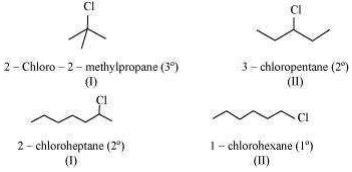
In the following pairs of halogen compounds,which compound undergoes faster $S_N1$ reaction?
$(i)$ $2$-chloro-$2$-methylpropane and $3$-chloropentane
(ii) $2$-chloroheptane and $1$-chlorohexane
$(i)$ $2$-chloro-$2$-methylpropane and $3$-chloropentane
(ii) $2$-chloroheptane and $1$-chlorohexane
Solution
(N/A) $(i)$ $S_N1$ reaction proceeds via the formation of a carbocation. The alkyl halide $(I)$ is $3^{\circ}$ while $(II)$ is $2^{\circ}$. Therefore,$(I)$ forms a $3^{\circ}$ carbocation while $(II)$ forms a $2^{\circ}$ carbocation. The greater the stability of the carbocation,the faster is the rate of $S_N1$ reaction. Since a $3^{\circ}$ carbocation is more stable than a $2^{\circ}$ carbocation,$(I)$,i.e.,$2$-chloro-$2$-methylpropane,undergoes a faster $S_N1$ reaction than $(II)$,i.e.,$3$-chloropentane.
$(ii)$ The alkyl halide $(I)$ is $2^{\circ}$ while $(II)$ is $1^{\circ}$. $A$ $2^{\circ}$ carbocation is more stable than a $1^{\circ}$ carbocation. Therefore,$(I)$,$2$-chloroheptane,undergoes a faster $S_N1$ reaction than $(II)$,$1$-chlorohexane.
$(ii)$ The alkyl halide $(I)$ is $2^{\circ}$ while $(II)$ is $1^{\circ}$. $A$ $2^{\circ}$ carbocation is more stable than a $1^{\circ}$ carbocation. Therefore,$(I)$,$2$-chloroheptane,undergoes a faster $S_N1$ reaction than $(II)$,$1$-chlorohexane.
0 likes
View Solution743
Easy
Identify $A, B, C, D, E, R$ and $R^1$ in the following reactions:
$Cyclohexyl-Br + Mg$ $\xrightarrow{dry\,ether} A$ $\xrightarrow{H_2O} B$
$R-Br + Mg$ $\xrightarrow{dry\,ether} C$ $\xrightarrow{D_2O} CH_3-CH(D)-CH_3$
$CH_3-C(CH_3)_2-C(CH_3)_2-CH_3 \xleftarrow{Na/ether} R^1-X$ $\xrightarrow{Mg} D$ $\xrightarrow{H_2O} E$
$Cyclohexyl-Br + Mg$ $\xrightarrow{dry\,ether} A$ $\xrightarrow{H_2O} B$
$R-Br + Mg$ $\xrightarrow{dry\,ether} C$ $\xrightarrow{D_2O} CH_3-CH(D)-CH_3$
$CH_3-C(CH_3)_2-C(CH_3)_2-CH_3 \xleftarrow{Na/ether} R^1-X$ $\xrightarrow{Mg} D$ $\xrightarrow{H_2O} E$
Solution
(B) $1.$ $Cyclohexyl-Br + Mg$ $\xrightarrow{dry\,ether} Cyclohexyl-MgBr (A)$ $\xrightarrow{H_2O} Cyclohexane (B)$
$2.$ $CH_3-CH(Br)-CH_3 (R) + Mg$ $\xrightarrow{dry\,ether} CH_3-CH(MgBr)-CH_3 (C)$ $\xrightarrow{D_2O} CH_3-CH(D)-CH_3$
$3.$ $2(CH_3)_3C-X (R^1-X) \xrightarrow{Na/ether} (CH_3)_3C-C(CH_3)_3$ (Wurtz reaction)
$4.$ $(CH_3)_3C-X$ $\xrightarrow{Mg} (CH_3)_3C-MgX (D)$ $\xrightarrow{H_2O} (CH_3)_3CH (E)$
Thus:
$A = Cyclohexylmagnesium\,bromide$
$B = Cyclohexane$
$C = CH_3-CH(MgBr)-CH_3$
$D = (CH_3)_3C-MgX$
$E = (CH_3)_3CH$
$R = CH_3-CH(Br)-CH_3$
$R^1 = (CH_3)_3C-$
$2.$ $CH_3-CH(Br)-CH_3 (R) + Mg$ $\xrightarrow{dry\,ether} CH_3-CH(MgBr)-CH_3 (C)$ $\xrightarrow{D_2O} CH_3-CH(D)-CH_3$
$3.$ $2(CH_3)_3C-X (R^1-X) \xrightarrow{Na/ether} (CH_3)_3C-C(CH_3)_3$ (Wurtz reaction)
$4.$ $(CH_3)_3C-X$ $\xrightarrow{Mg} (CH_3)_3C-MgX (D)$ $\xrightarrow{H_2O} (CH_3)_3CH (E)$
Thus:
$A = Cyclohexylmagnesium\,bromide$
$B = Cyclohexane$
$C = CH_3-CH(MgBr)-CH_3$
$D = (CH_3)_3C-MgX$
$E = (CH_3)_3CH$
$R = CH_3-CH(Br)-CH_3$
$R^1 = (CH_3)_3C-$
0 likes
View Solution744
Easy
What are ambident nucleophiles? Explain with an example.
Solution
(N/A) Ambident nucleophiles are nucleophiles that possess two nucleophilic sites through which they can attack.
For example,the nitrite ion $(NO_2^-)$ is an ambident nucleophile.
It can attack through the oxygen atom to form alkyl nitrites $(R-O-N=O)$,or it can attack through the nitrogen atom to form nitroalkanes $(R-NO_2)$.
For example,the nitrite ion $(NO_2^-)$ is an ambident nucleophile.
It can attack through the oxygen atom to form alkyl nitrites $(R-O-N=O)$,or it can attack through the nitrogen atom to form nitroalkanes $(R-NO_2)$.
0 likes
View Solution745
EasyMCQ
Which compound in each of the following pairs will react faster in $S_N2$ reaction with $OH^{-}$?
$(i)$ $CH_3-Br$ or $CH_3-I$
$(ii)$ $CH_3-C(CH_3)_2-Cl$ or $CH_3-Cl$
$(i)$ $CH_3-Br$ or $CH_3-I$
$(ii)$ $CH_3-C(CH_3)_2-Cl$ or $CH_3-Cl$
A
$(i)$ $CH_3-Br$,$(ii)$ $CH_3-C(CH_3)_2-Cl$
B
$(i)$ $CH_3-Br$,$(ii)$ $CH_3-Cl$
C
$(i)$ $CH_3-I$,$(ii)$ $CH_3-Cl$
D
$(i)$ $CH_3-I$,$(ii)$ $CH_3-C(CH_3)_2-Cl$
Solution
(C) $(i)$ In $S_N2$ reactions,the rate depends on the leaving group ability. The order of leaving group ability is $I^{-} > Br^{-} > Cl^{-} > F^{-}$. Since $I^{-}$ is a better leaving group than $Br^{-}$,$CH_3-I$ reacts faster than $CH_3-Br$.
$(ii)$ $S_N2$ reactions are highly sensitive to steric hindrance. The reactivity order for $S_N2$ is $\text{methyl} > \text{primary} > \text{secondary} > \text{tertiary}$. $CH_3-Cl$ is a methyl halide,while $CH_3-C(CH_3)_2-Cl$ is a tertiary halide. Therefore,$CH_3-Cl$ reacts faster due to significantly less steric hindrance.
$(ii)$ $S_N2$ reactions are highly sensitive to steric hindrance. The reactivity order for $S_N2$ is $\text{methyl} > \text{primary} > \text{secondary} > \text{tertiary}$. $CH_3-Cl$ is a methyl halide,while $CH_3-C(CH_3)_2-Cl$ is a tertiary halide. Therefore,$CH_3-Cl$ reacts faster due to significantly less steric hindrance.
0 likes
View Solution746
Easy
Predict all the alkenes that would be formed by dehydrohalogenation of the following halides with sodium ethoxide in ethanol and identify the major alkene:
$(i)$ $1-$Bromo$-1-$methylcyclohexane
$(ii)$ $2-$Chloro$-2-$methylbutane
$(iii)$ $2,2,3-$Trimethyl$-3-$bromopentane.
$(i)$ $1-$Bromo$-1-$methylcyclohexane
$(ii)$ $2-$Chloro$-2-$methylbutane
$(iii)$ $2,2,3-$Trimethyl$-3-$bromopentane.
Solution
(N/A) $(i)$ In $1-$bromo$-1-$methylcyclohexane,all $\beta$-hydrogen atoms are equivalent. Thus,dehydrohalogenation gives only one alkene: $1-$methylcyclohexene.
$(ii)$ In $2-$chloro$-2-$methylbutane,there are two sets of $\beta$-hydrogens. Dehydrohalogenation yields two alkenes:
$CH_3-C(Cl)(CH_3)-CH_2-CH_3 \xrightarrow{C_2H_5ONa/C_2H_5OH} CH_3-C(CH_3)=CH-CH_3 \text{ (major, } 2-$methylbut$-2-$ene$)$ $+ CH_2=C(CH_3)-CH_2-CH_3 \text{ (minor, } 2-$methylbut$-1-$ene$)$
According to Saytzeff's rule,the more substituted alkene ($2-$methylbut$-2-$ene$)$ is the major product.
$(iii)$ In $2,2,3-$trimethyl$-3-$bromopentane,there are two sets of $\beta$-hydrogens. Dehydrohalogenation yields two alkenes:
$CH_3-C(CH_3)_2-C(Br)(CH_3)-CH_2-CH_3$ $\xrightarrow{C_2H_5ONa/C_2H_5OH} CH_3-C(CH_3)_2-C(CH_3)=CH-CH_3 \text{ (major, } 3,4,4-$trimethylpent$-2-$ene$)$ $+ CH_3-C(CH_3)_2-C(=CH_2)-CH_2-CH_3 \text{ (minor, } 2,3,3-$trimethylpent$-1-$ene$)$
According to Saytzeff's rule,the more substituted alkene ($3,4,4-$trimethylpent$-2-$ene$)$ is the major product.
$(ii)$ In $2-$chloro$-2-$methylbutane,there are two sets of $\beta$-hydrogens. Dehydrohalogenation yields two alkenes:
$CH_3-C(Cl)(CH_3)-CH_2-CH_3 \xrightarrow{C_2H_5ONa/C_2H_5OH} CH_3-C(CH_3)=CH-CH_3 \text{ (major, } 2-$methylbut$-2-$ene$)$ $+ CH_2=C(CH_3)-CH_2-CH_3 \text{ (minor, } 2-$methylbut$-1-$ene$)$
According to Saytzeff's rule,the more substituted alkene ($2-$methylbut$-2-$ene$)$ is the major product.
$(iii)$ In $2,2,3-$trimethyl$-3-$bromopentane,there are two sets of $\beta$-hydrogens. Dehydrohalogenation yields two alkenes:
$CH_3-C(CH_3)_2-C(Br)(CH_3)-CH_2-CH_3$ $\xrightarrow{C_2H_5ONa/C_2H_5OH} CH_3-C(CH_3)_2-C(CH_3)=CH-CH_3 \text{ (major, } 3,4,4-$trimethylpent$-2-$ene$)$ $+ CH_3-C(CH_3)_2-C(=CH_2)-CH_2-CH_3 \text{ (minor, } 2,3,3-$trimethylpent$-1-$ene$)$
According to Saytzeff's rule,the more substituted alkene ($3,4,4-$trimethylpent$-2-$ene$)$ is the major product.
0 likes
View Solution747
Easy
Explain why:
$(i)$ the dipole moment of chlorobenzene is lower than that of cyclohexyl chloride?
$(ii)$ alkyl halides,though polar,are immiscible with water?
$(iii)$ Grignard reagents should be prepared under anhydrous conditions?
$(i)$ the dipole moment of chlorobenzene is lower than that of cyclohexyl chloride?
$(ii)$ alkyl halides,though polar,are immiscible with water?
$(iii)$ Grignard reagents should be prepared under anhydrous conditions?
Solution
(N/A) $(i)$ In chlorobenzene,the $Cl$ atom is linked to a $sp^{2}$ hybridized carbon atom. In cyclohexyl chloride,the $Cl$ atom is linked to a $sp^{3}$ hybridized carbon atom. The $sp^{2}$ hybridized carbon has more $s$-character than the $sp^{3}$ hybridized carbon atom,making it more electronegative. Consequently,the electron density of the $C-Cl$ bond near the $Cl$ atom is less in chlorobenzene than in cyclohexyl chloride. Furthermore,the $-I$ effect of the benzene ring in chlorobenzene decreases the electron density of the $C-Cl$ bond near the $Cl$ atom. As a result,the polarity of the $C-Cl$ bond in chlorobenzene decreases,leading to a lower dipole moment compared to cyclohexyl chloride.
$(ii)$ To be miscible with water,the solute-water force of attraction must be stronger than the solute-solute and water-water forces of attraction. Alkyl halides are polar molecules held together by dipole-dipole interactions,while water molecules are held together by strong hydrogen bonds. The new force of attraction between alkyl halides and water molecules is weaker than the existing alkyl halide-alkyl halide and water-water forces of attraction. Hence,alkyl halides are immiscible with water.
$(iii)$ Grignard reagents $(R-Mg-X)$ are highly reactive. In the presence of moisture,they react with water to form alkanes:
$R-Mg-X + H_{2}O \rightarrow R-H + Mg(OH)X$
Therefore,Grignard reagents must be prepared under anhydrous conditions to prevent decomposition.
$(ii)$ To be miscible with water,the solute-water force of attraction must be stronger than the solute-solute and water-water forces of attraction. Alkyl halides are polar molecules held together by dipole-dipole interactions,while water molecules are held together by strong hydrogen bonds. The new force of attraction between alkyl halides and water molecules is weaker than the existing alkyl halide-alkyl halide and water-water forces of attraction. Hence,alkyl halides are immiscible with water.
$(iii)$ Grignard reagents $(R-Mg-X)$ are highly reactive. In the presence of moisture,they react with water to form alkanes:
$R-Mg-X + H_{2}O \rightarrow R-H + Mg(OH)X$
Therefore,Grignard reagents must be prepared under anhydrous conditions to prevent decomposition.
0 likes
View Solution748
Easy
Write the mechanism of the following reaction:
$n-BuBr + KCN \xrightarrow{EtOH/H_2O} n-BuCN$
$n-BuBr + KCN \xrightarrow{EtOH/H_2O} n-BuCN$
Solution
(N/A) The given reaction is:
$n-BuBr + KCN \xrightarrow{EtOH/H_2O} n-BuCN$
This reaction proceeds via an $S_{N}2$ mechanism.
$1$. The nucleophile $CN^{-}$ attacks the electrophilic carbon atom of $n-butyl$ bromide $(n-BuBr)$ from the side opposite to the leaving group $(Br^{-})$.
$2$. This results in the formation of a transition state where the $C-CN$ bond is partially formed and the $C-Br$ bond is partially broken.
$3$. Finally,the $Br^{-}$ ion leaves,resulting in the formation of $n-butyl$ cyanide $(n-BuCN)$.
$4$. The $CN^{-}$ ion is an ambident nucleophile,but in the presence of $KCN$,the attack occurs primarily through the carbon atom due to the higher nucleophilicity of the carbon center.
$n-BuBr + KCN \xrightarrow{EtOH/H_2O} n-BuCN$
This reaction proceeds via an $S_{N}2$ mechanism.
$1$. The nucleophile $CN^{-}$ attacks the electrophilic carbon atom of $n-butyl$ bromide $(n-BuBr)$ from the side opposite to the leaving group $(Br^{-})$.
$2$. This results in the formation of a transition state where the $C-CN$ bond is partially formed and the $C-Br$ bond is partially broken.
$3$. Finally,the $Br^{-}$ ion leaves,resulting in the formation of $n-butyl$ cyanide $(n-BuCN)$.
$4$. The $CN^{-}$ ion is an ambident nucleophile,but in the presence of $KCN$,the attack occurs primarily through the carbon atom due to the higher nucleophilicity of the carbon center.
0 likes
View Solution749
Easy
Arrange the compounds of each set in order of reactivity towards $S_{N}2$ displacement:
$(i)$ $2-Bromo-2-methylbutane$,$1-Bromopentane$,$2-Bromopentane$
$(ii)$ $1-Bromo-3-methylbutane$,$2-Bromo-2-methylbutane$,$2-Bromo-3-methylbutane$
$(iii)$ $1-Bromobutane$,$1-Bromo-2,2-dimethylpropane$,$1-Bromo-2-methylbutane$,$1-Bromo-3-methylbutane$.
$(i)$ $2-Bromo-2-methylbutane$,$1-Bromopentane$,$2-Bromopentane$
$(ii)$ $1-Bromo-3-methylbutane$,$2-Bromo-2-methylbutane$,$2-Bromo-3-methylbutane$
$(iii)$ $1-Bromobutane$,$1-Bromo-2,2-dimethylpropane$,$1-Bromo-2-methylbutane$,$1-Bromo-3-methylbutane$.
Solution
(N/A) $(i)$ $1-Bromopentane$ $(1^{\circ})$,$2-Bromopentane$ $(2^{\circ})$,$2-Bromo-2-methylbutane$ $(3^{\circ})$. The $S_{N}2$ reactivity decreases as steric hindrance increases. The order is: $2-Bromo-2-methylbutane < 2-Bromopentane < 1-Bromopentane$.
$(ii)$ $1-Bromo-3-methylbutane$ $(1^{\circ})$,$2-Bromo-3-methylbutane$ $(2^{\circ})$,$2-Bromo-2-methylbutane$ $(3^{\circ})$. The order of reactivity is: $2-Bromo-2-methylbutane < 2-Bromo-3-methylbutane < 1-Bromo-3-methylbutane$.
$(iii)$ All are $1^{\circ}$ alkyl halides. Reactivity decreases as branching near the reaction site increases. The order is: $1-Bromo-2,2-dimethylpropane < 1-Bromo-2-methylbutane < 1-Bromo-3-methylbutane < 1-Bromobutane$.
$(ii)$ $1-Bromo-3-methylbutane$ $(1^{\circ})$,$2-Bromo-3-methylbutane$ $(2^{\circ})$,$2-Bromo-2-methylbutane$ $(3^{\circ})$. The order of reactivity is: $2-Bromo-2-methylbutane < 2-Bromo-3-methylbutane < 1-Bromo-3-methylbutane$.
$(iii)$ All are $1^{\circ}$ alkyl halides. Reactivity decreases as branching near the reaction site increases. The order is: $1-Bromo-2,2-dimethylpropane < 1-Bromo-2-methylbutane < 1-Bromo-3-methylbutane < 1-Bromobutane$.
0 likes
View SolutionHaloalkanes and Haloarenes — Properties of Haloalkanes · Frequently Asked Questions
1Are these Haloalkanes and Haloarenes questions useful for JEE and NEET?
Yes. All questions in this section are mapped to JEE Main and NEET exam patterns. Previous year questions from JEE Main, NEET, GUJCET and state-level exams are included with full solutions.
2Can I switch to Hindi or Gujarati for these questions?
Yes. Use the language tabs in the hero section or the sidebar to view the same questions and solutions in English, Hindi or Gujarati.
3How do I generate a question paper from this subtopic?
Use the Vedclass Exam Paper Generator — select the chapter and subtopic, set difficulty, and generate Sets A, B, C, D automatically. First 3 chapters of every subject are free.
Vedclass Products
For Students
Vedclass Test Series
Mock tests in real JEE/NEET style with performance analysis. 5-day free trial.
Start Free TrialFor Teachers
Exam Paper Generator
Generate Set A/B/C/D papers from this chapter in 2 minutes. 3 chapters free.
Try FreeFor Institutes
Online Exam Module
Live online exams with unlimited students, 360° analytics & white-label branding.
See DemoFor Teachers & Institutes
Generate a Haloalkanes and Haloarenes Exam Paper in 2 Minutes
Select subtopic & difficulty — Sets A, B, C, D auto-generated with No Repeat logic.
First 3 chapters of every subject are free — no payment required.