
A English
Properties of Phenols Questions in English
Class 12 Chemistry · Alcohols, Phenols and Ethers · Properties of Phenols
751+
Questions
English
Language
100%
With Solutions
Showing 50 of 751 questions in English
501
EasyMCQ
Which among the following compounds has the highest melting point?
A
Phenol
B
$p$-Nitrophenol
C
$p$-Cresol
D
$o$-Nitrophenol
Solution
(B) $p$-Nitrophenol has the highest melting point due to strong intermolecular hydrogen bonding in the solid state,which leads to a more stable crystal lattice structure compared to the other isomers. $o$-Nitrophenol exhibits intramolecular hydrogen bonding,which reduces its melting point.
0 likes
View Solution502
EasyMCQ
Which of the following is $\underline{\text{NOT}}$ a dihydric phenol?
A
$\alpha$-naphthol
B
Resorcinol
C
Hydroquinone
D
Catechol
Solution
(A) dihydric phenol is a compound containing two hydroxyl $(-OH)$ groups attached directly to a benzene ring.
$1$. $\alpha$-naphthol is a monohydric phenol (contains one $-OH$ group).
$2$. Resorcinol ($1,3$-dihydroxybenzene),Hydroquinone ($1,4$-dihydroxybenzene),and Catechol ($1,2$-dihydroxybenzene) are all dihydric phenols.
Therefore,$\alpha$-naphthol is not a dihydric phenol.
$1$. $\alpha$-naphthol is a monohydric phenol (contains one $-OH$ group).
$2$. Resorcinol ($1,3$-dihydroxybenzene),Hydroquinone ($1,4$-dihydroxybenzene),and Catechol ($1,2$-dihydroxybenzene) are all dihydric phenols.
Therefore,$\alpha$-naphthol is not a dihydric phenol.
0 likes
View Solution503
EasyMCQ
Identify the product in the following reaction: $Phenol \xrightarrow{CrO_3} \text{Product}$
A
$Benzene$
B
$Benzoic \ acid$
C
$Benzaldehyde$
D
$p-Benzoquinone$
Solution
(D) The reaction of $Phenol$ with chromic acid $(CrO_3)$ is an oxidation reaction.
$Phenol$ undergoes oxidation in the presence of $CrO_3$ to form $p-Benzoquinone$ as the major product.
This is a characteristic reaction of phenols where the aromatic ring is oxidized to a conjugated diketone.
$Phenol$ undergoes oxidation in the presence of $CrO_3$ to form $p-Benzoquinone$ as the major product.
This is a characteristic reaction of phenols where the aromatic ring is oxidized to a conjugated diketone.
0 likes
View Solution504
DifficultMCQ
What is the product formed when cumene is air oxidized in the presence of cobalt naphthenate and further treated with dilute acid?
A
Cumene hydroperoxide
B
Phenol $+$ Acetone
C
Acetone and Benzoic acid
D
Phenol and $CO_2$
Solution
(B) The process is known as the cumene process for the industrial production of phenol.
Step $1$: Cumene (isopropylbenzene) is oxidized by air in the presence of cobalt naphthenate to form cumene hydroperoxide.
Step $2$: Cumene hydroperoxide is then treated with dilute acid (like $dil. H_2SO_4$) to yield phenol and acetone as the final products.
The reaction is: $C_6H_5CH(CH_3)_2 + O_2$ $\xrightarrow{Co-naphthenate} C_6H_5C(CH_3)_2OOH$ $\xrightarrow{dil. H_2SO_4} C_6H_5OH + CH_3COCH_3$.
Step $1$: Cumene (isopropylbenzene) is oxidized by air in the presence of cobalt naphthenate to form cumene hydroperoxide.
Step $2$: Cumene hydroperoxide is then treated with dilute acid (like $dil. H_2SO_4$) to yield phenol and acetone as the final products.
The reaction is: $C_6H_5CH(CH_3)_2 + O_2$ $\xrightarrow{Co-naphthenate} C_6H_5C(CH_3)_2OOH$ $\xrightarrow{dil. H_2SO_4} C_6H_5OH + CH_3COCH_3$.
0 likes
View Solution505
EasyMCQ
Which of the following phenols is isolated from the defensive secretion of grasshopper species?
A
$4-$Methylphenol
B
Benzene$-1, 3-$diol
C
$2, 5-$dichlorophenol
D
Phenol
Solution
(C) The defensive froth emitted by the grasshopper $Romalea \ microptera$ contains several odorous compounds,including a chlorinated aromatic compound,$2, 5-$dichlorophenol.
This compound acts as a repellent to ants and is defensively useful to the grasshopper.
It is believed that this compound is derived from herbicides or herbicide derivatives ingested by the insect through its diet.
This compound acts as a repellent to ants and is defensively useful to the grasshopper.
It is believed that this compound is derived from herbicides or herbicide derivatives ingested by the insect through its diet.
0 likes
View Solution506
EasyMCQ
Which of the following is a dihydric phenol?
A
Resorcinol
B
$m$-Cresol
C
Phloroglucinol
D
Pyrogallol
Solution
(A) dihydric phenol contains two hydroxyl $(-OH)$ groups attached to the benzene ring.
$1$. Resorcinol is benzene-$1,3$-diol,which is a dihydric phenol.
$2$. $m$-Cresol is a monohydric phenol ($3$-methylphenol).
$3$. Phloroglucinol is benzene-$1,3,5$-triol,which is a trihydric phenol.
$4$. Pyrogallol is benzene-$1,2,3$-triol,which is a trihydric phenol.
Therefore,the correct option is Resorcinol.
$1$. Resorcinol is benzene-$1,3$-diol,which is a dihydric phenol.
$2$. $m$-Cresol is a monohydric phenol ($3$-methylphenol).
$3$. Phloroglucinol is benzene-$1,3,5$-triol,which is a trihydric phenol.
$4$. Pyrogallol is benzene-$1,2,3$-triol,which is a trihydric phenol.
Therefore,the correct option is Resorcinol.
0 likes
View Solution507
EasyMCQ
Identify substrate '$A$' in the following reaction.
$A + CO_2$ $\xrightarrow[6 \ atm]{398 \ K} \text{Sodium salicylate}$ $\xrightarrow{H_3O^{+}} \text{Salicylic acid}$
$A + CO_2$ $\xrightarrow[6 \ atm]{398 \ K} \text{Sodium salicylate}$ $\xrightarrow{H_3O^{+}} \text{Salicylic acid}$
A
Phenol
B
Sodium phenoxide
C
Salicylaldehyde
D
$o-$Phenolsulphonic acid
Solution
(B) The reaction described is the $Kolbe-Schmitt$ reaction.
In this reaction,$Sodium \ phenoxide$ reacts with $CO_2$ at $398 \ K$ and $6 \ atm$ pressure to form $Sodium \ salicylate$.
Upon acidification with $H_3O^{+}$,$Sodium \ salicylate$ is converted into $Salicylic \ acid$.
Therefore,the substrate '$A$' is $Sodium \ phenoxide$.
In this reaction,$Sodium \ phenoxide$ reacts with $CO_2$ at $398 \ K$ and $6 \ atm$ pressure to form $Sodium \ salicylate$.
Upon acidification with $H_3O^{+}$,$Sodium \ salicylate$ is converted into $Salicylic \ acid$.
Therefore,the substrate '$A$' is $Sodium \ phenoxide$.
0 likes
View Solution508
EasyMCQ
Identify '$Z$' in the following reaction.
$Ar-OH + Cl-C(=O)-R \xrightarrow{\text{Pyridine}} Z + HCl$
$Ar-OH + Cl-C(=O)-R \xrightarrow{\text{Pyridine}} Z + HCl$
A
$Ar-O-C(=O)-R$
B
$Ar-C(=O)-OR$
C
$R-C(=O)-OAr$
D
$Ar-C(=O)-R$
Solution
(A) The reaction between a phenol $(Ar-OH)$ and an acid chloride $(R-COCl)$ in the presence of a base like pyridine is an acylation reaction.
Pyridine acts as a base to neutralize the $HCl$ produced during the reaction,which helps in shifting the equilibrium towards the product side.
The reaction proceeds as follows:
$Ar-OH + R-COCl \xrightarrow{\text{Pyridine}} Ar-O-CO-R + HCl$
Here,the phenolic oxygen attacks the carbonyl carbon of the acid chloride,leading to the formation of an ester $(Ar-O-CO-R)$.
Pyridine acts as a base to neutralize the $HCl$ produced during the reaction,which helps in shifting the equilibrium towards the product side.
The reaction proceeds as follows:
$Ar-OH + R-COCl \xrightarrow{\text{Pyridine}} Ar-O-CO-R + HCl$
Here,the phenolic oxygen attacks the carbonyl carbon of the acid chloride,leading to the formation of an ester $(Ar-O-CO-R)$.
0 likes
View Solution509
EasyMCQ
Phenol on reaction with aqueous solution of bromine gives
A
$o-$Bromophenol
B
$m-$Bromophenol
C
$p-$Bromophenol
D
$2,4,6-$tribromophenol
Solution
(D) When phenol reacts with bromine water (aqueous solution of bromine),it undergoes electrophilic substitution at all available ortho and para positions.
Due to the strong activating effect of the $-OH$ group,the reaction proceeds rapidly to form $2,4,6-$tribromophenol as a white precipitate.
Due to the strong activating effect of the $-OH$ group,the reaction proceeds rapidly to form $2,4,6-$tribromophenol as a white precipitate.
0 likes
View Solution510
MediumMCQ
Identify the final product obtained when a mixture of vapours of phenol and hydrogen is passed over nickel catalyst at $433 \ K$.
A
Cyclohexanol
B
Cyclohex-$2$-en-$1$-ol
C
Cyclohexane
D
Benzene
Solution
(A) When phenol $(C_6H_5OH)$ is heated with hydrogen gas in the presence of a nickel catalyst at $433 \ K$,the benzene ring undergoes catalytic hydrogenation.
The reaction is: $C_6H_5OH + 3H_2 \xrightarrow{Ni, 433 \ K} C_6H_{11}OH$.
The product formed is cyclohexanol.
The reaction is: $C_6H_5OH + 3H_2 \xrightarrow{Ni, 433 \ K} C_6H_{11}OH$.
The product formed is cyclohexanol.
0 likes
View Solution511
MediumMCQ
Identify the product '$B$' in the following reaction.
$Sodium \ phenoxide$ $\xrightarrow[6 \ atm]{CO_2 ; \ 398 \ K} A$ $\xrightarrow{H_3O^{+}} B$
$Sodium \ phenoxide$ $\xrightarrow[6 \ atm]{CO_2 ; \ 398 \ K} A$ $\xrightarrow{H_3O^{+}} B$
A
Picric acid
B
Sulphonic acid
C
Salicylic acid
D
Salicylaldehyde
Solution
(C) The given reaction is the $Kolbe-Schmitt$ reaction.
In this reaction,$Sodium \ phenoxide$ reacts with $CO_2$ at $398 \ K$ and $6 \ atm$ pressure to form an intermediate $A$,which is $Sodium \ salicylate$.
Upon acidification with $H_3O^{+}$,$Sodium \ salicylate$ is converted into $Salicylic \ acid$ $(B)$.
The reaction sequence is:
$Sodium \ phenoxide + CO_2$ $\xrightarrow[6 \ atm]{398 \ K} Sodium \ salicylate (A)$ $\xrightarrow{H_3O^{+}} Salicylic \ acid (B)$.
In this reaction,$Sodium \ phenoxide$ reacts with $CO_2$ at $398 \ K$ and $6 \ atm$ pressure to form an intermediate $A$,which is $Sodium \ salicylate$.
Upon acidification with $H_3O^{+}$,$Sodium \ salicylate$ is converted into $Salicylic \ acid$ $(B)$.
The reaction sequence is:
$Sodium \ phenoxide + CO_2$ $\xrightarrow[6 \ atm]{398 \ K} Sodium \ salicylate (A)$ $\xrightarrow{H_3O^{+}} Salicylic \ acid (B)$.
0 likes
View Solution512
EasyMCQ
Which of the following compounds is obtained when phenol reacts with dilute nitric acid at low temperature?
A
$o-$Nitrophenol
B
$p-$Nitrophenol
C
$2,4,6-$Trinitrophenol
D
Mixture of $o-$nitrophenol and $p-$nitrophenol
Solution
(D) When phenol reacts with dilute nitric acid at low temperature $(298 \ K)$,it undergoes electrophilic aromatic substitution to form a mixture of $o-$nitrophenol and $p-$nitrophenol.
The ortho and para isomers can be separated by steam distillation because $o-$nitrophenol is steam volatile due to intramolecular hydrogen bonding,while $p-$nitrophenol is not steam volatile due to intermolecular hydrogen bonding.
The ortho and para isomers can be separated by steam distillation because $o-$nitrophenol is steam volatile due to intramolecular hydrogen bonding,while $p-$nitrophenol is not steam volatile due to intermolecular hydrogen bonding.
0 likes
View Solution513
MediumMCQ
What is the natural source of salicylic acid?
A
Cinnamon
B
Willow plant
C
Turmeric plant
D
Indian gooseberry
Solution
(B) Salicylic acid is a phenolic acid that occurs naturally in the bark of the $Willow$ plant (genus $Salix$). The name 'salicylic' is derived from the Latin word '$salix$',meaning willow tree. Historically,extracts from willow bark have been used for their medicinal properties,specifically for pain relief and fever reduction.
0 likes
View Solution514
MediumMCQ
Identify the product '$B$' in the following series of reactions.
$Chlorobenzene$ $\xrightarrow[ii) \ H_3O^{+}]{i) \ NaOH, 623 \ K / 150 \ atm} A$ $\xrightarrow{Br_2 \text{ water}} B$
$Chlorobenzene$ $\xrightarrow[ii) \ H_3O^{+}]{i) \ NaOH, 623 \ K / 150 \ atm} A$ $\xrightarrow{Br_2 \text{ water}} B$
A
Phenol
B
$o-$Bromophenol
C
$p-$Bromophenol
D
$2,4,6-$tribromophenol
Solution
(D) The reaction of $Chlorobenzene$ with $NaOH$ at $623 \ K$ and $150 \ atm$ followed by acidification $(H_3O^+)$ is the $Dow$ process,which yields $Phenol$ $(A)$.
When $Phenol$ reacts with $Br_2$ water,it undergoes electrophilic aromatic substitution to form $2,4,6-$tribromophenol $(B)$ as the final product due to the high reactivity of the $-OH$ group.
When $Phenol$ reacts with $Br_2$ water,it undergoes electrophilic aromatic substitution to form $2,4,6-$tribromophenol $(B)$ as the final product due to the high reactivity of the $-OH$ group.
0 likes
View Solution515
EasyMCQ
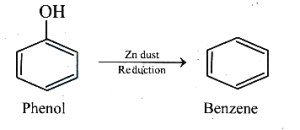
Identify the product obtained when phenol is heated with $Zn$ dust.
A
Benzene
B
Benzoquinone
C
$3 CH \equiv CH$
D
Cyclohexanol
Solution
(A) When phenol $(C_6H_5OH)$ is heated with zinc $(Zn)$ dust,it undergoes reduction to form benzene $(C_6H_6)$.
The chemical reaction is:
$C_6H_5OH + Zn \rightarrow C_6H_6 + ZnO$
The chemical reaction is:
$C_6H_5OH + Zn \rightarrow C_6H_6 + ZnO$
0 likes
View Solution516
MediumMCQ
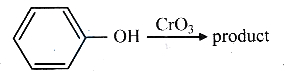
Identify the product of the following reaction.
A
Benzene
B
Benzoic acid
C
Benzaldehyde
D
$p-$Benzoquinone
Solution
(D) When phenol is treated with chromic acid $(CrO_3)$,it undergoes oxidation to form a conjugated diketone known as $p-$benzoquinone.
0 likes
View Solution517
EasyMCQ
Which reagent from the following is used in the Reimer-Tiemann reaction?
A
$CO_2, 6 \ atm, H_3O^{+}$
B
$CHCl_3, \ aq. \ NaOH, H_3O^{+}$
C
$CS_2$ (at low temperature)
D
$Na_2Cr_2O_7 / H_2SO_4$
Solution
(B) When phenol reacts with chloroform $(CHCl_3)$ in the presence of an aqueous base ($NaOH$ or $KOH$),an aldehyde $(-CHO)$ group is introduced into the benzene ring at the ortho position to the phenolic group,resulting in the formation of salicylaldehyde. This reaction is known as the Reimer-Tiemann reaction. The chemical equation is: $C_6H_5OH + CHCl_3 + 3KOH \rightarrow C_6H_4(OH)CHO + 3KCl + 3H_2O$.
0 likes
View Solution518
EasyMCQ
Identify the product obtained in the following reaction:
$C_6H_5OH \xrightarrow{CrO_3} \text{Product}$
$C_6H_5OH \xrightarrow{CrO_3} \text{Product}$
A
Benzene
B
Benzaldehyde
C
Benzoic acid
D
$p$-Benzoquinone
Solution
(D) When phenol $(C_6H_5OH)$ is treated with chromic acid $(CrO_3)$,it undergoes oxidation to form a conjugated diketone known as $p$-benzoquinone.
This is a specific oxidation reaction of phenol.
This is a specific oxidation reaction of phenol.
0 likes
View Solution519
MediumMCQ
Which of the following reagents is used in the conversion of phenol to picric acid?
A
dil. Nitric acid
B
conc. Nitrous acid
C
conc. Sulphuric acid
D
conc. $HNO_3 +$ conc. $H_2SO_4$
Solution
(D) The conversion of phenol to picric acid $(2,4,6-\text{trinitrophenol})$ is an electrophilic aromatic substitution reaction known as nitration.
Phenol reacts with concentrated nitric acid $(HNO_3)$ in the presence of concentrated sulphuric acid $(H_2SO_4)$ to form picric acid.
The concentrated $H_2SO_4$ acts as a catalyst and helps in the generation of the nitronium ion $(NO_2^+)$,which is the electrophile.
Phenol reacts with concentrated nitric acid $(HNO_3)$ in the presence of concentrated sulphuric acid $(H_2SO_4)$ to form picric acid.
The concentrated $H_2SO_4$ acts as a catalyst and helps in the generation of the nitronium ion $(NO_2^+)$,which is the electrophile.
0 likes
View Solution520
EasyMCQ
Phenol on heating with zinc dust forms
A
Benzoquinone
B
Cyclohexane
C
Benzene
D
Cyclohexanol
Solution
(C) When phenol $(C_6H_5OH)$ is heated with zinc dust $(Zn)$,it undergoes a reduction reaction.
In this process,the oxygen atom of the hydroxyl group is removed by zinc to form zinc oxide $(ZnO)$,and phenol is converted into benzene $(C_6H_6)$.
The chemical equation is: $C_6H_5OH + Zn \xrightarrow{\Delta} C_6H_6 + ZnO$.
In this process,the oxygen atom of the hydroxyl group is removed by zinc to form zinc oxide $(ZnO)$,and phenol is converted into benzene $(C_6H_6)$.
The chemical equation is: $C_6H_5OH + Zn \xrightarrow{\Delta} C_6H_6 + ZnO$.
0 likes
View Solution521
EasyMCQ
Which reagent is used in the conversion of phenol to picric acid?
A
Nitric acid (dil.)
B
Nitrous acid (conc.)
C
Sulphuric acid (conc.)
D
Nitric acid (conc.) + Sulphuric acid (conc.)
Solution
(D) The conversion of phenol to picric acid ($2,4,6$-trinitrophenol) is an electrophilic aromatic substitution reaction.
Phenol reacts with concentrated nitric acid $(HNO_3)$ in the presence of concentrated sulphuric acid $(H_2SO_4)$ to undergo nitration at the $ortho$ and $para$ positions,resulting in the formation of $2,4,6$-trinitrophenol,commonly known as picric acid.
Phenol reacts with concentrated nitric acid $(HNO_3)$ in the presence of concentrated sulphuric acid $(H_2SO_4)$ to undergo nitration at the $ortho$ and $para$ positions,resulting in the formation of $2,4,6$-trinitrophenol,commonly known as picric acid.
0 likes
View Solution522
MediumMCQ
Identify the product $A$ obtained in the following reaction.
$\text{Phenol} + \text{Conc. Nitric acid} \xrightarrow{\text{conc. } H_2SO_4} A$
$\text{Phenol} + \text{Conc. Nitric acid} \xrightarrow{\text{conc. } H_2SO_4} A$
A
$o-\text{Nitrophenol}$
B
$p-\text{Nitrophenol}$
C
$2,4,6-\text{Trinitrophenol}$
D
$\text{Mixture of ortho and para-nitrophenol}$
Solution
(C) When phenol is treated with concentrated nitric acid in the presence of concentrated $H_2SO_4$,it undergoes electrophilic aromatic substitution to form $2,4,6-\text{trinitrophenol}$,which is commonly known as picric acid.
This reaction involves the nitration of the phenol ring at all available ortho and para positions due to the strong activating effect of the $-\text{OH}$ group.
This reaction involves the nitration of the phenol ring at all available ortho and para positions due to the strong activating effect of the $-\text{OH}$ group.
0 likes
View Solution523
EasyMCQ
Identify the product when phenol is heated with zinc dust.
A
Benzoquinone
B
Cyclohexane
C
Benzene
D
Cyclohexanol
Solution
(C) When phenol $(C_6H_5OH)$ is heated with zinc dust,it undergoes a reduction reaction.
Zinc dust acts as a reducing agent and removes the oxygen atom from the phenol group.
The reaction is as follows:
$C_6H_5OH + Zn \xrightarrow{\Delta} C_6H_6 + ZnO$
Thus,phenol is converted into benzene.
Zinc dust acts as a reducing agent and removes the oxygen atom from the phenol group.
The reaction is as follows:
$C_6H_5OH + Zn \xrightarrow{\Delta} C_6H_6 + ZnO$
Thus,phenol is converted into benzene.
0 likes
View Solution524
EasyMCQ
Identify the solvent used in the bromination of phenol to obtain $2,4,6$-tribromophenol.
A
Chloroform
B
Water
C
Carbon tetrachloride
D
Carbon disulphide
Solution
(B) When phenol is treated with bromine water,it undergoes electrophilic substitution to form a white precipitate of $2,4,6$-tribromophenol.
The reaction is as follows:
$C_6H_5OH + 3Br_2 \xrightarrow{H_2O} C_6H_2Br_3OH + 3HBr$
Thus,water is the solvent used.
The reaction is as follows:
$C_6H_5OH + 3Br_2 \xrightarrow{H_2O} C_6H_2Br_3OH + 3HBr$
Thus,water is the solvent used.
0 likes
View Solution525
EasyMCQ
Identify the product obtained when phenol is reacted with dilute nitric acid at low temperature.
A
$ortho$-Nitrophenol
B
$para$-Nitrophenol
C
Mixture of $ortho$- and $para$-nitrophenols
D
$2,4,6$-Trinitrophenol
Solution
(C) When phenol reacts with dilute nitric acid $(HNO_3)$ at low temperature $(298 \ K)$,it undergoes electrophilic aromatic substitution to form a mixture of $ortho$-nitrophenol and $para$-nitrophenol.
$C_6H_5OH + dil. HNO_3 \rightarrow o-Nitrophenol + p-Nitrophenol$
$C_6H_5OH + dil. HNO_3 \rightarrow o-Nitrophenol + p-Nitrophenol$
0 likes
View Solution526
MediumMCQ
What is the product obtained in the Reimer-Tiemann reaction?
A
Salicylaldehyde
B
Salicylic acid
C
$2, 4, 6-$trinitrophenol
D
Aniline
Solution
(A) The Reimer-Tiemann reaction involves the treatment of phenol with chloroform $(CHCl_3)$ in the presence of an aqueous base like $KOH$ or $NaOH$.
This reaction results in the introduction of a formyl group $(-CHO)$ at the ortho position of the phenol ring.
The major product formed is $2-$hydroxybenzaldehyde,commonly known as Salicylaldehyde,along with a small amount of the para-isomer.
This reaction results in the introduction of a formyl group $(-CHO)$ at the ortho position of the phenol ring.
The major product formed is $2-$hydroxybenzaldehyde,commonly known as Salicylaldehyde,along with a small amount of the para-isomer.
0 likes
View Solution527
EasyMCQ
What is the product obtained when vapours of phenol are passed over heated zinc dust?
A
Ethene
B
Benzene
C
Benzoic acid
D
Cyclohexane
Solution
(B) When phenol $(C_6H_5OH)$ vapours are passed over heated zinc dust,it undergoes reduction to form benzene $(C_6H_6)$ and zinc oxide $(ZnO)$.
The chemical reaction is as follows:
$C_6H_5OH + Zn \rightarrow C_6H_6 + ZnO$
The chemical reaction is as follows:
$C_6H_5OH + Zn \rightarrow C_6H_6 + ZnO$
0 likes
View Solution528
EasyMCQ
Identify the product formed in the reaction.
Phenol $+$ conc. $H_2SO_4$ $\xrightarrow{373 \ K}$ product
Phenol $+$ conc. $H_2SO_4$ $\xrightarrow{373 \ K}$ product
A
$p-$Phenol sulphonic acid
B
$o-$Phenol sulphonic acid
C
$m-$Phenol sulphonic acid
D
Benzene sulphonic acid
Solution
(A) The reaction of phenol with concentrated $H_2SO_4$ at $373 \ K$ is an electrophilic aromatic substitution reaction known as sulphonation.
At higher temperatures $(373 \ K)$,the $-SO_3H$ group is predominantly directed to the para-position due to steric hindrance at the ortho-position,resulting in the formation of $p-$phenol sulphonic acid as the major product.
At higher temperatures $(373 \ K)$,the $-SO_3H$ group is predominantly directed to the para-position due to steric hindrance at the ortho-position,resulting in the formation of $p-$phenol sulphonic acid as the major product.
0 likes
View Solution529
EasyMCQ
Which among the following is obtained as a product when phenol is treated with $NaOH$ and $CO_2$ followed by acid hydrolysis?
A
Phthalic acid
B
Benzoic acid
C
Salicylaldehyde
D
Salicylic acid
Solution
(D) The reaction described is the $Kolbe-Schmitt$ reaction.
$1$. Phenol reacts with $NaOH$ to form sodium phenoxide.
$2$. Sodium phenoxide reacts with $CO_2$ at high pressure and temperature $(140 \ ^\circ C)$ to form sodium salicylate.
$3$. Subsequent acid hydrolysis $(H^+)$ converts the intermediate into salicylic acid.
Thus,the final product is salicylic acid.
$1$. Phenol reacts with $NaOH$ to form sodium phenoxide.
$2$. Sodium phenoxide reacts with $CO_2$ at high pressure and temperature $(140 \ ^\circ C)$ to form sodium salicylate.
$3$. Subsequent acid hydrolysis $(H^+)$ converts the intermediate into salicylic acid.
Thus,the final product is salicylic acid.
0 likes
View Solution530
MediumMCQ
Identify the reactant,reagent,and condition of Kolbe's reaction from the following.
A
$C_6H_5ONa, CO_2$ and $398\ K, 6\ atm$
B
$C_6H_5ONa, Na_2CO_3$ and $398\ K$
C
$C_6H_5OH, CHCl_3$ and aq. $NaOH$
D
$C_6H_5OH$,dil. $HNO_3$ and $413\ K$
Solution
(A) In Kolbe's reaction,sodium phenoxide $(C_6H_5ONa)$ is treated with carbon dioxide $(CO_2)$ at a temperature of $398\ K$ and a pressure of $6\ atm$,followed by acidification to yield salicylic acid.
Therefore,the correct reactants and conditions are $C_6H_5ONa, CO_2$ and $398\ K, 6\ atm$.
Therefore,the correct reactants and conditions are $C_6H_5ONa, CO_2$ and $398\ K, 6\ atm$.
0 likes
View Solution531
EasyMCQ
Identify the product obtained when phenol reacts with concentrated sulphuric acid at $293 \ K$?
A
Picric acid
B
$o-$Phenol sulphonic acid
C
$p-$Phenol sulphonic acid
D
Salicylic acid
Solution
(B) When phenol reacts with concentrated sulphuric acid at a low temperature of $293 \ K$,the electrophilic substitution reaction occurs primarily at the ortho position.
This results in the formation of $o-$phenol sulphonic acid as the major product.
At higher temperatures (e.g.,$373 \ K$),the para isomer becomes the major product due to thermodynamic stability.
This results in the formation of $o-$phenol sulphonic acid as the major product.
At higher temperatures (e.g.,$373 \ K$),the para isomer becomes the major product due to thermodynamic stability.
0 likes
View Solution532
MediumMCQ
Identify the product $(A)$ obtained in the following reaction.
Phenol + concentrated $HNO_3$ $\xrightarrow[H_2SO_4]{\text{concentrated}}$ $A$
Phenol + concentrated $HNO_3$ $\xrightarrow[H_2SO_4]{\text{concentrated}}$ $A$
A
$o-$Nitrophenol
B
$p-$Nitrophenol
C
mixture of $o-$Nitrophenol and $p-$Nitrophenol
D
$2, 4, 6-$Trinitrophenol
Solution
(D) When phenol is treated with concentrated $HNO_3$ in the presence of concentrated $H_2SO_4$,it undergoes electrophilic aromatic substitution (nitration) at all available ortho and para positions.
This reaction results in the formation of $2, 4, 6-$trinitrophenol,which is commonly known as picric acid.
Therefore,the correct product $(A)$ is $2, 4, 6-$trinitrophenol.
This reaction results in the formation of $2, 4, 6-$trinitrophenol,which is commonly known as picric acid.
Therefore,the correct product $(A)$ is $2, 4, 6-$trinitrophenol.
0 likes
View Solution533
MediumMCQ
When a mixture of vapours of phenol and hydrogen is passed over nickel catalyst at $433 \ K$,the product obtained is
A
Benzene
B
Benzaldehyde
C
Cyclohexane
D
Cyclohexanol
Solution
(D) When phenol $(C_6H_5OH)$ is hydrogenated in the presence of a nickel catalyst at $433 \ K$,the aromatic ring undergoes reduction to form a saturated cyclic alcohol.
The reaction is as follows:
$C_6H_5OH + 3H_2 \xrightarrow{Ni, 433 \ K} C_6H_{11}OH$
Thus,the product obtained is cyclohexanol.
The reaction is as follows:
$C_6H_5OH + 3H_2 \xrightarrow{Ni, 433 \ K} C_6H_{11}OH$
Thus,the product obtained is cyclohexanol.
0 likes
View Solution534
EasyMCQ
When carbolic acid is heated with concentrated nitric acid in the presence of concentrated sulphuric acid,it forms:
A
benzoic acid
B
picric acid
C
phthalic acid
D
benzene sulphonic acid
Solution
(B) Carbolic acid is another name for phenol $(C_6H_5OH)$.
When phenol is heated with a mixture of concentrated nitric acid $(HNO_3)$ and concentrated sulphuric acid $(H_2SO_4)$,it undergoes electrophilic aromatic substitution (nitration) at the $2, 4,$ and $6$ positions.
This reaction results in the formation of $2,4,6$-trinitrophenol,which is commonly known as picric acid.
The chemical reaction is as follows:
$C_6H_5OH + 3HNO_3 \xrightarrow{conc. H_2SO_4} C_6H_2(NO_2)_3OH + 3H_2O$
When phenol is heated with a mixture of concentrated nitric acid $(HNO_3)$ and concentrated sulphuric acid $(H_2SO_4)$,it undergoes electrophilic aromatic substitution (nitration) at the $2, 4,$ and $6$ positions.
This reaction results in the formation of $2,4,6$-trinitrophenol,which is commonly known as picric acid.
The chemical reaction is as follows:
$C_6H_5OH + 3HNO_3 \xrightarrow{conc. H_2SO_4} C_6H_2(NO_2)_3OH + 3H_2O$
0 likes
View Solution535
EasyMCQ
$A$ reaction of phenol with chloroform in the presence of sodium hydroxide to form salicylaldehyde is known as
A
Reimer-Tiemann reaction
B
Friedel-Crafts reaction
C
Stephen's reaction
D
Kolbe's reaction
Solution
(A) When phenol is treated with chloroform $(CHCl_3)$ in the presence of aqueous sodium hydroxide $(NaOH)$,a formyl group $(-CHO)$ is introduced at the ortho position of the benzene ring.
This reaction is known as the Reimer-Tiemann reaction.
The reaction proceeds through the formation of a dichlorocarbene intermediate $(:CCl_2)$,which acts as an electrophile.
The final product obtained after acidification is salicylaldehyde (o-hydroxybenzaldehyde).
This reaction is known as the Reimer-Tiemann reaction.
The reaction proceeds through the formation of a dichlorocarbene intermediate $(:CCl_2)$,which acts as an electrophile.
The final product obtained after acidification is salicylaldehyde (o-hydroxybenzaldehyde).
0 likes
View Solution536
EasyMCQ
When phenol reacts with dilute nitric acid at room temperature,the major product obtained is
A
$p$-nitrophenol
B
$m$-nitrophenol
C
$2,4,6$-trinitrophenol
D
$o$-nitrophenol
Solution
(D) When phenol reacts with dilute $HNO_3$ at low temperature,it undergoes electrophilic aromatic substitution to form a mixture of $o$-nitrophenol and $p$-nitrophenol.
$o$-nitrophenol is formed as the major product due to the presence of intra-molecular hydrogen bonding,which stabilizes the ortho isomer.
$o$-nitrophenol is formed as the major product due to the presence of intra-molecular hydrogen bonding,which stabilizes the ortho isomer.
0 likes
View Solution537
MediumMCQ
Which of the following compounds is obtained when phenol reacts with bromine water?
A
$2,4,6$-tribromophenol
B
$4$-Bromophenol
C
$2$-Bromophenol
D
$3$-Bromophenol
Solution
(A) When phenol reacts with bromine water $(Br_2/H_2O)$,it undergoes electrophilic aromatic substitution.
Due to the highly activating nature of the $-OH$ group,the reaction occurs at all available ortho and para positions simultaneously.
This results in the formation of a white precipitate of $2,4,6$-tribromophenol.
Due to the highly activating nature of the $-OH$ group,the reaction occurs at all available ortho and para positions simultaneously.
This results in the formation of a white precipitate of $2,4,6$-tribromophenol.
0 likes
View Solution538
EasyMCQ
Which of the following reagents is used to convert phenol to benzene?
A
$Zn$ (dust)
B
$Na$
C
$KMnO_{4}$ (acidified)
D
$LiAlH_{4}$
Solution
(A) When phenol is heated with zinc dust,it undergoes reduction to form benzene and zinc oxide.
$C_{6}H_{5}OH + Zn \xrightarrow{\Delta} C_{6}H_{6} + ZnO$
$C_{6}H_{5}OH + Zn \xrightarrow{\Delta} C_{6}H_{6} + ZnO$
0 likes
View Solution539
EasyMCQ
Phenol in the presence of sodium hydroxide reacts with chloroform to form salicylaldehyde. This reaction is known as:
A
Kolbe's reaction
B
Reimer-Tiemann reaction
C
Stephen reaction
D
Etard reaction
Solution
(B) The reaction of phenol with chloroform $(CHCl_3)$ in the presence of an aqueous base like sodium hydroxide $(NaOH)$ followed by acidification leads to the introduction of a formyl group $(-CHO)$ at the ortho position of the benzene ring,resulting in the formation of salicylaldehyde.
This specific chemical transformation is known as the Reimer-Tiemann reaction.
This specific chemical transformation is known as the Reimer-Tiemann reaction.
0 likes
View Solution540
MediumMCQ
Which among the following phenolic compounds is most acidic in nature?
A
$p-$Aminophenol
B
Phenol
C
$m-$Nitrophenol
D
$p-$Nitrophenol
Solution
(D) The acidity of phenolic compounds is determined by the stability of the phenoxide ion formed after the loss of a proton. $e-$ withdrawing groups $(EWG)$ stabilize the phenoxide ion through $-I$ and $-M$ effects,thereby increasing acidity.
$p-$Nitrophenol contains a nitro group at the para position,which exerts both $-I$ and $-M$ effects,significantly stabilizing the phenoxide ion.
$m-$Nitrophenol only exerts a $-I$ effect because the $-M$ effect does not operate at the meta position.
$p-$Aminophenol contains an amino group,which is an $e-$ donating group ($+M$ effect),decreasing acidity.
Therefore,the correct order of acidity is: $p-$Nitrophenol $ > m-$Nitrophenol $ > $ Phenol $ > p-$Aminophenol.
$p-$Nitrophenol contains a nitro group at the para position,which exerts both $-I$ and $-M$ effects,significantly stabilizing the phenoxide ion.
$m-$Nitrophenol only exerts a $-I$ effect because the $-M$ effect does not operate at the meta position.
$p-$Aminophenol contains an amino group,which is an $e-$ donating group ($+M$ effect),decreasing acidity.
Therefore,the correct order of acidity is: $p-$Nitrophenol $ > m-$Nitrophenol $ > $ Phenol $ > p-$Aminophenol.
0 likes
View Solution541
EasyMCQ
Which of the following compounds forms a white precipitate with bromine water?
A
Nitrobenzene
B
Phenol
C
Benzene
D
All of the above
Solution
(B) Phenol reacts with bromine water $(Br_2/H_2O)$ to undergo electrophilic aromatic substitution,yielding a white precipitate of $2,4,6-$tribromophenol.
The reaction is:
$C_6H_5OH + 3Br_2(aq) \rightarrow C_6H_2Br_3OH(s) + 3HBr(aq)$
The reaction is:
$C_6H_5OH + 3Br_2(aq) \rightarrow C_6H_2Br_3OH(s) + 3HBr(aq)$
0 likes
View Solution542
DifficultMCQ
Identify product $B$ in the following reaction.
Sodium phenoxide $\xrightarrow[6 \text{ atm}]{CO_2, 398 \text{ K}} A$ $\xrightarrow{H_3O^{+}} B$
Sodium phenoxide $\xrightarrow[6 \text{ atm}]{CO_2, 398 \text{ K}} A$ $\xrightarrow{H_3O^{+}} B$
A
Picric acid
B
Sulphonic acid
C
Salicylic acid
D
Salicylaldehyde
Solution
(C) The reaction shown is the $Kolbe-Schmitt$ reaction.
In the first step,sodium phenoxide reacts with $CO_2$ at $398 \text{ K}$ and $6 \text{ atm}$ pressure to form sodium salicylate $(A)$.
In the second step,acidification with $H_3O^{+}$ converts sodium salicylate $(A)$ into salicylic acid $(B)$.
Therefore,the product $B$ is salicylic acid.
In the first step,sodium phenoxide reacts with $CO_2$ at $398 \text{ K}$ and $6 \text{ atm}$ pressure to form sodium salicylate $(A)$.
In the second step,acidification with $H_3O^{+}$ converts sodium salicylate $(A)$ into salicylic acid $(B)$.
Therefore,the product $B$ is salicylic acid.
0 likes
View Solution543
EasyMCQ
Which of the following is $NOT$ a dihydric alcohol (or dihydric phenol)?
A
Catechol
B
Resorcinol
C
Phloroglucinol
D
Hydroquinone
Solution
(C) dihydric compound contains two hydroxyl $(-OH)$ groups attached to the benzene ring.
$1$. Catechol ($1,2$-dihydroxybenzene) is a dihydric phenol.
$2$. Resorcinol ($1,3$-dihydroxybenzene) is a dihydric phenol.
$3$. Hydroquinone ($1,4$-dihydroxybenzene) is a dihydric phenol.
$4$. Phloroglucinol ($1,3,5$-trihydroxybenzene) contains three hydroxyl groups,so it is a trihydric phenol.
Therefore,Phloroglucinol is $NOT$ a dihydric compound.
$1$. Catechol ($1,2$-dihydroxybenzene) is a dihydric phenol.
$2$. Resorcinol ($1,3$-dihydroxybenzene) is a dihydric phenol.
$3$. Hydroquinone ($1,4$-dihydroxybenzene) is a dihydric phenol.
$4$. Phloroglucinol ($1,3,5$-trihydroxybenzene) contains three hydroxyl groups,so it is a trihydric phenol.
Therefore,Phloroglucinol is $NOT$ a dihydric compound.
0 likes
View Solution544
MediumMCQ
Which of the following is a pair of dihydric phenols?
A
Resorcinol and Pyrogallol
B
Quinol and Phloroglucinol
C
Phloroglucinol and Pyrogallol
D
Catechol and Quinol
Solution
(D) Dihydric phenols are compounds that contain two hydroxyl $(-OH)$ groups attached to a benzene ring.
Based on the provided structures:
$1$. Catechol: Contains two $-OH$ groups (dihydric).
$2$. Resorcinol: Contains two $-OH$ groups (dihydric).
$3$. Quinol: Contains two $-OH$ groups (dihydric).
$4$. Phloroglucinol: Contains three $-OH$ groups (trihydric).
$5$. Pyrogallol: Contains three $-OH$ groups (trihydric).
Therefore,the pair consisting of two dihydric phenols is Catechol and Quinol.
Based on the provided structures:
$1$. Catechol: Contains two $-OH$ groups (dihydric).
$2$. Resorcinol: Contains two $-OH$ groups (dihydric).
$3$. Quinol: Contains two $-OH$ groups (dihydric).
$4$. Phloroglucinol: Contains three $-OH$ groups (trihydric).
$5$. Pyrogallol: Contains three $-OH$ groups (trihydric).
Therefore,the pair consisting of two dihydric phenols is Catechol and Quinol.
0 likes
View Solution545
EasyMCQ
Which among the following is a dihydric phenol?
A
$p$-Cresol
B
Phloroglucinol
C
Catechol
D
Pyrogallol
Solution
(C) dihydric phenol contains two hydroxyl $(-OH)$ groups attached to the benzene ring.
$1$. $p$-Cresol is a monohydric phenol with a methyl group at the para position.
$2$. Phloroglucinol ($1,3,5$-trihydroxybenzene) is a trihydric phenol.
$3$. Catechol ($1,2$-dihydroxybenzene) is a dihydric phenol.
$4$. Pyrogallol ($1,2,3$-trihydroxybenzene) is a trihydric phenol.
Therefore,Catechol is the correct answer.
$1$. $p$-Cresol is a monohydric phenol with a methyl group at the para position.
$2$. Phloroglucinol ($1,3,5$-trihydroxybenzene) is a trihydric phenol.
$3$. Catechol ($1,2$-dihydroxybenzene) is a dihydric phenol.
$4$. Pyrogallol ($1,2,3$-trihydroxybenzene) is a trihydric phenol.
Therefore,Catechol is the correct answer.
0 likes
View Solution546
EasyMCQ
Which of the following is $\underline{NOT}$ a dihydric phenol?
A
Quinol
B
Resorcinol
C
Catechol
D
Hydroxyquinol
Solution
(D) dihydric phenol contains two hydroxyl $(-OH)$ groups attached to the benzene ring.
$1$. Catechol ($1,2$-dihydroxybenzene) is a dihydric phenol.
$2$. Resorcinol ($1,3$-dihydroxybenzene) is a dihydric phenol.
$3$. Quinol or Hydroquinone ($1,4$-dihydroxybenzene) is a dihydric phenol.
$4$. Hydroxyquinol ($1,2,4$-trihydroxybenzene) contains three hydroxyl groups,making it a trihydric phenol.
Therefore,Hydroxyquinol is not a dihydric phenol.
$1$. Catechol ($1,2$-dihydroxybenzene) is a dihydric phenol.
$2$. Resorcinol ($1,3$-dihydroxybenzene) is a dihydric phenol.
$3$. Quinol or Hydroquinone ($1,4$-dihydroxybenzene) is a dihydric phenol.
$4$. Hydroxyquinol ($1,2,4$-trihydroxybenzene) contains three hydroxyl groups,making it a trihydric phenol.
Therefore,Hydroxyquinol is not a dihydric phenol.
0 likes
View Solution547
EasyMCQ
The common name of $Benzene-1,4-diol$ is
A
Catechol
B
Resorcinol
C
Quinol
D
Pyrogallol
Solution
(C) $Benzene-1,4-diol$ is also known as $Hydroquinone$ or $Quinol$.
$Catechol$ is $Benzene-1,2-diol$.
$Resorcinol$ is $Benzene-1,3-diol$.
$Pyrogallol$ is $Benzene-1,2,3-triol$.
$Catechol$ is $Benzene-1,2-diol$.
$Resorcinol$ is $Benzene-1,3-diol$.
$Pyrogallol$ is $Benzene-1,2,3-triol$.
0 likes
View Solution548
MediumMCQ
Which of the following compounds has the lowest solubility in water?
A
Phenol
B
$p$-Cresol
C
$o$-Nitrophenol
D
$p$-Nitrophenol
Solution
(C) Solubility in water depends on the ability of a compound to form hydrogen bonds with water molecules.
$o$-Nitrophenol exhibits intramolecular hydrogen bonding,which prevents it from forming effective intermolecular hydrogen bonds with water molecules.
In contrast,$p$-Nitrophenol,$p$-Cresol,and Phenol can form intermolecular hydrogen bonds with water,making them more soluble.
Therefore,$o$-Nitrophenol has the lowest solubility in water.
$o$-Nitrophenol exhibits intramolecular hydrogen bonding,which prevents it from forming effective intermolecular hydrogen bonds with water molecules.
In contrast,$p$-Nitrophenol,$p$-Cresol,and Phenol can form intermolecular hydrogen bonds with water,making them more soluble.
Therefore,$o$-Nitrophenol has the lowest solubility in water.
0 likes
View Solution549
MediumMCQ
Which of the following reagents is used in the conversion of phenol into picric acid?
A
dil. $HNO_3$
B
dil. $HNO_2$
C
conc. $HNO_3 +$ conc. $H_2SO_4$
D
conc. $H_2SO_4$
Solution
(C) The conversion of phenol into picric acid ($2,4,6$-trinitrophenol) is an electrophilic aromatic substitution reaction known as nitration.
When phenol is treated with concentrated nitric acid $(HNO_3)$ in the presence of concentrated sulfuric acid $(H_2SO_4)$,it undergoes nitration at the $2, 4,$ and $6$ positions to form $2,4,6$-trinitrophenol,commonly known as picric acid.
When phenol is treated with concentrated nitric acid $(HNO_3)$ in the presence of concentrated sulfuric acid $(H_2SO_4)$,it undergoes nitration at the $2, 4,$ and $6$ positions to form $2,4,6$-trinitrophenol,commonly known as picric acid.
0 likes
View Solution550
EasyMCQ
Which of the following statements is $NOT$ true for phenol?
A
Phenols are polar molecules.
B
Pure phenol is odourless,nontoxic,high melting solid.
C
Boiling points of phenols increase with an increase in molecular mass.
D
Phenols show appreciable solubility in water.
Solution
(B) Phenol $(C_6H_5OH)$ is a white,crystalline,low-melting solid $(m.p. = 41 \ ^\circ C)$.
It has a characteristic medicinal odour and is toxic in nature.
Therefore,the statement that pure phenol is odourless,nontoxic,and a high-melting solid is incorrect.
It has a characteristic medicinal odour and is toxic in nature.
Therefore,the statement that pure phenol is odourless,nontoxic,and a high-melting solid is incorrect.
0 likes
View SolutionAlcohols, Phenols and Ethers — Properties of Phenols · Frequently Asked Questions
1Are these Alcohols, Phenols and Ethers questions useful for JEE and NEET?
Yes. All questions in this section are mapped to JEE Main and NEET exam patterns. Previous year questions from JEE Main, NEET, GUJCET and state-level exams are included with full solutions.
2Can I switch to Hindi or Gujarati for these questions?
Yes. Use the language tabs in the hero section or the sidebar to view the same questions and solutions in English, Hindi or Gujarati.
3How do I generate a question paper from this subtopic?
Use the Vedclass Exam Paper Generator — select the chapter and subtopic, set difficulty, and generate Sets A, B, C, D automatically. First 3 chapters of every subject are free.
Vedclass Products
For Students
Vedclass Test Series
Mock tests in real JEE/NEET style with performance analysis. 5-day free trial.
Start Free TrialFor Teachers
Exam Paper Generator
Generate Set A/B/C/D papers from this chapter in 2 minutes. 3 chapters free.
Try FreeFor Institutes
Online Exam Module
Live online exams with unlimited students, 360° analytics & white-label branding.
See DemoFor Teachers & Institutes
Generate a Alcohols, Phenols and Ethers Exam Paper in 2 Minutes
Select subtopic & difficulty — Sets A, B, C, D auto-generated with No Repeat logic.
First 3 chapters of every subject are free — no payment required.