
A English
Properties of Phenols Questions in English
Class 12 Chemistry · Alcohols, Phenols and Ethers · Properties of Phenols
751+
Questions
English
Language
100%
With Solutions
Showing 47 of 751 questions in English
551
MediumMCQ
Which among the following has the highest melting point?
A
Phenol
B
$p-$Nitrophenol
C
$p-$Cresol
D
$o-$Nitrophenol
Solution
(B) The melting point of a compound is significantly influenced by the nature of hydrogen bonding.
$o-$Nitrophenol exhibits intramolecular hydrogen bonding,which restricts intermolecular association,leading to a lower melting point.
In $p-$Cresol,the presence of the non-polar $-CH_3$ group does not significantly enhance intermolecular forces compared to the nitro group.
$p-$Nitrophenol exhibits strong intermolecular hydrogen bonding,which leads to the association of molecules in the solid state,resulting in a much higher melting point $(114 \ ^\circ C)$ compared to the others.
$o-$Nitrophenol exhibits intramolecular hydrogen bonding,which restricts intermolecular association,leading to a lower melting point.
In $p-$Cresol,the presence of the non-polar $-CH_3$ group does not significantly enhance intermolecular forces compared to the nitro group.
$p-$Nitrophenol exhibits strong intermolecular hydrogen bonding,which leads to the association of molecules in the solid state,resulting in a much higher melting point $(114 \ ^\circ C)$ compared to the others.
0 likes
View Solution552
EasyMCQ
Which among the following phenols has the highest melting point?
A
$o-$Nitrophenol
B
$p-$Nitrophenol
C
$p-$Cresol
D
Phenol
Solution
(B) $p-$Nitrophenol has the highest melting point among the given compounds.
This is due to the presence of strong intermolecular hydrogen bonding in $p-$nitrophenol,which leads to the association of molecules.
In contrast,$o-$nitrophenol exhibits intramolecular hydrogen bonding,which reduces the intermolecular forces of attraction,resulting in a lower melting point.
This is due to the presence of strong intermolecular hydrogen bonding in $p-$nitrophenol,which leads to the association of molecules.
In contrast,$o-$nitrophenol exhibits intramolecular hydrogen bonding,which reduces the intermolecular forces of attraction,resulting in a lower melting point.
0 likes
View Solution553
EasyMCQ
The nature of $2,4,6-$trinitrophenol is
A
neutral
B
basic
C
acidic
D
weak basic
Solution
(C) $2,4,6-$trinitrophenol is commonly known as picric acid. The presence of three electron-withdrawing $-NO_2$ groups at the ortho and para positions significantly increases the acidity of the phenolic $-OH$ group by stabilizing the phenoxide ion through resonance and inductive effects. Therefore,it is strongly acidic in nature.
0 likes
View Solution554
DifficultMCQ
Carbolic acid is oxidised by acidified sodium dichromate to give
A
Acetone
B
Ethyl methyl ketone
C
Benzoquinone
D
Anthraquinone
Solution
(C) Carbolic acid (also known as phenol) is oxidised by acidified sodium dichromate $(Na_2Cr_2O_7 / H_2SO_4)$ to give $p$-benzoquinone.
The reaction is as follows:
$C_6H_5OH + [O] \xrightarrow{Na_2Cr_2O_7 / H_2SO_4} C_6H_4O_2$ (Benzoquinone)
In the presence of air,phenols are slowly oxidised to dark-coloured mixtures containing quinones.
The reaction is as follows:
$C_6H_5OH + [O] \xrightarrow{Na_2Cr_2O_7 / H_2SO_4} C_6H_4O_2$ (Benzoquinone)
In the presence of air,phenols are slowly oxidised to dark-coloured mixtures containing quinones.
0 likes
View Solution555
MediumMCQ
Identify product $B$ in the following sequence of reaction:
Aniline $\xrightarrow[273 \ K]{NaNO_2+HCl} A$ $\xrightarrow[\Delta]{H_2O} B + N_2 \uparrow$
Aniline $\xrightarrow[273 \ K]{NaNO_2+HCl} A$ $\xrightarrow[\Delta]{H_2O} B + N_2 \uparrow$
A
Sodium phenoxide
B
Nitrobenzene
C
Benzenediazonium chloride
D
Phenol
Solution
(D) Step $1$: Aniline reacts with $NaNO_2 + HCl$ at $273-278 \ K$ to form $A$,which is Benzenediazonium chloride $(C_6H_5N_2^+Cl^-)$.
Step $2$: When Benzenediazonium chloride is heated with water $(\Delta, H_2O)$,it undergoes hydrolysis to form $B$,which is Phenol $(C_6H_5OH)$,along with the evolution of Nitrogen gas $(N_2 \uparrow)$ and Hydrochloric acid $(HCl)$.
Therefore,product $B$ is Phenol.
Step $2$: When Benzenediazonium chloride is heated with water $(\Delta, H_2O)$,it undergoes hydrolysis to form $B$,which is Phenol $(C_6H_5OH)$,along with the evolution of Nitrogen gas $(N_2 \uparrow)$ and Hydrochloric acid $(HCl)$.
Therefore,product $B$ is Phenol.
0 likes
View Solution556
EasyMCQ
Identify $A$ in the following reaction: $A + \text{Acetic anhydride} \xrightarrow{H^{+}} \text{Aspirin} + \text{Acetic acid}$
A
Acrylic acid
B
Oxalic acid
C
Salicylic acid
D
Phthalic acid
Solution
(C) The reaction of $2-\text{hydroxybenzoic acid}$ (Salicylic acid) with acetic anhydride in the presence of an acid catalyst $(H^{+})$ is an acetylation reaction.
In this reaction,the phenolic $-OH$ group of salicylic acid is acetylated to form $2-\text{acetoxybenzoic acid}$,which is commonly known as Aspirin,along with the byproduct acetic acid.
Therefore,$A$ is Salicylic acid.
In this reaction,the phenolic $-OH$ group of salicylic acid is acetylated to form $2-\text{acetoxybenzoic acid}$,which is commonly known as Aspirin,along with the byproduct acetic acid.
Therefore,$A$ is Salicylic acid.
0 likes
View Solution557
DifficultMCQ
Identify the compound obtained in the following reaction:
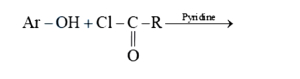
A
$Ar-Cl$
B
$Ar-CO-OR$
C
$Ar-O-R$
D
$R-CO-OAr$
Solution
(D) The reaction between a phenol $(Ar-OH)$ and an acid chloride $(R-CO-Cl)$ in the presence of a base like pyridine is known as acylation.
Pyridine acts as a base to neutralize the $HCl$ produced during the reaction,which helps in driving the reaction forward.
The reaction is:
$Ar-OH + R-CO-Cl \xrightarrow{\text{Pyridine}} R-CO-OAr + HCl$
Thus,the product formed is an ester,specifically $R-CO-OAr$.
Pyridine acts as a base to neutralize the $HCl$ produced during the reaction,which helps in driving the reaction forward.
The reaction is:
$Ar-OH + R-CO-Cl \xrightarrow{\text{Pyridine}} R-CO-OAr + HCl$
Thus,the product formed is an ester,specifically $R-CO-OAr$.
0 likes
View Solution558
EasyMCQ
The number of $\sigma$ bonds in carbolic acid is
A
$13$
B
$8$
C
$12$
D
$6$
Solution
(A) Carbolic acid is the common name for phenol,which has the chemical formula $C_6H_5OH$.
To determine the number of $\sigma$ bonds,we look at its structure:
$1$. There are $6$ carbon atoms in the ring,with $3$ $C-C$ $\sigma$ bonds and $3$ $C=C$ bonds (each containing $1$ $\sigma$ bond),totaling $6$ $\sigma$ bonds in the ring.
$2$. There are $5$ $C-H$ $\sigma$ bonds attached to the ring.
$3$. There is $1$ $C-O$ $\sigma$ bond.
$4$. There is $1$ $O-H$ $\sigma$ bond.
Total $\sigma$ bonds = $6 + 5 + 1 + 1 = 13$.
To determine the number of $\sigma$ bonds,we look at its structure:
$1$. There are $6$ carbon atoms in the ring,with $3$ $C-C$ $\sigma$ bonds and $3$ $C=C$ bonds (each containing $1$ $\sigma$ bond),totaling $6$ $\sigma$ bonds in the ring.
$2$. There are $5$ $C-H$ $\sigma$ bonds attached to the ring.
$3$. There is $1$ $C-O$ $\sigma$ bond.
$4$. There is $1$ $O-H$ $\sigma$ bond.
Total $\sigma$ bonds = $6 + 5 + 1 + 1 = 13$.
0 likes
View Solution559
EasyMCQ
Identify the product $(X)$ formed in the following reaction:
$C_{6}H_{5}OH + CH_{3}COOH \xrightarrow{H^{+}} X$
$C_{6}H_{5}OH + CH_{3}COOH \xrightarrow{H^{+}} X$
A
$C_{6}H_{5}OCOCH_{3}$
B
$C_{6}H_{5}CH_{3}$
C
$C_{6}H_{5}OCH_{3}$
D
$C_{6}H_{5}COOCH_{3}$
Solution
(A) The reaction between phenol $(C_{6}H_{5}OH)$ and acetic acid $(CH_{3}COOH)$ in the presence of an acid catalyst $(H^{+})$ is an esterification reaction.
In this reaction,the hydroxyl group of the phenol reacts with the carboxyl group of the acetic acid to form an ester,phenyl acetate $(C_{6}H_{5}OCOCH_{3})$,and water $(H_{2}O)$.
The reaction is: $C_{6}H_{5}OH + CH_{3}COOH \xrightarrow{H^{+}} C_{6}H_{5}OCOCH_{3} + H_{2}O$.
Therefore,the product $(X)$ is $C_{6}H_{5}OCOCH_{3}$.
In this reaction,the hydroxyl group of the phenol reacts with the carboxyl group of the acetic acid to form an ester,phenyl acetate $(C_{6}H_{5}OCOCH_{3})$,and water $(H_{2}O)$.
The reaction is: $C_{6}H_{5}OH + CH_{3}COOH \xrightarrow{H^{+}} C_{6}H_{5}OCOCH_{3} + H_{2}O$.
Therefore,the product $(X)$ is $C_{6}H_{5}OCOCH_{3}$.
0 likes
View Solution560
EasyMCQ
Which among the following compounds is used as a selective weed killer?
A
Picric acid
B
$2,4-D$ichlorophenoxyacetic acid
C
$2,4,6-T$richlorophenoxyacetic acid
D
Salol
Solution
(B) $2,4-D$ichlorophenoxyacetic acid (commonly known as $2,4-D$) is a synthetic auxin used as a selective herbicide.
It mimics the plant growth hormone auxin,causing uncontrolled and disorganized growth in broadleaf weeds,which leads to their death while leaving grasses and crops relatively unaffected.
It mimics the plant growth hormone auxin,causing uncontrolled and disorganized growth in broadleaf weeds,which leads to their death while leaving grasses and crops relatively unaffected.
0 likes
View Solution561
EasyMCQ
What is the common name of $Benzene-1,3-diol$?
A
Catechol
B
Resorcinol
C
Quinol
D
Pyrogallol
Solution
(B) The structure of $Benzene-1,3-diol$ consists of a benzene ring with two hydroxyl $(-OH)$ groups attached at the $1$ and $3$ positions.
This compound is commonly known as $Resorcinol$.
$Catechol$ is $Benzene-1,2-diol$.
$Quinol$ (or $Hydroquinone$) is $Benzene-1,4-diol$.
$Pyrogallol$ is $Benzene-1,2,3-triol$.
This compound is commonly known as $Resorcinol$.
$Catechol$ is $Benzene-1,2-diol$.
$Quinol$ (or $Hydroquinone$) is $Benzene-1,4-diol$.
$Pyrogallol$ is $Benzene-1,2,3-triol$.
0 likes
View Solution562
EasyMCQ
Which of the following is a trihydric phenol?
A
Catechol
B
Pyrogallol
C
Resorcinol
D
Quinol
Solution
(B) trihydric phenol contains three hydroxyl $(-OH)$ groups attached to the benzene ring.
$1$. Catechol is $1,2$-dihydroxybenzene (dihydric).
$2$. Pyrogallol is $1,2,3$-trihydroxybenzene (trihydric).
$3$. Resorcinol is $1,3$-dihydroxybenzene (dihydric).
$4$. Quinol (Hydroquinone) is $1,4$-dihydroxybenzene (dihydric).
Therefore,Pyrogallol is the correct answer.
$1$. Catechol is $1,2$-dihydroxybenzene (dihydric).
$2$. Pyrogallol is $1,2,3$-trihydroxybenzene (trihydric).
$3$. Resorcinol is $1,3$-dihydroxybenzene (dihydric).
$4$. Quinol (Hydroquinone) is $1,4$-dihydroxybenzene (dihydric).
Therefore,Pyrogallol is the correct answer.
0 likes
View Solution563
DifficultMCQ
Which of the following is a pair of dihydric phenols?
A
Resorcinol and pyrogallol
B
Quinol and phloroglucinol
C
Phloroglucinol and pyrogallol
D
Catechol and Quinol
Solution
(D) Dihydric phenols are compounds containing two hydroxyl $(-OH)$ groups attached to a benzene ring.
$1$. Catechol has two $-OH$ groups at the $1,2$-positions.
$2$. Resorcinol has two $-OH$ groups at the $1,3$-positions.
$3$. Quinol (or hydroquinone) has two $-OH$ groups at the $1,4$-positions.
$4$. Phloroglucinol has three $-OH$ groups at the $1,3,5$-positions (trihydric phenol).
$5$. Pyrogallol has three $-OH$ groups at the $1,2,3$-positions (trihydric phenol).
Therefore,the pair of dihydric phenols is Catechol and Quinol.
$1$. Catechol has two $-OH$ groups at the $1,2$-positions.
$2$. Resorcinol has two $-OH$ groups at the $1,3$-positions.
$3$. Quinol (or hydroquinone) has two $-OH$ groups at the $1,4$-positions.
$4$. Phloroglucinol has three $-OH$ groups at the $1,3,5$-positions (trihydric phenol).
$5$. Pyrogallol has three $-OH$ groups at the $1,2,3$-positions (trihydric phenol).
Therefore,the pair of dihydric phenols is Catechol and Quinol.
0 likes
View Solution564
MediumMCQ
Which of the following is the $IUPAC$ name of hydroquinone?
A
Benzene-$1, 2$-diol
B
Benzene-$1, 3$-diol
C
Benzene-$1, 4$-diol
D
Benzene-$1, 3, 5$-triol
Solution
(C) Hydroquinone is a dihydroxy benzene derivative where the two hydroxyl $(-OH)$ groups are attached at the $1$ and $4$ positions of the benzene ring.
According to $IUPAC$ nomenclature,this structure is named as Benzene-$1, 4$-diol.
According to $IUPAC$ nomenclature,this structure is named as Benzene-$1, 4$-diol.
0 likes
View Solution565
EasyMCQ
Which among the following phenols does $NOT$ correctly match with their $IUPAC$ names?
A
Catechol : Benzene$-1,2-$diol
B
Resorcinol : Benzene$-1,3-$diol
C
$o-$Cresol : Benzene$-1,2,3-$triol
D
Quinol : Benzene$-1,4-$diol
Solution
(C) The $IUPAC$ names for the given compounds are as follows:
$1$. Catechol is $Benzene-1,2-diol$.
$2$. Resorcinol is $Benzene-1,3-diol$.
$3$. $o-Cresol$ is $2-Methylphenol$.
$4$. Quinol is $Benzene-1,4-diol$.
Comparing these with the options,$o-Cresol$ is incorrectly matched with $Benzene-1,2,3-triol$. Therefore,option $C$ is the correct answer.
$1$. Catechol is $Benzene-1,2-diol$.
$2$. Resorcinol is $Benzene-1,3-diol$.
$3$. $o-Cresol$ is $2-Methylphenol$.
$4$. Quinol is $Benzene-1,4-diol$.
Comparing these with the options,$o-Cresol$ is incorrectly matched with $Benzene-1,2,3-triol$. Therefore,option $C$ is the correct answer.
0 likes
View Solution566
MediumMCQ
What is the $IUPAC$ name of picric acid?
A
$m-$Nitrobenzoic acid
B
$2, 4, 6-$Trinitrophenol
C
$2, 4-$Dinitrophenol
D
$2, 3-$Dinitrophenol
Solution
(B) The common name for $2, 4, 6-$trinitrophenol is picric acid.
It consists of a phenol ring where three nitro $(-NO_2)$ groups are attached at the $2, 4,$ and $6$ positions of the benzene ring.
Therefore,the correct $IUPAC$ name is $2, 4, 6-$trinitrophenol.
It consists of a phenol ring where three nitro $(-NO_2)$ groups are attached at the $2, 4,$ and $6$ positions of the benzene ring.
Therefore,the correct $IUPAC$ name is $2, 4, 6-$trinitrophenol.
0 likes
View Solution567
EasyMCQ
What is the $IUPAC$ name of hydroquinone?
A
Benzene-$1,4$-diol
B
Benzene-$1,3,5$-triol
C
Benzene-$1,2$-diol
D
Benzene-$1,2,4$-triol
Solution
(A) Hydroquinone is a phenolic compound with two hydroxyl $(-OH)$ groups attached to the benzene ring at the para positions ($1$ and $4$ positions).
Therefore,the $IUPAC$ name of hydroquinone is Benzene-$1,4$-diol.
Therefore,the $IUPAC$ name of hydroquinone is Benzene-$1,4$-diol.
0 likes
View Solution568
MediumMCQ
Which of the following is $NOT$ a dihydric alcohol?
A
Catechol
B
Hydroquinone
C
Phloroglucinol
D
Resorcinol
Solution
(C) dihydric alcohol (or diol) contains two hydroxyl $(-OH)$ groups attached to the carbon chain.
$1$. Catechol is $1,2$-dihydroxybenzene (dihydric).
$2$. Hydroquinone is $1,4$-dihydroxybenzene (dihydric).
$3$. Resorcinol is $1,3$-dihydroxybenzene (dihydric).
$4$. Phloroglucinol is $1,3,5$-trihydroxybenzene,which is a trihydric phenol,not a dihydric alcohol.
Therefore,the correct answer is $C$.
$1$. Catechol is $1,2$-dihydroxybenzene (dihydric).
$2$. Hydroquinone is $1,4$-dihydroxybenzene (dihydric).
$3$. Resorcinol is $1,3$-dihydroxybenzene (dihydric).
$4$. Phloroglucinol is $1,3,5$-trihydroxybenzene,which is a trihydric phenol,not a dihydric alcohol.
Therefore,the correct answer is $C$.
0 likes
View Solution569
EasyMCQ
Phenols are more acidic than alcohols because
A
phenoxide ion is stabilised by resonance
B
phenols are more soluble in polar solvents
C
phenoxide ions do not exhibit resonance
D
alcohols do not lose $H$ atoms at all
Solution
(A) Phenol is more acidic than alcohol because the phenoxide ion formed after the loss of a proton $(H^+)$ is stabilised by resonance. The negative charge on the oxygen atom is delocalised over the benzene ring,which increases the stability of the phenoxide ion compared to the alkoxide ion formed from alcohols.
0 likes
View Solution570
EasyMCQ
Phenol gives characteristic colouration with
A
iodine solution
B
bromine water
C
aqueous $FeCl_{3}$ solution
D
ammonium hydroxide
Solution
(C) Phenols react with neutral $FeCl_{3}$ solution to form a complex,which results in a characteristic blue,violet,or green colouration. This is a standard test for the presence of the phenolic group.
0 likes
View Solution571
EasyMCQ
Arrange the following compounds in decreasing order of their acidic strength.
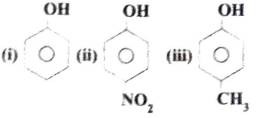
A
$(ii) > (i) > (iii)$
B
$(iii) > (i) > (ii)$
C
$(i) > (ii) > (iii)$
D
$(ii) > (iii) > (i)$
Solution
(A) The acidic strength of phenols depends on the nature of the substituent attached to the benzene ring.
Electron-withdrawing groups $(EWG)$ like $-NO_2$ increase the acidic strength by stabilizing the phenoxide ion through $-I$ and $-M$ effects.
Electron-donating groups $(EDG)$ like $-CH_3$ decrease the acidic strength by destabilizing the phenoxide ion through $+I$ and hyperconjugation effects.
Compound $(ii)$ has a $-NO_2$ group (strong $EWG$),which makes it the most acidic.
Compound $(i)$ is phenol (no substituent).
Compound $(iii)$ has a $-CH_3$ group $(EDG)$,which makes it the least acidic.
Therefore,the decreasing order of acidic strength is $(ii) > (i) > (iii)$.
Electron-withdrawing groups $(EWG)$ like $-NO_2$ increase the acidic strength by stabilizing the phenoxide ion through $-I$ and $-M$ effects.
Electron-donating groups $(EDG)$ like $-CH_3$ decrease the acidic strength by destabilizing the phenoxide ion through $+I$ and hyperconjugation effects.
Compound $(ii)$ has a $-NO_2$ group (strong $EWG$),which makes it the most acidic.
Compound $(i)$ is phenol (no substituent).
Compound $(iii)$ has a $-CH_3$ group $(EDG)$,which makes it the least acidic.
Therefore,the decreasing order of acidic strength is $(ii) > (i) > (iii)$.
0 likes
View Solution572
EasyMCQ
Which reaction is used to make salicylic acid from phenol?
A
Stephen reaction
B
Kolbe reaction
C
Etard reaction
D
Reimer-Tiemann reaction
Solution
(B) The conversion of phenol to salicylic acid is achieved using the $Kolbe$ reaction.
In this reaction,phenol is treated with sodium hydroxide $(NaOH)$ to form sodium phenoxide,which then reacts with carbon dioxide $(CO_2)$ under pressure followed by acidification to yield $2$-hydroxybenzoic acid,commonly known as salicylic acid.
In this reaction,phenol is treated with sodium hydroxide $(NaOH)$ to form sodium phenoxide,which then reacts with carbon dioxide $(CO_2)$ under pressure followed by acidification to yield $2$-hydroxybenzoic acid,commonly known as salicylic acid.
0 likes
View Solution573
EasyMCQ
Which of the following processes does not give benzene as a product?
A
$C_6H_5COONa + \text{Sodalime} \xrightarrow{\Delta}$
B
$C_6H_5N_2^{+}Cl^{-} + H_3PO_2 + H_2O \longrightarrow$
C
$C_6H_5OH + Zn \xrightarrow{\Delta}$
D
$C_6H_5OH + H_2CrO_4 \xrightarrow{[O]}$
Solution
(D) . $C_6H_5COONa + NaOH/CaO \xrightarrow{\Delta} C_6H_6 + Na_2CO_3$ (Benzene is formed).
$B$. $C_6H_5N_2^{+}Cl^{-} + H_3PO_2 + H_2O \longrightarrow C_6H_6 + H_3PO_3 + HCl + N_2$ (Benzene is formed).
$C$. $C_6H_5OH + Zn \xrightarrow{\Delta} C_6H_6 + ZnO$ (Benzene is formed).
$D$. $C_6H_5OH + H_2CrO_4 \xrightarrow{[O]} \text{Benzoquinone}$ (Benzene is $NOT$ formed).
Therefore,the correct option is $D$.
$B$. $C_6H_5N_2^{+}Cl^{-} + H_3PO_2 + H_2O \longrightarrow C_6H_6 + H_3PO_3 + HCl + N_2$ (Benzene is formed).
$C$. $C_6H_5OH + Zn \xrightarrow{\Delta} C_6H_6 + ZnO$ (Benzene is formed).
$D$. $C_6H_5OH + H_2CrO_4 \xrightarrow{[O]} \text{Benzoquinone}$ (Benzene is $NOT$ formed).
Therefore,the correct option is $D$.
0 likes
View Solution574
EasyMCQ
Which compound has the maximum value of $pK_a$ among the following?
A
$p-O_2N-C_6H_4-OH$
B
$m-O_2N-C_6H_4-OH$
C
$o-O_2N-C_6H_4-OH$
D
$C_6H_5OH$
Solution
(D) The $pK_a$ value is inversely proportional to the acidity of the compound. Higher acidity corresponds to a lower $pK_a$ value.
Nitro groups $(-NO_2)$ are strong electron-withdrawing groups $(EWG)$ that increase the acidity of phenol by stabilizing the phenoxide ion through $-I$ and $-M$ effects.
In $p-O_2N-C_6H_4-OH$,$m-O_2N-C_6H_4-OH$,and $o-O_2N-C_6H_4-OH$,the $-NO_2$ group increases acidity compared to phenol $(C_6H_5OH)$.
Since $C_6H_5OH$ lacks any electron-withdrawing substituent,it is the least acidic among the given compounds.
Therefore,$C_6H_5OH$ has the maximum $pK_a$ value.
Nitro groups $(-NO_2)$ are strong electron-withdrawing groups $(EWG)$ that increase the acidity of phenol by stabilizing the phenoxide ion through $-I$ and $-M$ effects.
In $p-O_2N-C_6H_4-OH$,$m-O_2N-C_6H_4-OH$,and $o-O_2N-C_6H_4-OH$,the $-NO_2$ group increases acidity compared to phenol $(C_6H_5OH)$.
Since $C_6H_5OH$ lacks any electron-withdrawing substituent,it is the least acidic among the given compounds.
Therefore,$C_6H_5OH$ has the maximum $pK_a$ value.
0 likes
View Solution575
EasyMCQ
Which of the following compounds reacts with ethylmagnesium bromide and also decolourizes bromine water solution?
A
$2-$vinylphenol
B
Methyl $2-$cyanophenylacetate
C
$2-$cyanoacetophenone
D
$2-$methoxyphenylacrylonitrile
Solution
(A) The compound must satisfy two conditions:
$1$. It must react with ethylmagnesium bromide $(C_2H_5MgBr)$,which is a Grignard reagent. This requires the presence of an acidic hydrogen (like in $-OH$,$-COOH$,etc.) or a carbonyl/cyano group.
$2$. It must decolourize bromine water,which indicates the presence of an unsaturated bond (alkene or alkyne).
Option $A$ is $2$-vinylphenol. It contains a phenolic $-OH$ group (acidic hydrogen) which reacts with $C_2H_5MgBr$ to form ethane gas. It also contains a vinyl group $(-CH=CH_2)$ which reacts with bromine water,causing decolourisation.
Therefore,the correct answer is $A$.
$1$. It must react with ethylmagnesium bromide $(C_2H_5MgBr)$,which is a Grignard reagent. This requires the presence of an acidic hydrogen (like in $-OH$,$-COOH$,etc.) or a carbonyl/cyano group.
$2$. It must decolourize bromine water,which indicates the presence of an unsaturated bond (alkene or alkyne).
Option $A$ is $2$-vinylphenol. It contains a phenolic $-OH$ group (acidic hydrogen) which reacts with $C_2H_5MgBr$ to form ethane gas. It also contains a vinyl group $(-CH=CH_2)$ which reacts with bromine water,causing decolourisation.
Therefore,the correct answer is $A$.
0 likes
View Solution576
EasyMCQ
What is the $IUPAC$ name of the product formed by the oxidation of phenol with chromic acid?
A
Cyclohexa-$2,4$-diene-$1,4$-diol
B
Cyclohexa-$2,4$-diene-$1,4$-dione
C
Cyclohexa-$2,5$-diene-$1,4$-diol
D
Cyclohexa-$2,5$-diene-$1,4$-dione
Solution
(D) The oxidation of phenol with chromic acid $(Na_2Cr_2O_7 / H_2SO_4)$ results in the formation of a conjugated diketone known as benzoquinone.
The chemical structure of benzoquinone is $Cyclohexa-2,5-diene-1,4-dione$.
Therefore,the correct $IUPAC$ name is $Cyclohexa-2,5-diene-1,4-dione$.
The chemical structure of benzoquinone is $Cyclohexa-2,5-diene-1,4-dione$.
Therefore,the correct $IUPAC$ name is $Cyclohexa-2,5-diene-1,4-dione$.
0 likes
View Solution577
EasyMCQ
How many $\sigma$ (sigma) and $\pi$ (pi) bonds are present respectively in the final product obtained by the Reimer-Tiemann reaction of phenol?
A
$15$ and $3$
B
$14$ and $4$
C
$15$ and $4$
D
$14$ and $3$
Solution
(C) The Reimer-Tiemann reaction of phenol with $CHCl_3$ and $NaOH$ yields salicylaldehyde ($2$-hydroxybenzaldehyde) as the final product.
The chemical formula of salicylaldehyde is $C_7H_6O_2$.
Structure: $A$ benzene ring with an $-OH$ group at position $1$ and a $-CHO$ group at position $2$.
Counting $\sigma$ bonds:
- $6$ $C-C$ bonds in the ring.
- $4$ $C-H$ bonds on the ring.
- $1$ $C-O$ bond (phenolic).
- $1$ $O-H$ bond.
- $1$ $C-C$ bond (between ring and $-CHO$).
- $1$ $C-H$ bond (in $-CHO$).
- $1$ $C-O$ bond (in $-CHO$).
Total $\sigma$ bonds = $6 + 4 + 1 + 1 + 1 + 1 + 1 = 15$.
Counting $\pi$ bonds:
- $3$ $\pi$ bonds in the benzene ring.
- $1$ $\pi$ bond in the $C=O$ group.
Total $\pi$ bonds = $3 + 1 = 4$.
Thus,the number of $\sigma$ and $\pi$ bonds are $15$ and $4$ respectively.
The chemical formula of salicylaldehyde is $C_7H_6O_2$.
Structure: $A$ benzene ring with an $-OH$ group at position $1$ and a $-CHO$ group at position $2$.
Counting $\sigma$ bonds:
- $6$ $C-C$ bonds in the ring.
- $4$ $C-H$ bonds on the ring.
- $1$ $C-O$ bond (phenolic).
- $1$ $O-H$ bond.
- $1$ $C-C$ bond (between ring and $-CHO$).
- $1$ $C-H$ bond (in $-CHO$).
- $1$ $C-O$ bond (in $-CHO$).
Total $\sigma$ bonds = $6 + 4 + 1 + 1 + 1 + 1 + 1 = 15$.
Counting $\pi$ bonds:
- $3$ $\pi$ bonds in the benzene ring.
- $1$ $\pi$ bond in the $C=O$ group.
Total $\pi$ bonds = $3 + 1 = 4$.
Thus,the number of $\sigma$ and $\pi$ bonds are $15$ and $4$ respectively.
0 likes
View Solution578
EasyMCQ
Which of the following statements is not correct?
A
Phenol is used to prepare analgesic drugs.
B
Phenol is neutralised by sodium carbonate.
C
Solubility of phenol in water is more than that of chlorobenzene.
D
Boiling point of $o$-nitrophenol is lower than that of $p$-nitrophenol.
Solution
(B) Phenol is a very weak acid $(K_a \approx 10^{-10})$ and it does not react with sodium carbonate $(Na_2CO_3)$ to form salt and evolve $CO_2$ gas.
Therefore,the statement that phenol is neutralised by sodium carbonate is incorrect.
$o$-Nitrophenol exhibits intramolecular hydrogen bonding,whereas $p$-nitrophenol exhibits intermolecular hydrogen bonding,making the boiling point of $o$-nitrophenol lower than that of $p$-nitrophenol.
Phenol is used in the synthesis of drugs like aspirin (an analgesic).
Phenol is more soluble in water than chlorobenzene due to its ability to form hydrogen bonds with water molecules.
Therefore,the statement that phenol is neutralised by sodium carbonate is incorrect.
$o$-Nitrophenol exhibits intramolecular hydrogen bonding,whereas $p$-nitrophenol exhibits intermolecular hydrogen bonding,making the boiling point of $o$-nitrophenol lower than that of $p$-nitrophenol.
Phenol is used in the synthesis of drugs like aspirin (an analgesic).
Phenol is more soluble in water than chlorobenzene due to its ability to form hydrogen bonds with water molecules.
0 likes
View Solution579
EasyMCQ
Which of the following acids does not have a $-COOH$ group?
A
Ethanoic Acid
B
Picric Acid
C
Benzoic Acid
D
Salicylic Acid
Solution
(B) The chemical formula of $Picric \ Acid$ is $2,4,6-trinitrophenol$.
It contains a phenolic $-OH$ group and three nitro $(-NO_2)$ groups attached to the benzene ring,but it does not contain a carboxylic acid $(-COOH)$ group.
Ethanoic acid $(CH_3COOH)$,Benzoic acid $(C_6H_5COOH)$,and Salicylic acid $(C_6H_4(OH)COOH)$ all contain the $-COOH$ group.
Therefore,the correct option is $B$.
It contains a phenolic $-OH$ group and three nitro $(-NO_2)$ groups attached to the benzene ring,but it does not contain a carboxylic acid $(-COOH)$ group.
Ethanoic acid $(CH_3COOH)$,Benzoic acid $(C_6H_5COOH)$,and Salicylic acid $(C_6H_4(OH)COOH)$ all contain the $-COOH$ group.
Therefore,the correct option is $B$.
0 likes
View Solution580
EasyMCQ
In the given reaction sequence,identify the processes $X$ and $Y$ respectively to obtain salicylaldehyde from chlorobenzene:
$Chlorobenzene$ $\xrightarrow{X} Phenol$ $\xrightarrow{Y} Salicylaldehyde$
$Chlorobenzene$ $\xrightarrow{X} Phenol$ $\xrightarrow{Y} Salicylaldehyde$
A
Fries rearrangement and Kolbe-Schmidt
B
Cumene and Reimer-Tiemann
C
Dow and Reimer-Tiemann
D
Dow and Friedel-Crafts
Solution
(C) The conversion of chlorobenzene to phenol is known as the $Dow$ process,where chlorobenzene reacts with $NaOH$ at high temperature and pressure.
The conversion of phenol to salicylaldehyde is known as the $Reimer-Tiemann$ reaction,which involves treatment with $CHCl_3$ and $NaOH$ followed by hydrolysis.
Therefore,$X$ is the $Dow$ process and $Y$ is the $Reimer-Tiemann$ reaction.
The conversion of phenol to salicylaldehyde is known as the $Reimer-Tiemann$ reaction,which involves treatment with $CHCl_3$ and $NaOH$ followed by hydrolysis.
Therefore,$X$ is the $Dow$ process and $Y$ is the $Reimer-Tiemann$ reaction.
0 likes
View Solution581
EasyMCQ
Hybridisation shown by Carbon and Oxygen of $-OH$ group in phenol are respectively . . . . . . .
A
$sp^2, sp^2$
B
$sp^3, sp^3$
C
$sp, sp^2$
D
$sp^2, sp^3$
Solution
(D) In phenol $(C_6H_5OH)$,the carbon atom attached to the $-OH$ group is part of the benzene ring and is bonded to two other carbons and one oxygen atom via double and single bonds,giving it $sp^2$ hybridisation.
The oxygen atom in the $-OH$ group is bonded to one carbon atom and one hydrogen atom,and it possesses two lone pairs of electrons. Therefore,the steric number of oxygen is $4$ ($2$ bond pairs + $2$ lone pairs),which corresponds to $sp^3$ hybridisation.
Thus,the hybridisation of carbon and oxygen is $sp^2$ and $sp^3$ respectively.
The oxygen atom in the $-OH$ group is bonded to one carbon atom and one hydrogen atom,and it possesses two lone pairs of electrons. Therefore,the steric number of oxygen is $4$ ($2$ bond pairs + $2$ lone pairs),which corresponds to $sp^3$ hybridisation.
Thus,the hybridisation of carbon and oxygen is $sp^2$ and $sp^3$ respectively.
0 likes
View Solution582
EasyMCQ
Which of the following reactions is not an electrophilic substitution reaction?
A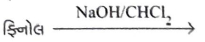
Phenol $\xrightarrow{NaOH / CHCl_3}$
B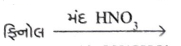
Phenol $\xrightarrow{\text{dil } HNO_3}$
C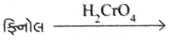
Phenol $\xrightarrow{H_2CrO_4}$
D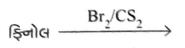
Phenol $\xrightarrow{Br_2 / CS_2}$
Solution
(C) The reaction of phenol with $H_2CrO_4$ (chromic acid) is an oxidation reaction,not an electrophilic substitution reaction.
In this reaction,phenol is oxidized to $p$-benzoquinone.
Other reactions listed:
$(A)$ Reimer-Tiemann reaction (electrophilic substitution),
$(B)$ Nitration of phenol (electrophilic substitution),
$(D)$ Bromination of phenol (electrophilic substitution).
In this reaction,phenol is oxidized to $p$-benzoquinone.
Other reactions listed:
$(A)$ Reimer-Tiemann reaction (electrophilic substitution),
$(B)$ Nitration of phenol (electrophilic substitution),
$(D)$ Bromination of phenol (electrophilic substitution).
0 likes
View Solution583
EasyMCQ
Which is the final product of the Reimer-Tiemann reaction?
A
Salicylaldehyde
B
Aspirin
C
Salicylic acid
D
Phenol
Solution
(A) The Reimer-Tiemann reaction involves the treatment of phenol with chloroform $(CHCl_3)$ in the presence of an aqueous base like sodium hydroxide $(NaOH)$.
This reaction leads to the introduction of a formyl group $(-CHO)$ at the ortho position of the phenol ring.
The final product formed is $2$-hydroxybenzaldehyde,commonly known as Salicylaldehyde.
Therefore,the correct option is $A$.
This reaction leads to the introduction of a formyl group $(-CHO)$ at the ortho position of the phenol ring.
The final product formed is $2$-hydroxybenzaldehyde,commonly known as Salicylaldehyde.
Therefore,the correct option is $A$.
0 likes
View Solution584
EasyMCQ
Which compound has the highest value of $pK_{a}$?
A
$p-$cresol
B
phenol
C
$o-$nitrophenol
D
$m-$nitrophenol
Solution
(A) The $pK_{a}$ value is inversely proportional to the acidity of the compound. Higher $pK_{a}$ means lower acidity.
$1$. $p-$cresol contains an electron-donating methyl group $(-CH_{3})$,which decreases the acidity of phenol.
$2$. Phenol has no substituent.
$3$. $o-$nitrophenol and $m-$nitrophenol contain electron-withdrawing nitro groups $(-NO_{2})$,which significantly increase the acidity of phenol.
Comparing these,$p-$cresol is the least acidic,therefore it has the highest $pK_{a}$ value.
$1$. $p-$cresol contains an electron-donating methyl group $(-CH_{3})$,which decreases the acidity of phenol.
$2$. Phenol has no substituent.
$3$. $o-$nitrophenol and $m-$nitrophenol contain electron-withdrawing nitro groups $(-NO_{2})$,which significantly increase the acidity of phenol.
Comparing these,$p-$cresol is the least acidic,therefore it has the highest $pK_{a}$ value.
0 likes
View Solution585
EasyMCQ
Salicylaldehyde on heating with zinc dust gives . . . . . . as the organic product.
A
Benzoic acid
B
Benzaldehyde
C
Benzyl alcohol
D
Benzene
Solution
(B) When salicylaldehyde $(2-hydroxybenzaldehyde)$ is heated with zinc dust,the phenolic $-OH$ group is reduced to a hydrogen atom,and the aldehyde group is also reduced to a methyl group,resulting in the formation of toluene $(C_6H_5CH_3)$. However,in the context of standard textbook reactions where zinc dust is used to reduce phenolic groups,the product is often identified as benzaldehyde if the reaction conditions specifically target the $-OH$ group. Given the options provided,the most chemically accurate transformation for salicylaldehyde with zinc dust is the reduction of the phenolic $-OH$ to $H$,yielding benzaldehyde $(C_6H_5CHO)$.
0 likes
View Solution586
MediumMCQ
The heating of phenyl methyl ether with $HI$ produces an aromatic compound $A$ which on treatment with conc. $HNO_3$ gives $B$. $A$ and $B$ respectively are
A
methanol,ethanoic acid
B
picric acid,phenol
C
iodobenzene,$1-$iodo$-4-$nitrobenzene
D
phenol,picric acid
Solution
(D) The reaction of phenyl methyl ether (anisole) with $HI$ involves the cleavage of the $C-O$ bond,yielding phenol $(A)$ and methyl iodide $(CH_3I)$.
Phenol $(A)$ reacts with concentrated $HNO_3$ (nitration) to form $2,4,6-$trinitrophenol,commonly known as picric acid $(B)$.
Phenol $(A)$ reacts with concentrated $HNO_3$ (nitration) to form $2,4,6-$trinitrophenol,commonly known as picric acid $(B)$.
0 likes
View Solution587
MediumMCQ
Which of the following compounds is the most acidic?
A
$Cl-CH_2-CH_2-OH$
B
Phenol
C
$o$-Nitrophenol
D
$o$-Cresol
Solution
(C) The acidity of a compound depends on the stability of its conjugate base.
$o$-Nitrophenol is the most acidic among the given options because the $-NO_2$ group is a strong electron-withdrawing group ($-I$ and $-M$ effect).
This group stabilizes the phenoxide ion formed after the loss of a proton $(H^+)$ by dispersing the negative charge through resonance.
In contrast,$-CH_3$ (in $o$-cresol) is an electron-donating group ($+I$ and hyperconjugation),which destabilizes the phenoxide ion,making it less acidic than phenol.
$Cl-CH_2-CH_2-OH$ is an aliphatic alcohol,which is significantly less acidic than phenolic compounds.
$o$-Nitrophenol is the most acidic among the given options because the $-NO_2$ group is a strong electron-withdrawing group ($-I$ and $-M$ effect).
This group stabilizes the phenoxide ion formed after the loss of a proton $(H^+)$ by dispersing the negative charge through resonance.
In contrast,$-CH_3$ (in $o$-cresol) is an electron-donating group ($+I$ and hyperconjugation),which destabilizes the phenoxide ion,making it less acidic than phenol.
$Cl-CH_2-CH_2-OH$ is an aliphatic alcohol,which is significantly less acidic than phenolic compounds.
0 likes
View Solution588
EasyMCQ
Which of the following is strongly acidic?
A
Phenol
B
$o$-cresol
C
$p$-nitrophenol
D
$p$-cresol
Solution
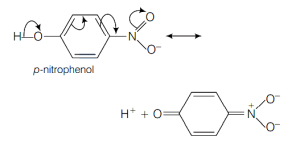
(C) The acidity of phenols is due to the greater resonance stabilization of the phenoxide ion relative to phenol. Electron withdrawing groups $(EWG)$ like $-NO_{2}$ stabilize the phenoxide ion by dispersing the negative charge,which increases the acidity of phenols.
Conversely,electron donating groups $(EDG)$ like alkyl groups destabilize the phenoxide ion by intensifying the negative charge,which decreases the acidic strength of phenols.
Since the methyl group has a $+I$ effect,which is stronger at the $o$-position than at the $p$-position (as the $+I$ effect decreases with distance),$o$-cresol is a weaker acid than $p$-cresol.
Therefore,the order of acidic strength is: $p$-nitrophenol $>$ phenol $>$ $p$-cresol $>$ $o$-cresol.
Conversely,electron donating groups $(EDG)$ like alkyl groups destabilize the phenoxide ion by intensifying the negative charge,which decreases the acidic strength of phenols.
Since the methyl group has a $+I$ effect,which is stronger at the $o$-position than at the $p$-position (as the $+I$ effect decreases with distance),$o$-cresol is a weaker acid than $p$-cresol.
Therefore,the order of acidic strength is: $p$-nitrophenol $>$ phenol $>$ $p$-cresol $>$ $o$-cresol.
0 likes
View Solution589
EasyMCQ
Phenol can be distinguished from propanol by using the reagent
A
Bromine water
B
Iron metal
C
Iodine in alcohol
D
Sodium metal
Solution
(A) Phenol reacts with bromine water to form a white precipitate of $2,4,6$-tribromophenol due to the high reactivity of the benzene ring towards electrophilic substitution.
Propanol does not undergo this reaction and does not form a white precipitate with bromine water.
Therefore,bromine water is an effective reagent to distinguish between phenol and propanol.
Propanol does not undergo this reaction and does not form a white precipitate with bromine water.
Therefore,bromine water is an effective reagent to distinguish between phenol and propanol.
0 likes
View Solution590
MediumMCQ
Match the following acids with their respective $pK_a$ values:
| Acid | $pK_a$ |
| $(i)$ Phenol | $a. 10$ |
| $(ii)$ $p-$Nitrophenol | $b. 7.1$ |
| $(iii)$ Ethyl alcohol | $c. 16$ |
| $(iv)$ Picric acid | $d. 0.78$ |
A
$i-c, ii-d, iii-a, iv-b$
B
$i-a, ii-b, iii-c, iv-d$
C
$i-b, ii-a, iii-d, iv-c$
D
$i-d, ii-c, iii-b, iv-a$
Solution
(B) The acidic strength order is: $\text{Ethyl alcohol} < \text{Phenol} < p-\text{Nitrophenol} < \text{Picric acid}$.
Since $pK_a = -\log(K_a)$,the $pK_a$ values follow the inverse order of acidic strength:
$(i)$ Phenol: $10$
$(ii)$ $p-$Nitrophenol: $7.1$
$(iii)$ Ethyl alcohol: $16$
$(iv)$ Picric acid: $0.78$
Therefore,the correct matching is: $(i)-a, (ii)-b, (iii)-c, (iv)-d$.
Since $pK_a = -\log(K_a)$,the $pK_a$ values follow the inverse order of acidic strength:
$(i)$ Phenol: $10$
$(ii)$ $p-$Nitrophenol: $7.1$
$(iii)$ Ethyl alcohol: $16$
$(iv)$ Picric acid: $0.78$
Therefore,the correct matching is: $(i)-a, (ii)-b, (iii)-c, (iv)-d$.
0 likes
View Solution591
EasyMCQ
In Kolbe's reaction,the reacting substances are:
A
phenol and $CCl_4$
B
sodium phenolate and $CCl_4$
C
phenol and $CHCl_3$
D
sodium phenolate and $CO_2$
Solution
(D) In Kolbe's reaction,phenol is first converted to sodium phenolate by reaction with $NaOH$.
Then,sodium phenolate reacts with $CO_2$ under pressure,followed by acidification to form salicylic acid.
The reaction is as follows:
$C_6H_5OH + NaOH \rightarrow C_6H_5ONa + H_2O$
$C_6H_5ONa + CO_2 \xrightarrow{H^+} \text{Salicylic acid}$
Thus,the reacting substances for the carboxylation step are sodium phenolate and $CO_2$.
Then,sodium phenolate reacts with $CO_2$ under pressure,followed by acidification to form salicylic acid.
The reaction is as follows:
$C_6H_5OH + NaOH \rightarrow C_6H_5ONa + H_2O$
$C_6H_5ONa + CO_2 \xrightarrow{H^+} \text{Salicylic acid}$
Thus,the reacting substances for the carboxylation step are sodium phenolate and $CO_2$.
0 likes
View Solution592
EasyMCQ
The reaction which involves dichlorocarbene as an electrophile is,
A
Reimer-Tiemann reaction
B
Kolbe's reaction
C
Friedel-Craft's acylation
D
Fittig's reaction
Solution
(A) The Reimer-Tiemann reaction involves the treatment of phenol with $CHCl_3$ in the presence of aqueous $NaOH$.
In this reaction,$CHCl_3$ reacts with $OH^-$ to generate the electrophile,dichlorocarbene $(:CCl_2)$.
The dichlorocarbene then attacks the phenoxide ion to form an intermediate,which upon hydrolysis yields salicylaldehyde.
In this reaction,$CHCl_3$ reacts with $OH^-$ to generate the electrophile,dichlorocarbene $(:CCl_2)$.
The dichlorocarbene then attacks the phenoxide ion to form an intermediate,which upon hydrolysis yields salicylaldehyde.
0 likes
View Solution593
DifficultMCQ
Arrange the following compounds in the increasing order of their acidic strength :
$i$. $m-$nitrophenol
$ii$. $m-$cresol
$iii$. phenol
$iv$. $m-$chlorophenol
$i$. $m-$nitrophenol
$ii$. $m-$cresol
$iii$. phenol
$iv$. $m-$chlorophenol
A
$ii < iii < iv < i$
B
$ii < iv < iii < i$
C
$ii < iii < i < iv$
D
$iv < i < iii < ii$
Solution
(A) The acidic strength of phenols depends on the stability of the phenoxide ion formed after the loss of a proton. Electron-withdrawing groups $(EWG)$ stabilize the phenoxide ion and increase acidity,while electron-donating groups $(EDG)$ destabilize it and decrease acidity.
$1$. $m-$cresol $(ii)$: The $-CH_3$ group is an $EDG$ due to $+I$ effect and hyperconjugation,making it less acidic than phenol.
$2$. Phenol $(iii)$: The reference compound.
$3$. $m-$chlorophenol $(iv)$: The $-Cl$ group is an $EWG$ due to its strong $-I$ effect,which outweighs its $+R$ effect at the meta position,making it more acidic than phenol.
$4$. $m-$nitrophenol $(i)$: The $-NO_2$ group is a strong $EWG$ due to both $-I$ and $-R$ effects,making it the most acidic among the given compounds.
Thus,the increasing order of acidic strength is: $m-$cresol $(ii)$ < phenol $(iii)$ < $m-$chlorophenol $(iv)$ < $m-$nitrophenol $(i)$.
The correct option is $A$.
$1$. $m-$cresol $(ii)$: The $-CH_3$ group is an $EDG$ due to $+I$ effect and hyperconjugation,making it less acidic than phenol.
$2$. Phenol $(iii)$: The reference compound.
$3$. $m-$chlorophenol $(iv)$: The $-Cl$ group is an $EWG$ due to its strong $-I$ effect,which outweighs its $+R$ effect at the meta position,making it more acidic than phenol.
$4$. $m-$nitrophenol $(i)$: The $-NO_2$ group is a strong $EWG$ due to both $-I$ and $-R$ effects,making it the most acidic among the given compounds.
Thus,the increasing order of acidic strength is: $m-$cresol $(ii)$ < phenol $(iii)$ < $m-$chlorophenol $(iv)$ < $m-$nitrophenol $(i)$.
The correct option is $A$.
0 likes
View Solution594
MediumMCQ
In the reaction shown below,$Y$ is:
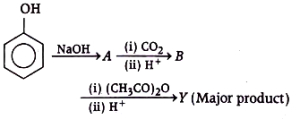
A
salicylaldehyde
B
aspirin
C
cumene
D
picric acid
Solution
(B) $1$. The reaction of phenol with $NaOH$ gives sodium phenoxide $(A)$.
$2$. The reaction of sodium phenoxide with $CO_2$ followed by acidification gives salicylic acid $(B)$ (Kolbe's reaction).
$3$. The acetylation of salicylic acid $(B)$ with acetic anhydride $(CH_3CO)_2O$ in the presence of an acid catalyst gives acetylsalicylic acid,which is commonly known as aspirin $(Y)$.
$2$. The reaction of sodium phenoxide with $CO_2$ followed by acidification gives salicylic acid $(B)$ (Kolbe's reaction).
$3$. The acetylation of salicylic acid $(B)$ with acetic anhydride $(CH_3CO)_2O$ in the presence of an acid catalyst gives acetylsalicylic acid,which is commonly known as aspirin $(Y)$.
0 likes
View Solution595
MediumMCQ
$A$ compound $A$ $(C_{7}H_{8}O)$ is insoluble in $NaHCO_{3}$ solution but dissolves in $NaOH$ and gives a characteristic colour with neutral $FeCl_{3}$ solution. When treated with bromine water,compound $A$ forms the compound $B$ with the formula $C_{7}H_{5}OBr_{3}$. $A$ is:
A
Phenylmethanol
B
$m$-Cresol
C
$o$-Cresol
D
$p$-Cresol
Solution
(B) $1$. The compound $A$ $(C_{7}H_{8}O)$ is insoluble in $NaHCO_{3}$ (meaning it is not a carboxylic acid) but soluble in $NaOH$ and gives a characteristic color with neutral $FeCl_{3}$ solution,which indicates the presence of a phenolic $-OH$ group.
$2$. The reaction with bromine water to form a tribromo derivative $(C_{7}H_{5}OBr_{3})$ is a characteristic reaction of phenols where the ortho and para positions are substituted by bromine atoms.
$3$. Among the given options,$m$-cresol ($3$-methylphenol) is a phenol that reacts with bromine water to form $2,4,6$-tribromo-$3$-methylphenol $(C_{7}H_{5}OBr_{3})$.
$4$. Therefore,compound $A$ is $m$-cresol.
$2$. The reaction with bromine water to form a tribromo derivative $(C_{7}H_{5}OBr_{3})$ is a characteristic reaction of phenols where the ortho and para positions are substituted by bromine atoms.
$3$. Among the given options,$m$-cresol ($3$-methylphenol) is a phenol that reacts with bromine water to form $2,4,6$-tribromo-$3$-methylphenol $(C_{7}H_{5}OBr_{3})$.
$4$. Therefore,compound $A$ is $m$-cresol.
0 likes
View Solution596
EasyMCQ
Phenol can be distinguished from ethanol by the reagent
A
Bromine water
B
Sodium metal
C
Iron metal
D
Chlorine water
Solution
(A) Phenol reacts with bromine water to give a white precipitate of $2,4,6$-tribromophenol.
Ethanol does not react with bromine water.
The reaction is:
$C_6H_5OH + 3Br_2(aq) \rightarrow C_6H_2Br_3OH(s) + 3HBr(aq)$
($2,4,6$-Tribromophenol,White precipitate)
Ethanol does not react with bromine water.
The reaction is:
$C_6H_5OH + 3Br_2(aq) \rightarrow C_6H_2Br_3OH(s) + 3HBr(aq)$
($2,4,6$-Tribromophenol,White precipitate)
0 likes
View Solution597
DifficultMCQ
What is the increasing order of acidic strength among the following?
$(i)$ $p-$methoxy phenol
$(ii)$ $p-$methyl phenol
$(iii)$ $p-$nitro phenol
$(i)$ $p-$methoxy phenol
$(ii)$ $p-$methyl phenol
$(iii)$ $p-$nitro phenol
A
$ii < i < iii$
B
$iii < ii < i$
C
$i < ii < iii$
D
$i < iii < ii$
Solution
(C) The acidic strength of phenols depends on the nature of the substituent attached to the benzene ring.
Electron-withdrawing groups $(EWG)$ like $-NO_2$ stabilize the phenoxide ion through resonance and inductive effects,thereby increasing acidic strength.
Electron-donating groups $(EDG)$ like $-OCH_3$ and $-CH_3$ destabilize the phenoxide ion by increasing electron density.
The $-OCH_3$ group acts as an $EDG$ via the $+M$ effect,which is stronger than the $+I$ effect of the $-CH_3$ group,making $p-$methoxy phenol less acidic than $p-$methyl phenol.
Thus,the order of acidic strength is: $p-$methoxy phenol $(i)$ < $p-$methyl phenol $(ii)$ < $p-$nitro phenol $(iii)$.
The correct increasing order is $i < ii < iii$.
Electron-withdrawing groups $(EWG)$ like $-NO_2$ stabilize the phenoxide ion through resonance and inductive effects,thereby increasing acidic strength.
Electron-donating groups $(EDG)$ like $-OCH_3$ and $-CH_3$ destabilize the phenoxide ion by increasing electron density.
The $-OCH_3$ group acts as an $EDG$ via the $+M$ effect,which is stronger than the $+I$ effect of the $-CH_3$ group,making $p-$methoxy phenol less acidic than $p-$methyl phenol.
Thus,the order of acidic strength is: $p-$methoxy phenol $(i)$ < $p-$methyl phenol $(ii)$ < $p-$nitro phenol $(iii)$.
The correct increasing order is $i < ii < iii$.
0 likes
View SolutionAlcohols, Phenols and Ethers — Properties of Phenols · Frequently Asked Questions
1Are these Alcohols, Phenols and Ethers questions useful for JEE and NEET?
Yes. All questions in this section are mapped to JEE Main and NEET exam patterns. Previous year questions from JEE Main, NEET, GUJCET and state-level exams are included with full solutions.
2Can I switch to Hindi or Gujarati for these questions?
Yes. Use the language tabs in the hero section or the sidebar to view the same questions and solutions in English, Hindi or Gujarati.
3How do I generate a question paper from this subtopic?
Use the Vedclass Exam Paper Generator — select the chapter and subtopic, set difficulty, and generate Sets A, B, C, D automatically. First 3 chapters of every subject are free.
Vedclass Products
For Students
Vedclass Test Series
Mock tests in real JEE/NEET style with performance analysis. 5-day free trial.
Start Free TrialFor Teachers
Exam Paper Generator
Generate Set A/B/C/D papers from this chapter in 2 minutes. 3 chapters free.
Try FreeFor Institutes
Online Exam Module
Live online exams with unlimited students, 360° analytics & white-label branding.
See DemoFor Teachers & Institutes
Generate a Alcohols, Phenols and Ethers Exam Paper in 2 Minutes
Select subtopic & difficulty — Sets A, B, C, D auto-generated with No Repeat logic.
First 3 chapters of every subject are free — no payment required.