
A English
Pedigree Analysis and Mendelian disorders Questions in English
Class 12 Biology · Principles of Inheritance and Variation · Pedigree Analysis and Mendelian disorders
420+
Questions
English
Language
100%
With Solutions
Showing 50 of 420 questions in English
51
MediumMCQ
Colour blindness is caused by a single
A
Dominant gene in woman
B
Dominant gene in man
C
Recessive gene in man
D
Recessive gene in woman
Solution
(C) Colour blindness is a sex-linked recessive disorder caused by a mutation in the genes on the $X$ chromosome.
In males,there is only one $X$ chromosome $(XY)$. If this $X$ chromosome carries the recessive gene for colour blindness,the male will express the trait.
In females,there are two $X$ chromosomes $(XX)$. For a female to be colour blind,she must inherit the recessive gene on both $X$ chromosomes $(X^cX^c)$.
Therefore,a single recessive gene on the $X$ chromosome is sufficient to cause colour blindness in a man.
In males,there is only one $X$ chromosome $(XY)$. If this $X$ chromosome carries the recessive gene for colour blindness,the male will express the trait.
In females,there are two $X$ chromosomes $(XX)$. For a female to be colour blind,she must inherit the recessive gene on both $X$ chromosomes $(X^cX^c)$.
Therefore,a single recessive gene on the $X$ chromosome is sufficient to cause colour blindness in a man.
0 likes
View Solution52
MediumMCQ
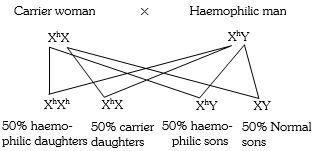
If a haemophilic man marries a woman carrier (heterozygous) for haemophilia,what would be the possibility that their daughter would be haemophilic (in $\%$)?
A
$100$
B
$75$
C
$50$
D
$0$
Solution
(C) Haemophilia is an $X$-linked recessive disorder.
Let $X^h$ be the allele for haemophilia and $X$ be the normal allele.
The genotype of a haemophilic man is $X^hY$.
The genotype of a carrier woman is $X^hX$.
When they cross $(X^hY \times X^hX)$,the possible genotypes of the offspring are:
$X^hX^h$ (Haemophilic daughter)
$X^hX$ (Carrier daughter)
$X^hY$ (Haemophilic son)
$XY$ (Normal son)
Out of the two possible female genotypes ($X^hX^h$ and $X^hX$),one is haemophilic $(X^hX^h)$.
Therefore,the probability of having a haemophilic daughter is $1/2$ or $50\%$.
Let $X^h$ be the allele for haemophilia and $X$ be the normal allele.
The genotype of a haemophilic man is $X^hY$.
The genotype of a carrier woman is $X^hX$.
When they cross $(X^hY \times X^hX)$,the possible genotypes of the offspring are:
$X^hX^h$ (Haemophilic daughter)
$X^hX$ (Carrier daughter)
$X^hY$ (Haemophilic son)
$XY$ (Normal son)
Out of the two possible female genotypes ($X^hX^h$ and $X^hX$),one is haemophilic $(X^hX^h)$.
Therefore,the probability of having a haemophilic daughter is $1/2$ or $50\%$.
0 likes
View Solution53
MediumMCQ
Females rarely experience the physiologic defect of haemophilia because they do so only when they are:
A
Heterozygous for the defect
B
Homozygous for the defect
C
Carrier for the defect
D
Wives of haemophilic husbands
Solution
(B) Haemophilia is an $X$-linked recessive disorder.
In females,there are two $X$ chromosomes $(XX)$.
For a female to express the disease,she must inherit the defective gene on both $X$ chromosomes.
If a female has only one defective gene,she is a carrier and does not show the symptoms of the disease.
Therefore,a female expresses the disease only when she is homozygous for the recessive allele $(X^hX^h)$.
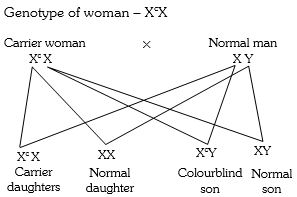
In females,there are two $X$ chromosomes $(XX)$.
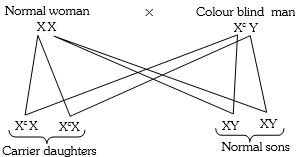
For a female to express the disease,she must inherit the defective gene on both $X$ chromosomes.
If a female has only one defective gene,she is a carrier and does not show the symptoms of the disease.
Therefore,a female expresses the disease only when she is homozygous for the recessive allele $(X^hX^h)$.
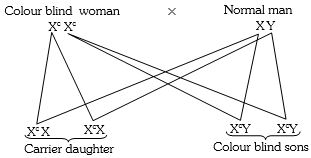
0 likes
View Solution54
MediumMCQ
$A$ colour-blind son will be born when:
A
Mother is normal and father is normal
B
Mother is colour-blind and father is normal
C
Mother is normal and father is colour-blind
D
All the cases are correct
Solution
(B) Colour blindness is an $X$-linked recessive disorder. Let $X^c$ represent the allele for colour blindness and $X$ represent the normal allele.
If the mother is colour-blind $(X^c X^c)$ and the father is normal $(XY)$,the cross is $X^c X^c \times XY$.
The possible offspring are $X^c X$ (carrier daughter) and $X^c Y$ (colour-blind son).
Therefore,all sons born to a colour-blind mother will be colour-blind,regardless of the father's phenotype.
If the mother is colour-blind $(X^c X^c)$ and the father is normal $(XY)$,the cross is $X^c X^c \times XY$.
The possible offspring are $X^c X$ (carrier daughter) and $X^c Y$ (colour-blind son).
Therefore,all sons born to a colour-blind mother will be colour-blind,regardless of the father's phenotype.
0 likes
View Solution55
MediumMCQ
Haemophilia is a type of genetic disorder that is:
A
Autosomal
B
$Y$-linked
C
$Z$-linked
D
$X$-linked
Solution
(D) Haemophilia is a sex-linked recessive disorder.
It is caused by a mutation in the genes located on the $X$ chromosome.
Since it is $X$-linked,it is more commonly observed in males because they have only one $X$ chromosome,whereas females have two $X$ chromosomes and can be carriers without showing symptoms.
It is caused by a mutation in the genes located on the $X$ chromosome.
Since it is $X$-linked,it is more commonly observed in males because they have only one $X$ chromosome,whereas females have two $X$ chromosomes and can be carriers without showing symptoms.
0 likes
View Solution56
MediumMCQ
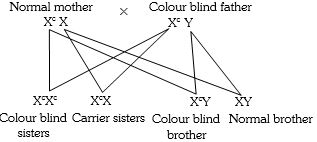
$A$ colourblind man has a colourblind sister but a normal brother. What is the phenotype of his parents?
A
Father colourblind and mother normal
B
Father normal and mother colourblind
C
Father and mother both are colourblind
D
Father and mother both are normal
Solution
(A) Colour blindness is an $X$-linked recessive trait. Let $X^c$ be the allele for colour blindness and $X$ be the normal allele.
$1$. $A$ colourblind man has the genotype $X^c Y$.
$2$. The man has a colourblind sister,meaning her genotype must be $X^c X^c$. Since she receives one $X^c$ from each parent,the father must be $X^c Y$ (colourblind) and the mother must contribute at least one $X^c$ allele.
$3$. The man also has a normal brother,whose genotype is $XY$. He receives the $Y$ chromosome from his father and the normal $X$ chromosome from his mother.
$4$. Therefore,the mother must be a carrier $(X^c X)$ to have both a colourblind daughter and a normal son.
$5$. Thus,the father is colourblind $(X^c Y)$ and the mother is a carrier (phenotypically normal,$X^c X$). The correct option is $(A)$.
$1$. $A$ colourblind man has the genotype $X^c Y$.
$2$. The man has a colourblind sister,meaning her genotype must be $X^c X^c$. Since she receives one $X^c$ from each parent,the father must be $X^c Y$ (colourblind) and the mother must contribute at least one $X^c$ allele.
$3$. The man also has a normal brother,whose genotype is $XY$. He receives the $Y$ chromosome from his father and the normal $X$ chromosome from his mother.
$4$. Therefore,the mother must be a carrier $(X^c X)$ to have both a colourblind daughter and a normal son.
$5$. Thus,the father is colourblind $(X^c Y)$ and the mother is a carrier (phenotypically normal,$X^c X$). The correct option is $(A)$.
0 likes
View Solution57
MediumMCQ
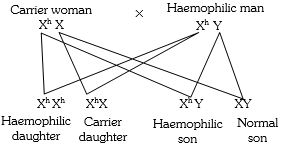
The female children of a haemophilic man and a carrier woman are likely to be:
A
All haemophilic
B
Half haemophilic and half carriers
C
All carriers
D
Half normal and half carriers
Solution
(B) Haemophilia is an $X$-linked recessive disorder.
Let the genotype of the carrier woman be $X^hX$ and the haemophilic man be $X^hY$.
The cross is as follows:
$X^hX \times X^hY$
Gametes produced:
Woman: $X^h, X$
Man: $X^h, Y$
Offspring genotypes:
$X^hX^h$ (Haemophilic daughter)
$X^hX$ (Carrier daughter)
$X^hY$ (Haemophilic son)
$XY$ (Normal son)
Among the female children (daughters),$50\%$ are haemophilic $(X^hX^h)$ and $50\%$ are carriers $(X^hX)$.
Therefore,the correct option is $(b)$.
Let the genotype of the carrier woman be $X^hX$ and the haemophilic man be $X^hY$.
The cross is as follows:
$X^hX \times X^hY$
Gametes produced:
Woman: $X^h, X$
Man: $X^h, Y$
Offspring genotypes:
$X^hX^h$ (Haemophilic daughter)
$X^hX$ (Carrier daughter)
$X^hY$ (Haemophilic son)
$XY$ (Normal son)
Among the female children (daughters),$50\%$ are haemophilic $(X^hX^h)$ and $50\%$ are carriers $(X^hX)$.
Therefore,the correct option is $(b)$.
0 likes
View Solution58
MediumMCQ
The daughter born to a haemophilic father and a normal mother could be:
A
Normal
B
Carrier
C
Haemophilic
D
None of these
Solution
(B) Haemophilia is an $X$-linked recessive disorder.
Let $X^H$ be the normal allele and $X^h$ be the haemophilic allele.
The father is haemophilic,so his genotype is $X^hY$.
The mother is normal,so her genotype is $X^HX^H$ (assuming she is not a carrier).
When these parents produce offspring,the father contributes his $Y$ chromosome to his daughters and his $X^h$ chromosome to his daughters.
The mother contributes an $X^H$ chromosome to all her children.
Therefore,the genotype of the daughter will be $X^HX^h$.
Since the daughter has one normal allele $(X^H)$ and one haemophilic allele $(X^h)$,she will be a carrier of the disease.
Let $X^H$ be the normal allele and $X^h$ be the haemophilic allele.
The father is haemophilic,so his genotype is $X^hY$.
The mother is normal,so her genotype is $X^HX^H$ (assuming she is not a carrier).
When these parents produce offspring,the father contributes his $Y$ chromosome to his daughters and his $X^h$ chromosome to his daughters.
The mother contributes an $X^H$ chromosome to all her children.
Therefore,the genotype of the daughter will be $X^HX^h$.
Since the daughter has one normal allele $(X^H)$ and one haemophilic allele $(X^h)$,she will be a carrier of the disease.
0 likes
View Solution59
EasyMCQ
Haemophilia is caused due to the lack of:
A
$ADH$
B
$AHF$
C
$STH$
D
$ACTH$
Solution
(B) Haemophilia is a sex-linked recessive genetic disorder in which the blood fails to clot properly.
It is caused by a deficiency of the Anti-Haemophilic Factor $(AHF)$,also known as Factor $VIII$,which is essential for the blood coagulation cascade.
Therefore,the correct option is $B$.
It is caused by a deficiency of the Anti-Haemophilic Factor $(AHF)$,also known as Factor $VIII$,which is essential for the blood coagulation cascade.
Therefore,the correct option is $B$.
0 likes
View Solution60
MediumMCQ
If a normal woman marries a colourblind man,what will be the phenotype of their children?
A
All sons will be colourblind and daughters normal
B
All daughters will be colourblind and sons normal
C
All children will be phenotypically normal
D
All children will be colourblind
Solution
(C) Colour blindness is an $X$-linked recessive trait. Let $X^C$ be the allele for colour blindness and $X$ be the normal allele.
$1$. The mother is normal: $XX$.
$2$. The father is colourblind: $X^CY$.
$3$. The cross results in: $XX^C$ (carrier daughter),$XX^C$ (carrier daughter),$XY$ (normal son),$XY$ (normal son).
$4$. Thus,all daughters are carriers (phenotypically normal) and all sons are normal. Therefore,all children are phenotypically normal.
$1$. The mother is normal: $XX$.
$2$. The father is colourblind: $X^CY$.
$3$. The cross results in: $XX^C$ (carrier daughter),$XX^C$ (carrier daughter),$XY$ (normal son),$XY$ (normal son).
$4$. Thus,all daughters are carriers (phenotypically normal) and all sons are normal. Therefore,all children are phenotypically normal.
0 likes
View Solution61
MediumMCQ
$A$ girl of normal vision whose father was colourblind marries a man of normal vision whose father was also colourblind. What percentage of their sons would be colourblind?
A
All colourblind
B
$50\%$ colourblind
C
All normal
D
$25\%$ colourblind
Solution
(B) The girl has normal vision but her father was colourblind,so she must be a carrier $(X^CX)$.
The man has normal vision,so his genotype is $(XY)$.
When they marry,the cross is: $X^CX \times XY$.
The possible genotypes for their children are: $XX$ (normal daughter),$X^CX$ (carrier daughter),$XY$ (normal son),and $X^CY$ (colourblind son).
Among the sons,$50\%$ will be normal $(XY)$ and $50\%$ will be colourblind $(X^CY)$.
The man has normal vision,so his genotype is $(XY)$.
When they marry,the cross is: $X^CX \times XY$.
The possible genotypes for their children are: $XX$ (normal daughter),$X^CX$ (carrier daughter),$XY$ (normal son),and $X^CY$ (colourblind son).
Among the sons,$50\%$ will be normal $(XY)$ and $50\%$ will be colourblind $(X^CY)$.
0 likes
View Solution62
DifficultMCQ
If all the sons are haemophilic and all the daughters are normal when a haemophilic father mates with a normal mother,this character is:
A
$X$-linked recessive
B
$Y$-linked
C
$X$-linked dominant
D
Autosomal recessive
Solution
(B) Haemophilia is typically an $X$-linked recessive disorder. However,the question describes a scenario where a haemophilic father $(X^hY)$ mates with a normal mother $(XX)$.
In this case,the father passes his $Y$ chromosome to all his sons and his $X^h$ chromosome to all his daughters.
If the trait were $X$-linked recessive,the daughters would be carriers $(X^hX)$ and the sons would be normal $(XY)$.
Since the question states all sons are haemophilic and daughters are normal,this indicates the trait is passed from father to son via the $Y$ chromosome.
Therefore,this character is $Y$-linked (holandric).
In this case,the father passes his $Y$ chromosome to all his sons and his $X^h$ chromosome to all his daughters.
If the trait were $X$-linked recessive,the daughters would be carriers $(X^hX)$ and the sons would be normal $(XY)$.
Since the question states all sons are haemophilic and daughters are normal,this indicates the trait is passed from father to son via the $Y$ chromosome.
Therefore,this character is $Y$-linked (holandric).
0 likes
View Solution63
MediumMCQ
Haemophilia is more commonly seen in human males than in human females because
A
This disease is due to an $X$-linked dominant mutation
B
$A$ greater proportion of girls die in infancy
C
This disease is due to an $X$-linked recessive mutation
D
This disease is due to a $Y$-linked recessive mutation
Solution
(C) Haemophilia is a sex-linked recessive disorder.
It is caused by a mutation in the genes located on the $X$ chromosome.
In human males,there is only one $X$ chromosome $(XY)$. If the $X$ chromosome carries the recessive mutant gene,the male will express the disease because there is no corresponding allele on the $Y$ chromosome to mask its effect.
In contrast,human females have two $X$ chromosomes $(XX)$. For a female to express the disease,she must be homozygous for the recessive allele $(X^hX^h)$. If she has only one recessive allele $(X^hX)$,she remains a carrier and does not show the disease phenotype.
Therefore,the disease is much more common in males than in females.
It is caused by a mutation in the genes located on the $X$ chromosome.
In human males,there is only one $X$ chromosome $(XY)$. If the $X$ chromosome carries the recessive mutant gene,the male will express the disease because there is no corresponding allele on the $Y$ chromosome to mask its effect.
In contrast,human females have two $X$ chromosomes $(XX)$. For a female to express the disease,she must be homozygous for the recessive allele $(X^hX^h)$. If she has only one recessive allele $(X^hX)$,she remains a carrier and does not show the disease phenotype.
Therefore,the disease is much more common in males than in females.
0 likes
View Solution64
MediumMCQ
$A$ son of a colourblind father and a normal homozygous mother marries a daughter of a normal father and a heterozygous (carrier) mother. What will be the phenotype of their children?
A
All colourblind sons
B
All colourblind sons and daughters
C
Some colourblind and some normal daughters
D
Some normal and some colourblind sons
Solution
(D) $1$. The father is colourblind $(X^cY)$ and the mother is homozygous normal $(XX)$. Their son receives the $Y$ chromosome from his father and an $X$ chromosome from his mother,making him normal $(XY)$.
$2$. The daughter's father is normal $(XY)$ and her mother is heterozygous carrier $(XX^c)$. The daughter has a $50\%$ chance of being a carrier $(XX^c)$ and a $50\%$ chance of being normal $(XX)$. Assuming the daughter is a carrier $(XX^c)$,the cross is $XY \times XX^c$.
$3$. The offspring genotypes are: $XX$ (normal daughter),$XX^c$ (carrier daughter),$XY$ (normal son),and $X^cY$ (colourblind son).
$4$. Thus,the sons have a $50\%$ chance of being colourblind and $50\%$ chance of being normal.
$2$. The daughter's father is normal $(XY)$ and her mother is heterozygous carrier $(XX^c)$. The daughter has a $50\%$ chance of being a carrier $(XX^c)$ and a $50\%$ chance of being normal $(XX)$. Assuming the daughter is a carrier $(XX^c)$,the cross is $XY \times XX^c$.
$3$. The offspring genotypes are: $XX$ (normal daughter),$XX^c$ (carrier daughter),$XY$ (normal son),and $X^cY$ (colourblind son).
$4$. Thus,the sons have a $50\%$ chance of being colourblind and $50\%$ chance of being normal.
0 likes
View Solution65
MediumMCQ
Most studies on human genetics have been made through
A
Genetic engineering
B
Eugenics
C
Microscopic study of chromosomes
D
Pedigree charts
Solution
(D) In humans,controlled crosses are not possible. Therefore,the study of the inheritance of traits in humans is performed by analyzing the inheritance pattern of a specific trait in a family over several generations. This analysis is represented in the form of a family tree,which is known as a pedigree chart.
0 likes
View Solution66
MediumMCQ
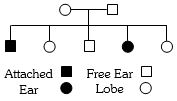
Given below is a pedigree chart of a family with five children. It shows the inheritance of attached earlobes as opposed to the free ones. The squares represent the male individuals and circles the female individuals. Which one of the following conclusions drawn is correct?
A
The parents are homozygous recessive
B
The trait is $Y$-linked
C
The parents are homozygous dominant
D
The parents are heterozygous
Solution
(D) In the given pedigree,both parents have free earlobes (represented by open symbols),but they have children with attached earlobes (represented by filled symbols).
Since the parents show the dominant trait (free earlobes) and produce offspring with the recessive trait (attached earlobes),both parents must carry the recessive allele.
Therefore,the parents must be heterozygous $(Aa)$ for the trait.
When two heterozygous parents $(Aa \times Aa)$ reproduce,they can produce offspring with the genotype $aa$ (attached earlobes),which explains the presence of affected children in the pedigree.
Since the parents show the dominant trait (free earlobes) and produce offspring with the recessive trait (attached earlobes),both parents must carry the recessive allele.
Therefore,the parents must be heterozygous $(Aa)$ for the trait.
When two heterozygous parents $(Aa \times Aa)$ reproduce,they can produce offspring with the genotype $aa$ (attached earlobes),which explains the presence of affected children in the pedigree.
0 likes
View Solution67
MediumMCQ
$A$ normal woman whose father was colourblind marries a normal man. What kinds of children would be expected and in what proportion?
A
Daughters normal,$50\%$ of sons colourblind
B
Daughters normal,all sons colourblind
C
$50\%$ of daughters colourblind,all sons normal
D
All daughters colourblind,sons normal
Solution
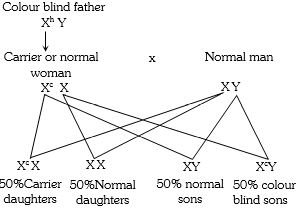
(A) Colour blindness is an $X$-linked recessive trait.
$1$. The woman's father was colourblind $(X^cY)$,so she must have inherited the colourblind gene from him. Since she is normal,she is a carrier $(X^cX)$.
$2$. She marries a normal man $(XY)$.
$3$. The cross is $X^cX \times XY$.
$4$. The offspring genotypes are: $X^cX$ (carrier daughter),$XX$ (normal daughter),$X^cY$ (colourblind son),and $XY$ (normal son).
$5$. Thus,all daughters are phenotypically normal (though $50\%$ are carriers),and $50\%$ of the sons are colourblind.
$1$. The woman's father was colourblind $(X^cY)$,so she must have inherited the colourblind gene from him. Since she is normal,she is a carrier $(X^cX)$.
$2$. She marries a normal man $(XY)$.
$3$. The cross is $X^cX \times XY$.
$4$. The offspring genotypes are: $X^cX$ (carrier daughter),$XX$ (normal daughter),$X^cY$ (colourblind son),and $XY$ (normal son).
$5$. Thus,all daughters are phenotypically normal (though $50\%$ are carriers),and $50\%$ of the sons are colourblind.
0 likes
View Solution68
MediumMCQ
$A$ colourblind daughter is born when:
A
Father is colourblind,mother is normal
B
Mother is colourblind,father is normal
C
Mother is carrier,father is normal
D
Mother is carrier,father is colourblind
Solution
(D) For a daughter to be colourblind,she must inherit the recessive gene for colourblindness from both parents. Since colourblindness is an $X$-linked recessive trait,the father must be colourblind $(X^cY)$ to pass the affected $X^c$ chromosome to his daughter. The mother must be either a carrier $(X^cX)$ or colourblind $(X^cX^c)$ to pass the other affected $X^c$ chromosome to the daughter. Therefore,if the mother is a carrier and the father is colourblind,there is a $50\%$ chance of producing a colourblind daughter.
0 likes
View Solution69
MediumMCQ
What is the cause of haemophilia?
A
Chromosomal aberration
B
Somatic mutation
C
$X$-linked mutation
D
All the above
Solution
(C) Haemophilia is a sex-linked recessive disorder,which shows its transmission from an unaffected carrier female to some of the male progeny.
It is caused by a mutation in the genes located on the $X$ chromosome,which are responsible for the synthesis of proteins involved in the blood clotting cascade.
Therefore,it is classified as an $X$-linked recessive disorder.
It is caused by a mutation in the genes located on the $X$ chromosome,which are responsible for the synthesis of proteins involved in the blood clotting cascade.
Therefore,it is classified as an $X$-linked recessive disorder.
0 likes
View Solution70
MediumMCQ
Which of the following diseases is genetically linked?
A
Haemophilia
B
Dysentery
C
Plague
D
Tuberculosis
Solution
(A) Haemophilia is a sex-linked recessive genetic disorder.
It is caused by a defect in the genes that code for clotting factors,leading to an inability of the blood to clot properly.
Dysentery,Plague,and Tuberculosis are infectious diseases caused by pathogens (bacteria or parasites) and are not inherited genetically.
It is caused by a defect in the genes that code for clotting factors,leading to an inability of the blood to clot properly.
Dysentery,Plague,and Tuberculosis are infectious diseases caused by pathogens (bacteria or parasites) and are not inherited genetically.
0 likes
View Solution71
MediumMCQ
$A$ haemophilic man marries a normal woman. Their offspring will be:
A
All girls
B
All normal
C
All haemophilic
D
All boys haemophilic
Solution
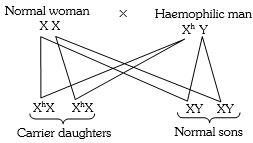
(B) Haemophilia is an $X$-linked recessive disorder. The genotype of a haemophilic man is $X^hY$ and that of a normal woman is $XX$.
When they cross,the possible genotypes of the offspring are:
$X^hY \times XX \rightarrow X^hX, X^hX, XY, XY$
Here,$X^hX$ represents carrier daughters and $XY$ represents normal sons.
Since none of the offspring express the disease (as daughters are only carriers and sons are normal),all offspring are phenotypically normal.
When they cross,the possible genotypes of the offspring are:
$X^hY \times XX \rightarrow X^hX, X^hX, XY, XY$
Here,$X^hX$ represents carrier daughters and $XY$ represents normal sons.
Since none of the offspring express the disease (as daughters are only carriers and sons are normal),all offspring are phenotypically normal.
0 likes
View Solution72
MediumMCQ
$A$ woman carrying two genes for haemophilia and one gene for colour blindness on one of her $X$ chromosomes marries a normal man. What will be the phenotype of the progeny?
A
All sons and daughters are haemophilic and colourblind
B
Haemophilic and colourblind daughters
C
$50\%$ haemophilic colourblind sons and $50\%$ normal sons
D
$50\%$ haemophilic daughters and $50\%$ colourblind daughters
Solution
(C) Let the $X$ chromosome carrying the genes for haemophilia and colour blindness be denoted as $X^{hc}$. The normal $X$ chromosome is $X$. The woman's genotype is $X^{hc}X$. The normal man's genotype is $XY$.
Cross: $X^{hc}X \times XY$
Gametes: $(X^{hc}, X)$ and $(X, Y)$
Progeny genotypes: $X^{hc}X$ (carrier daughter),$X^{hc}Y$ (haemophilic and colourblind son),$XX$ (normal daughter),$XY$ (normal son).
Thus,$50\%$ of the sons will be haemophilic and colourblind,and $50\%$ of the sons will be normal.
Cross: $X^{hc}X \times XY$
Gametes: $(X^{hc}, X)$ and $(X, Y)$
Progeny genotypes: $X^{hc}X$ (carrier daughter),$X^{hc}Y$ (haemophilic and colourblind son),$XX$ (normal daughter),$XY$ (normal son).
Thus,$50\%$ of the sons will be haemophilic and colourblind,and $50\%$ of the sons will be normal.
0 likes
View Solution73
MediumMCQ
In which of the following is colour blindness inherited?
A
In males only
B
In females only
C
In both males and females
D
In none of the above
Solution
(C) Colour blindness is an $X$-linked recessive disorder. It affects males when they possess a single recessive allele on their $X$ chromosome (hemizygous condition) and females when they possess two recessive alleles on both $X$ chromosomes (homozygous condition). Therefore,it can be inherited by both males and females.
0 likes
View Solution74
MediumMCQ
Persons who are colour blind cannot distinguish between which of the following colours?
A
Red and green
B
Black and yellow
C
Green and blue
D
Yellow and white
Solution
(A) Colour blindness is a sex-linked recessive disorder due to defect in either red or green cone of eye resulting in failure to discriminate between red and green colour. This defect is due to mutation in certain genes present in the $X$ chromosome.
0 likes
View Solution75
MediumMCQ
Which of the following is a sex-linked character?
A
Baldness
B
Polio
C
Colourblindness
D
Heart disease
Solution
(C) Red-green colour blindness is inherited as a sex-linked recessive trait located on the $X$-chromosome in human beings. Since it is $X$-linked,it is more commonly observed in males who have only one $X$-chromosome.
0 likes
View Solution76
MediumMCQ
The gene for colour blindness is located on
A
Homologous part of $X$-chromosome
B
Non-homologous part of $X$-chromosome
C
Homologous part of $Y$-chromosome
D
Non-homologous part of $Y$-chromosome
Solution
(B) The gene responsible for red-green colour blindness is located on the non-homologous region of the $X$-chromosome.
Because this gene is recessive and located on the $X$-chromosome,it is classified as an $X$-linked recessive trait.
Since males have only one $X$-chromosome $(XY)$,they are more frequently affected than females,who have two $X$-chromosomes $(XX)$ and would require both to carry the recessive allele to express the phenotype.
Because this gene is recessive and located on the $X$-chromosome,it is classified as an $X$-linked recessive trait.
Since males have only one $X$-chromosome $(XY)$,they are more frequently affected than females,who have two $X$-chromosomes $(XX)$ and would require both to carry the recessive allele to express the phenotype.
0 likes
View Solution77
MediumMCQ
$A$ sex-linked recessive gene $c$ produces red-green colour blindness in humans. $A$ normal woman whose father was colourblind marries a colourblind man. Of all the girls born to these parents, what percentage is expected to be colourblind?
A
$25$ percent
B
$50$ percent
C
$75$ percent
D
$100$ percent
Solution
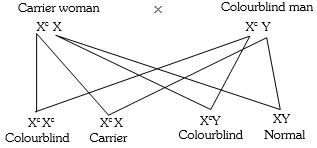
(B) The woman is normal but her father was colourblind, meaning she inherited the recessive gene from him. Thus, her genotype is $X^cX$.
The man is colourblind, so his genotype is $X^cY$.
When we cross $X^cX$ (carrier woman) with $X^cY$ (colourblind man):
- The possible genotypes for the offspring are $X^cX^c$ (colourblind girl), $X^cX$ (carrier girl), $X^cY$ (colourblind boy), and $XY$ (normal boy).
- Among the girls, $50\%$ are colourblind $(X^cX^c)$ and $50\%$ are carriers $(X^cX)$.
Therefore, $50\%$ of the girls are expected to be colourblind.
The man is colourblind, so his genotype is $X^cY$.
When we cross $X^cX$ (carrier woman) with $X^cY$ (colourblind man):
- The possible genotypes for the offspring are $X^cX^c$ (colourblind girl), $X^cX$ (carrier girl), $X^cY$ (colourblind boy), and $XY$ (normal boy).
- Among the girls, $50\%$ are colourblind $(X^cX^c)$ and $50\%$ are carriers $(X^cX)$.
Therefore, $50\%$ of the girls are expected to be colourblind.
0 likes
View Solution78
MediumMCQ
One of the genes present exclusively on the $X$-chromosome in humans is concerned with
A
Baldness
B
Red-green colour blindness
C
Facial hair/moustaches in males
D
Night blindness
Solution
(B) The correct answer is $(b)$. Red-green colour blindness is a well-known $X$-linked recessive disorder in humans.
Because the gene responsible for this condition is located on the $X$-chromosome,it is expressed more frequently in males (who have only one $X$-chromosome) than in females (who have two $X$-chromosomes).
Baldness is typically sex-influenced,while facial hair is a secondary sexual characteristic influenced by hormones,and night blindness is often related to Vitamin $A$ deficiency.
Because the gene responsible for this condition is located on the $X$-chromosome,it is expressed more frequently in males (who have only one $X$-chromosome) than in females (who have two $X$-chromosomes).
Baldness is typically sex-influenced,while facial hair is a secondary sexual characteristic influenced by hormones,and night blindness is often related to Vitamin $A$ deficiency.
0 likes
View Solution79
MediumMCQ
Which of the following is not true regarding haemophilia?
A
Royal disease
B
Bleeder's disease
C
$X$-linked disease
D
$Y$-linked disease
Solution
(D) Haemophilia is an $X$-linked recessive disorder. In this condition,the blood clotting factors are mutated,which prevents normal blood coagulation. It is historically known as the 'Royal disease' because it was famously found in the Royal family of England. It is also called 'Bleeder's disease' due to the inability of the blood to clot. Therefore,the statement that it is a $Y$-linked disease is incorrect.
0 likes
View Solution80
MediumMCQ
What are the chances of colour-blind daughters and sons being born in a marriage between a normal man and a normal woman whose father was colour-blind?
A
All sons are normal and all daughters are colour-blind.
B
Both the sons and daughters are colour-blind.
C
All the sons are colour-blind and all daughters are normal.
D
$50\%$ of sons are colour-blind and all daughters are phenotypically normal.
Solution
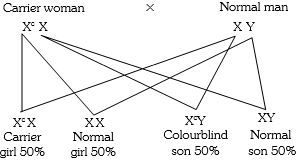
(D) Colour-blindness is an $X$-linked recessive trait. $A$ woman whose father was colour-blind must be a carrier $(X^cX)$ because she inherits one $X$ chromosome from her father (who must have been $X^cY$) and one from her mother.
When this carrier woman $(X^cX)$ marries a normal man $(XY)$,the cross is as follows:
Parents: $X^cX \times XY$
Gametes: $X^c, X$ and $X, Y$
Offspring: $X^cX$ (Carrier daughter),$XX$ (Normal daughter),$X^cY$ (Colour-blind son),$XY$ (Normal son).
Thus,$50\%$ of the sons will be colour-blind,and all the daughters will be phenotypically normal (though $50\%$ of them will be carriers).
When this carrier woman $(X^cX)$ marries a normal man $(XY)$,the cross is as follows:
Parents: $X^cX \times XY$
Gametes: $X^c, X$ and $X, Y$
Offspring: $X^cX$ (Carrier daughter),$XX$ (Normal daughter),$X^cY$ (Colour-blind son),$XY$ (Normal son).
Thus,$50\%$ of the sons will be colour-blind,and all the daughters will be phenotypically normal (though $50\%$ of them will be carriers).
0 likes
View Solution81
MediumMCQ
$A$ normal woman,whose father was colour-blind,is married to a normal man. The sons would be
A
All normal
B
All colour-blind
C
$75\%$ colour-blind
D
$50\%$ colour-blind
Solution
(D) Colour blindness is an $X$-linked recessive trait.
Since the woman's father was colour-blind,she must have inherited the recessive allele for colour blindness from him. Thus,the woman is a carrier with the genotype $X^cX$.
The normal man has the genotype $XY$.
When they cross $(X^cX \times XY)$,the possible genotypes for their offspring are:
$X^cX$ (Carrier daughter)
$XX$ (Normal daughter)
$X^cY$ (Colour-blind son)
$XY$ (Normal son)
Out of the two possible genotypes for sons ($X^cY$ and $XY$),one is colour-blind and one is normal.
Therefore,$50\%$ of the sons would be colour-blind.
Since the woman's father was colour-blind,she must have inherited the recessive allele for colour blindness from him. Thus,the woman is a carrier with the genotype $X^cX$.
The normal man has the genotype $XY$.
When they cross $(X^cX \times XY)$,the possible genotypes for their offspring are:
$X^cX$ (Carrier daughter)
$XX$ (Normal daughter)
$X^cY$ (Colour-blind son)
$XY$ (Normal son)
Out of the two possible genotypes for sons ($X^cY$ and $XY$),one is colour-blind and one is normal.
Therefore,$50\%$ of the sons would be colour-blind.
0 likes
View Solution82
MediumMCQ
If a normal woman marries a colourblind man,what will be the phenotype of their children?
A
All their children will be colourblind.
B
All their sons will be colourblind but the daughters will be normal.
C
All the children will have normal vision (daughters will be carriers).
D
All daughters will be colourblind and sons will be normal.
Solution
0 likes
View Solution83
EasyMCQ
The most common type of haemophilia results from the congenital absence of
A
Factor $II$
B
Factor $V$
C
Factor $VIII$
D
Factor $XI$
Solution
(C) Haemophilia $A$ is the most common form of haemophilia,which is caused by a deficiency of clotting factor $VIII$.
It is an $X$-linked recessive disorder,meaning the gene responsible for the production of factor $VIII$ is located on the $X$-chromosome.
Because males have only one $X$-chromosome,they are more frequently affected than females,who would require the mutation on both $X$-chromosomes to express the disease.
It is an $X$-linked recessive disorder,meaning the gene responsible for the production of factor $VIII$ is located on the $X$-chromosome.
Because males have only one $X$-chromosome,they are more frequently affected than females,who would require the mutation on both $X$-chromosomes to express the disease.
0 likes
View Solution84
EasyMCQ
Haemophilia is a:
A
Deficiency disorder
B
$Y$-linked disorder
C
$X$-linked disorder
D
Autosomal sex disorder
Solution
(C) Haemophilia is a genetic disorder characterized by the inability of the blood to clot properly,leading to excessive bleeding even from minor wounds.
It is caused by a deficiency in specific clotting factors (Factor $VIII$ or $IX$).
This condition is inherited as an $X$-linked recessive trait,meaning the gene responsible is located on the $X$ chromosome.
It is caused by a deficiency in specific clotting factors (Factor $VIII$ or $IX$).
This condition is inherited as an $X$-linked recessive trait,meaning the gene responsible is located on the $X$ chromosome.
0 likes
View Solution85
MediumMCQ
$A$ marriage between a normal-visioned man and a colourblind woman will produce which of the following types of offspring?
A
Normal sons and carrier daughters
B
Colourblind sons and carrier daughters
C
Colourblind sons and $50\%$ carrier daughters
D
$50\%$ colourblind sons and $50\%$ carrier daughters
Solution
(B) Colour blindness is an $X$-linked recessive disorder.
Let the genotype of a normal-visioned man be $XY$ and a colourblind woman be $X^c X^c$.
When these two individuals mate,the cross is as follows:
$P: X^c X^c$ (colourblind woman) $\times XY$ (normal man)
Gametes: $X^c$ and $X^c$ from the mother; $X$ and $Y$ from the father.
$F_1$ generation:
- $X^c X$: Carrier daughter
- $X^c Y$: Colourblind son
Thus,all sons will be colourblind and all daughters will be carriers.
Let the genotype of a normal-visioned man be $XY$ and a colourblind woman be $X^c X^c$.
When these two individuals mate,the cross is as follows:
$P: X^c X^c$ (colourblind woman) $\times XY$ (normal man)
Gametes: $X^c$ and $X^c$ from the mother; $X$ and $Y$ from the father.
$F_1$ generation:
- $X^c X$: Carrier daughter
- $X^c Y$: Colourblind son
Thus,all sons will be colourblind and all daughters will be carriers.
0 likes
View Solution86
MediumMCQ
Which of the following is not a hereditary disease?
A
Cretinism
B
Cystic fibrosis
C
Thalassaemia
D
Haemophilia
Solution
(A) $Cystic \text{ fibrosis}$, $Thalassaemia$, and $Haemophilia$ are genetic disorders caused by mutations in genes, making them hereditary diseases.
$Cretinism$ is a condition of severely stunted physical and mental growth due to untreated congenital deficiency of thyroid hormone (hypothyroidism) during pregnancy or early infancy. It is not caused by a genetic mutation passed through inheritance but rather by hormonal deficiency.
$Cretinism$ is a condition of severely stunted physical and mental growth due to untreated congenital deficiency of thyroid hormone (hypothyroidism) during pregnancy or early infancy. It is not caused by a genetic mutation passed through inheritance but rather by hormonal deficiency.
0 likes
View Solution87
MediumMCQ
$A$ man and a woman,who do not show any apparent signs of a certain inherited disease,have seven children ($2$ daughters and $5$ sons). Three of the sons suffer from the given disease but none of the daughters are affected. Which of the following modes of inheritance do you suggest for this disease?
A
Autosomal dominant
B
Sex-linked dominant
C
Sex-limited recessive
D
Sex-linked recessive
Solution
(D) $1$. The parents are phenotypically normal,but they have affected children. This indicates that the disease is recessive.
$2$. The disease affects only the sons ($3$ out of $5$) and none of the daughters are affected.
$3$. In $X$-linked recessive inheritance,a carrier mother $(X^CX)$ can pass the trait to her sons $(X^CY)$,while the father is unaffected $(XY)$.
$4$. Since the trait appears in males and skips generations (parents are unaffected),it is characteristic of $X$-linked recessive inheritance.
$2$. The disease affects only the sons ($3$ out of $5$) and none of the daughters are affected.
$3$. In $X$-linked recessive inheritance,a carrier mother $(X^CX)$ can pass the trait to her sons $(X^CY)$,while the father is unaffected $(XY)$.
$4$. Since the trait appears in males and skips generations (parents are unaffected),it is characteristic of $X$-linked recessive inheritance.
0 likes
View Solution88
MediumMCQ
$A$ woman with normal vision,but whose father was colour blind,marries a colour blind man. Suppose that the fourth child of this couple is a boy. What is the probability of this boy being colour blind?
A
Will be partially colour blind since he is heterozygous for the colour blind mutant allele.
B
Must have normal colour vision.
C
Must be colour blind.
D
May be colour blind or may be of normal vision.
Solution
(D) Colour blindness is an $X$-linked recessive trait.
Let the allele for normal vision be $X^C$ and the allele for colour blindness be $X^c$.
The woman has normal vision but her father was colour blind,so her genotype is $X^CX^c$ (carrier).
The man is colour blind,so his genotype is $X^cY$.
When these two individuals marry,the cross is $X^CX^c \times X^cY$.
The possible genotypes for their children are:
$1$. $X^CX^c$ (Carrier daughter)
$2$. $X^cX^c$ (Colour blind daughter)
$3$. $X^CY$ (Normal vision son)
$4$. $X^cY$ (Colour blind son)
Since the question specifies the child is a boy,we look at the male offspring genotypes: $X^CY$ and $X^cY$.
Therefore,the boy has a $50\%$ chance of being colour blind and a $50\%$ chance of having normal vision.
Let the allele for normal vision be $X^C$ and the allele for colour blindness be $X^c$.
The woman has normal vision but her father was colour blind,so her genotype is $X^CX^c$ (carrier).
The man is colour blind,so his genotype is $X^cY$.
When these two individuals marry,the cross is $X^CX^c \times X^cY$.
The possible genotypes for their children are:
$1$. $X^CX^c$ (Carrier daughter)
$2$. $X^cX^c$ (Colour blind daughter)
$3$. $X^CY$ (Normal vision son)
$4$. $X^cY$ (Colour blind son)
Since the question specifies the child is a boy,we look at the male offspring genotypes: $X^CY$ and $X^cY$.
Therefore,the boy has a $50\%$ chance of being colour blind and a $50\%$ chance of having normal vision.
0 likes
View Solution89
MediumMCQ
Which of the following is a sex-linked disease?
A
Haemophilia
B
Colour blindness
C
Sickle-cell anaemia
D
Both $(A)$ and $(B)$
Solution
(D) Sex-linked diseases are those caused by genes located on the sex chromosomes ($X$ or $Y$).
Haemophilia is an $X$-linked recessive disorder where blood fails to clot properly.
Colour blindness is also an $X$-linked recessive disorder resulting in the inability to distinguish between certain colours.
Sickle-cell anaemia is an autosomal recessive disorder,not sex-linked.
Therefore,both haemophilia and colour blindness are sex-linked diseases.
Haemophilia is an $X$-linked recessive disorder where blood fails to clot properly.
Colour blindness is also an $X$-linked recessive disorder resulting in the inability to distinguish between certain colours.
Sickle-cell anaemia is an autosomal recessive disorder,not sex-linked.
Therefore,both haemophilia and colour blindness are sex-linked diseases.
0 likes
View Solution90
MediumMCQ
One way of detecting sex-linked inheritance is:
A
Son resembles mother and daughter resembles father
B
Son resembles father and daughter resembles mother
C
Both son and daughter resemble father
D
Both son and daughter resemble mother
Solution
(A) Sex-linked inheritance,particularly $X$-linked recessive traits,often exhibits a pattern known as criss-cross inheritance.
In this pattern,the trait is passed from an affected father to his daughters (who become carriers) and then to his grandsons.
Specifically,a son inherits his $X$ chromosome from his mother,while a daughter inherits one $X$ chromosome from her mother and one from her father.
Therefore,if a mother carries a sex-linked recessive trait,her sons are more likely to express it,leading to the observation that the son resembles the mother and the daughter resembles the father in terms of trait expression.
In this pattern,the trait is passed from an affected father to his daughters (who become carriers) and then to his grandsons.
Specifically,a son inherits his $X$ chromosome from his mother,while a daughter inherits one $X$ chromosome from her mother and one from her father.
Therefore,if a mother carries a sex-linked recessive trait,her sons are more likely to express it,leading to the observation that the son resembles the mother and the daughter resembles the father in terms of trait expression.
0 likes
View Solution91
DifficultMCQ
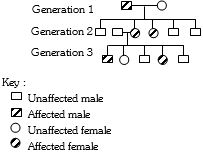
The pedigree chart below shows the inheritance of a particular sex-linked trait. How is the trait being studied in the pedigree chart above inherited?
A
Dominant $X$-linked
B
Recessive $X$-linked
C
Dominant $Y$-linked
D
Recessive $Y$-linked
Solution
(A) $1$. Analyze the pedigree: An affected father (Generation $1$) passes the trait to his daughters (Generation $2$),but not to his sons. This is characteristic of $X$-linked inheritance.
$2$. In Generation $2$,an affected female marries an unaffected male and produces both affected and unaffected offspring of both sexes. This indicates that the trait is dominant because it appears in every generation and affected individuals have affected parents.
$3$. Since an affected father passes the trait to all his daughters and the trait appears in both males and females in subsequent generations,it follows the pattern of $X$-linked dominant inheritance.
$2$. In Generation $2$,an affected female marries an unaffected male and produces both affected and unaffected offspring of both sexes. This indicates that the trait is dominant because it appears in every generation and affected individuals have affected parents.
$3$. Since an affected father passes the trait to all his daughters and the trait appears in both males and females in subsequent generations,it follows the pattern of $X$-linked dominant inheritance.
0 likes
View Solution92
MediumMCQ
Marriages between close relatives and cousins are not advisable because
A
More mutations can occur
B
More recessive defects are likely to appear
C
More chances are there for $Rh$ blood group anomalies
D
More chances are there for multiple births
Solution
(B) Marriages between close relatives and cousins are not advisable because recessive alleles for genetic disorders are often carried in a heterozygous state within a family. When close relatives mate,the probability of both parents carrying the same recessive allele increases significantly. This leads to a higher likelihood of offspring being homozygous for the recessive defect,causing the disorder to express itself.
0 likes
View Solution93
MediumMCQ
$A$ boy is colour blind. Among his two sisters,one is colour blind and one is a carrier (normal). Who is colour blind in his family?
A
Father
B
His grandfather and mother
C
Mother
D
His grandfather
Solution
(C) Colour blindness is an $X$-linked recessive trait.
Let $X^c$ be the allele for colour blindness and $X$ be the normal allele.
The boy is colour blind,so his genotype is $X^c Y$.
He receives his $Y$ chromosome from his father and his $X^c$ chromosome from his mother.
Since one sister is colour blind $(X^c X^c)$,she must have received one $X^c$ from the mother and one $X^c$ from the father.
This implies the father must be colour blind $(X^c Y)$ and the mother must be a carrier $(X^c X)$.
Therefore,the mother is a carrier and the father is colour blind.
Looking at the options,the mother is the one who carries the trait and passes it to the children,but the father is also affected. Given the context of the question,the mother's genotype is essential for the daughters to be colour blind.
Let $X^c$ be the allele for colour blindness and $X$ be the normal allele.
The boy is colour blind,so his genotype is $X^c Y$.
He receives his $Y$ chromosome from his father and his $X^c$ chromosome from his mother.
Since one sister is colour blind $(X^c X^c)$,she must have received one $X^c$ from the mother and one $X^c$ from the father.
This implies the father must be colour blind $(X^c Y)$ and the mother must be a carrier $(X^c X)$.
Therefore,the mother is a carrier and the father is colour blind.
Looking at the options,the mother is the one who carries the trait and passes it to the children,but the father is also affected. Given the context of the question,the mother's genotype is essential for the daughters to be colour blind.
1 likes
View Solution94
MediumMCQ
Knowing that albinism is determined by a recessive gene in humans,the presence of albinism in children born to a couple proves that:
A
Both the father and the mother are heterozygous for albinism.
B
The father is homozygous normal but the mother is heterozygous or vice versa.
C
The father is homozygous for albinism but the mother is heterozygous or vice versa.
D
$(A)$ and $(C)$ are correct.
Solution
(D) Albinism is an autosomal recessive disorder. Let the normal allele be $A$ and the recessive allele for albinism be $a$. An albino individual must have the genotype $aa$. For a child to be $aa$,they must receive one $a$ allele from each parent. Therefore,both parents must carry at least one $a$ allele. If both parents are phenotypically normal but carry the gene,they are heterozygous $(Aa)$. If one parent is an albino $(aa)$ and the other is a carrier $(Aa)$,the child can also be $aa$. Thus,both $(A)$ and $(C)$ are possible scenarios that result in an albino child.
0 likes
View Solution95
MediumMCQ
$A$ normal woman whose father was albino marries a man who is albino. What proportion of normal and albino can be expected among their offspring?
A
$1$ normal : $1$ albino
B
All albino
C
$2$ normal : $1$ albino
D
All normal
Solution
(A) Albinism is an autosomal recessive trait. Let $A$ be the dominant allele for normal pigmentation and $a$ be the recessive allele for albinism.
$1$. The woman is normal but her father was albino $(aa)$,so she must carry one recessive allele. Her genotype is $Aa$.
$2$. The man is albino,so his genotype must be $aa$.
$3$. The cross is $Aa \times aa$.
$4$. The Punnett square results in offspring genotypes: $50\%$ $Aa$ (normal) and $50\%$ $aa$ (albino).
$5$. Therefore,the ratio of normal to albino offspring is $1:1$.
$1$. The woman is normal but her father was albino $(aa)$,so she must carry one recessive allele. Her genotype is $Aa$.
$2$. The man is albino,so his genotype must be $aa$.
$3$. The cross is $Aa \times aa$.
$4$. The Punnett square results in offspring genotypes: $50\%$ $Aa$ (normal) and $50\%$ $aa$ (albino).
$5$. Therefore,the ratio of normal to albino offspring is $1:1$.
0 likes
View Solution96
MediumMCQ
Recessive characters are expressed:
A
Only when they are present on $X$ chromosomes of male
B
Only when they are present on $X$ chromosomes of female
C
On any autosome
D
On both the chromosomes of female
Solution
(A) Recessive alleles are those that only express their phenotype when present in a homozygous condition. In the case of $X$-linked recessive traits,males are hemizygous (having only one $X$ chromosome). Therefore,if a recessive allele is present on the single $X$ chromosome of a male,it will be expressed because there is no dominant allele on a second $X$ chromosome to mask its effect. Thus,the correct condition for the expression of $X$-linked recessive characters in males is their presence on the $X$ chromosome.
0 likes
View Solution97
MediumMCQ
$A$ husband and wife have normal vision,but the fathers of both of them were colour blind. What is the probability of their first daughter being colour blind (in $\%$)?
A
$25$
B
$50$
C
$75$
D
$0$
Solution
(D) Colour blindness is an $X$-linked recessive disorder.
Since the husband and wife have normal vision,their genotypes are:
Husband: $X^CY$ (where $C$ is normal vision,$c$ is colour blind).
Wife: $X^CX^c$ (she is a carrier because her father was colour blind,$X^cY$).
The cross is: $X^CY \times X^CX^c$.
The possible genotypes of their children are: $X^CX^C$ (normal daughter),$X^CX^c$ (carrier daughter),$X^CY$ (normal son),$X^cY$ (colour blind son).
For a daughter to be colour blind,she must inherit the $X^c$ allele from both parents $(X^cX^c)$.
Since the father has normal vision $(X^CY)$,he cannot pass the $X^c$ allele to his daughter.
Therefore,the probability of their daughter being colour blind is $0\%$.
Since the husband and wife have normal vision,their genotypes are:
Husband: $X^CY$ (where $C$ is normal vision,$c$ is colour blind).
Wife: $X^CX^c$ (she is a carrier because her father was colour blind,$X^cY$).
The cross is: $X^CY \times X^CX^c$.
The possible genotypes of their children are: $X^CX^C$ (normal daughter),$X^CX^c$ (carrier daughter),$X^CY$ (normal son),$X^cY$ (colour blind son).
For a daughter to be colour blind,she must inherit the $X^c$ allele from both parents $(X^cX^c)$.
Since the father has normal vision $(X^CY)$,he cannot pass the $X^c$ allele to his daughter.
Therefore,the probability of their daughter being colour blind is $0\%$.
0 likes
View Solution98
EasyMCQ
Sir Archibald Garrod is associated with which of the following fields?
A
Eugenics
B
Euthenics
C
Genetics
D
Human genetics
Solution
(D) Sir Archibald Garrod is widely known as the father of human genetics. He was the first to suggest that certain diseases,such as alkaptonuria,are inherited as recessive traits,which he termed 'inborn errors of metabolism'. This discovery laid the foundation for the field of human biochemical genetics.
0 likes
View Solution99
EasyMCQ
Who among the following is associated with biochemical genetics?
A
Beadle
B
Galton
C
Garrod
D
Mendel
Solution
(C) Archibald $Garrod$ is known as the father of human biochemical genetics.
He studied the metabolic disorder $alkaptonuria$ and proposed the concept of 'inborn errors of metabolism'.
He suggested that genes control biochemical reactions in the body,which laid the foundation for biochemical genetics.
He studied the metabolic disorder $alkaptonuria$ and proposed the concept of 'inborn errors of metabolism'.
He suggested that genes control biochemical reactions in the body,which laid the foundation for biochemical genetics.
0 likes
View Solution100
EasyMCQ
Who is known as the father of human genetics?
A
Bateson
B
Watson
C
Mendel
D
Archibald Garrod
Solution
(D) Archibald Garrod is known as the father of human genetics. In $1902$,he identified the first human genetic disease,alkaptonuria,and proposed the concept of 'inborn errors of metabolism'.
0 likes
View SolutionPrinciples of Inheritance and Variation — Pedigree Analysis and Mendelian disorders · Frequently Asked Questions
1Are these Principles of Inheritance and Variation questions useful for JEE and NEET?
Yes. All questions in this section are mapped to JEE Main and NEET exam patterns. Previous year questions from JEE Main, NEET, GUJCET and state-level exams are included with full solutions.
2Can I switch to Hindi or Gujarati for these questions?
Yes. Use the language tabs in the hero section or the sidebar to view the same questions and solutions in English, Hindi or Gujarati.
3How do I generate a question paper from this subtopic?
Use the Vedclass Exam Paper Generator — select the chapter and subtopic, set difficulty, and generate Sets A, B, C, D automatically. First 3 chapters of every subject are free.
Vedclass Products
For Students
Vedclass Test Series
Mock tests in real JEE/NEET style with performance analysis. 5-day free trial.
Start Free TrialFor Teachers
Exam Paper Generator
Generate Set A/B/C/D papers from this chapter in 2 minutes. 3 chapters free.
Try FreeFor Institutes
Online Exam Module
Live online exams with unlimited students, 360° analytics & white-label branding.
See DemoFor Teachers & Institutes
Generate a Principles of Inheritance and Variation Exam Paper in 2 Minutes
Select subtopic & difficulty — Sets A, B, C, D auto-generated with No Repeat logic.
First 3 chapters of every subject are free — no payment required.