
A English
Stationary Waves (Standing wave) Questions in English
Class 11 Physics · Waves and Sound · Stationary Waves (Standing wave)
189+
Questions
English
Language
100%
With Solutions
Showing 50 of 189 questions in English
101
MediumMCQ
The equation of a stationary wave is $y = 0.8 \cos \left( \frac{\pi x}{20} \right) \sin (200 \pi t)$,where $x$ is in $cm$ and $t$ is in $sec$. The separation between consecutive nodes will be .... $cm$.
A
$20$
B
$10$
C
$40$
D
$30$
Solution
(A) The standard equation of a stationary wave is given by $y = A \cos(kx) \sin(\omega t)$.
Comparing this with the given equation $y = 0.8 \cos \left( \frac{\pi x}{20} \right) \sin(200 \pi t)$,we get the wave number $k = \frac{\pi}{20}$.
We know that $k = \frac{2 \pi}{\lambda}$,so $\frac{2 \pi}{\lambda} = \frac{\pi}{20}$.
Solving for wavelength $\lambda$,we get $\lambda = 40 \, cm$.
The distance between two consecutive nodes in a stationary wave is given by $\frac{\lambda}{2}$.
Therefore,the separation is $\frac{40}{2} = 20 \, cm$.
Comparing this with the given equation $y = 0.8 \cos \left( \frac{\pi x}{20} \right) \sin(200 \pi t)$,we get the wave number $k = \frac{\pi}{20}$.
We know that $k = \frac{2 \pi}{\lambda}$,so $\frac{2 \pi}{\lambda} = \frac{\pi}{20}$.
Solving for wavelength $\lambda$,we get $\lambda = 40 \, cm$.
The distance between two consecutive nodes in a stationary wave is given by $\frac{\lambda}{2}$.
Therefore,the separation is $\frac{40}{2} = 20 \, cm$.
0 likes
View Solution102
MediumMCQ
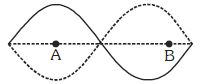
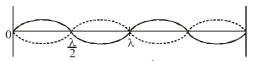
In the standing wave shown,particles at the positions $A$ and $B$ have a phase difference of
A
$0$
B
$\frac{\pi}{2}$
C
$\frac{5\pi}{6}$
D
$\pi$
Solution
(D) In a standing wave,all particles within a single loop (between two consecutive nodes) vibrate in phase with each other.
Particles in adjacent loops vibrate in opposite phases.
Since point $A$ is in the first loop and point $B$ is in the second loop,they are separated by a node.
Therefore,the particles at positions $A$ and $B$ are in opposite phases.
The phase difference between particles in opposite phases is $\pi$ radians.
Particles in adjacent loops vibrate in opposite phases.
Since point $A$ is in the first loop and point $B$ is in the second loop,they are separated by a node.
Therefore,the particles at positions $A$ and $B$ are in opposite phases.
The phase difference between particles in opposite phases is $\pi$ radians.
0 likes
View Solution103
MediumMCQ
The equation of a stationary wave is $Y = 10 \sin \left( \frac{\pi x}{4} \right) \cos (20 \pi t)$. The distance between two consecutive nodes in metres is
A
$4$
B
$2$
C
$5$
D
$8$
Solution
(A) The standard equation of a stationary wave is given by $Y = A \sin(kx) \cos(\omega t)$.
Comparing this with the given equation $Y = 10 \sin \left( \frac{\pi x}{4} \right) \cos(20 \pi t)$,we find the wave number $k = \frac{\pi}{4}$.
We know that $k = \frac{2\pi}{\lambda}$,so $\frac{2\pi}{\lambda} = \frac{\pi}{4}$.
Solving for $\lambda$,we get $\lambda = 8 \ m$.
The distance between two consecutive nodes in a stationary wave is given by $\frac{\lambda}{2}$.
Therefore,the distance $= \frac{8}{2} = 4 \ m$.
Comparing this with the given equation $Y = 10 \sin \left( \frac{\pi x}{4} \right) \cos(20 \pi t)$,we find the wave number $k = \frac{\pi}{4}$.
We know that $k = \frac{2\pi}{\lambda}$,so $\frac{2\pi}{\lambda} = \frac{\pi}{4}$.
Solving for $\lambda$,we get $\lambda = 8 \ m$.
The distance between two consecutive nodes in a stationary wave is given by $\frac{\lambda}{2}$.
Therefore,the distance $= \frac{8}{2} = 4 \ m$.
0 likes
View Solution104
MediumMCQ
$A$ wave $y = a \sin(\omega t - kx)$ on a string meets with another wave producing a node at $x = 0$. Then the equation of the unknown wave is
A
$y = a \sin(\omega t + kx)$
B
$y = -a \sin(\omega t + kx)$
C
$y = a \sin(\omega t - kx)$
D
$y = -a \sin(\omega t - kx)$
Solution
(B) Let the first wave be $y_1 = a \sin(\omega t - kx)$.
Let the unknown wave be $y_2 = A \sin(\omega t + kx + \phi)$.
The resultant wave is $y = y_1 + y_2$.
$A$ node is formed at $x = 0$,which means the resultant displacement $y$ must be zero for all $t$ at $x = 0$.
$y(0, t) = a \sin(\omega t) + A \sin(\omega t + \phi) = 0$.
For this to hold for all $t$,the waves must be equal in magnitude and opposite in phase.
Thus,$A = a$ and $\phi = \pi$ (or phase difference of $\pi$).
$y_2 = a \sin(\omega t + kx + \pi) = -a \sin(\omega t + kx)$.
Therefore,the equation of the unknown wave is $y = -a \sin(\omega t + kx)$.
Let the unknown wave be $y_2 = A \sin(\omega t + kx + \phi)$.
The resultant wave is $y = y_1 + y_2$.
$A$ node is formed at $x = 0$,which means the resultant displacement $y$ must be zero for all $t$ at $x = 0$.
$y(0, t) = a \sin(\omega t) + A \sin(\omega t + \phi) = 0$.
For this to hold for all $t$,the waves must be equal in magnitude and opposite in phase.
Thus,$A = a$ and $\phi = \pi$ (or phase difference of $\pi$).
$y_2 = a \sin(\omega t + kx + \pi) = -a \sin(\omega t + kx)$.
Therefore,the equation of the unknown wave is $y = -a \sin(\omega t + kx)$.
0 likes
View Solution105
MediumMCQ
The expression $y = a \sin bx \sin \omega t$ represents a stationary wave. The distance between the consecutive nodes is equal to
A
$\pi / b$
B
$2\pi / b$
C
$\pi / 2b$
D
$1 / b$
Solution
(A) The given expression for the stationary wave is $y = a \sin bx \sin \omega t$.
Comparing this with the standard equation of a stationary wave,$y = R \sin \left( \frac{2 \pi x}{\lambda} \right) \sin \omega t$,we get:
$\frac{2 \pi}{\lambda} = b$
From this,the wavelength $\lambda$ is given by:
$\lambda = \frac{2 \pi}{b}$
The distance between two consecutive nodes in a stationary wave is equal to half the wavelength,i.e.,$\frac{\lambda}{2}$.
Substituting the value of $\lambda$:
Distance $= \frac{\lambda}{2} = \frac{2 \pi / b}{2} = \frac{\pi}{b}$.
Comparing this with the standard equation of a stationary wave,$y = R \sin \left( \frac{2 \pi x}{\lambda} \right) \sin \omega t$,we get:
$\frac{2 \pi}{\lambda} = b$
From this,the wavelength $\lambda$ is given by:
$\lambda = \frac{2 \pi}{b}$
The distance between two consecutive nodes in a stationary wave is equal to half the wavelength,i.e.,$\frac{\lambda}{2}$.
Substituting the value of $\lambda$:
Distance $= \frac{\lambda}{2} = \frac{2 \pi / b}{2} = \frac{\pi}{b}$.
0 likes
View Solution106
MediumMCQ
$Assertion :$ For the formation of stationary waves,the medium must be bounded having definite boundaries.
$Reason :$ In the stationary wave,some particles of the medium remain permanently at rest.
$Reason :$ In the stationary wave,some particles of the medium remain permanently at rest.
A
If both $Assertion$ and $Reason$ are correct and the $Reason$ is a correct explanation of the $Assertion$.
B
If both $Assertion$ and $Reason$ are correct but $Reason$ is not a correct explanation of the $Assertion$.
C
If the $Assertion$ is correct but $Reason$ is incorrect.
D
If both the $Assertion$ and $Reason$ are incorrect.
Solution
(B) For the formation of stationary waves,it is necessary that the medium should be bounded. When a wave propagates in a bounded medium,it reflects at the boundary,producing a wave of the same frequency and amplitude travelling in the opposite direction. The superposition of these two waves results in a stationary wave. Thus,the $Assertion$ is correct.
In stationary waves,there are specific points in the medium where the displacement is always zero. These points are called nodes,and the particles at these positions remain permanently at rest. Thus,the $Reason$ is also correct.
However,the fact that some particles remain at rest (nodes) is a property of stationary waves,not the cause of why the medium must be bounded. Therefore,the $Reason$ is not the correct explanation of the $Assertion$.
In stationary waves,there are specific points in the medium where the displacement is always zero. These points are called nodes,and the particles at these positions remain permanently at rest. Thus,the $Reason$ is also correct.
However,the fact that some particles remain at rest (nodes) is a property of stationary waves,not the cause of why the medium must be bounded. Therefore,the $Reason$ is not the correct explanation of the $Assertion$.
0 likes
View Solution107
Medium
The transverse displacement of a string (clamped at both ends) is given by $y(x, t) = 0.06 \sin \left(\frac{2 \pi}{3} x\right) \cos (120 \pi t)$,where $x$ and $y$ are in $m$ and $t$ is in $s$. The length of the string is $1.5 \; m$ and its mass is $3.0 \times 10^{-2} \; kg$. Answer the following:
$(a)$ Does the function represent a travelling wave or a stationary wave?
$(b)$ Interpret the wave as a superposition of two waves travelling in opposite directions. What is the wavelength,frequency,and speed of each wave?
$(c)$ Determine the tension in the string.
$(a)$ Does the function represent a travelling wave or a stationary wave?
$(b)$ Interpret the wave as a superposition of two waves travelling in opposite directions. What is the wavelength,frequency,and speed of each wave?
$(c)$ Determine the tension in the string.
Solution
(N/A) The general equation for a stationary wave is $y(x, t) = 2a \sin(kx) \cos(\omega t)$.
Comparing this with the given equation $y(x, t) = 0.06 \sin \left(\frac{2 \pi}{3} x\right) \cos (120 \pi t)$,we conclude that it represents a stationary wave.
$(b)$ $A$ stationary wave is the superposition of two waves: $y_1 = a \sin(\omega t - kx)$ and $y_2 = a \sin(\omega t + kx)$.
Comparing the given equation with $y = 2a \sin(kx) \cos(\omega t)$,we have $k = \frac{2 \pi}{3}$ and $\omega = 120 \pi$.
Since $k = \frac{2 \pi}{\lambda}$,we get $\lambda = \frac{2 \pi}{k} = \frac{2 \pi}{2 \pi / 3} = 3 \; m$.
Since $\omega = 2 \pi \nu$,we get $\nu = \frac{\omega}{2 \pi} = \frac{120 \pi}{2 \pi} = 60 \; Hz$.
The speed of each wave is $v = \nu \lambda = 60 \times 3 = 180 \; m/s$.
$(c)$ The speed of a transverse wave on a string is $v = \sqrt{\frac{T}{\mu}}$,where $\mu = \frac{m}{l} = \frac{3.0 \times 10^{-2}}{1.5} = 2 \times 10^{-2} \; kg/m$.
Thus,$T = v^2 \mu = (180)^2 \times (2 \times 10^{-2}) = 32400 \times 0.02 = 648 \; N$.
Comparing this with the given equation $y(x, t) = 0.06 \sin \left(\frac{2 \pi}{3} x\right) \cos (120 \pi t)$,we conclude that it represents a stationary wave.
$(b)$ $A$ stationary wave is the superposition of two waves: $y_1 = a \sin(\omega t - kx)$ and $y_2 = a \sin(\omega t + kx)$.
Comparing the given equation with $y = 2a \sin(kx) \cos(\omega t)$,we have $k = \frac{2 \pi}{3}$ and $\omega = 120 \pi$.
Since $k = \frac{2 \pi}{\lambda}$,we get $\lambda = \frac{2 \pi}{k} = \frac{2 \pi}{2 \pi / 3} = 3 \; m$.
Since $\omega = 2 \pi \nu$,we get $\nu = \frac{\omega}{2 \pi} = \frac{120 \pi}{2 \pi} = 60 \; Hz$.
The speed of each wave is $v = \nu \lambda = 60 \times 3 = 180 \; m/s$.
$(c)$ The speed of a transverse wave on a string is $v = \sqrt{\frac{T}{\mu}}$,where $\mu = \frac{m}{l} = \frac{3.0 \times 10^{-2}}{1.5} = 2 \times 10^{-2} \; kg/m$.
Thus,$T = v^2 \mu = (180)^2 \times (2 \times 10^{-2}) = 32400 \times 0.02 = 648 \; N$.
0 likes
View Solution108
Medium
$(i)$ For the wave $y(x, t) = 0.06 \sin \left(\frac{2 \pi}{3} x\right) \cos (120 \pi t)$,where $x$ and $y$ are in $m$ and $t$ is in $s$. The length of the string is $1.5 \, m$ and its mass is $3.0 \times 10^{-2} \, kg$. Do all the points on the string oscillate with the same $(a)$ frequency,$(b)$ phase,$(c)$ amplitude? Explain your answers.
$(ii)$ What is the amplitude of a point $0.375 \, m$ away from one end?
$(ii)$ What is the amplitude of a point $0.375 \, m$ away from one end?
Solution
(N/A) $(i)$ The given equation represents a standing wave.
$(a)$ Yes,all points on the string oscillate with the same frequency of $f = \frac{\omega}{2\pi} = \frac{120\pi}{2\pi} = 60 \, Hz$,except at the nodes where the amplitude is zero.
$(b)$ No,all points do not oscillate with the same phase. Points within the same loop oscillate in phase,but points in adjacent loops oscillate with a phase difference of $\pi$ radians.
$(c)$ No,all points do not oscillate with the same amplitude. The amplitude of a point at position $x$ is given by $A(x) = 0.06 \sin \left(\frac{2\pi}{3} x\right)$,which depends on the position $x$.
$(ii)$ The amplitude of a point at $x = 0.375 \, m$ is:
$A = 0.06 \sin \left(\frac{2\pi}{3} \times 0.375\right)$
$A = 0.06 \sin \left(\frac{2\pi}{3} \times \frac{3}{8}\right)$
$A = 0.06 \sin \left(\frac{\pi}{4}\right)$
$A = 0.06 \times \frac{1}{\sqrt{2}} \approx 0.0424 \, m$.
$(a)$ Yes,all points on the string oscillate with the same frequency of $f = \frac{\omega}{2\pi} = \frac{120\pi}{2\pi} = 60 \, Hz$,except at the nodes where the amplitude is zero.
$(b)$ No,all points do not oscillate with the same phase. Points within the same loop oscillate in phase,but points in adjacent loops oscillate with a phase difference of $\pi$ radians.
$(c)$ No,all points do not oscillate with the same amplitude. The amplitude of a point at position $x$ is given by $A(x) = 0.06 \sin \left(\frac{2\pi}{3} x\right)$,which depends on the position $x$.
$(ii)$ The amplitude of a point at $x = 0.375 \, m$ is:
$A = 0.06 \sin \left(\frac{2\pi}{3} \times 0.375\right)$
$A = 0.06 \sin \left(\frac{2\pi}{3} \times \frac{3}{8}\right)$
$A = 0.06 \sin \left(\frac{\pi}{4}\right)$
$A = 0.06 \times \frac{1}{\sqrt{2}} \approx 0.0424 \, m$.
0 likes
View Solution109
Medium
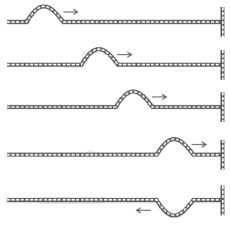
Explain the reflection of a wave at a rigid support.
Solution
(N/A) When a wave pulse traveling in the $+x$-direction hits a rigid (fixed) support,it reflects back in the $-x$-direction.
If we assume that no energy is absorbed at the boundary,the shape of the reflected pulse remains the same as the incident pulse,but its phase changes by $180^{\circ}$ or $\pi$ radians.
This occurs because the boundary is fixed,meaning the displacement at that point must always be zero.
Let the displacement of the incident progressive wave at time $t$ be $y_{i}(x, t) = a \sin(kx - \omega t)$.
Let the displacement of the reflected wave be $y_{r}(x, t)$.
According to the principle of superposition,the resultant displacement $y(x, t)$ is given by:
$y(x, t) = y_{i}(x, t) + y_{r}(x, t)$
Since the support is rigid,the displacement at the fixed end is always zero,so $y(x, t) = 0$.
Therefore,$0 = y_{i}(x, t) + y_{r}(x, t)$
This implies $y_{r}(x, t) = -y_{i}(x, t)$
Substituting the expression for the incident wave,we get:
$y_{r}(x, t) = -a \sin(kx - \omega t) = a \sin(kx - \omega t + \pi)$
If we assume that no energy is absorbed at the boundary,the shape of the reflected pulse remains the same as the incident pulse,but its phase changes by $180^{\circ}$ or $\pi$ radians.
This occurs because the boundary is fixed,meaning the displacement at that point must always be zero.
Let the displacement of the incident progressive wave at time $t$ be $y_{i}(x, t) = a \sin(kx - \omega t)$.
Let the displacement of the reflected wave be $y_{r}(x, t)$.
According to the principle of superposition,the resultant displacement $y(x, t)$ is given by:
$y(x, t) = y_{i}(x, t) + y_{r}(x, t)$
Since the support is rigid,the displacement at the fixed end is always zero,so $y(x, t) = 0$.
Therefore,$0 = y_{i}(x, t) + y_{r}(x, t)$
This implies $y_{r}(x, t) = -y_{i}(x, t)$
Substituting the expression for the incident wave,we get:
$y_{r}(x, t) = -a \sin(kx - \omega t) = a \sin(kx - \omega t + \pi)$
0 likes
View Solution110
Medium
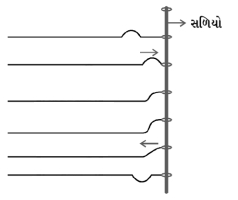
Explain the reflection of a wave at a free support.
Solution
(N/A) When a transverse wave pulse travels along a string and reaches a free end (a support that can move freely,such as a ring on a frictionless rod),it reflects back without any phase change.
$1$. As the pulse reaches the free end,the end is displaced to its maximum amplitude.
$2$. Because the support is free to move,it does not exert a restoring force in the opposite direction to the incident pulse.
$3$. Consequently,the reflected pulse has the same polarity (crest remains a crest) as the incident pulse.
$4$. There is no phase change of $\pi$ radians (or $180^{\circ}$) upon reflection at a free boundary.
$1$. As the pulse reaches the free end,the end is displaced to its maximum amplitude.
$2$. Because the support is free to move,it does not exert a restoring force in the opposite direction to the incident pulse.
$3$. Consequently,the reflected pulse has the same polarity (crest remains a crest) as the incident pulse.
$4$. There is no phase change of $\pi$ radians (or $180^{\circ}$) upon reflection at a free boundary.
0 likes
View Solution111
Medium
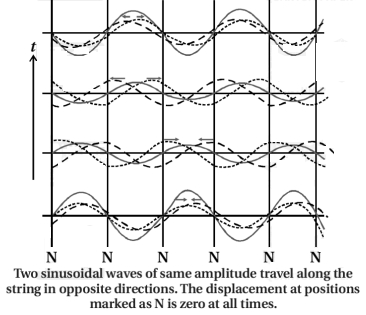
What are stationary waves? Obtain their equation.
Solution
(N/A) Stationary waves: When two waves of the same amplitude,frequency,and wavelength travel in opposite directions along the same line and superpose,the resultant wave formed is called a stationary wave.
These resultant waves do not propagate in any direction; hence,they do not transport energy.
To obtain the equation,consider two waves of the same amplitude $a$ and angular frequency $\omega$ traveling in opposite directions:
$1$. Wave traveling in the positive $x$-direction: $y_{1}(x, t) = a \sin(kx - \omega t)$
$2$. Wave traveling in the negative $x$-direction: $y_{2}(x, t) = a \sin(kx + \omega t)$
By the principle of superposition,the resultant displacement $y$ is:
$y = y_{1} + y_{2}$
$y = a \sin(kx - \omega t) + a \sin(kx + \omega t)$
Using the trigonometric identity $\sin(A) + \sin(B) = 2 \sin(\frac{A+B}{2}) \cos(\frac{A-B}{2})$:
$y = 2a \sin(kx) \cos(\omega t)$
This is the equation of a stationary wave,where $2a \sin(kx)$ represents the amplitude of the particle at position $x$.
These resultant waves do not propagate in any direction; hence,they do not transport energy.
To obtain the equation,consider two waves of the same amplitude $a$ and angular frequency $\omega$ traveling in opposite directions:
$1$. Wave traveling in the positive $x$-direction: $y_{1}(x, t) = a \sin(kx - \omega t)$
$2$. Wave traveling in the negative $x$-direction: $y_{2}(x, t) = a \sin(kx + \omega t)$
By the principle of superposition,the resultant displacement $y$ is:
$y = y_{1} + y_{2}$
$y = a \sin(kx - \omega t) + a \sin(kx + \omega t)$
Using the trigonometric identity $\sin(A) + \sin(B) = 2 \sin(\frac{A+B}{2}) \cos(\frac{A-B}{2})$:
$y = 2a \sin(kx) \cos(\omega t)$
This is the equation of a stationary wave,where $2a \sin(kx)$ represents the amplitude of the particle at position $x$.
0 likes
View Solution112
Difficult
Write the equation of a stationary wave and obtain the equations of nodes and antinodes by defining them.
Solution
(N/A) The equation of a stationary wave is given by:
$y(x, t) = 2a \sin(kx) \cos(\omega t)$ ... $(1)$
Here,the term $2a \sin(kx)$ represents the amplitude of the oscillation at a position $x$. Since the amplitude depends on $x$,different points on the string oscillate with different amplitudes.
Nodes: These are the points where the amplitude of oscillation is zero.
In equation $(1)$,for nodes,$2a \sin(kx) = 0$.
$\sin(kx) = 0 \implies kx = n\pi$,where $n = 0, 1, 2, 3, \dots$
Since $k = \frac{2\pi}{\lambda}$,we have $\frac{2\pi}{\lambda} x = n\pi$.
Therefore,$x = \frac{n\lambda}{2}$ for $n = 0, 1, 2, 3, \dots$
The distance between two consecutive nodes is $\frac{\lambda}{2}$.
Antinodes: These are the points where the amplitude of oscillation is maximum.
In equation $(1)$,for antinodes,$|\sin(kx)| = 1$.
$kx = (n + \frac{1}{2})\pi$,where $n = 0, 1, 2, 3, \dots$
$\frac{2\pi}{\lambda} x = (n + \frac{1}{2})\pi$.
Therefore,$x = (n + \frac{1}{2})\frac{\lambda}{2}$ for $n = 0, 1, 2, 3, \dots$
$y(x, t) = 2a \sin(kx) \cos(\omega t)$ ... $(1)$
Here,the term $2a \sin(kx)$ represents the amplitude of the oscillation at a position $x$. Since the amplitude depends on $x$,different points on the string oscillate with different amplitudes.
Nodes: These are the points where the amplitude of oscillation is zero.
In equation $(1)$,for nodes,$2a \sin(kx) = 0$.
$\sin(kx) = 0 \implies kx = n\pi$,where $n = 0, 1, 2, 3, \dots$
Since $k = \frac{2\pi}{\lambda}$,we have $\frac{2\pi}{\lambda} x = n\pi$.
Therefore,$x = \frac{n\lambda}{2}$ for $n = 0, 1, 2, 3, \dots$
The distance between two consecutive nodes is $\frac{\lambda}{2}$.
Antinodes: These are the points where the amplitude of oscillation is maximum.
In equation $(1)$,for antinodes,$|\sin(kx)| = 1$.
$kx = (n + \frac{1}{2})\pi$,where $n = 0, 1, 2, 3, \dots$
$\frac{2\pi}{\lambda} x = (n + \frac{1}{2})\pi$.
Therefore,$x = (n + \frac{1}{2})\frac{\lambda}{2}$ for $n = 0, 1, 2, 3, \dots$
0 likes
View Solution113
MediumMCQ
From which condition are the normal modes for the case of small hand drums decided?
A
The center of the drum is fixed.
B
The circumference of the drum is fixed.
C
The tension is uniform throughout.
D
The mass density is zero.
Solution
(B) For a small hand drum (a circular membrane),the normal modes are determined by the boundary condition that the circumference of the membrane is fixed (clamped).
Since the boundary is fixed,the displacement at the circumference must be zero for all time $t$.
This condition leads to the formation of stationary waves on the membrane,where the normal modes correspond to specific patterns of vibration (nodal lines) that satisfy this boundary condition.
Since the boundary is fixed,the displacement at the circumference must be zero for all time $t$.
This condition leads to the formation of stationary waves on the membrane,where the normal modes correspond to specific patterns of vibration (nodal lines) that satisfy this boundary condition.
0 likes
View Solution114
EasyMCQ
What will be the change in phase of a wave due to reflection from a rigid support?
A
$0$
B
π/$2$
C
π
D
$2$π
Solution
(C) When a wave travels through a medium and strikes a rigid boundary (a fixed end),it undergoes reflection.
According to the boundary conditions for a rigid support,the displacement at the boundary must always be zero.
To satisfy this condition,the reflected wave must be $180^{\circ}$ out of phase with the incident wave.
Therefore,the change in phase of the wave due to reflection from a rigid support is $\pi$ radians.
According to the boundary conditions for a rigid support,the displacement at the boundary must always be zero.
To satisfy this condition,the reflected wave must be $180^{\circ}$ out of phase with the incident wave.
Therefore,the change in phase of the wave due to reflection from a rigid support is $\pi$ radians.
0 likes
View Solution115
Medium
What is a refracted wave? $OR$ What is a stationary wave?
Solution
(N/A) $1$. Refracted wave: When a wave travels from one medium to another,its direction changes due to a change in speed. This phenomenon is called refraction,and the wave in the second medium is known as the refracted wave.
$2$. Stationary wave: $A$ stationary wave (or standing wave) is formed by the superposition of two identical waves traveling in opposite directions in the same medium. In this wave,the disturbance does not propagate through the medium,and the energy is not transferred from one point to another. Points of zero amplitude are called nodes,and points of maximum amplitude are called antinodes.
$2$. Stationary wave: $A$ stationary wave (or standing wave) is formed by the superposition of two identical waves traveling in opposite directions in the same medium. In this wave,the disturbance does not propagate through the medium,and the energy is not transferred from one point to another. Points of zero amplitude are called nodes,and points of maximum amplitude are called antinodes.
0 likes
View Solution116
EasyMCQ
Write the amplitude and phase difference for all particles of the same interval for stationary waves.
A
Amplitude is same,phase difference is $0$
B
Amplitude varies,phase difference is $0$ or $\pi$
C
Amplitude is same,phase difference is $\pi$
D
Amplitude varies,phase difference is $\pi/2$
Solution
(B) In a stationary wave,the amplitude of vibration of particles depends on their position $x$. The amplitude is given by $A(x) = 2a \sin(kx)$. Thus,the amplitude varies from point to point.
All particles between two consecutive nodes vibrate in the same phase,meaning their phase difference is $0$.
Particles in adjacent loops vibrate in opposite phases,meaning their phase difference is $\pi$ radians.
Therefore,for particles in the same interval (between two consecutive nodes),the amplitude varies and the phase difference is $0$.
All particles between two consecutive nodes vibrate in the same phase,meaning their phase difference is $0$.
Particles in adjacent loops vibrate in opposite phases,meaning their phase difference is $\pi$ radians.
Therefore,for particles in the same interval (between two consecutive nodes),the amplitude varies and the phase difference is $0$.
0 likes
View Solution117
MediumMCQ
What will be the phase difference of particles in successive intervals of stationary waves?
A
$0$
B
$\pi/2$
C
$\pi$
D
$\pi/4$
Solution
(C) In a stationary wave, all particles between two successive nodes vibrate in the same phase.
Particles in adjacent segments (separated by a node) vibrate in opposite phases.
The phase difference between particles in successive intervals (separated by a node) is $\pi$ radians.
Particles in adjacent segments (separated by a node) vibrate in opposite phases.
The phase difference between particles in successive intervals (separated by a node) is $\pi$ radians.
0 likes
View Solution118
Easy
What are nodes and antinodes?
Solution
(N/A) In a stationary wave,nodes and antinodes are specific points defined by their displacement amplitude:
$1$. Nodes: These are the points in a stationary wave where the displacement of the medium particles is always zero. The amplitude of vibration at these points is $0$. They occur at positions where the waves interfere destructively.
$2$. Antinodes: These are the points in a stationary wave where the displacement of the medium particles is maximum. The amplitude of vibration at these points is maximum. They occur at positions where the waves interfere constructively.
$1$. Nodes: These are the points in a stationary wave where the displacement of the medium particles is always zero. The amplitude of vibration at these points is $0$. They occur at positions where the waves interfere destructively.
$2$. Antinodes: These are the points in a stationary wave where the displacement of the medium particles is maximum. The amplitude of vibration at these points is maximum. They occur at positions where the waves interfere constructively.
0 likes
View Solution119
EasyMCQ
Give the values of the amplitude at a node and an anti-node in a stationary wave.
A
Node: $0$,Anti-node: $2A$
B
Node: $A$,Anti-node: $A$
C
Node: $2A$,Anti-node: $0$
D
Node: $0$,Anti-node: $A$
Solution
(A) In a stationary wave formed by the superposition of two identical waves traveling in opposite directions,the displacement is given by $y = 2A \sin(kx) \cos(\omega t)$.
At a node,the amplitude of vibration is zero because the displacement is always zero at these points,i.e.,$\sin(kx) = 0$.
At an anti-node,the amplitude of vibration is maximum,which is $2A$,because the displacement is maximum at these points,i.e.,$|\sin(kx)| = 1$.
At a node,the amplitude of vibration is zero because the displacement is always zero at these points,i.e.,$\sin(kx) = 0$.
At an anti-node,the amplitude of vibration is maximum,which is $2A$,because the displacement is maximum at these points,i.e.,$|\sin(kx)| = 1$.
0 likes
View Solution120
EasyMCQ
“Stationary waves conduct energy”. True or False?
A
True
B
False
Solution
(B) stationary wave (also known as a standing wave) is formed by the superposition of two identical waves traveling in opposite directions.
In a stationary wave,the energy is trapped between the nodes.
Although the particles of the medium oscillate,there is no net transport of energy across the medium.
Therefore,the statement that stationary waves conduct energy is False.
In a stationary wave,the energy is trapped between the nodes.
Although the particles of the medium oscillate,there is no net transport of energy across the medium.
Therefore,the statement that stationary waves conduct energy is False.
0 likes
View Solution121
EasyMCQ
Which is the most important property of a stationary wave?
A
It transfers energy.
B
It does not transfer energy.
C
It is a longitudinal wave.
D
It is a transverse wave.
Solution
(B) stationary wave (or standing wave) is formed by the superposition of two identical waves traveling in opposite directions.
In a stationary wave,the energy is confined between the nodes and antinodes.
Although the particles of the medium oscillate,there is no net transport of energy across any cross-section of the medium.
Therefore,the most important property of a stationary wave is that it does not transfer energy from one point to another.
In a stationary wave,the energy is confined between the nodes and antinodes.
Although the particles of the medium oscillate,there is no net transport of energy across any cross-section of the medium.
Therefore,the most important property of a stationary wave is that it does not transfer energy from one point to another.
0 likes
View Solution122
Easy
What is the fundamental mode?
Solution
(N/A) The fundamental mode,also known as the first harmonic,is the lowest frequency of vibration of a system (such as a string or an air column). In this mode,the system vibrates with the simplest possible standing wave pattern,having the minimum number of nodes and antinodes. For a string fixed at both ends,the fundamental mode corresponds to a length $L = \lambda / 2$,where $\lambda$ is the wavelength. The frequency of this mode is given by $f = v / (2L)$,where $v$ is the wave speed.
0 likes
View Solution123
Medium
Give the distance between consecutive nodes and antinodes in terms of wavelength $\lambda$.
Solution
(N/A) In a stationary wave,the distance between two consecutive nodes is $\frac{\lambda}{2}$.
Similarly,the distance between two consecutive antinodes is $\frac{\lambda}{2}$.
The distance between a node and its consecutive antinode is half of the distance between two consecutive nodes.
Therefore,the distance between a consecutive node and antinode is $\frac{1}{2} \times \frac{\lambda}{2} = \frac{\lambda}{4}$.
Similarly,the distance between two consecutive antinodes is $\frac{\lambda}{2}$.
The distance between a node and its consecutive antinode is half of the distance between two consecutive nodes.
Therefore,the distance between a consecutive node and antinode is $\frac{1}{2} \times \frac{\lambda}{2} = \frac{\lambda}{4}$.
0 likes
View Solution124
EasyMCQ
When a wave propagating on a string gets reflected from a fixed rigid support,what is the change in its phase?
A
$0$
B
$\pi/2$
C
$\pi$
D
$2\pi$
Solution
(C) When a wave traveling on a string encounters a fixed rigid support,the boundary condition requires the displacement at the support to be zero at all times.
To satisfy this condition,the reflected wave must have an equal amplitude but opposite phase compared to the incident wave.
Mathematically,if the incident wave is $y_i = A \sin(kx - \omega t)$,the reflected wave becomes $y_r = A \sin(kx + \omega t + \pi)$.
Therefore,the phase change upon reflection from a fixed rigid support is $\pi \text{ rad}$.
To satisfy this condition,the reflected wave must have an equal amplitude but opposite phase compared to the incident wave.
Mathematically,if the incident wave is $y_i = A \sin(kx - \omega t)$,the reflected wave becomes $y_r = A \sin(kx + \omega t + \pi)$.
Therefore,the phase change upon reflection from a fixed rigid support is $\pi \text{ rad}$.
0 likes
View Solution125
Easy
What are the amplitudes at node and antinode in a stationary wave? Explain.
Solution
(N/A) In a stationary wave formed by the superposition of two identical waves traveling in opposite directions,the amplitude varies with position.
$1$. At a node,the two waves interfere destructively,resulting in a displacement of $0$. Thus,the amplitude at a node is $0$.
$2$. At an antinode,the two waves interfere constructively,resulting in a maximum displacement. If each component wave has an amplitude $A$,the amplitude at the antinode is $2A$.
$1$. At a node,the two waves interfere destructively,resulting in a displacement of $0$. Thus,the amplitude at a node is $0$.
$2$. At an antinode,the two waves interfere constructively,resulting in a maximum displacement. If each component wave has an amplitude $A$,the amplitude at the antinode is $2A$.
0 likes
View Solution126
MediumMCQ
In a stationary wave,if the distance between a consecutive node and antinode is $5 \ cm$,then find the distance between two consecutive antinodes. (in $cm$)
A
$5$
B
$10$
C
$20$
D
$2.5$
Solution
(B) In a stationary wave,the distance between a consecutive node and antinode is $\frac{\lambda}{4}$.
Given that $\frac{\lambda}{4} = 5 \ cm$,we find the wavelength $\lambda = 20 \ cm$.
The distance between two consecutive antinodes is $\frac{\lambda}{2}$.
Substituting the value of $\lambda$,the distance is $\frac{20 \ cm}{2} = 10 \ cm$.
Given that $\frac{\lambda}{4} = 5 \ cm$,we find the wavelength $\lambda = 20 \ cm$.
The distance between two consecutive antinodes is $\frac{\lambda}{2}$.
Substituting the value of $\lambda$,the distance is $\frac{20 \ cm}{2} = 10 \ cm$.
0 likes
View Solution127
EasyMCQ
What kind of waves can survive as standing waves?
A
Only longitudinal waves
B
Only transverse waves
C
Waves that satisfy the condition of constructive interference in a confined space
D
Only electromagnetic waves
Solution
(C) standing wave (or stationary wave) is formed when two waves of the same frequency and amplitude travel in opposite directions and interfere with each other.
For a wave to survive as a standing wave in a confined region, it must satisfy the boundary conditions of that region.
This leads to the condition of constructive interference where the path difference between the waves must be an integer multiple of the wavelength, i.e., $L = n \lambda / 2$, where $n$ is an integer.
This principle is fundamental to Bohr's model of the hydrogen atom, where the electron wave must form a standing wave around the nucleus to maintain a stable orbit.
For a wave to survive as a standing wave in a confined region, it must satisfy the boundary conditions of that region.
This leads to the condition of constructive interference where the path difference between the waves must be an integer multiple of the wavelength, i.e., $L = n \lambda / 2$, where $n$ is an integer.
This principle is fundamental to Bohr's model of the hydrogen atom, where the electron wave must form a standing wave around the nucleus to maintain a stable orbit.
0 likes
View Solution128
Easy
Match Column - $A$ with Column - $B$.
| Column - $A$ | Column - $B$ |
|---|---|
| $(a)$ Minimum change in pressure | $(i)$ Antinodal point |
| $(b)$ Maximum change in pressure | $(ii)$ Nodal point |
Solution
(A) In a stationary wave,the pressure variation is related to the displacement of the medium particles.
At a nodal point $(ii)$,the displacement of particles is zero,which corresponds to the maximum change in pressure (pressure antinode).
At an antinodal point $(i)$,the displacement of particles is maximum,which corresponds to the minimum change in pressure (pressure node).
Therefore,the correct matching is: $(a-i), (b-ii)$.
At a nodal point $(ii)$,the displacement of particles is zero,which corresponds to the maximum change in pressure (pressure antinode).
At an antinodal point $(i)$,the displacement of particles is maximum,which corresponds to the minimum change in pressure (pressure node).
Therefore,the correct matching is: $(a-i), (b-ii)$.
0 likes
View Solution129
Medium
The wave pattern on a stretched string is shown in the figure. Interpret what kind of wave this is and find its wavelength.
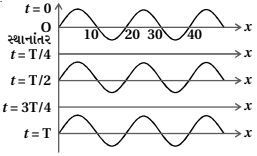
Solution
(N/A) The given figure shows a standing wave (or stationary wave) because the nodes (points with zero displacement) remain fixed at specific positions $x = 10, 20, 30, 40 \text{ cm}$ for all times $t$.
The distance between two consecutive nodes is equal to $\frac{\lambda}{2}$.
From the figure,the distance between two consecutive nodes is:
$\frac{\lambda}{2} = 20 \text{ cm} - 10 \text{ cm} = 10 \text{ cm}$.
Therefore,the wavelength $\lambda$ is:
$\lambda = 2 \times 10 \text{ cm} = 20 \text{ cm}$.
The distance between two consecutive nodes is equal to $\frac{\lambda}{2}$.
From the figure,the distance between two consecutive nodes is:
$\frac{\lambda}{2} = 20 \text{ cm} - 10 \text{ cm} = 10 \text{ cm}$.
Therefore,the wavelength $\lambda$ is:
$\lambda = 2 \times 10 \text{ cm} = 20 \text{ cm}$.
0 likes
View Solution130
Medium
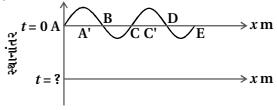
The pattern of standing waves formed on a stretched string at two instants of time is shown in the figure. The velocity of the two waves superimposing to form stationary waves is $360 \ m/s$ and their frequencies are $256 \ Hz$.
$(a)$ Calculate the time at which the second curve is plotted.
$(b)$ Mark nodes and antinodes on the curve.
$(c)$ Calculate the distance between $A^{\prime}$ and $C^{\prime}$.
$(a)$ Calculate the time at which the second curve is plotted.
$(b)$ Mark nodes and antinodes on the curve.
$(c)$ Calculate the distance between $A^{\prime}$ and $C^{\prime}$.
Solution
(N/A) Given: Velocity $v = 360 \ m/s$,Frequency $f = 256 \ Hz$.
Time period $T = \frac{1}{f} = \frac{1}{256} \approx 3.906 \times 10^{-3} \ s$.
$(a)$ At $t = 0$,the string is at its maximum displacement. The second curve (at $t = ?$) represents the string in its equilibrium position (straight line). The time taken for the string to go from maximum displacement to the equilibrium position is $\frac{T}{4}$.
$t = \frac{T}{4} = \frac{3.906 \times 10^{-3}}{4} = 9.765 \times 10^{-4} \ s$.
$(b)$ Nodes are points of zero displacement: $A, B, C, D, E$. Antinodes are points of maximum displacement: $A^{\prime}, C^{\prime}$.
$(c)$ The distance between two consecutive antinodes is equal to the wavelength $\lambda$.
$\lambda = \frac{v}{f} = \frac{360}{256} = 1.40625 \ m \approx 1.41 \ m$.
Time period $T = \frac{1}{f} = \frac{1}{256} \approx 3.906 \times 10^{-3} \ s$.
$(a)$ At $t = 0$,the string is at its maximum displacement. The second curve (at $t = ?$) represents the string in its equilibrium position (straight line). The time taken for the string to go from maximum displacement to the equilibrium position is $\frac{T}{4}$.
$t = \frac{T}{4} = \frac{3.906 \times 10^{-3}}{4} = 9.765 \times 10^{-4} \ s$.
$(b)$ Nodes are points of zero displacement: $A, B, C, D, E$. Antinodes are points of maximum displacement: $A^{\prime}, C^{\prime}$.
$(c)$ The distance between two consecutive antinodes is equal to the wavelength $\lambda$.
$\lambda = \frac{v}{f} = \frac{360}{256} = 1.40625 \ m \approx 1.41 \ m$.
0 likes
View Solution131
MediumMCQ
Two travelling waves produce a standing wave represented by the equation,
${y} = 1.0 \, \text{mm} \cos(1.57 \, \text{cm}^{-1} x) \sin(78.5 \, \text{s}^{-1} t)$
The node closest to the origin in the region ${x} > 0$ will be at ${x} = \dots \, \text{cm}$.
${y} = 1.0 \, \text{mm} \cos(1.57 \, \text{cm}^{-1} x) \sin(78.5 \, \text{s}^{-1} t)$
The node closest to the origin in the region ${x} > 0$ will be at ${x} = \dots \, \text{cm}$.
A
$3$
B
$1$
C
$5$
D
$7$
Solution
(B) For a node,the amplitude of the standing wave must be zero.
Given the equation ${y} = 1.0 \, \text{mm} \cos(1.57 \, \text{cm}^{-1} x) \sin(78.5 \, \text{s}^{-1} t)$,the spatial part is $\cos(1.57 \, \text{cm}^{-1} x)$.
Setting the spatial part to zero: $\cos(1.57 \, \text{cm}^{-1} x) = 0$.
This occurs when the argument is an odd multiple of $\frac{\pi}{2}$. For the node closest to the origin $(x > 0)$,we take the first positive value:
$1.57 \, \text{cm}^{-1} x = \frac{\pi}{2}$.
Using $\pi \approx 3.14$,we have $1.57 \approx \frac{\pi}{2}$.
Therefore,$x = \frac{\pi}{2 \times 1.57} \, \text{cm} = \frac{1.57}{1.57} \, \text{cm} = 1 \, \text{cm}$.
Given the equation ${y} = 1.0 \, \text{mm} \cos(1.57 \, \text{cm}^{-1} x) \sin(78.5 \, \text{s}^{-1} t)$,the spatial part is $\cos(1.57 \, \text{cm}^{-1} x)$.
Setting the spatial part to zero: $\cos(1.57 \, \text{cm}^{-1} x) = 0$.
This occurs when the argument is an odd multiple of $\frac{\pi}{2}$. For the node closest to the origin $(x > 0)$,we take the first positive value:
$1.57 \, \text{cm}^{-1} x = \frac{\pi}{2}$.
Using $\pi \approx 3.14$,we have $1.57 \approx \frac{\pi}{2}$.
Therefore,$x = \frac{\pi}{2 \times 1.57} \, \text{cm} = \frac{1.57}{1.57} \, \text{cm} = 1 \, \text{cm}$.
0 likes
View Solution132
MediumMCQ
Two travelling waves of equal amplitudes and equal frequencies move in opposite directions along a string. They interfere to produce a stationary wave whose equation is given by $y = (10 \cos \pi x \sin \frac{2 \pi t}{T}) \, cm$. The amplitude of the particle at $x = \frac{4}{3} \, cm$ will be ........ $cm$.
A
$4$
B
$9$
C
$6$
D
$5$
Solution
(D) The equation of a stationary wave is given by $y = A_{res} \sin \omega t$,where $A_{res}$ is the amplitude of the particle at position $x$.
Comparing the given equation $y = (10 \cos \pi x) \sin \frac{2 \pi t}{T}$ with the standard form,the amplitude at any position $x$ is $A(x) = |10 \cos \pi x|$.
Given $x = \frac{4}{3} \, cm$,we substitute this value into the expression:
$A = |10 \cos(\pi \cdot \frac{4}{3})|$
$A = |10 \cos(\frac{4 \pi}{3})|$
Since $\cos(\frac{4 \pi}{3}) = \cos(\pi + \frac{\pi}{3}) = -\cos(\frac{\pi}{3}) = -\frac{1}{2}$,
$A = |10 \cdot (-0.5)| = |-5| = 5 \, cm$.
Thus,the amplitude is $5 \, cm$.
Comparing the given equation $y = (10 \cos \pi x) \sin \frac{2 \pi t}{T}$ with the standard form,the amplitude at any position $x$ is $A(x) = |10 \cos \pi x|$.
Given $x = \frac{4}{3} \, cm$,we substitute this value into the expression:
$A = |10 \cos(\pi \cdot \frac{4}{3})|$
$A = |10 \cos(\frac{4 \pi}{3})|$
Since $\cos(\frac{4 \pi}{3}) = \cos(\pi + \frac{\pi}{3}) = -\cos(\frac{\pi}{3}) = -\frac{1}{2}$,
$A = |10 \cdot (-0.5)| = |-5| = 5 \, cm$.
Thus,the amplitude is $5 \, cm$.
0 likes
View Solution133
MediumMCQ
$A$ progressive wave travelling in the positive $x$-direction given by $y=a \cos (k x-\omega t)$ meets a denser surface at $x=0, t=0$. The reflected wave is then given by
A
$y=-a \sin (k x-\omega t)$
B
$y=a \sin (\omega t-k x)$
C
$y=-a \cos (k x+\omega t)$
D
$y=a \cos (k x-\omega t)$
Solution
(C) When a wave travelling in a medium hits a denser boundary (hard boundary),it undergoes a phase change of $\pi$ radians.
Additionally,the direction of propagation is reversed,meaning the sign of the $kx$ term changes from negative to positive.
The incident wave is $y_i = a \cos (kx - \omega t)$.
The reflected wave will have an amplitude $a$,a phase shift of $\pi$,and will travel in the negative $x$-direction.
Thus,the reflected wave is $y_r = a \cos (kx + \omega t + \pi)$.
Using the trigonometric identity $\cos(\theta + \pi) = -\cos(\theta)$,we get:
$y_r = -a \cos (kx + \omega t)$.
Additionally,the direction of propagation is reversed,meaning the sign of the $kx$ term changes from negative to positive.
The incident wave is $y_i = a \cos (kx - \omega t)$.
The reflected wave will have an amplitude $a$,a phase shift of $\pi$,and will travel in the negative $x$-direction.
Thus,the reflected wave is $y_r = a \cos (kx + \omega t + \pi)$.
Using the trigonometric identity $\cos(\theta + \pi) = -\cos(\theta)$,we get:
$y_r = -a \cos (kx + \omega t)$.
0 likes
View Solution134
MediumMCQ
$A$ suspension bridge is to be built across a valley where it is known that the wind can gust at $5 \,s$ intervals. It is estimated that the speed of transverse waves along the span of the bridge would be $400 \,m/s$. The danger of resonant motions in the bridge at its fundamental frequency would be greater if the span had a length of .......... $m$.
A
$2000$
B
$1000$
C
$400$
D
$80$
Solution
(B) The frequency of the wind gusts is given by $f = \frac{1}{T} = \frac{1}{5} = 0.2 \, Hz$.
The speed of the transverse waves along the bridge is $v = 400 \, m/s$.
The wavelength $\lambda$ of the waves produced by the wind is given by $\lambda = \frac{v}{f} = \frac{400}{0.2} = 2000 \, m$.
Resonance in a bridge (fixed at both ends) occurs at its fundamental frequency when the length of the span $L$ is equal to half the wavelength,i.e.,$L = \frac{\lambda}{2}$.
Therefore,$L = \frac{2000}{2} = 1000 \, m$.
The speed of the transverse waves along the bridge is $v = 400 \, m/s$.
The wavelength $\lambda$ of the waves produced by the wind is given by $\lambda = \frac{v}{f} = \frac{400}{0.2} = 2000 \, m$.
Resonance in a bridge (fixed at both ends) occurs at its fundamental frequency when the length of the span $L$ is equal to half the wavelength,i.e.,$L = \frac{\lambda}{2}$.
Therefore,$L = \frac{2000}{2} = 1000 \, m$.
0 likes
View Solution135
EasyMCQ
$A$ stationary wave is represented by $y = A \sin(100t) \cos(0.01x)$,where $y$ and $A$ are in millimetres,$t$ is in seconds,and $x$ is in metres. The velocity of the constituent wave is ........... $m/s$.
A
$10^4$
B
Not derivable
C
$1$
D
$10^2$
Solution
(A) The equation of a stationary wave is given by $y = A \sin(\omega t) \cos(kx)$.
Comparing this with the given equation $y = A \sin(100t) \cos(0.01x)$,we get:
Angular frequency $\omega = 100 \, rad/s$.
Wave number $k = 0.01 \, m^{-1}$.
The velocity $v$ of the constituent traveling waves is given by the ratio of angular frequency to wave number:
$v = \frac{\omega}{k}$
$v = \frac{100}{0.01}$
$v = 10000 \, m/s = 10^4 \, m/s$.
Therefore,the correct option is $A$.
Comparing this with the given equation $y = A \sin(100t) \cos(0.01x)$,we get:
Angular frequency $\omega = 100 \, rad/s$.
Wave number $k = 0.01 \, m^{-1}$.
The velocity $v$ of the constituent traveling waves is given by the ratio of angular frequency to wave number:
$v = \frac{\omega}{k}$
$v = \frac{100}{0.01}$
$v = 10000 \, m/s = 10^4 \, m/s$.
Therefore,the correct option is $A$.
0 likes
View Solution136
EasyMCQ
Standing waves are produced in a $10 \, m$ long stretched string fixed at both ends. If the string vibrates in $5$ segments and the wave velocity is $20 \, m/s$,the frequency is ....... $Hz$.
A
$5$
B
$10$
C
$2$
D
$4$
Solution
(A) The length of the string is $L = 10 \, m$.
The wave velocity is $v = 20 \, m/s$.
The string vibrates in $n = 5$ segments,which corresponds to the $5^{\text{th}}$ harmonic.
The frequency of the $n^{\text{th}}$ harmonic for a string fixed at both ends is given by $f_n = \frac{n v}{2L}$.
Substituting the given values: $f_5 = \frac{5 \times 20}{2 \times 10}$.
$f_5 = \frac{100}{20} = 5 \, Hz$.
Therefore,the frequency is $5 \, Hz$.
The wave velocity is $v = 20 \, m/s$.
The string vibrates in $n = 5$ segments,which corresponds to the $5^{\text{th}}$ harmonic.
The frequency of the $n^{\text{th}}$ harmonic for a string fixed at both ends is given by $f_n = \frac{n v}{2L}$.
Substituting the given values: $f_5 = \frac{5 \times 20}{2 \times 10}$.
$f_5 = \frac{100}{20} = 5 \, Hz$.
Therefore,the frequency is $5 \, Hz$.
0 likes
View Solution137
MediumMCQ
The standing wave in a medium is expressed as $y = 0.2 \sin(0.8 x) \cos(3000 t) \, m$. The distance between any two consecutive points of minimum or maximum displacement is
A
$\frac{\pi}{2} \, m$
B
$\frac{\pi}{4} \, m$
C
$\frac{\pi}{6} \, m$
D
None of these
Solution
(D) The given equation of the standing wave is $y = 0.2 \sin(0.8 x) \cos(3000 t) \, m$.
Comparing this with the standard equation $y = A \sin(kx) \cos(\omega t)$,we get the wave number $k = 0.8 \, rad/m$.
The relationship between wave number $k$ and wavelength $\lambda$ is $k = \frac{2\pi}{\lambda}$.
Thus,$\lambda = \frac{2\pi}{k} = \frac{2\pi}{0.8} = \frac{20\pi}{8} = 2.5\pi \, m$.
The distance between two consecutive points of minimum displacement (nodes) or maximum displacement (antinodes) is given by $\frac{\lambda}{2}$.
Distance $= \frac{\lambda}{2} = \frac{2.5\pi}{2} = 1.25\pi \, m = \frac{5\pi}{4} \, m$.
Since $\frac{5\pi}{4} \, m$ is not among the given options,the correct choice is $(d)$.
Comparing this with the standard equation $y = A \sin(kx) \cos(\omega t)$,we get the wave number $k = 0.8 \, rad/m$.
The relationship between wave number $k$ and wavelength $\lambda$ is $k = \frac{2\pi}{\lambda}$.
Thus,$\lambda = \frac{2\pi}{k} = \frac{2\pi}{0.8} = \frac{20\pi}{8} = 2.5\pi \, m$.
The distance between two consecutive points of minimum displacement (nodes) or maximum displacement (antinodes) is given by $\frac{\lambda}{2}$.
Distance $= \frac{\lambda}{2} = \frac{2.5\pi}{2} = 1.25\pi \, m = \frac{5\pi}{4} \, m$.
Since $\frac{5\pi}{4} \, m$ is not among the given options,the correct choice is $(d)$.
0 likes
View Solution138
MediumMCQ
The equation of a standing wave in a string fixed at both ends is given as $y = 2A \sin kx \cos \omega t$. The amplitude and frequency of a particle vibrating at the midpoint between an antinode and a node are respectively:
A
$A, \frac{\omega}{2\pi}$
B
$\frac{A}{\sqrt{2}}, \frac{\omega}{2\pi}$
C
$A, \frac{\omega}{\pi}$
D
$\sqrt{2}A, \frac{\omega}{2\pi}$
Solution
(D) The equation of the standing wave is $y = 2A \sin kx \cos \omega t$.
The amplitude of a particle at position $x$ is given by $A_p = |2A \sin kx|$.
$A$ node occurs where $\sin kx = 0$ (e.g.,$x = 0$),and an antinode occurs where $\sin kx = 1$ (e.g.,$x = \frac{\lambda}{4}$).
The midpoint between a node $(x = 0)$ and an antinode $(x = \frac{\lambda}{4})$ is $x = \frac{\lambda}{8}$.
Substituting $x = \frac{\lambda}{8}$ and $k = \frac{2\pi}{\lambda}$ into the amplitude expression:
$A_p = 2A \sin \left( \frac{2\pi}{\lambda} \cdot \frac{\lambda}{8} \right) = 2A \sin \left( \frac{\pi}{4} \right) = 2A \cdot \frac{1}{\sqrt{2}} = \sqrt{2}A$.
The frequency of vibration for all particles in a standing wave is the same as the frequency of the wave,which is $f = \frac{\omega}{2\pi}$.
Thus,the amplitude is $\sqrt{2}A$ and the frequency is $\frac{\omega}{2\pi}$.
The amplitude of a particle at position $x$ is given by $A_p = |2A \sin kx|$.
$A$ node occurs where $\sin kx = 0$ (e.g.,$x = 0$),and an antinode occurs where $\sin kx = 1$ (e.g.,$x = \frac{\lambda}{4}$).
The midpoint between a node $(x = 0)$ and an antinode $(x = \frac{\lambda}{4})$ is $x = \frac{\lambda}{8}$.
Substituting $x = \frac{\lambda}{8}$ and $k = \frac{2\pi}{\lambda}$ into the amplitude expression:
$A_p = 2A \sin \left( \frac{2\pi}{\lambda} \cdot \frac{\lambda}{8} \right) = 2A \sin \left( \frac{\pi}{4} \right) = 2A \cdot \frac{1}{\sqrt{2}} = \sqrt{2}A$.
The frequency of vibration for all particles in a standing wave is the same as the frequency of the wave,which is $f = \frac{\omega}{2\pi}$.
Thus,the amplitude is $\sqrt{2}A$ and the frequency is $\frac{\omega}{2\pi}$.
0 likes
View Solution139
EasyMCQ
In a standing wave,all particles of the medium cross the mean position with
A
Different speeds at different instants
B
Different speeds at same instant
C
Same speed at different instants
D
Same speed at same instant
Solution
(B) In a standing wave,all particles of the medium between two consecutive nodes vibrate in phase.
This means they all pass through their respective mean positions at the same instant of time.
The displacement of a particle in a standing wave is given by $y = A(x) \sin(\omega t + \phi)$,where $A(x)$ is the amplitude which depends on the position $x$.
The velocity of a particle is given by $v = \frac{dy}{dt} = A(x) \omega \cos(\omega t + \phi)$.
At the mean position,$\sin(\omega t + \phi) = 0$,which implies $\cos(\omega t + \phi) = \pm 1$.
Thus,the speed at the mean position is $|v| = A(x) \omega$.
Since the amplitude $A(x)$ varies with the position $x$,the particles have different speeds at the same instant when they cross the mean position.
This means they all pass through their respective mean positions at the same instant of time.
The displacement of a particle in a standing wave is given by $y = A(x) \sin(\omega t + \phi)$,where $A(x)$ is the amplitude which depends on the position $x$.
The velocity of a particle is given by $v = \frac{dy}{dt} = A(x) \omega \cos(\omega t + \phi)$.
At the mean position,$\sin(\omega t + \phi) = 0$,which implies $\cos(\omega t + \phi) = \pm 1$.
Thus,the speed at the mean position is $|v| = A(x) \omega$.
Since the amplitude $A(x)$ varies with the position $x$,the particles have different speeds at the same instant when they cross the mean position.
0 likes
View Solution140
MediumMCQ
If in a stationary wave the amplitude corresponding to an antinode is $4 \,cm$,then the amplitude corresponding to a particle of medium located exactly midway between a node and an antinode is ........... $cm$.
A
$2$
B
$2 \sqrt{2}$
C
$\sqrt{2}$
D
$1.5$
Solution
(B) The equation of a stationary wave is given by $y = A_0 \sin(kx) \cos(\omega t)$,where $A_0$ is the amplitude of the antinode.
Given,$A_0 = 4 \,cm$.
The position of a node is where $\sin(kx) = 0$,and the position of an antinode is where $\sin(kx) = 1$.
The distance between a node and an adjacent antinode is $\frac{\lambda}{4}$.
The particle located midway between a node and an antinode is at a distance $x = \frac{1}{2} \times \frac{\lambda}{4} = \frac{\lambda}{8}$ from the node.
The amplitude $A$ of a particle at position $x$ is given by $A = A_0 \sin(kx)$.
Substituting $k = \frac{2\pi}{\lambda}$ and $x = \frac{\lambda}{8}$:
$A = 4 \sin\left(\frac{2\pi}{\lambda} \times \frac{\lambda}{8}\right) = 4 \sin\left(\frac{\pi}{4}\right)$.
Since $\sin\left(\frac{\pi}{4}\right) = \frac{1}{\sqrt{2}}$,we get $A = 4 \times \frac{1}{\sqrt{2}} = 2\sqrt{2} \,cm$.
Given,$A_0 = 4 \,cm$.
The position of a node is where $\sin(kx) = 0$,and the position of an antinode is where $\sin(kx) = 1$.
The distance between a node and an adjacent antinode is $\frac{\lambda}{4}$.
The particle located midway between a node and an antinode is at a distance $x = \frac{1}{2} \times \frac{\lambda}{4} = \frac{\lambda}{8}$ from the node.
The amplitude $A$ of a particle at position $x$ is given by $A = A_0 \sin(kx)$.
Substituting $k = \frac{2\pi}{\lambda}$ and $x = \frac{\lambda}{8}$:
$A = 4 \sin\left(\frac{2\pi}{\lambda} \times \frac{\lambda}{8}\right) = 4 \sin\left(\frac{\pi}{4}\right)$.
Since $\sin\left(\frac{\pi}{4}\right) = \frac{1}{\sqrt{2}}$,we get $A = 4 \times \frac{1}{\sqrt{2}} = 2\sqrt{2} \,cm$.
0 likes
View Solution141
DifficultMCQ
$A$ $20 \ cm$ long string,having a mass of $1.0 \ g$,is fixed at both the ends. The tension in the string is $0.5 \ N$. The string is set into vibrations using an external vibrator of frequency $100 \ Hz$. Find the separation (in $cm$) between the successive nodes on the string.
A
$5$
B
$6$
C
$7$
D
$8$
Solution
(A) The velocity of a wave in a string is given by $v = \sqrt{\frac{T}{\mu}}$,where $T$ is the tension in the string and $\mu$ is the mass per unit length of the string.
Given: $T = 0.5 \ N$,mass $m = 1.0 \ g = 1.0 \times 10^{-3} \ kg$,and length $L = 20 \ cm = 0.2 \ m$.
The linear mass density $\mu = \frac{m}{L} = \frac{1.0 \times 10^{-3} \ kg}{0.2 \ m} = 0.5 \times 10^{-2} \ kg/m$.
Substituting these values into the velocity formula:
$v = \sqrt{\frac{0.5}{0.5 \times 10^{-2}}} = \sqrt{100} = 10 \ m/s$.
The wavelength $\lambda$ is given by $\lambda = \frac{v}{f}$,where $f = 100 \ Hz$.
$\lambda = \frac{10 \ m/s}{100 \ Hz} = 0.1 \ m = 10 \ cm$.
The separation between successive nodes in a stationary wave is $\frac{\lambda}{2}$.
Therefore,the separation $= \frac{10 \ cm}{2} = 5 \ cm$.
Given: $T = 0.5 \ N$,mass $m = 1.0 \ g = 1.0 \times 10^{-3} \ kg$,and length $L = 20 \ cm = 0.2 \ m$.
The linear mass density $\mu = \frac{m}{L} = \frac{1.0 \times 10^{-3} \ kg}{0.2 \ m} = 0.5 \times 10^{-2} \ kg/m$.
Substituting these values into the velocity formula:
$v = \sqrt{\frac{0.5}{0.5 \times 10^{-2}}} = \sqrt{100} = 10 \ m/s$.
The wavelength $\lambda$ is given by $\lambda = \frac{v}{f}$,where $f = 100 \ Hz$.
$\lambda = \frac{10 \ m/s}{100 \ Hz} = 0.1 \ m = 10 \ cm$.
The separation between successive nodes in a stationary wave is $\frac{\lambda}{2}$.
Therefore,the separation $= \frac{10 \ cm}{2} = 5 \ cm$.
0 likes
View Solution142
AdvancedMCQ
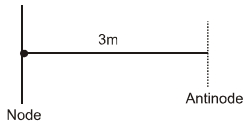
One end of a taut string of length $3 \ m$ along the $x$-axis is fixed at $x=0$. The speed of the waves in the string is $100 \ m/s$. The other end of the string is vibrating in the $y$-direction so that stationary waves are set up in the string. The possible waveform$(s)$ of these stationary waves is (are):
$(A)$ $y(x,t) = A \sin \frac{\pi x}{6} \cos \frac{50 \pi t}{3}$
$(B)$ $y(x,t) = A \sin \frac{\pi x}{3} \cos \frac{100 \pi t}{3}$
$(C)$ $y(x,t) = A \sin \frac{5 \pi x}{6} \cos \frac{250 \pi t}{3}$
$(D)$ $y(x,t) = A \sin \frac{5 \pi x}{2} \cos 250 \pi t$
$(A)$ $y(x,t) = A \sin \frac{\pi x}{6} \cos \frac{50 \pi t}{3}$
$(B)$ $y(x,t) = A \sin \frac{\pi x}{3} \cos \frac{100 \pi t}{3}$
$(C)$ $y(x,t) = A \sin \frac{5 \pi x}{6} \cos \frac{250 \pi t}{3}$
$(D)$ $y(x,t) = A \sin \frac{5 \pi x}{2} \cos 250 \pi t$
A
$(A, B, C)$
B
$(A, B, D)$
C
$(A, C, D)$
D
$(B, C, D)$
Solution
(C) Given: Length of string $L = 3 \ m$,wave speed $v = 100 \ m/s$.
The string is fixed at $x=0$ (node) and the other end at $x=3 \ m$ is vibrating (antinode).
For a string fixed at one end and free at the other,the possible wavelengths are given by $L = (2n+1) \frac{\lambda}{4}$,where $n = 0, 1, 2, ...$.
Thus,$\lambda = \frac{4L}{2n+1} = \frac{12}{2n+1} \ m$.
The wave number is $k = \frac{2\pi}{\lambda} = \frac{(2n+1)\pi}{6}$.
The angular frequency is $\omega = vk = 100 \times \frac{(2n+1)\pi}{6} = \frac{(2n+1)50\pi}{3}$.
For $n=0$: $k = \frac{\pi}{6}$,$\omega = \frac{50\pi}{3}$. This matches option $(A)$.
For $n=1$: $k = \frac{3\pi}{6} = \frac{\pi}{2}$ (Not in options).
For $n=2$: $k = \frac{5\pi}{6}$,$\omega = \frac{250\pi}{3}$. This matches option $(C)$.
For $n=7$: $k = \frac{15\pi}{6} = \frac{5\pi}{2}$,$\omega = \frac{15 \times 50\pi}{3} = 250\pi$. This matches option $(D)$.
Therefore,options $(A)$,$(C)$,and $(D)$ are correct.
The string is fixed at $x=0$ (node) and the other end at $x=3 \ m$ is vibrating (antinode).
For a string fixed at one end and free at the other,the possible wavelengths are given by $L = (2n+1) \frac{\lambda}{4}$,where $n = 0, 1, 2, ...$.
Thus,$\lambda = \frac{4L}{2n+1} = \frac{12}{2n+1} \ m$.
The wave number is $k = \frac{2\pi}{\lambda} = \frac{(2n+1)\pi}{6}$.
The angular frequency is $\omega = vk = 100 \times \frac{(2n+1)\pi}{6} = \frac{(2n+1)50\pi}{3}$.
For $n=0$: $k = \frac{\pi}{6}$,$\omega = \frac{50\pi}{3}$. This matches option $(A)$.
For $n=1$: $k = \frac{3\pi}{6} = \frac{\pi}{2}$ (Not in options).
For $n=2$: $k = \frac{5\pi}{6}$,$\omega = \frac{250\pi}{3}$. This matches option $(C)$.
For $n=7$: $k = \frac{15\pi}{6} = \frac{5\pi}{2}$,$\omega = \frac{15 \times 50\pi}{3} = 250\pi$. This matches option $(D)$.
Therefore,options $(A)$,$(C)$,and $(D)$ are correct.
0 likes
View Solution143
MediumMCQ
In a standing wave on a string $:-$
A
In one time period all the particles are simultaneously at rest once.
B
All the particles must be at their positive extremes once in a time period.
C
All the particles may be at their positive extremes simultaneously once in a time period.
D
All the particles are never at rest simultaneously.
Solution
(A) In a standing wave, the displacement of a particle at position $x$ is given by $y(x, t) = 2A \sin(kx) \cos(\omega t)$.
All particles pass through their mean position simultaneously at $t = \frac{T}{4}, \frac{3T}{4}, ...$ and are at rest at their extreme positions simultaneously at $t = 0, \frac{T}{2}, T, ...$.
Thus, all particles are at rest simultaneously twice in one time period.
However, particles in adjacent loops are in opposite phases. If particles in the first loop $(0 < x < \frac{\lambda}{2})$ are at their positive extreme, particles in the next loop $(\frac{\lambda}{2} < x < \lambda)$ are at their negative extreme.
Therefore, all particles can never be at their positive extremes simultaneously.
All particles pass through their mean position simultaneously at $t = \frac{T}{4}, \frac{3T}{4}, ...$ and are at rest at their extreme positions simultaneously at $t = 0, \frac{T}{2}, T, ...$.
Thus, all particles are at rest simultaneously twice in one time period.
However, particles in adjacent loops are in opposite phases. If particles in the first loop $(0 < x < \frac{\lambda}{2})$ are at their positive extreme, particles in the next loop $(\frac{\lambda}{2} < x < \lambda)$ are at their negative extreme.
Therefore, all particles can never be at their positive extremes simultaneously.
0 likes
View Solution144
MediumMCQ
The displacement of a string is given by,
$y(x, t) = 10 \sin \left(\frac{2 \pi}{3} x\right) \cos (120 \pi t)$
where $x$ and $y$ are in $m$ and $t$ is in $sec$. The length of the string is $1.5 \ m$ and its mass is $3 \times 10^{-2} \ kg$.
Select the correct statement$(s)$ below:
$(A)$ It represents a progressive wave of frequency $60 \ Hz$.
$(B)$ It represents a standing wave of frequency $60 \ Hz$.
$(C)$ It is the result of two waves of wavelength $3 \ m$,frequency $60 \ Hz$ each travelling with a speed of $180 \ m/s$ in opposite directions.
$(D)$ Reflection occurs from a free end.
$y(x, t) = 10 \sin \left(\frac{2 \pi}{3} x\right) \cos (120 \pi t)$
where $x$ and $y$ are in $m$ and $t$ is in $sec$. The length of the string is $1.5 \ m$ and its mass is $3 \times 10^{-2} \ kg$.
Select the correct statement$(s)$ below:
$(A)$ It represents a progressive wave of frequency $60 \ Hz$.
$(B)$ It represents a standing wave of frequency $60 \ Hz$.
$(C)$ It is the result of two waves of wavelength $3 \ m$,frequency $60 \ Hz$ each travelling with a speed of $180 \ m/s$ in opposite directions.
$(D)$ Reflection occurs from a free end.
A
Only $A$
B
$B$ and $D$
C
Only $C$
D
$B$ and $C$
Solution
(D) The given equation $y(x, t) = 10 \sin \left(\frac{2 \pi}{3} x\right) \cos (120 \pi t)$ is of the form $y(x, t) = 2A \sin(kx) \cos(\omega t)$,which represents a standing (stationary) wave.
Comparing the given equation with the standard form,we get $k = \frac{2 \pi}{3}$ and $\omega = 120 \pi$.
The frequency of the standing wave is $f = \frac{\omega}{2 \pi} = \frac{120 \pi}{2 \pi} = 60 \ Hz$. Thus,statement $(B)$ is correct.
$A$ standing wave is formed by the superposition of two waves of the same frequency and wavelength travelling in opposite directions.
The wavelength is $\lambda = \frac{2 \pi}{k} = \frac{2 \pi}{2 \pi / 3} = 3 \ m$.
The wave speed is $v = \frac{\omega}{k} = \frac{120 \pi}{2 \pi / 3} = 180 \ m/s$. Thus,statement $(C)$ is correct.
Since the string length is $L = 1.5 \ m$ and $\lambda = 3 \ m$,we have $L = \frac{\lambda}{2}$. This corresponds to the fundamental mode of a string fixed at both ends. Therefore,reflection occurs from a fixed end,not a free end. Statement $(D)$ is incorrect.
Hence,statements $(B)$ and $(C)$ are correct.
Comparing the given equation with the standard form,we get $k = \frac{2 \pi}{3}$ and $\omega = 120 \pi$.
The frequency of the standing wave is $f = \frac{\omega}{2 \pi} = \frac{120 \pi}{2 \pi} = 60 \ Hz$. Thus,statement $(B)$ is correct.
$A$ standing wave is formed by the superposition of two waves of the same frequency and wavelength travelling in opposite directions.
The wavelength is $\lambda = \frac{2 \pi}{k} = \frac{2 \pi}{2 \pi / 3} = 3 \ m$.
The wave speed is $v = \frac{\omega}{k} = \frac{120 \pi}{2 \pi / 3} = 180 \ m/s$. Thus,statement $(C)$ is correct.
Since the string length is $L = 1.5 \ m$ and $\lambda = 3 \ m$,we have $L = \frac{\lambda}{2}$. This corresponds to the fundamental mode of a string fixed at both ends. Therefore,reflection occurs from a fixed end,not a free end. Statement $(D)$ is incorrect.
Hence,statements $(B)$ and $(C)$ are correct.
0 likes
View Solution145
MediumMCQ
$A$ standing wave having $3$ nodes and $2$ antinodes is formed between two atoms having a distance of $1.21 \ Å$ between them. The wavelength of the standing wave is (in $Å$)
A
$1.21$
B
$1.42$
C
$6.05$
D
$3.63$
Solution
(A) Key Idea: The standing wave has $3$ nodes $(N)$ and $2$ antinodes $(A)$,which means it consists of $2$ loops or segments.
The distance between two consecutive nodes is $\frac{\lambda}{2}$.
Since there are $3$ nodes,there are $2$ such segments between the two atoms.
The total length $L$ of the standing wave is the sum of the lengths of these $2$ segments:
$L = 2 \times \left( \frac{\lambda}{2} \right) = \lambda$
Given that the distance between the two atoms is $1.21 \ Å$,we have:
$L = 1.21 \ Å$
Therefore,$\lambda = 1.21 \ Å$.
The distance between two consecutive nodes is $\frac{\lambda}{2}$.
Since there are $3$ nodes,there are $2$ such segments between the two atoms.
The total length $L$ of the standing wave is the sum of the lengths of these $2$ segments:
$L = 2 \times \left( \frac{\lambda}{2} \right) = \lambda$
Given that the distance between the two atoms is $1.21 \ Å$,we have:
$L = 1.21 \ Å$
Therefore,$\lambda = 1.21 \ Å$.

0 likes
View Solution146
MediumMCQ
$A$ pulse of a wave train travels along a stretched string and reaches the fixed end of the string. It will be reflected back with
A
a phase change of $180^{\circ}$ with velocity reversed
B
the same phase as the incident pulse with no reversal of velocity
C
a phase change of $180^{\circ}$ with no reversal of velocity
D
the same phase as the incident pulse but with velocity reversed
Solution
(A) When a pulse of a wave train travels along a stretched string and reaches a fixed end,it undergoes reflection.
According to the boundary conditions for a fixed end,the displacement at the boundary must be zero at all times.
This results in a phase change of $\pi$ $(180^{\circ})$ for the reflected pulse compared to the incident pulse.
However,the velocity of the wave after reflection is reversed in direction,but the magnitude remains the same.
Therefore,the pulse is reflected back with a phase change of $180^{\circ}$ and its velocity is reversed.
According to the boundary conditions for a fixed end,the displacement at the boundary must be zero at all times.
This results in a phase change of $\pi$ $(180^{\circ})$ for the reflected pulse compared to the incident pulse.
However,the velocity of the wave after reflection is reversed in direction,but the magnitude remains the same.
Therefore,the pulse is reflected back with a phase change of $180^{\circ}$ and its velocity is reversed.
0 likes
View Solution147
MediumMCQ
$A$ transverse displacement of a vibrating string is given by $y = 0.06 \sin \left( \frac{2 \pi}{3} x \right) \cos (120 \pi t)$. If the mass per unit length of the string is $4 \times 10^{-2} \ kg/m$,then the tension in the string will be: (in $N$)
A
$1296$
B
$1000$
C
$720$
D
$500$
Solution
(A) The given equation of the standing wave is $y = 0.06 \sin \left( \frac{2 \pi}{3} x \right) \cos (120 \pi t)$.
Comparing this with the standard equation $y = A \sin(kx) \cos(\omega t)$,we get the wave number $k = \frac{2 \pi}{3} \ m^{-1}$ and the angular frequency $\omega = 120 \pi \ rad/s$.
The wave speed $v$ is given by $v = \frac{\omega}{k} = \frac{120 \pi}{2 \pi / 3} = 120 \pi \times \frac{3}{2 \pi} = 180 \ m/s$.
The wave speed in a stretched string is given by $v = \sqrt{\frac{T}{\mu}}$,where $T$ is the tension and $\mu$ is the mass per unit length.
Given $\mu = 4 \times 10^{-2} \ kg/m$,we have $180 = \sqrt{\frac{T}{4 \times 10^{-2}}}$.
Squaring both sides: $180^2 = \frac{T}{4 \times 10^{-2}}$.
$32400 = \frac{T}{0.04}$.
$T = 32400 \times 0.04 = 1296 \ N$.
Comparing this with the standard equation $y = A \sin(kx) \cos(\omega t)$,we get the wave number $k = \frac{2 \pi}{3} \ m^{-1}$ and the angular frequency $\omega = 120 \pi \ rad/s$.
The wave speed $v$ is given by $v = \frac{\omega}{k} = \frac{120 \pi}{2 \pi / 3} = 120 \pi \times \frac{3}{2 \pi} = 180 \ m/s$.
The wave speed in a stretched string is given by $v = \sqrt{\frac{T}{\mu}}$,where $T$ is the tension and $\mu$ is the mass per unit length.
Given $\mu = 4 \times 10^{-2} \ kg/m$,we have $180 = \sqrt{\frac{T}{4 \times 10^{-2}}}$.
Squaring both sides: $180^2 = \frac{T}{4 \times 10^{-2}}$.
$32400 = \frac{T}{0.04}$.
$T = 32400 \times 0.04 = 1296 \ N$.
0 likes
View Solution148
MediumMCQ
$A$ string fixed at both the ends forms a standing wave with a node separation of $5 \,cm$. If the velocity of the wave on the string is $2 \,m/s$, then the frequency of vibration of the string is (in $\,Hz$)
A
$0.2$
B
$10$
C
$20$
D
$40$
Solution
(C) The separation between two consecutive nodes in a standing wave is given by $\frac{\lambda}{2}$.
Given, $\frac{\lambda}{2} = 5 \,cm = 0.05 \,m$.
Therefore, the wavelength $\lambda = 2 \times 0.05 \,m = 0.1 \,m$.
The frequency of vibration $f$ is related to the wave velocity $v$ and wavelength $\lambda$ by the formula $f = \frac{v}{\lambda}$.
Substituting the given values, $f = \frac{2 \,m/s}{0.1 \,m} = 20 \,Hz$.
Given, $\frac{\lambda}{2} = 5 \,cm = 0.05 \,m$.
Therefore, the wavelength $\lambda = 2 \times 0.05 \,m = 0.1 \,m$.
The frequency of vibration $f$ is related to the wave velocity $v$ and wavelength $\lambda$ by the formula $f = \frac{v}{\lambda}$.
Substituting the given values, $f = \frac{2 \,m/s}{0.1 \,m} = 20 \,Hz$.
0 likes
View Solution149
EasyMCQ
$A$ transverse wave strikes against a rigid wall. What happens to its phase and velocity?
A
Its phase changes by $180^{\circ}$,but velocity does not change.
B
Its phase does not change,but velocity changes.
C
Its velocity changes and phase changes by $180^{\circ}$.
D
Nothing can be predicted about changes in its velocity and phase.
Solution
(A) When a transverse wave strikes a rigid wall,it undergoes reflection. According to the boundary conditions for a rigid support,the wave experiences a phase reversal of $180^{\circ}$ (or $\pi$ radians). Since the medium remains the same,the speed of the wave does not change,although the direction of propagation is reversed. Therefore,the phase changes by $180^{\circ}$,but the magnitude of the velocity remains the same.
0 likes
View Solution150
EasyMCQ
$A$ stretched string fixed at both ends has $m$ nodes,then the length of the string will be
A
$(m-1) \frac{\lambda}{2}$
B
$\frac{(m+1) \lambda}{2}$
C
$\frac{m \lambda}{2}$
D
$(m-2) \frac{\lambda}{2}$
Solution
(A) For a stretched string fixed at both ends,the length $l$ is given by $l = \frac{p \lambda}{2}$,where $p$ is the number of loops (or segments).
In a standing wave on a string fixed at both ends,the number of loops $p$ is equal to the number of anti-nodes.
The relationship between the number of nodes $m$ and the number of anti-nodes $p$ is given by $m = p + 1$.
Therefore,the number of loops is $p = m - 1$.
Substituting this value of $p$ into the length formula,we get $l = \frac{(m-1) \lambda}{2}$.
In a standing wave on a string fixed at both ends,the number of loops $p$ is equal to the number of anti-nodes.
The relationship between the number of nodes $m$ and the number of anti-nodes $p$ is given by $m = p + 1$.
Therefore,the number of loops is $p = m - 1$.
Substituting this value of $p$ into the length formula,we get $l = \frac{(m-1) \lambda}{2}$.
0 likes
View SolutionWaves and Sound — Stationary Waves (Standing wave) · Frequently Asked Questions
1Are these Waves and Sound questions useful for JEE and NEET?
Yes. All questions in this section are mapped to JEE Main and NEET exam patterns. Previous year questions from JEE Main, NEET, GUJCET and state-level exams are included with full solutions.
2Can I switch to Hindi or Gujarati for these questions?
Yes. Use the language tabs in the hero section or the sidebar to view the same questions and solutions in English, Hindi or Gujarati.
3How do I generate a question paper from this subtopic?
Use the Vedclass Exam Paper Generator — select the chapter and subtopic, set difficulty, and generate Sets A, B, C, D automatically. First 3 chapters of every subject are free.
Vedclass Products
For Students
Vedclass Test Series
Mock tests in real JEE/NEET style with performance analysis. 5-day free trial.
Start Free TrialFor Teachers
Exam Paper Generator
Generate Set A/B/C/D papers from this chapter in 2 minutes. 3 chapters free.
Try FreeFor Institutes
Online Exam Module
Live online exams with unlimited students, 360° analytics & white-label branding.
See DemoFor Teachers & Institutes
Generate a Waves and Sound Exam Paper in 2 Minutes
Select subtopic & difficulty — Sets A, B, C, D auto-generated with No Repeat logic.
First 3 chapters of every subject are free — no payment required.