
A English
Stationary Waves (Standing wave) Questions in English
Class 11 Physics · Waves and Sound · Stationary Waves (Standing wave)
189+
Questions
English
Language
100%
With Solutions
Showing 37 of 189 questions in English
151
EasyMCQ
$A$ string is vibrating in its fifth overtone between two rigid supports $2.4 \ m$ apart. The distance between successive node and antinode is (in $m$)
A
$0.1$
B
$0.2$
C
$0.6$
D
$0.8$
Solution
(B) For a string fixed at both ends,the $n^{th}$ overtone corresponds to the $(n+1)^{th}$ harmonic.
Here,the fifth overtone is the sixth harmonic $(n=6)$.
The length of the string $L = 2.4 \ m$.
The condition for the $n^{th}$ harmonic is $L = n \frac{\lambda}{2}$.
Substituting the values: $2.4 = 6 \times \frac{\lambda}{2}$.
This gives $\frac{\lambda}{2} = \frac{2.4}{6} = 0.4 \ m$.
Thus,$\lambda = 0.8 \ m$.
The distance between a node and the successive antinode is always $\frac{\lambda}{4}$.
Therefore,distance $= \frac{0.8 \ m}{4} = 0.2 \ m$.
Here,the fifth overtone is the sixth harmonic $(n=6)$.
The length of the string $L = 2.4 \ m$.
The condition for the $n^{th}$ harmonic is $L = n \frac{\lambda}{2}$.
Substituting the values: $2.4 = 6 \times \frac{\lambda}{2}$.
This gives $\frac{\lambda}{2} = \frac{2.4}{6} = 0.4 \ m$.
Thus,$\lambda = 0.8 \ m$.
The distance between a node and the successive antinode is always $\frac{\lambda}{4}$.
Therefore,distance $= \frac{0.8 \ m}{4} = 0.2 \ m$.
0 likes
View Solution152
MediumMCQ
$A$ wave travelling along a uniform string represented by $Y=A \sin (\omega t-k x)$ is superimposed on another wave travelling along the same string represented by $Y=A \sin (\omega t+k x)$. The resultant is
A
$A$ wave travelling along $+x$ direction.
B
$A$ standing wave having nodes at $x=\left(n+\frac{1}{2}\right) \frac{\lambda}{2}$,where $n=0, 1, 2, 3, \ldots$
C
$A$ wave travelling along $-x$ direction.
D
$A$ standing wave having nodes at $x=\frac{n \lambda}{2}$,where $n=0, 1, 2, 3, \ldots$
Solution
(B) The resultant wave is formed by the superposition of two waves travelling in opposite directions: $Y_1 = A \sin(\omega t - kx)$ and $Y_2 = A \sin(\omega t + kx)$.
Using the trigonometric identity $\sin(C) + \sin(D) = 2 \sin(\frac{C+D}{2}) \cos(\frac{C-D}{2})$,we get:
$Y = Y_1 + Y_2 = 2A \sin(\omega t) \cos(kx)$.
This represents a standing wave.
Nodes occur where the amplitude is zero,i.e.,$\cos(kx) = 0$.
This implies $kx = (2n+1) \frac{\pi}{2}$ for $n = 0, 1, 2, \ldots$.
Substituting $k = \frac{2\pi}{\lambda}$,we get $\frac{2\pi}{\lambda} x = (2n+1) \frac{\pi}{2}$.
Solving for $x$,we find $x = (n + \frac{1}{2}) \frac{\lambda}{2}$.
Using the trigonometric identity $\sin(C) + \sin(D) = 2 \sin(\frac{C+D}{2}) \cos(\frac{C-D}{2})$,we get:
$Y = Y_1 + Y_2 = 2A \sin(\omega t) \cos(kx)$.
This represents a standing wave.
Nodes occur where the amplitude is zero,i.e.,$\cos(kx) = 0$.
This implies $kx = (2n+1) \frac{\pi}{2}$ for $n = 0, 1, 2, \ldots$.
Substituting $k = \frac{2\pi}{\lambda}$,we get $\frac{2\pi}{\lambda} x = (2n+1) \frac{\pi}{2}$.
Solving for $x$,we find $x = (n + \frac{1}{2}) \frac{\lambda}{2}$.
0 likes
View Solution153
MediumMCQ
Two progressive waves $Y_{1} = \sin 2\pi(\frac{t}{0.4} - \frac{x}{4})$ and $Y_{2} = \sin 2\pi(\frac{t}{0.4} + \frac{x}{4})$ superpose to form a standing wave. $x, Y_{1}$ and $Y_{2}$ are in $SI$ units. The amplitude of the particle at $x = 0.5 \ m$ is: (Given: $\sin 45^{\circ} = \cos 45^{\circ} = \frac{1}{\sqrt{2}}$)
A
$2\sqrt{2} \ m$
B
$2 \ m$
C
$\sqrt{2} \ m$
D
$\frac{1}{\sqrt{2}} \ m$
Solution
(C) The given progressive waves are $Y_{1} = \sin 2\pi(\frac{t}{0.4} - \frac{x}{4})$ and $Y_{2} = \sin 2\pi(\frac{t}{0.4} + \frac{x}{4})$.
Comparing these with the standard wave equation $Y = A \sin 2\pi(\frac{t}{T} \pm \frac{x}{\lambda})$,we get the wavelength $\lambda = 4 \ m$ and time period $T = 0.4 \ s$.
When two waves of equal amplitude and frequency traveling in opposite directions superpose,they form a standing wave given by $Y = Y_{1} + Y_{2} = 2A \cos(\frac{2\pi x}{\lambda}) \sin(\frac{2\pi t}{T})$.
Here,the amplitude of the standing wave at any position $x$ is given by $A_{res} = |2A \cos(\frac{2\pi x}{\lambda})|$.
Given $A = 1$,$\lambda = 4 \ m$,and $x = 0.5 \ m$,we substitute these values:
$A_{res} = 2 \times 1 \times |\cos(\frac{2\pi \times 0.5}{4})|$
$A_{res} = 2 \cos(\frac{\pi}{4})$
Since $\cos(45^{\circ}) = \frac{1}{\sqrt{2}}$,we get $A_{res} = 2 \times \frac{1}{\sqrt{2}} = \sqrt{2} \ m$.
Comparing these with the standard wave equation $Y = A \sin 2\pi(\frac{t}{T} \pm \frac{x}{\lambda})$,we get the wavelength $\lambda = 4 \ m$ and time period $T = 0.4 \ s$.
When two waves of equal amplitude and frequency traveling in opposite directions superpose,they form a standing wave given by $Y = Y_{1} + Y_{2} = 2A \cos(\frac{2\pi x}{\lambda}) \sin(\frac{2\pi t}{T})$.
Here,the amplitude of the standing wave at any position $x$ is given by $A_{res} = |2A \cos(\frac{2\pi x}{\lambda})|$.
Given $A = 1$,$\lambda = 4 \ m$,and $x = 0.5 \ m$,we substitute these values:
$A_{res} = 2 \times 1 \times |\cos(\frac{2\pi \times 0.5}{4})|$
$A_{res} = 2 \cos(\frac{\pi}{4})$
Since $\cos(45^{\circ}) = \frac{1}{\sqrt{2}}$,we get $A_{res} = 2 \times \frac{1}{\sqrt{2}} = \sqrt{2} \ m$.
0 likes
View Solution154
EasyMCQ
When a string is stretched between two rigid supports,kept under a certain tension,and vibrated,what is the nature of the standing wave formed?
A
Antinodes at both ends and at least one node in between
B
Nodes at both ends and at least one antinode in between
C
Nodes at both ends and no antinode in between
D
Antinodes at both ends and no node in between
Solution
(B) When a string is fixed at both ends (rigid supports),the displacement at these points must be zero because they cannot move.
Points with zero displacement are called nodes.
Therefore,nodes are formed at both ends.
For the string to vibrate,there must be at least one point of maximum displacement between the two fixed ends,which is called an antinode.
Thus,the simplest mode of vibration (the fundamental mode) consists of nodes at both ends and at least one antinode in between.
Points with zero displacement are called nodes.
Therefore,nodes are formed at both ends.
For the string to vibrate,there must be at least one point of maximum displacement between the two fixed ends,which is called an antinode.
Thus,the simplest mode of vibration (the fundamental mode) consists of nodes at both ends and at least one antinode in between.
0 likes
View Solution155
EasyMCQ
In case of a stationary wave pattern,which of the following statements is $CORRECT$?
A
The distance between consecutive nodes is equal to the wavelength.
B
In a pipe open at both ends,only even harmonics are present in an air column.
C
In a pipe closed at one end,all harmonics are present in an air column.
D
In the case of a stretched string when vibrated,the frequency of the first overtone is the same as the second harmonic.
Solution
(D) For a stretched string,the fundamental frequency (first harmonic) is $n = \frac{v}{2l} = \frac{1}{2l} \sqrt{\frac{T}{m}}$.
The frequency of the second harmonic is $2n = \frac{1}{l} \sqrt{\frac{T}{m}}$.
The first overtone is the next possible frequency above the fundamental,which is $n_1 = \frac{2v}{2l} = \frac{v}{l} = \frac{1}{l} \sqrt{\frac{T}{m}}$.
Comparing these,the frequency of the first overtone is equal to the frequency of the second harmonic.
Therefore,option $D$ is correct.
The frequency of the second harmonic is $2n = \frac{1}{l} \sqrt{\frac{T}{m}}$.
The first overtone is the next possible frequency above the fundamental,which is $n_1 = \frac{2v}{2l} = \frac{v}{l} = \frac{1}{l} \sqrt{\frac{T}{m}}$.
Comparing these,the frequency of the first overtone is equal to the frequency of the second harmonic.
Therefore,option $D$ is correct.
0 likes
View Solution156
MediumMCQ
Two progressive waves are travelling towards each other with velocity $50 \,m/s$ and frequency $200 \,Hz$. The distance between two consecutive antinodes is (in $\,m$)
A
$0.125$
B
$0.150$
C
$0.175$
D
$0.200$
Solution
(A) The velocity of the wave is given by $v = f \lambda$.
Given $v = 50 \,m/s$ and $f = 200 \,Hz$.
Calculating the wavelength $\lambda$:
$\lambda = \frac{v}{f} = \frac{50}{200} = 0.25 \,m$.
In a stationary wave, the distance between two consecutive antinodes is equal to half of the wavelength $(\frac{\lambda}{2})$.
Distance $= \frac{0.25 \,m}{2} = 0.125 \,m$.
Given $v = 50 \,m/s$ and $f = 200 \,Hz$.
Calculating the wavelength $\lambda$:
$\lambda = \frac{v}{f} = \frac{50}{200} = 0.25 \,m$.
In a stationary wave, the distance between two consecutive antinodes is equal to half of the wavelength $(\frac{\lambda}{2})$.
Distance $= \frac{0.25 \,m}{2} = 0.125 \,m$.
0 likes
View Solution157
EasyMCQ
Two waves of same frequency $(n)$ are approaching each other with same velocity of $12 \ m/s$ along the same linear path and interfere. The distance between two consecutive nodes is
A
$12n$
B
$6n$
C
$\frac{12}{n}$
D
$\frac{6}{n}$
Solution
(D) When two waves of the same frequency and velocity travel in opposite directions along the same path,they form a stationary wave.
Given frequency is $n$ and velocity $v = 12 \ m/s$.
The wavelength $\lambda$ is given by the relation $v = n\lambda$,so $\lambda = \frac{v}{n} = \frac{12}{n}$.
In a stationary wave,the distance between two consecutive nodes is equal to half the wavelength,i.e.,$d = \frac{\lambda}{2}$.
Substituting the value of $\lambda$,we get $d = \frac{1}{2} \times \frac{12}{n} = \frac{6}{n}$.
Given frequency is $n$ and velocity $v = 12 \ m/s$.
The wavelength $\lambda$ is given by the relation $v = n\lambda$,so $\lambda = \frac{v}{n} = \frac{12}{n}$.
In a stationary wave,the distance between two consecutive nodes is equal to half the wavelength,i.e.,$d = \frac{\lambda}{2}$.
Substituting the value of $\lambda$,we get $d = \frac{1}{2} \times \frac{12}{n} = \frac{6}{n}$.
0 likes
View Solution158
DifficultMCQ
$A$ stationary wave is represented by $y = 12 \cos \left(\frac{\pi}{6} x\right) \sin (8 \pi t)$,where $x$ and $y$ are in $cm$ and $t$ is in seconds. The distance between two successive antinodes is (in $cm$)
A
$12$
B
$10$
C
$6$
D
$2$
Solution
(C) The given equation for the stationary wave is $y = 12 \cos \left(\frac{\pi}{6} x\right) \sin (8 \pi t)$.
Comparing this with the standard form $y = A_0 \cos(kx) \sin(\omega t)$,we identify the wave number $k = \frac{2\pi}{\lambda}$.
From the equation,$k = \frac{\pi}{6}$.
Equating the two,we get $\frac{2\pi}{\lambda} = \frac{\pi}{6}$.
Solving for $\lambda$,we find $\lambda = 12 \ cm$.
The distance between two successive antinodes in a stationary wave is given by $\frac{\lambda}{2}$.
Therefore,the distance $= \frac{12 \ cm}{2} = 6 \ cm$.
Comparing this with the standard form $y = A_0 \cos(kx) \sin(\omega t)$,we identify the wave number $k = \frac{2\pi}{\lambda}$.
From the equation,$k = \frac{\pi}{6}$.
Equating the two,we get $\frac{2\pi}{\lambda} = \frac{\pi}{6}$.
Solving for $\lambda$,we find $\lambda = 12 \ cm$.
The distance between two successive antinodes in a stationary wave is given by $\frac{\lambda}{2}$.
Therefore,the distance $= \frac{12 \ cm}{2} = 6 \ cm$.
0 likes
View Solution159
EasyMCQ
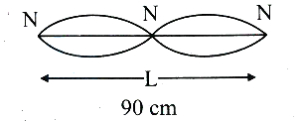
$A$ stationary wave is formed with $3$ nodes along the length of a string of $90 \ cm$. The wavelength of the wave is: (in $cm$)
A
$60$
B
$75$
C
$90$
D
$30$
Solution
(C) The length of the string is $L = 90 \ cm$.
There are $3$ nodes $(N)$ in the stationary wave.
The distance between two consecutive nodes is $\frac{\lambda}{2}$.
Since there are $3$ nodes,there are $2$ such segments (loops) between them.
Therefore,the total length $L = 2 \times \frac{\lambda}{2} = \lambda$.
Given $L = 90 \ cm$,we have $\lambda = 90 \ cm$.
There are $3$ nodes $(N)$ in the stationary wave.
The distance between two consecutive nodes is $\frac{\lambda}{2}$.
Since there are $3$ nodes,there are $2$ such segments (loops) between them.
Therefore,the total length $L = 2 \times \frac{\lambda}{2} = \lambda$.
Given $L = 90 \ cm$,we have $\lambda = 90 \ cm$.
0 likes
View Solution160
DifficultMCQ
Two progressive waves $Y_1 = \sin 2 \pi \left( \frac{t}{0.4} - \frac{x}{4} \right)$ and $Y_2 = \sin 2 \pi \left( \frac{t}{0.4} + \frac{x}{4} \right)$ superpose to form a standing wave. $x$ and $y$ are in $SI$ units. The amplitude of the particle at $x = 0.5 \ m$ is $\left[ \sin 45^{\circ} = \cos 45^{\circ} = \frac{1}{\sqrt{2}} \right]$.
A
$\sqrt{3} \ m$
B
$3 \sqrt{3} \ m$
C
$\sqrt{2} \ m$
D
$2 \sqrt{2} \ m$
Solution
(C) The resultant displacement $Y$ is given by the superposition principle: $Y = Y_1 + Y_2$.
Using the trigonometric identity $\sin(A - B) + \sin(A + B) = 2 \sin A \cos B$,where $A = \frac{2 \pi t}{0.4}$ and $B = \frac{2 \pi x}{4}$,we get:
$Y = 2 \sin \left( \frac{2 \pi t}{0.4} \right) \cos \left( \frac{2 \pi x}{4} \right)$.
The amplitude $R$ of the standing wave at any position $x$ is given by $R = |2 \cos \left( \frac{2 \pi x}{4} \right)|$.
Substituting $x = 0.5 \ m$:
$R = 2 \cos \left( \frac{2 \pi \times 0.5}{4} \right) = 2 \cos \left( \frac{\pi}{4} \right)$.
Since $\cos \left( \frac{\pi}{4} \right) = \frac{1}{\sqrt{2}}$,we have $R = 2 \times \frac{1}{\sqrt{2}} = \sqrt{2} \ m$.
Using the trigonometric identity $\sin(A - B) + \sin(A + B) = 2 \sin A \cos B$,where $A = \frac{2 \pi t}{0.4}$ and $B = \frac{2 \pi x}{4}$,we get:
$Y = 2 \sin \left( \frac{2 \pi t}{0.4} \right) \cos \left( \frac{2 \pi x}{4} \right)$.
The amplitude $R$ of the standing wave at any position $x$ is given by $R = |2 \cos \left( \frac{2 \pi x}{4} \right)|$.
Substituting $x = 0.5 \ m$:
$R = 2 \cos \left( \frac{2 \pi \times 0.5}{4} \right) = 2 \cos \left( \frac{\pi}{4} \right)$.
Since $\cos \left( \frac{\pi}{4} \right) = \frac{1}{\sqrt{2}}$,we have $R = 2 \times \frac{1}{\sqrt{2}} = \sqrt{2} \ m$.
0 likes
View Solution161
EasyMCQ
Stationary waves can be produced in
A
only solid and gaseous media
B
only liquid and gaseous media
C
only solid and liquid media
D
solid,liquid and gaseous media
Solution
(D) Stationary waves (also known as standing waves) are formed by the superposition of two identical waves traveling in opposite directions in a bounded medium.
These waves require a medium for propagation and reflection to occur at the boundaries.
Since mechanical waves can propagate through all three states of matter (solids,liquids,and gases),stationary waves can be produced in all these media.
For example,stationary waves are produced in a stretched string (solid),in a column of water (liquid),and in an air column (gas).
These waves require a medium for propagation and reflection to occur at the boundaries.
Since mechanical waves can propagate through all three states of matter (solids,liquids,and gases),stationary waves can be produced in all these media.
For example,stationary waves are produced in a stretched string (solid),in a column of water (liquid),and in an air column (gas).
0 likes
View Solution162
EasyMCQ
For a stationary wave,$Y = 10 \sin \left( \frac{\pi x}{15} \right) \cos (48 \pi t) \text{ cm}$,the distance between a node and the successive antinode is (in $\text{ cm}$)
A
$7.5$
B
$30$
C
$15$
D
$60$
Solution
(A) The standard equation for a stationary wave is given by $y = 2a \sin(kx) \cos(\omega t)$,where $k = \frac{2\pi}{\lambda}$.
Comparing the given equation $Y = 10 \sin \left( \frac{\pi x}{15} \right) \cos (48 \pi t)$ with the standard form,we identify the wave number $k = \frac{\pi}{15} \text{ cm}^{-1}$.
Since $k = \frac{2\pi}{\lambda}$,we have $\frac{2\pi}{\lambda} = \frac{\pi}{15}$.
Solving for wavelength $\lambda$,we get $\lambda = 30 \text{ cm}$.
The distance between a node and the successive antinode in a stationary wave is given by $\frac{\lambda}{4}$.
Therefore,the distance $= \frac{30}{4} = 7.5 \text{ cm}$.
Comparing the given equation $Y = 10 \sin \left( \frac{\pi x}{15} \right) \cos (48 \pi t)$ with the standard form,we identify the wave number $k = \frac{\pi}{15} \text{ cm}^{-1}$.
Since $k = \frac{2\pi}{\lambda}$,we have $\frac{2\pi}{\lambda} = \frac{\pi}{15}$.
Solving for wavelength $\lambda$,we get $\lambda = 30 \text{ cm}$.
The distance between a node and the successive antinode in a stationary wave is given by $\frac{\lambda}{4}$.
Therefore,the distance $= \frac{30}{4} = 7.5 \text{ cm}$.
0 likes
View Solution163
EasyMCQ
In a stationary wave,all particles
A
vibrate in $S.H.M.$ of different periods and different amplitudes.
B
vibrate in $S.H.M.$ of same period and amplitude.
C
except at nodes,vibrate in $S.H.M.$ of same period but of different amplitudes.
D
except at nodes,vibrate in $S.H.M.$ of same period and same amplitude.
Solution
(C) In a stationary wave,the particles of the medium vibrate about their mean positions in $S.H.M.$
All particles (except those at the nodes,which remain at rest) vibrate with the same frequency (and thus the same period) as the source.
However,the amplitude of vibration varies from particle to particle,being zero at the nodes and maximum at the antinodes.
All particles (except those at the nodes,which remain at rest) vibrate with the same frequency (and thus the same period) as the source.
However,the amplitude of vibration varies from particle to particle,being zero at the nodes and maximum at the antinodes.
0 likes
View Solution164
MediumMCQ
The equation of a stationary wave on a string clamped at both ends and vibrating in the third harmonic is $Y = 0.5 \sin(0.314 x) \cos(600 \pi t)$,where $x$ and $y$ are in $cm$ and $t$ is in seconds. The length of the vibrating string is: (in $cm$)
A
$20$
B
$10$
C
$40$
D
$30$
Solution
(D) The standard equation of a standing wave is $y = 2A \sin(kx) \cos(\omega t)$.
Comparing the given equation $Y = 0.5 \sin(0.314 x) \cos(600 \pi t)$ with the standard form,we identify the wave number $k = 0.314 \ cm^{-1}$.
Since $0.314 \approx \frac{\pi}{10}$,we have $k = \frac{\pi}{10} \ cm^{-1}$.
The wavelength $\lambda$ is given by $k = \frac{2\pi}{\lambda}$,so $\frac{\pi}{10} = \frac{2\pi}{\lambda}$,which gives $\lambda = 20 \ cm$.
For a string clamped at both ends,the length $L$ for the $n^{th}$ harmonic is $L = n \frac{\lambda}{2}$.
For the third harmonic,$n = 3$,so $L = 3 \times \frac{20}{2} = 3 \times 10 = 30 \ cm$.
Comparing the given equation $Y = 0.5 \sin(0.314 x) \cos(600 \pi t)$ with the standard form,we identify the wave number $k = 0.314 \ cm^{-1}$.
Since $0.314 \approx \frac{\pi}{10}$,we have $k = \frac{\pi}{10} \ cm^{-1}$.
The wavelength $\lambda$ is given by $k = \frac{2\pi}{\lambda}$,so $\frac{\pi}{10} = \frac{2\pi}{\lambda}$,which gives $\lambda = 20 \ cm$.
For a string clamped at both ends,the length $L$ for the $n^{th}$ harmonic is $L = n \frac{\lambda}{2}$.
For the third harmonic,$n = 3$,so $L = 3 \times \frac{20}{2} = 3 \times 10 = 30 \ cm$.
0 likes
View Solution165
MediumMCQ
$A$ stationary wave is represented by $y = 10 \sin \left( \frac{\pi x}{4} \right) \cos (20 \pi t)$,where $x$ and $y$ are in $cm$ and $t$ is in seconds. The distance between two consecutive nodes is (in $cm$)
A
$1$
B
$8$
C
$4$
D
$2$
Solution
(C) The given equation of the stationary wave is $y = 10 \sin \left( \frac{\pi x}{4} \right) \cos (20 \pi t)$.
Comparing this with the standard equation of a stationary wave,$y = 2A \sin (kx) \cos (\omega t)$,we get the propagation constant $k = \frac{\pi}{4} \ cm^{-1}$.
We know that the propagation constant $k$ is related to the wavelength $\lambda$ by the formula $k = \frac{2\pi}{\lambda}$.
Substituting the value of $k$: $\frac{\pi}{4} = \frac{2\pi}{\lambda}$.
Solving for $\lambda$,we get $\lambda = 8 \ cm$.
The distance between two consecutive nodes in a stationary wave is equal to half of the wavelength,which is $\frac{\lambda}{2}$.
Therefore,the distance is $\frac{8 \ cm}{2} = 4 \ cm$.
Comparing this with the standard equation of a stationary wave,$y = 2A \sin (kx) \cos (\omega t)$,we get the propagation constant $k = \frac{\pi}{4} \ cm^{-1}$.
We know that the propagation constant $k$ is related to the wavelength $\lambda$ by the formula $k = \frac{2\pi}{\lambda}$.
Substituting the value of $k$: $\frac{\pi}{4} = \frac{2\pi}{\lambda}$.
Solving for $\lambda$,we get $\lambda = 8 \ cm$.
The distance between two consecutive nodes in a stationary wave is equal to half of the wavelength,which is $\frac{\lambda}{2}$.
Therefore,the distance is $\frac{8 \ cm}{2} = 4 \ cm$.
0 likes
View Solution166
EasyMCQ
Two identical progressive waves moving in opposite directions superimpose to produce a stationary wave. The wavelength of each progressive wave is $\lambda$. The wavelength of the stationary wave is
A
$\frac{\lambda}{4}$
B
$\frac{\lambda}{2}$
C
$\lambda$
D
$2 \lambda$
Solution
(C) stationary wave is formed by the superposition of two identical progressive waves traveling in opposite directions with the same frequency and amplitude.
In a stationary wave,the distance between two consecutive nodes or two consecutive antinodes is $\frac{\lambda}{2}$.
The wavelength of the stationary wave is defined as the distance between two consecutive points that are in the same phase,which is equal to the wavelength of the constituent progressive waves.
Therefore,the wavelength of the stationary wave is $\lambda$.
In a stationary wave,the distance between two consecutive nodes or two consecutive antinodes is $\frac{\lambda}{2}$.
The wavelength of the stationary wave is defined as the distance between two consecutive points that are in the same phase,which is equal to the wavelength of the constituent progressive waves.
Therefore,the wavelength of the stationary wave is $\lambda$.
0 likes
View Solution167
EasyMCQ
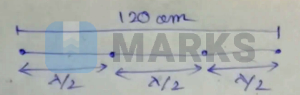
$A$ stationary wave is formed having $4$ nodes along the $120 \,cm$ length of the string. The wavelength of the wave is (in $\,cm$)
A
$20$
B
$40$
C
$80$
D
$60$
Solution
(C) In a stationary wave, the distance between two consecutive nodes is $\lambda / 2$.
For $4$ nodes, there are $3$ such segments of length $\lambda / 2$ between them.
Given the total length of the string is $L = 120 \,cm$.
Therefore, $3 \times (\lambda / 2) = 120 \,cm$.
$3 \lambda / 2 = 120 \,cm$.
$\lambda = (120 \times 2) / 3 \,cm$.
$\lambda = 240 / 3 \,cm$.
$\lambda = 80 \,cm$.
For $4$ nodes, there are $3$ such segments of length $\lambda / 2$ between them.
Given the total length of the string is $L = 120 \,cm$.
Therefore, $3 \times (\lambda / 2) = 120 \,cm$.
$3 \lambda / 2 = 120 \,cm$.
$\lambda = (120 \times 2) / 3 \,cm$.
$\lambda = 240 / 3 \,cm$.
$\lambda = 80 \,cm$.
0 likes
View Solution168
EasyMCQ
The correct statement about stationary waves is that
A
displacement at node is zero and at antinode is maximum.
B
displacement at node is maximum and at antinode is zero.
C
displacement at node is maximum.
D
displacement at antinode is minimum.
Solution
(A) In a stationary wave,the medium particles oscillate with different amplitudes at different positions.
Nodes are points where the amplitude of vibration is zero,meaning the displacement is always zero.
Antinodes are points where the amplitude of vibration is maximum.
Therefore,the displacement at a node is zero and at an antinode is maximum.
Nodes are points where the amplitude of vibration is zero,meaning the displacement is always zero.
Antinodes are points where the amplitude of vibration is maximum.
Therefore,the displacement at a node is zero and at an antinode is maximum.
0 likes
View Solution169
MediumMCQ
Find the wrong statement from the following about the equation of a stationary wave given by $Y = 0.04 \cos(\pi x) \sin(50 \pi t) \text{ m}$,where $t$ is in seconds.
A
Time Period $= 0.02 \text{ s}$
B
Wavelength $= 2 \text{ m}$
C
Velocity $= 50 \text{ m/s}$
D
Amplitude $= 0.02 \text{ m}$
Solution
(A) The given equation is $Y = 0.04 \cos(\pi x) \sin(50 \pi t)$.
Using the trigonometric identity $2 \sin A \cos B = \sin(A+B) + \sin(A-B)$,we can rewrite the equation as:
$Y = 0.02 \sin(50 \pi t + \pi x) + 0.02 \sin(50 \pi t - \pi x)$.
Comparing this with the standard wave equation $y = a \sin(\omega t \pm kx)$:
$1$. Amplitude $a = 0.02 \text{ m}$.
$2$. Angular frequency $\omega = 50 \pi \text{ rad/s}$.
$3$. Wave number $k = \pi \text{ m}^{-1}$.
Now,calculating the parameters:
- Time Period $T = \frac{2 \pi}{\omega} = \frac{2 \pi}{50 \pi} = 0.04 \text{ s}$.
- Wavelength $\lambda = \frac{2 \pi}{k} = \frac{2 \pi}{\pi} = 2 \text{ m}$.
- Velocity $v = \frac{\omega}{k} = \frac{50 \pi}{\pi} = 50 \text{ m/s}$.
Comparing these results with the given options,the statement in option $A$ (Time Period $= 0.02 \text{ s}$) is incorrect,as the calculated time period is $0.04 \text{ s}$.
Using the trigonometric identity $2 \sin A \cos B = \sin(A+B) + \sin(A-B)$,we can rewrite the equation as:
$Y = 0.02 \sin(50 \pi t + \pi x) + 0.02 \sin(50 \pi t - \pi x)$.
Comparing this with the standard wave equation $y = a \sin(\omega t \pm kx)$:
$1$. Amplitude $a = 0.02 \text{ m}$.
$2$. Angular frequency $\omega = 50 \pi \text{ rad/s}$.
$3$. Wave number $k = \pi \text{ m}^{-1}$.
Now,calculating the parameters:
- Time Period $T = \frac{2 \pi}{\omega} = \frac{2 \pi}{50 \pi} = 0.04 \text{ s}$.
- Wavelength $\lambda = \frac{2 \pi}{k} = \frac{2 \pi}{\pi} = 2 \text{ m}$.
- Velocity $v = \frac{\omega}{k} = \frac{50 \pi}{\pi} = 50 \text{ m/s}$.
Comparing these results with the given options,the statement in option $A$ (Time Period $= 0.02 \text{ s}$) is incorrect,as the calculated time period is $0.04 \text{ s}$.
0 likes
View Solution170
EasyMCQ
For the stationary wave $y = 4 \sin \left(\frac{\pi x}{15}\right) \cos (96 \pi t)$,the distance between a node and the next antinode is
A
$7.5$
B
$15$
C
$22.5$
D
$30$
Solution
(A) The standard equation for a stationary wave is given by $y = A \sin(kx) \cos(\omega t)$.
Comparing the given equation $y = 4 \sin \left(\frac{\pi x}{15}\right) \cos (96 \pi t)$ with the standard form,we identify the wave number $k$ as:
$k = \frac{2\pi}{\lambda} = \frac{\pi}{15}$
Solving for the wavelength $\lambda$:
$\lambda = 15 \times 2 = 30$
The distance between a node and the adjacent antinode in a stationary wave is always $\frac{\lambda}{4}$.
Therefore,the required distance is $\frac{30}{4} = 7.5$.
Comparing the given equation $y = 4 \sin \left(\frac{\pi x}{15}\right) \cos (96 \pi t)$ with the standard form,we identify the wave number $k$ as:
$k = \frac{2\pi}{\lambda} = \frac{\pi}{15}$
Solving for the wavelength $\lambda$:
$\lambda = 15 \times 2 = 30$
The distance between a node and the adjacent antinode in a stationary wave is always $\frac{\lambda}{4}$.
Therefore,the required distance is $\frac{30}{4} = 7.5$.
0 likes
View Solution171
EasyMCQ
Two waves of same frequency $n$ are approaching each other with same velocity,$v = 20 \ m/s$ and interfere. The distance between two consecutive nodes is
A
$\frac{20}{n}$
B
$\frac{10}{n}$
C
$\frac{5}{n}$
D
$\frac{n}{10}$
Solution
(B) When two waves of the same frequency and velocity travel in opposite directions,they form a standing wave.
The distance between two consecutive nodes in a standing wave is given by $x = \frac{\lambda}{2}$.
We know that the wave speed $v$ is related to frequency $n$ and wavelength $\lambda$ by the formula $v = n \lambda$,which implies $\lambda = \frac{v}{n}$.
Substituting the value of $\lambda$ into the distance formula:
$x = \frac{1}{2} \left( \frac{v}{n} \right) = \frac{v}{2n}$.
Given $v = 20 \ m/s$,we have:
$x = \frac{20 \ m/s}{2n} = \frac{10}{n} \ m$.
The distance between two consecutive nodes in a standing wave is given by $x = \frac{\lambda}{2}$.
We know that the wave speed $v$ is related to frequency $n$ and wavelength $\lambda$ by the formula $v = n \lambda$,which implies $\lambda = \frac{v}{n}$.
Substituting the value of $\lambda$ into the distance formula:
$x = \frac{1}{2} \left( \frac{v}{n} \right) = \frac{v}{2n}$.
Given $v = 20 \ m/s$,we have:
$x = \frac{20 \ m/s}{2n} = \frac{10}{n} \ m$.
0 likes
View Solution172
MediumMCQ
Two progressive waves are travelling towards each other with velocity $50 \,m/s$ and frequency $200 \,Hz$. The distance between two consecutive antinodes is (in $\,m$)
A
$0.031$
B
$0.125$
C
$0.250$
D
$0.0625$
Solution
(B) Given:
Velocity of waves,$v = 50 \,m/s$
Frequency of waves,$f = 200 \,Hz$
First,we calculate the wavelength $\lambda$ of the progressive waves:
$v = f \lambda$
$\lambda = \frac{v}{f} = \frac{50}{200} = 0.25 \,m$
When two identical progressive waves travel in opposite directions,they form a standing wave.
In a standing wave,the distance between two consecutive antinodes is equal to half the wavelength $(\frac{\lambda}{2})$.
Distance $= \frac{\lambda}{2} = \frac{0.25 \,m}{2} = 0.125 \,m$
Therefore,the correct option is $B$.
Velocity of waves,$v = 50 \,m/s$
Frequency of waves,$f = 200 \,Hz$
First,we calculate the wavelength $\lambda$ of the progressive waves:
$v = f \lambda$
$\lambda = \frac{v}{f} = \frac{50}{200} = 0.25 \,m$
When two identical progressive waves travel in opposite directions,they form a standing wave.
In a standing wave,the distance between two consecutive antinodes is equal to half the wavelength $(\frac{\lambda}{2})$.
Distance $= \frac{\lambda}{2} = \frac{0.25 \,m}{2} = 0.125 \,m$
Therefore,the correct option is $B$.
0 likes
View Solution173
MediumMCQ
$A$ string of mass $0.1 \ kg \ m^{-1}$ has length $0.9 \ m$. It is fixed at both ends and stretched such that it has a tension of $40 \ N$. The string vibrates in three segments with amplitude $0.3 \ cm$. The amplitude (maximum) of the particle velocity is (in $m/s$):
A
$\frac{\pi}{2}$
B
$\frac{\pi}{3}$
C
$\frac{\pi}{5}$
D
$\frac{\pi}{6}$
Solution
(C) Given: Linear mass density $\mu = 0.1 \ kg/m$,Length $L = 0.9 \ m$,Tension $T = 40 \ N$,Amplitude $A = 0.3 \ cm = 0.003 \ m$,Number of segments $n = 3$.
Wave speed $v = \sqrt{\frac{T}{\mu}} = \sqrt{\frac{40}{0.1}} = \sqrt{400} = 20 \ m/s$.
The frequency of the $n^{th}$ harmonic is $f_n = \frac{n v}{2L} = \frac{3 \times 20}{2 \times 0.9} = \frac{60}{1.8} = \frac{600}{18} = \frac{100}{3} \ Hz$.
Angular frequency $\omega = 2 \pi f_n = 2 \pi \times \frac{100}{3} = \frac{200 \pi}{3} \ rad/s$.
Maximum particle velocity $v_{max} = A \omega = 0.003 \times \frac{200 \pi}{3} = \frac{3}{1000} \times \frac{200 \pi}{3} = \frac{\pi}{5} \ m/s$.
Wave speed $v = \sqrt{\frac{T}{\mu}} = \sqrt{\frac{40}{0.1}} = \sqrt{400} = 20 \ m/s$.
The frequency of the $n^{th}$ harmonic is $f_n = \frac{n v}{2L} = \frac{3 \times 20}{2 \times 0.9} = \frac{60}{1.8} = \frac{600}{18} = \frac{100}{3} \ Hz$.
Angular frequency $\omega = 2 \pi f_n = 2 \pi \times \frac{100}{3} = \frac{200 \pi}{3} \ rad/s$.
Maximum particle velocity $v_{max} = A \omega = 0.003 \times \frac{200 \pi}{3} = \frac{3}{1000} \times \frac{200 \pi}{3} = \frac{\pi}{5} \ m/s$.
0 likes
View Solution174
MediumMCQ
$A$ stretched string is fixed at both ends. It is made to vibrate so that the total number of nodes formed in it is '$x$'. The length of the string in terms of the wavelength of waves formed in it is $(\lambda = \text{wavelength})$
A
$\frac{x \lambda}{2}$
B
$\left(x+\frac{1}{2}\right) \frac{\lambda}{2}$
C
$(x-1) \frac{\lambda}{2}$
D
$(x+1) \frac{\lambda}{2}$
Solution
(C) For a string fixed at both ends,the wave forms a stationary wave pattern.
Let $L$ be the length of the string and $\lambda$ be the wavelength.
The number of loops formed in the string is $n$,where $n = x - 1$ (since there are $x$ nodes including the two fixed ends).
The length of the string is given by $L = n \frac{\lambda}{2}$.
Substituting $n = x - 1$,we get $L = (x - 1) \frac{\lambda}{2}$.
Let $L$ be the length of the string and $\lambda$ be the wavelength.
The number of loops formed in the string is $n$,where $n = x - 1$ (since there are $x$ nodes including the two fixed ends).
The length of the string is given by $L = n \frac{\lambda}{2}$.
Substituting $n = x - 1$,we get $L = (x - 1) \frac{\lambda}{2}$.
0 likes
View Solution175
EasyMCQ
In a vibrating string with fixed ends,the waves are of type:
A
stationary longitudinal.
B
stationary transverse.
C
progressive transverse.
D
progressive longitudinal.
Solution
(B) When a string is fixed at both ends,waves travel along the string and reflect back from the fixed boundaries. The superposition of the incident and reflected waves results in the formation of stationary (standing) waves. Since the displacement of the string particles is perpendicular to the direction of wave propagation,these waves are transverse in nature. Therefore,the waves are stationary transverse waves.
0 likes
View Solution176
MediumMCQ
$A$ standing wave with a number of loops is produced on a string fixed at both ends. Which one of the following statements is correct?
A
All particles vibrate in phase.
B
Particles between two consecutive antinodes vibrate in phase.
C
The particles at alternate antinodes vibrate in phase.
D
The particles at all antinodes vibrate in phase.
Solution
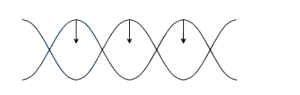
(D) In a standing wave on a string fixed at both ends,the string is divided into segments called loops.
Each loop is separated by nodes (points of zero displacement).
Within a single loop,all particles vibrate in phase with each other.
Particles in adjacent loops are separated by a node and vibrate with a phase difference of $\pi$ radians (i.e.,they are in anti-phase).
Therefore,particles in alternate loops (separated by an even number of nodes) vibrate in phase.
Since each antinode is located at the center of a loop,the particles at all antinodes vibrate in phase with each other.
Each loop is separated by nodes (points of zero displacement).
Within a single loop,all particles vibrate in phase with each other.
Particles in adjacent loops are separated by a node and vibrate with a phase difference of $\pi$ radians (i.e.,they are in anti-phase).
Therefore,particles in alternate loops (separated by an even number of nodes) vibrate in phase.
Since each antinode is located at the center of a loop,the particles at all antinodes vibrate in phase with each other.
0 likes
View Solution177
EasyMCQ
The equation of a stationary wave is $ y = 2 \sin \left( \frac{\pi x}{15} \right) \cos (48 \pi t) $. The distance between a node and its next antinode is (in $units$)
A
$22.5$
B
$7.5$
C
$30$
D
$1.5$
Solution
(B) The given equation of the stationary wave is $ y = 2 \sin \left( \frac{\pi x}{15} \right) \cos (48 \pi t) $.
Comparing this with the standard equation $ y = A \sin(kx) \cos(\omega t) $, we get the wave number $ k = \frac{\pi}{15} $.
We know that $ k = \frac{2 \pi}{\lambda} $, so $ \frac{2 \pi}{\lambda} = \frac{\pi}{15} $.
Solving for wavelength $ \lambda $, we get $ \lambda = 30 $ units.
The distance between a node and its consecutive antinode is given by $ d = \frac{\lambda}{4} $.
Substituting the value of $ \lambda $, we get $ d = \frac{30}{4} = 7.5 $ units.
Comparing this with the standard equation $ y = A \sin(kx) \cos(\omega t) $, we get the wave number $ k = \frac{\pi}{15} $.
We know that $ k = \frac{2 \pi}{\lambda} $, so $ \frac{2 \pi}{\lambda} = \frac{\pi}{15} $.
Solving for wavelength $ \lambda $, we get $ \lambda = 30 $ units.
The distance between a node and its consecutive antinode is given by $ d = \frac{\lambda}{4} $.
Substituting the value of $ \lambda $, we get $ d = \frac{30}{4} = 7.5 $ units.
0 likes
View Solution178
MediumMCQ
The speed of a stationary wave represented by the equation $y = 0.7 \sin \left(\frac{7 \pi}{4} x\right) \cos (350 \pi t)$ is (In the given equation $x$ and $y$ are in metre and $t$ is in second). (in $m \ s^{-1}$)
A
$100$
B
$150$
C
$160$
D
$200$
Solution
(D) The general equation of a stationary wave is given by $y = A \sin(kx) \cos(\omega t)$.
Comparing this with the given equation $y = 0.7 \sin \left(\frac{7 \pi}{4} x\right) \cos (350 \pi t)$,we get:
Wave number $k = \frac{7 \pi}{4} \ m^{-1}$
Angular frequency $\omega = 350 \pi \ rad \ s^{-1}$
The wave speed $v$ is defined as the ratio of angular frequency to wave number:
$v = \frac{\omega}{k}$
Substituting the values:
$v = \frac{350 \pi}{7 \pi / 4}$
$v = 350 \pi \times \frac{4}{7 \pi}$
$v = 50 \times 4 = 200 \ m \ s^{-1}$
Thus,the speed of the wave is $200 \ m \ s^{-1}$.
Comparing this with the given equation $y = 0.7 \sin \left(\frac{7 \pi}{4} x\right) \cos (350 \pi t)$,we get:
Wave number $k = \frac{7 \pi}{4} \ m^{-1}$
Angular frequency $\omega = 350 \pi \ rad \ s^{-1}$
The wave speed $v$ is defined as the ratio of angular frequency to wave number:
$v = \frac{\omega}{k}$
Substituting the values:
$v = \frac{350 \pi}{7 \pi / 4}$
$v = 350 \pi \times \frac{4}{7 \pi}$
$v = 50 \times 4 = 200 \ m \ s^{-1}$
Thus,the speed of the wave is $200 \ m \ s^{-1}$.
0 likes
View Solution179
MediumMCQ
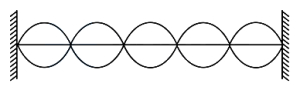
$A$ string fixed at both ends vibrates in $5$ loops as shown in the figure. The total number of nodes and antinodes respectively are
A
$6 \& 5$
B
$6 \& 10$
C
$2 \& 5$
D
$10 \& 6$
Solution
(A) In a stationary wave formed on a string fixed at both ends,the points where the displacement is always zero are called nodes. The points where the amplitude of vibration is maximum are called antinodes.
For a string vibrating in $n$ loops,the number of nodes is $n + 1$ and the number of antinodes is $n$.
Given that the string vibrates in $5$ loops,we have $n = 5$.
Therefore,the number of nodes = $5 + 1 = 6$.
The number of antinodes = $5$.
Thus,the total number of nodes and antinodes are $6$ and $5$ respectively.
For a string vibrating in $n$ loops,the number of nodes is $n + 1$ and the number of antinodes is $n$.
Given that the string vibrates in $5$ loops,we have $n = 5$.
Therefore,the number of nodes = $5 + 1 = 6$.
The number of antinodes = $5$.
Thus,the total number of nodes and antinodes are $6$ and $5$ respectively.
0 likes
View Solution180
MediumMCQ
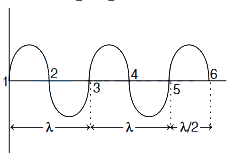
On producing the waves of frequency $1000 \,Hz$ in a Kundt's tube, the total distance between $6$ successive nodes is $85 \,cm$. Then, the speed of sound in the gas filled in the tube is (in $\,ms^{-1}$)
A
$330$
B
$340$
C
$350$
D
$300$
Solution
(B) Frequency, $f = 1000 \,Hz$.
Total distance between $6$ successive nodes is $d = 85 \,cm = 0.85 \,m$.
In a stationary wave, the distance between two successive nodes is $\frac{\lambda}{2}$.
Therefore, the distance between $6$ successive nodes (which involves $5$ intervals of $\frac{\lambda}{2}$) is given by:
$d = 5 \times \frac{\lambda}{2} = \frac{5 \lambda}{2}$.
Equating this to the given distance:
$\frac{5 \lambda}{2} = 0.85 \,m$.
$\lambda = \frac{0.85 \times 2}{5} = 0.34 \,m$.
The speed of sound $v$ is given by $v = f \lambda$.
$v = 1000 \,Hz \times 0.34 \,m = 340 \,ms^{-1}$.
Total distance between $6$ successive nodes is $d = 85 \,cm = 0.85 \,m$.
In a stationary wave, the distance between two successive nodes is $\frac{\lambda}{2}$.
Therefore, the distance between $6$ successive nodes (which involves $5$ intervals of $\frac{\lambda}{2}$) is given by:
$d = 5 \times \frac{\lambda}{2} = \frac{5 \lambda}{2}$.
Equating this to the given distance:
$\frac{5 \lambda}{2} = 0.85 \,m$.
$\lambda = \frac{0.85 \times 2}{5} = 0.34 \,m$.
The speed of sound $v$ is given by $v = f \lambda$.
$v = 1000 \,Hz \times 0.34 \,m = 340 \,ms^{-1}$.
0 likes
View Solution181
EasyMCQ
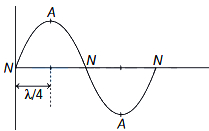
The distance between the successive node and anti-node is
A
$\lambda$
B
$\frac{\lambda}{2}$
C
$\frac{\lambda}{4}$
D
$\frac{3 \lambda}{4}$
Solution
(C) In a stationary wave,nodes $(N)$ are points of minimum displacement (zero amplitude),and anti-nodes $(A)$ are points of maximum displacement (maximum amplitude).
The distance between two consecutive nodes is $\frac{\lambda}{2}$.
The distance between two consecutive anti-nodes is $\frac{\lambda}{2}$.
The distance between a node and the next consecutive anti-node is exactly half the distance between two consecutive nodes,which is $\frac{1}{2} \times \frac{\lambda}{2} = \frac{\lambda}{4}$.
Therefore,the distance between the successive node and anti-node is $\frac{\lambda}{4}$.
The distance between two consecutive nodes is $\frac{\lambda}{2}$.
The distance between two consecutive anti-nodes is $\frac{\lambda}{2}$.
The distance between a node and the next consecutive anti-node is exactly half the distance between two consecutive nodes,which is $\frac{1}{2} \times \frac{\lambda}{2} = \frac{\lambda}{4}$.
Therefore,the distance between the successive node and anti-node is $\frac{\lambda}{4}$.
0 likes
View Solution182
EasyMCQ
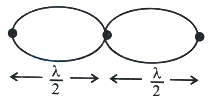
$A$ standing wave having $3$ nodes and $2$ antinodes is formed between two atoms having a distance of $1.21 \ Å$ between them. The wavelength of the standing wave is (in $Å$)
A
$1.21$
B
$2.42$
C
$6.05$
D
$3.63$
Solution
(A) In a standing wave,the distance between two consecutive nodes is $\frac{\lambda}{2}$.
Given that there are $3$ nodes and $2$ antinodes between two atoms,the total distance $L$ between the two atoms corresponds to two segments of length $\frac{\lambda}{2}$ each.
Therefore,the total distance $L = \frac{\lambda}{2} + \frac{\lambda}{2} = \lambda$.
Given $L = 1.21 \ Å$,we have $\lambda = 1.21 \ Å$.
Given that there are $3$ nodes and $2$ antinodes between two atoms,the total distance $L$ between the two atoms corresponds to two segments of length $\frac{\lambda}{2}$ each.
Therefore,the total distance $L = \frac{\lambda}{2} + \frac{\lambda}{2} = \lambda$.
Given $L = 1.21 \ Å$,we have $\lambda = 1.21 \ Å$.
0 likes
View Solution183
EasyMCQ
The equation of a stationary wave is $y = 20 \sin(\pi x) \cos(\omega t)$,where $x$ and $y$ are in meters and $t$ is in seconds. The distance between a node and its adjacent antinode is (in $\text{ cm}$)
A
$25$
B
$100$
C
$50$
D
$200$
Solution
(C) The given equation of the stationary wave is $y = 20 \sin(\pi x) \cos(\omega t)$.
Comparing this with the standard equation $y = A \sin(kx) \cos(\omega t)$,we get the wave number $k = \pi \text{ rad/m}$.
We know that $k = \frac{2\pi}{\lambda}$,so $\frac{2\pi}{\lambda} = \pi$,which gives the wavelength $\lambda = 2 \text{ m} = 200 \text{ cm}$.
The distance between a node and its adjacent antinode is given by $\frac{\lambda}{4}$.
Therefore,the distance $= \frac{200 \text{ cm}}{4} = 50 \text{ cm}$.
Comparing this with the standard equation $y = A \sin(kx) \cos(\omega t)$,we get the wave number $k = \pi \text{ rad/m}$.
We know that $k = \frac{2\pi}{\lambda}$,so $\frac{2\pi}{\lambda} = \pi$,which gives the wavelength $\lambda = 2 \text{ m} = 200 \text{ cm}$.
The distance between a node and its adjacent antinode is given by $\frac{\lambda}{4}$.
Therefore,the distance $= \frac{200 \text{ cm}}{4} = 50 \text{ cm}$.
0 likes
View Solution184
MediumMCQ
The transverse displacement of a string of a linear density $0.01 \text{ kg m}^{-1}$,clamped at its ends is given by $Y_{(x, t)} = 0.03 \sin \left(\frac{2 \pi x}{3}\right) \cos (60 \pi t)$,where $x$ and $y$ are in metres and time $t$ is in seconds. The tension in the string is: (in $\text{ N}$)
A
$9$
B
$36$
C
$162$
D
$81$
Solution
(D) The given equation for the standing wave is $y_{(x, t)} = 0.03 \sin \left(\frac{2 \pi x}{3}\right) \cos (60 \pi t)$.
Comparing this with the standard standing wave equation $y = a \sin(kx) \cos(\omega t)$,we get:
Angular frequency $\omega = 60 \pi \text{ rad s}^{-1}$.
Wave number $k = \frac{2 \pi}{3} \text{ m}^{-1}$.
The wave speed $v$ is given by $v = \frac{\omega}{k} = \frac{60 \pi}{2 \pi / 3} = 30 \times 3 = 90 \text{ m s}^{-1}$.
The speed of a transverse wave on a string is given by $v = \sqrt{\frac{T}{\mu}}$,where $T$ is the tension and $\mu$ is the linear mass density.
Given $\mu = 0.01 \text{ kg m}^{-1}$.
Substituting the values: $90 = \sqrt{\frac{T}{0.01}}$.
Squaring both sides: $8100 = \frac{T}{0.01}$.
$T = 8100 \times 0.01 = 81 \text{ N}$.
Comparing this with the standard standing wave equation $y = a \sin(kx) \cos(\omega t)$,we get:
Angular frequency $\omega = 60 \pi \text{ rad s}^{-1}$.
Wave number $k = \frac{2 \pi}{3} \text{ m}^{-1}$.
The wave speed $v$ is given by $v = \frac{\omega}{k} = \frac{60 \pi}{2 \pi / 3} = 30 \times 3 = 90 \text{ m s}^{-1}$.
The speed of a transverse wave on a string is given by $v = \sqrt{\frac{T}{\mu}}$,where $T$ is the tension and $\mu$ is the linear mass density.
Given $\mu = 0.01 \text{ kg m}^{-1}$.
Substituting the values: $90 = \sqrt{\frac{T}{0.01}}$.
Squaring both sides: $8100 = \frac{T}{0.01}$.
$T = 8100 \times 0.01 = 81 \text{ N}$.
0 likes
View Solution185
EasyMCQ
Standing waves are produced in a string $16 \ m$ long. If there are $9$ nodes between the two fixed ends of the string and the speed of the wave is $32 \ m/s$,what is the frequency of the wave (in $Hz$)?
A
$5$
B
$10$
C
$30$
D
$20$
Solution
(B) Given,length of the string,$L = 16 \ m$.
Speed of the wave,$v = 32 \ m/s$.
Number of nodes between the two fixed ends $= 9$.
The total number of nodes including the fixed ends is $9 + 2 = 11$.
The number of loops or segments $(p)$ formed in the string is given by the number of nodes minus $1$,so $p = 11 - 1 = 10$.
The frequency of the $p^{th}$ harmonic is given by the formula $f = \frac{p \cdot v}{2L}$.
Substituting the values: $f = \frac{10 \times 32}{2 \times 16}$.
$f = \frac{320}{32} = 10 \ Hz$.
Speed of the wave,$v = 32 \ m/s$.
Number of nodes between the two fixed ends $= 9$.
The total number of nodes including the fixed ends is $9 + 2 = 11$.
The number of loops or segments $(p)$ formed in the string is given by the number of nodes minus $1$,so $p = 11 - 1 = 10$.
The frequency of the $p^{th}$ harmonic is given by the formula $f = \frac{p \cdot v}{2L}$.
Substituting the values: $f = \frac{10 \times 32}{2 \times 16}$.
$f = \frac{320}{32} = 10 \ Hz$.
0 likes
View Solution186
EasyMCQ
The equation of a stationary wave along a stretched string is given by $y = 5 \sin \left( \frac{\pi x}{3} \right) \cos (40 \pi t)$. Here $x$ and $y$ are in $cm$ and $t$ is in seconds. The separation between two adjacent nodes is: (in $cm$)
A
$1.5$
B
$3$
C
$6$
D
$14$
Solution
(B) The standard equation for a stationary wave is $y = A \sin(kx) \cos(\omega t)$.
Comparing this with the given equation $y = 5 \sin \left( \frac{\pi x}{3} \right) \cos(40 \pi t)$,we identify the wave number $k = \frac{\pi}{3} \ cm^{-1}$.
The relationship between the wave number $k$ and the wavelength $\lambda$ is $k = \frac{2\pi}{\lambda}$.
Substituting the value of $k$: $\frac{\pi}{3} = \frac{2\pi}{\lambda}$,which gives $\lambda = 6 \ cm$.
The separation between two adjacent nodes in a stationary wave is given by $\frac{\lambda}{2}$.
Therefore,the separation $= \frac{6 \ cm}{2} = 3 \ cm$.
Comparing this with the given equation $y = 5 \sin \left( \frac{\pi x}{3} \right) \cos(40 \pi t)$,we identify the wave number $k = \frac{\pi}{3} \ cm^{-1}$.
The relationship between the wave number $k$ and the wavelength $\lambda$ is $k = \frac{2\pi}{\lambda}$.
Substituting the value of $k$: $\frac{\pi}{3} = \frac{2\pi}{\lambda}$,which gives $\lambda = 6 \ cm$.
The separation between two adjacent nodes in a stationary wave is given by $\frac{\lambda}{2}$.
Therefore,the separation $= \frac{6 \ cm}{2} = 3 \ cm$.
0 likes
View Solution187
MediumMCQ
$A$ wave disturbance in a medium is described by $y(x, t) = 0.02 \cos(50 \pi t + \frac{\pi}{2}) \cos(10 \pi x)$,where $x$ and $y$ are in meters and $t$ is in seconds. Which statement$(s)$ is/are correct?
A
$A$ node occurs at $x = 0.15 \ m$
B
An antinode occurs at $x = 0.3 \ m$
C
The speed of the wave is $4 \ m/s$
D
The wavelength of the wave is $0.2 \ m$
Solution
(A, B, D) The given equation is $y(x, t) = 0.02 \cos(50 \pi t + \frac{\pi}{2}) \cos(10 \pi x)$.
Nodes occur where the spatial part $\cos(10 \pi x) = 0$.
$10 \pi x = (n + \frac{1}{2}) \pi \implies x = \frac{n + 0.5}{10} = 0.05, 0.15, 0.25, \dots \ m$. Thus,a node occurs at $x = 0.15 \ m$.
Antinodes occur where $|\cos(10 \pi x)| = 1$.
$10 \pi x = n \pi \implies x = \frac{n}{10} = 0, 0.1, 0.2, 0.3, \dots \ m$. Thus,an antinode occurs at $x = 0.3 \ m$.
Comparing with the standard stationary wave equation $y = A \cos(\omega t + \phi) \cos(kx)$,we get $k = 10 \pi$ and $\omega = 50 \pi$.
Wavelength $\lambda = \frac{2 \pi}{k} = \frac{2 \pi}{10 \pi} = 0.2 \ m$.
Wave speed $v = \frac{\omega}{k} = \frac{50 \pi}{10 \pi} = 5 \ m/s$.
Nodes occur where the spatial part $\cos(10 \pi x) = 0$.
$10 \pi x = (n + \frac{1}{2}) \pi \implies x = \frac{n + 0.5}{10} = 0.05, 0.15, 0.25, \dots \ m$. Thus,a node occurs at $x = 0.15 \ m$.
Antinodes occur where $|\cos(10 \pi x)| = 1$.
$10 \pi x = n \pi \implies x = \frac{n}{10} = 0, 0.1, 0.2, 0.3, \dots \ m$. Thus,an antinode occurs at $x = 0.3 \ m$.
Comparing with the standard stationary wave equation $y = A \cos(\omega t + \phi) \cos(kx)$,we get $k = 10 \pi$ and $\omega = 50 \pi$.
Wavelength $\lambda = \frac{2 \pi}{k} = \frac{2 \pi}{10 \pi} = 0.2 \ m$.
Wave speed $v = \frac{\omega}{k} = \frac{50 \pi}{10 \pi} = 5 \ m/s$.
0 likes
View SolutionWaves and Sound — Stationary Waves (Standing wave) · Frequently Asked Questions
1Are these Waves and Sound questions useful for JEE and NEET?
Yes. All questions in this section are mapped to JEE Main and NEET exam patterns. Previous year questions from JEE Main, NEET, GUJCET and state-level exams are included with full solutions.
2Can I switch to Hindi or Gujarati for these questions?
Yes. Use the language tabs in the hero section or the sidebar to view the same questions and solutions in English, Hindi or Gujarati.
3How do I generate a question paper from this subtopic?
Use the Vedclass Exam Paper Generator — select the chapter and subtopic, set difficulty, and generate Sets A, B, C, D automatically. First 3 chapters of every subject are free.
Vedclass Products
For Students
Vedclass Test Series
Mock tests in real JEE/NEET style with performance analysis. 5-day free trial.
Start Free TrialFor Teachers
Exam Paper Generator
Generate Set A/B/C/D papers from this chapter in 2 minutes. 3 chapters free.
Try FreeFor Institutes
Online Exam Module
Live online exams with unlimited students, 360° analytics & white-label branding.
See DemoFor Teachers & Institutes
Generate a Waves and Sound Exam Paper in 2 Minutes
Select subtopic & difficulty — Sets A, B, C, D auto-generated with No Repeat logic.
First 3 chapters of every subject are free — no payment required.