
A English
Longitudinal Stationary Waves (Organ Pipes) and Resonance Tube Questions in English
Class 11 Physics · Waves and Sound · Longitudinal Stationary Waves (Organ Pipes) and Resonance Tube
352+
Questions
English
Language
100%
With Solutions
Showing 48 of 352 questions in English
51
DifficultMCQ
$A$ tuning fork of frequency $340 \ Hz$ is vibrated just above a tube of $120 \ cm$ height. Water is poured slowly into the tube. What is the minimum height of water necessary for resonance (in $cm$)? (Speed of sound in air $= 340 \ m/s$)
A
$15$
B
$25$
C
$30$
D
$45$
Solution
(D) The tuning fork forms a resonance with the air column in a pipe closed at one end. The resonance condition is given by $n = \frac{(2N - 1)v}{4l}$,where $N = 1, 2, 3, \dots$ represents the mode of vibration.
Given $n = 340 \ Hz$ and $v = 340 \ m/s$,the length of the air column $l$ is:
$l = \frac{(2N - 1)v}{4n} = \frac{(2N - 1) \times 340}{4 \times 340} = \frac{2N - 1}{4} \ m = (2N - 1) \times 25 \ cm$.
For $N = 1, l_1 = 25 \ cm$.
For $N = 2, l_2 = 75 \ cm$.
For $N = 3, l_3 = 125 \ cm$ (not possible as the tube height is $120 \ cm$).
The height of the water column $h$ is given by $h = H_{tube} - l$.
For $l_1 = 25 \ cm$,$h_1 = 120 - 25 = 95 \ cm$.
For $l_2 = 75 \ cm$,$h_2 = 120 - 75 = 45 \ cm$.
The minimum height of water required for resonance is $45 \ cm$.
Given $n = 340 \ Hz$ and $v = 340 \ m/s$,the length of the air column $l$ is:
$l = \frac{(2N - 1)v}{4n} = \frac{(2N - 1) \times 340}{4 \times 340} = \frac{2N - 1}{4} \ m = (2N - 1) \times 25 \ cm$.
For $N = 1, l_1 = 25 \ cm$.
For $N = 2, l_2 = 75 \ cm$.
For $N = 3, l_3 = 125 \ cm$ (not possible as the tube height is $120 \ cm$).
The height of the water column $h$ is given by $h = H_{tube} - l$.
For $l_1 = 25 \ cm$,$h_1 = 120 - 25 = 95 \ cm$.
For $l_2 = 75 \ cm$,$h_2 = 120 - 75 = 45 \ cm$.
The minimum height of water required for resonance is $45 \ cm$.
0 likes
View Solution52
DifficultMCQ
An organ pipe closed at one end has a fundamental frequency of $1500 \ Hz$. The maximum number of overtones generated by this pipe which a normal person can hear is:
A
$14$
B
$13$
C
$6$
D
$9$
Solution
(C) The maximum frequency a normal human can hear is $20,000 \ Hz$.
For a closed organ pipe,the frequency of the $N^{th}$ mode is given by $f_N = (2N - 1)f_1$,where $f_1 = 1500 \ Hz$ is the fundamental frequency.
We require $f_N \le 20,000 \ Hz$.
$(2N - 1) \times 1500 \le 20,000$
$2N - 1 \le \frac{20,000}{1500} \approx 13.33$
$2N \le 14.33 \implies N \le 7.16$.
Since $N$ must be an integer,the maximum mode number is $N = 7$.
The number of overtones is given by $(N - 1)$.
Therefore,the number of overtones $= 7 - 1 = 6$.
For a closed organ pipe,the frequency of the $N^{th}$ mode is given by $f_N = (2N - 1)f_1$,where $f_1 = 1500 \ Hz$ is the fundamental frequency.
We require $f_N \le 20,000 \ Hz$.
$(2N - 1) \times 1500 \le 20,000$
$2N - 1 \le \frac{20,000}{1500} \approx 13.33$
$2N \le 14.33 \implies N \le 7.16$.
Since $N$ must be an integer,the maximum mode number is $N = 7$.
The number of overtones is given by $(N - 1)$.
Therefore,the number of overtones $= 7 - 1 = 6$.
0 likes
View Solution53
EasyMCQ
If we study the vibration of a pipe open at both ends,then the following statement is not true.
A
Odd harmonics of the fundamental frequency will be generated.
B
All harmonics of the fundamental frequency will be generated.
C
Pressure change will be maximum at both ends.
D
Open end will be antinode.
Solution
(C) In a pipe open at both ends,the open ends are always displacement antinodes. Since pressure variation is inversely related to displacement,the pressure variation is minimum (zero) at the open ends. Therefore,the statement that 'Pressure change will be maximum at both ends' is false.
0 likes
View Solution54
MediumMCQ
The number of possible natural oscillations of an air column in a pipe closed at one end of length $85 \, cm$ whose frequencies lie below $1250 \, Hz$ are (Velocity of sound $= 340 \, m s^{-1}$)
A
$4$
B
$5$
C
$6$
D
$7$
Solution
(C) The fundamental frequency $(f_1)$ of a pipe closed at one end is given by $f_1 = \frac{v}{4L}$.
Given: $v = 340 \, m s^{-1}$ and $L = 85 \, cm = 0.85 \, m$.
Substituting the values: $f_1 = \frac{340}{4 \times 0.85} = \frac{340}{3.4} = 100 \, Hz$.
The natural frequencies of a closed pipe are odd harmonics of the fundamental frequency: $f_n = (2n - 1)f_1$,where $n = 1, 2, 3, \dots$.
The frequencies are: $100 \, Hz, 300 \, Hz, 500 \, Hz, 700 \, Hz, 900 \, Hz, 1100 \, Hz, 1300 \, Hz, \dots$.
We need to find the number of frequencies below $1250 \, Hz$.
The frequencies are $100, 300, 500, 700, 900, 1100$.
Counting these,we get $6$ possible natural oscillations.
Given: $v = 340 \, m s^{-1}$ and $L = 85 \, cm = 0.85 \, m$.
Substituting the values: $f_1 = \frac{340}{4 \times 0.85} = \frac{340}{3.4} = 100 \, Hz$.
The natural frequencies of a closed pipe are odd harmonics of the fundamental frequency: $f_n = (2n - 1)f_1$,where $n = 1, 2, 3, \dots$.
The frequencies are: $100 \, Hz, 300 \, Hz, 500 \, Hz, 700 \, Hz, 900 \, Hz, 1100 \, Hz, 1300 \, Hz, \dots$.
We need to find the number of frequencies below $1250 \, Hz$.
The frequencies are $100, 300, 500, 700, 900, 1100$.
Counting these,we get $6$ possible natural oscillations.
0 likes
View Solution55
MediumMCQ
$A$ string is stretched between fixed points separated by $75.0\, cm$. It is observed to have resonant frequencies of $420\, Hz$ and $315\, Hz$. There are no other resonant frequencies between these two. The lowest resonant frequency for this string is .... $Hz$.
A
$105$
B
$155$
C
$205$
D
$10.5$
Solution
(A) For a string fixed at both ends,the resonant frequencies are given by $v_n = n \cdot v_0$,where $v_0$ is the fundamental frequency (lowest resonant frequency) and $n = 1, 2, 3, \dots$.
The difference between any two consecutive resonant frequencies is $\Delta v = v_{n+1} - v_n = (n+1)v_0 - nv_0 = v_0$.
Given that $420\, Hz$ and $315\, Hz$ are resonant frequencies with no other resonant frequencies between them,they must be consecutive harmonics.
Therefore,the fundamental frequency $v_0$ is the difference between these two frequencies:
$v_0 = 420\, Hz - 315\, Hz = 105\, Hz$.
The difference between any two consecutive resonant frequencies is $\Delta v = v_{n+1} - v_n = (n+1)v_0 - nv_0 = v_0$.
Given that $420\, Hz$ and $315\, Hz$ are resonant frequencies with no other resonant frequencies between them,they must be consecutive harmonics.
Therefore,the fundamental frequency $v_0$ is the difference between these two frequencies:
$v_0 = 420\, Hz - 315\, Hz = 105\, Hz$.
0 likes
View Solution56
MediumMCQ
The second overtone of an open organ pipe has the same frequency as the first overtone of a closed organ pipe $L$ metre long. The length of the open pipe will be:
A
$L/2 \; m$
B
$4L \; m$
C
$L \; m$
D
$2L \; m$
Solution
(D) For an open organ pipe of length $L'$,the frequency of the $n^{th}$ harmonic is given by $f_n = n \frac{v}{2L'}$,where $n = 1, 2, 3, \dots$. The second overtone corresponds to the $3^{rd}$ harmonic $(n=3)$. Thus,$f_{open} = 3 \frac{v}{2L'}$.
For a closed organ pipe of length $L$,the frequency of the $n^{th}$ harmonic is given by $f_n = n \frac{v}{4L}$,where $n = 1, 3, 5, \dots$. The first overtone corresponds to the $3^{rd}$ harmonic $(n=3)$. Thus,$f_{closed} = 3 \frac{v}{4L}$.
According to the problem,the frequencies are equal:
$3 \frac{v}{2L'} = 3 \frac{v}{4L}$
Canceling $3v$ from both sides:
$\frac{1}{2L'} = \frac{1}{4L}$
Solving for $L'$:
$2L' = 4L \implies L' = 2L \; m$.
For a closed organ pipe of length $L$,the frequency of the $n^{th}$ harmonic is given by $f_n = n \frac{v}{4L}$,where $n = 1, 3, 5, \dots$. The first overtone corresponds to the $3^{rd}$ harmonic $(n=3)$. Thus,$f_{closed} = 3 \frac{v}{4L}$.
According to the problem,the frequencies are equal:
$3 \frac{v}{2L'} = 3 \frac{v}{4L}$
Canceling $3v$ from both sides:
$\frac{1}{2L'} = \frac{1}{4L}$
Solving for $L'$:
$2L' = 4L \implies L' = 2L \; m$.
0 likes
View Solution57
MediumMCQ
An air column,closed at one end and open at the other,resonates with a tuning fork when the smallest length of the column is $50\, cm$. The next larger length of the column resonating with the same tuning fork is .... $cm$.
A
$100$
B
$150$
C
$200$
D
$66.7$
Solution
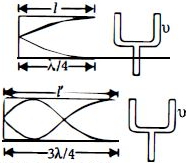
(B) For an air column closed at one end,the resonance occurs at odd harmonics.
The fundamental frequency (first harmonic) corresponds to the smallest length $l_1$:
$l_1 = \frac{\lambda}{4} = 50\, cm$
The next resonance (third harmonic) occurs at length $l_2$:
$l_2 = \frac{3\lambda}{4}$
Substituting $\lambda = 4 \times 50\, cm = 200\, cm$:
$l_2 = 3 \times \left(\frac{200}{4}\right) = 3 \times 50 = 150\, cm$.
The fundamental frequency (first harmonic) corresponds to the smallest length $l_1$:
$l_1 = \frac{\lambda}{4} = 50\, cm$
The next resonance (third harmonic) occurs at length $l_2$:
$l_2 = \frac{3\lambda}{4}$
Substituting $\lambda = 4 \times 50\, cm = 200\, cm$:
$l_2 = 3 \times \left(\frac{200}{4}\right) = 3 \times 50 = 150\, cm$.
0 likes
View Solution58
MediumMCQ
Two open organ pipes of fundamental frequencies $n_{1}$ and $n_{2}$ are joined in series. The fundamental frequency of the new pipe so obtained will be
A
$\frac{n_{1} + n_{2}}{2}$
B
$\sqrt{n_{1}^{2} + n_{2}^{2}}$
C
$\frac{n_{1}n_{2}}{n_{1} + n_{2}}$
D
$n_{1} + n_{2}$
Solution
(C) The fundamental frequency of an open organ pipe of length $L$ is given by $n = \frac{v}{2L}$,where $v$ is the speed of sound.
From this,the length of the pipe is $L = \frac{v}{2n}$.
For the two pipes with fundamental frequencies $n_{1}$ and $n_{2}$,their lengths are $L_{1} = \frac{v}{2n_{1}}$ and $L_{2} = \frac{v}{2n_{2}}$.
When these two pipes are joined in series,the total length of the new pipe becomes $L_{new} = L_{1} + L_{2}$.
The fundamental frequency $n$ of the new pipe is $n = \frac{v}{2L_{new}} = \frac{v}{2(L_{1} + L_{2})}$.
Substituting the values of $L_{1}$ and $L_{2}$:
$n = \frac{v}{2(\frac{v}{2n_{1}} + \frac{v}{2n_{2}})} = \frac{v}{v(\frac{1}{n_{1}} + \frac{1}{n_{2}})} = \frac{1}{\frac{n_{1} + n_{2}}{n_{1}n_{2}}}$.
Therefore,$n = \frac{n_{1}n_{2}}{n_{1} + n_{2}}$.
From this,the length of the pipe is $L = \frac{v}{2n}$.
For the two pipes with fundamental frequencies $n_{1}$ and $n_{2}$,their lengths are $L_{1} = \frac{v}{2n_{1}}$ and $L_{2} = \frac{v}{2n_{2}}$.
When these two pipes are joined in series,the total length of the new pipe becomes $L_{new} = L_{1} + L_{2}$.
The fundamental frequency $n$ of the new pipe is $n = \frac{v}{2L_{new}} = \frac{v}{2(L_{1} + L_{2})}$.
Substituting the values of $L_{1}$ and $L_{2}$:
$n = \frac{v}{2(\frac{v}{2n_{1}} + \frac{v}{2n_{2}})} = \frac{v}{v(\frac{1}{n_{1}} + \frac{1}{n_{2}})} = \frac{1}{\frac{n_{1} + n_{2}}{n_{1}n_{2}}}$.
Therefore,$n = \frac{n_{1}n_{2}}{n_{1} + n_{2}}$.
0 likes
View Solution59
EasyMCQ
The two nearest harmonics of a tube closed at one end and open at the other end are $220\, Hz$ and $260\, Hz$. What is the fundamental frequency of the system in $Hz$?
A
$10$
B
$20$
C
$30$
D
$40$
Solution
(B) For a tube closed at one end,the allowed frequencies (harmonics) are given by $f_n = n \cdot f_0$,where $n$ must be an odd integer $(n = 1, 3, 5, \dots)$ and $f_0$ is the fundamental frequency.
Two successive harmonics for such a tube differ by $2f_0$.
Given the two nearest harmonics are $f_1 = 220\, Hz$ and $f_2 = 260\, Hz$.
The difference between these two harmonics is $2f_0 = 260\, Hz - 220\, Hz = 40\, Hz$.
Therefore,the fundamental frequency is $f_0 = \frac{40\, Hz}{2} = 20\, Hz$.
Two successive harmonics for such a tube differ by $2f_0$.
Given the two nearest harmonics are $f_1 = 220\, Hz$ and $f_2 = 260\, Hz$.
The difference between these two harmonics is $2f_0 = 260\, Hz - 220\, Hz = 40\, Hz$.
Therefore,the fundamental frequency is $f_0 = \frac{40\, Hz}{2} = 20\, Hz$.
0 likes
View Solution60
MediumMCQ
The fundamental frequency in an open organ pipe is equal to the third harmonic of a closed organ pipe. If the length of the closed organ pipe is $20 \ cm$,the length of the open organ pipe is .... $cm$.
A
$13.33$
B
$8$
C
$16$
D
$12.5$
Solution
(A) The fundamental frequency of an open organ pipe of length $l'$ is given by $f_{open} = \frac{v}{2l'}$.
The frequencies of a closed organ pipe of length $l$ are given by $f_n = \frac{nv}{4l}$,where $n = 1, 3, 5, \dots$ (odd harmonics).
The third harmonic of a closed organ pipe corresponds to $n = 3$,so $f_{closed, 3} = \frac{3v}{4l}$.
According to the problem,$f_{open} = f_{closed, 3}$.
Therefore,$\frac{v}{2l'} = \frac{3v}{4l}$.
Simplifying for $l'$,we get $l' = \frac{4l}{6} = \frac{2l}{3}$.
Given $l = 20 \ cm$,we have $l' = \frac{2 \times 20}{3} = \frac{40}{3} \approx 13.33 \ cm$.
The frequencies of a closed organ pipe of length $l$ are given by $f_n = \frac{nv}{4l}$,where $n = 1, 3, 5, \dots$ (odd harmonics).
The third harmonic of a closed organ pipe corresponds to $n = 3$,so $f_{closed, 3} = \frac{3v}{4l}$.
According to the problem,$f_{open} = f_{closed, 3}$.
Therefore,$\frac{v}{2l'} = \frac{3v}{4l}$.
Simplifying for $l'$,we get $l' = \frac{4l}{6} = \frac{2l}{3}$.
Given $l = 20 \ cm$,we have $l' = \frac{2 \times 20}{3} = \frac{40}{3} \approx 13.33 \ cm$.
0 likes
View Solution61
MediumMCQ
$A$ tuning fork is used to produce resonance in a glass tube. The length of the air column in this tube can be adjusted by a variable piston. At room temperature of $27\,^{\circ}C$,two successive resonances are produced at $20\,cm$ and $73\,cm$ of column length. If the frequency of the tuning fork is $320\,Hz$,the velocity of sound in air at $27\,^{\circ}C$ is .... $m/s$.
A
$330$
B
$339$
C
$300$
D
$350$
Solution
(B) In a resonance tube experiment,the distance between two successive resonance positions is equal to half the wavelength of the sound wave,i.e.,$\frac{\lambda}{2} = L_2 - L_1$.
Given,$L_1 = 20\,cm = 0.20\,m$ and $L_2 = 73\,cm = 0.73\,m$.
Therefore,$\frac{\lambda}{2} = 0.73\,m - 0.20\,m = 0.53\,m$.
This implies $\lambda = 2 \times 0.53\,m = 1.06\,m$.
The velocity of sound $v$ is given by the formula $v = f \lambda$,where $f$ is the frequency of the tuning fork.
Given $f = 320\,Hz$.
$v = 320 \times 1.06 = 339.2\,m/s$.
Rounding to the nearest integer,the velocity of sound is $339\,m/s$.
Given,$L_1 = 20\,cm = 0.20\,m$ and $L_2 = 73\,cm = 0.73\,m$.
Therefore,$\frac{\lambda}{2} = 0.73\,m - 0.20\,m = 0.53\,m$.
This implies $\lambda = 2 \times 0.53\,m = 1.06\,m$.
The velocity of sound $v$ is given by the formula $v = f \lambda$,where $f$ is the frequency of the tuning fork.
Given $f = 320\,Hz$.
$v = 320 \times 1.06 = 339.2\,m/s$.
Rounding to the nearest integer,the velocity of sound is $339\,m/s$.
0 likes
View Solution62
EasyMCQ
In a resonance tube,the first resonance is obtained when the level of water in the tube is at $16\,cm$ from the open end. Neglecting end correction,the next resonance will be obtained when the level of water from the open end is .... $cm$
A
$24$
B
$32$
C
$48$
D
$64$
Solution
(C) For a closed organ pipe (resonance tube),the resonance lengths are given by $l_n = (2n - 1) \frac{\lambda}{4}$,where $n = 1, 2, 3, \dots$
For the first resonance $(n=1)$,$l_1 = \frac{\lambda}{4} = 16\,cm$.
For the second resonance $(n=2)$,$l_2 = 3 \frac{\lambda}{4} = 3 \times 16 = 48\,cm$.
Thus,the next resonance is obtained at $48\,cm$.
For the first resonance $(n=1)$,$l_1 = \frac{\lambda}{4} = 16\,cm$.
For the second resonance $(n=2)$,$l_2 = 3 \frac{\lambda}{4} = 3 \times 16 = 48\,cm$.
Thus,the next resonance is obtained at $48\,cm$.
0 likes
View Solution63
MediumMCQ
$A$ pipe open at both ends produces a note of frequency $f_1$. When the pipe is kept with $3/4$th of its length in water,it produces a note of frequency $f_2$. The ratio $f_1/f_2$ is
A
$0.75$
B
$1.33$
C
$0.5$
D
$2$
Solution
(C) For an open pipe of length $l$,the fundamental frequency is given by $f_1 = v / (2l)$,where $v$ is the speed of sound.
When $3/4$th of the pipe is submerged in water,the effective length of the air column becomes $l' = l - (3/4)l = l/4$.
This air column acts as a pipe closed at one end.
The fundamental frequency of a pipe closed at one end is given by $f_2 = v / (4l')$.
Substituting $l' = l/4$,we get $f_2 = v / (4 \times (l/4)) = v/l$.
Comparing $f_1$ and $f_2$,we have $f_2 = 2 \times (v / (2l)) = 2f_1$.
Therefore,the ratio $f_1/f_2 = f_1 / (2f_1) = 1/2 = 0.5$.
When $3/4$th of the pipe is submerged in water,the effective length of the air column becomes $l' = l - (3/4)l = l/4$.
This air column acts as a pipe closed at one end.
The fundamental frequency of a pipe closed at one end is given by $f_2 = v / (4l')$.
Substituting $l' = l/4$,we get $f_2 = v / (4 \times (l/4)) = v/l$.
Comparing $f_1$ and $f_2$,we have $f_2 = 2 \times (v / (2l)) = 2f_1$.
Therefore,the ratio $f_1/f_2 = f_1 / (2f_1) = 1/2 = 0.5$.
0 likes
View Solution64
MediumMCQ
The fundamental frequency of a closed pipe is $220 \ Hz$. If $\frac{1}{4}$ of the pipe is filled with water,the frequency of the first overtone of the pipe now is ..... $Hz$.
A
$220$
B
$440$
C
$880$
D
$1760$
Solution
(C) The fundamental frequency of a closed pipe of length $l$ is given by $n = \frac{v}{4l} = 220 \ Hz$.
From this,we find the speed of sound $v = 220 \times 4l = 880l \ m/s$.
When $\frac{1}{4}$ of the pipe is filled with water,the length of the air column becomes $l' = l - \frac{1}{4}l = \frac{3}{4}l$.
The new fundamental frequency of this air column is $n' = \frac{v}{4l'} = \frac{v}{4(\frac{3}{4}l)} = \frac{v}{3l}$.
The first overtone of a closed pipe is $3$ times the fundamental frequency.
Therefore,the frequency of the first overtone is $f_{1st} = 3 \times n' = 3 \times \frac{v}{3l} = \frac{v}{l}$.
Substituting $v = 880l$,we get $f_{1st} = \frac{880l}{l} = 880 \ Hz$.
From this,we find the speed of sound $v = 220 \times 4l = 880l \ m/s$.
When $\frac{1}{4}$ of the pipe is filled with water,the length of the air column becomes $l' = l - \frac{1}{4}l = \frac{3}{4}l$.
The new fundamental frequency of this air column is $n' = \frac{v}{4l'} = \frac{v}{4(\frac{3}{4}l)} = \frac{v}{3l}$.
The first overtone of a closed pipe is $3$ times the fundamental frequency.
Therefore,the frequency of the first overtone is $f_{1st} = 3 \times n' = 3 \times \frac{v}{3l} = \frac{v}{l}$.
Substituting $v = 880l$,we get $f_{1st} = \frac{880l}{l} = 880 \ Hz$.
0 likes
View Solution65
MediumMCQ
$A$ glass tube $1.5 \ m$ long and open at both ends is immersed vertically in a water tank completely. $A$ tuning fork of $660 \ Hz$ is vibrated and kept at the upper end of the tube,and the tube is gradually raised out of the water. Taking the velocity of sound in air as $330 \ m/s$,find the total number of resonances heard before the tube comes out of the water.
A
$12$
B
$6$
C
$8$
D
$4$
Solution
(B) The tube acts as a closed organ pipe because one end is closed by the water surface and the other is open. The resonance condition for a closed pipe is given by $l = \frac{(2N - 1)v}{4f}$,where $N$ is the order of the resonance,$v = 330 \ m/s$ is the speed of sound,and $f = 660 \ Hz$ is the frequency.
Substituting the values: $1.5 = \frac{(2N - 1) \times 330}{4 \times 660}$.
Simplifying the equation: $1.5 = \frac{(2N - 1)}{8}$.
$12 = 2N - 1$.
$2N = 13$.
$N = 6.5$.
Since $N$ must be an integer,the possible values for $N$ are $1, 2, 3, 4, 5, 6$. Thus,there are $6$ resonances.
Substituting the values: $1.5 = \frac{(2N - 1) \times 330}{4 \times 660}$.
Simplifying the equation: $1.5 = \frac{(2N - 1)}{8}$.
$12 = 2N - 1$.
$2N = 13$.
$N = 6.5$.
Since $N$ must be an integer,the possible values for $N$ are $1, 2, 3, 4, 5, 6$. Thus,there are $6$ resonances.
0 likes
View Solution66
EasyMCQ
In the $5$th overtone of an open organ pipe,the number of nodes $(N)$ and antinodes $(A)$ are:
A
$5N, 6A$
B
$6N, 7A$
C
$7N, 8A$
D
$8N, 9A$
Solution
(B) For an open organ pipe,the frequency of the $n$th overtone is given by $f_n = (n+1)f_0$,where $f_0$ is the fundamental frequency.
Thus,the $5$th overtone corresponds to the $6$th harmonic mode ($n=5$,so harmonic number $p = n+1 = 6$).
In an open organ pipe vibrating in the $p$th harmonic mode:
Number of nodes $(N)$ = $p = 6$.
Number of antinodes $(A)$ = $p + 1 = 6 + 1 = 7$.
Therefore,there are $6$ nodes and $7$ antinodes.
Thus,the $5$th overtone corresponds to the $6$th harmonic mode ($n=5$,so harmonic number $p = n+1 = 6$).
In an open organ pipe vibrating in the $p$th harmonic mode:
Number of nodes $(N)$ = $p = 6$.
Number of antinodes $(A)$ = $p + 1 = 6 + 1 = 7$.
Therefore,there are $6$ nodes and $7$ antinodes.
0 likes
View Solution67
MediumMCQ
$A$ taut string fixed at both ends vibrates in its $n^{th}$ overtone. The distance between adjacent Node and Antinode is found to be $d$. If the length of the string is $L$,then:
A
$L = 2d (n + 1)$
B
$L = d (n + 1)$
C
$L = 2dn$
D
$L = 2d (n - 1)$
Solution
(A) For a string fixed at both ends,the $n^{th}$ overtone corresponds to the $(n+1)^{th}$ harmonic.
The length of the string $L$ is related to the wavelength $\lambda$ by the formula: $L = (n+1) \frac{\lambda}{2} \dots (1)$.
The distance between an adjacent node and antinode is always $\frac{\lambda}{4}$. According to the problem,this distance is $d$. Therefore,$\frac{\lambda}{4} = d$,which implies $\lambda = 4d$.
Substituting $\lambda = 4d$ into equation $(1)$:
$L = (n+1) \frac{4d}{2}$
$L = 2d(n+1)$.
The length of the string $L$ is related to the wavelength $\lambda$ by the formula: $L = (n+1) \frac{\lambda}{2} \dots (1)$.
The distance between an adjacent node and antinode is always $\frac{\lambda}{4}$. According to the problem,this distance is $d$. Therefore,$\frac{\lambda}{4} = d$,which implies $\lambda = 4d$.
Substituting $\lambda = 4d$ into equation $(1)$:
$L = (n+1) \frac{4d}{2}$
$L = 2d(n+1)$.
0 likes
View Solution68
DifficultMCQ
Sound waves of frequency $660 \, Hz$ fall normally on a perfectly reflecting wall. The shortest distance from the wall at which the air particle has maximum amplitude of vibration is .... $m$ (velocity of sound in air is $330 \, m/s$)
A
$0.125$
B
$0.5$
C
$0.25$
D
$2$
Solution
(A) Given frequency of sound waves $\nu = 660 \, Hz$ and velocity $v = 330 \, m/s$.
The wavelength of the sound waves is calculated as $\lambda = \frac{v}{\nu} = \frac{330}{660} = 0.5 \, m$.
When sound waves reflect from a perfectly reflecting wall,stationary waves are formed due to the interference between the incident and reflected waves.
$A$ displacement node is always formed at the reflecting surface (the wall).
The air particles have maximum amplitude of vibration at the antinodes.
The shortest distance from the wall (node) to the first point of maximum amplitude (antinode) is given by $d = \frac{\lambda}{4}$.
Substituting the value of $\lambda$,we get $d = \frac{0.5}{4} = 0.125 \, m$.
The wavelength of the sound waves is calculated as $\lambda = \frac{v}{\nu} = \frac{330}{660} = 0.5 \, m$.
When sound waves reflect from a perfectly reflecting wall,stationary waves are formed due to the interference between the incident and reflected waves.
$A$ displacement node is always formed at the reflecting surface (the wall).
The air particles have maximum amplitude of vibration at the antinodes.
The shortest distance from the wall (node) to the first point of maximum amplitude (antinode) is given by $d = \frac{\lambda}{4}$.
Substituting the value of $\lambda$,we get $d = \frac{0.5}{4} = 0.125 \, m$.
0 likes
View Solution69
MediumMCQ
An open organ pipe of length $L$ vibrates in the second harmonic mode. The pressure vibration is maximum
A
at the two ends
B
at a distance $L/4$ from either end inside the tube
C
at the mid-point of the tube
D
none of these
Solution
(B) For an open organ pipe,the length $L$ is given by $L = \frac{n \lambda}{2}$,where $\lambda$ is the wavelength and $n$ is an integer $(n = 1, 2, 3, \dots)$.
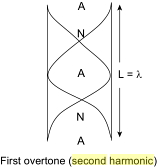
For the second harmonic mode,$n = 2$. Therefore,$L = \frac{2 \lambda}{2} = \lambda$.
In an open organ pipe,the ends are always antinodes $(A)$ for displacement,which correspond to nodes for pressure variation. The nodes $(N)$ for displacement are where the pressure variation is maximum.
In the second harmonic mode,the standing wave pattern consists of three antinodes and two nodes. The nodes are located at distances of $\frac{\lambda}{4}$ and $\frac{3\lambda}{4}$ from one end. Since $L = \lambda$,these positions are $\frac{L}{4}$ and $\frac{3L}{4}$ from one end.
Thus,the pressure vibration is maximum at distances of $\frac{L}{4}$ from either end inside the tube.
For the second harmonic mode,$n = 2$. Therefore,$L = \frac{2 \lambda}{2} = \lambda$.
In an open organ pipe,the ends are always antinodes $(A)$ for displacement,which correspond to nodes for pressure variation. The nodes $(N)$ for displacement are where the pressure variation is maximum.
In the second harmonic mode,the standing wave pattern consists of three antinodes and two nodes. The nodes are located at distances of $\frac{\lambda}{4}$ and $\frac{3\lambda}{4}$ from one end. Since $L = \lambda$,these positions are $\frac{L}{4}$ and $\frac{3L}{4}$ from one end.
Thus,the pressure vibration is maximum at distances of $\frac{L}{4}$ from either end inside the tube.
0 likes
View Solution70
AdvancedMCQ
An open organ pipe of length $l$ is sounded together with another organ pipe of length $l + x$ in their fundamental tones $(x << l)$. The beat frequency heard will be (speed of sound is $v$):
A
$\frac{vx}{4l^2}$
B
$\frac{vl^2}{2x}$
C
$\frac{vx}{2l^2}$
D
$\frac{vx^2}{2l}$
Solution
(C) The fundamental frequency of an open organ pipe of length $l$ is given by $f_1 = \frac{v}{2l}$.
The fundamental frequency of an open organ pipe of length $(l+x)$ is given by $f_2 = \frac{v}{2(l+x)}$.
The beat frequency is the difference between the two frequencies: $f_{beat} = |f_1 - f_2|$.
$f_{beat} = \frac{v}{2l} - \frac{v}{2(l+x)} = \frac{v}{2} \left( \frac{1}{l} - \frac{1}{l+x} \right)$.
$f_{beat} = \frac{v}{2} \left( \frac{l+x-l}{l(l+x)} \right) = \frac{v}{2} \left( \frac{x}{l(l+x)} \right)$.
Since $x << l$,we can approximate $l+x \approx l$.
Therefore,$f_{beat} \approx \frac{v}{2} \left( \frac{x}{l^2} \right) = \frac{vx}{2l^2}$.
The fundamental frequency of an open organ pipe of length $(l+x)$ is given by $f_2 = \frac{v}{2(l+x)}$.
The beat frequency is the difference between the two frequencies: $f_{beat} = |f_1 - f_2|$.
$f_{beat} = \frac{v}{2l} - \frac{v}{2(l+x)} = \frac{v}{2} \left( \frac{1}{l} - \frac{1}{l+x} \right)$.
$f_{beat} = \frac{v}{2} \left( \frac{l+x-l}{l(l+x)} \right) = \frac{v}{2} \left( \frac{x}{l(l+x)} \right)$.
Since $x << l$,we can approximate $l+x \approx l$.
Therefore,$f_{beat} \approx \frac{v}{2} \left( \frac{x}{l^2} \right) = \frac{vx}{2l^2}$.
0 likes
View Solution71
MediumMCQ
$A$ tuning fork of frequency $340 \, Hz$ is vibrated just above a cylindrical tube of length $120 \, cm$. Water is slowly poured into the tube. If the speed of sound is $340 \, m/s$,then the minimum height of water required for resonance is .... $cm$.
A
$95$
B
$75$
C
$45$
D
$25$
Solution
(C) The wavelength of the sound wave is given by $\lambda = \frac{v}{\nu}$.
Substituting the values,$\lambda = \frac{340}{340} = 1 \, m = 100 \, cm$.
For a closed organ pipe (resonance tube),resonance occurs when the length of the air column $l$ satisfies $l = \frac{(2n-1)\lambda}{4}$ for $n = 1, 2, 3, \dots$.
Possible lengths of the air column are:
For $n=1$: $l_1 = \frac{\lambda}{4} = \frac{100}{4} = 25 \, cm$.
For $n=2$: $l_2 = \frac{3\lambda}{4} = \frac{300}{4} = 75 \, cm$.
For $n=3$: $l_3 = \frac{5\lambda}{4} = \frac{500}{4} = 125 \, cm$.
Since the total length of the tube is $120 \, cm$,the air column length $l_3 = 125 \, cm$ is not possible.
As water is poured,the air column length decreases. The first resonance occurs at $l_2 = 75 \, cm$ (as $l_1 = 25 \, cm$ would require more water,and we seek the minimum height of water for the first possible resonance encountered).
The height of the water column $h$ is given by $h = \text{Total length} - \text{Air column length} = 120 \, cm - 75 \, cm = 45 \, cm$.
Substituting the values,$\lambda = \frac{340}{340} = 1 \, m = 100 \, cm$.
For a closed organ pipe (resonance tube),resonance occurs when the length of the air column $l$ satisfies $l = \frac{(2n-1)\lambda}{4}$ for $n = 1, 2, 3, \dots$.
Possible lengths of the air column are:
For $n=1$: $l_1 = \frac{\lambda}{4} = \frac{100}{4} = 25 \, cm$.
For $n=2$: $l_2 = \frac{3\lambda}{4} = \frac{300}{4} = 75 \, cm$.
For $n=3$: $l_3 = \frac{5\lambda}{4} = \frac{500}{4} = 125 \, cm$.
Since the total length of the tube is $120 \, cm$,the air column length $l_3 = 125 \, cm$ is not possible.
As water is poured,the air column length decreases. The first resonance occurs at $l_2 = 75 \, cm$ (as $l_1 = 25 \, cm$ would require more water,and we seek the minimum height of water for the first possible resonance encountered).
The height of the water column $h$ is given by $h = \text{Total length} - \text{Air column length} = 120 \, cm - 75 \, cm = 45 \, cm$.
0 likes
View Solution72
AdvancedMCQ
In a closed-end pipe of length $105 \, cm$,standing waves are set up corresponding to the third overtone. What distance from the closed end,amongst the following,is a pressure node in $cm$?
A
$20$
B
$60$
C
$85$
D
$45$
Solution
(D) For a closed pipe of length $L = 105 \, cm$,the frequency of the $n^{th}$ overtone is given by $f_n = (2n+1) \frac{v}{4L}$.
The third overtone corresponds to $n = 3$,so the length $L$ is related to the wavelength $\lambda$ by $L = \frac{(2n+1)\lambda}{4} = \frac{7\lambda}{4}$.
Given $L = 105 \, cm$,we have $105 = \frac{7\lambda}{4}$,which gives $\lambda = \frac{105 \times 4}{7} = 60 \, cm$.
In a closed pipe,the closed end is a displacement node (pressure antinode) and the open end is a displacement antinode (pressure node).
Pressure nodes occur at distances $x = \frac{\lambda}{4}, \frac{3\lambda}{4}, \frac{5\lambda}{4}, \dots$ from the closed end.
For $\lambda = 60 \, cm$,the positions of pressure nodes are $x = 15 \, cm, 45 \, cm, 75 \, cm, \dots$
Comparing with the given options,$45 \, cm$ is a pressure node.
The third overtone corresponds to $n = 3$,so the length $L$ is related to the wavelength $\lambda$ by $L = \frac{(2n+1)\lambda}{4} = \frac{7\lambda}{4}$.
Given $L = 105 \, cm$,we have $105 = \frac{7\lambda}{4}$,which gives $\lambda = \frac{105 \times 4}{7} = 60 \, cm$.
In a closed pipe,the closed end is a displacement node (pressure antinode) and the open end is a displacement antinode (pressure node).
Pressure nodes occur at distances $x = \frac{\lambda}{4}, \frac{3\lambda}{4}, \frac{5\lambda}{4}, \dots$ from the closed end.
For $\lambda = 60 \, cm$,the positions of pressure nodes are $x = 15 \, cm, 45 \, cm, 75 \, cm, \dots$
Comparing with the given options,$45 \, cm$ is a pressure node.
0 likes
View Solution73
AdvancedMCQ
$A$ pipe's lower end is immersed in water such that the length of the air column from the top open end has a length of $25 \, cm$. The speed of sound in air is $350 \, m/s$. The air column is found to resonate with a tuning fork of frequency $1750 \, Hz$. By what minimum distance should the pipe be raised in order to make the air column resonate again with the same tuning fork?
A
$7$
B
$5$
C
$35$
D
$10$
Solution
(D) Given: Speed of sound in air,$v = 350 \, m/s$. Frequency of tuning fork,$f = 1750 \, Hz$.
For a pipe closed at one end,the resonant frequencies are given by $f_n = \frac{(2n-1)v}{4L}$,where $n = 1, 2, 3, \dots$ and $L$ is the length of the air column.
Initially,$L_1 = 25 \, cm = 0.25 \, m$. Substituting the values: $1750 = \frac{(2n-1) \times 350}{4 \times 0.25}$.
$1750 = \frac{(2n-1) \times 350}{1} \implies 2n-1 = \frac{1750}{350} = 5 \implies 2n = 6 \implies n = 3$.
To resonate again with the same tuning fork,the next resonant length $L_2$ corresponds to $n = 4$.
$1750 = \frac{(2 \times 4 - 1) \times 350}{4 \times L_2} \implies 1750 = \frac{7 \times 350}{4 \times L_2}$.
$L_2 = \frac{7 \times 350}{4 \times 1750} = \frac{2450}{7000} = 0.35 \, m = 35 \, cm$.
The minimum distance the pipe should be raised is $\Delta L = L_2 - L_1 = 35 \, cm - 25 \, cm = 10 \, cm$.
For a pipe closed at one end,the resonant frequencies are given by $f_n = \frac{(2n-1)v}{4L}$,where $n = 1, 2, 3, \dots$ and $L$ is the length of the air column.
Initially,$L_1 = 25 \, cm = 0.25 \, m$. Substituting the values: $1750 = \frac{(2n-1) \times 350}{4 \times 0.25}$.
$1750 = \frac{(2n-1) \times 350}{1} \implies 2n-1 = \frac{1750}{350} = 5 \implies 2n = 6 \implies n = 3$.
To resonate again with the same tuning fork,the next resonant length $L_2$ corresponds to $n = 4$.
$1750 = \frac{(2 \times 4 - 1) \times 350}{4 \times L_2} \implies 1750 = \frac{7 \times 350}{4 \times L_2}$.
$L_2 = \frac{7 \times 350}{4 \times 1750} = \frac{2450}{7000} = 0.35 \, m = 35 \, cm$.
The minimum distance the pipe should be raised is $\Delta L = L_2 - L_1 = 35 \, cm - 25 \, cm = 10 \, cm$.
0 likes
View Solution74
AdvancedMCQ
In the case of a closed organ pipe,which harmonic is the $p^{th}$ overtone?
A
$2p + 1$
B
$2p - 1$
C
$p + 1$
D
$p - 1$
Solution
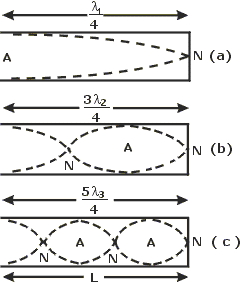
(A) In a closed organ pipe of length $l$,the allowed frequencies are given by $\nu_n = (2n + 1) \frac{v}{4l}$,where $n = 0, 1, 2, \dots$ represents the mode of vibration.
For $n = 0$,$\nu_0 = \frac{v}{4l}$ (Fundamental frequency or first harmonic).
For $n = 1$,$\nu_1 = 3 \frac{v}{4l}$ (First overtone or third harmonic).
For $n = 2$,$\nu_2 = 5 \frac{v}{4l}$ (Second overtone or fifth harmonic).
In general,for the $p^{th}$ overtone,we set $n = p$. The frequency is $\nu_p = (2p + 1) \frac{v}{4l}$.
Since the fundamental frequency $\nu_0 = \frac{v}{4l}$,we have $\nu_p = (2p + 1) \nu_0$.
Thus,the $p^{th}$ overtone corresponds to the $(2p + 1)^{th}$ harmonic.
For $n = 0$,$\nu_0 = \frac{v}{4l}$ (Fundamental frequency or first harmonic).
For $n = 1$,$\nu_1 = 3 \frac{v}{4l}$ (First overtone or third harmonic).
For $n = 2$,$\nu_2 = 5 \frac{v}{4l}$ (Second overtone or fifth harmonic).
In general,for the $p^{th}$ overtone,we set $n = p$. The frequency is $\nu_p = (2p + 1) \frac{v}{4l}$.
Since the fundamental frequency $\nu_0 = \frac{v}{4l}$,we have $\nu_p = (2p + 1) \nu_0$.
Thus,the $p^{th}$ overtone corresponds to the $(2p + 1)^{th}$ harmonic.
0 likes
View Solution75
AdvancedMCQ
$A$ closed organ pipe of radius $r_1$ and an open organ pipe of radius $r_2$ having the same length $L$ resonate when excited with a given tuning fork. The closed organ pipe resonates in its fundamental mode,whereas the open organ pipe resonates in its first overtone. Then:
A
$r_2 - r_1 = L$
B
$r_2 - r_1 = L/2$
C
$r_2 - 2r_1 = 2.5L$
D
$2r_2 - r_1 = 2.5L$
Solution
(C) For a closed organ pipe with end correction,the frequency of the $n^{th}$ mode is given by $\nu_{n}^{\prime} = \frac{(2n-1)v}{4(L+0.6r_1)}$,where $0.6r_1$ is the end correction.
For the fundamental mode $(n=1)$,$\nu_{1}^{\prime} = \frac{v}{4(L+0.6r_1)}$.
For an open organ pipe with end correction,the frequency of the $m^{th}$ mode is given by $\nu_{m} = \frac{mv}{2(L+2 \times 0.6r_2)}$,where $0.6r_2$ is the end correction at each end.
For the first overtone $(m=2)$,$\nu_{2} = \frac{2v}{2(L+1.2r_2)} = \frac{v}{L+1.2r_2}$.
Since both pipes resonate with the same tuning fork,$\nu_{1}^{\prime} = \nu_{2}$.
Therefore,$\frac{v}{4(L+0.6r_1)} = \frac{v}{L+1.2r_2}$.
$L + 1.2r_2 = 4L + 2.4r_1$.
$1.2r_2 - 2.4r_1 = 3L$.
Dividing by $1.2$,we get $r_2 - 2r_1 = 2.5L$.
For the fundamental mode $(n=1)$,$\nu_{1}^{\prime} = \frac{v}{4(L+0.6r_1)}$.
For an open organ pipe with end correction,the frequency of the $m^{th}$ mode is given by $\nu_{m} = \frac{mv}{2(L+2 \times 0.6r_2)}$,where $0.6r_2$ is the end correction at each end.
For the first overtone $(m=2)$,$\nu_{2} = \frac{2v}{2(L+1.2r_2)} = \frac{v}{L+1.2r_2}$.
Since both pipes resonate with the same tuning fork,$\nu_{1}^{\prime} = \nu_{2}$.
Therefore,$\frac{v}{4(L+0.6r_1)} = \frac{v}{L+1.2r_2}$.
$L + 1.2r_2 = 4L + 2.4r_1$.
$1.2r_2 - 2.4r_1 = 3L$.
Dividing by $1.2$,we get $r_2 - 2r_1 = 2.5L$.
0 likes
View Solution76
AdvancedMCQ
The first overtone frequency of a closed organ pipe is equal to the first overtone frequency of an open organ pipe. Further,the $n^{th}$ harmonic of the closed organ pipe is also equal to the $m^{th}$ harmonic of the open pipe,where $n$ and $m$ are:
A
$5, 4$
B
$7, 5$
C
$9, 6$
D
$7, 3$
Solution
(C) Let $L'$ and $L$ be the lengths of the closed and open organ pipes,respectively.
For a closed organ pipe,the frequency of the $n^{th}$ harmonic is given by $\nu_n' = \frac{n v}{4 L'}$,where $n$ must be an odd integer $(n = 1, 3, 5, \dots)$.
The first overtone of a closed pipe corresponds to the $3^{rd}$ harmonic $(n=3)$,so $\nu_{1st, closed} = \frac{3 v}{4 L'}$.
For an open organ pipe,the frequency of the $m^{th}$ harmonic is given by $\nu_m = \frac{m v}{2 L}$,where $m = 1, 2, 3, \dots$.
The first overtone of an open pipe corresponds to the $2^{nd}$ harmonic $(m=2)$,so $\nu_{1st, open} = \frac{2 v}{2 L} = \frac{v}{L}$.
Given $\nu_{1st, closed} = \nu_{1st, open}$,we have $\frac{3 v}{4 L'} = \frac{v}{L}$,which implies $\frac{L'}{L} = \frac{3}{4}$.
Given the $n^{th}$ harmonic of the closed pipe equals the $m^{th}$ harmonic of the open pipe: $\frac{n v}{4 L'} = \frac{m v}{2 L}$.
Substituting $\frac{L'}{L} = \frac{3}{4}$,we get $\frac{n}{4(3/4)} = \frac{m}{2} \implies \frac{n}{3} = \frac{m}{2} \implies 2n = 3m$.
Testing the options: For $n=9$ and $m=6$,$2(9) = 18$ and $3(6) = 18$. Thus,$n=9$ and $m=6$ is the correct pair.
For a closed organ pipe,the frequency of the $n^{th}$ harmonic is given by $\nu_n' = \frac{n v}{4 L'}$,where $n$ must be an odd integer $(n = 1, 3, 5, \dots)$.
The first overtone of a closed pipe corresponds to the $3^{rd}$ harmonic $(n=3)$,so $\nu_{1st, closed} = \frac{3 v}{4 L'}$.
For an open organ pipe,the frequency of the $m^{th}$ harmonic is given by $\nu_m = \frac{m v}{2 L}$,where $m = 1, 2, 3, \dots$.
The first overtone of an open pipe corresponds to the $2^{nd}$ harmonic $(m=2)$,so $\nu_{1st, open} = \frac{2 v}{2 L} = \frac{v}{L}$.
Given $\nu_{1st, closed} = \nu_{1st, open}$,we have $\frac{3 v}{4 L'} = \frac{v}{L}$,which implies $\frac{L'}{L} = \frac{3}{4}$.
Given the $n^{th}$ harmonic of the closed pipe equals the $m^{th}$ harmonic of the open pipe: $\frac{n v}{4 L'} = \frac{m v}{2 L}$.
Substituting $\frac{L'}{L} = \frac{3}{4}$,we get $\frac{n}{4(3/4)} = \frac{m}{2} \implies \frac{n}{3} = \frac{m}{2} \implies 2n = 3m$.
Testing the options: For $n=9$ and $m=6$,$2(9) = 18$ and $3(6) = 18$. Thus,$n=9$ and $m=6$ is the correct pair.
0 likes
View Solution77
MediumMCQ
If $l_1$ and $l_2$ are the lengths of the air column for the first and second resonance when a tuning fork of frequency $n$ is sounded on a resonance tube,then the distance of the displacement antinode from the top end of the resonance tube is:
A
$2(l_2 - l_1)$
B
$\frac{1}{2}(2l_2 - l_1)$
C
$\frac{l_2 - 3l_1}{2}$
D
$\frac{l_2 - l_1}{2}$
Solution
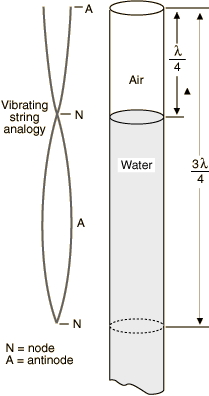
(C) In a resonance tube,the length of the air column for the first resonance is $l_1 = \frac{\lambda}{4} - e$,where $e$ is the end correction.
For the second resonance,the length is $l_2 = \frac{3\lambda}{4} - e$.
Subtracting the two equations: $l_2 - l_1 = \frac{3\lambda}{4} - \frac{\lambda}{4} = \frac{2\lambda}{4} = \frac{\lambda}{2}$.
Thus,$\lambda = 2(l_2 - l_1)$.
Substituting $\lambda$ into the first resonance equation: $l_1 = \frac{2(l_2 - l_1)}{4} - e = \frac{l_2 - l_1}{2} - e$.
Therefore,the end correction $e = \frac{l_2 - l_1}{2} - l_1 = \frac{l_2 - 3l_1}{2}$.
The displacement antinode is located at a distance $e$ above the open end of the tube. Hence,the distance is $\frac{l_2 - 3l_1}{2}$.
For the second resonance,the length is $l_2 = \frac{3\lambda}{4} - e$.
Subtracting the two equations: $l_2 - l_1 = \frac{3\lambda}{4} - \frac{\lambda}{4} = \frac{2\lambda}{4} = \frac{\lambda}{2}$.
Thus,$\lambda = 2(l_2 - l_1)$.
Substituting $\lambda$ into the first resonance equation: $l_1 = \frac{2(l_2 - l_1)}{4} - e = \frac{l_2 - l_1}{2} - e$.
Therefore,the end correction $e = \frac{l_2 - l_1}{2} - l_1 = \frac{l_2 - 3l_1}{2}$.
The displacement antinode is located at a distance $e$ above the open end of the tube. Hence,the distance is $\frac{l_2 - 3l_1}{2}$.
0 likes
View Solution78
MediumMCQ
$A$ closed organ pipe has length $l$. The air in it is vibrating in the $3^{rd}$ overtone with a maximum displacement amplitude $a$. The displacement amplitude at a distance $l/7$ from the closed end of the pipe is:
A
$0$
B
$a$
C
$a/2$
D
none of these
Solution
(B) For a closed organ pipe,the frequencies of harmonics are given by $f_n = (2n-1)f_0$,where $n=1, 2, 3, ...$ corresponds to the fundamental,$1^{st}$ overtone,$2^{nd}$ overtone,and so on.
For the $3^{rd}$ overtone,$n=4$,so the frequency is $f_4 = (2(4)-1)f_0 = 7f_0$.
The length of the pipe $l$ in terms of wavelength $\lambda$ for the $n^{th}$ harmonic is $l = \frac{(2n-1)\lambda}{4}$.
For the $3^{rd}$ overtone $(n=4)$,$l = \frac{7\lambda}{4}$,which implies $\lambda = \frac{4l}{7}$.
The displacement amplitude $y(x)$ in a closed organ pipe at a distance $x$ from the closed end (node) is given by $y(x) = a \sin(kx)$,where $k = \frac{2\pi}{\lambda}$.
Substituting $k = \frac{2\pi}{(4l/7)} = \frac{7\pi}{2l}$,we get $y(x) = a \sin\left(\frac{7\pi x}{2l}\right)$.
At $x = l/7$,the amplitude is $y(l/7) = a \sin\left(\frac{7\pi (l/7)}{2l}\right) = a \sin\left(\frac{\pi}{2}\right) = a(1) = a$.
For the $3^{rd}$ overtone,$n=4$,so the frequency is $f_4 = (2(4)-1)f_0 = 7f_0$.
The length of the pipe $l$ in terms of wavelength $\lambda$ for the $n^{th}$ harmonic is $l = \frac{(2n-1)\lambda}{4}$.
For the $3^{rd}$ overtone $(n=4)$,$l = \frac{7\lambda}{4}$,which implies $\lambda = \frac{4l}{7}$.
The displacement amplitude $y(x)$ in a closed organ pipe at a distance $x$ from the closed end (node) is given by $y(x) = a \sin(kx)$,where $k = \frac{2\pi}{\lambda}$.
Substituting $k = \frac{2\pi}{(4l/7)} = \frac{7\pi}{2l}$,we get $y(x) = a \sin\left(\frac{7\pi x}{2l}\right)$.
At $x = l/7$,the amplitude is $y(l/7) = a \sin\left(\frac{7\pi (l/7)}{2l}\right) = a \sin\left(\frac{\pi}{2}\right) = a(1) = a$.
0 likes
View Solution79
MediumMCQ
The first resonance length of a resonance tube is $40\, cm$ and the second resonance length is $122\, cm$. The third resonance length of the tube will be... $cm$
A
$200$
B
$202$
C
$203$
D
$204$
Solution
(D) In a resonance tube,the resonance lengths are given by $L_n = (2n-1) \frac{\lambda}{4} + e$,where $e$ is the end correction.
The difference between consecutive resonance lengths is $\Delta L = L_{n+1} - L_n = \frac{\lambda}{2}$.
Given the first resonance length $L_1 = 40\, cm$ and the second resonance length $L_2 = 122\, cm$,the difference is:
$\Delta L = 122\, cm - 40\, cm = 82\, cm$.
Since the difference between consecutive resonance lengths is constant,the third resonance length $L_3$ is:
$L_3 = L_2 + \Delta L = 122\, cm + 82\, cm = 204\, cm$.
The difference between consecutive resonance lengths is $\Delta L = L_{n+1} - L_n = \frac{\lambda}{2}$.
Given the first resonance length $L_1 = 40\, cm$ and the second resonance length $L_2 = 122\, cm$,the difference is:
$\Delta L = 122\, cm - 40\, cm = 82\, cm$.
Since the difference between consecutive resonance lengths is constant,the third resonance length $L_3$ is:
$L_3 = L_2 + \Delta L = 122\, cm + 82\, cm = 204\, cm$.
0 likes
View Solution80
DifficultMCQ
$A$ closed organ pipe and an open pipe of the same length produce $4$ beats when they are set into vibrations simultaneously. If the length of each of them were twice their initial lengths,the number of beats produced will be
A
$2$
B
$4$
C
$1$
D
$8$
Solution
(A) Let the length of both pipes be $L$. The fundamental frequency of an open organ pipe is $\nu_{open} = \frac{v}{2L}$.
The fundamental frequency of a closed organ pipe is $\nu_{closed} = \frac{v}{4L}$.
The beat frequency is given by $b = |\nu_{open} - \nu_{closed}| = |\frac{v}{2L} - \frac{v}{4L}| = \frac{v}{4L} = 4$.
If the length of each pipe is doubled,the new length becomes $L' = 2L$.
The new frequencies are $\nu'_{open} = \frac{v}{2(2L)} = \frac{v}{4L}$ and $\nu'_{closed} = \frac{v}{4(2L)} = \frac{v}{8L}$.
The new beat frequency is $b' = |\nu'_{open} - \nu'_{closed}| = |\frac{v}{4L} - \frac{v}{8L}| = \frac{v}{8L}$.
Since $\frac{v}{4L} = 4$,then $\frac{v}{8L} = \frac{4}{2} = 2$.
Therefore,the number of beats produced will be $2$.
The fundamental frequency of a closed organ pipe is $\nu_{closed} = \frac{v}{4L}$.
The beat frequency is given by $b = |\nu_{open} - \nu_{closed}| = |\frac{v}{2L} - \frac{v}{4L}| = \frac{v}{4L} = 4$.
If the length of each pipe is doubled,the new length becomes $L' = 2L$.
The new frequencies are $\nu'_{open} = \frac{v}{2(2L)} = \frac{v}{4L}$ and $\nu'_{closed} = \frac{v}{4(2L)} = \frac{v}{8L}$.
The new beat frequency is $b' = |\nu'_{open} - \nu'_{closed}| = |\frac{v}{4L} - \frac{v}{8L}| = \frac{v}{8L}$.
Since $\frac{v}{4L} = 4$,then $\frac{v}{8L} = \frac{4}{2} = 2$.
Therefore,the number of beats produced will be $2$.
0 likes
View Solution81
AdvancedMCQ
The second overtone of an open organ pipe $A$ and a closed pipe $B$ have the same frequency at a given temperature. It follows that the ratio of the
A
length of $A$ and $B$ is $4 : 3$
B
frequencies of first overtone of $A$ and $B$ is $10 : 9$
C
lengths of $B$ to that of $A$ is $5 : 6$
D
Both $(B)$ and $(C)$
Solution
(D) For an open organ pipe $A$,the frequency of the $n$-th overtone is given by $\nu_{A,n} = (n+1) \frac{v}{2 l_A}$. The second overtone $(n=2)$ is $\nu_{A,2} = \frac{3v}{2l_A}$.
For a closed organ pipe $B$,the frequency of the $n$-th overtone is given by $\nu_{B,n} = (2n+1) \frac{v}{4 l_B}$. The second overtone $(n=2)$ is $\nu_{B,2} = \frac{5v}{4l_B}$.
Given $\nu_{A,2} = \nu_{B,2}$,we have $\frac{3v}{2l_A} = \frac{5v}{4l_B}$.
Rearranging gives $\frac{l_B}{l_A} = \frac{5 \times 2}{3 \times 4} = \frac{10}{12} = \frac{5}{6}$. Thus,the ratio of lengths of $B$ to $A$ is $5:6$.
Now,the first overtone of $A$ $(n=1)$ is $\nu_{A,1} = \frac{2v}{2l_A} = \frac{v}{l_A}$.
The first overtone of $B$ $(n=1)$ is $\nu_{B,1} = \frac{3v}{4l_B}$.
The ratio of these frequencies is $\frac{\nu_{A,1}}{\nu_{B,1}} = \frac{v}{l_A} \times \frac{4l_B}{3v} = \frac{4}{3} \times \frac{l_B}{l_A} = \frac{4}{3} \times \frac{5}{6} = \frac{20}{18} = \frac{10}{9}$.
Both statements $(B)$ and $(C)$ are correct.
For a closed organ pipe $B$,the frequency of the $n$-th overtone is given by $\nu_{B,n} = (2n+1) \frac{v}{4 l_B}$. The second overtone $(n=2)$ is $\nu_{B,2} = \frac{5v}{4l_B}$.
Given $\nu_{A,2} = \nu_{B,2}$,we have $\frac{3v}{2l_A} = \frac{5v}{4l_B}$.
Rearranging gives $\frac{l_B}{l_A} = \frac{5 \times 2}{3 \times 4} = \frac{10}{12} = \frac{5}{6}$. Thus,the ratio of lengths of $B$ to $A$ is $5:6$.
Now,the first overtone of $A$ $(n=1)$ is $\nu_{A,1} = \frac{2v}{2l_A} = \frac{v}{l_A}$.
The first overtone of $B$ $(n=1)$ is $\nu_{B,1} = \frac{3v}{4l_B}$.
The ratio of these frequencies is $\frac{\nu_{A,1}}{\nu_{B,1}} = \frac{v}{l_A} \times \frac{4l_B}{3v} = \frac{4}{3} \times \frac{l_B}{l_A} = \frac{4}{3} \times \frac{5}{6} = \frac{20}{18} = \frac{10}{9}$.
Both statements $(B)$ and $(C)$ are correct.
0 likes
View Solution82
MediumMCQ
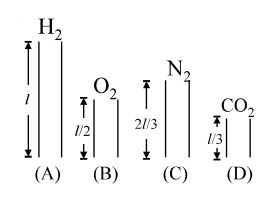
Four open organ pipes of different lengths and different gases at the same temperature are shown in the figure. Let $f_A$,$f_B$,$f_C$,and $f_D$ be their fundamental frequencies. Then: [Take $\gamma_{CO_2} = 7/5$]
A
$f_A/f_B = \sqrt{2}$
B
$f_C/f_D = \sqrt{72/28}$
C
$f_B/f_C = \sqrt{11/28}$
D
$f_D/f_A = \sqrt{71/11}$
Solution
(C) The fundamental frequency of an open organ pipe is given by $f = \frac{v}{2L} = \frac{1}{2L} \sqrt{\frac{\gamma RT}{M}}$.
Since $T$ is constant,$f \propto \frac{\sqrt{\gamma}}{L \sqrt{M}}$.
Let $K = \frac{\sqrt{RT}}{2}$. Then $f = K \frac{\sqrt{\gamma}}{L \sqrt{M}}$.
For pipe $A$ $(H_2)$: $L_A = l$,$M_A = 2$,$\gamma_A = 1.4 = 7/5$. So,$f_A = K \frac{\sqrt{7/5}}{l \sqrt{2}}$.
For pipe $B$ $(O_2)$: $L_B = l/2$,$M_B = 32$,$\gamma_B = 1.4 = 7/5$. So,$f_B = K \frac{\sqrt{7/5}}{(l/2) \sqrt{32}} = 2K \frac{\sqrt{7/5}}{l \sqrt{32}}$.
For pipe $C$ $(N_2)$: $L_C = 2l/3$,$M_C = 28$,$\gamma_C = 1.4 = 7/5$. So,$f_C = K \frac{\sqrt{7/5}}{(2l/3) \sqrt{28}} = \frac{3}{2} K \frac{\sqrt{7/5}}{l \sqrt{28}}$.
For pipe $D$ $(CO_2)$: $L_D = l/3$,$M_D = 44$,$\gamma_D = 7/5$. So,$f_D = K \frac{\sqrt{7/5}}{(l/3) \sqrt{44}} = 3K \frac{\sqrt{7/5}}{l \sqrt{44}}$.
Calculating $f_B/f_C = \frac{2K \sqrt{7/5} / (l \sqrt{32})}{3K \sqrt{7/5} / (2l \sqrt{28})} = \frac{2}{\sqrt{32}} \times \frac{2 \sqrt{28}}{3} = \frac{4}{3} \sqrt{\frac{28}{32}} = \frac{4}{3} \sqrt{\frac{7}{8}} = \frac{4}{3} \frac{\sqrt{7}}{2\sqrt{2}} = \frac{2\sqrt{7}}{3\sqrt{2}} = \sqrt{\frac{28}{18}} = \sqrt{\frac{14}{9}}$.
Checking $f_C/f_D = \frac{3K \sqrt{7/5} / (2l \sqrt{28})}{3K \sqrt{7/5} / (l \sqrt{44})} = \frac{1}{2 \sqrt{28}} \times \sqrt{44} = \frac{1}{2} \sqrt{\frac{44}{28}} = \frac{1}{2} \sqrt{\frac{11}{7}} = \sqrt{\frac{11}{28}}$.
Thus,option $C$ is correct.
Since $T$ is constant,$f \propto \frac{\sqrt{\gamma}}{L \sqrt{M}}$.
Let $K = \frac{\sqrt{RT}}{2}$. Then $f = K \frac{\sqrt{\gamma}}{L \sqrt{M}}$.
For pipe $A$ $(H_2)$: $L_A = l$,$M_A = 2$,$\gamma_A = 1.4 = 7/5$. So,$f_A = K \frac{\sqrt{7/5}}{l \sqrt{2}}$.
For pipe $B$ $(O_2)$: $L_B = l/2$,$M_B = 32$,$\gamma_B = 1.4 = 7/5$. So,$f_B = K \frac{\sqrt{7/5}}{(l/2) \sqrt{32}} = 2K \frac{\sqrt{7/5}}{l \sqrt{32}}$.
For pipe $C$ $(N_2)$: $L_C = 2l/3$,$M_C = 28$,$\gamma_C = 1.4 = 7/5$. So,$f_C = K \frac{\sqrt{7/5}}{(2l/3) \sqrt{28}} = \frac{3}{2} K \frac{\sqrt{7/5}}{l \sqrt{28}}$.
For pipe $D$ $(CO_2)$: $L_D = l/3$,$M_D = 44$,$\gamma_D = 7/5$. So,$f_D = K \frac{\sqrt{7/5}}{(l/3) \sqrt{44}} = 3K \frac{\sqrt{7/5}}{l \sqrt{44}}$.
Calculating $f_B/f_C = \frac{2K \sqrt{7/5} / (l \sqrt{32})}{3K \sqrt{7/5} / (2l \sqrt{28})} = \frac{2}{\sqrt{32}} \times \frac{2 \sqrt{28}}{3} = \frac{4}{3} \sqrt{\frac{28}{32}} = \frac{4}{3} \sqrt{\frac{7}{8}} = \frac{4}{3} \frac{\sqrt{7}}{2\sqrt{2}} = \frac{2\sqrt{7}}{3\sqrt{2}} = \sqrt{\frac{28}{18}} = \sqrt{\frac{14}{9}}$.
Checking $f_C/f_D = \frac{3K \sqrt{7/5} / (2l \sqrt{28})}{3K \sqrt{7/5} / (l \sqrt{44})} = \frac{1}{2 \sqrt{28}} \times \sqrt{44} = \frac{1}{2} \sqrt{\frac{44}{28}} = \frac{1}{2} \sqrt{\frac{11}{7}} = \sqrt{\frac{11}{28}}$.
Thus,option $C$ is correct.
0 likes
View Solution83
MediumMCQ
$A$ gas is filled in an organ pipe and it is sounded in its fundamental mode. Choose the correct statement$(s)$ : ($T$ = constant)
A
If gas is changed from $H_2$ to $O_2$,the resonant frequency will increase.
B
If gas is changed from $O_2$ to $N_2$,the resonant frequency will increase.
C
If gas is changed from $He$ to $CH_4$,the resonant frequency will decrease.
D
Both $(B)$ and $(C)$.
Solution
(D) The fundamental frequency of an organ pipe is given by $f = \frac{v}{2L}$ (for open pipe) or $f = \frac{v}{4L}$ (for closed pipe).
In both cases,$f \propto v$,where $v$ is the speed of sound in the gas.
The speed of sound in a gas is given by $v = \sqrt{\frac{\gamma RT}{M}}$,where $M$ is the molar mass of the gas.
Since $T$ is constant,$v \propto \frac{1}{\sqrt{M}}$. Thus,$f \propto \frac{1}{\sqrt{M}}$.
$(A)$ $M(H_2) = 2$,$M(O_2) = 32$. Since $M$ increases,$f$ decreases. Statement $(A)$ is incorrect.
$(B)$ $M(O_2) = 32$,$M(N_2) = 28$. Since $M$ decreases,$f$ increases. Statement $(B)$ is correct.
$(C)$ $M(He) = 4$,$M(CH_4) = 16$. Since $M$ increases,$f$ decreases. Statement $(C)$ is correct.
Therefore,both $(B)$ and $(C)$ are correct.
In both cases,$f \propto v$,where $v$ is the speed of sound in the gas.
The speed of sound in a gas is given by $v = \sqrt{\frac{\gamma RT}{M}}$,where $M$ is the molar mass of the gas.
Since $T$ is constant,$v \propto \frac{1}{\sqrt{M}}$. Thus,$f \propto \frac{1}{\sqrt{M}}$.
$(A)$ $M(H_2) = 2$,$M(O_2) = 32$. Since $M$ increases,$f$ decreases. Statement $(A)$ is incorrect.
$(B)$ $M(O_2) = 32$,$M(N_2) = 28$. Since $M$ decreases,$f$ increases. Statement $(B)$ is correct.
$(C)$ $M(He) = 4$,$M(CH_4) = 16$. Since $M$ increases,$f$ decreases. Statement $(C)$ is correct.
Therefore,both $(B)$ and $(C)$ are correct.
0 likes
View Solution84
DifficultMCQ
$A$ closed organ pipe of length $1.2 \, m$ vibrates in its first overtone mode. The pressure variation is maximum at:
A
$0.8 \, m$ from the open end
B
$0.4 \, m$ from the open end
C
at the open end
D
$1.0 \, m$ from the open end
Solution
(B) For a closed organ pipe,the length $L$ is related to the wavelength $\lambda$ for the $n^{th}$ overtone as $L = (2n + 1) \frac{\lambda}{4}$.
For the first overtone,$n = 1$,so $L = \frac{3\lambda}{4}$.
Given $L = 1.2 \, m$,we have $\frac{3\lambda}{4} = 1.2 \, m$,which gives $\lambda = 1.6 \, m$.
In a standing wave,pressure variation is maximum at the displacement nodes.
In a closed organ pipe,the open end is a displacement antinode (pressure node),and the closed end is a displacement node (pressure antinode).
The displacement nodes occur at distances $x = 0, \frac{\lambda}{2}, \lambda, \dots$ from the closed end.
Alternatively,measuring from the open end,the displacement nodes occur at $x = \frac{\lambda}{4}, \frac{3\lambda}{4}, \dots$ from the open end.
For the first overtone,the first displacement node (maximum pressure variation) is at $\frac{\lambda}{4} = \frac{1.6}{4} = 0.4 \, m$ from the open end.
For the first overtone,$n = 1$,so $L = \frac{3\lambda}{4}$.
Given $L = 1.2 \, m$,we have $\frac{3\lambda}{4} = 1.2 \, m$,which gives $\lambda = 1.6 \, m$.
In a standing wave,pressure variation is maximum at the displacement nodes.
In a closed organ pipe,the open end is a displacement antinode (pressure node),and the closed end is a displacement node (pressure antinode).
The displacement nodes occur at distances $x = 0, \frac{\lambda}{2}, \lambda, \dots$ from the closed end.
Alternatively,measuring from the open end,the displacement nodes occur at $x = \frac{\lambda}{4}, \frac{3\lambda}{4}, \dots$ from the open end.
For the first overtone,the first displacement node (maximum pressure variation) is at $\frac{\lambda}{4} = \frac{1.6}{4} = 0.4 \, m$ from the open end.
0 likes
View Solution85
AdvancedMCQ
In an organ pipe whose one end is at $x = 0$,the pressure is expressed by $p = p_0 \cos \frac{3\pi x}{2} \sin 300\pi t$,where $x$ is in meters and $t$ is in seconds. The organ pipe can be:
A
closed at one end,open at another with length $= 0.5 \ m$
B
open at both ends,length $= 1 \ m$
C
closed at both ends,length $= 2 \ m$
D
closed at one end,open at another with length $= \frac{2}{3} \ m$
Solution
(C) The pressure variation in a standing wave is given by $p(x, t) = p_0 \cos(kx) \sin(\omega t)$.
At a closed end,the displacement is zero,which corresponds to a pressure antinode (maximum pressure amplitude).
At an open end,the pressure is atmospheric,which corresponds to a pressure node (zero pressure amplitude).
Given $p = p_0 \cos \frac{3\pi x}{2} \sin 300\pi t$.
At $x = 0$,$p = p_0 \cos(0) \sin(300\pi t) = p_0 \sin(300\pi t)$. Since the pressure amplitude is maximum $(p_0)$,$x = 0$ is a closed end.
For the other end to be a closed end,the pressure amplitude must be maximum,i.e.,$|\cos \frac{3\pi x}{2}| = 1$.
This occurs when $\frac{3\pi x}{2} = n\pi$ for integer $n$.
For the first possible length $L > 0$,we set $n = 3$,so $\frac{3\pi L}{2} = 3\pi$,which gives $L = 2 \ m$.
Thus,the pipe is closed at both ends with a length of $2 \ m$.
At a closed end,the displacement is zero,which corresponds to a pressure antinode (maximum pressure amplitude).
At an open end,the pressure is atmospheric,which corresponds to a pressure node (zero pressure amplitude).
Given $p = p_0 \cos \frac{3\pi x}{2} \sin 300\pi t$.
At $x = 0$,$p = p_0 \cos(0) \sin(300\pi t) = p_0 \sin(300\pi t)$. Since the pressure amplitude is maximum $(p_0)$,$x = 0$ is a closed end.
For the other end to be a closed end,the pressure amplitude must be maximum,i.e.,$|\cos \frac{3\pi x}{2}| = 1$.
This occurs when $\frac{3\pi x}{2} = n\pi$ for integer $n$.
For the first possible length $L > 0$,we set $n = 3$,so $\frac{3\pi L}{2} = 3\pi$,which gives $L = 2 \ m$.
Thus,the pipe is closed at both ends with a length of $2 \ m$.
0 likes
View Solution86
MediumMCQ
While measuring the speed of sound by performing a resonance column experiment,a student gets the first resonance condition at a column length of $18 \ cm$ during winter. Repeating the same experiment during summer,she measures the column length to be $x \ cm$ for the second resonance. Then
A
$18 \ cm > x$
B
$x > 54 \ cm$
C
$54 \ cm > x > 36 \ cm$
D
$36 \ cm > x > 18 \ cm$
Solution
(B) In a resonance column experiment,the frequency of the tuning fork $f$ remains constant.
For the first resonance in winter,the length is $\ell_1 = 18 \ cm$. The frequency is given by $f = \frac{v}{4 \ell_1} = \frac{v}{4 \times 18}$,where $v$ is the speed of sound in winter.
For the second resonance in summer,the length is $\ell_2 = x \ cm$. The frequency is given by $f = \frac{3v'}{4 \ell_2} = \frac{3v'}{4x}$,where $v'$ is the speed of sound in summer.
Equating the frequencies: $\frac{v}{4 \times 18} = \frac{3v'}{4x}$.
Solving for $x$: $x = 54 \times \frac{v'}{v} \ cm$.
Since the temperature in summer is higher than in winter,the speed of sound $v' > v$ (because $v \propto \sqrt{T}$).
Therefore,$x > 54 \ cm$.
For the first resonance in winter,the length is $\ell_1 = 18 \ cm$. The frequency is given by $f = \frac{v}{4 \ell_1} = \frac{v}{4 \times 18}$,where $v$ is the speed of sound in winter.
For the second resonance in summer,the length is $\ell_2 = x \ cm$. The frequency is given by $f = \frac{3v'}{4 \ell_2} = \frac{3v'}{4x}$,where $v'$ is the speed of sound in summer.
Equating the frequencies: $\frac{v}{4 \times 18} = \frac{3v'}{4x}$.
Solving for $x$: $x = 54 \times \frac{v'}{v} \ cm$.
Since the temperature in summer is higher than in winter,the speed of sound $v' > v$ (because $v \propto \sqrt{T}$).
Therefore,$x > 54 \ cm$.
0 likes
View Solution87
MediumMCQ
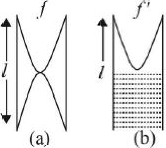
$A$ pipe open at both ends has a fundamental frequency $f$ in air. The pipe is dipped vertically in water so that half of its length is in water. The fundamental frequency of the air column is now ..... $f$.
A
$2$
B
$1$
C
$0.5$
D
$0.75$
Solution
(B) For a pipe open at both ends with length $\ell$,the fundamental frequency is given by $f = \frac{v}{2\ell}$,where $v$ is the speed of sound in air.
When the pipe is dipped vertically in water such that half of its length is submerged,the length of the air column becomes $\ell^{\prime} = \frac{\ell}{2}$.
Since the pipe is now closed at one end (by the water surface) and open at the other,it acts as a pipe closed at one end.
The fundamental frequency of a pipe closed at one end with length $\ell^{\prime}$ is $f^{\prime} = \frac{v}{4\ell^{\prime}}$.
Substituting $\ell^{\prime} = \frac{\ell}{2}$ into the equation,we get $f^{\prime} = \frac{v}{4(\ell/2)} = \frac{v}{2\ell}$.
Comparing this with the initial frequency,we find $f^{\prime} = f$.
When the pipe is dipped vertically in water such that half of its length is submerged,the length of the air column becomes $\ell^{\prime} = \frac{\ell}{2}$.
Since the pipe is now closed at one end (by the water surface) and open at the other,it acts as a pipe closed at one end.
The fundamental frequency of a pipe closed at one end with length $\ell^{\prime}$ is $f^{\prime} = \frac{v}{4\ell^{\prime}}$.
Substituting $\ell^{\prime} = \frac{\ell}{2}$ into the equation,we get $f^{\prime} = \frac{v}{4(\ell/2)} = \frac{v}{2\ell}$.
Comparing this with the initial frequency,we find $f^{\prime} = f$.
0 likes
View Solution88
MediumMCQ
$A$ uniform narrow $1.95 \, m$ long pipe is open at both ends. It resonates at two successive harmonics of frequency $275 \, Hz$ and $330 \, Hz$. The speed of sound in the tube is ...... $m/s$.
A
$200$
B
$205$
C
$210$
D
$214.5$
Solution
(D) For an open pipe of length $L$,the frequency of the $n^{th}$ harmonic is given by $f_n = \frac{n v}{2L}$,where $v$ is the speed of sound.
Given $L = 1.95 \, m$,and two successive harmonics are $f_n = 275 \, Hz$ and $f_{n+1} = 330 \, Hz$.
The difference between two successive harmonics is the fundamental frequency $f_1 = \frac{v}{2L}$.
$f_{n+1} - f_n = \frac{(n+1)v}{2L} - \frac{nv}{2L} = \frac{v}{2L} = 330 - 275 = 55 \, Hz$.
Substituting the value of $L$:
$\frac{v}{2 \times 1.95} = 55$.
$v = 55 \times 3.9 = 214.5 \, m/s$.
Given $L = 1.95 \, m$,and two successive harmonics are $f_n = 275 \, Hz$ and $f_{n+1} = 330 \, Hz$.
The difference between two successive harmonics is the fundamental frequency $f_1 = \frac{v}{2L}$.
$f_{n+1} - f_n = \frac{(n+1)v}{2L} - \frac{nv}{2L} = \frac{v}{2L} = 330 - 275 = 55 \, Hz$.
Substituting the value of $L$:
$\frac{v}{2 \times 1.95} = 55$.
$v = 55 \times 3.9 = 214.5 \, m/s$.
0 likes
View Solution89
MediumMCQ
One insulated conductor from a household extension cord has a mass per unit length of $\mu$. $A$ section of this conductor is held under tension between two clamps. $A$ subsection is located in a magnetic field of magnitude $B$ directed perpendicular to the length of the cord. When the cord carries an $AC$ current of $i$ at a frequency of $f$,it vibrates in resonance in its simplest standing-wave vibration state. Determine the relationship that must be satisfied between the separation $d$ of the clamps and the tension $T$ in the cord.
A
$T=4\mu f^2d^2$
B
$T=2\mu f^2d^2$
C
$T=\frac{\mu f^2d^2}{2}$
D
$T=\frac{\mu f^2d^2}{4}$
Solution
(A) The fundamental frequency $(n_0)$ of a string of length $d$ fixed at both ends is given by the formula: $n_0 = \frac{1}{2d} \sqrt{\frac{T}{\mu}}$.
Since the cord vibrates in its simplest standing-wave state (fundamental mode),the frequency of vibration $f$ is equal to the fundamental frequency $n_0$.
Therefore,$f = \frac{1}{2d} \sqrt{\frac{T}{\mu}}$.
Squaring both sides,we get: $f^2 = \frac{1}{4d^2} \cdot \frac{T}{\mu}$.
Rearranging to solve for tension $T$: $T = 4\mu f^2 d^2$.
Since the cord vibrates in its simplest standing-wave state (fundamental mode),the frequency of vibration $f$ is equal to the fundamental frequency $n_0$.
Therefore,$f = \frac{1}{2d} \sqrt{\frac{T}{\mu}}$.
Squaring both sides,we get: $f^2 = \frac{1}{4d^2} \cdot \frac{T}{\mu}$.
Rearranging to solve for tension $T$: $T = 4\mu f^2 d^2$.
0 likes
View Solution90
DifficultMCQ
$A$ student is performing the experiment of Resonance Column. The diameter of the column tube is $4 \ cm$. The frequency of the tuning fork is $512 \ Hz$. The air temperature is $38^{\circ}C$ in which the speed of sound is $336 \ m/s$. The zero of the meter scale coincides with the top end of the Resonance column tube. When the first resonance occurs,the reading of the water level in the column is ..... $cm$.
A
$14.0$
B
$15.2$
C
$16.4$
D
$17.6$
Solution
(B) In a resonance column experiment,the first resonance length $l_1$ is given by the formula: $\frac{\lambda}{4} = l_1 + e$,where $e$ is the end correction.
The end correction $e$ for a tube of diameter $d$ is given by $e = 0.3d$.
The wavelength $\lambda$ is calculated as $\lambda = \frac{v}{f}$,where $v = 336 \ m/s$ and $f = 512 \ Hz$.
$\lambda = \frac{336}{512} \approx 0.65625 \ m = 65.625 \ cm$.
Therefore,$\frac{\lambda}{4} = \frac{65.625}{4} = 16.40625 \ cm$.
Given the diameter $d = 4 \ cm$,the end correction $e = 0.3 \times 4 = 1.2 \ cm$.
Substituting these values into the resonance formula: $l_1 = \frac{\lambda}{4} - e = 16.40625 - 1.2 = 15.20625 \ cm$.
Rounding to one decimal place,the reading is $15.2 \ cm$.
The end correction $e$ for a tube of diameter $d$ is given by $e = 0.3d$.
The wavelength $\lambda$ is calculated as $\lambda = \frac{v}{f}$,where $v = 336 \ m/s$ and $f = 512 \ Hz$.
$\lambda = \frac{336}{512} \approx 0.65625 \ m = 65.625 \ cm$.
Therefore,$\frac{\lambda}{4} = \frac{65.625}{4} = 16.40625 \ cm$.
Given the diameter $d = 4 \ cm$,the end correction $e = 0.3 \times 4 = 1.2 \ cm$.
Substituting these values into the resonance formula: $l_1 = \frac{\lambda}{4} - e = 16.40625 - 1.2 = 15.20625 \ cm$.
Rounding to one decimal place,the reading is $15.2 \ cm$.
0 likes
View Solution91
MediumMCQ
$A$ string fixed at both ends is in resonance in its $2^{nd}$ harmonic with a tuning fork of frequency $f_1$. Now,one end becomes free. If the frequency of the tuning fork is increased slowly from $f_1$,then again a resonance is obtained when the frequency is $f_2$. If in this case the string vibrates in the $n^{th}$ harmonic,then:
A
$n = 3, f_2 = \frac{3}{4}f_1$
B
$n = 3, f_2 = \frac{5}{4}f_1$
C
$n = 5, f_2 = \frac{5}{4}f_1$
D
$n = 5, f_2 = \frac{3}{4}f_1$
Solution
(C) For a string fixed at both ends,the frequency of the $2^{nd}$ harmonic is given by $f_1 = \frac{2v}{2L} = \frac{v}{L}$,where $v$ is the wave speed and $L$ is the length of the string.
When one end becomes free,the string acts like a pipe closed at one end. The resonant frequencies are given by $f_n = \frac{nv}{4L}$,where $n$ must be an odd integer $(n = 1, 3, 5, \dots)$.
We are given that the frequency is increased from $f_1$. We need to find the first resonant frequency $f_2 > f_1$ for the new configuration.
Setting $f_2 = \frac{nv}{4L} > f_1 = \frac{v}{L}$,we get $\frac{nv}{4L} > \frac{v}{L}$,which implies $n > 4$.
The smallest odd integer greater than $4$ is $n = 5$.
Thus,$f_2 = \frac{5v}{4L} = \frac{5}{4} \left( \frac{v}{L} \right) = \frac{5}{4}f_1$.
When one end becomes free,the string acts like a pipe closed at one end. The resonant frequencies are given by $f_n = \frac{nv}{4L}$,where $n$ must be an odd integer $(n = 1, 3, 5, \dots)$.
We are given that the frequency is increased from $f_1$. We need to find the first resonant frequency $f_2 > f_1$ for the new configuration.
Setting $f_2 = \frac{nv}{4L} > f_1 = \frac{v}{L}$,we get $\frac{nv}{4L} > \frac{v}{L}$,which implies $n > 4$.
The smallest odd integer greater than $4$ is $n = 5$.
Thus,$f_2 = \frac{5v}{4L} = \frac{5}{4} \left( \frac{v}{L} \right) = \frac{5}{4}f_1$.
0 likes
View Solution92
MediumMCQ
$A$ closed organ pipe (closed at one end) is excited to support the third overtone. It is found that air in the pipe has
A
three nodes and three antinodes
B
three nodes and four antinodes
C
four nodes and three antinodes
D
four nodes and four antinodes
Solution
(D) For a closed organ pipe,the frequencies of the harmonics are given by $f_n = (2n - 1)f_1$,where $n = 1, 2, 3, ...$ is the harmonic number.
The fundamental frequency $(n=1)$ is the first harmonic.
The first overtone is the third harmonic $(n=2)$.
The second overtone is the fifth harmonic $(n=3)$.
The third overtone is the seventh harmonic $(n=4)$.
For the $n$-th harmonic in a closed pipe,the number of nodes is $n$ and the number of antinodes is $n$.
Since the third overtone corresponds to the $4$-th harmonic $(n=4)$,the air column in the pipe will have $4$ nodes and $4$ antinodes.
The fundamental frequency $(n=1)$ is the first harmonic.
The first overtone is the third harmonic $(n=2)$.
The second overtone is the fifth harmonic $(n=3)$.
The third overtone is the seventh harmonic $(n=4)$.
For the $n$-th harmonic in a closed pipe,the number of nodes is $n$ and the number of antinodes is $n$.
Since the third overtone corresponds to the $4$-th harmonic $(n=4)$,the air column in the pipe will have $4$ nodes and $4$ antinodes.
0 likes
View Solution93
MediumMCQ
$A$ tuning fork of frequency $340 \, Hz$ is sounded above an organ pipe of length $120 \, cm$. Water is now slowly poured in it. The minimum height of water column required for resonance is .... $cm$ (speed of sound in air $= 340 \, m/s$)
A
$25$
B
$95$
C
$75$
D
$45$
Solution
(D) The frequency of the tuning fork is $f = 340 \, Hz$ and the speed of sound is $v = 340 \, m/s$.
The wavelength is $\lambda = \frac{v}{f} = \frac{340}{340} = 1 \, m = 100 \, cm$.
For a pipe closed at one end,resonance occurs when the length of the air column $L$ satisfies $L = \frac{n \lambda}{4}$,where $n = 1, 3, 5, \ldots$.
Substituting $\lambda = 100 \, cm$,we get $L = \frac{n \times 100}{4} = 25n \, cm$.
Possible lengths of the air column are $L = 25 \, cm, 75 \, cm, 125 \, cm, \ldots$.
Since the total length of the pipe is $120 \, cm$,the air column length $L$ must be $\le 120 \, cm$. Thus,the possible values for $L$ are $25 \, cm$ and $75 \, cm$.
The height of the water column $h$ is given by $h = 120 - L$.
To find the minimum height of the water column,we must choose the maximum possible length of the air column,which is $L = 75 \, cm$.
Therefore,$h_{\min} = 120 \, cm - 75 \, cm = 45 \, cm$.
The wavelength is $\lambda = \frac{v}{f} = \frac{340}{340} = 1 \, m = 100 \, cm$.
For a pipe closed at one end,resonance occurs when the length of the air column $L$ satisfies $L = \frac{n \lambda}{4}$,where $n = 1, 3, 5, \ldots$.
Substituting $\lambda = 100 \, cm$,we get $L = \frac{n \times 100}{4} = 25n \, cm$.
Possible lengths of the air column are $L = 25 \, cm, 75 \, cm, 125 \, cm, \ldots$.
Since the total length of the pipe is $120 \, cm$,the air column length $L$ must be $\le 120 \, cm$. Thus,the possible values for $L$ are $25 \, cm$ and $75 \, cm$.
The height of the water column $h$ is given by $h = 120 - L$.
To find the minimum height of the water column,we must choose the maximum possible length of the air column,which is $L = 75 \, cm$.
Therefore,$h_{\min} = 120 \, cm - 75 \, cm = 45 \, cm$.
0 likes
View Solution94
MediumMCQ
$A$ string of length $3 \ m$ and linear mass density $0.0025 \ kg/m$ is fixed at both ends. One of its resonance frequencies is $252 \ Hz$. The next higher resonance frequency is $336 \ Hz$. Then the fundamental frequency will be ..... $Hz$.
A
$84$
B
$63$
C
$126$
D
$168$
Solution
(A) For a string fixed at both ends,the resonance frequencies are given by $f_n = n f_1$,where $n = 1, 2, 3, \dots$ and $f_1$ is the fundamental frequency.
Given two consecutive resonance frequencies $f_n = 252 \ Hz$ and $f_{n+1} = 336 \ Hz$.
Taking the ratio: $\frac{f_{n+1}}{f_n} = \frac{(n+1) f_1}{n f_1} = \frac{n+1}{n} = \frac{336}{252}$.
Simplifying the fraction: $\frac{336}{252} = \frac{4}{3}$.
Thus,$\frac{n+1}{n} = \frac{4}{3}$,which implies $n = 3$.
Substituting $n = 3$ into $f_n = n f_1$,we get $252 = 3 f_1$.
Therefore,$f_1 = \frac{252}{3} = 84 \ Hz$.
Given two consecutive resonance frequencies $f_n = 252 \ Hz$ and $f_{n+1} = 336 \ Hz$.
Taking the ratio: $\frac{f_{n+1}}{f_n} = \frac{(n+1) f_1}{n f_1} = \frac{n+1}{n} = \frac{336}{252}$.
Simplifying the fraction: $\frac{336}{252} = \frac{4}{3}$.
Thus,$\frac{n+1}{n} = \frac{4}{3}$,which implies $n = 3$.
Substituting $n = 3$ into $f_n = n f_1$,we get $252 = 3 f_1$.
Therefore,$f_1 = \frac{252}{3} = 84 \ Hz$.
0 likes
View Solution95
MediumMCQ
$A$ closed organ pipe of length $l$ is sounded together with another closed organ pipe of length $l + x$ $(x << l)$,both in their fundamental mode. If $v$ is the speed of sound,the beat frequency heard is:
A
$\frac{vx}{2l^2}$
B
$\frac{vx}{4l^2}$
C
$\frac{vx^2}{4l}$
D
$\frac{vx}{l^2}$
Solution
(B) The fundamental frequency of a closed organ pipe of length $L$ is given by $f = \frac{v}{4L}$.
For the first pipe of length $l$,the frequency is $f_1 = \frac{v}{4l}$.
For the second pipe of length $l + x$,the frequency is $f_2 = \frac{v}{4(l + x)}$.
The beat frequency $f_b$ is the difference between these two frequencies: $f_b = f_1 - f_2 = \frac{v}{4l} - \frac{v}{4(l + x)}$.
Factoring out $\frac{v}{4}$,we get $f_b = \frac{v}{4} \left( \frac{1}{l} - \frac{1}{l + x} \right) = \frac{v}{4} \left( \frac{l + x - l}{l(l + x)} \right) = \frac{v}{4} \left( \frac{x}{l(l + x)} \right)$.
Since $x << l$,we can approximate $l + x \approx l$,so $l(l + x) \approx l^2$.
Therefore,the beat frequency is $f_b \approx \frac{vx}{4l^2}$.
For the first pipe of length $l$,the frequency is $f_1 = \frac{v}{4l}$.
For the second pipe of length $l + x$,the frequency is $f_2 = \frac{v}{4(l + x)}$.
The beat frequency $f_b$ is the difference between these two frequencies: $f_b = f_1 - f_2 = \frac{v}{4l} - \frac{v}{4(l + x)}$.
Factoring out $\frac{v}{4}$,we get $f_b = \frac{v}{4} \left( \frac{1}{l} - \frac{1}{l + x} \right) = \frac{v}{4} \left( \frac{l + x - l}{l(l + x)} \right) = \frac{v}{4} \left( \frac{x}{l(l + x)} \right)$.
Since $x << l$,we can approximate $l + x \approx l$,so $l(l + x) \approx l^2$.
Therefore,the beat frequency is $f_b \approx \frac{vx}{4l^2}$.
0 likes
View Solution96
MediumMCQ
In the resonance tube experiment,the first resonant length is $l_1$ and the second resonant length is $l_2$. Then,the third resonant length will be:
A
$5l_2$
B
$2(l_2-l_1)$
C
$2l_2-l_1$
D
$3l_2-2l_1$
Solution
(C) In a resonance tube experiment,the resonant lengths are given by the formula $\ell_n + \varepsilon = \frac{(2n-1)v}{4f_0}$,where $\varepsilon$ is the end correction,$v$ is the speed of sound,and $f_0$ is the frequency of the tuning fork.
For the first resonance $(n=1)$: $\ell_1 + \varepsilon = \frac{v}{4f_0}$.
For the second resonance $(n=2)$: $\ell_2 + \varepsilon = \frac{3v}{4f_0}$.
For the third resonance $(n=3)$: $\ell_3 + \varepsilon = \frac{5v}{4f_0}$.
Subtracting the first equation from the second: $\ell_2 - \ell_1 = \frac{3v}{4f_0} - \frac{v}{4f_0} = \frac{2v}{4f_0} = \frac{v}{2f_0}$.
Thus,$\frac{v}{4f_0} = \frac{\ell_2 - \ell_1}{2}$.
Substituting this into the third resonance equation: $\ell_3 + \varepsilon = 5 \times \frac{\ell_2 - \ell_1}{2} = 2.5(\ell_2 - \ell_1)$.
Alternatively,note that the difference between consecutive resonant lengths is constant: $\ell_2 - \ell_1 = \ell_3 - \ell_2 = \frac{v}{2f_0}$.
Therefore,$\ell_3 = \ell_2 + (\ell_2 - \ell_1) = 2\ell_2 - \ell_1$.
For the first resonance $(n=1)$: $\ell_1 + \varepsilon = \frac{v}{4f_0}$.
For the second resonance $(n=2)$: $\ell_2 + \varepsilon = \frac{3v}{4f_0}$.
For the third resonance $(n=3)$: $\ell_3 + \varepsilon = \frac{5v}{4f_0}$.
Subtracting the first equation from the second: $\ell_2 - \ell_1 = \frac{3v}{4f_0} - \frac{v}{4f_0} = \frac{2v}{4f_0} = \frac{v}{2f_0}$.
Thus,$\frac{v}{4f_0} = \frac{\ell_2 - \ell_1}{2}$.
Substituting this into the third resonance equation: $\ell_3 + \varepsilon = 5 \times \frac{\ell_2 - \ell_1}{2} = 2.5(\ell_2 - \ell_1)$.
Alternatively,note that the difference between consecutive resonant lengths is constant: $\ell_2 - \ell_1 = \ell_3 - \ell_2 = \frac{v}{2f_0}$.
Therefore,$\ell_3 = \ell_2 + (\ell_2 - \ell_1) = 2\ell_2 - \ell_1$.
0 likes
View Solution97
MediumMCQ
An open and a closed organ pipe are of same length. The ratio of the frequency of the $n^{th}$ mode of vibration of the two pipes is
A
$1$
B
$\frac{n}{2n + 1}$
C
$\frac{2n}{2n - 1}$
D
$2n$
Solution
(C) For an open organ pipe,the frequency of the $n^{th}$ mode of vibration is given by $(v_{n})_{o} = \frac{nv}{2l}$,where $v$ is the speed of sound and $l$ is the length of the pipe.
For a closed organ pipe,the frequency of the $n^{th}$ mode of vibration is given by $(v_{n})_{c} = (2n - 1) \frac{v}{4l}$.
To find the ratio of the frequency of the $n^{th}$ mode of the open pipe to that of the closed pipe,we divide the two expressions:
$\frac{(v_{n})_{o}}{(v_{n})_{c}} = \frac{\frac{nv}{2l}}{(2n - 1) \frac{v}{4l}}$
$\frac{(v_{n})_{o}}{(v_{n})_{c}} = \frac{nv}{2l} \times \frac{4l}{(2n - 1)v}$
$\frac{(v_{n})_{o}}{(v_{n})_{c}} = \frac{2n}{2n - 1}$
For a closed organ pipe,the frequency of the $n^{th}$ mode of vibration is given by $(v_{n})_{c} = (2n - 1) \frac{v}{4l}$.
To find the ratio of the frequency of the $n^{th}$ mode of the open pipe to that of the closed pipe,we divide the two expressions:
$\frac{(v_{n})_{o}}{(v_{n})_{c}} = \frac{\frac{nv}{2l}}{(2n - 1) \frac{v}{4l}}$
$\frac{(v_{n})_{o}}{(v_{n})_{c}} = \frac{nv}{2l} \times \frac{4l}{(2n - 1)v}$
$\frac{(v_{n})_{o}}{(v_{n})_{c}} = \frac{2n}{2n - 1}$
0 likes
View Solution98
MediumMCQ
The fundamental frequency of a closed organ pipe of length $20\; cm$ is equal to the second overtone of an organ pipe open at both the ends. The length of the organ pipe open at both the ends is ...... $cm$.
A
$100$
B
$120$
C
$140$
D
$80$
Solution
(B) The fundamental frequency of a closed organ pipe is given by $f_c = \frac{v}{4\ell_c}$,where $\ell_c = 20\; cm$.
The frequencies of an open organ pipe are given by $f_n = \frac{nv}{2\ell_o}$,where $n = 1, 2, 3, \dots$.
The first overtone is $n=2$,and the second overtone is $n=3$.
Thus,the second overtone frequency of an open organ pipe is $f_{o,2} = \frac{3v}{2\ell_o}$.
According to the problem,the fundamental frequency of the closed pipe equals the second overtone of the open pipe:
$\frac{v}{4\ell_c} = \frac{3v}{2\ell_o}$
Canceling $v$ from both sides:
$\frac{1}{4\ell_c} = \frac{3}{2\ell_o}$
Rearranging to solve for $\ell_o$:
$\ell_o = \frac{3 \times 4\ell_c}{2} = 6\ell_c$
Substituting $\ell_c = 20\; cm$:
$\ell_o = 6 \times 20\; cm = 120\; cm$.
The frequencies of an open organ pipe are given by $f_n = \frac{nv}{2\ell_o}$,where $n = 1, 2, 3, \dots$.
The first overtone is $n=2$,and the second overtone is $n=3$.
Thus,the second overtone frequency of an open organ pipe is $f_{o,2} = \frac{3v}{2\ell_o}$.
According to the problem,the fundamental frequency of the closed pipe equals the second overtone of the open pipe:
$\frac{v}{4\ell_c} = \frac{3v}{2\ell_o}$
Canceling $v$ from both sides:
$\frac{1}{4\ell_c} = \frac{3}{2\ell_o}$
Rearranging to solve for $\ell_o$:
$\ell_o = \frac{3 \times 4\ell_c}{2} = 6\ell_c$
Substituting $\ell_c = 20\; cm$:
$\ell_o = 6 \times 20\; cm = 120\; cm$.
0 likes
View SolutionWaves and Sound — Longitudinal Stationary Waves (Organ Pipes) and Resonance Tube · Frequently Asked Questions
1Are these Waves and Sound questions useful for JEE and NEET?
Yes. All questions in this section are mapped to JEE Main and NEET exam patterns. Previous year questions from JEE Main, NEET, GUJCET and state-level exams are included with full solutions.
2Can I switch to Hindi or Gujarati for these questions?
Yes. Use the language tabs in the hero section or the sidebar to view the same questions and solutions in English, Hindi or Gujarati.
3How do I generate a question paper from this subtopic?
Use the Vedclass Exam Paper Generator — select the chapter and subtopic, set difficulty, and generate Sets A, B, C, D automatically. First 3 chapters of every subject are free.
Vedclass Products
For Students
Vedclass Test Series
Mock tests in real JEE/NEET style with performance analysis. 5-day free trial.
Start Free TrialFor Teachers
Exam Paper Generator
Generate Set A/B/C/D papers from this chapter in 2 minutes. 3 chapters free.
Try FreeFor Institutes
Online Exam Module
Live online exams with unlimited students, 360° analytics & white-label branding.
See DemoFor Teachers & Institutes
Generate a Waves and Sound Exam Paper in 2 Minutes
Select subtopic & difficulty — Sets A, B, C, D auto-generated with No Repeat logic.
First 3 chapters of every subject are free — no payment required.