
A English
Third Law of Motion and Momentum and Impulse Questions in English
Class 11 Physics · Newton's Laws of Motion and Friction · Third Law of Motion and Momentum and Impulse
208+
Questions
English
Language
100%
With Solutions
Showing 50 of 208 questions in English
51
EasyMCQ
$A$ metal ball hits a wall and does not rebound,whereas a rubber ball of the same mass hits the wall with the same velocity and rebounds. What can be concluded from this?
A
The metal ball experiences a greater change in momentum.
B
The rubber ball experiences a greater change in momentum.
C
The initial momentum of the metal ball is greater than that of the rubber ball.
D
Both experience the same change in momentum.
Solution
(B) Let the mass of the balls be $m$ and the initial velocity be $v_1$.
For the metal ball,the final velocity $v_2 = 0$ (as it does not rebound).
The change in momentum is $\Delta p = m(v_2 - v_1) = m(0 - v_1) = -mv_1$.
The magnitude of change is $|\Delta p| = mv_1$.
For the rubber ball,the final velocity $v_2' = -v_1$ (as it rebounds with the same velocity).
The change in momentum is $\Delta p' = m(v_2' - v_1) = m(-v_1 - v_1) = -2mv_1$.
The magnitude of change is $|\Delta p'| = 2mv_1$.
Comparing the two,$|\Delta p'| > |\Delta p|$.
Therefore,the rubber ball experiences a greater change in momentum.
For the metal ball,the final velocity $v_2 = 0$ (as it does not rebound).
The change in momentum is $\Delta p = m(v_2 - v_1) = m(0 - v_1) = -mv_1$.
The magnitude of change is $|\Delta p| = mv_1$.
For the rubber ball,the final velocity $v_2' = -v_1$ (as it rebounds with the same velocity).
The change in momentum is $\Delta p' = m(v_2' - v_1) = m(-v_1 - v_1) = -2mv_1$.
The magnitude of change is $|\Delta p'| = 2mv_1$.
Comparing the two,$|\Delta p'| > |\Delta p|$.
Therefore,the rubber ball experiences a greater change in momentum.
0 likes
View Solution52
EasyMCQ
$A$ ball of mass $3 \ kg$ strikes a wall at an angle of $60^\circ$ with a velocity of $10 \ m/s$ and rebounds at the same angle and speed. What is the change in momentum of the ball in $MKS$ units?
A
$30 \ kg \cdot m/s$
B
$60 \ kg \cdot m/s$
C
$15 \ kg \cdot m/s$
D
$45 \ kg \cdot m/s$
Solution
(A) The change in momentum $\Delta \vec{p}$ is given by $\vec{p}_f - \vec{p}_i$.
Since the ball rebounds at the same angle and speed,the velocity component parallel to the wall remains unchanged,while the component perpendicular to the wall reverses direction.
Let the wall be along the $y$-axis. The initial velocity is $\vec{v}_i = (v \cos 60^\circ) \hat{i} - (v \sin 60^\circ) \hat{j}$.
The final velocity is $\vec{v}_f = -(v \cos 60^\circ) \hat{i} - (v \sin 60^\circ) \hat{j}$.
The change in momentum is $\Delta \vec{p} = m(\vec{v}_f - \vec{v}_i) = m(-2v \cos 60^\circ) \hat{i}$.
The magnitude of the change in momentum is $|\Delta p| = 2mv \cos 60^\circ$.
Given $m = 3 \ kg$,$v = 10 \ m/s$,and $\cos 60^\circ = 0.5$.
$|\Delta p| = 2 \times 3 \times 10 \times 0.5 = 30 \ kg \cdot m/s$.
Since the ball rebounds at the same angle and speed,the velocity component parallel to the wall remains unchanged,while the component perpendicular to the wall reverses direction.
Let the wall be along the $y$-axis. The initial velocity is $\vec{v}_i = (v \cos 60^\circ) \hat{i} - (v \sin 60^\circ) \hat{j}$.
The final velocity is $\vec{v}_f = -(v \cos 60^\circ) \hat{i} - (v \sin 60^\circ) \hat{j}$.
The change in momentum is $\Delta \vec{p} = m(\vec{v}_f - \vec{v}_i) = m(-2v \cos 60^\circ) \hat{i}$.
The magnitude of the change in momentum is $|\Delta p| = 2mv \cos 60^\circ$.
Given $m = 3 \ kg$,$v = 10 \ m/s$,and $\cos 60^\circ = 0.5$.
$|\Delta p| = 2 \times 3 \times 10 \times 0.5 = 30 \ kg \cdot m/s$.
0 likes
View Solution53
MediumMCQ
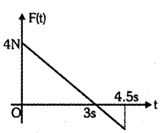
$A$ block of mass $2 \ kg$ moves freely along the $x$-axis. It is at rest at $t = 0$. The force $F(t)$ acting on the block varies with time $t$ as shown in the figure. What is the kinetic energy of the block after $4.5 \ s$ (in $J$)?
A
$4.50$
B
$7.50$
C
$5.06$
D
$14.06$
Solution
(C) The change in momentum $\Delta p$ is equal to the area under the force-time graph.
From the graph,the area from $t = 0$ to $t = 3 \ s$ is a triangle with base $3 \ s$ and height $4 \ N$,so Area$_1 = \frac{1}{2} \times 3 \times 4 = 6 \ N \cdot s$.
The area from $t = 3 \ s$ to $t = 4.5 \ s$ is a triangle with base $1.5 \ s$ and height $-2 \ N$ (since the force at $t = 4.5 \ s$ is $-2 \ N$ by similar triangles),so Area$_2 = \frac{1}{2} \times 1.5 \times (-2) = -1.5 \ N \cdot s$.
The total change in momentum $\Delta p = 6 - 1.5 = 4.5 \ kg \cdot m/s$.
Since the block starts from rest,the final momentum $p = 4.5 \ kg \cdot m/s$.
The kinetic energy $K = \frac{p^2}{2m} = \frac{(4.5)^2}{2 \times 2} = \frac{20.25}{4} = 5.0625 \ J \approx 5.06 \ J$.
From the graph,the area from $t = 0$ to $t = 3 \ s$ is a triangle with base $3 \ s$ and height $4 \ N$,so Area$_1 = \frac{1}{2} \times 3 \times 4 = 6 \ N \cdot s$.
The area from $t = 3 \ s$ to $t = 4.5 \ s$ is a triangle with base $1.5 \ s$ and height $-2 \ N$ (since the force at $t = 4.5 \ s$ is $-2 \ N$ by similar triangles),so Area$_2 = \frac{1}{2} \times 1.5 \times (-2) = -1.5 \ N \cdot s$.
The total change in momentum $\Delta p = 6 - 1.5 = 4.5 \ kg \cdot m/s$.
Since the block starts from rest,the final momentum $p = 4.5 \ kg \cdot m/s$.
The kinetic energy $K = \frac{p^2}{2m} = \frac{(4.5)^2}{2 \times 2} = \frac{20.25}{4} = 5.0625 \ J \approx 5.06 \ J$.
0 likes
View Solution54
DifficultMCQ
An object of mass $5 \ kg$ is moving with a momentum of $10 \ kg \cdot m/s$. If a force of $0.2 \ N$ is applied on it in the direction of its motion for $10 \ s$,what is the increase in its kinetic energy in $Joule$?
A
$2.8$
B
$3.2$
C
$3.8$
D
$4.4$
Solution
(D) The change in momentum is given by the impulse: $\Delta P = F \times t$.
Given $F = 0.2 \ N$ and $t = 10 \ s$,the change in momentum is $\Delta P = 0.2 \times 10 = 2 \ kg \cdot m/s$.
Initial momentum $P_1 = 10 \ kg \cdot m/s$.
Final momentum $P_2 = P_1 + \Delta P = 10 + 2 = 12 \ kg \cdot m/s$.
The kinetic energy $K$ is related to momentum $P$ by $K = \frac{P^2}{2m}$.
Initial kinetic energy $K_1 = \frac{P_1^2}{2m} = \frac{10^2}{2 \times 5} = \frac{100}{10} = 10 \ J$.
Final kinetic energy $K_2 = \frac{P_2^2}{2m} = \frac{12^2}{2 \times 5} = \frac{144}{10} = 14.4 \ J$.
The increase in kinetic energy is $\Delta K = K_2 - K_1 = 14.4 - 10 = 4.4 \ J$.
Given $F = 0.2 \ N$ and $t = 10 \ s$,the change in momentum is $\Delta P = 0.2 \times 10 = 2 \ kg \cdot m/s$.
Initial momentum $P_1 = 10 \ kg \cdot m/s$.
Final momentum $P_2 = P_1 + \Delta P = 10 + 2 = 12 \ kg \cdot m/s$.
The kinetic energy $K$ is related to momentum $P$ by $K = \frac{P^2}{2m}$.
Initial kinetic energy $K_1 = \frac{P_1^2}{2m} = \frac{10^2}{2 \times 5} = \frac{100}{10} = 10 \ J$.
Final kinetic energy $K_2 = \frac{P_2^2}{2m} = \frac{12^2}{2 \times 5} = \frac{144}{10} = 14.4 \ J$.
The increase in kinetic energy is $\Delta K = K_2 - K_1 = 14.4 - 10 = 4.4 \ J$.
0 likes
View Solution55
MediumMCQ
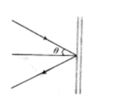
$A$ jet of water with cross-sectional area $A$ strikes a wall at an angle $\theta$ with the normal to the wall and rebounds elastically. If the density of water is $\rho$ and the velocity is $v$,what is the force exerted on the wall?
A
$2Av \rho \cos \theta$
B
$2Av^2 \rho \cos \theta$
C
$2Av^2 \rho$
D
$2Av \rho$
Solution
(B) The mass of water striking the wall per second is $m = A \cdot v \cdot \rho$.
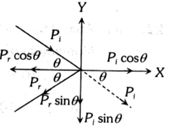
The initial momentum of the water striking the wall per second is $P_i = m \cdot v = Av^2 \rho$.
Since the collision is elastic,the water rebounds with the same speed $v$ at an angle $\theta$ with the normal. The component of momentum perpendicular to the wall is $P \cos \theta$.
The change in momentum per second (force) exerted by the wall on the water is $\Delta P = P_{final, x} - P_{initial, x}$.
Taking the direction towards the wall as positive,the initial momentum component is $P_i \cos \theta$ and the final momentum component is $-P_i \cos \theta$.
Therefore,the force exerted by the water on the wall is $F = |\Delta P| = |(-P_i \cos \theta) - (P_i \cos \theta)| = 2P_i \cos \theta$.
Substituting $P_i = Av^2 \rho$,we get $F = 2Av^2 \rho \cos \theta$.
The initial momentum of the water striking the wall per second is $P_i = m \cdot v = Av^2 \rho$.
Since the collision is elastic,the water rebounds with the same speed $v$ at an angle $\theta$ with the normal. The component of momentum perpendicular to the wall is $P \cos \theta$.
The change in momentum per second (force) exerted by the wall on the water is $\Delta P = P_{final, x} - P_{initial, x}$.
Taking the direction towards the wall as positive,the initial momentum component is $P_i \cos \theta$ and the final momentum component is $-P_i \cos \theta$.
Therefore,the force exerted by the water on the wall is $F = |\Delta P| = |(-P_i \cos \theta) - (P_i \cos \theta)| = 2P_i \cos \theta$.
Substituting $P_i = Av^2 \rho$,we get $F = 2Av^2 \rho \cos \theta$.
0 likes
View Solution56
MediumMCQ
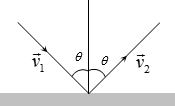
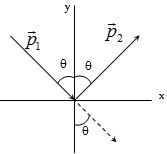
$A$ particle of mass $m \, kg$ moving with a velocity $v \, m/s$ strikes a surface as shown in the figure and rebounds with the same speed. The magnitude of the change in momentum is:
A
$2mv \cos \theta$
B
$2mv \sin \theta$
C
$0$
D
$2mv$
Solution
(B) Let the initial velocity be $\vec{v}_1$ and the final velocity be $\vec{v}_2$.
From the geometry,the initial momentum is $\vec{P}_1 = m\vec{v}_1 = -mv \sin \theta \hat{i} - mv \cos \theta \hat{j}$.
The final momentum is $\vec{P}_2 = m\vec{v}_2 = mv \sin \theta \hat{i} - mv \cos \theta \hat{j}$.
The change in momentum is $\Delta \vec{P} = \vec{P}_2 - \vec{P}_1$.
$\Delta \vec{P} = (mv \sin \theta \hat{i} - mv \cos \theta \hat{j}) - (-mv \sin \theta \hat{i} - mv \cos \theta \hat{j})$.
$\Delta \vec{P} = 2mv \sin \theta \hat{i}$.
The magnitude of the change in momentum is $|\Delta \vec{P}| = 2mv \sin \theta$.
From the geometry,the initial momentum is $\vec{P}_1 = m\vec{v}_1 = -mv \sin \theta \hat{i} - mv \cos \theta \hat{j}$.
The final momentum is $\vec{P}_2 = m\vec{v}_2 = mv \sin \theta \hat{i} - mv \cos \theta \hat{j}$.
The change in momentum is $\Delta \vec{P} = \vec{P}_2 - \vec{P}_1$.
$\Delta \vec{P} = (mv \sin \theta \hat{i} - mv \cos \theta \hat{j}) - (-mv \sin \theta \hat{i} - mv \cos \theta \hat{j})$.
$\Delta \vec{P} = 2mv \sin \theta \hat{i}$.
The magnitude of the change in momentum is $|\Delta \vec{P}| = 2mv \sin \theta$.
0 likes
View Solution57
EasyMCQ
$A$ ball of mass $60 \ g$ hits a wall with a velocity of $4 \ m/s$ and rebounds with the same velocity. The change in momentum in $kg \cdot m/s$ is:
A
$0.98$
B
$0.73$
C
$0.48$
D
$0.22$
Solution
(C) Given: Mass $m = 60 \ g = 60 \times 10^{-3} \ kg$,Initial velocity $v_i = 4 \ m/s$,Final velocity $v_f = -4 \ m/s$ (since it rebounds).
The initial momentum is $P_i = m \times v_i = (60 \times 10^{-3}) \times 4 = 0.24 \ kg \cdot m/s$.
The final momentum is $P_f = m \times v_f = (60 \times 10^{-3}) \times (-4) = -0.24 \ kg \cdot m/s$.
The change in momentum $\Delta P = P_f - P_i = -0.24 - 0.24 = -0.48 \ kg \cdot m/s$.
The magnitude of the change in momentum is $|\Delta P| = 0.48 \ kg \cdot m/s$.
The initial momentum is $P_i = m \times v_i = (60 \times 10^{-3}) \times 4 = 0.24 \ kg \cdot m/s$.
The final momentum is $P_f = m \times v_f = (60 \times 10^{-3}) \times (-4) = -0.24 \ kg \cdot m/s$.
The change in momentum $\Delta P = P_f - P_i = -0.24 - 0.24 = -0.48 \ kg \cdot m/s$.
The magnitude of the change in momentum is $|\Delta P| = 0.48 \ kg \cdot m/s$.
0 likes
View Solution58
MediumMCQ
$A$ ball of mass $150 \, g$ moving with a velocity of $12 \, m/s$ hits a bat and returns with a velocity of $20 \, m/s$ in the opposite direction within $0.01 \, s$. The force exerted by the bat on the ball is ........... $N$.
A
$480$
B
$600$
C
$500$
D
$400$
Solution
(A) Given: Mass $m = 150 \, g = 0.15 \, kg$.
Initial velocity $u = -12 \, m/s$ (taking the direction towards the bat as negative).
Final velocity $v = +20 \, m/s$ (taking the direction away from the bat as positive).
Time interval $\Delta t = 0.01 \, s$.
According to Newton's Second Law of Motion,the force $F$ is given by the rate of change of momentum:
$F = \frac{m(v - u)}{\Delta t}$
$F = \frac{0.15 \times (20 - (-12))}{0.01}$
$F = \frac{0.15 \times (20 + 12)}{0.01}$
$F = \frac{0.15 \times 32}{0.01}$
$F = 15 \times 32 = 480 \, N$.
Therefore,the force exerted by the bat is $480 \, N$.
Initial velocity $u = -12 \, m/s$ (taking the direction towards the bat as negative).
Final velocity $v = +20 \, m/s$ (taking the direction away from the bat as positive).
Time interval $\Delta t = 0.01 \, s$.
According to Newton's Second Law of Motion,the force $F$ is given by the rate of change of momentum:
$F = \frac{m(v - u)}{\Delta t}$
$F = \frac{0.15 \times (20 - (-12))}{0.01}$
$F = \frac{0.15 \times (20 + 12)}{0.01}$
$F = \frac{0.15 \times 32}{0.01}$
$F = 15 \times 32 = 480 \, N$.
Therefore,the force exerted by the bat is $480 \, N$.
0 likes
View Solution59
MediumMCQ
$A$ force of $50 \, dynes$ acts on a particle of mass $5 \, g$ for $3 \, seconds$. What is the impulse of the force?
A
$0.15 \times 10^{-3} \, N \cdot s$
B
$0.98 \times 10^{-3} \, N \cdot s$
C
$1.5 \times 10^{-3} \, N \cdot s$
D
$2.5 \times 10^{-3} \, N \cdot s$
Solution
(C) The impulse $J$ is defined as the product of force $F$ and the time interval $\Delta t$ for which it acts: $J = F \times \Delta t$.
Given: Force $F = 50 \, dynes$.
Since $1 \, N = 10^5 \, dynes$,we convert the force to $SI$ units: $F = 50 \times 10^{-5} \, N = 5 \times 10^{-4} \, N$.
Time $\Delta t = 3 \, s$.
Impulse $J = (5 \times 10^{-4} \, N) \times (3 \, s) = 15 \times 10^{-4} \, N \cdot s = 1.5 \times 10^{-3} \, N \cdot s$.
Given: Force $F = 50 \, dynes$.
Since $1 \, N = 10^5 \, dynes$,we convert the force to $SI$ units: $F = 50 \times 10^{-5} \, N = 5 \times 10^{-4} \, N$.
Time $\Delta t = 3 \, s$.
Impulse $J = (5 \times 10^{-4} \, N) \times (3 \, s) = 15 \times 10^{-4} \, N \cdot s = 1.5 \times 10^{-3} \, N \cdot s$.
0 likes
View Solution60
EasyMCQ
$A$ body of mass $M$ hits normally a rigid wall with velocity $V$ and bounces back with the same velocity. The impulse experienced by the body is
A
$MV$
B
$2MV$
C
$4MV$
D
$0$
Solution
(B) Impulse is defined as the change in linear momentum of the body.
Initial momentum of the body,$P_i = MV$.
Since the body bounces back with the same velocity $V$ in the opposite direction,the final momentum is $P_f = -MV$.
Impulse $J = \Delta P = P_f - P_i$.
$J = (-MV) - (MV) = -2MV$.
The magnitude of the impulse experienced by the body is $2MV$.
Initial momentum of the body,$P_i = MV$.
Since the body bounces back with the same velocity $V$ in the opposite direction,the final momentum is $P_f = -MV$.
Impulse $J = \Delta P = P_f - P_i$.
$J = (-MV) - (MV) = -2MV$.
The magnitude of the impulse experienced by the body is $2MV$.
0 likes
View Solution61
EasyMCQ
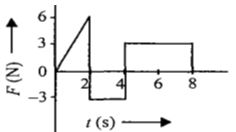
The force $F$ acting on a particle of mass $m$ is indicated by the force-time graph shown below. The change in momentum of the particle over the time interval from $0 \, s$ to $8 \, s$ is .......... $N-s$.
A
$24$
B
$20$
C
$12$
D
$6$
Solution
(C) The change in momentum of a particle is equal to the impulse,which is the area under the force-time $(F-t)$ graph.
Change in momentum = Area under $F-t$ graph
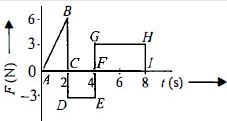
$= \text{Area of triangle } ABC + \text{Area of rectangle } CDEF + \text{Area of rectangle } FGHI$
$= (\frac{1}{2} \times \text{base} \times \text{height}) + (\text{width} \times \text{height}) + (\text{width} \times \text{height})$
$= (\frac{1}{2} \times 2 \times 6) + (2 \times -3) + (4 \times 3)$
$= 6 - 6 + 12$
$= 12 \, N-s$.
Change in momentum = Area under $F-t$ graph
$= \text{Area of triangle } ABC + \text{Area of rectangle } CDEF + \text{Area of rectangle } FGHI$
$= (\frac{1}{2} \times \text{base} \times \text{height}) + (\text{width} \times \text{height}) + (\text{width} \times \text{height})$
$= (\frac{1}{2} \times 2 \times 6) + (2 \times -3) + (4 \times 3)$
$= 6 - 6 + 12$
$= 12 \, N-s$.
0 likes
View Solution62
MediumMCQ
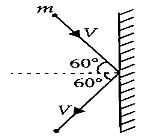
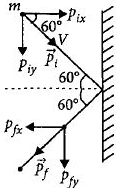
$A$ rigid ball of mass $m$ strikes a rigid wall at $60^\circ$ and gets reflected without loss of speed as shown in the figure. The value of impulse imparted by the wall on the ball will be
A
$\frac{mv}{2}$
B
$\frac{mv}{3}$
C
$mv$
D
$2mv \cos 60^\circ = mv$
Solution
(C) The impulse imparted by the wall on the ball is equal to the change in momentum of the ball.
Let the initial velocity be $\vec{v}_i$ and the final velocity be $\vec{v}_f$.
The initial momentum is $\vec{p}_i = m\vec{v}_i$ and the final momentum is $\vec{p}_f = m\vec{v}_f$.
Taking the normal to the wall as the $x$-axis,the initial velocity components are $v_{ix} = v \cos 60^\circ$ (towards the wall) and $v_{iy} = v \sin 60^\circ$ (parallel to the wall).
The final velocity components are $v_{fx} = -v \cos 60^\circ$ (away from the wall) and $v_{fy} = v \sin 60^\circ$ (parallel to the wall).
The change in momentum $\Delta \vec{p} = \vec{p}_f - \vec{p}_i = m(\vec{v}_f - \vec{v}_i)$.
$\Delta p_x = m(v_{fx} - v_{ix}) = m(-v \cos 60^\circ - v \cos 60^\circ) = -2mv \cos 60^\circ = -2mv(0.5) = -mv$.
$\Delta p_y = m(v_{fy} - v_{iy}) = m(v \sin 60^\circ - v \sin 60^\circ) = 0$.
The magnitude of the impulse is $|\Delta \vec{p}| = |-mv| = mv$.
Let the initial velocity be $\vec{v}_i$ and the final velocity be $\vec{v}_f$.
The initial momentum is $\vec{p}_i = m\vec{v}_i$ and the final momentum is $\vec{p}_f = m\vec{v}_f$.
Taking the normal to the wall as the $x$-axis,the initial velocity components are $v_{ix} = v \cos 60^\circ$ (towards the wall) and $v_{iy} = v \sin 60^\circ$ (parallel to the wall).
The final velocity components are $v_{fx} = -v \cos 60^\circ$ (away from the wall) and $v_{fy} = v \sin 60^\circ$ (parallel to the wall).
The change in momentum $\Delta \vec{p} = \vec{p}_f - \vec{p}_i = m(\vec{v}_f - \vec{v}_i)$.
$\Delta p_x = m(v_{fx} - v_{ix}) = m(-v \cos 60^\circ - v \cos 60^\circ) = -2mv \cos 60^\circ = -2mv(0.5) = -mv$.
$\Delta p_y = m(v_{fy} - v_{iy}) = m(v \sin 60^\circ - v \sin 60^\circ) = 0$.
The magnitude of the impulse is $|\Delta \vec{p}| = |-mv| = mv$.
0 likes
View Solution63
EasyMCQ
$A$ force of $50 \text{ dynes}$ acts on a body of mass $5 \text{ g}$ which is at rest for an interval of $3 \text{ seconds}$. The impulse is:
A
$0.15 \times 10^{-3} \text{ N-s}$
B
$0.98 \times 10^{-3} \text{ N-s}$
C
$1.5 \times 10^{-3} \text{ N-s}$
D
$2.5 \times 10^{-3} \text{ N-s}$
Solution
(C) Impulse is defined as the product of force and time interval: $J = F \times \Delta t$.
Given force $F = 50 \text{ dynes}$. Since $1 \text{ dyne} = 10^{-5} \text{ N}$,we have $F = 50 \times 10^{-5} \text{ N} = 5 \times 10^{-4} \text{ N}$.
The time interval is $\Delta t = 3 \text{ s}$.
Therefore,Impulse $J = (5 \times 10^{-4} \text{ N}) \times (3 \text{ s}) = 15 \times 10^{-4} \text{ N-s} = 1.5 \times 10^{-3} \text{ N-s}$.
Given force $F = 50 \text{ dynes}$. Since $1 \text{ dyne} = 10^{-5} \text{ N}$,we have $F = 50 \times 10^{-5} \text{ N} = 5 \times 10^{-4} \text{ N}$.
The time interval is $\Delta t = 3 \text{ s}$.
Therefore,Impulse $J = (5 \times 10^{-4} \text{ N}) \times (3 \text{ s}) = 15 \times 10^{-4} \text{ N-s} = 1.5 \times 10^{-3} \text{ N-s}$.
0 likes
View Solution64
MediumMCQ
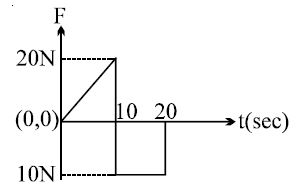
$A$ particle of mass $1\, kg$ is acted upon by a force $F$ which varies as shown in the figure. If the initial velocity of the particle is $10\, ms^{-1}$, the maximum velocity attained by the particle during the period is ........ $ms^{-1}$.
A
$210$
B
$110$
C
$100$
D
$90$
Solution
(B) The impulse $J$ delivered to the particle is equal to the area under the force-time $(F-t)$ graph.
Impulse $J = \Delta p = m(v_f - v_i)$.
From the graph, the area from $t = 0$ to $t = 10\, s$ is a triangle with base $10\, s$ and height $20\, N$.
Area $A_1 = \frac{1}{2} \times \text{base} \times \text{height} = \frac{1}{2} \times 10 \times 20 = 100\, Ns$.
This area is positive, so the velocity increases during this interval.
At $t = 10\, s$, the velocity $v_{10}$ is given by $m(v_{10} - v_i) = A_1$.
$1 \times (v_{10} - 10) = 100 \implies v_{10} = 110\, ms^{-1}$.
From $t = 10\, s$ to $t = 20\, s$, the force is $-10\, N$ (a rectangle).
Area $A_2 = \text{base} \times \text{height} = (20 - 10) \times (-10) = 10 \times (-10) = -100\, Ns$.
Since the force is negative, the velocity decreases after $t = 10\, s$.
Therefore, the maximum velocity is attained at $t = 10\, s$, which is $110\, ms^{-1}$.
Impulse $J = \Delta p = m(v_f - v_i)$.
From the graph, the area from $t = 0$ to $t = 10\, s$ is a triangle with base $10\, s$ and height $20\, N$.
Area $A_1 = \frac{1}{2} \times \text{base} \times \text{height} = \frac{1}{2} \times 10 \times 20 = 100\, Ns$.
This area is positive, so the velocity increases during this interval.
At $t = 10\, s$, the velocity $v_{10}$ is given by $m(v_{10} - v_i) = A_1$.
$1 \times (v_{10} - 10) = 100 \implies v_{10} = 110\, ms^{-1}$.
From $t = 10\, s$ to $t = 20\, s$, the force is $-10\, N$ (a rectangle).
Area $A_2 = \text{base} \times \text{height} = (20 - 10) \times (-10) = 10 \times (-10) = -100\, Ns$.
Since the force is negative, the velocity decreases after $t = 10\, s$.
Therefore, the maximum velocity is attained at $t = 10\, s$, which is $110\, ms^{-1}$.
0 likes
View Solution65
DifficultMCQ
$A$ particle of mass $m$,initially at rest,is acted on by a force $F = F_0 \left\{ {1 - {{\left( {\frac{{2t - T}}{T}} \right)}^2}} \right\}$ during the interval $0 \leq t \leq T$. The velocity of the particle at the end of the interval is:
A
$\frac{5F_0T}{6m}$
B
$\frac{4F_0T}{3m}$
C
$\frac{2F_0T}{3m}$
D
$\frac{3F_0T}{2m}$
Solution
(C) The impulse $J$ applied to the particle is equal to the change in momentum $\Delta p = mv_f - mv_i$. Since the particle is initially at rest,$v_i = 0$,so $mv_f = \int_{0}^{T} F(t) dt$.
Substituting the given force expression:
$mv_f = \int_{0}^{T} F_0 \left[ 1 - \left( \frac{2t - T}{T} \right)^2 \right] dt$.
Let $u = \frac{2t - T}{T}$,then $du = \frac{2}{T} dt$,or $dt = \frac{T}{2} du$.
When $t = 0, u = -1$. When $t = T, u = 1$.
$mv_f = F_0 \int_{-1}^{1} (1 - u^2) \frac{T}{2} du = \frac{F_0 T}{2} \left[ u - \frac{u^3}{3} \right]_{-1}^{1}$.
$mv_f = \frac{F_0 T}{2} \left[ (1 - 1/3) - (-1 + 1/3) \right] = \frac{F_0 T}{2} \left[ 2/3 + 2/3 \right] = \frac{F_0 T}{2} \left( \frac{4}{3} \right) = \frac{2F_0 T}{3}$.
Therefore,$v_f = \frac{2F_0 T}{3m}$.
Substituting the given force expression:
$mv_f = \int_{0}^{T} F_0 \left[ 1 - \left( \frac{2t - T}{T} \right)^2 \right] dt$.
Let $u = \frac{2t - T}{T}$,then $du = \frac{2}{T} dt$,or $dt = \frac{T}{2} du$.
When $t = 0, u = -1$. When $t = T, u = 1$.
$mv_f = F_0 \int_{-1}^{1} (1 - u^2) \frac{T}{2} du = \frac{F_0 T}{2} \left[ u - \frac{u^3}{3} \right]_{-1}^{1}$.
$mv_f = \frac{F_0 T}{2} \left[ (1 - 1/3) - (-1 + 1/3) \right] = \frac{F_0 T}{2} \left[ 2/3 + 2/3 \right] = \frac{F_0 T}{2} \left( \frac{4}{3} \right) = \frac{2F_0 T}{3}$.
Therefore,$v_f = \frac{2F_0 T}{3m}$.
0 likes
View Solution66
MediumMCQ
$A$ boy hits a baseball with a bat and imparts an impulse $J$ to the ball. The boy hits the ball again with the same force,except that the ball and the bat are in contact for twice the amount of time as in the first hit. The new impulse equals:
A
half the original impulse
B
the original impulse
C
twice the original impulse
D
four times the original impulse
Solution
(C) Impulse $J$ is defined as the product of the average force $F$ and the time interval $\Delta t$ for which the force acts: $J = F \cdot \Delta t$.
In the first case,the impulse is $J = F \cdot \Delta t$.
In the second case,the force $F$ remains the same,but the contact time is doubled,i.e.,$\Delta t' = 2 \Delta t$.
Therefore,the new impulse $J'$ is given by $J' = F \cdot (2 \Delta t) = 2(F \cdot \Delta t) = 2J$.
Thus,the new impulse is twice the original impulse.
In the first case,the impulse is $J = F \cdot \Delta t$.
In the second case,the force $F$ remains the same,but the contact time is doubled,i.e.,$\Delta t' = 2 \Delta t$.
Therefore,the new impulse $J'$ is given by $J' = F \cdot (2 \Delta t) = 2(F \cdot \Delta t) = 2J$.
Thus,the new impulse is twice the original impulse.
0 likes
View Solution67
DifficultMCQ
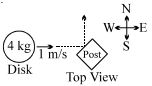
$A$ $4 \ kg$ disk slides over level ice toward the east at a velocity of $1 \ m/s$,as shown. The disk strikes a post and rebounds toward the north at the same speed. The change in the magnitude of the eastward component of the momentum of the disk is ............. $kg \cdot m/s$.
A
$-4$
B
$-1$
C
$0$
D
$4$
Solution
(A) The momentum of an object is given by the product of its mass and its velocity $(p = mv)$.
Before the collision,the disk is moving directly east with a velocity of $1 \ m/s$. The eastward component of its initial momentum is $p_{i,E} = 4 \ kg \times 1 \ m/s = 4 \ kg \cdot m/s$.
After the collision,the disk moves directly north. Since it has no velocity component in the eastward direction,the eastward component of its final momentum is $p_{f,E} = 0 \ kg \cdot m/s$.
The change in the eastward component of the momentum is given by $\Delta p_E = p_{f,E} - p_{i,E}$.
Substituting the values,we get $\Delta p_E = 0 - 4 = -4 \ kg \cdot m/s$.
Before the collision,the disk is moving directly east with a velocity of $1 \ m/s$. The eastward component of its initial momentum is $p_{i,E} = 4 \ kg \times 1 \ m/s = 4 \ kg \cdot m/s$.
After the collision,the disk moves directly north. Since it has no velocity component in the eastward direction,the eastward component of its final momentum is $p_{f,E} = 0 \ kg \cdot m/s$.
The change in the eastward component of the momentum is given by $\Delta p_E = p_{f,E} - p_{i,E}$.
Substituting the values,we get $\Delta p_E = 0 - 4 = -4 \ kg \cdot m/s$.
0 likes
View Solution68
EasyMCQ
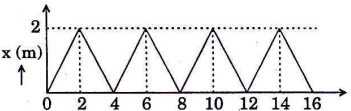
The figure shows the position-time $(x-t)$ graph of one-dimensional motion of a body of mass $0.4 \; kg$. The magnitude of each impulse is:
A
$0.2 \; N \cdot s$
B
$0.4 \; N \cdot s$
C
$0.8 \; N \cdot s$
D
$1.6 \; N \cdot s$
Solution
(C) The impulse $J$ is equal to the change in linear momentum,$\Delta p = m(v_f - v_i)$.
From the graph,the motion consists of segments with constant velocity.
For the interval $t = 0$ to $t = 2 \; s$,the displacement is $2 \; m$. Thus,initial velocity $v_i = \frac{2 \; m}{2 \; s} = 1 \; m/s$.
For the interval $t = 2 \; s$ to $t = 4 \; s$,the displacement is $-2 \; m$. Thus,final velocity $v_f = \frac{-2 \; m}{2 \; s} = -1 \; m/s$.
The mass of the body is $m = 0.4 \; kg$.
The impulse $J$ at each collision (at $t = 2, 6, 10, 14 \; s$) is given by:
$J = m(v_f - v_i) = 0.4 \; kg \times (-1 \; m/s - 1 \; m/s) = 0.4 \times (-2) = -0.8 \; kg \cdot m/s$.
The magnitude of the impulse is $|J| = |-0.8| = 0.8 \; N \cdot s$.
From the graph,the motion consists of segments with constant velocity.
For the interval $t = 0$ to $t = 2 \; s$,the displacement is $2 \; m$. Thus,initial velocity $v_i = \frac{2 \; m}{2 \; s} = 1 \; m/s$.
For the interval $t = 2 \; s$ to $t = 4 \; s$,the displacement is $-2 \; m$. Thus,final velocity $v_f = \frac{-2 \; m}{2 \; s} = -1 \; m/s$.
The mass of the body is $m = 0.4 \; kg$.
The impulse $J$ at each collision (at $t = 2, 6, 10, 14 \; s$) is given by:
$J = m(v_f - v_i) = 0.4 \; kg \times (-1 \; m/s - 1 \; m/s) = 0.4 \times (-2) = -0.8 \; kg \cdot m/s$.
The magnitude of the impulse is $|J| = |-0.8| = 0.8 \; N \cdot s$.
0 likes
View Solution69
MediumMCQ
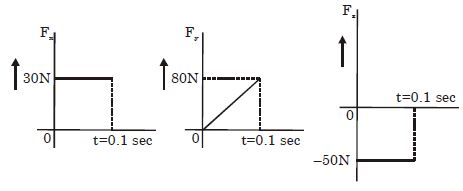
$A$ particle is acted upon by a force whose components' variations with time are shown in the diagrams. The magnitude of the change in momentum of the particle in $0.1\,s$ is:
A
$2\,kg\,m/s$
B
$10\,kg\,m/s$
C
$12\,kg\,m/s$
D
$5\sqrt{2}\,kg\,m/s$
Solution
(D) The change in momentum $\Delta \vec{p}$ is equal to the impulse $\vec{J} = \int \vec{F} dt$. This is equal to the area under the force-time graph for each component.
For the $x$-component: $\Delta p_x = \text{Area} = 30\,N \times 0.1\,s = 3\,N\cdot s$.
For the $y$-component: $\Delta p_y = \text{Area} = \frac{1}{2} \times 80\,N \times 0.1\,s = 4\,N\cdot s$.
For the $z$-component: $\Delta p_z = \text{Area} = -50\,N \times 0.1\,s = -5\,N\cdot s$.
The magnitude of the total change in momentum is $\Delta p = \sqrt{(\Delta p_x)^2 + (\Delta p_y)^2 + (\Delta p_z)^2}$.
$\Delta p = \sqrt{3^2 + 4^2 + (-5)^2} = \sqrt{9 + 16 + 25} = \sqrt{50} = 5\sqrt{2}\,kg\,m/s$.
For the $x$-component: $\Delta p_x = \text{Area} = 30\,N \times 0.1\,s = 3\,N\cdot s$.
For the $y$-component: $\Delta p_y = \text{Area} = \frac{1}{2} \times 80\,N \times 0.1\,s = 4\,N\cdot s$.
For the $z$-component: $\Delta p_z = \text{Area} = -50\,N \times 0.1\,s = -5\,N\cdot s$.
The magnitude of the total change in momentum is $\Delta p = \sqrt{(\Delta p_x)^2 + (\Delta p_y)^2 + (\Delta p_z)^2}$.
$\Delta p = \sqrt{3^2 + 4^2 + (-5)^2} = \sqrt{9 + 16 + 25} = \sqrt{50} = 5\sqrt{2}\,kg\,m/s$.
0 likes
View Solution70
MediumMCQ
$A$ $40 \ g$ ball dropped from a certain height bounces back from the horizontal ground without losing mechanical energy. If its speed is $10 \ m/s$ just before making contact with the ground,and the average value of the force of the ground on the ball is $16 \ N$ while the ball and ground are in contact,how long were they in contact in milliseconds $(ms)$?
A
$25$
B
$50$
C
$75$
D
$100$
Solution
(B) The mass of the ball is $m = 40 \ g = 0.04 \ kg$.
The initial velocity just before impact is $v_i = -10 \ m/s$ (taking downward as negative).
Since the collision is elastic (no loss of mechanical energy),the final velocity just after impact is $v_f = +10 \ m/s$.
The change in momentum is $\Delta p = m(v_f - v_i) = 0.04 \times (10 - (-10)) = 0.04 \times 20 = 0.8 \ kg \cdot m/s$.
According to the impulse-momentum theorem,the impulse $J = F_{avg} \times \Delta t = \Delta p$.
Given $F_{avg} = 16 \ N$,we have $16 \times \Delta t = 0.8$.
$\Delta t = \frac{0.8}{16} = 0.05 \ s$.
Converting to milliseconds,$\Delta t = 0.05 \times 1000 = 50 \ ms$.
The initial velocity just before impact is $v_i = -10 \ m/s$ (taking downward as negative).
Since the collision is elastic (no loss of mechanical energy),the final velocity just after impact is $v_f = +10 \ m/s$.
The change in momentum is $\Delta p = m(v_f - v_i) = 0.04 \times (10 - (-10)) = 0.04 \times 20 = 0.8 \ kg \cdot m/s$.
According to the impulse-momentum theorem,the impulse $J = F_{avg} \times \Delta t = \Delta p$.
Given $F_{avg} = 16 \ N$,we have $16 \times \Delta t = 0.8$.
$\Delta t = \frac{0.8}{16} = 0.05 \ s$.
Converting to milliseconds,$\Delta t = 0.05 \times 1000 = 50 \ ms$.
0 likes
View Solution71
DifficultMCQ
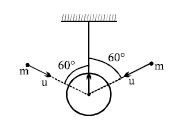
$A$ bob of mass $10m$ is suspended through an inextensible string of length $l$. When the bob is at rest at the equilibrium position, two particles of mass $m$ each, moving with velocity $u$, strike the bob at an angle of $60^{\circ}$ with the string and get simultaneously attached to it. What is the value of the impulsive tension $J$ in the string during the impact?
A
$0$
B
$2mu$
C
$mu$
D
$12mu$
Solution
(C) Let the impulsive tension in the string be $J$. The impulsive force exerted by each particle on the bob along the string is $m u \cos 60^{\circ}$.
Since there are two such particles striking simultaneously from opposite sides, the total impulsive force acting on the bob along the string is $2 \times (m u \cos 60^{\circ})$.
Using the impulse-momentum theorem along the vertical direction (the direction of the string):
$J - 2mu \cos 60^{\circ} = 0$ (since the bob is constrained by the string and cannot move vertically).
$J = 2mu \times \frac{1}{2} = mu$.
Thus, the impulsive tension in the string is $mu$.
Since there are two such particles striking simultaneously from opposite sides, the total impulsive force acting on the bob along the string is $2 \times (m u \cos 60^{\circ})$.
Using the impulse-momentum theorem along the vertical direction (the direction of the string):
$J - 2mu \cos 60^{\circ} = 0$ (since the bob is constrained by the string and cannot move vertically).
$J = 2mu \times \frac{1}{2} = mu$.
Thus, the impulsive tension in the string is $mu$.

0 likes
View Solution72
DifficultMCQ
$A$ particle moves in the $x-y$ plane under the action of a force $\vec F$ such that the value of its linear momentum $\vec P$ at any time $t$ is $P_x = 2 \cos t$ and $P_y = 2 \sin t$. The angle between $\vec F$ and $\vec P$ at a given time $t$ will be:
A
$\theta = 0^\circ$
B
$\theta = 30^\circ$
C
$\theta = 90^\circ$
D
$\theta = 180^\circ$
Solution
(C) The linear momentum vector is given by $\vec P = P_x \hat i + P_y \hat j = (2 \cos t) \hat i + (2 \sin t) \hat j$.
According to Newton's second law,the force $\vec F$ is the time derivative of linear momentum: $\vec F = \frac{d\vec P}{dt}$.
$\vec F = \frac{d}{dt} (2 \cos t \hat i + 2 \sin t \hat j) = -2 \sin t \hat i + 2 \cos t \hat j$.
To find the angle $\theta$ between $\vec F$ and $\vec P$,we calculate their dot product: $\vec F \cdot \vec P = (-2 \sin t)(2 \cos t) + (2 \cos t)(2 \sin t) = -4 \sin t \cos t + 4 \sin t \cos t = 0$.
Since the dot product $\vec F \cdot \vec P = |\vec F| |\vec P| \cos \theta = 0$,it follows that $\cos \theta = 0$,which means $\theta = 90^\circ$.
According to Newton's second law,the force $\vec F$ is the time derivative of linear momentum: $\vec F = \frac{d\vec P}{dt}$.
$\vec F = \frac{d}{dt} (2 \cos t \hat i + 2 \sin t \hat j) = -2 \sin t \hat i + 2 \cos t \hat j$.
To find the angle $\theta$ between $\vec F$ and $\vec P$,we calculate their dot product: $\vec F \cdot \vec P = (-2 \sin t)(2 \cos t) + (2 \cos t)(2 \sin t) = -4 \sin t \cos t + 4 \sin t \cos t = 0$.
Since the dot product $\vec F \cdot \vec P = |\vec F| |\vec P| \cos \theta = 0$,it follows that $\cos \theta = 0$,which means $\theta = 90^\circ$.
0 likes
View Solution73
DifficultMCQ
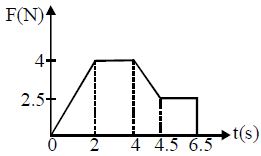
$A$ body of mass $2 \ kg$ has an initial speed of $5 \ ms^{-1}$. $A$ force acts on it for some time in the direction of motion. The force-time graph is shown in the figure. The final speed of the body is .......... $ms^{-1}$.
A
$9.25$
B
$5$
C
$14.25$
D
$4.25$
Solution
(C) Given: Mass $m = 2 \ kg$,initial velocity $u = 5 \ ms^{-1}$.
According to the impulse-momentum theorem,the change in momentum is equal to the area under the force-time graph.
$\Delta p = J = \int F \, dt = \text{Area under } F-t \text{ graph}$.
Area = Area of triangle $(0-2 \ s)$ + Area of rectangle $(2-4 \ s)$ + Area of trapezoid $(4-4.5 \ s)$ + Area of rectangle $(4.5-6.5 \ s)$.
Area = $\left(\frac{1}{2} \times 2 \times 4\right) + (2 \times 4) + \left(\frac{1}{2} \times (4 + 2.5) \times 0.5\right) + (2 \times 2.5)$.
Area = $4 + 8 + 1.625 + 5 = 18.625 \ N \cdot s$.
Since $\Delta p = m(v - u) = 18.625$,
$2(v - 5) = 18.625$.
$v - 5 = 9.3125$.
$v = 14.3125 \ ms^{-1}$.
Re-evaluating the area calculation: Area = $4 + 8 + 1.625 + 5 = 18.625$. $v = 5 + 9.3125 = 14.3125 \ ms^{-1}$. Given the options,$14.25$ is the closest intended answer.
According to the impulse-momentum theorem,the change in momentum is equal to the area under the force-time graph.
$\Delta p = J = \int F \, dt = \text{Area under } F-t \text{ graph}$.
Area = Area of triangle $(0-2 \ s)$ + Area of rectangle $(2-4 \ s)$ + Area of trapezoid $(4-4.5 \ s)$ + Area of rectangle $(4.5-6.5 \ s)$.
Area = $\left(\frac{1}{2} \times 2 \times 4\right) + (2 \times 4) + \left(\frac{1}{2} \times (4 + 2.5) \times 0.5\right) + (2 \times 2.5)$.
Area = $4 + 8 + 1.625 + 5 = 18.625 \ N \cdot s$.
Since $\Delta p = m(v - u) = 18.625$,
$2(v - 5) = 18.625$.
$v - 5 = 9.3125$.
$v = 14.3125 \ ms^{-1}$.
Re-evaluating the area calculation: Area = $4 + 8 + 1.625 + 5 = 18.625$. $v = 5 + 9.3125 = 14.3125 \ ms^{-1}$. Given the options,$14.25$ is the closest intended answer.
0 likes
View Solution74
DifficultMCQ
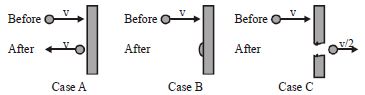
Three different projectiles,each with the same mass $m$,are fired with speed $v$ at a wall. In case $A$,the projectile bounces straight back with speed $v$. In case $B$,the projectile sticks to the wall. In case $C$,the projectile crashes through the wall and emerges with half its original speed. These three cases are shown in the figure. Place the magnitude of the impulse exerted by the wall on the projectile in each of these three cases in the correct order.
A
$A > B > C$
B
$C > B > A$
C
$B > A > C$
D
$A > C > B$
Solution
(A) The impulse $\vec{I}$ exerted by the wall on the projectile is equal to the change in momentum of the projectile: $\vec{I} = \Delta \vec{p} = \vec{p}_f - \vec{p}_i$.
Let the initial direction of the projectile be positive ($+x$ direction).
Case $A$: Initial momentum $\vec{p}_i = mv \hat{i}$,final momentum $\vec{p}_f = -mv \hat{i}$. Impulse $I_A = |(-mv) - (mv)| = |-2mv| = 2mv$.
Case $B$: Initial momentum $\vec{p}_i = mv \hat{i}$,final momentum $\vec{p}_f = 0$. Impulse $I_B = |0 - mv| = |-mv| = mv$.
Case $C$: Initial momentum $\vec{p}_i = mv \hat{i}$,final momentum $\vec{p}_f = \frac{mv}{2} \hat{i}$. Impulse $I_C = |\frac{mv}{2} - mv| = |-\frac{mv}{2}| = \frac{mv}{2}$.
Comparing the magnitudes: $2mv > mv > \frac{mv}{2}$,which means $I_A > I_B > I_C$.
Let the initial direction of the projectile be positive ($+x$ direction).
Case $A$: Initial momentum $\vec{p}_i = mv \hat{i}$,final momentum $\vec{p}_f = -mv \hat{i}$. Impulse $I_A = |(-mv) - (mv)| = |-2mv| = 2mv$.
Case $B$: Initial momentum $\vec{p}_i = mv \hat{i}$,final momentum $\vec{p}_f = 0$. Impulse $I_B = |0 - mv| = |-mv| = mv$.
Case $C$: Initial momentum $\vec{p}_i = mv \hat{i}$,final momentum $\vec{p}_f = \frac{mv}{2} \hat{i}$. Impulse $I_C = |\frac{mv}{2} - mv| = |-\frac{mv}{2}| = \frac{mv}{2}$.
Comparing the magnitudes: $2mv > mv > \frac{mv}{2}$,which means $I_A > I_B > I_C$.
0 likes
View Solution75
DifficultMCQ
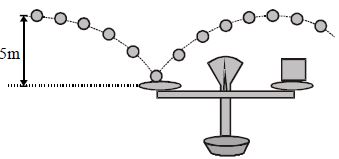
$A$ stream of glass beads, each with a mass of $15 \ g$, comes out of a horizontal tube at a rate of $100 \ \text{beads per second}$. The beads fall a distance of $5 \ m$ to a balance pan and bounce back to their original height. How much mass (in $kg$) must be placed in the other pan of the balance to keep the pointer at zero?
A
$3$
B
$6$
C
$9$
D
$12$
Solution
(A) The velocity of each bead just before hitting the pan is $v = \sqrt{2gh}$.
Given $g = 10 \ m/s^2$ and $h = 5 \ m$, we have $v = \sqrt{2 \times 10 \times 5} = 10 \ m/s$.
Since the beads bounce back to their original height, the collision is perfectly elastic, and the velocity just after the collision is also $v = 10 \ m/s$ upwards.
The change in momentum for one bead is $\Delta p = m(v - (-v)) = 2mv$.
Given $m = 15 \ g = 0.015 \ kg$, $\Delta p = 2 \times 0.015 \times 10 = 0.3 \ kg \ m/s$.
The rate of change of momentum (force) exerted on the pan by $n = 100 \ \text{beads per second}$ is $F = n \times \Delta p = 100 \times 0.3 = 30 \ N$.
To keep the pointer at zero, the weight of the mass $M$ placed in the other pan must balance this force: $Mg = F$.
$M \times 10 = 30 \implies M = 3 \ kg$.
Given $g = 10 \ m/s^2$ and $h = 5 \ m$, we have $v = \sqrt{2 \times 10 \times 5} = 10 \ m/s$.
Since the beads bounce back to their original height, the collision is perfectly elastic, and the velocity just after the collision is also $v = 10 \ m/s$ upwards.
The change in momentum for one bead is $\Delta p = m(v - (-v)) = 2mv$.
Given $m = 15 \ g = 0.015 \ kg$, $\Delta p = 2 \times 0.015 \times 10 = 0.3 \ kg \ m/s$.
The rate of change of momentum (force) exerted on the pan by $n = 100 \ \text{beads per second}$ is $F = n \times \Delta p = 100 \times 0.3 = 30 \ N$.
To keep the pointer at zero, the weight of the mass $M$ placed in the other pan must balance this force: $Mg = F$.
$M \times 10 = 30 \implies M = 3 \ kg$.
0 likes
View Solution76
EasyMCQ
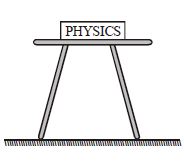
$A$ book is lying on the table. What is the angle between the action of the book on the table and the reaction of the table on the book?
A
$0\ rad$
B
$\frac{\pi }{4}\ rad$
C
$\frac{\pi }{2}\ rad$
D
$\pi \ rad$
Solution
(D) According to Newton's third law of motion,for every action,there is an equal and opposite reaction.
The action force exerted by the book on the table acts downwards.
The reaction force exerted by the table on the book acts upwards.
Since these two forces are equal in magnitude and act in exactly opposite directions along the same line of action,the angle between them is $180^{\circ}$ or $\pi \ rad$.
The action force exerted by the book on the table acts downwards.
The reaction force exerted by the table on the book acts upwards.
Since these two forces are equal in magnitude and act in exactly opposite directions along the same line of action,the angle between them is $180^{\circ}$ or $\pi \ rad$.
0 likes
View Solution77
MediumMCQ
In a tonga,a horse pulls a wagon. Which is the correct analysis of the situation?
A
The tonga moves forward because the horse pulls forward slightly harder on the wagon than the wagon pulls backward on the horse.
B
Because action always equals reaction,the horse cannot pull the wagon. The wagon pulls backward just as hard as the horse pulls forward,so there is no motion.
C
The horse's force on the wagon is as strong as the force of the wagon on the horse.
D
The horse can pull the wagon forward only if it weighs more than the wagon.
Solution
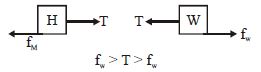
(C) According to Newton's third law of motion,the force exerted by the horse on the wagon $(T)$ and the force exerted by the wagon on the horse $(T)$ are equal in magnitude and opposite in direction. These forces act on different bodies,so they do not cancel each other out.
For the wagon to move forward,the forward force exerted by the horse on the wagon $(T)$ must be greater than the opposing frictional force $(f_w)$ acting on the wagon.
For the horse to move forward,the horse pushes the ground backward with its feet,and the ground exerts a forward frictional force $(f_M)$ on the horse. The horse moves forward if this forward frictional force $(f_M)$ is greater than the backward tension $(T)$ exerted by the wagon.
Therefore,the statement that the horse's force on the wagon is as strong as the force of the wagon on the horse is correct,as it describes the action-reaction pair.
For the wagon to move forward,the forward force exerted by the horse on the wagon $(T)$ must be greater than the opposing frictional force $(f_w)$ acting on the wagon.
For the horse to move forward,the horse pushes the ground backward with its feet,and the ground exerts a forward frictional force $(f_M)$ on the horse. The horse moves forward if this forward frictional force $(f_M)$ is greater than the backward tension $(T)$ exerted by the wagon.
Therefore,the statement that the horse's force on the wagon is as strong as the force of the wagon on the horse is correct,as it describes the action-reaction pair.
0 likes
View Solution78
DifficultMCQ
$A$ small mass $m$ is launched from the top of a cliff with speed $V$ at an angle of $30^{\circ}$ above the horizontal. When the mass reaches the ground,its velocity is directed at $45^{\circ}$ below the horizontal. Which one of the following choices is the magnitude of the total impulse that was imparted to the mass during its flight? Ignore air resistance.
A
$\frac{1}{2}(\sqrt{3} + 1) mV$
B
$\sqrt{\frac{3}{2}} (\frac{\sqrt{2} + 1}{2}) mV$
C
$\frac{1}{2}(\sqrt{3} - 1) mV$
D
$\frac{1}{2}(\sqrt{\frac{3}{2}} + 1) mV$
Solution
(A) The horizontal component of velocity remains constant throughout the flight because there is no horizontal force (ignoring air resistance).
Let $V_1$ be the final speed at the ground.
$V \cos 30^{\circ} = V_1 \cos 45^{\circ}$
$V \frac{\sqrt{3}}{2} = V_1 \frac{1}{\sqrt{2}}$
$V_1 = V \sqrt{\frac{3}{2}}$
Impulse $J$ is equal to the change in momentum: $\vec{J} = \vec{p}_f - \vec{p}_i$.
Since horizontal momentum is constant,the impulse acts only in the vertical direction.
$J = |p_{fy} - p_{iy}| = |m(-V_1 \sin 45^{\circ}) - m(V \sin 30^{\circ})|$
$J = m |V \sqrt{\frac{3}{2}} \cdot \frac{1}{\sqrt{2}} + V \cdot \frac{1}{2}|$
$J = m |V \frac{\sqrt{3}}{2} + \frac{V}{2}| = \frac{1}{2}(\sqrt{3} + 1) mV$.
Let $V_1$ be the final speed at the ground.
$V \cos 30^{\circ} = V_1 \cos 45^{\circ}$
$V \frac{\sqrt{3}}{2} = V_1 \frac{1}{\sqrt{2}}$
$V_1 = V \sqrt{\frac{3}{2}}$
Impulse $J$ is equal to the change in momentum: $\vec{J} = \vec{p}_f - \vec{p}_i$.
Since horizontal momentum is constant,the impulse acts only in the vertical direction.
$J = |p_{fy} - p_{iy}| = |m(-V_1 \sin 45^{\circ}) - m(V \sin 30^{\circ})|$
$J = m |V \sqrt{\frac{3}{2}} \cdot \frac{1}{\sqrt{2}} + V \cdot \frac{1}{2}|$
$J = m |V \frac{\sqrt{3}}{2} + \frac{V}{2}| = \frac{1}{2}(\sqrt{3} + 1) mV$.
0 likes
View Solution79
MediumMCQ
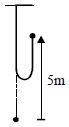
$A$ block of mass $2\, kg$ is suspended by a string of length $5\, m$. It is released from a horizontal position (as shown in the figure) such that the string is initially slack. What will be the impulse when the string just becomes tight? (Take $g = 10\, m/s^2$)
A
$2$
B
$0.2$
C
$20$
D
$200$
Solution
(C) When the block is released from the horizontal position,it falls freely under gravity until the string becomes taut.
The vertical distance fallen by the block is $h = 5\, m$.
The velocity $v_i$ of the block just before the string becomes tight is given by the equation of motion $v^2 = u^2 + 2gh$:
$v_i = \sqrt{2gh} = \sqrt{2 \times 10 \times 5} = 10\, m/s$ (directed vertically downwards).
When the string becomes tight,the impulsive tension in the string acts upwards,bringing the vertical component of the velocity to zero instantaneously.
Thus,the final vertical velocity $v_f = 0$.
The impulse $I$ is equal to the change in momentum:
$I = m(v_f - v_i) = 2(0 - 10) = -20\, N-s$.
The magnitude of the impulse is $20\, N-s$.
The vertical distance fallen by the block is $h = 5\, m$.
The velocity $v_i$ of the block just before the string becomes tight is given by the equation of motion $v^2 = u^2 + 2gh$:
$v_i = \sqrt{2gh} = \sqrt{2 \times 10 \times 5} = 10\, m/s$ (directed vertically downwards).
When the string becomes tight,the impulsive tension in the string acts upwards,bringing the vertical component of the velocity to zero instantaneously.
Thus,the final vertical velocity $v_f = 0$.
The impulse $I$ is equal to the change in momentum:
$I = m(v_f - v_i) = 2(0 - 10) = -20\, N-s$.
The magnitude of the impulse is $20\, N-s$.
0 likes
View Solution80
MediumMCQ
The position-time graph for a particle of mass $100 \ g$ is shown in the figure. The impulse acting on the particle at $t = 5 \ s$ is ............ $N-s$.
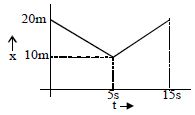
A
$0.3$
B
$0.1$
C
$0.2$
D
$0.4$
Solution
(A) The mass of the particle is $m = 100 \ g = 0.1 \ kg$.
From the position-time graph,the velocity $v$ is the slope of the line.
For $t < 5 \ s$,the initial velocity $v_i$ is the slope of the line from $(0, 20)$ to $(5, 10)$:
$v_i = \frac{10 - 20}{5 - 0} = \frac{-10}{5} = -2 \ m/s$.
For $t > 5 \ s$,the final velocity $v_f$ is the slope of the line from $(5, 10)$ to $(15, 20)$:
$v_f = \frac{20 - 10}{15 - 5} = \frac{10}{10} = 1 \ m/s$.
Impulse $I$ is equal to the change in momentum:
$I = \Delta p = m(v_f - v_i) = 0.1 \times [1 - (-2)] = 0.1 \times 3 = 0.3 \ N-s$.
From the position-time graph,the velocity $v$ is the slope of the line.
For $t < 5 \ s$,the initial velocity $v_i$ is the slope of the line from $(0, 20)$ to $(5, 10)$:
$v_i = \frac{10 - 20}{5 - 0} = \frac{-10}{5} = -2 \ m/s$.
For $t > 5 \ s$,the final velocity $v_f$ is the slope of the line from $(5, 10)$ to $(15, 20)$:
$v_f = \frac{20 - 10}{15 - 5} = \frac{10}{10} = 1 \ m/s$.
Impulse $I$ is equal to the change in momentum:
$I = \Delta p = m(v_f - v_i) = 0.1 \times [1 - (-2)] = 0.1 \times 3 = 0.3 \ N-s$.
0 likes
View Solution81
MediumMCQ
$A$ $2 \ kg$ object is initially at rest. It is acted upon by a force as indicated in the figure. Find the total work done by the force in $3 \ s$. (in $J$)
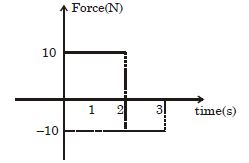
A
$10$
B
$5$
C
$25$
D
$0$
Solution
(C) The impulse $J$ is equal to the area under the force-time graph.
Impulse $J = \int F \, dt = \text{Area under } F-t \text{ graph}$.
Area from $t=0$ to $t=2 \ s$ is $10 \ N \times 2 \ s = 20 \ N \cdot s$.
Area from $t=2$ to $t=3 \ s$ is $-10 \ N \times 1 \ s = -10 \ N \cdot s$.
Total impulse $J_{total} = 20 - 10 = 10 \ N \cdot s$.
According to the impulse-momentum theorem,$J = \Delta p = m(v_f - v_i)$.
Given $m = 2 \ kg$ and $v_i = 0$,we have $10 = 2(v_f - 0)$,which gives $v_f = 5 \ m/s$.
The work done by the force is equal to the change in kinetic energy:
$W = \Delta K = \frac{1}{2} m v_f^2 - \frac{1}{2} m v_i^2$.
$W = \frac{1}{2} \times 2 \times (5)^2 - 0 = 25 \ J$.
Impulse $J = \int F \, dt = \text{Area under } F-t \text{ graph}$.
Area from $t=0$ to $t=2 \ s$ is $10 \ N \times 2 \ s = 20 \ N \cdot s$.
Area from $t=2$ to $t=3 \ s$ is $-10 \ N \times 1 \ s = -10 \ N \cdot s$.
Total impulse $J_{total} = 20 - 10 = 10 \ N \cdot s$.
According to the impulse-momentum theorem,$J = \Delta p = m(v_f - v_i)$.
Given $m = 2 \ kg$ and $v_i = 0$,we have $10 = 2(v_f - 0)$,which gives $v_f = 5 \ m/s$.
The work done by the force is equal to the change in kinetic energy:
$W = \Delta K = \frac{1}{2} m v_f^2 - \frac{1}{2} m v_i^2$.
$W = \frac{1}{2} \times 2 \times (5)^2 - 0 = 25 \ J$.
0 likes
View Solution82
MediumMCQ
Two trains $A$ and $B$ are running in the same direction on parallel rails such that $A$ is faster than $B$. Packets of equal weight are transferred between them. What will happen due to this?
A
$A$ will be accelerated but $B$ will be retarded
B
$B$ will be accelerated but $A$ will be retarded
C
There will be no change in $A$ but $B$ will be accelerated
D
There will be no change in $B$ but $A$ will be accelerated
Solution
(B) Let the velocities of trains $A$ and $B$ be $v_A$ and $v_B$ respectively,where $v_A > v_B$.
When a packet of mass $m$ is transferred from $A$ to $B$,it carries a horizontal momentum $m v_A$ to train $B$.
Since $v_A > v_B$,the packet imparts an impulsive force on train $B$ in the direction of its motion,causing $B$ to accelerate.
Conversely,the packet transferred from $B$ to $A$ carries momentum $m v_B$. Since $v_B < v_A$,this packet exerts a retarding force on train $A$.
Therefore,train $B$ gains momentum (accelerates) and train $A$ loses momentum (retards).
When a packet of mass $m$ is transferred from $A$ to $B$,it carries a horizontal momentum $m v_A$ to train $B$.
Since $v_A > v_B$,the packet imparts an impulsive force on train $B$ in the direction of its motion,causing $B$ to accelerate.
Conversely,the packet transferred from $B$ to $A$ carries momentum $m v_B$. Since $v_B < v_A$,this packet exerts a retarding force on train $A$.
Therefore,train $B$ gains momentum (accelerates) and train $A$ loses momentum (retards).
0 likes
View Solution83
MediumMCQ
$A$ $140\,g$ ball,in horizontal flight with a speed of $39.0\,m/s$,is struck by a bat. After leaving the bat,the ball travels in the opposite direction with a speed of $39.0\,m/s$. If the impact time $\Delta t$ for the ball-bat collision is $1.20\,ms$,calculate the average force in $N$ acting on the ball.
A
$1308$
B
$1090$
C
$9100$
D
$980$
Solution
(C) Given: Mass $m = 140\,g = 0.140\,kg$.
Initial velocity $v_i = 39.0\,m/s$.
Final velocity $v_f = -39.0\,m/s$ (opposite direction).
Impact time $\Delta t = 1.20\,ms = 1.20 \times 10^{-3}\,s$.
The change in momentum is $\Delta p = m(v_f - v_i)$.
$\Delta p = 0.140 \times (-39.0 - 39.0) = 0.140 \times (-78.0) = -10.92\,kg\cdot m/s$.
The average force $F$ is given by $F = \frac{\Delta p}{\Delta t}$.
$F = \frac{-10.92}{1.20 \times 10^{-3}} = -9100\,N$.
The magnitude of the average force acting on the ball is $9100\,N$.
Initial velocity $v_i = 39.0\,m/s$.
Final velocity $v_f = -39.0\,m/s$ (opposite direction).
Impact time $\Delta t = 1.20\,ms = 1.20 \times 10^{-3}\,s$.
The change in momentum is $\Delta p = m(v_f - v_i)$.
$\Delta p = 0.140 \times (-39.0 - 39.0) = 0.140 \times (-78.0) = -10.92\,kg\cdot m/s$.
The average force $F$ is given by $F = \frac{\Delta p}{\Delta t}$.
$F = \frac{-10.92}{1.20 \times 10^{-3}} = -9100\,N$.
The magnitude of the average force acting on the ball is $9100\,N$.
0 likes
View Solution84
MediumMCQ
$A$ particle of mass $m$ moving with velocity $(3\hat{i} + 2\hat{j}) \ m/s$ collides with another body of mass $M$ and finally moves with velocity $(-2\hat{i} + \hat{j}) \ m/s$. Then during the collision:
A
impulse received by $m$ is $m[5\hat{i} + \hat{j}]$
B
impulse received by $m$ is $m[-5\hat{i} - \hat{j}]$
C
impulse received by $M$ is $M[-5\hat{i} - \hat{j}]$
D
impulse received by $M$ is $m[-5\hat{i} - \hat{j}]$
Solution
(B) The impulse $J$ received by a body is equal to the change in its linear momentum,given by $J = \Delta p = m(v_f - v_i)$.
For the particle of mass $m$:
Initial velocity $v_i = (3\hat{i} + 2\hat{j}) \ m/s$.
Final velocity $v_f = (-2\hat{i} + \hat{j}) \ m/s$.
Impulse received by $m = m(v_f - v_i) = m[(-2\hat{i} + \hat{j}) - (3\hat{i} + 2\hat{j})] = m[-5\hat{i} - \hat{j}]$.
According to Newton's third law,the impulse received by mass $M$ is equal and opposite to the impulse received by mass $m$:
Impulse received by $M = -(Impulse \ received \ by \ m) = -m[-5\hat{i} - \hat{j}] = m[5\hat{i} + \hat{j}]$.
Thus,the correct statement is that the impulse received by $m$ is $m[-5\hat{i} - \hat{j}]$.
For the particle of mass $m$:
Initial velocity $v_i = (3\hat{i} + 2\hat{j}) \ m/s$.
Final velocity $v_f = (-2\hat{i} + \hat{j}) \ m/s$.
Impulse received by $m = m(v_f - v_i) = m[(-2\hat{i} + \hat{j}) - (3\hat{i} + 2\hat{j})] = m[-5\hat{i} - \hat{j}]$.
According to Newton's third law,the impulse received by mass $M$ is equal and opposite to the impulse received by mass $m$:
Impulse received by $M = -(Impulse \ received \ by \ m) = -m[-5\hat{i} - \hat{j}] = m[5\hat{i} + \hat{j}]$.
Thus,the correct statement is that the impulse received by $m$ is $m[-5\hat{i} - \hat{j}]$.
0 likes
View Solution85
EasyMCQ
$A$ body is accelerated by applying a force of $30 \, N$. The change in the momentum of the body after $2 \, sec$ is ............ $kg \cdot m/s$.
A
$7.5$
B
$30$
C
$120$
D
$60$
Solution
(D) According to the impulse-momentum theorem,the change in momentum (impulse) is given by the product of the force applied and the time interval for which it is applied.
$\Delta P = F \times \Delta t$
Given:
Force $(F)$ = $30 \, N$
Time interval $(\Delta t)$ = $2 \, sec$
Therefore,the change in momentum is:
$\Delta P = 30 \, N \times 2 \, sec = 60 \, kg \cdot m/s$.
Thus,the correct option is $D$.
$\Delta P = F \times \Delta t$
Given:
Force $(F)$ = $30 \, N$
Time interval $(\Delta t)$ = $2 \, sec$
Therefore,the change in momentum is:
$\Delta P = 30 \, N \times 2 \, sec = 60 \, kg \cdot m/s$.
Thus,the correct option is $D$.
0 likes
View Solution86
MediumMCQ
Two bodies $A$ and $B$ collide as shown in Fig. $(i)$ and $(ii)$. Which statement is true?

A
They exert equal and opposite force on each other in $(i)$ but not in $(ii)$.
B
They exert equal and opposite force on each other in both $(i)$ and $(ii)$.
C
The forces are equal and opposite to each other in $(i)$ but only the components of the forces parallel to the velocities are equal in $(ii)$.
D
The forces are equal and opposite in $(i)$ but only the components of the forces perpendicular to the velocities are equal in $(ii)$.
Solution
(B) According to Newton's third law of motion,for every action,there is an equal and opposite reaction. This law applies to all interactions between two bodies,regardless of whether the collision is head-on or oblique.
In both cases $(i)$ and $(ii)$,when body $A$ and body $B$ collide,they exert forces on each other. The force exerted by $A$ on $B$ $(F_{AB})$ is always equal in magnitude and opposite in direction to the force exerted by $B$ on $A$ $(F_{BA})$,i.e.,$F_{AB} = -F_{BA}$.
Therefore,they exert equal and opposite forces on each other in both scenarios.
In both cases $(i)$ and $(ii)$,when body $A$ and body $B$ collide,they exert forces on each other. The force exerted by $A$ on $B$ $(F_{AB})$ is always equal in magnitude and opposite in direction to the force exerted by $B$ on $A$ $(F_{BA})$,i.e.,$F_{AB} = -F_{BA}$.
Therefore,they exert equal and opposite forces on each other in both scenarios.
0 likes
View Solution87
DifficultMCQ
In the figure,the position-time graph of a particle of mass $0.1\, kg$ is shown. The impulse at $t = 2\, s$ is ......... $kg\, m/s$.
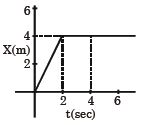
A
$0.2$
B
$-0.2$
C
$0.1$
D
$-0.4$
Solution
(B) The impulse $J$ is equal to the change in momentum $\Delta p = m(v_f - v_i)$.
From the position-time graph,the velocity $v_i$ for $0 < t < 2\, s$ is the slope of the line:
$v_i = \frac{\Delta x}{\Delta t} = \frac{4 - 0}{2 - 0} = 2\, m/s$.
For $t > 2\, s$,the position is constant $(x = 4\, m)$,so the final velocity $v_f = 0\, m/s$.
The impulse at $t = 2\, s$ is:
$J = m(v_f - v_i) = 0.1\, kg \times (0 - 2)\, m/s = -0.2\, kg\, m/s$.
From the position-time graph,the velocity $v_i$ for $0 < t < 2\, s$ is the slope of the line:
$v_i = \frac{\Delta x}{\Delta t} = \frac{4 - 0}{2 - 0} = 2\, m/s$.
For $t > 2\, s$,the position is constant $(x = 4\, m)$,so the final velocity $v_f = 0\, m/s$.
The impulse at $t = 2\, s$ is:
$J = m(v_f - v_i) = 0.1\, kg \times (0 - 2)\, m/s = -0.2\, kg\, m/s$.
0 likes
View Solution88
MediumMCQ
Displacement of a particle of mass $2\, kg$ moving in a straight line varies with time as $s = (2t^3 + 2)\, m$. The impulse of the force acting on the particle over a time interval between $t = 0$ and $t = 1\, s$ is .......... $N-s$.
A
$10$
B
$12$
C
$8$
D
$6$
Solution
(B) Given,mass $m = 2\, kg$ and displacement $s = (2t^3 + 2)\, m$.
Velocity $v$ is the rate of change of displacement with respect to time:
$v = \frac{ds}{dt} = \frac{d}{dt}(2t^3 + 2) = 6t^2\, m/s$.
At $t = 0\, s$,initial velocity $v_i = 6(0)^2 = 0\, m/s$.
At $t = 1\, s$,final velocity $v_f = 6(1)^2 = 6\, m/s$.
Impulse $J$ is equal to the change in linear momentum $\Delta P$:
$J = \Delta P = m(v_f - v_i)$.
Substituting the values:
$J = 2\, kg \times (6\, m/s - 0\, m/s) = 2 \times 6 = 12\, N-s$.
Velocity $v$ is the rate of change of displacement with respect to time:
$v = \frac{ds}{dt} = \frac{d}{dt}(2t^3 + 2) = 6t^2\, m/s$.
At $t = 0\, s$,initial velocity $v_i = 6(0)^2 = 0\, m/s$.
At $t = 1\, s$,final velocity $v_f = 6(1)^2 = 6\, m/s$.
Impulse $J$ is equal to the change in linear momentum $\Delta P$:
$J = \Delta P = m(v_f - v_i)$.
Substituting the values:
$J = 2\, kg \times (6\, m/s - 0\, m/s) = 2 \times 6 = 12\, N-s$.
0 likes
View Solution89
EasyMCQ
$A$ cricket ball of mass $500\, g$ collides with a bat with speed $15\, m/s$ and returns with the same speed within $0.01\, s$. The force acted on the bat is ............ $N$.
A
$750$
B
$1500$
C
$500$
D
$1000$
Solution
(B) Given: Mass $m = 500\, g = 0.5\, kg$,initial velocity $u = 15\, m/s$,final velocity $v = -15\, m/s$ (since it returns in the opposite direction),and time $\Delta t = 0.01\, s$.
Change in momentum $\Delta P = m(v - u) = 0.5 \times (-15 - 15) = 0.5 \times (-30) = -15\, kg\cdot m/s$.
The magnitude of the force exerted on the ball is $F = |\frac{\Delta P}{\Delta t}| = |\frac{-15}{0.01}| = 1500\, N$.
By Newton's third law,the force acted on the bat is equal in magnitude to the force acted on the ball,which is $1500\, N$.
Change in momentum $\Delta P = m(v - u) = 0.5 \times (-15 - 15) = 0.5 \times (-30) = -15\, kg\cdot m/s$.
The magnitude of the force exerted on the ball is $F = |\frac{\Delta P}{\Delta t}| = |\frac{-15}{0.01}| = 1500\, N$.
By Newton's third law,the force acted on the bat is equal in magnitude to the force acted on the ball,which is $1500\, N$.
0 likes
View Solution90
MediumMCQ
In the figure shown,a balloon is pressed against a wall. It is in equilibrium and maximum compressed state. $\vec F_1 =$ force of balloon on hand of man; $\vec F_2 =$ force of balloon on wall; $\vec F_3 =$ friction; $\vec F_4 =$ weight of balloon. Choose the correct statement.
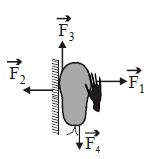
A
$\vec {F_1}$ and $\vec {F_2}$ are action-reaction pairs.
B
$\vec {F_3}$ and $\vec {F_4}$ are action-reaction pairs.
C
$\vec {F_2}$ and $\vec {F_3}$ are action-reaction pairs.
D
$\vec {F_4}$ and gravitational force exerted by balloon on earth are action-reaction pairs.
Solution
(D) According to Newton's third law,action and reaction forces always act on different bodies and are equal in magnitude and opposite in direction.
$1$. $\vec F_4$ represents the weight of the balloon,which is the gravitational force exerted by the Earth on the balloon. The reaction to this force is the gravitational force exerted by the balloon on the Earth,which acts on the Earth.
$2$. Therefore,$\vec F_4$ and the gravitational force exerted by the balloon on the Earth form an action-reaction pair.
$3$. Other options are incorrect because $\vec F_1, \vec F_2, \vec F_3$ are contact forces acting on the same body (the balloon) and do not form action-reaction pairs with each other.
$1$. $\vec F_4$ represents the weight of the balloon,which is the gravitational force exerted by the Earth on the balloon. The reaction to this force is the gravitational force exerted by the balloon on the Earth,which acts on the Earth.
$2$. Therefore,$\vec F_4$ and the gravitational force exerted by the balloon on the Earth form an action-reaction pair.
$3$. Other options are incorrect because $\vec F_1, \vec F_2, \vec F_3$ are contact forces acting on the same body (the balloon) and do not form action-reaction pairs with each other.
0 likes
View Solution91
DifficultMCQ
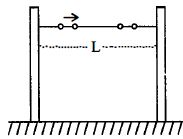
$A$ large number $(n)$ of identical beads,each of mass $m$ and radius $r$,are strung on a thin smooth rigid horizontal rod of length $L$ $(L >> r)$ and are at rest at random positions. The rod is mounted between two rigid supports. If one of the beads is now given a speed $v$,the average force experienced by each support after a long time is (assume all collisions are elastic):
A
$\frac{mv^2}{2(L - nr)}$
B
$\frac{mv^2}{L - 2nr}$
C
$\frac{mv^2}{L - nr}$
D
zero
Solution
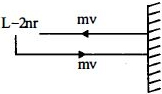
(B) The total length available for the motion of the beads is $L_{eff} = L - 2nr$,as each of the $n$ beads occupies a length of $2r$.
When a bead moves with speed $v$ and undergoes elastic collisions with the supports,the change in momentum for one collision with a support is $\Delta p = mv - (-mv) = 2mv$.
The time taken to travel between the two supports and return is $\Delta t = \frac{2(L - 2nr)}{v}$.
The average force $F$ exerted on each support is given by the rate of change of momentum: $F = \frac{\Delta p}{\Delta t} = \frac{2mv}{2(L - 2nr) / v} = \frac{mv^2}{L - 2nr}$.
When a bead moves with speed $v$ and undergoes elastic collisions with the supports,the change in momentum for one collision with a support is $\Delta p = mv - (-mv) = 2mv$.
The time taken to travel between the two supports and return is $\Delta t = \frac{2(L - 2nr)}{v}$.
The average force $F$ exerted on each support is given by the rate of change of momentum: $F = \frac{\Delta p}{\Delta t} = \frac{2mv}{2(L - 2nr) / v} = \frac{mv^2}{L - 2nr}$.
0 likes
View Solution92
MediumMCQ
An engine pumps water continuously through a hose. Water leaves the hose with velocity $v$ and $m$ is the mass per unit length of the water jet. If this jet hits a surface and comes to rest instantaneously,the force on the surface is
A
$mv^3$
B
$mv^2$
C
$\frac{1}{2}mv^2$
D
$\frac{1}{2}mv^3$
Solution
(B) The force exerted by a fluid jet on a surface is given by the rate of change of momentum.
Let $M$ be the mass of water hitting the surface in time $t$.
The velocity of the water jet is $v$ and it comes to rest upon hitting the surface,so the change in velocity is $\Delta v = v - 0 = v$.
The mass per unit length is given as $m = \frac{M}{L}$,where $L$ is the length of the water jet.
In time $t$,the length of the water jet hitting the surface is $L = v \cdot t$.
Therefore,the mass of water hitting the surface in time $t$ is $M = m \cdot L = m \cdot v \cdot t$.
The force $F$ is the rate of change of momentum: $F = \frac{\Delta p}{\Delta t} = \frac{M \cdot v}{t}$.
Substituting $M = m \cdot v \cdot t$ into the force equation:
$F = \frac{(m \cdot v \cdot t) \cdot v}{t} = m \cdot v^2$.
Thus,the force on the surface is $mv^2$.
Let $M$ be the mass of water hitting the surface in time $t$.
The velocity of the water jet is $v$ and it comes to rest upon hitting the surface,so the change in velocity is $\Delta v = v - 0 = v$.
The mass per unit length is given as $m = \frac{M}{L}$,where $L$ is the length of the water jet.
In time $t$,the length of the water jet hitting the surface is $L = v \cdot t$.
Therefore,the mass of water hitting the surface in time $t$ is $M = m \cdot L = m \cdot v \cdot t$.
The force $F$ is the rate of change of momentum: $F = \frac{\Delta p}{\Delta t} = \frac{M \cdot v}{t}$.
Substituting $M = m \cdot v \cdot t$ into the force equation:
$F = \frac{(m \cdot v \cdot t) \cdot v}{t} = m \cdot v^2$.
Thus,the force on the surface is $mv^2$.
0 likes
View Solution93
EasyMCQ
$A$ particle of mass $m$ is moving with a uniform velocity $v_1$. It is given an impulse such that its velocity becomes $v_2$. The impulse is equal to
A
$m(v_2 - v_1)$
B
$m(v_1 + v_2)$
C
$\frac{1}{2} m(|v_2^2| - |v_1^2|)$
D
$m(|v_2| - |v_1|)$
Solution
(A) Impulse is defined as the change in momentum of a body.
Mathematically,Impulse $J = \Delta p = p_f - p_i$.
Given the initial velocity is $v_1$ and the final velocity is $v_2$,the initial momentum is $p_i = m v_1$ and the final momentum is $p_f = m v_2$.
Therefore,Impulse $J = m v_2 - m v_1 = m(v_2 - v_1)$.
Mathematically,Impulse $J = \Delta p = p_f - p_i$.
Given the initial velocity is $v_1$ and the final velocity is $v_2$,the initial momentum is $p_i = m v_1$ and the final momentum is $p_f = m v_2$.
Therefore,Impulse $J = m v_2 - m v_1 = m(v_2 - v_1)$.
0 likes
View Solution94
EasyMCQ
The average force necessary to stop a hammer having momentum $50 \ N-s$ in $0.25 \ s$ is ...... $N$.
A
$50$
B
$12.5$
C
$100$
D
$200$
Solution
(D) According to Newton's second law of motion,the average force is equal to the rate of change of momentum.
The formula is given by: $F_{ave} = \frac{\Delta p}{\Delta t}$.
Given:
Change in momentum $\Delta p = 50 \ N-s$ (since the hammer is brought to rest from $50 \ N-s$ momentum).
Time interval $\Delta t = 0.25 \ s$.
Substituting the values:
$F_{ave} = \frac{50}{0.25} = \frac{5000}{25} = 200 \ N$.
Therefore,the average force required is $200 \ N$.
The formula is given by: $F_{ave} = \frac{\Delta p}{\Delta t}$.
Given:
Change in momentum $\Delta p = 50 \ N-s$ (since the hammer is brought to rest from $50 \ N-s$ momentum).
Time interval $\Delta t = 0.25 \ s$.
Substituting the values:
$F_{ave} = \frac{50}{0.25} = \frac{5000}{25} = 200 \ N$.
Therefore,the average force required is $200 \ N$.
0 likes
View Solution95
DifficultMCQ
$A$ ball is thrown up at an angle with the horizontal. Then,the total change of momentum by the instant it returns to the ground is
A
acceleration due to gravity $\times$ total time of flight
B
weight of the ball $\times$ half the time of flight
C
weight of the ball $\times$ total time of flight
D
weight of the ball $\times$ horizontal range
Solution
(C) The change in momentum $\Delta p$ is given by the impulse exerted by the gravitational force.
The force acting on the ball is its weight,$F = mg$,which acts downwards.
The time for which this force acts is the total time of flight,$T = \frac{2v \sin \theta}{g}$.
According to the impulse-momentum theorem,the change in momentum is equal to the impulse,which is the product of the constant force and the time interval.
$\Delta p = F \times T = (mg) \times T$.
Therefore,the total change in momentum is equal to the weight of the ball multiplied by the total time of flight.
The force acting on the ball is its weight,$F = mg$,which acts downwards.
The time for which this force acts is the total time of flight,$T = \frac{2v \sin \theta}{g}$.
According to the impulse-momentum theorem,the change in momentum is equal to the impulse,which is the product of the constant force and the time interval.
$\Delta p = F \times T = (mg) \times T$.
Therefore,the total change in momentum is equal to the weight of the ball multiplied by the total time of flight.
0 likes
View Solution96
MediumMCQ
$A$ $140\, g$ ball,in horizontal flight with a speed $v_1$ of $39.0\, m/s$,is struck by a bat. After leaving the bat,the ball travels in the opposite direction with speed $v_2 = 39.0\, m/s$. If the impact time $\Delta t$ for the ball-bat collision is $1.20\, ms$,what average net force acts on the ball? (in $N$)
A
$1308$
B
$1090$
C
$9100$
D
$980$
Solution
(C) The average force $F$ is given by the rate of change of momentum: $F = \frac{\Delta p}{\Delta t}$.
Given mass $m = 140\, g = 0.140\, kg$.
The initial velocity $v_1 = 39.0\, m/s$ (let this be in the positive direction).
The final velocity $v_2 = -39.0\, m/s$ (opposite direction).
The change in momentum $\Delta p = m(v_2 - v_1) = 0.140 \times (-39.0 - 39.0) = 0.140 \times (-78.0) = -10.92\, kg \cdot m/s$.
The impact time $\Delta t = 1.20\, ms = 1.20 \times 10^{-3}\, s$.
The magnitude of the average force is $F = \frac{|\Delta p|}{\Delta t} = \frac{10.92}{1.20 \times 10^{-3}} = \frac{10.92}{0.0012} = 9100\, N$.
Given mass $m = 140\, g = 0.140\, kg$.
The initial velocity $v_1 = 39.0\, m/s$ (let this be in the positive direction).
The final velocity $v_2 = -39.0\, m/s$ (opposite direction).
The change in momentum $\Delta p = m(v_2 - v_1) = 0.140 \times (-39.0 - 39.0) = 0.140 \times (-78.0) = -10.92\, kg \cdot m/s$.
The impact time $\Delta t = 1.20\, ms = 1.20 \times 10^{-3}\, s$.
The magnitude of the average force is $F = \frac{|\Delta p|}{\Delta t} = \frac{10.92}{1.20 \times 10^{-3}} = \frac{10.92}{0.0012} = 9100\, N$.
0 likes
View Solution97
MediumMCQ
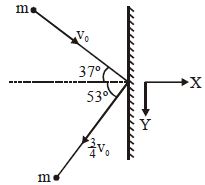
$A$ ball of mass $m$ moving with velocity $v_0$ collides with a wall as shown in the figure. After impact,it rebounds with a velocity $\frac{3}{4}v_0$. The impulse acting on the ball during the impact is
A
$-\frac{m}{2}v_0\hat{j}$
B
$-\frac{3}{4}mv_0\hat{i}$
C
$-\frac{5}{4}mv_0\hat{i}$
D
None of these
Solution
(C) The initial velocity vector is $\vec{v}_i = v_0 \cos 37^{\circ} \hat{i} + v_0 \sin 37^{\circ} \hat{j} = \frac{4}{5} v_0 \hat{i} + \frac{3}{5} v_0 \hat{j}$.
The final velocity vector is $\vec{v}_f = -(\frac{3}{4} v_0) \cos 53^{\circ} \hat{i} + (\frac{3}{4} v_0) \sin 53^{\circ} \hat{j}$.
Using $\cos 53^{\circ} = \frac{3}{5}$ and $\sin 53^{\circ} = \frac{4}{5}$,we get $\vec{v}_f = -\frac{3}{4} v_0 (\frac{3}{5}) \hat{i} + \frac{3}{4} v_0 (\frac{4}{5}) \hat{j} = -\frac{9}{20} v_0 \hat{i} + \frac{3}{5} v_0 \hat{j}$.
The impulse $\vec{J}$ is the change in momentum: $\vec{J} = m(\vec{v}_f - \vec{v}_i)$.
$\vec{J} = m [(-\frac{9}{20} v_0 \hat{i} + \frac{3}{5} v_0 \hat{j}) - (\frac{4}{5} v_0 \hat{i} + \frac{3}{5} v_0 \hat{j})]$.
$\vec{J} = m [(-\frac{9}{20} - \frac{16}{20}) v_0 \hat{i} + (\frac{3}{5} - \frac{3}{5}) v_0 \hat{j}] = m [-\frac{25}{20} v_0 \hat{i}] = -\frac{5}{4} mv_0 \hat{i}$.
The final velocity vector is $\vec{v}_f = -(\frac{3}{4} v_0) \cos 53^{\circ} \hat{i} + (\frac{3}{4} v_0) \sin 53^{\circ} \hat{j}$.
Using $\cos 53^{\circ} = \frac{3}{5}$ and $\sin 53^{\circ} = \frac{4}{5}$,we get $\vec{v}_f = -\frac{3}{4} v_0 (\frac{3}{5}) \hat{i} + \frac{3}{4} v_0 (\frac{4}{5}) \hat{j} = -\frac{9}{20} v_0 \hat{i} + \frac{3}{5} v_0 \hat{j}$.
The impulse $\vec{J}$ is the change in momentum: $\vec{J} = m(\vec{v}_f - \vec{v}_i)$.
$\vec{J} = m [(-\frac{9}{20} v_0 \hat{i} + \frac{3}{5} v_0 \hat{j}) - (\frac{4}{5} v_0 \hat{i} + \frac{3}{5} v_0 \hat{j})]$.
$\vec{J} = m [(-\frac{9}{20} - \frac{16}{20}) v_0 \hat{i} + (\frac{3}{5} - \frac{3}{5}) v_0 \hat{j}] = m [-\frac{25}{20} v_0 \hat{i}] = -\frac{5}{4} mv_0 \hat{i}$.
0 likes
View Solution98
EasyMCQ
$A$ body of mass $m_1$ exerts a force on another body of mass $m_2$. If the magnitude of acceleration of $m_2$ is $a_2$,then the magnitude of the acceleration of $m_1$ is (considering only two bodies in space).
A
Zero
B
$\frac{m_2 a_2}{m_1}$
C
$\frac{m_1 a_2}{m_2}$
D
$a_2$
Solution
(B) According to Newton's third law of motion,the force exerted by body $m_1$ on body $m_2$ is equal in magnitude and opposite in direction to the force exerted by body $m_2$ on body $m_1$.
Let $F$ be the magnitude of the force.
For body $m_2$,the force is $F = m_2 a_2$.
For body $m_1$,the force is $F = m_1 a_1$.
Since the forces are equal in magnitude,we have $m_1 a_1 = m_2 a_2$.
Therefore,the acceleration of body $m_1$ is $a_1 = \frac{m_2 a_2}{m_1}$.
Let $F$ be the magnitude of the force.
For body $m_2$,the force is $F = m_2 a_2$.
For body $m_1$,the force is $F = m_1 a_1$.
Since the forces are equal in magnitude,we have $m_1 a_1 = m_2 a_2$.
Therefore,the acceleration of body $m_1$ is $a_1 = \frac{m_2 a_2}{m_1}$.
0 likes
View Solution99
MediumMCQ
$A$ ping-pong ball of mass $m$ is floating in air by a jet of water emerging out of a nozzle. If the water strikes the ping-pong ball with a speed $v$ and just after collision the water falls dead,the rate of flow (in $kg/s$) of water in the nozzle is equal to
A
$\frac{2mg}{v}$
B
$\frac{mv}{g}$
C
$\frac{mg}{v}$
D
none of these
Solution
(C) The impact force exerted by the water on the ball is given by Newton's second law in terms of momentum change:
$F = \frac{\Delta p}{\Delta t}$
Here,$\Delta p$ is the change in momentum of the water of mass $\Delta m$ striking the ball with speed $v$ during time $\Delta t$. Since the water falls dead after the collision,its final velocity is $0$.
Therefore,the change in momentum is $\Delta p = \Delta m \cdot v - 0 = \Delta m \cdot v$.
Substituting this into the force equation:
$F = \frac{\Delta m \cdot v}{\Delta t} = v \left( \frac{\Delta m}{\Delta t} \right)$
Where $\frac{\Delta m}{\Delta t}$ is the rate of flow of water in the nozzle. Since the ball is floating in equilibrium,the upward force exerted by the water must balance the weight of the ball:
$F = mg$
Equating the two expressions for $F$:
$v \left( \frac{\Delta m}{\Delta t} \right) = mg$
Solving for the rate of flow:
$\frac{\Delta m}{\Delta t} = \frac{mg}{v}$
$F = \frac{\Delta p}{\Delta t}$
Here,$\Delta p$ is the change in momentum of the water of mass $\Delta m$ striking the ball with speed $v$ during time $\Delta t$. Since the water falls dead after the collision,its final velocity is $0$.
Therefore,the change in momentum is $\Delta p = \Delta m \cdot v - 0 = \Delta m \cdot v$.
Substituting this into the force equation:
$F = \frac{\Delta m \cdot v}{\Delta t} = v \left( \frac{\Delta m}{\Delta t} \right)$
Where $\frac{\Delta m}{\Delta t}$ is the rate of flow of water in the nozzle. Since the ball is floating in equilibrium,the upward force exerted by the water must balance the weight of the ball:
$F = mg$
Equating the two expressions for $F$:
$v \left( \frac{\Delta m}{\Delta t} \right) = mg$
Solving for the rate of flow:
$\frac{\Delta m}{\Delta t} = \frac{mg}{v}$
0 likes
View Solution100
EasyMCQ
When a horse pulls a wagon,the force that causes the horse to move forward is the force
A
the ground exerts on it
B
it exerts on the ground
C
the wagon exerts on it
D
it exerts on the wagon
Solution
(A) According to Newton's third law of motion,when a horse pushes the ground backward with its hooves,the ground exerts an equal and opposite reaction force on the horse in the forward direction. This reaction force from the ground is what causes the horse to move forward.
0 likes
View SolutionNewton's Laws of Motion and Friction — Third Law of Motion and Momentum and Impulse · Frequently Asked Questions
1Are these Newton's Laws of Motion and Friction questions useful for JEE and NEET?
Yes. All questions in this section are mapped to JEE Main and NEET exam patterns. Previous year questions from JEE Main, NEET, GUJCET and state-level exams are included with full solutions.
2Can I switch to Hindi or Gujarati for these questions?
Yes. Use the language tabs in the hero section or the sidebar to view the same questions and solutions in English, Hindi or Gujarati.
3How do I generate a question paper from this subtopic?
Use the Vedclass Exam Paper Generator — select the chapter and subtopic, set difficulty, and generate Sets A, B, C, D automatically. First 3 chapters of every subject are free.
Vedclass Products
For Students
Vedclass Test Series
Mock tests in real JEE/NEET style with performance analysis. 5-day free trial.
Start Free TrialFor Teachers
Exam Paper Generator
Generate Set A/B/C/D papers from this chapter in 2 minutes. 3 chapters free.
Try FreeFor Institutes
Online Exam Module
Live online exams with unlimited students, 360° analytics & white-label branding.
See DemoFor Teachers & Institutes
Generate a Newton's Laws of Motion and Friction Exam Paper in 2 Minutes
Select subtopic & difficulty — Sets A, B, C, D auto-generated with No Repeat logic.
First 3 chapters of every subject are free — no payment required.