
A English
Third Law of Motion and Momentum and Impulse Questions in English
Class 11 Physics · Newton's Laws of Motion and Friction · Third Law of Motion and Momentum and Impulse
208+
Questions
English
Language
100%
With Solutions
Showing 47 of 208 questions in English
151
MediumMCQ
If impulse $I$ varies with time $t$ as $I \text{ (kg m s}^{-1}) = 20 t^2 - 40 t$. The change in momentum is minimum at ........... $s$.
A
$t=2$
B
$t=1$
C
$t=0.5$
D
$t=1.5$
Solution
(B) The impulse $I$ is defined as the change in momentum,$\Delta p = I$. Given $I = 20 t^2 - 40 t$.
To find the time at which the change in momentum is minimum,we differentiate $I$ with respect to $t$ and set it to zero:
$\frac{dI}{dt} = \frac{d}{dt}(20 t^2 - 40 t) = 40 t - 40$.
Setting $\frac{dI}{dt} = 0$ gives $40 t - 40 = 0$,which implies $t = 1 \text{ s}$.
To confirm this is a minimum,we check the second derivative: $\frac{d^2I}{dt^2} = 40$. Since $40 > 0$,the function has a minimum at $t = 1 \text{ s}$.
To find the time at which the change in momentum is minimum,we differentiate $I$ with respect to $t$ and set it to zero:
$\frac{dI}{dt} = \frac{d}{dt}(20 t^2 - 40 t) = 40 t - 40$.
Setting $\frac{dI}{dt} = 0$ gives $40 t - 40 = 0$,which implies $t = 1 \text{ s}$.
To confirm this is a minimum,we check the second derivative: $\frac{d^2I}{dt^2} = 40$. Since $40 > 0$,the function has a minimum at $t = 1 \text{ s}$.
0 likes
View Solution152
EasyMCQ
If the final momentum is equal to the initial momentum of the system,then:
A
No net force on the system
B
Always net force on the system
C
May be net force on the system
D
Both $(a)$ and $(b)$
Solution
(C) According to Newton's Second Law of Motion,the net external force acting on a system is equal to the rate of change of linear momentum,given by $F_{net} = \frac{dp}{dt}$.
If the final momentum $(p_f)$ is equal to the initial momentum $(p_i)$,then the change in momentum $\Delta p = p_f - p_i = 0$.
This implies that the average net force over the time interval $\Delta t$ is $\frac{\Delta p}{\Delta t} = 0$.
However,this does not necessarily mean the instantaneous net force is zero at every moment during the process. The net force could be non-zero at various instants such that the total impulse (integral of force over time) is zero.
Therefore,it is possible that there is a net force on the system at some point,even if the total change in momentum is zero.
Thus,the correct option is $(c)$.
If the final momentum $(p_f)$ is equal to the initial momentum $(p_i)$,then the change in momentum $\Delta p = p_f - p_i = 0$.
This implies that the average net force over the time interval $\Delta t$ is $\frac{\Delta p}{\Delta t} = 0$.
However,this does not necessarily mean the instantaneous net force is zero at every moment during the process. The net force could be non-zero at various instants such that the total impulse (integral of force over time) is zero.
Therefore,it is possible that there is a net force on the system at some point,even if the total change in momentum is zero.
Thus,the correct option is $(c)$.
0 likes
View Solution153
MediumMCQ
$A$ body of mass $5 \,kg$ is moving with a velocity of $\vec{v}=(2 \hat{i}+6 \hat{j}) \,m/s$ at $t=0 \,s$. After time $t=2 \,s$,the velocity of the body is $(10 \hat{i}+6 \hat{j}) \,m/s$. The change in momentum of the body is ......... $kg \cdot m/s$.
A
$40 \hat{i}$
B
$20 \hat{i}$
C
$30 \hat{i}$
D
$(50 \hat{i}+30 \hat{j})$
Solution
(A) Given:
Mass $m = 5 \,kg$
Initial velocity $\vec{v}_i = (2 \hat{i} + 6 \hat{j}) \,m/s$
Final velocity $\vec{v}_f = (10 \hat{i} + 6 \hat{j}) \,m/s$
The change in momentum $\Delta \vec{p}$ is given by the formula:
$\Delta \vec{p} = m(\vec{v}_f - \vec{v}_i)$
Substitute the given values:
$\Delta \vec{p} = 5 \times [(10 \hat{i} + 6 \hat{j}) - (2 \hat{i} + 6 \hat{j})]$
$\Delta \vec{p} = 5 \times [(10 - 2) \hat{i} + (6 - 6) \hat{j}]$
$\Delta \vec{p} = 5 \times [8 \hat{i} + 0 \hat{j}]$
$\Delta \vec{p} = 40 \hat{i} \,kg \cdot m/s$
Therefore,the change in momentum is $40 \hat{i} \,kg \cdot m/s$.
Mass $m = 5 \,kg$
Initial velocity $\vec{v}_i = (2 \hat{i} + 6 \hat{j}) \,m/s$
Final velocity $\vec{v}_f = (10 \hat{i} + 6 \hat{j}) \,m/s$
The change in momentum $\Delta \vec{p}$ is given by the formula:
$\Delta \vec{p} = m(\vec{v}_f - \vec{v}_i)$
Substitute the given values:
$\Delta \vec{p} = 5 \times [(10 \hat{i} + 6 \hat{j}) - (2 \hat{i} + 6 \hat{j})]$
$\Delta \vec{p} = 5 \times [(10 - 2) \hat{i} + (6 - 6) \hat{j}]$
$\Delta \vec{p} = 5 \times [8 \hat{i} + 0 \hat{j}]$
$\Delta \vec{p} = 40 \hat{i} \,kg \cdot m/s$
Therefore,the change in momentum is $40 \hat{i} \,kg \cdot m/s$.
0 likes
View Solution154
MediumMCQ
$A$ particle of mass $m$ strikes elastically on a wall with velocity $v$,at an angle of $60^{\circ}$ from the wall. The magnitude of the change in momentum of the particle along the wall is:
A
$0$
B
$2mv$
C
$\sqrt{3}mv$
D
$mv$
Solution
(A) In an elastic collision with a smooth wall,the component of velocity parallel to the wall remains unchanged.
Let the velocity of the particle be $\vec{v}$. The angle with the wall is $60^{\circ}$,so the angle with the normal to the wall is $90^{\circ} - 60^{\circ} = 30^{\circ}$.
The component of velocity parallel to the wall is $v_{\parallel} = v \cos(60^{\circ})$.
Since the wall is smooth,there is no impulsive force acting along the wall,meaning the parallel component of velocity remains constant throughout the collision.
Initial momentum along the wall: $p_{i, \parallel} = m v \cos(60^{\circ})$.
Final momentum along the wall: $p_{f, \parallel} = m v \cos(60^{\circ})$.
Change in momentum along the wall: $\Delta p_{\parallel} = p_{f, \parallel} - p_{i, \parallel} = m v \cos(60^{\circ}) - m v \cos(60^{\circ}) = 0$.
Therefore,the magnitude of the change in momentum along the wall is $0$.
Let the velocity of the particle be $\vec{v}$. The angle with the wall is $60^{\circ}$,so the angle with the normal to the wall is $90^{\circ} - 60^{\circ} = 30^{\circ}$.
The component of velocity parallel to the wall is $v_{\parallel} = v \cos(60^{\circ})$.
Since the wall is smooth,there is no impulsive force acting along the wall,meaning the parallel component of velocity remains constant throughout the collision.
Initial momentum along the wall: $p_{i, \parallel} = m v \cos(60^{\circ})$.
Final momentum along the wall: $p_{f, \parallel} = m v \cos(60^{\circ})$.
Change in momentum along the wall: $\Delta p_{\parallel} = p_{f, \parallel} - p_{i, \parallel} = m v \cos(60^{\circ}) - m v \cos(60^{\circ}) = 0$.
Therefore,the magnitude of the change in momentum along the wall is $0$.
0 likes
View Solution155
EasyMCQ
The average force necessary to stop a hammer with momentum $p \; Ns$ in $0.5 \; s$ is .......... $N$.
A
$2 p$
B
$p$
C
$4 p$
D
$\frac{p}{2}$
Solution
(A) According to Newton's second law of motion,the average force $F$ is equal to the rate of change of momentum.
$F = \frac{\Delta p}{\Delta t}$
Here,the initial momentum is $p$ and the final momentum is $0$ (since the hammer comes to rest).
Change in momentum $\Delta p = p - 0 = p$.
The time interval $\Delta t = 0.5 \; s$.
Therefore,the average force $F = \frac{p}{0.5} = 2p \; N$.
Thus,the average force required is $2p \; N$.
$F = \frac{\Delta p}{\Delta t}$
Here,the initial momentum is $p$ and the final momentum is $0$ (since the hammer comes to rest).
Change in momentum $\Delta p = p - 0 = p$.
The time interval $\Delta t = 0.5 \; s$.
Therefore,the average force $F = \frac{p}{0.5} = 2p \; N$.
Thus,the average force required is $2p \; N$.
0 likes
View Solution156
MediumMCQ
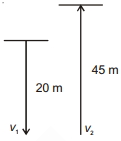
$A$ ball of mass $50 \,g$ is dropped from a height of $20 \,m$. $A$ boy on the ground hits the ball vertically upwards with a bat with an average force of $200 \,N$,so that it attains a vertical height of $45 \,m$. The time for which the ball remains in contact with the bat is ........... of a second. [Take $g = 10 \,m/s^2$]
A
$1/20^{\text{th}}$
B
$1/40^{\text{th}}$
C
$1/80^{\text{th}}$
D
$1/120^{\text{th}}$
Solution
(C) $1$. Calculate the velocity of the ball just before hitting the bat $(v_1)$: Using $v^2 = u^2 + 2gh$,where $u = 0$,$h = 20 \,m$,and $g = 10 \,m/s^2$,we get $v_1 = \sqrt{2 \times 10 \times 20} = \sqrt{400} = 20 \,m/s$ (downwards).
$2$. Calculate the velocity of the ball just after being hit by the bat $(v_2)$: Using $v^2 = u^2 + 2gh$ for the upward motion,where $v = 0$ at the maximum height $h = 45 \,m$,we get $0 = u^2 - 2 \times 10 \times 45$,so $u = v_2 = \sqrt{900} = 30 \,m/s$ (upwards).
$3$. Apply the impulse-momentum theorem: $\text{Impulse} = F \Delta t = m(v_{\text{final}} - v_{\text{initial}})$.
$4$. Taking upward direction as positive: $v_{\text{final}} = +30 \,m/s$ and $v_{\text{initial}} = -20 \,m/s$.
$5$. The force exerted by the bat is upward,so $F = +200 \,N$. The weight of the ball $(mg = 0.05 \times 10 = 0.5 \,N)$ acts downwards. The net average force is $F_{\text{net}} = F_{\text{bat}} - mg = 200 - 0.5 \approx 200 \,N$.
$6$. $\Delta t = \frac{m(v_2 - v_1)}{F_{\text{net}}} = \frac{0.05 \times (30 - (-20))}{200} = \frac{0.05 \times 50}{200} = \frac{2.5}{200} = \frac{1}{80} \,s$.
$2$. Calculate the velocity of the ball just after being hit by the bat $(v_2)$: Using $v^2 = u^2 + 2gh$ for the upward motion,where $v = 0$ at the maximum height $h = 45 \,m$,we get $0 = u^2 - 2 \times 10 \times 45$,so $u = v_2 = \sqrt{900} = 30 \,m/s$ (upwards).
$3$. Apply the impulse-momentum theorem: $\text{Impulse} = F \Delta t = m(v_{\text{final}} - v_{\text{initial}})$.
$4$. Taking upward direction as positive: $v_{\text{final}} = +30 \,m/s$ and $v_{\text{initial}} = -20 \,m/s$.
$5$. The force exerted by the bat is upward,so $F = +200 \,N$. The weight of the ball $(mg = 0.05 \times 10 = 0.5 \,N)$ acts downwards. The net average force is $F_{\text{net}} = F_{\text{bat}} - mg = 200 - 0.5 \approx 200 \,N$.
$6$. $\Delta t = \frac{m(v_2 - v_1)}{F_{\text{net}}} = \frac{0.05 \times (30 - (-20))}{200} = \frac{0.05 \times 50}{200} = \frac{2.5}{200} = \frac{1}{80} \,s$.
1 likes
View Solution157
EasyMCQ
In accordance with Newton's third law of motion,which of the following statements is correct?
A
Action and reaction never balance each other.
B
For the appearance of action and reaction,physical contact is not necessary.
C
This law is applicable whether the bodies are at rest or they are in motion.
D
All of these.
Solution
(D) The correct answer is $(D)$.
$(1)$ Action and reaction forces act on different bodies,so they cannot cancel each other out.
$(2)$ Physical contact is not required for action-reaction pairs; for example,gravitational force and electrostatic (Coulomb) force act at a distance.
$(3)$ Newton's $3^{rd}$ law is universal and applies regardless of whether the bodies are at rest or in motion.
Therefore,all the given statements are correct.
$(1)$ Action and reaction forces act on different bodies,so they cannot cancel each other out.
$(2)$ Physical contact is not required for action-reaction pairs; for example,gravitational force and electrostatic (Coulomb) force act at a distance.
$(3)$ Newton's $3^{rd}$ law is universal and applies regardless of whether the bodies are at rest or in motion.
Therefore,all the given statements are correct.
0 likes
View Solution158
EasyMCQ
When a $4 \,kg$ rifle is fired,the $10 \,g$ bullet receives an acceleration of $3 \times 10^6 \,cm/s^2$. The magnitude of the force acting on the rifle (in newton) is ............
A
Zero
B
$120$
C
$300$
D
$3000$
Solution
(C) According to Newton's third law of motion,for every action,there is an equal and opposite reaction. The force exerted by the rifle on the bullet is equal in magnitude to the force exerted by the bullet on the rifle.
First,convert the given values into $SI$ units:
Mass of the bullet,$m = 10 \,g = 0.01 \,kg$.
Acceleration of the bullet,$a = 3 \times 10^6 \,cm/s^2 = 3 \times 10^6 \times 10^{-2} \,m/s^2 = 3 \times 10^4 \,m/s^2$.
The force acting on the bullet is $F = m \times a$.
$F = 0.01 \,kg \times 3 \times 10^4 \,m/s^2 = 300 \,N$.
Since the force acting on the rifle is equal in magnitude to the force acting on the bullet,the magnitude of the force acting on the rifle is $300 \,N$.
First,convert the given values into $SI$ units:
Mass of the bullet,$m = 10 \,g = 0.01 \,kg$.
Acceleration of the bullet,$a = 3 \times 10^6 \,cm/s^2 = 3 \times 10^6 \times 10^{-2} \,m/s^2 = 3 \times 10^4 \,m/s^2$.
The force acting on the bullet is $F = m \times a$.
$F = 0.01 \,kg \times 3 \times 10^4 \,m/s^2 = 300 \,N$.
Since the force acting on the rifle is equal in magnitude to the force acting on the bullet,the magnitude of the force acting on the rifle is $300 \,N$.
0 likes
View Solution159
EasyMCQ
$A$ machine gun fires a bullet of mass $65 \, g$ with a velocity of $1300 \, m/s$. The man holding it can exert a maximum force of $169 \, N$ on the gun. The number of bullets he can fire per second will be ............
A
$1$
B
$2$
C
$3$
D
$4$
Solution
(B) The force exerted by the machine gun on the man is equal to the rate of change of momentum of the bullets fired.
Let $n$ be the number of bullets fired per second.
The force $F$ is given by the formula $F = n \cdot m \cdot v$,where $m$ is the mass of one bullet and $v$ is its velocity.
Given: $m = 65 \, g = 0.065 \, kg$,$v = 1300 \, m/s$,and $F = 169 \, N$.
Substituting the values into the equation:
$169 = n \times 0.065 \times 1300$
$169 = n \times 84.5$
$n = \frac{169}{84.5} = 2$.
Therefore,the man can fire $2$ bullets per second.
Let $n$ be the number of bullets fired per second.
The force $F$ is given by the formula $F = n \cdot m \cdot v$,where $m$ is the mass of one bullet and $v$ is its velocity.
Given: $m = 65 \, g = 0.065 \, kg$,$v = 1300 \, m/s$,and $F = 169 \, N$.
Substituting the values into the equation:
$169 = n \times 0.065 \times 1300$
$169 = n \times 84.5$
$n = \frac{169}{84.5} = 2$.
Therefore,the man can fire $2$ bullets per second.
0 likes
View Solution160
DifficultMCQ
$A$ particle of mass $m$ strikes a wall with speed $v$ at an angle $30^{\circ}$ with the wall elastically as shown in the figure. The magnitude of impulse imparted to the ball by the wall is

A
$m v$
B
$\frac{m v}{2}$
C
$2 m v$
D
$\sqrt{3} m v$
Solution
(D) The impulse imparted to the particle by the wall is equal to the change in its linear momentum.
Let the wall be along the $y$-axis. The velocity of the particle before collision is $\vec{v}_i = v \cos 30^{\circ} \hat{i} - v \sin 30^{\circ} \hat{j}$.
Since the collision is elastic,the component of velocity parallel to the wall remains unchanged,and the component perpendicular to the wall reverses its direction.
Thus,the velocity after collision is $\vec{v}_f = -v \cos 30^{\circ} \hat{i} - v \sin 30^{\circ} \hat{j}$.
The change in momentum $\Delta \vec{p} = m(\vec{v}_f - \vec{v}_i) = m(-2v \cos 30^{\circ} \hat{i}) = -2mv \cos 30^{\circ} \hat{i}$.
The magnitude of impulse is $|\Delta \vec{p}| = 2mv \cos 30^{\circ} = 2mv \left(\frac{\sqrt{3}}{2}\right) = \sqrt{3} mv$.
Let the wall be along the $y$-axis. The velocity of the particle before collision is $\vec{v}_i = v \cos 30^{\circ} \hat{i} - v \sin 30^{\circ} \hat{j}$.
Since the collision is elastic,the component of velocity parallel to the wall remains unchanged,and the component perpendicular to the wall reverses its direction.
Thus,the velocity after collision is $\vec{v}_f = -v \cos 30^{\circ} \hat{i} - v \sin 30^{\circ} \hat{j}$.
The change in momentum $\Delta \vec{p} = m(\vec{v}_f - \vec{v}_i) = m(-2v \cos 30^{\circ} \hat{i}) = -2mv \cos 30^{\circ} \hat{i}$.
The magnitude of impulse is $|\Delta \vec{p}| = 2mv \cos 30^{\circ} = 2mv \left(\frac{\sqrt{3}}{2}\right) = \sqrt{3} mv$.
0 likes
View Solution161
DifficultMCQ
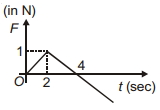
$A$ force acting on a body varies with time as shown below. If the initial momentum of the body is $\vec{p}$,then the time taken by the body to regain its momentum $\vec{p}$ again is ........... $s$.
A
$8$
B
$(4+2 \sqrt{2})$
C
$6$
D
Can never obtain
Solution
(B) The change in momentum $\Delta \vec{p}$ is equal to the impulse,which is the area under the $F-t$ graph.
For the body to regain its initial momentum $\vec{p}$,the total change in momentum must be zero,meaning the net area under the $F-t$ graph must be zero.
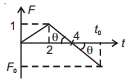
Let the graph cross the $t$-axis at $t = 4 \ s$. The area of the positive triangle (from $t=0$ to $t=4$) is $A_1 = \frac{1}{2} \times 4 \times 1 = 2 \ N \cdot s$.
For the total area to be zero,the area of the negative triangle (from $t=4$ to $t_0$) must be equal in magnitude to the positive area.
Let the force at time $t_0$ be $-F_0$. From the slope of the line,$\tan \theta = \frac{1}{2} = \frac{F_0}{t_0-4}$,so $F_0 = \frac{t_0-4}{2}$.
The area of the negative triangle is $A_2 = \frac{1}{2} \times (t_0-4) \times F_0 = \frac{1}{2} \times (t_0-4) \times \frac{t_0-4}{2} = \frac{(t_0-4)^2}{4}$.
Setting $A_1 = A_2$,we get $2 = \frac{(t_0-4)^2}{4}$,which implies $(t_0-4)^2 = 8$.
Thus,$t_0-4 = \sqrt{8} = 2\sqrt{2}$,so $t_0 = 4 + 2\sqrt{2} \ s$.
For the body to regain its initial momentum $\vec{p}$,the total change in momentum must be zero,meaning the net area under the $F-t$ graph must be zero.
Let the graph cross the $t$-axis at $t = 4 \ s$. The area of the positive triangle (from $t=0$ to $t=4$) is $A_1 = \frac{1}{2} \times 4 \times 1 = 2 \ N \cdot s$.
For the total area to be zero,the area of the negative triangle (from $t=4$ to $t_0$) must be equal in magnitude to the positive area.
Let the force at time $t_0$ be $-F_0$. From the slope of the line,$\tan \theta = \frac{1}{2} = \frac{F_0}{t_0-4}$,so $F_0 = \frac{t_0-4}{2}$.
The area of the negative triangle is $A_2 = \frac{1}{2} \times (t_0-4) \times F_0 = \frac{1}{2} \times (t_0-4) \times \frac{t_0-4}{2} = \frac{(t_0-4)^2}{4}$.
Setting $A_1 = A_2$,we get $2 = \frac{(t_0-4)^2}{4}$,which implies $(t_0-4)^2 = 8$.
Thus,$t_0-4 = \sqrt{8} = 2\sqrt{2}$,so $t_0 = 4 + 2\sqrt{2} \ s$.
0 likes
View Solution162
MediumMCQ
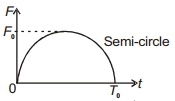
The magnitude of force acting on a particle moving along the $x$-axis varies with time $(t)$ as shown in the figure. If at $t=0$ the velocity of the particle is $v_0$,then its velocity at $t=T_0$ will be
A
$v_0+\frac{\pi F_0 T_0}{4 m}$
B
$v_0+\frac{\pi F_0}{2 m}$
C
$v_0+\frac{\pi T_0^2}{4 m}$
D
$v_0+\frac{\pi F_0 T_0}{m}$
Solution
(A) The impulse-momentum theorem states that the impulse applied to an object is equal to the change in its momentum.
$J = \int F dt = \Delta p = m(v - v_0)$
The impulse is equal to the area under the $F-t$ curve.
The given curve is a semi-ellipse with semi-major axis $a = T_0/2$ and semi-minor axis $b = F_0$. The area of a semi-ellipse is given by $\frac{1}{2} \pi a b$.
Area $= \frac{1}{2} \pi \left(\frac{T_0}{2}\right) F_0 = \frac{\pi F_0 T_0}{4}$
Equating impulse to the change in momentum:
$m(v - v_0) = \frac{\pi F_0 T_0}{4}$
$v - v_0 = \frac{\pi F_0 T_0}{4m}$
$v = v_0 + \frac{\pi F_0 T_0}{4m}$
Thus,the correct option is $A$.
$J = \int F dt = \Delta p = m(v - v_0)$
The impulse is equal to the area under the $F-t$ curve.
The given curve is a semi-ellipse with semi-major axis $a = T_0/2$ and semi-minor axis $b = F_0$. The area of a semi-ellipse is given by $\frac{1}{2} \pi a b$.
Area $= \frac{1}{2} \pi \left(\frac{T_0}{2}\right) F_0 = \frac{\pi F_0 T_0}{4}$
Equating impulse to the change in momentum:
$m(v - v_0) = \frac{\pi F_0 T_0}{4}$
$v - v_0 = \frac{\pi F_0 T_0}{4m}$
$v = v_0 + \frac{\pi F_0 T_0}{4m}$
Thus,the correct option is $A$.
0 likes
View Solution163
MediumMCQ
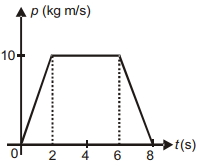
The momentum $p$ of an object varies with time $(t)$ as shown in the figure. The corresponding force $(F)$-time $(t)$ graph is
A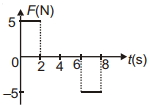
B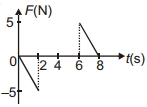
C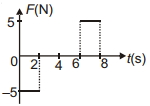
D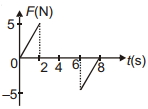
Solution
(A) According to Newton's second law of motion,the force $F$ is given by the rate of change of momentum:
$F = \frac{dp}{dt}$
This means the force $F$ is equal to the slope of the $p-t$ graph.
$1$. From $t = 0$ to $t = 2 \ s$,the momentum increases linearly from $0$ to $10 \ kg \ m/s$. The slope is constant and positive:
$F = \frac{10 - 0}{2 - 0} = 5 \ N$
$2$. From $t = 2$ to $t = 6 \ s$,the momentum is constant at $10 \ kg \ m/s$. The slope is zero:
$F = \frac{10 - 10}{6 - 2} = 0 \ N$
$3$. From $t = 6$ to $t = 8 \ s$,the momentum decreases linearly from $10$ to $0 \ kg \ m/s$. The slope is constant and negative:
$F = \frac{0 - 10}{8 - 6} = -5 \ N$
Comparing these values with the given options,the graph in Option $A$ correctly represents these force values over time.
$F = \frac{dp}{dt}$
This means the force $F$ is equal to the slope of the $p-t$ graph.
$1$. From $t = 0$ to $t = 2 \ s$,the momentum increases linearly from $0$ to $10 \ kg \ m/s$. The slope is constant and positive:
$F = \frac{10 - 0}{2 - 0} = 5 \ N$
$2$. From $t = 2$ to $t = 6 \ s$,the momentum is constant at $10 \ kg \ m/s$. The slope is zero:
$F = \frac{10 - 10}{6 - 2} = 0 \ N$
$3$. From $t = 6$ to $t = 8 \ s$,the momentum decreases linearly from $10$ to $0 \ kg \ m/s$. The slope is constant and negative:
$F = \frac{0 - 10}{8 - 6} = -5 \ N$
Comparing these values with the given options,the graph in Option $A$ correctly represents these force values over time.
0 likes
View Solution164
MediumMCQ
$A$ tennis ball is dropped onto the floor from a height of $9.8\,m$. It rebounds to a height of $5.0\,m$. The ball comes in contact with the floor for $0.2\,s$. The average acceleration during contact is $..........\,m/s^2$. [Given $g = 10\,m/s^2$]
A
$120$
B
$121$
C
$122$
D
$189$
Solution
(A) The velocity of the ball just before hitting the floor is $v_i = \sqrt{2gh_i} = \sqrt{2 \times 10 \times 9.8} = \sqrt{196} = 14\,m/s$ (downwards).
Taking the downward direction as negative,$v_i = -14\,m/s$.
The velocity of the ball just after rebounding is $v_f = \sqrt{2gh_f} = \sqrt{2 \times 10 \times 5} = \sqrt{100} = 10\,m/s$ (upwards).
Taking the upward direction as positive,$v_f = +10\,m/s$.
The change in velocity is $\Delta v = v_f - v_i = 10 - (-14) = 24\,m/s$.
The average acceleration is $a_{\text{avg}} = \frac{\Delta v}{\Delta t} = \frac{24}{0.2} = 120\,m/s^2$.
Taking the downward direction as negative,$v_i = -14\,m/s$.
The velocity of the ball just after rebounding is $v_f = \sqrt{2gh_f} = \sqrt{2 \times 10 \times 5} = \sqrt{100} = 10\,m/s$ (upwards).
Taking the upward direction as positive,$v_f = +10\,m/s$.
The change in velocity is $\Delta v = v_f - v_i = 10 - (-14) = 24\,m/s$.
The average acceleration is $a_{\text{avg}} = \frac{\Delta v}{\Delta t} = \frac{24}{0.2} = 120\,m/s^2$.
1 likes
View Solution165
MediumMCQ
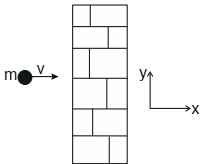
$100$ balls,each of mass $m$,moving with speed $v$,simultaneously strike a wall normally and are reflected back with the same speed in time $t$. The total force exerted by the balls on the wall is
A
$\frac{100 \,mv }{ t }$
B
$\frac{200\, mv }{ t }$
C
$200\,mvt$
D
$\frac{ mv }{100 t }$
Solution
(B) The initial momentum of $100$ balls is $P_i = 100mv$ (taking the direction towards the wall as positive).
After reflection,the final momentum of the balls is $P_f = -100mv$ (as they move in the opposite direction with the same speed).
The change in momentum of the balls is $\Delta P = P_f - P_i = -100mv - 100mv = -200mv$.
The force exerted by the wall on the balls is $F_{wall} = \frac{\Delta P}{t} = -\frac{200mv}{t}$.
According to Newton's third law,the force exerted by the balls on the wall is equal in magnitude and opposite in direction to the force exerted by the wall on the balls.
Therefore,the magnitude of the force exerted by the balls on the wall is $|F| = \frac{200mv}{t}$.
After reflection,the final momentum of the balls is $P_f = -100mv$ (as they move in the opposite direction with the same speed).
The change in momentum of the balls is $\Delta P = P_f - P_i = -100mv - 100mv = -200mv$.
The force exerted by the wall on the balls is $F_{wall} = \frac{\Delta P}{t} = -\frac{200mv}{t}$.
According to Newton's third law,the force exerted by the balls on the wall is equal in magnitude and opposite in direction to the force exerted by the wall on the balls.
Therefore,the magnitude of the force exerted by the balls on the wall is $|F| = \frac{200mv}{t}$.
0 likes
View Solution166
MediumMCQ
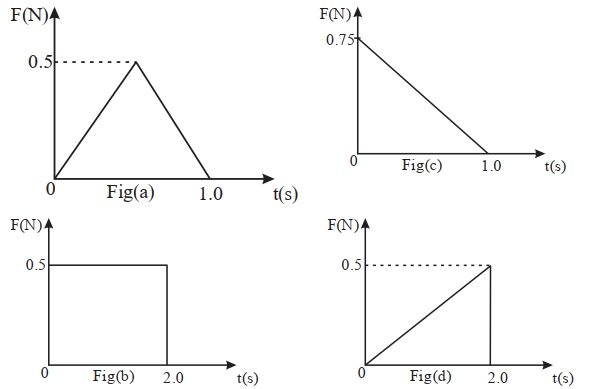
Figures $(a)$,$(b)$,$(c)$ and $(d)$ show the variation of force with time. The impulse is highest in which figure?
A
Fig $(c)$
B
Fig $(b)$
C
Fig $(a)$
D
Fig $(d)$
Solution
(B) The impulse is defined as the area under the force-time $(F-t)$ curve.
$(a)$ Area $= \frac{1}{2} \times \text{base} \times \text{height} = \frac{1}{2} \times 1.0 \times 0.5 = 0.25 \, N \cdot s$
$(b)$ Area $= \text{length} \times \text{breadth} = 2.0 \times 0.5 = 1.0 \, N \cdot s$
$(c)$ Area $= \frac{1}{2} \times \text{base} \times \text{height} = \frac{1}{2} \times 1.0 \times 0.75 = 0.375 \, N \cdot s$
$(d)$ Area $= \frac{1}{2} \times \text{base} \times \text{height} = \frac{1}{2} \times 2.0 \times 0.5 = 0.5 \, N \cdot s$
Comparing the values, the impulse is highest in figure $(b)$.
$(a)$ Area $= \frac{1}{2} \times \text{base} \times \text{height} = \frac{1}{2} \times 1.0 \times 0.5 = 0.25 \, N \cdot s$
$(b)$ Area $= \text{length} \times \text{breadth} = 2.0 \times 0.5 = 1.0 \, N \cdot s$
$(c)$ Area $= \frac{1}{2} \times \text{base} \times \text{height} = \frac{1}{2} \times 1.0 \times 0.75 = 0.375 \, N \cdot s$
$(d)$ Area $= \frac{1}{2} \times \text{base} \times \text{height} = \frac{1}{2} \times 2.0 \times 0.5 = 0.5 \, N \cdot s$
Comparing the values, the impulse is highest in figure $(b)$.
0 likes
View Solution167
MediumMCQ
An average force of $125\,N$ is applied on a machine gun firing bullets each of mass $10\,g$ at the speed of $250\,m/s$ to keep it in position. The number of bullets fired per second by the machine gun is:
A
$5$
B
$50$
C
$100$
D
$25$
Solution
(B) The force exerted by the machine gun is equal to the rate of change of momentum of the bullets.
$F = \frac{dp}{dt} = n \cdot m \cdot v$
where $n$ is the number of bullets fired per second,$m$ is the mass of each bullet,and $v$ is the velocity of the bullets.
Given:
Force $F = 125\,N$
Mass $m = 10\,g = 10 \times 10^{-3}\,kg = 0.01\,kg$
Velocity $v = 250\,m/s$
Substituting the values into the formula:
$125 = n \times 0.01 \times 250$
$125 = n \times 2.5$
$n = \frac{125}{2.5} = 50$
Therefore,the number of bullets fired per second is $50$.
$F = \frac{dp}{dt} = n \cdot m \cdot v$
where $n$ is the number of bullets fired per second,$m$ is the mass of each bullet,and $v$ is the velocity of the bullets.
Given:
Force $F = 125\,N$
Mass $m = 10\,g = 10 \times 10^{-3}\,kg = 0.01\,kg$
Velocity $v = 250\,m/s$
Substituting the values into the formula:
$125 = n \times 0.01 \times 250$
$125 = n \times 2.5$
$n = \frac{125}{2.5} = 50$
Therefore,the number of bullets fired per second is $50$.
0 likes
View Solution168
MediumMCQ
$A$ bullet of mass $10\,g$ leaves the barrel of a gun with a velocity of $600\,m/s$. If the barrel of the gun is $50\,cm$ long and the mass of the gun is $3\,kg$,then the value of the impulse supplied to the gun will be $.....\,Ns$.
A
$12$
B
$6$
C
$36$
D
$3$
Solution
(B) The impulse supplied to the gun is equal to the change in momentum of the bullet.
Given:
Mass of the bullet,$m = 10\,g = 0.01\,kg$
Velocity of the bullet,$v = 600\,m/s$
Mass of the gun,$M = 3\,kg$
Impulse $J = \Delta p = m \times v$
$J = 0.01\,kg \times 600\,m/s = 6\,Ns$
Since the system is initially at rest,the impulse imparted to the gun is equal in magnitude to the momentum gained by the bullet.
Given:
Mass of the bullet,$m = 10\,g = 0.01\,kg$
Velocity of the bullet,$v = 600\,m/s$
Mass of the gun,$M = 3\,kg$
Impulse $J = \Delta p = m \times v$
$J = 0.01\,kg \times 600\,m/s = 6\,Ns$
Since the system is initially at rest,the impulse imparted to the gun is equal in magnitude to the momentum gained by the bullet.
0 likes
View Solution169
DifficultMCQ
$A$ spherical body of mass $100 \,g$ is dropped from a height of $10 \,m$ from the ground. After hitting the ground, the body rebounds to a height of $5 \,m$. The impulse of force imparted by the ground to the body is given by: (given $g = 9.8 \,m/s^2$)
A
$4.32 \,kg \,m/s$
B
$43.2 \,kg \,m/s$
C
$23.9 \,kg \,m/s$
D
$2.39 \,kg \,m/s$
Solution
(D) The impulse $\vec{I}$ is equal to the change in momentum $\Delta \vec{P} = \vec{P}_f - \vec{P}_i$.
Mass $m = 100 \,g = 0.1 \,kg$.
Velocity just before hitting the ground: $v_i = -\sqrt{2gh_1} = -\sqrt{2 \times 9.8 \times 10} = -\sqrt{196} = -14 \,m/s$.
Velocity just after rebounding: $v_f = \sqrt{2gh_2} = \sqrt{2 \times 9.8 \times 5} = \sqrt{98} = 7\sqrt{2} \approx 9.9 \,m/s$.
Impulse $I = m(v_f - v_i) = 0.1 \times (9.9 - (-14)) = 0.1 \times (23.9) = 2.39 \,kg \,m/s$.
Mass $m = 100 \,g = 0.1 \,kg$.
Velocity just before hitting the ground: $v_i = -\sqrt{2gh_1} = -\sqrt{2 \times 9.8 \times 10} = -\sqrt{196} = -14 \,m/s$.
Velocity just after rebounding: $v_f = \sqrt{2gh_2} = \sqrt{2 \times 9.8 \times 5} = \sqrt{98} = 7\sqrt{2} \approx 9.9 \,m/s$.
Impulse $I = m(v_f - v_i) = 0.1 \times (9.9 - (-14)) = 0.1 \times (23.9) = 2.39 \,kg \,m/s$.
0 likes
View Solution170
MediumMCQ
$A$ particle moves in the $x-y$ plane under the influence of a force $\vec{F}$ such that its linear momentum is $\vec{P}(t) = \hat{i} \cos(kt) - \hat{j} \sin(kt)$. If $k$ is a constant,the angle between $\vec{F}$ and $\vec{P}$ will be:
A
$\frac{\pi}{2}$
B
$\frac{\pi}{6}$
C
$\frac{\pi}{4}$
D
$\frac{\pi}{3}$
Solution
(A) Given linear momentum $\vec{P}(t) = \cos(kt) \hat{i} - \sin(kt) \hat{j}$.
Force $\vec{F}$ is the rate of change of momentum: $\vec{F} = \frac{d\vec{P}}{dt}$.
$\vec{F} = \frac{d}{dt} [\cos(kt) \hat{i} - \sin(kt) \hat{j}] = -k \sin(kt) \hat{i} - k \cos(kt) \hat{j}$.
To find the angle $\theta$ between $\vec{F}$ and $\vec{P}$,we use the dot product: $\vec{F} \cdot \vec{P} = |\vec{F}| |\vec{P}| \cos \theta$.
$\vec{F} \cdot \vec{P} = (-k \sin(kt))(\cos(kt)) + (-k \cos(kt))(-\sin(kt))$.
$\vec{F} \cdot \vec{P} = -k \sin(kt) \cos(kt) + k \sin(kt) \cos(kt) = 0$.
Since the dot product is $0$,$\cos \theta = 0$,which implies $\theta = \frac{\pi}{2}$.
Force $\vec{F}$ is the rate of change of momentum: $\vec{F} = \frac{d\vec{P}}{dt}$.
$\vec{F} = \frac{d}{dt} [\cos(kt) \hat{i} - \sin(kt) \hat{j}] = -k \sin(kt) \hat{i} - k \cos(kt) \hat{j}$.
To find the angle $\theta$ between $\vec{F}$ and $\vec{P}$,we use the dot product: $\vec{F} \cdot \vec{P} = |\vec{F}| |\vec{P}| \cos \theta$.
$\vec{F} \cdot \vec{P} = (-k \sin(kt))(\cos(kt)) + (-k \cos(kt))(-\sin(kt))$.
$\vec{F} \cdot \vec{P} = -k \sin(kt) \cos(kt) + k \sin(kt) \cos(kt) = 0$.
Since the dot product is $0$,$\cos \theta = 0$,which implies $\theta = \frac{\pi}{2}$.
0 likes
View Solution171
MediumMCQ
$A$ player caught a cricket ball of mass $150 \ g$ moving at a speed of $20 \ m/s$. If the catching process is completed in $0.1 \ s$,the magnitude of the force exerted by the ball on the hand of the player is .......... $N$.
A
$150$
B
$3$
C
$30$
D
$300$
Solution
(C) Given: Mass $m = 150 \ g = 0.15 \ kg$,Initial velocity $u = 20 \ m/s$,Final velocity $v = 0 \ m/s$,Time interval $\Delta t = 0.1 \ s$.
According to Newton's second law of motion,the force $F$ exerted is equal to the rate of change of momentum:
$F = \frac{\Delta p}{\Delta t} = \frac{m(v - u)}{\Delta t}$
$F = \frac{0.15 \times (0 - 20)}{0.1}$
$F = \frac{0.15 \times (-20)}{0.1} = \frac{-3}{0.1} = -30 \ N$
The magnitude of the force is $|F| = 30 \ N$.
According to Newton's second law of motion,the force $F$ exerted is equal to the rate of change of momentum:
$F = \frac{\Delta p}{\Delta t} = \frac{m(v - u)}{\Delta t}$
$F = \frac{0.15 \times (0 - 20)}{0.1}$
$F = \frac{0.15 \times (-20)}{0.1} = \frac{-3}{0.1} = -30 \ N$
The magnitude of the force is $|F| = 30 \ N$.
0 likes
View Solution172
DifficultMCQ
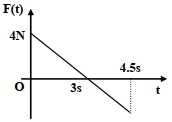
$A$ block of mass $2 \ kg$ is free to move along the $x$-axis. It is at rest and from $t=0$ onwards it is subjected to a time-dependent force $F(t)$ in the $x$ direction. The force $F(t)$ varies with $t$ as shown in the figure. The kinetic energy of the block after $4.5 \ s$ is (in $J$)
A
$4.50$
B
$7.50$
C
$5.06$
D
$14.06$
Solution
(C) The impulse imparted to the block is equal to the area under the $F-t$ graph.
Impulse $J = \int F \ dt = \text{Area of triangle from } t=0 \text{ to } 3 \ s - \text{Area of triangle from } t=3 \text{ to } 4.5 \ s$.
At $t=0$,$F=4 \ N$. The slope of the line is $m = \frac{0-4}{3-0} = -\frac{4}{3} \ N/s$.
So,$F(t) = 4 - \frac{4}{3}t$.
At $t=4.5 \ s$,$F(4.5) = 4 - \frac{4}{3}(4.5) = 4 - 6 = -2 \ N$.
Impulse $J = \left(\frac{1}{2} \times 3 \times 4\right) - \left(\frac{1}{2} \times (4.5-3) \times 2\right) = 6 - 1.5 = 4.5 \ kg \cdot m/s$.
Since the block starts from rest,the final momentum $p = J = 4.5 \ kg \cdot m/s$.
The kinetic energy $K.E. = \frac{p^2}{2m} = \frac{(4.5)^2}{2 \times 2} = \frac{20.25}{4} = 5.0625 \ J \approx 5.06 \ J$.
Impulse $J = \int F \ dt = \text{Area of triangle from } t=0 \text{ to } 3 \ s - \text{Area of triangle from } t=3 \text{ to } 4.5 \ s$.
At $t=0$,$F=4 \ N$. The slope of the line is $m = \frac{0-4}{3-0} = -\frac{4}{3} \ N/s$.
So,$F(t) = 4 - \frac{4}{3}t$.
At $t=4.5 \ s$,$F(4.5) = 4 - \frac{4}{3}(4.5) = 4 - 6 = -2 \ N$.
Impulse $J = \left(\frac{1}{2} \times 3 \times 4\right) - \left(\frac{1}{2} \times (4.5-3) \times 2\right) = 6 - 1.5 = 4.5 \ kg \cdot m/s$.
Since the block starts from rest,the final momentum $p = J = 4.5 \ kg \cdot m/s$.
The kinetic energy $K.E. = \frac{p^2}{2m} = \frac{(4.5)^2}{2 \times 2} = \frac{20.25}{4} = 5.0625 \ J \approx 5.06 \ J$.
0 likes
View Solution173
DifficultMCQ
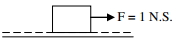
$A$ solid horizontal surface is covered with a thin layer of oil. $A$ rectangular block of mass $m = 0.4 \ kg$ is at rest on this surface. An impulse of $1.0 \ N \ s$ is applied to the block at time $t = 0$ so that it starts moving along the $x$-axis with a velocity $v(t) = v_0 e^{-t/\tau}$,where $v_0$ is a constant and $\tau = 4 \ s$. The displacement of the block,in metres,at $t = \tau$ is. . . . . . . Take $e^{-1} = 0.37$.
A
$6.2$
B
$6.3$
C
$6.4$
D
$6.5$
Solution
(B) Given,$m = 0.4 \ kg$,Impulse $J = 1.0 \ N \ s$,$\tau = 4 \ s$,and $v(t) = v_0 e^{-t/\tau}$.
At $t = 0$,the velocity is $v(0) = v_0 e^0 = v_0$.
From the impulse-momentum theorem,$J = \Delta p = m \Delta v = m(v(0) - 0) = m v_0$.
Therefore,$v_0 = J/m = 1.0 / 0.4 = 2.5 \ m/s$.
The displacement $S$ at $t = \tau$ is given by the integral of velocity:
$S = \int_0^{\tau} v(t) \ dt = \int_0^{\tau} v_0 e^{-t/\tau} \ dt$.
$S = v_0 \left[ -\tau e^{-t/\tau} \right]_0^{\tau} = v_0 \tau (1 - e^{-1})$.
Substituting the values: $S = (2.5) \times (4) \times (1 - 0.37)$.
$S = 10 \times 0.63 = 6.3 \ m$.
At $t = 0$,the velocity is $v(0) = v_0 e^0 = v_0$.
From the impulse-momentum theorem,$J = \Delta p = m \Delta v = m(v(0) - 0) = m v_0$.
Therefore,$v_0 = J/m = 1.0 / 0.4 = 2.5 \ m/s$.
The displacement $S$ at $t = \tau$ is given by the integral of velocity:
$S = \int_0^{\tau} v(t) \ dt = \int_0^{\tau} v_0 e^{-t/\tau} \ dt$.
$S = v_0 \left[ -\tau e^{-t/\tau} \right]_0^{\tau} = v_0 \tau (1 - e^{-1})$.
Substituting the values: $S = (2.5) \times (4) \times (1 - 0.37)$.
$S = 10 \times 0.63 = 6.3 \ m$.
0 likes
View Solution174
MediumMCQ
$A$ ball of mass $0.5 \ kg$ is dropped from a height of $40 \ m$. The ball hits the ground and rises to a height of $10 \ m$. The impulse imparted to the ball during its collision with the ground is (Take $g = 9.8 \ m/s^2$)
A
$21 \ Ns$
B
$7 \ Ns$
C
$0$
D
$84 \ Ns$
Solution
(A) The velocity of the ball just before hitting the ground is $v_i = -\sqrt{2gh_1} = -\sqrt{2 \times 9.8 \times 40} = -\sqrt{784} = -28 \ m/s$.
The velocity of the ball just after rebounding is $v_f = \sqrt{2gh_2} = \sqrt{2 \times 9.8 \times 10} = \sqrt{196} = 14 \ m/s$.
The impulse imparted to the ball is equal to the change in momentum: $\vec{I} = \Delta \vec{P} = m(\vec{v}_f - \vec{v}_i)$.
Substituting the values: $\vec{I} = 0.5 \times [14 - (-28)] = 0.5 \times [14 + 28] = 0.5 \times 42 = 21 \ Ns$.
The velocity of the ball just after rebounding is $v_f = \sqrt{2gh_2} = \sqrt{2 \times 9.8 \times 10} = \sqrt{196} = 14 \ m/s$.
The impulse imparted to the ball is equal to the change in momentum: $\vec{I} = \Delta \vec{P} = m(\vec{v}_f - \vec{v}_i)$.
Substituting the values: $\vec{I} = 0.5 \times [14 - (-28)] = 0.5 \times [14 + 28] = 0.5 \times 42 = 21 \ Ns$.
0 likes
View Solution175
EasyMCQ
$A$ player kicks a football of mass $0.5 \ kg$ and the football begins to move with a velocity of $10 \ m/s$. If the contact between the leg and the football lasts for $\frac{1}{50} \ s$,then the force acted on the football should be .......... $N$.
A
$2500$
B
$1250$
C
$250$
D
$625$
Solution
(C) The force acting on the football can be calculated using Newton's second law in terms of impulse: $F = \frac{\Delta p}{\Delta t}$.
Here,the mass of the football $m = 0.5 \ kg$.
The initial velocity $u = 0 \ m/s$ and the final velocity $v = 10 \ m/s$.
The time of contact $\Delta t = \frac{1}{50} \ s$.
The change in momentum $\Delta p = m(v - u) = 0.5 \times (10 - 0) = 5 \ kg \cdot m/s$.
Therefore,the force $F = \frac{5}{1/50} = 5 \times 50 = 250 \ N$.
Here,the mass of the football $m = 0.5 \ kg$.
The initial velocity $u = 0 \ m/s$ and the final velocity $v = 10 \ m/s$.
The time of contact $\Delta t = \frac{1}{50} \ s$.
The change in momentum $\Delta p = m(v - u) = 0.5 \times (10 - 0) = 5 \ kg \cdot m/s$.
Therefore,the force $F = \frac{5}{1/50} = 5 \times 50 = 250 \ N$.
0 likes
View Solution176
MediumMCQ
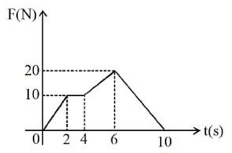
$A$ particle of mass $2 \ kg$ is initially at rest. $A$ force acts on it whose magnitude changes with time. The force-time graph is shown below. The velocity of the particle after $10 \ s$ is $.... \ ms^{-1}$.
A
$20$
B
$10$
C
$75$
D
$50$
Solution
(D) The impulse applied to the particle is equal to the area under the $F-t$ graph.
Impulse $J = \int F \, dt = \Delta p = m(v_f - v_i)$.
Given $m = 2 \ kg$ and $v_i = 0 \ ms^{-1}$.
Area under the graph = Area of triangle $(0-2 \ s)$ + Area of rectangle $(2-4 \ s)$ + Area of trapezium $(4-6 \ s)$ + Area of triangle $(6-10 \ s)$.
Area $= (\frac{1}{2} \times 2 \times 10) + (2 \times 10) + (\frac{1}{2} \times (10 + 20) \times 2) + (\frac{1}{2} \times 4 \times 20)$.
Area $= 10 + 20 + 30 + 40 = 100 \ N \cdot s$.
Since $J = m \cdot v_f$,we have $100 = 2 \times v_f$.
Therefore,$v_f = 50 \ ms^{-1}$.
Impulse $J = \int F \, dt = \Delta p = m(v_f - v_i)$.
Given $m = 2 \ kg$ and $v_i = 0 \ ms^{-1}$.
Area under the graph = Area of triangle $(0-2 \ s)$ + Area of rectangle $(2-4 \ s)$ + Area of trapezium $(4-6 \ s)$ + Area of triangle $(6-10 \ s)$.
Area $= (\frac{1}{2} \times 2 \times 10) + (2 \times 10) + (\frac{1}{2} \times (10 + 20) \times 2) + (\frac{1}{2} \times 4 \times 20)$.
Area $= 10 + 20 + 30 + 40 = 100 \ N \cdot s$.
Since $J = m \cdot v_f$,we have $100 = 2 \times v_f$.
Therefore,$v_f = 50 \ ms^{-1}$.
0 likes
View Solution177
EasyMCQ
$N$ number of balls,each of mass $m \ kg$,moving along the positive direction of the $x$-axis,strike a wall per second and return elastically. The velocity of each ball is $u \ m/s$. The force exerted on the wall by the balls in newtons is:
A
$mNu$
B
$0$
C
$2mNu$
D
$\frac{mNu}{2}$
Solution
(C) The force exerted on the wall is given by the rate of change of momentum.
Initial momentum of $N$ balls per second = $Nmu \hat{i}$.
Since the collision is elastic,the balls return with the same speed in the opposite direction.
Final momentum of $N$ balls per second = $-Nmu \hat{i}$.
Change in momentum per second = $\text{Final momentum} - \text{Initial momentum} = -Nmu \hat{i} - (Nmu \hat{i}) = -2Nmu \hat{i}$.
The magnitude of the change in momentum per second is $2Nmu$.
Since force is the rate of change of momentum,$F = \frac{\Delta p}{\Delta t} = \frac{2Nmu}{1} = 2Nmu \ N$.
Therefore,the correct option is $C$.
Initial momentum of $N$ balls per second = $Nmu \hat{i}$.
Since the collision is elastic,the balls return with the same speed in the opposite direction.
Final momentum of $N$ balls per second = $-Nmu \hat{i}$.
Change in momentum per second = $\text{Final momentum} - \text{Initial momentum} = -Nmu \hat{i} - (Nmu \hat{i}) = -2Nmu \hat{i}$.
The magnitude of the change in momentum per second is $2Nmu$.
Since force is the rate of change of momentum,$F = \frac{\Delta p}{\Delta t} = \frac{2Nmu}{1} = 2Nmu \ N$.
Therefore,the correct option is $C$.
0 likes
View Solution178
MediumMCQ
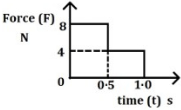
$A$ force is applied to a body of mass $3 \ kg$ at rest on a frictionless horizontal surface, as shown in the force-time $(F-t)$ graph. The speed of the body after $1 \ s$ is: (in $m/s$)
A
$8$
B
$6$
C
$4$
D
$2$
Solution
(D) The impulse applied to the body is equal to the area under the force-time $(F-t)$ graph.
Impulse $(J)$ = Change in momentum $(\Delta p)$ = $m(v - u)$.
Given mass $m = 3 \ kg$, initial velocity $u = 0 \ m/s$.
Area under the graph = Area of the first rectangle + Area of the second rectangle.
Area = $(8 \ N \times 0.5 \ s) + (4 \ N \times (1.0 - 0.5) \ s)$.
Area = $(4 \ Ns) + (4 \ N \times 0.5 \ s) = 4 \ Ns + 2 \ Ns = 6 \ Ns$.
Since Impulse = $\Delta p = m(v - u)$,
$6 = 3 \times (v - 0)$,
$6 = 3v$,
$v = 2 \ m/s$.
Therefore, the speed of the body after $1 \ s$ is $2 \ m/s$.
Impulse $(J)$ = Change in momentum $(\Delta p)$ = $m(v - u)$.
Given mass $m = 3 \ kg$, initial velocity $u = 0 \ m/s$.
Area under the graph = Area of the first rectangle + Area of the second rectangle.
Area = $(8 \ N \times 0.5 \ s) + (4 \ N \times (1.0 - 0.5) \ s)$.
Area = $(4 \ Ns) + (4 \ N \times 0.5 \ s) = 4 \ Ns + 2 \ Ns = 6 \ Ns$.
Since Impulse = $\Delta p = m(v - u)$,
$6 = 3 \times (v - 0)$,
$6 = 3v$,
$v = 2 \ m/s$.
Therefore, the speed of the body after $1 \ s$ is $2 \ m/s$.
0 likes
View Solution179
MediumMCQ
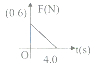
Using the variation of force and time given below, the final velocity of a particle of mass $2 \, kg$ moving with an initial velocity $6 \, m/s$ will be: (in $m/s$)
A
$10$
B
$5$
C
$12$
D
$0$
Solution
(C) The impulse applied to the particle is equal to the area under the force-time graph.
Impulse $J = \text{Area of triangle} = \frac{1}{2} \times 4 \, s \times 6 \, N = 12 \, N \cdot s$.
According to the impulse-momentum theorem, Impulse $J = \Delta p = m(v_f - v_i)$.
Given mass $m = 2 \, kg$, initial velocity $v_i = 6 \, m/s$, and impulse $J = 12 \, N \cdot s$.
$12 = 2(v_f - 6)$.
$6 = v_f - 6$.
$v_f = 12 \, m/s$.
Thus, the final velocity of the particle is $12 \, m/s$.
Impulse $J = \text{Area of triangle} = \frac{1}{2} \times 4 \, s \times 6 \, N = 12 \, N \cdot s$.
According to the impulse-momentum theorem, Impulse $J = \Delta p = m(v_f - v_i)$.
Given mass $m = 2 \, kg$, initial velocity $v_i = 6 \, m/s$, and impulse $J = 12 \, N \cdot s$.
$12 = 2(v_f - 6)$.
$6 = v_f - 6$.
$v_f = 12 \, m/s$.
Thus, the final velocity of the particle is $12 \, m/s$.
0 likes
View Solution180
EasyMCQ
$A$ wall is hit elastically and normally by $n$ balls per second. All the balls have the same mass $m$ and are moving with the same velocity $u$. The force exerted by the balls on the wall is
A
$2 mnu^2$
B
$2 mnu$
C
$\frac{1}{2} mnu^2$
D
$mnu$
Solution
(B) The force exerted on the wall is equal to the rate of change of momentum of the balls.
For an elastic collision,the ball hits the wall with velocity $u$ and rebounds with velocity $-u$.
The change in momentum for a single ball is $\Delta p = m(u - (-u)) = 2mu$.
Since $n$ balls hit the wall per second,the total change in momentum per second is $\frac{dp}{dt} = n \times \Delta p = n(2mu) = 2mnu$.
According to Newton's second law,the force $F$ is equal to the rate of change of momentum,so $F = 2mnu$.
For an elastic collision,the ball hits the wall with velocity $u$ and rebounds with velocity $-u$.
The change in momentum for a single ball is $\Delta p = m(u - (-u)) = 2mu$.
Since $n$ balls hit the wall per second,the total change in momentum per second is $\frac{dp}{dt} = n \times \Delta p = n(2mu) = 2mnu$.
According to Newton's second law,the force $F$ is equal to the rate of change of momentum,so $F = 2mnu$.
0 likes
View Solution181
MediumMCQ
$A$ bullet of mass $20 \,g$ moving with a velocity of $200 \,m/s$ strikes a target and is brought to rest in $\left(\frac{1}{50}\right) \,s$. The impulse and average force of impact are respectively:
A
$4 \,Ns, 200 \,N$
B
$4 \,Ns, 100 \,N$
C
$2 \,Ns, 200 \,N$
D
$2 \,Ns, 100 \,N$
Solution
(A) Given: Mass of the bullet $m = 20 \,g = 0.02 \,kg$. Initial velocity $u = 200 \,m/s$. Final velocity $v = 0 \,m/s$. Time taken $\Delta t = \frac{1}{50} \,s = 0.02 \,s$.
Impulse $(J)$ is equal to the change in momentum:
$J = \Delta p = m(v - u)$
$J = 0.02 \,kg \times (0 - 200) \,m/s = -4 \,kg \cdot m/s$.
The magnitude of impulse is $4 \,Ns$.
Average force $(F_{avg})$ is given by the rate of change of momentum:
$F_{avg} = \frac{J}{\Delta t} = \frac{4 \,Ns}{0.02 \,s} = 200 \,N$.
Thus,the impulse is $4 \,Ns$ and the average force is $200 \,N$.
Impulse $(J)$ is equal to the change in momentum:
$J = \Delta p = m(v - u)$
$J = 0.02 \,kg \times (0 - 200) \,m/s = -4 \,kg \cdot m/s$.
The magnitude of impulse is $4 \,Ns$.
Average force $(F_{avg})$ is given by the rate of change of momentum:
$F_{avg} = \frac{J}{\Delta t} = \frac{4 \,Ns}{0.02 \,s} = 200 \,N$.
Thus,the impulse is $4 \,Ns$ and the average force is $200 \,N$.
0 likes
View Solution182
EasyMCQ
$A$ batsman hits a ball of mass $0.2 \ kg$ straight towards the bowler without changing its initial speed of $6 \ m/s$. What is the impulse imparted to the ball (in $Ns$)?
A
$2.4$
B
$1.6$
C
$4$
D
$3.2$
Solution
(A) The impulse imparted to an object is equal to the change in its linear momentum.
Let the initial velocity of the ball be $u = 6 \ m/s$ (towards the batsman).
After being hit,the ball moves towards the bowler with the same speed,so the final velocity is $v = -6 \ m/s$.
The mass of the ball is $m = 0.2 \ kg$.
Impulse $J = \Delta p = m(v - u)$.
$J = 0.2 \times (-6 - 6) = 0.2 \times (-12) = -2.4 \ Ns$.
The magnitude of the impulse imparted to the ball is $2.4 \ Ns$.
Let the initial velocity of the ball be $u = 6 \ m/s$ (towards the batsman).
After being hit,the ball moves towards the bowler with the same speed,so the final velocity is $v = -6 \ m/s$.
The mass of the ball is $m = 0.2 \ kg$.
Impulse $J = \Delta p = m(v - u)$.
$J = 0.2 \times (-6 - 6) = 0.2 \times (-12) = -2.4 \ Ns$.
The magnitude of the impulse imparted to the ball is $2.4 \ Ns$.
0 likes
View Solution183
MediumMCQ
$A$ ball of mass $0.1 \,kg$ strikes a wall normally with a speed of $30 \,ms^{-1}$ and rebounds with a speed of $20 \,ms^{-1}$. The impulse of the force exerted by the wall on the ball is (in $\,N-s$)
A
$1$
B
$5$
C
$2$
D
$3$
Solution
(B) Impulse is defined as the change in momentum of the object.
Let the initial velocity be $u = 30 \,ms^{-1}$ and the final velocity be $v = -20 \,ms^{-1}$ (since it rebounds in the opposite direction).
The mass of the ball is $m = 0.1 \,kg$.
Impulse $J = \Delta p = m(v - u)$.
Taking the direction of the initial velocity as positive:
$J = m(v_{final} - v_{initial}) = 0.1 \times (-20 - 30) = 0.1 \times (-50) = -5 \,N-s$.
The magnitude of the impulse exerted by the wall on the ball is $|J| = 5 \,N-s$.
Let the initial velocity be $u = 30 \,ms^{-1}$ and the final velocity be $v = -20 \,ms^{-1}$ (since it rebounds in the opposite direction).
The mass of the ball is $m = 0.1 \,kg$.
Impulse $J = \Delta p = m(v - u)$.
Taking the direction of the initial velocity as positive:
$J = m(v_{final} - v_{initial}) = 0.1 \times (-20 - 30) = 0.1 \times (-50) = -5 \,N-s$.
The magnitude of the impulse exerted by the wall on the ball is $|J| = 5 \,N-s$.
0 likes
View Solution184
MediumMCQ
In projectile motion,two particles of masses $m_1$ and $m_2$ have velocities $\vec{V}_1$ and $\vec{V}_2$ respectively at time $t=0$. Their velocities become $\vec{V}_1^{\prime}$ and $\vec{V}_2^{\prime}$ at time $2t$ while still moving in air. The value of $[(m_1 \vec{V}_1^{\prime} + m_2 \vec{V}_2^{\prime}) - (m_1 \vec{V}_1 + m_2 \vec{V}_2)]$ is ($g =$ acceleration due to gravity).
A
zero
B
$\frac{1}{2}(m_1 + m_2) gt$
C
$(m_1 + m_2) gt$
D
$2(m_1 + m_2) gt$
Solution
(D) The external force acting on the system of two particles is the gravitational force: $F_{ext} = (m_1 + m_2)g$ (acting downwards).
According to Newton's second law,the rate of change of momentum is equal to the external force: $F_{ext} = \frac{\Delta P}{\Delta t}$.
Here,$\Delta P = (m_1 \vec{V}_1^{\prime} + m_2 \vec{V}_2^{\prime}) - (m_1 \vec{V}_1 + m_2 \vec{V}_2)$ and $\Delta t = 2t - 0 = 2t$.
Substituting these into the equation: $(m_1 + m_2)g = \frac{(m_1 \vec{V}_1^{\prime} + m_2 \vec{V}_2^{\prime}) - (m_1 \vec{V}_1 + m_2 \vec{V}_2)}{2t}$.
Therefore,the change in momentum is: $[(m_1 \vec{V}_1^{\prime} + m_2 \vec{V}_2^{\prime}) - (m_1 \vec{V}_1 + m_2 \vec{V}_2)] = 2(m_1 + m_2)gt$.
According to Newton's second law,the rate of change of momentum is equal to the external force: $F_{ext} = \frac{\Delta P}{\Delta t}$.
Here,$\Delta P = (m_1 \vec{V}_1^{\prime} + m_2 \vec{V}_2^{\prime}) - (m_1 \vec{V}_1 + m_2 \vec{V}_2)$ and $\Delta t = 2t - 0 = 2t$.
Substituting these into the equation: $(m_1 + m_2)g = \frac{(m_1 \vec{V}_1^{\prime} + m_2 \vec{V}_2^{\prime}) - (m_1 \vec{V}_1 + m_2 \vec{V}_2)}{2t}$.
Therefore,the change in momentum is: $[(m_1 \vec{V}_1^{\prime} + m_2 \vec{V}_2^{\prime}) - (m_1 \vec{V}_1 + m_2 \vec{V}_2)] = 2(m_1 + m_2)gt$.
0 likes
View Solution185
DifficultMCQ
$1000$ small balls,each weighing $1 \text{ g}$,strike $1 \text{ cm}^2$ of area per second with a velocity of $50 \text{ m/s}$ in a normal direction and rebound with the same velocity. The value of pressure on the surface will be:
A
$10^7 \text{ N/m}^2$
B
$10^6 \text{ N/m}^2$
C
$5 \times 10^6 \text{ N/m}^2$
D
$2 \times 10^6 \text{ N/m}^2$
Solution
(B) Given that:
Number of balls $N = 1000 = 10^3$
Mass of each ball $m = 1 \text{ g} = 10^{-3} \text{ kg}$
Area $A = 1 \text{ cm}^2 = 10^{-4} \text{ m}^2$
Velocity $v = 50 \text{ m/s}$
The change in momentum for each collision is $\Delta p = m[v - (-v)] = 2mv$.
Since there are $N$ collisions per second,the total force $F$ exerted on the surface is:
$F = N \times \Delta p = N \times 2mv$
$F = 10^3 \times 2 \times 10^{-3} \text{ kg} \times 50 \text{ m/s} = 100 \text{ N}$.
Pressure $P$ is defined as force per unit area:
$P = \frac{F}{A} = \frac{100 \text{ N}}{10^{-4} \text{ m}^2} = 10^6 \text{ N/m}^2$.
Number of balls $N = 1000 = 10^3$
Mass of each ball $m = 1 \text{ g} = 10^{-3} \text{ kg}$
Area $A = 1 \text{ cm}^2 = 10^{-4} \text{ m}^2$
Velocity $v = 50 \text{ m/s}$
The change in momentum for each collision is $\Delta p = m[v - (-v)] = 2mv$.
Since there are $N$ collisions per second,the total force $F$ exerted on the surface is:
$F = N \times \Delta p = N \times 2mv$
$F = 10^3 \times 2 \times 10^{-3} \text{ kg} \times 50 \text{ m/s} = 100 \text{ N}$.
Pressure $P$ is defined as force per unit area:
$P = \frac{F}{A} = \frac{100 \text{ N}}{10^{-4} \text{ m}^2} = 10^6 \text{ N/m}^2$.
0 likes
View Solution186
EasyMCQ
$A$ machine gun fires bullets of mass $30 \text{ g}$ with a velocity of $1000 \text{ m/s}$. The man holding the gun can exert a maximum force of $300 \text{ N}$ on it. How many bullets can he fire per second at most?
A
$3$
B
$6$
C
$10$
D
$9$
Solution
(C) The force exerted by the machine gun is equal to the rate of change of momentum of the bullets fired.
Let $n$ be the number of bullets fired per second.
The mass of each bullet is $m = 30 \text{ g} = 0.03 \text{ kg}$.
The velocity of each bullet is $v = 1000 \text{ m/s}$.
The force $F$ exerted by the gun is given by the formula:
$F = n \times m \times v$
Given $F = 300 \text{ N}$,$m = 0.03 \text{ kg}$,and $v = 1000 \text{ m/s}$.
Substituting the values:
$300 = n \times 0.03 \times 1000$
$300 = n \times 30$
$n = \frac{300}{30} = 10$
Therefore,the man can fire at most $10$ bullets per second.
Let $n$ be the number of bullets fired per second.
The mass of each bullet is $m = 30 \text{ g} = 0.03 \text{ kg}$.
The velocity of each bullet is $v = 1000 \text{ m/s}$.
The force $F$ exerted by the gun is given by the formula:
$F = n \times m \times v$
Given $F = 300 \text{ N}$,$m = 0.03 \text{ kg}$,and $v = 1000 \text{ m/s}$.
Substituting the values:
$300 = n \times 0.03 \times 1000$
$300 = n \times 30$
$n = \frac{300}{30} = 10$
Therefore,the man can fire at most $10$ bullets per second.
0 likes
View Solution187
MediumMCQ
$A$ machine gun fires a bullet of mass $35 \ g$ with a speed of $600 \ m/s$. The person holding the gun can exert a maximum force of $147 \ N$ on it. The number of bullets that can be fired from the gun per second is
A
$3$
B
$5$
C
$7$
D
$9$
Solution
(C) The force exerted by the machine gun is equal to the rate of change of momentum of the bullets.
Let $n$ be the number of bullets fired per second.
The mass of each bullet is $m = 35 \ g = 0.035 \ kg$.
The velocity of each bullet is $v = 600 \ m/s$.
The force $F$ exerted by the gun is given by the formula $F = n \times (m \times v)$.
Given $F = 147 \ N$,$m = 0.035 \ kg$,and $v = 600 \ m/s$.
Substituting the values: $147 = n \times (0.035 \times 600)$.
$147 = n \times 21$.
$n = 147 / 21 = 7$.
Therefore,the number of bullets that can be fired per second is $7$.
Let $n$ be the number of bullets fired per second.
The mass of each bullet is $m = 35 \ g = 0.035 \ kg$.
The velocity of each bullet is $v = 600 \ m/s$.
The force $F$ exerted by the gun is given by the formula $F = n \times (m \times v)$.
Given $F = 147 \ N$,$m = 0.035 \ kg$,and $v = 600 \ m/s$.
Substituting the values: $147 = n \times (0.035 \times 600)$.
$147 = n \times 21$.
$n = 147 / 21 = 7$.
Therefore,the number of bullets that can be fired per second is $7$.
0 likes
View Solution188
DifficultMCQ
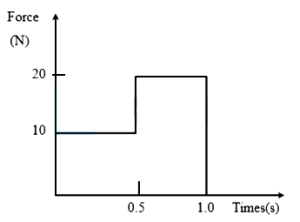
$A$ force is applied to a body of mass $2 \,kg$ at rest on a frictionless horizontal surface, as shown in the force-time $(F-t)$ graph. The speed of the body after $1 \,s$ is: (in $\,m/s$)
A
$7.5$
B
$12.5$
C
$10$
D
$15$
Solution
(A) The area under the $F-t$ graph represents the impulse, which is equal to the change in momentum of the body.
Since the body is initially at rest, the impulse equals the final momentum of the body after $1 \,s$.
$\text{Impulse} = \text{Area under } F-t \text{ graph}$
$\text{Impulse} = (10 \,N \times 0.5 \,s) + (20 \,N \times 0.5 \,s)$
$\text{Impulse} = 5 \,N-s + 10 \,N-s = 15 \,N-s$
Since $\text{Impulse} = \Delta p = m \times v - m \times u$ and $u = 0$, we have:
$15 = 2 \,kg \times v$
$v = \frac{15}{2} = 7.5 \,m/s$
Since the body is initially at rest, the impulse equals the final momentum of the body after $1 \,s$.
$\text{Impulse} = \text{Area under } F-t \text{ graph}$
$\text{Impulse} = (10 \,N \times 0.5 \,s) + (20 \,N \times 0.5 \,s)$
$\text{Impulse} = 5 \,N-s + 10 \,N-s = 15 \,N-s$
Since $\text{Impulse} = \Delta p = m \times v - m \times u$ and $u = 0$, we have:
$15 = 2 \,kg \times v$
$v = \frac{15}{2} = 7.5 \,m/s$
0 likes
View Solution189
EasyMCQ
$A$ mass of $1 \ kg$ is suspended by a string $A$. Another string $C$ is connected to its lower end as shown in figure. If a sudden jerk is given to $C$,then
A
the mass will start rotating
B
the portion $A B$ of the string will break
C
the portion $B C$ of the string will break
D
None of the string will break
Solution
(C) When a sudden jerk is given to string $C$,an impulsive force is applied to it.
Because the mass has inertia,it resists the sudden change in motion.
This impulsive tension develops in string $C$ first,exceeding its breaking strength.
Since the impulse takes finite time to propagate through the mass to string $A$,string $C$ breaks before the tension in string $A$ can increase significantly.
Because the mass has inertia,it resists the sudden change in motion.
This impulsive tension develops in string $C$ first,exceeding its breaking strength.
Since the impulse takes finite time to propagate through the mass to string $A$,string $C$ breaks before the tension in string $A$ can increase significantly.
0 likes
View Solution190
EasyMCQ
$A$ body of mass $2 \,kg$ collides with a wall with a speed of $100 \,ms^{-1}$ and rebounds with the same speed. If the time of contact is $1/50 \,s$,the force exerted on the wall is
A
$8 \,N$
B
$2 \times 10^{4} \,N$
C
$4 \,N$
D
$10^{4} \,N$
Solution
(B) The change in momentum $\Delta p$ is given by the final momentum minus the initial momentum.
Initial momentum $p_i = m \times v = 2 \,kg \times 100 \,ms^{-1} = 200 \,kg \cdot ms^{-1}$.
Since the body rebounds with the same speed in the opposite direction,the final momentum $p_f = m \times (-v) = 2 \,kg \times (-100 \,ms^{-1}) = -200 \,kg \cdot ms^{-1}$.
The change in momentum $\Delta p = p_f - p_i = -200 - 200 = -400 \,kg \cdot ms^{-1}$.
The magnitude of the change in momentum is $|\Delta p| = 400 \,kg \cdot ms^{-1}$.
The force exerted on the wall is given by Newton's Second Law: $F = \frac{|\Delta p|}{\Delta t}$.
Given $\Delta t = 1/50 \,s$,we have $F = \frac{400}{1/50} = 400 \times 50 = 20,000 \,N = 2 \times 10^{4} \,N$.
Initial momentum $p_i = m \times v = 2 \,kg \times 100 \,ms^{-1} = 200 \,kg \cdot ms^{-1}$.
Since the body rebounds with the same speed in the opposite direction,the final momentum $p_f = m \times (-v) = 2 \,kg \times (-100 \,ms^{-1}) = -200 \,kg \cdot ms^{-1}$.
The change in momentum $\Delta p = p_f - p_i = -200 - 200 = -400 \,kg \cdot ms^{-1}$.
The magnitude of the change in momentum is $|\Delta p| = 400 \,kg \cdot ms^{-1}$.
The force exerted on the wall is given by Newton's Second Law: $F = \frac{|\Delta p|}{\Delta t}$.
Given $\Delta t = 1/50 \,s$,we have $F = \frac{400}{1/50} = 400 \times 50 = 20,000 \,N = 2 \times 10^{4} \,N$.
0 likes
View Solution191
EasyMCQ
Five objects of different masses are simultaneously released vertically downwards from height $h$ (in air). Which physical quantity associated with the objects will change at the instant they strike the ground? (Neglect the air resistance.)
A
Momentum
B
Time
C
Acceleration
D
Velocity
Solution
(A) When objects are released from height $h$ under gravity,they undergo free fall.
According to the equations of motion,the final velocity $v$ just before striking the ground is given by $v = \sqrt{2gh}$.
Since $g$ and $h$ are the same for all objects,the velocity $v$ is the same for all objects regardless of their mass.
However,the momentum $p$ of an object is given by $p = mv$.
Since the masses $m$ of the five objects are different,their momenta $p$ will be different at the instant they strike the ground.
Therefore,the physical quantity that depends on the mass and changes for different objects is momentum.
According to the equations of motion,the final velocity $v$ just before striking the ground is given by $v = \sqrt{2gh}$.
Since $g$ and $h$ are the same for all objects,the velocity $v$ is the same for all objects regardless of their mass.
However,the momentum $p$ of an object is given by $p = mv$.
Since the masses $m$ of the five objects are different,their momenta $p$ will be different at the instant they strike the ground.
Therefore,the physical quantity that depends on the mass and changes for different objects is momentum.
0 likes
View Solution192
EasyMCQ
Two balls each of mass $250 \ g$ moving in opposite directions each with a speed $16 \ m \ s^{-1}$ collide and rebound with the same speeds. The impulse imparted to one ball due to the other is
A
$4 \ kg \ m \ s^{-1}$
B
$16 \ kg \ m \ s^{-1}$
C
$8 \ kg \ m \ s^{-1}$
D
$2 \ kg \ m \ s^{-1}$
Solution
(C) The mass of each ball is $m = 250 \ g = 0.25 \ kg$.
The initial velocity of the first ball is $v_i = 16 \ m \ s^{-1}$.
After the collision,the ball rebounds with the same speed in the opposite direction,so the final velocity is $v_f = -16 \ m \ s^{-1}$.
Impulse is defined as the change in momentum: $J = \Delta p = m(v_f - v_i)$.
Substituting the values: $J = 0.25 \ kg \times (-16 \ m \ s^{-1} - 16 \ m \ s^{-1})$.
$J = 0.25 \ kg \times (-32 \ m \ s^{-1}) = -8 \ kg \ m \ s^{-1}$.
The magnitude of the impulse imparted is $|J| = 8 \ kg \ m \ s^{-1}$.
The initial velocity of the first ball is $v_i = 16 \ m \ s^{-1}$.
After the collision,the ball rebounds with the same speed in the opposite direction,so the final velocity is $v_f = -16 \ m \ s^{-1}$.
Impulse is defined as the change in momentum: $J = \Delta p = m(v_f - v_i)$.
Substituting the values: $J = 0.25 \ kg \times (-16 \ m \ s^{-1} - 16 \ m \ s^{-1})$.
$J = 0.25 \ kg \times (-32 \ m \ s^{-1}) = -8 \ kg \ m \ s^{-1}$.
The magnitude of the impulse imparted is $|J| = 8 \ kg \ m \ s^{-1}$.
0 likes
View Solution193
DifficultMCQ
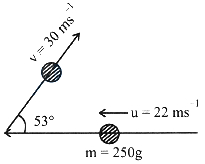
$A$ soccer ball of mass $250 \text{ g}$ is moving horizontally to the left with a speed $22 \text{ ms}^{-1}$. This ball is kicked towards the right with a velocity $30 \text{ ms}^{-1}$ at an angle $53^{\circ}$ with the horizontal in the upward direction. Assuming that it took $0.01 \text{ s}$ for the collision to take place, the average force acting is $(\cos 53^{\circ} = \frac{3}{5}; \sin 53^{\circ} = \frac{4}{5})$. (in $\text{ N}$)
A
$1000$
B
$986$
C
$1166$
D
$2000$
Solution
(C) Given: Mass $m = 250 \text{ g} = 0.25 \text{ kg} = \frac{1}{4} \text{ kg}$.
Initial velocity $\vec{u} = -22 \hat{i} \text{ ms}^{-1}$.
Final velocity $\vec{v} = 30 \cos 53^{\circ} \hat{i} + 30 \sin 53^{\circ} \hat{j} = 30(\frac{3}{5}) \hat{i} + 30(\frac{4}{5}) \hat{j} = 18 \hat{i} + 24 \hat{j} \text{ ms}^{-1}$.
Change in momentum $\Delta \vec{P} = m(\vec{v} - \vec{u}) = \frac{1}{4} [(18 \hat{i} + 24 \hat{j}) - (-22 \hat{i})] = \frac{1}{4} [40 \hat{i} + 24 \hat{j}] = 10 \hat{i} + 6 \hat{j} \text{ Ns}$.
Magnitude of change in momentum $|\Delta \vec{P}| = \sqrt{10^2 + 6^2} = \sqrt{100 + 36} = \sqrt{136} \text{ Ns}$.
Average force $\vec{F}_{avg} = \frac{\Delta \vec{P}}{\Delta t} = \frac{\sqrt{136}}{0.01} = 100 \sqrt{136} \approx 100 \times 11.66 = 1166 \text{ N}$.
Initial velocity $\vec{u} = -22 \hat{i} \text{ ms}^{-1}$.
Final velocity $\vec{v} = 30 \cos 53^{\circ} \hat{i} + 30 \sin 53^{\circ} \hat{j} = 30(\frac{3}{5}) \hat{i} + 30(\frac{4}{5}) \hat{j} = 18 \hat{i} + 24 \hat{j} \text{ ms}^{-1}$.
Change in momentum $\Delta \vec{P} = m(\vec{v} - \vec{u}) = \frac{1}{4} [(18 \hat{i} + 24 \hat{j}) - (-22 \hat{i})] = \frac{1}{4} [40 \hat{i} + 24 \hat{j}] = 10 \hat{i} + 6 \hat{j} \text{ Ns}$.
Magnitude of change in momentum $|\Delta \vec{P}| = \sqrt{10^2 + 6^2} = \sqrt{100 + 36} = \sqrt{136} \text{ Ns}$.
Average force $\vec{F}_{avg} = \frac{\Delta \vec{P}}{\Delta t} = \frac{\sqrt{136}}{0.01} = 100 \sqrt{136} \approx 100 \times 11.66 = 1166 \text{ N}$.
0 likes
View Solution194
MediumMCQ
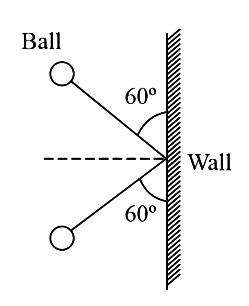
$A$ ball of mass $3 \ kg$,moving with a speed of $100 \ m/s$,strikes a wall at an angle of $60^{\circ}$ with the wall (as shown in the figure). The ball rebounds at the same speed and remains in contact with the wall for $0.2 \ s$. The force exerted by the ball on the wall is:
A
$1500\sqrt{3} \ N$
B
$1500 \ N$
C
$3000\sqrt{3} \ N$
D
$300 \ N$
Solution
(A) The angle given is with the wall,so the angle with the normal is $\theta = 90^{\circ} - 60^{\circ} = 30^{\circ}$.
Change in momentum $\Delta p$ occurs only in the direction perpendicular to the wall.
The component of velocity perpendicular to the wall is $v_{\perp} = v \sin(60^{\circ}) = v \cos(30^{\circ})$.
Initial momentum component perpendicular to the wall: $p_i = m v \cos(30^{\circ})$.
Final momentum component perpendicular to the wall: $p_f = -m v \cos(30^{\circ})$.
Change in momentum: $\Delta p = |p_f - p_i| = 2 m v \cos(30^{\circ})$.
Substituting the values: $\Delta p = 2 \times 3 \times 100 \times \frac{\sqrt{3}}{2} = 300\sqrt{3} \ kg \cdot m/s$.
The force exerted is $F = \frac{\Delta p}{\Delta t} = \frac{300\sqrt{3}}{0.2} = 1500\sqrt{3} \ N$.
Change in momentum $\Delta p$ occurs only in the direction perpendicular to the wall.
The component of velocity perpendicular to the wall is $v_{\perp} = v \sin(60^{\circ}) = v \cos(30^{\circ})$.
Initial momentum component perpendicular to the wall: $p_i = m v \cos(30^{\circ})$.
Final momentum component perpendicular to the wall: $p_f = -m v \cos(30^{\circ})$.
Change in momentum: $\Delta p = |p_f - p_i| = 2 m v \cos(30^{\circ})$.
Substituting the values: $\Delta p = 2 \times 3 \times 100 \times \frac{\sqrt{3}}{2} = 300\sqrt{3} \ kg \cdot m/s$.
The force exerted is $F = \frac{\Delta p}{\Delta t} = \frac{300\sqrt{3}}{0.2} = 1500\sqrt{3} \ N$.
0 likes
View Solution195
EasyMCQ
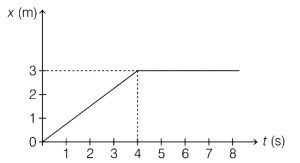
The position-time $(x-t)$ graph of a moving body of mass $2 \, kg$ is shown in the figure. The impulse on the body at $t=4 \, s$ is
A
$1.5 \, kg \cdot m/s$
B
$-1.5 \, kg \cdot m/s$
C
$1 \, kg \cdot m/s$
D
$2 \, kg \cdot m/s$
Solution
(B) Given, mass of the body, $m = 2 \, kg$.
Impulse is defined as the change in momentum: $\text{Impulse} = \Delta p = p_f - p_i = m(v_f - v_i)$.
From the position-time graph, the velocity is the slope of the $x-t$ graph $(v = \frac{dx}{dt})$.
For $t < 4 \, s$, the velocity $v_i$ is the slope of the line from $(0,0)$ to $(4,3)$:
$v_i = \frac{3 - 0}{4 - 0} = 0.75 \, m/s$.
For $t > 4 \, s$, the velocity $v_f$ is the slope of the horizontal line:
$v_f = 0 \, m/s$.
Therefore, the impulse at $t = 4 \, s$ is:
$\text{Impulse} = m(v_f - v_i) = 2 \, kg \times (0 - 0.75 \, m/s) = -1.5 \, kg \cdot m/s$.
Thus, the correct option is $B$.
Impulse is defined as the change in momentum: $\text{Impulse} = \Delta p = p_f - p_i = m(v_f - v_i)$.
From the position-time graph, the velocity is the slope of the $x-t$ graph $(v = \frac{dx}{dt})$.
For $t < 4 \, s$, the velocity $v_i$ is the slope of the line from $(0,0)$ to $(4,3)$:
$v_i = \frac{3 - 0}{4 - 0} = 0.75 \, m/s$.
For $t > 4 \, s$, the velocity $v_f$ is the slope of the horizontal line:
$v_f = 0 \, m/s$.
Therefore, the impulse at $t = 4 \, s$ is:
$\text{Impulse} = m(v_f - v_i) = 2 \, kg \times (0 - 0.75 \, m/s) = -1.5 \, kg \cdot m/s$.
Thus, the correct option is $B$.
0 likes
View Solution196
EasyMCQ
$A$ ball of mass $0.5 \ kg$ moving horizontally at $10 \ m \ s^{-1}$ strikes a vertical wall and rebounds with speed $v$. The magnitude of the change in linear momentum is found to be $8.0 \ kg \ m \ s^{-1}$. The magnitude of $v$ is, (in $m \ s^{-1}$)
A
$6.0$
B
$9.0$
C
$26.0$
D
$13.0$
Solution
(A) Linear momentum is a vector quantity.
Let the direction towards the wall be positive.
Initial momentum $\vec{p}_i = m \times 10 \hat{i} = 0.5 \times 10 \hat{i} = 5 \hat{i} \ kg \ m \ s^{-1}$.
After rebounding,the ball moves in the opposite direction.
Final momentum $\vec{p}_f = -m \times v \hat{i} = -0.5 \times v \hat{i} \ kg \ m \ s^{-1}$.
The change in linear momentum is $\Delta \vec{p} = \vec{p}_f - \vec{p}_i$.
$\Delta \vec{p} = (-0.5v \hat{i}) - (5 \hat{i}) = -(0.5v + 5) \hat{i}$.
The magnitude of the change in linear momentum is given as $8.0 \ kg \ m \ s^{-1}$.
$|\Delta \vec{p}| = 0.5v + 5 = 8.0$.
$0.5v = 8.0 - 5 = 3.0$.
$v = \frac{3.0}{0.5} = 6.0 \ m \ s^{-1}$.
Let the direction towards the wall be positive.
Initial momentum $\vec{p}_i = m \times 10 \hat{i} = 0.5 \times 10 \hat{i} = 5 \hat{i} \ kg \ m \ s^{-1}$.
After rebounding,the ball moves in the opposite direction.
Final momentum $\vec{p}_f = -m \times v \hat{i} = -0.5 \times v \hat{i} \ kg \ m \ s^{-1}$.
The change in linear momentum is $\Delta \vec{p} = \vec{p}_f - \vec{p}_i$.
$\Delta \vec{p} = (-0.5v \hat{i}) - (5 \hat{i}) = -(0.5v + 5) \hat{i}$.
The magnitude of the change in linear momentum is given as $8.0 \ kg \ m \ s^{-1}$.
$|\Delta \vec{p}| = 0.5v + 5 = 8.0$.
$0.5v = 8.0 - 5 = 3.0$.
$v = \frac{3.0}{0.5} = 6.0 \ m \ s^{-1}$.
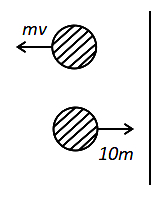
0 likes
View Solution197
MediumMCQ
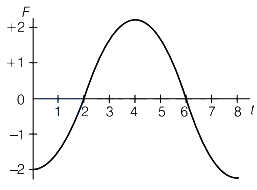
$A$ force-time $(F-t)$ graph for a linear motion is shown in the following figure. The segments shown are circular. The linear momentum gained between $0$ and $8 \,s$ is
A
$-2 \pi \,N s$
B
$0$
C
$4 \pi \,Ns$
D
$6 \pi \,Ns$
Solution
(B) The change in linear momentum $(\Delta p)$ is equal to the area under the force-time $(F-t)$ graph.
$\Delta p = \int_0^8 F \,dt = \text{Area under the } F-t \text{ curve}$.
From the graph,the area from $t=0$ to $t=2$ is a quarter-circle below the $t$-axis (negative area).
The area from $t=2$ to $t=6$ is a semi-circle above the $t$-axis (positive area).
The area from $t=6$ to $t=8$ is a quarter-circle below the $t$-axis (negative area).
Given the radius of the circular segments is $r=2$ units (from $F=0$ to $F=2$ or $F=-2$):
Area of quarter-circle $= \frac{1}{4} \pi r^2 = \frac{1}{4} \pi (2)^2 = \pi$.
Area of semi-circle $= \frac{1}{2} \pi r^2 = \frac{1}{2} \pi (2)^2 = 2\pi$.
Total area $= -(\text{Area}_{0-2}) + (\text{Area}_{2-6}) - (\text{Area}_{6-8})$
$\Delta p = -\pi + 2\pi - \pi = 0$.
Thus,the linear momentum gained between $0$ and $8 \,s$ is $0$.
$\Delta p = \int_0^8 F \,dt = \text{Area under the } F-t \text{ curve}$.
From the graph,the area from $t=0$ to $t=2$ is a quarter-circle below the $t$-axis (negative area).
The area from $t=2$ to $t=6$ is a semi-circle above the $t$-axis (positive area).
The area from $t=6$ to $t=8$ is a quarter-circle below the $t$-axis (negative area).
Given the radius of the circular segments is $r=2$ units (from $F=0$ to $F=2$ or $F=-2$):
Area of quarter-circle $= \frac{1}{4} \pi r^2 = \frac{1}{4} \pi (2)^2 = \pi$.
Area of semi-circle $= \frac{1}{2} \pi r^2 = \frac{1}{2} \pi (2)^2 = 2\pi$.
Total area $= -(\text{Area}_{0-2}) + (\text{Area}_{2-6}) - (\text{Area}_{6-8})$
$\Delta p = -\pi + 2\pi - \pi = 0$.
Thus,the linear momentum gained between $0$ and $8 \,s$ is $0$.
0 likes
View SolutionNewton's Laws of Motion and Friction — Third Law of Motion and Momentum and Impulse · Frequently Asked Questions
1Are these Newton's Laws of Motion and Friction questions useful for JEE and NEET?
Yes. All questions in this section are mapped to JEE Main and NEET exam patterns. Previous year questions from JEE Main, NEET, GUJCET and state-level exams are included with full solutions.
2Can I switch to Hindi or Gujarati for these questions?
Yes. Use the language tabs in the hero section or the sidebar to view the same questions and solutions in English, Hindi or Gujarati.
3How do I generate a question paper from this subtopic?
Use the Vedclass Exam Paper Generator — select the chapter and subtopic, set difficulty, and generate Sets A, B, C, D automatically. First 3 chapters of every subject are free.
Vedclass Products
For Students
Vedclass Test Series
Mock tests in real JEE/NEET style with performance analysis. 5-day free trial.
Start Free TrialFor Teachers
Exam Paper Generator
Generate Set A/B/C/D papers from this chapter in 2 minutes. 3 chapters free.
Try FreeFor Institutes
Online Exam Module
Live online exams with unlimited students, 360° analytics & white-label branding.
See DemoFor Teachers & Institutes
Generate a Newton's Laws of Motion and Friction Exam Paper in 2 Minutes
Select subtopic & difficulty — Sets A, B, C, D auto-generated with No Repeat logic.
First 3 chapters of every subject are free — no payment required.