
A English
Mix Examples-Newton's Laws of Motion and Friction Questions in English
Class 11 Physics · Newton's Laws of Motion and Friction · Mix Examples-Newton's Laws of Motion and Friction
305+
Questions
English
Language
100%
With Solutions
Showing 49 of 305 questions in English
151
DifficultMCQ
$A$ block is placed on a rough horizontal plane. $A$ time-dependent horizontal force $F = Kt$ acts on the block,where $K$ is a positive constant. The acceleration-time graph of the block is:
A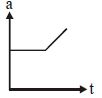
B
C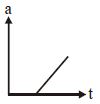
D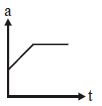
Solution
(C) The block remains at rest as long as the applied force $F$ is less than or equal to the maximum static friction force $f_{s,max} = \mu mg$.
So,the block starts sliding when $F = \mu mg$,which implies $Kt = \mu mg$,or $t = \frac{\mu mg}{K}$.
For $t \leq \frac{\mu mg}{K}$,the acceleration $a = 0$.
For $t > \frac{\mu mg}{K}$,the net force acting on the block is $F_{net} = F - f_k = Kt - \mu mg$,where $f_k = \mu mg$ is the kinetic friction.
The acceleration is given by $a = \frac{F_{net}}{m} = \frac{Kt - \mu mg}{m} = \frac{K}{m}t - \mu g$.
This equation represents a straight line with a positive slope $\frac{K}{m}$ and a negative intercept $-\mu g$ on the acceleration axis.
Thus,the acceleration is zero until $t = \frac{\mu mg}{K}$ and then increases linearly with time. This corresponds to the graph shown in option $C$.
So,the block starts sliding when $F = \mu mg$,which implies $Kt = \mu mg$,or $t = \frac{\mu mg}{K}$.
For $t \leq \frac{\mu mg}{K}$,the acceleration $a = 0$.
For $t > \frac{\mu mg}{K}$,the net force acting on the block is $F_{net} = F - f_k = Kt - \mu mg$,where $f_k = \mu mg$ is the kinetic friction.
The acceleration is given by $a = \frac{F_{net}}{m} = \frac{Kt - \mu mg}{m} = \frac{K}{m}t - \mu g$.
This equation represents a straight line with a positive slope $\frac{K}{m}$ and a negative intercept $-\mu g$ on the acceleration axis.
Thus,the acceleration is zero until $t = \frac{\mu mg}{K}$ and then increases linearly with time. This corresponds to the graph shown in option $C$.
0 likes
View Solution152
DifficultMCQ
In the figure,a block of weight $60 \, N$ is placed on a rough surface. The coefficient of friction between the block and the surface is $0.5$. Find the maximum weight $W$ such that the block does not slip on the surface.
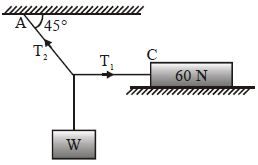
A
$60 \, N$
B
$\frac{60}{\sqrt{2}} \, N$
C
$30 \, N$
D
$\frac{30}{\sqrt{2}} \, N$
Solution
(C) The block of weight $60 \, N$ is on a rough surface with coefficient of friction $\mu = 0.5$. The maximum frictional force $F_{max}$ that can act on the block is given by $F_{max} = \mu N = 0.5 \times 60 \, N = 30 \, N$.
For the block not to slip,the tension $T_1$ in the horizontal string must be less than or equal to $F_{max}$. Thus,$T_1 = 30 \, N$.
At the junction point,the forces are in equilibrium. Let $T_2$ be the tension in the inclined string at an angle of $45^{\circ}$ to the horizontal.
The horizontal component of $T_2$ balances $T_1$: $T_2 \cos 45^{\circ} = T_1 = 30 \, N$.
$T_2 \times \frac{1}{\sqrt{2}} = 30 \implies T_2 = 30\sqrt{2} \, N$.
The vertical component of $T_2$ balances the weight $W$: $W = T_2 \sin 45^{\circ}$.
$W = 30\sqrt{2} \times \frac{1}{\sqrt{2}} = 30 \, N$.
Therefore,the maximum weight $W$ is $30 \, N$.
For the block not to slip,the tension $T_1$ in the horizontal string must be less than or equal to $F_{max}$. Thus,$T_1 = 30 \, N$.
At the junction point,the forces are in equilibrium. Let $T_2$ be the tension in the inclined string at an angle of $45^{\circ}$ to the horizontal.
The horizontal component of $T_2$ balances $T_1$: $T_2 \cos 45^{\circ} = T_1 = 30 \, N$.
$T_2 \times \frac{1}{\sqrt{2}} = 30 \implies T_2 = 30\sqrt{2} \, N$.
The vertical component of $T_2$ balances the weight $W$: $W = T_2 \sin 45^{\circ}$.
$W = 30\sqrt{2} \times \frac{1}{\sqrt{2}} = 30 \, N$.
Therefore,the maximum weight $W$ is $30 \, N$.
0 likes
View Solution153
DifficultMCQ
$A$ balloon of mass $m$ is descending down with an acceleration $\frac{g}{2}$. How much mass should be removed from it so that it starts moving up with the same acceleration?
A
$\frac{2m}{3}$
B
$\frac{m}{3}$
C
$3m$
D
$\frac{4m}{3}$
Solution
(A) Let $F$ be the upward buoyant force acting on the balloon.
When the balloon is descending with acceleration $a = \frac{g}{2}$,the equation of motion is:
$mg - F = m \left(\frac{g}{2}\right)$
$F = mg - \frac{mg}{2} = \frac{mg}{2} \quad ...(1)$
Let $m_1$ be the mass removed. The new mass of the balloon is $(m - m_1)$.
When the balloon moves up with acceleration $a = \frac{g}{2}$,the equation of motion is:
$F - (m - m_1)g = (m - m_1) \left(\frac{g}{2}\right)$
$F = (m - m_1) \left(g + \frac{g}{2}\right) = \frac{3}{2}(m - m_1)g \quad ...(2)$
Equating $(1)$ and $(2)$:
$\frac{mg}{2} = \frac{3}{2}(m - m_1)g$
$m = 3(m - m_1)$
$m = 3m - 3m_1$
$3m_1 = 2m$
$m_1 = \frac{2m}{3}$
When the balloon is descending with acceleration $a = \frac{g}{2}$,the equation of motion is:
$mg - F = m \left(\frac{g}{2}\right)$
$F = mg - \frac{mg}{2} = \frac{mg}{2} \quad ...(1)$
Let $m_1$ be the mass removed. The new mass of the balloon is $(m - m_1)$.
When the balloon moves up with acceleration $a = \frac{g}{2}$,the equation of motion is:
$F - (m - m_1)g = (m - m_1) \left(\frac{g}{2}\right)$
$F = (m - m_1) \left(g + \frac{g}{2}\right) = \frac{3}{2}(m - m_1)g \quad ...(2)$
Equating $(1)$ and $(2)$:
$\frac{mg}{2} = \frac{3}{2}(m - m_1)g$
$m = 3(m - m_1)$
$m = 3m - 3m_1$
$3m_1 = 2m$
$m_1 = \frac{2m}{3}$
0 likes
View Solution154
EasyMCQ
$A$ hosepipe directs a horizontal jet of water moving with a velocity of $20\, m/s$ onto a vertical wall. The cross-sectional area of the jet is $10^{-3}\, m^2$. If the density of water is $1000\, kg/m^3$,then the force acting on the wall is ........... $N$ [Assuming water comes to rest after striking the wall].
A
$200$
B
$400$
C
$600$
D
$800$
Solution
(B) The force exerted by a fluid jet on a wall is given by the rate of change of momentum.
$F = \frac{dp}{dt} = \frac{d(mv)}{dt} = v \frac{dm}{dt}$.
Since the mass flow rate $\frac{dm}{dt} = \rho A v$,the force is $F = \rho A v^2$.
Given:
Density $\rho = 1000\, kg/m^3$
Area $A = 10^{-3}\, m^2$
Velocity $v = 20\, m/s$
Substituting the values:
$F = 1000 \times 10^{-3} \times (20)^2$
$F = 1 \times 400 = 400\, N$.
$F = \frac{dp}{dt} = \frac{d(mv)}{dt} = v \frac{dm}{dt}$.
Since the mass flow rate $\frac{dm}{dt} = \rho A v$,the force is $F = \rho A v^2$.
Given:
Density $\rho = 1000\, kg/m^3$
Area $A = 10^{-3}\, m^2$
Velocity $v = 20\, m/s$
Substituting the values:
$F = 1000 \times 10^{-3} \times (20)^2$
$F = 1 \times 400 = 400\, N$.
0 likes
View Solution155
MediumMCQ
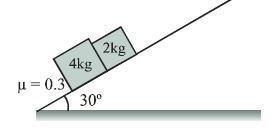
Two blocks,$4\, kg$ and $2\, kg$,are sliding down an inclined plane as shown in the figure. The acceleration of the $2\, kg$ block is ........ $m/s^2$.
A
$1.66$
B
$2.4$
C
$3.66$
D
$4.66$
Solution
(B) The system consists of two blocks of masses $m_1 = 4\, kg$ and $m_2 = 2\, kg$ sliding down an inclined plane with angle $\theta = 30^{\circ}$ and coefficient of kinetic friction $\mu = 0.3$.
Since the blocks are in contact and moving together,they will have the same acceleration $a$.
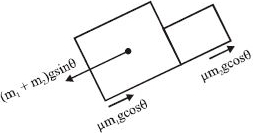
The net driving force down the plane is the component of gravity: $F_g = (m_1 + m_2)g \sin \theta$.
The total frictional force opposing the motion is: $f_k = \mu(m_1 + m_2)g \cos \theta$.
Applying Newton's second law for the system: $(m_1 + m_2)a = (m_1 + m_2)g \sin \theta - \mu(m_1 + m_2)g \cos \theta$.
Dividing by $(m_1 + m_2)$,we get: $a = g(\sin \theta - \mu \cos \theta)$.
Substituting the values ($g = 9.8\, m/s^2$,$\sin 30^{\circ} = 0.5$,$\cos 30^{\circ} \approx 0.866$):
$a = 9.8 \times (0.5 - 0.3 \times 0.866) = 9.8 \times (0.5 - 0.2598) = 9.8 \times 0.2402 \approx 2.354\, m/s^2$.
Rounding to the nearest option,the acceleration is approximately $2.4\, m/s^2$.
Since the blocks are in contact and moving together,they will have the same acceleration $a$.
The net driving force down the plane is the component of gravity: $F_g = (m_1 + m_2)g \sin \theta$.
The total frictional force opposing the motion is: $f_k = \mu(m_1 + m_2)g \cos \theta$.
Applying Newton's second law for the system: $(m_1 + m_2)a = (m_1 + m_2)g \sin \theta - \mu(m_1 + m_2)g \cos \theta$.
Dividing by $(m_1 + m_2)$,we get: $a = g(\sin \theta - \mu \cos \theta)$.
Substituting the values ($g = 9.8\, m/s^2$,$\sin 30^{\circ} = 0.5$,$\cos 30^{\circ} \approx 0.866$):
$a = 9.8 \times (0.5 - 0.3 \times 0.866) = 9.8 \times (0.5 - 0.2598) = 9.8 \times 0.2402 \approx 2.354\, m/s^2$.
Rounding to the nearest option,the acceleration is approximately $2.4\, m/s^2$.
0 likes
View Solution156
MediumMCQ
$A$ box '$A$' is lying on the horizontal floor of the compartment of a train running along horizontal rails from left to right. At time '$t$',it decelerates. Then the reaction $R$ by the floor on the box is given best by
A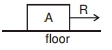
B
C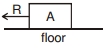
D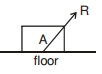
Solution
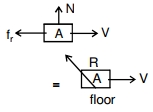
(B) The box is moving from left to right with velocity $V$. When the train decelerates,the box tends to continue its motion due to inertia,so it experiences a pseudo force towards the left relative to the train.
Consequently,a kinetic friction force $f_r$ acts on the box towards the left to oppose this relative motion.
The floor also exerts a normal force $N$ acting vertically upwards on the box.
The net reaction force $R$ exerted by the floor on the box is the vector sum of the normal force $N$ and the friction force $f_r$,i.e.,$R = N + f_r$.
Since $N$ is upwards and $f_r$ is towards the left,the resultant reaction force $R$ will point upwards and to the left.
This corresponds to the direction shown in option $B$.
Consequently,a kinetic friction force $f_r$ acts on the box towards the left to oppose this relative motion.
The floor also exerts a normal force $N$ acting vertically upwards on the box.
The net reaction force $R$ exerted by the floor on the box is the vector sum of the normal force $N$ and the friction force $f_r$,i.e.,$R = N + f_r$.
Since $N$ is upwards and $f_r$ is towards the left,the resultant reaction force $R$ will point upwards and to the left.
This corresponds to the direction shown in option $B$.
0 likes
View Solution157
MediumMCQ
Among the forces in nature,friction can be classified into
A
Electromagnetic
B
Gravitational
C
Nuclear
D
Other weak forces
Solution
(A) Friction arises due to the intermolecular forces between the surfaces in contact. These intermolecular forces are essentially electromagnetic in nature,as they result from the interactions between the charged particles (electrons and nuclei) of the atoms on the two surfaces. Therefore,friction is classified as an electromagnetic force.
0 likes
View Solution158
DifficultMCQ
$A$ metal block is resting on a rough wooden surface. $A$ horizontal force applied to the block is increased uniformly with time, given by $F = kt$. Which of the following curves correctly represents the velocity of the block as a function of time?
A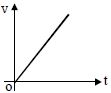
B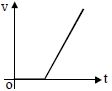
C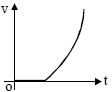
D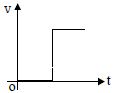
Solution
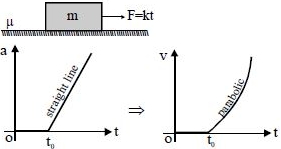
(C) The block remains at rest as long as the applied force $F = kt$ is less than or equal to the maximum static friction $f_{max} = \mu mg$.
Thus, the block starts moving when $kt \geq \mu mg$, which means $t \geq \frac{\mu mg}{k} = t_0$.
For $t < t_0$, the velocity $v = 0$.
For $t \geq t_0$, the net force on the block is $F_{net} = kt - \mu mg$.
Using Newton's second law, $ma = kt - \mu mg$, so the acceleration is $a = \frac{k}{m}t - \mu g$.
Since $a = \frac{dv}{dt}$, we integrate with respect to time: $v = \int_{t_0}^{t} (\frac{k}{m}t' - \mu g) dt'$.
This results in $v = \frac{k}{2m}(t^2 - t_0^2) - \mu g(t - t_0)$.
Since the velocity is proportional to $t^2$, the graph is parabolic for $t > t_0$.
Thus, the block starts moving when $kt \geq \mu mg$, which means $t \geq \frac{\mu mg}{k} = t_0$.
For $t < t_0$, the velocity $v = 0$.
For $t \geq t_0$, the net force on the block is $F_{net} = kt - \mu mg$.
Using Newton's second law, $ma = kt - \mu mg$, so the acceleration is $a = \frac{k}{m}t - \mu g$.
Since $a = \frac{dv}{dt}$, we integrate with respect to time: $v = \int_{t_0}^{t} (\frac{k}{m}t' - \mu g) dt'$.
This results in $v = \frac{k}{2m}(t^2 - t_0^2) - \mu g(t - t_0)$.
Since the velocity is proportional to $t^2$, the graph is parabolic for $t > t_0$.
0 likes
View Solution159
MediumMCQ
$A$ car of mass $500\, kg$ is driven with acceleration $1\, m/s^2$ along a straight level road against a constant external resistance of $1000\, N$. When the velocity is $5\, m/s$,the rate at which the engine is working is .............. $kW$.
A
$5$
B
$7.5$
C
$2.5$
D
$10$
Solution
(B) The force required to accelerate the car is given by Newton's second law: $F_{net} = ma$.
Here,$F_{net} = F_{engine} - F_{resistance}$.
Given $m = 500\, kg$,$a = 1\, m/s^2$,and $F_{resistance} = 1000\, N$.
$F_{engine} - 1000 = 500 \times 1$.
$F_{engine} = 1500\, N$.
The power $P$ delivered by the engine is given by $P = F_{engine} \times v$.
Given $v = 5\, m/s$.
$P = 1500 \times 5 = 7500\, W$.
Converting to kilowatts: $P = 7.5\, kW$.
Here,$F_{net} = F_{engine} - F_{resistance}$.
Given $m = 500\, kg$,$a = 1\, m/s^2$,and $F_{resistance} = 1000\, N$.
$F_{engine} - 1000 = 500 \times 1$.
$F_{engine} = 1500\, N$.
The power $P$ delivered by the engine is given by $P = F_{engine} \times v$.
Given $v = 5\, m/s$.
$P = 1500 \times 5 = 7500\, W$.
Converting to kilowatts: $P = 7.5\, kW$.
0 likes
View Solution160
DifficultMCQ
Five persons $A, B, C, D$ and $E$ are pulling a cart of mass $100 \, kg$ on a smooth surface and the cart is moving with an acceleration of $3 \, m/s^2$ in the east direction. When person $A$ stops pulling,it moves with an acceleration of $1 \, m/s^2$ in the west direction. When person $B$ stops pulling,it moves with an acceleration of $24 \, m/s^2$ in the north direction. The magnitude of the acceleration of the cart when only $A$ and $B$ pull the cart,keeping their directions the same as the original directions,is ............ $m/s^2$.
A
$26$
B
$3\sqrt{71}$
C
$25$
D
$30$
Solution
(C) Let the total force exerted by the five persons be $\vec{F}_{total} = \vec{F}_A + \vec{F}_B + \vec{F}_C + \vec{F}_D + \vec{F}_E$. Given $m = 100 \, kg$ and $\vec{a} = 3 \hat{i} \, m/s^2$ (taking East as $+\hat{i}$),we have $\vec{F}_{total} = 100 \times 3 \hat{i} = 300 \hat{i} \, N$ $...(1)$.
When $A$ stops,the force is $\vec{F}_{total} - \vec{F}_A = 100 \times (-1 \hat{i}) = -100 \hat{i} \, N$ $...(2)$.
Subtracting $(2)$ from $(1)$,we get $\vec{F}_A = 400 \hat{i} \, N$.
When $B$ stops,the force is $\vec{F}_{total} - \vec{F}_B = 100 \times (24 \hat{j}) = 2400 \hat{j} \, N$ (taking North as $+\hat{j}$) $...(3)$.
Subtracting $(3)$ from $(1)$,we get $\vec{F}_B = 300 \hat{i} - 2400 \hat{j} \, N$.
When only $A$ and $B$ pull,the net force is $\vec{F}_{net} = \vec{F}_A + \vec{F}_B = 400 \hat{i} + 300 \hat{i} - 2400 \hat{j} = 700 \hat{i} - 2400 \hat{j} \, N$.
The acceleration is $\vec{a} = \frac{\vec{F}_{net}}{m} = \frac{700 \hat{i} - 2400 \hat{j}}{100} = 7 \hat{i} - 24 \hat{j} \, m/s^2$.
The magnitude is $|\vec{a}| = \sqrt{7^2 + (-24)^2} = \sqrt{49 + 576} = \sqrt{625} = 25 \, m/s^2$.
When $A$ stops,the force is $\vec{F}_{total} - \vec{F}_A = 100 \times (-1 \hat{i}) = -100 \hat{i} \, N$ $...(2)$.
Subtracting $(2)$ from $(1)$,we get $\vec{F}_A = 400 \hat{i} \, N$.
When $B$ stops,the force is $\vec{F}_{total} - \vec{F}_B = 100 \times (24 \hat{j}) = 2400 \hat{j} \, N$ (taking North as $+\hat{j}$) $...(3)$.
Subtracting $(3)$ from $(1)$,we get $\vec{F}_B = 300 \hat{i} - 2400 \hat{j} \, N$.
When only $A$ and $B$ pull,the net force is $\vec{F}_{net} = \vec{F}_A + \vec{F}_B = 400 \hat{i} + 300 \hat{i} - 2400 \hat{j} = 700 \hat{i} - 2400 \hat{j} \, N$.
The acceleration is $\vec{a} = \frac{\vec{F}_{net}}{m} = \frac{700 \hat{i} - 2400 \hat{j}}{100} = 7 \hat{i} - 24 \hat{j} \, m/s^2$.
The magnitude is $|\vec{a}| = \sqrt{7^2 + (-24)^2} = \sqrt{49 + 576} = \sqrt{625} = 25 \, m/s^2$.
0 likes
View Solution161
MediumMCQ
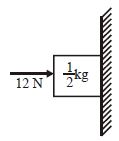
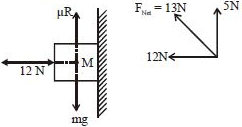
$A$ horizontal force $12 \, N$ pushes a block weighing $1/2 \, kg$ against a vertical wall. The coefficient of static friction between the wall and the block is $0.5$ and the coefficient of kinetic friction is $0.35$. Assuming that the block is not moving initially,which one of the following choices is correct? (Take $g = 10 \, m/s^2$)
A
Block moves vertically downwards
B
Block moves vertically upwards
C
Block will not move and force exerted on the block by the wall is $12 \, N$
D
Block will not move and force exerted on the block by the wall is $13 \, N$
Solution
(D) The normal force $N$ exerted by the wall on the block is equal to the applied horizontal force: $N = 12 \, N$.
The maximum static frictional force $f_{s,max}$ is given by $f_{s,max} = \mu_s N = 0.5 \times 12 \, N = 6 \, N$.
The weight of the block is $W = mg = (1/2) \, kg \times 10 \, m/s^2 = 5 \, N$.
Since the weight $W = 5 \, N$ is less than the maximum static friction $f_{s,max} = 6 \, N$,the block will not move.
The wall exerts two forces on the block: the normal force $N = 12 \, N$ (horizontal) and the static frictional force $f_s = 5 \, N$ (vertical,balancing the weight).
The total force exerted by the wall on the block is the resultant of these two perpendicular forces: $F_{total} = \sqrt{N^2 + f_s^2} = \sqrt{12^2 + 5^2} = \sqrt{144 + 25} = \sqrt{169} = 13 \, N$.
The maximum static frictional force $f_{s,max}$ is given by $f_{s,max} = \mu_s N = 0.5 \times 12 \, N = 6 \, N$.
The weight of the block is $W = mg = (1/2) \, kg \times 10 \, m/s^2 = 5 \, N$.
Since the weight $W = 5 \, N$ is less than the maximum static friction $f_{s,max} = 6 \, N$,the block will not move.
The wall exerts two forces on the block: the normal force $N = 12 \, N$ (horizontal) and the static frictional force $f_s = 5 \, N$ (vertical,balancing the weight).
The total force exerted by the wall on the block is the resultant of these two perpendicular forces: $F_{total} = \sqrt{N^2 + f_s^2} = \sqrt{12^2 + 5^2} = \sqrt{144 + 25} = \sqrt{169} = 13 \, N$.
1 likes
View Solution162
DifficultMCQ
$A$ block of mass $M = 100 \, kg$ is pulled by a force $T$ at an angle of $37^{\circ}$ with the horizontal. The coefficient of friction between the block and the ground is $\mu = 1/3$. $A$ person of mass $m = 25 \, kg$ is standing on a platform and pulls the block with the force $T$. Find the maximum upward acceleration $a_{\max}$ of the person such that the block just starts to move.
A
$\frac{4g}{3}$
B
$\frac{g}{2}$
C
$\frac{g}{3}$
D
$\frac{3g}{4}$
Solution
(C) For the block,the forces are balanced as follows:
$T \cos 37^{\circ} = f$
$N + T \sin 37^{\circ} = Mg$
Since $f = \mu N$,we have $T \cos 37^{\circ} = \mu (Mg - T \sin 37^{\circ})$.
Substituting the values $M = 100 \, kg$,$\mu = 1/3$,$\cos 37^{\circ} = 4/5$,and $\sin 37^{\circ} = 3/5$:
$T(4/5) = (1/3)(100g - T(3/5))$
$12T/5 = 100g - 3T/5$
$15T/5 = 100g \implies 3T = 100g \implies T = 100g/3$.
For the person,the upward force is $T = 100g/3$ and the downward force is $mg = 25g$.
The equation of motion is $T - mg = ma_{\max}$.
$100g/3 - 25g = 25a_{\max}$
$(100g - 75g)/3 = 25a_{\max}$
$25g/3 = 25a_{\max}$
$a_{\max} = g/3$.
$T \cos 37^{\circ} = f$
$N + T \sin 37^{\circ} = Mg$
Since $f = \mu N$,we have $T \cos 37^{\circ} = \mu (Mg - T \sin 37^{\circ})$.
Substituting the values $M = 100 \, kg$,$\mu = 1/3$,$\cos 37^{\circ} = 4/5$,and $\sin 37^{\circ} = 3/5$:
$T(4/5) = (1/3)(100g - T(3/5))$
$12T/5 = 100g - 3T/5$
$15T/5 = 100g \implies 3T = 100g \implies T = 100g/3$.
For the person,the upward force is $T = 100g/3$ and the downward force is $mg = 25g$.
The equation of motion is $T - mg = ma_{\max}$.
$100g/3 - 25g = 25a_{\max}$
$(100g - 75g)/3 = 25a_{\max}$
$25g/3 = 25a_{\max}$
$a_{\max} = g/3$.
0 likes
View Solution163
DifficultMCQ
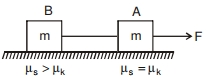
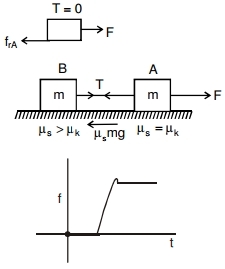
$A$ force $F=t$ is applied to block $A$ as shown in the figure. The force is applied at $t=0$ seconds when the system was at rest and the string was just straight without tension. Which of the following graphs shows the friction force between block $B$ and the horizontal surface as a function of time $t$?
A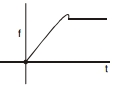
B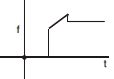
C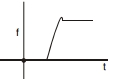
D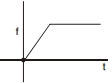
Solution
(C) $1$. Initially,for block $A$,the applied force $F=t$ is balanced by static friction $f_{rA}$. The block $A$ remains at rest until $F = \mu_s mg$,i.e.,$t = \mu_s mg$. During this time,the tension $T$ in the string is $0$,so block $B$ remains at rest and the friction force on $B$ is $0$.
$2$. When $t > \mu_s mg$,block $A$ starts to move. The tension $T$ in the string increases as $T = F - f_{rA} = t - \mu_k mg$ (assuming kinetic friction $\mu_k mg$ acts on $A$).
$3$. Block $B$ will start to move when the tension $T$ exceeds the maximum static friction force on $B$,which is $\mu_s mg$. So,$T = t - \mu_k mg = \mu_s mg$,which gives $t = \mu_s mg + \mu_k mg$.
$4$. For $t < \mu_s mg + \mu_k mg$,block $B$ is at rest,so the friction force on $B$ is equal to the tension $T = t - \mu_k mg$. However,since $T$ is only non-zero for $t > \mu_s mg$,the friction on $B$ is $0$ until $t = \mu_s mg$,then it increases linearly with $t$.
$5$. Once $t$ reaches the threshold where $B$ moves,the friction force on $B$ drops from its maximum static value $\mu_s mg$ to the kinetic friction value $\mu_k mg$ and remains constant.
$6$. Comparing this behavior with the given options,graph $C$ correctly represents this: zero friction until $t = \mu_s mg$,then increasing friction,a peak at the threshold,and finally a constant kinetic friction value.
$2$. When $t > \mu_s mg$,block $A$ starts to move. The tension $T$ in the string increases as $T = F - f_{rA} = t - \mu_k mg$ (assuming kinetic friction $\mu_k mg$ acts on $A$).
$3$. Block $B$ will start to move when the tension $T$ exceeds the maximum static friction force on $B$,which is $\mu_s mg$. So,$T = t - \mu_k mg = \mu_s mg$,which gives $t = \mu_s mg + \mu_k mg$.
$4$. For $t < \mu_s mg + \mu_k mg$,block $B$ is at rest,so the friction force on $B$ is equal to the tension $T = t - \mu_k mg$. However,since $T$ is only non-zero for $t > \mu_s mg$,the friction on $B$ is $0$ until $t = \mu_s mg$,then it increases linearly with $t$.
$5$. Once $t$ reaches the threshold where $B$ moves,the friction force on $B$ drops from its maximum static value $\mu_s mg$ to the kinetic friction value $\mu_k mg$ and remains constant.
$6$. Comparing this behavior with the given options,graph $C$ correctly represents this: zero friction until $t = \mu_s mg$,then increasing friction,a peak at the threshold,and finally a constant kinetic friction value.
0 likes
View Solution164
DifficultMCQ
Consider two blocks of mass $m_1 = 5 \, kg$ and $m_2 = 10 \, kg$ placed on a horizontal surface. The coefficient of static friction between the blocks and the surface is $\mu = 0.2$. $A$ horizontal force $F$ is applied to the $10 \, kg$ block. What is the maximum force $F$ (in $N$) that can be applied such that neither block moves? (Take $g = 10 \, m/s^2$)
A
data insufficient
B
$15$
C
$30$
D
None
Solution
(C) For the $5 \, kg$ block,the maximum static friction force is $f_{s1} = \mu m_1 g = 0.2 \times 5 \times 10 = 10 \, N$.
For the $10 \, kg$ block,the maximum static friction force is $f_{s2} = \mu m_2 g = 0.2 \times 10 \times 10 = 20 \, N$.
For the system to remain at rest,the applied force $F$ must be balanced by the total maximum static friction of the system.
However,the $5 \, kg$ block will only move if the force transmitted to it exceeds $10 \, N$. Since the force $F$ is applied to the $10 \, kg$ block,the entire system will start moving when $F$ exceeds the total friction $f_{s1} + f_{s2} = 10 + 20 = 30 \, N$.
Thus,the maximum force $F$ that will not cause motion of any block is $30 \, N$.
For the $10 \, kg$ block,the maximum static friction force is $f_{s2} = \mu m_2 g = 0.2 \times 10 \times 10 = 20 \, N$.
For the system to remain at rest,the applied force $F$ must be balanced by the total maximum static friction of the system.
However,the $5 \, kg$ block will only move if the force transmitted to it exceeds $10 \, N$. Since the force $F$ is applied to the $10 \, kg$ block,the entire system will start moving when $F$ exceeds the total friction $f_{s1} + f_{s2} = 10 + 20 = 30 \, N$.
Thus,the maximum force $F$ that will not cause motion of any block is $30 \, N$.
0 likes
View Solution165
DifficultMCQ
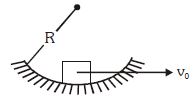
$A$ particle is projected with a speed $v_0 = \sqrt{gR}$ at the bottom of a hemispherical bowl. The coefficient of friction between the particle and the hemispherical surface is $\mu = 0.5$. Then,the initial acceleration of the particle is:
A
$g \uparrow$
B
$g \leftarrow$
C
$\sqrt{2} g \nwarrow$
D
$2g \nearrow$
Solution
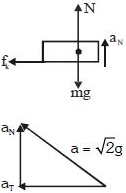
(C) At the bottom of the bowl,the normal force $N$ and gravity $mg$ act on the particle. The net force provides the centripetal acceleration:
$N - mg = \frac{mv_0^2}{R}$
Given $v_0 = \sqrt{gR}$,we have:
$N - mg = \frac{m(gR)}{R} = mg$
$N = 2mg$
The kinetic friction force is $f_k = \mu N = 0.5 \times 2mg = mg$.
The tangential acceleration $a_T$ is caused by friction:
$ma_T = f_k = mg \implies a_T = g$ (directed horizontally,opposite to velocity).
The normal acceleration $a_N$ is the centripetal acceleration:
$a_N = \frac{v_0^2}{R} = \frac{gR}{R} = g$ (directed vertically upwards).
The total acceleration $a$ is the vector sum of $a_T$ and $a_N$:
$a = \sqrt{a_T^2 + a_N^2} = \sqrt{g^2 + g^2} = \sqrt{2}g$.
The direction is at an angle of $45^\circ$ to the horizontal,pointing upwards and backwards,represented as $\nwarrow$.
$N - mg = \frac{mv_0^2}{R}$
Given $v_0 = \sqrt{gR}$,we have:
$N - mg = \frac{m(gR)}{R} = mg$
$N = 2mg$
The kinetic friction force is $f_k = \mu N = 0.5 \times 2mg = mg$.
The tangential acceleration $a_T$ is caused by friction:
$ma_T = f_k = mg \implies a_T = g$ (directed horizontally,opposite to velocity).
The normal acceleration $a_N$ is the centripetal acceleration:
$a_N = \frac{v_0^2}{R} = \frac{gR}{R} = g$ (directed vertically upwards).
The total acceleration $a$ is the vector sum of $a_T$ and $a_N$:
$a = \sqrt{a_T^2 + a_N^2} = \sqrt{g^2 + g^2} = \sqrt{2}g$.
The direction is at an angle of $45^\circ$ to the horizontal,pointing upwards and backwards,represented as $\nwarrow$.
0 likes
View Solution166
DifficultMCQ
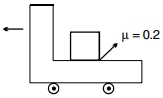
$A$ truck starting from rest moves with an acceleration of $5\,m/s^2$ for $1\,sec$ and then moves with constant velocity. The velocity w.r.t. ground v/s time graph for the block in the truck is (Assume that the block does not fall off the truck and the coefficient of friction $\mu = 0.2$):
A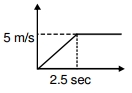
B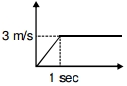
C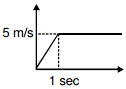
D
None of these
Solution
(A) For $t \le 1\,sec$,the truck accelerates at $a_T = 5\,m/s^2$. The maximum acceleration the block can have due to friction is $a_{max} = \mu g = 0.2 \times 10 = 2\,m/s^2$. Since $a_T > a_{max}$,the block slips. The block accelerates at $2\,m/s^2$ for the entire duration until its velocity matches the truck's velocity.
At $t = 1\,sec$,the truck's velocity is $v_T = a_T \times t = 5 \times 1 = 5\,m/s$. The block's velocity is $v_B = a_{max} \times t = 2 \times 1 = 2\,m/s$.
After $t = 1\,sec$,the truck moves at a constant velocity of $5\,m/s$. The block continues to accelerate at $2\,m/s^2$ until its velocity reaches $5\,m/s$.
Let $t'$ be the time taken for the block to reach $5\,m/s$ from $t = 1\,sec$. Using $v = u + at$,we have $5 = 2 + 2 \times t'$,which gives $t' = 1.5\,sec$.
The total time taken is $t_{total} = 1 + 1.5 = 2.5\,sec$. Thus,the velocity of the block increases linearly to $5\,m/s$ at $t = 2.5\,sec$ and remains constant thereafter.
At $t = 1\,sec$,the truck's velocity is $v_T = a_T \times t = 5 \times 1 = 5\,m/s$. The block's velocity is $v_B = a_{max} \times t = 2 \times 1 = 2\,m/s$.
After $t = 1\,sec$,the truck moves at a constant velocity of $5\,m/s$. The block continues to accelerate at $2\,m/s^2$ until its velocity reaches $5\,m/s$.
Let $t'$ be the time taken for the block to reach $5\,m/s$ from $t = 1\,sec$. Using $v = u + at$,we have $5 = 2 + 2 \times t'$,which gives $t' = 1.5\,sec$.
The total time taken is $t_{total} = 1 + 1.5 = 2.5\,sec$. Thus,the velocity of the block increases linearly to $5\,m/s$ at $t = 2.5\,sec$ and remains constant thereafter.
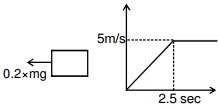
0 likes
View Solution167
EasyMCQ
$Assertion$: Two bodies of masses $M$ and $m$ $(M > m)$ are allowed to fall from the same height. If the air resistance for each is the same,then both bodies will reach the Earth simultaneously.
$Reason$: For the same air resistance,the acceleration of both bodies will be the same.
$Reason$: For the same air resistance,the acceleration of both bodies will be the same.
A
If both $Assertion$ and $Reason$ are correct and the $Reason$ is a correct explanation of the $Assertion$.
B
If both $Assertion$ and $Reason$ are correct but $Reason$ is not a correct explanation of the $Assertion$.
C
If the $Assertion$ is correct but $Reason$ is incorrect.
D
If both the $Assertion$ and $Reason$ are incorrect.
Solution
(D) The forces acting on a body of mass $m$ are its weight $mg$ acting vertically downward and air resistance $F$ acting vertically upward.
The net force is $F_{net} = mg - F$.
The acceleration of the body is $a = \frac{F_{net}}{m} = g - \frac{F}{m}$.
For the body of mass $M$,the acceleration is $a_M = g - \frac{F}{M}$.
For the body of mass $m$,the acceleration is $a_m = g - \frac{F}{m}$.
Since $M > m$,it follows that $\frac{F}{M} < \frac{F}{m}$,which implies $a_M > a_m$.
The body with the larger mass $M$ will have a greater acceleration and will reach the ground first.
Therefore,the $Assertion$ is incorrect because they do not reach simultaneously,and the $Reason$ is also incorrect because the accelerations are not the same.
The net force is $F_{net} = mg - F$.
The acceleration of the body is $a = \frac{F_{net}}{m} = g - \frac{F}{m}$.
For the body of mass $M$,the acceleration is $a_M = g - \frac{F}{M}$.
For the body of mass $m$,the acceleration is $a_m = g - \frac{F}{m}$.
Since $M > m$,it follows that $\frac{F}{M} < \frac{F}{m}$,which implies $a_M > a_m$.
The body with the larger mass $M$ will have a greater acceleration and will reach the ground first.
Therefore,the $Assertion$ is incorrect because they do not reach simultaneously,and the $Reason$ is also incorrect because the accelerations are not the same.
0 likes
View Solution168
MediumMCQ
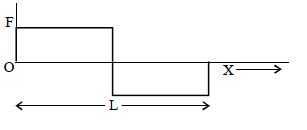
$A$ person used force $(F)$,shown in the figure,to move a load with a constant velocity on a given surface. Identify the correct surface profile.
A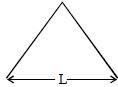
B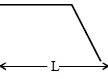
C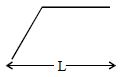
D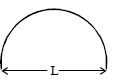
Solution
(A) To move a load of mass $m$ with a constant velocity on an inclined plane of angle $\theta$,the required force $F$ is $mg \sin \theta$.
In the given $F-x$ graph,the force is positive for the first half of the distance $L$ and negative for the second half.
This indicates that for the first half,the load is being pushed up an incline (requiring a positive force $mg \sin \theta$),and for the second half,the load is moving down an incline (where the force required to maintain constant velocity is $-mg \sin \theta$).
The surface profile that consists of an upward incline followed by a downward incline is the triangular profile shown in the first option image (labeled as option $A$ in the context of the provided images).
In the given $F-x$ graph,the force is positive for the first half of the distance $L$ and negative for the second half.
This indicates that for the first half,the load is being pushed up an incline (requiring a positive force $mg \sin \theta$),and for the second half,the load is moving down an incline (where the force required to maintain constant velocity is $-mg \sin \theta$).
The surface profile that consists of an upward incline followed by a downward incline is the triangular profile shown in the first option image (labeled as option $A$ in the context of the provided images).
0 likes
View Solution169
EasyMCQ
$A$ gardener holds a hosepipe through which water is gushing out at a rate of $4\, kg\, s^{-1}$ with a speed of $2\, ms^{-1}$. The moment the speed of water is increased to $3\, ms^{-1}$,the gardener will experience a jerk of
A
$4\, N$ in the backward direction
B
$8\, N$ in the forward direction
C
$8\, N$ in the backward direction
D
$4\, N$ in the forward direction
Solution
(A) The force exerted by the water on the gardener is given by the rate of change of momentum,$F = \frac{dp}{dt} = v \frac{dm}{dt}$.
Initially,the force is $F_1 = \frac{dm}{dt} \cdot v_1 = 4 \times 2 = 8\, N$.
When the speed increases to $3\, ms^{-1}$,the new force is $F_2 = \frac{dm}{dt} \cdot v_2 = 4 \times 3 = 12\, N$.
The change in force (jerk) experienced by the gardener is $\Delta F = F_2 - F_1 = 12 - 8 = 4\, N$.
Since the water is pushing the hosepipe backward,the increase in momentum requires an additional backward force,so the gardener experiences a jerk of $4\, N$ in the backward direction.
Initially,the force is $F_1 = \frac{dm}{dt} \cdot v_1 = 4 \times 2 = 8\, N$.
When the speed increases to $3\, ms^{-1}$,the new force is $F_2 = \frac{dm}{dt} \cdot v_2 = 4 \times 3 = 12\, N$.
The change in force (jerk) experienced by the gardener is $\Delta F = F_2 - F_1 = 12 - 8 = 4\, N$.
Since the water is pushing the hosepipe backward,the increase in momentum requires an additional backward force,so the gardener experiences a jerk of $4\, N$ in the backward direction.
0 likes
View Solution170
MediumMCQ
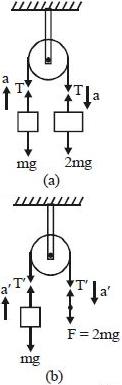
Two pulley arrangements shown in the figure are identical. The mass of the rope is negligible. In figure $(a)$,the mass $m$ is lifted by attaching a mass $2m$ to the other end of the rope. In figure $(b)$,$m$ is lifted up by pulling the other end of the rope with a constant downward force $F = 2mg$. The accelerations of $m$ in the two cases are respectively:
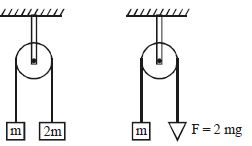
A
$3g, g$
B
$g/3, g$
C
$g/3, 2g$
D
$g, g/3$
Solution
(B) For figure $(a)$:
Let $a$ be the acceleration of the system. The equations of motion are:
For mass $m$: $T - mg = ma$ $(i)$
For mass $2m$: $2mg - T = 2ma$ $(ii)$
Adding $(i)$ and $(ii)$,we get:
$mg = 3ma$
$\therefore a = g/3$
For figure $(b)$:
Let $a'$ be the acceleration of mass $m$. The tension in the rope is $T' = F = 2mg$ because the force is applied directly to the rope.
The equation of motion for mass $m$ is:
$T' - mg = ma'$
Substituting $T' = 2mg$:
$2mg - mg = ma'$
$mg = ma'$
$\therefore a' = g$
Thus,the accelerations are $g/3$ and $g$ respectively.
Let $a$ be the acceleration of the system. The equations of motion are:
For mass $m$: $T - mg = ma$ $(i)$
For mass $2m$: $2mg - T = 2ma$ $(ii)$
Adding $(i)$ and $(ii)$,we get:
$mg = 3ma$
$\therefore a = g/3$
For figure $(b)$:
Let $a'$ be the acceleration of mass $m$. The tension in the rope is $T' = F = 2mg$ because the force is applied directly to the rope.
The equation of motion for mass $m$ is:
$T' - mg = ma'$
Substituting $T' = 2mg$:
$2mg - mg = ma'$
$mg = ma'$
$\therefore a' = g$
Thus,the accelerations are $g/3$ and $g$ respectively.
0 likes
View Solution171
MediumMCQ
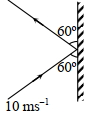
$A$ body of mass $3 \, kg$ hits a wall at an angle of $60^\circ$ with the wall and returns at the same angle. The speed of the body is $10 \, m/s$ and the impact time is $0.2 \, s$. Calculate the force exerted on the wall.
A
$100 \, N$
B
$50\sqrt{3} \, N$
C
$150\sqrt{3} \, N$
D
$75\sqrt{3} \, N$
Solution
(C) The change in momentum occurs only in the direction perpendicular to the wall.
Let the velocity be $v = 10 \, m/s$ and mass $m = 3 \, kg$.
The component of velocity perpendicular to the wall is $v_{\perp} = v \sin(60^\circ)$.
Initial momentum perpendicular to the wall: $p_i = mv \sin(60^\circ)$.
Final momentum perpendicular to the wall (after reflection): $p_f = -mv \sin(60^\circ)$.
Change in momentum: $\Delta p = p_f - p_i = -mv \sin(60^\circ) - mv \sin(60^\circ) = -2mv \sin(60^\circ)$.
The magnitude of the change in momentum is $|\Delta p| = 2mv \sin(60^\circ)$.
Force exerted on the wall $F = \frac{|\Delta p|}{\Delta t} = \frac{2mv \sin(60^\circ)}{\Delta t}$.
Substituting the values: $F = \frac{2 \times 3 \times 10 \times \sin(60^\circ)}{0.2} = \frac{60 \times (\sqrt{3}/2)}{0.2} = \frac{30\sqrt{3}}{0.2} = 150\sqrt{3} \, N$.
Let the velocity be $v = 10 \, m/s$ and mass $m = 3 \, kg$.
The component of velocity perpendicular to the wall is $v_{\perp} = v \sin(60^\circ)$.
Initial momentum perpendicular to the wall: $p_i = mv \sin(60^\circ)$.
Final momentum perpendicular to the wall (after reflection): $p_f = -mv \sin(60^\circ)$.
Change in momentum: $\Delta p = p_f - p_i = -mv \sin(60^\circ) - mv \sin(60^\circ) = -2mv \sin(60^\circ)$.
The magnitude of the change in momentum is $|\Delta p| = 2mv \sin(60^\circ)$.
Force exerted on the wall $F = \frac{|\Delta p|}{\Delta t} = \frac{2mv \sin(60^\circ)}{\Delta t}$.
Substituting the values: $F = \frac{2 \times 3 \times 10 \times \sin(60^\circ)}{0.2} = \frac{60 \times (\sqrt{3}/2)}{0.2} = \frac{30\sqrt{3}}{0.2} = 150\sqrt{3} \, N$.
0 likes
View Solution172
MediumMCQ
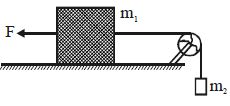
$A$ constant force $F = m_2g/2$ is applied on the block of mass $m_1$ as shown in the figure. The string and the pulley are light and the surface of the table is smooth. The acceleration of $m_1$ is
A
$\frac{m_2g}{2(m_1 + m_2)}$ towards right
B
$\frac{m_2g}{2(m_1 - m_2)}$ towards left
C
$\frac{m_2g}{2(m_2 - m_1)}$ towards right
D
$\frac{m_2g}{2(m_2 - m_1)}$ towards left
Solution
(A) Let $a$ be the acceleration of the system. Since the string is inextensible,both blocks have the same magnitude of acceleration $a$.
For block $m_1$ on the table,the forces acting horizontally are the tension $T$ (towards the right) and the applied force $F = m_2g/2$ (towards the left). Assuming the block $m_1$ moves towards the right,the equation of motion is:
$T - F = m_1a$
$T - m_2g/2 = m_1a$ --- $(i)$
For block $m_2$ hanging vertically,the forces are gravity $m_2g$ (downwards) and tension $T$ (upwards). Since $m_1$ moves right,$m_2$ moves downwards:
$m_2g - T = m_2a$ --- $(ii)$
Adding equations $(i)$ and $(ii)$:
$(T - m_2g/2) + (m_2g - T) = m_1a + m_2a$
$m_2g/2 = (m_1 + m_2)a$
$a = \frac{m_2g}{2(m_1 + m_2)}$
Since the result is positive,the assumption that $m_1$ moves towards the right is correct.
For block $m_1$ on the table,the forces acting horizontally are the tension $T$ (towards the right) and the applied force $F = m_2g/2$ (towards the left). Assuming the block $m_1$ moves towards the right,the equation of motion is:
$T - F = m_1a$
$T - m_2g/2 = m_1a$ --- $(i)$
For block $m_2$ hanging vertically,the forces are gravity $m_2g$ (downwards) and tension $T$ (upwards). Since $m_1$ moves right,$m_2$ moves downwards:
$m_2g - T = m_2a$ --- $(ii)$
Adding equations $(i)$ and $(ii)$:
$(T - m_2g/2) + (m_2g - T) = m_1a + m_2a$
$m_2g/2 = (m_1 + m_2)a$
$a = \frac{m_2g}{2(m_1 + m_2)}$
Since the result is positive,the assumption that $m_1$ moves towards the right is correct.
0 likes
View Solution173
EasyMCQ
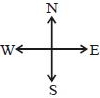
$A$ hockey player is moving northward and suddenly turns westward with the same speed to avoid an opponent. The force that acts on the player is
A
frictional force along westward
B
muscular force along southward
C
frictional force along south-west
D
muscular force along south-west
Solution
(D) The initial velocity of the player is $\vec{v}_i = v\hat{j}$ (northward).
The final velocity of the player is $\vec{v}_f = -v\hat{i}$ (westward).
The change in velocity is $\Delta\vec{v} = \vec{v}_f - \vec{v}_i = -v\hat{i} - v\hat{j}$.
According to Newton's second law,the force $\vec{F}$ acting on the player is in the direction of the change in velocity $\Delta\vec{v}$.
The direction of $\Delta\vec{v} = -v\hat{i} - v\hat{j}$ is south-west.
Since the player changes their direction by applying force through their feet against the ground,this is a muscular force exerted by the player on the ground,and by Newton's third law,the ground exerts an equal and opposite force on the player. Thus,the force acting on the player is a muscular force directed towards the south-west.
The final velocity of the player is $\vec{v}_f = -v\hat{i}$ (westward).
The change in velocity is $\Delta\vec{v} = \vec{v}_f - \vec{v}_i = -v\hat{i} - v\hat{j}$.
According to Newton's second law,the force $\vec{F}$ acting on the player is in the direction of the change in velocity $\Delta\vec{v}$.
The direction of $\Delta\vec{v} = -v\hat{i} - v\hat{j}$ is south-west.
Since the player changes their direction by applying force through their feet against the ground,this is a muscular force exerted by the player on the ground,and by Newton's third law,the ground exerts an equal and opposite force on the player. Thus,the force acting on the player is a muscular force directed towards the south-west.
0 likes
View Solution174
EasyMCQ
$Assertion$: On a rainy day,it is difficult to drive a car or bus at high speed.
$Reason$: The value of the coefficient of friction is lowered due to the wetting of the surface.
$Reason$: The value of the coefficient of friction is lowered due to the wetting of the surface.
A
If both $Assertion$ and $Reason$ are correct and the $Reason$ is a correct explanation of the $Assertion$.
B
If both $Assertion$ and $Reason$ are correct but $Reason$ is not a correct explanation of the $Assertion$.
C
If the $Assertion$ is correct but $Reason$ is incorrect.
D
If both the $Assertion$ and $Reason$ are incorrect.
Solution
(A) On a rainy day,the roads become wet.
Water acts as a lubricant between the tires and the road surface,which significantly lowers the coefficient of friction $(\mu)$.
Since the frictional force $f = \mu N$ (where $N$ is the normal force),a decrease in $\mu$ leads to a decrease in the available frictional force.
This reduced friction makes it difficult to maintain control,increases the braking distance,and increases the chances of skidding at high speeds.
Therefore,both the $Assertion$ and $Reason$ are correct,and the $Reason$ is the correct explanation for the $Assertion$.
Water acts as a lubricant between the tires and the road surface,which significantly lowers the coefficient of friction $(\mu)$.
Since the frictional force $f = \mu N$ (where $N$ is the normal force),a decrease in $\mu$ leads to a decrease in the available frictional force.
This reduced friction makes it difficult to maintain control,increases the braking distance,and increases the chances of skidding at high speeds.
Therefore,both the $Assertion$ and $Reason$ are correct,and the $Reason$ is the correct explanation for the $Assertion$.
0 likes
View Solution175
EasyMCQ
$Assertion$: Use of ball bearings between two moving parts of a machine is a common practice.
$Reason$: Ball bearings reduce vibrations and provide good stability.
$Reason$: Ball bearings reduce vibrations and provide good stability.
A
If both $Assertion$ and $Reason$ are correct and the $Reason$ is a correct explanation of the $Assertion$.
B
If both $Assertion$ and $Reason$ are correct but $Reason$ is not a correct explanation of the $Assertion$.
C
If the $Assertion$ is correct but $Reason$ is incorrect.
D
If both the $Assertion$ and $Reason$ are incorrect.
Solution
(C) The $Assertion$ is correct because ball bearings are widely used in machines to reduce friction between moving parts.
The $Reason$ is incorrect because the primary purpose of using ball bearings is to convert sliding friction into rolling friction,which is significantly smaller than sliding friction. While they may provide stability,they are not primarily used to reduce vibrations in the context of friction reduction.
The $Reason$ is incorrect because the primary purpose of using ball bearings is to convert sliding friction into rolling friction,which is significantly smaller than sliding friction. While they may provide stability,they are not primarily used to reduce vibrations in the context of friction reduction.
0 likes
View Solution176
EasyMCQ
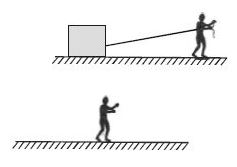
$Assertion$ : $A$ man and a block rest on a smooth horizontal surface. The man holds a rope which is connected to the block. The man cannot move on the horizontal surface.
$Reason$ : $A$ man standing at rest on a smooth horizontal surface cannot start walking due to the absence of friction (The man is only in contact with the floor as shown).
$Reason$ : $A$ man standing at rest on a smooth horizontal surface cannot start walking due to the absence of friction (The man is only in contact with the floor as shown).
A
If both Assertion and Reason are correct and the Reason is a correct explanation of the Assertion.
B
If both Assertion and Reason are correct but Reason is not a correct explanation of the Assertion.
C
If the Assertion is correct but Reason is incorrect.
D
If both the Assertion and Reason are incorrect.
Solution
(D) The $Assertion$ states that the man cannot move on the horizontal surface while holding a rope connected to a block. This is incorrect because the man can exert a force on the block by pulling the rope. According to Newton's third law,the block will exert an equal and opposite force on the man,causing him to move towards the block.
The $Reason$ states that a man standing at rest on a smooth horizontal surface cannot start walking due to the absence of friction. This is correct. Walking requires friction to push the ground backward,which in turn provides a forward reaction force. Without friction,the man's feet would simply slip.
Since the $Assertion$ is incorrect and the $Reason$ is correct,the correct option is $D$ (based on standard assertion-reason logic where the assertion is false).
The $Reason$ states that a man standing at rest on a smooth horizontal surface cannot start walking due to the absence of friction. This is correct. Walking requires friction to push the ground backward,which in turn provides a forward reaction force. Without friction,the man's feet would simply slip.
Since the $Assertion$ is incorrect and the $Reason$ is correct,the correct option is $D$ (based on standard assertion-reason logic where the assertion is false).
0 likes
View Solution177
MediumMCQ
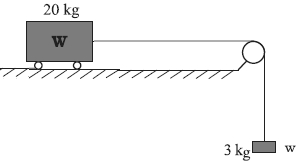
What is the acceleration of the block and trolley system shown in the figure,if the coefficient of kinetic friction between the trolley and the surface is $0.04$? What is the tension in the string? (Take $g = 10\; m s^{-2}$). Neglect the mass of the string.
A
$0.96\; m s^{-2}$ and $27.1\; N$
B
$0.66\; m s^{-2}$ and $22.5\; N$
C
$0.96\; m s^{-2}$ and $12.7\; N$
D
$0.48\; m s^{-2}$ and $27.1\; N$
Solution
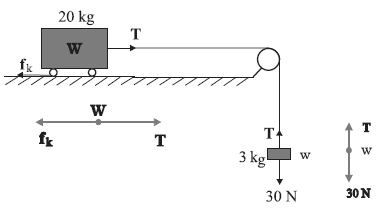
(A) Since the string is inextensible and the pulley is smooth,the $3\; kg$ block and the $20\; kg$ trolley have the same magnitude of acceleration $a$.
Applying Newton's second law to the motion of the $3\; kg$ block:
$30 - T = 3a$ --- (Equation $1$)
Applying Newton's second law to the motion of the $20\; kg$ trolley:
$T - f_k = 20a$ --- (Equation $2$)
Where the kinetic friction $f_k = \mu_k N$.
Given $\mu_k = 0.04$ and the normal force $N = m_{trolley} g = 20 \times 10 = 200\; N$.
So,$f_k = 0.04 \times 200 = 8\; N$.
Substituting $f_k$ into Equation $2$:
$T - 8 = 20a$ --- (Equation $3$)
Adding Equation $1$ and Equation $3$:
$(30 - T) + (T - 8) = 3a + 20a$
$22 = 23a$
$a = \frac{22}{23} \approx 0.96\; m s^{-2}$.
Substituting $a$ into Equation $1$:
$30 - T = 3 \times (0.9565)$
$T = 30 - 2.87 = 27.13\; N \approx 27.1\; N$.
Applying Newton's second law to the motion of the $3\; kg$ block:
$30 - T = 3a$ --- (Equation $1$)
Applying Newton's second law to the motion of the $20\; kg$ trolley:
$T - f_k = 20a$ --- (Equation $2$)
Where the kinetic friction $f_k = \mu_k N$.
Given $\mu_k = 0.04$ and the normal force $N = m_{trolley} g = 20 \times 10 = 200\; N$.
So,$f_k = 0.04 \times 200 = 8\; N$.
Substituting $f_k$ into Equation $2$:
$T - 8 = 20a$ --- (Equation $3$)
Adding Equation $1$ and Equation $3$:
$(30 - T) + (T - 8) = 3a + 20a$
$22 = 23a$
$a = \frac{22}{23} \approx 0.96\; m s^{-2}$.
Substituting $a$ into Equation $1$:
$30 - T = 3 \times (0.9565)$
$T = 30 - 2.87 = 27.13\; N \approx 27.1\; N$.
0 likes
View Solution178
Medium
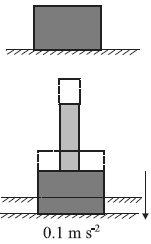
$A$ wooden block of mass $2\; kg$ rests on a soft horizontal floor. When an iron cylinder of mass $25\; kg$ is placed on top of the block,the floor yields steadily and the block and the cylinder together go down with an acceleration of $0.1\; m/s^2$. What is the action of the block on the floor $(a)$ before and $(b)$ after the floor yields? Take $g = 10\; m/s^2$. Identify the action-reaction pairs in the problem.
Solution
(N/A) The block is at rest on the floor. Its free-body diagram shows two forces on the block: the force of gravitational attraction by the earth equal to $2 \times 10 = 20\; N$,and the normal force $R$ of the floor on the block. By the First Law,the net force on the block must be zero,i.e.,$R = 20\; N$. Using the third law,the action of the block (i.e.,the force exerted on the floor by the block) is equal to $20\; N$ and directed vertically downwards.
$(b)$ The system (block $+$ cylinder) accelerates downwards with $0.1\; m/s^2$. The free-body diagram of the system shows two forces on the system: the force of gravity due to the earth $(27\; kg \times 10\; m/s^2 = 270\; N)$; and the normal force $R'$ by the floor. Note that the free-body diagram of the system does not show the internal forces between the block and the cylinder. Applying the second law to the system:
$270 - R' = 27 \times 0.1\; N$
$R' = 270 - 2.7 = 267.3\; N$
By the third law,the action of the system on the floor is equal to $267.3\; N$ vertically downward.
Action-reaction pairs:
For $(a)$: $(i)$ The force of gravity $(20\; N)$ on the block by the earth (action); the force of gravity on the earth by the block (reaction) equal to $20\; N$ directed upwards. $(ii)$ The force on the floor by the block (action); the force on the block by the floor (reaction).
For $(b)$: $(i)$ The force of gravity $(270\; N)$ on the system by the earth (action); the force of gravity on the earth by the system (reaction),equal to $270\; N$ directed upwards. $(ii)$ The force on the floor by the system (action); the force on the system by the floor (reaction). In addition,for $(b)$,the force on the block by the cylinder and the force on the cylinder by the block also constitute an action-reaction pair.
$(b)$ The system (block $+$ cylinder) accelerates downwards with $0.1\; m/s^2$. The free-body diagram of the system shows two forces on the system: the force of gravity due to the earth $(27\; kg \times 10\; m/s^2 = 270\; N)$; and the normal force $R'$ by the floor. Note that the free-body diagram of the system does not show the internal forces between the block and the cylinder. Applying the second law to the system:
$270 - R' = 27 \times 0.1\; N$
$R' = 270 - 2.7 = 267.3\; N$
By the third law,the action of the system on the floor is equal to $267.3\; N$ vertically downward.
Action-reaction pairs:
For $(a)$: $(i)$ The force of gravity $(20\; N)$ on the block by the earth (action); the force of gravity on the earth by the block (reaction) equal to $20\; N$ directed upwards. $(ii)$ The force on the floor by the block (action); the force on the block by the floor (reaction).
For $(b)$: $(i)$ The force of gravity $(270\; N)$ on the system by the earth (action); the force of gravity on the earth by the system (reaction),equal to $270\; N$ directed upwards. $(ii)$ The force on the floor by the system (action); the force on the system by the floor (reaction). In addition,for $(b)$,the force on the block by the cylinder and the force on the cylinder by the block also constitute an action-reaction pair.
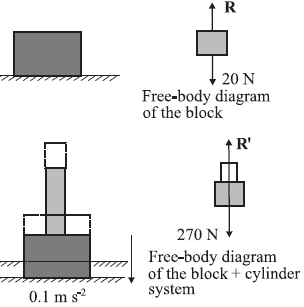
0 likes
View Solution179
Medium
Give the magnitude and direction of the net force acting on:
$(a)$ a drop of rain falling down with a constant speed,
$(b)$ a cork of mass $10\; g$ floating on water,
$(c)$ a kite skillfully held stationary in the sky,
$(d)$ a car moving with a constant velocity of $30\; km/h$ on a rough road,
$(e)$ a high-speed electron in space far from all material objects,and free of electric and magnetic fields.
$(a)$ a drop of rain falling down with a constant speed,
$(b)$ a cork of mass $10\; g$ floating on water,
$(c)$ a kite skillfully held stationary in the sky,
$(d)$ a car moving with a constant velocity of $30\; km/h$ on a rough road,
$(e)$ a high-speed electron in space far from all material objects,and free of electric and magnetic fields.
Solution
(N/A) Zero net force: The rain drop is falling with a constant speed,meaning its acceleration is zero. According to Newton's second law of motion,the net force acting on the rain drop is zero.
$(b)$ Zero net force: The weight of the cork acts downward and is balanced by the buoyant force exerted by the water in the upward direction. Thus,the net force is zero.
$(c)$ Zero net force: The kite is stationary in the sky,meaning it has no acceleration. According to Newton's first law of motion,the net force acting on the kite is zero.
$(d)$ Zero net force: The car is moving with a constant velocity,so its acceleration is zero. According to Newton's second law of motion,the net force acting on the car is zero.
$(e)$ Zero net force: The high-speed electron is far from all material objects and external fields,so no force acts upon it.
$(b)$ Zero net force: The weight of the cork acts downward and is balanced by the buoyant force exerted by the water in the upward direction. Thus,the net force is zero.
$(c)$ Zero net force: The kite is stationary in the sky,meaning it has no acceleration. According to Newton's first law of motion,the net force acting on the kite is zero.
$(d)$ Zero net force: The car is moving with a constant velocity,so its acceleration is zero. According to Newton's second law of motion,the net force acting on the car is zero.
$(e)$ Zero net force: The high-speed electron is far from all material objects and external fields,so no force acts upon it.
0 likes
View Solution180
Medium
$A$ pebble of mass $0.05 \, kg$ is thrown vertically upwards. Give the direction and magnitude of the net force on the pebble,$(a)$ during its upward motion,$(b)$ during its downward motion,$(c)$ at the highest point where it is momentarily at rest. Do your answers change if the pebble was thrown at an angle of $45^{\circ}$ with the horizontal direction? Ignore air resistance.
Solution
(A) The net force is $0.5 \, N$ in the vertically downward direction in all cases.
Acceleration due to gravity $(g)$,irrespective of the direction of motion of an object,always acts downward. The gravitational force is the only force acting on the pebble in all three cases. Its magnitude is given by Newton's second law of motion as:
$F = m \times a$
Where,$F$ is the net force,$m$ is the mass of the pebble $(0.05 \, kg)$,and $a = g = 10 \, m/s^2$.
Therefore,$F = 0.05 \times 10 = 0.5 \, N$.
The net force on the pebble in all three cases is $0.5 \, N$ and this force acts in the downward direction.
If the pebble is thrown at an angle of $45^{\circ}$ with the horizontal,it will have both horizontal and vertical components of velocity. At the highest point,only the vertical component of velocity becomes zero. However,the pebble will have a horizontal component of velocity throughout its motion. This component of velocity has no effect on the net force acting on the pebble,which remains $0.5 \, N$ downwards.
Acceleration due to gravity $(g)$,irrespective of the direction of motion of an object,always acts downward. The gravitational force is the only force acting on the pebble in all three cases. Its magnitude is given by Newton's second law of motion as:
$F = m \times a$
Where,$F$ is the net force,$m$ is the mass of the pebble $(0.05 \, kg)$,and $a = g = 10 \, m/s^2$.
Therefore,$F = 0.05 \times 10 = 0.5 \, N$.
The net force on the pebble in all three cases is $0.5 \, N$ and this force acts in the downward direction.
If the pebble is thrown at an angle of $45^{\circ}$ with the horizontal,it will have both horizontal and vertical components of velocity. At the highest point,only the vertical component of velocity becomes zero. However,the pebble will have a horizontal component of velocity throughout its motion. This component of velocity has no effect on the net force acting on the pebble,which remains $0.5 \, N$ downwards.
0 likes
View Solution181
Medium
Give the magnitude and direction of the net force acting on a stone of mass $0.1\; kg$,
$(a)$ just after it is dropped from the window of a stationary train,
$(b)$ just after it is dropped from the window of a train running at a constant velocity of $36\; km/h$,
$(c)$ just after it is dropped from the window of a train accelerating with $1\; m/s^2$,
$(d)$ lying on the floor of a train which is accelerating with $1\; m/s^2$,the stone being at rest relative to the train.
Neglect air resistance throughout.
$(a)$ just after it is dropped from the window of a stationary train,
$(b)$ just after it is dropped from the window of a train running at a constant velocity of $36\; km/h$,
$(c)$ just after it is dropped from the window of a train accelerating with $1\; m/s^2$,
$(d)$ lying on the floor of a train which is accelerating with $1\; m/s^2$,the stone being at rest relative to the train.
Neglect air resistance throughout.
Solution
(A) $1\; N$; vertically downward. Mass of the stone,$m = 0.1\; kg$. Acceleration of the stone,$a = g = 10\; m/s^2$. As per Newton's second law of motion,the net force acting on the stone is $F = ma = mg = 0.1 \times 10 = 1\; N$. Acceleration due to gravity always acts in the downward direction.
$(b)$ $1\; N$; vertically downward. The train is moving with a constant velocity,so its acceleration is zero. Once the stone is dropped,no horizontal force acts on it. The only force acting is gravity,which is $1\; N$ vertically downward.
$(c)$ $1\; N$; vertically downward. Once the stone is dropped,it is no longer in contact with the train. The horizontal force due to the train's acceleration stops acting on the stone. The only force remaining is gravity,which is $1\; N$ vertically downward.
$(d)$ $0.1\; N$; in the direction of motion of the train. The stone is at rest relative to the train,so it shares the train's acceleration $a = 1\; m/s^2$. The net force is $F = ma = 0.1 \times 1 = 0.1\; N$,acting in the direction of the train's motion.
$(b)$ $1\; N$; vertically downward. The train is moving with a constant velocity,so its acceleration is zero. Once the stone is dropped,no horizontal force acts on it. The only force acting is gravity,which is $1\; N$ vertically downward.
$(c)$ $1\; N$; vertically downward. Once the stone is dropped,it is no longer in contact with the train. The horizontal force due to the train's acceleration stops acting on the stone. The only force remaining is gravity,which is $1\; N$ vertically downward.
$(d)$ $0.1\; N$; in the direction of motion of the train. The stone is at rest relative to the train,so it shares the train's acceleration $a = 1\; m/s^2$. The net force is $F = ma = 0.1 \times 1 = 0.1\; N$,acting in the direction of the train's motion.
0 likes
View Solution182
Medium
Explain why
$(a)$ a horse cannot pull a cart and run in empty space,
$(b)$ passengers are thrown forward from their seats when a speeding bus stops suddenly,
$(c)$ it is easier to pull a lawn mower than to push it,
$(d)$ a cricketer moves his hands backwards while holding a catch.
$(a)$ a horse cannot pull a cart and run in empty space,
$(b)$ passengers are thrown forward from their seats when a speeding bus stops suddenly,
$(c)$ it is easier to pull a lawn mower than to push it,
$(d)$ a cricketer moves his hands backwards while holding a catch.
Solution
(N/A) In order to pull a cart,a horse pushes the ground backward with some force. The ground in turn exerts an equal and opposite reaction force upon the feet of the horse. This reaction force causes the horse to move forward. An empty space is devoid of any such reaction force. Therefore,a horse cannot pull a cart and run in empty space.
$(b)$ When a speeding bus stops suddenly,the lower portion of a passenger's body,which is in contact with the seat,suddenly comes to rest. However,the upper portion tends to remain in motion (as per the first law of motion). As a result,the passenger's upper body is thrown forward in the direction in which the bus was moving.
$(c)$ While pulling a lawn mower,a force at an angle $\theta$ is applied on it. The vertical component of this applied force $(F \sin \theta)$ acts upward,which reduces the effective weight of the mower $(mg - F \sin \theta)$. On the other hand,while pushing a lawn mower,the vertical component of the applied force acts in the direction of the weight of the mower,increasing the effective weight $(mg + F \sin \theta)$. Since the effective weight is lesser in the first case,pulling the lawn mower is easier than pushing it.
$(d)$ According to Newton's second law of motion,$F = ma = m \frac{\Delta v}{\Delta t}$. The impact force $(F)$ is inversely proportional to the impact time $(\Delta t)$,i.e.,$F \propto \frac{1}{\Delta t}$. By moving his hands backward,a cricketer increases the time of impact $(\Delta t)$,which results in a decrease in the stopping force,thereby preventing the hands from getting hurt.
$(b)$ When a speeding bus stops suddenly,the lower portion of a passenger's body,which is in contact with the seat,suddenly comes to rest. However,the upper portion tends to remain in motion (as per the first law of motion). As a result,the passenger's upper body is thrown forward in the direction in which the bus was moving.
$(c)$ While pulling a lawn mower,a force at an angle $\theta$ is applied on it. The vertical component of this applied force $(F \sin \theta)$ acts upward,which reduces the effective weight of the mower $(mg - F \sin \theta)$. On the other hand,while pushing a lawn mower,the vertical component of the applied force acts in the direction of the weight of the mower,increasing the effective weight $(mg + F \sin \theta)$. Since the effective weight is lesser in the first case,pulling the lawn mower is easier than pushing it.
$(d)$ According to Newton's second law of motion,$F = ma = m \frac{\Delta v}{\Delta t}$. The impact force $(F)$ is inversely proportional to the impact time $(\Delta t)$,i.e.,$F \propto \frac{1}{\Delta t}$. By moving his hands backward,a cricketer increases the time of impact $(\Delta t)$,which results in a decrease in the stopping force,thereby preventing the hands from getting hurt.
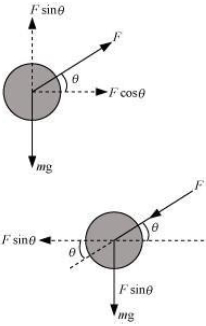
0 likes
View Solution183
Medium
The figure shows a man standing stationary with respect to a horizontal conveyor belt that is accelerating with $1 \; m/s^2$. What is the net force on the man? If the coefficient of static friction between the man's shoes and the belt is $0.2$,up to what acceleration of the belt can the man continue to be stationary relative to the belt? (Mass of the man $= 65 \; kg.)$
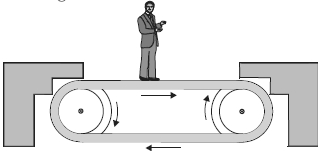
Solution
(N/A) Mass of the man,$m = 65 \; kg$.
Acceleration of the belt,$a = 1 \; m/s^2$.
Coefficient of static friction,$\mu = 0.2$.
The net force $F$ acting on the man is given by Newton's second law of motion as:
$F = m \times a = 65 \times 1 = 65 \; N$.
The man will continue to be stationary with respect to the conveyor belt until the net force required to accelerate the man is less than or equal to the maximum static frictional force $f_{s,max}$ exerted by the belt.
$f_{s,max} = \mu \times N = \mu \times m \times g$.
Let $a'$ be the maximum acceleration of the belt. For the man to remain stationary:
$m \times a' \leq \mu \times m \times g$
$a' \leq \mu \times g$
$a' \leq 0.2 \times 10 = 2 \; m/s^2$.
Therefore,the maximum acceleration of the belt up to which the man can stand stationary is $2 \; m/s^2$.
Acceleration of the belt,$a = 1 \; m/s^2$.
Coefficient of static friction,$\mu = 0.2$.
The net force $F$ acting on the man is given by Newton's second law of motion as:
$F = m \times a = 65 \times 1 = 65 \; N$.
The man will continue to be stationary with respect to the conveyor belt until the net force required to accelerate the man is less than or equal to the maximum static frictional force $f_{s,max}$ exerted by the belt.
$f_{s,max} = \mu \times N = \mu \times m \times g$.
Let $a'$ be the maximum acceleration of the belt. For the man to remain stationary:
$m \times a' \leq \mu \times m \times g$
$a' \leq \mu \times g$
$a' \leq 0.2 \times 10 = 2 \; m/s^2$.
Therefore,the maximum acceleration of the belt up to which the man can stand stationary is $2 \; m/s^2$.
0 likes
View Solution184
Medium
$A$ helicopter of mass $1000 \;kg$ rises with a vertical acceleration of $15\; m s^{-2}$. The crew and the passengers weigh $300\; kg$. Give the magnitude and direction of the
$(a)$ force on the floor by the crew and passengers,
$(b)$ action of the rotor of the helicopter on the surrounding air,
$(c)$ force on the helicopter due to the surrounding air.
$(a)$ force on the floor by the crew and passengers,
$(b)$ action of the rotor of the helicopter on the surrounding air,
$(c)$ force on the helicopter due to the surrounding air.
Solution
(A-D) Mass of the helicopter,$m_h = 1000 \; kg$. Mass of the crew and passengers,$m_p = 300 \; kg$.
Total mass of the system,$m = 1300 \; kg$.
Acceleration of the helicopter,$a = 15 \; m s^{-2}$.
$(a)$ Using Newton's second law of motion for the crew and passengers,the normal force $R$ exerted by the floor is:
$R - m_p g = m_p a \implies R = m_p(g + a)$
$R = 300(10 + 15) = 300 \times 25 = 7500 \; N$.
By Newton's third law,the force on the floor by the crew and passengers is $7500 \; N$,directed downward.
$(b)$ Using Newton's second law for the entire system (helicopter + crew + passengers):
$F_{air} - mg = ma \implies F_{air} = m(g + a)$
$F_{air} = 1300(10 + 15) = 1300 \times 25 = 32500 \; N$.
By Newton's third law,the action of the rotor on the surrounding air is $32500 \; N$,directed downward.
$(c)$ The force on the helicopter due to the surrounding air is $32500 \; N$,directed upward.
Total mass of the system,$m = 1300 \; kg$.
Acceleration of the helicopter,$a = 15 \; m s^{-2}$.
$(a)$ Using Newton's second law of motion for the crew and passengers,the normal force $R$ exerted by the floor is:
$R - m_p g = m_p a \implies R = m_p(g + a)$
$R = 300(10 + 15) = 300 \times 25 = 7500 \; N$.
By Newton's third law,the force on the floor by the crew and passengers is $7500 \; N$,directed downward.
$(b)$ Using Newton's second law for the entire system (helicopter + crew + passengers):
$F_{air} - mg = ma \implies F_{air} = m(g + a)$
$F_{air} = 1300(10 + 15) = 1300 \times 25 = 32500 \; N$.
By Newton's third law,the action of the rotor on the surrounding air is $32500 \; N$,directed downward.
$(c)$ The force on the helicopter due to the surrounding air is $32500 \; N$,directed upward.
0 likes
View Solution185
Difficult
Two bodies $A$ and $B$ of masses $5 \, kg$ and $10 \, kg$ in contact with each other rest on a table against a rigid wall. The coefficient of friction between the bodies and the table is $0.15$. $A$ force of $200 \, N$ is applied horizontally to $A$. What are $(a)$ the reaction of the partition $(b)$ the action-reaction forces between $A$ and $B$? What happens when the wall is removed? Does the answer to $(b)$ change,when the bodies are in motion? Ignore the difference between $\mu_{s}$ and $\mu_{k}$.
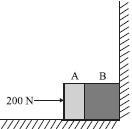
Solution
(N/A) Mass of body $A$,$m_{A} = 5 \, kg$.
Mass of body $B$,$m_{B} = 10 \, kg$.
Applied force,$F = 200 \, N$.
Coefficient of friction,$\mu = 0.15$.
The total force of friction is given by $f_{s} = \mu(m_{A} + m_{B})g = 0.15(5 + 10) \times 10 = 22.5 \, N$ (leftward).
$(a)$ The net force acting on the partition is $F_{net} = F - f_{s} = 200 - 22.5 = 177.5 \, N$ (rightward). By Newton's third law,the reaction of the wall is $177.5 \, N$ (leftward).
$(b)$ The force of friction on mass $A$ is $f_{A} = \mu m_{A} g = 0.15 \times 5 \times 10 = 7.5 \, N$ (leftward). The net force exerted by $A$ on $B$ is $F_{AB} = F - f_{A} = 200 - 7.5 = 192.5 \, N$ (rightward). By Newton's third law,$B$ exerts $192.5 \, N$ on $A$ (leftward).
When the wall is removed,the system moves with acceleration $a = \frac{F - f_{s}}{m_{A} + m_{B}} = \frac{177.5}{15} \approx 11.83 \, m/s^{2}$.
The force exerted by $A$ on $B$ becomes $F'_{AB} = m_{B} a + f_{B} = 10 \times 11.83 + (0.15 \times 10 \times 10) = 118.3 + 15 = 133.3 \, N$. Yes,the answer to $(b)$ changes when the bodies are in motion.
Mass of body $B$,$m_{B} = 10 \, kg$.
Applied force,$F = 200 \, N$.
Coefficient of friction,$\mu = 0.15$.
The total force of friction is given by $f_{s} = \mu(m_{A} + m_{B})g = 0.15(5 + 10) \times 10 = 22.5 \, N$ (leftward).
$(a)$ The net force acting on the partition is $F_{net} = F - f_{s} = 200 - 22.5 = 177.5 \, N$ (rightward). By Newton's third law,the reaction of the wall is $177.5 \, N$ (leftward).
$(b)$ The force of friction on mass $A$ is $f_{A} = \mu m_{A} g = 0.15 \times 5 \times 10 = 7.5 \, N$ (leftward). The net force exerted by $A$ on $B$ is $F_{AB} = F - f_{A} = 200 - 7.5 = 192.5 \, N$ (rightward). By Newton's third law,$B$ exerts $192.5 \, N$ on $A$ (leftward).
When the wall is removed,the system moves with acceleration $a = \frac{F - f_{s}}{m_{A} + m_{B}} = \frac{177.5}{15} \approx 11.83 \, m/s^{2}$.
The force exerted by $A$ on $B$ becomes $F'_{AB} = m_{B} a + f_{B} = 10 \times 11.83 + (0.15 \times 10 \times 10) = 118.3 + 15 = 133.3 \, N$. Yes,the answer to $(b)$ changes when the bodies are in motion.
0 likes
View Solution186
Medium
$A$ block of mass $15 \;kg$ is placed on a long trolley. The coefficient of static friction between the block and the trolley is $0.18$. The trolley accelerates from rest with $0.5 \;m s^{-2}$ for $20 \;s$ and then moves with uniform velocity. Discuss the motion of the block as viewed by
$(a)$ a stationary observer on the ground,
$(b)$ an observer moving with the trolley.
$(a)$ a stationary observer on the ground,
$(b)$ an observer moving with the trolley.
Solution
(A) Mass of the block,$m = 15 \; kg$.
Coefficient of static friction,$\mu = 0.18$.
Acceleration of the trolley,$a = 0.5 \; m s^{-2}$.
According to Newton's second law of motion,the force $F$ required to move the block with the trolley is $F = ma = 15 \times 0.5 = 7.5 \; N$.
The maximum force of static friction available is $f_{max} = \mu mg = 0.18 \times 15 \times 9.8 = 26.46 \; N$ (taking $g = 9.8 \; m s^{-2}$). Even if we take $g = 10 \; m s^{-2}$,$f_{max} = 27 \; N$.
Since the required force $(7.5 \; N)$ is less than the maximum static friction $(27 \; N)$,the block will not slide on the trolley.
$(a)$ For a stationary observer on the ground,the block accelerates along with the trolley at $0.5 \; m s^{-2}$ for the first $20 \; s$ and then moves with a uniform velocity of $v = at = 0.5 \times 20 = 10 \; m s^{-1}$.
$(b)$ For an observer moving with the trolley,the block remains at rest because the frictional force provides the necessary acceleration to keep it stationary relative to the trolley.
Coefficient of static friction,$\mu = 0.18$.
Acceleration of the trolley,$a = 0.5 \; m s^{-2}$.
According to Newton's second law of motion,the force $F$ required to move the block with the trolley is $F = ma = 15 \times 0.5 = 7.5 \; N$.
The maximum force of static friction available is $f_{max} = \mu mg = 0.18 \times 15 \times 9.8 = 26.46 \; N$ (taking $g = 9.8 \; m s^{-2}$). Even if we take $g = 10 \; m s^{-2}$,$f_{max} = 27 \; N$.
Since the required force $(7.5 \; N)$ is less than the maximum static friction $(27 \; N)$,the block will not slide on the trolley.
$(a)$ For a stationary observer on the ground,the block accelerates along with the trolley at $0.5 \; m s^{-2}$ for the first $20 \; s$ and then moves with a uniform velocity of $v = at = 0.5 \times 20 = 10 \; m s^{-1}$.
$(b)$ For an observer moving with the trolley,the block remains at rest because the frictional force provides the necessary acceleration to keep it stationary relative to the trolley.
0 likes
View Solution187
MediumMCQ
$A$ $1\; kg$ block situated on a rough incline is connected to a spring of spring constant $100\; N m^{-1}$ as shown in the figure. The block is released from rest with the spring in the unstretched position. The block moves $10\; cm$ down the incline before coming to rest. Find the coefficient of friction between the block and the incline. Assume that the spring has a negligible mass and the pulley is frictionless.
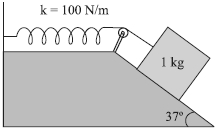
A
$0.564$
B
$0.368$
C
$0.115$
D
$0.256$
Solution
(C) Mass of the block,$m = 1\; kg$.
Spring constant,$k = 100\; N m^{-1}$.
Displacement of the block,$x = 10\; cm = 0.1\; m$.
According to the work-energy theorem,the work done by all forces is equal to the change in kinetic energy. Since the block starts from rest and comes to rest,the change in kinetic energy is zero.
Work done by gravity + Work done by spring + Work done by friction = $0$.
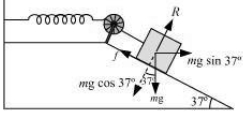
$mgx \sin 37^{\circ} - \frac{1}{2} k x^2 - f x = 0$.
Here,$f = \mu N = \mu mg \cos 37^{\circ}$.
Substituting the values:
$(1)(9.8)(0.1) \sin 37^{\circ} - \frac{1}{2} (100)(0.1)^2 - \mu (1)(9.8)(0.1) \cos 37^{\circ} = 0$.
$0.98 \times 0.6018 - 0.5 - \mu (0.98)(0.7986) = 0$.
$0.5898 - 0.5 = \mu (0.7826)$.
$0.0898 = \mu (0.7826)$.
$\mu = \frac{0.0898}{0.7826} \approx 0.115$.
Spring constant,$k = 100\; N m^{-1}$.
Displacement of the block,$x = 10\; cm = 0.1\; m$.
According to the work-energy theorem,the work done by all forces is equal to the change in kinetic energy. Since the block starts from rest and comes to rest,the change in kinetic energy is zero.
Work done by gravity + Work done by spring + Work done by friction = $0$.
$mgx \sin 37^{\circ} - \frac{1}{2} k x^2 - f x = 0$.
Here,$f = \mu N = \mu mg \cos 37^{\circ}$.
Substituting the values:
$(1)(9.8)(0.1) \sin 37^{\circ} - \frac{1}{2} (100)(0.1)^2 - \mu (1)(9.8)(0.1) \cos 37^{\circ} = 0$.
$0.98 \times 0.6018 - 0.5 - \mu (0.98)(0.7986) = 0$.
$0.5898 - 0.5 = \mu (0.7826)$.
$0.0898 = \mu (0.7826)$.
$\mu = \frac{0.0898}{0.7826} \approx 0.115$.
0 likes
View Solution188
MediumMCQ
On which factors does the stopping distance of a vehicle depend?
A
Initial velocity of the vehicle
B
Coefficient of friction between the tires and the road
C
Reaction time of the driver
D
All of the above
0 likes
View Solution189
EasyMCQ
Provide an example from daily life where motion is controlled or initiated by an external force.
A
$A$ stationary football is kicked.
B
$A$ stone is thrown upward.
C
Branches of a tree swing due to wind.
D
All of the above.
Solution
(D) In daily life,motion is initiated or controlled by the application of an external force,which is a fundamental concept of $Newton's$ laws of motion.
$1$. $A$ stationary football is kicked: The force applied by the foot changes the state of rest of the ball.
$2$. To throw a stone in an upward direction,one has to apply an upward push (force).
$3$. Branches of a tree swing due to wind: The moving air exerts a force on the branches,causing them to move.
$4$. $A$ boat moves in a flowing river without anyone rowing it: The force exerted by the flowing water moves the boat.
All these examples demonstrate how external forces control or initiate motion.
$1$. $A$ stationary football is kicked: The force applied by the foot changes the state of rest of the ball.
$2$. To throw a stone in an upward direction,one has to apply an upward push (force).
$3$. Branches of a tree swing due to wind: The moving air exerts a force on the branches,causing them to move.
$4$. $A$ boat moves in a flowing river without anyone rowing it: The force exerted by the flowing water moves the boat.
All these examples demonstrate how external forces control or initiate motion.
0 likes
View Solution190
Medium
Write the advantages and disadvantages of friction. Write the remedies to reduce friction.
Solution
(N/A) Friction is like fire; sometimes it is desirable and necessary,and sometimes it is undesirable.
Advantages of Friction:
$(1)$ It allows us to walk on the ground without slipping.
$(2)$ It enables us to hold objects firmly.
$(3)$ It allows us to write on surfaces like paper or boards.
$(4)$ It helps in transmitting motion between wheels via conveyor belts.
Disadvantages of Friction:
$(1)$ It opposes relative motion and dissipates mechanical energy in the form of heat.
$(2)$ It causes wear and tear in the moving parts of machines.
$(3)$ It leads to the wearing out of clothes,shoes,and vehicle tires.
Remedies to Reduce Friction:
$(1)$ Lubricants: Using oils or greases between moving parts reduces kinetic friction.
$(2)$ Ball-bearings: Using ball-bearings between moving parts converts sliding friction into rolling friction,which is significantly lower.
$(3)$ Air Cushion: Maintaining a thin cushion of air between solid surfaces can effectively reduce friction,as illustrated in the figure.
Advantages of Friction:
$(1)$ It allows us to walk on the ground without slipping.
$(2)$ It enables us to hold objects firmly.
$(3)$ It allows us to write on surfaces like paper or boards.
$(4)$ It helps in transmitting motion between wheels via conveyor belts.
Disadvantages of Friction:
$(1)$ It opposes relative motion and dissipates mechanical energy in the form of heat.
$(2)$ It causes wear and tear in the moving parts of machines.
$(3)$ It leads to the wearing out of clothes,shoes,and vehicle tires.
Remedies to Reduce Friction:
$(1)$ Lubricants: Using oils or greases between moving parts reduces kinetic friction.
$(2)$ Ball-bearings: Using ball-bearings between moving parts converts sliding friction into rolling friction,which is significantly lower.
$(3)$ Air Cushion: Maintaining a thin cushion of air between solid surfaces can effectively reduce friction,as illustrated in the figure.
0 likes
View Solution191
Difficult
Write the relation between the coefficient of static friction,kinetic friction,and rolling friction.
Solution
(N/A) The coefficients of friction are denoted by $\mu_s$ (static friction),$\mu_k$ (kinetic friction),and $\mu_r$ (rolling friction).
For a given pair of surfaces,the magnitude of these coefficients generally follows the inequality:
$\mu_s > \mu_k > \mu_r$.
This relationship exists because static friction must overcome the interlocking of surface irregularities at rest,kinetic friction involves sliding where the surfaces have less time to interlock,and rolling friction is significantly lower as it involves minimal deformation and contact area changes.
For a given pair of surfaces,the magnitude of these coefficients generally follows the inequality:
$\mu_s > \mu_k > \mu_r$.
This relationship exists because static friction must overcome the interlocking of surface irregularities at rest,kinetic friction involves sliding where the surfaces have less time to interlock,and rolling friction is significantly lower as it involves minimal deformation and contact area changes.
0 likes
View Solution192
Medium
Write important guidance for solving problems in mechanics.
Solution
(N/A) We can solve different problems of dynamics using Newton's three laws of motion.
Sometimes,a problem involves more than one body,and these bodies exert forces on each other.
Moreover,every body experiences a gravitational force. To solve such problems,we must define a 'system' whose motion is to be discussed,while the remaining parts and external agencies are considered the 'environment'.
To solve the problem,follow these steps:
$(1)$ Draw a schematic diagram showing the assembly of different objects,their connections,and supports.
$(2)$ Select the object as the system whose motion you want to analyze. If the system consists of multiple objects,ensure that the acceleration vector of all these objects is the same.
$(3)$ List all forces acting on the system by the environment. Do not include internal forces acting within the system.
$(4)$ Represent the system as a point and draw all external forces acting on it as vectors originating from that point. This is called a Free Body Diagram $(FBD)$. This does not mean the system is free from forces,but only that the forces acting $ON$ the system are shown.
$(5)$ If necessary,select another system and repeat the steps. Use Newton's third law: for example,if the force exerted by $B$ on $A$ is $\vec{F}$ in the $FBD$ of $A$,then the force exerted by $A$ on $B$ in the $FBD$ of $B$ is $-\vec{F}$.
Sometimes,a problem involves more than one body,and these bodies exert forces on each other.
Moreover,every body experiences a gravitational force. To solve such problems,we must define a 'system' whose motion is to be discussed,while the remaining parts and external agencies are considered the 'environment'.
To solve the problem,follow these steps:
$(1)$ Draw a schematic diagram showing the assembly of different objects,their connections,and supports.
$(2)$ Select the object as the system whose motion you want to analyze. If the system consists of multiple objects,ensure that the acceleration vector of all these objects is the same.
$(3)$ List all forces acting on the system by the environment. Do not include internal forces acting within the system.
$(4)$ Represent the system as a point and draw all external forces acting on it as vectors originating from that point. This is called a Free Body Diagram $(FBD)$. This does not mean the system is free from forces,but only that the forces acting $ON$ the system are shown.
$(5)$ If necessary,select another system and repeat the steps. Use Newton's third law: for example,if the force exerted by $B$ on $A$ is $\vec{F}$ in the $FBD$ of $A$,then the force exerted by $A$ on $B$ in the $FBD$ of $B$ is $-\vec{F}$.
0 likes
View Solution193
MediumMCQ
$A$ force of $36 \, \text{dyne}$ acts on a body placed on an inclined plane making an angle of $60^{\circ}$ with the horizontal. If the mass of the body is $18 \, \text{g}$,what is the acceleration of the body in the horizontal direction?
A
$1 \, \text{cm/s}^2$
B
$2 \, \text{cm/s}^2$
C
$0.5 \, \text{cm/s}^2$
D
$1.5 \, \text{cm/s}^2$
Solution
(A) The component of the force $F$ in the horizontal direction ($x$-direction) is given by $F_x = F \cos(60^{\circ})$.
Given $F = 36 \, \text{dyne}$ and $\theta = 60^{\circ}$.
$F_x = 36 \times \cos(60^{\circ}) = 36 \times 0.5 = 18 \, \text{dyne}$.
According to Newton's second law,the acceleration in the horizontal direction $a_x$ is given by $a_x = \frac{F_x}{m}$.
Given mass $m = 18 \, \text{g}$.
$a_x = \frac{18 \, \text{dyne}}{18 \, \text{g}} = 1 \, \text{cm/s}^2$.
Given $F = 36 \, \text{dyne}$ and $\theta = 60^{\circ}$.
$F_x = 36 \times \cos(60^{\circ}) = 36 \times 0.5 = 18 \, \text{dyne}$.
According to Newton's second law,the acceleration in the horizontal direction $a_x$ is given by $a_x = \frac{F_x}{m}$.
Given mass $m = 18 \, \text{g}$.
$a_x = \frac{18 \, \text{dyne}}{18 \, \text{g}} = 1 \, \text{cm/s}^2$.
0 likes
View Solution194
MediumMCQ
Can the work done by a frictional force be positive or negative?
A
Always positive
B
Always negative
C
Can be positive or negative
D
Always zero
Solution
(C) Work done by a force is given by $W = \vec{F} \cdot \vec{d} = Fd \cos(\theta)$,where $\theta$ is the angle between the force vector and the displacement vector.
In the case of kinetic friction,the frictional force always acts in the direction opposite to the relative motion (displacement) of the object. Thus,the angle $\theta$ between the frictional force and the displacement is $180^{\circ}$.
Since $\cos(180^{\circ}) = -1$,the work done by kinetic friction is always negative $(W = -Fd)$.
However,in the case of static friction,it acts in the direction of the intended motion or relative motion. For example,when a person walks,static friction acts in the direction of motion,making the work done by static friction positive. Therefore,the work done by frictional force can be positive or negative depending on the type of friction and the context.
In the case of kinetic friction,the frictional force always acts in the direction opposite to the relative motion (displacement) of the object. Thus,the angle $\theta$ between the frictional force and the displacement is $180^{\circ}$.
Since $\cos(180^{\circ}) = -1$,the work done by kinetic friction is always negative $(W = -Fd)$.
However,in the case of static friction,it acts in the direction of the intended motion or relative motion. For example,when a person walks,static friction acts in the direction of motion,making the work done by static friction positive. Therefore,the work done by frictional force can be positive or negative depending on the type of friction and the context.
0 likes
View Solution195
MediumMCQ
If an explosion occurs in a projectile,which force acts on its centre of mass?
A
Internal force
B
External force
C
No force
D
Both internal and external forces
Solution
(B) When a projectile explodes in mid-air,the explosion is caused by internal forces (such as chemical energy release).
According to Newton's laws,internal forces do not change the motion of the centre of mass of a system.
The only external force acting on the projectile throughout its flight,including during and after the explosion,is the gravitational force $(F_{ext} = mg)$.
Therefore,the centre of mass of the projectile continues to follow the original parabolic trajectory determined by the external gravitational force.
According to Newton's laws,internal forces do not change the motion of the centre of mass of a system.
The only external force acting on the projectile throughout its flight,including during and after the explosion,is the gravitational force $(F_{ext} = mg)$.
Therefore,the centre of mass of the projectile continues to follow the original parabolic trajectory determined by the external gravitational force.
0 likes
View Solution196
EasyMCQ
What is the value of the contact force $R$ on an object of mass $m$ placed on an inclined plane with angle $\theta$?
A
$mg \cos \theta$
B
$mg \sin \theta$
C
$mg$
D
$\sqrt{N^2 + f^2}$
Solution
(D) The contact force $R$ between two surfaces is the resultant of the normal force $N$ and the frictional force $f$.
By definition,the normal force $N$ acts perpendicular to the surface,and the frictional force $f$ acts parallel to the surface.
Since these two forces are mutually perpendicular,the magnitude of the resultant contact force $R$ is given by the vector sum:
$R = \sqrt{N^2 + f^2}$.
For an object on an inclined plane,$N = mg \cos \theta$ and $f = \mu N$ (if sliding) or $f = mg \sin \theta$ (if in equilibrium).
Thus,the general expression for the contact force is $R = \sqrt{N^2 + f^2}$.
By definition,the normal force $N$ acts perpendicular to the surface,and the frictional force $f$ acts parallel to the surface.
Since these two forces are mutually perpendicular,the magnitude of the resultant contact force $R$ is given by the vector sum:
$R = \sqrt{N^2 + f^2}$.
For an object on an inclined plane,$N = mg \cos \theta$ and $f = \mu N$ (if sliding) or $f = mg \sin \theta$ (if in equilibrium).
Thus,the general expression for the contact force is $R = \sqrt{N^2 + f^2}$.
0 likes
View Solution197
MediumMCQ
$A$ $100 \, kg$ gun fires a ball of $1 \, kg$ horizontally from a cliff of height $500 \, m$. It falls on the ground at a distance of $400 \, m$ from the bottom of the cliff. Find the recoil velocity of the gun. (Acceleration due to gravity $g = 10 \, m/s^2$) (in $, m/s$)
A
$0.2$
B
$0.4$
C
$0.6$
D
$0.8$
Solution
(B) Mass of the gun,$m_1 = 100 \, kg$.
Mass of the ball,$m_2 = 1 \, kg$.
Height of the cliff,$h = 500 \, m$.
Horizontal distance travelled by the ball,$x = 400 \, m$.
Acceleration due to gravity,$g = 10 \, m/s^2$.
First,we calculate the time taken by the ball to reach the ground using the vertical motion equation:
$h = \frac{1}{2} g t^2$
$500 = \frac{1}{2} \times 10 \times t^2$
$500 = 5 t^2$
$t^2 = 100$
$t = 10 \, s$.
Next,we find the horizontal velocity $(u)$ of the ball:
$x = u t$
$400 = u \times 10$
$u = 40 \, m/s$.
Using the law of conservation of linear momentum,the momentum of the gun must be equal and opposite to the momentum of the ball:
$m_1 v = m_2 u$
$100 \times v = 1 \times 40$
$v = \frac{40}{100} = 0.4 \, m/s$.
Therefore,the recoil velocity of the gun is $0.4 \, m/s$.
Mass of the ball,$m_2 = 1 \, kg$.
Height of the cliff,$h = 500 \, m$.
Horizontal distance travelled by the ball,$x = 400 \, m$.
Acceleration due to gravity,$g = 10 \, m/s^2$.
First,we calculate the time taken by the ball to reach the ground using the vertical motion equation:
$h = \frac{1}{2} g t^2$
$500 = \frac{1}{2} \times 10 \times t^2$
$500 = 5 t^2$
$t^2 = 100$
$t = 10 \, s$.
Next,we find the horizontal velocity $(u)$ of the ball:
$x = u t$
$400 = u \times 10$
$u = 40 \, m/s$.
Using the law of conservation of linear momentum,the momentum of the gun must be equal and opposite to the momentum of the ball:
$m_1 v = m_2 u$
$100 \times v = 1 \times 40$
$v = \frac{40}{100} = 0.4 \, m/s$.
Therefore,the recoil velocity of the gun is $0.4 \, m/s$.
0 likes
View Solution198
Difficult
$A$ racing car travels on a track (without banking) $ABCDEFA$. $ABC$ is a circular arc of radius $2R$. $CD$ and $FA$ are straight paths of length $R$ and $DEF$ is a circular arc of radius $R = 100 \, m$. The coefficient of friction on the road is $\mu = 0.1$. The maximum speed of the car on straight paths is $50 \, m/s$. Find the minimum time for completing one round.
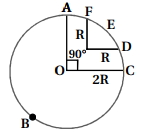
Solution
(D) The frictional force provides the necessary centripetal force for circular motion.
For a circular path of radius $r$,the maximum speed $v$ is given by $\frac{mv^2}{r} = \mu mg$,which simplifies to $v = \sqrt{\mu rg}$.
$1$. For path $ABC$ (radius $2R = 200 \, m$):
Length $L_1 = \frac{3}{4} \times (2\pi \times 2R) = 3\pi R = 300\pi \, m$.
Speed $v_1 = \sqrt{0.1 \times 200 \times 10} = \sqrt{200} \approx 14.14 \, m/s$.
Time $t_1 = \frac{300\pi}{14.14} \approx 66.66 \, s$.
$2$. For path $DEF$ (radius $R = 100 \, m$):
Length $L_2 = \frac{1}{4} \times (2\pi R) = \frac{\pi R}{2} = 50\pi \, m$.
Speed $v_2 = \sqrt{0.1 \times 100 \times 10} = 10 \, m/s$.
Time $t_2 = \frac{50\pi}{10} = 5\pi \approx 15.71 \, s$.
$3$. For straight paths $CD$ and $FA$ (length $R = 100 \, m$ each):
Total length $L_3 = R + R = 200 \, m$.
Speed $v_3 = 50 \, m/s$.
Time $t_3 = \frac{200}{50} = 4.0 \, s$.
Total time $T = t_1 + t_2 + t_3 = 66.66 + 15.71 + 4.0 = 86.37 \, s$.
For a circular path of radius $r$,the maximum speed $v$ is given by $\frac{mv^2}{r} = \mu mg$,which simplifies to $v = \sqrt{\mu rg}$.
$1$. For path $ABC$ (radius $2R = 200 \, m$):
Length $L_1 = \frac{3}{4} \times (2\pi \times 2R) = 3\pi R = 300\pi \, m$.
Speed $v_1 = \sqrt{0.1 \times 200 \times 10} = \sqrt{200} \approx 14.14 \, m/s$.
Time $t_1 = \frac{300\pi}{14.14} \approx 66.66 \, s$.
$2$. For path $DEF$ (radius $R = 100 \, m$):
Length $L_2 = \frac{1}{4} \times (2\pi R) = \frac{\pi R}{2} = 50\pi \, m$.
Speed $v_2 = \sqrt{0.1 \times 100 \times 10} = 10 \, m/s$.
Time $t_2 = \frac{50\pi}{10} = 5\pi \approx 15.71 \, s$.
$3$. For straight paths $CD$ and $FA$ (length $R = 100 \, m$ each):
Total length $L_3 = R + R = 200 \, m$.
Speed $v_3 = 50 \, m/s$.
Time $t_3 = \frac{200}{50} = 4.0 \, s$.
Total time $T = t_1 + t_2 + t_3 = 66.66 + 15.71 + 4.0 = 86.37 \, s$.
0 likes
View Solution199
Medium
$A$ helicopter of mass $2000 \,kg$ rises with a vertical acceleration of $15 \,m s^{-2}$. The total mass of the crew and passengers is $500 \,kg$. Calculate the magnitude and direction of the following (take $g = 10 \,m s^{-2}$):
$(a)$ Force on the floor of the helicopter by the crew and passengers.
$(b)$ Action of the rotor of the helicopter on the surrounding air.
$(c)$ Force on the helicopter due to the surrounding air.
$(a)$ Force on the floor of the helicopter by the crew and passengers.
$(b)$ Action of the rotor of the helicopter on the surrounding air.
$(c)$ Force on the helicopter due to the surrounding air.
Solution
(A) Given:
Mass of helicopter $m_{1} = 2000 \,kg$
Mass of crew and passengers $m_{2} = 500 \,kg$
Acceleration $a = 15 \,m s^{-2}$
Acceleration due to gravity $g = 10 \,m s^{-2}$
$(a)$ The force on the floor of the helicopter by the crew and passengers is the apparent weight $F_{1} = m_{2}(g + a)$.
$F_{1} = 500 \times (10 + 15) = 500 \times 25 = 12500 \,N$ (downward).
$(b)$ The action of the rotor on the surrounding air is equal to the total force required to lift the entire system (helicopter + crew + passengers) with acceleration $a$.
$F_{2} = (m_{1} + m_{2})(g + a) = (2000 + 500) \times (10 + 15) = 2500 \times 25 = 62500 \,N$ (downward).
$(c)$ By Newton's third law,the force on the helicopter due to the surrounding air is the reaction to the action force $F_{2}$.
$F_{3} = 62500 \,N$ (upward).
Mass of helicopter $m_{1} = 2000 \,kg$
Mass of crew and passengers $m_{2} = 500 \,kg$
Acceleration $a = 15 \,m s^{-2}$
Acceleration due to gravity $g = 10 \,m s^{-2}$
$(a)$ The force on the floor of the helicopter by the crew and passengers is the apparent weight $F_{1} = m_{2}(g + a)$.
$F_{1} = 500 \times (10 + 15) = 500 \times 25 = 12500 \,N$ (downward).
$(b)$ The action of the rotor on the surrounding air is equal to the total force required to lift the entire system (helicopter + crew + passengers) with acceleration $a$.
$F_{2} = (m_{1} + m_{2})(g + a) = (2000 + 500) \times (10 + 15) = 2500 \times 25 = 62500 \,N$ (downward).
$(c)$ By Newton's third law,the force on the helicopter due to the surrounding air is the reaction to the action force $F_{2}$.
$F_{3} = 62500 \,N$ (upward).
0 likes
View SolutionNewton's Laws of Motion and Friction — Mix Examples-Newton's Laws of Motion and Friction · Frequently Asked Questions
1Are these Newton's Laws of Motion and Friction questions useful for JEE and NEET?
Yes. All questions in this section are mapped to JEE Main and NEET exam patterns. Previous year questions from JEE Main, NEET, GUJCET and state-level exams are included with full solutions.
2Can I switch to Hindi or Gujarati for these questions?
Yes. Use the language tabs in the hero section or the sidebar to view the same questions and solutions in English, Hindi or Gujarati.
3How do I generate a question paper from this subtopic?
Use the Vedclass Exam Paper Generator — select the chapter and subtopic, set difficulty, and generate Sets A, B, C, D automatically. First 3 chapters of every subject are free.
Vedclass Products
For Students
Vedclass Test Series
Mock tests in real JEE/NEET style with performance analysis. 5-day free trial.
Start Free TrialFor Teachers
Exam Paper Generator
Generate Set A/B/C/D papers from this chapter in 2 minutes. 3 chapters free.
Try FreeFor Institutes
Online Exam Module
Live online exams with unlimited students, 360° analytics & white-label branding.
See DemoFor Teachers & Institutes
Generate a Newton's Laws of Motion and Friction Exam Paper in 2 Minutes
Select subtopic & difficulty — Sets A, B, C, D auto-generated with No Repeat logic.
First 3 chapters of every subject are free — no payment required.