
Class 11PhysicsNewton's Laws of Motion and FrictionMix Examples-Newton's Laws of Motion and Friction
Difficult$A$ force $F=t$ is applied to block $A$ as shown in the figure. The force is applied at $t=0$ seconds when the system was at rest and the string was just straight without tension. Which of the following graphs shows the friction force between block $B$ and the horizontal surface as a function of time $t$?
- A
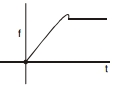
- B
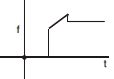
- C
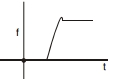
- D
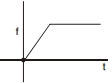
Explore More
Similar Questions
$A$ boy of mass $4 \, kg$ is standing on a piece of wood having mass $5 \, kg$. If the coefficient of friction between the wood and the floor is $0.5$,the maximum force that the boy can exert on the rope so that the piece of wood does not move from its place is ...... $N$. (Round off to the Nearest Integer) [Take $g = 10 \, m s^{-2}$]
DifficultJEE MAIN 2021
View SolutionConsider the following statements $A$ and $B$ and identify the correct answer given below:
$(A)$ $A$ body initially at rest is acted upon by a constant force. The rate of change of its kinetic energy varies linearly with time.
$(B)$ When a body is at rest,it must be in equilibrium.
$(A)$ $A$ body initially at rest is acted upon by a constant force. The rate of change of its kinetic energy varies linearly with time.
$(B)$ When a body is at rest,it must be in equilibrium.
$A$ $1\; kg$ block situated on a rough incline is connected to a spring of spring constant $100\; N m^{-1}$ as shown in the figure. The block is released from rest with the spring in the unstretched position. The block moves $10\; cm$ down the incline before coming to rest. Find the coefficient of friction between the block and the incline. Assume that the spring has a negligible mass and the pulley is frictionless.
Medium
View SolutionTwo wedges each of mass $600 \ g$ are placed next to each other on a rough horizontal surface. The coefficient of static friction between the wedges and the surface is $0.4$. $A$ cube of mass $M$ is balanced on the wedges as shown in the figure. If there is no friction between the cube and wedges,the largest mass $M$ of the cube that can be balanced without motion of the wedges is . . . . . . $kg$.
DifficultAP EAMCET 2017
View SolutionIn the following problem,indicate the correct direction of the friction force acting on the cylinder,which is pulled on a rough surface by a constant force $F$. $A$ spool is pulled horizontally by a constant force $F$ applied below the center of mass. Which of the following diagrams correctly shows the direction of the friction force?
Difficult
View SolutionVedclass Products
For Students
Vedclass Test Series
Mock tests in real JEE/NEET style with performance analysis. 5-day free trial.
Start Free TrialFor Teachers
Exam Paper Generator
Generate Set A/B/C/D exam papers from 7.5L+ questions in 2 minutes. 3 chapters free.
Try FreeFor Institutes
Online Exam Module
Live online exams with unlimited students, 360° analytics & white-label branding.
See Demo