
Class 11PhysicsNewton's Laws of Motion and FrictionMix Examples-Newton's Laws of Motion and Friction
Difficult$A$ block is placed on a rough horizontal plane. $A$ time-dependent horizontal force $F = Kt$ acts on the block,where $K$ is a positive constant. The acceleration-time graph of the block is:
- A
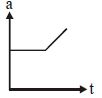
- B

- C
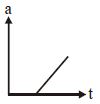
- D
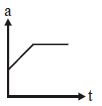
Explore More
Similar Questions
$A$ spring is compressed between two toy carts of masses $m_1$ and $m_2$. When the toy carts are released,the spring exerts equal and opposite forces for the same time $t$ on each toy cart. If the coefficients of friction $\mu$ between the ground and the toy carts are equal,then the ratio of the displacements of the toy carts is:
Difficult
View Solution$A$ $1.0 \ kg$ block of wood sits on top of an identical block of wood,which sits on top of a flat level table made of plastic. The coefficient of static friction between the wood surfaces is $\mu_1$,and the coefficient of static friction between the wood and plastic is $\mu_2$. $A$ horizontal force $F$ is applied to the top block only,and this force is increased until the top block starts to move. The bottom block will move with the top block if and only if
Difficult
View Solution$A$ block of mass $M = 10\,kg$ rests on a horizontal table. The coefficient of friction between the block and the table is $\mu = 0.05.$ When hit by a bullet of mass $m = 50\,g$ moving with speed $v,$ which gets embedded in it,the block moves and comes to a stop after moving a distance of $2\,m$ on the table. If a freely falling object were to acquire speed $\frac{v}{10}$ after being dropped from height $H,$ then neglecting energy losses and taking $g = 10\,m/s^2,$ the value of $H$ is close to ................. $km$.
DifficultJEE MAIN 2015
View SolutionAt the moment $t=0$, a time-dependent force $F=at$ (where $a$ is a constant equal to $1 \,Ns^{-1}$) is applied to a body of mass $1 \,kg$ resting on a smooth horizontal plane as shown in the figure. If the direction of this force makes an angle $45^{\circ}$ with the horizontal, then the velocity of the body at the moment it leaves the plane is (acceleration due to gravity $=10 \,ms^{-2}$)
Given $m_1 = 4m_2$. How much extra distance (in $cm$) does $m_2$ travel before coming to rest?
Difficult
View SolutionVedclass Products
For Students
Vedclass Test Series
Mock tests in real JEE/NEET style with performance analysis. 5-day free trial.
Start Free TrialFor Teachers
Exam Paper Generator
Generate Set A/B/C/D exam papers from 7.5L+ questions in 2 minutes. 3 chapters free.
Try FreeFor Institutes
Online Exam Module
Live online exams with unlimited students, 360° analytics & white-label branding.
See Demo