
A English
Acceleration Due to Gravity and its Variation Questions in English
Class 11 Physics · Gravitation · Acceleration Due to Gravity and its Variation
430+
Questions
English
Language
100%
With Solutions
Showing 50 of 430 questions in English
201
EasyMCQ
Give the value of acceleration due to gravity at height $12\, km$ from the surface of earth. (in $, m/s^2$)
A
$9.80$
B
$9.76$
C
$9.78$
D
$9.82$
Solution
(B) The acceleration due to gravity $g'$ at a height $h$ above the surface of the earth is given by the formula $g' = g(1 - \frac{2h}{R})$,where $g = 9.8\, m/s^2$ is the acceleration due to gravity at the surface,$h = 12\, km = 1.2 \times 10^4\, m$,and $R = 6400\, km = 6.4 \times 10^6\, m$ is the radius of the earth.
Substituting the values:
$g' = 9.8 \times (1 - \frac{2 \times 12}{6400})$
$g' = 9.8 \times (1 - \frac{24}{6400})$
$g' = 9.8 \times (1 - 0.00375)$
$g' = 9.8 \times 0.99625$
$g' \approx 9.763\, m/s^2$.
Thus,the value is approximately $9.76\, m/s^2$.
Substituting the values:
$g' = 9.8 \times (1 - \frac{2 \times 12}{6400})$
$g' = 9.8 \times (1 - \frac{24}{6400})$
$g' = 9.8 \times (1 - 0.00375)$
$g' = 9.8 \times 0.99625$
$g' \approx 9.763\, m/s^2$.
Thus,the value is approximately $9.76\, m/s^2$.
0 likes
View Solution202
Easy
What is the value of acceleration due to gravity $(g)$ at the centre of the Earth? What will be the variation of $g$ below and above the surface of the Earth?
Solution
(N/A) $1$. At the centre of the Earth,the distance from the centre $r = 0$. The formula for acceleration due to gravity at a depth $d$ is $g_d = g(1 - d/R)$,where $d = R$ at the centre. Thus,$g_{centre} = g(1 - R/R) = 0$. So,the value of $g$ at the centre of the Earth is $0 \ m/s^2$.
$2$. Below the surface: As we go deeper into the Earth (increasing depth $d$),the value of $g$ decreases linearly according to the formula $g_d = g(1 - d/R)$.
$3$. Above the surface: As we go higher above the surface (increasing height $h$),the value of $g$ decreases according to the formula $g_h = g(1 - 2h/R)$ for $h \ll R$,or more generally $g_h = gR^2 / (R + h)^2$. In both cases,$g$ decreases as height increases.
$2$. Below the surface: As we go deeper into the Earth (increasing depth $d$),the value of $g$ decreases linearly according to the formula $g_d = g(1 - d/R)$.
$3$. Above the surface: As we go higher above the surface (increasing height $h$),the value of $g$ decreases according to the formula $g_h = g(1 - 2h/R)$ for $h \ll R$,or more generally $g_h = gR^2 / (R + h)^2$. In both cases,$g$ decreases as height increases.
0 likes
View Solution203
MediumMCQ
Neglecting air resistance,is the acceleration due to gravity the same for both heavy and light objects?
A
Yes
B
No
C
Depends on the height
D
Depends on the shape
Solution
(A) Yes,the acceleration due to gravity $(g)$ is given by the formula $g = \frac{GM}{R^2}$,where $G$ is the universal gravitational constant,$M$ is the mass of the Earth,and $R$ is the radius of the Earth.
Since $g$ depends only on the mass of the Earth and its radius,it is independent of the mass of the falling object.
Therefore,in the absence of air resistance,all objects fall with the same acceleration regardless of their mass.
Since $g$ depends only on the mass of the Earth and its radius,it is independent of the mass of the falling object.
Therefore,in the absence of air resistance,all objects fall with the same acceleration regardless of their mass.
0 likes
View Solution204
MediumMCQ
State the values of $g$ and $G$ at the center of the Earth. Identify which of $g$ and $G$ is a vector and which is a scalar.
A
$g = 0, G = 0$; both are scalars.
B
$g = 0, G = 6.67 \times 10^{-11} \ Nm^2/kg^2$; $g$ is a vector,$G$ is a scalar.
C
$g = 9.8 \ m/s^2, G = 6.67 \times 10^{-11} \ Nm^2/kg^2$; both are vectors.
D
$g = 9.8 \ m/s^2, G = 0$; $g$ is a scalar,$G$ is a vector.
Solution
(B) $1$. At the center of the Earth,the acceleration due to gravity $(g)$ is $0$ because the net gravitational force acting on an object at the center is zero.
$2$. The universal gravitational constant $(G)$ is a fundamental constant of nature and its value remains $6.67 \times 10^{-11} \ Nm^2/kg^2$ everywhere in the universe,including the center of the Earth.
$3$. Acceleration due to gravity $(g)$ is a vector quantity because it has both magnitude and direction (towards the center of the Earth).
$4$. The universal gravitational constant $(G)$ is a scalar quantity as it has only magnitude.
$2$. The universal gravitational constant $(G)$ is a fundamental constant of nature and its value remains $6.67 \times 10^{-11} \ Nm^2/kg^2$ everywhere in the universe,including the center of the Earth.
$3$. Acceleration due to gravity $(g)$ is a vector quantity because it has both magnitude and direction (towards the center of the Earth).
$4$. The universal gravitational constant $(G)$ is a scalar quantity as it has only magnitude.
0 likes
View Solution205
Medium
At which location,the equator or the poles of the Earth,is the value of acceleration due to gravity $g$ higher? Why?
Solution
(B) The value of acceleration due to gravity $g$ is higher at the poles of the Earth.
This is because the Earth is not a perfect sphere; it is flattened at the poles and bulges at the equator.
The radius of the Earth at the poles $(R_p)$ is about $21 \, km$ less than the radius at the equator $(R_e)$.
According to the formula $g = \frac{GM}{R^2}$,the acceleration due to gravity is inversely proportional to the square of the radius $(g \propto \frac{1}{R^2})$.
Since the radius at the poles is smaller,the value of $g$ is greater at the poles compared to the equator.
This is because the Earth is not a perfect sphere; it is flattened at the poles and bulges at the equator.
The radius of the Earth at the poles $(R_p)$ is about $21 \, km$ less than the radius at the equator $(R_e)$.
According to the formula $g = \frac{GM}{R^2}$,the acceleration due to gravity is inversely proportional to the square of the radius $(g \propto \frac{1}{R^2})$.
Since the radius at the poles is smaller,the value of $g$ is greater at the poles compared to the equator.
0 likes
View Solution206
Medium
How can we conclude that the Earth is not a perfect sphere based on the acceleration due to gravity?
Solution
(N/A) The acceleration due to gravity is given by $g = \frac{GM_e}{R_e^2}$,which implies $g \propto \frac{1}{R_e^2}$. The Earth is slightly bulging at the equator,meaning the radius $R_e$ is larger at the equator,resulting in a lower value of $g$. Conversely,the Earth is flattened at the poles,meaning the radius $R_e$ is smaller at the poles,resulting in a higher value of $g$. Since $g$ varies with latitude,we can conclude that the Earth is not a perfect sphere.
0 likes
View Solution207
EasyMCQ
By approximately how many meters is the radius of the Earth at the equator greater than the radius of the Earth at the poles (in $,000 \ m$)?
A
$21$
B
$42$
C
$10$
D
$5$
Solution
(A) The Earth is not a perfect sphere; it is an oblate spheroid.
The equatorial radius $(R_e)$ is approximately $6,378 \ km$.
The polar radius $(R_p)$ is approximately $6,357 \ km$.
The difference between the equatorial radius and the polar radius is $\Delta R = R_e - R_p = 6,378 \ km - 6,357 \ km = 21 \ km$.
Since $1 \ km = 1,000 \ m$,the difference in meters is $21 \times 1,000 \ m = 21,000 \ m$.
The equatorial radius $(R_e)$ is approximately $6,378 \ km$.
The polar radius $(R_p)$ is approximately $6,357 \ km$.
The difference between the equatorial radius and the polar radius is $\Delta R = R_e - R_p = 6,378 \ km - 6,357 \ km = 21 \ km$.
Since $1 \ km = 1,000 \ m$,the difference in meters is $21 \times 1,000 \ m = 21,000 \ m$.
0 likes
View Solution208
EasyMCQ
As we move from the poles of the Earth towards the equator,what happens to the value of the acceleration due to gravity $(g)$?
A
It increases.
B
It decreases.
C
It remains constant.
D
It first increases and then decreases.
Solution
(B) The Earth is not a perfect sphere; it is flattened at the poles and bulges at the equator.
As a result,the radius of the Earth at the equator $(R_e)$ is greater than the radius at the poles $(R_p)$.
The formula for acceleration due to gravity is $g = \frac{GM}{R^2}$.
Since $g$ is inversely proportional to the square of the radius $(g \propto \frac{1}{R^2})$,a larger radius at the equator results in a smaller value of $g$.
Therefore,as we move from the poles towards the equator,the value of $g$ decreases.
As a result,the radius of the Earth at the equator $(R_e)$ is greater than the radius at the poles $(R_p)$.
The formula for acceleration due to gravity is $g = \frac{GM}{R^2}$.
Since $g$ is inversely proportional to the square of the radius $(g \propto \frac{1}{R^2})$,a larger radius at the equator results in a smaller value of $g$.
Therefore,as we move from the poles towards the equator,the value of $g$ decreases.
0 likes
View Solution209
EasyMCQ
As we move above the surface of the Earth,the value of acceleration due to gravity $g$ . . . . . . .
A
increases
B
decreases
C
remains constant
D
becomes zero
Solution
(B) The acceleration due to gravity at a height $h$ above the Earth's surface is given by the formula $g_h = g \left( 1 + \frac{h}{R_e} \right)^{-2}$,where $g$ is the acceleration due to gravity at the surface,$R_e$ is the radius of the Earth,and $h$ is the height.
As the height $h$ increases,the term $\left( 1 + \frac{h}{R_e} \right)$ increases,which causes the value of $g_h$ to decrease.
Therefore,the value of acceleration due to gravity decreases as we move above the surface of the Earth.
As the height $h$ increases,the term $\left( 1 + \frac{h}{R_e} \right)$ increases,which causes the value of $g_h$ to decrease.
Therefore,the value of acceleration due to gravity decreases as we move above the surface of the Earth.
0 likes
View Solution210
MediumMCQ
If the value of acceleration due to gravity on the surface of the Earth is $g$,what will be the value of $g$ at a height equal to the radius of the Earth from the surface?
A
$g/2$
B
$g/4$
C
$g/8$
D
$g$
Solution
(B) The acceleration due to gravity at the surface of the Earth is given by $g = \frac{GM_e}{R_e^2}$.
At a height $h = R_e$ above the surface,the acceleration due to gravity $g^{\prime}$ is given by the formula $g^{\prime} = \frac{GM_e}{(R_e + h)^2}$.
Substituting $h = R_e$ into the equation,we get $g^{\prime} = \frac{GM_e}{(R_e + R_e)^2} = \frac{GM_e}{(2R_e)^2}$.
This simplifies to $g^{\prime} = \frac{GM_e}{4R_e^2}$.
Since $g = \frac{GM_e}{R_e^2}$,we can write $g^{\prime} = \frac{g}{4}$.
At a height $h = R_e$ above the surface,the acceleration due to gravity $g^{\prime}$ is given by the formula $g^{\prime} = \frac{GM_e}{(R_e + h)^2}$.
Substituting $h = R_e$ into the equation,we get $g^{\prime} = \frac{GM_e}{(R_e + R_e)^2} = \frac{GM_e}{(2R_e)^2}$.
This simplifies to $g^{\prime} = \frac{GM_e}{4R_e^2}$.
Since $g = \frac{GM_e}{R_e^2}$,we can write $g^{\prime} = \frac{g}{4}$.
0 likes
View Solution211
EasyMCQ
If the radius of the Earth decreases without any change in its mass,will the value of $g$ on its surface increase or decrease?
A
Increase
B
Decrease
C
Remain the same
D
Become zero
Solution
(A) The acceleration due to gravity $g$ on the surface of the Earth is given by the formula $g = \frac{GM}{R^2}$,where $G$ is the universal gravitational constant,$M$ is the mass of the Earth,and $R$ is the radius of the Earth.
Since $G$ and $M$ are constant,we have $g \propto \frac{1}{R^2}$.
If the radius $R$ decreases,the denominator $R^2$ decreases.
Therefore,the value of $g$ will increase.
Since $G$ and $M$ are constant,we have $g \propto \frac{1}{R^2}$.
If the radius $R$ decreases,the denominator $R^2$ decreases.
Therefore,the value of $g$ will increase.
0 likes
View Solution212
MediumMCQ
If the radius of the Earth shrinks to $1/n$ of its present value while its mass remains constant,what will be the value of $g'_e$ on its surface?
A
$n g_e$
B
$n^2 g_e$
C
$g_e / n$
D
$g_e / n^2$
Solution
(B) The acceleration due to gravity on the surface of the Earth is given by $g_e = \frac{G M_e}{R_e^2}$.
Given that the new radius $R'_e = \frac{R_e}{n}$ and the mass $M_e$ remains constant.
The new acceleration due to gravity $g'_e$ is given by $g'_e = \frac{G M_e}{(R'_e)^2}$.
Substituting the value of $R'_e$,we get $g'_e = \frac{G M_e}{(R_e/n)^2} = \frac{G M_e n^2}{R_e^2}$.
Since $g_e = \frac{G M_e}{R_e^2}$,we can write $g'_e = n^2 g_e$.
Given that the new radius $R'_e = \frac{R_e}{n}$ and the mass $M_e$ remains constant.
The new acceleration due to gravity $g'_e$ is given by $g'_e = \frac{G M_e}{(R'_e)^2}$.
Substituting the value of $R'_e$,we get $g'_e = \frac{G M_e}{(R_e/n)^2} = \frac{G M_e n^2}{R_e^2}$.
Since $g_e = \frac{G M_e}{R_e^2}$,we can write $g'_e = n^2 g_e$.
0 likes
View Solution213
EasyMCQ
At which location on Earth is the effective acceleration due to gravity maximum?
A
At the equator
B
At the poles
C
At the center of the Earth
D
At a height of $100 \ km$ from the surface
Solution
(B) The effective acceleration due to gravity $g'$ at a latitude $\phi$ is given by $g' = g - \omega^2 R \cos^2 \phi$,where $g$ is the acceleration due to gravity at the poles,$\omega$ is the angular velocity of the Earth,and $R$ is the radius of the Earth.
At the poles,$\phi = 90^\circ$,so $\cos 90^\circ = 0$. Thus,$g' = g$,which is the maximum value.
At the equator,$\phi = 0^\circ$,so $\cos 0^\circ = 1$. Thus,$g' = g - \omega^2 R$,which is the minimum value.
At the poles,$\phi = 90^\circ$,so $\cos 90^\circ = 0$. Thus,$g' = g$,which is the maximum value.
At the equator,$\phi = 0^\circ$,so $\cos 0^\circ = 1$. Thus,$g' = g - \omega^2 R$,which is the minimum value.
0 likes
View Solution214
MediumMCQ
What should be the angular speed of the Earth about its axis so that the acceleration due to gravity at the equator becomes zero?
A
$\sqrt{\frac{g}{R_e}}$
B
$\sqrt{\frac{2g}{R_e}}$
C
$\frac{g}{R_e}$
D
$\sqrt{\frac{g}{2R_e}}$
Solution
(A) The effective acceleration due to gravity $g'$ at a latitude $\lambda$ is given by the formula: $g' = g - \omega^2 R_e \cos^2 \lambda$.
At the equator,the latitude $\lambda = 0^\circ$,so $\cos 0^\circ = 1$.
Substituting this into the equation,we get $g' = g - \omega^2 R_e$.
For the acceleration due to gravity to be zero at the equator,we set $g' = 0$.
Therefore,$0 = g - \omega^2 R_e$.
Rearranging the terms,we get $\omega^2 R_e = g$.
Solving for $\omega$,we find $\omega = \sqrt{\frac{g}{R_e}}$.
At the equator,the latitude $\lambda = 0^\circ$,so $\cos 0^\circ = 1$.
Substituting this into the equation,we get $g' = g - \omega^2 R_e$.
For the acceleration due to gravity to be zero at the equator,we set $g' = 0$.
Therefore,$0 = g - \omega^2 R_e$.
Rearranging the terms,we get $\omega^2 R_e = g$.
Solving for $\omega$,we find $\omega = \sqrt{\frac{g}{R_e}}$.
0 likes
View Solution215
MediumMCQ
The gravitational force of the Earth on a rocket at a height $h$ from the surface of the Earth is $\frac{1}{3}$ of the gravitational force on the surface of the Earth. Find the relationship between $h$ and $R_e$ (the radius of the Earth).
A
$h = R_e(\sqrt{3} - 1)$
B
$h = R_e(\sqrt{3} + 1)$
C
$h = R_e(3 - 1)$
D
$h = R_e(\sqrt{3})$
Solution
(A) The gravitational force at the surface of the Earth is $F_s = \frac{GM_e m}{R_e^2}$.
The gravitational force at height $h$ is $F_h = \frac{GM_e m}{(R_e + h)^2}$.
According to the problem,$F_h = \frac{1}{3} F_s$.
Substituting the expressions: $\frac{GM_e m}{(R_e + h)^2} = \frac{1}{3} \frac{GM_e m}{R_e^2}$.
Simplifying the equation: $(R_e + h)^2 = 3 R_e^2$.
Taking the square root on both sides: $R_e + h = \sqrt{3} R_e$.
Therefore,$h = \sqrt{3} R_e - R_e = R_e(\sqrt{3} - 1)$.
The gravitational force at height $h$ is $F_h = \frac{GM_e m}{(R_e + h)^2}$.
According to the problem,$F_h = \frac{1}{3} F_s$.
Substituting the expressions: $\frac{GM_e m}{(R_e + h)^2} = \frac{1}{3} \frac{GM_e m}{R_e^2}$.
Simplifying the equation: $(R_e + h)^2 = 3 R_e^2$.
Taking the square root on both sides: $R_e + h = \sqrt{3} R_e$.
Therefore,$h = \sqrt{3} R_e - R_e = R_e(\sqrt{3} - 1)$.
0 likes
View Solution216
MediumMCQ
If the radius of the Earth becomes double while its mass remains unchanged,what will be the change in the weight of an object of mass $m$ on the surface of the Earth?
A
It becomes double.
B
It becomes half.
C
It becomes one-fourth.
D
It remains the same.
Solution
(C) The weight of an object on the surface of the Earth is given by $W = mg = \frac{GM_e m}{R_e^2}$.
When the radius of the Earth is doubled,the new radius becomes $R_e' = 2R_e$.
The new weight $W'$ is given by $W' = \frac{GM_e m}{(2R_e)^2} = \frac{GM_e m}{4R_e^2}$.
Substituting the original weight $W$ into the equation,we get $W' = \frac{W}{4}$.
Therefore,the weight of the object becomes one-fourth of its original weight.
When the radius of the Earth is doubled,the new radius becomes $R_e' = 2R_e$.
The new weight $W'$ is given by $W' = \frac{GM_e m}{(2R_e)^2} = \frac{GM_e m}{4R_e^2}$.
Substituting the original weight $W$ into the equation,we get $W' = \frac{W}{4}$.
Therefore,the weight of the object becomes one-fourth of its original weight.
0 likes
View Solution217
MediumMCQ
If the radius of the Earth were to shrink by half,its mass remaining the same,what would be the weight of an object on its surface?
A
It would remain the same.
B
It would become half.
C
It would become double.
D
It would become four times.
Solution
(D) The weight of an object of mass $m$ on the surface of the Earth is given by $W = mg = \frac{GM_e m}{R_e^2}$.
When the radius of the Earth becomes half $(R' = \frac{R_e}{2})$ while the mass $M_e$ remains constant,the new acceleration due to gravity $g'$ is:
$g' = \frac{GM_e}{(R_e/2)^2} = \frac{GM_e}{R_e^2 / 4} = 4 \left( \frac{GM_e}{R_e^2} \right) = 4g$.
Therefore,the new weight $W'$ is:
$W' = mg' = m(4g) = 4W$.
Thus,the weight of the object becomes $4$ times its original weight.
When the radius of the Earth becomes half $(R' = \frac{R_e}{2})$ while the mass $M_e$ remains constant,the new acceleration due to gravity $g'$ is:
$g' = \frac{GM_e}{(R_e/2)^2} = \frac{GM_e}{R_e^2 / 4} = 4 \left( \frac{GM_e}{R_e^2} \right) = 4g$.
Therefore,the new weight $W'$ is:
$W' = mg' = m(4g) = 4W$.
Thus,the weight of the object becomes $4$ times its original weight.
0 likes
View Solution218
MediumMCQ
If the radius of the Earth were to shrink by half while its density remains constant,what would be the weight of an object on the surface of the Earth?
A
$W/4$
B
$W/2$
C
$W$
D
$2W$
Solution
(B) The acceleration due to gravity $g$ is given by $g = \frac{GM_e}{R_e^2}$.
Since mass $M_e = \text{Volume} \times \text{Density} = \frac{4}{3} \pi R_e^3 \rho$,we have $g = \frac{G}{R_e^2} (\frac{4}{3} \pi R_e^3 \rho) = \frac{4}{3} \pi G R_e \rho$.
This shows that $g \propto R_e$ when density $\rho$ is constant.
If the radius becomes $R_e' = \frac{R_e}{2}$,the new acceleration due to gravity $g'$ will be $g' = \frac{4}{3} \pi G (\frac{R_e}{2}) \rho = \frac{1}{2} g$.
Since weight $W = mg$,the new weight $W'$ is $W' = m g' = m (\frac{g}{2}) = \frac{W}{2}$.
Since mass $M_e = \text{Volume} \times \text{Density} = \frac{4}{3} \pi R_e^3 \rho$,we have $g = \frac{G}{R_e^2} (\frac{4}{3} \pi R_e^3 \rho) = \frac{4}{3} \pi G R_e \rho$.
This shows that $g \propto R_e$ when density $\rho$ is constant.
If the radius becomes $R_e' = \frac{R_e}{2}$,the new acceleration due to gravity $g'$ will be $g' = \frac{4}{3} \pi G (\frac{R_e}{2}) \rho = \frac{1}{2} g$.
Since weight $W = mg$,the new weight $W'$ is $W' = m g' = m (\frac{g}{2}) = \frac{W}{2}$.
0 likes
View Solution219
MediumMCQ
Two planets have radii $R_1$ and $R_2$ and densities $\rho_1$ and $\rho_2$ respectively. Find the ratio of the acceleration due to gravity on these planets.
A
$R_1 \rho_1 : R_2 \rho_2$
B
$R_1 \rho_2 : R_2 \rho_1$
C
$R_2 \rho_1 : R_1 \rho_2$
D
$R_2 \rho_2 : R_1 \rho_1$
Solution
(A) The acceleration due to gravity $g$ on the surface of a planet is given by $g = \frac{GM}{R^2}$.
Since the mass $M$ of a planet can be expressed in terms of its density $\rho$ and radius $R$ as $M = \rho \times V = \rho \times (\frac{4}{3} \pi R^3)$,we substitute this into the formula for $g$:
$g = \frac{G}{R^2} \times (\frac{4}{3} \pi R^3 \rho) = \frac{4}{3} \pi G R \rho$.
Therefore,the ratio of the acceleration due to gravity on the two planets is:
$\frac{g_1}{g_2} = \frac{\frac{4}{3} \pi G R_1 \rho_1}{\frac{4}{3} \pi G R_2 \rho_2} = \frac{R_1 \rho_1}{R_2 \rho_2}$.
Thus,the ratio is $R_1 \rho_1 : R_2 \rho_2$.
Since the mass $M$ of a planet can be expressed in terms of its density $\rho$ and radius $R$ as $M = \rho \times V = \rho \times (\frac{4}{3} \pi R^3)$,we substitute this into the formula for $g$:
$g = \frac{G}{R^2} \times (\frac{4}{3} \pi R^3 \rho) = \frac{4}{3} \pi G R \rho$.
Therefore,the ratio of the acceleration due to gravity on the two planets is:
$\frac{g_1}{g_2} = \frac{\frac{4}{3} \pi G R_1 \rho_1}{\frac{4}{3} \pi G R_2 \rho_2} = \frac{R_1 \rho_1}{R_2 \rho_2}$.
Thus,the ratio is $R_1 \rho_1 : R_2 \rho_2$.
0 likes
View Solution220
EasyMCQ
If the mass and radius of a planet are double those of the Earth,what will be the acceleration due to gravity on this planet compared to the acceleration due to gravity on Earth?
A
$g/4$
B
$g/2$
C
$g$
D
$2g$
Solution
(B) The acceleration due to gravity on the surface of a planet is given by $g = \frac{GM}{R^2}$.
For Earth,$g_e = \frac{GM_e}{R_e^2}$.
For the given planet,the mass $M_p = 2M_e$ and the radius $R_p = 2R_e$.
Substituting these values into the formula for the planet's gravity $g_p$:
$g_p = \frac{G(2M_e)}{(2R_e)^2}$
$g_p = \frac{2GM_e}{4R_e^2}$
$g_p = \frac{1}{2} \left( \frac{GM_e}{R_e^2} \right)$
Since $g_e = \frac{GM_e}{R_e^2}$,we get $g_p = \frac{g_e}{2}$.
Thus,the acceleration due to gravity on the planet is half that of Earth.
For Earth,$g_e = \frac{GM_e}{R_e^2}$.
For the given planet,the mass $M_p = 2M_e$ and the radius $R_p = 2R_e$.
Substituting these values into the formula for the planet's gravity $g_p$:
$g_p = \frac{G(2M_e)}{(2R_e)^2}$
$g_p = \frac{2GM_e}{4R_e^2}$
$g_p = \frac{1}{2} \left( \frac{GM_e}{R_e^2} \right)$
Since $g_e = \frac{GM_e}{R_e^2}$,we get $g_p = \frac{g_e}{2}$.
Thus,the acceleration due to gravity on the planet is half that of Earth.
0 likes
View Solution221
Difficult
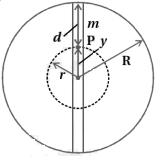
$A$ tunnel is dug through the centre of the earth. Show that a body of mass $m$ when dropped from rest from one end of the tunnel will execute simple harmonic motion.
Solution
(N/A) Consider a body of mass $m$ at a point $P$ inside a tunnel dug through the center of the Earth. Let the distance of point $P$ from the center of the Earth be $y$. According to the shell theorem,the gravitational force on the body at distance $y$ from the center is due only to the mass of the Earth contained within a sphere of radius $y$.
The mass of this inner sphere is $M' = \rho \cdot \frac{4}{3} \pi y^3$,where $\rho$ is the density of the Earth. Since $\rho = \frac{M}{\frac{4}{3} \pi R^3}$,we have $M' = M \left( \frac{y^3}{R^3} \right)$.
The gravitational force on the body is $F = -\frac{G M' m}{y^2} = -\frac{G M m y^3}{R^3 y^2} = -\left( \frac{G M m}{R^3} \right) y$.
Since $g = \frac{G M}{R^2}$,we can write $F = -\left( \frac{mg}{R} \right) y$.
This force is of the form $F = -ky$,where $k = \frac{mg}{R}$ is a constant. Since the restoring force is directly proportional to the displacement $y$ and directed towards the center,the body executes simple harmonic motion.
The mass of this inner sphere is $M' = \rho \cdot \frac{4}{3} \pi y^3$,where $\rho$ is the density of the Earth. Since $\rho = \frac{M}{\frac{4}{3} \pi R^3}$,we have $M' = M \left( \frac{y^3}{R^3} \right)$.
The gravitational force on the body is $F = -\frac{G M' m}{y^2} = -\frac{G M m y^3}{R^3 y^2} = -\left( \frac{G M m}{R^3} \right) y$.
Since $g = \frac{G M}{R^2}$,we can write $F = -\left( \frac{mg}{R} \right) y$.
This force is of the form $F = -ky$,where $k = \frac{mg}{R}$ is a constant. Since the restoring force is directly proportional to the displacement $y$ and directed towards the center,the body executes simple harmonic motion.
0 likes
View Solution222
MediumMCQ
How does the acceleration due to gravity $(g)$ at a location on Earth change with latitude?
A
It decreases as we move from the equator to the poles.
B
It increases as we move from the equator to the poles.
C
It remains constant at all latitudes.
D
It is maximum at the equator and minimum at the poles.
Solution
(B) The acceleration due to gravity on the surface of the Earth is given by the formula $g' = g - \omega^2 R \cos^2 \phi$,where $\phi$ is the latitude.
As we move from the equator $(\phi = 0^\circ)$ to the poles $(\phi = 90^\circ)$,the value of $\cos^2 \phi$ decreases.
Consequently,the term $\omega^2 R \cos^2 \phi$ decreases,which causes the effective acceleration due to gravity $(g')$ to increase.
Therefore,$g$ is minimum at the equator and maximum at the poles.
As we move from the equator $(\phi = 0^\circ)$ to the poles $(\phi = 90^\circ)$,the value of $\cos^2 \phi$ decreases.
Consequently,the term $\omega^2 R \cos^2 \phi$ decreases,which causes the effective acceleration due to gravity $(g')$ to increase.
Therefore,$g$ is minimum at the equator and maximum at the poles.
0 likes
View Solution223
MediumMCQ
Calculate the difference in the value of $g$ at the equator and at the poles due to the rotation of the Earth.
A
$R_{e} \omega^{2}$
B
$0$
C
$2 R_{e} \omega^{2}$
D
$\frac{1}{2} R_{e} \omega^{2}$
Solution
(A) The acceleration due to gravity at the poles $(g_{p})$ is given by $g_{p} = G M / R^{2}$.
At the equator,the effective acceleration due to gravity $(g_{e})$ is given by $g_{e} = g - R_{e} \omega^{2}$,where $R_{e}$ is the radius of the Earth and $\omega$ is the angular velocity of the Earth's rotation.
The difference in the value of $g$ between the poles and the equator is $\Delta g = g_{p} - g_{e}$.
Substituting the expressions: $\Delta g = g - (g - R_{e} \omega^{2})$.
Therefore,$\Delta g = R_{e} \omega^{2}$.
At the equator,the effective acceleration due to gravity $(g_{e})$ is given by $g_{e} = g - R_{e} \omega^{2}$,where $R_{e}$ is the radius of the Earth and $\omega$ is the angular velocity of the Earth's rotation.
The difference in the value of $g$ between the poles and the equator is $\Delta g = g_{p} - g_{e}$.
Substituting the expressions: $\Delta g = g - (g - R_{e} \omega^{2})$.
Therefore,$\Delta g = R_{e} \omega^{2}$.
0 likes
View Solution224
DifficultMCQ
Since the Earth is not a perfect sphere,what is the effect on the acceleration due to gravity $(g)$?
A
It is constant everywhere.
B
It is maximum at the equator.
C
It is maximum at the poles.
D
It is zero at the poles.
Solution
(C) The Earth is slightly flattened at the poles and bulges at the equator.
According to the formula $g = \frac{GM}{R_e^2}$,the acceleration due to gravity is inversely proportional to the square of the radius $(g \propto \frac{1}{R_e^2})$.
Since the radius at the poles $(R_p)$ is less than the radius at the equator $(R_e)$,the value of $g$ is greater at the poles than at the equator $(g_p > g_e)$.
According to the formula $g = \frac{GM}{R_e^2}$,the acceleration due to gravity is inversely proportional to the square of the radius $(g \propto \frac{1}{R_e^2})$.
Since the radius at the poles $(R_p)$ is less than the radius at the equator $(R_e)$,the value of $g$ is greater at the poles than at the equator $(g_p > g_e)$.
0 likes
View Solution225
Easy
At which location on Earth is the value of $g$ maximum? State the reasons.
Solution
(N/A) The value of $g$ is maximum at the poles.
Reasons:
$(i)$ The radius of the Earth is slightly smaller at the poles compared to the equator. Since $g = \frac{GM}{R^2}$,a smaller $R$ leads to a larger $g$.
$(ii)$ At the poles,the centrifugal force due to the Earth's rotation is zero,which means there is no reduction in the effective gravitational acceleration.
Reasons:
$(i)$ The radius of the Earth is slightly smaller at the poles compared to the equator. Since $g = \frac{GM}{R^2}$,a smaller $R$ leads to a larger $g$.
$(ii)$ At the poles,the centrifugal force due to the Earth's rotation is zero,which means there is no reduction in the effective gravitational acceleration.
0 likes
View Solution226
MediumMCQ
How does the rotation of the Earth affect the acceleration due to gravity on its surface?
A
It increases the acceleration due to gravity at the equator.
B
It decreases the acceleration due to gravity at the equator.
C
It has no effect on the acceleration due to gravity.
D
It increases the acceleration due to gravity at the poles.
Solution
(B) The effective acceleration due to gravity $g'$ at a latitude $\lambda$ is given by $g' = g - \omega^2 R \cos^2 \lambda$,where $g$ is the acceleration due to gravity without rotation,$\omega$ is the angular velocity of the Earth,and $R$ is the radius of the Earth.
Because of the term $\omega^2 R \cos^2 \lambda$,the rotation of the Earth causes a decrease in the effective acceleration due to gravity.
This effect is zero at the poles (where $\lambda = 90^\circ$) and maximum at the equator (where $\lambda = 0^\circ$).
Because of the term $\omega^2 R \cos^2 \lambda$,the rotation of the Earth causes a decrease in the effective acceleration due to gravity.
This effect is zero at the poles (where $\lambda = 90^\circ$) and maximum at the equator (where $\lambda = 0^\circ$).
0 likes
View Solution227
EasyMCQ
What is the effect on the value of $g$ at the equator if the Earth stops its rotation?
A
It increases by $R\omega^2$.
B
It decreases by $R\omega^2$.
C
It remains unchanged.
D
It becomes zero.
Solution
(A) The effective acceleration due to gravity at the equator is given by $g' = g - R\omega^2$,where $g$ is the acceleration due to gravity if the Earth were stationary,$R$ is the radius of the Earth,and $\omega$ is the angular velocity of the Earth's rotation.
If the Earth stops its rotation,then $\omega = 0$.
Therefore,the new value of $g$ becomes $g' = g$.
This means the value of $g$ at the equator increases by an amount equal to $R\omega^2$.
If the Earth stops its rotation,then $\omega = 0$.
Therefore,the new value of $g$ becomes $g' = g$.
This means the value of $g$ at the equator increases by an amount equal to $R\omega^2$.
0 likes
View Solution228
MediumMCQ
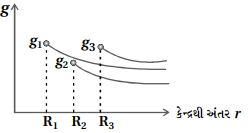
Different planets have masses $M_1, M_2, M_3$ and radii $R_1, R_2, R_3$ respectively. The acceleration due to gravity on their surfaces are $g_1, g_2, g_3$ respectively. Based on the given graph,arrange their masses in descending order.
A
$M_3 > M_1 > M_2$
B
$M_1 > M_2 > M_3$
C
$M_2 > M_1 > M_3$
D
$M_1 > M_3 > M_2$
Solution
(A) The acceleration due to gravity on the surface of a planet is given by $g = \frac{GM}{R^2}$,where $M$ is the mass and $R$ is the radius of the planet.
From the graph,we observe that at the surfaces,$g_1 = g_3 > g_2$.
For $g_1 = g_3$,we have $\frac{GM_1}{R_1^2} = \frac{GM_3}{R_3^2}$,which implies $\frac{M_1}{R_1^2} = \frac{M_3}{R_3^2}$.
Since $R_1 < R_3$,it follows that $R_1^2 < R_3^2$,and therefore $M_1 < M_3$.
Now,comparing $g_1$ and $g_2$,we have $g_1 > g_2$,so $\frac{GM_1}{R_1^2} > \frac{GM_2}{R_2^2}$.
Given the graph,$R_1 < R_2$ and $g_1 > g_2$,which leads to $M_1 > M_2$.
Combining these results,we get $M_3 > M_1 > M_2$.
From the graph,we observe that at the surfaces,$g_1 = g_3 > g_2$.
For $g_1 = g_3$,we have $\frac{GM_1}{R_1^2} = \frac{GM_3}{R_3^2}$,which implies $\frac{M_1}{R_1^2} = \frac{M_3}{R_3^2}$.
Since $R_1 < R_3$,it follows that $R_1^2 < R_3^2$,and therefore $M_1 < M_3$.
Now,comparing $g_1$ and $g_2$,we have $g_1 > g_2$,so $\frac{GM_1}{R_1^2} > \frac{GM_2}{R_2^2}$.
Given the graph,$R_1 < R_2$ and $g_1 > g_2$,which leads to $M_1 > M_2$.
Combining these results,we get $M_3 > M_1 > M_2$.
0 likes
View Solution229
Medium
An astronaut inside a small spaceship orbiting around the earth cannot detect gravity. If the space station orbiting around the earth has a large size,can he hope to detect gravity?
Solution
(A) Inside a small spaceship orbiting around the earth,the value of acceleration due to gravity $g$ is effectively constant throughout the interior,and the astronaut experiences weightlessness due to free fall.
If the space station orbiting around the earth has a large size,the variation in the gravitational field (tidal forces) across the dimensions of the station becomes significant. In such a case,the astronaut inside the spaceship will experience a non-uniform gravitational force and can detect the presence of gravity.
If the space station orbiting around the earth has a large size,the variation in the gravitational field (tidal forces) across the dimensions of the station becomes significant. In such a case,the astronaut inside the spaceship will experience a non-uniform gravitational force and can detect the presence of gravity.
0 likes
View Solution230
Easy
State whether the following statements are true or false:
$(a)$ $G$ is a vector quantity.
$(b)$ The relation $g = \frac{GM}{r^2}$ holds well for all celestial bodies.
$(c)$ If the Earth suddenly stops rotating,the value of acceleration due to gravity at the equator will decrease.
$(a)$ $G$ is a vector quantity.
$(b)$ The relation $g = \frac{GM}{r^2}$ holds well for all celestial bodies.
$(c)$ If the Earth suddenly stops rotating,the value of acceleration due to gravity at the equator will decrease.
Solution
(A) False. $G$ (Universal Gravitational Constant) is a scalar quantity.
$(b)$ True. The formula $g = \frac{GM}{r^2}$ is derived from Newton's Law of Gravitation and is applicable to all spherical celestial bodies.
$(c)$ False. The effective acceleration due to gravity at the equator is given by $g' = g - R\omega^2$. If the Earth stops rotating,$\omega = 0$,so $g' = g$. Since $g > (g - R\omega^2)$,the value of $g$ at the equator will actually increase.
$(b)$ True. The formula $g = \frac{GM}{r^2}$ is derived from Newton's Law of Gravitation and is applicable to all spherical celestial bodies.
$(c)$ False. The effective acceleration due to gravity at the equator is given by $g' = g - R\omega^2$. If the Earth stops rotating,$\omega = 0$,so $g' = g$. Since $g > (g - R\omega^2)$,the value of $g$ at the equator will actually increase.
0 likes
View Solution231
MediumMCQ
Match Column-$I$ with Column-$II$.
| Column-$I$ | Column-$II$ |
| $(1)$ Maximum value of acceleration due to gravity $g$ | $(a)$ At the center of the Earth |
| $(2)$ Minimum value of acceleration due to gravity $g$ | $(b)$ At the poles |
| $(3)$ Zero value of acceleration due to gravity $g$ | $(c)$ At the equator |
A
$(1-a), (2-c), (3-b)$
B
$(1-c), (2-b), (3-a)$
C
$(1-b), (2-c), (3-a)$
D
$(1-a), (2-b), (3-c)$
Solution
(C) The acceleration due to gravity $g$ on the surface of the Earth is given by $g = \frac{GM}{R^2}$.
$(1)$ The value of $g$ is maximum at the poles because the radius of the Earth $R$ is minimum at the poles $(R_{pole} < R_{equator})$.
$(2)$ The value of $g$ is minimum at the equator because the radius of the Earth $R$ is maximum at the equator.
$(3)$ The value of $g$ is zero at the center of the Earth because the mass of the Earth enclosed within a sphere of radius $r$ becomes zero as $r \to 0$.
Therefore,the correct matching is $(1-b), (2-c), (3-a)$.
$(1)$ The value of $g$ is maximum at the poles because the radius of the Earth $R$ is minimum at the poles $(R_{pole} < R_{equator})$.
$(2)$ The value of $g$ is minimum at the equator because the radius of the Earth $R$ is maximum at the equator.
$(3)$ The value of $g$ is zero at the center of the Earth because the mass of the Earth enclosed within a sphere of radius $r$ becomes zero as $r \to 0$.
Therefore,the correct matching is $(1-b), (2-c), (3-a)$.
0 likes
View Solution232
MediumMCQ
The acceleration due to gravity on the surface of the Earth is $g$. What is the acceleration due to gravity at a height $h = R$ above the Earth's surface,where $R$ is the radius of the Earth?
A
$g/2$
B
$g/3$
C
$g/4$
D
$g/9$
Solution
(C) The acceleration due to gravity at the surface of the Earth is given by $g = \frac{GM}{R^2}$,where $G$ is the gravitational constant,$M$ is the mass of the Earth,and $R$ is the radius of the Earth.
At a height $h$ above the surface,the acceleration due to gravity $g_h$ is given by the formula $g_h = \frac{GM}{(R+h)^2}$.
Given that $h = R$,we substitute this into the formula:
$g_h = \frac{GM}{(R+R)^2} = \frac{GM}{(2R)^2} = \frac{GM}{4R^2}$.
Since $g = \frac{GM}{R^2}$,we can write $g_h = \frac{1}{4} \left( \frac{GM}{R^2} \right) = \frac{g}{4}$.
Therefore,the acceleration due to gravity at a height $h = R$ is $g/4$.
At a height $h$ above the surface,the acceleration due to gravity $g_h$ is given by the formula $g_h = \frac{GM}{(R+h)^2}$.
Given that $h = R$,we substitute this into the formula:
$g_h = \frac{GM}{(R+R)^2} = \frac{GM}{(2R)^2} = \frac{GM}{4R^2}$.
Since $g = \frac{GM}{R^2}$,we can write $g_h = \frac{1}{4} \left( \frac{GM}{R^2} \right) = \frac{g}{4}$.
Therefore,the acceleration due to gravity at a height $h = R$ is $g/4$.
0 likes
View Solution233
Medium
The centre of gravity of a body on the earth coincides with its centre of mass for a small object,whereas for an extended object,it may not. What is the qualitative meaning of 'small' and 'extended' in this regard? For which of the following does the centre of gravity coincide with the centre of mass: a building,a pond,a lake,a mountain?
Solution
(A) The qualitative meaning of 'small' and 'extended' depends on the variation of the acceleration due to gravity $(g)$ over the dimensions of the object.
If the vertical height or dimensions of the object are very small compared to the radius of the earth $(R_e \approx 6400 \ km)$,the gravitational field is considered uniform,and the object is called 'small'. In this case,the centre of gravity coincides with the centre of mass.
If the dimensions of the object are large enough that the variation in $g$ becomes significant,the object is called 'extended'. In this case,the centre of gravity may not coincide with the centre of mass.
$(1)$ $A$ building and a pond are considered 'small' objects because their vertical extent is negligible compared to $R_e$. Thus,for these,the centre of gravity coincides with the centre of mass.
$(2)$ $A$ deep lake and a mountain are examples of 'extended' objects because their vertical extent is significant enough that the variation in $g$ cannot be ignored. Thus,for these,the centre of gravity may not coincide with the centre of mass.
If the vertical height or dimensions of the object are very small compared to the radius of the earth $(R_e \approx 6400 \ km)$,the gravitational field is considered uniform,and the object is called 'small'. In this case,the centre of gravity coincides with the centre of mass.
If the dimensions of the object are large enough that the variation in $g$ becomes significant,the object is called 'extended'. In this case,the centre of gravity may not coincide with the centre of mass.
$(1)$ $A$ building and a pond are considered 'small' objects because their vertical extent is negligible compared to $R_e$. Thus,for these,the centre of gravity coincides with the centre of mass.
$(2)$ $A$ deep lake and a mountain are examples of 'extended' objects because their vertical extent is significant enough that the variation in $g$ cannot be ignored. Thus,for these,the centre of gravity may not coincide with the centre of mass.
0 likes
View Solution234
DifficultMCQ
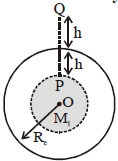
The height $h$ at which the weight of a body will be the same as that at the same depth $h$ from the surface of the earth is (Radius of the earth is $R$ and effect of the rotation of the earth is neglected):
A
$\frac{\sqrt{5} R - R }{2}$
B
$\frac{\sqrt{5}}{2} R - R$
C
$\frac{ R }{2}$
D
$\frac{\sqrt{3} R - R }{2}$
Solution
(A) Let $M$ be the mass of the earth and $R$ be its radius.
At a depth $h$ below the surface,the effective mass $M_1$ attracting the body is the mass of the sphere of radius $(R-h)$.
$M_1 = \frac{M}{\frac{4}{3} \pi R^3} \cdot \frac{4}{3} \pi (R-h)^3 = M \frac{(R-h)^3}{R^3}$.
The acceleration due to gravity at depth $h$ is $g_P = \frac{G M_1}{(R-h)^2} = \frac{G M (R-h)^3}{R^3 (R-h)^2} = \frac{G M (R-h)}{R^3}$.
The acceleration due to gravity at height $h$ above the surface is $g_Q = \frac{G M}{(R+h)^2}$.
Given that the weight is the same at both points,$g_P = g_Q$.
$\frac{G M (R-h)}{R^3} = \frac{G M}{(R+h)^2}$.
$(R-h)(R+h)^2 = R^3$.
$(R-h)(R^2 + 2Rh + h^2) = R^3$.
$R^3 + 2R^2h + Rh^2 - hR^2 - 2Rh^2 - h^3 = R^3$.
$R^2h - Rh^2 - h^3 = 0$.
Dividing by $h$ (since $h \neq 0$): $R^2 - Rh - h^2 = 0$.
$h^2 + Rh - R^2 = 0$.
Using the quadratic formula $h = \frac{-b \pm \sqrt{b^2 - 4ac}}{2a}$:
$h = \frac{-R \pm \sqrt{R^2 - 4(1)(-R^2)}}{2} = \frac{-R \pm \sqrt{5R^2}}{2}$.
Since $h > 0$,we take the positive root: $h = \frac{\sqrt{5}R - R}{2}$.
At a depth $h$ below the surface,the effective mass $M_1$ attracting the body is the mass of the sphere of radius $(R-h)$.
$M_1 = \frac{M}{\frac{4}{3} \pi R^3} \cdot \frac{4}{3} \pi (R-h)^3 = M \frac{(R-h)^3}{R^3}$.
The acceleration due to gravity at depth $h$ is $g_P = \frac{G M_1}{(R-h)^2} = \frac{G M (R-h)^3}{R^3 (R-h)^2} = \frac{G M (R-h)}{R^3}$.
The acceleration due to gravity at height $h$ above the surface is $g_Q = \frac{G M}{(R+h)^2}$.
Given that the weight is the same at both points,$g_P = g_Q$.
$\frac{G M (R-h)}{R^3} = \frac{G M}{(R+h)^2}$.
$(R-h)(R+h)^2 = R^3$.
$(R-h)(R^2 + 2Rh + h^2) = R^3$.
$R^3 + 2R^2h + Rh^2 - hR^2 - 2Rh^2 - h^3 = R^3$.
$R^2h - Rh^2 - h^3 = 0$.
Dividing by $h$ (since $h \neq 0$): $R^2 - Rh - h^2 = 0$.
$h^2 + Rh - R^2 = 0$.
Using the quadratic formula $h = \frac{-b \pm \sqrt{b^2 - 4ac}}{2a}$:
$h = \frac{-R \pm \sqrt{R^2 - 4(1)(-R^2)}}{2} = \frac{-R \pm \sqrt{5R^2}}{2}$.
Since $h > 0$,we take the positive root: $h = \frac{\sqrt{5}R - R}{2}$.
0 likes
View Solution235
DifficultMCQ
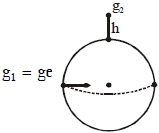
The acceleration due to gravity on the earth's surface at the poles is $g$ and the angular velocity of the earth about the axis passing through the poles is $\omega$. An object is weighed at the equator and at a height $h$ above the poles by using a spring balance. If the weights are found to be the same,then $h$ is: ($h << R$,where $R$ is the radius of the earth)
A
$\frac{R^{2} \omega^{2}}{8g}$
B
$\frac{R^{2} \omega^{2}}{4g}$
C
$\frac{R^{2} \omega^{2}}{g}$
D
$\frac{R^{2} \omega^{2}}{2g}$
Solution
(D) The effective acceleration due to gravity at the equator $(g_e)$ is given by $g_e = g - R\omega^2$,where $g$ is the acceleration due to gravity at the poles.
The acceleration due to gravity at a height $h$ above the poles $(g_h)$ is given by $g_h = g(1 - \frac{2h}{R}) = g - \frac{2gh}{R}$.
Given that the weights are the same at both locations,the effective acceleration due to gravity must be equal: $g_e = g_h$.
Substituting the expressions: $g - R\omega^2 = g - \frac{2gh}{R}$.
Simplifying the equation: $R\omega^2 = \frac{2gh}{R}$.
Solving for $h$: $h = \frac{R^2\omega^2}{2g}$.
The acceleration due to gravity at a height $h$ above the poles $(g_h)$ is given by $g_h = g(1 - \frac{2h}{R}) = g - \frac{2gh}{R}$.
Given that the weights are the same at both locations,the effective acceleration due to gravity must be equal: $g_e = g_h$.
Substituting the expressions: $g - R\omega^2 = g - \frac{2gh}{R}$.
Simplifying the equation: $R\omega^2 = \frac{2gh}{R}$.
Solving for $h$: $h = \frac{R^2\omega^2}{2g}$.
0 likes
View Solution236
DifficultMCQ
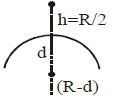
The value of the acceleration due to gravity is $g_{1}$ at a height $h = \frac{R}{2}$ ($R$ = radius of the earth) from the surface of the earth. It is again equal to $g_{1}$ at a depth $d$ below the surface of the earth. The ratio $\left(\frac{d}{R}\right)$ equals
A
$\frac{7}{9}$
B
$\frac{4}{9}$
C
$\frac{1}{3}$
D
$\frac{5}{9}$
Solution
(D) The acceleration due to gravity at a height $h$ is given by $g_{h} = \frac{GM}{(R+h)^{2}}$.
Given $h = \frac{R}{2}$,we have $g_{1} = \frac{GM}{(R + R/2)^{2}} = \frac{GM}{(3R/2)^{2}} = \frac{4GM}{9R^{2}} \ldots(1)$
The acceleration due to gravity at a depth $d$ is given by $g_{d} = g(1 - \frac{d}{R}) = \frac{GM}{R^{2}}(1 - \frac{d}{R}) = \frac{GM(R-d)}{R^{3}} \ldots(2)$
Since $g_{1} = g_{d}$,we equate equations $(1)$ and $(2)$:
$\frac{4GM}{9R^{2}} = \frac{GM(R-d)}{R^{3}}$
$\frac{4}{9} = \frac{R-d}{R}$
$\frac{4}{9} = 1 - \frac{d}{R}$
$\frac{d}{R} = 1 - \frac{4}{9} = \frac{5}{9}$
Given $h = \frac{R}{2}$,we have $g_{1} = \frac{GM}{(R + R/2)^{2}} = \frac{GM}{(3R/2)^{2}} = \frac{4GM}{9R^{2}} \ldots(1)$
The acceleration due to gravity at a depth $d$ is given by $g_{d} = g(1 - \frac{d}{R}) = \frac{GM}{R^{2}}(1 - \frac{d}{R}) = \frac{GM(R-d)}{R^{3}} \ldots(2)$
Since $g_{1} = g_{d}$,we equate equations $(1)$ and $(2)$:
$\frac{4GM}{9R^{2}} = \frac{GM(R-d)}{R^{3}}$
$\frac{4}{9} = \frac{R-d}{R}$
$\frac{4}{9} = 1 - \frac{d}{R}$
$\frac{d}{R} = 1 - \frac{4}{9} = \frac{5}{9}$
0 likes
View Solution237
MediumMCQ
What is the depth at which the value of acceleration due to gravity becomes $\frac{1}{n}$ times the value at the surface of the Earth? (radius of Earth $= R$)
A
$\frac{R}{n}$
B
$\frac{R}{n^{2}}$
C
$\frac{R(n-1)}{n}$
D
$\frac{Rn}{n-1}$
Solution
(C) The value of acceleration due to gravity at a depth $d$ below the surface of the Earth is given by the formula:
$g' = g \left(1 - \frac{d}{R}\right)$
where $g$ is the acceleration due to gravity at the surface and $R$ is the radius of the Earth.
According to the problem,the value of acceleration at depth $d$ is $\frac{1}{n}$ times the value at the surface:
$g' = \frac{g}{n}$
Substituting this into the formula:
$\frac{g}{n} = g \left(1 - \frac{d}{R}\right)$
Dividing both sides by $g$:
$\frac{1}{n} = 1 - \frac{d}{R}$
Rearranging the terms to solve for $d$:
$\frac{d}{R} = 1 - \frac{1}{n}$
$\frac{d}{R} = \frac{n-1}{n}$
$d = R \left(\frac{n-1}{n}\right)$
$g' = g \left(1 - \frac{d}{R}\right)$
where $g$ is the acceleration due to gravity at the surface and $R$ is the radius of the Earth.
According to the problem,the value of acceleration at depth $d$ is $\frac{1}{n}$ times the value at the surface:
$g' = \frac{g}{n}$
Substituting this into the formula:
$\frac{g}{n} = g \left(1 - \frac{d}{R}\right)$
Dividing both sides by $g$:
$\frac{1}{n} = 1 - \frac{d}{R}$
Rearranging the terms to solve for $d$:
$\frac{d}{R} = 1 - \frac{1}{n}$
$\frac{d}{R} = \frac{n-1}{n}$
$d = R \left(\frac{n-1}{n}\right)$
1 likes
View Solution238
DifficultMCQ
The weight of a body on the surface of the earth is $63 \ N$. What is the gravitational force on it due to the earth at a height equal to half the radius of the earth? (in $N$)
A
$35$
B
$28$
C
$18$
D
$40$
Solution
(B) Acceleration due to gravity at altitude $h$ is given by the formula:
$g^{\prime} = \frac{g}{(1 + \frac{h}{R_{e}})^2}$
Given $h = \frac{R_{e}}{2}$,we substitute this into the equation:
$g^{\prime} = \frac{g}{(1 + \frac{R_{e}/2}{R_{e}})^2} = \frac{g}{(1 + \frac{1}{2})^2} = \frac{g}{(\frac{3}{2})^2} = \frac{4g}{9} \dots(i)$
Weight of the body at the earth's surface is $w = mg = 63 \ N \dots(ii)$
Weight of the body at altitude $h = \frac{R_{e}}{2}$ is $w^{\prime} = mg^{\prime} = m(\frac{4g}{9}) = \frac{4}{9}mg \dots(iii)$
Substituting the value from equation $(ii)$ into equation $(iii)$:
$w^{\prime} = \frac{4}{9} \times 63 = 4 \times 7 = 28 \ N$
$g^{\prime} = \frac{g}{(1 + \frac{h}{R_{e}})^2}$
Given $h = \frac{R_{e}}{2}$,we substitute this into the equation:
$g^{\prime} = \frac{g}{(1 + \frac{R_{e}/2}{R_{e}})^2} = \frac{g}{(1 + \frac{1}{2})^2} = \frac{g}{(\frac{3}{2})^2} = \frac{4g}{9} \dots(i)$
Weight of the body at the earth's surface is $w = mg = 63 \ N \dots(ii)$
Weight of the body at altitude $h = \frac{R_{e}}{2}$ is $w^{\prime} = mg^{\prime} = m(\frac{4g}{9}) = \frac{4}{9}mg \dots(iii)$
Substituting the value from equation $(ii)$ into equation $(iii)$:
$w^{\prime} = \frac{4}{9} \times 63 = 4 \times 7 = 28 \ N$
0 likes
View Solution239
MediumMCQ
If the radius of the earth is $6347 \, km$,then what will be the difference between the acceleration of free fall and the acceleration due to gravity near the earth's surface?
A
$0.0340$
B
$0.3400$
C
$0.00334$
D
$0.24$
Solution
(A) The acceleration due to gravity $(g)$ near the earth's surface is given by $g = \frac{GM}{R^2} \approx 9.8 \, m/s^2$.
The acceleration of free fall $(g_{\text{eff}})$ considering the rotation of the earth is given by $g_{\text{eff}} = g - \omega^2 R \cos^2 \phi$. Near the equator $(\phi = 0)$,this becomes $g_{\text{eff}} = g - \omega^2 R$.
The difference between the acceleration due to gravity and the acceleration of free fall is $\Delta g = g - g_{\text{eff}} = \omega^2 R$.
Given $R = 6347 \times 10^3 \, m$ and the angular velocity of the earth $\omega = \frac{2\pi}{T}$,where $T = 24 \times 3600 \, s$.
$\Delta g = \left(\frac{2\pi}{86400}\right)^2 \times 6347 \times 10^3$.
$\Delta g = \left(\frac{6.283}{86400}\right)^2 \times 6347000 \approx (7.27 \times 10^{-5})^2 \times 6347000$.
$\Delta g \approx 5.285 \times 10^{-9} \times 6347000 \approx 0.0335 \, m/s^2 \approx 0.0340 \, m/s^2$.
The acceleration of free fall $(g_{\text{eff}})$ considering the rotation of the earth is given by $g_{\text{eff}} = g - \omega^2 R \cos^2 \phi$. Near the equator $(\phi = 0)$,this becomes $g_{\text{eff}} = g - \omega^2 R$.
The difference between the acceleration due to gravity and the acceleration of free fall is $\Delta g = g - g_{\text{eff}} = \omega^2 R$.
Given $R = 6347 \times 10^3 \, m$ and the angular velocity of the earth $\omega = \frac{2\pi}{T}$,where $T = 24 \times 3600 \, s$.
$\Delta g = \left(\frac{2\pi}{86400}\right)^2 \times 6347 \times 10^3$.
$\Delta g = \left(\frac{6.283}{86400}\right)^2 \times 6347000 \approx (7.27 \times 10^{-5})^2 \times 6347000$.
$\Delta g \approx 5.285 \times 10^{-9} \times 6347000 \approx 0.0335 \, m/s^2 \approx 0.0340 \, m/s^2$.
0 likes
View Solution240
MediumMCQ
Find the gravitational field at a distance of $2000\, km$ from the center of the Earth. (in $m/s^2$)
(Given: $R_{\text{earth}} = 6400\, km$,$r = 2000\, km$,$M_{\text{earth}} = 6 \times 10^{24}\, kg$)
(Given: $R_{\text{earth}} = 6400\, km$,$r = 2000\, km$,$M_{\text{earth}} = 6 \times 10^{24}\, kg$)
A
$1.53$
B
$7.12$
C
$3.06$
D
$1.8$
Solution
(C) The gravitational field $g'$ inside the Earth at a distance $r$ from the center is given by the formula:
$g' = \frac{G M r}{R^3}$
We know that the acceleration due to gravity at the surface is $g = \frac{G M}{R^2} \approx 9.8\, m/s^2$.
Substituting $g$ into the formula,we get:
$g' = g \times \frac{r}{R}$
Given values:
$g = 9.8\, m/s^2$
$r = 2000\, km$
$R = 6400\, km$
Calculating the value:
$g' = 9.8 \times \frac{2000}{6400}$
$g' = 9.8 \times \frac{20}{64}$
$g' = 9.8 \times 0.3125$
$g' = 3.0625\, m/s^2$
Rounding to two decimal places,we get $3.06\, m/s^2$.
$g' = \frac{G M r}{R^3}$
We know that the acceleration due to gravity at the surface is $g = \frac{G M}{R^2} \approx 9.8\, m/s^2$.
Substituting $g$ into the formula,we get:
$g' = g \times \frac{r}{R}$
Given values:
$g = 9.8\, m/s^2$
$r = 2000\, km$
$R = 6400\, km$
Calculating the value:
$g' = 9.8 \times \frac{2000}{6400}$
$g' = 9.8 \times \frac{20}{64}$
$g' = 9.8 \times 0.3125$
$g' = 3.0625\, m/s^2$
Rounding to two decimal places,we get $3.06\, m/s^2$.
0 likes
View Solution241
DifficultMCQ
$A$ planet has the same density as that of the Earth,and the universal gravitational constant $G$ is twice that of the Earth. The ratio of the acceleration due to gravity on the planet to that on the Earth is:
A
$1:4$
B
$1:5$
C
$1:2$
D
$2:1$
Solution
(D) The acceleration due to gravity at the surface of a planet is given by $g = \frac{GM}{R^2}$.
Since $M = V \rho = \frac{4}{3} \pi R^3 \rho$,we can write $g = \frac{G (\frac{4}{3} \pi R^3 \rho)}{R^2} = \frac{4}{3} \pi G \rho R$.
Assuming the radius of the planet is the same as the Earth $(R_p = R_e)$ unless otherwise specified,or evaluating the ratio based on the given constants:
Given $\rho_p = \rho_e$ and $G_p = 2G_e$.
The ratio of acceleration due to gravity is $\frac{g_p}{g_e} = \frac{\frac{4}{3} \pi G_p \rho_p R_p}{\frac{4}{3} \pi G_e \rho_e R_e}$.
Assuming $R_p = R_e$,we get $\frac{g_p}{g_e} = \frac{G_p}{G_e} = \frac{2G_e}{G_e} = 2$.
Thus,the ratio is $2:1$.
Since $M = V \rho = \frac{4}{3} \pi R^3 \rho$,we can write $g = \frac{G (\frac{4}{3} \pi R^3 \rho)}{R^2} = \frac{4}{3} \pi G \rho R$.
Assuming the radius of the planet is the same as the Earth $(R_p = R_e)$ unless otherwise specified,or evaluating the ratio based on the given constants:
Given $\rho_p = \rho_e$ and $G_p = 2G_e$.
The ratio of acceleration due to gravity is $\frac{g_p}{g_e} = \frac{\frac{4}{3} \pi G_p \rho_p R_p}{\frac{4}{3} \pi G_e \rho_e R_e}$.
Assuming $R_p = R_e$,we get $\frac{g_p}{g_e} = \frac{G_p}{G_e} = \frac{2G_e}{G_e} = 2$.
Thus,the ratio is $2:1$.
0 likes
View Solution242
MediumMCQ
If the angular velocity of earth's spin is increased such that the bodies at the equator start floating,the duration of the day would be approximately ........ minutes
(Take: $g = 10 \, m/s^2$,the radius of earth,$R = 6400 \times 10^3 \, m$,Take $\pi = 3.14$)
(Take: $g = 10 \, m/s^2$,the radius of earth,$R = 6400 \times 10^3 \, m$,Take $\pi = 3.14$)
A
$60$
B
$480$
C
$1200$
D
$84$
Solution
(D) For bodies at the equator to start floating,the gravitational force must be equal to the required centripetal force.
$mg = m \omega^2 R$
where $\omega$ is the angular velocity of the Earth and $R$ is the radius of the Earth.
Solving for $\omega$:
$\omega = \sqrt{\frac{g}{R}}$
The duration of the day $T$ is given by $T = \frac{2\pi}{\omega}$.
Substituting $\omega$:
$T = 2\pi \sqrt{\frac{R}{g}}$
Given $g = 10 \, m/s^2$ and $R = 6400 \times 10^3 \, m$:
$T = 2 \times 3.14 \times \sqrt{\frac{6400 \times 10^3}{10}}$
$T = 6.28 \times \sqrt{640000}$
$T = 6.28 \times 800 = 5024 \, s$
To convert the duration into minutes:
$T_{\text{min}} = \frac{5024}{60} \approx 83.73 \, \text{minutes}$
Rounding to the nearest integer,the duration is approximately $84 \, \text{minutes}$.
$mg = m \omega^2 R$
where $\omega$ is the angular velocity of the Earth and $R$ is the radius of the Earth.
Solving for $\omega$:
$\omega = \sqrt{\frac{g}{R}}$
The duration of the day $T$ is given by $T = \frac{2\pi}{\omega}$.
Substituting $\omega$:
$T = 2\pi \sqrt{\frac{R}{g}}$
Given $g = 10 \, m/s^2$ and $R = 6400 \times 10^3 \, m$:
$T = 2 \times 3.14 \times \sqrt{\frac{6400 \times 10^3}{10}}$
$T = 6.28 \times \sqrt{640000}$
$T = 6.28 \times 800 = 5024 \, s$
To convert the duration into minutes:
$T_{\text{min}} = \frac{5024}{60} \approx 83.73 \, \text{minutes}$
Rounding to the nearest integer,the duration is approximately $84 \, \text{minutes}$.
0 likes
View Solution243
MediumMCQ
$A$ body weighs $49 \, N$ on a spring balance at the North Pole. What will be its weight recorded on the same weighing machine if it is shifted to the equator (in $, N$)? (Use $g = \frac{GM}{R^2} = 9.8 \, m/s^2$ and radius of the Earth,$R = 6400 \, km$.)
A
$49$
B
$48.83$
C
$49.83$
D
$49.17$
Solution
(B) The weight of the body at the poles is given by $W_p = mg = 49 \, N$.
Since $g = 9.8 \, m/s^2$,the mass of the body is $m = \frac{49}{9.8} = 5 \, kg$.
At the equator,the effective acceleration due to gravity is $g_e = g - R\omega^2$,where $\omega$ is the angular velocity of the Earth.
The angular velocity $\omega = \frac{2\pi}{T}$,where $T = 24 \times 3600 \, s$.
$R\omega^2 = R \left(\frac{2\pi}{T}\right)^2 = 6.4 \times 10^6 \times \left(\frac{2 \times 3.14}{86400}\right)^2 \approx 0.0337 \, m/s^2$.
The weight at the equator is $W_e = m(g - R\omega^2) = 5 \times (9.8 - 0.0337) = 5 \times 9.7663 = 48.8315 \, N$.
Rounding to two decimal places,the weight is $48.83 \, N$.
Since $g = 9.8 \, m/s^2$,the mass of the body is $m = \frac{49}{9.8} = 5 \, kg$.
At the equator,the effective acceleration due to gravity is $g_e = g - R\omega^2$,where $\omega$ is the angular velocity of the Earth.
The angular velocity $\omega = \frac{2\pi}{T}$,where $T = 24 \times 3600 \, s$.
$R\omega^2 = R \left(\frac{2\pi}{T}\right)^2 = 6.4 \times 10^6 \times \left(\frac{2 \times 3.14}{86400}\right)^2 \approx 0.0337 \, m/s^2$.
The weight at the equator is $W_e = m(g - R\omega^2) = 5 \times (9.8 - 0.0337) = 5 \times 9.7663 = 48.8315 \, N$.
Rounding to two decimal places,the weight is $48.83 \, N$.
0 likes
View Solution244
DifficultMCQ
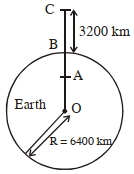
In the provided figure of the Earth,the value of acceleration due to gravity is the same at points $A$ and $C$,but it is smaller than its value at point $B$ (surface of the Earth). The value of $OA : AB$ is $x : y$. The value of $x$ is $\ldots \ldots \ldots$
A
$3$
B
$5$
C
$4$
D
$6$
Solution
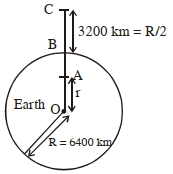
(C) Let $R$ be the radius of the Earth. Point $A$ is at a distance $r$ from the center $O$ inside the Earth. Point $C$ is at a height $h = 3200 \text{ km} = R/2$ above the surface $B$.
The acceleration due to gravity at point $A$ (inside the Earth) is given by $g_A = \frac{G M r}{R^3}$.
The acceleration due to gravity at point $C$ (outside the Earth) is given by $g_C = \frac{G M}{(R + h)^2} = \frac{G M}{(R + R/2)^2} = \frac{G M}{(3R/2)^2} = \frac{4 G M}{9 R^2}$.
Given that $g_A = g_C$,we equate the expressions:
$\frac{G M r}{R^3} = \frac{4 G M}{9 R^2}$
Solving for $r$:
$r = \frac{4 R}{9}$.
Thus,$OA = r = \frac{4 R}{9}$.
The distance $AB = R - r = R - \frac{4 R}{9} = \frac{5 R}{9}$.
Therefore,the ratio $OA : AB = \frac{4 R}{9} : \frac{5 R}{9} = 4 : 5$.
Since the ratio is $x : y = 4 : 5$,the value of $x$ is $4$.
The acceleration due to gravity at point $A$ (inside the Earth) is given by $g_A = \frac{G M r}{R^3}$.
The acceleration due to gravity at point $C$ (outside the Earth) is given by $g_C = \frac{G M}{(R + h)^2} = \frac{G M}{(R + R/2)^2} = \frac{G M}{(3R/2)^2} = \frac{4 G M}{9 R^2}$.
Given that $g_A = g_C$,we equate the expressions:
$\frac{G M r}{R^3} = \frac{4 G M}{9 R^2}$
Solving for $r$:
$r = \frac{4 R}{9}$.
Thus,$OA = r = \frac{4 R}{9}$.
The distance $AB = R - r = R - \frac{4 R}{9} = \frac{5 R}{9}$.
Therefore,the ratio $OA : AB = \frac{4 R}{9} : \frac{5 R}{9} = 4 : 5$.
Since the ratio is $x : y = 4 : 5$,the value of $x$ is $4$.
0 likes
View Solution245
DifficultMCQ
If $R_{E}$ is the radius of the Earth,then the ratio between the acceleration due to gravity at a depth $r$ below and a height $r$ above the Earth's surface is: (Given: $r < R_{E}$)
A
$1-\frac{r}{R_{E}}-\frac{r^{2}}{R_{E}^{2}}-\frac{r^{3}}{R_{E}^{3}}$
B
$1+\frac{r}{R_{E}}+\frac{r^{2}}{R_{E}^{2}}+\frac{r^{3}}{R_{E}^{3}}$
C
$1+\frac{r}{R_{E}}-\frac{r^{2}}{R_{E}^{2}}+\frac{r^{3}}{R_{E}^{3}}$
D
$1+\frac{r}{R_{E}}-\frac{r^{2}}{R_{E}^{2}}-\frac{r^{3}}{R_{E}^{3}}$
Solution
(D) The acceleration due to gravity at a height $r$ above the Earth's surface is given by $g_{up} = \frac{g}{(1 + \frac{r}{R_{E}})^{2}}$.
The acceleration due to gravity at a depth $r$ below the Earth's surface is given by $g_{down} = g(1 - \frac{r}{R_{E}})$.
The ratio of acceleration due to gravity at depth $r$ to that at height $r$ is:
$\frac{g_{down}}{g_{up}} = \frac{g(1 - \frac{r}{R_{E}})}{\frac{g}{(1 + \frac{r}{R_{E}})^{2}}} = (1 - \frac{r}{R_{E}})(1 + \frac{r}{R_{E}})^{2}$.
Expanding the expression:
$= (1 - \frac{r}{R_{E}})(1 + \frac{2r}{R_{E}} + \frac{r^{2}}{R_{E}^{2}})$
$= 1 + \frac{2r}{R_{E}} + \frac{r^{2}}{R_{E}^{2}} - \frac{r}{R_{E}} - \frac{2r^{2}}{R_{E}^{2}} - \frac{r^{3}}{R_{E}^{3}}$
$= 1 + \frac{r}{R_{E}} - \frac{r^{2}}{R_{E}^{2}} - \frac{r^{3}}{R_{E}^{3}}$.
The acceleration due to gravity at a depth $r$ below the Earth's surface is given by $g_{down} = g(1 - \frac{r}{R_{E}})$.
The ratio of acceleration due to gravity at depth $r$ to that at height $r$ is:
$\frac{g_{down}}{g_{up}} = \frac{g(1 - \frac{r}{R_{E}})}{\frac{g}{(1 + \frac{r}{R_{E}})^{2}}} = (1 - \frac{r}{R_{E}})(1 + \frac{r}{R_{E}})^{2}$.
Expanding the expression:
$= (1 - \frac{r}{R_{E}})(1 + \frac{2r}{R_{E}} + \frac{r^{2}}{R_{E}^{2}})$
$= 1 + \frac{2r}{R_{E}} + \frac{r^{2}}{R_{E}^{2}} - \frac{r}{R_{E}} - \frac{2r^{2}}{R_{E}^{2}} - \frac{r^{3}}{R_{E}^{3}}$
$= 1 + \frac{r}{R_{E}} - \frac{r^{2}}{R_{E}^{2}} - \frac{r^{3}}{R_{E}^{3}}$.
0 likes
View Solution246
MediumMCQ
Consider a planet in some solar system which has a mass double the mass of Earth and density equal to the average density of Earth. If the weight of an object on Earth is $W$,then the weight of the same object on that planet will be
A
$\sqrt{2} W$
B
$2 W$
C
$W$
D
$2^{1/3} W$
Solution
(D) Given that the density of the planet is equal to the density of Earth,$\rho_p = \rho_e$.
Since density $\rho = \frac{M}{\frac{4}{3}\pi R^3}$,we have $\frac{M_p}{R_p^3} = \frac{M_e}{R_e^3}$.
This implies $\frac{R_p}{R_e} = \left(\frac{M_p}{M_e}\right)^{1/3}$.
Given $M_p = 2 M_e$,we get $\frac{R_p}{R_e} = 2^{1/3}$.
The weight of an object is $W = mg = m \frac{GM}{R^2}$.
Therefore,$\frac{W_p}{W_e} = \frac{M_p}{M_e} \left(\frac{R_e}{R_p}\right)^2$.
Substituting the values,$\frac{W_p}{W_e} = 2 \times \left(\frac{1}{2^{1/3}}\right)^2 = 2 \times 2^{-2/3} = 2^{1 - 2/3} = 2^{1/3}$.
Thus,$W_p = 2^{1/3} W$.
Since density $\rho = \frac{M}{\frac{4}{3}\pi R^3}$,we have $\frac{M_p}{R_p^3} = \frac{M_e}{R_e^3}$.
This implies $\frac{R_p}{R_e} = \left(\frac{M_p}{M_e}\right)^{1/3}$.
Given $M_p = 2 M_e$,we get $\frac{R_p}{R_e} = 2^{1/3}$.
The weight of an object is $W = mg = m \frac{GM}{R^2}$.
Therefore,$\frac{W_p}{W_e} = \frac{M_p}{M_e} \left(\frac{R_e}{R_p}\right)^2$.
Substituting the values,$\frac{W_p}{W_e} = 2 \times \left(\frac{1}{2^{1/3}}\right)^2 = 2 \times 2^{-2/3} = 2^{1 - 2/3} = 2^{1/3}$.
Thus,$W_p = 2^{1/3} W$.
0 likes
View Solution247
MediumMCQ
The approximate height from the surface of earth at which the weight of the body becomes $\frac{1}{3}$ of its weight on the surface of earth is $.......... \, km$ : [Radius of earth $R = 6400 \, km$ and $\sqrt{3} = 1.732$]
A
$3840$
B
$4685$
C
$2133$
D
$4267$
Solution
(B) The weight of a body at height $h$ is given by $W' = m g'$,where $g' = g \left( \frac{R}{R+h} \right)^2$.
Given that the weight at height $h$ is $\frac{1}{3}$ of the weight on the surface,we have $m g' = \frac{1}{3} m g$,which implies $g' = \frac{g}{3}$.
Substituting the expression for $g'$,we get $g \left( \frac{R}{R+h} \right)^2 = \frac{g}{3}$.
Taking the square root on both sides,we get $\frac{R}{R+h} = \frac{1}{\sqrt{3}}$.
Rearranging the equation,$R+h = R\sqrt{3}$,so $h = R(\sqrt{3} - 1)$.
Substituting the values $R = 6400 \, km$ and $\sqrt{3} = 1.732$,we get $h = 6400 \times (1.732 - 1) = 6400 \times 0.732$.
$h = 4684.8 \, km \approx 4685 \, km$.
Given that the weight at height $h$ is $\frac{1}{3}$ of the weight on the surface,we have $m g' = \frac{1}{3} m g$,which implies $g' = \frac{g}{3}$.
Substituting the expression for $g'$,we get $g \left( \frac{R}{R+h} \right)^2 = \frac{g}{3}$.
Taking the square root on both sides,we get $\frac{R}{R+h} = \frac{1}{\sqrt{3}}$.
Rearranging the equation,$R+h = R\sqrt{3}$,so $h = R(\sqrt{3} - 1)$.
Substituting the values $R = 6400 \, km$ and $\sqrt{3} = 1.732$,we get $h = 6400 \times (1.732 - 1) = 6400 \times 0.732$.
$h = 4684.8 \, km \approx 4685 \, km$.
0 likes
View Solution248
MediumMCQ
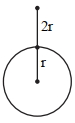
The height of any point $P$ above the surface of the Earth is equal to the diameter of the Earth. The value of acceleration due to gravity at point $P$ will be: (Given $g = $ acceleration due to gravity at the surface of the Earth)
A
$g / 2$
B
$g / 4$
C
$g / 3$
D
$g / 9$
Solution
(D) Let $R$ be the radius of the Earth. The diameter of the Earth is $2R$.
Given that the height $h$ of point $P$ above the surface is equal to the diameter of the Earth,so $h = 2R$.
The distance of point $P$ from the center of the Earth is $r = R + h = R + 2R = 3R$.
The acceleration due to gravity at the surface of the Earth is $g = \frac{GM}{R^2}$.
The acceleration due to gravity at point $P$ at a distance $r$ from the center is $g' = \frac{GM}{r^2}$.
Substituting $r = 3R$ into the equation,we get:
$g' = \frac{GM}{(3R)^2} = \frac{GM}{9R^2}$.
Since $g = \frac{GM}{R^2}$,we can write:
$g' = \frac{1}{9} \left( \frac{GM}{R^2} \right) = \frac{g}{9}$.
Given that the height $h$ of point $P$ above the surface is equal to the diameter of the Earth,so $h = 2R$.
The distance of point $P$ from the center of the Earth is $r = R + h = R + 2R = 3R$.
The acceleration due to gravity at the surface of the Earth is $g = \frac{GM}{R^2}$.
The acceleration due to gravity at point $P$ at a distance $r$ from the center is $g' = \frac{GM}{r^2}$.
Substituting $r = 3R$ into the equation,we get:
$g' = \frac{GM}{(3R)^2} = \frac{GM}{9R^2}$.
Since $g = \frac{GM}{R^2}$,we can write:
$g' = \frac{1}{9} \left( \frac{GM}{R^2} \right) = \frac{g}{9}$.
0 likes
View Solution249
MediumMCQ
Given below are two statements: One is labelled as Assertion $A$ and the other is labelled as Reason $R$.
Assertion $A$: If we move from poles to equator,the direction of acceleration due to gravity of earth always points towards the center of earth without any variation in its magnitude.
Reason $R$: At equator,the direction of acceleration due to the gravity is towards the center of earth. In the light of above statements,choose the correct answer from the options given below.
Assertion $A$: If we move from poles to equator,the direction of acceleration due to gravity of earth always points towards the center of earth without any variation in its magnitude.
Reason $R$: At equator,the direction of acceleration due to the gravity is towards the center of earth. In the light of above statements,choose the correct answer from the options given below.
A
Both $A$ and $R$ are true and $R$ is the correct explanation of $A$.
B
Both $A$ and $R$ are true but $R$ is $NOT$ the correct explanation of $A$.
C
$A$ is true but $R$ is false.
D
$A$ is false but $R$ is true.
Solution
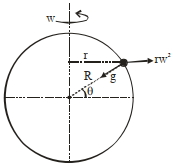
(D) The effective acceleration due to gravity $(g')$ on the surface of the rotating Earth is given by the vector sum of the gravitational acceleration $(g)$ and the centrifugal acceleration $(rw^2)$.
The magnitude of the effective acceleration due to gravity is $g' = \sqrt{g^2 + (rw^2)^2 - 2g(rw^2)\cos\theta}$,where $\theta$ is the latitude.
As we move from the poles to the equator,the magnitude of the effective acceleration due to gravity changes because the centrifugal component varies with the latitude $\theta$.
Furthermore,the direction of the effective acceleration due to gravity is not always towards the center of the Earth,except at the poles and the equator.
Therefore,Assertion $A$ is false because the magnitude varies and the direction does not always point towards the center of the Earth.
Reason $R$ states that at the equator,the direction of acceleration due to gravity is towards the center of the Earth. This is true because at the equator,the centrifugal acceleration $(rw^2)$ is directed radially outward,and the gravitational acceleration $(g)$ is directed radially inward. Their resultant,the effective acceleration $(g')$,is also directed radially inward towards the center of the Earth.
Thus,$A$ is false but $R$ is true.
The magnitude of the effective acceleration due to gravity is $g' = \sqrt{g^2 + (rw^2)^2 - 2g(rw^2)\cos\theta}$,where $\theta$ is the latitude.
As we move from the poles to the equator,the magnitude of the effective acceleration due to gravity changes because the centrifugal component varies with the latitude $\theta$.
Furthermore,the direction of the effective acceleration due to gravity is not always towards the center of the Earth,except at the poles and the equator.
Therefore,Assertion $A$ is false because the magnitude varies and the direction does not always point towards the center of the Earth.
Reason $R$ states that at the equator,the direction of acceleration due to gravity is towards the center of the Earth. This is true because at the equator,the centrifugal acceleration $(rw^2)$ is directed radially outward,and the gravitational acceleration $(g)$ is directed radially inward. Their resultant,the effective acceleration $(g')$,is also directed radially inward towards the center of the Earth.
Thus,$A$ is false but $R$ is true.
0 likes
View Solution250
MediumMCQ
The variation of acceleration due to gravity $(g)$ with distance $(r)$ from the center of the earth is correctly represented by ... (Given $R =$ radius of earth)
A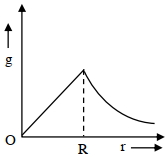
B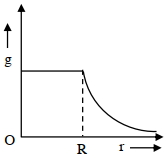
C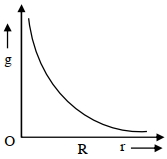
D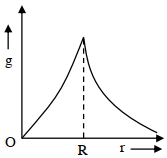
Solution
(A) The acceleration due to gravity $(g)$ at a distance $(r)$ from the center of the earth is given by:
$1$. Inside the earth $(r \leq R)$: $g = \frac{GMr}{R^3}$. Here,$g$ is directly proportional to $r$ $(g \propto r)$,which represents a straight line passing through the origin.
$2$. Outside the earth $(r \geq R)$: $g = \frac{GM}{r^2}$. Here,$g$ is inversely proportional to the square of the distance $(g \propto 1/r^2)$,which represents a parabolic curve.
Thus,the graph shows a linear increase up to $r = R$ and a non-linear decrease for $r > R$. This corresponds to the graph shown in option $A$.
$1$. Inside the earth $(r \leq R)$: $g = \frac{GMr}{R^3}$. Here,$g$ is directly proportional to $r$ $(g \propto r)$,which represents a straight line passing through the origin.
$2$. Outside the earth $(r \geq R)$: $g = \frac{GM}{r^2}$. Here,$g$ is inversely proportional to the square of the distance $(g \propto 1/r^2)$,which represents a parabolic curve.
Thus,the graph shows a linear increase up to $r = R$ and a non-linear decrease for $r > R$. This corresponds to the graph shown in option $A$.
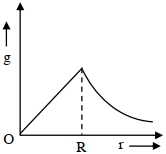
0 likes
View SolutionGravitation — Acceleration Due to Gravity and its Variation · Frequently Asked Questions
1Are these Gravitation questions useful for JEE and NEET?
Yes. All questions in this section are mapped to JEE Main and NEET exam patterns. Previous year questions from JEE Main, NEET, GUJCET and state-level exams are included with full solutions.
2Can I switch to Hindi or Gujarati for these questions?
Yes. Use the language tabs in the hero section or the sidebar to view the same questions and solutions in English, Hindi or Gujarati.
3How do I generate a question paper from this subtopic?
Use the Vedclass Exam Paper Generator — select the chapter and subtopic, set difficulty, and generate Sets A, B, C, D automatically. First 3 chapters of every subject are free.
Vedclass Products
For Students
Vedclass Test Series
Mock tests in real JEE/NEET style with performance analysis. 5-day free trial.
Start Free TrialFor Teachers
Exam Paper Generator
Generate Set A/B/C/D papers from this chapter in 2 minutes. 3 chapters free.
Try FreeFor Institutes
Online Exam Module
Live online exams with unlimited students, 360° analytics & white-label branding.
See DemoFor Teachers & Institutes
Generate a Gravitation Exam Paper in 2 Minutes
Select subtopic & difficulty — Sets A, B, C, D auto-generated with No Repeat logic.
First 3 chapters of every subject are free — no payment required.