
A English
Acceleration Due to Gravity and its Variation Questions in English
Class 11 Physics · Gravitation · Acceleration Due to Gravity and its Variation
430+
Questions
English
Language
100%
With Solutions
Showing 50 of 430 questions in English
151
MediumMCQ
The ratio of the weights of a body on the Earth's surface to that on the surface of a planet is $9 : 4$. The mass of the planet is $\frac{1}{9}^{th}$ of that of the Earth. If $R$ is the radius of the Earth,what is the radius of the planet? (Assume the planets have the same mass density)
A
$\frac{R}{3}$
B
$\frac{R}{4}$
C
$\frac{R}{9}$
D
$\frac{R}{2}$
Solution
(D) Since the mass of the object remains constant,the weight of the object is proportional to the acceleration due to gravity $g$.
Given: $\frac{W_{earth}}{W_{planet}} = \frac{9}{4} = \frac{g_{earth}}{g_{planet}}$.
We know that $g = \frac{GM}{R^2}$. Since density $\rho$ is constant,$M = \rho \cdot \frac{4}{3}\pi R^3$,so $g = \frac{G \cdot \rho \cdot \frac{4}{3}\pi R^3}{R^2} = G \cdot \rho \cdot \frac{4}{3}\pi R \propto R$.
However,the problem states the mass of the planet is $\frac{1}{9}$ of the Earth's mass. Let $M_p = \frac{M_e}{9}$.
Using $g = \frac{GM}{R^2}$,we have $\frac{g_e}{g_p} = \frac{M_e}{M_p} \cdot \frac{R_p^2}{R_e^2} = 9 \cdot \frac{R_p^2}{R^2}$.
Given $\frac{g_e}{g_p} = \frac{9}{4}$,so $\frac{9}{4} = 9 \cdot \frac{R_p^2}{R^2}$.
$\frac{1}{4} = \frac{R_p^2}{R^2} \implies \frac{R_p}{R} = \frac{1}{2}$.
Therefore,$R_p = \frac{R}{2}$.
Given: $\frac{W_{earth}}{W_{planet}} = \frac{9}{4} = \frac{g_{earth}}{g_{planet}}$.
We know that $g = \frac{GM}{R^2}$. Since density $\rho$ is constant,$M = \rho \cdot \frac{4}{3}\pi R^3$,so $g = \frac{G \cdot \rho \cdot \frac{4}{3}\pi R^3}{R^2} = G \cdot \rho \cdot \frac{4}{3}\pi R \propto R$.
However,the problem states the mass of the planet is $\frac{1}{9}$ of the Earth's mass. Let $M_p = \frac{M_e}{9}$.
Using $g = \frac{GM}{R^2}$,we have $\frac{g_e}{g_p} = \frac{M_e}{M_p} \cdot \frac{R_p^2}{R_e^2} = 9 \cdot \frac{R_p^2}{R^2}$.
Given $\frac{g_e}{g_p} = \frac{9}{4}$,so $\frac{9}{4} = 9 \cdot \frac{R_p^2}{R^2}$.
$\frac{1}{4} = \frac{R_p^2}{R^2} \implies \frac{R_p}{R} = \frac{1}{2}$.
Therefore,$R_p = \frac{R}{2}$.
0 likes
View Solution152
DifficultMCQ
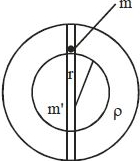
Assume that a tunnel is dug through the Earth from the North Pole to the South Pole and that the Earth is a non-rotating,uniform sphere of density $\rho$. The gravitational force on a particle of mass $m$ dropped into the tunnel when it reaches a distance $r$ from the center of the Earth is:
A
$\left( \frac{3}{4\pi} mG\rho \right) r$
B
$\left( \frac{4\pi}{3} mG\rho \right) r$
C
$\left( \frac{4\pi}{3} mG\rho \right) r^2$
D
$\left( \frac{4\pi}{3} m^2 G\rho \right) r$
Solution
(B) When a particle of mass $m$ is at a distance $r$ from the center of the Earth,the gravitational force acting on it is due only to the mass of the Earth contained within a sphere of radius $r$. Let this mass be $M'$.
The volume of this inner sphere is $V' = \frac{4}{3} \pi r^3$.
Since the density $\rho$ is uniform,the mass $M'$ is given by $M' = \rho V' = \rho \left( \frac{4}{3} \pi r^3 \right)$.
The gravitational force $F$ on the particle of mass $m$ at distance $r$ is given by Newton's law of gravitation:
$F = \frac{G M' m}{r^2}$
Substituting the value of $M'$:
$F = \frac{G m}{r^2} \left( \rho \cdot \frac{4}{3} \pi r^3 \right)$
Simplifying the expression:
$F = \left( \frac{4}{3} \pi G \rho \right) m r$
The volume of this inner sphere is $V' = \frac{4}{3} \pi r^3$.
Since the density $\rho$ is uniform,the mass $M'$ is given by $M' = \rho V' = \rho \left( \frac{4}{3} \pi r^3 \right)$.
The gravitational force $F$ on the particle of mass $m$ at distance $r$ is given by Newton's law of gravitation:
$F = \frac{G M' m}{r^2}$
Substituting the value of $M'$:
$F = \frac{G m}{r^2} \left( \rho \cdot \frac{4}{3} \pi r^3 \right)$
Simplifying the expression:
$F = \left( \frac{4}{3} \pi G \rho \right) m r$
0 likes
View Solution153
MediumMCQ
At what height above the earth's surface is the value of $g$ the same as in a $200 \ km$ deep mine?
A
$50$
B
$100$
C
$150$
D
$400$
Solution
(B) The acceleration due to gravity at a height $h$ above the earth's surface is given by $g_h = g(1 - \frac{2h}{R})$.
The acceleration due to gravity at a depth $d$ below the earth's surface is given by $g_d = g(1 - \frac{d}{R})$.
Given that $g_h = g_d$ for $d = 200 \ km$,we equate the two expressions:
$g(1 - \frac{2h}{R}) = g(1 - \frac{d}{R})$
Canceling $g$ and $1$ from both sides:
$-\frac{2h}{R} = -\frac{d}{R}$
This simplifies to:
$2h = d$
$h = \frac{d}{2}$
Substituting $d = 200 \ km$:
$h = \frac{200}{2} = 100 \ km$.
The acceleration due to gravity at a depth $d$ below the earth's surface is given by $g_d = g(1 - \frac{d}{R})$.
Given that $g_h = g_d$ for $d = 200 \ km$,we equate the two expressions:
$g(1 - \frac{2h}{R}) = g(1 - \frac{d}{R})$
Canceling $g$ and $1$ from both sides:
$-\frac{2h}{R} = -\frac{d}{R}$
This simplifies to:
$2h = d$
$h = \frac{d}{2}$
Substituting $d = 200 \ km$:
$h = \frac{200}{2} = 100 \ km$.
0 likes
View Solution154
MediumMCQ
Which of the following statements are true about acceleration due to gravity?
$(a)$ '$g$' decreases in moving away from the centre if $r > R$
$(b)$ '$g$' decreases in moving towards the centre if $r < R$
$(c)$ '$g$' is zero at the centre of the Earth
$(d)$ '$g$' decreases if the Earth stops rotating on its axis
$(a)$ '$g$' decreases in moving away from the centre if $r > R$
$(b)$ '$g$' decreases in moving towards the centre if $r < R$
$(c)$ '$g$' is zero at the centre of the Earth
$(d)$ '$g$' decreases if the Earth stops rotating on its axis
A
$(a)$ and $(b)$
B
$(a), (b)$ and $(c)$
C
$(a)$ and $(c)$
D
$(a), (b), (c)$ and $(d)$
Solution
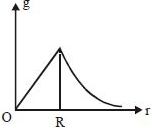
(B) The variation of acceleration due to gravity $(g)$ is given by:
$1$. For $r > R$ (outside the Earth): $g = \frac{GM}{r^2}$. Thus,$g$ decreases as $r$ increases.
$2$. For $r < R$ (inside the Earth): $g = \frac{GMr}{R^3}$. Thus,$g$ decreases as we move towards the centre ($r$ decreases).
$3$. At the centre of the Earth $(r = 0)$: $g = 0$.
$4$. Effect of rotation: The effective gravity is $g' = g - \omega^2 R \cos^2 \lambda$. If the Earth stops rotating $(\omega = 0)$,then $g' = g$. Since $g$ was previously $g - \omega^2 R \cos^2 \lambda$,the value of $g$ increases (except at the poles where $\cos \lambda = 0$). Therefore,statement $(d)$ is false.
Thus,statements $(a), (b),$ and $(c)$ are true.
$1$. For $r > R$ (outside the Earth): $g = \frac{GM}{r^2}$. Thus,$g$ decreases as $r$ increases.
$2$. For $r < R$ (inside the Earth): $g = \frac{GMr}{R^3}$. Thus,$g$ decreases as we move towards the centre ($r$ decreases).
$3$. At the centre of the Earth $(r = 0)$: $g = 0$.
$4$. Effect of rotation: The effective gravity is $g' = g - \omega^2 R \cos^2 \lambda$. If the Earth stops rotating $(\omega = 0)$,then $g' = g$. Since $g$ was previously $g - \omega^2 R \cos^2 \lambda$,the value of $g$ increases (except at the poles where $\cos \lambda = 0$). Therefore,statement $(d)$ is false.
Thus,statements $(a), (b),$ and $(c)$ are true.
0 likes
View Solution155
MediumMCQ
The variation of acceleration due to gravity $g$ with distance $d$ from the centre of the earth is best represented by ($R =$ Earth's radius)
A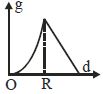
B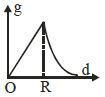
C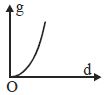
D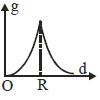
Solution
(B) The acceleration due to gravity $g$ varies with the distance $d$ from the centre of the Earth as follows:
$1$. Inside the Earth $(d < R)$:
The acceleration due to gravity at a distance $d$ from the centre is given by $g_d = \frac{GMd}{R^3} = g \frac{d}{R}$,where $g$ is the acceleration due to gravity at the surface. This shows that $g_d \propto d$,which is a linear relationship.
$2$. At the surface of the Earth $(d = R)$:
The acceleration due to gravity is maximum,$g = \frac{GM}{R^2}$.
$3$. Outside the Earth $(d > R)$:
The acceleration due to gravity at a distance $d$ from the centre is given by $g_d = \frac{GM}{d^2}$. This shows that $g_d \propto \frac{1}{d^2}$,which is an inverse square relationship.
Combining these,the graph starts from the origin $(d=0, g=0)$,increases linearly to a maximum at $d=R$,and then decreases following an inverse square curve for $d > R$. This corresponds to the graph shown in option $B$.
$1$. Inside the Earth $(d < R)$:
The acceleration due to gravity at a distance $d$ from the centre is given by $g_d = \frac{GMd}{R^3} = g \frac{d}{R}$,where $g$ is the acceleration due to gravity at the surface. This shows that $g_d \propto d$,which is a linear relationship.
$2$. At the surface of the Earth $(d = R)$:
The acceleration due to gravity is maximum,$g = \frac{GM}{R^2}$.
$3$. Outside the Earth $(d > R)$:
The acceleration due to gravity at a distance $d$ from the centre is given by $g_d = \frac{GM}{d^2}$. This shows that $g_d \propto \frac{1}{d^2}$,which is an inverse square relationship.
Combining these,the graph starts from the origin $(d=0, g=0)$,increases linearly to a maximum at $d=R$,and then decreases following an inverse square curve for $d > R$. This corresponds to the graph shown in option $B$.
0 likes
View Solution156
DifficultMCQ
If a man at the equator would weigh $(3/5)^{th}$ of his weight,the angular speed of the earth is
A
$\sqrt {\frac{2}{5} \frac{g}{R}} $
B
$\sqrt {\frac{g}{R}} $
C
$\sqrt {\frac{R}{g}} $
D
$\sqrt {\frac{2}{5} \frac{R}{g}} $
Solution
(A) At the equator,the effective acceleration due to gravity $g'$ is given by $g' = g - \omega^2 R$,where $g$ is the acceleration due to gravity at the poles,$\omega$ is the angular speed of the Earth,and $R$ is the radius of the Earth.
Given that the man's weight at the equator is $(3/5)$ of his actual weight,we have $W' = (3/5)W$.
Since $W = mg$,this implies $mg' = (3/5)mg$,which simplifies to $g' = (3/5)g$.
Substituting this into the equation for effective gravity: $(3/5)g = g - \omega^2 R$.
Rearranging the terms: $\omega^2 R = g - (3/5)g = (2/5)g$.
Solving for $\omega$: $\omega^2 = (2/5)(g/R)$,therefore $\omega = \sqrt{(2/5)(g/R)}$.
Given that the man's weight at the equator is $(3/5)$ of his actual weight,we have $W' = (3/5)W$.
Since $W = mg$,this implies $mg' = (3/5)mg$,which simplifies to $g' = (3/5)g$.
Substituting this into the equation for effective gravity: $(3/5)g = g - \omega^2 R$.
Rearranging the terms: $\omega^2 R = g - (3/5)g = (2/5)g$.
Solving for $\omega$: $\omega^2 = (2/5)(g/R)$,therefore $\omega = \sqrt{(2/5)(g/R)}$.
0 likes
View Solution157
MediumMCQ
When a body is taken from the pole to the equator,its weight:
A
Remains constant
B
Increases
C
Decreases
D
None of these
Solution
(C) The weight of a body is given by $W = mg$,where $m$ is the mass and $g$ is the acceleration due to gravity.
Due to the rotation of the Earth and its shape (oblate spheroid),the radius of the Earth at the equator is greater than at the poles.
Since $g = \frac{GM}{R^2}$,the value of $g$ is minimum at the equator and maximum at the poles.
Therefore,when a body is moved from the pole to the equator,the value of $g$ decreases,which causes the weight of the body to decrease.
Due to the rotation of the Earth and its shape (oblate spheroid),the radius of the Earth at the equator is greater than at the poles.
Since $g = \frac{GM}{R^2}$,the value of $g$ is minimum at the equator and maximum at the poles.
Therefore,when a body is moved from the pole to the equator,the value of $g$ decreases,which causes the weight of the body to decrease.
0 likes
View Solution158
MediumMCQ
The mass of the moon is $(1/8)$ of the earth,but the gravitational pull is $(1/6)$ of the earth. This is due to the fact that:
A
the moon is the satellite of the earth
B
the radius of the earth is $(8/6)$ of the moon
C
the radius of the earth is $\sqrt{8/6}$ of the moon
D
the radius of the moon is $(6/8)$ of the earth
Solution
(C) The acceleration due to gravity on the surface of a planet is given by $g = \frac{GM}{R^2}$.
Let $M_e$ and $R_e$ be the mass and radius of the earth,and $M_m$ and $R_m$ be the mass and radius of the moon.
Given: $M_m = \frac{M_e}{8}$ and $g_m = \frac{g_e}{6}$.
Taking the ratio: $\frac{g_m}{g_e} = \frac{G M_m / R_m^2}{G M_e / R_e^2} = \frac{M_m}{M_e} \times \left( \frac{R_e}{R_m} \right)^2$.
Substituting the given values: $\frac{1}{6} = \frac{1}{8} \times \left( \frac{R_e}{R_m} \right)^2$.
Rearranging gives: $\left( \frac{R_e}{R_m} \right)^2 = \frac{8}{6}$.
Therefore,$R_e = \sqrt{\frac{8}{6}} R_m$.
Let $M_e$ and $R_e$ be the mass and radius of the earth,and $M_m$ and $R_m$ be the mass and radius of the moon.
Given: $M_m = \frac{M_e}{8}$ and $g_m = \frac{g_e}{6}$.
Taking the ratio: $\frac{g_m}{g_e} = \frac{G M_m / R_m^2}{G M_e / R_e^2} = \frac{M_m}{M_e} \times \left( \frac{R_e}{R_m} \right)^2$.
Substituting the given values: $\frac{1}{6} = \frac{1}{8} \times \left( \frac{R_e}{R_m} \right)^2$.
Rearranging gives: $\left( \frac{R_e}{R_m} \right)^2 = \frac{8}{6}$.
Therefore,$R_e = \sqrt{\frac{8}{6}} R_m$.
0 likes
View Solution159
MediumMCQ
$A$ body weighs $250\,N$ on the surface of the earth. How much will it weigh halfway down to the center of the earth (in $,N$)?
A
$125$
B
$150$
C
$175$
D
$250$
Solution
(A) The acceleration due to gravity at a depth $d$ below the surface of the earth is given by the formula $g' = g(1 - \frac{d}{R})$,where $g$ is the acceleration due to gravity at the surface,$R$ is the radius of the earth,and $d$ is the depth.
Given that the body is halfway down to the center of the earth,the depth $d = \frac{R}{2}$.
Substituting this value into the formula,we get $g' = g(1 - \frac{R/2}{R}) = g(1 - \frac{1}{2}) = \frac{g}{2}$.
The weight of the body at depth $d$ is $W' = mg' = m(\frac{g}{2}) = \frac{mg}{2}$.
Since the weight at the surface is $W = mg = 250\,N$,the weight at half the depth is $W' = \frac{250}{2} = 125\,N$.
Given that the body is halfway down to the center of the earth,the depth $d = \frac{R}{2}$.
Substituting this value into the formula,we get $g' = g(1 - \frac{R/2}{R}) = g(1 - \frac{1}{2}) = \frac{g}{2}$.
The weight of the body at depth $d$ is $W' = mg' = m(\frac{g}{2}) = \frac{mg}{2}$.
Since the weight at the surface is $W = mg = 250\,N$,the weight at half the depth is $W' = \frac{250}{2} = 125\,N$.
0 likes
View Solution160
MediumMCQ
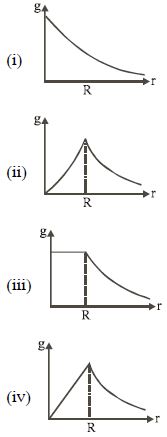
The dependence of acceleration due to gravity $g$ on the distance $r$ from the centre of the earth,assumed to be a sphere of radius $R$ of uniform density,is as shown in the figure below. The correct figure is:
A
$(i)$
B
$(ii)$
C
$(iii)$
D
$(iv)$
Solution
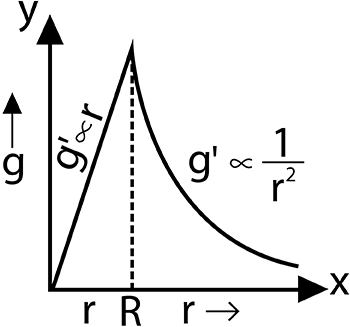
(B) For a point inside the earth $(r < R)$,the acceleration due to gravity is given by $g' = \frac{G M r}{R^3}$,which implies $g' \propto r$. Thus,the graph is a straight line passing through the origin.
For a point outside the earth $(r > R)$,the acceleration due to gravity is given by $g' = \frac{G M}{r^2}$,which implies $g' \propto \frac{1}{r^2}$. Thus,the graph is a curve showing an inverse square relationship.
At the surface of the earth $(r = R)$,the value of $g$ is maximum. Combining these two regions,the correct variation is shown in figure $(ii)$.
For a point outside the earth $(r > R)$,the acceleration due to gravity is given by $g' = \frac{G M}{r^2}$,which implies $g' \propto \frac{1}{r^2}$. Thus,the graph is a curve showing an inverse square relationship.
At the surface of the earth $(r = R)$,the value of $g$ is maximum. Combining these two regions,the correct variation is shown in figure $(ii)$.
0 likes
View Solution161
MediumMCQ
Imagine a new planet having the same density as that of Earth but it is $3$ times bigger than the Earth in size. If the acceleration due to gravity on the surface of Earth is $g$ and that on the surface of the new planet is $g^{\prime}$,then
A
$g^{\prime} = g/9$
B
$g^{\prime} = 27g$
C
$g^{\prime} = 9g$
D
$g^{\prime} = 3g$
Solution
(D) The acceleration due to gravity $g$ on the surface of a planet is given by $g = \frac{GM}{R^2}$.
Since $M = \text{density} (\rho) \times \text{volume} (V) = \rho \times \frac{4}{3} \pi R^3$,we can write $g = \frac{G}{R^2} \times \rho \times \frac{4}{3} \pi R^3 = \frac{4}{3} \pi \rho G R$.
This shows that $g \propto R$ when the density $\rho$ is constant.
Given that the new planet has the same density as Earth but is $3$ times bigger in size (radius),let $R^{\prime} = 3R$.
Therefore,$\frac{g^{\prime}}{g} = \frac{R^{\prime}}{R} = \frac{3R}{R} = 3$.
Thus,$g^{\prime} = 3g$.
Since $M = \text{density} (\rho) \times \text{volume} (V) = \rho \times \frac{4}{3} \pi R^3$,we can write $g = \frac{G}{R^2} \times \rho \times \frac{4}{3} \pi R^3 = \frac{4}{3} \pi \rho G R$.
This shows that $g \propto R$ when the density $\rho$ is constant.
Given that the new planet has the same density as Earth but is $3$ times bigger in size (radius),let $R^{\prime} = 3R$.
Therefore,$\frac{g^{\prime}}{g} = \frac{R^{\prime}}{R} = \frac{3R}{R} = 3$.
Thus,$g^{\prime} = 3g$.
0 likes
View Solution162
DifficultMCQ
The mass of a planet is $\frac{1}{9}$ of the mass of the Earth and its radius is half that of the Earth. If a body weighs $9 \ N$ on the Earth,its weight on the planet would be ........ $N$.
A
$6$
B
$4.5$
C
$4$
D
$9$
Solution
(C) The acceleration due to gravity on the Earth is $g = \frac{GM_e}{R_e^2}$.
Given,the mass of the planet $M_p = \frac{1}{9} M_e$ and the radius of the planet $R_p = \frac{1}{2} R_e$.
The acceleration due to gravity on the planet is $g_p = \frac{GM_p}{R_p^2}$.
Substituting the values,$g_p = \frac{G(M_e/9)}{(R_e/2)^2} = \frac{G M_e / 9}{R_e^2 / 4} = \frac{4}{9} \frac{GM_e}{R_e^2} = \frac{4}{9} g$.
The weight of the body on the Earth is $W_e = mg = 9 \ N$.
The weight of the body on the planet is $W_p = mg_p = m(\frac{4}{9} g) = \frac{4}{9} (mg) = \frac{4}{9} \times 9 \ N = 4 \ N$.
Given,the mass of the planet $M_p = \frac{1}{9} M_e$ and the radius of the planet $R_p = \frac{1}{2} R_e$.
The acceleration due to gravity on the planet is $g_p = \frac{GM_p}{R_p^2}$.
Substituting the values,$g_p = \frac{G(M_e/9)}{(R_e/2)^2} = \frac{G M_e / 9}{R_e^2 / 4} = \frac{4}{9} \frac{GM_e}{R_e^2} = \frac{4}{9} g$.
The weight of the body on the Earth is $W_e = mg = 9 \ N$.
The weight of the body on the planet is $W_p = mg_p = m(\frac{4}{9} g) = \frac{4}{9} (mg) = \frac{4}{9} \times 9 \ N = 4 \ N$.
0 likes
View Solution163
DifficultMCQ
The height at which the weight of a body becomes $\frac{1}{9}$ of its weight on the surface of the earth (radius of the earth is $R$) is:
A
$h = 3R$
B
$h = R$
C
$h = \frac{R}{2}$
D
$h = 2R$
Solution
(D) The acceleration due to gravity at a height $h$ above the surface of the earth is given by the formula: $g' = g \left(1 + \frac{h}{R}\right)^{-2}$.
Given that the weight of the body at height $h$ is $\frac{1}{9}$ of its weight at the surface,we have $g' = \frac{g}{9}$.
Substituting this into the formula: $\frac{g}{9} = g \left(1 + \frac{h}{R}\right)^{-2}$.
This simplifies to: $\frac{1}{9} = \left(1 + \frac{h}{R}\right)^{-2}$.
Taking the square root of both sides: $\frac{1}{3} = \left(1 + \frac{h}{R}\right)^{-1}$.
Inverting both sides: $3 = 1 + \frac{h}{R}$.
Therefore,$\frac{h}{R} = 2$,which gives $h = 2R$.
Given that the weight of the body at height $h$ is $\frac{1}{9}$ of its weight at the surface,we have $g' = \frac{g}{9}$.
Substituting this into the formula: $\frac{g}{9} = g \left(1 + \frac{h}{R}\right)^{-2}$.
This simplifies to: $\frac{1}{9} = \left(1 + \frac{h}{R}\right)^{-2}$.
Taking the square root of both sides: $\frac{1}{3} = \left(1 + \frac{h}{R}\right)^{-1}$.
Inverting both sides: $3 = 1 + \frac{h}{R}$.
Therefore,$\frac{h}{R} = 2$,which gives $h = 2R$.
0 likes
View Solution164
DifficultMCQ
$A$ tunnel is dug along a diameter of the Earth. If $M_e$ and $R_e$ are the mass and radius of the Earth respectively,then the force on a particle of mass $m$ placed in the tunnel at a distance $r$ from the center is:
A
$\frac{G M_e m}{R_e^3} r$
B
$\frac{G M_e}{R_e^3} \cdot \frac{m}{r}$
C
$\frac{G M_e m}{r} R_e^3$
D
$\frac{G M_e m}{R_e^2} r$
Solution
(A) For a particle of mass $m$ at a distance $r$ $(r < R_e)$ from the center of the Earth,the gravitational force is due only to the mass $M'$ of the sphere of radius $r$.
The mass $M'$ of the sphere of radius $r$ is given by: $M' = \rho \cdot V = \left( \frac{M_e}{\frac{4}{3} \pi R_e^3} \right) \cdot \left( \frac{4}{3} \pi r^3 \right) = M_e \frac{r^3}{R_e^3}$.
The gravitational force $F$ on the particle is: $F = \frac{G M' m}{r^2}$.
Substituting the value of $M'$: $F = \frac{G (M_e \frac{r^3}{R_e^3}) m}{r^2} = \frac{G M_e m r^3}{R_e^3 r^2} = \frac{G M_e m}{R_e^3} r$.
The mass $M'$ of the sphere of radius $r$ is given by: $M' = \rho \cdot V = \left( \frac{M_e}{\frac{4}{3} \pi R_e^3} \right) \cdot \left( \frac{4}{3} \pi r^3 \right) = M_e \frac{r^3}{R_e^3}$.
The gravitational force $F$ on the particle is: $F = \frac{G M' m}{r^2}$.
Substituting the value of $M'$: $F = \frac{G (M_e \frac{r^3}{R_e^3}) m}{r^2} = \frac{G M_e m r^3}{R_e^3 r^2} = \frac{G M_e m}{R_e^3} r$.
0 likes
View Solution165
DifficultMCQ
$A$ body weighs $700\,gm\,wt.$ on the surface of the earth. How much will it weigh on the surface of a planet whose mass is $\frac{1}{7}$ and radius is half of that of the earth?
A
$200$
B
$400$
C
$50$
D
$300$
Solution
(B) The acceleration due to gravity on the surface of the earth is $g = \frac{GM}{R^2}$.
For the planet,the mass $M_p = \frac{M}{7}$ and the radius $R_p = \frac{R}{2}$.
The acceleration due to gravity on the planet is $g_p = \frac{GM_p}{R_p^2} = \frac{G(M/7)}{(R/2)^2} = \frac{GM/7}{R^2/4} = \frac{4}{7} \frac{GM}{R^2} = \frac{4}{7}g$.
The weight of the body on the planet is $W_p = m \cdot g_p = m \cdot (\frac{4}{7}g) = \frac{4}{7} \cdot (mg)$.
Given that the weight on earth $W_e = mg = 700\,gm\,wt$.
Therefore,$W_p = \frac{4}{7} \times 700 = 400\,gm\,wt$.
For the planet,the mass $M_p = \frac{M}{7}$ and the radius $R_p = \frac{R}{2}$.
The acceleration due to gravity on the planet is $g_p = \frac{GM_p}{R_p^2} = \frac{G(M/7)}{(R/2)^2} = \frac{GM/7}{R^2/4} = \frac{4}{7} \frac{GM}{R^2} = \frac{4}{7}g$.
The weight of the body on the planet is $W_p = m \cdot g_p = m \cdot (\frac{4}{7}g) = \frac{4}{7} \cdot (mg)$.
Given that the weight on earth $W_e = mg = 700\,gm\,wt$.
Therefore,$W_p = \frac{4}{7} \times 700 = 400\,gm\,wt$.
0 likes
View Solution166
MediumMCQ
The angular velocity of the Earth at present is $\omega$. With what angular velocity should it rotate so that the weight of a body at the equator appears to be zero (in $\omega$)? (Express the answer as a multiple of $\omega$)
A
$2$
B
$8$
C
$17$
D
$289$
Solution
(C) The effective acceleration due to gravity at the equator is given by $g' = g - \omega'^2 R$, where $\omega'$ is the new angular velocity.
For the weight of a body at the equator to be zero, the effective gravity must be zero, so $g - \omega'^2 R = 0$.
This implies $\omega' = \sqrt{g/R}$.
Given the present angular velocity $\omega = \sqrt{g/R_e}$ is not the standard way to relate, we use the condition $g = \omega_0^2 R$ where $\omega_0$ is the required angular velocity.
We know $g = 9.8 \ m/s^2$ and $R = 6.4 \times 10^6 \ m$.
Calculating $\omega_0 = \sqrt{9.8 / (6.4 \times 10^6)} \approx 1.24 \times 10^{-3} \ rad/s$.
The present angular velocity of the Earth is $\omega = 2\pi / T$, where $T = 86400 \ s$.
$\omega \approx 7.27 \times 10^{-5} \ rad/s$.
Ratio $\frac{\omega_0}{\omega} = \frac{1.24 \times 10^{-3}}{7.27 \times 10^{-5}} \approx 17$.
Thus, the required angular velocity is $17\omega$.
For the weight of a body at the equator to be zero, the effective gravity must be zero, so $g - \omega'^2 R = 0$.
This implies $\omega' = \sqrt{g/R}$.
Given the present angular velocity $\omega = \sqrt{g/R_e}$ is not the standard way to relate, we use the condition $g = \omega_0^2 R$ where $\omega_0$ is the required angular velocity.
We know $g = 9.8 \ m/s^2$ and $R = 6.4 \times 10^6 \ m$.
Calculating $\omega_0 = \sqrt{9.8 / (6.4 \times 10^6)} \approx 1.24 \times 10^{-3} \ rad/s$.
The present angular velocity of the Earth is $\omega = 2\pi / T$, where $T = 86400 \ s$.
$\omega \approx 7.27 \times 10^{-5} \ rad/s$.
Ratio $\frac{\omega_0}{\omega} = \frac{1.24 \times 10^{-3}}{7.27 \times 10^{-5}} \approx 17$.
Thus, the required angular velocity is $17\omega$.
0 likes
View Solution167
MediumMCQ
Suppose the earth stopped rotating. Then,the weight of a body will
A
Increase equally at all points
B
Decrease equally at all points
C
Increase at the equator
D
Increase at the poles
Solution
(C) The effective weight $R$ of a body of mass $m$ at a latitude $\lambda$ on the rotating earth is given by $R = mg - m\omega^2 R_e \cos^2 \lambda$,where $\omega$ is the angular velocity of the earth and $R_e$ is the radius of the earth.
At the equator,$\lambda = 0^\circ$,so $\cos \lambda = 1$. Thus,$R = mg - m\omega^2 R_e$.
At the poles,$\lambda = 90^\circ$,so $\cos \lambda = 0$. Thus,$R = mg$.
If the earth stops rotating,$\omega = 0$.
At the poles,the weight remains $R = mg$ (no change).
At the equator,the weight becomes $R = mg$,which is an increase compared to the rotating case $(mg - m\omega^2 R_e)$.
Therefore,the weight of a body will increase at the equator.
At the equator,$\lambda = 0^\circ$,so $\cos \lambda = 1$. Thus,$R = mg - m\omega^2 R_e$.
At the poles,$\lambda = 90^\circ$,so $\cos \lambda = 0$. Thus,$R = mg$.
If the earth stops rotating,$\omega = 0$.
At the poles,the weight remains $R = mg$ (no change).
At the equator,the weight becomes $R = mg$,which is an increase compared to the rotating case $(mg - m\omega^2 R_e)$.
Therefore,the weight of a body will increase at the equator.
0 likes
View Solution168
EasyMCQ
What will be the formula for the mass of the Earth in terms of $g$,$R$,and $G$?
A
$G \frac{R}{g}$
B
$g \frac{R^{2}}{G}$
C
$g^{2} \frac{R}{G}$
D
$G \frac{g}{R}$
Solution
(B) The acceleration due to gravity $g$ on the surface of the Earth is given by the formula:
$g = \frac{GM}{R^2}$
where $G$ is the universal gravitational constant,$M$ is the mass of the Earth,and $R$ is the radius of the Earth.
To find the mass $M$,we rearrange the formula:
$M = \frac{gR^2}{G}$
Thus,the correct formula is $g \frac{R^2}{G}$.
$g = \frac{GM}{R^2}$
where $G$ is the universal gravitational constant,$M$ is the mass of the Earth,and $R$ is the radius of the Earth.
To find the mass $M$,we rearrange the formula:
$M = \frac{gR^2}{G}$
Thus,the correct formula is $g \frac{R^2}{G}$.
0 likes
View Solution169
MediumMCQ
The radius of the Earth is about $6400 \; km$ and that of Mars is $3200 \; km$. The mass of the Earth is about $10$ times the mass of Mars. An object weighs $200 \; N$ on the surface of the Earth. Its weight on the surface of Mars will be .......... $N$.
A
$80$
B
$20$
C
$6$
D
$40$
Solution
(A) Given: Radius of Earth $R_e = 6400 \; km$,Radius of Mars $R_m = 3200 \; km$.
Mass of Earth $M_e = 10 M_m$,Weight on Earth $W_e = 200 \; N$.
The weight of an object is given by $W = mg$,where $g = \frac{GM}{R^2}$.
Therefore,the ratio of weights is $\frac{W_m}{W_e} = \frac{m g_m}{m g_e} = \frac{M_m}{M_e} \times \left(\frac{R_e}{R_m}\right)^2$.
Substituting the values: $\frac{W_m}{200} = \frac{1}{10} \times \left(\frac{6400}{3200}\right)^2$.
$\frac{W_m}{200} = \frac{1}{10} \times (2)^2 = \frac{4}{10} = 0.4$.
$W_m = 200 \times 0.4 = 80 \; N$.
Mass of Earth $M_e = 10 M_m$,Weight on Earth $W_e = 200 \; N$.
The weight of an object is given by $W = mg$,where $g = \frac{GM}{R^2}$.
Therefore,the ratio of weights is $\frac{W_m}{W_e} = \frac{m g_m}{m g_e} = \frac{M_m}{M_e} \times \left(\frac{R_e}{R_m}\right)^2$.
Substituting the values: $\frac{W_m}{200} = \frac{1}{10} \times \left(\frac{6400}{3200}\right)^2$.
$\frac{W_m}{200} = \frac{1}{10} \times (2)^2 = \frac{4}{10} = 0.4$.
$W_m = 200 \times 0.4 = 80 \; N$.
0 likes
View Solution170
DifficultMCQ
If a particle takes $t$ seconds less and acquires a velocity of $v \text{ m/s}$ more in falling through the same distance on two planets,where the accelerations due to gravity are $2g$ and $8g$ respectively,then:
A
$v=4gt$
B
$v=5gt$
C
$v=2gt$
D
$v=16gt$
Solution
(A) Let the distance fallen be $h$. The time taken to fall through distance $h$ under gravity $g'$ is $T = \sqrt{\frac{2h}{g'}}$ and the final velocity is $V = \sqrt{2g'h}$.
For the first planet $(g_1 = 2g)$: $T_1 = \sqrt{\frac{2h}{2g}} = \sqrt{\frac{h}{g}}$ and $V_1 = \sqrt{2(2g)h} = 2\sqrt{gh}$.
For the second planet $(g_2 = 8g)$: $T_2 = \sqrt{\frac{2h}{8g}} = \frac{1}{2}\sqrt{\frac{h}{g}}$ and $V_2 = \sqrt{2(8g)h} = 4\sqrt{gh}$.
Given $t = T_1 - T_2 = \sqrt{\frac{h}{g}} - \frac{1}{2}\sqrt{\frac{h}{g}} = \frac{1}{2}\sqrt{\frac{h}{g}}$.
Given $v = V_2 - V_1 = 4\sqrt{gh} - 2\sqrt{gh} = 2\sqrt{gh}$.
From the time equation,$\sqrt{h} = 2t\sqrt{g}$.
Substituting this into the velocity equation: $v = 2\sqrt{g}(2t\sqrt{g}) = 4gt$.
For the first planet $(g_1 = 2g)$: $T_1 = \sqrt{\frac{2h}{2g}} = \sqrt{\frac{h}{g}}$ and $V_1 = \sqrt{2(2g)h} = 2\sqrt{gh}$.
For the second planet $(g_2 = 8g)$: $T_2 = \sqrt{\frac{2h}{8g}} = \frac{1}{2}\sqrt{\frac{h}{g}}$ and $V_2 = \sqrt{2(8g)h} = 4\sqrt{gh}$.
Given $t = T_1 - T_2 = \sqrt{\frac{h}{g}} - \frac{1}{2}\sqrt{\frac{h}{g}} = \frac{1}{2}\sqrt{\frac{h}{g}}$.
Given $v = V_2 - V_1 = 4\sqrt{gh} - 2\sqrt{gh} = 2\sqrt{gh}$.
From the time equation,$\sqrt{h} = 2t\sqrt{g}$.
Substituting this into the velocity equation: $v = 2\sqrt{g}(2t\sqrt{g}) = 4gt$.
0 likes
View Solution171
DifficultMCQ
The maximum vertical distance through which a fully dressed astronaut can jump on the earth is $0.5\, m$. If the mean density of the moon is two-thirds that of the earth and the radius is one-quarter that of the earth,what is the maximum vertical distance through which he can jump on the moon and the ratio of the duration of the jump on the moon to that on the earth?
A
$3\, m, 6 : 1$
B
$6\, m, 3 : 1$
C
$3\, m, 1 : 6$
D
$6\, m, 1 : 6$
Solution
(A) The acceleration due to gravity $g$ is given by $g = G \cdot \frac{4}{3} \pi R \rho$.
Given $\rho' = \frac{2}{3} \rho$ and $R' = \frac{1}{4} R$,the acceleration due to gravity on the moon $g'$ is:
$g' = G \cdot \frac{4}{3} \pi R' \rho' = G \cdot \frac{4}{3} \pi \left(\frac{R}{4}\right) \left(\frac{2}{3} \rho\right) = \frac{1}{6} g$.
$(I)$ Maximum height $h_{\max} = \frac{u^2}{2g}$. Since the initial velocity $u$ is the same,$h_{\max} \propto \frac{1}{g}$.
Therefore,$h' g' = h g \implies h' = h \left(\frac{g}{g'}\right) = 0.5 \times 6 = 3\, m$.
$(II)$ The time of flight $t = \frac{2u}{g}$. Since $u$ is constant,$t \propto \frac{1}{g}$.
Therefore,$\frac{t'}{t} = \frac{g}{g'} = \frac{g}{g/6} = 6$.
Thus,the ratio of time on the moon to the earth is $6 : 1$.
Given $\rho' = \frac{2}{3} \rho$ and $R' = \frac{1}{4} R$,the acceleration due to gravity on the moon $g'$ is:
$g' = G \cdot \frac{4}{3} \pi R' \rho' = G \cdot \frac{4}{3} \pi \left(\frac{R}{4}\right) \left(\frac{2}{3} \rho\right) = \frac{1}{6} g$.
$(I)$ Maximum height $h_{\max} = \frac{u^2}{2g}$. Since the initial velocity $u$ is the same,$h_{\max} \propto \frac{1}{g}$.
Therefore,$h' g' = h g \implies h' = h \left(\frac{g}{g'}\right) = 0.5 \times 6 = 3\, m$.
$(II)$ The time of flight $t = \frac{2u}{g}$. Since $u$ is constant,$t \propto \frac{1}{g}$.
Therefore,$\frac{t'}{t} = \frac{g}{g'} = \frac{g}{g/6} = 6$.
Thus,the ratio of time on the moon to the earth is $6 : 1$.
0 likes
View Solution172
DifficultMCQ
Two equal masses $m$ and $m$ are hung from a balance whose scale pans differ in vertical height by $h$. The error in weighing in terms of density of the earth $\rho$ is:
A
$2\pi G\rho mh$
B
$\frac{1}{3}\pi G\rho mh$
C
$\frac{8}{3}\pi G\rho mh$
D
$\frac{4}{3}\pi G\rho mh$
Solution
(C) The acceleration due to gravity at a height $h$ above the surface of the Earth is given by $g_h = g(1 - \frac{2h}{R})$.
Let the two pans be at heights $h_1$ and $h_2$ such that $h_1 - h_2 = h$. The weights measured are $W_1 = mg_1$ and $W_2 = mg_2$.
The difference in weight (error) is $\Delta W = mg_1 - mg_2 = mg(1 - \frac{2h_1}{R}) - mg(1 - \frac{2h_2}{R}) = mg(\frac{2h_2}{R} - \frac{2h_1}{R}) = \frac{2mg}{R}(h_2 - h_1)$.
Since $h_1 - h_2 = h$,we have $\Delta W = \frac{2mgh}{R}$.
Substituting $g = \frac{GM}{R^2}$ and $M = \frac{4}{3}\pi R^3 \rho$,we get $g = \frac{G}{R^2} \cdot \frac{4}{3}\pi R^3 \rho = \frac{4}{3}\pi G R \rho$.
Substituting this into the error formula: $\Delta W = \frac{2mh}{R} \cdot (\frac{4}{3}\pi G R \rho) = \frac{8}{3}\pi G \rho mh$.
Let the two pans be at heights $h_1$ and $h_2$ such that $h_1 - h_2 = h$. The weights measured are $W_1 = mg_1$ and $W_2 = mg_2$.
The difference in weight (error) is $\Delta W = mg_1 - mg_2 = mg(1 - \frac{2h_1}{R}) - mg(1 - \frac{2h_2}{R}) = mg(\frac{2h_2}{R} - \frac{2h_1}{R}) = \frac{2mg}{R}(h_2 - h_1)$.
Since $h_1 - h_2 = h$,we have $\Delta W = \frac{2mgh}{R}$.
Substituting $g = \frac{GM}{R^2}$ and $M = \frac{4}{3}\pi R^3 \rho$,we get $g = \frac{G}{R^2} \cdot \frac{4}{3}\pi R^3 \rho = \frac{4}{3}\pi G R \rho$.
Substituting this into the error formula: $\Delta W = \frac{2mh}{R} \cdot (\frac{4}{3}\pi G R \rho) = \frac{8}{3}\pi G \rho mh$.
0 likes
View Solution173
DifficultMCQ
If the radius of the earth were to shrink by $1\%$ with its mass remaining the same,the acceleration due to gravity on the earth's surface would
A
Decrease by $2\%$
B
Remain unchanged
C
Increase by $2\%$
D
Become zero
Solution
(C) The acceleration due to gravity $g$ on the surface of the Earth is given by the formula $g = \frac{GM}{R^2}$,where $G$ is the gravitational constant,$M$ is the mass of the Earth,and $R$ is its radius.
Taking the natural logarithm on both sides,we get $\ln g = \ln G + \ln M - 2 \ln R$.
Differentiating both sides,we obtain the relative error formula: $\frac{\Delta g}{g} = -2 \frac{\Delta R}{R}$.
Given that the radius shrinks by $1\%$,we have $\frac{\Delta R}{R} = -0.01$.
Substituting this value,we get $\frac{\Delta g}{g} = -2(-0.01) = 0.02$,which is $2\%$.
Since the result is positive,the acceleration due to gravity increases by $2\%$.
Taking the natural logarithm on both sides,we get $\ln g = \ln G + \ln M - 2 \ln R$.
Differentiating both sides,we obtain the relative error formula: $\frac{\Delta g}{g} = -2 \frac{\Delta R}{R}$.
Given that the radius shrinks by $1\%$,we have $\frac{\Delta R}{R} = -0.01$.
Substituting this value,we get $\frac{\Delta g}{g} = -2(-0.01) = 0.02$,which is $2\%$.
Since the result is positive,the acceleration due to gravity increases by $2\%$.
0 likes
View Solution174
MediumMCQ
The magnitudes of the gravitational field at distances $r_1$ and $r_2$ from the center of a uniform sphere of radius $R$ and mass $M$ are $F_1$ and $F_2$ respectively. Then:
A
$\frac{F_1}{F_2} = \frac{r_1}{r_2}$ if $r_1 < R$ and $r_2 < R$
B
$\frac{F_1}{F_2} = \frac{r_1}{r_2}$ if $r_1 > R$ and $r_2 > R$
C
$\frac{F_1}{F_2} = \frac{r_1^2}{r_2^2}$ if $r_1 < R$ and $r_2 < R$
D
$\frac{F_1}{F_2} = \frac{r_1^2}{r_2^2}$ if $r_1 > R$ and $r_2 > R$
Solution
(A) For a uniform sphere of mass $M$ and radius $R$:
$1$. Inside the sphere $(r < R)$,the gravitational field intensity $E$ (or force per unit mass) is given by $E = \frac{GMr}{R^3}$. Thus,$E \propto r$.
Therefore,if $r_1 < R$ and $r_2 < R$,then $\frac{F_1}{F_2} = \frac{r_1}{r_2}$.
$2$. Outside the sphere $(r > R)$,the gravitational field intensity is given by $E = \frac{GM}{r^2}$. Thus,$E \propto \frac{1}{r^2}$.
Therefore,if $r_1 > R$ and $r_2 > R$,then $\frac{F_1}{F_2} = \frac{r_2^2}{r_1^2}$.
Comparing these with the given options,option $A$ is correct.
$1$. Inside the sphere $(r < R)$,the gravitational field intensity $E$ (or force per unit mass) is given by $E = \frac{GMr}{R^3}$. Thus,$E \propto r$.
Therefore,if $r_1 < R$ and $r_2 < R$,then $\frac{F_1}{F_2} = \frac{r_1}{r_2}$.
$2$. Outside the sphere $(r > R)$,the gravitational field intensity is given by $E = \frac{GM}{r^2}$. Thus,$E \propto \frac{1}{r^2}$.
Therefore,if $r_1 > R$ and $r_2 > R$,then $\frac{F_1}{F_2} = \frac{r_2^2}{r_1^2}$.
Comparing these with the given options,option $A$ is correct.
0 likes
View Solution175
EasyMCQ
$Assertion$ : In a free fall,the weight of a body becomes effectively zero.
$Reason$ : The acceleration due to gravity acting on a body in free fall is zero.
$Reason$ : The acceleration due to gravity acting on a body in free fall is zero.
A
If both $Assertion$ and $Reason$ are correct and the $Reason$ is a correct explanation of the $Assertion$.
B
If both $Assertion$ and $Reason$ are correct but $Reason$ is not a correct explanation of the $Assertion$.
C
If both the $Assertion$ and $Reason$ are incorrect.
D
If the $Assertion$ is correct but $Reason$ is incorrect.
Solution
(D) In a free fall,the apparent weight of a body becomes zero. This is because the body and the surface it is on (or the frame of reference) are both accelerating downwards at $g$. The normal force $N$ acting on the body is given by $N = m(g - a)$. Since $a = g$ in free fall,$N = m(g - g) = 0$. Thus,the body experiences weightlessness.
However,the acceleration due to gravity acting on a body in free fall is $g = 9.8 \; m/s^2$,which is definitely not zero. Therefore,the $Assertion$ is correct,but the $Reason$ is incorrect.
However,the acceleration due to gravity acting on a body in free fall is $g = 9.8 \; m/s^2$,which is definitely not zero. Therefore,the $Assertion$ is correct,but the $Reason$ is incorrect.
0 likes
View Solution176
MediumMCQ
$Assertion$ : $A$ tennis ball bounces higher on hills than in plains.
$Reason$ : Acceleration due to gravity on the hill is greater than that on the surface of earth.
$Reason$ : Acceleration due to gravity on the hill is greater than that on the surface of earth.
A
If both $Assertion$ and $Reason$ are correct and the $Reason$ is a correct explanation of the $Assertion$.
B
If both $Assertion$ and $Reason$ are correct but $Reason$ is not a correct explanation of the $Assertion$.
C
If the $Assertion$ is correct but $Reason$ is incorrect.
D
If both the $Assertion$ and $Reason$ are incorrect.
Solution
(C) Let the tennis ball bounce with an initial velocity $u$. It will rise to a height $h$ where its final velocity becomes $0$. Using the equation of motion $v^2 - u^2 = 2as$,we get:
$0^2 - u^2 = 2(-g')h$,where $g'$ is the acceleration due to gravity on the hill.
Therefore,$h = \frac{u^2}{2g'}$.
Since the acceleration due to gravity on the hill $(g')$ is less than that on the surface of the earth $(g)$ due to the increase in altitude,the height $h$ will be greater on the hill.
Thus,the $Assertion$ is correct,but the $Reason$ is incorrect because $g'$ is actually less than $g$.
$0^2 - u^2 = 2(-g')h$,where $g'$ is the acceleration due to gravity on the hill.
Therefore,$h = \frac{u^2}{2g'}$.
Since the acceleration due to gravity on the hill $(g')$ is less than that on the surface of the earth $(g)$ due to the increase in altitude,the height $h$ will be greater on the hill.
Thus,the $Assertion$ is correct,but the $Reason$ is incorrect because $g'$ is actually less than $g$.
0 likes
View Solution177
MediumMCQ
If the earth were to cease rotating about its own axis,the increase in the value of $g$ in the $C.G.S.$ system at a place of latitude of $45^{\circ}$ will be ........ $cm/sec^{2}$.
A
$2.68$
B
$1.68$
C
$3.36$
D
$0.34$
Solution
(B) The effective acceleration due to gravity $g'$ at a latitude $\lambda$ is given by $g' = g - R\omega^2 \cos^2 \lambda$,where $g$ is the acceleration due to gravity if the earth were stationary,$R$ is the radius of the earth,and $\omega$ is the angular velocity of the earth.
The increase in the value of $g$ when the earth stops rotating is $\Delta g = g - g' = R\omega^2 \cos^2 \lambda$.
Given:
$R = 6400 \times 10^3 \ m = 6.4 \times 10^6 \ m$
$\lambda = 45^{\circ} \implies \cos^2 45^{\circ} = (1/\sqrt{2})^2 = 0.5$
$\omega = \frac{2\pi}{T} = \frac{2 \times 3.14}{24 \times 3600} \approx 7.27 \times 10^{-5} \ rad/sec$
Substituting the values:
$\Delta g = (6.4 \times 10^6) \times (7.27 \times 10^{-5})^2 \times 0.5$
$\Delta g = (6.4 \times 10^6) \times (52.85 \times 10^{-10}) \times 0.5$
$\Delta g \approx 0.0169 \ m/sec^2$
Converting to $C.G.S.$ units $(cm/sec^2)$:
$1 \ m/sec^2 = 100 \ cm/sec^2$
$\Delta g = 0.0169 \times 100 = 1.69 \ cm/sec^2 \approx 1.68 \ cm/sec^2$.
The increase in the value of $g$ when the earth stops rotating is $\Delta g = g - g' = R\omega^2 \cos^2 \lambda$.
Given:
$R = 6400 \times 10^3 \ m = 6.4 \times 10^6 \ m$
$\lambda = 45^{\circ} \implies \cos^2 45^{\circ} = (1/\sqrt{2})^2 = 0.5$
$\omega = \frac{2\pi}{T} = \frac{2 \times 3.14}{24 \times 3600} \approx 7.27 \times 10^{-5} \ rad/sec$
Substituting the values:
$\Delta g = (6.4 \times 10^6) \times (7.27 \times 10^{-5})^2 \times 0.5$
$\Delta g = (6.4 \times 10^6) \times (52.85 \times 10^{-10}) \times 0.5$
$\Delta g \approx 0.0169 \ m/sec^2$
Converting to $C.G.S.$ units $(cm/sec^2)$:
$1 \ m/sec^2 = 100 \ cm/sec^2$
$\Delta g = 0.0169 \times 100 = 1.69 \ cm/sec^2 \approx 1.68 \ cm/sec^2$.
0 likes
View Solution178
DifficultMCQ
The angular speed of the Earth in $rad/s$,so that bodies on the equator may appear weightless is: [Use $g = 10\, m/s^2$ and the radius of the Earth $R = 6.4 \times 10^3\, km$]
A
$1.25 \times 10^{-3}$
B
$1.56 \times 10^{-3}$
C
$1.25 \times 10^{-1}$
D
$1.56$
Solution
(A) For a body on the equator to appear weightless,the effective gravity must be zero.
The condition for weightlessness due to the rotation of the Earth is given by $g - \omega^2 R = 0$.
Therefore,$\omega^2 R = g$,which implies $\omega = \sqrt{g / R}$.
Given $g = 10\, m/s^2$ and $R = 6.4 \times 10^3\, km = 6.4 \times 10^6\, m$.
Substituting the values: $\omega = \sqrt{\frac{10}{6.4 \times 10^6}}$.
$\omega = \sqrt{\frac{10}{6.4} \times 10^{-6}} = \sqrt{1.5625 \times 10^{-6}}$.
$\omega = 1.25 \times 10^{-3}\, rad/s$.
The condition for weightlessness due to the rotation of the Earth is given by $g - \omega^2 R = 0$.
Therefore,$\omega^2 R = g$,which implies $\omega = \sqrt{g / R}$.
Given $g = 10\, m/s^2$ and $R = 6.4 \times 10^3\, km = 6.4 \times 10^6\, m$.
Substituting the values: $\omega = \sqrt{\frac{10}{6.4 \times 10^6}}$.
$\omega = \sqrt{\frac{10}{6.4} \times 10^{-6}} = \sqrt{1.5625 \times 10^{-6}}$.
$\omega = 1.25 \times 10^{-3}\, rad/s$.
0 likes
View Solution179
MediumMCQ
The change in the value of $g$ at a height $h$ above the surface of the earth is the same as at a depth $d$ below the surface of the earth. When both $d$ and $h$ are much smaller than the radius of the earth,then which one of the following is correct?
A
$d = \frac{3h}{2}$
B
$d = \frac{h}{2}$
C
$d = h$
D
$d = 2h$
Solution
(D) The variation of acceleration due to gravity $g$ with altitude $h$ (where $h \ll R$) is given by: $g_h = g(1 - \frac{2h}{R})$.
The variation of acceleration due to gravity $g$ with depth $d$ (where $d \ll R$) is given by: $g_d = g(1 - \frac{d}{R})$.
According to the problem,the change in the value of $g$ at height $h$ is the same as the change at depth $d$. This implies that the values of $g$ at these points are equal,so $g_h = g_d$.
Equating the two expressions: $g(1 - \frac{2h}{R}) = g(1 - \frac{d}{R})$.
Simplifying the equation: $1 - \frac{2h}{R} = 1 - \frac{d}{R}$.
Subtracting $1$ from both sides: $-\frac{2h}{R} = -\frac{d}{R}$.
Multiplying by $-R$: $d = 2h$.
The variation of acceleration due to gravity $g$ with depth $d$ (where $d \ll R$) is given by: $g_d = g(1 - \frac{d}{R})$.
According to the problem,the change in the value of $g$ at height $h$ is the same as the change at depth $d$. This implies that the values of $g$ at these points are equal,so $g_h = g_d$.
Equating the two expressions: $g(1 - \frac{2h}{R}) = g(1 - \frac{d}{R})$.
Simplifying the equation: $1 - \frac{2h}{R} = 1 - \frac{d}{R}$.
Subtracting $1$ from both sides: $-\frac{2h}{R} = -\frac{d}{R}$.
Multiplying by $-R$: $d = 2h$.
0 likes
View Solution180
EasyMCQ
$Assertion$ : In a free fall,weight of a body becomes effectively zero.
$Reason$ : Acceleration due to gravity acting on a body having free fall is zero.
$Reason$ : Acceleration due to gravity acting on a body having free fall is zero.
A
If both $Assertion$ and $Reason$ are correct and the $Reason$ is a correct explanation of the $Assertion$.
B
If both $Assertion$ and $Reason$ are correct but $Reason$ is not a correct explanation of the $Assertion$.
C
If the $Assertion$ is correct but $Reason$ is incorrect.
D
If both the $Assertion$ and $Reason$ are incorrect.
Solution
(C) In a free fall,the effective weight of a body becomes zero. This is because the normal force acting on the object is zero,as the object and the surface are accelerating downwards at the same rate $g$. Thus,the object experiences weightlessness.
The acceleration due to gravity acting on an object in free fall is $g = 9.8 \ m/s^2$,which is non-zero. Therefore,the $Assertion$ is correct,but the $Reason$ is incorrect.
The acceleration due to gravity acting on an object in free fall is $g = 9.8 \ m/s^2$,which is non-zero. Therefore,the $Assertion$ is correct,but the $Reason$ is incorrect.
0 likes
View Solution181
MediumMCQ
$A$ body weighs $200 \; N$ on the surface of the earth. How much will it weigh halfway down to the centre of the earth (in $; N$)?
A
$150$
B
$200$
C
$250$
D
$100$
Solution
(D) The acceleration due to gravity at a depth $d$ below the surface of the earth is given by the formula: $g' = g(1 - d/R)$,where $g$ is the acceleration due to gravity at the surface and $R$ is the radius of the earth.
Given that the body is halfway down to the center,the depth $d = R/2$.
Substituting this value into the formula:
$g' = g(1 - (R/2)/R) = g(1 - 1/2) = g/2$.
Since weight $W = mg$,the new weight $W'$ at depth $d$ is $W' = mg' = m(g/2) = W/2$.
Given the weight at the surface $W = 200 \; N$,the weight at depth $d = R/2$ is $W' = 200/2 = 100 \; N$.
Given that the body is halfway down to the center,the depth $d = R/2$.
Substituting this value into the formula:
$g' = g(1 - (R/2)/R) = g(1 - 1/2) = g/2$.
Since weight $W = mg$,the new weight $W'$ at depth $d$ is $W' = mg' = m(g/2) = W/2$.
Given the weight at the surface $W = 200 \; N$,the weight at depth $d = R/2$ is $W' = 200/2 = 100 \; N$.
0 likes
View Solution182
MediumMCQ
$A$ box weighs $196 \; N$ on a spring balance at the North Pole. Its weight recorded on the same balance if it is shifted to the equator is close to ....... $N$ (Take $g = 10 \; m/s^2$ at the North Pole and the radius of the Earth $R = 6400 \; km$).
A
$195.66$
B
$194.66$
C
$194.32$
D
$195.32$
Solution
(D) The weight of the box at the North Pole is $W_p = mg = 196 \; N$. Given $g = 10 \; m/s^2$,the mass $m = 196 / 10 = 19.6 \; kg$.
At the equator,the effective acceleration due to gravity is $g' = g - \omega^2 R$,where $\omega$ is the angular velocity of the Earth.
The weight at the equator is $W_e = m(g - \omega^2 R) = mg - m\omega^2 R$.
The angular velocity $\omega = \frac{2\pi}{T}$,where $T = 24 \times 3600 \; s$.
Substituting the values: $W_e = 196 - 19.6 \times \left( \frac{2\pi}{24 \times 3600} \right)^2 \times 6400 \times 10^3$.
Calculating the term $m\omega^2 R = 19.6 \times (7.27 \times 10^{-5})^2 \times 6.4 \times 10^6 \approx 19.6 \times 0.0337 \approx 0.66 \; N$.
Therefore,$W_e = 196 - 0.66 = 195.34 \; N$.
The closest option is $195.32 \; N$.
At the equator,the effective acceleration due to gravity is $g' = g - \omega^2 R$,where $\omega$ is the angular velocity of the Earth.
The weight at the equator is $W_e = m(g - \omega^2 R) = mg - m\omega^2 R$.
The angular velocity $\omega = \frac{2\pi}{T}$,where $T = 24 \times 3600 \; s$.
Substituting the values: $W_e = 196 - 19.6 \times \left( \frac{2\pi}{24 \times 3600} \right)^2 \times 6400 \times 10^3$.
Calculating the term $m\omega^2 R = 19.6 \times (7.27 \times 10^{-5})^2 \times 6.4 \times 10^6 \approx 19.6 \times 0.0337 \approx 0.66 \; N$.
Therefore,$W_e = 196 - 0.66 = 195.34 \; N$.
The closest option is $195.32 \; N$.
0 likes
View Solution183
Medium
Choose the correct alternative:
$(a)$ Acceleration due to gravity increases/decreases with increasing altitude.
$(b)$ Acceleration due to gravity increases/decreases with increasing depth (assume the Earth to be a sphere of uniform density).
$(c)$ Acceleration due to gravity is independent of mass of the Earth/mass of the body.
$(d)$ The formula $-G M m(1 / r_{2}-1 / r_{1})$ is more/less accurate than the formula $m g(r_{2}-r_{1})$ for the difference of potential energy between two points $r_{2}$ and $r_{1}$ distance away from the centre of the Earth.
$(a)$ Acceleration due to gravity increases/decreases with increasing altitude.
$(b)$ Acceleration due to gravity increases/decreases with increasing depth (assume the Earth to be a sphere of uniform density).
$(c)$ Acceleration due to gravity is independent of mass of the Earth/mass of the body.
$(d)$ The formula $-G M m(1 / r_{2}-1 / r_{1})$ is more/less accurate than the formula $m g(r_{2}-r_{1})$ for the difference of potential energy between two points $r_{2}$ and $r_{1}$ distance away from the centre of the Earth.
Solution
(A) Decreases,$(b)$ Decreases,$(c)$ Mass of the body,$(d)$ More.
$(a)$ Acceleration due to gravity at height $h$ is $g_{h} = g(1 - 2h/R_{e})$. Thus,it decreases with increasing altitude.
$(b)$ Acceleration due to gravity at depth $d$ is $g_{d} = g(1 - d/R_{e})$. Thus,it decreases with increasing depth.
$(c)$ Since $g = GM/R^{2}$,the acceleration due to gravity is independent of the mass of the body $(m)$.
$(d)$ The potential energy difference is $\Delta U = -GmM(1/r_{2} - 1/r_{1})$. The formula $mg(r_{2}-r_{1})$ is only an approximation for small distances near the surface. Thus,the former is more accurate.
$(a)$ Acceleration due to gravity at height $h$ is $g_{h} = g(1 - 2h/R_{e})$. Thus,it decreases with increasing altitude.
$(b)$ Acceleration due to gravity at depth $d$ is $g_{d} = g(1 - d/R_{e})$. Thus,it decreases with increasing depth.
$(c)$ Since $g = GM/R^{2}$,the acceleration due to gravity is independent of the mass of the body $(m)$.
$(d)$ The potential energy difference is $\Delta U = -GmM(1/r_{2} - 1/r_{1})$. The formula $mg(r_{2}-r_{1})$ is only an approximation for small distances near the surface. Thus,the former is more accurate.
0 likes
View Solution184
MediumMCQ
$A$ body weighs $63 \; N$ on the surface of the earth. What is the gravitational force (in $N$) on it due to the earth at a height equal to half the radius of the earth?
A
$63$
B
$42$
C
$28$
D
$56$
Solution
(C) Weight of the body on the surface of the earth,$W = mg = 63 \; N$.
The acceleration due to gravity at a height $h$ from the Earth's surface is given by the formula:
$g' = g \left( 1 + \frac{h}{R_e} \right)^{-2}$
Given that the height $h = \frac{R_e}{2}$,we substitute this into the formula:
$g' = g \left( 1 + \frac{R_e/2}{R_e} \right)^{-2} = g \left( 1 + \frac{1}{2} \right)^{-2} = g \left( \frac{3}{2} \right)^{-2} = g \left( \frac{2}{3} \right)^2 = \frac{4}{9} g$
The gravitational force (weight) at height $h$ is $W' = mg'$.
$W' = m \left( \frac{4}{9} g \right) = \frac{4}{9} (mg)$
Substituting the value of $W = 63 \; N$:
$W' = \frac{4}{9} \times 63 = 4 \times 7 = 28 \; N$.
The acceleration due to gravity at a height $h$ from the Earth's surface is given by the formula:
$g' = g \left( 1 + \frac{h}{R_e} \right)^{-2}$
Given that the height $h = \frac{R_e}{2}$,we substitute this into the formula:
$g' = g \left( 1 + \frac{R_e/2}{R_e} \right)^{-2} = g \left( 1 + \frac{1}{2} \right)^{-2} = g \left( \frac{3}{2} \right)^{-2} = g \left( \frac{2}{3} \right)^2 = \frac{4}{9} g$
The gravitational force (weight) at height $h$ is $W' = mg'$.
$W' = m \left( \frac{4}{9} g \right) = \frac{4}{9} (mg)$
Substituting the value of $W = 63 \; N$:
$W' = \frac{4}{9} \times 63 = 4 \times 7 = 28 \; N$.
0 likes
View Solution185
MediumMCQ
Assuming the Earth to be a sphere of uniform mass density,how much would a body weigh (in $N$) halfway down to the centre of the Earth if it weighed $250 \; N$ on the surface?
A
$250$
B
$300$
C
$144$
D
$125$
Solution
(D) The weight of a body of mass $m$ at the Earth's surface is given by $W = mg = 250 \; N$.
The acceleration due to gravity at a depth $d$ below the Earth's surface is given by the formula $g' = g(1 - \frac{d}{R_e})$,where $R_e$ is the radius of the Earth.
Given that the body is halfway down to the center,the depth is $d = \frac{R_e}{2}$.
Substituting this value into the formula,we get:
$g' = g(1 - \frac{R_e/2}{R_e}) = g(1 - \frac{1}{2}) = \frac{1}{2}g$.
The weight of the body at depth $d$ is $W' = mg'$.
Substituting $g' = \frac{1}{2}g$,we get $W' = m(\frac{1}{2}g) = \frac{1}{2}mg = \frac{1}{2}W$.
Since $W = 250 \; N$,the new weight is $W' = \frac{1}{2} \times 250 = 125 \; N$.
The acceleration due to gravity at a depth $d$ below the Earth's surface is given by the formula $g' = g(1 - \frac{d}{R_e})$,where $R_e$ is the radius of the Earth.
Given that the body is halfway down to the center,the depth is $d = \frac{R_e}{2}$.
Substituting this value into the formula,we get:
$g' = g(1 - \frac{R_e/2}{R_e}) = g(1 - \frac{1}{2}) = \frac{1}{2}g$.
The weight of the body at depth $d$ is $W' = mg'$.
Substituting $g' = \frac{1}{2}g$,we get $W' = m(\frac{1}{2}g) = \frac{1}{2}mg = \frac{1}{2}W$.
Since $W = 250 \; N$,the new weight is $W' = \frac{1}{2} \times 250 = 125 \; N$.
0 likes
View Solution186
MediumMCQ
At which location on Earth is the centripetal force maximum?
A
At the equator
B
At the poles
C
At the Tropic of Cancer
D
At the Tropic of Capricorn
Solution
(A) The centripetal force is given by $F_{c} = m\omega^{2}r$,where $r$ is the distance from the axis of rotation.
At the poles,the radius of rotation $r$ is effectively zero,but the question refers to the effective force experienced due to Earth's rotation.
However,considering the standard physics curriculum regarding the effective acceleration due to gravity $g' = g - \omega^{2}R \cos^{2}\phi$,the centripetal component is maximum at the equator where $\phi = 0^{\circ}$ and $\cos\phi = 1$.
Thus,the centripetal force is maximum at the equator.
At the poles,the radius of rotation $r$ is effectively zero,but the question refers to the effective force experienced due to Earth's rotation.
However,considering the standard physics curriculum regarding the effective acceleration due to gravity $g' = g - \omega^{2}R \cos^{2}\phi$,the centripetal component is maximum at the equator where $\phi = 0^{\circ}$ and $\cos\phi = 1$.
Thus,the centripetal force is maximum at the equator.
0 likes
View Solution187
Difficult
Obtain an expression for the acceleration due to gravity of the Earth at a depth $d$ below its surface.
Solution
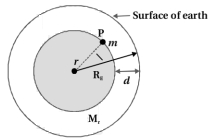
(N/A) Consider the Earth to be a sphere of radius $R_E$ and mass $M_E$ with uniform density $\rho$.
Let a point mass $m$ be situated at a point $P$ at a distance $r$ from the centre,where $r = R_E - d$.
According to the shell theorem,for a point inside the Earth,the gravitational force is exerted only by the mass of the sphere of radius $r$,denoted by $M_r$. The shells outside this radius exert no net gravitational force on the mass $m$.
The mass of the inner sphere is $M_r = \rho \cdot \frac{4}{3} \pi r^3$.
Since the density is uniform,$\rho = \frac{M_E}{\frac{4}{3} \pi R_E^3}$.
Substituting $\rho$ into the expression for $M_r$,we get $M_r = M_E \left( \frac{r^3}{R_E^3} \right)$.
The gravitational force on mass $m$ at distance $r$ is $F = \frac{G M_r m}{r^2}$.
Substituting $M_r$,we get $F = \frac{G m}{r^2} \cdot M_E \frac{r^3}{R_E^3} = \frac{G M_E m r}{R_E^3}$.
The acceleration due to gravity $g(r)$ is given by $g(r) = \frac{F}{m} = \frac{G M_E r}{R_E^3}$.
Substituting $r = R_E - d$,we get $g(d) = \frac{G M_E (R_E - d)}{R_E^3} = \frac{G M_E}{R_E^2} \left( 1 - \frac{d}{R_E} \right)$.
Since $g = \frac{G M_E}{R_E^2}$ is the acceleration due to gravity at the surface,the expression becomes $g(d) = g \left( 1 - \frac{d}{R_E} \right)$.
Let a point mass $m$ be situated at a point $P$ at a distance $r$ from the centre,where $r = R_E - d$.
According to the shell theorem,for a point inside the Earth,the gravitational force is exerted only by the mass of the sphere of radius $r$,denoted by $M_r$. The shells outside this radius exert no net gravitational force on the mass $m$.
The mass of the inner sphere is $M_r = \rho \cdot \frac{4}{3} \pi r^3$.
Since the density is uniform,$\rho = \frac{M_E}{\frac{4}{3} \pi R_E^3}$.
Substituting $\rho$ into the expression for $M_r$,we get $M_r = M_E \left( \frac{r^3}{R_E^3} \right)$.
The gravitational force on mass $m$ at distance $r$ is $F = \frac{G M_r m}{r^2}$.
Substituting $M_r$,we get $F = \frac{G m}{r^2} \cdot M_E \frac{r^3}{R_E^3} = \frac{G M_E m r}{R_E^3}$.
The acceleration due to gravity $g(r)$ is given by $g(r) = \frac{F}{m} = \frac{G M_E r}{R_E^3}$.
Substituting $r = R_E - d$,we get $g(d) = \frac{G M_E (R_E - d)}{R_E^3} = \frac{G M_E}{R_E^2} \left( 1 - \frac{d}{R_E} \right)$.
Since $g = \frac{G M_E}{R_E^2}$ is the acceleration due to gravity at the surface,the expression becomes $g(d) = g \left( 1 - \frac{d}{R_E} \right)$.
0 likes
View Solution188
Medium
Obtain the general equation of gravitational force at a distance $r$ from the centre of the Earth and derive the equation for acceleration due to gravity on the surface of the Earth.
Solution
(N/A) Imagine the Earth to be a sphere made of a large number of concentric spherical shells with the smallest one at the centre and the largest one at its surface.
$A$ point outside the Earth is outside all the shells. Thus,all the shells exert a gravitational force at the point outside just as if their masses were concentrated at their common centre.
For a point inside the Earth,the situation is different. Consider the Earth to be made up of concentric shells. $A$ point mass $m$ is situated at a distance $r$ $(r < R_E)$ from the centre. The point $P$ lies outside the sphere of radius $r$. For the shells of radius greater than $r$,the point $P$ lies inside. Hence,no net gravitational force is exerted by these outer shells on mass $m$ kept at $P$.
If the mass of the particle is $m$ at $P$,and the mass of the inner sphere of radius $r$ is $M_r$,then the force on the mass $m$ at $P$ has a magnitude:
$F = \frac{G m M_r}{r^2}$
Assuming the entire Earth has a uniform density $\rho$,its total mass is $M_E = (\frac{4}{3} \pi R_E^3) \rho$.
Therefore,$\rho = \frac{M_E}{\frac{4}{3} \pi R_E^3}$.
The mass of the inner sphere is $M_r = (\frac{4}{3} \pi r^3) \rho = (\frac{4}{3} \pi r^3) \frac{M_E}{\frac{4}{3} \pi R_E^3} = M_E \frac{r^3}{R_E^3}$.
Substituting $M_r$ into the force equation:
$F = \frac{G m}{r^2} (M_E \frac{r^3}{R_E^3}) = \frac{G M_E m r}{R_E^3}$.
Since $F = mg_r$,the acceleration due to gravity at distance $r$ is $g_r = \frac{G M_E r}{R_E^3}$.
On the surface of the Earth,$r = R_E$. Substituting this into the equation:
$g = \frac{G M_E R_E}{R_E^3} = \frac{G M_E}{R_E^2}$.
$A$ point outside the Earth is outside all the shells. Thus,all the shells exert a gravitational force at the point outside just as if their masses were concentrated at their common centre.
For a point inside the Earth,the situation is different. Consider the Earth to be made up of concentric shells. $A$ point mass $m$ is situated at a distance $r$ $(r < R_E)$ from the centre. The point $P$ lies outside the sphere of radius $r$. For the shells of radius greater than $r$,the point $P$ lies inside. Hence,no net gravitational force is exerted by these outer shells on mass $m$ kept at $P$.
If the mass of the particle is $m$ at $P$,and the mass of the inner sphere of radius $r$ is $M_r$,then the force on the mass $m$ at $P$ has a magnitude:
$F = \frac{G m M_r}{r^2}$
Assuming the entire Earth has a uniform density $\rho$,its total mass is $M_E = (\frac{4}{3} \pi R_E^3) \rho$.
Therefore,$\rho = \frac{M_E}{\frac{4}{3} \pi R_E^3}$.
The mass of the inner sphere is $M_r = (\frac{4}{3} \pi r^3) \rho = (\frac{4}{3} \pi r^3) \frac{M_E}{\frac{4}{3} \pi R_E^3} = M_E \frac{r^3}{R_E^3}$.
Substituting $M_r$ into the force equation:
$F = \frac{G m}{r^2} (M_E \frac{r^3}{R_E^3}) = \frac{G M_E m r}{R_E^3}$.
Since $F = mg_r$,the acceleration due to gravity at distance $r$ is $g_r = \frac{G M_E r}{R_E^3}$.
On the surface of the Earth,$r = R_E$. Substituting this into the equation:
$g = \frac{G M_E R_E}{R_E^3} = \frac{G M_E}{R_E^2}$.
0 likes
View Solution189
Easy
Define acceleration due to gravity. Give the magnitude of $g$ on the surface of earth.
Solution
(N/A) Acceleration due to gravity is defined as the uniform acceleration produced in a body falling freely under the sole influence of the earth's gravitational force. It is denoted by the symbol $g$.
The magnitude of acceleration due to gravity on the surface of the earth is approximately $9.8 \ m/s^2$.
The magnitude of acceleration due to gravity on the surface of the earth is approximately $9.8 \ m/s^2$.
0 likes
View Solution190
EasyMCQ
What is the gravitational force on a particle at the centre of the Earth?
A
Zero
B
Infinite
C
Equal to weight at the surface
D
Half of the weight at the surface
Solution
(A) According to the shell theorem for a spherical mass distribution,the gravitational force inside a uniform spherical shell is zero.
Since the Earth can be considered as a collection of concentric spherical shells,a particle at the centre of the Earth experiences an equal gravitational pull from all directions.
Therefore,the net gravitational force on a particle at the centre of the Earth is $0$.
Since the Earth can be considered as a collection of concentric spherical shells,a particle at the centre of the Earth experiences an equal gravitational pull from all directions.
Therefore,the net gravitational force on a particle at the centre of the Earth is $0$.
0 likes
View Solution191
MediumMCQ
How does the force of gravity $F$ vary inside the Earth at a distance $r$ from the center,where $r < R_e$?
A
$F \propto r$
B
$F \propto r^2$
C
$F \propto 1/r$
D
$F \propto 1/r^2$
Solution
(A) The gravitational force $F$ on a mass $m$ at a distance $r$ from the center of the Earth (where $r < R_e$) is given by $F = \frac{G M_r m}{r^2}$.
Assuming the Earth has a uniform density $\rho$,the mass $M_r$ contained within a sphere of radius $r$ is $M_r = \rho \cdot \frac{4}{3} \pi r^3$.
Substituting $M_r$ into the force equation: $F = \frac{G m}{r^2} \cdot \rho \cdot \frac{4}{3} \pi r^3$.
Simplifying this,we get $F = (\frac{4}{3} \pi G \rho m) r$.
Since $G, \pi, \rho, m$ are constants,it follows that $F \propto r$.
Assuming the Earth has a uniform density $\rho$,the mass $M_r$ contained within a sphere of radius $r$ is $M_r = \rho \cdot \frac{4}{3} \pi r^3$.
Substituting $M_r$ into the force equation: $F = \frac{G m}{r^2} \cdot \rho \cdot \frac{4}{3} \pi r^3$.
Simplifying this,we get $F = (\frac{4}{3} \pi G \rho m) r$.
Since $G, \pi, \rho, m$ are constants,it follows that $F \propto r$.
0 likes
View Solution192
Easy
How much is the radius of the Earth at the equator greater than the radius at the poles?
Solution
(21 KM) The Earth is not a perfect sphere; it is an oblate spheroid,meaning it bulges at the equator and is flattened at the poles.
The equatorial radius of the Earth is approximately $6378 \; km$.
The polar radius of the Earth is approximately $6357 \; km$.
The difference between the equatorial radius and the polar radius is $6378 \; km - 6357 \; km = 21 \; km$.
The equatorial radius of the Earth is approximately $6378 \; km$.
The polar radius of the Earth is approximately $6357 \; km$.
The difference between the equatorial radius and the polar radius is $6378 \; km - 6357 \; km = 21 \; km$.
0 likes
View Solution193
Medium
Write the difference between $G$ and $g$.
Solution
(N/A) $G$ is the Universal Gravitational Constant,while $g$ is the acceleration due to gravity.
$1$. $G$ is a constant value throughout the universe $(G = 6.67 \times 10^{-11} \ N \ m^2/kg^2)$,whereas $g$ varies from place to place on the Earth and other celestial bodies.
$2$. $G$ is a scalar quantity,while $g$ is a vector quantity.
$3$. The $SI$ unit of $G$ is $N \ m^2/kg^2$,whereas the $SI$ unit of $g$ is $m/s^2$.
$1$. $G$ is a constant value throughout the universe $(G = 6.67 \times 10^{-11} \ N \ m^2/kg^2)$,whereas $g$ varies from place to place on the Earth and other celestial bodies.
$2$. $G$ is a scalar quantity,while $g$ is a vector quantity.
$3$. The $SI$ unit of $G$ is $N \ m^2/kg^2$,whereas the $SI$ unit of $g$ is $m/s^2$.
0 likes
View Solution194
Medium
Derive the equation for the variation of $g$ due to height from the surface of the Earth.
Solution
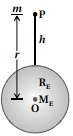
(N/A) Consider a point mass $m$ at a height $h$ above the surface of the Earth as shown in the figure. This body is placed at point $P$ at a distance $r = R_{E} + h$ from the center of the Earth.
The magnitude of the gravitational force on the body is:
$F(h) = \frac{GM_{E}m}{(R_{E} + h)^{2}}$
Since $F = mg(h)$,the acceleration due to gravity at height $h$ is:
$g(h) = \frac{F(h)}{m} = \frac{GM_{E}}{(R_{E} + h)^{2}} \quad ......(1)$
Acceleration due to gravity on the surface of the Earth $(h = 0)$:
$g = \frac{GM_{E}}{R_{E}^{2}} \quad ......(2)$
Taking the ratio of equation $(1)$ and $(2)$:
$\frac{g(h)}{g} = \frac{GM_{E}}{(R_{E} + h)^{2}} \times \frac{R_{E}^{2}}{GM_{E}} = \frac{R_{E}^{2}}{(R_{E} + h)^{2}}$
$\frac{g(h)}{g} = \frac{R_{E}^{2}}{R_{E}^{2}(1 + \frac{h}{R_{E}})^{2}} = \left(1 + \frac{h}{R_{E}}\right)^{-2}$
$g(h) = g \left(1 + \frac{h}{R_{E}}\right)^{-2} \quad ......(3)$
For small heights $(h \ll R_{E})$,we can use the binomial expansion $(1 + x)^{n} \approx 1 + nx$:
$g(h) \approx g \left(1 - \frac{2h}{R_{E}}\right) \quad ......(4)$
Equation $(3)$ is valid for any height,while equation $(4)$ is an approximation valid only when $h \ll R_{E}$.
The magnitude of the gravitational force on the body is:
$F(h) = \frac{GM_{E}m}{(R_{E} + h)^{2}}$
Since $F = mg(h)$,the acceleration due to gravity at height $h$ is:
$g(h) = \frac{F(h)}{m} = \frac{GM_{E}}{(R_{E} + h)^{2}} \quad ......(1)$
Acceleration due to gravity on the surface of the Earth $(h = 0)$:
$g = \frac{GM_{E}}{R_{E}^{2}} \quad ......(2)$
Taking the ratio of equation $(1)$ and $(2)$:
$\frac{g(h)}{g} = \frac{GM_{E}}{(R_{E} + h)^{2}} \times \frac{R_{E}^{2}}{GM_{E}} = \frac{R_{E}^{2}}{(R_{E} + h)^{2}}$
$\frac{g(h)}{g} = \frac{R_{E}^{2}}{R_{E}^{2}(1 + \frac{h}{R_{E}})^{2}} = \left(1 + \frac{h}{R_{E}}\right)^{-2}$
$g(h) = g \left(1 + \frac{h}{R_{E}}\right)^{-2} \quad ......(3)$
For small heights $(h \ll R_{E})$,we can use the binomial expansion $(1 + x)^{n} \approx 1 + nx$:
$g(h) \approx g \left(1 - \frac{2h}{R_{E}}\right) \quad ......(4)$
Equation $(3)$ is valid for any height,while equation $(4)$ is an approximation valid only when $h \ll R_{E}$.
3 likes
View Solution195
Medium
Find the magnitude of acceleration due to gravity at a height of $10 \, km$ from the surface of the earth.
Solution
(N/A) The acceleration due to gravity at a height $h$ above the Earth's surface is given by the formula $g_{h} = g_{e} \left(1 - \frac{2h}{R_{e}}\right)$,where $h = 10 \, km = 10^{4} \, m$,$R_{e} = 6.4 \times 10^{6} \, m$,and $g_{e} = 9.8 \, m/s^2$.
Substituting the values:
$g_{h} = 9.8 \left[1 - \frac{2 \times 10^{4}}{6.4 \times 10^{6}}\right]$
$g_{h} = 9.8 [1 - 0.003125]$
$g_{h} = 9.8 [0.996875]$
$g_{h} = 9.769375 \, m/s^2$
Rounding to appropriate significant figures,we get $g_{h} \approx 9.77 \, m/s^2$.
Substituting the values:
$g_{h} = 9.8 \left[1 - \frac{2 \times 10^{4}}{6.4 \times 10^{6}}\right]$
$g_{h} = 9.8 [1 - 0.003125]$
$g_{h} = 9.8 [0.996875]$
$g_{h} = 9.769375 \, m/s^2$
Rounding to appropriate significant figures,we get $g_{h} \approx 9.77 \, m/s^2$.
0 likes
View Solution196
Medium
Derive the equation for the variation of acceleration due to gravity $g$ with depth $d$ below the surface of the Earth.
Solution
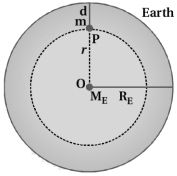
(N/A) Consider a point mass $m$ at a depth $d$ below the surface of the Earth. Let $R_{E}$ be the radius of the Earth. Its distance from the center of the Earth is $r = (R_{E} - d)$.
The gravitational force on mass $m$ due to the outer shell of thickness $d$ is zero.
The gravitational force on the body is exerted only by the inner sphere of radius $(R_{E} - d)$.
Assuming the Earth has a uniform density $\rho$,the mass of the inner sphere $M_{s}$ is given by:
$M_{s} = \frac{4}{3} \pi (R_{E} - d)^{3} \rho$ $......(1)$
The total mass of the Earth $M_{E}$ is:
$M_{E} = \frac{4}{3} \pi R_{E}^{3} \rho$ $......(2)$
Dividing equation $(1)$ by $(2)$:
$\frac{M_{s}}{M_{E}} = \frac{(R_{E} - d)^{3}}{R_{E}^{3}}$
$M_{s} = M_{E} \frac{(R_{E} - d)^{3}}{R_{E}^{3}}$ $......(3)$
The gravitational force $F(d)$ exerted on the point mass $m$ at depth $d$ is:
$F(d) = \frac{G M_{s} m}{(R_{E} - d)^{2}}$ $......(4)$
Substituting the value of $M_{s}$ from equation $(3)$ into equation $(4)$:
$F(d) = \frac{G m}{(R_{E} - d)^{2}} \left[ M_{E} \frac{(R_{E} - d)^{3}}{R_{E}^{3}} \right]$
$F(d) = \frac{G M_{E} m (R_{E} - d)}{R_{E}^{3}}$
Since $F(d) = m g_{d}$,where $g_{d}$ is the acceleration due to gravity at depth $d$:
$m g_{d} = \frac{G M_{E} m (R_{E} - d)}{R_{E}^{3}}$
$g_{d} = \frac{G M_{E}}{R_{E}^{2}} \left( 1 - \frac{d}{R_{E}} \right)$
Since $g = \frac{G M_{E}}{R_{E}^{2}}$ is the acceleration due to gravity at the surface,we get:
$g_{d} = g \left( 1 - \frac{d}{R_{E}} \right)$
The gravitational force on mass $m$ due to the outer shell of thickness $d$ is zero.
The gravitational force on the body is exerted only by the inner sphere of radius $(R_{E} - d)$.
Assuming the Earth has a uniform density $\rho$,the mass of the inner sphere $M_{s}$ is given by:
$M_{s} = \frac{4}{3} \pi (R_{E} - d)^{3} \rho$ $......(1)$
The total mass of the Earth $M_{E}$ is:
$M_{E} = \frac{4}{3} \pi R_{E}^{3} \rho$ $......(2)$
Dividing equation $(1)$ by $(2)$:
$\frac{M_{s}}{M_{E}} = \frac{(R_{E} - d)^{3}}{R_{E}^{3}}$
$M_{s} = M_{E} \frac{(R_{E} - d)^{3}}{R_{E}^{3}}$ $......(3)$
The gravitational force $F(d)$ exerted on the point mass $m$ at depth $d$ is:
$F(d) = \frac{G M_{s} m}{(R_{E} - d)^{2}}$ $......(4)$
Substituting the value of $M_{s}$ from equation $(3)$ into equation $(4)$:
$F(d) = \frac{G m}{(R_{E} - d)^{2}} \left[ M_{E} \frac{(R_{E} - d)^{3}}{R_{E}^{3}} \right]$
$F(d) = \frac{G M_{E} m (R_{E} - d)}{R_{E}^{3}}$
Since $F(d) = m g_{d}$,where $g_{d}$ is the acceleration due to gravity at depth $d$:
$m g_{d} = \frac{G M_{E} m (R_{E} - d)}{R_{E}^{3}}$
$g_{d} = \frac{G M_{E}}{R_{E}^{2}} \left( 1 - \frac{d}{R_{E}} \right)$
Since $g = \frac{G M_{E}}{R_{E}^{2}}$ is the acceleration due to gravity at the surface,we get:
$g_{d} = g \left( 1 - \frac{d}{R_{E}} \right)$
0 likes
View Solution197
Difficult
Explain the variations of acceleration due to gravity inside and outside the Earth and draw the graph.
Solution
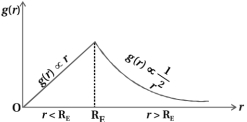
(N/A) $1$. Inside the Earth $(r < R_E)$: The acceleration due to gravity at a distance $r$ from the center is given by $g(r) = \frac{4}{3} \pi G \rho r$,where $\rho$ is the density of the Earth. Since $\frac{4}{3} \pi G \rho$ is constant,we have $g(r) \propto r$. This means $g$ increases linearly as we move from the center to the surface.
$2$. Outside the Earth $(r > R_E)$: The acceleration due to gravity at a distance $r$ from the center is given by $g(r) = \frac{GM}{r^2}$. Thus,$g(r) \propto \frac{1}{r^2}$. This means $g$ decreases as the inverse square of the distance from the center.
$3$. At the surface $(r = R_E)$: The value of $g$ is maximum,given by $g = \frac{GM}{R_E^2}$.
The graph shows $g(r)$ on the y-axis and $r$ on the x-axis,illustrating the linear increase inside the Earth and the inverse-square decrease outside the Earth.
$2$. Outside the Earth $(r > R_E)$: The acceleration due to gravity at a distance $r$ from the center is given by $g(r) = \frac{GM}{r^2}$. Thus,$g(r) \propto \frac{1}{r^2}$. This means $g$ decreases as the inverse square of the distance from the center.
$3$. At the surface $(r = R_E)$: The value of $g$ is maximum,given by $g = \frac{GM}{R_E^2}$.
The graph shows $g(r)$ on the y-axis and $r$ on the x-axis,illustrating the linear increase inside the Earth and the inverse-square decrease outside the Earth.
0 likes
View Solution198
Difficult
Obtain an expression for the variation in effective gravitational acceleration $g'$ with latitude due to the Earth's rotation.
Solution
(N/A) The angle made by the line joining a given place on the Earth's surface to the center of the Earth with the equatorial plane is called the latitude $(\lambda)$ of that place.
For the equator,latitude $\lambda = 0^{\circ}$ and for the poles,latitude $\lambda = 90^{\circ}$.
As shown in the figure,the latitude of the place $P$ on the Earth's surface is $\lambda = \angle POE$. Consider a particle of mass $m$ at this position. Two forces act on it:
$(1)$ The Earth's gravitational force $mg$ acting towards the center $O$ along the line $PO$.
$(2)$ Due to the Earth's rotation,the particle experiences a centrifugal force $m r \omega^2$ acting outwards along the radius of the circular path $PM$ (where $r$ is the radius of the circle of latitude).
From the geometry of the figure,$r = R_e \cos \lambda$,where $R_e$ is the radius of the Earth.
The component of the centrifugal force $m r \omega^2$ acting along the line $PO$ (towards the center) is $m r \omega^2 \cos \lambda$.
Substituting $r = R_e \cos \lambda$,the component is $m (R_e \cos \lambda) \omega^2 \cos \lambda = m R_e \omega^2 \cos^2 \lambda$.
The effective force $F$ on the particle towards the center is $F = mg - m R_e \omega^2 \cos^2 \lambda$.
If $g'$ is the effective gravitational acceleration,then $mg' = F = mg - m R_e \omega^2 \cos^2 \lambda$.
Therefore,the expression for effective gravitational acceleration is $g' = g - R_e \omega^2 \cos^2 \lambda$.
For the equator,latitude $\lambda = 0^{\circ}$ and for the poles,latitude $\lambda = 90^{\circ}$.
As shown in the figure,the latitude of the place $P$ on the Earth's surface is $\lambda = \angle POE$. Consider a particle of mass $m$ at this position. Two forces act on it:
$(1)$ The Earth's gravitational force $mg$ acting towards the center $O$ along the line $PO$.
$(2)$ Due to the Earth's rotation,the particle experiences a centrifugal force $m r \omega^2$ acting outwards along the radius of the circular path $PM$ (where $r$ is the radius of the circle of latitude).
From the geometry of the figure,$r = R_e \cos \lambda$,where $R_e$ is the radius of the Earth.
The component of the centrifugal force $m r \omega^2$ acting along the line $PO$ (towards the center) is $m r \omega^2 \cos \lambda$.
Substituting $r = R_e \cos \lambda$,the component is $m (R_e \cos \lambda) \omega^2 \cos \lambda = m R_e \omega^2 \cos^2 \lambda$.
The effective force $F$ on the particle towards the center is $F = mg - m R_e \omega^2 \cos^2 \lambda$.
If $g'$ is the effective gravitational acceleration,then $mg' = F = mg - m R_e \omega^2 \cos^2 \lambda$.
Therefore,the expression for effective gravitational acceleration is $g' = g - R_e \omega^2 \cos^2 \lambda$.
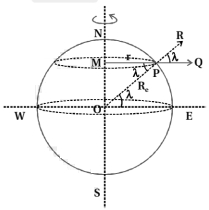
0 likes
View Solution199
Medium
Write the equation of gravitational acceleration which is used for any height $h$ from the surface of the Earth.
Solution
(N/A) The gravitational acceleration $g$ at a height $h$ above the surface of the Earth is given by the formula:
$g_h = g \left( \frac{R_e}{R_e + h} \right)^2$
Where:
$g_h$ is the acceleration due to gravity at height $h$.
$g$ is the acceleration due to gravity at the Earth's surface $(g \approx 9.8 \ m/s^2)$.
$R_e$ is the radius of the Earth.
$h$ is the height above the Earth's surface.
$g_h = g \left( \frac{R_e}{R_e + h} \right)^2$
Where:
$g_h$ is the acceleration due to gravity at height $h$.
$g$ is the acceleration due to gravity at the Earth's surface $(g \approx 9.8 \ m/s^2)$.
$R_e$ is the radius of the Earth.
$h$ is the height above the Earth's surface.
0 likes
View Solution200
Medium
Write the equation of acceleration due to gravity at a height $h$ from the surface of the Earth,where $h << R_e$.
Solution
(N/A) The acceleration due to gravity at a height $h$ above the surface of the Earth is given by the formula:
$g_h = g \left( 1 + \frac{h}{R_e} \right)^{-2}$
Using the binomial expansion for $h << R_e$,we can approximate this as:
$g_h \approx g \left( 1 - \frac{2h}{R_e} \right)$
Where $g$ is the acceleration due to gravity at the surface of the Earth,$h$ is the height,and $R_e$ is the radius of the Earth.
$g_h = g \left( 1 + \frac{h}{R_e} \right)^{-2}$
Using the binomial expansion for $h << R_e$,we can approximate this as:
$g_h \approx g \left( 1 - \frac{2h}{R_e} \right)$
Where $g$ is the acceleration due to gravity at the surface of the Earth,$h$ is the height,and $R_e$ is the radius of the Earth.
0 likes
View SolutionGravitation — Acceleration Due to Gravity and its Variation · Frequently Asked Questions
1Are these Gravitation questions useful for JEE and NEET?
Yes. All questions in this section are mapped to JEE Main and NEET exam patterns. Previous year questions from JEE Main, NEET, GUJCET and state-level exams are included with full solutions.
2Can I switch to Hindi or Gujarati for these questions?
Yes. Use the language tabs in the hero section or the sidebar to view the same questions and solutions in English, Hindi or Gujarati.
3How do I generate a question paper from this subtopic?
Use the Vedclass Exam Paper Generator — select the chapter and subtopic, set difficulty, and generate Sets A, B, C, D automatically. First 3 chapters of every subject are free.
Vedclass Products
For Students
Vedclass Test Series
Mock tests in real JEE/NEET style with performance analysis. 5-day free trial.
Start Free TrialFor Teachers
Exam Paper Generator
Generate Set A/B/C/D papers from this chapter in 2 minutes. 3 chapters free.
Try FreeFor Institutes
Online Exam Module
Live online exams with unlimited students, 360° analytics & white-label branding.
See DemoFor Teachers & Institutes
Generate a Gravitation Exam Paper in 2 Minutes
Select subtopic & difficulty — Sets A, B, C, D auto-generated with No Repeat logic.
First 3 chapters of every subject are free — no payment required.