
A English
Kepler’s laws of Planetary Motion Questions in English
Class 11 Physics · Gravitation · Kepler’s laws of Planetary Motion
145+
Questions
English
Language
100%
With Solutions
Showing 49 of 145 questions in English
1
EasyMCQ
$A$ satellite which is geostationary in a particular orbit is taken to another orbit. Its distance from the centre of the Earth in the new orbit is $2$ times that of the earlier orbit. The time period in the second orbit is:
A
$4.8$ hours
B
$48\sqrt{2}$ hours
C
$24$ hours
D
$24\sqrt{2}$ hours
Solution
(B) According to Kepler's third law of planetary motion,the square of the time period $(T)$ is proportional to the cube of the orbital radius $(r)$: $T^2 \propto r^3$,which implies $T \propto r^{3/2}$.
Given that the initial time period $T_1 = 24$ hours (for a geostationary orbit) and the new radius $r_2 = 2r_1$.
The new time period $T_2$ is given by: $T_2 = T_1 \times (r_2/r_1)^{3/2}$.
Substituting the values: $T_2 = 24 \times (2)^{3/2} = 24 \times 2\sqrt{2} = 48\sqrt{2}$ hours.
Given that the initial time period $T_1 = 24$ hours (for a geostationary orbit) and the new radius $r_2 = 2r_1$.
The new time period $T_2$ is given by: $T_2 = T_1 \times (r_2/r_1)^{3/2}$.
Substituting the values: $T_2 = 24 \times (2)^{3/2} = 24 \times 2\sqrt{2} = 48\sqrt{2}$ hours.
0 likes
View Solution2
MediumMCQ
An earth satellite $S$ has an orbit radius which is $4$ times that of a communication satellite $C$. The period of revolution of $S$ is ........ $days$.
A
$4$
B
$8$
C
$16$
D
$32$
Solution
(B) According to Kepler's third law of planetary motion, the square of the time period $T$ is proportional to the cube of the orbital radius $r$, i.e., $T^2 \propto r^3$.
Given that the orbital radius of satellite $S$ is $r_s = 4r_c$, where $r_c$ is the orbital radius of the communication satellite $C$.
The time period of a communication satellite is $T_c = 1 \text{ day}$.
Using the relation $\frac{T_s}{T_c} = \left(\frac{r_s}{r_c}\right)^{3/2}$, we substitute the given values:
$\frac{T_s}{1} = (4)^{3/2} = (2^2)^{3/2} = 2^3 = 8$.
Therefore, the time period of satellite $S$ is $8 \text{ days}$.
Given that the orbital radius of satellite $S$ is $r_s = 4r_c$, where $r_c$ is the orbital radius of the communication satellite $C$.
The time period of a communication satellite is $T_c = 1 \text{ day}$.
Using the relation $\frac{T_s}{T_c} = \left(\frac{r_s}{r_c}\right)^{3/2}$, we substitute the given values:
$\frac{T_s}{1} = (4)^{3/2} = (2^2)^{3/2} = 2^3 = 8$.
Therefore, the time period of satellite $S$ is $8 \text{ days}$.
0 likes
View Solution3
MediumMCQ
Which of the following quantities does not depend upon the orbital radius of the satellite?
A
$T/R$
B
$T^2/R$
C
$T^2/R^2$
D
$T^2/R^3$
Solution
(D) According to Kepler's Third Law of Planetary Motion,the square of the time period $(T)$ of a satellite is directly proportional to the cube of the orbital radius $(R)$.
Mathematically,this is expressed as $T^2 \propto R^3$.
Therefore,the ratio $\frac{T^2}{R^3} = \text{constant}$.
Since this ratio is a constant value,it does not depend on the orbital radius $(R)$ of the satellite.
Mathematically,this is expressed as $T^2 \propto R^3$.
Therefore,the ratio $\frac{T^2}{R^3} = \text{constant}$.
Since this ratio is a constant value,it does not depend on the orbital radius $(R)$ of the satellite.
0 likes
View Solution4
MediumMCQ
The time period of a satellite of the Earth is $5$ hours. If the separation between the Earth and the satellite is increased to four times the previous value,the new time period will become ......... $hours$.
A
$20$
B
$10$
C
$80$
D
$40$
Solution
(D) According to Kepler's third law of planetary motion,the square of the time period $(T)$ is proportional to the cube of the orbital radius $(R)$: $T^2 \propto R^3$,which implies $T \propto R^{3/2}$.
Given the initial time period $T_1 = 5$ hours.
Let the initial separation be $R_1$ and the new separation be $R_2 = 4R_1$.
The new time period $T_2$ is given by the ratio: $\frac{T_2}{T_1} = \left( \frac{R_2}{R_1} \right)^{3/2}$.
Substituting the values: $\frac{T_2}{5} = \left( \frac{4R_1}{R_1} \right)^{3/2} = (4)^{3/2}$.
Calculating the exponent: $(4)^{3/2} = (2^2)^{3/2} = 2^3 = 8$.
Therefore,$T_2 = 5 \times 8 = 40$ hours.
Given the initial time period $T_1 = 5$ hours.
Let the initial separation be $R_1$ and the new separation be $R_2 = 4R_1$.
The new time period $T_2$ is given by the ratio: $\frac{T_2}{T_1} = \left( \frac{R_2}{R_1} \right)^{3/2}$.
Substituting the values: $\frac{T_2}{5} = \left( \frac{4R_1}{R_1} \right)^{3/2} = (4)^{3/2}$.
Calculating the exponent: $(4)^{3/2} = (2^2)^{3/2} = 2^3 = 8$.
Therefore,$T_2 = 5 \times 8 = 40$ hours.
0 likes
View Solution5
MediumMCQ
$A$ satellite moves around the Earth in a circular orbit of radius $R$ making one revolution per day. $A$ second satellite moving in a circular orbit moves around the Earth once in $8$ days. The radius of the orbit of the second satellite is
A
$8R$
B
$4R$
C
$2R$
D
$R$
Solution
(B) According to Kepler's Third Law of Planetary Motion,the square of the time period $(T)$ is directly proportional to the cube of the orbital radius $(r)$: $T^2 \propto r^3$.
Given for the first satellite: $T_1 = 1 \text{ day}$,$r_1 = R$.
Given for the second satellite: $T_2 = 8 \text{ days}$,$r_2 = ?$.
Using the ratio: $\left( \frac{T_2}{T_1} \right)^2 = \left( \frac{r_2}{r_1} \right)^3$.
Substituting the values: $\left( \frac{8}{1} \right)^2 = \left( \frac{r_2}{R} \right)^3$.
$64 = \left( \frac{r_2}{R} \right)^3$.
Taking the cube root on both sides: $\sqrt[3]{64} = \frac{r_2}{R}$.
$4 = \frac{r_2}{R}$,which implies $r_2 = 4R$.
Given for the first satellite: $T_1 = 1 \text{ day}$,$r_1 = R$.
Given for the second satellite: $T_2 = 8 \text{ days}$,$r_2 = ?$.
Using the ratio: $\left( \frac{T_2}{T_1} \right)^2 = \left( \frac{r_2}{r_1} \right)^3$.
Substituting the values: $\left( \frac{8}{1} \right)^2 = \left( \frac{r_2}{R} \right)^3$.
$64 = \left( \frac{r_2}{R} \right)^3$.
Taking the cube root on both sides: $\sqrt[3]{64} = \frac{r_2}{R}$.
$4 = \frac{r_2}{R}$,which implies $r_2 = 4R$.
0 likes
View Solution6
MediumMCQ
$A$ satellite moves in a circle around the earth. The radius of this circle is equal to one half of the radius of the moon's orbit. The satellite completes one revolution in
A
$1/2$ lunar month
B
$2/3$ lunar month
C
$2^{-3/2}$ lunar month
D
$2^{3/2}$ lunar month
Solution
(C) According to Kepler's third law of planetary motion,the square of the time period $(T)$ is proportional to the cube of the orbital radius $(r)$,i.e.,$T^2 \propto r^3$.
Let $T_s$ and $r_s$ be the time period and orbital radius of the satellite,and $T_m$ and $r_m$ be the time period and orbital radius of the moon.
Given: $r_s = \frac{1}{2} r_m$ and $T_m = 1$ lunar month.
Using the ratio: $\frac{T_s}{T_m} = \left( \frac{r_s}{r_m} \right)^{3/2}$.
Substituting the values: $\frac{T_s}{1} = \left( \frac{1/2 r_m}{r_m} \right)^{3/2} = \left( \frac{1}{2} \right)^{3/2} = 2^{-3/2}$.
Therefore,the satellite completes one revolution in $2^{-3/2}$ lunar month.
Let $T_s$ and $r_s$ be the time period and orbital radius of the satellite,and $T_m$ and $r_m$ be the time period and orbital radius of the moon.
Given: $r_s = \frac{1}{2} r_m$ and $T_m = 1$ lunar month.
Using the ratio: $\frac{T_s}{T_m} = \left( \frac{r_s}{r_m} \right)^{3/2}$.
Substituting the values: $\frac{T_s}{1} = \left( \frac{1/2 r_m}{r_m} \right)^{3/2} = \left( \frac{1}{2} \right)^{3/2} = 2^{-3/2}$.
Therefore,the satellite completes one revolution in $2^{-3/2}$ lunar month.
0 likes
View Solution7
MediumMCQ
The distances of Neptune and Saturn from the Sun are nearly $10^{13} \ m$ and $10^{12} \ m$ respectively. Assuming that they move in circular orbits,their periodic times will be in the ratio:
A
$10\sqrt{10}$
B
$100$
C
$\sqrt{10}$
D
$1/\sqrt{10}$
Solution
(A) According to Kepler's third law of planetary motion,the square of the time period $T$ is proportional to the cube of the semi-major axis $R$ of the orbit: $T^2 \propto R^3$.
Given:
$R_1 = 10^{13} \ m$ (Neptune)
$R_2 = 10^{12} \ m$ (Saturn)
The ratio of the time periods is given by:
$\frac{T_1}{T_2} = \left( \frac{R_1}{R_2} \right)^{3/2}$
Substituting the values:
$\frac{T_1}{T_2} = \left( \frac{10^{13}}{10^{12}} \right)^{3/2}$
$\frac{T_1}{T_2} = (10)^{3/2}$
$\frac{T_1}{T_2} = 10^1 \cdot 10^{1/2} = 10\sqrt{10}$
Given:
$R_1 = 10^{13} \ m$ (Neptune)
$R_2 = 10^{12} \ m$ (Saturn)
The ratio of the time periods is given by:
$\frac{T_1}{T_2} = \left( \frac{R_1}{R_2} \right)^{3/2}$
Substituting the values:
$\frac{T_1}{T_2} = \left( \frac{10^{13}}{10^{12}} \right)^{3/2}$
$\frac{T_1}{T_2} = (10)^{3/2}$
$\frac{T_1}{T_2} = 10^1 \cdot 10^{1/2} = 10\sqrt{10}$
0 likes
View Solution8
EasyMCQ
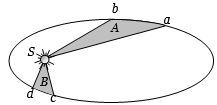
The figure shows the motion of a planet around the sun in an elliptical orbit with the sun at the focus. The shaded areas $A$ and $B$ are also shown in the figure,which can be assumed to be equal. If ${t_1}$ and ${t_2}$ represent the time taken for the planet to move from $a$ to $b$ and $d$ to $c$ respectively,then:
A
${t_1} < {t_2}$
B
${t_1} > {t_2}$
C
${t_1} = {t_2}$
D
${t_1} \le {t_2}$
Solution
(C) According to Kepler's second law of planetary motion,the areal velocity of a planet revolving around the sun is constant.
This means that the radius vector sweeps out equal areas in equal intervals of time.
Given that the shaded areas $A$ and $B$ are equal,the time taken to sweep these areas must also be equal.
Therefore,if ${t_1}$ is the time taken to move from $a$ to $b$ (sweeping area $A$) and ${t_2}$ is the time taken to move from $d$ to $c$ (sweeping area $B$),then ${t_1} = {t_2}$.
This means that the radius vector sweeps out equal areas in equal intervals of time.
Given that the shaded areas $A$ and $B$ are equal,the time taken to sweep these areas must also be equal.
Therefore,if ${t_1}$ is the time taken to move from $a$ to $b$ (sweeping area $A$) and ${t_2}$ is the time taken to move from $d$ to $c$ (sweeping area $B$),then ${t_1} = {t_2}$.
0 likes
View Solution9
MediumMCQ
The period of a satellite in a circular orbit of radius $R$ is $T$. The period of another satellite in a circular orbit of radius $4R$ is:
A
$4T$
B
$T/4$
C
$8T$
D
$T/8$
Solution
(C) According to Kepler's third law of planetary motion,the square of the time period $T$ is proportional to the cube of the orbital radius $R$,i.e.,$T^2 \propto R^3$.
Given for the first satellite: $T_1 = T$ and $R_1 = R$.
For the second satellite: $R_2 = 4R$ and we need to find $T_2$.
Using the ratio formula:
$\frac{T_2}{T_1} = \left( \frac{R_2}{R_1} \right)^{3/2}$
Substituting the values:
$\frac{T_2}{T} = \left( \frac{4R}{R} \right)^{3/2}$
$\frac{T_2}{T} = (4)^{3/2}$
$\frac{T_2}{T} = (2^2)^{3/2} = 2^3 = 8$
Therefore,$T_2 = 8T$.
Given for the first satellite: $T_1 = T$ and $R_1 = R$.
For the second satellite: $R_2 = 4R$ and we need to find $T_2$.
Using the ratio formula:
$\frac{T_2}{T_1} = \left( \frac{R_2}{R_1} \right)^{3/2}$
Substituting the values:
$\frac{T_2}{T} = \left( \frac{4R}{R} \right)^{3/2}$
$\frac{T_2}{T} = (4)^{3/2}$
$\frac{T_2}{T} = (2^2)^{3/2} = 2^3 = 8$
Therefore,$T_2 = 8T$.
0 likes
View Solution10
EasyMCQ
The orbit of a planet around a star is:
A
$A$ circle
B
An ellipse
C
$A$ parabola
D
$A$ straight line
Solution
(B) According to Kepler's first law of planetary motion,also known as the Law of Orbits,every planet moves around the Sun (or a star) in an elliptical orbit with the Sun at one of the two foci. Therefore,the correct shape of the orbit is an ellipse.
0 likes
View Solution11
EasyMCQ
If a body describes a circular motion under an inverse square field,the time taken to complete one revolution $T$ is related to the radius of the circular orbit $r$ as:
A
$T \propto r$
B
$T \propto r^2$
C
$T^2 \propto r^3$
D
$T \propto r^4$
Solution
(C) In an inverse square field,the force $F$ acting on a body of mass $m$ moving in a circular orbit of radius $r$ is given by $F = \frac{k}{r^2}$,where $k$ is a constant.
For circular motion,this force provides the necessary centripetal force: $\frac{k}{r^2} = \frac{mv^2}{r}$.
Simplifying this,we get $v^2 = \frac{k}{mr}$,which implies $v = \sqrt{\frac{k}{mr}}$.
The time period $T$ for one revolution is $T = \frac{2\pi r}{v}$.
Substituting the expression for $v$: $T = \frac{2\pi r}{\sqrt{\frac{k}{mr}}} = 2\pi \sqrt{\frac{m}{k}} \cdot r^{3/2}$.
Squaring both sides,we get $T^2 = 4\pi^2 \frac{m}{k} r^3$.
Since $4, \pi, m,$ and $k$ are constants,we have $T^2 \propto r^3$.
For circular motion,this force provides the necessary centripetal force: $\frac{k}{r^2} = \frac{mv^2}{r}$.
Simplifying this,we get $v^2 = \frac{k}{mr}$,which implies $v = \sqrt{\frac{k}{mr}}$.
The time period $T$ for one revolution is $T = \frac{2\pi r}{v}$.
Substituting the expression for $v$: $T = \frac{2\pi r}{\sqrt{\frac{k}{mr}}} = 2\pi \sqrt{\frac{m}{k}} \cdot r^{3/2}$.
Squaring both sides,we get $T^2 = 4\pi^2 \frac{m}{k} r^3$.
Since $4, \pi, m,$ and $k$ are constants,we have $T^2 \propto r^3$.
0 likes
View Solution12
MediumMCQ
If the earth is at one-fourth of its present distance from the sun,the duration of the year will be
A
Half the present year
B
One-eighth the present year
C
One-fourth the present year
D
One-sixth the present year
Solution
(B) According to Kepler's third law of planetary motion,the square of the time period $(T)$ of a planet is directly proportional to the cube of its semi-major axis $(r)$,i.e.,$T^2 \propto r^3$.
Given that the new distance $r' = \frac{1}{4}r$.
Using the ratio formula: $\left( \frac{T'}{T} \right)^2 = \left( \frac{r'}{r} \right)^3$.
Substituting the value of $r'$: $\left( \frac{T'}{T} \right)^2 = \left( \frac{1}{4} \right)^3 = \frac{1}{64}$.
Taking the square root on both sides: $\frac{T'}{T} = \sqrt{\frac{1}{64}} = \frac{1}{8}$.
Therefore,the new duration of the year $T' = \frac{1}{8}T$.
Given that the new distance $r' = \frac{1}{4}r$.
Using the ratio formula: $\left( \frac{T'}{T} \right)^2 = \left( \frac{r'}{r} \right)^3$.
Substituting the value of $r'$: $\left( \frac{T'}{T} \right)^2 = \left( \frac{1}{4} \right)^3 = \frac{1}{64}$.
Taking the square root on both sides: $\frac{T'}{T} = \sqrt{\frac{1}{64}} = \frac{1}{8}$.
Therefore,the new duration of the year $T' = \frac{1}{8}T$.
0 likes
View Solution13
EasyMCQ
The Earth revolves around the Sun in an elliptical orbit with a mean radius of $9.3 \times 10^{10} \ m$ in a period of $1$ year. Assuming that there are no outside influences,which of the following statements is true?
A
The Earth's kinetic energy remains constant.
B
The Earth's angular momentum remains constant.
C
The Earth's potential energy remains constant.
D
All of the above are correct.
Solution
(B) According to Kepler's second law of planetary motion,the gravitational force exerted by the Sun on the Earth is a central force.
Since the torque exerted by a central force about the center of the Sun is zero $(\tau = r \times F = 0)$,the angular momentum $(L)$ of the Earth remains constant throughout its orbit.
However,the distance between the Earth and the Sun changes in an elliptical orbit,which causes both the kinetic energy and the potential energy of the Earth to vary with its position.
Since the torque exerted by a central force about the center of the Sun is zero $(\tau = r \times F = 0)$,the angular momentum $(L)$ of the Earth remains constant throughout its orbit.
However,the distance between the Earth and the Sun changes in an elliptical orbit,which causes both the kinetic energy and the potential energy of the Earth to vary with its position.
0 likes
View Solution14
MediumMCQ
$A$ planet moves around the sun. At a given point $P$,it is closest to the sun at a distance $d_1$ and has a speed $v_1$. At another point $Q$,when it is farthest from the sun at a distance $d_2$,its speed will be:
A
$\frac{d_1^2 v_1}{d_2^2}$
B
$\frac{d_2 v_1}{d_1}$
C
$\frac{d_1 v_1}{d_2}$
D
$\frac{d_2^2 v_1}{d_1^2}$
Solution
(C) According to Kepler's second law of planetary motion,the angular momentum of a planet revolving around the sun remains constant.
The angular momentum $L$ is given by $L = mvr \sin(\theta)$. At the points of closest approach (perihelion) and farthest distance (aphelion),the velocity vector is perpendicular to the position vector,so $\theta = 90^\circ$ and $\sin(90^\circ) = 1$.
Therefore,the conservation of angular momentum gives:
$m v_1 d_1 = m v_2 d_2$
Canceling the mass $m$ from both sides:
$v_1 d_1 = v_2 d_2$
Solving for $v_2$:
$v_2 = \frac{v_1 d_1}{d_2}$
The angular momentum $L$ is given by $L = mvr \sin(\theta)$. At the points of closest approach (perihelion) and farthest distance (aphelion),the velocity vector is perpendicular to the position vector,so $\theta = 90^\circ$ and $\sin(90^\circ) = 1$.
Therefore,the conservation of angular momentum gives:
$m v_1 d_1 = m v_2 d_2$
Canceling the mass $m$ from both sides:
$v_1 d_1 = v_2 d_2$
Solving for $v_2$:
$v_2 = \frac{v_1 d_1}{d_2}$
0 likes
View Solution15
MediumMCQ
Two planets move around the sun. The periodic times and the mean radii of the orbits are $T_1, T_2$ and $r_1, r_2$ respectively. The ratio $T_1/T_2$ is equal to
A
$(r_1/r_2)^{1/2}$
B
$r_1/r_2$
C
$(r_1/r_2)^2$
D
$(r_1/r_2)^{3/2}$
Solution
(D) According to Kepler's third law of planetary motion,the square of the time period of revolution of a planet is directly proportional to the cube of the semi-major axis of its orbit.
Mathematically,$T^2 \propto r^3$.
For two planets,we can write the ratio as:
$\frac{T_1^2}{T_2^2} = \frac{r_1^3}{r_2^3}$
Taking the square root on both sides:
$\frac{T_1}{T_2} = \left( \frac{r_1}{r_2} \right)^{3/2}$
Mathematically,$T^2 \propto r^3$.
For two planets,we can write the ratio as:
$\frac{T_1^2}{T_2^2} = \frac{r_1^3}{r_2^3}$
Taking the square root on both sides:
$\frac{T_1}{T_2} = \left( \frac{r_1}{r_2} \right)^{3/2}$
0 likes
View Solution16
EasyMCQ
Kepler's second law regarding the constancy of areal velocity of a planet is a consequence of the law of conservation of
A
Energy
B
Angular momentum
C
Linear momentum
D
None of these
Solution
(B) Kepler's second law states that the areal velocity $(dA/dt)$ of a planet revolving around the Sun is constant.
Since the gravitational force exerted by the Sun on the planet is a central force,the torque $(\tau)$ acting on the planet about the Sun is zero.
According to the relation $\tau = dL/dt$,if $\tau = 0$,then the angular momentum $(L)$ of the planet remains constant.
The areal velocity is given by the expression $\frac{dA}{dt} = \frac{L}{2m}$,where $m$ is the mass of the planet.
Since $L$ and $m$ are constants,the areal velocity is constant.
Therefore,Kepler's second law is a direct consequence of the law of conservation of angular momentum.
Since the gravitational force exerted by the Sun on the planet is a central force,the torque $(\tau)$ acting on the planet about the Sun is zero.
According to the relation $\tau = dL/dt$,if $\tau = 0$,then the angular momentum $(L)$ of the planet remains constant.
The areal velocity is given by the expression $\frac{dA}{dt} = \frac{L}{2m}$,where $m$ is the mass of the planet.
Since $L$ and $m$ are constants,the areal velocity is constant.
Therefore,Kepler's second law is a direct consequence of the law of conservation of angular momentum.
0 likes
View Solution17
EasyMCQ
According to Kepler, the period of revolution of a planet $(T)$ and its mean distance from the sun $(r)$ are related by the equation:
A
$T^3 r^3 = \text{constant}$
B
$T^2 r^{-3} = \text{constant}$
C
$T r^3 = \text{constant}$
D
$T^2 r = \text{constant}$
Solution
(B) Kepler's third law of planetary motion, also known as the law of periods, states that the square of the time period of revolution $(T)$ of a planet is directly proportional to the cube of its semi-major axis $(r)$ of its orbit around the sun.
Mathematically, this is expressed as $T^2 \propto r^3$.
This can be rewritten as $\frac{T^2}{r^3} = \text{constant}$.
By using the laws of exponents, this is equivalent to $T^2 r^{-3} = \text{constant}$.
Therefore, the correct option is $B$.
Mathematically, this is expressed as $T^2 \propto r^3$.
This can be rewritten as $\frac{T^2}{r^3} = \text{constant}$.
By using the laws of exponents, this is equivalent to $T^2 r^{-3} = \text{constant}$.
Therefore, the correct option is $B$.
0 likes
View Solution18
EasyMCQ
$A$ planet revolves around the sun whose mean distance is $1.588$ times the mean distance between the earth and the sun. The revolution time of the planet will be ........... $years$.
A
$1.25$
B
$1.59$
C
$0.89$
D
$2$
Solution
(D) According to Kepler's third law of planetary motion, the square of the time period of revolution $(T)$ is proportional to the cube of the semi-major axis $(r)$ of the orbit: $T^2 \propto r^3$.
Given that the mean distance of the planet $(r_p)$ is $1.588$ times the mean distance of the earth $(r_e)$, we have $r_p = 1.588 \times r_e$.
The ratio of the time periods is given by: $\frac{T_p}{T_e} = \left( \frac{r_p}{r_e} \right)^{3/2}$.
Substituting the given values: $\frac{T_p}{T_e} = (1.588)^{3/2}$.
Since $1.588 \approx (2)^{2/3}$, we have $(1.588)^{3/2} \approx ((2)^{2/3})^{3/2} = 2^1 = 2$.
Therefore, $T_p = 2 \times T_e$. Since $T_e = 1 \text{ year}$, the revolution time of the planet is $2 \text{ years}$.
Given that the mean distance of the planet $(r_p)$ is $1.588$ times the mean distance of the earth $(r_e)$, we have $r_p = 1.588 \times r_e$.
The ratio of the time periods is given by: $\frac{T_p}{T_e} = \left( \frac{r_p}{r_e} \right)^{3/2}$.
Substituting the given values: $\frac{T_p}{T_e} = (1.588)^{3/2}$.
Since $1.588 \approx (2)^{2/3}$, we have $(1.588)^{3/2} \approx ((2)^{2/3})^{3/2} = 2^1 = 2$.
Therefore, $T_p = 2 \times T_e$. Since $T_e = 1 \text{ year}$, the revolution time of the planet is $2 \text{ years}$.
0 likes
View Solution19
MediumMCQ
$A$ satellite $A$ of mass $m$ is at a distance of $r$ from the centre of the earth. Another satellite $B$ of mass $2m$ is at a distance of $2r$ from the earth's centre. Their time periods are in the ratio of:
A
$1:2$
B
$1:16$
C
$1:32$
D
$1:2\sqrt{2}$
Solution
(D) According to Kepler's Third Law of Planetary Motion,the square of the time period $T$ of a satellite is directly proportional to the cube of its orbital radius $r$,i.e.,$T^2 \propto r^3$.
This relationship is independent of the mass of the satellite.
Given for satellite $A$: $r_A = r$.
Given for satellite $B$: $r_B = 2r$.
The ratio of their time periods is given by:
$\frac{T_A}{T_B} = \left( \frac{r_A}{r_B} \right)^{3/2} = \left( \frac{r}{2r} \right)^{3/2} = \left( \frac{1}{2} \right)^{3/2} = \frac{1}{2^{3/2}} = \frac{1}{2 \cdot 2^{1/2}} = \frac{1}{2\sqrt{2}}$.
Thus,the ratio is $1:2\sqrt{2}$.
This relationship is independent of the mass of the satellite.
Given for satellite $A$: $r_A = r$.
Given for satellite $B$: $r_B = 2r$.
The ratio of their time periods is given by:
$\frac{T_A}{T_B} = \left( \frac{r_A}{r_B} \right)^{3/2} = \left( \frac{r}{2r} \right)^{3/2} = \left( \frac{1}{2} \right)^{3/2} = \frac{1}{2^{3/2}} = \frac{1}{2 \cdot 2^{1/2}} = \frac{1}{2\sqrt{2}}$.
Thus,the ratio is $1:2\sqrt{2}$.
0 likes
View Solution20
EasyMCQ
If the radius of the Earth's orbit is made $\frac{1}{4}$ of its original value,the duration of a year will become:
A
$8$ times
B
$4$ times
C
$\frac{1}{8}$ times
D
$\frac{1}{4}$ times
Solution
(C) According to Kepler's Third Law of Planetary Motion,the square of the time period $(T)$ is directly proportional to the cube of the semi-major axis $(r)$ of the orbit: $T^2 \propto r^3$.
Let the initial radius be $r_1$ and the initial time period be $T_1$. Let the new radius be $r_2 = \frac{1}{4} r_1$ and the new time period be $T_2$.
Using the proportionality: $\frac{T_2^2}{T_1^2} = \left( \frac{r_2}{r_1} \right)^3$.
Substituting the values: $\frac{T_2^2}{T_1^2} = \left( \frac{1}{4} \right)^3 = \frac{1}{64}$.
Taking the square root on both sides: $\frac{T_2}{T_1} = \sqrt{\frac{1}{64}} = \frac{1}{8}$.
Therefore,the new duration of the year will be $\frac{1}{8}$ times the original duration.
Let the initial radius be $r_1$ and the initial time period be $T_1$. Let the new radius be $r_2 = \frac{1}{4} r_1$ and the new time period be $T_2$.
Using the proportionality: $\frac{T_2^2}{T_1^2} = \left( \frac{r_2}{r_1} \right)^3$.
Substituting the values: $\frac{T_2^2}{T_1^2} = \left( \frac{1}{4} \right)^3 = \frac{1}{64}$.
Taking the square root on both sides: $\frac{T_2}{T_1} = \sqrt{\frac{1}{64}} = \frac{1}{8}$.
Therefore,the new duration of the year will be $\frac{1}{8}$ times the original duration.
0 likes
View Solution21
EasyMCQ
The Earth revolves around the Sun in one year. If the distance between them becomes double,the new period of revolution will be
A
$1/2$ year
B
$2\sqrt{2}$ years
C
$4$ years
D
$8$ years
Solution
(B) According to Kepler's third law of planetary motion,the square of the time period $(T)$ is directly proportional to the cube of the semi-major axis $(r)$ of the orbit: $T^2 \propto r^3$.
Given the initial state: $T_1 = 1$ year and $r_1 = r$.
For the new state: $r_2 = 2r$.
Using the ratio: $\frac{T_2}{T_1} = \left( \frac{r_2}{r_1} \right)^{3/2}$.
Substituting the values: $\frac{T_2}{1} = \left( \frac{2r}{r} \right)^{3/2} = (2)^{3/2} = 2\sqrt{2}$.
Therefore,the new period of revolution $T_2 = 2\sqrt{2}$ years.
Given the initial state: $T_1 = 1$ year and $r_1 = r$.
For the new state: $r_2 = 2r$.
Using the ratio: $\frac{T_2}{T_1} = \left( \frac{r_2}{r_1} \right)^{3/2}$.
Substituting the values: $\frac{T_2}{1} = \left( \frac{2r}{r} \right)^{3/2} = (2)^{3/2} = 2\sqrt{2}$.
Therefore,the new period of revolution $T_2 = 2\sqrt{2}$ years.
0 likes
View Solution22
EasyMCQ
Kepler discovered
A
Laws of motion
B
Laws of rotational motion
C
Laws of planetary motion
D
Laws of curvilinear motion
Solution
(C) Johannes Kepler formulated three fundamental laws that describe the motion of planets around the Sun. These are known as Kepler's laws of planetary motion.
$1$. The Law of Orbits: All planets move in elliptical orbits with the Sun at one of the foci.
$2$. The Law of Areas: $A$ line that connects a planet to the Sun sweeps out equal areas in equal times.
$3$. The Law of Periods: The square of the orbital period of a planet is directly proportional to the cube of the semi-major axis of its orbit.
Therefore,the correct option is $C$.
$1$. The Law of Orbits: All planets move in elliptical orbits with the Sun at one of the foci.
$2$. The Law of Areas: $A$ line that connects a planet to the Sun sweeps out equal areas in equal times.
$3$. The Law of Periods: The square of the orbital period of a planet is directly proportional to the cube of the semi-major axis of its orbit.
Therefore,the correct option is $C$.
0 likes
View Solution23
MediumMCQ
$A$ body revolves around the sun $27$ times faster than the earth. What is the ratio of their orbital radii?
A
$1/3$
B
$1/9$
C
$1/27$
D
$1/4$
Solution
(B) According to Kepler's third law,the square of the orbital period $T$ is proportional to the cube of the semi-major axis $r$: $T^2 \propto r^3$.
Since angular velocity $\omega = 2\pi / T$,we have $T = 2\pi / \omega$,which implies $T^2 \propto 1/\omega^2$.
Substituting this into Kepler's law: $1/\omega^2 \propto r^3$,which gives $\omega^2 \propto 1/r^3$ or $\omega \propto r^{-3/2}$.
Rearranging for $r$,we get $r \propto \omega^{-2/3}$.
Given that the body revolves $27$ times faster than the earth,$\omega_{\text{body}} = 27 \omega_{\text{earth}}$.
The ratio of the radii is $\frac{r_{\text{body}}}{r_{\text{earth}}} = \left( \frac{\omega_{\text{earth}}}{\omega_{\text{body}}} \right)^{2/3}$.
Substituting the values: $\frac{r_{\text{body}}}{r_{\text{earth}}} = \left( \frac{1}{27} \right)^{2/3} = \left( (3^3)^{-1} \right)^{2/3} = (3^{-3})^{2/3} = 3^{-2} = \frac{1}{9}$.
Since angular velocity $\omega = 2\pi / T$,we have $T = 2\pi / \omega$,which implies $T^2 \propto 1/\omega^2$.
Substituting this into Kepler's law: $1/\omega^2 \propto r^3$,which gives $\omega^2 \propto 1/r^3$ or $\omega \propto r^{-3/2}$.
Rearranging for $r$,we get $r \propto \omega^{-2/3}$.
Given that the body revolves $27$ times faster than the earth,$\omega_{\text{body}} = 27 \omega_{\text{earth}}$.
The ratio of the radii is $\frac{r_{\text{body}}}{r_{\text{earth}}} = \left( \frac{\omega_{\text{earth}}}{\omega_{\text{body}}} \right)^{2/3}$.
Substituting the values: $\frac{r_{\text{body}}}{r_{\text{earth}}} = \left( \frac{1}{27} \right)^{2/3} = \left( (3^3)^{-1} \right)^{2/3} = (3^{-3})^{2/3} = 3^{-2} = \frac{1}{9}$.
0 likes
View Solution24
MediumMCQ
Two planets are at mean distances $d_1$ and $d_2$ from the sun,and their orbital frequencies are $n_1$ and $n_2$ respectively. Then:
A
$n_1^2 d_1^2 = n_2^2 d_2^2$
B
$n_1^2 d_1^3 = n_2^2 d_2^3$
C
$n_1 d_1^2 = n_2 d_2^2$
D
$n_1^2 d_1 = n_2^2 d_2$
Solution
(B) According to Kepler's Third Law of Planetary Motion,the square of the time period $T$ is proportional to the cube of the mean distance $d$ from the sun: $T^2 \propto d^3$.
Since frequency $n$ is the reciprocal of the time period $(n = 1/T)$,we have $T = 1/n$.
Substituting this into the law: $(1/n)^2 \propto d^3$,which implies $1/n^2 \propto d^3$.
Rearranging this gives $n^2 d^3 = \text{constant}$.
Therefore,for two planets,we have $n_1^2 d_1^3 = n_2^2 d_2^3$.
Since frequency $n$ is the reciprocal of the time period $(n = 1/T)$,we have $T = 1/n$.
Substituting this into the law: $(1/n)^2 \propto d^3$,which implies $1/n^2 \propto d^3$.
Rearranging this gives $n^2 d^3 = \text{constant}$.
Therefore,for two planets,we have $n_1^2 d_1^3 = n_2^2 d_2^3$.
0 likes
View Solution25
EasyMCQ
The distance of a planet from the sun is $5$ times the distance between the earth and the sun. The time period of the planet is
A
$5^{3/2}$ years
B
$5^{2/3}$ years
C
$5^{1/3}$ years
D
$5^{1/2}$ years
Solution
(A) According to Kepler's third law of planetary motion,the square of the time period $(T)$ is proportional to the cube of the semi-major axis $(R)$ of the orbit: $T^2 \propto R^3$ or $T \propto R^{3/2}$.
Given that the distance of the planet from the sun is $R_p = 5 R_e$,where $R_e$ is the distance between the earth and the sun.
The time period of the earth is $T_e = 1$ year.
Using the ratio: $\frac{T_p}{T_e} = \left( \frac{R_p}{R_e} \right)^{3/2}$.
Substituting the values: $\frac{T_p}{1} = (5)^{3/2}$.
Therefore,the time period of the planet is $T_p = 5^{3/2}$ years.
Given that the distance of the planet from the sun is $R_p = 5 R_e$,where $R_e$ is the distance between the earth and the sun.
The time period of the earth is $T_e = 1$ year.
Using the ratio: $\frac{T_p}{T_e} = \left( \frac{R_p}{R_e} \right)^{3/2}$.
Substituting the values: $\frac{T_p}{1} = (5)^{3/2}$.
Therefore,the time period of the planet is $T_p = 5^{3/2}$ years.
0 likes
View Solution26
EasyMCQ
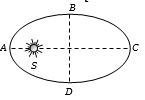
$A$ planet is revolving around the sun in an elliptical path as shown in the figure. Which of the following is the correct option?
A
The time taken in travelling $DAB$ is less than that for $BCD$.
B
The time taken in travelling $DAB$ is greater than that for $BCD$.
C
The time taken in travelling $CDA$ is less than that for $ABC$.
D
The time taken in travelling $CDA$ is greater than that for $ABC$.
Solution
(A) According to Kepler's second law of planetary motion,the radius vector joining the sun and the planet sweeps out equal areas in equal intervals of time.
In the given figure,the sun $S$ is at one of the foci of the elliptical orbit.
The area swept by the planet in path $DAB$ is less than the area swept in path $BCD$ because the sun is closer to the arc $DAB$.
Since the area swept in path $DAB$ is smaller than the area swept in path $BCD$,the time taken to travel $DAB$ must be less than the time taken to travel $BCD$ to satisfy the condition of equal area in equal time.
Alternatively,according to the law of conservation of angular momentum,the orbital velocity of the planet is higher when it is closer to the sun (near $A$) and lower when it is farther away (near $C$).
Thus,the planet travels faster along the path $DAB$ and slower along the path $BCD$,confirming that the time taken for $DAB$ is less than that for $BCD$.
In the given figure,the sun $S$ is at one of the foci of the elliptical orbit.
The area swept by the planet in path $DAB$ is less than the area swept in path $BCD$ because the sun is closer to the arc $DAB$.
Since the area swept in path $DAB$ is smaller than the area swept in path $BCD$,the time taken to travel $DAB$ must be less than the time taken to travel $BCD$ to satisfy the condition of equal area in equal time.
Alternatively,according to the law of conservation of angular momentum,the orbital velocity of the planet is higher when it is closer to the sun (near $A$) and lower when it is farther away (near $C$).
Thus,the planet travels faster along the path $DAB$ and slower along the path $BCD$,confirming that the time taken for $DAB$ is less than that for $BCD$.
0 likes
View Solution27
EasyMCQ
$A$ planet is revolving around the sun in an elliptical path as shown. The orbital velocity of the planet will be minimum at:
A
$A$
B
$B$
C
$C$
D
$D$
Solution
(C) According to Kepler's second law of planetary motion,the areal velocity of a planet remains constant.
This implies that the orbital velocity $v$ of a planet is inversely proportional to its distance $r$ from the sun $(v \propto 1/r)$.
Therefore,the orbital velocity is minimum when the distance $r$ from the sun is maximum.
Looking at the provided elliptical path,point $C$ is at the maximum distance from the sun $(S)$.
Thus,the orbital velocity of the planet is minimum at point $C$.
This implies that the orbital velocity $v$ of a planet is inversely proportional to its distance $r$ from the sun $(v \propto 1/r)$.
Therefore,the orbital velocity is minimum when the distance $r$ from the sun is maximum.
Looking at the provided elliptical path,point $C$ is at the maximum distance from the sun $(S)$.
Thus,the orbital velocity of the planet is minimum at point $C$.
0 likes
View Solution28
EasyMCQ
$A$ planet has an orbital radius twice that of the Earth's orbital radius. The time period of the planet is .......... $years$.
A
$4.2$
B
$2.8$
C
$5.6$
D
$8.4$
Solution
(B) According to Kepler's third law of planetary motion,the square of the time period $(T)$ is directly proportional to the cube of the semi-major axis $(R)$ of the orbit: $T^2 \propto R^3$.
Let $T_1$ and $R_1$ be the time period and orbital radius of the Earth,and $T_2$ and $R_2$ be the time period and orbital radius of the planet.
Given: $T_1 = 1 \text{ year}$,$R_1 = R$,and $R_2 = 2R$.
Using the ratio formula: $\frac{T_2}{T_1} = \left( \frac{R_2}{R_1} \right)^{3/2}$.
Substituting the values: $T_2 = 1 \times \left( \frac{2R}{R} \right)^{3/2} = 2^{3/2}$.
Calculating the value: $2^{3/2} = \sqrt{2^3} = \sqrt{8} \approx 2.828 \text{ years}$.
Rounding to the nearest option,the time period is $2.8 \text{ years}$.
Let $T_1$ and $R_1$ be the time period and orbital radius of the Earth,and $T_2$ and $R_2$ be the time period and orbital radius of the planet.
Given: $T_1 = 1 \text{ year}$,$R_1 = R$,and $R_2 = 2R$.
Using the ratio formula: $\frac{T_2}{T_1} = \left( \frac{R_2}{R_1} \right)^{3/2}$.
Substituting the values: $T_2 = 1 \times \left( \frac{2R}{R} \right)^{3/2} = 2^{3/2}$.
Calculating the value: $2^{3/2} = \sqrt{2^3} = \sqrt{8} \approx 2.828 \text{ years}$.
Rounding to the nearest option,the time period is $2.8 \text{ years}$.
0 likes
View Solution29
EasyMCQ
According to Kepler's law,the time period of a satellite varies with its radius as:
A
$T^2 \propto R^3$
B
$T^3 \propto R^2$
C
$T^2 \propto \frac{1}{R^3}$
D
$T^3 \propto \frac{1}{R^2}$
Solution
(A) According to Kepler's third law of planetary motion,also known as the law of periods,the square of the orbital period $(T)$ of a planet (or satellite) is directly proportional to the cube of the semi-major axis $(R)$ of its orbit.
Mathematically,this is expressed as $T^2 \propto R^3$.
Therefore,the correct relationship is $T^2 \propto R^3$.
Mathematically,this is expressed as $T^2 \propto R^3$.
Therefore,the correct relationship is $T^2 \propto R^3$.
0 likes
View Solution30
MediumMCQ
In planetary motion,the areal velocity of the position vector of a planet depends on the angular velocity $(\omega)$ and the distance of the planet from the sun $(r)$. If so,the correct relation for areal velocity is:
A
$\frac{dA}{dt} \propto \omega r$
B
$\frac{dA}{dt} \propto \omega^2 r$
C
$\frac{dA}{dt} \propto \omega r^2$
D
$\frac{dA}{dt} \propto \sqrt{\omega r}$
Solution
(C) The areal velocity of a planet is given by the rate of change of area swept by the position vector,which is $\frac{dA}{dt} = \frac{1}{2} r^2 \omega$.
Since the angular momentum $L = mvr = mr^2\omega$ is constant for a central force,the areal velocity is $\frac{dA}{dt} = \frac{L}{2m}$.
From the expression $\frac{dA}{dt} = \frac{1}{2} r^2 \omega$,it is clear that $\frac{dA}{dt} \propto \omega r^2$.
Therefore,the correct relation is $\frac{dA}{dt} \propto \omega r^2$.
Since the angular momentum $L = mvr = mr^2\omega$ is constant for a central force,the areal velocity is $\frac{dA}{dt} = \frac{L}{2m}$.
From the expression $\frac{dA}{dt} = \frac{1}{2} r^2 \omega$,it is clear that $\frac{dA}{dt} \propto \omega r^2$.
Therefore,the correct relation is $\frac{dA}{dt} \propto \omega r^2$.
0 likes
View Solution31
EasyMCQ
The ratio of the distances of two planets from the sun is $1.38$. The ratio of their period of revolution around the sun is
A
$1.38$
B
$1.38^{3/2}$
C
$1.38^{1/2}$
D
$1.38^3$
Solution
(B) According to Kepler's third law of planetary motion,the square of the time period of revolution $(T)$ is directly proportional to the cube of the semi-major axis $(a)$ of the orbit: $T^2 \propto a^3$.
Given the ratio of distances (semi-major axes) of two planets from the sun is $\frac{a_1}{a_2} = 1.38$.
We need to find the ratio of their periods of revolution $\frac{T_1}{T_2}$.
From Kepler's third law: $\left(\frac{T_1}{T_2}\right)^2 = \left(\frac{a_1}{a_2}\right)^3$.
Taking the square root on both sides: $\frac{T_1}{T_2} = \left(\frac{a_1}{a_2}\right)^{3/2}$.
Substituting the given value: $\frac{T_1}{T_2} = (1.38)^{3/2}$.
Given the ratio of distances (semi-major axes) of two planets from the sun is $\frac{a_1}{a_2} = 1.38$.
We need to find the ratio of their periods of revolution $\frac{T_1}{T_2}$.
From Kepler's third law: $\left(\frac{T_1}{T_2}\right)^2 = \left(\frac{a_1}{a_2}\right)^3$.
Taking the square root on both sides: $\frac{T_1}{T_2} = \left(\frac{a_1}{a_2}\right)^{3/2}$.
Substituting the given value: $\frac{T_1}{T_2} = (1.38)^{3/2}$.
0 likes
View Solution32
EasyMCQ
In an elliptical orbit under gravitational force,in general
A
Tangential velocity is constant
B
Angular velocity is constant
C
Radial velocity is constant
D
Areal velocity is constant
Solution
(D) According to Kepler's second law of planetary motion,a line segment joining a planet and the Sun sweeps out equal areas during equal intervals of time.
This implies that the areal velocity $(dA/dt)$ of the planet remains constant throughout its elliptical orbit.
While the tangential,angular,and radial velocities change as the distance from the Sun varies,the areal velocity is conserved due to the conservation of angular momentum in a central force field.
This implies that the areal velocity $(dA/dt)$ of the planet remains constant throughout its elliptical orbit.
While the tangential,angular,and radial velocities change as the distance from the Sun varies,the areal velocity is conserved due to the conservation of angular momentum in a central force field.
0 likes
View Solution33
MediumMCQ
If a new planet is discovered rotating around the Sun with an orbital radius double that of Earth,what will be its time period (in Earth's days)?
A
$1032$
B
$1023$
C
$1024$
D
$1043$
Solution
(A) According to Kepler's third law of planetary motion,the square of the time period $T$ is proportional to the cube of the orbital radius $R$,i.e.,$T^2 \propto R^3$.
Let $T_E$ and $R_E$ be the time period and orbital radius of the Earth,and $T_P$ and $R_P$ be those of the new planet.
Given $R_P = 2R_E$ and $T_E = 365$ days.
Using the ratio formula:
$\left( \frac{T_P}{T_E} \right)^2 = \left( \frac{R_P}{R_E} \right)^3 = \left( \frac{2R_E}{R_E} \right)^3 = 2^3 = 8$.
Taking the square root on both sides:
$\frac{T_P}{T_E} = \sqrt{8} = 2\sqrt{2}$.
Substituting the value of $T_E$:
$T_P = 2\sqrt{2} \times 365 \approx 2.8284 \times 365 \approx 1032.37$ days.
Rounding to the nearest whole number,the time period is $1032$ days.
Let $T_E$ and $R_E$ be the time period and orbital radius of the Earth,and $T_P$ and $R_P$ be those of the new planet.
Given $R_P = 2R_E$ and $T_E = 365$ days.
Using the ratio formula:
$\left( \frac{T_P}{T_E} \right)^2 = \left( \frac{R_P}{R_E} \right)^3 = \left( \frac{2R_E}{R_E} \right)^3 = 2^3 = 8$.
Taking the square root on both sides:
$\frac{T_P}{T_E} = \sqrt{8} = 2\sqrt{2}$.
Substituting the value of $T_E$:
$T_P = 2\sqrt{2} \times 365 \approx 2.8284 \times 365 \approx 1032.37$ days.
Rounding to the nearest whole number,the time period is $1032$ days.
0 likes
View Solution34
EasyMCQ
Suppose the law of gravitational attraction suddenly changes and becomes an inverse cube law,i.e.,$F \propto 1/r^3$,but still remains a central force. Then:
A
Kepler's law of areas still holds.
B
Kepler's law of periods still holds.
C
Kepler's law of areas and periods still hold.
D
Neither the law of areas nor the law of periods still holds.
Solution
(A) Kepler's second law (law of areas) is a direct consequence of the conservation of angular momentum,which holds for any central force. Since the force remains a central force,the torque $\tau = r \times F$ is zero,meaning angular momentum $L$ is conserved. Therefore,Kepler's law of areas still holds.
Kepler's third law (law of periods) states that $T^2 \propto r^3$. This is derived specifically for an inverse-square law $(F \propto 1/r^2)$. If the force follows an inverse-cube law $(F \propto 1/r^3)$,the centripetal force requirement $mv^2/r = k/r^3$ implies $v^2 \propto 1/r^2$,or $v \propto 1/r$. Since $v = 2\pi r/T$,we get $1/r \propto r/T$,which leads to $T \propto r^2$,or $T^2 \propto r^4$. Thus,the law of periods does not hold.
Kepler's third law (law of periods) states that $T^2 \propto r^3$. This is derived specifically for an inverse-square law $(F \propto 1/r^2)$. If the force follows an inverse-cube law $(F \propto 1/r^3)$,the centripetal force requirement $mv^2/r = k/r^3$ implies $v^2 \propto 1/r^2$,or $v \propto 1/r$. Since $v = 2\pi r/T$,we get $1/r \propto r/T$,which leads to $T \propto r^2$,or $T^2 \propto r^4$. Thus,the law of periods does not hold.
0 likes
View Solution35
MediumMCQ
The eccentricity of Earth's orbit is $0.0167$. The ratio of its maximum speed in its orbit to its minimum speed is
A
$2.507$
B
$1.034$
C
$8.324$
D
$1$
Solution
(B) According to Kepler's second law,the angular momentum of a planet remains constant. The speed of a planet in an elliptical orbit is given by $v = \frac{L}{mr}$,where $L$ is angular momentum,$m$ is mass,and $r$ is the distance from the Sun.
At perihelion (closest approach),$r_{\min} = a(1-e)$,so $v_{\max} = \frac{L}{m a(1-e)}$.
At aphelion (farthest distance),$r_{\max} = a(1+e)$,so $v_{\min} = \frac{L}{m a(1+e)}$.
The ratio of maximum speed to minimum speed is $\frac{v_{\max}}{v_{\min}} = \frac{1+e}{1-e}$.
Given $e = 0.0167$,we have $\frac{v_{\max}}{v_{\min}} = \frac{1 + 0.0167}{1 - 0.0167} = \frac{1.0167}{0.9833} \approx 1.034$.
At perihelion (closest approach),$r_{\min} = a(1-e)$,so $v_{\max} = \frac{L}{m a(1-e)}$.
At aphelion (farthest distance),$r_{\max} = a(1+e)$,so $v_{\min} = \frac{L}{m a(1+e)}$.
The ratio of maximum speed to minimum speed is $\frac{v_{\max}}{v_{\min}} = \frac{1+e}{1-e}$.
Given $e = 0.0167$,we have $\frac{v_{\max}}{v_{\min}} = \frac{1 + 0.0167}{1 - 0.0167} = \frac{1.0167}{0.9833} \approx 1.034$.
0 likes
View Solution36
MediumMCQ
The Earth is revolving around the Sun. If the distance of the Earth from the Sun is reduced to $\frac{1}{4}$ of the present distance,then the length of the present day will be reduced by a factor of:
A
$\frac{1}{4}$
B
$\frac{1}{2}$
C
$\frac{1}{8}$
D
$\frac{1}{6}$
Solution
(C) According to Kepler's third law of planetary motion,the square of the time period $(T)$ is proportional to the cube of the semi-major axis $(r)$: $T^2 \propto r^3$ or $T \propto r^{3/2}$.
Given that the new distance $r_2 = \frac{1}{4} r_1$.
Substituting this into the ratio formula:
$\frac{T_2}{T_1} = \left( \frac{r_2}{r_1} \right)^{3/2} = \left( \frac{1}{4} \right)^{3/2} = \frac{1}{8}$.
Therefore,the length of the year (orbital period) is reduced to $\frac{1}{8}$ of its original value.
Given that the new distance $r_2 = \frac{1}{4} r_1$.
Substituting this into the ratio formula:
$\frac{T_2}{T_1} = \left( \frac{r_2}{r_1} \right)^{3/2} = \left( \frac{1}{4} \right)^{3/2} = \frac{1}{8}$.
Therefore,the length of the year (orbital period) is reduced to $\frac{1}{8}$ of its original value.
0 likes
View Solution37
MediumMCQ
If the distance between the earth and the sun becomes half its present value,the number of days in a year would have been
A
$64.5$
B
$129$
C
$182.5$
D
$730$
Solution
(B) According to Kepler's third law,the square of the orbital period $(T)$ is proportional to the cube of the semi-major axis $(r)$,i.e.,$T^2 \propto r^3$.
Let $T_1 = 365$ days and $r_1$ be the present distance.
Given $r_2 = \frac{1}{2} r_1$.
Then,$\left( \frac{T_2}{T_1} \right)^2 = \left( \frac{r_2}{r_1} \right)^3 = \left( \frac{1}{2} \right)^3 = \frac{1}{8}$.
Taking the square root on both sides,$\frac{T_2}{T_1} = \sqrt{\frac{1}{8}} = \frac{1}{2\sqrt{2}}$.
Therefore,$T_2 = \frac{T_1}{2\sqrt{2}} = \frac{365}{2 \times 1.414} \approx \frac{365}{2.828} \approx 129$ days.
Let $T_1 = 365$ days and $r_1$ be the present distance.
Given $r_2 = \frac{1}{2} r_1$.
Then,$\left( \frac{T_2}{T_1} \right)^2 = \left( \frac{r_2}{r_1} \right)^3 = \left( \frac{1}{2} \right)^3 = \frac{1}{8}$.
Taking the square root on both sides,$\frac{T_2}{T_1} = \sqrt{\frac{1}{8}} = \frac{1}{2\sqrt{2}}$.
Therefore,$T_2 = \frac{T_1}{2\sqrt{2}} = \frac{365}{2 \times 1.414} \approx \frac{365}{2.828} \approx 129$ days.
0 likes
View Solution38
EasyMCQ
Which of the following graphs represents the motion of a planet moving about the sun?
A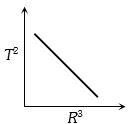
B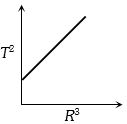
C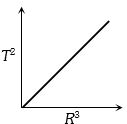
D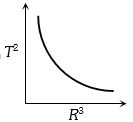
Solution
(C) According to Kepler's third law of planetary motion,the square of the time period $(T)$ of a planet is directly proportional to the cube of the semi-major axis $(R)$ of its orbit.
Mathematically,this is expressed as $T^2 \propto R^3$,or $T^2 = kR^3$,where $k$ is a constant.
This equation represents a straight line passing through the origin when $T^2$ is plotted on the y-axis and $R^3$ is plotted on the x-axis.
Therefore,the graph that shows a straight line passing through the origin represents this relationship,which corresponds to Graph $C$.
Mathematically,this is expressed as $T^2 \propto R^3$,or $T^2 = kR^3$,where $k$ is a constant.
This equation represents a straight line passing through the origin when $T^2$ is plotted on the y-axis and $R^3$ is plotted on the x-axis.
Therefore,the graph that shows a straight line passing through the origin represents this relationship,which corresponds to Graph $C$.
0 likes
View Solution39
EasyMCQ
The period of revolution increases in the order of:
A
Saturn,Uranus,Venus
B
Mars,Saturn,Pluto
C
Mercury,Neptune,Mars
D
Mars,Jupiter,Venus
Solution
(B) According to Kepler's third law of planetary motion,the square of the orbital period $T$ is directly proportional to the cube of the semi-major axis $r$ of its orbit,expressed as $T^2 \propto r^3$.
This implies that as the distance $r$ from the Sun increases,the period of revolution $T$ also increases.
The average distances of the planets from the Sun are: Mercury,Venus,Earth,Mars,Jupiter,Saturn,Uranus,Neptune,and Pluto.
Comparing the given options,the order of increasing distance from the Sun is Mars,Saturn,and Pluto.
Therefore,the period of revolution increases in the order of Mars,Saturn,and Pluto.
This implies that as the distance $r$ from the Sun increases,the period of revolution $T$ also increases.
The average distances of the planets from the Sun are: Mercury,Venus,Earth,Mars,Jupiter,Saturn,Uranus,Neptune,and Pluto.
Comparing the given options,the order of increasing distance from the Sun is Mars,Saturn,and Pluto.
Therefore,the period of revolution increases in the order of Mars,Saturn,and Pluto.
0 likes
View Solution40
EasyMCQ
The motion of planets in the solar system is an example of the conservation of:
A
Mass
B
Momentum
C
Angular momentum
D
Kinetic energy
Solution
(C) The gravitational force exerted by the Sun on the planets is a central force. $A$ central force has zero torque about the center of force (the Sun). Since the net external torque acting on the planet is zero,the angular momentum of the planet remains constant. Therefore,the motion of planets in the solar system is an example of the conservation of angular momentum.
0 likes
View Solution41
DifficultMCQ
Suppose a planet goes around the Sun with a linear speed twice as fast as that of the Earth. What will be its orbit size compared to that of the Earth? (Radius of Earth $= R$)
A
$R / 4$
B
$R / 2$
C
$R$
D
$2R$
Solution
(A) According to Kepler's Third Law,the orbital period $T$ is related to the orbital radius $R$ as $T \propto R^{3/2}$.
Also,the orbital speed $v$ is given by $v = \frac{2\pi R}{T}$.
Substituting $T \propto R^{3/2}$ into the speed formula,we get $v \propto \frac{R}{R^{3/2}} = R^{-1/2}$,which means $v \propto \frac{1}{\sqrt{R}}$.
Let $v_1$ and $R_1$ be the speed and radius of the Earth,and $v_2$ and $R_2$ be the speed and radius of the planet.
Given $v_2 = 2v_1$,we have $\frac{v_1}{v_2} = \sqrt{\frac{R_2}{R_1}}$.
Substituting the values: $\frac{v_1}{2v_1} = \sqrt{\frac{R_2}{R}}$.
$\frac{1}{2} = \sqrt{\frac{R_2}{R}}$.
Squaring both sides: $\frac{1}{4} = \frac{R_2}{R}$.
Therefore,$R_2 = \frac{R}{4}$.
Also,the orbital speed $v$ is given by $v = \frac{2\pi R}{T}$.
Substituting $T \propto R^{3/2}$ into the speed formula,we get $v \propto \frac{R}{R^{3/2}} = R^{-1/2}$,which means $v \propto \frac{1}{\sqrt{R}}$.
Let $v_1$ and $R_1$ be the speed and radius of the Earth,and $v_2$ and $R_2$ be the speed and radius of the planet.
Given $v_2 = 2v_1$,we have $\frac{v_1}{v_2} = \sqrt{\frac{R_2}{R_1}}$.
Substituting the values: $\frac{v_1}{2v_1} = \sqrt{\frac{R_2}{R}}$.
$\frac{1}{2} = \sqrt{\frac{R_2}{R}}$.
Squaring both sides: $\frac{1}{4} = \frac{R_2}{R}$.
Therefore,$R_2 = \frac{R}{4}$.
0 likes
View Solution42
MediumMCQ
The earth $E$ moves in an elliptical orbit with the sun $S$ at one of the foci as shown in the figure. Its speed of motion will be maximum at the point:
A
$C$
B
$A$
C
$B$
D
$D$
Solution
(B) According to Kepler's second law,the angular momentum of a planet revolving around the sun is conserved.
$L = mvr \sin(\theta) = \text{constant}$.
At the perihelion and aphelion,the velocity vector is perpendicular to the radius vector,so $L = mvr$.
Since the mass $m$ of the earth is constant,we have $vr = \text{constant}$,which implies $v \propto (1/r)$.
This means the orbital speed $v$ is inversely proportional to the distance $r$ from the sun.
The speed of the earth will be maximum when its distance from the sun is minimum.
Looking at the elliptical orbit,the distance is minimum at point $A$ (the perihelion).
Therefore,the speed of the earth is maximum at point $A$.
$L = mvr \sin(\theta) = \text{constant}$.
At the perihelion and aphelion,the velocity vector is perpendicular to the radius vector,so $L = mvr$.
Since the mass $m$ of the earth is constant,we have $vr = \text{constant}$,which implies $v \propto (1/r)$.
This means the orbital speed $v$ is inversely proportional to the distance $r$ from the sun.
The speed of the earth will be maximum when its distance from the sun is minimum.
Looking at the elliptical orbit,the distance is minimum at point $A$ (the perihelion).
Therefore,the speed of the earth is maximum at point $A$.
0 likes
View Solution43
MediumMCQ
If a planet revolves around the sun with an angular velocity $(\omega)$ and distance $(r)$,then the areal velocity of the planet is proportional to which of the following?
A
$\frac{dA}{dt} \propto \omega r$
B
$\frac{dA}{dt} \propto \omega^2 r$
C
$\frac{dA}{dt} \propto \omega r^2$
D
$\frac{dA}{dt} \propto \sqrt{\omega r}$
Solution
(C) The areal velocity of a planet is given by the formula $\frac{dA}{dt} = \frac{L}{2m}$,where $L$ is the angular momentum and $m$ is the mass of the planet.
Since angular momentum $L = mvr$ and linear velocity $v = r\omega$,we can substitute these into the equation.
$\frac{dA}{dt} = \frac{m(r\omega)r}{2m}$.
Simplifying the expression,we get $\frac{dA}{dt} = \frac{1}{2} \omega r^2$.
Therefore,the areal velocity is proportional to $\omega r^2$.
Since angular momentum $L = mvr$ and linear velocity $v = r\omega$,we can substitute these into the equation.
$\frac{dA}{dt} = \frac{m(r\omega)r}{2m}$.
Simplifying the expression,we get $\frac{dA}{dt} = \frac{1}{2} \omega r^2$.
Therefore,the areal velocity is proportional to $\omega r^2$.
0 likes
View Solution44
MediumMCQ
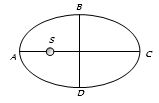
$A$ planet revolves around the Sun in an elliptical orbit as shown in the figure. Which of the following statements is correct?
A
The time taken to travel $DAB$ is less than that for $BCD$.
B
The time taken to travel $DAB$ is more than that for $BCD$.
C
The time taken to travel $CDA$ is less than that for $ABC$.
D
The time taken to travel $CDA$ is more than that for $ABC$.
Solution
(A) According to Kepler's second law of planetary motion,the areal velocity of a planet revolving around the Sun is constant. This means the planet sweeps out equal areas in equal intervals of time.
In the given figure,the Sun $S$ is at one of the foci of the elliptical orbit.
The path $DAB$ is closer to the Sun compared to the path $BCD$.
Since the area swept by the radius vector in path $DAB$ is smaller than the area swept in path $BCD$,the time taken to travel $DAB$ is less than the time taken to travel $BCD$.
In the given figure,the Sun $S$ is at one of the foci of the elliptical orbit.
The path $DAB$ is closer to the Sun compared to the path $BCD$.
Since the area swept by the radius vector in path $DAB$ is smaller than the area swept in path $BCD$,the time taken to travel $DAB$ is less than the time taken to travel $BCD$.
0 likes
View Solution45
DifficultMCQ
$A$ satellite orbits the Earth in a circular orbit of radius $R$. Another satellite orbits in an orbit of radius $1.02 R$. What is the percentage increase in the time period of the second satellite compared to the first (in $\%$)?
A
$0.7$
B
$1.0$
C
$1.5$
D
$3.0$
Solution
(D) According to Kepler's third law,the time period $T$ of a satellite is related to the orbital radius $r$ by the relation $T \propto r^{3/2}$.
Taking the logarithmic derivative of both sides,we get $\frac{\Delta T}{T} = \frac{3}{2} \frac{\Delta r}{r}$.
Given that the radius increases from $R$ to $1.02 R$,the change in radius is $\Delta r = 1.02 R - R = 0.02 R$.
Therefore,the fractional change in radius is $\frac{\Delta r}{r} = \frac{0.02 R}{R} = 0.02$ or $2\%$.
Substituting this into the derivative equation: $\frac{\Delta T}{T} = \frac{3}{2} \times 2\% = 3\%$.
Thus,the time period increases by $3\%$.
Taking the logarithmic derivative of both sides,we get $\frac{\Delta T}{T} = \frac{3}{2} \frac{\Delta r}{r}$.
Given that the radius increases from $R$ to $1.02 R$,the change in radius is $\Delta r = 1.02 R - R = 0.02 R$.
Therefore,the fractional change in radius is $\frac{\Delta r}{r} = \frac{0.02 R}{R} = 0.02$ or $2\%$.
Substituting this into the derivative equation: $\frac{\Delta T}{T} = \frac{3}{2} \times 2\% = 3\%$.
Thus,the time period increases by $3\%$.
0 likes
View Solution46
EasyMCQ
If $J$ is the angular momentum of a planet revolving around the Sun,what is the areal velocity of the planet?
A
$\frac{1}{2} mJ$
B
$\frac{J}{2m}$
C
$\frac{m}{2J}$
D
$\frac{1}{2mJ}$
Solution
(B) The areal velocity of a radius vector is given by $\frac{dA}{dt} = \frac{1}{2} r^2 \frac{d\theta}{dt} = \frac{1}{2} r^2 \omega$.
The angular momentum of the planet is $J = I \omega = mr^2 \omega$,where $m$ is the mass of the planet,$r$ is the distance from the Sun,and $\omega$ is the angular velocity.
From this,we can express $r^2 \omega$ as $\frac{J}{m}$.
Substituting this into the areal velocity formula: $\frac{dA}{dt} = \frac{1}{2} \left( \frac{J}{m} \right) = \frac{J}{2m}$.
The angular momentum of the planet is $J = I \omega = mr^2 \omega$,where $m$ is the mass of the planet,$r$ is the distance from the Sun,and $\omega$ is the angular velocity.
From this,we can express $r^2 \omega$ as $\frac{J}{m}$.
Substituting this into the areal velocity formula: $\frac{dA}{dt} = \frac{1}{2} \left( \frac{J}{m} \right) = \frac{J}{2m}$.
0 likes
View Solution47
EasyMCQ
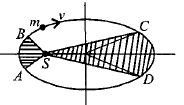
The figure shows an elliptical orbit of a planet of mass $m$ about the sun $S.$ The shaded area $SCD$ is twice the shaded area $SAB.$ If $t_1$ is the time taken for the planet to move from $C$ to $D$ and $t_2$ is the time taken to move from $A$ to $B,$ then:
A
$t_1 = 4t_2$
B
$t_1 = 2t_2$
C
$t_1 = t_2$
D
$t_1 > t_2$
Solution
(B) According to Kepler's Second Law of Planetary Motion,a line segment joining a planet and the Sun sweeps out equal areas during equal intervals of time.
This means the areal velocity $\frac{dA}{dt}$ is constant.
Therefore,the time taken to sweep an area is directly proportional to the area swept.
Given that the area $SCD = 2 \times \text{Area } SAB$.
Since $t_1$ is the time taken to sweep area $SCD$ and $t_2$ is the time taken to sweep area $SAB$,we have:
$\frac{t_1}{t_2} = \frac{\text{Area } SCD}{\text{Area } SAB} = \frac{2 \times \text{Area } SAB}{\text{Area } SAB} = 2$.
Thus,$t_1 = 2t_2$.
This means the areal velocity $\frac{dA}{dt}$ is constant.
Therefore,the time taken to sweep an area is directly proportional to the area swept.
Given that the area $SCD = 2 \times \text{Area } SAB$.
Since $t_1$ is the time taken to sweep area $SCD$ and $t_2$ is the time taken to sweep area $SAB$,we have:
$\frac{t_1}{t_2} = \frac{\text{Area } SCD}{\text{Area } SAB} = \frac{2 \times \text{Area } SAB}{\text{Area } SAB} = 2$.
Thus,$t_1 = 2t_2$.
0 likes
View Solution48
DifficultMCQ
Kepler's third law states that the square of the period of revolution $(T)$ of a planet around the sun is proportional to the cube of the average distance $(r)$ between the sun and the planet,i.e.,$T^2 = Kr^3$,where $K$ is a constant. If the masses of the sun and the planet are $M$ and $m$ respectively,then according to Newton's law of gravitation,the force of attraction between them is $F = \frac{GMm}{r^2}$,where $G$ is the gravitational constant. The relation between $G$ and $K$ is:
A
$GK = 4\pi^2$
B
$GMK = 4\pi^2$
C
$K = G$
D
$K = \frac{1}{G}$
Solution
(B) The gravitational force of attraction between the sun and the planet provides the necessary centripetal force for the planet's orbit.
$\therefore \frac{GMm}{r^2} = \frac{mv^2}{r} \implies v^2 = \frac{GM}{r} \quad \dots(i)$
The time period $(T)$ of the planet is given by $T = \frac{2\pi r}{v}$.
Squaring both sides,we get $T^2 = \frac{4\pi^2 r^2}{v^2}$.
Substituting the value of $v^2$ from equation $(i)$:
$T^2 = \frac{4\pi^2 r^2}{(\frac{GM}{r})} = \frac{4\pi^2 r^3}{GM} \quad \dots(ii)$
According to the problem,Kepler's third law is given as:
$T^2 = Kr^3 \quad \dots(iii)$
Comparing equations $(ii)$ and $(iii)$,we get:
$K = \frac{4\pi^2}{GM} \implies GMK = 4\pi^2$.
$\therefore \frac{GMm}{r^2} = \frac{mv^2}{r} \implies v^2 = \frac{GM}{r} \quad \dots(i)$
The time period $(T)$ of the planet is given by $T = \frac{2\pi r}{v}$.
Squaring both sides,we get $T^2 = \frac{4\pi^2 r^2}{v^2}$.
Substituting the value of $v^2$ from equation $(i)$:
$T^2 = \frac{4\pi^2 r^2}{(\frac{GM}{r})} = \frac{4\pi^2 r^3}{GM} \quad \dots(ii)$
According to the problem,Kepler's third law is given as:
$T^2 = Kr^3 \quad \dots(iii)$
Comparing equations $(ii)$ and $(iii)$,we get:
$K = \frac{4\pi^2}{GM} \implies GMK = 4\pi^2$.
0 likes
View Solution49
EasyMCQ
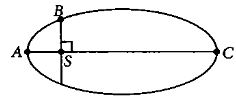
The kinetic energies of a planet in an elliptical orbit about the Sun,at positions $A, B$ and $C$ are $K_A, K_B$ and $K_C$,respectively. $AC$ is the major axis and $SB$ is perpendicular to $AC$ at the position of the Sun $S$ as shown in the figure. Then
A
$K_A < K_B < K_C$
B
$K_A > K_B > K_C$
C
$K_B > K_A > K_C$
D
$K_B < K_A < K_C$
Solution
(B) According to Kepler's second law of planetary motion,the areal velocity of a planet is constant. This implies that the planet moves faster when it is closer to the Sun and slower when it is farther away.
Point $A$ is the perihelion (closest to the Sun),and point $C$ is the aphelion (farthest from the Sun). Point $B$ is at an intermediate distance.
Therefore,the orbital speeds at these positions follow the relation: $v_A > v_B > v_C$.
Since the kinetic energy $K$ is given by $K = \frac{1}{2}mv^2$,it is directly proportional to the square of the speed $(K \propto v^2)$.
Thus,the kinetic energies at these positions follow the relation: $K_A > K_B > K_C$.
Point $A$ is the perihelion (closest to the Sun),and point $C$ is the aphelion (farthest from the Sun). Point $B$ is at an intermediate distance.
Therefore,the orbital speeds at these positions follow the relation: $v_A > v_B > v_C$.
Since the kinetic energy $K$ is given by $K = \frac{1}{2}mv^2$,it is directly proportional to the square of the speed $(K \propto v^2)$.
Thus,the kinetic energies at these positions follow the relation: $K_A > K_B > K_C$.
0 likes
View SolutionGravitation — Kepler’s laws of Planetary Motion · Frequently Asked Questions
1Are these Gravitation questions useful for JEE and NEET?
Yes. All questions in this section are mapped to JEE Main and NEET exam patterns. Previous year questions from JEE Main, NEET, GUJCET and state-level exams are included with full solutions.
2Can I switch to Hindi or Gujarati for these questions?
Yes. Use the language tabs in the hero section or the sidebar to view the same questions and solutions in English, Hindi or Gujarati.
3How do I generate a question paper from this subtopic?
Use the Vedclass Exam Paper Generator — select the chapter and subtopic, set difficulty, and generate Sets A, B, C, D automatically. First 3 chapters of every subject are free.
Vedclass Products
For Students
Vedclass Test Series
Mock tests in real JEE/NEET style with performance analysis. 5-day free trial.
Start Free TrialFor Teachers
Exam Paper Generator
Generate Set A/B/C/D papers from this chapter in 2 minutes. 3 chapters free.
Try FreeFor Institutes
Online Exam Module
Live online exams with unlimited students, 360° analytics & white-label branding.
See DemoFor Teachers & Institutes
Generate a Gravitation Exam Paper in 2 Minutes
Select subtopic & difficulty — Sets A, B, C, D auto-generated with No Repeat logic.
First 3 chapters of every subject are free — no payment required.