
A English
Acceleration Due to Gravity and its Variation Questions in English
Class 11 Physics · Gravitation · Acceleration Due to Gravity and its Variation
430+
Questions
English
Language
100%
With Solutions
Showing 48 of 430 questions in English
301
DifficultMCQ
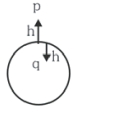
At what distance above and below the surface of the earth will a body have the same weight? (Take the radius of the earth as $R$.)
A
$\sqrt{5} R - R$
B
$\frac{\sqrt{3} R - R}{2}$
C
$\frac{R}{2}$
D
$\frac{\sqrt{5} R - R}{2}$
Solution
(D) Let $h$ be the distance above and below the surface of the earth where the weight of the body is the same. This implies the acceleration due to gravity at height $h$ $(g_h)$ must be equal to the acceleration due to gravity at depth $h$ $(g_d)$.
The formula for acceleration due to gravity at height $h$ is $g_h = g \left( 1 + \frac{h}{R} \right)^{-2} \approx g \left( 1 - \frac{2h}{R} \right)$ (for $h \ll R$). However,for a general solution,we use $g_h = \frac{g R^2}{(R+h)^2}$.
The formula for acceleration due to gravity at depth $h$ is $g_d = g \left( 1 - \frac{h}{R} \right)$.
Equating the two: $\frac{g R^2}{(R+h)^2} = g \left( 1 - \frac{h}{R} \right)$.
$\frac{1}{(1 + h/R)^2} = 1 - \frac{h}{R}$.
Let $x = \frac{h}{R}$. Then $\frac{1}{(1+x)^2} = 1 - x$.
$1 = (1-x)(1+x)^2 = (1-x)(1 + 2x + x^2) = 1 + 2x + x^2 - x - 2x^2 - x^3$.
$1 = 1 + x - x^2 - x^3$.
$x^3 + x^2 - x = 0$.
Since $x \neq 0$,we have $x^2 + x - 1 = 0$.
Using the quadratic formula $x = \frac{-b \pm \sqrt{b^2 - 4ac}}{2a}$,we get $x = \frac{-1 \pm \sqrt{1^2 - 4(1)(-1)}}{2(1)} = \frac{-1 \pm \sqrt{5}}{2}$.
Since $x$ must be positive,$x = \frac{\sqrt{5} - 1}{2}$.
Therefore,$h = \frac{\sqrt{5} - 1}{2} R = \frac{\sqrt{5} R - R}{2}$.
The formula for acceleration due to gravity at height $h$ is $g_h = g \left( 1 + \frac{h}{R} \right)^{-2} \approx g \left( 1 - \frac{2h}{R} \right)$ (for $h \ll R$). However,for a general solution,we use $g_h = \frac{g R^2}{(R+h)^2}$.
The formula for acceleration due to gravity at depth $h$ is $g_d = g \left( 1 - \frac{h}{R} \right)$.
Equating the two: $\frac{g R^2}{(R+h)^2} = g \left( 1 - \frac{h}{R} \right)$.
$\frac{1}{(1 + h/R)^2} = 1 - \frac{h}{R}$.
Let $x = \frac{h}{R}$. Then $\frac{1}{(1+x)^2} = 1 - x$.
$1 = (1-x)(1+x)^2 = (1-x)(1 + 2x + x^2) = 1 + 2x + x^2 - x - 2x^2 - x^3$.
$1 = 1 + x - x^2 - x^3$.
$x^3 + x^2 - x = 0$.
Since $x \neq 0$,we have $x^2 + x - 1 = 0$.
Using the quadratic formula $x = \frac{-b \pm \sqrt{b^2 - 4ac}}{2a}$,we get $x = \frac{-1 \pm \sqrt{1^2 - 4(1)(-1)}}{2(1)} = \frac{-1 \pm \sqrt{5}}{2}$.
Since $x$ must be positive,$x = \frac{\sqrt{5} - 1}{2}$.
Therefore,$h = \frac{\sqrt{5} - 1}{2} R = \frac{\sqrt{5} R - R}{2}$.
0 likes
View Solution302
DifficultMCQ
The gravitational potential at a point above the surface of the Earth is $-5.12 \times 10^7 \,J/kg$ and the acceleration due to gravity at that point is $6.4 \,m/s^2$. Assume that the mean radius of the Earth is $6400 \,km$. The height of this point above the Earth's surface is: (in $\,km$)
A
$1600$
B
$540$
C
$1200$
D
$1000$
Solution
(A) Let $R_E$ be the radius of the Earth and $h$ be the height of the point above the surface. The distance from the center of the Earth is $r = R_E + h$.
Gravitational potential $V = -\frac{G M_E}{r} = -5.12 \times 10^7 \,J/kg$ ... $(i)$
Acceleration due to gravity $g' = \frac{G M_E}{r^2} = 6.4 \,m/s^2$ ... $(ii)$
Dividing equation $(i)$ by equation $(ii)$:
$\frac{V}{g'} = \frac{-G M_E / r}{G M_E / r^2} = -r$
$r = -\frac{V}{g'} = -\frac{-5.12 \times 10^7}{6.4} = 0.8 \times 10^7 \,m = 8000 \,km$
Since $r = R_E + h$, we have $h = r - R_E = 8000 \,km - 6400 \,km = 1600 \,km$.
Gravitational potential $V = -\frac{G M_E}{r} = -5.12 \times 10^7 \,J/kg$ ... $(i)$
Acceleration due to gravity $g' = \frac{G M_E}{r^2} = 6.4 \,m/s^2$ ... $(ii)$
Dividing equation $(i)$ by equation $(ii)$:
$\frac{V}{g'} = \frac{-G M_E / r}{G M_E / r^2} = -r$
$r = -\frac{V}{g'} = -\frac{-5.12 \times 10^7}{6.4} = 0.8 \times 10^7 \,m = 8000 \,km$
Since $r = R_E + h$, we have $h = r - R_E = 8000 \,km - 6400 \,km = 1600 \,km$.
0 likes
View Solution303
DifficultMCQ
$A$ simple pendulum is placed at a place where its distance from the earth's surface is equal to the radius of the earth. If the length of the string is $4 \ m$,then the time period of small oscillations will be . . . . . . $s$. [Take $g = \pi^2 \ ms^{-2}$]
A
$5$
B
$6$
C
$7$
D
$8$
Solution
(D) The acceleration due to gravity at a height $h$ above the earth's surface is given by $g' = g \left( \frac{R}{R+h} \right)^2$.
Given $h = R$,the acceleration due to gravity becomes $g' = g \left( \frac{R}{R+R} \right)^2 = g \left( \frac{1}{2} \right)^2 = \frac{g}{4}$.
The time period of a simple pendulum is given by $T = 2\pi \sqrt{\frac{\ell}{g'}}$.
Substituting $\ell = 4 \ m$ and $g' = \frac{g}{4}$,we get $T = 2\pi \sqrt{\frac{4}{g/4}} = 2\pi \sqrt{\frac{16}{g}}$.
Given $g = \pi^2 \ ms^{-2}$,we substitute this into the equation:
$T = 2\pi \sqrt{\frac{16}{\pi^2}} = 2\pi \left( \frac{4}{\pi} \right) = 8 \ s$.
Given $h = R$,the acceleration due to gravity becomes $g' = g \left( \frac{R}{R+R} \right)^2 = g \left( \frac{1}{2} \right)^2 = \frac{g}{4}$.
The time period of a simple pendulum is given by $T = 2\pi \sqrt{\frac{\ell}{g'}}$.
Substituting $\ell = 4 \ m$ and $g' = \frac{g}{4}$,we get $T = 2\pi \sqrt{\frac{4}{g/4}} = 2\pi \sqrt{\frac{16}{g}}$.
Given $g = \pi^2 \ ms^{-2}$,we substitute this into the equation:
$T = 2\pi \sqrt{\frac{16}{\pi^2}} = 2\pi \left( \frac{4}{\pi} \right) = 8 \ s$.
0 likes
View Solution304
DifficultMCQ
$A$ $90 \,kg$ body placed at $2R$ distance from the surface of the Earth experiences a gravitational pull of: ($R=$ Radius of Earth,$g=10 \,ms^{-2}$) (in $\,N$)
A
$300$
B
$225$
C
$120$
D
$100$
Solution
(D) The gravitational acceleration $g'$ at a height $h$ from the surface of the Earth is given by the formula: $g' = g \left(1 + \frac{h}{R}\right)^{-2}$.
Given $h = 2R$,we substitute this into the formula:
$g' = g \left(1 + \frac{2R}{R}\right)^{-2} = g(1 + 2)^{-2} = g(3)^{-2} = \frac{g}{9}$.
Given $g = 10 \,ms^{-2}$,the effective acceleration is $g' = \frac{10}{9} \,ms^{-2}$.
The gravitational force (weight) experienced by the body of mass $m = 90 \,kg$ is:
$F = m \times g' = 90 \times \frac{10}{9} = 100 \,N$.
Given $h = 2R$,we substitute this into the formula:
$g' = g \left(1 + \frac{2R}{R}\right)^{-2} = g(1 + 2)^{-2} = g(3)^{-2} = \frac{g}{9}$.
Given $g = 10 \,ms^{-2}$,the effective acceleration is $g' = \frac{10}{9} \,ms^{-2}$.
The gravitational force (weight) experienced by the body of mass $m = 90 \,kg$ is:
$F = m \times g' = 90 \times \frac{10}{9} = 100 \,N$.
0 likes
View Solution305
DifficultMCQ
$A$ simple pendulum performing small oscillations at a height $R$ above the Earth's surface has a time period of $T_1 = 4 \ s$. What would be its time period $T_2$ if it is brought to a point at a height $2R$ from the Earth's surface? Choose the correct relation ($R =$ radius of Earth).
A
$T_1 = T_2$
B
$2T_1 = 3T_2$
C
$3T_1 = 2T_2$
D
$2T_1 = T_2$
Solution
(C) The time period of a simple pendulum is given by $T = 2\pi \sqrt{\frac{\ell}{g'}}$.
The acceleration due to gravity at a height $h$ is $g' = \frac{GM}{(R+h)^2}$.
Thus,$T = 2\pi \sqrt{\frac{\ell (R+h)^2}{GM}} = 2\pi \sqrt{\frac{\ell}{GM}} (R+h)$.
For height $h_1 = R$,$T_1 = 2\pi \sqrt{\frac{\ell}{GM}} (R+R) = 2\pi \sqrt{\frac{\ell}{GM}} (2R)$.
For height $h_2 = 2R$,$T_2 = 2\pi \sqrt{\frac{\ell}{GM}} (R+2R) = 2\pi \sqrt{\frac{\ell}{GM}} (3R)$.
Taking the ratio: $\frac{T_1}{T_2} = \frac{2R}{3R} = \frac{2}{3}$.
Therefore,$3T_1 = 2T_2$.
The acceleration due to gravity at a height $h$ is $g' = \frac{GM}{(R+h)^2}$.
Thus,$T = 2\pi \sqrt{\frac{\ell (R+h)^2}{GM}} = 2\pi \sqrt{\frac{\ell}{GM}} (R+h)$.
For height $h_1 = R$,$T_1 = 2\pi \sqrt{\frac{\ell}{GM}} (R+R) = 2\pi \sqrt{\frac{\ell}{GM}} (2R)$.
For height $h_2 = 2R$,$T_2 = 2\pi \sqrt{\frac{\ell}{GM}} (R+2R) = 2\pi \sqrt{\frac{\ell}{GM}} (3R)$.
Taking the ratio: $\frac{T_1}{T_2} = \frac{2R}{3R} = \frac{2}{3}$.
Therefore,$3T_1 = 2T_2$.
0 likes
View Solution306
DifficultMCQ
Assuming the earth to be a sphere of uniform mass density, a body weighs $300 \,N$ on the surface of the earth. How much would it weigh at a depth of $R/4$ below the surface of the earth (in $\,N$)?
A
$75$
B
$375$
C
$300$
D
$225$
Solution
(D) At the surface of the earth, the weight of the body is given by $W_s = mg_s = 300 \,N$.
The acceleration due to gravity at a depth $d$ below the surface of the earth is given by the formula $g_d = g_s \left(1 - \frac{d}{R}\right)$, where $g_s$ is the acceleration due to gravity at the surface and $R$ is the radius of the earth.
Given the depth $d = R/4$, we substitute this into the formula:
$g_d = g_s \left(1 - \frac{R/4}{R}\right)$
$g_d = g_s \left(1 - \frac{1}{4}\right)$
$g_d = g_s \left(\frac{3}{4}\right)$
The weight of the body at depth $d$ is $W_d = mg_d$.
Substituting $g_d$ into the weight equation:
$W_d = m \times \left(\frac{3}{4} g_s\right)$
$W_d = \frac{3}{4} \times (mg_s)$
Since $mg_s = 300 \,N$, we have:
$W_d = \frac{3}{4} \times 300 \,N = 225 \,N$.
The acceleration due to gravity at a depth $d$ below the surface of the earth is given by the formula $g_d = g_s \left(1 - \frac{d}{R}\right)$, where $g_s$ is the acceleration due to gravity at the surface and $R$ is the radius of the earth.
Given the depth $d = R/4$, we substitute this into the formula:
$g_d = g_s \left(1 - \frac{R/4}{R}\right)$
$g_d = g_s \left(1 - \frac{1}{4}\right)$
$g_d = g_s \left(\frac{3}{4}\right)$
The weight of the body at depth $d$ is $W_d = mg_d$.
Substituting $g_d$ into the weight equation:
$W_d = m \times \left(\frac{3}{4} g_s\right)$
$W_d = \frac{3}{4} \times (mg_s)$
Since $mg_s = 300 \,N$, we have:
$W_d = \frac{3}{4} \times 300 \,N = 225 \,N$.
0 likes
View Solution307
MediumMCQ
The mass of a planet is $\frac{1}{10}$ that of the earth and its diameter is half that of the earth. The acceleration due to gravity on that planet is: (in $m \ s^{-2}$)
A
$9.8$
B
$4.9$
C
$3.92$
D
$19.6$
Solution
(C) The acceleration due to gravity on the surface of a planet is given by $g = \frac{GM}{R^2}$.
Let the mass and radius of the earth be $M$ and $R$ respectively. Then $g = \frac{GM}{R^2} = 9.8 \ m \ s^{-2}$.
For the given planet,the mass $M' = \frac{M}{10}$ and the radius $R' = \frac{R}{2}$ (since diameter is half,radius is also half).
The acceleration due to gravity on the planet is $g' = \frac{GM'}{R'^2}$.
Substituting the values: $g' = \frac{G(M/10)}{(R/2)^2} = \frac{GM/10}{R^2/4} = \frac{4}{10} \frac{GM}{R^2}$.
Since $\frac{GM}{R^2} = 9.8 \ m \ s^{-2}$,we have $g' = 0.4 \times 9.8 \ m \ s^{-2} = 3.92 \ m \ s^{-2}$.
Let the mass and radius of the earth be $M$ and $R$ respectively. Then $g = \frac{GM}{R^2} = 9.8 \ m \ s^{-2}$.
For the given planet,the mass $M' = \frac{M}{10}$ and the radius $R' = \frac{R}{2}$ (since diameter is half,radius is also half).
The acceleration due to gravity on the planet is $g' = \frac{GM'}{R'^2}$.
Substituting the values: $g' = \frac{G(M/10)}{(R/2)^2} = \frac{GM/10}{R^2/4} = \frac{4}{10} \frac{GM}{R^2}$.
Since $\frac{GM}{R^2} = 9.8 \ m \ s^{-2}$,we have $g' = 0.4 \times 9.8 \ m \ s^{-2} = 3.92 \ m \ s^{-2}$.
0 likes
View Solution308
MediumMCQ
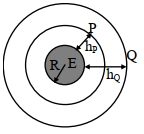
Two satellites $P$ and $Q$ are moving in different circular orbits around the Earth (radius $R$). The heights of $P$ and $Q$ from the Earth's surface are $h_p$ and $h_Q$,respectively,where $h_p = R / 3$. The accelerations of $P$ and $Q$ due to Earth's gravity are $g_p$ and $g_Q$,respectively. If $g_p / g_Q = 36 / 25$,what is the value of $h_Q$?
A
$3 R / 5$
B
$R / 6$
C
$6 R / 5$
D
$5 R / 6$
Solution
(A) The acceleration due to gravity at a distance $r$ from the center of the Earth is given by $g = \frac{GM}{r^2}$,where $r = R + h$.
Given the ratio of accelerations:
$\frac{g_p}{g_Q} = \frac{GM / r_p^2}{GM / r_Q^2} = \left( \frac{r_Q}{r_p} \right)^2$
Substituting the given values:
$\frac{36}{25} = \left( \frac{r_Q}{r_p} \right)^2$
Taking the square root on both sides:
$\frac{r_Q}{r_p} = \frac{6}{5} \implies r_Q = \frac{6}{5} r_p$
Since $r_p = R + h_p = R + R/3 = 4R/3$:
$r_Q = \frac{6}{5} \times \left( \frac{4R}{3} \right) = \frac{24R}{15} = \frac{8R}{5}$
Now,$r_Q = R + h_Q$,so:
$R + h_Q = \frac{8R}{5}$
$h_Q = \frac{8R}{5} - R = \frac{3R}{5}$
Given the ratio of accelerations:
$\frac{g_p}{g_Q} = \frac{GM / r_p^2}{GM / r_Q^2} = \left( \frac{r_Q}{r_p} \right)^2$
Substituting the given values:
$\frac{36}{25} = \left( \frac{r_Q}{r_p} \right)^2$
Taking the square root on both sides:
$\frac{r_Q}{r_p} = \frac{6}{5} \implies r_Q = \frac{6}{5} r_p$
Since $r_p = R + h_p = R + R/3 = 4R/3$:
$r_Q = \frac{6}{5} \times \left( \frac{4R}{3} \right) = \frac{24R}{15} = \frac{8R}{5}$
Now,$r_Q = R + h_Q$,so:
$R + h_Q = \frac{8R}{5}$
$h_Q = \frac{8R}{5} - R = \frac{3R}{5}$
0 likes
View Solution309
AdvancedMCQ
$A$ planet of radius $R = \frac{1}{10} \times$ (radius of Earth) has the same mass density as Earth. Scientists dig a well of depth $\frac{R}{5}$ on it and lower a wire of the same length and of linear mass density $\lambda = 10^{-3} \ kg \ m^{-1}$ into it. If the wire is not touching anywhere,the force applied at the top of the wire by a person holding it in place is (take the radius of Earth $= 6 \times 10^6 \ m$ and the acceleration due to gravity on Earth $g_e = 10 \ m \ s^{-2}$) (in $N$)
A
$96$
B
$108$
C
$120$
D
$150$
Solution
(B) Given: $R_p = \frac{R_e}{10}$,$\rho_p = \rho_e$,$\lambda = 10^{-3} \ kg \ m^{-1}$,$g_e = 10 \ m \ s^{-2}$,$R_e = 6 \times 10^6 \ m$.
Since density is the same,$M_p = \rho \cdot \frac{4}{3} \pi R_p^3 = \frac{M_e}{10^3}$.
The surface gravity of the planet is $g_p = \frac{G M_p}{R_p^2} = \frac{G (M_e / 10^3)}{(R_e / 10)^2} = \frac{G M_e}{10 R_e^2} = \frac{g_e}{10} = \frac{10}{10} = 1 \ m \ s^{-2}$.
The acceleration due to gravity at a distance $r$ from the center is $g(r) = g_p \frac{r}{R_p}$.
The wire extends from $r = R_p - \frac{R_p}{5} = \frac{4R_p}{5}$ to $r = R_p$.
The force $F$ required to hold the wire is the weight of the wire: $F = \int_{4R_p/5}^{R_p} \lambda \cdot g(r) \, dr = \int_{4R_p/5}^{R_p} \lambda \frac{g_p}{R_p} r \, dr$.
$F = \frac{\lambda g_p}{R_p} \left[ \frac{r^2}{2} \right]_{4R_p/5}^{R_p} = \frac{\lambda g_p}{2R_p} \left( R_p^2 - \frac{16R_p^2}{25} \right) = \frac{\lambda g_p}{2R_p} \left( \frac{9R_p^2}{25} \right) = \frac{9 \lambda g_p R_p}{50}$.
Substituting values: $R_p = \frac{6 \times 10^6}{10} = 6 \times 10^5 \ m$.
$F = \frac{9 \times 10^{-3} \times 1 \times 6 \times 10^5}{50} = \frac{5400}{50} = 108 \ N$.
Since density is the same,$M_p = \rho \cdot \frac{4}{3} \pi R_p^3 = \frac{M_e}{10^3}$.
The surface gravity of the planet is $g_p = \frac{G M_p}{R_p^2} = \frac{G (M_e / 10^3)}{(R_e / 10)^2} = \frac{G M_e}{10 R_e^2} = \frac{g_e}{10} = \frac{10}{10} = 1 \ m \ s^{-2}$.
The acceleration due to gravity at a distance $r$ from the center is $g(r) = g_p \frac{r}{R_p}$.
The wire extends from $r = R_p - \frac{R_p}{5} = \frac{4R_p}{5}$ to $r = R_p$.
The force $F$ required to hold the wire is the weight of the wire: $F = \int_{4R_p/5}^{R_p} \lambda \cdot g(r) \, dr = \int_{4R_p/5}^{R_p} \lambda \frac{g_p}{R_p} r \, dr$.
$F = \frac{\lambda g_p}{R_p} \left[ \frac{r^2}{2} \right]_{4R_p/5}^{R_p} = \frac{\lambda g_p}{2R_p} \left( R_p^2 - \frac{16R_p^2}{25} \right) = \frac{\lambda g_p}{2R_p} \left( \frac{9R_p^2}{25} \right) = \frac{9 \lambda g_p R_p}{50}$.
Substituting values: $R_p = \frac{6 \times 10^6}{10} = 6 \times 10^5 \ m$.
$F = \frac{9 \times 10^{-3} \times 1 \times 6 \times 10^5}{50} = \frac{5400}{50} = 108 \ N$.
0 likes
View Solution310
MediumMCQ
Given below are two statements. One is labelled as Assertion $(A)$ and the other is labelled as Reason $(R)$.
Assertion $(A) :$ $A$ simple pendulum is taken to a planet of mass and radius,$4$ times and $2$ times,respectively,than the Earth. The time period of the pendulum remains the same on Earth and the planet.
Reason $(R) :$ The mass of the pendulum remains unchanged at Earth and the other planet. In the light of the above statements,choose the correct answer from the options given below $:$
Assertion $(A) :$ $A$ simple pendulum is taken to a planet of mass and radius,$4$ times and $2$ times,respectively,than the Earth. The time period of the pendulum remains the same on Earth and the planet.
Reason $(R) :$ The mass of the pendulum remains unchanged at Earth and the other planet. In the light of the above statements,choose the correct answer from the options given below $:$
A
Both $(A)$ and $(R)$ are true but $(R)$ is $\text{NOT}$ the correct explanation of $(A)$
B
$(A)$ is true but $(R)$ is false
C
$(A)$ is false but $(R)$ is true
D
Both $(A)$ and $(R)$ are true and $(R)$ is the correct explanation of $(A)$
Solution
(A) The acceleration due to gravity on Earth is $g = \frac{GM}{R^2}$.
On the planet,the mass is $M' = 4M$ and the radius is $R' = 2R$.
The acceleration due to gravity on the planet is $g' = \frac{G(4M)}{(2R)^2} = \frac{4GM}{4R^2} = \frac{GM}{R^2} = g$.
Since the acceleration due to gravity is the same on both,the time period $T = 2\pi \sqrt{\frac{l}{g}}$ remains the same. Thus,Assertion $(A)$ is true.
The mass of the pendulum bob does not affect the time period of a simple pendulum. Thus,Reason $(R)$ is true.
However,the reason for the time period being the same is the equality of $g$ on both planets,not the mass of the pendulum. Therefore,$(R)$ is not the correct explanation of $(A)$.
On the planet,the mass is $M' = 4M$ and the radius is $R' = 2R$.
The acceleration due to gravity on the planet is $g' = \frac{G(4M)}{(2R)^2} = \frac{4GM}{4R^2} = \frac{GM}{R^2} = g$.
Since the acceleration due to gravity is the same on both,the time period $T = 2\pi \sqrt{\frac{l}{g}}$ remains the same. Thus,Assertion $(A)$ is true.
The mass of the pendulum bob does not affect the time period of a simple pendulum. Thus,Reason $(R)$ is true.
However,the reason for the time period being the same is the equality of $g$ on both planets,not the mass of the pendulum. Therefore,$(R)$ is not the correct explanation of $(A)$.
0 likes
View Solution311
MediumMCQ
Acceleration due to gravity on the surface of Earth is $g$. If the diameter of Earth is reduced to one-third of its original value and mass remains unchanged,then the acceleration due to gravity on the surface of the Earth is . . . . . . $g$.
A
$9$
B
$6$
C
$4$
D
$8$
Solution
(A) The acceleration due to gravity on the surface of the Earth is given by the formula:
$g = \frac{GM}{R_e^2}$
where $G$ is the gravitational constant,$M$ is the mass of the Earth,and $R_e$ is the radius of the Earth.
Given that the diameter is reduced to $1/3$ of its original value,the radius $R_e$ also reduces to $1/3$ of its original value,i.e.,$R' = R_e / 3$.
The mass $M$ remains unchanged.
The new acceleration due to gravity $g'$ is given by:
$g' = \frac{GM}{(R_e/3)^2} = \frac{GM}{R_e^2 / 9} = 9 \left( \frac{GM}{R_e^2} \right) = 9g$
Therefore,the new acceleration due to gravity is $9g$.
$g = \frac{GM}{R_e^2}$
where $G$ is the gravitational constant,$M$ is the mass of the Earth,and $R_e$ is the radius of the Earth.
Given that the diameter is reduced to $1/3$ of its original value,the radius $R_e$ also reduces to $1/3$ of its original value,i.e.,$R' = R_e / 3$.
The mass $M$ remains unchanged.
The new acceleration due to gravity $g'$ is given by:
$g' = \frac{GM}{(R_e/3)^2} = \frac{GM}{R_e^2 / 9} = 9 \left( \frac{GM}{R_e^2} \right) = 9g$
Therefore,the new acceleration due to gravity is $9g$.
0 likes
View Solution312
MediumMCQ
Given below are two statements: one is labelled as Assertion $(A)$ and the other is labelled as Reason $(R).$
Assertion $(A):$ Time period of a simple pendulum is longer at the top of a mountain than that at the base of the mountain.
Reason $(R):$ Time period of a simple pendulum decreases with increasing value of acceleration due to gravity and vice-versa.
In the light of the above statements,choose the most appropriate answer from the options given below:
Assertion $(A):$ Time period of a simple pendulum is longer at the top of a mountain than that at the base of the mountain.
Reason $(R):$ Time period of a simple pendulum decreases with increasing value of acceleration due to gravity and vice-versa.
In the light of the above statements,choose the most appropriate answer from the options given below:
A
Both $(A)$ and $(R)$ are true but $(R)$ is not the correct explanation of $(A).$
B
Both $(A)$ and $(R)$ are true and $(R)$ is the correct explanation of $(A).$
C
$(A)$ is true but $(R)$ is false.
D
$(A)$ is false but $(R)$ is true.
Solution
(B) The time period $T$ of a simple pendulum is given by the formula $T = 2\pi \sqrt{\frac{\ell}{g}},$ where $\ell$ is the length of the pendulum and $g$ is the acceleration due to gravity.
From this formula,it is clear that $T \propto \frac{1}{\sqrt{g}},$ which means the time period decreases as $g$ increases and increases as $g$ decreases.
At the top of a mountain,the height $h$ from the surface of the Earth is positive,and the acceleration due to gravity is given by $g_h = g_0 \left( \frac{R}{R+h} \right)^2.$
Since $g_h < g_0$ (where $g_0$ is the acceleration due to gravity at the base/surface),the value of $g$ is smaller at the top of the mountain.
Because $g$ is smaller at the top,the time period $T$ will be larger at the top of the mountain compared to the base.
Therefore,both Assertion $(A)$ and Reason $(R)$ are true,and $(R)$ is the correct explanation of $(A).$
From this formula,it is clear that $T \propto \frac{1}{\sqrt{g}},$ which means the time period decreases as $g$ increases and increases as $g$ decreases.
At the top of a mountain,the height $h$ from the surface of the Earth is positive,and the acceleration due to gravity is given by $g_h = g_0 \left( \frac{R}{R+h} \right)^2.$
Since $g_h < g_0$ (where $g_0$ is the acceleration due to gravity at the base/surface),the value of $g$ is smaller at the top of the mountain.
Because $g$ is smaller at the top,the time period $T$ will be larger at the top of the mountain compared to the base.
Therefore,both Assertion $(A)$ and Reason $(R)$ are true,and $(R)$ is the correct explanation of $(A).$
0 likes
View Solution313
MediumMCQ
$A$ body weighs $48 \ N$ on the surface of the earth. The gravitational force experienced by the body due to the earth at a height equal to one-third the radius of the earth from its surface is (in $N$)
A
$16$
B
$27$
C
$32$
D
$36$
Solution
(B) The weight of a body on the surface of the earth is $W = mg = 48 \ N$.
The acceleration due to gravity at a height $h$ above the surface of the earth is given by $g' = g \left( \frac{R}{R+h} \right)^2$.
Given $h = \frac{R}{3}$,we substitute this into the formula:
$g' = g \left( \frac{R}{R + \frac{R}{3}} \right)^2 = g \left( \frac{R}{\frac{4R}{3}} \right)^2 = g \left( \frac{3}{4} \right)^2 = g \left( \frac{9}{16} \right)$.
The weight at height $h$ is $W' = mg' = mg \left( \frac{9}{16} \right)$.
Substituting $mg = 48 \ N$:
$W' = 48 \times \frac{9}{16} = 3 \times 9 = 27 \ N$.
The acceleration due to gravity at a height $h$ above the surface of the earth is given by $g' = g \left( \frac{R}{R+h} \right)^2$.
Given $h = \frac{R}{3}$,we substitute this into the formula:
$g' = g \left( \frac{R}{R + \frac{R}{3}} \right)^2 = g \left( \frac{R}{\frac{4R}{3}} \right)^2 = g \left( \frac{3}{4} \right)^2 = g \left( \frac{9}{16} \right)$.
The weight at height $h$ is $W' = mg' = mg \left( \frac{9}{16} \right)$.
Substituting $mg = 48 \ N$:
$W' = 48 \times \frac{9}{16} = 3 \times 9 = 27 \ N$.
0 likes
View Solution314
MediumMCQ
The angular speed of rotation of the Earth about its axis,at which the weight of a man standing on the equator becomes half of his weight at the poles,is given by:
A
$0.034 \ rad \ s^{-1}$
B
$8.75 \times 10^{-4} \ rad \ s^{-1}$
C
$1.23 \times 10^{-2} \ rad \ s^{-1}$
D
$7.65 \times 10^{-7} \ rad \ s^{-1}$
Solution
(B) The effective acceleration due to gravity at the equator $(g_E)$ is given by $g_E = g_P - \omega^2 R$,where $g_P$ is the acceleration due to gravity at the poles,$\omega$ is the angular speed of the Earth,and $R$ is the radius of the Earth.
Given that the weight at the equator is half the weight at the poles,we have $g_E = \frac{g_P}{2}$.
Substituting this into the equation: $\frac{g_P}{2} = g_P - \omega^2 R$.
Rearranging for $\omega$: $\omega^2 R = g_P - \frac{g_P}{2} = \frac{g_P}{2}$.
Thus,$\omega = \sqrt{\frac{g_P}{2R}}$.
Using $g_P = 9.8 \ m/s^2$ and $R = 6400 \ km = 6.4 \times 10^6 \ m$:
$\omega = \sqrt{\frac{9.8}{2 \times 6.4 \times 10^6}} = \sqrt{\frac{9.8}{12.8 \times 10^6}} = \sqrt{0.7656 \times 10^{-6}} \approx 8.75 \times 10^{-4} \ rad/s$.
Given that the weight at the equator is half the weight at the poles,we have $g_E = \frac{g_P}{2}$.
Substituting this into the equation: $\frac{g_P}{2} = g_P - \omega^2 R$.
Rearranging for $\omega$: $\omega^2 R = g_P - \frac{g_P}{2} = \frac{g_P}{2}$.
Thus,$\omega = \sqrt{\frac{g_P}{2R}}$.
Using $g_P = 9.8 \ m/s^2$ and $R = 6400 \ km = 6.4 \times 10^6 \ m$:
$\omega = \sqrt{\frac{9.8}{2 \times 6.4 \times 10^6}} = \sqrt{\frac{9.8}{12.8 \times 10^6}} = \sqrt{0.7656 \times 10^{-6}} \approx 8.75 \times 10^{-4} \ rad/s$.
0 likes
View Solution315
MediumMCQ
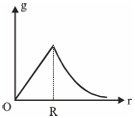
Which of the following statements are true about the acceleration due to gravity of the Earth (where $r$ is the distance from the center of the Earth and $R$ is the radius of the Earth)?
$(a)$ $g$ decreases when moving away from the center, if $r > R$.
$(b)$ $g$ decreases when moving away from the center, if $r < R$.
$(c)$ $g$ is zero at the center of the Earth.
$(d)$ $g$ at the equator decreases, if the Earth stops rotating about its axis.
$(a)$ $g$ decreases when moving away from the center, if $r > R$.
$(b)$ $g$ decreases when moving away from the center, if $r < R$.
$(c)$ $g$ is zero at the center of the Earth.
$(d)$ $g$ at the equator decreases, if the Earth stops rotating about its axis.
A
$(a) \& \ (b)$
B
$(a), (b) \& \ (c)$
C
$(a) \& \ (c)$
D
$(a), (b), (c) \& \ (d)$
Solution
(C) The variation of acceleration due to gravity $g$ with distance $r$ from the center of the Earth is given by:
$1$. For $r < R$ (inside the Earth): $g_{in} = \frac{GMr}{R^3}$. Thus, $g$ increases linearly with $r$. As $r$ increases from $0$ to $R$, $g$ increases. Therefore, statement $(b)$ is false.
$2$. At $r = 0$ (center of the Earth): $g = 0$. Thus, statement $(c)$ is true.
$3$. For $r > R$ (outside the Earth): $g_{out} = \frac{GM}{r^2}$. Thus, $g$ decreases as $r$ increases. Therefore, statement $(a)$ is true.
$4$. The effective acceleration due to gravity at the equator is $g' = g - \omega^2 R$. If the Earth stops rotating $(\omega = 0)$, then $g' = g$. Since $g - \omega^2 R < g$, the value of $g$ at the equator increases when the Earth stops rotating. Therefore, statement $(d)$ is false.
Conclusion: Statements $(a)$ and $(c)$ are true.
$1$. For $r < R$ (inside the Earth): $g_{in} = \frac{GMr}{R^3}$. Thus, $g$ increases linearly with $r$. As $r$ increases from $0$ to $R$, $g$ increases. Therefore, statement $(b)$ is false.
$2$. At $r = 0$ (center of the Earth): $g = 0$. Thus, statement $(c)$ is true.
$3$. For $r > R$ (outside the Earth): $g_{out} = \frac{GM}{r^2}$. Thus, $g$ decreases as $r$ increases. Therefore, statement $(a)$ is true.
$4$. The effective acceleration due to gravity at the equator is $g' = g - \omega^2 R$. If the Earth stops rotating $(\omega = 0)$, then $g' = g$. Since $g - \omega^2 R < g$, the value of $g$ at the equator increases when the Earth stops rotating. Therefore, statement $(d)$ is false.
Conclusion: Statements $(a)$ and $(c)$ are true.
0 likes
View Solution316
MediumMCQ
Two particles are projected vertically upwards with the same velocity on two different planets with accelerations due to gravity $g_1$ and $g_2$ respectively. If they fall back to their initial points of projection after lapse of times $t_1$ and $t_2$ respectively,then
A
$t_1 t_2 = g_1 g_2$
B
$t_1 g_1 = t_2 g_2$
C
$t_1 g_2 = t_2 g_1$
D
$t_1^2 + t_2^2 = g_1 + g_2$
Solution
(B) The time of flight $t$ for a particle projected vertically upwards with initial velocity $u$ under gravity $g$ is given by the formula $t = \frac{2u}{g}$.
Since both particles are projected with the same initial velocity $u$,we have $u = \frac{g_1 t_1}{2}$ and $u = \frac{g_2 t_2}{2}$.
Equating the two expressions for $u$,we get $\frac{g_1 t_1}{2} = \frac{g_2 t_2}{2}$.
This simplifies to $g_1 t_1 = g_2 t_2$.
Since both particles are projected with the same initial velocity $u$,we have $u = \frac{g_1 t_1}{2}$ and $u = \frac{g_2 t_2}{2}$.
Equating the two expressions for $u$,we get $\frac{g_1 t_1}{2} = \frac{g_2 t_2}{2}$.
This simplifies to $g_1 t_1 = g_2 t_2$.
0 likes
View Solution317
DifficultMCQ
Let $g$ be the acceleration due to gravity at the Earth's surface and $K$ be the rotational kinetic energy of the Earth. Suppose the Earth's radius decreases by $2 \%$ keeping its mass the same,then:
A
$g$ decreases by $2 \%$ and $K$ decreases by $4 \%$
B
$g$ decreases by $4 \%$ and $K$ increases by $2 \%$
C
$g$ increases by $4 \%$ and $K$ increases by $4 \%$
D
$g$ decreases by $4 \%$ and $K$ increases by $4 \%$
Solution
(C) The acceleration due to gravity is given by $g = \frac{GM}{R^2}$. Since $G$ and $M$ are constant,$g \propto R^{-2}$. Taking the derivative,$\frac{\Delta g}{g} = -2 \frac{\Delta R}{R}$. Given $\frac{\Delta R}{R} = -2 \%$,we get $\frac{\Delta g}{g} = -2(-2 \%) = +4 \%$. Thus,$g$ increases by $4 \%$.
The rotational kinetic energy is $K = \frac{1}{2} I \omega^2 = \frac{L^2}{2I}$,where $L$ is the angular momentum. Assuming $L$ remains constant,$K \propto \frac{1}{I}$. Since $I = \frac{2}{5} MR^2$,we have $I \propto R^2$. Therefore,$K \propto R^{-2}$. Taking the derivative,$\frac{\Delta K}{K} = -2 \frac{\Delta R}{R}$. Given $\frac{\Delta R}{R} = -2 \%$,we get $\frac{\Delta K}{K} = -2(-2 \%) = +4 \%$. Thus,$K$ increases by $4 \%$. Therefore,both $g$ and $K$ increase by $4 \%$.
The rotational kinetic energy is $K = \frac{1}{2} I \omega^2 = \frac{L^2}{2I}$,where $L$ is the angular momentum. Assuming $L$ remains constant,$K \propto \frac{1}{I}$. Since $I = \frac{2}{5} MR^2$,we have $I \propto R^2$. Therefore,$K \propto R^{-2}$. Taking the derivative,$\frac{\Delta K}{K} = -2 \frac{\Delta R}{R}$. Given $\frac{\Delta R}{R} = -2 \%$,we get $\frac{\Delta K}{K} = -2(-2 \%) = +4 \%$. Thus,$K$ increases by $4 \%$. Therefore,both $g$ and $K$ increase by $4 \%$.
0 likes
View Solution318
MediumMCQ
The time period of a simple pendulum on the earth's surface is $T$. Its time period becomes $xT$ when taken to a height $2R$ above the earth's surface. The value of $x$ will be ($R =$ radius of the earth).
A
$2$
B
$4$
C
$1$
D
$3$
Solution
(D) The time period of a simple pendulum is given by $T = 2\pi \sqrt{\frac{l}{g}}$.
On the surface of the earth,$g = \frac{GM}{R^2}$,so $T = 2\pi \sqrt{\frac{l}{g}}$.
At a height $h = 2R$ above the surface,the acceleration due to gravity $g'$ is given by $g' = \frac{GM}{(R+h)^2} = \frac{GM}{(R+2R)^2} = \frac{GM}{(3R)^2} = \frac{GM}{9R^2} = \frac{g}{9}$.
The new time period $T'$ is $T' = 2\pi \sqrt{\frac{l}{g'}} = 2\pi \sqrt{\frac{l}{g/9}} = 3 \times 2\pi \sqrt{\frac{l}{g}} = 3T$.
Comparing $T' = 3T$ with $T' = xT$,we get $x = 3$.
On the surface of the earth,$g = \frac{GM}{R^2}$,so $T = 2\pi \sqrt{\frac{l}{g}}$.
At a height $h = 2R$ above the surface,the acceleration due to gravity $g'$ is given by $g' = \frac{GM}{(R+h)^2} = \frac{GM}{(R+2R)^2} = \frac{GM}{(3R)^2} = \frac{GM}{9R^2} = \frac{g}{9}$.
The new time period $T'$ is $T' = 2\pi \sqrt{\frac{l}{g'}} = 2\pi \sqrt{\frac{l}{g/9}} = 3 \times 2\pi \sqrt{\frac{l}{g}} = 3T$.
Comparing $T' = 3T$ with $T' = xT$,we get $x = 3$.
0 likes
View Solution319
EasyMCQ
Two planets $A$ and $B$ have densities $\varrho_1$ and $\varrho_2$ and have radii $r_1$ and $r_2$ respectively. The ratio of acceleration due to gravity on $A$ to that of $B$ is:
A
$r_1: r_2$
B
$r_1 \varrho_1: r_2 \varrho_2$
C
$r_1^2 \varrho_1: r_2^2 \varrho_2$
D
$r_1 \varrho_2: r_2 \varrho_1$
Solution
(B) The acceleration due to gravity $g$ on the surface of a planet is given by the formula $g = \frac{GM}{r^2}$.
Since the mass $M$ of a planet can be expressed in terms of its density $\varrho$ and radius $r$ as $M = \text{Volume} \times \text{Density} = \frac{4}{3} \pi r^3 \varrho$,we substitute this into the formula for $g$:
$g = \frac{G (\frac{4}{3} \pi r^3 \varrho)}{r^2} = \frac{4}{3} \pi G r \varrho$.
Therefore,$g \propto r \varrho$.
For planet $A$,$g_A \propto r_1 \varrho_1$.
For planet $B$,$g_B \propto r_2 \varrho_2$.
The ratio of acceleration due to gravity on $A$ to that of $B$ is $\frac{g_A}{g_B} = \frac{r_1 \varrho_1}{r_2 \varrho_2}$.
Since the mass $M$ of a planet can be expressed in terms of its density $\varrho$ and radius $r$ as $M = \text{Volume} \times \text{Density} = \frac{4}{3} \pi r^3 \varrho$,we substitute this into the formula for $g$:
$g = \frac{G (\frac{4}{3} \pi r^3 \varrho)}{r^2} = \frac{4}{3} \pi G r \varrho$.
Therefore,$g \propto r \varrho$.
For planet $A$,$g_A \propto r_1 \varrho_1$.
For planet $B$,$g_B \propto r_2 \varrho_2$.
The ratio of acceleration due to gravity on $A$ to that of $B$ is $\frac{g_A}{g_B} = \frac{r_1 \varrho_1}{r_2 \varrho_2}$.
0 likes
View Solution320
MediumMCQ
The depth $d$ at which the value of acceleration due to gravity becomes $\left(\frac{1}{n}\right)$ times the value at the surface of the earth is ($R=$ radius of the earth).
A
$\frac{R(n-1)}{n}$
B
$\frac{R(n+1)}{n}$
C
$\frac{Rn}{(n-1)}$
D
$\frac{R}{n}$
Solution
(A) The acceleration due to gravity at a depth $d$ below the surface of the earth is given by $g_d = g_s \left(1 - \frac{d}{R}\right)$,where $g_s$ is the acceleration due to gravity at the surface.
Given that $g_d = \frac{g_s}{n}$,we substitute this into the equation:
$\frac{g_s}{n} = g_s \left(1 - \frac{d}{R}\right)$
Dividing both sides by $g_s$:
$\frac{1}{n} = 1 - \frac{d}{R}$
Rearranging the terms to solve for $d$:
$\frac{d}{R} = 1 - \frac{1}{n}$
$\frac{d}{R} = \frac{n-1}{n}$
$d = \frac{R(n-1)}{n}$
Thus,the correct option is $A$.
Given that $g_d = \frac{g_s}{n}$,we substitute this into the equation:
$\frac{g_s}{n} = g_s \left(1 - \frac{d}{R}\right)$
Dividing both sides by $g_s$:
$\frac{1}{n} = 1 - \frac{d}{R}$
Rearranging the terms to solve for $d$:
$\frac{d}{R} = 1 - \frac{1}{n}$
$\frac{d}{R} = \frac{n-1}{n}$
$d = \frac{R(n-1)}{n}$
Thus,the correct option is $A$.
0 likes
View Solution321
MediumMCQ
$A$ body weighs $45 \ N$ on the surface of the earth. The gravitational force on a body due to the earth at a height equal to half the radius of the earth will be: (in $N$)
A
$20$
B
$22.5$
C
$30$
D
$36$
Solution
(A) The weight of a body on the surface of the earth is given by $W = mg = \frac{GMm}{R^2} = 45 \ N$,where $R$ is the radius of the earth.
At a height $h = \frac{R}{2}$,the acceleration due to gravity $g'$ is given by the formula $g' = g \left( \frac{R}{R+h} \right)^2$.
Substituting $h = \frac{R}{2}$ into the formula:
$g' = g \left( \frac{R}{R + R/2} \right)^2 = g \left( \frac{R}{3R/2} \right)^2 = g \left( \frac{2}{3} \right)^2 = \frac{4}{9}g$.
The weight at height $h$ is $W' = mg' = m \left( \frac{4}{9}g \right) = \frac{4}{9} W$.
Substituting $W = 45 \ N$:
$W' = \frac{4}{9} \times 45 = 4 \times 5 = 20 \ N$.
At a height $h = \frac{R}{2}$,the acceleration due to gravity $g'$ is given by the formula $g' = g \left( \frac{R}{R+h} \right)^2$.
Substituting $h = \frac{R}{2}$ into the formula:
$g' = g \left( \frac{R}{R + R/2} \right)^2 = g \left( \frac{R}{3R/2} \right)^2 = g \left( \frac{2}{3} \right)^2 = \frac{4}{9}g$.
The weight at height $h$ is $W' = mg' = m \left( \frac{4}{9}g \right) = \frac{4}{9} W$.
Substituting $W = 45 \ N$:
$W' = \frac{4}{9} \times 45 = 4 \times 5 = 20 \ N$.
0 likes
View Solution322
EasyMCQ
The depth $d$ at which the acceleration due to gravity becomes $\frac{g}{n}$ is (where $R$ is the radius of the Earth,$g$ is the acceleration due to gravity at the surface,and $n$ is an integer).
A
$\frac{R(n-1)}{n}$
B
$\frac{R(n+1)}{n}$
C
$\frac{R(n-1)^2}{n}$
D
$\frac{R(n+1)^2}{n}$
Solution
(A) The acceleration due to gravity at a depth $d$ below the Earth's surface is given by the formula: $g_d = g(1 - \frac{d}{R})$.
Given that $g_d = \frac{g}{n}$,we substitute this into the equation:
$\frac{g}{n} = g(1 - \frac{d}{R})$.
Dividing both sides by $g$:
$\frac{1}{n} = 1 - \frac{d}{R}$.
Rearranging the terms to solve for $d$:
$\frac{d}{R} = 1 - \frac{1}{n}$.
$\frac{d}{R} = \frac{n-1}{n}$.
Therefore,$d = \frac{R(n-1)}{n}$.
Given that $g_d = \frac{g}{n}$,we substitute this into the equation:
$\frac{g}{n} = g(1 - \frac{d}{R})$.
Dividing both sides by $g$:
$\frac{1}{n} = 1 - \frac{d}{R}$.
Rearranging the terms to solve for $d$:
$\frac{d}{R} = 1 - \frac{1}{n}$.
$\frac{d}{R} = \frac{n-1}{n}$.
Therefore,$d = \frac{R(n-1)}{n}$.
0 likes
View Solution323
MediumMCQ
$A$ pendulum is oscillating with frequency $n$ on the surface of the Earth. If it is taken to a depth $d = R/3$ below the surface of the Earth,what is the new frequency of oscillation? ($R$ is the radius of the Earth)
A
$\sqrt{2/3} n$
B
$\sqrt{3/2} n$
C
$\sqrt{1/3} n$
D
$\sqrt{1/2} n$
Solution
(A) The frequency of a simple pendulum is given by $n = \frac{1}{2\pi} \sqrt{\frac{g}{L}}$.
Since $L$ is constant,$n \propto \sqrt{g}$.
On the surface of the Earth,$g_s = g$.
At a depth $d$,the acceleration due to gravity is given by $g_d = g_s \left(1 - \frac{d}{R}\right)$.
Given $d = R/3$,we have $g_d = g \left(1 - \frac{R/3}{R}\right) = g \left(1 - 1/3\right) = \frac{2}{3}g$.
The new frequency $n'$ is given by $n' = n \sqrt{\frac{g_d}{g_s}}$.
Substituting the values,$n' = n \sqrt{\frac{(2/3)g}{g}} = n \sqrt{2/3}$.
Since $L$ is constant,$n \propto \sqrt{g}$.
On the surface of the Earth,$g_s = g$.
At a depth $d$,the acceleration due to gravity is given by $g_d = g_s \left(1 - \frac{d}{R}\right)$.
Given $d = R/3$,we have $g_d = g \left(1 - \frac{R/3}{R}\right) = g \left(1 - 1/3\right) = \frac{2}{3}g$.
The new frequency $n'$ is given by $n' = n \sqrt{\frac{g_d}{g_s}}$.
Substituting the values,$n' = n \sqrt{\frac{(2/3)g}{g}} = n \sqrt{2/3}$.
0 likes
View Solution324
MediumMCQ
The speed with which the earth would have to rotate about its axis so that a person on the equator would weigh $\frac{1}{6}$ th as much as at present is ($g=$ gravitational acceleration,$R=$ equatorial radius of the earth).
A
$\sqrt{\frac{5}{6} \frac{g}{R}}$
B
$\sqrt{\frac{1}{6} \frac{g}{R}}$
C
$\sqrt{\frac{6}{5} \frac{R}{g}}$
D
$\sqrt{\frac{6}{5}} g R$
Solution
(A) The effective acceleration due to gravity at the equator is given by $g' = g - \omega^2 R$,where $g$ is the acceleration due to gravity at the poles (or without rotation),$\omega$ is the angular velocity,and $R$ is the radius of the earth.
Given that the weight at the equator becomes $\frac{1}{6}$ of its present value,we assume the present weight is approximately $mg$ (since $\omega^2 R$ is very small compared to $g$).
Thus,$g' = \frac{1}{6} g$.
Substituting this into the equation: $\frac{1}{6} g = g - \omega^2 R$.
Rearranging for $\omega^2 R$: $\omega^2 R = g - \frac{1}{6} g = \frac{5}{6} g$.
Solving for $\omega$: $\omega = \sqrt{\frac{5g}{6R}}$.
Therefore,the required angular speed is $\sqrt{\frac{5}{6} \frac{g}{R}}$.
Given that the weight at the equator becomes $\frac{1}{6}$ of its present value,we assume the present weight is approximately $mg$ (since $\omega^2 R$ is very small compared to $g$).
Thus,$g' = \frac{1}{6} g$.
Substituting this into the equation: $\frac{1}{6} g = g - \omega^2 R$.
Rearranging for $\omega^2 R$: $\omega^2 R = g - \frac{1}{6} g = \frac{5}{6} g$.
Solving for $\omega$: $\omega = \sqrt{\frac{5g}{6R}}$.
Therefore,the required angular speed is $\sqrt{\frac{5}{6} \frac{g}{R}}$.
0 likes
View Solution325
DifficultMCQ
The height above the earth's surface at which the acceleration due to gravity becomes $\frac{1}{n}$ times the value at the surface is ($R=$ radius of earth).
A
$\frac{R}{\sqrt{n}}$
B
$R \cdot \sqrt{n}$
C
$(\sqrt{n}+1) R$
D
$(\sqrt{n}-1) R$
Solution
(D) The acceleration due to gravity at a height $h$ above the earth's surface is given by the formula: $g' = g \left( \frac{R}{R+h} \right)^2$.
Given that $g' = \frac{g}{n}$,we can write: $\frac{g}{n} = g \left( \frac{R}{R+h} \right)^2$.
Dividing both sides by $g$,we get: $\frac{1}{n} = \left( \frac{R}{R+h} \right)^2$.
Taking the square root of both sides: $\frac{1}{\sqrt{n}} = \frac{R}{R+h}$.
Rearranging the equation to solve for $h$: $R+h = R \sqrt{n}$.
Therefore,$h = R \sqrt{n} - R = R(\sqrt{n}-1)$.
Given that $g' = \frac{g}{n}$,we can write: $\frac{g}{n} = g \left( \frac{R}{R+h} \right)^2$.
Dividing both sides by $g$,we get: $\frac{1}{n} = \left( \frac{R}{R+h} \right)^2$.
Taking the square root of both sides: $\frac{1}{\sqrt{n}} = \frac{R}{R+h}$.
Rearranging the equation to solve for $h$: $R+h = R \sqrt{n}$.
Therefore,$h = R \sqrt{n} - R = R(\sqrt{n}-1)$.
0 likes
View Solution326
MediumMCQ
The height at which the weight of the body becomes $\frac{1}{16}$ of its weight on the surface of the earth of radius $R$ is: (in $R$)
A
$2$
B
$3$
C
$4$
D
$5$
Solution
(B) The weight of a body at height $h$ is given by $W_h = W \left( \frac{R}{R+h} \right)^2$,where $W$ is the weight on the surface of the earth.
Given that $W_h = \frac{1}{16} W$,we have:
$\frac{1}{16} W = W \left( \frac{R}{R+h} \right)^2$
$\frac{1}{16} = \left( \frac{R}{R+h} \right)^2$
Taking the square root on both sides:
$\frac{1}{4} = \frac{R}{R+h}$
$R + h = 4R$
$h = 3R$
Therefore,the height at which the weight becomes $\frac{1}{16}$ of its surface weight is $3R$.
Given that $W_h = \frac{1}{16} W$,we have:
$\frac{1}{16} W = W \left( \frac{R}{R+h} \right)^2$
$\frac{1}{16} = \left( \frac{R}{R+h} \right)^2$
Taking the square root on both sides:
$\frac{1}{4} = \frac{R}{R+h}$
$R + h = 4R$
$h = 3R$
Therefore,the height at which the weight becomes $\frac{1}{16}$ of its surface weight is $3R$.
0 likes
View Solution327
EasyMCQ
The height $h$ above the earth's surface at which the value of acceleration due to gravity $g$ becomes $\frac{g}{3}$ is ($R=$ radius of the earth).
A
$(\sqrt{3}+1) R$
B
$(\sqrt{3}-1) R$
C
$\sqrt{3} R$
D
$3 \sqrt{R}$
Solution
(B) The acceleration due to gravity at a height $h$ above the earth's surface is given by the formula: $g_h = g \left( \frac{R}{R+h} \right)^2$.
Given that $g_h = \frac{g}{3}$,we substitute this into the equation:
$\frac{g}{3} = g \left( \frac{R}{R+h} \right)^2$.
Dividing both sides by $g$:
$\frac{1}{3} = \left( \frac{R}{R+h} \right)^2$.
Taking the square root of both sides:
$\frac{1}{\sqrt{3}} = \frac{R}{R+h}$.
Rearranging the terms to solve for $h$:
$R + h = \sqrt{3} R$.
$h = \sqrt{3} R - R$.
$h = (\sqrt{3} - 1) R$.
Given that $g_h = \frac{g}{3}$,we substitute this into the equation:
$\frac{g}{3} = g \left( \frac{R}{R+h} \right)^2$.
Dividing both sides by $g$:
$\frac{1}{3} = \left( \frac{R}{R+h} \right)^2$.
Taking the square root of both sides:
$\frac{1}{\sqrt{3}} = \frac{R}{R+h}$.
Rearranging the terms to solve for $h$:
$R + h = \sqrt{3} R$.
$h = \sqrt{3} R - R$.
$h = (\sqrt{3} - 1) R$.
0 likes
View Solution328
EasyMCQ
$A$ pendulum is oscillating with frequency $n$ on the surface of the Earth. If it is taken to a depth $d = \frac{R}{4}$ below the surface of the Earth,what is the new frequency of oscillation? ($R =$ radius of the Earth)
A
$\frac{2}{\sqrt{3}} n$
B
$\frac{\sqrt{3}}{2} n$
C
$\frac{2 n}{\sqrt{3}}$
D
$\frac{n}{4}$
Solution
(B) The frequency of the pendulum at the surface is given by $f = \frac{1}{2 \pi} \sqrt{\frac{g}{l}}$.
At a depth $d$,the gravitational acceleration is given by $g_{eff} = g \left(1 - \frac{d}{R}\right)$.
For $d = \frac{R}{4}$,the effective acceleration is $g_{eff} = g \left(1 - \frac{R/4}{R}\right) = g \left(1 - \frac{1}{4}\right) = \frac{3}{4} g$.
The frequency at depth $d$ is $f_d = \frac{1}{2 \pi} \sqrt{\frac{g_{eff}}{l}} = \frac{1}{2 \pi} \sqrt{\frac{3g}{4l}}$.
Taking the ratio of the new frequency to the original frequency $n$:
$\frac{f_d}{n} = \frac{\frac{1}{2 \pi} \sqrt{\frac{3g}{4l}}}{\frac{1}{2 \pi} \sqrt{\frac{g}{l}}} = \sqrt{\frac{3}{4}} = \frac{\sqrt{3}}{2}$.
Therefore,the new frequency is $f_d = \frac{\sqrt{3}}{2} n$.
At a depth $d$,the gravitational acceleration is given by $g_{eff} = g \left(1 - \frac{d}{R}\right)$.
For $d = \frac{R}{4}$,the effective acceleration is $g_{eff} = g \left(1 - \frac{R/4}{R}\right) = g \left(1 - \frac{1}{4}\right) = \frac{3}{4} g$.
The frequency at depth $d$ is $f_d = \frac{1}{2 \pi} \sqrt{\frac{g_{eff}}{l}} = \frac{1}{2 \pi} \sqrt{\frac{3g}{4l}}$.
Taking the ratio of the new frequency to the original frequency $n$:
$\frac{f_d}{n} = \frac{\frac{1}{2 \pi} \sqrt{\frac{3g}{4l}}}{\frac{1}{2 \pi} \sqrt{\frac{g}{l}}} = \sqrt{\frac{3}{4}} = \frac{\sqrt{3}}{2}$.
Therefore,the new frequency is $f_d = \frac{\sqrt{3}}{2} n$.
0 likes
View Solution329
MediumMCQ
The height $h$ from the surface of the earth at which the value of $g$ will be reduced by $64 \%$ from the value at the surface of the earth is ($R=$ radius of the earth).
A
$\frac{1}{3} R$
B
$\frac{2}{3} R$
C
$\frac{3}{2} R$
D
$2 R$
Solution
(B) The acceleration due to gravity at the surface of the earth is $g = \frac{GM}{R^2}$.
At a height $h$,the acceleration due to gravity is $g_h = \frac{GM}{(R+h)^2}$.
Given that the value of $g$ is reduced by $64 \%$,the remaining value is $g_h = (100 \% - 64 \%) \text{ of } g = 36 \% \text{ of } g = 0.36g$.
Therefore,$\frac{g_h}{g} = 0.36 = \frac{36}{100}$.
Substituting the expressions for $g$ and $g_h$:
$\frac{R^2}{(R+h)^2} = \frac{36}{100}$.
Taking the square root on both sides:
$\frac{R}{R+h} = \frac{6}{10} = \frac{3}{5}$.
Cross-multiplying gives:
$5R = 3(R+h) = 3R + 3h$.
$2R = 3h$.
$h = \frac{2}{3} R$.
At a height $h$,the acceleration due to gravity is $g_h = \frac{GM}{(R+h)^2}$.
Given that the value of $g$ is reduced by $64 \%$,the remaining value is $g_h = (100 \% - 64 \%) \text{ of } g = 36 \% \text{ of } g = 0.36g$.
Therefore,$\frac{g_h}{g} = 0.36 = \frac{36}{100}$.
Substituting the expressions for $g$ and $g_h$:
$\frac{R^2}{(R+h)^2} = \frac{36}{100}$.
Taking the square root on both sides:
$\frac{R}{R+h} = \frac{6}{10} = \frac{3}{5}$.
Cross-multiplying gives:
$5R = 3(R+h) = 3R + 3h$.
$2R = 3h$.
$h = \frac{2}{3} R$.
0 likes
View Solution330
MediumMCQ
The depth $d$ at which the value of acceleration due to gravity becomes $\frac{1}{n-1}$ times the value at the earth's surface is ($R=$ radius of the earth).
A
$R\left(\frac{n}{n-1}\right)$
B
$R\left(\frac{n-2}{n-1}\right)$
C
$R\left(\frac{2n-1}{n}\right)$
D
$R\left(\frac{n-1}{2n-1}\right)$
Solution
(B) The acceleration due to gravity at a depth $d$ is given by the formula: $g_d = g\left(1 - \frac{d}{R}\right)$.
Given that $g_d = \frac{g}{n-1}$,we substitute this into the equation:
$\frac{g}{n-1} = g\left(1 - \frac{d}{R}\right)$.
Dividing both sides by $g$:
$\frac{1}{n-1} = 1 - \frac{d}{R}$.
Rearranging the terms to solve for $d$:
$\frac{d}{R} = 1 - \frac{1}{n-1}$.
$\frac{d}{R} = \frac{n-1-1}{n-1} = \frac{n-2}{n-1}$.
Therefore,$d = R\left(\frac{n-2}{n-1}\right)$.
Given that $g_d = \frac{g}{n-1}$,we substitute this into the equation:
$\frac{g}{n-1} = g\left(1 - \frac{d}{R}\right)$.
Dividing both sides by $g$:
$\frac{1}{n-1} = 1 - \frac{d}{R}$.
Rearranging the terms to solve for $d$:
$\frac{d}{R} = 1 - \frac{1}{n-1}$.
$\frac{d}{R} = \frac{n-1-1}{n-1} = \frac{n-2}{n-1}$.
Therefore,$d = R\left(\frac{n-2}{n-1}\right)$.
0 likes
View Solution331
EasyMCQ
The acceleration due to gravity at the surface of the planet is the same as that at the surface of the earth,but the density of the planet is thrice that of the earth. If $R$ is the radius of the earth,the radius of the planet will be:
A
$\frac{R}{9}$
B
$\frac{R}{3}$
C
$3 R$
D
$9 R$
Solution
(B) The acceleration due to gravity $g$ at the surface of a planet is given by $g = \frac{GM}{R^2}$.
Since mass $M = \text{Volume} \times \text{Density} = \frac{4}{3} \pi R^3 \rho$,we can write $g = \frac{G}{R^2} \times \frac{4}{3} \pi R^3 \rho = \frac{4}{3} \pi R \rho G$.
Given that $g$ is the same for both the earth and the planet,we have $R_e \rho_e = R_p \rho_p$.
Here,$R_e = R$ and $\rho_p = 3 \rho_e$.
Substituting these values: $R \times \rho_e = R_p \times (3 \rho_e)$.
Therefore,$R_p = \frac{R}{3}$.
Since mass $M = \text{Volume} \times \text{Density} = \frac{4}{3} \pi R^3 \rho$,we can write $g = \frac{G}{R^2} \times \frac{4}{3} \pi R^3 \rho = \frac{4}{3} \pi R \rho G$.
Given that $g$ is the same for both the earth and the planet,we have $R_e \rho_e = R_p \rho_p$.
Here,$R_e = R$ and $\rho_p = 3 \rho_e$.
Substituting these values: $R \times \rho_e = R_p \times (3 \rho_e)$.
Therefore,$R_p = \frac{R}{3}$.
0 likes
View Solution332
MediumMCQ
The weights of an object are measured in a coal mine of depth $h_1$,then at sea level of height $h_2=0$,and lastly at the top of a mountain of height $h_3$ as $W_1, W_2$,and $W_3$ respectively. Which one of the following relations is correct? [$h_1 \ll R, h_3 \ll R, R=$ radius of the earth]
A
$W_1=W_2=W_3$
B
$W_1 < W_2 < W_3$
C
$W_1 > W_2 < W_3$
D
$W_1 < W_2 > W_3$
Solution
(D) The weight of an object is given by $W = mg$,where $m$ is the mass and $g$ is the acceleration due to gravity.
At the surface of the earth $(h=0)$,the acceleration due to gravity $g$ is maximum.
As we move into a mine of depth $h_1$,the acceleration due to gravity is $g_1 = g(1 - h_1/R)$,so $W_1 = mg(1 - h_1/R) < W_2$.
As we move to the top of a mountain of height $h_3$,the acceleration due to gravity is $g_3 = g(1 - 2h_3/R)$,so $W_3 = mg(1 - 2h_3/R) < W_2$.
Since $W_2$ is the weight at the surface,it is greater than both $W_1$ and $W_3$.
Therefore,the correct relation is $W_1 < W_2 > W_3$.
At the surface of the earth $(h=0)$,the acceleration due to gravity $g$ is maximum.
As we move into a mine of depth $h_1$,the acceleration due to gravity is $g_1 = g(1 - h_1/R)$,so $W_1 = mg(1 - h_1/R) < W_2$.
As we move to the top of a mountain of height $h_3$,the acceleration due to gravity is $g_3 = g(1 - 2h_3/R)$,so $W_3 = mg(1 - 2h_3/R) < W_2$.
Since $W_2$ is the weight at the surface,it is greater than both $W_1$ and $W_3$.
Therefore,the correct relation is $W_1 < W_2 > W_3$.
0 likes
View Solution333
EasyMCQ
The density of a new planet is twice that of earth. The acceleration due to gravity at the surface of the planet is equal to that at the surface of earth. If $R$ is the radius of earth,then the radius of the planet would be
A
$4 R$
B
$R / 2$
C
$\frac{R}{4}$
D
$2 R$
Solution
(B) The acceleration due to gravity $g$ at the surface of a planet is given by the formula: $g = \frac{4}{3} \pi \rho G R$,where $\rho$ is the density,$G$ is the gravitational constant,and $R$ is the radius of the planet.
Given that the density of the planet $\rho_p = 2 \rho_e$ and the acceleration due to gravity $g_p = g_e$.
Equating the expressions for both the planet and the earth:
$\frac{4}{3} \pi \rho_p G R_p = \frac{4}{3} \pi \rho_e G R_e$
$\rho_p R_p = \rho_e R_e$
Substituting $\rho_p = 2 \rho_e$ and $R_e = R$:
$(2 \rho_e) R_p = \rho_e R$
$2 R_p = R$
$R_p = \frac{R}{2}$
Given that the density of the planet $\rho_p = 2 \rho_e$ and the acceleration due to gravity $g_p = g_e$.
Equating the expressions for both the planet and the earth:
$\frac{4}{3} \pi \rho_p G R_p = \frac{4}{3} \pi \rho_e G R_e$
$\rho_p R_p = \rho_e R_e$
Substituting $\rho_p = 2 \rho_e$ and $R_e = R$:
$(2 \rho_e) R_p = \rho_e R$
$2 R_p = R$
$R_p = \frac{R}{2}$
0 likes
View Solution334
MediumMCQ
The speed with which the earth would have to rotate about its axis so that a person on the equator would weigh $\frac{3}{5}$ th as much as at present weight is ($g=$ gravitational acceleration,$R=$ equatorial radius of the earth).
A
$\sqrt{\frac{2g}{5R}}$
B
$\sqrt{\frac{3g}{5R}}$
C
$\sqrt{\frac{5R}{3g}}$
D
$\sqrt{\frac{3}{5}gR}$
Solution
(A) The effective acceleration due to gravity $g'$ at a latitude $\theta$ is given by $g' = g - R\omega^2 \cos^2 \theta$.
At the equator,the latitude $\theta = 0^\circ$,so $\cos 0^\circ = 1$. Thus,$g' = g - R\omega^2$.
Given that the weight becomes $\frac{3}{5}$ of its present value,the effective gravity $g'$ must be $\frac{3}{5}g$.
Substituting this into the equation: $\frac{3}{5}g = g - R\omega^2$.
Rearranging the terms: $R\omega^2 = g - \frac{3}{5}g = \frac{2}{5}g$.
Solving for $\omega$: $\omega^2 = \frac{2g}{5R}$,which gives $\omega = \sqrt{\frac{2g}{5R}}$.
At the equator,the latitude $\theta = 0^\circ$,so $\cos 0^\circ = 1$. Thus,$g' = g - R\omega^2$.
Given that the weight becomes $\frac{3}{5}$ of its present value,the effective gravity $g'$ must be $\frac{3}{5}g$.
Substituting this into the equation: $\frac{3}{5}g = g - R\omega^2$.
Rearranging the terms: $R\omega^2 = g - \frac{3}{5}g = \frac{2}{5}g$.
Solving for $\omega$: $\omega^2 = \frac{2g}{5R}$,which gives $\omega = \sqrt{\frac{2g}{5R}}$.
0 likes
View Solution335
MediumMCQ
$A$ boy weighs $72 \ N$ on the surface of the earth. What will be the gravitational force on the boy at a height equal to half the radius of the earth (in $N$)?
A
$32$
B
$48$
C
$96$
D
$162$
Solution
(A) The weight of an object at the surface of the earth is $W = mg = 72 \ N$.
At a height $h$ above the surface,the acceleration due to gravity $g_h$ is given by the formula: $g_h = g \left( \frac{R}{R+h} \right)^2$.
Given that the height $h = \frac{R}{2}$,we substitute this into the formula:
$g_h = g \left( \frac{R}{R + \frac{R}{2}} \right)^2 = g \left( \frac{R}{\frac{3R}{2}} \right)^2 = g \left( \frac{2}{3} \right)^2 = \frac{4}{9} g$.
The weight at height $h$ is $W_h = m g_h = m \left( \frac{4}{9} g \right) = \frac{4}{9} W$.
Substituting $W = 72 \ N$:
$W_h = \frac{4}{9} \times 72 = 4 \times 8 = 32 \ N$.
At a height $h$ above the surface,the acceleration due to gravity $g_h$ is given by the formula: $g_h = g \left( \frac{R}{R+h} \right)^2$.
Given that the height $h = \frac{R}{2}$,we substitute this into the formula:
$g_h = g \left( \frac{R}{R + \frac{R}{2}} \right)^2 = g \left( \frac{R}{\frac{3R}{2}} \right)^2 = g \left( \frac{2}{3} \right)^2 = \frac{4}{9} g$.
The weight at height $h$ is $W_h = m g_h = m \left( \frac{4}{9} g \right) = \frac{4}{9} W$.
Substituting $W = 72 \ N$:
$W_h = \frac{4}{9} \times 72 = 4 \times 8 = 32 \ N$.
0 likes
View Solution336
DifficultMCQ
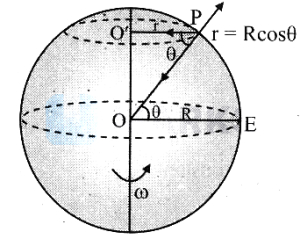
The linear speed of a particle at the equator of the earth due to its spin motion is $V$. The linear speed of the particle at latitude $30^{\circ}$ is:
A
$\frac{V}{\sqrt{2}}$
B
$\frac{V}{2}$
C
$\frac{\sqrt{3}}{2} V$
D
$V$
Solution
(C) The particle on the equator of the earth has linear speed $V = R \omega$,where $R$ is the radius of the earth and $\omega$ is the angular velocity of the earth's rotation.
At a latitude $\theta$,the particle moves in a circle of radius $r = R \cos \theta$.
The linear speed $V'$ of the particle at latitude $\theta$ is given by $V' = r \omega = (R \cos \theta) \omega$.
Substituting $\theta = 30^{\circ}$:
$V' = R \omega \cos 30^{\circ} = R \omega \left( \frac{\sqrt{3}}{2} \right)$.
Since $V = R \omega$,we have $V' = \frac{\sqrt{3}}{2} V$.
At a latitude $\theta$,the particle moves in a circle of radius $r = R \cos \theta$.
The linear speed $V'$ of the particle at latitude $\theta$ is given by $V' = r \omega = (R \cos \theta) \omega$.
Substituting $\theta = 30^{\circ}$:
$V' = R \omega \cos 30^{\circ} = R \omega \left( \frac{\sqrt{3}}{2} \right)$.
Since $V = R \omega$,we have $V' = \frac{\sqrt{3}}{2} V$.
0 likes
View Solution337
EasyMCQ
$A$ body weighs $300 \ N$ on the surface of the earth. How much will it weigh at a distance $\frac{R}{2}$ below the surface of the earth (in $N$)? ($R$ is the radius of the earth.)
A
$300$
B
$250$
C
$200$
D
$150$
Solution
(D) The acceleration due to gravity at a depth $d$ below the surface of the earth is given by the formula: $g_d = g(1 - \frac{d}{R})$.
Given that the depth $d = \frac{R}{2}$,we substitute this value into the equation:
$g_d = g(1 - \frac{R/2}{R}) = g(1 - \frac{1}{2}) = \frac{g}{2}$.
The weight of the body at the surface is $W = mg = 300 \ N$.
The weight of the body at depth $d$ is $W_d = mg_d$.
Substituting $g_d = \frac{g}{2}$,we get $W_d = m(\frac{g}{2}) = \frac{1}{2} \times mg = \frac{1}{2} \times 300 \ N = 150 \ N$.
Given that the depth $d = \frac{R}{2}$,we substitute this value into the equation:
$g_d = g(1 - \frac{R/2}{R}) = g(1 - \frac{1}{2}) = \frac{g}{2}$.
The weight of the body at the surface is $W = mg = 300 \ N$.
The weight of the body at depth $d$ is $W_d = mg_d$.
Substituting $g_d = \frac{g}{2}$,we get $W_d = m(\frac{g}{2}) = \frac{1}{2} \times mg = \frac{1}{2} \times 300 \ N = 150 \ N$.
0 likes
View Solution338
MediumMCQ
Consider a planet whose density is the same as that of the Earth but whose radius is three times the radius '$R$' of the Earth. The acceleration due to gravity '$g_n$' on the surface of the planet is $g_n = x \cdot g$,where '$g$' is the acceleration due to gravity on the surface of the Earth. The value of '$x$' is:
A
$9$
B
$3$
C
$1/3$
D
$1/9$
Solution
(B) The acceleration due to gravity on the surface of a planet is given by $g = \frac{GM}{R^2}$.
Since the mass $M$ of a sphere with density $\rho$ and radius $R$ is $M = \rho \cdot \frac{4}{3} \pi R^3$,we can substitute this into the formula:
$g = \frac{G \cdot \rho \cdot \frac{4}{3} \pi R^3}{R^2} = \frac{4}{3} \pi G \rho R$.
This shows that $g \propto R$ when the density $\rho$ is constant.
For the Earth,$g = \frac{4}{3} \pi G \rho R$.
For the planet,the radius is $R_p = 3R$ and the density is $\rho_p = \rho$.
Thus,the acceleration due to gravity on the planet is $g_n = \frac{4}{3} \pi G \rho (3R) = 3 \cdot (\frac{4}{3} \pi G \rho R) = 3g$.
Comparing $g_n = x \cdot g$ with $g_n = 3g$,we find that $x = 3$.
Since the mass $M$ of a sphere with density $\rho$ and radius $R$ is $M = \rho \cdot \frac{4}{3} \pi R^3$,we can substitute this into the formula:
$g = \frac{G \cdot \rho \cdot \frac{4}{3} \pi R^3}{R^2} = \frac{4}{3} \pi G \rho R$.
This shows that $g \propto R$ when the density $\rho$ is constant.
For the Earth,$g = \frac{4}{3} \pi G \rho R$.
For the planet,the radius is $R_p = 3R$ and the density is $\rho_p = \rho$.
Thus,the acceleration due to gravity on the planet is $g_n = \frac{4}{3} \pi G \rho (3R) = 3 \cdot (\frac{4}{3} \pi G \rho R) = 3g$.
Comparing $g_n = x \cdot g$ with $g_n = 3g$,we find that $x = 3$.
0 likes
View Solution339
MediumMCQ
The height at which the weight of a body becomes $\left(\frac{1}{9}\right)^{\text{th}}$ of its weight on the surface of the Earth is $(R = \text{radius of Earth})$: (in $R$)
A
$8$
B
$4$
C
$3$
D
$2$
Solution
(D) The weight of a body at height $h$ is given by $W_h = m g_h$ and on the surface is $W = m g$.
Given that $W_h = \frac{W}{9}$,we have $m g_h = \frac{m g}{9}$,which implies $g_h = \frac{g}{9}$.
The acceleration due to gravity at height $h$ is $g_h = \frac{GM}{(R+h)^2}$ and on the surface is $g = \frac{GM}{R^2}$.
Substituting these into the equation $g_h = \frac{g}{9}$:
$\frac{GM}{(R+h)^2} = \frac{1}{9} \cdot \frac{GM}{R^2}$
$\frac{1}{(R+h)^2} = \frac{1}{9 R^2}$
Taking the square root on both sides:
$\frac{1}{R+h} = \frac{1}{3 R}$
$R + h = 3 R$
$h = 2 R$
Therefore,the height is $2 R$.
Given that $W_h = \frac{W}{9}$,we have $m g_h = \frac{m g}{9}$,which implies $g_h = \frac{g}{9}$.
The acceleration due to gravity at height $h$ is $g_h = \frac{GM}{(R+h)^2}$ and on the surface is $g = \frac{GM}{R^2}$.
Substituting these into the equation $g_h = \frac{g}{9}$:
$\frac{GM}{(R+h)^2} = \frac{1}{9} \cdot \frac{GM}{R^2}$
$\frac{1}{(R+h)^2} = \frac{1}{9 R^2}$
Taking the square root on both sides:
$\frac{1}{R+h} = \frac{1}{3 R}$
$R + h = 3 R$
$h = 2 R$
Therefore,the height is $2 R$.
0 likes
View Solution340
DifficultMCQ
The depth at which acceleration due to gravity becomes $\frac{g}{2n}$ is ($R=$ radius of earth,$g=$ acceleration due to gravity on earth's surface,$n$ is an integer).
A
$\frac{R(1-2n)}{n}$
B
$\frac{R(1-n)}{2n}$
C
$\frac{R(n-1)}{n}$
D
$\frac{R(2n-1)}{2n}$
Solution
(D) The gravitational acceleration at a depth $d$ below the Earth's surface is given by the formula: $g_d = g \left(1 - \frac{d}{R}\right)$.
Given that the acceleration due to gravity at depth $d$ is $g_d = \frac{g}{2n}$.
Substituting this into the formula:
$\frac{g}{2n} = g \left(1 - \frac{d}{R}\right)$.
Dividing both sides by $g$:
$\frac{1}{2n} = 1 - \frac{d}{R}$.
Rearranging the terms to solve for $d$:
$\frac{d}{R} = 1 - \frac{1}{2n}$.
$\frac{d}{R} = \frac{2n - 1}{2n}$.
Therefore,$d = R \left(\frac{2n - 1}{2n}\right)$.
Given that the acceleration due to gravity at depth $d$ is $g_d = \frac{g}{2n}$.
Substituting this into the formula:
$\frac{g}{2n} = g \left(1 - \frac{d}{R}\right)$.
Dividing both sides by $g$:
$\frac{1}{2n} = 1 - \frac{d}{R}$.
Rearranging the terms to solve for $d$:
$\frac{d}{R} = 1 - \frac{1}{2n}$.
$\frac{d}{R} = \frac{2n - 1}{2n}$.
Therefore,$d = R \left(\frac{2n - 1}{2n}\right)$.
0 likes
View Solution341
MediumMCQ
$A$ mine is located at depth $\frac{R}{3}$ below the earth's surface. The acceleration due to gravity at that depth in the mine is ($R = \text{radius of earth}$,$g = \text{acceleration due to gravity at surface}$).
A
$g$
B
$3g$
C
$\frac{2g}{3}$
D
$\frac{g}{3}$
Solution
(C) The acceleration due to gravity at a depth $d$ below the earth's surface is given by the formula: $g_d = g(1 - \frac{d}{R})$.
Given that the depth $d = \frac{R}{3}$.
Substituting the value of $d$ into the formula:
$g_d = g(1 - \frac{R/3}{R})$
$g_d = g(1 - \frac{1}{3})$
$g_d = g(\frac{2}{3})$
Therefore,the acceleration due to gravity at that depth is $\frac{2g}{3}$.
Given that the depth $d = \frac{R}{3}$.
Substituting the value of $d$ into the formula:
$g_d = g(1 - \frac{R/3}{R})$
$g_d = g(1 - \frac{1}{3})$
$g_d = g(\frac{2}{3})$
Therefore,the acceleration due to gravity at that depth is $\frac{2g}{3}$.
0 likes
View Solution342
MediumMCQ
If two planets have their radii in the ratio $x: y$ and densities in the ratio $m: n$,then the ratio of the acceleration due to gravity on them is
A
$ny : mx$
B
$my : nx$
C
$nx : my$
D
$mx : ny$
Solution
(D) The acceleration due to gravity $g$ on the surface of a planet is given by $g = \frac{GM}{R^2}$.
Since the mass $M$ of a planet can be expressed in terms of its density $d$ and radius $R$ as $M = \frac{4}{3} \pi R^3 d$,we substitute this into the formula for $g$:
$g = \frac{G}{R^2} \left( \frac{4}{3} \pi R^3 d \right) = \frac{4}{3} \pi G R d$.
This shows that $g \propto R \cdot d$.
Given the ratios of radii $\frac{R_1}{R_2} = \frac{x}{y}$ and densities $\frac{d_1}{d_2} = \frac{m}{n}$,the ratio of the acceleration due to gravity is:
$\frac{g_1}{g_2} = \frac{R_1}{R_2} \times \frac{d_1}{d_2} = \frac{x}{y} \times \frac{m}{n} = \frac{xm}{yn}$.
Thus,the ratio is $xm : yn$ or $mx : ny$.
Since the mass $M$ of a planet can be expressed in terms of its density $d$ and radius $R$ as $M = \frac{4}{3} \pi R^3 d$,we substitute this into the formula for $g$:
$g = \frac{G}{R^2} \left( \frac{4}{3} \pi R^3 d \right) = \frac{4}{3} \pi G R d$.
This shows that $g \propto R \cdot d$.
Given the ratios of radii $\frac{R_1}{R_2} = \frac{x}{y}$ and densities $\frac{d_1}{d_2} = \frac{m}{n}$,the ratio of the acceleration due to gravity is:
$\frac{g_1}{g_2} = \frac{R_1}{R_2} \times \frac{d_1}{d_2} = \frac{x}{y} \times \frac{m}{n} = \frac{xm}{yn}$.
Thus,the ratio is $xm : yn$ or $mx : ny$.
0 likes
View Solution343
MediumMCQ
The value of acceleration due to gravity at a depth $d$ from the surface of the Earth and at an altitude $h$ from the surface of the Earth are in the ratio:
A
$1: 1$
B
$\frac{R-2 h}{R-d}$
C
$\frac{R-d}{R-2 h}$
D
$\frac{R-d}{R-h}$
Solution
(C) The acceleration due to gravity at a depth $d$ is given by $g_d = g(1 - \frac{d}{R})$.
The acceleration due to gravity at an altitude $h$ (where $h \ll R$) is given by $g_h = g(1 - \frac{2h}{R})$.
Taking the ratio of $g_d$ to $g_h$:
$\frac{g_d}{g_h} = \frac{g(1 - \frac{d}{R})}{g(1 - \frac{2h}{R})}$
Simplifying the expression:
$\frac{g_d}{g_h} = \frac{\frac{R-d}{R}}{\frac{R-2h}{R}} = \frac{R-d}{R-2h}$.
The acceleration due to gravity at an altitude $h$ (where $h \ll R$) is given by $g_h = g(1 - \frac{2h}{R})$.
Taking the ratio of $g_d$ to $g_h$:
$\frac{g_d}{g_h} = \frac{g(1 - \frac{d}{R})}{g(1 - \frac{2h}{R})}$
Simplifying the expression:
$\frac{g_d}{g_h} = \frac{\frac{R-d}{R}}{\frac{R-2h}{R}} = \frac{R-d}{R-2h}$.
0 likes
View Solution344
DifficultMCQ
Considering Earth to be a sphere of radius $R$ having uniform density $\rho$,the value of acceleration due to gravity $g$ in terms of $R$,$\rho$,and $G$ is:
A
$g=\sqrt{\frac{3 \pi R}{\rho G}}$
B
$g=\sqrt{\frac{4}{3} \pi \rho GR}$
C
$g=\frac{4}{3} \pi \rho GR$
D
$g=\frac{GM}{\rho R^2}$
Solution
(C) The acceleration due to gravity on the surface of the Earth is given by the formula $g = \frac{GM}{R^2}$.
Since the Earth is a sphere of radius $R$ and uniform density $\rho$,its mass $M$ can be expressed as $M = \text{Volume} \times \text{Density} = \frac{4}{3} \pi R^3 \rho$.
Substituting the value of $M$ into the formula for $g$,we get:
$g = \frac{G}{R^2} \times (\frac{4}{3} \pi R^3 \rho)$.
Simplifying the expression,we get $g = \frac{4}{3} \pi \rho GR$.
Since the Earth is a sphere of radius $R$ and uniform density $\rho$,its mass $M$ can be expressed as $M = \text{Volume} \times \text{Density} = \frac{4}{3} \pi R^3 \rho$.
Substituting the value of $M$ into the formula for $g$,we get:
$g = \frac{G}{R^2} \times (\frac{4}{3} \pi R^3 \rho)$.
Simplifying the expression,we get $g = \frac{4}{3} \pi \rho GR$.
0 likes
View Solution345
DifficultMCQ
Earth is assumed to be a sphere of radius $R$. If $g_{\phi}$ is the value of effective acceleration due to gravity at latitude $30^{\circ}$ and $g$ is the value at the equator,then the value of $|g - g_{\phi}|$ is ($\omega$ is the angular velocity of rotation of the Earth,$\cos 30^{\circ} = \frac{\sqrt{3}}{2}$).
A
$\frac{1}{4} \omega^2 R$
B
$\frac{3}{4} \omega^2 R$
C
$\omega^2 R$
D
$\frac{1}{2} \omega^2 R$
Solution
(A) The effective acceleration due to gravity at a latitude $\phi$ is given by the formula: $g_{\phi} = g_{0} - R \omega^2 \cos^2 \phi$,where $g_{0}$ is the acceleration due to gravity at the poles (ignoring rotation).
At the equator,$\phi = 0^{\circ}$,so $g = g_{0} - R \omega^2 \cos^2 0^{\circ} = g_{0} - R \omega^2$.
At latitude $\phi = 30^{\circ}$,$g_{\phi} = g_{0} - R \omega^2 \cos^2 30^{\circ} = g_{0} - R \omega^2 \left(\frac{\sqrt{3}}{2}\right)^2 = g_{0} - \frac{3}{4} R \omega^2$.
Now,calculating the difference $|g - g_{\phi}|$:
$|g - g_{\phi}| = |(g_{0} - R \omega^2) - (g_{0} - \frac{3}{4} R \omega^2)|$
$|g - g_{\phi}| = |-\frac{1}{4} R \omega^2| = \frac{1}{4} R \omega^2$.
At the equator,$\phi = 0^{\circ}$,so $g = g_{0} - R \omega^2 \cos^2 0^{\circ} = g_{0} - R \omega^2$.
At latitude $\phi = 30^{\circ}$,$g_{\phi} = g_{0} - R \omega^2 \cos^2 30^{\circ} = g_{0} - R \omega^2 \left(\frac{\sqrt{3}}{2}\right)^2 = g_{0} - \frac{3}{4} R \omega^2$.
Now,calculating the difference $|g - g_{\phi}|$:
$|g - g_{\phi}| = |(g_{0} - R \omega^2) - (g_{0} - \frac{3}{4} R \omega^2)|$
$|g - g_{\phi}| = |-\frac{1}{4} R \omega^2| = \frac{1}{4} R \omega^2$.
0 likes
View Solution346
MediumMCQ
The difference in the acceleration due to gravity at the pole and equator is ( $g=$ acceleration due to gravity,$R=$ radius of earth,$\theta=$ latitude,$\omega=$ angular velocity,$\cos 0^{\circ}=1, \cos 90^{\circ}=0$ ).
A
$R \omega^2 \cos^2 \theta$
B
$R \omega^2$
C
$\frac{R \omega^2}{g^2}$
D
$\omega \cos^2 \theta$
Solution
(B) The effective acceleration due to gravity at a latitude $\theta$ due to the rotation of the Earth is given by $g^{\prime} = g - R \omega^2 \cos^2 \theta$.
At the equator,the latitude $\theta = 0^{\circ}$,so $\cos 0^{\circ} = 1$.
Thus,the acceleration due to gravity at the equator is $g_e = g - R \omega^2$.
At the poles,the latitude $\theta = 90^{\circ}$,so $\cos 90^{\circ} = 0$.
Thus,the acceleration due to gravity at the poles is $g_p = g$.
The difference in the acceleration due to gravity between the pole and the equator is $g_p - g_e = g - (g - R \omega^2) = R \omega^2$.
At the equator,the latitude $\theta = 0^{\circ}$,so $\cos 0^{\circ} = 1$.
Thus,the acceleration due to gravity at the equator is $g_e = g - R \omega^2$.
At the poles,the latitude $\theta = 90^{\circ}$,so $\cos 90^{\circ} = 0$.
Thus,the acceleration due to gravity at the poles is $g_p = g$.
The difference in the acceleration due to gravity between the pole and the equator is $g_p - g_e = g - (g - R \omega^2) = R \omega^2$.
0 likes
View Solution347
MediumMCQ
The acceleration due to gravity on the moon is $\frac{1}{6}$ times the acceleration due to gravity on the earth. If the ratio of the density of the earth $\rho_e$ to the density of the moon $\rho_m$ is $\frac{5}{3}$,then the radius of the moon $R_m$ in terms of the radius of the earth $R_e$ is:
A
$\left(\frac{3}{18}\right) R_{e}$
B
$\left(\frac{1}{2 \sqrt{3}}\right) R_{e}$
C
$\left(\frac{5}{18}\right) R_{e}$
D
$\left(\frac{7}{6}\right) R_{e}$
Solution
(C) We know that the acceleration due to gravity is given by $g = \frac{GM}{R^2}$.
Since the mass of a planet is $M = \rho \left( \frac{4}{3} \pi R^3 \right)$,we can substitute this into the gravity formula:
$g = \frac{G}{R^2} \left( \rho \frac{4}{3} \pi R^3 \right) = \frac{4}{3} \pi G \rho R$.
This shows that $g \propto \rho R$.
Given that $g_m = \frac{1}{6} g_e$ and the ratio of densities $\frac{\rho_e}{\rho_m} = \frac{5}{3}$,which implies $\frac{\rho_m}{\rho_e} = \frac{3}{5}$.
Using the proportionality $g \propto \rho R$,we have:
$\frac{g_m}{g_e} = \frac{\rho_m R_m}{\rho_e R_e}$
$\frac{1}{6} = \left( \frac{3}{5} \right) \left( \frac{R_m}{R_e} \right)$
$\frac{R_m}{R_e} = \frac{1}{6} \times \frac{5}{3} = \frac{5}{18}$
Therefore,$R_m = \frac{5}{18} R_e$.
Since the mass of a planet is $M = \rho \left( \frac{4}{3} \pi R^3 \right)$,we can substitute this into the gravity formula:
$g = \frac{G}{R^2} \left( \rho \frac{4}{3} \pi R^3 \right) = \frac{4}{3} \pi G \rho R$.
This shows that $g \propto \rho R$.
Given that $g_m = \frac{1}{6} g_e$ and the ratio of densities $\frac{\rho_e}{\rho_m} = \frac{5}{3}$,which implies $\frac{\rho_m}{\rho_e} = \frac{3}{5}$.
Using the proportionality $g \propto \rho R$,we have:
$\frac{g_m}{g_e} = \frac{\rho_m R_m}{\rho_e R_e}$
$\frac{1}{6} = \left( \frac{3}{5} \right) \left( \frac{R_m}{R_e} \right)$
$\frac{R_m}{R_e} = \frac{1}{6} \times \frac{5}{3} = \frac{5}{18}$
Therefore,$R_m = \frac{5}{18} R_e$.
0 likes
View Solution348
MediumMCQ
Two spherical planets $A$ and $B$ have the same mass,but their densities are in a ratio $8:1$. For these planets,the ratio of acceleration due to gravity at the surface of $A$ to its value at the surface of $B$ is:
A
$4:1$
B
$1:4$
C
$2:1$
D
$1:2$
Solution
(A) Given: $\rho_A : \rho_B = 8 : 1$ and $M_A = M_B = M$.
Since density $\rho = \frac{M}{V} = \frac{M}{\frac{4}{3}\pi R^3}$,we have $\rho \propto \frac{1}{R^3}$.
Therefore,$\frac{\rho_A}{\rho_B} = \left(\frac{R_B}{R_A}\right)^3 = 8$.
Taking the cube root,$\frac{R_B}{R_A} = 2$,which means $\frac{R_A}{R_B} = \frac{1}{2}$.
The acceleration due to gravity is given by $g = \frac{GM}{R^2}$.
Thus,the ratio $\frac{g_A}{g_B} = \frac{GM/R_A^2}{GM/R_B^2} = \left(\frac{R_B}{R_A}\right)^2$.
Substituting the value,$\frac{g_A}{g_B} = (2)^2 = 4$.
So,the ratio is $4:1$.
Since density $\rho = \frac{M}{V} = \frac{M}{\frac{4}{3}\pi R^3}$,we have $\rho \propto \frac{1}{R^3}$.
Therefore,$\frac{\rho_A}{\rho_B} = \left(\frac{R_B}{R_A}\right)^3 = 8$.
Taking the cube root,$\frac{R_B}{R_A} = 2$,which means $\frac{R_A}{R_B} = \frac{1}{2}$.
The acceleration due to gravity is given by $g = \frac{GM}{R^2}$.
Thus,the ratio $\frac{g_A}{g_B} = \frac{GM/R_A^2}{GM/R_B^2} = \left(\frac{R_B}{R_A}\right)^2$.
Substituting the value,$\frac{g_A}{g_B} = (2)^2 = 4$.
So,the ratio is $4:1$.
0 likes
View SolutionGravitation — Acceleration Due to Gravity and its Variation · Frequently Asked Questions
1Are these Gravitation questions useful for JEE and NEET?
Yes. All questions in this section are mapped to JEE Main and NEET exam patterns. Previous year questions from JEE Main, NEET, GUJCET and state-level exams are included with full solutions.
2Can I switch to Hindi or Gujarati for these questions?
Yes. Use the language tabs in the hero section or the sidebar to view the same questions and solutions in English, Hindi or Gujarati.
3How do I generate a question paper from this subtopic?
Use the Vedclass Exam Paper Generator — select the chapter and subtopic, set difficulty, and generate Sets A, B, C, D automatically. First 3 chapters of every subject are free.
Vedclass Products
For Students
Vedclass Test Series
Mock tests in real JEE/NEET style with performance analysis. 5-day free trial.
Start Free TrialFor Teachers
Exam Paper Generator
Generate Set A/B/C/D papers from this chapter in 2 minutes. 3 chapters free.
Try FreeFor Institutes
Online Exam Module
Live online exams with unlimited students, 360° analytics & white-label branding.
See DemoFor Teachers & Institutes
Generate a Gravitation Exam Paper in 2 Minutes
Select subtopic & difficulty — Sets A, B, C, D auto-generated with No Repeat logic.
First 3 chapters of every subject are free — no payment required.