
A English
Acceleration Due to Gravity and its Variation Questions in English
Class 11 Physics · Gravitation · Acceleration Due to Gravity and its Variation
430+
Questions
English
Language
100%
With Solutions
Showing 50 of 430 questions in English
251
EasyMCQ
Given below are two statements:
Statement $I$: The law of gravitation holds good for any pair of bodies in the universe.
Statement $II$: The weight of any person becomes zero when the person is at the centre of the earth.
In the light of the above statements,choose the correct answer from the options given below.
Statement $I$: The law of gravitation holds good for any pair of bodies in the universe.
Statement $II$: The weight of any person becomes zero when the person is at the centre of the earth.
In the light of the above statements,choose the correct answer from the options given below.
A
Both Statement $I$ and Statement $II$ are true.
B
Both Statement $I$ and Statement $II$ are false.
C
Statement $I$ is true but Statement $II$ is false.
D
Statement $I$ is false but Statement $II$ is true.
Solution
(A) Statement $I$ is true because Newton's Law of Universal Gravitation states that every particle in the universe attracts every other particle with a force that is directly proportional to the product of their masses and inversely proportional to the square of the distance between their centers.
Statement $II$ is true because the acceleration due to gravity $g$ at the center of the Earth is zero. Since weight is defined as $W = mg$,if $g = 0$,then the weight $W$ of the person at the center of the Earth is also zero.
Therefore,both statements are true.
Statement $II$ is true because the acceleration due to gravity $g$ at the center of the Earth is zero. Since weight is defined as $W = mg$,if $g = 0$,then the weight $W$ of the person at the center of the Earth is also zero.
Therefore,both statements are true.
0 likes
View Solution252
MediumMCQ
The length of a seconds pendulum at a height $h=2R$ from the earth's surface will be. (Given: $R =$ radius of earth and acceleration due to gravity at the surface of earth $g = \pi^{2} \ m/s^{2}$)
A
$\frac{2}{9} \ m$
B
$\frac{4}{9} \ m$
C
$\frac{8}{9} \ m$
D
$\frac{1}{9} \ m$
Solution
(D) seconds pendulum has a time period $T = 2 \ s$.
The formula for the time period of a simple pendulum is $T = 2 \pi \sqrt{\frac{L}{g'}}$.
At a height $h = 2R$ from the surface,the acceleration due to gravity $g'$ is given by $g' = g \left( \frac{R}{R+h} \right)^{2} = g \left( \frac{R}{R+2R} \right)^{2} = g \left( \frac{1}{3} \right)^{2} = \frac{g}{9}$.
Given $g = \pi^{2} \ m/s^{2}$,so $g' = \frac{\pi^{2}}{9} \ m/s^{2}$.
Substituting the values into the time period formula: $2 = 2 \pi \sqrt{\frac{L}{\pi^{2}/9}}$.
$1 = \pi \sqrt{\frac{9L}{\pi^{2}}} = \pi \cdot \frac{3\sqrt{L}}{\pi} = 3\sqrt{L}$.
$\sqrt{L} = \frac{1}{3} \Rightarrow L = \frac{1}{9} \ m$.
The formula for the time period of a simple pendulum is $T = 2 \pi \sqrt{\frac{L}{g'}}$.
At a height $h = 2R$ from the surface,the acceleration due to gravity $g'$ is given by $g' = g \left( \frac{R}{R+h} \right)^{2} = g \left( \frac{R}{R+2R} \right)^{2} = g \left( \frac{1}{3} \right)^{2} = \frac{g}{9}$.
Given $g = \pi^{2} \ m/s^{2}$,so $g' = \frac{\pi^{2}}{9} \ m/s^{2}$.
Substituting the values into the time period formula: $2 = 2 \pi \sqrt{\frac{L}{\pi^{2}/9}}$.
$1 = \pi \sqrt{\frac{9L}{\pi^{2}}} = \pi \cdot \frac{3\sqrt{L}}{\pi} = 3\sqrt{L}$.
$\sqrt{L} = \frac{1}{3} \Rightarrow L = \frac{1}{9} \ m$.
0 likes
View Solution253
MediumMCQ
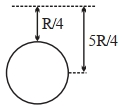
An object is taken to a height above the surface of the Earth at a distance of $\frac{5}{4} R$ from the center of the Earth,where the radius of the Earth is $R = 6400 \, km$. The percentage decrease in the weight of the object will be $....\%$.
A
$36$
B
$50$
C
$64$
D
$25$
Solution
(A) The acceleration due to gravity at a distance $r$ from the center of the Earth is given by $g' = \frac{GM}{r^2}$.
Given the distance from the center is $r = \frac{5}{4}R$,the acceleration due to gravity at this height is:
$g' = \frac{GM}{(\frac{5}{4}R)^2} = \frac{GM}{\frac{25}{16}R^2} = \frac{16}{25} \left( \frac{GM}{R^2} \right) = \frac{16}{25}g$.
Since weight $W = mg$,the new weight $W' = m g' = \frac{16}{25}mg = \frac{16}{25}W$.
The decrease in weight is $\Delta W = W - W' = W - \frac{16}{25}W = \frac{9}{25}W$.
The percentage decrease in weight is $\frac{\Delta W}{W} \times 100 = \frac{9/25 W}{W} \times 100 = \frac{9}{25} \times 100 = 36\%$.
Thus,the percentage decrease in the weight of the object is $36\%$.
Given the distance from the center is $r = \frac{5}{4}R$,the acceleration due to gravity at this height is:
$g' = \frac{GM}{(\frac{5}{4}R)^2} = \frac{GM}{\frac{25}{16}R^2} = \frac{16}{25} \left( \frac{GM}{R^2} \right) = \frac{16}{25}g$.
Since weight $W = mg$,the new weight $W' = m g' = \frac{16}{25}mg = \frac{16}{25}W$.
The decrease in weight is $\Delta W = W - W' = W - \frac{16}{25}W = \frac{9}{25}W$.
The percentage decrease in weight is $\frac{\Delta W}{W} \times 100 = \frac{9/25 W}{W} \times 100 = \frac{9}{25} \times 100 = 36\%$.
Thus,the percentage decrease in the weight of the object is $36\%$.
0 likes
View Solution254
MediumMCQ
The percentage decrease in the weight of a rocket,when taken to a height of $32 \ km$ above the surface of the Earth,will be $.....\%$
(Radius of Earth $= 6400 \ km$)
(Radius of Earth $= 6400 \ km$)
A
$1$
B
$3$
C
$4$
D
$0.5$
Solution
(A) The acceleration due to gravity at a height $h$ above the surface of the Earth is given by $g' = g(1 - \frac{2h}{R})$,where $R$ is the radius of the Earth and $h << R$.
The change in acceleration due to gravity is $\Delta g = g - g' = g(\frac{2h}{R})$.
The fractional decrease in weight (which is proportional to the change in $g$) is given by $\frac{\Delta g}{g} = \frac{2h}{R}$.
To find the percentage decrease,we multiply by $100$:
$\text{Percentage decrease} = \frac{\Delta g}{g} \times 100 = \frac{2h}{R} \times 100$.
Substituting the given values $h = 32 \ km$ and $R = 6400 \ km$:
$\text{Percentage decrease} = 2 \times \frac{32}{6400} \times 100 = 2 \times \frac{1}{200} \times 100 = 1 \%$.
The change in acceleration due to gravity is $\Delta g = g - g' = g(\frac{2h}{R})$.
The fractional decrease in weight (which is proportional to the change in $g$) is given by $\frac{\Delta g}{g} = \frac{2h}{R}$.
To find the percentage decrease,we multiply by $100$:
$\text{Percentage decrease} = \frac{\Delta g}{g} \times 100 = \frac{2h}{R} \times 100$.
Substituting the given values $h = 32 \ km$ and $R = 6400 \ km$:
$\text{Percentage decrease} = 2 \times \frac{32}{6400} \times 100 = 2 \times \frac{1}{200} \times 100 = 1 \%$.
0 likes
View Solution255
DifficultMCQ
Assume there are two identical simple pendulum clocks. Clock-$1$ is placed on the Earth and Clock-$2$ is placed on a space station located at a height $h$ above the Earth's surface. Clock-$1$ and Clock-$2$ operate with time periods of $4\,s$ and $6\,s$ respectively. Then the value of $h$ is $....\,km$ (consider the radius of the Earth $R_E = 6400\,km$ and $g$ on Earth $10\,m/s^2$).
A
$1200$
B
$1600$
C
$3200$
D
$4800$
Solution
(C) The time period of a simple pendulum is given by $T = 2\pi \sqrt{\frac{L}{g}}$,which implies $T \propto \frac{1}{\sqrt{g}}$.
The acceleration due to gravity at height $h$ is given by $g' = g \left( \frac{R_E}{R_E + h} \right)^2$,which implies $\sqrt{\frac{g'}{g}} = \frac{R_E}{R_E + h}$.
Given the time periods $T_1 = 4\,s$ and $T_2 = 6\,s$,we have the ratio:
$\frac{T_1}{T_2} = \sqrt{\frac{g}{g'}} = \frac{R_E + h}{R_E}$.
Substituting the values:
$\frac{4}{6} = \frac{6400 + h}{6400}$.
$\frac{2}{3} = 1 + \frac{h}{6400}$.
$\frac{h}{6400} = \frac{2}{3} - 1 = -\frac{1}{3}$.
Wait,re-evaluating the ratio: Since $T \propto \frac{1}{\sqrt{g}}$,then $\frac{T_2}{T_1} = \sqrt{\frac{g}{g'}} = \frac{R_E + h}{R_E}$.
$\frac{6}{4} = \frac{6400 + h}{6400}$.
$1.5 = 1 + \frac{h}{6400}$.
$0.5 = \frac{h}{6400}$.
$h = 0.5 \times 6400 = 3200\,km$.
The acceleration due to gravity at height $h$ is given by $g' = g \left( \frac{R_E}{R_E + h} \right)^2$,which implies $\sqrt{\frac{g'}{g}} = \frac{R_E}{R_E + h}$.
Given the time periods $T_1 = 4\,s$ and $T_2 = 6\,s$,we have the ratio:
$\frac{T_1}{T_2} = \sqrt{\frac{g}{g'}} = \frac{R_E + h}{R_E}$.
Substituting the values:
$\frac{4}{6} = \frac{6400 + h}{6400}$.
$\frac{2}{3} = 1 + \frac{h}{6400}$.
$\frac{h}{6400} = \frac{2}{3} - 1 = -\frac{1}{3}$.
Wait,re-evaluating the ratio: Since $T \propto \frac{1}{\sqrt{g}}$,then $\frac{T_2}{T_1} = \sqrt{\frac{g}{g'}} = \frac{R_E + h}{R_E}$.
$\frac{6}{4} = \frac{6400 + h}{6400}$.
$1.5 = 1 + \frac{h}{6400}$.
$0.5 = \frac{h}{6400}$.
$h = 0.5 \times 6400 = 3200\,km$.
0 likes
View Solution256
MediumMCQ
If the radius of earth shrinks by $2 \%$ while its mass remains the same,the acceleration due to gravity on the earth's surface will approximately:
A
decrease by $2 \%$
B
decrease by $4 \%$
C
increase by $2 \%$
D
increase by $4 \%$
Solution
(D) The acceleration due to gravity $g$ on the surface of the earth is given by the formula: $g = \frac{GM}{R^2}$,where $G$ is the gravitational constant,$M$ is the mass of the earth,and $R$ is the radius of the earth.
Since the mass $M$ remains constant,we have $g \propto \frac{1}{R^2}$.
Taking the natural logarithm and differentiating,we get the relative error formula: $\frac{\Delta g}{g} = -2 \frac{\Delta R}{R}$.
Given that the radius shrinks by $2 \%$,we have $\frac{\Delta R}{R} = -0.02$.
Substituting this into the error formula: $\frac{\Delta g}{g} = -2 \times (-0.02) = 0.04$.
To express this as a percentage,multiply by $100$: $\frac{\Delta g}{g} \times 100 = 4 \%$.
Since the result is positive,the acceleration due to gravity will increase by $4 \%$.
Since the mass $M$ remains constant,we have $g \propto \frac{1}{R^2}$.
Taking the natural logarithm and differentiating,we get the relative error formula: $\frac{\Delta g}{g} = -2 \frac{\Delta R}{R}$.
Given that the radius shrinks by $2 \%$,we have $\frac{\Delta R}{R} = -0.02$.
Substituting this into the error formula: $\frac{\Delta g}{g} = -2 \times (-0.02) = 0.04$.
To express this as a percentage,multiply by $100$: $\frac{\Delta g}{g} \times 100 = 4 \%$.
Since the result is positive,the acceleration due to gravity will increase by $4 \%$.
1 likes
View Solution257
MediumMCQ
If the acceleration due to gravity experienced by a point mass at a height $h$ above the surface of the Earth is the same as the acceleration due to gravity at a depth $d = \alpha h$ $(h \ll R_{e})$ from the Earth's surface,then the value of $\alpha$ will be: (use $R_{e} = 6400 \ km$)
A
$5$
B
$3$
C
$2$
D
$0$
Solution
(C) The acceleration due to gravity at a height $h$ above the Earth's surface is given by $g_h = g(1 - \frac{2h}{R_e})$ for $h \ll R_e$.
The acceleration due to gravity at a depth $d$ below the Earth's surface is given by $g_d = g(1 - \frac{d}{R_e})$.
According to the problem,$g_h = g_d$,so:
$g(1 - \frac{2h}{R_e}) = g(1 - \frac{d}{R_e})$
Canceling $g$ from both sides and simplifying:
$1 - \frac{2h}{R_e} = 1 - \frac{d}{R_e}$
$\frac{2h}{R_e} = \frac{d}{R_e}$
$d = 2h$
Given that $d = \alpha h$,we compare the two expressions:
$\alpha h = 2h$
$\alpha = 2$.
The acceleration due to gravity at a depth $d$ below the Earth's surface is given by $g_d = g(1 - \frac{d}{R_e})$.
According to the problem,$g_h = g_d$,so:
$g(1 - \frac{2h}{R_e}) = g(1 - \frac{d}{R_e})$
Canceling $g$ from both sides and simplifying:
$1 - \frac{2h}{R_e} = 1 - \frac{d}{R_e}$
$\frac{2h}{R_e} = \frac{d}{R_e}$
$d = 2h$
Given that $d = \alpha h$,we compare the two expressions:
$\alpha h = 2h$
$\alpha = 2$.
0 likes
View Solution258
DifficultMCQ
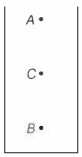
$A$ narrow but tall cabin is falling freely near the earth's surface. Inside the cabin,two small stones $A$ and $B$ are released from rest (relative to the cabin). Initially $A$ is much above the centre of mass and $B$ is much below the centre of mass of the cabin. $A$ close observation of the motion of $A$ and $B$ will reveal that
A
both $A$ and $B$ continue to be exactly at rest relative to the cabin
B
$A$ moves slowly upward and $B$ moves slowly downward relative to the cabin
C
both $A$ and $B$ fall to the bottom of the cabin with constant acceleration due to gravity
D
$A$ and $B$ move slightly towards each other vertically
Solution
(B) The acceleration due to gravity $g$ decreases as we move away from the earth's surface,given by $g(h) = g_0(1 - 2h/R_e)$.
Let $C$ be the centre of mass of the cabin. The acceleration of any object at a height $h$ is $a = g(h)$.
Since $A$ is above $C$ and $B$ is below $C$,their heights are $h_A > h_C > h_B$.
Consequently,the gravitational accelerations satisfy $a_B > a_C > a_A$.
When viewed from the frame of the cabin (which has acceleration $a_C$),the relative accelerations are:
$a_{A,rel} = a_A - a_C < 0$ (meaning $A$ accelerates upward relative to the cabin).
$a_{B,rel} = a_B - a_C > 0$ (meaning $B$ accelerates downward relative to the cabin).
Thus,$A$ moves slowly upward and $B$ moves slowly downward relative to the cabin. Therefore,option $(b)$ is correct.
Let $C$ be the centre of mass of the cabin. The acceleration of any object at a height $h$ is $a = g(h)$.
Since $A$ is above $C$ and $B$ is below $C$,their heights are $h_A > h_C > h_B$.
Consequently,the gravitational accelerations satisfy $a_B > a_C > a_A$.
When viewed from the frame of the cabin (which has acceleration $a_C$),the relative accelerations are:
$a_{A,rel} = a_A - a_C < 0$ (meaning $A$ accelerates upward relative to the cabin).
$a_{B,rel} = a_B - a_C > 0$ (meaning $B$ accelerates downward relative to the cabin).
Thus,$A$ moves slowly upward and $B$ moves slowly downward relative to the cabin. Therefore,option $(b)$ is correct.
0 likes
View Solution259
AdvancedMCQ
$A$ certain planet completes one rotation about its axis in time $T$. The weight of an object placed at the equator on the planet's surface is a fraction $f$ ($f$ is close to unity) of its weight recorded at a latitude of $60^{\circ}$. The density of the planet (assumed to be a uniform perfect sphere) is given by
A
$\left(\frac{4-f}{1-f}\right) \cdot \frac{3 \pi}{4 G T^2}$
B
$\left(\frac{4-f}{1+f}\right) \cdot \frac{3 \pi}{4 G T^2}$
C
$\left(\frac{4-3f}{1-f}\right) \cdot \frac{3 \pi}{4 G T^2}$
D
$\left(\frac{4-2f}{1-f}\right) \cdot \frac{3 \pi}{4 G T^2}$
Solution
(A) Due to the rotation of the planet,the effective acceleration due to gravity at latitude $\lambda$ is given by $g^{\prime} = g - \omega^2 R \cos^2 \lambda$.
At the equator,$\lambda = 0^{\circ}$,so $g_e = g - \omega^2 R$.
At a latitude of $60^{\circ}$,$\lambda = 60^{\circ}$,so $g_{60} = g - \omega^2 R \cos^2(60^{\circ}) = g - \frac{\omega^2 R}{4}$.
Given that the weight at the equator is $f$ times the weight at $60^{\circ}$,we have $g_e = f \cdot g_{60}$.
Substituting the expressions: $g - \omega^2 R = f \left( g - \frac{\omega^2 R}{4} \right)$.
Rearranging gives $g(1 - f) = \omega^2 R \left( 1 - \frac{f}{4} \right) = \frac{\omega^2 R}{4} (4 - f)$.
Using $g = \frac{GM}{R^2}$,$M = \frac{4}{3} \pi R^3 \rho$,and $\omega = \frac{2\pi}{T}$,we substitute:
$\frac{G}{R^2} \left( \frac{4}{3} \pi R^3 \rho \right) (1 - f) = \frac{4 \pi^2}{T^2} R \left( \frac{4 - f}{4} \right)$.
$\frac{4}{3} \pi G R \rho (1 - f) = \frac{\pi^2 R}{T^2} (4 - f)$.
Solving for density $\rho$: $\rho = \left( \frac{4 - f}{1 - f} \right) \cdot \frac{3 \pi}{4 G T^2}$.
At the equator,$\lambda = 0^{\circ}$,so $g_e = g - \omega^2 R$.
At a latitude of $60^{\circ}$,$\lambda = 60^{\circ}$,so $g_{60} = g - \omega^2 R \cos^2(60^{\circ}) = g - \frac{\omega^2 R}{4}$.
Given that the weight at the equator is $f$ times the weight at $60^{\circ}$,we have $g_e = f \cdot g_{60}$.
Substituting the expressions: $g - \omega^2 R = f \left( g - \frac{\omega^2 R}{4} \right)$.
Rearranging gives $g(1 - f) = \omega^2 R \left( 1 - \frac{f}{4} \right) = \frac{\omega^2 R}{4} (4 - f)$.
Using $g = \frac{GM}{R^2}$,$M = \frac{4}{3} \pi R^3 \rho$,and $\omega = \frac{2\pi}{T}$,we substitute:
$\frac{G}{R^2} \left( \frac{4}{3} \pi R^3 \rho \right) (1 - f) = \frac{4 \pi^2}{T^2} R \left( \frac{4 - f}{4} \right)$.
$\frac{4}{3} \pi G R \rho (1 - f) = \frac{\pi^2 R}{T^2} (4 - f)$.
Solving for density $\rho$: $\rho = \left( \frac{4 - f}{1 - f} \right) \cdot \frac{3 \pi}{4 G T^2}$.
0 likes
View Solution260
MediumMCQ
At a height of $10 \,km$ above the surface of the earth,the value of acceleration due to gravity is the same as that at a particular depth below the surface of the earth. Assuming uniform mass density for the earth,the depth is ............. $km$.
A
$1$
B
$5$
C
$10$
D
$20$
Solution
(D) The value of acceleration due to gravity at a height $h$ above the surface is given by $g_h = g(1 - \frac{2h}{R})$,where $R$ is the radius of the earth.
The value of acceleration due to gravity at a depth $d$ below the surface is given by $g_d = g(1 - \frac{d}{R})$.
According to the problem,$g_h = g_d$.
Therefore,$g(1 - \frac{2h}{R}) = g(1 - \frac{d}{R})$.
Simplifying the equation,we get $\frac{2h}{R} = \frac{d}{R}$,which implies $d = 2h$.
Given that $h = 10 \,km$,we have $d = 2 \times 10 \,km = 20 \,km$.
The value of acceleration due to gravity at a depth $d$ below the surface is given by $g_d = g(1 - \frac{d}{R})$.
According to the problem,$g_h = g_d$.
Therefore,$g(1 - \frac{2h}{R}) = g(1 - \frac{d}{R})$.
Simplifying the equation,we get $\frac{2h}{R} = \frac{d}{R}$,which implies $d = 2h$.
Given that $h = 10 \,km$,we have $d = 2 \times 10 \,km = 20 \,km$.
0 likes
View Solution261
MediumMCQ
$A$ ball is launched from the top of Mt. Everest,which is at an elevation of $9000 \, m$. The ball moves in a circular orbit around the Earth. Acceleration due to gravity near the Earth's surface is $g$. The magnitude of the ball's acceleration while in orbit is
A
close to $g/2$
B
zero
C
much greater than $g$
D
nearly equal to $g$
Solution
(D) The orbital radius of the ball is $r = R + h$,where $R$ is the radius of the Earth $(6400 \, km)$ and $h$ is the height $(9 \, km)$.
Since $h \ll R$,we have $r \approx R$.
The acceleration of an object in a circular orbit is given by the centripetal acceleration $a = v^2 / r$.
Substituting the orbital velocity $v = \sqrt{GM/r}$,we get $a = (GM/r) / r = GM/r^2$.
Since $r \approx R$,the acceleration $a \approx GM/R^2$.
By definition,the acceleration due to gravity near the Earth's surface is $g = GM/R^2$.
Therefore,the acceleration of the ball in orbit is nearly equal to $g$.
Since $h \ll R$,we have $r \approx R$.
The acceleration of an object in a circular orbit is given by the centripetal acceleration $a = v^2 / r$.
Substituting the orbital velocity $v = \sqrt{GM/r}$,we get $a = (GM/r) / r = GM/r^2$.
Since $r \approx R$,the acceleration $a \approx GM/R^2$.
By definition,the acceleration due to gravity near the Earth's surface is $g = GM/R^2$.
Therefore,the acceleration of the ball in orbit is nearly equal to $g$.
0 likes
View Solution262
MediumMCQ
Consider two spherical planets of same average density. The second planet is $8$ times as massive as the first planet. The ratio of the acceleration due to gravity of the second planet to that of the first planet is
A
$1$
B
$2$
C
$4$
D
$8$
Solution
(B) Given,mass of the second planet $M_2 = 8 M_1$,where $M_1$ is the mass of the first planet.
Since the density $\rho$ is the same for both planets,we have $M = \frac{4}{3} \pi R^3 \rho$.
Thus,$M \propto R^3$,which implies $R \propto M^{1/3}$.
Therefore,$\frac{R_2}{R_1} = \left(\frac{M_2}{M_1}\right)^{1/3} = (8)^{1/3} = 2$,so $R_2 = 2 R_1$.
The acceleration due to gravity is given by $g = \frac{GM}{R^2}$.
The ratio of the acceleration due to gravity of the second planet to that of the first planet is:
$\frac{g_2}{g_1} = \frac{M_2}{M_1} \times \left(\frac{R_1}{R_2}\right)^2$
Substituting the values,we get $\frac{g_2}{g_1} = 8 \times \left(\frac{1}{2}\right)^2 = 8 \times \frac{1}{4} = 2$.
Thus,the ratio is $2$.
Since the density $\rho$ is the same for both planets,we have $M = \frac{4}{3} \pi R^3 \rho$.
Thus,$M \propto R^3$,which implies $R \propto M^{1/3}$.
Therefore,$\frac{R_2}{R_1} = \left(\frac{M_2}{M_1}\right)^{1/3} = (8)^{1/3} = 2$,so $R_2 = 2 R_1$.
The acceleration due to gravity is given by $g = \frac{GM}{R^2}$.
The ratio of the acceleration due to gravity of the second planet to that of the first planet is:
$\frac{g_2}{g_1} = \frac{M_2}{M_1} \times \left(\frac{R_1}{R_2}\right)^2$
Substituting the values,we get $\frac{g_2}{g_1} = 8 \times \left(\frac{1}{2}\right)^2 = 8 \times \frac{1}{4} = 2$.
Thus,the ratio is $2$.
0 likes
View Solution263
MediumMCQ
$A$ body weighs $144 \, N$ at the surface of the earth. When it is taken to a height of $h = 3R$,where $R$ is the radius of the earth,it would weigh .......... $N$.
A
$48$
B
$36$
C
$16$
D
$9$
Solution
(D) Given that,the weight of the body at the surface of the earth is $W = mg = 144 \, N$.
The acceleration due to gravity at a height $h$ above the surface of the earth is given by the formula:
$g' = g \left( \frac{R}{R + h} \right)^2$
Given $h = 3R$,we substitute this into the equation:
$g' = g \left( \frac{R}{R + 3R} \right)^2 = g \left( \frac{R}{4R} \right)^2 = g \left( \frac{1}{4} \right)^2 = \frac{g}{16}$
The weight of the body at height $h$ is $W' = mg'$.
$W' = m \left( \frac{g}{16} \right) = \frac{W}{16}$
Substituting the value of $W = 144 \, N$:
$W' = \frac{144}{16} = 9 \, N$.
Therefore,the weight of the body at a height of $3R$ is $9 \, N$.
The acceleration due to gravity at a height $h$ above the surface of the earth is given by the formula:
$g' = g \left( \frac{R}{R + h} \right)^2$
Given $h = 3R$,we substitute this into the equation:
$g' = g \left( \frac{R}{R + 3R} \right)^2 = g \left( \frac{R}{4R} \right)^2 = g \left( \frac{1}{4} \right)^2 = \frac{g}{16}$
The weight of the body at height $h$ is $W' = mg'$.
$W' = m \left( \frac{g}{16} \right) = \frac{W}{16}$
Substituting the value of $W = 144 \, N$:
$W' = \frac{144}{16} = 9 \, N$.
Therefore,the weight of the body at a height of $3R$ is $9 \, N$.
0 likes
View Solution264
MediumMCQ
If the radius of the Earth contracts by $0.1 \%$,with its mass remaining the same,then the weight of a body at the Earth's surface will increase by ..............$\%$
A
$0.1 \%$
B
$0.2 \%$
C
$0.3 \%$
D
Remains the same
Solution
(B) The weight of a body at the Earth's surface is given by $W = \frac{GMm}{r^2}$,where $G$ is the gravitational constant,$M$ is the mass of the Earth,$m$ is the mass of the body,and $r$ is the radius of the Earth.
Since $G, M,$ and $m$ are constant,$W \propto \frac{1}{r^2}$.
Given that the radius contracts by $0.1 \%$,the new radius is $r' = r(1 - 0.001) = 0.999r$.
The new weight $W'$ is given by $W' = \frac{GMm}{(0.999r)^2} = \frac{W}{(0.999)^2}$.
Using the binomial approximation $(1-x)^{-n} \approx 1+nx$ for small $x$,we have $W' = W(1 - 0.001)^{-2} \approx W(1 + 2 \times 0.001) = W(1 + 0.002)$.
Thus,$W' = W + 0.002W$,which represents an increase of $0.002 \times 100 = 0.2 \%$.
Therefore,the weight increases by $0.2 \%$.
Since $G, M,$ and $m$ are constant,$W \propto \frac{1}{r^2}$.
Given that the radius contracts by $0.1 \%$,the new radius is $r' = r(1 - 0.001) = 0.999r$.
The new weight $W'$ is given by $W' = \frac{GMm}{(0.999r)^2} = \frac{W}{(0.999)^2}$.
Using the binomial approximation $(1-x)^{-n} \approx 1+nx$ for small $x$,we have $W' = W(1 - 0.001)^{-2} \approx W(1 + 2 \times 0.001) = W(1 + 0.002)$.
Thus,$W' = W + 0.002W$,which represents an increase of $0.002 \times 100 = 0.2 \%$.
Therefore,the weight increases by $0.2 \%$.
0 likes
View Solution265
MediumMCQ
If the mass of the Earth decreases by $25 \%$ and its radius increases by $50 \%$,then the acceleration due to gravity at its surface decreases by nearly ......... $\%$
A
$89$
B
$67$
C
$33$
D
$11$
Solution
(B) We know that the acceleration due to gravity is given by $g = \frac{GM}{R^2}$.
Given that the mass of the Earth decreases by $25 \%$,the new mass $M' = M - 0.25M = 0.75M = \frac{3}{4}M$.
The radius of the Earth increases by $50 \%$,so the new radius $R' = R + 0.50R = 1.5R = \frac{3}{2}R$.
The new acceleration due to gravity $g'$ is:
$g' = \frac{GM'}{(R')^2} = \frac{G(0.75M)}{(1.5R)^2} = \frac{0.75GM}{2.25R^2} = \frac{0.75}{2.25} g = \frac{1}{3} g \approx 0.333g$.
The decrease in acceleration due to gravity is $\Delta g = g - g' = g - 0.333g = 0.667g$.
Expressed as a percentage,the decrease is $0.667 \times 100 \% \approx 67 \%$.
Therefore,the acceleration due to gravity at its surface decreases by nearly $67 \%$.
Given that the mass of the Earth decreases by $25 \%$,the new mass $M' = M - 0.25M = 0.75M = \frac{3}{4}M$.
The radius of the Earth increases by $50 \%$,so the new radius $R' = R + 0.50R = 1.5R = \frac{3}{2}R$.
The new acceleration due to gravity $g'$ is:
$g' = \frac{GM'}{(R')^2} = \frac{G(0.75M)}{(1.5R)^2} = \frac{0.75GM}{2.25R^2} = \frac{0.75}{2.25} g = \frac{1}{3} g \approx 0.333g$.
The decrease in acceleration due to gravity is $\Delta g = g - g' = g - 0.333g = 0.667g$.
Expressed as a percentage,the decrease is $0.667 \times 100 \% \approx 67 \%$.
Therefore,the acceleration due to gravity at its surface decreases by nearly $67 \%$.
0 likes
View Solution266
MediumMCQ
Acceleration due to gravity at the surface of a planet is equal to that at the surface of the Earth,and its density is $1.5$ times that of the Earth. If the radius of the Earth is $R$,the radius of the planet is:
A
$\frac{3}{2} R$
B
$\frac{2}{3} R$
C
$\frac{9}{4} R$
D
$\frac{4}{9} R$
Solution
(B) The acceleration due to gravity $g$ at the surface of a body of radius $R$ and density $\rho$ is given by:
$g = \frac{GM}{R^2} = \frac{G(\rho \cdot \frac{4}{3}\pi R^3)}{R^2} = \frac{4}{3} \pi G \rho R$
Given that $g_p = g_e$ and $\rho_p = 1.5 \rho_e = \frac{3}{2} \rho_e$.
Equating the gravity expressions for the planet and the Earth:
$\frac{4}{3} \pi G \rho_p R_p = \frac{4}{3} \pi G \rho_e R_e$
$\rho_p R_p = \rho_e R_e$
Substituting $\rho_p = \frac{3}{2} \rho_e$ and $R_e = R$:
$(\frac{3}{2} \rho_e) R_p = \rho_e R$
$R_p = \frac{2}{3} R$
Thus,the radius of the planet is $\frac{2}{3} R$.
$g = \frac{GM}{R^2} = \frac{G(\rho \cdot \frac{4}{3}\pi R^3)}{R^2} = \frac{4}{3} \pi G \rho R$
Given that $g_p = g_e$ and $\rho_p = 1.5 \rho_e = \frac{3}{2} \rho_e$.
Equating the gravity expressions for the planet and the Earth:
$\frac{4}{3} \pi G \rho_p R_p = \frac{4}{3} \pi G \rho_e R_e$
$\rho_p R_p = \rho_e R_e$
Substituting $\rho_p = \frac{3}{2} \rho_e$ and $R_e = R$:
$(\frac{3}{2} \rho_e) R_p = \rho_e R$
$R_p = \frac{2}{3} R$
Thus,the radius of the planet is $\frac{2}{3} R$.
0 likes
View Solution267
MediumMCQ
Weight of a body decreases by $1.5 \%$ when it is raised to a height $h$ above the surface of the Earth. When the same body is taken to the same depth $h$ in a mine,its weight will show ........
A
$0.75 \%$ decrease
B
$3.0 \%$ decrease
C
$0.75 \%$ increase
D
$1.5 \%$ decrease
Solution
(A) The weight of a body at height $h$ is given by $W_h = W \left(1 - \frac{2h}{R}\right)$,where $W = mg$ is the weight at the surface.
Percentage decrease in weight at height $h$ is $\frac{W - W_h}{W} \times 100 = \frac{2h}{R} \times 100 = 1.5 \%$.
From this,we get $\frac{h}{R} = \frac{1.5}{2 \times 100} = 0.75 \%$.
The weight of a body at depth $h$ is given by $W_d = W \left(1 - \frac{h}{R}\right)$.
Percentage decrease in weight at depth $h$ is $\frac{W - W_d}{W} \times 100 = \frac{h}{R} \times 100$.
Substituting the value of $\frac{h}{R}$,we get $\frac{h}{R} \times 100 = 0.75 \%$.
Thus,the weight decreases by $0.75 \%$.
Percentage decrease in weight at height $h$ is $\frac{W - W_h}{W} \times 100 = \frac{2h}{R} \times 100 = 1.5 \%$.
From this,we get $\frac{h}{R} = \frac{1.5}{2 \times 100} = 0.75 \%$.
The weight of a body at depth $h$ is given by $W_d = W \left(1 - \frac{h}{R}\right)$.
Percentage decrease in weight at depth $h$ is $\frac{W - W_d}{W} \times 100 = \frac{h}{R} \times 100$.
Substituting the value of $\frac{h}{R}$,we get $\frac{h}{R} \times 100 = 0.75 \%$.
Thus,the weight decreases by $0.75 \%$.
0 likes
View Solution268
MediumMCQ
If all objects on the equator of the earth feel weightless,then the duration of the day will nearly become ....... $hr$.
A
$6.2$
B
$4.4$
C
$2.2$
D
$1.41$
Solution
(D) For an object on the equator to feel weightless,the effective acceleration due to gravity must be zero.
The effective acceleration due to gravity at the equator is given by $g_{eff} = g - \omega^2 R$,where $g$ is the acceleration due to gravity,$\omega$ is the angular velocity of the earth,and $R$ is the radius of the earth.
Setting $g_{eff} = 0$,we get $g - \omega^2 R = 0$,which implies $\omega^2 R = g$.
Thus,$\omega = \sqrt{\frac{g}{R}}$.
The duration of the day (time period $T$) is given by $T = \frac{2 \pi}{\omega} = 2 \pi \sqrt{\frac{R}{g}}$.
Substituting the values $R \approx 6.4 \times 10^6 \, m$ and $g \approx 9.8 \, m/s^2$:
$T = 2 \times 3.14 \times \sqrt{\frac{6.4 \times 10^6}{9.8}} \approx 2 \times 3.14 \times 808 \, s \approx 5074 \, s$.
Converting to hours: $T \approx \frac{5074}{3600} \, hr \approx 1.41 \, hr$.
The effective acceleration due to gravity at the equator is given by $g_{eff} = g - \omega^2 R$,where $g$ is the acceleration due to gravity,$\omega$ is the angular velocity of the earth,and $R$ is the radius of the earth.
Setting $g_{eff} = 0$,we get $g - \omega^2 R = 0$,which implies $\omega^2 R = g$.
Thus,$\omega = \sqrt{\frac{g}{R}}$.
The duration of the day (time period $T$) is given by $T = \frac{2 \pi}{\omega} = 2 \pi \sqrt{\frac{R}{g}}$.
Substituting the values $R \approx 6.4 \times 10^6 \, m$ and $g \approx 9.8 \, m/s^2$:
$T = 2 \times 3.14 \times \sqrt{\frac{6.4 \times 10^6}{9.8}} \approx 2 \times 3.14 \times 808 \, s \approx 5074 \, s$.
Converting to hours: $T \approx \frac{5074}{3600} \, hr \approx 1.41 \, hr$.
0 likes
View Solution269
MediumMCQ
If acceleration due to gravity at distance $d < R$ from the centre of the Earth is $\beta$,then its value at distance $d$ above the surface of the Earth will be [where $R$ is the radius of the Earth].
A
$\frac{\beta R^2}{(R+d)^3}$
B
$\frac{\beta R}{2 d}$
C
$\frac{\beta d}{(R+d)^2}$
D
$\frac{\beta R^3}{d(R+d)^2}$
Solution
(D) The acceleration due to gravity at a depth $d$ inside the Earth is given by $g_d = \frac{GMd}{R^3} = \beta$,where $d < R$.
From this,we can express the gravitational constant and mass product as $GM = \frac{\beta R^3}{d}$.
The acceleration due to gravity at a height $d$ above the surface of the Earth is given by $g_h = \frac{GM}{(R+d)^2}$.
Substituting the value of $GM$ from the first equation into the second,we get $g_h = \frac{\beta R^3}{d(R+d)^2}$.
From this,we can express the gravitational constant and mass product as $GM = \frac{\beta R^3}{d}$.
The acceleration due to gravity at a height $d$ above the surface of the Earth is given by $g_h = \frac{GM}{(R+d)^2}$.
Substituting the value of $GM$ from the first equation into the second,we get $g_h = \frac{\beta R^3}{d(R+d)^2}$.
0 likes
View Solution270
EasyMCQ
$A$ body weighs $72 \, N$ on the surface of the earth. When it is taken to a height of $h = 2R$,where $R$ is the radius of the earth,it would weigh ........ $N$.
A
$36$
B
$18$
C
$9$
D
$8$
Solution
(D) The weight of a body on the surface of the earth is given by $W = mg = \frac{GMm}{R^2} = 72 \, N$.
At a height $h = 2R$ from the surface,the distance from the center of the earth is $r = R + h = R + 2R = 3R$.
The weight at this height is $W' = mg' = \frac{GMm}{r^2} = \frac{GMm}{(3R)^2} = \frac{GMm}{9R^2}$.
Substituting the value of $W$ from the first equation,we get $W' = \frac{1}{9} \times \left( \frac{GMm}{R^2} \right) = \frac{72}{9} = 8 \, N$.
At a height $h = 2R$ from the surface,the distance from the center of the earth is $r = R + h = R + 2R = 3R$.
The weight at this height is $W' = mg' = \frac{GMm}{r^2} = \frac{GMm}{(3R)^2} = \frac{GMm}{9R^2}$.
Substituting the value of $W$ from the first equation,we get $W' = \frac{1}{9} \times \left( \frac{GMm}{R^2} \right) = \frac{72}{9} = 8 \, N$.
0 likes
View Solution271
EasyMCQ
Two planets have the same density but different radii. The acceleration due to gravity would be ........
A
Same on both planets
B
Greater on the smaller planet
C
Greater on the larger planet
D
Dependent on the distance of the planet from the sun
Solution
(C) The acceleration due to gravity $(g)$ at the surface of a planet is given by the formula: $g = \frac{GM}{R^2}$.
Here,$M$ is the mass of the planet and $R$ is its radius.
Since the planet is a sphere,its mass can be expressed in terms of its density $(\rho)$ and volume $(V)$: $M = \rho V = \rho \left( \frac{4}{3} \pi R^3 \right)$.
Substituting this into the expression for $g$:
$g = \frac{G}{R^2} \times \left( \frac{4}{3} \pi R^3 \rho \right) = \frac{4}{3} \pi G R \rho$.
Since $G$,$\pi$,and $\rho$ are constants for both planets,we find that $g \propto R$.
Therefore,the acceleration due to gravity is directly proportional to the radius of the planet. Thus,it would be greater on the larger planet.
Here,$M$ is the mass of the planet and $R$ is its radius.
Since the planet is a sphere,its mass can be expressed in terms of its density $(\rho)$ and volume $(V)$: $M = \rho V = \rho \left( \frac{4}{3} \pi R^3 \right)$.
Substituting this into the expression for $g$:
$g = \frac{G}{R^2} \times \left( \frac{4}{3} \pi R^3 \rho \right) = \frac{4}{3} \pi G R \rho$.
Since $G$,$\pi$,and $\rho$ are constants for both planets,we find that $g \propto R$.
Therefore,the acceleration due to gravity is directly proportional to the radius of the planet. Thus,it would be greater on the larger planet.
0 likes
View Solution272
DifficultMCQ
If the radius of the Earth shrinks by $1.5 \%$ (mass remaining same),then the value of gravitational acceleration changes by ......... $\%$
A
$2$
B
$-2$
C
$3$
D
$-3$
Solution
(C) The gravitational acceleration $g$ is given by the formula $g = \frac{GM}{R^2}$,where $G$ is the gravitational constant,$M$ is the mass of the Earth,and $R$ is its radius.
Since the mass $M$ remains constant,we have $g \propto \frac{1}{R^2}$.
Taking the logarithmic derivative,we get $\frac{\Delta g}{g} = -2 \frac{\Delta R}{R}$.
Given that the radius shrinks by $1.5 \%$,we have $\frac{\Delta R}{R} = -1.5 \% = -0.015$.
Substituting this value into the equation:
$\frac{\Delta g}{g} = -2 \times (-1.5 \%) = +3 \%$.
Therefore,the gravitational acceleration increases by $3 \%$.
Since the mass $M$ remains constant,we have $g \propto \frac{1}{R^2}$.
Taking the logarithmic derivative,we get $\frac{\Delta g}{g} = -2 \frac{\Delta R}{R}$.
Given that the radius shrinks by $1.5 \%$,we have $\frac{\Delta R}{R} = -1.5 \% = -0.015$.
Substituting this value into the equation:
$\frac{\Delta g}{g} = -2 \times (-1.5 \%) = +3 \%$.
Therefore,the gravitational acceleration increases by $3 \%$.
0 likes
View Solution273
EasyMCQ
If the density of a planet is double that of the earth and the radius is $1.5$ times that of the earth,the acceleration due to gravity on the surface of the planet is ........
A
$0.75$ times that on the surface of the earth
B
$3$ times that on the surface of the earth
C
$1.33$ times that on the surface of the earth
D
$6$ times that on the surface of the earth
Solution
(B) The acceleration due to gravity on the surface of a planet is given by $g = \frac{GM}{R^2}$.
Since mass $M = \text{Volume} \times \text{Density} = \frac{4}{3} \pi R^3 \rho$,we can substitute this into the formula:
$g = \frac{G}{R^2} \times \frac{4}{3} \pi R^3 \rho = \frac{4}{3} \pi G \rho R$.
This shows that $g \propto \rho R$.
Given $\rho_p = 2 \rho_e$ and $R_p = 1.5 R_e$,where $p$ denotes the planet and $e$ denotes the earth:
$\frac{g_p}{g_e} = \frac{\rho_p R_p}{\rho_e R_e} = \frac{2 \rho_e \times 1.5 R_e}{\rho_e R_e} = 2 \times 1.5 = 3$.
Therefore,the acceleration due to gravity on the surface of the planet is $3$ times that on the surface of the earth.
Since mass $M = \text{Volume} \times \text{Density} = \frac{4}{3} \pi R^3 \rho$,we can substitute this into the formula:
$g = \frac{G}{R^2} \times \frac{4}{3} \pi R^3 \rho = \frac{4}{3} \pi G \rho R$.
This shows that $g \propto \rho R$.
Given $\rho_p = 2 \rho_e$ and $R_p = 1.5 R_e$,where $p$ denotes the planet and $e$ denotes the earth:
$\frac{g_p}{g_e} = \frac{\rho_p R_p}{\rho_e R_e} = \frac{2 \rho_e \times 1.5 R_e}{\rho_e R_e} = 2 \times 1.5 = 3$.
Therefore,the acceleration due to gravity on the surface of the planet is $3$ times that on the surface of the earth.
0 likes
View Solution274
MediumMCQ
At what height above the surface of the Earth does the value of $g$ decrease by $2 \%$? [Radius of the Earth is $6400 \, km$]
A
$32$
B
$64$
C
$128$
D
$1600$
Solution
(B) The acceleration due to gravity at a height $h$ above the surface of the Earth is given by the formula $g' = g(1 - \frac{2h}{R_e})$,where $R_e$ is the radius of the Earth.
Given that the value of $g$ decreases by $2 \%$,the new value $g'$ is $98 \%$ of $g$,so $g' = 0.98g$.
Substituting this into the formula: $0.98g = g(1 - \frac{2h}{R_e})$.
Dividing both sides by $g$: $0.98 = 1 - \frac{2h}{R_e}$.
Rearranging the terms: $\frac{2h}{R_e} = 1 - 0.98 = 0.02$.
Solving for $h$: $h = 0.01 \times R_e$.
Given $R_e = 6400 \, km$,we have $h = 0.01 \times 6400 \, km = 64 \, km$.
Given that the value of $g$ decreases by $2 \%$,the new value $g'$ is $98 \%$ of $g$,so $g' = 0.98g$.
Substituting this into the formula: $0.98g = g(1 - \frac{2h}{R_e})$.
Dividing both sides by $g$: $0.98 = 1 - \frac{2h}{R_e}$.
Rearranging the terms: $\frac{2h}{R_e} = 1 - 0.98 = 0.02$.
Solving for $h$: $h = 0.01 \times R_e$.
Given $R_e = 6400 \, km$,we have $h = 0.01 \times 6400 \, km = 64 \, km$.
0 likes
View Solution275
MediumMCQ
During the motion of a man from the equator to the pole of the Earth,his weight will ....... $\%$ (neglect the effect of change in the radius of the Earth).
A
Increase by $0.34$
B
Decrease by $0.34$
C
Increase by $0.52$
D
Decrease by $0.52$
Solution
(A) The weight of a man at the equator is given by $w_{eq} = m(g - \omega^2 R)$,where $m$ is the mass,$g$ is the acceleration due to gravity,$\omega$ is the angular velocity of the Earth,and $R$ is the radius of the Earth.
At the poles,the effect of rotation is zero,so the weight is $w_p = mg$.
The change in weight is $\Delta w = w_p - w_{eq} = mg - m(g - \omega^2 R) = m\omega^2 R$.
The fractional change in weight is $\frac{\Delta w}{w_{eq}} = \frac{m\omega^2 R}{m(g - \omega^2 R)} = \frac{\omega^2 R}{g - \omega^2 R}$.
Given $\omega^2 R \approx 0.0337 \, m/s^2$ and $g \approx 9.81 \, m/s^2$,we have:
$\frac{\Delta w}{w_{eq}} = \frac{0.0337}{9.81 - 0.0337} \approx \frac{0.0337}{9.7763} \approx 0.003447$.
Converting to percentage: $0.003447 \times 100 = 0.3447 \%$.
Thus,the weight increases by approximately $0.34 \%$.
At the poles,the effect of rotation is zero,so the weight is $w_p = mg$.
The change in weight is $\Delta w = w_p - w_{eq} = mg - m(g - \omega^2 R) = m\omega^2 R$.
The fractional change in weight is $\frac{\Delta w}{w_{eq}} = \frac{m\omega^2 R}{m(g - \omega^2 R)} = \frac{\omega^2 R}{g - \omega^2 R}$.
Given $\omega^2 R \approx 0.0337 \, m/s^2$ and $g \approx 9.81 \, m/s^2$,we have:
$\frac{\Delta w}{w_{eq}} = \frac{0.0337}{9.81 - 0.0337} \approx \frac{0.0337}{9.7763} \approx 0.003447$.
Converting to percentage: $0.003447 \times 100 = 0.3447 \%$.
Thus,the weight increases by approximately $0.34 \%$.
0 likes
View Solution276
EasyMCQ
If the Earth suddenly stops rotating,then the weight of an object of mass $m$ at the equator will $[\omega$ is the angular speed of the Earth and $R$ is its radius]
A
Decrease by $m \omega^2 R$
B
Increase by $m \omega^2 R$
C
Decrease by $m \omega R^2$
D
Increase by $m \omega R^2$
Solution
(B) The apparent weight $w'$ of an object of mass $m$ at the equator is given by the formula: $w' = mg - m \omega^2 R$,where $g$ is the acceleration due to gravity,$\omega$ is the angular speed of the Earth,and $R$ is the radius of the Earth.
When the Earth is rotating,the effective weight is reduced by the centrifugal force $m \omega^2 R$.
If the Earth suddenly stops rotating,the angular speed $\omega$ becomes $0$.
Consequently,the new apparent weight $w''$ becomes $w'' = mg$.
Comparing the two,the weight increases by the magnitude of the centrifugal force,which is $m \omega^2 R$.
Therefore,the weight of the object increases by $m \omega^2 R$.
When the Earth is rotating,the effective weight is reduced by the centrifugal force $m \omega^2 R$.
If the Earth suddenly stops rotating,the angular speed $\omega$ becomes $0$.
Consequently,the new apparent weight $w''$ becomes $w'' = mg$.
Comparing the two,the weight increases by the magnitude of the centrifugal force,which is $m \omega^2 R$.
Therefore,the weight of the object increases by $m \omega^2 R$.
0 likes
View Solution277
DifficultMCQ
The value of $g$ at the surface of the earth is $9.8 \, m/s^2$. Then the value of $g$ at a place $480 \, km$ above the surface of the earth will be nearly .......... $m/s^2$ (radius of the earth is $6400 \, km$).
A
$9.8$
B
$7.2$
C
$8.5$
D
$4.2$
Solution
(C) The acceleration due to gravity at a height $h$ above the surface of the earth is given by the formula:
$g_h = g \left[ \frac{R}{R+h} \right]^2$
Given:
$g = 9.8 \, m/s^2$
$R = 6400 \, km$
$h = 480 \, km$
Substituting the values into the formula:
$g_h = 9.8 \left[ \frac{6400}{6400 + 480} \right]^2$
$g_h = 9.8 \left[ \frac{6400}{6880} \right]^2$
$g_h = 9.8 \left[ \frac{40}{43} \right]^2$
$g_h = 9.8 \times (0.9302)^2$
$g_h = 9.8 \times 0.8653$
$g_h \approx 8.48 \, m/s^2$
Rounding to the nearest value,we get $8.5 \, m/s^2$.
$g_h = g \left[ \frac{R}{R+h} \right]^2$
Given:
$g = 9.8 \, m/s^2$
$R = 6400 \, km$
$h = 480 \, km$
Substituting the values into the formula:
$g_h = 9.8 \left[ \frac{6400}{6400 + 480} \right]^2$
$g_h = 9.8 \left[ \frac{6400}{6880} \right]^2$
$g_h = 9.8 \left[ \frac{40}{43} \right]^2$
$g_h = 9.8 \times (0.9302)^2$
$g_h = 9.8 \times 0.8653$
$g_h \approx 8.48 \, m/s^2$
Rounding to the nearest value,we get $8.5 \, m/s^2$.
0 likes
View Solution278
MediumMCQ
If the change in the value of $g$ at a height $h$ above the surface of the earth is the same as at a depth $x$ below it,then (where $x$ and $h$ are much smaller than the radius of the earth $R_e$):
A
$x=h$
B
$x=2h$
C
$x=\frac{h}{2}$
D
$x=h^2$
Solution
(B) The acceleration due to gravity at a height $h$ above the surface is given by $g_h = g(1 - \frac{2h}{R_e})$.
The change in the value of $g$ at height $h$ is $\Delta g_h = g - g_h = g(\frac{2h}{R_e})$.
The acceleration due to gravity at a depth $x$ below the surface is given by $g_x = g(1 - \frac{x}{R_e})$.
The change in the value of $g$ at depth $x$ is $\Delta g_x = g - g_x = g(\frac{x}{R_e})$.
According to the problem,the change in $g$ is the same in both cases:
$\Delta g_h = \Delta g_x$
$g(\frac{2h}{R_e}) = g(\frac{x}{R_e})$
$x = 2h$.
The change in the value of $g$ at height $h$ is $\Delta g_h = g - g_h = g(\frac{2h}{R_e})$.
The acceleration due to gravity at a depth $x$ below the surface is given by $g_x = g(1 - \frac{x}{R_e})$.
The change in the value of $g$ at depth $x$ is $\Delta g_x = g - g_x = g(\frac{x}{R_e})$.
According to the problem,the change in $g$ is the same in both cases:
$\Delta g_h = \Delta g_x$
$g(\frac{2h}{R_e}) = g(\frac{x}{R_e})$
$x = 2h$.
0 likes
View Solution279
MediumMCQ
What should be the angular speed with which the Earth must rotate on its axis so that a person on the equator would weigh $\frac{3}{5}$ th as much as their present weight?
A
$\sqrt{\frac{2 g}{5 R}}$
B
$\sqrt{\frac{2 R}{5 g}}$
C
$\frac{2 \sqrt{R}}{\sqrt{5 g}}$
D
$\frac{2 g}{5 R}$
Solution
(A) The effective acceleration due to gravity at the equator is given by $g' = g - \omega^2 R$,where $g$ is the acceleration due to gravity at the poles (or without rotation),$\omega$ is the angular speed,and $R$ is the radius of the Earth.
The weight of a person at the equator is $W' = m g'$.
Given that the new weight is $\frac{3}{5}$ of the present weight,we have $m g' = \frac{3}{5} m g$.
Substituting the expression for $g'$:
$m(g - \omega^2 R) = \frac{3}{5} m g$
Divide both sides by $m$:
$g - \omega^2 R = \frac{3}{5} g$
Rearranging the terms to solve for $\omega^2 R$:
$\omega^2 R = g - \frac{3}{5} g = \frac{2}{5} g$
Solving for $\omega$:
$\omega^2 = \frac{2 g}{5 R}$
$\omega = \sqrt{\frac{2 g}{5 R}}$
The weight of a person at the equator is $W' = m g'$.
Given that the new weight is $\frac{3}{5}$ of the present weight,we have $m g' = \frac{3}{5} m g$.
Substituting the expression for $g'$:
$m(g - \omega^2 R) = \frac{3}{5} m g$
Divide both sides by $m$:
$g - \omega^2 R = \frac{3}{5} g$
Rearranging the terms to solve for $\omega^2 R$:
$\omega^2 R = g - \frac{3}{5} g = \frac{2}{5} g$
Solving for $\omega$:
$\omega^2 = \frac{2 g}{5 R}$
$\omega = \sqrt{\frac{2 g}{5 R}}$
0 likes
View Solution280
MediumMCQ
The acceleration due to gravity on a planet is $1.96 \, m/s^2$. If it is safe to jump from a height of $3 \, m$ on the Earth,the corresponding height on the planet will be ........ $m$.
A
$3$
B
$6$
C
$9$
D
$15$
Solution
(D) To ensure safety,the velocity attained upon reaching the ground must be the same on both the Earth and the planet.
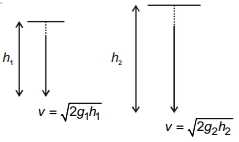
Let $g_1 = 9.8 \, m/s^2$ be the acceleration due to gravity on Earth and $h_1 = 3 \, m$ be the safe height on Earth.
Let $g_2 = 1.96 \, m/s^2$ be the acceleration due to gravity on the planet and $h_2$ be the corresponding safe height on the planet.
The velocity $v$ attained after falling from height $h$ is given by $v = \sqrt{2gh}$.
Equating the velocities for safety: $\sqrt{2 g_1 h_1} = \sqrt{2 g_2 h_2}$.
Squaring both sides: $g_1 h_1 = g_2 h_2$.
Substituting the values: $9.8 \times 3 = 1.96 \times h_2$.
$h_2 = \frac{9.8 \times 3}{1.96} = 5 \times 3 = 15 \, m$.
Thus,the corresponding height on the planet is $15 \, m$.
Let $g_1 = 9.8 \, m/s^2$ be the acceleration due to gravity on Earth and $h_1 = 3 \, m$ be the safe height on Earth.
Let $g_2 = 1.96 \, m/s^2$ be the acceleration due to gravity on the planet and $h_2$ be the corresponding safe height on the planet.
The velocity $v$ attained after falling from height $h$ is given by $v = \sqrt{2gh}$.
Equating the velocities for safety: $\sqrt{2 g_1 h_1} = \sqrt{2 g_2 h_2}$.
Squaring both sides: $g_1 h_1 = g_2 h_2$.
Substituting the values: $9.8 \times 3 = 1.96 \times h_2$.
$h_2 = \frac{9.8 \times 3}{1.96} = 5 \times 3 = 15 \, m$.
Thus,the corresponding height on the planet is $15 \, m$.
0 likes
View Solution281
MediumMCQ
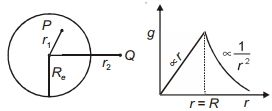
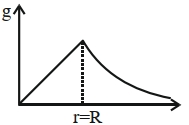
Which of the following graphs represents the variation of acceleration due to gravity $(g)$ with distance $r$ from the centre of the Earth?
A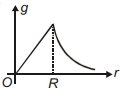
B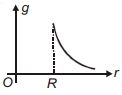
C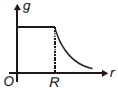
D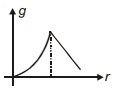
Solution
(A) Let $M_e$ be the mass of the Earth and $R$ be the radius of the Earth.
$1$. For a point inside the Earth at a distance $r$ from the center $(r < R)$, the acceleration due to gravity is given by:
$g_{in} = \frac{G M_e r}{R^3}$
This implies $g \propto r$, which is a linear relationship passing through the origin.
$2$. For a point outside the Earth at a distance $r$ from the center $(r \geq R)$, the acceleration due to gravity is given by:
$g_{out} = \frac{G M_e}{r^2}$
This implies $g \propto \frac{1}{r^2}$, which is a hyperbolic decay curve.
At the surface $(r = R)$, the value of $g$ is maximum, $g_{max} = \frac{G M_e}{R^2}$.
Comparing this with the given options, the graph that shows a linear increase for $r < R$ and a $1/r^2$ decrease for $r > R$ is represented by the first graph (Graph $A$).
$1$. For a point inside the Earth at a distance $r$ from the center $(r < R)$, the acceleration due to gravity is given by:
$g_{in} = \frac{G M_e r}{R^3}$
This implies $g \propto r$, which is a linear relationship passing through the origin.
$2$. For a point outside the Earth at a distance $r$ from the center $(r \geq R)$, the acceleration due to gravity is given by:
$g_{out} = \frac{G M_e}{r^2}$
This implies $g \propto \frac{1}{r^2}$, which is a hyperbolic decay curve.
At the surface $(r = R)$, the value of $g$ is maximum, $g_{max} = \frac{G M_e}{R^2}$.
Comparing this with the given options, the graph that shows a linear increase for $r < R$ and a $1/r^2$ decrease for $r > R$ is represented by the first graph (Graph $A$).
0 likes
View Solution282
MediumMCQ
The rotation of the earth having radius $R$ about its axis speeds up to a value such that a man at latitude angle $60^{\circ}$ feels weightless. The duration of the day in such case will be:
A
$8 \pi \sqrt{\frac{R}{g}}$
B
$8 \pi \sqrt{\frac{g}{R}}$
C
$\pi \sqrt{\frac{R}{g}}$
D
$4 \pi \sqrt{\frac{R}{g}}$
Solution
(C) The effective acceleration due to gravity $g'$ at a latitude $\lambda$ is given by $g' = g - R\omega^2 \cos^2 \lambda$.
For a man to feel weightless,the effective gravity must be zero,so $g' = 0$.
Substituting the given values: $0 = g - R\omega^2 \cos^2 60^{\circ}$.
Since $\cos 60^{\circ} = 1/2$,we have $\cos^2 60^{\circ} = 1/4$.
Thus,$0 = g - R\omega^2 (1/4)$,which implies $R\omega^2 / 4 = g$.
Solving for $\omega$,we get $\omega^2 = 4g/R$,so $\omega = 2\sqrt{g/R}$.
The duration of the day $T$ is related to angular velocity $\omega$ by $T = 2\pi / \omega$.
Substituting $\omega$,we get $T = 2\pi / (2\sqrt{g/R}) = \pi \sqrt{R/g}$.
For a man to feel weightless,the effective gravity must be zero,so $g' = 0$.
Substituting the given values: $0 = g - R\omega^2 \cos^2 60^{\circ}$.
Since $\cos 60^{\circ} = 1/2$,we have $\cos^2 60^{\circ} = 1/4$.
Thus,$0 = g - R\omega^2 (1/4)$,which implies $R\omega^2 / 4 = g$.
Solving for $\omega$,we get $\omega^2 = 4g/R$,so $\omega = 2\sqrt{g/R}$.
The duration of the day $T$ is related to angular velocity $\omega$ by $T = 2\pi / \omega$.
Substituting $\omega$,we get $T = 2\pi / (2\sqrt{g/R}) = \pi \sqrt{R/g}$.
0 likes
View Solution283
EasyMCQ
The weight of a body at the surface of earth is $18 \, N$. The weight of the body at an altitude of $3200 \, km$ above the earth's surface is $........ \, N$ (given,radius of earth $R_e = 6400 \, km$).
A
$9.8$
B
$4.9$
C
$19.6$
D
$8$
Solution
(D) The acceleration due to gravity at a height $h$ above the Earth's surface is given by the formula $g' = g \left( 1 + \frac{h}{R_e} \right)^{-2}$.
The weight of the body at the surface is $W = mg = 18 \, N$.
The weight at height $h$ is $W' = mg' = \frac{mg}{(1 + h/R_e)^2}$.
Given $h = 3200 \, km$ and $R_e = 6400 \, km$,the ratio $\frac{h}{R_e} = \frac{3200}{6400} = \frac{1}{2} = 0.5$.
Substituting these values into the weight formula:
$W' = \frac{18}{(1 + 0.5)^2} = \frac{18}{(1.5)^2} = \frac{18}{2.25} = 8 \, N$.
The weight of the body at the surface is $W = mg = 18 \, N$.
The weight at height $h$ is $W' = mg' = \frac{mg}{(1 + h/R_e)^2}$.
Given $h = 3200 \, km$ and $R_e = 6400 \, km$,the ratio $\frac{h}{R_e} = \frac{3200}{6400} = \frac{1}{2} = 0.5$.
Substituting these values into the weight formula:
$W' = \frac{18}{(1 + 0.5)^2} = \frac{18}{(1.5)^2} = \frac{18}{2.25} = 8 \, N$.
1 likes
View Solution284
MediumMCQ
Given below are two statements:
Statement $I:$ Acceleration due to earth's gravity decreases as you go 'up' or 'down' from earth's surface.
Statement $II:$ Acceleration due to earth's gravity is same at a height '$h$' and depth '$d$' from earth's surface,if $h = d$.
In the light of above statements,choose the most appropriate answer from the options given below:
Statement $I:$ Acceleration due to earth's gravity decreases as you go 'up' or 'down' from earth's surface.
Statement $II:$ Acceleration due to earth's gravity is same at a height '$h$' and depth '$d$' from earth's surface,if $h = d$.
In the light of above statements,choose the most appropriate answer from the options given below:
A
Statement $I$ is incorrect but statement $II$ is correct
B
Both Statement $I$ and Statement $II$ are incorrect
C
Statement $I$ is correct but statement $II$ is incorrect
D
Both Statement $I$ and $II$ are correct
Solution
(C) Statement $I$ is correct: The acceleration due to gravity $g$ at a height $h$ above the surface is given by $g_h = g(1 + h/R)^{-2}$,which decreases as $h$ increases. At a depth $d$ below the surface,it is given by $g_d = g(1 - d/R)$,which decreases as $d$ increases.
Statement $II$ is incorrect: For a height $h$ and depth $d$ where $h = d$,the values are $g_h = g(1 + h/R)^{-2}$ and $g_d = g(1 - h/R)$. Using binomial approximation for small $h$,$g_h \approx g(1 - 2h/R)$,while $g_d = g(1 - h/R)$. Since $(1 - 2h/R) \neq (1 - h/R)$,the values are not the same.
Statement $II$ is incorrect: For a height $h$ and depth $d$ where $h = d$,the values are $g_h = g(1 + h/R)^{-2}$ and $g_d = g(1 - h/R)$. Using binomial approximation for small $h$,$g_h \approx g(1 - 2h/R)$,while $g_d = g(1 - h/R)$. Since $(1 - 2h/R) \neq (1 - h/R)$,the values are not the same.
0 likes
View Solution285
MediumMCQ
Given below are two statements: one is labelled as Assertion $A$ and the other is labelled as Reason $R$.
Assertion $A:$ $A$ pendulum clock when taken to Mount Everest becomes fast.
Reason $R:$ The value of $g$ (acceleration due to gravity) is less at Mount Everest than its value on the surface of earth.
In the light of the above statements,choose the most appropriate answer from the options given below.
Assertion $A:$ $A$ pendulum clock when taken to Mount Everest becomes fast.
Reason $R:$ The value of $g$ (acceleration due to gravity) is less at Mount Everest than its value on the surface of earth.
In the light of the above statements,choose the most appropriate answer from the options given below.
A
Both $A$ and $R$ are correct but $R$ is $NOT$ the correct explanation of $A$.
B
Both $A$ and $R$ are correct and $R$ is the correct explanation of $A$.
C
$A$ is not correct but $R$ is correct.
D
$A$ is correct but $R$ is not correct.
Solution
(C) The time period of a simple pendulum is given by $T = 2\pi \sqrt{\frac{L}{g}}$.
As we move to Mount Everest (higher altitude),the value of $g$ decreases.
Since $T \propto \frac{1}{\sqrt{g}}$,a decrease in $g$ leads to an increase in the time period $T$.
An increase in the time period means the clock takes more time to complete one oscillation,which implies the clock becomes slow,not fast.
Therefore,Assertion $A$ is incorrect.
The value of $g$ at altitude $h$ is $g' = g(1 - \frac{2h}{R_e})$,which is indeed less than $g$ at the surface. Thus,Reason $R$ is correct.
Hence,$A$ is incorrect but $R$ is correct.
As we move to Mount Everest (higher altitude),the value of $g$ decreases.
Since $T \propto \frac{1}{\sqrt{g}}$,a decrease in $g$ leads to an increase in the time period $T$.
An increase in the time period means the clock takes more time to complete one oscillation,which implies the clock becomes slow,not fast.
Therefore,Assertion $A$ is incorrect.
The value of $g$ at altitude $h$ is $g' = g(1 - \frac{2h}{R_e})$,which is indeed less than $g$ at the surface. Thus,Reason $R$ is correct.
Hence,$A$ is incorrect but $R$ is correct.
0 likes
View Solution286
MediumMCQ
$T$ is the time period of a simple pendulum on the Earth's surface. Its time period becomes $xT$ when taken to a height $R$ (equal to the Earth's radius) above the Earth's surface. Then,the value of $x$ will be:
A
$4$
B
$2$
C
$1/2$
D
$1/4$
Solution
(B) The time period of a simple pendulum is given by $T = 2\pi \sqrt{\frac{\ell}{g}}$,where $g$ is the acceleration due to gravity at the surface.
At a height $h = R$ above the surface,the acceleration due to gravity $g'$ is given by $g' = \frac{g}{(1 + h/R)^2}$.
Substituting $h = R$,we get $g' = \frac{g}{(1 + R/R)^2} = \frac{g}{(2)^2} = \frac{g}{4}$.
The new time period $T'$ is $T' = 2\pi \sqrt{\frac{\ell}{g'}} = 2\pi \sqrt{\frac{\ell}{g/4}} = 2 \times 2\pi \sqrt{\frac{\ell}{g}} = 2T$.
Given that the new time period is $xT$,we have $xT = 2T$,which implies $x = 2$.
At a height $h = R$ above the surface,the acceleration due to gravity $g'$ is given by $g' = \frac{g}{(1 + h/R)^2}$.
Substituting $h = R$,we get $g' = \frac{g}{(1 + R/R)^2} = \frac{g}{(2)^2} = \frac{g}{4}$.
The new time period $T'$ is $T' = 2\pi \sqrt{\frac{\ell}{g'}} = 2\pi \sqrt{\frac{\ell}{g/4}} = 2 \times 2\pi \sqrt{\frac{\ell}{g}} = 2T$.
Given that the new time period is $xT$,we have $xT = 2T$,which implies $x = 2$.
0 likes
View Solution287
MediumMCQ
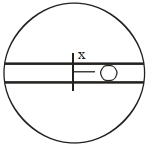
Assume that the Earth is a solid sphere of uniform density and a tunnel is dug along its diameter throughout the Earth. It is found that when a particle is released in this tunnel, it executes a simple harmonic motion. The mass of the particle is $100 \, g$. The time period of the motion of the particle will be (approximately) (take $g = 10 \, m/s^2$, radius of Earth $R = 6400 \, km$):
A
$24$ hours
B
$1$ hour $24$ minutes
C
$1$ hour $40$ minutes
D
$12$ hours
Solution
(B) When a particle is at a distance $x$ from the center of the Earth, the gravitational force acting on it is directed towards the center and is given by $F = -\frac{GMm}{R^3}x$.
Since $F = ma$, the acceleration $a$ is given by $a = -\frac{GM}{R^3}x$.
Using the relation $g = \frac{GM}{R^2}$, we can write the acceleration as $a = -\frac{g}{R}x$.
Comparing this with the standard equation for simple harmonic motion, $a = -\omega^2 x$, we get $\omega^2 = \frac{g}{R}$, or $\omega = \sqrt{\frac{g}{R}}$.
The time period $T$ is given by $T = \frac{2\pi}{\omega} = 2\pi \sqrt{\frac{R}{g}}$.
Substituting the given values: $R = 6400 \, km = 6400 \times 10^3 \, m$ and $g = 10 \, m/s^2$.
$T = 2 \times 3.14 \times \sqrt{\frac{6400 \times 10^3}{10}} = 2 \times 3.14 \times \sqrt{640000} = 2 \times 3.14 \times 800 \, s$.
$T = 5024 \, s$.
Converting to minutes: $T = \frac{5024}{60} \approx 83.73 \, minutes$, which is approximately $1$ hour and $24$ minutes.
Since $F = ma$, the acceleration $a$ is given by $a = -\frac{GM}{R^3}x$.
Using the relation $g = \frac{GM}{R^2}$, we can write the acceleration as $a = -\frac{g}{R}x$.
Comparing this with the standard equation for simple harmonic motion, $a = -\omega^2 x$, we get $\omega^2 = \frac{g}{R}$, or $\omega = \sqrt{\frac{g}{R}}$.
The time period $T$ is given by $T = \frac{2\pi}{\omega} = 2\pi \sqrt{\frac{R}{g}}$.
Substituting the given values: $R = 6400 \, km = 6400 \times 10^3 \, m$ and $g = 10 \, m/s^2$.
$T = 2 \times 3.14 \times \sqrt{\frac{6400 \times 10^3}{10}} = 2 \times 3.14 \times \sqrt{640000} = 2 \times 3.14 \times 800 \, s$.
$T = 5024 \, s$.
Converting to minutes: $T = \frac{5024}{60} \approx 83.73 \, minutes$, which is approximately $1$ hour and $24$ minutes.
0 likes
View Solution288
MediumMCQ
At a certain depth $d$ below the surface of the earth,the value of acceleration due to gravity becomes four times its value at a height $3R$ above the earth's surface. Where $R$ is the radius of the earth (Take $R = 6400 \ km$). The depth $d$ is equal to $............ \ km$.
A
$5260$
B
$640$
C
$2560$
D
$4800$
Solution
(D) The acceleration due to gravity at a depth $d$ is given by $g_d = g_0 \left(1 - \frac{d}{R}\right)$,where $g_0 = \frac{GM}{R^2}$.
The acceleration due to gravity at a height $h = 3R$ is given by $g_h = \frac{GM}{(R+h)^2} = \frac{GM}{(R+3R)^2} = \frac{GM}{(4R)^2} = \frac{GM}{16R^2} = \frac{g_0}{16}$.
According to the problem,$g_d = 4 \times g_h$.
Substituting the expressions: $g_0 \left(1 - \frac{d}{R}\right) = 4 \times \left(\frac{g_0}{16}\right)$.
$1 - \frac{d}{R} = \frac{1}{4}$.
$\frac{d}{R} = 1 - \frac{1}{4} = \frac{3}{4}$.
$d = \frac{3}{4} \times R = \frac{3}{4} \times 6400 \ km = 4800 \ km$.
The acceleration due to gravity at a height $h = 3R$ is given by $g_h = \frac{GM}{(R+h)^2} = \frac{GM}{(R+3R)^2} = \frac{GM}{(4R)^2} = \frac{GM}{16R^2} = \frac{g_0}{16}$.
According to the problem,$g_d = 4 \times g_h$.
Substituting the expressions: $g_0 \left(1 - \frac{d}{R}\right) = 4 \times \left(\frac{g_0}{16}\right)$.
$1 - \frac{d}{R} = \frac{1}{4}$.
$\frac{d}{R} = 1 - \frac{1}{4} = \frac{3}{4}$.
$d = \frac{3}{4} \times R = \frac{3}{4} \times 6400 \ km = 4800 \ km$.
0 likes
View Solution289
MediumMCQ
$A$ body of weight $W$ is projected vertically upwards from the Earth's surface to reach a height above the Earth which is equal to nine times the radius of the Earth. The weight of the body at that height will be
A
$W/81$
B
$W/100$
C
$W/9$
D
$W/3$
Solution
(B) The weight of a body at the surface of the Earth is given by $W = mg = G \frac{Mm}{R^2}$,where $M$ is the mass of the Earth and $R$ is the radius of the Earth.
At a height $h$ above the surface,the weight $W'$ is given by $W' = mg' = G \frac{Mm}{(R+h)^2}$.
Given that $h = 9R$,we substitute this into the expression for $W'$:
$W' = G \frac{Mm}{(R + 9R)^2} = G \frac{Mm}{(10R)^2} = G \frac{Mm}{100R^2}$.
Since $W = G \frac{Mm}{R^2}$,we can write $W' = \frac{W}{100}$.
Therefore,the weight of the body at that height is $W/100$.
At a height $h$ above the surface,the weight $W'$ is given by $W' = mg' = G \frac{Mm}{(R+h)^2}$.
Given that $h = 9R$,we substitute this into the expression for $W'$:
$W' = G \frac{Mm}{(R + 9R)^2} = G \frac{Mm}{(10R)^2} = G \frac{Mm}{100R^2}$.
Since $W = G \frac{Mm}{R^2}$,we can write $W' = \frac{W}{100}$.
Therefore,the weight of the body at that height is $W/100$.
0 likes
View Solution290
MediumMCQ
Given below are two statements:
Statement-$I$: Acceleration due to gravity is different at different places on the surface of Earth.
Statement-$II$: Acceleration due to gravity increases as we go down below the Earth's surface.
In the light of the above statements,choose the correct answer from the options given below:
Statement-$I$: Acceleration due to gravity is different at different places on the surface of Earth.
Statement-$II$: Acceleration due to gravity increases as we go down below the Earth's surface.
In the light of the above statements,choose the correct answer from the options given below:
A
Both Statement $I$ and Statement $II$ are true.
B
Both Statement $I$ and Statement $II$ are false.
C
Statement $I$ is true but Statement $II$ is false.
D
Statement $I$ is false but Statement $II$ is true.
Solution
(C) Statement-$I$ is true because the Earth is not a perfect sphere (it is an oblate spheroid) and it rotates about its axis. The acceleration due to gravity $g$ varies with latitude $\phi$ as $g_{\phi} = g - \omega^2 R_e \cos^2 \phi$. Thus,it is different at different places.
Statement-$II$ is false because the acceleration due to gravity at a depth $d$ below the Earth's surface is given by $g_d = g(1 - d/R_e)$. As depth $d$ increases,the term $(1 - d/R_e)$ decreases,meaning $g_d$ decreases as we go deeper into the Earth.
Statement-$II$ is false because the acceleration due to gravity at a depth $d$ below the Earth's surface is given by $g_d = g(1 - d/R_e)$. As depth $d$ increases,the term $(1 - d/R_e)$ decreases,meaning $g_d$ decreases as we go deeper into the Earth.
0 likes
View Solution291
MediumMCQ
The escape velocities of two planets $A$ and $B$ are in the ratio $1:2$. If the ratio of their radii respectively is $1:3$,then the ratio of acceleration due to gravity of planet $A$ to the acceleration due to gravity of planet $B$ will be:
A
$\frac{4}{3}$
B
$\frac{3}{2}$
C
$\frac{2}{3}$
D
$\frac{3}{4}$
Solution
(D) The escape velocity is given by $V_e = \sqrt{\frac{2GM}{R}}$.
Since $M = \rho \cdot \frac{4}{3}\pi R^3$,we have $V_e = \sqrt{\frac{2G \rho \frac{4}{3}\pi R^3}{R}} = \sqrt{\frac{8}{3}G\pi\rho} \cdot R$.
Thus,$V_e \propto \rho^{1/2} R$.
Given $\frac{V_{eA}}{V_{eB}} = \frac{1}{2}$ and $\frac{R_A}{R_B} = \frac{1}{3}$.
From $\frac{V_{eA}}{V_{eB}} = \sqrt{\frac{\rho_A}{\rho_B}} \cdot \frac{R_A}{R_B}$,we get $\frac{1}{2} = \sqrt{\frac{\rho_A}{\rho_B}} \cdot \frac{1}{3}$,which implies $\sqrt{\frac{\rho_A}{\rho_B}} = \frac{3}{2}$,so $\frac{\rho_A}{\rho_B} = \frac{9}{4}$.
The acceleration due to gravity is $g = \frac{GM}{R^2} = \frac{G(\rho \cdot \frac{4}{3}\pi R^3)}{R^2} = \frac{4}{3}G\pi\rho R$.
Therefore,$\frac{g_A}{g_B} = \frac{\rho_A R_A}{\rho_B R_B} = \left(\frac{\rho_A}{\rho_B}\right) \left(\frac{R_A}{R_B}\right) = \left(\frac{9}{4}\right) \left(\frac{1}{3}\right) = \frac{3}{4}$.
Since $M = \rho \cdot \frac{4}{3}\pi R^3$,we have $V_e = \sqrt{\frac{2G \rho \frac{4}{3}\pi R^3}{R}} = \sqrt{\frac{8}{3}G\pi\rho} \cdot R$.
Thus,$V_e \propto \rho^{1/2} R$.
Given $\frac{V_{eA}}{V_{eB}} = \frac{1}{2}$ and $\frac{R_A}{R_B} = \frac{1}{3}$.
From $\frac{V_{eA}}{V_{eB}} = \sqrt{\frac{\rho_A}{\rho_B}} \cdot \frac{R_A}{R_B}$,we get $\frac{1}{2} = \sqrt{\frac{\rho_A}{\rho_B}} \cdot \frac{1}{3}$,which implies $\sqrt{\frac{\rho_A}{\rho_B}} = \frac{3}{2}$,so $\frac{\rho_A}{\rho_B} = \frac{9}{4}$.
The acceleration due to gravity is $g = \frac{GM}{R^2} = \frac{G(\rho \cdot \frac{4}{3}\pi R^3)}{R^2} = \frac{4}{3}G\pi\rho R$.
Therefore,$\frac{g_A}{g_B} = \frac{\rho_A R_A}{\rho_B R_B} = \left(\frac{\rho_A}{\rho_B}\right) \left(\frac{R_A}{R_B}\right) = \left(\frac{9}{4}\right) \left(\frac{1}{3}\right) = \frac{3}{4}$.
0 likes
View Solution292
MediumMCQ
$A$ planet has double the mass of the earth. Its average density is equal to that of the earth. An object weighing $W$ on earth will weigh on that planet:
A
$2^{2 / 3} W$
B
$W$
C
$2^{1 / 3} W$
D
$2 W$
Solution
(C) The mass of a planet is given by $M = \rho \times \frac{4}{3} \pi R^3$,where $\rho$ is the density and $R$ is the radius.
Since the density $\rho$ is constant,$M \propto R^3$,which implies $R \propto M^{1/3}$.
The weight of an object is $W = mg$,where the acceleration due to gravity $g = \frac{GM}{R^2}$.
Substituting $R \propto M^{1/3}$ into the expression for $g$,we get $g \propto \frac{M}{(M^{1/3})^2} = \frac{M}{M^{2/3}} = M^{1/3}$.
Since the weight $W \propto g$,we have $W \propto M^{1/3}$.
Given that the mass of the planet is double the mass of the earth $(M_p = 2M_e)$,the new weight $W'$ will be $W' = (2)^{1/3} W$.
Since the density $\rho$ is constant,$M \propto R^3$,which implies $R \propto M^{1/3}$.
The weight of an object is $W = mg$,where the acceleration due to gravity $g = \frac{GM}{R^2}$.
Substituting $R \propto M^{1/3}$ into the expression for $g$,we get $g \propto \frac{M}{(M^{1/3})^2} = \frac{M}{M^{2/3}} = M^{1/3}$.
Since the weight $W \propto g$,we have $W \propto M^{1/3}$.
Given that the mass of the planet is double the mass of the earth $(M_p = 2M_e)$,the new weight $W'$ will be $W' = (2)^{1/3} W$.
0 likes
View Solution293
MediumMCQ
The weight of a body on the surface of the earth is $100\,N$. The gravitational force on it when taken at a height,from the surface of earth,equal to one-fourth the radius of the earth is $..........\,N$.
A
$100$
B
$64$
C
$50$
D
$25$
Solution
(B) The weight of a body on the surface of the earth is given by $W = mg = 100\,N$.
The acceleration due to gravity at a height $h$ above the surface of the earth is given by $g' = g \left( \frac{R}{R+h} \right)^2$.
Given $h = \frac{R}{4}$,we substitute this into the formula:
$g' = g \left( \frac{R}{R + R/4} \right)^2 = g \left( \frac{R}{5R/4} \right)^2 = g \left( \frac{4}{5} \right)^2 = \frac{16}{25}g$.
The weight at height $h$ is $W' = mg' = m \left( \frac{16}{25}g \right) = \frac{16}{25} \times W$.
Substituting $W = 100\,N$:
$W' = \frac{16}{25} \times 100 = 16 \times 4 = 64\,N$.
The acceleration due to gravity at a height $h$ above the surface of the earth is given by $g' = g \left( \frac{R}{R+h} \right)^2$.
Given $h = \frac{R}{4}$,we substitute this into the formula:
$g' = g \left( \frac{R}{R + R/4} \right)^2 = g \left( \frac{R}{5R/4} \right)^2 = g \left( \frac{4}{5} \right)^2 = \frac{16}{25}g$.
The weight at height $h$ is $W' = mg' = m \left( \frac{16}{25}g \right) = \frac{16}{25} \times W$.
Substituting $W = 100\,N$:
$W' = \frac{16}{25} \times 100 = 16 \times 4 = 64\,N$.
0 likes
View Solution294
MediumMCQ
The weight of a body on the earth is $400\,N$. Then weight of the body when taken to a depth half of the radius of the earth will be ............ $N$.
A
$0$
B
$300$
C
$100$
D
$200$
Solution
(D) The weight of a body on the surface of the earth is given by $W = mg = 400\,N$.
At a depth $d$ below the surface of the earth,the acceleration due to gravity $g'$ is given by the formula $g' = g(1 - \frac{d}{R})$,where $R$ is the radius of the earth.
Given that the depth $d = \frac{R}{2}$,we substitute this into the formula:
$g' = g(1 - \frac{R/2}{R}) = g(1 - \frac{1}{2}) = \frac{g}{2}$.
The new weight $W'$ of the body at this depth is $W' = mg' = m(\frac{g}{2}) = \frac{mg}{2}$.
Since $mg = 400\,N$,we have $W' = \frac{400}{2} = 200\,N$.
At a depth $d$ below the surface of the earth,the acceleration due to gravity $g'$ is given by the formula $g' = g(1 - \frac{d}{R})$,where $R$ is the radius of the earth.
Given that the depth $d = \frac{R}{2}$,we substitute this into the formula:
$g' = g(1 - \frac{R/2}{R}) = g(1 - \frac{1}{2}) = \frac{g}{2}$.
The new weight $W'$ of the body at this depth is $W' = mg' = m(\frac{g}{2}) = \frac{mg}{2}$.
Since $mg = 400\,N$,we have $W' = \frac{400}{2} = 200\,N$.
0 likes
View Solution295
MediumMCQ
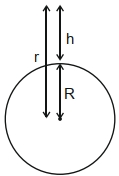
The acceleration due to gravity at height $h$ above the earth if $h \ll R$ (radius of earth) is given by
A
$g^{\prime}=g\left(1-\frac{2 h}{R}\right)$
B
$g^{\prime}=g\left(1-\frac{2 h^2}{R^2}\right)$
C
$g^{\prime}=g\left(1-\frac{h}{2 R}\right)$
D
$g^{\prime}=g\left(1-\frac{h^2}{2 R^2}\right)$
Solution
(A) For a point at a height $h$ above the surface of the earth,the acceleration due to gravity is given by:
$g(h) = \frac{GM}{(R+h)^2}$
where $G$ is the gravitational constant,$M$ is the mass of the earth,and $R$ is the radius of the earth.
We can rewrite this expression as:
$g(h) = \frac{GM}{R^2(1 + \frac{h}{R})^2}$
$g(h) = \frac{GM}{R^2} (1 + \frac{h}{R})^{-2}$
Since $g = \frac{GM}{R^2}$ is the acceleration due to gravity at the surface of the earth,we have:
$g(h) = g (1 + \frac{h}{R})^{-2}$
Given the condition $h \ll R$,we can use the binomial approximation $(1 + x)^n \approx 1 + nx$ for $|x| \ll 1$:
$(1 + \frac{h}{R})^{-2} \approx 1 - \frac{2h}{R}$
Substituting this back into the equation:
$g(h) \approx g (1 - \frac{2h}{R})$
Thus,the acceleration due to gravity at height $h$ is $g^{\prime} = g(1 - \frac{2h}{R})$.
$g(h) = \frac{GM}{(R+h)^2}$
where $G$ is the gravitational constant,$M$ is the mass of the earth,and $R$ is the radius of the earth.
We can rewrite this expression as:
$g(h) = \frac{GM}{R^2(1 + \frac{h}{R})^2}$
$g(h) = \frac{GM}{R^2} (1 + \frac{h}{R})^{-2}$
Since $g = \frac{GM}{R^2}$ is the acceleration due to gravity at the surface of the earth,we have:
$g(h) = g (1 + \frac{h}{R})^{-2}$
Given the condition $h \ll R$,we can use the binomial approximation $(1 + x)^n \approx 1 + nx$ for $|x| \ll 1$:
$(1 + \frac{h}{R})^{-2} \approx 1 - \frac{2h}{R}$
Substituting this back into the equation:
$g(h) \approx g (1 - \frac{2h}{R})$
Thus,the acceleration due to gravity at height $h$ is $g^{\prime} = g(1 - \frac{2h}{R})$.
0 likes
View Solution296
MediumMCQ
Assuming the Earth to be a sphere of uniform mass density,the weight of a body at a depth $d = R/2$ from the surface of the Earth,if its weight on the surface of the Earth is $200 \, N$,will be $........... \, N$ (Given $R =$ Radius of Earth).
A
$400$
B
$500$
C
$300$
D
$100$
Solution
(D) The weight of a body on the surface of the Earth is given by $W = mg = 200 \, N$.
The acceleration due to gravity at a depth $d$ below the surface of the Earth is given by the formula $g' = g(1 - d/R)$,where $g$ is the acceleration due to gravity at the surface and $R$ is the radius of the Earth.
Given the depth $d = R/2$,we substitute this into the formula:
$g' = g(1 - (R/2)/R) = g(1 - 1/2) = g/2$.
The weight of the body at depth $d$ is $W' = mg' = m(g/2) = (mg)/2$.
Since $mg = 200 \, N$,we have $W' = 200/2 = 100 \, N$.
The acceleration due to gravity at a depth $d$ below the surface of the Earth is given by the formula $g' = g(1 - d/R)$,where $g$ is the acceleration due to gravity at the surface and $R$ is the radius of the Earth.
Given the depth $d = R/2$,we substitute this into the formula:
$g' = g(1 - (R/2)/R) = g(1 - 1/2) = g/2$.
The weight of the body at depth $d$ is $W' = mg' = m(g/2) = (mg)/2$.
Since $mg = 200 \, N$,we have $W' = 200/2 = 100 \, N$.
0 likes
View Solution297
MediumMCQ
Given below are two statements:
Statement $I:$ Rotation of the earth shows effect on the value of acceleration due to gravity $(g)$.
Statement $II:$ The effect of rotation of the earth on the value of $g$ at the equator is minimum and that at the pole is maximum.
In the light of the above statements,choose the correct answer from the options given below.
Statement $I:$ Rotation of the earth shows effect on the value of acceleration due to gravity $(g)$.
Statement $II:$ The effect of rotation of the earth on the value of $g$ at the equator is minimum and that at the pole is maximum.
In the light of the above statements,choose the correct answer from the options given below.
A
Statement $I$ is false but Statement $II$ is true.
B
Statement $I$ is true but Statement $II$ is false.
C
Both Statement $I$ and Statement $II$ are true.
D
Both Statement $I$ and Statement $II$ are false.
Solution
(B) The effective acceleration due to gravity $g'$ at a latitude $\lambda$ is given by $g' = g - R\omega^2 \cos^2 \lambda$.
Statement $I$ is true because the rotation of the earth introduces a centrifugal force,which modifies the effective acceleration due to gravity.
Statement $II$ is false. At the poles,$\lambda = 90^{\circ}$,so $\cos 90^{\circ} = 0$,meaning the effect is zero (minimum). At the equator,$\lambda = 0^{\circ}$,so $\cos 0^{\circ} = 1$,meaning the effect is $R\omega^2$,which is the maximum reduction in $g$.
Therefore,Statement $I$ is true and Statement $II$ is false.
Statement $I$ is true because the rotation of the earth introduces a centrifugal force,which modifies the effective acceleration due to gravity.
Statement $II$ is false. At the poles,$\lambda = 90^{\circ}$,so $\cos 90^{\circ} = 0$,meaning the effect is zero (minimum). At the equator,$\lambda = 0^{\circ}$,so $\cos 0^{\circ} = 1$,meaning the effect is $R\omega^2$,which is the maximum reduction in $g$.
Therefore,Statement $I$ is true and Statement $II$ is false.
0 likes
View Solution298
MediumMCQ
The radii of two planets $A$ and $B$ are $R$ and $4R$ and their densities are $\rho$ and $\rho/3$ respectively. The ratio of acceleration due to gravity at their surfaces $(g_A : g_B)$ will be
A
$1:16$
B
$3:16$
C
$3:4$
D
$4:3$
Solution
(C) The acceleration due to gravity $g$ at the surface of a planet is given by $g = \frac{GM}{R^2}$.
Since mass $M = \text{density} (\rho) \times \text{volume} (V) = \rho \times \frac{4}{3} \pi R^3$,we can write:
$g = \frac{G}{R^2} \times \rho \times \frac{4}{3} \pi R^3 = \left( \frac{4}{3} \pi G \right) \rho R$.
Therefore,$g \propto \rho R$.
For planet $A$: $g_A \propto \rho \times R$.
For planet $B$: $g_B \propto \frac{\rho}{3} \times 4R = \frac{4}{3} \rho R$.
Taking the ratio:
$\frac{g_A}{g_B} = \frac{\rho R}{\frac{4}{3} \rho R} = \frac{1}{4/3} = \frac{3}{4}$.
Thus,the ratio $(g_A : g_B)$ is $3:4$.
Since mass $M = \text{density} (\rho) \times \text{volume} (V) = \rho \times \frac{4}{3} \pi R^3$,we can write:
$g = \frac{G}{R^2} \times \rho \times \frac{4}{3} \pi R^3 = \left( \frac{4}{3} \pi G \right) \rho R$.
Therefore,$g \propto \rho R$.
For planet $A$: $g_A \propto \rho \times R$.
For planet $B$: $g_B \propto \frac{\rho}{3} \times 4R = \frac{4}{3} \rho R$.
Taking the ratio:
$\frac{g_A}{g_B} = \frac{\rho R}{\frac{4}{3} \rho R} = \frac{1}{4/3} = \frac{3}{4}$.
Thus,the ratio $(g_A : g_B)$ is $3:4$.
0 likes
View Solution299
EasyMCQ
Two planets $A$ and $B$ of radii $R$ and $1.5 R$ have densities $\rho$ and $\rho / 2$ respectively. The ratio of acceleration due to gravity at the surface of $B$ to $A$ is:
A
$2: 3$
B
$2: 1$
C
$3: 4$
D
$4: 3$
Solution
(C) The acceleration due to gravity $g$ at the surface of a planet is given by $g = \frac{GM}{R^2}$.
Since mass $M = \text{density} (\rho) \times \text{volume} (\frac{4}{3} \pi R^3)$,we have $g = \frac{G}{R^2} \times \frac{4}{3} \pi R^3 \rho = \frac{4}{3} \pi G \rho R$.
For planet $A$: $g_A = \frac{4}{3} \pi G \rho R$.
For planet $B$: $g_B = \frac{4}{3} \pi G (\frac{\rho}{2}) (1.5 R) = \frac{4}{3} \pi G \rho R \times (0.5 \times 1.5) = \frac{4}{3} \pi G \rho R \times 0.75$.
Therefore,the ratio $\frac{g_B}{g_A} = \frac{0.75}{1} = \frac{3}{4}$.
Since mass $M = \text{density} (\rho) \times \text{volume} (\frac{4}{3} \pi R^3)$,we have $g = \frac{G}{R^2} \times \frac{4}{3} \pi R^3 \rho = \frac{4}{3} \pi G \rho R$.
For planet $A$: $g_A = \frac{4}{3} \pi G \rho R$.
For planet $B$: $g_B = \frac{4}{3} \pi G (\frac{\rho}{2}) (1.5 R) = \frac{4}{3} \pi G \rho R \times (0.5 \times 1.5) = \frac{4}{3} \pi G \rho R \times 0.75$.
Therefore,the ratio $\frac{g_B}{g_A} = \frac{0.75}{1} = \frac{3}{4}$.
0 likes
View Solution300
DifficultMCQ
The acceleration due to gravity on the surface of Earth is $g$. If the diameter of Earth reduces to half of its original value and mass remains constant,then the acceleration due to gravity on the surface of Earth would be:
A
$g / 4$
B
$2g$
C
$g / 2$
D
$4g$
Solution
(D) The acceleration due to gravity on the surface of Earth is given by $g = \frac{GM}{R^2}$,where $G$ is the gravitational constant,$M$ is the mass of Earth,and $R$ is the radius of Earth.
Since $M$ is constant,we have $g \propto \frac{1}{R^2}$.
Let the initial radius be $R_1 = R$ and the final radius be $R_2 = \frac{R}{2}$.
Then,the ratio of the new acceleration $g_2$ to the initial acceleration $g_1$ is given by:
$\frac{g_2}{g_1} = \frac{R_1^2}{R_2^2} = \frac{R^2}{(R/2)^2} = \frac{R^2}{R^2/4} = 4$.
Therefore,$g_2 = 4g_1 = 4g$.
Since $M$ is constant,we have $g \propto \frac{1}{R^2}$.
Let the initial radius be $R_1 = R$ and the final radius be $R_2 = \frac{R}{2}$.
Then,the ratio of the new acceleration $g_2$ to the initial acceleration $g_1$ is given by:
$\frac{g_2}{g_1} = \frac{R_1^2}{R_2^2} = \frac{R^2}{(R/2)^2} = \frac{R^2}{R^2/4} = 4$.
Therefore,$g_2 = 4g_1 = 4g$.
1 likes
View SolutionGravitation — Acceleration Due to Gravity and its Variation · Frequently Asked Questions
1Are these Gravitation questions useful for JEE and NEET?
Yes. All questions in this section are mapped to JEE Main and NEET exam patterns. Previous year questions from JEE Main, NEET, GUJCET and state-level exams are included with full solutions.
2Can I switch to Hindi or Gujarati for these questions?
Yes. Use the language tabs in the hero section or the sidebar to view the same questions and solutions in English, Hindi or Gujarati.
3How do I generate a question paper from this subtopic?
Use the Vedclass Exam Paper Generator — select the chapter and subtopic, set difficulty, and generate Sets A, B, C, D automatically. First 3 chapters of every subject are free.
Vedclass Products
For Students
Vedclass Test Series
Mock tests in real JEE/NEET style with performance analysis. 5-day free trial.
Start Free TrialFor Teachers
Exam Paper Generator
Generate Set A/B/C/D papers from this chapter in 2 minutes. 3 chapters free.
Try FreeFor Institutes
Online Exam Module
Live online exams with unlimited students, 360° analytics & white-label branding.
See DemoFor Teachers & Institutes
Generate a Gravitation Exam Paper in 2 Minutes
Select subtopic & difficulty — Sets A, B, C, D auto-generated with No Repeat logic.
First 3 chapters of every subject are free — no payment required.