
A English
Mix Examples-Gravitation Questions in English
Class 11 Physics · Gravitation · Mix Examples-Gravitation
156+
Questions
English
Language
100%
With Solutions
Showing 47 of 156 questions in English
1
EasyMCQ
If a person with a spring balance and a body hanging from it goes up and up in an aeroplane,then the reading of the weight of the body as indicated by the spring balance will
A
Go on increasing
B
Go on decreasing
C
First increase and then decrease
D
Remain the same
Solution
(C) The apparent weight of a body in an accelerating frame is given by $W_{app} = m(g + a)$,where $a$ is the upward acceleration.
Initially,as the aeroplane takes off and gains altitude,it experiences upward acceleration,causing the reading of the spring balance to increase.
As the aeroplane reaches a high altitude,the acceleration becomes zero (or negligible) and the value of the acceleration due to gravity $g$ decreases with height $(g' = g(1 - 2h/R))$.
Therefore,the reading of the spring balance will first increase due to the upward acceleration and then decrease due to the reduction in the gravitational force at higher altitudes.
Initially,as the aeroplane takes off and gains altitude,it experiences upward acceleration,causing the reading of the spring balance to increase.
As the aeroplane reaches a high altitude,the acceleration becomes zero (or negligible) and the value of the acceleration due to gravity $g$ decreases with height $(g' = g(1 - 2h/R))$.
Therefore,the reading of the spring balance will first increase due to the upward acceleration and then decrease due to the reduction in the gravitational force at higher altitudes.
0 likes
View Solution2
EasyMCQ
How many times is the escape velocity $(V_e)$ of the orbital velocity $(V_0)$ for a satellite revolving near the Earth?
A
$\sqrt{2} \text{ times}$
B
$2 \text{ times}$
C
$3 \text{ times}$
D
$4 \text{ times}$
Solution
(A) For a spherically symmetric massive body such as a planet,the escape velocity $(V_e)$ at the surface is given by the formula: $V_e = \sqrt{\frac{2GM}{R}}$.
For a satellite in a circular orbit close to the Earth's surface,the orbital velocity $(V_0)$ is given by the formula: $V_0 = \sqrt{\frac{GM}{R}}$.
Dividing the two expressions,we get: $\frac{V_e}{V_0} = \frac{\sqrt{\frac{2GM}{R}}}{\sqrt{\frac{GM}{R}}} = \sqrt{2}$.
Therefore,the escape velocity is $\sqrt{2}$ times the orbital velocity.
For a satellite in a circular orbit close to the Earth's surface,the orbital velocity $(V_0)$ is given by the formula: $V_0 = \sqrt{\frac{GM}{R}}$.
Dividing the two expressions,we get: $\frac{V_e}{V_0} = \frac{\sqrt{\frac{2GM}{R}}}{\sqrt{\frac{GM}{R}}} = \sqrt{2}$.
Therefore,the escape velocity is $\sqrt{2}$ times the orbital velocity.
0 likes
View Solution3
MediumMCQ
The ratio of the $K.E.$ required to be given to a satellite to escape Earth's gravitational field to the $K.E.$ required to be given so that the satellite moves in a circular orbit just above Earth's atmosphere is:
A
$1$
B
$2$
C
$\frac{1}{2}$
D
$\infty$
Solution
(B) The $K.E.$ required for a satellite to escape from Earth's gravitational field is given by the escape energy: $E_e = \frac{1}{2}mv_e^2 = \frac{1}{2}m(\sqrt{\frac{2GM}{R}})^2 = \frac{GMm}{R}$.
The $K.E.$ required for a satellite to move in a circular orbit just above Earth's atmosphere is given by the orbital energy: $E_o = \frac{1}{2}mv_0^2 = \frac{1}{2}m(\sqrt{\frac{GM}{R}})^2 = \frac{GMm}{2R}$.
The ratio of these two energies is $\frac{E_e}{E_o} = \frac{GMm/R}{GMm/2R} = 2$.
The $K.E.$ required for a satellite to move in a circular orbit just above Earth's atmosphere is given by the orbital energy: $E_o = \frac{1}{2}mv_0^2 = \frac{1}{2}m(\sqrt{\frac{GM}{R}})^2 = \frac{GMm}{2R}$.
The ratio of these two energies is $\frac{E_e}{E_o} = \frac{GMm/R}{GMm/2R} = 2$.
0 likes
View Solution4
EasyMCQ
Out of the following,the only incorrect statement about satellites is
A
$A$ satellite cannot move in a stable orbit in a plane passing through the earth's centre
B
Geostationary satellites are launched in the equatorial plane
C
We can use just one geostationary satellite for global communication around the globe
D
The speed of a satellite increases with an increase in the radius of its orbit
Solution
(D) The orbital speed of a satellite is given by the formula $v = \sqrt{\frac{GM}{r}}$,where $G$ is the gravitational constant,$M$ is the mass of the Earth,and $r$ is the orbital radius.
From this relation,it is clear that $v \propto \frac{1}{\sqrt{r}}$.
Therefore,as the radius of the orbit $r$ increases,the orbital speed $v$ of the satellite decreases.
Statement $A$ is incorrect because a satellite can move in a stable orbit in any plane passing through the Earth's center (e.g.,polar orbits).
Statement $C$ is incorrect because one geostationary satellite covers only about one-third of the Earth's surface; three are required for global coverage.
However,in the context of standard physics problems of this type,statement $D$ is the most fundamentally incorrect physical relationship provided.
From this relation,it is clear that $v \propto \frac{1}{\sqrt{r}}$.
Therefore,as the radius of the orbit $r$ increases,the orbital speed $v$ of the satellite decreases.
Statement $A$ is incorrect because a satellite can move in a stable orbit in any plane passing through the Earth's center (e.g.,polar orbits).
Statement $C$ is incorrect because one geostationary satellite covers only about one-third of the Earth's surface; three are required for global coverage.
However,in the context of standard physics problems of this type,statement $D$ is the most fundamentally incorrect physical relationship provided.
0 likes
View Solution5
DifficultMCQ
In the following four periods:
$(i)$ Time of revolution of a satellite just above the earth's surface $({T_{st}})$
$(ii)$ Period of oscillation of mass inside the tunnel bored along the diameter of the earth $({T_{ma}})$
$(iii)$ Period of simple pendulum having a length equal to the earth's radius in a uniform field of $9.8 \; N/kg \; ({T_{sp}})$
$(iv)$ Period of an infinite length simple pendulum in the earth's real gravitational field $({T_{is}})$
$(i)$ Time of revolution of a satellite just above the earth's surface $({T_{st}})$
$(ii)$ Period of oscillation of mass inside the tunnel bored along the diameter of the earth $({T_{ma}})$
$(iii)$ Period of simple pendulum having a length equal to the earth's radius in a uniform field of $9.8 \; N/kg \; ({T_{sp}})$
$(iv)$ Period of an infinite length simple pendulum in the earth's real gravitational field $({T_{is}})$
A
${T_{st}} > {T_{ma}}$
B
${T_{ma}} > {T_{st}}$
C
${T_{sp}} < {T_{is}}$
D
${T_{st}} = {T_{ma}} = {T_{sp}} = {T_{is}}$
Solution
(D) $(i)$ For a satellite orbiting just above the Earth's surface,the time period is $T_{st} = 2\pi \sqrt{\frac{R}{g}} \approx 84.6 \; \text{min}$.
$(ii)$ For a mass oscillating in a tunnel through the Earth's diameter,the motion is simple harmonic with $T_{ma} = 2\pi \sqrt{\frac{R}{g}} \approx 84.6 \; \text{min}$.
$(iii)$ For a simple pendulum of length $l=R$ in a uniform field $g$,$T_{sp} = 2\pi \sqrt{\frac{l}{g}} = 2\pi \sqrt{\frac{R}{g}} \approx 84.6 \; \text{min}$.
$(iv)$ For an infinite length simple pendulum in the Earth's real gravitational field,the period is $T_{is} = 2\pi \sqrt{\frac{R}{g}} \approx 84.6 \; \text{min}$.
Thus,all four periods are equal: ${T_{st}} = {T_{ma}} = {T_{sp}} = {T_{is}}$.
$(ii)$ For a mass oscillating in a tunnel through the Earth's diameter,the motion is simple harmonic with $T_{ma} = 2\pi \sqrt{\frac{R}{g}} \approx 84.6 \; \text{min}$.
$(iii)$ For a simple pendulum of length $l=R$ in a uniform field $g$,$T_{sp} = 2\pi \sqrt{\frac{l}{g}} = 2\pi \sqrt{\frac{R}{g}} \approx 84.6 \; \text{min}$.
$(iv)$ For an infinite length simple pendulum in the Earth's real gravitational field,the period is $T_{is} = 2\pi \sqrt{\frac{R}{g}} \approx 84.6 \; \text{min}$.
Thus,all four periods are equal: ${T_{st}} = {T_{ma}} = {T_{sp}} = {T_{is}}$.
0 likes
View Solution6
EasyMCQ
Which of the following astronomers first proposed that the Sun is static and the Earth revolves around the Sun?
A
Copernicus
B
Kepler
C
Galileo
D
None
Solution
(A) Nicolaus Copernicus,a Polish astronomer,studied the sky from the top of a cathedral. In $1543$,he published his book 'De revolutionibus orbium coelestium' (On the Revolutions of the Heavenly Spheres). In this work,he proposed the heliocentric model,stating that the Earth revolves around the Sun once a year and also rotates around its own axis.
0 likes
View Solution7
EasyMCQ
The radius and mass of the Earth are both increased by $0.5\%$. Which of the following statements is true at the surface of the Earth?
A
Potential energy will remain unchanged.
B
$g$ will decrease.
C
Escape velocity will remain unchanged.
D
All of the above.
Solution
(D) The acceleration due to gravity is $g = \frac{GM}{R^2}$,escape velocity is $v_e = \sqrt{\frac{2GM}{R}}$,and gravitational potential energy is $U = -\frac{GMm}{R}$.
From these relations,we observe that $g \propto \frac{M}{R^2}$,$v_e \propto \sqrt{\frac{M}{R}}$,and $U \propto \frac{M}{R}$.
Let the change be $x = 0.5\% = 0.005$. If $M' = M(1+x)$ and $R' = R(1+x)$:
$1$. For $g$: $g' = \frac{G M(1+x)}{R^2(1+x)^2} = g(1+x)^{-1} \approx g(1-x)$. Thus,$g$ decreases by $0.5\%$.
$2$. For $v_e$: $v_e' = \sqrt{\frac{2G M(1+x)}{R(1+x)}} = \sqrt{\frac{2GM}{R}} = v_e$. Thus,escape velocity remains unchanged.
$3$. For $U$: $U' = -\frac{G M(1+x)m}{R(1+x)} = -\frac{GMm}{R} = U$. Thus,potential energy remains unchanged.
Therefore,all statements are correct.
From these relations,we observe that $g \propto \frac{M}{R^2}$,$v_e \propto \sqrt{\frac{M}{R}}$,and $U \propto \frac{M}{R}$.
Let the change be $x = 0.5\% = 0.005$. If $M' = M(1+x)$ and $R' = R(1+x)$:
$1$. For $g$: $g' = \frac{G M(1+x)}{R^2(1+x)^2} = g(1+x)^{-1} \approx g(1-x)$. Thus,$g$ decreases by $0.5\%$.
$2$. For $v_e$: $v_e' = \sqrt{\frac{2G M(1+x)}{R(1+x)}} = \sqrt{\frac{2GM}{R}} = v_e$. Thus,escape velocity remains unchanged.
$3$. For $U$: $U' = -\frac{G M(1+x)m}{R(1+x)} = -\frac{GMm}{R} = U$. Thus,potential energy remains unchanged.
Therefore,all statements are correct.
0 likes
View Solution8
DifficultMCQ
$A$ solid sphere of uniform density and radius $4$ units is located with its centre at the origin $O$ of coordinates. Two spheres of equal radii $1$ unit with their centres at $A(-2, 0, 0)$ and $B(2, 0, 0)$ respectively are taken out of the solid leaving behind spherical cavities as shown in the figure.
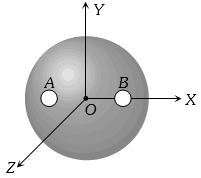
A
The gravitational force due to this object at the origin is zero.
B
The gravitational potential is the same at all points on the circle ${y^2} + {z^2} = 4$.
C
The gravitational potential is the same at all points of the circle ${y^2} + {z^2} = 36$.
D
All of the above.
Solution
(D) The gravitational potential $V$ at any point $P$ due to the solid sphere with cavities is given by the principle of superposition: $V = V_{\text{large sphere}} - V_{\text{cavity A}} - V_{\text{cavity B}}$.
$1$. At the origin $O(0, 0, 0)$,the gravitational field $\vec{E}$ due to the large sphere is zero. The fields due to the two cavities are equal in magnitude and opposite in direction $(\vec{E}_A = -\vec{E}_B)$,so the net field at the origin is zero. Thus,option $(A)$ is correct.
$2$. The gravitational potential at any point $(x, y, z)$ due to a sphere with a cavity is symmetric about the axis passing through the centres of the cavities. For the circle ${y^2} + {z^2} = R^2$ in the plane $x = 0$,the distance from any point on the circle to the centres $A(-2, 0, 0)$ and $B(2, 0, 0)$ is the same. Specifically,for any point $(0, y, z)$ on the circle,the distance to $A$ is $\sqrt{(-2-0)^2 + y^2 + z^2} = \sqrt{4 + R^2}$ and the distance to $B$ is $\sqrt{(2-0)^2 + y^2 + z^2} = \sqrt{4 + R^2}$. Since the distances are equal,the potentials due to the cavities are equal,and the potential due to the large sphere is constant on this circle. Thus,the total potential is constant on the circles ${y^2} + {z^2} = 4$ and ${y^2} + {z^2} = 36$. Options $(B)$ and $(C)$ are also correct.
Therefore,the correct option is $(D)$.
$1$. At the origin $O(0, 0, 0)$,the gravitational field $\vec{E}$ due to the large sphere is zero. The fields due to the two cavities are equal in magnitude and opposite in direction $(\vec{E}_A = -\vec{E}_B)$,so the net field at the origin is zero. Thus,option $(A)$ is correct.
$2$. The gravitational potential at any point $(x, y, z)$ due to a sphere with a cavity is symmetric about the axis passing through the centres of the cavities. For the circle ${y^2} + {z^2} = R^2$ in the plane $x = 0$,the distance from any point on the circle to the centres $A(-2, 0, 0)$ and $B(2, 0, 0)$ is the same. Specifically,for any point $(0, y, z)$ on the circle,the distance to $A$ is $\sqrt{(-2-0)^2 + y^2 + z^2} = \sqrt{4 + R^2}$ and the distance to $B$ is $\sqrt{(2-0)^2 + y^2 + z^2} = \sqrt{4 + R^2}$. Since the distances are equal,the potentials due to the cavities are equal,and the potential due to the large sphere is constant on this circle. Thus,the total potential is constant on the circles ${y^2} + {z^2} = 4$ and ${y^2} + {z^2} = 36$. Options $(B)$ and $(C)$ are also correct.
Therefore,the correct option is $(D)$.
0 likes
View Solution9
MediumMCQ
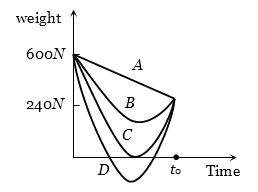
Suppose,the acceleration due to gravity at the earth's surface is $10 \, m/s^2$ and at the surface of Mars it is $4.0 \, m/s^2$. $A$ $60 \, kg$ passenger goes from the earth to the Mars in a spaceship moving with a constant velocity. Neglect all other objects in the sky. Which part of the figure best represents the weight (net gravitational force) of the passenger as a function of time?
A
$A$
B
$B$
C
$C$
D
$D$
Solution
(D) The weight of the passenger is the net gravitational force acting on them. Let $M_e$ and $M_m$ be the masses of Earth and Mars,and $R_e$ and $R_m$ be their radii. The gravitational force $F$ at a distance $x$ from Earth along the path is given by $F = |F_e - F_m| = |\frac{G M_e m}{x^2} - \frac{G M_m m}{(d-x)^2}|$,where $d$ is the distance between Earth and Mars.
At the surface of Earth $(x = R_e)$,the weight is $W_e = m g_e = 60 \times 10 = 600 \, N$.
At the surface of Mars $(x = d - R_m)$,the weight is $W_m = m g_m = 60 \times 4 = 240 \, N$.
As the spaceship moves from Earth to Mars,the gravitational pull of Earth decreases and the gravitational pull of Mars increases. At some point between the two planets,the gravitational forces from Earth and Mars will be equal in magnitude,making the net gravitational force (weight) zero.
Since the spaceship moves with constant velocity,the distance $x$ is proportional to time $t$. Therefore,the graph of weight versus time must decrease from $600 \, N$,reach $0 \, N$ at some intermediate time,and then increase to $240 \, N$ at the arrival time $t_0$. Curve $D$ is the only one that shows the weight becoming zero and then increasing to $240 \, N$.
At the surface of Earth $(x = R_e)$,the weight is $W_e = m g_e = 60 \times 10 = 600 \, N$.
At the surface of Mars $(x = d - R_m)$,the weight is $W_m = m g_m = 60 \times 4 = 240 \, N$.
As the spaceship moves from Earth to Mars,the gravitational pull of Earth decreases and the gravitational pull of Mars increases. At some point between the two planets,the gravitational forces from Earth and Mars will be equal in magnitude,making the net gravitational force (weight) zero.
Since the spaceship moves with constant velocity,the distance $x$ is proportional to time $t$. Therefore,the graph of weight versus time must decrease from $600 \, N$,reach $0 \, N$ at some intermediate time,and then increase to $240 \, N$ at the arrival time $t_0$. Curve $D$ is the only one that shows the weight becoming zero and then increasing to $240 \, N$.
0 likes
View Solution10
DifficultMCQ
The correct graph representing the variation of total energy $(E_t)$,kinetic energy $(E_k)$,and potential energy $(U)$ of a satellite with its distance $(r)$ from the centre of the Earth is:
A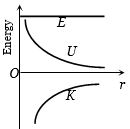
B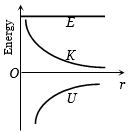
C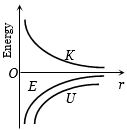
D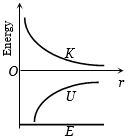
Solution
(C) For a satellite of mass $m$ orbiting a planet of mass $M$ at a distance $r$ from its center,the energies are given by:
Potential Energy: $U = -\frac{GMm}{r}$
Kinetic Energy: $K = \frac{GMm}{2r}$
Total Energy: $E = U + K = -\frac{GMm}{2r}$
From these expressions:
$1$. $U$ is always negative and its magnitude decreases as $r$ increases,approaching $0$ from below.
$2$. $K$ is always positive and decreases as $r$ increases,approaching $0$ from above.
$3$. $E$ is always negative and its magnitude decreases as $r$ increases,approaching $0$ from below.
$4$. Comparing magnitudes: $|U| = 2|E|$ and $K = |E|$.
Thus,$U$ and $E$ are negative curves,while $K$ is a positive curve. As $r \to \infty$,all energies approach $0$. The correct graph shows $K$ above the $r$-axis,and both $U$ and $E$ below the $r$-axis,with $U$ being more negative than $E$ (i.e.,$|U| > |E|$). This corresponds to the graph where $K$ is positive,$E$ is the top negative curve,and $U$ is the bottom negative curve.
Potential Energy: $U = -\frac{GMm}{r}$
Kinetic Energy: $K = \frac{GMm}{2r}$
Total Energy: $E = U + K = -\frac{GMm}{2r}$
From these expressions:
$1$. $U$ is always negative and its magnitude decreases as $r$ increases,approaching $0$ from below.
$2$. $K$ is always positive and decreases as $r$ increases,approaching $0$ from above.
$3$. $E$ is always negative and its magnitude decreases as $r$ increases,approaching $0$ from below.
$4$. Comparing magnitudes: $|U| = 2|E|$ and $K = |E|$.
Thus,$U$ and $E$ are negative curves,while $K$ is a positive curve. As $r \to \infty$,all energies approach $0$. The correct graph shows $K$ above the $r$-axis,and both $U$ and $E$ below the $r$-axis,with $U$ being more negative than $E$ (i.e.,$|U| > |E|$). This corresponds to the graph where $K$ is positive,$E$ is the top negative curve,and $U$ is the bottom negative curve.
0 likes
View Solution11
EasyMCQ
$A$ study of binary stars is most helpful in
A
Finding their distances
B
Finding their temperature
C
Finding their masses
D
Verifying Newton's force law of gravitation
Solution
(D) Binary stars are two stars that orbit around a common center of mass. By observing their orbital periods and the separation between them,astronomers can apply Kepler's laws and Newton's law of universal gravitation to determine the masses of the stars. Furthermore,the motion of binary stars provides a direct observational test for Newton's law of gravitation in a celestial context,confirming that the same gravitational laws apply to distant stars as they do to objects on Earth.
0 likes
View Solution12
EasyMCQ
The solar constant on the surface of the earth is $S$. What will be its value on the surface of another planet which is about $5.3 \, AU$ away from the sun?
A
$\frac{S}{5.3}$
B
$\frac{S}{(5.3)^2}$
C
$5.3 \, S$
D
$(5.3)^2 \, S$
Solution
(B) The solar constant $S$ is defined as the solar energy incident per unit area per unit time at the distance of the Earth from the Sun.
According to the inverse square law,the intensity of radiation $I$ from a point source is inversely proportional to the square of the distance $r$ from the source,i.e.,$I \propto \frac{1}{r^2}$.
Let $S$ be the solar constant at Earth's distance $r_E = 1 \, AU$.
Let $S'$ be the solar constant at a distance $r_P = 5.3 \, AU$.
Then,$\frac{S'}{S} = \frac{r_E^2}{r_P^2} = \left(\frac{1}{5.3}\right)^2$.
Therefore,$S' = \frac{S}{(5.3)^2}$.
According to the inverse square law,the intensity of radiation $I$ from a point source is inversely proportional to the square of the distance $r$ from the source,i.e.,$I \propto \frac{1}{r^2}$.
Let $S$ be the solar constant at Earth's distance $r_E = 1 \, AU$.
Let $S'$ be the solar constant at a distance $r_P = 5.3 \, AU$.
Then,$\frac{S'}{S} = \frac{r_E^2}{r_P^2} = \left(\frac{1}{5.3}\right)^2$.
Therefore,$S' = \frac{S}{(5.3)^2}$.
0 likes
View Solution13
EasyMCQ
As we move towards the centre of the Sun,what happens to its physical properties?
A
Density decreases
B
Pressure decreases
C
Temperature decreases
D
Density and pressure increase
Solution
(D) As we move towards the centre of the Sun,the gravitational force exerted by the outer layers increases,leading to a significant increase in both density and pressure. Therefore,the correct option is $D$.
0 likes
View Solution14
DifficultMCQ
If the distance of Mercury from the Sun is $0.4$ times the distance of the Earth from the Sun,find the solar constant of Mercury in $cal/min \cdot cm^2$. The solar constant of the Earth is $2 \, cal/min \cdot cm^2$.
A
$12.5$
B
$25$
C
$0.32$
D
$2$
Solution
(A) The solar constant $S$ is inversely proportional to the square of the distance $R$ from the Sun,i.e.,$S \propto \frac{1}{R^2}$.
Given,$R_M = 0.4 \, R_E$,where $R_M$ is the distance of Mercury and $R_E$ is the distance of Earth.
The solar constant of Earth is $S_E = 2 \, cal/min \cdot cm^2$.
Using the relation $\frac{S_M}{S_E} = \frac{R_E^2}{R_M^2}$,we get:
$\frac{S_M}{2} = \frac{R_E^2}{(0.4 \, R_E)^2} = \frac{1}{0.16} = 6.25$.
Therefore,$S_M = 6.25 \times 2 = 12.5 \, cal/min \cdot cm^2$.
Given,$R_M = 0.4 \, R_E$,where $R_M$ is the distance of Mercury and $R_E$ is the distance of Earth.
The solar constant of Earth is $S_E = 2 \, cal/min \cdot cm^2$.
Using the relation $\frac{S_M}{S_E} = \frac{R_E^2}{R_M^2}$,we get:
$\frac{S_M}{2} = \frac{R_E^2}{(0.4 \, R_E)^2} = \frac{1}{0.16} = 6.25$.
Therefore,$S_M = 6.25 \times 2 = 12.5 \, cal/min \cdot cm^2$.
0 likes
View Solution15
DifficultMCQ
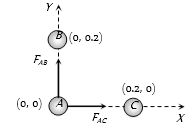
Three particles of mass $1 \, kg$ each are placed at $(0, 0)$,$(0, 0.2 \, m)$,and $(0.2 \, m, 0)$. What is the net gravitational force on the particle placed at the origin?
A
$1.67 \times 10^{-9} (\hat{i} + \hat{j}) \, N$
B
$3.34 \times 10^{-10} (\hat{i} + \hat{j}) \, N$
C
$1.67 \times 10^{-9} (\hat{i} - \hat{j}) \, N$
D
$3.34 \times 10^{-9} (\hat{i} + \hat{j}) \, N$
Solution
(A) Let the particle at the origin be $A(0,0)$,the particle at $(0.2, 0)$ be $C$,and the particle at $(0, 0.2)$ be $B$. All masses $m = 1 \, kg$.
The gravitational force exerted by particle $C$ on $A$ is:
$\vec{F}_{AC} = \frac{G m_A m_C}{r_{AC}^2} \hat{i} = \frac{6.67 \times 10^{-11} \times 1 \times 1}{(0.2)^2} \hat{i} = \frac{6.67 \times 10^{-11}}{0.04} \hat{i} = 1.6675 \times 10^{-9} \hat{i} \approx 1.67 \times 10^{-9} \hat{i} \, N$
The gravitational force exerted by particle $B$ on $A$ is:
$\vec{F}_{AB} = \frac{G m_A m_B}{r_{AB}^2} \hat{j} = \frac{6.67 \times 10^{-11} \times 1 \times 1}{(0.2)^2} \hat{j} = 1.67 \times 10^{-9} \hat{j} \, N$
The net force on particle $A$ is:
$\vec{F}_{net} = \vec{F}_{AC} + \vec{F}_{AB} = 1.67 \times 10^{-9} (\hat{i} + \hat{j}) \, N$
The gravitational force exerted by particle $C$ on $A$ is:
$\vec{F}_{AC} = \frac{G m_A m_C}{r_{AC}^2} \hat{i} = \frac{6.67 \times 10^{-11} \times 1 \times 1}{(0.2)^2} \hat{i} = \frac{6.67 \times 10^{-11}}{0.04} \hat{i} = 1.6675 \times 10^{-9} \hat{i} \approx 1.67 \times 10^{-9} \hat{i} \, N$
The gravitational force exerted by particle $B$ on $A$ is:
$\vec{F}_{AB} = \frac{G m_A m_B}{r_{AB}^2} \hat{j} = \frac{6.67 \times 10^{-11} \times 1 \times 1}{(0.2)^2} \hat{j} = 1.67 \times 10^{-9} \hat{j} \, N$
The net force on particle $A$ is:
$\vec{F}_{net} = \vec{F}_{AC} + \vec{F}_{AB} = 1.67 \times 10^{-9} (\hat{i} + \hat{j}) \, N$
0 likes
View Solution16
DifficultMCQ
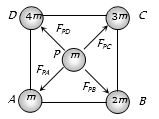
Particles of masses $m, 2m, 3m$ and $4m$ are placed at the corners of a square of side $a$. What is the net gravitational force on a particle of mass $m$ placed at the center?
A
$\frac{24m^2G}{a^2}$
B
$\frac{6m^2G}{a^2}$
C
$\frac{4\sqrt{2}Gm^2}{a^2}$
D
$0$
Solution
(C) Let the center of the square be $P$. The distance from each corner to the center $P$ is $x = \frac{a}{\sqrt{2}}$.
The gravitational forces exerted by the masses at corners $A, B, C, D$ on the mass $m$ at $P$ are:
$F_{PA} = \frac{G(m)(m)}{x^2} = \frac{Gm^2}{x^2} = F$
$F_{PB} = \frac{G(2m)(m)}{x^2} = 2F$
$F_{PC} = \frac{G(3m)(m)}{x^2} = 3F$
$F_{PD} = \frac{G(4m)(m)}{x^2} = 4F$
These forces act along the diagonals. The net force along the diagonal $AC$ is $F_{net, AC} = F_{PC} - F_{PA} = 3F - F = 2F$ (directed towards $C$).
The net force along the diagonal $BD$ is $F_{net, BD} = F_{PD} - F_{PB} = 4F - 2F = 2F$ (directed towards $D$).
The resultant force $F_{net}$ is the vector sum of these two perpendicular forces:
$F_{net} = \sqrt{(2F)^2 + (2F)^2} = 2\sqrt{2}F$
Substituting $F = \frac{Gm^2}{x^2} = \frac{Gm^2}{(a/\sqrt{2})^2} = \frac{2Gm^2}{a^2}$:
$F_{net} = 2\sqrt{2} \left( \frac{2Gm^2}{a^2} \right) = \frac{4\sqrt{2}Gm^2}{a^2}$
The gravitational forces exerted by the masses at corners $A, B, C, D$ on the mass $m$ at $P$ are:
$F_{PA} = \frac{G(m)(m)}{x^2} = \frac{Gm^2}{x^2} = F$
$F_{PB} = \frac{G(2m)(m)}{x^2} = 2F$
$F_{PC} = \frac{G(3m)(m)}{x^2} = 3F$
$F_{PD} = \frac{G(4m)(m)}{x^2} = 4F$
These forces act along the diagonals. The net force along the diagonal $AC$ is $F_{net, AC} = F_{PC} - F_{PA} = 3F - F = 2F$ (directed towards $C$).
The net force along the diagonal $BD$ is $F_{net, BD} = F_{PD} - F_{PB} = 4F - 2F = 2F$ (directed towards $D$).
The resultant force $F_{net}$ is the vector sum of these two perpendicular forces:
$F_{net} = \sqrt{(2F)^2 + (2F)^2} = 2\sqrt{2}F$
Substituting $F = \frac{Gm^2}{x^2} = \frac{Gm^2}{(a/\sqrt{2})^2} = \frac{2Gm^2}{a^2}$:
$F_{net} = 2\sqrt{2} \left( \frac{2Gm^2}{a^2} \right) = \frac{4\sqrt{2}Gm^2}{a^2}$
0 likes
View Solution17
DifficultMCQ
What is the gravitational force exerted by the sphere of mass $M$ and radius $a$ on a ring of mass $m$ and radius $a$,where the distance between the center of the ring and the center of the sphere is $r = 1.73a = \sqrt{3}a$?
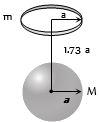
A
$\frac{GMm}{8a^2}$
B
$\frac{GMm}{(1.73a)^2}$
C
$\sqrt{3} \frac{GMm}{a^2}$
D
$1.73 \frac{GMm}{8a^2}$
Solution
(A) The gravitational field $I$ at a distance $r$ along the axis of a ring of mass $m$ and radius $a$ is given by $I = \frac{Gmr}{(a^2 + r^2)^{3/2}}$.
The gravitational force $F$ exerted by the sphere of mass $M$ on the ring is $F = M \times I = \frac{GMmr}{(a^2 + r^2)^{3/2}}$.
Given $r = \sqrt{3}a$,substitute this into the formula:
$F = \frac{GMm(\sqrt{3}a)}{(a^2 + (\sqrt{3}a)^2)^{3/2}}$
$F = \frac{GMm\sqrt{3}a}{(a^2 + 3a^2)^{3/2}}$
$F = \frac{GMm\sqrt{3}a}{(4a^2)^{3/2}}$
$F = \frac{GMm\sqrt{3}a}{8a^3}$
$F = \frac{\sqrt{3}GMm}{8a^2}$
The gravitational force $F$ exerted by the sphere of mass $M$ on the ring is $F = M \times I = \frac{GMmr}{(a^2 + r^2)^{3/2}}$.
Given $r = \sqrt{3}a$,substitute this into the formula:
$F = \frac{GMm(\sqrt{3}a)}{(a^2 + (\sqrt{3}a)^2)^{3/2}}$
$F = \frac{GMm\sqrt{3}a}{(a^2 + 3a^2)^{3/2}}$
$F = \frac{GMm\sqrt{3}a}{(4a^2)^{3/2}}$
$F = \frac{GMm\sqrt{3}a}{8a^3}$
$F = \frac{\sqrt{3}GMm}{8a^2}$
0 likes
View Solution18
MediumMCQ
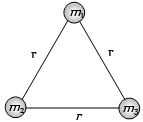
Particles of mass $100 \, g$ each are placed at the vertices of an equilateral triangle of side $20 \, cm$. How much work must be done to increase the separation between them to infinity?
A
$0.33 \times 10^{-11} \, J$
B
$-0.33 \times 10^{-11} \, J$
C
$1.00 \times 10^{-11} \, J$
D
$-1.00 \times 10^{-11} \, J$
Solution
(C) The gravitational potential energy $U$ of a system of three particles is given by:
$U = -\frac{G m_1 m_2}{r_{12}} - \frac{G m_2 m_3}{r_{23}} - \frac{G m_1 m_3}{r_{13}}$
Given $m_1 = m_2 = m_3 = 100 \, g = 0.1 \, kg$ and $r_{12} = r_{23} = r_{13} = 20 \, cm = 0.2 \, m$.
Since all masses and distances are equal,$U = -3 \times \frac{G m^2}{r}$.
$U = -3 \times \frac{6.67 \times 10^{-11} \times (0.1)^2}{0.2}$
$U = -3 \times \frac{6.67 \times 10^{-11} \times 0.01}{0.2} = -3 \times 3.335 \times 10^{-12} = -1.00 \times 10^{-11} \, J$.
The work required to move the particles to infinity is $W = U_{\infty} - U_{initial} = 0 - (-1.00 \times 10^{-11} \, J) = 1.00 \times 10^{-11} \, J$.
$U = -\frac{G m_1 m_2}{r_{12}} - \frac{G m_2 m_3}{r_{23}} - \frac{G m_1 m_3}{r_{13}}$
Given $m_1 = m_2 = m_3 = 100 \, g = 0.1 \, kg$ and $r_{12} = r_{23} = r_{13} = 20 \, cm = 0.2 \, m$.
Since all masses and distances are equal,$U = -3 \times \frac{G m^2}{r}$.
$U = -3 \times \frac{6.67 \times 10^{-11} \times (0.1)^2}{0.2}$
$U = -3 \times \frac{6.67 \times 10^{-11} \times 0.01}{0.2} = -3 \times 3.335 \times 10^{-12} = -1.00 \times 10^{-11} \, J$.
The work required to move the particles to infinity is $W = U_{\infty} - U_{initial} = 0 - (-1.00 \times 10^{-11} \, J) = 1.00 \times 10^{-11} \, J$.
0 likes
View Solution19
DifficultMCQ
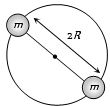
Two particles,each of mass $m$,are moving in a circle of radius $R$ under the influence of their mutual gravitational attraction. What is their speed?
A
$v = \frac{1}{2R}\sqrt{\frac{1}{Gm}}$
B
$v = \sqrt{\frac{Gm}{2R}}$
C
$v = \frac{1}{2}\sqrt{\frac{Gm}{R}}$
D
$v = \sqrt{\frac{4Gm}{R}}$
Solution
(C) The gravitational force between the two particles provides the necessary centripetal force for circular motion.
The distance between the two particles is $d = 2R$.
The gravitational force is $F_g = \frac{G \cdot m \cdot m}{(2R)^2} = \frac{Gm^2}{4R^2}$.
The centripetal force required for a particle of mass $m$ moving with speed $v$ in a circle of radius $R$ is $F_c = \frac{mv^2}{R}$.
Equating the two forces: $\frac{mv^2}{R} = \frac{Gm^2}{4R^2}$.
Simplifying the equation: $v^2 = \frac{Gm^2}{4R^2} \cdot \frac{R}{m} = \frac{Gm}{4R}$.
Taking the square root: $v = \sqrt{\frac{Gm}{4R}} = \frac{1}{2}\sqrt{\frac{Gm}{R}}$.
The distance between the two particles is $d = 2R$.
The gravitational force is $F_g = \frac{G \cdot m \cdot m}{(2R)^2} = \frac{Gm^2}{4R^2}$.
The centripetal force required for a particle of mass $m$ moving with speed $v$ in a circle of radius $R$ is $F_c = \frac{mv^2}{R}$.
Equating the two forces: $\frac{mv^2}{R} = \frac{Gm^2}{4R^2}$.
Simplifying the equation: $v^2 = \frac{Gm^2}{4R^2} \cdot \frac{R}{m} = \frac{Gm}{4R}$.
Taking the square root: $v = \sqrt{\frac{Gm}{4R}} = \frac{1}{2}\sqrt{\frac{Gm}{R}}$.
0 likes
View Solution20
DifficultMCQ
If the mass of the Earth remains constant and its radius is reduced to $\frac{1}{n}$ of its original value,what will be the duration of $1$ day?
A
$\frac{24}{n} \ hr$
B
$\frac{24}{n^2} \ hr$
C
$24n \ hr$
D
$24n^2 \ hr$
Solution
(B) The angular momentum $L$ of the Earth remains conserved as no external torque acts on it.
$L = I\omega = \text{constant}$
Since $I = \frac{2}{5}MR^2$ and $\omega = \frac{2\pi}{T}$,we have:
$\frac{2}{5}MR^2 \times \frac{2\pi}{T} = \text{constant}$
This implies $T \propto R^2$.
Given the new radius $R_2 = \frac{R}{n}$,the new time period $T_2$ is related to the original time period $T_1 = 24 \ hr$ by:
$\frac{T_2}{T_1} = \left( \frac{R_2}{R_1} \right)^2 = \left( \frac{R/n}{R} \right)^2 = \frac{1}{n^2}$
Therefore,$T_2 = \frac{T_1}{n^2} = \frac{24}{n^2} \ hr$.
$L = I\omega = \text{constant}$
Since $I = \frac{2}{5}MR^2$ and $\omega = \frac{2\pi}{T}$,we have:
$\frac{2}{5}MR^2 \times \frac{2\pi}{T} = \text{constant}$
This implies $T \propto R^2$.
Given the new radius $R_2 = \frac{R}{n}$,the new time period $T_2$ is related to the original time period $T_1 = 24 \ hr$ by:
$\frac{T_2}{T_1} = \left( \frac{R_2}{R_1} \right)^2 = \left( \frac{R/n}{R} \right)^2 = \frac{1}{n^2}$
Therefore,$T_2 = \frac{T_1}{n^2} = \frac{24}{n^2} \ hr$.
0 likes
View Solution21
EasyMCQ
$A$ body projected vertically from the earth reaches a height equal to earth's radius before returning to the earth. The power exerted by the gravitational force is greatest
A
at the highest position of the body.
B
at the instant just before the body hits the earth.
C
it remains constant all through.
D
at the instant just after the body is projected.
Solution
(B) Power is defined as the dot product of force and velocity: $P = \vec{F} \cdot \vec{v} = Fv \cos \theta$.
At the highest point,the velocity $v = 0$,so power $P = 0$.
During the motion,the gravitational force $\vec{F}$ is always directed towards the center of the earth.
As the body falls back,the velocity $\vec{v}$ is directed downwards,which is in the same direction as the gravitational force $\vec{F}$ (i.e.,$\theta = 0^\circ$).
Since $P = Fv \cos(0^\circ) = Fv$,the power is proportional to the speed $v$.
The speed $v$ of the body is maximum at the instant just before it hits the earth's surface.
Therefore,the power exerted by the gravitational force is greatest at the instant just before the body hits the earth.
At the highest point,the velocity $v = 0$,so power $P = 0$.
During the motion,the gravitational force $\vec{F}$ is always directed towards the center of the earth.
As the body falls back,the velocity $\vec{v}$ is directed downwards,which is in the same direction as the gravitational force $\vec{F}$ (i.e.,$\theta = 0^\circ$).
Since $P = Fv \cos(0^\circ) = Fv$,the power is proportional to the speed $v$.
The speed $v$ of the body is maximum at the instant just before it hits the earth's surface.
Therefore,the power exerted by the gravitational force is greatest at the instant just before the body hits the earth.
0 likes
View Solution22
MediumMCQ
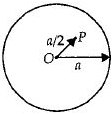
$A$ particle of mass $M$ is situated at the centre of a spherical shell of same mass and radius $a.$ The magnitude of the gravitational potential at a point situated at $a/2$ distance from the centre,will be
A
$\frac{GM}{a}$
B
$\frac{2GM}{a}$
C
$\frac{3GM}{a}$
D
$\frac{4GM}{a}$
Solution
(C) Given:
Mass of the particle $= M$
Mass of the spherical shell $= M$
Radius of the spherical shell $= a$
Let $O$ be the center of the spherical shell.
The gravitational potential at a point $P$ at a distance $r = a/2$ from the center due to the particle at the center is given by $V_1 = -\frac{GM}{r} = -\frac{GM}{a/2} = -\frac{2GM}{a}$.
The gravitational potential at any point inside a spherical shell is constant and equal to the potential at its surface,which is $V_2 = -\frac{GM}{a}$.
The total gravitational potential at point $P$ is $V = V_1 + V_2$.
$V = -\frac{2GM}{a} + \left( -\frac{GM}{a} \right) = -\frac{3GM}{a}$.
The magnitude of the gravitational potential is $|V| = \frac{3GM}{a}$.
Mass of the particle $= M$
Mass of the spherical shell $= M$
Radius of the spherical shell $= a$
Let $O$ be the center of the spherical shell.
The gravitational potential at a point $P$ at a distance $r = a/2$ from the center due to the particle at the center is given by $V_1 = -\frac{GM}{r} = -\frac{GM}{a/2} = -\frac{2GM}{a}$.
The gravitational potential at any point inside a spherical shell is constant and equal to the potential at its surface,which is $V_2 = -\frac{GM}{a}$.
The total gravitational potential at point $P$ is $V = V_1 + V_2$.
$V = -\frac{2GM}{a} + \left( -\frac{GM}{a} \right) = -\frac{3GM}{a}$.
The magnitude of the gravitational potential is $|V| = \frac{3GM}{a}$.
0 likes
View Solution23
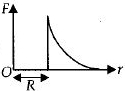
MediumMCQ
Which one of the following plots represents the variation of gravitational field on a particle with distance $r$ due to a thin spherical shell of radius $R$? ($r$ is measured from the centre of the spherical shell)
A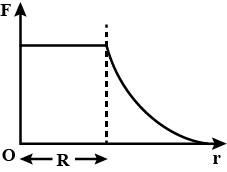
B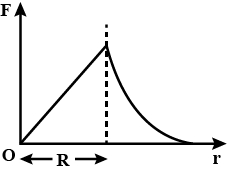
C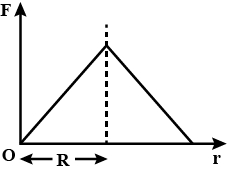
D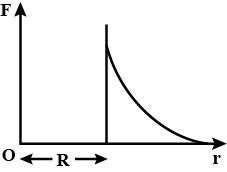
Solution
(D) The gravitational field $F$ due to a thin spherical shell of mass $M$ and radius $R$ is given by:
$1$. Inside the shell,i.e.,for $r < R$:
The gravitational field $F = 0$.
$2$. On the surface of the shell,i.e.,for $r = R$:
The gravitational field $F = \frac{GM}{R^2}$.
$3$. Outside the shell,i.e.,for $r > R$:
The gravitational field $F = \frac{GM}{r^2}$.
Thus,for $r < R$,the field is zero,and for $r > R$,it follows an inverse-square law. The correct plot is the one that shows $F = 0$ for $r < R$ and a curve representing $F \propto 1/r^2$ for $r > R$.
$1$. Inside the shell,i.e.,for $r < R$:
The gravitational field $F = 0$.
$2$. On the surface of the shell,i.e.,for $r = R$:
The gravitational field $F = \frac{GM}{R^2}$.
$3$. Outside the shell,i.e.,for $r > R$:
The gravitational field $F = \frac{GM}{r^2}$.
Thus,for $r < R$,the field is zero,and for $r > R$,it follows an inverse-square law. The correct plot is the one that shows $F = 0$ for $r < R$ and a curve representing $F \propto 1/r^2$ for $r > R$.
0 likes
View Solution24
MediumMCQ
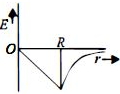
The dependence of the intensity of the gravitational field $(E)$ of the Earth on the distance $(r)$ from the center of the Earth is correctly represented by:
A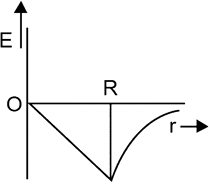
B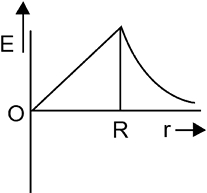
C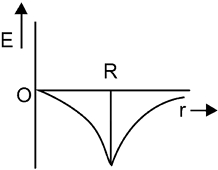
D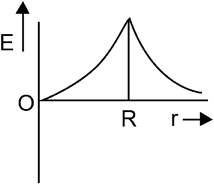
Solution
(A) For a point inside the Earth,i.e.,$r < R$:
$E = -\frac{GM}{R^3}r$
Where $M$ and $R$ are the mass and radius of the Earth,respectively. The negative sign indicates that the field is directed towards the center.
At the center,$r = 0$,therefore $E = 0$.
For a point outside the Earth,i.e.,$r > R$:
$E = -\frac{GM}{r^2}$
On the surface of the Earth,i.e.,$r = R$:
$E = -\frac{GM}{R^2}$
The magnitude of the gravitational field increases linearly with distance $r$ inside the Earth and decreases inversely with the square of the distance $r$ outside the Earth. The graph representing this variation is shown in the provided solution image.
$E = -\frac{GM}{R^3}r$
Where $M$ and $R$ are the mass and radius of the Earth,respectively. The negative sign indicates that the field is directed towards the center.
At the center,$r = 0$,therefore $E = 0$.
For a point outside the Earth,i.e.,$r > R$:
$E = -\frac{GM}{r^2}$
On the surface of the Earth,i.e.,$r = R$:
$E = -\frac{GM}{R^2}$
The magnitude of the gravitational field increases linearly with distance $r$ inside the Earth and decreases inversely with the square of the distance $r$ outside the Earth. The graph representing this variation is shown in the provided solution image.
0 likes
View Solution25
MediumMCQ
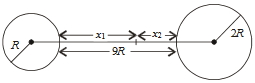
Two spherical bodies of mass $M$ and $5M$ and radii $R$ and $2R$ are released in free space with initial separation between their centres equal to $12R.$ If they attract each other due to gravitational force only,then the distance covered by the smaller body before collision is (in $R$)
A
$2.5$
B
$4.5$
C
$7.5$
D
$1.5$
Solution
(C) The initial distance between the centres is $12R.$ Collision occurs when the distance between the centres is equal to the sum of their radii,which is $R + 2R = 3R.$
Therefore,the total distance covered by both bodies before collision is $12R - 3R = 9R.$
Let $x_1$ and $x_2$ be the distances covered by the bodies of mass $M$ and $5M$ respectively. Since there is no external force,the centre of mass of the system remains stationary. Thus,$M x_1 = 5M x_2$,which gives $x_1 = 5x_2$.
Given $x_1 + x_2 = 9R$,we substitute $x_1 = 5x_2$ to get $5x_2 + x_2 = 9R$,so $6x_2 = 9R$,which means $x_2 = 1.5R$.
Then,$x_1 = 5(1.5R) = 7.5R$.
The distance covered by the smaller body (mass $M$) is $7.5R$.
Therefore,the total distance covered by both bodies before collision is $12R - 3R = 9R.$
Let $x_1$ and $x_2$ be the distances covered by the bodies of mass $M$ and $5M$ respectively. Since there is no external force,the centre of mass of the system remains stationary. Thus,$M x_1 = 5M x_2$,which gives $x_1 = 5x_2$.
Given $x_1 + x_2 = 9R$,we substitute $x_1 = 5x_2$ to get $5x_2 + x_2 = 9R$,so $6x_2 = 9R$,which means $x_2 = 1.5R$.
Then,$x_1 = 5(1.5R) = 7.5R$.
The distance covered by the smaller body (mass $M$) is $7.5R$.
0 likes
View Solution26
MediumMCQ
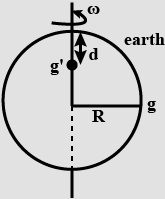
Let $\omega$ be the angular velocity of the earth's rotation about its axis. Assume that the acceleration due to gravity on the earth's surface has the same value at the equator and the poles. An object weighed at the equator gives the same reading as a reading taken at a depth $d$ below the earth's surface at a pole $(d << R)$. The value of $d$ is
A
$\frac{\omega^2 R^2}{g}$
B
$\frac{\omega^2 R^2}{2g}$
C
$\frac{2\omega^2 R^2}{g}$
D
$\frac{\sqrt{Rg}}{g}$
Solution
(A) Let $\omega$ be the angular velocity of the earth's rotation about its axis.
Let $g$ be the acceleration due to gravity at the poles.
Let $R$ be the radius of the earth.
The effective acceleration due to gravity at the equator is $g_{eq} = g - \omega^2 R$.
The acceleration due to gravity at a depth $d$ below the surface is $g_d = g(1 - \frac{d}{R})$.
According to the problem,the readings are the same,so $g_{eq} = g_d$.
$g - \omega^2 R = g(1 - \frac{d}{R})$
$g - \omega^2 R = g - \frac{gd}{R}$
$\omega^2 R = \frac{gd}{R}$
$d = \frac{\omega^2 R^2}{g}$
Let $g$ be the acceleration due to gravity at the poles.
Let $R$ be the radius of the earth.
The effective acceleration due to gravity at the equator is $g_{eq} = g - \omega^2 R$.
The acceleration due to gravity at a depth $d$ below the surface is $g_d = g(1 - \frac{d}{R})$.
According to the problem,the readings are the same,so $g_{eq} = g_d$.
$g - \omega^2 R = g(1 - \frac{d}{R})$
$g - \omega^2 R = g - \frac{gd}{R}$
$\omega^2 R = \frac{gd}{R}$
$d = \frac{\omega^2 R^2}{g}$
0 likes
View Solution27
DifficultMCQ
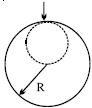
$A$ spherical hole of radius $R/2$ is excavated from an asteroid of mass $M$ and radius $R$,as shown in the figure. The gravitational acceleration at a point on the surface of the asteroid just above the excavation is:
A
$GM/R^2$
B
$GM/2R^2$
C
$GM/8R^2$
D
$7GM/8R^2$
Solution
(B) Let the mass of the asteroid be $M$ and its radius be $R$. The density $\rho$ is given by $\rho = M / (\frac{4}{3} \pi R^3)$.
When a spherical hole of radius $r = R/2$ is excavated,the mass of the removed part is $m = \rho \cdot (\frac{4}{3} \pi r^3) = \rho \cdot (\frac{4}{3} \pi (R/2)^3) = \rho \cdot (\frac{4}{3} \pi R^3) / 8 = M/8$.
The gravitational acceleration at the point $P$ (just above the hole) due to the complete asteroid is $g_1 = GM/R^2$ directed towards the center.
The gravitational acceleration at point $P$ due to the removed sphere (hole) is $g_2 = G(M/8) / (R/2)^2 = (GM/8) / (R^2/4) = GM / 2R^2$ directed away from the center of the hole (towards the center of the asteroid).
Since the hole is removed,the net gravitational acceleration $g_{net}$ is the vector sum of the acceleration due to the complete sphere and the negative mass of the hole: $g_{net} = g_1 - g_2 = GM/R^2 - GM/2R^2 = GM/2R^2$.
When a spherical hole of radius $r = R/2$ is excavated,the mass of the removed part is $m = \rho \cdot (\frac{4}{3} \pi r^3) = \rho \cdot (\frac{4}{3} \pi (R/2)^3) = \rho \cdot (\frac{4}{3} \pi R^3) / 8 = M/8$.
The gravitational acceleration at the point $P$ (just above the hole) due to the complete asteroid is $g_1 = GM/R^2$ directed towards the center.
The gravitational acceleration at point $P$ due to the removed sphere (hole) is $g_2 = G(M/8) / (R/2)^2 = (GM/8) / (R^2/4) = GM / 2R^2$ directed away from the center of the hole (towards the center of the asteroid).
Since the hole is removed,the net gravitational acceleration $g_{net}$ is the vector sum of the acceleration due to the complete sphere and the negative mass of the hole: $g_{net} = g_1 - g_2 = GM/R^2 - GM/2R^2 = GM/2R^2$.
0 likes
View Solution28
MediumMCQ
$A$ man of mass $m$ starts falling towards a planet of mass $M$ and radius $R.$ As he reaches near to the surface,he realizes that he will pass through a small hole in the planet. As he enters the hole,he sees that the planet is really made of two pieces: a spherical shell of negligible thickness of mass $\frac{2M}{3}$ and a point mass $\frac{M}{3}$ at the centre. The change in the force of gravity experienced by the man is:
A
$\frac{2}{3} \frac{GMm}{R^2}$
B
$0$
C
$\frac{1}{3} \frac{GMm}{R^2}$
D
$\frac{4}{3} \frac{GMm}{R^2}$
Solution
(A) Outside the planet (at the surface),the gravitational force on the man is given by Newton's law of gravitation: $F_{\text{old}} = \frac{GMm}{R^2}$.
Inside the planet,the man is inside the spherical shell of mass $\frac{2M}{3}$. According to the shell theorem,the gravitational field due to a spherical shell at any point inside it is zero. Thus,the shell exerts no force on the man.
The man is at a distance $R$ from the point mass $\frac{M}{3}$ located at the center. The gravitational force exerted by this point mass is $F_{\text{new}} = \frac{G(\frac{M}{3})m}{R^2} = \frac{GMm}{3R^2}$.
The change in the force of gravity experienced by the man is $\Delta F = F_{\text{old}} - F_{\text{new}} = \frac{GMm}{R^2} - \frac{GMm}{3R^2} = \frac{2GMm}{3R^2}$.
Inside the planet,the man is inside the spherical shell of mass $\frac{2M}{3}$. According to the shell theorem,the gravitational field due to a spherical shell at any point inside it is zero. Thus,the shell exerts no force on the man.
The man is at a distance $R$ from the point mass $\frac{M}{3}$ located at the center. The gravitational force exerted by this point mass is $F_{\text{new}} = \frac{G(\frac{M}{3})m}{R^2} = \frac{GMm}{3R^2}$.
The change in the force of gravity experienced by the man is $\Delta F = F_{\text{old}} - F_{\text{new}} = \frac{GMm}{R^2} - \frac{GMm}{3R^2} = \frac{2GMm}{3R^2}$.
0 likes
View Solution29
MediumMCQ
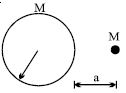
$A$ particle of mass $M$ is at a distance $a$ from the surface of a thin spherical shell of equal mass $M$ and radius $a$. Which of the following statements is correct regarding the gravitational field and potential inside the shell?
A
Gravitational field and potential both are zero at the centre of the shell.
B
Gravitational field is zero not only inside the shell but at a point outside the shell also.
C
Inside the shell,gravitational field alone is zero.
D
Neither gravitational field nor gravitational potential is zero inside the shell.
Solution
(D) For a thin spherical shell of mass $M$ and radius $a$,the gravitational field inside the shell due to the shell itself is zero,and the gravitational potential inside is constant and equal to $-GM/a$.
However,there is an external particle of mass $M$ at a distance $a$ from the surface of the shell. The distance of this particle from the centre of the shell is $r = a + a = 2a$.
This external particle creates a non-zero gravitational field and a non-zero gravitational potential at all points inside the shell.
Therefore,inside the shell,the net gravitational field is equal to the field produced by the external particle,and the net gravitational potential is the sum of the constant potential due to the shell and the potential due to the external particle.
Thus,neither the net gravitational field nor the net gravitational potential is zero inside the shell.
However,there is an external particle of mass $M$ at a distance $a$ from the surface of the shell. The distance of this particle from the centre of the shell is $r = a + a = 2a$.
This external particle creates a non-zero gravitational field and a non-zero gravitational potential at all points inside the shell.
Therefore,inside the shell,the net gravitational field is equal to the field produced by the external particle,and the net gravitational potential is the sum of the constant potential due to the shell and the potential due to the external particle.
Thus,neither the net gravitational field nor the net gravitational potential is zero inside the shell.
0 likes
View Solution30
DifficultMCQ
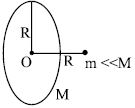
$A$ particle of mass $m$ starts from rest at a distance $R$ from the centre and along the axis of a fixed ring of radius $R$ and mass $M$. Its velocity at the centre of the ring is:
A
$\sqrt {\frac{{\sqrt 2 GM}}{R}} $
B
$\sqrt {\frac{{2GM}}{R}} $
C
$\sqrt {\left( {1 - \frac{1}{{\sqrt 2 }}} \right)\frac{{GM}}{R}} $
D
$\sqrt {2\left( {1 - \frac{1}{{\sqrt 2 }}} \right)\frac{{GM}}{R}} $
Solution
(D) The gravitational potential $V$ at a distance $x$ from the centre of a ring of radius $R$ and mass $M$ is given by $V(x) = -\frac{GM}{\sqrt{x^2 + R^2}}$.
Applying the principle of conservation of mechanical energy between the initial position $(x = R)$ and the centre $(x = 0)$:
$K_i + U_i = K_f + U_f$
Since the particle starts from rest,$K_i = 0$.
$0 + m V(R) = \frac{1}{2}mv^2 + m V(0)$
$0 + m \left( -\frac{GM}{\sqrt{R^2 + R^2}} \right) = \frac{1}{2}mv^2 + m \left( -\frac{GM}{R} \right)$
$-\frac{GM}{\sqrt{2}R} = \frac{1}{2}v^2 - \frac{GM}{R}$
$\frac{1}{2}v^2 = \frac{GM}{R} - \frac{GM}{\sqrt{2}R} = \frac{GM}{R} \left( 1 - \frac{1}{\sqrt{2}} \right)$
$v^2 = \frac{2GM}{R} \left( 1 - \frac{1}{\sqrt{2}} \right)$
$v = \sqrt{2\left( 1 - \frac{1}{\sqrt{2}} \right) \frac{GM}{R}}$
Applying the principle of conservation of mechanical energy between the initial position $(x = R)$ and the centre $(x = 0)$:
$K_i + U_i = K_f + U_f$
Since the particle starts from rest,$K_i = 0$.
$0 + m V(R) = \frac{1}{2}mv^2 + m V(0)$
$0 + m \left( -\frac{GM}{\sqrt{R^2 + R^2}} \right) = \frac{1}{2}mv^2 + m \left( -\frac{GM}{R} \right)$
$-\frac{GM}{\sqrt{2}R} = \frac{1}{2}v^2 - \frac{GM}{R}$
$\frac{1}{2}v^2 = \frac{GM}{R} - \frac{GM}{\sqrt{2}R} = \frac{GM}{R} \left( 1 - \frac{1}{\sqrt{2}} \right)$
$v^2 = \frac{2GM}{R} \left( 1 - \frac{1}{\sqrt{2}} \right)$
$v = \sqrt{2\left( 1 - \frac{1}{\sqrt{2}} \right) \frac{GM}{R}}$
0 likes
View Solution31
AdvancedMCQ
Two point masses of mass $4m$ and $m$ respectively,separated by a distance $d$,are revolving under their mutual force of attraction. The ratio of their kinetic energies is:
A
$1 : 4$
B
$1 : 5$
C
$1 : 1$
D
$1 : 2$
Solution
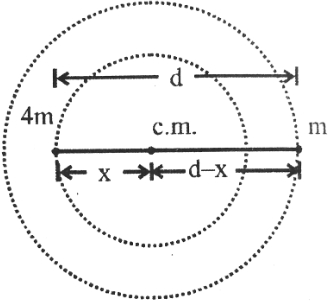
(A) The two masses revolve about their common center of mass (c.m.).
Let the distance of mass $4m$ from the center of mass be $x$,and the distance of mass $m$ be $(d-x)$.
By the definition of the center of mass: $4m(x) = m(d-x) \Rightarrow 4x = d-x \Rightarrow 5x = d \Rightarrow x = d/5$.
Thus,the distance of mass $4m$ from the center of mass is $r_1 = d/5$,and the distance of mass $m$ is $r_2 = 4d/5$.
Both masses revolve with the same angular velocity $\omega$.
The kinetic energy of a particle in circular motion is $K = \frac{1}{2}mv^2 = \frac{1}{2}m(r\omega)^2 = \frac{1}{2}mr^2\omega^2$.
The ratio of kinetic energies is:
$\frac{K_{4m}}{K_m} = \frac{\frac{1}{2}(4m)r_1^2\omega^2}{\frac{1}{2}(m)r_2^2\omega^2} = \frac{4(d/5)^2}{(4d/5)^2} = \frac{4(d^2/25)}{16(d^2/25)} = \frac{4}{16} = \frac{1}{4}$.
Therefore,the ratio is $1:4$.
Let the distance of mass $4m$ from the center of mass be $x$,and the distance of mass $m$ be $(d-x)$.
By the definition of the center of mass: $4m(x) = m(d-x) \Rightarrow 4x = d-x \Rightarrow 5x = d \Rightarrow x = d/5$.
Thus,the distance of mass $4m$ from the center of mass is $r_1 = d/5$,and the distance of mass $m$ is $r_2 = 4d/5$.
Both masses revolve with the same angular velocity $\omega$.
The kinetic energy of a particle in circular motion is $K = \frac{1}{2}mv^2 = \frac{1}{2}m(r\omega)^2 = \frac{1}{2}mr^2\omega^2$.
The ratio of kinetic energies is:
$\frac{K_{4m}}{K_m} = \frac{\frac{1}{2}(4m)r_1^2\omega^2}{\frac{1}{2}(m)r_2^2\omega^2} = \frac{4(d/5)^2}{(4d/5)^2} = \frac{4(d^2/25)}{16(d^2/25)} = \frac{4}{16} = \frac{1}{4}$.
Therefore,the ratio is $1:4$.
0 likes
View Solution32
MediumMCQ
Select the correct choice$(s)$:
A
The gravitational field inside a spherical cavity,within a spherical planet,must be non-zero and uniform.
B
When a body is projected horizontally at an appreciably large height above the earth,with a velocity less than that required for a circular orbit,it will fall to the earth along a parabolic path.
C
$A$ body of zero total mechanical energy placed in a gravitational field will escape the field.
D
Earth's satellite must be in the equatorial plane.
Solution
(A, C) The gravitational field inside a spherical cavity within a spherical planet is uniform and non-zero. This is a standard result derived from the superposition principle of gravitational fields.
Regarding option $C$,the total mechanical energy $E = K + U$. If $E = 0$,then $K = -U$. Since $U$ is negative in a gravitational field,$K$ must be positive. As the body moves away from the source,$U$ increases (becomes less negative) and $K$ decreases. At infinity,$U = 0$ and $K = 0$,meaning the body has just enough energy to reach infinity,which is the definition of escape velocity. Thus,a body with zero total mechanical energy will escape the gravitational field.
Regarding option $C$,the total mechanical energy $E = K + U$. If $E = 0$,then $K = -U$. Since $U$ is negative in a gravitational field,$K$ must be positive. As the body moves away from the source,$U$ increases (becomes less negative) and $K$ decreases. At infinity,$U = 0$ and $K = 0$,meaning the body has just enough energy to reach infinity,which is the definition of escape velocity. Thus,a body with zero total mechanical energy will escape the gravitational field.
0 likes
View Solution33
DifficultMCQ
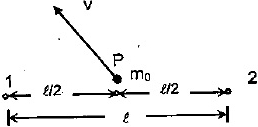
$A$ particle of mass $m_0$ is projected from the mid-point of the line joining two fixed particles each of mass $m.$ If the distance of separation between the fixed particles is $l,$ the minimum velocity of projection of the particle so as to escape to infinity is equal to
A
$\sqrt {\frac{{GM}}{l}} $
B
$\sqrt {\frac{{GM}}{2l}} $
C
$\sqrt {\frac{{2GM}}{l}} $
D
$2 \sqrt {\frac{{2Gm}}{l}} $
Solution
(D) The gravitational potential at the mid-point $P$ due to two fixed particles of mass $m$ is given by:
$V = V_1 + V_2 = -\frac{Gm}{l/2} - \frac{Gm}{l/2} = -\frac{4Gm}{l}$
The gravitational potential energy of the particle of mass $m_0$ at point $P$ is:
$U = m_0 V = -\frac{4Gmm_0}{l}$
For the particle to just escape to infinity,its total energy at the point of projection must be equal to its total energy at infinity,which is zero.
By the law of conservation of energy:
$K_i + U_i = K_f + U_f$
$\frac{1}{2} m_0 v^2 + \left( -\frac{4Gmm_0}{l} \right) = 0 + 0$
$\frac{1}{2} m_0 v^2 = \frac{4Gmm_0}{l}$
$v^2 = \frac{8Gm}{l}$
$v = \sqrt{\frac{8Gm}{l}} = 2 \sqrt{\frac{2Gm}{l}}$
Thus,the minimum velocity is $2 \sqrt{\frac{2Gm}{l}}.$
$V = V_1 + V_2 = -\frac{Gm}{l/2} - \frac{Gm}{l/2} = -\frac{4Gm}{l}$
The gravitational potential energy of the particle of mass $m_0$ at point $P$ is:
$U = m_0 V = -\frac{4Gmm_0}{l}$
For the particle to just escape to infinity,its total energy at the point of projection must be equal to its total energy at infinity,which is zero.
By the law of conservation of energy:
$K_i + U_i = K_f + U_f$
$\frac{1}{2} m_0 v^2 + \left( -\frac{4Gmm_0}{l} \right) = 0 + 0$
$\frac{1}{2} m_0 v^2 = \frac{4Gmm_0}{l}$
$v^2 = \frac{8Gm}{l}$
$v = \sqrt{\frac{8Gm}{l}} = 2 \sqrt{\frac{2Gm}{l}}$
Thus,the minimum velocity is $2 \sqrt{\frac{2Gm}{l}}.$
0 likes
View Solution34
AdvancedMCQ
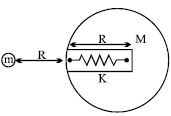
$A$ small ball of mass $m$ is released at a height $R$ above the earth's surface,as shown in the figure. The ball enters a narrow groove and reaches a maximum depth of $R/2$ inside the earth before coming to rest momentarily. The groove contains an ideal spring of spring constant $K$ and natural length $R$. Find the value of $K$ if $R$ is the radius of the earth and $M$ is the mass of the earth.
A
$\frac{3GMm}{R^3}$
B
$\frac{6GMm}{R^3}$
C
$\frac{9GMm}{R^3}$
D
$\frac{7GMm}{R^3}$
Solution
(D) By the principle of conservation of energy,the total mechanical energy at the initial position equals the total mechanical energy at the final position (where the ball comes to rest momentarily).
Initial energy $E_i = K_i + U_i = 0 - \frac{GMm}{2R}$.
Final energy $E_f = K_f + U_f = 0 + U_{grav, depth} + U_{spring}$.
The gravitational potential energy at a depth $d = R/2$ (i.e.,at distance $r = R/2$ from the center) is $U_{grav} = -\frac{GMm}{2R^3}(3R^2 - r^2) = -\frac{GMm}{2R^3}(3R^2 - (R/2)^2) = -\frac{GMm}{2R^3}(3R^2 - R^2/4) = -\frac{GMm}{2R^3}(\frac{11R^2}{4}) = -\frac{11GMm}{8R}$.
The spring is compressed by $x = R/2$,so $U_{spring} = \frac{1}{2}K(R/2)^2 = \frac{KR^2}{8}$.
Equating $E_i = E_f$: $-\frac{GMm}{2R} = -\frac{11GMm}{8R} + \frac{KR^2}{8}$.
$\frac{KR^2}{8} = \frac{11GMm}{8R} - \frac{4GMm}{8R} = \frac{7GMm}{8R}$.
Therefore,$K = \frac{7GMm}{R^3}$.
Initial energy $E_i = K_i + U_i = 0 - \frac{GMm}{2R}$.
Final energy $E_f = K_f + U_f = 0 + U_{grav, depth} + U_{spring}$.
The gravitational potential energy at a depth $d = R/2$ (i.e.,at distance $r = R/2$ from the center) is $U_{grav} = -\frac{GMm}{2R^3}(3R^2 - r^2) = -\frac{GMm}{2R^3}(3R^2 - (R/2)^2) = -\frac{GMm}{2R^3}(3R^2 - R^2/4) = -\frac{GMm}{2R^3}(\frac{11R^2}{4}) = -\frac{11GMm}{8R}$.
The spring is compressed by $x = R/2$,so $U_{spring} = \frac{1}{2}K(R/2)^2 = \frac{KR^2}{8}$.
Equating $E_i = E_f$: $-\frac{GMm}{2R} = -\frac{11GMm}{8R} + \frac{KR^2}{8}$.
$\frac{KR^2}{8} = \frac{11GMm}{8R} - \frac{4GMm}{8R} = \frac{7GMm}{8R}$.
Therefore,$K = \frac{7GMm}{R^3}$.
0 likes
View Solution35
DifficultMCQ
$A$ particle is dropped on Earth from a height $R$ (radius of Earth) and it bounces back to a height $R/2$. The coefficient of restitution for the collision is (ignore air resistance and rotation of Earth).
A
$\frac{2}{3}$
B
$\sqrt{\frac{2}{3}}$
C
$\sqrt{\frac{1}{3}}$
D
$\sqrt{\frac{1}{2}}$
Solution
(B) The gravitational potential energy at a distance $r$ from the center of the Earth is $U = -\frac{GMm}{r}$.
Using the conservation of energy,the velocity $v$ of the particle just before hitting the surface (at distance $R$ from the center) when dropped from height $h$ is given by $\frac{1}{2}mv^2 = GMm(\frac{1}{R} - \frac{1}{R+h})$.
For the initial drop from height $h_1 = R$,the velocity of approach $v_1$ is $\frac{1}{2}mv_1^2 = GMm(\frac{1}{R} - \frac{1}{2R}) = \frac{GMm}{2R}$,so $v_1 = \sqrt{\frac{GM}{R}}$.
For the rebound to height $h_2 = R/2$,the velocity of separation $v_2$ is $\frac{1}{2}mv_2^2 = GMm(\frac{1}{R} - \frac{1}{R + R/2}) = GMm(\frac{1}{R} - \frac{2}{3R}) = \frac{GMm}{3R}$,so $v_2 = \sqrt{\frac{2GM}{3R}}$.
The coefficient of restitution $e$ is defined as $e = \frac{v_2}{v_1} = \frac{\sqrt{2GM/3R}}{\sqrt{GM/R}} = \sqrt{\frac{2}{3}}$.
Using the conservation of energy,the velocity $v$ of the particle just before hitting the surface (at distance $R$ from the center) when dropped from height $h$ is given by $\frac{1}{2}mv^2 = GMm(\frac{1}{R} - \frac{1}{R+h})$.
For the initial drop from height $h_1 = R$,the velocity of approach $v_1$ is $\frac{1}{2}mv_1^2 = GMm(\frac{1}{R} - \frac{1}{2R}) = \frac{GMm}{2R}$,so $v_1 = \sqrt{\frac{GM}{R}}$.
For the rebound to height $h_2 = R/2$,the velocity of separation $v_2$ is $\frac{1}{2}mv_2^2 = GMm(\frac{1}{R} - \frac{1}{R + R/2}) = GMm(\frac{1}{R} - \frac{2}{3R}) = \frac{GMm}{3R}$,so $v_2 = \sqrt{\frac{2GM}{3R}}$.
The coefficient of restitution $e$ is defined as $e = \frac{v_2}{v_1} = \frac{\sqrt{2GM/3R}}{\sqrt{GM/R}} = \sqrt{\frac{2}{3}}$.
0 likes
View Solution36
DifficultMCQ
$A$ satellite of mass $5M$ orbits the Earth in a circular orbit. At one point in its orbit,the satellite explodes into two pieces,one of mass $M$ and the other of mass $4M$. After the explosion,the mass $M$ ends up travelling in the same circular orbit,but in the opposite direction. After the explosion,the mass $4M$ is in:
A
bound orbit
B
unbound orbit
C
partially bound orbit
D
data is insufficient to determine the nature of the orbit.
Solution
(B) Let the orbital velocity of the satellite of mass $5M$ be $v_r$. The velocities of the pieces of mass $M$ and $4M$ after the explosion are $v_1$ and $v_4$ respectively.
Given that the mass $M$ travels in the same orbit but in the opposite direction,its velocity is $v_1 = -v_r$.
According to the law of conservation of linear momentum,the total momentum before the explosion is equal to the total momentum after the explosion:
$5M v_r = (4M) v_4 + (M)(-v_r)$
$5M v_r = 4M v_4 - M v_r$
$6M v_r = 4M v_4$
$v_4 = 1.5 v_r$
The escape velocity for a satellite in a circular orbit is $v_e = \sqrt{2} v_r \approx 1.414 v_r$.
Since $v_4 = 1.5 v_r > 1.414 v_r$,the velocity of the $4M$ mass exceeds the escape velocity.
Therefore,the mass $4M$ will follow an unbound orbit (hyperbolic trajectory).
Given that the mass $M$ travels in the same orbit but in the opposite direction,its velocity is $v_1 = -v_r$.
According to the law of conservation of linear momentum,the total momentum before the explosion is equal to the total momentum after the explosion:
$5M v_r = (4M) v_4 + (M)(-v_r)$
$5M v_r = 4M v_4 - M v_r$
$6M v_r = 4M v_4$
$v_4 = 1.5 v_r$
The escape velocity for a satellite in a circular orbit is $v_e = \sqrt{2} v_r \approx 1.414 v_r$.
Since $v_4 = 1.5 v_r > 1.414 v_r$,the velocity of the $4M$ mass exceeds the escape velocity.
Therefore,the mass $4M$ will follow an unbound orbit (hyperbolic trajectory).
0 likes
View Solution37
MediumMCQ
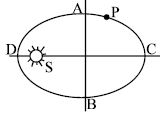
The figure shows the orbit of a planet $P$ around the sun $S.$ $AB$ and $CD$ are the minor and major axes of the ellipse,respectively. If $U$ is the potential energy and $K$ is the kinetic energy of the planet,then $|U| > |K|$ at:
A
Only $D$
B
Only $C$
C
Both $D$ and $C$
D
Neither $D$ nor $C$
Solution
(C) According to the Virial Theorem for a system bound by an inverse-square law force (like gravity),the time-averaged kinetic energy $\langle K \rangle$ and potential energy $\langle U \rangle$ are related by $\langle U \rangle = -2 \langle K \rangle.$
For a planet in an elliptical orbit,the total mechanical energy $E$ is constant and is given by $E = K + U = -\frac{GMm}{2a},$ where $a$ is the semi-major axis.
At any point in the orbit,the potential energy is $U = -\frac{GMm}{r}.$
Since the total energy $E = K + U = -\frac{GMm}{2a},$ we have $K = E - U = -\frac{GMm}{2a} - (-\frac{GMm}{r}) = GMm(\frac{1}{r} - \frac{1}{2a}).$
Comparing the magnitudes $|U| = \frac{GMm}{r}$ and $|K| = GMm|\frac{1}{r} - \frac{1}{2a}|,$ we observe that $|U| > |K|$ holds true for all points in the orbit,including $C$ and $D.$
Specifically,at any point $r$ in the orbit,since $r$ is always less than $2a$ (the major axis length),the condition $|U| > |K|$ is satisfied throughout the entire elliptical path.
For a planet in an elliptical orbit,the total mechanical energy $E$ is constant and is given by $E = K + U = -\frac{GMm}{2a},$ where $a$ is the semi-major axis.
At any point in the orbit,the potential energy is $U = -\frac{GMm}{r}.$
Since the total energy $E = K + U = -\frac{GMm}{2a},$ we have $K = E - U = -\frac{GMm}{2a} - (-\frac{GMm}{r}) = GMm(\frac{1}{r} - \frac{1}{2a}).$
Comparing the magnitudes $|U| = \frac{GMm}{r}$ and $|K| = GMm|\frac{1}{r} - \frac{1}{2a}|,$ we observe that $|U| > |K|$ holds true for all points in the orbit,including $C$ and $D.$
Specifically,at any point $r$ in the orbit,since $r$ is always less than $2a$ (the major axis length),the condition $|U| > |K|$ is satisfied throughout the entire elliptical path.
0 likes
View Solution38
AdvancedMCQ
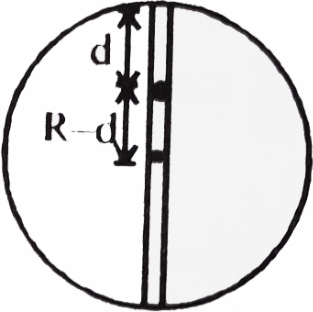
If a tunnel is cut at any orientation through the Earth,a ball released from one end will reach the other end in time ........ $\text{min}$ (neglect Earth's rotation).
A
$84.6$
B
$42.3$
C
$8$
D
depends on orientation
Solution
(B) The acceleration due to gravity at a distance $x$ from the center of the Earth is given by $g_{x} = \frac{g}{R} x$,where $g$ is the acceleration due to gravity at the surface and $R$ is the radius of the Earth.
Since the force $F = -m g_{x} = -\left(\frac{mg}{R}\right) x$ is proportional to the displacement $x$ and directed towards the center,the motion of the ball is simple harmonic motion $(SHM)$.
The time period of this $SHM$ is $T = 2 \pi \sqrt{\frac{m}{k}}$,where $k = \frac{mg}{R}$.
Thus,$T = 2 \pi \sqrt{\frac{m}{mg/R}} = 2 \pi \sqrt{\frac{R}{g}}$.
Substituting $R \approx 6400 \text{ km}$ and $g \approx 9.8 \text{ m/s}^2$,we get $T \approx 84.6 \text{ min}$.
The time taken to reach the other end is half the time period,so $t = \frac{T}{2} = \frac{84.6}{2} = 42.3 \text{ min}$.
Since the force $F = -m g_{x} = -\left(\frac{mg}{R}\right) x$ is proportional to the displacement $x$ and directed towards the center,the motion of the ball is simple harmonic motion $(SHM)$.
The time period of this $SHM$ is $T = 2 \pi \sqrt{\frac{m}{k}}$,where $k = \frac{mg}{R}$.
Thus,$T = 2 \pi \sqrt{\frac{m}{mg/R}} = 2 \pi \sqrt{\frac{R}{g}}$.
Substituting $R \approx 6400 \text{ km}$ and $g \approx 9.8 \text{ m/s}^2$,we get $T \approx 84.6 \text{ min}$.
The time taken to reach the other end is half the time period,so $t = \frac{T}{2} = \frac{84.6}{2} = 42.3 \text{ min}$.
0 likes
View Solution39
AdvancedMCQ
$A$ geostationary satellite is at a height $h$ above the surface of the Earth. If the Earth's radius is $R$,which of the following statements is correct?
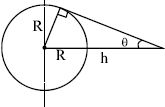
A
The minimum colatitude on Earth up to which the satellite can be used for communication is $\sin^{-1} \left( \frac{R}{R+h} \right).$
B
The maximum colatitude on Earth up to which the satellite can be used for communication is $\sin^{-1} \left( \frac{R}{R+h} \right).$
C
The area on Earth escaped from this satellite is given as $2\pi R^2 (1 + \sin \theta).$
D
$(A)$ and $(C)$ both.
Solution
(D) From the geometry of the problem,consider a right-angled triangle formed by the center of the Earth,the satellite,and the point on the horizon visible from the satellite. The hypotenuse is $(R+h)$ and the side opposite to the angle $\theta$ is $R$. Thus,$\sin \theta = \frac{R}{R+h}$.
The colatitude is the angle measured from the pole. The satellite can communicate up to a certain latitude,which corresponds to a minimum colatitude of $\theta = \sin^{-1} \left( \frac{R}{R+h} \right)$.
The area of the spherical cap visible from the satellite is $A_{visible} = 2\pi R^2 (1 - \cos \alpha)$,where $\alpha$ is the angular radius of the visible region. In this geometry,$\cos \alpha = \frac{R}{R+h} = \sin \theta$. Thus,the visible area is $2\pi R^2 (1 - \sin \theta)$.
The area on Earth that is $NOT$ visible (escaped) from the satellite is the total surface area minus the visible area:
$A_{escaped} = 4\pi R^2 - 2\pi R^2 (1 - \sin \theta) = 2\pi R^2 (1 + \sin \theta).$
Therefore,both statements $(A)$ and $(C)$ are correct.
The colatitude is the angle measured from the pole. The satellite can communicate up to a certain latitude,which corresponds to a minimum colatitude of $\theta = \sin^{-1} \left( \frac{R}{R+h} \right)$.
The area of the spherical cap visible from the satellite is $A_{visible} = 2\pi R^2 (1 - \cos \alpha)$,where $\alpha$ is the angular radius of the visible region. In this geometry,$\cos \alpha = \frac{R}{R+h} = \sin \theta$. Thus,the visible area is $2\pi R^2 (1 - \sin \theta)$.
The area on Earth that is $NOT$ visible (escaped) from the satellite is the total surface area minus the visible area:
$A_{escaped} = 4\pi R^2 - 2\pi R^2 (1 - \sin \theta) = 2\pi R^2 (1 + \sin \theta).$
Therefore,both statements $(A)$ and $(C)$ are correct.
0 likes
View Solution40
MediumMCQ
When a satellite in a circular orbit around the earth enters the atmospheric region,it encounters small air resistance to its motion. Then
A
its kinetic energy increases
B
its kinetic energy decreases
C
its angular momentum about the earth decreases
D
$(A)$ and $(C)$ both
Solution
(D) When a satellite encounters air resistance,it loses mechanical energy,causing it to spiral inward towards the earth. As the orbital radius $r$ decreases,the potential energy becomes more negative,and the kinetic energy $K = \frac{GMm}{2r}$ increases.
Because the air resistance acts as a non-conservative force,it exerts a torque on the satellite,which causes the angular momentum $L = mvr$ to decrease over time.
Therefore,both the kinetic energy increases and the angular momentum decreases. Thus,option $(D)$ is correct.
Because the air resistance acts as a non-conservative force,it exerts a torque on the satellite,which causes the angular momentum $L = mvr$ to decrease over time.
Therefore,both the kinetic energy increases and the angular momentum decreases. Thus,option $(D)$ is correct.
0 likes
View Solution41
AdvancedMCQ
Two satellites $s_1$ and $s_2$ of equal masses revolve in the same sense around a heavy planet in coplanar circular orbits of radii $R$ and $4R$. Which of the following statements is correct?
A
The ratio of the period of revolution of $s_1$ and $s_2$ is $1 : 8$.
B
Their velocities are in the ratio $2 : 1$.
C
The ratio of angular velocities of $s_2$ with respect to $s_1$ when all three are in the same line is $9 : 5$.
D
All of the above.
Solution
(D) According to Kepler's Third Law,$T^2 \propto r^3$. Therefore,$T_1/T_2 = (R_1/R_2)^{3/2} = (R/4R)^{3/2} = (1/4)^{3/2} = 1/8$. Thus,option $A$ is correct.
For orbital velocity,$v = \sqrt{GM/r}$,so $v \propto 1/\sqrt{r}$. Thus,$v_1/v_2 = \sqrt{r_2/r_1} = \sqrt{4R/R} = 2/1$. Thus,option $B$ is correct.
Angular velocity $\omega = v/r = \sqrt{GM/r^3}$,so $\omega \propto r^{-3/2}$.
$\omega_1 = \sqrt{GM/R^3}$ and $\omega_2 = \sqrt{GM/(4R)^3} = \omega_1/8$.
The relative angular velocity $\omega_{rel} = |\omega_1 - \omega_2| = |\omega_1 - \omega_1/8| = 7\omega_1/8$.
However,the question asks for the ratio of angular velocities of $s_2$ w.r.t $s_1$ in a specific context. Given the options,$A$ and $B$ are clearly correct,making $D$ the intended answer.
For orbital velocity,$v = \sqrt{GM/r}$,so $v \propto 1/\sqrt{r}$. Thus,$v_1/v_2 = \sqrt{r_2/r_1} = \sqrt{4R/R} = 2/1$. Thus,option $B$ is correct.
Angular velocity $\omega = v/r = \sqrt{GM/r^3}$,so $\omega \propto r^{-3/2}$.
$\omega_1 = \sqrt{GM/R^3}$ and $\omega_2 = \sqrt{GM/(4R)^3} = \omega_1/8$.
The relative angular velocity $\omega_{rel} = |\omega_1 - \omega_2| = |\omega_1 - \omega_1/8| = 7\omega_1/8$.
However,the question asks for the ratio of angular velocities of $s_2$ w.r.t $s_1$ in a specific context. Given the options,$A$ and $B$ are clearly correct,making $D$ the intended answer.
0 likes
View Solution42
MediumMCQ
If a satellite orbits as close to the earth's surface as possible,
A
its speed is maximum
B
time period of its rotation is minimum
C
the total energy of the 'earth plus satellite' system is minimum
D
all of the above
Solution
(D) The orbital speed of a satellite is given by $v = \sqrt{\frac{GM}{r}}$. As $r$ decreases,the speed $v$ increases. Thus,for the smallest possible $r$,the speed is maximum.
The time period of a satellite is given by $T = 2\pi \sqrt{\frac{r^3}{GM}}$. As $r$ decreases,the time period $T$ decreases. Thus,for the smallest possible $r$,the time period is minimum.
The total energy of the satellite-earth system is given by $E = -\frac{GMm}{2r}$. As $r$ decreases,the value of $E$ becomes more negative,meaning the total energy is minimum.
Since all three statements are correct,the correct option is $D$.
The time period of a satellite is given by $T = 2\pi \sqrt{\frac{r^3}{GM}}$. As $r$ decreases,the time period $T$ decreases. Thus,for the smallest possible $r$,the time period is minimum.
The total energy of the satellite-earth system is given by $E = -\frac{GMm}{2r}$. As $r$ decreases,the value of $E$ becomes more negative,meaning the total energy is minimum.
Since all three statements are correct,the correct option is $D$.
0 likes
View Solution43
DifficultMCQ
For a satellite to orbit around the earth,which of the following must be true?
A
It must be above the equator at some time
B
Its period of rotation must be $> 2\pi \sqrt{R/g}$ where $R$ is radius of earth
C
Its height above the surface cannot exceed $36,000 \, km$
D
$(A)$ and $(B)$ both
Solution
(D) For any satellite to orbit the Earth,the center of the Earth must lie in the orbital plane of the satellite. Since the equator is a great circle passing through the center of the Earth,the orbital plane of any satellite must intersect the equatorial plane. Therefore,the satellite must pass over the equator at some point in its orbit.
The time period $T$ of a satellite is given by $T = 2\pi \sqrt{\frac{r}{g_{eff}}}$,where $r = R + h$ is the orbital radius.
Since the minimum height $h$ above the surface is $0$,the minimum orbital radius is $R$. Thus,the time period $T$ must satisfy $T = 2\pi \sqrt{\frac{R+h}{g}} > 2\pi \sqrt{\frac{R}{g}}$.
Both statements $(A)$ and $(B)$ are correct.
The time period $T$ of a satellite is given by $T = 2\pi \sqrt{\frac{r}{g_{eff}}}$,where $r = R + h$ is the orbital radius.
Since the minimum height $h$ above the surface is $0$,the minimum orbital radius is $R$. Thus,the time period $T$ must satisfy $T = 2\pi \sqrt{\frac{R+h}{g}} > 2\pi \sqrt{\frac{R}{g}}$.
Both statements $(A)$ and $(B)$ are correct.
0 likes
View Solution44
AdvancedMCQ
$A$ tunnel is dug in the Earth across one of its diameters. Two masses $m$ and $2m$ are dropped from the ends of the tunnel. The masses collide, stick to each other, and perform $S.H.M.$ The amplitude of the $S.H.M.$ will be:
A
$R$
B
$R/2$
C
$R/3$
D
$2R/3$
Solution
(C) Let the velocity of mass $m$ be $u$ and mass $2m$ be $u$ when they reach the center of the Earth. By conservation of energy, $u = \sqrt{gR} = \sqrt{\frac{GM}{R}}$.
At the center, the masses collide and stick. By conservation of linear momentum: $(2m)u - m(u) = (3m)v$, where $v$ is the velocity of the combined mass $3m$ after collision.
$mu = 3mv \Rightarrow v = u/3$.
The potential energy of the combined mass at distance $x$ from the center is $U(x) = \frac{1}{2} (3m) \omega^2 x^2$, where $\omega^2 = \frac{g}{R} = \frac{GM}{R^3}$.
Using conservation of energy for the combined mass: $\frac{1}{2} (3m) v^2 = \frac{1}{2} (3m) \omega^2 A^2$.
$v^2 = \omega^2 A^2 \Rightarrow A = \frac{v}{\omega} = \frac{u/3}{\sqrt{GM/R^3}} = \frac{\sqrt{GM/R}/3}{\sqrt{GM/R^3}} = \frac{R}{3}$.
At the center, the masses collide and stick. By conservation of linear momentum: $(2m)u - m(u) = (3m)v$, where $v$ is the velocity of the combined mass $3m$ after collision.
$mu = 3mv \Rightarrow v = u/3$.
The potential energy of the combined mass at distance $x$ from the center is $U(x) = \frac{1}{2} (3m) \omega^2 x^2$, where $\omega^2 = \frac{g}{R} = \frac{GM}{R^3}$.
Using conservation of energy for the combined mass: $\frac{1}{2} (3m) v^2 = \frac{1}{2} (3m) \omega^2 A^2$.
$v^2 = \omega^2 A^2 \Rightarrow A = \frac{v}{\omega} = \frac{u/3}{\sqrt{GM/R^3}} = \frac{\sqrt{GM/R}/3}{\sqrt{GM/R^3}} = \frac{R}{3}$.
0 likes
View Solution45
DifficultMCQ
Four particles,each of mass $M$ and equidistant from each other,move along a circle of radius $R$ under the action of their mutual gravitational attraction. The speed of each particle is
A
$\sqrt {2\sqrt 2 \frac{{GM}}{R}}$
B
$\sqrt {\frac{{GM}}{R}\left( {1 + 2\sqrt 2 } \right)}$
C
$\frac{1}{2}\sqrt {\frac{{GM}}{R}\left( {1 + 2\sqrt 2 } \right)}$
D
$\sqrt {\frac{{GM}}{R}}$
Solution
(C) Consider one particle of mass $M$. It is acted upon by three other particles. Let the distance between adjacent particles be $a = R\sqrt{2}$ and the distance between opposite particles be $d = 2R$.
The gravitational force exerted by the two adjacent particles is $F = \frac{GM^2}{a^2} = \frac{GM^2}{2R^2}$. The components of these forces directed towards the center are $F \cos(45^{\circ})$ each.
The gravitational force exerted by the diagonally opposite particle is $F' = \frac{GM^2}{d^2} = \frac{GM^2}{(2R)^2} = \frac{GM^2}{4R^2}$.
The net centripetal force required for circular motion is provided by the sum of these forces directed towards the center:
$F_{net} = 2F \cos(45^{\circ}) + F' = \frac{Mv^2}{R}$
Substituting the values:
$2 \left( \frac{GM^2}{2R^2} \right) \frac{1}{\sqrt{2}} + \frac{GM^2}{4R^2} = \frac{Mv^2}{R}$
$\frac{GM^2}{R^2} \left( \frac{1}{\sqrt{2}} + \frac{1}{4} \right) = \frac{Mv^2}{R}$
$v^2 = \frac{GM}{R} \left( \frac{4 + \sqrt{2}}{4\sqrt{2}} \right) = \frac{GM}{R} \left( \frac{2\sqrt{2} + 1}{4} \right)$
$v = \frac{1}{2} \sqrt{\frac{GM}{R} (1 + 2\sqrt{2})}$
The gravitational force exerted by the two adjacent particles is $F = \frac{GM^2}{a^2} = \frac{GM^2}{2R^2}$. The components of these forces directed towards the center are $F \cos(45^{\circ})$ each.
The gravitational force exerted by the diagonally opposite particle is $F' = \frac{GM^2}{d^2} = \frac{GM^2}{(2R)^2} = \frac{GM^2}{4R^2}$.
The net centripetal force required for circular motion is provided by the sum of these forces directed towards the center:
$F_{net} = 2F \cos(45^{\circ}) + F' = \frac{Mv^2}{R}$
Substituting the values:
$2 \left( \frac{GM^2}{2R^2} \right) \frac{1}{\sqrt{2}} + \frac{GM^2}{4R^2} = \frac{Mv^2}{R}$
$\frac{GM^2}{R^2} \left( \frac{1}{\sqrt{2}} + \frac{1}{4} \right) = \frac{Mv^2}{R}$
$v^2 = \frac{GM}{R} \left( \frac{4 + \sqrt{2}}{4\sqrt{2}} \right) = \frac{GM}{R} \left( \frac{2\sqrt{2} + 1}{4} \right)$
$v = \frac{1}{2} \sqrt{\frac{GM}{R} (1 + 2\sqrt{2})}$
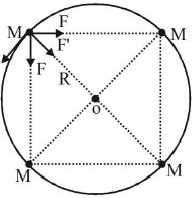
0 likes
View Solution46
DifficultMCQ
$A$ satellite is orbiting the Earth at a height $h$ above the surface (where $R$ is the radius of the Earth and $h \ll R$). What is the minimum increase in the orbital velocity required for the satellite to escape the Earth's gravitational field? (Ignore the effect of the atmosphere.)
A
$\sqrt{\frac{gR}{2}}$
B
$\sqrt{gR}(\sqrt{2}-1)$
C
$\sqrt{2gR}$
D
$\sqrt{gR}$
Solution
(B) The orbital velocity of a satellite at height $h$ is given by $v_o = \sqrt{\frac{GM}{R+h}}$. Since $h \ll R$,we can approximate $R+h \approx R$. Thus,$v_o \approx \sqrt{\frac{GM}{R}} = \sqrt{gR}$.
The escape velocity from the Earth's surface (or near the surface) is given by $v_e = \sqrt{\frac{2GM}{R}} = \sqrt{2gR}$.
The required increase in velocity $\Delta v$ is the difference between the escape velocity and the orbital velocity:
$\Delta v = v_e - v_o = \sqrt{2gR} - \sqrt{gR}$.
Factoring out $\sqrt{gR}$,we get:
$\Delta v = \sqrt{gR}(\sqrt{2} - 1)$.
The escape velocity from the Earth's surface (or near the surface) is given by $v_e = \sqrt{\frac{2GM}{R}} = \sqrt{2gR}$.
The required increase in velocity $\Delta v$ is the difference between the escape velocity and the orbital velocity:
$\Delta v = v_e - v_o = \sqrt{2gR} - \sqrt{gR}$.
Factoring out $\sqrt{gR}$,we get:
$\Delta v = \sqrt{gR}(\sqrt{2} - 1)$.
0 likes
View Solution47
MediumMCQ
The variation of acceleration due to gravity $g$ with distance $d$ from the centre of the earth is best represented by ($R =$ Earth's radius)
A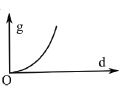
B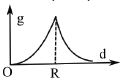
C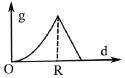
D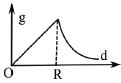
Solution
(D) The variation of acceleration due to gravity $g$ with distance $d$ from the center of the earth is given by:
$1$. Inside the earth $(d < R)$:
$g = \frac{GM}{R^3} d$
Since $G, M,$ and $R$ are constants,$g \propto d$. This represents a straight line passing through the origin.
$2$. At the surface of the earth $(d = R)$:
$g = \frac{GM}{R^2} = g_s$ (maximum value).
$3$. Outside the earth $(d > R)$:
$g = \frac{GM}{d^2}$
Here,$g \propto \frac{1}{d^2}$. This represents a rectangular hyperbola.
Combining these,the graph shows a linear increase from the center to the surface,followed by a hyperbolic decrease as distance increases beyond the surface. This matches the graph in option $D$.
$1$. Inside the earth $(d < R)$:
$g = \frac{GM}{R^3} d$
Since $G, M,$ and $R$ are constants,$g \propto d$. This represents a straight line passing through the origin.
$2$. At the surface of the earth $(d = R)$:
$g = \frac{GM}{R^2} = g_s$ (maximum value).
$3$. Outside the earth $(d > R)$:
$g = \frac{GM}{d^2}$
Here,$g \propto \frac{1}{d^2}$. This represents a rectangular hyperbola.
Combining these,the graph shows a linear increase from the center to the surface,followed by a hyperbolic decrease as distance increases beyond the surface. This matches the graph in option $D$.
0 likes
View SolutionGravitation — Mix Examples-Gravitation · Frequently Asked Questions
1Are these Gravitation questions useful for JEE and NEET?
Yes. All questions in this section are mapped to JEE Main and NEET exam patterns. Previous year questions from JEE Main, NEET, GUJCET and state-level exams are included with full solutions.
2Can I switch to Hindi or Gujarati for these questions?
Yes. Use the language tabs in the hero section or the sidebar to view the same questions and solutions in English, Hindi or Gujarati.
3How do I generate a question paper from this subtopic?
Use the Vedclass Exam Paper Generator — select the chapter and subtopic, set difficulty, and generate Sets A, B, C, D automatically. First 3 chapters of every subject are free.
Vedclass Products
For Students
Vedclass Test Series
Mock tests in real JEE/NEET style with performance analysis. 5-day free trial.
Start Free TrialFor Teachers
Exam Paper Generator
Generate Set A/B/C/D papers from this chapter in 2 minutes. 3 chapters free.
Try FreeFor Institutes
Online Exam Module
Live online exams with unlimited students, 360° analytics & white-label branding.
See DemoFor Teachers & Institutes
Generate a Gravitation Exam Paper in 2 Minutes
Select subtopic & difficulty — Sets A, B, C, D auto-generated with No Repeat logic.
First 3 chapters of every subject are free — no payment required.