
A English
Acceleration Due to Gravity and its Variation Questions in English
Class 11 Physics · Gravitation · Acceleration Due to Gravity and its Variation
430+
Questions
English
Language
100%
With Solutions
Showing 50 of 430 questions in English
101
MediumMCQ
At what depth does the acceleration due to gravity become $\frac{g}{4}$? ($R$ = radius of the Earth)
A
$R$
B
$\frac{3R}{4}$
C
$\frac{R}{2}$
D
$\frac{R}{4}$
Solution
(B) The acceleration due to gravity at a depth $d$ below the surface of the Earth is given by the formula:
$g' = g\left(1 - \frac{d}{R}\right)$
Given that the acceleration due to gravity at depth $d$ is $\frac{g}{4}$,we substitute $g' = \frac{g}{4}$ into the equation:
$\frac{g}{4} = g\left(1 - \frac{d}{R}\right)$
Dividing both sides by $g$:
$\frac{1}{4} = 1 - \frac{d}{R}$
Rearranging the terms to solve for $d$:
$\frac{d}{R} = 1 - \frac{1}{4}$
$\frac{d}{R} = \frac{3}{4}$
$d = \frac{3R}{4}$
Thus,at a depth of $\frac{3R}{4}$,the acceleration due to gravity becomes $\frac{g}{4}$.
$g' = g\left(1 - \frac{d}{R}\right)$
Given that the acceleration due to gravity at depth $d$ is $\frac{g}{4}$,we substitute $g' = \frac{g}{4}$ into the equation:
$\frac{g}{4} = g\left(1 - \frac{d}{R}\right)$
Dividing both sides by $g$:
$\frac{1}{4} = 1 - \frac{d}{R}$
Rearranging the terms to solve for $d$:
$\frac{d}{R} = 1 - \frac{1}{4}$
$\frac{d}{R} = \frac{3}{4}$
$d = \frac{3R}{4}$
Thus,at a depth of $\frac{3R}{4}$,the acceleration due to gravity becomes $\frac{g}{4}$.
0 likes
View Solution102
MediumMCQ
At what depth $d$ below the surface of the Earth does the acceleration due to gravity become $\frac{1}{n}$ times its value at the surface? ($R$ = radius of the Earth)
A
$\frac{R}{n}$
B
$R \left( \frac{n-1}{n} \right)$
C
$\frac{R}{n^2}$
D
$R \left( \frac{n}{n+1} \right)$
Solution
(B) The acceleration due to gravity at a depth $d$ below the Earth's surface is given by the formula: $g' = g \left( 1 - \frac{d}{R} \right)$.
Given that the acceleration due to gravity at depth $d$ is $\frac{1}{n}$ times the value at the surface,we have $g' = \frac{g}{n}$.
Substituting this into the formula: $\frac{g}{n} = g \left( 1 - \frac{d}{R} \right)$.
Dividing both sides by $g$: $\frac{1}{n} = 1 - \frac{d}{R}$.
Rearranging the terms to solve for $d$: $\frac{d}{R} = 1 - \frac{1}{n}$.
$\frac{d}{R} = \frac{n-1}{n}$.
Therefore,the depth $d$ is $d = R \left( \frac{n-1}{n} \right)$.
Given that the acceleration due to gravity at depth $d$ is $\frac{1}{n}$ times the value at the surface,we have $g' = \frac{g}{n}$.
Substituting this into the formula: $\frac{g}{n} = g \left( 1 - \frac{d}{R} \right)$.
Dividing both sides by $g$: $\frac{1}{n} = 1 - \frac{d}{R}$.
Rearranging the terms to solve for $d$: $\frac{d}{R} = 1 - \frac{1}{n}$.
$\frac{d}{R} = \frac{n-1}{n}$.
Therefore,the depth $d$ is $d = R \left( \frac{n-1}{n} \right)$.
0 likes
View Solution103
DifficultMCQ
What should be the angular speed of the Earth so that a body at $60^{\circ}$ latitude becomes weightless? (Radius of Earth $R = 6400 \, km$)
A
$2.5 \times 10^{-3} \, rad/sec$
B
$5.0 \times 10^{-1} \, rad/sec$
C
$10 \times 10^{1} \, rad/sec$
D
$7.8 \times 10^{-2} \, rad/sec$
Solution
(A) The effective acceleration due to gravity $g'$ at a latitude $\lambda$ is given by $g' = g - \omega^2 R \cos^2 \lambda$.
For the body to be weightless,the effective gravity must be zero,so $g' = 0$.
Substituting the values: $0 = g - \omega^2 R \cos^2(60^{\circ})$.
Since $\cos(60^{\circ}) = 1/2$,we have $\cos^2(60^{\circ}) = 1/4$.
Thus,$g = \omega^2 R (1/4) \implies \omega^2 = 4g/R$.
Taking the square root,$\omega = 2 \sqrt{g/R}$.
Using $g = 9.8 \, m/s^2$ and $R = 6.4 \times 10^6 \, m$:
$\omega = 2 \sqrt{9.8 / (6.4 \times 10^6)} \approx 2 \sqrt{1.53 \times 10^{-6}} \approx 2 \times 1.237 \times 10^{-3} \approx 2.47 \times 10^{-3} \, rad/s$.
Rounding to the nearest option,$\omega = 2.5 \times 10^{-3} \, rad/s$.
For the body to be weightless,the effective gravity must be zero,so $g' = 0$.
Substituting the values: $0 = g - \omega^2 R \cos^2(60^{\circ})$.
Since $\cos(60^{\circ}) = 1/2$,we have $\cos^2(60^{\circ}) = 1/4$.
Thus,$g = \omega^2 R (1/4) \implies \omega^2 = 4g/R$.
Taking the square root,$\omega = 2 \sqrt{g/R}$.
Using $g = 9.8 \, m/s^2$ and $R = 6.4 \times 10^6 \, m$:
$\omega = 2 \sqrt{9.8 / (6.4 \times 10^6)} \approx 2 \sqrt{1.53 \times 10^{-6}} \approx 2 \times 1.237 \times 10^{-3} \approx 2.47 \times 10^{-3} \, rad/s$.
Rounding to the nearest option,$\omega = 2.5 \times 10^{-3} \, rad/s$.
0 likes
View Solution104
MediumMCQ
For a sphere of mass $M$ and radius $R$,if the gravitational forces at distances $r_1$ and $r_2$ from the center are $F_1$ and $F_2$ respectively,then:
A
$\frac{F_1}{F_2} = \frac{r_1}{r_2}$ if $r_1 < R$ and $r_2 < R$
B
$\frac{F_1}{F_2} = \frac{r_1^2}{r_2^2}$ if $r_1 < R$ and $r_2 < R$
C
$\frac{F_1}{F_2} = \frac{r_1}{r_2}$ if $r_1 > R$ and $r_2 > R$
D
$\frac{F_1}{F_2} = \frac{r_2^2}{r_1^2}$ if $r_1 > R$ and $r_2 > R$
Solution
(A) The gravitational force $F$ on a test mass $m$ is given by $F = mI$,where $I$ is the gravitational field intensity.
Case $1$: For points outside the sphere $(r > R)$:
The gravitational field intensity is $I = \frac{GM}{r^2}$.
Thus,$F \propto \frac{1}{r^2}$.
Therefore,$\frac{F_1}{F_2} = \frac{r_2^2}{r_1^2}$ for $r_1 > R$ and $r_2 > R$.
Case $2$: For points inside the sphere $(r < R)$:
The gravitational field intensity is $I = \frac{GMr}{R^3}$.
Thus,$F \propto r$.
Therefore,$\frac{F_1}{F_2} = \frac{r_1}{r_2}$ for $r_1 < R$ and $r_2 < R$.
Comparing these with the given options,option $A$ is correct.
Case $1$: For points outside the sphere $(r > R)$:
The gravitational field intensity is $I = \frac{GM}{r^2}$.
Thus,$F \propto \frac{1}{r^2}$.
Therefore,$\frac{F_1}{F_2} = \frac{r_2^2}{r_1^2}$ for $r_1 > R$ and $r_2 > R$.
Case $2$: For points inside the sphere $(r < R)$:
The gravitational field intensity is $I = \frac{GMr}{R^3}$.
Thus,$F \propto r$.
Therefore,$\frac{F_1}{F_2} = \frac{r_1}{r_2}$ for $r_1 < R$ and $r_2 < R$.
Comparing these with the given options,option $A$ is correct.
0 likes
View Solution105
MediumMCQ
If a body takes time $t$ to reach the ground when dropped from a height $h$ on Earth,how much time will it take to reach the ground when dropped from the same height $h$ on the Moon?
A
$t$
B
$6t$
C
$\sqrt{6}t$
D
$\frac{t}{6}$
Solution
(C) The time taken for a body to fall from a height $h$ under gravity is given by the kinematic equation $h = \frac{1}{2}gt^2$,which simplifies to $t = \sqrt{\frac{2h}{g}}$.
For Earth,$t_{earth} = \sqrt{\frac{2h}{g_{earth}}}$.
For the Moon,$t_{moon} = \sqrt{\frac{2h}{g_{moon}}}$.
Given that the acceleration due to gravity on the Moon is $g_{moon} = \frac{g_{earth}}{6}$,we can write the ratio as:
$\frac{t_{moon}}{t_{earth}} = \sqrt{\frac{g_{earth}}{g_{moon}}} = \sqrt{\frac{g_{earth}}{g_{earth}/6}} = \sqrt{6}$.
Therefore,$t_{moon} = \sqrt{6}t$.
For Earth,$t_{earth} = \sqrt{\frac{2h}{g_{earth}}}$.
For the Moon,$t_{moon} = \sqrt{\frac{2h}{g_{moon}}}$.
Given that the acceleration due to gravity on the Moon is $g_{moon} = \frac{g_{earth}}{6}$,we can write the ratio as:
$\frac{t_{moon}}{t_{earth}} = \sqrt{\frac{g_{earth}}{g_{moon}}} = \sqrt{\frac{g_{earth}}{g_{earth}/6}} = \sqrt{6}$.
Therefore,$t_{moon} = \sqrt{6}t$.
0 likes
View Solution106
DifficultMCQ
What is the time period of a seconds pendulum on a planet whose mass and radius are twice that of the Earth?
A
$1/\sqrt{2} \ s$
B
$2\sqrt{2} \ s$
C
$2 \ s$
D
$1/2 \ s$
Solution
(B) The acceleration due to gravity $g$ is given by $g = \frac{GM}{R^2}$.
For the new planet,$M' = 2M$ and $R' = 2R$.
Thus,the new acceleration due to gravity $g'$ is:
$g' = \frac{G(2M)}{(2R)^2} = \frac{2GM}{4R^2} = \frac{1}{2} \left( \frac{GM}{R^2} \right) = \frac{g}{2}$.
The time period of a pendulum is given by $T = 2\pi \sqrt{\frac{L}{g}}$.
Therefore,$\frac{T'}{T} = \sqrt{\frac{g}{g'}} = \sqrt{\frac{g}{g/2}} = \sqrt{2}$.
Given that for a seconds pendulum on Earth,$T = 2 \ s$.
So,$T' = T \times \sqrt{2} = 2\sqrt{2} \ s$.
For the new planet,$M' = 2M$ and $R' = 2R$.
Thus,the new acceleration due to gravity $g'$ is:
$g' = \frac{G(2M)}{(2R)^2} = \frac{2GM}{4R^2} = \frac{1}{2} \left( \frac{GM}{R^2} \right) = \frac{g}{2}$.
The time period of a pendulum is given by $T = 2\pi \sqrt{\frac{L}{g}}$.
Therefore,$\frac{T'}{T} = \sqrt{\frac{g}{g'}} = \sqrt{\frac{g}{g/2}} = \sqrt{2}$.
Given that for a seconds pendulum on Earth,$T = 2 \ s$.
So,$T' = T \times \sqrt{2} = 2\sqrt{2} \ s$.
0 likes
View Solution107
MediumMCQ
The height at which the weight of a body becomes $\frac{1}{16}^{th}$ of its weight on the surface of the Earth (radius $R$) is: (in $R$)
A
$5$
B
$15$
C
$3$
D
$4$
Solution
(C) The acceleration due to gravity at a height $h$ from the surface of the Earth is given by:
$g' = \frac{g}{(1 + \frac{h}{R})^2} \quad ... (i)$
Where $g$ is the acceleration due to gravity at the surface of the Earth and $R$ is the radius of the Earth.
Multiplying both sides by the mass of the body $m$,we get the weight $W'$ at height $h$:
$W' = mg' = \frac{mg}{(1 + \frac{h}{R})^2} = \frac{W}{(1 + \frac{h}{R})^2}$
According to the question,$W' = \frac{1}{16}W$.
Substituting this into the equation:
$\frac{1}{16} = \frac{1}{(1 + \frac{h}{R})^2}$
Taking the square root on both sides:
$1 + \frac{h}{R} = 4$
$\frac{h}{R} = 3$
$h = 3R$
$g' = \frac{g}{(1 + \frac{h}{R})^2} \quad ... (i)$
Where $g$ is the acceleration due to gravity at the surface of the Earth and $R$ is the radius of the Earth.
Multiplying both sides by the mass of the body $m$,we get the weight $W'$ at height $h$:
$W' = mg' = \frac{mg}{(1 + \frac{h}{R})^2} = \frac{W}{(1 + \frac{h}{R})^2}$
According to the question,$W' = \frac{1}{16}W$.
Substituting this into the equation:
$\frac{1}{16} = \frac{1}{(1 + \frac{h}{R})^2}$
Taking the square root on both sides:
$1 + \frac{h}{R} = 4$
$\frac{h}{R} = 3$
$h = 3R$
0 likes
View Solution108
MediumMCQ
$A$ spherical planet has a mass $M$ and diameter $D$. $A$ particle of mass $m$ falling freely near the surface of this planet will experience an acceleration due to gravity equal to:
A
$\frac{4GM}{D^2}$
B
$\frac{GM}{D^2}$
C
$\frac{GMm}{D^2}$
D
$\frac{4GMm}{D^2}$
Solution
(A) The gravitational force $F$ acting on a particle of mass $m$ near the surface of a planet of mass $M$ and radius $R = D/2$ is given by Newton's law of gravitation:
$F = \frac{GMm}{R^2} = \frac{GMm}{(D/2)^2}$
The acceleration due to gravity $g$ experienced by the particle is defined as the force per unit mass:
$g = \frac{F}{m} = \frac{GM}{(D/2)^2}$
Simplifying the expression:
$g = \frac{GM}{D^2/4} = \frac{4GM}{D^2}$
Thus,the acceleration due to gravity is $\frac{4GM}{D^2}$.
$F = \frac{GMm}{R^2} = \frac{GMm}{(D/2)^2}$
The acceleration due to gravity $g$ experienced by the particle is defined as the force per unit mass:
$g = \frac{F}{m} = \frac{GM}{(D/2)^2}$
Simplifying the expression:
$g = \frac{GM}{D^2/4} = \frac{4GM}{D^2}$
Thus,the acceleration due to gravity is $\frac{4GM}{D^2}$.
0 likes
View Solution109
MediumMCQ
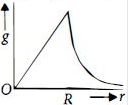
Starting from the centre of the earth having radius $R$,the variation of $g$ (acceleration due to gravity) is shown by:
A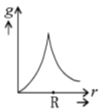
B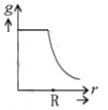
C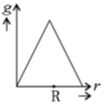
D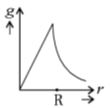
Solution
(D) The acceleration due to gravity $g$ at a distance $r$ from the centre of the Earth is given by:
For $r \le R$ (inside the Earth):
$g = \frac{4}{3} \pi \rho G r$
This shows that $g$ is directly proportional to $r$ $(g \propto r)$,which represents a straight line passing through the origin.
For $r > R$ (outside the Earth):
$g = \frac{GM}{r^2} = \frac{4}{3} \frac{\pi \rho R^3 G}{r^2}$
This shows that $g$ is inversely proportional to the square of the distance $(g \propto \frac{1}{r^2})$,which represents a hyperbolic curve.
Combining these,the graph starts from the origin,increases linearly until $r = R$,and then decreases following an inverse-square law for $r > R$. This matches the curve shown in the solution image.
For $r \le R$ (inside the Earth):
$g = \frac{4}{3} \pi \rho G r$
This shows that $g$ is directly proportional to $r$ $(g \propto r)$,which represents a straight line passing through the origin.
For $r > R$ (outside the Earth):
$g = \frac{GM}{r^2} = \frac{4}{3} \frac{\pi \rho R^3 G}{r^2}$
This shows that $g$ is inversely proportional to the square of the distance $(g \propto \frac{1}{r^2})$,which represents a hyperbolic curve.
Combining these,the graph starts from the origin,increases linearly until $r = R$,and then decreases following an inverse-square law for $r > R$. This matches the curve shown in the solution image.
0 likes
View Solution110
MediumMCQ
At a height of $h$ $km$ from the surface of the Earth,the gravitational potential and the value of $g$ are $-5.4 \times 10^7\, J kg^{-1}$ and $6.0\, m s^{-2}$ respectively. Take the radius of the Earth as $6400\, km$.
A
$1600$
B
$1400$
C
$2000$
D
$2600$
Solution
(D) The gravitational potential at a height $h$ from the surface of the Earth is given by $V_h = -\frac{GM}{R+h} = -5.4 \times 10^7\, J kg^{-1}$.
The acceleration due to gravity at the same height is $g_h = \frac{GM}{(R+h)^2} = 6.0\, m s^{-2}$.
We can relate these two expressions as $g_h = \frac{GM}{(R+h)^2} = \frac{1}{R+h} \left( \frac{GM}{R+h} \right) = \frac{-V_h}{R+h}$.
Rearranging for $(R+h)$,we get $R+h = \frac{-V_h}{g_h}$.
Substituting the given values: $R+h = \frac{-(-5.4 \times 10^7)}{6.0} = \frac{5.4 \times 10^7}{6.0} = 0.9 \times 10^7 = 9.0 \times 10^6\, m$.
Converting the radius of the Earth to meters: $R = 6400\, km = 6.4 \times 10^6\, m$.
Now,$h = (R+h) - R = 9.0 \times 10^6 - 6.4 \times 10^6 = 2.6 \times 10^6\, m$.
Converting back to kilometers: $h = 2600\, km$.
The acceleration due to gravity at the same height is $g_h = \frac{GM}{(R+h)^2} = 6.0\, m s^{-2}$.
We can relate these two expressions as $g_h = \frac{GM}{(R+h)^2} = \frac{1}{R+h} \left( \frac{GM}{R+h} \right) = \frac{-V_h}{R+h}$.
Rearranging for $(R+h)$,we get $R+h = \frac{-V_h}{g_h}$.
Substituting the given values: $R+h = \frac{-(-5.4 \times 10^7)}{6.0} = \frac{5.4 \times 10^7}{6.0} = 0.9 \times 10^7 = 9.0 \times 10^6\, m$.
Converting the radius of the Earth to meters: $R = 6400\, km = 6.4 \times 10^6\, m$.
Now,$h = (R+h) - R = 9.0 \times 10^6 - 6.4 \times 10^6 = 2.6 \times 10^6\, m$.
Converting back to kilometers: $h = 2600\, km$.
0 likes
View Solution111
MediumMCQ
Imagine Earth to be a solid sphere of mass $M$ and radius $R$. If the value of acceleration due to gravity at a depth $d$ below Earth's surface is the same as its value at a height $h$ above its surface and equal to $\frac{g}{4}$ (where $g$ is the value of acceleration due to gravity on the surface of Earth),the ratio of $\frac{h}{d}$ will be
A
$\frac{4}{3}$
B
$\frac{3}{2}$
C
$\frac{2}{3}$
D
$1$
Solution
(A) The acceleration due to gravity at a height $h$ above the surface is given by $g_h = g \left(1 + \frac{h}{R}\right)^{-2} \approx \frac{g}{(1 + h/R)^2}$.
Given $g_h = \frac{g}{4}$,we have $\frac{g}{4} = \frac{g}{(1 + h/R)^2}$.
Taking the square root on both sides,$2 = 1 + \frac{h}{R}$,which gives $\frac{h}{R} = 1$,so $h = R$.
The acceleration due to gravity at a depth $d$ below the surface is given by $g_d = g \left(1 - \frac{d}{R}\right)$.
Given $g_d = \frac{g}{4}$,we have $\frac{g}{4} = g \left(1 - \frac{d}{R}\right)$.
Dividing by $g$,$\frac{1}{4} = 1 - \frac{d}{R}$,which gives $\frac{d}{R} = 1 - \frac{1}{4} = \frac{3}{4}$,so $d = \frac{3R}{4}$.
Now,the ratio $\frac{h}{d} = \frac{R}{3R/4} = \frac{4}{3}$.
Given $g_h = \frac{g}{4}$,we have $\frac{g}{4} = \frac{g}{(1 + h/R)^2}$.
Taking the square root on both sides,$2 = 1 + \frac{h}{R}$,which gives $\frac{h}{R} = 1$,so $h = R$.
The acceleration due to gravity at a depth $d$ below the surface is given by $g_d = g \left(1 - \frac{d}{R}\right)$.
Given $g_d = \frac{g}{4}$,we have $\frac{g}{4} = g \left(1 - \frac{d}{R}\right)$.
Dividing by $g$,$\frac{1}{4} = 1 - \frac{d}{R}$,which gives $\frac{d}{R} = 1 - \frac{1}{4} = \frac{3}{4}$,so $d = \frac{3R}{4}$.
Now,the ratio $\frac{h}{d} = \frac{R}{3R/4} = \frac{4}{3}$.
0 likes
View Solution112
MediumMCQ
The acceleration due to gravity at a height $1\, km$ above the earth is the same as at a depth $d$ below the surface of earth. Then $d = $ ......... $km$
A
$1$
B
$1.5$
C
$2$
D
$4$
Solution
(C) The acceleration due to gravity at a height $h$ above the surface of the Earth is given by the formula:
$g_h = g \left( 1 - \frac{2h}{R_e} \right)$
where $R_e$ is the radius of the Earth.
The acceleration due to gravity at a depth $d$ below the surface of the Earth is given by the formula:
$g_d = g \left( 1 - \frac{d}{R_e} \right)$
According to the problem,the acceleration due to gravity at height $h$ is equal to the acceleration due to gravity at depth $d$:
$g_h = g_d$
Substituting the formulas:
$g \left( 1 - \frac{2h}{R_e} \right) = g \left( 1 - \frac{d}{R_e} \right)$
Canceling $g$ from both sides and simplifying:
$1 - \frac{2h}{R_e} = 1 - \frac{d}{R_e}$
$\frac{2h}{R_e} = \frac{d}{R_e}$
$d = 2h$
Given that $h = 1\, km$,we find:
$d = 2 \times 1\, km = 2\, km$
$g_h = g \left( 1 - \frac{2h}{R_e} \right)$
where $R_e$ is the radius of the Earth.
The acceleration due to gravity at a depth $d$ below the surface of the Earth is given by the formula:
$g_d = g \left( 1 - \frac{d}{R_e} \right)$
According to the problem,the acceleration due to gravity at height $h$ is equal to the acceleration due to gravity at depth $d$:
$g_h = g_d$
Substituting the formulas:
$g \left( 1 - \frac{2h}{R_e} \right) = g \left( 1 - \frac{d}{R_e} \right)$
Canceling $g$ from both sides and simplifying:
$1 - \frac{2h}{R_e} = 1 - \frac{d}{R_e}$
$\frac{2h}{R_e} = \frac{d}{R_e}$
$d = 2h$
Given that $h = 1\, km$,we find:
$d = 2 \times 1\, km = 2\, km$
0 likes
View Solution113
EasyMCQ
If the mass of the Sun were ten times smaller and the universal gravitational constant were ten times larger in magnitude,which of the following is not correct?
A
Raindrops will fall faster.
B
Walking on the ground would become more difficult.
C
$g$ on the Earth will not change.
D
Time period of a simple pendulum on the Earth would decrease.
Solution
(C) The acceleration due to gravity on the surface of the Earth is given by $g = \frac{GM}{R^2}$,where $M$ is the mass of the Earth and $R$ is the radius of the Earth.
Note that the mass of the Sun does not affect the value of $g$ on the Earth's surface.
If the universal gravitational constant $G$ becomes $10G$,then the new acceleration due to gravity $g'$ becomes $g' = \frac{(10G)M}{R^2} = 10g$.
Since $g' = 10g$,the acceleration due to gravity increases significantly.
$1$. Raindrops will fall faster because the acceleration due to gravity is higher.
$2$. Walking on the ground becomes more difficult because the effective weight of a person increases.
$3$. The time period of a simple pendulum is $T = 2\pi \sqrt{\frac{l}{g}}$. Since $g$ increases,$T$ will decrease.
$4$. The statement '$g$ on the Earth will not change' is incorrect because $g$ increases by a factor of $10$.
Note that the mass of the Sun does not affect the value of $g$ on the Earth's surface.
If the universal gravitational constant $G$ becomes $10G$,then the new acceleration due to gravity $g'$ becomes $g' = \frac{(10G)M}{R^2} = 10g$.
Since $g' = 10g$,the acceleration due to gravity increases significantly.
$1$. Raindrops will fall faster because the acceleration due to gravity is higher.
$2$. Walking on the ground becomes more difficult because the effective weight of a person increases.
$3$. The time period of a simple pendulum is $T = 2\pi \sqrt{\frac{l}{g}}$. Since $g$ increases,$T$ will decrease.
$4$. The statement '$g$ on the Earth will not change' is incorrect because $g$ increases by a factor of $10$.
0 likes
View Solution114
EasyMCQ
Suppose that the force of earth's gravity suddenly disappears,choose the correct answer out of the following statements.
A
The weight of the body will become zero but mass remains the same.
B
The mass of the body will become zero but the weight remains the same.
C
Both the mass and weight will be the same.
D
Mass and weight will remain the same.
Solution
(A) Weight is defined as the force exerted on an object due to gravity,given by the formula $W = m \times g$,where $m$ is the mass and $g$ is the acceleration due to gravity. If the force of gravity disappears,$g$ becomes $0$,which results in the weight $W$ becoming $0$. However,mass is an intrinsic property of an object representing the amount of matter it contains and does not depend on gravity. Therefore,the mass remains unchanged.
0 likes
View Solution115
MediumMCQ
Consider Earth to be a homogeneous sphere. Scientist $A$ goes deep down in a mine and scientist $B$ goes high up in a balloon. The value of $g$ measured by
A
$A$ goes on decreasing and that by $B$ goes on increasing
B
$B$ goes on decreasing and that by $A$ goes on increasing
C
Each decreases at the same rate
D
Each decreases at different rates
Solution
(D) For scientist $A$,who goes down into a mine at depth $d$,the acceleration due to gravity is given by $g' = g(1 - d/R)$. As $d$ increases,$g'$ decreases.
For scientist $B$,who goes up in a balloon to a height $h$,the acceleration due to gravity is given by $g' = g(1 - 2h/R)$ (for $h \ll R$). As $h$ increases,$g'$ decreases.
Since the mathematical expressions for the variation of $g$ with depth and height are different,the value of $g$ measured by each scientist decreases at different rates.
For scientist $B$,who goes up in a balloon to a height $h$,the acceleration due to gravity is given by $g' = g(1 - 2h/R)$ (for $h \ll R$). As $h$ increases,$g'$ decreases.
Since the mathematical expressions for the variation of $g$ with depth and height are different,the value of $g$ measured by each scientist decreases at different rates.
0 likes
View Solution116
MediumMCQ
The mass of the moon is $\frac{1}{81}$ of the earth,but the gravitational pull (acceleration due to gravity) is $\frac{1}{6}$ of the earth. This is due to the fact that:
A
The radius of the moon is $\frac{81}{6}$ of the earth
B
The radius of the earth is $\frac{9}{\sqrt{6}}$ of the moon
C
Moon is the satellite of the earth
D
None of the above
Solution
(B) The acceleration due to gravity $g$ on the surface of a celestial body is given by $g = \frac{GM}{R^2}$,where $M$ is the mass and $R$ is the radius.
Given: $M_m = \frac{1}{81} M_e$ and $g_m = \frac{1}{6} g_e$.
We have the ratio: $\frac{g_m}{g_e} = \frac{M_m}{M_e} \times \left( \frac{R_e}{R_m} \right)^2$.
Substituting the values: $\frac{1}{6} = \frac{1}{81} \times \left( \frac{R_e}{R_m} \right)^2$.
Therefore,$\left( \frac{R_e}{R_m} \right)^2 = \frac{81}{6}$.
Taking the square root on both sides: $\frac{R_e}{R_m} = \sqrt{\frac{81}{6}} = \frac{9}{\sqrt{6}}$.
Thus,$R_e = \frac{9}{\sqrt{6}} R_m$.
Given: $M_m = \frac{1}{81} M_e$ and $g_m = \frac{1}{6} g_e$.
We have the ratio: $\frac{g_m}{g_e} = \frac{M_m}{M_e} \times \left( \frac{R_e}{R_m} \right)^2$.
Substituting the values: $\frac{1}{6} = \frac{1}{81} \times \left( \frac{R_e}{R_m} \right)^2$.
Therefore,$\left( \frac{R_e}{R_m} \right)^2 = \frac{81}{6}$.
Taking the square root on both sides: $\frac{R_e}{R_m} = \sqrt{\frac{81}{6}} = \frac{9}{\sqrt{6}}$.
Thus,$R_e = \frac{9}{\sqrt{6}} R_m$.
0 likes
View Solution117
MediumMCQ
If a planet has a mass and radius both half that of the Earth,the acceleration due to gravity at its surface would be ......... $m/s^2$ ($g$ on Earth $= 9.8\, m/s^2$)
A
$4.9$
B
$8.9$
C
$19.6$
D
$29.4$
Solution
(C) The acceleration due to gravity on the surface of a planet is given by the formula $g = \frac{GM}{R^2}$.
This implies that $g \propto \frac{M}{R^2}$.
According to the problem,the mass of the planet is $M_p = \frac{M_e}{2}$ and its radius is $R_p = \frac{R_e}{2}$,where $M_e$ and $R_e$ are the mass and radius of the Earth respectively.
Taking the ratio of the acceleration due to gravity on the planet $(g_p)$ to that on Earth $(g_e)$:
$\frac{g_p}{g_e} = \left( \frac{M_p}{M_e} \right) \times \left( \frac{R_e}{R_p} \right)^2 = \left( \frac{1}{2} \right) \times (2)^2 = \frac{1}{2} \times 4 = 2$.
Therefore,$g_p = 2 \times g_e = 2 \times 9.8\, m/s^2 = 19.6\, m/s^2$.
This implies that $g \propto \frac{M}{R^2}$.
According to the problem,the mass of the planet is $M_p = \frac{M_e}{2}$ and its radius is $R_p = \frac{R_e}{2}$,where $M_e$ and $R_e$ are the mass and radius of the Earth respectively.
Taking the ratio of the acceleration due to gravity on the planet $(g_p)$ to that on Earth $(g_e)$:
$\frac{g_p}{g_e} = \left( \frac{M_p}{M_e} \right) \times \left( \frac{R_e}{R_p} \right)^2 = \left( \frac{1}{2} \right) \times (2)^2 = \frac{1}{2} \times 4 = 2$.
Therefore,$g_p = 2 \times g_e = 2 \times 9.8\, m/s^2 = 19.6\, m/s^2$.
0 likes
View Solution118
EasyMCQ
$g_e$ and $g_p$ denote the acceleration due to gravity on the surface of the Earth and another planet whose mass and radius are twice that of the Earth. Then:
A
$g_p = g_e$
B
$g_p = g_e / 2$
C
$g_p = 2g_e$
D
$g_p = g_e / 4$
Solution
(B) The acceleration due to gravity on the surface of a planet is given by the formula $g = \frac{GM}{R^2}$,where $G$ is the universal gravitational constant,$M$ is the mass of the planet,and $R$ is its radius.
For Earth,$g_e = \frac{GM_e}{R_e^2}$.
For the other planet,the mass $M_p = 2M_e$ and the radius $R_p = 2R_e$.
Substituting these values into the formula for $g_p$:
$g_p = \frac{G(2M_e)}{(2R_e)^2} = \frac{2GM_e}{4R_e^2} = \frac{1}{2} \left( \frac{GM_e}{R_e^2} \right)$.
Since $g_e = \frac{GM_e}{R_e^2}$,we get $g_p = \frac{g_e}{2}$.
For Earth,$g_e = \frac{GM_e}{R_e^2}$.
For the other planet,the mass $M_p = 2M_e$ and the radius $R_p = 2R_e$.
Substituting these values into the formula for $g_p$:
$g_p = \frac{G(2M_e)}{(2R_e)^2} = \frac{2GM_e}{4R_e^2} = \frac{1}{2} \left( \frac{GM_e}{R_e^2} \right)$.
Since $g_e = \frac{GM_e}{R_e^2}$,we get $g_p = \frac{g_e}{2}$.
0 likes
View Solution119
MediumMCQ
If the value of $g$ at the surface of the earth is $9.8 \, m/s^2$,then the value of $g$ at a place $480 \, km$ above the surface of the earth will be .......... $m/s^2$. (Radius of the earth is $6400 \, km$)
A
$8.4$
B
$9.8$
C
$7.2$
D
$4.2$
Solution
(A) The acceleration due to gravity at the surface of the earth is given by $g = \frac{GM}{R^2} = 9.8 \, m/s^2$.
At a height $h$ above the surface of the earth,the acceleration due to gravity $g'$ is given by $g' = g \left( \frac{R}{R+h} \right)^2$.
Given: $g = 9.8 \, m/s^2$,$R = 6400 \, km$,and $h = 480 \, km$.
Substituting these values into the formula:
$g' = 9.8 \times \left( \frac{6400}{6400 + 480} \right)^2$
$g' = 9.8 \times \left( \frac{6400}{6880} \right)^2$
$g' = 9.8 \times (0.9302)^2$
$g' = 9.8 \times 0.8653 \approx 8.48 \, m/s^2$.
Rounding to the nearest provided option,we get $8.4 \, m/s^2$.
At a height $h$ above the surface of the earth,the acceleration due to gravity $g'$ is given by $g' = g \left( \frac{R}{R+h} \right)^2$.
Given: $g = 9.8 \, m/s^2$,$R = 6400 \, km$,and $h = 480 \, km$.
Substituting these values into the formula:
$g' = 9.8 \times \left( \frac{6400}{6400 + 480} \right)^2$
$g' = 9.8 \times \left( \frac{6400}{6880} \right)^2$
$g' = 9.8 \times (0.9302)^2$
$g' = 9.8 \times 0.8653 \approx 8.48 \, m/s^2$.
Rounding to the nearest provided option,we get $8.4 \, m/s^2$.
0 likes
View Solution120
MediumMCQ
The acceleration due to gravity at an altitude $h$ above the Earth's surface is half of its value on the surface of the Earth. If the radius of the Earth $R = 4000 \ mile$,the altitude $h$ is approximately ......... $mile$.
A
$1200$
B
$2000$
C
$1600$
D
$4000$
Solution
(C) The acceleration due to gravity at height $h$ is given by $g' = g \left( \frac{R}{R + h} \right)^2$.
Given that $g' = \frac{g}{2}$,we have $\frac{1}{2} = \left( \frac{R}{R + h} \right)^2$.
Taking the square root on both sides,we get $\frac{1}{\sqrt{2}} = \frac{R}{R + h}$.
This implies $R + h = R\sqrt{2}$,so $h = R(\sqrt{2} - 1)$.
Given $R = 4000 \ mile$ and $\sqrt{2} \approx 1.414$,we have $h = 4000(1.414 - 1) = 4000(0.414) = 1656 \ mile$.
Rounding to the nearest provided option,$h \approx 1600 \ mile$.
Given that $g' = \frac{g}{2}$,we have $\frac{1}{2} = \left( \frac{R}{R + h} \right)^2$.
Taking the square root on both sides,we get $\frac{1}{\sqrt{2}} = \frac{R}{R + h}$.
This implies $R + h = R\sqrt{2}$,so $h = R(\sqrt{2} - 1)$.
Given $R = 4000 \ mile$ and $\sqrt{2} \approx 1.414$,we have $h = 4000(1.414 - 1) = 4000(0.414) = 1656 \ mile$.
Rounding to the nearest provided option,$h \approx 1600 \ mile$.
0 likes
View Solution121
MediumMCQ
At what altitude will the acceleration due to gravity be $25\%$ of that at the earth's surface (given radius of earth is $R$)?
A
$R/4$
B
$R$
C
$3R/8$
D
$R/2$
Solution
(B) The acceleration due to gravity at the surface of the earth is given by $g_0 = \frac{GM}{R^2}$,where $M$ is the mass of the earth and $R$ is its radius.
At an altitude $h$,the acceleration due to gravity $g_h$ is given by $g_h = \frac{GM}{(R+h)^2}$.
We are given that $g_h = 25\% \text{ of } g_0$,which means $g_h = \frac{1}{4} g_0$.
Substituting the expressions for $g_h$ and $g_0$,we get $\frac{GM}{(R+h)^2} = \frac{1}{4} \frac{GM}{R^2}$.
Canceling $GM$ from both sides,we have $\frac{1}{(R+h)^2} = \frac{1}{4R^2}$.
Taking the square root of both sides,we get $\frac{1}{R+h} = \frac{1}{2R}$.
Cross-multiplying gives $2R = R + h$,which simplifies to $h = R$.
At an altitude $h$,the acceleration due to gravity $g_h$ is given by $g_h = \frac{GM}{(R+h)^2}$.
We are given that $g_h = 25\% \text{ of } g_0$,which means $g_h = \frac{1}{4} g_0$.
Substituting the expressions for $g_h$ and $g_0$,we get $\frac{GM}{(R+h)^2} = \frac{1}{4} \frac{GM}{R^2}$.
Canceling $GM$ from both sides,we have $\frac{1}{(R+h)^2} = \frac{1}{4R^2}$.
Taking the square root of both sides,we get $\frac{1}{R+h} = \frac{1}{2R}$.
Cross-multiplying gives $2R = R + h$,which simplifies to $h = R$.
0 likes
View Solution122
MediumMCQ
If the radius of the earth is increased by a factor of $5$,by what factor must its density be changed to keep the value of $g$ the same?
A
$1/25$
B
$1/5$
C
$1/\sqrt{5}$
D
$5$
Solution
(B) The acceleration due to gravity on the surface of the earth is given by $g = \frac{GM}{R^2}$.
Substituting mass $M = \rho V = \rho \left( \frac{4}{3} \pi R^3 \right)$,we get:
$g = \frac{G \rho \frac{4}{3} \pi R^3}{R^2} = \frac{4}{3} G \pi \rho R$.
Since $G$,$\pi$,and $\frac{4}{3}$ are constants,we have $g \propto \rho R$.
To keep $g$ constant,the product $\rho R$ must remain constant.
Let the initial density be $\rho_1$ and radius be $R_1$. Let the final density be $\rho_2$ and radius be $R_2 = 5R_1$.
Then,$\rho_1 R_1 = \rho_2 R_2$.
$\rho_1 R_1 = \rho_2 (5R_1)$.
$\rho_2 = \frac{\rho_1}{5}$.
Thus,the density must be changed by a factor of $1/5$.
Substituting mass $M = \rho V = \rho \left( \frac{4}{3} \pi R^3 \right)$,we get:
$g = \frac{G \rho \frac{4}{3} \pi R^3}{R^2} = \frac{4}{3} G \pi \rho R$.
Since $G$,$\pi$,and $\frac{4}{3}$ are constants,we have $g \propto \rho R$.
To keep $g$ constant,the product $\rho R$ must remain constant.
Let the initial density be $\rho_1$ and radius be $R_1$. Let the final density be $\rho_2$ and radius be $R_2 = 5R_1$.
Then,$\rho_1 R_1 = \rho_2 R_2$.
$\rho_1 R_1 = \rho_2 (5R_1)$.
$\rho_2 = \frac{\rho_1}{5}$.
Thus,the density must be changed by a factor of $1/5$.
0 likes
View Solution123
AdvancedMCQ
$A$ newly discovered planet has a density eight times the density of the earth and a radius twice the radius of the earth. The time taken by a $2\, kg$ mass to fall freely through a distance $S$ near the surface of the earth is $1$ second. Then the time taken for a $4\, kg$ mass to fall freely through the same distance $S$ near the surface of the new planet is ....... $\sec$.
A
$0.25$
B
$0.5$
C
$1$
D
$4$
Solution
(A) Let the density of Earth be $d$ and its radius be $R$.
Then the density of the planet is $8d$ and its radius is $2R$.
Mass of Earth $M = \frac{4}{3} \pi R^3 d$.
Mass of the planet $M' = \frac{4}{3} \pi (2R)^3 (8d) = \frac{4}{3} \pi (8R^3) (8d) = 64 M$.
Acceleration due to gravity on Earth is $g = \frac{GM}{R^2}$.
Acceleration due to gravity on the planet is $g' = \frac{GM'}{(2R)^2} = \frac{G(64M)}{4R^2} = 16 \frac{GM}{R^2} = 16g$.
For a body falling freely from rest,the distance $S$ covered in time $t$ is $S = \frac{1}{2}at^2$.
On Earth: $S = \frac{1}{2}g(1)^2 = \frac{g}{2}$.
On the planet: $S = \frac{1}{2}g't^2 = \frac{1}{2}(16g)t^2 = 8gt^2$.
Equating the two expressions for $S$: $\frac{g}{2} = 8gt^2$.
$t^2 = \frac{1}{16} \implies t = \frac{1}{4} = 0.25 \, \text{sec}$.
Note: The mass of the object does not affect the time of free fall.
Then the density of the planet is $8d$ and its radius is $2R$.
Mass of Earth $M = \frac{4}{3} \pi R^3 d$.
Mass of the planet $M' = \frac{4}{3} \pi (2R)^3 (8d) = \frac{4}{3} \pi (8R^3) (8d) = 64 M$.
Acceleration due to gravity on Earth is $g = \frac{GM}{R^2}$.
Acceleration due to gravity on the planet is $g' = \frac{GM'}{(2R)^2} = \frac{G(64M)}{4R^2} = 16 \frac{GM}{R^2} = 16g$.
For a body falling freely from rest,the distance $S$ covered in time $t$ is $S = \frac{1}{2}at^2$.
On Earth: $S = \frac{1}{2}g(1)^2 = \frac{g}{2}$.
On the planet: $S = \frac{1}{2}g't^2 = \frac{1}{2}(16g)t^2 = 8gt^2$.
Equating the two expressions for $S$: $\frac{g}{2} = 8gt^2$.
$t^2 = \frac{1}{16} \implies t = \frac{1}{4} = 0.25 \, \text{sec}$.
Note: The mass of the object does not affect the time of free fall.
0 likes
View Solution124
DifficultMCQ
At what height above the earth's surface does the acceleration due to gravity fall to $1\%$ of its value at the earth's surface (in $,R$)?
A
$9$
B
$10$
C
$99$
D
$100$
Solution
(A) Given: $g_{h} = 1\% \text{ of } g_{s} = 0.01 g_{s}$.
The formula for acceleration due to gravity at height $h$ is $g_{h} = g_{s} \left( \frac{R}{R+h} \right)^{2}$.
Substituting the given value: $0.01 g_{s} = g_{s} \left( \frac{R}{R+h} \right)^{2}$.
Dividing both sides by $g_{s}$: $0.01 = \left( \frac{R}{R+h} \right)^{2}$.
Taking the square root on both sides: $0.1 = \frac{R}{R+h}$.
Rearranging the equation: $0.1(R + h) = R$.
$0.1R + 0.1h = R$.
$0.1h = 0.9R$.
$h = \frac{0.9}{0.1} R = 9R$.
Thus,at a height of $9R$,the acceleration due to gravity falls to $1\%$ of its value at the surface.
The formula for acceleration due to gravity at height $h$ is $g_{h} = g_{s} \left( \frac{R}{R+h} \right)^{2}$.
Substituting the given value: $0.01 g_{s} = g_{s} \left( \frac{R}{R+h} \right)^{2}$.
Dividing both sides by $g_{s}$: $0.01 = \left( \frac{R}{R+h} \right)^{2}$.
Taking the square root on both sides: $0.1 = \frac{R}{R+h}$.
Rearranging the equation: $0.1(R + h) = R$.
$0.1R + 0.1h = R$.
$0.1h = 0.9R$.
$h = \frac{0.9}{0.1} R = 9R$.
Thus,at a height of $9R$,the acceleration due to gravity falls to $1\%$ of its value at the surface.
0 likes
View Solution125
MediumMCQ
The ratio of gravitational acceleration at height $3R$ to that at height $4R$ from the surface of the earth is (where $R$ is the radius of the earth):
A
$9/16$
B
$25/16$
C
$16/25$
D
$16/9$
Solution
(B) The gravitational acceleration $g_h$ at a height $h$ from the surface of the earth is given by the formula:
$g_h = g \left( \frac{R}{R+h} \right)^2$
where $g$ is the acceleration due to gravity at the surface of the earth.
For height $h_1 = 3R$,the acceleration is:
$g_1 = g \left( \frac{R}{R+3R} \right)^2 = g \left( \frac{R}{4R} \right)^2 = g \left( \frac{1}{4} \right)^2 = \frac{g}{16}$
For height $h_2 = 4R$,the acceleration is:
$g_2 = g \left( \frac{R}{R+4R} \right)^2 = g \left( \frac{R}{5R} \right)^2 = g \left( \frac{1}{5} \right)^2 = \frac{g}{25}$
The ratio of gravitational acceleration at height $3R$ to that at height $4R$ is:
$\frac{g_1}{g_2} = \frac{g/16}{g/25} = \frac{25}{16}$
Thus,the correct option is $B$.
$g_h = g \left( \frac{R}{R+h} \right)^2$
where $g$ is the acceleration due to gravity at the surface of the earth.
For height $h_1 = 3R$,the acceleration is:
$g_1 = g \left( \frac{R}{R+3R} \right)^2 = g \left( \frac{R}{4R} \right)^2 = g \left( \frac{1}{4} \right)^2 = \frac{g}{16}$
For height $h_2 = 4R$,the acceleration is:
$g_2 = g \left( \frac{R}{R+4R} \right)^2 = g \left( \frac{R}{5R} \right)^2 = g \left( \frac{1}{5} \right)^2 = \frac{g}{25}$
The ratio of gravitational acceleration at height $3R$ to that at height $4R$ is:
$\frac{g_1}{g_2} = \frac{g/16}{g/25} = \frac{25}{16}$
Thus,the correct option is $B$.
0 likes
View Solution126
AdvancedMCQ
$A$ uniform spherical planet (Radius $R$) has acceleration due to gravity at its surface $g$. Points $P$ and $Q$ located inside and outside the planet have acceleration due to gravity $g/4$. The maximum possible separation between $P$ and $Q$ is:
A
$7R/4$
B
$3R/4$
C
$9R/4$
D
None of these
Solution
(A) For a point $P$ inside the planet at a distance $r_1$ from the center, the acceleration due to gravity is given by $g_{in} = g(r_1/R)$.
Given $g_{in} = g/4$, we have $r_1/R = 1/4$, so $r_1 = R/4$.
The distance of point $P$ from the surface is $d = R - r_1 = R - R/4 = 3R/4$.
For a point $Q$ outside the planet at a distance $r_2$ from the center, the acceleration due to gravity is given by $g_{out} = g(R/r_2)^2$.
Given $g_{out} = g/4$, we have $(R/r_2)^2 = 1/4$, which implies $R/r_2 = 1/2$, so $r_2 = 2R$.
The distance of point $Q$ from the surface is $h = r_2 - R = 2R - R = R$.
The maximum separation between $P$ and $Q$ is the sum of their distances from the surface: $d + h = 3R/4 + R = 7R/4$.
Given $g_{in} = g/4$, we have $r_1/R = 1/4$, so $r_1 = R/4$.
The distance of point $P$ from the surface is $d = R - r_1 = R - R/4 = 3R/4$.
For a point $Q$ outside the planet at a distance $r_2$ from the center, the acceleration due to gravity is given by $g_{out} = g(R/r_2)^2$.
Given $g_{out} = g/4$, we have $(R/r_2)^2 = 1/4$, which implies $R/r_2 = 1/2$, so $r_2 = 2R$.
The distance of point $Q$ from the surface is $h = r_2 - R = 2R - R = R$.
The maximum separation between $P$ and $Q$ is the sum of their distances from the surface: $d + h = 3R/4 + R = 7R/4$.
0 likes
View Solution127
MediumMCQ
Assuming the Earth to be a sphere of uniform density, the acceleration due to gravity:
A
at a point outside the Earth is inversely proportional to the square of its distance from the centre.
B
at a point outside the Earth is inversely proportional to its distance from the centre.
C
at a point inside is proportional to its distance from the centre.
D
$ (A) $ and $ (C) $ both.
Solution
(D) For a point outside the Earth at a distance $r$ from the centre $(r > R)$, the acceleration due to gravity is given by $g_{out} = \frac{GM}{r^2}$. Thus, $g_{out} \propto \frac{1}{r^2}$.
For a point inside the Earth at a distance $r$ from the centre $(r < R)$, assuming uniform density $\rho$, the mass enclosed is $M' = \rho \cdot \frac{4}{3}\pi r^3$. The acceleration due to gravity is $g_{in} = \frac{GM'}{r^2} = \frac{G}{r^2} \cdot \rho \cdot \frac{4}{3}\pi r^3 = \frac{4}{3}\pi G \rho r$. Thus, $g_{in} \propto r$.
Therefore, both statements $(A)$ and $(C)$ are correct.
For a point inside the Earth at a distance $r$ from the centre $(r < R)$, assuming uniform density $\rho$, the mass enclosed is $M' = \rho \cdot \frac{4}{3}\pi r^3$. The acceleration due to gravity is $g_{in} = \frac{GM'}{r^2} = \frac{G}{r^2} \cdot \rho \cdot \frac{4}{3}\pi r^3 = \frac{4}{3}\pi G \rho r$. Thus, $g_{in} \propto r$.
Therefore, both statements $(A)$ and $(C)$ are correct.
0 likes
View Solution128
EasyMCQ
The average density of the Earth:
A
is directly proportional to $g$
B
is inversely proportional to $g$
C
does not depend on $g$
D
is a complex function of $g$
Solution
(A) The acceleration due to gravity $g$ at the surface of the Earth is given by $g = \frac{GM}{R^2}$.
Substituting the mass $M = \rho \times V = \rho \times \frac{4}{3}\pi R^3$,we get:
$g = \frac{G \times \rho \times \frac{4}{3}\pi R^3}{R^2} = \frac{4}{3}\pi G \rho R$.
From this expression,we can see that the average density $\rho$ is given by $\rho = \frac{3g}{4\pi GR}$.
Since $G$,$\pi$,and $R$ (radius of the Earth) are constants,it follows that $\rho \propto g$.
Therefore,the average density of the Earth is directly proportional to $g$.
Substituting the mass $M = \rho \times V = \rho \times \frac{4}{3}\pi R^3$,we get:
$g = \frac{G \times \rho \times \frac{4}{3}\pi R^3}{R^2} = \frac{4}{3}\pi G \rho R$.
From this expression,we can see that the average density $\rho$ is given by $\rho = \frac{3g}{4\pi GR}$.
Since $G$,$\pi$,and $R$ (radius of the Earth) are constants,it follows that $\rho \propto g$.
Therefore,the average density of the Earth is directly proportional to $g$.
0 likes
View Solution129
MediumMCQ
The height at which the acceleration due to gravity becomes $\frac{g}{9}$ (where $g$ = the acceleration due to gravity on the surface of the earth) in terms of $R$,the radius of the earth,is
A
$2R$
B
$\frac{R}{\sqrt{2}}$
C
$\frac{R}{2}$
D
$\sqrt{2}R$
Solution
(A) The acceleration due to gravity at a height $h$ above the surface of the earth is given by the formula: $g' = g \left( \frac{R}{R+h} \right)^2$.
Given that $g' = \frac{g}{9}$,we substitute this into the equation:
$\frac{g}{9} = g \left( \frac{R}{R+h} \right)^2$.
Dividing both sides by $g$,we get: $\frac{1}{9} = \left( \frac{R}{R+h} \right)^2$.
Taking the square root of both sides: $\frac{1}{3} = \frac{R}{R+h}$.
Cross-multiplying gives: $R + h = 3R$.
Therefore,$h = 3R - R = 2R$.
Given that $g' = \frac{g}{9}$,we substitute this into the equation:
$\frac{g}{9} = g \left( \frac{R}{R+h} \right)^2$.
Dividing both sides by $g$,we get: $\frac{1}{9} = \left( \frac{R}{R+h} \right)^2$.
Taking the square root of both sides: $\frac{1}{3} = \frac{R}{R+h}$.
Cross-multiplying gives: $R + h = 3R$.
Therefore,$h = 3R - R = 2R$.
0 likes
View Solution130
DifficultMCQ
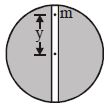
Suppose a vertical tunnel is dug along the diameter of the Earth,which is assumed to be a sphere of uniform mass having density $\rho$. If a body of mass $m$ is dropped into this tunnel,its acceleration at a distance $y$ from the center is given by
A
$\frac{4 \pi}{3} G \rho ym$
B
$\frac{3}{4} \pi G \rho y$
C
$\frac{4}{3} \pi G \rho y$
D
$\frac{4}{3} \pi G \rho ym$
Solution
(C) For a point at a distance $y$ from the center of a uniform sphere of density $\rho$,the gravitational force $F$ acting on a body of mass $m$ is due only to the mass $M'$ contained within a sphere of radius $y$.
$M' = \text{Volume} \times \text{Density} = \left(\frac{4}{3} \pi y^3\right) \rho$.
According to Newton's law of gravitation,the force is $F = \frac{G M' m}{y^2}$.
Substituting $M'$,we get $F = \frac{G m}{y^2} \left(\frac{4}{3} \pi y^3 \rho\right) = \frac{4}{3} \pi G \rho m y$.
Since $F = ma$,the acceleration $a$ is given by $a = \frac{F}{m} = \frac{4}{3} \pi G \rho y$.
$M' = \text{Volume} \times \text{Density} = \left(\frac{4}{3} \pi y^3\right) \rho$.
According to Newton's law of gravitation,the force is $F = \frac{G M' m}{y^2}$.
Substituting $M'$,we get $F = \frac{G m}{y^2} \left(\frac{4}{3} \pi y^3 \rho\right) = \frac{4}{3} \pi G \rho m y$.
Since $F = ma$,the acceleration $a$ is given by $a = \frac{F}{m} = \frac{4}{3} \pi G \rho y$.
0 likes
View Solution131
MediumMCQ
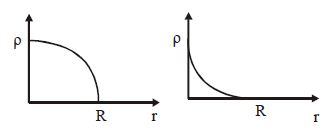
Two planets $A$ and $B$ have the same mass $M$ and radius $R$. The variation of density $\rho$ of the planets with distance $r$ from the center is shown in the following diagrams. The ratio of acceleration due to gravity at the surface of the planets $A$ and $B$ will be:
A
$> 1$
B
$< 1$
C
$1$
D
Will depend on the maximum density
Solution
(C) The acceleration due to gravity $g$ at the surface of a planet is given by the formula:
$g = \frac{GM}{R^2}$
where $G$ is the universal gravitational constant,$M$ is the mass of the planet,and $R$ is its radius.
According to the problem,both planets $A$ and $B$ have the same mass $M$ and the same radius $R$.
Since $g$ depends only on the mass $M$ and the radius $R$ of the planet,and both are identical for planets $A$ and $B$,the acceleration due to gravity at the surface of both planets must be equal.
Therefore,the ratio of the acceleration due to gravity at the surface of planet $A$ to that of planet $B$ is:
$\frac{g_A}{g_B} = \frac{GM/R^2}{GM/R^2} = 1$
Thus,the correct option is $C$.
$g = \frac{GM}{R^2}$
where $G$ is the universal gravitational constant,$M$ is the mass of the planet,and $R$ is its radius.
According to the problem,both planets $A$ and $B$ have the same mass $M$ and the same radius $R$.
Since $g$ depends only on the mass $M$ and the radius $R$ of the planet,and both are identical for planets $A$ and $B$,the acceleration due to gravity at the surface of both planets must be equal.
Therefore,the ratio of the acceleration due to gravity at the surface of planet $A$ to that of planet $B$ is:
$\frac{g_A}{g_B} = \frac{GM/R^2}{GM/R^2} = 1$
Thus,the correct option is $C$.
0 likes
View Solution132
MediumMCQ
Two planets have radii $r_1$ and $r_2$ and their densities are $p_1$ and $p_2$ respectively. The ratio of the acceleration due to gravity on their surfaces will be:
A
$r_1 p_1 : r_2 p_2$
B
$r_1 p_1^2 : r_2 p_2^2$
C
$r_1^2 p_1 : r_2^2 p_2$
D
$r_1 p_2 : r_2 p_1$
Solution
(A) The acceleration due to gravity $g$ on the surface of a planet is given by $g = \frac{GM}{r^2}$.
Since the mass $M$ of a planet can be expressed in terms of its density $p$ and radius $r$ as $M = \text{Volume} \times \text{Density} = \frac{4}{3} \pi r^3 p$,we substitute this into the formula for $g$:
$g = \frac{G}{r^2} \times \left( \frac{4}{3} \pi r^3 p \right) = \frac{4}{3} \pi G r p$.
Thus,$g \propto r p$.
Therefore,the ratio of acceleration due to gravity on the two planets is $\frac{g_1}{g_2} = \frac{r_1 p_1}{r_2 p_2}$.
Since the mass $M$ of a planet can be expressed in terms of its density $p$ and radius $r$ as $M = \text{Volume} \times \text{Density} = \frac{4}{3} \pi r^3 p$,we substitute this into the formula for $g$:
$g = \frac{G}{r^2} \times \left( \frac{4}{3} \pi r^3 p \right) = \frac{4}{3} \pi G r p$.
Thus,$g \propto r p$.
Therefore,the ratio of acceleration due to gravity on the two planets is $\frac{g_1}{g_2} = \frac{r_1 p_1}{r_2 p_2}$.
0 likes
View Solution133
MediumMCQ
The mass of a planet and its diameter are three times those of the Earth. Then the acceleration due to gravity on the surface of the planet is ....... $m/s^2$.
A
$3.3$
B
$4.9$
C
$19.6$
D
$29.4$
Solution
(A) The acceleration due to gravity on the surface of the Earth is given by $g = \frac{GM_e}{R_e^2} = 9.8 \ m/s^2$.
For the planet,the mass $M_p = 3M_e$ and the radius $R_p = 3R_e$ (since the diameter is three times that of the Earth,the radius is also three times).
The acceleration due to gravity on the surface of the planet is $g_p = \frac{GM_p}{R_p^2}$.
Substituting the values: $g_p = \frac{G(3M_e)}{(3R_e)^2} = \frac{3GM_e}{9R_e^2} = \frac{1}{3} \left( \frac{GM_e}{R_e^2} \right)$.
Therefore,$g_p = \frac{g}{3} = \frac{9.8}{3} \approx 3.3 \ m/s^2$.
For the planet,the mass $M_p = 3M_e$ and the radius $R_p = 3R_e$ (since the diameter is three times that of the Earth,the radius is also three times).
The acceleration due to gravity on the surface of the planet is $g_p = \frac{GM_p}{R_p^2}$.
Substituting the values: $g_p = \frac{G(3M_e)}{(3R_e)^2} = \frac{3GM_e}{9R_e^2} = \frac{1}{3} \left( \frac{GM_e}{R_e^2} \right)$.
Therefore,$g_p = \frac{g}{3} = \frac{9.8}{3} \approx 3.3 \ m/s^2$.
0 likes
View Solution134
DifficultMCQ
The time period of a simple pendulum increases by a factor of $\sqrt{2}$ at a height $h$ from the surface of the Earth. Then the value of $h$ is:
A
$0.25\ R$
B
$0.4\ R$
C
$0.5\ R$
D
$R$
Solution
(B) The time period of a simple pendulum is given by $T = 2\pi \sqrt{\frac{\ell}{g}}$.
At height $h$,the new time period is $T^{\prime} = 2\pi \sqrt{\frac{\ell}{g^{\prime}}}$.
Given that $T^{\prime} = \sqrt{2} T$,we have $2\pi \sqrt{\frac{\ell}{g^{\prime}}} = \sqrt{2} \cdot 2\pi \sqrt{\frac{\ell}{g}}$.
Squaring both sides,we get $\frac{1}{g^{\prime}} = \frac{2}{g}$,which implies $g^{\prime} = \frac{g}{2}$.
The acceleration due to gravity at height $h$ is $g^{\prime} = \frac{g R^2}{(R+h)^2}$.
Equating the two expressions for $g^{\prime}$,we get $\frac{g R^2}{(R+h)^2} = \frac{g}{2}$.
This simplifies to $(R+h)^2 = 2R^2$,so $R+h = \sqrt{2}R$.
Therefore,$h = (\sqrt{2}-1)R \approx 0.414 R$.
At height $h$,the new time period is $T^{\prime} = 2\pi \sqrt{\frac{\ell}{g^{\prime}}}$.
Given that $T^{\prime} = \sqrt{2} T$,we have $2\pi \sqrt{\frac{\ell}{g^{\prime}}} = \sqrt{2} \cdot 2\pi \sqrt{\frac{\ell}{g}}$.
Squaring both sides,we get $\frac{1}{g^{\prime}} = \frac{2}{g}$,which implies $g^{\prime} = \frac{g}{2}$.
The acceleration due to gravity at height $h$ is $g^{\prime} = \frac{g R^2}{(R+h)^2}$.
Equating the two expressions for $g^{\prime}$,we get $\frac{g R^2}{(R+h)^2} = \frac{g}{2}$.
This simplifies to $(R+h)^2 = 2R^2$,so $R+h = \sqrt{2}R$.
Therefore,$h = (\sqrt{2}-1)R \approx 0.414 R$.
0 likes
View Solution135
DifficultMCQ
Weight of a body of mass $m$ decreases by $1\%$ when it is raised to height $h$ above the Earth's surface. If the body is taken to a depth $h$ in a mine,then its weight will
A
decrease by $0.5\%$
B
decrease by $2\%$
C
increase by $0.5\%$
D
increase by $1\%$
Solution
(A) The acceleration due to gravity at height $h$ is given by $g_h = g(1 - \frac{2h}{R})$.
The fractional decrease in weight at height $h$ is $\frac{\Delta g}{g} = \frac{2h}{R} = 1\% = 0.01$.
Therefore,$\frac{h}{R} = 0.005$.
The acceleration due to gravity at depth $h$ is given by $g_d = g(1 - \frac{h}{R})$.
The fractional decrease in weight at depth $h$ is $\frac{\Delta g}{g} = \frac{h}{R} = 0.005 = 0.5\%$.
Thus,the weight of the body decreases by $0.5\%$.
The fractional decrease in weight at height $h$ is $\frac{\Delta g}{g} = \frac{2h}{R} = 1\% = 0.01$.
Therefore,$\frac{h}{R} = 0.005$.
The acceleration due to gravity at depth $h$ is given by $g_d = g(1 - \frac{h}{R})$.
The fractional decrease in weight at depth $h$ is $\frac{\Delta g}{g} = \frac{h}{R} = 0.005 = 0.5\%$.
Thus,the weight of the body decreases by $0.5\%$.
0 likes
View Solution136
DifficultMCQ
The rotation of the Earth,having radius $R$,about its axis speeds up to a value such that a man at latitude angle $60^{\circ}$ feels weightlessness. The duration of the day in such a case is:
A
$2 \pi \sqrt{\frac{R}{g}}$
B
$\pi \sqrt{\frac{R}{g}}$
C
$2 \pi \sqrt{\frac{g}{R}}$
D
$4 \pi \sqrt{\frac{R}{g}}$
Solution
(D) The effective acceleration due to gravity $g'$ at a latitude $\lambda$ is given by $g' = g - R \omega^2 \cos^2 \lambda$.
For a man to feel weightlessness,the effective gravity must be zero,so $g' = 0$.
Substituting the given values,$0 = g - R \omega^2 \cos^2 60^{\circ}$.
Since $\cos 60^{\circ} = \frac{1}{2}$,we have $0 = g - R \omega^2 (\frac{1}{2})^2$.
$g = R \omega^2 (\frac{1}{4}) \Rightarrow \omega^2 = \frac{4g}{R} \Rightarrow \omega = 2 \sqrt{\frac{g}{R}}$.
The time period $T$ is given by $T = \frac{2 \pi}{\omega}$.
Substituting $\omega$,$T = \frac{2 \pi}{2 \sqrt{g/R}} = \pi \sqrt{\frac{R}{g}} \times 2 = 2 \pi \sqrt{\frac{R}{g}} \times 2 = 4 \pi \sqrt{\frac{R}{g}}$.
For a man to feel weightlessness,the effective gravity must be zero,so $g' = 0$.
Substituting the given values,$0 = g - R \omega^2 \cos^2 60^{\circ}$.
Since $\cos 60^{\circ} = \frac{1}{2}$,we have $0 = g - R \omega^2 (\frac{1}{2})^2$.
$g = R \omega^2 (\frac{1}{4}) \Rightarrow \omega^2 = \frac{4g}{R} \Rightarrow \omega = 2 \sqrt{\frac{g}{R}}$.
The time period $T$ is given by $T = \frac{2 \pi}{\omega}$.
Substituting $\omega$,$T = \frac{2 \pi}{2 \sqrt{g/R}} = \pi \sqrt{\frac{R}{g}} \times 2 = 2 \pi \sqrt{\frac{R}{g}} \times 2 = 4 \pi \sqrt{\frac{R}{g}}$.
0 likes
View Solution137
MediumMCQ
If the mass of the planet is $10\%$ less than that of the earth and the radius is $20\%$ greater than that of the earth,the acceleration due to gravity on the planet will be
A
$\frac{5}{8}$ times that on the surface of earth
B
$\frac{3}{4}$ times that on the surface of earth
C
$\frac{1}{2}$ times that on the surface of earth
D
$\frac{9}{10}$ times that on the surface of earth
Solution
(A) The acceleration due to gravity on the surface of a planet is given by $g = \frac{GM}{R^2}$.
Let $M$ and $R$ be the mass and radius of the Earth,respectively.
For the given planet,the mass $M' = M - 0.10M = 0.9M = \frac{9}{10}M$.
The radius $R' = R + 0.20R = 1.2R = \frac{12}{10}R = \frac{6}{5}R$.
The acceleration due to gravity on the planet is $g' = \frac{GM'}{(R')^2}$.
Substituting the values: $g' = \frac{G(\frac{9}{10}M)}{(\frac{6}{5}R)^2}$.
$g' = \frac{G \cdot \frac{9}{10}M}{\frac{36}{25}R^2} = \frac{9}{10} \cdot \frac{25}{36} \cdot \frac{GM}{R^2}$.
$g' = \frac{1}{2} \cdot \frac{5}{4} \cdot g = \frac{5}{8}g$.
Thus,the acceleration due to gravity on the planet is $\frac{5}{8}$ times that on the surface of the earth.
Let $M$ and $R$ be the mass and radius of the Earth,respectively.
For the given planet,the mass $M' = M - 0.10M = 0.9M = \frac{9}{10}M$.
The radius $R' = R + 0.20R = 1.2R = \frac{12}{10}R = \frac{6}{5}R$.
The acceleration due to gravity on the planet is $g' = \frac{GM'}{(R')^2}$.
Substituting the values: $g' = \frac{G(\frac{9}{10}M)}{(\frac{6}{5}R)^2}$.
$g' = \frac{G \cdot \frac{9}{10}M}{\frac{36}{25}R^2} = \frac{9}{10} \cdot \frac{25}{36} \cdot \frac{GM}{R^2}$.
$g' = \frac{1}{2} \cdot \frac{5}{4} \cdot g = \frac{5}{8}g$.
Thus,the acceleration due to gravity on the planet is $\frac{5}{8}$ times that on the surface of the earth.
0 likes
View Solution138
MediumMCQ
If $g_E$ and $g_M$ are the accelerations due to gravity on the surfaces of the earth and the moon respectively and if Millikan's oil drop experiment could be performed on the two surfaces,one will find the ratio (electronic charge on the moon / electronic charge on the earth) to be
A
$1$
B
$0$
C
$\frac{g_E}{g_M}$
D
$\frac{g_M}{g_E}$
Solution
(A) The electronic charge is a fundamental physical constant and is an intrinsic property of an electron.
It does not depend on the gravitational field or the location where the measurement is performed.
Millikan's oil drop experiment determines the value of the elementary charge $e$,which is approximately $1.602 \times 10^{-19} \ C$.
Since the charge of an electron remains constant regardless of the acceleration due to gravity ($g_E$ or $g_M$),the ratio of the electronic charge on the moon to the electronic charge on the earth is $1$.
It does not depend on the gravitational field or the location where the measurement is performed.
Millikan's oil drop experiment determines the value of the elementary charge $e$,which is approximately $1.602 \times 10^{-19} \ C$.
Since the charge of an electron remains constant regardless of the acceleration due to gravity ($g_E$ or $g_M$),the ratio of the electronic charge on the moon to the electronic charge on the earth is $1$.
0 likes
View Solution139
MediumMCQ
The dependence of acceleration due to gravity $g$ on the distance $r$ from the centre of the earth, assumed to be a sphere of radius $R$ of uniform density, is as shown in which of the following figures?
A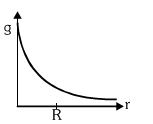
B
Graph showing $g$ increasing linearly with $r$ for $r < R$ and decreasing as $1/r^2$ for $r > R$.
C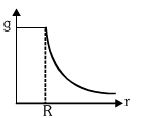
D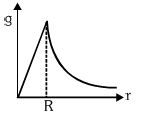
Solution
(D) For a sphere of uniform density, the acceleration due to gravity $g$ at a distance $r$ from the centre is given by:
$1$. Inside the earth $(r < R)$: $g_{in} = \frac{G M r}{R^3}$. Thus, $g \propto r$. This represents a straight line passing through the origin.
$2$. Outside the earth $(r > R)$: $g_{out} = \frac{G M}{r^2}$. Thus, $g \propto \frac{1}{r^2}$. This represents a hyperbolic curve.
Therefore, the graph starts from the origin, increases linearly until $r = R$, and then decreases following an inverse-square law. This corresponds to the figure provided in option $D$.
$1$. Inside the earth $(r < R)$: $g_{in} = \frac{G M r}{R^3}$. Thus, $g \propto r$. This represents a straight line passing through the origin.
$2$. Outside the earth $(r > R)$: $g_{out} = \frac{G M}{r^2}$. Thus, $g \propto \frac{1}{r^2}$. This represents a hyperbolic curve.
Therefore, the graph starts from the origin, increases linearly until $r = R$, and then decreases following an inverse-square law. This corresponds to the figure provided in option $D$.
0 likes
View Solution140
DifficultMCQ
If the acceleration due to gravity at the Earth is $g$,the mass of the Earth is $80$ times that of the Moon,and the radius of the Earth is $4$ times that of the Moon,then the value of the acceleration due to gravity at the surface of the Moon will be:
A
$g$
B
$g/20$
C
$g/5$
D
$320g$
Solution
(C) The acceleration due to gravity at the surface of a planet is given by $g = \frac{GM}{R^2}$.
For Earth,$g = \frac{GM_e}{R_e^2}$.
For the Moon,$g_m = \frac{GM_m}{R_m^2}$.
Given: $M_e = 80 M_m$ (so $M_m = \frac{M_e}{80}$) and $R_e = 4 R_m$ (so $R_m = \frac{R_e}{4}$).
Substituting these values into the expression for $g_m$:
$g_m = \frac{G(M_e / 80)}{(R_e / 4)^2} = \frac{G M_e / 80}{R_e^2 / 16} = \frac{16}{80} \frac{G M_e}{R_e^2}$.
Since $g = \frac{G M_e}{R_e^2}$,we get $g_m = \frac{1}{5} g = \frac{g}{5}$.
For Earth,$g = \frac{GM_e}{R_e^2}$.
For the Moon,$g_m = \frac{GM_m}{R_m^2}$.
Given: $M_e = 80 M_m$ (so $M_m = \frac{M_e}{80}$) and $R_e = 4 R_m$ (so $R_m = \frac{R_e}{4}$).
Substituting these values into the expression for $g_m$:
$g_m = \frac{G(M_e / 80)}{(R_e / 4)^2} = \frac{G M_e / 80}{R_e^2 / 16} = \frac{16}{80} \frac{G M_e}{R_e^2}$.
Since $g = \frac{G M_e}{R_e^2}$,we get $g_m = \frac{1}{5} g = \frac{g}{5}$.
0 likes
View Solution141
EasyMCQ
$A$ hole is drilled through the Earth along a diameter and a stone is dropped into it. When the stone reaches the center of the Earth,which of the following quantities remains constant?
A
Mass
B
Weight
C
Acceleration
D
Gravitational field
Solution
(A) The mass of an object is an intrinsic property of matter and does not change regardless of its position in the universe.
As the stone moves toward the center of the Earth,the gravitational force acting on it decreases,meaning its weight $(W = mg)$ decreases.
At the center of the Earth,the gravitational acceleration $(g)$ becomes zero,so the weight and the gravitational field intensity also become zero.
Therefore,only the mass of the stone remains constant throughout the motion.
As the stone moves toward the center of the Earth,the gravitational force acting on it decreases,meaning its weight $(W = mg)$ decreases.
At the center of the Earth,the gravitational acceleration $(g)$ becomes zero,so the weight and the gravitational field intensity also become zero.
Therefore,only the mass of the stone remains constant throughout the motion.
0 likes
View Solution142
DifficultMCQ
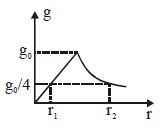
The figure shows the variation of acceleration due to gravity with distance from the center of a uniform spherical planet of radius $R$. What is $r_2 - r_1$?
A
$\frac{R}{4}$
B
$\frac{7R}{4}$
C
$\frac{4R}{3}$
D
$2R$
Solution
(B) For a point inside the planet at distance $r_1$ from the center,the acceleration due to gravity is given by $g(r_1) = g_0 \frac{r_1}{R}$.
Given $g(r_1) = \frac{g_0}{4}$,we have $\frac{g_0}{4} = g_0 \frac{r_1}{R}$,which gives $r_1 = \frac{R}{4}$.
For a point outside the planet at distance $r_2$ from the center,the acceleration due to gravity is given by $g(r_2) = g_0 \frac{R^2}{r_2^2}$.
Given $g(r_2) = \frac{g_0}{4}$,we have $\frac{g_0}{4} = g_0 \frac{R^2}{r_2^2}$,which implies $r_2^2 = 4R^2$,so $r_2 = 2R$.
Therefore,$r_2 - r_1 = 2R - \frac{R}{4} = \frac{7R}{4}$.
Given $g(r_1) = \frac{g_0}{4}$,we have $\frac{g_0}{4} = g_0 \frac{r_1}{R}$,which gives $r_1 = \frac{R}{4}$.
For a point outside the planet at distance $r_2$ from the center,the acceleration due to gravity is given by $g(r_2) = g_0 \frac{R^2}{r_2^2}$.
Given $g(r_2) = \frac{g_0}{4}$,we have $\frac{g_0}{4} = g_0 \frac{R^2}{r_2^2}$,which implies $r_2^2 = 4R^2$,so $r_2 = 2R$.
Therefore,$r_2 - r_1 = 2R - \frac{R}{4} = \frac{7R}{4}$.
0 likes
View Solution143
DifficultMCQ
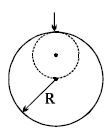
$A$ spherical part of radius $R/2$ is excavated from an asteroid of mass $M$ and radius $R$ as shown in the figure. The gravitational acceleration at a point on the surface of the asteroid just above the excavation is
A
$\frac{GM}{R^2}$
B
$\frac{GM}{2R^2}$
C
$\frac{GM}{8R^2}$
D
$\frac{7GM}{8R^2}$
Solution
(B) Let the original mass of the asteroid be $M$ and its radius be $R$. The gravitational field at the surface is $g = \frac{GM}{R^2}$.
When a spherical part of radius $r = R/2$ is excavated,its mass $M'$ is given by $M' = \rho \cdot V' = \rho \cdot \frac{4}{3}\pi (R/2)^3 = \frac{1}{8} \rho \cdot \frac{4}{3}\pi R^3 = \frac{M}{8}$.
The gravitational field at the point on the surface just above the excavation is the vector sum of the field due to the original sphere and the field due to the removed part (treated as a negative mass).
The field due to the original sphere at the surface is $g_1 = \frac{GM}{R^2}$ (directed towards the center).
The field due to the removed sphere at its own surface is $g_2 = \frac{GM'}{r^2} = \frac{G(M/8)}{(R/2)^2} = \frac{GM/8}{R^2/4} = \frac{GM}{2R^2}$ (directed away from the center of the excavation,i.e.,outwards).
The net gravitational acceleration is $g_{net} = g_1 - g_2 = \frac{GM}{R^2} - \frac{GM}{2R^2} = \frac{GM}{2R^2}$.
When a spherical part of radius $r = R/2$ is excavated,its mass $M'$ is given by $M' = \rho \cdot V' = \rho \cdot \frac{4}{3}\pi (R/2)^3 = \frac{1}{8} \rho \cdot \frac{4}{3}\pi R^3 = \frac{M}{8}$.
The gravitational field at the point on the surface just above the excavation is the vector sum of the field due to the original sphere and the field due to the removed part (treated as a negative mass).
The field due to the original sphere at the surface is $g_1 = \frac{GM}{R^2}$ (directed towards the center).
The field due to the removed sphere at its own surface is $g_2 = \frac{GM'}{r^2} = \frac{G(M/8)}{(R/2)^2} = \frac{GM/8}{R^2/4} = \frac{GM}{2R^2}$ (directed away from the center of the excavation,i.e.,outwards).
The net gravitational acceleration is $g_{net} = g_1 - g_2 = \frac{GM}{R^2} - \frac{GM}{2R^2} = \frac{GM}{2R^2}$.

0 likes
View Solution144
MediumMCQ
The diameters of two planets are in the ratio $4:1$. Their mean densities have the ratio $1:2$. The ratio of gravitational acceleration on the surface of the planets will be:
A
$1 : 2$
B
$1 : 4$
C
$2 : 1$
D
$4 : 1$
Solution
(C) The gravitational acceleration $g$ on the surface of a planet is given by $g = \frac{GM}{R^2}$.
Since $M = \rho \cdot V = \rho \cdot \frac{4}{3}\pi R^3$,substituting this into the formula gives $g = \frac{G \cdot \rho \cdot \frac{4}{3}\pi R^3}{R^2} = \frac{4}{3} \pi G \rho R$.
Thus,$g \propto \rho R$.
Given the ratio of diameters $D_1 : D_2 = 4 : 1$,the ratio of radii $R_1 : R_2 = 4 : 1$.
Given the ratio of densities $\rho_1 : \rho_2 = 1 : 2$.
The ratio of gravitational accelerations is $\frac{g_1}{g_2} = \frac{\rho_1 R_1}{\rho_2 R_2} = \left(\frac{1}{2}\right) \cdot \left(\frac{4}{1}\right) = \frac{4}{2} = 2 : 1$.
Since $M = \rho \cdot V = \rho \cdot \frac{4}{3}\pi R^3$,substituting this into the formula gives $g = \frac{G \cdot \rho \cdot \frac{4}{3}\pi R^3}{R^2} = \frac{4}{3} \pi G \rho R$.
Thus,$g \propto \rho R$.
Given the ratio of diameters $D_1 : D_2 = 4 : 1$,the ratio of radii $R_1 : R_2 = 4 : 1$.
Given the ratio of densities $\rho_1 : \rho_2 = 1 : 2$.
The ratio of gravitational accelerations is $\frac{g_1}{g_2} = \frac{\rho_1 R_1}{\rho_2 R_2} = \left(\frac{1}{2}\right) \cdot \left(\frac{4}{1}\right) = \frac{4}{2} = 2 : 1$.
0 likes
View Solution145
MediumMCQ
Suppose that the angular velocity of rotation of the earth is increased. Then,as a consequence:
A
There will be no change in weight anywhere on the earth.
B
Weight of the object,everywhere on the earth,will decrease.
C
Weight of the object,everywhere on the earth,will increase.
D
Except at poles,weight of the object on the earth will decrease.
Solution
(D) The effective acceleration due to gravity $g'$ at a latitude $\phi$ is given by the formula: $g' = g - \omega^2 R \cos^2 \phi$,where $\omega$ is the angular velocity of the earth and $R$ is the radius of the earth.
At the poles,the latitude $\phi = 90^\circ$,so $\cos 90^\circ = 0$. Thus,$g' = g$,which means there is no change in gravity at the poles regardless of the change in $\omega$.
At all other latitudes,as the angular velocity $\omega$ increases,the term $\omega^2 R \cos^2 \phi$ increases.
Since $g' = g - \omega^2 R \cos^2 \phi$,an increase in $\omega$ leads to a decrease in $g'$.
Consequently,the weight of an object,$W = mg'$,will decrease at all points on the earth except at the poles.
At the poles,the latitude $\phi = 90^\circ$,so $\cos 90^\circ = 0$. Thus,$g' = g$,which means there is no change in gravity at the poles regardless of the change in $\omega$.
At all other latitudes,as the angular velocity $\omega$ increases,the term $\omega^2 R \cos^2 \phi$ increases.
Since $g' = g - \omega^2 R \cos^2 \phi$,an increase in $\omega$ leads to a decrease in $g'$.
Consequently,the weight of an object,$W = mg'$,will decrease at all points on the earth except at the poles.
0 likes
View Solution146
MediumMCQ
If the Earth has no rotational motion,the weight of a person on the equator is $W$. Determine the speed with which the Earth would have to rotate about its axis so that the person at the equator will weigh $\frac{3}{4} W$. The radius of the Earth is $6400 \ km$ and $g = 10 \ m/s^2$.
A
$1.1 \times 10^{-3} \ rad/s$
B
$0.83 \times 10^{-3} \ rad/s$
C
$0.63 \times 10^{-3} \ rad/s$
D
$0.28 \times 10^{-3} \ rad/s$
Solution
(C) The effective acceleration due to gravity at the equator (where $\theta = 0^\circ$) is given by $g' = g - \omega^2 R$.
Given that the weight becomes $\frac{3}{4} W$,the effective gravity must be $g' = \frac{3}{4} g$.
Substituting this into the equation: $\frac{3}{4} g = g - \omega^2 R$.
Rearranging for $\omega^2 R$: $\omega^2 R = g - \frac{3}{4} g = \frac{1}{4} g$.
Solving for $\omega$: $\omega = \sqrt{\frac{g}{4R}}$.
Given $g = 10 \ m/s^2$ and $R = 6400 \ km = 6.4 \times 10^6 \ m$.
$\omega = \sqrt{\frac{10}{4 \times 6.4 \times 10^6}} = \sqrt{\frac{10}{25.6 \times 10^6}} = \sqrt{\frac{1}{2.56 \times 10^6}} = \frac{1}{1.6 \times 10^3} \ rad/s$.
$\omega = 0.625 \times 10^{-3} \ rad/s \approx 0.63 \times 10^{-3} \ rad/s$.
Given that the weight becomes $\frac{3}{4} W$,the effective gravity must be $g' = \frac{3}{4} g$.
Substituting this into the equation: $\frac{3}{4} g = g - \omega^2 R$.
Rearranging for $\omega^2 R$: $\omega^2 R = g - \frac{3}{4} g = \frac{1}{4} g$.
Solving for $\omega$: $\omega = \sqrt{\frac{g}{4R}}$.
Given $g = 10 \ m/s^2$ and $R = 6400 \ km = 6.4 \times 10^6 \ m$.
$\omega = \sqrt{\frac{10}{4 \times 6.4 \times 10^6}} = \sqrt{\frac{10}{25.6 \times 10^6}} = \sqrt{\frac{1}{2.56 \times 10^6}} = \frac{1}{1.6 \times 10^3} \ rad/s$.
$\omega = 0.625 \times 10^{-3} \ rad/s \approx 0.63 \times 10^{-3} \ rad/s$.
0 likes
View Solution147
MediumMCQ
Which graph correctly presents the variation of acceleration due to gravity with the distance from the centre of the earth (radius of the earth $= R_E$)?
A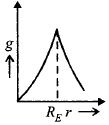
B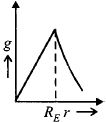
C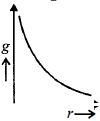
D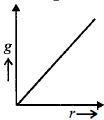
Solution
(A) The acceleration due to gravity $g$ varies with the distance $r$ from the centre of the Earth as follows:
$1$. Inside the Earth $(r < R_E)$: The acceleration due to gravity is given by $g = \frac{GM r}{R_E^3}$,which means $g \propto r$. This represents a straight line passing through the origin.
$2$. Outside the Earth $(r \geq R_E)$: The acceleration due to gravity is given by $g = \frac{GM}{r^2}$,which means $g \propto \frac{1}{r^2}$. This represents a rectangular hyperbola.
Thus,the graph shows a linear increase up to $r = R_E$ and a non-linear decrease for $r > R_E$,which is correctly depicted in the graph provided in option $A$.
$1$. Inside the Earth $(r < R_E)$: The acceleration due to gravity is given by $g = \frac{GM r}{R_E^3}$,which means $g \propto r$. This represents a straight line passing through the origin.
$2$. Outside the Earth $(r \geq R_E)$: The acceleration due to gravity is given by $g = \frac{GM}{r^2}$,which means $g \propto \frac{1}{r^2}$. This represents a rectangular hyperbola.
Thus,the graph shows a linear increase up to $r = R_E$ and a non-linear decrease for $r > R_E$,which is correctly depicted in the graph provided in option $A$.
0 likes
View Solution148
MediumMCQ
Assuming the earth to be a sphere of uniform density,the acceleration due to gravity inside the earth at a distance of $r$ from the centre is proportional to
A
$r$
B
$r^{-1}$
C
$r^2$
D
$r^{-2}$
Solution
(A) The acceleration due to gravity $g'$ at a distance $r$ from the center of the earth (where $r < R$,$R$ being the radius of the earth) is given by the formula:
$g' = \frac{4}{3} \pi \rho G r$
Here,$\rho$ is the uniform density of the earth and $G$ is the universal gravitational constant.
Since $\frac{4}{3}$,$\pi$,$\rho$,and $G$ are constants,we can conclude that:
$g' \propto r$
Therefore,the acceleration due to gravity inside the earth is directly proportional to the distance $r$ from the center.
$g' = \frac{4}{3} \pi \rho G r$
Here,$\rho$ is the uniform density of the earth and $G$ is the universal gravitational constant.
Since $\frac{4}{3}$,$\pi$,$\rho$,and $G$ are constants,we can conclude that:
$g' \propto r$
Therefore,the acceleration due to gravity inside the earth is directly proportional to the distance $r$ from the center.
0 likes
View Solution149
DifficultMCQ
The mass and the diameter of a planet are three times the respective values for the Earth. The period of oscillation of a simple pendulum on the Earth is $2 \ s$. The period of oscillation of the same pendulum on the planet would be
A
$\frac{\sqrt{3}}{2} \ s$
B
$\frac{2}{\sqrt{3}} \ s$
C
$\frac{3}{2} \ s$
D
$2\sqrt{3} \ s$
Solution
(D) The acceleration due to gravity on a planet is given by $g = \frac{GM}{R^2}$.
Let $M_e$ and $R_e$ be the mass and radius of the Earth,and $M_p$ and $R_p$ be the mass and radius of the planet.
Given: $M_p = 3M_e$ and $D_p = 3D_e$,which implies $R_p = 3R_e$.
The ratio of gravity on the planet to the Earth is $\frac{g_p}{g_e} = \frac{M_p}{M_e} \left( \frac{R_e}{R_p} \right)^2 = 3 \left( \frac{1}{3} \right)^2 = \frac{3}{9} = \frac{1}{3}$.
The time period of a simple pendulum is $T = 2\pi \sqrt{\frac{l}{g}}$,so $T \propto \frac{1}{\sqrt{g}}$.
Therefore,$\frac{T_p}{T_e} = \sqrt{\frac{g_e}{g_p}} = \sqrt{3}$.
Given $T_e = 2 \ s$,we get $T_p = 2\sqrt{3} \ s$.
Let $M_e$ and $R_e$ be the mass and radius of the Earth,and $M_p$ and $R_p$ be the mass and radius of the planet.
Given: $M_p = 3M_e$ and $D_p = 3D_e$,which implies $R_p = 3R_e$.
The ratio of gravity on the planet to the Earth is $\frac{g_p}{g_e} = \frac{M_p}{M_e} \left( \frac{R_e}{R_p} \right)^2 = 3 \left( \frac{1}{3} \right)^2 = \frac{3}{9} = \frac{1}{3}$.
The time period of a simple pendulum is $T = 2\pi \sqrt{\frac{l}{g}}$,so $T \propto \frac{1}{\sqrt{g}}$.
Therefore,$\frac{T_p}{T_e} = \sqrt{\frac{g_e}{g_p}} = \sqrt{3}$.
Given $T_e = 2 \ s$,we get $T_p = 2\sqrt{3} \ s$.
0 likes
View Solution150
MediumMCQ
The value of acceleration due to gravity at Earth's surface is $9.8\, m\,s^{-2}$. The altitude above its surface at which the acceleration due to gravity decreases to $4.9\, m\,s^{-2}$,is close to: (Radius of Earth $= 6.4 \times 10^6\, m$)
A
$6.4 \times 10^6\, m$
B
$9.0 \times 10^6\, m$
C
$2.6 \times 10^6\, m$
D
$1.6 \times 10^6\, m$
Solution
(C) The acceleration due to gravity at the surface of the Earth is given by $g = \frac{GM}{R^2} = 9.8\, m\,s^{-2}$.
At an altitude $h$,the acceleration due to gravity $g'$ is given by $g' = \frac{GM}{(R+h)^2}$.
We are given $g' = 4.9\, m\,s^{-2}$,which is $\frac{g}{2}$.
So,$\frac{GM}{(R+h)^2} = \frac{1}{2} \frac{GM}{R^2}$.
Taking the reciprocal and square root on both sides: $\frac{R+h}{R} = \sqrt{2}$.
$1 + \frac{h}{R} = 1.414$.
$\frac{h}{R} = 0.414$.
$h = 0.414 \times R = 0.414 \times 6.4 \times 10^6\, m$.
$h \approx 2.65 \times 10^6\, m$.
At an altitude $h$,the acceleration due to gravity $g'$ is given by $g' = \frac{GM}{(R+h)^2}$.
We are given $g' = 4.9\, m\,s^{-2}$,which is $\frac{g}{2}$.
So,$\frac{GM}{(R+h)^2} = \frac{1}{2} \frac{GM}{R^2}$.
Taking the reciprocal and square root on both sides: $\frac{R+h}{R} = \sqrt{2}$.
$1 + \frac{h}{R} = 1.414$.
$\frac{h}{R} = 0.414$.
$h = 0.414 \times R = 0.414 \times 6.4 \times 10^6\, m$.
$h \approx 2.65 \times 10^6\, m$.
0 likes
View SolutionGravitation — Acceleration Due to Gravity and its Variation · Frequently Asked Questions
1Are these Gravitation questions useful for JEE and NEET?
Yes. All questions in this section are mapped to JEE Main and NEET exam patterns. Previous year questions from JEE Main, NEET, GUJCET and state-level exams are included with full solutions.
2Can I switch to Hindi or Gujarati for these questions?
Yes. Use the language tabs in the hero section or the sidebar to view the same questions and solutions in English, Hindi or Gujarati.
3How do I generate a question paper from this subtopic?
Use the Vedclass Exam Paper Generator — select the chapter and subtopic, set difficulty, and generate Sets A, B, C, D automatically. First 3 chapters of every subject are free.
Vedclass Products
For Students
Vedclass Test Series
Mock tests in real JEE/NEET style with performance analysis. 5-day free trial.
Start Free TrialFor Teachers
Exam Paper Generator
Generate Set A/B/C/D papers from this chapter in 2 minutes. 3 chapters free.
Try FreeFor Institutes
Online Exam Module
Live online exams with unlimited students, 360° analytics & white-label branding.
See DemoFor Teachers & Institutes
Generate a Gravitation Exam Paper in 2 Minutes
Select subtopic & difficulty — Sets A, B, C, D auto-generated with No Repeat logic.
First 3 chapters of every subject are free — no payment required.