
Medium
Which of the following graphs best represents the motion of a raindrop?
- A
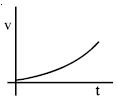
- B
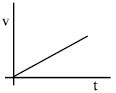
- C
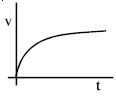
- D
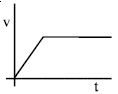
Explore More
Similar Questions
$A$ small ball of mass $M$,radius $R$ and density $\rho$ moves with terminal velocity through a container filled with glycerine of density $\sigma$. The viscous force acting on the ball is ($g=$ gravitational acceleration).
The graph between terminal velocity (along $y-$ axis) and square of radius (along $x-$ axis) of a spherical body of density $\rho$ allowed to fall through a fluid of density $\sigma$ is a
Medium
View SolutionWhat is the terminal velocity of an air bubble of $1.0 \ mm$ in diameter rising in a liquid of viscosity $0.85 \ N \ s \ m^{-2}$ and density $900 \ kg \ m^{-3}$? (Air density $= 1.293 \ kg \ m^{-3}$,$g = 9 \ m \ s^{-2}$)
Two spheres of different material are falling through a liquid of density $\rho_L = 2 \times 10^3 \ kg/m^3$ with the same uniform terminal speed. The density of sphere $1$ is $\rho_1 = 8 \times 10^3 \ kg/m^3$ and the density of sphere $2$ is $\rho_2 = 11 \times 10^3 \ kg/m^3$. The ratio of their radii $(r_1/r_2)$ is:
An object falling through a fluid is observed to have acceleration given by $a = g - bv$,where $g$ is the gravitational acceleration and $b$ is a constant. After a long time of release,it is observed to fall with a constant speed. What must be the value of this constant speed?
Difficult
View SolutionVedclass Products
For Students
Vedclass Test Series
Mock tests in real JEE/NEET style with performance analysis. 5-day free trial.
Start Free TrialFor Teachers
Exam Paper Generator
Generate Set A/B/C/D exam papers from 7.5L+ questions in 2 minutes. 3 chapters free.
Try FreeFor Institutes
Online Exam Module
Live online exams with unlimited students, 360° analytics & white-label branding.
See Demo