
Medium
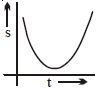
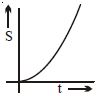
The displacement of a ball falling from rest in a viscous medium is plotted against time. Choose a possible option.
- A

- B

- C
- D
Explore More
Similar Questions
$A$ ball rises to the surface at a constant velocity in a liquid whose density is $4$ times greater than that of the material of the ball. The ratio of the force of friction acting on the rising ball to its weight is
In an experiment to calculate the coefficient of viscosity of a liquid by measuring terminal velocity, it was observed that a ball of mass $(\frac{\pi}{2}) \ gm$ and radius $0.5 \ cm$ takes $5 \ s$ to fall steadily through a height of $50 \ cm$ inside a long column of liquid of density $1.2 \ gm/cc$. The coefficient of viscosity will be given as: (in $\text{poise}$)
Medium
View Solution$A$ metal ball of radius $9 \times 10^{-4} \ m$ and density $10^4 \ kg/m^3$ falls freely under gravity through a distance $h$ and enters a tank of water. Considering that the metal ball has constant velocity in water,the value of $h$ is [coefficient of viscosity of water $= 8.1 \times 10^{-4} \ Pa \cdot s, g = 10 \ m/s^2$,density of water $= 10^3 \ kg/m^3$]. (in $m$)
DifficultMHT CET 2024
View SolutionFind the viscosity of glycerine $($having density $1.3 \ g \ cm^{-3})$ if a steel ball of $2 \ mm$ radius $($density $8 \ g \ cm^{-3})$ acquires a terminal velocity of $4 \ cm \ s^{-1}$ in falling freely in the tank of glycerine. $(g = 980 \ cm \ s^{-2})$ (in $\text{poise}$)
Medium
View Solution$A$ sphere of mass $M$ and radius $R$ is falling in a viscous fluid. The terminal velocity attained by the falling object will be proportional to
Medium
View SolutionVedclass Products
For Students
Vedclass Test Series
Mock tests in real JEE/NEET style with performance analysis. 5-day free trial.
Start Free TrialFor Teachers
Exam Paper Generator
Generate Set A/B/C/D exam papers from 7.5L+ questions in 2 minutes. 3 chapters free.
Try FreeFor Institutes
Online Exam Module
Live online exams with unlimited students, 360° analytics & white-label branding.
See Demo