
Easy
From amongst the following curves, which one shows the variation of the velocity $v$ with time $t$ for a small-sized spherical body falling vertically in a long column of a viscous liquid?
- A
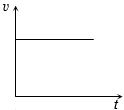
- B
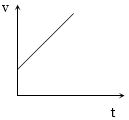
- C
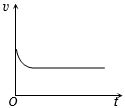
- D
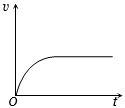
Explore More
Similar Questions
$A$ solid metallic sphere of radius $r$ is allowed to fall freely through air. If the frictional resistance due to air is proportional to the cross-sectional area and to the square of the velocity,then the terminal velocity of the sphere is proportional to which of the following?
Difficult
View Solution$A$ spherical ball of radius $1 \times 10^{-4} \,m$ and density $10^4 \,kg \,m^{-3}$ falls freely under gravity through a distance $h$ before entering a tank of water. If the velocity of the ball does not change after entering the water, then the value of $h$ is:
DifficultAP EAMCET 2024
View Solution$A$ viscous fluid is flowing through a cylindrical tube. The velocity distribution of the fluid is best represented by the diagram
Easy
View SolutionOn which factors does terminal velocity depend? Explain.
Medium
View Solution$A$ spherical liquid drop of radius $r$ acquires the terminal velocity $v_1$ when falling through a gas of viscosity $\eta$. Now the drop is broken into $64$ identical droplets and each droplet acquires terminal velocity $v_2$ falling through the same gas. The ratio of terminal velocities $v_1/v_2$ is . . . . . . .
DifficultJEE MAIN 2026
View SolutionVedclass Products
For Students
Vedclass Test Series
Mock tests in real JEE/NEET style with performance analysis. 5-day free trial.
Start Free TrialFor Teachers
Exam Paper Generator
Generate Set A/B/C/D exam papers from 7.5L+ questions in 2 minutes. 3 chapters free.
Try FreeFor Institutes
Online Exam Module
Live online exams with unlimited students, 360° analytics & white-label branding.
See Demo