
A English
Viscosity and Stoke's Law and Terminal Velocity Questions in English
Class 11 Physics · Fluid Mechanics and Surface Tension · Viscosity and Stoke's Law and Terminal Velocity
197+
Questions
English
Language
100%
With Solutions
Showing 50 of 197 questions in English
101
MediumMCQ
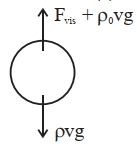
$A$ small ball of mass $M$ and density $\rho$ is dropped in a viscous liquid of density $\rho_0$. After some time,the ball falls with a constant velocity. What is the viscous force on the ball?
A
$F=Mg\left(1-\frac{\rho_0}{\rho}\right)$
B
$F=Mg\left(1+\frac{\rho}{\rho_0}\right)$
C
$F=Mg\left(1+\frac{\rho_0}{\rho}\right)$
D
$F=Mg\left(1-\frac{\rho}{\rho_0}\right)$
Solution
(A) When the ball falls with a constant terminal velocity,the net force acting on it is zero.
The forces acting on the ball are:
$1$. Weight of the ball acting downwards: $W = Mg = \rho Vg$ (where $V$ is the volume of the ball).
$2$. Buoyant force acting upwards: $F_B = \rho_0 Vg$.
$3$. Viscous force acting upwards: $F_{vis}$.
For equilibrium,the downward force must equal the sum of the upward forces:
$Mg = F_{vis} + F_B$
$F_{vis} = Mg - F_B$
$F_{vis} = \rho Vg - \rho_0 Vg$
$F_{vis} = \rho Vg \left(1 - \frac{\rho_0}{\rho}\right)$
Since $M = \rho V$,we substitute $M$ back into the equation:
$F_{vis} = Mg \left(1 - \frac{\rho_0}{\rho}\right)$
The forces acting on the ball are:
$1$. Weight of the ball acting downwards: $W = Mg = \rho Vg$ (where $V$ is the volume of the ball).
$2$. Buoyant force acting upwards: $F_B = \rho_0 Vg$.
$3$. Viscous force acting upwards: $F_{vis}$.
For equilibrium,the downward force must equal the sum of the upward forces:
$Mg = F_{vis} + F_B$
$F_{vis} = Mg - F_B$
$F_{vis} = \rho Vg - \rho_0 Vg$
$F_{vis} = \rho Vg \left(1 - \frac{\rho_0}{\rho}\right)$
Since $M = \rho V$,we substitute $M$ back into the equation:
$F_{vis} = Mg \left(1 - \frac{\rho_0}{\rho}\right)$
1 likes
View Solution102
MediumMCQ
An air bubble of diameter $6\,mm$ rises steadily through a solution of density $1750\,kg/m^3$ at the rate of $0.35\,cm/s$. The coefficient of viscosity of the solution (neglect density of air) is $..........\,Pa\cdot s$ (given,$g = 10\,m/s^2$).
A
$5$
B
$10$
C
$8$
D
$9$
Solution
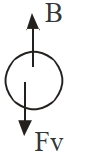
(B) Since the air bubble is moving at a constant terminal velocity,the net force acting on it is zero.
The upward buoyant force $B$ is balanced by the downward viscous drag force $F_v$.
$B = F_v$
Using Archimedes' principle for buoyancy and Stokes' law for viscous drag:
$\frac{4}{3} \pi R^3 \rho g = 6 \pi \eta R v$
Where $R$ is the radius of the bubble,$\rho$ is the density of the solution,$\eta$ is the coefficient of viscosity,and $v$ is the terminal velocity.
Given:
Diameter $d = 6\,mm \implies R = 3\,mm = 3 \times 10^{-3}\,m$
Density $\rho = 1750\,kg/m^3$
Velocity $v = 0.35\,cm/s = 0.35 \times 10^{-2}\,m/s$
Acceleration due to gravity $g = 10\,m/s^2$
Rearranging for $\eta$:
$\eta = \frac{2 R^2 \rho g}{9 v}$
Substituting the values:
$\eta = \frac{2 \times (3 \times 10^{-3})^2 \times 1750 \times 10}{9 \times 0.35 \times 10^{-2}}$
$\eta = \frac{2 \times 9 \times 10^{-6} \times 17500}{9 \times 0.35 \times 10^{-2}}$
$\eta = \frac{2 \times 10^{-6} \times 17500}{0.35 \times 10^{-2}}$
$\eta = \frac{0.035}{0.0035} = 10\,Pa\cdot s$
The upward buoyant force $B$ is balanced by the downward viscous drag force $F_v$.
$B = F_v$
Using Archimedes' principle for buoyancy and Stokes' law for viscous drag:
$\frac{4}{3} \pi R^3 \rho g = 6 \pi \eta R v$
Where $R$ is the radius of the bubble,$\rho$ is the density of the solution,$\eta$ is the coefficient of viscosity,and $v$ is the terminal velocity.
Given:
Diameter $d = 6\,mm \implies R = 3\,mm = 3 \times 10^{-3}\,m$
Density $\rho = 1750\,kg/m^3$
Velocity $v = 0.35\,cm/s = 0.35 \times 10^{-2}\,m/s$
Acceleration due to gravity $g = 10\,m/s^2$
Rearranging for $\eta$:
$\eta = \frac{2 R^2 \rho g}{9 v}$
Substituting the values:
$\eta = \frac{2 \times (3 \times 10^{-3})^2 \times 1750 \times 10}{9 \times 0.35 \times 10^{-2}}$
$\eta = \frac{2 \times 9 \times 10^{-6} \times 17500}{9 \times 0.35 \times 10^{-2}}$
$\eta = \frac{2 \times 10^{-6} \times 17500}{0.35 \times 10^{-2}}$
$\eta = \frac{0.035}{0.0035} = 10\,Pa\cdot s$
0 likes
View Solution103
DifficultMCQ
Eight equal drops of water are falling through air with a steady speed of $10\,cm/s$. If the drops coalesce,the new velocity is $.........\,cm/s$.
A
$10$
B
$40$
C
$16$
D
$5$
Solution
(B) For a small drop falling through a viscous medium at terminal velocity,the terminal velocity $v$ is given by $v = \frac{2}{9} \frac{r^2 (\rho - \sigma) g}{\eta}$,which implies $v \propto r^2$.
Let $r$ be the radius of each small drop and $R$ be the radius of the large drop formed by coalescing $8$ small drops.
Since the volume is conserved,$8 \times (\frac{4}{3} \pi r^3) = \frac{4}{3} \pi R^3$,which gives $R^3 = 8r^3$,so $R = 2r$.
Using the proportionality $v \propto r^2$,we have $\frac{v_1}{v_2} = (\frac{r}{R})^2$.
Substituting the values,$\frac{10}{v_2} = (\frac{r}{2r})^2 = (\frac{1}{2})^2 = \frac{1}{4}$.
Therefore,$v_2 = 10 \times 4 = 40\,cm/s$.
Let $r$ be the radius of each small drop and $R$ be the radius of the large drop formed by coalescing $8$ small drops.
Since the volume is conserved,$8 \times (\frac{4}{3} \pi r^3) = \frac{4}{3} \pi R^3$,which gives $R^3 = 8r^3$,so $R = 2r$.
Using the proportionality $v \propto r^2$,we have $\frac{v_1}{v_2} = (\frac{r}{R})^2$.
Substituting the values,$\frac{10}{v_2} = (\frac{r}{2r})^2 = (\frac{1}{2})^2 = \frac{1}{4}$.
Therefore,$v_2 = 10 \times 4 = 40\,cm/s$.
0 likes
View Solution104
MediumMCQ
Given below are two statements: one is labelled as Assertion $A$ and the other is labelled as Reason $R$.
Assertion $A$: $A$ spherical body of radius $(5 \pm 0.1) \ mm$ having a particular density is falling through a liquid of constant density. The percentage error in the calculation of its terminal velocity is $4\,\%$.
Reason $R$: The terminal velocity of the spherical body falling through the liquid is inversely proportional to its radius.
In the light of the above statements,choose the correct answer from the options given below:
Assertion $A$: $A$ spherical body of radius $(5 \pm 0.1) \ mm$ having a particular density is falling through a liquid of constant density. The percentage error in the calculation of its terminal velocity is $4\,\%$.
Reason $R$: The terminal velocity of the spherical body falling through the liquid is inversely proportional to its radius.
In the light of the above statements,choose the correct answer from the options given below:
A
Both $A$ and $R$ are true but $R$ is $NOT$ the correct explanation of $A$.
B
Both $A$ and $R$ are true and $R$ is the correct explanation of $A$.
C
$A$ is false but $R$ is true.
D
$A$ is true but $R$ is false.
Solution
(D) The terminal velocity $V_t$ of a spherical body falling through a viscous liquid is given by Stokes' Law: $V_t = \frac{2}{9} \frac{r^2 g (\rho - \sigma)}{\eta}$.
From this,we see that $V_t \propto r^2$.
Therefore,the relative error is given by $\frac{\Delta V_t}{V_t} = 2 \frac{\Delta r}{r}$.
Given $r = 5 \ mm$ and $\Delta r = 0.1 \ mm$,the percentage error is $\frac{\Delta V_t}{V_t} \times 100\% = 2 \times \left( \frac{0.1}{5} \right) \times 100\% = 4\,\%$.
Thus,Assertion $A$ is true.
Reason $R$ states that $V_t$ is inversely proportional to the radius,which is incorrect because $V_t \propto r^2$. Thus,Reason $R$ is false.
From this,we see that $V_t \propto r^2$.
Therefore,the relative error is given by $\frac{\Delta V_t}{V_t} = 2 \frac{\Delta r}{r}$.
Given $r = 5 \ mm$ and $\Delta r = 0.1 \ mm$,the percentage error is $\frac{\Delta V_t}{V_t} \times 100\% = 2 \times \left( \frac{0.1}{5} \right) \times 100\% = 4\,\%$.
Thus,Assertion $A$ is true.
Reason $R$ states that $V_t$ is inversely proportional to the radius,which is incorrect because $V_t \propto r^2$. Thus,Reason $R$ is false.
0 likes
View Solution105
DifficultMCQ
$A$ small steel ball is dropped into a long cylinder containing glycerine. Which one of the following is the correct representation of the velocity-time graph for the transit of the ball?
A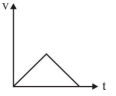
B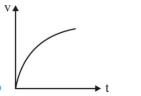
C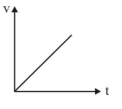
D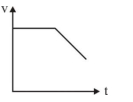
Solution
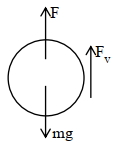
(B) When a steel ball is dropped in a viscous liquid like glycerine,it experiences three forces: gravitational force $(mg)$ downwards,buoyant force $(F_B)$ upwards,and viscous drag force $(F_v = 6 \pi \eta r v)$ upwards.
The equation of motion is: $mg - F_B - F_v = ma$
Substituting the expressions for forces: $(\rho \frac{4}{3} \pi r^3) g - (\rho_L \frac{4}{3} \pi r^3) g - 6 \pi \eta r v = m \frac{dv}{dt}$
Let $K_1 = \frac{4}{3} \pi r^3 g (\rho - \rho_L) / m$ and $K_2 = \frac{6 \pi \eta r}{m}$. Then the equation becomes: $\frac{dv}{dt} = K_1 - K_2 v$
Integrating this differential equation with initial conditions ($v=0$ at $t=0$): $\int_0^v \frac{dv}{K_1 - K_2 v} = \int_0^t dt$
This yields: $v = \frac{K_1}{K_2} (1 - e^{-K_2 t})$
As $t \to \infty$,the velocity approaches a constant terminal velocity $v_T = \frac{K_1}{K_2}$. The graph of $v$ versus $t$ is an exponential curve that starts from the origin and asymptotically approaches the terminal velocity,which corresponds to Graph $B$.
The equation of motion is: $mg - F_B - F_v = ma$
Substituting the expressions for forces: $(\rho \frac{4}{3} \pi r^3) g - (\rho_L \frac{4}{3} \pi r^3) g - 6 \pi \eta r v = m \frac{dv}{dt}$
Let $K_1 = \frac{4}{3} \pi r^3 g (\rho - \rho_L) / m$ and $K_2 = \frac{6 \pi \eta r}{m}$. Then the equation becomes: $\frac{dv}{dt} = K_1 - K_2 v$
Integrating this differential equation with initial conditions ($v=0$ at $t=0$): $\int_0^v \frac{dv}{K_1 - K_2 v} = \int_0^t dt$
This yields: $v = \frac{K_1}{K_2} (1 - e^{-K_2 t})$
As $t \to \infty$,the velocity approaches a constant terminal velocity $v_T = \frac{K_1}{K_2}$. The graph of $v$ versus $t$ is an exponential curve that starts from the origin and asymptotically approaches the terminal velocity,which corresponds to Graph $B$.
0 likes
View Solution106
DifficultMCQ
$A$ small spherical ball of radius $r$,falling through a viscous medium of negligible density has terminal velocity $v$. Another ball of the same mass but of radius $2r$,falling through the same viscous medium will have terminal velocity:
A
$v/2$
B
$v/4$
C
$4v$
D
$2v$
Solution
(A) The terminal velocity $v$ of a spherical ball of radius $r$ falling through a viscous medium is given by Stokes' Law: $F_{drag} = 6 \pi \eta r v$.
Since the density of the medium is negligible,the buoyant force is negligible. At terminal velocity,the gravitational force equals the viscous drag force:
$Mg = 6 \pi \eta r v$
Given that the mass $M$ of the ball is constant,we have:
$v \propto \frac{1}{r}$
Let $v$ be the terminal velocity for radius $r$,and $v'$ be the terminal velocity for radius $r' = 2r$.
Then,$\frac{v'}{v} = \frac{r}{r'} = \frac{r}{2r} = \frac{1}{2}$.
Therefore,$v' = \frac{v}{2}$.
Since the density of the medium is negligible,the buoyant force is negligible. At terminal velocity,the gravitational force equals the viscous drag force:
$Mg = 6 \pi \eta r v$
Given that the mass $M$ of the ball is constant,we have:
$v \propto \frac{1}{r}$
Let $v$ be the terminal velocity for radius $r$,and $v'$ be the terminal velocity for radius $r' = 2r$.
Then,$\frac{v'}{v} = \frac{r}{r'} = \frac{r}{2r} = \frac{1}{2}$.
Therefore,$v' = \frac{v}{2}$.
0 likes
View Solution107
DifficultMCQ
$A$ small ball of mass $m$ and density $\rho$ is dropped in a viscous liquid of density $\rho_0$. After some time,the ball falls with constant velocity. The viscous force on the ball is:
A
$mg\left(\frac{\rho_0}{\rho}-1\right)$
B
$mg\left(1+\frac{\rho}{\rho_0}\right)$
C
$mg\left(1-\rho \rho_0\right)$
D
$mg\left(1-\frac{\rho_0}{\rho}\right)$
Solution
(D) When the ball falls with a constant velocity (terminal velocity),the net force acting on it is zero.
The forces acting on the ball are:
$1$. Weight of the ball $(W = mg)$ acting downwards.
$2$. Buoyant force $(F_B)$ acting upwards.
$3$. Viscous force $(F_v)$ acting upwards.
According to the condition of constant velocity,the acceleration $a = 0$.
Therefore,$mg - F_B - F_v = 0$,which implies $F_v = mg - F_B$.
The buoyant force $F_B$ is equal to the weight of the displaced liquid: $F_B = V \rho_0 g$,where $V$ is the volume of the ball.
Since the volume $V = \frac{m}{\rho}$,we have $F_B = \frac{m}{\rho} \rho_0 g$.
Substituting this into the equation for $F_v$:
$F_v = mg - \frac{m}{\rho} \rho_0 g$
$F_v = mg \left(1 - \frac{\rho_0}{\rho}\right)$.
The forces acting on the ball are:
$1$. Weight of the ball $(W = mg)$ acting downwards.
$2$. Buoyant force $(F_B)$ acting upwards.
$3$. Viscous force $(F_v)$ acting upwards.
According to the condition of constant velocity,the acceleration $a = 0$.
Therefore,$mg - F_B - F_v = 0$,which implies $F_v = mg - F_B$.
The buoyant force $F_B$ is equal to the weight of the displaced liquid: $F_B = V \rho_0 g$,where $V$ is the volume of the ball.
Since the volume $V = \frac{m}{\rho}$,we have $F_B = \frac{m}{\rho} \rho_0 g$.
Substituting this into the equation for $F_v$:
$F_v = mg - \frac{m}{\rho} \rho_0 g$
$F_v = mg \left(1 - \frac{\rho_0}{\rho}\right)$.
0 likes
View Solution108
DifficultMCQ
Small water droplets of radius $0.01 \,mm$ are formed in the upper atmosphere and falling with a terminal velocity of $10 \,cm/s$. Due to condensation, if $8$ such droplets are coalesced to form a larger drop, the new terminal velocity will be ........... $cm/s$.
A
$20$
B
$40$
C
$50$
D
$70$
Solution
(B) The terminal velocity $V_t$ of a spherical droplet is given by Stokes' Law: $V_t = \frac{2}{9} \frac{r^2(\rho - \sigma)g}{\eta}$.
From this formula, $V_t \propto r^2$, where $r$ is the radius of the droplet.
Let $r$ be the radius of the small droplet and $R$ be the radius of the larger drop formed by coalescing $8$ small droplets.
Since the volume is conserved, the volume of the larger drop equals the sum of the volumes of $8$ small droplets:
$\frac{4}{3}\pi R^3 = 8 \times \frac{4}{3}\pi r^3$.
$R^3 = 8r^3 \Rightarrow R = 2r$.
Now, the ratio of the new terminal velocity $V_t'$ to the initial terminal velocity $V_t$ is:
$\frac{V_t'}{V_t} = \frac{R^2}{r^2} = \frac{(2r)^2}{r^2} = 4$.
Therefore, $V_t' = 4 \times V_t = 4 \times 10 \,cm/s = 40 \,cm/s$.
From this formula, $V_t \propto r^2$, where $r$ is the radius of the droplet.
Let $r$ be the radius of the small droplet and $R$ be the radius of the larger drop formed by coalescing $8$ small droplets.
Since the volume is conserved, the volume of the larger drop equals the sum of the volumes of $8$ small droplets:
$\frac{4}{3}\pi R^3 = 8 \times \frac{4}{3}\pi r^3$.
$R^3 = 8r^3 \Rightarrow R = 2r$.
Now, the ratio of the new terminal velocity $V_t'$ to the initial terminal velocity $V_t$ is:
$\frac{V_t'}{V_t} = \frac{R^2}{r^2} = \frac{(2r)^2}{r^2} = 4$.
Therefore, $V_t' = 4 \times V_t = 4 \times 10 \,cm/s = 40 \,cm/s$.
0 likes
View Solution109
DifficultMCQ
$A$ spherical ball of radius $1 \times 10^{-4} \,m$ and density $10^5 \,kg/m^3$ falls freely under gravity through a distance $h$ before entering a tank of water. If after entering the water the velocity of the ball does not change, then the value of $h$ is approximately: (The coefficient of viscosity of water is $9.8 \times 10^{-6} \,N s/m^2$) (in $\,m$)
A
$2296$
B
$2249$
C
$2518$
D
$2396$
Solution
(C) The terminal velocity $V_T$ of a spherical ball in a viscous liquid is given by Stokes' Law: $V_T = \frac{2}{9} \frac{R^2 g (\rho_B - \rho_L)}{\eta}$.
Given: $R = 10^{-4} \,m$, $\rho_B = 10^5 \,kg/m^3$, $\rho_L = 10^3 \,kg/m^3$, $\eta = 9.8 \times 10^{-6} \,N s/m^2$, and $g = 9.8 \,m/s^2$.
Substituting the values: $V_T = \frac{2}{9} \times \frac{(10^{-4})^2 \times 9.8 \times (10^5 - 10^3)}{9.8 \times 10^{-6}}$.
$V_T = \frac{2}{9} \times \frac{10^{-8} \times 9.8 \times 99000}{9.8 \times 10^{-6}} = \frac{2}{9} \times 10^{-2} \times 99000 = 220 \,m/s$.
Since the velocity remains constant upon entering the water, the velocity after falling height $h$ must be equal to the terminal velocity: $V = \sqrt{2gh} = V_T$.
$h = \frac{V_T^2}{2g} = \frac{(220)^2}{2 \times 9.8} = \frac{48400}{19.6} \approx 2469 \,m$. Given the options, the closest value is $2518 \,m$.
Given: $R = 10^{-4} \,m$, $\rho_B = 10^5 \,kg/m^3$, $\rho_L = 10^3 \,kg/m^3$, $\eta = 9.8 \times 10^{-6} \,N s/m^2$, and $g = 9.8 \,m/s^2$.
Substituting the values: $V_T = \frac{2}{9} \times \frac{(10^{-4})^2 \times 9.8 \times (10^5 - 10^3)}{9.8 \times 10^{-6}}$.
$V_T = \frac{2}{9} \times \frac{10^{-8} \times 9.8 \times 99000}{9.8 \times 10^{-6}} = \frac{2}{9} \times 10^{-2} \times 99000 = 220 \,m/s$.
Since the velocity remains constant upon entering the water, the velocity after falling height $h$ must be equal to the terminal velocity: $V = \sqrt{2gh} = V_T$.
$h = \frac{V_T^2}{2g} = \frac{(220)^2}{2 \times 9.8} = \frac{48400}{19.6} \approx 2469 \,m$. Given the options, the closest value is $2518 \,m$.
0 likes
View Solution110
DifficultMCQ
Consider two solid spheres $P$ and $Q$ each of density $8 \ g \ cm^{-3}$ and diameters $1 \ cm$ and $0.5 \ cm$,respectively. Sphere $P$ is dropped into a liquid of density $0.8 \ g \ cm^{-3}$ and viscosity $\eta = 3 \ \text{poiseuille}$. Sphere $Q$ is dropped into a liquid of density $1.6 \ g \ cm^{-3}$ and viscosity $\eta = 2 \ \text{poiseuille}$. The ratio of the terminal velocities of $P$ and $Q$ is:
A
$4$
B
$2$
C
$1$
D
$3$
Solution
(D) The terminal velocity $v$ of a sphere falling through a viscous liquid is given by the formula: $v = \frac{2gr^2(\rho - \sigma)}{9\eta}$,where $g$ is the acceleration due to gravity,$r$ is the radius of the sphere,$\rho$ is the density of the sphere,$\sigma$ is the density of the liquid,and $\eta$ is the coefficient of viscosity.
The ratio of terminal velocities is: $\frac{v_P}{v_Q} = \frac{r_P^2(\rho_P - \sigma_1) \eta_2}{r_Q^2(\rho_Q - \sigma_2) \eta_1}$.
Given values:
$\rho_P = \rho_Q = 8 \ g \ cm^{-3}$
$r_P = 0.5 \ cm$,$r_Q = 0.25 \ cm$
$\sigma_1 = 0.8 \ g \ cm^{-3}$,$\sigma_2 = 1.6 \ g \ cm^{-3}$
$\eta_1 = 3 \ \text{poiseuille}$,$\eta_2 = 2 \ \text{poiseuille}$
Substituting these values into the ratio formula:
$\frac{v_P}{v_Q} = \frac{(0.5)^2 \times (8 - 0.8) \times 2}{(0.25)^2 \times (8 - 1.6) \times 3}$
$\frac{v_P}{v_Q} = \frac{0.25 \times 7.2 \times 2}{0.0625 \times 6.4 \times 3}$
$\frac{v_P}{v_Q} = \frac{3.6}{1.2} = 3$.
Thus,the ratio of the terminal velocities is $3$.
The ratio of terminal velocities is: $\frac{v_P}{v_Q} = \frac{r_P^2(\rho_P - \sigma_1) \eta_2}{r_Q^2(\rho_Q - \sigma_2) \eta_1}$.
Given values:
$\rho_P = \rho_Q = 8 \ g \ cm^{-3}$
$r_P = 0.5 \ cm$,$r_Q = 0.25 \ cm$
$\sigma_1 = 0.8 \ g \ cm^{-3}$,$\sigma_2 = 1.6 \ g \ cm^{-3}$
$\eta_1 = 3 \ \text{poiseuille}$,$\eta_2 = 2 \ \text{poiseuille}$
Substituting these values into the ratio formula:
$\frac{v_P}{v_Q} = \frac{(0.5)^2 \times (8 - 0.8) \times 2}{(0.25)^2 \times (8 - 1.6) \times 3}$
$\frac{v_P}{v_Q} = \frac{0.25 \times 7.2 \times 2}{0.0625 \times 6.4 \times 3}$
$\frac{v_P}{v_Q} = \frac{3.6}{1.2} = 3$.
Thus,the ratio of the terminal velocities is $3$.
0 likes
View Solution111
AdvancedMCQ
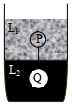
Two spheres $P$ and $Q$ of equal radii have densities $\rho_1$ and $\rho_2$,respectively. The spheres are connected by a massless string and placed in liquids $L_1$ and $L_2$ of densities $\sigma_1$ and $\sigma_2$ and viscosities $\eta_1$ and $\eta_2$,respectively. They float in equilibrium with the sphere $P$ in $L_1$ and sphere $Q$ in $L_2$ and the string being taut (see figure). If sphere $P$ alone in $L_2$ has terminal velocity $\overrightarrow{V}_{P}$ and $Q$ alone in $L_1$ has terminal velocity $\overrightarrow{V}_{Q}$,then
$(A)$ $\frac{|\overrightarrow{V}_{P}|}{|\overrightarrow{V}_{Q}|}=\frac{\eta_1}{\eta_2}$
$(B)$ $\frac{|\overrightarrow{V}_{P}|}{|\overrightarrow{V}_{Q}|}=\frac{\eta_2}{\eta_1}$
$(C)$ $\overrightarrow{V}_{P} \cdot \overrightarrow{V}_{Q} > 0$
$(D)$ $\overrightarrow{V}_{P} \cdot \overrightarrow{V}_{Q} < 0$
$(A)$ $\frac{|\overrightarrow{V}_{P}|}{|\overrightarrow{V}_{Q}|}=\frac{\eta_1}{\eta_2}$
$(B)$ $\frac{|\overrightarrow{V}_{P}|}{|\overrightarrow{V}_{Q}|}=\frac{\eta_2}{\eta_1}$
$(C)$ $\overrightarrow{V}_{P} \cdot \overrightarrow{V}_{Q} > 0$
$(D)$ $\overrightarrow{V}_{P} \cdot \overrightarrow{V}_{Q} < 0$
A
$(B,D)$
B
$(B,C)$
C
$(A,C)$
D
$(A,D)$
Solution
(D) Let $V$ be the volume of each sphere. For the system to be in equilibrium with the string taut,the net force on the system must be zero.
Since $P$ is in $L_1$ and $Q$ is in $L_2$,and the string is taut,$P$ must be lighter than $L_1$ $(\rho_1 < \sigma_1)$ and $Q$ must be heavier than $L_2$ $(\rho_2 > \sigma_2)$.
The equilibrium condition is: $(V\rho_1 g + V\rho_2 g) = (V\sigma_1 g + V\sigma_2 g)$,which implies $\rho_1 + \rho_2 = \sigma_1 + \sigma_2$.
Terminal velocity $v_t = \frac{2r^2g}{9\eta}(\rho_{sphere} - \sigma_{liquid})$.
For sphere $P$ in $L_2$: $\overrightarrow{V}_{P} = \frac{2r^2g}{9\eta_2}(\rho_1 - \sigma_2)$. Since $\rho_1 < \sigma_1 < \sigma_2$,$\overrightarrow{V}_{P}$ is directed upwards (negative).
For sphere $Q$ in $L_1$: $\overrightarrow{V}_{Q} = \frac{2r^2g}{9\eta_1}(\rho_2 - \sigma_1)$. Since $\rho_2 > \sigma_2 > \sigma_1$,$\overrightarrow{V}_{Q}$ is directed downwards (positive).
Thus,$|\overrightarrow{V}_{P}| = \frac{2r^2g}{9\eta_2}(\sigma_2 - \rho_1)$ and $|\overrightarrow{V}_{Q}| = \frac{2r^2g}{9\eta_1}(\rho_2 - \sigma_1)$.
Using $\rho_2 - \sigma_1 = \sigma_2 - \rho_1$,we get $\frac{|\overrightarrow{V}_{P}|}{|\overrightarrow{V}_{Q}|} = \frac{\eta_1}{\eta_2}$.
Since $\overrightarrow{V}_{P}$ is upward and $\overrightarrow{V}_{Q}$ is downward,$\overrightarrow{V}_{P} \cdot \overrightarrow{V}_{Q} < 0$.
Since $P$ is in $L_1$ and $Q$ is in $L_2$,and the string is taut,$P$ must be lighter than $L_1$ $(\rho_1 < \sigma_1)$ and $Q$ must be heavier than $L_2$ $(\rho_2 > \sigma_2)$.
The equilibrium condition is: $(V\rho_1 g + V\rho_2 g) = (V\sigma_1 g + V\sigma_2 g)$,which implies $\rho_1 + \rho_2 = \sigma_1 + \sigma_2$.
Terminal velocity $v_t = \frac{2r^2g}{9\eta}(\rho_{sphere} - \sigma_{liquid})$.
For sphere $P$ in $L_2$: $\overrightarrow{V}_{P} = \frac{2r^2g}{9\eta_2}(\rho_1 - \sigma_2)$. Since $\rho_1 < \sigma_1 < \sigma_2$,$\overrightarrow{V}_{P}$ is directed upwards (negative).
For sphere $Q$ in $L_1$: $\overrightarrow{V}_{Q} = \frac{2r^2g}{9\eta_1}(\rho_2 - \sigma_1)$. Since $\rho_2 > \sigma_2 > \sigma_1$,$\overrightarrow{V}_{Q}$ is directed downwards (positive).
Thus,$|\overrightarrow{V}_{P}| = \frac{2r^2g}{9\eta_2}(\sigma_2 - \rho_1)$ and $|\overrightarrow{V}_{Q}| = \frac{2r^2g}{9\eta_1}(\rho_2 - \sigma_1)$.
Using $\rho_2 - \sigma_1 = \sigma_2 - \rho_1$,we get $\frac{|\overrightarrow{V}_{P}|}{|\overrightarrow{V}_{Q}|} = \frac{\eta_1}{\eta_2}$.
Since $\overrightarrow{V}_{P}$ is upward and $\overrightarrow{V}_{Q}$ is downward,$\overrightarrow{V}_{P} \cdot \overrightarrow{V}_{Q} < 0$.
0 likes
View Solution112
MediumMCQ
$A$ small rigid spherical ball of mass $M$ is dropped in a long vertical tube containing glycerine. The velocity of the ball becomes constant after some time. If the density of glycerine is half of the density of the ball,then the viscous force acting on the ball will be (consider $g$ as acceleration due to gravity).
A
$\frac{3}{2} Mg$
B
$\frac{Mg}{2}$
C
$Mg$
D
$2 Mg$
Solution
(B) When the ball moves with a constant terminal velocity,its acceleration is zero $(a = 0)$.
According to Newton's second law,the net force acting on the ball is zero.
The forces acting on the ball are:
$1$. Weight of the ball $(Mg)$ acting downwards.
$2$. Buoyant force $(F_B)$ acting upwards.
$3$. Viscous force $(f)$ acting upwards.
Equating the forces:
$Mg = F_B + f$
$f = Mg - F_B$
The buoyant force is given by $F_B = V \rho_{glycerine} g$,where $V$ is the volume of the ball.
Since $M = V \rho_{ball}$,we have $V = \frac{M}{\rho_{ball}}$.
Given $\rho_{glycerine} = \frac{1}{2} \rho_{ball}$,we get:
$F_B = V (\frac{1}{2} \rho_{ball}) g = \frac{1}{2} (V \rho_{ball}) g = \frac{Mg}{2}$.
Substituting this into the force equation:
$f = Mg - \frac{Mg}{2} = \frac{Mg}{2}$.
According to Newton's second law,the net force acting on the ball is zero.
The forces acting on the ball are:
$1$. Weight of the ball $(Mg)$ acting downwards.
$2$. Buoyant force $(F_B)$ acting upwards.
$3$. Viscous force $(f)$ acting upwards.
Equating the forces:
$Mg = F_B + f$
$f = Mg - F_B$
The buoyant force is given by $F_B = V \rho_{glycerine} g$,where $V$ is the volume of the ball.
Since $M = V \rho_{ball}$,we have $V = \frac{M}{\rho_{ball}}$.
Given $\rho_{glycerine} = \frac{1}{2} \rho_{ball}$,we get:
$F_B = V (\frac{1}{2} \rho_{ball}) g = \frac{1}{2} (V \rho_{ball}) g = \frac{Mg}{2}$.
Substituting this into the force equation:
$f = Mg - \frac{Mg}{2} = \frac{Mg}{2}$.

0 likes
View Solution113
MediumMCQ
In the experiment for measurement of viscosity $\eta$ of a given liquid with a ball having radius $R$,consider the following statements.
$A.$ Graph between terminal velocity $V$ and $R$ will be a parabola.
$B.$ The terminal velocities of different diameter balls are constant for a given liquid.
$C.$ Measurement of terminal velocity is dependent on the temperature.
$D.$ This experiment can be utilized to assess the density of a given liquid.
$E.$ If balls are dropped with some initial speed,the value of $\eta$ will change.
Choose the correct answer from the options given below:
$A.$ Graph between terminal velocity $V$ and $R$ will be a parabola.
$B.$ The terminal velocities of different diameter balls are constant for a given liquid.
$C.$ Measurement of terminal velocity is dependent on the temperature.
$D.$ This experiment can be utilized to assess the density of a given liquid.
$E.$ If balls are dropped with some initial speed,the value of $\eta$ will change.
Choose the correct answer from the options given below:
A
$B, D$ and $E$ only
B
$A, C$ and $D$ only
C
$C, D$ and $E$ only
D
$A, B$ and $E$ only
Solution
(B) The terminal velocity $V_T$ of a spherical ball of radius $R$ and density $d$ falling through a liquid of density $\rho$ and viscosity $\eta$ is given by $V_T = \frac{2}{9} R^2 \frac{g}{\eta} (d - \rho)$.
Statement $A$ is correct because $V_T \propto R^2$,which represents a parabola.
Statement $B$ is incorrect because $V_T$ depends on $R^2$; thus,different diameters result in different terminal velocities.
Statement $C$ is correct because viscosity $\eta$ is highly temperature-dependent.
Statement $D$ is correct because by measuring $V_T$ and knowing $\eta$,one can determine the density $\rho$ of the liquid.
Statement $E$ is incorrect because $\eta$ is a property of the fluid and does not change based on the initial speed of the ball.
Therefore,statements $A, C,$ and $D$ are correct.
Statement $A$ is correct because $V_T \propto R^2$,which represents a parabola.
Statement $B$ is incorrect because $V_T$ depends on $R^2$; thus,different diameters result in different terminal velocities.
Statement $C$ is correct because viscosity $\eta$ is highly temperature-dependent.
Statement $D$ is correct because by measuring $V_T$ and knowing $\eta$,one can determine the density $\rho$ of the liquid.
Statement $E$ is incorrect because $\eta$ is a property of the fluid and does not change based on the initial speed of the ball.
Therefore,statements $A, C,$ and $D$ are correct.
0 likes
View Solution114
MediumMCQ
$A$ solid steel ball of diameter $3.6 \ mm$ acquires a terminal velocity of $2.45 \times 10^{-2} \ m/s$ while falling under gravity through an oil of density $925 \ kg/m^3$. Take the density of steel as $7825 \ kg/m^3$ and $g$ as $9.8 \ m/s^2$. The viscosity of the oil in $SI$ units is:
A
$2.18$
B
$2.38$
C
$1.68$
D
$1.99$
Solution
(D) The formula for terminal velocity $v_T$ is given by Stokes' Law: $v_T = \frac{2}{9} \frac{(\rho_s - \rho_o) r^2 g}{\eta}$,where $\rho_s$ is the density of steel,$\rho_o$ is the density of oil,$r$ is the radius of the ball,$g$ is the acceleration due to gravity,and $\eta$ is the coefficient of viscosity.
Given:
Diameter $d = 3.6 \ mm = 3.6 \times 10^{-3} \ m$,so radius $r = 1.8 \times 10^{-3} \ m$.
$v_T = 2.45 \times 10^{-2} \ m/s$.
$\rho_s = 7825 \ kg/m^3$.
$\rho_o = 925 \ kg/m^3$.
$g = 9.8 \ m/s^2$.
Rearranging for $\eta$: $\eta = \frac{2}{9} \frac{(\rho_s - \rho_o) r^2 g}{v_T}$.
Substituting the values:
$\eta = \frac{2}{9} \times \frac{(7825 - 925) \times (1.8 \times 10^{-3})^2 \times 9.8}{2.45 \times 10^{-2}}$.
$\eta = \frac{2}{9} \times \frac{6900 \times 3.24 \times 10^{-6} \times 9.8}{2.45 \times 10^{-2}}$.
$\eta = \frac{2}{9} \times \frac{21902.4 \times 10^{-6}}{2.45 \times 10^{-2}} \approx 1.99 \ Pa \cdot s$.
Given:
Diameter $d = 3.6 \ mm = 3.6 \times 10^{-3} \ m$,so radius $r = 1.8 \times 10^{-3} \ m$.
$v_T = 2.45 \times 10^{-2} \ m/s$.
$\rho_s = 7825 \ kg/m^3$.
$\rho_o = 925 \ kg/m^3$.
$g = 9.8 \ m/s^2$.
Rearranging for $\eta$: $\eta = \frac{2}{9} \frac{(\rho_s - \rho_o) r^2 g}{v_T}$.
Substituting the values:
$\eta = \frac{2}{9} \times \frac{(7825 - 925) \times (1.8 \times 10^{-3})^2 \times 9.8}{2.45 \times 10^{-2}}$.
$\eta = \frac{2}{9} \times \frac{6900 \times 3.24 \times 10^{-6} \times 9.8}{2.45 \times 10^{-2}}$.
$\eta = \frac{2}{9} \times \frac{21902.4 \times 10^{-6}}{2.45 \times 10^{-2}} \approx 1.99 \ Pa \cdot s$.
0 likes
View Solution115
MediumMCQ
Eight identical drops of same radii are falling through air with steady velocity $6 \ cm/s$. If these drops coalesce,then the terminal velocity would be .......... $cm/s$.
A
$12$
B
$18$
C
$20$
D
$24$
Solution
(D) Let the radius of each small drop be $r$ and the radius of the large drop be $R$. Since the volume remains constant when drops coalesce,we have $8 \times (\frac{4}{3} \pi r^3) = \frac{4}{3} \pi R^3$.
This simplifies to $R^3 = 8r^3$,which gives $R = 2r$.
The terminal velocity $V_T$ of a drop is given by $V_T = \frac{2}{9} \frac{r^2(\rho - \sigma)g}{\eta}$,which implies $V_T \propto r^2$.
Therefore,the ratio of the terminal velocities is $\frac{V_2}{V_1} = (\frac{R}{r})^2$.
Substituting the values,$\frac{V_2}{6} = (\frac{2r}{r})^2 = 4$.
Thus,$V_2 = 6 \times 4 = 24 \ cm/s$.
This simplifies to $R^3 = 8r^3$,which gives $R = 2r$.
The terminal velocity $V_T$ of a drop is given by $V_T = \frac{2}{9} \frac{r^2(\rho - \sigma)g}{\eta}$,which implies $V_T \propto r^2$.
Therefore,the ratio of the terminal velocities is $\frac{V_2}{V_1} = (\frac{R}{r})^2$.
Substituting the values,$\frac{V_2}{6} = (\frac{2r}{r})^2 = 4$.
Thus,$V_2 = 6 \times 4 = 24 \ cm/s$.
0 likes
View Solution116
EasyMCQ
The terminal velocity of a sphere of radius $3 \ mm$ falling in a viscous liquid is $10 \ cm/s$. The terminal velocity of a ball of radius $6 \ mm$ of the same material falling in the same liquid will be $...... \ cm/s$.
A
$10$
B
$20$
C
$40$
D
$50$
Solution
(C) The terminal velocity $V_T$ of a sphere falling through a viscous liquid is given by the formula: $V_T = \frac{2}{9} \frac{r^2 (\rho - \sigma) g}{\eta}$.
From this expression,we can see that $V_T \propto r^2$,where $r$ is the radius of the sphere.
Given: $r_1 = 3 \ mm$,$V_{T1} = 10 \ cm/s$,and $r_2 = 6 \ mm$.
Using the ratio method: $\frac{V_{T2}}{V_{T1}} = \left( \frac{r_2}{r_1} \right)^2$.
Substituting the values: $\frac{V_{T2}}{10} = \left( \frac{6}{3} \right)^2$.
$\frac{V_{T2}}{10} = (2)^2 = 4$.
$V_{T2} = 4 \times 10 = 40 \ cm/s$.
From this expression,we can see that $V_T \propto r^2$,where $r$ is the radius of the sphere.
Given: $r_1 = 3 \ mm$,$V_{T1} = 10 \ cm/s$,and $r_2 = 6 \ mm$.
Using the ratio method: $\frac{V_{T2}}{V_{T1}} = \left( \frac{r_2}{r_1} \right)^2$.
Substituting the values: $\frac{V_{T2}}{10} = \left( \frac{6}{3} \right)^2$.
$\frac{V_{T2}}{10} = (2)^2 = 4$.
$V_{T2} = 4 \times 10 = 40 \ cm/s$.
0 likes
View Solution117
MediumMCQ
Find the viscosity of glycerine $($having density $1.3 \ g \ cm^{-3})$ if a steel ball of $2 \ mm$ radius $($density $8 \ g \ cm^{-3})$ acquires a terminal velocity of $4 \ cm \ s^{-1}$ in falling freely in the tank of glycerine. $(g = 980 \ cm \ s^{-2})$ (in $\text{poise}$)
A
$14.6$
B
$12.2$
C
$10.4$
D
$9.8$
Solution
(A) The formula for terminal velocity $v_T$ is given by $v_T = \frac{2}{9} \frac{g(\rho - \sigma)r^2}{\eta}$.
Rearranging for viscosity $\eta$,we get $\eta = \frac{2}{9} \frac{g(\rho - \sigma)r^2}{v_T}$.
Given values: $g = 980 \ cm \ s^{-2}$,$\rho = 8 \ g \ cm^{-3}$,$\sigma = 1.3 \ g \ cm^{-3}$,$r = 2 \ mm = 0.2 \ cm$,and $v_T = 4 \ cm \ s^{-1}$.
Substituting these values into the formula:
$\eta = \frac{2}{9} \times \frac{980 \times (8 - 1.3) \times (0.2)^2}{4}$.
$\eta = \frac{2}{9} \times \frac{980 \times 6.7 \times 0.04}{4}$.
$\eta = \frac{2}{9} \times 980 \times 6.7 \times 0.01$.
$\eta = \frac{131.32}{9} \approx 14.59 \ \text{Poise} \approx 14.6 \ \text{Poise}$.
Rearranging for viscosity $\eta$,we get $\eta = \frac{2}{9} \frac{g(\rho - \sigma)r^2}{v_T}$.
Given values: $g = 980 \ cm \ s^{-2}$,$\rho = 8 \ g \ cm^{-3}$,$\sigma = 1.3 \ g \ cm^{-3}$,$r = 2 \ mm = 0.2 \ cm$,and $v_T = 4 \ cm \ s^{-1}$.
Substituting these values into the formula:
$\eta = \frac{2}{9} \times \frac{980 \times (8 - 1.3) \times (0.2)^2}{4}$.
$\eta = \frac{2}{9} \times \frac{980 \times 6.7 \times 0.04}{4}$.
$\eta = \frac{2}{9} \times 980 \times 6.7 \times 0.01$.
$\eta = \frac{131.32}{9} \approx 14.59 \ \text{Poise} \approx 14.6 \ \text{Poise}$.
0 likes
View Solution118
MediumMCQ
Eight equal drops of water,each of radius $r = 2 \ mm$,are falling through air with a terminal velocity of $16 \ cm/s$. The eight drops combine to form a single big drop. The terminal velocity of the bigger drop will be $.... \ cm/s$.
A
$16$
B
$32$
C
$64$
D
$30$
Solution
(C) The terminal velocity $v_t$ of a spherical drop falling through a viscous medium is given by Stokes' Law as $v_t = \frac{2r^2(\rho - \sigma)g}{9\eta}$.
From this,we see that $v_t \propto r^2$.
Let $r$ be the radius of each small drop and $R$ be the radius of the big drop.
Since the volume remains constant when $8$ small drops combine to form one big drop:
$8 \times (\frac{4}{3} \pi r^3) = \frac{4}{3} \pi R^3$
$R^3 = 8r^3 \Rightarrow R = 2r$.
Now,using the proportionality $v_t \propto r^2$:
$\frac{v_{big}}{v_{small}} = \frac{R^2}{r^2} = \frac{(2r)^2}{r^2} = 4$.
Given $v_{small} = 16 \ cm/s$,the terminal velocity of the big drop is:
$v_{big} = 4 \times 16 \ cm/s = 64 \ cm/s$.
From this,we see that $v_t \propto r^2$.
Let $r$ be the radius of each small drop and $R$ be the radius of the big drop.
Since the volume remains constant when $8$ small drops combine to form one big drop:
$8 \times (\frac{4}{3} \pi r^3) = \frac{4}{3} \pi R^3$
$R^3 = 8r^3 \Rightarrow R = 2r$.
Now,using the proportionality $v_t \propto r^2$:
$\frac{v_{big}}{v_{small}} = \frac{R^2}{r^2} = \frac{(2r)^2}{r^2} = 4$.
Given $v_{small} = 16 \ cm/s$,the terminal velocity of the big drop is:
$v_{big} = 4 \times 16 \ cm/s = 64 \ cm/s$.
0 likes
View Solution119
MediumMCQ
In an experiment to calculate the coefficient of viscosity of a liquid by measuring terminal velocity, it was observed that a ball of mass $(\frac{\pi}{2}) \ gm$ and radius $0.5 \ cm$ takes $5 \ s$ to fall steadily through a height of $50 \ cm$ inside a long column of liquid of density $1.2 \ gm/cc$. The coefficient of viscosity will be given as: (in $\text{poise}$)
A
$4.9$
B
$9.8$
C
$12.6$
D
$16$
Solution
(B) The density of the ball $\rho$ is given by $\rho = \frac{m}{V} = \frac{\pi/2}{\frac{4}{3}\pi(0.5)^3} = \frac{3}{8 \times 0.125} = 3 \ gm/cc$.
The terminal velocity $V_T$ is $V_T = \frac{\text{distance}}{\text{time}} = \frac{50 \ cm}{5 \ s} = 10 \ cm/s$.
According to Stoke's Law, the terminal velocity is $V_T = \frac{2}{9} \frac{r^2(\rho - \sigma)g}{\eta}$, where $\sigma = 1.2 \ gm/cc$ is the density of the liquid and $g = 980 \ cm/s^2$.
Rearranging for viscosity $\eta$: $\eta = \frac{2}{9} \frac{r^2(\rho - \sigma)g}{V_T}$.
Substituting the values: $\eta = \frac{2}{9} \times \frac{(0.5)^2 \times (3 - 1.2) \times 980}{10}$.
$\eta = \frac{2}{9} \times \frac{0.25 \times 1.8 \times 980}{10} = \frac{2}{9} \times \frac{0.45 \times 980}{10} = \frac{2}{9} \times 44.1 = 9.8 \ \text{poise}$.
The terminal velocity $V_T$ is $V_T = \frac{\text{distance}}{\text{time}} = \frac{50 \ cm}{5 \ s} = 10 \ cm/s$.
According to Stoke's Law, the terminal velocity is $V_T = \frac{2}{9} \frac{r^2(\rho - \sigma)g}{\eta}$, where $\sigma = 1.2 \ gm/cc$ is the density of the liquid and $g = 980 \ cm/s^2$.
Rearranging for viscosity $\eta$: $\eta = \frac{2}{9} \frac{r^2(\rho - \sigma)g}{V_T}$.
Substituting the values: $\eta = \frac{2}{9} \times \frac{(0.5)^2 \times (3 - 1.2) \times 980}{10}$.
$\eta = \frac{2}{9} \times \frac{0.25 \times 1.8 \times 980}{10} = \frac{2}{9} \times \frac{0.45 \times 980}{10} = \frac{2}{9} \times 44.1 = 9.8 \ \text{poise}$.
0 likes
View Solution120
MediumMCQ
Two metal spheres are falling through a liquid of density $3 \times 10^3 \ kg/m^3$ with the same uniform speed. The material densities of sphere $1$ and sphere $2$ are $8 \times 10^3 \ kg/m^3$ and $11 \times 10^3 \ kg/m^3$ respectively. The ratio of their radii is
A
$11/8$
B
$\sqrt{11/8}$
C
$\sqrt{8/5}$
D
$\sqrt{3/2}$
Solution
(C) The terminal velocity $V_t$ of a spherical body of radius $R$ and density $\rho$,falling through a liquid of density $\sigma$,is given by $V_t = \frac{2}{9} \frac{R^2(\rho - \sigma)g}{\eta}$,where $\eta$ is the coefficient of viscosity.
Since both spheres fall with the same uniform speed,$V_{t1} = V_{t2}$.
Thus,$R_1^2(\rho_1 - \sigma) = R_2^2(\rho_2 - \sigma)$.
Rearranging for the ratio of radii: $\frac{R_1^2}{R_2^2} = \frac{\rho_2 - \sigma}{\rho_1 - \sigma}$.
Given $\rho_1 = 8 \times 10^3 \ kg/m^3$,$\rho_2 = 11 \times 10^3 \ kg/m^3$,and $\sigma = 3 \times 10^3 \ kg/m^3$.
Substituting the values: $\frac{R_1^2}{R_2^2} = \frac{11 \times 10^3 - 3 \times 10^3}{8 \times 10^3 - 3 \times 10^3} = \frac{8 \times 10^3}{5 \times 10^3} = \frac{8}{5}$.
Therefore,$\frac{R_1}{R_2} = \sqrt{\frac{8}{5}}$.
Since both spheres fall with the same uniform speed,$V_{t1} = V_{t2}$.
Thus,$R_1^2(\rho_1 - \sigma) = R_2^2(\rho_2 - \sigma)$.
Rearranging for the ratio of radii: $\frac{R_1^2}{R_2^2} = \frac{\rho_2 - \sigma}{\rho_1 - \sigma}$.
Given $\rho_1 = 8 \times 10^3 \ kg/m^3$,$\rho_2 = 11 \times 10^3 \ kg/m^3$,and $\sigma = 3 \times 10^3 \ kg/m^3$.
Substituting the values: $\frac{R_1^2}{R_2^2} = \frac{11 \times 10^3 - 3 \times 10^3}{8 \times 10^3 - 3 \times 10^3} = \frac{8 \times 10^3}{5 \times 10^3} = \frac{8}{5}$.
Therefore,$\frac{R_1}{R_2} = \sqrt{\frac{8}{5}}$.
0 likes
View Solution121
MediumMCQ
$A$ ball rises to the surface at a constant velocity in a liquid whose density is $4$ times greater than that of the material of the ball. The ratio of the force of friction acting on the rising ball to its weight is
A
$3: 1$
B
$4: 1$
C
$1: 3$
D
$1: 4$
Solution
(A) Let $V$ be the volume of the ball,$\rho_1$ be the density of the ball,and $\rho_2$ be the density of the liquid. Given $\rho_2 = 4\rho_1$.
The forces acting on the ball moving at a constant velocity are the buoyant force $(F_B)$,the weight of the ball $(W)$,and the viscous drag force $(F_v)$.
Since the velocity is constant,the net force is zero: $F_B = W + F_v$.
Therefore,the frictional force (viscous drag) is $F_v = F_B - W$.
Buoyant force $F_B = V \rho_2 g = V(4\rho_1)g = 4V\rho_1 g$.
Weight $W = V \rho_1 g$.
Thus,$F_v = 4V\rho_1 g - V\rho_1 g = 3V\rho_1 g$.
The ratio of the frictional force to the weight is $\frac{F_v}{W} = \frac{3V\rho_1 g}{V\rho_1 g} = \frac{3}{1} = 3:1$.
The forces acting on the ball moving at a constant velocity are the buoyant force $(F_B)$,the weight of the ball $(W)$,and the viscous drag force $(F_v)$.
Since the velocity is constant,the net force is zero: $F_B = W + F_v$.
Therefore,the frictional force (viscous drag) is $F_v = F_B - W$.
Buoyant force $F_B = V \rho_2 g = V(4\rho_1)g = 4V\rho_1 g$.
Weight $W = V \rho_1 g$.
Thus,$F_v = 4V\rho_1 g - V\rho_1 g = 3V\rho_1 g$.
The ratio of the frictional force to the weight is $\frac{F_v}{W} = \frac{3V\rho_1 g}{V\rho_1 g} = \frac{3}{1} = 3:1$.
0 likes
View Solution122
MediumMCQ
$A$ metal sphere of radius $R$ and density $\rho_1$ is dropped in a liquid of density $\sigma$ and moves with terminal velocity $V$. Another metal sphere of the same radius and density $\rho_2$ is dropped in the same liquid. Its terminal velocity will be:
A
$V \left[ (\rho_2 - \sigma) / (\rho_1 - \sigma) \right]$
B
$V \left[ (\rho_1 - \sigma) / (\rho_2 - \sigma) \right]$
C
$V \left[ (\rho_2 + \sigma) / (\rho_1 + \sigma) \right]$
D
$V \left[ (\rho_1 + \sigma) / (\rho_2 + \sigma) \right]$
Solution
(A) The terminal velocity $V_T$ of a sphere of radius $R$ and density $\rho$ falling through a liquid of density $\sigma$ and viscosity $\eta$ is given by Stokes' Law:
$V_T = \frac{2}{9} \frac{R^2 (\rho - \sigma) g}{\eta}$
Since $R$,$g$,and $\eta$ are constant for both spheres,the terminal velocity is directly proportional to the difference in densities:
$V \propto (\rho - \sigma)$
Therefore,for the first sphere: $V \propto (\rho_1 - \sigma)$
For the second sphere with terminal velocity $V'$: $V' \propto (\rho_2 - \sigma)$
Taking the ratio:
$\frac{V'}{V} = \frac{\rho_2 - \sigma}{\rho_1 - \sigma}$
$V' = V \left[ \frac{\rho_2 - \sigma}{\rho_1 - \sigma} \right]$
$V_T = \frac{2}{9} \frac{R^2 (\rho - \sigma) g}{\eta}$
Since $R$,$g$,and $\eta$ are constant for both spheres,the terminal velocity is directly proportional to the difference in densities:
$V \propto (\rho - \sigma)$
Therefore,for the first sphere: $V \propto (\rho_1 - \sigma)$
For the second sphere with terminal velocity $V'$: $V' \propto (\rho_2 - \sigma)$
Taking the ratio:
$\frac{V'}{V} = \frac{\rho_2 - \sigma}{\rho_1 - \sigma}$
$V' = V \left[ \frac{\rho_2 - \sigma}{\rho_1 - \sigma} \right]$
0 likes
View Solution123
MediumMCQ
$n$ small water drops of same size (radius $r$) fall through air with constant terminal velocity $V$. They coalesce to form a big drop of radius $R$. The terminal velocity of the big drop is
A
$\frac{VR^2}{r^2}$
B
$\frac{Vr^2}{R^2}$
C
$\frac{VR}{r}$
D
$\frac{Vr}{R}$
Solution
(A) The terminal velocity $V$ of a drop of radius $r$ is given by $V = \frac{2}{9} \frac{r^2(\rho - \sigma)g}{\eta}$.
Since $V \propto r^2$,we have $\frac{V_{big}}{V_{small}} = \frac{R^2}{r^2}$.
Given that $n$ drops of radius $r$ coalesce to form one big drop of radius $R$,the volume is conserved: $\frac{4}{3}\pi R^3 = n \cdot \frac{4}{3}\pi r^3$,which implies $R^3 = nr^3$ or $R = n^{1/3}r$.
Substituting $R^2 = n^{2/3}r^2$ into the velocity ratio,we get $V_{big} = V \cdot \frac{R^2}{r^2} = V \cdot n^{2/3}$.
However,expressing the result in terms of $R$ and $r$ as per the options,we use the proportionality $V \propto r^2$. Thus,$V_{big} = V \cdot \frac{R^2}{r^2}$.
Since $V \propto r^2$,we have $\frac{V_{big}}{V_{small}} = \frac{R^2}{r^2}$.
Given that $n$ drops of radius $r$ coalesce to form one big drop of radius $R$,the volume is conserved: $\frac{4}{3}\pi R^3 = n \cdot \frac{4}{3}\pi r^3$,which implies $R^3 = nr^3$ or $R = n^{1/3}r$.
Substituting $R^2 = n^{2/3}r^2$ into the velocity ratio,we get $V_{big} = V \cdot \frac{R^2}{r^2} = V \cdot n^{2/3}$.
However,expressing the result in terms of $R$ and $r$ as per the options,we use the proportionality $V \propto r^2$. Thus,$V_{big} = V \cdot \frac{R^2}{r^2}$.
0 likes
View Solution124
MediumMCQ
Two raindrops reach the earth with different terminal velocities having the ratio $9: 4$. The ratio of their volumes is
A
$8/27$
B
$9/4$
C
$3/2$
D
$27/8$
Solution
(D) The terminal velocity $v_t$ of a spherical raindrop of radius $r$ falling through a viscous medium is given by the formula: $v_t = \frac{2}{9} \frac{r^2 g (\rho - \sigma)}{\eta}$,where $\rho$ is the density of the raindrop,$\sigma$ is the density of air,$g$ is the acceleration due to gravity,and $\eta$ is the coefficient of viscosity.
Since all these parameters are constant for both raindrops,we have $v_t \propto r^2$.
Given the ratio of terminal velocities is $\frac{v_{t1}}{v_{t2}} = \frac{9}{4}$,we can write: $\frac{r_1^2}{r_2^2} = \frac{9}{4}$.
Taking the square root of both sides,we get $\frac{r_1}{r_2} = \frac{3}{2}$.
The volume $V$ of a spherical raindrop is given by $V = \frac{4}{3} \pi r^3$,so $V \propto r^3$.
The ratio of their volumes is $\frac{V_1}{V_2} = \left( \frac{r_1}{r_2} \right)^3 = \left( \frac{3}{2} \right)^3 = \frac{27}{8}$.
Thus,the correct option is $D$.
Since all these parameters are constant for both raindrops,we have $v_t \propto r^2$.
Given the ratio of terminal velocities is $\frac{v_{t1}}{v_{t2}} = \frac{9}{4}$,we can write: $\frac{r_1^2}{r_2^2} = \frac{9}{4}$.
Taking the square root of both sides,we get $\frac{r_1}{r_2} = \frac{3}{2}$.
The volume $V$ of a spherical raindrop is given by $V = \frac{4}{3} \pi r^3$,so $V \propto r^3$.
The ratio of their volumes is $\frac{V_1}{V_2} = \left( \frac{r_1}{r_2} \right)^3 = \left( \frac{3}{2} \right)^3 = \frac{27}{8}$.
Thus,the correct option is $D$.
0 likes
View Solution125
MediumMCQ
The velocity of a small spherical ball of mass $m$ and density $d_1$,when dropped in a container filled with glycerine,becomes constant after some time. The viscous force acting on the ball if the density of glycerine is $d_2$ is
A
$mg(1 - d_2/d_1)$
B
$mg(1 + d_2/d_1)$
C
$mg(1 - d_1/d_2)$
D
$mg(1 + d_1/d_2)$
Solution
(A) When the ball attains a constant terminal velocity,the net force acting on it is zero.
The forces acting on the ball are:
$1$. Weight $(W = mg)$ acting downwards.
$2$. Buoyant force $(F_B)$ acting upwards.
$3$. Viscous force $(F_v)$ acting upwards.
At equilibrium,$F_v + F_B = W$,so $F_v = W - F_B$.
The weight $W = mg$.
The buoyant force $F_B$ is equal to the weight of the displaced glycerine: $F_B = V d_2 g$,where $V$ is the volume of the ball.
Since $m = V d_1$,we have $V = m/d_1$.
Substituting $V$ into the buoyant force equation: $F_B = (m/d_1) d_2 g = mg(d_2/d_1)$.
Therefore,the viscous force $F_v = mg - mg(d_2/d_1) = mg(1 - d_2/d_1)$.
The forces acting on the ball are:
$1$. Weight $(W = mg)$ acting downwards.
$2$. Buoyant force $(F_B)$ acting upwards.
$3$. Viscous force $(F_v)$ acting upwards.
At equilibrium,$F_v + F_B = W$,so $F_v = W - F_B$.
The weight $W = mg$.
The buoyant force $F_B$ is equal to the weight of the displaced glycerine: $F_B = V d_2 g$,where $V$ is the volume of the ball.
Since $m = V d_1$,we have $V = m/d_1$.
Substituting $V$ into the buoyant force equation: $F_B = (m/d_1) d_2 g = mg(d_2/d_1)$.
Therefore,the viscous force $F_v = mg - mg(d_2/d_1) = mg(1 - d_2/d_1)$.
0 likes
View Solution126
MediumMCQ
$125$ small water drops of same size fall through air with constant terminal velocity $4 \,cm/s$. They coalesce to form a big drop. The terminal velocity of the big drop is: (in $\,m/s$)
A
$0.5$
B
$1$
C
$1.5$
D
$2.5$
Solution
(B) Let $r$ be the radius of each small drop and $R$ be the radius of the big drop.
Since the volume remains constant, the volume of the big drop equals the sum of the volumes of $125$ small drops:
$\frac{4}{3} \pi R^3 = 125 \times \frac{4}{3} \pi r^3$
$R^3 = 125 r^3 \implies R = 5r$.
The terminal velocity $v_t$ of a drop is given by $v_t = \frac{2r^2(\rho - \sigma)g}{9\eta}$, which implies $v_t \propto r^2$.
Let $v$ be the terminal velocity of the small drop and $V$ be the terminal velocity of the big drop.
$\frac{V}{v} = \left(\frac{R}{r}\right)^2 = (5)^2 = 25$.
Given $v = 4 \,cm/s$, we have $V = 25 \times 4 \,cm/s = 100 \,cm/s$.
Converting to meters per second: $100 \,cm/s = 1 \,m/s$.
Since the volume remains constant, the volume of the big drop equals the sum of the volumes of $125$ small drops:
$\frac{4}{3} \pi R^3 = 125 \times \frac{4}{3} \pi r^3$
$R^3 = 125 r^3 \implies R = 5r$.
The terminal velocity $v_t$ of a drop is given by $v_t = \frac{2r^2(\rho - \sigma)g}{9\eta}$, which implies $v_t \propto r^2$.
Let $v$ be the terminal velocity of the small drop and $V$ be the terminal velocity of the big drop.
$\frac{V}{v} = \left(\frac{R}{r}\right)^2 = (5)^2 = 25$.
Given $v = 4 \,cm/s$, we have $V = 25 \times 4 \,cm/s = 100 \,cm/s$.
Converting to meters per second: $100 \,cm/s = 1 \,m/s$.
0 likes
View Solution127
MediumMCQ
Two spheres of different material are falling through a liquid of density $\rho_L = 2 \times 10^3 \ kg/m^3$ with the same uniform terminal speed. The density of sphere $1$ is $\rho_1 = 8 \times 10^3 \ kg/m^3$ and the density of sphere $2$ is $\rho_2 = 11 \times 10^3 \ kg/m^3$. The ratio of their radii $(r_1/r_2)$ is:
A
$3/2$
B
$2/3$
C
$\sqrt{3/2}$
D
$\sqrt{2/3}$
Solution
(C) The terminal velocity $v_t$ of a sphere of radius $r$ and density $\rho$ falling through a liquid of density $\rho_L$ and viscosity $\eta$ is given by Stokes' Law: $v_t = \frac{2}{9} \frac{r^2 g}{\eta} (\rho - \rho_L)$.
Since both spheres fall with the same uniform terminal speed $v_t$,we have: $r_1^2 (\rho_1 - \rho_L) = r_2^2 (\rho_2 - \rho_L)$.
Rearranging for the ratio of radii: $\frac{r_1^2}{r_2^2} = \frac{\rho_2 - \rho_L}{\rho_1 - \rho_L}$.
Substituting the given values: $\frac{r_1^2}{r_2^2} = \frac{11 \times 10^3 - 2 \times 10^3}{8 \times 10^3 - 2 \times 10^3} = \frac{9 \times 10^3}{6 \times 10^3} = \frac{9}{6} = \frac{3}{2}$.
Therefore,the ratio of their radii is $\frac{r_1}{r_2} = \sqrt{\frac{3}{2}}$.
Since both spheres fall with the same uniform terminal speed $v_t$,we have: $r_1^2 (\rho_1 - \rho_L) = r_2^2 (\rho_2 - \rho_L)$.
Rearranging for the ratio of radii: $\frac{r_1^2}{r_2^2} = \frac{\rho_2 - \rho_L}{\rho_1 - \rho_L}$.
Substituting the given values: $\frac{r_1^2}{r_2^2} = \frac{11 \times 10^3 - 2 \times 10^3}{8 \times 10^3 - 2 \times 10^3} = \frac{9 \times 10^3}{6 \times 10^3} = \frac{9}{6} = \frac{3}{2}$.
Therefore,the ratio of their radii is $\frac{r_1}{r_2} = \sqrt{\frac{3}{2}}$.
0 likes
View Solution128
DifficultMCQ
$A$ metal ball of radius $9 \times 10^{-4} \ m$ and density $10^4 \ kg/m^3$ falls freely under gravity through a distance $h$ and enters a tank of water. Considering that the metal ball has constant velocity in water,the value of $h$ is [coefficient of viscosity of water $= 8.1 \times 10^{-4} \ Pa \cdot s, g = 10 \ m/s^2$,density of water $= 10^3 \ kg/m^3$]. (in $m$)
A
$20$
B
$18$
C
$15$
D
$12$
Solution
(A) The velocity of the ball when it hits the surface of the water is given by $v = \sqrt{2gh}$.
The terminal velocity of the ball in water is given by Stokes' Law: $v = \frac{2}{9} r^2 g \frac{(\rho - \sigma)}{\eta}$,where $\rho$ is the density of the ball,$\sigma$ is the density of water,and $\eta$ is the coefficient of viscosity.
Equating the two expressions for velocity:
$\sqrt{2gh} = \frac{2}{9} \frac{r^2 g}{\eta} (\rho - \sigma)$
Squaring both sides:
$2gh = \left( \frac{2}{9} \frac{r^2 g}{\eta} (\rho - \sigma) \right)^2$
$h = \frac{1}{2g} \left( \frac{2}{9} \frac{r^2 g}{\eta} (\rho - \sigma) \right)^2 = \frac{2}{81} \frac{r^4 g}{\eta^2} (\rho - \sigma)^2$
Substituting the given values:
$r = 9 \times 10^{-4} \ m$,$\rho = 10^4 \ kg/m^3$,$\sigma = 10^3 \ kg/m^3$,$\eta = 8.1 \times 10^{-4} \ Pa \cdot s$,$g = 10 \ m/s^2$.
$h = \frac{2}{81} \times \frac{(9 \times 10^{-4})^4 \times 10}{(8.1 \times 10^{-4})^2} \times (10^4 - 10^3)^2$
$h = \frac{2}{81} \times \frac{6561 \times 10^{-16} \times 10}{65.61 \times 10^{-8}} \times (9000)^2$
$h = \frac{2}{81} \times 10^{-7} \times 100 \times 81 \times 10^6 = 20 \ m$.
The terminal velocity of the ball in water is given by Stokes' Law: $v = \frac{2}{9} r^2 g \frac{(\rho - \sigma)}{\eta}$,where $\rho$ is the density of the ball,$\sigma$ is the density of water,and $\eta$ is the coefficient of viscosity.
Equating the two expressions for velocity:
$\sqrt{2gh} = \frac{2}{9} \frac{r^2 g}{\eta} (\rho - \sigma)$
Squaring both sides:
$2gh = \left( \frac{2}{9} \frac{r^2 g}{\eta} (\rho - \sigma) \right)^2$
$h = \frac{1}{2g} \left( \frac{2}{9} \frac{r^2 g}{\eta} (\rho - \sigma) \right)^2 = \frac{2}{81} \frac{r^4 g}{\eta^2} (\rho - \sigma)^2$
Substituting the given values:
$r = 9 \times 10^{-4} \ m$,$\rho = 10^4 \ kg/m^3$,$\sigma = 10^3 \ kg/m^3$,$\eta = 8.1 \times 10^{-4} \ Pa \cdot s$,$g = 10 \ m/s^2$.
$h = \frac{2}{81} \times \frac{(9 \times 10^{-4})^4 \times 10}{(8.1 \times 10^{-4})^2} \times (10^4 - 10^3)^2$
$h = \frac{2}{81} \times \frac{6561 \times 10^{-16} \times 10}{65.61 \times 10^{-8}} \times (9000)^2$
$h = \frac{2}{81} \times 10^{-7} \times 100 \times 81 \times 10^6 = 20 \ m$.
0 likes
View Solution129
EasyMCQ
$A$ steel ball of radius $6 \ mm$ has a terminal speed of $12 \ cm s^{-1}$ in a viscous liquid. What will be the terminal speed of a steel ball of radius $3 \ mm$ in the same liquid (in $cm s^{-1}$)?
A
$12$
B
$9$
C
$6$
D
$3$
Solution
(D) The formula for terminal velocity $v$ is given by $v = \frac{2r^2g(\rho - \sigma)}{9\eta}$,where $r$ is the radius of the ball,$g$ is the acceleration due to gravity,$\rho$ is the density of the ball,$\sigma$ is the density of the liquid,and $\eta$ is the coefficient of viscosity.
Since the material of the ball and the liquid remain the same,$v \propto r^2$.
Therefore,$\frac{v_2}{v_1} = \left(\frac{r_2}{r_1}\right)^2$.
Given $r_1 = 6 \ mm$,$v_1 = 12 \ cm s^{-1}$,and $r_2 = 3 \ mm$.
Substituting the values: $\frac{v_2}{12} = \left(\frac{3}{6}\right)^2 = \left(\frac{1}{2}\right)^2 = \frac{1}{4}$.
Thus,$v_2 = \frac{12}{4} = 3 \ cm s^{-1}$.
Since the material of the ball and the liquid remain the same,$v \propto r^2$.
Therefore,$\frac{v_2}{v_1} = \left(\frac{r_2}{r_1}\right)^2$.
Given $r_1 = 6 \ mm$,$v_1 = 12 \ cm s^{-1}$,and $r_2 = 3 \ mm$.
Substituting the values: $\frac{v_2}{12} = \left(\frac{3}{6}\right)^2 = \left(\frac{1}{2}\right)^2 = \frac{1}{4}$.
Thus,$v_2 = \frac{12}{4} = 3 \ cm s^{-1}$.
0 likes
View Solution130
MediumMCQ
Two identical drops of water are falling through air with steady velocity $V$. If the two drops coalesce to form a single drop,what is the new terminal velocity of the single drop?
A
$(2)^{1/3} V$
B
$(2)^{3/2} V$
C
$(2)^{2/3} V$
D
$(2)^{1/4} V$
Solution
(C) Let the radius of each of the two identical water droplets be $r$.
When they coalesce to form a single larger drop of radius $R$,the volume remains conserved.
Thus,$\frac{4}{3} \pi R^3 = 2 \times \frac{4}{3} \pi r^3$,which gives $R^3 = 2r^3$,or $R = 2^{1/3} r$.
The terminal velocity $V$ of a spherical drop falling through a viscous medium is given by $V = \frac{2}{9} \frac{r^2(\rho - \sigma)g}{\eta}$.
From this expression,we see that $V \propto r^2$.
If $V'$ is the terminal velocity of the new drop,then $\frac{V'}{V} = \frac{R^2}{r^2}$.
Substituting $R = 2^{1/3} r$,we get $\frac{V'}{V} = \frac{(2^{1/3} r)^2}{r^2} = \frac{2^{2/3} r^2}{r^2} = 2^{2/3}$.
Therefore,the new terminal velocity is $V' = 2^{2/3} V$.
When they coalesce to form a single larger drop of radius $R$,the volume remains conserved.
Thus,$\frac{4}{3} \pi R^3 = 2 \times \frac{4}{3} \pi r^3$,which gives $R^3 = 2r^3$,or $R = 2^{1/3} r$.
The terminal velocity $V$ of a spherical drop falling through a viscous medium is given by $V = \frac{2}{9} \frac{r^2(\rho - \sigma)g}{\eta}$.
From this expression,we see that $V \propto r^2$.
If $V'$ is the terminal velocity of the new drop,then $\frac{V'}{V} = \frac{R^2}{r^2}$.
Substituting $R = 2^{1/3} r$,we get $\frac{V'}{V} = \frac{(2^{1/3} r)^2}{r^2} = \frac{2^{2/3} r^2}{r^2} = 2^{2/3}$.
Therefore,the new terminal velocity is $V' = 2^{2/3} V$.
0 likes
View Solution131
EasyMCQ
$A$ metal sphere of radius $R$,density $\rho_1$ moves with terminal velocity $V_1$ through a liquid of density $\sigma$. Another sphere of same radius but density $\rho_2$ moves through the same liquid. Its terminal velocity is $V_2$. The ratio $V_1: V_2$ is
A
$(\rho_1 - \sigma) : (\rho_2 - \sigma)$
B
$(\rho_2 - \sigma) : (\rho_1 - \sigma)$
C
$(\rho_1 + \sigma) : (\rho_2 + \sigma)$
D
$(\rho_2 + \sigma) : (\rho_1 + \sigma)$
Solution
(A) The terminal velocity $v$ of a sphere of radius $R$ and density $\rho$ falling through a liquid of density $\sigma$ and viscosity $\eta$ is given by Stokes' Law as:
$v = \frac{2}{9} \frac{(\rho - \sigma) R^2 g}{\eta}$
For the first sphere with density $\rho_1$ and terminal velocity $V_1$:
$V_1 = \frac{2}{9} \frac{(\rho_1 - \sigma) R^2 g}{\eta}$
For the second sphere with density $\rho_2$ and terminal velocity $V_2$:
$V_2 = \frac{2}{9} \frac{(\rho_2 - \sigma) R^2 g}{\eta}$
Taking the ratio of $V_1$ to $V_2$:
$\frac{V_1}{V_2} = \frac{\frac{2}{9} \frac{(\rho_1 - \sigma) R^2 g}{\eta}}{\frac{2}{9} \frac{(\rho_2 - \sigma) R^2 g}{\eta}}$
$\frac{V_1}{V_2} = \frac{\rho_1 - \sigma}{\rho_2 - \sigma}$
Therefore,the ratio $V_1 : V_2$ is $(\rho_1 - \sigma) : (\rho_2 - \sigma)$.
$v = \frac{2}{9} \frac{(\rho - \sigma) R^2 g}{\eta}$
For the first sphere with density $\rho_1$ and terminal velocity $V_1$:
$V_1 = \frac{2}{9} \frac{(\rho_1 - \sigma) R^2 g}{\eta}$
For the second sphere with density $\rho_2$ and terminal velocity $V_2$:
$V_2 = \frac{2}{9} \frac{(\rho_2 - \sigma) R^2 g}{\eta}$
Taking the ratio of $V_1$ to $V_2$:
$\frac{V_1}{V_2} = \frac{\frac{2}{9} \frac{(\rho_1 - \sigma) R^2 g}{\eta}}{\frac{2}{9} \frac{(\rho_2 - \sigma) R^2 g}{\eta}}$
$\frac{V_1}{V_2} = \frac{\rho_1 - \sigma}{\rho_2 - \sigma}$
Therefore,the ratio $V_1 : V_2$ is $(\rho_1 - \sigma) : (\rho_2 - \sigma)$.
0 likes
View Solution132
EasyMCQ
Two metal spheres are falling through a liquid of density $2.5 \times 10^3 \ kg/m^3$ with the same uniform speed. The density of the material of the first sphere and the second sphere is $11.5 \times 10^3 \ kg/m^3$ and $8.5 \times 10^3 \ kg/m^3$ respectively. The ratio of the radius of the first sphere to that of the second sphere is
A
$\frac{2}{3}$
B
$\sqrt{\frac{2}{3}}$
C
$\frac{3}{2}$
D
$\sqrt{\frac{3}{2}}$
Solution
(B) The terminal velocity $v$ of a sphere falling through a viscous liquid is given by the formula:
$v = \frac{2r^2(\rho - \sigma)g}{9\eta}$
where $r$ is the radius of the sphere,$\rho$ is the density of the sphere,$\sigma$ is the density of the liquid,$g$ is the acceleration due to gravity,and $\eta$ is the coefficient of viscosity.
Since both spheres fall with the same uniform speed,their terminal velocities are equal:
$v_1 = v_2$
$\frac{2r_1^2(\rho_1 - \sigma)g}{9\eta} = \frac{2r_2^2(\rho_2 - \sigma)g}{9\eta}$
$r_1^2(\rho_1 - \sigma) = r_2^2(\rho_2 - \sigma)$
$\frac{r_1^2}{r_2^2} = \frac{\rho_2 - \sigma}{\rho_1 - \sigma}$
$\frac{r_1}{r_2} = \sqrt{\frac{\rho_2 - \sigma}{\rho_1 - \sigma}}$
Given: $\rho_1 = 11.5 \times 10^3 \ kg/m^3$,$\rho_2 = 8.5 \times 10^3 \ kg/m^3$,and $\sigma = 2.5 \times 10^3 \ kg/m^3$.
Substituting these values:
$\frac{r_1}{r_2} = \sqrt{\frac{8.5 \times 10^3 - 2.5 \times 10^3}{11.5 \times 10^3 - 2.5 \times 10^3}} = \sqrt{\frac{6.0 \times 10^3}{9.0 \times 10^3}} = \sqrt{\frac{6}{9}} = \sqrt{\frac{2}{3}}$
$v = \frac{2r^2(\rho - \sigma)g}{9\eta}$
where $r$ is the radius of the sphere,$\rho$ is the density of the sphere,$\sigma$ is the density of the liquid,$g$ is the acceleration due to gravity,and $\eta$ is the coefficient of viscosity.
Since both spheres fall with the same uniform speed,their terminal velocities are equal:
$v_1 = v_2$
$\frac{2r_1^2(\rho_1 - \sigma)g}{9\eta} = \frac{2r_2^2(\rho_2 - \sigma)g}{9\eta}$
$r_1^2(\rho_1 - \sigma) = r_2^2(\rho_2 - \sigma)$
$\frac{r_1^2}{r_2^2} = \frac{\rho_2 - \sigma}{\rho_1 - \sigma}$
$\frac{r_1}{r_2} = \sqrt{\frac{\rho_2 - \sigma}{\rho_1 - \sigma}}$
Given: $\rho_1 = 11.5 \times 10^3 \ kg/m^3$,$\rho_2 = 8.5 \times 10^3 \ kg/m^3$,and $\sigma = 2.5 \times 10^3 \ kg/m^3$.
Substituting these values:
$\frac{r_1}{r_2} = \sqrt{\frac{8.5 \times 10^3 - 2.5 \times 10^3}{11.5 \times 10^3 - 2.5 \times 10^3}} = \sqrt{\frac{6.0 \times 10^3}{9.0 \times 10^3}} = \sqrt{\frac{6}{9}} = \sqrt{\frac{2}{3}}$
0 likes
View Solution133
MediumMCQ
$A$ lead sphere of mass $m$ falls in a viscous liquid with terminal velocity $V_0$. Another lead sphere of mass $8m$ but of the same material will fall through the same liquid with terminal velocity:
A
$V_0$
B
$8 V_0$
C
$4 V_0$
D
$64 V_0$
Solution
(C) The terminal velocity $V$ of a spherical body falling through a viscous liquid is given by the formula: $V = \frac{2g(\rho - \sigma)r^2}{9\eta}$.
Since the material is the same,the density $\rho$ is constant. The terminal velocity is proportional to the square of the radius: $V \propto r^2$.
Given that the mass $m$ is increased to $8m$,and density is constant,the volume $V_{ol} = \frac{m}{\rho}$ also increases by a factor of $8$.
Since $V_{ol} = \frac{4}{3}\pi r^3$,if the volume becomes $8$ times,the radius $r$ becomes $2$ times $(r_2 = 2r_1)$.
Therefore,the new terminal velocity $V_2$ is given by: $\frac{V_2}{V_0} = \left(\frac{r_2}{r_1}\right)^2 = (2)^2 = 4$.
Thus,$V_2 = 4V_0$.
Since the material is the same,the density $\rho$ is constant. The terminal velocity is proportional to the square of the radius: $V \propto r^2$.
Given that the mass $m$ is increased to $8m$,and density is constant,the volume $V_{ol} = \frac{m}{\rho}$ also increases by a factor of $8$.
Since $V_{ol} = \frac{4}{3}\pi r^3$,if the volume becomes $8$ times,the radius $r$ becomes $2$ times $(r_2 = 2r_1)$.
Therefore,the new terminal velocity $V_2$ is given by: $\frac{V_2}{V_0} = \left(\frac{r_2}{r_1}\right)^2 = (2)^2 = 4$.
Thus,$V_2 = 4V_0$.
0 likes
View Solution134
DifficultMCQ
Two rain drops of same radius are falling through air each with a steady speed of $5 \,cm/s$. If the drops coalesce,the new steady velocity of the big drop will be
A
$5 \,cm/s$
B
$5 \sqrt{2} \,cm/s$
C
$5 \times 2^{1/3} \,cm/s$
D
$5 \times 4^{1/3} \,cm/s$
Solution
(D) The terminal velocity $v$ of a spherical drop falling through a viscous medium is given by $v = \frac{2r^2(\rho - \sigma)g}{9\eta}$.
Thus,$v \propto r^2$.
Let the radius of each small drop be $r$ and the radius of the big drop be $R$.
Since the volume is conserved when the two drops coalesce,$\frac{4}{3}\pi R^3 = 2 \times \frac{4}{3}\pi r^3$,which implies $R^3 = 2r^3$ or $R = 2^{1/3}r$.
Given the initial terminal velocity $v_1 = 5 \,cm/s$,the new terminal velocity $v_2$ is:
$v_2 = v_1 \times \left(\frac{R}{r}\right)^2$
$v_2 = 5 \times \left(\frac{2^{1/3}r}{r}\right)^2$
$v_2 = 5 \times (2^{1/3})^2 = 5 \times 2^{2/3} = 5 \times 4^{1/3} \,cm/s$.
Thus,$v \propto r^2$.
Let the radius of each small drop be $r$ and the radius of the big drop be $R$.
Since the volume is conserved when the two drops coalesce,$\frac{4}{3}\pi R^3 = 2 \times \frac{4}{3}\pi r^3$,which implies $R^3 = 2r^3$ or $R = 2^{1/3}r$.
Given the initial terminal velocity $v_1 = 5 \,cm/s$,the new terminal velocity $v_2$ is:
$v_2 = v_1 \times \left(\frac{R}{r}\right)^2$
$v_2 = 5 \times \left(\frac{2^{1/3}r}{r}\right)^2$
$v_2 = 5 \times (2^{1/3})^2 = 5 \times 2^{2/3} = 5 \times 4^{1/3} \,cm/s$.
0 likes
View Solution135
DifficultMCQ
$A$ metal sphere of mass $m$ and density $\sigma_1$ falls with terminal velocity through a container containing liquid. The density of the liquid is $\sigma_2$. The viscous force acting on the sphere is:
A
$m g\left(1+\frac{\sigma_2}{\sigma_1}\right)$
B
$m g\left(1-\frac{\sigma_1}{\sigma_2}\right)$
C
$m g\left(1-\frac{\sigma_2}{\sigma_1}\right)$
D
$m g\left(1+\frac{\sigma_1}{\sigma_2}\right)$
Solution
(C) Given: Mass of sphere $= m$,Density of sphere $= \sigma_1$,Density of liquid $= \sigma_2$.
At terminal velocity $v_t$,the forces acting on the sphere are balanced.
The downward force is the weight $W = mg$.
The upward forces are the viscous force $F_V$ and the buoyant force $F_B$.
$W = F_V + F_B$
$mg = F_V + (\text{Volume} \times \sigma_2 \times g)$
Since $m = \sigma_1 \times \text{Volume}$,we have $\text{Volume} = \frac{m}{\sigma_1}$.
$mg = F_V + \left(\frac{m}{\sigma_1} \times \sigma_2 \times g\right)$
$F_V = mg - \frac{m \sigma_2 g}{\sigma_1}$
$F_V = mg \left(1 - \frac{\sigma_2}{\sigma_1}\right)$
At terminal velocity $v_t$,the forces acting on the sphere are balanced.
The downward force is the weight $W = mg$.
The upward forces are the viscous force $F_V$ and the buoyant force $F_B$.
$W = F_V + F_B$
$mg = F_V + (\text{Volume} \times \sigma_2 \times g)$
Since $m = \sigma_1 \times \text{Volume}$,we have $\text{Volume} = \frac{m}{\sigma_1}$.
$mg = F_V + \left(\frac{m}{\sigma_1} \times \sigma_2 \times g\right)$
$F_V = mg - \frac{m \sigma_2 g}{\sigma_1}$
$F_V = mg \left(1 - \frac{\sigma_2}{\sigma_1}\right)$
0 likes
View Solution136
MediumMCQ
$A$ spherical metal ball of radius $r$ falls through a viscous liquid with terminal velocity $V$. Another metal ball of the same material but of radius $\frac{r}{3}$ falls through the same liquid. What will be its terminal velocity?
A
$\frac{V}{3}$
B
$\frac{V}{4}$
C
$\frac{V}{6}$
D
$\frac{V}{9}$
Solution
(D) The terminal velocity $v$ of a spherical ball of radius $r$ falling through a viscous liquid is given by Stokes' Law as:
$v = \frac{2r^2(\rho - \sigma)g}{9\eta}$
where $\rho$ is the density of the ball,$\sigma$ is the density of the liquid,$g$ is the acceleration due to gravity,and $\eta$ is the coefficient of viscosity.
Since the material and the liquid are the same,$\rho$,$\sigma$,and $\eta$ are constants.
Therefore,$v \propto r^2$.
Given $r_1 = r$ and $r_2 = \frac{r}{3}$,the ratio of the terminal velocities is:
$\frac{v_1}{v_2} = \frac{r_1^2}{r_2^2} = \frac{r^2}{(\frac{r}{3})^2} = \frac{r^2}{\frac{r^2}{9}} = 9$.
Thus,$v_2 = \frac{v_1}{9} = \frac{V}{9}$.
$v = \frac{2r^2(\rho - \sigma)g}{9\eta}$
where $\rho$ is the density of the ball,$\sigma$ is the density of the liquid,$g$ is the acceleration due to gravity,and $\eta$ is the coefficient of viscosity.
Since the material and the liquid are the same,$\rho$,$\sigma$,and $\eta$ are constants.
Therefore,$v \propto r^2$.
Given $r_1 = r$ and $r_2 = \frac{r}{3}$,the ratio of the terminal velocities is:
$\frac{v_1}{v_2} = \frac{r_1^2}{r_2^2} = \frac{r^2}{(\frac{r}{3})^2} = \frac{r^2}{\frac{r^2}{9}} = 9$.
Thus,$v_2 = \frac{v_1}{9} = \frac{V}{9}$.
0 likes
View Solution137
MediumMCQ
$A$ small ball of mass $M$,radius $R$ and density $\rho$ moves with terminal velocity through a container filled with glycerine of density $\sigma$. The viscous force acting on the ball is ($g=$ gravitational acceleration).
A
$M g \rho \sigma$
B
$M g(\rho - \sigma)$
C
$M g \left[1 - \frac{\sigma}{\rho}\right]$
D
$\frac{M g \rho}{\sigma}$
Solution
(C) When a ball moves with terminal velocity,the net force acting on it is zero. The forces acting on the ball are the gravitational force (weight) acting downwards,and the buoyant force and viscous force acting upwards.
$Mg = F_v + F_b$
Where $Mg$ is the weight,$F_v$ is the viscous force,and $F_b$ is the buoyant force.
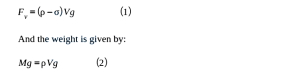
The weight of the ball is $Mg = V \rho g$,where $V$ is the volume of the ball.
The buoyant force is $F_b = V \sigma g$.
Substituting these into the force balance equation:
$V \rho g = F_v + V \sigma g$
$F_v = V \rho g - V \sigma g = V g (\rho - \sigma)$
Since $V = \frac{M}{\rho}$,we substitute $V$ in the expression for $F_v$:
$F_v = \frac{M}{\rho} g (\rho - \sigma) = M g \left( \frac{\rho - \sigma}{\rho} \right) = M g \left( 1 - \frac{\sigma}{\rho} \right)$.
$Mg = F_v + F_b$
Where $Mg$ is the weight,$F_v$ is the viscous force,and $F_b$ is the buoyant force.
The weight of the ball is $Mg = V \rho g$,where $V$ is the volume of the ball.
The buoyant force is $F_b = V \sigma g$.
Substituting these into the force balance equation:
$V \rho g = F_v + V \sigma g$
$F_v = V \rho g - V \sigma g = V g (\rho - \sigma)$
Since $V = \frac{M}{\rho}$,we substitute $V$ in the expression for $F_v$:
$F_v = \frac{M}{\rho} g (\rho - \sigma) = M g \left( \frac{\rho - \sigma}{\rho} \right) = M g \left( 1 - \frac{\sigma}{\rho} \right)$.
0 likes
View Solution138
MediumMCQ
Eight identical small drops of water are falling down vertically through a medium,each with terminal velocity $v$. If they combine to form a single drop,then its terminal velocity will be (in $v$)
A
$3$
B
$6$
C
$5$
D
$4$
Solution
(D) Let $R$ and $r$ be the radii of the big and small drops respectively. The volume of the big drop is equal to $8$ times the volume of one small drop.
$\frac{4}{3} \pi R^3 = 8 \times \frac{4}{3} \pi r^3$
$R^3 = 8r^3 \implies R = 2r$
According to Stoke's Law,the terminal velocity $v_t$ of a spherical drop is given by $v_t = \frac{2r^2(\rho - \sigma)g}{9\eta}$,which implies $v_t \propto r^2$.
Let $V$ be the terminal velocity of the big drop.
$\frac{V}{v} = \frac{R^2}{r^2} = \frac{(2r)^2}{r^2} = \frac{4r^2}{r^2} = 4$
Therefore,$V = 4v$.
$\frac{4}{3} \pi R^3 = 8 \times \frac{4}{3} \pi r^3$
$R^3 = 8r^3 \implies R = 2r$
According to Stoke's Law,the terminal velocity $v_t$ of a spherical drop is given by $v_t = \frac{2r^2(\rho - \sigma)g}{9\eta}$,which implies $v_t \propto r^2$.
Let $V$ be the terminal velocity of the big drop.
$\frac{V}{v} = \frac{R^2}{r^2} = \frac{(2r)^2}{r^2} = \frac{4r^2}{r^2} = 4$
Therefore,$V = 4v$.
0 likes
View Solution139
MediumMCQ
$A$ lead sphere of mass $m$ falls with a terminal velocity $V$ in a viscous liquid. With what terminal velocity will another lead sphere of mass $8m$ fall in the same liquid?
A
$V$
B
$64V$
C
$8V$
D
$4V$
Solution
(D) The formula for terminal velocity is given by:
$V_{T} = \frac{2}{9} r^2 \frac{(\rho-\sigma)g}{\eta}$
Here,$V_{T} \propto r^2$.
The relationship between mass and radius is:
$m \propto \text{volume} \propto r^3$
Therefore,$\frac{m_1}{m_2} = \left(\frac{r_1}{r_2}\right)^3$.
Given $m_1 = m$ and $m_2 = 8m$,we have:
$\frac{m}{8m} = \left(\frac{r_1}{r_2}\right)^3 \Rightarrow \frac{1}{8} = \left(\frac{r_1}{r_2}\right)^3$
$\frac{r_1}{r_2} = \frac{1}{2} \Rightarrow r_2 = 2r_1$.
Now,the ratio of terminal velocities is:
$\frac{V_{T2}}{V_{T1}} = \left(\frac{r_2}{r_1}\right)^2 = (2)^2 = 4$.
Thus,$V_{T2} = 4V_{T1} = 4V$.
$V_{T} = \frac{2}{9} r^2 \frac{(\rho-\sigma)g}{\eta}$
Here,$V_{T} \propto r^2$.
The relationship between mass and radius is:
$m \propto \text{volume} \propto r^3$
Therefore,$\frac{m_1}{m_2} = \left(\frac{r_1}{r_2}\right)^3$.
Given $m_1 = m$ and $m_2 = 8m$,we have:
$\frac{m}{8m} = \left(\frac{r_1}{r_2}\right)^3 \Rightarrow \frac{1}{8} = \left(\frac{r_1}{r_2}\right)^3$
$\frac{r_1}{r_2} = \frac{1}{2} \Rightarrow r_2 = 2r_1$.
Now,the ratio of terminal velocities is:
$\frac{V_{T2}}{V_{T1}} = \left(\frac{r_2}{r_1}\right)^2 = (2)^2 = 4$.
Thus,$V_{T2} = 4V_{T1} = 4V$.
0 likes
View Solution140
MediumMCQ
Two rain drops of same radius $r$ falling with terminal velocity $V$ merge and form a bigger drop with radius $R$. The terminal velocity of the bigger drop is:
A
$\frac{V R^2}{r^2}$
B
$\frac{V R}{r}$
C
$\frac{V r^2}{R^2}$
D
$\frac{2 V R}{r}$
Solution
(A) The terminal velocity $v$ of a spherical droplet falling through a viscous fluid is given by Stokes' Law: $v = \frac{2}{9} \frac{r^2(\rho - \sigma)g}{\eta}$.
From this expression,we observe that the terminal velocity is directly proportional to the square of the radius: $v \propto r^2$.
Let $V$ be the terminal velocity of the smaller drops of radius $r$,and $V'$ be the terminal velocity of the merged drop of radius $R$.
According to the proportionality relation:
$\frac{V'}{V} = \frac{R^2}{r^2}$
Therefore,the terminal velocity of the bigger drop is $V' = \frac{V R^2}{r^2}$.
From this expression,we observe that the terminal velocity is directly proportional to the square of the radius: $v \propto r^2$.
Let $V$ be the terminal velocity of the smaller drops of radius $r$,and $V'$ be the terminal velocity of the merged drop of radius $R$.
According to the proportionality relation:
$\frac{V'}{V} = \frac{R^2}{r^2}$
Therefore,the terminal velocity of the bigger drop is $V' = \frac{V R^2}{r^2}$.
0 likes
View Solution141
DifficultMCQ
$A$ spherical solid ball of volume $V$ is made up of a material of density $\rho$. It is falling through a liquid of density $\sigma$ $(\sigma < \rho)$. Assume that the liquid applies a viscous force on the ball that is proportional to the square of the terminal speed $v_{T}$,$F = -K v_{T}^2$ $(K > 0)$. Then,the terminal speed of the ball is ($g =$ acceleration due to gravity).
A
$\left[\frac{V g \rho}{K}\right]^{\frac{1}{2}}$
B
$\left[\frac{V g(\rho-\sigma)}{K}\right]^{\frac{1}{2}}$
C
$\frac{V g(\rho-\sigma)}{K}$
D
$\frac{V g \rho}{K}$
Solution
(B) The condition for terminal speed $v_{T}$ is that the net force on the ball is zero. At terminal velocity,the weight of the ball is balanced by the buoyant force and the viscous drag force.
Weight $(W) = \rho V g$
Buoyant force $(f) = \sigma V g$
Viscous force $(F) = K v_{T}^2$
Equating the forces: $W = f + F$
$\rho V g = \sigma V g + K v_{T}^2$
$K v_{T}^2 = V g (\rho - \sigma)$
$v_{T}^2 = \frac{V g (\rho - \sigma)}{K}$
$v_{T} = \sqrt{\frac{V g (\rho - \sigma)}{K}}$
Weight $(W) = \rho V g$
Buoyant force $(f) = \sigma V g$
Viscous force $(F) = K v_{T}^2$
Equating the forces: $W = f + F$
$\rho V g = \sigma V g + K v_{T}^2$
$K v_{T}^2 = V g (\rho - \sigma)$
$v_{T}^2 = \frac{V g (\rho - \sigma)}{K}$
$v_{T} = \sqrt{\frac{V g (\rho - \sigma)}{K}}$
0 likes
View Solution142
MediumMCQ
The velocity of a small ball of mass $M$ and density $d_1$ when dropped in a container filled with glycerin becomes constant after some time. If the density of glycerin is $d_2$,the viscous force acting on the ball is ($g$ = acceleration due to gravity).
A
$Mg \frac{d_1}{d_2}$
B
$Mgd_1 d_2$
C
$Mg(d_1-d_2)$
D
$Mg(1-\frac{d_2}{d_1})$
Solution
(D) Since the velocity of the ball becomes constant,it implies that the ball has reached terminal velocity. At this state,the net force acting on the ball is zero.
The forces acting on the ball are the gravitational force $(Mg)$ acting downwards,the buoyant force $(F_B)$ acting upwards,and the viscous force $(F_V)$ acting upwards.
According to the equilibrium condition:
$F_V + F_B = Mg$
We know that the buoyant force $F_B = V d_2 g$,where $V$ is the volume of the ball.
Since the mass of the ball is $M = V d_1$,the volume $V = \frac{M}{d_1}$.
Substituting $V$ into the buoyant force equation:
$F_B = \frac{M}{d_1} d_2 g$
Now,substituting $F_B$ into the equilibrium equation:
$F_V + \frac{M}{d_1} d_2 g = Mg$
$F_V = Mg - \frac{M d_2 g}{d_1}$
$F_V = Mg(1 - \frac{d_2}{d_1})$
The forces acting on the ball are the gravitational force $(Mg)$ acting downwards,the buoyant force $(F_B)$ acting upwards,and the viscous force $(F_V)$ acting upwards.
According to the equilibrium condition:
$F_V + F_B = Mg$
We know that the buoyant force $F_B = V d_2 g$,where $V$ is the volume of the ball.
Since the mass of the ball is $M = V d_1$,the volume $V = \frac{M}{d_1}$.
Substituting $V$ into the buoyant force equation:
$F_B = \frac{M}{d_1} d_2 g$
Now,substituting $F_B$ into the equilibrium equation:
$F_V + \frac{M}{d_1} d_2 g = Mg$
$F_V = Mg - \frac{M d_2 g}{d_1}$
$F_V = Mg(1 - \frac{d_2}{d_1})$
0 likes
View Solution143
MediumMCQ
If the terminal speed of a sphere $A$ [density $\rho_A = 7.5 \ kg \ m^{-3}$] is $0.4 \ ms^{-1}$ in a viscous liquid [density $\rho_L = 1.5 \ kg \ m^{-3}$],the terminal speed of sphere $B$ [density $\rho_B = 3 \ kg \ m^{-3}$] of the same size in the same liquid is: (in $ms^{-1}$)
A
$0.3$
B
$0.1$
C
$0.2$
D
$0.04$
Solution
(B) The terminal velocity $V$ of a sphere of radius $r$ and density $\rho$ falling through a liquid of density $\rho_L$ and viscosity $\eta$ is given by the formula:
$V = \frac{2}{9} \frac{r^2 g (\rho - \rho_L)}{\eta}$
Since the spheres have the same size ($r$ is constant) and are in the same liquid ($\eta$ and $\rho_L$ are constant),the terminal velocity is directly proportional to the difference in densities:
$V \propto (\rho - \rho_L)$
Therefore,the ratio of the terminal velocities is:
$\frac{V_A}{V_B} = \frac{\rho_A - \rho_L}{\rho_B - \rho_L}$
Substituting the given values:
$\frac{0.4}{V_B} = \frac{7.5 - 1.5}{3 - 1.5} = \frac{6.0}{1.5} = 4$
$V_B = \frac{0.4}{4} = 0.1 \ ms^{-1}$
$V = \frac{2}{9} \frac{r^2 g (\rho - \rho_L)}{\eta}$
Since the spheres have the same size ($r$ is constant) and are in the same liquid ($\eta$ and $\rho_L$ are constant),the terminal velocity is directly proportional to the difference in densities:
$V \propto (\rho - \rho_L)$
Therefore,the ratio of the terminal velocities is:
$\frac{V_A}{V_B} = \frac{\rho_A - \rho_L}{\rho_B - \rho_L}$
Substituting the given values:
$\frac{0.4}{V_B} = \frac{7.5 - 1.5}{3 - 1.5} = \frac{6.0}{1.5} = 4$
$V_B = \frac{0.4}{4} = 0.1 \ ms^{-1}$
0 likes
View Solution144
DifficultMCQ
$A$ ball rises to the surface of a liquid with constant velocity. The density of the liquid is four times the density of the material of the ball. The viscous force of the liquid on the rising ball is greater than the weight of the ball by a factor of
A
$4$
B
$3$
C
$2$
D
$5$
Solution
(B) The ball is moving with constant velocity,so the net force acting on it is zero.
Let $\rho_{b}$ be the density of the ball and $\rho_{\ell}$ be the density of the liquid.
Given $\rho_{\ell} = 4\rho_{b}$.
The weight of the ball is $W = V \rho_{b} g$,acting downwards.
The buoyant force is $F_{B} = V \rho_{\ell} g$,acting upwards.
Since the ball is rising with constant velocity,the viscous force $F_{v}$ acts downwards.
Equating the forces: $F_{B} = W + F_{v}$.
Therefore,$F_{v} = F_{B} - W = V \rho_{\ell} g - V \rho_{b} g = V g (4\rho_{b} - \rho_{b}) = 3 V \rho_{b} g$.
Since $W = V \rho_{b} g$,we have $F_{v} = 3W$.
Thus,the viscous force is greater than the weight of the ball by a factor of $3$.
Let $\rho_{b}$ be the density of the ball and $\rho_{\ell}$ be the density of the liquid.
Given $\rho_{\ell} = 4\rho_{b}$.
The weight of the ball is $W = V \rho_{b} g$,acting downwards.
The buoyant force is $F_{B} = V \rho_{\ell} g$,acting upwards.
Since the ball is rising with constant velocity,the viscous force $F_{v}$ acts downwards.
Equating the forces: $F_{B} = W + F_{v}$.
Therefore,$F_{v} = F_{B} - W = V \rho_{\ell} g - V \rho_{b} g = V g (4\rho_{b} - \rho_{b}) = 3 V \rho_{b} g$.
Since $W = V \rho_{b} g$,we have $F_{v} = 3W$.
Thus,the viscous force is greater than the weight of the ball by a factor of $3$.
0 likes
View Solution145
EasyMCQ
The speed of a ball of radius $2 \,cm$ in a viscous liquid is $20 \,cm / s$. What will be the speed of a ball of radius $1 \,cm$ in the same liquid (in $\,cm / s$)?
A
$10$
B
$4$
C
$5$
D
$8$
Solution
(C) According to Stoke's Law, the terminal velocity $V$ of a spherical body falling through a viscous liquid is given by $V = \frac{2}{9} \frac{r^2 g (\rho - \sigma)}{\eta}$.
From this formula, it is clear that the terminal velocity is directly proportional to the square of the radius of the ball, i.e., $V \propto r^2$.
Given:
Radius $r_1 = 2 \,cm$, Velocity $V_1 = 20 \,cm / s$.
Radius $r_2 = 1 \,cm$, Velocity $V_2 = ?$.
Using the proportionality $V \propto r^2$:
$\frac{V_2}{V_1} = \left(\frac{r_2}{r_1}\right)^2$
$\frac{V_2}{20} = \left(\frac{1}{2}\right)^2$
$\frac{V_2}{20} = \frac{1}{4}$
$V_2 = \frac{20}{4} = 5 \,cm / s$.
From this formula, it is clear that the terminal velocity is directly proportional to the square of the radius of the ball, i.e., $V \propto r^2$.
Given:
Radius $r_1 = 2 \,cm$, Velocity $V_1 = 20 \,cm / s$.
Radius $r_2 = 1 \,cm$, Velocity $V_2 = ?$.
Using the proportionality $V \propto r^2$:
$\frac{V_2}{V_1} = \left(\frac{r_2}{r_1}\right)^2$
$\frac{V_2}{20} = \left(\frac{1}{2}\right)^2$
$\frac{V_2}{20} = \frac{1}{4}$
$V_2 = \frac{20}{4} = 5 \,cm / s$.
0 likes
View Solution146
DifficultMCQ
$n$ small drops of the same size fall through air with a constant terminal velocity of $5 \ cm/s$. If they coalesce to form a single big drop,what is the terminal velocity of the big drop?
A
$7 n^{2/3} \ cm/s$
B
$5 n^{2/3} \ cm/s$
C
$3 n^{2/3} \ cm/s$
D
$9 n^{2/3} \ cm/s$
Solution
(B) Let $r$ be the radius of each small drop and $R$ be the radius of the big drop.
Since the volume remains constant during coalescence:
$n \times (\frac{4}{3} \pi r^3) = \frac{4}{3} \pi R^3$
$R^3 = n r^3 \implies R = n^{1/3} r$
The terminal velocity $v_t$ of a drop is given by Stokes' Law: $v_t = \frac{2r^2(\rho - \sigma)g}{9\eta}$.
Thus,$v_t \propto r^2$.
Let $v_1 = 5 \ cm/s$ be the terminal velocity of a small drop and $v_2$ be the terminal velocity of the big drop.
$\frac{v_2}{v_1} = \left(\frac{R}{r}\right)^2 = (n^{1/3})^2 = n^{2/3}$.
$v_2 = v_1 \times n^{2/3} = 5 n^{2/3} \ cm/s$.
Since the volume remains constant during coalescence:
$n \times (\frac{4}{3} \pi r^3) = \frac{4}{3} \pi R^3$
$R^3 = n r^3 \implies R = n^{1/3} r$
The terminal velocity $v_t$ of a drop is given by Stokes' Law: $v_t = \frac{2r^2(\rho - \sigma)g}{9\eta}$.
Thus,$v_t \propto r^2$.
Let $v_1 = 5 \ cm/s$ be the terminal velocity of a small drop and $v_2$ be the terminal velocity of the big drop.
$\frac{v_2}{v_1} = \left(\frac{R}{r}\right)^2 = (n^{1/3})^2 = n^{2/3}$.
$v_2 = v_1 \times n^{2/3} = 5 n^{2/3} \ cm/s$.
0 likes
View Solution147
EasyMCQ
Two rain drops falling through air have radii in the ratio $1: 2$. They will have terminal velocity in the ratio
A
$1: 2$
B
$4: 1$
C
$1: 4$
D
$2: 1$
Solution
(C) The terminal velocity $v_{t}$ of a spherical body falling through a viscous medium is given by Stokes' Law as $v_{t} = \frac{2r^{2}(\rho - \sigma)g}{9\eta}$.
Since the density of the drop $\rho$,density of air $\sigma$,acceleration due to gravity $g$,and coefficient of viscosity $\eta$ are constant for both drops,we have $v_{t} \propto r^{2}$.
Given the ratio of radii is $\frac{r_{1}}{r_{2}} = \frac{1}{2}$.
Therefore,the ratio of their terminal velocities is $\frac{v_{t1}}{v_{t2}} = \left(\frac{r_{1}}{r_{2}}\right)^{2} = \left(\frac{1}{2}\right)^{2} = \frac{1}{4}$.
Thus,the ratio is $1: 4$.
Since the density of the drop $\rho$,density of air $\sigma$,acceleration due to gravity $g$,and coefficient of viscosity $\eta$ are constant for both drops,we have $v_{t} \propto r^{2}$.
Given the ratio of radii is $\frac{r_{1}}{r_{2}} = \frac{1}{2}$.
Therefore,the ratio of their terminal velocities is $\frac{v_{t1}}{v_{t2}} = \left(\frac{r_{1}}{r_{2}}\right)^{2} = \left(\frac{1}{2}\right)^{2} = \frac{1}{4}$.
Thus,the ratio is $1: 4$.
0 likes
View Solution148
EasyMCQ
$A$ metal sphere of mass $m$ and density $\sigma_{1}$ falls with terminal velocity through a container containing liquid. The density of the liquid is $\sigma_{2}$. The viscous force acting on the sphere is
A
$mg(1 - \frac{\sigma_{2}}{\sigma_{1}})$
B
$mg(1 - \frac{\sigma_{1}}{\sigma_{2}})$
C
$mg(1 + \frac{\sigma_{1}}{\sigma_{2}})$
D
$mg(1 + \frac{\sigma_{2}}{\sigma_{1}})$
Solution
(A) When a sphere falls with terminal velocity,the net force acting on it is zero.
The forces acting on the sphere are:
$1$. Weight $(W = mg)$ acting downwards.
$2$. Buoyant force $(F_{B})$ acting upwards.
$3$. Viscous force $(F_{v})$ acting upwards.
At terminal velocity: $W = F_{B} + F_{v}$.
Therefore,$F_{v} = W - F_{B}$.
The weight of the sphere is $W = V \sigma_{1} g$,where $V$ is the volume of the sphere.
Since $m = V \sigma_{1}$,we have $V = \frac{m}{\sigma_{1}}$.
The buoyant force is $F_{B} = V \sigma_{2} g = (\frac{m}{\sigma_{1}}) \sigma_{2} g = mg(\frac{\sigma_{2}}{\sigma_{1}})$.
Substituting these into the equation for viscous force:
$F_{v} = mg - mg(\frac{\sigma_{2}}{\sigma_{1}}) = mg(1 - \frac{\sigma_{2}}{\sigma_{1}})$.
The forces acting on the sphere are:
$1$. Weight $(W = mg)$ acting downwards.
$2$. Buoyant force $(F_{B})$ acting upwards.
$3$. Viscous force $(F_{v})$ acting upwards.
At terminal velocity: $W = F_{B} + F_{v}$.
Therefore,$F_{v} = W - F_{B}$.
The weight of the sphere is $W = V \sigma_{1} g$,where $V$ is the volume of the sphere.
Since $m = V \sigma_{1}$,we have $V = \frac{m}{\sigma_{1}}$.
The buoyant force is $F_{B} = V \sigma_{2} g = (\frac{m}{\sigma_{1}}) \sigma_{2} g = mg(\frac{\sigma_{2}}{\sigma_{1}})$.
Substituting these into the equation for viscous force:
$F_{v} = mg - mg(\frac{\sigma_{2}}{\sigma_{1}}) = mg(1 - \frac{\sigma_{2}}{\sigma_{1}})$.
0 likes
View Solution149
MediumMCQ
$A$ small metal sphere of mass $M$ and density $d_{1}$,when dropped in a jar filled with liquid,moves with terminal velocity after some time. The viscous force acting on the sphere is ($d_{2} =$ density of liquid,$g =$ gravitational acceleration).
A
$Mg(1 - \frac{d_{2}}{d_{1}})$
B
$Mg(\frac{d_{2}}{d_{1}})$
C
$Mg(1 - \frac{d_{1}}{d_{2}})$
D
$Mg - (\frac{d_{1}}{d_{2}})$
Solution
(A) When a sphere moves with terminal velocity,the net force acting on it is zero.
The forces acting on the sphere are: weight $(W)$ acting downwards,buoyant force $(F_{B})$ acting upwards,and viscous force $(F_{v})$ acting upwards.
$W = F_{B} + F_{v}$
$F_{v} = W - F_{B}$
Weight $W = Mg = V d_{1} g$,where $V$ is the volume of the sphere.
Buoyant force $F_{B} = V d_{2} g$.
Substituting these into the equation:
$F_{v} = V d_{1} g - V d_{2} g = V d_{1} g (1 - \frac{d_{2}}{d_{1}})$.
Since $M = V d_{1}$,we get:
$F_{v} = Mg (1 - \frac{d_{2}}{d_{1}})$.
The forces acting on the sphere are: weight $(W)$ acting downwards,buoyant force $(F_{B})$ acting upwards,and viscous force $(F_{v})$ acting upwards.
$W = F_{B} + F_{v}$
$F_{v} = W - F_{B}$
Weight $W = Mg = V d_{1} g$,where $V$ is the volume of the sphere.
Buoyant force $F_{B} = V d_{2} g$.
Substituting these into the equation:
$F_{v} = V d_{1} g - V d_{2} g = V d_{1} g (1 - \frac{d_{2}}{d_{1}})$.
Since $M = V d_{1}$,we get:
$F_{v} = Mg (1 - \frac{d_{2}}{d_{1}})$.
0 likes
View Solution150
EasyMCQ
$A$ metal sphere of radius $R$ and density $\varrho_{1}$ moves with terminal velocity $v_{1}$ through a liquid of density $\sigma$. Another sphere of the same radius but of density $\varrho_{2}$ moves through the same liquid. Its terminal velocity will be:
A
$\left[\frac{\varrho_{1}-\sigma}{\varrho_{2}-\sigma}\right] v_{1}$
B
$\left[\frac{\varrho_{2}+\sigma}{\varrho_{1}+\sigma}\right] v_{1}$
C
$\left[\frac{\varrho_{1}+\varrho_{2}}{\sigma}\right] v_{1}$
D
$\left[\frac{\varrho_{2}-\sigma}{\varrho_{1}-\sigma}\right] v_{1}$
Solution
(D) The terminal velocity $v$ of a sphere of radius $R$ and density $\rho$ falling through a liquid of density $\sigma$ and viscosity $\eta$ is given by Stokes' Law: $6 \pi \eta R v = \frac{4}{3} \pi R^{3} g (\rho - \sigma)$.
Thus,$v \propto (\rho - \sigma)$.
For the first sphere: $v_{1} \propto (\varrho_{1} - \sigma)$.
For the second sphere: $v_{2} \propto (\varrho_{2} - \sigma)$.
Taking the ratio: $\frac{v_{2}}{v_{1}} = \frac{\varrho_{2} - \sigma}{\varrho_{1} - \sigma}$.
Therefore,$v_{2} = \left[\frac{\varrho_{2} - \sigma}{\varrho_{1} - \sigma}\right] v_{1}$.
Thus,$v \propto (\rho - \sigma)$.
For the first sphere: $v_{1} \propto (\varrho_{1} - \sigma)$.
For the second sphere: $v_{2} \propto (\varrho_{2} - \sigma)$.
Taking the ratio: $\frac{v_{2}}{v_{1}} = \frac{\varrho_{2} - \sigma}{\varrho_{1} - \sigma}$.
Therefore,$v_{2} = \left[\frac{\varrho_{2} - \sigma}{\varrho_{1} - \sigma}\right] v_{1}$.
0 likes
View SolutionFluid Mechanics and Surface Tension — Viscosity and Stoke's Law and Terminal Velocity · Frequently Asked Questions
1Are these Fluid Mechanics and Surface Tension questions useful for JEE and NEET?
Yes. All questions in this section are mapped to JEE Main and NEET exam patterns. Previous year questions from JEE Main, NEET, GUJCET and state-level exams are included with full solutions.
2Can I switch to Hindi or Gujarati for these questions?
Yes. Use the language tabs in the hero section or the sidebar to view the same questions and solutions in English, Hindi or Gujarati.
3How do I generate a question paper from this subtopic?
Use the Vedclass Exam Paper Generator — select the chapter and subtopic, set difficulty, and generate Sets A, B, C, D automatically. First 3 chapters of every subject are free.
Vedclass Products
For Students
Vedclass Test Series
Mock tests in real JEE/NEET style with performance analysis. 5-day free trial.
Start Free TrialFor Teachers
Exam Paper Generator
Generate Set A/B/C/D papers from this chapter in 2 minutes. 3 chapters free.
Try FreeFor Institutes
Online Exam Module
Live online exams with unlimited students, 360° analytics & white-label branding.
See DemoFor Teachers & Institutes
Generate a Fluid Mechanics and Surface Tension Exam Paper in 2 Minutes
Select subtopic & difficulty — Sets A, B, C, D auto-generated with No Repeat logic.
First 3 chapters of every subject are free — no payment required.