
A English
Types of Flow, Equation of Continuity and Flow Rate Questions in English
Class 11 Physics · Fluid Mechanics and Surface Tension · Types of Flow, Equation of Continuity and Flow Rate
85+
Questions
English
Language
100%
With Solutions
Showing 31 of 85 questions in English
51
Easy
Give an example of steady flow.
Solution
(N/A) Steady flow is defined as a type of fluid flow in which the velocity of the fluid particles at any given point remains constant with respect to time.
An example of steady flow is the flow of water through a pipe with a constant cross-sectional area at a constant flow rate.
In this scenario,at any specific point inside the pipe,the velocity of the water particles passing through it does not change over time.
An example of steady flow is the flow of water through a pipe with a constant cross-sectional area at a constant flow rate.
In this scenario,at any specific point inside the pipe,the velocity of the water particles passing through it does not change over time.
0 likes
View Solution52
MediumMCQ
Why does fluid flow faster in a narrow tube?
A
Due to increase in pressure
B
Due to the equation of continuity
C
Due to decrease in density
D
Due to increase in viscosity
Solution
(B) According to the equation of continuity for an incompressible fluid,the product of the cross-sectional area $A$ and the velocity $v$ of the fluid remains constant,i.e.,$A_1v_1 = A_2v_2$.
This implies $v \propto \frac{1}{A}$.
Therefore,when the cross-sectional area $A$ decreases (in a narrow tube),the velocity $v$ of the fluid must increase to maintain a constant flow rate.
This implies $v \propto \frac{1}{A}$.
Therefore,when the cross-sectional area $A$ decreases (in a narrow tube),the velocity $v$ of the fluid must increase to maintain a constant flow rate.
0 likes
View Solution53
EasyMCQ
Which fundamental law forms the basis of the equation of continuity?
A
Law of conservation of mass
B
Law of conservation of energy
C
Law of conservation of momentum
D
Law of conservation of angular momentum
Solution
(A) The equation of continuity is derived from the principle of conservation of mass.
For an incompressible fluid flowing through a pipe of varying cross-section,the mass of fluid entering the pipe must equal the mass of fluid leaving the pipe in the same time interval.
Mathematically,this is expressed as $A_1 v_1 = A_2 v_2$,where $A$ is the cross-sectional area and $v$ is the velocity of the fluid.
For an incompressible fluid flowing through a pipe of varying cross-section,the mass of fluid entering the pipe must equal the mass of fluid leaving the pipe in the same time interval.
Mathematically,this is expressed as $A_1 v_1 = A_2 v_2$,where $A$ is the cross-sectional area and $v$ is the velocity of the fluid.
0 likes
View Solution54
AdvancedMCQ
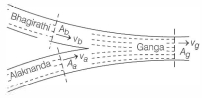
The Bhagirathi and the Alaknanda merge at Deoprayag to form the Ganga. The speeds of the Bhagirathi and the Alaknanda are in the ratio $1: 1.5$. The cross-sectional areas of the Bhagirathi,the Alaknanda,and the Ganga are in the ratio $1: 2: 3$. Assuming streamline flow,the ratio of the speed of the Ganga to that of the Alaknanda is
A
$7: 9$
B
$4: 3$
C
$8: 9$
D
$5: 3$
Solution
(C) Since water is not stored anywhere,the volume flow rate of the Ganga must equal the sum of the volume flow rates of the Bhagirathi and the Alaknanda.
By the equation of continuity,we have:
$A_g v_g = A_b v_b + A_a v_a \quad \dots(i)$
Given the ratio of cross-sectional areas $A_b : A_a : A_g = 1 : 2 : 3$,we can write:
$A_b = x, A_a = 2x, A_g = 3x$
Given the ratio of speeds $v_b : v_a = 1 : 1.5 = 1 : \frac{3}{2}$,we can write:
$v_b = y, v_a = 1.5y = \frac{3}{2}y$
Substituting these values into equation $(i)$:
$3x \cdot v_g = x \cdot y + 2x \cdot \left(\frac{3}{2}y\right)$
$3x \cdot v_g = xy + 3xy = 4xy$
$v_g = \frac{4}{3}y$
Now,the ratio of the speed of the Ganga to that of the Alaknanda is:
$\frac{v_g}{v_a} = \frac{\frac{4}{3}y}{\frac{3}{2}y} = \frac{4}{3} \times \frac{2}{3} = \frac{8}{9}$
By the equation of continuity,we have:
$A_g v_g = A_b v_b + A_a v_a \quad \dots(i)$
Given the ratio of cross-sectional areas $A_b : A_a : A_g = 1 : 2 : 3$,we can write:
$A_b = x, A_a = 2x, A_g = 3x$
Given the ratio of speeds $v_b : v_a = 1 : 1.5 = 1 : \frac{3}{2}$,we can write:
$v_b = y, v_a = 1.5y = \frac{3}{2}y$
Substituting these values into equation $(i)$:
$3x \cdot v_g = x \cdot y + 2x \cdot \left(\frac{3}{2}y\right)$
$3x \cdot v_g = xy + 3xy = 4xy$
$v_g = \frac{4}{3}y$
Now,the ratio of the speed of the Ganga to that of the Alaknanda is:
$\frac{v_g}{v_a} = \frac{\frac{4}{3}y}{\frac{3}{2}y} = \frac{4}{3} \times \frac{2}{3} = \frac{8}{9}$
0 likes
View Solution55
EasyMCQ
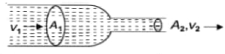
$A$ liquid flows in the tube from left to right as shown in the figure. $A_1$ and $A_2$ are the cross-sections of the portions of the tube as shown. The ratio of speed $\frac{v_1}{v_2}$ will be ..........
A
$\frac{A_1}{A_2}$
B
$\frac{A_2}{A_1}$
C
$\sqrt{\frac{A_2}{A_1}}$
D
$\sqrt{\frac{A_1}{A_2}}$
Solution
(B) According to the equation of continuity for an incompressible fluid,the product of the cross-sectional area and the fluid velocity remains constant at all points along the tube.
Mathematically,this is expressed as:
$A_1 v_1 = A_2 v_2$
To find the ratio of the speeds $\frac{v_1}{v_2}$,we rearrange the equation:
$\frac{v_1}{v_2} = \frac{A_2}{A_1}$
Thus,the correct option is $B$.
Mathematically,this is expressed as:
$A_1 v_1 = A_2 v_2$
To find the ratio of the speeds $\frac{v_1}{v_2}$,we rearrange the equation:
$\frac{v_1}{v_2} = \frac{A_2}{A_1}$
Thus,the correct option is $B$.
0 likes
View Solution56
MediumMCQ
Two water pipes $P$ and $Q$ having diameters $2 \times 10^{-2} \, m$ and $4 \times 10^{-2} \, m$ respectively are joined in series with the main supply line of water. The velocity of water flowing in pipe $P$ is ........
A
Four times that of $Q$
B
Two times that of $Q$
C
$\frac{1}{2}$ times that of $Q$
D
$\frac{1}{4}$ times that of $Q$
Solution
(A) According to the equation of continuity for an incompressible fluid in steady flow,the volume flow rate (discharge) remains constant throughout the pipe.
$A_P V_P = A_Q V_Q$
Where $A$ is the cross-sectional area and $V$ is the velocity of water.
Since $A = \frac{\pi d^2}{4}$,we have:
$\frac{\pi d_P^2}{4} V_P = \frac{\pi d_Q^2}{4} V_Q$
$d_P^2 V_P = d_Q^2 V_Q$
$V_P = \left( \frac{d_Q}{d_P} \right)^2 V_Q$
Given $d_P = 2 \times 10^{-2} \, m$ and $d_Q = 4 \times 10^{-2} \, m$:
$V_P = \left( \frac{4 \times 10^{-2}}{2 \times 10^{-2}} \right)^2 V_Q$
$V_P = (2)^2 V_Q$
$V_P = 4 V_Q$
Thus,the velocity of water in pipe $P$ is four times that of pipe $Q$.
$A_P V_P = A_Q V_Q$
Where $A$ is the cross-sectional area and $V$ is the velocity of water.
Since $A = \frac{\pi d^2}{4}$,we have:
$\frac{\pi d_P^2}{4} V_P = \frac{\pi d_Q^2}{4} V_Q$
$d_P^2 V_P = d_Q^2 V_Q$
$V_P = \left( \frac{d_Q}{d_P} \right)^2 V_Q$
Given $d_P = 2 \times 10^{-2} \, m$ and $d_Q = 4 \times 10^{-2} \, m$:
$V_P = \left( \frac{4 \times 10^{-2}}{2 \times 10^{-2}} \right)^2 V_Q$
$V_P = (2)^2 V_Q$
$V_P = 4 V_Q$
Thus,the velocity of water in pipe $P$ is four times that of pipe $Q$.
0 likes
View Solution57
MediumMCQ
Assertion $(A):$ The stream of water flowing at high speed from a garden hose pipe tends to spread like a fountain when held vertically up but tends to narrow down when held vertically down.
Reason $(R):$ In any steady flow of an incompressible fluid,the volume flow rate of the fluid remains constant.
Reason $(R):$ In any steady flow of an incompressible fluid,the volume flow rate of the fluid remains constant.
A
If both Assertion and Reason are true and Reason is the correct explanation of Assertion.
B
If both Assertion and Reason are true but Reason is not the correct explanation of Assertion.
C
If Assertion is true but Reason is false.
D
If both Assertion and Reason are false.
Solution
(A) The Assertion is true because when water flows vertically upward,gravity acts against the motion,causing the velocity to decrease. By the equation of continuity $(A_1v_1 = A_2v_2)$,as velocity $(v)$ decreases,the cross-sectional area $(A)$ must increase,causing the stream to spread. Conversely,when flowing downward,gravity increases the velocity,causing the stream to narrow.
The Reason is also true; the equation of continuity is based on the principle of conservation of mass for an incompressible fluid,which states that the volume flow rate $(Q = Av)$ remains constant.
Since the change in the cross-sectional area of the stream is directly caused by the change in velocity due to gravity,and the relationship between area and velocity is governed by the constant volume flow rate,the Reason correctly explains the Assertion.
The Reason is also true; the equation of continuity is based on the principle of conservation of mass for an incompressible fluid,which states that the volume flow rate $(Q = Av)$ remains constant.
Since the change in the cross-sectional area of the stream is directly caused by the change in velocity due to gravity,and the relationship between area and velocity is governed by the constant volume flow rate,the Reason correctly explains the Assertion.
0 likes
View Solution58
EasyMCQ
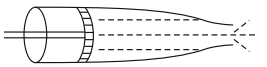
The figure below shows a liquid being pushed out of a tube by a piston having a cross-sectional area of $2.0\,cm^2$. The cross-sectional area at the outlet is $10\,mm^2$. If the piston is pushed at a speed of $4\,cm/s$,the speed of the outgoing fluid is $.........\,cm/s$.
A
$70$
B
$60$
C
$80$
D
$50$
Solution
(C) According to the equation of continuity for an incompressible fluid,the product of the cross-sectional area and the fluid velocity remains constant at all points along the tube.
$A_1 V_1 = A_2 V_2$
Given:
$A_1 = 2.0\,cm^2 = 2.0 \times 10^2\,mm^2 = 200\,mm^2$
$V_1 = 4\,cm/s$
$A_2 = 10\,mm^2$
Substituting the values into the equation:
$200\,mm^2 \times 4\,cm/s = 10\,mm^2 \times V_2$
$800 = 10 \times V_2$
$V_2 = 80\,cm/s$
Therefore,the speed of the outgoing fluid is $80\,cm/s$.
$A_1 V_1 = A_2 V_2$
Given:
$A_1 = 2.0\,cm^2 = 2.0 \times 10^2\,mm^2 = 200\,mm^2$
$V_1 = 4\,cm/s$
$A_2 = 10\,mm^2$
Substituting the values into the equation:
$200\,mm^2 \times 4\,cm/s = 10\,mm^2 \times V_2$
$800 = 10 \times V_2$
$V_2 = 80\,cm/s$
Therefore,the speed of the outgoing fluid is $80\,cm/s$.
0 likes
View Solution59
EasyMCQ
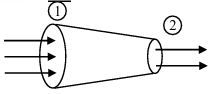
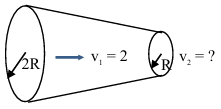
$A$ tube of length $L$ is shown in the figure. The radius of the cross-section at point $(1)$ is $2 \ cm$ and at point $(2)$ is $1 \ cm$. If the velocity of water entering at point $(1)$ is $2 \ m/s$,then the velocity of water leaving at point $(2)$ will be: (in $m/s$)
A
$2$
B
$4$
C
$6$
D
$8$
Solution
(D) According to the equation of continuity for an incompressible fluid,the product of the cross-sectional area and the velocity of flow remains constant at all points in the tube.
$A_1 v_1 = A_2 v_2$
Here,$A_1 = \pi r_1^2$ and $A_2 = \pi r_2^2$.
Given: $r_1 = 2 \ cm$,$r_2 = 1 \ cm$,and $v_1 = 2 \ m/s$.
Substituting the values:
$\pi (2)^2 \times 2 = \pi (1)^2 \times v_2$
$4 \times 2 = 1 \times v_2$
$v_2 = 8 \ m/s$.
$A_1 v_1 = A_2 v_2$
Here,$A_1 = \pi r_1^2$ and $A_2 = \pi r_2^2$.
Given: $r_1 = 2 \ cm$,$r_2 = 1 \ cm$,and $v_1 = 2 \ m/s$.
Substituting the values:
$\pi (2)^2 \times 2 = \pi (1)^2 \times v_2$
$4 \times 2 = 1 \times v_2$
$v_2 = 8 \ m/s$.
0 likes
View Solution60
EasyMCQ
An incompressible fluid flows steadily through a cylindrical pipe having radius $R$ at point $A$ and $\frac{R}{3}$ at point $B$ further along the direction of flow of liquid. If the velocity at point $A$ is $V$,then the velocity at point $B$ is:
A
$\frac{V}{9}$
B
$\frac{V}{3}$
C
$3V$
D
$9V$
Solution
(D) According to the equation of continuity for an incompressible fluid,the product of the cross-sectional area and the velocity of the fluid remains constant at all points along the flow: $A_1 V_1 = A_2 V_2$.
Here,the cross-sectional area of the pipe is $A = \pi r^2$.
At point $A$,the radius is $R$,so the area $A_A = \pi R^2$ and velocity $V_A = V$.
At point $B$,the radius is $\frac{R}{3}$,so the area $A_B = \pi \left(\frac{R}{3}\right)^2 = \frac{\pi R^2}{9}$.
Using the continuity equation: $(\pi R^2) \times V = \left(\frac{\pi R^2}{9}\right) \times V_B$.
Canceling $\pi R^2$ from both sides,we get: $V = \frac{V_B}{9}$.
Therefore,the velocity at point $B$ is $V_B = 9V$.
Here,the cross-sectional area of the pipe is $A = \pi r^2$.
At point $A$,the radius is $R$,so the area $A_A = \pi R^2$ and velocity $V_A = V$.
At point $B$,the radius is $\frac{R}{3}$,so the area $A_B = \pi \left(\frac{R}{3}\right)^2 = \frac{\pi R^2}{9}$.
Using the continuity equation: $(\pi R^2) \times V = \left(\frac{\pi R^2}{9}\right) \times V_B$.
Canceling $\pi R^2$ from both sides,we get: $V = \frac{V_B}{9}$.
Therefore,the velocity at point $B$ is $V_B = 9V$.
0 likes
View Solution61
EasyMCQ
Water flows through a horizontal pipe of varying cross-section at the rate of $\pi \times 10^{-1} \,m^3/s$. The velocity of water at a point where the radius of the pipe is $10 \,cm$ is $(\pi = 3.14)$. (in $\,m/s$)
A
$0.1$
B
$1$
C
$10$
D
$100$
Solution
(C) The rate of flow (volume flow rate) is given by $Q = A \times v$,where $A$ is the cross-sectional area and $v$ is the velocity of the water.
Given,$Q = \pi \times 10^{-1} \,m^3/s$.
The radius of the pipe $r = 10 \,cm = 0.1 \,m$.
The area of the cross-section $A = \pi r^2 = \pi \times (0.1)^2 = \pi \times 0.01 \,m^2$.
Using the equation of continuity,$v = Q / A$.
$v = (\pi \times 10^{-1}) / (\pi \times 0.01) = 0.1 / 0.01 = 10 \,m/s$.
Therefore,the velocity of water is $10 \,m/s$.
Given,$Q = \pi \times 10^{-1} \,m^3/s$.
The radius of the pipe $r = 10 \,cm = 0.1 \,m$.
The area of the cross-section $A = \pi r^2 = \pi \times (0.1)^2 = \pi \times 0.01 \,m^2$.
Using the equation of continuity,$v = Q / A$.
$v = (\pi \times 10^{-1}) / (\pi \times 0.01) = 0.1 / 0.01 = 10 \,m/s$.
Therefore,the velocity of water is $10 \,m/s$.
0 likes
View Solution62
MediumMCQ
$A$ gardening pipe having an internal radius '$R$' is connected to a water sprinkler having '$n$' holes each of radius '$r$'. The water in the pipe has a speed '$v$'. The speed of water leaving the sprinkler is
A
$\left(\frac{R^2}{n r^2}\right) v$
B
$\frac{R^2 v}{n r^2}$
C
$\left(\frac{n r^2}{R^2}\right) v$
D
$\left(\frac{n R^2}{r^2}\right) v$
Solution
(B) According to the equation of continuity,the mass flow rate of water remains constant throughout the system.
$A_1 v_1 = A_2 v_2$
Here,$A_1 = \pi R^2$ is the cross-sectional area of the pipe and $v_1 = v$ is the speed of water in the pipe.
The sprinkler has $n$ holes,each of radius $r$. The total cross-sectional area of the holes is $A_2 = n \pi r^2$.
Let $v'$ be the speed of water leaving the sprinkler.
Substituting these values into the continuity equation:
$\pi R^2 v = (n \pi r^2) v'$
Solving for $v'$:
$v' = \frac{\pi R^2 v}{n \pi r^2} = \frac{R^2 v}{n r^2}$
$A_1 v_1 = A_2 v_2$
Here,$A_1 = \pi R^2$ is the cross-sectional area of the pipe and $v_1 = v$ is the speed of water in the pipe.
The sprinkler has $n$ holes,each of radius $r$. The total cross-sectional area of the holes is $A_2 = n \pi r^2$.
Let $v'$ be the speed of water leaving the sprinkler.
Substituting these values into the continuity equation:
$\pi R^2 v = (n \pi r^2) v'$
Solving for $v'$:
$v' = \frac{\pi R^2 v}{n \pi r^2} = \frac{R^2 v}{n r^2}$
0 likes
View Solution63
MediumMCQ
The surface of water in a water tank of cross-sectional area $750 \,cm^2$ on the top of a house is '$h$' $m$ above the tap level. The speed of water coming out through the tap of cross-sectional area $500 \,mm^2$ is $30 \,cm/s$. At that instant, $\frac{dh}{dt}$ is $x \times 10^{-3} \,m/s$. The value of '$x$' will be:
A
$2$
B
$3$
C
$4$
D
$6$
Solution
(A) According to the equation of continuity, the volume flow rate at the tank surface must equal the volume flow rate at the tap: $A_1 v_1 = A_2 v_2$.
Here, $A_1 = 750 \,cm^2 = 750 \times 10^{-4} \,m^2$ and $A_2 = 500 \,mm^2 = 500 \times 10^{-6} \,m^2$.
The speed of water at the tap is $v_2 = 30 \,cm/s = 0.3 \,m/s$.
The speed of the water surface falling is $v_1 = \frac{dh}{dt}$.
Substituting the values: $(750 \times 10^{-4}) \cdot \frac{dh}{dt} = (500 \times 10^{-6}) \times (0.3)$.
$\frac{dh}{dt} = \frac{500 \times 10^{-6} \times 0.3}{750 \times 10^{-4}} = \frac{150 \times 10^{-6}}{750 \times 10^{-4}} = 0.2 \times 10^{-2} \,m/s = 2 \times 10^{-3} \,m/s$.
Given $\frac{dh}{dt} = x \times 10^{-3} \,m/s$, we find $x = 2$.
Here, $A_1 = 750 \,cm^2 = 750 \times 10^{-4} \,m^2$ and $A_2 = 500 \,mm^2 = 500 \times 10^{-6} \,m^2$.
The speed of water at the tap is $v_2 = 30 \,cm/s = 0.3 \,m/s$.
The speed of the water surface falling is $v_1 = \frac{dh}{dt}$.
Substituting the values: $(750 \times 10^{-4}) \cdot \frac{dh}{dt} = (500 \times 10^{-6}) \times (0.3)$.
$\frac{dh}{dt} = \frac{500 \times 10^{-6} \times 0.3}{750 \times 10^{-4}} = \frac{150 \times 10^{-6}}{750 \times 10^{-4}} = 0.2 \times 10^{-2} \,m/s = 2 \times 10^{-3} \,m/s$.
Given $\frac{dh}{dt} = x \times 10^{-3} \,m/s$, we find $x = 2$.
0 likes
View Solution64
EasyMCQ
Water flows through a horizontal pipe at a speed '$V$'. The internal diameter of the pipe is '$d$'. If the water is coming out of a nozzle at a speed '$V_1$',then the diameter of the nozzle is:
A
$d \sqrt{\frac{V_1}{V}}$
B
$d \sqrt{\frac{V}{V_1}}$
C
$\frac{d V}{V_1}$
D
$\frac{V_1}{dV}$
Solution
(B) According to the equation of continuity for an incompressible fluid,the product of the cross-sectional area and the velocity of the fluid remains constant at all points along the pipe.
$A_1 V_1 = A_2 V_2$
Here,$A_1$ is the area of the pipe,$V$ is the velocity in the pipe,$A_n$ is the area of the nozzle,and $V_1$ is the velocity at the nozzle.
$A_1 = \frac{\pi d^2}{4}$ and $A_n = \frac{\pi d_n^2}{4}$,where $d_n$ is the diameter of the nozzle.
Substituting these into the continuity equation:
$\frac{\pi d^2}{4} \times V = \frac{\pi d_n^2}{4} \times V_1$
$d^2 V = d_n^2 V_1$
$d_n^2 = d^2 \frac{V}{V_1}$
$d_n = d \sqrt{\frac{V}{V_1}}$
$A_1 V_1 = A_2 V_2$
Here,$A_1$ is the area of the pipe,$V$ is the velocity in the pipe,$A_n$ is the area of the nozzle,and $V_1$ is the velocity at the nozzle.
$A_1 = \frac{\pi d^2}{4}$ and $A_n = \frac{\pi d_n^2}{4}$,where $d_n$ is the diameter of the nozzle.
Substituting these into the continuity equation:
$\frac{\pi d^2}{4} \times V = \frac{\pi d_n^2}{4} \times V_1$
$d^2 V = d_n^2 V_1$
$d_n^2 = d^2 \frac{V}{V_1}$
$d_n = d \sqrt{\frac{V}{V_1}}$
0 likes
View Solution65
EasyMCQ
Select the $WRONG$ statement from the following. In a streamline flow,
A
velocity of a fluid at a given point is never constant.
B
velocity is smaller than critical velocity.
C
layers are always parallel.
D
the particles do not move in random direction.
Solution
(A) In a streamline flow,the velocity of a fluid at a specific point is always constant over time. This is because each particle of the fluid follows a well-defined path,and there is no mixing or crossing of paths between particles. Therefore,the statement that the velocity at a given point is 'never constant' is incorrect.
0 likes
View Solution66
EasyMCQ
In a streamlined flow,the velocity of a fluid at a given point
A
is always constant
B
does not remain constant
C
changes from low value to high value
D
changes from high value to low value
Solution
(A) By definition,in a streamlined flow,the velocity of the fluid at any specific point remains constant over time. Although the velocity may vary from one point to another in the path of the fluid,at any fixed point,the velocity vector does not change with time.
0 likes
View Solution67
EasyMCQ
Water flows through a horizontal pipe at a speed $V$. The internal diameter of the pipe is $d$. If the water is emerging from a nozzle at a speed $V_{1}$,then the diameter of the nozzle is
A
$\frac{V}{V_{1}}$
B
$d \sqrt{\frac{V_{1}}{V}}$
C
$d \sqrt{\frac{V}{V_{1}}}$
D
$\frac{d V_{1}}{V}$
Solution
(C) According to the equation of continuity for an incompressible fluid,the product of the cross-sectional area and the velocity of flow remains constant at any point along the pipe: $A_1 V_1 = A_2 V_2$.
Here,$A_1$ is the area of the pipe,$V$ is the velocity in the pipe,$A_2$ is the area of the nozzle,and $V_1$ is the velocity at the nozzle.
Since the area $A = \pi (d/2)^2$,we have $A \propto d^2$.
Substituting this into the continuity equation: $d^2 V = d_2^2 V_1$.
Solving for the nozzle diameter $d_2$: $d_2^2 = d^2 \frac{V}{V_1}$.
Taking the square root on both sides: $d_2 = d \sqrt{\frac{V}{V_1}}$.
Here,$A_1$ is the area of the pipe,$V$ is the velocity in the pipe,$A_2$ is the area of the nozzle,and $V_1$ is the velocity at the nozzle.
Since the area $A = \pi (d/2)^2$,we have $A \propto d^2$.
Substituting this into the continuity equation: $d^2 V = d_2^2 V_1$.
Solving for the nozzle diameter $d_2$: $d_2^2 = d^2 \frac{V}{V_1}$.
Taking the square root on both sides: $d_2 = d \sqrt{\frac{V}{V_1}}$.
0 likes
View Solution68
EasyMCQ
Water flows through a horizontal pipe of varying cross-section at a rate of $0.314 \,m^3 \,s^{-1}$. The velocity of water at a point where the radius of the pipe is $10 \,cm$ is (in $\,m/s$)
A
$0.1$
B
$1$
C
$10$
D
$100$
Solution
(C) Given: Flow rate $Q = 0.314 \,m^3/s$ and radius $r = 10 \,cm = 0.1 \,m$.
Using the equation of continuity, $Q = A \times v$, where $A = \pi r^2$ is the cross-sectional area.
Substituting the values: $0.314 = \pi \times (0.1)^2 \times v$.
Taking $\pi \approx 3.14$, we get $0.314 = 3.14 \times 0.01 \times v$.
$0.314 = 0.0314 \times v$.
$v = \frac{0.314}{0.0314} = 10 \,m/s$.
Using the equation of continuity, $Q = A \times v$, where $A = \pi r^2$ is the cross-sectional area.
Substituting the values: $0.314 = \pi \times (0.1)^2 \times v$.
Taking $\pi \approx 3.14$, we get $0.314 = 3.14 \times 0.01 \times v$.
$0.314 = 0.0314 \times v$.
$v = \frac{0.314}{0.0314} = 10 \,m/s$.
0 likes
View Solution69
EasyMCQ
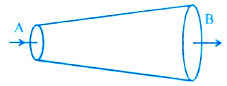
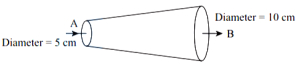
An ideal fluid flows through a pipe of circular cross-section with diameters $5 \ cm$ and $10 \ cm$ as shown. The ratio of velocities of the fluid at $A$ and $B$ is
A
$1:1$
B
$1:4$
C
$2:1$
D
$4:1$
Solution
(D) According to the equation of continuity for an ideal fluid,the product of the cross-sectional area and the velocity of the fluid remains constant at all points along the pipe.
Therefore,$A_A v_A = A_B v_B$,where $A$ is the cross-sectional area and $v$ is the velocity.
The area of a circular cross-section is given by $A = \pi r^2 = \pi (d/2)^2 = \frac{\pi d^2}{4}$,where $d$ is the diameter.
Thus,$\frac{v_A}{v_B} = \frac{A_B}{A_A} = \frac{\frac{\pi (d_B)^2}{4}}{\frac{\pi (d_A)^2}{4}} = \left( \frac{d_B}{d_A} \right)^2$.
Given $d_A = 5 \ cm$ and $d_B = 10 \ cm$,we have:
$\frac{v_A}{v_B} = \left( \frac{10}{5} \right)^2 = (2)^2 = \frac{4}{1}$.
Hence,the ratio of the velocities of the fluid at $A$ and $B$ is $4:1$.
Therefore,$A_A v_A = A_B v_B$,where $A$ is the cross-sectional area and $v$ is the velocity.
The area of a circular cross-section is given by $A = \pi r^2 = \pi (d/2)^2 = \frac{\pi d^2}{4}$,where $d$ is the diameter.
Thus,$\frac{v_A}{v_B} = \frac{A_B}{A_A} = \frac{\frac{\pi (d_B)^2}{4}}{\frac{\pi (d_A)^2}{4}} = \left( \frac{d_B}{d_A} \right)^2$.
Given $d_A = 5 \ cm$ and $d_B = 10 \ cm$,we have:
$\frac{v_A}{v_B} = \left( \frac{10}{5} \right)^2 = (2)^2 = \frac{4}{1}$.
Hence,the ratio of the velocities of the fluid at $A$ and $B$ is $4:1$.
0 likes
View Solution70
EasyMCQ
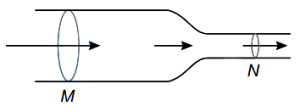
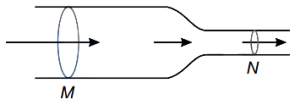
$A$ horizontal tube of non-uniform cross-section has radii of $0.1 \,m$ and $0.05 \,m$ respectively at $M$ and $N$. For a streamline flow of an incompressible liquid, the rate of liquid flow is
A
changing continuously with time
B
greater at $M$ than at $N$
C
greater at $N$ than at $M$
D
the same at $M$ and $N$
Solution
(D) According to the equation of continuity for an incompressible fluid in streamline flow, the volume flow rate $(Q = Av)$ remains constant at all cross-sections of the tube.
Therefore, the rate of liquid flow is the same at both points $M$ and $N$.
Therefore, the rate of liquid flow is the same at both points $M$ and $N$.
0 likes
View Solution71
MediumMCQ
The cylindrical tube of a spray pump has a cross-section of $8 \,cm^{2}$, one end of which has $40$ fine holes each of area $10^{-8} \,m^{2}$. If the liquid flows inside the tube with a speed of $0.15 \,m \,min^{-1}$, the speed with which the liquid is ejected through the holes is (in $\,ms^{-1}$)
A
$50$
B
$5$
C
$0.05$
D
$0.5$
Solution
(B) According to the equation of continuity, the volume flow rate remains constant throughout the system.
$A_{1} v_{1} = A_{2} v_{2}$
Here, $A_{1} = 8 \,cm^{2} = 8 \times 10^{-4} \,m^{2}$.
The speed inside the tube is $v_{1} = 0.15 \,m \,min^{-1} = \frac{0.15}{60} \,m \,s^{-1} = 0.0025 \,m \,s^{-1}$.
The total area of the $40$ holes is $A_{2} = 40 \times 10^{-8} \,m^{2}$.
Substituting these values into the continuity equation:
$(8 \times 10^{-4}) \times (0.0025) = (40 \times 10^{-8}) \times v_{2}$
$v_{2} = \frac{8 \times 10^{-4} \times 0.0025}{40 \times 10^{-8}}$
$v_{2} = \frac{2 \times 10^{-6}}{40 \times 10^{-8}} = \frac{200}{40} = 5 \,m \,s^{-1}$.
Thus, the speed with which the liquid is ejected is $5 \,m \,s^{-1}$.
$A_{1} v_{1} = A_{2} v_{2}$
Here, $A_{1} = 8 \,cm^{2} = 8 \times 10^{-4} \,m^{2}$.
The speed inside the tube is $v_{1} = 0.15 \,m \,min^{-1} = \frac{0.15}{60} \,m \,s^{-1} = 0.0025 \,m \,s^{-1}$.
The total area of the $40$ holes is $A_{2} = 40 \times 10^{-8} \,m^{2}$.
Substituting these values into the continuity equation:
$(8 \times 10^{-4}) \times (0.0025) = (40 \times 10^{-8}) \times v_{2}$
$v_{2} = \frac{8 \times 10^{-4} \times 0.0025}{40 \times 10^{-8}}$
$v_{2} = \frac{2 \times 10^{-6}}{40 \times 10^{-8}} = \frac{200}{40} = 5 \,m \,s^{-1}$.
Thus, the speed with which the liquid is ejected is $5 \,m \,s^{-1}$.
0 likes
View Solution72
EasyMCQ
The radius of the cross-section of the cylindrical tube of a spray pump is $2 \,cm$. One end of the pump has $50$ fine holes, each of radius $0.4 \,mm$. If the speed of flow of the liquid inside the tube is $0.04 \,ms^{-1}$, what is the speed of ejection of the liquid from the holes (in $\,ms^{-1}$)?
A
$6$
B
$2$
C
$4$
D
$3$
Solution
(B) Given: Radius of the tube $r_1 = 2 \,cm = 0.02 \,m$.
Radius of each hole $r_2 = 0.4 \,mm = 0.0004 \,m$.
Number of holes $n = 50$.
Speed of liquid inside the tube $v_1 = 0.04 \,ms^{-1}$.
According to the equation of continuity, the volume flow rate inside the tube must equal the total volume flow rate through all the holes:
$A_1 v_1 = n A_2 v_2$
Substituting the areas $\pi r_1^2 v_1 = n \pi r_2^2 v_2$
$r_1^2 v_1 = n r_2^2 v_2$
$(0.02)^2 \times 0.04 = 50 \times (0.0004)^2 \times v_2$
$4 \times 10^{-4} \times 0.04 = 50 \times 16 \times 10^{-8} \times v_2$
$1.6 \times 10^{-5} = 800 \times 10^{-8} \times v_2$
$1.6 \times 10^{-5} = 8 \times 10^{-6} \times v_2$
$v_2 = \frac{1.6 \times 10^{-5}}{8 \times 10^{-6}} = 0.2 \times 10 = 2 \,ms^{-1}$.
Radius of each hole $r_2 = 0.4 \,mm = 0.0004 \,m$.
Number of holes $n = 50$.
Speed of liquid inside the tube $v_1 = 0.04 \,ms^{-1}$.
According to the equation of continuity, the volume flow rate inside the tube must equal the total volume flow rate through all the holes:
$A_1 v_1 = n A_2 v_2$
Substituting the areas $\pi r_1^2 v_1 = n \pi r_2^2 v_2$
$r_1^2 v_1 = n r_2^2 v_2$
$(0.02)^2 \times 0.04 = 50 \times (0.0004)^2 \times v_2$
$4 \times 10^{-4} \times 0.04 = 50 \times 16 \times 10^{-8} \times v_2$
$1.6 \times 10^{-5} = 800 \times 10^{-8} \times v_2$
$1.6 \times 10^{-5} = 8 \times 10^{-6} \times v_2$
$v_2 = \frac{1.6 \times 10^{-5}}{8 \times 10^{-6}} = 0.2 \times 10 = 2 \,ms^{-1}$.
0 likes
View Solution73
MediumMCQ
Two water pipes of diameter $2 \,cm$ and $4 \,cm$ are separately connected to a main supply line. The velocity of flow of water in the pipe of $2 \,cm$ diameter is
A
$4$ times that in the other pipe
B
$\frac{1}{4}$ times that in the other pipe
C
$2$ times that in the other pipe
D
$\frac{1}{2}$ times that in the other pipe
Solution
(A) Given: Diameter of the first pipe,$d_1 = 2 \,cm$. Radius $r_1 = 1 \,cm = 10^{-2} \,m$.
Diameter of the second pipe,$d_2 = 4 \,cm$. Radius $r_2 = 2 \,cm = 2 \times 10^{-2} \,m$.
According to the equation of continuity for an incompressible fluid,the volume flow rate remains constant: $A_1 v_1 = A_2 v_2$.
Here,$A = \pi r^2$ is the cross-sectional area.
Substituting the values: $\pi (r_1)^2 v_1 = \pi (r_2)^2 v_2$.
$(10^{-2})^2 v_1 = (2 \times 10^{-2})^2 v_2$.
$10^{-4} v_1 = 4 \times 10^{-4} v_2$.
$v_1 = 4 v_2$.
Therefore,the velocity of flow in the $2 \,cm$ pipe is $4$ times the velocity in the $4 \,cm$ pipe.
Diameter of the second pipe,$d_2 = 4 \,cm$. Radius $r_2 = 2 \,cm = 2 \times 10^{-2} \,m$.
According to the equation of continuity for an incompressible fluid,the volume flow rate remains constant: $A_1 v_1 = A_2 v_2$.
Here,$A = \pi r^2$ is the cross-sectional area.
Substituting the values: $\pi (r_1)^2 v_1 = \pi (r_2)^2 v_2$.
$(10^{-2})^2 v_1 = (2 \times 10^{-2})^2 v_2$.
$10^{-4} v_1 = 4 \times 10^{-4} v_2$.
$v_1 = 4 v_2$.
Therefore,the velocity of flow in the $2 \,cm$ pipe is $4$ times the velocity in the $4 \,cm$ pipe.
0 likes
View Solution74
MediumMCQ
Water flows through a hose pipe whose internal diameter is $4 \,cm$ at a speed of $1 \,ms^{-1}$. If water has to emerge at a speed of $4 \,ms^{-1}$, then the diameter of the nozzle should be (in $\,cm$)
A
$1$
B
$2$
C
$4$
D
$0.5$
Solution
(B) Given: Internal diameter of the hose pipe, $d_1 = 4 \,cm$. Radius $r_1 = \frac{d_1}{2} = 2 \,cm = 2 \times 10^{-2} \,m$.
Speed of water through the hose pipe, $v_1 = 1 \,ms^{-1}$.
Speed of water through the nozzle, $v_2 = 4 \,ms^{-1}$.
Let the diameter of the nozzle be $d_2$ and its radius be $r_2$.
According to the equation of continuity for an incompressible fluid, $A_1 v_1 = A_2 v_2$.
Substituting the area $A = \pi r^2$, we get $\pi r_1^2 v_1 = \pi r_2^2 v_2$.
$r_2^2 = \frac{r_1^2 v_1}{v_2} = \frac{(2 \times 10^{-2} \,m)^2 \times 1 \,ms^{-1}}{4 \,ms^{-1}}$.
$r_2^2 = \frac{4 \times 10^{-4}}{4} \,m^2 = 10^{-4} \,m^2$.
Taking the square root, $r_2 = 10^{-2} \,m = 1 \,cm$.
The diameter of the nozzle is $d_2 = 2 r_2 = 2 \times 1 \,cm = 2 \,cm$.
Speed of water through the hose pipe, $v_1 = 1 \,ms^{-1}$.
Speed of water through the nozzle, $v_2 = 4 \,ms^{-1}$.
Let the diameter of the nozzle be $d_2$ and its radius be $r_2$.
According to the equation of continuity for an incompressible fluid, $A_1 v_1 = A_2 v_2$.
Substituting the area $A = \pi r^2$, we get $\pi r_1^2 v_1 = \pi r_2^2 v_2$.
$r_2^2 = \frac{r_1^2 v_1}{v_2} = \frac{(2 \times 10^{-2} \,m)^2 \times 1 \,ms^{-1}}{4 \,ms^{-1}}$.
$r_2^2 = \frac{4 \times 10^{-4}}{4} \,m^2 = 10^{-4} \,m^2$.
Taking the square root, $r_2 = 10^{-2} \,m = 1 \,cm$.
The diameter of the nozzle is $d_2 = 2 r_2 = 2 \times 1 \,cm = 2 \,cm$.
0 likes
View Solution75
DifficultMCQ
$A$ pipe having an internal diameter $D$ is connected to another pipe of the same size. Water flows into the second pipe through $n$ holes,each of diameter $d$. If the water in the first pipe has speed $v$,the speed of water leaving the second pipe is
A
$\frac{D^2 v}{n d^2}$
B
$\frac{D^2 v}{d^2}$
C
$\frac{n d^2 v}{D^2}$
D
$\frac{d^2 v}{D^2}$
Solution
(A) According to the equation of continuity,the volume flow rate of water remains constant.
For the first pipe,the area of cross-section is $A_1 = \pi (D/2)^2$ and the speed is $v$.
For the second pipe,the water flows out through $n$ holes,each of area $a = \pi (d/2)^2$. Let the speed of water leaving these holes be $v'$.
Equating the flow rates: $A_1 v = n \times a \times v'$.
Substituting the values: $\pi (D/2)^2 v = n \times \pi (d/2)^2 v'$.
Simplifying the equation: $(D^2/4) v = n (d^2/4) v'$.
Solving for $v'$: $v' = \frac{D^2 v}{n d^2}$.
For the first pipe,the area of cross-section is $A_1 = \pi (D/2)^2$ and the speed is $v$.
For the second pipe,the water flows out through $n$ holes,each of area $a = \pi (d/2)^2$. Let the speed of water leaving these holes be $v'$.
Equating the flow rates: $A_1 v = n \times a \times v'$.
Substituting the values: $\pi (D/2)^2 v = n \times \pi (d/2)^2 v'$.
Simplifying the equation: $(D^2/4) v = n (d^2/4) v'$.
Solving for $v'$: $v' = \frac{D^2 v}{n d^2}$.
0 likes
View Solution76
MediumMCQ
Water flows through a horizontal pipe of variable cross-section at the rate of $12 \pi$ litre per minute. The velocity of the water at the point where the diameter of the pipe becomes $2 \text{ cm}$ is (in $\text{ m/s}$)
A
$6$
B
$8$
C
$4$
D
$2$
Solution
(D) Given, the rate of flow of water, $Q = 12 \pi \text{ litre/minute}$.
Converting this to $SI$ units $(m^3/s)$:
$Q = \frac{12 \pi \times 10^{-3} \text{ m}^3}{60 \text{ s}} = 0.2 \pi \times 10^{-3} \text{ m}^3/s = 2 \pi \times 10^{-4} \text{ m}^3/s$.
The diameter of the pipe is $d = 2 \text{ cm} = 0.02 \text{ m}$, so the radius is $r = 0.01 \text{ m} = 10^{-2} \text{ m}$.
The cross-sectional area $A$ is given by $A = \pi r^2 = \pi (10^{-2})^2 = \pi \times 10^{-4} \text{ m}^2$.
Using the equation of continuity, $Q = A \times v$, where $v$ is the velocity of water:
$2 \pi \times 10^{-4} = (\pi \times 10^{-4}) \times v$.
Solving for $v$:
$v = \frac{2 \pi \times 10^{-4}}{\pi \times 10^{-4}} = 2 \text{ m/s}$.
Converting this to $SI$ units $(m^3/s)$:
$Q = \frac{12 \pi \times 10^{-3} \text{ m}^3}{60 \text{ s}} = 0.2 \pi \times 10^{-3} \text{ m}^3/s = 2 \pi \times 10^{-4} \text{ m}^3/s$.
The diameter of the pipe is $d = 2 \text{ cm} = 0.02 \text{ m}$, so the radius is $r = 0.01 \text{ m} = 10^{-2} \text{ m}$.
The cross-sectional area $A$ is given by $A = \pi r^2 = \pi (10^{-2})^2 = \pi \times 10^{-4} \text{ m}^2$.
Using the equation of continuity, $Q = A \times v$, where $v$ is the velocity of water:
$2 \pi \times 10^{-4} = (\pi \times 10^{-4}) \times v$.
Solving for $v$:
$v = \frac{2 \pi \times 10^{-4}}{\pi \times 10^{-4}} = 2 \text{ m/s}$.
0 likes
View Solution77
EasyMCQ
$A$ liquid flows steadily through a cylindrical pipe having a radius $2R$ at point $A$ and radius $R$ at point $B$ farther along the flow direction. If the velocity at point $B$ is $4v$,what will be the velocity at point $A$?
A
$v/4$
B
$v$
C
$2v$
D
$4v$
Solution
(B) According to the equation of continuity for an incompressible fluid,the product of the cross-sectional area and the velocity of the fluid remains constant at all points along the flow:
$A_A v_A = A_B v_B$
Given that the pipe is cylindrical,the cross-sectional area $A = \pi r^2$.
At point $A$,the radius is $2R$,so $A_A = \pi (2R)^2 = 4\pi R^2$.
At point $B$,the radius is $R$,so $A_B = \pi R^2$.
The velocity at point $B$ is given as $v_B = 4v$.
Substituting these values into the continuity equation:
$4\pi R^2 \times v_A = \pi R^2 \times 4v$
Dividing both sides by $4\pi R^2$:
$v_A = v$
$A_A v_A = A_B v_B$
Given that the pipe is cylindrical,the cross-sectional area $A = \pi r^2$.
At point $A$,the radius is $2R$,so $A_A = \pi (2R)^2 = 4\pi R^2$.
At point $B$,the radius is $R$,so $A_B = \pi R^2$.
The velocity at point $B$ is given as $v_B = 4v$.
Substituting these values into the continuity equation:
$4\pi R^2 \times v_A = \pi R^2 \times 4v$
Dividing both sides by $4\pi R^2$:
$v_A = v$
0 likes
View Solution78
DifficultMCQ
$A$ pipe having an internal diameter $D$ is connected to another pipe of the same size. Water flows into the second pipe through $n$ holes,each of diameter $d$. If the water in the first pipe has speed $v$,what is the speed of water leaving the second pipe?
A
$\frac{D^2 v}{n d^2}$
B
$\frac{D^2 v}{d^2}$
C
$\frac{n d^2 v}{D^2}$
D
$\frac{d^2 v}{n D^2}$
Solution
(A) According to the equation of continuity,the volume flow rate of water entering the first pipe must equal the total volume flow rate of water exiting through the $n$ holes in the second pipe.
Let $A_1$ be the cross-sectional area of the first pipe and $v$ be the speed of water in it.
$A_1 = \pi \left(\frac{D}{2}\right)^2$
Let $A_2$ be the area of each hole and $v'$ be the speed of water leaving each hole.
$A_2 = \pi \left(\frac{d}{2}\right)^2$
The total flow rate out is $n \times A_2 \times v'$.
Equating the flow rates: $A_1 v = n A_2 v'$
$\pi \left(\frac{D}{2}\right)^2 v = n \pi \left(\frac{d}{2}\right)^2 v'$
$\frac{D^2}{4} v = n \frac{d^2}{4} v'$
$v' = \frac{D^2 v}{n d^2}$
Let $A_1$ be the cross-sectional area of the first pipe and $v$ be the speed of water in it.
$A_1 = \pi \left(\frac{D}{2}\right)^2$
Let $A_2$ be the area of each hole and $v'$ be the speed of water leaving each hole.
$A_2 = \pi \left(\frac{d}{2}\right)^2$
The total flow rate out is $n \times A_2 \times v'$.
Equating the flow rates: $A_1 v = n A_2 v'$
$\pi \left(\frac{D}{2}\right)^2 v = n \pi \left(\frac{d}{2}\right)^2 v'$
$\frac{D^2}{4} v = n \frac{d^2}{4} v'$
$v' = \frac{D^2 v}{n d^2}$
0 likes
View Solution79
MediumMCQ
$A$ shower head has $25$ circular openings, each with radius $1 \,mm$. The shower head is connected to a pipe with radius $2 \,cm$. If the speed of the water in the pipe is $25 \,cm/s$, what is its speed as it exits the shower head openings (in $\,m/s$)?
A
$1$
B
$2$
C
$4$
D
$5$
Solution
(C) The radius of each circular opening is $r_1 = 1 \,mm = 10^{-3} \,m$.
The cross-sectional area of each opening is $A_1 = \pi r_1^2 = \pi \times (10^{-3})^2 = \pi \times 10^{-6} \,m^2$.
The radius of the pipe is $r_2 = 2 \,cm = 0.02 \,m$.
The cross-sectional area of the pipe is $A_2 = \pi r_2^2 = \pi \times (0.02)^2 = 4\pi \times 10^{-4} \,m^2$.
The speed of water in the pipe is $v_2 = 25 \,cm/s = 0.25 \,m/s$.
Let $v_1$ be the speed of water as it exits the $n = 25$ openings.
According to the equation of continuity, the total flow rate is constant:
$n A_1 v_1 = A_2 v_2$
$25 \times (\pi \times 10^{-6}) \times v_1 = (4\pi \times 10^{-4}) \times 0.25$
$v_1 = \frac{4\pi \times 10^{-4} \times 0.25}{25 \times \pi \times 10^{-6}}$
$v_1 = \frac{10^{-4}}{25 \times 10^{-6}} = \frac{100}{25} = 4 \,m/s$.
The cross-sectional area of each opening is $A_1 = \pi r_1^2 = \pi \times (10^{-3})^2 = \pi \times 10^{-6} \,m^2$.
The radius of the pipe is $r_2 = 2 \,cm = 0.02 \,m$.
The cross-sectional area of the pipe is $A_2 = \pi r_2^2 = \pi \times (0.02)^2 = 4\pi \times 10^{-4} \,m^2$.
The speed of water in the pipe is $v_2 = 25 \,cm/s = 0.25 \,m/s$.
Let $v_1$ be the speed of water as it exits the $n = 25$ openings.
According to the equation of continuity, the total flow rate is constant:
$n A_1 v_1 = A_2 v_2$
$25 \times (\pi \times 10^{-6}) \times v_1 = (4\pi \times 10^{-4}) \times 0.25$
$v_1 = \frac{4\pi \times 10^{-4} \times 0.25}{25 \times \pi \times 10^{-6}}$
$v_1 = \frac{10^{-4}}{25 \times 10^{-6}} = \frac{100}{25} = 4 \,m/s$.
0 likes
View Solution80
EasyMCQ
$A$ motor of power $P_0$ is used to deliver water at a certain rate through a given horizontal pipe. To increase the rate of flow of water through the same pipe $n$ times,the power of the motor is increased to $P_1$. The ratio of $P_1$ to $P_0$ is
A
$n: 1$
B
$n^2: 1$
C
$n^3: 1$
D
$n^4: 1$
Solution
(C) The power required to move a fluid through a pipe is given by the work done per unit time. For a horizontal pipe,the work done is primarily to overcome the kinetic energy of the fluid. The kinetic energy per unit time (power) is given by $P = \frac{1}{2} \dot{m} v^2$,where $\dot{m}$ is the mass flow rate and $v$ is the velocity of the fluid.
Since the mass flow rate $\dot{m} = \rho A v$ (where $\rho$ is density and $A$ is the cross-sectional area),we have $\dot{m} \propto v$. Thus,$P \propto \dot{m} v^2 \propto \dot{m} (\frac{\dot{m}}{\rho A})^2 \propto \dot{m}^3$.
If the rate of flow $\dot{m}$ is increased by a factor of $n$,the new power $P_1$ will be $P_1 \propto (n \dot{m})^3 = n^3 \dot{m}^3$.
Therefore,the ratio $\frac{P_1}{P_0} = \frac{n^3 \dot{m}^3}{\dot{m}^3} = n^3$.
Hence,the ratio $P_1: P_0 = n^3: 1$.
Since the mass flow rate $\dot{m} = \rho A v$ (where $\rho$ is density and $A$ is the cross-sectional area),we have $\dot{m} \propto v$. Thus,$P \propto \dot{m} v^2 \propto \dot{m} (\frac{\dot{m}}{\rho A})^2 \propto \dot{m}^3$.
If the rate of flow $\dot{m}$ is increased by a factor of $n$,the new power $P_1$ will be $P_1 \propto (n \dot{m})^3 = n^3 \dot{m}^3$.
Therefore,the ratio $\frac{P_1}{P_0} = \frac{n^3 \dot{m}^3}{\dot{m}^3} = n^3$.
Hence,the ratio $P_1: P_0 = n^3: 1$.

0 likes
View Solution81
DifficultMCQ
$A$ water spray gun is attached to a hose of cross-sectional area $30 \text{ cm}^2$. The gun comprises $10$ perforations,each of cross-sectional area $15 \text{ mm}^2$. If the water flows in the hose with a speed of $50 \text{ cm/s}$,calculate the speed at which the water flows out from each perforation. (Neglect any edge effects)
A
$100 \text{ m/s}$
B
$10 \text{ m/s}$
C
$1000 \text{ m/s}$
D
$15 \times 10^2 \text{ m/s}$
Solution
(B) According to the equation of continuity for an incompressible fluid,the volume flow rate remains constant: $A_1 v_1 = N A_2 v_2$.
Here,$A_1 = 30 \text{ cm}^2 = 3000 \text{ mm}^2$,$v_1 = 50 \text{ cm/s}$,$N = 10$,and $A_2 = 15 \text{ mm}^2$.
Substituting the values: $3000 \text{ mm}^2 \times 50 \text{ cm/s} = 10 \times 15 \text{ mm}^2 \times v_2$.
$150000 \text{ mm}^2 \cdot \text{cm/s} = 150 \text{ mm}^2 \times v_2$.
$v_2 = \frac{150000}{150} \text{ cm/s} = 1000 \text{ cm/s}$.
Converting to $SI$ units: $v_2 = 1000 \text{ cm/s} = 10 \text{ m/s}$.
Here,$A_1 = 30 \text{ cm}^2 = 3000 \text{ mm}^2$,$v_1 = 50 \text{ cm/s}$,$N = 10$,and $A_2 = 15 \text{ mm}^2$.
Substituting the values: $3000 \text{ mm}^2 \times 50 \text{ cm/s} = 10 \times 15 \text{ mm}^2 \times v_2$.
$150000 \text{ mm}^2 \cdot \text{cm/s} = 150 \text{ mm}^2 \times v_2$.
$v_2 = \frac{150000}{150} \text{ cm/s} = 1000 \text{ cm/s}$.
Converting to $SI$ units: $v_2 = 1000 \text{ cm/s} = 10 \text{ m/s}$.
0 likes
View SolutionFluid Mechanics and Surface Tension — Types of Flow, Equation of Continuity and Flow Rate · Frequently Asked Questions
1Are these Fluid Mechanics and Surface Tension questions useful for JEE and NEET?
Yes. All questions in this section are mapped to JEE Main and NEET exam patterns. Previous year questions from JEE Main, NEET, GUJCET and state-level exams are included with full solutions.
2Can I switch to Hindi or Gujarati for these questions?
Yes. Use the language tabs in the hero section or the sidebar to view the same questions and solutions in English, Hindi or Gujarati.
3How do I generate a question paper from this subtopic?
Use the Vedclass Exam Paper Generator — select the chapter and subtopic, set difficulty, and generate Sets A, B, C, D automatically. First 3 chapters of every subject are free.
Vedclass Products
For Students
Vedclass Test Series
Mock tests in real JEE/NEET style with performance analysis. 5-day free trial.
Start Free TrialFor Teachers
Exam Paper Generator
Generate Set A/B/C/D papers from this chapter in 2 minutes. 3 chapters free.
Try FreeFor Institutes
Online Exam Module
Live online exams with unlimited students, 360° analytics & white-label branding.
See DemoFor Teachers & Institutes
Generate a Fluid Mechanics and Surface Tension Exam Paper in 2 Minutes
Select subtopic & difficulty — Sets A, B, C, D auto-generated with No Repeat logic.
First 3 chapters of every subject are free — no payment required.