
A English
Reynold's Number and Poiseuille's Equation Questions in English
Class 11 Physics · Fluid Mechanics and Surface Tension · Reynold's Number and Poiseuille's Equation
78+
Questions
English
Language
100%
With Solutions
Showing 26 of 78 questions in English
51
EasyMCQ
If $\rho$ is the density and $\eta$ is the coefficient of viscosity of a fluid which flows with a speed $v$ in a pipe of diameter $d$,the correct formula for Reynolds number $R_{e}$ is ..............
A
$R_{e}=\frac{\eta d}{\rho v}$
B
$R_{e}=\frac{\rho v}{\eta d}$
C
$R_{e}=\frac{\rho vd}{\eta}$
D
$R_{e}=\frac{\eta}{\rho vd}$
Solution
(C) The Reynolds number $(R_{e})$ is a dimensionless quantity used to predict flow patterns in different fluid flow situations.
It is defined as the ratio of inertial forces to viscous forces.
The formula for the Reynolds number is given by:
$R_{e} = \frac{\rho v d}{\eta}$
Where:
$\rho$ = density of the fluid
$v$ = velocity of the fluid
$d$ = diameter of the pipe
$\eta$ = coefficient of viscosity of the fluid
Thus,the correct option is $C$.
It is defined as the ratio of inertial forces to viscous forces.
The formula for the Reynolds number is given by:
$R_{e} = \frac{\rho v d}{\eta}$
Where:
$\rho$ = density of the fluid
$v$ = velocity of the fluid
$d$ = diameter of the pipe
$\eta$ = coefficient of viscosity of the fluid
Thus,the correct option is $C$.
0 likes
View Solution52
EasyMCQ
$A$ liquid of density $10^3 \, kg/m^3$ and coefficient of viscosity $8 \times 10^{-2} \, \text{decapoise}$ is flowing in a tube of radius $2 \, cm$ with speed $2 \, m/s$. The Reynold's number is ..........
A
$500$
B
$1000$
C
$1500$
D
$2000$
Solution
(B) The Reynold's number $(R_e)$ is given by the formula:
$R_e = \frac{\rho v D}{\eta}$
where $\rho$ is the density of the liquid, $v$ is the velocity, $D$ is the diameter of the tube, and $\eta$ is the coefficient of viscosity.
Given:
Density $\rho = 10^3 \, kg/m^3$
Velocity $v = 2 \, m/s$
Radius $r = 2 \, cm = 0.02 \, m$, so diameter $D = 2r = 0.04 \, m$
Coefficient of viscosity $\eta = 8 \times 10^{-2} \, \text{decapoise} = 0.08 \, Pa \cdot s$
Substituting the values:
$R_e = \frac{10^3 \times 2 \times 0.04}{8 \times 10^{-2}}$
$R_e = \frac{1000 \times 0.08}{0.08}$
$R_e = 1000$
$R_e = \frac{\rho v D}{\eta}$
where $\rho$ is the density of the liquid, $v$ is the velocity, $D$ is the diameter of the tube, and $\eta$ is the coefficient of viscosity.
Given:
Density $\rho = 10^3 \, kg/m^3$
Velocity $v = 2 \, m/s$
Radius $r = 2 \, cm = 0.02 \, m$, so diameter $D = 2r = 0.04 \, m$
Coefficient of viscosity $\eta = 8 \times 10^{-2} \, \text{decapoise} = 0.08 \, Pa \cdot s$
Substituting the values:
$R_e = \frac{10^3 \times 2 \times 0.04}{8 \times 10^{-2}}$
$R_e = \frac{1000 \times 0.08}{0.08}$
$R_e = 1000$
0 likes
View Solution53
MediumMCQ
Water flows in a streamline manner through a capillary tube of radius $a$. The pressure difference is $P$ and the rate of flow is $Q$. If the radius is reduced to $\frac{a}{4}$ and the pressure is increased to $4P$,then the rate of flow becomes ................
A
$4Q$
B
$\frac{Q}{2}$
C
$Q$
D
$\frac{Q}{64}$
Solution
(D) According to Poiseuille's equation,the rate of flow $Q$ through a capillary tube is given by $Q = \frac{\pi P r^4}{8 \eta L}$.
From this,we can see that $Q \propto P \times r^4$.
Let the initial state be $Q_1 = Q$,$P_1 = P$,and $r_1 = a$.
Let the final state be $Q_2$,$P_2 = 4P$,and $r_2 = \frac{a}{4}$.
Using the proportionality $Q \propto P \times r^4$,we have $\frac{Q_2}{Q_1} = \frac{P_2}{P_1} \times \left( \frac{r_2}{r_1} \right)^4$.
Substituting the values: $\frac{Q_2}{Q} = \frac{4P}{P} \times \left( \frac{a/4}{a} \right)^4$.
$\frac{Q_2}{Q} = 4 \times \left( \frac{1}{4} \right)^4 = 4 \times \frac{1}{256} = \frac{1}{64}$.
Therefore,$Q_2 = \frac{Q}{64}$.
From this,we can see that $Q \propto P \times r^4$.
Let the initial state be $Q_1 = Q$,$P_1 = P$,and $r_1 = a$.
Let the final state be $Q_2$,$P_2 = 4P$,and $r_2 = \frac{a}{4}$.
Using the proportionality $Q \propto P \times r^4$,we have $\frac{Q_2}{Q_1} = \frac{P_2}{P_1} \times \left( \frac{r_2}{r_1} \right)^4$.
Substituting the values: $\frac{Q_2}{Q} = \frac{4P}{P} \times \left( \frac{a/4}{a} \right)^4$.
$\frac{Q_2}{Q} = 4 \times \left( \frac{1}{4} \right)^4 = 4 \times \frac{1}{256} = \frac{1}{64}$.
Therefore,$Q_2 = \frac{Q}{64}$.
0 likes
View Solution54
MediumMCQ
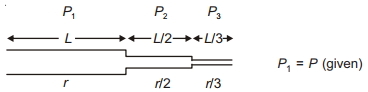
Three capillaries of length $L, L/2$ and $L/3$ are connected in series. Their radii are $r, r/2$ and $r/3$ respectively. If stream-line flow is to be maintained and the pressure difference across the first capillary is $P$,then:
A
The pressure difference across the ends of the second capillary is $8 P$.
B
The pressure difference across the third capillary is $43 P$.
C
The pressure difference across the ends of the second capillary is $16 P$.
D
The pressure difference across the third capillary is $59 P$.
Solution
(A) According to Poiseuille's equation,the rate of flow $Q$ is given by $Q = \frac{\pi P r^4}{8 \eta L}$.
Since the capillaries are connected in series,the rate of flow $Q$ is the same for all three capillaries.
Therefore,the pressure difference $\Delta P$ across a capillary is given by $\Delta P = Q \cdot \frac{8 \eta L}{\pi r^4} \propto \frac{L}{r^4}$.
Let $P_1, P_2, P_3$ be the pressure differences across the first,second,and third capillaries respectively.
Given $P_1 = P$,$L_1 = L, r_1 = r$.
For the second capillary: $L_2 = L/2, r_2 = r/2$.
$P_2 = P_1 \cdot \frac{L_2}{L_1} \cdot \left(\frac{r_1}{r_2}\right)^4 = P \cdot \frac{L/2}{L} \cdot \left(\frac{r}{r/2}\right)^4 = P \cdot \frac{1}{2} \cdot (2)^4 = P \cdot \frac{16}{2} = 8P$.
For the third capillary: $L_3 = L/3, r_3 = r/3$.
$P_3 = P_1 \cdot \frac{L_3}{L_1} \cdot \left(\frac{r_1}{r_3}\right)^4 = P \cdot \frac{L/3}{L} \cdot \left(\frac{r}{r/3}\right)^4 = P \cdot \frac{1}{3} \cdot (3)^4 = P \cdot \frac{81}{3} = 27P$.
Thus,the pressure difference across the second capillary is $8P$.
Since the capillaries are connected in series,the rate of flow $Q$ is the same for all three capillaries.
Therefore,the pressure difference $\Delta P$ across a capillary is given by $\Delta P = Q \cdot \frac{8 \eta L}{\pi r^4} \propto \frac{L}{r^4}$.
Let $P_1, P_2, P_3$ be the pressure differences across the first,second,and third capillaries respectively.
Given $P_1 = P$,$L_1 = L, r_1 = r$.
For the second capillary: $L_2 = L/2, r_2 = r/2$.
$P_2 = P_1 \cdot \frac{L_2}{L_1} \cdot \left(\frac{r_1}{r_2}\right)^4 = P \cdot \frac{L/2}{L} \cdot \left(\frac{r}{r/2}\right)^4 = P \cdot \frac{1}{2} \cdot (2)^4 = P \cdot \frac{16}{2} = 8P$.
For the third capillary: $L_3 = L/3, r_3 = r/3$.
$P_3 = P_1 \cdot \frac{L_3}{L_1} \cdot \left(\frac{r_1}{r_3}\right)^4 = P \cdot \frac{L/3}{L} \cdot \left(\frac{r}{r/3}\right)^4 = P \cdot \frac{1}{3} \cdot (3)^4 = P \cdot \frac{81}{3} = 27P$.
Thus,the pressure difference across the second capillary is $8P$.
0 likes
View Solution55
MediumMCQ
Two liquids of densities $d_1$ and $d_2$ are flowing in identical capillary tubes under the same pressure difference. If $t_1$ and $t_2$ are the times taken for the flow of equal quantities (mass) of liquids,then the ratio of the coefficient of viscosity of the liquids must be:
A
$\frac{d_1 t_1}{d_2 t_2}$
B
$\frac{t_1}{t_2}$
C
$\frac{d_2 t_2}{d_1 t_1}$
D
$\sqrt{\frac{d_1 t_1}{d_2 t_2}}$
Solution
(A) According to Poiseuille's equation,the volume of liquid flowing per second $(Q)$ in a capillary tube is given by:
$Q = \frac{V}{t} = \frac{\pi r^4 \Delta P}{8 \eta L}$
Since mass $m = V \cdot d$,the mass of liquid flowing per second is:
$\frac{m}{t} = \frac{\pi r^4 \Delta P}{8 \eta L} \cdot d$
For two liquids with equal mass $m$ flowing through identical tubes under the same pressure difference $\Delta P$:
$\frac{m}{t_1} = \frac{\pi r^4 \Delta P}{8 \eta_1 L} d_1 \implies \eta_1 = \frac{\pi r^4 \Delta P \cdot d_1 t_1}{8 L m} \dots (I)$
$\frac{m}{t_2} = \frac{\pi r^4 \Delta P}{8 \eta_2 L} d_2 \implies \eta_2 = \frac{\pi r^4 \Delta P \cdot d_2 t_2}{8 L m} \dots (II)$
Dividing equation $(I)$ by $(II)$:
$\frac{\eta_1}{\eta_2} = \frac{d_1 t_1}{d_2 t_2}$
$Q = \frac{V}{t} = \frac{\pi r^4 \Delta P}{8 \eta L}$
Since mass $m = V \cdot d$,the mass of liquid flowing per second is:
$\frac{m}{t} = \frac{\pi r^4 \Delta P}{8 \eta L} \cdot d$
For two liquids with equal mass $m$ flowing through identical tubes under the same pressure difference $\Delta P$:
$\frac{m}{t_1} = \frac{\pi r^4 \Delta P}{8 \eta_1 L} d_1 \implies \eta_1 = \frac{\pi r^4 \Delta P \cdot d_1 t_1}{8 L m} \dots (I)$
$\frac{m}{t_2} = \frac{\pi r^4 \Delta P}{8 \eta_2 L} d_2 \implies \eta_2 = \frac{\pi r^4 \Delta P \cdot d_2 t_2}{8 L m} \dots (II)$
Dividing equation $(I)$ by $(II)$:
$\frac{\eta_1}{\eta_2} = \frac{d_1 t_1}{d_2 t_2}$
0 likes
View Solution56
MediumMCQ
The rate of flow of water in a capillary tube of length $\ell$ and radius $r$ is $V.$ The rate of flow in another capillary tube of length $2 \ell$ and radius $2 r$ for the same pressure difference would be $....V$
A
$16$
B
$9$
C
$8$
D
$2$
Solution
(C) According to Poiseuille's law,the rate of flow of liquid through a capillary tube is given by:
$V = \frac{\pi P r^4}{8 \eta \ell}$
where $P$ is the pressure difference,$r$ is the radius,$\eta$ is the coefficient of viscosity,and $\ell$ is the length of the tube.
Given that $P$ and $\eta$ remain constant,the rate of flow $V$ is proportional to $\frac{r^4}{\ell}$.
Therefore,the ratio of the new rate of flow $V^{\prime}$ to the original rate of flow $V$ is:
$\frac{V^{\prime}}{V} = \frac{(2r)^4}{2\ell} \times \frac{\ell}{r^4}$
$\frac{V^{\prime}}{V} = \frac{16r^4}{2\ell} \times \frac{\ell}{r^4} = \frac{16}{2} = 8$
Thus,$V^{\prime} = 8V$.
$V = \frac{\pi P r^4}{8 \eta \ell}$
where $P$ is the pressure difference,$r$ is the radius,$\eta$ is the coefficient of viscosity,and $\ell$ is the length of the tube.
Given that $P$ and $\eta$ remain constant,the rate of flow $V$ is proportional to $\frac{r^4}{\ell}$.
Therefore,the ratio of the new rate of flow $V^{\prime}$ to the original rate of flow $V$ is:
$\frac{V^{\prime}}{V} = \frac{(2r)^4}{2\ell} \times \frac{\ell}{r^4}$
$\frac{V^{\prime}}{V} = \frac{16r^4}{2\ell} \times \frac{\ell}{r^4} = \frac{16}{2} = 8$
Thus,$V^{\prime} = 8V$.
0 likes
View Solution57
MediumMCQ
$A$ fluid of density $\rho$ and viscosity $\eta$ is flowing through a pipe of diameter $d$, with a velocity $v$. The Reynolds number is:
A
$\frac{\rho v d}{\eta}$
B
$\frac{d \rho v}{\eta}$
C
$\frac{d \rho v}{\eta^2}$
D
$\frac{2 \eta dv}{\rho}$
Solution
(B) The Reynolds number $(Re)$ is a dimensionless quantity used to predict flow patterns in different fluid flow situations.
It is defined by the formula: $Re = \frac{\rho v d}{\eta}$.
Where:
$\rho$ = density of the fluid
$v$ = velocity of the fluid
$d$ = diameter of the pipe
$\eta$ = coefficient of viscosity of the fluid.
Comparing this with the given options, the correct expression is $\frac{\rho v d}{\eta}$.
It is defined by the formula: $Re = \frac{\rho v d}{\eta}$.
Where:
$\rho$ = density of the fluid
$v$ = velocity of the fluid
$d$ = diameter of the pipe
$\eta$ = coefficient of viscosity of the fluid.
Comparing this with the given options, the correct expression is $\frac{\rho v d}{\eta}$.
0 likes
View Solution58
EasyMCQ
$A$ fluid of density $\rho$ is flowing through a uniform tube of diameter $d$. The coefficient of viscosity of the fluid is $\eta$. The critical velocity of the fluid is:
A
inversely proportional to $\eta$
B
directly proportional to $\eta$
C
directly proportional to $d$
D
directly proportional to $\rho$
Solution
(B) The formula for the critical velocity $(v_c)$ of a fluid flowing through a pipe is given by Reynolds number $(R_e)$:
$R_e = \frac{\rho v_c d}{\eta}$
Rearranging for critical velocity $(v_c)$:
$v_c = \frac{R_e \eta}{\rho d}$
From this expression,it is clear that the critical velocity $(v_c)$ is directly proportional to the coefficient of viscosity $(\eta)$ and inversely proportional to the density $(\rho)$ and the diameter $(d)$ of the tube.
Therefore,the correct statement is that the critical velocity is directly proportional to $\eta$.
$R_e = \frac{\rho v_c d}{\eta}$
Rearranging for critical velocity $(v_c)$:
$v_c = \frac{R_e \eta}{\rho d}$
From this expression,it is clear that the critical velocity $(v_c)$ is directly proportional to the coefficient of viscosity $(\eta)$ and inversely proportional to the density $(\rho)$ and the diameter $(d)$ of the tube.
Therefore,the correct statement is that the critical velocity is directly proportional to $\eta$.
0 likes
View Solution59
EasyMCQ
When a liquid flows through a tube,the Reynolds number is $900$. The flow of the liquid is:
A
turbulent.
B
changing from turbulent flow to streamline flow.
C
streamline.
D
changing from streamline flow to turbulent flow.
Solution
(C) The Reynolds number $(Re)$ is a dimensionless quantity used to predict the flow regime of a fluid.
For flow through a pipe:
$1$. If $Re < 2000$,the flow is streamline (laminar).
$2$. If $2000 < Re < 3000$,the flow is in a transition state.
$3$. If $Re > 3000$,the flow is turbulent.
Given that the Reynolds number is $900$,which is less than $2000$,the flow of the liquid is streamline.
For flow through a pipe:
$1$. If $Re < 2000$,the flow is streamline (laminar).
$2$. If $2000 < Re < 3000$,the flow is in a transition state.
$3$. If $Re > 3000$,the flow is turbulent.
Given that the Reynolds number is $900$,which is less than $2000$,the flow of the liquid is streamline.
0 likes
View Solution60
EasyMCQ
When a liquid of density $\rho$ flows through a tube of diameter $d$ with critical velocity $V$,then the Reynolds number is (where $\eta$ is the coefficient of viscosity of the liquid).
A
$\frac{\eta \rho}{V d}$
B
$\frac{V d}{\rho \eta}$
C
$\frac{\rho V d}{\eta}$
D
$\frac{V \eta d}{\rho}$
Solution
(C) The Reynolds number $(R_e)$ is a dimensionless quantity used to predict the flow pattern of a fluid in a pipe. It represents the ratio of inertial forces to viscous forces.
Mathematically,it is defined as:
$R_e = \frac{\text{Inertial force}}{\text{Viscous force}}$
For a liquid of density $\rho$ flowing with velocity $V$ through a tube of diameter $d$ with coefficient of viscosity $\eta$,the formula is:
$R_e = \frac{\rho V d}{\eta}$
Thus,the correct option is $C$.
Mathematically,it is defined as:
$R_e = \frac{\text{Inertial force}}{\text{Viscous force}}$
For a liquid of density $\rho$ flowing with velocity $V$ through a tube of diameter $d$ with coefficient of viscosity $\eta$,the formula is:
$R_e = \frac{\rho V d}{\eta}$
Thus,the correct option is $C$.
0 likes
View Solution61
MediumMCQ
$A$ glass tube of uniform cross-section is connected to a tap with a rubber tube. The tap is opened slowly. Initially, the flow of water in the tube is streamline. The speed of flow of water to convert it into a turbulent flow is (radius of tube $= 1 \,cm$, $\eta = 1 \times 10^{-3} \,Ns/m^2$, $R_{n} = 2500$, and density of water $\rho = 10^3 \,kg/m^3$) (in $m/s$)
A
$0.15$
B
$0.125$
C
$0.3$
D
$0.2$
Solution
(B) The Reynolds number $(R_{n})$ for the flow of a fluid through a pipe is given by the formula:
$R_{n} = \frac{v_{c} \rho d}{\eta}$
Where:
$v_{c}$ is the critical velocity,
$\rho$ is the density of the fluid $(10^3 \,kg/m^3)$,
$d$ is the diameter of the tube $(2 \times r = 2 \times 1 \,cm = 2 \times 10^{-2} \,m)$,
$\eta$ is the coefficient of viscosity $(1 \times 10^{-3} \,Ns/m^2)$,
$R_{n}$ is the critical Reynolds number $(2500)$.
Rearranging the formula to solve for $v_{c}$:
$v_{c} = \frac{R_{n} \eta}{\rho d}$
Substituting the given values:
$v_{c} = \frac{2500 \times 10^{-3}}{10^3 \times 2 \times 10^{-2}}$
$v_{c} = \frac{2.5}{20} = 0.125 \,m/s$
Thus, the speed of flow required to convert the streamline flow into turbulent flow is $0.125 \,m/s$.
$R_{n} = \frac{v_{c} \rho d}{\eta}$
Where:
$v_{c}$ is the critical velocity,
$\rho$ is the density of the fluid $(10^3 \,kg/m^3)$,
$d$ is the diameter of the tube $(2 \times r = 2 \times 1 \,cm = 2 \times 10^{-2} \,m)$,
$\eta$ is the coefficient of viscosity $(1 \times 10^{-3} \,Ns/m^2)$,
$R_{n}$ is the critical Reynolds number $(2500)$.
Rearranging the formula to solve for $v_{c}$:
$v_{c} = \frac{R_{n} \eta}{\rho d}$
Substituting the given values:
$v_{c} = \frac{2500 \times 10^{-3}}{10^3 \times 2 \times 10^{-2}}$
$v_{c} = \frac{2.5}{20} = 0.125 \,m/s$
Thus, the speed of flow required to convert the streamline flow into turbulent flow is $0.125 \,m/s$.
0 likes
View Solution62
DifficultMCQ
$A$ flow of liquid is streamline if the Reynolds number is
A
less than $1000$
B
greater than $1000$
C
between $2000$ to $3000$
D
between $4000$ to $5000$
Solution
$(A)$ The Reynolds number $(Re)$ is a dimensionless quantity that represents the ratio of inertial forces to viscous forces in a fluid flow.
It is used to predict the flow regime of a fluid.
For a flow in a pipe, if the Reynolds number is less than $2000$, the flow is considered to be streamline or laminar.
If the Reynolds number is between $2000$ and $4000$, the flow is in a transition state.
If the Reynolds number is greater than $4000$, the flow is turbulent.
Among the given options, the condition for streamline flow is satisfied by the range less than $1000$.
It is used to predict the flow regime of a fluid.
For a flow in a pipe, if the Reynolds number is less than $2000$, the flow is considered to be streamline or laminar.
If the Reynolds number is between $2000$ and $4000$, the flow is in a transition state.
If the Reynolds number is greater than $4000$, the flow is turbulent.
Among the given options, the condition for streamline flow is satisfied by the range less than $1000$.
0 likes
View Solution63
DifficultMCQ
The rate of steady volume flow of water through a capillary tube of length $l$ and radius $r$,under a pressure difference of $p$ is $V$. This tube is connected with another tube of the same length but half the radius,in series. Then,the rate of steady volume flow through them is (The pressure difference across the combination is $p$.)
A
$\frac{V}{16}$
B
$\frac{V}{17}$
C
$\frac{16V}{17}$
D
$\frac{17V}{16}$
Solution
(B) According to Poiseuille's law,the rate of steady volume flow $V$ through a capillary tube is given by $V = \frac{\pi p r^4}{8 \eta l}$.
This can be rewritten as the pressure difference $p = V \left( \frac{8 \eta l}{\pi r^4} \right) = V R_H$,where $R_H = \frac{8 \eta l}{\pi r^4}$ is the hydraulic resistance.
For the first tube,$R_1 = \frac{8 \eta l}{\pi r^4}$.
For the second tube,$R_2 = \frac{8 \eta l}{\pi (r/2)^4} = \frac{8 \eta l}{\pi r^4 / 16} = 16 R_1$.
In a series combination,the total pressure difference $p$ is the sum of pressure differences across each tube: $p = p_1 + p_2 = V' R_1 + V' R_2$,where $V'$ is the new rate of flow.
Since $p = V R_1$,we have $V R_1 = V' (R_1 + 16 R_1) = V' (17 R_1)$.
Therefore,$V = 17 V'$,which gives $V' = \frac{V}{17}$.
This can be rewritten as the pressure difference $p = V \left( \frac{8 \eta l}{\pi r^4} \right) = V R_H$,where $R_H = \frac{8 \eta l}{\pi r^4}$ is the hydraulic resistance.
For the first tube,$R_1 = \frac{8 \eta l}{\pi r^4}$.
For the second tube,$R_2 = \frac{8 \eta l}{\pi (r/2)^4} = \frac{8 \eta l}{\pi r^4 / 16} = 16 R_1$.
In a series combination,the total pressure difference $p$ is the sum of pressure differences across each tube: $p = p_1 + p_2 = V' R_1 + V' R_2$,where $V'$ is the new rate of flow.
Since $p = V R_1$,we have $V R_1 = V' (R_1 + 16 R_1) = V' (17 R_1)$.
Therefore,$V = 17 V'$,which gives $V' = \frac{V}{17}$.
0 likes
View Solution64
DifficultMCQ
Water is conveyed through a uniform tube of $8 \text{ cm}$ in diameter and $3140 \text{ m}$ in length at the rate of $2 \times 10^{-3} \text{ m}^3/\text{s}$. The pressure required to maintain the flow is (Viscosity of water $= 10^{-3} \text{ SI units}$):
A
$6.25 \times 10^3 \text{ N/m}^2$
B
$0.625 \text{ N/m}^2$
C
$0.0625 \text{ N/m}^2$
D
$0.00625 \text{ N/m}^2$
Solution
(A) Given: Diameter $d = 8 \text{ cm}$,so radius $r = 4 \text{ cm} = 4 \times 10^{-2} \text{ m}$.
Length $l = 3140 \text{ m}$.
Rate of flow $Q = 2 \times 10^{-3} \text{ m}^3/\text{s}$.
Viscosity $\eta = 10^{-3} \text{ SI units}$.
According to Poiseuille's equation for laminar flow in a pipe:
$Q = \frac{\pi P r^4}{8 \eta l}$
Rearranging for pressure $P$:
$P = \frac{Q(8 \eta l)}{\pi r^4}$
Substituting the values:
$P = \frac{2 \times 10^{-3} \times 8 \times 10^{-3} \times 3140}{3.14 \times (4 \times 10^{-2})^4}$
$P = \frac{16 \times 3140 \times 10^{-6}}{3.14 \times 256 \times 10^{-8}}$
$P = \frac{3140 \times 10^2}{3.14 \times 16}$
$P = \frac{1000 \times 10^2}{16} = \frac{10^5}{16} = 6.25 \times 10^3 \text{ N/m}^2$.
Length $l = 3140 \text{ m}$.
Rate of flow $Q = 2 \times 10^{-3} \text{ m}^3/\text{s}$.
Viscosity $\eta = 10^{-3} \text{ SI units}$.
According to Poiseuille's equation for laminar flow in a pipe:
$Q = \frac{\pi P r^4}{8 \eta l}$
Rearranging for pressure $P$:
$P = \frac{Q(8 \eta l)}{\pi r^4}$
Substituting the values:
$P = \frac{2 \times 10^{-3} \times 8 \times 10^{-3} \times 3140}{3.14 \times (4 \times 10^{-2})^4}$
$P = \frac{16 \times 3140 \times 10^{-6}}{3.14 \times 256 \times 10^{-8}}$
$P = \frac{3140 \times 10^2}{3.14 \times 16}$
$P = \frac{1000 \times 10^2}{16} = \frac{10^5}{16} = 6.25 \times 10^3 \text{ N/m}^2$.
0 likes
View Solution65
EasyMCQ
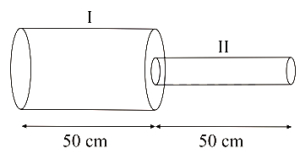
Two capillary tubes of same length each of $50 \ cm$ but of different radii $4 \ mm$ and $2 \ mm$ are connected in series. When water flows,the pressure difference between the ends of the arrangement is $P$. Then the pressure difference between the ends of the first tube is
A
$\frac{P}{2}$
B
$\frac{P}{17}$
C
$\frac{P}{4}$
D
$\frac{P}{8}$
Solution
(B) According to Poiseuille's equation,the resistance to fluid flow $R$ is given by $R = \frac{8 \eta l}{\pi r^4}$,where $\eta$ is the viscosity,$l$ is the length,and $r$ is the radius of the tube.
Since the length $l$ and viscosity $\eta$ are the same for both tubes,we have $R \propto \frac{1}{r^4}$.
Let $r_1 = 4 \ mm$ and $r_2 = 2 \ mm$. The ratio of resistances is $\frac{R_1}{R_2} = \left(\frac{r_2}{r_1}\right)^4 = \left(\frac{2}{4}\right)^4 = \left(\frac{1}{2}\right)^4 = \frac{1}{16}$.
Thus,$R_2 = 16 R_1$. Let $R_1 = R$,then $R_2 = 16 R$.
Since the tubes are connected in series,the same volume flow rate $Q$ passes through both. The pressure difference across each tube is $\Delta P = Q \times R$.
For the first tube,$\Delta P_1 = Q \times R_1 = Q \times R$.
For the second tube,$\Delta P_2 = Q \times R_2 = Q \times 16 R$.
The total pressure difference is $P = \Delta P_1 + \Delta P_2 = Q R + 16 Q R = 17 Q R$.
Therefore,$Q R = \frac{P}{17}$.
The pressure difference across the first tube is $\Delta P_1 = Q R = \frac{P}{17}$.
Since the length $l$ and viscosity $\eta$ are the same for both tubes,we have $R \propto \frac{1}{r^4}$.
Let $r_1 = 4 \ mm$ and $r_2 = 2 \ mm$. The ratio of resistances is $\frac{R_1}{R_2} = \left(\frac{r_2}{r_1}\right)^4 = \left(\frac{2}{4}\right)^4 = \left(\frac{1}{2}\right)^4 = \frac{1}{16}$.
Thus,$R_2 = 16 R_1$. Let $R_1 = R$,then $R_2 = 16 R$.
Since the tubes are connected in series,the same volume flow rate $Q$ passes through both. The pressure difference across each tube is $\Delta P = Q \times R$.
For the first tube,$\Delta P_1 = Q \times R_1 = Q \times R$.
For the second tube,$\Delta P_2 = Q \times R_2 = Q \times 16 R$.
The total pressure difference is $P = \Delta P_1 + \Delta P_2 = Q R + 16 Q R = 17 Q R$.
Therefore,$Q R = \frac{P}{17}$.
The pressure difference across the first tube is $\Delta P_1 = Q R = \frac{P}{17}$.
0 likes
View Solution66
EasyMCQ
If water flows with a velocity of $20 \,cm \,s^{-1}$ in a pipe of radius $2 \,cm$, then the flow is (The coefficient of viscosity of water is $10^{-3} \,kg \,m^{-1} \,s^{-1}$ and density of water is $10^3 \,kg \,m^{-3}$).
A
turbulent
B
steady flow
C
non-viscous
D
unsteady
Solution
(A) To determine the nature of the flow, we calculate the Reynolds number $(R_e)$.
The formula for the Reynolds number is $R_e = \frac{\rho v D}{\eta}$, where $\rho$ is the density, $v$ is the velocity, $D$ is the diameter of the pipe, and $\eta$ is the coefficient of viscosity.
Given:
Density $\rho = 10^3 \,kg \,m^{-3}$
Velocity $v = 20 \,cm \,s^{-1} = 0.2 \,m \,s^{-1}$
Radius $r = 2 \,cm = 0.02 \,m$, so diameter $D = 2r = 0.04 \,m$
Viscosity $\eta = 10^{-3} \,kg \,m^{-1} \,s^{-1}$
Substituting these values:
$R_e = \frac{10^3 \times 0.2 \times 0.04}{10^{-3}}$
$R_e = \frac{10^3 \times 0.008}{10^{-3}} = 8 \times 10^3 = 8000$
Since the Reynolds number $R_e > 2000$, the flow is turbulent.
The formula for the Reynolds number is $R_e = \frac{\rho v D}{\eta}$, where $\rho$ is the density, $v$ is the velocity, $D$ is the diameter of the pipe, and $\eta$ is the coefficient of viscosity.
Given:
Density $\rho = 10^3 \,kg \,m^{-3}$
Velocity $v = 20 \,cm \,s^{-1} = 0.2 \,m \,s^{-1}$
Radius $r = 2 \,cm = 0.02 \,m$, so diameter $D = 2r = 0.04 \,m$
Viscosity $\eta = 10^{-3} \,kg \,m^{-1} \,s^{-1}$
Substituting these values:
$R_e = \frac{10^3 \times 0.2 \times 0.04}{10^{-3}}$
$R_e = \frac{10^3 \times 0.008}{10^{-3}} = 8 \times 10^3 = 8000$
Since the Reynolds number $R_e > 2000$, the flow is turbulent.
0 likes
View Solution67
EasyMCQ
Water flows from a tap of diameter $1.5 \ cm$ with a flow rate of $7.5 \times 10^{-5} \ m^3 \ s^{-1}$. The coefficient of viscosity of water is $10^{-3} \ Pa \cdot s$. The flow is:
A
Turbulent with Reynolds number less than $6000$
B
Steady flow with Reynolds number less than $2000$
C
Turbulent with Reynolds number greater than $6000$
D
Steady flow with Reynolds number more than $6000$
Solution
(C) Given: Diameter $D = 1.5 \ cm = 1.5 \times 10^{-2} \ m$,Flow rate $Q = 7.5 \times 10^{-5} \ m^3 \ s^{-1}$,Viscosity $\eta = 10^{-3} \ Pa \cdot s$,Density of water $\rho = 10^3 \ kg \cdot m^{-3}$.
Flow rate $Q = A \cdot v = \frac{\pi}{4} D^2 v$,so velocity $v = \frac{4Q}{\pi D^2}$.
Reynolds number $R_e = \frac{\rho v D}{\eta} = \frac{\rho (\frac{4Q}{\pi D^2}) D}{\eta} = \frac{4 \rho Q}{\pi \eta D}$.
Substituting the values: $R_e = \frac{4 \times 10^3 \times 7.5 \times 10^{-5}}{3.14 \times 10^{-3} \times 1.5 \times 10^{-2}}$.
$R_e = \frac{0.3}{4.71 \times 10^{-5}} \approx 6369.4$.
Since $R_e > 4000$,the flow is turbulent. Among the given options,the flow is turbulent with a Reynolds number greater than $6000$.
Flow rate $Q = A \cdot v = \frac{\pi}{4} D^2 v$,so velocity $v = \frac{4Q}{\pi D^2}$.
Reynolds number $R_e = \frac{\rho v D}{\eta} = \frac{\rho (\frac{4Q}{\pi D^2}) D}{\eta} = \frac{4 \rho Q}{\pi \eta D}$.
Substituting the values: $R_e = \frac{4 \times 10^3 \times 7.5 \times 10^{-5}}{3.14 \times 10^{-3} \times 1.5 \times 10^{-2}}$.
$R_e = \frac{0.3}{4.71 \times 10^{-5}} \approx 6369.4$.
Since $R_e > 4000$,the flow is turbulent. Among the given options,the flow is turbulent with a Reynolds number greater than $6000$.
0 likes
View Solution68
EasyMCQ
Identify the incorrect statement regarding Reynolds number $(R_e)$:
A
for $R_e < 1000$,flow is laminar
B
for $1000 < R_e < 2000$,flow is steady
C
for $R_e > 2000$,flow is turbulent
D
$R_e$ is a dimensionless number
Solution
(B) The Reynolds number $(R_e)$ is a dimensionless quantity used to predict flow patterns in different fluid flow situations.
For flow through a pipe,the generally accepted criteria are:
$1$. If $R_e < 2000$,the flow is laminar.
$2$. If $2000 < R_e < 3000$,the flow is unsteady or in transition.
$3$. If $R_e > 3000$,the flow is turbulent.
Option $B$ states that for $1000 < R_e < 2000$,the flow is steady. While flow is laminar in this range,the classification of 'steady' is not the standard terminology used to define this specific range in fluid mechanics,and option $C$ is also technically incorrect based on the standard threshold of $3000$. However,in many simplified textbook contexts,$R_e > 2000$ is often cited as the threshold for turbulence. Comparing the options,option $B$ is the most inaccurate description of flow regimes.
For flow through a pipe,the generally accepted criteria are:
$1$. If $R_e < 2000$,the flow is laminar.
$2$. If $2000 < R_e < 3000$,the flow is unsteady or in transition.
$3$. If $R_e > 3000$,the flow is turbulent.
Option $B$ states that for $1000 < R_e < 2000$,the flow is steady. While flow is laminar in this range,the classification of 'steady' is not the standard terminology used to define this specific range in fluid mechanics,and option $C$ is also technically incorrect based on the standard threshold of $3000$. However,in many simplified textbook contexts,$R_e > 2000$ is often cited as the threshold for turbulence. Comparing the options,option $B$ is the most inaccurate description of flow regimes.
0 likes
View Solution69
MediumMCQ
The flow rate of water from a tap of diameter $1.25 \text{ cm}$ is $3 \text{ litres per min}$. If the coefficient of viscosity of water is $10^{-3} \text{ Pa-s}$,the nature of the flow is:
A
unsteady
B
turbulent
C
streamlined
D
laminar
Solution
(B) Given: Diameter of tap,$D = 1.25 \text{ cm} = 1.25 \times 10^{-2} \text{ m}$.
Density of water,$\rho = 10^3 \text{ kg/m}^3$.
Coefficient of viscosity,$\eta = 10^{-3} \text{ Pa-s}$.
Volume flow rate,$Q = 3 \text{ L/min} = \frac{3 \times 10^{-3} \text{ m}^3}{60 \text{ s}} = 5 \times 10^{-5} \text{ m}^3/\text{s}$.
Using the formula for velocity $v = \frac{Q}{A} = \frac{4Q}{\pi D^2}$.
Reynold's number $R_e$ is given by $R_e = \frac{\rho v D}{\eta} = \frac{4 \rho Q}{\pi D \eta}$.
Substituting the values:
$R_e = \frac{4 \times 10^3 \times 5 \times 10^{-5}}{3.14159 \times 1.25 \times 10^{-2} \times 10^{-3}} \approx 5093$.
Since $R_e > 3000$,the flow is turbulent.
Density of water,$\rho = 10^3 \text{ kg/m}^3$.
Coefficient of viscosity,$\eta = 10^{-3} \text{ Pa-s}$.
Volume flow rate,$Q = 3 \text{ L/min} = \frac{3 \times 10^{-3} \text{ m}^3}{60 \text{ s}} = 5 \times 10^{-5} \text{ m}^3/\text{s}$.
Using the formula for velocity $v = \frac{Q}{A} = \frac{4Q}{\pi D^2}$.
Reynold's number $R_e$ is given by $R_e = \frac{\rho v D}{\eta} = \frac{4 \rho Q}{\pi D \eta}$.
Substituting the values:
$R_e = \frac{4 \times 10^3 \times 5 \times 10^{-5}}{3.14159 \times 1.25 \times 10^{-2} \times 10^{-3}} \approx 5093$.
Since $R_e > 3000$,the flow is turbulent.
0 likes
View Solution70
EasyMCQ
$A$ pure number which determines the type of flow of a liquid through a pipe is known as
A
Reynold's number
B
Bernoulli's number
C
Pascal's number
D
Torricelli's number
Solution
(A) pure number which determines the type of flow of a liquid through a pipe is known as Reynold's number $(R_e)$.
$(i)$ If $R_e < 2100$,the flow is laminar.
(ii) If $2100 < R_e < 4000$,the flow is unsteady or transitional.
(iii) If $R_e > 4000$,the flow is turbulent.
$(i)$ If $R_e < 2100$,the flow is laminar.
(ii) If $2100 < R_e < 4000$,the flow is unsteady or transitional.
(iii) If $R_e > 4000$,the flow is turbulent.
0 likes
View Solution71
EasyMCQ
The volume of a liquid is proportional to......,given its density $\rho$,viscosity $\eta$ and $t$ the time of flow through a capillary tube of length $L$ and radius $R$,with a pressure difference $p$ across its ends.
A
$\frac{p^2 R^2 t}{\eta L}$
B
$\frac{p R^4}{\eta L t}$
C
$\frac{p R^4 t}{\eta L}$
D
$\frac{p^2 R^2 t}{\eta L^2}$
Solution
(C) According to Poiseuille's law,the rate of flow of a liquid $(Q)$ through a capillary tube is given by the formula:
$Q = \frac{V}{t} = \frac{\pi p R^4}{8 \eta L}$
Where:
$V$ is the volume of the liquid,
$t$ is the time of flow,
$p$ is the pressure difference,
$R$ is the radius of the tube,
$\eta$ is the coefficient of viscosity,
$L$ is the length of the tube.
Rearranging the formula to solve for the volume $V$:
$V = \frac{\pi p R^4 t}{8 \eta L}$
Since $\frac{\pi}{8}$ is a dimensionless constant,the volume $V$ is proportional to the remaining terms:
$V \propto \frac{p R^4 t}{\eta L}$
Therefore,the correct option is $C$.
$Q = \frac{V}{t} = \frac{\pi p R^4}{8 \eta L}$
Where:
$V$ is the volume of the liquid,
$t$ is the time of flow,
$p$ is the pressure difference,
$R$ is the radius of the tube,
$\eta$ is the coefficient of viscosity,
$L$ is the length of the tube.
Rearranging the formula to solve for the volume $V$:
$V = \frac{\pi p R^4 t}{8 \eta L}$
Since $\frac{\pi}{8}$ is a dimensionless constant,the volume $V$ is proportional to the remaining terms:
$V \propto \frac{p R^4 t}{\eta L}$
Therefore,the correct option is $C$.
0 likes
View Solution72
EasyMCQ
For which of the following Reynolds numbers is a flow considered streamlined (laminar)?
A
$900$
B
$2100$
C
$2900$
D
$4000$
Solution
$(A)$ The Reynolds number $(Re)$ is a dimensionless quantity used to predict the flow regime of a fluid.
For flow in a pipe, the criteria are generally defined as follows:
$1$. If $Re < 2000$, the flow is streamlined or laminar.
$2$. If $2000 < Re < 3000$, the flow is in a transition state.
$3$. If $Re > 3000$, the flow is turbulent.
Comparing the given options with the criteria for streamlined flow $(Re < 2000)$:
- Option $A$: $900 < 2000$ (Streamlined)
- Option $B$: $2100$ (Transition)
- Option $C$: $2900$ (Transition)
- Option $D$: $4000$ (Turbulent)
Therefore, the correct option is $A$.
For flow in a pipe, the criteria are generally defined as follows:
$1$. If $Re < 2000$, the flow is streamlined or laminar.
$2$. If $2000 < Re < 3000$, the flow is in a transition state.
$3$. If $Re > 3000$, the flow is turbulent.
Comparing the given options with the criteria for streamlined flow $(Re < 2000)$:
- Option $A$: $900 < 2000$ (Streamlined)
- Option $B$: $2100$ (Transition)
- Option $C$: $2900$ (Transition)
- Option $D$: $4000$ (Turbulent)
Therefore, the correct option is $A$.
0 likes
View Solution73
MediumMCQ
Consider an increase of $1 \%$ in each of the radius of the artery,the viscosity of blood,and the density of blood,respectively. The percentage change in the flow rate of blood in the artery is (in $\%$)
A
$0.25$
B
$0.50$
C
$1.0$
D
$3.0$
Solution
(D) According to Poiseuille's law,the volume flow rate $Q$ is given by:
$Q = \frac{\pi \Delta P r^4}{8 L \eta}$
where $r$ is the radius,$\eta$ is the viscosity,and $\Delta P$ is the pressure difference.
Since the flow rate $Q$ does not depend on the density of blood,the change in density does not affect the flow rate.
Taking the logarithmic differentiation of the formula:
$\frac{\Delta Q}{Q} = 4 \frac{\Delta r}{r} - \frac{\Delta \eta}{\eta}$
Given that the radius $r$ increases by $1 \%$ $(\frac{\Delta r}{r} = 0.01)$ and the viscosity $\eta$ increases by $1 \%$ $(\frac{\Delta \eta}{\eta} = 0.01)$:
$\frac{\Delta Q}{Q} = 4(0.01) - 0.01 = 0.04 - 0.01 = 0.03$
Therefore,the percentage change in the flow rate is $0.03 \times 100 = 3 \%$.
$Q = \frac{\pi \Delta P r^4}{8 L \eta}$
where $r$ is the radius,$\eta$ is the viscosity,and $\Delta P$ is the pressure difference.
Since the flow rate $Q$ does not depend on the density of blood,the change in density does not affect the flow rate.
Taking the logarithmic differentiation of the formula:
$\frac{\Delta Q}{Q} = 4 \frac{\Delta r}{r} - \frac{\Delta \eta}{\eta}$
Given that the radius $r$ increases by $1 \%$ $(\frac{\Delta r}{r} = 0.01)$ and the viscosity $\eta$ increases by $1 \%$ $(\frac{\Delta \eta}{\eta} = 0.01)$:
$\frac{\Delta Q}{Q} = 4(0.01) - 0.01 = 0.04 - 0.01 = 0.03$
Therefore,the percentage change in the flow rate is $0.03 \times 100 = 3 \%$.
0 likes
View Solution74
MediumMCQ
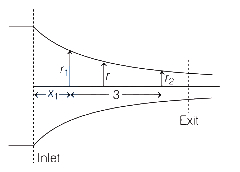
Consider a steady flow of oil in a pipeline. The cross-sectional radius of the pipeline decreases gradually as $r = r_0 e^{-\alpha x}$,where $\alpha = \frac{1}{3} \text{ m}^{-1}$ and $x$ is the distance from the pipeline inlet. If $R_1$ is the Reynolds number for a certain pipeline cross-section at a distance $x_1$ metre from the inlet and $R_2$ is for distance $(x_1 + 3)$ metre,then the ratio $\frac{R_1}{R_2}$ is
A
$\frac{1}{e}$
B
$e$
C
$\frac{1}{e^3}$
D
$\frac{1}{e^6}$
Solution
(A) The Reynolds number for a fluid flow is given by $R_e = \frac{2 v \rho r}{\eta}$,where $v$ is the velocity of flow,$\rho$ is the density of the fluid,$r$ is the radius of the tube,and $\eta$ is the viscosity of the fluid.
From the equation of continuity,$A_1 v_1 = A_2 v_2$,where $A = \pi r^2$. Thus,$\pi r_1^2 v_1 = \pi r_2^2 v_2$,which implies $\frac{v_1}{v_2} = \frac{r_2^2}{r_1^2}$.
The ratio of Reynolds numbers is $\frac{R_1}{R_2} = \frac{v_1 r_1}{v_2 r_2} = \left(\frac{r_2^2}{r_1^2}\right) \times \left(\frac{r_1}{r_2}\right) = \frac{r_2}{r_1}$.
Given $r = r_0 e^{-\alpha x}$,we have $r_1 = r_0 e^{-\alpha x_1}$ and $r_2 = r_0 e^{-\alpha (x_1 + 3)}$.
Substituting these values,$\frac{R_1}{R_2} = \frac{r_0 e^{-\alpha (x_1 + 3)}}{r_0 e^{-\alpha x_1}} = e^{-\alpha (x_1 + 3) + \alpha x_1} = e^{-3 \alpha}$.
Given $\alpha = \frac{1}{3} \text{ m}^{-1}$,we get $\frac{R_1}{R_2} = e^{-3(1/3)} = e^{-1} = \frac{1}{e}$.
From the equation of continuity,$A_1 v_1 = A_2 v_2$,where $A = \pi r^2$. Thus,$\pi r_1^2 v_1 = \pi r_2^2 v_2$,which implies $\frac{v_1}{v_2} = \frac{r_2^2}{r_1^2}$.
The ratio of Reynolds numbers is $\frac{R_1}{R_2} = \frac{v_1 r_1}{v_2 r_2} = \left(\frac{r_2^2}{r_1^2}\right) \times \left(\frac{r_1}{r_2}\right) = \frac{r_2}{r_1}$.
Given $r = r_0 e^{-\alpha x}$,we have $r_1 = r_0 e^{-\alpha x_1}$ and $r_2 = r_0 e^{-\alpha (x_1 + 3)}$.
Substituting these values,$\frac{R_1}{R_2} = \frac{r_0 e^{-\alpha (x_1 + 3)}}{r_0 e^{-\alpha x_1}} = e^{-\alpha (x_1 + 3) + \alpha x_1} = e^{-3 \alpha}$.
Given $\alpha = \frac{1}{3} \text{ m}^{-1}$,we get $\frac{R_1}{R_2} = e^{-3(1/3)} = e^{-1} = \frac{1}{e}$.
0 likes
View Solution75
MediumMCQ
$A$ horizontal pipeline carrying gasoline has a cross-sectional diameter of $5 \,mm$. If the viscosity and density of the gasoline are $6 \times 10^{-3} \,Poise$ and $720 \,kg/m^3$ respectively,the velocity after which the flow becomes turbulent is:
A
$ > 1.66 \,m/s$
B
$ > 3.33 \,m/s$
C
$ > 1.66 \,m/s$
D
$ > 0.33 \,m/s$
Solution
(D) Given: Diameter of pipe $d = 5 \,mm = 5 \times 10^{-3} \,m$. Density of gasoline $\rho = 720 \,kg/m^3$. Viscosity of gasoline $\eta = 6 \times 10^{-3} \,Poise = 6 \times 10^{-4} \,Pa \cdot s$. The critical Reynolds number for pipe flow is $R_e = 2000$. The formula for critical velocity $v_c$ is $v_c = \frac{R_e \cdot \eta}{\rho \cdot d}$. Substituting the values: $v_c = \frac{2000 \times 6 \times 10^{-4}}{720 \times 5 \times 10^{-3}} = \frac{1.2}{3.6} = \frac{1}{3} \approx 0.33 \,m/s$. Thus,the flow becomes turbulent when the velocity is $ > 0.33 \,m/s$.
0 likes
View Solution76
EasyMCQ
Water is flowing through a very narrow tube. The velocity of water below which the flow remains a streamline flow is known as
A
relative velocity
B
terminal velocity
C
critical velocity
D
particle velocity
Solution
(C) The velocity of a fluid,such as water,flowing through a tube,below which the flow remains streamline (or laminar) and above which it becomes turbulent,is defined as the critical velocity.
0 likes
View SolutionFluid Mechanics and Surface Tension — Reynold's Number and Poiseuille's Equation · Frequently Asked Questions
1Are these Fluid Mechanics and Surface Tension questions useful for JEE and NEET?
Yes. All questions in this section are mapped to JEE Main and NEET exam patterns. Previous year questions from JEE Main, NEET, GUJCET and state-level exams are included with full solutions.
2Can I switch to Hindi or Gujarati for these questions?
Yes. Use the language tabs in the hero section or the sidebar to view the same questions and solutions in English, Hindi or Gujarati.
3How do I generate a question paper from this subtopic?
Use the Vedclass Exam Paper Generator — select the chapter and subtopic, set difficulty, and generate Sets A, B, C, D automatically. First 3 chapters of every subject are free.
Vedclass Products
For Students
Vedclass Test Series
Mock tests in real JEE/NEET style with performance analysis. 5-day free trial.
Start Free TrialFor Teachers
Exam Paper Generator
Generate Set A/B/C/D papers from this chapter in 2 minutes. 3 chapters free.
Try FreeFor Institutes
Online Exam Module
Live online exams with unlimited students, 360° analytics & white-label branding.
See DemoFor Teachers & Institutes
Generate a Fluid Mechanics and Surface Tension Exam Paper in 2 Minutes
Select subtopic & difficulty — Sets A, B, C, D auto-generated with No Repeat logic.
First 3 chapters of every subject are free — no payment required.