
A English
Mix Examples - Electricity Questions in English
Class 10 Science · Electricity · Mix Examples - Electricity
449+
Questions
English
Language
100%
With Solutions
Showing 50 of 449 questions in English
351
EasyMCQ
If five equal pieces of wire having $5\, \Omega$ resistance are made and connected in parallel,then their equivalent resistance will be $......$
A
$0.2\, \Omega$
B
$1\, \Omega$
C
$5\, \Omega$
D
$25\, \Omega$
Solution
(A) When a wire of resistance $R$ is cut into $n$ equal pieces,the resistance of each piece becomes $R' = R/n$.
Here,the original resistance $R = 5\, \Omega$ and the number of pieces $n = 5$.
Therefore,the resistance of each piece $R' = 5\, \Omega / 5 = 1\, \Omega$.
When $n$ resistors of equal resistance $R'$ are connected in parallel,the equivalent resistance $R_{eq}$ is given by $R_{eq} = R'/n$.
Substituting the values,$R_{eq} = 1\, \Omega / 5 = 0.2\, \Omega$.
Here,the original resistance $R = 5\, \Omega$ and the number of pieces $n = 5$.
Therefore,the resistance of each piece $R' = 5\, \Omega / 5 = 1\, \Omega$.
When $n$ resistors of equal resistance $R'$ are connected in parallel,the equivalent resistance $R_{eq}$ is given by $R_{eq} = R'/n$.
Substituting the values,$R_{eq} = 1\, \Omega / 5 = 0.2\, \Omega$.
0 likes
View Solution352
EasyMCQ
The $SI$ unit of resistivity of the material is $......$
A
$\Omega$
B
$\Omega \cdot m$
C
$\Omega/m$
D
$\Omega/V$
Solution
(B) The resistance $R$ of a conductor is given by the formula $R = \rho \frac{L}{A}$,where $\rho$ is the resistivity,$L$ is the length,and $A$ is the cross-sectional area.
Rearranging the formula for resistivity,we get $\rho = R \cdot \frac{A}{L}$.
The $SI$ unit of resistance $R$ is Ohm $(\Omega)$,the unit of area $A$ is square meter $(m^2)$,and the unit of length $L$ is meter $(m)$.
Substituting these units into the formula: $\text{Unit of } \rho = \Omega \cdot \frac{m^2}{m} = \Omega \cdot m$.
Therefore,the $SI$ unit of resistivity is $\Omega \cdot m$.
Rearranging the formula for resistivity,we get $\rho = R \cdot \frac{A}{L}$.
The $SI$ unit of resistance $R$ is Ohm $(\Omega)$,the unit of area $A$ is square meter $(m^2)$,and the unit of length $L$ is meter $(m)$.
Substituting these units into the formula: $\text{Unit of } \rho = \Omega \cdot \frac{m^2}{m} = \Omega \cdot m$.
Therefore,the $SI$ unit of resistivity is $\Omega \cdot m$.
0 likes
View Solution353
EasyMCQ
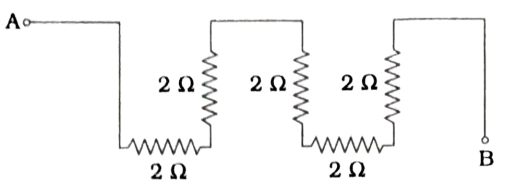
What will be the equivalent resistance between points $A$ and $B$ of the following electric circuit?
A
$1\, \Omega$
B
$2\, \Omega$
C
$5\, \Omega$
D
$10 \, \Omega$
Solution
(D) In the given circuit,all the resistors are connected in series.
When resistors are connected in series,the equivalent resistance $R_{eq}$ is the sum of individual resistances.
$R_{eq} = R_1 + R_2 + R_3 + R_4 + R_5$
Here,there are $5$ resistors,each of $2 \, \Omega$.
$R_{eq} = 2 \, \Omega + 2 \, \Omega + 2 \, \Omega + 2 \, \Omega + 2 \, \Omega = 10 \, \Omega$.
Therefore,the equivalent resistance between points $A$ and $B$ is $10 \, \Omega$.
When resistors are connected in series,the equivalent resistance $R_{eq}$ is the sum of individual resistances.
$R_{eq} = R_1 + R_2 + R_3 + R_4 + R_5$
Here,there are $5$ resistors,each of $2 \, \Omega$.
$R_{eq} = 2 \, \Omega + 2 \, \Omega + 2 \, \Omega + 2 \, \Omega + 2 \, \Omega = 10 \, \Omega$.
Therefore,the equivalent resistance between points $A$ and $B$ is $10 \, \Omega$.
0 likes
View Solution354
EasyMCQ
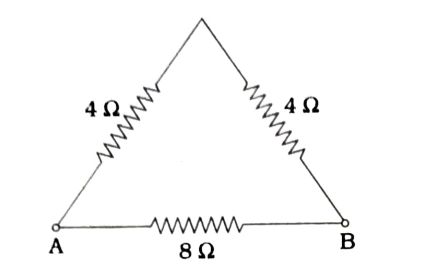
The equivalent resistance between points $A$ and $B$ of the following electric circuit will be $.........$
A
$4 \, \Omega$
B
$8 \, \Omega$
C
$2 \, \Omega$
D
$16 \, \Omega$
Solution
(A) In the given circuit,there are two branches connected between points $A$ and $B$.
Branch $1$ consists of two resistors of $4 \, \Omega$ each,connected in series. The equivalent resistance of this branch is $R_1 = 4 \, \Omega + 4 \, \Omega = 8 \, \Omega$.
Branch $2$ consists of a single resistor of $8 \, \Omega$ connected directly between $A$ and $B$.
Now,these two branches ($R_1 = 8 \, \Omega$ and $R_2 = 8 \, \Omega$) are connected in parallel.
The equivalent resistance $R_{eq}$ is given by the formula: $\frac{1}{R_{eq}} = \frac{1}{R_1} + \frac{1}{R_2}$.
Substituting the values: $\frac{1}{R_{eq}} = \frac{1}{8} + \frac{1}{8} = \frac{2}{8} = \frac{1}{4}$.
Therefore,$R_{eq} = 4 \, \Omega$.
Branch $1$ consists of two resistors of $4 \, \Omega$ each,connected in series. The equivalent resistance of this branch is $R_1 = 4 \, \Omega + 4 \, \Omega = 8 \, \Omega$.
Branch $2$ consists of a single resistor of $8 \, \Omega$ connected directly between $A$ and $B$.
Now,these two branches ($R_1 = 8 \, \Omega$ and $R_2 = 8 \, \Omega$) are connected in parallel.
The equivalent resistance $R_{eq}$ is given by the formula: $\frac{1}{R_{eq}} = \frac{1}{R_1} + \frac{1}{R_2}$.
Substituting the values: $\frac{1}{R_{eq}} = \frac{1}{8} + \frac{1}{8} = \frac{2}{8} = \frac{1}{4}$.
Therefore,$R_{eq} = 4 \, \Omega$.
0 likes
View Solution355
EasyMCQ
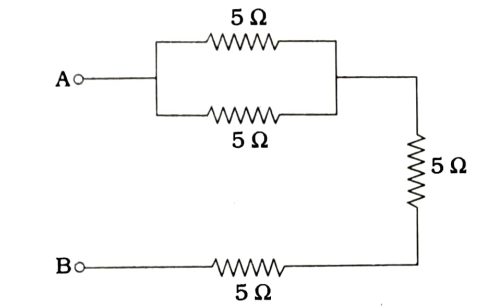
The equivalent resistance between points $A$ and $B$ in the following electric circuit is:
A
$2.5 \, \Omega$
B
$5 \, \Omega$
C
$12.5 \, \Omega$
D
$20 \, \Omega$
Solution
(C) $1$. Identify the parallel combination: Two resistors of $5 \, \Omega$ each are connected in parallel. The equivalent resistance $(R_p)$ of this parallel part is given by $\frac{1}{R_p} = \frac{1}{5} + \frac{1}{5} = \frac{2}{5}$,so $R_p = 2.5 \, \Omega$.
$2$. Identify the series combination: The circuit now consists of three resistors in series: the equivalent resistance $R_p = 2.5 \, \Omega$,and two other resistors of $5 \, \Omega$ each.
$3$. Calculate total resistance: The total equivalent resistance $(R_{eq})$ is the sum of these resistances in series: $R_{eq} = 2.5 \, \Omega + 5 \, \Omega + 5 \, \Omega = 12.5 \, \Omega$.
$2$. Identify the series combination: The circuit now consists of three resistors in series: the equivalent resistance $R_p = 2.5 \, \Omega$,and two other resistors of $5 \, \Omega$ each.
$3$. Calculate total resistance: The total equivalent resistance $(R_{eq})$ is the sum of these resistances in series: $R_{eq} = 2.5 \, \Omega + 5 \, \Omega + 5 \, \Omega = 12.5 \, \Omega$.
0 likes
View Solution356
EasyMCQ
Which physical quantity has a unit of $kWh$?
A
Electric Power
B
Work
C
Electric current
D
Electric potential
Solution
(B) The unit $kWh$ stands for kilowatt-hour.
Power is defined as the rate of doing work or energy consumption,measured in kilowatts $(kW)$.
Energy is defined as the product of power and time,expressed as $Energy = Power \times Time$.
Therefore,the unit of energy is $kW \times h = kWh$.
Since work is a form of energy,$kWh$ is a unit of work or energy.
Power is defined as the rate of doing work or energy consumption,measured in kilowatts $(kW)$.
Energy is defined as the product of power and time,expressed as $Energy = Power \times Time$.
Therefore,the unit of energy is $kW \times h = kWh$.
Since work is a form of energy,$kWh$ is a unit of work or energy.
0 likes
View Solution357
EasyMCQ
$1 \; kWh = \ldots \ldots \; \text{joules}$
A
$3.6 \times 10^{6}$
B
$3.6 \times 10^{3}$
C
$3.6 \times 10^{-6}$
D
$3.6 \times 10^{-3}$
Solution
(A) $1 \; kWh$ is the unit of electrical energy.
$1 \; kWh = 1 \; \text{kilowatt} \times 1 \; \text{hour}$.
Since $1 \; \text{kilowatt} = 1000 \; \text{watts}$ and $1 \; \text{hour} = 3600 \; \text{seconds}$.
Therefore,$1 \; kWh = 1000 \; \text{W} \times 3600 \; \text{s}$.
$1 \; kWh = 3,600,000 \; \text{joules}$.
In scientific notation,this is $3.6 \times 10^{6} \; \text{joules}$.
$1 \; kWh = 1 \; \text{kilowatt} \times 1 \; \text{hour}$.
Since $1 \; \text{kilowatt} = 1000 \; \text{watts}$ and $1 \; \text{hour} = 3600 \; \text{seconds}$.
Therefore,$1 \; kWh = 1000 \; \text{W} \times 3600 \; \text{s}$.
$1 \; kWh = 3,600,000 \; \text{joules}$.
In scientific notation,this is $3.6 \times 10^{6} \; \text{joules}$.
0 likes
View Solution358
EasyMCQ
An electric heater consumes $1.1 \,kW$ power when $220 \,V$ voltage is applied to it. How much current will be flowing through it (in $,A$)?
A
$1.1$
B
$2.2$
C
$4$
D
$5$
Solution
(D) Given:
Power $(P)$ = $1.1 \,kW = 1100 \,W$
Voltage $(V)$ = $220 \,V$
We know the formula for electric power is $P = V \times I$,where $I$ is the current.
Rearranging the formula to solve for current: $I = P / V$.
Substituting the values: $I = 1100 \,W / 220 \,V = 5 \,A$.
Therefore,the current flowing through the heater is $5 \,A$.
Power $(P)$ = $1.1 \,kW = 1100 \,W$
Voltage $(V)$ = $220 \,V$
We know the formula for electric power is $P = V \times I$,where $I$ is the current.
Rearranging the formula to solve for current: $I = P / V$.
Substituting the values: $I = 1100 \,W / 220 \,V = 5 \,A$.
Therefore,the current flowing through the heater is $5 \,A$.
0 likes
View Solution359
EasyMCQ
What makes the electric current flow through an electrolyte?
A
Only free electrons
B
Only positive ions
C
Only negative ions
D
Positive and negative ions
Solution
(D) An electrolyte is a substance that produces an electrically conducting solution when dissolved in a polar solvent,such as water.
When an electric potential is applied across an electrolyte,the dissolved solute dissociates into charged particles called ions.
The positive ions (cations) move towards the cathode (negative electrode),and the negative ions (anions) move towards the anode (positive electrode).
Therefore,the flow of electric current through an electrolyte is due to the movement of both positive and negative ions.
When an electric potential is applied across an electrolyte,the dissolved solute dissociates into charged particles called ions.
The positive ions (cations) move towards the cathode (negative electrode),and the negative ions (anions) move towards the anode (positive electrode).
Therefore,the flow of electric current through an electrolyte is due to the movement of both positive and negative ions.
0 likes
View Solution360
EasyMCQ
Distilled water acts as ........ for electricity.
A
a conductor
B
an insulator
C
a semiconductor
D
none of these
Solution
(B) Distilled water is pure water $(H_2O)$ and does not contain dissolved salts or ions.
Since electricity requires free ions or electrons to flow through a medium,the absence of these charge carriers makes distilled water a poor conductor of electricity.
Therefore,distilled water acts as an insulator.
Since electricity requires free ions or electrons to flow through a medium,the absence of these charge carriers makes distilled water a poor conductor of electricity.
Therefore,distilled water acts as an insulator.
0 likes
View Solution361
EasyMCQ
What type of electric charge does a proton possess?
A
Positive
B
Negative
C
Zero
D
Neutral
Solution
(A) proton is a subatomic particle found in the nucleus of an atom.
It carries a fundamental positive electric charge of approximately $+1.602 \times 10^{-19} \ C$.
Therefore,the correct option is $A$.
It carries a fundamental positive electric charge of approximately $+1.602 \times 10^{-19} \ C$.
Therefore,the correct option is $A$.
0 likes
View Solution362
EasyMCQ
What type of electric charge does an electron possess?
A
Zero
B
Positive
C
Negative
D
No charge
Solution
(C) An electron is a subatomic particle that carries a fundamental negative electric charge. By convention,the charge of an electron is defined as $-1.602 \times 10^{-19} \ C$.
0 likes
View Solution363
EasyMCQ
What is the magnitude of the electric charge on an electron?
A
$1.6 \times 10^{-19} \ C$
B
$6.25 \times 10^{-18} \ C$
C
$1.6 \times 10^{-18} \ C$
D
$6.25 \times 10^{-19} \ C$
Solution
(A) The elementary charge,denoted by $e$,is the electric charge carried by a single proton or,equivalently,the magnitude of the negative electric charge carried by a single electron.
It is a fundamental physical constant.
The value of the charge on an electron is approximately $1.602 \times 10^{-19} \ C$.
Therefore,the correct magnitude is $1.6 \times 10^{-19} \ C$.
It is a fundamental physical constant.
The value of the charge on an electron is approximately $1.602 \times 10^{-19} \ C$.
Therefore,the correct magnitude is $1.6 \times 10^{-19} \ C$.
0 likes
View Solution364
EasyMCQ
How many electrons constitute a total charge of $1 \ C$?
A
$1.6 \times 10^{19}$
B
$6.25 \times 10^{18}$
C
$1.6 \times 10^{18}$
D
$6.25 \times 10^{19}$
Solution
(B) The quantization of electric charge is given by the formula $Q = ne$,where $Q$ is the total charge,$n$ is the number of electrons,and $e$ is the elementary charge of an electron.
Given: $Q = 1 \ C$ and $e = 1.6 \times 10^{-19} \ C$.
Rearranging the formula to solve for $n$: $n = Q / e$.
Substituting the values: $n = 1 / (1.6 \times 10^{-19})$.
$n = 10^{19} / 1.6$.
$n = 0.625 \times 10^{19} = 6.25 \times 10^{18}$.
Therefore,$6.25 \times 10^{18}$ electrons constitute a total charge of $1 \ C$.
Given: $Q = 1 \ C$ and $e = 1.6 \times 10^{-19} \ C$.
Rearranging the formula to solve for $n$: $n = Q / e$.
Substituting the values: $n = 1 / (1.6 \times 10^{-19})$.
$n = 10^{19} / 1.6$.
$n = 0.625 \times 10^{19} = 6.25 \times 10^{18}$.
Therefore,$6.25 \times 10^{18}$ electrons constitute a total charge of $1 \ C$.
0 likes
View Solution365
EasyMCQ
What is the total electric charge on $100$ protons in Coulombs?
A
$1.6 \times 10^{-21}$
B
$1.6 \times 10^{-20}$
C
$1.6 \times 10^{-17}$
D
$1.6 \times 10^{-16}$
Solution
(C) The charge of a single proton is $e = 1.6 \times 10^{-19} \ C$.
To find the total charge $(Q)$ on $n = 100$ protons,we use the formula $Q = n \times e$.
Substituting the values: $Q = 100 \times (1.6 \times 10^{-19} \ C)$.
$Q = 10^2 \times 1.6 \times 10^{-19} \ C$.
$Q = 1.6 \times 10^{-17} \ C$.
Therefore,the total electric charge is $1.6 \times 10^{-17} \ C$.
To find the total charge $(Q)$ on $n = 100$ protons,we use the formula $Q = n \times e$.
Substituting the values: $Q = 100 \times (1.6 \times 10^{-19} \ C)$.
$Q = 10^2 \times 1.6 \times 10^{-19} \ C$.
$Q = 1.6 \times 10^{-17} \ C$.
Therefore,the total electric charge is $1.6 \times 10^{-17} \ C$.
0 likes
View Solution366
EasyMCQ
Which of the following substances does not contain free electrons?
A
Copper
B
Silver
C
Aluminum
D
Plastic
Solution
(D) Free electrons are the charge carriers responsible for the flow of electric current in conductors.
Metals like $Copper$,$Silver$,and $Aluminum$ are good conductors of electricity because they possess a large number of free electrons in their atomic structure.
$Plastic$ is an insulator (non-conductor) of electricity.
In insulators,electrons are tightly bound to their respective atoms and are not free to move,which prevents the flow of electric current.
Therefore,$Plastic$ does not contain free electrons.
Metals like $Copper$,$Silver$,and $Aluminum$ are good conductors of electricity because they possess a large number of free electrons in their atomic structure.
$Plastic$ is an insulator (non-conductor) of electricity.
In insulators,electrons are tightly bound to their respective atoms and are not free to move,which prevents the flow of electric current.
Therefore,$Plastic$ does not contain free electrons.
0 likes
View Solution367
EasyMCQ
Which law is used to calculate the magnitude of the electric force between two electric charges?
A
Coulomb's law
B
Ampere's law
C
Ohm's law
D
Faraday's law
Solution
(A) The electric force between two stationary point charges is determined by Coulomb's law.
According to Coulomb's law,the magnitude of the electrostatic force $(F)$ between two point charges ($q_1$ and $q_2$) separated by a distance $(r)$ is directly proportional to the product of the magnitudes of the charges and inversely proportional to the square of the distance between them.
The formula is given by: $F = k \cdot \frac{|q_1 \cdot q_2|}{r^2}$,where $k$ is Coulomb's constant.
According to Coulomb's law,the magnitude of the electrostatic force $(F)$ between two point charges ($q_1$ and $q_2$) separated by a distance $(r)$ is directly proportional to the product of the magnitudes of the charges and inversely proportional to the square of the distance between them.
The formula is given by: $F = k \cdot \frac{|q_1 \cdot q_2|}{r^2}$,where $k$ is Coulomb's constant.
0 likes
View Solution368
EasyMCQ
Who discovered the electron?
A
Coulomb
B
Thomson
C
Volta
D
Ampere
Solution
(B) The electron was discovered by $J.J. Thomson$ in $1897$ during his experiments with cathode ray tubes. He identified these particles as fundamental constituents of atoms.
0 likes
View Solution369
EasyMCQ
What is the electric charge passing through a cross-sectional area of the conductor per unit time called?
A
Electric potential
B
Electric current
C
Electric power
D
Resistance
Solution
(B) Electric current is defined as the rate of flow of electric charge through a cross-section of a conductor.
Mathematically,it is expressed as $I = Q / t$,where $I$ is the electric current,$Q$ is the net charge,and $t$ is the time taken.
The $SI$ unit of electric current is the Ampere $(A)$.
Mathematically,it is expressed as $I = Q / t$,where $I$ is the electric current,$Q$ is the net charge,and $t$ is the time taken.
The $SI$ unit of electric current is the Ampere $(A)$.
0 likes
View Solution370
EasyMCQ
What is the unit of electric current?
A
watt
B
volt
C
coulomb
D
ampere
Solution
(D) The $SI$ unit of electric current is the $Ampere$ $(A)$.
Electric current is defined as the rate of flow of electric charge through a conductor.
One $Ampere$ is equivalent to one $Coulomb$ of charge flowing per second $(1 \ A = 1 \ C/s)$.
Electric current is defined as the rate of flow of electric charge through a conductor.
One $Ampere$ is equivalent to one $Coulomb$ of charge flowing per second $(1 \ A = 1 \ C/s)$.
0 likes
View Solution371
EasyMCQ
The unit of electric current,$.......$,is also called an ampere,named after André-Marie Ampère.
A
$Coulomb/second$
B
$Joule/coulomb$
C
$Volt/ampere$
D
$Joule/second$
Solution
(A) Electric current $(I)$ is defined as the rate of flow of electric charge $(Q)$ through a conductor.
Mathematically,$I = Q / t$.
The $SI$ unit of charge $(Q)$ is the coulomb $(C)$ and the $SI$ unit of time $(t)$ is the second $(s)$.
Therefore,the unit of electric current is $Coulomb/second$ $(C/s)$,which is defined as an ampere $(A)$.
Mathematically,$I = Q / t$.
The $SI$ unit of charge $(Q)$ is the coulomb $(C)$ and the $SI$ unit of time $(t)$ is the second $(s)$.
Therefore,the unit of electric current is $Coulomb/second$ $(C/s)$,which is defined as an ampere $(A)$.
0 likes
View Solution372
EasyMCQ
$1\, mA = \dots A$
A
$10^{3}$
B
$10^{6}$
C
$10^{-6}$
D
$10^{-3}$
Solution
(D) The prefix $m$ stands for milli,which represents a factor of $10^{-3}$.
Therefore,$1\, mA = 1 \times 10^{-3}\, A$.
Thus,$1\, mA = 10^{-3}\, A$.
Therefore,$1\, mA = 1 \times 10^{-3}\, A$.
Thus,$1\, mA = 10^{-3}\, A$.
0 likes
View Solution373
EasyMCQ
$1 \, \mu A = \ldots \ldots \ldots \, A$
A
$10^{-3}$
B
$10^{3}$
C
$10^{6}$
D
$10^{-6}$
Solution
(D) The prefix $\mu$ (micro) represents a factor of $10^{-6}$.
Therefore,$1 \, \mu A$ is equal to $10^{-6} \, A$.
Therefore,$1 \, \mu A$ is equal to $10^{-6} \, A$.
0 likes
View Solution374
EasyMCQ
How many microamperes $(\mu A)$ are equal to $1$ milliampere $(mA)$?
A
$10^{-6}$
B
$10^{-3}$
C
$10^{6}$
D
$10^{3}$
Solution
(D) We know that $1 \text{ milliampere } (mA) = 10^{-3} \text{ amperes } (A)$.
We also know that $1 \text{ microampere } (\mu A) = 10^{-6} \text{ amperes } (A)$.
To find the value of $1 \text{ mA}$ in terms of $\mu A$,we set up the equation:
$1 \text{ mA} = x \times 1 \mu A$
$10^{-3} \text{ A} = x \times 10^{-6} \text{ A}$
$x = \frac{10^{-3}}{10^{-6}}$
$x = 10^{-3 - (-6)} = 10^{-3 + 6} = 10^{3}$
Therefore,$1 \text{ mA} = 10^{3} \mu A$.
We also know that $1 \text{ microampere } (\mu A) = 10^{-6} \text{ amperes } (A)$.
To find the value of $1 \text{ mA}$ in terms of $\mu A$,we set up the equation:
$1 \text{ mA} = x \times 1 \mu A$
$10^{-3} \text{ A} = x \times 10^{-6} \text{ A}$
$x = \frac{10^{-3}}{10^{-6}}$
$x = 10^{-3 - (-6)} = 10^{-3 + 6} = 10^{3}$
Therefore,$1 \text{ mA} = 10^{3} \mu A$.
0 likes
View Solution375
EasyMCQ
If $1 \text{ ampere}$ electric current passes through a conductor,how many electrons will pass per second?
A
$6.25 \times 10^{19}$
B
$6.25 \times 10^{18}$
C
$1.6 \times 10^{19}$
D
$1.6 \times 10^{18}$
Solution
(B) The formula for electric current is $I = Q / t$,where $I$ is current,$Q$ is total charge,and $t$ is time.
Given $I = 1 \text{ A}$ and $t = 1 \text{ s}$,the total charge $Q = I \times t = 1 \text{ A} \times 1 \text{ s} = 1 \text{ C}$.
The quantization of charge is given by $Q = n \times e$,where $n$ is the number of electrons and $e$ is the elementary charge $(e \approx 1.6 \times 10^{-19} \text{ C})$.
To find $n$,we rearrange the formula: $n = Q / e$.
Substituting the values: $n = 1 \text{ C} / (1.6 \times 10^{-19} \text{ C}) = 0.625 \times 10^{19} = 6.25 \times 10^{18}$.
Therefore,$6.25 \times 10^{18}$ electrons pass through the conductor per second.
Given $I = 1 \text{ A}$ and $t = 1 \text{ s}$,the total charge $Q = I \times t = 1 \text{ A} \times 1 \text{ s} = 1 \text{ C}$.
The quantization of charge is given by $Q = n \times e$,where $n$ is the number of electrons and $e$ is the elementary charge $(e \approx 1.6 \times 10^{-19} \text{ C})$.
To find $n$,we rearrange the formula: $n = Q / e$.
Substituting the values: $n = 1 \text{ C} / (1.6 \times 10^{-19} \text{ C}) = 0.625 \times 10^{19} = 6.25 \times 10^{18}$.
Therefore,$6.25 \times 10^{18}$ electrons pass through the conductor per second.
0 likes
View Solution376
EasyMCQ
Which instrument is used to measure electric current?
A
Voltmeter
B
Galvanometer
C
Ammeter
D
Wattmeter
Solution
(C) An $Ammeter$ is an instrument used to measure the electric current in a circuit. It is always connected in series with the component through which the current is to be measured. $A$ $Voltmeter$ measures potential difference,a $Galvanometer$ detects small amounts of current,and a $Wattmeter$ measures electric power.
0 likes
View Solution377
EasyMCQ
What is the direction of conventional current?
A
Opposite to positive electric charge
B
In the direction to the flow of electrons
C
Opposite to the flow of electrons
D
From negative electrode to positive electrode
Solution
(C) By convention,the direction of electric current is taken as the direction of flow of positive charges.
Since electrons are negatively charged particles,they flow from the negative terminal to the positive terminal of a source.
Therefore,the direction of conventional current is considered to be opposite to the direction of the flow of electrons.
Since electrons are negatively charged particles,they flow from the negative terminal to the positive terminal of a source.
Therefore,the direction of conventional current is considered to be opposite to the direction of the flow of electrons.
0 likes
View Solution378
EasyMCQ
What is the unit of electric potential difference?
A
watt
B
ampere
C
volt
D
coulomb
Solution
(C) The electric potential difference between two points in an electric circuit is defined as the amount of work done in moving a unit charge from one point to the other.
Its $SI$ unit is the volt $(V)$,named after the Italian physicist Alessandro Volta.
$1 \text{ volt} = 1 \text{ joule} / 1 \text{ coulomb}$.
Therefore,the correct unit is the volt.
Its $SI$ unit is the volt $(V)$,named after the Italian physicist Alessandro Volta.
$1 \text{ volt} = 1 \text{ joule} / 1 \text{ coulomb}$.
Therefore,the correct unit is the volt.
0 likes
View Solution379
EasyMCQ
Of which physical quantity is the $joule/coulomb$ a unit?
A
Electric Charge
B
Electric potential difference
C
Electric current
D
Resistance
Solution
(B) The electric potential difference $(V)$ between two points is defined as the amount of work done $(W)$ in moving a unit positive charge $(Q)$ from one point to another.
Mathematically,$V = W / Q$.
The unit of work $(W)$ is Joule $(J)$ and the unit of charge $(Q)$ is Coulomb $(C)$.
Therefore,the unit of electric potential difference is $Joule/Coulomb$ $(J/C)$,which is also known as Volt $(V)$.
Mathematically,$V = W / Q$.
The unit of work $(W)$ is Joule $(J)$ and the unit of charge $(Q)$ is Coulomb $(C)$.
Therefore,the unit of electric potential difference is $Joule/Coulomb$ $(J/C)$,which is also known as Volt $(V)$.
0 likes
View Solution380
EasyMCQ
Which of the following has the unit $volt$?
A
Electric current
B
Resistance
C
Electric potential
D
Electric energy
Solution
(C) The $SI$ unit of electric potential (or potential difference) is $volt$ $(V)$.
Electric current is measured in $ampere$ $(A)$.
Resistance is measured in $ohm$ ($\Omega$).
Electric energy is measured in $joule$ $(J)$ or $kilowatt-hour$ $(kWh)$.
Therefore, the correct option is $C$.
Electric current is measured in $ampere$ $(A)$.
Resistance is measured in $ohm$ ($\Omega$).
Electric energy is measured in $joule$ $(J)$ or $kilowatt-hour$ $(kWh)$.
Therefore, the correct option is $C$.
0 likes
View Solution381
EasyMCQ
What is the device (meter) used to measure electric potential difference called?
A
Ammeter
B
Voltmeter
C
Voltameter
D
Galvanometer
Solution
(B) The device used to measure the electric potential difference between two points in an electric circuit is called a $Voltmeter$.
It is always connected in parallel across the points where the potential difference is to be measured.
An $Ammeter$ is used to measure electric current.
$A$ $Galvanometer$ is used to detect the presence of small electric currents.
$A$ $Voltameter$ is an electrolytic cell used for measuring the quantity of electricity by the amount of chemical action produced.
It is always connected in parallel across the points where the potential difference is to be measured.
An $Ammeter$ is used to measure electric current.
$A$ $Galvanometer$ is used to detect the presence of small electric currents.
$A$ $Voltameter$ is an electrolytic cell used for measuring the quantity of electricity by the amount of chemical action produced.
0 likes
View Solution382
EasyMCQ
Who invented the simple battery?
A
Volta
B
Coulomb
C
Ampere
D
Ohm
Solution
(A) The simple battery,known as the voltaic pile,was invented by the Italian physicist Alessandro Volta in $1800$.
It was the first electrical battery that could provide a continuous current to a circuit.
Therefore,the correct option is $A$.
It was the first electrical battery that could provide a continuous current to a circuit.
Therefore,the correct option is $A$.
0 likes
View Solution383
EasyMCQ
In a Voltaic cell,what is the positive electrode (cathode) made of?
A
Lead
B
Zinc
C
Carbon
D
Copper
Solution
(D) Voltaic cell (or simple galvanic cell) consists of two electrodes immersed in an electrolyte.
In this cell,the zinc plate acts as the negative electrode (anode) and the copper plate acts as the positive electrode (cathode).
Therefore,the positive electrode is made of copper.
In this cell,the zinc plate acts as the negative electrode (anode) and the copper plate acts as the positive electrode (cathode).
Therefore,the positive electrode is made of copper.
0 likes
View Solution384
EasyMCQ
Which solution is used as an electrolyte in a Voltaic cell?
A
Dilute sulfuric acid
B
Ammonium chloride
C
Sodium chloride
D
Copper sulfate
Solution
(A) Voltaic cell (or simple galvanic cell) consists of two different metal electrodes,typically zinc and copper,immersed in an electrolyte solution.
In the original design by Alessandro Volta,the electrolyte used is dilute sulfuric acid $(H_2SO_4)$.
The zinc electrode acts as the anode (negative terminal) and the copper electrode acts as the cathode (positive terminal).
In the original design by Alessandro Volta,the electrolyte used is dilute sulfuric acid $(H_2SO_4)$.
The zinc electrode acts as the anode (negative terminal) and the copper electrode acts as the cathode (positive terminal).
0 likes
View Solution385
EasyMCQ
What is the main principle involved in a Voltaic cell?
A
Conversion of chemical energy into heat energy.
B
Conversion of heat energy into electrical energy.
C
Conversion of chemical energy into electrical energy.
D
Conversion of electrical energy into chemical energy.
Solution
(C) Voltaic cell (also known as a Galvanic cell) is an electrochemical device that generates electrical energy from spontaneous chemical reactions occurring within it.
In this cell,redox reactions (oxidation and reduction) take place at the electrodes.
The chemical potential energy stored in the reactants is converted into electrical energy,which can then be used to power an external circuit.
In this cell,redox reactions (oxidation and reduction) take place at the electrodes.
The chemical potential energy stored in the reactants is converted into electrical energy,which can then be used to power an external circuit.
0 likes
View Solution386
EasyMCQ
In a Voltaic cell,what is the direction of the flow of electrons in the external circuit?
A
From positive electrode to negative electrode
B
From negative electrode to positive electrode
C
From copper plate to zinc plate
D
In the direction of conventional current
Solution
(B) In a Voltaic cell (or any electrochemical cell),the chemical reactions occur at the electrodes.
In the external circuit,electrons flow from the anode (negative electrode) to the cathode (positive electrode).
This flow of electrons constitutes the electric current,which is conventionally defined as flowing from the positive terminal to the negative terminal (opposite to the direction of electron flow).
Therefore,the correct direction of electron flow is from the negative electrode to the positive electrode.
In the external circuit,electrons flow from the anode (negative electrode) to the cathode (positive electrode).
This flow of electrons constitutes the electric current,which is conventionally defined as flowing from the positive terminal to the negative terminal (opposite to the direction of electron flow).
Therefore,the correct direction of electron flow is from the negative electrode to the positive electrode.
0 likes
View Solution387
EasyMCQ
Which of the following is the symbol for an electric cell?
A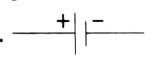
B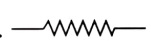
C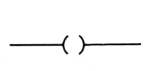
D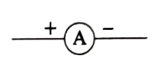
Solution
(A) In an electric circuit,the symbol for an electric cell consists of two parallel vertical lines of unequal length. The longer line represents the positive terminal $(+)$,and the shorter,thicker line represents the negative terminal $(-)$.
Option $A$ correctly represents this symbol.
Option $A$ correctly represents this symbol.
0 likes
View Solution388
EasyMCQ
Which of the following is the symbol for a resistor?
A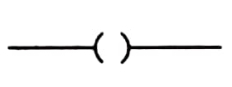
Open switch
B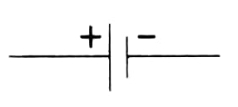
Cell
C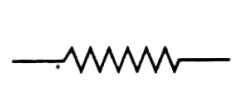
Resistor
D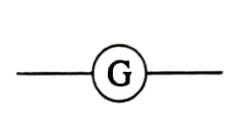
Galvanometer
Solution
(C) In electrical circuit diagrams,different components are represented by standard symbols.
- The symbol shown in option $A$ represents an open switch.
- The symbol shown in option $B$ represents a cell.
- The symbol shown in option $C$ represents a resistor,which is a component used to provide resistance in a circuit.
- The symbol shown in option $D$ represents a galvanometer,used to detect small electric currents.
Therefore,the correct symbol for a resistor is given in option $C$.
- The symbol shown in option $A$ represents an open switch.
- The symbol shown in option $B$ represents a cell.
- The symbol shown in option $C$ represents a resistor,which is a component used to provide resistance in a circuit.
- The symbol shown in option $D$ represents a galvanometer,used to detect small electric currents.
Therefore,the correct symbol for a resistor is given in option $C$.
0 likes
View Solution389
EasyMCQ
The electric current flowing through any conductor is directly proportional to the electric potential difference across the conductor. Which law is this?
A
Coulomb's law
B
Ampere's law
C
Faraday's law
D
Ohm's law
Solution
(D) Ohm's law states that the electric current $(I)$ flowing through a metallic conductor is directly proportional to the potential difference $(V)$ across its ends,provided its temperature and other physical conditions remain constant.
Mathematically,this is expressed as $V \propto I$ or $V = IR$,where $R$ is the resistance of the conductor.
Mathematically,this is expressed as $V \propto I$ or $V = IR$,where $R$ is the resistance of the conductor.
0 likes
View Solution390
EasyMCQ
Which one of the following is true according to Ohm's law?
A
Resistance increases as current increases.
B
$I-V$ graph is linear.
C
Resistance increases as voltage increases.
D
Current increases as resistance increases.
Solution
(B) Ohm's law states that the current $(I)$ flowing through a conductor is directly proportional to the potential difference $(V)$ applied across its ends,provided the temperature remains constant.
Mathematically,this is expressed as $V = IR$ or $I = V/R$.
Since $V = IR$,the relationship between $V$ and $I$ is linear,meaning the graph of $I$ versus $V$ (or $V$ versus $I$) is a straight line passing through the origin.
Resistance $(R)$ is a constant property of the conductor at a given temperature and does not change with changes in $V$ or $I$.
Mathematically,this is expressed as $V = IR$ or $I = V/R$.
Since $V = IR$,the relationship between $V$ and $I$ is linear,meaning the graph of $I$ versus $V$ (or $V$ versus $I$) is a straight line passing through the origin.
Resistance $(R)$ is a constant property of the conductor at a given temperature and does not change with changes in $V$ or $I$.
0 likes
View Solution391
EasyMCQ
Which of the following represents Ohm's law?
A
$R = \frac{V}{I}$
B
$I = \frac{R}{V}$
C
$V = IR$
D
$I = Q \cdot t$
Solution
(C) Ohm's law states that the current flowing through a conductor is directly proportional to the potential difference across its ends,provided the temperature remains constant.
Mathematically,this is expressed as $V \propto I$,which leads to $V = IR$,where $R$ is the resistance of the conductor.
From this formula,we can also derive $R = \frac{V}{I}$ and $I = \frac{V}{R}$.
Option $A$ $(R = \frac{V}{I})$ is a common representation of the definition of resistance derived from Ohm's law,but $V = IR$ is the standard form of the law.
Mathematically,this is expressed as $V \propto I$,which leads to $V = IR$,where $R$ is the resistance of the conductor.
From this formula,we can also derive $R = \frac{V}{I}$ and $I = \frac{V}{R}$.
Option $A$ $(R = \frac{V}{I})$ is a common representation of the definition of resistance derived from Ohm's law,but $V = IR$ is the standard form of the law.
0 likes
View Solution392
EasyMCQ
What is the unit of resistance?
A
coulomb
B
Joule
C
ohm
D
volt
Solution
(C) The unit of electrical resistance is the $ohm$ $(\Omega)$.
According to Ohm's Law, $V = IR$, where $V$ is the potential difference in $volts$, $I$ is the current in $amperes$, and $R$ is the resistance in $ohms$.
Therefore, $R = V/I$, which gives the unit as $volt/ampere$, defined as $ohm$.
According to Ohm's Law, $V = IR$, where $V$ is the potential difference in $volts$, $I$ is the current in $amperes$, and $R$ is the resistance in $ohms$.
Therefore, $R = V/I$, which gives the unit as $volt/ampere$, defined as $ohm$.
0 likes
View Solution393
EasyMCQ
The unit $Volt \times Ampere$ represents which physical quantity?
A
Electric Current
B
Electric Potential
C
Electric Charge
D
Electric Power
Solution
(D) The formula for electric power $(P)$ is given by the product of electric potential $(V)$ and electric current $(I)$.
$P = V \times I$
Since the unit of electric potential $(V)$ is Volt and the unit of electric current $(I)$ is Ampere,the product $Volt \times Ampere$ represents the unit of Electric Power,which is Watt.
$P = V \times I$
Since the unit of electric potential $(V)$ is Volt and the unit of electric current $(I)$ is Ampere,the product $Volt \times Ampere$ represents the unit of Electric Power,which is Watt.
0 likes
View Solution394
EasyMCQ
What is the symbol used to denote the unit of resistance,ohm?
A
$R$
B
$I$
C
$\rho$
D
$\Omega$
Solution
(D) The unit of electrical resistance is the ohm.
It is denoted by the Greek letter omega,represented by the symbol $\Omega$.
$R$ is the symbol for resistance itself.
$I$ is the symbol for electric current.
$\rho$ (rho) is the symbol for electrical resistivity.
It is denoted by the Greek letter omega,represented by the symbol $\Omega$.
$R$ is the symbol for resistance itself.
$I$ is the symbol for electric current.
$\rho$ (rho) is the symbol for electrical resistivity.
0 likes
View Solution395
EasyMCQ
What is the resistance of insulating materials?
A
Small
B
Very small
C
Zero
D
Very large
Solution
(D) Insulators are materials that do not allow the flow of electric current through them.
This is because they have a very high electrical resistance,which prevents the movement of free electrons.
Therefore,the resistance of insulating materials is very large compared to conductors.
This is because they have a very high electrical resistance,which prevents the movement of free electrons.
Therefore,the resistance of insulating materials is very large compared to conductors.
0 likes
View Solution396
EasyMCQ
Which alloy is used to make the heating element (resistance wire) in an electric iron?
A
Brass
B
Stainless steel
C
Nichrome
D
Bronze
Solution
(C) The heating elements of electrical heating appliances,such as electric irons,toasters,and heaters,are made of alloys because alloys have a much higher resistivity than their constituent metals.
Nichrome,an alloy of nickel and chromium,is commonly used for this purpose because it does not oxidize (burn) easily even at high temperatures when it is red hot.
Nichrome,an alloy of nickel and chromium,is commonly used for this purpose because it does not oxidize (burn) easily even at high temperatures when it is red hot.
0 likes
View Solution397
EasyMCQ
What are the resistors used in devices like radios and televisions made of?
A
$A$ mixture of carbon and graphite
B
Nichrome
C
An alloy of lead and tin
D
Germanium
Solution
(A) Resistors used in electronic devices like radios and televisions are typically carbon resistors.
These are made from a mixture of carbon and graphite,which acts as the resistive material,often bound with a ceramic or plastic material.
Carbon resistors are preferred in these applications due to their small size,low cost,and ability to handle high-frequency signals effectively.
These are made from a mixture of carbon and graphite,which acts as the resistive material,often bound with a ceramic or plastic material.
Carbon resistors are preferred in these applications due to their small size,low cost,and ability to handle high-frequency signals effectively.
0 likes
View Solution398
EasyMCQ
On which of the following factors does the resistance of a conductor depend?
A
Nature of the material
B
Length of the conductor
C
Area of cross-section
D
All of the above
Solution
(D) The resistance $R$ of a conductor is given by the formula $R = \rho \frac{l}{A}$,where:
$1$. $\rho$ (rho) is the resistivity,which depends on the nature of the material.
$2$. $l$ is the length of the conductor.
$3$. $A$ is the area of cross-section.
Since the resistance depends on all these three factors,the correct option is $D$.
$1$. $\rho$ (rho) is the resistivity,which depends on the nature of the material.
$2$. $l$ is the length of the conductor.
$3$. $A$ is the area of cross-section.
Since the resistance depends on all these three factors,the correct option is $D$.
0 likes
View Solution399
EasyMCQ
If the cross-sectional area of a conducting wire is doubled,what will be the effect on its resistance?
A
Doubled
B
Four times
C
Halved
D
One-fourth
Solution
(C) The resistance $R$ of a conducting wire is given by the formula $R = \rho \frac{L}{A}$,where $\rho$ is the resistivity,$L$ is the length,and $A$ is the cross-sectional area of the wire.
From this relation,it is clear that resistance is inversely proportional to the cross-sectional area $(R \propto \frac{1}{A})$.
If the area $A$ is doubled $(A' = 2A)$,the new resistance $R'$ becomes $R' = \rho \frac{L}{2A} = \frac{1}{2} R$.
Therefore,the resistance becomes half of its original value.
From this relation,it is clear that resistance is inversely proportional to the cross-sectional area $(R \propto \frac{1}{A})$.
If the area $A$ is doubled $(A' = 2A)$,the new resistance $R'$ becomes $R' = \rho \frac{L}{2A} = \frac{1}{2} R$.
Therefore,the resistance becomes half of its original value.
0 likes
View Solution400
EasyMCQ
If the diameter of a conducting wire is doubled,how many times does its resistance become?
A
Doubled
B
Four times
C
Half
D
One-fourth
Solution
(D) The resistance $R$ of a wire is given by the formula $R = \rho \frac{L}{A}$,where $\rho$ is resistivity,$L$ is length,and $A$ is the cross-sectional area.
Since the wire is cylindrical,the cross-sectional area $A = \pi r^2$,where $r$ is the radius.
Since the diameter $D = 2r$,we can write $A = \pi (D/2)^2 = \frac{\pi D^2}{4}$.
Substituting this into the resistance formula: $R = \rho \frac{L}{\pi D^2 / 4} = \frac{4 \rho L}{\pi D^2}$.
This shows that $R \propto \frac{1}{D^2}$.
If the diameter $D$ is doubled $(D' = 2D)$,the new resistance $R'$ becomes $R' = \frac{4 \rho L}{\pi (2D)^2} = \frac{4 \rho L}{4 \pi D^2} = \frac{1}{4} R$.
Therefore,the resistance becomes one-fourth of its original value.
Since the wire is cylindrical,the cross-sectional area $A = \pi r^2$,where $r$ is the radius.
Since the diameter $D = 2r$,we can write $A = \pi (D/2)^2 = \frac{\pi D^2}{4}$.
Substituting this into the resistance formula: $R = \rho \frac{L}{\pi D^2 / 4} = \frac{4 \rho L}{\pi D^2}$.
This shows that $R \propto \frac{1}{D^2}$.
If the diameter $D$ is doubled $(D' = 2D)$,the new resistance $R'$ becomes $R' = \frac{4 \rho L}{\pi (2D)^2} = \frac{4 \rho L}{4 \pi D^2} = \frac{1}{4} R$.
Therefore,the resistance becomes one-fourth of its original value.
0 likes
View SolutionElectricity — Mix Examples - Electricity · Frequently Asked Questions
1Are these Electricity questions useful for JEE and NEET?
Yes. All questions in this section are mapped to JEE Main and NEET exam patterns. Previous year questions from JEE Main, NEET, GUJCET and state-level exams are included with full solutions.
2Can I switch to Hindi or Gujarati for these questions?
Yes. Use the language tabs in the hero section or the sidebar to view the same questions and solutions in English, Hindi or Gujarati.
3How do I generate a question paper from this subtopic?
Use the Vedclass Exam Paper Generator — select the chapter and subtopic, set difficulty, and generate Sets A, B, C, D automatically. First 3 chapters of every subject are free.
Vedclass Products
For Students
Vedclass Test Series
Mock tests in real JEE/NEET style with performance analysis. 5-day free trial.
Start Free TrialFor Teachers
Exam Paper Generator
Generate Set A/B/C/D papers from this chapter in 2 minutes. 3 chapters free.
Try FreeFor Institutes
Online Exam Module
Live online exams with unlimited students, 360° analytics & white-label branding.
See DemoFor Teachers & Institutes
Generate a Electricity Exam Paper in 2 Minutes
Select subtopic & difficulty — Sets A, B, C, D auto-generated with No Repeat logic.
First 3 chapters of every subject are free — no payment required.