
અ Gujarati
Mix Examples - Introduction to Trigonometry Questions in Gujarati
Class 10 Mathematics · Introduction to Trigonometry · Mix Examples - Introduction to Trigonometry
135+
Questions
Gujarati
Language
100%
With Solutions
Showing 50 of 135 questions in Gujarati
1
EasyMCQ
જો $\cos A = \frac{4}{5}$ હોય,તો $\tan A$ ની કિંમત શોધો.
A
$\frac{3}{4}$
B
$\frac{3}{5}$
C
$\frac{4}{3}$
D
$\frac{5}{3}$
Solution
(A) આપેલ છે કે,$\cos A = \frac{4}{5}$.
આપણે જાણીએ છીએ કે $\sin^2 A + \cos^2 A = 1$,તેથી $\sin A = \sqrt{1 - \cos^2 A}$.
$\cos A$ ની કિંમત મૂકતા:
$\sin A = \sqrt{1 - (\frac{4}{5})^2} = \sqrt{1 - \frac{16}{25}} = \sqrt{\frac{25 - 16}{25}} = \sqrt{\frac{9}{25}} = \frac{3}{5}$.
હવે,$\tan A = \frac{\sin A}{\cos A}$.
$\sin A$ અને $\cos A$ ની કિંમતો મૂકતા:
$\tan A = \frac{3/5}{4/5} = \frac{3}{4}$.
આમ,$\tan A$ ની જરૂરી કિંમત $\frac{3}{4}$ છે.
આપણે જાણીએ છીએ કે $\sin^2 A + \cos^2 A = 1$,તેથી $\sin A = \sqrt{1 - \cos^2 A}$.
$\cos A$ ની કિંમત મૂકતા:
$\sin A = \sqrt{1 - (\frac{4}{5})^2} = \sqrt{1 - \frac{16}{25}} = \sqrt{\frac{25 - 16}{25}} = \sqrt{\frac{9}{25}} = \frac{3}{5}$.
હવે,$\tan A = \frac{\sin A}{\cos A}$.
$\sin A$ અને $\cos A$ ની કિંમતો મૂકતા:
$\tan A = \frac{3/5}{4/5} = \frac{3}{4}$.
આમ,$\tan A$ ની જરૂરી કિંમત $\frac{3}{4}$ છે.
0 likes
View Solution2
EasyMCQ
જો $\sin A = \frac{1}{2}$ હોય,તો $\cot A$ ની કિંમત શોધો.
A
$\frac{1}{\sqrt{3}}$
B
$\sqrt{3}$
C
$\frac{\sqrt{3}}{2}$
D
$1$
Solution
(B) આપેલ છે કે,$\sin A = \frac{1}{2}$.
નિત્યસમ $\sin^2 A + \cos^2 A = 1$ નો ઉપયોગ કરતા,આપણને $\cos A$ મળે છે:
$\cos A = \sqrt{1 - \sin^2 A} = \sqrt{1 - (\frac{1}{2})^2} = \sqrt{1 - \frac{1}{4}} = \sqrt{\frac{3}{4}} = \frac{\sqrt{3}}{2}$.
હવે,$\cot A$ ની કિંમત નીચે મુજબ મળે છે:
$\cot A = \frac{\cos A}{\sin A} = \frac{\frac{\sqrt{3}}{2}}{\frac{1}{2}} = \sqrt{3}$.
નિત્યસમ $\sin^2 A + \cos^2 A = 1$ નો ઉપયોગ કરતા,આપણને $\cos A$ મળે છે:
$\cos A = \sqrt{1 - \sin^2 A} = \sqrt{1 - (\frac{1}{2})^2} = \sqrt{1 - \frac{1}{4}} = \sqrt{\frac{3}{4}} = \frac{\sqrt{3}}{2}$.
હવે,$\cot A$ ની કિંમત નીચે મુજબ મળે છે:
$\cot A = \frac{\cos A}{\sin A} = \frac{\frac{\sqrt{3}}{2}}{\frac{1}{2}} = \sqrt{3}$.
0 likes
View Solution3
MediumMCQ
પદાવલિ $\left[\operatorname{cosec}(75^{\circ}+\theta)-\sec(15^{\circ}-\theta)-\tan(55^{\circ}+\theta)+\cot(35^{\circ}-\theta)\right]$ ની કિંમત શોધો.
A
$-1$
B
$1$
C
$0$
D
$\frac{3}{2}$
Solution
(C) આપેલ પદાવલિ: $E = \operatorname{cosec}(75^{\circ}+\theta) - \sec(15^{\circ}-\theta) - \tan(55^{\circ}+\theta) + \cot(35^{\circ}-\theta)$
કોટીકોણના નિત્યસમ $\operatorname{cosec}(90^{\circ}-A) = \sec A$ અને $\cot(90^{\circ}-A) = \tan A$ નો ઉપયોગ કરતા:
$1$. $\operatorname{cosec}(75^{\circ}+\theta) = \operatorname{cosec}(90^{\circ}-(15^{\circ}-\theta)) = \sec(15^{\circ}-\theta)$
$2$. $\cot(35^{\circ}-\theta) = \cot(90^{\circ}-(55^{\circ}+\theta)) = \tan(55^{\circ}+\theta)$
આ કિંમતો પદાવલિમાં મૂકતા:
$E = \sec(15^{\circ}-\theta) - \sec(15^{\circ}-\theta) - \tan(55^{\circ}+\theta) + \tan(55^{\circ}+\theta)$
$E = 0$
આમ,આપેલ પદાવલિની કિંમત $0$ છે.
કોટીકોણના નિત્યસમ $\operatorname{cosec}(90^{\circ}-A) = \sec A$ અને $\cot(90^{\circ}-A) = \tan A$ નો ઉપયોગ કરતા:
$1$. $\operatorname{cosec}(75^{\circ}+\theta) = \operatorname{cosec}(90^{\circ}-(15^{\circ}-\theta)) = \sec(15^{\circ}-\theta)$
$2$. $\cot(35^{\circ}-\theta) = \cot(90^{\circ}-(55^{\circ}+\theta)) = \tan(55^{\circ}+\theta)$
આ કિંમતો પદાવલિમાં મૂકતા:
$E = \sec(15^{\circ}-\theta) - \sec(15^{\circ}-\theta) - \tan(55^{\circ}+\theta) + \tan(55^{\circ}+\theta)$
$E = 0$
આમ,આપેલ પદાવલિની કિંમત $0$ છે.
0 likes
View Solution4
EasyMCQ
આપેલ છે કે $\sin \theta = \frac{a}{b},$ તો $\cos \theta$ ની કિંમત શું થાય?
A
$\frac{b}{\sqrt{b^{2}-a^{2}}}$
B
$\frac{b}{a}$
C
$\frac{a}{\sqrt{b^{2}-a^{2}}}$
D
$\frac{\sqrt{b^{2}-a^{2}}}{b}$
Solution
(D) આપેલ છે,$\sin \theta = \frac{a}{b}$.
ત્રિકોણમિતીય નિત્યસમ $\sin^{2} \theta + \cos^{2} \theta = 1$ નો ઉપયોગ કરતા,આપણે લખી શકીએ કે $\cos \theta = \sqrt{1 - \sin^{2} \theta}$.
$\sin \theta$ ની કિંમત મૂકતા:
$\cos \theta = \sqrt{1 - \left(\frac{a}{b}\right)^{2}}$
$\cos \theta = \sqrt{1 - \frac{a^{2}}{b^{2}}}$
$\cos \theta = \sqrt{\frac{b^{2} - a^{2}}{b^{2}}}$
$\cos \theta = \frac{\sqrt{b^{2} - a^{2}}}{b}$.
ત્રિકોણમિતીય નિત્યસમ $\sin^{2} \theta + \cos^{2} \theta = 1$ નો ઉપયોગ કરતા,આપણે લખી શકીએ કે $\cos \theta = \sqrt{1 - \sin^{2} \theta}$.
$\sin \theta$ ની કિંમત મૂકતા:
$\cos \theta = \sqrt{1 - \left(\frac{a}{b}\right)^{2}}$
$\cos \theta = \sqrt{1 - \frac{a^{2}}{b^{2}}}$
$\cos \theta = \sqrt{\frac{b^{2} - a^{2}}{b^{2}}}$
$\cos \theta = \frac{\sqrt{b^{2} - a^{2}}}{b}$.
0 likes
View Solution5
MediumMCQ
જો $\cos (\alpha+\beta)=0$ હોય,તો $\sin (\alpha-\beta)$ ને શેમાં ઘટાડી શકાય?
A
$\cos 2 \beta$
B
$\cos \beta$
C
$\sin \alpha$
D
$\sin 2 \alpha$
Solution
(A) આપેલ છે કે,$\cos (\alpha+\beta)=0=\cos 90^{\circ}$ $\left[\because \cos 90^{\circ}=0\right]$
$\Rightarrow \alpha+\beta=90^{\circ}$
$\Rightarrow \alpha=90^{\circ}-\beta$ ......$(i)$
હવે,$\sin (\alpha-\beta)=\sin (90^{\circ}-\beta-\beta)$ [સમીકરણ $(i)$ માંથી કિંમત મૂકતા]
$= \sin (90^{\circ}-2 \beta)$
$= \cos 2 \beta$ $\left[\because \sin (90^{\circ}-\theta)=\cos \theta\right]$
આમ,$\sin (\alpha-\beta)$ ને $\cos 2 \beta$ માં ઘટાડી શકાય છે.
$\Rightarrow \alpha+\beta=90^{\circ}$
$\Rightarrow \alpha=90^{\circ}-\beta$ ......$(i)$
હવે,$\sin (\alpha-\beta)=\sin (90^{\circ}-\beta-\beta)$ [સમીકરણ $(i)$ માંથી કિંમત મૂકતા]
$= \sin (90^{\circ}-2 \beta)$
$= \cos 2 \beta$ $\left[\because \sin (90^{\circ}-\theta)=\cos \theta\right]$
આમ,$\sin (\alpha-\beta)$ ને $\cos 2 \beta$ માં ઘટાડી શકાય છે.
0 likes
View Solution6
MediumMCQ
$(\tan 1^{\circ} \tan 2^{\circ} \tan 3^{\circ} \ldots \tan 89^{\circ})$ નું મૂલ્ય કેટલું છે?
A
$0$
B
$1$
C
$2$
D
$\frac{1}{2}$
Solution
(B) આપણી પાસે પદાવલિ છે: $P = \tan 1^{\circ} \cdot \tan 2^{\circ} \cdot \tan 3^{\circ} \ldots \tan 89^{\circ}$.
ગુણધર્મ $\tan(90^{\circ} - \theta) = \cot \theta$ નો ઉપયોગ કરીને,આપણે લખી શકીએ કે $\tan 89^{\circ} = \cot 1^{\circ}$,$\tan 88^{\circ} = \cot 2^{\circ}$,વગેરે.
કારણ કે $\cot \theta = \frac{1}{\tan \theta}$,તેથી $\tan 89^{\circ} = \frac{1}{\tan 1^{\circ}}$,$\tan 88^{\circ} = \frac{1}{\tan 2^{\circ}}$,વગેરે.
આ કિંમતોને પદાવલિમાં મૂકતા:
$P = (\tan 1^{\circ} \cdot \cot 1^{\circ}) \cdot (\tan 2^{\circ} \cdot \cot 2^{\circ}) \ldots (\tan 44^{\circ} \cdot \cot 44^{\circ}) \cdot \tan 45^{\circ}$.
કારણ કે $\tan \theta \cdot \cot \theta = 1$ અને $\tan 45^{\circ} = 1$,તેથી પદાવલિનું મૂલ્ય:
$P = 1 \cdot 1 \cdot 1 \ldots \cdot 1 = 1$.
ગુણધર્મ $\tan(90^{\circ} - \theta) = \cot \theta$ નો ઉપયોગ કરીને,આપણે લખી શકીએ કે $\tan 89^{\circ} = \cot 1^{\circ}$,$\tan 88^{\circ} = \cot 2^{\circ}$,વગેરે.
કારણ કે $\cot \theta = \frac{1}{\tan \theta}$,તેથી $\tan 89^{\circ} = \frac{1}{\tan 1^{\circ}}$,$\tan 88^{\circ} = \frac{1}{\tan 2^{\circ}}$,વગેરે.
આ કિંમતોને પદાવલિમાં મૂકતા:
$P = (\tan 1^{\circ} \cdot \cot 1^{\circ}) \cdot (\tan 2^{\circ} \cdot \cot 2^{\circ}) \ldots (\tan 44^{\circ} \cdot \cot 44^{\circ}) \cdot \tan 45^{\circ}$.
કારણ કે $\tan \theta \cdot \cot \theta = 1$ અને $\tan 45^{\circ} = 1$,તેથી પદાવલિનું મૂલ્ય:
$P = 1 \cdot 1 \cdot 1 \ldots \cdot 1 = 1$.
0 likes
View Solution7
MediumMCQ
જો $\cos 9 \alpha = \sin \alpha$ અને $9 \alpha < 90^{\circ}$ હોય,તો $\tan 5 \alpha$ ની કિંમત શોધો.
A
$\frac{1}{\sqrt{3}}$
B
$\sqrt{3}$
C
$1$
D
$0$
Solution
(C) આપેલ છે કે,$\cos 9 \alpha = \sin \alpha$ અને $9 \alpha < 90^{\circ},$ જેનો અર્થ છે કે $9 \alpha$ એ લઘુકોણ છે.
ત્રિકોણમિતીય નિત્યસમ $\cos A = \sin(90^{\circ} - A)$ નો ઉપયોગ કરતા,આપણે સમીકરણને આ રીતે લખી શકીએ:
$\sin(90^{\circ} - 9 \alpha) = \sin \alpha$
જેથી,
$90^{\circ} - 9 \alpha = \alpha$
$\alpha$ માટે ઉકેલતા:
$10 \alpha = 90^{\circ}$
$\alpha = 9^{\circ}$
હવે,$\tan 5 \alpha$ ની કિંમત શોધીએ:
$\tan 5 \alpha = \tan(5 \times 9^{\circ}) = \tan 45^{\circ}$
આપણે જાણીએ છીએ કે $\tan 45^{\circ} = 1,$ તેથી જવાબ $1$ છે.
ત્રિકોણમિતીય નિત્યસમ $\cos A = \sin(90^{\circ} - A)$ નો ઉપયોગ કરતા,આપણે સમીકરણને આ રીતે લખી શકીએ:
$\sin(90^{\circ} - 9 \alpha) = \sin \alpha$
જેથી,
$90^{\circ} - 9 \alpha = \alpha$
$\alpha$ માટે ઉકેલતા:
$10 \alpha = 90^{\circ}$
$\alpha = 9^{\circ}$
હવે,$\tan 5 \alpha$ ની કિંમત શોધીએ:
$\tan 5 \alpha = \tan(5 \times 9^{\circ}) = \tan 45^{\circ}$
આપણે જાણીએ છીએ કે $\tan 45^{\circ} = 1,$ તેથી જવાબ $1$ છે.
0 likes
View Solution8
EasyMCQ
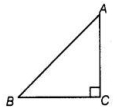
જો $\triangle ABC$ માં $C$ આગળ કાટખૂણો હોય,તો $\cos(A + B)$ ની કિંમત શોધો.
A
$1$
B
$\frac{1}{2}$
C
$\frac{\sqrt{3}}{2}$
D
$0$
Solution
(D) આપણે જાણીએ છીએ કે $\triangle ABC$ માં ત્રણેય ખૂણાઓનો સરવાળો $180^{\circ}$ થાય છે.
એટલે કે,$\angle A + \angle B + \angle C = 180^{\circ}$.
અહીં $C$ આગળ કાટખૂણો હોવાથી,$\angle C = 90^{\circ}$ (આપેલ છે).
આ કિંમત મૂકતા,$\angle A + \angle B + 90^{\circ} = 180^{\circ}$.
તેથી,$A + B = 180^{\circ} - 90^{\circ} = 90^{\circ}$.
હવે,આપણે $\cos(A + B)$ ની કિંમત શોધવાની છે.
$A + B = 90^{\circ}$ મૂકતા,આપણને $\cos(90^{\circ}) = 0$ મળે છે.
એટલે કે,$\angle A + \angle B + \angle C = 180^{\circ}$.
અહીં $C$ આગળ કાટખૂણો હોવાથી,$\angle C = 90^{\circ}$ (આપેલ છે).
આ કિંમત મૂકતા,$\angle A + \angle B + 90^{\circ} = 180^{\circ}$.
તેથી,$A + B = 180^{\circ} - 90^{\circ} = 90^{\circ}$.
હવે,આપણે $\cos(A + B)$ ની કિંમત શોધવાની છે.
$A + B = 90^{\circ}$ મૂકતા,આપણને $\cos(90^{\circ}) = 0$ મળે છે.
0 likes
View Solution9
DifficultMCQ
જો $\sin A + \sin^2 A = 1$ હોય,તો $(\cos^2 A + \cos^4 A)$ પદાવલિનું મૂલ્ય કેટલું થાય?
A
$1$
B
$\frac{1}{2}$
C
$2$
D
$3$
Solution
(A) આપેલ છે કે,$\sin A + \sin^2 A = 1$.
આના પરથી,આપણે લખી શકીએ કે $\sin A = 1 - \sin^2 A$.
નિત્યસમ $\sin^2 A + \cos^2 A = 1$ નો ઉપયોગ કરતા,આપણે જાણીએ છીએ કે $1 - \sin^2 A = \cos^2 A$.
તેથી,$\sin A = \cos^2 A$.
બંને બાજુ વર્ગ કરતા,આપણને મળે છે $\sin^2 A = (\cos^2 A)^2 = \cos^4 A$.
હવે,સમીકરણમાં $\sin^2 A = 1 - \cos^2 A$ મૂકતા:
$1 - \cos^2 A = \cos^4 A$.
પદોને ગોઠવતા,આપણને મળે છે $\cos^2 A + \cos^4 A = 1$.
આના પરથી,આપણે લખી શકીએ કે $\sin A = 1 - \sin^2 A$.
નિત્યસમ $\sin^2 A + \cos^2 A = 1$ નો ઉપયોગ કરતા,આપણે જાણીએ છીએ કે $1 - \sin^2 A = \cos^2 A$.
તેથી,$\sin A = \cos^2 A$.
બંને બાજુ વર્ગ કરતા,આપણને મળે છે $\sin^2 A = (\cos^2 A)^2 = \cos^4 A$.
હવે,સમીકરણમાં $\sin^2 A = 1 - \cos^2 A$ મૂકતા:
$1 - \cos^2 A = \cos^4 A$.
પદોને ગોઠવતા,આપણને મળે છે $\cos^2 A + \cos^4 A = 1$.
0 likes
View Solution10
EasyMCQ
જો $\sin \alpha = \frac{1}{2}$ અને $\cos \beta = \frac{1}{2}$ હોય,તો $(\alpha + \beta)$ નું મૂલ્ય શું થાય ($^{\circ}$ માં)?
A
$0$
B
$90$
C
$30$
D
$60$
Solution
(B) આપેલ છે,$\sin \alpha = \frac{1}{2} = \sin 30^{\circ}$ $\left[\because \sin 30^{\circ} = \frac{1}{2}\right]$
$\Rightarrow \alpha = 30^{\circ}$
અને,$\cos \beta = \frac{1}{2} = \cos 60^{\circ}$ $\left[\because \cos 60^{\circ} = \frac{1}{2}\right]$
$\Rightarrow \beta = 60^{\circ}$
તેથી,$\alpha + \beta = 30^{\circ} + 60^{\circ} = 90^{\circ}$
$\Rightarrow \alpha = 30^{\circ}$
અને,$\cos \beta = \frac{1}{2} = \cos 60^{\circ}$ $\left[\because \cos 60^{\circ} = \frac{1}{2}\right]$
$\Rightarrow \beta = 60^{\circ}$
તેથી,$\alpha + \beta = 30^{\circ} + 60^{\circ} = 90^{\circ}$
0 likes
View Solution11
DifficultMCQ
પદાવલિ $\left[\frac{\sin ^{2} 22^{\circ}+\sin ^{2} 68^{\circ}}{\cos ^{2} 22^{\circ}+\cos ^{2} 68^{\circ}}+\sin ^{2} 63^{\circ}+\cos 63^{\circ} \sin 27^{\circ}\right]$ ની કિંમત શોધો.
A
$3$
B
$1$
C
$2$
D
$0$
Solution
(C) આપેલ પદાવલિ: $\frac{\sin ^{2} 22^{\circ}+\sin ^{2} 68^{\circ}}{\cos ^{2} 22^{\circ}+\cos ^{2} 68^{\circ}}+\sin ^{2} 63^{\circ}+\cos 63^{\circ} \sin 27^{\circ}$
નિત્યસમ $\sin(90^{\circ}-\theta) = \cos \theta$ અને $\cos(90^{\circ}-\theta) = \sin \theta$ નો ઉપયોગ કરતા:
પગલું $1$: અપૂર્ણાંકનું સાદું રૂપ આપો.
$\sin 68^{\circ} = \sin(90^{\circ}-22^{\circ}) = \cos 22^{\circ}$
$\cos 22^{\circ} = \cos(90^{\circ}-68^{\circ}) = \sin 68^{\circ}$
તેથી,અપૂર્ણાંક $\frac{\sin ^{2} 22^{\circ}+\cos ^{2} 22^{\circ}}{\sin ^{2} 68^{\circ}+\cos ^{2} 68^{\circ}} = \frac{1}{1} = 1$ થશે.
પગલું $2$: બાકીના પદોનું સાદું રૂપ આપો.
$\sin 27^{\circ} = \sin(90^{\circ}-63^{\circ}) = \cos 63^{\circ}$
તેથી,$\sin ^{2} 63^{\circ}+\cos 63^{\circ} \sin 27^{\circ} = \sin ^{2} 63^{\circ}+\cos 63^{\circ} \cdot \cos 63^{\circ} = \sin ^{2} 63^{\circ}+\cos ^{2} 63^{\circ} = 1$ થશે.
પગલું $3$: પરિણામોનો સરવાળો કરો.
$1 + 1 = 2$.
નિત્યસમ $\sin(90^{\circ}-\theta) = \cos \theta$ અને $\cos(90^{\circ}-\theta) = \sin \theta$ નો ઉપયોગ કરતા:
પગલું $1$: અપૂર્ણાંકનું સાદું રૂપ આપો.
$\sin 68^{\circ} = \sin(90^{\circ}-22^{\circ}) = \cos 22^{\circ}$
$\cos 22^{\circ} = \cos(90^{\circ}-68^{\circ}) = \sin 68^{\circ}$
તેથી,અપૂર્ણાંક $\frac{\sin ^{2} 22^{\circ}+\cos ^{2} 22^{\circ}}{\sin ^{2} 68^{\circ}+\cos ^{2} 68^{\circ}} = \frac{1}{1} = 1$ થશે.
પગલું $2$: બાકીના પદોનું સાદું રૂપ આપો.
$\sin 27^{\circ} = \sin(90^{\circ}-63^{\circ}) = \cos 63^{\circ}$
તેથી,$\sin ^{2} 63^{\circ}+\cos 63^{\circ} \sin 27^{\circ} = \sin ^{2} 63^{\circ}+\cos 63^{\circ} \cdot \cos 63^{\circ} = \sin ^{2} 63^{\circ}+\cos ^{2} 63^{\circ} = 1$ થશે.
પગલું $3$: પરિણામોનો સરવાળો કરો.
$1 + 1 = 2$.
0 likes
View Solution12
MediumMCQ
જો $4 \tan \theta = 3$ હોય,તો $\left(\frac{4 \sin \theta - \cos \theta}{4 \sin \theta + \cos \theta}\right)$ ની કિંમત શોધો.
A
$\frac{2}{3}$
B
$\frac{1}{3}$
C
$\frac{3}{4}$
D
$\frac{1}{2}$
Solution
(D) આપેલ છે,$4 \tan \theta = 3$
$\Rightarrow \tan \theta = \frac{3}{4}$ ..........$(i)$
પદાવલિ $\frac{4 \sin \theta - \cos \theta}{4 \sin \theta + \cos \theta}$ ની કિંમત શોધવા માટે,અંશ અને છેદ બંનેને $\cos \theta$ વડે ભાગતા:
$= \frac{\frac{4 \sin \theta}{\cos \theta} - \frac{\cos \theta}{\cos \theta}}{\frac{4 \sin \theta}{\cos \theta} + \frac{\cos \theta}{\cos \theta}}$
$= \frac{4 \tan \theta - 1}{4 \tan \theta + 1}$
હવે,સમીકરણ $(i)$ માંથી $\tan \theta = \frac{3}{4}$ ની કિંમત મૂકતા:
$= \frac{4(\frac{3}{4}) - 1}{4(\frac{3}{4}) + 1}$
$= \frac{3 - 1}{3 + 1} = \frac{2}{4} = \frac{1}{2}$.
$\Rightarrow \tan \theta = \frac{3}{4}$ ..........$(i)$
પદાવલિ $\frac{4 \sin \theta - \cos \theta}{4 \sin \theta + \cos \theta}$ ની કિંમત શોધવા માટે,અંશ અને છેદ બંનેને $\cos \theta$ વડે ભાગતા:
$= \frac{\frac{4 \sin \theta}{\cos \theta} - \frac{\cos \theta}{\cos \theta}}{\frac{4 \sin \theta}{\cos \theta} + \frac{\cos \theta}{\cos \theta}}$
$= \frac{4 \tan \theta - 1}{4 \tan \theta + 1}$
હવે,સમીકરણ $(i)$ માંથી $\tan \theta = \frac{3}{4}$ ની કિંમત મૂકતા:
$= \frac{4(\frac{3}{4}) - 1}{4(\frac{3}{4}) + 1}$
$= \frac{3 - 1}{3 + 1} = \frac{2}{4} = \frac{1}{2}$.
0 likes
View Solution13
MediumMCQ
જો $\sin \theta - \cos \theta = 0$ હોય,તો $(\sin^4 \theta + \cos^4 \theta)$ નું મૂલ્ય શોધો.
A
$\frac{1}{2}$
B
$\frac{3}{4}$
C
$1$
D
$\frac{1}{4}$
Solution
(A) આપેલ છે,$\sin \theta - \cos \theta = 0$.
$\sin \theta = \cos \theta \Rightarrow \frac{\sin \theta}{\cos \theta} = 1$.
$\tan \theta = 1$ $[\because \tan \theta = \frac{\sin \theta}{\cos \theta}$ અને $\tan 45^{\circ} = 1]$.
$\tan \theta = \tan 45^{\circ}$.
$\theta = 45^{\circ}$.
હવે,$\sin^4 \theta + \cos^4 \theta = \sin^4 45^{\circ} + \cos^4 45^{\circ}$.
$= (\frac{1}{\sqrt{2}})^4 + (\frac{1}{\sqrt{2}})^4$ $[\because \sin 45^{\circ} = \cos 45^{\circ} = \frac{1}{\sqrt{2}}]$.
$= \frac{1}{4} + \frac{1}{4} = \frac{2}{4} = \frac{1}{2}$.
$\sin \theta = \cos \theta \Rightarrow \frac{\sin \theta}{\cos \theta} = 1$.
$\tan \theta = 1$ $[\because \tan \theta = \frac{\sin \theta}{\cos \theta}$ અને $\tan 45^{\circ} = 1]$.
$\tan \theta = \tan 45^{\circ}$.
$\theta = 45^{\circ}$.
હવે,$\sin^4 \theta + \cos^4 \theta = \sin^4 45^{\circ} + \cos^4 45^{\circ}$.
$= (\frac{1}{\sqrt{2}})^4 + (\frac{1}{\sqrt{2}})^4$ $[\because \sin 45^{\circ} = \cos 45^{\circ} = \frac{1}{\sqrt{2}}]$.
$= \frac{1}{4} + \frac{1}{4} = \frac{2}{4} = \frac{1}{2}$.
0 likes
View Solution14
EasyMCQ
$\sin (45^{\circ}+\theta)-\cos (45^{\circ}-\theta)$ ની કિંમત કેટલી થાય?
A
$2 \cos \theta$
B
$0$
C
$2 \sin \theta$
D
$1$
Solution
(B) આપણે જાણીએ છીએ કે $\sin (90^{\circ}-\theta) = \cos \theta$ અને $\cos (90^{\circ}-\theta) = \sin \theta$.
આપેલ પદાવલિ: $\sin (45^{\circ}+\theta)-\cos (45^{\circ}-\theta)$
નિત્યસમ $\sin A = \cos (90^{\circ}-A)$ નો ઉપયોગ કરતા:
$\sin (45^{\circ}+\theta) = \cos (90^{\circ}-(45^{\circ}+\theta))$
$= \cos (90^{\circ}-45^{\circ}-\theta)$
$= \cos (45^{\circ}-\theta)$
આ કિંમતને મૂળ પદાવલિમાં મૂકતા:
$\cos (45^{\circ}-\theta)-\cos (45^{\circ}-\theta) = 0$
આપેલ પદાવલિ: $\sin (45^{\circ}+\theta)-\cos (45^{\circ}-\theta)$
નિત્યસમ $\sin A = \cos (90^{\circ}-A)$ નો ઉપયોગ કરતા:
$\sin (45^{\circ}+\theta) = \cos (90^{\circ}-(45^{\circ}+\theta))$
$= \cos (90^{\circ}-45^{\circ}-\theta)$
$= \cos (45^{\circ}-\theta)$
આ કિંમતને મૂળ પદાવલિમાં મૂકતા:
$\cos (45^{\circ}-\theta)-\cos (45^{\circ}-\theta) = 0$
0 likes
View Solution15
Easy
'True' (સાચું) અથવા 'False' (ખોટું) લખો અને તમારા જવાબનું સમર્થન કરો.
$\sin \theta + \cos \theta$ નું મૂલ્ય હંમેશા $1$ કરતા વધારે હોય છે.
$\sin \theta + \cos \theta$ નું મૂલ્ય હંમેશા $1$ કરતા વધારે હોય છે.
Solution
(B) ખોટું.
પદાવલિ $\sin \theta + \cos \theta$ ને $\sqrt{2} (\frac{1}{\sqrt{2}} \sin \theta + \frac{1}{\sqrt{2}} \cos \theta) = \sqrt{2} \sin(\theta + 45^{\circ})$ તરીકે લખી શકાય છે.
$\theta = 0^{\circ}$ માટે,તેનું મૂલ્ય $\sin 0^{\circ} + \cos 0^{\circ} = 0 + 1 = 1$ થાય છે.
કારણ કે આ મૂલ્ય $1$ ની બરાબર હોઈ શકે છે (દા.ત.,$\theta = 0^{\circ}$ અથવા $\theta = 90^{\circ}$ પર),તેથી 'હંમેશા $1$ કરતા વધારે હોય છે' તેવું વિધાન ખોટું છે.
પદાવલિ $\sin \theta + \cos \theta$ ને $\sqrt{2} (\frac{1}{\sqrt{2}} \sin \theta + \frac{1}{\sqrt{2}} \cos \theta) = \sqrt{2} \sin(\theta + 45^{\circ})$ તરીકે લખી શકાય છે.
$\theta = 0^{\circ}$ માટે,તેનું મૂલ્ય $\sin 0^{\circ} + \cos 0^{\circ} = 0 + 1 = 1$ થાય છે.
કારણ કે આ મૂલ્ય $1$ ની બરાબર હોઈ શકે છે (દા.ત.,$\theta = 0^{\circ}$ અથવા $\theta = 90^{\circ}$ પર),તેથી 'હંમેશા $1$ કરતા વધારે હોય છે' તેવું વિધાન ખોટું છે.
0 likes
View Solution16
Easy
'True' (સાચું) અથવા 'False' (ખોટું) લખો અને તમારા જવાબનું સમર્થન કરો.
$\frac{\tan 47^{\circ}}{\cot 43^{\circ}}=1$
$\frac{\tan 47^{\circ}}{\cot 43^{\circ}}=1$
Solution
(TRUE) સાચું (True)
આપણે જાણીએ છીએ કે $\tan(90^{\circ} - \theta) = \cot \theta$.
તેથી,$\tan 47^{\circ} = \tan(90^{\circ} - 43^{\circ}) = \cot 43^{\circ}$.
આ કિંમત પદાવલિમાં મૂકતા:
$\frac{\tan 47^{\circ}}{\cot 43^{\circ}} = \frac{\cot 43^{\circ}}{\cot 43^{\circ}} = 1$.
આમ,આપેલ વિધાન સાચું છે.
આપણે જાણીએ છીએ કે $\tan(90^{\circ} - \theta) = \cot \theta$.
તેથી,$\tan 47^{\circ} = \tan(90^{\circ} - 43^{\circ}) = \cot 43^{\circ}$.
આ કિંમત પદાવલિમાં મૂકતા:
$\frac{\tan 47^{\circ}}{\cot 43^{\circ}} = \frac{\cot 43^{\circ}}{\cot 43^{\circ}} = 1$.
આમ,આપેલ વિધાન સાચું છે.
0 likes
View Solution17
MediumMCQ
'True' (સાચું) અથવા 'False' (ખોટું) લખો અને તમારા જવાબનું સમર્થન કરો.
પદાવલિ $(\cos^{2} 23^{\circ} - \sin^{2} 67^{\circ})$ નું મૂલ્ય ધન છે.
પદાવલિ $(\cos^{2} 23^{\circ} - \sin^{2} 67^{\circ})$ નું મૂલ્ય ધન છે.
A
True
B
False
Solution
(B) False (ખોટું)
આપણે જાણીએ છીએ કે $\sin(90^{\circ} - \theta) = \cos \theta$.
તેથી,$\sin 67^{\circ} = \sin(90^{\circ} - 23^{\circ}) = \cos 23^{\circ}$.
આ કિંમત પદાવલિમાં મૂકતા:
$\cos^{2} 23^{\circ} - \sin^{2} 67^{\circ} = \cos^{2} 23^{\circ} - (\cos 23^{\circ})^{2}$
$= \cos^{2} 23^{\circ} - \cos^{2} 23^{\circ}$
$= 0$.
$0$ એ ધન કે ઋણ નથી,તેથી વિધાન કે તેનું મૂલ્ય ધન છે તે ખોટું છે.
આપણે જાણીએ છીએ કે $\sin(90^{\circ} - \theta) = \cos \theta$.
તેથી,$\sin 67^{\circ} = \sin(90^{\circ} - 23^{\circ}) = \cos 23^{\circ}$.
આ કિંમત પદાવલિમાં મૂકતા:
$\cos^{2} 23^{\circ} - \sin^{2} 67^{\circ} = \cos^{2} 23^{\circ} - (\cos 23^{\circ})^{2}$
$= \cos^{2} 23^{\circ} - \cos^{2} 23^{\circ}$
$= 0$.
$0$ એ ધન કે ઋણ નથી,તેથી વિધાન કે તેનું મૂલ્ય ધન છે તે ખોટું છે.
0 likes
View Solution18
EasyMCQ
'True' (સાચું) અથવા 'False' (ખોટું) લખો અને તમારા જવાબનું સમર્થન કરો.
પદાવલિ $(\sin 80^{\circ} - \cos 80^{\circ})$ નું મૂલ્ય ઋણ છે.
પદાવલિ $(\sin 80^{\circ} - \cos 80^{\circ})$ નું મૂલ્ય ઋણ છે.
A
True
B
False
Solution
(B) આ વિધાન ખોટું (False) છે.
આપણે જાણીએ છીએ કે $0^{\circ} < \theta < 90^{\circ}$ અંતરાલમાં,$\sin \theta$ એ વધતું વિધેય છે,જ્યારે $\cos \theta$ એ ઘટતું વિધેય છે.
$\theta = 45^{\circ}$ માટે,$\sin 45^{\circ} = \cos 45^{\circ} = \frac{1}{\sqrt{2}}$ થાય છે.
કોઈપણ ખૂણા $\theta$ માટે જ્યાં $45^{\circ} < \theta < 90^{\circ}$ હોય,ત્યાં $\sin \theta > \cos \theta$ થાય છે.
અહીં $80^{\circ}$ એ $(45^{\circ}, 90^{\circ})$ અંતરાલમાં આવેલું હોવાથી,$\sin 80^{\circ} > \cos 80^{\circ}$ થાય.
તેથી,$(\sin 80^{\circ} - \cos 80^{\circ}) > 0$ થાય,જેનો અર્થ છે કે આ મૂલ્ય ધન છે,ઋણ નથી.
આપણે જાણીએ છીએ કે $0^{\circ} < \theta < 90^{\circ}$ અંતરાલમાં,$\sin \theta$ એ વધતું વિધેય છે,જ્યારે $\cos \theta$ એ ઘટતું વિધેય છે.
$\theta = 45^{\circ}$ માટે,$\sin 45^{\circ} = \cos 45^{\circ} = \frac{1}{\sqrt{2}}$ થાય છે.
કોઈપણ ખૂણા $\theta$ માટે જ્યાં $45^{\circ} < \theta < 90^{\circ}$ હોય,ત્યાં $\sin \theta > \cos \theta$ થાય છે.
અહીં $80^{\circ}$ એ $(45^{\circ}, 90^{\circ})$ અંતરાલમાં આવેલું હોવાથી,$\sin 80^{\circ} > \cos 80^{\circ}$ થાય.
તેથી,$(\sin 80^{\circ} - \cos 80^{\circ}) > 0$ થાય,જેનો અર્થ છે કે આ મૂલ્ય ધન છે,ઋણ નથી.
0 likes
View Solution19
Easy
'True' (સાચું) અથવા 'False' (ખોટું) લખો અને તમારા જવાબનું સમર્થન કરો.
$\sqrt{(1-\cos^2 \theta) \sec^2 \theta} = \tan \theta$
$\sqrt{(1-\cos^2 \theta) \sec^2 \theta} = \tan \theta$
Solution
(A) સાચું.
આપેલ પદાવલિ: $\sqrt{(1-\cos^2 \theta) \sec^2 \theta}$
નિત્યસમ $\sin^2 \theta + \cos^2 \theta = 1$ નો ઉપયોગ કરતા,આપણને મળે છે $1 - \cos^2 \theta = \sin^2 \theta$.
આ કિંમત પદાવલિમાં મૂકતા: $\sqrt{\sin^2 \theta \cdot \sec^2 \theta}$
કારણ કે $\sec \theta = \frac{1}{\cos \theta}$,આપણે લખી શકીએ: $\sqrt{\sin^2 \theta \cdot \frac{1}{\cos^2 \theta}} = \sqrt{\frac{\sin^2 \theta}{\cos^2 \theta}}$
નિત્યસમ $\tan \theta = \frac{\sin \theta}{\cos \theta}$ નો ઉપયોગ કરતા,આપણને મળે છે: $\sqrt{\tan^2 \theta} = \tan \theta$.
આમ,આપેલ વિધાન સાચું છે.
આપેલ પદાવલિ: $\sqrt{(1-\cos^2 \theta) \sec^2 \theta}$
નિત્યસમ $\sin^2 \theta + \cos^2 \theta = 1$ નો ઉપયોગ કરતા,આપણને મળે છે $1 - \cos^2 \theta = \sin^2 \theta$.
આ કિંમત પદાવલિમાં મૂકતા: $\sqrt{\sin^2 \theta \cdot \sec^2 \theta}$
કારણ કે $\sec \theta = \frac{1}{\cos \theta}$,આપણે લખી શકીએ: $\sqrt{\sin^2 \theta \cdot \frac{1}{\cos^2 \theta}} = \sqrt{\frac{\sin^2 \theta}{\cos^2 \theta}}$
નિત્યસમ $\tan \theta = \frac{\sin \theta}{\cos \theta}$ નો ઉપયોગ કરતા,આપણને મળે છે: $\sqrt{\tan^2 \theta} = \tan \theta$.
આમ,આપેલ વિધાન સાચું છે.
0 likes
View Solution20
Medium
નીચેના વિધાન 'સાચું' છે કે 'ખોટું' તે જણાવો અને તમારા જવાબનું સમર્થન કરો:
જો $\cos A + \cos^2 A = 1$ હોય,તો $\sin^2 A + \sin^4 A = 1$ થાય.
જો $\cos A + \cos^2 A = 1$ હોય,તો $\sin^2 A + \sin^4 A = 1$ થાય.
Solution
(A) સાચું.
આપેલ છે કે $\cos A + \cos^2 A = 1$.
પદોને ફરીથી ગોઠવતા,આપણને મળે છે $\cos A = 1 - \cos^2 A$.
નિત્યસમ $\sin^2 A + \cos^2 A = 1$ નો ઉપયોગ કરતા,આપણે જાણીએ છીએ કે $1 - \cos^2 A = \sin^2 A$.
તેથી,$\cos A = \sin^2 A$.
બંને બાજુ વર્ગ કરતા,આપણને મળે છે $\cos^2 A = (\sin^2 A)^2 = \sin^4 A$.
આપણે જાણીએ છીએ કે $\cos^2 A = 1 - \sin^2 A$.
આ કિંમતને $\cos^2 A = \sin^4 A$ સમીકરણમાં મૂકતા,આપણને મળે છે $1 - \sin^2 A = \sin^4 A$.
પદોને ફરીથી ગોઠવતા,આપણને મળે છે $\sin^2 A + \sin^4 A = 1$.
આપેલ છે કે $\cos A + \cos^2 A = 1$.
પદોને ફરીથી ગોઠવતા,આપણને મળે છે $\cos A = 1 - \cos^2 A$.
નિત્યસમ $\sin^2 A + \cos^2 A = 1$ નો ઉપયોગ કરતા,આપણે જાણીએ છીએ કે $1 - \cos^2 A = \sin^2 A$.
તેથી,$\cos A = \sin^2 A$.
બંને બાજુ વર્ગ કરતા,આપણને મળે છે $\cos^2 A = (\sin^2 A)^2 = \sin^4 A$.
આપણે જાણીએ છીએ કે $\cos^2 A = 1 - \sin^2 A$.
આ કિંમતને $\cos^2 A = \sin^4 A$ સમીકરણમાં મૂકતા,આપણને મળે છે $1 - \sin^2 A = \sin^4 A$.
પદોને ફરીથી ગોઠવતા,આપણને મળે છે $\sin^2 A + \sin^4 A = 1$.
0 likes
View Solution21
Easy
'True' (સાચું) અથવા 'False' (ખોટું) લખો અને તમારા જવાબનું સમર્થન કરો.
$(\tan \theta+2)(2 \tan \theta+1)=5 \tan \theta+\sec ^{2} \theta$
$(\tan \theta+2)(2 \tan \theta+1)=5 \tan \theta+\sec ^{2} \theta$
Solution
(B) ખોટું (False).
$L$.$H$.$S$. $= (\tan \theta + 2)(2 \tan \theta + 1)$
$= 2 \tan^2 \theta + \tan \theta + 4 \tan \theta + 2$
$= 2 \tan^2 \theta + 5 \tan \theta + 2$
નિત્યસમ $\tan^2 \theta = \sec^2 \theta - 1$ નો ઉપયોગ કરતા:
$= 2(\sec^2 \theta - 1) + 5 \tan \theta + 2$
$= 2 \sec^2 \theta - 2 + 5 \tan \theta + 2$
$= 2 \sec^2 \theta + 5 \tan \theta$
અહીં $2 \sec^2 \theta + 5 \tan \theta \neq 5 \tan \theta + \sec^2 \theta$ હોવાથી,આપેલ વિધાન ખોટું છે.
$L$.$H$.$S$. $= (\tan \theta + 2)(2 \tan \theta + 1)$
$= 2 \tan^2 \theta + \tan \theta + 4 \tan \theta + 2$
$= 2 \tan^2 \theta + 5 \tan \theta + 2$
નિત્યસમ $\tan^2 \theta = \sec^2 \theta - 1$ નો ઉપયોગ કરતા:
$= 2(\sec^2 \theta - 1) + 5 \tan \theta + 2$
$= 2 \sec^2 \theta - 2 + 5 \tan \theta + 2$
$= 2 \sec^2 \theta + 5 \tan \theta$
અહીં $2 \sec^2 \theta + 5 \tan \theta \neq 5 \tan \theta + \sec^2 \theta$ હોવાથી,આપેલ વિધાન ખોટું છે.
0 likes
View Solution22
Medium
'True' (સાચું) અથવા 'False' (ખોટું) લખો અને તમારા જવાબનું સમર્થન કરો.
$2 \sin \theta$ ની કિંમત $(a + \frac{1}{a})$ હોઈ શકે,જ્યાં $a$ એ ધન સંખ્યા છે અને $a \neq 1$ છે.
$2 \sin \theta$ ની કિંમત $(a + \frac{1}{a})$ હોઈ શકે,જ્યાં $a$ એ ધન સંખ્યા છે અને $a \neq 1$ છે.
Solution
(B) ખોટું.
આપેલ છે કે $a$ એ ધન સંખ્યા છે અને $a \neq 1,$ તેથી આપણે સમાંતર મધ્યક-ભૌમિતિક મધ્યક $(AM-GM)$ અસમતાનો ઉપયોગ કરીએ છીએ.
કોઈપણ બે ધન સંખ્યાઓ $a$ અને $\frac{1}{a}$ માટે,$AM = \frac{a + \frac{1}{a}}{2}$ અને $GM = \sqrt{a \cdot \frac{1}{a}} = 1$ થાય.
જ્યારે $a \neq 1$ હોય ત્યારે $AM > GM$ હોવાથી,$\frac{a + \frac{1}{a}}{2} > 1$ મળે,જેનો અર્થ છે કે $(a + \frac{1}{a}) > 2.$
જો આપણે ધારીએ કે $2 \sin \theta = a + \frac{1}{a},$ તો $2 \sin \theta > 2$ થાય,જેનો અર્થ છે કે $\sin \theta > 1.$
જોકે,આપણે જાણીએ છીએ કે $\sin \theta$ નો વિસ્તાર $[-1, 1]$ છે,તેથી $\sin \theta$ ની કિંમત ક્યારેય $1$ થી મોટી હોઈ શકે નહીં.
તેથી,આપેલ વિધાન ખોટું છે.
આપેલ છે કે $a$ એ ધન સંખ્યા છે અને $a \neq 1,$ તેથી આપણે સમાંતર મધ્યક-ભૌમિતિક મધ્યક $(AM-GM)$ અસમતાનો ઉપયોગ કરીએ છીએ.
કોઈપણ બે ધન સંખ્યાઓ $a$ અને $\frac{1}{a}$ માટે,$AM = \frac{a + \frac{1}{a}}{2}$ અને $GM = \sqrt{a \cdot \frac{1}{a}} = 1$ થાય.
જ્યારે $a \neq 1$ હોય ત્યારે $AM > GM$ હોવાથી,$\frac{a + \frac{1}{a}}{2} > 1$ મળે,જેનો અર્થ છે કે $(a + \frac{1}{a}) > 2.$
જો આપણે ધારીએ કે $2 \sin \theta = a + \frac{1}{a},$ તો $2 \sin \theta > 2$ થાય,જેનો અર્થ છે કે $\sin \theta > 1.$
જોકે,આપણે જાણીએ છીએ કે $\sin \theta$ નો વિસ્તાર $[-1, 1]$ છે,તેથી $\sin \theta$ ની કિંમત ક્યારેય $1$ થી મોટી હોઈ શકે નહીં.
તેથી,આપેલ વિધાન ખોટું છે.
0 likes
View Solution23
Medium
'True' (સાચું) અથવા 'False' (ખોટું) લખો અને તમારા જવાબનું સમર્થન કરો.
$\cos \theta = \frac{a^{2} + b^{2}}{2ab}$,જ્યાં $a$ અને $b$ બે ભિન્ન સંખ્યાઓ છે જેથી $ab > 0$.
$\cos \theta = \frac{a^{2} + b^{2}}{2ab}$,જ્યાં $a$ અને $b$ બે ભિન્ન સંખ્યાઓ છે જેથી $ab > 0$.
Solution
(B) ખોટું.
આપેલ છે કે $a$ અને $b$ બે ભિન્ન સંખ્યાઓ છે જેથી $ab > 0$.
આપણે જાણીએ છીએ કે કોઈપણ બે ભિન્ન ધન સંખ્યાઓ માટે,સમાંતર મધ્યક $(AM)$ એ ગુણોત્તર મધ્યક $(GM)$ કરતા હંમેશા મોટો હોય છે.
$AM > GM$
$\frac{a^2 + b^2}{2} > \sqrt{a^2 b^2}$
$\frac{a^2 + b^2}{2} > ab$
બંને બાજુને $ab$ વડે ભાગતા (કારણ કે $ab > 0$):
$\frac{a^2 + b^2}{2ab} > 1$
કારણ કે $\cos \theta = \frac{a^2 + b^2}{2ab}$,આનો અર્થ એ થાય કે $\cos \theta > 1$.
જોકે,$\cos \theta$ નો વિસ્તાર $[-1, 1]$ છે,જેનો અર્થ છે કે $\cos \theta$ ની કિંમત $1$ થી મોટી હોઈ શકે નહીં.
તેથી,આપેલ વિધાન ખોટું છે.
આપેલ છે કે $a$ અને $b$ બે ભિન્ન સંખ્યાઓ છે જેથી $ab > 0$.
આપણે જાણીએ છીએ કે કોઈપણ બે ભિન્ન ધન સંખ્યાઓ માટે,સમાંતર મધ્યક $(AM)$ એ ગુણોત્તર મધ્યક $(GM)$ કરતા હંમેશા મોટો હોય છે.
$AM > GM$
$\frac{a^2 + b^2}{2} > \sqrt{a^2 b^2}$
$\frac{a^2 + b^2}{2} > ab$
બંને બાજુને $ab$ વડે ભાગતા (કારણ કે $ab > 0$):
$\frac{a^2 + b^2}{2ab} > 1$
કારણ કે $\cos \theta = \frac{a^2 + b^2}{2ab}$,આનો અર્થ એ થાય કે $\cos \theta > 1$.
જોકે,$\cos \theta$ નો વિસ્તાર $[-1, 1]$ છે,જેનો અર્થ છે કે $\cos \theta$ ની કિંમત $1$ થી મોટી હોઈ શકે નહીં.
તેથી,આપેલ વિધાન ખોટું છે.
0 likes
View Solution24
Medium
સાબિત કરો કે $\sin^{6} \theta + \cos^{6} \theta + 3 \sin^{2} \theta \cos^{2} \theta = 1$.
Solution
(N/A) આપણે જાણીએ છીએ કે મૂળભૂત ત્રિકોણમિતીય નિત્યસમ: $\sin^{2} \theta + \cos^{2} \theta = 1$ છે.
બંને બાજુ ઘન લેતા,આપણને મળે છે:
$(\sin^{2} \theta + \cos^{2} \theta)^{3} = (1)^{3}$
બીજગણિતીય નિત્યસમ $(a + b)^{3} = a^{3} + b^{3} + 3ab(a + b)$ નો ઉપયોગ કરતા,જ્યાં $a = \sin^{2} \theta$ અને $b = \cos^{2} \theta$ છે:
$(\sin^{2} \theta)^{3} + (\cos^{2} \theta)^{3} + 3(\sin^{2} \theta)(\cos^{2} \theta)(\sin^{2} \theta + \cos^{2} \theta) = 1$
કારણ કે $\sin^{2} \theta + \cos^{2} \theta = 1$ હોવાથી,સમીકરણ આ મુજબ બનશે:
$\sin^{6} \theta + \cos^{6} \theta + 3 \sin^{2} \theta \cos^{2} \theta (1) = 1$
આમ,$\sin^{6} \theta + \cos^{6} \theta + 3 \sin^{2} \theta \cos^{2} \theta = 1$. જે સાબિત થાય છે.
બંને બાજુ ઘન લેતા,આપણને મળે છે:
$(\sin^{2} \theta + \cos^{2} \theta)^{3} = (1)^{3}$
બીજગણિતીય નિત્યસમ $(a + b)^{3} = a^{3} + b^{3} + 3ab(a + b)$ નો ઉપયોગ કરતા,જ્યાં $a = \sin^{2} \theta$ અને $b = \cos^{2} \theta$ છે:
$(\sin^{2} \theta)^{3} + (\cos^{2} \theta)^{3} + 3(\sin^{2} \theta)(\cos^{2} \theta)(\sin^{2} \theta + \cos^{2} \theta) = 1$
કારણ કે $\sin^{2} \theta + \cos^{2} \theta = 1$ હોવાથી,સમીકરણ આ મુજબ બનશે:
$\sin^{6} \theta + \cos^{6} \theta + 3 \sin^{2} \theta \cos^{2} \theta (1) = 1$
આમ,$\sin^{6} \theta + \cos^{6} \theta + 3 \sin^{2} \theta \cos^{2} \theta = 1$. જે સાબિત થાય છે.
0 likes
View Solution25
Medium
સાબિત કરો કે $(\sin^{4} \theta - \cos^{4} \theta + 1) \operatorname{cosec}^{2} \theta = 2$.
Solution
(N/A) $L$.$H$.$S$. $= (\sin^{4} \theta - \cos^{4} \theta + 1) \operatorname{cosec}^{2} \theta$
$= [(\sin^{2} \theta - \cos^{2} \theta)(\sin^{2} \theta + \cos^{2} \theta) + 1] \operatorname{cosec}^{2} \theta$
કારણ કે $\sin^{2} \theta + \cos^{2} \theta = 1$,તેથી:
$= (\sin^{2} \theta - \cos^{2} \theta + 1) \operatorname{cosec}^{2} \theta$
$1 - \cos^{2} \theta = \sin^{2} \theta$ મૂકતા:
$= (\sin^{2} \theta + \sin^{2} \theta) \operatorname{cosec}^{2} \theta$
$= (2 \sin^{2} \theta) \operatorname{cosec}^{2} \theta$
$= 2 (\sin^{2} \theta \cdot \operatorname{cosec}^{2} \theta)$
કારણ કે $\sin \theta \cdot \operatorname{cosec} \theta = 1$,તેથી:
$= 2(1) = 2 = \text{R.H.S.}$
$= [(\sin^{2} \theta - \cos^{2} \theta)(\sin^{2} \theta + \cos^{2} \theta) + 1] \operatorname{cosec}^{2} \theta$
કારણ કે $\sin^{2} \theta + \cos^{2} \theta = 1$,તેથી:
$= (\sin^{2} \theta - \cos^{2} \theta + 1) \operatorname{cosec}^{2} \theta$
$1 - \cos^{2} \theta = \sin^{2} \theta$ મૂકતા:
$= (\sin^{2} \theta + \sin^{2} \theta) \operatorname{cosec}^{2} \theta$
$= (2 \sin^{2} \theta) \operatorname{cosec}^{2} \theta$
$= 2 (\sin^{2} \theta \cdot \operatorname{cosec}^{2} \theta)$
કારણ કે $\sin \theta \cdot \operatorname{cosec} \theta = 1$,તેથી:
$= 2(1) = 2 = \text{R.H.S.}$
0 likes
View Solution26
Easy
આપેલ છે કે $\alpha + \beta = 90^{\circ}$,તો સાબિત કરો કે $\sqrt{\cos \alpha \operatorname{cosec} \beta - \cos \alpha \sin \beta} = \sin \alpha$.
Solution
(N/A) આપેલ છે કે $\alpha + \beta = 90^{\circ}$,તેથી $\beta = 90^{\circ} - \alpha$ થાય.
પદમાં $\beta$ ની કિંમત મૂકતા:
$\sqrt{\cos \alpha \operatorname{cosec} \beta - \cos \alpha \sin \beta} = \sqrt{\cos \alpha \operatorname{cosec}(90^{\circ} - \alpha) - \cos \alpha \sin(90^{\circ} - \alpha)}$
ત્રિકોણમિતીય નિત્યસમ $\operatorname{cosec}(90^{\circ} - \alpha) = \sec \alpha$ અને $\sin(90^{\circ} - \alpha) = \cos \alpha$ નો ઉપયોગ કરતા:
$= \sqrt{\cos \alpha \sec \alpha - \cos \alpha \cos \alpha}$
કારણ કે $\cos \alpha \sec \alpha = 1$ અને $\cos \alpha \cos \alpha = \cos^{2} \alpha$:
$= \sqrt{1 - \cos^{2} \alpha}$
નિત્યસમ $1 - \cos^{2} \alpha = \sin^{2} \alpha$ નો ઉપયોગ કરતા:
$= \sqrt{\sin^{2} \alpha} = \sin \alpha$.
આમ,પદ સાબિત થાય છે.
પદમાં $\beta$ ની કિંમત મૂકતા:
$\sqrt{\cos \alpha \operatorname{cosec} \beta - \cos \alpha \sin \beta} = \sqrt{\cos \alpha \operatorname{cosec}(90^{\circ} - \alpha) - \cos \alpha \sin(90^{\circ} - \alpha)}$
ત્રિકોણમિતીય નિત્યસમ $\operatorname{cosec}(90^{\circ} - \alpha) = \sec \alpha$ અને $\sin(90^{\circ} - \alpha) = \cos \alpha$ નો ઉપયોગ કરતા:
$= \sqrt{\cos \alpha \sec \alpha - \cos \alpha \cos \alpha}$
કારણ કે $\cos \alpha \sec \alpha = 1$ અને $\cos \alpha \cos \alpha = \cos^{2} \alpha$:
$= \sqrt{1 - \cos^{2} \alpha}$
નિત્યસમ $1 - \cos^{2} \alpha = \sin^{2} \alpha$ નો ઉપયોગ કરતા:
$= \sqrt{\sin^{2} \alpha} = \sin \alpha$.
આમ,પદ સાબિત થાય છે.
0 likes
View Solution27
Medium
જો $\sin \theta + \cos \theta = \sqrt{3}$ હોય,તો સાબિત કરો કે $\tan \theta + \cot \theta = 1$.
Solution
(N/A) આપેલ છે: $\sin \theta + \cos \theta = \sqrt{3}$.
બંને બાજુ વર્ગ કરતા:
$(\sin \theta + \cos \theta)^2 = (\sqrt{3})^2$
$\sin^2 \theta + \cos^2 \theta + 2 \sin \theta \cos \theta = 3$
આપણે જાણીએ છીએ કે $\sin^2 \theta + \cos^2 \theta = 1$,તેથી:
$1 + 2 \sin \theta \cos \theta = 3$
$2 \sin \theta \cos \theta = 2$
$\sin \theta \cos \theta = 1$.
હવે,પદ $\tan \theta + \cot \theta$ ને ધ્યાનમાં લેતા:
$\tan \theta + \cot \theta = \frac{\sin \theta}{\cos \theta} + \frac{\cos \theta}{\sin \theta} = \frac{\sin^2 \theta + \cos^2 \theta}{\sin \theta \cos \theta}$.
$\sin^2 \theta + \cos^2 \theta = 1$ અને $\sin \theta \cos \theta = 1$ ની કિંમત મૂકતા:
$\tan \theta + \cot \theta = \frac{1}{1} = 1$.
આમ,સાબિત થાય છે.
બંને બાજુ વર્ગ કરતા:
$(\sin \theta + \cos \theta)^2 = (\sqrt{3})^2$
$\sin^2 \theta + \cos^2 \theta + 2 \sin \theta \cos \theta = 3$
આપણે જાણીએ છીએ કે $\sin^2 \theta + \cos^2 \theta = 1$,તેથી:
$1 + 2 \sin \theta \cos \theta = 3$
$2 \sin \theta \cos \theta = 2$
$\sin \theta \cos \theta = 1$.
હવે,પદ $\tan \theta + \cot \theta$ ને ધ્યાનમાં લેતા:
$\tan \theta + \cot \theta = \frac{\sin \theta}{\cos \theta} + \frac{\cos \theta}{\sin \theta} = \frac{\sin^2 \theta + \cos^2 \theta}{\sin \theta \cos \theta}$.
$\sin^2 \theta + \cos^2 \theta = 1$ અને $\sin \theta \cos \theta = 1$ ની કિંમત મૂકતા:
$\tan \theta + \cot \theta = \frac{1}{1} = 1$.
આમ,સાબિત થાય છે.
0 likes
View Solution28
Medium
સાબિત કરો કે,
$\frac{\sin \theta}{1+\cos \theta}+\frac{1+\cos \theta}{\sin \theta}=2 \operatorname{cosec} \theta$
$\frac{\sin \theta}{1+\cos \theta}+\frac{1+\cos \theta}{\sin \theta}=2 \operatorname{cosec} \theta$
Solution
(N/A) ડા.બા. $= \frac{\sin \theta}{1+\cos \theta} + \frac{1+\cos \theta}{\sin \theta}$
$= \frac{\sin^2 \theta + (1+\cos \theta)^2}{\sin \theta(1+\cos \theta)}$
$= \frac{\sin^2 \theta + 1 + \cos^2 \theta + 2 \cos \theta}{\sin \theta(1+\cos \theta)}$ $\quad [\because (a+b)^2 = a^2 + b^2 + 2ab]$
$= \frac{(\sin^2 \theta + \cos^2 \theta) + 1 + 2 \cos \theta}{\sin \theta(1+\cos \theta)}$
$= \frac{1 + 1 + 2 \cos \theta}{\sin \theta(1+\cos \theta)}$ $\quad [\because \sin^2 \theta + \cos^2 \theta = 1]$
$= \frac{2 + 2 \cos \theta}{\sin \theta(1+\cos \theta)}$
$= \frac{2(1+\cos \theta)}{\sin \theta(1+\cos \theta)}$
$= \frac{2}{\sin \theta} = 2 \operatorname{cosec} \theta = \text{જ.બા.}$ $\quad [\because \operatorname{cosec} \theta = \frac{1}{\sin \theta}]$
$= \frac{\sin^2 \theta + (1+\cos \theta)^2}{\sin \theta(1+\cos \theta)}$
$= \frac{\sin^2 \theta + 1 + \cos^2 \theta + 2 \cos \theta}{\sin \theta(1+\cos \theta)}$ $\quad [\because (a+b)^2 = a^2 + b^2 + 2ab]$
$= \frac{(\sin^2 \theta + \cos^2 \theta) + 1 + 2 \cos \theta}{\sin \theta(1+\cos \theta)}$
$= \frac{1 + 1 + 2 \cos \theta}{\sin \theta(1+\cos \theta)}$ $\quad [\because \sin^2 \theta + \cos^2 \theta = 1]$
$= \frac{2 + 2 \cos \theta}{\sin \theta(1+\cos \theta)}$
$= \frac{2(1+\cos \theta)}{\sin \theta(1+\cos \theta)}$
$= \frac{2}{\sin \theta} = 2 \operatorname{cosec} \theta = \text{જ.બા.}$ $\quad [\because \operatorname{cosec} \theta = \frac{1}{\sin \theta}]$
0 likes
View Solution29
Medium
સાબિત કરો કે,
$\frac{\tan A}{1+\sec A} + \frac{\tan A}{\sec A-1} = 2 \operatorname{cosec} A$
$\frac{\tan A}{1+\sec A} + \frac{\tan A}{\sec A-1} = 2 \operatorname{cosec} A$
Solution
(N/A) ડા.બા. $= \frac{\tan A}{1+\sec A} + \frac{\tan A}{\sec A-1}$
$= \tan A \left( \frac{\sec A - 1 + 1 + \sec A}{(\sec A + 1)(\sec A - 1)} \right)$
$= \tan A \left( \frac{2 \sec A}{\sec^2 A - 1} \right)$
$= \tan A \left( \frac{2 \sec A}{\tan^2 A} \right) \quad [\because \sec^2 A - 1 = \tan^2 A]$
$= \frac{2 \sec A}{\tan A} = \frac{2 \cdot \frac{1}{\cos A}}{\frac{\sin A}{\cos A}} = \frac{2}{\sin A} = 2 \operatorname{cosec} A = \text{જ.બા.}$
$= \tan A \left( \frac{\sec A - 1 + 1 + \sec A}{(\sec A + 1)(\sec A - 1)} \right)$
$= \tan A \left( \frac{2 \sec A}{\sec^2 A - 1} \right)$
$= \tan A \left( \frac{2 \sec A}{\tan^2 A} \right) \quad [\because \sec^2 A - 1 = \tan^2 A]$
$= \frac{2 \sec A}{\tan A} = \frac{2 \cdot \frac{1}{\cos A}}{\frac{\sin A}{\cos A}} = \frac{2}{\sin A} = 2 \operatorname{cosec} A = \text{જ.બા.}$
0 likes
View Solution30
Medium
સાબિત કરો કે:
જો $\tan A = \frac{3}{4}$ હોય,તો $\sin A \cos A = \frac{12}{25}$
જો $\tan A = \frac{3}{4}$ હોય,તો $\sin A \cos A = \frac{12}{25}$
Solution
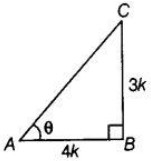
(N/A) આપેલ છે,$\tan A = \frac{3}{4} = \frac{P}{B} = \frac{\text{સામેની બાજુ}}{\text{પાસેની બાજુ}}$.
ધારો કે $P = 3k$ અને $B = 4k$.
પાયથાગોરસના પ્રમેય મુજબ,
$H^2 = P^2 + B^2 = (3k)^2 + (4k)^2$
$H^2 = 9k^2 + 16k^2 = 25k^2$
$\Rightarrow H = 5k$ [કારણ કે,બાજુની લંબાઈ ઋણ ન હોઈ શકે].
હવે,$\sin A = \frac{P}{H} = \frac{3k}{5k} = \frac{3}{5}$ અને $\cos A = \frac{B}{H} = \frac{4k}{5k} = \frac{4}{5}$.
તેથી,$\sin A \cos A = \frac{3}{5} \times \frac{4}{5} = \frac{12}{25}$.
આમ,સાબિત થાય છે.
ધારો કે $P = 3k$ અને $B = 4k$.
પાયથાગોરસના પ્રમેય મુજબ,
$H^2 = P^2 + B^2 = (3k)^2 + (4k)^2$
$H^2 = 9k^2 + 16k^2 = 25k^2$
$\Rightarrow H = 5k$ [કારણ કે,બાજુની લંબાઈ ઋણ ન હોઈ શકે].
હવે,$\sin A = \frac{P}{H} = \frac{3k}{5k} = \frac{3}{5}$ અને $\cos A = \frac{B}{H} = \frac{4k}{5k} = \frac{4}{5}$.
તેથી,$\sin A \cos A = \frac{3}{5} \times \frac{4}{5} = \frac{12}{25}$.
આમ,સાબિત થાય છે.
0 likes
View Solution31
Medium
સાબિત કરો કે,$(\sin \alpha+\cos \alpha)(\tan \alpha+\cot \alpha)=\sec \alpha+\operatorname{cosec} \alpha$
Solution
ડા.બા. $= (\sin \alpha + \cos \alpha)(\tan \alpha + \cot \alpha)$
$= (\sin \alpha + \cos \alpha) \left( \frac{\sin \alpha}{\cos \alpha} + \frac{\cos \alpha}{\sin \alpha} \right)$ $\left[ \because \tan \alpha = \frac{\sin \alpha}{\cos \alpha} \text{ અને } \cot \alpha = \frac{\cos \alpha}{\sin \alpha} \right]$
$= (\sin \alpha + \cos \alpha) \left( \frac{\sin^2 \alpha + \cos^2 \alpha}{\sin \alpha \cos \alpha} \right)$
$= (\sin \alpha + \cos \alpha) \cdot \frac{1}{\sin \alpha \cos \alpha}$ $\left[ \because \sin^2 \alpha + \cos^2 \alpha = 1 \right]$
$= \frac{\sin \alpha}{\sin \alpha \cos \alpha} + \frac{\cos \alpha}{\sin \alpha \cos \alpha}$
$= \frac{1}{\cos \alpha} + \frac{1}{\sin \alpha}$
$= \sec \alpha + \operatorname{cosec} \alpha = \text{જ.બા.}$
$= (\sin \alpha + \cos \alpha) \left( \frac{\sin \alpha}{\cos \alpha} + \frac{\cos \alpha}{\sin \alpha} \right)$ $\left[ \because \tan \alpha = \frac{\sin \alpha}{\cos \alpha} \text{ અને } \cot \alpha = \frac{\cos \alpha}{\sin \alpha} \right]$
$= (\sin \alpha + \cos \alpha) \left( \frac{\sin^2 \alpha + \cos^2 \alpha}{\sin \alpha \cos \alpha} \right)$
$= (\sin \alpha + \cos \alpha) \cdot \frac{1}{\sin \alpha \cos \alpha}$ $\left[ \because \sin^2 \alpha + \cos^2 \alpha = 1 \right]$
$= \frac{\sin \alpha}{\sin \alpha \cos \alpha} + \frac{\cos \alpha}{\sin \alpha \cos \alpha}$
$= \frac{1}{\cos \alpha} + \frac{1}{\sin \alpha}$
$= \sec \alpha + \operatorname{cosec} \alpha = \text{જ.બા.}$
0 likes
View Solution32
Medium
સાબિત કરો કે,
$(\sqrt{3}+ 1) (3-\cot 30^{\circ})=\tan ^{3} 60^{\circ}-2 \sin 60^{\circ}$
$(\sqrt{3}+ 1) (3-\cot 30^{\circ})=\tan ^{3} 60^{\circ}-2 \sin 60^{\circ}$
Solution
(A) આપણે જાણીએ છીએ કે ત્રિકોણમિતીય મૂલ્યો: $\tan 60^{\circ} = \sqrt{3}$,$\sin 60^{\circ} = \frac{\sqrt{3}}{2}$,અને $\cot 30^{\circ} = \sqrt{3}$ છે.
પ્રથમ,જમણી બાજુ ($R$.$H$.$S$.) ની ગણતરી કરીએ:
$\text{R.H.S.} = \tan^{3} 60^{\circ} - 2 \sin 60^{\circ} = (\sqrt{3})^{3} - 2 \left(\frac{\sqrt{3}}{2}\right) = 3\sqrt{3} - \sqrt{3} = 2\sqrt{3}$.
હવે,ડાબી બાજુ ($L$.$H$.$S$.) ની ગણતરી કરીએ:
$\text{L.H.S.} = (\sqrt{3} + 1)(3 - \cot 30^{\circ}) = (\sqrt{3} + 1)(3 - \sqrt{3})$.
બીજા કૌંસમાંથી $\sqrt{3}$ સામાન્ય લેતા:
$\text{L.H.S.} = (\sqrt{3} + 1) \sqrt{3}(\sqrt{3} - 1) = \sqrt{3}(\sqrt{3} + 1)(\sqrt{3} - 1)$.
નિત્યસમ $(a+b)(a-b) = a^2 - b^2$ નો ઉપયોગ કરતા:
$\text{L.H.S.} = \sqrt{3}((\sqrt{3})^2 - 1^2) = \sqrt{3}(3 - 1) = \sqrt{3}(2) = 2\sqrt{3}$.
આમ,$\text{L.H.S.} = \text{R.H.S.}$ હોવાથી,સાબિત થાય છે.
પ્રથમ,જમણી બાજુ ($R$.$H$.$S$.) ની ગણતરી કરીએ:
$\text{R.H.S.} = \tan^{3} 60^{\circ} - 2 \sin 60^{\circ} = (\sqrt{3})^{3} - 2 \left(\frac{\sqrt{3}}{2}\right) = 3\sqrt{3} - \sqrt{3} = 2\sqrt{3}$.
હવે,ડાબી બાજુ ($L$.$H$.$S$.) ની ગણતરી કરીએ:
$\text{L.H.S.} = (\sqrt{3} + 1)(3 - \cot 30^{\circ}) = (\sqrt{3} + 1)(3 - \sqrt{3})$.
બીજા કૌંસમાંથી $\sqrt{3}$ સામાન્ય લેતા:
$\text{L.H.S.} = (\sqrt{3} + 1) \sqrt{3}(\sqrt{3} - 1) = \sqrt{3}(\sqrt{3} + 1)(\sqrt{3} - 1)$.
નિત્યસમ $(a+b)(a-b) = a^2 - b^2$ નો ઉપયોગ કરતા:
$\text{L.H.S.} = \sqrt{3}((\sqrt{3})^2 - 1^2) = \sqrt{3}(3 - 1) = \sqrt{3}(2) = 2\sqrt{3}$.
આમ,$\text{L.H.S.} = \text{R.H.S.}$ હોવાથી,સાબિત થાય છે.
0 likes
View Solution33
Medium
સાબિત કરો કે,
$1 + \frac{\cot^{2} \alpha}{1 + \operatorname{cosec} \alpha} = \operatorname{cosec} \alpha$
$1 + \frac{\cot^{2} \alpha}{1 + \operatorname{cosec} \alpha} = \operatorname{cosec} \alpha$
Solution
(N/A) $L$.$H$.$S$. $= 1 + \frac{\cot^{2} \alpha}{1 + \operatorname{cosec} \alpha}$
$= 1 + \frac{\cos^{2} \alpha / \sin^{2} \alpha}{1 + 1 / \sin \alpha} \quad [\because \cot \theta = \frac{\cos \theta}{\sin \theta} \text{ અને } \operatorname{cosec} \theta = \frac{1}{\sin \theta}]$
$= 1 + \frac{\cos^{2} \alpha}{\sin \alpha(1 + \sin \alpha)} = \frac{\sin \alpha(1 + \sin \alpha) + \cos^{2} \alpha}{\sin \alpha(1 + \sin \alpha)}$
$= \frac{\sin \alpha + (\sin^{2} \alpha + \cos^{2} \alpha)}{\sin \alpha(1 + \sin \alpha)} \quad [\because \sin^{2} \theta + \cos^{2} \theta = 1]$
$= \frac{\sin \alpha + 1}{\sin \alpha(1 + \sin \alpha)} = \frac{1}{\sin \alpha} \quad [\because \operatorname{cosec} \theta = \frac{1}{\sin \theta}]$
$= \operatorname{cosec} \alpha = \text{R.H.S.}$
$= 1 + \frac{\cos^{2} \alpha / \sin^{2} \alpha}{1 + 1 / \sin \alpha} \quad [\because \cot \theta = \frac{\cos \theta}{\sin \theta} \text{ અને } \operatorname{cosec} \theta = \frac{1}{\sin \theta}]$
$= 1 + \frac{\cos^{2} \alpha}{\sin \alpha(1 + \sin \alpha)} = \frac{\sin \alpha(1 + \sin \alpha) + \cos^{2} \alpha}{\sin \alpha(1 + \sin \alpha)}$
$= \frac{\sin \alpha + (\sin^{2} \alpha + \cos^{2} \alpha)}{\sin \alpha(1 + \sin \alpha)} \quad [\because \sin^{2} \theta + \cos^{2} \theta = 1]$
$= \frac{\sin \alpha + 1}{\sin \alpha(1 + \sin \alpha)} = \frac{1}{\sin \alpha} \quad [\because \operatorname{cosec} \theta = \frac{1}{\sin \theta}]$
$= \operatorname{cosec} \alpha = \text{R.H.S.}$
0 likes
View Solution34
Medium
સાબિત કરો કે,$\tan \theta + \tan (90^{\circ} - \theta) = \sec \theta \sec (90^{\circ} - \theta)$
Solution
(N/A) ડા.બા. $= \tan \theta + \tan (90^{\circ} - \theta)$
કારણ કે $\tan (90^{\circ} - \theta) = \cot \theta$,તેથી:
$= \tan \theta + \cot \theta$
$= \frac{\sin \theta}{\cos \theta} + \frac{\cos \theta}{\sin \theta}$
$= \frac{\sin^2 \theta + \cos^2 \theta}{\sin \theta \cos \theta}$
કારણ કે $\sin^2 \theta + \cos^2 \theta = 1$,તેથી:
$= \frac{1}{\sin \theta \cos \theta}$
$= \frac{1}{\cos \theta} \cdot \frac{1}{\sin \theta}$
$= \sec \theta \operatorname{cosec} \theta$
કારણ કે $\operatorname{cosec} \theta = \sec (90^{\circ} - \theta)$,તેથી:
$= \sec \theta \sec (90^{\circ} - \theta) = \text{જ.બા.}$
કારણ કે $\tan (90^{\circ} - \theta) = \cot \theta$,તેથી:
$= \tan \theta + \cot \theta$
$= \frac{\sin \theta}{\cos \theta} + \frac{\cos \theta}{\sin \theta}$
$= \frac{\sin^2 \theta + \cos^2 \theta}{\sin \theta \cos \theta}$
કારણ કે $\sin^2 \theta + \cos^2 \theta = 1$,તેથી:
$= \frac{1}{\sin \theta \cos \theta}$
$= \frac{1}{\cos \theta} \cdot \frac{1}{\sin \theta}$
$= \sec \theta \operatorname{cosec} \theta$
કારણ કે $\operatorname{cosec} \theta = \sec (90^{\circ} - \theta)$,તેથી:
$= \sec \theta \sec (90^{\circ} - \theta) = \text{જ.બા.}$
0 likes
View Solution35
EasyMCQ
જો $\sqrt{3} \tan \theta = 1$ હોય,તો $\sin^{2} \theta - \cos^{2} \theta$ ની કિંમત શોધો.
A
$\frac{3}{4}$
B
$\frac{1}{2}$
C
$-\frac{1}{2}$
D
$-\frac{3}{4}$
Solution
(C) આપેલ છે કે,$\sqrt{3} \tan \theta = 1$.
$\tan \theta = \frac{1}{\sqrt{3}}$.
આપણે જાણીએ છીએ કે $\tan 30^{\circ} = \frac{1}{\sqrt{3}}$,તેથી $\theta = 30^{\circ}$ મળે.
હવે,$\theta = 30^{\circ}$ ની કિંમત $\sin^{2} \theta - \cos^{2} \theta$ માં મૂકતા:
$\sin^{2} 30^{\circ} - \cos^{2} 30^{\circ} = \left(\frac{1}{2}\right)^{2} - \left(\frac{\sqrt{3}}{2}\right)^{2}$.
$= \frac{1}{4} - \frac{3}{4}$.
$= \frac{1 - 3}{4} = -\frac{2}{4} = -\frac{1}{2}$.
$\tan \theta = \frac{1}{\sqrt{3}}$.
આપણે જાણીએ છીએ કે $\tan 30^{\circ} = \frac{1}{\sqrt{3}}$,તેથી $\theta = 30^{\circ}$ મળે.
હવે,$\theta = 30^{\circ}$ ની કિંમત $\sin^{2} \theta - \cos^{2} \theta$ માં મૂકતા:
$\sin^{2} 30^{\circ} - \cos^{2} 30^{\circ} = \left(\frac{1}{2}\right)^{2} - \left(\frac{\sqrt{3}}{2}\right)^{2}$.
$= \frac{1}{4} - \frac{3}{4}$.
$= \frac{1 - 3}{4} = -\frac{2}{4} = -\frac{1}{2}$.
0 likes
View Solution36
MediumMCQ
$(1+\tan ^{2} \theta)(1-\sin \theta)(1+\sin \theta)$ નું સાદું રૂપ આપો.
A
$1$
B
$0$
C
$-1$
D
$0.5$
Solution
(A) આપેલ પદાવલિ: $(1+\tan ^{2} \theta)(1-\sin \theta)(1+\sin \theta)$
બીજગણિતીય નિત્યસમ $(a-b)(a+b) = a^{2}-b^{2}$ નો ઉપયોગ કરતા,$(1-\sin \theta)(1+\sin \theta) = 1-\sin ^{2} \theta$ મળે.
તેથી,પદાવલિ $(1+\tan ^{2} \theta)(1-\sin ^{2} \theta)$ બને છે.
આપણે જાણીએ છીએ કે $1+\tan ^{2} \theta = \sec ^{2} \theta$ અને $1-\sin ^{2} \theta = \cos ^{2} \theta$.
આ કિંમતો મૂકતા,આપણને $\sec ^{2} \theta \cdot \cos ^{2} \theta$ મળે છે.
કારણ કે $\sec \theta = \frac{1}{\cos \theta}$,તેથી $\sec ^{2} \theta = \frac{1}{\cos ^{2} \theta}$.
આમ,$\frac{1}{\cos ^{2} \theta} \cdot \cos ^{2} \theta = 1$.
બીજગણિતીય નિત્યસમ $(a-b)(a+b) = a^{2}-b^{2}$ નો ઉપયોગ કરતા,$(1-\sin \theta)(1+\sin \theta) = 1-\sin ^{2} \theta$ મળે.
તેથી,પદાવલિ $(1+\tan ^{2} \theta)(1-\sin ^{2} \theta)$ બને છે.
આપણે જાણીએ છીએ કે $1+\tan ^{2} \theta = \sec ^{2} \theta$ અને $1-\sin ^{2} \theta = \cos ^{2} \theta$.
આ કિંમતો મૂકતા,આપણને $\sec ^{2} \theta \cdot \cos ^{2} \theta$ મળે છે.
કારણ કે $\sec \theta = \frac{1}{\cos \theta}$,તેથી $\sec ^{2} \theta = \frac{1}{\cos ^{2} \theta}$.
આમ,$\frac{1}{\cos ^{2} \theta} \cdot \cos ^{2} \theta = 1$.
0 likes
View Solution37
MediumMCQ
જો $2 \sin^{2} \theta - \cos^{2} \theta = 2$ હોય,તો $\theta$ ની કિંમત શોધો. ($^{\circ}$ માં)
A
$30$
B
$90$
C
$0$
D
$120$
Solution
(B) આપેલ સમીકરણ: $2 \sin^{2} \theta - \cos^{2} \theta = 2$
નિત્યસમ $\cos^{2} \theta = 1 - \sin^{2} \theta$ નો ઉપયોગ કરતા,આપણે તેને સમીકરણમાં મૂકીએ:
$2 \sin^{2} \theta - (1 - \sin^{2} \theta) = 2$
પદાવલિનું સાદું રૂપ આપતા:
$2 \sin^{2} \theta - 1 + \sin^{2} \theta = 2$
$3 \sin^{2} \theta - 1 = 2$
બંને બાજુ $1$ ઉમેરતા:
$3 \sin^{2} \theta = 3$
$3$ વડે ભાગતા:
$\sin^{2} \theta = 1$
વર્ગમૂળ લેતા:
$\sin \theta = 1$ (મુખ્ય કિંમત ધ્યાનમાં લેતા)
કારણ કે $\sin 90^{\circ} = 1$,તેથી:
$\theta = 90^{\circ}$
નિત્યસમ $\cos^{2} \theta = 1 - \sin^{2} \theta$ નો ઉપયોગ કરતા,આપણે તેને સમીકરણમાં મૂકીએ:
$2 \sin^{2} \theta - (1 - \sin^{2} \theta) = 2$
પદાવલિનું સાદું રૂપ આપતા:
$2 \sin^{2} \theta - 1 + \sin^{2} \theta = 2$
$3 \sin^{2} \theta - 1 = 2$
બંને બાજુ $1$ ઉમેરતા:
$3 \sin^{2} \theta = 3$
$3$ વડે ભાગતા:
$\sin^{2} \theta = 1$
વર્ગમૂળ લેતા:
$\sin \theta = 1$ (મુખ્ય કિંમત ધ્યાનમાં લેતા)
કારણ કે $\sin 90^{\circ} = 1$,તેથી:
$\theta = 90^{\circ}$
1 likes
View Solution38
Medium
સાબિત કરો કે $\frac{\cos ^{2}\left(45^{\circ}+\theta\right)+\cos ^{2}\left(45^{\circ}-\theta\right)}{\tan \left(60^{\circ}+\theta\right) \tan \left(30^{\circ}-\theta\right)}=1$
Solution
(N/A) ડા.બા. $= \frac{\cos ^{2}\left(45^{\circ}+\theta\right)+\cos ^{2}\left(45^{\circ}-\theta\right)}{\tan \left(60^{\circ}+\theta\right) \cdot \tan \left(30^{\circ}-\theta\right)}$
નિત્યસમ $\cos \theta = \sin(90^{\circ}-\theta)$ અને $\tan \theta = \cot(90^{\circ}-\theta)$ નો ઉપયોગ કરતા:
અંશ: $\cos ^{2}\left(45^{\circ}+\theta\right) + \sin ^{2}\left(90^{\circ}-(45^{\circ}-\theta)\right) = \cos ^{2}\left(45^{\circ}+\theta\right) + \sin ^{2}\left(45^{\circ}+\theta\right) = 1$
છેદ: $\tan \left(60^{\circ}+\theta\right) \cdot \cot \left(90^{\circ}-(30^{\circ}-\theta)\right) = \tan \left(60^{\circ}+\theta\right) \cdot \cot \left(60^{\circ}+\theta\right) = \tan \left(60^{\circ}+\theta\right) \cdot \frac{1}{\tan \left(60^{\circ}+\theta\right)} = 1$
તેથી,$\frac{1}{1} = 1 = \text{જ.બા.}$
નિત્યસમ $\cos \theta = \sin(90^{\circ}-\theta)$ અને $\tan \theta = \cot(90^{\circ}-\theta)$ નો ઉપયોગ કરતા:
અંશ: $\cos ^{2}\left(45^{\circ}+\theta\right) + \sin ^{2}\left(90^{\circ}-(45^{\circ}-\theta)\right) = \cos ^{2}\left(45^{\circ}+\theta\right) + \sin ^{2}\left(45^{\circ}+\theta\right) = 1$
છેદ: $\tan \left(60^{\circ}+\theta\right) \cdot \cot \left(90^{\circ}-(30^{\circ}-\theta)\right) = \tan \left(60^{\circ}+\theta\right) \cdot \cot \left(60^{\circ}+\theta\right) = \tan \left(60^{\circ}+\theta\right) \cdot \frac{1}{\tan \left(60^{\circ}+\theta\right)} = 1$
તેથી,$\frac{1}{1} = 1 = \text{જ.બા.}$
0 likes
View Solution39
Easy
સાબિત કરો કે $\tan ^{4} \theta+\tan ^{2} \theta=\sec ^{4} \theta-\sec ^{2} \theta$
Solution
(N/A) ડા.બા. ($L$.$H$.$S$.) $= \tan ^{4} \theta + \tan ^{2} \theta$
$= \tan ^{2} \theta (\tan ^{2} \theta + 1)$
$= \tan ^{2} \theta \cdot \sec ^{2} \theta$ (કારણ કે $\sec ^{2} \theta = \tan ^{2} \theta + 1$)
$= (\sec ^{2} \theta - 1) \cdot \sec ^{2} \theta$ (કારણ કે $\tan ^{2} \theta = \sec ^{2} \theta - 1$)
$= \sec ^{4} \theta - \sec ^{2} \theta = \text{જ.બા. (R.H.S.)}$
$= \tan ^{2} \theta (\tan ^{2} \theta + 1)$
$= \tan ^{2} \theta \cdot \sec ^{2} \theta$ (કારણ કે $\sec ^{2} \theta = \tan ^{2} \theta + 1$)
$= (\sec ^{2} \theta - 1) \cdot \sec ^{2} \theta$ (કારણ કે $\tan ^{2} \theta = \sec ^{2} \theta - 1$)
$= \sec ^{4} \theta - \sec ^{2} \theta = \text{જ.બા. (R.H.S.)}$
0 likes
View Solution40
Difficult
જો $\operatorname{cosec} \theta + \cot \theta = p$ હોય,તો સાબિત કરો કે $\cos \theta = \frac{p^{2} - 1}{p^{2} + 1}$.
Solution
(N/A) આપેલ છે,$\operatorname{cosec} \theta + \cot \theta = p$.
આપણે જાણીએ છીએ કે $\operatorname{cosec} \theta = \frac{1}{\sin \theta}$ અને $\cot \theta = \frac{\cos \theta}{\sin \theta}$.
આ કિંમતો મૂકતા,આપણને મળે $\frac{1 + \cos \theta}{\sin \theta} = p$.
બંને બાજુ વર્ગ કરતા,આપણને મળે $\frac{(1 + \cos \theta)^{2}}{\sin^{2} \theta} = p^{2}$.
નિત્યસમ $\sin^{2} \theta = 1 - \cos^{2} \theta = (1 - \cos \theta)(1 + \cos \theta)$ નો ઉપયોગ કરતા:
$\frac{(1 + \cos \theta)^{2}}{(1 - \cos \theta)(1 + \cos \theta)} = p^{2} \Rightarrow \frac{1 + \cos \theta}{1 - \cos \theta} = p^{2}$.
યોગ-વિયોગની રીત (componendo and dividendo) લાગુ પાડતા:
$\frac{p^{2} - 1}{p^{2} + 1} = \frac{(1 + \cos \theta) - (1 - \cos \theta)}{(1 + \cos \theta) + (1 - \cos \theta)}$.
પદાવલિનું સાદું રૂપ આપતા:
$\frac{p^{2} - 1}{p^{2} + 1} = \frac{1 + \cos \theta - 1 + \cos \theta}{1 + \cos \theta + 1 - \cos \theta} = \frac{2 \cos \theta}{2} = \cos \theta$.
આમ,$\cos \theta = \frac{p^{2} - 1}{p^{2} + 1}$. આમ સાબિત થાય છે.
આપણે જાણીએ છીએ કે $\operatorname{cosec} \theta = \frac{1}{\sin \theta}$ અને $\cot \theta = \frac{\cos \theta}{\sin \theta}$.
આ કિંમતો મૂકતા,આપણને મળે $\frac{1 + \cos \theta}{\sin \theta} = p$.
બંને બાજુ વર્ગ કરતા,આપણને મળે $\frac{(1 + \cos \theta)^{2}}{\sin^{2} \theta} = p^{2}$.
નિત્યસમ $\sin^{2} \theta = 1 - \cos^{2} \theta = (1 - \cos \theta)(1 + \cos \theta)$ નો ઉપયોગ કરતા:
$\frac{(1 + \cos \theta)^{2}}{(1 - \cos \theta)(1 + \cos \theta)} = p^{2} \Rightarrow \frac{1 + \cos \theta}{1 - \cos \theta} = p^{2}$.
યોગ-વિયોગની રીત (componendo and dividendo) લાગુ પાડતા:
$\frac{p^{2} - 1}{p^{2} + 1} = \frac{(1 + \cos \theta) - (1 - \cos \theta)}{(1 + \cos \theta) + (1 - \cos \theta)}$.
પદાવલિનું સાદું રૂપ આપતા:
$\frac{p^{2} - 1}{p^{2} + 1} = \frac{1 + \cos \theta - 1 + \cos \theta}{1 + \cos \theta + 1 - \cos \theta} = \frac{2 \cos \theta}{2} = \cos \theta$.
આમ,$\cos \theta = \frac{p^{2} - 1}{p^{2} + 1}$. આમ સાબિત થાય છે.
0 likes
View Solution41
Difficult
સાબિત કરો કે $\sqrt{\sec ^{2} \theta+\operatorname{cosec}^{2} \theta}=\tan \theta+\cot \theta$
Solution
(A) $L.H.S. = \sqrt{\sec ^{2} \theta+\operatorname{cosec}^{2} \theta}$
$= \sqrt{\frac{1}{\cos ^{2} \theta}+\frac{1}{\sin ^{2} \theta}}$ $\left[\because \sec \theta = \frac{1}{\cos \theta} \text{ અને } \operatorname{cosec} \theta = \frac{1}{\sin \theta}\right]$
$= \sqrt{\frac{\sin ^{2} \theta+\cos ^{2} \theta}{\sin ^{2} \theta \cdot \cos ^{2} \theta}} = \sqrt{\frac{1}{\sin ^{2} \theta \cdot \cos ^{2} \theta}}$ $\left[\because \sin ^{2} \theta+\cos ^{2} \theta = 1\right]$
$= \frac{1}{\sin \theta \cdot \cos \theta} = \frac{\sin ^{2} \theta+\cos ^{2} \theta}{\sin \theta \cdot \cos \theta}$ $\left[\because 1 = \sin ^{2} \theta+\cos ^{2} \theta\right]$
$= \frac{\sin ^{2} \theta}{\sin \theta \cdot \cos \theta} + \frac{\cos ^{2} \theta}{\sin \theta \cdot \cos \theta}$
$= \frac{\sin \theta}{\cos \theta} + \frac{\cos \theta}{\sin \theta}$ $\left[\because \tan \theta = \frac{\sin \theta}{\cos \theta} \text{ અને } \cot \theta = \frac{\cos \theta}{\sin \theta}\right]$
$= \tan \theta + \cot \theta = R.H.S.$
$= \sqrt{\frac{1}{\cos ^{2} \theta}+\frac{1}{\sin ^{2} \theta}}$ $\left[\because \sec \theta = \frac{1}{\cos \theta} \text{ અને } \operatorname{cosec} \theta = \frac{1}{\sin \theta}\right]$
$= \sqrt{\frac{\sin ^{2} \theta+\cos ^{2} \theta}{\sin ^{2} \theta \cdot \cos ^{2} \theta}} = \sqrt{\frac{1}{\sin ^{2} \theta \cdot \cos ^{2} \theta}}$ $\left[\because \sin ^{2} \theta+\cos ^{2} \theta = 1\right]$
$= \frac{1}{\sin \theta \cdot \cos \theta} = \frac{\sin ^{2} \theta+\cos ^{2} \theta}{\sin \theta \cdot \cos \theta}$ $\left[\because 1 = \sin ^{2} \theta+\cos ^{2} \theta\right]$
$= \frac{\sin ^{2} \theta}{\sin \theta \cdot \cos \theta} + \frac{\cos ^{2} \theta}{\sin \theta \cdot \cos \theta}$
$= \frac{\sin \theta}{\cos \theta} + \frac{\cos \theta}{\sin \theta}$ $\left[\because \tan \theta = \frac{\sin \theta}{\cos \theta} \text{ અને } \cot \theta = \frac{\cos \theta}{\sin \theta}\right]$
$= \tan \theta + \cot \theta = R.H.S.$
0 likes
View Solution42
Difficult
જો $1+\sin ^{2} \theta=3 \sin \theta \cos \theta$ હોય,તો સાબિત કરો કે $\tan \theta=1$ અથવા $\frac{1}{2}$ થાય.
Solution
(A) આપેલ સમીકરણ: $1+\sin ^{2} \theta=3 \sin \theta \cos \theta$
બંને બાજુ $\cos^{2} \theta$ વડે ભાગતા:
$\frac{1}{\cos^{2} \theta} + \frac{\sin^{2} \theta}{\cos^{2} \theta} = \frac{3 \sin \theta \cos \theta}{\cos^{2} \theta}$
નિત્યસમ $\sec^{2} \theta = \frac{1}{\cos^{2} \theta}$,$\tan \theta = \frac{\sin \theta}{\cos \theta}$,અને $\sec^{2} \theta = 1 + \tan^{2} \theta$ નો ઉપયોગ કરતા:
$(1 + \tan^{2} \theta) + \tan^{2} \theta = 3 \tan \theta$
પદોને ગોઠવીને દ્વિઘાત સમીકરણ બનાવતા:
$2 \tan^{2} \theta - 3 \tan \theta + 1 = 0$
દ્વિઘાત સમીકરણના અવયવ પાડતા:
$2 \tan^{2} \theta - 2 \tan \theta - \tan \theta + 1 = 0$
$2 \tan \theta (\tan \theta - 1) - 1 (\tan \theta - 1) = 0$
$(2 \tan \theta - 1) (\tan \theta - 1) = 0$
તેથી,$\tan \theta - 1 = 0$ અથવા $2 \tan \theta - 1 = 0$
$\tan \theta = 1$ અથવા $\tan \theta = \frac{1}{2}$.
આમ,સાબિત થાય છે.
બંને બાજુ $\cos^{2} \theta$ વડે ભાગતા:
$\frac{1}{\cos^{2} \theta} + \frac{\sin^{2} \theta}{\cos^{2} \theta} = \frac{3 \sin \theta \cos \theta}{\cos^{2} \theta}$
નિત્યસમ $\sec^{2} \theta = \frac{1}{\cos^{2} \theta}$,$\tan \theta = \frac{\sin \theta}{\cos \theta}$,અને $\sec^{2} \theta = 1 + \tan^{2} \theta$ નો ઉપયોગ કરતા:
$(1 + \tan^{2} \theta) + \tan^{2} \theta = 3 \tan \theta$
પદોને ગોઠવીને દ્વિઘાત સમીકરણ બનાવતા:
$2 \tan^{2} \theta - 3 \tan \theta + 1 = 0$
દ્વિઘાત સમીકરણના અવયવ પાડતા:
$2 \tan^{2} \theta - 2 \tan \theta - \tan \theta + 1 = 0$
$2 \tan \theta (\tan \theta - 1) - 1 (\tan \theta - 1) = 0$
$(2 \tan \theta - 1) (\tan \theta - 1) = 0$
તેથી,$\tan \theta - 1 = 0$ અથવા $2 \tan \theta - 1 = 0$
$\tan \theta = 1$ અથવા $\tan \theta = \frac{1}{2}$.
આમ,સાબિત થાય છે.
0 likes
View Solution43
Difficult
જો $\sin \theta + 2 \cos \theta = 1$ આપેલ હોય,તો સાબિત કરો કે $2 \sin \theta - \cos \theta = 2$.
Solution
(N/A) આપેલ છે,$\sin \theta + 2 \cos \theta = 1$.
બંને બાજુ વર્ગ કરતા,આપણને મળે:
$(\sin \theta + 2 \cos \theta)^2 = 1^2$
$\sin^2 \theta + 4 \cos^2 \theta + 4 \sin \theta \cos \theta = 1$
નિત્યસમ $\sin^2 \theta = 1 - \cos^2 \theta$ અને $\cos^2 \theta = 1 - \sin^2 \theta$ નો ઉપયોગ કરતા:
$(1 - \cos^2 \theta) + 4(1 - \sin^2 \theta) + 4 \sin \theta \cos \theta = 1$
$1 - \cos^2 \theta + 4 - 4 \sin^2 \theta + 4 \sin \theta \cos \theta = 1$
$5 - (\cos^2 \theta + 4 \sin^2 \theta - 4 \sin \theta \cos \theta) = 1$
પદોને ગોઠવતા:
$4 \sin^2 \theta + \cos^2 \theta - 4 \sin \theta \cos \theta = 5 - 1$
$4 \sin^2 \theta + \cos^2 \theta - 4 \sin \theta \cos \theta = 4$
બીજગણિતીય નિત્યસમ $(a - b)^2 = a^2 + b^2 - 2ab$ ને ઓળખતા,જ્યાં $a = 2 \sin \theta$ અને $b = \cos \theta$ છે:
$(2 \sin \theta - \cos \theta)^2 = 4$
બંને બાજુ વર્ગમૂળ લેતા:
$2 \sin \theta - \cos \theta = 2$
આમ,સાબિત થાય છે.
બંને બાજુ વર્ગ કરતા,આપણને મળે:
$(\sin \theta + 2 \cos \theta)^2 = 1^2$
$\sin^2 \theta + 4 \cos^2 \theta + 4 \sin \theta \cos \theta = 1$
નિત્યસમ $\sin^2 \theta = 1 - \cos^2 \theta$ અને $\cos^2 \theta = 1 - \sin^2 \theta$ નો ઉપયોગ કરતા:
$(1 - \cos^2 \theta) + 4(1 - \sin^2 \theta) + 4 \sin \theta \cos \theta = 1$
$1 - \cos^2 \theta + 4 - 4 \sin^2 \theta + 4 \sin \theta \cos \theta = 1$
$5 - (\cos^2 \theta + 4 \sin^2 \theta - 4 \sin \theta \cos \theta) = 1$
પદોને ગોઠવતા:
$4 \sin^2 \theta + \cos^2 \theta - 4 \sin \theta \cos \theta = 5 - 1$
$4 \sin^2 \theta + \cos^2 \theta - 4 \sin \theta \cos \theta = 4$
બીજગણિતીય નિત્યસમ $(a - b)^2 = a^2 + b^2 - 2ab$ ને ઓળખતા,જ્યાં $a = 2 \sin \theta$ અને $b = \cos \theta$ છે:
$(2 \sin \theta - \cos \theta)^2 = 4$
બંને બાજુ વર્ગમૂળ લેતા:
$2 \sin \theta - \cos \theta = 2$
આમ,સાબિત થાય છે.
0 likes
View Solution44
Medium
જો $\tan \theta + \sec \theta = l$ હોય,તો સાબિત કરો કે $\sec \theta = \frac{l^{2} + 1}{2l}$.
Solution
(A) આપેલ છે: $\tan \theta + \sec \theta = l$ .....$(i)$
આપણે જાણીએ છીએ કે નિત્યસમ: $\sec^{2} \theta - \tan^{2} \theta = 1$.
આને $(\sec \theta - \tan \theta)(\sec \theta + \tan \theta) = 1$ તરીકે લખી શકાય છે.
સમીકરણ $(i)$ માંથી $(\sec \theta + \tan \theta)$ ની કિંમત મૂકતા:
$(\sec \theta - \tan \theta) \cdot l = 1$
$\sec \theta - \tan \theta = \frac{1}{l}$ .....$(ii)$
હવે,સમીકરણ $(i)$ અને સમીકરણ $(ii)$ નો સરવાળો કરતા:
$(\tan \theta + \sec \theta) + (\sec \theta - \tan \theta) = l + \frac{1}{l}$
$2 \sec \theta = \frac{l^{2} + 1}{l}$
બંને બાજુ $2$ વડે ભાગતા:
$\sec \theta = \frac{l^{2} + 1}{2l}$.
આમ,સાબિત થાય છે.
આપણે જાણીએ છીએ કે નિત્યસમ: $\sec^{2} \theta - \tan^{2} \theta = 1$.
આને $(\sec \theta - \tan \theta)(\sec \theta + \tan \theta) = 1$ તરીકે લખી શકાય છે.
સમીકરણ $(i)$ માંથી $(\sec \theta + \tan \theta)$ ની કિંમત મૂકતા:
$(\sec \theta - \tan \theta) \cdot l = 1$
$\sec \theta - \tan \theta = \frac{1}{l}$ .....$(ii)$
હવે,સમીકરણ $(i)$ અને સમીકરણ $(ii)$ નો સરવાળો કરતા:
$(\tan \theta + \sec \theta) + (\sec \theta - \tan \theta) = l + \frac{1}{l}$
$2 \sec \theta = \frac{l^{2} + 1}{l}$
બંને બાજુ $2$ વડે ભાગતા:
$\sec \theta = \frac{l^{2} + 1}{2l}$.
આમ,સાબિત થાય છે.
0 likes
View Solution45
Difficult
જો $\sin \theta + \cos \theta = p$ અને $\sec \theta + \operatorname{cosec} \theta = q$ હોય,તો સાબિત કરો કે $q(p^2 - 1) = 2p$.
Solution
(N/A) આપેલ છે કે,$\sin \theta + \cos \theta = p$ ......$(i)$
અને $\sec \theta + \operatorname{cosec} \theta = q$
$\Rightarrow \frac{1}{\cos \theta} + \frac{1}{\sin \theta} = q$ $\left[\because \sec \theta = \frac{1}{\cos \theta} \text{ અને } \operatorname{cosec} \theta = \frac{1}{\sin \theta}\right]$
$\Rightarrow \frac{\sin \theta + \cos \theta}{\sin \theta \cdot \cos \theta} = q$
$\Rightarrow \frac{p}{\sin \theta \cdot \cos \theta} = q$ [સમીકરણ $(i)$ પરથી]
$\Rightarrow \sin \theta \cdot \cos \theta = \frac{p}{q}$ ......$(ii)$
હવે,સમીકરણ $(i)$ ની બંને બાજુ વર્ગ કરતા:
$(\sin \theta + \cos \theta)^2 = p^2$
$\Rightarrow (\sin^2 \theta + \cos^2 \theta) + 2 \sin \theta \cdot \cos \theta = p^2$ $\left[\because (a+b)^2 = a^2 + 2ab + b^2\right]$
$\Rightarrow 1 + 2 \sin \theta \cdot \cos \theta = p^2$ $\left[\because \sin^2 \theta + \cos^2 \theta = 1\right]$
સમીકરણ $(ii)$ માંથી $\sin \theta \cdot \cos \theta = \frac{p}{q}$ ની કિંમત મૂકતા:
$\Rightarrow 1 + 2 \left(\frac{p}{q}\right) = p^2$
$\Rightarrow 1 + \frac{2p}{q} = p^2$
બંને બાજુ $q$ વડે ગુણતા:
$\Rightarrow q + 2p = p^2 q$
$\Rightarrow 2p = p^2 q - q$
$\Rightarrow 2p = q(p^2 - 1)$
આમ,$q(p^2 - 1) = 2p$ સાબિત થાય છે.
અને $\sec \theta + \operatorname{cosec} \theta = q$
$\Rightarrow \frac{1}{\cos \theta} + \frac{1}{\sin \theta} = q$ $\left[\because \sec \theta = \frac{1}{\cos \theta} \text{ અને } \operatorname{cosec} \theta = \frac{1}{\sin \theta}\right]$
$\Rightarrow \frac{\sin \theta + \cos \theta}{\sin \theta \cdot \cos \theta} = q$
$\Rightarrow \frac{p}{\sin \theta \cdot \cos \theta} = q$ [સમીકરણ $(i)$ પરથી]
$\Rightarrow \sin \theta \cdot \cos \theta = \frac{p}{q}$ ......$(ii)$
હવે,સમીકરણ $(i)$ ની બંને બાજુ વર્ગ કરતા:
$(\sin \theta + \cos \theta)^2 = p^2$
$\Rightarrow (\sin^2 \theta + \cos^2 \theta) + 2 \sin \theta \cdot \cos \theta = p^2$ $\left[\because (a+b)^2 = a^2 + 2ab + b^2\right]$
$\Rightarrow 1 + 2 \sin \theta \cdot \cos \theta = p^2$ $\left[\because \sin^2 \theta + \cos^2 \theta = 1\right]$
સમીકરણ $(ii)$ માંથી $\sin \theta \cdot \cos \theta = \frac{p}{q}$ ની કિંમત મૂકતા:
$\Rightarrow 1 + 2 \left(\frac{p}{q}\right) = p^2$
$\Rightarrow 1 + \frac{2p}{q} = p^2$
બંને બાજુ $q$ વડે ગુણતા:
$\Rightarrow q + 2p = p^2 q$
$\Rightarrow 2p = p^2 q - q$
$\Rightarrow 2p = q(p^2 - 1)$
આમ,$q(p^2 - 1) = 2p$ સાબિત થાય છે.
0 likes
View Solution46
Difficult
જો $a \sin \theta + b \cos \theta = c$ હોય,તો સાબિત કરો કે $a \cos \theta - b \sin \theta = \pm \sqrt{a^2 + b^2 - c^2}$,જ્યાં $a^2 + b^2 \geq c^2$ આપેલ છે.
Solution
(N/A) આપેલ છે: $a \sin \theta + b \cos \theta = c$ $(1)$
ધારો કે $x = a \cos \theta - b \sin \theta$ $(2)$
બંને સમીકરણો $(1)$ અને $(2)$ નો વર્ગ કરીને તેમનો સરવાળો કરતા:
$(a \sin \theta + b \cos \theta)^2 + (a \cos \theta - b \sin \theta)^2 = c^2 + x^2$
$a^2 \sin^2 \theta + b^2 \cos^2 \theta + 2ab \sin \theta \cos \theta + a^2 \cos^2 \theta + b^2 \sin^2 \theta - 2ab \sin \theta \cos \theta = c^2 + x^2$
$a^2(\sin^2 \theta + \cos^2 \theta) + b^2(\cos^2 \theta + \sin^2 \theta) = c^2 + x^2$
કારણ કે $\sin^2 \theta + \cos^2 \theta = 1$,તેથી:
$a^2(1) + b^2(1) = c^2 + x^2$
$a^2 + b^2 = c^2 + x^2$
$x^2 = a^2 + b^2 - c^2$
$x = \pm \sqrt{a^2 + b^2 - c^2}$
તેથી,$a \cos \theta - b \sin \theta = \pm \sqrt{a^2 + b^2 - c^2}$ સાબિત થાય છે.
ધારો કે $x = a \cos \theta - b \sin \theta$ $(2)$
બંને સમીકરણો $(1)$ અને $(2)$ નો વર્ગ કરીને તેમનો સરવાળો કરતા:
$(a \sin \theta + b \cos \theta)^2 + (a \cos \theta - b \sin \theta)^2 = c^2 + x^2$
$a^2 \sin^2 \theta + b^2 \cos^2 \theta + 2ab \sin \theta \cos \theta + a^2 \cos^2 \theta + b^2 \sin^2 \theta - 2ab \sin \theta \cos \theta = c^2 + x^2$
$a^2(\sin^2 \theta + \cos^2 \theta) + b^2(\cos^2 \theta + \sin^2 \theta) = c^2 + x^2$
કારણ કે $\sin^2 \theta + \cos^2 \theta = 1$,તેથી:
$a^2(1) + b^2(1) = c^2 + x^2$
$a^2 + b^2 = c^2 + x^2$
$x^2 = a^2 + b^2 - c^2$
$x = \pm \sqrt{a^2 + b^2 - c^2}$
તેથી,$a \cos \theta - b \sin \theta = \pm \sqrt{a^2 + b^2 - c^2}$ સાબિત થાય છે.
0 likes
View Solution47
Difficult
સાબિત કરો કે $\frac{1+\sec \theta-\tan \theta}{1+\sec \theta+\tan \theta}=\frac{1-\sin \theta}{\cos \theta}$
Solution
(A) $L$.$H$.$S$. $= \frac{1+\sec \theta-\tan \theta}{1+\sec \theta+\tan \theta}$
$= \frac{1+\frac{1}{\cos \theta}-\frac{\sin \theta}{\cos \theta}}{1+\frac{1}{\cos \theta}+\frac{\sin \theta}{\cos \theta}}$ $\left[\because \sec \theta=\frac{1}{\cos \theta} \text{ અને } \tan \theta=\frac{\sin \theta}{\cos \theta}\right]$
$= \frac{\cos \theta+1-\sin \theta}{\cos \theta+1+\sin \theta} = \frac{(\cos \theta+1)-\sin \theta}{(\cos \theta+1)+\sin \theta}$
નિત્યસમ $1 = \sec^2 \theta - \tan^2 \theta$ નો ઉપયોગ કરતા:
$= \frac{(\sec^2 \theta - \tan^2 \theta) + (\sec \theta - \tan \theta)}{1 + \sec \theta + \tan \theta}$
$= \frac{(\sec \theta - \tan \theta)(\sec \theta + \tan \theta) + (\sec \theta - \tan \theta)}{1 + \sec \theta + \tan \theta}$
$= \frac{(\sec \theta - \tan \theta)(\sec \theta + \tan \theta + 1)}{1 + \sec \theta + \tan \theta}$
$= \sec \theta - \tan \theta$
$= \frac{1}{\cos \theta} - \frac{\sin \theta}{\cos \theta} = \frac{1-\sin \theta}{\cos \theta} = \text{R.H.S.}$
આમ,સાબિત થાય છે.
$= \frac{1+\frac{1}{\cos \theta}-\frac{\sin \theta}{\cos \theta}}{1+\frac{1}{\cos \theta}+\frac{\sin \theta}{\cos \theta}}$ $\left[\because \sec \theta=\frac{1}{\cos \theta} \text{ અને } \tan \theta=\frac{\sin \theta}{\cos \theta}\right]$
$= \frac{\cos \theta+1-\sin \theta}{\cos \theta+1+\sin \theta} = \frac{(\cos \theta+1)-\sin \theta}{(\cos \theta+1)+\sin \theta}$
નિત્યસમ $1 = \sec^2 \theta - \tan^2 \theta$ નો ઉપયોગ કરતા:
$= \frac{(\sec^2 \theta - \tan^2 \theta) + (\sec \theta - \tan \theta)}{1 + \sec \theta + \tan \theta}$
$= \frac{(\sec \theta - \tan \theta)(\sec \theta + \tan \theta) + (\sec \theta - \tan \theta)}{1 + \sec \theta + \tan \theta}$
$= \frac{(\sec \theta - \tan \theta)(\sec \theta + \tan \theta + 1)}{1 + \sec \theta + \tan \theta}$
$= \sec \theta - \tan \theta$
$= \frac{1}{\cos \theta} - \frac{\sin \theta}{\cos \theta} = \frac{1-\sin \theta}{\cos \theta} = \text{R.H.S.}$
આમ,સાબિત થાય છે.
0 likes
View Solution48
MediumMCQ
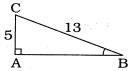
$\Delta ABC$ માં, $AC = 5$, $BC = 13$, $m \angle A = 90^\circ$ હોય, તો $\tan B = \ldots$
A
$\frac{5}{13}$
B
$\frac{5}{12}$
C
$\frac{12}{13}$
D
$\frac{12}{5}$
Solution
(B) $\Delta ABC$ માં, $AC = 5$ અને કર્ણ $BC = 13$ છે, જ્યાં $m \angle A = 90^\circ$ છે。
પાયથાગોરસના પ્રમેય મુજબ:
$AB^2 = BC^2 - AC^2$
$AB^2 = 13^2 - 5^2 = 169 - 25 = 144$
$AB = \sqrt{144} = 12$
હવે, $\tan B = \frac{\text{$\angle B$ ની સામેની બાજુ}}{\text{$\angle B$ ની પાસેની બાજુ}} = \frac{AC}{AB} = \frac{5}{12}$.
પાયથાગોરસના પ્રમેય મુજબ:
$AB^2 = BC^2 - AC^2$
$AB^2 = 13^2 - 5^2 = 169 - 25 = 144$
$AB = \sqrt{144} = 12$
હવે, $\tan B = \frac{\text{$\angle B$ ની સામેની બાજુ}}{\text{$\angle B$ ની પાસેની બાજુ}} = \frac{AC}{AB} = \frac{5}{12}$.
0 likes
View Solution49
EasyMCQ
$\Delta ABC$ માં,$m \angle C = 90^{\circ}$ અને $\tan A = \frac{1}{\sqrt{3}}$ હોય,તો $\sin A = \ldots$
A
$\frac{\sqrt{3}}{2}$
B
$\frac{1}{\sqrt{2}}$
C
$\frac{1}{2}$
D
$\sqrt{3}$
Solution
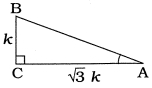
(C) આપેલ છે: $\tan A = \frac{1}{\sqrt{3}}$.
કાટકોણ ત્રિકોણમાં,$\tan A = \frac{\text{સામેની બાજુ}}{\text{પાસેની બાજુ}} = \frac{BC}{AC}$.
તેથી,$\frac{BC}{AC} = \frac{1}{\sqrt{3}}$.
ધારો કે $BC = k$ અને $AC = \sqrt{3}k$,જ્યાં $k > 0$.
પાયથાગોરસના પ્રમેય મુજબ: $AB^2 = BC^2 + AC^2$.
$AB^2 = k^2 + (\sqrt{3}k)^2 = k^2 + 3k^2 = 4k^2$.
તેથી,$AB = 2k$.
હવે,$\sin A = \frac{\text{સામેની બાજુ}}{\text{કર્ણ}} = \frac{BC}{AB} = \frac{k}{2k} = \frac{1}{2}$.
વૈકલ્પિક રીતે,કારણ કે $\tan A = \frac{1}{\sqrt{3}}$,આપણે જાણીએ છીએ કે $A = 30^{\circ}$.
તેથી,$\sin A = \sin 30^{\circ} = \frac{1}{2}$.
કાટકોણ ત્રિકોણમાં,$\tan A = \frac{\text{સામેની બાજુ}}{\text{પાસેની બાજુ}} = \frac{BC}{AC}$.
તેથી,$\frac{BC}{AC} = \frac{1}{\sqrt{3}}$.
ધારો કે $BC = k$ અને $AC = \sqrt{3}k$,જ્યાં $k > 0$.
પાયથાગોરસના પ્રમેય મુજબ: $AB^2 = BC^2 + AC^2$.
$AB^2 = k^2 + (\sqrt{3}k)^2 = k^2 + 3k^2 = 4k^2$.
તેથી,$AB = 2k$.
હવે,$\sin A = \frac{\text{સામેની બાજુ}}{\text{કર્ણ}} = \frac{BC}{AB} = \frac{k}{2k} = \frac{1}{2}$.
વૈકલ્પિક રીતે,કારણ કે $\tan A = \frac{1}{\sqrt{3}}$,આપણે જાણીએ છીએ કે $A = 30^{\circ}$.
તેથી,$\sin A = \sin 30^{\circ} = \frac{1}{2}$.
0 likes
View Solution50
EasyMCQ
$\Delta ABC$ માં,$m \angle C = 90^{\circ}$ અને $\cos B = \frac{1}{2}$ હોય,તો $\operatorname{cosec} A = \ldots$
A
$\frac{1}{2}$
B
$\sqrt{3}$
C
$\frac{2}{\sqrt{3}}$
D
$2$
Solution
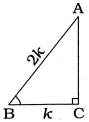
(D) આપેલ છે કે $\Delta ABC$ માં,$m \angle C = 90^{\circ}$ અને $\cos B = \frac{1}{2}$.
આપણે જાણીએ છીએ કે $\cos B = \frac{\angle B \text{ ની પાસેની બાજુ}}{\text{કર્ણ}} = \frac{BC}{AB}$.
તેથી,$\frac{BC}{AB} = \frac{1}{2}$. ધારો કે $BC = k$ અને $AB = 2k$,જ્યાં $k > 0$.
પાયથાગોરસના પ્રમેય મુજબ,$AC^2 + BC^2 = AB^2$.
$AC^2 + k^2 = (2k)^2 = 4k^2$.
$AC^2 = 3k^2 \implies AC = k\sqrt{3}$.
હવે,$\operatorname{cosec} A = \frac{\text{કર્ણ}}{\angle A \text{ ની સામેની બાજુ}} = \frac{AB}{BC}$.
$\operatorname{cosec} A = \frac{2k}{k} = 2$.
આપણે જાણીએ છીએ કે $\cos B = \frac{\angle B \text{ ની પાસેની બાજુ}}{\text{કર્ણ}} = \frac{BC}{AB}$.
તેથી,$\frac{BC}{AB} = \frac{1}{2}$. ધારો કે $BC = k$ અને $AB = 2k$,જ્યાં $k > 0$.
પાયથાગોરસના પ્રમેય મુજબ,$AC^2 + BC^2 = AB^2$.
$AC^2 + k^2 = (2k)^2 = 4k^2$.
$AC^2 = 3k^2 \implies AC = k\sqrt{3}$.
હવે,$\operatorname{cosec} A = \frac{\text{કર્ણ}}{\angle A \text{ ની સામેની બાજુ}} = \frac{AB}{BC}$.
$\operatorname{cosec} A = \frac{2k}{k} = 2$.
0 likes
View SolutionIntroduction to Trigonometry — Mix Examples - Introduction to Trigonometry · Frequently Asked Questions
1Are these Introduction to Trigonometry questions useful for JEE and NEET?
Yes. All questions in this section are mapped to JEE Main and NEET exam patterns. Previous year questions from JEE Main, NEET, GUJCET and state-level exams are included with full solutions.
2Can I switch to Hindi or Gujarati for these questions?
Yes. Use the language tabs in the hero section or the sidebar to view the same questions and solutions in English, Hindi or Gujarati.
3How do I generate a question paper from this subtopic?
Use the Vedclass Exam Paper Generator — select the chapter and subtopic, set difficulty, and generate Sets A, B, C, D automatically. First 3 chapters of every subject are free.
Vedclass Products
For Students
Vedclass Test Series
Mock tests in real JEE/NEET style with performance analysis. 5-day free trial.
Start Free TrialFor Teachers
Exam Paper Generator
Generate Set A/B/C/D papers from this chapter in 2 minutes. 3 chapters free.
Try FreeFor Institutes
Online Exam Module
Live online exams with unlimited students, 360° analytics & white-label branding.
See DemoFor Teachers & Institutes
Generate a Introduction to Trigonometry Exam Paper in 2 Minutes
Select subtopic & difficulty — Sets A, B, C, D auto-generated with No Repeat logic.
First 3 chapters of every subject are free — no payment required.