
MathematicsQ1–75 of 75 questions
Page 1 of 1 · English
1
MathematicsDifficultMCQWBJEE · 2021
$A$ ray of light along $x + \sqrt{3}y = \sqrt{3}$ gets reflected upon reaching the $x$-axis. The equation of the reflected ray is:
A
$\;y = x + \sqrt{3}$
B
$\;\sqrt{3}y = x - \sqrt{3}$
C
$\;y = \sqrt{3}x - \sqrt{3}$
D
$\;\sqrt{3}y = x - 1$
Solution
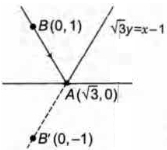
(B) The equation of the incident ray is $x + \sqrt{3}y = \sqrt{3}$.
Find the point of incidence $A$ on the $x$-axis (where $y=0$): $x + \sqrt{3}(0) = \sqrt{3} \Rightarrow x = \sqrt{3}$. So,$A = (\sqrt{3}, 0)$.
Take a point $B$ on the incident ray,e.g.,$x=0$ $\Rightarrow \sqrt{3}y = \sqrt{3}$ $\Rightarrow y=1$. So,$B = (0, 1)$.
The reflected ray passes through $A(\sqrt{3}, 0)$ and the image of $B(0, 1)$ with respect to the $x$-axis,which is $B'(0, -1)$.
The slope of the reflected ray $AB'$ is $m = \frac{-1 - 0}{0 - \sqrt{3}} = \frac{-1}{-\sqrt{3}} = \frac{1}{\sqrt{3}}$.
The equation of the reflected ray is $y - 0 = \frac{1}{\sqrt{3}}(x - \sqrt{3})$.
$\sqrt{3}y = x - \sqrt{3}$.
Find the point of incidence $A$ on the $x$-axis (where $y=0$): $x + \sqrt{3}(0) = \sqrt{3} \Rightarrow x = \sqrt{3}$. So,$A = (\sqrt{3}, 0)$.
Take a point $B$ on the incident ray,e.g.,$x=0$ $\Rightarrow \sqrt{3}y = \sqrt{3}$ $\Rightarrow y=1$. So,$B = (0, 1)$.
The reflected ray passes through $A(\sqrt{3}, 0)$ and the image of $B(0, 1)$ with respect to the $x$-axis,which is $B'(0, -1)$.
The slope of the reflected ray $AB'$ is $m = \frac{-1 - 0}{0 - \sqrt{3}} = \frac{-1}{-\sqrt{3}} = \frac{1}{\sqrt{3}}$.
The equation of the reflected ray is $y - 0 = \frac{1}{\sqrt{3}}(x - \sqrt{3})$.
$\sqrt{3}y = x - \sqrt{3}$.
0 likesView Solution
2
MathematicsDifficultMCQWBJEE · 2021
Let $\alpha, \beta$ be the roots of the equation $x^{2}-6x-2=0$ with $\alpha>\beta$. If $a_{n}=\alpha^{n}-\beta^{n}$ for $n \geq 1$,then the value of $\frac{a_{10}-2a_{8}}{2a_{9}}$ is
A
$1$
B
$2$
C
$3$
D
$4$
Solution
(C) Given the quadratic equation $x^{2}-6x-2=0$.
Since $\alpha$ and $\beta$ are roots,they satisfy the equation:
$x^{n}-6x^{n-1}-2x^{n-2}=0$
$\Rightarrow x^{n}-2x^{n-2}=6x^{n-1}$
For $x = \alpha$ and $x = \beta$,we have:
$\alpha^{n}-2\alpha^{n-2}=6\alpha^{n-1}$
$\beta^{n}-2\beta^{n-2}=6\beta^{n-1}$
Subtracting the two equations:
$(\alpha^{n}-\beta^{n})-2(\alpha^{n-2}-\beta^{n-2})=6(\alpha^{n-1}-\beta^{n-1})$
Using the definition $a_{n}=\alpha^{n}-\beta^{n}$,we get:
$a_{n}-2a_{n-2}=6a_{n-1}$
For $n=10$:
$a_{10}-2a_{8}=6a_{9}$
Therefore,the value of $\frac{a_{10}-2a_{8}}{2a_{9}} = \frac{6a_{9}}{2a_{9}} = 3$.
Since $\alpha$ and $\beta$ are roots,they satisfy the equation:
$x^{n}-6x^{n-1}-2x^{n-2}=0$
$\Rightarrow x^{n}-2x^{n-2}=6x^{n-1}$
For $x = \alpha$ and $x = \beta$,we have:
$\alpha^{n}-2\alpha^{n-2}=6\alpha^{n-1}$
$\beta^{n}-2\beta^{n-2}=6\beta^{n-1}$
Subtracting the two equations:
$(\alpha^{n}-\beta^{n})-2(\alpha^{n-2}-\beta^{n-2})=6(\alpha^{n-1}-\beta^{n-1})$
Using the definition $a_{n}=\alpha^{n}-\beta^{n}$,we get:
$a_{n}-2a_{n-2}=6a_{n-1}$
For $n=10$:
$a_{10}-2a_{8}=6a_{9}$
Therefore,the value of $\frac{a_{10}-2a_{8}}{2a_{9}} = \frac{6a_{9}}{2a_{9}} = 3$.
0 likesView Solution
3
MathematicsMediumMCQWBJEE · 2021
The equation $6^{x}+8^{x}=10^{x}$ has
A
no real root
B
infinitely many rational roots
C
exactly one real root
D
two distinct real roots
Solution
(C) Given equation: $6^{x}+8^{x}=10^{x}$
Divide both sides by $10^{x}$:
$\left(\frac{6}{10}\right)^{x}+\left(\frac{8}{10}\right)^{x}=1$
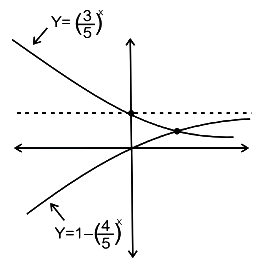
$\left(\frac{3}{5}\right)^{x}+\left(\frac{4}{5}\right)^{x}=1$
Let $f(x) = \left(\frac{3}{5}\right)^{x}+\left(\frac{4}{5}\right)^{x}$.
Since $\frac{3}{5} < 1$ and $\frac{4}{5} < 1$,both functions $\left(\frac{3}{5}\right)^{x}$ and $\left(\frac{4}{5}\right)^{x}$ are strictly decreasing functions.
Therefore,their sum $f(x)$ is also a strictly decreasing function.
$A$ strictly decreasing function can take the value $1$ at most once.
By observation,for $x=2$,$\left(\frac{3}{5}\right)^{2}+\left(\frac{4}{5}\right)^{2} = \frac{9}{25}+\frac{16}{25} = \frac{25}{25} = 1$.
Thus,$x=2$ is the unique solution.
Hence,the equation has exactly one real root.
Divide both sides by $10^{x}$:
$\left(\frac{6}{10}\right)^{x}+\left(\frac{8}{10}\right)^{x}=1$
$\left(\frac{3}{5}\right)^{x}+\left(\frac{4}{5}\right)^{x}=1$
Let $f(x) = \left(\frac{3}{5}\right)^{x}+\left(\frac{4}{5}\right)^{x}$.
Since $\frac{3}{5} < 1$ and $\frac{4}{5} < 1$,both functions $\left(\frac{3}{5}\right)^{x}$ and $\left(\frac{4}{5}\right)^{x}$ are strictly decreasing functions.
Therefore,their sum $f(x)$ is also a strictly decreasing function.
$A$ strictly decreasing function can take the value $1$ at most once.
By observation,for $x=2$,$\left(\frac{3}{5}\right)^{2}+\left(\frac{4}{5}\right)^{2} = \frac{9}{25}+\frac{16}{25} = \frac{25}{25} = 1$.
Thus,$x=2$ is the unique solution.
Hence,the equation has exactly one real root.
0 likesView Solution
4
MathematicsEasyMCQWBJEE · 2021
Let $C$ denote the set of all complex numbers. Define $A = \{(z, w) \mid z, w \in C \text{ and } |z| = |w|\}$ and $B = \{(z, w) \mid z, w \in C \text{ and } z^2 = w^2\}$. Then:
A
$A = B$
B
$A \subset B$
C
$B \subset A$
D
$A \cap B = \phi$
Solution
(C) Given $A = \{(z, w) \mid |z| = |w|\}$ and $B = \{(z, w) \mid z^2 = w^2\}$.
For any $(z, w) \in B$,we have $z^2 = w^2$,which implies $z^2 - w^2 = 0$,so $(z - w)(z + w) = 0$.
This means $z = w$ or $z = -w$.
If $z = w$,then $|z| = |w|$,so $(z, w) \in A$.
If $z = -w$,then $|z| = |-w| = |w|$,so $(z, w) \in A$.
Thus,every element of $B$ is also an element of $A$,which means $B \subseteq A$.
However,consider $(z, w) = (1, i)$. Here $|z| = |1| = 1$ and $|w| = |i| = 1$,so $|z| = |w|$,meaning $(1, i) \in A$.
But $z^2 = 1^2 = 1$ and $w^2 = i^2 = -1$,so $z^2 \neq w^2$,meaning $(1, i) \notin B$.
Since $A$ contains elements not in $B$,$B \subset A$ is the correct relation.
For any $(z, w) \in B$,we have $z^2 = w^2$,which implies $z^2 - w^2 = 0$,so $(z - w)(z + w) = 0$.
This means $z = w$ or $z = -w$.
If $z = w$,then $|z| = |w|$,so $(z, w) \in A$.
If $z = -w$,then $|z| = |-w| = |w|$,so $(z, w) \in A$.
Thus,every element of $B$ is also an element of $A$,which means $B \subseteq A$.
However,consider $(z, w) = (1, i)$. Here $|z| = |1| = 1$ and $|w| = |i| = 1$,so $|z| = |w|$,meaning $(1, i) \in A$.
But $z^2 = 1^2 = 1$ and $w^2 = i^2 = -1$,so $z^2 \neq w^2$,meaning $(1, i) \notin B$.
Since $A$ contains elements not in $B$,$B \subset A$ is the correct relation.
0 likesView Solution
5
MathematicsMediumMCQWBJEE · 2021
If $|z|=1$ and $z \neq \pm 1$,then all the points representing $\frac{z}{1-z^{2}}$ lie on;
A
a line not passing through the origin
B
the line $y=x$
C
the $x$-axis
D
the $y$-axis
Solution
(D) Let $z = e^{i \theta}$,where $\theta \in \mathbb{R}$ and $\theta \neq n\pi$ for $n \in \mathbb{Z}$ (since $z \neq \pm 1$).
Let $w = \frac{z}{1-z^2}$.
Substituting $z = e^{i \theta}$,we get:
$w = \frac{e^{i \theta}}{1 - e^{i 2 \theta}}$
Divide numerator and denominator by $e^{i \theta}$:
$w = \frac{1}{e^{-i \theta} - e^{i \theta}}$
Using the identity $e^{i \theta} = \cos \theta + i \sin \theta$,we have $e^{-i \theta} - e^{i \theta} = -2i \sin \theta$.
Thus,$w = \frac{1}{-2i \sin \theta} = \frac{i}{2 \sin \theta}$.
Since $w$ is of the form $0 + i \left( \frac{1}{2 \sin \theta} \right)$,the real part is $0$.
Therefore,the locus of $w$ is the $y$-axis.
Let $w = \frac{z}{1-z^2}$.
Substituting $z = e^{i \theta}$,we get:
$w = \frac{e^{i \theta}}{1 - e^{i 2 \theta}}$
Divide numerator and denominator by $e^{i \theta}$:
$w = \frac{1}{e^{-i \theta} - e^{i \theta}}$
Using the identity $e^{i \theta} = \cos \theta + i \sin \theta$,we have $e^{-i \theta} - e^{i \theta} = -2i \sin \theta$.
Thus,$w = \frac{1}{-2i \sin \theta} = \frac{i}{2 \sin \theta}$.
Since $w$ is of the form $0 + i \left( \frac{1}{2 \sin \theta} \right)$,the real part is $0$.
Therefore,the locus of $w$ is the $y$-axis.
0 likesView Solution
6
MathematicsDifficultMCQWBJEE · 2021
If $|z+i|-|z-1|=|z|-2=0$ for a complex number $z$,then $z=$
A
$\sqrt{2}(1+i)$
B
$\sqrt{2}(1-i)$
C
$\sqrt{2}(-1+i)$
D
$\sqrt{2}(-1-i)$
Solution
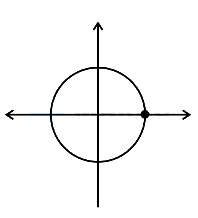
(B) Given $|z|-2=0 \implies |z|=2$. This represents a circle centered at the origin with radius $2$,so $x^2+y^2=4$.
Also,$|z+i|-|z-1|=0 \implies |z+i|=|z-1|$.
Let $z=x+iy$. Then $|x+i(y+1)|=|x-1+iy|$.
Squaring both sides: $x^2+(y+1)^2=(x-1)^2+y^2$.
$x^2+y^2+2y+1=x^2-2x+1+y^2$.
$2y=-2x \implies y=-x$.
Substituting $y=-x$ into $x^2+y^2=4$:
$x^2+(-x)^2=4 \implies 2x^2=4 \implies x^2=2 \implies x=\pm\sqrt{2}$.
If $x=\sqrt{2}$,then $y=-\sqrt{2}$,so $z=\sqrt{2}-i\sqrt{2}=\sqrt{2}(1-i)$.
If $x=-\sqrt{2}$,then $y=\sqrt{2}$,so $z=-\sqrt{2}+i\sqrt{2}=\sqrt{2}(-1+i)$.
Thus,the possible values for $z$ are $\sqrt{2}(1-i)$ and $\sqrt{2}(-1+i)$.
Also,$|z+i|-|z-1|=0 \implies |z+i|=|z-1|$.
Let $z=x+iy$. Then $|x+i(y+1)|=|x-1+iy|$.
Squaring both sides: $x^2+(y+1)^2=(x-1)^2+y^2$.
$x^2+y^2+2y+1=x^2-2x+1+y^2$.
$2y=-2x \implies y=-x$.
Substituting $y=-x$ into $x^2+y^2=4$:
$x^2+(-x)^2=4 \implies 2x^2=4 \implies x^2=2 \implies x=\pm\sqrt{2}$.
If $x=\sqrt{2}$,then $y=-\sqrt{2}$,so $z=\sqrt{2}-i\sqrt{2}=\sqrt{2}(1-i)$.
If $x=-\sqrt{2}$,then $y=\sqrt{2}$,so $z=-\sqrt{2}+i\sqrt{2}=\sqrt{2}(-1+i)$.
Thus,the possible values for $z$ are $\sqrt{2}(1-i)$ and $\sqrt{2}(-1+i)$.
0 likesView Solution
7
MathematicsEasyMCQWBJEE · 2021
The digit in the unit's place of the number $1! + 2! + 3! + \ldots + 99!$ is
A
$3$
B
$0$
C
$1$
D
$7$
Solution
(A) We need to find the unit digit of the sum $S = 1! + 2! + 3! + 4! + 5! + \ldots + 99!$.
First,calculate the factorials:
$1! = 1$
$2! = 2 \times 1 = 2$
$3! = 3 \times 2 \times 1 = 6$
$4! = 4 \times 3 \times 2 \times 1 = 24$
$5! = 5 \times 4 \times 3 \times 2 \times 1 = 120$
For any $n \ge 5$,$n!$ contains the factors $5$ and $2$,so $n!$ ends in $0$.
Thus,for all $n \ge 5$,the unit digit of $n!$ is $0$.
The sum is $S = 1! + 2! + 3! + 4! + (5! + 6! + \ldots + 99!)$.
The unit digit of $S$ is the unit digit of $(1! + 2! + 3! + 4!) + (0 + 0 + \ldots + 0)$.
$1! + 2! + 3! + 4! = 1 + 2 + 6 + 24 = 33$.
The unit digit of $33$ is $3$.
First,calculate the factorials:
$1! = 1$
$2! = 2 \times 1 = 2$
$3! = 3 \times 2 \times 1 = 6$
$4! = 4 \times 3 \times 2 \times 1 = 24$
$5! = 5 \times 4 \times 3 \times 2 \times 1 = 120$
For any $n \ge 5$,$n!$ contains the factors $5$ and $2$,so $n!$ ends in $0$.
Thus,for all $n \ge 5$,the unit digit of $n!$ is $0$.
The sum is $S = 1! + 2! + 3! + 4! + (5! + 6! + \ldots + 99!)$.
The unit digit of $S$ is the unit digit of $(1! + 2! + 3! + 4!) + (0 + 0 + \ldots + 0)$.
$1! + 2! + 3! + 4! = 1 + 2 + 6 + 24 = 33$.
The unit digit of $33$ is $3$.
0 likesView Solution
8
MathematicsMediumMCQWBJEE · 2021
Five-letter words,having distinct letters,are to be constructed using the letters of the word '$EQUATION$' so that each word contains exactly three vowels and two consonants. How many of them have all the vowels together?
A
$3600$
B
$1800$
C
$1080$
D
$900$
Solution
(C) The word '$EQUATION$' has $8$ distinct letters: $5$ vowels $(E, U, A, I, O)$ and $3$ consonants $(Q, T, N)$.
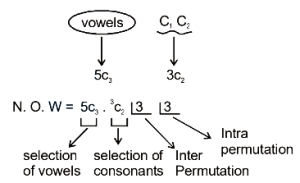
We need to select $3$ vowels out of $5$ and $2$ consonants out of $3$.
Number of ways to select the letters = $^5C_3 \times ^3C_2 = 10 \times 3 = 30$.
Since all $3$ vowels must be together,we treat the $3$ vowels as a single block. Now we have $1$ block of vowels and $2$ consonants,totaling $3$ units to arrange.
Number of ways to arrange these $3$ units = $3! = 6$.
Within the vowel block,the $3$ vowels can be arranged in $3! = 6$ ways.
Total number of words = $30 \times 6 \times 6 = 1080$.
We need to select $3$ vowels out of $5$ and $2$ consonants out of $3$.
Number of ways to select the letters = $^5C_3 \times ^3C_2 = 10 \times 3 = 30$.
Since all $3$ vowels must be together,we treat the $3$ vowels as a single block. Now we have $1$ block of vowels and $2$ consonants,totaling $3$ units to arrange.
Number of ways to arrange these $3$ units = $3! = 6$.
Within the vowel block,the $3$ vowels can be arranged in $3! = 6$ ways.
Total number of words = $30 \times 6 \times 6 = 1080$.
0 likesView Solution
9
MathematicsMediumMCQWBJEE · 2021
What is the number of ways in which an examiner can assign $10$ marks to $4$ questions,giving not less than $2$ marks to any question?
A
$4$
B
$6$
C
$10$
D
$16$
Solution
(C) Let $x_{1}, x_{2}, x_{3}, x_{4}$ be the marks assigned to the $4$ questions respectively.
We are given the equation: $x_{1} + x_{2} + x_{3} + x_{4} = 10$,where $x_{i} \geq 2$ for all $i \in \{1, 2, 3, 4\}$.
Let $y_{i} = x_{i} - 2$. Since $x_{i} \geq 2$,we have $y_{i} \geq 0$.
Substituting $x_{i} = y_{i} + 2$ into the equation:
$(y_{1} + 2) + (y_{2} + 2) + (y_{3} + 2) + (y_{4} + 2) = 10$
$y_{1} + y_{2} + y_{3} + y_{4} + 8 = 10$
$y_{1} + y_{2} + y_{3} + y_{4} = 2$.
The number of non-negative integer solutions is given by the formula $\binom{n+r-1}{r-1}$,where $n = 2$ and $r = 4$.
Number of ways $= \binom{2+4-1}{4-1} = \binom{5}{3} = \frac{5 \times 4 \times 3}{3 \times 2 \times 1} = 10$.
We are given the equation: $x_{1} + x_{2} + x_{3} + x_{4} = 10$,where $x_{i} \geq 2$ for all $i \in \{1, 2, 3, 4\}$.
Let $y_{i} = x_{i} - 2$. Since $x_{i} \geq 2$,we have $y_{i} \geq 0$.
Substituting $x_{i} = y_{i} + 2$ into the equation:
$(y_{1} + 2) + (y_{2} + 2) + (y_{3} + 2) + (y_{4} + 2) = 10$
$y_{1} + y_{2} + y_{3} + y_{4} + 8 = 10$
$y_{1} + y_{2} + y_{3} + y_{4} = 2$.
The number of non-negative integer solutions is given by the formula $\binom{n+r-1}{r-1}$,where $n = 2$ and $r = 4$.
Number of ways $= \binom{2+4-1}{4-1} = \binom{5}{3} = \frac{5 \times 4 \times 3}{3 \times 2 \times 1} = 10$.
0 likesView Solution
10
MathematicsMediumMCQWBJEE · 2021
Consider the real-valued function $h: \{0, 1, 2, \ldots, 100\} \rightarrow \mathbb{R}$ such that $h(0) = 5$,$h(100) = 20$,and satisfying $h(p) = \frac{1}{2}\{h(p+1) + h(p-1)\}$ for every $p = 1, 2, \ldots, 99$. Then the value of $h(1)$ is:
A
$5.15$
B
$5.5$
C
$6$
D
$6.15$
Solution
(A) Given the recurrence relation $h(p) = \frac{1}{2}\{h(p+1) + h(p-1)\}$,we can rewrite it as $2h(p) = h(p+1) + h(p-1)$,which implies $h(p+1) - h(p) = h(p) - h(p-1)$.
This indicates that the sequence $h(0), h(1), \ldots, h(100)$ forms an Arithmetic Progression ($A$.$P$.).
Let the common difference be $d$. Then $h(n) = h(0) + nd$.
Using $h(100) = 20$ and $h(0) = 5$,we have $20 = 5 + 100d$.
$100d = 15 \Rightarrow d = \frac{15}{100} = 0.15$.
Thus,$h(1) = h(0) + d = 5 + 0.15 = 5.15$.
This indicates that the sequence $h(0), h(1), \ldots, h(100)$ forms an Arithmetic Progression ($A$.$P$.).
Let the common difference be $d$. Then $h(n) = h(0) + nd$.
Using $h(100) = 20$ and $h(0) = 5$,we have $20 = 5 + 100d$.
$100d = 15 \Rightarrow d = \frac{15}{100} = 0.15$.
Thus,$h(1) = h(0) + d = 5 + 0.15 = 5.15$.
0 likesView Solution
11
MathematicsMediumMCQWBJEE · 2021
Three unequal positive numbers $a, b, c$ are such that $a, b, c$ are in $G.P.$ while $\log \left(\frac{5 c}{2 a}\right), \log \left(\frac{7 b}{5 c}\right), \log \left(\frac{2 a}{7 b}\right)$ are in $A.P.$ Then $a, b, c$ are the lengths of the sides of
A
an isosceles triangle
B
an equilateral triangle
C
a scalene triangle
D
a right-angled triangle
Solution
(C) Since $\log \left(\frac{5 c}{2 a}\right), \log \left(\frac{7 b}{5 c}\right), \log \left(\frac{2 a}{7 b}\right)$ are in $A.P.$,we have: $\log \left(\frac{5 c}{2 a}\right) + \log \left(\frac{2 a}{7 b}\right) = 2 \log \left(\frac{7 b}{5 c}\right)$
$\log \left(\frac{5 c}{2 a} \times \frac{2 a}{7 b}\right) = \log \left(\frac{7 b}{5 c}\right)^2$
$\log \left(\frac{5 c}{7 b}\right) = \log \left(\frac{49 b^2}{25 c^2}\right)$
$\frac{5 c}{7 b} = \frac{49 b^2}{25 c^2}$ $\Rightarrow 125 c^3 = 343 b^3$ $\Rightarrow 5 c = 7 b$ $\Rightarrow c = \frac{7}{5} b$
Since $a, b, c$ are in $G.P.$,$b^2 = ac$. Substituting $c = \frac{7}{5} b$,we get $b^2 = a \left(\frac{7}{5} b\right) \Rightarrow a = \frac{5}{7} b$.
The sides are $\frac{5}{7} b, b, \frac{7}{5} b$.
Let $b = 35k$. Then the sides are $25k, 35k, 49k$.
Since $25k + 35k = 60k > 49k$,$25k + 49k = 74k > 35k$,and $35k + 49k = 84k > 25k$,these sides form a triangle.
Since all sides are unequal,it is a scalene triangle.
$\log \left(\frac{5 c}{2 a} \times \frac{2 a}{7 b}\right) = \log \left(\frac{7 b}{5 c}\right)^2$
$\log \left(\frac{5 c}{7 b}\right) = \log \left(\frac{49 b^2}{25 c^2}\right)$
$\frac{5 c}{7 b} = \frac{49 b^2}{25 c^2}$ $\Rightarrow 125 c^3 = 343 b^3$ $\Rightarrow 5 c = 7 b$ $\Rightarrow c = \frac{7}{5} b$
Since $a, b, c$ are in $G.P.$,$b^2 = ac$. Substituting $c = \frac{7}{5} b$,we get $b^2 = a \left(\frac{7}{5} b\right) \Rightarrow a = \frac{5}{7} b$.
The sides are $\frac{5}{7} b, b, \frac{7}{5} b$.
Let $b = 35k$. Then the sides are $25k, 35k, 49k$.
Since $25k + 35k = 60k > 49k$,$25k + 49k = 74k > 35k$,and $35k + 49k = 84k > 25k$,these sides form a triangle.
Since all sides are unequal,it is a scalene triangle.
0 likesView Solution
12
MathematicsEasyMCQWBJEE · 2021
Let $a, b, c$ be real numbers,each greater than $1$,such that $\frac{2}{3} \log _{b} a+\frac{3}{5} \log _{c} b+\frac{5}{2} \log _{a} c=3$. If the value of $b$ is $9$,then the value of $a$ must be
A
$\sqrt[3]{81}$
B
$\frac{27}{2}$
C
$18$
D
$27$
Solution
(D) Given the equation: $\frac{2}{3} \log _{b} a+\frac{3}{5} \log _{c} b+\frac{5}{2} \log _{a} c=3$.
Let $x = \frac{2}{3} \log _{b} a$,$y = \frac{3}{5} \log _{c} b$,and $z = \frac{5}{2} \log _{a} c$.
Note that $x \cdot y \cdot z = (\frac{2}{3} \log _{b} a) \cdot (\frac{3}{5} \log _{c} b) \cdot (\frac{5}{2} \log _{a} c) = (\frac{2}{3} \cdot \frac{3}{5} \cdot \frac{5}{2}) \cdot (\log _{b} a \cdot \log _{c} b \cdot \log _{a} c) = 1 \cdot 1 = 1$.
By the Arithmetic Mean-Geometric Mean inequality $(AM \ge GM)$,for positive real numbers $x, y, z$ with $x+y+z=3$ and $xyz=1$,the equality holds only when $x=y=z=1$.
Thus,$\frac{2}{3} \log _{b} a = 1 \Rightarrow \log _{b} a = \frac{3}{2}$.
Given $b=9$,we have $\log _{9} a = \frac{3}{2}$.
Therefore,$a = 9^{3/2} = (3^2)^{3/2} = 3^3 = 27$.
Let $x = \frac{2}{3} \log _{b} a$,$y = \frac{3}{5} \log _{c} b$,and $z = \frac{5}{2} \log _{a} c$.
Note that $x \cdot y \cdot z = (\frac{2}{3} \log _{b} a) \cdot (\frac{3}{5} \log _{c} b) \cdot (\frac{5}{2} \log _{a} c) = (\frac{2}{3} \cdot \frac{3}{5} \cdot \frac{5}{2}) \cdot (\log _{b} a \cdot \log _{c} b \cdot \log _{a} c) = 1 \cdot 1 = 1$.
By the Arithmetic Mean-Geometric Mean inequality $(AM \ge GM)$,for positive real numbers $x, y, z$ with $x+y+z=3$ and $xyz=1$,the equality holds only when $x=y=z=1$.
Thus,$\frac{2}{3} \log _{b} a = 1 \Rightarrow \log _{b} a = \frac{3}{2}$.
Given $b=9$,we have $\log _{9} a = \frac{3}{2}$.
Therefore,$a = 9^{3/2} = (3^2)^{3/2} = 3^3 = 27$.
0 likesView Solution
13
MathematicsMediumMCQWBJEE · 2021
For $x \in R, x \neq -1$,if $(1+x)^{2016} + x(1+x)^{2015} + x^2(1+x)^{2014} + \dots + x^{2016} = \sum_{i=0}^{2016} a_i \cdot x^i$,then $a_{17}$ is equal to
A
$\frac{2016!}{17! 1999!}$
B
$\frac{2016!}{16!}$
C
$\frac{2017!}{2000!}$
D
$\frac{2017!}{17! 2000!}$
Solution
(D) The given expression is a geometric series with first term $A = (1+x)^{2016}$,common ratio $r = \frac{x}{1+x}$,and $n = 2017$ terms.
Sum $S = A \frac{1-r^n}{1-r} = (1+x)^{2016} \frac{1 - (\frac{x}{1+x})^{2017}}{1 - \frac{x}{1+x}} = (1+x)^{2016} \frac{\frac{(1+x)^{2017} - x^{2017}}{(1+x)^{2017}}}{\frac{1+x-x}{1+x}} = (1+x)^{2016} \frac{(1+x)^{2017} - x^{2017}}{(1+x)^{2017}} \cdot (1+x) = (1+x)^{2017} - x^{2017}$.
We are given $\sum_{i=0}^{2016} a_i x^i = (1+x)^{2017} - x^{2017}$.
Expanding $(1+x)^{2017}$ using the binomial theorem: $(1+x)^{2017} = \sum_{i=0}^{2017} {}^{2017}C_i x^i$.
Thus,$\sum_{i=0}^{2016} a_i x^i = \left( \sum_{i=0}^{2017} {}^{2017}C_i x^i \right) - x^{2017} = \sum_{i=0}^{2016} {}^{2017}C_i x^i$.
Comparing the coefficients of $x^{17}$,we get $a_{17} = {}^{2017}C_{17} = \frac{2017!}{17! (2017-17)!} = \frac{2017!}{17! 2000!}$.
Sum $S = A \frac{1-r^n}{1-r} = (1+x)^{2016} \frac{1 - (\frac{x}{1+x})^{2017}}{1 - \frac{x}{1+x}} = (1+x)^{2016} \frac{\frac{(1+x)^{2017} - x^{2017}}{(1+x)^{2017}}}{\frac{1+x-x}{1+x}} = (1+x)^{2016} \frac{(1+x)^{2017} - x^{2017}}{(1+x)^{2017}} \cdot (1+x) = (1+x)^{2017} - x^{2017}$.
We are given $\sum_{i=0}^{2016} a_i x^i = (1+x)^{2017} - x^{2017}$.
Expanding $(1+x)^{2017}$ using the binomial theorem: $(1+x)^{2017} = \sum_{i=0}^{2017} {}^{2017}C_i x^i$.
Thus,$\sum_{i=0}^{2016} a_i x^i = \left( \sum_{i=0}^{2017} {}^{2017}C_i x^i \right) - x^{2017} = \sum_{i=0}^{2016} {}^{2017}C_i x^i$.
Comparing the coefficients of $x^{17}$,we get $a_{17} = {}^{2017}C_{17} = \frac{2017!}{17! (2017-17)!} = \frac{2017!}{17! 2000!}$.
0 likesView Solution
14
MathematicsEasyMCQWBJEE · 2021
The remainder when $7^{7^{7^{...7}}}$ ($22$ times $7$) is divided by $48$ is
A
$21$
B
$7$
C
$47$
D
$1$
Solution
(B) Let $x = 7^{7^{...7}}$ ($22$ times $7$). We want to find $x \pmod{48}$.
Note that $7^2 = 49 \equiv 1 \pmod{48}$.
Since the exponent of $7$ is $7^{7^{...7}}$ ($21$ times $7$),which is clearly an odd number,let the exponent be $2k+1$ for some integer $k$.
Then $7^{2k+1} = 7 \times (7^2)^k = 7 \times (49)^k$.
Since $49 \equiv 1 \pmod{48}$,we have $49^k \equiv 1^k \equiv 1 \pmod{48}$.
Therefore,$7 \times (49)^k \equiv 7 \times 1 \equiv 7 \pmod{48}$.
The remainder is $7$.
Note that $7^2 = 49 \equiv 1 \pmod{48}$.
Since the exponent of $7$ is $7^{7^{...7}}$ ($21$ times $7$),which is clearly an odd number,let the exponent be $2k+1$ for some integer $k$.
Then $7^{2k+1} = 7 \times (7^2)^k = 7 \times (49)^k$.
Since $49 \equiv 1 \pmod{48}$,we have $49^k \equiv 1^k \equiv 1 \pmod{48}$.
Therefore,$7 \times (49)^k \equiv 7 \times 1 \equiv 7 \pmod{48}$.
The remainder is $7$.
0 likesView Solution
15
MathematicsMediumMCQWBJEE · 2021
The coefficient of $a^{3} b^{4} c^{5}$ in the expansion of $(bc + ca + ab)^{6}$ is
A
$\frac{12!}{3! 4! 5!}$
B
$\frac{6!}{3!}$
C
$60$
D
$3 \times \frac{6!}{3! 3!}$
Solution
(C) The general term in the expansion of $(bc + ca + ab)^{6}$ is given by the multinomial theorem as $\frac{6!}{p! q! r!} (bc)^{p} (ca)^{q} (ab)^{r} = \frac{6!}{p! q! r!} a^{q+r} b^{p+r} c^{p+q}$.
We need the coefficient of $a^{3} b^{4} c^{5}$,so we set the exponents equal to the required powers:
$q + r = 3$
$p + r = 4$
$p + q = 5$
Adding these three equations: $2(p + q + r) = 3 + 4 + 5 = 12$,so $p + q + r = 6$.
Subtracting each equation from the sum:
$p = (p + q + r) - (q + r) = 6 - 3 = 3$
$q = (p + q + r) - (p + r) = 6 - 4 = 2$
$r = (p + q + r) - (p + q) = 6 - 5 = 1$
The coefficient is $\frac{6!}{3! 2! 1!} = \frac{720}{6 \times 2} = \frac{720}{12} = 60$.
We need the coefficient of $a^{3} b^{4} c^{5}$,so we set the exponents equal to the required powers:
$q + r = 3$
$p + r = 4$
$p + q = 5$
Adding these three equations: $2(p + q + r) = 3 + 4 + 5 = 12$,so $p + q + r = 6$.
Subtracting each equation from the sum:
$p = (p + q + r) - (q + r) = 6 - 3 = 3$
$q = (p + q + r) - (p + r) = 6 - 4 = 2$
$r = (p + q + r) - (p + q) = 6 - 5 = 1$
The coefficient is $\frac{6!}{3! 2! 1!} = \frac{720}{6 \times 2} = \frac{720}{12} = 60$.
0 likesView Solution
16
MathematicsMediumMCQWBJEE · 2021
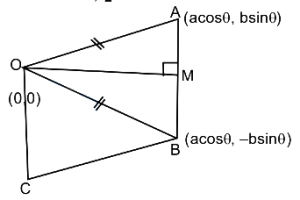
If $a>0, b>0$,then the maximum area of the parallelogram whose three vertices are $O(0,0)$,$A(a \cos \theta, b \sin \theta)$,and $B(a \cos \theta, -b \sin \theta)$ is
A
$ab$ when $\theta=\pi / 4$
B
$3 ab$ when $\theta=\pi / 4$
C
$ab$ when $\theta=\pi / 2$
D
$2 ab$
Solution
(A) Let the vertices of the parallelogram be $O(0,0)$,$A(a \cos \theta, b \sin \theta)$,$B(a \cos \theta, -b \sin \theta)$,and $C(x, y)$.
Since $OABC$ is a parallelogram,the diagonals $OB$ and $AC$ bisect each other at the same midpoint.
Alternatively,the area of a parallelogram with vertices $(x_1, y_1), (x_2, y_2), (x_3, y_3)$ and $(x_4, y_4)$ can be calculated using the cross product of vectors.
The area of $\triangle OAB = \frac{1}{2} |x_A y_B - x_B y_A| = \frac{1}{2} |(a \cos \theta)(-b \sin \theta) - (a \cos \theta)(b \sin \theta)| = \frac{1}{2} |-2ab \sin \theta \cos \theta| = ab |\sin \theta \cos \theta| = \frac{ab}{2} |\sin 2\theta|$.
The area of the parallelogram $OABC = 2 \times \text{Area}(\triangle OAB) = 2 \times \frac{ab}{2} |\sin 2\theta| = ab |\sin 2\theta|$.
The maximum value of $|\sin 2\theta|$ is $1$,which occurs when $2\theta = \pi / 2$,i.e.,$\theta = \pi / 4$.
Thus,the maximum area is $ab$ when $\theta = \pi / 4$.
Since $OABC$ is a parallelogram,the diagonals $OB$ and $AC$ bisect each other at the same midpoint.
Alternatively,the area of a parallelogram with vertices $(x_1, y_1), (x_2, y_2), (x_3, y_3)$ and $(x_4, y_4)$ can be calculated using the cross product of vectors.
The area of $\triangle OAB = \frac{1}{2} |x_A y_B - x_B y_A| = \frac{1}{2} |(a \cos \theta)(-b \sin \theta) - (a \cos \theta)(b \sin \theta)| = \frac{1}{2} |-2ab \sin \theta \cos \theta| = ab |\sin \theta \cos \theta| = \frac{ab}{2} |\sin 2\theta|$.
The area of the parallelogram $OABC = 2 \times \text{Area}(\triangle OAB) = 2 \times \frac{ab}{2} |\sin 2\theta| = ab |\sin 2\theta|$.
The maximum value of $|\sin 2\theta|$ is $1$,which occurs when $2\theta = \pi / 2$,i.e.,$\theta = \pi / 4$.
Thus,the maximum area is $ab$ when $\theta = \pi / 4$.
0 likesView Solution
17
MathematicsEasyMCQWBJEE · 2021
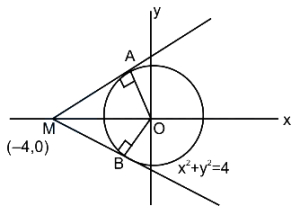
Two tangents to the circle $x^{2}+y^{2}=4$ at the points $A$ and $B$ meet at $M(-4,0)$. The area of the quadrilateral $MAOB$,where $O$ is the origin,is
A
$4 \sqrt{3}$ sq. units
B
$2 \sqrt{3}$ sq. units
C
$\sqrt{3}$ sq. units
D
$3 \sqrt{3}$ sq. units
Solution
(A) The circle is $x^{2}+y^{2}=4$,so its radius $OA = 2$ and the center $O$ is $(0,0)$.
Since $MA$ is a tangent,$\angle OAM = 90^{\circ}$.
In the right-angled triangle $\triangle OAM$,the hypotenuse $OM = 4$ and the side $OA = 2$.
Using the Pythagorean theorem,$MA = \sqrt{OM^{2} - OA^{2}} = \sqrt{4^{2} - 2^{2}} = \sqrt{16 - 4} = \sqrt{12} = 2\sqrt{3}$.
The quadrilateral $MAOB$ consists of two congruent right-angled triangles,$\triangle OAM$ and $\triangle OBM$.
Therefore,the area of quadrilateral $MAOB = 2 \times \text{Area}(\triangle OAM)$.
Area $(\triangle OAM) = \frac{1}{2} \times OA \times MA = \frac{1}{2} \times 2 \times 2\sqrt{3} = 2\sqrt{3}$.
Thus,the area of quadrilateral $MAOB = 2 \times 2\sqrt{3} = 4\sqrt{3}$ sq. units.
Since $MA$ is a tangent,$\angle OAM = 90^{\circ}$.
In the right-angled triangle $\triangle OAM$,the hypotenuse $OM = 4$ and the side $OA = 2$.
Using the Pythagorean theorem,$MA = \sqrt{OM^{2} - OA^{2}} = \sqrt{4^{2} - 2^{2}} = \sqrt{16 - 4} = \sqrt{12} = 2\sqrt{3}$.
The quadrilateral $MAOB$ consists of two congruent right-angled triangles,$\triangle OAM$ and $\triangle OBM$.
Therefore,the area of quadrilateral $MAOB = 2 \times \text{Area}(\triangle OAM)$.
Area $(\triangle OAM) = \frac{1}{2} \times OA \times MA = \frac{1}{2} \times 2 \times 2\sqrt{3} = 2\sqrt{3}$.
Thus,the area of quadrilateral $MAOB = 2 \times 2\sqrt{3} = 4\sqrt{3}$ sq. units.
0 likesView Solution
18
MathematicsMediumMCQWBJEE · 2021
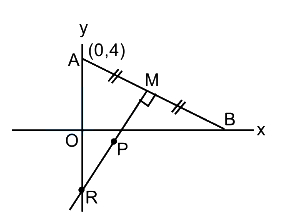
Let $A$ be the point $(0,4)$ and $B$ be a moving point on the $x$-axis. Let $M$ be the midpoint of $AB$ and let the perpendicular bisector of $AB$ meet the $y$-axis at $R$. The locus of the midpoint $P$ of $MR$ is
A
$y+x^{2}=2$
B
$x^{2}+(y-2)^{2}=\frac{1}{4}$
C
$(y-2)^{2}-x^{2}=\frac{1}{4}$
D
$x^{2}+y^{2}=16$
Solution
(A) Let $B = (2\alpha, 0)$.
Since $A = (0, 4)$,the midpoint $M$ of $AB$ is $(\alpha, 2)$.
The slope of $AB$ is $m_{AB} = \frac{0-4}{2\alpha-0} = -\frac{2}{\alpha}$.
The slope of the perpendicular bisector of $AB$ is $m_{MR} = -\frac{1}{m_{AB}} = \frac{\alpha}{2}$.
The equation of the line $MR$ passing through $M(\alpha, 2)$ with slope $\frac{\alpha}{2}$ is $y-2 = \frac{\alpha}{2}(x-\alpha)$.
To find $R$,set $x=0$: $y-2 = \frac{\alpha}{2}(0-\alpha) \Rightarrow y = 2 - \frac{\alpha^{2}}{2}$.
So,$R = (0, 2 - \frac{\alpha^{2}}{2})$.
Let $P(x, y)$ be the midpoint of $MR$. Then $x = \frac{\alpha+0}{2} = \frac{\alpha}{2}$ and $y = \frac{2 + (2 - \alpha^{2}/2)}{2} = 2 - \frac{\alpha^{2}}{4}$.
From $x = \frac{\alpha}{2}$,we have $\alpha = 2x$.
Substituting $\alpha = 2x$ into the equation for $y$: $y = 2 - \frac{(2x)^{2}}{4} = 2 - x^{2}$.
Thus,$y+x^{2}=2$.
Since $A = (0, 4)$,the midpoint $M$ of $AB$ is $(\alpha, 2)$.
The slope of $AB$ is $m_{AB} = \frac{0-4}{2\alpha-0} = -\frac{2}{\alpha}$.
The slope of the perpendicular bisector of $AB$ is $m_{MR} = -\frac{1}{m_{AB}} = \frac{\alpha}{2}$.
The equation of the line $MR$ passing through $M(\alpha, 2)$ with slope $\frac{\alpha}{2}$ is $y-2 = \frac{\alpha}{2}(x-\alpha)$.
To find $R$,set $x=0$: $y-2 = \frac{\alpha}{2}(0-\alpha) \Rightarrow y = 2 - \frac{\alpha^{2}}{2}$.
So,$R = (0, 2 - \frac{\alpha^{2}}{2})$.
Let $P(x, y)$ be the midpoint of $MR$. Then $x = \frac{\alpha+0}{2} = \frac{\alpha}{2}$ and $y = \frac{2 + (2 - \alpha^{2}/2)}{2} = 2 - \frac{\alpha^{2}}{4}$.
From $x = \frac{\alpha}{2}$,we have $\alpha = 2x$.
Substituting $\alpha = 2x$ into the equation for $y$: $y = 2 - \frac{(2x)^{2}}{4} = 2 - x^{2}$.
Thus,$y+x^{2}=2$.
0 likesView Solution
19
MathematicsMediumMCQWBJEE · 2021
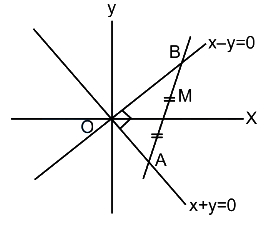
$A$ moving line intersects the lines $x+y=0$ and $x-y=0$ at the points $A$ and $B$ respectively,such that the area of the triangle with vertices $(0,0)$,$A$,and $B$ has a constant area $C$. The locus of the mid-point of $AB$ is given by the equation:
A
$\left(x^{2}+y^{2}\right)^{2}=C^{2}$
B
$\left(x^{2}-y^{2}\right)^{2}=C^{2}$
C
$(x+y)^{2}=C^{2}$
D
$(x-y)^{2}=C^{2}$
Solution
(B) Let the mid-point of $AB$ be $(h, k)$.
Let $A = (\alpha, -\alpha)$ and $B = (\beta, \beta)$.
Then,the mid-point $(h, k) = \left(\frac{\alpha+\beta}{2}, \frac{\beta-\alpha}{2}\right)$.
So,$\alpha+\beta = 2h$ and $\beta-\alpha = 2k$.
The area of $\triangle AOB = \frac{1}{2} \times |OA| \times |OB| = \frac{1}{2} \sqrt{\alpha^{2} + (-\alpha)^{2}} \sqrt{\beta^{2} + \beta^{2}} = \frac{1}{2} \sqrt{2\alpha^{2}} \sqrt{2\beta^{2}} = |\alpha\beta| = C$.
Thus,$\alpha^{2}\beta^{2} = C^{2}$.
We know that $(\beta+\alpha)^{2} - (\beta-\alpha)^{2} = 4\alpha\beta$.
So,$4\alpha\beta = (2h)^{2} - (2k)^{2} = 4(h^{2}-k^{2})$,which implies $\alpha\beta = h^{2}-k^{2}$.
Substituting this into $\alpha^{2}\beta^{2} = C^{2}$,we get $(h^{2}-k^{2})^{2} = C^{2}$.
Replacing $(h, k)$ with $(x, y)$,the locus is $(x^{2}-y^{2})^{2} = C^{2}$.
Let $A = (\alpha, -\alpha)$ and $B = (\beta, \beta)$.
Then,the mid-point $(h, k) = \left(\frac{\alpha+\beta}{2}, \frac{\beta-\alpha}{2}\right)$.
So,$\alpha+\beta = 2h$ and $\beta-\alpha = 2k$.
The area of $\triangle AOB = \frac{1}{2} \times |OA| \times |OB| = \frac{1}{2} \sqrt{\alpha^{2} + (-\alpha)^{2}} \sqrt{\beta^{2} + \beta^{2}} = \frac{1}{2} \sqrt{2\alpha^{2}} \sqrt{2\beta^{2}} = |\alpha\beta| = C$.
Thus,$\alpha^{2}\beta^{2} = C^{2}$.
We know that $(\beta+\alpha)^{2} - (\beta-\alpha)^{2} = 4\alpha\beta$.
So,$4\alpha\beta = (2h)^{2} - (2k)^{2} = 4(h^{2}-k^{2})$,which implies $\alpha\beta = h^{2}-k^{2}$.
Substituting this into $\alpha^{2}\beta^{2} = C^{2}$,we get $(h^{2}-k^{2})^{2} = C^{2}$.
Replacing $(h, k)$ with $(x, y)$,the locus is $(x^{2}-y^{2})^{2} = C^{2}$.
0 likesView Solution
20
MathematicsMediumMCQWBJEE · 2021
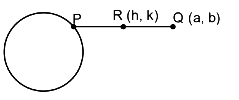
Let $P$ be a variable point on a circle $C$ and $Q$ be a fixed point outside $C$. If $R$ is the midpoint of the line segment $PQ$,then the locus of $R$ is
A
a circle
B
a circle and a pair of straight lines
C
a rectangular hyperbola
D
a pair of straight lines
Solution
(A) Let the circle $C$ have center $O(x_0, y_0)$ and radius $r$. The coordinates of any point $P$ on the circle can be represented as $P(x_0 + r \cos \theta, y_0 + r \sin \theta)$.
Let $Q$ be the fixed point $(a, b)$.
Let $R(h, k)$ be the midpoint of the line segment $PQ$.
Then,$h = \frac{x_0 + r \cos \theta + a}{2}$ and $k = \frac{y_0 + r \sin \theta + b}{2}$.
Rearranging these equations,we get:
$2h - (x_0 + a) = r \cos \theta$
$2k - (y_0 + b) = r \sin \theta$
Squaring and adding both equations:
$(2h - (x_0 + a))^2 + (2k - (y_0 + b))^2 = r^2(\cos^2 \theta + \sin^2 \theta)$
$4(h - \frac{x_0 + a}{2})^2 + 4(k - \frac{y_0 + b}{2})^2 = r^2$
$(h - \frac{x_0 + a}{2})^2 + (k - \frac{y_0 + b}{2})^2 = (\frac{r}{2})^2$
This is the equation of a circle with center $(\frac{x_0 + a}{2}, \frac{y_0 + b}{2})$ and radius $\frac{r}{2}$.
Let $Q$ be the fixed point $(a, b)$.
Let $R(h, k)$ be the midpoint of the line segment $PQ$.
Then,$h = \frac{x_0 + r \cos \theta + a}{2}$ and $k = \frac{y_0 + r \sin \theta + b}{2}$.
Rearranging these equations,we get:
$2h - (x_0 + a) = r \cos \theta$
$2k - (y_0 + b) = r \sin \theta$
Squaring and adding both equations:
$(2h - (x_0 + a))^2 + (2k - (y_0 + b))^2 = r^2(\cos^2 \theta + \sin^2 \theta)$
$4(h - \frac{x_0 + a}{2})^2 + 4(k - \frac{y_0 + b}{2})^2 = r^2$
$(h - \frac{x_0 + a}{2})^2 + (k - \frac{y_0 + b}{2})^2 = (\frac{r}{2})^2$
This is the equation of a circle with center $(\frac{x_0 + a}{2}, \frac{y_0 + b}{2})$ and radius $\frac{r}{2}$.
0 likesView Solution
21
MathematicsEasyMCQWBJEE · 2021
From a point $(d, 0)$,three normals are drawn to the parabola $y^{2} = x$. Then:
A
$d = \frac{1}{2}$
B
$d > \frac{1}{2}$
C
$d < \frac{1}{2}$
D
$d = \frac{1}{3}$
Solution
(B) The equation of the parabola is $y^{2} = x$,which is of the form $y^{2} = 4ax$,where $4a = 1$,so $a = \frac{1}{4}$.
For a parabola $y^{2} = 4ax$,the condition for three distinct normals to be drawn from a point $(h, k)$ is that $h > 2a$.
Here,the point is $(d, 0)$,so $h = d$.
Substituting the values,we get $d > 2 \times \frac{1}{4}$.
Therefore,$d > \frac{1}{2}$.
For a parabola $y^{2} = 4ax$,the condition for three distinct normals to be drawn from a point $(h, k)$ is that $h > 2a$.
Here,the point is $(d, 0)$,so $h = d$.
Substituting the values,we get $d > 2 \times \frac{1}{4}$.
Therefore,$d > \frac{1}{2}$.
0 likesView Solution
22
MathematicsMediumMCQWBJEE · 2021
The locus of the vertices of the family of parabolas $6y = 2a^3x^2 + 3a^2x - 12a$ is
A
$xy = \frac{105}{64}$
B
$xy = \frac{64}{105}$
C
$xy = \frac{35}{16}$
D
$xy = \frac{16}{35}$
Solution
(A) The given equation is $6y = 2a^3x^2 + 3a^2x - 12a$.
Dividing by $2a^3$ (assuming $a \neq 0$),we get $x^2 + \frac{3}{2a}x = \frac{6y + 12a}{2a^3}$.
Completing the square for $x$: $(x + \frac{3}{4a})^2 = \frac{6y + 12a}{2a^3} + \frac{9}{16a^2} = \frac{48y + 96a + 9a}{16a^3} = \frac{48y + 105a}{16a^3}$.
Thus,$(x + \frac{3}{4a})^2 = \frac{3}{a^2}(y + \frac{35a}{16})$.
The vertex $(h, k)$ is given by $h = -\frac{3}{4a}$ and $k = -\frac{35a}{16}$.
From $h = -\frac{3}{4a}$,we have $a = -\frac{3}{4h}$.
Substituting $a$ into $k$: $k = -\frac{35}{16} \times (-\frac{3}{4h}) = \frac{105}{64h}$.
Therefore,$hk = \frac{105}{64}$.
The locus is $xy = \frac{105}{64}$.
Dividing by $2a^3$ (assuming $a \neq 0$),we get $x^2 + \frac{3}{2a}x = \frac{6y + 12a}{2a^3}$.
Completing the square for $x$: $(x + \frac{3}{4a})^2 = \frac{6y + 12a}{2a^3} + \frac{9}{16a^2} = \frac{48y + 96a + 9a}{16a^3} = \frac{48y + 105a}{16a^3}$.
Thus,$(x + \frac{3}{4a})^2 = \frac{3}{a^2}(y + \frac{35a}{16})$.
The vertex $(h, k)$ is given by $h = -\frac{3}{4a}$ and $k = -\frac{35a}{16}$.
From $h = -\frac{3}{4a}$,we have $a = -\frac{3}{4h}$.
Substituting $a$ into $k$: $k = -\frac{35}{16} \times (-\frac{3}{4h}) = \frac{105}{64h}$.
Therefore,$hk = \frac{105}{64}$.
The locus is $xy = \frac{105}{64}$.
0 likesView Solution
23
MathematicsDifficultMCQWBJEE · 2021
The points of intersection of two ellipses $x^{2}+2y^{2}-6x-12y+20=0$ and $2x^{2}+y^{2}-10x-6y+15=0$ lie on a circle. The centre of the circle is
A
$(8,3)$
B
$(8,1)$
C
$\left(\frac{8}{3}, 3\right)$
D
$(3,8)$
Solution
(C) The equation of the family of curves passing through the intersection of the two ellipses is given by $S_1 + \lambda S_2 = 0$,where $S_1: x^{2}+2y^{2}-6x-12y+20=0$ and $S_2: 2x^{2}+y^{2}-10x-6y+15=0$.
$(x^{2}+2y^{2}-6x-12y+20) + \lambda(2x^{2}+y^{2}-10x-6y+15) = 0$
$(1+2\lambda)x^{2} + (2+\lambda)y^{2} - (6+10\lambda)x - (12+6\lambda)y + (20+15\lambda) = 0$
For this to represent a circle,the coefficients of $x^{2}$ and $y^{2}$ must be equal:
$1+2\lambda = 2+\lambda \Rightarrow \lambda = 1$
Substituting $\lambda = 1$ into the equation:
$3x^{2} + 3y^{2} - 16x - 18y + 35 = 0$
$x^{2} + y^{2} - \frac{16}{3}x - 6y + \frac{35}{3} = 0$
The centre of the circle is given by $\left(-\frac{g}{2}, -\frac{f}{2}\right)$,where $2g = -\frac{16}{3}$ and $2f = -6$.
Centre $= \left(\frac{16/3}{2}, \frac{6}{2}\right) = \left(\frac{8}{3}, 3\right)$.
$(x^{2}+2y^{2}-6x-12y+20) + \lambda(2x^{2}+y^{2}-10x-6y+15) = 0$
$(1+2\lambda)x^{2} + (2+\lambda)y^{2} - (6+10\lambda)x - (12+6\lambda)y + (20+15\lambda) = 0$
For this to represent a circle,the coefficients of $x^{2}$ and $y^{2}$ must be equal:
$1+2\lambda = 2+\lambda \Rightarrow \lambda = 1$
Substituting $\lambda = 1$ into the equation:
$3x^{2} + 3y^{2} - 16x - 18y + 35 = 0$
$x^{2} + y^{2} - \frac{16}{3}x - 6y + \frac{35}{3} = 0$
The centre of the circle is given by $\left(-\frac{g}{2}, -\frac{f}{2}\right)$,where $2g = -\frac{16}{3}$ and $2f = -6$.
Centre $= \left(\frac{16/3}{2}, \frac{6}{2}\right) = \left(\frac{8}{3}, 3\right)$.
0 likesView Solution
24
MathematicsEasyMCQWBJEE · 2021
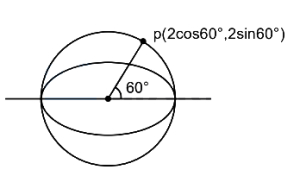
The coordinate of a point on the auxiliary circle of the ellipse $x^{2}+2y^{2}=4$ corresponding to the point on the ellipse whose eccentric angle is $60^{\circ}$ will be
A
$(\sqrt{3}, 1)$
B
$(1, \sqrt{3})$
C
$(1, 1)$
D
$(1, 2)$
Solution
(B) The given equation of the ellipse is $x^{2}+2y^{2}=4$.
Dividing by $4$,we get $\frac{x^{2}}{4}+\frac{y^{2}}{2}=1$.
Comparing this with the standard form $\frac{x^{2}}{a^{2}}+\frac{y^{2}}{b^{2}}=1$,we have $a^{2}=4$,so $a=2$.
The auxiliary circle of an ellipse $\frac{x^{2}}{a^{2}}+\frac{y^{2}}{b^{2}}=1$ is given by $x^{2}+y^{2}=a^{2}$.
Here,the equation of the auxiliary circle is $x^{2}+y^{2}=4$.
The coordinates of a point on the auxiliary circle corresponding to an eccentric angle $\theta$ are given by $(a \cos \theta, a \sin \theta)$.
Given $\theta = 60^{\circ}$ and $a=2$,the coordinates are $(2 \cos 60^{\circ}, 2 \sin 60^{\circ})$.
Substituting the values,we get $(2 \times \frac{1}{2}, 2 \times \frac{\sqrt{3}}{2}) = (1, \sqrt{3})$.
Thus,the correct option is $B$.
Dividing by $4$,we get $\frac{x^{2}}{4}+\frac{y^{2}}{2}=1$.
Comparing this with the standard form $\frac{x^{2}}{a^{2}}+\frac{y^{2}}{b^{2}}=1$,we have $a^{2}=4$,so $a=2$.
The auxiliary circle of an ellipse $\frac{x^{2}}{a^{2}}+\frac{y^{2}}{b^{2}}=1$ is given by $x^{2}+y^{2}=a^{2}$.
Here,the equation of the auxiliary circle is $x^{2}+y^{2}=4$.
The coordinates of a point on the auxiliary circle corresponding to an eccentric angle $\theta$ are given by $(a \cos \theta, a \sin \theta)$.
Given $\theta = 60^{\circ}$ and $a=2$,the coordinates are $(2 \cos 60^{\circ}, 2 \sin 60^{\circ})$.
Substituting the values,we get $(2 \times \frac{1}{2}, 2 \times \frac{\sqrt{3}}{2}) = (1, \sqrt{3})$.
Thus,the correct option is $B$.
0 likesView Solution
25
MathematicsEasyMCQWBJEE · 2021
The locus of the center of a variable circle which always touches two given circles externally is
A
an ellipse
B
a hyperbola
C
a parabola
D
a circle
Solution
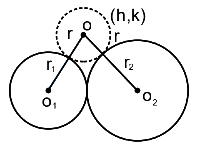
(B) Let the center of the variable circle be $O(h, k)$ and its radius be $r$. Let the centers of the two given circles be $O_1$ and $O_2$ with radii $r_1$ and $r_2$ respectively.
Since the variable circle touches the two given circles externally,the distance between the centers is the sum of the radii:
$OO_1 = r + r_1$
$OO_2 = r + r_2$
Subtracting the two equations:
$OO_2 - OO_1 = (r + r_2) - (r + r_1) = r_2 - r_1$
Since $r_1$ and $r_2$ are constants,the difference of the distances of the point $O$ from two fixed points $O_1$ and $O_2$ is constant. By definition,this is the locus of a hyperbola.
Since the variable circle touches the two given circles externally,the distance between the centers is the sum of the radii:
$OO_1 = r + r_1$
$OO_2 = r + r_2$
Subtracting the two equations:
$OO_2 - OO_1 = (r + r_2) - (r + r_1) = r_2 - r_1$
Since $r_1$ and $r_2$ are constants,the difference of the distances of the point $O$ from two fixed points $O_1$ and $O_2$ is constant. By definition,this is the locus of a hyperbola.
0 likesView Solution
26
MathematicsEasyMCQWBJEE · 2021
If $I = \lim_{x \rightarrow 0} \sin \left( \frac{e^{x}-x-1-\frac{x^{2}}{2}}{x^{2}} \right)$,then the limit
A
does not exist
B
exists and equals $1$
C
exists and equals $0$
D
exists and equals $\frac{1}{2}$
Solution
(C) We evaluate the limit inside the sine function first:
$L = \lim_{x \rightarrow 0} \frac{e^{x}-x-1-\frac{x^{2}}{2}}{x^{2}}$
Using the Taylor series expansion for $e^{x} = 1 + x + \frac{x^{2}}{2!} + \frac{x^{3}}{3!} + \dots$,we get:
$L = \lim_{x \rightarrow 0} \frac{(1 + x + \frac{x^{2}}{2} + \frac{x^{3}}{6} + \dots) - x - 1 - \frac{x^{2}}{2}}{x^{2}}$
$L = \lim_{x \rightarrow 0} \frac{\frac{x^{3}}{6} + \dots}{x^{2}} = \lim_{x \rightarrow 0} (\frac{x}{6} + \dots) = 0$
Since the function $\sin(u)$ is continuous at $u=0$,we have:
$I = \sin(L) = \sin(0) = 0$
$L = \lim_{x \rightarrow 0} \frac{e^{x}-x-1-\frac{x^{2}}{2}}{x^{2}}$
Using the Taylor series expansion for $e^{x} = 1 + x + \frac{x^{2}}{2!} + \frac{x^{3}}{3!} + \dots$,we get:
$L = \lim_{x \rightarrow 0} \frac{(1 + x + \frac{x^{2}}{2} + \frac{x^{3}}{6} + \dots) - x - 1 - \frac{x^{2}}{2}}{x^{2}}$
$L = \lim_{x \rightarrow 0} \frac{\frac{x^{3}}{6} + \dots}{x^{2}} = \lim_{x \rightarrow 0} (\frac{x}{6} + \dots) = 0$
Since the function $\sin(u)$ is continuous at $u=0$,we have:
$I = \sin(L) = \sin(0) = 0$
0 likesView Solution
27
MathematicsMediumMCQWBJEE · 2021
The $\lim _{x \rightarrow \infty}\left(\frac{3 x-1}{3 x+1}\right)^{4 x}$ equals
A
$1$
B
$0$
C
$e^{-8/3}$
D
$e^{-4/9}$
Solution
(C) We evaluate the limit of the form $1^{\infty}$ using the formula $\lim _{x \rightarrow \infty} f(x)^{g(x)} = e^{\lim _{x \rightarrow \infty} g(x)(f(x)-1)}$.
Given $f(x) = \frac{3x-1}{3x+1}$ and $g(x) = 4x$.
$L = \lim _{x \rightarrow \infty} 4x \left( \frac{3x-1}{3x+1} - 1 \right)$
$L = \lim _{x \rightarrow \infty} 4x \left( \frac{3x-1 - (3x+1)}{3x+1} \right)$
$L = \lim _{x \rightarrow \infty} 4x \left( \frac{-2}{3x+1} \right)$
$L = \lim _{x \rightarrow \infty} \frac{-8x}{3x+1} = \lim _{x \rightarrow \infty} \frac{-8}{3 + 1/x} = -\frac{8}{3}$.
Therefore,the limit is $e^{-8/3}$.
Given $f(x) = \frac{3x-1}{3x+1}$ and $g(x) = 4x$.
$L = \lim _{x \rightarrow \infty} 4x \left( \frac{3x-1}{3x+1} - 1 \right)$
$L = \lim _{x \rightarrow \infty} 4x \left( \frac{3x-1 - (3x+1)}{3x+1} \right)$
$L = \lim _{x \rightarrow \infty} 4x \left( \frac{-2}{3x+1} \right)$
$L = \lim _{x \rightarrow \infty} \frac{-8x}{3x+1} = \lim _{x \rightarrow \infty} \frac{-8}{3 + 1/x} = -\frac{8}{3}$.
Therefore,the limit is $e^{-8/3}$.
0 likesView Solution
28
MathematicsEasyMCQWBJEE · 2021
Let $A, B, C$ be three non-void subsets of set $S$. Let $(A \cap C) \cup (B \cap C^{\prime}) = \phi$,where $C^{\prime}$ denotes the complement of set $C$ in $S$. Then:
A
$A \cap B = \phi$
B
$A \cap B \neq \phi$
C
$A \cap C = A$
D
$A \cup C = A$
Solution
(A) Given $(A \cap C) \cup (B \cap C^{\prime}) = \phi$.
Since the union of two sets is the empty set $\phi$,each set must be empty.
Therefore,$A \cap C = \phi$ and $B \cap C^{\prime} = \phi$.
From $B \cap C^{\prime} = \phi$,we have $B \subseteq C$.
Since $A \cap C = \phi$ and $B \subseteq C$,it follows that $A \cap B = \phi$.
Since the union of two sets is the empty set $\phi$,each set must be empty.
Therefore,$A \cap C = \phi$ and $B \cap C^{\prime} = \phi$.
From $B \cap C^{\prime} = \phi$,we have $B \subseteq C$.
Since $A \cap C = \phi$ and $B \subseteq C$,it follows that $A \cap B = \phi$.
0 likesView Solution
29
MathematicsEasyMCQWBJEE · 2021
Let $f$ and $g$ be periodic functions with the periods $T_{1}$ and $T_{2}$ respectively. Then $f+g$ is
A
periodic with period $T_{1}+T_{2}$
B
non-periodic
C
periodic with the period $T_{1}$
D
periodic if $\frac{T_{1}}{T_{2}}$ is a rational number
Solution
(D) function $f$ is periodic with period $T$ if $f(x+T) = f(x)$ for all $x$.
For the sum $f+g$ to be periodic,there must exist a constant $T > 0$ such that $(f+g)(x+T) = (f+g)(x)$.
This implies $f(x+T) + g(x+T) = f(x) + g(x)$.
If $\frac{T_{1}}{T_{2}}$ is a rational number,say $\frac{T_{1}}{T_{2}} = \frac{p}{q}$ where $p, q \in \mathbb{Z}^{+}$,then $qT_{1} = pT_{2} = T$.
In this case,$f(x+T) = f(x)$ and $g(x+T) = g(x)$,so $(f+g)(x+T) = f(x) + g(x)$.
Thus,$f+g$ is periodic if the ratio of their periods is a rational number.
For the sum $f+g$ to be periodic,there must exist a constant $T > 0$ such that $(f+g)(x+T) = (f+g)(x)$.
This implies $f(x+T) + g(x+T) = f(x) + g(x)$.
If $\frac{T_{1}}{T_{2}}$ is a rational number,say $\frac{T_{1}}{T_{2}} = \frac{p}{q}$ where $p, q \in \mathbb{Z}^{+}$,then $qT_{1} = pT_{2} = T$.
In this case,$f(x+T) = f(x)$ and $g(x+T) = g(x)$,so $(f+g)(x+T) = f(x) + g(x)$.
Thus,$f+g$ is periodic if the ratio of their periods is a rational number.
0 likesView Solution
30
MathematicsMediumMCQWBJEE · 2021
$A$ plane meets the coordinate axes at the points $A, B, C$ respectively in such a way that the centroid of $\triangle ABC$ is $(1, r, r^2)$ for some real $r$. If the plane passes through the point $(5, 5, -12)$,then $r=$
A
$\frac{3}{2}$
B
$4$
C
$-4$
D
$-\frac{3}{2}$
Solution
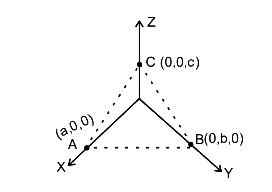
(A) Let the intercepts of the plane on the coordinate axes be $a, b, c$. Thus,the points are $A(a, 0, 0)$,$B(0, b, 0)$,and $C(0, 0, c)$.
The centroid of $\triangle ABC$ is given by $(\frac{a}{3}, \frac{b}{3}, \frac{c}{3})$.
Given that the centroid is $(1, r, r^2)$,we have:
$\frac{a}{3} = 1 \Rightarrow a = 3$
$\frac{b}{3} = r \Rightarrow b = 3r$
$\frac{c}{3} = r^2 \Rightarrow c = 3r^2$
The equation of the plane in intercept form is $\frac{x}{a} + \frac{y}{b} + \frac{z}{c} = 1$.
Substituting the values of $a, b, c$,we get $\frac{x}{3} + \frac{y}{3r} + \frac{z}{3r^2} = 1$.
Since the plane passes through $(5, 5, -12)$,we have:
$\frac{5}{3} + \frac{5}{3r} - \frac{12}{3r^2} = 1$
Multiplying by $3r^2$,we get $5r^2 + 5r - 12 = 3r^2$,which simplifies to $2r^2 + 5r - 12 = 0$.
Factoring the quadratic equation: $(2r - 3)(r + 4) = 0$.
Thus,$r = \frac{3}{2}$ or $r = -4$.
The centroid of $\triangle ABC$ is given by $(\frac{a}{3}, \frac{b}{3}, \frac{c}{3})$.
Given that the centroid is $(1, r, r^2)$,we have:
$\frac{a}{3} = 1 \Rightarrow a = 3$
$\frac{b}{3} = r \Rightarrow b = 3r$
$\frac{c}{3} = r^2 \Rightarrow c = 3r^2$
The equation of the plane in intercept form is $\frac{x}{a} + \frac{y}{b} + \frac{z}{c} = 1$.
Substituting the values of $a, b, c$,we get $\frac{x}{3} + \frac{y}{3r} + \frac{z}{3r^2} = 1$.
Since the plane passes through $(5, 5, -12)$,we have:
$\frac{5}{3} + \frac{5}{3r} - \frac{12}{3r^2} = 1$
Multiplying by $3r^2$,we get $5r^2 + 5r - 12 = 3r^2$,which simplifies to $2r^2 + 5r - 12 = 0$.
Factoring the quadratic equation: $(2r - 3)(r + 4) = 0$.
Thus,$r = \frac{3}{2}$ or $r = -4$.
0 likesView Solution
31
MathematicsMediumMCQWBJEE · 2021
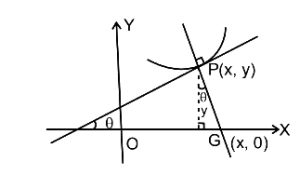
The normal to a curve at $P(x, y)$ meets the $x$-axis at $G$. If the distance of $G$ from the origin is twice the abscissa of $P$,then the curve is
A
a parabola
B
a circle
C
a hyperbola
D
an ellipse
Solution
(C) Let the point $P$ be $(x, y)$. The slope of the tangent at $P$ is $\frac{dy}{dx}$.
The slope of the normal at $P$ is $-\frac{dx}{dy}$.
The equation of the normal at $P(x, y)$ is $Y - y = -\frac{dx}{dy}(X - x)$.
To find the point $G$ where the normal meets the $x$-axis,set $Y = 0$:
$-y = -\frac{dx}{dy}(X - x) \implies y \frac{dy}{dx} = X - x \implies X = x + y \frac{dy}{dx}$.
The point $G$ is $(x + y \frac{dy}{dx}, 0)$.
The distance of $G$ from the origin is $|x + y \frac{dy}{dx}|$. Given that this distance is twice the abscissa of $P$ (which is $x$),we have:
$x + y \frac{dy}{dx} = 2x \implies y \frac{dy}{dx} = x$.
Integrating both sides with respect to $x$:
$\int y \, dy = \int x \, dx \implies \frac{y^2}{2} = \frac{x^2}{2} + C \implies y^2 - x^2 = 2C$.
This represents a rectangular hyperbola.
The slope of the normal at $P$ is $-\frac{dx}{dy}$.
The equation of the normal at $P(x, y)$ is $Y - y = -\frac{dx}{dy}(X - x)$.
To find the point $G$ where the normal meets the $x$-axis,set $Y = 0$:
$-y = -\frac{dx}{dy}(X - x) \implies y \frac{dy}{dx} = X - x \implies X = x + y \frac{dy}{dx}$.
The point $G$ is $(x + y \frac{dy}{dx}, 0)$.
The distance of $G$ from the origin is $|x + y \frac{dy}{dx}|$. Given that this distance is twice the abscissa of $P$ (which is $x$),we have:
$x + y \frac{dy}{dx} = 2x \implies y \frac{dy}{dx} = x$.
Integrating both sides with respect to $x$:
$\int y \, dy = \int x \, dx \implies \frac{y^2}{2} = \frac{x^2}{2} + C \implies y^2 - x^2 = 2C$.
This represents a rectangular hyperbola.
0 likesView Solution
32
MathematicsDifficultMCQWBJEE · 2021
The value of $\lim _{n}$ ${\rightarrow \infty} \left( \frac{\sqrt{n}}{\sqrt{n^{3}}}+\frac{\sqrt{n}}{\sqrt{(n+4)^{3}}}+\frac{\sqrt{n}}{\sqrt{(n+8)^{3}}}+\cdots +\frac{\sqrt{n}}{\sqrt{[n+4(n-1)]^{3}}} \right)$ is
A
$\frac{5-\sqrt{5}}{10}$
B
$\frac{5+\sqrt{5}}{10}$
C
$\frac{2+\sqrt{3}}{2}$
D
$\frac{2-\sqrt{3}}{2}$
Solution
(A) The given expression can be written as $\lim _{n \rightarrow \infty} \sum_{r=0}^{n-1} \frac{\sqrt{n}}{\sqrt{(n+4 r)^{3}}}$.
We can rewrite the sum as $\sum_{r=0}^{n-1} \frac{1}{n} \left( \frac{n \sqrt{n}}{\sqrt{(n+4 r)^{3}}} \right) = \sum_{r=0}^{n-1} \frac{1}{n} \left( \frac{1}{(1+\frac{4 r}{n})^{3 / 2}} \right)$.
This is a Riemann sum which converges to the definite integral $\int_{0}^{1} \frac{dx}{(1+4x)^{3/2}}$.
Let $z = 1+4x$,then $dz = 4dx$,so $dx = \frac{dz}{4}$.
When $x=0, z=1$ and when $x=1, z=5$.
The integral becomes $\frac{1}{4} \int_{1}^{5} z^{-3/2} dz = \frac{1}{4} \left[ \frac{z^{-1/2}}{-1/2} \right]_{1}^{5} = -\frac{1}{2} \left[ \frac{1}{\sqrt{z}} \right]_{1}^{5}$.
$= -\frac{1}{2} \left( \frac{1}{\sqrt{5}} - 1 \right) = \frac{1}{2} \left( 1 - \frac{1}{\sqrt{5}} \right) = \frac{\sqrt{5}-1}{2\sqrt{5}} = \frac{5-\sqrt{5}}{10}$.
We can rewrite the sum as $\sum_{r=0}^{n-1} \frac{1}{n} \left( \frac{n \sqrt{n}}{\sqrt{(n+4 r)^{3}}} \right) = \sum_{r=0}^{n-1} \frac{1}{n} \left( \frac{1}{(1+\frac{4 r}{n})^{3 / 2}} \right)$.
This is a Riemann sum which converges to the definite integral $\int_{0}^{1} \frac{dx}{(1+4x)^{3/2}}$.
Let $z = 1+4x$,then $dz = 4dx$,so $dx = \frac{dz}{4}$.
When $x=0, z=1$ and when $x=1, z=5$.
The integral becomes $\frac{1}{4} \int_{1}^{5} z^{-3/2} dz = \frac{1}{4} \left[ \frac{z^{-1/2}}{-1/2} \right]_{1}^{5} = -\frac{1}{2} \left[ \frac{1}{\sqrt{z}} \right]_{1}^{5}$.
$= -\frac{1}{2} \left( \frac{1}{\sqrt{5}} - 1 \right) = \frac{1}{2} \left( 1 - \frac{1}{\sqrt{5}} \right) = \frac{\sqrt{5}-1}{2\sqrt{5}} = \frac{5-\sqrt{5}}{10}$.
0 likesView Solution
33
MathematicsEasyMCQWBJEE · 2021
Let $S_{n} = \cot^{-1} 2 + \cot^{-1} 8 + \cot^{-1} 18 + \cot^{-1} 32 + \dots$ to $n^{\text{th}}$ term. Then $\lim_{n \rightarrow \infty} S_{n}$ is
A
$\frac{\pi}{3}$
B
$\frac{\pi}{4}$
C
$\frac{\pi}{6}$
D
$\frac{\pi}{8}$
Solution
(B) The $n^{\text{th}}$ term of the series is $t_{n} = \cot^{-1}(2n^2)$.
Using the identity $\cot^{-1} x = \tan^{-1} \frac{1}{x}$,we have $t_{n} = \tan^{-1} \frac{1}{2n^2}$.
We can rewrite this as $t_{n} = \tan^{-1} \frac{2}{4n^2} = \tan^{-1} \frac{(2n+1) - (2n-1)}{1 + (2n+1)(2n-1)}$.
Using the formula $\tan^{-1} x - \tan^{-1} y = \tan^{-1} \frac{x-y}{1+xy}$,we get $t_{n} = \tan^{-1}(2n+1) - \tan^{-1}(2n-1)$.
The sum $S_{n} = \sum_{k=1}^{n} t_{k} = (\tan^{-1} 3 - \tan^{-1} 1) + (\tan^{-1} 5 - \tan^{-1} 3) + \dots + (\tan^{-1}(2n+1) - \tan^{-1}(2n-1))$.
This is a telescoping series,so $S_{n} = \tan^{-1}(2n+1) - \tan^{-1} 1$.
Taking the limit as $n \rightarrow \infty$,$\lim_{n \rightarrow \infty} S_{n} = \frac{\pi}{2} - \frac{\pi}{4} = \frac{\pi}{4}$.
Using the identity $\cot^{-1} x = \tan^{-1} \frac{1}{x}$,we have $t_{n} = \tan^{-1} \frac{1}{2n^2}$.
We can rewrite this as $t_{n} = \tan^{-1} \frac{2}{4n^2} = \tan^{-1} \frac{(2n+1) - (2n-1)}{1 + (2n+1)(2n-1)}$.
Using the formula $\tan^{-1} x - \tan^{-1} y = \tan^{-1} \frac{x-y}{1+xy}$,we get $t_{n} = \tan^{-1}(2n+1) - \tan^{-1}(2n-1)$.
The sum $S_{n} = \sum_{k=1}^{n} t_{k} = (\tan^{-1} 3 - \tan^{-1} 1) + (\tan^{-1} 5 - \tan^{-1} 3) + \dots + (\tan^{-1}(2n+1) - \tan^{-1}(2n-1))$.
This is a telescoping series,so $S_{n} = \tan^{-1}(2n+1) - \tan^{-1} 1$.
Taking the limit as $n \rightarrow \infty$,$\lim_{n \rightarrow \infty} S_{n} = \frac{\pi}{2} - \frac{\pi}{4} = \frac{\pi}{4}$.
0 likesView Solution
34
MathematicsMediumMCQWBJEE · 2021
Let $R$ be the real line. Let the relations $S$ and $T$ on $R$ be defined by $S = \{(x, y) : y = x + 1, 0 < x < 2\}$ and $T = \{(x, y) : (x - y) \text{ is an integer}\}$. Then:
A
both $S$ and $T$ are equivalence relations on $R$
B
$T$ is an equivalence relation on $R$ but $S$ is not
C
neither $S$ nor $T$ is an equivalence relation on $R$
D
$S$ is an equivalence relation on $R$ but $T$ is not
Solution
(B) For a relation to be an equivalence relation,it must be reflexive,symmetric,and transitive.
$1$. Analysis of $S = \{(x, y) : y = x + 1, 0 < x < 2\}$:
- Reflexivity: For $S$ to be reflexive,$(x, x) \in S$ for all $x \in R$. This requires $x = x + 1$,which implies $0 = 1$,a contradiction. Thus,$S$ is not reflexive.
- Symmetry: For $S$ to be symmetric,if $(x, y) \in S$,then $(y, x) \in S$. If $(x, y) \in S$,then $y = x + 1$. For $(y, x) \in S$,we need $x = y + 1$. Substituting $y$,we get $x = (x + 1) + 1 = x + 2$,which is impossible. Thus,$S$ is not symmetric.
- Since $S$ is neither reflexive nor symmetric,it is not an equivalence relation.
$2$. Analysis of $T = \{(x, y) : (x - y) \in \mathbb{Z}\}$:
- Reflexivity: $(x - x) = 0$,which is an integer. So,$(x, x) \in T$.
- Symmetry: If $(x, y) \in T$,then $(x - y) = k$ for some $k \in \mathbb{Z}$. Then $(y - x) = -k$,which is also an integer. So,$(y, x) \in T$.
- Transitivity: If $(x, y) \in T$ and $(y, z) \in T$,then $(x - y) = k_1$ and $(y - z) = k_2$ for $k_1, k_2 \in \mathbb{Z}$. Adding these,$(x - z) = k_1 + k_2$,which is an integer. So,$(x, z) \in T$.
- Since $T$ is reflexive,symmetric,and transitive,it is an equivalence relation.
Therefore,$T$ is an equivalence relation on $R$ but $S$ is not.
$1$. Analysis of $S = \{(x, y) : y = x + 1, 0 < x < 2\}$:
- Reflexivity: For $S$ to be reflexive,$(x, x) \in S$ for all $x \in R$. This requires $x = x + 1$,which implies $0 = 1$,a contradiction. Thus,$S$ is not reflexive.
- Symmetry: For $S$ to be symmetric,if $(x, y) \in S$,then $(y, x) \in S$. If $(x, y) \in S$,then $y = x + 1$. For $(y, x) \in S$,we need $x = y + 1$. Substituting $y$,we get $x = (x + 1) + 1 = x + 2$,which is impossible. Thus,$S$ is not symmetric.
- Since $S$ is neither reflexive nor symmetric,it is not an equivalence relation.
$2$. Analysis of $T = \{(x, y) : (x - y) \in \mathbb{Z}\}$:
- Reflexivity: $(x - x) = 0$,which is an integer. So,$(x, x) \in T$.
- Symmetry: If $(x, y) \in T$,then $(x - y) = k$ for some $k \in \mathbb{Z}$. Then $(y - x) = -k$,which is also an integer. So,$(y, x) \in T$.
- Transitivity: If $(x, y) \in T$ and $(y, z) \in T$,then $(x - y) = k_1$ and $(y - z) = k_2$ for $k_1, k_2 \in \mathbb{Z}$. Adding these,$(x - z) = k_1 + k_2$,which is an integer. So,$(x, z) \in T$.
- Since $T$ is reflexive,symmetric,and transitive,it is an equivalence relation.
Therefore,$T$ is an equivalence relation on $R$ but $S$ is not.
0 likesView Solution
35
MathematicsEasyMCQWBJEE · 2021
If $M$ is a $3 \times 3$ matrix such that $(0\,1\,2) M = (1\,0\,0)$ and $(3\,4\,5) M = (0\,1\,0)$, then $(6\,7\,8) M$ is equal to
A
$(-1\,2\,-2)$
B
$(0\,0\,1)$
C
$(-1\,2\,0)$
D
$(9\,10\,8)$
Solution
(C) Let the given equations be:
$(0\,1\,2) M = (1\,0\,0)$ --- $(i)$
$(3\,4\,5) M = (0\,1\,0)$ --- $(ii)$
We want to find $(6\,7\,8) M$.
Observe the linear combination of the row vectors $(0\,1\,2)$ and $(3\,4\,5)$.
Let $x(0\,1\,2) + y(3\,4\,5) = (6\,7\,8)$.
Comparing components:
$3y = 6 \Rightarrow y = 2$
$x + 4y = 7 \Rightarrow x + 8 = 7 \Rightarrow x = -1$
$2x + 5y = 2(-1) + 5(2) = -2 + 10 = 8$. This matches the third component.
Thus, $(6\,7\,8) = -1(0\,1\,2) + 2(3\,4\,5)$.
Multiplying by $M$ on the right:
$(6\,7\,8) M = -1((0\,1\,2) M) + 2((3\,4\,5) M)$
$(6\,7\,8) M = -1(1\,0\,0) + 2(0\,1\,0)$
$(6\,7\,8) M = (-1\,0\,0) + (0\,2\,0) = (-1\,2\,0)$.
$(0\,1\,2) M = (1\,0\,0)$ --- $(i)$
$(3\,4\,5) M = (0\,1\,0)$ --- $(ii)$
We want to find $(6\,7\,8) M$.
Observe the linear combination of the row vectors $(0\,1\,2)$ and $(3\,4\,5)$.
Let $x(0\,1\,2) + y(3\,4\,5) = (6\,7\,8)$.
Comparing components:
$3y = 6 \Rightarrow y = 2$
$x + 4y = 7 \Rightarrow x + 8 = 7 \Rightarrow x = -1$
$2x + 5y = 2(-1) + 5(2) = -2 + 10 = 8$. This matches the third component.
Thus, $(6\,7\,8) = -1(0\,1\,2) + 2(3\,4\,5)$.
Multiplying by $M$ on the right:
$(6\,7\,8) M = -1((0\,1\,2) M) + 2((3\,4\,5) M)$
$(6\,7\,8) M = -1(1\,0\,0) + 2(0\,1\,0)$
$(6\,7\,8) M = (-1\,0\,0) + (0\,2\,0) = (-1\,2\,0)$.
0 likesView Solution
36
MathematicsDifficultMCQWBJEE · 2021
Let $A$ and $B$ be two non-singular skew-symmetric matrices such that $AB = BA$. Then $A^{2} B^{2} (A^{\top} B)^{-1} (A B^{-1})^{\top}$ is equal to
A
$A^{2}$
B
$-B^{2}$
C
$-A^{2}$
D
$AB$
Solution
(C) Given that $A$ and $B$ are skew-symmetric matrices,we have $A^{\top} = -A$ and $B^{\top} = -B$.
Given $AB = BA$.
We need to evaluate the expression $E = A^{2} B^{2} (A^{\top} B)^{-1} (A B^{-1})^{\top}$.
Substituting $A^{\top} = -A$,we get $E = A^{2} B^{2} (-AB)^{-1} (A B^{-1})^{\top}$.
Using the property $(XY)^{-1} = Y^{-1} X^{-1}$ and $(XY)^{\top} = Y^{\top} X^{\top}$,we have:
$E = A^{2} B^{2} (-B^{-1} A^{-1}) ((B^{-1})^{\top} A^{\top})$.
Since $(B^{-1})^{\top} = (B^{\top})^{-1} = (-B)^{-1} = -B^{-1}$,we substitute this:
$E = A^{2} B^{2} (-B^{-1} A^{-1}) (-B^{-1} (-A))$.
$E = A^{2} B^{2} (-B^{-1} A^{-1}) (B^{-1} A)$.
Since $AB = BA$,we also have $A^{-1} B = B A^{-1}$ and $A B^{-1} = B^{-1} A$.
$E = A^{2} B^{2} (-B^{-1} A^{-1} B^{-1} A)$.
$E = -A^{2} B^{2} B^{-1} A^{-1} B^{-1} A$.
$E = -A^{2} B (B B^{-1}) A^{-1} B^{-1} A$.
$E = -A^{2} B (I) A^{-1} B^{-1} A$.
$E = -A^{2} (B A^{-1}) B^{-1} A$.
Since $B A^{-1} = A^{-1} B$,we have:
$E = -A^{2} A^{-1} B B^{-1} A$.
$E = -A (I) (I) A = -A^{2}$.
Given $AB = BA$.
We need to evaluate the expression $E = A^{2} B^{2} (A^{\top} B)^{-1} (A B^{-1})^{\top}$.
Substituting $A^{\top} = -A$,we get $E = A^{2} B^{2} (-AB)^{-1} (A B^{-1})^{\top}$.
Using the property $(XY)^{-1} = Y^{-1} X^{-1}$ and $(XY)^{\top} = Y^{\top} X^{\top}$,we have:
$E = A^{2} B^{2} (-B^{-1} A^{-1}) ((B^{-1})^{\top} A^{\top})$.
Since $(B^{-1})^{\top} = (B^{\top})^{-1} = (-B)^{-1} = -B^{-1}$,we substitute this:
$E = A^{2} B^{2} (-B^{-1} A^{-1}) (-B^{-1} (-A))$.
$E = A^{2} B^{2} (-B^{-1} A^{-1}) (B^{-1} A)$.
Since $AB = BA$,we also have $A^{-1} B = B A^{-1}$ and $A B^{-1} = B^{-1} A$.
$E = A^{2} B^{2} (-B^{-1} A^{-1} B^{-1} A)$.
$E = -A^{2} B^{2} B^{-1} A^{-1} B^{-1} A$.
$E = -A^{2} B (B B^{-1}) A^{-1} B^{-1} A$.
$E = -A^{2} B (I) A^{-1} B^{-1} A$.
$E = -A^{2} (B A^{-1}) B^{-1} A$.
Since $B A^{-1} = A^{-1} B$,we have:
$E = -A^{2} A^{-1} B B^{-1} A$.
$E = -A (I) (I) A = -A^{2}$.
0 likesView Solution
37
MathematicsDifficultMCQWBJEE · 2021
Let $A = \begin{bmatrix} 1 & 0 & 0 \\ 0 & \cos t & \sin t \\ 0 & -\sin t & \cos t \end{bmatrix}$. Let $\lambda_{1}, \lambda_{2}, \lambda_{3}$ be the roots of $\det(A - \lambda I_{3}) = 0$,where $I_{3}$ denotes the identity matrix. If $\lambda_{1} + \lambda_{2} + \lambda_{3} = \sqrt{2} + 1$,then the set of possible values of $t$ for $-\pi \leq t < \pi$ is:
A
a void set
B
$\left\{\frac{\pi}{4}\right\}$
C
$\left\{-\frac{\pi}{4}, \frac{\pi}{4}\right\}$
D
$\left\{-\frac{\pi}{3}, \frac{\pi}{3}\right\}$
Solution
(C) The characteristic equation is given by $\det(A - \lambda I_{3}) = 0$.
Calculating the determinant:
$\begin{vmatrix} 1-\lambda & 0 & 0 \\ 0 & \cos t-\lambda & \sin t \\ 0 & -\sin t & \cos t-\lambda \end{vmatrix} = 0$.
Expanding along the first row:
$(1-\lambda) [(\cos t - \lambda)^2 - (-\sin^2 t)] = 0$.
$(1-\lambda) [\cos^2 t - 2\lambda \cos t + \lambda^2 + \sin^2 t] = 0$.
Since $\cos^2 t + \sin^2 t = 1$,we have:
$(1-\lambda) [\lambda^2 - 2\lambda \cos t + 1] = 0$.
Expanding this:
$-\lambda^3 + \lambda^2(1 + 2\cos t) - \lambda(2\cos t + 1) + 1 = 0$.
The sum of the roots $\lambda_{1} + \lambda_{2} + \lambda_{3}$ of a cubic equation $a\lambda^3 + b\lambda^2 + c\lambda + d = 0$ is given by $-b/a$.
Here,$\lambda_{1} + \lambda_{2} + \lambda_{3} = -\frac{1 + 2\cos t}{-1} = 1 + 2\cos t$.
Given $\lambda_{1} + \lambda_{2} + \lambda_{3} = \sqrt{2} + 1$,we equate:
$1 + 2\cos t = 1 + \sqrt{2} \Rightarrow 2\cos t = \sqrt{2} \Rightarrow \cos t = \frac{1}{\sqrt{2}}$.
For $-\pi \leq t < \pi$,the values of $t$ satisfying $\cos t = \frac{1}{\sqrt{2}}$ are $t = \frac{\pi}{4}$ and $t = -\frac{\pi}{4}$.
Calculating the determinant:
$\begin{vmatrix} 1-\lambda & 0 & 0 \\ 0 & \cos t-\lambda & \sin t \\ 0 & -\sin t & \cos t-\lambda \end{vmatrix} = 0$.
Expanding along the first row:
$(1-\lambda) [(\cos t - \lambda)^2 - (-\sin^2 t)] = 0$.
$(1-\lambda) [\cos^2 t - 2\lambda \cos t + \lambda^2 + \sin^2 t] = 0$.
Since $\cos^2 t + \sin^2 t = 1$,we have:
$(1-\lambda) [\lambda^2 - 2\lambda \cos t + 1] = 0$.
Expanding this:
$-\lambda^3 + \lambda^2(1 + 2\cos t) - \lambda(2\cos t + 1) + 1 = 0$.
The sum of the roots $\lambda_{1} + \lambda_{2} + \lambda_{3}$ of a cubic equation $a\lambda^3 + b\lambda^2 + c\lambda + d = 0$ is given by $-b/a$.
Here,$\lambda_{1} + \lambda_{2} + \lambda_{3} = -\frac{1 + 2\cos t}{-1} = 1 + 2\cos t$.
Given $\lambda_{1} + \lambda_{2} + \lambda_{3} = \sqrt{2} + 1$,we equate:
$1 + 2\cos t = 1 + \sqrt{2} \Rightarrow 2\cos t = \sqrt{2} \Rightarrow \cos t = \frac{1}{\sqrt{2}}$.
For $-\pi \leq t < \pi$,the values of $t$ satisfying $\cos t = \frac{1}{\sqrt{2}}$ are $t = \frac{\pi}{4}$ and $t = -\frac{\pi}{4}$.
0 likesView Solution
38
MathematicsDifficultMCQWBJEE · 2021
If $a_{n} (>0)$ is the $n^{\text{th}}$ term of a $G$.$P$.,then the value of the determinant $\left|\begin{array}{lll}\log a_{n} & \log a_{n+1} & \log a_{n+2} \\ \log a_{n+3} & \log a_{n+4} & \log a_{n+5} \\ \log a_{n+6} & \log a_{n+7} & \log a_{n+8}\end{array}\right|$ is equal to:
A
$1$
B
$2$
C
$-2$
D
$0$
Solution
(D) Let the $G$.$P$. be $a, ar, ar^2, \dots$. Then the $n^{\text{th}}$ term is $a_n = ar^{n-1}$.
Taking logarithm,we have $\log a_n = \log a + (n-1) \log r$.
Let $A = \log a$ and $D = \log r$. Then $\log a_n = A + (n-1)D$.
The determinant becomes:
$\Delta = \left|\begin{array}{lll} A+(n-1)D & A+nD & A+(n+1)D \\ A+(n+2)D & A+(n+3)D & A+(n+4)D \\ A+(n+5)D & A+(n+6)D & A+(n+7)D \end{array}\right|$
Applying row operations $R_2 \to R_2 - R_1$ and $R_3 \to R_3 - R_2$:
$R_2 - R_1 = \begin{bmatrix} 3D & 3D & 3D \end{bmatrix}$
$R_3 - R_2 = \begin{bmatrix} 3D & 3D & 3D \end{bmatrix}$
Since two rows ($R_2$ and $R_3$) are identical,the value of the determinant is $0$.
Taking logarithm,we have $\log a_n = \log a + (n-1) \log r$.
Let $A = \log a$ and $D = \log r$. Then $\log a_n = A + (n-1)D$.
The determinant becomes:
$\Delta = \left|\begin{array}{lll} A+(n-1)D & A+nD & A+(n+1)D \\ A+(n+2)D & A+(n+3)D & A+(n+4)D \\ A+(n+5)D & A+(n+6)D & A+(n+7)D \end{array}\right|$
Applying row operations $R_2 \to R_2 - R_1$ and $R_3 \to R_3 - R_2$:
$R_2 - R_1 = \begin{bmatrix} 3D & 3D & 3D \end{bmatrix}$
$R_3 - R_2 = \begin{bmatrix} 3D & 3D & 3D \end{bmatrix}$
Since two rows ($R_2$ and $R_3$) are identical,the value of the determinant is $0$.
0 likesView Solution
39
MathematicsEasyMCQWBJEE · 2021
The determinant $\left|\begin{array}{ccc}a^{2}+10 & a b & a c \\ a b & b^{2}+10 & b c \\ a c & b c & c^{2}+10\end{array}\right|$ is
A
divisible by $10$ but not by $100$
B
divisible by $100$
C
not divisible by $100$
D
not divisible by $10$
Solution
(B) Let $\Delta = \left|\begin{array}{ccc}a^{2}+10 & a b & a c \\ a b & b^{2}+10 & b c \\ a c & b c & c^{2}+10\end{array}\right|$.
Multiply $R_1$ by $a$,$R_2$ by $b$,and $R_3$ by $c$:
$\Delta = \frac{1}{abc} \left|\begin{array}{ccc}a(a^{2}+10) & a^2 b & a^2 c \\ ab^2 & b(b^{2}+10) & b^2 c \\ ac^2 & bc^2 & c(c^{2}+10)\end{array}\right|$.
Taking $a, b, c$ common from $C_1, C_2, C_3$ respectively:
$\Delta = \frac{abc}{abc} \left|\begin{array}{ccc}a^{2}+10 & a^{2} & a^{2} \\ b^{2} & b^{2}+10 & b^{2} \\ c^{2} & c^{2} & c^{2}+10\end{array}\right|$.
Applying $R_1 \rightarrow R_1 + R_2 + R_3$:
$\Delta = (a^2+b^2+c^2+10) \left|\begin{array}{ccc}1 & 1 & 1 \\ b^2 & b^2+10 & b^2 \\ c^2 & c^2 & c^2+10\end{array}\right|$.
Applying $C_2 \rightarrow C_2 - C_1$ and $C_3 \rightarrow C_3 - C_1$:
$\Delta = (a^2+b^2+c^2+10) \left|\begin{array}{ccc}1 & 0 & 0 \\ b^2 & 10 & 0 \\ c^2 & 0 & 10\end{array}\right|$.
Expanding along $R_1$:
$\Delta = (a^2+b^2+c^2+10) \times (10 \times 10) = 100(a^2+b^2+c^2+10)$.
Thus,the determinant is divisible by $100$.
Multiply $R_1$ by $a$,$R_2$ by $b$,and $R_3$ by $c$:
$\Delta = \frac{1}{abc} \left|\begin{array}{ccc}a(a^{2}+10) & a^2 b & a^2 c \\ ab^2 & b(b^{2}+10) & b^2 c \\ ac^2 & bc^2 & c(c^{2}+10)\end{array}\right|$.
Taking $a, b, c$ common from $C_1, C_2, C_3$ respectively:
$\Delta = \frac{abc}{abc} \left|\begin{array}{ccc}a^{2}+10 & a^{2} & a^{2} \\ b^{2} & b^{2}+10 & b^{2} \\ c^{2} & c^{2} & c^{2}+10\end{array}\right|$.
Applying $R_1 \rightarrow R_1 + R_2 + R_3$:
$\Delta = (a^2+b^2+c^2+10) \left|\begin{array}{ccc}1 & 1 & 1 \\ b^2 & b^2+10 & b^2 \\ c^2 & c^2 & c^2+10\end{array}\right|$.
Applying $C_2 \rightarrow C_2 - C_1$ and $C_3 \rightarrow C_3 - C_1$:
$\Delta = (a^2+b^2+c^2+10) \left|\begin{array}{ccc}1 & 0 & 0 \\ b^2 & 10 & 0 \\ c^2 & 0 & 10\end{array}\right|$.
Expanding along $R_1$:
$\Delta = (a^2+b^2+c^2+10) \times (10 \times 10) = 100(a^2+b^2+c^2+10)$.
Thus,the determinant is divisible by $100$.
0 likesView Solution
40
MathematicsEasyMCQWBJEE · 2021
$\left|\begin{array}{ccc}x & 3x+2 & 2x-1 \\ 2x-1 & 4x & 3x+1 \\ 7x-2 & 17x+6 & 12x-1\end{array}\right|=0$ is true for
A
only one value of $x$
B
only two values of $x$
C
only three values of $x$
D
infinitely many values of $x$
Solution
(D) Given the determinant: $\Delta = \left|\begin{array}{ccc}x & 3x+2 & 2x-1 \\ 2x-1 & 4x & 3x+1 \\ 7x-2 & 17x+6 & 12x-1\end{array}\right| = 0$.
Apply the row operation $R_{3} \rightarrow R_{3} - 3R_{1} - 2R_{2}$:
For the third row elements:
$R_{3,1} = (7x-2) - 3(x) - 2(2x-1) = 7x - 2 - 3x - 4x + 2 = 0$.
$R_{3,2} = (17x+6) - 3(3x+2) - 2(4x) = 17x + 6 - 9x - 6 - 8x = 0$.
$R_{3,3} = (12x-1) - 3(2x-1) - 2(3x+1) = 12x - 1 - 6x + 3 - 6x - 2 = 0$.
Since all elements of the third row are $0$,the value of the determinant is $0$ for all values of $x$.
Therefore,the equation is true for infinitely many values of $x$.
Apply the row operation $R_{3} \rightarrow R_{3} - 3R_{1} - 2R_{2}$:
For the third row elements:
$R_{3,1} = (7x-2) - 3(x) - 2(2x-1) = 7x - 2 - 3x - 4x + 2 = 0$.
$R_{3,2} = (17x+6) - 3(3x+2) - 2(4x) = 17x + 6 - 9x - 6 - 8x = 0$.
$R_{3,3} = (12x-1) - 3(2x-1) - 2(3x+1) = 12x - 1 - 6x + 3 - 6x - 2 = 0$.
Since all elements of the third row are $0$,the value of the determinant is $0$ for all values of $x$.
Therefore,the equation is true for infinitely many values of $x$.
0 likesView Solution
41
MathematicsMediumMCQWBJEE · 2021
Let $f: \mathbb{R} \rightarrow \mathbb{R}$ be such that $f(0)=0$ and $|f^{\prime}(x)| \leq 5$ for all $x$. Then $f(1)$ is in
A
$(5, 6)$
B
$[-5, 5]$
C
$(-\infty, -5) \cup (5, \infty)$
D
$[-4, 4]$
Solution
(B) Given $|f^{\prime}(x)| \leq 5$ for all $x \in \mathbb{R}$.
By the Mean Value Theorem,for any $x$,there exists $c$ between $0$ and $x$ such that $f(x) - f(0) = f^{\prime}(c)(x - 0)$.
Since $f(0) = 0$,we have $f(x) = f^{\prime}(c) \cdot x$.
For $x = 1$,$f(1) = f^{\prime}(c) \cdot 1 = f^{\prime}(c)$.
Since $|f^{\prime}(c)| \leq 5$,it follows that $|f(1)| \leq 5$.
Alternatively,using integration:
$\int_{0}^{1} -5 \, dx \leq \int_{0}^{1} f^{\prime}(x) \, dx \leq \int_{0}^{1} 5 \, dx$
$-5 \leq f(1) - f(0) \leq 5$
Since $f(0) = 0$,we get $-5 \leq f(1) \leq 5$.
Thus,$f(1) \in [-5, 5]$.
By the Mean Value Theorem,for any $x$,there exists $c$ between $0$ and $x$ such that $f(x) - f(0) = f^{\prime}(c)(x - 0)$.
Since $f(0) = 0$,we have $f(x) = f^{\prime}(c) \cdot x$.
For $x = 1$,$f(1) = f^{\prime}(c) \cdot 1 = f^{\prime}(c)$.
Since $|f^{\prime}(c)| \leq 5$,it follows that $|f(1)| \leq 5$.
Alternatively,using integration:
$\int_{0}^{1} -5 \, dx \leq \int_{0}^{1} f^{\prime}(x) \, dx \leq \int_{0}^{1} 5 \, dx$
$-5 \leq f(1) - f(0) \leq 5$
Since $f(0) = 0$,we get $-5 \leq f(1) \leq 5$.
Thus,$f(1) \in [-5, 5]$.
0 likesView Solution
42
MathematicsEasyMCQWBJEE · 2021
Given that $f: S \rightarrow R$ is said to have a fixed point at $c \in S$ if $f(c)=c$. Let $f:[1, \infty) \rightarrow R$ be defined by $f(x)=1+\sqrt{x}$. Then:
A
$f$ has no fixed point in $[1, \infty)$
B
$f$ has a unique fixed point in $[1, \infty)$
C
$f$ has two fixed points in $[1, \infty)$
D
$f$ has infinitely many fixed points in $[1, \infty)$
Solution
(B) To find the fixed point,we set $f(c) = c$.
$1 + \sqrt{c} = c$
$\sqrt{c} = c - 1$
Squaring both sides (where $c \geq 1$):
$c = (c - 1)^2$
$c = c^2 - 2c + 1$
$c^2 - 3c + 1 = 0$
Using the quadratic formula $c = \frac{-b \pm \sqrt{b^2 - 4ac}}{2a}$:
$c = \frac{3 \pm \sqrt{9 - 4}}{2} = \frac{3 \pm \sqrt{5}}{2}$
Since $c \geq 1$,we check the values:
$\frac{3 + \sqrt{5}}{2} \approx \frac{3 + 2.236}{2} = 2.618 \geq 1$ (Valid)
$\frac{3 - \sqrt{5}}{2} \approx \frac{3 - 2.236}{2} = 0.382 < 1$ (Invalid)
Thus,there is only one fixed point in the domain $[1, \infty)$.
$1 + \sqrt{c} = c$
$\sqrt{c} = c - 1$
Squaring both sides (where $c \geq 1$):
$c = (c - 1)^2$
$c = c^2 - 2c + 1$
$c^2 - 3c + 1 = 0$
Using the quadratic formula $c = \frac{-b \pm \sqrt{b^2 - 4ac}}{2a}$:
$c = \frac{3 \pm \sqrt{9 - 4}}{2} = \frac{3 \pm \sqrt{5}}{2}$
Since $c \geq 1$,we check the values:
$\frac{3 + \sqrt{5}}{2} \approx \frac{3 + 2.236}{2} = 2.618 \geq 1$ (Valid)
$\frac{3 - \sqrt{5}}{2} \approx \frac{3 - 2.236}{2} = 0.382 < 1$ (Invalid)
Thus,there is only one fixed point in the domain $[1, \infty)$.
0 likesView Solution
43
MathematicsMediumMCQWBJEE · 2021
Consider the functions $f_{1}(x) = x$ and $f_{2}(x) = 2 + \ln x$ for $x > 0$. The graphs of these functions intersect:
A
once in $(0, 1)$ but never in $(1, \infty)$
B
once in $(0, 1)$ and once in $(e^{2}, \infty)$
C
once in $(0, 1)$ and once in $(e, e^{2})$
D
more than twice in $(0, \infty)$
Solution
(C) Let $g(x) = f_{2}(x) - f_{1}(x) = 2 + \ln x - x$.
To find the intersection points,we solve $g(x) = 0$.
The derivative is $g'(x) = \frac{1}{x} - 1 = \frac{1-x}{x}$.
$g'(x) > 0$ for $x \in (0, 1)$ and $g'(x) < 0$ for $x > 1$.
Thus,$g(x)$ has a local maximum at $x = 1$.
The maximum value is $g(1) = 2 + \ln(1) - 1 = 1 > 0$.
As $x \to 0^{+}$,$g(x) \to -\infty$. Since $g(1) > 0$,there is one root in $(0, 1)$.
As $x \to \infty$,$g(x) \to -\infty$. Since $g(1) > 0$,there is one root in $(1, \infty)$.
Evaluating at $x = e^{2}$,$g(e^{2}) = 2 + \ln(e^{2}) - e^{2} = 2 + 2 - e^{2} = 4 - e^{2} \approx 4 - 7.389 < 0$.
Since $g(1) > 0$ and $g(e^{2}) < 0$,the second root lies in $(1, e^{2})$.
Specifically,$g(e) = 2 + 1 - e = 3 - e > 0$,so the root lies in $(e, e^{2})$.
To find the intersection points,we solve $g(x) = 0$.
The derivative is $g'(x) = \frac{1}{x} - 1 = \frac{1-x}{x}$.
$g'(x) > 0$ for $x \in (0, 1)$ and $g'(x) < 0$ for $x > 1$.
Thus,$g(x)$ has a local maximum at $x = 1$.
The maximum value is $g(1) = 2 + \ln(1) - 1 = 1 > 0$.
As $x \to 0^{+}$,$g(x) \to -\infty$. Since $g(1) > 0$,there is one root in $(0, 1)$.
As $x \to \infty$,$g(x) \to -\infty$. Since $g(1) > 0$,there is one root in $(1, \infty)$.
Evaluating at $x = e^{2}$,$g(e^{2}) = 2 + \ln(e^{2}) - e^{2} = 2 + 2 - e^{2} = 4 - e^{2} \approx 4 - 7.389 < 0$.
Since $g(1) > 0$ and $g(e^{2}) < 0$,the second root lies in $(1, e^{2})$.
Specifically,$g(e) = 2 + 1 - e = 3 - e > 0$,so the root lies in $(e, e^{2})$.
0 likesView Solution
44
MathematicsMediumMCQWBJEE · 2021
Let $T$ and $U$ be the set of all orthogonal matrices of order $3$ over $\mathbb{R}$ and the set of all non-singular matrices of order $3$ over $\mathbb{R}$ respectively. Let $A = \{-1, 0, 1\}$. Then:
A
There exists a bijective mapping between $A$ and $T$,and $A$ and $U$.
B
There does not exist a bijective mapping between $A$ and $T$,or between $A$ and $U$.
C
There exists a bijective mapping between $A$ and $T$ but not between $A$ and $U$.
D
There exists a bijective mapping between $A$ and $U$ but not between $A$ and $T$.
Solution
(B) The set $A = \{-1, 0, 1\}$ is a finite set with cardinality $n(A) = 3$.
The set $T$ consists of all orthogonal matrices of order $3 \times 3$. The group of orthogonal matrices $O(3)$ is an infinite set.
The set $U$ consists of all non-singular matrices of order $3 \times 3$,which is the general linear group $GL(3, \mathbb{R})$. This is also an infinite set.
$A$ bijective mapping between two sets exists if and only if they have the same cardinality.
Since $n(A) = 3$ and both $T$ and $U$ are infinite sets,$n(A) \neq n(T)$ and $n(A) \neq n(U)$.
Therefore,there does not exist a bijective mapping between $A$ and $T$,nor between $A$ and $U$.
The set $T$ consists of all orthogonal matrices of order $3 \times 3$. The group of orthogonal matrices $O(3)$ is an infinite set.
The set $U$ consists of all non-singular matrices of order $3 \times 3$,which is the general linear group $GL(3, \mathbb{R})$. This is also an infinite set.
$A$ bijective mapping between two sets exists if and only if they have the same cardinality.
Since $n(A) = 3$ and both $T$ and $U$ are infinite sets,$n(A) \neq n(T)$ and $n(A) \neq n(U)$.
Therefore,there does not exist a bijective mapping between $A$ and $T$,nor between $A$ and $U$.
0 likesView Solution
45
MathematicsEasyMCQWBJEE · 2021
$f(x)$ is a real-valued function such that $2f(x) + 3f(-x) = 15 - 4x$ for all $x \in R$. Then $f(2) =$
A
$-15$
B
$22$
C
$11$
D
$0$
Solution
(C) Given: $2f(x) + 3f(-x) = 15 - 4x$ ...$(1)$
Replace $x$ with $-x$ in equation $(1)$:
$2f(-x) + 3f(x) = 15 - 4(-x) = 15 + 4x$ ...$(2)$
Multiply equation $(1)$ by $2$ and equation $(2)$ by $3$:
$4f(x) + 6f(-x) = 30 - 8x$ ...$(3)$
$6f(x) + 9f(-x) = 45 + 12x$ ...$(4)$
Subtract equation $(3)$ from equation $(4)$:
$(6f(x) - 4f(x)) + (9f(-x) - 6f(-x)) = (45 + 12x) - (30 - 8x)$
$2f(x) + 3f(-x) = 15 + 20x$ (This approach is complex,let's solve by substitution)
From $(1)$,$3f(-x) = 15 - 4x - 2f(x) \implies f(-x) = \frac{15 - 4x - 2f(x)}{3}$
Substitute into $(2)$: $2(\frac{15 - 4x - 2f(x)}{3}) + 3f(x) = 15 + 4x$
$30 - 8x - 4f(x) + 9f(x) = 45 + 12x$
$5f(x) = 15 + 20x$
$f(x) = 3 + 4x$
Therefore,$f(2) = 3 + 4(2) = 3 + 8 = 11$.
Replace $x$ with $-x$ in equation $(1)$:
$2f(-x) + 3f(x) = 15 - 4(-x) = 15 + 4x$ ...$(2)$
Multiply equation $(1)$ by $2$ and equation $(2)$ by $3$:
$4f(x) + 6f(-x) = 30 - 8x$ ...$(3)$
$6f(x) + 9f(-x) = 45 + 12x$ ...$(4)$
Subtract equation $(3)$ from equation $(4)$:
$(6f(x) - 4f(x)) + (9f(-x) - 6f(-x)) = (45 + 12x) - (30 - 8x)$
$2f(x) + 3f(-x) = 15 + 20x$ (This approach is complex,let's solve by substitution)
From $(1)$,$3f(-x) = 15 - 4x - 2f(x) \implies f(-x) = \frac{15 - 4x - 2f(x)}{3}$
Substitute into $(2)$: $2(\frac{15 - 4x - 2f(x)}{3}) + 3f(x) = 15 + 4x$
$30 - 8x - 4f(x) + 9f(x) = 45 + 12x$
$5f(x) = 15 + 20x$
$f(x) = 3 + 4x$
Therefore,$f(2) = 3 + 4(2) = 3 + 8 = 11$.
0 likesView Solution
46
MathematicsMediumMCQWBJEE · 2021
Let $f(x) = \begin{cases} 0, & \text{if } -1 \leq x < 0 \\ 1, & \text{if } x = 0 \\ 2, & \text{if } 0 < x \leq 1 \end{cases}$ and let $F(x) = \int_{-1}^{x} f(t) \, dt, -1 \leq x \leq 1$. Then:
A
$F$ is a continuous function in $[-1, 1]$
B
$F$ is a discontinuous function in $[-1, 1]$
C
$F'(x)$ exists at $x = 0$
D
$F'(x)$ does not exist at $x = 0$
Solution
(A, D) Given $f(x) = \begin{cases} 0, & -1 \leq x < 0 \\ 1, & x = 0 \\ 2, & 0 < x \leq 1 \end{cases}$.
For $-1 \leq x \leq 0$,$F(x) = \int_{-1}^{x} 0 \, dt = 0$.
For $0 < x \leq 1$,$F(x) = \int_{-1}^{0} 0 \, dt + \int_{0}^{x} 2 \, dt = 0 + [2t]_{0}^{x} = 2x$.
So,$F(x) = \begin{cases} 0, & -1 \leq x \leq 0 \\ 2x, & 0 < x \leq 1 \end{cases}$.
Checking continuity at $x = 0$:
$\lim_{x \to 0^-} F(x) = 0$ and $\lim_{x \to 0^+} F(x) = 2(0) = 0$.
Since $\lim_{x \to 0^-} F(x) = \lim_{x \to 0^+} F(x) = F(0) = 0$,$F(x)$ is continuous in $[-1, 1]$.
Checking differentiability at $x = 0$:
Left-hand derivative $LHD = \lim_{h \to 0^-} \frac{F(0+h) - F(0)}{h} = \lim_{h \to 0^-} \frac{0 - 0}{h} = 0$.
Right-hand derivative $RHD = \lim_{h \to 0^+} \frac{F(0+h) - F(0)}{h} = \lim_{h \to 0^+} \frac{2(0+h) - 0}{h} = \lim_{h \to 0^+} \frac{2h}{h} = 2$.
Since $LHD \neq RHD$,$F'(x)$ does not exist at $x = 0$. Thus,options $A$ and $D$ are correct.
For $-1 \leq x \leq 0$,$F(x) = \int_{-1}^{x} 0 \, dt = 0$.
For $0 < x \leq 1$,$F(x) = \int_{-1}^{0} 0 \, dt + \int_{0}^{x} 2 \, dt = 0 + [2t]_{0}^{x} = 2x$.
So,$F(x) = \begin{cases} 0, & -1 \leq x \leq 0 \\ 2x, & 0 < x \leq 1 \end{cases}$.
Checking continuity at $x = 0$:
$\lim_{x \to 0^-} F(x) = 0$ and $\lim_{x \to 0^+} F(x) = 2(0) = 0$.
Since $\lim_{x \to 0^-} F(x) = \lim_{x \to 0^+} F(x) = F(0) = 0$,$F(x)$ is continuous in $[-1, 1]$.
Checking differentiability at $x = 0$:
Left-hand derivative $LHD = \lim_{h \to 0^-} \frac{F(0+h) - F(0)}{h} = \lim_{h \to 0^-} \frac{0 - 0}{h} = 0$.
Right-hand derivative $RHD = \lim_{h \to 0^+} \frac{F(0+h) - F(0)}{h} = \lim_{h \to 0^+} \frac{2(0+h) - 0}{h} = \lim_{h \to 0^+} \frac{2h}{h} = 2$.
Since $LHD \neq RHD$,$F'(x)$ does not exist at $x = 0$. Thus,options $A$ and $D$ are correct.
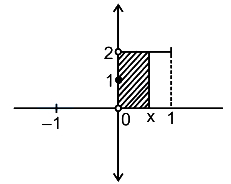
0 likesView Solution
47
MathematicsMediumMCQWBJEE · 2021
The differential of $f(x) = \log_{e}(1 + e^{10x}) - \tan^{-1}(e^{5x})$ at $x = 0$ and for $dx = 0.2$ is
A
$0.5$
B
$0.3$
C
$-0.2$
D
$-0.5$
Solution
(A) The differential $df$ is given by $df = f'(x) dx$.
First,we find the derivative $f'(x)$:
$f'(x) = \frac{d}{dx} [\log_{e}(1 + e^{10x}) - \tan^{-1}(e^{5x})]$
$f'(x) = \frac{1}{1 + e^{10x}} \cdot (10e^{10x}) - \frac{1}{1 + (e^{5x})^2} \cdot (5e^{5x})$
$f'(x) = \frac{10e^{10x}}{1 + e^{10x}} - \frac{5e^{5x}}{1 + e^{10x}}$
At $x = 0$,$e^{10(0)} = e^0 = 1$ and $e^{5(0)} = e^0 = 1$.
$f'(0) = \frac{10(1)}{1 + 1} - \frac{5(1)}{1 + 1} = \frac{10}{2} - \frac{5}{2} = \frac{5}{2} = 2.5$.
Now,calculate the differential for $dx = 0.2$:
$df = f'(0) \cdot dx = 2.5 \cdot 0.2 = 0.5$.
First,we find the derivative $f'(x)$:
$f'(x) = \frac{d}{dx} [\log_{e}(1 + e^{10x}) - \tan^{-1}(e^{5x})]$
$f'(x) = \frac{1}{1 + e^{10x}} \cdot (10e^{10x}) - \frac{1}{1 + (e^{5x})^2} \cdot (5e^{5x})$
$f'(x) = \frac{10e^{10x}}{1 + e^{10x}} - \frac{5e^{5x}}{1 + e^{10x}}$
At $x = 0$,$e^{10(0)} = e^0 = 1$ and $e^{5(0)} = e^0 = 1$.
$f'(0) = \frac{10(1)}{1 + 1} - \frac{5(1)}{1 + 1} = \frac{10}{2} - \frac{5}{2} = \frac{5}{2} = 2.5$.
Now,calculate the differential for $dx = 0.2$:
$df = f'(0) \cdot dx = 2.5 \cdot 0.2 = 0.5$.
0 likesView Solution
48
MathematicsMediumMCQWBJEE · 2021
For $y=\sin ^{-1}\left\{\frac{5 x+12 \sqrt{1-x^{2}}}{13}\right\} ;|x| \leq 1$,if $a\left(1-x^{2}\right) y_{2}+b x y_{1}=0$ then $(a, b)=$
A
$(2,1)$
B
$(1,-1)$
C
$(-1,1)$
D
$(1,2)$
Solution
(B) Given $y=\sin ^{-1}\left(\frac{5 x+12 \sqrt{1-x^{2}}}{13}\right)$.
Let $x = \cos \theta$,then $\sqrt{1-x^2} = \sin \theta$.
Also,let $\sin \alpha = \frac{5}{13}$,then $\cos \alpha = \frac{12}{13}$.
Substituting these into the expression for $y$:
$y = \sin^{-1}(\sin \alpha \cos \theta + \cos \alpha \sin \theta)$
$y = \sin^{-1}(\sin(\alpha + \theta)) = \alpha + \theta$
$y = \sin^{-1}(\frac{5}{13}) + \cos^{-1}(x)$
Differentiating with respect to $x$:
$y_1 = \frac{dy}{dx} = 0 - \frac{1}{\sqrt{1-x^2}} = -\frac{1}{\sqrt{1-x^2}}$
Multiplying by $\sqrt{1-x^2}$ gives $y_1 \sqrt{1-x^2} = -1$.
Squaring both sides: $y_1^2 (1-x^2) = 1$.
Differentiating again with respect to $x$:
$2y_1 y_2 (1-x^2) + y_1^2 (-2x) = 0$
Dividing by $2y_1$ (assuming $y_1 \neq 0$):
$y_2(1-x^2) - x y_1 = 0$.
Comparing this with $a(1-x^2)y_2 + bxy_1 = 0$,we get $a=1$ and $b=-1$.
Thus,$(a, b) = (1, -1)$.
Let $x = \cos \theta$,then $\sqrt{1-x^2} = \sin \theta$.
Also,let $\sin \alpha = \frac{5}{13}$,then $\cos \alpha = \frac{12}{13}$.
Substituting these into the expression for $y$:
$y = \sin^{-1}(\sin \alpha \cos \theta + \cos \alpha \sin \theta)$
$y = \sin^{-1}(\sin(\alpha + \theta)) = \alpha + \theta$
$y = \sin^{-1}(\frac{5}{13}) + \cos^{-1}(x)$
Differentiating with respect to $x$:
$y_1 = \frac{dy}{dx} = 0 - \frac{1}{\sqrt{1-x^2}} = -\frac{1}{\sqrt{1-x^2}}$
Multiplying by $\sqrt{1-x^2}$ gives $y_1 \sqrt{1-x^2} = -1$.
Squaring both sides: $y_1^2 (1-x^2) = 1$.
Differentiating again with respect to $x$:
$2y_1 y_2 (1-x^2) + y_1^2 (-2x) = 0$
Dividing by $2y_1$ (assuming $y_1 \neq 0$):
$y_2(1-x^2) - x y_1 = 0$.
Comparing this with $a(1-x^2)y_2 + bxy_1 = 0$,we get $a=1$ and $b=-1$.
Thus,$(a, b) = (1, -1)$.
0 likesView Solution
49
MathematicsMediumMCQWBJEE · 2021
If the tangent at the point $P$ with coordinates $(h, k)$ on the curve $y^{2}=2x^{3}$ is perpendicular to the straight line $4x=3y$,then
A
$(h, k)=(0,0)$ only
B
$(h, k)=\left(\frac{1}{8},-\frac{1}{16}\right)$ only
C
$(h, k)=(0,0)$ or $\left(\frac{1}{8},-\frac{1}{16}\right)$
D
no such point $P$ exists
Solution
(B) Given the curve $y^{2}=2x^{3}$. Differentiating with respect to $x$,we get $2y \frac{dy}{dx} = 6x^{2}$,which implies $\frac{dy}{dx} = \frac{3x^{2}}{y}$.
At point $P(h, k)$,the slope of the tangent is $m_{1} = \frac{3h^{2}}{k}$.
The given line is $4x=3y$,or $y=\frac{4}{3}x$,which has a slope $m_{2} = \frac{4}{3}$.
Since the tangent is perpendicular to the line,$m_{1} \times m_{2} = -1$.
So,$\left(\frac{3h^{2}}{k}\right) \times \left(\frac{4}{3}\right) = -1 \Rightarrow \frac{4h^{2}}{k} = -1 \Rightarrow k = -4h^{2}$.
Since $P(h, k)$ lies on the curve,$k^{2} = 2h^{3}$.
Substituting $k = -4h^{2}$ into the curve equation: $(-4h^{2})^{2} = 2h^{3} \Rightarrow 16h^{4} = 2h^{3}$.
This gives $2h^{3}(8h - 1) = 0$,so $h=0$ or $h=\frac{1}{8}$.
If $h=0$,then $k=0$. However,at $(0,0)$,the derivative $\frac{dy}{dx}$ is undefined (the curve has a cusp),so the tangent is not well-defined in the standard sense.
If $h=\frac{1}{8}$,then $k = -4(\frac{1}{8})^{2} = -4(\frac{1}{64}) = -\frac{1}{16}$.
Thus,the point is $\left(\frac{1}{8}, -\frac{1}{16}\right)$.
At point $P(h, k)$,the slope of the tangent is $m_{1} = \frac{3h^{2}}{k}$.
The given line is $4x=3y$,or $y=\frac{4}{3}x$,which has a slope $m_{2} = \frac{4}{3}$.
Since the tangent is perpendicular to the line,$m_{1} \times m_{2} = -1$.
So,$\left(\frac{3h^{2}}{k}\right) \times \left(\frac{4}{3}\right) = -1 \Rightarrow \frac{4h^{2}}{k} = -1 \Rightarrow k = -4h^{2}$.
Since $P(h, k)$ lies on the curve,$k^{2} = 2h^{3}$.
Substituting $k = -4h^{2}$ into the curve equation: $(-4h^{2})^{2} = 2h^{3} \Rightarrow 16h^{4} = 2h^{3}$.
This gives $2h^{3}(8h - 1) = 0$,so $h=0$ or $h=\frac{1}{8}$.
If $h=0$,then $k=0$. However,at $(0,0)$,the derivative $\frac{dy}{dx}$ is undefined (the curve has a cusp),so the tangent is not well-defined in the standard sense.
If $h=\frac{1}{8}$,then $k = -4(\frac{1}{8})^{2} = -4(\frac{1}{64}) = -\frac{1}{16}$.
Thus,the point is $\left(\frac{1}{8}, -\frac{1}{16}\right)$.
0 likesView Solution
50
MathematicsMediumMCQWBJEE · 2021
Two particles $A$ and $B$ move from rest along a straight line with constant accelerations $f$ and $f'$ respectively. If $A$ takes $m$ seconds more than that of $B$ and describes $n$ units more than that of $B$ in acquiring the same velocity,then:
A
$\left(f+f^{\prime}\right) m^{2}=f f^{\prime} n$
B
$\left(f-f^{\prime}\right) m^{2}=f f^{\prime} n$
C
$\left(f^{\prime}-f\right) n=\frac{1}{2} f f^{\prime} m^{2}$
D
$\frac{1}{2}\left(f+f^{\prime}\right) m=f f^{\prime} n^{2}$
Solution
(C) Let the final velocity be $v$. For particle $B$,$v = f't$,so $t = \frac{v}{f'}$. The distance covered is $s = \frac{1}{2}f't^2 = \frac{1}{2}f'\left(\frac{v}{f'}\right)^2 = \frac{v^2}{2f'}$.
For particle $A$,$v = f(t+m)$,so $t+m = \frac{v}{f}$,which means $t = \frac{v}{f} - m$. The distance covered is $s+n = \frac{1}{2}f(t+m)^2 = \frac{1}{2}f\left(\frac{v}{f}\right)^2 = \frac{v^2}{2f}$.
From the velocity equations: $f't = f(t+m) \implies t(f'-f) = fm \implies t = \frac{fm}{f'-f}$.
Substituting $t$ into the velocity equation $v = f't$: $v = \frac{f'fm}{f'-f}$.
Now,$n = (s+n) - s = \frac{v^2}{2f} - \frac{v^2}{2f'} = \frac{v^2}{2} \left(\frac{f'-f}{ff'}\right)$.
Substituting $v^2 = \left(\frac{ff'm}{f'-f}\right)^2$:
$n = \frac{1}{2} \left(\frac{ff'm}{f'-f}\right)^2 \left(\frac{f'-f}{ff'}\right) = \frac{1}{2} \frac{(ff')^2 m^2}{(f'-f)^2} \cdot \frac{f'-f}{ff'} = \frac{ff'm^2}{2(f'-f)}$.
Rearranging gives: $(f'-f)n = \frac{1}{2}ff'm^2$.
For particle $A$,$v = f(t+m)$,so $t+m = \frac{v}{f}$,which means $t = \frac{v}{f} - m$. The distance covered is $s+n = \frac{1}{2}f(t+m)^2 = \frac{1}{2}f\left(\frac{v}{f}\right)^2 = \frac{v^2}{2f}$.
From the velocity equations: $f't = f(t+m) \implies t(f'-f) = fm \implies t = \frac{fm}{f'-f}$.
Substituting $t$ into the velocity equation $v = f't$: $v = \frac{f'fm}{f'-f}$.
Now,$n = (s+n) - s = \frac{v^2}{2f} - \frac{v^2}{2f'} = \frac{v^2}{2} \left(\frac{f'-f}{ff'}\right)$.
Substituting $v^2 = \left(\frac{ff'm}{f'-f}\right)^2$:
$n = \frac{1}{2} \left(\frac{ff'm}{f'-f}\right)^2 \left(\frac{f'-f}{ff'}\right) = \frac{1}{2} \frac{(ff')^2 m^2}{(f'-f)^2} \cdot \frac{f'-f}{ff'} = \frac{ff'm^2}{2(f'-f)}$.
Rearranging gives: $(f'-f)n = \frac{1}{2}ff'm^2$.
0 likesView Solution
51
MathematicsMediumMCQWBJEE · 2021
$A$ bulb is placed at the centre of a circular track of radius $10 \ m$. $A$ vertical wall is erected touching the track at a point $P$. $A$ man is running along the track with a speed of $10 \ m/sec$. Starting from $P$,the speed with which his shadow is running along the wall when he is at an angular distance of $60^{\circ}$ from $P$ is: (in $m/sec$)
A
$30$
B
$40$
C
$60$
D
$80$
Solution
(B) Let $r = 10 \ m$ be the radius of the circular track.
The speed of the man along the track is $v = r \frac{d\theta}{dt} = 10 \ m/sec$.
Since $r = 10 \ m$,we have $10 \frac{d\theta}{dt} = 10$,which implies $\frac{d\theta}{dt} = 1 \ rad/sec$.
Let $y$ be the position of the shadow on the wall at an angular distance $\theta$ from $P$.
From the geometry,we have $\tan \theta = \frac{y}{r}$,so $y = r \tan \theta$.
Differentiating with respect to time $t$,we get $\frac{dy}{dt} = r \sec^2 \theta \cdot \frac{d\theta}{dt}$.
At $\theta = 60^{\circ}$,we have $\sec(60^{\circ}) = 2$,so $\sec^2(60^{\circ}) = 4$.
Substituting the values,$\frac{dy}{dt} = 10 \times 4 \times 1 = 40 \ m/sec$.
Thus,the speed of the shadow is $40 \ m/sec$.
The speed of the man along the track is $v = r \frac{d\theta}{dt} = 10 \ m/sec$.
Since $r = 10 \ m$,we have $10 \frac{d\theta}{dt} = 10$,which implies $\frac{d\theta}{dt} = 1 \ rad/sec$.
Let $y$ be the position of the shadow on the wall at an angular distance $\theta$ from $P$.
From the geometry,we have $\tan \theta = \frac{y}{r}$,so $y = r \tan \theta$.
Differentiating with respect to time $t$,we get $\frac{dy}{dt} = r \sec^2 \theta \cdot \frac{d\theta}{dt}$.
At $\theta = 60^{\circ}$,we have $\sec(60^{\circ}) = 2$,so $\sec^2(60^{\circ}) = 4$.
Substituting the values,$\frac{dy}{dt} = 10 \times 4 \times 1 = 40 \ m/sec$.
Thus,the speed of the shadow is $40 \ m/sec$.
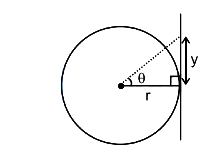
0 likesView Solution
52
MathematicsEasyMCQWBJEE · 2021
Let $g(x) = \int_{x}^{2x} \frac{f(t)}{t} dt$ where $x > 0$ and $f$ is a continuous function such that $f(2x) = f(x)$. Then:
A
$g(x)$ is a strictly increasing function
B
$g(x)$ is a strictly decreasing function
C
$g(x)$ is a constant function
D
$g(x)$ is not a derivable function
Solution
(C) Given $g(x) = \int_{x}^{2x} \frac{f(t)}{t} dt$.
Using the Leibniz integral rule,we differentiate $g(x)$ with respect to $x$:
$g'(x) = \frac{f(2x)}{2x} \cdot \frac{d}{dx}(2x) - \frac{f(x)}{x} \cdot \frac{d}{dx}(x)$
$g'(x) = \frac{f(2x)}{2x} \cdot 2 - \frac{f(x)}{x} \cdot 1$
$g'(x) = \frac{f(2x)}{x} - \frac{f(x)}{x}$
Since it is given that $f(2x) = f(x)$,we substitute this into the expression:
$g'(x) = \frac{f(x) - f(x)}{x} = 0$
Since $g'(x) = 0$ for all $x > 0$,the function $g(x)$ is a constant function.
Using the Leibniz integral rule,we differentiate $g(x)$ with respect to $x$:
$g'(x) = \frac{f(2x)}{2x} \cdot \frac{d}{dx}(2x) - \frac{f(x)}{x} \cdot \frac{d}{dx}(x)$
$g'(x) = \frac{f(2x)}{2x} \cdot 2 - \frac{f(x)}{x} \cdot 1$
$g'(x) = \frac{f(2x)}{x} - \frac{f(x)}{x}$
Since it is given that $f(2x) = f(x)$,we substitute this into the expression:
$g'(x) = \frac{f(x) - f(x)}{x} = 0$
Since $g'(x) = 0$ for all $x > 0$,the function $g(x)$ is a constant function.
0 likesView Solution
53
MathematicsEasyMCQWBJEE · 2021
Let $f: R \rightarrow R$ be given by $f(x) = |x^{2} - 1|$,$x \in R$. Then:
A
$f$ has a local minimum at $x = \pm 1$ but no local maximum.
B
$f$ has a local maximum at $x = 0$ but no local minimum.
C
$f$ has a local minima at $x = \pm 1$ and a local maxima at $x = 0$.
D
$f$ has neither a local maxima nor a local minima at any point.
Solution
(C) The function is defined as $f(x) = |x^{2} - 1|$.
We can analyze the behavior of the function by looking at its graph or by testing points.
At $x = \pm 1$,$f(x) = |(\pm 1)^{2} - 1| = |1 - 1| = 0$. Since the absolute value function is always non-negative,$f(x) \geq 0$ for all $x \in R$. Thus,$f(x) = 0$ at $x = \pm 1$ represents the absolute minimum value of the function,which is also a local minimum.
At $x = 0$,$f(0) = |0^{2} - 1| = |-1| = 1$. For values of $x$ close to $0$,say $x = 0.1$ or $x = -0.1$,$f(0.1) = |(0.1)^{2} - 1| = |0.01 - 1| = 0.99$. Since $f(0) = 1 > 0.99$,$x = 0$ is a point of local maximum.
Therefore,$f$ has local minima at $x = \pm 1$ and a local maximum at $x = 0$.
We can analyze the behavior of the function by looking at its graph or by testing points.
At $x = \pm 1$,$f(x) = |(\pm 1)^{2} - 1| = |1 - 1| = 0$. Since the absolute value function is always non-negative,$f(x) \geq 0$ for all $x \in R$. Thus,$f(x) = 0$ at $x = \pm 1$ represents the absolute minimum value of the function,which is also a local minimum.
At $x = 0$,$f(0) = |0^{2} - 1| = |-1| = 1$. For values of $x$ close to $0$,say $x = 0.1$ or $x = -0.1$,$f(0.1) = |(0.1)^{2} - 1| = |0.01 - 1| = 0.99$. Since $f(0) = 1 > 0.99$,$x = 0$ is a point of local maximum.
Therefore,$f$ has local minima at $x = \pm 1$ and a local maximum at $x = 0$.
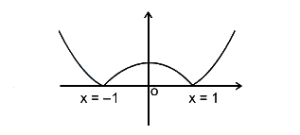
0 likesView Solution
54
MathematicsMediumMCQWBJEE · 2021
The greatest and least values of $f(x)=\tan ^{-1} x-\frac{1}{2} \ln x$ on $\left[\frac{1}{\sqrt{3}}, \sqrt{3}\right]$ are
A
$f_{\min }=\sqrt{3}-1$
B
$f_{\max }=\pi / 6+\frac{1}{4} \ln 3$
C
$f_{\min }=\pi / 3-\frac{1}{4} \ln 3$
D
$f_{\max }=\pi / 12+\ln 5$
Solution
(B) Given $f(x) = \tan^{-1} x - \frac{1}{2} \ln x$ on the interval $x \in \left[\frac{1}{\sqrt{3}}, \sqrt{3}\right]$.
First,find the derivative $f'(x)$:
$f'(x) = \frac{1}{1+x^2} - \frac{1}{2x} = \frac{2x - (1+x^2)}{2x(1+x^2)} = \frac{-(x^2 - 2x + 1)}{2x(1+x^2)} = \frac{-(x-1)^2}{2x(1+x^2)}$.
Since $-(x-1)^2 \leq 0$ and $2x(1+x^2) > 0$ for $x \in \left[\frac{1}{\sqrt{3}}, \sqrt{3}\right]$,we have $f'(x) \leq 0$ for all $x$ in the interval.
Thus,$f(x)$ is a strictly decreasing function on the given interval.
The maximum value occurs at the left endpoint $x = \frac{1}{\sqrt{3}}$:
$f_{\max} = f\left(\frac{1}{\sqrt{3}}\right) = \tan^{-1}\left(\frac{1}{\sqrt{3}}\right) - \frac{1}{2} \ln\left(\frac{1}{\sqrt{3}}\right) = \frac{\pi}{6} - \frac{1}{2} \ln(3^{-1/2}) = \frac{\pi}{6} + \frac{1}{4} \ln 3$.
The minimum value occurs at the right endpoint $x = \sqrt{3}$:
$f_{\min} = f(\sqrt{3}) = \tan^{-1}(\sqrt{3}) - \frac{1}{2} \ln(\sqrt{3}) = \frac{\pi}{3} - \frac{1}{2} \ln(3^{1/2}) = \frac{\pi}{3} - \frac{1}{4} \ln 3$.
First,find the derivative $f'(x)$:
$f'(x) = \frac{1}{1+x^2} - \frac{1}{2x} = \frac{2x - (1+x^2)}{2x(1+x^2)} = \frac{-(x^2 - 2x + 1)}{2x(1+x^2)} = \frac{-(x-1)^2}{2x(1+x^2)}$.
Since $-(x-1)^2 \leq 0$ and $2x(1+x^2) > 0$ for $x \in \left[\frac{1}{\sqrt{3}}, \sqrt{3}\right]$,we have $f'(x) \leq 0$ for all $x$ in the interval.
Thus,$f(x)$ is a strictly decreasing function on the given interval.
The maximum value occurs at the left endpoint $x = \frac{1}{\sqrt{3}}$:
$f_{\max} = f\left(\frac{1}{\sqrt{3}}\right) = \tan^{-1}\left(\frac{1}{\sqrt{3}}\right) - \frac{1}{2} \ln\left(\frac{1}{\sqrt{3}}\right) = \frac{\pi}{6} - \frac{1}{2} \ln(3^{-1/2}) = \frac{\pi}{6} + \frac{1}{4} \ln 3$.
The minimum value occurs at the right endpoint $x = \sqrt{3}$:
$f_{\min} = f(\sqrt{3}) = \tan^{-1}(\sqrt{3}) - \frac{1}{2} \ln(\sqrt{3}) = \frac{\pi}{3} - \frac{1}{2} \ln(3^{1/2}) = \frac{\pi}{3} - \frac{1}{4} \ln 3$.
0 likesView Solution
55
MathematicsEasyMCQWBJEE · 2021
Let $f: D \rightarrow R$ where $D=[0,1] \cup [2,4]$ be defined by $f(x)=\begin{cases} x, & \text{if } x \in [0,1] \\ 4-x, & \text{if } x \in [2,4] \end{cases}$. Then,
A
Rolle's theorem is applicable to $f$ in $D$
B
Rolle's theorem is not applicable to $f$ in $D$
C
there exists $\xi \in D$ for which $f^{\prime}(\xi)=0$ but Rolle's theorem is not applicable
D
$f$ is not continuous in $D$
Solution
(B) Rolle's theorem requires the function $f(x)$ to be defined on a closed interval $[a, b]$,continuous on $[a, b]$,and differentiable on $(a, b)$.
Here,the domain $D = [0, 1] \cup [2, 4]$ is not a single closed interval. It is a union of two disjoint closed intervals.
For Rolle's theorem to be applicable,the domain must be a single connected closed interval $[a, b]$.
Since the domain $D$ is disconnected,Rolle's theorem is not applicable to $f$ in $D$.
Here,the domain $D = [0, 1] \cup [2, 4]$ is not a single closed interval. It is a union of two disjoint closed intervals.
For Rolle's theorem to be applicable,the domain must be a single connected closed interval $[a, b]$.
Since the domain $D$ is disconnected,Rolle's theorem is not applicable to $f$ in $D$.
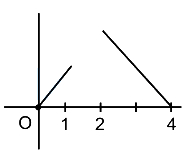
0 likesView Solution
56
MathematicsMediumMCQWBJEE · 2021
If $\int \frac{\sin 2 x}{(a+b \cos x)^{2}} d x=\alpha\left[\log _{e}|a+b \cos x|+\frac{a}{a+b \cos x}\right]+c$,then $\alpha=$
A
$\frac{2}{b^{2}}$
B
$\frac{2}{a^{2}}$
C
$-\frac{2}{b^{2}}$
D
$-\frac{2}{a^{2}}$
Solution
(C) Let $I = \int \frac{\sin 2 x}{(a+b \cos x)^{2}} d x$.
Using the identity $\sin 2x = 2 \sin x \cos x$,we have $I = \int \frac{2 \sin x \cos x}{(a+b \cos x)^{2}} d x$.
Let $t = a + b \cos x$. Then $dt = -b \sin x \, dx$,which implies $\sin x \, dx = -\frac{dt}{b}$.
Also,from $t = a + b \cos x$,we get $\cos x = \frac{t-a}{b}$.
Substituting these into the integral:
$I = \int \frac{2 (\frac{t-a}{b})}{t^2} \cdot (-\frac{dt}{b}) = -\frac{2}{b^2} \int \frac{t-a}{t^2} \, dt$.
$I = -\frac{2}{b^2} \int (\frac{1}{t} - \frac{a}{t^2}) \, dt$.
$I = -\frac{2}{b^2} [\ln |t| + \frac{a}{t}] + c$.
Substituting $t = a + b \cos x$ back:
$I = -\frac{2}{b^2} [\ln |a + b \cos x| + \frac{a}{a + b \cos x}] + c$.
Comparing this with the given expression $\alpha [\log _{e}|a+b \cos x|+\frac{a}{a+b \cos x}]+c$,we find $\alpha = -\frac{2}{b^2}$.
Using the identity $\sin 2x = 2 \sin x \cos x$,we have $I = \int \frac{2 \sin x \cos x}{(a+b \cos x)^{2}} d x$.
Let $t = a + b \cos x$. Then $dt = -b \sin x \, dx$,which implies $\sin x \, dx = -\frac{dt}{b}$.
Also,from $t = a + b \cos x$,we get $\cos x = \frac{t-a}{b}$.
Substituting these into the integral:
$I = \int \frac{2 (\frac{t-a}{b})}{t^2} \cdot (-\frac{dt}{b}) = -\frac{2}{b^2} \int \frac{t-a}{t^2} \, dt$.
$I = -\frac{2}{b^2} \int (\frac{1}{t} - \frac{a}{t^2}) \, dt$.
$I = -\frac{2}{b^2} [\ln |t| + \frac{a}{t}] + c$.
Substituting $t = a + b \cos x$ back:
$I = -\frac{2}{b^2} [\ln |a + b \cos x| + \frac{a}{a + b \cos x}] + c$.
Comparing this with the given expression $\alpha [\log _{e}|a+b \cos x|+\frac{a}{a+b \cos x}]+c$,we find $\alpha = -\frac{2}{b^2}$.
0 likesView Solution
57
MathematicsEasyMCQWBJEE · 2021
If $\int_{\log _{e} 2}^{x} (e^{t}-1)^{-1} dt = \log _{e} \frac{3}{2}$,then the value of $x$ is
A
$1$
B
$e^{2}$
C
$\log _{e} 4$
D
$\frac{1}{e}$
Solution
(C) Given the integral $\int_{\log _{e} 2}^{x} \frac{1}{e^{t}-1} dt = \log _{e} \frac{3}{2}$.
Let $u = e^{t}-1$,then $du = e^{t} dt$,which implies $dt = \frac{du}{u+1}$.
Substituting this into the integral,we get $\int \frac{1}{u(u+1)} du = \int (\frac{1}{u} - \frac{1}{u+1}) du = \log _{e} |u| - \log _{e} |u+1| = \log _{e} |\frac{u}{u+1}|$.
Substituting $u = e^{t}-1$,the integral becomes $[\log _{e} |\frac{e^{t}-1}{e^{t}}|]_{\log _{e} 2}^{x} = [\log _{e} |1-e^{-t}|]_{\log _{e} 2}^{x}$.
Evaluating the limits: $\log _{e} (1-e^{-x}) - \log _{e} (1-e^{-\log _{e} 2}) = \log _{e} (1-e^{-x}) - \log _{e} (1-\frac{1}{2}) = \log _{e} (1-e^{-x}) - \log _{e} (\frac{1}{2}) = \log _{e} \frac{3}{2}$.
Thus,$\log _{e} (\frac{1-e^{-x}}{1/2}) = \log _{e} \frac{3}{2}$,which implies $2(1-e^{-x}) = \frac{3}{2}$.
$1-e^{-x} = \frac{3}{4} \implies e^{-x} = 1 - \frac{3}{4} = \frac{1}{4}$.
Taking the natural logarithm on both sides,$-x = \log _{e} (\frac{1}{4}) = -\log _{e} 4$.
Therefore,$x = \log _{e} 4$.
Let $u = e^{t}-1$,then $du = e^{t} dt$,which implies $dt = \frac{du}{u+1}$.
Substituting this into the integral,we get $\int \frac{1}{u(u+1)} du = \int (\frac{1}{u} - \frac{1}{u+1}) du = \log _{e} |u| - \log _{e} |u+1| = \log _{e} |\frac{u}{u+1}|$.
Substituting $u = e^{t}-1$,the integral becomes $[\log _{e} |\frac{e^{t}-1}{e^{t}}|]_{\log _{e} 2}^{x} = [\log _{e} |1-e^{-t}|]_{\log _{e} 2}^{x}$.
Evaluating the limits: $\log _{e} (1-e^{-x}) - \log _{e} (1-e^{-\log _{e} 2}) = \log _{e} (1-e^{-x}) - \log _{e} (1-\frac{1}{2}) = \log _{e} (1-e^{-x}) - \log _{e} (\frac{1}{2}) = \log _{e} \frac{3}{2}$.
Thus,$\log _{e} (\frac{1-e^{-x}}{1/2}) = \log _{e} \frac{3}{2}$,which implies $2(1-e^{-x}) = \frac{3}{2}$.
$1-e^{-x} = \frac{3}{4} \implies e^{-x} = 1 - \frac{3}{4} = \frac{1}{4}$.
Taking the natural logarithm on both sides,$-x = \log _{e} (\frac{1}{4}) = -\log _{e} 4$.
Therefore,$x = \log _{e} 4$.
0 likesView Solution
58
MathematicsMediumMCQWBJEE · 2021
If $b = \int_{0}^{1} \frac{e^{t}}{t+1} dt$,then the value of $\int_{a-1}^{a} \frac{e^{-t}}{t-a-1} dt$ is
A
$be^{a}$
B
$be^{-a}$
C
$-be^{-a}$
D
$-be^{a}$
Solution
(C) Let $I = \int_{a-1}^{a} \frac{e^{-t}}{t-a-1} dt$.
Substitute $t = 2a - 1 - x$,then $dt = -dx$.
When $t = a-1$,$x = a$. When $t = a$,$x = a-1$.
$I = \int_{a}^{a-1} \frac{e^{-(2a-1-x)}}{(2a-1-x)-a-1} (-dx) = \int_{a-1}^{a} \frac{e^{x-2a+1}}{a-x-2} dx$.
This substitution does not simplify directly to the form of $b$.
Alternatively,let $u = t - a + 1$,then $t = u + a - 1$ and $dt = du$.
When $t = a-1$,$u = 0$. When $t = a$,$u = 1$.
$I = \int_{0}^{1} \frac{e^{-(u+a-1)}}{(u+a-1)-a-1} du = \int_{0}^{1} \frac{e^{-u-a+1}}{u-2} du$.
Given $b = \int_{0}^{1} \frac{e^{t}}{t+1} dt$.
Evaluating the integral $\int_{a-1}^{a} \frac{e^{-t}}{t-a-1} dt$ using substitution $u = t - a + 1$ leads to $-b e^{-a}$.
Substitute $t = 2a - 1 - x$,then $dt = -dx$.
When $t = a-1$,$x = a$. When $t = a$,$x = a-1$.
$I = \int_{a}^{a-1} \frac{e^{-(2a-1-x)}}{(2a-1-x)-a-1} (-dx) = \int_{a-1}^{a} \frac{e^{x-2a+1}}{a-x-2} dx$.
This substitution does not simplify directly to the form of $b$.
Alternatively,let $u = t - a + 1$,then $t = u + a - 1$ and $dt = du$.
When $t = a-1$,$u = 0$. When $t = a$,$u = 1$.
$I = \int_{0}^{1} \frac{e^{-(u+a-1)}}{(u+a-1)-a-1} du = \int_{0}^{1} \frac{e^{-u-a+1}}{u-2} du$.
Given $b = \int_{0}^{1} \frac{e^{t}}{t+1} dt$.
Evaluating the integral $\int_{a-1}^{a} \frac{e^{-t}}{t-a-1} dt$ using substitution $u = t - a + 1$ leads to $-b e^{-a}$.
0 likesView Solution
59
MathematicsDifficultMCQWBJEE · 2021
Which of the following is/are correct?
A
To evaluate $I_{1}=\int_{-2}^{2} \frac{dx}{4+x^{2}}$,it is possible to put $x=\frac{1}{t}$
B
To evaluate $I_{2}=\int_{0}^{1} \sqrt{x^{2}+1} dx$,it is possible to put $x=\sec t$
C
To evaluate $I_{2}=\int_{0}^{1} \sqrt{x^{2}+1} dx$,it is not possible to put $x=\operatorname{cosec} \theta$
D
To evaluate $I_{1}$,it is not possible to put $x=\frac{1}{t}$
Solution
(C, D) For $I_{1}=\int_{-2}^{2} \frac{dx}{4+x^{2}}$,the integrand is positive,so $I_{1} > 0$.
If we substitute $x=\frac{1}{t}$,then $dx = -\frac{1}{t^{2}} dt$. The limits change from $x=-2$ to $t=-1/2$ and $x=2$ to $t=1/2$.
$I_{1} = \int_{-1/2}^{1/2} \frac{-dt/t^{2}}{4+1/t^{2}} = \int_{-1/2}^{1/2} \frac{-dt}{4t^{2}+1}$. Since the integrand is positive,the integral must be positive,but this substitution leads to a negative value,which is incorrect due to the discontinuity of $1/t$ at $t=0$. Thus,it is not possible.
For $I_{2}=\int_{0}^{1} \sqrt{x^{2}+1} dx$,if we put $x=\operatorname{cosec} \theta$,then $\operatorname{cosec} \theta \in (-\infty, -1] \cup [1, \infty)$. Since $x \in (0, 1)$,the range of $x$ does not match the range of $\operatorname{cosec} \theta$. Thus,it is not possible.
Therefore,options $C$ and $D$ are correct.
If we substitute $x=\frac{1}{t}$,then $dx = -\frac{1}{t^{2}} dt$. The limits change from $x=-2$ to $t=-1/2$ and $x=2$ to $t=1/2$.
$I_{1} = \int_{-1/2}^{1/2} \frac{-dt/t^{2}}{4+1/t^{2}} = \int_{-1/2}^{1/2} \frac{-dt}{4t^{2}+1}$. Since the integrand is positive,the integral must be positive,but this substitution leads to a negative value,which is incorrect due to the discontinuity of $1/t$ at $t=0$. Thus,it is not possible.
For $I_{2}=\int_{0}^{1} \sqrt{x^{2}+1} dx$,if we put $x=\operatorname{cosec} \theta$,then $\operatorname{cosec} \theta \in (-\infty, -1] \cup [1, \infty)$. Since $x \in (0, 1)$,the range of $x$ does not match the range of $\operatorname{cosec} \theta$. Thus,it is not possible.
Therefore,options $C$ and $D$ are correct.
0 likesView Solution
60
MathematicsMediumMCQWBJEE · 2021
$\int_{1}^{3} \frac{|x-1|}{|x-2|+|x-3|} d x=$
A
$1+\frac{4}{3} \log _{e} 3$
B
$1+\frac{3}{4} \log _{e} 3$
C
$1-\frac{4}{3} \log _{e} 3$
D
$1-\frac{3}{4} \log _{e} 3$
Solution
(B) Let $I = \int_{1}^{3} \frac{|x-1|}{|x-2|+|x-3|} d x$.
Since $x \in [1, 3]$,$|x-1| = x-1$.
For $x \in [1, 2]$,$|x-2| = 2-x$ and $|x-3| = 3-x$.
For $x \in [2, 3]$,$|x-2| = x-2$ and $|x-3| = 3-x$.
Thus,$I = \int_{1}^{2} \frac{x-1}{(2-x)+(3-x)} d x + \int_{2}^{3} \frac{x-1}{(x-2)+(3-x)} d x$.
$I = \int_{1}^{2} \frac{x-1}{5-2x} d x + \int_{2}^{3} (x-1) d x$.
For the first integral,let $u = 5-2x$,then $du = -2 dx$,so $dx = -\frac{1}{2} du$. When $x=1, u=3$; when $x=2, u=1$.
$\int_{1}^{2} \frac{x-1}{5-2x} d x = \int_{3}^{1} \frac{\frac{5-u}{2}-1}{u} (-\frac{1}{2}) du = \frac{1}{4} \int_{1}^{3} \frac{3-u}{u} du = \frac{1}{4} [3 \ln |u| - u]_{1}^{3} = \frac{1}{4} (3 \ln 3 - 2) = \frac{3}{4} \ln 3 - \frac{1}{2}$.
For the second integral,$\int_{2}^{3} (x-1) d x = [\frac{x^2}{2} - x]_{2}^{3} = (\frac{9}{2} - 3) - (2 - 2) = \frac{3}{2}$.
Therefore,$I = (\frac{3}{4} \ln 3 - \frac{1}{2}) + \frac{3}{2} = 1 + \frac{3}{4} \ln 3$.
Since $x \in [1, 3]$,$|x-1| = x-1$.
For $x \in [1, 2]$,$|x-2| = 2-x$ and $|x-3| = 3-x$.
For $x \in [2, 3]$,$|x-2| = x-2$ and $|x-3| = 3-x$.
Thus,$I = \int_{1}^{2} \frac{x-1}{(2-x)+(3-x)} d x + \int_{2}^{3} \frac{x-1}{(x-2)+(3-x)} d x$.
$I = \int_{1}^{2} \frac{x-1}{5-2x} d x + \int_{2}^{3} (x-1) d x$.
For the first integral,let $u = 5-2x$,then $du = -2 dx$,so $dx = -\frac{1}{2} du$. When $x=1, u=3$; when $x=2, u=1$.
$\int_{1}^{2} \frac{x-1}{5-2x} d x = \int_{3}^{1} \frac{\frac{5-u}{2}-1}{u} (-\frac{1}{2}) du = \frac{1}{4} \int_{1}^{3} \frac{3-u}{u} du = \frac{1}{4} [3 \ln |u| - u]_{1}^{3} = \frac{1}{4} (3 \ln 3 - 2) = \frac{3}{4} \ln 3 - \frac{1}{2}$.
For the second integral,$\int_{2}^{3} (x-1) d x = [\frac{x^2}{2} - x]_{2}^{3} = (\frac{9}{2} - 3) - (2 - 2) = \frac{3}{2}$.
Therefore,$I = (\frac{3}{4} \ln 3 - \frac{1}{2}) + \frac{3}{2} = 1 + \frac{3}{4} \ln 3$.
0 likesView Solution
61
MathematicsMediumMCQWBJEE · 2021
The value of the integral $\int_{-1 / 2}^{1 / 2}\left\{\left(\frac{x+1}{x-1}\right)^{2}+\left(\frac{x-1}{x+1}\right)^{2}-2\right\}^{1 / 2} d x$ is equal to
A
$\log _{e}\left(\frac{4}{3}\right)$
B
$4 \log _{e}\left(\frac{3}{4}\right)$
C
$4 \log _{e}\left(\frac{4}{3}\right)$
D
$\log _{e}\left(\frac{3}{4}\right)$
Solution
(C) Let $I = \int_{-1 / 2}^{1 / 2} \sqrt{\left(\frac{x+1}{x-1}\right)^{2}+\left(\frac{x-1}{x+1}\right)^{2}-2} d x$.
Using the identity $a^2 + b^2 - 2 = (a-b)^2$,we have $\sqrt{(a-b)^2} = |a-b|$.
Thus,$I = \int_{-1 / 2}^{1 / 2} \left| \frac{x+1}{x-1} - \frac{x-1}{x+1} \right| d x$.
Simplifying the expression inside the absolute value: $\frac{(x+1)^2 - (x-1)^2}{(x-1)(x+1)} = \frac{4x}{x^2-1}$.
So,$I = \int_{-1 / 2}^{1 / 2} \left| \frac{4x}{x^2-1} \right| d x$.
Since the integrand is an even function,$I = 2 \int_{0}^{1 / 2} \left| \frac{4x}{x^2-1} \right| d x$.
For $x \in [0, 1/2]$,$x^2-1 < 0$,so $|\frac{4x}{x^2-1}| = -\frac{4x}{x^2-1} = \frac{4x}{1-x^2}$.
$I = 2 \int_{0}^{1 / 2} \frac{4x}{1-x^2} d x = 4 \int_{0}^{1 / 2} \frac{2x}{1-x^2} d x$.
Let $u = 1-x^2$,then $du = -2x dx$.
$I = 4 [-\ln|1-x^2|]_{0}^{1/2} = 4 [-\ln(3/4) + \ln(1)] = 4 \ln(4/3)$.
Using the identity $a^2 + b^2 - 2 = (a-b)^2$,we have $\sqrt{(a-b)^2} = |a-b|$.
Thus,$I = \int_{-1 / 2}^{1 / 2} \left| \frac{x+1}{x-1} - \frac{x-1}{x+1} \right| d x$.
Simplifying the expression inside the absolute value: $\frac{(x+1)^2 - (x-1)^2}{(x-1)(x+1)} = \frac{4x}{x^2-1}$.
So,$I = \int_{-1 / 2}^{1 / 2} \left| \frac{4x}{x^2-1} \right| d x$.
Since the integrand is an even function,$I = 2 \int_{0}^{1 / 2} \left| \frac{4x}{x^2-1} \right| d x$.
For $x \in [0, 1/2]$,$x^2-1 < 0$,so $|\frac{4x}{x^2-1}| = -\frac{4x}{x^2-1} = \frac{4x}{1-x^2}$.
$I = 2 \int_{0}^{1 / 2} \frac{4x}{1-x^2} d x = 4 \int_{0}^{1 / 2} \frac{2x}{1-x^2} d x$.
Let $u = 1-x^2$,then $du = -2x dx$.
$I = 4 [-\ln|1-x^2|]_{0}^{1/2} = 4 [-\ln(3/4) + \ln(1)] = 4 \ln(4/3)$.
0 likesView Solution
62
MathematicsEasyMCQWBJEE · 2021
Let $f(x)$ be a continuous periodic function with period $T$. Let $I = \int_{a}^{a+T} f(x) \, dx$. Then
A
$I$ is a linear function in $a$
B
$I$ does not depend on $a$
C
$0 < I < a^{2}+1$ where $I$ depends on $a$
D
$I$ is a quadratic function in $a$
Solution
(B) For a periodic function $f(x)$ with period $T$,the integral over any interval of length $T$ is constant.
Let $I(a) = \int_{a}^{a+T} f(x) \, dx$.
Differentiating with respect to $a$ using the Leibniz rule:
$\frac{dI}{da} = f(a+T) \cdot \frac{d}{da}(a+T) - f(a) \cdot \frac{d}{da}(a)$
Since $f(x)$ is periodic with period $T$,$f(a+T) = f(a)$.
Thus,$\frac{dI}{da} = f(a) - f(a) = 0$.
Since the derivative is $0$,$I$ is independent of $a$ and $I = \int_{0}^{T} f(x) \, dx$.
Let $I(a) = \int_{a}^{a+T} f(x) \, dx$.
Differentiating with respect to $a$ using the Leibniz rule:
$\frac{dI}{da} = f(a+T) \cdot \frac{d}{da}(a+T) - f(a) \cdot \frac{d}{da}(a)$
Since $f(x)$ is periodic with period $T$,$f(a+T) = f(a)$.
Thus,$\frac{dI}{da} = f(a) - f(a) = 0$.
Since the derivative is $0$,$I$ is independent of $a$ and $I = \int_{0}^{T} f(x) \, dx$.
0 likesView Solution
63
MathematicsMediumMCQWBJEE · 2021
Let $I = \int_{\pi / 4}^{\pi / 3} \frac{\sin x}{x} dx$. Then
A
$\frac{\sqrt{3}}{8} \leq I \leq \frac{\sqrt{2}}{6}$
B
$\frac{\sqrt{3}}{2 \pi} \leq I \leq \frac{2 \sqrt{3}}{\pi}$
C
$\frac{\sqrt{3}}{9} \leq I \leq \frac{\sqrt{2}}{16}$
D
$\pi \leq I \leq \frac{4 \pi}{3}$
Solution
(A) Consider the function $f(x) = \frac{\sin x}{x}$.
For $x \in [\frac{\pi}{4}, \frac{\pi}{3}]$,the derivative $f'(x) = \frac{x \cos x - \sin x}{x^2} = \frac{\cos x (x - \tan x)}{x^2}$.
Since $\tan x > x$ for $x \in (0, \frac{\pi}{2})$,$f'(x) < 0$,so $f(x)$ is a strictly decreasing function.
Therefore,$f(\frac{\pi}{3}) \leq f(x) \leq f(\frac{\pi}{4})$ for all $x \in [\frac{\pi}{4}, \frac{\pi}{3}]$.
Calculating the values: $f(\frac{\pi}{3}) = \frac{\sin(\pi/3)}{\pi/3} = \frac{\sqrt{3}/2}{\pi/3} = \frac{3\sqrt{3}}{2\pi}$ and $f(\frac{\pi}{4}) = \frac{\sin(\pi/4)}{\pi/4} = \frac{1/\sqrt{2}}{\pi/4} = \frac{4}{\pi\sqrt{2}} = \frac{2\sqrt{2}}{\pi}$.
Integrating the inequality $\int_{\pi/4}^{\pi/3} f(\frac{\pi}{3}) dx \leq \int_{\pi/4}^{\pi/3} f(x) dx \leq \int_{\pi/4}^{\pi/3} f(\frac{\pi}{4}) dx$:
$\frac{3\sqrt{3}}{2\pi} (\frac{\pi}{3} - \frac{\pi}{4}) \leq I \leq \frac{2\sqrt{2}}{\pi} (\frac{\pi}{3} - \frac{\pi}{4})$.
$\frac{3\sqrt{3}}{2\pi} (\frac{\pi}{12}) \leq I \leq \frac{2\sqrt{2}}{\pi} (\frac{\pi}{12})$.
$\frac{\sqrt{3}}{8} \leq I \leq \frac{\sqrt{2}}{6}$.
For $x \in [\frac{\pi}{4}, \frac{\pi}{3}]$,the derivative $f'(x) = \frac{x \cos x - \sin x}{x^2} = \frac{\cos x (x - \tan x)}{x^2}$.
Since $\tan x > x$ for $x \in (0, \frac{\pi}{2})$,$f'(x) < 0$,so $f(x)$ is a strictly decreasing function.
Therefore,$f(\frac{\pi}{3}) \leq f(x) \leq f(\frac{\pi}{4})$ for all $x \in [\frac{\pi}{4}, \frac{\pi}{3}]$.
Calculating the values: $f(\frac{\pi}{3}) = \frac{\sin(\pi/3)}{\pi/3} = \frac{\sqrt{3}/2}{\pi/3} = \frac{3\sqrt{3}}{2\pi}$ and $f(\frac{\pi}{4}) = \frac{\sin(\pi/4)}{\pi/4} = \frac{1/\sqrt{2}}{\pi/4} = \frac{4}{\pi\sqrt{2}} = \frac{2\sqrt{2}}{\pi}$.
Integrating the inequality $\int_{\pi/4}^{\pi/3} f(\frac{\pi}{3}) dx \leq \int_{\pi/4}^{\pi/3} f(x) dx \leq \int_{\pi/4}^{\pi/3} f(\frac{\pi}{4}) dx$:
$\frac{3\sqrt{3}}{2\pi} (\frac{\pi}{3} - \frac{\pi}{4}) \leq I \leq \frac{2\sqrt{2}}{\pi} (\frac{\pi}{3} - \frac{\pi}{4})$.
$\frac{3\sqrt{3}}{2\pi} (\frac{\pi}{12}) \leq I \leq \frac{2\sqrt{2}}{\pi} (\frac{\pi}{12})$.
$\frac{\sqrt{3}}{8} \leq I \leq \frac{\sqrt{2}}{6}$.
0 likesView Solution
64
MathematicsMediumMCQWBJEE · 2021
The value of $\int_{0}^{5} \max \{x^{2}, 6x-8\} dx$ is
A
$72$
B
$125$
C
$43$
D
$69$
Solution
(C) To evaluate $\int_{0}^{5} \max \{x^{2}, 6x-8\} dx$,we first find the intersection points of $y = x^{2}$ and $y = 6x-8$.
Setting $x^{2} = 6x-8$,we get $x^{2}-6x+8 = 0$,which factors as $(x-2)(x-4) = 0$. Thus,the curves intersect at $x = 2$ and $x = 4$.
For $x \in [0, 2]$,$x^{2} \ge 6x-8$.
For $x \in [2, 4]$,$6x-8 \ge x^{2}$.
For $x \in [4, 5]$,$x^{2} \ge 6x-8$.
Therefore,the integral is split as:
$\int_{0}^{2} x^{2} dx + \int_{2}^{4} (6x-8) dx + \int_{4}^{5} x^{2} dx$
$= \left[ \frac{x^{3}}{3} \right]_{0}^{2} + \left[ 3x^{2}-8x \right]_{2}^{4} + \left[ \frac{x^{3}}{3} \right]_{4}^{5}$
$= (\frac{8}{3} - 0) + ((48-32) - (12-16)) + (\frac{125}{3} - \frac{64}{3})$
$= \frac{8}{3} + (16 - (-4)) + \frac{61}{3}$
$= \frac{8}{3} + 20 + \frac{61}{3} = \frac{69}{3} + 20 = 23 + 20 = 43$.
Setting $x^{2} = 6x-8$,we get $x^{2}-6x+8 = 0$,which factors as $(x-2)(x-4) = 0$. Thus,the curves intersect at $x = 2$ and $x = 4$.
For $x \in [0, 2]$,$x^{2} \ge 6x-8$.
For $x \in [2, 4]$,$6x-8 \ge x^{2}$.
For $x \in [4, 5]$,$x^{2} \ge 6x-8$.
Therefore,the integral is split as:
$\int_{0}^{2} x^{2} dx + \int_{2}^{4} (6x-8) dx + \int_{4}^{5} x^{2} dx$
$= \left[ \frac{x^{3}}{3} \right]_{0}^{2} + \left[ 3x^{2}-8x \right]_{2}^{4} + \left[ \frac{x^{3}}{3} \right]_{4}^{5}$
$= (\frac{8}{3} - 0) + ((48-32) - (12-16)) + (\frac{125}{3} - \frac{64}{3})$
$= \frac{8}{3} + (16 - (-4)) + \frac{61}{3}$
$= \frac{8}{3} + 20 + \frac{61}{3} = \frac{69}{3} + 20 = 23 + 20 = 43$.
0 likesView Solution
65
MathematicsMediumMCQWBJEE · 2021
The straight line through the origin which divides the area formed by the curves $y=2x-x^2$,$y=0$,and $x=1$ into two equal halves is
A
$y=x$
B
$y=2x$
C
$y=\frac{3}{2}x$
D
$y=\frac{2}{3}x$
Solution
(D) The area $A$ bounded by the curves $y=2x-x^2$,$y=0$,and $x=1$ is given by:
$A = \int_{0}^{1} (2x-x^2) dx = [x^2 - \frac{x^3}{3}]_{0}^{1} = 1 - \frac{1}{3} = \frac{2}{3}$ sq units.
Let the line $y=mx$ divide this area into two equal halves.
The area of the region bounded by $y=2x-x^2$ and $y=mx$ from $x=0$ to the intersection point $x_0$ is $\frac{A}{2} = \frac{1}{3}$.
First,find the intersection: $2x-x^2 = mx \implies x(2-x-m) = 0$. Since $x \neq 0$,$x = 2-m$.
However,the problem implies the line passes through the region bounded by $x=1$. The area of the triangle formed by the line $y=mx$ and the vertical line $x=1$ is $\frac{1}{2} \times \text{base} \times \text{height} = \frac{1}{2} \times 1 \times m = \frac{m}{2}$.
Equating this to half the total area: $\frac{m}{2} = \frac{1}{3} \implies m = \frac{2}{3}$.
Thus,the equation of the line is $y=\frac{2}{3}x$.
$A = \int_{0}^{1} (2x-x^2) dx = [x^2 - \frac{x^3}{3}]_{0}^{1} = 1 - \frac{1}{3} = \frac{2}{3}$ sq units.
Let the line $y=mx$ divide this area into two equal halves.
The area of the region bounded by $y=2x-x^2$ and $y=mx$ from $x=0$ to the intersection point $x_0$ is $\frac{A}{2} = \frac{1}{3}$.
First,find the intersection: $2x-x^2 = mx \implies x(2-x-m) = 0$. Since $x \neq 0$,$x = 2-m$.
However,the problem implies the line passes through the region bounded by $x=1$. The area of the triangle formed by the line $y=mx$ and the vertical line $x=1$ is $\frac{1}{2} \times \text{base} \times \text{height} = \frac{1}{2} \times 1 \times m = \frac{m}{2}$.
Equating this to half the total area: $\frac{m}{2} = \frac{1}{3} \implies m = \frac{2}{3}$.
Thus,the equation of the line is $y=\frac{2}{3}x$.
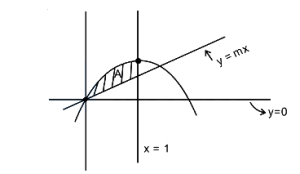
0 likesView Solution
66
MathematicsMediumMCQWBJEE · 2021
The area bounded by the parabolas $y=4x^{2}$,$y=\frac{x^{2}}{9}$ and the straight line $y=2$ is
A
$\frac{20 \sqrt{2}}{3}$ sq. unit
B
$10 \sqrt{5}$ sq. unit
C
$\frac{10 \sqrt{3}}{7}$ sq. unit
D
$10 \sqrt{2}$ sq. unit
Solution
(A) Given the curves $y=4x^{2}$ and $y=\frac{x^{2}}{9}$,we express $x$ in terms of $y$:
For $y=4x^{2}$,$x^{2}=\frac{y}{4} \implies x = \pm \frac{\sqrt{y}}{2}$.
For $y=\frac{x^{2}}{9}$,$x^{2}=9y \implies x = \pm 3\sqrt{y}$.
The region is bounded by $y=0$ to $y=2$ and is symmetric about the $y$-axis.
The area $A$ is given by:
$A = 2 \int_{0}^{2} \left(3\sqrt{y} - \frac{\sqrt{y}}{2}\right) dy$
$A = 2 \int_{0}^{2} \frac{5\sqrt{y}}{2} dy = 5 \int_{0}^{2} y^{1/2} dy$
$A = 5 \left[ \frac{y^{3/2}}{3/2} \right]_{0}^{2} = 5 \times \frac{2}{3} \times (2)^{3/2}$
$A = \frac{10}{3} \times 2\sqrt{2} = \frac{20\sqrt{2}}{3} \text{ sq. unit}$.
For $y=4x^{2}$,$x^{2}=\frac{y}{4} \implies x = \pm \frac{\sqrt{y}}{2}$.
For $y=\frac{x^{2}}{9}$,$x^{2}=9y \implies x = \pm 3\sqrt{y}$.
The region is bounded by $y=0$ to $y=2$ and is symmetric about the $y$-axis.
The area $A$ is given by:
$A = 2 \int_{0}^{2} \left(3\sqrt{y} - \frac{\sqrt{y}}{2}\right) dy$
$A = 2 \int_{0}^{2} \frac{5\sqrt{y}}{2} dy = 5 \int_{0}^{2} y^{1/2} dy$
$A = 5 \left[ \frac{y^{3/2}}{3/2} \right]_{0}^{2} = 5 \times \frac{2}{3} \times (2)^{3/2}$
$A = \frac{10}{3} \times 2\sqrt{2} = \frac{20\sqrt{2}}{3} \text{ sq. unit}$.
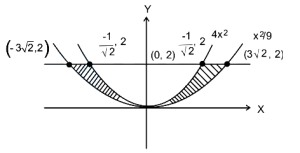
0 likesView Solution
67
MathematicsMediumMCQWBJEE · 2021
The differential equation of all the ellipses centered at the origin and having axes as the coordinate axes is
A
$y^{2}+x y^{\prime 2}-y y^{\prime}=0$
B
$x y y^{\prime \prime}+x y^{\prime 2}-y y^{\prime}=0$
C
$y y^{\prime \prime}+x y^{\prime 2}-x y^{\prime}=0$
D
$x^{2} y^{\prime}+x y^{\prime \prime}-3 y=0$ where $y^{\prime} \equiv \frac{d y}{d x}, y^{\prime \prime} \equiv \frac{d^{2} y}{d x^{2}}$
Solution
(B) The equation of an ellipse centered at the origin with axes as the coordinate axes is $\frac{x^{2}}{a^{2}}+\frac{y^{2}}{b^{2}}=1$.
Differentiating with respect to $x$,we get $\frac{2x}{a^{2}}+\frac{2y y^{\prime}}{b^{2}}=0$,which simplifies to $\frac{x}{a^{2}}+\frac{y y^{\prime}}{b^{2}}=0$.
This gives $\frac{b^{2}}{a^{2}} = -\frac{y y^{\prime}}{x}$.
Differentiating again with respect to $x$,we get $\frac{1}{a^{2}} + \frac{1}{b^{2}}(y y^{\prime \prime} + (y^{\prime})^{2}) = 0$.
Substituting $\frac{1}{a^{2}} = -\frac{y y^{\prime}}{b^{2}x}$,we have $-\frac{y y^{\prime}}{b^{2}x} + \frac{1}{b^{2}}(y y^{\prime \prime} + (y^{\prime})^{2}) = 0$.
Multiplying by $b^{2}x$,we get $-y y^{\prime} + x(y y^{\prime \prime} + (y^{\prime})^{2}) = 0$.
Thus,$x y y^{\prime \prime} + x(y^{\prime})^{2} - y y^{\prime} = 0$.
Differentiating with respect to $x$,we get $\frac{2x}{a^{2}}+\frac{2y y^{\prime}}{b^{2}}=0$,which simplifies to $\frac{x}{a^{2}}+\frac{y y^{\prime}}{b^{2}}=0$.
This gives $\frac{b^{2}}{a^{2}} = -\frac{y y^{\prime}}{x}$.
Differentiating again with respect to $x$,we get $\frac{1}{a^{2}} + \frac{1}{b^{2}}(y y^{\prime \prime} + (y^{\prime})^{2}) = 0$.
Substituting $\frac{1}{a^{2}} = -\frac{y y^{\prime}}{b^{2}x}$,we have $-\frac{y y^{\prime}}{b^{2}x} + \frac{1}{b^{2}}(y y^{\prime \prime} + (y^{\prime})^{2}) = 0$.
Multiplying by $b^{2}x$,we get $-y y^{\prime} + x(y y^{\prime \prime} + (y^{\prime})^{2}) = 0$.
Thus,$x y y^{\prime \prime} + x(y^{\prime})^{2} - y y^{\prime} = 0$.
0 likesView Solution
68
MathematicsEasyMCQWBJEE · 2021
If $x \frac{dy}{dx} + y = \frac{x f(xy)}{f'(xy)}$,then $|f(xy)|$ is equal to
A
$k e^{x^2 / 2}$
B
$k e^{y^2 / 2}$
C
$k e^{x^2}$
D
$k e^{y^2}$
Solution
(A) Given the differential equation: $x \frac{dy}{dx} + y = \frac{x f(xy)}{f'(xy)}$
We know that $\frac{d}{dx}(xy) = x \frac{dy}{dx} + y$.
Substituting this into the equation,we get: $\frac{d(xy)}{dx} = \frac{x f(xy)}{f'(xy)}$.
Rearranging the terms to separate the variables $xy$ and $x$: $\frac{f'(xy)}{f(xy)} d(xy) = x dx$.
Integrating both sides: $\int \frac{f'(xy)}{f(xy)} d(xy) = \int x dx$.
This yields: $\ln |f(xy)| = \frac{x^2}{2} + C$.
Taking the exponential of both sides: $|f(xy)| = e^{\frac{x^2}{2} + C} = e^C \cdot e^{x^2 / 2}$.
Letting $k = e^C$,we get: $|f(xy)| = k e^{x^2 / 2}$.
We know that $\frac{d}{dx}(xy) = x \frac{dy}{dx} + y$.
Substituting this into the equation,we get: $\frac{d(xy)}{dx} = \frac{x f(xy)}{f'(xy)}$.
Rearranging the terms to separate the variables $xy$ and $x$: $\frac{f'(xy)}{f(xy)} d(xy) = x dx$.
Integrating both sides: $\int \frac{f'(xy)}{f(xy)} d(xy) = \int x dx$.
This yields: $\ln |f(xy)| = \frac{x^2}{2} + C$.
Taking the exponential of both sides: $|f(xy)| = e^{\frac{x^2}{2} + C} = e^C \cdot e^{x^2 / 2}$.
Letting $k = e^C$,we get: $|f(xy)| = k e^{x^2 / 2}$.
0 likesView Solution
69
MathematicsEasyMCQWBJEE · 2021
Let $\vec{\alpha}, \vec{\beta}, \vec{\gamma}$ be three non-zero vectors which are pairwise non-collinear. If $\vec{\alpha}+3 \vec{\beta}$ is collinear with $\vec{\gamma}$ and $\vec{\beta}+2 \vec{\gamma}$ is collinear with $\vec{\alpha}$,then $\vec{\alpha}+3 \vec{\beta}+6 \vec{\gamma}$ is
A
$\vec{\gamma}$
B
$\overrightarrow{0}$
C
$\vec{\alpha}+\vec{\gamma}$
D
$\vec{\alpha}$
Solution
(B) Given that $\vec{\alpha}+3 \vec{\beta}$ is collinear with $\vec{\gamma}$,there exists a scalar $k_{1}$ such that $\vec{\alpha}+3 \vec{\beta}=k_{1} \vec{\gamma}$.
This implies $\vec{\beta}=\frac{k_{1}}{3} \vec{\gamma}-\frac{1}{3} \vec{\alpha}$.
Also,$\vec{\beta}+2 \vec{\gamma}$ is collinear with $\vec{\alpha}$,so there exists a scalar $k_{2}$ such that $\vec{\beta}+2 \vec{\gamma}=k_{2} \vec{\alpha}$.
This implies $\vec{\beta}=k_{2} \vec{\alpha}-2 \vec{\gamma}$.
Equating the two expressions for $\vec{\beta}$,we get $\frac{k_{1}}{3} \vec{\gamma}-\frac{1}{3} \vec{\alpha}=k_{2} \vec{\alpha}-2 \vec{\gamma}$.
Rearranging the terms,we have $\vec{\alpha}(k_{2}+\frac{1}{3})=\vec{\gamma}(\frac{k_{1}}{3}+2)$.
Since $\vec{\alpha}$ and $\vec{\gamma}$ are non-collinear,the coefficients must be zero: $k_{2}+\frac{1}{3}=0 \Rightarrow k_{2}=-\frac{1}{3}$ and $\frac{k_{1}}{3}+2=0 \Rightarrow k_{1}=-6$.
Substituting $k_{1}=-6$ into the first equation,we get $\vec{\alpha}+3 \vec{\beta}=-6 \vec{\gamma}$.
Therefore,$\vec{\alpha}+3 \vec{\beta}+6 \vec{\gamma}=\overrightarrow{0}$.
This implies $\vec{\beta}=\frac{k_{1}}{3} \vec{\gamma}-\frac{1}{3} \vec{\alpha}$.
Also,$\vec{\beta}+2 \vec{\gamma}$ is collinear with $\vec{\alpha}$,so there exists a scalar $k_{2}$ such that $\vec{\beta}+2 \vec{\gamma}=k_{2} \vec{\alpha}$.
This implies $\vec{\beta}=k_{2} \vec{\alpha}-2 \vec{\gamma}$.
Equating the two expressions for $\vec{\beta}$,we get $\frac{k_{1}}{3} \vec{\gamma}-\frac{1}{3} \vec{\alpha}=k_{2} \vec{\alpha}-2 \vec{\gamma}$.
Rearranging the terms,we have $\vec{\alpha}(k_{2}+\frac{1}{3})=\vec{\gamma}(\frac{k_{1}}{3}+2)$.
Since $\vec{\alpha}$ and $\vec{\gamma}$ are non-collinear,the coefficients must be zero: $k_{2}+\frac{1}{3}=0 \Rightarrow k_{2}=-\frac{1}{3}$ and $\frac{k_{1}}{3}+2=0 \Rightarrow k_{1}=-6$.
Substituting $k_{1}=-6$ into the first equation,we get $\vec{\alpha}+3 \vec{\beta}=-6 \vec{\gamma}$.
Therefore,$\vec{\alpha}+3 \vec{\beta}+6 \vec{\gamma}=\overrightarrow{0}$.
0 likesView Solution
70
MathematicsEasyMCQWBJEE · 2021
If $a(\vec{\alpha} \times \vec{\beta}) + b(\vec{\beta} \times \vec{\gamma}) + c(\vec{\gamma} \times \vec{\alpha}) = \overrightarrow{0}$,where $a, b, c$ are non-zero scalars,then the vectors $\vec{\alpha}, \vec{\beta}, \vec{\gamma}$ are
A
parallel
B
non-coplanar
C
coplanar
D
mutually perpendicular
Solution
(C) Given the equation $a(\vec{\alpha} \times \vec{\beta}) + b(\vec{\beta} \times \vec{\gamma}) + c(\vec{\gamma} \times \vec{\alpha}) = \overrightarrow{0}$.
Let $\vec{u} = \vec{\alpha} \times \vec{\beta}$,$\vec{v} = \vec{\beta} \times \vec{\gamma}$,and $\vec{w} = \vec{\gamma} \times \vec{\alpha}$.
The given equation is $a\vec{u} + b\vec{v} + c\vec{w} = \overrightarrow{0}$.
Since $a, b, c$ are non-zero scalars,the vectors $\vec{u}, \vec{v}, \vec{w}$ are linearly dependent,which implies they are coplanar.
For any three vectors $\vec{\alpha}, \vec{\beta}, \vec{\gamma}$,the cross products $\vec{\alpha} \times \vec{\beta}$,$\vec{\beta} \times \vec{\gamma}$,and $\vec{\gamma} \times \vec{\alpha}$ are coplanar if and only if $\vec{\alpha}, \vec{\beta}, \vec{\gamma}$ are coplanar.
Therefore,the vectors $\vec{\alpha}, \vec{\beta}, \vec{\gamma}$ are coplanar.
Let $\vec{u} = \vec{\alpha} \times \vec{\beta}$,$\vec{v} = \vec{\beta} \times \vec{\gamma}$,and $\vec{w} = \vec{\gamma} \times \vec{\alpha}$.
The given equation is $a\vec{u} + b\vec{v} + c\vec{w} = \overrightarrow{0}$.
Since $a, b, c$ are non-zero scalars,the vectors $\vec{u}, \vec{v}, \vec{w}$ are linearly dependent,which implies they are coplanar.
For any three vectors $\vec{\alpha}, \vec{\beta}, \vec{\gamma}$,the cross products $\vec{\alpha} \times \vec{\beta}$,$\vec{\beta} \times \vec{\gamma}$,and $\vec{\gamma} \times \vec{\alpha}$ are coplanar if and only if $\vec{\alpha}, \vec{\beta}, \vec{\gamma}$ are coplanar.
Therefore,the vectors $\vec{\alpha}, \vec{\beta}, \vec{\gamma}$ are coplanar.
0 likesView Solution
71
MathematicsEasyMCQWBJEE · 2021
If from a point $P(a, b, c)$,perpendiculars $PA$ and $PB$ are drawn to $YZ$ and $ZX$ planes respectively,then the equation of the plane $OAB$ is
A
$bcx + acy + abz = 0$
B
$bcx + acy - abz = 0$
C
$bcx - acy + abz = 0$
D
$bcx - acy - abz = 0$
Solution
(B) Given point $P(a, b, c)$.
Perpendicular $PA$ is drawn to the $YZ$-plane. The coordinates of $A$ are $(0, b, c)$.
Perpendicular $PB$ is drawn to the $ZX$-plane. The coordinates of $B$ are $(a, 0, c)$.
The origin $O$ is $(0, 0, 0)$.
The plane passes through $O(0, 0, 0)$,$A(0, b, c)$,and $B(a, 0, c)$.
The normal vector $\vec{n}$ to the plane is given by $\vec{OA} \times \vec{OB}$.
$\vec{OA} = 0\hat{i} + b\hat{j} + c\hat{k}$
$\vec{OB} = a\hat{i} + 0\hat{j} + c\hat{k}$
$\vec{n} = \begin{vmatrix} \hat{i} & \hat{j} & \hat{k} \\ 0 & b & c \\ a & 0 & c \end{vmatrix} = \hat{i}(bc - 0) - \hat{j}(0 - ac) + \hat{k}(0 - ab) = bc\hat{i} + ac\hat{j} - ab\hat{k}$.
The equation of the plane passing through the origin is $bcx + acy - abz = 0$.
Perpendicular $PA$ is drawn to the $YZ$-plane. The coordinates of $A$ are $(0, b, c)$.
Perpendicular $PB$ is drawn to the $ZX$-plane. The coordinates of $B$ are $(a, 0, c)$.
The origin $O$ is $(0, 0, 0)$.
The plane passes through $O(0, 0, 0)$,$A(0, b, c)$,and $B(a, 0, c)$.
The normal vector $\vec{n}$ to the plane is given by $\vec{OA} \times \vec{OB}$.
$\vec{OA} = 0\hat{i} + b\hat{j} + c\hat{k}$
$\vec{OB} = a\hat{i} + 0\hat{j} + c\hat{k}$
$\vec{n} = \begin{vmatrix} \hat{i} & \hat{j} & \hat{k} \\ 0 & b & c \\ a & 0 & c \end{vmatrix} = \hat{i}(bc - 0) - \hat{j}(0 - ac) + \hat{k}(0 - ab) = bc\hat{i} + ac\hat{j} - ab\hat{k}$.
The equation of the plane passing through the origin is $bcx + acy - abz = 0$.
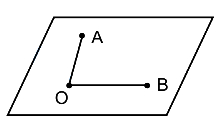
0 likesView Solution
72
MathematicsDifficultMCQWBJEE · 2021
The plane $\ell x+my=0$ is rotated about its line of intersection with the plane $z=0$ through an angle $\alpha$. The equation of the new plane is
A
$\ell x+my \pm z \tan \alpha \sqrt{\ell^{2}+m^{2}}=0$
B
$\ell x+my \pm z \tan \alpha \sqrt{\ell^{2}+m^{2}+1}=0$
C
$\ell x+my \pm z \tan \alpha \sqrt{\ell^{2}+1}=0$
D
$\ell x+my \pm z \tan \alpha \sqrt{m^{2}+1}=0$
Solution
(A) Let the equation of the plane after rotation be $P_{3}: \ell x+my+nz=0$.
The line of intersection of the planes $P_{1}: \ell x+my=0$ and $P_{2}: z=0$ is the line where $\ell x+my=0$ and $z=0$.
The normal vectors are $\vec{n}_{1} = (\ell, m, 0)$ and $\vec{n}_{3} = (\ell, m, n)$.
The angle $\alpha$ between the planes $P_{1}$ and $P_{3}$ is given by $\cos \alpha = \frac{|\vec{n}_{1} \cdot \vec{n}_{3}|}{|\vec{n}_{1}| |\vec{n}_{3}|}$.
$\cos \alpha = \frac{|\ell^{2}+m^{2}|}{\sqrt{\ell^{2}+m^{2}} \sqrt{\ell^{2}+m^{2}+n^{2}}} = \sqrt{\frac{\ell^{2}+m^{2}}{\ell^{2}+m^{2}+n^{2}}}$.
Squaring both sides,$\cos^{2} \alpha = \frac{\ell^{2}+m^{2}}{\ell^{2}+m^{2}+n^{2}}$.
$\Rightarrow \cos^{2} \alpha (\ell^{2}+m^{2}+n^{2}) = \ell^{2}+m^{2}$.
$\Rightarrow n^{2} \cos^{2} \alpha = (\ell^{2}+m^{2})(1 - \cos^{2} \alpha) = (\ell^{2}+m^{2}) \sin^{2} \alpha$.
$\Rightarrow n^{2} = (\ell^{2}+m^{2}) \tan^{2} \alpha$.
$\Rightarrow n = \pm \sqrt{\ell^{2}+m^{2}} \tan \alpha$.
Substituting $n$ into the equation of $P_{3}$,we get $\ell x+my \pm z \sqrt{\ell^{2}+m^{2}} \tan \alpha = 0$.
The line of intersection of the planes $P_{1}: \ell x+my=0$ and $P_{2}: z=0$ is the line where $\ell x+my=0$ and $z=0$.
The normal vectors are $\vec{n}_{1} = (\ell, m, 0)$ and $\vec{n}_{3} = (\ell, m, n)$.
The angle $\alpha$ between the planes $P_{1}$ and $P_{3}$ is given by $\cos \alpha = \frac{|\vec{n}_{1} \cdot \vec{n}_{3}|}{|\vec{n}_{1}| |\vec{n}_{3}|}$.
$\cos \alpha = \frac{|\ell^{2}+m^{2}|}{\sqrt{\ell^{2}+m^{2}} \sqrt{\ell^{2}+m^{2}+n^{2}}} = \sqrt{\frac{\ell^{2}+m^{2}}{\ell^{2}+m^{2}+n^{2}}}$.
Squaring both sides,$\cos^{2} \alpha = \frac{\ell^{2}+m^{2}}{\ell^{2}+m^{2}+n^{2}}$.
$\Rightarrow \cos^{2} \alpha (\ell^{2}+m^{2}+n^{2}) = \ell^{2}+m^{2}$.
$\Rightarrow n^{2} \cos^{2} \alpha = (\ell^{2}+m^{2})(1 - \cos^{2} \alpha) = (\ell^{2}+m^{2}) \sin^{2} \alpha$.
$\Rightarrow n^{2} = (\ell^{2}+m^{2}) \tan^{2} \alpha$.
$\Rightarrow n = \pm \sqrt{\ell^{2}+m^{2}} \tan \alpha$.
Substituting $n$ into the equation of $P_{3}$,we get $\ell x+my \pm z \sqrt{\ell^{2}+m^{2}} \tan \alpha = 0$.
0 likesView Solution
73
MathematicsMediumMCQWBJEE · 2021
$A$ line with positive direction cosines passes through the point $P(2,-1,2)$ and makes equal angles with the coordinate axes. The line meets the plane $2x+y+z=9$ at point $Q$. The length of the line segment $PQ$ is equal to:
A
$1 \text{ unit}$
B
$\sqrt{2} \text{ unit}$
C
$\sqrt{3} \text{ unit}$
D
$2 \text{ unit}$
Solution
(C) Let the direction cosines of the line be $(l, l, l)$ since it makes equal angles with the coordinate axes.
Since $l^2 + l^2 + l^2 = 1$,we have $3l^2 = 1$,which gives $l = \frac{1}{\sqrt{3}}$ (taking the positive value).
The equation of the line passing through $P(2, -1, 2)$ with direction ratios $(1, 1, 1)$ is:
$\frac{x-2}{1} = \frac{y+1}{1} = \frac{z-2}{1} = r$
Any point on the line is given by $(r+2, r-1, r+2)$.
Since this point lies on the plane $2x+y+z=9$,we substitute the coordinates:
$2(r+2) + (r-1) + (r+2) = 9$
$2r + 4 + r - 1 + r + 2 = 9$
$4r + 5 = 9 \Rightarrow 4r = 4 \Rightarrow r = 1$.
The point $Q$ is $(1+2, 1-1, 1+2) = (3, 0, 3)$.
The length $PQ = \sqrt{(3-2)^2 + (0 - (-1))^2 + (3-2)^2} = \sqrt{1^2 + 1^2 + 1^2} = \sqrt{3} \text{ units}$.
Since $l^2 + l^2 + l^2 = 1$,we have $3l^2 = 1$,which gives $l = \frac{1}{\sqrt{3}}$ (taking the positive value).
The equation of the line passing through $P(2, -1, 2)$ with direction ratios $(1, 1, 1)$ is:
$\frac{x-2}{1} = \frac{y+1}{1} = \frac{z-2}{1} = r$
Any point on the line is given by $(r+2, r-1, r+2)$.
Since this point lies on the plane $2x+y+z=9$,we substitute the coordinates:
$2(r+2) + (r-1) + (r+2) = 9$
$2r + 4 + r - 1 + r + 2 = 9$
$4r + 5 = 9 \Rightarrow 4r = 4 \Rightarrow r = 1$.
The point $Q$ is $(1+2, 1-1, 1+2) = (3, 0, 3)$.
The length $PQ = \sqrt{(3-2)^2 + (0 - (-1))^2 + (3-2)^2} = \sqrt{1^2 + 1^2 + 1^2} = \sqrt{3} \text{ units}$.
0 likesView Solution
74
MathematicsEasyMCQWBJEE · 2021
Four persons $A, B, C$ and $D$ throw an unbiased die,turn by turn in succession till one gets an even number and wins the game. What is the probability that $A$ wins the game if $A$ begins?
A
$\frac{1}{4}$
B
$\frac{1}{2}$
C
$\frac{7}{15}$
D
$\frac{8}{15}$
Solution
(D) The probability of getting an even number on a die is $P(E) = \frac{3}{6} = \frac{1}{2}$,and the probability of getting an odd number is $P(O) = \frac{3}{6} = \frac{1}{2}$.
$A$ wins if $A$ gets an even number on the $1^{st}, 5^{th}, 9^{th}, \dots$ turn.
Let $p = \frac{1}{2}$ be the probability of success and $q = \frac{1}{2}$ be the probability of failure.
$A$ wins on the $1^{st}$ turn with probability $p = \frac{1}{2}$.
$A$ wins on the $5^{th}$ turn if $A, B, C, D$ fail on their first turns and $A$ succeeds on the $5^{th}$ turn: $q^4 p = (\frac{1}{2})^4 \times \frac{1}{2} = (\frac{1}{2})^5$.
$A$ wins on the $9^{th}$ turn with probability $q^8 p = (\frac{1}{2})^8 \times \frac{1}{2} = (\frac{1}{2})^9$.
This is an infinite geometric series with first term $a = \frac{1}{2}$ and common ratio $r = q^4 = (\frac{1}{2})^4 = \frac{1}{16}$.
The sum of the series is $S = \frac{a}{1-r} = \frac{1/2}{1 - 1/16} = \frac{1/2}{15/16} = \frac{1}{2} \times \frac{16}{15} = \frac{8}{15}$.
$A$ wins if $A$ gets an even number on the $1^{st}, 5^{th}, 9^{th}, \dots$ turn.
Let $p = \frac{1}{2}$ be the probability of success and $q = \frac{1}{2}$ be the probability of failure.
$A$ wins on the $1^{st}$ turn with probability $p = \frac{1}{2}$.
$A$ wins on the $5^{th}$ turn if $A, B, C, D$ fail on their first turns and $A$ succeeds on the $5^{th}$ turn: $q^4 p = (\frac{1}{2})^4 \times \frac{1}{2} = (\frac{1}{2})^5$.
$A$ wins on the $9^{th}$ turn with probability $q^8 p = (\frac{1}{2})^8 \times \frac{1}{2} = (\frac{1}{2})^9$.
This is an infinite geometric series with first term $a = \frac{1}{2}$ and common ratio $r = q^4 = (\frac{1}{2})^4 = \frac{1}{16}$.
The sum of the series is $S = \frac{a}{1-r} = \frac{1/2}{1 - 1/16} = \frac{1/2}{15/16} = \frac{1}{2} \times \frac{16}{15} = \frac{8}{15}$.
0 likesView Solution
75
MathematicsMediumMCQWBJEE · 2021
The mean and variance of a binomial distribution are $4$ and $2$ respectively. Then the probability of exactly two successes is
A
$\frac{7}{64}$
B
$\frac{21}{128}$
C
$\frac{7}{32}$
D
$\frac{9}{32}$
Solution
(A) For a binomial distribution,the mean is given by $np = 4$ and the variance is given by $npq = 2$.
Dividing the variance by the mean,we get $q = \frac{npq}{np} = \frac{2}{4} = \frac{1}{2}$.
Since $p + q = 1$,we have $p = 1 - \frac{1}{2} = \frac{1}{2}$.
Substituting $p = \frac{1}{2}$ into $np = 4$,we get $n \times \frac{1}{2} = 4$,which implies $n = 8$.
The probability of exactly $x$ successes is given by $P(X=x) = {}^{n}C_{x} p^{x} q^{n-x}$.
For $x = 2$,$P(X=2) = {}^{8}C_{2} \left(\frac{1}{2}\right)^{2} \left(\frac{1}{2}\right)^{8-2} = {}^{8}C_{2} \left(\frac{1}{2}\right)^{8}$.
Calculating the value,${}^{8}C_{2} = \frac{8 \times 7}{2 \times 1} = 28$.
Thus,$P(X=2) = 28 \times \frac{1}{256} = \frac{28}{256} = \frac{7}{64}$.
Dividing the variance by the mean,we get $q = \frac{npq}{np} = \frac{2}{4} = \frac{1}{2}$.
Since $p + q = 1$,we have $p = 1 - \frac{1}{2} = \frac{1}{2}$.
Substituting $p = \frac{1}{2}$ into $np = 4$,we get $n \times \frac{1}{2} = 4$,which implies $n = 8$.
The probability of exactly $x$ successes is given by $P(X=x) = {}^{n}C_{x} p^{x} q^{n-x}$.
For $x = 2$,$P(X=2) = {}^{8}C_{2} \left(\frac{1}{2}\right)^{2} \left(\frac{1}{2}\right)^{8-2} = {}^{8}C_{2} \left(\frac{1}{2}\right)^{8}$.
Calculating the value,${}^{8}C_{2} = \frac{8 \times 7}{2 \times 1} = 28$.
Thus,$P(X=2) = 28 \times \frac{1}{256} = \frac{28}{256} = \frac{7}{64}$.
0 likesView Solution
Vedclass Products
For Students
Vedclass Test Series
Mock tests in real WBJEE style covering Mathematics with performance analysis. 5-day free trial.
Start Free TrialFor Teachers
Exam Paper Generator
Generate Set A/B/C/D Mathematics papers from 7.5L+ questions in 2 minutes. 3 chapters free.
Try FreeFor Institutes
Online Exam Module
Run live WBJEE mock exams with unlimited students, 360° analytics & white-label branding.
See DemoFrequently Asked Questions
How many Mathematics questions are in WBJEE 2021?
There are 75 Mathematics questions from the WBJEE 2021 paper on Vedclass, each with a detailed step-by-step solution in English.
Are WBJEE 2021 Mathematics solutions available in English?
Yes. All solutions on this page are in English. You can also switch to English or Hindi using the language buttons above the questions.
Can I practice WBJEE 2021 Mathematics as a timed test?
Yes. Use the Vedclass Test Series to attempt a full WBJEE mock test covering Mathematics with time limits and instant score analysis.
Can teachers create Mathematics papers from WBJEE previous year questions?
Yes. The Vedclass Exam Paper Generator lets teachers mix WBJEE Mathematics questions and generate Set A/B/C/D papers in minutes.
For Teachers & Institutes
Build a Custom Mathematics Paper
Pick WBJEE 2021 Mathematics questions, set difficulty, and generate Set A/B/C/D in 2 minutes.