
MathematicsQ1–75 of 75 questions
Page 1 of 1 · English
1
MathematicsMediumMCQWBJEE · 2018
If $x+\log _{10}\left(1+2^{x}\right)=x \log _{10} 5+\log _{10} 6$,then the value of $x$ is
A
$1/2$
B
$1/3$
C
$1$
D
$2$
Solution
(C) Given equation: $x+\log _{10}\left(1+2^{x}\right)=x \log _{10} 5+\log _{10} 6$
Rearranging the terms:
$\log _{10}\left(1+2^{x}\right) = x \log _{10} 5 - x + \log _{10} 6$
$\log _{10}\left(1+2^{x}\right) = x \log _{10} 5 - x \log _{10} 10 + \log _{10} 6$
$\log _{10}\left(1+2^{x}\right) = \log _{10} 5^{x} - \log _{10} 10^{x} + \log _{10} 6$
$\log _{10}\left(1+2^{x}\right) = \log _{10}\left(\frac{5^{x} \cdot 6}{10^{x}}\right)$
Taking antilog on both sides:
$1+2^{x} = \frac{5^{x} \cdot 6}{2^{x} \cdot 5^{x}}$
$1+2^{x} = \frac{6}{2^{x}}$
Let $2^{x} = t$. Then $1+t = \frac{6}{t}$
$t + t^{2} = 6$
$t^{2} + t - 6 = 0$
$(t+3)(t-2) = 0$
Since $t = 2^{x} > 0$,we have $t = 2$.
$2^{x} = 2^{1} \Rightarrow x = 1$.
Rearranging the terms:
$\log _{10}\left(1+2^{x}\right) = x \log _{10} 5 - x + \log _{10} 6$
$\log _{10}\left(1+2^{x}\right) = x \log _{10} 5 - x \log _{10} 10 + \log _{10} 6$
$\log _{10}\left(1+2^{x}\right) = \log _{10} 5^{x} - \log _{10} 10^{x} + \log _{10} 6$
$\log _{10}\left(1+2^{x}\right) = \log _{10}\left(\frac{5^{x} \cdot 6}{10^{x}}\right)$
Taking antilog on both sides:
$1+2^{x} = \frac{5^{x} \cdot 6}{2^{x} \cdot 5^{x}}$
$1+2^{x} = \frac{6}{2^{x}}$
Let $2^{x} = t$. Then $1+t = \frac{6}{t}$
$t + t^{2} = 6$
$t^{2} + t - 6 = 0$
$(t+3)(t-2) = 0$
Since $t = 2^{x} > 0$,we have $t = 2$.
$2^{x} = 2^{1} \Rightarrow x = 1$.
0 likesView Solution
2
MathematicsMediumMCQWBJEE · 2018
For $0 \leq p \leq 1$ and for any positive $a, b$,let $I(p)=(a+b)^{p}$ and $J(p)=a^{p}+b^{p}$. Then:
A
$I(p) > J(p)$
B
$I(p) \leq J(p)$
C
$I(p) < J(p)$ in $[0, p/2]$ and $I(p) > J(p)$ in $[p/2, \infty)$
D
$I(p) < J(p)$ in $[p/2, \infty)$ and $J(p) < I(p)$ in $[0, p/2]$
Solution
(B) Given $0 \leq p \leq 1$ and $a, b > 0$.
Consider the function $f(x) = x^p$.
Since $0 \leq p \leq 1$,the function $f(x) = x^p$ is a concave function for $x > 0$.
By the property of concave functions,for any $a, b > 0$ and $0 < p < 1$,we have $(a+b)^p \leq a^p + b^p$.
This implies $I(p) \leq J(p)$.
For $p=0$,$I(0) = (a+b)^0 = 1$ and $J(0) = a^0 + b^0 = 1 + 1 = 2$,so $1 \leq 2$.
For $p=1$,$I(1) = a+b$ and $J(1) = a+b$,so $a+b \leq a+b$.
Thus,$I(p) \leq J(p)$ holds for all $0 \leq p \leq 1$.
Consider the function $f(x) = x^p$.
Since $0 \leq p \leq 1$,the function $f(x) = x^p$ is a concave function for $x > 0$.
By the property of concave functions,for any $a, b > 0$ and $0 < p < 1$,we have $(a+b)^p \leq a^p + b^p$.
This implies $I(p) \leq J(p)$.
For $p=0$,$I(0) = (a+b)^0 = 1$ and $J(0) = a^0 + b^0 = 1 + 1 = 2$,so $1 \leq 2$.
For $p=1$,$I(1) = a+b$ and $J(1) = a+b$,so $a+b \leq a+b$.
Thus,$I(p) \leq J(p)$ holds for all $0 \leq p \leq 1$.
0 likesView Solution
3
MathematicsEasyMCQWBJEE · 2018
If $b_{1} b_{2} = 2(c_{1} + c_{2})$ and $b_{1}, b_{2}, c_{1}, c_{2}$ are all real numbers,then at least one of the equations $x^{2} + b_{1} x + c_{1} = 0$ and $x^{2} + b_{2} x + c_{2} = 0$ has
A
real roots
B
purely imaginary roots
C
roots of the form $a + ib$ $(a, b \in R, ab \neq 0)$
D
rational roots
Solution
(A) Consider the two quadratic equations:
$x^{2} + b_{1}x + c_{1} = 0$ and $x^{2} + b_{2}x + c_{2} = 0$.
Let $D_{1}$ and $D_{2}$ be the discriminants of these equations respectively.
$D_{1} = b_{1}^{2} - 4c_{1}$
$D_{2} = b_{2}^{2} - 4c_{2}$
Adding the two discriminants,we get:
$D_{1} + D_{2} = b_{1}^{2} + b_{2}^{2} - 4(c_{1} + c_{2})$
Given that $b_{1}b_{2} = 2(c_{1} + c_{2})$,we substitute $4(c_{1} + c_{2}) = 2b_{1}b_{2}$ into the equation:
$D_{1} + D_{2} = b_{1}^{2} + b_{2}^{2} - 2b_{1}b_{2}$
$D_{1} + D_{2} = (b_{1} - b_{2})^{2}$
Since $(b_{1} - b_{2})^{2} \geq 0$ for all real $b_{1}, b_{2}$,it follows that $D_{1} + D_{2} \geq 0$.
If the sum of two real numbers is non-negative,then at least one of them must be non-negative.
Therefore,at least one of $D_{1}$ or $D_{2}$ is $\geq 0$,which implies that at least one of the equations has real roots.
$x^{2} + b_{1}x + c_{1} = 0$ and $x^{2} + b_{2}x + c_{2} = 0$.
Let $D_{1}$ and $D_{2}$ be the discriminants of these equations respectively.
$D_{1} = b_{1}^{2} - 4c_{1}$
$D_{2} = b_{2}^{2} - 4c_{2}$
Adding the two discriminants,we get:
$D_{1} + D_{2} = b_{1}^{2} + b_{2}^{2} - 4(c_{1} + c_{2})$
Given that $b_{1}b_{2} = 2(c_{1} + c_{2})$,we substitute $4(c_{1} + c_{2}) = 2b_{1}b_{2}$ into the equation:
$D_{1} + D_{2} = b_{1}^{2} + b_{2}^{2} - 2b_{1}b_{2}$
$D_{1} + D_{2} = (b_{1} - b_{2})^{2}$
Since $(b_{1} - b_{2})^{2} \geq 0$ for all real $b_{1}, b_{2}$,it follows that $D_{1} + D_{2} \geq 0$.
If the sum of two real numbers is non-negative,then at least one of them must be non-negative.
Therefore,at least one of $D_{1}$ or $D_{2}$ is $\geq 0$,which implies that at least one of the equations has real roots.
0 likesView Solution
4
MathematicsMediumMCQWBJEE · 2018
If the equation $x^{2}-cx+d=0$ has roots equal to the fourth powers of the roots of $x^{2}+ax+b=0,$ where $a^{2}>4b,$ then the roots of $x^{2}-4bx+2b^{2}-c=0$ will be
A
both real
B
both negative
C
both positive
D
one positive and one negative
Solution
(D) Let $\alpha$ and $\beta$ be the roots of $x^{2}+ax+b=0$ and the roots of $x^{2}-cx+d=0$ be $\alpha^{4}$ and $\beta^{4}$.
From the relations between roots and coefficients:
$\alpha+\beta=-a, \alpha\beta=b$ ...$(i)$
$\alpha^{4}+\beta^{4}=c, \alpha^{4}\beta^{4}=d$ ...$(ii)$
From $(ii),$ $c = \alpha^{4}+\beta^{4} = (\alpha^{2}+\beta^{2})^{2}-2(\alpha\beta)^{2} = ((\alpha+\beta)^{2}-2\alpha\beta)^{2}-2(\alpha\beta)^{2}$.
Substituting $(i)$: $c = (a^{2}-2b)^{2}-2b^{2} = a^{4}+4b^{2}-4a^{2}b-2b^{2} = a^{4}-4a^{2}b+2b^{2}$.
Thus,$2b^{2}-c = 2b^{2}-(a^{4}-4a^{2}b+2b^{2}) = 4a^{2}b-a^{4} = a^{2}(4b-a^{2})$.
Given $a^{2}>4b$,we have $4b-a^{2} < 0$,so $2b^{2}-c < 0$.
For the equation $x^{2}-4bx+(2b^{2}-c)=0$,the product of roots is $2b^{2}-c < 0$.
Since the product of the roots is negative,one root must be positive and the other must be negative.
From the relations between roots and coefficients:
$\alpha+\beta=-a, \alpha\beta=b$ ...$(i)$
$\alpha^{4}+\beta^{4}=c, \alpha^{4}\beta^{4}=d$ ...$(ii)$
From $(ii),$ $c = \alpha^{4}+\beta^{4} = (\alpha^{2}+\beta^{2})^{2}-2(\alpha\beta)^{2} = ((\alpha+\beta)^{2}-2\alpha\beta)^{2}-2(\alpha\beta)^{2}$.
Substituting $(i)$: $c = (a^{2}-2b)^{2}-2b^{2} = a^{4}+4b^{2}-4a^{2}b-2b^{2} = a^{4}-4a^{2}b+2b^{2}$.
Thus,$2b^{2}-c = 2b^{2}-(a^{4}-4a^{2}b+2b^{2}) = 4a^{2}b-a^{4} = a^{2}(4b-a^{2})$.
Given $a^{2}>4b$,we have $4b-a^{2} < 0$,so $2b^{2}-c < 0$.
For the equation $x^{2}-4bx+(2b^{2}-c)=0$,the product of roots is $2b^{2}-c < 0$.
Since the product of the roots is negative,one root must be positive and the other must be negative.
0 likesView Solution
5
MathematicsMediumMCQWBJEE · 2018
Let $z_{1}$ and $z_{2}$ be complex numbers such that $z_{1} \neq z_{2}$ and $|z_{1}|=|z_{2}|$. If $\operatorname{Re}(z_{1}) > 0$ and $\operatorname{Im}(z_{2}) < 0$, then $\frac{z_{1}+z_{2}}{z_{1}-z_{2}}$ is
A
one
B
real and positive
C
real and negative
D
purely imaginary
Solution
(D) Let $w = \frac{z_{1}+z_{2}}{z_{1}-z_{2}}$.
To check if $w$ is purely imaginary, we evaluate $w + \bar{w}$.
$w + \bar{w} = \frac{z_{1}+z_{2}}{z_{1}-z_{2}} + \frac{\bar{z}_{1}+\bar{z}_{2}}{\bar{z}_{1}-\bar{z}_{2}}$
$= \frac{(z_{1}+z_{2})(\bar{z}_{1}-\bar{z}_{2}) + (\bar{z}_{1}+\bar{z}_{2})(z_{1}-z_{2})}{(z_{1}-z_{2})(\bar{z}_{1}-\bar{z}_{2})}$
$= \frac{(z_{1}\bar{z}_{1} - z_{1}\bar{z}_{2} + z_{2}\bar{z}_{1} - z_{2}\bar{z}_{2}) + (\bar{z}_{1}z_{1} - \bar{z}_{1}z_{2} + \bar{z}_{2}z_{1} - \bar{z}_{2}z_{2})}{|z_{1}-z_{2}|^2}$
Since $|z_{1}| = |z_{2}|$, we have $z_{1}\bar{z}_{1} = z_{2}\bar{z}_{2} = |z_{1}|^2 = |z_{2}|^2$.
Substituting this, the numerator becomes:
$|z_{1}|^2 - z_{1}\bar{z}_{2} + z_{2}\bar{z}_{1} - |z_{2}|^2 + |z_{1}|^2 - \bar{z}_{1}z_{2} + \bar{z}_{2}z_{1} - |z_{2}|^2$
$= 2|z_{1}|^2 - 2|z_{2}|^2 = 0$.
Since $w + \bar{w} = 0$, $w$ must be purely imaginary.
To check if $w$ is purely imaginary, we evaluate $w + \bar{w}$.
$w + \bar{w} = \frac{z_{1}+z_{2}}{z_{1}-z_{2}} + \frac{\bar{z}_{1}+\bar{z}_{2}}{\bar{z}_{1}-\bar{z}_{2}}$
$= \frac{(z_{1}+z_{2})(\bar{z}_{1}-\bar{z}_{2}) + (\bar{z}_{1}+\bar{z}_{2})(z_{1}-z_{2})}{(z_{1}-z_{2})(\bar{z}_{1}-\bar{z}_{2})}$
$= \frac{(z_{1}\bar{z}_{1} - z_{1}\bar{z}_{2} + z_{2}\bar{z}_{1} - z_{2}\bar{z}_{2}) + (\bar{z}_{1}z_{1} - \bar{z}_{1}z_{2} + \bar{z}_{2}z_{1} - \bar{z}_{2}z_{2})}{|z_{1}-z_{2}|^2}$
Since $|z_{1}| = |z_{2}|$, we have $z_{1}\bar{z}_{1} = z_{2}\bar{z}_{2} = |z_{1}|^2 = |z_{2}|^2$.
Substituting this, the numerator becomes:
$|z_{1}|^2 - z_{1}\bar{z}_{2} + z_{2}\bar{z}_{1} - |z_{2}|^2 + |z_{1}|^2 - \bar{z}_{1}z_{2} + \bar{z}_{2}z_{1} - |z_{2}|^2$
$= 2|z_{1}|^2 - 2|z_{2}|^2 = 0$.
Since $w + \bar{w} = 0$, $w$ must be purely imaginary.
0 likesView Solution
6
MathematicsEasyMCQWBJEE · 2018
If $Z_{r} = \sin \frac{2 \pi r}{11} - i \cos \frac{2 \pi r}{11}$,then $\sum_{r=0}^{10} Z_{r}$ is equal to
A
-$1$
B
$0$
C
i
D
-i
Solution
(B) Given $Z_{r} = \sin \frac{2 \pi r}{11} - i \cos \frac{2 \pi r}{11}$.
We can rewrite this as $Z_{r} = -i (\cos \frac{2 \pi r}{11} + i \sin \frac{2 \pi r}{11})$.
Using Euler's formula $e^{i \theta} = \cos \theta + i \sin \theta$,we have $Z_{r} = -i e^{i \frac{2 \pi r}{11}}$.
Now,$\sum_{r=0}^{10} Z_{r} = -i \sum_{r=0}^{10} (e^{i \frac{2 \pi}{11}})^{r}$.
This is a geometric series with $11$ terms where the common ratio is $\omega = e^{i \frac{2 \pi}{11}} \neq 1$.
The sum of the roots of unity $\sum_{r=0}^{n-1} e^{i \frac{2 \pi r}{n}} = 0$ for $n > 1$.
Thus,$\sum_{r=0}^{10} e^{i \frac{2 \pi r}{11}} = 0$.
Therefore,$\sum_{r=0}^{10} Z_{r} = -i \times 0 = 0$.
We can rewrite this as $Z_{r} = -i (\cos \frac{2 \pi r}{11} + i \sin \frac{2 \pi r}{11})$.
Using Euler's formula $e^{i \theta} = \cos \theta + i \sin \theta$,we have $Z_{r} = -i e^{i \frac{2 \pi r}{11}}$.
Now,$\sum_{r=0}^{10} Z_{r} = -i \sum_{r=0}^{10} (e^{i \frac{2 \pi}{11}})^{r}$.
This is a geometric series with $11$ terms where the common ratio is $\omega = e^{i \frac{2 \pi}{11}} \neq 1$.
The sum of the roots of unity $\sum_{r=0}^{n-1} e^{i \frac{2 \pi r}{n}} = 0$ for $n > 1$.
Thus,$\sum_{r=0}^{10} e^{i \frac{2 \pi r}{11}} = 0$.
Therefore,$\sum_{r=0}^{10} Z_{r} = -i \times 0 = 0$.
0 likesView Solution
7
MathematicsMediumMCQWBJEE · 2018
If $z_{1}$ and $z_{2}$ are two non-zero complex numbers such that $\frac{z_{1}}{z_{2}}+\frac{z_{2}}{z_{1}}=1$,then the origin and the points represented by $z_{1}$ and $z_{2}$:
A
lie on a straight line
B
form a right-angled triangle
C
form an equilateral triangle
D
form an isosceles triangle
Solution
(C) We know that if $z_{1}, z_{2},$ and $z_{3}$ are the vertices of an equilateral triangle,then $z_{1}^{2}+z_{2}^{2}+z_{3}^{2}-z_{1}z_{2}-z_{2}z_{3}-z_{3}z_{1}=0$.
Given that $\frac{z_{1}}{z_{2}}+\frac{z_{2}}{z_{1}}=1$,we can multiply by $z_{1}z_{2}$ to get $z_{1}^{2}+z_{2}^{2}=z_{1}z_{2}$,which implies $z_{1}^{2}+z_{2}^{2}-z_{1}z_{2}=0$.
If we consider the origin as the third point $z_{3}=0$,the condition becomes $z_{1}^{2}+z_{2}^{2}+0^{2}-z_{1}z_{2}-z_{2}(0)-0(z_{1})=0$,which simplifies to $z_{1}^{2}+z_{2}^{2}-z_{1}z_{2}=0$.
This matches the condition for an equilateral triangle.
Thus,the origin and the points $z_{1}$ and $z_{2}$ form an equilateral triangle.
Given that $\frac{z_{1}}{z_{2}}+\frac{z_{2}}{z_{1}}=1$,we can multiply by $z_{1}z_{2}$ to get $z_{1}^{2}+z_{2}^{2}=z_{1}z_{2}$,which implies $z_{1}^{2}+z_{2}^{2}-z_{1}z_{2}=0$.
If we consider the origin as the third point $z_{3}=0$,the condition becomes $z_{1}^{2}+z_{2}^{2}+0^{2}-z_{1}z_{2}-z_{2}(0)-0(z_{1})=0$,which simplifies to $z_{1}^{2}+z_{2}^{2}-z_{1}z_{2}=0$.
This matches the condition for an equilateral triangle.
Thus,the origin and the points $z_{1}$ and $z_{2}$ form an equilateral triangle.
0 likesView Solution
8
MathematicsMediumMCQWBJEE · 2018
On the occasion of the Dipawali festival,each student of a class sends a greeting card to every other student. If there are $20$ students in the class,the total number of greeting cards sent by the students is:
A
${}^{20}C_{2}$
B
${}^{20}P_{2}$
C
$2 \times {}^{20}C_{2}$
D
$2 \times {}^{20}P_{2}$
Solution
(B) Each student sends a card to every other student. This means for every pair of students $(A, B)$,student $A$ sends a card to $B$ and student $B$ sends a card to $A$.
This is a permutation problem where we need to arrange $2$ students out of $20$ in a specific order (sender and receiver).
The number of ways to arrange $2$ students out of $20$ is given by the permutation formula ${}^{n}P_{r} = \frac{n!}{(n-r)!}$.
Here $n = 20$ and $r = 2$,so the number of cards is ${}^{20}P_{2} = 20 \times 19 = 380$.
Alternatively,this is equal to ${}^{20}C_{2} \times 2! = \frac{20 \times 19}{2 \times 1} \times 2 = 380$.
This is a permutation problem where we need to arrange $2$ students out of $20$ in a specific order (sender and receiver).
The number of ways to arrange $2$ students out of $20$ is given by the permutation formula ${}^{n}P_{r} = \frac{n!}{(n-r)!}$.
Here $n = 20$ and $r = 2$,so the number of cards is ${}^{20}P_{2} = 20 \times 19 = 380$.
Alternatively,this is equal to ${}^{20}C_{2} \times 2! = \frac{20 \times 19}{2 \times 1} \times 2 = 380$.
0 likesView Solution
9
MathematicsMediumMCQWBJEE · 2018
From a collection of $20$ consecutive natural numbers,four are selected such that they are not consecutive. The number of such selections is
A
$284 \times 17$
B
$285 \times 17$
C
$284 \times 16$
D
$285 \times 16$
Solution
(A) The total number of ways to select $4$ numbers from $20$ is given by $^{20}C_{4}$.
The number of ways to select $4$ consecutive numbers from $20$ is $17$ (these are $(1,2,3,4), (2,3,4,5), \ldots, (17,18,19,20)$).
The number of ways to select $4$ non-consecutive numbers is the total number of selections minus the number of consecutive selections.
$\text{Required selections} = {}^{20}C_{4} - 17$
$\text{Required selections} = \frac{20 \times 19 \times 18 \times 17}{4 \times 3 \times 2 \times 1} - 17$
$\text{Required selections} = 4845 - 17 = 4828$
Calculating the options: $284 \times 17 = 4828$.
Thus,the correct option is $A$.
The number of ways to select $4$ consecutive numbers from $20$ is $17$ (these are $(1,2,3,4), (2,3,4,5), \ldots, (17,18,19,20)$).
The number of ways to select $4$ non-consecutive numbers is the total number of selections minus the number of consecutive selections.
$\text{Required selections} = {}^{20}C_{4} - 17$
$\text{Required selections} = \frac{20 \times 19 \times 18 \times 17}{4 \times 3 \times 2 \times 1} - 17$
$\text{Required selections} = 4845 - 17 = 4828$
Calculating the options: $284 \times 17 = 4828$.
Thus,the correct option is $A$.
0 likesView Solution
10
MathematicsMediumMCQWBJEE · 2018
The number of ways to select $n$ objects from $2n$ objects,of which $n$ are identical and the rest are different,is:
A
$2^{n}$
B
$2^{n-1}$
C
$2^{n}-1$
D
$2^{n-1}+1$
Solution
(A) We need to select $n$ objects from $2n$ objects,where $n$ objects are identical and $n$ objects are distinct.
Let $k$ be the number of distinct objects selected,where $0 \le k \le n$.
Then the remaining $(n-k)$ objects must be selected from the $n$ identical objects.
Since the $n$ identical objects are indistinguishable,there is only $1$ way to select any number of them.
Thus,for each $k$ from $0$ to $n$,the number of ways to select $k$ distinct objects is given by $\binom{n}{k}$.
The total number of ways is the sum of these possibilities:
$\sum_{k=0}^{n} \binom{n}{k} = \binom{n}{0} + \binom{n}{1} + \binom{n}{2} + \dots + \binom{n}{n} = 2^{n}$.
Let $k$ be the number of distinct objects selected,where $0 \le k \le n$.
Then the remaining $(n-k)$ objects must be selected from the $n$ identical objects.
Since the $n$ identical objects are indistinguishable,there is only $1$ way to select any number of them.
Thus,for each $k$ from $0$ to $n$,the number of ways to select $k$ distinct objects is given by $\binom{n}{k}$.
The total number of ways is the sum of these possibilities:
$\sum_{k=0}^{n} \binom{n}{k} = \binom{n}{0} + \binom{n}{1} + \binom{n}{2} + \dots + \binom{n}{n} = 2^{n}$.
0 likesView Solution
11
MathematicsMediumMCQWBJEE · 2018
Given that $n$ arithmetic means are inserted between two sets of numbers $(a, 2b)$ and $(2a, b)$,where $a, b \in \mathbb{R}$. Suppose the $m^{th}$ means between these sets are equal,then the ratio $a : b$ is equal to:
A
$n-m+1 : m$
B
$n-m+1 : n$
C
$n : n-m+1$
D
$m : n-m+1$
Solution
(D) Let $d_1$ be the common difference for the first set $(a, 2b)$. The $(n+2)^{th}$ term is $2b = a + (n+1)d_1$,so $d_1 = \frac{2b-a}{n+1}$.
The $m^{th}$ arithmetic mean is $A_m = a + m d_1 = a + m \left( \frac{2b-a}{n+1} \right)$.
Let $d_2$ be the common difference for the second set $(2a, b)$. The $(n+2)^{th}$ term is $b = 2a + (n+1)d_2$,so $d_2 = \frac{b-2a}{n+1}$.
The $m^{th}$ arithmetic mean is $A'_m = 2a + m d_2 = 2a + m \left( \frac{b-2a}{n+1} \right)$.
Equating the two means: $a + m \left( \frac{2b-a}{n+1} \right) = 2a + m \left( \frac{b-2a}{n+1} \right)$.
Multiplying by $(n+1)$: $a(n+1) + m(2b-a) = 2a(n+1) + m(b-2a)$.
$an + a + 2bm - am = 2an + 2a + bm - 2am$.
Rearranging terms: $2bm - bm - am + 2am = 2an - an + 2a - a$.
$bm + am = an + a$.
$m(b+a) = a(n+1)$.
Thus,$\frac{a}{b} = \frac{m}{n+1-m}$.
The $m^{th}$ arithmetic mean is $A_m = a + m d_1 = a + m \left( \frac{2b-a}{n+1} \right)$.
Let $d_2$ be the common difference for the second set $(2a, b)$. The $(n+2)^{th}$ term is $b = 2a + (n+1)d_2$,so $d_2 = \frac{b-2a}{n+1}$.
The $m^{th}$ arithmetic mean is $A'_m = 2a + m d_2 = 2a + m \left( \frac{b-2a}{n+1} \right)$.
Equating the two means: $a + m \left( \frac{2b-a}{n+1} \right) = 2a + m \left( \frac{b-2a}{n+1} \right)$.
Multiplying by $(n+1)$: $a(n+1) + m(2b-a) = 2a(n+1) + m(b-2a)$.
$an + a + 2bm - am = 2an + 2a + bm - 2am$.
Rearranging terms: $2bm - bm - am + 2am = 2an - an + 2a - a$.
$bm + am = an + a$.
$m(b+a) = a(n+1)$.
Thus,$\frac{a}{b} = \frac{m}{n+1-m}$.
0 likesView Solution
12
MathematicsMediumMCQWBJEE · 2018
If $n$ is an even positive integer,then the condition that the greatest term in the expansion of $(a+x)^{n}$ may also have the greatest coefficient is
A
$\frac{n}{n+2} < x < \frac{n+2}{n}$
B
$\frac{n}{n+1} < x < \frac{n+1}{n}$
C
$\frac{n+1}{n+2} < x < \frac{n+2}{n+1}$
D
$\frac{n+2}{n+3} < x < \frac{n+3}{n+2}$
Solution
(A) For the expansion $(1+x)^n$,the greatest coefficient occurs at the middle term$(s)$. Since $n$ is even,the greatest coefficient is at the term $T_{n/2+1}$.
For the greatest term $T_{r+1}$ in the expansion of $(1+x)^n$,we have the condition $\frac{n-r+1}{r} x \ge 1$ and $\frac{n-r+1}{r+1} x \le 1$.
For the greatest term to be the one with the greatest coefficient,we set $r = n/2$.
Substituting $r = n/2$ into the inequality $\frac{n-r+1}{r} x > 1$ and $\frac{n-r+1}{r+1} x < 1$:
$\frac{n - n/2 + 1}{n/2} x > 1$ $\Rightarrow \frac{n/2 + 1}{n/2} x > 1$ $\Rightarrow \frac{n+2}{n} x > 1$ $\Rightarrow x > \frac{n}{n+2}$.
$\frac{n - n/2 + 1}{n/2 + 1} x < 1$ $\Rightarrow \frac{n/2 + 1}{n/2 + 1} x < 1$ $\Rightarrow x < \frac{n+2}{n}$.
Thus,the condition is $\frac{n}{n+2} < x < \frac{n+2}{n}$.
For the greatest term $T_{r+1}$ in the expansion of $(1+x)^n$,we have the condition $\frac{n-r+1}{r} x \ge 1$ and $\frac{n-r+1}{r+1} x \le 1$.
For the greatest term to be the one with the greatest coefficient,we set $r = n/2$.
Substituting $r = n/2$ into the inequality $\frac{n-r+1}{r} x > 1$ and $\frac{n-r+1}{r+1} x < 1$:
$\frac{n - n/2 + 1}{n/2} x > 1$ $\Rightarrow \frac{n/2 + 1}{n/2} x > 1$ $\Rightarrow \frac{n+2}{n} x > 1$ $\Rightarrow x > \frac{n}{n+2}$.
$\frac{n - n/2 + 1}{n/2 + 1} x < 1$ $\Rightarrow \frac{n/2 + 1}{n/2 + 1} x < 1$ $\Rightarrow x < \frac{n+2}{n}$.
Thus,the condition is $\frac{n}{n+2} < x < \frac{n+2}{n}$.
0 likesView Solution
13
MathematicsMediumMCQWBJEE · 2018
The number $(101)^{100}-1$ is divisible by
A
$10^{4}$
B
$10^{6}$
C
$10^{8}$
D
$10^{12}$
Solution
(A) Using the Binomial Theorem,we can write $(101)^{100}-1$ as $(1+100)^{100}-1$.
Expanding this using the binomial expansion:
$(1+100)^{100}-1 = \left(1 + {}^{100}C_{1}(100) + {}^{100}C_{2}(100)^{2} + {}^{100}C_{3}(100)^{3} + \dots + {}^{100}C_{100}(100)^{100}\right) - 1$.
Since ${}^{100}C_{1} = 100$,the expression becomes:
$100(100) + {}^{100}C_{2}(100)^{2} + {}^{100}C_{3}(100)^{3} + \dots + {}^{100}C_{100}(100)^{100}$.
$= 10^{4} + {}^{100}C_{2}(10^{4}) + {}^{100}C_{3}(10^{6}) + \dots + 10^{200}$.
$= 10^{4} \left(1 + {}^{100}C_{2} + {}^{100}C_{3}(10^{2}) + \dots + 10^{196}\right)$.
Thus,the expression is divisible by $10^{4}$.
Expanding this using the binomial expansion:
$(1+100)^{100}-1 = \left(1 + {}^{100}C_{1}(100) + {}^{100}C_{2}(100)^{2} + {}^{100}C_{3}(100)^{3} + \dots + {}^{100}C_{100}(100)^{100}\right) - 1$.
Since ${}^{100}C_{1} = 100$,the expression becomes:
$100(100) + {}^{100}C_{2}(100)^{2} + {}^{100}C_{3}(100)^{3} + \dots + {}^{100}C_{100}(100)^{100}$.
$= 10^{4} + {}^{100}C_{2}(10^{4}) + {}^{100}C_{3}(10^{6}) + \dots + 10^{200}$.
$= 10^{4} \left(1 + {}^{100}C_{2} + {}^{100}C_{3}(10^{2}) + \dots + 10^{196}\right)$.
Thus,the expression is divisible by $10^{4}$.
0 likesView Solution
14
MathematicsMediumMCQWBJEE · 2018
If $(2 \leq r \leq n)$,then ${}^{n}C_{r} + 2 \cdot {}^{n}C_{r+1} + {}^{n}C_{r+2}$ is equal to:
A
$2 \cdot {}^{n}C_{r+1}$
B
${}^{n+1}C_{r+1}$
C
${}^{n+2}C_{r+2}$
D
${}^{n+1}C_{r}$
Solution
(C) We are given the expression: ${}^{n}C_{r} + 2 \cdot {}^{n}C_{r+1} + {}^{n}C_{r+2}$
Split the middle term:
$= {}^{n}C_{r} + {}^{n}C_{r+1} + {}^{n}C_{r+1} + {}^{n}C_{r+2}$
Using the Pascal's identity ${}^{n}C_{r} + {}^{n}C_{r+1} = {}^{n+1}C_{r+1}$:
$= ({}^{n}C_{r} + {}^{n}C_{r+1}) + ({}^{n}C_{r+1} + {}^{n}C_{r+2})$
$= {}^{n+1}C_{r+1} + {}^{n+1}C_{r+2}$
Applying the identity again:
$= {}^{n+2}C_{r+2}$
Split the middle term:
$= {}^{n}C_{r} + {}^{n}C_{r+1} + {}^{n}C_{r+1} + {}^{n}C_{r+2}$
Using the Pascal's identity ${}^{n}C_{r} + {}^{n}C_{r+1} = {}^{n+1}C_{r+1}$:
$= ({}^{n}C_{r} + {}^{n}C_{r+1}) + ({}^{n}C_{r+1} + {}^{n}C_{r+2})$
$= {}^{n+1}C_{r+1} + {}^{n+1}C_{r+2}$
Applying the identity again:
$= {}^{n+2}C_{r+2}$
0 likesView Solution
15
MathematicsMediumMCQWBJEE · 2018
If $\sin 6 \theta + \sin 4 \theta + \sin 2 \theta = 0$,then the general value of $\theta$ is
A
$\frac{n \pi}{4}, n \pi \pm \frac{\pi}{3}$
B
$\frac{n \pi}{4}, n \pi \pm \frac{\pi}{6}$
C
$\frac{n \pi}{4}, 2 n \pi \pm \frac{\pi}{3}$
D
$\frac{n \pi}{4}, 2 n \pi \pm \frac{\pi}{6}$
Solution
(A) Given equation: $\sin 6 \theta + \sin 4 \theta + \sin 2 \theta = 0$
Grouping terms: $(\sin 6 \theta + \sin 2 \theta) + \sin 4 \theta = 0$
Using the formula $\sin C + \sin D = 2 \sin \frac{C+D}{2} \cos \frac{C-D}{2}$:
$2 \sin 4 \theta \cos 2 \theta + \sin 4 \theta = 0$
Factoring out $\sin 4 \theta$:
$\sin 4 \theta (2 \cos 2 \theta + 1) = 0$
This gives two cases:
Case $1$: $\sin 4 \theta = 0$ $\Rightarrow 4 \theta = n \pi$ $\Rightarrow \theta = \frac{n \pi}{4}$
Case $2$: $2 \cos 2 \theta + 1 = 0 \Rightarrow \cos 2 \theta = -\frac{1}{2} = \cos \frac{2 \pi}{3}$
General solution for $\cos x = \cos \alpha$ is $x = 2 n \pi \pm \alpha$:
$2 \theta = 2 n \pi \pm \frac{2 \pi}{3} \Rightarrow \theta = n \pi \pm \frac{\pi}{3}$
Thus,$\theta = \frac{n \pi}{4}$ or $\theta = n \pi \pm \frac{\pi}{3}$,where $n \in \mathbb{Z}$.
Grouping terms: $(\sin 6 \theta + \sin 2 \theta) + \sin 4 \theta = 0$
Using the formula $\sin C + \sin D = 2 \sin \frac{C+D}{2} \cos \frac{C-D}{2}$:
$2 \sin 4 \theta \cos 2 \theta + \sin 4 \theta = 0$
Factoring out $\sin 4 \theta$:
$\sin 4 \theta (2 \cos 2 \theta + 1) = 0$
This gives two cases:
Case $1$: $\sin 4 \theta = 0$ $\Rightarrow 4 \theta = n \pi$ $\Rightarrow \theta = \frac{n \pi}{4}$
Case $2$: $2 \cos 2 \theta + 1 = 0 \Rightarrow \cos 2 \theta = -\frac{1}{2} = \cos \frac{2 \pi}{3}$
General solution for $\cos x = \cos \alpha$ is $x = 2 n \pi \pm \alpha$:
$2 \theta = 2 n \pi \pm \frac{2 \pi}{3} \Rightarrow \theta = n \pi \pm \frac{\pi}{3}$
Thus,$\theta = \frac{n \pi}{4}$ or $\theta = n \pi \pm \frac{\pi}{3}$,where $n \in \mathbb{Z}$.
0 likesView Solution
16
MathematicsMediumMCQWBJEE · 2018
The point $Q$ is the image of the point $P(1,5)$ about the line $y=x$ and $R$ is the image of the point $Q$ about the line $y=-x$. The circumcentre of the $\Delta PQR$ is
A
$(5,1)$
B
$(-5,1)$
C
$(1,-5)$
D
$(0,0)$
Solution
(D) Given point $P(1,5)$.
The image of point $P(1,5)$ about the line $y=x$ is $Q(5,1)$.
The image of point $Q(5,1)$ about the line $y=-x$ is $R(-1,-5)$.
Since the lines $y=x$ and $y=-x$ are perpendicular,the angle $\angle PQR = 90^{\circ}$.
Thus,$\Delta PQR$ is a right-angled triangle with the right angle at $Q$.
The circumcentre of a right-angled triangle is the midpoint of its hypotenuse $PR$.
Circumcentre $= \left(\frac{1+(-1)}{2}, \frac{5+(-5)}{2}\right) = (0,0)$.
The image of point $P(1,5)$ about the line $y=x$ is $Q(5,1)$.
The image of point $Q(5,1)$ about the line $y=-x$ is $R(-1,-5)$.
Since the lines $y=x$ and $y=-x$ are perpendicular,the angle $\angle PQR = 90^{\circ}$.
Thus,$\Delta PQR$ is a right-angled triangle with the right angle at $Q$.
The circumcentre of a right-angled triangle is the midpoint of its hypotenuse $PR$.
Circumcentre $= \left(\frac{1+(-1)}{2}, \frac{5+(-5)}{2}\right) = (0,0)$.
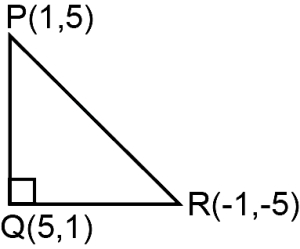
0 likesView Solution
17
MathematicsMediumMCQWBJEE · 2018
The angular points of a triangle are $A(-1, -7)$,$B(5, 1)$,and $C(1, 4)$. The equation of the bisector of the angle $\angle ABC$ is
A
$x = 7y + 2$
B
$7y = x + 2$
C
$y = 7x + 2$
D
$7x = y + 2$
Solution
(B) The side lengths are calculated as follows:
$AB = \sqrt{(5 - (-1))^2 + (1 - (-7))^2} = \sqrt{6^2 + 8^2} = \sqrt{36 + 64} = 10$
$BC = \sqrt{(1 - 5)^2 + (4 - 1)^2} = \sqrt{(-4)^2 + 3^2} = \sqrt{16 + 9} = 5$
By the Angle Bisector Theorem,the bisector of $\angle ABC$ divides the opposite side $AC$ in the ratio of the adjacent sides $AB:BC = 10:5 = 2:1$.
Let $P$ be the point on $AC$ that divides it in the ratio $2:1$. Using the section formula:
$P = \left( \frac{2(1) + 1(-1)}{2 + 1}, \frac{2(4) + 1(-7)}{2 + 1} \right) = \left( \frac{2 - 1}{3}, \frac{8 - 7}{3} \right) = \left( \frac{1}{3}, \frac{1}{3} \right)$
The equation of the line passing through $B(5, 1)$ and $P(\frac{1}{3}, \frac{1}{3})$ is given by:
$y - 1 = \frac{\frac{1}{3} - 1}{\frac{1}{3} - 5}(x - 5)$
$y - 1 = \frac{-2/3}{-14/3}(x - 5)$
$y - 1 = \frac{1}{7}(x - 5)$
$7y - 7 = x - 5$
$7y = x + 2$
$AB = \sqrt{(5 - (-1))^2 + (1 - (-7))^2} = \sqrt{6^2 + 8^2} = \sqrt{36 + 64} = 10$
$BC = \sqrt{(1 - 5)^2 + (4 - 1)^2} = \sqrt{(-4)^2 + 3^2} = \sqrt{16 + 9} = 5$
By the Angle Bisector Theorem,the bisector of $\angle ABC$ divides the opposite side $AC$ in the ratio of the adjacent sides $AB:BC = 10:5 = 2:1$.
Let $P$ be the point on $AC$ that divides it in the ratio $2:1$. Using the section formula:
$P = \left( \frac{2(1) + 1(-1)}{2 + 1}, \frac{2(4) + 1(-7)}{2 + 1} \right) = \left( \frac{2 - 1}{3}, \frac{8 - 7}{3} \right) = \left( \frac{1}{3}, \frac{1}{3} \right)$
The equation of the line passing through $B(5, 1)$ and $P(\frac{1}{3}, \frac{1}{3})$ is given by:
$y - 1 = \frac{\frac{1}{3} - 1}{\frac{1}{3} - 5}(x - 5)$
$y - 1 = \frac{-2/3}{-14/3}(x - 5)$
$y - 1 = \frac{1}{7}(x - 5)$
$7y - 7 = x - 5$
$7y = x + 2$
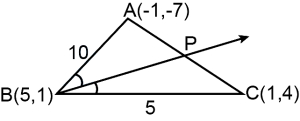
0 likesView Solution
18
MathematicsDifficultMCQWBJEE · 2018
$A$ line cuts the $X$-axis at $A(5,0)$ and the $Y$-axis at $B(0,-3)$. $A$ variable line $PQ$ is drawn perpendicular to $AB$ cutting the $X$-axis at $P$ and the $Y$-axis at $Q$. If $AQ$ and $BP$ meet at $R$,then the locus of $R$ is
A
$x^{2}+y^{2}-5x+3y=0$
B
$x^{2}+y^{2}+5x+3y=0$
C
$x^{2}+y^{2}+5x-3y=0$
D
$x^{2}+y^{2}-5x-3y=0$
Solution
(A) The equation of line $AB$ is $\frac{x}{5} + \frac{y}{-3} = 1$,which simplifies to $3x - 5y = 15$.
Since line $PQ$ is perpendicular to $AB$,its equation is of the form $5x + 3y = \lambda$.
The coordinates of $P$ (where $y=0$) are $(\frac{\lambda}{5}, 0)$ and the coordinates of $Q$ (where $x=0$) are $(0, \frac{\lambda}{3})$.
The equation of line $AQ$ passing through $A(5,0)$ and $Q(0, \frac{\lambda}{3})$ is $\frac{x}{5} + \frac{y}{\lambda/3} = 1$,which gives $\frac{x}{5} + \frac{3y}{\lambda} = 1$. Thus,$\frac{1}{\lambda} = \frac{1}{3y}(1 - \frac{x}{5})$.
The equation of line $BP$ passing through $B(0,-3)$ and $P(\frac{\lambda}{5}, 0)$ is $\frac{x}{\lambda/5} + \frac{y}{-3} = 1$,which gives $\frac{5x}{\lambda} - \frac{y}{3} = 1$. Thus,$\frac{1}{\lambda} = \frac{1}{5x}(\frac{y}{3} + 1)$.
Equating the two expressions for $\frac{1}{\lambda}$:
$\frac{1}{3y}(1 - \frac{x}{5}) = \frac{1}{5x}(\frac{y}{3} + 1)$
$5x(1 - \frac{x}{5}) = 3y(\frac{y}{3} + 1)$
$5x - x^{2} = y^{2} + 3y$
$x^{2} + y^{2} - 5x + 3y = 0$.
Since line $PQ$ is perpendicular to $AB$,its equation is of the form $5x + 3y = \lambda$.
The coordinates of $P$ (where $y=0$) are $(\frac{\lambda}{5}, 0)$ and the coordinates of $Q$ (where $x=0$) are $(0, \frac{\lambda}{3})$.
The equation of line $AQ$ passing through $A(5,0)$ and $Q(0, \frac{\lambda}{3})$ is $\frac{x}{5} + \frac{y}{\lambda/3} = 1$,which gives $\frac{x}{5} + \frac{3y}{\lambda} = 1$. Thus,$\frac{1}{\lambda} = \frac{1}{3y}(1 - \frac{x}{5})$.
The equation of line $BP$ passing through $B(0,-3)$ and $P(\frac{\lambda}{5}, 0)$ is $\frac{x}{\lambda/5} + \frac{y}{-3} = 1$,which gives $\frac{5x}{\lambda} - \frac{y}{3} = 1$. Thus,$\frac{1}{\lambda} = \frac{1}{5x}(\frac{y}{3} + 1)$.
Equating the two expressions for $\frac{1}{\lambda}$:
$\frac{1}{3y}(1 - \frac{x}{5}) = \frac{1}{5x}(\frac{y}{3} + 1)$
$5x(1 - \frac{x}{5}) = 3y(\frac{y}{3} + 1)$
$5x - x^{2} = y^{2} + 3y$
$x^{2} + y^{2} - 5x + 3y = 0$.
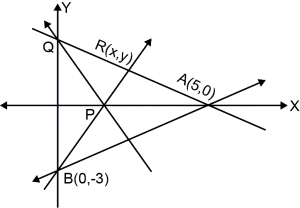
0 likesView Solution
19
MathematicsDifficultMCQWBJEE · 2018
The area of the triangle formed by the intersection of a line parallel to $X$-axis and passing through $P(h, k)$ with the lines $y=x$ and $x+y=2$ is $h^{2}$. The locus of the point $P$ is
A
$x=y-1$
B
$x=-(y-1)$
C
$x=1+y$
D
$x=-(1+y)$
Solution
(A) The line parallel to the $X$-axis passing through $P(h, k)$ is $y=k$.
The intersection of $y=k$ and $y=x$ is $B(k, k)$.
The intersection of $y=k$ and $x+y=2$ is $C(2-k, k)$.
The intersection of $y=x$ and $x+y=2$ is $A(1, 1)$.
The area of $\Delta ABC$ is given by $\frac{1}{2} |x_A(y_B-y_C) + x_B(y_C-y_A) + x_C(y_A-y_B)| = h^2$.
$\frac{1}{2} |1(k-k) + k(k-1) + (2-k)(1-k)| = h^2$
$\frac{1}{2} |0 + k^2 - k + 2 - 2k - k + k^2| = h^2$
$\frac{1}{2} |2k^2 - 4k + 2| = h^2$
$|k^2 - 2k + 1| = h^2$
$(k-1)^2 = h^2$
Taking square root on both sides,$k-1 = \pm h$.
Replacing $(h, k)$ with $(x, y)$,we get $y-1 = \pm x$.
Thus,$x = y-1$ or $x = -(y-1)$.
The intersection of $y=k$ and $y=x$ is $B(k, k)$.
The intersection of $y=k$ and $x+y=2$ is $C(2-k, k)$.
The intersection of $y=x$ and $x+y=2$ is $A(1, 1)$.
The area of $\Delta ABC$ is given by $\frac{1}{2} |x_A(y_B-y_C) + x_B(y_C-y_A) + x_C(y_A-y_B)| = h^2$.
$\frac{1}{2} |1(k-k) + k(k-1) + (2-k)(1-k)| = h^2$
$\frac{1}{2} |0 + k^2 - k + 2 - 2k - k + k^2| = h^2$
$\frac{1}{2} |2k^2 - 4k + 2| = h^2$
$|k^2 - 2k + 1| = h^2$
$(k-1)^2 = h^2$
Taking square root on both sides,$k-1 = \pm h$.
Replacing $(h, k)$ with $(x, y)$,we get $y-1 = \pm x$.
Thus,$x = y-1$ or $x = -(y-1)$.
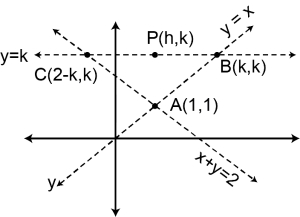
0 likesView Solution
20
MathematicsMediumMCQWBJEE · 2018
Without changing the direction of the axes,the origin is shifted to the point $(2, 3)$. Then the equation $x^{2} + y^{2} - 4x - 6y + 9 = 0$ changes to
A
$x^{2} + y^{2} + 4 = 0$
B
$x^{2} + y^{2} = 4$
C
$x^{2} + y^{2} - 8x - 12y + 48 = 0$
D
$x^{2} + y^{2} = 9$
Solution
(B) Let the new coordinates be $(x', y')$. The transformation equations are $x = x' + 2$ and $y = y' + 3$.
Substituting these into the given equation $x^{2} + y^{2} - 4x - 6y + 9 = 0$:
$(x' + 2)^{2} + (y' + 3)^{2} - 4(x' + 2) - 6(y' + 3) + 9 = 0$
Expanding the terms:
$(x'^{2} + 4x' + 4) + (y'^{2} + 6y' + 9) - 4x' - 8 - 6y' - 18 + 9 = 0$
Combining like terms:
$x'^{2} + y'^{2} + (4x' - 4x') + (6y' - 6y') + (4 + 9 - 8 - 18 + 9) = 0$
$x'^{2} + y'^{2} - 4 = 0$
Therefore,the new equation is $x^{2} + y^{2} = 4$.
Substituting these into the given equation $x^{2} + y^{2} - 4x - 6y + 9 = 0$:
$(x' + 2)^{2} + (y' + 3)^{2} - 4(x' + 2) - 6(y' + 3) + 9 = 0$
Expanding the terms:
$(x'^{2} + 4x' + 4) + (y'^{2} + 6y' + 9) - 4x' - 8 - 6y' - 18 + 9 = 0$
Combining like terms:
$x'^{2} + y'^{2} + (4x' - 4x') + (6y' - 6y') + (4 + 9 - 8 - 18 + 9) = 0$
$x'^{2} + y'^{2} - 4 = 0$
Therefore,the new equation is $x^{2} + y^{2} = 4$.
0 likesView Solution
21
MathematicsDifficultMCQWBJEE · 2018
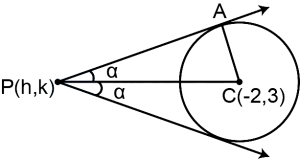
The angle between a pair of tangents drawn from a point $P$ to the circle $x^{2}+y^{2}+4x-6y+9 \sin^{2} \alpha + 13 \cos^{2} \alpha = 0$ is $2 \alpha$. The equation of the locus of the point $P$ is
A
$x^{2}+y^{2}+4x+6y+9=0$
B
$x^{2}+y^{2}-4x+6y+9=0$
C
$x^{2}+y^{2}-4x-6y+9=0$
D
$x^{2}+y^{2}+4x-6y+9=0$
Solution
(D) The given equation of the circle is $x^{2}+y^{2}+4x-6y+9 \sin^{2} \alpha + 13 \cos^{2} \alpha = 0$.
Comparing this with the general equation $x^{2}+y^{2}+2gx+2fy+c=0$,we get the center $C = (-2, 3)$.
The radius $r$ is given by $\sqrt{g^{2}+f^{2}-c} = \sqrt{(-2)^{2}+(3)^{2}-(9 \sin^{2} \alpha + 13 \cos^{2} \alpha)}$.
$r = \sqrt{4+9-9 \sin^{2} \alpha - 13 \cos^{2} \alpha} = \sqrt{13-9 \sin^{2} \alpha - 13(1-\sin^{2} \alpha)} = \sqrt{13-9 \sin^{2} \alpha - 13 + 13 \sin^{2} \alpha} = \sqrt{4 \sin^{2} \alpha} = 2 \sin \alpha$.
Let $P(h, k)$ be a point on the locus. The angle between the tangents is $2 \alpha$,so the angle between the line $PC$ and a tangent is $\alpha$.
In the right-angled triangle $\triangle PAC$,$\sin \alpha = \frac{AC}{PC} = \frac{r}{PC}$.
Thus,$PC = \frac{r}{\sin \alpha} = \frac{2 \sin \alpha}{\sin \alpha} = 2$.
$PC^{2} = 4$.
$(h+2)^{2} + (k-3)^{2} = 4$.
$h^{2}+4h+4 + k^{2}-6k+9 = 4$.
$h^{2}+k^{2}+4h-6k+9 = 0$.
Replacing $(h, k)$ with $(x, y)$,the locus is $x^{2}+y^{2}+4x-6y+9=0$.
Comparing this with the general equation $x^{2}+y^{2}+2gx+2fy+c=0$,we get the center $C = (-2, 3)$.
The radius $r$ is given by $\sqrt{g^{2}+f^{2}-c} = \sqrt{(-2)^{2}+(3)^{2}-(9 \sin^{2} \alpha + 13 \cos^{2} \alpha)}$.
$r = \sqrt{4+9-9 \sin^{2} \alpha - 13 \cos^{2} \alpha} = \sqrt{13-9 \sin^{2} \alpha - 13(1-\sin^{2} \alpha)} = \sqrt{13-9 \sin^{2} \alpha - 13 + 13 \sin^{2} \alpha} = \sqrt{4 \sin^{2} \alpha} = 2 \sin \alpha$.
Let $P(h, k)$ be a point on the locus. The angle between the tangents is $2 \alpha$,so the angle between the line $PC$ and a tangent is $\alpha$.
In the right-angled triangle $\triangle PAC$,$\sin \alpha = \frac{AC}{PC} = \frac{r}{PC}$.
Thus,$PC = \frac{r}{\sin \alpha} = \frac{2 \sin \alpha}{\sin \alpha} = 2$.
$PC^{2} = 4$.
$(h+2)^{2} + (k-3)^{2} = 4$.
$h^{2}+4h+4 + k^{2}-6k+9 = 4$.
$h^{2}+k^{2}+4h-6k+9 = 0$.
Replacing $(h, k)$ with $(x, y)$,the locus is $x^{2}+y^{2}+4x-6y+9=0$.
0 likesView Solution
22
MathematicsMediumMCQWBJEE · 2018
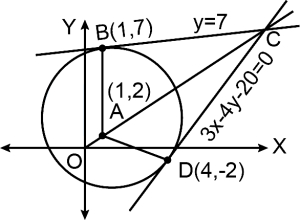
Let $A$ be the centre of the circle $x^{2}+y^{2}-2x-4y-20=0$. Let $B(1,7)$ and $D(4,-2)$ be two points on the circle such that tangents at $B$ and $D$ meet at $C$. The area of the quadrilateral $ABCD$ is
A
$150 \text{ sq units}$
B
$50 \text{ sq units}$
C
$75 \text{ sq units}$
D
$70 \text{ sq units}$
Solution
(C) The given equation of the circle is $x^{2}+y^{2}-2x-4y-20=0$.
Comparing with $x^{2}+y^{2}+2gx+2fy+c=0$,we get $g=-1, f=-2, c=-20$.
The center $A$ is $(-g, -f) = (1, 2)$ and the radius $r = \sqrt{g^{2}+f^{2}-c} = \sqrt{1+4+20} = \sqrt{25} = 5$.
The tangent at $B(1, 7)$ is $x(1) + y(7) - (x+1) - 2(y+7) - 20 = 0$,which simplifies to $y=7$.
The tangent at $D(4, -2)$ is $x(4) + y(-2) - (x+4) - 2(y-2) - 20 = 0$,which simplifies to $3x-4y-20=0$.
Solving $y=7$ and $3x-4y-20=0$,we get $3x-28-20=0 \implies 3x=48 \implies x=16$. Thus,$C$ is $(16, 7)$.
The quadrilateral $ABCD$ consists of two congruent triangles $\Delta ABC$ and $\Delta ADC$.
The length of the tangent $BC = \sqrt{(16-1)^{2} + (7-7)^{2}} = 15$.
The area of $\Delta ABC = \frac{1}{2} \times \text{base} \times \text{height} = \frac{1}{2} \times BC \times AB = \frac{1}{2} \times 15 \times 5 = 37.5$.
The area of quadrilateral $ABCD = 2 \times \text{Area}(\Delta ABC) = 2 \times 37.5 = 75 \text{ sq units}$.
Comparing with $x^{2}+y^{2}+2gx+2fy+c=0$,we get $g=-1, f=-2, c=-20$.
The center $A$ is $(-g, -f) = (1, 2)$ and the radius $r = \sqrt{g^{2}+f^{2}-c} = \sqrt{1+4+20} = \sqrt{25} = 5$.
The tangent at $B(1, 7)$ is $x(1) + y(7) - (x+1) - 2(y+7) - 20 = 0$,which simplifies to $y=7$.
The tangent at $D(4, -2)$ is $x(4) + y(-2) - (x+4) - 2(y-2) - 20 = 0$,which simplifies to $3x-4y-20=0$.
Solving $y=7$ and $3x-4y-20=0$,we get $3x-28-20=0 \implies 3x=48 \implies x=16$. Thus,$C$ is $(16, 7)$.
The quadrilateral $ABCD$ consists of two congruent triangles $\Delta ABC$ and $\Delta ADC$.
The length of the tangent $BC = \sqrt{(16-1)^{2} + (7-7)^{2}} = 15$.
The area of $\Delta ABC = \frac{1}{2} \times \text{base} \times \text{height} = \frac{1}{2} \times BC \times AB = \frac{1}{2} \times 15 \times 5 = 37.5$.
The area of quadrilateral $ABCD = 2 \times \text{Area}(\Delta ABC) = 2 \times 37.5 = 75 \text{ sq units}$.
0 likesView Solution
23
MathematicsMediumMCQWBJEE · 2018
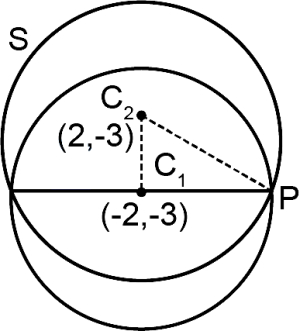
If one of the diameters of the circle given by the equation $x^{2}+y^{2}+4x+6y-12=0$ is a chord of a circle $S$ whose centre is $(2,-3)$,then the radius of $S$ is:
A
$\sqrt{41} \text{ unit}$
B
$3\sqrt{5} \text{ unit}$
C
$5\sqrt{2} \text{ unit}$
D
$2\sqrt{5} \text{ unit}$
Solution
(A) The given circle is $x^{2}+y^{2}+4x+6y-12=0$.
Comparing with $x^{2}+y^{2}+2gx+2fy+c=0$,we get $g=2, f=3, c=-12$.
The centre $C_{1}$ is $(-g, -f) = (-2, -3)$ and the radius $r_{1} = \sqrt{g^{2}+f^{2}-c} = \sqrt{2^{2}+3^{2}-(-12)} = \sqrt{4+9+12} = \sqrt{25} = 5 \text{ units}$.
Since a diameter of this circle is a chord of circle $S$,the distance $d$ from the centre of $S$,$C_{2}(2, -3)$,to this chord is $0$ (because the chord passes through the centre of the first circle,but the problem states the diameter is a chord of $S$,implying the chord is a diameter of the first circle).
Actually,the chord is a diameter of the first circle,so its length is $2r_{1} = 10$. The distance $d$ from $C_{2}(2, -3)$ to the centre $C_{1}(-2, -3)$ is $\sqrt{(2 - (-2))^{2} + (-3 - (-3))^{2}} = \sqrt{4^{2} + 0^{2}} = 4$.
Let $R$ be the radius of circle $S$. The distance from the centre $C_{2}$ to the chord is $d=4$. The half-length of the chord is $a = r_{1} = 5$.
Using the Pythagorean theorem in the triangle formed by the radius $R$,distance $d$,and half-chord $a$:
$R^{2} = d^{2} + a^{2} = 4^{2} + 5^{2} = 16 + 25 = 41$.
Therefore,$R = \sqrt{41} \text{ units}$.
Comparing with $x^{2}+y^{2}+2gx+2fy+c=0$,we get $g=2, f=3, c=-12$.
The centre $C_{1}$ is $(-g, -f) = (-2, -3)$ and the radius $r_{1} = \sqrt{g^{2}+f^{2}-c} = \sqrt{2^{2}+3^{2}-(-12)} = \sqrt{4+9+12} = \sqrt{25} = 5 \text{ units}$.
Since a diameter of this circle is a chord of circle $S$,the distance $d$ from the centre of $S$,$C_{2}(2, -3)$,to this chord is $0$ (because the chord passes through the centre of the first circle,but the problem states the diameter is a chord of $S$,implying the chord is a diameter of the first circle).
Actually,the chord is a diameter of the first circle,so its length is $2r_{1} = 10$. The distance $d$ from $C_{2}(2, -3)$ to the centre $C_{1}(-2, -3)$ is $\sqrt{(2 - (-2))^{2} + (-3 - (-3))^{2}} = \sqrt{4^{2} + 0^{2}} = 4$.
Let $R$ be the radius of circle $S$. The distance from the centre $C_{2}$ to the chord is $d=4$. The half-length of the chord is $a = r_{1} = 5$.
Using the Pythagorean theorem in the triangle formed by the radius $R$,distance $d$,and half-chord $a$:
$R^{2} = d^{2} + a^{2} = 4^{2} + 5^{2} = 16 + 25 = 41$.
Therefore,$R = \sqrt{41} \text{ units}$.
0 likesView Solution
24
MathematicsDifficultMCQWBJEE · 2018
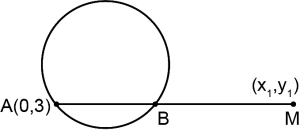
$A$ chord $AB$ is drawn from the point $A(0,3)$ on the circle $x^{2}+4x+(y-3)^{2}=0$,and is extended to $M$ such that $AM=2AB$. The locus of $M$ is
A
$x^{2}+y^{2}-8x-6y+9=0$
B
$x^{2}+y^{2}+8x+6y+9=0$
C
$x^{2}+y^{2}+8x-6y+9=0$
D
$x^{2}+y^{2}-8x+6y+9=0$
Solution
(C) Let the coordinates of $M$ be $(x, y)$.
Given $A(0, 3)$ and $AM = 2AB$,this implies that $B$ is the midpoint of the segment $AM$.
Therefore,the coordinates of $B$ are $\left(\frac{0+x}{2}, \frac{3+y}{2}\right) = \left(\frac{x}{2}, \frac{y+3}{2}\right)$.
Since $B$ lies on the circle $x^{2}+4x+(y-3)^{2}=0$,we substitute the coordinates of $B$ into the circle's equation:
$\left(\frac{x}{2}\right)^{2} + 4\left(\frac{x}{2}\right) + \left(\frac{y+3}{2} - 3\right)^{2} = 0$
$\Rightarrow \frac{x^{2}}{4} + 2x + \left(\frac{y+3-6}{2}\right)^{2} = 0$
$\Rightarrow \frac{x^{2}}{4} + 2x + \left(\frac{y-3}{2}\right)^{2} = 0$
$\Rightarrow \frac{x^{2}}{4} + 2x + \frac{y^{2}-6y+9}{4} = 0$
Multiplying the entire equation by $4$,we get:
$x^{2} + 8x + y^{2} - 6y + 9 = 0$
Thus,the locus of $M$ is $x^{2}+y^{2}+8x-6y+9=0$.
Given $A(0, 3)$ and $AM = 2AB$,this implies that $B$ is the midpoint of the segment $AM$.
Therefore,the coordinates of $B$ are $\left(\frac{0+x}{2}, \frac{3+y}{2}\right) = \left(\frac{x}{2}, \frac{y+3}{2}\right)$.
Since $B$ lies on the circle $x^{2}+4x+(y-3)^{2}=0$,we substitute the coordinates of $B$ into the circle's equation:
$\left(\frac{x}{2}\right)^{2} + 4\left(\frac{x}{2}\right) + \left(\frac{y+3}{2} - 3\right)^{2} = 0$
$\Rightarrow \frac{x^{2}}{4} + 2x + \left(\frac{y+3-6}{2}\right)^{2} = 0$
$\Rightarrow \frac{x^{2}}{4} + 2x + \left(\frac{y-3}{2}\right)^{2} = 0$
$\Rightarrow \frac{x^{2}}{4} + 2x + \frac{y^{2}-6y+9}{4} = 0$
Multiplying the entire equation by $4$,we get:
$x^{2} + 8x + y^{2} - 6y + 9 = 0$
Thus,the locus of $M$ is $x^{2}+y^{2}+8x-6y+9=0$.
0 likesView Solution
25
MathematicsMediumMCQWBJEE · 2018
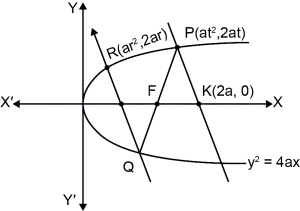
Let $P(at^{2}, 2at)$,$Q$,and $R(ar^{2}, 2ar)$ be three points on the parabola $y^{2}=4ax$. If $PQ$ is a focal chord and $PK$ is parallel to $QR$,where the coordinates of $K$ are $(2a, 0)$,then the value of $r$ is:
A
$\frac{t}{1-t^{2}}$
B
$\frac{1-t^{2}}{t}$
C
$\frac{t^{2}+1}{t}$
D
$\frac{t^{2}-1}{t}$
Solution
(D) Since $PQ$ is a focal chord with $P(at^{2}, 2at)$,the coordinates of $Q$ are $(\frac{a}{t^{2}}, \frac{-2a}{t})$.
Slope of $QR = \frac{2ar - (-2a/t)}{ar^{2} - a/t^{2}} = \frac{2a(r + 1/t)}{a(r - 1/t)(r + 1/t)} = \frac{2}{r - 1/t} = \frac{2t}{rt - 1}$.
Slope of $PK = \frac{2at - 0}{at^{2} - 2a} = \frac{2at}{a(t^{2} - 2)} = \frac{2t}{t^{2} - 2}$.
Since $PK \parallel QR$,their slopes are equal:
$\frac{2t}{rt - 1} = \frac{2t}{t^{2} - 2}$.
Assuming $t \neq 0$,we have $rt - 1 = t^{2} - 2$.
$rt = t^{2} - 1$.
$r = \frac{t^{2} - 1}{t}$.
Slope of $QR = \frac{2ar - (-2a/t)}{ar^{2} - a/t^{2}} = \frac{2a(r + 1/t)}{a(r - 1/t)(r + 1/t)} = \frac{2}{r - 1/t} = \frac{2t}{rt - 1}$.
Slope of $PK = \frac{2at - 0}{at^{2} - 2a} = \frac{2at}{a(t^{2} - 2)} = \frac{2t}{t^{2} - 2}$.
Since $PK \parallel QR$,their slopes are equal:
$\frac{2t}{rt - 1} = \frac{2t}{t^{2} - 2}$.
Assuming $t \neq 0$,we have $rt - 1 = t^{2} - 2$.
$rt = t^{2} - 1$.
$r = \frac{t^{2} - 1}{t}$.
0 likesView Solution
26
MathematicsMediumMCQWBJEE · 2018
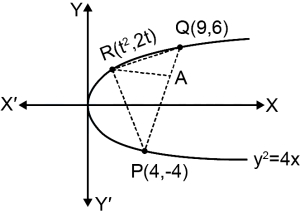
Consider the parabola $y^{2}=4x$. Let $P$ and $Q$ be points on the parabola where $P(4, -4)$ and $Q(9, 6)$. Let $R$ be a point on the arc of the parabola between $P$ and $Q$. Then,the area of $\Delta PQR$ is largest when
A
$\angle PQA=90^{\circ}$
B
$R(4, 4)$
C
$R\left(\frac{1}{4}, 1\right)$
D
$R\left(1, \frac{1}{4}\right)$
Solution
(C) The area of $\Delta PQR$ is maximized when the distance from $R$ to the line $PQ$ is maximum.
Let $R$ be $(t^{2}, 2t)$. The line $PQ$ passes through $P(4, -4)$ and $Q(9, 6)$.
The slope of $PQ$ is $m = \frac{6 - (-4)}{9 - 4} = \frac{10}{5} = 2$.
The equation of line $PQ$ is $y - 6 = 2(x - 9) \Rightarrow 2x - y - 12 = 0$.
The perpendicular distance from $R(t^{2}, 2t)$ to $2x - y - 12 = 0$ is $d = \frac{|2t^{2} - 2t - 12|}{\sqrt{2^{2} + (-1)^{2}}} = \frac{|2(t^{2} - t - 6)|}{\sqrt{5}} = \frac{2|t - 3||t + 2|}{\sqrt{5}}$.
For $R$ to be on the arc between $P$ and $Q$,the parameter $t$ must lie between $-2$ and $3$.
Let $f(t) = t^{2} - t - 6$. To maximize the distance,we find the critical point of $f(t)$ by setting $f'(t) = 2t - 1 = 0$,which gives $t = \frac{1}{2}$.
At $t = \frac{1}{2}$,the coordinates of $R$ are $\left(\left(\frac{1}{2}\right)^{2}, 2\left(\frac{1}{2}\right)\right) = \left(\frac{1}{4}, 1\right)$.
Let $R$ be $(t^{2}, 2t)$. The line $PQ$ passes through $P(4, -4)$ and $Q(9, 6)$.
The slope of $PQ$ is $m = \frac{6 - (-4)}{9 - 4} = \frac{10}{5} = 2$.
The equation of line $PQ$ is $y - 6 = 2(x - 9) \Rightarrow 2x - y - 12 = 0$.
The perpendicular distance from $R(t^{2}, 2t)$ to $2x - y - 12 = 0$ is $d = \frac{|2t^{2} - 2t - 12|}{\sqrt{2^{2} + (-1)^{2}}} = \frac{|2(t^{2} - t - 6)|}{\sqrt{5}} = \frac{2|t - 3||t + 2|}{\sqrt{5}}$.
For $R$ to be on the arc between $P$ and $Q$,the parameter $t$ must lie between $-2$ and $3$.
Let $f(t) = t^{2} - t - 6$. To maximize the distance,we find the critical point of $f(t)$ by setting $f'(t) = 2t - 1 = 0$,which gives $t = \frac{1}{2}$.
At $t = \frac{1}{2}$,the coordinates of $R$ are $\left(\left(\frac{1}{2}\right)^{2}, 2\left(\frac{1}{2}\right)\right) = \left(\frac{1}{4}, 1\right)$.
0 likesView Solution
27
MathematicsMediumMCQWBJEE · 2018
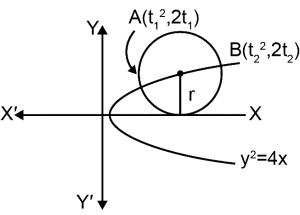
Let $A$ and $B$ be two distinct points on the parabola $y^{2}=4x$. If the axis of the parabola touches a circle of radius $r$ having $AB$ as its diameter,then the slope of the line $AB$ is
A
$-\frac{1}{r}$
B
$\frac{1}{r}$
C
$\frac{2}{r}$
D
None of the above
Solution
(D) Let the coordinates of points $A$ and $B$ be $(t_{1}^{2}, 2t_{1})$ and $(t_{2}^{2}, 2t_{2})$ respectively.
The center of the circle with diameter $AB$ is given by $(\frac{t_{1}^{2}+t_{2}^{2}}{2}, t_{1}+t_{2})$.
The axis of the parabola $y^{2}=4x$ is the $x$-axis,which has the equation $y=0$.
Since the circle touches the $x$-axis,the radius of the circle is equal to the absolute value of the $y$-coordinate of the center.
Thus,$r = |t_{1}+t_{2}|$,which implies $t_{1}+t_{2} = \pm r$.
The slope of the line $AB$ is given by $m = \frac{2t_{2}-2t_{1}}{t_{2}^{2}-t_{1}^{2}} = \frac{2(t_{2}-t_{1})}{(t_{2}-t_{1})(t_{2}+t_{1})} = \frac{2}{t_{1}+t_{2}}$.
Substituting $t_{1}+t_{2} = \pm r$,we get the slope $m = \frac{2}{\pm r} = \pm \frac{2}{r}$.
Since $\pm \frac{2}{r}$ is not explicitly listed in the options $A, B,$ or $C$,the correct choice is $D$.
The center of the circle with diameter $AB$ is given by $(\frac{t_{1}^{2}+t_{2}^{2}}{2}, t_{1}+t_{2})$.
The axis of the parabola $y^{2}=4x$ is the $x$-axis,which has the equation $y=0$.
Since the circle touches the $x$-axis,the radius of the circle is equal to the absolute value of the $y$-coordinate of the center.
Thus,$r = |t_{1}+t_{2}|$,which implies $t_{1}+t_{2} = \pm r$.
The slope of the line $AB$ is given by $m = \frac{2t_{2}-2t_{1}}{t_{2}^{2}-t_{1}^{2}} = \frac{2(t_{2}-t_{1})}{(t_{2}-t_{1})(t_{2}+t_{1})} = \frac{2}{t_{1}+t_{2}}$.
Substituting $t_{1}+t_{2} = \pm r$,we get the slope $m = \frac{2}{\pm r} = \pm \frac{2}{r}$.
Since $\pm \frac{2}{r}$ is not explicitly listed in the options $A, B,$ or $C$,the correct choice is $D$.
0 likesView Solution
28
MathematicsMediumMCQWBJEE · 2018
The number of common tangents to the parabolas $y = x^{2}$ and $y = -x^{2} + 4x - 4$ is:
A
$1$
B
$2$
C
$3$
D
$4$
Solution
(A) Given parabolas are $y = x^{2}$ and $y = -(x-2)^{2}$.
Let the tangent to $y = x^{2}$ be $y = mx - \frac{m^{2}}{4}$.
This line is also a tangent to $y = -(x-2)^{2}$,which can be written as $(y-0) = -1(x-2)^{2}$.
The condition for a line $y = mx + c$ to be a tangent to $y = a(x-h)^{2} + k$ is $c = k - \frac{m^{2}}{4a}$.
Here,$a = -1, h = 2, k = 0$. So,$c = 0 - \frac{m^{2}}{4(-1)} = \frac{m^{2}}{4}$.
Equating the two expressions for $c$:
$-\frac{m^{2}}{4} = \frac{m^{2}}{4}$ $\Rightarrow \frac{m^{2}}{2} = 0$ $\Rightarrow m = 0$.
For $m = 0$,the tangent is $y = 0$.
Since there is only one value of $m$,there is only $1$ common tangent.
Let the tangent to $y = x^{2}$ be $y = mx - \frac{m^{2}}{4}$.
This line is also a tangent to $y = -(x-2)^{2}$,which can be written as $(y-0) = -1(x-2)^{2}$.
The condition for a line $y = mx + c$ to be a tangent to $y = a(x-h)^{2} + k$ is $c = k - \frac{m^{2}}{4a}$.
Here,$a = -1, h = 2, k = 0$. So,$c = 0 - \frac{m^{2}}{4(-1)} = \frac{m^{2}}{4}$.
Equating the two expressions for $c$:
$-\frac{m^{2}}{4} = \frac{m^{2}}{4}$ $\Rightarrow \frac{m^{2}}{2} = 0$ $\Rightarrow m = 0$.
For $m = 0$,the tangent is $y = 0$.
Since there is only one value of $m$,there is only $1$ common tangent.
0 likesView Solution
29
MathematicsMediumMCQWBJEE · 2018
Let $P$ be a point on the ellipse $\frac{x^{2}}{9}+\frac{y^{2}}{4}=1$ and the line through $P$ parallel to the $Y$-axis meets the circle $x^{2}+y^{2}=9$ at $Q$,where $P$ and $Q$ are on the same side of the $X$-axis. If $R$ is a point on $PQ$ such that $\frac{PR}{RQ}=\frac{1}{2}$,then the locus of $R$ is
A
$\frac{x^{2}}{9}+\frac{9y^{2}}{49}=1$
B
$\frac{x^{2}}{49}+\frac{y^{2}}{9}=1$
C
$\frac{x^{2}}{9}+\frac{y^{2}}{49}=1$
D
$\frac{9x^{2}}{49}+\frac{y^{2}}{9}=1$
Solution
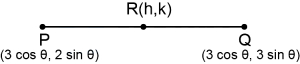
(A) Let the point $P$ on the ellipse $\frac{x^{2}}{9}+\frac{y^{2}}{4}=1$ be $(3\cos\theta, 2\sin\theta)$.
The line through $P$ parallel to the $Y$-axis is $x = 3\cos\theta$.
This line meets the circle $x^{2}+y^{2}=9$ at $Q$. Substituting $x = 3\cos\theta$ into the circle equation:
$(3\cos\theta)^{2} + y^{2} = 9$ $\Rightarrow 9\cos^{2}\theta + y^{2} = 9$ $\Rightarrow y^{2} = 9(1-\cos^{2}\theta) = 9\sin^{2}\theta$.
Since $P$ and $Q$ are on the same side of the $X$-axis,$y$ must have the same sign as $2\sin\theta$. Thus,$Q = (3\cos\theta, 3\sin\theta)$.
Let $R(h, k)$ be a point on $PQ$ such that $\frac{PR}{RQ} = \frac{1}{2}$. Using the section formula:
$h = \frac{1(3\cos\theta) + 2(3\cos\theta)}{1+2} = 3\cos\theta$
$k = \frac{1(3\sin\theta) + 2(2\sin\theta)}{1+2} = \frac{7\sin\theta}{3}$
From these,$\cos\theta = \frac{h}{3}$ and $\sin\theta = \frac{3k}{7}$.
Using the identity $\cos^{2}\theta + \sin^{2}\theta = 1$,we get:
$(\frac{h}{3})^{2} + (\frac{3k}{7})^{2} = 1 \Rightarrow \frac{h^{2}}{9} + \frac{9k^{2}}{49} = 1$.
Replacing $(h, k)$ with $(x, y)$,the locus is $\frac{x^{2}}{9} + \frac{9y^{2}}{49} = 1$.
The line through $P$ parallel to the $Y$-axis is $x = 3\cos\theta$.
This line meets the circle $x^{2}+y^{2}=9$ at $Q$. Substituting $x = 3\cos\theta$ into the circle equation:
$(3\cos\theta)^{2} + y^{2} = 9$ $\Rightarrow 9\cos^{2}\theta + y^{2} = 9$ $\Rightarrow y^{2} = 9(1-\cos^{2}\theta) = 9\sin^{2}\theta$.
Since $P$ and $Q$ are on the same side of the $X$-axis,$y$ must have the same sign as $2\sin\theta$. Thus,$Q = (3\cos\theta, 3\sin\theta)$.
Let $R(h, k)$ be a point on $PQ$ such that $\frac{PR}{RQ} = \frac{1}{2}$. Using the section formula:
$h = \frac{1(3\cos\theta) + 2(3\cos\theta)}{1+2} = 3\cos\theta$
$k = \frac{1(3\sin\theta) + 2(2\sin\theta)}{1+2} = \frac{7\sin\theta}{3}$
From these,$\cos\theta = \frac{h}{3}$ and $\sin\theta = \frac{3k}{7}$.
Using the identity $\cos^{2}\theta + \sin^{2}\theta = 1$,we get:
$(\frac{h}{3})^{2} + (\frac{3k}{7})^{2} = 1 \Rightarrow \frac{h^{2}}{9} + \frac{9k^{2}}{49} = 1$.
Replacing $(h, k)$ with $(x, y)$,the locus is $\frac{x^{2}}{9} + \frac{9y^{2}}{49} = 1$.
0 likesView Solution
30
MathematicsEasyMCQWBJEE · 2018
Let the eccentricity of the hyperbola $\frac{x^{2}}{a^{2}}-\frac{y^{2}}{b^{2}}=1$ be reciprocal to that of the ellipse $x^{2}+9y^{2}=9$. Then the ratio $a^{2}:b^{2}$ equals:
A
$8:1$
B
$1:8$
C
$9:1$
D
$1:9$
Solution
(A) The given equation of the ellipse is $x^{2}+9y^{2}=9$,which can be written as $\frac{x^{2}}{9}+\frac{y^{2}}{1}=1$.
Here,$a^{2}=9$ and $b^{2}=1$,so $a=3$ and $b=1$.
The eccentricity $e_{e}$ of the ellipse is given by $e_{e} = \sqrt{1-\frac{b^{2}}{a^{2}}} = \sqrt{1-\frac{1}{9}} = \sqrt{\frac{8}{9}} = \frac{\sqrt{8}}{3}$.
The eccentricity $e_{h}$ of the hyperbola is the reciprocal of $e_{e}$,so $e_{h} = \frac{3}{\sqrt{8}}$.
For the hyperbola $\frac{x^{2}}{a^{2}}-\frac{y^{2}}{b^{2}}=1$,the eccentricity is $e_{h} = \sqrt{1+\frac{b^{2}}{a^{2}}}$.
Squaring both sides,we get $e_{h}^{2} = 1+\frac{b^{2}}{a^{2}} = \frac{9}{8}$.
Thus,$\frac{b^{2}}{a^{2}} = \frac{9}{8}-1 = \frac{1}{8}$.
Therefore,the ratio $a^{2}:b^{2} = 8:1$.
Here,$a^{2}=9$ and $b^{2}=1$,so $a=3$ and $b=1$.
The eccentricity $e_{e}$ of the ellipse is given by $e_{e} = \sqrt{1-\frac{b^{2}}{a^{2}}} = \sqrt{1-\frac{1}{9}} = \sqrt{\frac{8}{9}} = \frac{\sqrt{8}}{3}$.
The eccentricity $e_{h}$ of the hyperbola is the reciprocal of $e_{e}$,so $e_{h} = \frac{3}{\sqrt{8}}$.
For the hyperbola $\frac{x^{2}}{a^{2}}-\frac{y^{2}}{b^{2}}=1$,the eccentricity is $e_{h} = \sqrt{1+\frac{b^{2}}{a^{2}}}$.
Squaring both sides,we get $e_{h}^{2} = 1+\frac{b^{2}}{a^{2}} = \frac{9}{8}$.
Thus,$\frac{b^{2}}{a^{2}} = \frac{9}{8}-1 = \frac{1}{8}$.
Therefore,the ratio $a^{2}:b^{2} = 8:1$.
0 likesView Solution
31
MathematicsMediumMCQWBJEE · 2018
$A$ hyperbola,having the transverse axis of length $2 \sin \theta$,is confocal with the ellipse $3 x^{2}+4 y^{2}=12$. Its equation is
A
$x^{2} \sin ^{2} \theta-y^{2} \cos ^{2} \theta=1$
B
$x^{2} \operatorname{cosec}^{2} \theta-y^{2} \sec ^{2} \theta=1$
C
$(x^{2}+y^{2}) \sin ^{2} \theta=1+y^{2}$
D
$x^{2} \operatorname{cosec}^{2} \theta=x^{2}+y^{2}+\sin ^{2} \theta$
Solution
(B) Given,the length of the transverse axis of the hyperbola is $2 a_{1} = 2 \sin \theta$,so $a_{1} = \sin \theta$.
For the ellipse $3 x^{2} + 4 y^{2} = 12$,we divide by $12$ to get $\frac{x^{2}}{4} + \frac{y^{2}}{3} = 1$.
Here,$a^{2} = 4$ and $b^{2} = 3$.
The eccentricity $e$ of the ellipse is given by $b^{2} = a^{2}(1 - e^{2})$,so $3 = 4(1 - e^{2})$,which gives $e^{2} = 1 - \frac{3}{4} = \frac{1}{4}$,so $e = \frac{1}{2}$.
The focus of the ellipse is $(\pm ae, 0) = (\pm 2 \times \frac{1}{2}, 0) = (\pm 1, 0)$.
Since the hyperbola is confocal with the ellipse,its focus is $(\pm 1, 0)$.
For the hyperbola,$a_{1} e_{1} = 1$. Substituting $a_{1} = \sin \theta$,we get $e_{1} = \frac{1}{\sin \theta} = \operatorname{cosec} \theta$.
Now,$b_{1}^{2} = a_{1}^{2}(e_{1}^{2} - 1) = a_{1}^{2} e_{1}^{2} - a_{1}^{2} = 1 - \sin^{2} \theta = \cos^{2} \theta$.
The equation of the hyperbola is $\frac{x^{2}}{a_{1}^{2}} - \frac{y^{2}}{b_{1}^{2}} = 1$,which becomes $\frac{x^{2}}{\sin^{2} \theta} - \frac{y^{2}}{\cos^{2} \theta} = 1$.
This simplifies to $x^{2} \operatorname{cosec}^{2} \theta - y^{2} \sec^{2} \theta = 1$.
For the ellipse $3 x^{2} + 4 y^{2} = 12$,we divide by $12$ to get $\frac{x^{2}}{4} + \frac{y^{2}}{3} = 1$.
Here,$a^{2} = 4$ and $b^{2} = 3$.
The eccentricity $e$ of the ellipse is given by $b^{2} = a^{2}(1 - e^{2})$,so $3 = 4(1 - e^{2})$,which gives $e^{2} = 1 - \frac{3}{4} = \frac{1}{4}$,so $e = \frac{1}{2}$.
The focus of the ellipse is $(\pm ae, 0) = (\pm 2 \times \frac{1}{2}, 0) = (\pm 1, 0)$.
Since the hyperbola is confocal with the ellipse,its focus is $(\pm 1, 0)$.
For the hyperbola,$a_{1} e_{1} = 1$. Substituting $a_{1} = \sin \theta$,we get $e_{1} = \frac{1}{\sin \theta} = \operatorname{cosec} \theta$.
Now,$b_{1}^{2} = a_{1}^{2}(e_{1}^{2} - 1) = a_{1}^{2} e_{1}^{2} - a_{1}^{2} = 1 - \sin^{2} \theta = \cos^{2} \theta$.
The equation of the hyperbola is $\frac{x^{2}}{a_{1}^{2}} - \frac{y^{2}}{b_{1}^{2}} = 1$,which becomes $\frac{x^{2}}{\sin^{2} \theta} - \frac{y^{2}}{\cos^{2} \theta} = 1$.
This simplifies to $x^{2} \operatorname{cosec}^{2} \theta - y^{2} \sec^{2} \theta = 1$.
0 likesView Solution
32
MathematicsMediumMCQWBJEE · 2018
Let $f(x) = 3x^{10} - 7x^{8} + 5x^{6} - 21x^{3} + 3x^{2} - 7$. Then $\lim_{h \rightarrow 0} \frac{f(1-h) - f(1)}{h^{3} + 3h}$ is:
A
does not exist
B
is $\frac{50}{3}$
C
is $\frac{53}{3}$
D
is $\frac{22}{3}$
Solution
(C) Given $f(x) = 3x^{10} - 7x^{8} + 5x^{6} - 21x^{3} + 3x^{2} - 7$.
We need to evaluate the limit $L = \lim_{h \rightarrow 0} \frac{f(1-h) - f(1)}{h^{3} + 3h}$.
We can rewrite the expression as:
$L = \lim_{h \rightarrow 0} \left( \frac{f(1-h) - f(1)}{-h} \cdot \frac{-h}{h(h^{2} + 3)} \right)$.
Since $f'(1) = \lim_{h \rightarrow 0} \frac{f(1-h) - f(1)}{-h}$,we have:
$L = f'(1) \cdot \lim_{h \rightarrow 0} \frac{-1}{h^{2} + 3}$.
First,calculate the derivative $f'(x) = 30x^{9} - 56x^{7} + 30x^{5} - 63x^{2} + 6x$.
Evaluating at $x = 1$:
$f'(1) = 30(1)^{9} - 56(1)^{7} + 30(1)^{5} - 63(1)^{2} + 6(1) = 30 - 56 + 30 - 63 + 6 = -53$.
Now substitute this into the limit expression:
$L = (-53) \cdot \left( \frac{-1}{0^{2} + 3} \right) = (-53) \cdot \left( -\frac{1}{3} \right) = \frac{53}{3}$.
We need to evaluate the limit $L = \lim_{h \rightarrow 0} \frac{f(1-h) - f(1)}{h^{3} + 3h}$.
We can rewrite the expression as:
$L = \lim_{h \rightarrow 0} \left( \frac{f(1-h) - f(1)}{-h} \cdot \frac{-h}{h(h^{2} + 3)} \right)$.
Since $f'(1) = \lim_{h \rightarrow 0} \frac{f(1-h) - f(1)}{-h}$,we have:
$L = f'(1) \cdot \lim_{h \rightarrow 0} \frac{-1}{h^{2} + 3}$.
First,calculate the derivative $f'(x) = 30x^{9} - 56x^{7} + 30x^{5} - 63x^{2} + 6x$.
Evaluating at $x = 1$:
$f'(1) = 30(1)^{9} - 56(1)^{7} + 30(1)^{5} - 63(1)^{2} + 6(1) = 30 - 56 + 30 - 63 + 6 = -53$.
Now substitute this into the limit expression:
$L = (-53) \cdot \left( \frac{-1}{0^{2} + 3} \right) = (-53) \cdot \left( -\frac{1}{3} \right) = \frac{53}{3}$.
0 likesView Solution
33
MathematicsEasyMCQWBJEE · 2018
$A$ student appears for tests $I$,$II$,and $III$. The student is successful if they pass in tests ($I$ and $II$) $OR$ ($I$ and $III$). The probabilities of the student passing in tests $I$,$II$,and $III$ are respectively $p$,$q$,and $1/2$. If the probability of the student being successful is $1/2$,then:
A
$p(1+q)=1$
B
$q(1+p)=1$
C
$pq=1$
D
$\frac{1}{p}+\frac{1}{q}=1$
Solution
(A) Let $X$ be the event that the student is successful. Let $X_1, X_2, X_3$ be the events of passing tests $I, II, III$ respectively.
Given $P(X_1) = p$,$P(X_2) = q$,and $P(X_3) = 1/2$.
The student is successful if $(X_1 \cap X_2)$ or $(X_1 \cap X_3)$.
Since these events are not mutually exclusive,we use the formula $P(A \cup B) = P(A) + P(B) - P(A \cap B)$.
Here,$A = X_1 \cap X_2$ and $B = X_1 \cap X_3$.
$P(X) = P(X_1 \cap X_2) + P(X_1 \cap X_3) - P(X_1 \cap X_2 \cap X_3)$.
Since the tests are independent:
$P(X) = p \cdot q + p \cdot (1/2) - p \cdot q \cdot (1/2)$.
Given $P(X) = 1/2$:
$1/2 = pq + p/2 - pq/2$.
$1/2 = p/2 + pq/2$.
Multiply by $2$:
$1 = p + pq$.
$1 = p(1+q)$.
Given $P(X_1) = p$,$P(X_2) = q$,and $P(X_3) = 1/2$.
The student is successful if $(X_1 \cap X_2)$ or $(X_1 \cap X_3)$.
Since these events are not mutually exclusive,we use the formula $P(A \cup B) = P(A) + P(B) - P(A \cap B)$.
Here,$A = X_1 \cap X_2$ and $B = X_1 \cap X_3$.
$P(X) = P(X_1 \cap X_2) + P(X_1 \cap X_3) - P(X_1 \cap X_2 \cap X_3)$.
Since the tests are independent:
$P(X) = p \cdot q + p \cdot (1/2) - p \cdot q \cdot (1/2)$.
Given $P(X) = 1/2$:
$1/2 = pq + p/2 - pq/2$.
$1/2 = p/2 + pq/2$.
Multiply by $2$:
$1 = p + pq$.
$1 = p(1+q)$.
0 likesView Solution
34
MathematicsDifficultMCQWBJEE · 2018
If $\int f(x) \sin x \cos x \, dx = \frac{1}{2(b^2 - a^2)} \log f(x) + c$,where $c$ is the constant of integration,then $f(x)$ is
A
$\frac{2}{ab \cos 2x}$
B
$\frac{2}{(b^2 - a^2) \cos 2x}$
C
$\frac{2}{ab \sin 2x}$
D
$\frac{2}{(b^2 - a^2) \sin 2x}$
Solution
(B) Given the integral equation: $\int f(x) \sin x \cos x \, dx = \frac{1}{2(b^2 - a^2)} \log f(x) + c$.
Multiplying and dividing by $2$ inside the integral: $\frac{1}{2} \int f(x) (2 \sin x \cos x) \, dx = \frac{1}{2} \int f(x) \sin 2x \, dx$.
Let $f(x) = \frac{2}{(b^2 - a^2) \cos 2x}$.
Substituting this into the integral: $\frac{1}{2} \int \frac{2}{(b^2 - a^2) \cos 2x} \sin 2x \, dx = \frac{1}{b^2 - a^2} \int \tan 2x \, dx$.
Integrating $\tan 2x$: $\frac{1}{b^2 - a^2} \cdot \frac{\log |\sec 2x|}{2} + c = \frac{1}{2(b^2 - a^2)} \log |\sec 2x| + c$.
Since $\sec 2x = \frac{1}{\cos 2x}$,this is $\frac{1}{2(b^2 - a^2)} \log |\frac{1}{\cos 2x}| + c$.
Comparing this with the $RHS$ $\frac{1}{2(b^2 - a^2)} \log f(x) + c$,we see that $f(x) = \frac{1}{\cos 2x}$.
However,to match the constant factor in the provided options,$f(x) = \frac{2}{(b^2 - a^2) \cos 2x}$ is the correct form.
Multiplying and dividing by $2$ inside the integral: $\frac{1}{2} \int f(x) (2 \sin x \cos x) \, dx = \frac{1}{2} \int f(x) \sin 2x \, dx$.
Let $f(x) = \frac{2}{(b^2 - a^2) \cos 2x}$.
Substituting this into the integral: $\frac{1}{2} \int \frac{2}{(b^2 - a^2) \cos 2x} \sin 2x \, dx = \frac{1}{b^2 - a^2} \int \tan 2x \, dx$.
Integrating $\tan 2x$: $\frac{1}{b^2 - a^2} \cdot \frac{\log |\sec 2x|}{2} + c = \frac{1}{2(b^2 - a^2)} \log |\sec 2x| + c$.
Since $\sec 2x = \frac{1}{\cos 2x}$,this is $\frac{1}{2(b^2 - a^2)} \log |\frac{1}{\cos 2x}| + c$.
Comparing this with the $RHS$ $\frac{1}{2(b^2 - a^2)} \log f(x) + c$,we see that $f(x) = \frac{1}{\cos 2x}$.
However,to match the constant factor in the provided options,$f(x) = \frac{2}{(b^2 - a^2) \cos 2x}$ is the correct form.
0 likesView Solution
35
MathematicsEasyMCQWBJEE · 2018
The equation $x \log x = 3 - x$:
A
has no root in $(1, 3)$
B
has exactly one root in $(1, 3)$
C
$x \log x - (3 - x) > 0$ in $[1, 3]$
D
$x \log x - (3 - x) < 0$ in $[1, 3]$
Solution
(B) Let $f(x) = x \log x + x - 3$.
$f'(x) = x \cdot \frac{1}{x} + \log x + 1 = 1 + \log x + 1 = \log x + 2$.
For $x \in (1, 3)$,$\log x > 0$,so $f'(x) = \log x + 2 > 2 > 0$.
Thus,$f(x)$ is strictly increasing on $(1, 3)$.
$f(1) = 1 \cdot \log(1) + 1 - 3 = 0 + 1 - 3 = -2$.
$f(3) = 3 \log 3 + 3 - 3 = 3 \log 3 \approx 3(1.098) = 3.294 > 0$.
Since $f(1) < 0$ and $f(3) > 0$ and $f(x)$ is continuous and strictly increasing,by the Intermediate Value Theorem,there exists exactly one root in $(1, 3)$.
$f'(x) = x \cdot \frac{1}{x} + \log x + 1 = 1 + \log x + 1 = \log x + 2$.
For $x \in (1, 3)$,$\log x > 0$,so $f'(x) = \log x + 2 > 2 > 0$.
Thus,$f(x)$ is strictly increasing on $(1, 3)$.
$f(1) = 1 \cdot \log(1) + 1 - 3 = 0 + 1 - 3 = -2$.
$f(3) = 3 \log 3 + 3 - 3 = 3 \log 3 \approx 3(1.098) = 3.294 > 0$.
Since $f(1) < 0$ and $f(3) > 0$ and $f(x)$ is continuous and strictly increasing,by the Intermediate Value Theorem,there exists exactly one root in $(1, 3)$.
0 likesView Solution
36
MathematicsEasyMCQWBJEE · 2018
The approximate value of $\sin 31^{\circ}$ is
A
$>0.5$
B
$>0.6$
C
$ < 0.5$
D
$ < 0.4$
Solution
(A) We know that,$\sin 30^{\circ} = \frac{1}{2} = 0.5$.
In the $1^{\text{st}}$ quadrant,$\sin x$ is an increasing function.
Since $31^{\circ} > 30^{\circ}$,it follows that $\sin 31^{\circ} > \sin 30^{\circ}$.
Therefore,$\sin 31^{\circ} > 0.5$.
In the $1^{\text{st}}$ quadrant,$\sin x$ is an increasing function.
Since $31^{\circ} > 30^{\circ}$,it follows that $\sin 31^{\circ} > \sin 30^{\circ}$.
Therefore,$\sin 31^{\circ} > 0.5$.
0 likesView Solution
37
MathematicsEasyMCQWBJEE · 2018
On the set of real numbers $R$,a relation $\rho$ is defined by $x \rho y$ if and only if $x-y$ is zero or an irrational number. Then:
A
$\rho$ is an equivalence relation
B
$\rho$ is reflexive but neither symmetric nor transitive
C
$\rho$ is reflexive and symmetric but not transitive
D
$\rho$ is symmetric and transitive but not reflexive
Solution
(C) $1$. Reflexivity: For any $x \in R$,$x - x = 0$. Since $0$ is allowed,$x \rho x$ holds. Thus,$\rho$ is reflexive.
$2$. Symmetry: If $x \rho y$,then $x - y$ is $0$ or irrational. Since $y - x = -(x - y)$,if $x - y$ is $0$,$y - x$ is $0$. If $x - y$ is irrational,$y - x$ is also irrational. Thus,$y \rho x$ holds. $\rho$ is symmetric.
$3$. Transitivity: Let $x = \sqrt{2} + 1$,$y = \sqrt{2}$,and $z = 0$. Here,$x - y = 1$ (rational,not zero or irrational),so $x \rho y$ is false. Let us test $x = \sqrt{2}$,$y = 0$,$z = -\sqrt{2}$. Then $x - y = \sqrt{2}$ (irrational) and $y - z = \sqrt{2}$ (irrational). However,$x - z = 2\sqrt{2}$ (irrational). Consider $x = \sqrt{2} + 1$,$y = \sqrt{2}$,$z = 1$. $x - y = 1$ (not allowed). Consider $x = 1 + \sqrt{2}$,$y = 1$,$z = \sqrt{2}$. $x - y = \sqrt{2}$ (irrational) and $y - z = 1 - \sqrt{2}$ (irrational). But $x - z = 1$ (rational,not zero). Thus,$x \rho y$ and $y \rho z$ hold,but $x \rho z$ does not hold. Therefore,$\rho$ is not transitive.
$2$. Symmetry: If $x \rho y$,then $x - y$ is $0$ or irrational. Since $y - x = -(x - y)$,if $x - y$ is $0$,$y - x$ is $0$. If $x - y$ is irrational,$y - x$ is also irrational. Thus,$y \rho x$ holds. $\rho$ is symmetric.
$3$. Transitivity: Let $x = \sqrt{2} + 1$,$y = \sqrt{2}$,and $z = 0$. Here,$x - y = 1$ (rational,not zero or irrational),so $x \rho y$ is false. Let us test $x = \sqrt{2}$,$y = 0$,$z = -\sqrt{2}$. Then $x - y = \sqrt{2}$ (irrational) and $y - z = \sqrt{2}$ (irrational). However,$x - z = 2\sqrt{2}$ (irrational). Consider $x = \sqrt{2} + 1$,$y = \sqrt{2}$,$z = 1$. $x - y = 1$ (not allowed). Consider $x = 1 + \sqrt{2}$,$y = 1$,$z = \sqrt{2}$. $x - y = \sqrt{2}$ (irrational) and $y - z = 1 - \sqrt{2}$ (irrational). But $x - z = 1$ (rational,not zero). Thus,$x \rho y$ and $y \rho z$ hold,but $x \rho z$ does not hold. Therefore,$\rho$ is not transitive.
0 likesView Solution
38
MathematicsEasyMCQWBJEE · 2018
On the set $R$ of real numbers,the relation $\rho$ is defined by $x \rho y$ if $x > |y|$. Which of the following statements is true regarding the properties of $\rho$?
A
If $|x-y| < 2$,then $\rho$ is reflexive but neither symmetric nor transitive.
B
If $x-y < 2$,then $\rho$ is reflexive and symmetric but not transitive.
C
If $x \geq y$,then $\rho$ is reflexive and transitive but not symmetric.
D
If $x > |y|$,then $\rho$ is transitive but neither reflexive nor symmetric.
Solution
(D) Given the relation $\rho$ on the set $R$ of real numbers defined by $x \rho y \iff x > |y|$.
$1$. For reflexive property:
Check if $x \rho x$ holds for all $x \in R$.
$x \rho x \iff x > |x|$.
This is false for all $x \leq 0$ (e.g.,if $x = -1$,$-1 > |-1| = 1$ is false).
Thus,$\rho$ is not reflexive.
$2$. For symmetric property:
Check if $x \rho y \implies y \rho x$.
$x \rho y \implies x > |y|$.
$y \rho x \implies y > |x|$.
If we take $x = 2$ and $y = 1$,$2 > |1|$ is true,but $1 > |2|$ is false.
Thus,$\rho$ is not symmetric.
$3$. For transitive property:
Check if $x \rho y$ and $y \rho z \implies x \rho z$.
$x \rho y \implies x > |y|$.
$y \rho z \implies y > |z|$.
Since $y > |z|$,we have $|y| \geq y > |z|$,so $|y| > |z|$.
Since $x > |y|$ and $|y| > |z|$,by transitivity of inequality,$x > |z|$.
Therefore,$x \rho z$ holds.
Thus,$\rho$ is transitive.
Conclusion: The relation $\rho$ defined by $x > |y|$ is transitive but neither reflexive nor symmetric.
$1$. For reflexive property:
Check if $x \rho x$ holds for all $x \in R$.
$x \rho x \iff x > |x|$.
This is false for all $x \leq 0$ (e.g.,if $x = -1$,$-1 > |-1| = 1$ is false).
Thus,$\rho$ is not reflexive.
$2$. For symmetric property:
Check if $x \rho y \implies y \rho x$.
$x \rho y \implies x > |y|$.
$y \rho x \implies y > |x|$.
If we take $x = 2$ and $y = 1$,$2 > |1|$ is true,but $1 > |2|$ is false.
Thus,$\rho$ is not symmetric.
$3$. For transitive property:
Check if $x \rho y$ and $y \rho z \implies x \rho z$.
$x \rho y \implies x > |y|$.
$y \rho z \implies y > |z|$.
Since $y > |z|$,we have $|y| \geq y > |z|$,so $|y| > |z|$.
Since $x > |y|$ and $|y| > |z|$,by transitivity of inequality,$x > |z|$.
Therefore,$x \rho z$ holds.
Thus,$\rho$ is transitive.
Conclusion: The relation $\rho$ defined by $x > |y|$ is transitive but neither reflexive nor symmetric.
0 likesView Solution
39
MathematicsEasyMCQWBJEE · 2018
Let $\rho$ be a relation defined on $N$,the set of natural numbers,as $\rho = \{(x, y) \in N \times N : 2x + y = 41\}$. Then:
A
$\rho$ is an equivalence relation
B
$\rho$ is only reflexive relation
C
$\rho$ is only symmetric relation
D
$\rho$ is not transitive
Solution
(D) Given the relation $\rho = \{(x, y) \in N \times N : 2x + y = 41\}$.
$1$. Reflexive: For $\rho$ to be reflexive,$(x, x) \in \rho$ for all $x \in N$. This implies $2x + x = 41$,so $3x = 41$,which gives $x = \frac{41}{3} \notin N$. Thus,$\rho$ is not reflexive.
$2$. Symmetric: For $\rho$ to be symmetric,if $(x, y) \in \rho$,then $(y, x) \in \rho$. If $(x, y) = (1, 39) \in \rho$ (since $2(1) + 39 = 41$),then $(y, x) = (39, 1)$. Checking $(39, 1)$: $2(39) + 1 = 78 + 1 = 79 \neq 41$. Thus,$(39, 1) \notin \rho$. So,$\rho$ is not symmetric.
$3$. Transitive: For $\rho$ to be transitive,if $(x, y) \in \rho$ and $(y, z) \in \rho$,then $(x, z) \in \rho$. Let $(x, y) = (1, 39) \in \rho$ and $(y, z) = (39, -37)$. However,$z$ must be in $N$. Since $2(39) + z = 41 \Rightarrow z = 41 - 78 = -37 \notin N$. There are no pairs $(y, z) \in N \times N$ such that $2y + z = 41$ for $y=39$. In fact,for any $(x, y) \in \rho$,$y = 41 - 2x$. For $(y, z) \in \rho$,$z = 41 - 2y = 41 - 2(41 - 2x) = 41 - 82 + 4x = 4x - 41$. For $z \in N$,$4x - 41 > 0 \Rightarrow x > 10.25$. If we take $x=11$,$y=19$,$z=3$. Here $(11, 19) \in \rho$ and $(19, 3) \in \rho$. But $(11, 3) \notin \rho$ because $2(11) + 3 = 25 \neq 41$. Thus,$\rho$ is not transitive.
$1$. Reflexive: For $\rho$ to be reflexive,$(x, x) \in \rho$ for all $x \in N$. This implies $2x + x = 41$,so $3x = 41$,which gives $x = \frac{41}{3} \notin N$. Thus,$\rho$ is not reflexive.
$2$. Symmetric: For $\rho$ to be symmetric,if $(x, y) \in \rho$,then $(y, x) \in \rho$. If $(x, y) = (1, 39) \in \rho$ (since $2(1) + 39 = 41$),then $(y, x) = (39, 1)$. Checking $(39, 1)$: $2(39) + 1 = 78 + 1 = 79 \neq 41$. Thus,$(39, 1) \notin \rho$. So,$\rho$ is not symmetric.
$3$. Transitive: For $\rho$ to be transitive,if $(x, y) \in \rho$ and $(y, z) \in \rho$,then $(x, z) \in \rho$. Let $(x, y) = (1, 39) \in \rho$ and $(y, z) = (39, -37)$. However,$z$ must be in $N$. Since $2(39) + z = 41 \Rightarrow z = 41 - 78 = -37 \notin N$. There are no pairs $(y, z) \in N \times N$ such that $2y + z = 41$ for $y=39$. In fact,for any $(x, y) \in \rho$,$y = 41 - 2x$. For $(y, z) \in \rho$,$z = 41 - 2y = 41 - 2(41 - 2x) = 41 - 82 + 4x = 4x - 41$. For $z \in N$,$4x - 41 > 0 \Rightarrow x > 10.25$. If we take $x=11$,$y=19$,$z=3$. Here $(11, 19) \in \rho$ and $(19, 3) \in \rho$. But $(11, 3) \notin \rho$ because $2(11) + 3 = 25 \neq 41$. Thus,$\rho$ is not transitive.
0 likesView Solution
40
MathematicsMediumMCQWBJEE · 2018
The least positive integer $n$ such that $\left(\begin{array}{cc}\cos \frac{\pi}{4} & \sin \frac{\pi}{4} \\ -\sin \frac{\pi}{4} & \cos \frac{\pi}{4}\end{array}\right)^{n}$ is an identity matrix of order $2$ is
A
$4$
B
$8$
C
$12$
D
$16$
Solution
(B) Let $A = \begin{bmatrix} \cos \frac{\pi}{4} & \sin \frac{\pi}{4} \\ -\sin \frac{\pi}{4} & \cos \frac{\pi}{4} \end{bmatrix} = \begin{bmatrix} \frac{1}{\sqrt{2}} & \frac{1}{\sqrt{2}} \\ -\frac{1}{\sqrt{2}} & \frac{1}{\sqrt{2}} \end{bmatrix}$.
This is a rotation matrix $R_{\theta} = \begin{bmatrix} \cos \theta & \sin \theta \\ -\sin \theta & \cos \theta \end{bmatrix}$ with $\theta = \frac{\pi}{4}$.
By the property of rotation matrices,$A^n = R_{n\theta} = \begin{bmatrix} \cos(n\theta) & \sin(n\theta) \\ -\sin(n\theta) & \cos(n\theta) \end{bmatrix}$.
We want $A^n = I = \begin{bmatrix} 1 & 0 \\ 0 & 1 \end{bmatrix}$.
This implies $\cos(n\theta) = 1$ and $\sin(n\theta) = 0$.
This occurs when $n\theta = 2k\pi$ for some integer $k$.
Substituting $\theta = \frac{\pi}{4}$,we get $n \cdot \frac{\pi}{4} = 2k\pi$.
$n = 8k$.
For the least positive integer $n$,we set $k = 1$,which gives $n = 8$.
This is a rotation matrix $R_{\theta} = \begin{bmatrix} \cos \theta & \sin \theta \\ -\sin \theta & \cos \theta \end{bmatrix}$ with $\theta = \frac{\pi}{4}$.
By the property of rotation matrices,$A^n = R_{n\theta} = \begin{bmatrix} \cos(n\theta) & \sin(n\theta) \\ -\sin(n\theta) & \cos(n\theta) \end{bmatrix}$.
We want $A^n = I = \begin{bmatrix} 1 & 0 \\ 0 & 1 \end{bmatrix}$.
This implies $\cos(n\theta) = 1$ and $\sin(n\theta) = 0$.
This occurs when $n\theta = 2k\pi$ for some integer $k$.
Substituting $\theta = \frac{\pi}{4}$,we get $n \cdot \frac{\pi}{4} = 2k\pi$.
$n = 8k$.
For the least positive integer $n$,we set $k = 1$,which gives $n = 8$.
0 likesView Solution
41
MathematicsEasyMCQWBJEE · 2018
In a third-order matrix $A$,$a_{ij}$ denotes the element in the $i$-th row and $j$-th column. If $a_{ij} = 0$ for $i = j$,$1$ for $i > j$,and $-1$ for $i < j$,then the matrix is:
A
skew-symmetric
B
symmetric
C
not invertible
D
non-singular
Solution
(A) Given the conditions for the elements of the $3 \times 3$ matrix $A$:
$a_{ij} = 0$ if $i = j$
$a_{ij} = 1$ if $i > j$
$a_{ij} = -1$ if $i < j$
Constructing the matrix $A$:
$A = \begin{bmatrix} 0 & -1 & -1 \\ 1 & 0 & -1 \\ 1 & 1 & 0 \end{bmatrix}$
Now,find the transpose $A^T$:
$A^T = \begin{bmatrix} 0 & 1 & 1 \\ -1 & 0 & 1 \\ -1 & -1 & 0 \end{bmatrix} = -A$
Since $A^T = -A$,the matrix $A$ is a skew-symmetric matrix.
Now,calculate the determinant $|A|$:
$|A| = 0(0 - (-1)) - (-1)(0 - (-1)) + (-1)(1 - 0)$
$|A| = 0 + 1(1) - 1(1) = 1 - 1 = 0$
Since the determinant $|A| = 0$,the matrix is singular and therefore not invertible.
$a_{ij} = 0$ if $i = j$
$a_{ij} = 1$ if $i > j$
$a_{ij} = -1$ if $i < j$
Constructing the matrix $A$:
$A = \begin{bmatrix} 0 & -1 & -1 \\ 1 & 0 & -1 \\ 1 & 1 & 0 \end{bmatrix}$
Now,find the transpose $A^T$:
$A^T = \begin{bmatrix} 0 & 1 & 1 \\ -1 & 0 & 1 \\ -1 & -1 & 0 \end{bmatrix} = -A$
Since $A^T = -A$,the matrix $A$ is a skew-symmetric matrix.
Now,calculate the determinant $|A|$:
$|A| = 0(0 - (-1)) - (-1)(0 - (-1)) + (-1)(1 - 0)$
$|A| = 0 + 1(1) - 1(1) = 1 - 1 = 0$
Since the determinant $|A| = 0$,the matrix is singular and therefore not invertible.
0 likesView Solution
42
MathematicsMediumMCQWBJEE · 2018
If $\left|\begin{array}{ccc}-1 & 7 & 0 \\ 2 & 1 & -3 \\ 3 & 4 & 1\end{array}\right|=A$,then the value of $\left|\begin{array}{ccc}13 & -11 & 5 \\ -7 & -1 & 25 \\ -21 & -3 & -15\end{array}\right|$ is:
A
$A^{2}$
B
$A^{2}-A+I_{3}$
C
$A^{2}-3A+I_{3}$
D
$3A^{2}+5A-4I_{3}$
Solution
(A) First,calculate the value of $A$:
$A = -1(1 - (-12)) - 7(2 - (-9)) + 0 = -1(13) - 7(11) = -13 - 77 = -90$.
Now,let $B = \left|\begin{array}{ccc}13 & -11 & 5 \\ -7 & -1 & 25 \\ -21 & -3 & -15\end{array}\right|$.
Taking $5$ common from $C_3$ and $3$ common from $R_3$:
$B = 5 \times 3 \left|\begin{array}{ccc}13 & -11 & 1 \\ -7 & -1 & 5 \\ -7 & -1 & -1\end{array}\right| = 15 \left|\begin{array}{ccc}13 & -11 & 1 \\ -7 & -1 & 5 \\ 0 & 0 & -6\end{array}\right|$ (using $R_3 \rightarrow R_3 - R_2$).
Expanding along $R_3$:
$B = 15 \times (-6) \left|\begin{array}{cc}13 & -11 \\ -7 & -1\end{array}\right| = -90 \times (-13 - 77) = -90 \times (-90) = 8100$.
Since $A = -90$,then $A^2 = (-90)^2 = 8100$.
Therefore,$B = A^2$.
$A = -1(1 - (-12)) - 7(2 - (-9)) + 0 = -1(13) - 7(11) = -13 - 77 = -90$.
Now,let $B = \left|\begin{array}{ccc}13 & -11 & 5 \\ -7 & -1 & 25 \\ -21 & -3 & -15\end{array}\right|$.
Taking $5$ common from $C_3$ and $3$ common from $R_3$:
$B = 5 \times 3 \left|\begin{array}{ccc}13 & -11 & 1 \\ -7 & -1 & 5 \\ -7 & -1 & -1\end{array}\right| = 15 \left|\begin{array}{ccc}13 & -11 & 1 \\ -7 & -1 & 5 \\ 0 & 0 & -6\end{array}\right|$ (using $R_3 \rightarrow R_3 - R_2$).
Expanding along $R_3$:
$B = 15 \times (-6) \left|\begin{array}{cc}13 & -11 \\ -7 & -1\end{array}\right| = -90 \times (-13 - 77) = -90 \times (-90) = 8100$.
Since $A = -90$,then $A^2 = (-90)^2 = 8100$.
Therefore,$B = A^2$.
0 likesView Solution
43
MathematicsMediumMCQWBJEE · 2018
If $a_{r}=(\cos 2 r \pi+i \sin 2 r \pi)^{1 / 9}$,then the value of $\left|\begin{array}{lll}a_{1} & a_{2} & a_{3} \\ a_{4} & a_{5} & a_{6} \\ a_{7} & a_{8} & a_{9}\end{array}\right|$ is equal to
A
$1$
B
$-1$
C
$0$
D
$2$
Solution
(C) We have,$a_{r}=(\cos 2 r \pi+i \sin 2 r \pi)^{1 / 9} = e^{\frac{2 r \pi i}{9}}$.
Now,the determinant is $\Delta = \left|\begin{array}{ccc} e^{\frac{2 \pi i}{9}} & e^{\frac{4 \pi i}{9}} & e^{\frac{6 \pi i}{9}} \\ e^{\frac{8 \pi i}{9}} & e^{\frac{10 \pi i}{9}} & e^{\frac{12 \pi i}{9}} \\ e^{\frac{14 \pi i}{9}} & e^{\frac{16 \pi i}{9}} & e^{\frac{18 \pi i}{9}} \end{array}\right|$.
Observe that the ratio of corresponding elements in $R_{2}$ and $R_{1}$ is $e^{\frac{6 \pi i}{9}} = e^{\frac{2 \pi i}{3}}$.
Specifically,$a_{4} = a_{1} \cdot e^{\frac{6 \pi i}{9}}$,$a_{5} = a_{2} \cdot e^{\frac{6 \pi i}{9}}$,and $a_{6} = a_{3} \cdot e^{\frac{6 \pi i}{9}}$.
Since row $R_{2}$ is a scalar multiple of row $R_{1}$,the rows are linearly dependent.
Therefore,the value of the determinant is $0$.
Now,the determinant is $\Delta = \left|\begin{array}{ccc} e^{\frac{2 \pi i}{9}} & e^{\frac{4 \pi i}{9}} & e^{\frac{6 \pi i}{9}} \\ e^{\frac{8 \pi i}{9}} & e^{\frac{10 \pi i}{9}} & e^{\frac{12 \pi i}{9}} \\ e^{\frac{14 \pi i}{9}} & e^{\frac{16 \pi i}{9}} & e^{\frac{18 \pi i}{9}} \end{array}\right|$.
Observe that the ratio of corresponding elements in $R_{2}$ and $R_{1}$ is $e^{\frac{6 \pi i}{9}} = e^{\frac{2 \pi i}{3}}$.
Specifically,$a_{4} = a_{1} \cdot e^{\frac{6 \pi i}{9}}$,$a_{5} = a_{2} \cdot e^{\frac{6 \pi i}{9}}$,and $a_{6} = a_{3} \cdot e^{\frac{6 \pi i}{9}}$.
Since row $R_{2}$ is a scalar multiple of row $R_{1}$,the rows are linearly dependent.
Therefore,the value of the determinant is $0$.
0 likesView Solution
44
MathematicsEasyMCQWBJEE · 2018
If the polynomial $f(x) = \left|\begin{array}{ccc} (1+x)^{a} & (2+x)^{b} & 1 \\ 1 & (1+x)^{a} & (2+x)^{b} \\ (2+x)^{b} & 1 & (1+x)^{a} \end{array}\right|$,then the constant term of $f(x)$ is ($a$ and $b$ are positive integers).
A
$2 - 3 \cdot 2^{b} + 2^{3b}$
B
$2 + 3 \cdot 2^{b} + 2^{3b}$
C
$2 + 3 \cdot 2^{b} - 2^{3b}$
D
$2 - 3 \cdot 2^{b} - 2^{3b}$
Solution
(A) To find the constant term of the polynomial $f(x)$,we set $x = 0$.
Substituting $x = 0$ into the determinant,we get:
$f(0) = \left|\begin{array}{ccc} (1+0)^{a} & (2+0)^{b} & 1 \\ 1 & (1+0)^{a} & (2+0)^{b} \\ (2+0)^{b} & 1 & (1+0)^{a} \end{array}\right| = \left|\begin{array}{ccc} 1 & 2^{b} & 1 \\ 1 & 1 & 2^{b} \\ 2^{b} & 1 & 1 \end{array}\right|$.
Expanding the determinant along the first row:
$f(0) = 1 \cdot \left|\begin{array}{cc} 1 & 2^{b} \\ 1 & 1 \end{array}\right| - 2^{b} \cdot \left|\begin{array}{cc} 1 & 2^{b} \\ 2^{b} & 1 \end{array}\right| + 1 \cdot \left|\begin{array}{cc} 1 & 1 \\ 2^{b} & 1 \end{array}\right|$.
Calculating the $2 \times 2$ determinants:
$f(0) = 1(1 - 2^{b}) - 2^{b}(1 - (2^{b})^{2}) + 1(1 - 2^{b})$.
$f(0) = (1 - 2^{b}) - 2^{b}(1 - 2^{2b}) + (1 - 2^{b})$.
$f(0) = 1 - 2^{b} - 2^{b} + 2^{3b} + 1 - 2^{b}$.
$f(0) = 2 - 3 \cdot 2^{b} + 2^{3b}$.
Substituting $x = 0$ into the determinant,we get:
$f(0) = \left|\begin{array}{ccc} (1+0)^{a} & (2+0)^{b} & 1 \\ 1 & (1+0)^{a} & (2+0)^{b} \\ (2+0)^{b} & 1 & (1+0)^{a} \end{array}\right| = \left|\begin{array}{ccc} 1 & 2^{b} & 1 \\ 1 & 1 & 2^{b} \\ 2^{b} & 1 & 1 \end{array}\right|$.
Expanding the determinant along the first row:
$f(0) = 1 \cdot \left|\begin{array}{cc} 1 & 2^{b} \\ 1 & 1 \end{array}\right| - 2^{b} \cdot \left|\begin{array}{cc} 1 & 2^{b} \\ 2^{b} & 1 \end{array}\right| + 1 \cdot \left|\begin{array}{cc} 1 & 1 \\ 2^{b} & 1 \end{array}\right|$.
Calculating the $2 \times 2$ determinants:
$f(0) = 1(1 - 2^{b}) - 2^{b}(1 - (2^{b})^{2}) + 1(1 - 2^{b})$.
$f(0) = (1 - 2^{b}) - 2^{b}(1 - 2^{2b}) + (1 - 2^{b})$.
$f(0) = 1 - 2^{b} - 2^{b} + 2^{3b} + 1 - 2^{b}$.
$f(0) = 2 - 3 \cdot 2^{b} + 2^{3b}$.
0 likesView Solution
45
MathematicsDifficultMCQWBJEE · 2018
If $S_{r} = \left|\begin{array}{ccc} 2r & x & n(n+1) \\ 6r^{2}-1 & y & n^{2}(2n+3) \\ 4r^{3}-2nr & z & n^{3}(n+1) \end{array}\right|$,then the value of $\sum_{r=1}^{n} S_{r}$ is independent of
A
only $x$
B
only $y$
C
only $n$
D
$x, y, z$ and $n$
Solution
(D) We have,$S_{r} = \left|\begin{array}{ccc} 2r & x & n(n+1) \\ 6r^{2}-1 & y & n^{2}(2n+3) \\ 4r^{3}-2nr & z & n^{3}(n+1) \end{array}\right|$.
Applying the summation $\sum_{r=1}^{n}$ to the determinant,we get:
$\sum_{r=1}^{n} S_{r} = \left|\begin{array}{ccc} 2 \sum_{r=1}^{n} r & x & n(n+1) \\ \sum_{r=1}^{n} (6r^{2}-1) & y & n^{2}(2n+3) \\ \sum_{r=1}^{n} (4r^{3}-2nr) & z & n^{3}(n+1) \end{array}\right|$.
Using the standard summation formulas $\sum r = \frac{n(n+1)}{2}$,$\sum r^{2} = \frac{n(n+1)(2n+1)}{6}$,and $\sum r^{3} = \frac{n^{2}(n+1)^{2}}{4}$,we calculate the entries of the first column:
$C_{11} = 2 \cdot \frac{n(n+1)}{2} = n(n+1)$.
$C_{21} = 6 \cdot \frac{n(n+1)(2n+1)}{6} - n = n(n+1)(2n+1) - n = n(2n^{2}+3n+1-1) = n^{2}(2n+3)$.
$C_{31} = 4 \cdot \frac{n^{2}(n+1)^{2}}{4} - 2n \cdot \frac{n(n+1)}{2} = n^{2}(n+1)^{2} - n^{2}(n+1) = n^{2}(n+1)(n+1-1) = n^{3}(n+1)$.
Substituting these back,we get:
$\sum_{r=1}^{n} S_{r} = \left|\begin{array}{ccc} n(n+1) & x & n(n+1) \\ n^{2}(2n+3) & y & n^{2}(2n+3) \\ n^{3}(n+1) & z & n^{3}(n+1) \end{array}\right|$.
Since column $C_{1}$ and column $C_{3}$ are identical,the value of the determinant is $0$.
Thus,the sum is $0$,which is independent of $x, y, z$ and $n$.
Applying the summation $\sum_{r=1}^{n}$ to the determinant,we get:
$\sum_{r=1}^{n} S_{r} = \left|\begin{array}{ccc} 2 \sum_{r=1}^{n} r & x & n(n+1) \\ \sum_{r=1}^{n} (6r^{2}-1) & y & n^{2}(2n+3) \\ \sum_{r=1}^{n} (4r^{3}-2nr) & z & n^{3}(n+1) \end{array}\right|$.
Using the standard summation formulas $\sum r = \frac{n(n+1)}{2}$,$\sum r^{2} = \frac{n(n+1)(2n+1)}{6}$,and $\sum r^{3} = \frac{n^{2}(n+1)^{2}}{4}$,we calculate the entries of the first column:
$C_{11} = 2 \cdot \frac{n(n+1)}{2} = n(n+1)$.
$C_{21} = 6 \cdot \frac{n(n+1)(2n+1)}{6} - n = n(n+1)(2n+1) - n = n(2n^{2}+3n+1-1) = n^{2}(2n+3)$.
$C_{31} = 4 \cdot \frac{n^{2}(n+1)^{2}}{4} - 2n \cdot \frac{n(n+1)}{2} = n^{2}(n+1)^{2} - n^{2}(n+1) = n^{2}(n+1)(n+1-1) = n^{3}(n+1)$.
Substituting these back,we get:
$\sum_{r=1}^{n} S_{r} = \left|\begin{array}{ccc} n(n+1) & x & n(n+1) \\ n^{2}(2n+3) & y & n^{2}(2n+3) \\ n^{3}(n+1) & z & n^{3}(n+1) \end{array}\right|$.
Since column $C_{1}$ and column $C_{3}$ are identical,the value of the determinant is $0$.
Thus,the sum is $0$,which is independent of $x, y, z$ and $n$.
0 likesView Solution
46
MathematicsEasyMCQWBJEE · 2018
If the following three linear equations have a non-trivial solution,then
$x+4ay+az=0$
$x+3by+bz=0$
$x+2cy+cz=0$
$x+4ay+az=0$
$x+3by+bz=0$
$x+2cy+cz=0$
A
$a, b, c$ are in $AP$
B
$a, b, c$ are in $GP$
C
$a, b, c$ are in $HP$
D
$a+b+c=0$
Solution
(C) For a system of linear equations to have a non-trivial solution,the determinant of the coefficient matrix must be zero.
The determinant is given by:
$\left|\begin{array}{ccc}1 & 4a & a \\ 1 & 3b & b \\ 1 & 2c & c\end{array}\right|=0$
Expanding along the first column:
$1(3bc - 2bc) - 1(4ac - 2ac) + 1(4ab - 3ab) = 0$
Simplifying the expression:
$(bc) - (2ac) + (ab) = 0$
$bc + ab = 2ac$
Dividing both sides by $abc$ (assuming $a, b, c \neq 0$):
$\frac{bc}{abc} + \frac{ab}{abc} = \frac{2ac}{abc}$
$\frac{1}{a} + \frac{1}{c} = \frac{2}{b}$
This condition implies that $\frac{1}{a}, \frac{1}{b}, \frac{1}{c}$ are in $AP$,which means $a, b, c$ are in $HP$.
The determinant is given by:
$\left|\begin{array}{ccc}1 & 4a & a \\ 1 & 3b & b \\ 1 & 2c & c\end{array}\right|=0$
Expanding along the first column:
$1(3bc - 2bc) - 1(4ac - 2ac) + 1(4ab - 3ab) = 0$
Simplifying the expression:
$(bc) - (2ac) + (ab) = 0$
$bc + ab = 2ac$
Dividing both sides by $abc$ (assuming $a, b, c \neq 0$):
$\frac{bc}{abc} + \frac{ab}{abc} = \frac{2ac}{abc}$
$\frac{1}{a} + \frac{1}{c} = \frac{2}{b}$
This condition implies that $\frac{1}{a}, \frac{1}{b}, \frac{1}{c}$ are in $AP$,which means $a, b, c$ are in $HP$.
0 likesView Solution
47
MathematicsMediumMCQWBJEE · 2018
If $0 \leq A \leq \frac{\pi}{4},$ then $\tan ^{-1}\left(\frac{1}{2} \tan 2 A\right)+\tan ^{-1}(\cot A)+\tan ^{-1}(\cot ^{3} A)$ is equal to
A
$\frac{\pi}{4}$
B
$\pi$
C
$0$
D
$\frac{\pi}{2}$
Solution
(C) Let $S = \tan ^{-1}\left(\frac{1}{2} \tan 2 A\right)+\tan ^{-1}(\cot A)+\tan ^{-1}(\cot ^{3} A)$.
Using the identity $\tan ^{-1} x + \tan ^{-1} y = \tan ^{-1}\left(\frac{x+y}{1-xy}\right)$,we have:
$\tan ^{-1}(\cot A) + \tan ^{-1}(\cot ^{3} A) = \tan ^{-1}\left(\frac{\cot A + \cot ^{3} A}{1 - \cot A \cdot \cot ^{3} A}\right) = \tan ^{-1}\left(\frac{\cot A(1 + \cot ^{2} A)}{1 - \cot ^{4} A}\right)$.
Since $1 - \cot ^{4} A = (1 - \cot ^{2} A)(1 + \cot ^{2} A)$,the expression simplifies to:
$\tan ^{-1}\left(\frac{\cot A}{1 - \cot ^{2} A}\right) = \tan ^{-1}\left(\frac{1/\tan A}{1 - 1/\tan ^{2} A}\right) = \tan ^{-1}\left(\frac{\tan A}{\tan ^{2} A - 1}\right) = -\tan ^{-1}\left(\frac{\tan A}{1 - \tan ^{2} A}\right)$.
Now,$\frac{1}{2} \tan 2 A = \frac{1}{2} \cdot \frac{2 \tan A}{1 - \tan ^{2} A} = \frac{\tan A}{1 - \tan ^{2} A}$.
Thus,$S = \tan ^{-1}\left(\frac{\tan A}{1 - \tan ^{2} A}\right) - \tan ^{-1}\left(\frac{\tan A}{1 - \tan ^{2} A}\right) = 0$.
Using the identity $\tan ^{-1} x + \tan ^{-1} y = \tan ^{-1}\left(\frac{x+y}{1-xy}\right)$,we have:
$\tan ^{-1}(\cot A) + \tan ^{-1}(\cot ^{3} A) = \tan ^{-1}\left(\frac{\cot A + \cot ^{3} A}{1 - \cot A \cdot \cot ^{3} A}\right) = \tan ^{-1}\left(\frac{\cot A(1 + \cot ^{2} A)}{1 - \cot ^{4} A}\right)$.
Since $1 - \cot ^{4} A = (1 - \cot ^{2} A)(1 + \cot ^{2} A)$,the expression simplifies to:
$\tan ^{-1}\left(\frac{\cot A}{1 - \cot ^{2} A}\right) = \tan ^{-1}\left(\frac{1/\tan A}{1 - 1/\tan ^{2} A}\right) = \tan ^{-1}\left(\frac{\tan A}{\tan ^{2} A - 1}\right) = -\tan ^{-1}\left(\frac{\tan A}{1 - \tan ^{2} A}\right)$.
Now,$\frac{1}{2} \tan 2 A = \frac{1}{2} \cdot \frac{2 \tan A}{1 - \tan ^{2} A} = \frac{\tan A}{1 - \tan ^{2} A}$.
Thus,$S = \tan ^{-1}\left(\frac{\tan A}{1 - \tan ^{2} A}\right) - \tan ^{-1}\left(\frac{\tan A}{1 - \tan ^{2} A}\right) = 0$.
0 likesView Solution
48
MathematicsMediumMCQWBJEE · 2018
The domain of definition of $f(x) = \sqrt{\frac{1-|x|}{2-|x|}}$ is: (Here $(a, b) = \{x : a < x < b\}$ and $[a, b] = \{x : a \leq x \leq b\}$)
A
$(-\infty, -1) \cup (2, \infty)$
B
$(-\infty, -2) \cup [-1, 1] \cup (2, \infty)$
C
$(-\infty, 1) \cup (2, \infty)$
D
$[-1, 1] \cup (2, \infty)$
Solution
(B) For $f(x) = \sqrt{\frac{1-|x|}{2-|x|}}$ to be defined,the expression inside the square root must be non-negative: $\frac{1-|x|}{2-|x|} \geq 0$.
Multiplying by $-1$ on both sides,we get $\frac{|x|-1}{|x|-2} \leq 0$.
Let $t = |x|$. Then $\frac{t-1}{t-2} \leq 0$.
Since $t = |x| \geq 0$,the critical points are $t=1$ and $t=2$.
The inequality holds for $1 \leq t < 2$.
Thus,$1 \leq |x| < 2$.
This implies $x \in (-2, -1] \cup [1, 2)$ is incorrect based on the original expression.
Re-evaluating $\frac{1-|x|}{2-|x|} \geq 0$:
The expression is $\geq 0$ when the numerator and denominator have the same sign.
Case $1$: $1-|x| \geq 0$ and $2-|x| > 0 \Rightarrow |x| \leq 1$ and $|x| < 2$ $\Rightarrow |x| \leq 1$ $\Rightarrow x \in [-1, 1]$.
Case $2$: $1-|x| \leq 0$ and $2-|x| < 0 \Rightarrow |x| \geq 1$ and $|x| > 2$ $\Rightarrow |x| > 2$ $\Rightarrow x \in (-\infty, -2) \cup (2, \infty)$.
Combining these,the domain is $(-\infty, -2) \cup [-1, 1] \cup (2, \infty)$.
Multiplying by $-1$ on both sides,we get $\frac{|x|-1}{|x|-2} \leq 0$.
Let $t = |x|$. Then $\frac{t-1}{t-2} \leq 0$.
Since $t = |x| \geq 0$,the critical points are $t=1$ and $t=2$.
The inequality holds for $1 \leq t < 2$.
Thus,$1 \leq |x| < 2$.
This implies $x \in (-2, -1] \cup [1, 2)$ is incorrect based on the original expression.
Re-evaluating $\frac{1-|x|}{2-|x|} \geq 0$:
The expression is $\geq 0$ when the numerator and denominator have the same sign.
Case $1$: $1-|x| \geq 0$ and $2-|x| > 0 \Rightarrow |x| \leq 1$ and $|x| < 2$ $\Rightarrow |x| \leq 1$ $\Rightarrow x \in [-1, 1]$.
Case $2$: $1-|x| \leq 0$ and $2-|x| < 0 \Rightarrow |x| \geq 1$ and $|x| > 2$ $\Rightarrow |x| > 2$ $\Rightarrow x \in (-\infty, -2) \cup (2, \infty)$.
Combining these,the domain is $(-\infty, -2) \cup [-1, 1] \cup (2, \infty)$.
0 likesView Solution
49
MathematicsMediumMCQWBJEE · 2018
If $f: R \rightarrow R$ is defined by $f(x)=e^{x}$ and $g: R \rightarrow R$ is defined by $g(x)=x^{2}$,then the mapping $(g \circ f): R \rightarrow R$ is defined by $(g \circ f)(x) = g(f(x))$ for all $x \in R$. Which of the following is true?
A
$g \circ f$ is bijective but $f$ is not injective
B
$g \circ f$ is injective and $g$ is injective
C
$g \circ f$ is injective but $g$ is not bijective
D
$g \circ f$ is surjective and $g$ is surjective
Solution
(C) Given $f: R \rightarrow R$ where $f(x) = e^{x}$ and $g: R \rightarrow R$ where $g(x) = x^{2}$.
We calculate the composite function $(g \circ f)(x) = g(f(x)) = g(e^{x}) = (e^{x})^{2} = e^{2x}$.
For $(g \circ f)(x) = e^{2x}$,if $(g \circ f)(x_{1}) = (g \circ f)(x_{2})$,then $e^{2x_{1}} = e^{2x_{2}}$,which implies $2x_{1} = 2x_{2}$,so $x_{1} = x_{2}$. Thus,$g \circ f$ is injective.
However,the range of $g \circ f$ is $(0, \infty)$,which is not equal to the codomain $R$,so $g \circ f$ is not surjective.
For $g(x) = x^{2}$,$g(-1) = 1$ and $g(1) = 1$,so $g$ is not injective. Also,the range of $g$ is $[0, \infty)$,so $g$ is not surjective.
Therefore,$g \circ f$ is injective but $g$ is not bijective.
We calculate the composite function $(g \circ f)(x) = g(f(x)) = g(e^{x}) = (e^{x})^{2} = e^{2x}$.
For $(g \circ f)(x) = e^{2x}$,if $(g \circ f)(x_{1}) = (g \circ f)(x_{2})$,then $e^{2x_{1}} = e^{2x_{2}}$,which implies $2x_{1} = 2x_{2}$,so $x_{1} = x_{2}$. Thus,$g \circ f$ is injective.
However,the range of $g \circ f$ is $(0, \infty)$,which is not equal to the codomain $R$,so $g \circ f$ is not surjective.
For $g(x) = x^{2}$,$g(-1) = 1$ and $g(1) = 1$,so $g$ is not injective. Also,the range of $g$ is $[0, \infty)$,so $g$ is not surjective.
Therefore,$g \circ f$ is injective but $g$ is not bijective.
0 likesView Solution
50
MathematicsMediumMCQWBJEE · 2018
Consider the function $y = \log_{a}(x + \sqrt{x^{2} + 1})$ where $a > 0$ and $a \neq 1$. The inverse of the function:
A
does not exist
B
is $x = \log_{1/a}(y + \sqrt{y^{2} + 1})$
C
is $x = \sinh(y \log a)$
D
is $x = \cosh(-y \log \frac{1}{a})$
Solution
(C) Given,$y = \log_{a}(x + \sqrt{x^{2} + 1})$,$a > 0, a \neq 1$.
Taking exponential on both sides,we get $a^{y} = x + \sqrt{x^{2} + 1}$.
Now,consider $a^{-y} = \frac{1}{x + \sqrt{x^{2} + 1}}$.
Rationalizing the denominator,we get $a^{-y} = \sqrt{x^{2} + 1} - x$.
Subtracting the two equations: $a^{y} - a^{-y} = (x + \sqrt{x^{2} + 1}) - (\sqrt{x^{2} + 1} - x) = 2x$.
Thus,$x = \frac{a^{y} - a^{-y}}{2}$.
Since $a^{y} = e^{y \ln a}$,we have $x = \frac{e^{y \ln a} - e^{-y \ln a}}{2}$.
Using the definition $\sinh(u) = \frac{e^{u} - e^{-u}}{2}$,we get $x = \sinh(y \ln a)$.
Therefore,the inverse function is $f^{-1}(y) = \sinh(y \log a)$.
Taking exponential on both sides,we get $a^{y} = x + \sqrt{x^{2} + 1}$.
Now,consider $a^{-y} = \frac{1}{x + \sqrt{x^{2} + 1}}$.
Rationalizing the denominator,we get $a^{-y} = \sqrt{x^{2} + 1} - x$.
Subtracting the two equations: $a^{y} - a^{-y} = (x + \sqrt{x^{2} + 1}) - (\sqrt{x^{2} + 1} - x) = 2x$.
Thus,$x = \frac{a^{y} - a^{-y}}{2}$.
Since $a^{y} = e^{y \ln a}$,we have $x = \frac{e^{y \ln a} - e^{-y \ln a}}{2}$.
Using the definition $\sinh(u) = \frac{e^{u} - e^{-u}}{2}$,we get $x = \sinh(y \ln a)$.
Therefore,the inverse function is $f^{-1}(y) = \sinh(y \log a)$.
0 likesView Solution
51
MathematicsMediumMCQWBJEE · 2018
Let $f:[a, b] \rightarrow R$ be such that $f$ is differentiable in $(a, b)$,continuous at $x=a$ and $x=b$,and $f(a)=0=f(b)$. Then:
A
there exists at least one point $c$ in $(a, b)$ such that $f^{\prime}(c)=f(c)$
B
$f^{\prime}(x)=f(x)$ does not hold at any point in $(a, b)$
C
at every point of $(a, b)$,$f^{\prime}(x)>f(x)$
D
at every point of $(a, b)$,$f^{\prime}(x)$
Solution
(A) Define a function $g(x) = e^{-x} f(x)$.
Since $f(x)$ is continuous on $[a, b]$ and differentiable on $(a, b)$,$g(x)$ is also continuous on $[a, b]$ and differentiable on $(a, b)$.
Given $f(a)=0$ and $f(b)=0$,we have $g(a) = e^{-a} f(a) = 0$ and $g(b) = e^{-b} f(b) = 0$.
By Rolle's Theorem,there exists at least one point $c \in (a, b)$ such that $g^{\prime}(c) = 0$.
Now,$g^{\prime}(x) = \frac{d}{dx} (e^{-x} f(x)) = e^{-x} f^{\prime}(x) - e^{-x} f(x) = e^{-x} (f^{\prime}(x) - f(x))$.
Setting $g^{\prime}(c) = 0$,we get $e^{-c} (f^{\prime}(c) - f(c)) = 0$.
Since $e^{-c} \neq 0$ for any $c$,it follows that $f^{\prime}(c) - f(c) = 0$,or $f^{\prime}(c) = f(c)$.
Since $f(x)$ is continuous on $[a, b]$ and differentiable on $(a, b)$,$g(x)$ is also continuous on $[a, b]$ and differentiable on $(a, b)$.
Given $f(a)=0$ and $f(b)=0$,we have $g(a) = e^{-a} f(a) = 0$ and $g(b) = e^{-b} f(b) = 0$.
By Rolle's Theorem,there exists at least one point $c \in (a, b)$ such that $g^{\prime}(c) = 0$.
Now,$g^{\prime}(x) = \frac{d}{dx} (e^{-x} f(x)) = e^{-x} f^{\prime}(x) - e^{-x} f(x) = e^{-x} (f^{\prime}(x) - f(x))$.
Setting $g^{\prime}(c) = 0$,we get $e^{-c} (f^{\prime}(c) - f(c)) = 0$.
Since $e^{-c} \neq 0$ for any $c$,it follows that $f^{\prime}(c) - f(c) = 0$,or $f^{\prime}(c) = f(c)$.
0 likesView Solution
52
MathematicsMediumMCQWBJEE · 2018
Let $f(x) = \begin{cases} -2 \sin x, & \text{if } x \leq -\frac{\pi}{2} \\ A \sin x + B, & \text{if } -\frac{\pi}{2} < x < \frac{\pi}{2} \\ \cos x, & \text{if } x \geq \frac{\pi}{2} \end{cases}$. For what values of $A$ and $B$ is $f$ continuous?
A
$f$ is discontinuous for all $A$ and $B$
B
$f$ is continuous for $A = -1$ and $B = 1$
C
$f$ is continuous for $A = 1$ and $B = -1$
D
$f$ is continuous for all real values of $A$ and $B$
Solution
(B) For $f(x)$ to be continuous,it must be continuous at $x = -\frac{\pi}{2}$ and $x = \frac{\pi}{2}$.
At $x = -\frac{\pi}{2}$:
$LHL = \lim_{x \to -\frac{\pi}{2}^-} (-2 \sin x) = -2 \sin(-\frac{\pi}{2}) = -2(-1) = 2$.
$RHL = \lim_{x \to -\frac{\pi}{2}^+} (A \sin x + B) = A \sin(-\frac{\pi}{2}) + B = -A + B$.
For continuity,$LHL = RHL \implies -A + B = 2$ (Equation $i$).
At $x = \frac{\pi}{2}$:
$LHL = \lim_{x \to \frac{\pi}{2}^-} (A \sin x + B) = A \sin(\frac{\pi}{2}) + B = A + B$.
$RHL = \lim_{x \to \frac{\pi}{2}^+} (\cos x) = \cos(\frac{\pi}{2}) = 0$.
For continuity,$LHL = RHL \implies A + B = 0$ (Equation $ii$).
Adding Equation $i$ and Equation $ii$: $(-A + B) + (A + B) = 2 + 0 \implies 2B = 2 \implies B = 1$.
Substituting $B = 1$ into Equation $ii$: $A + 1 = 0 \implies A = -1$.
Thus,$f$ is continuous for $A = -1$ and $B = 1$.
At $x = -\frac{\pi}{2}$:
$LHL = \lim_{x \to -\frac{\pi}{2}^-} (-2 \sin x) = -2 \sin(-\frac{\pi}{2}) = -2(-1) = 2$.
$RHL = \lim_{x \to -\frac{\pi}{2}^+} (A \sin x + B) = A \sin(-\frac{\pi}{2}) + B = -A + B$.
For continuity,$LHL = RHL \implies -A + B = 2$ (Equation $i$).
At $x = \frac{\pi}{2}$:
$LHL = \lim_{x \to \frac{\pi}{2}^-} (A \sin x + B) = A \sin(\frac{\pi}{2}) + B = A + B$.
$RHL = \lim_{x \to \frac{\pi}{2}^+} (\cos x) = \cos(\frac{\pi}{2}) = 0$.
For continuity,$LHL = RHL \implies A + B = 0$ (Equation $ii$).
Adding Equation $i$ and Equation $ii$: $(-A + B) + (A + B) = 2 + 0 \implies 2B = 2 \implies B = 1$.
Substituting $B = 1$ into Equation $ii$: $A + 1 = 0 \implies A = -1$.
Thus,$f$ is continuous for $A = -1$ and $B = 1$.
0 likesView Solution
53
MathematicsDifficultMCQWBJEE · 2018
Let $f_1(x) = e^x, f_2(x) = e^{f_1(x)}, \ldots, f_{n+1}(x) = e^{f_n(x)}$ for all $n \geq 1$. Then for any fixed $n$,$\frac{d}{dx} f_n(x)$ is:
A
$f_n(x)$
B
$f_n(x) f_{n-1}(x)$
C
$f_n(x) f_{n-1}(x) \ldots f_1(x)$
D
$f_n(x) \ldots f_1(x) e^x$
Solution
(C) Given $f_1(x) = e^x$ and $f_{n+1}(x) = e^{f_n(x)}$.
Taking the natural logarithm on both sides of $f_n(x) = e^{f_{n-1}(x)}$,we get $\ln(f_n(x)) = f_{n-1}(x)$.
Differentiating both sides with respect to $x$:
$\frac{1}{f_n(x)} \cdot f_n'(x) = f_{n-1}'(x)$
$\Rightarrow f_n'(x) = f_n(x) \cdot f_{n-1}'(x) \quad \dots (i)$
For $n=1$,$f_1'(x) = e^x = f_1(x)$.
For $n=2$,$f_2'(x) = f_2(x) \cdot f_1'(x) = f_2(x) \cdot f_1(x)$.
For $n=3$,$f_3'(x) = f_3(x) \cdot f_2'(x) = f_3(x) \cdot f_2(x) \cdot f_1(x)$.
By induction,for any $n \geq 1$,$\frac{d}{dx} f_n(x) = f_n(x) \cdot f_{n-1}(x) \cdot \ldots \cdot f_1(x)$.
Taking the natural logarithm on both sides of $f_n(x) = e^{f_{n-1}(x)}$,we get $\ln(f_n(x)) = f_{n-1}(x)$.
Differentiating both sides with respect to $x$:
$\frac{1}{f_n(x)} \cdot f_n'(x) = f_{n-1}'(x)$
$\Rightarrow f_n'(x) = f_n(x) \cdot f_{n-1}'(x) \quad \dots (i)$
For $n=1$,$f_1'(x) = e^x = f_1(x)$.
For $n=2$,$f_2'(x) = f_2(x) \cdot f_1'(x) = f_2(x) \cdot f_1(x)$.
For $n=3$,$f_3'(x) = f_3(x) \cdot f_2'(x) = f_3(x) \cdot f_2(x) \cdot f_1(x)$.
By induction,for any $n \geq 1$,$\frac{d}{dx} f_n(x) = f_n(x) \cdot f_{n-1}(x) \cdot \ldots \cdot f_1(x)$.
0 likesView Solution
54
MathematicsMediumMCQWBJEE · 2018
The law of motion of a body moving along a straight line is $x = \frac{1}{2} vt$,where $x$ is its distance from a fixed point on the line at time $t$ and $v$ is its velocity. Then:
A
acceleration $f$ varies directly with $x$
B
acceleration $f$ varies inversely with $x$
C
acceleration $f$ is constant
D
acceleration $f$ varies directly with $t$
Solution
(C) Given the equation of motion: $x = \frac{1}{2} vt$.
Since velocity $v = \frac{dx}{dt}$,we substitute this into the equation:
$x = \frac{1}{2} \left( \frac{dx}{dt} \right) t$.
Rearranging the terms to separate variables:
$\frac{2 dt}{t} = \frac{dx}{x}$.
Integrating both sides:
$2 \int \frac{dt}{t} = \int \frac{dx}{x} \implies 2 \ln |t| + C' = \ln |x|$.
This simplifies to $\ln |t^2| + C' = \ln |x|$,which implies $x = c t^2$ for some constant $c$.
Now,find the velocity $v$ by differentiating $x$ with respect to $t$:
$v = \frac{dx}{dt} = \frac{d}{dt} (c t^2) = 2ct$.
Finally,find the acceleration $f$ by differentiating $v$ with respect to $t$:
$f = \frac{dv}{dt} = \frac{d}{dt} (2ct) = 2c$.
Since $2c$ is a constant,the acceleration $f$ is constant.
Since velocity $v = \frac{dx}{dt}$,we substitute this into the equation:
$x = \frac{1}{2} \left( \frac{dx}{dt} \right) t$.
Rearranging the terms to separate variables:
$\frac{2 dt}{t} = \frac{dx}{x}$.
Integrating both sides:
$2 \int \frac{dt}{t} = \int \frac{dx}{x} \implies 2 \ln |t| + C' = \ln |x|$.
This simplifies to $\ln |t^2| + C' = \ln |x|$,which implies $x = c t^2$ for some constant $c$.
Now,find the velocity $v$ by differentiating $x$ with respect to $t$:
$v = \frac{dx}{dt} = \frac{d}{dt} (c t^2) = 2ct$.
Finally,find the acceleration $f$ by differentiating $v$ with respect to $t$:
$f = \frac{dv}{dt} = \frac{d}{dt} (2ct) = 2c$.
Since $2c$ is a constant,the acceleration $f$ is constant.
0 likesView Solution
55
MathematicsEasyMCQWBJEE · 2018
The normals to the curve $y=x^{2}-x+1$,drawn at the points with the abscissae $x_{1}=0, x_{2}=-1$ and $x_{3}=5/2$,are:
A
parallel to each other
B
pairwise perpendicular
C
concurrent
D
not concurrent
Solution
(C) Given the curve $y = x^2 - x + 1$.
The slope of the tangent is $\frac{dy}{dx} = 2x - 1$.
The slope of the normal is $m = -\frac{1}{dy/dx} = -\frac{1}{2x-1} = \frac{1}{1-2x}$.
$1$. At $x_1 = 0$,$y_1 = 1$. Slope $m_1 = \frac{1}{1-0} = 1$.
Equation: $y - 1 = 1(x - 0) \Rightarrow x - y + 1 = 0$ $(i)$.
$2$. At $x_2 = -1$,$y_2 = (-1)^2 - (-1) + 1 = 3$. Slope $m_2 = \frac{1}{1-2(-1)} = \frac{1}{3}$.
Equation: $y - 3 = \frac{1}{3}(x + 1) \Rightarrow 3y - 9 = x + 1 \Rightarrow x - 3y + 10 = 0$ (ii).
$3$. At $x_3 = 5/2$,$y_3 = (5/2)^2 - 5/2 + 1 = 25/4 - 10/4 + 4/4 = 19/4$. Slope $m_3 = \frac{1}{1-2(5/2)} = \frac{1}{1-5} = -\frac{1}{4}$.
Equation: $y - 19/4 = -\frac{1}{4}(x - 5/2) \Rightarrow 4y - 19 = -x + 5/2 \Rightarrow 2x + 8y - 43 = 0$ (iii).
Solving $(i)$ and (ii): $x - y = -1$ and $x - 3y = -10$. Subtracting gives $2y = 9 \Rightarrow y = 9/2$. Then $x = y - 1 = 7/2$.
Intersection point is $(7/2, 9/2)$.
Check if $(7/2, 9/2)$ satisfies (iii): $2(7/2) + 8(9/2) - 43 = 7 + 36 - 43 = 43 - 43 = 0$.
Since the point satisfies all three equations,the normals are concurrent.
The slope of the tangent is $\frac{dy}{dx} = 2x - 1$.
The slope of the normal is $m = -\frac{1}{dy/dx} = -\frac{1}{2x-1} = \frac{1}{1-2x}$.
$1$. At $x_1 = 0$,$y_1 = 1$. Slope $m_1 = \frac{1}{1-0} = 1$.
Equation: $y - 1 = 1(x - 0) \Rightarrow x - y + 1 = 0$ $(i)$.
$2$. At $x_2 = -1$,$y_2 = (-1)^2 - (-1) + 1 = 3$. Slope $m_2 = \frac{1}{1-2(-1)} = \frac{1}{3}$.
Equation: $y - 3 = \frac{1}{3}(x + 1) \Rightarrow 3y - 9 = x + 1 \Rightarrow x - 3y + 10 = 0$ (ii).
$3$. At $x_3 = 5/2$,$y_3 = (5/2)^2 - 5/2 + 1 = 25/4 - 10/4 + 4/4 = 19/4$. Slope $m_3 = \frac{1}{1-2(5/2)} = \frac{1}{1-5} = -\frac{1}{4}$.
Equation: $y - 19/4 = -\frac{1}{4}(x - 5/2) \Rightarrow 4y - 19 = -x + 5/2 \Rightarrow 2x + 8y - 43 = 0$ (iii).
Solving $(i)$ and (ii): $x - y = -1$ and $x - 3y = -10$. Subtracting gives $2y = 9 \Rightarrow y = 9/2$. Then $x = y - 1 = 7/2$.
Intersection point is $(7/2, 9/2)$.
Check if $(7/2, 9/2)$ satisfies (iii): $2(7/2) + 8(9/2) - 43 = 7 + 36 - 43 = 43 - 43 = 0$.
Since the point satisfies all three equations,the normals are concurrent.
0 likesView Solution
56
MathematicsMediumMCQWBJEE · 2018
$A$ ladder $20 \ ft$ long leans against a vertical wall. The top end slides downwards at the rate of $2 \ ft/sec$. The rate at which the lower end moves on a horizontal floor when it is $12 \ ft$ from the wall is
A
$\frac{8}{3} \ ft/sec$
B
$\frac{6}{5} \ ft/sec$
C
$\frac{3}{2} \ ft/sec$
D
$\frac{17}{4} \ ft/sec$
Solution
(A) Let $x$ be the distance of the lower end of the ladder from the wall and $y$ be the height of the top end of the ladder from the floor.
Given the length of the ladder is $20 \ ft$,by the Pythagorean theorem,we have:
$x^2 + y^2 = 20^2 = 400$
Differentiating both sides with respect to time $t$,we get:
$2x \frac{dx}{dt} + 2y \frac{dy}{dt} = 0$
$x \frac{dx}{dt} + y \frac{dy}{dt} = 0$
Given that the top end slides downwards at a rate of $2 \ ft/sec$,we have $\frac{dy}{dt} = -2 \ ft/sec$.
When $x = 12 \ ft$,we find $y$ using the equation $x^2 + y^2 = 400$:
$12^2 + y^2 = 400$
$144 + y^2 = 400$
$y^2 = 256 \Rightarrow y = 16 \ ft$
Now,substitute $x = 12$,$y = 16$,and $\frac{dy}{dt} = -2$ into the differentiated equation:
$12 \left(\frac{dx}{dt}\right) + 16(-2) = 0$
$12 \left(\frac{dx}{dt}\right) - 32 = 0$
$12 \left(\frac{dx}{dt}\right) = 32$
$\frac{dx}{dt} = \frac{32}{12} = \frac{8}{3} \ ft/sec$
Thus,the lower end moves away from the wall at a rate of $\frac{8}{3} \ ft/sec$.
Given the length of the ladder is $20 \ ft$,by the Pythagorean theorem,we have:
$x^2 + y^2 = 20^2 = 400$
Differentiating both sides with respect to time $t$,we get:
$2x \frac{dx}{dt} + 2y \frac{dy}{dt} = 0$
$x \frac{dx}{dt} + y \frac{dy}{dt} = 0$
Given that the top end slides downwards at a rate of $2 \ ft/sec$,we have $\frac{dy}{dt} = -2 \ ft/sec$.
When $x = 12 \ ft$,we find $y$ using the equation $x^2 + y^2 = 400$:
$12^2 + y^2 = 400$
$144 + y^2 = 400$
$y^2 = 256 \Rightarrow y = 16 \ ft$
Now,substitute $x = 12$,$y = 16$,and $\frac{dy}{dt} = -2$ into the differentiated equation:
$12 \left(\frac{dx}{dt}\right) + 16(-2) = 0$
$12 \left(\frac{dx}{dt}\right) - 32 = 0$
$12 \left(\frac{dx}{dt}\right) = 32$
$\frac{dx}{dt} = \frac{32}{12} = \frac{8}{3} \ ft/sec$
Thus,the lower end moves away from the wall at a rate of $\frac{8}{3} \ ft/sec$.
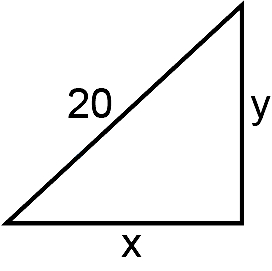
0 likesView Solution
57
MathematicsEasyMCQWBJEE · 2018
$A$ particle is in motion along a curve $12 y = x^{3}$. The rate of change of its ordinate exceeds that of its abscissa when:
A
$ -2 < x < 2 $
B
$ x = \pm 2 $
C
$ x < -2 $
D
$ x > 2 $
Solution
(D) Given the curve $12 y = x^{3}$.
Let the rate of change of the ordinate be $\frac{dy}{dt}$ and the rate of change of the abscissa be $\frac{dx}{dt}$.
We are given that the rate of change of the ordinate exceeds that of the abscissa,so $\frac{dy}{dt} > \frac{dx}{dt}$.
Differentiating the equation of the curve with respect to $t$,we get $12 \frac{dy}{dt} = 3x^{2} \frac{dx}{dt}$,which implies $\frac{dy}{dt} = \frac{x^{2}}{4} \frac{dx}{dt}$.
Substituting this into the inequality $\frac{dy}{dt} > \frac{dx}{dt}$,we have $\frac{x^{2}}{4} \frac{dx}{dt} > \frac{dx}{dt}$.
Assuming $\frac{dx}{dt} > 0$,we get $\frac{x^{2}}{4} > 1$,which means $x^{2} > 4$.
This inequality $x^{2} - 4 > 0$ factors as $(x - 2)(x + 2) > 0$.
The solution to this inequality is $x \in (-\infty, -2) \cup (2, \infty)$.
Since the question asks for the condition where the rate of change of the ordinate exceeds the abscissa,and considering the provided options,the condition $x > 2$ is a valid subset of the solution set.
Let the rate of change of the ordinate be $\frac{dy}{dt}$ and the rate of change of the abscissa be $\frac{dx}{dt}$.
We are given that the rate of change of the ordinate exceeds that of the abscissa,so $\frac{dy}{dt} > \frac{dx}{dt}$.
Differentiating the equation of the curve with respect to $t$,we get $12 \frac{dy}{dt} = 3x^{2} \frac{dx}{dt}$,which implies $\frac{dy}{dt} = \frac{x^{2}}{4} \frac{dx}{dt}$.
Substituting this into the inequality $\frac{dy}{dt} > \frac{dx}{dt}$,we have $\frac{x^{2}}{4} \frac{dx}{dt} > \frac{dx}{dt}$.
Assuming $\frac{dx}{dt} > 0$,we get $\frac{x^{2}}{4} > 1$,which means $x^{2} > 4$.
This inequality $x^{2} - 4 > 0$ factors as $(x - 2)(x + 2) > 0$.
The solution to this inequality is $x \in (-\infty, -2) \cup (2, \infty)$.
Since the question asks for the condition where the rate of change of the ordinate exceeds the abscissa,and considering the provided options,the condition $x > 2$ is a valid subset of the solution set.
0 likesView Solution
58
MathematicsMediumMCQWBJEE · 2018
Let $f(x) = \cos \left(\frac{\pi}{x}\right), x \neq 0$. Assuming $k$ is an integer,which of the following is true?
A
$f(x)$ increases in the interval $\left(\frac{1}{2k+1}, \frac{1}{2k}\right)$
B
$f(x)$ decreases in the interval $\left(\frac{1}{2k+1}, \frac{1}{2k}\right)$
C
$f(x)$ decreases in the interval $\left(\frac{1}{2k+2}, \frac{1}{2k+1}\right)$
D
$f(x)$ increases in the interval $\left(\frac{1}{2k+2}, \frac{1}{2k+1}\right)$
Solution
(A) Given $f(x) = \cos \left(\frac{\pi}{x}\right)$.
Taking the derivative with respect to $x$:
$f'(x) = -\sin \left(\frac{\pi}{x}\right) \cdot \left(-\frac{\pi}{x^2}\right) = \frac{\pi}{x^2} \sin \left(\frac{\pi}{x}\right)$.
For $f(x)$ to be increasing,$f'(x) > 0$.
Since $\frac{\pi}{x^2} > 0$ for all $x \neq 0$,we need $\sin \left(\frac{\pi}{x}\right) > 0$.
This occurs when $2k\pi < \frac{\pi}{x} < (2k+1)\pi$ for some integer $k$.
Dividing by $\pi$,we get $2k < \frac{1}{x} < 2k+1$.
Taking the reciprocal,the inequality reverses: $\frac{1}{2k+1} < x < \frac{1}{2k}$.
Thus,$f(x)$ increases in the interval $\left(\frac{1}{2k+1}, \frac{1}{2k}\right)$.
For $f(x)$ to be decreasing,$f'(x) < 0$,which implies $\sin \left(\frac{\pi}{x}\right) < 0$.
This occurs when $(2k+1)\pi < \frac{\pi}{x} < (2k+2)\pi$.
Dividing by $\pi$,we get $2k+1 < \frac{1}{x} < 2k+2$.
Taking the reciprocal,we get $\frac{1}{2k+2} < x < \frac{1}{2k+1}$.
Thus,$f(x)$ decreases in the interval $\left(\frac{1}{2k+2}, \frac{1}{2k+1}\right)$.
Taking the derivative with respect to $x$:
$f'(x) = -\sin \left(\frac{\pi}{x}\right) \cdot \left(-\frac{\pi}{x^2}\right) = \frac{\pi}{x^2} \sin \left(\frac{\pi}{x}\right)$.
For $f(x)$ to be increasing,$f'(x) > 0$.
Since $\frac{\pi}{x^2} > 0$ for all $x \neq 0$,we need $\sin \left(\frac{\pi}{x}\right) > 0$.
This occurs when $2k\pi < \frac{\pi}{x} < (2k+1)\pi$ for some integer $k$.
Dividing by $\pi$,we get $2k < \frac{1}{x} < 2k+1$.
Taking the reciprocal,the inequality reverses: $\frac{1}{2k+1} < x < \frac{1}{2k}$.
Thus,$f(x)$ increases in the interval $\left(\frac{1}{2k+1}, \frac{1}{2k}\right)$.
For $f(x)$ to be decreasing,$f'(x) < 0$,which implies $\sin \left(\frac{\pi}{x}\right) < 0$.
This occurs when $(2k+1)\pi < \frac{\pi}{x} < (2k+2)\pi$.
Dividing by $\pi$,we get $2k+1 < \frac{1}{x} < 2k+2$.
Taking the reciprocal,we get $\frac{1}{2k+2} < x < \frac{1}{2k+1}$.
Thus,$f(x)$ decreases in the interval $\left(\frac{1}{2k+2}, \frac{1}{2k+1}\right)$.
0 likesView Solution
59
MathematicsMediumMCQWBJEE · 2018
Let $f:[a, b] \rightarrow R$ be differentiable on $[a, b]$ and $k \in R$. Let $f(a)=0=f(b)$. Also let $J(x)=f'(x)+k f(x)$. Then
A
$J(x)>0$ for all $x \in[a, b]$
B
$J(x) < 0$ for all $x \in[a, b]$
C
$J(x)=0$ has at least one root in $(a, b)$
D
$J(x)=0$ has no root in $(a, b)$
Solution
(C) Consider the function $g(x) = e^{kx} f(x)$. Since $f(x)$ is differentiable on $[a, b]$ and $e^{kx}$ is differentiable everywhere,$g(x)$ is differentiable on $[a, b]$.
Given $f(a) = 0$ and $f(b) = 0$,we have $g(a) = e^{ka} f(a) = 0$ and $g(b) = e^{kb} f(b) = 0$.
Since $g(a) = g(b) = 0$ and $g(x)$ is continuous on $[a, b]$ and differentiable on $(a, b)$,by Rolle's Theorem,there exists at least one $c \in (a, b)$ such that $g'(c) = 0$.
Now,$g'(x) = \frac{d}{dx} (e^{kx} f(x)) = k e^{kx} f(x) + e^{kx} f'(x) = e^{kx} (f'(x) + k f(x))$.
Since $g'(c) = 0$,we have $e^{kc} (f'(c) + k f(c)) = 0$.
Because $e^{kc} \neq 0$ for any $c$,it must be that $f'(c) + k f(c) = 0$.
Thus,$J(c) = 0$ for at least one $c \in (a, b)$.
Given $f(a) = 0$ and $f(b) = 0$,we have $g(a) = e^{ka} f(a) = 0$ and $g(b) = e^{kb} f(b) = 0$.
Since $g(a) = g(b) = 0$ and $g(x)$ is continuous on $[a, b]$ and differentiable on $(a, b)$,by Rolle's Theorem,there exists at least one $c \in (a, b)$ such that $g'(c) = 0$.
Now,$g'(x) = \frac{d}{dx} (e^{kx} f(x)) = k e^{kx} f(x) + e^{kx} f'(x) = e^{kx} (f'(x) + k f(x))$.
Since $g'(c) = 0$,we have $e^{kc} (f'(c) + k f(c)) = 0$.
Because $e^{kc} \neq 0$ for any $c$,it must be that $f'(c) + k f(c) = 0$.
Thus,$J(c) = 0$ for at least one $c \in (a, b)$.
0 likesView Solution
60
MathematicsEasyMCQWBJEE · 2018
Let $f: \mathbb{R} \rightarrow \mathbb{R}$ be a twice continuously differentiable function such that $f(0)=f(1)=f^{\prime}(0)=0$. Then:
A
$f^{\prime \prime}(0)=0$
B
$f^{\prime \prime}(c)=0$ for some $c \in (0, 1)$
C
if $c \neq 0$,then $f^{\prime \prime}(c) \neq 0$
D
$f^{\prime}(x) > 0$ for all $x \neq 0$
Solution
(B) Given that $f(0)=0$ and $f(1)=0$. By Rolle's Theorem,there exists at least one $c_1 \in (0, 1)$ such that $f^{\prime}(c_1)=0$.
We are also given $f^{\prime}(0)=0$.
Now,consider the function $f^{\prime}(x)$ on the interval $[0, c_1]$.
Since $f$ is twice continuously differentiable,$f^{\prime}$ is continuous on $[0, c_1]$ and differentiable on $(0, c_1)$.
We have $f^{\prime}(0)=0$ and $f^{\prime}(c_1)=0$.
By applying Rolle's Theorem to $f^{\prime}(x)$ on the interval $[0, c_1]$,there exists at least one $c \in (0, c_1)$ such that $f^{\prime \prime}(c)=0$.
Since $(0, c_1) \subset (0, 1)$,there exists some $c \in (0, 1)$ such that $f^{\prime \prime}(c)=0$.
We are also given $f^{\prime}(0)=0$.
Now,consider the function $f^{\prime}(x)$ on the interval $[0, c_1]$.
Since $f$ is twice continuously differentiable,$f^{\prime}$ is continuous on $[0, c_1]$ and differentiable on $(0, c_1)$.
We have $f^{\prime}(0)=0$ and $f^{\prime}(c_1)=0$.
By applying Rolle's Theorem to $f^{\prime}(x)$ on the interval $[0, c_1]$,there exists at least one $c \in (0, c_1)$ such that $f^{\prime \prime}(c)=0$.
Since $(0, c_1) \subset (0, 1)$,there exists some $c \in (0, 1)$ such that $f^{\prime \prime}(c)=0$.
0 likesView Solution
61
MathematicsMediumMCQWBJEE · 2018
If $\int e^{\sin x} \cdot \left[ \frac{x \cos^3 x - \sin x}{\cos^2 x} \right] dx = e^{\sin x} f(x) + c$,where $c$ is the constant of integration,then $f(x)$ is equal to:
A
$x - \sec x$
B
$\sec x - x$
C
$\tan x - x$
D
$x - \tan x$
Solution
(A) Given the integral: $\int e^{\sin x} \left( \frac{x \cos^3 x - \sin x}{\cos^2 x} \right) dx = e^{\sin x} f(x) + c$.
Simplify the integrand: $\frac{x \cos^3 x - \sin x}{\cos^2 x} = x \cos x - \frac{\sin x}{\cos^2 x} = x \cos x - \sec x \tan x$.
So the integral becomes: $\int e^{\sin x} (x \cos x - \sec x \tan x) dx$.
We can rewrite this as: $\int [e^{\sin x} \cos x \cdot x - e^{\sin x} \sec x \tan x] dx$.
Notice that $\frac{d}{dx} [e^{\sin x} (x - \sec x)] = e^{\sin x} \cos x (x - \sec x) + e^{\sin x} (1 - \sec x \tan x) = e^{\sin x} (x \cos x - \sec x \cos x + 1 - \sec x \tan x) = e^{\sin x} (x \cos x - 1 + 1 - \sec x \tan x) = e^{\sin x} (x \cos x - \sec x \tan x)$.
Thus,$\int e^{\sin x} (x \cos x - \sec x \tan x) dx = e^{\sin x} (x - \sec x) + c$.
Comparing this with $e^{\sin x} f(x) + c$,we get $f(x) = x - \sec x$.
Simplify the integrand: $\frac{x \cos^3 x - \sin x}{\cos^2 x} = x \cos x - \frac{\sin x}{\cos^2 x} = x \cos x - \sec x \tan x$.
So the integral becomes: $\int e^{\sin x} (x \cos x - \sec x \tan x) dx$.
We can rewrite this as: $\int [e^{\sin x} \cos x \cdot x - e^{\sin x} \sec x \tan x] dx$.
Notice that $\frac{d}{dx} [e^{\sin x} (x - \sec x)] = e^{\sin x} \cos x (x - \sec x) + e^{\sin x} (1 - \sec x \tan x) = e^{\sin x} (x \cos x - \sec x \cos x + 1 - \sec x \tan x) = e^{\sin x} (x \cos x - 1 + 1 - \sec x \tan x) = e^{\sin x} (x \cos x - \sec x \tan x)$.
Thus,$\int e^{\sin x} (x \cos x - \sec x \tan x) dx = e^{\sin x} (x - \sec x) + c$.
Comparing this with $e^{\sin x} f(x) + c$,we get $f(x) = x - \sec x$.
0 likesView Solution
62
MathematicsMediumMCQWBJEE · 2018
The value of the integral $I = \int_{1/2014}^{2014} \frac{\tan^{-1} x}{x} dx$ is
A
$\frac{\pi}{4} \log 2014$
B
$\frac{\pi}{2} \log 2014$
C
$\pi \log 2014$
D
$\frac{1}{2} \log 2014$
Solution
(B) Let $I = \int_{1/2014}^{2014} \frac{\tan^{-1} x}{x} dx$ $(i)$
Using the property $\int_{a}^{b} f(x) dx = \int_{a}^{b} f(\frac{ab}{x}) dx$ is not directly applicable,but we use the substitution $x = \frac{1}{t}$,so $dx = -\frac{1}{t^2} dt$.
When $x = 1/2014$,$t = 2014$. When $x = 2014$,$t = 1/2014$.
$I = \int_{2014}^{1/2014} \frac{\tan^{-1}(1/t)}{1/t} (-\frac{1}{t^2}) dt = \int_{1/2014}^{2014} \frac{\cot^{-1} t}{t} dt = \int_{1/2014}^{2014} \frac{\cot^{-1} x}{x} dx$ $(ii)$
Adding $(i)$ and $(ii)$:
$2I = \int_{1/2014}^{2014} \frac{\tan^{-1} x + \cot^{-1} x}{x} dx$
Since $\tan^{-1} x + \cot^{-1} x = \frac{\pi}{2}$:
$2I = \int_{1/2014}^{2014} \frac{\pi/2}{x} dx = \frac{\pi}{2} [\ln x]_{1/2014}^{2014}$
$2I = \frac{\pi}{2} (\ln 2014 - \ln(1/2014)) = \frac{\pi}{2} (\ln 2014 + \ln 2014) = \frac{\pi}{2} (2 \ln 2014) = \pi \ln 2014$
$I = \frac{\pi}{2} \log 2014$.
Using the property $\int_{a}^{b} f(x) dx = \int_{a}^{b} f(\frac{ab}{x}) dx$ is not directly applicable,but we use the substitution $x = \frac{1}{t}$,so $dx = -\frac{1}{t^2} dt$.
When $x = 1/2014$,$t = 2014$. When $x = 2014$,$t = 1/2014$.
$I = \int_{2014}^{1/2014} \frac{\tan^{-1}(1/t)}{1/t} (-\frac{1}{t^2}) dt = \int_{1/2014}^{2014} \frac{\cot^{-1} t}{t} dt = \int_{1/2014}^{2014} \frac{\cot^{-1} x}{x} dx$ $(ii)$
Adding $(i)$ and $(ii)$:
$2I = \int_{1/2014}^{2014} \frac{\tan^{-1} x + \cot^{-1} x}{x} dx$
Since $\tan^{-1} x + \cot^{-1} x = \frac{\pi}{2}$:
$2I = \int_{1/2014}^{2014} \frac{\pi/2}{x} dx = \frac{\pi}{2} [\ln x]_{1/2014}^{2014}$
$2I = \frac{\pi}{2} (\ln 2014 - \ln(1/2014)) = \frac{\pi}{2} (\ln 2014 + \ln 2014) = \frac{\pi}{2} (2 \ln 2014) = \pi \ln 2014$
$I = \frac{\pi}{2} \log 2014$.
0 likesView Solution
63
MathematicsMediumMCQWBJEE · 2018
The value of $I = \int_{\pi / 2}^{5 \pi / 2} \frac{e^{\tan^{-1}(\sin x)}}{e^{\tan^{-1}(\sin x)} + e^{\tan^{-1}(\cos x)}} dx$ is
A
$1$
B
$\pi$
C
$e$
D
$\frac{\pi}{2}$
Solution
(B) Let $I = \int_{\pi / 2}^{5 \pi / 2} \frac{e^{\tan^{-1}(\sin x)}}{e^{\tan^{-1}(\sin x)} + e^{\tan^{-1}(\cos x)}} dx$.
Using the property $\int_{a}^{b} f(x) dx = \int_{a}^{b} f(a+b-x) dx$,we have $a+b = \frac{\pi}{2} + \frac{5\pi}{2} = 3\pi$.
$I = \int_{\pi / 2}^{5 \pi / 2} \frac{e^{\tan^{-1}(\sin(3\pi - x))}}{e^{\tan^{-1}(\sin(3\pi - x))} + e^{\tan^{-1}(\cos(3\pi - x))}} dx$.
Since $\sin(3\pi - x) = \sin x$ and $\cos(3\pi - x) = -\cos x$,this does not simplify directly.
Let us use the property $\int_{a}^{b} f(x) dx = \int_{a}^{b} f(a+b-x) dx$ on the interval $[0, 2\pi]$.
The integrand $f(x) = \frac{e^{\tan^{-1}(\sin x)}}{e^{\tan^{-1}(\sin x)} + e^{\tan^{-1}(\cos x)}}$ has a period of $\frac{\pi}{2}$.
$I = \int_{\pi/2}^{5\pi/2} f(x) dx = \int_{0}^{2\pi} f(x) dx$.
Since $f(x)$ is periodic with period $\frac{\pi}{2}$,$\int_{0}^{2\pi} f(x) dx = 4 \int_{0}^{\pi/2} f(x) dx$.
Let $J = \int_{0}^{\pi/2} \frac{e^{\tan^{-1}(\sin x)}}{e^{\tan^{-1}(\sin x)} + e^{\tan^{-1}(\cos x)}} dx$.
Using $\int_{0}^{a} f(x) dx = \int_{0}^{a} f(a-x) dx$,$J = \int_{0}^{\pi/2} \frac{e^{\tan^{-1}(\cos x)}}{e^{\tan^{-1}(\cos x)} + e^{\tan^{-1}(\sin x)}} dx$.
$2J = \int_{0}^{\pi/2} 1 dx = \frac{\pi}{2} \implies J = \frac{\pi}{4}$.
Thus,$I = 4 \times \frac{\pi}{4} = \pi$.
Using the property $\int_{a}^{b} f(x) dx = \int_{a}^{b} f(a+b-x) dx$,we have $a+b = \frac{\pi}{2} + \frac{5\pi}{2} = 3\pi$.
$I = \int_{\pi / 2}^{5 \pi / 2} \frac{e^{\tan^{-1}(\sin(3\pi - x))}}{e^{\tan^{-1}(\sin(3\pi - x))} + e^{\tan^{-1}(\cos(3\pi - x))}} dx$.
Since $\sin(3\pi - x) = \sin x$ and $\cos(3\pi - x) = -\cos x$,this does not simplify directly.
Let us use the property $\int_{a}^{b} f(x) dx = \int_{a}^{b} f(a+b-x) dx$ on the interval $[0, 2\pi]$.
The integrand $f(x) = \frac{e^{\tan^{-1}(\sin x)}}{e^{\tan^{-1}(\sin x)} + e^{\tan^{-1}(\cos x)}}$ has a period of $\frac{\pi}{2}$.
$I = \int_{\pi/2}^{5\pi/2} f(x) dx = \int_{0}^{2\pi} f(x) dx$.
Since $f(x)$ is periodic with period $\frac{\pi}{2}$,$\int_{0}^{2\pi} f(x) dx = 4 \int_{0}^{\pi/2} f(x) dx$.
Let $J = \int_{0}^{\pi/2} \frac{e^{\tan^{-1}(\sin x)}}{e^{\tan^{-1}(\sin x)} + e^{\tan^{-1}(\cos x)}} dx$.
Using $\int_{0}^{a} f(x) dx = \int_{0}^{a} f(a-x) dx$,$J = \int_{0}^{\pi/2} \frac{e^{\tan^{-1}(\cos x)}}{e^{\tan^{-1}(\cos x)} + e^{\tan^{-1}(\sin x)}} dx$.
$2J = \int_{0}^{\pi/2} 1 dx = \frac{\pi}{2} \implies J = \frac{\pi}{4}$.
Thus,$I = 4 \times \frac{\pi}{4} = \pi$.
0 likesView Solution
64
MathematicsMediumMCQWBJEE · 2018
If $M = \int_{0}^{\pi / 2} \frac{\cos x}{x+2} dx$ and $N = \int_{0}^{\frac{\pi}{4}} \frac{\sin x \cos x}{(x+1)^{2}} dx$,then the value of $M-N$ is
A
$\pi$
B
$\frac{\pi}{4}$
C
$\frac{2}{\pi-4}$
D
$\frac{2}{\pi+4}$
Solution
(D) Given,$M = \int_{0}^{\frac{\pi}{2}} \frac{\cos x}{x+2} dx$ and $N = \int_{0}^{\frac{\pi}{4}} \frac{\sin x \cos x}{(x+1)^{2}} dx$.
Using the identity $\sin x \cos x = \frac{1}{2} \sin 2x$,we have $N = \int_{0}^{\frac{\pi}{4}} \frac{\sin 2x}{2(x+1)^{2}} dx$.
Let $2x = t$,then $dx = \frac{dt}{2}$. When $x=0, t=0$ and when $x=\frac{\pi}{4}, t=\frac{\pi}{2}$.
Substituting these into $N$,we get $N = \int_{0}^{\frac{\pi}{2}} \frac{\sin t}{2(\frac{t}{2}+1)^{2}} \cdot \frac{dt}{2} = \int_{0}^{\frac{\pi}{2}} \frac{\sin t}{(t+2)^{2}} dt$.
Now,$M - N = \int_{0}^{\frac{\pi}{2}} \frac{\cos x}{x+2} dx - \int_{0}^{\frac{\pi}{2}} \frac{\sin x}{(x+2)^{2}} dx$.
Using integration by parts on the first integral,let $u = \frac{1}{x+2}$ and $dv = \cos x dx$. Then $du = -\frac{1}{(x+2)^{2}} dx$ and $v = \sin x$.
$M = \left[ \frac{\sin x}{x+2} \right]_{0}^{\frac{\pi}{2}} - \int_{0}^{\frac{\pi}{2}} \sin x \left( -\frac{1}{(x+2)^{2}} \right) dx = \left[ \frac{\sin x}{x+2} \right]_{0}^{\frac{\pi}{2}} + \int_{0}^{\frac{\pi}{2}} \frac{\sin x}{(x+2)^{2}} dx$.
Thus,$M - N = \left[ \frac{\sin x}{x+2} \right]_{0}^{\frac{\pi}{2}} = \frac{\sin(\pi/2)}{\pi/2 + 2} - \frac{\sin(0)}{0+2} = \frac{1}{\frac{\pi+4}{2}} = \frac{2}{\pi+4}$.
Using the identity $\sin x \cos x = \frac{1}{2} \sin 2x$,we have $N = \int_{0}^{\frac{\pi}{4}} \frac{\sin 2x}{2(x+1)^{2}} dx$.
Let $2x = t$,then $dx = \frac{dt}{2}$. When $x=0, t=0$ and when $x=\frac{\pi}{4}, t=\frac{\pi}{2}$.
Substituting these into $N$,we get $N = \int_{0}^{\frac{\pi}{2}} \frac{\sin t}{2(\frac{t}{2}+1)^{2}} \cdot \frac{dt}{2} = \int_{0}^{\frac{\pi}{2}} \frac{\sin t}{(t+2)^{2}} dt$.
Now,$M - N = \int_{0}^{\frac{\pi}{2}} \frac{\cos x}{x+2} dx - \int_{0}^{\frac{\pi}{2}} \frac{\sin x}{(x+2)^{2}} dx$.
Using integration by parts on the first integral,let $u = \frac{1}{x+2}$ and $dv = \cos x dx$. Then $du = -\frac{1}{(x+2)^{2}} dx$ and $v = \sin x$.
$M = \left[ \frac{\sin x}{x+2} \right]_{0}^{\frac{\pi}{2}} - \int_{0}^{\frac{\pi}{2}} \sin x \left( -\frac{1}{(x+2)^{2}} \right) dx = \left[ \frac{\sin x}{x+2} \right]_{0}^{\frac{\pi}{2}} + \int_{0}^{\frac{\pi}{2}} \frac{\sin x}{(x+2)^{2}} dx$.
Thus,$M - N = \left[ \frac{\sin x}{x+2} \right]_{0}^{\frac{\pi}{2}} = \frac{\sin(\pi/2)}{\pi/2 + 2} - \frac{\sin(0)}{0+2} = \frac{1}{\frac{\pi+4}{2}} = \frac{2}{\pi+4}$.
0 likesView Solution
65
MathematicsEasyMCQWBJEE · 2018
Let $I = \int_{\pi / 4}^{\pi / 3} \frac{\sin x}{x} dx$. Then
A
$\frac{1}{2} \leq I \leq 1$
B
$4 \leq I \leq 2 \sqrt{30}$
C
$\frac{\sqrt{3}}{8} \leq I \leq \frac{\sqrt{2}}{6}$
D
$1 \leq I \leq \frac{2 \sqrt{3}}{\sqrt{2}}$
Solution
(C) We have $I = \int_{\pi / 4}^{\pi / 3} \frac{\sin x}{x} dx$.
Since $f(x) = \frac{\sin x}{x}$ is a decreasing function on the interval $[\frac{\pi}{4}, \frac{\pi}{3}]$,the minimum value occurs at $x = \frac{\pi}{3}$ and the maximum value occurs at $x = \frac{\pi}{4}$.
The length of the interval is $\Delta x = \frac{\pi}{3} - \frac{\pi}{4} = \frac{\pi}{12}$.
Using the property of definite integrals for a monotonic function,we have:
$(\text{length of interval}) \times f(\text{upper limit}) \leq I \leq (\text{length of interval}) \times f(\text{lower limit})$.
Substituting the values:
$\frac{\pi}{12} \times \frac{\sin(\pi/3)}{\pi/3} \leq I \leq \frac{\pi}{12} \times \frac{\sin(\pi/4)}{\pi/4}$.
$\frac{\pi}{12} \times \frac{\sqrt{3}/2}{\pi/3} \leq I \leq \frac{\pi}{12} \times \frac{1/\sqrt{2}}{\pi/4}$.
$\frac{\pi}{12} \times \frac{3\sqrt{3}}{2\pi} \leq I \leq \frac{\pi}{12} \times \frac{4}{\pi\sqrt{2}}$.
$\frac{3\sqrt{3}}{24} \leq I \leq \frac{4}{12\sqrt{2}}$.
$\frac{\sqrt{3}}{8} \leq I \leq \frac{1}{3\sqrt{2}} = \frac{\sqrt{2}}{6}$.
Since $f(x) = \frac{\sin x}{x}$ is a decreasing function on the interval $[\frac{\pi}{4}, \frac{\pi}{3}]$,the minimum value occurs at $x = \frac{\pi}{3}$ and the maximum value occurs at $x = \frac{\pi}{4}$.
The length of the interval is $\Delta x = \frac{\pi}{3} - \frac{\pi}{4} = \frac{\pi}{12}$.
Using the property of definite integrals for a monotonic function,we have:
$(\text{length of interval}) \times f(\text{upper limit}) \leq I \leq (\text{length of interval}) \times f(\text{lower limit})$.
Substituting the values:
$\frac{\pi}{12} \times \frac{\sin(\pi/3)}{\pi/3} \leq I \leq \frac{\pi}{12} \times \frac{\sin(\pi/4)}{\pi/4}$.
$\frac{\pi}{12} \times \frac{\sqrt{3}/2}{\pi/3} \leq I \leq \frac{\pi}{12} \times \frac{1/\sqrt{2}}{\pi/4}$.
$\frac{\pi}{12} \times \frac{3\sqrt{3}}{2\pi} \leq I \leq \frac{\pi}{12} \times \frac{4}{\pi\sqrt{2}}$.
$\frac{3\sqrt{3}}{24} \leq I \leq \frac{4}{12\sqrt{2}}$.
$\frac{\sqrt{3}}{8} \leq I \leq \frac{1}{3\sqrt{2}} = \frac{\sqrt{2}}{6}$.
0 likesView Solution
66
MathematicsMediumMCQWBJEE · 2018
Let $I = \int_{0}^{1} \frac{x^{3} \cos 3x}{2+x^{2}} dx$. Then
A
$-\frac{1}{2} < I < \frac{1}{2}$
B
$-\frac{1}{3} < I < \frac{1}{3}$
C
$-1 < I < 1$
D
$-\frac{3}{2} < I < \frac{3}{2}$
Solution
(A) Given $I = \int_{0}^{1} \frac{x^{3} \cos 3x}{2+x^{2}} dx$.
Since $-1 \leq \cos 3x \leq 1$,we have $-x^{3} \leq x^{3} \cos 3x \leq x^{3}$.
Dividing by $2+x^{2} > 0$,we get $\frac{-x^{3}}{2+x^{2}} \leq \frac{x^{3} \cos 3x}{2+x^{2}} \leq \frac{x^{3}}{2+x^{2}}$.
Since $2+x^{2} > x^{2}$ for $x \in [0, 1]$,it follows that $\frac{x^{3}}{2+x^{2}} < \frac{x^{3}}{x^{2}} = x$.
Thus,$-\int_{0}^{1} x dx < I < \int_{0}^{1} x dx$.
Evaluating the integrals,$-\left[ \frac{x^{2}}{2} \right]_{0}^{1} < I < \left[ \frac{x^{2}}{2} \right]_{0}^{1}$.
This gives $-\frac{1}{2} < I < \frac{1}{2}$.
Since $-1 \leq \cos 3x \leq 1$,we have $-x^{3} \leq x^{3} \cos 3x \leq x^{3}$.
Dividing by $2+x^{2} > 0$,we get $\frac{-x^{3}}{2+x^{2}} \leq \frac{x^{3} \cos 3x}{2+x^{2}} \leq \frac{x^{3}}{2+x^{2}}$.
Since $2+x^{2} > x^{2}$ for $x \in [0, 1]$,it follows that $\frac{x^{3}}{2+x^{2}} < \frac{x^{3}}{x^{2}} = x$.
Thus,$-\int_{0}^{1} x dx < I < \int_{0}^{1} x dx$.
Evaluating the integrals,$-\left[ \frac{x^{2}}{2} \right]_{0}^{1} < I < \left[ \frac{x^{2}}{2} \right]_{0}^{1}$.
This gives $-\frac{1}{2} < I < \frac{1}{2}$.
0 likesView Solution
67
MathematicsMediumMCQWBJEE · 2018
The value of $\lim _{n \rightarrow \infty} \frac{1}{n} \left\{ \sec ^{2} \frac{\pi}{4 n} + \sec ^{2} \frac{2 \pi}{4 n} + \ldots + \sec ^{2} \frac{n \pi}{4 n} \right\}$ is
A
$\log _{e} 2$
B
$\frac{\pi}{2}$
C
$\frac{4}{\pi}$
D
$e$
Solution
(C) Given the limit: $\lim _{n \rightarrow \infty} \frac{1}{n} \sum_{r=1}^{n} \sec ^{2} \left( \frac{r \pi}{4 n} \right)$.
By the definition of a definite integral as the limit of a sum,$\lim _{n \rightarrow \infty} \frac{1}{n} \sum_{r=1}^{n} f \left( \frac{r}{n} \right) = \int_{0}^{1} f(x) dx$.
Here,$f(x) = \sec ^{2} \left( \frac{\pi x}{4} \right)$.
So,the integral becomes $\int_{0}^{1} \sec ^{2} \left( \frac{\pi x}{4} \right) dx$.
Integrating $\sec ^{2} \left( \frac{\pi x}{4} \right)$,we get $\frac{4}{\pi} \tan \left( \frac{\pi x}{4} \right)$.
Evaluating the definite integral from $0$ to $1$: $\left[ \frac{4}{\pi} \tan \left( \frac{\pi x}{4} \right) \right]_{0}^{1} = \frac{4}{\pi} \left( \tan \frac{\pi}{4} - \tan 0 \right)$.
Since $\tan \frac{\pi}{4} = 1$ and $\tan 0 = 0$,the value is $\frac{4}{\pi} (1 - 0) = \frac{4}{\pi}$.
By the definition of a definite integral as the limit of a sum,$\lim _{n \rightarrow \infty} \frac{1}{n} \sum_{r=1}^{n} f \left( \frac{r}{n} \right) = \int_{0}^{1} f(x) dx$.
Here,$f(x) = \sec ^{2} \left( \frac{\pi x}{4} \right)$.
So,the integral becomes $\int_{0}^{1} \sec ^{2} \left( \frac{\pi x}{4} \right) dx$.
Integrating $\sec ^{2} \left( \frac{\pi x}{4} \right)$,we get $\frac{4}{\pi} \tan \left( \frac{\pi x}{4} \right)$.
Evaluating the definite integral from $0$ to $1$: $\left[ \frac{4}{\pi} \tan \left( \frac{\pi x}{4} \right) \right]_{0}^{1} = \frac{4}{\pi} \left( \tan \frac{\pi}{4} - \tan 0 \right)$.
Since $\tan \frac{\pi}{4} = 1$ and $\tan 0 = 0$,the value is $\frac{4}{\pi} (1 - 0) = \frac{4}{\pi}$.
0 likesView Solution
68
MathematicsMediumMCQWBJEE · 2018
The area of the region lying above the $X$-axis and included between the circle $x^{2}+y^{2}=2ax$ and the parabola $y^{2}=ax$,$a>0$ is
A
$8 \pi a^{2}$
B
$a^{2}\left(\frac{\pi}{4}-\frac{2}{3}\right)$
C
$\frac{16 \pi a^{2}}{9}$
D
$\pi\left(\frac{27}{8}+3 a^{2}\right)$
Solution
(B) Given,the equation of the circle is $x^{2}+y^{2}=2ax$,which can be written as $(x-a)^{2}+y^{2}=a^{2}$.
The equation of the parabola is $y^{2}=ax$,where $a>0$.
To find the intersection points,substitute $y^{2}=ax$ into the circle equation:
$x^{2}+ax=2ax$
$x^{2}-ax=0$
$x(x-a)=0$
Thus,$x=0$ or $x=a$.
The intersection points are $(0,0)$ and $(a, a)$ (considering the region above the $X$-axis).
The required area is the area of the quarter circle in the first quadrant minus the area under the parabola from $x=0$ to $x=a$.
Area $= \int_{0}^{a} \sqrt{2ax-x^{2}} dx - \int_{0}^{a} \sqrt{ax} dx$
$= \frac{\pi a^{2}}{4} - \sqrt{a} \left[ \frac{x^{3/2}}{3/2} \right]_{0}^{a}$
$= \frac{\pi a^{2}}{4} - \frac{2}{3} \sqrt{a} (a^{3/2})$
$= \frac{\pi a^{2}}{4} - \frac{2a^{2}}{3}$
$= a^{2}\left(\frac{\pi}{4}-\frac{2}{3}\right)$
The equation of the parabola is $y^{2}=ax$,where $a>0$.
To find the intersection points,substitute $y^{2}=ax$ into the circle equation:
$x^{2}+ax=2ax$
$x^{2}-ax=0$
$x(x-a)=0$
Thus,$x=0$ or $x=a$.
The intersection points are $(0,0)$ and $(a, a)$ (considering the region above the $X$-axis).
The required area is the area of the quarter circle in the first quadrant minus the area under the parabola from $x=0$ to $x=a$.
Area $= \int_{0}^{a} \sqrt{2ax-x^{2}} dx - \int_{0}^{a} \sqrt{ax} dx$
$= \frac{\pi a^{2}}{4} - \sqrt{a} \left[ \frac{x^{3/2}}{3/2} \right]_{0}^{a}$
$= \frac{\pi a^{2}}{4} - \frac{2}{3} \sqrt{a} (a^{3/2})$
$= \frac{\pi a^{2}}{4} - \frac{2a^{2}}{3}$
$= a^{2}\left(\frac{\pi}{4}-\frac{2}{3}\right)$
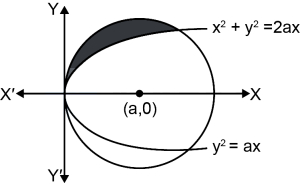
0 likesView Solution
69
MathematicsEasyMCQWBJEE · 2018
The differential equation representing the family of curves $y^{2}=2 d(x+\sqrt{d})$,where $d$ is a parameter,is of
A
order $2$
B
degree $2$
C
degree $3$
D
degree $4$
Solution
(C) Given,$y^{2}=2 d(x+\sqrt{d})$ $(i)$
Differentiating with respect to $x$,we get:
$2y y_{1} = 2d \Rightarrow d = y y_{1}$
Substituting $d = y y_{1}$ into equation $(i)$:
$y^{2} = 2(y y_{1})(x + \sqrt{y y_{1}})$
Rearranging the terms to isolate the radical:
$y^{2} - 2y y_{1} x = 2y y_{1} \sqrt{y y_{1}}$
Squaring both sides:
$(y^{2} - 2y y_{1} x)^{2} = (2y y_{1})^{2} (y y_{1})$
$(y^{2} - 2y y_{1} x)^{2} = 4(y y_{1})^{3}$
The highest derivative present is $y_{1}$ (order $1$),and the highest power of the highest derivative is $3$. Therefore,the degree of the differential equation is $3$.
Differentiating with respect to $x$,we get:
$2y y_{1} = 2d \Rightarrow d = y y_{1}$
Substituting $d = y y_{1}$ into equation $(i)$:
$y^{2} = 2(y y_{1})(x + \sqrt{y y_{1}})$
Rearranging the terms to isolate the radical:
$y^{2} - 2y y_{1} x = 2y y_{1} \sqrt{y y_{1}}$
Squaring both sides:
$(y^{2} - 2y y_{1} x)^{2} = (2y y_{1})^{2} (y y_{1})$
$(y^{2} - 2y y_{1} x)^{2} = 4(y y_{1})^{3}$
The highest derivative present is $y_{1}$ (order $1$),and the highest power of the highest derivative is $3$. Therefore,the degree of the differential equation is $3$.
0 likesView Solution
70
MathematicsDifficultMCQWBJEE · 2018
Let $y(x)$ be a solution of $(1+x^{2}) \frac{dy}{dx} + 2xy - 4x^{2} = 0$ and $y(0) = -1$. Then $y(1)$ is equal to
A
$\frac{1}{2}$
B
$\frac{1}{3}$
C
$\frac{1}{6}$
D
$1$
Solution
(C) The given differential equation is $(1+x^{2}) \frac{dy}{dx} + 2xy = 4x^{2}$.
Dividing by $(1+x^{2})$,we get $\frac{dy}{dx} + \left(\frac{2x}{1+x^{2}}\right)y = \frac{4x^{2}}{1+x^{2}}$.
This is a linear differential equation of the form $\frac{dy}{dx} + P(x)y = Q(x)$,where $P(x) = \frac{2x}{1+x^{2}}$ and $Q(x) = \frac{4x^{2}}{1+x^{2}}$.
The integrating factor $IF = e^{\int P(x) dx} = e^{\int \frac{2x}{1+x^{2}} dx} = e^{\ln(1+x^{2})} = 1+x^{2}$.
The general solution is given by $y(IF) = \int Q(x)(IF) dx + C$.
$y(1+x^{2}) = \int \left(\frac{4x^{2}}{1+x^{2}}\right)(1+x^{2}) dx + C$.
$y(1+x^{2}) = \int 4x^{2} dx + C = \frac{4x^{3}}{3} + C$.
Using the initial condition $y(0) = -1$,we substitute $x=0$ and $y=-1$:
$-1(1+0^{2}) = \frac{4(0)^{3}}{3} + C \Rightarrow C = -1$.
Thus,$y(1+x^{2}) = \frac{4x^{3}}{3} - 1$.
For $x=1$,$y(1+1^{2}) = \frac{4(1)^{3}}{3} - 1$.
$2y = \frac{4}{3} - 1 = \frac{1}{3}$.
Therefore,$y(1) = \frac{1}{6}$.
Dividing by $(1+x^{2})$,we get $\frac{dy}{dx} + \left(\frac{2x}{1+x^{2}}\right)y = \frac{4x^{2}}{1+x^{2}}$.
This is a linear differential equation of the form $\frac{dy}{dx} + P(x)y = Q(x)$,where $P(x) = \frac{2x}{1+x^{2}}$ and $Q(x) = \frac{4x^{2}}{1+x^{2}}$.
The integrating factor $IF = e^{\int P(x) dx} = e^{\int \frac{2x}{1+x^{2}} dx} = e^{\ln(1+x^{2})} = 1+x^{2}$.
The general solution is given by $y(IF) = \int Q(x)(IF) dx + C$.
$y(1+x^{2}) = \int \left(\frac{4x^{2}}{1+x^{2}}\right)(1+x^{2}) dx + C$.
$y(1+x^{2}) = \int 4x^{2} dx + C = \frac{4x^{3}}{3} + C$.
Using the initial condition $y(0) = -1$,we substitute $x=0$ and $y=-1$:
$-1(1+0^{2}) = \frac{4(0)^{3}}{3} + C \Rightarrow C = -1$.
Thus,$y(1+x^{2}) = \frac{4x^{3}}{3} - 1$.
For $x=1$,$y(1+1^{2}) = \frac{4(1)^{3}}{3} - 1$.
$2y = \frac{4}{3} - 1 = \frac{1}{3}$.
Therefore,$y(1) = \frac{1}{6}$.
0 likesView Solution
71
MathematicsMediumMCQWBJEE · 2018
Let $\vec{\alpha}=\hat{i}+\hat{j}+\hat{k}$,$\vec{\beta}=\hat{i}-\hat{j}-\hat{k}$ and $\vec{\gamma}=-\hat{i}+\hat{j}-\hat{k}$ be three vectors. $A$ vector $\vec{\delta}$,in the plane of $\vec{\alpha}$ and $\vec{\beta}$,whose projection on $\vec{\gamma}$ is $\frac{1}{\sqrt{3}}$,is given by
A
$-\hat{i}-3\hat{j}-3\hat{k}$
B
$\hat{i}-3\hat{j}-3\hat{k}$
C
$-\hat{i}+3\hat{j}+3\hat{k}$
D
$\hat{i}+3\hat{j}-3\hat{k}$
Solution
(C) Since $\vec{\delta}$ lies in the plane of $\vec{\alpha}$ and $\vec{\beta}$,we can write $\vec{\delta} = \vec{\alpha} + \lambda \vec{\beta}$ for some scalar $\lambda$.
Substituting the given vectors,we get $\vec{\delta} = (\hat{i}+\hat{j}+\hat{k}) + \lambda(\hat{i}-\hat{j}-\hat{k}) = (1+\lambda)\hat{i} + (1-\lambda)\hat{j} + (1-\lambda)\hat{k}$.
The projection of $\vec{\delta}$ on $\vec{\gamma}$ is given by $\frac{\vec{\delta} \cdot \vec{\gamma}}{|\vec{\gamma}|} = \frac{1}{\sqrt{3}}$.
Calculating the dot product: $\vec{\delta} \cdot \vec{\gamma} = (1+\lambda)(-1) + (1-\lambda)(1) + (1-\lambda)(-1) = -1 - \lambda + 1 - \lambda - 1 + \lambda = -1 - \lambda$.
The magnitude $|\vec{\gamma}| = \sqrt{(-1)^2 + 1^2 + (-1)^2} = \sqrt{3}$.
Thus,$\frac{-1-\lambda}{\sqrt{3}} = \frac{1}{\sqrt{3}} \Rightarrow -1-\lambda = 1 \Rightarrow \lambda = -2$.
Substituting $\lambda = -2$ into the expression for $\vec{\delta}$,we get $\vec{\delta} = (1-2)\hat{i} + (1-(-2))\hat{j} + (1-(-2))\hat{k} = -\hat{i} + 3\hat{j} + 3\hat{k}$.
Substituting the given vectors,we get $\vec{\delta} = (\hat{i}+\hat{j}+\hat{k}) + \lambda(\hat{i}-\hat{j}-\hat{k}) = (1+\lambda)\hat{i} + (1-\lambda)\hat{j} + (1-\lambda)\hat{k}$.
The projection of $\vec{\delta}$ on $\vec{\gamma}$ is given by $\frac{\vec{\delta} \cdot \vec{\gamma}}{|\vec{\gamma}|} = \frac{1}{\sqrt{3}}$.
Calculating the dot product: $\vec{\delta} \cdot \vec{\gamma} = (1+\lambda)(-1) + (1-\lambda)(1) + (1-\lambda)(-1) = -1 - \lambda + 1 - \lambda - 1 + \lambda = -1 - \lambda$.
The magnitude $|\vec{\gamma}| = \sqrt{(-1)^2 + 1^2 + (-1)^2} = \sqrt{3}$.
Thus,$\frac{-1-\lambda}{\sqrt{3}} = \frac{1}{\sqrt{3}} \Rightarrow -1-\lambda = 1 \Rightarrow \lambda = -2$.
Substituting $\lambda = -2$ into the expression for $\vec{\delta}$,we get $\vec{\delta} = (1-2)\hat{i} + (1-(-2))\hat{j} + (1-(-2))\hat{k} = -\hat{i} + 3\hat{j} + 3\hat{k}$.
0 likesView Solution
72
MathematicsEasyMCQWBJEE · 2018
Let $\vec{\alpha}, \vec{\beta}, \vec{\gamma}$ be three unit vectors such that $\vec{\alpha} \cdot \vec{\beta} = \vec{\alpha} \cdot \vec{\gamma} = 0$ and the angle between $\vec{\beta}$ and $\vec{\gamma}$ is $30^{\circ}$. Then $\vec{\alpha}$ is
A
$2(\vec{\beta} \times \vec{\gamma})$
B
$-2(\vec{\beta} \times \vec{\gamma})$
C
$\pm 2(\vec{\beta} \times \vec{\gamma})$
D
$(\vec{\beta} \times \vec{\gamma})$
Solution
(C) Since $\vec{\alpha} \cdot \vec{\beta} = 0$ and $\vec{\alpha} \cdot \vec{\gamma} = 0$,the vector $\vec{\alpha}$ is perpendicular to both $\vec{\beta}$ and $\vec{\gamma}$.
Thus,$\vec{\alpha}$ must be parallel to the cross product $\vec{\beta} \times \vec{\gamma}$.
Let $\vec{\alpha} = \lambda(\vec{\beta} \times \vec{\gamma})$ for some scalar $\lambda$.
Since $\vec{\alpha}, \vec{\beta}, \vec{\gamma}$ are unit vectors,we have $|\vec{\alpha}| = 1, |\vec{\beta}| = 1, |\vec{\gamma}| = 1$.
Taking the magnitude on both sides: $|\vec{\alpha}| = |\lambda| |\vec{\beta} \times \vec{\gamma}|$.
We know that $|\vec{\beta} \times \vec{\gamma}| = |\vec{\beta}| |\vec{\gamma}| \sin(30^{\circ}) = 1 \cdot 1 \cdot \frac{1}{2} = \frac{1}{2}$.
Substituting the values: $1 = |\lambda| \cdot \frac{1}{2} \Rightarrow |\lambda| = 2 \Rightarrow \lambda = \pm 2$.
Therefore,$\vec{\alpha} = \pm 2(\vec{\beta} \times \vec{\gamma})$.
Thus,$\vec{\alpha}$ must be parallel to the cross product $\vec{\beta} \times \vec{\gamma}$.
Let $\vec{\alpha} = \lambda(\vec{\beta} \times \vec{\gamma})$ for some scalar $\lambda$.
Since $\vec{\alpha}, \vec{\beta}, \vec{\gamma}$ are unit vectors,we have $|\vec{\alpha}| = 1, |\vec{\beta}| = 1, |\vec{\gamma}| = 1$.
Taking the magnitude on both sides: $|\vec{\alpha}| = |\lambda| |\vec{\beta} \times \vec{\gamma}|$.
We know that $|\vec{\beta} \times \vec{\gamma}| = |\vec{\beta}| |\vec{\gamma}| \sin(30^{\circ}) = 1 \cdot 1 \cdot \frac{1}{2} = \frac{1}{2}$.
Substituting the values: $1 = |\lambda| \cdot \frac{1}{2} \Rightarrow |\lambda| = 2 \Rightarrow \lambda = \pm 2$.
Therefore,$\vec{\alpha} = \pm 2(\vec{\beta} \times \vec{\gamma})$.
0 likesView Solution
73
MathematicsMediumMCQWBJEE · 2018
The foot of the perpendicular drawn from the point $(1, 8, 4)$ on the line joining the points $(0, -11, 4)$ and $(2, -3, 1)$ is
A
$(4, 5, 2)$
B
$(-4, 5, 2)$
C
$(4, -5, 2)$
D
$(4, 5, -2)$
Solution
(D) Let the points be $A(0, -11, 4)$ and $B(2, -3, 1)$. The equation of the line passing through $A$ and $B$ is given by $\frac{x-0}{2-0} = \frac{y-(-11)}{-3-(-11)} = \frac{z-4}{1-4} = \lambda$.
This simplifies to $\frac{x}{2} = \frac{y+11}{8} = \frac{z-4}{-3} = \lambda$.
So,any point $P$ on this line is $(2\lambda, 8\lambda-11, -3\lambda+4)$.
Let $Q$ be the point $(1, 8, 4)$. The direction ratios of the line $PQ$ are $(2\lambda-1, 8\lambda-11-8, -3\lambda+4-4) = (2\lambda-1, 8\lambda-19, -3\lambda)$.
Since $PQ$ is perpendicular to the line,the dot product of the direction ratios of $PQ$ and the line $(2, 8, -3)$ must be zero:
$2(2\lambda-1) + 8(8\lambda-19) - 3(-3\lambda) = 0$.
$4\lambda - 2 + 64\lambda - 152 + 9\lambda = 0$.
$77\lambda - 154 = 0 \Rightarrow \lambda = 2$.
Substituting $\lambda = 2$ into the coordinates of $P$:
$x = 2(2) = 4$,$y = 8(2)-11 = 5$,$z = -3(2)+4 = -2$.
Thus,the foot of the perpendicular is $(4, 5, -2)$.
This simplifies to $\frac{x}{2} = \frac{y+11}{8} = \frac{z-4}{-3} = \lambda$.
So,any point $P$ on this line is $(2\lambda, 8\lambda-11, -3\lambda+4)$.
Let $Q$ be the point $(1, 8, 4)$. The direction ratios of the line $PQ$ are $(2\lambda-1, 8\lambda-11-8, -3\lambda+4-4) = (2\lambda-1, 8\lambda-19, -3\lambda)$.
Since $PQ$ is perpendicular to the line,the dot product of the direction ratios of $PQ$ and the line $(2, 8, -3)$ must be zero:
$2(2\lambda-1) + 8(8\lambda-19) - 3(-3\lambda) = 0$.
$4\lambda - 2 + 64\lambda - 152 + 9\lambda = 0$.
$77\lambda - 154 = 0 \Rightarrow \lambda = 2$.
Substituting $\lambda = 2$ into the coordinates of $P$:
$x = 2(2) = 4$,$y = 8(2)-11 = 5$,$z = -3(2)+4 = -2$.
Thus,the foot of the perpendicular is $(4, 5, -2)$.
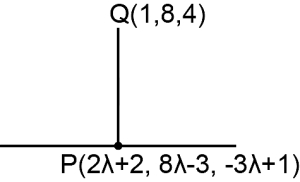
0 likesView Solution
74
MathematicsMediumMCQWBJEE · 2018
$A$ point $P$ lies on a line passing through $Q(1, -2, 3)$ and is parallel to the line $\frac{x}{1} = \frac{y}{4} = \frac{z}{5}$. If $P$ lies on the plane $2x + 3y - 4z + 22 = 0$,then the length of the segment $PQ$ is:
A
$\sqrt{42}$ units
B
$\sqrt{32}$ units
C
$4$ units
D
$5$ units
Solution
(A) The equation of the line passing through $Q(1, -2, 3)$ and parallel to the line $\frac{x}{1} = \frac{y}{4} = \frac{z}{5}$ is given by $\frac{x-1}{1} = \frac{y+2}{4} = \frac{z-3}{5} = \lambda$.
Since point $P$ lies on this line,its coordinates can be represented as $P(\lambda+1, 4\lambda-2, 5\lambda+3)$.
Since $P$ also lies on the plane $2x + 3y - 4z + 22 = 0$,we substitute the coordinates of $P$ into the plane equation:
$2(\lambda+1) + 3(4\lambda-2) - 4(5\lambda+3) + 22 = 0$.
Expanding this,we get $2\lambda + 2 + 12\lambda - 6 - 20\lambda - 12 + 22 = 0$.
Simplifying,we get $-6\lambda + 6 = 0$,which implies $\lambda = 1$.
Substituting $\lambda = 1$ back into the coordinates of $P$,we get $P(1+1, 4(1)-2, 5(1)+3) = P(2, 2, 8)$.
The distance $PQ$ is calculated as $\sqrt{(2-1)^2 + (2 - (-2))^2 + (8-3)^2} = \sqrt{1^2 + 4^2 + 5^2} = \sqrt{1 + 16 + 25} = \sqrt{42}$ units.
Since point $P$ lies on this line,its coordinates can be represented as $P(\lambda+1, 4\lambda-2, 5\lambda+3)$.
Since $P$ also lies on the plane $2x + 3y - 4z + 22 = 0$,we substitute the coordinates of $P$ into the plane equation:
$2(\lambda+1) + 3(4\lambda-2) - 4(5\lambda+3) + 22 = 0$.
Expanding this,we get $2\lambda + 2 + 12\lambda - 6 - 20\lambda - 12 + 22 = 0$.
Simplifying,we get $-6\lambda + 6 = 0$,which implies $\lambda = 1$.
Substituting $\lambda = 1$ back into the coordinates of $P$,we get $P(1+1, 4(1)-2, 5(1)+3) = P(2, 2, 8)$.
The distance $PQ$ is calculated as $\sqrt{(2-1)^2 + (2 - (-2))^2 + (8-3)^2} = \sqrt{1^2 + 4^2 + 5^2} = \sqrt{1 + 16 + 25} = \sqrt{42}$ units.
0 likesView Solution
75
MathematicsMediumMCQWBJEE · 2018
In order to get a head at least once with probability $\geq 0.9$,the minimum number of times an unbiased coin needs to be tossed is
A
$3$
B
$4$
C
$5$
D
$6$
Solution
(B) Let $n$ be the number of times the coin is tossed.
For an unbiased coin,the probability of getting a head is $p = \frac{1}{2}$ and the probability of getting a tail is $q = 1 - p = \frac{1}{2}$.
The probability of getting at least one head is given by $P(X \geq 1) = 1 - P(X = 0)$.
Here,$P(X = 0)$ is the probability of getting no heads (i.e.,all tails),which is $q^n = (\frac{1}{2})^n$.
We are given that $P(X \geq 1) \geq 0.9$.
So,$1 - (\frac{1}{2})^n \geq 0.9$.
$1 - 0.9 \geq (\frac{1}{2})^n$.
$0.1 \geq \frac{1}{2^n}$.
$\frac{1}{10} \geq \frac{1}{2^n}$.
$2^n \geq 10$.
For $n = 3$,$2^3 = 8 < 10$.
For $n = 4$,$2^4 = 16 \geq 10$.
Thus,the minimum number of tosses required is $4$.
For an unbiased coin,the probability of getting a head is $p = \frac{1}{2}$ and the probability of getting a tail is $q = 1 - p = \frac{1}{2}$.
The probability of getting at least one head is given by $P(X \geq 1) = 1 - P(X = 0)$.
Here,$P(X = 0)$ is the probability of getting no heads (i.e.,all tails),which is $q^n = (\frac{1}{2})^n$.
We are given that $P(X \geq 1) \geq 0.9$.
So,$1 - (\frac{1}{2})^n \geq 0.9$.
$1 - 0.9 \geq (\frac{1}{2})^n$.
$0.1 \geq \frac{1}{2^n}$.
$\frac{1}{10} \geq \frac{1}{2^n}$.
$2^n \geq 10$.
For $n = 3$,$2^3 = 8 < 10$.
For $n = 4$,$2^4 = 16 \geq 10$.
Thus,the minimum number of tosses required is $4$.
0 likesView Solution
Vedclass Products
For Students
Vedclass Test Series
Mock tests in real WBJEE style covering Mathematics with performance analysis. 5-day free trial.
Start Free TrialFor Teachers
Exam Paper Generator
Generate Set A/B/C/D Mathematics papers from 7.5L+ questions in 2 minutes. 3 chapters free.
Try FreeFor Institutes
Online Exam Module
Run live WBJEE mock exams with unlimited students, 360° analytics & white-label branding.
See DemoFrequently Asked Questions
How many Mathematics questions are in WBJEE 2018?
There are 75 Mathematics questions from the WBJEE 2018 paper on Vedclass, each with a detailed step-by-step solution in English.
Are WBJEE 2018 Mathematics solutions available in English?
Yes. All solutions on this page are in English. You can also switch to English or Hindi using the language buttons above the questions.
Can I practice WBJEE 2018 Mathematics as a timed test?
Yes. Use the Vedclass Test Series to attempt a full WBJEE mock test covering Mathematics with time limits and instant score analysis.
Can teachers create Mathematics papers from WBJEE previous year questions?
Yes. The Vedclass Exam Paper Generator lets teachers mix WBJEE Mathematics questions and generate Set A/B/C/D papers in minutes.
For Teachers & Institutes
Build a Custom Mathematics Paper
Pick WBJEE 2018 Mathematics questions, set difficulty, and generate Set A/B/C/D in 2 minutes.