
ChemistryQ51–150 of 206 questions
Page 2 of 3 · English
51
ChemistryMCQTS EAMCET · 2019
The area (in square units) of the region bounded by the curve $y=|\sin 2x|$ and the $X$-axis in the interval $[0, 2\pi]$ is:
A
$0$
B
$3$
C
$4$
D
$1$
Solution
(C) The function is $y = |\sin 2x|$. We need to find the area bounded by this curve and the $X$-axis in the interval $[0, 2\pi]$.
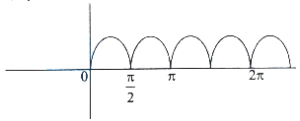
Since the period of $|\sin 2x|$ is $\frac{\pi}{2}$,the function repeats its shape every $\frac{\pi}{2}$ units.
In the interval $[0, 2\pi]$,there are $4$ such identical humps (from $0$ to $\frac{\pi}{2}$,$\frac{\pi}{2}$ to $\pi$,$\pi$ to $\frac{3\pi}{2}$,and $\frac{3\pi}{2}$ to $2\pi$).
Thus,the total area $A$ is given by:
$A = \int_0^{2\pi} |\sin 2x| \, dx = 4 \int_0^{\frac{\pi}{2}} \sin 2x \, dx$
$A = 4 \left[ \frac{-\cos 2x}{2} \right]_0^{\frac{\pi}{2}}$
$A = -2 [\cos(2 \cdot \frac{\pi}{2}) - \cos(0)]$
$A = -2 [\cos(\pi) - \cos(0)]$
$A = -2 [-1 - 1] = -2 [-2] = 4$
Therefore,the area is $4$ square units.
Since the period of $|\sin 2x|$ is $\frac{\pi}{2}$,the function repeats its shape every $\frac{\pi}{2}$ units.
In the interval $[0, 2\pi]$,there are $4$ such identical humps (from $0$ to $\frac{\pi}{2}$,$\frac{\pi}{2}$ to $\pi$,$\pi$ to $\frac{3\pi}{2}$,and $\frac{3\pi}{2}$ to $2\pi$).
Thus,the total area $A$ is given by:
$A = \int_0^{2\pi} |\sin 2x| \, dx = 4 \int_0^{\frac{\pi}{2}} \sin 2x \, dx$
$A = 4 \left[ \frac{-\cos 2x}{2} \right]_0^{\frac{\pi}{2}}$
$A = -2 [\cos(2 \cdot \frac{\pi}{2}) - \cos(0)]$
$A = -2 [\cos(\pi) - \cos(0)]$
$A = -2 [-1 - 1] = -2 [-2] = 4$
Therefore,the area is $4$ square units.
0 likesView Solution
52
ChemistryMediumMCQTS EAMCET · 2019
The concentration in $M$ of $OH^{-}$ in $0.001 \ M$ $H_2SO_4$ is
A
$1 \times 10^{-13}$
B
$0.5 \times 10^{-12}$
C
$5 \times 10^{-12}$
D
$0.5 \times 10^{-13}$
Solution
(C) $H_2SO_4$ is a strong diprotic acid,so it dissociates completely as: $H_2SO_4 \rightarrow 2H^{+} + SO_4^{2-}$.
Concentration of $[H^{+}] = 2 \times 0.001 \ M = 0.002 \ M = 2 \times 10^{-3} \ M$.
Using the ionic product of water at $25^{\circ}C$,$K_w = [H^{+}][OH^{-}] = 10^{-14}$.
$[OH^{-}] = \frac{K_w}{[H^{+}]} = \frac{10^{-14}}{2 \times 10^{-3}}$.
$[OH^{-}] = 0.5 \times 10^{-11} \ M = 5 \times 10^{-12} \ M$.
Concentration of $[H^{+}] = 2 \times 0.001 \ M = 0.002 \ M = 2 \times 10^{-3} \ M$.
Using the ionic product of water at $25^{\circ}C$,$K_w = [H^{+}][OH^{-}] = 10^{-14}$.
$[OH^{-}] = \frac{K_w}{[H^{+}]} = \frac{10^{-14}}{2 \times 10^{-3}}$.
$[OH^{-}] = 0.5 \times 10^{-11} \ M = 5 \times 10^{-12} \ M$.
0 likesView Solution
53
ChemistryDifficultMCQTS EAMCET · 2019
What is the solubility product $(K_{sp})$ of calcium phosphate in pure water? $[S = \text{molar solubility}]$
A
$108 \ S^5$
B
$72 \ S^3$
C
$6 \ S^5$
D
$121 \ S^2$
Solution
(A) The dissociation of calcium phosphate is given by: $Ca_3(PO_4)_2(s) \rightleftharpoons 3Ca^{2+}(aq) + 2PO_4^{3-}(aq)$.
Let the molar solubility be $S$.
Then,$[Ca^{2+}] = 3S$ and $[PO_4^{3-}] = 2S$.
The solubility product expression is $K_{sp} = [Ca^{2+}]^3 [PO_4^{3-}]^2$.
Substituting the values: $K_{sp} = (3S)^3 (2S)^2$.
$K_{sp} = (27S^3) (4S^2) = 108S^5$.
Thus,the correct option is $(A)$.
Let the molar solubility be $S$.
Then,$[Ca^{2+}] = 3S$ and $[PO_4^{3-}] = 2S$.
The solubility product expression is $K_{sp} = [Ca^{2+}]^3 [PO_4^{3-}]^2$.
Substituting the values: $K_{sp} = (3S)^3 (2S)^2$.
$K_{sp} = (27S^3) (4S^2) = 108S^5$.
Thus,the correct option is $(A)$.
0 likesView Solution
54
ChemistryMCQTS EAMCET · 2019
If $x \log x \frac{dy}{dx} + y = \log x^2$ and $y(e) = 0$,then $y(e^2) = $
A
$0$
B
$1$
C
$\frac{1}{2}$
D
$\frac{3}{2}$
Solution
(D) Given the linear differential equation: $x \log x \frac{dy}{dx} + y = \log x^2$.
Dividing by $x \log x$,we get: $\frac{dy}{dx} + \frac{y}{x \log x} = \frac{2 \log x}{x \log x} = \frac{2}{x}$.
This is of the form $\frac{dy}{dx} + Py = Q$,where $P = \frac{1}{x \log x}$ and $Q = \frac{2}{x}$.
The Integrating Factor $(IF)$ is $e^{\int P dx} = e^{\int \frac{1}{x \log x} dx} = e^{\log(\log x)} = \log x$.
The general solution is $y \cdot IF = \int (Q \cdot IF) dx + c$.
$y \log x = \int \left(\frac{2}{x} \cdot \log x\right) dx + c$.
Let $u = \log x$,then $du = \frac{1}{x} dx$.
$y \log x = \int 2u du + c = u^2 + c = (\log x)^2 + c$.
Given $y(e) = 0$,substitute $x = e$ and $y = 0$:
$0 \cdot \log e = (\log e)^2 + c \Rightarrow 0 = 1 + c \Rightarrow c = -1$.
Thus,$y \log x = (\log x)^2 - 1$.
For $x = e^2$,$y \log(e^2) = (\log e^2)^2 - 1$.
$y(2) = (2)^2 - 1 = 4 - 1 = 3$.
$2y = 3 \Rightarrow y = \frac{3}{2}$.
Dividing by $x \log x$,we get: $\frac{dy}{dx} + \frac{y}{x \log x} = \frac{2 \log x}{x \log x} = \frac{2}{x}$.
This is of the form $\frac{dy}{dx} + Py = Q$,where $P = \frac{1}{x \log x}$ and $Q = \frac{2}{x}$.
The Integrating Factor $(IF)$ is $e^{\int P dx} = e^{\int \frac{1}{x \log x} dx} = e^{\log(\log x)} = \log x$.
The general solution is $y \cdot IF = \int (Q \cdot IF) dx + c$.
$y \log x = \int \left(\frac{2}{x} \cdot \log x\right) dx + c$.
Let $u = \log x$,then $du = \frac{1}{x} dx$.
$y \log x = \int 2u du + c = u^2 + c = (\log x)^2 + c$.
Given $y(e) = 0$,substitute $x = e$ and $y = 0$:
$0 \cdot \log e = (\log e)^2 + c \Rightarrow 0 = 1 + c \Rightarrow c = -1$.
Thus,$y \log x = (\log x)^2 - 1$.
For $x = e^2$,$y \log(e^2) = (\log e^2)^2 - 1$.
$y(2) = (2)^2 - 1 = 4 - 1 = 3$.
$2y = 3 \Rightarrow y = \frac{3}{2}$.
0 likesView Solution
55
ChemistryDifficultMCQTS EAMCET · 2019
Identify the correct statements from the following.
$(i)$ Quartz is a piezoelectric material.
$(ii)$ All group $14$ tetrachlorides except $CCl_4$ are easily hydrolyzed in water.
$(iii)$ The $C-C$ bond distance within the layer of graphite is $154 \ pm$.
$(iv)$ $SiO_2$ is soluble in aqueous $HCl$ solution.
$(i)$ Quartz is a piezoelectric material.
$(ii)$ All group $14$ tetrachlorides except $CCl_4$ are easily hydrolyzed in water.
$(iii)$ The $C-C$ bond distance within the layer of graphite is $154 \ pm$.
$(iv)$ $SiO_2$ is soluble in aqueous $HCl$ solution.
A
$i, iii$
B
$i, ii$
C
$iii, iv$
D
$ii, iv$
Solution
(B) $(i)$ Quartz is a crystalline form of $SiO_2$ and exhibits piezoelectric properties, making it useful in electronic devices. This statement is correct.
$(ii)$ Group $14$ elements (except $C$) have vacant $d$-orbitals, allowing them to accept lone pairs from water molecules, leading to hydrolysis. $CCl_4$ cannot be hydrolyzed due to the absence of $d$-orbitals. This statement is correct.
$(iii)$ In graphite, the $C-C$ bond distance within the layers is $141.5 \ pm$, not $154 \ pm$ (which is the $C-C$ bond length in diamond). This statement is incorrect.
$(iv)$ $SiO_2$ is acidic in nature and is insoluble in $HCl$, but it reacts with $HF$ to form $SiF_4$. This statement is incorrect.
Therefore, statements $(i)$ and $(ii)$ are correct.
$(ii)$ Group $14$ elements (except $C$) have vacant $d$-orbitals, allowing them to accept lone pairs from water molecules, leading to hydrolysis. $CCl_4$ cannot be hydrolyzed due to the absence of $d$-orbitals. This statement is correct.
$(iii)$ In graphite, the $C-C$ bond distance within the layers is $141.5 \ pm$, not $154 \ pm$ (which is the $C-C$ bond length in diamond). This statement is incorrect.
$(iv)$ $SiO_2$ is acidic in nature and is insoluble in $HCl$, but it reacts with $HF$ to form $SiF_4$. This statement is incorrect.
Therefore, statements $(i)$ and $(ii)$ are correct.
0 likesView Solution
56
ChemistryEasyMCQTS EAMCET · 2019
Which one of the following is correct relating to diborane $(B_2H_6)$?
A
Colourless liquid
B
Colourless solid
C
Colourless gas
D
Colourless gel
Solution
(C) Diborane $(B_2H_6)$ is a colourless,highly toxic,and pyrophoric gas at room temperature.
It has a repulsively sweet odour and is widely used as a chemical reagent in organic synthesis.
Therefore,the correct option is $(C)$.
It has a repulsively sweet odour and is widely used as a chemical reagent in organic synthesis.
Therefore,the correct option is $(C)$.
0 likesView Solution
57
ChemistryMediumMCQTS EAMCET · 2019
$A$ and $B$ are formed when borax is dissolved in water. $C$ and $B$ are formed when borax is reacted with aqueous $HCl$ solution. What are $A$ and $C$ respectively?
A
$NaCl, NaOH$
B
$NaOH, NaCl$
C
$NaBO_2, NaCl$
D
$NaOH, NaBO_2$
Solution
(B) The reaction of borax $(Na_2B_4O_7)$ with water is:
$Na_2B_4O_7 + 7H_2O \rightarrow 4H_3BO_3 (B) + 2NaOH (A)$
The reaction of borax with dilute $HCl$ is:
$Na_2B_4O_7 + 2HCl + 5H_2O \rightarrow 2NaCl (C) + 4H_3BO_3 (B)$
From the above reactions,we identify $(A) = NaOH$ and $(C) = NaCl$.
Therefore,the correct option is $(B)$.
$Na_2B_4O_7 + 7H_2O \rightarrow 4H_3BO_3 (B) + 2NaOH (A)$
The reaction of borax with dilute $HCl$ is:
$Na_2B_4O_7 + 2HCl + 5H_2O \rightarrow 2NaCl (C) + 4H_3BO_3 (B)$
From the above reactions,we identify $(A) = NaOH$ and $(C) = NaCl$.
Therefore,the correct option is $(B)$.
0 likesView Solution
58
ChemistryMediumMCQTS EAMCET · 2019
The oxidation state $(n)$,coordination number $(CN)$ of $Al$,and the number of valence electrons around $Al$ $(N)$ in $Al_2Cl_6$ are respectively:
A
$3, 3, 6$
B
$3, 4, 8$
C
$4, 4, 8$
D
$3, 4, 6$
Solution
(B) The structure of $Al_2Cl_6$ is a dimer where each $Al$ atom is bonded to $4$ chlorine atoms (two terminal and two bridging).
$(I)$ Oxidation state $(n)$ of $Al$ in $Al_2Cl_6$: $2x + 6(-1) = 0 \implies 2x = 6 \implies x = +3$.
$(II)$ Coordination number $(CN)$ of $Al$: Each $Al$ atom is surrounded by $4$ chlorine atoms,so $CN = 4$.
$(III)$ Number of valence electrons $(N)$ around $Al$: Since each $Al$ atom is bonded to $4$ chlorine atoms by covalent bonds (including coordinate bonds),it shares $4$ electron pairs,resulting in $4 \times 2 = 8$ valence electrons around each $Al$ atom.
Therefore,the values are $3, 4, 8$. The correct option is $(B)$.
$(I)$ Oxidation state $(n)$ of $Al$ in $Al_2Cl_6$: $2x + 6(-1) = 0 \implies 2x = 6 \implies x = +3$.
$(II)$ Coordination number $(CN)$ of $Al$: Each $Al$ atom is surrounded by $4$ chlorine atoms,so $CN = 4$.
$(III)$ Number of valence electrons $(N)$ around $Al$: Since each $Al$ atom is bonded to $4$ chlorine atoms by covalent bonds (including coordinate bonds),it shares $4$ electron pairs,resulting in $4 \times 2 = 8$ valence electrons around each $Al$ atom.
Therefore,the values are $3, 4, 8$. The correct option is $(B)$.
0 likesView Solution
59
ChemistryMediumMCQTS EAMCET · 2019
Which of the following statements is/are correct for group $13$ elements?
$A$. $Al$ reacts with dil. $HCl$ to liberate $H_2$ gas
$B$. $Al$ reacts with conc. $HNO_3$ to liberate $H_2$ gas
$C$. Boron reacts with only acids to liberate $H_2$ gas
$D$. Anhydrous $AlCl_3$ reacts with moisture to liberate $H_2$ gas
$A$. $Al$ reacts with dil. $HCl$ to liberate $H_2$ gas
$B$. $Al$ reacts with conc. $HNO_3$ to liberate $H_2$ gas
$C$. Boron reacts with only acids to liberate $H_2$ gas
$D$. Anhydrous $AlCl_3$ reacts with moisture to liberate $H_2$ gas
A
$B, C, D$
B
$A, B, D$
C
$A, C$
D
$A$
Solution
(D) . When $Al$ reacts with dil. $HCl$,it liberates $H_2$ gas: $2 Al + 6 HCl \text{ (dil.) } \longrightarrow 2 AlCl_3 + 3 H_2$.
$B$. When $Al$ reacts with conc. $HNO_3$,it becomes passive due to the formation of a protective oxide layer and does not liberate $H_2$ gas.
$C$. Crystalline boron is chemically inert and does not react with acids to liberate $H_2$ gas.
$D$. Anhydrous $AlCl_3$ undergoes hydrolysis with moisture to release $HCl$ fumes,not $H_2$ gas: $AlCl_3 + 3 H_2 O \longrightarrow Al(OH)_3 + 3 HCl$.
Therefore,only statement $A$ is correct.
$B$. When $Al$ reacts with conc. $HNO_3$,it becomes passive due to the formation of a protective oxide layer and does not liberate $H_2$ gas.
$C$. Crystalline boron is chemically inert and does not react with acids to liberate $H_2$ gas.
$D$. Anhydrous $AlCl_3$ undergoes hydrolysis with moisture to release $HCl$ fumes,not $H_2$ gas: $AlCl_3 + 3 H_2 O \longrightarrow Al(OH)_3 + 3 HCl$.
Therefore,only statement $A$ is correct.
0 likesView Solution
60
ChemistryDifficultMCQTS EAMCET · 2019
Match the following.
| Column $I$ | Column $II$ |
|---|---|
| $A$. $SO_2$ | $I$. Photochemical smog |
| $B$. $PAN$ | $II$. Acid rain |
| $C$. Smoke | $III$. Stratospheric pollutant |
| $D$. $CF_2Cl_2$ | $IV$. Particulate |
A
$A-IV, B-III, C-I, D-II$
B
$A-III, B-I, C-IV, D-II$
C
$A-II, B-I, C-IV, D-III$
D
$A-IV, B-I, C-III, D-II$
Solution
(C) $1$. $SO_2$: Acid rain. Nitrogen oxides and sulphur dioxide react with water droplets in clouds to form sulphuric and nitric acids,resulting in acid rain.
$2$. $PAN$: Photochemical smog. Peroxyacetyl nitrate $(PAN)$ is a phytotoxic air pollutant formed by the reaction of hydrocarbons and nitrogen oxides in the presence of sunlight.
$3$. Smoke: Particulate. Smoke consists of a mixture of solid particles and liquid droplets suspended in the air.
$4$. $CF_2Cl_2$: Stratospheric pollutant. Chlorofluorocarbons like $CF_2Cl_2$ are responsible for the depletion of the ozone layer in the stratosphere.
$2$. $PAN$: Photochemical smog. Peroxyacetyl nitrate $(PAN)$ is a phytotoxic air pollutant formed by the reaction of hydrocarbons and nitrogen oxides in the presence of sunlight.
$3$. Smoke: Particulate. Smoke consists of a mixture of solid particles and liquid droplets suspended in the air.
$4$. $CF_2Cl_2$: Stratospheric pollutant. Chlorofluorocarbons like $CF_2Cl_2$ are responsible for the depletion of the ozone layer in the stratosphere.
0 likesView Solution
61
ChemistryEasyMCQTS EAMCET · 2019
Identify the correct statement$(s)$ from the following: $I$. The catenation property of group $14$ elements decreases from carbon to tin. $II$. Fullerene $(C_{60})$ has $20$ five-membered carbon rings and $12$ six-membered carbon rings. $III$. $SiO_2$ is soluble in conc. $NaOH$.
A
Only $II$
B
$I, III$
C
$I, II$
D
$II, III$
Solution
(B) $(I)$ The catenation property of group $14$ elements decreases from carbon to tin. Carbon has a small atomic size,resulting in strong $C-C$ bonds,which leads to maximum catenation. As we move down the group,atomic size increases,bond strength decreases,and the tendency for catenation decreases.
$(II)$ Fullerene $(C_{60})$ consists of $20$ six-membered rings and $12$ five-membered rings. The statement in the question incorrectly swaps these values.
$(III)$ $SiO_2$ is an acidic oxide and is soluble in strong alkaline solutions like $NaOH$ to form sodium silicate: $2NaOH + SiO_2 \longrightarrow Na_2SiO_3 + H_2O$.
Therefore,statements $I$ and $III$ are correct.
$(II)$ Fullerene $(C_{60})$ consists of $20$ six-membered rings and $12$ five-membered rings. The statement in the question incorrectly swaps these values.
$(III)$ $SiO_2$ is an acidic oxide and is soluble in strong alkaline solutions like $NaOH$ to form sodium silicate: $2NaOH + SiO_2 \longrightarrow Na_2SiO_3 + H_2O$.
Therefore,statements $I$ and $III$ are correct.
0 likesView Solution
62
ChemistryEasyMCQTS EAMCET · 2019
The products formed during the reaction of carbon with conc. $H_2SO_4$ are:
$C + 2H_2SO_4 \longrightarrow \text{products}$
$C + 2H_2SO_4 \longrightarrow \text{products}$
A
$CO, SO_2, H_2O$
B
$CO_2, SO_2, H_2O$
C
$CO, CO_2, H_2O$
D
$SO_2, H_2O$
Solution
(B) When concentrated $H_2SO_4$ reacts with non-metals,it acts as an oxidizing agent and produces the oxoacid of the non-metal along with $SO_2$ gas.
In the case of carbon,the reaction produces carbonic acid $(H_2CO_3)$ and sulfur dioxide $(SO_2)$.
Since $H_2CO_3$ is unstable,it immediately decomposes into carbon dioxide $(CO_2)$ and water $(H_2O)$.
The overall balanced chemical equation is:
$C + 2H_2SO_4 \xrightarrow{\Delta} CO_2 + 2SO_2 + 2H_2O$
Thus,the products formed are $CO_2, SO_2,$ and $H_2O$.
Therefore,option $(b)$ is the correct answer.
In the case of carbon,the reaction produces carbonic acid $(H_2CO_3)$ and sulfur dioxide $(SO_2)$.
Since $H_2CO_3$ is unstable,it immediately decomposes into carbon dioxide $(CO_2)$ and water $(H_2O)$.
The overall balanced chemical equation is:
$C + 2H_2SO_4 \xrightarrow{\Delta} CO_2 + 2SO_2 + 2H_2O$
Thus,the products formed are $CO_2, SO_2,$ and $H_2O$.
Therefore,option $(b)$ is the correct answer.
0 likesView Solution
63
ChemistryEasyMCQTS EAMCET · 2019
What is the order of relative basic strength of $ClO_2^{-}, ClO_3^{-}, ClO_4^{-}?$
A
$ClO_2^{-} > ClO_3^{-} > ClO_4^{-}$
B
$ClO_3^{-} > ClO_2^{-} > ClO_4^{-}$
C
$ClO_4^{-} > ClO_2^{-} > ClO_3^{-}$
D
$ClO_2^{-} > ClO_4^{-} > ClO_3^{-}$
Solution
(A) The basic strength of an oxoanion is inversely proportional to the oxidation state of the central atom $(Cl)$.
Higher oxidation state of the central atom leads to greater acidic nature and lower basic strength.
Calculating the oxidation state of $Cl$ in each species:
$ClO_2^{-}: x + 2(-2) = -1 \implies x = +3$
$ClO_3^{-}: x + 3(-2) = -1 \implies x = +5$
$ClO_4^{-}: x + 4(-2) = -1 \implies x = +7$
Since the order of oxidation states is $ClO_4^{-} (+7) > ClO_3^{-} (+5) > ClO_2^{-} (+3)$,the order of acidic nature is $ClO_4^{-} > ClO_3^{-} > ClO_2^{-}$.
Therefore,the order of basic strength is the reverse: $ClO_2^{-} > ClO_3^{-} > ClO_4^{-}$.
Thus,option $(A)$ is the correct answer.
Higher oxidation state of the central atom leads to greater acidic nature and lower basic strength.
Calculating the oxidation state of $Cl$ in each species:
$ClO_2^{-}: x + 2(-2) = -1 \implies x = +3$
$ClO_3^{-}: x + 3(-2) = -1 \implies x = +5$
$ClO_4^{-}: x + 4(-2) = -1 \implies x = +7$
Since the order of oxidation states is $ClO_4^{-} (+7) > ClO_3^{-} (+5) > ClO_2^{-} (+3)$,the order of acidic nature is $ClO_4^{-} > ClO_3^{-} > ClO_2^{-}$.
Therefore,the order of basic strength is the reverse: $ClO_2^{-} > ClO_3^{-} > ClO_4^{-}$.
Thus,option $(A)$ is the correct answer.
0 likesView Solution
64
ChemistryMediumMCQTS EAMCET · 2019
Match the chemical reactions given in List-$I$ with their types given in List-$II$:
| List-$I$ | List-$II$ |
| $A$. $TiCl_{4(l)} + 2Mg_{(s)} \xrightarrow{\Delta} Ti_{(s)} + 2MgCl_{2(s)}$ | $I$. Disproportionation reaction |
| $B$. $2H_2O_{2(aq)} \rightarrow 2H_2O_{(l)} + O_{2(g)}$ | $II$. Metal displacement reaction |
| $C$. $C_{(s)} + O_{2(g)} \xrightarrow{\Delta} CO_{2(g)}$ | $III$. Decomposition reaction |
| $D$. $2NaH_{(s)} \xrightarrow{\Delta} 2Na_{(s)} + H_{2(g)}$ | $IV$. Combination reaction |
A
$A-II, B-III, C-IV, D-III$
B
$A-II, B-I, C-IV, D-III$
C
$A-II, B-III, C-I, D-IV$
D
$A-II, B-I, C-III, D-IV$
Solution
(A) The reactions are classified as follows:
$A$. $TiCl_{4(l)} + 2Mg_{(s)} \xrightarrow{\Delta} Ti_{(s)} + 2MgCl_{2(s)}$: Magnesium displaces Titanium from its chloride,hence it is a metal displacement reaction $(II)$.
$B$. $2H_2O_{2(aq)} \rightarrow 2H_2O_{(l)} + O_{2(g)}$: Hydrogen peroxide breaks down into water and oxygen,which is a decomposition reaction $(III)$.
$C$. $C_{(s)} + O_{2(g)} \xrightarrow{\Delta} CO_{2(g)}$: Carbon and oxygen combine to form a single product,which is a combination reaction $(IV)$.
$D$. $2NaH_{(s)} \xrightarrow{\Delta} 2Na_{(s)} + H_{2(g)}$: Sodium hydride breaks down into sodium and hydrogen,which is a decomposition reaction $(III)$.
Therefore,the correct matching is $A-II, B-III, C-IV, D-III$.
$A$. $TiCl_{4(l)} + 2Mg_{(s)} \xrightarrow{\Delta} Ti_{(s)} + 2MgCl_{2(s)}$: Magnesium displaces Titanium from its chloride,hence it is a metal displacement reaction $(II)$.
$B$. $2H_2O_{2(aq)} \rightarrow 2H_2O_{(l)} + O_{2(g)}$: Hydrogen peroxide breaks down into water and oxygen,which is a decomposition reaction $(III)$.
$C$. $C_{(s)} + O_{2(g)} \xrightarrow{\Delta} CO_{2(g)}$: Carbon and oxygen combine to form a single product,which is a combination reaction $(IV)$.
$D$. $2NaH_{(s)} \xrightarrow{\Delta} 2Na_{(s)} + H_{2(g)}$: Sodium hydride breaks down into sodium and hydrogen,which is a decomposition reaction $(III)$.
Therefore,the correct matching is $A-II, B-III, C-IV, D-III$.
0 likesView Solution
65
ChemistryEasyMCQTS EAMCET · 2019
Identify the oxidation states of $Mn$ when $MnO_4^{2-}$ ion undergoes disproportionation reaction under acidic medium.
A
$+2, +7$
B
$+2, +5$
C
$+4, +4$
D
$+7, +4$
Solution
(D) The disproportionation reaction for $MnO_4^{2-}$ occurs as follows:
$3 \stackrel{+6}{MnO_4^{2-}} + 4 H^{+} \longrightarrow \stackrel{+4}{MnO_2} + 2 \stackrel{+7}{MnO_4^{-}} + 2 H_2 O$
Here,$MnO_4^{2-}$ (oxidation state $+6$) is oxidized to $MnO_4^{-}$ (oxidation state $+7$) and reduced to $MnO_2$ (oxidation state $+4$).
Thus,the oxidation states of $Mn$ in the products are $+7$ and $+4$.
Therefore,option $(D)$ is the correct answer.
$3 \stackrel{+6}{MnO_4^{2-}} + 4 H^{+} \longrightarrow \stackrel{+4}{MnO_2} + 2 \stackrel{+7}{MnO_4^{-}} + 2 H_2 O$
Here,$MnO_4^{2-}$ (oxidation state $+6$) is oxidized to $MnO_4^{-}$ (oxidation state $+7$) and reduced to $MnO_2$ (oxidation state $+4$).
Thus,the oxidation states of $Mn$ in the products are $+7$ and $+4$.
Therefore,option $(D)$ is the correct answer.
0 likesView Solution
66
ChemistryMediumMCQTS EAMCET · 2019
The coefficients $x, y, p, q,$ and $r$ in the following balanced equation are respectively:
$xMnO_4^{2-}{_{\text{(aq)}}} + yH_2O_{\text{(l)}} \rightarrow pMnO_2{_{\text{(s)}}} + qMnO_4^{-}{_{\text{(aq)}}} + rOH^{-}{_{\text{(aq)}}}$
$xMnO_4^{2-}{_{\text{(aq)}}} + yH_2O_{\text{(l)}} \rightarrow pMnO_2{_{\text{(s)}}} + qMnO_4^{-}{_{\text{(aq)}}} + rOH^{-}{_{\text{(aq)}}}$
A
$3, 2, 2, 4, 1$
B
$2, 3, 1, 1, 5$
C
$2, 3, 2, 1, 5$
D
$3, 2, 1, 2, 4$
Solution
(D) The given reaction is a disproportionation reaction where $Mn$ in $MnO_4^{2-}$ is oxidized and reduced.
Step $1$: Write the half-reactions.
Oxidation: $MnO_4^{2-} \rightarrow MnO_4^{-} + e^-$
Reduction: $MnO_4^{2-} + 2H_2O + 2e^- \rightarrow MnO_2 + 4OH^{-}$
Step $2$: Balance the electrons by multiplying the oxidation half-reaction by $2$.
$2MnO_4^{2-} \rightarrow 2MnO_4^{-} + 2e^-$
$MnO_4^{2-} + 2H_2O + 2e^- \rightarrow MnO_2 + 4OH^{-}$
Step $3$: Add the two half-reactions:
$3MnO_4^{2-} + 2H_2O \rightarrow MnO_2 + 2MnO_4^{-} + 4OH^{-}$
Comparing this with the given equation,we get $x=3, y=2, p=1, q=2, r=4$.
Thus,the correct option is $D$.
Step $1$: Write the half-reactions.
Oxidation: $MnO_4^{2-} \rightarrow MnO_4^{-} + e^-$
Reduction: $MnO_4^{2-} + 2H_2O + 2e^- \rightarrow MnO_2 + 4OH^{-}$
Step $2$: Balance the electrons by multiplying the oxidation half-reaction by $2$.
$2MnO_4^{2-} \rightarrow 2MnO_4^{-} + 2e^-$
$MnO_4^{2-} + 2H_2O + 2e^- \rightarrow MnO_2 + 4OH^{-}$
Step $3$: Add the two half-reactions:
$3MnO_4^{2-} + 2H_2O \rightarrow MnO_2 + 2MnO_4^{-} + 4OH^{-}$
Comparing this with the given equation,we get $x=3, y=2, p=1, q=2, r=4$.
Thus,the correct option is $D$.
0 likesView Solution
67
ChemistryMediumMCQTS EAMCET · 2019
One third litre of $x \ M \ K_2Cr_2O_7$ is required to completely oxidise $2 \ L$ of $0.1 \ M$ ferrous ammonium sulphate in acidic medium. What is $x$?
A
$0.03$
B
$0.1$
C
$0.2$
D
$0.5$
Solution
(B) The balanced chemical equation for the reaction is:
$Cr_2O_7^{2-} + 6Fe^{2+} + 14H^+ \longrightarrow 2Cr^{3+} + 6Fe^{3+} + 7H_2O$
Moles of ferrous ammonium sulphate $= M \times V = 0.1 \ M \times 2 \ L = 0.2 \ mol$.
From the stoichiometry,$1 \ mole$ of $K_2Cr_2O_7$ reacts with $6 \ moles$ of $Fe^{2+}$.
Moles of $K_2Cr_2O_7$ required $= \frac{0.2}{6} = \frac{0.1}{3} \ mol$.
Molarity $x = \frac{n}{V} = \frac{0.1/3 \ mol}{1/3 \ L} = 0.1 \ M$.
Thus,option $(B)$ is correct.
$Cr_2O_7^{2-} + 6Fe^{2+} + 14H^+ \longrightarrow 2Cr^{3+} + 6Fe^{3+} + 7H_2O$
Moles of ferrous ammonium sulphate $= M \times V = 0.1 \ M \times 2 \ L = 0.2 \ mol$.
From the stoichiometry,$1 \ mole$ of $K_2Cr_2O_7$ reacts with $6 \ moles$ of $Fe^{2+}$.
Moles of $K_2Cr_2O_7$ required $= \frac{0.2}{6} = \frac{0.1}{3} \ mol$.
Molarity $x = \frac{n}{V} = \frac{0.1/3 \ mol}{1/3 \ L} = 0.1 \ M$.
Thus,option $(B)$ is correct.
0 likesView Solution
68
ChemistryMediumMCQTS EAMCET · 2019
How many protons will be consumed when dichromate ion oxidises $Fe^{2+}$ ions in aqueous acidic medium?
A
$4$
B
$6$
C
$10$
D
$14$
Solution
(D) When dichromate ion oxidises $Fe^{2+}$ ions in aqueous acidic medium to $Fe^{3+}$,the following balanced redox reaction takes place:
$Cr_2O_7^{2-} + 14H^{+} + 6Fe^{2+} \rightarrow 2Cr^{3+} + 6Fe^{3+} + 7H_2O$
From the balanced equation,it is clear that $14$ protons ($H^{+}$ ions) are consumed for every $1$ mole of dichromate ion reacting with $6$ moles of $Fe^{2+}$ ions.
Therefore,the correct option is $(D)$.
$Cr_2O_7^{2-} + 14H^{+} + 6Fe^{2+} \rightarrow 2Cr^{3+} + 6Fe^{3+} + 7H_2O$
From the balanced equation,it is clear that $14$ protons ($H^{+}$ ions) are consumed for every $1$ mole of dichromate ion reacting with $6$ moles of $Fe^{2+}$ ions.
Therefore,the correct option is $(D)$.
0 likesView Solution
69
ChemistryEasyMCQTS EAMCET · 2019
The frequency of the radiation emitted by alkali metals in the flame test follows the order:
A
$Li > Na > K > Cs$
B
$Li > K > Na > Cs$
C
$K > Na > Li > Cs$
D
$K > Cs > Na > Li$
Solution
(A) In the flame test,the energy of the emitted radiation corresponds to the excitation of electrons from the ground state to higher energy levels. The energy difference $(\Delta E)$ between these levels decreases as the size of the alkali metal atom increases down the group $(Li < Na < K < Rb < Cs)$. Since energy is directly proportional to frequency $(\Delta E = h\nu)$,the frequency of the emitted radiation follows the same order as the energy difference. Therefore,the order of frequency is $Li > Na > K > Cs$.
0 likesView Solution
70
ChemistryMediumMCQTS EAMCET · 2019
Which of the following products are formed on the hydrolysis of $NaO_2$?
A
$A, D$
B
$A, C, D$
C
$A, B, D$
D
$A, B, C$
Solution
(D) The hydrolysis of sodium superoxide $(NaO_2)$ proceeds according to the following chemical equation:
$2NaO_2 + 2H_2O \rightarrow 2NaOH + H_2O_2 + O_2$
From the reaction,it is evident that the products formed are sodium hydroxide $(NaOH)$,hydrogen peroxide $(H_2O_2)$,and oxygen gas $(O_2)$.
Therefore,the correct options are $A$,$B$,and $C$.
$2NaO_2 + 2H_2O \rightarrow 2NaOH + H_2O_2 + O_2$
From the reaction,it is evident that the products formed are sodium hydroxide $(NaOH)$,hydrogen peroxide $(H_2O_2)$,and oxygen gas $(O_2)$.
Therefore,the correct options are $A$,$B$,and $C$.
0 likesView Solution
71
ChemistryEasyMCQTS EAMCET · 2019
Which gas/gases evolve$(s)$ when sodium metal is reacted with water at room temperature?
A
Oxygen only
B
Hydrogen only
C
Sodium vapour and hydrogen
D
Hydrogen and water vapour
Solution
(D) When sodium metal $(Na)$ reacts with water $(H_2O)$ at room temperature,it undergoes a vigorous exothermic reaction.
The chemical equation for this reaction is: $2Na(s) + 2H_2O(l) \rightarrow 2NaOH(aq) + H_2(g)$.
As shown in the equation,hydrogen gas $(H_2)$ is evolved.
Due to the highly exothermic nature of the reaction,some water also evaporates,resulting in the evolution of hydrogen gas along with water vapour.
The chemical equation for this reaction is: $2Na(s) + 2H_2O(l) \rightarrow 2NaOH(aq) + H_2(g)$.
As shown in the equation,hydrogen gas $(H_2)$ is evolved.
Due to the highly exothermic nature of the reaction,some water also evaporates,resulting in the evolution of hydrogen gas along with water vapour.
0 likesView Solution
72
ChemistryMediumMCQTS EAMCET · 2019
Which one among the following statements is correct about a solution of borax in water?
A
It is acidic because it contains $H_3BO_3$ and $NaOH$
B
It dissociates into $NaBO_2$ and $B_2O_3$
C
It is neutral because it contains $NaOH$ and $H_3BO_3$
D
It is alkaline because it contains $NaOH$ and $H_3BO_3$
Solution
(D) Borax $(Na_2B_4O_7 \cdot 10H_2O)$ dissolves in water to form an alkaline solution.
The hydrolysis reaction is: $Na_2B_4O_7 + 7H_2O \rightarrow 2NaOH + 4H_3BO_3$.
In this reaction,$NaOH$ is a strong base and $H_3BO_3$ (orthoboric acid) is a very weak acid.
Due to the presence of the strong base $NaOH$,the resulting solution is alkaline in nature.
The hydrolysis reaction is: $Na_2B_4O_7 + 7H_2O \rightarrow 2NaOH + 4H_3BO_3$.
In this reaction,$NaOH$ is a strong base and $H_3BO_3$ (orthoboric acid) is a very weak acid.
Due to the presence of the strong base $NaOH$,the resulting solution is alkaline in nature.
0 likesView Solution
73
ChemistryEasyMCQTS EAMCET · 2019
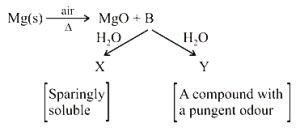
Identify $X$ and $Y$,respectively in the following reactions:
A
$MgO ; C$
B
$Mg(OH)_2 ; MgO$
C
$MgO ; NH_3$
D
$Mg(OH)_2 ; NH_3$
Solution
(D) When $Mg$ is heated in air,it reacts with both $O_2$ and $N_2$ to form $MgO$ and $Mg_3N_2$ (which is $B$).
$2Mg + O_2 \xrightarrow{\Delta} 2MgO$
$3Mg + N_2 \xrightarrow{\Delta} Mg_3N_2 (B)$
Now,the hydrolysis of $Mg_3N_2$ occurs as follows:
$Mg_3N_2 + 6H_2O \rightarrow 3Mg(OH)_2 + 2NH_3$
Here,$Mg(OH)_2$ $(X)$ is sparingly soluble in water,and $NH_3$ $(Y)$ is a gas with a pungent odour.
Therefore,$X = Mg(OH)_2$ and $Y = NH_3$.
$2Mg + O_2 \xrightarrow{\Delta} 2MgO$
$3Mg + N_2 \xrightarrow{\Delta} Mg_3N_2 (B)$
Now,the hydrolysis of $Mg_3N_2$ occurs as follows:
$Mg_3N_2 + 6H_2O \rightarrow 3Mg(OH)_2 + 2NH_3$
Here,$Mg(OH)_2$ $(X)$ is sparingly soluble in water,and $NH_3$ $(Y)$ is a gas with a pungent odour.
Therefore,$X = Mg(OH)_2$ and $Y = NH_3$.
0 likesView Solution
74
ChemistryMediumMCQTS EAMCET · 2019
What is the equivalent weight of methanol if one mole of $CH_3OH$ is combusted to form $CO$ and $H_2O$?
A
$8$
B
$5.33$
C
$4$
D
$10.66$
Solution
(A) The balanced chemical equation for the combustion of $CH_3OH$ to $CO$ and $H_2O$ is:
$CH_3OH + O_2 \rightarrow CO + 2H_2O$
In this reaction,the oxidation state of carbon in $CH_3OH$ is $-2$ and in $CO$ is $+2$.
The change in oxidation state of carbon is $|2 - (-2)| = 4$.
Thus,the valency factor ($n$-factor) for methanol is $4$.
The molecular weight of $CH_3OH$ is $12 + 4(1) + 16 = 32 \ g/mol$.
Equivalent weight = $\frac{\text{Molecular weight}}{n\text{-factor}} = \frac{32}{4} = 8$.
$CH_3OH + O_2 \rightarrow CO + 2H_2O$
In this reaction,the oxidation state of carbon in $CH_3OH$ is $-2$ and in $CO$ is $+2$.
The change in oxidation state of carbon is $|2 - (-2)| = 4$.
Thus,the valency factor ($n$-factor) for methanol is $4$.
The molecular weight of $CH_3OH$ is $12 + 4(1) + 16 = 32 \ g/mol$.
Equivalent weight = $\frac{\text{Molecular weight}}{n\text{-factor}} = \frac{32}{4} = 8$.
0 likesView Solution
75
ChemistryMediumMCQTS EAMCET · 2019
In a $1 \ L$ vessel,$10 \ \text{moles}$ of methane and $50 \ \text{moles}$ of $O_2$ are present. The number of moles of $O_2$,water,and $CO_2$ present in the vessel after the vessel is heated to burn methane completely are respectively:
A
$30, 20, 20$
B
$30, 20, 10$
C
$20, 30, 10$
D
$20, 10, 30$
Solution
(B) The combustion reaction for methane is as follows:
$CH_4 + 2O_2 \rightarrow CO_2 + 2H_2O$
Initial moles:
$CH_4 = 10, O_2 = 50, CO_2 = 0, H_2O = 0$
Since $CH_4$ is the limiting reagent,it will be completely consumed.
For $10 \ \text{moles}$ of $CH_4$,$2 \times 10 = 20 \ \text{moles}$ of $O_2$ are consumed.
Final moles:
$O_2 = 50 - 20 = 30 \ \text{moles}$
$CO_2 = 10 \ \text{moles}$
$H_2O = 2 \times 10 = 20 \ \text{moles}$
Thus,the number of moles of $O_2$,$H_2O$,and $CO_2$ are $30, 20, 10$ respectively.
Option $B$ is the correct answer.
$CH_4 + 2O_2 \rightarrow CO_2 + 2H_2O$
Initial moles:
$CH_4 = 10, O_2 = 50, CO_2 = 0, H_2O = 0$
Since $CH_4$ is the limiting reagent,it will be completely consumed.
For $10 \ \text{moles}$ of $CH_4$,$2 \times 10 = 20 \ \text{moles}$ of $O_2$ are consumed.
Final moles:
$O_2 = 50 - 20 = 30 \ \text{moles}$
$CO_2 = 10 \ \text{moles}$
$H_2O = 2 \times 10 = 20 \ \text{moles}$
Thus,the number of moles of $O_2$,$H_2O$,and $CO_2$ are $30, 20, 10$ respectively.
Option $B$ is the correct answer.
0 likesView Solution
76
ChemistryEasyMCQTS EAMCET · 2019
The number of moles of $H_2$ required to produce $10$ moles of $NH_3$ in the following reaction is:
$a H_{2(g)} + b NO_{2(g)} \longrightarrow c NH_{3(g)} + d H_2O_{(g)}$
$a H_{2(g)} + b NO_{2(g)} \longrightarrow c NH_{3(g)} + d H_2O_{(g)}$
A
$10$
B
$20$
C
$35$
D
$53$
Solution
(C) First,we balance the chemical equation:
$7 H_{2(g)} + 2 NO_{2(g)} \longrightarrow 2 NH_{3(g)} + 4 H_2O_{(g)}$
From the balanced equation,$2$ moles of $NH_3$ are produced by $7$ moles of $H_2$.
Therefore,$1$ mole of $NH_3$ is produced by $\frac{7}{2}$ moles of $H_2$.
For $10$ moles of $NH_3$,the moles of $H_2$ required are:
$= \frac{7}{2} \times 10 = 35$ moles.
Thus,the correct option is $(C)$.
$7 H_{2(g)} + 2 NO_{2(g)} \longrightarrow 2 NH_{3(g)} + 4 H_2O_{(g)}$
From the balanced equation,$2$ moles of $NH_3$ are produced by $7$ moles of $H_2$.
Therefore,$1$ mole of $NH_3$ is produced by $\frac{7}{2}$ moles of $H_2$.
For $10$ moles of $NH_3$,the moles of $H_2$ required are:
$= \frac{7}{2} \times 10 = 35$ moles.
Thus,the correct option is $(C)$.
0 likesView Solution
77
ChemistryMediumMCQTS EAMCET · 2019
While combusting in air,$4 \ g$ of $H_2$ gas was completely converted into water. If $36 \ \mu mole$ of $CO_2$ from air is dissolved into that water,what is the concentration of $CO_2$?
A
$1 \ \mu M$
B
$1 \ mM$
C
$1 \ nM$
D
$1000 \ mM$
Solution
(B) The combustion reaction is: $2H_2(g) + O_2(g) \rightarrow 2H_2O(l)$.
Given $4 \ g$ of $H_2$ $(n = 4/2 = 2 \ mol)$,it produces $2 \ mol$ of $H_2O$.
The density of water is $1 \ g/mL$,so the volume of $2 \ mol$ of $H_2O$ $(36 \ g)$ is $36 \ mL = 36 \times 10^{-3} \ L$.
The amount of $CO_2$ is $36 \ \mu mol = 36 \times 10^{-6} \ mol$.
Concentration of $CO_2 = \frac{n}{V} = \frac{36 \times 10^{-6} \ mol}{36 \times 10^{-3} \ L} = 10^{-3} \ M = 1 \ mM$.
Given $4 \ g$ of $H_2$ $(n = 4/2 = 2 \ mol)$,it produces $2 \ mol$ of $H_2O$.
The density of water is $1 \ g/mL$,so the volume of $2 \ mol$ of $H_2O$ $(36 \ g)$ is $36 \ mL = 36 \times 10^{-3} \ L$.
The amount of $CO_2$ is $36 \ \mu mol = 36 \times 10^{-6} \ mol$.
Concentration of $CO_2 = \frac{n}{V} = \frac{36 \times 10^{-6} \ mol}{36 \times 10^{-3} \ L} = 10^{-3} \ M = 1 \ mM$.
0 likesView Solution
78
ChemistryMediumMCQTS EAMCET · 2019
$A$ spherical ball of radius $7 \ cm$ contains $56 \ w\%$ iron. Find out the number of moles of iron present approximately in the ball (in $.1$)? $(d = 1.4 \ g \ cm^{-3}; \text{atomic mass} = 56 \ g \ mol^{-1})$
A
$15$
B
$20$
C
$25$
D
$35$
Solution
(B) The volume of the spherical ball is given by $V = \frac{4}{3} \pi r^3$.
Substituting $r = 7 \ cm$,$V = \frac{4}{3} \times \frac{22}{7} \times 7^3 = \frac{4}{3} \times 22 \times 49 \approx 1437.33 \ cm^3$.
The mass of the ball is $m = V \times d = 1437.33 \ cm^3 \times 1.4 \ g \ cm^{-3} \approx 2012.26 \ g$.
The mass of iron in the ball is $56\%$ of the total mass: $m_{\text{Fe}} = 2012.26 \times 0.56 \approx 1126.87 \ g$.
The number of moles of iron is $n = \frac{m_{\text{Fe}}}{\text{atomic mass}} = \frac{1126.87}{56} \approx 20.12 \ mol$.
Thus,the number of moles of iron is approximately $20.1 \ mol$.
Therefore,option $(B)$ is correct.
Substituting $r = 7 \ cm$,$V = \frac{4}{3} \times \frac{22}{7} \times 7^3 = \frac{4}{3} \times 22 \times 49 \approx 1437.33 \ cm^3$.
The mass of the ball is $m = V \times d = 1437.33 \ cm^3 \times 1.4 \ g \ cm^{-3} \approx 2012.26 \ g$.
The mass of iron in the ball is $56\%$ of the total mass: $m_{\text{Fe}} = 2012.26 \times 0.56 \approx 1126.87 \ g$.
The number of moles of iron is $n = \frac{m_{\text{Fe}}}{\text{atomic mass}} = \frac{1126.87}{56} \approx 20.12 \ mol$.
Thus,the number of moles of iron is approximately $20.1 \ mol$.
Therefore,option $(B)$ is correct.
0 likesView Solution
79
ChemistryDifficultMCQTS EAMCET · 2019
Which one of the following gives the highest volume of $O_2$ at $STP$ on complete decomposition?
A
$2 \text{ mL}$ of $100 \text{ V } H_2O_2$
B
$500 \text{ mL}$ of $30 \text{ V } H_2O_2$
C
$1 \text{ L}$ of $10 \text{ V } H_2O_2$
D
$100 \text{ mL}$ of $20 \text{ V } H_2O_2$
Solution
(B) The volume of $O_2$ gas evolved at $STP$ is calculated using the formula: $\text{Volume of } O_2 = \text{Volume of } H_2O_2 \text{ solution} \times \text{Volume strength}$.
$(A) 2 \text{ mL} \times 100 = 200 \text{ mL}$
$(B) 500 \text{ mL} \times 30 = 15000 \text{ mL}$
$(C) 1000 \text{ mL} \times 10 = 10000 \text{ mL}$
$(D) 100 \text{ mL} \times 20 = 2000 \text{ mL}$
Comparing the results,option $(B)$ yields the highest volume of $O_2$.
$(A) 2 \text{ mL} \times 100 = 200 \text{ mL}$
$(B) 500 \text{ mL} \times 30 = 15000 \text{ mL}$
$(C) 1000 \text{ mL} \times 10 = 10000 \text{ mL}$
$(D) 100 \text{ mL} \times 20 = 2000 \text{ mL}$
Comparing the results,option $(B)$ yields the highest volume of $O_2$.
0 likesView Solution
80
ChemistryEasyMCQTS EAMCET · 2019
The nitrogen gas pressure inside a container of volume $2.6 \ cm^3$ is $2.3 \ atm$ at $27^{\circ} C$. The approximate number of moles of nitrogen present in the container is $[R=0.0821 \ L \ atm \ mol^{-1} \ K^{-1}]$
A
$4 \times 10^{-3}$
B
$1.7 \times 10^{-4}$
C
$4 \times 10^{-4}$
D
$2 \times 10^{-4}$
Solution
(D) Given:
Pressure of $N_2$ gas $(P) = 2.3 \ atm$
Volume $(V) = 2.6 \ cm^3 = 2.6 \times 10^{-3} \ L$
Temperature $(T) = 27^{\circ} C + 273 = 300 \ K$
Gas constant $(R) = 0.0821 \ L \ atm \ mol^{-1} \ K^{-1}$
Using the ideal gas equation: $PV = nRT$
$n = \frac{PV}{RT}$
$n = \frac{2.3 \ atm \times 2.6 \times 10^{-3} \ L}{0.0821 \ L \ atm \ mol^{-1} \ K^{-1} \times 300 \ K}$
$n = \frac{5.98 \times 10^{-3}}{24.63} \ mol$
$n \approx 2.42 \times 10^{-4} \ mol$
Rounding to the nearest provided option,the value is $2 \times 10^{-4} \ mol$.
Pressure of $N_2$ gas $(P) = 2.3 \ atm$
Volume $(V) = 2.6 \ cm^3 = 2.6 \times 10^{-3} \ L$
Temperature $(T) = 27^{\circ} C + 273 = 300 \ K$
Gas constant $(R) = 0.0821 \ L \ atm \ mol^{-1} \ K^{-1}$
Using the ideal gas equation: $PV = nRT$
$n = \frac{PV}{RT}$
$n = \frac{2.3 \ atm \times 2.6 \times 10^{-3} \ L}{0.0821 \ L \ atm \ mol^{-1} \ K^{-1} \times 300 \ K}$
$n = \frac{5.98 \times 10^{-3}}{24.63} \ mol$
$n \approx 2.42 \times 10^{-4} \ mol$
Rounding to the nearest provided option,the value is $2 \times 10^{-4} \ mol$.
0 likesView Solution
81
ChemistryEasyMCQTS EAMCET · 2019
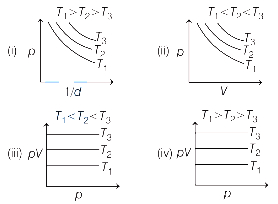
Which of the following plots is/are correct for Boyle's law?
A
$(iv)$
B
$(ii), (iv)$
C
$(i), (iv)$
D
$(ii), (iii)$
Solution
(B) Boyle's law states that at constant temperature $(T)$ and amount of gas $(n)$,the pressure $(p)$ of a fixed amount of gas is inversely proportional to its volume $(V)$:
$p \propto \frac{1}{V} \implies pV = \text{constant} \quad (k)$
$1$. Plot $(ii)$: Shows $p$ vs $V$ at different temperatures. Since $pV = nRT$,$p = \frac{nRT}{V}$. For a given $V$,$p$ increases as $T$ increases. Thus,for $T_3 > T_2 > T_1$,the curve for $T_3$ should be above $T_2$,which is above $T_1$. The plot $(ii)$ shows $T_1 < T_2 < T_3$ with curves correctly ordered,making it a correct representation of Boyle's law isotherms.
$2$. Plot $(iv)$: Shows $pV$ vs $p$. Since $pV = nRT$,for a fixed $T$,$pV$ is constant. As $T$ increases,the value of the constant $nRT$ increases. Thus,$pV$ should be higher for higher temperatures. The plot $(iv)$ shows $T_1 < T_2 < T_3$ with $pV$ values increasing accordingly,which is correct.
Plots $(i)$ and $(iii)$ do not correctly represent the relationship between the variables at different temperatures based on the ideal gas equation.
Therefore,plots $(ii)$ and $(iv)$ are correct.
$p \propto \frac{1}{V} \implies pV = \text{constant} \quad (k)$
$1$. Plot $(ii)$: Shows $p$ vs $V$ at different temperatures. Since $pV = nRT$,$p = \frac{nRT}{V}$. For a given $V$,$p$ increases as $T$ increases. Thus,for $T_3 > T_2 > T_1$,the curve for $T_3$ should be above $T_2$,which is above $T_1$. The plot $(ii)$ shows $T_1 < T_2 < T_3$ with curves correctly ordered,making it a correct representation of Boyle's law isotherms.
$2$. Plot $(iv)$: Shows $pV$ vs $p$. Since $pV = nRT$,for a fixed $T$,$pV$ is constant. As $T$ increases,the value of the constant $nRT$ increases. Thus,$pV$ should be higher for higher temperatures. The plot $(iv)$ shows $T_1 < T_2 < T_3$ with $pV$ values increasing accordingly,which is correct.
Plots $(i)$ and $(iii)$ do not correctly represent the relationship between the variables at different temperatures based on the ideal gas equation.
Therefore,plots $(ii)$ and $(iv)$ are correct.
0 likesView Solution
82
ChemistryEasyMCQTS EAMCET · 2019
Diffusion of $CH_{4(g)}$ and $O_{2(g)}$ occurs under similar conditions,then the ratio of their rates of diffusion is
A
$1.414$
B
$0.707$
C
$2.312$
D
$1.732$
Solution
(A) According to Graham's Law of Diffusion,under similar conditions of pressure and temperature,the rate of diffusion $(r)$ of a gas is inversely proportional to the square root of its molar mass $(M)$:
$r \propto \frac{1}{\sqrt{M}}$
Therefore,the ratio of the rates of diffusion of $CH_{4}$ and $O_{2}$ is given by:
$\frac{r_{CH_{4}}}{r_{O_{2}}} = \sqrt{\frac{M_{O_{2}}}{M_{CH_{4}}}}$
Given molar masses: $M_{CH_{4}} = 16 \ g/mol$ and $M_{O_{2}} = 32 \ g/mol$.
Substituting the values:
$\frac{r_{CH_{4}}}{r_{O_{2}}} = \sqrt{\frac{32}{16}} = \sqrt{2} \approx 1.414$.
$r \propto \frac{1}{\sqrt{M}}$
Therefore,the ratio of the rates of diffusion of $CH_{4}$ and $O_{2}$ is given by:
$\frac{r_{CH_{4}}}{r_{O_{2}}} = \sqrt{\frac{M_{O_{2}}}{M_{CH_{4}}}}$
Given molar masses: $M_{CH_{4}} = 16 \ g/mol$ and $M_{O_{2}} = 32 \ g/mol$.
Substituting the values:
$\frac{r_{CH_{4}}}{r_{O_{2}}} = \sqrt{\frac{32}{16}} = \sqrt{2} \approx 1.414$.
0 likesView Solution
83
ChemistryMediumMCQTS EAMCET · 2019
What is the approximate most probable velocity of oxygen,if the kinetic energy of one mole of oxygen is $3741.3 \ J$?
A
$\sqrt{43851} \ m \ s^{-1}$
B
$\sqrt{48321} \ m \ s^{-1}$
C
$\sqrt{155887} \ m \ s^{-1}$
D
$\sqrt{3950} \ m \ s^{-1}$
Solution
(C) The kinetic energy $(KE)$ of one mole of an ideal gas is given by $KE = \frac{3}{2} RT$.
From this,we get $RT = \frac{2}{3} KE$.
The most probable velocity $(v_{mp})$ is given by $v_{mp} = \sqrt{\frac{2RT}{M}}$.
Here,$M$ is the molar mass of oxygen $(O_2)$,which is $32 \ g \ mol^{-1} = 0.032 \ kg \ mol^{-1}$.
Given $KE = 3741.3 \ J \ mol^{-1}$.
Substituting $RT = \frac{2}{3} \times 3741.3$ into the velocity formula:
$v_{mp} = \sqrt{\frac{2 \times (\frac{2}{3} \times 3741.3)}{0.032}}$
$v_{mp} = \sqrt{\frac{4 \times 3741.3}{3 \times 0.032}} = \sqrt{\frac{14965.2}{0.096}} = \sqrt{155887.5} \ m \ s^{-1}$.
Thus,the approximate most probable velocity is $\sqrt{155887} \ m \ s^{-1}$.
Therefore,option $(C)$ is the correct answer.
From this,we get $RT = \frac{2}{3} KE$.
The most probable velocity $(v_{mp})$ is given by $v_{mp} = \sqrt{\frac{2RT}{M}}$.
Here,$M$ is the molar mass of oxygen $(O_2)$,which is $32 \ g \ mol^{-1} = 0.032 \ kg \ mol^{-1}$.
Given $KE = 3741.3 \ J \ mol^{-1}$.
Substituting $RT = \frac{2}{3} \times 3741.3$ into the velocity formula:
$v_{mp} = \sqrt{\frac{2 \times (\frac{2}{3} \times 3741.3)}{0.032}}$
$v_{mp} = \sqrt{\frac{4 \times 3741.3}{3 \times 0.032}} = \sqrt{\frac{14965.2}{0.096}} = \sqrt{155887.5} \ m \ s^{-1}$.
Thus,the approximate most probable velocity is $\sqrt{155887} \ m \ s^{-1}$.
Therefore,option $(C)$ is the correct answer.
0 likesView Solution
84
ChemistryEasyMCQTS EAMCET · 2019
Which of the following statements is not correct regarding the kinetic theory of gases?
A
Gases are considered as point masses.
B
Kinetic energy of gas molecules increases with temperature.
C
Total energy of molecules before and after the collisions is different.
D
The distribution of molecular speed of a gas remains constant at a particular temperature.
Solution
(C) The explanation of the given statements is as follows:
$(a)$ Gas particles are considered as point masses or rigid particles.
$(b)$ Kinetic energy of gas molecules is directly proportional to absolute temperature. $\text{K.E.} \propto T$. Therefore,$\text{K.E.}$ increases with increasing temperature.
$(c)$ Rigid elastic gas particles undergo collisions and follow the law of conservation of energy. Therefore,the total energy of molecules before and after the collisions remains equal.
$(d)$ The distribution of molecular speed of a gas remains constant at a particular temperature.
Hence,option $(C)$ is incorrect.
$(a)$ Gas particles are considered as point masses or rigid particles.
$(b)$ Kinetic energy of gas molecules is directly proportional to absolute temperature. $\text{K.E.} \propto T$. Therefore,$\text{K.E.}$ increases with increasing temperature.
$(c)$ Rigid elastic gas particles undergo collisions and follow the law of conservation of energy. Therefore,the total energy of molecules before and after the collisions remains equal.
$(d)$ The distribution of molecular speed of a gas remains constant at a particular temperature.
Hence,option $(C)$ is incorrect.
0 likesView Solution
85
ChemistryMediumMCQTS EAMCET · 2019
What is the correction term in the pressure for real gas in comparison to the ideal gas?
A
$a n^2 / V^2$
B
$a V^2 / n^2$
C
$a n^2 / V^2$
D
$a n^2 / V - n b$
Solution
(C) According to the van der Waals equation for real gases,the pressure correction term is added to the observed pressure to account for intermolecular forces.
The corrected pressure is given by $P_{ideal} = P_{observed} + \frac{a n^2}{V^2}$.
Therefore,the correction term for pressure is $\frac{a n^2}{V^2}$.
Thus,option $(C)$ is the correct answer.
The corrected pressure is given by $P_{ideal} = P_{observed} + \frac{a n^2}{V^2}$.
Therefore,the correction term for pressure is $\frac{a n^2}{V^2}$.
Thus,option $(C)$ is the correct answer.
0 likesView Solution
86
ChemistryDifficultMCQTS EAMCET · 2019
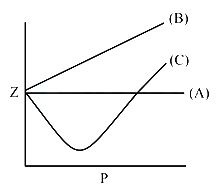
The variation of the compressibility factor $(Z)$ with pressure $(P$ in $bar)$ for some gases is shown in the figure below. Identify the gases $(A)$,$(B)$,and $(C)$.
A
Real Gas,$N_2, CO_2$
B
Ideal Gas,$H_2, CO_2$
C
Ideal Gas,$CO_2, H_2$
D
Real Gas,$H_2, CO_2$
Solution
(B) The compressibility factor $(Z)$ is defined as $Z = \frac{PV_m}{RT}$.
For an ideal gas,$Z = 1$ at all pressures,which corresponds to the horizontal line $(A)$.
Real gases show deviations from ideal behavior.
For gases like $H_2$ and $He$,the intermolecular forces are weak,and the volume effect dominates,leading to $Z > 1$ at all pressures,as shown by curve $(B)$.
For easily liquefiable gases like $CO_2$,the attractive forces dominate at low pressures $(Z < 1)$,while the volume effect dominates at high pressures $(Z > 1)$,resulting in the characteristic dip shown by curve $(C)$.
Therefore,$(A)$ is an ideal gas,$(B)$ is $H_2$,and $(C)$ is $CO_2$.
For an ideal gas,$Z = 1$ at all pressures,which corresponds to the horizontal line $(A)$.
Real gases show deviations from ideal behavior.
For gases like $H_2$ and $He$,the intermolecular forces are weak,and the volume effect dominates,leading to $Z > 1$ at all pressures,as shown by curve $(B)$.
For easily liquefiable gases like $CO_2$,the attractive forces dominate at low pressures $(Z < 1)$,while the volume effect dominates at high pressures $(Z > 1)$,resulting in the characteristic dip shown by curve $(C)$.
Therefore,$(A)$ is an ideal gas,$(B)$ is $H_2$,and $(C)$ is $CO_2$.
0 likesView Solution
87
ChemistryEasyMCQTS EAMCET · 2019
The van der Waals' equation for $0.5 \ mol$ of a gas is
A
$\left(p+\frac{a}{4 V^2}\right)\left(V-0.5 b\right)=0.5 R T$
B
$\left(p+\frac{a}{4 V^2}\right)(2 V-b)=R T$
C
$\left(p+\frac{a}{4 V^2}\right)(V-2 b)=0.5 R T$
D
$\left(p+\frac{a}{4 V^2}\right)(V-b)=0.5 R T$
Solution
(B) The van der Waals' equation for $n$ moles of a gas is given by $\left(p+\frac{a n^2}{V^2}\right)(V-n b)=n R T$.
Given $n = 0.5 \ mol$,we substitute this into the equation:
$\left(p+\frac{a(0.5)^2}{V^2}\right)(V-0.5 b) = 0.5 R T$
$\left(p+\frac{a}{4 V^2}\right)(V-0.5 b) = 0.5 R T$
Multiplying both sides by $2$,we get:
$\left(p+\frac{a}{4 V^2}\right)(2V-b) = R T$.
Thus,option $B$ is correct.
Given $n = 0.5 \ mol$,we substitute this into the equation:
$\left(p+\frac{a(0.5)^2}{V^2}\right)(V-0.5 b) = 0.5 R T$
$\left(p+\frac{a}{4 V^2}\right)(V-0.5 b) = 0.5 R T$
Multiplying both sides by $2$,we get:
$\left(p+\frac{a}{4 V^2}\right)(2V-b) = R T$.
Thus,option $B$ is correct.
0 likesView Solution
88
ChemistryMediumMCQTS EAMCET · 2019
The compressibility factor $(Z)$ of a gas at critical state is $(T_c = \frac{8 a}{27 R b}; p_c = \frac{a}{27 b^2}; V_c = 3 b)$.
A
$8/3$
B
$1$
C
$3/8$
D
$0.5$
Solution
(C) Given,$T_c = \frac{8 a}{27 R b}$,$p_c = \frac{a}{27 b^2}$,$V_c = 3 b$.
The compressibility factor $(Z)$ is defined as $Z = \frac{p V}{R T}$.
At the critical state,$Z = \frac{p_c V_c}{R T_c}$.
Substituting the given values:
$Z = \frac{(\frac{a}{27 b^2}) \times (3 b)}{R \times (\frac{8 a}{27 R b})}$.
$Z = \frac{\frac{3 a}{27 b}}{\frac{8 a}{27 b}} = \frac{3}{8}$.
Thus,the correct option is $(C)$.
The compressibility factor $(Z)$ is defined as $Z = \frac{p V}{R T}$.
At the critical state,$Z = \frac{p_c V_c}{R T_c}$.
Substituting the given values:
$Z = \frac{(\frac{a}{27 b^2}) \times (3 b)}{R \times (\frac{8 a}{27 R b})}$.
$Z = \frac{\frac{3 a}{27 b}}{\frac{8 a}{27 b}} = \frac{3}{8}$.
Thus,the correct option is $(C)$.
0 likesView Solution
89
ChemistryMediumMCQTS EAMCET · 2019
Which one of the following represents Boyle's temperature of a gas?
A
The temperature at which an ideal gas obeys Boyle's law.
B
The temperature at which the compressibility factor is less than $1$ for a real gas.
C
The temperature at which a gas obeys ideal gas law over an appreciable range of pressure.
D
The temperature at which the compressibility factor deviates from $1$ for an ideal gas.
Solution
(C) Boyle's temperature $(T_B)$ is defined as the temperature at which a real gas behaves like an ideal gas over an appreciable range of pressure.
At this temperature,the second virial coefficient of the real gas becomes zero,and the gas follows the ideal gas equation $PV = nRT$ for a significant pressure range.
At this temperature,the second virial coefficient of the real gas becomes zero,and the gas follows the ideal gas equation $PV = nRT$ for a significant pressure range.
0 likesView Solution
90
ChemistryEasyMCQTS EAMCET · 2019
In the Millikan's oil drop method,which of the following forces does not act on the oil drop?
A
Gravitational force
B
Viscous force
C
Magnetic force
D
Electrostatic force
Solution
(C) In Millikan's oil drop experiment,an electrically charged droplet of oil is placed between two parallel metal plates.
$1$. Gravitational force $(F_g = mg)$ acts downwards.
$2$. Viscous force $(F_v = 6 \pi \eta r v)$ acts opposite to the direction of motion of the droplet.
$3$. Electrostatic force $(F_e = qE)$ acts on the charged droplet when an electric field is applied.
Magnetic force is not involved in this experiment as there is no magnetic field present.
Therefore,the correct option is $(C)$.
$1$. Gravitational force $(F_g = mg)$ acts downwards.
$2$. Viscous force $(F_v = 6 \pi \eta r v)$ acts opposite to the direction of motion of the droplet.
$3$. Electrostatic force $(F_e = qE)$ acts on the charged droplet when an electric field is applied.
Magnetic force is not involved in this experiment as there is no magnetic field present.
Therefore,the correct option is $(C)$.
0 likesView Solution
91
ChemistryEasyMCQTS EAMCET · 2019
Which of the following pairs has the identical $e/m$ value?
A
An $\alpha$-particle and deuterium ion
B
$A$ proton and neutron
C
An electron and $\gamma$-rays
D
$A$ proton and deuterium ion
Solution
(A) The $e/m$ ratio (specific charge) is calculated as the ratio of charge $(e)$ to mass $(m)$.
For a proton $(H^+)$,$e/m = 1/1 = 1$.
For a deuterium ion $(D^+)$,charge is $1$ and mass is $2$,so $e/m = 1/2 = 0.5$.
For an $\alpha$-particle $(He^{2+})$,charge is $2$ and mass is $4$,so $e/m = 2/4 = 0.5$.
Since both the deuterium ion and the $\alpha$-particle have an $e/m$ ratio of $0.5$,they have identical $e/m$ values.
For a proton $(H^+)$,$e/m = 1/1 = 1$.
For a deuterium ion $(D^+)$,charge is $1$ and mass is $2$,so $e/m = 1/2 = 0.5$.
For an $\alpha$-particle $(He^{2+})$,charge is $2$ and mass is $4$,so $e/m = 2/4 = 0.5$.
Since both the deuterium ion and the $\alpha$-particle have an $e/m$ ratio of $0.5$,they have identical $e/m$ values.
0 likesView Solution
92
ChemistryMediumMCQTS EAMCET · 2019
From the following energy levels of a hydrogen atom,the values of $E_{\infty}$ and $E_3$ in $J$ are,respectively: $E_{\infty} = \ldots \ldots \ldots$ $E_3 = \ldots \ldots \ldots$ Given: $E_2 = -0.545 \times 10^{-18} \ J$,$E_1 = -2.18 \times 10^{-18} \ J$.
A
$1, 0.242 \times 10^{-18}$
B
$\infty, -0.726 \times 10^{-18}$
C
$0, -0.242 \times 10^{-18}$
D
$0, 0.242 \times 10^{-18}$
Solution
(C) The energy of an electron in the $n$th orbital of a hydrogen atom is given by the formula: $E_n = -2.18 \times 10^{-18} \cdot \frac{Z^2}{n^2} \ J$.
For a hydrogen atom,$Z = 1$.
Thus,$E_n = -\frac{2.18 \times 10^{-18}}{n^2} \ J$.
For $n = \infty$,$E_{\infty} = -\frac{2.18 \times 10^{-18}}{\infty} = 0 \ J$.
For $n = 3$,$E_3 = -\frac{2.18 \times 10^{-18}}{3^2} = -\frac{2.18 \times 10^{-18}}{9} = -0.242 \times 10^{-18} \ J$.
Therefore,$E_{\infty} = 0 \ J$ and $E_3 = -0.242 \times 10^{-18} \ J$.
Hence,option $(c)$ is the correct answer.
For a hydrogen atom,$Z = 1$.
Thus,$E_n = -\frac{2.18 \times 10^{-18}}{n^2} \ J$.
For $n = \infty$,$E_{\infty} = -\frac{2.18 \times 10^{-18}}{\infty} = 0 \ J$.
For $n = 3$,$E_3 = -\frac{2.18 \times 10^{-18}}{3^2} = -\frac{2.18 \times 10^{-18}}{9} = -0.242 \times 10^{-18} \ J$.
Therefore,$E_{\infty} = 0 \ J$ and $E_3 = -0.242 \times 10^{-18} \ J$.
Hence,option $(c)$ is the correct answer.
0 likesView Solution
93
ChemistryEasyMCQTS EAMCET · 2019
The radius of the $2^{nd}$ orbit of $B^{4+}$ ion is:
A
$4.23 \ \mathring{A}$
B
$0.2340 \ \mathring{A}$
C
$0.4232 \ \mathring{A}$
D
$0.3241 \ \mathring{A}$
Solution
(C) The radius of the $n^{th}$ orbit for a hydrogen-like species is given by the formula:
$r = 0.529 \times \frac{n^2}{Z} \ \mathring{A}$
Where $n$ is the principal quantum number (orbit number) and $Z$ is the atomic number.
For the $B^{4+}$ ion:
$n = 2$
$Z = 5$ (Atomic number of Boron)
Substituting these values into the formula:
$r = 0.529 \times \frac{2^2}{5} \ \mathring{A}$
$r = 0.529 \times \frac{4}{5} \ \mathring{A}$
$r = 0.529 \times 0.8 \ \mathring{A}$
$r = 0.4232 \ \mathring{A}$
$r = 0.529 \times \frac{n^2}{Z} \ \mathring{A}$
Where $n$ is the principal quantum number (orbit number) and $Z$ is the atomic number.
For the $B^{4+}$ ion:
$n = 2$
$Z = 5$ (Atomic number of Boron)
Substituting these values into the formula:
$r = 0.529 \times \frac{2^2}{5} \ \mathring{A}$
$r = 0.529 \times \frac{4}{5} \ \mathring{A}$
$r = 0.529 \times 0.8 \ \mathring{A}$
$r = 0.4232 \ \mathring{A}$
0 likesView Solution
94
ChemistryMediumMCQTS EAMCET · 2019
The ratio of the radius of the second orbit of $Li^{2+}$ to that of the third orbit of $Be^{3+}$ is:
A
$9/8$
B
$8/9$
C
$27/16$
D
$16/27$
Solution
(D) The radius of an electron $(r_n)$ in any orbit is given by the formula: $r_n = 0.529 \times \frac{n^2}{Z} \ \mathring{A}$.
For $Li^{2+}$: $n = 2$,$Z = 3$.
For $Be^{3+}$: $n = 3$,$Z = 4$.
The ratio is given by: $\frac{r_{Li^{2+}}}{r_{Be^{3+}}} = \frac{n_1^2 / Z_1}{n_2^2 / Z_2} = \frac{n_1^2}{Z_1} \times \frac{Z_2}{n_2^2}$.
Substituting the values: $\frac{2^2}{3} \times \frac{4}{3^2} = \frac{4}{3} \times \frac{4}{9} = \frac{16}{27}$.
Thus,the correct option is $(D)$.
For $Li^{2+}$: $n = 2$,$Z = 3$.
For $Be^{3+}$: $n = 3$,$Z = 4$.
The ratio is given by: $\frac{r_{Li^{2+}}}{r_{Be^{3+}}} = \frac{n_1^2 / Z_1}{n_2^2 / Z_2} = \frac{n_1^2}{Z_1} \times \frac{Z_2}{n_2^2}$.
Substituting the values: $\frac{2^2}{3} \times \frac{4}{3^2} = \frac{4}{3} \times \frac{4}{9} = \frac{16}{27}$.
Thus,the correct option is $(D)$.
0 likesView Solution
95
ChemistryMediumMCQTS EAMCET · 2019
The speed of the electron (in $ms^{-1}$) in the third orbit of a hydrogen atom is approximately (mass of electron $= 9.1 \times 10^{-31} \ kg$).
A
$3.6 \times 10^5$
B
$2.18 \times 10^6$
C
$7.26 \times 10^5$
D
$2.18 \times 10^5$
Solution
(C) The velocity of an electron in the $n^{th}$ orbit of a hydrogen-like atom is given by the formula: $v = 2.18 \times 10^6 \times \frac{Z}{n} \ ms^{-1}$.
For a hydrogen atom,the atomic number $Z = 1$.
For the third orbit,the principal quantum number $n = 3$.
Substituting these values into the formula:
$v = 2.18 \times 10^6 \times \frac{1}{3} \ ms^{-1}$.
$v = 0.7266 \times 10^6 \ ms^{-1}$.
$v = 7.26 \times 10^5 \ ms^{-1}$.
Therefore,option $(C)$ is the correct answer.
For a hydrogen atom,the atomic number $Z = 1$.
For the third orbit,the principal quantum number $n = 3$.
Substituting these values into the formula:
$v = 2.18 \times 10^6 \times \frac{1}{3} \ ms^{-1}$.
$v = 0.7266 \times 10^6 \ ms^{-1}$.
$v = 7.26 \times 10^5 \ ms^{-1}$.
Therefore,option $(C)$ is the correct answer.
0 likesView Solution
96
ChemistryEasyMCQTS EAMCET · 2019
Which of the following series correctly represents the energy of the radiation?
A
$Radio \ waves > X-rays > visible > IR$
B
$UV > X-rays > IR > radio \ waves$
C
$\gamma-rays > IR > visible > microwave$
D
$X-rays > UV > IR > microwave$
Solution
(D) The energy $(E)$ of electromagnetic radiation is inversely proportional to its wavelength $(\lambda)$ according to the equation $E = \frac{hc}{\lambda}$.
As the wavelength increases,the energy of the radiation decreases.
The electromagnetic spectrum in order of decreasing energy is: $\gamma-rays > X-rays > UV > visible > IR > microwave > radio \ waves$.
Comparing this with the given options,the correct order is $X-rays > UV > IR > microwave$.
As the wavelength increases,the energy of the radiation decreases.
The electromagnetic spectrum in order of decreasing energy is: $\gamma-rays > X-rays > UV > visible > IR > microwave > radio \ waves$.
Comparing this with the given options,the correct order is $X-rays > UV > IR > microwave$.
0 likesView Solution
97
ChemistryEasyMCQTS EAMCET · 2019
The product of uncertainty in the position and uncertainty in the velocity of a particle is $5.79 \times 10^{-5} \ m^2 \ s^{-1}$. If the uncertainty in the position is $1 \ nm$,what is the uncertainty in the measurement of its velocity in $m \ s^{-1}$?
A
$5.79 \times 10^7$
B
$5.79 \times 10^5$
C
$5.79 \times 10^{-5}$
D
$5.79 \times 10^4$
Solution
(D) Given,the product of uncertainty in position $(\Delta x)$ and uncertainty in velocity $(\Delta v)$ is $\Delta x \cdot \Delta v = 5.79 \times 10^{-5} \ m^2 \ s^{-1}$.
Uncertainty in position $\Delta x = 1 \ nm = 1 \times 10^{-9} \ m$.
To find the uncertainty in velocity $(\Delta v)$:
$\Delta v = \frac{\Delta x \cdot \Delta v}{\Delta x} = \frac{5.79 \times 10^{-5} \ m^2 \ s^{-1}}{1 \times 10^{-9} \ m} = 5.79 \times 10^4 \ m \ s^{-1}$.
Uncertainty in position $\Delta x = 1 \ nm = 1 \times 10^{-9} \ m$.
To find the uncertainty in velocity $(\Delta v)$:
$\Delta v = \frac{\Delta x \cdot \Delta v}{\Delta x} = \frac{5.79 \times 10^{-5} \ m^2 \ s^{-1}}{1 \times 10^{-9} \ m} = 5.79 \times 10^4 \ m \ s^{-1}$.
0 likesView Solution
98
ChemistryMediumMCQTS EAMCET · 2019
Match the items in List-$I$ with the items in List-$II$.
| List-$I$ | List-$II$ |
|---|---|
| $A$. Nodes | $I$. Three dimensional shape of the orbital |
| $B$. Subsidiary quantum number | $II$. Significant only for motion of microscopic objects |
| $C$. White light | $III$. $|\psi|^2$ is zero |
| $D$. Heisenberg uncertainty principle | $IV$. Spin state of electron |
| $V$. Continuous spectrum |
A
$A-III, B-I, C-V, D-II$
B
$A-III, B-I, C-V, D-IV$
C
$A-I, B-III, C-V, D-II$
D
$A-III, B-I, C-II, D-V$
Solution
(A) . Nodes $(III)$ $|\psi|^2$ is zero,as $|\psi|^2$ represents the region where the probability of finding an electron is zero.
$B$. Subsidiary Quantum Number $(I)$ determines the three-dimensional shape of the orbital. It is also called the azimuthal quantum number.
$C$. White Light $(V)$ produces a continuous spectrum because it contains all wavelengths of visible light,appearing as a continuous pattern.
$D$. Heisenberg's Uncertainty Principle $(II)$ is significant only for the motion of microscopic objects,as it states that it is impossible to determine simultaneously the exact position and exact momentum of a subatomic particle.
Therefore,the correct matching is $A-III, B-I, C-V, D-II$.
$B$. Subsidiary Quantum Number $(I)$ determines the three-dimensional shape of the orbital. It is also called the azimuthal quantum number.
$C$. White Light $(V)$ produces a continuous spectrum because it contains all wavelengths of visible light,appearing as a continuous pattern.
$D$. Heisenberg's Uncertainty Principle $(II)$ is significant only for the motion of microscopic objects,as it states that it is impossible to determine simultaneously the exact position and exact momentum of a subatomic particle.
Therefore,the correct matching is $A-III, B-I, C-V, D-II$.
0 likesView Solution
99
ChemistryEasyMCQTS EAMCET · 2019
The following lists contain reactions and their corresponding equilibrium constants at different temperatures:
If $\Delta H_1^0$ and $\Delta H_2^0$ are the standard enthalpies for the reactions $2 SO_{2(g)} + O_{2(g)} \rightleftharpoons 2 SO_{3(g)}$ and $N_2O_{4(g)} \rightleftharpoons 2 NO_{2(g)}$ respectively,then:
| List-$I$ (Reaction) | List-$II$ $(K_p)$ |
|---|---|
| $2 SO_{2(g)} + O_{2(g)} \rightleftharpoons 2 SO_{3(g)}$ at $298 \ K$ | $4.0 \times 10^{24}$ |
| $2 SO_{2(g)} + O_{2(g)} \rightleftharpoons 2 SO_{3(g)}$ at $700 \ K$ | $3.0 \times 10^{4}$ |
| $N_2O_{4(g)} \rightleftharpoons 2 NO_{2(g)}$ at $298 \ K$ | $0.98$ |
| $N_2O_{4(g)} \rightleftharpoons 2 NO_{2(g)}$ at $500 \ K$ | $1700$ |
If $\Delta H_1^0$ and $\Delta H_2^0$ are the standard enthalpies for the reactions $2 SO_{2(g)} + O_{2(g)} \rightleftharpoons 2 SO_{3(g)}$ and $N_2O_{4(g)} \rightleftharpoons 2 NO_{2(g)}$ respectively,then:
A
Both $\Delta H_1^0$ and $\Delta H_2^0$ are negative
B
Both $\Delta H_1^0$ and $\Delta H_2^0$ are positive
C
$\Delta H_1^0$ is negative and $\Delta H_2^0$ is positive
D
$\Delta H_1^0$ is positive and $\Delta H_2^0$ is negative
Solution
(C) According to the van't Hoff equation,the relationship between the equilibrium constant $(K)$ and temperature $(T)$ is given by $\ln K = -\frac{\Delta H^0}{RT} + C$.
For the first reaction $(2 SO_{2(g)} + O_{2(g)} \rightleftharpoons 2 SO_{3(g)})$,as temperature increases from $298 \ K$ to $700 \ K$,the value of $K_p$ decreases from $4.0 \times 10^{24}$ to $3.0 \times 10^4$. Since $K_p$ decreases with an increase in temperature,the reaction is exothermic,meaning $\Delta H_1^0 < 0$.
For the second reaction $(N_2O_{4(g)} \rightleftharpoons 2 NO_{2(g)})$,as temperature increases from $298 \ K$ to $500 \ K$,the value of $K_p$ increases from $0.98$ to $1700$. Since $K_p$ increases with an increase in temperature,the reaction is endothermic,meaning $\Delta H_2^0 > 0$.
Therefore,$\Delta H_1^0$ is negative and $\Delta H_2^0$ is positive.
For the first reaction $(2 SO_{2(g)} + O_{2(g)} \rightleftharpoons 2 SO_{3(g)})$,as temperature increases from $298 \ K$ to $700 \ K$,the value of $K_p$ decreases from $4.0 \times 10^{24}$ to $3.0 \times 10^4$. Since $K_p$ decreases with an increase in temperature,the reaction is exothermic,meaning $\Delta H_1^0 < 0$.
For the second reaction $(N_2O_{4(g)} \rightleftharpoons 2 NO_{2(g)})$,as temperature increases from $298 \ K$ to $500 \ K$,the value of $K_p$ increases from $0.98$ to $1700$. Since $K_p$ increases with an increase in temperature,the reaction is endothermic,meaning $\Delta H_2^0 > 0$.
Therefore,$\Delta H_1^0$ is negative and $\Delta H_2^0$ is positive.
0 likesView Solution
100
ChemistryEasyMCQTS EAMCET · 2019
The $\Delta H_f^{\circ}$ values (in $kJ \ mol^{-1}$) for graphite,diamond,and $C_{60}$ are respectively:
A
$0 ; 1.9 ; 38.1$
B
$1.8 ; 1.9 ; 38.1$
C
$0 ; 0 ; 21.4$
D
$1.8 ; 1.9 ; 2.0$
Solution
(A) Graphite is the most stable allotrope of carbon at standard state,therefore its standard enthalpy of formation,$\Delta H_f^{\circ}$,is defined as $0 \ kJ \ mol^{-1}$.
Diamond is less stable than graphite,having a $\Delta H_f^{\circ}$ of approximately $1.9 \ kJ \ mol^{-1}$.
$C_{60}$ (Fullerene) is significantly less stable due to strain in its structure,with a $\Delta H_f^{\circ}$ of approximately $38.1 \ kJ \ mol^{-1}$.
Thus,the values are $0$,$1.9$,and $38.1 \ kJ \ mol^{-1}$ respectively.
Therefore,option $A$ is the correct answer.
Diamond is less stable than graphite,having a $\Delta H_f^{\circ}$ of approximately $1.9 \ kJ \ mol^{-1}$.
$C_{60}$ (Fullerene) is significantly less stable due to strain in its structure,with a $\Delta H_f^{\circ}$ of approximately $38.1 \ kJ \ mol^{-1}$.
Thus,the values are $0$,$1.9$,and $38.1 \ kJ \ mol^{-1}$ respectively.
Therefore,option $A$ is the correct answer.
0 likesView Solution
101
ChemistryEasyMCQTS EAMCET · 2019
$A$ current of $19296 \ C$ is passed through an aqueous solution of copper sulphate using copper electrodes. What is the mass (in $g$) of copper deposited at the cathode? (Molar mass of $Cu = 63.5 \ g \ mol^{-1}$)
A
$3.17$
B
$1.58$
C
$6.35$
D
$0.79$
Solution
(C) According to Faraday's law of electrolysis,the mass of substance deposited is given by $m = \frac{Q \times M}{n \times F}$.
Here,$Q = 19296 \ C$,$M = 63.5 \ g \ mol^{-1}$,$n = 2$ (for $Cu^{2+} + 2e^- \rightarrow Cu$),and $F = 96500 \ C \ mol^{-1}$.
Substituting the values: $m = \frac{19296 \times 63.5}{2 \times 96500}$.
$m = \frac{1225296}{193000} = 6.35 \ g$.
Therefore,the mass of copper deposited is $6.35 \ g$.
Here,$Q = 19296 \ C$,$M = 63.5 \ g \ mol^{-1}$,$n = 2$ (for $Cu^{2+} + 2e^- \rightarrow Cu$),and $F = 96500 \ C \ mol^{-1}$.
Substituting the values: $m = \frac{19296 \times 63.5}{2 \times 96500}$.
$m = \frac{1225296}{193000} = 6.35 \ g$.
Therefore,the mass of copper deposited is $6.35 \ g$.
0 likesView Solution
102
ChemistryMediumMCQTS EAMCET · 2019
The following results have been obtained during the kinetic studies of the reaction: $2 \ NO + 2 \ H_2 \longrightarrow N_2 + 2 \ H_2O$
| Expt | $\frac{-d[NO]}{dt} \ (mol \ L^{-1} \ s^{-1})$ | $[NO] \ (mol \ L^{-1})$ | $[H_2] \ (mol \ L^{-1})$ |
| $1$ | $4.8 \times 10^{-5}$ | $1 \times 10^{-2}$ | $1 \times 10^{-3}$ |
| $2$ | $43.2 \times 10^{-5}$ | $3 \times 10^{-2}$ | $1 \times 10^{-3}$ |
| $3$ | $86.4 \times 10^{-5}$ | $3 \times 10^{-2}$ | $2 \times 10^{-3}$ |
A
$\frac{-d[NO]}{dt} = k[NO]^2[H_2]$
B
$\frac{-d[NO]}{dt} = k[NO]^2[H_2]^{\frac{1}{2}}$
C
$\frac{-d[NO]}{dt} = k[NO][H_2]^2$
D
$\frac{-d[NO]}{dt} = k[NO][H_2]$
Solution
(A) Let the rate law be $\frac{-d[NO]}{dt} = k[NO]^x[H_2]^y$.
From experiment $1$ and $2$,$[H_2]$ is constant,so $\frac{43.2 \times 10^{-5}}{4.8 \times 10^{-5}} = (\frac{3 \times 10^{-2}}{1 \times 10^{-2}})^x \implies 9 = 3^x \implies x = 2$.
From experiment $2$ and $3$,$[NO]$ is constant,so $\frac{86.4 \times 10^{-5}}{43.2 \times 10^{-5}} = (\frac{2 \times 10^{-3}}{1 \times 10^{-3}})^y \implies 2 = 2^y \implies y = 1$.
Thus,the rate law is $\frac{-d[NO]}{dt} = k[NO]^2[H_2]$.
From experiment $1$ and $2$,$[H_2]$ is constant,so $\frac{43.2 \times 10^{-5}}{4.8 \times 10^{-5}} = (\frac{3 \times 10^{-2}}{1 \times 10^{-2}})^x \implies 9 = 3^x \implies x = 2$.
From experiment $2$ and $3$,$[NO]$ is constant,so $\frac{86.4 \times 10^{-5}}{43.2 \times 10^{-5}} = (\frac{2 \times 10^{-3}}{1 \times 10^{-3}})^y \implies 2 = 2^y \implies y = 1$.
Thus,the rate law is $\frac{-d[NO]}{dt} = k[NO]^2[H_2]$.
0 likesView Solution
103
ChemistryEasyMCQTS EAMCET · 2019
The decreasing order of acidic strength for the following acids is:
$(A)$ $CH_3COOH$
$(B)$ $CH_3CHClCH_2COOH$
$(C)$ $ClCH_2COOH$
$(D)$ $Cl_2CHCOOH$
$(A)$ $CH_3COOH$
$(B)$ $CH_3CHClCH_2COOH$
$(C)$ $ClCH_2COOH$
$(D)$ $Cl_2CHCOOH$
A
$B > C > A > D$
B
$D > C > B > A$
C
$D > B > C > A$
D
$C > D > B > A$
Solution
(B) The acidic strength of carboxylic acids is determined by the stability of the carboxylate anion formed after the loss of a proton.
Electron-Withdrawing Groups $(EWG)$ like $Cl$ stabilize the carboxylate anion through the $-I$ effect,thereby increasing acidic strength.
Electron-Donating Groups $(EDG)$ like $CH_3$ destabilize the anion,decreasing acidic strength.
Analysis of the given acids:
$(A)$ $CH_3COOH$: Contains a $CH_3$ group which shows a $+I$ effect,making it the least acidic.
$(B)$ $CH_3CHClCH_2COOH$: Contains one $Cl$ atom at the $\beta$-position. The $-I$ effect is weaker due to the distance from the $-COOH$ group.
$(C)$ $ClCH_2COOH$: Contains one $Cl$ atom at the $\alpha$-position. The $-I$ effect is stronger than in $(B)$.
$(D)$ $Cl_2CHCOOH$: Contains two $Cl$ atoms at the $\alpha$-position. The cumulative $-I$ effect is the strongest.
Therefore,the decreasing order of acidic strength is: $D > C > B > A$.
Electron-Withdrawing Groups $(EWG)$ like $Cl$ stabilize the carboxylate anion through the $-I$ effect,thereby increasing acidic strength.
Electron-Donating Groups $(EDG)$ like $CH_3$ destabilize the anion,decreasing acidic strength.
Analysis of the given acids:
$(A)$ $CH_3COOH$: Contains a $CH_3$ group which shows a $+I$ effect,making it the least acidic.
$(B)$ $CH_3CHClCH_2COOH$: Contains one $Cl$ atom at the $\beta$-position. The $-I$ effect is weaker due to the distance from the $-COOH$ group.
$(C)$ $ClCH_2COOH$: Contains one $Cl$ atom at the $\alpha$-position. The $-I$ effect is stronger than in $(B)$.
$(D)$ $Cl_2CHCOOH$: Contains two $Cl$ atoms at the $\alpha$-position. The cumulative $-I$ effect is the strongest.
Therefore,the decreasing order of acidic strength is: $D > C > B > A$.
0 likesView Solution
104
ChemistryDifficultMCQTS EAMCET · 2019
The compound that does not undergo haloform reaction is
A
$CH_3CHO$
B
$CH_3CH_2OH$
C
$CH_3COCH_3$
D
$C_2H_5COCH_2CH_3$
Solution
(D) The haloform reaction is given by compounds containing the methyl keto group $(CH_3-CO-)$ or compounds that can be oxidized to a methyl keto group,such as secondary alcohols with the structure $(R-CH(OH)-CH_3)$.
$1$. $CH_3CHO$ (acetaldehyde) contains the $CH_3-CO-$ group.
$2$. $CH_3CH_2OH$ (ethanol) can be oxidized to $CH_3CHO$,which contains the $CH_3-CO-$ group.
$3$. $CH_3COCH_3$ (acetone) contains the $CH_3-CO-$ group.
$4$. $C_2H_5COCH_2CH_3$ (pentan$-3-$one) does not contain a methyl keto group $(CH_3-CO-)$ and cannot be oxidized to one.
Therefore,$C_2H_5COCH_2CH_3$ does not undergo the haloform reaction.
$1$. $CH_3CHO$ (acetaldehyde) contains the $CH_3-CO-$ group.
$2$. $CH_3CH_2OH$ (ethanol) can be oxidized to $CH_3CHO$,which contains the $CH_3-CO-$ group.
$3$. $CH_3COCH_3$ (acetone) contains the $CH_3-CO-$ group.
$4$. $C_2H_5COCH_2CH_3$ (pentan$-3-$one) does not contain a methyl keto group $(CH_3-CO-)$ and cannot be oxidized to one.
Therefore,$C_2H_5COCH_2CH_3$ does not undergo the haloform reaction.
0 likesView Solution
105
ChemistryMediumMCQTS EAMCET · 2019
Arrange the following compounds in the correct order of their acid strength.
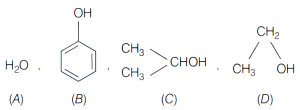
A
$A > D > C > B$
B
$A > B > C > D$
C
$B > C > D > A$
D
$B > A > D > C$
Solution
(D) The acidic strength of compounds is determined by the stability of their conjugate bases. More stable conjugate bases correspond to stronger acids.
$A$: $H_2O$ (Conjugate base: $OH^-$)
$B$: Phenol $(C_6H_5OH)$ (Conjugate base: Phenoxide ion,$C_6H_5O^-$,which is resonance stabilized)
$C$: Isopropyl alcohol $((CH_3)_2CHOH)$ (Conjugate base: Isopropoxide ion,$(CH_3)_2CHO^-$,destabilized by two electron-donating methyl groups)
$D$: Ethanol $(CH_3CH_2OH)$ (Conjugate base: Ethoxide ion,$CH_3CH_2O^-$,destabilized by one electron-donating ethyl group)
Stability order of conjugate bases: $C_6H_5O^- > OH^- > CH_3CH_2O^- > (CH_3)_2CHO^-$.
Therefore,the order of acidic strength is: $B > A > D > C$.
Thus,option $D$ is correct.
$A$: $H_2O$ (Conjugate base: $OH^-$)
$B$: Phenol $(C_6H_5OH)$ (Conjugate base: Phenoxide ion,$C_6H_5O^-$,which is resonance stabilized)
$C$: Isopropyl alcohol $((CH_3)_2CHOH)$ (Conjugate base: Isopropoxide ion,$(CH_3)_2CHO^-$,destabilized by two electron-donating methyl groups)
$D$: Ethanol $(CH_3CH_2OH)$ (Conjugate base: Ethoxide ion,$CH_3CH_2O^-$,destabilized by one electron-donating ethyl group)
Stability order of conjugate bases: $C_6H_5O^- > OH^- > CH_3CH_2O^- > (CH_3)_2CHO^-$.
Therefore,the order of acidic strength is: $B > A > D > C$.
Thus,option $D$ is correct.
0 likesView Solution
106
ChemistryMediumMCQTS EAMCET · 2019
The correct order of rates of $C-Br$ bond ionisation of the following bromides is
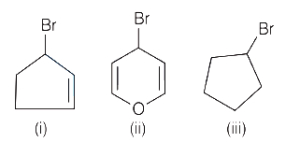
A
$i > ii > iii$
B
$ii > iii > i$
C
$i > iii > ii$
D
$ii > i > iii$
Solution
(D) The rate of $C-Br$ bond ionisation depends on the stability of the resulting carbocation. Greater stability of the carbocation leads to a faster rate of ionisation.
In species $(ii)$,the loss of $Br^-$ generates a pyrylium cation,which is aromatic ($6\pi$ electrons) and highly stable.
In species $(i)$,the loss of $Br^-$ generates an allylic carbocation,which is stabilized by resonance but is less stable than the aromatic pyrylium cation.
In species $(iii)$,the loss of $Br^-$ generates a secondary alkyl carbocation,which is the least stable among the three as it is only stabilized by hyperconjugation.
Therefore,the correct order of stability of carbocations and thus the rate of ionisation is $ii > i > iii$.
In species $(ii)$,the loss of $Br^-$ generates a pyrylium cation,which is aromatic ($6\pi$ electrons) and highly stable.
In species $(i)$,the loss of $Br^-$ generates an allylic carbocation,which is stabilized by resonance but is less stable than the aromatic pyrylium cation.
In species $(iii)$,the loss of $Br^-$ generates a secondary alkyl carbocation,which is the least stable among the three as it is only stabilized by hyperconjugation.
Therefore,the correct order of stability of carbocations and thus the rate of ionisation is $ii > i > iii$.
0 likesView Solution
107
ChemistryEasyMCQTS EAMCET · 2019
Identify $A$ and $B$ respectively in the following reactions:
$4 Au_{(s)} + 8 CN^{-}_{(aq)} + 2 H_2O_{(aq)} + O_{2(g)} \longrightarrow 4 A_{(aq)} + 4 OH^{-}_{(aq)}$
$2 A_{(aq)} + Zn_{(s)} \longrightarrow B_{(aq)} + 2 Au_{(s)}$
$4 Au_{(s)} + 8 CN^{-}_{(aq)} + 2 H_2O_{(aq)} + O_{2(g)} \longrightarrow 4 A_{(aq)} + 4 OH^{-}_{(aq)}$
$2 A_{(aq)} + Zn_{(s)} \longrightarrow B_{(aq)} + 2 Au_{(s)}$
A
$[Au(CN)_2]^{-} ; [Zn(CN)_4]^{2-}$
B
$Au(CN)_4 ; [Zn(CN)_4]^{2-}$
C
$HCN ; [Au(CN)_4]^{2-}$
D
$AuCN ; [HCN]$
Solution
(A) The extraction of gold involves the leaching of gold metal with cyanide ions in the presence of air $(O_2)$ to form the soluble complex $A$:
$4 Au_{(s)} + 8 CN^{-}_{(aq)} + 2 H_2O_{(aq)} + O_{2(g)} \longrightarrow 4 [Au(CN)_2]^{-}_{(aq)} (A) + 4 OH^{-}_{(aq)}$
Next,the gold is recovered from the complex by displacement with a more electropositive metal like zinc,forming the complex $B$:
$2 [Au(CN)_2]^{-}_{(aq)} + Zn_{(s)} \longrightarrow [Zn(CN)_4]^{2-}_{(aq)} (B) + 2 Au_{(s)}$
Thus,$A$ is $[Au(CN)_2]^{-}$ and $B$ is $[Zn(CN)_4]^{2-}$.
Therefore,option $A$ is the correct answer.
$4 Au_{(s)} + 8 CN^{-}_{(aq)} + 2 H_2O_{(aq)} + O_{2(g)} \longrightarrow 4 [Au(CN)_2]^{-}_{(aq)} (A) + 4 OH^{-}_{(aq)}$
Next,the gold is recovered from the complex by displacement with a more electropositive metal like zinc,forming the complex $B$:
$2 [Au(CN)_2]^{-}_{(aq)} + Zn_{(s)} \longrightarrow [Zn(CN)_4]^{2-}_{(aq)} (B) + 2 Au_{(s)}$
Thus,$A$ is $[Au(CN)_2]^{-}$ and $B$ is $[Zn(CN)_4]^{2-}$.
Therefore,option $A$ is the correct answer.
0 likesView Solution
108
ChemistryEasyMCQTS EAMCET · 2019
Statement $(A)$ $Mg$ can reduce $Al_2O_3$ above $1350^{\circ} C$.
Statement $(B)$ $Al$ can reduce $MgO$ below $1350^{\circ} C$.
The correct answer is
Statement $(B)$ $Al$ can reduce $MgO$ below $1350^{\circ} C$.
The correct answer is
A
Both $(A)$ and $(B)$ are wrong.
B
$(A)$ is correct,but $(B)$ is wrong.
C
$(A)$ is wrong,but $(B)$ is correct.
D
Both $(A)$ and $(B)$ are correct.
Solution
(A) According to the Ellingham diagram,the line for the formation of $MgO$ lies below the line for the formation of $Al_2O_3$ at temperatures below $1350^{\circ} C$.
Therefore,$Mg$ can reduce $Al_2O_3$ to $Al$ below $1350^{\circ} C$.
Above $1350^{\circ} C$,the line for $Al_2O_3$ formation lies below the line for $MgO$ formation.
Consequently,$Al$ can reduce $MgO$ to $Mg$ above $1350^{\circ} C$.
Since both statements contradict these facts,both $(A)$ and $(B)$ are wrong.
Therefore,$Mg$ can reduce $Al_2O_3$ to $Al$ below $1350^{\circ} C$.
Above $1350^{\circ} C$,the line for $Al_2O_3$ formation lies below the line for $MgO$ formation.
Consequently,$Al$ can reduce $MgO$ to $Mg$ above $1350^{\circ} C$.
Since both statements contradict these facts,both $(A)$ and $(B)$ are wrong.
0 likesView Solution
109
ChemistryMediumMCQTS EAMCET · 2019
Which of the following statements are correct related to metallurgy?
$A$. In electrolytic refining of copper,pure $Cu$ is used as anode.
$B$. Zone refining is based on the principle that impurities are more soluble in the melt than in the solid state of the metal.
$C$. $TiI_4$ upon heating will give pure $Ti$.
$D$. Very pure $Zr$ may be obtained by galvanisation.
$E$. In copper smelting,hot air is used to convert to $CuSO_4$.
The correct answer is
$A$. In electrolytic refining of copper,pure $Cu$ is used as anode.
$B$. Zone refining is based on the principle that impurities are more soluble in the melt than in the solid state of the metal.
$C$. $TiI_4$ upon heating will give pure $Ti$.
$D$. Very pure $Zr$ may be obtained by galvanisation.
$E$. In copper smelting,hot air is used to convert to $CuSO_4$.
The correct answer is
A
$A, B, C$
B
$B, C$
C
$C, D, E$
D
$A, C, E$
Solution
(B) . Incorrect: In electrolytic refining of copper,pure $Cu$ is used as the cathode,and impure $Cu$ is used as the anode.
$B$. Correct: Zone refining is based on the principle that impurities are more soluble in the melt than in the solid state of the metal.
$C$. Correct: $TiI_4$ on heating decomposes to give pure $Ti$ (Van Arkel method). $TiI_4 \xrightarrow{>1100^{\circ} C} Ti + 2I_2$.
$D$. Incorrect: Very pure $Zr$ is obtained by the Van Arkel method,not galvanisation.
$E$. Incorrect: In copper smelting,hot air is used to convert $Cu_2S$ to $Cu_2O$ and then to metallic $Cu$ (self-reduction),not $CuSO_4$.
Thus,the correct statements are $B$ and $C$.
$B$. Correct: Zone refining is based on the principle that impurities are more soluble in the melt than in the solid state of the metal.
$C$. Correct: $TiI_4$ on heating decomposes to give pure $Ti$ (Van Arkel method). $TiI_4 \xrightarrow{>1100^{\circ} C} Ti + 2I_2$.
$D$. Incorrect: Very pure $Zr$ is obtained by the Van Arkel method,not galvanisation.
$E$. Incorrect: In copper smelting,hot air is used to convert $Cu_2S$ to $Cu_2O$ and then to metallic $Cu$ (self-reduction),not $CuSO_4$.
Thus,the correct statements are $B$ and $C$.
0 likesView Solution
110
ChemistryMediumMCQTS EAMCET · 2019
Which one of the following is used to produce $Al$ by electrolysis?
A
Molten $Al_2O_3 + Na_3AlF_6$ electrolyte,carbon coated steel vessel cathode,graphite anode.
B
$Al_2O_3 + PbF_2$ electrolyte,steel cathode,graphite anode
C
Molten $Al_2O_3 + Na_3AlF_6$ electrolyte,graphite cathode,steel anode
D
$Al_2O_3 + H_2O$ electrolyte,graphite cathode,steel anode
Solution
(A) Molten $Al_2O_3 + Na_3AlF_6$ as electrolyte,carbon coated steel vessel cathode,and graphite anode are used to produce aluminium $(Al)$ by electrolysis.
This process is known as the Hall-$H$éroult process.
In this process,purified alumina is mixed with $Na_3AlF_6$ (cryolite),which lowers the melting point of the mixture and increases its electrical conductivity.
In the electrolytic cell,the steel vessel acts as the cathode (coated with carbon),and graphite rods act as the anode.
The overall reaction is $2Al_2O_3 + 3C \longrightarrow 4Al + 3CO_2 \uparrow$.
The electrolytic reactions are as follows:
$Al_2O_3 \longrightarrow 2Al^{3+} + 3O^{2-}$.
At cathode: $Al^{3+} + 3e^{-} \longrightarrow Al_{(l)}$.
At anode: $C_{(s)} + 2O^{2-} \longrightarrow CO_{2(g)} + 4e^{-}$.
The oxygen liberated at the anode reacts with the carbon of the anode to produce $CO_2$.
Hence,option $(A)$ is the correct answer.
This process is known as the Hall-$H$éroult process.
In this process,purified alumina is mixed with $Na_3AlF_6$ (cryolite),which lowers the melting point of the mixture and increases its electrical conductivity.
In the electrolytic cell,the steel vessel acts as the cathode (coated with carbon),and graphite rods act as the anode.
The overall reaction is $2Al_2O_3 + 3C \longrightarrow 4Al + 3CO_2 \uparrow$.
The electrolytic reactions are as follows:
$Al_2O_3 \longrightarrow 2Al^{3+} + 3O^{2-}$.
At cathode: $Al^{3+} + 3e^{-} \longrightarrow Al_{(l)}$.
At anode: $C_{(s)} + 2O^{2-} \longrightarrow CO_{2(g)} + 4e^{-}$.
The oxygen liberated at the anode reacts with the carbon of the anode to produce $CO_2$.
Hence,option $(A)$ is the correct answer.
0 likesView Solution
111
ChemistryMediumMCQTS EAMCET · 2019
Match the reactions in List-$I$ with the major products in List-$II$:
| List-$I$ | List-$II$ (Major Product) |
| :--- | :--- |
| $(A)$ $CH_3-CHBr-CH_2Br \xrightarrow{KOH/C_2H_5OH}$ | $(I)$ $1^{\circ}$-alkyl bromide |
| $(B)$ $CH_3-CH_2-CH=CH_2 \xrightarrow{HBr, (C_6H_5CO)_2O_2, \Delta}$ | $(II)$ $2^{\circ}$-alkyl bromide |
| $(C)$ $CH_3CH_2CH_3 \xrightarrow{Br_2, h\nu}$ | $(III)$ Allyl bromide |
| $(D)$ $CH_3-CH=CH_2 \xrightarrow{NBS, \Delta}$ | $(IV)$ Alkenyl bromide |
| List-$I$ | List-$II$ (Major Product) |
| :--- | :--- |
| $(A)$ $CH_3-CHBr-CH_2Br \xrightarrow{KOH/C_2H_5OH}$ | $(I)$ $1^{\circ}$-alkyl bromide |
| $(B)$ $CH_3-CH_2-CH=CH_2 \xrightarrow{HBr, (C_6H_5CO)_2O_2, \Delta}$ | $(II)$ $2^{\circ}$-alkyl bromide |
| $(C)$ $CH_3CH_2CH_3 \xrightarrow{Br_2, h\nu}$ | $(III)$ Allyl bromide |
| $(D)$ $CH_3-CH=CH_2 \xrightarrow{NBS, \Delta}$ | $(IV)$ Alkenyl bromide |
A
$A-IV, B-I, C-II, D-III$
B
$A-I, B-II, C-III, D-IV$
C
$A-IV, B-II, C-I, D-III$
D
$A-III, B-I, C-II, D-IV$
Solution
(A) The reactions are analyzed as follows:
$(A)$ $CH_3-CHBr-CH_2Br \xrightarrow{alc. KOH} CH_3-C \equiv CH$ or $CH_3-CH=CHBr$. This is a dehydrohalogenation reaction yielding an alkenyl bromide $(IV)$.
$(B)$ $CH_3-CH_2-CH=CH_2 \xrightarrow{HBr, \text{peroxide}} CH_3-CH_2-CH_2-CH_2Br$. This is Anti-Markovnikov addition,yielding a $1^{\circ}$-alkyl bromide $(I)$.
$(C)$ $CH_3-CH_2-CH_3 \xrightarrow{Br_2, h\nu} CH_3-CHBr-CH_3$. Free radical bromination occurs preferentially at the $2^{\circ}$ carbon to form a $2^{\circ}$-alkyl bromide $(II)$.
$(D)$ $CH_3-CH=CH_2 \xrightarrow{NBS, \Delta} BrCH_2-CH=CH_2$. $NBS$ ($N$-Bromosuccinimide) performs allylic bromination,yielding allyl bromide $(III)$.
Therefore,the correct matching is $A-IV, B-I, C-II, D-III$.
$(A)$ $CH_3-CHBr-CH_2Br \xrightarrow{alc. KOH} CH_3-C \equiv CH$ or $CH_3-CH=CHBr$. This is a dehydrohalogenation reaction yielding an alkenyl bromide $(IV)$.
$(B)$ $CH_3-CH_2-CH=CH_2 \xrightarrow{HBr, \text{peroxide}} CH_3-CH_2-CH_2-CH_2Br$. This is Anti-Markovnikov addition,yielding a $1^{\circ}$-alkyl bromide $(I)$.
$(C)$ $CH_3-CH_2-CH_3 \xrightarrow{Br_2, h\nu} CH_3-CHBr-CH_3$. Free radical bromination occurs preferentially at the $2^{\circ}$ carbon to form a $2^{\circ}$-alkyl bromide $(II)$.
$(D)$ $CH_3-CH=CH_2 \xrightarrow{NBS, \Delta} BrCH_2-CH=CH_2$. $NBS$ ($N$-Bromosuccinimide) performs allylic bromination,yielding allyl bromide $(III)$.
Therefore,the correct matching is $A-IV, B-I, C-II, D-III$.
0 likesView Solution
112
ChemistryMediumMCQTS EAMCET · 2019
Find the correct order of acid strengths of the following compounds:
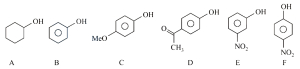
A
$F > E > D > B > C > A$
B
$D > F > E > C > B > A$
C
$D > E > F > B > C > A$
D
$F > D > E > B > C > A$
Solution
(A) The acidity of phenols depends on the stability of the phenoxide ion formed after the loss of a proton. Electron-withdrawing groups $(EWG)$ stabilize the phenoxide ion,increasing acidity,while electron-donating groups $(EDG)$ destabilize it,decreasing acidity.
$1$. $A$ (Cyclohexanol): The conjugate base is an alkoxide ion,which is less stable than the phenoxide ion. Thus,$A$ is the least acidic.
$2$. $B$ (Phenol): The reference compound.
$3$. $C$ (p-Methoxyphenol): $-OCH_3$ is an $EDG$ by resonance (+$M$ effect),which destabilizes the phenoxide ion. Thus,$C < B$.
$4$. $D$ (p-Hydroxyacetophenone): $-COCH_3$ is an $EWG$ (-$M$ effect),which stabilizes the phenoxide ion. Thus,$D > B$.
$5$. $E$ (m-Nitrophenol): $-NO_2$ is a strong $EWG$ (-$I$ and -$M$ effects). At the meta position,only the -$I$ effect operates. Thus,$E > B$.
$6$. $F$ (p-Nitrophenol): $-NO_2$ at the para position exerts both -$I$ and -$M$ effects,providing maximum stabilization to the phenoxide ion. Thus,$F > E$.
Comparing the $EWG$ strengths: $p-NO_2$ $(F)$ > $m-NO_2$ $(E)$ > $p-COCH_3$ $(D)$.
Comparing the $EDG$ strengths: $p-OCH_3$ $(C)$ destabilizes more than $B$. $A$ is the least acidic.
The correct order is $F > E > D > B > C > A$.
$1$. $A$ (Cyclohexanol): The conjugate base is an alkoxide ion,which is less stable than the phenoxide ion. Thus,$A$ is the least acidic.
$2$. $B$ (Phenol): The reference compound.
$3$. $C$ (p-Methoxyphenol): $-OCH_3$ is an $EDG$ by resonance (+$M$ effect),which destabilizes the phenoxide ion. Thus,$C < B$.
$4$. $D$ (p-Hydroxyacetophenone): $-COCH_3$ is an $EWG$ (-$M$ effect),which stabilizes the phenoxide ion. Thus,$D > B$.
$5$. $E$ (m-Nitrophenol): $-NO_2$ is a strong $EWG$ (-$I$ and -$M$ effects). At the meta position,only the -$I$ effect operates. Thus,$E > B$.
$6$. $F$ (p-Nitrophenol): $-NO_2$ at the para position exerts both -$I$ and -$M$ effects,providing maximum stabilization to the phenoxide ion. Thus,$F > E$.
Comparing the $EWG$ strengths: $p-NO_2$ $(F)$ > $m-NO_2$ $(E)$ > $p-COCH_3$ $(D)$.
Comparing the $EDG$ strengths: $p-OCH_3$ $(C)$ destabilizes more than $B$. $A$ is the least acidic.
The correct order is $F > E > D > B > C > A$.
0 likesView Solution
113
ChemistryMediumMCQTS EAMCET · 2019
Find the reactants which on heating with alcoholic $KOH$ produce the compound $CH_3-CH_2-CH_2-CH=CH_2$.
$(i) \ CH_3-CH(Br)-CH_2-CH_2-CH_3$
$(ii) \ CH_3-CH_2-CH(Br)-CH_2-CH_3$
$(iii) \ CH_3-CH_2-CH_2-CH_2-CH_2Br$
$(iv) \ CH_3-CH_2-CH_2-CH(Br)-CH_3$
$(i) \ CH_3-CH(Br)-CH_2-CH_2-CH_3$
$(ii) \ CH_3-CH_2-CH(Br)-CH_2-CH_3$
$(iii) \ CH_3-CH_2-CH_2-CH_2-CH_2Br$
$(iv) \ CH_3-CH_2-CH_2-CH(Br)-CH_3$
A
$(ii), (iv)$
B
$(i), (iv)$
C
$(ii), (iii), (iv)$
D
$(i), (ii)$
Solution
(B) Dehydrohalogenation of haloalkanes with alcoholic $KOH$ follows Zaitsev's rule,where the more substituted alkene is the major product. However,the target product is $pent-1-ene$ $(CH_3-CH_2-CH_2-CH=CH_2)$.
$(i) \ CH_3-CH(Br)-CH_2-CH_2-CH_3$ on dehydrohalogenation gives $pent-1-ene$ and $pent-2-ene$.
$(ii) \ CH_3-CH_2-CH(Br)-CH_2-CH_3$ on dehydrohalogenation gives $pent-2-ene$.
$(iii) \ CH_3-CH_2-CH_2-CH_2-CH_2Br$ on dehydrohalogenation gives $pent-1-ene$.
$(iv) \ CH_3-CH_2-CH_2-CH(Br)-CH_3$ on dehydrohalogenation gives $pent-1-ene$ and $pent-2-ene$.
Thus,reactants $(i)$,$(iii)$,and $(iv)$ can produce $pent-1-ene$. Given the options,$(i)$ and $(iv)$ are the most appropriate choices for producing the terminal alkene.
$(i) \ CH_3-CH(Br)-CH_2-CH_2-CH_3$ on dehydrohalogenation gives $pent-1-ene$ and $pent-2-ene$.
$(ii) \ CH_3-CH_2-CH(Br)-CH_2-CH_3$ on dehydrohalogenation gives $pent-2-ene$.
$(iii) \ CH_3-CH_2-CH_2-CH_2-CH_2Br$ on dehydrohalogenation gives $pent-1-ene$.
$(iv) \ CH_3-CH_2-CH_2-CH(Br)-CH_3$ on dehydrohalogenation gives $pent-1-ene$ and $pent-2-ene$.
Thus,reactants $(i)$,$(iii)$,and $(iv)$ can produce $pent-1-ene$. Given the options,$(i)$ and $(iv)$ are the most appropriate choices for producing the terminal alkene.
0 likesView Solution
114
ChemistryEasyMCQTS EAMCET · 2019
Identify the correct order of reactivity of the following haloarenes on treatment with $NaOH$?
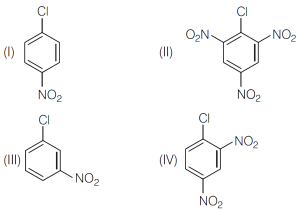
A
$II > I > IV > III$
B
$I > III > IV > II$
C
$II > IV > I > III$
D
$II > III > IV > I$
Solution
(C) The reactivity of haloarenes towards nucleophilic substitution with $NaOH$ increases with the presence of electron-withdrawing groups (like $-NO_2$) on the benzene ring. These groups stabilize the carbanion intermediate formed during the reaction by withdrawing electron density through inductive and resonance effects.
$1$. Compound $(II)$ has three $-NO_2$ groups (at ortho and para positions),providing maximum stabilization.
$2$. Compound $(IV)$ has two $-NO_2$ groups (at ortho and para positions).
$3$. Compound $(I)$ has one $-NO_2$ group at the para position.
$4$. Compound $(III)$ has one $-NO_2$ group at the meta position,which provides the least stabilization compared to ortho/para positions because the negative charge is not delocalized onto the $-NO_2$ group via resonance.
Thus,the order of reactivity is $(II) > (IV) > (I) > (III)$.
Hence,option $(C)$ is correct.
$1$. Compound $(II)$ has three $-NO_2$ groups (at ortho and para positions),providing maximum stabilization.
$2$. Compound $(IV)$ has two $-NO_2$ groups (at ortho and para positions).
$3$. Compound $(I)$ has one $-NO_2$ group at the para position.
$4$. Compound $(III)$ has one $-NO_2$ group at the meta position,which provides the least stabilization compared to ortho/para positions because the negative charge is not delocalized onto the $-NO_2$ group via resonance.
Thus,the order of reactivity is $(II) > (IV) > (I) > (III)$.
Hence,option $(C)$ is correct.
0 likesView Solution
115
ChemistryMediumMCQTS EAMCET · 2019
What are two types of crystal structures shown by ice at different pressures?
A
Hexagonal and monoclinic
B
Cubic and monoclinic
C
Hexagonal and tetragonal
D
Cubic and hexagonal
Solution
(D) Ice exhibits polymorphism,meaning it can exist in different crystal structures depending on temperature and pressure.
The two most common forms are hexagonal ice (ice $I_h$),which is the ordinary form of ice found in nature,and cubic ice (ice $I_c$),which has a crystal structure similar to diamond.
Cubic ice is typically formed by the deposition of water vapor at very low temperatures (below $140 \ K$).
The two most common forms are hexagonal ice (ice $I_h$),which is the ordinary form of ice found in nature,and cubic ice (ice $I_c$),which has a crystal structure similar to diamond.
Cubic ice is typically formed by the deposition of water vapor at very low temperatures (below $140 \ K$).
0 likesView Solution
116
ChemistryEasyMCQTS EAMCET · 2019
How many nearest neighbours are there for $Si$ and $O$ atoms in quartz crystals?
A
$4$ $(Si)$; $2$ $(O)$
B
$4$ $(Si)$; $4$ $(O)$
C
$2$ $(Si)$; $2$ $(O)$
D
$3$ $(Si)$; $2$ $(O)$
Solution
(A) Quartz is $SiO_2$ (silicon dioxide) in which $SiO_2$ units are present as a giant crystal lattice.
In the $SiO_2$ crystal structure,each $Si$ atom is tetrahedrally surrounded by $4$ $O$ atoms,meaning it has $4$ nearest neighbours.
Each $O$ atom is bonded to $2$ $Si$ atoms,meaning it has $2$ nearest neighbours.
Therefore,the correct option is $(A)$.
In the $SiO_2$ crystal structure,each $Si$ atom is tetrahedrally surrounded by $4$ $O$ atoms,meaning it has $4$ nearest neighbours.
Each $O$ atom is bonded to $2$ $Si$ atoms,meaning it has $2$ nearest neighbours.
Therefore,the correct option is $(A)$.
0 likesView Solution
117
ChemistryMediumMCQTS EAMCET · 2019
Statement $(A)$: Among the oxides of nitrogen,$NO$ and $NO_2$ are paramagnetic.
Statement $(B)$: $NO$ is paramagnetic in the gaseous state and diamagnetic in the liquid state.
The correct answer is:
Statement $(B)$: $NO$ is paramagnetic in the gaseous state and diamagnetic in the liquid state.
The correct answer is:
A
$(A)$ is correct,$(B)$ is not correct
B
Both $(A)$ and $(B)$ are not correct
C
$(A)$ is not correct,$(B)$ is correct
D
Both $(A)$ and $(B)$ are correct
Solution
(D) Statement $(A)$: $NO$ has $11$ valence electrons (odd number),making it paramagnetic. $NO_2$ has $17$ valence electrons (odd number),making it paramagnetic. Thus,statement $(A)$ is correct.
Statement $(B)$: In the gaseous state,$NO$ exists as a monomer with an unpaired electron,making it paramagnetic. In the liquid and solid states,$NO$ dimerizes to form $N_2O_2$,where all electrons are paired,making it diamagnetic. Thus,statement $(B)$ is correct.
Therefore,both statements are correct,and option $(D)$ is the correct answer.
Statement $(B)$: In the gaseous state,$NO$ exists as a monomer with an unpaired electron,making it paramagnetic. In the liquid and solid states,$NO$ dimerizes to form $N_2O_2$,where all electrons are paired,making it diamagnetic. Thus,statement $(B)$ is correct.
Therefore,both statements are correct,and option $(D)$ is the correct answer.
0 likesView Solution
118
ChemistryMediumMCQTS EAMCET · 2019
Match the following List-$I$ (Acid) with List-$II$ (Reagents used for preparation):
| List-$I$ (Acid) | List-$II$ (Reagents used for preparation) |
| :--- | :--- |
| $A. H_3PO_2$ | $I. \text{Red } P_4 \text{alkali}$ |
| $B. H_4P_2O_5$ | $II. \text{White } P_4 \text{alkali}$ |
| $C. H_3PO_4$ | $III. PCl_3; H_3PO_3$ |
| $D. H_4P_2O_7$ | $IV. P_2O_5; H_2O$ |
| | $V. H_3PO_4; \Delta$ |
| List-$I$ (Acid) | List-$II$ (Reagents used for preparation) |
| :--- | :--- |
| $A. H_3PO_2$ | $I. \text{Red } P_4 \text{alkali}$ |
| $B. H_4P_2O_5$ | $II. \text{White } P_4 \text{alkali}$ |
| $C. H_3PO_4$ | $III. PCl_3; H_3PO_3$ |
| $D. H_4P_2O_7$ | $IV. P_2O_5; H_2O$ |
| | $V. H_3PO_4; \Delta$ |
A
$A-II, B-III, C-IV, D-V$
B
$A-I, B-III, C-IV, D-V$
C
$A-II, B-III, C-V, D-IV$
D
$A-I, B-II, C-III, D-IV$
Solution
(A) The correct matches are:
$A. H_3PO_2$: Prepared by the reaction of white $P_4$ with alkali. $(A-II)$
$B. H_4P_2O_5$: Prepared by the reaction of $PCl_3$ with $H_3PO_3$. $(B-III)$
$C. H_3PO_4$: Prepared by the reaction of $P_2O_5$ with $H_2O$. $(C-IV)$
$D. H_4P_2O_7$: Prepared by the thermal dehydration $(\Delta)$ of $H_3PO_4$. $(D-V)$
Thus,the correct matching is $A-II, B-III, C-IV, D-V$.
$A. H_3PO_2$: Prepared by the reaction of white $P_4$ with alkali. $(A-II)$
$B. H_4P_2O_5$: Prepared by the reaction of $PCl_3$ with $H_3PO_3$. $(B-III)$
$C. H_3PO_4$: Prepared by the reaction of $P_2O_5$ with $H_2O$. $(C-IV)$
$D. H_4P_2O_7$: Prepared by the thermal dehydration $(\Delta)$ of $H_3PO_4$. $(D-V)$
Thus,the correct matching is $A-II, B-III, C-IV, D-V$.
0 likesView Solution
119
ChemistryDifficultMCQTS EAMCET · 2019
What are the compounds formed when white phosphorus is dissolved in boiling $NaOH$ solution in an inert atmosphere?
A
$PH_3, Na_3PO_4$
B
$NaH_2PO_4, P(OH)_3$
C
$PH_3, NaH_2PO_2$
D
$P_4O_{10}, Na$
Solution
(C) White phosphorus $(P_4)$ undergoes disproportionation reaction when dissolved in boiling $NaOH$ solution in an inert atmosphere (e.g.,$CO_2$ or $N_2$ atmosphere) to produce phosphine $(PH_3)$ and sodium hypophosphite $(NaH_2PO_2)$.
The chemical equation for the reaction is:
$P_4 + 3NaOH + 3H_2O \longrightarrow PH_3 + 3NaH_2PO_2$
Therefore,the products formed are phosphine and sodium hypophosphite.
Hence,option $C$ is correct.
The chemical equation for the reaction is:
$P_4 + 3NaOH + 3H_2O \longrightarrow PH_3 + 3NaH_2PO_2$
Therefore,the products formed are phosphine and sodium hypophosphite.
Hence,option $C$ is correct.
0 likesView Solution
120
ChemistryDifficultMCQTS EAMCET · 2019
The elements with the highest and the lowest enthalpy of atomisation respectively,for first row transition elements are:
A
$Sc, Zn$
B
$Ti, Ni$
C
$V, Zn$
D
$Cr, Zn$
Solution
(D) The enthalpy of atomisation is the enthalpy change that accompanies the total separation of all atoms in a chemical substance.
The extent of metallic bonding an element undergoes decides the enthalpy of atomisation. The more extensive the metallic bonding of an element,the higher will be its enthalpy of atomisation.
$Cr$ $(3d^5 4s^1)$ has the highest enthalpy of atomisation for the first row of transition elements due to the maximum number of unpaired electrons available for metallic bonding.
$Zn$ $(3d^{10} 4s^2)$ has a completely filled $d$-orbital and has no unpaired electrons to participate in the formation of metallic bonds. Therefore,the metallic bonding in zinc is the weakest,resulting in the lowest enthalpy of atomisation.
The extent of metallic bonding an element undergoes decides the enthalpy of atomisation. The more extensive the metallic bonding of an element,the higher will be its enthalpy of atomisation.
$Cr$ $(3d^5 4s^1)$ has the highest enthalpy of atomisation for the first row of transition elements due to the maximum number of unpaired electrons available for metallic bonding.
$Zn$ $(3d^{10} 4s^2)$ has a completely filled $d$-orbital and has no unpaired electrons to participate in the formation of metallic bonds. Therefore,the metallic bonding in zinc is the weakest,resulting in the lowest enthalpy of atomisation.
0 likesView Solution
121
ChemistryMediumMCQTS EAMCET · 2019
Statement $(A)$ Sulphur vapour is paramagnetic. Statement $(B)$ Reaction of dil. $HCl$ with finely divided iron forms $FeCl_3$ and $H_2$ gas. The correct answer is
A
Statement $(A)$ is correct,but $(B)$ is wrong.
B
Both the statements are correct.
C
Statement $(A)$ is wrong,but $(B)$ is correct.
D
Both the statements are wrong.
Solution
(A) Statement $(A)$ is correct because sulphur vapour exists as $S_2$ at high temperatures,which is paramagnetic due to the presence of two unpaired electrons in its antibonding molecular orbitals,similar to $O_2$.
Statement $(B)$ is incorrect because the reaction of dilute $HCl$ with iron produces $FeCl_2$ and $H_2$ gas,not $FeCl_3$.
The reaction is: $Fe(s) + 2HCl(dil.) \longrightarrow FeCl_2(aq) + H_2(g)$.
The $H_2$ gas produced acts as a reducing agent and prevents the oxidation of $Fe^{2+}$ to $Fe^{3+}$.
Therefore,statement $(A)$ is correct and statement $(B)$ is wrong.
Statement $(B)$ is incorrect because the reaction of dilute $HCl$ with iron produces $FeCl_2$ and $H_2$ gas,not $FeCl_3$.
The reaction is: $Fe(s) + 2HCl(dil.) \longrightarrow FeCl_2(aq) + H_2(g)$.
The $H_2$ gas produced acts as a reducing agent and prevents the oxidation of $Fe^{2+}$ to $Fe^{3+}$.
Therefore,statement $(A)$ is correct and statement $(B)$ is wrong.
0 likesView Solution
122
ChemistryEasyMCQTS EAMCET · 2019
The reason for the noble gases to have low boiling and low melting points is:
A
atoms of the noble gases have weak covalent interaction
B
atoms of the noble gases have weak dipole interaction
C
atoms of the noble gases have weak van der Waals' interaction
D
None of these.
Solution
(C) Noble gases consist of monoatomic molecules with stable electronic configurations.
Due to the lack of permanent dipoles or chemical bonding between atoms,the only forces of attraction between them are weak van der Waals' forces (also known as London dispersion forces).
These weak forces require very little energy to overcome,resulting in low melting and boiling points.
Due to the lack of permanent dipoles or chemical bonding between atoms,the only forces of attraction between them are weak van der Waals' forces (also known as London dispersion forces).
These weak forces require very little energy to overcome,resulting in low melting and boiling points.
0 likesView Solution
123
ChemistryEasyMCQTS EAMCET · 2019
Identify all the products formed when $XeF_4$ is completely hydrolysed.
A
$Xe, XeO_3, O_2, HF$
B
$Xe, O_2, HF$
C
$XeO_3, O_2$
D
$XeO_3$
Solution
(A) The complete hydrolysis of $XeF_4$ is represented by the following chemical equation:
$6 XeF_4 + 12 H_2O \longrightarrow 2 XeO_3 + 4 Xe + 3 O_2 + 24 HF$
As shown in the equation,the products formed are $Xe$,$XeO_3$,$O_2$,and $HF$.
Therefore,option $(A)$ is the correct answer.
$6 XeF_4 + 12 H_2O \longrightarrow 2 XeO_3 + 4 Xe + 3 O_2 + 24 HF$
As shown in the equation,the products formed are $Xe$,$XeO_3$,$O_2$,and $HF$.
Therefore,option $(A)$ is the correct answer.
0 likesView Solution
124
ChemistryMediumMCQTS EAMCET · 2019
The enzyme responsible for the conversion of proteins to $\alpha$-amino acids is
A
Pepsin
B
Trypsin
C
Maltase
D
Amylase
Solution
(B) Proteins are hydrolyzed into $\alpha$-amino acids in the presence of proteolytic enzymes. Both $Pepsin$ and $Trypsin$ are proteolytic enzymes. However,in the context of standard biochemical pathways for protein digestion in the small intestine,$Trypsin$ is the primary enzyme responsible for the conversion of proteins into smaller peptides and $\alpha$-amino acids. $Pepsin$ acts primarily in the stomach.
0 likesView Solution
125
ChemistryMediumMCQTS EAMCET · 2019
Match the following:
| List-$I$ | List-$II$ |
|---|---|
| $A$. $(CH_2-C(Cl)=CH-CH_2)_n$ | $I$. Cross-linked network |
| $B$. Nylon-$6,6$ | $II$. Elastomer |
| $C$. $HDP$ | $III$. Fibre |
| $D$. Melamine-formaldehyde | $IV$. Ziegler-Natta catalyst |
A
$A-II, B-III, C-IV, D-I$
B
$A-I, B-II, C-III, D-IV$
C
$A-II, B-III, C-I, D-IV$
D
$A-IV, B-III, C-II, D-I$
Solution
(A) . The polymer $(CH_2-C(Cl)=CH-CH_2)_n$ is Neoprene,which is an elastomer.
$B$. Nylon-$6,6$ is a synthetic polymer classified as a fibre.
$C$. High-density polyethylene $(HDP)$ is synthesized using a Ziegler-Natta catalyst.
$D$. Melamine-formaldehyde is a thermosetting polymer with a cross-linked network structure.
Therefore,the correct matching is $A-II, B-III, C-IV, D-I$.
$B$. Nylon-$6,6$ is a synthetic polymer classified as a fibre.
$C$. High-density polyethylene $(HDP)$ is synthesized using a Ziegler-Natta catalyst.
$D$. Melamine-formaldehyde is a thermosetting polymer with a cross-linked network structure.
Therefore,the correct matching is $A-II, B-III, C-IV, D-I$.
0 likesView Solution
126
ChemistryEasyMCQTS EAMCET · 2019
The monomer units of nylon-$6, 6$ and nylon-$2$-nylon-$6$ are respectively:
A
$H_2N(CH_2)_6NH_2, HO_2C(CH_2)_4CO_2H$ and $H_2NCH_2CO_2H, H_2N(CH_2)_5CO_2H$
B
$H_2NCH_2CO_2H, HO_2C(CH_2)_4CO_2H$ and $H_2N(CH_2)_6NH_2, H_2N(CH_2)_5CO_2H$
C
$H_2N(CH_2)_6NH_2, HO_2C(CH_2)_4CO_2H$ and $H_2NCH_2CO_2H, H_2N(CH_2)_5CO_2H$
D
$H_2NCH_2CO_2H, H_2N(CH_2)_5CO_2H$ and $H_2N(CH_2)_6NH_2, HO_2C(CH_2)_4CO_2H$
Solution
(C) The monomer units of nylon-$6, 6$ are hexamethylene diamine,$H_2N(CH_2)_6NH_2$ and adipic acid,$HO_2C(CH_2)_4CO_2H$.
The monomer units of nylon-$2$-nylon-$6$ are glycine,$H_2NCH_2COOH$ and aminocaproic acid,$H_2N(CH_2)_5COOH$.
Therefore,the correct option is $C$.
The monomer units of nylon-$2$-nylon-$6$ are glycine,$H_2NCH_2COOH$ and aminocaproic acid,$H_2N(CH_2)_5COOH$.
Therefore,the correct option is $C$.
0 likesView Solution
127
ChemistryEasyMCQTS EAMCET · 2019
Which of the following polymers is formed due to the copolymerisation of $1,3-$butadiene and phenylethene?
A
Buna-$N$
B
Neoprene
C
Novalac
D
Buna-$S$
Solution
(D) The copolymerisation of $1,3-$butadiene and phenylethene (styrene) results in the formation of Buna-$S$ (also known as $SBR$).
The reaction is as follows:
$n CH_2=CH-CH=CH_2 + n CH_2=CH(C_6H_5) \rightarrow -[CH_2-CH=CH-CH_2-CH_2-CH(C_6H_5)]_n-$
Hence,option $(d)$ is the correct answer.
The reaction is as follows:
$n CH_2=CH-CH=CH_2 + n CH_2=CH(C_6H_5) \rightarrow -[CH_2-CH=CH-CH_2-CH_2-CH(C_6H_5)]_n-$
Hence,option $(d)$ is the correct answer.
0 likesView Solution
128
ChemistryMediumTS EAMCET · 2019
Match the following items in List-$I$ with their corresponding monomer units in List-$II$.
| List-$I$ | List-$II$ |
|---|---|
| $A$. Natural rubber | $i$. $\beta$-glucose |
| $B$. Cellulose | $ii$. Isoprene |
| $C$. Nylon-$6$ | $iii$. Tetrafluoroethylene |
| $D$. Teflon | $iv$. Caprolactam |
Solution
(A-II, B-I, C-IV, D-III) The correct matches are as follows:
$A$. Natural rubber is a polymer of isoprene ($2$-methyl-$1,3$-butadiene). Thus,$A \rightarrow ii$.
$B$. Cellulose is a polysaccharide consisting of a linear chain of $\beta(1-4)$ linked $\beta$-$D$-glucose units. Thus,$B \rightarrow i$.
$C$. The monomer unit of Nylon-$6$ is caprolactam. Thus,$C \rightarrow iv$.
$D$. Teflon is formed by the polymerization of tetrafluoroethylene monomer units: $n(CF_2=CF_2) \rightarrow -(CF_2-CF_2)_n-$. Thus,$D \rightarrow iii$.
The correct matching is $A-ii, B-i, C-iv, D-iii$.
$A$. Natural rubber is a polymer of isoprene ($2$-methyl-$1,3$-butadiene). Thus,$A \rightarrow ii$.
$B$. Cellulose is a polysaccharide consisting of a linear chain of $\beta(1-4)$ linked $\beta$-$D$-glucose units. Thus,$B \rightarrow i$.
$C$. The monomer unit of Nylon-$6$ is caprolactam. Thus,$C \rightarrow iv$.
$D$. Teflon is formed by the polymerization of tetrafluoroethylene monomer units: $n(CF_2=CF_2) \rightarrow -(CF_2-CF_2)_n-$. Thus,$D \rightarrow iii$.
The correct matching is $A-ii, B-i, C-iv, D-iii$.
0 likesView Solution
129
ChemistryMediumMCQTS EAMCET · 2019
How many grams of glucose are required to prepare an aqueous solution of glucose having a vapor pressure of $23.324 \ mm \ Hg$ at $25^{\circ} C$ in $100 \ g$ of water? The vapor pressure of pure water at $25^{\circ} C$ is $23.8 \ mm \ Hg$.
A
$20.4$
B
$10.3$
C
$5.4$
D
$7.4$
Solution
(A) According to Raoult's law for non-volatile solutes:
$\frac{P^0 - P_s}{P^0} = \frac{n_2}{n_1 + n_2} \approx \frac{n_2}{n_1}$ (for dilute solutions).
Given: $P^0 = 23.8 \ mm \ Hg$,$P_s = 23.324 \ mm \ Hg$,$W_1 = 100 \ g$ (water),$M_1 = 18 \ g/mol$,$M_2 = 180 \ g/mol$ (glucose).
Relative lowering of vapor pressure: $\frac{23.8 - 23.324}{23.8} = \frac{0.476}{23.8} = 0.02$.
Using the formula: $\frac{0.476}{23.8} = \frac{W_2 / 180}{100 / 18}$.
$0.02 = \frac{W_2}{180} \times \frac{18}{100} = \frac{W_2}{1000}$.
$W_2 = 0.02 \times 1000 = 20.4 \ g$.
$\frac{P^0 - P_s}{P^0} = \frac{n_2}{n_1 + n_2} \approx \frac{n_2}{n_1}$ (for dilute solutions).
Given: $P^0 = 23.8 \ mm \ Hg$,$P_s = 23.324 \ mm \ Hg$,$W_1 = 100 \ g$ (water),$M_1 = 18 \ g/mol$,$M_2 = 180 \ g/mol$ (glucose).
Relative lowering of vapor pressure: $\frac{23.8 - 23.324}{23.8} = \frac{0.476}{23.8} = 0.02$.
Using the formula: $\frac{0.476}{23.8} = \frac{W_2 / 180}{100 / 18}$.
$0.02 = \frac{W_2}{180} \times \frac{18}{100} = \frac{W_2}{1000}$.
$W_2 = 0.02 \times 1000 = 20.4 \ g$.
0 likesView Solution
130
ChemistryMediumMCQTS EAMCET · 2019
If an element having atomic number $96$ crystallises in a cubic lattice with a density of $10.3 \ g \ cm^{-3}$ and an edge length of $314 \ pm$, then the structure of the solid is:
A
hcp
B
fcc
C
bcc
D
simple cubic
Solution
(D) Given: Density $(d) = 10.3 \ g \ cm^{-3}$, Edge length $(a) = 314 \ pm = 314 \times 10^{-10} \ cm$, Molar mass $(M) = 247 \ g \ mol^{-1}$ (for element with atomic number $96$), Avogadro number $(N_A) = 6.022 \times 10^{23} \ mol^{-1}$.
Using the formula: $d = \frac{Z \times M}{a^3 \times N_A}$.
Rearranging for $Z$: $Z = \frac{d \times a^3 \times N_A}{M}$.
Substituting the values: $Z = \frac{10.3 \times (314 \times 10^{-10})^3 \times 6.022 \times 10^{23}}{247}$.
$Z = \frac{10.3 \times 3.0959 \times 10^{-23} \times 6.022 \times 10^{23}}{247} \approx \frac{192.0}{247} \approx 0.777 \approx 1$.
Since $Z = 1$, the structure of the solid is simple cubic.
Using the formula: $d = \frac{Z \times M}{a^3 \times N_A}$.
Rearranging for $Z$: $Z = \frac{d \times a^3 \times N_A}{M}$.
Substituting the values: $Z = \frac{10.3 \times (314 \times 10^{-10})^3 \times 6.022 \times 10^{23}}{247}$.
$Z = \frac{10.3 \times 3.0959 \times 10^{-23} \times 6.022 \times 10^{23}}{247} \approx \frac{192.0}{247} \approx 0.777 \approx 1$.
Since $Z = 1$, the structure of the solid is simple cubic.
0 likesView Solution
131
ChemistryMediumMCQTS EAMCET · 2019
Match the following:
| List-$I$ | List-$II$ |
|---|---|
| $A$. $ABCABC...$ layers | $I$. $F$-centres |
| $B$. Thermodynamics defects | $II$. $X$-ray diffraction |
| $C$. $Farbenzenter$ | $III$. Vacancy defects |
| $D$. $Debye-Scherrer$ method | $IV$. Semiconductors |
| $V$. Silver |
A
$A-V, B-III, C-I, D-II$
B
$A-V, B-III, C-II, D-I$
C
$A-III, B-V, C-I, D-II$
D
$A-V, B-III, C-I, D-IV$
Solution
(A) $A \rightarrow V$: $ABCABC...$ packing (cubic close packing) is observed in silver $(Ag)$.
$B \rightarrow III$: Point defects are often called thermodynamic defects because their concentration depends on temperature.
$C \rightarrow I$: $Farbenzenter$ (colour centres) are $F$-centres where anionic vacancies are occupied by electrons.
$D \rightarrow II$: The $Debye-Scherrer$ method is a technique used for $X$-ray diffraction of powder samples.
Therefore,the correct matching is $A-V, B-III, C-I, D-II$,which corresponds to option $A$.
$B \rightarrow III$: Point defects are often called thermodynamic defects because their concentration depends on temperature.
$C \rightarrow I$: $Farbenzenter$ (colour centres) are $F$-centres where anionic vacancies are occupied by electrons.
$D \rightarrow II$: The $Debye-Scherrer$ method is a technique used for $X$-ray diffraction of powder samples.
Therefore,the correct matching is $A-V, B-III, C-I, D-II$,which corresponds to option $A$.
0 likesView Solution
132
ChemistryDifficultMCQTS EAMCET · 2019
How many of the following compounds show ferrimagnetism?
$Fe_3O_4; MgFe_2O_4; NiFe_2O_4; MnO; CrO_2$
$Fe_3O_4; MgFe_2O_4; NiFe_2O_4; MnO; CrO_2$
A
$1$
B
$2$
C
$3$
D
$4$
Solution
(C) In ferrimagnetic substances,the magnetic moments of the domains are aligned in parallel and antiparallel directions in unequal numbers.
The net magnetic moment is non-zero but small.
These substances are weakly attracted by a magnetic field compared to ferromagnetic substances and lose their ferrimagnetism on heating,becoming paramagnetic.
Examples include $Fe_3O_4$ (magnetite) and ferrites like $MgFe_2O_4$ and $NiFe_2O_4$.
Among the given compounds:
$1$. $Fe_3O_4$: Ferrimagnetic
$2$. $MgFe_2O_4$: Ferrimagnetic
$3$. $NiFe_2O_4$: Ferrimagnetic
$4$. $MnO$: Antiferromagnetic
$5$. $CrO_2$: Ferromagnetic
Thus,there are $3$ compounds that show ferrimagnetism.
Therefore,option $C$ is the correct answer.
The net magnetic moment is non-zero but small.
These substances are weakly attracted by a magnetic field compared to ferromagnetic substances and lose their ferrimagnetism on heating,becoming paramagnetic.
Examples include $Fe_3O_4$ (magnetite) and ferrites like $MgFe_2O_4$ and $NiFe_2O_4$.
Among the given compounds:
$1$. $Fe_3O_4$: Ferrimagnetic
$2$. $MgFe_2O_4$: Ferrimagnetic
$3$. $NiFe_2O_4$: Ferrimagnetic
$4$. $MnO$: Antiferromagnetic
$5$. $CrO_2$: Ferromagnetic
Thus,there are $3$ compounds that show ferrimagnetism.
Therefore,option $C$ is the correct answer.
0 likesView Solution
133
ChemistryMediumMCQTS EAMCET · 2019
In a compound $AB$,$A$ atoms occupy the corners of the cube and the $B$ atoms occupy the body centre of the cube. If the $A$ atoms possess magnetic moment due to up-spin and $B$ atoms possess magnetic moment due to down-spin,the magnetic nature of the compound $AB$ in an isolated unit cell is
A
paramagnetic
B
ferrimagnetic
C
diamagnetic
D
anti-ferromagnetic
Solution
(D) In a unit cell of $AB$,there are $8$ corners occupied by $A$ atoms and $1$ body centre occupied by a $B$ atom.
Contribution of $A$ atoms = $8 \times (1/8) = 1$ atom.
Contribution of $B$ atoms = $1 \times 1 = 1$ atom.
Since $A$ atoms have up-spin and $B$ atoms have down-spin,the magnetic moments cancel each other out.
Therefore,the magnetic nature of the compound $AB$ in an isolated unit cell is anti-ferromagnetic.
Contribution of $A$ atoms = $8 \times (1/8) = 1$ atom.
Contribution of $B$ atoms = $1 \times 1 = 1$ atom.
Since $A$ atoms have up-spin and $B$ atoms have down-spin,the magnetic moments cancel each other out.
Therefore,the magnetic nature of the compound $AB$ in an isolated unit cell is anti-ferromagnetic.
0 likesView Solution
134
ChemistryDifficultMCQTS EAMCET · 2019
If $0.1 \ M$ solution of $NaCl$ is isotonic with $1.1 \ w \%$ urea solution, the degree of ionisation of $NaCl$ is $($Molar masses of urea and $NaCl$ are $60 \ g \ mol^{-1}$ and $58.5 \ g \ mol^{-1}$, respectively.$)$
A
$2$
B
$0.83$
C
$1$
D
$1.83$
Solution
(B) Two solutions are isotonic if they have the same osmotic pressure $(\pi)$.
For $NaCl$ solution: $\pi_1 = i \times C_1 \times R \times T$.
For urea solution: $\pi_2 = C_2 \times R \times T$ (since $i = 1$ for urea).
Given $1.1 \ w \%$ urea solution means $1.1 \ g$ of urea in $100 \ mL$ of solution, so $C_2 = \frac{1.1 \ g / 60 \ g \ mol^{-1}}{0.1 \ L} = 0.1833 \ M$.
Equating the osmotic pressures: $i \times 0.1 = 0.1833$.
$i = 1.83$.
For $NaCl \rightarrow Na^+ + Cl^-$, the number of ions $n = 2$.
The degree of ionization $\alpha$ is given by $\alpha = \frac{i - 1}{n - 1}$.
$\alpha = \frac{1.83 - 1}{2 - 1} = 0.83$.
For $NaCl$ solution: $\pi_1 = i \times C_1 \times R \times T$.
For urea solution: $\pi_2 = C_2 \times R \times T$ (since $i = 1$ for urea).
Given $1.1 \ w \%$ urea solution means $1.1 \ g$ of urea in $100 \ mL$ of solution, so $C_2 = \frac{1.1 \ g / 60 \ g \ mol^{-1}}{0.1 \ L} = 0.1833 \ M$.
Equating the osmotic pressures: $i \times 0.1 = 0.1833$.
$i = 1.83$.
For $NaCl \rightarrow Na^+ + Cl^-$, the number of ions $n = 2$.
The degree of ionization $\alpha$ is given by $\alpha = \frac{i - 1}{n - 1}$.
$\alpha = \frac{1.83 - 1}{2 - 1} = 0.83$.
0 likesView Solution
135
ChemistryEasyMCQTS EAMCET · 2019
Two compounds form an ideal solution at room temperature. Which of the following are correct for this ideal solution?
$(A)$ $\Delta G_{mix} < 0$
$(B)$ $\Delta S_{mix} > 0$
$(C)$ $\Delta V_{mix} = 0$
$(D)$ $\Delta_{mix} H = 0$
$(A)$ $\Delta G_{mix} < 0$
$(B)$ $\Delta S_{mix} > 0$
$(C)$ $\Delta V_{mix} = 0$
$(D)$ $\Delta_{mix} H = 0$
A
$A, B, C, D$
B
$B, C, D$
C
$A, C, D$
D
$A, B, C$
Solution
(A) For an ideal solution,the following conditions must be satisfied:
$1$. $\Delta_{mix} H = 0$: There is no heat absorbed or evolved during the mixing process.
$2$. $\Delta_{mix} V = 0$: The total volume of the solution is equal to the sum of the volumes of the individual components.
$3$. $\Delta_{mix} S > 0$: The entropy of mixing is positive because the mixing process increases the randomness of the system.
$4$. $\Delta_{mix} G < 0$: The Gibbs free energy of mixing is negative,which makes the formation of an ideal solution a spontaneous process.
Since all four conditions $(A, B, C, D)$ are correct for an ideal solution,the correct option is $(A)$.
$1$. $\Delta_{mix} H = 0$: There is no heat absorbed or evolved during the mixing process.
$2$. $\Delta_{mix} V = 0$: The total volume of the solution is equal to the sum of the volumes of the individual components.
$3$. $\Delta_{mix} S > 0$: The entropy of mixing is positive because the mixing process increases the randomness of the system.
$4$. $\Delta_{mix} G < 0$: The Gibbs free energy of mixing is negative,which makes the formation of an ideal solution a spontaneous process.
Since all four conditions $(A, B, C, D)$ are correct for an ideal solution,the correct option is $(A)$.
0 likesView Solution
136
ChemistryMediumMCQTS EAMCET · 2019
The freezing point of a solution containing $10 \ mL$ of non-volatile and non-electrolyte liquid $A$ in $500 \ g$ of water is $-0.413^{\circ} C$. If $K_f$ of water is $1.86 \ K \ kg \ mol^{-1}$ and the molecular weight of $A = 60 \ g \ mol^{-1}$,what is the density of the solution in $g \ mL^{-1}$? (Assume $\Delta_{\text{mix}} V = 0$)
A
$1.13$
B
$1.3$
C
$0.9$
D
$0.993$
Solution
(D) Given:
Volume of solute $A = 10 \ mL$
$\Delta T_f = 0 - (-0.413) = 0.413 \ K$
Mass of solvent $(w_A) = 500 \ g$
$K_f \text{ (water)} = 1.86 \ K \ kg \ mol^{-1}$
Molecular weight of $A \ (M_B) = 60 \ g \ mol^{-1}$
Using the formula for freezing point depression:
$\Delta T_f = K_f \times \frac{w_B}{M_B} \times \frac{1000}{w_A}$
$0.413 = 1.86 \times \frac{w_B}{60} \times \frac{1000}{500}$
$\therefore w_B = \frac{0.413 \times 60 \times 500}{1.86 \times 1000} = 6.66 \ g$
Total mass of solution $= w_A + w_B = 500 + 6.66 = 506.66 \ g$
Total volume of solution $= V_{\text{solvent}} + V_{\text{solute}} = 500 \ mL + 10 \ mL = 510 \ mL$ (Assuming density of water $\approx 1 \ g \ mL^{-1}$)
Density of solution $(d) = \frac{\text{Total mass}}{\text{Total volume}} = \frac{506.66 \ g}{510 \ mL} \approx 0.993 \ g \ mL^{-1}$
Thus,the correct option is $(D)$.
Volume of solute $A = 10 \ mL$
$\Delta T_f = 0 - (-0.413) = 0.413 \ K$
Mass of solvent $(w_A) = 500 \ g$
$K_f \text{ (water)} = 1.86 \ K \ kg \ mol^{-1}$
Molecular weight of $A \ (M_B) = 60 \ g \ mol^{-1}$
Using the formula for freezing point depression:
$\Delta T_f = K_f \times \frac{w_B}{M_B} \times \frac{1000}{w_A}$
$0.413 = 1.86 \times \frac{w_B}{60} \times \frac{1000}{500}$
$\therefore w_B = \frac{0.413 \times 60 \times 500}{1.86 \times 1000} = 6.66 \ g$
Total mass of solution $= w_A + w_B = 500 + 6.66 = 506.66 \ g$
Total volume of solution $= V_{\text{solvent}} + V_{\text{solute}} = 500 \ mL + 10 \ mL = 510 \ mL$ (Assuming density of water $\approx 1 \ g \ mL^{-1}$)
Density of solution $(d) = \frac{\text{Total mass}}{\text{Total volume}} = \frac{506.66 \ g}{510 \ mL} \approx 0.993 \ g \ mL^{-1}$
Thus,the correct option is $(D)$.
0 likesView Solution
137
ChemistryDifficultMCQTS EAMCET · 2019
An electrolyte of a polymer-salt complex of poly(ethylene oxide)-LiCF$_{3}$SO$_{3}$ is shaped into a free standing circular film of $20 \ mm$ diameter and a thickness of $20 \ \mu m$. When it is sandwiched between $2$ stainless steel circular electrodes of the same diameter, this cell exhibits a conductance of $\frac{314}{5} \ S$. What is the specific conductivity of the electrolyte?
A
$4 \ mS \ cm^{-1}$
B
$0.4 \ S \ cm^{-1}$
C
$40 \ mS \ cm^{-1}$
D
$0.004 \ S \ cm^{-1}$
Solution
(C) The specific conductivity $(\kappa)$ is given by the formula: $\kappa = G \times \frac{l}{A}$, where $G$ is conductance, $l$ is thickness, and $A$ is the area of the electrode.
Given: Conductance $G = \frac{314}{5} \ S = 62.8 \ S$.
Diameter $= 20 \ mm = 2 \ cm$, so radius $r = 1 \ cm$.
Area $A = \pi r^2 = 3.14 \times (1 \ cm)^2 = 3.14 \ cm^2$.
Thickness $l = 20 \ \mu m = 20 \times 10^{-4} \ cm$.
Substituting these values: $\kappa = 62.8 \times \frac{20 \times 10^{-4}}{3.14} \ S \ cm^{-1}$.
$\kappa = 20 \times 20 \times 10^{-4} \ S \ cm^{-1} = 400 \times 10^{-4} \ S \ cm^{-1} = 0.04 \ S \ cm^{-1}$.
Converting to $mS \ cm^{-1}$: $0.04 \ S \ cm^{-1} \times 1000 \ mS/S = 40 \ mS \ cm^{-1}$.
Given: Conductance $G = \frac{314}{5} \ S = 62.8 \ S$.
Diameter $= 20 \ mm = 2 \ cm$, so radius $r = 1 \ cm$.
Area $A = \pi r^2 = 3.14 \times (1 \ cm)^2 = 3.14 \ cm^2$.
Thickness $l = 20 \ \mu m = 20 \times 10^{-4} \ cm$.
Substituting these values: $\kappa = 62.8 \times \frac{20 \times 10^{-4}}{3.14} \ S \ cm^{-1}$.
$\kappa = 20 \times 20 \times 10^{-4} \ S \ cm^{-1} = 400 \times 10^{-4} \ S \ cm^{-1} = 0.04 \ S \ cm^{-1}$.
Converting to $mS \ cm^{-1}$: $0.04 \ S \ cm^{-1} \times 1000 \ mS/S = 40 \ mS \ cm^{-1}$.
0 likesView Solution
138
ChemistryDifficultMCQTS EAMCET · 2019
$A$ solution of $17.1$ $w\%$ of sucrose (molar mass $= 342 \ g \ mol^{-1}$) is isotonic with a $x$ $w\%$ solution of oxalic acid (molar mass $= 90 \ g \ mol^{-1}$). Assume the degree of dissociation of oxalic acid as $0.01$. What is $x$?
A
$9$
B
$0.45$
C
$4.41$
D
$0.9$
Solution
(C) Given,
Mass of sucrose $(w_1) = 17.1 \ g$
Molar mass of sucrose $(M_1) = 342 \ g \ mol^{-1}$
Mass of oxalic acid $(w_2) = x \ g$
Molar mass of oxalic acid $(M_2) = 90 \ g \ mol^{-1}$
Degree of dissociation $(\alpha)$ of oxalic acid $= 0.01$
Step $I$: To find the value of van't Hoff factor $(i)$
$i = (1 - \alpha) + n\alpha$
where,$n = 3$ (number of ions produced by oxalic acid,$H_2C_2O_4 \rightleftharpoons 2H^+ + C_2O_4^{2-}$)
$i = (1 - 0.01) + (3 \times 0.01) = 0.99 + 0.03 = 1.02$
Step $II$: For isotonic solutions,osmotic pressure $(\pi)$ is equal.
$\pi_{\text{sucrose}} = \pi_{\text{oxalic acid}}$
$C_{\text{sucrose}} \times R \times T = i \times C_{\text{oxalic acid}} \times R \times T$
$\frac{w_1}{M_1} = i \times \frac{x}{M_2}$
$x = \frac{w_1 \times M_2}{M_1 \times i} = \frac{17.1 \times 90}{342 \times 1.02} = \frac{1539}{348.84} \approx 4.41$
Thus,$x = 4.41$.
Mass of sucrose $(w_1) = 17.1 \ g$
Molar mass of sucrose $(M_1) = 342 \ g \ mol^{-1}$
Mass of oxalic acid $(w_2) = x \ g$
Molar mass of oxalic acid $(M_2) = 90 \ g \ mol^{-1}$
Degree of dissociation $(\alpha)$ of oxalic acid $= 0.01$
Step $I$: To find the value of van't Hoff factor $(i)$
$i = (1 - \alpha) + n\alpha$
where,$n = 3$ (number of ions produced by oxalic acid,$H_2C_2O_4 \rightleftharpoons 2H^+ + C_2O_4^{2-}$)
$i = (1 - 0.01) + (3 \times 0.01) = 0.99 + 0.03 = 1.02$
Step $II$: For isotonic solutions,osmotic pressure $(\pi)$ is equal.
$\pi_{\text{sucrose}} = \pi_{\text{oxalic acid}}$
$C_{\text{sucrose}} \times R \times T = i \times C_{\text{oxalic acid}} \times R \times T$
$\frac{w_1}{M_1} = i \times \frac{x}{M_2}$
$x = \frac{w_1 \times M_2}{M_1 \times i} = \frac{17.1 \times 90}{342 \times 1.02} = \frac{1539}{348.84} \approx 4.41$
Thus,$x = 4.41$.
0 likesView Solution
139
ChemistryMediumMCQTS EAMCET · 2019
Calculate the depression in the freezing point of a solution containing $0.1 \ g$ of $K_3[Fe(CN)_6]$ in $100 \ g$ of $H_2O$. (Molecular weight of $K_3[Fe(CN)_6] = 329 \ g \ mol^{-1}$; $K_f = 1.86 \ K \ kg \ mol^{-1}$)
A
$0$
B
$1.223$
C
$0.0226$
D
$0.226$
Solution
(C) Given:
Mass of solute $(K_3[Fe(CN)_6])$ = $0.1 \ g$
Mass of solvent $(H_2O)$ = $100 \ g$
Molar mass of solute $(M)$ = $329 \ g \ mol^{-1}$
$K_f = 1.86 \ K \ kg \ mol^{-1}$
Dissociation of $K_3[Fe(CN)_6]$:
$K_3[Fe(CN)_6] \rightarrow 3K^{+} + [Fe(CN)_6]^{3-}$
Van't Hoff factor $(i)$ = $3 + 1 = 4$
Molality $(m)$ = $\frac{\text{mass of solute}}{\text{molar mass}} \times \frac{1000}{\text{mass of solvent in } g}$
$m = \frac{0.1}{329} \times \frac{1000}{100} = \frac{1}{329} \ mol \ kg^{-1}$
Depression in freezing point $(\Delta T_f)$:
$\Delta T_f = i \times K_f \times m$
$\Delta T_f = 4 \times 1.86 \times \frac{1}{329} \approx 0.0226 \ K$
Thus,option $C$ is correct.
Mass of solute $(K_3[Fe(CN)_6])$ = $0.1 \ g$
Mass of solvent $(H_2O)$ = $100 \ g$
Molar mass of solute $(M)$ = $329 \ g \ mol^{-1}$
$K_f = 1.86 \ K \ kg \ mol^{-1}$
Dissociation of $K_3[Fe(CN)_6]$:
$K_3[Fe(CN)_6] \rightarrow 3K^{+} + [Fe(CN)_6]^{3-}$
Van't Hoff factor $(i)$ = $3 + 1 = 4$
Molality $(m)$ = $\frac{\text{mass of solute}}{\text{molar mass}} \times \frac{1000}{\text{mass of solvent in } g}$
$m = \frac{0.1}{329} \times \frac{1000}{100} = \frac{1}{329} \ mol \ kg^{-1}$
Depression in freezing point $(\Delta T_f)$:
$\Delta T_f = i \times K_f \times m$
$\Delta T_f = 4 \times 1.86 \times \frac{1}{329} \approx 0.0226 \ K$
Thus,option $C$ is correct.
0 likesView Solution
140
ChemistryMediumMCQTS EAMCET · 2019
If a solute associates in a solvent,its experimentally calculated molar mass using the boiling point elevation method will be
A
half of the actual value
B
the same as the actual value
C
one-fourth of the actual value
D
higher than the actual value
Solution
(D) Colligative properties are inversely proportional to the molar mass of the solute $(M \propto \frac{1}{\text{Colligative Property}})$.
When a solute associates in a solvent,the number of particles decreases,which leads to a decrease in the observed colligative property (like boiling point elevation).
Since the observed colligative property is lower than the theoretical value,the experimentally calculated molar mass will be higher than the actual molar mass.
When a solute associates in a solvent,the number of particles decreases,which leads to a decrease in the observed colligative property (like boiling point elevation).
Since the observed colligative property is lower than the theoretical value,the experimentally calculated molar mass will be higher than the actual molar mass.
0 likesView Solution
141
ChemistryMediumMCQTS EAMCET · 2019
$A$ camphor sample melts at $176^{\circ} C$. $K_f$ for camphor is $40 \ K \ kg \ mol^{-1}$. $A$ solution of $0.02 \ g$ of a hydrocarbon in $0.8 \ g$ of camphor melts at $156.77^{\circ} C$. The hydrocarbon is made up of $92.3 \%$ of carbon. What is the molecular formula of the hydrocarbon?
A
$C_6 H_6$
B
$C_{12} H_{12}$
C
$C_4 H_4$
D
$C_8 H_8$
Solution
(C) Melting point of pure camphor $= 176^{\circ} C$
$K_f$ for camphor $= 40 \ K \ kg \ mol^{-1}$
Mass of hydrocarbon solute $(w_B) = 0.02 \ g$
Mass of camphor solvent $(w_A) = 0.8 \ g$
Freezing point of solution $= 156.77^{\circ} C$
Depression in freezing point,$\Delta T_f = 176 - 156.77 = 19.23 \ K$
Using the formula $\Delta T_f = \frac{K_f \times w_B \times 1000}{M_B \times w_A}$:
$19.23 = \frac{40 \times 0.02 \times 1000}{M_B \times 0.8}$
$M_B = \frac{40 \times 0.02 \times 1000}{19.23 \times 0.8} = \frac{800}{15.384} \approx 52 \ g \ mol^{-1}$
For the hydrocarbon with $92.3 \%$ carbon,the remaining $7.7 \%$ is hydrogen.
Empirical formula calculation:
$C: \frac{92.3}{12} = 7.69 \approx 7.7$
$H: \frac{7.7}{1} = 7.7$
Ratio $C:H = 1:1$,so empirical formula is $CH$ (empirical mass $= 13 \ g \ mol^{-1}$).
$n = \frac{\text{Molar mass}}{\text{Empirical mass}} = \frac{52}{13} = 4$
Molecular formula $= (CH)_4 = C_4 H_4$.
$K_f$ for camphor $= 40 \ K \ kg \ mol^{-1}$
Mass of hydrocarbon solute $(w_B) = 0.02 \ g$
Mass of camphor solvent $(w_A) = 0.8 \ g$
Freezing point of solution $= 156.77^{\circ} C$
Depression in freezing point,$\Delta T_f = 176 - 156.77 = 19.23 \ K$
Using the formula $\Delta T_f = \frac{K_f \times w_B \times 1000}{M_B \times w_A}$:
$19.23 = \frac{40 \times 0.02 \times 1000}{M_B \times 0.8}$
$M_B = \frac{40 \times 0.02 \times 1000}{19.23 \times 0.8} = \frac{800}{15.384} \approx 52 \ g \ mol^{-1}$
For the hydrocarbon with $92.3 \%$ carbon,the remaining $7.7 \%$ is hydrogen.
Empirical formula calculation:
$C: \frac{92.3}{12} = 7.69 \approx 7.7$
$H: \frac{7.7}{1} = 7.7$
Ratio $C:H = 1:1$,so empirical formula is $CH$ (empirical mass $= 13 \ g \ mol^{-1}$).
$n = \frac{\text{Molar mass}}{\text{Empirical mass}} = \frac{52}{13} = 4$
Molecular formula $= (CH)_4 = C_4 H_4$.
0 likesView Solution
142
ChemistryEasyMCQTS EAMCET · 2019
$A$ polymer contains $50$ molecules with molecular mass $5,000$,$100$ molecules with molecular mass $10,000$ and $50$ molecules with molecular mass $15,000$. Calculate the number average molecular mass. (in $,000$)
A
$5$
B
$75$
C
$10$
D
$20$
Solution
(C) The number average molecular mass $(M_n)$ is calculated using the formula: $M_n = \frac{\sum N_i M_i}{\sum N_i} = \frac{N_1 M_1 + N_2 M_2 + N_3 M_3}{N_1 + N_2 + N_3}$.
Given: $N_1 = 50, M_1 = 5,000$; $N_2 = 100, M_2 = 10,000$; $N_3 = 50, M_3 = 15,000$.
Substituting the values: $M_n = \frac{(50 \times 5,000) + (100 \times 10,000) + (50 \times 15,000)}{50 + 100 + 50}$.
$M_n = \frac{250,000 + 1,000,000 + 750,000}{200} = \frac{2,000,000}{200} = 10,000$.
Thus,the number average molecular mass is $10,000$.
Given: $N_1 = 50, M_1 = 5,000$; $N_2 = 100, M_2 = 10,000$; $N_3 = 50, M_3 = 15,000$.
Substituting the values: $M_n = \frac{(50 \times 5,000) + (100 \times 10,000) + (50 \times 15,000)}{50 + 100 + 50}$.
$M_n = \frac{250,000 + 1,000,000 + 750,000}{200} = \frac{2,000,000}{200} = 10,000$.
Thus,the number average molecular mass is $10,000$.
0 likesView Solution
143
ChemistryEasyMCQTS EAMCET · 2019
The molality (in $mol \ kg^{-1}$) of $1 \ mol$ of solute in $50 \ g$ of solvent is
A
$10$
B
$20$
C
$30$
D
$40$
Solution
(B) Given,
Moles of solute $(n) = 1 \ mol$
Mass of solvent $(w_A) = 50 \ g$
Molality $(m)$ is defined as the number of moles of solute per kilogram of solvent.
Formula: $m = \frac{n \times 1000}{w_A \text{ (in } g)}$
Substituting the values: $m = \frac{1 \times 1000}{50} = 20 \ mol \ kg^{-1}$
Hence,option $(B)$ is the correct answer.
Moles of solute $(n) = 1 \ mol$
Mass of solvent $(w_A) = 50 \ g$
Molality $(m)$ is defined as the number of moles of solute per kilogram of solvent.
Formula: $m = \frac{n \times 1000}{w_A \text{ (in } g)}$
Substituting the values: $m = \frac{1 \times 1000}{50} = 20 \ mol \ kg^{-1}$
Hence,option $(B)$ is the correct answer.
0 likesView Solution
144
ChemistryEasyMCQTS EAMCET · 2019
The approximate molarity of a solution in $mol \ L^{-1}$ that contains $13.50 \ g$ of $NaCl$ dissolved in $452 \ mL$ of water is
A
$0.25$
B
$0.51$
C
$1$
D
$1.2$
Solution
(B) Given:
Mass of $NaCl = 13.50 \ g$
Volume of solution $= 452 \ mL = 0.452 \ L$
Molar mass of $NaCl = 23 + 35.5 = 58.5 \ g \ mol^{-1}$
Molarity $(M) = \frac{\text{Number of moles of solute}}{\text{Volume of solution in } L}$
Number of moles of $NaCl = \frac{13.50 \ g}{58.5 \ g \ mol^{-1}} \approx 0.2308 \ mol$
$M = \frac{0.2308 \ mol}{0.452 \ L} \approx 0.51 \ mol \ L^{-1}$
Mass of $NaCl = 13.50 \ g$
Volume of solution $= 452 \ mL = 0.452 \ L$
Molar mass of $NaCl = 23 + 35.5 = 58.5 \ g \ mol^{-1}$
Molarity $(M) = \frac{\text{Number of moles of solute}}{\text{Volume of solution in } L}$
Number of moles of $NaCl = \frac{13.50 \ g}{58.5 \ g \ mol^{-1}} \approx 0.2308 \ mol$
$M = \frac{0.2308 \ mol}{0.452 \ L} \approx 0.51 \ mol \ L^{-1}$
0 likesView Solution
145
ChemistryMediumMCQTS EAMCET · 2019
The vapour pressure of pure $CCl_4$ (molar mass $= 154 \ g \ mol^{-1}$) and $SnCl_4$ (molar mass $= 170 \ g \ mol^{-1}$) at $25^{\circ} C$ are $115.0 \ torr$ and $238.0 \ torr$ respectively. Assuming ideal behaviour,calculate the total approximate vapour pressure in $torr$ of a solution containing $10 \ g$ of $CCl_4$ and $15 \ g$ of $SnCl_4$.
A
$185.85$
B
$190.0$
C
$180.7$
D
$182.1$
Solution
(A) Given,vapour pressure of pure $CCl_4$ at $25^{\circ} C$ $(p^{\circ}_{CCl_4}) = 115.0 \ torr$.
Vapour pressure of pure $SnCl_4$ at $25^{\circ} C$ $(p^{\circ}_{SnCl_4}) = 238.0 \ torr$.
Moles of $CCl_4$ $(n_{CCl_4}) = \frac{10 \ g}{154 \ g \ mol^{-1}} \approx 0.0649 \ mol$.
Moles of $SnCl_4$ $(n_{SnCl_4}) = \frac{15 \ g}{170 \ g \ mol^{-1}} \approx 0.0882 \ mol$.
Total moles $(n_{total}) = 0.0649 + 0.0882 = 0.1531 \ mol$.
Mole fraction of $CCl_4$ $(\chi_{CCl_4}) = \frac{0.0649}{0.1531} \approx 0.424$.
Mole fraction of $SnCl_4$ $(\chi_{SnCl_4}) = 1 - 0.424 = 0.576$.
Total vapour pressure $(p_{total}) = \chi_{CCl_4} \cdot p^{\circ}_{CCl_4} + \chi_{SnCl_4} \cdot p^{\circ}_{SnCl_4}$.
$p_{total} = (0.424 \times 115.0) + (0.576 \times 238.0) = 48.76 + 137.09 = 185.85 \ torr$.
Thus,the correct option is $A$.
Vapour pressure of pure $SnCl_4$ at $25^{\circ} C$ $(p^{\circ}_{SnCl_4}) = 238.0 \ torr$.
Moles of $CCl_4$ $(n_{CCl_4}) = \frac{10 \ g}{154 \ g \ mol^{-1}} \approx 0.0649 \ mol$.
Moles of $SnCl_4$ $(n_{SnCl_4}) = \frac{15 \ g}{170 \ g \ mol^{-1}} \approx 0.0882 \ mol$.
Total moles $(n_{total}) = 0.0649 + 0.0882 = 0.1531 \ mol$.
Mole fraction of $CCl_4$ $(\chi_{CCl_4}) = \frac{0.0649}{0.1531} \approx 0.424$.
Mole fraction of $SnCl_4$ $(\chi_{SnCl_4}) = 1 - 0.424 = 0.576$.
Total vapour pressure $(p_{total}) = \chi_{CCl_4} \cdot p^{\circ}_{CCl_4} + \chi_{SnCl_4} \cdot p^{\circ}_{SnCl_4}$.
$p_{total} = (0.424 \times 115.0) + (0.576 \times 238.0) = 48.76 + 137.09 = 185.85 \ torr$.
Thus,the correct option is $A$.
0 likesView Solution
146
ChemistryEasyMCQTS EAMCET · 2019
Which of the following statements is/are not correct?
$(A)$ Adsorption is accompanied by decrease in enthalpy as well as decrease in entropy of the system.
$(B)$ Gases,which can react strongly with adsorbent show chemisorption.
$(C)$ When the value of the slope of the Freundlich isotherm is non-zero,adsorption is independent of pressure.
$(D)$ Gold number of potato starch is $0.15$.
$(A)$ Adsorption is accompanied by decrease in enthalpy as well as decrease in entropy of the system.
$(B)$ Gases,which can react strongly with adsorbent show chemisorption.
$(C)$ When the value of the slope of the Freundlich isotherm is non-zero,adsorption is independent of pressure.
$(D)$ Gold number of potato starch is $0.15$.
A
$A, D$
B
$B, C$
C
$A, C$
D
$C, D$
Solution
(D) Adsorption is a spontaneous process accompanied by a decrease in enthalpy $(\Delta H < 0)$ and a decrease in entropy $(\Delta S < 0)$. Since $\Delta G = \Delta H - T\Delta S$,for the process to be spontaneous,$\Delta G$ must be negative,which is satisfied when $|\Delta H| > |T\Delta S|$. Thus,statement $(A)$ is correct.
$(B)$ Chemisorption involves the formation of chemical bonds between the adsorbate and the adsorbent. Gases that react strongly with the adsorbent surface exhibit chemisorption. Thus,statement $(B)$ is correct.
$(C)$ According to the Freundlich adsorption isotherm,$\frac{x}{m} = k \cdot p^{1/n}$. If the slope $(1/n)$ is non-zero,the amount of gas adsorbed $(\frac{x}{m})$ depends on the pressure $(p)$. Therefore,adsorption is not independent of pressure. Thus,statement $(C)$ is incorrect.
$(D)$ The gold number is defined as the minimum mass in milligrams of a protective colloid required to prevent the coagulation of $10 \ mL$ of a gold sol by the addition of $1 \ mL$ of $10 \% \ NaCl$ solution. The gold number for potato starch is approximately $20-25$,not $0.15$. Thus,statement $(D)$ is incorrect.
Therefore,statements $(C)$ and $(D)$ are not correct.
$(B)$ Chemisorption involves the formation of chemical bonds between the adsorbate and the adsorbent. Gases that react strongly with the adsorbent surface exhibit chemisorption. Thus,statement $(B)$ is correct.
$(C)$ According to the Freundlich adsorption isotherm,$\frac{x}{m} = k \cdot p^{1/n}$. If the slope $(1/n)$ is non-zero,the amount of gas adsorbed $(\frac{x}{m})$ depends on the pressure $(p)$. Therefore,adsorption is not independent of pressure. Thus,statement $(C)$ is incorrect.
$(D)$ The gold number is defined as the minimum mass in milligrams of a protective colloid required to prevent the coagulation of $10 \ mL$ of a gold sol by the addition of $1 \ mL$ of $10 \% \ NaCl$ solution. The gold number for potato starch is approximately $20-25$,not $0.15$. Thus,statement $(D)$ is incorrect.
Therefore,statements $(C)$ and $(D)$ are not correct.
0 likesView Solution
147
ChemistryEasyMCQTS EAMCET · 2019
Identify the correct statements from the following:
$(i)$ $A$ closed vessel containing $90 \%$ $CO_2$ and $10 \%$ $O_2$ is an aerosol.
$(ii)$ Milk is an emulsion.
$(iii)$ Smoke is an aerosol.
$(iv)$ Peptisation is a method of purification of colloidal solution.
$(v)$ Ultrafiltration is a method of purification of colloidal solution.
$(i)$ $A$ closed vessel containing $90 \%$ $CO_2$ and $10 \%$ $O_2$ is an aerosol.
$(ii)$ Milk is an emulsion.
$(iii)$ Smoke is an aerosol.
$(iv)$ Peptisation is a method of purification of colloidal solution.
$(v)$ Ultrafiltration is a method of purification of colloidal solution.
A
$(i)$,$(ii)$,$(iii)$
B
$(i)$,$(iii)$,$(iv)$
C
$(ii)$,$(iii)$,$(v)$
D
$(i)$,$(ii)$,$(v)$
Solution
(C) $(i)$ Incorrect: $A$ mixture of gases is a true solution,not an aerosol.
$(ii)$ Correct: Milk is an emulsion of liquid fat in water.
$(iii)$ Correct: Smoke is an aerosol (solid particles dispersed in gas).
$(iv)$ Incorrect: Peptisation is a method of preparation of colloidal solutions,not purification.
$(v)$ Correct: Ultrafiltration is a method used for the purification of colloidal solutions by removing electrolytes and other impurities using a special filter paper.
Therefore,statements $(ii)$,$(iii)$,and $(v)$ are correct.
$(ii)$ Correct: Milk is an emulsion of liquid fat in water.
$(iii)$ Correct: Smoke is an aerosol (solid particles dispersed in gas).
$(iv)$ Incorrect: Peptisation is a method of preparation of colloidal solutions,not purification.
$(v)$ Correct: Ultrafiltration is a method used for the purification of colloidal solutions by removing electrolytes and other impurities using a special filter paper.
Therefore,statements $(ii)$,$(iii)$,and $(v)$ are correct.
0 likesView Solution
148
ChemistryMediumMCQTS EAMCET · 2019
Which one of the following is used as an eye lotion?
A
Milk of magnesia
B
Silver sol
C
Colloidal antimony
D
Chromium salt sol
Solution
(B) Silver sols are used as an eye lotion because they possess antiseptic properties and can help heal eye infections.
Hence,option $(B)$ is the correct answer.
Hence,option $(B)$ is the correct answer.
0 likesView Solution
149
ChemistryMediumMCQTS EAMCET · 2019
In the preparation of chlorine by the electrolysis of brine,the reaction taking place at the anode is
A
$Cl^{-}_{(aq)} \rightarrow \frac{1}{2} Cl_{2(g)} + e^{-}$
B
$Na^{+}_{(aq)} + e^{-} \rightarrow Na_{(s)}$
C
$O_{2(g)} + 4H^{+} + 4e^{-} \rightarrow 2H_{2}O_{(l)}$
D
$H^{+}_{(aq)} + e^{-} \rightarrow \frac{1}{2} H_{2(g)}$
Solution
(A) Brine is an aqueous solution of sodium chloride $(NaCl)$.
During the electrolysis of brine,the ions present are $Na^{+}$,$Cl^{-}$,$H^{+}$,and $OH^{-}$.
At the anode,oxidation occurs. Between $Cl^{-}$ and $OH^{-}$ ions,$Cl^{-}$ ions are preferentially oxidized to form chlorine gas due to their lower discharge potential in concentrated solutions.
The reaction at the anode is: $Cl^{-}_{(aq)} \rightarrow \frac{1}{2} Cl_{2(g)} + e^{-}$.
During the electrolysis of brine,the ions present are $Na^{+}$,$Cl^{-}$,$H^{+}$,and $OH^{-}$.
At the anode,oxidation occurs. Between $Cl^{-}$ and $OH^{-}$ ions,$Cl^{-}$ ions are preferentially oxidized to form chlorine gas due to their lower discharge potential in concentrated solutions.
The reaction at the anode is: $Cl^{-}_{(aq)} \rightarrow \frac{1}{2} Cl_{2(g)} + e^{-}$.
0 likesView Solution
150
ChemistryEasyMCQTS EAMCET · 2019
The most effective coagulating agent among the following for $Sb_2S_3$ sol is
A
$Na_2SO_4$
B
$Al_2(SO_4)_3$
C
$NH_4Cl$
D
$NaCl$
Solution
(B) $Sb_2S_3$ is a negatively charged sol. According to the Hardy-Schulze rule,the coagulating power of an electrolyte depends on the valency of the ion carrying a charge opposite to that of the colloidal particles.
Since $Sb_2S_3$ is a negative sol,it requires a positive ion for coagulation.
The coagulating power increases with the increase in the magnitude of the charge on the cation.
The valencies of the cations are: $Na^+$ $(+1)$,$NH_4^+$ $(+1)$,and $Al^{3+}$ $(+3)$.
Since $Al^{3+}$ has the highest valency,$Al_2(SO_4)_3$ is the most effective coagulating agent.
Since $Sb_2S_3$ is a negative sol,it requires a positive ion for coagulation.
The coagulating power increases with the increase in the magnitude of the charge on the cation.
The valencies of the cations are: $Na^+$ $(+1)$,$NH_4^+$ $(+1)$,and $Al^{3+}$ $(+3)$.
Since $Al^{3+}$ has the highest valency,$Al_2(SO_4)_3$ is the most effective coagulating agent.
0 likesView Solution
Vedclass Products
For Students
Vedclass Test Series
Mock tests in real TS EAMCET style covering Chemistry with performance analysis. 5-day free trial.
Start Free TrialFor Teachers
Exam Paper Generator
Generate Set A/B/C/D Chemistry papers from 7.5L+ questions in 2 minutes. 3 chapters free.
Try FreeFor Institutes
Online Exam Module
Run live TS EAMCET mock exams with unlimited students, 360° analytics & white-label branding.
See DemoFrequently Asked Questions
How many Chemistry questions are in TS EAMCET 2019?
There are 206 Chemistry questions from the TS EAMCET 2019 paper on Vedclass, each with a detailed step-by-step solution in English.
Are TS EAMCET 2019 Chemistry solutions available in English?
Yes. All solutions on this page are in English. You can also switch to English or Hindi using the language buttons above the questions.
Can I practice TS EAMCET 2019 Chemistry as a timed test?
Yes. Use the Vedclass Test Series to attempt a full TS EAMCET mock test covering Chemistry with time limits and instant score analysis.
Can teachers create Chemistry papers from TS EAMCET previous year questions?
Yes. The Vedclass Exam Paper Generator lets teachers mix TS EAMCET Chemistry questions and generate Set A/B/C/D papers in minutes.
For Teachers & Institutes
Build a Custom Chemistry Paper
Pick TS EAMCET 2019 Chemistry questions, set difficulty, and generate Set A/B/C/D in 2 minutes.