
ChemistryQ1–87 of 94 questions
Page 1 of 2 · English
1
ChemistryMCQNEET · 2017
Due to the Doppler effect,the shift in wavelength observed is $0.1 \ \mathring{A}$ for a star producing a wavelength of $6000 \ \mathring{A}$. The velocity of recession of the star will be ...... $km/s$.
A
$2.5$
B
$10$
C
$5$
D
$20$
Solution
(C) The Doppler shift formula for light is given by $\frac{\Delta \lambda}{\lambda} = \frac{v}{c}$,where $\Delta \lambda$ is the shift in wavelength,$\lambda$ is the original wavelength,$v$ is the velocity of the source,and $c$ is the speed of light.
Given: $\Delta \lambda = 0.1 \ \mathring{A}$,$\lambda = 6000 \ \mathring{A}$,and $c = 3 \times 10^5 \ km/s$.
Rearranging the formula for velocity $v$: $v = \frac{\Delta \lambda}{\lambda} \times c$.
Substituting the values: $v = \frac{0.1}{6000} \times 3 \times 10^5 \ km/s$.
$v = \frac{1}{60000} \times 3 \times 10^5 = \frac{30}{6} = 5 \ km/s$.
Thus,the velocity of recession of the star is $5 \ km/s$.
Given: $\Delta \lambda = 0.1 \ \mathring{A}$,$\lambda = 6000 \ \mathring{A}$,and $c = 3 \times 10^5 \ km/s$.
Rearranging the formula for velocity $v$: $v = \frac{\Delta \lambda}{\lambda} \times c$.
Substituting the values: $v = \frac{0.1}{6000} \times 3 \times 10^5 \ km/s$.
$v = \frac{1}{60000} \times 3 \times 10^5 = \frac{30}{6} = 5 \ km/s$.
Thus,the velocity of recession of the star is $5 \ km/s$.
0 likesView Solution
2
ChemistryDifficultMCQNEET · 2017
Which one is the wrong statement?
A
The uncertainty principle is $\Delta E \times \Delta t \geq \frac{h}{4\pi}$
B
Half-filled and fully-filled orbitals have greater stability due to greater exchange energy,greater symmetry,and more balanced arrangement.
C
The energy of $2s$ orbital is less than the energy of $2p$ orbital in case of hydrogen-like atoms.
D
de-Broglie's wavelength is given by $\lambda = \frac{h}{mv}$,where $m =$ mass of the particle,$v =$ group velocity of the particle.
Solution
(C) For hydrogen-like atoms (single-electron species),the energy of orbitals depends only on the principal quantum number $n$.
Therefore,the energy of $2s$ orbital is equal to the energy of $2p$ orbital $(E_{2s} = E_{2p})$.
Thus,the statement that the energy of $2s$ orbital is less than $2p$ orbital is incorrect.
Therefore,the energy of $2s$ orbital is equal to the energy of $2p$ orbital $(E_{2s} = E_{2p})$.
Thus,the statement that the energy of $2s$ orbital is less than $2p$ orbital is incorrect.
0 likesView Solution
3
ChemistryMediumMCQNEET · 2017
The element with atomic number $Z = 114$ has been discovered recently. It will belong to which of the following family/group and electronic configuration?
A
Carbon family,$[Rn] \ 5f^{14} \ 6d^{10} \ 7s^2 \ 7p^2$
B
Oxygen family,$[Rn] \ 5f^{14} \ 6d^{10} \ 7s^2 \ 7p^4$
C
Nitrogen family,$[Rn] \ 5f^{14} \ 6d^{10} \ 7s^2 \ 7p^6$
D
Halogen family,$[Rn] \ 5f^{14} \ 6d^{10} \ 7s^2 \ 7p^5$
Solution
(A) The atomic number of the element is $Z = 114$.
The electronic configuration is determined by filling orbitals in the order of increasing energy: $[Rn] \ 5f^{14} \ 6d^{10} \ 7s^2 \ 7p^2$.
Since the valence shell configuration is $ns^2 np^2$ (where $n=7$),the element belongs to the $14^{th}$ group,which is the carbon family.
The electronic configuration is determined by filling orbitals in the order of increasing energy: $[Rn] \ 5f^{14} \ 6d^{10} \ 7s^2 \ 7p^2$.
Since the valence shell configuration is $ns^2 np^2$ (where $n=7$),the element belongs to the $14^{th}$ group,which is the carbon family.
0 likesView Solution
4
ChemistryDifficultMCQNEET · 2017
Which of the following pairs of compounds is isoelectronic and isostructural?
A
$TeI_2, XeF_2$
B
$BeCl_2, XeF_2$
C
$IF_3, XeF_2$
D
$IBr_{2}^{-}, XeF_2$
Solution
(D) To be isoelectronic,the total number of valence electrons must be the same.
For $IBr_{2}^{-}$: $7 (I) + 2 \times 7 (Br) + 1 (\text{charge}) = 22$ valence electrons.
For $XeF_{2}$: $8 (Xe) + 2 \times 7 (F) = 22$ valence electrons.
Both species have $22$ valence electrons,so they are isoelectronic.
Both $IBr_{2}^{-}$ and $XeF_{2}$ have $3$ lone pairs and $2$ bond pairs around the central atom,resulting in a linear geometry ($sp^3d$ hybridization),making them isostructural.
For $IBr_{2}^{-}$: $7 (I) + 2 \times 7 (Br) + 1 (\text{charge}) = 22$ valence electrons.
For $XeF_{2}$: $8 (Xe) + 2 \times 7 (F) = 22$ valence electrons.
Both species have $22$ valence electrons,so they are isoelectronic.
Both $IBr_{2}^{-}$ and $XeF_{2}$ have $3$ lone pairs and $2$ bond pairs around the central atom,resulting in a linear geometry ($sp^3d$ hybridization),making them isostructural.
0 likesView Solution
5
ChemistryMediumMCQNEET · 2017
The species having bond angles of $120^{\circ}$ is
A
$ClF_3$
B
$NCl_3$
C
$BCl_3$
D
$PH_3$
Solution
(C) To determine the species with a bond angle of $120^{\circ}$,we analyze the hybridization and geometry of each molecule:
$1$. $ClF_3$: The central atom $Cl$ has $7$ valence electrons. It forms $3$ bonds with $F$ atoms and has $2$ lone pairs. The hybridization is $sp^3d$,and the geometry is $T$-shaped with bond angles less than $90^{\circ}$.
$2$. $NCl_3$: The central atom $N$ has $5$ valence electrons. It forms $3$ bonds with $Cl$ atoms and has $1$ lone pair. The hybridization is $sp^3$,and the geometry is pyramidal with bond angles approximately $107^{\circ}$.
$3$. $BCl_3$: The central atom $B$ has $3$ valence electrons. It forms $3$ bonds with $Cl$ atoms and has no lone pairs. The hybridization is $sp^2$,and the geometry is trigonal planar with bond angles of $120^{\circ}$.
$4$. $PH_3$: The central atom $P$ has $5$ valence electrons. It forms $3$ bonds with $H$ atoms and has $1$ lone pair. The geometry is pyramidal with bond angles close to $93^{\circ}$.
Therefore,$BCl_3$ is the correct species.
$1$. $ClF_3$: The central atom $Cl$ has $7$ valence electrons. It forms $3$ bonds with $F$ atoms and has $2$ lone pairs. The hybridization is $sp^3d$,and the geometry is $T$-shaped with bond angles less than $90^{\circ}$.
$2$. $NCl_3$: The central atom $N$ has $5$ valence electrons. It forms $3$ bonds with $Cl$ atoms and has $1$ lone pair. The hybridization is $sp^3$,and the geometry is pyramidal with bond angles approximately $107^{\circ}$.
$3$. $BCl_3$: The central atom $B$ has $3$ valence electrons. It forms $3$ bonds with $Cl$ atoms and has no lone pairs. The hybridization is $sp^2$,and the geometry is trigonal planar with bond angles of $120^{\circ}$.
$4$. $PH_3$: The central atom $P$ has $5$ valence electrons. It forms $3$ bonds with $H$ atoms and has $1$ lone pair. The geometry is pyramidal with bond angles close to $93^{\circ}$.
Therefore,$BCl_3$ is the correct species.
0 likesView Solution
6
ChemistryDifficultMCQNEET · 2017
Which one of the following pairs of species have the same bond order?
A
$O_2, NO^{+}$
B
$CN^{-}, CO$
C
$N_2, O_2^{-}$
D
$CO, NO$
Solution
(B) The bond order of a species can be determined by its total number of electrons using Molecular Orbital Theory.
For $CN^{-}$: Total electrons = $6 (C) + 7 (N) + 1 = 14$. Bond order = $\frac{1}{2}(10 - 4) = 3$.
For $CO$: Total electrons = $6 (C) + 8 (O) = 14$. Bond order = $\frac{1}{2}(10 - 4) = 3$.
Since both $CN^{-}$ and $CO$ have $14$ electrons,they have the same bond order of $3$.
For $CN^{-}$: Total electrons = $6 (C) + 7 (N) + 1 = 14$. Bond order = $\frac{1}{2}(10 - 4) = 3$.
For $CO$: Total electrons = $6 (C) + 8 (O) = 14$. Bond order = $\frac{1}{2}(10 - 4) = 3$.
Since both $CN^{-}$ and $CO$ have $14$ electrons,they have the same bond order of $3$.
0 likesView Solution
7
ChemistryMediumMCQNEET · 2017
For a given reaction,$\Delta H = 35.5 \ kJ \ mol^{-1}$ and $\Delta S = 83.6 \ J \ K^{-1} \ mol^{-1}$. The reaction is spontaneous at (Assume that $\Delta H$ and $\Delta S$ do not vary with temperature.)
A
$T > 425 \ K$
B
all temperatures
C
$T > 298 \ K$
D
$T < 425 \ K$
Solution
(A) The condition for spontaneity is $\Delta G < 0$.
Given $\Delta G = \Delta H - T \Delta S$.
For the reaction to be spontaneous,$\Delta H - T \Delta S < 0$,which implies $T \Delta S > \Delta H$ or $T > \frac{\Delta H}{\Delta S}$.
Given $\Delta H = 35.5 \ kJ \ mol^{-1} = 35500 \ J \ mol^{-1}$ and $\Delta S = 83.6 \ J \ K^{-1} \ mol^{-1}$.
Calculating the equilibrium temperature: $T = \frac{35500}{83.6} \approx 424.64 \ K \approx 425 \ K$.
Since $\Delta H > 0$ and $\Delta S > 0$,the reaction is spontaneous at temperatures higher than the equilibrium temperature,i.e.,$T > 425 \ K$.
Given $\Delta G = \Delta H - T \Delta S$.
For the reaction to be spontaneous,$\Delta H - T \Delta S < 0$,which implies $T \Delta S > \Delta H$ or $T > \frac{\Delta H}{\Delta S}$.
Given $\Delta H = 35.5 \ kJ \ mol^{-1} = 35500 \ J \ mol^{-1}$ and $\Delta S = 83.6 \ J \ K^{-1} \ mol^{-1}$.
Calculating the equilibrium temperature: $T = \frac{35500}{83.6} \approx 424.64 \ K \approx 425 \ K$.
Since $\Delta H > 0$ and $\Delta S > 0$,the reaction is spontaneous at temperatures higher than the equilibrium temperature,i.e.,$T > 425 \ K$.
0 likesView Solution
8
ChemistryMediumMCQNEET · 2017
$A$ gas is allowed to expand in a well-insulated container against a constant external pressure of $2.5 \ atm$ from an initial volume of $2.50 \ L$ to a final volume of $4.50 \ L$. The change in internal energy $\Delta U$ of the gas in joules will be .............. $J$.
A
$-500$
B
$-505$
C
$+505$
D
$1136.25$
Solution
(B) For an irreversible expansion process,the work done is given by $W = -P_{ext} \Delta V$.
Given $P_{ext} = 2.5 \ atm$,$V_i = 2.50 \ L$,and $V_f = 4.50 \ L$.
$W = -2.5 \ atm \times (4.50 \ L - 2.50 \ L) = -2.5 \times 2.0 = -5.0 \ L \ atm$.
Since $1 \ L \ atm = 101.3 \ J$,$W = -5.0 \times 101.3 \ J = -505 \ J$.
As the container is well-insulated,the process is adiabatic,so $q = 0$.
According to the First Law of Thermodynamics,$\Delta U = q + W$.
Therefore,$\Delta U = 0 + (-505 \ J) = -505 \ J$.
Given $P_{ext} = 2.5 \ atm$,$V_i = 2.50 \ L$,and $V_f = 4.50 \ L$.
$W = -2.5 \ atm \times (4.50 \ L - 2.50 \ L) = -2.5 \times 2.0 = -5.0 \ L \ atm$.
Since $1 \ L \ atm = 101.3 \ J$,$W = -5.0 \times 101.3 \ J = -505 \ J$.
As the container is well-insulated,the process is adiabatic,so $q = 0$.
According to the First Law of Thermodynamics,$\Delta U = q + W$.
Therefore,$\Delta U = 0 + (-505 \ J) = -505 \ J$.
0 likesView Solution
9
ChemistryDifficultMCQNEET · 2017
The equilibrium constants of the following are
$N_2 + 3H_2 \rightleftharpoons 2NH_3 \,; \quad K_1$
$N_2 + O_2 \rightleftharpoons 2NO \,; \quad K_2$
$H_2 + \frac{1}{2} O_2 \rightleftharpoons H_2O \,; \quad K_3$
The equilibrium constant $(K)$ of the reaction:
$2NH_3 + \frac{5}{2} O_2 \rightleftharpoons 2NO + 3H_2O$ is:
$N_2 + 3H_2 \rightleftharpoons 2NH_3 \,; \quad K_1$
$N_2 + O_2 \rightleftharpoons 2NO \,; \quad K_2$
$H_2 + \frac{1}{2} O_2 \rightleftharpoons H_2O \,; \quad K_3$
The equilibrium constant $(K)$ of the reaction:
$2NH_3 + \frac{5}{2} O_2 \rightleftharpoons 2NO + 3H_2O$ is:
A
$K_2 K_3^3 / K_1$
B
$K_2 K_3 / K_1$
C
$K_2^3 K_3 / K_1$
D
$K_1 K_3^3 / K_2$
Solution
(A) Given reactions:
$(1) \ N_2 + 3H_2 \rightleftharpoons 2NH_3 \quad K_1$
$(2) \ N_2 + O_2 \rightleftharpoons 2NO \quad K_2$
$(3) \ H_2 + \frac{1}{2} O_2 \rightleftharpoons H_2O \quad K_3$
Target reaction:
$(4) \ 2NH_3 + \frac{5}{2} O_2 \rightleftharpoons 2NO + 3H_2O \quad K$
To obtain equation $(4)$,we perform the operation: $(2) + 3 \times (3) - (1)$.
Applying the rules of equilibrium constants:
$K = \frac{K_2 \times (K_3)^3}{K_1} = \frac{K_2 K_3^3}{K_1}$
$(1) \ N_2 + 3H_2 \rightleftharpoons 2NH_3 \quad K_1$
$(2) \ N_2 + O_2 \rightleftharpoons 2NO \quad K_2$
$(3) \ H_2 + \frac{1}{2} O_2 \rightleftharpoons H_2O \quad K_3$
Target reaction:
$(4) \ 2NH_3 + \frac{5}{2} O_2 \rightleftharpoons 2NO + 3H_2O \quad K$
To obtain equation $(4)$,we perform the operation: $(2) + 3 \times (3) - (1)$.
Applying the rules of equilibrium constants:
$K = \frac{K_2 \times (K_3)^3}{K_1} = \frac{K_2 K_3^3}{K_1}$
0 likesView Solution
10
ChemistryMediumMCQNEET · 2017
Concentration of the $Ag^{+}$ ions in a saturated solution of $Ag_2C_2O_4$ is $2.2 \times 10^{-4} \ mol \ L^{-1}.$ Solubility product of $Ag_2C_2O_4$ is
A
$2.66 \times 10^{-12}$
B
$4.5 \times 10^{-11}$
C
$5.3 \times 10^{-12}$
D
$2.42 \times 10^{-8}$
Solution
(C) The dissociation of $Ag_2C_2O_4$ is given by: $Ag_2C_2O_4(s) \rightleftharpoons 2Ag^{+}(aq) + C_2O_4^{2-}(aq)$.
Given $[Ag^{+}] = 2.2 \times 10^{-4} \ mol \ L^{-1}$.
From the stoichiometry,$[C_2O_4^{2-}] = \frac{1}{2} [Ag^{+}] = \frac{2.2 \times 10^{-4}}{2} = 1.1 \times 10^{-4} \ mol \ L^{-1}$.
The solubility product $K_{sp}$ is defined as: $K_{sp} = [Ag^{+}]^2 [C_2O_4^{2-}]$.
Substituting the values: $K_{sp} = (2.2 \times 10^{-4})^2 \times (1.1 \times 10^{-4})$.
$K_{sp} = (4.84 \times 10^{-8}) \times (1.1 \times 10^{-4}) = 5.324 \times 10^{-12} \approx 5.3 \times 10^{-12}$.
Given $[Ag^{+}] = 2.2 \times 10^{-4} \ mol \ L^{-1}$.
From the stoichiometry,$[C_2O_4^{2-}] = \frac{1}{2} [Ag^{+}] = \frac{2.2 \times 10^{-4}}{2} = 1.1 \times 10^{-4} \ mol \ L^{-1}$.
The solubility product $K_{sp}$ is defined as: $K_{sp} = [Ag^{+}]^2 [C_2O_4^{2-}]$.
Substituting the values: $K_{sp} = (2.2 \times 10^{-4})^2 \times (1.1 \times 10^{-4})$.
$K_{sp} = (4.84 \times 10^{-8}) \times (1.1 \times 10^{-4}) = 5.324 \times 10^{-12} \approx 5.3 \times 10^{-12}$.
1 likesView Solution
11
ChemistryMediumMCQNEET · 2017
$A$ $20 \, L$ container at $400 \, K$ contains $CO_{2(g)}$ at a pressure of $0.4 \, atm$ and an excess of $SrO$ (neglect the volume of solid $SrO$). The volume of the container is now decreased by moving the movable piston fitted in the container. The maximum volume of the container,when the pressure of $CO_2$ attains its maximum value,will be........$L$
(Given: $SrCO_{3(s)} \rightleftharpoons SrO_{(s)} + CO_{2(g)}, K_p = 1.6 \, atm$)
(Given: $SrCO_{3(s)} \rightleftharpoons SrO_{(s)} + CO_{2(g)}, K_p = 1.6 \, atm$)
A
$10$
B
$4$
C
$2$
D
$5$
Solution
(D) The equilibrium reaction is: $SrCO_{3(s)} \rightleftharpoons SrO_{(s)} + CO_{2(g)}$
The equilibrium constant $K_p$ is given by: $K_p = P_{CO_2} = 1.6 \, atm$.
This means the maximum pressure $CO_2$ can exert at equilibrium is $1.6 \, atm$.
Using Boyle's Law $(P_1V_1 = P_2V_2)$ for the gas phase,where $P_1 = 0.4 \, atm$,$V_1 = 20 \, L$,and $P_2 = 1.6 \, atm$:
$0.4 \times 20 = 1.6 \times V_2$
$V_2 = \frac{0.4 \times 20}{1.6} = \frac{8}{1.6} = 5 \, L$.
Thus,the volume of the container when the pressure reaches $1.6 \, atm$ is $5 \, L$.
The equilibrium constant $K_p$ is given by: $K_p = P_{CO_2} = 1.6 \, atm$.
This means the maximum pressure $CO_2$ can exert at equilibrium is $1.6 \, atm$.
Using Boyle's Law $(P_1V_1 = P_2V_2)$ for the gas phase,where $P_1 = 0.4 \, atm$,$V_1 = 20 \, L$,and $P_2 = 1.6 \, atm$:
$0.4 \times 20 = 1.6 \times V_2$
$V_2 = \frac{0.4 \times 20}{1.6} = \frac{8}{1.6} = 5 \, L$.
Thus,the volume of the container when the pressure reaches $1.6 \, atm$ is $5 \, L$.
0 likesView Solution
12
ChemistryMediumMCQNEET · 2017
Ionic mobility of which of the following alkali metal ions is lowest when aqueous solution of their salts are put under an electric field?
A
$K^{+}$
B
$Rb^{+}$
C
$Li^{+}$
D
$Na^{+}$
Solution
(C) Ionic mobility is inversely proportional to the size of the hydrated ion: $\text{Ionic mobility} \propto \frac{1}{\text{size of hydrated ion}}$.
In aqueous solution,the extent of hydration depends on the charge density of the ion.
Smaller alkali metal ions have higher charge density,leading to greater hydration.
The order of hydrated ionic size is: $Li^{+}_{(aq)} > Na^{+}_{(aq)} > K^{+}_{(aq)} > Rb^{+}_{(aq)}$.
Since $Li^{+}$ has the largest hydrated size,it experiences the most drag in an electric field.
Therefore,$Li^{+}$ has the lowest ionic mobility.
In aqueous solution,the extent of hydration depends on the charge density of the ion.
Smaller alkali metal ions have higher charge density,leading to greater hydration.
The order of hydrated ionic size is: $Li^{+}_{(aq)} > Na^{+}_{(aq)} > K^{+}_{(aq)} > Rb^{+}_{(aq)}$.
Since $Li^{+}$ has the largest hydrated size,it experiences the most drag in an electric field.
Therefore,$Li^{+}$ has the lowest ionic mobility.
0 likesView Solution
13
ChemistryMediumMCQNEET · 2017
The most suitable method of separation of a $1:1$ mixture of $ortho$- and $para$-nitrophenols is:
A
Chromatography
B
Crystallisation
C
Steam distillation
D
Sublimation
Solution
(C) $o$-Nitrophenol and $p$-nitrophenol can be separated by steam distillation.
$o$-Nitrophenol is steam volatile due to the presence of intramolecular hydrogen bonding,which reduces its intermolecular attraction.
In contrast,$p$-nitrophenol exhibits intermolecular hydrogen bonding,leading to the association of molecules,which makes it less volatile.
Therefore,$o$-nitrophenol distills over with steam,while $p$-nitrophenol remains in the distillation flask.
$o$-Nitrophenol is steam volatile due to the presence of intramolecular hydrogen bonding,which reduces its intermolecular attraction.
In contrast,$p$-nitrophenol exhibits intermolecular hydrogen bonding,leading to the association of molecules,which makes it less volatile.
Therefore,$o$-nitrophenol distills over with steam,while $p$-nitrophenol remains in the distillation flask.
0 likesView Solution
14
ChemistryDifficultMCQNEET · 2017
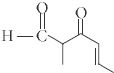
The $IUPAC$ name of the compound is . . . . . . .
A
$5-$formylhex$-2-$en$-3-$one
B
$5-$methyl$-4-$oxohex$-2-$en$-5-$al
C
$3-$keto$-2-$methylhex$-5-$enal
D
$2-$methyl$-3-$oxohex$-4-$enal
Solution
(D) $1$. Identify the principal functional group: The aldehyde $(-CHO)$ group has higher priority than the ketone $(>C=O)$ group. Thus,the parent chain must include the aldehyde carbon as $C-1$.
$2$. Number the chain: Start numbering from the aldehyde carbon $(C-1)$. The chain is $6$ carbons long $(hex)$.
$3$. Identify substituents and unsaturation: There is a methyl group at $C-2$,a ketone group at $C-3$,and a double bond starting at $C-4$.
$4$. Combine the parts: The name is $2-$methyl$-3-$oxohex$-4-$enal.
$2$. Number the chain: Start numbering from the aldehyde carbon $(C-1)$. The chain is $6$ carbons long $(hex)$.
$3$. Identify substituents and unsaturation: There is a methyl group at $C-2$,a ketone group at $C-3$,and a double bond starting at $C-4$.
$4$. Combine the parts: The name is $2-$methyl$-3-$oxohex$-4-$enal.
0 likesView Solution
15
ChemistryMediumMCQNEET · 2017
The correct statement regarding electrophile is
A
electrophile is a negatively charged species and can form a bond by accepting a pair of electrons from another electrophile
B
electrophiles are generally neutral species and can form a bond by accepting a pair of electrons from a nucleophile
C
electrophile can be either neutral or positively charged species and can form a bond by accepting a pair of electrons from a nucleophile
D
electrophile is a negatively charged species and can form a bond by accepting a pair of electrons from a nucleophile
Solution
(C) An electrophile is an electron-deficient species that can be either neutral (e.g.,$BF_3$,$AlCl_3$) or positively charged (e.g.,$H^+$,$NO_2^+$).
It acts as a Lewis acid and forms a chemical bond by accepting a pair of electrons from a nucleophile.
It acts as a Lewis acid and forms a chemical bond by accepting a pair of electrons from a nucleophile.
0 likesView Solution
16
ChemistryDifficultMCQNEET · 2017
Which one is the correct order of acidity?
A
$CH \equiv CH > CH_3-C \equiv CH > CH_2=CH_2 > CH_3-CH_3$
B
$CH \equiv CH > CH_2=CH_2 > CH_3-C \equiv CH > CH_3-CH_3$
C
$CH_3-CH_3 > CH_2=CH_2 > CH_3-C \equiv CH > CH \equiv CH$
D
$CH_2=CH_2 > CH_3-CH=CH_2 > CH_3-C \equiv CH > CH \equiv CH$
Solution
(A) The acidity of hydrocarbons depends on the hybridization of the carbon atom attached to the acidic hydrogen.
The order of electronegativity of carbon is $sp > sp^2 > sp^3$.
$CH \equiv CH$ ($sp$ hybridized) is the most acidic.
$CH_3-C \equiv CH$ ($sp$ hybridized) is less acidic than $CH \equiv CH$ due to the $+I$ effect of the methyl group.
$CH_2=CH_2$ ($sp^2$ hybridized) is less acidic than alkynes.
$CH_3-CH_3$ ($sp^3$ hybridized) is the least acidic.
Therefore,the correct order is $CH \equiv CH > CH_3-C \equiv CH > CH_2=CH_2 > CH_3-CH_3$.
The order of electronegativity of carbon is $sp > sp^2 > sp^3$.
$CH \equiv CH$ ($sp$ hybridized) is the most acidic.
$CH_3-C \equiv CH$ ($sp$ hybridized) is less acidic than $CH \equiv CH$ due to the $+I$ effect of the methyl group.
$CH_2=CH_2$ ($sp^2$ hybridized) is less acidic than alkynes.
$CH_3-CH_3$ ($sp^3$ hybridized) is the least acidic.
Therefore,the correct order is $CH \equiv CH > CH_3-C \equiv CH > CH_2=CH_2 > CH_3-CH_3$.
0 likesView Solution
17
ChemistryMediumMCQNEET · 2017
Predict the correct intermediate and product in the following reaction: $CH_3-C \equiv CH \xrightarrow[HgSO_4]{H_2O, H_2SO_4} \text{Intermediate } (A) \to \text{Product } (B)$
A
$A: CH_3-C(OH)=CH_2, B: CH_3-C(SO_4)=CH_2$
B
$A: CH_3-C(=O)-CH_3, B: CH_3-C \equiv CH$
C
$A: CH_3-C(OH)=CH_2, B: CH_3-C(=O)-CH_3$
D
$A: CH_3-C(SO_4)=CH_2, B: CH_3-C(=O)-CH_3$
Solution
(C) In the presence of $HgSO_4$ and $H_2SO_4$,alkynes undergo hydration following Markovnikov's rule.
Propyne $(CH_3-C \equiv CH)$ reacts with water to form an unstable enol intermediate,$CH_3-C(OH)=CH_2$ $(A)$.
This enol then undergoes tautomerization to form the more stable keto form,propanone $CH_3-C(=O)-CH_3$ $(B)$.
$CH_3-C \equiv CH + H_2O \xrightarrow{Hg^{2+}/H^{+}} [CH_3-C(OH)=CH_2] \to CH_3-C(=O)-CH_3$
Propyne $(CH_3-C \equiv CH)$ reacts with water to form an unstable enol intermediate,$CH_3-C(OH)=CH_2$ $(A)$.
This enol then undergoes tautomerization to form the more stable keto form,propanone $CH_3-C(=O)-CH_3$ $(B)$.
$CH_3-C \equiv CH + H_2O \xrightarrow{Hg^{2+}/H^{+}} [CH_3-C(OH)=CH_2] \to CH_3-C(=O)-CH_3$
0 likesView Solution
18
ChemistryMediumMCQNEET · 2017
With respect to the conformers of ethane,which of the following statements is true?
A
Bond angle changes but bond length remains same.
B
Both bond angle and bond length change.
C
Both bond angle and bond length remain same.
D
Bond angle remains same but bond length changes.
Solution
(C) Conformers are different spatial arrangements of atoms in a molecule that can be interconverted by rotation about a single bond.
During this rotation,the bond lengths and bond angles of the molecule remain unchanged because the covalent bonds are not broken or distorted.
During this rotation,the bond lengths and bond angles of the molecule remain unchanged because the covalent bonds are not broken or distorted.
0 likesView Solution
19
ChemistryMediumMCQNEET · 2017
Which of the following is a sink for $CO$?
A
Plants
B
Oceans
C
Haemoglobin
D
Microorganisms present in the soil
Solution
(D) Micro-organisms present in the soil act as a sink for $CO$ (carbon monoxide) by oxidizing it to $CO_2$.
0 likesView Solution
20
ChemistryDifficultMCQNEET · 2017
$HgCl_2$ and $I_2$ both when dissolved in water containing $I^{-}$ ions,the pair of species formed is
A
$HgI_2, I^{-}$
B
$HgI_4^{2-}, I_3^-$
C
$Hg_2I_2, I^{-}$
D
$HgI_2, I_3^-$
Solution
(B) When $HgCl_2$ is dissolved in a solution containing $I^{-}$ ions,it first forms $HgI_2$ precipitate,which then reacts with excess $I^{-}$ to form the soluble complex $[HgI_4]^{2-}$.
$HgCl_2 + 2I^{-} \longrightarrow HgI_2(s) + 2Cl^{-}$
$HgI_2(s) + 2I^{-} \longrightarrow [HgI_4]^{2-}(aq)$
When $I_2$ is dissolved in a solution containing $I^{-}$ ions,it forms the triiodide ion,which is water-soluble.
$I_2 + I^{-} \longrightarrow I_3^{-}(aq)$
Thus,the final species formed are $[HgI_4]^{2-}$ and $I_3^{-}$.
$HgCl_2 + 2I^{-} \longrightarrow HgI_2(s) + 2Cl^{-}$
$HgI_2(s) + 2I^{-} \longrightarrow [HgI_4]^{2-}(aq)$
When $I_2$ is dissolved in a solution containing $I^{-}$ ions,it forms the triiodide ion,which is water-soluble.
$I_2 + I^{-} \longrightarrow I_3^{-}(aq)$
Thus,the final species formed are $[HgI_4]^{2-}$ and $I_3^{-}$.
0 likesView Solution
21
ChemistryMCQNEET · 2017
Which of the following are found in extreme saline conditions?
A
Archaebacteria
B
Eubacteria
C
Cyanobacteria
D
Mycobacteria
Solution
(A) Archaebacteria are a unique group of bacteria that live in some of the most harsh habitats such as extreme salty areas (halophiles),hot springs (thermoacidophiles),and marshy areas (methanogens).
Archaebacteria differ from other bacteria in having a different cell wall structure,which is responsible for their survival in extreme conditions.
Therefore,the correct option is $A$.
Archaebacteria differ from other bacteria in having a different cell wall structure,which is responsible for their survival in extreme conditions.
Therefore,the correct option is $A$.
0 likesView Solution
22
ChemistryMCQNEET · 2017
Which of the following facilitates the opening of the stomatal aperture?
A
Contraction of the outer wall of guard cells
B
Decrease in turgidity of guard cells
C
Radial orientation of cellulose microfibrils in the cell wall of guard cells
D
Longitudinal orientation of cellulose microfibrils in the cell wall of guard cells
Solution
(C) The opening and closing of the stomatal aperture are primarily controlled by the turgor pressure of the guard cells.
When guard cells become turgid due to the influx of water,they expand.
The cell walls of guard cells contain cellulose microfibrils that are oriented radially rather than longitudinally.
This radial orientation makes the cell wall more extensible in the transverse direction,causing the guard cells to bulge outwards and pull the stomatal aperture open.
Therefore,the radial arrangement of cellulose microfibrils is the key structural feature facilitating stomatal opening.
When guard cells become turgid due to the influx of water,they expand.
The cell walls of guard cells contain cellulose microfibrils that are oriented radially rather than longitudinally.
This radial orientation makes the cell wall more extensible in the transverse direction,causing the guard cells to bulge outwards and pull the stomatal aperture open.
Therefore,the radial arrangement of cellulose microfibrils is the key structural feature facilitating stomatal opening.
0 likesView Solution
23
ChemistryMCQNEET · 2017
Which of the following components provides a sticky character to the bacterial cell?
A
Cell wall
B
Nuclear membrane
C
Plasma membrane
D
Glycocalyx
Solution
(D) The $Glycocalyx$ is the outermost layer of the bacterial cell envelope.
It is composed of polysaccharides and sometimes proteins.
This layer provides a sticky or slimy character to the bacterial cell,which helps in attachment to surfaces and protects the bacterium from the host's immune system.
It is composed of polysaccharides and sometimes proteins.
This layer provides a sticky or slimy character to the bacterial cell,which helps in attachment to surfaces and protects the bacterium from the host's immune system.
0 likesView Solution
24
ChemistryMediumMCQNEET · 2017
Amongst the following compounds,the one which is most easily sulphonated is:
A
Benzene
B
Nitrobenzene
C
Toluene
D
Chlorobenzene
Solution
(C) Sulphonation is an electrophilic aromatic substitution reaction. The rate of this reaction depends on the electron density of the benzene ring.
Groups that donate electrons to the ring (activating groups) increase the electron density and make the ring more susceptible to electrophilic attack.
$1$. $CH_3$ group in Toluene is an electron-donating group ($+I$ and hyperconjugation effect),which activates the benzene ring.
$2$. $Cl$ in Chlorobenzene is deactivating due to its strong $-I$ effect.
$3$. $NO_2$ in Nitrobenzene is a strongly deactivating group due to its $-I$ and $-M$ effects.
$4$. Benzene has no substituent.
Therefore,Toluene is the most reactive towards electrophilic substitution among the given options.
Groups that donate electrons to the ring (activating groups) increase the electron density and make the ring more susceptible to electrophilic attack.
$1$. $CH_3$ group in Toluene is an electron-donating group ($+I$ and hyperconjugation effect),which activates the benzene ring.
$2$. $Cl$ in Chlorobenzene is deactivating due to its strong $-I$ effect.
$3$. $NO_2$ in Nitrobenzene is a strongly deactivating group due to its $-I$ and $-M$ effects.
$4$. Benzene has no substituent.
Therefore,Toluene is the most reactive towards electrophilic substitution among the given options.
0 likesView Solution
25
ChemistryMediumMCQNEET · 2017
Of the following,the largest value of entropy at $25^{\circ} C$ and $1 \ atm$ is that of
A
$H_2$
B
$C_2H_6$
C
$C_2H_2$
D
$CH_4$
Solution
(B) Entropy is a measure of the randomness or disorder of a system. For gaseous molecules,entropy generally increases with an increase in the complexity and size of the molecule,as there are more degrees of freedom for rotation and vibration.
Comparing the given molecules:
$H_2$ (diatomic,small)
$CH_4$ (polyatomic,$5$ atoms)
$C_2H_2$ (polyatomic,$4$ atoms)
$C_2H_6$ (polyatomic,$8$ atoms)
Since $C_2H_6$ has the largest number of atoms and the most complex structure among the choices,it possesses the highest degree of randomness and thus the largest entropy value.
The standard molar entropy values $(J \ K^{-1} \ mol^{-1})$ at $298 \ K$ are:
Comparing the given molecules:
$H_2$ (diatomic,small)
$CH_4$ (polyatomic,$5$ atoms)
$C_2H_2$ (polyatomic,$4$ atoms)
$C_2H_6$ (polyatomic,$8$ atoms)
Since $C_2H_6$ has the largest number of atoms and the most complex structure among the choices,it possesses the highest degree of randomness and thus the largest entropy value.
The standard molar entropy values $(J \ K^{-1} \ mol^{-1})$ at $298 \ K$ are:
| $C_2H_2$ | $200.8$ |
| $H_2$ | $130.58$ |
| $C_2H_6$ | $229.5$ |
| $CH_4$ | $186.2$ |
0 likesView Solution
26
ChemistryMediumMCQNEET · 2017
Which of the following hydrides has the largest bond angle?
A
$H_2S$
B
$H_2Te$
C
$H_2O$
D
$H_2Se$
Solution
(C) The bond angle in hydrides of group $16$ elements depends on the electronegativity of the central atom.
As we move down the group,the electronegativity of the central atom decreases,which causes the bond pair electrons to move further away from the central atom.
This results in a decrease in bond pair-bond pair repulsion,leading to a smaller bond angle.
Therefore,$H_2O$ has the largest bond angle $(104.5^\circ)$ compared to $H_2S$ $(92.1^\circ)$,$H_2Se$ $(91^\circ)$,and $H_2Te$ $(90^\circ)$.
As we move down the group,the electronegativity of the central atom decreases,which causes the bond pair electrons to move further away from the central atom.
This results in a decrease in bond pair-bond pair repulsion,leading to a smaller bond angle.
Therefore,$H_2O$ has the largest bond angle $(104.5^\circ)$ compared to $H_2S$ $(92.1^\circ)$,$H_2Se$ $(91^\circ)$,and $H_2Te$ $(90^\circ)$.
0 likesView Solution
27
ChemistryMediumMCQNEET · 2017
$A$ hydrocarbon contains $85.7 \% C$. If $42 \, mg$ of the compound contains $3.01 \times 10^{20}$ molecules,the molecular formula of the compound will be
A
$C_3H_6$
B
$C_6H_{12}$
C
$C_{12}H_{24}$
D
$C_2H_4$
Solution
(B) $1$. Calculate the molar mass of the hydrocarbon:
Given $42 \, mg = 0.042 \, g$ contains $3.01 \times 10^{20}$ molecules.
Number of moles $n = \frac{3.01 \times 10^{20}}{6.022 \times 10^{23}} \approx 0.5 \times 10^{-3} \, mol = 5 \times 10^{-4} \, mol$.
Molar mass $M = \frac{\text{mass}}{\text{moles}} = \frac{0.042 \, g}{5 \times 10^{-4} \, mol} = 84 \, g/mol$.
$2$. Determine the number of atoms of $C$ and $H$:
Mass of $C = 85.7 \% \text{ of } 84 = 0.857 \times 84 \approx 72 \, g$.
Number of $C$ atoms $= \frac{72 \, g}{12 \, g/mol} = 6$.
Mass of $H = 84 - 72 = 12 \, g$.
Number of $H$ atoms $= \frac{12 \, g}{1 \, g/mol} = 12$.
$3$. Conclusion:
The molecular formula is $C_6H_{12}$.
Given $42 \, mg = 0.042 \, g$ contains $3.01 \times 10^{20}$ molecules.
Number of moles $n = \frac{3.01 \times 10^{20}}{6.022 \times 10^{23}} \approx 0.5 \times 10^{-3} \, mol = 5 \times 10^{-4} \, mol$.
Molar mass $M = \frac{\text{mass}}{\text{moles}} = \frac{0.042 \, g}{5 \times 10^{-4} \, mol} = 84 \, g/mol$.
$2$. Determine the number of atoms of $C$ and $H$:
Mass of $C = 85.7 \% \text{ of } 84 = 0.857 \times 84 \approx 72 \, g$.
Number of $C$ atoms $= \frac{72 \, g}{12 \, g/mol} = 6$.
Mass of $H = 84 - 72 = 12 \, g$.
Number of $H$ atoms $= \frac{12 \, g}{1 \, g/mol} = 12$.
$3$. Conclusion:
The molecular formula is $C_6H_{12}$.
0 likesView Solution
28
ChemistryMediumMCQNEET · 2017
Which of the following statements is incorrect?
A
The bond angle follows the order $109^{\circ}28' > 107^{\circ} > 104.5^{\circ} > 92^{\circ}$ (i.e.,$CH_{4} > NH_{3} > H_{2}O > H_{2}S$)
B
The bond order follows the order $O_{2}^{+} > O_{2} > O_{2}^{-} > O_{2}^{2-}$
C
Strength of $H$-bond follows the order $HF > H_{2}O > NH_{3} > HCl$
D
Of $\overline{O}-C \equiv \stackrel{+}{O}$ and $O=C=O$,the structure $\overline{O}-C \equiv \stackrel{+}{O}$ is the most stable structure
Solution
(D) $1$. The bond angle order $CH_{4} (109.5^{\circ}) > NH_{3} (107^{\circ}) > H_{2}O (104.5^{\circ}) > H_{2}S (92^{\circ})$ is correct due to the presence of lone pairs.
$2$. The bond order for $O_{2}$ species is $O_{2}^{+} (2.5) > O_{2} (2.0) > O_{2}^{-} (1.5) > O_{2}^{2-} (1.0)$,which is correct.
$3$. The strength of $H$-bond depends on electronegativity. $HF > H_{2}O > NH_{3}$ is correct,but $HCl$ does not form significant $H$-bonds,so the order is correct.
$4$. In $CO_{2}$,the structure $O=C=O$ is more stable than $\overline{O}-C \equiv \stackrel{+}{O}$ because $O=C=O$ has no formal charges and satisfies the octet rule for all atoms. Therefore,option $D$ is incorrect.
$2$. The bond order for $O_{2}$ species is $O_{2}^{+} (2.5) > O_{2} (2.0) > O_{2}^{-} (1.5) > O_{2}^{2-} (1.0)$,which is correct.
$3$. The strength of $H$-bond depends on electronegativity. $HF > H_{2}O > NH_{3}$ is correct,but $HCl$ does not form significant $H$-bonds,so the order is correct.
$4$. In $CO_{2}$,the structure $O=C=O$ is more stable than $\overline{O}-C \equiv \stackrel{+}{O}$ because $O=C=O$ has no formal charges and satisfies the octet rule for all atoms. Therefore,option $D$ is incorrect.
1 likesView Solution
29
ChemistryMediumMCQNEET · 2017
Which of the following absorbs carbon dioxide and releases oxygen?
A
$CaO$
B
$KO_{2}$
C
$KOH$
D
$K_{2}O$
Solution
(B) Potassium superoxide $(KO_{2})$ reacts with carbon dioxide $(CO_{2})$ to produce potassium carbonate $(K_{2}CO_{3})$ and oxygen gas $(O_{2})$.
The balanced chemical equation is:
$2 KO_{2} + CO_{2} \rightarrow K_{2}CO_{3} + \frac{3}{2} O_{2}$
Due to this property,it is used in breathing apparatus for submarines and space travel.
The balanced chemical equation is:
$2 KO_{2} + CO_{2} \rightarrow K_{2}CO_{3} + \frac{3}{2} O_{2}$
Due to this property,it is used in breathing apparatus for submarines and space travel.
0 likesView Solution
30
ChemistryEasyMCQNEET · 2017
The total number of orbitals present for principal quantum number,$n=4$ is
A
$12$
B
$15$
C
$16$
D
$30$
Solution
(C) The total number of orbitals in a shell with principal quantum number $n$ is given by the formula $n^2$.
For $n = 4$,the total number of orbitals $= 4^2 = 16$.
For $n = 4$,the total number of orbitals $= 4^2 = 16$.
0 likesView Solution
31
ChemistryEasyMCQNEET · 2017
Under isothermal and reversible conditions,the term "free energy" in thermodynamics signifies
A
Non-expansion work done by the system
B
Expansion work done by the system
C
Non-expansion work done on the system
D
Expansion work done on the system
Solution
(A) In thermodynamics,the change in Gibbs free energy $( \Delta G )$ under isothermal and reversible conditions is equal to the maximum non-expansion work (or useful work) done by the system. Mathematically,$ \Delta G = W_{\text{non-expansion}} $.
0 likesView Solution
32
ChemistryMediumMCQNEET · 2017
The standard equilibrium constant,$K_p$ at $298 \, K$ for the reaction,$N_{2(g)} + 3H_{2(g)} \rightleftharpoons 2NH_{3(g)}$ is $5.8 \times 10^5$. The value of standard equilibrium constant,if the concentration of gases is expressed in terms of $mol/L$,will be:
[Given : $R = 0.08314 \, L \, bar \, K^{-1} \, mol^{-1}$]
[Given : $R = 0.08314 \, L \, bar \, K^{-1} \, mol^{-1}$]
A
$3.51 \times 10^6$
B
$3.84 \times 10^7$
C
$3.56 \times 10^8$
D
$3.99 \times 10^9$
Solution
(C) The relationship between $K_p$ and $K_c$ is given by the formula: $K_p = K_c(RT)^{\Delta n_g}$.
For the reaction $N_{2(g)} + 3H_{2(g)} \rightleftharpoons 2NH_{3(g)}$,the change in the number of moles of gaseous species is $\Delta n_g = 2 - (1 + 3) = -2$.
Given $K_p = 5.8 \times 10^5$,$T = 298 \, K$,and $R = 0.08314 \, L \, bar \, K^{-1} \, mol^{-1}$.
Rearranging the formula to solve for $K_c$: $K_c = K_p(RT)^{-\Delta n_g} = K_p(RT)^2$.
Substituting the values: $K_c = (5.8 \times 10^5) \times (0.08314 \times 298)^2$.
$K_c = (5.8 \times 10^5) \times (24.77572)^2$.
$K_c = (5.8 \times 10^5) \times 613.836$.
$K_c \approx 3.56 \times 10^8$.
For the reaction $N_{2(g)} + 3H_{2(g)} \rightleftharpoons 2NH_{3(g)}$,the change in the number of moles of gaseous species is $\Delta n_g = 2 - (1 + 3) = -2$.
Given $K_p = 5.8 \times 10^5$,$T = 298 \, K$,and $R = 0.08314 \, L \, bar \, K^{-1} \, mol^{-1}$.
Rearranging the formula to solve for $K_c$: $K_c = K_p(RT)^{-\Delta n_g} = K_p(RT)^2$.
Substituting the values: $K_c = (5.8 \times 10^5) \times (0.08314 \times 298)^2$.
$K_c = (5.8 \times 10^5) \times (24.77572)^2$.
$K_c = (5.8 \times 10^5) \times 613.836$.
$K_c \approx 3.56 \times 10^8$.
0 likesView Solution
33
ChemistryMediumMCQNEET · 2017
For dry cleaning of clothes,instead of tetrachloroethene,which is carcinogenic in nature,which of the following solvents can be used?
A
Liquid $CO_{2}$
B
$H_{2}O_{2}$
C
Liquid $O_{3}$
D
Petrol
Solution
(A) Tetrachloroethene $(Cl_{2}C=CCl_{2})$ was previously used as a solvent for dry cleaning,but it is a suspected carcinogen and pollutes groundwater.
Liquid $CO_{2}$ is now used as an environmentally friendly alternative for dry cleaning,as it is non-toxic and does not pollute the environment.
Liquid $CO_{2}$ is now used as an environmentally friendly alternative for dry cleaning,as it is non-toxic and does not pollute the environment.
0 likesView Solution
34
ChemistryEasyMCQNEET · 2017
Consider the following reaction for which the change in enthalpy is positive:
$2 A_{(g)} + B_{(g)} \rightleftharpoons C_{(g)} + D_{(g)}$
Which of the following will not affect the equilibrium?
$2 A_{(g)} + B_{(g)} \rightleftharpoons C_{(g)} + D_{(g)}$
Which of the following will not affect the equilibrium?
A
Change in concentration of reactants
B
Change in pressure
C
Change in temperature
D
Presence of catalyst
Solution
(D) According to the $Le \ Chatelier$ principle,a catalyst provides an alternative pathway with lower activation energy for both the forward and backward reactions. It increases the rate of both reactions equally,thus reaching the equilibrium state faster without changing the position of the equilibrium or the equilibrium constant. Therefore,the presence of a catalyst does not affect the equilibrium.
0 likesView Solution
35
ChemistryMediumMCQNEET · 2017
For the reaction $CO_{(g)} + Cl_{2(g)} \rightleftharpoons COCl_{2(g)}$,$\frac{K_p}{K_c}$ is equal to
A
$\frac{1}{RT}$
B
$RT$
C
$\sqrt{RT}$
D
$(RT)^2$
Solution
(A) The relationship between $K_p$ and $K_c$ is given by $K_p = K_c(RT)^{\Delta n_{(g)}}$.
Therefore,$\frac{K_p}{K_c} = (RT)^{\Delta n_{(g)}}$.
For the reaction $CO_{(g)} + Cl_{2(g)} \rightleftharpoons COCl_{2(g)}$,the change in the number of moles of gaseous species is $\Delta n_{(g)} = n_{p(g)} - n_{r(g)} = 1 - (1 + 1) = 1 - 2 = -1$.
Substituting this value,we get $\frac{K_p}{K_c} = (RT)^{-1} = \frac{1}{RT}$.
Therefore,$\frac{K_p}{K_c} = (RT)^{\Delta n_{(g)}}$.
For the reaction $CO_{(g)} + Cl_{2(g)} \rightleftharpoons COCl_{2(g)}$,the change in the number of moles of gaseous species is $\Delta n_{(g)} = n_{p(g)} - n_{r(g)} = 1 - (1 + 1) = 1 - 2 = -1$.
Substituting this value,we get $\frac{K_p}{K_c} = (RT)^{-1} = \frac{1}{RT}$.
0 likesView Solution
36
ChemistryMediumMCQNEET · 2017
Which of the following pairs of species is not isostructural?
A
$ICl_4^-, XeF_4$
B
$ClO_3^-, CO_3^{2-}$
C
$IBr_2^-, XeF_2$
D
$BrO_3^-, XeO_3$
Solution
(B) To determine if species are isostructural,we check their hybridization and geometry:
$1$. $ICl_4^-$ ($sp^3d^2$,square planar) and $XeF_4$ ($sp^3d^2$,square planar) are isostructural.
$2$. $ClO_3^-$ ($sp^3$,pyramidal) and $CO_3^{2-}$ ($sp^2$,trigonal planar) are not isostructural.
$3$. $IBr_2^-$ ($sp^3d$,linear) and $XeF_2$ ($sp^3d$,linear) are isostructural.
$4$. $BrO_3^-$ ($sp^3$,pyramidal) and $XeO_3$ ($sp^3$,pyramidal) are isostructural.
Thus,the pair $ClO_3^-$ and $CO_3^{2-}$ is not isostructural.
$1$. $ICl_4^-$ ($sp^3d^2$,square planar) and $XeF_4$ ($sp^3d^2$,square planar) are isostructural.
$2$. $ClO_3^-$ ($sp^3$,pyramidal) and $CO_3^{2-}$ ($sp^2$,trigonal planar) are not isostructural.
$3$. $IBr_2^-$ ($sp^3d$,linear) and $XeF_2$ ($sp^3d$,linear) are isostructural.
$4$. $BrO_3^-$ ($sp^3$,pyramidal) and $XeO_3$ ($sp^3$,pyramidal) are isostructural.
Thus,the pair $ClO_3^-$ and $CO_3^{2-}$ is not isostructural.
0 likesView Solution
37
ChemistryEasyMCQNEET · 2017
The correct statement regarding ethane conformation is:
A
Rotation around carbon-carbon bond in ethane molecule is not possible,because ethane molecule contains a pi $(\pi)$ bond between the carbon and carbon and ethane has very low melting point.
B
Rotation around carbon-carbon bond in ethane molecule is not possible,because ethane molecule contains both sigma $(\sigma)$ bond,and pi $(\pi)$ bond between the carbon and carbon.
C
Rotation around carbon-carbon bond in ethane molecule is possible because of cylindrical symmetry of sigma $(\sigma)$ bond between carbon-carbon atoms.
D
Rotation around carbon-carbon bond in ethane molecule is not possible,because ethane molecule contains both sigma $(\sigma)$ bond and pi $(\pi)$ bond between the carbon and carbon and ethane has very high boiling point.
Solution
(C) In an ethane molecule $(CH_3-CH_3)$,the carbon-carbon bond is a single sigma $(\sigma)$ bond.
Because the sigma $(\sigma)$ bond is formed by the head-on overlap of orbitals,it possesses cylindrical symmetry along the internuclear axis.
This cylindrical symmetry allows for free rotation around the carbon-carbon single bond,leading to different conformational isomers.
Because the sigma $(\sigma)$ bond is formed by the head-on overlap of orbitals,it possesses cylindrical symmetry along the internuclear axis.
This cylindrical symmetry allows for free rotation around the carbon-carbon single bond,leading to different conformational isomers.
0 likesView Solution
38
ChemistryMediumMCQNEET · 2017
It is because of the inability of $ns^{2}$ electrons of the valence shell to participate in bonding that:
A
$Sn^{2+}$ is oxidising while $Pb^{4+}$ is reducing
B
$Sn^{2+}$ and $Pb^{2+}$ are both oxidising and reducing
C
$Sn^{4+}$ is reducing while $Pb^{4+}$ is oxidising
D
$Sn^{2+}$ is reducing while $Pb^{4+}$ is oxidising.
Solution
(D) The inability of $ns^{2}$ electrons of the valence shell to participate in bonding when moving down the group in heavier $p$-block elements is known as the inert pair effect.
As a result,$Pb(II)$ is more stable than $Pb(IV)$,and $Sn(IV)$ is more stable than $Sn(II)$.
Since $Pb(IV)$ is unstable,it is easily reduced to $Pb(II)$,making $Pb(IV)$ a strong oxidizing agent.
Since $Sn(II)$ is unstable,it is easily oxidized to $Sn(IV)$,making $Sn(II)$ a strong reducing agent.
As a result,$Pb(II)$ is more stable than $Pb(IV)$,and $Sn(IV)$ is more stable than $Sn(II)$.
Since $Pb(IV)$ is unstable,it is easily reduced to $Pb(II)$,making $Pb(IV)$ a strong oxidizing agent.
Since $Sn(II)$ is unstable,it is easily oxidized to $Sn(IV)$,making $Sn(II)$ a strong reducing agent.
0 likesView Solution
39
ChemistryMediumMCQNEET · 2017
Which is the incorrect statement?
A
Density decreases in case of crystals with Schottky defect.
B
$FeO_{0.98}$ has non-stoichiometric metal deficiency defect.
C
$NaCl_{(s)}$ is insulator,silicon is semiconductor,silver is conductor,quartz is piezoelectric crystal.
D
Frenkel defect is favoured in those ionic compounds in which sizes of cation and anions are almost equal.
Solution
(D) In $Schottky$ defect,ions leave the lattice,so density decreases. This is a correct statement.
$FeO_{0.98}$ shows metal deficiency defect because the ratio of $Fe$ to $O$ is less than $1:1$. This is a correct statement.
$NaCl_{(s)}$ is an insulator,$Si$ is a semiconductor,$Ag$ is a conductor,and quartz is a piezoelectric crystal. This is a correct statement.
Frenkel defect occurs in ionic compounds where there is a large difference in the size of the cation and anion (cation is much smaller than the anion). Therefore,the statement that it is favoured when sizes are almost equal is incorrect.
$FeO_{0.98}$ shows metal deficiency defect because the ratio of $Fe$ to $O$ is less than $1:1$. This is a correct statement.
$NaCl_{(s)}$ is an insulator,$Si$ is a semiconductor,$Ag$ is a conductor,and quartz is a piezoelectric crystal. This is a correct statement.
Frenkel defect occurs in ionic compounds where there is a large difference in the size of the cation and anion (cation is much smaller than the anion). Therefore,the statement that it is favoured when sizes are almost equal is incorrect.
0 likesView Solution
40
ChemistryEasyMCQNEET · 2017
If molality of the dilute solution is doubled,the value of molal depression constant $(K_f)$ will be
A
halved
B
tripled
C
unchanged
D
doubled.
Solution
(C) The molal depression constant,also known as the cryoscopic constant $(K_f)$,is a characteristic property of the solvent.
It depends solely on the nature of the solvent and is independent of the concentration of the solute or the molality of the solution.
Therefore,if the molality of the dilute solution is doubled,the value of $(K_f)$ will remain unchanged.
It depends solely on the nature of the solvent and is independent of the concentration of the solute or the molality of the solution.
Therefore,if the molality of the dilute solution is doubled,the value of $(K_f)$ will remain unchanged.
0 likesView Solution
41
ChemistryEasyMCQNEET · 2017
Which of the following is dependent on temperature $?$
A
Molarity
B
Mole fraction
C
Weight percentage
D
Molality
Solution
(A) Molarity is defined as the number of moles of solute dissolved per liter of solution $(M = \frac{n}{V(L)})$.
Since the volume of a solution changes with temperature due to thermal expansion or contraction,molarity is temperature-dependent.
In contrast,mole fraction,weight percentage,and molality are based on mass,which remains constant regardless of temperature changes.
Since the volume of a solution changes with temperature due to thermal expansion or contraction,molarity is temperature-dependent.
In contrast,mole fraction,weight percentage,and molality are based on mass,which remains constant regardless of temperature changes.
0 likesView Solution
42
ChemistryAdvancedMCQNEET · 2017
In the electrochemical cell $:$
$Zn \,|\,ZnSO_4\,(0.01\,M)\,||\,CuSO_4\,(1.0\,M)\,|\,Cu$
the $emf$ of this Daniell cell is $E_1.$ When the concentration of $ZnSO_4$ is changed to $1.0\,M$ and that of $CuSO_4$ changed to $0.01\,M,$ the $emf$ changes to $E_2.$ From the followings,which one is the relationship between $E_1$ and $E_2$ $?$ (Given,$RT/F = 0.059$)
$Zn \,|\,ZnSO_4\,(0.01\,M)\,||\,CuSO_4\,(1.0\,M)\,|\,Cu$
the $emf$ of this Daniell cell is $E_1.$ When the concentration of $ZnSO_4$ is changed to $1.0\,M$ and that of $CuSO_4$ changed to $0.01\,M,$ the $emf$ changes to $E_2.$ From the followings,which one is the relationship between $E_1$ and $E_2$ $?$ (Given,$RT/F = 0.059$)
A
$E_1 < E_2$
B
$E_1 > E_2$
C
$E_1 = E_2$
D
none of the above
Solution
(B) The cell reaction for the Daniell cell is $Zn(s) + Cu^{2+}(aq) \longrightarrow Zn^{2+}(aq) + Cu(s).$
Using the Nernst equation $E = E^{\circ} - \frac{0.059}{n} \log \frac{[Zn^{2+}]}{[Cu^{2+}]}$ where $n = 2.$
For $E_1$: $[Zn^{2+}] = 0.01 \, M$ and $[Cu^{2+}] = 1.0 \, M.$
$E_1 = E^{\circ} - \frac{0.059}{2} \log \frac{0.01}{1} = E^{\circ} - \frac{0.059}{2} \log(10^{-2}) = E^{\circ} + 0.059.$
For $E_2$: $[Zn^{2+}] = 1.0 \, M$ and $[Cu^{2+}] = 0.01 \, M.$
$E_2 = E^{\circ} - \frac{0.059}{2} \log \frac{1}{0.01} = E^{\circ} - \frac{0.059}{2} \log(10^{2}) = E^{\circ} - 0.059.$
Comparing the two,$E_1 = E^{\circ} + 0.059$ and $E_2 = E^{\circ} - 0.059.$
Therefore,$E_1 > E_2.$
Using the Nernst equation $E = E^{\circ} - \frac{0.059}{n} \log \frac{[Zn^{2+}]}{[Cu^{2+}]}$ where $n = 2.$
For $E_1$: $[Zn^{2+}] = 0.01 \, M$ and $[Cu^{2+}] = 1.0 \, M.$
$E_1 = E^{\circ} - \frac{0.059}{2} \log \frac{0.01}{1} = E^{\circ} - \frac{0.059}{2} \log(10^{-2}) = E^{\circ} + 0.059.$
For $E_2$: $[Zn^{2+}] = 1.0 \, M$ and $[Cu^{2+}] = 0.01 \, M.$
$E_2 = E^{\circ} - \frac{0.059}{2} \log \frac{1}{0.01} = E^{\circ} - \frac{0.059}{2} \log(10^{2}) = E^{\circ} - 0.059.$
Comparing the two,$E_1 = E^{\circ} + 0.059$ and $E_2 = E^{\circ} - 0.059.$
Therefore,$E_1 > E_2.$
0 likesView Solution
43
ChemistryAdvancedMCQNEET · 2017
Mechanism of a hypothetical reaction $X_2 + Y_2 \rightarrow 2XY$ is given below:
$(i)$ $X_2 \rightarrow X + X$ (fast)
$(ii)$ $X + Y_2 \rightleftharpoons XY + Y$ (slow)
$(iii)$ $X + Y \rightarrow XY$ (fast)
The overall order of the reaction will be
$(i)$ $X_2 \rightarrow X + X$ (fast)
$(ii)$ $X + Y_2 \rightleftharpoons XY + Y$ (slow)
$(iii)$ $X + Y \rightarrow XY$ (fast)
The overall order of the reaction will be
A
$2$
B
$0$
C
$1.5$
D
$1$
Solution
(C) The rate of the reaction is determined by the slow step $(ii)$:
$r = k[X][Y_2]$ $---$ $(1)$
From the fast equilibrium step $(i)$,we have:
$K_{eq} = \frac{[X]^2}{[X_2]}$
$[X]^2 = K_{eq}[X_2]$
$[X] = K_{eq}^{1/2}[X_2]^{1/2}$ $---$ $(2)$
Substituting equation $(2)$ into equation $(1)$:
$r = k \cdot K_{eq}^{1/2}[X_2]^{1/2}[Y_2]^1$
$r = k'[X_2]^{1/2}[Y_2]^1$
The overall order of the reaction is the sum of the exponents of the concentration terms in the rate law:
Order $= 0.5 + 1 = 1.5$
$r = k[X][Y_2]$ $---$ $(1)$
From the fast equilibrium step $(i)$,we have:
$K_{eq} = \frac{[X]^2}{[X_2]}$
$[X]^2 = K_{eq}[X_2]$
$[X] = K_{eq}^{1/2}[X_2]^{1/2}$ $---$ $(2)$
Substituting equation $(2)$ into equation $(1)$:
$r = k \cdot K_{eq}^{1/2}[X_2]^{1/2}[Y_2]^1$
$r = k'[X_2]^{1/2}[Y_2]^1$
The overall order of the reaction is the sum of the exponents of the concentration terms in the rate law:
Order $= 0.5 + 1 = 1.5$
0 likesView Solution
44
ChemistryMediumMCQNEET · 2017
$A$ first order reaction has a specific reaction rate of $10^{-2} \ sec^{-1}.$ How much time will it take for $20 \ g$ of the reactant to reduce to $5 \ g?$ ........ $sec$
A
$138.6$
B
$346.5$
C
$693.0$
D
$238.6$
Solution
(A) For a first order reaction,the integrated rate equation is given by:
$t = \frac{2.303}{k} \log \frac{[A]_0}{[A]_t}$
Given:
$k = 10^{-2} \ sec^{-1}$
$[A]_0 = 20 \ g$
$[A]_t = 5 \ g$
Substituting the values:
$t = \frac{2.303}{10^{-2}} \log \frac{20}{5}$
$t = 230.3 \times \log(4)$
$t = 230.3 \times 0.6021$
$t \approx 138.6 \ sec$
$t = \frac{2.303}{k} \log \frac{[A]_0}{[A]_t}$
Given:
$k = 10^{-2} \ sec^{-1}$
$[A]_0 = 20 \ g$
$[A]_t = 5 \ g$
Substituting the values:
$t = \frac{2.303}{10^{-2}} \log \frac{20}{5}$
$t = 230.3 \times \log(4)$
$t = 230.3 \times 0.6021$
$t \approx 138.6 \ sec$
0 likesView Solution
45
ChemistryMediumMCQNEET · 2017
Which one of the following statements is not correct?
A
The value of equilibrium constant is changed in the presence of a catalyst in the reaction at equilibrium.
B
Enzymes catalyse mainly bio-chemical reactions.
C
Coenzymes increase the catalytic activity of enzyme.
D
Catalyst does not initiate any reaction.
Solution
(A) catalyst decreases the activation energies of both the forward and backward reactions by the same amount.
Therefore,it speeds up both the forward and backward reactions at the same rate.
As a result,the equilibrium constant $(K_{eq})$ remains unaffected by the presence of a catalyst at a given temperature.
Thus,the statement that the equilibrium constant changes is incorrect.
Therefore,it speeds up both the forward and backward reactions at the same rate.
As a result,the equilibrium constant $(K_{eq})$ remains unaffected by the presence of a catalyst at a given temperature.
Thus,the statement that the equilibrium constant changes is incorrect.
0 likesView Solution
46
ChemistryMediumMCQNEET · 2017
Extraction of gold and silver involves leaching with $CN^{-}$ ion. Silver is later recovered by
A
distillation
B
zone refining
C
displacement with $Zn$
D
liquation
Solution
(C) The extraction of silver and gold involves the cyanide process (MacArthur-Forrest process).
First,the ore is leached with $NaCN$ in the presence of air $(O_2)$ to form a soluble complex:
$Ag_{2}S + 4 NaCN \xrightarrow{O_{2}} 2 Na[Ag(CN)_{2}] + Na_{2}SO_{4}$
Then,the silver is recovered from the solution by displacement using a more electropositive metal like zinc $(Zn)$:
$2 Na[Ag(CN)_{2}] + Zn \longrightarrow Na_{2}[Zn(CN)_{4}] + 2Ag(\downarrow)$
Thus,silver is recovered by displacement with $Zn$.
First,the ore is leached with $NaCN$ in the presence of air $(O_2)$ to form a soluble complex:
$Ag_{2}S + 4 NaCN \xrightarrow{O_{2}} 2 Na[Ag(CN)_{2}] + Na_{2}SO_{4}$
Then,the silver is recovered from the solution by displacement using a more electropositive metal like zinc $(Zn)$:
$2 Na[Ag(CN)_{2}] + Zn \longrightarrow Na_{2}[Zn(CN)_{4}] + 2Ag(\downarrow)$
Thus,silver is recovered by displacement with $Zn$.
0 likesView Solution
47
ChemistryMediumMCQNEET · 2017
Match the interhalogen compounds of Column-$I$ with the geometry in Column-$II$ and assign the correct code.
| Column $I$ | Column $II$ |
| $A$. $XX'$ | $i$. $T$-shape |
| $B$. $XX'_3$ | $ii$. Pentagonal bipyramidal |
| $C$. $XX'_5$ | $iii$. Linear |
| $D$. $XX'_7$ | $iv$. Square pyramidal |
| $v$. Tetrahedral |
A
$A-iii, B-i, C-iv, D-ii$
B
$A-v, B-iv, C-iii, D-ii$
C
$A-iv, B-iii, C-ii, D-i$
D
$A-iii, B-iv, C-i, D-ii$
Solution
(A) $A-iii$: $XX'$ has linear geometry as only two atoms are present.
$B-i$: $XX'_3$ has $T$-shaped geometry as $3$ bond pairs and $2$ lone pairs of electrons are present. The electron pair geometry is trigonal bipyramidal.
$C-iv$: $XX'_5$ has square-pyramidal geometry as $5$ bond pairs and $1$ lone pair of electrons are present. The electron pair geometry is octahedral.
$D-ii$: $XX'_7$ has pentagonal bipyramidal geometry as $7$ bond pairs and $0$ lone pairs of electrons are present.
$B-i$: $XX'_3$ has $T$-shaped geometry as $3$ bond pairs and $2$ lone pairs of electrons are present. The electron pair geometry is trigonal bipyramidal.
$C-iv$: $XX'_5$ has square-pyramidal geometry as $5$ bond pairs and $1$ lone pair of electrons are present. The electron pair geometry is octahedral.
$D-ii$: $XX'_7$ has pentagonal bipyramidal geometry as $7$ bond pairs and $0$ lone pairs of electrons are present.
0 likesView Solution
48
ChemistryMediumMCQNEET · 2017
In which pair of ions do both species contain an $S-S$ bond?
A
$S_4O_6^{2-}, S_2O_3^{2-}$
B
$S_2O_7^{2-}, S_2O_8^{2-}$
C
$S_4O_6^{2-}, S_2O_7^{2-}$
D
$S_2O_7^{2-}, S_2O_3^{2-}$
Solution
(A) The tetrathionate ion $(S_4O_6^{2-})$ has a structure with an $S-S-S-S$ chain,thus it contains $S-S$ bonds.
The thiosulfate ion $(S_2O_3^{2-})$ has a structure where one sulfur atom is bonded to another sulfur atom via a double bond ($S=S$ bond),thus it contains an $S-S$ bond.
The disulfate ion $(S_2O_7^{2-})$ has an $S-O-S$ linkage and no $S-S$ bond.
The peroxodisulfate ion $(S_2O_8^{2-})$ has an $S-O-O-S$ linkage and no $S-S$ bond.
Therefore,both $S_4O_6^{2-}$ and $S_2O_3^{2-}$ contain $S-S$ bonds.
The thiosulfate ion $(S_2O_3^{2-})$ has a structure where one sulfur atom is bonded to another sulfur atom via a double bond ($S=S$ bond),thus it contains an $S-S$ bond.
The disulfate ion $(S_2O_7^{2-})$ has an $S-O-S$ linkage and no $S-S$ bond.
The peroxodisulfate ion $(S_2O_8^{2-})$ has an $S-O-O-S$ linkage and no $S-S$ bond.
Therefore,both $S_4O_6^{2-}$ and $S_2O_3^{2-}$ contain $S-S$ bonds.
0 likesView Solution
49
ChemistryMediumMCQNEET · 2017
Name the gas that can readily decolourise acidified $KMnO_4$ solution.
A
$SO_2$
B
$NO_2$
C
$P_2O_5$
D
$CO_2$
Solution
(A) Sulfur dioxide $(SO_2)$ acts as a strong reducing agent.
When $SO_2$ gas is passed through an acidified solution of potassium permanganate $(KMnO_4)$,it reduces the purple-colored $Mn^{7+}$ ion to the colorless $Mn^{2+}$ ion.
The balanced chemical equation is:
$2KMnO_4 + 5SO_2 + 2H_2O \rightarrow K_2SO_4 + 2MnSO_4 + 2H_2SO_4$
Since $MnSO_4$ is a colorless solution,the purple color of $KMnO_4$ disappears.
When $SO_2$ gas is passed through an acidified solution of potassium permanganate $(KMnO_4)$,it reduces the purple-colored $Mn^{7+}$ ion to the colorless $Mn^{2+}$ ion.
The balanced chemical equation is:
$2KMnO_4 + 5SO_2 + 2H_2O \rightarrow K_2SO_4 + 2MnSO_4 + 2H_2SO_4$
Since $MnSO_4$ is a colorless solution,the purple color of $KMnO_4$ disappears.
1 likesView Solution
50
ChemistryMediumMCQNEET · 2017
The reason for the greater range of oxidation states in actinoids is attributed to:
A
actinoid contraction
B
$5f$,$6d$ and $7s$ levels having comparable energies
C
$4f$ and $5d$ levels being close in energies
D
the radioactive nature of actinoids.
Solution
(B) The actinoids exhibit a greater range of oxidation states compared to lanthanoids because the $5f$,$6d$,and $7s$ energy levels are very close in energy.
This small energy gap allows electrons from these subshells to participate in bonding,making excitation easier.
This small energy gap allows electrons from these subshells to participate in bonding,making excitation easier.
0 likesView Solution
51
ChemistryEasyMCQNEET · 2017
An example of a $\sigma$-bonded organometallic compound is:
A
Grignard's reagent
B
ferrocene
C
cobaltocene
D
ruthenocene
Solution
(A) Grignard's reagent,represented as $RMgX$,contains a direct $\sigma$-bond between the carbon atom of the alkyl group and the magnesium metal atom.
Therefore,it is classified as a $\sigma$-bonded organometallic compound.
In contrast,ferrocene,cobaltocene,and ruthenocene are examples of $\pi$-bonded organometallic compounds (metallocenes).
Therefore,it is classified as a $\sigma$-bonded organometallic compound.
In contrast,ferrocene,cobaltocene,and ruthenocene are examples of $\pi$-bonded organometallic compounds (metallocenes).
0 likesView Solution
52
ChemistryDifficultMCQNEET · 2017
The correct order of the stoichiometries of $AgCl$ formed when $AgNO_3$ in excess is treated with the complexes $CoCl_3 \cdot 6NH_3$,$CoCl_3 \cdot 5NH_3$,and $CoCl_3 \cdot 4NH_3$ respectively is:
A
$3 \ AgCl, 1 \ AgCl, 2 \ AgCl$
B
$3 \ AgCl, 2 \ AgCl, 1 \ AgCl$
C
$2 \ AgCl, 3 \ AgCl, 2 \ AgCl$
D
$1 \ AgCl, 3 \ AgCl, 2 \ AgCl$
Solution
(B) The reaction of coordination complexes with excess $AgNO_3$ precipitates the chloride ions present outside the coordination sphere (ionizable chlorides).
$1$. $[Co(NH_3)_6]Cl_3$ contains $3$ ionizable $Cl^-$ ions,yielding $3 \ mol \ AgCl$.
$2$. $[Co(NH_3)_5Cl]Cl_2$ contains $2$ ionizable $Cl^-$ ions,yielding $2 \ mol \ AgCl$.
$3$. $[Co(NH_3)_4Cl_2]Cl$ contains $1$ ionizable $Cl^-$ ion,yielding $1 \ mol \ AgCl$.
Thus,the correct order is $3 \ AgCl, 2 \ AgCl, 1 \ AgCl$.
$1$. $[Co(NH_3)_6]Cl_3$ contains $3$ ionizable $Cl^-$ ions,yielding $3 \ mol \ AgCl$.
$2$. $[Co(NH_3)_5Cl]Cl_2$ contains $2$ ionizable $Cl^-$ ions,yielding $2 \ mol \ AgCl$.
$3$. $[Co(NH_3)_4Cl_2]Cl$ contains $1$ ionizable $Cl^-$ ion,yielding $1 \ mol \ AgCl$.
Thus,the correct order is $3 \ AgCl, 2 \ AgCl, 1 \ AgCl$.
0 likesView Solution
53
ChemistryAdvancedMCQNEET · 2017
The correct increasing order for the wavelengths of absorption in the visible region for the complexes of $Co^{3+}$ is:
A
$[Co(H_2O)_6]^{3+}, [Co(en)_3]^{3+}, [Co(NH_3)_6]^{3+}$
B
$[Co(H_2O)_6]^{3+}, [Co(NH_3)_6]^{3+}, [Co(en)_3]^{3+}$
C
$[Co(NH_3)_6]^{3+}, [Co(en)_3]^{3+}, [Co(H_2O)_6]^{3+}$
D
$[Co(en)_3]^{3+}, [Co(NH_3)_6]^{3+}, [Co(H_2O)_6]^{3+}$
Solution
(B) The energy of absorbed light $(\Delta_o)$ is inversely proportional to the wavelength of absorption $(\lambda)$: $\Delta_o \propto \frac{1}{\lambda}$.
Stronger ligands cause greater crystal field splitting $(\Delta_o)$,which corresponds to higher energy and shorter wavelength of absorption.
The spectrochemical series for the given ligands is: $H_2O < NH_3 < en$.
As the ligand strength increases,the splitting energy $(\Delta_o)$ increases,and therefore the absorbed wavelength $(\lambda)$ decreases.
Thus,the increasing order of wavelength is: $[Co(H_2O)_6]^{3+} < [Co(NH_3)_6]^{3+} < [Co(en)_3]^{3+}$.
Stronger ligands cause greater crystal field splitting $(\Delta_o)$,which corresponds to higher energy and shorter wavelength of absorption.
The spectrochemical series for the given ligands is: $H_2O < NH_3 < en$.
As the ligand strength increases,the splitting energy $(\Delta_o)$ increases,and therefore the absorbed wavelength $(\lambda)$ decreases.
Thus,the increasing order of wavelength is: $[Co(H_2O)_6]^{3+} < [Co(NH_3)_6]^{3+} < [Co(en)_3]^{3+}$.
0 likesView Solution
54
ChemistryMediumMCQNEET · 2017
Pick out the correct statement with respect to $[Mn(CN)_6]^{3-}.$
A
It is $sp^3d^2$ hybridised and tetrahedral.
B
It is $d^2sp^3$ hybridised and octahedral.
C
It is $dsp^2$ hybridised and square planar.
D
It is $sp^3d^2$ hybridised and octahedral.
Solution
(B) $1$. The oxidation state of $Mn$ in $[Mn(CN)_6]^{3-}$ is calculated as: $x + 6(-1) = -3 \implies x = +3$.
$2$. The electronic configuration of $Mn$ $(Z=25)$ is $[Ar] 3d^5 4s^2$. Thus,$Mn^{3+}$ is $[Ar] 3d^4$.
$3$. $CN^-$ is a Strong Field Ligand $(SFL)$,which causes pairing of electrons in the $3d$ orbitals.
$4$. After pairing,two $3d$ orbitals,one $4s$ orbital,and three $4p$ orbitals are available for hybridization,resulting in $d^2sp^3$ hybridization.
$5$. Since the coordination number is $6$,the geometry is octahedral.
$2$. The electronic configuration of $Mn$ $(Z=25)$ is $[Ar] 3d^5 4s^2$. Thus,$Mn^{3+}$ is $[Ar] 3d^4$.
$3$. $CN^-$ is a Strong Field Ligand $(SFL)$,which causes pairing of electrons in the $3d$ orbitals.
$4$. After pairing,two $3d$ orbitals,one $4s$ orbital,and three $4p$ orbitals are available for hybridization,resulting in $d^2sp^3$ hybridization.
$5$. Since the coordination number is $6$,the geometry is octahedral.
0 likesView Solution
55
ChemistryMediumMCQNEET · 2017
Identify $A$ and predict the type of reaction.
$3\text{-bromoanisole} \xrightarrow{NaNH_2} A$
$3\text{-bromoanisole} \xrightarrow{NaNH_2} A$
A
$3\text{-aminoanisole}$ and elimination-addition reaction
B
$2\text{-aminoanisole}$ and cine substitution reaction
C
$3\text{-aminoanisole}$ and cine substitution reaction
D
$2\text{-aminoanisole}$ and substitution reaction
Solution
(A) The reaction of $3\text{-bromoanisole}$ with $NaNH_2$ proceeds via the formation of a benzyne intermediate.
$1$. The strong base $NH_2^-$ abstracts the ortho-hydrogen relative to the $Br$ atom,leading to the elimination of $Br^-$ and the formation of a benzyne intermediate.
$2$. The nucleophile $NH_2^-$ can then attack the benzyne intermediate at two different positions.
$3$. Attack at the meta-position (relative to the $OCH_3$ group) leads to a more stable carbanion intermediate because the negative charge is closer to the electron-withdrawing $OCH_3$ group.
$4$. Protonation of this intermediate yields $3\text{-aminoanisole}$ as the major product.
$5$. Since the incoming nucleophile ends up on the same carbon atom where the leaving group was originally present,this is not a cine substitution reaction; it is an elimination-addition reaction.
$1$. The strong base $NH_2^-$ abstracts the ortho-hydrogen relative to the $Br$ atom,leading to the elimination of $Br^-$ and the formation of a benzyne intermediate.
$2$. The nucleophile $NH_2^-$ can then attack the benzyne intermediate at two different positions.
$3$. Attack at the meta-position (relative to the $OCH_3$ group) leads to a more stable carbanion intermediate because the negative charge is closer to the electron-withdrawing $OCH_3$ group.
$4$. Protonation of this intermediate yields $3\text{-aminoanisole}$ as the major product.
$5$. Since the incoming nucleophile ends up on the same carbon atom where the leaving group was originally present,this is not a cine substitution reaction; it is an elimination-addition reaction.
0 likesView Solution
56
ChemistryDifficultMCQNEET · 2017
The heating of phenyl methyl ether with $HI$ produces
A
iodobenzene
B
phenol
C
benzene
D
methyl iodide
Solution
(B) When phenyl methyl ether $(Ph-O-CH_3)$ is heated with $HI$,the reaction proceeds via the protonation of the ether oxygen followed by a nucleophilic attack by the iodide ion $(I^-)$ on the less sterically hindered methyl group via an $S_N2$ mechanism.
The reaction is as follows:
$Ph-O-CH_3 + HI \rightarrow Ph-OH + CH_3I$
The products formed are phenol $(Ph-OH)$ and methyl iodide $(CH_3I)$. Among the given options,phenol is the correct product.
The reaction is as follows:
$Ph-O-CH_3 + HI \rightarrow Ph-OH + CH_3I$
The products formed are phenol $(Ph-OH)$ and methyl iodide $(CH_3I)$. Among the given options,phenol is the correct product.
0 likesView Solution
57
ChemistryMediumMCQNEET · 2017
Which one is the most acidic compound?
A
Phenol
B
$p$-Nitrophenol
C
$2,4,6$-Trinitrophenol (Picric acid)
D
$p$-Cresol
Solution
(C) The acidity of phenols depends on the stability of the phenoxide ion formed after the loss of a proton. Electron-withdrawing groups ($-I$ and $-M$ effects) increase acidity by stabilizing the phenoxide ion,while electron-donating groups (like $-CH_3$) decrease acidity.
$1$. $2,4,6$-Trinitrophenol has three $-NO_2$ groups,which exert strong $-I$ and $-M$ effects,making it the most acidic.
$2$. $p$-Nitrophenol has one $-NO_2$ group,which is acidic but less than picric acid.
$3$. Phenol has no substituent.
$4$. $p$-Cresol has a $-CH_3$ group,which is electron-donating ($+I$ and hyperconjugation),making it the least acidic.
Therefore,the order of acidity is: $2,4,6$-Trinitrophenol > $p$-Nitrophenol > Phenol > $p$-Cresol.
$1$. $2,4,6$-Trinitrophenol has three $-NO_2$ groups,which exert strong $-I$ and $-M$ effects,making it the most acidic.
$2$. $p$-Nitrophenol has one $-NO_2$ group,which is acidic but less than picric acid.
$3$. Phenol has no substituent.
$4$. $p$-Cresol has a $-CH_3$ group,which is electron-donating ($+I$ and hyperconjugation),making it the least acidic.
Therefore,the order of acidity is: $2,4,6$-Trinitrophenol > $p$-Nitrophenol > Phenol > $p$-Cresol.
0 likesView Solution
58
ChemistryMediumMCQNEET · 2017
Consider the reactions and identify $A, X, Y$ and $Z$:
$X (C_2H_6O)$ $\xrightarrow{Cu, 573 \ K} A$ $\xrightarrow{[Ag(NH_3)_2]^+, ^-OH, \Delta} \text{Silver mirror}$
$A \xrightarrow{^-OH, \Delta} Y$
$A \xrightarrow{NH_2NHCONH_2} Z$
$X (C_2H_6O)$ $\xrightarrow{Cu, 573 \ K} A$ $\xrightarrow{[Ag(NH_3)_2]^+, ^-OH, \Delta} \text{Silver mirror}$
$A \xrightarrow{^-OH, \Delta} Y$
$A \xrightarrow{NH_2NHCONH_2} Z$
A
$A: \text{Methoxymethane}, X: \text{Ethanol}, Y: \text{Ethanoic acid}, Z: \text{Semicarbazide}$
B
$A: \text{Ethanal}, X: \text{Ethanol}, Y: \text{But-2-enal}, Z: \text{Semicarbazone}$
C
$A: \text{Ethanol}, X: \text{Acetaldehyde}, Y: \text{Butanone}, Z: \text{Hydrazone}$
D
$A: \text{Methoxymethane}, X: \text{Ethanoic acid}, Y: \text{Acetate ion}, Z: \text{Hydrazine}$
Solution
(B) $X$ is $C_2H_6O$. Since it reacts with $Cu$ at $573 \ K$ to give $A$,and $A$ gives a silver mirror test,$X$ must be a primary alcohol and $A$ must be an aldehyde.
$X = CH_3CH_2OH$ (Ethanol).
$A = CH_3CHO$ (Ethanal).
$2CH_3CHO \xrightarrow{^-OH, \Delta} CH_3CH=CHCHO$ ($Y$,But$-2-$enal) via Aldol condensation.
$CH_3CHO + NH_2NHCONH_2 \rightarrow CH_3CH=NNHCONH_2$ ($Z$,Semicarbazone).
Thus,$A = \text{Ethanal}, X = \text{Ethanol}, Y = \text{But-2-enal}, Z = \text{Semicarbazone}$.
$X = CH_3CH_2OH$ (Ethanol).
$A = CH_3CHO$ (Ethanal).
$2CH_3CHO \xrightarrow{^-OH, \Delta} CH_3CH=CHCHO$ ($Y$,But$-2-$enal) via Aldol condensation.
$CH_3CHO + NH_2NHCONH_2 \rightarrow CH_3CH=NNHCONH_2$ ($Z$,Semicarbazone).
Thus,$A = \text{Ethanal}, X = \text{Ethanol}, Y = \text{But-2-enal}, Z = \text{Semicarbazone}$.
0 likesView Solution
59
ChemistryMediumMCQNEET · 2017
Of the following,which is the product formed when cyclohexanone undergoes aldol condensation followed by heating?
A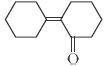
B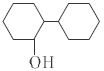
C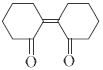
D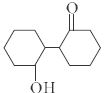
Solution
(A) Cyclohexanone undergoes self-aldol condensation in the presence of a base $(OH^-)$ to form a $\beta$-hydroxy ketone intermediate. Upon heating $(\Delta)$,this intermediate undergoes dehydration (elimination of $H_2O$) to form an $\alpha,\beta$-unsaturated ketone. The final product is $2$-cyclohexylidenecyclohexanone.
0 likesView Solution
60
ChemistryMediumMCQNEET · 2017
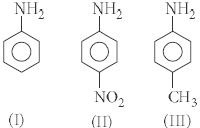
The correct increasing order of basic strength for the following compounds is:
A
$III < I < II$
B
$III < II < I$
C
$II < I < III$
D
$II < III < I$
Solution
(C) The basic strength of aromatic amines depends on the electron density on the nitrogen atom.
Electron-donating groups (like $-CH_3$) increase the electron density on the nitrogen atom,thereby increasing the basic strength.
Electron-withdrawing groups (like $-NO_2$) decrease the electron density on the nitrogen atom,thereby decreasing the basic strength.
In the given compounds:
$(I)$ is Aniline.
$(II)$ is $p$-Nitroaniline,where $-NO_2$ is a strong electron-withdrawing group,making it the least basic.
$(III)$ is $p$-Toluidine,where $-CH_3$ is an electron-donating group,making it the most basic.
Therefore,the increasing order of basic strength is: $II < I < III$.
Electron-donating groups (like $-CH_3$) increase the electron density on the nitrogen atom,thereby increasing the basic strength.
Electron-withdrawing groups (like $-NO_2$) decrease the electron density on the nitrogen atom,thereby decreasing the basic strength.
In the given compounds:
$(I)$ is Aniline.
$(II)$ is $p$-Nitroaniline,where $-NO_2$ is a strong electron-withdrawing group,making it the least basic.
$(III)$ is $p$-Toluidine,where $-CH_3$ is an electron-donating group,making it the most basic.
Therefore,the increasing order of basic strength is: $II < I < III$.
0 likesView Solution
61
ChemistryMediumMCQNEET · 2017
Which of the following reactions is appropriate for converting acetamide to methanamine?
A
Hoffmann hypobromamide reaction
B
Stephen's reaction
C
Gabriel phthalimide synthesis
D
Carbylamine reaction
Solution
(A) The conversion of acetamide $(CH_3CONH_2)$ to methanamine $(CH_3NH_2)$ involves the removal of a carbonyl group,which is characteristic of the Hoffmann bromamide degradation reaction.
The chemical equation is:
$CH_3CONH_2 + Br_2 + 4KOH \rightarrow CH_3NH_2 + K_2CO_3 + 2KBr + 2H_2O$
This reaction is known as the Hoffmann hypobromamide reaction.
The chemical equation is:
$CH_3CONH_2 + Br_2 + 4KOH \rightarrow CH_3NH_2 + K_2CO_3 + 2KBr + 2H_2O$
This reaction is known as the Hoffmann hypobromamide reaction.
0 likesView Solution
62
ChemistryEasyMCQNEET · 2017
Which of the following statements is not correct?
A
Ovalbumin is a simple food reserve in egg-white.
B
Blood proteins thrombin and fibrinogen are involved in blood clotting.
C
Denaturation makes the proteins more active.
D
Insulin maintains sugar level in the blood of a human body.
Solution
(C) Denaturation is a process in which the secondary and tertiary structures of proteins are destroyed due to physical or chemical changes,such as change in $pH$ or temperature. During this process,the globules unfold and the helix becomes uncoiled,causing the protein to lose its biological activity. Therefore,the statement that denaturation makes proteins more active is incorrect.
0 likesView Solution
63
ChemistryEasyMCQNEET · 2017
$A$ mixture of chloroxylenol and terpineol acts as
A
antiseptic
B
antipyretic
C
antibiotic
D
analgesic
Solution
(A) mixture of chloroxylenol and terpineol is commonly known as Dettol,which acts as an antiseptic.
0 likesView Solution
64
ChemistryEasyMCQNEET · 2017
The electron distribution in $d^{n}$ coordination complexes depends on the magnitude of crystal field splitting,$(\Delta_{0})$ and pairing energy $(P).$ The condition which favours the formation of high spin complexes is
A
$\Delta_{0} > P$
B
$\Delta_{0} < P$
C
$\Delta_{0} = P$
D
$t_{2g}^{4} e_{g}^{0}$
Solution
(B) In coordination complexes,the electron distribution is determined by the competition between the crystal field splitting energy $(\Delta_{0})$ and the pairing energy $(P).$
If $\Delta_{0} > P$,the energy required to pair electrons is less than the energy required to promote an electron to the higher energy $e_{g}$ orbitals. This leads to the formation of low spin complexes.
If $\Delta_{0} < P$,the energy required to pair electrons is greater than the energy required to promote an electron to the higher energy $e_{g}$ orbitals. This leads to the formation of high spin complexes.
Therefore,the condition that favours the formation of high spin complexes is $\Delta_{0} < P$.
If $\Delta_{0} > P$,the energy required to pair electrons is less than the energy required to promote an electron to the higher energy $e_{g}$ orbitals. This leads to the formation of low spin complexes.
If $\Delta_{0} < P$,the energy required to pair electrons is greater than the energy required to promote an electron to the higher energy $e_{g}$ orbitals. This leads to the formation of high spin complexes.
Therefore,the condition that favours the formation of high spin complexes is $\Delta_{0} < P$.
0 likesView Solution
65
ChemistryMediumMCQNEET · 2017
Toluene in the vapour phase is in equilibrium with a solution of benzene and toluene having mole fraction of toluene $0.50$. If vapour pressure of pure benzene is $119 \ torr$ and that of toluene is $37.0 \ torr$ at the same temperature,mole fraction of toluene in vapour phase will be:
A
$0.462$
B
$0.237$
C
$0.506$
D
$0.325$
Solution
(B) Let $A$ be toluene and $B$ be benzene.
Given: $X_{A} = 0.50$,$X_{B} = 1 - 0.50 = 0.50$.
$P_{A}^{0} = 37.0 \ torr$,$P_{B}^{0} = 119 \ torr$.
Total vapour pressure $P_{total} = P_{A}^{0} X_{A} + P_{B}^{0} X_{B} = (37.0 \times 0.50) + (119 \times 0.50) = 18.5 + 59.5 = 78.0 \ torr$.
According to Dalton's Law,the mole fraction of toluene in the vapour phase $(y_{A})$ is given by $y_{A} = \frac{P_{A}}{P_{total}}$.
$P_{A} = P_{A}^{0} X_{A} = 37.0 \times 0.50 = 18.5 \ torr$.
$y_{A} = \frac{18.5}{78.0} \approx 0.237$.
Given: $X_{A} = 0.50$,$X_{B} = 1 - 0.50 = 0.50$.
$P_{A}^{0} = 37.0 \ torr$,$P_{B}^{0} = 119 \ torr$.
Total vapour pressure $P_{total} = P_{A}^{0} X_{A} + P_{B}^{0} X_{B} = (37.0 \times 0.50) + (119 \times 0.50) = 18.5 + 59.5 = 78.0 \ torr$.
According to Dalton's Law,the mole fraction of toluene in the vapour phase $(y_{A})$ is given by $y_{A} = \frac{P_{A}}{P_{total}}$.
$P_{A} = P_{A}^{0} X_{A} = 37.0 \times 0.50 = 18.5 \ torr$.
$y_{A} = \frac{18.5}{78.0} \approx 0.237$.
0 likesView Solution
66
ChemistryMediumMCQNEET · 2017
The reaction: $ArN_2Cl \xrightarrow{Cu / HCl} ArCl + N_2$ is known as
A
Sandmeyer's reaction
B
Finkelstein reaction
C
Gattermann reaction
D
Balz-Schiemann reaction
Solution
(C) The reaction of benzene diazonium chloride $(ArN_2Cl)$ with copper powder $(Cu)$ in the presence of hydrochloric acid $(HCl)$ to form aryl chloride $(ArCl)$ is known as the Gattermann reaction.
Note: If $Cu_2Cl_2 / HCl$ were used instead of $Cu / HCl$,it would be the Sandmeyer reaction.
Note: If $Cu_2Cl_2 / HCl$ were used instead of $Cu / HCl$,it would be the Sandmeyer reaction.
0 likesView Solution
67
ChemistryMediumMCQNEET · 2017
Which one of the following ions is not tetrahedral in shape?
A
$NH_4^+$
B
$BF_4^-$
C
$[Cu(NH_3)_4]^{2+}$
D
$[NiCl_4]^{2-}$
Solution
(C) In $[Cu(NH_3)_4]^{2+}$,the $Cu^{2+}$ ion undergoes $dsp^2$ hybridization,which results in a square planar geometry.
In contrast,the ions $NH_4^+$,$BF_4^-$,and $[NiCl_4]^{2-}$ all exhibit $sp^3$ hybridization,which corresponds to a tetrahedral geometry.
In contrast,the ions $NH_4^+$,$BF_4^-$,and $[NiCl_4]^{2-}$ all exhibit $sp^3$ hybridization,which corresponds to a tetrahedral geometry.
0 likesView Solution
68
ChemistryMediumMCQNEET · 2017
The oxidation of phenol with chromic acid gives
A
$A$ simple diketone
B
$A$ conjugated diketone
C
$Ortho$-benzoquinone
D
An aldehyde
Solution
(B) When phenol is oxidized with chromic acid $(H_2CrO_4)$,it undergoes oxidation to form $p$-benzoquinone.
$p$-Benzoquinone is a cyclic conjugated diketone.
Therefore,the correct description of the product is a conjugated diketone.
$p$-Benzoquinone is a cyclic conjugated diketone.
Therefore,the correct description of the product is a conjugated diketone.
0 likesView Solution
69
ChemistryMediumMCQNEET · 2017
The product $(P)$ of the following reaction:
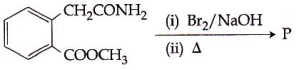
A
B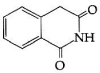
C
D
Solution
(C) The reaction involves two steps:
$1$. The first step uses $Br_2/NaOH$,which is the condition for the Hofmann bromamide degradation reaction. This reaction converts an amide group $(-CONH_2)$ into a primary amine group $(-NH_2)$.
$2$. The starting material is methyl $2-(carbamoylmethyl)benzoate$. The $-CONH_2$ group is converted to $-CH_2NH_2$.
$3$. The intermediate formed is methyl $2-(aminomethyl)benzoate$.
$4$. In the second step,heating $(\Delta)$ causes an intramolecular cyclization (nucleophilic acyl substitution) where the $-NH_2$ group attacks the ester carbonyl group $(-COOCH_3)$,resulting in the loss of a methanol molecule $(-CH_3OH)$ and the formation of a cyclic amide (lactam).
$5$. The final product $(P)$ is $isoindolin-1-one$.
$1$. The first step uses $Br_2/NaOH$,which is the condition for the Hofmann bromamide degradation reaction. This reaction converts an amide group $(-CONH_2)$ into a primary amine group $(-NH_2)$.
$2$. The starting material is methyl $2-(carbamoylmethyl)benzoate$. The $-CONH_2$ group is converted to $-CH_2NH_2$.
$3$. The intermediate formed is methyl $2-(aminomethyl)benzoate$.
$4$. In the second step,heating $(\Delta)$ causes an intramolecular cyclization (nucleophilic acyl substitution) where the $-NH_2$ group attacks the ester carbonyl group $(-COOCH_3)$,resulting in the loss of a methanol molecule $(-CH_3OH)$ and the formation of a cyclic amide (lactam).
$5$. The final product $(P)$ is $isoindolin-1-one$.
0 likesView Solution
70
ChemistryMediumMCQNEET · 2017
For the reaction,$XA + YB \rightarrow ZC$,if $\frac{- d [ A ]}{ dt } = \frac{- d [ B ]}{ dt } = \frac{d [ C ]}{ dt },$ then the correct statement among the following is:
A
The value of $X = Y = Z = 3$
B
The value of $X = Y = 3$
C
The value of $X = 2$
D
The value of $Y = 2$
Solution
(A) For a general reaction $XA + YB \rightarrow ZC$,the rate of reaction is given by:
Rate $= -\frac{1}{X} \frac{d[A]}{dt} = -\frac{1}{Y} \frac{d[B]}{dt} = \frac{1}{Z} \frac{d[C]}{dt}$
Given that $\frac{-d[A]}{dt} = \frac{-d[B]}{dt} = \frac{d[C]}{dt}$,we can equate these to the rate expression:
$\frac{1}{X} (\text{Rate}) = \frac{1}{Y} (\text{Rate}) = \frac{1}{Z} (\text{Rate})$
This implies that $X = Y = Z$. Since the coefficients in a balanced chemical equation must be equal for the rates of disappearance and appearance to be equal,the simplest integer ratio is $X = Y = Z = 1$. However,looking at the options provided,the statement $X = Y = Z$ is implied by the equality of the rates. Given the options,the most consistent choice is that the coefficients are equal.
Rate $= -\frac{1}{X} \frac{d[A]}{dt} = -\frac{1}{Y} \frac{d[B]}{dt} = \frac{1}{Z} \frac{d[C]}{dt}$
Given that $\frac{-d[A]}{dt} = \frac{-d[B]}{dt} = \frac{d[C]}{dt}$,we can equate these to the rate expression:
$\frac{1}{X} (\text{Rate}) = \frac{1}{Y} (\text{Rate}) = \frac{1}{Z} (\text{Rate})$
This implies that $X = Y = Z$. Since the coefficients in a balanced chemical equation must be equal for the rates of disappearance and appearance to be equal,the simplest integer ratio is $X = Y = Z = 1$. However,looking at the options provided,the statement $X = Y = Z$ is implied by the equality of the rates. Given the options,the most consistent choice is that the coefficients are equal.
0 likesView Solution
71
ChemistryMediumMCQNEET · 2017
If the rate of the reaction,$R-CO-Z + Nu^- \rightarrow R-CO-Nu + Z^-$ is fastest,then $Z$ is
A
$Cl$
B
$NH_2$
C
$OC_2H_5$
D
$OCOCH_3$
Solution
(A) The given reaction is a nucleophilic acyl substitution reaction. The rate of this reaction depends on the leaving group ability of $Z^-$. $A$ better leaving group makes the reaction faster. The leaving group ability is inversely proportional to the basicity of the group. Among the given options,$Cl^-$ is the weakest base and thus the best leaving group. Therefore,the reaction is fastest when $Z = Cl$.
0 likesView Solution
72
ChemistryMediumMCQNEET · 2017
$A$ compound formed by $Mg$,$Al$,and $O$ is found to have a cubic close-packed $(CCP)$ array of oxide ions,in which $Mg^{2+}$ ions occupy $\frac{1}{8}^{th}$ of the tetrahedral voids and $Al^{3+}$ ions occupy $\frac{1}{2}$ of the octahedral voids. The formula for the compound is:
A
$MgAl_4O_2$
B
$Mg_2Al_3O_2$
C
$MgAl_2O_4$
D
$MgAlO$
Solution
(C) Let the number of oxide ions $(O^{2-})$ in the $CCP$ lattice be $N = 4$.
Number of octahedral voids $(OV)$ = $N = 4$.
Number of tetrahedral voids $(TV)$ = $2N = 8$.
Given that $Mg^{2+}$ ions occupy $\frac{1}{8}^{th}$ of the tetrahedral voids:
Number of $Mg^{2+} = \frac{1}{8} \times 8 = 1$.
Given that $Al^{3+}$ ions occupy $\frac{1}{2}$ of the octahedral voids:
Number of $Al^{3+} = \frac{1}{2} \times 4 = 2$.
Thus,the ratio of $Mg : Al : O$ is $1 : 2 : 4$.
The formula of the compound is $MgAl_2O_4$.
Number of octahedral voids $(OV)$ = $N = 4$.
Number of tetrahedral voids $(TV)$ = $2N = 8$.
Given that $Mg^{2+}$ ions occupy $\frac{1}{8}^{th}$ of the tetrahedral voids:
Number of $Mg^{2+} = \frac{1}{8} \times 8 = 1$.
Given that $Al^{3+}$ ions occupy $\frac{1}{2}$ of the octahedral voids:
Number of $Al^{3+} = \frac{1}{2} \times 4 = 2$.
Thus,the ratio of $Mg : Al : O$ is $1 : 2 : 4$.
The formula of the compound is $MgAl_2O_4$.
0 likesView Solution
73
ChemistryMediumMCQNEET · 2017
Of the following alcohols,the one that would react fastest with conc. $HCl$ and anhydrous $ZnCl_{2}$ is,
A
Butan$-1-$ol
B
Butan$-2-$ol
C
$2-$methylpropan$-2-$ol
D
$2-$methylpropan$-1-$ol
Solution
(C) The reaction of alcohols with conc. $HCl$ and anhydrous $ZnCl_{2}$ is known as the Lucas test.
This reaction proceeds via an $S_{N}1$ mechanism,where the rate-determining step is the formation of a carbocation.
Therefore,the reactivity of alcohols follows the order: $3^{\circ} > 2^{\circ} > 1^{\circ}$.
Among the given options:
$A$. Butan$-1-$ol is a $1^{\circ}$ alcohol.
$B$. Butan$-2-$ol is a $2^{\circ}$ alcohol.
$C$. $2-$methylpropan$-2-$ol is a $3^{\circ}$ alcohol.
$D$. $2-$methylpropan$-1-$ol is a $1^{\circ}$ alcohol.
Since $3^{\circ}$ alcohols form the most stable carbocation,$2-$methylpropan$-2-$ol reacts fastest.
This reaction proceeds via an $S_{N}1$ mechanism,where the rate-determining step is the formation of a carbocation.
Therefore,the reactivity of alcohols follows the order: $3^{\circ} > 2^{\circ} > 1^{\circ}$.
Among the given options:
$A$. Butan$-1-$ol is a $1^{\circ}$ alcohol.
$B$. Butan$-2-$ol is a $2^{\circ}$ alcohol.
$C$. $2-$methylpropan$-2-$ol is a $3^{\circ}$ alcohol.
$D$. $2-$methylpropan$-1-$ol is a $1^{\circ}$ alcohol.
Since $3^{\circ}$ alcohols form the most stable carbocation,$2-$methylpropan$-2-$ol reacts fastest.
0 likesView Solution
74
ChemistryMediumMCQNEET · 2017
The $[Co(H_2O)_6]^{2+}$ ion has three unpaired electrons. The hybridization of $Co$ in $[Co(H_2O)_6]^{2+}$ is
A
$sp^3$
B
$dsp^2$
C
$sp^3d^2$
D
$d^2sp^3$
Solution
(C) The atomic number of $Co$ is $27$. The electronic configuration of $Co^{2+}$ is $[Ar] 3d^7$.
Since $H_2O$ is a weak field ligand,it does not cause pairing of electrons in the $3d$ orbitals.
Thus,the $3d$ orbitals have $3$ unpaired electrons.
The hybridization involves the use of one $4s$,three $4p$,and two $4d$ orbitals to accommodate the six ligands.
Therefore,the hybridization is $sp^3d^2$.
Since $H_2O$ is a weak field ligand,it does not cause pairing of electrons in the $3d$ orbitals.
Thus,the $3d$ orbitals have $3$ unpaired electrons.
The hybridization involves the use of one $4s$,three $4p$,and two $4d$ orbitals to accommodate the six ligands.
Therefore,the hybridization is $sp^3d^2$.
0 likesView Solution
75
ChemistryMediumMCQNEET · 2017
For the tetrahedral complex $[MnBr_4]^{2-}$, the spin-only magnetic moment value is $....$ (At. no. of $Mn = 25$) (in $BM$)
A
$1.7$
B
$5.9$
C
$4.8$
D
$2.4$
Solution
(B) The central metal ion is $Mn^{2+}$.
The atomic number of $Mn$ is $25$, so the electronic configuration of $Mn^{2+}$ is $[Ar] 3d^5$.
In the tetrahedral complex $[MnBr_4]^{2-}$, $Br^-$ is a weak field ligand, so the electrons remain unpaired.
Number of unpaired electrons $(n)$ = $5$.
The spin-only magnetic moment $(\mu)$ is calculated using the formula $\mu = \sqrt{n(n+2)} \ BM$.
$\mu = \sqrt{5(5+2)} = \sqrt{35} \approx 5.92 \ BM$.
The atomic number of $Mn$ is $25$, so the electronic configuration of $Mn^{2+}$ is $[Ar] 3d^5$.
In the tetrahedral complex $[MnBr_4]^{2-}$, $Br^-$ is a weak field ligand, so the electrons remain unpaired.
Number of unpaired electrons $(n)$ = $5$.
The spin-only magnetic moment $(\mu)$ is calculated using the formula $\mu = \sqrt{n(n+2)} \ BM$.
$\mu = \sqrt{5(5+2)} = \sqrt{35} \approx 5.92 \ BM$.
0 likesView Solution
76
ChemistryMediumMCQNEET · 2017
Which of the following statements is incorrect?
A
In coagulation of a negative sol,flocculating power is in the order of $Al^{3+} > Ba^{2+} > Na^{+}$
B
In the flocculation of a positive sol,flocculating power is in the order,$Cl^{-} > SO_{4}^{2-} > PO_{4}^{3-} > [Fe(CN)_{6}]^{4-}$
C
Lyophilic colloids have greater affinity for solvents
D
Lyophilic sols are more stable than lyophobic sols
Solution
(B) According to the Hardy-Schulze rule,the flocculating power of an ion increases with the increase in the magnitude of the charge on the ion.
For a positive sol,the coagulating ions must be negative.
The correct order of flocculating power for a positive sol is $[Fe(CN)_{6}]^{4-} > PO_{4}^{3-} > SO_{4}^{2-} > Cl^{-}$.
Therefore,the statement in option $B$ is incorrect as it presents the reverse order.
For a positive sol,the coagulating ions must be negative.
The correct order of flocculating power for a positive sol is $[Fe(CN)_{6}]^{4-} > PO_{4}^{3-} > SO_{4}^{2-} > Cl^{-}$.
Therefore,the statement in option $B$ is incorrect as it presents the reverse order.
0 likesView Solution
77
ChemistryEasyMCQNEET · 2017
Which of these artificial sweeteners is unstable at cooking temperature?
A
Aspartame
B
Alitame
C
Sucralose
D
Saccharin
Solution
(A) $Aspartame$ is an artificial sweetener that is unstable at cooking temperatures. It decomposes upon heating,which limits its use to cold foods and soft drinks.
0 likesView Solution
78
ChemistryMediumMCQNEET · 2017
Which of the following pairs shows the highest bond dissociation enthalpy among halogens and the lowest bond dissociation enthalpy among hydrogen halides?
A
$I_{2}, HI$
B
$Cl_{2}, HCl$
C
$Br_{2}, HBr$
D
$Cl_{2}, HI$
Solution
(D) $1$. Among halogens,the bond dissociation enthalpy order is $Cl_{2} > Br_{2} > F_{2} > I_{2}$. Thus,$Cl_{2}$ has the highest bond dissociation enthalpy.
$2$. Among hydrogen halides,the bond dissociation enthalpy decreases down the group due to an increase in bond length: $HF > HCl > HBr > HI$. Thus,$HI$ has the lowest bond dissociation enthalpy.
$3$. Therefore,the correct pair is $(Cl_{2}, HI)$.
$2$. Among hydrogen halides,the bond dissociation enthalpy decreases down the group due to an increase in bond length: $HF > HCl > HBr > HI$. Thus,$HI$ has the lowest bond dissociation enthalpy.
$3$. Therefore,the correct pair is $(Cl_{2}, HI)$.
0 likesView Solution
79
ChemistryMediumMCQNEET · 2017
Match the polymer in Column-$I$ to the monomer from Column-$II$ and assign the correct code.
Code:
$(a) \quad (b) \quad (c) \quad (d)$
| Column-$I$ (Polymer) | Column-$II$ (Monomer) |
|---|---|
| $(a)$ Nylon-$6$ | $(i)$ Ethylene glycol,terephthalic acid |
| $(b)$ Dacron | $(ii)$ Urea,formaldehyde |
| $(c)$ Glyptal | $(iii)$ Ethylene glycol,phthalic acid |
| $(d)$ Novolac | $(iv)$ Phenol,formaldehyde |
| $ $ | $(v)$ Caprolactam |
Code:
$(a) \quad (b) \quad (c) \quad (d)$
A
$(v) \quad (i) \quad (iii) \quad (iv)$
B
$(iii) \quad (i) \quad (iv) \quad (ii)$
C
$(ii) \quad (i) \quad (iv) \quad (ii)$
D
$(v) \quad (iii) \quad (i) \quad (ii)$
Solution
(A) The correct matching is as follows:
$(a)$ Nylon-$6$ is formed from $(v)$ Caprolactam.
$(b)$ Dacron is formed from $(i)$ Ethylene glycol and terephthalic acid.
$(c)$ Glyptal is formed from $(iii)$ Ethylene glycol and phthalic acid.
$(d)$ Novolac is formed from $(iv)$ Phenol and formaldehyde.
Therefore,the correct sequence is $(a)-(v), (b)-(i), (c)-(iii), (d)-(iv)$.
$(a)$ Nylon-$6$ is formed from $(v)$ Caprolactam.
$(b)$ Dacron is formed from $(i)$ Ethylene glycol and terephthalic acid.
$(c)$ Glyptal is formed from $(iii)$ Ethylene glycol and phthalic acid.
$(d)$ Novolac is formed from $(iv)$ Phenol and formaldehyde.
Therefore,the correct sequence is $(a)-(v), (b)-(i), (c)-(iii), (d)-(iv)$.
0 likesView Solution
80
ChemistryEasyMCQNEET · 2017
Which of the following lanthanoids shows $+4$ oxidation state to acquire noble gas configuration?
(At nos. : $La=57, Ce=58, Eu=63$ and $Yb=70$ )
(At nos. : $La=57, Ce=58, Eu=63$ and $Yb=70$ )
A
$Ce$
B
$Yb$
C
$La$
D
$Eu$
Solution
(A) The electronic configuration of $Ce$ $(Z=58)$ is $[Xe] 4f^1 5d^1 6s^2$.
By losing four electrons,$Ce$ attains the stable noble gas configuration of Xenon $([Xe])$,resulting in the $+4$ oxidation state.
Therefore,$Ce^{4+}$ is a stable ion.
By losing four electrons,$Ce$ attains the stable noble gas configuration of Xenon $([Xe])$,resulting in the $+4$ oxidation state.
Therefore,$Ce^{4+}$ is a stable ion.
0 likesView Solution
81
ChemistryMediumMCQNEET · 2017
Consider the following sequence of reactions:
$Benzene$ $\xrightarrow{CO, HCl, \text{anhydrous } AlCl_3/CuCl} A$ $\xrightarrow{B, OH^-, 293 K} \text{Chalcone (1,3-diphenylprop-2-en-1-one)}$
The substance $B$ is:
$Benzene$ $\xrightarrow{CO, HCl, \text{anhydrous } AlCl_3/CuCl} A$ $\xrightarrow{B, OH^-, 293 K} \text{Chalcone (1,3-diphenylprop-2-en-1-one)}$
The substance $B$ is:
A
Benzene
B
Acetophenone
C
Benzaldehyde
D
Acetone
Solution
(B) $1$. The first step is the Gattermann-Koch reaction where benzene reacts with $CO$ and $HCl$ in the presence of anhydrous $AlCl_3/CuCl$ to form $A$,which is benzaldehyde $(C_6H_5CHO)$.
$2$. The second step is the Claisen-Schmidt condensation reaction between benzaldehyde $(A)$ and a ketone $(B)$ in the presence of a base $(OH^-)$ to form the product,which is chalcone $(C_6H_5-CH=CH-CO-C_6H_5)$.
$3$. For the formation of chalcone,the ketone $B$ must be acetophenone $(C_6H_5COCH_3)$.
$4$. Therefore,the substance $B$ is acetophenone.
$2$. The second step is the Claisen-Schmidt condensation reaction between benzaldehyde $(A)$ and a ketone $(B)$ in the presence of a base $(OH^-)$ to form the product,which is chalcone $(C_6H_5-CH=CH-CO-C_6H_5)$.
$3$. For the formation of chalcone,the ketone $B$ must be acetophenone $(C_6H_5COCH_3)$.
$4$. Therefore,the substance $B$ is acetophenone.
0 likesView Solution
82
ChemistryMediumMCQNEET · 2017
Which of the following complex ions is not diamagnetic?
A
$[Ti(en)_{2}(NH_{3})_{2}]^{4+}$
B
$[Cr(NH_{3})_{6}]^{3+}$
C
$[Zn(NH_{3})_{6}]^{2+}$
D
$[Sc(H_{2}O)_{3}(NH_{3})_{3}]^{3+}$
Solution
(B) To determine if a complex is diamagnetic,we check for the presence of unpaired electrons in the central metal ion.
$A$. In $[Ti(en)_{2}(NH_{3})_{2}]^{4+}$,$Ti$ is in the $+4$ oxidation state ($d^0$ configuration). It has no unpaired electrons,so it is diamagnetic.
$B$. In $[Cr(NH_{3})_{6}]^{3+}$,$Cr$ is in the $+3$ oxidation state ($d^3$ configuration). The $d$-orbitals have $3$ unpaired electrons $(t_{2g}^3)$,making it paramagnetic.
$C$. In $[Zn(NH_{3})_{6}]^{2+}$,$Zn$ is in the $+2$ oxidation state ($d^{10}$ configuration). It has no unpaired electrons,so it is diamagnetic.
$D$. In $[Sc(H_{2}O)_{3}(NH_{3})_{3}]^{3+}$,$Sc$ is in the $+3$ oxidation state ($d^0$ configuration). It has no unpaired electrons,so it is diamagnetic.
Therefore,$[Cr(NH_{3})_{6}]^{3+}$ is not diamagnetic.
$A$. In $[Ti(en)_{2}(NH_{3})_{2}]^{4+}$,$Ti$ is in the $+4$ oxidation state ($d^0$ configuration). It has no unpaired electrons,so it is diamagnetic.
$B$. In $[Cr(NH_{3})_{6}]^{3+}$,$Cr$ is in the $+3$ oxidation state ($d^3$ configuration). The $d$-orbitals have $3$ unpaired electrons $(t_{2g}^3)$,making it paramagnetic.
$C$. In $[Zn(NH_{3})_{6}]^{2+}$,$Zn$ is in the $+2$ oxidation state ($d^{10}$ configuration). It has no unpaired electrons,so it is diamagnetic.
$D$. In $[Sc(H_{2}O)_{3}(NH_{3})_{3}]^{3+}$,$Sc$ is in the $+3$ oxidation state ($d^0$ configuration). It has no unpaired electrons,so it is diamagnetic.
Therefore,$[Cr(NH_{3})_{6}]^{3+}$ is not diamagnetic.
0 likesView Solution
83
ChemistryMediumMCQNEET · 2017
Among halogens,the one which can oxidise water to oxygen is:
A
chlorine
B
bromine
C
fluorine
D
iodine
Solution
(C) Fluorine $(F_2)$ is the strongest oxidizing agent among the halogens due to its high electronegativity and high standard reduction potential. It reacts vigorously with water to oxidize it to oxygen $(O_2)$ according to the following reaction:
$2F_2(g) + 2H_2O(l) \rightarrow 4HF(aq) + O_2(g)$
$2F_2(g) + 2H_2O(l) \rightarrow 4HF(aq) + O_2(g)$
0 likesView Solution
84
ChemistryEasyMCQNEET · 2017
Given that $\Lambda_{m}^{\infty} = 133.4 \, S \, cm^{2} \, mol^{-1} (AgNO_{3})$; $\Lambda_{m}^{\infty} = 149.9 \, S \, cm^{2} \, mol^{-1} (KCl)$ and $\Lambda_{m}^{\infty} = 144.9 \, S \, cm^{2} \, mol^{-1} (KNO_{3})$,the molar conductivity at infinite dilution for $AgCl$ is $....... \, S \, cm^{2} \, mol^{-1}$.
A
$140$
B
$138$
C
$134$
D
$132$
Solution
(B) According to Kohlrausch's law of independent migration of ions,the molar conductivity at infinite dilution for $AgCl$ can be calculated as:
$\Lambda_{m}^{\infty}(AgCl) = \Lambda_{m}^{\infty}(Ag^{+}) + \Lambda_{m}^{\infty}(Cl^{-})$
Using the given values:
$\Lambda_{m}^{\infty}(AgCl) = \Lambda_{m}^{\infty}(AgNO_{3}) + \Lambda_{m}^{\infty}(KCl) - \Lambda_{m}^{\infty}(KNO_{3})$
Substituting the values:
$= 133.4 + 149.9 - 144.9$
$= 283.3 - 144.9$
$= 138.4 \, S \, cm^{2} \, mol^{-1}$
Rounding to the nearest integer,the value is $138 \, S \, cm^{2} \, mol^{-1}$.
$\Lambda_{m}^{\infty}(AgCl) = \Lambda_{m}^{\infty}(Ag^{+}) + \Lambda_{m}^{\infty}(Cl^{-})$
Using the given values:
$\Lambda_{m}^{\infty}(AgCl) = \Lambda_{m}^{\infty}(AgNO_{3}) + \Lambda_{m}^{\infty}(KCl) - \Lambda_{m}^{\infty}(KNO_{3})$
Substituting the values:
$= 133.4 + 149.9 - 144.9$
$= 283.3 - 144.9$
$= 138.4 \, S \, cm^{2} \, mol^{-1}$
Rounding to the nearest integer,the value is $138 \, S \, cm^{2} \, mol^{-1}$.
0 likesView Solution
85
ChemistryMediumMCQNEET · 2017
Consider the reaction between chlorine and nitric oxide:
$Cl_{2(g)} + 2NO_{(g)} \rightarrow 2NOCl_{(g)}$
On doubling the concentration of both reactants,the rate of the reaction increases by a factor of $8$. However,if only the concentration of $Cl_2$ is doubled,the rate increases by a factor of $2$. The order of this reaction with respect to $NO$ is :
$Cl_{2(g)} + 2NO_{(g)} \rightarrow 2NOCl_{(g)}$
On doubling the concentration of both reactants,the rate of the reaction increases by a factor of $8$. However,if only the concentration of $Cl_2$ is doubled,the rate increases by a factor of $2$. The order of this reaction with respect to $NO$ is :
A
$0$
B
$1$
C
$2$
D
$3$
Solution
(C) Let the rate law be $Rate = k[Cl_2]^x[NO]^y$.
Given that doubling $[Cl_2]$ increases the rate by a factor of $2$,we have $2^x = 2$,which implies $x = 1$.
When both concentrations are doubled,the rate increases by a factor of $8$,so $2^x \times 2^y = 8$.
Substituting $x = 1$,we get $2^1 \times 2^y = 8$,which simplifies to $2^y = 4$.
Therefore,$y = 2$.
The order of the reaction with respect to $NO$ is $2$.
Given that doubling $[Cl_2]$ increases the rate by a factor of $2$,we have $2^x = 2$,which implies $x = 1$.
When both concentrations are doubled,the rate increases by a factor of $8$,so $2^x \times 2^y = 8$.
Substituting $x = 1$,we get $2^1 \times 2^y = 8$,which simplifies to $2^y = 4$.
Therefore,$y = 2$.
The order of the reaction with respect to $NO$ is $2$.
0 likesView Solution
86
ChemistryMediumMCQNEET · 2017
Strong reducing behaviour of $H_3PO_2$ is due to
A
Low oxidation state of $P$
B
Presence of one $-OH$ group and two $P-H$ bonds
C
Presence of two $-OH$ groups and one $P-H$ bond
D
Low coordination number of $P$
Solution
(B) The structure of hypophosphorous acid $(H_3PO_2)$ contains one $P=O$ bond,two $P-H$ bonds,and one $P-OH$ bond.
The presence of two $P-H$ bonds is responsible for its strong reducing character,as these bonds can easily release hydrogen atoms.
The presence of two $P-H$ bonds is responsible for its strong reducing character,as these bonds can easily release hydrogen atoms.
0 likesView Solution
87
ChemistryEasyMCQNEET · 2017
Among the following acids,the strongest acid is
A
$NCCH_2COOH$
B
$O_2NCH_2COOH$
C
$F_3CCOOH$
D
$Cl_3CCOOH$
Solution
(C) The strength of an acid is determined by the stability of its conjugate base. Electron-withdrawing groups $(EWG)$ stabilize the carboxylate anion $(RCOO^-)$ through the inductive effect ($-I$ effect),thereby increasing the acidity of the parent carboxylic acid.
Comparing the substituents:
$1$. $NCCH_2-$: Contains a cyano group $(-CN)$,which has a $-I$ effect.
$2$. $O_2NCH_2-$: Contains a nitro group $(-NO_2)$,which has a strong $-I$ effect.
$3$. $F_3C-$: Contains three fluorine atoms. Fluorine is the most electronegative element,and the $-I$ effect of three fluorine atoms is significantly stronger than that of a single $-NO_2$ or $-CN$ group.
$4$. $Cl_3C-$: Contains three chlorine atoms. Chlorine is less electronegative than fluorine,so the $-I$ effect of $Cl_3C-$ is weaker than that of $F_3C-$.
Since fluorine is the most electronegative,$F_3CCOOH$ exhibits the strongest $-I$ effect,making its conjugate base the most stable and the acid the strongest among the given options.
Comparing the substituents:
$1$. $NCCH_2-$: Contains a cyano group $(-CN)$,which has a $-I$ effect.
$2$. $O_2NCH_2-$: Contains a nitro group $(-NO_2)$,which has a strong $-I$ effect.
$3$. $F_3C-$: Contains three fluorine atoms. Fluorine is the most electronegative element,and the $-I$ effect of three fluorine atoms is significantly stronger than that of a single $-NO_2$ or $-CN$ group.
$4$. $Cl_3C-$: Contains three chlorine atoms. Chlorine is less electronegative than fluorine,so the $-I$ effect of $Cl_3C-$ is weaker than that of $F_3C-$.
Since fluorine is the most electronegative,$F_3CCOOH$ exhibits the strongest $-I$ effect,making its conjugate base the most stable and the acid the strongest among the given options.
0 likesView Solution
Vedclass Products
For Students
Vedclass Test Series
Mock tests in real NEET style covering Chemistry with performance analysis. 5-day free trial.
Start Free TrialFor Teachers
Exam Paper Generator
Generate Set A/B/C/D Chemistry papers from 7.5L+ questions in 2 minutes. 3 chapters free.
Try FreeFor Institutes
Online Exam Module
Run live NEET mock exams with unlimited students, 360° analytics & white-label branding.
See DemoFrequently Asked Questions
How many Chemistry questions are in NEET 2017?
There are 94 Chemistry questions from the NEET 2017 paper on Vedclass, each with a detailed step-by-step solution in English.
Are NEET 2017 Chemistry solutions available in English?
Yes. All solutions on this page are in English. You can also switch to English or Hindi using the language buttons above the questions.
Can I practice NEET 2017 Chemistry as a timed test?
Yes. Use the Vedclass Test Series to attempt a full NEET mock test covering Chemistry with time limits and instant score analysis.
Can teachers create Chemistry papers from NEET previous year questions?
Yes. The Vedclass Exam Paper Generator lets teachers mix NEET Chemistry questions and generate Set A/B/C/D papers in minutes.
For Teachers & Institutes
Build a Custom Chemistry Paper
Pick NEET 2017 Chemistry questions, set difficulty, and generate Set A/B/C/D in 2 minutes.