
ChemistryQ1–100 of 148 questions
Page 1 of 2 · English
1
ChemistryMCQNEET · 2016
$A$ long wire carries a steady current. It is bent into a circle of one turn and the magnetic field at the centre of the coil is $B$. It is then bent into a circular loop of $n$ turns. The magnetic field at the centre of the coil will be
A
$nB$
B
$n^2B$
C
$2nB$
D
$2n^2B$
Solution
(B) Let the length of the wire be $L$ and the current be $i$.
For a single turn loop of radius $r$,the circumference is $2\pi r = L$,so $r = \frac{L}{2\pi}$.
The magnetic field at the center is $B = \frac{\mu_0 i}{2r} = \frac{\mu_0 i}{2(L/2\pi)} = \frac{\mu_0 i \pi}{L}$.
When the wire is bent into $n$ turns,the new radius $r'$ satisfies $n(2\pi r') = L$,so $r' = \frac{L}{2\pi n} = \frac{r}{n}$.
The magnetic field at the center for $n$ turns is $B_n = n \times \frac{\mu_0 i}{2r'} = n \times \frac{\mu_0 i}{2(r/n)} = n^2 \times \frac{\mu_0 i}{2r}$.
Since $B = \frac{\mu_0 i}{2r}$,we have $B_n = n^2 B$.
For a single turn loop of radius $r$,the circumference is $2\pi r = L$,so $r = \frac{L}{2\pi}$.
The magnetic field at the center is $B = \frac{\mu_0 i}{2r} = \frac{\mu_0 i}{2(L/2\pi)} = \frac{\mu_0 i \pi}{L}$.
When the wire is bent into $n$ turns,the new radius $r'$ satisfies $n(2\pi r') = L$,so $r' = \frac{L}{2\pi n} = \frac{r}{n}$.
The magnetic field at the center for $n$ turns is $B_n = n \times \frac{\mu_0 i}{2r'} = n \times \frac{\mu_0 i}{2(r/n)} = n^2 \times \frac{\mu_0 i}{2r}$.
Since $B = \frac{\mu_0 i}{2r}$,we have $B_n = n^2 B$.
0 likesView Solution
2
ChemistryMCQNEET · 2016
Which of the following combinations should be selected for better tuning of an $L-C-R$ circuit used for communication?
A
$R=15 \ \Omega, L=3.5 \ H, C=30 \ \mu F$
B
$R=25 \ \Omega, L=1.5 \ H, C=45 \ \mu F$
C
$R=20 \ \Omega, L=1.5 \ H, C=35 \ \mu F$
D
$R=25 \ \Omega, L=2.5 \ H, C=45 \ \mu F$
Solution
(A) The quality factor $(Q)$ of an $L-C-R$ circuit determines the sharpness of resonance or the tuning quality. It is given by the formula:
$Q = \frac{1}{R} \sqrt{\frac{L}{C}}$
For better tuning,the quality factor $Q$ should be as high as possible.
Calculating $Q$ for each option:
$1$. For option $(A)$: $Q_1 = \frac{1}{15} \sqrt{\frac{3.5}{30 \times 10^{-6}}} = \frac{1}{15} \sqrt{\frac{3.5 \times 10^6}{30}} = \frac{1000}{15} \sqrt{0.1167} \approx 22.77$
$2$. For option $(B)$: $Q_2 = \frac{1}{25} \sqrt{\frac{1.5}{45 \times 10^{-6}}} = \frac{1000}{25} \sqrt{\frac{1.5}{45}} = 40 \sqrt{0.0333} \approx 7.30$
$3$. For option $(C)$: $Q_3 = \frac{1}{20} \sqrt{\frac{1.5}{35 \times 10^{-6}}} = \frac{1000}{20} \sqrt{\frac{1.5}{35}} = 50 \sqrt{0.0428} \approx 10.35$
$4$. For option $(D)$: $Q_4 = \frac{1}{25} \sqrt{\frac{2.5}{45 \times 10^{-6}}} = \frac{1000}{25} \sqrt{\frac{2.5}{45}} = 40 \sqrt{0.0555} \approx 9.43$
Comparing the values,$Q_1$ is the highest. Therefore,option $(A)$ provides the best tuning.
$Q = \frac{1}{R} \sqrt{\frac{L}{C}}$
For better tuning,the quality factor $Q$ should be as high as possible.
Calculating $Q$ for each option:
$1$. For option $(A)$: $Q_1 = \frac{1}{15} \sqrt{\frac{3.5}{30 \times 10^{-6}}} = \frac{1}{15} \sqrt{\frac{3.5 \times 10^6}{30}} = \frac{1000}{15} \sqrt{0.1167} \approx 22.77$
$2$. For option $(B)$: $Q_2 = \frac{1}{25} \sqrt{\frac{1.5}{45 \times 10^{-6}}} = \frac{1000}{25} \sqrt{\frac{1.5}{45}} = 40 \sqrt{0.0333} \approx 7.30$
$3$. For option $(C)$: $Q_3 = \frac{1}{20} \sqrt{\frac{1.5}{35 \times 10^{-6}}} = \frac{1000}{20} \sqrt{\frac{1.5}{35}} = 50 \sqrt{0.0428} \approx 10.35$
$4$. For option $(D)$: $Q_4 = \frac{1}{25} \sqrt{\frac{2.5}{45 \times 10^{-6}}} = \frac{1000}{25} \sqrt{\frac{2.5}{45}} = 40 \sqrt{0.0555} \approx 9.43$
Comparing the values,$Q_1$ is the highest. Therefore,option $(A)$ provides the best tuning.
0 likesView Solution
3
ChemistryMCQNEET · 2016
What is the output $Y$ in the following circuit,when all the three inputs $A, B, C$ are first $0$ and then $1$?
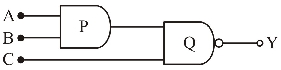
A
$1, 0$
B
$1, 1$
C
$0, 1$
D
$0, 0$
Solution
(A) The circuit consists of an $AND$ gate $(P)$ followed by a $NAND$ gate $(Q)$.
The output of the $AND$ gate $P$ is $X = A \cdot B$.
The output of the $NAND$ gate $Q$ is $Y = \overline{X \cdot C} = \overline{(A \cdot B) \cdot C} = \overline{A \cdot B \cdot C}$.
Case $1$: When $A = B = C = 0$,
$Y = \overline{0 \cdot 0 \cdot 0} = \overline{0} = 1$.
Case $2$: When $A = B = C = 1$,
$Y = \overline{1 \cdot 1 \cdot 1} = \overline{1} = 0$.
Thus,the outputs are $1$ and $0$ respectively.
The output of the $AND$ gate $P$ is $X = A \cdot B$.
The output of the $NAND$ gate $Q$ is $Y = \overline{X \cdot C} = \overline{(A \cdot B) \cdot C} = \overline{A \cdot B \cdot C}$.
Case $1$: When $A = B = C = 0$,
$Y = \overline{0 \cdot 0 \cdot 0} = \overline{0} = 1$.
Case $2$: When $A = B = C = 1$,
$Y = \overline{1 \cdot 1 \cdot 1} = \overline{1} = 0$.
Thus,the outputs are $1$ and $0$ respectively.
0 likesView Solution
4
ChemistryMediumMCQNEET · 2016
The hybridization of atomic orbitals of nitrogen in $NO_2^+$,$NO_3^-$,and $NH_4^+$ are:
A
$sp$,$sp^3$,and $sp^2$ respectively
B
$sp$,$sp^2$,and $sp^3$ respectively
C
$sp^2$,$sp$,and $sp^3$ respectively
D
$sp^2$,$sp^3$,and $sp$ respectively
Solution
(B) To determine the hybridization,we use the formula: $\text{Hybridization} = \frac{1}{2} [V + M - C + A]$,where $V$ is the number of valence electrons,$M$ is the number of monovalent atoms,$C$ is the cationic charge,and $A$ is the anionic charge.
$1$. For $NO_2^+$: $\text{Hybridization} = \frac{1}{2} [5 + 0 - 1 + 0] = 2$,which corresponds to $sp$ hybridization.
$2$. For $NO_3^-$: $\text{Hybridization} = \frac{1}{2} [5 + 0 - 0 + 1] = 3$,which corresponds to $sp^2$ hybridization.
$3$. For $NH_4^+$: $\text{Hybridization} = \frac{1}{2} [5 + 4 - 1 + 0] = 4$,which corresponds to $sp^3$ hybridization.
Thus,the correct order is $sp$,$sp^2$,and $sp^3$ respectively.
$1$. For $NO_2^+$: $\text{Hybridization} = \frac{1}{2} [5 + 0 - 1 + 0] = 2$,which corresponds to $sp$ hybridization.
$2$. For $NO_3^-$: $\text{Hybridization} = \frac{1}{2} [5 + 0 - 0 + 1] = 3$,which corresponds to $sp^2$ hybridization.
$3$. For $NH_4^+$: $\text{Hybridization} = \frac{1}{2} [5 + 4 - 1 + 0] = 4$,which corresponds to $sp^3$ hybridization.
Thus,the correct order is $sp$,$sp^2$,and $sp^3$ respectively.
0 likesView Solution
5
ChemistryMediumMCQNEET · 2016
Suppose the elements $X$ and $Y$ combine to form two compounds $XY_2$ and $X_3Y_2.$ When $0.1 \ mol$ of $XY_2$ weighs $10 \ g$ and $0.05 \ mol$ of $X_3Y_2$ weighs $9 \ g,$ the atomic weights of $X$ and $Y$ are
A
$40, 30$
B
$60, 40$
C
$20, 30$
D
$30, 20$
Solution
(A) For $XY_2$:
$0.1 \ mol$ of $XY_2 = 10 \ g$
$1 \ mol$ of $XY_2 = 100 \ g$
So,$X + 2Y = 100$ (Equation $1$)
For $X_3Y_2$:
$0.05 \ mol$ of $X_3Y_2 = 9 \ g$
$1 \ mol$ of $X_3Y_2 = 180 \ g$
So,$3X + 2Y = 180$ (Equation $2$)
Subtracting Equation $1$ from Equation $2$:
$(3X + 2Y) - (X + 2Y) = 180 - 100$
$2X = 80 \implies X = 40$
Substituting $X = 40$ in Equation $1$:
$40 + 2Y = 100$
$2Y = 60 \implies Y = 30$
Therefore,the atomic weights of $X$ and $Y$ are $40$ and $30$ respectively.
$0.1 \ mol$ of $XY_2 = 10 \ g$
$1 \ mol$ of $XY_2 = 100 \ g$
So,$X + 2Y = 100$ (Equation $1$)
For $X_3Y_2$:
$0.05 \ mol$ of $X_3Y_2 = 9 \ g$
$1 \ mol$ of $X_3Y_2 = 180 \ g$
So,$3X + 2Y = 180$ (Equation $2$)
Subtracting Equation $1$ from Equation $2$:
$(3X + 2Y) - (X + 2Y) = 180 - 100$
$2X = 80 \implies X = 40$
Substituting $X = 40$ in Equation $1$:
$40 + 2Y = 100$
$2Y = 60 \implies Y = 30$
Therefore,the atomic weights of $X$ and $Y$ are $40$ and $30$ respectively.
0 likesView Solution
6
ChemistryMediumMCQNEET · 2016
How many electrons can fit in the orbital for which $n = 3$ and $l = 1$?
A
$6$
B
$2$
C
$10$
D
$14$
Solution
(B) For $n = 3$ and $l = 1$,the subshell is $3p$.
According to the Pauli exclusion principle,any single orbital can accommodate a maximum of $2$ electrons with opposite spins.
Therefore,a single $3p$ orbital can hold $2$ electrons.
According to the Pauli exclusion principle,any single orbital can accommodate a maximum of $2$ electrons with opposite spins.
Therefore,a single $3p$ orbital can hold $2$ electrons.
0 likesView Solution
7
ChemistryDifficultMCQNEET · 2016
Which of the following pairs of $d-$ orbitals will have electron density along the axes?
A
$d_{z^2}, d_{xz}$
B
$d_{xz}, d_{yz}$
C
$d_{z^2}, d_{x^2 - y^2}$
D
$d_{xy}, d_{x^2 - y^2}$
Solution
(C) The $d-$orbitals are classified into two sets based on their orientation relative to the coordinate axes:
$1$. $e_g$ set: These orbitals have electron density along the axes. These include $d_{z^2}$ and $d_{x^2 - y^2}$.
$2$. $t_{2g}$ set: These orbitals have electron density between the axes. These include $d_{xy}, d_{yz},$ and $d_{xz}$.
Therefore,the pair of $d-$orbitals that have electron density along the axes is $d_{z^2}$ and $d_{x^2 - y^2}$.
$1$. $e_g$ set: These orbitals have electron density along the axes. These include $d_{z^2}$ and $d_{x^2 - y^2}$.
$2$. $t_{2g}$ set: These orbitals have electron density between the axes. These include $d_{xy}, d_{yz},$ and $d_{xz}$.
Therefore,the pair of $d-$orbitals that have electron density along the axes is $d_{z^2}$ and $d_{x^2 - y^2}$.
0 likesView Solution
8
ChemistryMediumMCQNEET · 2016
Two electrons occupying the same orbital are distinguished by
A
azimuthal quantum number
B
spin quantum number
C
principal quantum number
D
magnetic quantum number
Solution
(B) According to the Pauli Exclusion Principle,no two electrons in an atom can have the same set of all four quantum numbers.
For two electrons in the same orbital,the principal quantum number $(n)$,azimuthal quantum number $(l)$,and magnetic quantum number $(m_l)$ are identical.
Therefore,they must differ in their spin quantum number $(m_s)$,which can be either $+1/2$ or $-1/2$.
For two electrons in the same orbital,the principal quantum number $(n)$,azimuthal quantum number $(l)$,and magnetic quantum number $(m_l)$ are identical.
Therefore,they must differ in their spin quantum number $(m_s)$,which can be either $+1/2$ or $-1/2$.
0 likesView Solution
9
ChemistryMediumMCQNEET · 2016
In which of the following options the order of arrangement does not agree with the variation of property indicated against it?
A
$I < Br < Cl < F$ (increasing electron gain enthalpy)
B
$Li < Na < K < Rb$ (increasing metallic radius)
C
$B < C < N < O$ (increasing first ionisation enthalpy)
D
Both $(a)$ and $(c)$
Solution
(D) For option $(a)$: The electron gain enthalpy becomes more negative as we move from $I$ to $Cl$. However,$F$ has a lower electron gain enthalpy than $Cl$ due to its small size and inter-electronic repulsion. The correct order is $I < Br < F < Cl$. Thus,$(a)$ is incorrect.
For option $(b)$: Metallic radius increases down the group as the number of shells increases. The order $Li < Na < K < Rb$ is correct.
For option $(c)$: Ionisation enthalpy generally increases across a period. However,$N$ has a stable half-filled $2p^3$ configuration,making its ionisation enthalpy higher than $O$. The correct order is $B < C < O < N$. Thus,$(c)$ is incorrect.
Since both $(a)$ and $(c)$ do not agree with the indicated property,the correct option is $(d)$.
For option $(b)$: Metallic radius increases down the group as the number of shells increases. The order $Li < Na < K < Rb$ is correct.
For option $(c)$: Ionisation enthalpy generally increases across a period. However,$N$ has a stable half-filled $2p^3$ configuration,making its ionisation enthalpy higher than $O$. The correct order is $B < C < O < N$. Thus,$(c)$ is incorrect.
Since both $(a)$ and $(c)$ do not agree with the indicated property,the correct option is $(d)$.
0 likesView Solution
10
ChemistryMediumMCQNEET · 2016
Which one of the following compounds shows the presence of intramolecular hydrogen bond?
A
$H_2O_2$
B
$HCN$
C
Cellulose
D
Concentrated acetic acid
Solution
(C) Intramolecular hydrogen bonding occurs within a single molecule,whereas intermolecular hydrogen bonding occurs between different molecules.
$H_2O_2$,$HCN$,and concentrated $CH_3COOH$ exhibit intermolecular hydrogen bonding.
Cellulose contains multiple hydroxyl $(-OH)$ groups within its polymeric structure,which allow for the formation of intramolecular hydrogen bonds between the chains and within the glucose units,stabilizing its structure.
$H_2O_2$,$HCN$,and concentrated $CH_3COOH$ exhibit intermolecular hydrogen bonding.
Cellulose contains multiple hydroxyl $(-OH)$ groups within its polymeric structure,which allow for the formation of intramolecular hydrogen bonds between the chains and within the glucose units,stabilizing its structure.
0 likesView Solution
11
ChemistryDifficultMCQNEET · 2016
Which of the following pairs of ions is isoelectronic and isostructural?
A
$CO_3^{2-}, NO_3^-$
B
$ClO_3^-, CO_3^{2-}$
C
$ClO_3^-, SO_3^{2-}$
D
Both $(a)$ and $(c)$
Solution
(D) Isoelectronic species have the same number of electrons,and isostructural species have the same geometry.
$1.$ For pair $(a)$: $CO_3^{2-}$ has $6 + (3 \times 8) + 2 = 32$ electrons and $NO_3^-$ has $7 + (3 \times 8) + 1 = 32$ electrons. Both have $sp^2$ hybridization and a trigonal planar shape.
$2.$ For pair $(c)$: $ClO_3^-$ has $17 + (3 \times 8) + 1 = 42$ electrons and $SO_3^{2-}$ has $16 + (3 \times 8) + 2 = 42$ electrons. Both have $sp^3$ hybridization (with one lone pair) and a pyramidal shape.
Since both pairs $(a)$ and $(c)$ satisfy the conditions,the correct option is $(d)$.
$1.$ For pair $(a)$: $CO_3^{2-}$ has $6 + (3 \times 8) + 2 = 32$ electrons and $NO_3^-$ has $7 + (3 \times 8) + 1 = 32$ electrons. Both have $sp^2$ hybridization and a trigonal planar shape.
$2.$ For pair $(c)$: $ClO_3^-$ has $17 + (3 \times 8) + 1 = 42$ electrons and $SO_3^{2-}$ has $16 + (3 \times 8) + 2 = 42$ electrons. Both have $sp^3$ hybridization (with one lone pair) and a pyramidal shape.
Since both pairs $(a)$ and $(c)$ satisfy the conditions,the correct option is $(d)$.
0 likesView Solution
12
ChemistryMediumMCQNEET · 2016
The correct geometry and hybridization for $XeF_4$ are
A
octahedral,$sp^3d^2$
B
trigonal bipyramidal,$sp^3d$
C
planar triangle,$sp^3d^3$
D
square planar,$sp^3d^2$
Solution
(D) In $XeF_4$,the central atom $Xe$ has $8$ valence electrons.
It forms $4$ single bonds with $F$ atoms and has $2$ lone pairs of electrons.
Total electron pairs = $4 \text{ (bond pairs)} + 2 \text{ (lone pairs)} = 6$.
This corresponds to $sp^3d^2$ hybridization.
Due to the presence of $2$ lone pairs,the geometry is square planar.
It forms $4$ single bonds with $F$ atoms and has $2$ lone pairs of electrons.
Total electron pairs = $4 \text{ (bond pairs)} + 2 \text{ (lone pairs)} = 6$.
This corresponds to $sp^3d^2$ hybridization.
Due to the presence of $2$ lone pairs,the geometry is square planar.
0 likesView Solution
13
ChemistryDifficultMCQNEET · 2016
Consider the molecules $CH_4$,$NH_3$ and $H_2O$. Which of the given statements is false?
A
The $H-O-H$ bond angle in $H_2O$ is smaller than the $H-N-H$ bond angle in $NH_3$.
B
The $H-C-H$ bond angle in $CH_4$ is larger than the $H-N-H$ bond angle in $NH_3$.
C
The $H-C-H$ bond angle in $CH_4$,the $H-N-H$ bond angle in $NH_3$,and the $H-O-H$ bond angle in $H_2O$ are all greater than $90^{\circ}$.
D
The $H-O-H$ bond angle in $H_2O$ is larger than the $H-C-H$ bond angle in $CH_4$.
Solution
(D) According to $VSEPR$ theory,the bond angles are influenced by the number of lone pairs on the central atom.
$CH_4$ has $0$ lone pairs,$NH_3$ has $1$ lone pair,and $H_2O$ has $2$ lone pairs.
As the number of lone pairs increases,the repulsion between lone pairs and bond pairs increases,which decreases the bond angle.
The bond angles are:
$CH_4$: $109.5^{\circ}$ $(109^{\circ} 28')$
$NH_3$: $107^{\circ}$
$H_2O$: $104.5^{\circ}$
Comparing these values:
$104.5^{\circ} < 107^{\circ} < 109.5^{\circ}$.
Statement $A$ is true $(104.5^{\circ} < 107^{\circ})$.
Statement $B$ is true $(109.5^{\circ} > 107^{\circ})$.
Statement $C$ is true (all are $> 90^{\circ}$).
Statement $D$ is false because $104.5^{\circ}$ is not larger than $109.5^{\circ}$.
$CH_4$ has $0$ lone pairs,$NH_3$ has $1$ lone pair,and $H_2O$ has $2$ lone pairs.
As the number of lone pairs increases,the repulsion between lone pairs and bond pairs increases,which decreases the bond angle.
The bond angles are:
$CH_4$: $109.5^{\circ}$ $(109^{\circ} 28')$
$NH_3$: $107^{\circ}$
$H_2O$: $104.5^{\circ}$
Comparing these values:
$104.5^{\circ} < 107^{\circ} < 109.5^{\circ}$.
Statement $A$ is true $(104.5^{\circ} < 107^{\circ})$.
Statement $B$ is true $(109.5^{\circ} > 107^{\circ})$.
Statement $C$ is true (all are $> 90^{\circ}$).
Statement $D$ is false because $104.5^{\circ}$ is not larger than $109.5^{\circ}$.
0 likesView Solution
14
ChemistryMediumMCQNEET · 2016
Predict the correct order of repulsion among the following:
A
$bond \ pair - bond \ pair > lone \ pair - bond \ pair > lone \ pair - lone \ pair$
B
$lone \ pair - bond \ pair > bond \ pair - bond \ pair > lone \ pair - lone \ pair$
C
$lone \ pair - lone \ pair > lone \ pair - bond \ pair > bond \ pair - bond \ pair$
D
$lone \ pair - lone \ pair > bond \ pair - bond \ pair > lone \ pair - bond \ pair$
Solution
(C) According to the $VSEPR$ theory,the magnitude of repulsion between electron pairs follows the order: $lone \ pair - lone \ pair > lone \ pair - bond \ pair > bond \ pair - bond \ pair$.
This is because a lone pair is held by only one nucleus,whereas a bond pair is shared between two nuclei. Consequently,lone pairs occupy more space around the central atom,leading to greater repulsion.
This is because a lone pair is held by only one nucleus,whereas a bond pair is shared between two nuclei. Consequently,lone pairs occupy more space around the central atom,leading to greater repulsion.
0 likesView Solution
15
ChemistryDifficultMCQNEET · 2016
Equal moles of hydrogen and oxygen gases are placed in a container with a pin-hole through which both can escape. What fraction of the oxygen escapes in the time required for one-half of the hydrogen to escape?
A
$3/8$
B
$1/2$
C
$1/8$
D
$1/4$
Solution
(C) According to Graham's Law of Effusion,the rate of effusion $r$ is inversely proportional to the square root of the molar mass $M$: $r \propto \frac{1}{\sqrt{M}}$.
The number of moles effused $n$ in time $t$ is given by $n = r \times t$.
Therefore,the ratio of moles effused is $\frac{n_{H}}{n_{O}} = \frac{r_{H} \times t}{r_{O} \times t} = \frac{\sqrt{M_{O}}}{\sqrt{M_{H}}}$.
Given $M_{H} = 2 \ g/mol$ and $M_{O} = 32 \ g/mol$.
$\frac{n_{H}}{n_{O}} = \sqrt{\frac{32}{2}} = \sqrt{16} = 4$.
So,$n_{H} = 4 \times n_{O}$.
We are given that $n_{H} = 1/2 \ mole$ (half of the initial $1 \ mole$).
$1/2 = 4 \times n_{O} \implies n_{O} = 1/8 \ mole$.
Since we started with $1 \ mole$ of oxygen,the fraction of oxygen that escapes is $1/8$.
The number of moles effused $n$ in time $t$ is given by $n = r \times t$.
Therefore,the ratio of moles effused is $\frac{n_{H}}{n_{O}} = \frac{r_{H} \times t}{r_{O} \times t} = \frac{\sqrt{M_{O}}}{\sqrt{M_{H}}}$.
Given $M_{H} = 2 \ g/mol$ and $M_{O} = 32 \ g/mol$.
$\frac{n_{H}}{n_{O}} = \sqrt{\frac{32}{2}} = \sqrt{16} = 4$.
So,$n_{H} = 4 \times n_{O}$.
We are given that $n_{H} = 1/2 \ mole$ (half of the initial $1 \ mole$).
$1/2 = 4 \times n_{O} \implies n_{O} = 1/8 \ mole$.
Since we started with $1 \ mole$ of oxygen,the fraction of oxygen that escapes is $1/8$.
0 likesView Solution
16
ChemistryMediumMCQNEET · 2016
For a sample of a perfect gas,when its pressure is changed isothermally from $p_i$ to $p_f$,the entropy change is given by:
A
$\Delta S = nR \ln \left( \frac{p_f}{p_i} \right)$
B
$\Delta S = nR \ln \left( \frac{p_i}{p_f} \right)$
C
$\Delta S = nRT \ln \left( \frac{p_f}{p_i} \right)$
D
$\Delta S = RT \ln \left( \frac{p_i}{p_f} \right)$
Solution
(B) For an ideal gas,the entropy change $\Delta S$ is given by the general expression:
$\Delta S = n C_p \ln \left( \frac{T_f}{T_i} \right) + n R \ln \left( \frac{p_i}{p_f} \right)$
For an isothermal process,the temperature remains constant,so $T_i = T_f$.
This implies $\ln \left( \frac{T_f}{T_i} \right) = \ln(1) = 0$.
Therefore,the expression simplifies to:
$\Delta S = n R \ln \left( \frac{p_i}{p_f} \right)$
$\Delta S = n C_p \ln \left( \frac{T_f}{T_i} \right) + n R \ln \left( \frac{p_i}{p_f} \right)$
For an isothermal process,the temperature remains constant,so $T_i = T_f$.
This implies $\ln \left( \frac{T_f}{T_i} \right) = \ln(1) = 0$.
Therefore,the expression simplifies to:
$\Delta S = n R \ln \left( \frac{p_i}{p_f} \right)$
0 likesView Solution
17
ChemistryEasyMCQNEET · 2016
The correct thermodynamic conditions for a spontaneous reaction at all temperatures are:
A
$\Delta H > 0$ and $\Delta S < 0$
B
$\Delta H < 0$ and $\Delta S < 0$
C
$\Delta H < 0$ and $\Delta S = 0$
D
$\Delta H < 0$ and $\Delta S > 0$
Solution
(D) The Gibbs free energy equation is given by $\Delta G = \Delta H - T \Delta S$.
For a reaction to be spontaneous at all temperatures,$\Delta G$ must be negative $(< 0)$ for all values of $T$.
If $\Delta H < 0$ (exothermic) and $\Delta S > 0$ (increase in entropy),then $\Delta G = (\text{negative}) - T(\text{positive})$,which will always be negative regardless of the temperature $T$.
Therefore,the correct condition is $\Delta H < 0$ and $\Delta S > 0$.
For a reaction to be spontaneous at all temperatures,$\Delta G$ must be negative $(< 0)$ for all values of $T$.
If $\Delta H < 0$ (exothermic) and $\Delta S > 0$ (increase in entropy),then $\Delta G = (\text{negative}) - T(\text{positive})$,which will always be negative regardless of the temperature $T$.
Therefore,the correct condition is $\Delta H < 0$ and $\Delta S > 0$.
0 likesView Solution
18
ChemistryDifficultMCQNEET · 2016
Consider the following liquid-vapour equilibrium.
$Liquid \rightleftharpoons Vapour$
Which of the following relations is correct?
$Liquid \rightleftharpoons Vapour$
Which of the following relations is correct?
A
$\frac{d \ln P}{d T^2} = \frac{-\Delta H_v}{T^2}$
B
$\frac{d \ln P}{d T} = \frac{\Delta H_v}{R T^2}$
C
$\frac{d \ln G}{d T^2} = \frac{\Delta H_v}{R T^2}$
D
$\frac{d \ln P}{d T} = \frac{-\Delta H_v}{R T}$
Solution
(B) According to the Clausius-Clapeyron equation:
$P = A e^{\frac{-\Delta H_v}{R T}}$
Taking the natural logarithm on both sides:
$\ln P = \ln A - \frac{\Delta H_v}{R T}$
Differentiating with respect to temperature $T$:
$\frac{d}{d T} (\ln P) = \frac{d}{d T} (\ln A) - \frac{\Delta H_v}{R} \frac{d}{d T} (T^{-1})$
Since $\ln A$ is constant,its derivative is $0$:
$\frac{d \ln P}{d T} = 0 - \frac{\Delta H_v}{R} (-T^{-2})$
Simplifying the expression:
$\frac{d \ln P}{d T} = \frac{\Delta H_v}{R T^2}$
$P = A e^{\frac{-\Delta H_v}{R T}}$
Taking the natural logarithm on both sides:
$\ln P = \ln A - \frac{\Delta H_v}{R T}$
Differentiating with respect to temperature $T$:
$\frac{d}{d T} (\ln P) = \frac{d}{d T} (\ln A) - \frac{\Delta H_v}{R} \frac{d}{d T} (T^{-1})$
Since $\ln A$ is constant,its derivative is $0$:
$\frac{d \ln P}{d T} = 0 - \frac{\Delta H_v}{R} (-T^{-2})$
Simplifying the expression:
$\frac{d \ln P}{d T} = \frac{\Delta H_v}{R T^2}$
0 likesView Solution
19
ChemistryDifficultMCQNEET · 2016
The percentage of pyridine $(C_5H_5N)$ that forms pyridinium ion $(C_5H_5N^{+}H)$ in a $0.10 \ M$ aqueous pyridine solution ($K_b$ for $C_5H_5N = 1.7 \times 10^{-9}$) is (in $\%$)
A
$0.0060$
B
$0.013$
C
$0.77$
D
$1.6$
Solution
(B) The dissociation of pyridine in water is given by: $C_5H_5N + H_2O \rightleftharpoons C_5H_5N^{+}H + OH^{-}$.
For a weak base,the degree of dissociation $\alpha$ is calculated as $\alpha = \sqrt{\frac{K_b}{c}}$.
Given $K_b = 1.7 \times 10^{-9}$ and $c = 0.10 \ M$.
$\alpha = \sqrt{\frac{1.7 \times 10^{-9}}{0.10}} = \sqrt{1.7 \times 10^{-8}} = 1.3 \times 10^{-4}$.
The percentage of dissociation is $\% \alpha = \alpha \times 100$.
$\% \alpha = 1.3 \times 10^{-4} \times 100 = 1.3 \times 10^{-2} = 0.013 \%$.
For a weak base,the degree of dissociation $\alpha$ is calculated as $\alpha = \sqrt{\frac{K_b}{c}}$.
Given $K_b = 1.7 \times 10^{-9}$ and $c = 0.10 \ M$.
$\alpha = \sqrt{\frac{1.7 \times 10^{-9}}{0.10}} = \sqrt{1.7 \times 10^{-8}} = 1.3 \times 10^{-4}$.
The percentage of dissociation is $\% \alpha = \alpha \times 100$.
$\% \alpha = 1.3 \times 10^{-4} \times 100 = 1.3 \times 10^{-2} = 0.013 \%$.
0 likesView Solution
20
ChemistryMediumMCQNEET · 2016
The solubility of $AgCl_{(s)}$ with solubility product $1.6 \times 10^{-10}$ in $0.1 \ M \ NaCl$ solution would be
A
$1.26 \times 10^{-5} \ M$
B
$1.6 \times 10^{-9} \ M$
C
$1.6 \times 10^{-11} \ M$
D
zero.
Solution
(B) The dissociation of $AgCl$ is given by: $AgCl_{(s)} \rightleftharpoons Ag^{+}_{(aq)} + Cl^{-}_{(aq)}$
The solubility product expression is $K_{sp} = [Ag^{+}][Cl^{-}]$.
In a $0.1 \ M \ NaCl$ solution,the concentration of $Cl^{-}$ ions is dominated by the $NaCl$ dissociation,so $[Cl^{-}] \approx 0.1 \ M$.
Let $S$ be the solubility of $AgCl$ in the presence of $NaCl$. Then $[Ag^{+}] = S$.
Substituting the values into the $K_{sp}$ expression:
$1.6 \times 10^{-10} = S \times 0.1$
Solving for $S$:
$S = \frac{1.6 \times 10^{-10}}{0.1} = 1.6 \times 10^{-9} \ M$.
The solubility product expression is $K_{sp} = [Ag^{+}][Cl^{-}]$.
In a $0.1 \ M \ NaCl$ solution,the concentration of $Cl^{-}$ ions is dominated by the $NaCl$ dissociation,so $[Cl^{-}] \approx 0.1 \ M$.
Let $S$ be the solubility of $AgCl$ in the presence of $NaCl$. Then $[Ag^{+}] = S$.
Substituting the values into the $K_{sp}$ expression:
$1.6 \times 10^{-10} = S \times 0.1$
Solving for $S$:
$S = \frac{1.6 \times 10^{-10}}{0.1} = 1.6 \times 10^{-9} \ M$.
0 likesView Solution
21
ChemistryEasyMCQNEET · 2016
Which of the following fluoro-compounds is most likely to behave as a Lewis base?
A
$BF_3$
B
$PF_3$
C
$CF_4$
D
$SiF_4$
Solution
(B) Lewis base is a substance that can donate a lone pair of electrons.
$1$. $BF_3$: Boron has an incomplete octet ($6$ electrons),making it a Lewis acid.
$2$. $PF_3$: Phosphorus has $5$ valence electrons,$3$ are used in bonding with $F$ atoms,leaving one lone pair on the $P$ atom. This lone pair can be donated,making $PF_3$ a Lewis base.
$3$. $CF_4$: Carbon has a complete octet and no lone pairs,making it chemically inert in this context.
$4$. $SiF_4$: Silicon has empty $d$-orbitals,allowing it to accept electron pairs,making it a Lewis acid.
Therefore,$PF_3$ is the correct answer.
$1$. $BF_3$: Boron has an incomplete octet ($6$ electrons),making it a Lewis acid.
$2$. $PF_3$: Phosphorus has $5$ valence electrons,$3$ are used in bonding with $F$ atoms,leaving one lone pair on the $P$ atom. This lone pair can be donated,making $PF_3$ a Lewis base.
$3$. $CF_4$: Carbon has a complete octet and no lone pairs,making it chemically inert in this context.
$4$. $SiF_4$: Silicon has empty $d$-orbitals,allowing it to accept electron pairs,making it a Lewis acid.
Therefore,$PF_3$ is the correct answer.
0 likesView Solution
22
ChemistryDifficultMCQNEET · 2016
$MY$ and $NY_3$,two nearly insoluble salts,have the same $K_{sp}$ values of $6.2 \times 10^{-13}$ at room temperature. Which statement would be true in regard to $MY$ and $NY_3$?
A
The salts $MY$ and $NY_3$ are more soluble in $0.5 \ M \ KY$ than in pure water.
B
The addition of the salt of $KY$ to solution of $MY$ and $NY_3$ will have no effect on their solubilities.
C
The molar solubilities of $MY$ and $NY_3$ in water are identical.
D
The molar solubility of $MY$ in water is less than that of $NY_3$.
Solution
(D) For $MY$: $K_{sp} = s_1^2$
$\Rightarrow s_1 = \sqrt{K_{sp}} = \sqrt{6.2 \times 10^{-13}} = 7.87 \times 10^{-7} \ mol \ L^{-1}$
For $NY_3$: $K_{sp} = [N^{3+}][Y^-]^3 = (s_2)(3s_2)^3 = 27s_2^4$
$\Rightarrow s_2 = \sqrt[4]{\frac{6.2 \times 10^{-13}}{27}} = 3.89 \times 10^{-4} \ mol \ L^{-1}$
Comparing the values,$s_1 < s_2$.
Therefore,the molar solubility of $MY$ in water is less than that of $NY_3$.
$\Rightarrow s_1 = \sqrt{K_{sp}} = \sqrt{6.2 \times 10^{-13}} = 7.87 \times 10^{-7} \ mol \ L^{-1}$
For $NY_3$: $K_{sp} = [N^{3+}][Y^-]^3 = (s_2)(3s_2)^3 = 27s_2^4$
$\Rightarrow s_2 = \sqrt[4]{\frac{6.2 \times 10^{-13}}{27}} = 3.89 \times 10^{-4} \ mol \ L^{-1}$
Comparing the values,$s_1 < s_2$.
Therefore,the molar solubility of $MY$ in water is less than that of $NY_3$.
0 likesView Solution
23
ChemistryMediumMCQNEET · 2016
Hot concentrated sulphuric acid is a moderately strong oxidizing agent. Which of the following reactions does not show oxidizing behaviour?
A
$Cu + 2H_2SO_4 \rightarrow CuSO_4 + SO_2 + 2H_2O$
B
$S + 2H_2SO_4 \rightarrow 3SO_2 + 2H_2O$
C
$C + 2H_2SO_4 \rightarrow CO_2 + 2SO_2 + 2H_2O$
D
$CaF_2 + H_2SO_4 \rightarrow CaSO_4 + 2HF$
Solution
(D) In the reaction $CaF_2 + H_2SO_4 \rightarrow CaSO_4 + 2HF$,the oxidation states of all elements $(Ca: +2, F: -1, H: +1, S: +6, O: -2)$ remain unchanged on both sides of the equation.
Since there is no change in oxidation states,this is an acid-base reaction,not a redox reaction.
Therefore,it does not demonstrate the oxidizing behavior of concentrated $H_2SO_4$.
Since there is no change in oxidation states,this is an acid-base reaction,not a redox reaction.
Therefore,it does not demonstrate the oxidizing behavior of concentrated $H_2SO_4$.
0 likesView Solution
24
ChemistryMediumMCQNEET · 2016
Which of the following statements about hydrogen is incorrect?
A
Hydronium ion,$H_3O^{+}$ exists freely in solution.
B
Dihydrogen does not act as a reducing agent.
C
Hydrogen has three isotopes of which tritium is the most common.
D
Both $(b)$ and $(c)$
Solution
(D) The statement in option $(a)$ is incorrect because $H_3O^{+}$ does not exist freely in solution; it exists as $H_9O_4^{+}$ or similar hydrated forms.
However,the question asks for incorrect statements among the provided options.
Option $(b)$ is incorrect because dihydrogen acts as a strong reducing agent in many reactions (e.g.,reduction of metal oxides).
Option $(c)$ is incorrect because protium $(_1^1H)$ is the most common isotope,not tritium.
Since both $(b)$ and $(c)$ are incorrect statements,option $(d)$ is the correct choice.
However,the question asks for incorrect statements among the provided options.
Option $(b)$ is incorrect because dihydrogen acts as a strong reducing agent in many reactions (e.g.,reduction of metal oxides).
Option $(c)$ is incorrect because protium $(_1^1H)$ is the most common isotope,not tritium.
Since both $(b)$ and $(c)$ are incorrect statements,option $(d)$ is the correct choice.
0 likesView Solution
25
ChemistryMediumMCQNEET · 2016
The suspension of slaked lime in water is known as
A
lime water
B
quick lime
C
milk of lime
D
aqueous solution of slaked lime
Solution
(C) Calcium hydroxide,$Ca(OH)_2$,is prepared by adding water to quick lime,$CaO$.
It is a white amorphous powder that is sparingly soluble in water.
The clear aqueous solution of $Ca(OH)_2$ is known as lime water.
$A$ suspension of slaked lime in water is known as milk of lime.
It is a white amorphous powder that is sparingly soluble in water.
The clear aqueous solution of $Ca(OH)_2$ is known as lime water.
$A$ suspension of slaked lime in water is known as milk of lime.
0 likesView Solution
26
ChemistryMediumMCQNEET · 2016
In context with beryllium,which one of the following statements is incorrect?
A
It is rendered passive by nitric acid.
B
It forms $Be_2C$.
C
Its salts rarely hydrolyze.
D
Its hydride is electron-deficient and polymeric.
Solution
(C) Beryllium has a high charge density and small size,which leads to a high tendency for hydrolysis of its salts in aqueous solution.
Therefore,the statement that its salts rarely hydrolyze is incorrect.
For example,$BeCl_2$ undergoes hydrolysis as follows:
$BeCl_2 + 2 H_2O \longrightarrow Be(OH)_2 + 2 HCl$
Therefore,the statement that its salts rarely hydrolyze is incorrect.
For example,$BeCl_2$ undergoes hydrolysis as follows:
$BeCl_2 + 2 H_2O \longrightarrow Be(OH)_2 + 2 HCl$
0 likesView Solution
27
ChemistryMediumMCQNEET · 2016
Which of the following statements is false?
A
$Ca^{2+}$ ions are not important in maintaining the regular beating of the heart.
B
$Mg^{2+}$ ions are important in the green parts of the plants.
C
$Mg^{2+}$ ions form a complex with $ATP$.
D
$Ca^{2+}$ ions are important in blood clotting.
Solution
(A) $Ca^{2+}$ ions are essential for maintaining the regular beating of the heart as they are involved in the excitation-contraction coupling process in cardiac muscle cells. Therefore,the statement that they are not important is false. $Mg^{2+}$ ions are central to the chlorophyll molecule in plants. $Mg^{2+}$ ions also form complexes with $ATP$ to facilitate energy transfer. $Ca^{2+}$ ions play a crucial role in the blood clotting cascade.
0 likesView Solution
28
ChemistryMediumMCQNEET · 2016
The product obtained as a result of a reaction of nitrogen with $CaC_2$ is
A
$CaCN_3$
B
$Ca_2CN$
C
$CaCN_2$
D
$CaCN$
Solution
(C) When nitrogen reacts with $CaC_2$ at high temperatures,calcium cyanamide $(CaCN_2)$ and carbon are formed.
The chemical equation for the reaction is:
$CaC_2 + N_2 \xrightarrow{\Delta} CaCN_2 + C$
This mixture of $CaCN_2$ and $C$ is known as nitrolim,which is used as a fertilizer.
The chemical equation for the reaction is:
$CaC_2 + N_2 \xrightarrow{\Delta} CaCN_2 + C$
This mixture of $CaCN_2$ and $C$ is known as nitrolim,which is used as a fertilizer.
0 likesView Solution
29
ChemistryMediumMCQNEET · 2016
Boric acid is an acid because its molecule
A
contains replaceable $H^{+}$ ion
B
gives up a proton
C
accepts $OH^{-}$ from water releasing proton.
D
combines with proton from water molecule.
Solution
(C) Boric acid is a weak monobasic Lewis acid. It acts as an acid not by donating a proton directly,but by accepting an $OH^{-}$ ion from water,which releases a proton $(H^{+})$ into the solution.
$B(OH)_3 + H_2O \longrightarrow [B(OH)_4]^{-}_{(aq)} + H^{+}_{(aq)}$
$B(OH)_3 + H_2O \longrightarrow [B(OH)_4]^{-}_{(aq)} + H^{+}_{(aq)}$
0 likesView Solution
30
ChemistryDifficultMCQNEET · 2016
Which among the given molecules can exhibit tautomerism?
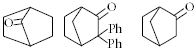
A
$III$ only
B
Both $I$ and $III$
C
Both $I$ and $II$
D
Both $II$ and $III$
Solution
(A) Tautomerism in carbonyl compounds requires the presence of an $\alpha$-hydrogen atom to form an enol. Additionally,the formation of the enol must not violate $Bredt's$ $Rule$,which states that a double bond cannot be placed at the bridgehead of a bridged bicyclic system unless the ring is large enough.
$I$: This is bicyclo[$2.2$.$1$]heptan$-2-$one. The $\alpha$-hydrogen is present,but forming the enol would place a double bond at the bridgehead,violating $Bredt's$ $Rule$.
$II$: This is $3,3-$diphenylbicyclo[$2.2$.$1$]heptan$-2-$one. Similar to $I$,the enol form would violate $Bredt's$ $Rule$.
$III$: This is bicyclo[$2.2$.$1$]heptan$-2-$one (specifically the isomer where the carbonyl is at the $2-$position). The enol form can be formed by removing an $\alpha$-hydrogen from the $C_3$ position,which does not violate $Bredt's$ $Rule$ as the double bond is not at the bridgehead.
Therefore,only molecule $III$ can exhibit tautomerism.
$I$: This is bicyclo[$2.2$.$1$]heptan$-2-$one. The $\alpha$-hydrogen is present,but forming the enol would place a double bond at the bridgehead,violating $Bredt's$ $Rule$.
$II$: This is $3,3-$diphenylbicyclo[$2.2$.$1$]heptan$-2-$one. Similar to $I$,the enol form would violate $Bredt's$ $Rule$.
$III$: This is bicyclo[$2.2$.$1$]heptan$-2-$one (specifically the isomer where the carbonyl is at the $2-$position). The enol form can be formed by removing an $\alpha$-hydrogen from the $C_3$ position,which does not violate $Bredt's$ $Rule$ as the double bond is not at the bridgehead.
Therefore,only molecule $III$ can exhibit tautomerism.
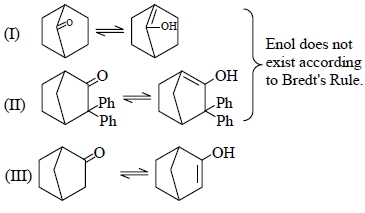
0 likesView Solution
31
ChemistryDifficultMCQNEET · 2016
Which of the following biphenyls is optically active?
A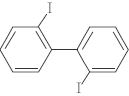
B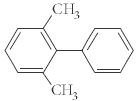
C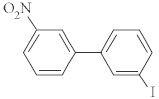
D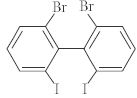
Solution
(D) For a biphenyl derivative to be optically active,it must exhibit atropisomerism,which requires the presence of bulky substituents at the ortho positions of both phenyl rings to prevent free rotation around the central $C-C$ single bond.
In option $D$,the molecule has bulky substituents ($Br$ and $I$) at all four ortho positions $(2, 2', 6, 6')$. This steric hindrance prevents the two phenyl rings from becoming coplanar,forcing them into a non-planar conformation that lacks a plane of symmetry and a center of inversion,thus making the molecule chiral and optically active.
The other options lack sufficient ortho-substitution to prevent free rotation,allowing the molecules to adopt planar or symmetric conformations that are achiral.
In option $D$,the molecule has bulky substituents ($Br$ and $I$) at all four ortho positions $(2, 2', 6, 6')$. This steric hindrance prevents the two phenyl rings from becoming coplanar,forcing them into a non-planar conformation that lacks a plane of symmetry and a center of inversion,thus making the molecule chiral and optically active.
The other options lack sufficient ortho-substitution to prevent free rotation,allowing the molecules to adopt planar or symmetric conformations that are achiral.
0 likesView Solution
32
ChemistryMediumMCQNEET · 2016
In which of the following molecules,all atoms are coplanar?
A
Biphenyl
B
Cyclohexane
C
$1,1-$dicyano$-2,2-$dimethylethene
D
Bicyclohexyl
Solution
(C) For a molecule to be coplanar,all its atoms must lie in the same plane.
$(A)$ Biphenyl: Due to steric hindrance between the ortho-hydrogens of the two phenyl rings,the rings are twisted relative to each other,making the molecule non-coplanar.
$(B)$ Cyclohexane: It exists in a chair conformation,which is non-planar.
$(C)$ $1,1-$dicyano$-2,2-$dimethylethene: The central $C=C$ bond is $sp^2$ hybridized. The two $CH_3$ groups and two $CN$ groups are attached to these $sp^2$ carbons. While the $C=C$ bond and the atoms directly attached to it are planar,the $CH_3$ groups have $sp^3$ hybridized carbons,which are tetrahedral and not coplanar with the rest of the molecule.
$(D)$ Bicyclohexyl: It consists of two cyclohexane rings,which are non-planar.
Correction: Upon re-evaluating the options,none of the provided structures are strictly coplanar in their most stable conformations. However,if we consider the planar representation of the $C=C$ system in option $(C)$,it is the closest to being planar,but strictly speaking,the methyl hydrogens prevent total coplanarity. If the question implies a planar structure like $1,1-dicyanoethene$,it would be planar. Given the standard options,this question is often flawed in competitive exams. If we must choose,$1,1-dicyano-2,2-dimethylethene$ has a planar $C=C$ core,but the methyl groups are not. If the question intended $1,1-dicyanoethene$,it would be planar.
$(A)$ Biphenyl: Due to steric hindrance between the ortho-hydrogens of the two phenyl rings,the rings are twisted relative to each other,making the molecule non-coplanar.
$(B)$ Cyclohexane: It exists in a chair conformation,which is non-planar.
$(C)$ $1,1-$dicyano$-2,2-$dimethylethene: The central $C=C$ bond is $sp^2$ hybridized. The two $CH_3$ groups and two $CN$ groups are attached to these $sp^2$ carbons. While the $C=C$ bond and the atoms directly attached to it are planar,the $CH_3$ groups have $sp^3$ hybridized carbons,which are tetrahedral and not coplanar with the rest of the molecule.
$(D)$ Bicyclohexyl: It consists of two cyclohexane rings,which are non-planar.
Correction: Upon re-evaluating the options,none of the provided structures are strictly coplanar in their most stable conformations. However,if we consider the planar representation of the $C=C$ system in option $(C)$,it is the closest to being planar,but strictly speaking,the methyl hydrogens prevent total coplanarity. If the question implies a planar structure like $1,1-dicyanoethene$,it would be planar. Given the standard options,this question is often flawed in competitive exams. If we must choose,$1,1-dicyano-2,2-dimethylethene$ has a planar $C=C$ core,but the methyl groups are not. If the question intended $1,1-dicyanoethene$,it would be planar.
0 likesView Solution
33
ChemistryMediumMCQNEET · 2016
In pyrrole,the electron density is maximum on

A
$2$ and $3$
B
$3$ and $4$
C
$2$ and $4$
D
$2$ and $5$
Solution
(D) In pyrrole,the lone pair of electrons on the nitrogen atom is involved in the aromatic sextet. Due to the resonance effect,the electron density is delocalized over the ring. When an electrophile attacks,the intermediate carbocation (sigma complex) is more stable when the electrophile attacks at the $C_{2}$ or $C_{5}$ positions because the positive charge can be delocalized over more atoms,including the nitrogen atom. Therefore,the electron density is maximum at the $C_{2}$ and $C_{5}$ positions.

0 likesView Solution
34
ChemistryMediumMCQNEET · 2016
Which of the following compounds shall not produce propene by reaction with $HBr$ followed by elimination or direct only elimination reaction?
A
Cyclopropane
B
$CH_3-CH_2-CH_2OH$
C
$CH_2=C=O$
D
$CH_3-CH_2-CH_2Br$
Solution
(C) Let us analyze each option:
$(i)$ $CH_3-CH_2-CH_2Br$ undergoes elimination to form propene $(CH_3-CH=CH_2)$.
(ii) Cyclopropane undergoes ring-opening elimination to form propene $(CH_3-CH=CH_2)$.
(iii) $CH_3-CH_2-CH_2OH$ reacts with $HBr$ to form $CH_3-CH_2-CH_2Br$,which then undergoes elimination to form propene $(CH_3-CH=CH_2)$.
(iv) $CH_2=C=O$ (ketene) does not produce propene by reaction with $HBr$ or by direct elimination.
Therefore,the correct option is $C$.
$(i)$ $CH_3-CH_2-CH_2Br$ undergoes elimination to form propene $(CH_3-CH=CH_2)$.
(ii) Cyclopropane undergoes ring-opening elimination to form propene $(CH_3-CH=CH_2)$.
(iii) $CH_3-CH_2-CH_2OH$ reacts with $HBr$ to form $CH_3-CH_2-CH_2Br$,which then undergoes elimination to form propene $(CH_3-CH=CH_2)$.
(iv) $CH_2=C=O$ (ketene) does not produce propene by reaction with $HBr$ or by direct elimination.
Therefore,the correct option is $C$.
0 likesView Solution
35
ChemistryAdvancedMCQNEET · 2016
In the given reaction,the product $P$ is
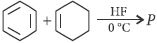
A
$1-$fluorocyclohexylbenzene
B
$1-$fluoro$-1-$phenylcyclohexane
C
cyclohexylbenzene
D
$1,2-$diphenylcyclohexane
Solution
(C) The reaction involves the electrophilic addition of a proton $(H^+)$ from $HF$ to cyclohexene to form a cyclohexyl carbocation.
This carbocation then acts as an electrophile and undergoes Electrophilic Substitution Reaction $(ESR)$ with benzene to form cyclohexylbenzene.
Thus,the product $P$ is cyclohexylbenzene.
This carbocation then acts as an electrophile and undergoes Electrophilic Substitution Reaction $(ESR)$ with benzene to form cyclohexylbenzene.
Thus,the product $P$ is cyclohexylbenzene.
0 likesView Solution
36
ChemistryMediumMCQNEET · 2016
The compound that will react most readily with gaseous bromine has the formula
A
$C_3H_6$
B
$C_2H_2$
C
$C_4H_{10}$
D
$C_2H_4$
Solution
(A) The reaction of alkenes with bromine is an electrophilic addition reaction.
Among the given options,$C_3H_6$ (propene) is an alkene with an electron-donating methyl group $(-CH_3)$ attached to the double bond.
This methyl group increases the electron density of the double bond via the inductive effect,making it more nucleophilic and thus more reactive towards the electrophilic bromine compared to $C_2H_4$ (ethene) or $C_2H_2$ (ethyne).
$C_4H_{10}$ (butane) is an alkane and does not undergo addition reactions with bromine under normal conditions.
Among the given options,$C_3H_6$ (propene) is an alkene with an electron-donating methyl group $(-CH_3)$ attached to the double bond.
This methyl group increases the electron density of the double bond via the inductive effect,making it more nucleophilic and thus more reactive towards the electrophilic bromine compared to $C_2H_4$ (ethene) or $C_2H_2$ (ethyne).
$C_4H_{10}$ (butane) is an alkane and does not undergo addition reactions with bromine under normal conditions.
0 likesView Solution
37
ChemistryMediumMCQNEET · 2016
The correct statement regarding the comparison of staggered and eclipsed conformations of ethane is:
A
The eclipsed conformation of ethane is more stable than the staggered conformation even though the eclipsed conformation has torsional strain.
B
The staggered conformation of ethane is more stable than the eclipsed conformation,because the staggered conformation has no torsional strain.
C
The staggered conformation of ethane is less stable than the eclipsed conformation,because the staggered conformation has torsional strain.
D
The eclipsed conformation of ethane is more stable than the staggered conformation,because the eclipsed conformation has no torsional strain.
Solution
(B) The magnitude of torsional strain depends upon the dihedral angle of rotation about the $C-C$ bond.
In the eclipsed conformation,the hydrogen atoms on adjacent carbons are as close as possible,resulting in maximum torsional strain and minimum stability.
In the staggered conformation,the hydrogen atoms are as far apart as possible,resulting in minimum torsional strain and maximum stability.
Therefore,the staggered conformation of ethane is more stable than the eclipsed conformation.
In the eclipsed conformation,the hydrogen atoms on adjacent carbons are as close as possible,resulting in maximum torsional strain and minimum stability.
In the staggered conformation,the hydrogen atoms are as far apart as possible,resulting in minimum torsional strain and maximum stability.
Therefore,the staggered conformation of ethane is more stable than the eclipsed conformation.
0 likesView Solution
38
ChemistryDifficultMCQNEET · 2016
Consider the nitration of benzene using mixed conc. $H_2SO_4$ and $HNO_3$. If a large amount of $KHSO_4$ is added to the mixture,the rate of nitration will be
A
unchanged
B
doubled
C
faster
D
slower.
Solution
(D) The nitration reaction involves the generation of the electrophile $NO_2^+$ as follows:
$HNO_3 + 2H_2SO_4 \rightleftharpoons NO_2^+ + H_3O^+ + 2HSO_4^-$
When $KHSO_4$ is added,it dissociates completely:
$KHSO_4 \rightarrow K^+ + HSO_4^-$
Due to the common ion effect of $HSO_4^-$,the concentration of $HSO_4^-$ increases in the reaction mixture.
According to Le Chatelier's principle,the equilibrium shifts in the backward direction to counteract the increase in $HSO_4^-$.
This results in a decrease in the concentration of the electrophile $NO_2^+$.
Since the rate of nitration depends on the concentration of $NO_2^+$,the rate of the nitration process will become slower.
$HNO_3 + 2H_2SO_4 \rightleftharpoons NO_2^+ + H_3O^+ + 2HSO_4^-$
When $KHSO_4$ is added,it dissociates completely:
$KHSO_4 \rightarrow K^+ + HSO_4^-$
Due to the common ion effect of $HSO_4^-$,the concentration of $HSO_4^-$ increases in the reaction mixture.
According to Le Chatelier's principle,the equilibrium shifts in the backward direction to counteract the increase in $HSO_4^-$.
This results in a decrease in the concentration of the electrophile $NO_2^+$.
Since the rate of nitration depends on the concentration of $NO_2^+$,the rate of the nitration process will become slower.
0 likesView Solution
39
ChemistryMediumMCQNEET · 2016
The pair of electrons in the given carbanion,$CH_{3}C\equiv C^{-},$ is present in which of the following orbitals?
A
$sp^{2}$
B
$sp$
C
$2p$
D
$sp^{3}$
Solution
(B) In the carbanion $CH_{3}-C\equiv C^{-}$,the terminal carbon atom is bonded to another carbon by a triple bond and carries a lone pair of electrons.
The hybridization of a carbon atom involved in a triple bond is $sp$.
Therefore,the lone pair of electrons on the terminal carbon atom is present in an $sp$-hybridized orbital.
The hybridization of a carbon atom involved in a triple bond is $sp$.
Therefore,the lone pair of electrons on the terminal carbon atom is present in an $sp$-hybridized orbital.
0 likesView Solution
40
ChemistryAdvancedMCQNEET · 2016
In the reaction
$HC \equiv CH \xrightarrow[(ii) CH_3CH_2Br]{(i) NaNH_2 / liq. NH_3} X$
$\xrightarrow[(ii) CH_3CH_2Br]{(i) NaNH_2 / liq. NH_3} Y$
$X$ and $Y$ are
$HC \equiv CH \xrightarrow[(ii) CH_3CH_2Br]{(i) NaNH_2 / liq. NH_3} X$
$\xrightarrow[(ii) CH_3CH_2Br]{(i) NaNH_2 / liq. NH_3} Y$
$X$ and $Y$ are
A
$X = 1-$butyne,$Y = 2-$hexyne
B
$X = 1-$butyne,$Y = 3-$hexyne
C
$X = 2-$butyne,$Y = 3-$hexyne
D
$X = 1-$butyne,$Y = 2-$hexyne
Solution
(B) Step $1$: Acetylene $(HC \equiv CH)$ reacts with $NaNH_2$ in liquid $NH_3$ to form the acetylide ion $(HC \equiv C^-Na^+)$,which then undergoes $S_N2$ reaction with $CH_3CH_2Br$ to form $1-$butyne $(X = CH_3CH_2C \equiv CH)$.
Step $2$: $1-$butyne $(CH_3CH_2C \equiv CH)$ reacts with $NaNH_2$ in liquid $NH_3$ to form the butynylide ion $(CH_3CH_2C \equiv C^-Na^+)$,which then undergoes $S_N2$ reaction with $CH_3CH_2Br$ to form $3-$hexyne $(Y = CH_3CH_2C \equiv CCH_2CH_3)$.
Step $2$: $1-$butyne $(CH_3CH_2C \equiv CH)$ reacts with $NaNH_2$ in liquid $NH_3$ to form the butynylide ion $(CH_3CH_2C \equiv C^-Na^+)$,which then undergoes $S_N2$ reaction with $CH_3CH_2Br$ to form $3-$hexyne $(Y = CH_3CH_2C \equiv CCH_2CH_3)$.
0 likesView Solution
41
ChemistryMediumMCQNEET · 2016
Match the compounds given in $Column\, I$ with the hybridisation and shape given in $Column\, II$ and mark the correct option.
| $Column\, I$ | $Column\, II$ |
|---|---|
| $(A)\, XeF_6$ | $(i)\, \text{Distorted octahedral}$ |
| $(B)\, XeO_3$ | $(ii)\, \text{Square planar}$ |
| $(C)\, XeOF_4$ | $(iii)\, \text{Pyramidal}$ |
| $(D)\, XeF_4$ | $(iv)\, \text{Square pyramidal}$ |
A
$A-(iv), B-(iii), C-(i), D-(ii)$
B
$A-(iv), B-(i), C-(ii), D-(iii)$
C
$A-(i), B-(iii), C-(iv), D-(ii)$
D
$A-(i), B-(ii), C-(iv), D-(iii)$
Solution
(C) $XeF_6$ has $sp^3d^3$ hybridization and distorted octahedral shape due to $6$ bond pairs and $1$ lone pair.
$(B)$ $XeO_3$ has $sp^3$ hybridization and pyramidal shape due to $3$ bond pairs and $1$ lone pair.
$(C)$ $XeOF_4$ has $sp^3d^2$ hybridization and square pyramidal shape due to $5$ bond pairs and $1$ lone pair.
$(D)$ $XeF_4$ has $sp^3d^2$ hybridization and square planar shape due to $4$ bond pairs and $2$ lone pairs.
Therefore,the correct matching is $A-(i), B-(iii), C-(iv), D-(ii)$.
$(B)$ $XeO_3$ has $sp^3$ hybridization and pyramidal shape due to $3$ bond pairs and $1$ lone pair.
$(C)$ $XeOF_4$ has $sp^3d^2$ hybridization and square pyramidal shape due to $5$ bond pairs and $1$ lone pair.
$(D)$ $XeF_4$ has $sp^3d^2$ hybridization and square planar shape due to $4$ bond pairs and $2$ lone pairs.
Therefore,the correct matching is $A-(i), B-(iii), C-(iv), D-(ii)$.
0 likesView Solution
42
ChemistryMediumMCQNEET · 2016
When copper is heated with concentrated $HNO_3$,it produces:
A
$Cu(NO_3)_2, NO$ and $NO_2$
B
$Cu(NO_3)_2$ and $N_2O$
C
$Cu(NO_3)_2$ and $NO_2$
D
$Cu(NO_3)_2$ and $NO$
Solution
(C) When copper reacts with concentrated $HNO_3$,it acts as a strong oxidizing agent and produces copper$(II)$ nitrate,water,and nitrogen dioxide gas.
The balanced chemical equation is:
$Cu(s) + 4HNO_3(conc.) \longrightarrow Cu(NO_3)_2(aq) + 2H_2O(l) + 2NO_2(g)$
The reddish-brown gas evolved is $NO_2$.
The balanced chemical equation is:
$Cu(s) + 4HNO_3(conc.) \longrightarrow Cu(NO_3)_2(aq) + 2H_2O(l) + 2NO_2(g)$
The reddish-brown gas evolved is $NO_2$.
0 likesView Solution
43
ChemistryEasyMCQNEET · 2016
The correct structure of the product $A$ formed in the reaction shown below is:
$Cyclohex-2-en-1-one \xrightarrow[{Pd/C, \text{ ethanol}}]{{H_2 \text{ (gas, 1 atm)}}} A$
$Cyclohex-2-en-1-one \xrightarrow[{Pd/C, \text{ ethanol}}]{{H_2 \text{ (gas, 1 atm)}}} A$
A
Cyclohex$-2-$en$-1-$ol
B
Cyclohexanone
C
Cyclohex$-2-$en$-1-$one
D
Cyclohex$-1-$en$-1-$ol
Solution
(B) The reaction involves the catalytic hydrogenation of an $\alpha,\beta$-unsaturated ketone,specifically $cyclohex-2-en-1-one$,using $H_2$ gas in the presence of $Pd/C$ catalyst.
Under mild conditions ($1$ atm pressure,room temperature),$Pd/C$ is a selective catalyst that can reduce the carbon-carbon double bond $(C=C)$ while leaving the carbonyl group $(C=O)$ intact.
Therefore,the $C=C$ bond is hydrogenated to a $C-C$ single bond,converting $cyclohex-2-en-1-one$ into $cyclohexanone$.
Under mild conditions ($1$ atm pressure,room temperature),$Pd/C$ is a selective catalyst that can reduce the carbon-carbon double bond $(C=C)$ while leaving the carbonyl group $(C=O)$ intact.
Therefore,the $C=C$ bond is hydrogenated to a $C-C$ single bond,converting $cyclohex-2-en-1-one$ into $cyclohexanone$.
1 likesView Solution
44
ChemistryMCQNEET · 2016
Which of the following is a hormone-releasing $IUD$?
A
$LNG-20$
B
Lippes loop
C
$Cu7$
D
Multiload $375$
Solution
(A) Intrauterine devices $(IUDs)$ are effective contraceptive methods. They are categorized based on their mechanism of action:
$1$. Non-medicated $IUDs$: Example is Lippes loop.
$2$. Copper-releasing $IUDs$: Examples include $CuT$,$Cu7$,and Multiload $375$. These release copper ions which suppress sperm motility and fertilizing capacity.
$3$. Hormone-releasing $IUDs$: Examples include Progestasert and $LNG-20$. These make the uterus unsuitable for implantation and the cervix hostile to the sperm.
Therefore,$LNG-20$ is a hormone-releasing $IUD$.
$1$. Non-medicated $IUDs$: Example is Lippes loop.
$2$. Copper-releasing $IUDs$: Examples include $CuT$,$Cu7$,and Multiload $375$. These release copper ions which suppress sperm motility and fertilizing capacity.
$3$. Hormone-releasing $IUDs$: Examples include Progestasert and $LNG-20$. These make the uterus unsuitable for implantation and the cervix hostile to the sperm.
Therefore,$LNG-20$ is a hormone-releasing $IUD$.
0 likesView Solution
45
ChemistryMCQNEET · 2016
Water vapour comes out from the plant leaf through the stomatal opening. Through the same stomatal opening,carbon dioxide diffuses into the plant during photosynthesis. Reason out the above statements using one of the following options:
A
The above processes happen only during night times
B
One process occurs during day time,and the other at night
C
Both processes cannot happen simultaneously
D
Both processes can happen together because the diffusion coefficient of water and $CO_2$ is different
Solution
(D) During the day,when stomata are open for photosynthesis,$CO_2$ diffuses into the leaf while water vapour diffuses out due to transpiration.
These two processes occur simultaneously because the diffusion of gases is independent of each other.
According to Fick's law of diffusion,the rate of diffusion depends on the concentration gradient and the diffusion coefficient of the specific gas.
Since the diffusion coefficients of water vapour and $CO_2$ are different,they can move in opposite directions through the same stomatal pore at the same time without interfering with each other.
These two processes occur simultaneously because the diffusion of gases is independent of each other.
According to Fick's law of diffusion,the rate of diffusion depends on the concentration gradient and the diffusion coefficient of the specific gas.
Since the diffusion coefficients of water vapour and $CO_2$ are different,they can move in opposite directions through the same stomatal pore at the same time without interfering with each other.
0 likesView Solution
46
ChemistryMCQNEET · 2016
You are given a tissue with its potential for differentiation in an artificial culture. Which of the following pairs of hormones would you add to the medium to secure shoots as well as roots?
A
$IAA$ and gibberellin
B
Auxin and cytokinin
C
Auxin and abscisic acid
D
Gibberellin and abscisic acid
Solution
(B) In plant tissue culture,the process of organogenesis is regulated by the balance between two main classes of plant hormones: Auxins and Cytokinins.
$1$. $A$ high ratio of Auxin to Cytokinin in the culture medium promotes root development (rhizogenesis).
$2$. $A$ high ratio of Cytokinin to Auxin promotes shoot development (caulogenesis).
$3$. By manipulating the concentrations of these two hormones,researchers can induce the formation of both shoots and roots from the callus tissue. Therefore,the correct pair is Auxin and Cytokinin.
$1$. $A$ high ratio of Auxin to Cytokinin in the culture medium promotes root development (rhizogenesis).
$2$. $A$ high ratio of Cytokinin to Auxin promotes shoot development (caulogenesis).
$3$. By manipulating the concentrations of these two hormones,researchers can induce the formation of both shoots and roots from the callus tissue. Therefore,the correct pair is Auxin and Cytokinin.
0 likesView Solution
47
ChemistryMCQNEET · 2016
Phytochrome is a
A
flavoprotein
B
glycoprotein
C
lipoprotein
D
chromoprotein
Solution
(D) Phytochrome is a blue-green pigment found in plants that acts as a photoreceptor.
It is a proteinaceous pigment,specifically a chromoprotein,consisting of a protein moiety linked to a light-absorbing chromophore.
It exists in two interconvertible forms: $P_r$ (which absorbs red light) and $P_{fr}$ (which absorbs far-red light).
Therefore,the correct classification of phytochrome is a chromoprotein.
It is a proteinaceous pigment,specifically a chromoprotein,consisting of a protein moiety linked to a light-absorbing chromophore.
It exists in two interconvertible forms: $P_r$ (which absorbs red light) and $P_{fr}$ (which absorbs far-red light).
Therefore,the correct classification of phytochrome is a chromoprotein.
0 likesView Solution
48
ChemistryMCQNEET · 2016
Which of the following guards the opening of the hepatopancreatic duct into the duodenum?
A
Pyloric sphincter
B
Sphincter of Oddi
C
Semilunar valve
D
Ileocaecal valve
Solution
(B) The hepatopancreatic duct is formed by the union of the common bile duct and the pancreatic duct.
It opens into the duodenum.
The opening of this duct is guarded by a muscular valve known as the Sphincter of Oddi.
This sphincter regulates the flow of bile and pancreatic juice into the duodenum.
It opens into the duodenum.
The opening of this duct is guarded by a muscular valve known as the Sphincter of Oddi.
This sphincter regulates the flow of bile and pancreatic juice into the duodenum.
0 likesView Solution
49
ChemistryMCQNEET · 2016
In the stomach,gastric acid is secreted by the
A
peptic cells
B
acidic cells
C
gastrin secreting cells
D
parietal cells
Solution
(D) The stomach lining contains gastric glands.
These glands consist of different types of cells,including mucous neck cells,peptic or chief cells,and parietal or oxyntic cells.
Parietal cells (also known as oxyntic cells) are responsible for secreting hydrochloric acid $(HCl)$ and intrinsic factor,which is essential for the absorption of vitamin $B_{12}$.
Therefore,gastric acid is secreted by the parietal cells.
These glands consist of different types of cells,including mucous neck cells,peptic or chief cells,and parietal or oxyntic cells.
Parietal cells (also known as oxyntic cells) are responsible for secreting hydrochloric acid $(HCl)$ and intrinsic factor,which is essential for the absorption of vitamin $B_{12}$.
Therefore,gastric acid is secreted by the parietal cells.
0 likesView Solution
50
ChemistryMCQNEET · 2016
Which hormones stimulate the production of pancreatic juice and bicarbonate?
A
Angiotensin and epinephrine
B
Gastrin and insulin
C
Cholecystokinin and secretin
D
Insulin and glucagon
Solution
(C) The process of digestion involves various hormones that regulate the secretion of digestive juices.
$1$. $Secretin$ is a hormone that acts on the exocrine pancreas to stimulate the secretion of water and bicarbonate ions $(HCO_3^-)$.
$2$. $Cholecystokinin$ $(CCK)$ acts on the pancreas to stimulate the secretion of pancreatic enzymes and also causes the contraction of the gallbladder to release bile.
Therefore, $Cholecystokinin$ and $Secretin$ are the primary hormones responsible for stimulating the production of pancreatic juice and bicarbonate, respectively.
$1$. $Secretin$ is a hormone that acts on the exocrine pancreas to stimulate the secretion of water and bicarbonate ions $(HCO_3^-)$.
$2$. $Cholecystokinin$ $(CCK)$ acts on the pancreas to stimulate the secretion of pancreatic enzymes and also causes the contraction of the gallbladder to release bile.
Therefore, $Cholecystokinin$ and $Secretin$ are the primary hormones responsible for stimulating the production of pancreatic juice and bicarbonate, respectively.
0 likesView Solution
51
ChemistryMediumMCQNEET · 2016
Among the following,which one is a wrong statement?
A
$PH_5$ and $BiCl_5$ do not exist.
B
$p\pi -d\pi$ bonds are present in $SO_2$.
C
$SeF_4$ and $CH_4$ have same shape.
D
$I_3^+$ has bent geometry.
Solution
(C) $1$. $PH_5$ and $BiCl_5$ do not exist due to the inert pair effect and steric hindrance.
$2$. $SO_2$ contains $p\pi -d\pi$ bonding between sulfur and oxygen atoms.
$3$. $SeF_4$ has a see-saw shape (due to $sp^3d$ hybridization with one lone pair),while $CH_4$ has a tetrahedral shape ($sp^3$ hybridization). Thus,they do not have the same shape.
$4$. $I_3^+$ has a bent geometry due to the presence of two lone pairs on the central iodine atom.
$2$. $SO_2$ contains $p\pi -d\pi$ bonding between sulfur and oxygen atoms.
$3$. $SeF_4$ has a see-saw shape (due to $sp^3d$ hybridization with one lone pair),while $CH_4$ has a tetrahedral shape ($sp^3$ hybridization). Thus,they do not have the same shape.
$4$. $I_3^+$ has a bent geometry due to the presence of two lone pairs on the central iodine atom.
0 likesView Solution
52
ChemistryMediumMCQNEET · 2016
$AlF_3$ is soluble in $HF$ only in the presence of $KF$. This is due to the formation of:
A
$K_3[AlF_3H_3]$
B
$K_3[AlF_6]$
C
$AlH_3$
D
$K[AlF_3H]$
Solution
(B) $AlF_3$ is insoluble in $HF$ because it is an ionic solid with a high lattice energy.
In the presence of $KF$,$AlF_3$ reacts to form a soluble complex salt.
The reaction is: $AlF_3 + 3KF \rightarrow K_3[AlF_6]$.
The coordination number of $Al^{3+}$ is $6$,leading to the formation of the stable octahedral complex $[AlF_6]^{3-}$.
In the presence of $KF$,$AlF_3$ reacts to form a soluble complex salt.
The reaction is: $AlF_3 + 3KF \rightarrow K_3[AlF_6]$.
The coordination number of $Al^{3+}$ is $6$,leading to the formation of the stable octahedral complex $[AlF_6]^{3-}$.
0 likesView Solution
53
ChemistryMediumMCQNEET · 2016
For the following reactions,which of the following statements is correct?
$A. \, CH_3CH_2CH_2Br + KOH \rightarrow CH_3CH=CH_2 + KBr + H_2O$
$B. \, (CH_3)_2CHBr + KOH \rightarrow (CH_3)_2CHOH + KBr$
$C. \, C_6H_{10} + Br_2 \rightarrow C_6H_{10}Br_2$
$A. \, CH_3CH_2CH_2Br + KOH \rightarrow CH_3CH=CH_2 + KBr + H_2O$
$B. \, (CH_3)_2CHBr + KOH \rightarrow (CH_3)_2CHOH + KBr$
$C. \, C_6H_{10} + Br_2 \rightarrow C_6H_{10}Br_2$
A
$A$ is elimination,$B$ and $C$ are substitution reactions.
B
$A$ is substitution,$B$ and $C$ are addition reactions.
C
$A$ and $B$ are elimination reactions and $C$ is addition reaction.
D
$A$ is elimination,$B$ is substitution and $C$ is addition reaction.
Solution
(D) In reaction $A$,a saturated alkyl halide is converted into an unsaturated alkene by the removal of $H$ and $Br$ atoms. Hence,it is an elimination reaction.
In reaction $B$,the $-Br$ group is replaced by the $-OH$ group. Hence,it is a substitution reaction.
In reaction $C$,the addition of $Br_2$ across the double bond converts an unsaturated compound into a saturated compound. Hence,it is an addition reaction.
Therefore,the correct statement is that $A$ is elimination,$B$ is substitution,and $C$ is addition reaction.
In reaction $B$,the $-Br$ group is replaced by the $-OH$ group. Hence,it is a substitution reaction.
In reaction $C$,the addition of $Br_2$ across the double bond converts an unsaturated compound into a saturated compound. Hence,it is an addition reaction.
Therefore,the correct statement is that $A$ is elimination,$B$ is substitution,and $C$ is addition reaction.
0 likesView Solution
54
ChemistryMediumMCQNEET · 2016
Which of the following can be used as the halide component for Friedel-Crafts reaction?
A
Chlorobenzene
B
Bromobenzene
C
Chloroethane
D
Isopropyl chloride
Solution
(D) The Friedel-Crafts reaction requires an alkyl or acyl halide that can form a carbocation or an electrophilic species in the presence of a Lewis acid like $AlCl_3$.
$1$. Aryl halides like chlorobenzene and bromobenzene,and vinyl halides like vinyl chloride $(CH_2=CH-Cl)$,are not suitable for Friedel-Crafts reactions because the carbon-halogen bond has partial double bond character due to resonance,making it very strong and difficult to break.
$2$. Alkyl halides like chloroethane $(CH_3CH_2Cl)$ and isopropyl chloride $((CH_3)_2CHCl)$ readily react with $AlCl_3$ to form carbocations,which then act as electrophiles in the Friedel-Crafts alkylation.
$3$. Both $C$ and $D$ are alkyl halides and can be used. However,in the context of typical textbook examples,both are valid. Given the options,$C$ and $D$ are both correct,but usually,such questions might have a single best answer or multiple correct options. Based on the provided image,isopropyl chloride is explicitly shown as a reactant. Therefore,$D$ is a definitive choice.
$1$. Aryl halides like chlorobenzene and bromobenzene,and vinyl halides like vinyl chloride $(CH_2=CH-Cl)$,are not suitable for Friedel-Crafts reactions because the carbon-halogen bond has partial double bond character due to resonance,making it very strong and difficult to break.
$2$. Alkyl halides like chloroethane $(CH_3CH_2Cl)$ and isopropyl chloride $((CH_3)_2CHCl)$ readily react with $AlCl_3$ to form carbocations,which then act as electrophiles in the Friedel-Crafts alkylation.
$3$. Both $C$ and $D$ are alkyl halides and can be used. However,in the context of typical textbook examples,both are valid. Given the options,$C$ and $D$ are both correct,but usually,such questions might have a single best answer or multiple correct options. Based on the provided image,isopropyl chloride is explicitly shown as a reactant. Therefore,$D$ is a definitive choice.
0 likesView Solution
55
ChemistryMediumMCQNEET · 2016
In calcium fluoride,having the fluorite structure,the coordination numbers for calcium ion $(Ca^{2+})$ and fluoride ion $(F^{-})$ are
A
$4$ and $2$
B
$6$ and $6$
C
$8$ and $4$
D
$4$ and $8$
Solution
(C) In the fluorite structure $(CaF_2)$,$Ca^{2+}$ ions form a face-centered cubic $(fcc)$ lattice.
Each $Ca^{2+}$ ion is surrounded by $8 F^{-}$ ions,so its coordination number is $8$.
Each $F^{-}$ ion is surrounded by $4 Ca^{2+}$ ions,so its coordination number is $4$.
Therefore,the coordination numbers for $Ca^{2+}$ and $F^{-}$ are $8$ and $4$ respectively.
Each $Ca^{2+}$ ion is surrounded by $8 F^{-}$ ions,so its coordination number is $8$.
Each $F^{-}$ ion is surrounded by $4 Ca^{2+}$ ions,so its coordination number is $4$.
Therefore,the coordination numbers for $Ca^{2+}$ and $F^{-}$ are $8$ and $4$ respectively.
0 likesView Solution
56
ChemistryMediumMCQNEET · 2016
Lithium has a $bcc$ structure. Its density is $530 \ kg \ m^{-3}$ and its atomic mass is $6.94 \ g \ mol^{-1}$. Calculate the edge length of a unit cell of lithium metal in $pm$ $(N_A = 6.02 \times 10^{23} \ mol^{-1})$.
A
$527$
B
$264$
C
$154$
D
$352$
Solution
(D) For a $bcc$ structure, the number of atoms per unit cell $z = 2$.
Density $d = 530 \ kg \ m^{-3} = 0.530 \ g \ cm^{-3}$.
Atomic mass $M = 6.94 \ g \ mol^{-1}$.
Using the formula $d = \frac{z M}{a^3 N_A}$, we have $a^3 = \frac{z M}{d N_A}$.
$a^3 = \frac{2 \times 6.94 \ g \ mol^{-1}}{0.530 \ g \ cm^{-3} \times 6.02 \times 10^{23} \ mol^{-1}}$.
$a^3 = 4.352 \times 10^{-23} \ cm^3$.
$a = (43.52 \times 10^{-24})^{1/3} \ cm = 3.517 \times 10^{-8} \ cm$.
Since $1 \ cm = 10^{10} \ pm$, $a = 3.517 \times 10^{-8} \times 10^{10} \ pm = 351.7 \ pm \approx 352 \ pm$.
Density $d = 530 \ kg \ m^{-3} = 0.530 \ g \ cm^{-3}$.
Atomic mass $M = 6.94 \ g \ mol^{-1}$.
Using the formula $d = \frac{z M}{a^3 N_A}$, we have $a^3 = \frac{z M}{d N_A}$.
$a^3 = \frac{2 \times 6.94 \ g \ mol^{-1}}{0.530 \ g \ cm^{-3} \times 6.02 \times 10^{23} \ mol^{-1}}$.
$a^3 = 4.352 \times 10^{-23} \ cm^3$.
$a = (43.52 \times 10^{-24})^{1/3} \ cm = 3.517 \times 10^{-8} \ cm$.
Since $1 \ cm = 10^{10} \ pm$, $a = 3.517 \times 10^{-8} \times 10^{10} \ pm = 351.7 \ pm \approx 352 \ pm$.
0 likesView Solution
57
ChemistryMediumMCQNEET · 2016
The ionic radii of $A^{+}$ and $B^{-}$ ions are $0.98 \times 10^{-10} \ m$ and $1.81 \times 10^{-10} \ m$. The coordination number of each ion in $AB$ is.......
A
$8$
B
$2$
C
$6$
D
$4$
Solution
(C) The radius ratio is calculated as follows:
Radius ratio $= \frac{r_{+}}{r_{-}} = \frac{0.98 \times 10^{-10} \ m}{1.81 \times 10^{-10} \ m} = 0.541$
Since the calculated radius ratio $0.541$ lies in the range $0.414 - 0.732$,the crystal structure corresponds to an octahedral geometry.
Therefore,the coordination number $(CN)$ of each ion in the $AB$ crystal lattice is $6$.
Radius ratio $= \frac{r_{+}}{r_{-}} = \frac{0.98 \times 10^{-10} \ m}{1.81 \times 10^{-10} \ m} = 0.541$
Since the calculated radius ratio $0.541$ lies in the range $0.414 - 0.732$,the crystal structure corresponds to an octahedral geometry.
Therefore,the coordination number $(CN)$ of each ion in the $AB$ crystal lattice is $6$.
0 likesView Solution
58
ChemistryEasyMCQNEET · 2016
The van't Hoff factor $(i)$ for a dilute aqueous solution of the strong electrolyte barium hydroxide is
A
$0$
B
$1$
C
$2$
D
$3$
Solution
(D) Barium hydroxide is a strong electrolyte that dissociates completely in an aqueous solution as follows:
$Ba(OH)_{2} \longrightarrow Ba^{2+} + 2OH^{-}$
Since one mole of $Ba(OH)_{2}$ produces $1$ mole of $Ba^{2+}$ ions and $2$ moles of $OH^{-}$ ions,the total number of particles produced is $1 + 2 = 3$.
The van't Hoff factor $(i)$ is defined as the number of particles produced per formula unit of the electrolyte.
Therefore,$i = 3$.
$Ba(OH)_{2} \longrightarrow Ba^{2+} + 2OH^{-}$
Since one mole of $Ba(OH)_{2}$ produces $1$ mole of $Ba^{2+}$ ions and $2$ moles of $OH^{-}$ ions,the total number of particles produced is $1 + 2 = 3$.
The van't Hoff factor $(i)$ is defined as the number of particles produced per formula unit of the electrolyte.
Therefore,$i = 3$.
1 likesView Solution
59
ChemistryMediumMCQNEET · 2016
Which one of the following is incorrect for an ideal solution?
A
$\Delta H_{mix} = 0$
B
$\Delta U_{mix} = 0$
C
$\Delta P = P_{obs} - P_{calculated \ by \ Raoult's \ law} = 0$
D
$\Delta G_{mix} = 0$
Solution
(D) An ideal solution is defined by the following characteristics:
$1$. $\Delta H_{mix} = 0$ (Enthalpy of mixing is zero).
$2$. $\Delta V_{mix} = 0$ (Volume of mixing is zero).
$3$. $\Delta U_{mix} = 0$ (Internal energy of mixing is zero).
$4$. The solution obeys Raoult's law over the entire range of concentration,so $\Delta P = 0$.
However,for any spontaneous mixing process,the entropy of mixing $\Delta S_{mix}$ is always positive.
Since $\Delta G_{mix} = \Delta H_{mix} - T\Delta S_{mix}$,and $\Delta H_{mix} = 0$ while $\Delta S_{mix} > 0$,it follows that $\Delta G_{mix} = -T\Delta S_{mix} < 0$.
Therefore,the statement $\Delta G_{mix} = 0$ is incorrect.
$1$. $\Delta H_{mix} = 0$ (Enthalpy of mixing is zero).
$2$. $\Delta V_{mix} = 0$ (Volume of mixing is zero).
$3$. $\Delta U_{mix} = 0$ (Internal energy of mixing is zero).
$4$. The solution obeys Raoult's law over the entire range of concentration,so $\Delta P = 0$.
However,for any spontaneous mixing process,the entropy of mixing $\Delta S_{mix}$ is always positive.
Since $\Delta G_{mix} = \Delta H_{mix} - T\Delta S_{mix}$,and $\Delta H_{mix} = 0$ while $\Delta S_{mix} > 0$,it follows that $\Delta G_{mix} = -T\Delta S_{mix} < 0$.
Therefore,the statement $\Delta G_{mix} = 0$ is incorrect.
0 likesView Solution
60
ChemistryDifficultMCQNEET · 2016
Which of the following statements about the composition of the vapour over an ideal $1:1$ molar mixture of benzene and toluene is correct? Assume that the temperature is constant at $25\ ^oC$. (Given,vapour pressure data at $25\ ^oC$,benzene $= 12.8\ kPa,$ toluene $= 3.85\ kPa$)
A
The vapour will contain equal amounts of benzene and toluene.
B
Not enough information is given to make a prediction.
C
The vapour will contain a higher percentage of benzene.
D
The vapour will contain a higher percentage of toluene.
Solution
(C) According to Raoult's Law,the partial pressure of a component in the vapour phase is given by $P_i = P^o_i X_i$.
Since the mixture is $1:1$ molar,the mole fractions in the liquid phase are equal $(X_{\text{benzene}} = X_{\text{toluene}} = 0.5)$.
The total pressure $P = P^o_{\text{benzene}} X_{\text{benzene}} + P^o_{\text{toluene}} X_{\text{toluene}}$.
The mole fraction in the vapour phase is $Y_i = \frac{P_i}{P} = \frac{P^o_i X_i}{P}$.
Since $X_{\text{benzene}} = X_{\text{toluene}}$,the component with the higher pure vapour pressure $(P^o)$ will have a higher mole fraction in the vapour phase.
Given $P^o_{\text{benzene}} = 12.8\ kPa$ and $P^o_{\text{toluene}} = 3.85\ kPa$,benzene is more volatile.
Therefore,the vapour will contain a higher percentage of benzene.
Since the mixture is $1:1$ molar,the mole fractions in the liquid phase are equal $(X_{\text{benzene}} = X_{\text{toluene}} = 0.5)$.
The total pressure $P = P^o_{\text{benzene}} X_{\text{benzene}} + P^o_{\text{toluene}} X_{\text{toluene}}$.
The mole fraction in the vapour phase is $Y_i = \frac{P_i}{P} = \frac{P^o_i X_i}{P}$.
Since $X_{\text{benzene}} = X_{\text{toluene}}$,the component with the higher pure vapour pressure $(P^o)$ will have a higher mole fraction in the vapour phase.
Given $P^o_{\text{benzene}} = 12.8\ kPa$ and $P^o_{\text{toluene}} = 3.85\ kPa$,benzene is more volatile.
Therefore,the vapour will contain a higher percentage of benzene.
1 likesView Solution
61
ChemistryDifficultMCQNEET · 2016
At $100\, ^oC$ the vapour pressure of a solution of $6.5\, g$ of a solute in $100\, g$ water is $732\, mm.$ If $K_b = 0.52,$ the boiling point of this solution will be .........$^oC$
A
$102$
B
$103$
C
$101$
D
$100$
Solution
(C) Given: $W_{B} = 6.5\, g$,$W_{A} = 100\, g$,$p_{s} = 732\, mm$,$K_{b} = 0.52$,$T_{b}^{o} = 100\, ^oC$,$p^{o} = 760\, mm$.
Using Raoult's law for relative lowering of vapour pressure: $\frac{p^{o} - p_{s}}{p^{o}} = \frac{n_{2}}{n_{1}}$.
$\frac{760 - 732}{760} = \frac{n_{2}}{100 / 18}$.
$n_{2} = \frac{28 \times 100}{760 \times 18} \approx 0.2046\, mol$.
Now,calculate elevation in boiling point: $\Delta T_{b} = K_{b} \times m = K_{b} \times \frac{n_{2} \times 1000}{W_{A} (g)}$.
$\Delta T_{b} = \frac{0.52 \times 0.2046 \times 1000}{100} = 1.06\, ^oC$.
Boiling point of solution $T_{b} = T_{b}^{o} + \Delta T_{b} = 100 + 1.06 = 101.06\, ^oC$.
Using Raoult's law for relative lowering of vapour pressure: $\frac{p^{o} - p_{s}}{p^{o}} = \frac{n_{2}}{n_{1}}$.
$\frac{760 - 732}{760} = \frac{n_{2}}{100 / 18}$.
$n_{2} = \frac{28 \times 100}{760 \times 18} \approx 0.2046\, mol$.
Now,calculate elevation in boiling point: $\Delta T_{b} = K_{b} \times m = K_{b} \times \frac{n_{2} \times 1000}{W_{A} (g)}$.
$\Delta T_{b} = \frac{0.52 \times 0.2046 \times 1000}{100} = 1.06\, ^oC$.
Boiling point of solution $T_{b} = T_{b}^{o} + \Delta T_{b} = 100 + 1.06 = 101.06\, ^oC$.
0 likesView Solution
62
ChemistryMediumMCQNEET · 2016
The molar conductivity of a $0.5 \ mol/dm^3$ solution of $AgNO_3$ with electrolytic conductivity of $5.76 \times 10^{-3} \ S \ cm^{-1}$ at $298 \ K$ is ......... $S \ cm^2/mol$.
A
$2.88$
B
$11.52$
C
$0.086$
D
$28.8$
Solution
(B) The formula for molar conductivity is $\Lambda_{m} = \frac{\kappa \times 1000}{M}$.
Given,electrolytic conductivity $\kappa = 5.76 \times 10^{-3} \ S \ cm^{-1}$ and Molarity $M = 0.5 \ mol/dm^3 = 0.5 \ mol/L$.
Substituting the values:
$\Lambda_{m} = \frac{5.76 \times 10^{-3} \ S \ cm^{-1} \times 1000 \ cm^3/L}{0.5 \ mol/L} = 11.52 \ S \ cm^2 \ mol^{-1}$.
Given,electrolytic conductivity $\kappa = 5.76 \times 10^{-3} \ S \ cm^{-1}$ and Molarity $M = 0.5 \ mol/dm^3 = 0.5 \ mol/L$.
Substituting the values:
$\Lambda_{m} = \frac{5.76 \times 10^{-3} \ S \ cm^{-1} \times 1000 \ cm^3/L}{0.5 \ mol/L} = 11.52 \ S \ cm^2 \ mol^{-1}$.
0 likesView Solution
63
ChemistryDifficultMCQNEET · 2016
During the electrolysis of molten sodium chloride,the time required to produce $0.10 \ mol$ of chlorine gas using a current of $3 \ A$ is .......... $\min.$
A
$55$
B
$110$
C
$220$
D
$330$
Solution
(B) The chemical reaction at the anode during the electrolysis of molten $NaCl$ is: $2Cl^{-} \longrightarrow Cl_2 + 2e^-$.
From the stoichiometry,$1 \ mol$ of $Cl_2$ gas is produced by the transfer of $2 \ mol$ of electrons.
Therefore,to produce $0.10 \ mol$ of $Cl_2$,the required charge $Q$ is $n \times F = 0.10 \times 2 \times 96500 \ C = 19300 \ C$.
Using the formula $Q = I \times t$,where $I = 3 \ A$:
$t = \frac{Q}{I} = \frac{19300 \ C}{3 \ A} = 6433.33 \ s$.
Converting seconds to minutes: $t = \frac{6433.33}{60} \approx 107.22 \ \min$.
Rounding to the nearest given option,the time is approximately $110 \ \min$.
From the stoichiometry,$1 \ mol$ of $Cl_2$ gas is produced by the transfer of $2 \ mol$ of electrons.
Therefore,to produce $0.10 \ mol$ of $Cl_2$,the required charge $Q$ is $n \times F = 0.10 \times 2 \times 96500 \ C = 19300 \ C$.
Using the formula $Q = I \times t$,where $I = 3 \ A$:
$t = \frac{Q}{I} = \frac{19300 \ C}{3 \ A} = 6433.33 \ s$.
Converting seconds to minutes: $t = \frac{6433.33}{60} \approx 107.22 \ \min$.
Rounding to the nearest given option,the time is approximately $110 \ \min$.
0 likesView Solution
64
ChemistryDifficultMCQNEET · 2016
If the $E^{\circ}_{cell}$ for a given reaction has a negative value,which of the following gives the correct relationships for the values of $\Delta G^{\circ}$ and $K_{eq}$ ?
A
$\Delta G^{\circ} > 0; K_{eq} < 1$
B
$\Delta G^{\circ} > 0; K_{eq} > 1$
C
$\Delta G^{\circ} < 0; K_{eq} > 1$
D
$\Delta G^{\circ} < 0; K_{eq} < 1$
Solution
(A) The relationship between standard Gibbs free energy change $(\Delta G^{\circ})$ and standard cell potential $(E^{\circ}_{cell})$ is given by $\Delta G^{\circ} = -nFE^{\circ}_{cell}$.
If $E^{\circ}_{cell} < 0$,then $\Delta G^{\circ} > 0$,which indicates that the reaction is non-spontaneous.
Furthermore,the relationship between $E^{\circ}_{cell}$ and the equilibrium constant $(K_{eq})$ is given by $E^{\circ}_{cell} = \frac{RT}{nF} \ln K_{eq}$.
If $E^{\circ}_{cell} < 0$,then $\ln K_{eq} < 0$,which implies $K_{eq} < 1$.
If $E^{\circ}_{cell} < 0$,then $\Delta G^{\circ} > 0$,which indicates that the reaction is non-spontaneous.
Furthermore,the relationship between $E^{\circ}_{cell}$ and the equilibrium constant $(K_{eq})$ is given by $E^{\circ}_{cell} = \frac{RT}{nF} \ln K_{eq}$.
If $E^{\circ}_{cell} < 0$,then $\ln K_{eq} < 0$,which implies $K_{eq} < 1$.
0 likesView Solution
65
ChemistryDifficultMCQNEET · 2016
The number of electrons delivered at the cathode during electrolysis by a current of $1 \ A$ in $60 \ s$ is (charge on electron $= 1.60 \times 10^{-19} \ C$)
A
$6 \times 10^{23}$
B
$6 \times 10^{20}$
C
$3.75 \times 10^{20}$
D
$7.48 \times 10^{23}$
Solution
(C) The total charge $Q$ passed is given by the formula $Q = I \times t$.
Given $I = 1 \ A$ and $t = 60 \ s$,we have $Q = 1 \times 60 = 60 \ C$.
The charge on a single electron is $1.60 \times 10^{-19} \ C$.
The number of electrons $n$ is calculated as $n = \frac{Q}{e} = \frac{60}{1.60 \times 10^{-19}}$.
$n = 37.5 \times 10^{19} = 3.75 \times 10^{20}$ electrons.
Given $I = 1 \ A$ and $t = 60 \ s$,we have $Q = 1 \times 60 = 60 \ C$.
The charge on a single electron is $1.60 \times 10^{-19} \ C$.
The number of electrons $n$ is calculated as $n = \frac{Q}{e} = \frac{60}{1.60 \times 10^{-19}}$.
$n = 37.5 \times 10^{19} = 3.75 \times 10^{20}$ electrons.
0 likesView Solution
66
ChemistryMediumMCQNEET · 2016
Zinc can be coated on iron to produce galvanized iron,but the reverse is not possible. This is because:
A
zinc is lighter than iron
B
zinc has a lower melting point than iron
C
zinc has a lower negative electrode potential than iron
D
zinc has a higher negative electrode potential than iron
Solution
(D) $E^{0}_{Zn^{2+}/Zn} = -0.76 \ V$ and $E^{0}_{Fe^{2+}/Fe} = -0.44 \ V$.
Since $Zn$ has a more negative standard reduction potential $(SRP)$ than $Fe$,$Zn$ acts as a sacrificial anode and protects iron from corrosion by becoming the anode itself.
Since $Zn$ has a more negative standard reduction potential $(SRP)$ than $Fe$,$Zn$ acts as a sacrificial anode and protects iron from corrosion by becoming the anode itself.
0 likesView Solution
67
ChemistryMediumMCQNEET · 2016
The pressure of $H_2$ required to make the potential of $H_2$-electrode zero in pure water at $298 \ K$ is
A
$10^{-10} \ atm$
B
$10^{-4} \ atm$
C
$10^{-14} \ atm$
D
$10^{-12} \ atm$
Solution
(C) The reduction half-reaction for the hydrogen electrode is: $2H^{+} + 2e^{-} \longrightarrow H_{2(g)}$
Using the Nernst equation for the electrode potential: $E_{H^{+}/H_2} = E^{\circ}_{H^{+}/H_2} - \frac{0.0591}{2} \log \frac{P_{H_2}}{[H^{+}]^2}$
Since $E^{\circ}_{H^{+}/H_2} = 0 \ V$ and we want the electrode potential $E_{H^{+}/H_2}$ to be $0 \ V$,we have:
$0 = 0 - \frac{0.0591}{2} \log \frac{P_{H_2}}{[H^{+}]^2}$
This implies $\log \frac{P_{H_2}}{[H^{+}]^2} = 0$,so $\frac{P_{H_2}}{[H^{+}]^2} = 10^0 = 1$
Therefore,$P_{H_2} = [H^{+}]^2$
For pure water at $298 \ K$,the concentration of hydrogen ions is $[H^{+}] = 10^{-7} \ M$
Substituting this value: $P_{H_2} = (10^{-7})^2 = 10^{-14} \ atm$
Using the Nernst equation for the electrode potential: $E_{H^{+}/H_2} = E^{\circ}_{H^{+}/H_2} - \frac{0.0591}{2} \log \frac{P_{H_2}}{[H^{+}]^2}$
Since $E^{\circ}_{H^{+}/H_2} = 0 \ V$ and we want the electrode potential $E_{H^{+}/H_2}$ to be $0 \ V$,we have:
$0 = 0 - \frac{0.0591}{2} \log \frac{P_{H_2}}{[H^{+}]^2}$
This implies $\log \frac{P_{H_2}}{[H^{+}]^2} = 0$,so $\frac{P_{H_2}}{[H^{+}]^2} = 10^0 = 1$
Therefore,$P_{H_2} = [H^{+}]^2$
For pure water at $298 \ K$,the concentration of hydrogen ions is $[H^{+}] = 10^{-7} \ M$
Substituting this value: $P_{H_2} = (10^{-7})^2 = 10^{-14} \ atm$
0 likesView Solution
68
ChemistryMediumMCQNEET · 2016
The decomposition of phosphine $(PH_3)$ on tungsten at low pressure is a first-order reaction. It is because the
A
rate is proportional to the surface coverage
B
rate is inversely proportional to the surface coverage
C
rate is independent of the surface coverage
D
rate of decomposition is very slow.
Solution
(A) The decomposition reaction is $PH_3 \xrightarrow{W} P + \frac{3}{2} H_2$.
According to the Langmuir adsorption isotherm,the fraction of surface coverage $\theta$ is given by $\theta = \frac{kP}{1 + kP}$.
At low pressure,$kP \ll 1$,so $\theta \approx kP$.
Since the rate of reaction is proportional to the surface coverage $(\text{Rate} \propto \theta)$,at low pressure,the rate becomes proportional to the partial pressure of $PH_3$ $(\text{Rate} \propto P_{PH_3})$,which corresponds to a first-order reaction.
According to the Langmuir adsorption isotherm,the fraction of surface coverage $\theta$ is given by $\theta = \frac{kP}{1 + kP}$.
At low pressure,$kP \ll 1$,so $\theta \approx kP$.
Since the rate of reaction is proportional to the surface coverage $(\text{Rate} \propto \theta)$,at low pressure,the rate becomes proportional to the partial pressure of $PH_3$ $(\text{Rate} \propto P_{PH_3})$,which corresponds to a first-order reaction.
0 likesView Solution
69
ChemistryAdvancedMCQNEET · 2016
The rate of a first-order reaction is $0.04 \ mol \ L^{-1} \ s^{-1}$ at $10 \ s$ and $0.03 \ mol \ L^{-1} \ s^{-1}$ at $20 \ s$ after the initiation of the reaction. The half-life period of the reaction is ......... $s$. (in $.1$)
A
$44$
B
$54$
C
$24$
D
$34$
Solution
(C) For a first-order reaction,the rate $R$ at time $t$ is given by $R = k[A]_t$,where $[A]_t = [A]_0 e^{-kt}$.
Thus,$R_t = k[A]_0 e^{-kt} = R_0 e^{-kt}$.
Given $R_{10} = 0.04 \ mol \ L^{-1} \ s^{-1}$ and $R_{20} = 0.03 \ mol \ L^{-1} \ s^{-1}$.
Taking the ratio: $\frac{R_{10}}{R_{20}} = \frac{e^{-k(10)}}{e^{-k(20)}} = e^{10k} = \frac{0.04}{0.03} = 1.333$.
Taking natural log on both sides: $10k = \ln(1.333) = 0.2877$.
$k = 0.02877 \ s^{-1}$.
The half-life period is $t_{1/2} = \frac{0.693}{k} = \frac{0.693}{0.02877} \approx 24.1 \ s$.
Thus,$R_t = k[A]_0 e^{-kt} = R_0 e^{-kt}$.
Given $R_{10} = 0.04 \ mol \ L^{-1} \ s^{-1}$ and $R_{20} = 0.03 \ mol \ L^{-1} \ s^{-1}$.
Taking the ratio: $\frac{R_{10}}{R_{20}} = \frac{e^{-k(10)}}{e^{-k(20)}} = e^{10k} = \frac{0.04}{0.03} = 1.333$.
Taking natural log on both sides: $10k = \ln(1.333) = 0.2877$.
$k = 0.02877 \ s^{-1}$.
The half-life period is $t_{1/2} = \frac{0.693}{k} = \frac{0.693}{0.02877} \approx 24.1 \ s$.
0 likesView Solution
70
ChemistryMediumMCQNEET · 2016
The addition of a catalyst during a chemical reaction alters which of the following quantities?
A
Enthalpy
B
Activation energy
C
Entropy
D
Internal energy
Solution
(B) catalyst is a substance that increases the rate of a chemical reaction without itself undergoing any permanent chemical change.
It functions by providing an alternative reaction pathway with a lower activation energy $(E_a)$.
As shown in the potential energy diagram,the catalyst reduces the energy barrier between reactants and products,but it does not change the energy of the reactants or products,meaning the enthalpy change $(\Delta H)$ remains unaffected.
It functions by providing an alternative reaction pathway with a lower activation energy $(E_a)$.
As shown in the potential energy diagram,the catalyst reduces the energy barrier between reactants and products,but it does not change the energy of the reactants or products,meaning the enthalpy change $(\Delta H)$ remains unaffected.
0 likesView Solution
71
ChemistryMediumMCQNEET · 2016
The coagulation values in millimoles per litre of the electrolytes used for the coagulation of $As_2S_3$ are given below:
$I$. $(NaCl) = 52,$
$II$. $(BaCl_2) = 0.69,$
$III$. $(MgSO_4) = 0.22$
The correct order of their coagulating power is:
$I$. $(NaCl) = 52,$
$II$. $(BaCl_2) = 0.69,$
$III$. $(MgSO_4) = 0.22$
The correct order of their coagulating power is:
A
$I > II > III$
B
$II > I > III$
C
$III > II > I$
D
$III > I > II$
Solution
(C) Coagulation power $\propto \frac{1}{\text{Coagulation value}}$
Lower the coagulation value,higher is the coagulating power of the electrolyte.
Given values:
$I (NaCl) = 52$
$II (BaCl_2) = 0.69$
$III (MgSO_4) = 0.22$
Comparing the values: $0.22 < 0.69 < 52$
Therefore,the order of coagulating power is: $III > II > I$.
Lower the coagulation value,higher is the coagulating power of the electrolyte.
Given values:
$I (NaCl) = 52$
$II (BaCl_2) = 0.69$
$III (MgSO_4) = 0.22$
Comparing the values: $0.22 < 0.69 < 52$
Therefore,the order of coagulating power is: $III > II > I$.
0 likesView Solution
72
ChemistryEasyMCQNEET · 2016
Fog is a colloidal solution of
A
solid in gas
B
gas in gas
C
liquid in gas
D
gas in liquid
Solution
(C) Fog is a colloidal solution of liquid in a gas,in which the liquid is the dispersed phase and the gas is the dispersion medium.
0 likesView Solution
73
ChemistryEasyMCQNEET · 2016
Which one of the following characteristics is associated with adsorption?
A
$\Delta G$ and $\Delta H$ are negative but $\Delta S$ is positive.
B
$\Delta G$ and $\Delta S$ are negative but $\Delta H$ is positive.
C
$\Delta G$ is negative but $\Delta H$ and $\Delta S$ are positive.
D
$\Delta G, \Delta H$ and $\Delta S$ all are negative.
Solution
(D) Adsorption is a spontaneous process that occurs with the release of energy and a decrease in the entropy of the substance.
For a spontaneous process,the Gibbs free energy change,$\Delta G$,must be negative.
The relationship is given by $\Delta G = \Delta H - T \Delta S$.
Since the process is exothermic,the enthalpy change,$\Delta H$,is negative.
As the molecules get adsorbed on the surface,their randomness decreases,meaning the entropy change,$\Delta S$,is also negative.
For a spontaneous process,the Gibbs free energy change,$\Delta G$,must be negative.
The relationship is given by $\Delta G = \Delta H - T \Delta S$.
Since the process is exothermic,the enthalpy change,$\Delta H$,is negative.
As the molecules get adsorbed on the surface,their randomness decreases,meaning the entropy change,$\Delta S$,is also negative.
0 likesView Solution
74
ChemistryMediumMCQNEET · 2016
Match items of Column-$I$ with the items of Column-$II$ and assign the correct code :
| Column $I$ | Column $II$ |
| $A$. Cyanide process | $i$. Ultrapure $Ge$ |
| $B$. Froth floatation | $ii$. Dressing of $ZnS$ |
| $C$. Electrolytic reduction | $iii$. Extraction of $Al$ |
| $D$. Zone refining | $iv$. Extraction of $Au$ |
| $v$. Purification of $Ni$ |
A
$A-i, B-ii, C-iii, D-iv$
B
$A-iii, B-iv, C-v, D-i$
C
$A-iv, B-ii, C-iii, D-i$
D
$A-ii, B-iii, C-i, D-v$
Solution
(C) The Cyanide process is used for the extraction of $Au$ and $Ag$ from their ores $(A-iv)$.
Froth flotation is a method used for the concentration (dressing) of sulphide ores like $ZnS$ $(B-ii)$.
Electrolytic reduction is the standard method for the extraction of highly reactive metals like $Al$ $(C-iii)$.
Zone refining is a technique used to obtain metals in an ultrapure state,such as $Ge$ $(D-i)$.
Therefore,the correct matching is $A-iv, B-ii, C-iii, D-i$.
Froth flotation is a method used for the concentration (dressing) of sulphide ores like $ZnS$ $(B-ii)$.
Electrolytic reduction is the standard method for the extraction of highly reactive metals like $Al$ $(C-iii)$.
Zone refining is a technique used to obtain metals in an ultrapure state,such as $Ge$ $(D-i)$.
Therefore,the correct matching is $A-iv, B-ii, C-iii, D-i$.
0 likesView Solution
75
ChemistryDifficultMCQNEET · 2016
Which is the correct statement for the given acids?
A
Phosphinic acid is a monoprotic acid while phosphonic acid is a diprotic acid.
B
Phosphinic acid is a diprotic acid while phosphonic acid is a monoprotic acid.
C
Both are diprotic acids.
D
Both are triprotic acids.
Solution
(A) The basicity of an oxoacid of phosphorus is determined by the number of $P-OH$ groups present in its structure.
Phosphinic acid $(H_3PO_2)$ contains one $P-OH$ group,making it a monoprotic acid.
Phosphonic acid $(H_3PO_3)$ contains two $P-OH$ groups,making it a diprotic acid.
Therefore,the correct statement is that phosphinic acid is a monoprotic acid while phosphonic acid is a diprotic acid.
Phosphinic acid $(H_3PO_2)$ contains one $P-OH$ group,making it a monoprotic acid.
Phosphonic acid $(H_3PO_3)$ contains two $P-OH$ groups,making it a diprotic acid.
Therefore,the correct statement is that phosphinic acid is a monoprotic acid while phosphonic acid is a diprotic acid.
0 likesView Solution
76
ChemistryMediumMCQNEET · 2016
Which one of the following orders is correct for the bond dissociation enthalpy of halogen molecules?
A
$Br_2 > I_2 > F_2 > Cl_2$
B
$F_2 > Cl_2 > Br_2 > I_2$
C
$I_2 > Br_2 > Cl_2 > F_2$
D
$Cl_2 > Br_2 > F_2 > I_2$
Solution
(D) The correct order of bond dissociation enthalpy for halogen molecules is $Cl_2 > Br_2 > F_2 > I_2$.
Although bond dissociation energy generally decreases down the group due to an increase in atomic size,$F_2$ is an exception.
In $F_2$,the small size of the fluorine atoms leads to strong inter-electronic repulsion between the lone pairs of the two atoms,which significantly weakens the $F-F$ bond.
Therefore,the bond dissociation enthalpy of $F_2$ is lower than that of $Cl_2$ and $Br_2$.
Although bond dissociation energy generally decreases down the group due to an increase in atomic size,$F_2$ is an exception.
In $F_2$,the small size of the fluorine atoms leads to strong inter-electronic repulsion between the lone pairs of the two atoms,which significantly weakens the $F-F$ bond.
Therefore,the bond dissociation enthalpy of $F_2$ is lower than that of $Cl_2$ and $Br_2$.
0 likesView Solution
77
ChemistryMediumMCQNEET · 2016
Among the following,the correct order of acidity is
A
$HClO_2 < HClO < HClO_3 < HClO_4$
B
$HClO_4 < HClO_2 < HClO < HClO_3$
C
$HClO_3 < HClO_4 < HClO_2 < HClO$
D
$HClO < HClO_2 < HClO_3 < HClO_4$
Solution
(D) The acidic strength of oxoacids of chlorine increases with an increase in the oxidation state of the central chlorine atom.
The oxidation states of $Cl$ in the given acids are:
$HClO: +1$
$HClO_2: +3$
$HClO_3: +5$
$HClO_4: +7$
Since the acidic strength is directly proportional to the oxidation state,the correct order is $HClO < HClO_2 < HClO_3 < HClO_4$.
The oxidation states of $Cl$ in the given acids are:
$HClO: +1$
$HClO_2: +3$
$HClO_3: +5$
$HClO_4: +7$
Since the acidic strength is directly proportional to the oxidation state,the correct order is $HClO < HClO_2 < HClO_3 < HClO_4$.
0 likesView Solution
78
ChemistryMediumMCQNEET · 2016
Which one of the following statements related to lanthanons is incorrect?
A
Europium shows $+2$ oxidation state.
B
The basicity decreases as the ionic radius decreases from $Pr$ to $Lu$.
C
All the lanthanons are much more reactive than aluminium.
D
$Ce(+4)$ solutions are widely used as oxidizing agent in volumetric analysis.
Solution
(C) The earlier members of the lanthanoid series are quite reactive,similar to $Ca$. However,with an increase in atomic number,their reactivity decreases,and they behave more like $Al$. Therefore,the statement that all lanthanons are much more reactive than $Al$ is incorrect.
0 likesView Solution
79
ChemistryMediumMCQNEET · 2016
Which one of the following statements is correct when $SO_2$ is passed through acidified $K_2Cr_2O_7$ solution?
A
$SO_2$ is reduced.
B
Green $Cr_2(SO_4)_3$ is formed.
C
The solution turns blue.
D
The solution is decolourised.
Solution
(B) When $SO_2$ gas is passed through an acidified solution of $K_2Cr_2O_7$,it acts as a reducing agent and reduces $Cr(VI)$ to $Cr(III)$.
The balanced chemical equation is: $K_2Cr_2O_7 + H_2SO_4 + 3SO_2 \longrightarrow K_2SO_4 + Cr_2(SO_4)_3 + H_2O$.
The formation of $Cr_2(SO_4)_3$ results in a green-colored solution.
The balanced chemical equation is: $K_2Cr_2O_7 + H_2SO_4 + 3SO_2 \longrightarrow K_2SO_4 + Cr_2(SO_4)_3 + H_2O$.
The formation of $Cr_2(SO_4)_3$ results in a green-colored solution.
0 likesView Solution
80
ChemistryMediumMCQNEET · 2016
The electronic configurations of $Eu$ (Atomic No. $63$),$Gd$ (Atomic No. $64$) and $Tb$ (Atomic No. $65$) are
A
$[Xe]4f^6 \, 5d^1 \, 6s^2, [Xe]4f^7 \, 5d^1 \, 6s^2$ and $[Xe]4f^8 \, 5d^1 \, 6s^2$
B
$[Xe] \, 4f^7 \, 6s^2, [Xe] \, 4f^7 \, 5d^1 \, 6s^2$ and $[Xe] \, 4f^9 \, 6s^2$
C
$[Xe] \, 4f^7 \, 6s^2, [Xe] \, 4f^8 \, 6s^2$ and $[Xe] \, 4f^8 \, 5d^1 \, 6s^2$
D
$[Xe] \, 4f^6 \, 5d^1 \, 6s^2, [Xe] \, 4f^7 \, 5d^1 \, 6s^2$ and $[Xe] \, 4f^9 \, 6s^2$
Solution
(B) The electronic configuration of Lanthanoids follows the general pattern $[Xe] \, 4f^{n} \, 5d^{0-1} \, 6s^2$.
For $Eu$ $(Z=63)$: The configuration is $[Xe] \, 4f^7 \, 6s^2$.
For $Gd$ $(Z=64)$: The configuration is $[Xe] \, 4f^7 \, 5d^1 \, 6s^2$ (due to the stability of the half-filled $f$-orbital).
For $Tb$ $(Z=65)$: The configuration is $[Xe] \, 4f^9 \, 6s^2$.
Thus,the correct option is $B$.
For $Eu$ $(Z=63)$: The configuration is $[Xe] \, 4f^7 \, 6s^2$.
For $Gd$ $(Z=64)$: The configuration is $[Xe] \, 4f^7 \, 5d^1 \, 6s^2$ (due to the stability of the half-filled $f$-orbital).
For $Tb$ $(Z=65)$: The configuration is $[Xe] \, 4f^9 \, 6s^2$.
Thus,the correct option is $B$.
0 likesView Solution
81
ChemistryDifficultMCQNEET · 2016
The correct increasing order of trans-effect of the following species is:
A
$NH_3 < CN^{-} < Br^{-} < C_6H_5^{-}$
B
$NH_3 < Br^{-} < C_6H_5^{-} < CN^{-}$
C
$Br^{-} < CN^{-} < NH_3 < C_6H_5^{-}$
D
$CN^{-} < Br^{-} < C_6H_5^{-} < NH_3$
Solution
(B) The trans-effect is defined as the effect of a coordinated ligand upon the rate of substitution of ligands attached to the trans position. The experimental order of the trans-effect for the given species is $NH_3 < Br^{-} < C_6H_5^{-} < CN^{-}$.
Thus,the correct increasing order is $NH_3 < Br^{-} < C_6H_5^{-} < CN^{-}$.
Thus,the correct increasing order is $NH_3 < Br^{-} < C_6H_5^{-} < CN^{-}$.
0 likesView Solution
82
ChemistryMediumMCQNEET · 2016
The Jahn-Teller effect is not observed in high spin complexes of:
A
$d^7$
B
$d^8$
C
$d^4$
D
$d^9$
Solution
(B) The Jahn-Teller effect is a geometric distortion that occurs in non-linear molecules with unsymmetrical electronic configurations in the $e_g$ or $t_{2g}$ orbitals of octahedral complexes.
For high spin complexes:
- $d^4$ configuration is $t_{2g}^3 e_g^1$ (unsymmetrical).
- $d^7$ configuration is $t_{2g}^5 e_g^2$ (unsymmetrical).
- $d^9$ configuration is $t_{2g}^6 e_g^3$ (unsymmetrical).
- $d^8$ configuration is $t_{2g}^6 e_g^2$ (symmetrical).
Since the $d^8$ high spin complex has a symmetrical electronic configuration,it does not show Jahn-Teller distortion.
For high spin complexes:
- $d^4$ configuration is $t_{2g}^3 e_g^1$ (unsymmetrical).
- $d^7$ configuration is $t_{2g}^5 e_g^2$ (unsymmetrical).
- $d^9$ configuration is $t_{2g}^6 e_g^3$ (unsymmetrical).
- $d^8$ configuration is $t_{2g}^6 e_g^2$ (symmetrical).
Since the $d^8$ high spin complex has a symmetrical electronic configuration,it does not show Jahn-Teller distortion.
0 likesView Solution
83
ChemistryMediumMCQNEET · 2016
Which of the following has the longest $C-O$ bond length? (Free $C-O$ bond length in $CO$ is $1.128 \ \mathring{A}$.)
A
$[Fe(CO)_4]^{2-}$
B
$[Mn(CO)_6]^+$
C
$Ni(CO)_4$
D
$[Co(CO)_4]^-$
Solution
(A) In metal carbonyl complexes,the metal-carbon bond is formed by the donation of lone pairs from $CO$ to the metal,and back-bonding occurs from the metal $d$-orbitals to the empty $\pi^*$ antibonding orbitals of $CO$.
As the negative charge on the metal carbonyl complex increases,the electron density on the metal increases,which enhances the back-donation of electrons into the $\pi^*$ antibonding orbitals of $CO$.
This increases the population of the antibonding orbitals,which weakens the $C-O$ bond and increases its bond length.
Comparing the complexes:
$1. [Mn(CO)_6]^+$: Metal has a positive charge,least back-bonding.
$2. [Ni(CO)_4]$: Neutral complex.
$3. [Co(CO)_4]^-$: Negative charge,more back-bonding.
$4. [Fe(CO)_4]^{2-}$: Highest negative charge,maximum back-bonding.
Therefore,$[Fe(CO)_4]^{2-}$ has the longest $C-O$ bond length. The order is $[Mn(CO)_6]^+ < [Ni(CO)_4] < [Co(CO)_4]^- < [Fe(CO)_4]^{2-}$.
As the negative charge on the metal carbonyl complex increases,the electron density on the metal increases,which enhances the back-donation of electrons into the $\pi^*$ antibonding orbitals of $CO$.
This increases the population of the antibonding orbitals,which weakens the $C-O$ bond and increases its bond length.
Comparing the complexes:
$1. [Mn(CO)_6]^+$: Metal has a positive charge,least back-bonding.
$2. [Ni(CO)_4]$: Neutral complex.
$3. [Co(CO)_4]^-$: Negative charge,more back-bonding.
$4. [Fe(CO)_4]^{2-}$: Highest negative charge,maximum back-bonding.
Therefore,$[Fe(CO)_4]^{2-}$ has the longest $C-O$ bond length. The order is $[Mn(CO)_6]^+ < [Ni(CO)_4] < [Co(CO)_4]^- < [Fe(CO)_4]^{2-}$.
0 likesView Solution
84
ChemistryDifficultMCQNEET · 2016
Consider the reaction,
$CH_3CH_2CH_2Br + NaCN \to CH_3CH_2CH_2CN + NaBr$
This reaction will be the fastest in
$CH_3CH_2CH_2Br + NaCN \to CH_3CH_2CH_2CN + NaBr$
This reaction will be the fastest in
A
ethanol
B
methanol
C
$N, N'-$dimethylformamide $(DMF)$
D
water
Solution
(C) The reaction $CH_3CH_2CH_2Br + NaCN \to CH_3CH_2CH_2CN + NaBr$ follows an $S_N2$ mechanism.
$S_N2$ reactions are significantly faster in polar aprotic solvents because these solvents do not solvate the nucleophile $(CN^-)$ through hydrogen bonding,thereby keeping the nucleophile highly reactive.
Among the given options,$N, N'-$dimethylformamide $(DMF)$ is a polar aprotic solvent,whereas ethanol,methanol,and water are polar protic solvents.
Therefore,the reaction will be the fastest in $DMF$.
$S_N2$ reactions are significantly faster in polar aprotic solvents because these solvents do not solvate the nucleophile $(CN^-)$ through hydrogen bonding,thereby keeping the nucleophile highly reactive.
Among the given options,$N, N'-$dimethylformamide $(DMF)$ is a polar aprotic solvent,whereas ethanol,methanol,and water are polar protic solvents.
Therefore,the reaction will be the fastest in $DMF$.
0 likesView Solution
85
ChemistryDifficultMCQNEET · 2016
This reaction can be classified as:
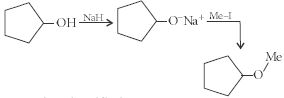
A
dehydration reaction
B
Williamson alcohol synthesis reaction
C
Williamson ether synthesis reaction
D
alcohol formation reaction
Solution
(C) The given reaction involves the formation of an ether from an alkoxide ion and an alkyl halide.
First,cyclopentanol reacts with $NaH$ to form sodium cyclopentoxide.
Then,sodium cyclopentoxide reacts with methyl iodide $(Me-I)$ via an $S_N2$ mechanism to form methyl cyclopentyl ether.
This is a classic example of the Williamson ether synthesis reaction,represented by the general equation: $R-X + R'-ONa \longrightarrow R-O-R' + NaX$.
First,cyclopentanol reacts with $NaH$ to form sodium cyclopentoxide.
Then,sodium cyclopentoxide reacts with methyl iodide $(Me-I)$ via an $S_N2$ mechanism to form methyl cyclopentyl ether.
This is a classic example of the Williamson ether synthesis reaction,represented by the general equation: $R-X + R'-ONa \longrightarrow R-O-R' + NaX$.
0 likesView Solution
86
ChemistryEasyMCQNEET · 2016
The correct order of strengths of the carboxylic acids is:
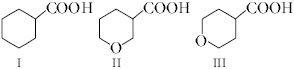
A
$I > II > III$
B
$II > III > I$
C
$III > II > I$
D
$II > I > III$
Solution
(B) The acidity of carboxylic acids is determined by the stability of the carboxylate anion formed after the loss of a proton. Electron-withdrawing groups ($-I$ effect) stabilize the carboxylate anion and increase acidity.
In compound $I$,there is no electron-withdrawing group.
In compound $II$,the oxygen atom is at the $\beta$-position relative to the $-COOH$ group.
In compound $III$,the oxygen atom is at the $\gamma$-position relative to the $-COOH$ group.
The $-I$ effect decreases with distance. Since the oxygen atom in $II$ is closer to the $-COOH$ group than in $III$,the $-I$ effect is stronger in $II$ than in $III$.
Therefore,the order of acidity is $II > III > I$.
In compound $I$,there is no electron-withdrawing group.
In compound $II$,the oxygen atom is at the $\beta$-position relative to the $-COOH$ group.
In compound $III$,the oxygen atom is at the $\gamma$-position relative to the $-COOH$ group.
The $-I$ effect decreases with distance. Since the oxygen atom in $II$ is closer to the $-COOH$ group than in $III$,the $-I$ effect is stronger in $II$ than in $III$.
Therefore,the order of acidity is $II > III > I$.
0 likesView Solution
87
ChemistryMediumMCQNEET · 2016
Which of the following reagents would distinguish $cis$-cyclopenta-$1,2$-diol from the $trans$-isomer?
A
$MnO_2$
B
Aluminium isopropoxide
C
Acetone
D
Ozone
Solution
(C) $cis$-cyclopenta-$1,2$-diol reacts with acetone to form an acetonide (a cyclic ketal) because the two hydroxyl groups are on the same side of the ring,allowing for the formation of a stable five-membered ring structure.
$trans$-cyclopenta-$1,2$-diol cannot form this cyclic ketal with acetone because the hydroxyl groups are on opposite sides of the ring,making the formation of the required cyclic structure geometrically impossible.
Therefore,acetone acts as a reagent to distinguish between the two isomers.
$trans$-cyclopenta-$1,2$-diol cannot form this cyclic ketal with acetone because the hydroxyl groups are on opposite sides of the ring,making the formation of the required cyclic structure geometrically impossible.
Therefore,acetone acts as a reagent to distinguish between the two isomers.
0 likesView Solution
88
ChemistryMediumMCQNEET · 2016
The correct statement regarding a carbonyl compound with a hydrogen atom on its $\alpha-$carbon is:
A
$A$ carbonyl compound with a hydrogen atom on its $\alpha-$carbon rapidly equilibrates with its corresponding enol and this process is known as carbonylation.
B
$A$ carbonyl compound with a hydrogen atom on its $\alpha-$carbon rapidly equilibrates with its corresponding enol and this process is known as keto-enol tautomerism.
C
$A$ carbonyl compound with a hydrogen atom on its $\alpha-$carbon never equilibrates with its corresponding enol.
D
$A$ carbonyl compound with a hydrogen atom on its $\alpha-$carbon rapidly equilibrates with its corresponding enol and this process is known as aldehyde-ketone equilibration.
Solution
(B) Carbonyl compounds containing at least one $\alpha-$hydrogen atom exhibit tautomerism due to the acidic nature of the $\alpha-$hydrogen. The $\alpha-$hydrogen atom migrates to the carbonyl oxygen atom,resulting in an equilibrium between the keto form and the enol form. This phenomenon is specifically known as keto-enol tautomerism.
0 likesView Solution
89
ChemistryDifficultMCQNEET · 2016
Which one of the following nitro-compounds does not react with nitrous acid?
A
$CH_3CH_2CH_2NO_2$
B
$(CH_3)_2CHCH_2NO_2$
C
$(CH_3)_3CNO_2$
D
$CH_3C(=O)CH(CH_3)NO_2$
Solution
(C) The reaction of nitro compounds with nitrous acid $(HNO_2)$ depends on the presence of $\alpha$-hydrogen atoms.
$1^o$ nitro compounds (containing two $\alpha$-hydrogens) react with $HNO_2$ to form nitrolic acids,which dissolve in $NaOH$ to give a red solution.
$2^o$ nitro compounds (containing one $\alpha$-hydrogen) react with $HNO_2$ to form pseudonitroles,which dissolve in $NaOH$ to give a blue solution.
$3^o$ nitro compounds do not contain any $\alpha$-hydrogen atoms,and therefore,they do not react with nitrous acid.
In the given options:
$(A)$ $CH_3CH_2CH_2NO_2$ is a $1^o$ nitro compound with $\alpha$-hydrogens.
$(B)$ $(CH_3)_2CHCH_2NO_2$ is a $1^o$ nitro compound with $\alpha$-hydrogens.
$(C)$ $(CH_3)_3CNO_2$ is a $3^o$ nitro compound with no $\alpha$-hydrogen atoms.
$(D)$ $CH_3C(=O)CH(CH_3)NO_2$ is a $2^o$ nitro compound with an $\alpha$-hydrogen.
Thus,$(CH_3)_3CNO_2$ does not react with nitrous acid.
$1^o$ nitro compounds (containing two $\alpha$-hydrogens) react with $HNO_2$ to form nitrolic acids,which dissolve in $NaOH$ to give a red solution.
$2^o$ nitro compounds (containing one $\alpha$-hydrogen) react with $HNO_2$ to form pseudonitroles,which dissolve in $NaOH$ to give a blue solution.
$3^o$ nitro compounds do not contain any $\alpha$-hydrogen atoms,and therefore,they do not react with nitrous acid.
In the given options:
$(A)$ $CH_3CH_2CH_2NO_2$ is a $1^o$ nitro compound with $\alpha$-hydrogens.
$(B)$ $(CH_3)_2CHCH_2NO_2$ is a $1^o$ nitro compound with $\alpha$-hydrogens.
$(C)$ $(CH_3)_3CNO_2$ is a $3^o$ nitro compound with no $\alpha$-hydrogen atoms.
$(D)$ $CH_3C(=O)CH(CH_3)NO_2$ is a $2^o$ nitro compound with an $\alpha$-hydrogen.
Thus,$(CH_3)_3CNO_2$ does not react with nitrous acid.
0 likesView Solution
90
ChemistryAdvancedMCQNEET · 2016
$A$ given nitrogen-containing aromatic compound $A$ reacts with $Sn/HCl,$ followed by $HNO_2$ to give an unstable compound $B$. $B,$ on treatment with phenol,forms a beautiful coloured compound $C$ with the molecular formula $C_{12}H_{10}N_2O.$ The structure of compound $A$ is
A
Aniline
B
Nitrobenzene
C
Benzonitrile
D
Benzamide
Solution
(B) The reaction sequence is as follows:
$1$. Compound $A$ reacts with $Sn/HCl$ (a reducing agent) to form an amine. This indicates that $A$ is a nitro compound,specifically nitrobenzene $(C_6H_5NO_2)$.
$2$. Nitrobenzene $(C_6H_5NO_2)$ is reduced to aniline $(C_6H_5NH_2)$.
$3$. Aniline reacts with $HNO_2$ (nitrous acid) at $0-5^{\circ}C$ to form benzenediazonium chloride $(C_6H_5N_2^+Cl^-)$,which is the unstable compound $B$.
$4$. Benzenediazonium chloride $(B)$ undergoes a coupling reaction with phenol $(C_6H_5OH)$ in a basic medium to form $p$-hydroxyazobenzene $(C_6H_5-N=N-C_6H_4OH)$,which is the coloured compound $C$ with molecular formula $C_{12}H_{10}N_2O$.
Therefore,compound $A$ is nitrobenzene.
$1$. Compound $A$ reacts with $Sn/HCl$ (a reducing agent) to form an amine. This indicates that $A$ is a nitro compound,specifically nitrobenzene $(C_6H_5NO_2)$.
$2$. Nitrobenzene $(C_6H_5NO_2)$ is reduced to aniline $(C_6H_5NH_2)$.
$3$. Aniline reacts with $HNO_2$ (nitrous acid) at $0-5^{\circ}C$ to form benzenediazonium chloride $(C_6H_5N_2^+Cl^-)$,which is the unstable compound $B$.
$4$. Benzenediazonium chloride $(B)$ undergoes a coupling reaction with phenol $(C_6H_5OH)$ in a basic medium to form $p$-hydroxyazobenzene $(C_6H_5-N=N-C_6H_4OH)$,which is the coloured compound $C$ with molecular formula $C_{12}H_{10}N_2O$.
Therefore,compound $A$ is nitrobenzene.
0 likesView Solution
91
ChemistryDifficultMCQNEET · 2016
The correct statement regarding the basicity of arylamines is
A
arylamines are generally more basic than alkylamines because of aryl group
B
arylamines are generally more basic than alkylamines,because the nitrogen atom in arylamines is $sp$-hybridised
C
arylamines are generally less basic than alkylamines because the nitrogen lone-pair electrons are delocalised by interaction with the aromatic ring $\pi$-electron system
D
arylamines are generally more basic than alkylamines because the nitrogen lone-pair electrons are not delocalised by interaction with the aromatic ring $\pi$-electron system.
Solution
(C) In arylamines,the lone pair of electrons on the nitrogen atom is involved in resonance with the aromatic ring.
This delocalization makes the lone pair less available for protonation,thereby reducing the basicity of arylamines compared to alkylamines,where the alkyl group exerts a $+I$ effect that increases electron density on the nitrogen atom.
This delocalization makes the lone pair less available for protonation,thereby reducing the basicity of arylamines compared to alkylamines,where the alkyl group exerts a $+I$ effect that increases electron density on the nitrogen atom.
0 likesView Solution
92
ChemistryMediumMCQNEET · 2016
The product formed by the reaction of an aldehyde with a primary amine is
A
carboxylic acid
B
aromatic acid
C
Schiff's base
D
ketone
Solution
(C) The reaction between an aldehyde and a primary amine is a nucleophilic addition-elimination reaction.
The general reaction is: $R-CHO + R'-NH_2 \rightarrow R-CH=N-R' + H_2O$.
The product formed is known as a Schiff's base (or an imine).
The general reaction is: $R-CHO + R'-NH_2 \rightarrow R-CH=N-R' + H_2O$.
The product formed is known as a Schiff's base (or an imine).
0 likesView Solution
93
ChemistryMediumMCQNEET · 2016
The central dogma of molecular genetics states that the genetic information flows from
A
Amino acids $\rightarrow$ Proteins $\rightarrow$ $DNA$
B
$DNA$ $\rightarrow$ Carbohydrates $\rightarrow$ Proteins
C
$DNA$ $\rightarrow$ $RNA$ $\rightarrow$ Proteins
D
$DNA$ $\rightarrow$ $RNA$ $\rightarrow$ Carbohydrates
Solution
(C) The central dogma of molecular biology describes the flow of genetic information within a biological system.
It states that genetic information flows from $DNA$ to $RNA$ and then to proteins.
The process is represented as: $DNA$ $\xrightarrow{\text{Transcription}} RNA$ $\xrightarrow{\text{Translation}} \text{Protein}$.
It states that genetic information flows from $DNA$ to $RNA$ and then to proteins.
The process is represented as: $DNA$ $\xrightarrow{\text{Transcription}} RNA$ $\xrightarrow{\text{Translation}} \text{Protein}$.
0 likesView Solution
94
ChemistryDifficultMCQNEET · 2016
The correct corresponding order of names of four aldoses with configurations given below,respectively,is:
$(1)$ $CHO-CH(OH)-CH(OH)-CH_2OH$ (both $-OH$ on right)
$(2)$ $CHO-CH(OH)-CH(OH)-CH_2OH$ ($-OH$ on left at $C-2$,right at $C-3$)
$(3)$ $CHO-CH(OH)-CH(OH)-CH_2OH$ (both $-OH$ on left)
$(4)$ $CHO-CH(OH)-CH(OH)-CH_2OH$ ($-OH$ on right at $C-2$,left at $C-3$)
$(1)$ $CHO-CH(OH)-CH(OH)-CH_2OH$ (both $-OH$ on right)
$(2)$ $CHO-CH(OH)-CH(OH)-CH_2OH$ ($-OH$ on left at $C-2$,right at $C-3$)
$(3)$ $CHO-CH(OH)-CH(OH)-CH_2OH$ (both $-OH$ on left)
$(4)$ $CHO-CH(OH)-CH(OH)-CH_2OH$ ($-OH$ on right at $C-2$,left at $C-3$)
A
$L$-erythrose,$L$-threose,$L$-erythrose,$D$-threose
B
$D$-threose,$D$-erythrose,$L$-threose,$L$-erythrose
C
$L$-erythrose,$L$-threose,$D$-erythrose,$D$-threose
D
$D$-erythrose,$D$-threose,$L$-erythrose,$L$-threose
Solution
(D) In a Fischer projection,the $D/L$ configuration is determined by the $-OH$ group on the chiral carbon furthest from the aldehyde group (the lowest chiral carbon).
If the $-OH$ is on the right,it is $D$; if on the left,it is $L$.
$(1)$ $D$-erythrose: Both $-OH$ groups are on the same side (right).
$(2)$ $D$-threose: $-OH$ groups are on opposite sides,with the bottom $-OH$ on the right.
$(3)$ $L$-erythrose: Both $-OH$ groups are on the same side (left).
$(4)$ $L$-threose: $-OH$ groups are on opposite sides,with the bottom $-OH$ on the left.
Thus,the correct order is $D$-erythrose,$D$-threose,$L$-erythrose,$L$-threose.
If the $-OH$ is on the right,it is $D$; if on the left,it is $L$.
$(1)$ $D$-erythrose: Both $-OH$ groups are on the same side (right).
$(2)$ $D$-threose: $-OH$ groups are on opposite sides,with the bottom $-OH$ on the right.
$(3)$ $L$-erythrose: Both $-OH$ groups are on the same side (left).
$(4)$ $L$-threose: $-OH$ groups are on opposite sides,with the bottom $-OH$ on the left.
Thus,the correct order is $D$-erythrose,$D$-threose,$L$-erythrose,$L$-threose.
0 likesView Solution
95
ChemistryEasyMCQNEET · 2016
The correct statement regarding $RNA$ and $DNA,$ respectively is
A
the sugar component in $RNA$ is a arabinose and the sugar component in $DNA$ is ribose
B
the sugar component in $RNA$ is $2'-$deoxyribose and the sugar component in $DNA$ is arabinose
C
the sugar component in $RNA$ is arabinose and the sugar component in $DNA$ is $2'-$deoxyribose
D
the sugar component in $RNA$ is ribose and the sugar component in $DNA$ is $2'-$deoxyribose.
Solution
(D) $RNA$ (Ribonucleic acid) contains the sugar $\beta-D-ribose.$
$DNA$ (Deoxyribonucleic acid) contains the sugar $\beta-D-2'-deoxyribose.$
Therefore,the correct statement is that the sugar component in $RNA$ is ribose and the sugar component in $DNA$ is $2'-$deoxyribose.
$DNA$ (Deoxyribonucleic acid) contains the sugar $\beta-D-2'-deoxyribose.$
Therefore,the correct statement is that the sugar component in $RNA$ is ribose and the sugar component in $DNA$ is $2'-$deoxyribose.
0 likesView Solution
96
ChemistryMediumMCQNEET · 2016
In a protein molecule,various amino acids are linked together by:
A
peptide bond
B
dative bond
C
$\alpha - glycosidic$ bond
D
$\beta - glycosidic$ bond
Solution
(A) The peptide bond is an amide bond $(-CONH-)$ formed by the condensation reaction between the carboxyl group $(-COOH)$ of one amino acid and the amino group $(-NH_2)$ of another amino acid,with the elimination of a water molecule $(H_2O)$.
This linkage is responsible for the primary structure of proteins.
This linkage is responsible for the primary structure of proteins.
0 likesView Solution
97
ChemistryEasyMCQNEET · 2016
Which one given below is a non-reducing sugar?
A
Glucose
B
Sucrose
C
Maltose
D
Lactose
Solution
(B) Sucrose is a non-reducing sugar because it does not have a free $-CHO$ or ketonic group.
0 likesView Solution
98
ChemistryDifficultMCQNEET · 2016
Which one of the following structures represents nylon $6, 6$ polymer?
A
$[-CH_2-CH(NH_2)-CH_2-CH(CH_3)-]_{66}$
B
$[-CH_2-CH(NH_2)-CH_2-CH(NH_2)-]_{66}$
C
$[-CH_2-CH(NH_2)-CH_2-CH(Cl)-]_6-[-CH_2-CH(CH_3)-CH_2-CH(COOH)-]_6$
D
$[-CO-(CH_2)_4-CO-NH-(CH_2)_6-NH-]_n$
Solution
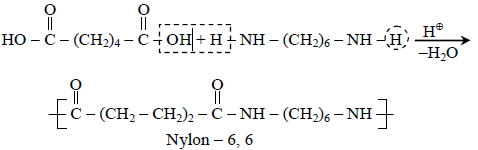
0 likesView Solution
99
ChemistryDifficultMCQNEET · 2016
Natural rubber has
A
alternate $cis-$ and $trans-$ configuration
B
random $cis-$ and $trans-$ configuration
C
all $cis-$ configuration
D
all $trans-$ configuration.
Solution
(C) Natural rubber is a linear polymer of isoprene $(2-methyl-1,3-butadiene)$.
In natural rubber,the double bonds are present in the $cis-$ configuration,which means the bulky groups are on the same side of the double bond.
This $cis-$ configuration gives natural rubber its elastic properties.
Therefore,natural rubber has an all $cis-$ configuration.
In natural rubber,the double bonds are present in the $cis-$ configuration,which means the bulky groups are on the same side of the double bond.
This $cis-$ configuration gives natural rubber its elastic properties.
Therefore,natural rubber has an all $cis-$ configuration.
0 likesView Solution
100
ChemistryMediumMCQNEET · 2016
Which of the following is an analgesic?
A
Streptomycin
B
Chloromycetin
C
Novalgin
D
Penicillin
Solution
(C) $Novalgin$ (Dipyrone) is a non-narcotic analgesic used as a pain reliever.
$Penicillin$ is an antibiotic used for curing infections.
$Streptomycin$ is an antibiotic drug.
$Chloromycetin$ is an antibiotic drug.
$Penicillin$ is an antibiotic used for curing infections.
$Streptomycin$ is an antibiotic drug.
$Chloromycetin$ is an antibiotic drug.
0 likesView Solution
Vedclass Products
For Students
Vedclass Test Series
Mock tests in real NEET style covering Chemistry with performance analysis. 5-day free trial.
Start Free TrialFor Teachers
Exam Paper Generator
Generate Set A/B/C/D Chemistry papers from 7.5L+ questions in 2 minutes. 3 chapters free.
Try FreeFor Institutes
Online Exam Module
Run live NEET mock exams with unlimited students, 360° analytics & white-label branding.
See DemoFrequently Asked Questions
How many Chemistry questions are in NEET 2016?
There are 148 Chemistry questions from the NEET 2016 paper on Vedclass, each with a detailed step-by-step solution in English.
Are NEET 2016 Chemistry solutions available in English?
Yes. All solutions on this page are in English. You can also switch to English or Hindi using the language buttons above the questions.
Can I practice NEET 2016 Chemistry as a timed test?
Yes. Use the Vedclass Test Series to attempt a full NEET mock test covering Chemistry with time limits and instant score analysis.
Can teachers create Chemistry papers from NEET previous year questions?
Yes. The Vedclass Exam Paper Generator lets teachers mix NEET Chemistry questions and generate Set A/B/C/D papers in minutes.
For Teachers & Institutes
Build a Custom Chemistry Paper
Pick NEET 2016 Chemistry questions, set difficulty, and generate Set A/B/C/D in 2 minutes.