
PhysicsQ1–89 of 89 questions
Page 1 of 1 · English
1
PhysicsDifficultMCQNEET · 2016
Planck's constant $(h)$,speed of light in vacuum $(c)$,and Newton's gravitational constant $(G)$ are three fundamental constants. Which of the following combinations of these has the dimension of length?
A
$\sqrt{\frac{hc}{G}}$
B
$\sqrt{\frac{Gc}{h^{3/2}}}$
C
$\frac{\sqrt{hG}}{c^{3/2}}$
D
$\frac{\sqrt{hG}}{c^{5/2}}$
Solution
(C) Let the dimension of length $l$ be expressed as $l \propto h^p c^q G^r$.
Substituting the dimensions of each constant:
$[L] = [ML^2T^{-1}]^p [LT^{-1}]^q [M^{-1}L^3T^{-2}]^r$
$[M^0 L^1 T^0] = M^{p-r} L^{2p+q+3r} T^{-p-q-2r}$
Comparing the powers of $M, L,$ and $T$ on both sides:
$p - r = 0 \implies p = r$
$2p + q + 3r = 1$
$-p - q - 2r = 0$
Substituting $p = r$ into the third equation: $-r - q - 2r = 0 \implies q = -3r$.
Substituting $p = r$ and $q = -3r$ into the second equation: $2r - 3r + 3r = 1 \implies 2r = 1 \implies r = 1/2$.
Thus,$p = 1/2$ and $q = -3/2$.
Therefore,$l \propto h^{1/2} c^{-3/2} G^{1/2} = \sqrt{\frac{hG}{c^3}} = \frac{\sqrt{hG}}{c^{3/2}}$.
Substituting the dimensions of each constant:
$[L] = [ML^2T^{-1}]^p [LT^{-1}]^q [M^{-1}L^3T^{-2}]^r$
$[M^0 L^1 T^0] = M^{p-r} L^{2p+q+3r} T^{-p-q-2r}$
Comparing the powers of $M, L,$ and $T$ on both sides:
$p - r = 0 \implies p = r$
$2p + q + 3r = 1$
$-p - q - 2r = 0$
Substituting $p = r$ into the third equation: $-r - q - 2r = 0 \implies q = -3r$.
Substituting $p = r$ and $q = -3r$ into the second equation: $2r - 3r + 3r = 1 \implies 2r = 1 \implies r = 1/2$.
Thus,$p = 1/2$ and $q = -3/2$.
Therefore,$l \propto h^{1/2} c^{-3/2} G^{1/2} = \sqrt{\frac{hG}{c^3}} = \frac{\sqrt{hG}}{c^{3/2}}$.
0 likesView Solution
2
PhysicsMediumMCQNEET · 2016
Two cars $P$ and $Q$ start from a point at the same time in a straight line and their positions are represented by $x_P(t) = at + bt^2$ and $x_Q(t) = ft - t^2$. At what time do the cars have the same velocity?
A
$\frac{a + f}{2(1 + b)}$
B
$\frac{f - a}{2(1 + b)}$
C
$\frac{a + f}{1 + b}$
D
$\frac{a + f}{2(b - 1)}$
Solution
(B) The position of car $P$ at any time $t$ is given by $x_P(t) = at + bt^2$.
The velocity of car $P$ is $v_P(t) = \frac{dx_P(t)}{dt} = a + 2bt$ ... $(i)$.
Similarly,for car $Q$,the position is $x_Q(t) = ft - t^2$.
The velocity of car $Q$ is $v_Q(t) = \frac{dx_Q(t)}{dt} = f - 2t$ ... $(ii)$.
Given that the cars have the same velocity,$v_P(t) = v_Q(t)$.
Therefore,$a + 2bt = f - 2t$.
Rearranging the terms to solve for $t$: $2bt + 2t = f - a$.
$2t(b + 1) = f - a$.
Thus,$t = \frac{f - a}{2(1 + b)}$.
The velocity of car $P$ is $v_P(t) = \frac{dx_P(t)}{dt} = a + 2bt$ ... $(i)$.
Similarly,for car $Q$,the position is $x_Q(t) = ft - t^2$.
The velocity of car $Q$ is $v_Q(t) = \frac{dx_Q(t)}{dt} = f - 2t$ ... $(ii)$.
Given that the cars have the same velocity,$v_P(t) = v_Q(t)$.
Therefore,$a + 2bt = f - 2t$.
Rearranging the terms to solve for $t$: $2bt + 2t = f - a$.
$2t(b + 1) = f - a$.
Thus,$t = \frac{f - a}{2(1 + b)}$.
0 likesView Solution
3
PhysicsMediumMCQNEET · 2016
If the velocity of a particle is $v = At + Bt^2$,where $A$ and $B$ are constants,then the distance travelled by it between $1 \ s$ and $2 \ s$ is
A
$3A + 7B$
B
$\frac{3}{2}A + \frac{7}{3}B$
C
$\frac{A}{2} + \frac{B}{3}$
D
$\frac{3}{2}A + 4B$
Solution
(B) The velocity of the particle is given by $v = At + Bt^2$.
Since $v = \frac{ds}{dt}$,we have $ds = (At + Bt^2) dt$.
To find the distance travelled between $t = 1 \ s$ and $t = 2 \ s$,we integrate the velocity with respect to time:
$s = \int_{1}^{2} (At + Bt^2) dt$
$s = \left[ \frac{At^2}{2} + \frac{Bt^3}{3} \right]_{1}^{2}$
$s = \left( \frac{A(2)^2}{2} + \frac{B(2)^3}{3} \right) - \left( \frac{A(1)^2}{2} + \frac{B(1)^3}{3} \right)$
$s = \left( 2A + \frac{8B}{3} \right) - \left( \frac{A}{2} + \frac{B}{3} \right)$
$s = (2A - \frac{A}{2}) + (\frac{8B}{3} - \frac{B}{3})$
$s = \frac{3}{2}A + \frac{7}{3}B$
Since the velocity does not change sign in the interval $[1, 2]$,the distance is equal to the magnitude of displacement.
Since $v = \frac{ds}{dt}$,we have $ds = (At + Bt^2) dt$.
To find the distance travelled between $t = 1 \ s$ and $t = 2 \ s$,we integrate the velocity with respect to time:
$s = \int_{1}^{2} (At + Bt^2) dt$
$s = \left[ \frac{At^2}{2} + \frac{Bt^3}{3} \right]_{1}^{2}$
$s = \left( \frac{A(2)^2}{2} + \frac{B(2)^3}{3} \right) - \left( \frac{A(1)^2}{2} + \frac{B(1)^3}{3} \right)$
$s = \left( 2A + \frac{8B}{3} \right) - \left( \frac{A}{2} + \frac{B}{3} \right)$
$s = (2A - \frac{A}{2}) + (\frac{8B}{3} - \frac{B}{3})$
$s = \frac{3}{2}A + \frac{7}{3}B$
Since the velocity does not change sign in the interval $[1, 2]$,the distance is equal to the magnitude of displacement.
1 likesView Solution
4
PhysicsMediumMCQNEET · 2016
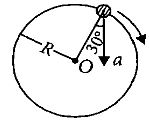
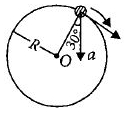
In the given figure,$a = 15 \, m s^{-2}$ represents the total acceleration of a particle moving in the clockwise direction in a circle of radius $R = 2.5 \, m$ at a given instant of time. The speed of the particle is ........ $m/s$.
A
$5.7$
B
$6.2$
C
$4.5$
D
$5.0$
Solution
(A) Given:
Total acceleration $a = 15 \, m s^{-2}$
Radius $R = 2.5 \, m$
Angle between total acceleration and centripetal acceleration is $30^{\circ}$.
The centripetal acceleration $a_c$ is the component of the total acceleration $a$ directed towards the center of the circle.
From the figure,$a_c = a \cos(30^{\circ})$.
$a_c = 15 \times \frac{\sqrt{3}}{2} \approx 15 \times 0.866 = 12.99 \, m s^{-2}$.
We know that the centripetal acceleration is given by $a_c = \frac{v^2}{R}$,where $v$ is the speed of the particle.
Therefore,$v = \sqrt{a_c R}$.
$v = \sqrt{12.99 \times 2.5} = \sqrt{32.475} \approx 5.698 \, m/s$.
Rounding to one decimal place,we get $v \approx 5.7 \, m/s$.
Thus,the correct option is $A$.
Total acceleration $a = 15 \, m s^{-2}$
Radius $R = 2.5 \, m$
Angle between total acceleration and centripetal acceleration is $30^{\circ}$.
The centripetal acceleration $a_c$ is the component of the total acceleration $a$ directed towards the center of the circle.
From the figure,$a_c = a \cos(30^{\circ})$.
$a_c = 15 \times \frac{\sqrt{3}}{2} \approx 15 \times 0.866 = 12.99 \, m s^{-2}$.
We know that the centripetal acceleration is given by $a_c = \frac{v^2}{R}$,where $v$ is the speed of the particle.
Therefore,$v = \sqrt{a_c R}$.
$v = \sqrt{12.99 \times 2.5} = \sqrt{32.475} \approx 5.698 \, m/s$.
Rounding to one decimal place,we get $v \approx 5.7 \, m/s$.
Thus,the correct option is $A$.
0 likesView Solution
5
PhysicsMediumMCQNEET · 2016
$A$ particle moves so that its position vector is given by $\vec{r} = \cos(\omega t) \hat{i} + \sin(\omega t) \hat{j}$,where $\omega$ is a constant. Which of the following is true?
A
Velocity and acceleration both are parallel to $\vec{r}$.
B
Velocity is perpendicular to $\vec{r}$ and acceleration is directed towards the origin.
C
Velocity is perpendicular to $\vec{r}$ and acceleration is directed away from the origin.
D
Velocity and acceleration both are perpendicular to $\vec{r}$.
Solution
(B) Given the position vector: $\vec{r} = \cos(\omega t) \hat{i} + \sin(\omega t) \hat{j}$.
$1$. Velocity $\vec{v}$ is the derivative of position with respect to time:
$\vec{v} = \frac{d\vec{r}}{dt} = -\omega \sin(\omega t) \hat{i} + \omega \cos(\omega t) \hat{j}$.
$2$. Acceleration $\vec{a}$ is the derivative of velocity with respect to time:
$\vec{a} = \frac{d\vec{v}}{dt} = -\omega^2 \cos(\omega t) \hat{i} - \omega^2 \sin(\omega t) \hat{j} = -\omega^2 \vec{r}$.
$3$. Since $\vec{a} = -\omega^2 \vec{r}$,the acceleration is directed towards the origin (centripetal acceleration).
$4$. To check the relationship between $\vec{r}$ and $\vec{v}$,calculate the dot product:
$\vec{r} \cdot \vec{v} = (\cos(\omega t))(-\omega \sin(\omega t)) + (\sin(\omega t))(\omega \cos(\omega t)) = -\omega \sin(\omega t) \cos(\omega t) + \omega \sin(\omega t) \cos(\omega t) = 0$.
Since the dot product is $0$,the velocity is perpendicular to the position vector $\vec{r}$.
$1$. Velocity $\vec{v}$ is the derivative of position with respect to time:
$\vec{v} = \frac{d\vec{r}}{dt} = -\omega \sin(\omega t) \hat{i} + \omega \cos(\omega t) \hat{j}$.
$2$. Acceleration $\vec{a}$ is the derivative of velocity with respect to time:
$\vec{a} = \frac{d\vec{v}}{dt} = -\omega^2 \cos(\omega t) \hat{i} - \omega^2 \sin(\omega t) \hat{j} = -\omega^2 \vec{r}$.
$3$. Since $\vec{a} = -\omega^2 \vec{r}$,the acceleration is directed towards the origin (centripetal acceleration).
$4$. To check the relationship between $\vec{r}$ and $\vec{v}$,calculate the dot product:
$\vec{r} \cdot \vec{v} = (\cos(\omega t))(-\omega \sin(\omega t)) + (\sin(\omega t))(\omega \cos(\omega t)) = -\omega \sin(\omega t) \cos(\omega t) + \omega \sin(\omega t) \cos(\omega t) = 0$.
Since the dot product is $0$,the velocity is perpendicular to the position vector $\vec{r}$.
0 likesView Solution
6
PhysicsMediumMCQNEET · 2016
If the magnitude of the sum of two vectors is equal to the magnitude of the difference of the two vectors,the angle between these vectors is ........ $^o$.
A
$90$
B
$120$
C
$45$
D
$60$
Solution
(A) Let the two vectors be $\vec{A}$ and $\vec{B}$.
The magnitude of the sum of $\vec{A}$ and $\vec{B}$ is given by: $|\vec{A} + \vec{B}| = \sqrt{A^2 + B^2 + 2AB \cos \theta}$.
The magnitude of the difference of $\vec{A}$ and $\vec{B}$ is given by: $|\vec{A} - \vec{B}| = \sqrt{A^2 + B^2 - 2AB \cos \theta}$.
Given that $|\vec{A} + \vec{B}| = |\vec{A} - \vec{B}|$,we square both sides:
$A^2 + B^2 + 2AB \cos \theta = A^2 + B^2 - 2AB \cos \theta$.
Subtracting $A^2 + B^2$ from both sides,we get:
$2AB \cos \theta = -2AB \cos \theta$.
$4AB \cos \theta = 0$.
Since $A$ and $B$ are non-zero vectors,$4AB \neq 0$,therefore $\cos \theta = 0$.
This implies $\theta = 90^o$.
The magnitude of the sum of $\vec{A}$ and $\vec{B}$ is given by: $|\vec{A} + \vec{B}| = \sqrt{A^2 + B^2 + 2AB \cos \theta}$.
The magnitude of the difference of $\vec{A}$ and $\vec{B}$ is given by: $|\vec{A} - \vec{B}| = \sqrt{A^2 + B^2 - 2AB \cos \theta}$.
Given that $|\vec{A} + \vec{B}| = |\vec{A} - \vec{B}|$,we square both sides:
$A^2 + B^2 + 2AB \cos \theta = A^2 + B^2 - 2AB \cos \theta$.
Subtracting $A^2 + B^2$ from both sides,we get:
$2AB \cos \theta = -2AB \cos \theta$.
$4AB \cos \theta = 0$.
Since $A$ and $B$ are non-zero vectors,$4AB \neq 0$,therefore $\cos \theta = 0$.
This implies $\theta = 90^o$.
0 likesView Solution
7
PhysicsMediumMCQNEET · 2016
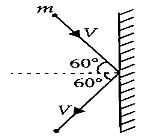
$A$ rigid ball of mass $m$ strikes a rigid wall at $60^\circ$ and gets reflected without loss of speed as shown in the figure. The value of impulse imparted by the wall on the ball will be
A
$\frac{mv}{2}$
B
$\frac{mv}{3}$
C
$mv$
D
$2mv \cos 60^\circ = mv$
Solution
(C) The impulse imparted by the wall on the ball is equal to the change in momentum of the ball.
Let the initial velocity be $\vec{v}_i$ and the final velocity be $\vec{v}_f$.
The initial momentum is $\vec{p}_i = m\vec{v}_i$ and the final momentum is $\vec{p}_f = m\vec{v}_f$.
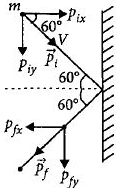
Taking the normal to the wall as the $x$-axis,the initial velocity components are $v_{ix} = v \cos 60^\circ$ (towards the wall) and $v_{iy} = v \sin 60^\circ$ (parallel to the wall).
The final velocity components are $v_{fx} = -v \cos 60^\circ$ (away from the wall) and $v_{fy} = v \sin 60^\circ$ (parallel to the wall).
The change in momentum $\Delta \vec{p} = \vec{p}_f - \vec{p}_i = m(\vec{v}_f - \vec{v}_i)$.
$\Delta p_x = m(v_{fx} - v_{ix}) = m(-v \cos 60^\circ - v \cos 60^\circ) = -2mv \cos 60^\circ = -2mv(0.5) = -mv$.
$\Delta p_y = m(v_{fy} - v_{iy}) = m(v \sin 60^\circ - v \sin 60^\circ) = 0$.
The magnitude of the impulse is $|\Delta \vec{p}| = |-mv| = mv$.
Let the initial velocity be $\vec{v}_i$ and the final velocity be $\vec{v}_f$.
The initial momentum is $\vec{p}_i = m\vec{v}_i$ and the final momentum is $\vec{p}_f = m\vec{v}_f$.
Taking the normal to the wall as the $x$-axis,the initial velocity components are $v_{ix} = v \cos 60^\circ$ (towards the wall) and $v_{iy} = v \sin 60^\circ$ (parallel to the wall).
The final velocity components are $v_{fx} = -v \cos 60^\circ$ (away from the wall) and $v_{fy} = v \sin 60^\circ$ (parallel to the wall).
The change in momentum $\Delta \vec{p} = \vec{p}_f - \vec{p}_i = m(\vec{v}_f - \vec{v}_i)$.
$\Delta p_x = m(v_{fx} - v_{ix}) = m(-v \cos 60^\circ - v \cos 60^\circ) = -2mv \cos 60^\circ = -2mv(0.5) = -mv$.
$\Delta p_y = m(v_{fy} - v_{iy}) = m(v \sin 60^\circ - v \sin 60^\circ) = 0$.
The magnitude of the impulse is $|\Delta \vec{p}| = |-mv| = mv$.
0 likesView Solution
8
PhysicsDifficultMCQNEET · 2016
$A$ car is negotiating a curved road of radius $R$. The road is banked at an angle $\theta$. The coefficient of friction between the tyres of the car and the road is $\mu_s$. The maximum safe velocity on this road is
A
$\sqrt{gR\frac{\mu_s + \tan\theta}{1 - \mu_s\tan\theta}}$
B
$\sqrt{\frac{g}{R}\frac{\mu_s + \tan\theta}{1 - \mu_s\tan\theta}}$
C
$\frac{g}{R^2}\frac{\mu_s + \tan\theta}{1 - \mu_s\tan\theta}$
D
$\sqrt{gR^2\frac{\mu_s + \tan\theta}{1 - \mu_s\tan\theta}}$
Solution
(A) For vertical equilibrium on the road:
$N \cos\theta = mg + f \sin\theta$
$mg = N \cos\theta - f \sin\theta$ ... $(i)$
For safe turning,the centripetal force is provided by the horizontal components of the normal force and friction:
$N \sin\theta + f \cos\theta = \frac{mv^2}{R}$ ... $(ii)$
Dividing equation $(ii)$ by equation $(i)$:
$\frac{v^2}{Rg} = \frac{N \sin\theta + f \cos\theta}{N \cos\theta - f \sin\theta}$
At maximum velocity,the friction force $f$ reaches its limiting value,$f = \mu_s N$. Substituting this into the equation:
$\frac{v_{\max}^2}{Rg} = \frac{N \sin\theta + \mu_s N \cos\theta}{N \cos\theta - \mu_s N \sin\theta}$
Dividing the numerator and denominator by $N \cos\theta$:
$\frac{v_{\max}^2}{Rg} = \frac{\tan\theta + \mu_s}{1 - \mu_s \tan\theta}$
Therefore,the maximum safe velocity is:
$v_{\max} = \sqrt{gR \left( \frac{\mu_s + \tan\theta}{1 - \mu_s \tan\theta} \right)}$
$N \cos\theta = mg + f \sin\theta$
$mg = N \cos\theta - f \sin\theta$ ... $(i)$
For safe turning,the centripetal force is provided by the horizontal components of the normal force and friction:
$N \sin\theta + f \cos\theta = \frac{mv^2}{R}$ ... $(ii)$
Dividing equation $(ii)$ by equation $(i)$:
$\frac{v^2}{Rg} = \frac{N \sin\theta + f \cos\theta}{N \cos\theta - f \sin\theta}$
At maximum velocity,the friction force $f$ reaches its limiting value,$f = \mu_s N$. Substituting this into the equation:
$\frac{v_{\max}^2}{Rg} = \frac{N \sin\theta + \mu_s N \cos\theta}{N \cos\theta - \mu_s N \sin\theta}$
Dividing the numerator and denominator by $N \cos\theta$:
$\frac{v_{\max}^2}{Rg} = \frac{\tan\theta + \mu_s}{1 - \mu_s \tan\theta}$
Therefore,the maximum safe velocity is:
$v_{\max} = \sqrt{gR \left( \frac{\mu_s + \tan\theta}{1 - \mu_s \tan\theta} \right)}$
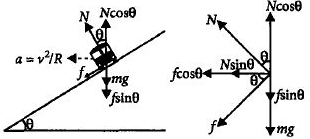
0 likesView Solution
9
PhysicsDifficultMCQNEET · 2016
$A$ body of mass $1\, kg$ begins to move under the action of a time-dependent force $\overrightarrow{F} = (2t\hat{i} + 3t^2\hat{j})\, N$,where $\hat{i}$ and $\hat{j}$ are unit vectors along the $x$ and $y$ axes. What power will be developed by the force at time $t$?
A
$(2t^2 + 4t^4)\, W$
B
$(2t^3 + 3t^4)\, W$
C
$(2t^3 + 3t^5)\, W$
D
$(2t^2 + 3t^3)\, W$
Solution
(C) Given: Force $\overrightarrow{F} = (2t\hat{i} + 3t^2\hat{j})\, N$ and mass $m = 1\, kg$.
Acceleration of the body is given by $\overrightarrow{a} = \frac{\overrightarrow{F}}{m} = \frac{2t\hat{i} + 3t^2\hat{j}}{1} = (2t\hat{i} + 3t^2\hat{j})\, m/s^2$.
Velocity $\overrightarrow{v}$ at time $t$ is obtained by integrating acceleration with respect to time: $\overrightarrow{v} = \int \overrightarrow{a} dt = \int (2t\hat{i} + 3t^2\hat{j}) dt = t^2\hat{i} + t^3\hat{j}\, m/s$.
Power $P$ developed by the force is the dot product of force and velocity: $P = \overrightarrow{F} \cdot \overrightarrow{v}$.
$P = (2t\hat{i} + 3t^2\hat{j}) \cdot (t^2\hat{i} + t^3\hat{j}) = (2t)(t^2) + (3t^2)(t^3) = 2t^3 + 3t^5\, W$.
Acceleration of the body is given by $\overrightarrow{a} = \frac{\overrightarrow{F}}{m} = \frac{2t\hat{i} + 3t^2\hat{j}}{1} = (2t\hat{i} + 3t^2\hat{j})\, m/s^2$.
Velocity $\overrightarrow{v}$ at time $t$ is obtained by integrating acceleration with respect to time: $\overrightarrow{v} = \int \overrightarrow{a} dt = \int (2t\hat{i} + 3t^2\hat{j}) dt = t^2\hat{i} + t^3\hat{j}\, m/s$.
Power $P$ developed by the force is the dot product of force and velocity: $P = \overrightarrow{F} \cdot \overrightarrow{v}$.
$P = (2t\hat{i} + 3t^2\hat{j}) \cdot (t^2\hat{i} + t^3\hat{j}) = (2t)(t^2) + (3t^2)(t^3) = 2t^3 + 3t^5\, W$.
0 likesView Solution
10
PhysicsMediumMCQNEET · 2016
What is the minimum velocity with which a body of mass $m$ must enter a vertical loop of radius $R$ so that it can complete the loop $?$
A
$\sqrt{2gR}$
B
$\sqrt{5gR}$
C
$\sqrt{3gR}$
D
$\sqrt{gR}$
Solution
(B) To complete a vertical loop,the body must maintain a minimum velocity at the highest point $C$ such that the tension $T_C$ in the string (or normal force) is at least zero.
At the highest point $C$,the forces acting on the body are gravity $(mg)$ acting downwards and tension $(T_C)$ acting downwards. The centripetal force is provided by the sum of these forces:
$T_C + mg = \frac{mv_C^2}{R}$
For the minimum velocity,we set $T_C = 0$,which gives:
$mg = \frac{mv_C^2}{R} \Rightarrow v_C = \sqrt{gR}$
Now,we apply the law of conservation of mechanical energy between the lowest point $A$ and the highest point $C$. Let $v_0$ be the velocity at point $A$:
Total Energy at $A$ = Total Energy at $C$
$\frac{1}{2}mv_0^2 = \frac{1}{2}mv_C^2 + mg(2R)$
Substituting $v_C^2 = gR$:
$\frac{1}{2}mv_0^2 = \frac{1}{2}m(gR) + 2mgR$
$\frac{1}{2}mv_0^2 = \frac{5}{2}mgR$
$v_0^2 = 5gR$
$v_0 = \sqrt{5gR}$
At the highest point $C$,the forces acting on the body are gravity $(mg)$ acting downwards and tension $(T_C)$ acting downwards. The centripetal force is provided by the sum of these forces:
$T_C + mg = \frac{mv_C^2}{R}$
For the minimum velocity,we set $T_C = 0$,which gives:
$mg = \frac{mv_C^2}{R} \Rightarrow v_C = \sqrt{gR}$
Now,we apply the law of conservation of mechanical energy between the lowest point $A$ and the highest point $C$. Let $v_0$ be the velocity at point $A$:
Total Energy at $A$ = Total Energy at $C$
$\frac{1}{2}mv_0^2 = \frac{1}{2}mv_C^2 + mg(2R)$
Substituting $v_C^2 = gR$:
$\frac{1}{2}mv_0^2 = \frac{1}{2}m(gR) + 2mgR$
$\frac{1}{2}mv_0^2 = \frac{5}{2}mgR$
$v_0^2 = 5gR$
$v_0 = \sqrt{5gR}$
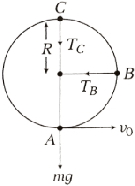
0 likesView Solution
11
PhysicsDifficultMCQNEET · 2016
$A$ bullet of mass $10\, g$ moving horizontally with a velocity of $400\, m s^{-1}$ strikes a wood block of mass $2\, kg$ which is suspended by a light inextensible string of length $5\, m$. As a result,the centre of gravity of the block is found to rise a vertical distance of $10\, cm$. The speed of the bullet after it emerges out horizontally from the block will be ................... $m s^{-1}$.
A
$160$
B
$120$
C
$100$
D
$80$
Solution
(B) Given:
Mass of bullet,$m = 10\, g = 0.01\, kg$
Initial speed of bullet,$u = 400\, m s^{-1}$
Mass of block,$M = 2\, kg$
Vertical rise of block,$h = 10\, cm = 0.1\, m$
Let $v_1$ be the speed of the block immediately after the collision and $v$ be the speed of the bullet after emerging from the block.
Applying the principle of conservation of mechanical energy to the block after the collision:
$\frac{1}{2} M v_1^2 = Mgh$
$v_1 = \sqrt{2gh} = \sqrt{2 \times 9.8 \times 0.1} = \sqrt{1.96} = 1.4\, m s^{-1}$
(Using $g = 9.8\, m s^{-2}$ for precision).
Applying the principle of conservation of linear momentum for the system (bullet + block) during the collision:
$mu = Mv_1 + mv$
$0.01 \times 400 = 2 \times 1.4 + 0.01 \times v$
$4 = 2.8 + 0.01v$
$0.01v = 1.2$
$v = 120\, m s^{-1}$
Mass of bullet,$m = 10\, g = 0.01\, kg$
Initial speed of bullet,$u = 400\, m s^{-1}$
Mass of block,$M = 2\, kg$
Vertical rise of block,$h = 10\, cm = 0.1\, m$
Let $v_1$ be the speed of the block immediately after the collision and $v$ be the speed of the bullet after emerging from the block.
Applying the principle of conservation of mechanical energy to the block after the collision:
$\frac{1}{2} M v_1^2 = Mgh$
$v_1 = \sqrt{2gh} = \sqrt{2 \times 9.8 \times 0.1} = \sqrt{1.96} = 1.4\, m s^{-1}$
(Using $g = 9.8\, m s^{-2}$ for precision).
Applying the principle of conservation of linear momentum for the system (bullet + block) during the collision:
$mu = Mv_1 + mv$
$0.01 \times 400 = 2 \times 1.4 + 0.01 \times v$
$4 = 2.8 + 0.01v$
$0.01v = 1.2$
$v = 120\, m s^{-1}$
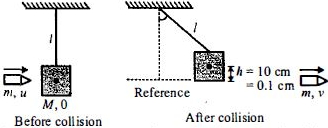
0 likesView Solution
12
PhysicsMediumMCQNEET · 2016
$A$ black body is at a temperature of $5760 \ K$. The energy of radiation emitted by the body at wavelength $250 \ nm$ is $U_1$,at wavelength $500 \ nm$ is $U_2$ and that at $1000 \ nm$ is $U_3$. Wien's constant,$b = 2.88 \times 10^6 \ nm \ K$. Which of the following is correct?
A
$U_3=0$
B
$U_1>U_2$
C
$U_2>U_1$
D
$U_1=0$
Solution
(C) According to Wien's displacement law,the wavelength corresponding to maximum spectral emissive power is given by:
$\lambda_m = \frac{b}{T} = \frac{2.88 \times 10^6 \ nm \ K}{5760 \ K} = 500 \ nm$
This means the peak of the black body radiation curve occurs at $\lambda = 500 \ nm$,where the energy emitted is $U_2$.
Comparing the values at different wavelengths from the spectral distribution curve:
At $\lambda = 250 \ nm$,the energy is $U_1$.
At $\lambda = 500 \ nm$,the energy is $U_2$ (maximum).
At $\lambda = 1000 \ nm$,the energy is $U_3$.
From the graph,it is clear that $U_2$ is the maximum value,so $U_2 > U_1$ and $U_2 > U_3$. Also,comparing $U_1$ and $U_3$ from the graph,$U_3 > U_1$. Thus,the correct relation is $U_2 > U_1$.
$\lambda_m = \frac{b}{T} = \frac{2.88 \times 10^6 \ nm \ K}{5760 \ K} = 500 \ nm$
This means the peak of the black body radiation curve occurs at $\lambda = 500 \ nm$,where the energy emitted is $U_2$.
Comparing the values at different wavelengths from the spectral distribution curve:
At $\lambda = 250 \ nm$,the energy is $U_1$.
At $\lambda = 500 \ nm$,the energy is $U_2$ (maximum).
At $\lambda = 1000 \ nm$,the energy is $U_3$.
From the graph,it is clear that $U_2$ is the maximum value,so $U_2 > U_1$ and $U_2 > U_3$. Also,comparing $U_1$ and $U_3$ from the graph,$U_3 > U_1$. Thus,the correct relation is $U_2 > U_1$.
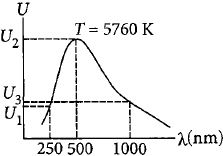
0 likesView Solution
13
PhysicsDifficultMCQNEET · 2016
$A$ body cools from a temperature $3T$ to $2T$ in $10$ minutes. The room temperature is $T$. Assume that Newton's law of cooling is applicable. The temperature of the body at the end of the next $10$ minutes will be
A
$\frac{4}{3}T$
B
$T$
C
$\frac{7}{4}T$
D
$\frac{3}{2}T$
Solution
(D) According to Newton's law of cooling,the rate of cooling is proportional to the temperature difference between the body and the surroundings:
$\frac{T_1 - T_2}{t} = K \left( \frac{T_1 + T_2}{2} - T_s \right)$
For the first interval of $10$ minutes:
$T_1 = 3T, T_2 = 2T, T_s = T, t = 10$
$\frac{3T - 2T}{10} = K \left( \frac{3T + 2T}{2} - T \right)$
$\frac{T}{10} = K \left( 2.5T - T \right) = K(1.5T) \implies K = \frac{1}{15} \dots (i)$
For the next interval of $10$ minutes:
Let the final temperature be $T'$.
$T_1 = 2T, T_2 = T', T_s = T, t = 10$
$\frac{2T - T'}{10} = K \left( \frac{2T + T'}{2} - T \right)$
$\frac{2T - T'}{10} = K \left( \frac{T'}{2} \right) \dots (ii)$
Substituting $K = \frac{1}{15}$ into equation $(ii)$:
$\frac{2T - T'}{10} = \frac{1}{15} \left( \frac{T'}{2} \right)$
$\frac{2T - T'}{10} = \frac{T'}{30}$
$3(2T - T') = T'$
$6T - 3T' = T'$
$6T = 4T' \implies T' = \frac{6}{4}T = \frac{3}{2}T$
$\frac{T_1 - T_2}{t} = K \left( \frac{T_1 + T_2}{2} - T_s \right)$
For the first interval of $10$ minutes:
$T_1 = 3T, T_2 = 2T, T_s = T, t = 10$
$\frac{3T - 2T}{10} = K \left( \frac{3T + 2T}{2} - T \right)$
$\frac{T}{10} = K \left( 2.5T - T \right) = K(1.5T) \implies K = \frac{1}{15} \dots (i)$
For the next interval of $10$ minutes:
Let the final temperature be $T'$.
$T_1 = 2T, T_2 = T', T_s = T, t = 10$
$\frac{2T - T'}{10} = K \left( \frac{2T + T'}{2} - T \right)$
$\frac{2T - T'}{10} = K \left( \frac{T'}{2} \right) \dots (ii)$
Substituting $K = \frac{1}{15}$ into equation $(ii)$:
$\frac{2T - T'}{10} = \frac{1}{15} \left( \frac{T'}{2} \right)$
$\frac{2T - T'}{10} = \frac{T'}{30}$
$3(2T - T') = T'$
$6T - 3T' = T'$
$6T = 4T' \implies T' = \frac{6}{4}T = \frac{3}{2}T$
0 likesView Solution
14
PhysicsMediumMCQNEET · 2016
$A$ given sample of an ideal gas occupies a volume $V$ at a pressure $P$ and absolute temperature $T.$ The mass of each molecule of the gas is $m.$ Which of the following gives the density of the gas $?$
A
$\frac{P}{kTV}$
B
$mKT$
C
$\frac{P}{kT}$
D
$\frac{Pm}{kT}$
Solution
(D) The ideal gas equation is given by $PV = nRT$,where $n$ is the number of moles.
We know that $n = \frac{\text{mass of gas}}{M}$,where $M$ is the molar mass.
Also,the molar mass $M = m N_A$,where $m$ is the mass of one molecule and $N_A$ is Avogadro's number.
Substituting these into the ideal gas equation: $PV = \left(\frac{\text{mass}}{m N_A}\right) RT$.
Rearranging for density $\rho = \frac{\text{mass}}{V}$,we get $\rho = \frac{P m N_A}{RT}$.
Since the Boltzmann constant $k = \frac{R}{N_A}$,we have $R = N_A k$.
Substituting $R$ in the density equation: $\rho = \frac{P m N_A}{(N_A k) T} = \frac{Pm}{kT}$.
We know that $n = \frac{\text{mass of gas}}{M}$,where $M$ is the molar mass.
Also,the molar mass $M = m N_A$,where $m$ is the mass of one molecule and $N_A$ is Avogadro's number.
Substituting these into the ideal gas equation: $PV = \left(\frac{\text{mass}}{m N_A}\right) RT$.
Rearranging for density $\rho = \frac{\text{mass}}{V}$,we get $\rho = \frac{P m N_A}{RT}$.
Since the Boltzmann constant $k = \frac{R}{N_A}$,we have $R = N_A k$.
Substituting $R$ in the density equation: $\rho = \frac{P m N_A}{(N_A k) T} = \frac{Pm}{kT}$.
0 likesView Solution
15
PhysicsMediumMCQNEET · 2016
The molecules of a given mass of a gas have $r.m.s.$ velocity of $200 \,m s^{-1}$ at $27^o C$ and $1.0 \times 10^5 \,N m^{-2}$ pressure. When the temperature and pressure of the gas are respectively $127^o C$ and $0.05 \times 10^5 \,N m^{-2},$ the $r.m.s.$ velocity of its molecules in $m s^{-1}$ is
A
$\frac{400}{\sqrt{3}}$
B
$\frac{100\sqrt{2}}{3}$
C
$\frac{100}{3}$
D
$100\sqrt{2}$
Solution
(A) The $r.m.s.$ velocity of gas molecules is given by the formula $v_{rms} = \sqrt{\frac{3RT}{M}}$.
This shows that $v_{rms} \propto \sqrt{T}$.
The pressure does not affect the $r.m.s.$ velocity of an ideal gas.
Given $T_1 = 27^o C = 300 \,K$ and $v_1 = 200 \,m s^{-1}$.
Given $T_2 = 127^o C = 400 \,K$.
Using the ratio: $\frac{v_2}{v_1} = \sqrt{\frac{T_2}{T_1}}$.
$\frac{v_2}{200} = \sqrt{\frac{400}{300}} = \sqrt{\frac{4}{3}} = \frac{2}{\sqrt{3}}$.
Therefore,$v_2 = 200 \times \frac{2}{\sqrt{3}} = \frac{400}{\sqrt{3}} \,m s^{-1}$.
This shows that $v_{rms} \propto \sqrt{T}$.
The pressure does not affect the $r.m.s.$ velocity of an ideal gas.
Given $T_1 = 27^o C = 300 \,K$ and $v_1 = 200 \,m s^{-1}$.
Given $T_2 = 127^o C = 400 \,K$.
Using the ratio: $\frac{v_2}{v_1} = \sqrt{\frac{T_2}{T_1}}$.
$\frac{v_2}{200} = \sqrt{\frac{400}{300}} = \sqrt{\frac{4}{3}} = \frac{2}{\sqrt{3}}$.
Therefore,$v_2 = 200 \times \frac{2}{\sqrt{3}} = \frac{400}{\sqrt{3}} \,m s^{-1}$.
0 likesView Solution
16
PhysicsMediumMCQNEET · 2016
Two rotating bodies $A$ and $B$ of masses $m$ and $2m$ with moments of inertia $I_A$ and $I_B$ $(I_B > I_A)$ have equal kinetic energy of rotation. If $L_A$ and $L_B$ are their angular momenta respectively,then:
A
$L_B > L_A$
B
$L_A > L_B$
C
$L_A = \frac{L_B}{2}$
D
$L_A = 2L_B$
Solution
(A) The rotational kinetic energy $K$ is related to the angular momentum $L$ and moment of inertia $I$ by the formula $K = \frac{L^2}{2I}$.
Given that the kinetic energies are equal,$K_A = K_B$.
Therefore,$\frac{L_A^2}{2I_A} = \frac{L_B^2}{2I_B}$.
This implies $\frac{L_A^2}{L_B^2} = \frac{I_A}{I_B}$.
Taking the square root on both sides,we get $\frac{L_A}{L_B} = \sqrt{\frac{I_A}{I_B}}$.
Since it is given that $I_B > I_A$,it follows that $\frac{I_A}{I_B} < 1$.
Thus,$\frac{L_A}{L_B} < 1$,which means $L_A < L_B$ or $L_B > L_A$.
Given that the kinetic energies are equal,$K_A = K_B$.
Therefore,$\frac{L_A^2}{2I_A} = \frac{L_B^2}{2I_B}$.
This implies $\frac{L_A^2}{L_B^2} = \frac{I_A}{I_B}$.
Taking the square root on both sides,we get $\frac{L_A}{L_B} = \sqrt{\frac{I_A}{I_B}}$.
Since it is given that $I_B > I_A$,it follows that $\frac{I_A}{I_B} < 1$.
Thus,$\frac{L_A}{L_B} < 1$,which means $L_A < L_B$ or $L_B > L_A$.
0 likesView Solution
17
PhysicsMediumMCQNEET · 2016
$A$ solid sphere of mass $m$ and radius $R$ is rotating about its diameter. $A$ solid cylinder of the same mass and same radius is also rotating about its geometrical axis with an angular speed twice that of the sphere. The ratio of their kinetic energies of rotation $E_{sphere}/E_{cylinder}$ will be
A
$1:4$
B
$3:1$
C
$2:3$
D
$1:5$
Solution
(D) The rotational kinetic energy is given by $E = \frac{1}{2} I \omega^2$.
For the solid sphere rotating about its diameter,the moment of inertia is $I_s = \frac{2}{5} m R^2$.
For the solid cylinder rotating about its geometrical axis,the moment of inertia is $I_c = \frac{1}{2} m R^2$.
Given that the angular speed of the cylinder is twice that of the sphere,we have $\omega_c = 2 \omega_s$.
The ratio of their kinetic energies is:
$\frac{E_{sphere}}{E_{cylinder}} = \frac{\frac{1}{2} I_s \omega_s^2}{\frac{1}{2} I_c \omega_c^2} = \frac{I_s \omega_s^2}{I_c (2 \omega_s)^2} = \frac{I_s}{4 I_c}$.
Substituting the values of $I_s$ and $I_c$:
$\frac{E_{sphere}}{E_{cylinder}} = \frac{\frac{2}{5} m R^2}{4 \times \frac{1}{2} m R^2} = \frac{2/5}{2} = \frac{1}{5}$.
Thus,the ratio is $1:5$.
For the solid sphere rotating about its diameter,the moment of inertia is $I_s = \frac{2}{5} m R^2$.
For the solid cylinder rotating about its geometrical axis,the moment of inertia is $I_c = \frac{1}{2} m R^2$.
Given that the angular speed of the cylinder is twice that of the sphere,we have $\omega_c = 2 \omega_s$.
The ratio of their kinetic energies is:
$\frac{E_{sphere}}{E_{cylinder}} = \frac{\frac{1}{2} I_s \omega_s^2}{\frac{1}{2} I_c \omega_c^2} = \frac{I_s \omega_s^2}{I_c (2 \omega_s)^2} = \frac{I_s}{4 I_c}$.
Substituting the values of $I_s$ and $I_c$:
$\frac{E_{sphere}}{E_{cylinder}} = \frac{\frac{2}{5} m R^2}{4 \times \frac{1}{2} m R^2} = \frac{2/5}{2} = \frac{1}{5}$.
Thus,the ratio is $1:5$.
0 likesView Solution
18
PhysicsMediumMCQNEET · 2016
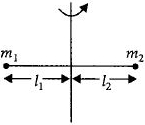
$A$ light rod of length $l$ has two masses $m_1$ and $m_2$ attached to its two ends. The moment of inertia of the system about an axis perpendicular to the rod and passing through the centre of mass is
A
$(m_1+m_2)l^2$
B
$\sqrt{m_1 m_2} l^2$
C
$\frac{m_1 m_2}{m_1 + m_2} l^2$
D
$\frac{m_1 + m_2}{m_1 m_2} l^2$
Solution
(C) Let the distances of masses $m_1$ and $m_2$ from the center of mass be $l_1$ and $l_2$ respectively.
Given that the total length of the rod is $l$,so $l_1 + l_2 = l$.
By the definition of the center of mass,$m_1 l_1 = m_2 l_2$.
Substituting $l_2 = l - l_1$,we get $m_1 l_1 = m_2 (l - l_1)$,which simplifies to $l_1 = \frac{m_2 l}{m_1 + m_2}$.
Similarly,$l_2 = \frac{m_1 l}{m_1 + m_2}$.
The moment of inertia $I$ about an axis passing through the center of mass is given by $I = m_1 l_1^2 + m_2 l_2^2$.
Substituting the values of $l_1$ and $l_2$:
$I = m_1 \left( \frac{m_2 l}{m_1 + m_2} \right)^2 + m_2 \left( \frac{m_1 l}{m_1 + m_2} \right)^2$
$I = \frac{m_1 m_2^2 l^2 + m_2 m_1^2 l^2}{(m_1 + m_2)^2}$
$I = \frac{m_1 m_2 l^2 (m_2 + m_1)}{(m_1 + m_2)^2}$
$I = \frac{m_1 m_2}{m_1 + m_2} l^2$.
Given that the total length of the rod is $l$,so $l_1 + l_2 = l$.
By the definition of the center of mass,$m_1 l_1 = m_2 l_2$.
Substituting $l_2 = l - l_1$,we get $m_1 l_1 = m_2 (l - l_1)$,which simplifies to $l_1 = \frac{m_2 l}{m_1 + m_2}$.
Similarly,$l_2 = \frac{m_1 l}{m_1 + m_2}$.
The moment of inertia $I$ about an axis passing through the center of mass is given by $I = m_1 l_1^2 + m_2 l_2^2$.
Substituting the values of $l_1$ and $l_2$:
$I = m_1 \left( \frac{m_2 l}{m_1 + m_2} \right)^2 + m_2 \left( \frac{m_1 l}{m_1 + m_2} \right)^2$
$I = \frac{m_1 m_2^2 l^2 + m_2 m_1^2 l^2}{(m_1 + m_2)^2}$
$I = \frac{m_1 m_2 l^2 (m_2 + m_1)}{(m_1 + m_2)^2}$
$I = \frac{m_1 m_2}{m_1 + m_2} l^2$.
0 likesView Solution
19
PhysicsDifficultMCQNEET · 2016
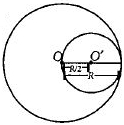
From a disc of radius $R$ and mass $M,$ a circular hole of diameter $R,$ whose rim passes through the centre is cut. What is the moment of inertia of the remaining part of the disc about a perpendicular axis,passing through the centre?
A
$\frac{13M{R^2}}{32}$
B
$\frac{11M{R^2}}{32}$
C
$\frac{9M{R^2}}{32}$
D
$\frac{15M{R^2}}{32}$
Solution
(A) Mass per unit area of the disc is $\sigma = \frac{M}{\pi R^2}$.
The radius of the removed circular hole is $r = \frac{R}{2}$.
The mass of the removed portion is $M' = \sigma \times \pi r^2 = \frac{M}{\pi R^2} \times \pi \left(\frac{R}{2}\right)^2 = \frac{M}{4}$.
The moment of inertia of the removed portion about its own central axis (perpendicular to the plane) is $I_{cm} = \frac{1}{2} M' r^2 = \frac{1}{2} \left(\frac{M}{4}\right) \left(\frac{R}{2}\right)^2 = \frac{MR^2}{32}$.
Using the parallel axis theorem,the moment of inertia of the removed portion about the axis passing through the center $O$ of the original disc is $I'_{0} = I_{cm} + M' d^2$,where $d = \frac{R}{2}$ is the distance between the center of the disc and the center of the hole.
$I'_{0} = \frac{MR^2}{32} + \left(\frac{M}{4}\right) \left(\frac{R}{2}\right)^2 = \frac{MR^2}{32} + \frac{MR^2}{16} = \frac{3MR^2}{32}$.
The moment of inertia of the complete disc about the center $O$ is $I_{0} = \frac{1}{2} MR^2$.
The moment of inertia of the remaining part is $I = I_{0} - I'_{0} = \frac{1}{2} MR^2 - \frac{3MR^2}{32} = \frac{16MR^2 - 3MR^2}{32} = \frac{13MR^2}{32}$.
The radius of the removed circular hole is $r = \frac{R}{2}$.
The mass of the removed portion is $M' = \sigma \times \pi r^2 = \frac{M}{\pi R^2} \times \pi \left(\frac{R}{2}\right)^2 = \frac{M}{4}$.
The moment of inertia of the removed portion about its own central axis (perpendicular to the plane) is $I_{cm} = \frac{1}{2} M' r^2 = \frac{1}{2} \left(\frac{M}{4}\right) \left(\frac{R}{2}\right)^2 = \frac{MR^2}{32}$.
Using the parallel axis theorem,the moment of inertia of the removed portion about the axis passing through the center $O$ of the original disc is $I'_{0} = I_{cm} + M' d^2$,where $d = \frac{R}{2}$ is the distance between the center of the disc and the center of the hole.
$I'_{0} = \frac{MR^2}{32} + \left(\frac{M}{4}\right) \left(\frac{R}{2}\right)^2 = \frac{MR^2}{32} + \frac{MR^2}{16} = \frac{3MR^2}{32}$.
The moment of inertia of the complete disc about the center $O$ is $I_{0} = \frac{1}{2} MR^2$.
The moment of inertia of the remaining part is $I = I_{0} - I'_{0} = \frac{1}{2} MR^2 - \frac{3MR^2}{32} = \frac{16MR^2 - 3MR^2}{32} = \frac{13MR^2}{32}$.
0 likesView Solution
20
PhysicsMediumMCQNEET · 2016
$A$ disc and a sphere of same radius but different masses roll off on two inclined planes of the same altitude and length. Which one of the two objects gets to the bottom of the plane first?
A
Sphere
B
Both reach at the same time
C
Depends on their masses
D
Disc
Solution
(A) The time $t$ taken by a body to roll down an inclined plane of length $l$ and inclination $\theta$ without slipping is given by:
$t = \sqrt{\frac{2l(1 + \frac{k^2}{R^2})}{g \sin \theta}}$
where $k$ is the radius of gyration and $R$ is the radius of the object.
Since $l$,$\theta$,and $g$ are the same for both,the time depends on the factor $(1 + \frac{k^2}{R^2})$.
For a disc,$I = \frac{1}{2}MR^2$,so $k^2 = \frac{1}{2}R^2$,which gives $(1 + \frac{k^2}{R^2}) = 1 + 0.5 = 1.5$.
For a solid sphere,$I = \frac{2}{5}MR^2$,so $k^2 = \frac{2}{5}R^2$,which gives $(1 + \frac{k^2}{R^2}) = 1 + 0.4 = 1.4$.
Since $1.4 < 1.5$,the time taken by the sphere is less than the time taken by the disc $(t_s < t_d)$.
Therefore,the sphere reaches the bottom first.
$t = \sqrt{\frac{2l(1 + \frac{k^2}{R^2})}{g \sin \theta}}$
where $k$ is the radius of gyration and $R$ is the radius of the object.
Since $l$,$\theta$,and $g$ are the same for both,the time depends on the factor $(1 + \frac{k^2}{R^2})$.
For a disc,$I = \frac{1}{2}MR^2$,so $k^2 = \frac{1}{2}R^2$,which gives $(1 + \frac{k^2}{R^2}) = 1 + 0.5 = 1.5$.
For a solid sphere,$I = \frac{2}{5}MR^2$,so $k^2 = \frac{2}{5}R^2$,which gives $(1 + \frac{k^2}{R^2}) = 1 + 0.4 = 1.4$.
Since $1.4 < 1.5$,the time taken by the sphere is less than the time taken by the disc $(t_s < t_d)$.
Therefore,the sphere reaches the bottom first.
0 likesView Solution
21
PhysicsMediumMCQNEET · 2016
$A$ uniform circular disc of radius $50\, cm$ at rest is free to turn about an axis which is perpendicular to its plane and passes through its centre. It is subjected to a torque which produces a constant angular acceleration of $2.0\, rad \,s^{-2}$. Its net acceleration in $m\,s^{-2}$ at the end of $2.0\,s$ is approximately (in $.0$)
A
$7$
B
$6$
C
$3$
D
$8$
Solution
(D) Given: Radius $r = 50\, cm = 0.5\, m$,angular acceleration $\alpha = 2.0\, rad\, s^{-2}$,initial angular velocity $\omega_0 = 0$,and time $t = 2.0\, s$.
First,calculate the angular velocity $\omega$ at $t = 2.0\, s$ using $\omega = \omega_0 + \alpha t = 0 + (2.0)(2.0) = 4.0\, rad\, s^{-1}$.
The tangential acceleration is $a_t = r\alpha = 0.5 \times 2.0 = 1.0\, m\, s^{-2}$.
The radial (centripetal) acceleration is $a_r = \omega^2 r = (4.0)^2 \times 0.5 = 16 \times 0.5 = 8.0\, m\, s^{-2}$.
The net acceleration $a$ is given by $a = \sqrt{a_t^2 + a_r^2} = \sqrt{1.0^2 + 8.0^2} = \sqrt{1 + 64} = \sqrt{65} \approx 8.06\, m\, s^{-2}$.
Rounding to the nearest value,the net acceleration is approximately $8.0\, m\, s^{-2}$.
First,calculate the angular velocity $\omega$ at $t = 2.0\, s$ using $\omega = \omega_0 + \alpha t = 0 + (2.0)(2.0) = 4.0\, rad\, s^{-1}$.
The tangential acceleration is $a_t = r\alpha = 0.5 \times 2.0 = 1.0\, m\, s^{-2}$.
The radial (centripetal) acceleration is $a_r = \omega^2 r = (4.0)^2 \times 0.5 = 16 \times 0.5 = 8.0\, m\, s^{-2}$.
The net acceleration $a$ is given by $a = \sqrt{a_t^2 + a_r^2} = \sqrt{1.0^2 + 8.0^2} = \sqrt{1 + 64} = \sqrt{65} \approx 8.06\, m\, s^{-2}$.
Rounding to the nearest value,the net acceleration is approximately $8.0\, m\, s^{-2}$.
0 likesView Solution
22
PhysicsMediumMCQNEET · 2016
The ratio of escape velocity at earth $(v_e)$ to the escape velocity at a planet $(v_p)$ whose radius and mean density are twice as that of earth is:
A
$1 : 2\sqrt{2}$
B
$1 : 4$
C
$1 : \sqrt{2}$
D
$1 : 2$
Solution
(A) The formula for escape velocity is $v = \sqrt{\frac{2GM}{R}}$.
Since mass $M = \rho \times V = \rho \times \frac{4}{3}\pi R^3$,we substitute this into the formula:
$v = \sqrt{\frac{2G}{R} \times \frac{4}{3}\pi R^3 \rho} = R \sqrt{\frac{8\pi G \rho}{3}}$.
Thus,the escape velocity is proportional to $R\sqrt{\rho}$,i.e.,$v \propto R\sqrt{\rho}$.
Given for the planet: $R_p = 2R_e$ and $\rho_p = 2\rho_e$.
Therefore,the ratio is:
$\frac{v_e}{v_p} = \frac{R_e}{R_p} \times \sqrt{\frac{\rho_e}{\rho_p}} = \frac{R_e}{2R_e} \times \sqrt{\frac{\rho_e}{2\rho_e}} = \frac{1}{2} \times \frac{1}{\sqrt{2}} = \frac{1}{2\sqrt{2}}$.
Hence,the ratio is $1 : 2\sqrt{2}$.
Since mass $M = \rho \times V = \rho \times \frac{4}{3}\pi R^3$,we substitute this into the formula:
$v = \sqrt{\frac{2G}{R} \times \frac{4}{3}\pi R^3 \rho} = R \sqrt{\frac{8\pi G \rho}{3}}$.
Thus,the escape velocity is proportional to $R\sqrt{\rho}$,i.e.,$v \propto R\sqrt{\rho}$.
Given for the planet: $R_p = 2R_e$ and $\rho_p = 2\rho_e$.
Therefore,the ratio is:
$\frac{v_e}{v_p} = \frac{R_e}{R_p} \times \sqrt{\frac{\rho_e}{\rho_p}} = \frac{R_e}{2R_e} \times \sqrt{\frac{\rho_e}{2\rho_e}} = \frac{1}{2} \times \frac{1}{\sqrt{2}} = \frac{1}{2\sqrt{2}}$.
Hence,the ratio is $1 : 2\sqrt{2}$.
0 likesView Solution
23
PhysicsMediumMCQNEET · 2016
At a height of $h$ $km$ from the surface of the Earth,the gravitational potential and the value of $g$ are $-5.4 \times 10^7\, J kg^{-1}$ and $6.0\, m s^{-2}$ respectively. Take the radius of the Earth as $6400\, km$.
A
$1600$
B
$1400$
C
$2000$
D
$2600$
Solution
(D) The gravitational potential at a height $h$ from the surface of the Earth is given by $V_h = -\frac{GM}{R+h} = -5.4 \times 10^7\, J kg^{-1}$.
The acceleration due to gravity at the same height is $g_h = \frac{GM}{(R+h)^2} = 6.0\, m s^{-2}$.
We can relate these two expressions as $g_h = \frac{GM}{(R+h)^2} = \frac{1}{R+h} \left( \frac{GM}{R+h} \right) = \frac{-V_h}{R+h}$.
Rearranging for $(R+h)$,we get $R+h = \frac{-V_h}{g_h}$.
Substituting the given values: $R+h = \frac{-(-5.4 \times 10^7)}{6.0} = \frac{5.4 \times 10^7}{6.0} = 0.9 \times 10^7 = 9.0 \times 10^6\, m$.
Converting the radius of the Earth to meters: $R = 6400\, km = 6.4 \times 10^6\, m$.
Now,$h = (R+h) - R = 9.0 \times 10^6 - 6.4 \times 10^6 = 2.6 \times 10^6\, m$.
Converting back to kilometers: $h = 2600\, km$.
The acceleration due to gravity at the same height is $g_h = \frac{GM}{(R+h)^2} = 6.0\, m s^{-2}$.
We can relate these two expressions as $g_h = \frac{GM}{(R+h)^2} = \frac{1}{R+h} \left( \frac{GM}{R+h} \right) = \frac{-V_h}{R+h}$.
Rearranging for $(R+h)$,we get $R+h = \frac{-V_h}{g_h}$.
Substituting the given values: $R+h = \frac{-(-5.4 \times 10^7)}{6.0} = \frac{5.4 \times 10^7}{6.0} = 0.9 \times 10^7 = 9.0 \times 10^6\, m$.
Converting the radius of the Earth to meters: $R = 6400\, km = 6.4 \times 10^6\, m$.
Now,$h = (R+h) - R = 9.0 \times 10^6 - 6.4 \times 10^6 = 2.6 \times 10^6\, m$.
Converting back to kilometers: $h = 2600\, km$.
0 likesView Solution
24
PhysicsDifficultMCQNEET · 2016
$A$ satellite of mass $m$ is orbiting the Earth (of radius $R$) at a height $h$ from its surface. The total energy of the satellite in terms of $g_0$,the value of acceleration due to gravity at the Earth's surface,is
A
$\frac{2m g_0 R^2}{R + h}$
B
$-\frac{2m g_0 R^2}{R + h}$
C
$\frac{m g_0 R^2}{2(R + h)}$
D
$-\frac{m g_0 R^2}{2(R + h)}$
Solution
(D) The total energy $E$ of a satellite is the sum of its potential energy $PE$ and kinetic energy $KE$.
$E = PE + KE = -\frac{GMm}{R + h} + \frac{1}{2}mv^2$
For a satellite in a circular orbit,the gravitational force provides the necessary centripetal force:
$\frac{mv^2}{R + h} = \frac{GMm}{(R + h)^2} \implies v^2 = \frac{GM}{R + h}$
Substituting $v^2$ into the energy equation:
$E = -\frac{GMm}{R + h} + \frac{1}{2}m\left(\frac{GM}{R + h}\right) = -\frac{GMm}{2(R + h)}$
Since the acceleration due to gravity at the surface is $g_0 = \frac{GM}{R^2}$,we have $GM = g_0 R^2$.
Substituting this into the expression for $E$:
$E = -\frac{m g_0 R^2}{2(R + h)}$
$E = PE + KE = -\frac{GMm}{R + h} + \frac{1}{2}mv^2$
For a satellite in a circular orbit,the gravitational force provides the necessary centripetal force:
$\frac{mv^2}{R + h} = \frac{GMm}{(R + h)^2} \implies v^2 = \frac{GM}{R + h}$
Substituting $v^2$ into the energy equation:
$E = -\frac{GMm}{R + h} + \frac{1}{2}m\left(\frac{GM}{R + h}\right) = -\frac{GMm}{2(R + h)}$
Since the acceleration due to gravity at the surface is $g_0 = \frac{GM}{R^2}$,we have $GM = g_0 R^2$.
Substituting this into the expression for $E$:
$E = -\frac{m g_0 R^2}{2(R + h)}$
0 likesView Solution
25
PhysicsMediumMCQNEET · 2016
Three liquids of densities $\rho_1, \rho_2$ and $\rho_3$ (with $\rho_1 > \rho_2 > \rho_3$),having the same value of surface tension $T$,rise to the same height in three identical capillaries. The angles of contact $\theta_1, \theta_2$ and $\theta_3$ obey:
A
$\frac{\pi}{2} < \theta_1 < \theta_2 < \theta_3 < \pi$
B
$\pi > \theta_1 > \theta_2 > \theta_3 > \frac{\pi}{2}$
C
$\frac{\pi}{2} > \theta_1 > \theta_2 > \theta_3 > 0$
D
$0 \le \theta_1 < \theta_2 < \theta_3 < \frac{\pi}{2}$
Solution
(D) The height of capillary rise is given by $h = \frac{2T \cos \theta}{r \rho g}$.
For a given value of $T$ and $r$,we have $h \propto \frac{\cos \theta}{\rho}$.
Since the liquids rise to the same height $(h_1 = h_2 = h_3)$,we have $\frac{\cos \theta_1}{\rho_1} = \frac{\cos \theta_2}{\rho_2} = \frac{\cos \theta_3}{\rho_3}$.
Given $\rho_1 > \rho_2 > \rho_3$,it follows that $\cos \theta_1 > \cos \theta_2 > \cos \theta_3$.
Since the cosine function is a decreasing function in the interval $[0, \frac{\pi}{2}]$,we have $\theta_1 < \theta_2 < \theta_3$.
Therefore,$0 \le \theta_1 < \theta_2 < \theta_3 < \frac{\pi}{2}$.
For a given value of $T$ and $r$,we have $h \propto \frac{\cos \theta}{\rho}$.
Since the liquids rise to the same height $(h_1 = h_2 = h_3)$,we have $\frac{\cos \theta_1}{\rho_1} = \frac{\cos \theta_2}{\rho_2} = \frac{\cos \theta_3}{\rho_3}$.
Given $\rho_1 > \rho_2 > \rho_3$,it follows that $\cos \theta_1 > \cos \theta_2 > \cos \theta_3$.
Since the cosine function is a decreasing function in the interval $[0, \frac{\pi}{2}]$,we have $\theta_1 < \theta_2 < \theta_3$.
Therefore,$0 \le \theta_1 < \theta_2 < \theta_3 < \frac{\pi}{2}$.
0 likesView Solution
26
PhysicsDifficultMCQNEET · 2016
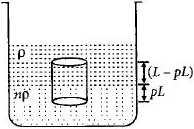
Two non-mixing liquids of densities $\rho$ and $n\rho$ $(n > 1)$ are put in a container. The height of each liquid is $h$. $A$ solid cylinder of length $L$ and density $d$ is placed in this container. The cylinder floats with its axis vertical and a length $pL$ $(p < 1)$ submerged in the denser liquid. The density $d$ is equal to:
A
$[2+(n+1)p]\rho$
B
$[2+(n-1)p]\rho$
C
$[1+(n-1)p]\rho$
D
$[1+(n+1)p]\rho$
Solution
(C) Let $d$ be the density of the cylinder and $A$ be the area of the cross-section of the cylinder.
According to the law of floatation,the weight of the cylinder is equal to the total upthrust exerted by the two liquids.
Weight of cylinder = $L \times A \times d \times g$
Upthrust by denser liquid (density $n\rho$) = $(pL \times A) \times n\rho \times g$
Upthrust by lighter liquid (density $\rho$) = $((L - pL) \times A) \times \rho \times g$
Equating weight to total upthrust:
$L \times A \times d \times g = (pL \times A) \times n\rho \times g + ((L - pL) \times A) \times \rho \times g$
Dividing both sides by $A \times L \times g$:
$d = p \times n\rho + (1 - p) \times \rho$
$d = np\rho + \rho - p\rho$
$d = [1 + (n - 1)p]\rho$
According to the law of floatation,the weight of the cylinder is equal to the total upthrust exerted by the two liquids.
Weight of cylinder = $L \times A \times d \times g$
Upthrust by denser liquid (density $n\rho$) = $(pL \times A) \times n\rho \times g$
Upthrust by lighter liquid (density $\rho$) = $((L - pL) \times A) \times \rho \times g$
Equating weight to total upthrust:
$L \times A \times d \times g = (pL \times A) \times n\rho \times g + ((L - pL) \times A) \times \rho \times g$
Dividing both sides by $A \times L \times g$:
$d = p \times n\rho + (1 - p) \times \rho$
$d = np\rho + \rho - p\rho$
$d = [1 + (n - 1)p]\rho$
0 likesView Solution
27
PhysicsMediumMCQNEET · 2016
$A$ rectangular film of liquid is extended from $(4 \, cm \times 2 \, cm)$ to $(5 \, cm \times 4 \, cm).$ If the work done is $3 \times 10^{-4} \, J,$ the value of the surface tension of the liquid is ............ $N \, m^{-1}$
A
$0.2$
B
$8.0$
C
$0.250$
D
$0.125$
Solution
(D) The work done in stretching a liquid film is given by $W = T \times \Delta A_{total}$.
Since a liquid film has two surfaces,the change in area is $\Delta A_{total} = 2 \times (A_2 - A_1)$.
Initial area $A_1 = 4 \, cm \times 2 \, cm = 8 \, cm^2 = 8 \times 10^{-4} \, m^2$.
Final area $A_2 = 5 \, cm \times 4 \, cm = 20 \, cm^2 = 20 \times 10^{-4} \, m^2$.
Change in area $\Delta A = A_2 - A_1 = 12 \, cm^2 = 12 \times 10^{-4} \, m^2$.
Total change in area $\Delta A_{total} = 2 \times 12 \times 10^{-4} \, m^2 = 24 \times 10^{-4} \, m^2$.
Given work done $W = 3 \times 10^{-4} \, J$.
Using $W = T \times \Delta A_{total}$,we get $T = \frac{W}{\Delta A_{total}} = \frac{3 \times 10^{-4}}{24 \times 10^{-4}} = \frac{1}{8} = 0.125 \, N \, m^{-1}$.
Since a liquid film has two surfaces,the change in area is $\Delta A_{total} = 2 \times (A_2 - A_1)$.
Initial area $A_1 = 4 \, cm \times 2 \, cm = 8 \, cm^2 = 8 \times 10^{-4} \, m^2$.
Final area $A_2 = 5 \, cm \times 4 \, cm = 20 \, cm^2 = 20 \times 10^{-4} \, m^2$.
Change in area $\Delta A = A_2 - A_1 = 12 \, cm^2 = 12 \times 10^{-4} \, m^2$.
Total change in area $\Delta A_{total} = 2 \times 12 \times 10^{-4} \, m^2 = 24 \times 10^{-4} \, m^2$.
Given work done $W = 3 \times 10^{-4} \, J$.
Using $W = T \times \Delta A_{total}$,we get $T = \frac{W}{\Delta A_{total}} = \frac{3 \times 10^{-4}}{24 \times 10^{-4}} = \frac{1}{8} = 0.125 \, N \, m^{-1}$.
0 likesView Solution
28
PhysicsMediumMCQNEET · 2016
The temperature inside a refrigerator is $t_2 \, ^\circ C$ and the room temperature is $t_1 \, ^\circ C$. The amount of heat delivered to the room for each joule of electrical energy consumed ideally will be:
A
$\frac{t_2 + 273}{t_1 - t_2}$
B
$\frac{t_1 + t_2}{t_2 + 273}$
C
$\frac{t_1}{t_1 - t_2}$
D
$\frac{t_1 + 273}{t_1 - t_2}$
Solution
(D) The temperature inside the refrigerator is $T_2 = (t_2 + 273) \, K$ and the room temperature is $T_1 = (t_1 + 273) \, K$.
For an ideal refrigerator (Carnot cycle),the ratio of heat rejected to the room $(Q_1)$ to the heat absorbed from the cold reservoir $(Q_2)$ is given by $\frac{Q_1}{Q_2} = \frac{T_1}{T_2}$.
From the first law of thermodynamics,the work done $W$ is $W = Q_1 - Q_2$,which implies $Q_2 = Q_1 - W$.
Substituting this into the ratio: $\frac{Q_1}{Q_1 - W} = \frac{T_1}{T_2}$.
Rearranging for $\frac{Q_1}{W}$: $\frac{Q_1 - W}{Q_1} = \frac{T_2}{T_1} \Rightarrow 1 - \frac{W}{Q_1} = \frac{T_2}{T_1}$.
$\frac{W}{Q_1} = 1 - \frac{T_2}{T_1} = \frac{T_1 - T_2}{T_1}$.
Therefore,the heat delivered to the room per unit of work done is $\frac{Q_1}{W} = \frac{T_1}{T_1 - T_2}$.
Substituting $T_1 = t_1 + 273$ and $T_2 = t_2 + 273$,we get $\frac{Q_1}{W} = \frac{t_1 + 273}{(t_1 + 273) - (t_2 + 273)} = \frac{t_1 + 273}{t_1 - t_2}$.
For an ideal refrigerator (Carnot cycle),the ratio of heat rejected to the room $(Q_1)$ to the heat absorbed from the cold reservoir $(Q_2)$ is given by $\frac{Q_1}{Q_2} = \frac{T_1}{T_2}$.
From the first law of thermodynamics,the work done $W$ is $W = Q_1 - Q_2$,which implies $Q_2 = Q_1 - W$.
Substituting this into the ratio: $\frac{Q_1}{Q_1 - W} = \frac{T_1}{T_2}$.
Rearranging for $\frac{Q_1}{W}$: $\frac{Q_1 - W}{Q_1} = \frac{T_2}{T_1} \Rightarrow 1 - \frac{W}{Q_1} = \frac{T_2}{T_1}$.
$\frac{W}{Q_1} = 1 - \frac{T_2}{T_1} = \frac{T_1 - T_2}{T_1}$.
Therefore,the heat delivered to the room per unit of work done is $\frac{Q_1}{W} = \frac{T_1}{T_1 - T_2}$.
Substituting $T_1 = t_1 + 273$ and $T_2 = t_2 + 273$,we get $\frac{Q_1}{W} = \frac{t_1 + 273}{(t_1 + 273) - (t_2 + 273)} = \frac{t_1 + 273}{t_1 - t_2}$.
0 likesView Solution
29
PhysicsMediumMCQNEET · 2016
One mole of an ideal monatomic gas undergoes a process described by the equation $PV^3 = \text{constant}$. The heat capacity of the gas during this process is
A
$2R$
B
$R$
C
$\frac{3}{2}R$
D
$\frac{5}{2}R$
Solution
(B) The given process is described by the equation $PV^3 = \text{constant}$.
This is a polytropic process of the form $PV^n = \text{constant}$, where $n = 3$.
For an ideal gas, the molar heat capacity $C$ for a polytropic process is given by the formula $C = C_v + \frac{R}{1 - n}$.
For a monatomic gas, the molar heat capacity at constant volume is $C_v = \frac{3}{2}R$.
Substituting the values $C_v = \frac{3}{2}R$ and $n = 3$ into the formula:
$C = \frac{3}{2}R + \frac{R}{1 - 3}$
$C = \frac{3}{2}R + \frac{R}{-2}$
$C = \frac{3}{2}R - \frac{1}{2}R = R$.
Therefore, the heat capacity of the gas during this process is $R$.
This is a polytropic process of the form $PV^n = \text{constant}$, where $n = 3$.
For an ideal gas, the molar heat capacity $C$ for a polytropic process is given by the formula $C = C_v + \frac{R}{1 - n}$.
For a monatomic gas, the molar heat capacity at constant volume is $C_v = \frac{3}{2}R$.
Substituting the values $C_v = \frac{3}{2}R$ and $n = 3$ into the formula:
$C = \frac{3}{2}R + \frac{R}{1 - 3}$
$C = \frac{3}{2}R + \frac{R}{-2}$
$C = \frac{3}{2}R - \frac{1}{2}R = R$.
Therefore, the heat capacity of the gas during this process is $R$.
0 likesView Solution
30
PhysicsMediumMCQNEET · 2016
Two identical bodies are made of a material for which the heat capacity increases with temperature. One of these is held at a temperature of $100^{\circ} C$,while the other one is kept at $0^{\circ} C$. If the two are brought into contact,then assuming no heat loss to the environment,the final temperature that they will reach is
A
less than $50^{\circ} C$ but greater than $0^{\circ} C$
B
$0^{\circ} C$
C
$50^{\circ} C$
D
more than $50^{\circ} C$
Solution
(D) Let the heat capacity of the bodies be $C(T)$,where $C(T)$ is an increasing function of temperature $T$.
When the two bodies are brought into contact,heat flows from the hotter body $(100^{\circ} C)$ to the colder body $(0^{\circ} C)$ until they reach a common final temperature $T_f$.
According to the principle of calorimetry,the heat lost by the hotter body equals the heat gained by the colder body:
$\int_{T_f}^{100} C(T) dT = \int_{0}^{T_f} C(T) dT$.
Since $C(T)$ increases with temperature,the heat capacity of the hotter body is higher than that of the colder body throughout the process of reaching equilibrium.
Because the hotter body has a higher heat capacity,it requires more energy to change its temperature by a certain amount compared to the colder body.
Therefore,the final equilibrium temperature $T_f$ will be closer to the initial temperature of the body with the higher heat capacity.
Thus,$T_f > 50^{\circ} C$.
When the two bodies are brought into contact,heat flows from the hotter body $(100^{\circ} C)$ to the colder body $(0^{\circ} C)$ until they reach a common final temperature $T_f$.
According to the principle of calorimetry,the heat lost by the hotter body equals the heat gained by the colder body:
$\int_{T_f}^{100} C(T) dT = \int_{0}^{T_f} C(T) dT$.
Since $C(T)$ increases with temperature,the heat capacity of the hotter body is higher than that of the colder body throughout the process of reaching equilibrium.
Because the hotter body has a higher heat capacity,it requires more energy to change its temperature by a certain amount compared to the colder body.
Therefore,the final equilibrium temperature $T_f$ will be closer to the initial temperature of the body with the higher heat capacity.
Thus,$T_f > 50^{\circ} C$.
0 likesView Solution
31
PhysicsMediumMCQNEET · 2016
Coefficient of linear expansion of brass and steel rods are $\alpha_1$ and $\alpha_2$. Lengths of brass and steel rods are $l_1$ and $l_2$ respectively. If $(l_2 - l_1)$ is maintained same at all temperatures,which one of the following relations holds good?
A
$\alpha_1 l_2^2 = \alpha_2 l_1^2$
B
$\alpha_1^2 l_2 = \alpha_2^2 l_1$
C
$\alpha_1 l_1 = \alpha_2 l_2$
D
$\alpha_1 l_2 = \alpha_2 l_1$
Solution
(C) Let the lengths of the brass and steel rods at temperature $T$ be $L_1$ and $L_2$ respectively.
After a change in temperature $\Delta T$,the new lengths are:
$L_1' = l_1(1 + \alpha_1 \Delta T)$
$L_2' = l_2(1 + \alpha_2 \Delta T)$
Given that the difference $(L_2' - L_1')$ remains constant and equal to $(l_2 - l_1)$ at all temperatures:
$L_2' - L_1' = l_2 - l_1$
$l_2(1 + \alpha_2 \Delta T) - l_1(1 + \alpha_1 \Delta T) = l_2 - l_1$
$l_2 + l_2 \alpha_2 \Delta T - l_1 - l_1 \alpha_1 \Delta T = l_2 - l_1$
$(l_2 - l_1) + \Delta T(l_2 \alpha_2 - l_1 \alpha_1) = l_2 - l_1$
For this to hold for any $\Delta T$,the coefficient of $\Delta T$ must be zero:
$l_2 \alpha_2 - l_1 \alpha_1 = 0$
$\alpha_1 l_1 = \alpha_2 l_2$
After a change in temperature $\Delta T$,the new lengths are:
$L_1' = l_1(1 + \alpha_1 \Delta T)$
$L_2' = l_2(1 + \alpha_2 \Delta T)$
Given that the difference $(L_2' - L_1')$ remains constant and equal to $(l_2 - l_1)$ at all temperatures:
$L_2' - L_1' = l_2 - l_1$
$l_2(1 + \alpha_2 \Delta T) - l_1(1 + \alpha_1 \Delta T) = l_2 - l_1$
$l_2 + l_2 \alpha_2 \Delta T - l_1 - l_1 \alpha_1 \Delta T = l_2 - l_1$
$(l_2 - l_1) + \Delta T(l_2 \alpha_2 - l_1 \alpha_1) = l_2 - l_1$
For this to hold for any $\Delta T$,the coefficient of $\Delta T$ must be zero:
$l_2 \alpha_2 - l_1 \alpha_1 = 0$
$\alpha_1 l_1 = \alpha_2 l_2$
0 likesView Solution
32
PhysicsMediumMCQNEET · 2016
$A$ gas is compressed isothermally to half its initial volume. The same gas is compressed separately through an adiabatic process until its volume is again reduced to half. Then
A
Compressing the gas through adiabatic process will require more work to be done.
B
Compressing the gas isothermally or adiabatically will require the same amount of work.
C
Which of the case (whether compression through isothermal or through adiabatic process) requires more work will depend upon the atomicity of the gas.
D
Compressing the gas isothermally will require more work to be done.
Solution
(A) Let the initial volume be $V_1 = V$ and the final volume be $V_2 = V/2$.
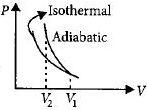
In a $P-V$ diagram,the work done during a compression process is represented by the area under the curve.
For a given change in volume,the adiabatic curve is steeper than the isothermal curve.
Since the adiabatic curve lies above the isothermal curve for the same volume range during compression,the area under the adiabatic curve is greater than the area under the isothermal curve.
Therefore,compressing the gas through an adiabatic process requires more work to be done than compressing it isothermally.
In a $P-V$ diagram,the work done during a compression process is represented by the area under the curve.
For a given change in volume,the adiabatic curve is steeper than the isothermal curve.
Since the adiabatic curve lies above the isothermal curve for the same volume range during compression,the area under the adiabatic curve is greater than the area under the isothermal curve.
Therefore,compressing the gas through an adiabatic process requires more work to be done than compressing it isothermally.
0 likesView Solution
33
PhysicsDifficultMCQNEET · 2016
$A$ piece of ice falls from a height $h$ so that it melts completely. Only one-quarter of the heat produced is absorbed by the ice and all energy of ice gets converted into heat during its fall. The value of $h$ is (Latent heat of ice is $L = 3.4 \times 10^{5} \text{ J/kg}$ and $g = 10 \text{ N/kg}$) (in $\text{ km}$)
A
$544$
B
$136$
C
$68$
D
$34$
Solution
(B) The potential energy of the ice at height $h$ is $PE = mgh$.
According to the problem, all this energy is converted into heat during the fall.
Only one-quarter of this heat is absorbed by the ice to melt it completely.
The heat required to melt a mass $m$ of ice is $Q = mL$, where $L$ is the latent heat of fusion.
Therefore, the energy balance equation is $\frac{1}{4} (mgh) = mL$.
Canceling $m$ from both sides, we get $\frac{gh}{4} = L$.
Solving for $h$, we get $h = \frac{4L}{g}$.
Substituting the given values: $h = \frac{4 \times 3.4 \times 10^{5}}{10} \text{ m}$.
$h = 4 \times 3.4 \times 10^{4} \text{ m} = 13.6 \times 10^{4} \text{ m} = 136,000 \text{ m}$.
Converting to kilometers, $h = 136 \text{ km}$.
According to the problem, all this energy is converted into heat during the fall.
Only one-quarter of this heat is absorbed by the ice to melt it completely.
The heat required to melt a mass $m$ of ice is $Q = mL$, where $L$ is the latent heat of fusion.
Therefore, the energy balance equation is $\frac{1}{4} (mgh) = mL$.
Canceling $m$ from both sides, we get $\frac{gh}{4} = L$.
Solving for $h$, we get $h = \frac{4L}{g}$.
Substituting the given values: $h = \frac{4 \times 3.4 \times 10^{5}}{10} \text{ m}$.
$h = 4 \times 3.4 \times 10^{4} \text{ m} = 13.6 \times 10^{4} \text{ m} = 136,000 \text{ m}$.
Converting to kilometers, $h = 136 \text{ km}$.
1 likesView Solution
34
PhysicsMediumMCQNEET · 2016
$A$ refrigerator works between $4^{\circ}C$ and $30^{\circ}C$. It is required to remove $600 \, cal$ of heat every second in order to keep the temperature of the refrigerated space constant. The power required is ....... $W$ (Take $1 \, cal = 4.2 \, J$)
A
$23.65$
B
$236.5$
C
$2365$
D
$2.365$
Solution
(B) Given: Cold reservoir temperature $T_2 = 4^{\circ}C = 277 \, K$,Hot reservoir temperature $T_1 = 30^{\circ}C = 303 \, K$.
Heat removed per second $Q_2 = 600 \, cal/s$.
Coefficient of performance $\alpha = \frac{T_2}{T_1 - T_2}$.
$\alpha = \frac{277}{303 - 277} = \frac{277}{26}$.
We know that $\alpha = \frac{Q_2}{W}$,where $W$ is the work done per second (power).
Therefore,$W = \frac{Q_2}{\alpha} = \frac{600 \times 26}{277} \, cal/s$.
Converting to Joules: $W = \frac{600 \times 26}{277} \times 4.2 \, J/s$.
$W \approx 236.5 \, W$.
Heat removed per second $Q_2 = 600 \, cal/s$.
Coefficient of performance $\alpha = \frac{T_2}{T_1 - T_2}$.
$\alpha = \frac{277}{303 - 277} = \frac{277}{26}$.
We know that $\alpha = \frac{Q_2}{W}$,where $W$ is the work done per second (power).
Therefore,$W = \frac{Q_2}{\alpha} = \frac{600 \times 26}{277} \, cal/s$.
Converting to Joules: $W = \frac{600 \times 26}{277} \times 4.2 \, J/s$.
$W \approx 236.5 \, W$.
0 likesView Solution
35
PhysicsMediumMCQNEET · 2016
$A$ body of mass $m$ is attached to the lower end of a spring whose upper end is fixed. The mass of the spring is negligible. When the mass $m$ is pulled down slightly and released,it oscillates with a time period of $3 \ s$. When the mass $m$ is increased by $1 \ kg$,the time period of oscillation becomes $5 \ s$. What is the value of $m$ in $kg$?
A
$\frac{16}{9}$
B
$\frac{9}{16}$
C
$\frac{3}{4}$
D
$\frac{4}{3}$
Solution
(B) The time period of a spring-block system is given by $T = 2 \pi \sqrt{\frac{m}{k}}$.
For a given spring,$T \propto \sqrt{m}$.
Therefore,$\frac{T_{1}}{T_{2}} = \sqrt{\frac{m_{1}}{m_{2}}}$.
Here,$T_{1} = 3 \ s$,$m_{1} = m$,$T_{2} = 5 \ s$,and $m_{2} = m + 1$.
Substituting the values: $\frac{3}{5} = \sqrt{\frac{m}{m+1}}$.
Squaring both sides: $\frac{9}{25} = \frac{m}{m+1}$.
Cross-multiplying: $9(m + 1) = 25m \Rightarrow 9m + 9 = 25m$.
$16m = 9 \Rightarrow m = \frac{9}{16} \ kg$.
For a given spring,$T \propto \sqrt{m}$.
Therefore,$\frac{T_{1}}{T_{2}} = \sqrt{\frac{m_{1}}{m_{2}}}$.
Here,$T_{1} = 3 \ s$,$m_{1} = m$,$T_{2} = 5 \ s$,and $m_{2} = m + 1$.
Substituting the values: $\frac{3}{5} = \sqrt{\frac{m}{m+1}}$.
Squaring both sides: $\frac{9}{25} = \frac{m}{m+1}$.
Cross-multiplying: $9(m + 1) = 25m \Rightarrow 9m + 9 = 25m$.
$16m = 9 \Rightarrow m = \frac{9}{16} \ kg$.
0 likesView Solution
36
PhysicsMediumMCQNEET · 2016
The second overtone of an open organ pipe has the same frequency as the first overtone of a closed organ pipe $L$ metre long. The length of the open pipe will be:
A
$L/2 \; m$
B
$4L \; m$
C
$L \; m$
D
$2L \; m$
Solution
(D) For an open organ pipe of length $L'$,the frequency of the $n^{th}$ harmonic is given by $f_n = n \frac{v}{2L'}$,where $n = 1, 2, 3, \dots$. The second overtone corresponds to the $3^{rd}$ harmonic $(n=3)$. Thus,$f_{open} = 3 \frac{v}{2L'}$.
For a closed organ pipe of length $L$,the frequency of the $n^{th}$ harmonic is given by $f_n = n \frac{v}{4L}$,where $n = 1, 3, 5, \dots$. The first overtone corresponds to the $3^{rd}$ harmonic $(n=3)$. Thus,$f_{closed} = 3 \frac{v}{4L}$.
According to the problem,the frequencies are equal:
$3 \frac{v}{2L'} = 3 \frac{v}{4L}$
Canceling $3v$ from both sides:
$\frac{1}{2L'} = \frac{1}{4L}$
Solving for $L'$:
$2L' = 4L \implies L' = 2L \; m$.
For a closed organ pipe of length $L$,the frequency of the $n^{th}$ harmonic is given by $f_n = n \frac{v}{4L}$,where $n = 1, 3, 5, \dots$. The first overtone corresponds to the $3^{rd}$ harmonic $(n=3)$. Thus,$f_{closed} = 3 \frac{v}{4L}$.
According to the problem,the frequencies are equal:
$3 \frac{v}{2L'} = 3 \frac{v}{4L}$
Canceling $3v$ from both sides:
$\frac{1}{2L'} = \frac{1}{4L}$
Solving for $L'$:
$2L' = 4L \implies L' = 2L \; m$.
0 likesView Solution
37
PhysicsMediumMCQNEET · 2016
Three sound waves of equal amplitudes have frequencies $(n - 1)$,$n$,and $(n + 1)$. They superimpose to produce beats. The number of beats produced per second is:
A
$3$
B
$2$
C
$1$
D
$4$
Solution
(B) The frequencies of the three sound waves are $f_1 = n - 1$,$f_2 = n$,and $f_3 = n + 1$.
Beats are produced by the superposition of waves with different frequencies.
The beat frequencies between pairs of waves are:
$|f_2 - f_1| = |n - (n - 1)| = 1 \text{ Hz}$
$|f_3 - f_2| = |(n + 1) - n| = 1 \text{ Hz}$
$|f_3 - f_1| = |(n + 1) - (n - 1)| = 2 \text{ Hz}$
The resultant beat frequency is the greatest common divisor or the effective frequency of the superposition,which is determined by the difference between the extreme frequencies.
The number of beats produced per second is the difference between the maximum and minimum frequencies: $(n + 1) - (n - 1) = 2 \text{ Hz}$.
Beats are produced by the superposition of waves with different frequencies.
The beat frequencies between pairs of waves are:
$|f_2 - f_1| = |n - (n - 1)| = 1 \text{ Hz}$
$|f_3 - f_2| = |(n + 1) - n| = 1 \text{ Hz}$
$|f_3 - f_1| = |(n + 1) - (n - 1)| = 2 \text{ Hz}$
The resultant beat frequency is the greatest common divisor or the effective frequency of the superposition,which is determined by the difference between the extreme frequencies.
The number of beats produced per second is the difference between the maximum and minimum frequencies: $(n + 1) - (n - 1) = 2 \text{ Hz}$.
0 likesView Solution
38
PhysicsMediumMCQNEET · 2016
$A$ siren emitting a sound of frequency $800 \, Hz$ moves away from an observer towards a cliff at a speed of $15 \, m s^{-1}$. The frequency of sound that the observer hears in the echo reflected from the cliff is .... $Hz$ (Take velocity of sound in air $= 330 \, m s^{-1}$)
A
$800$
B
$838$
C
$885$
D
$765$
Solution
(B) The frequency of the sound emitted by the siren is $f_0 = 800 \, Hz$.
The speed of the source (siren) is $v_s = 15 \, m s^{-1}$.
The speed of sound in air is $v = 330 \, m s^{-1}$.
Since the siren is moving towards the cliff,the cliff acts as an observer receiving the sound. The frequency $f'$ received by the cliff is given by the Doppler effect formula for a moving source and stationary observer:
$f' = f_0 \left( \frac{v}{v - v_s} \right) = 800 \left( \frac{330}{330 - 15} \right) = 800 \left( \frac{330}{315} \right) \approx 838.09 \, Hz$.
The cliff reflects this sound back to the original observer. Since the cliff is stationary,it acts as a stationary source emitting sound at frequency $f'$. The original observer is stationary relative to the cliff,so they hear the reflected sound at the same frequency $f'$.
Therefore,the frequency heard by the observer is approximately $838 \, Hz$.
The speed of the source (siren) is $v_s = 15 \, m s^{-1}$.
The speed of sound in air is $v = 330 \, m s^{-1}$.
Since the siren is moving towards the cliff,the cliff acts as an observer receiving the sound. The frequency $f'$ received by the cliff is given by the Doppler effect formula for a moving source and stationary observer:
$f' = f_0 \left( \frac{v}{v - v_s} \right) = 800 \left( \frac{330}{330 - 15} \right) = 800 \left( \frac{330}{315} \right) \approx 838.09 \, Hz$.
The cliff reflects this sound back to the original observer. Since the cliff is stationary,it acts as a stationary source emitting sound at frequency $f'$. The original observer is stationary relative to the cliff,so they hear the reflected sound at the same frequency $f'$.
Therefore,the frequency heard by the observer is approximately $838 \, Hz$.
0 likesView Solution
39
PhysicsMediumMCQNEET · 2016
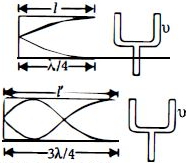
An air column,closed at one end and open at the other,resonates with a tuning fork when the smallest length of the column is $50\, cm$. The next larger length of the column resonating with the same tuning fork is .... $cm$.
A
$100$
B
$150$
C
$200$
D
$66.7$
Solution
(B) For an air column closed at one end,the resonance occurs at odd harmonics.
The fundamental frequency (first harmonic) corresponds to the smallest length $l_1$:
$l_1 = \frac{\lambda}{4} = 50\, cm$
The next resonance (third harmonic) occurs at length $l_2$:
$l_2 = \frac{3\lambda}{4}$
Substituting $\lambda = 4 \times 50\, cm = 200\, cm$:
$l_2 = 3 \times \left(\frac{200}{4}\right) = 3 \times 50 = 150\, cm$.
The fundamental frequency (first harmonic) corresponds to the smallest length $l_1$:
$l_1 = \frac{\lambda}{4} = 50\, cm$
The next resonance (third harmonic) occurs at length $l_2$:
$l_2 = \frac{3\lambda}{4}$
Substituting $\lambda = 4 \times 50\, cm = 200\, cm$:
$l_2 = 3 \times \left(\frac{200}{4}\right) = 3 \times 50 = 150\, cm$.
0 likesView Solution
40
PhysicsMediumMCQNEET · 2016
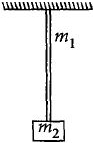
$A$ uniform rope of length $L$ and mass $m_1$ hangs vertically from a rigid support. $A$ block of mass $m_2$ is attached to the free end of the rope. $A$ transverse pulse of wavelength $\lambda_1$ is produced at the lower end of the rope. The wavelength of the pulse when it reaches the top of the rope is $\lambda_2$. The ratio $\lambda_2 / \lambda_1$ is:
A
$\sqrt{\frac{m_1 + m_2}{m_2}}$
B
$\sqrt{\frac{m_2}{m_1}}$
C
$\sqrt{\frac{m_1 + m_2}{m_1}}$
D
$\sqrt{\frac{m_1}{m_2}}$
Solution
(A) The speed of a transverse wave on a string is given by $v = \sqrt{\frac{T}{\mu}}$,where $T$ is the tension and $\mu$ is the linear mass density.
Since the frequency $f$ of the pulse remains constant,the wavelength $\lambda = \frac{v}{f}$ is directly proportional to the velocity $v$. Therefore,$\lambda \propto \sqrt{T}$.
At the lower end of the rope (where the block $m_2$ is attached),the tension $T_1$ is due to the weight of the block: $T_1 = m_2 g$.
At the top of the rope,the tension $T_2$ is due to the weight of both the rope and the block: $T_2 = (m_1 + m_2) g$.
Thus,the ratio of the wavelengths is:
$\frac{\lambda_2}{\lambda_1} = \sqrt{\frac{T_2}{T_1}} = \sqrt{\frac{(m_1 + m_2) g}{m_2 g}} = \sqrt{\frac{m_1 + m_2}{m_2}}$.
Since the frequency $f$ of the pulse remains constant,the wavelength $\lambda = \frac{v}{f}$ is directly proportional to the velocity $v$. Therefore,$\lambda \propto \sqrt{T}$.
At the lower end of the rope (where the block $m_2$ is attached),the tension $T_1$ is due to the weight of the block: $T_1 = m_2 g$.
At the top of the rope,the tension $T_2$ is due to the weight of both the rope and the block: $T_2 = (m_1 + m_2) g$.
Thus,the ratio of the wavelengths is:
$\frac{\lambda_2}{\lambda_1} = \sqrt{\frac{T_2}{T_1}} = \sqrt{\frac{(m_1 + m_2) g}{m_2 g}} = \sqrt{\frac{m_1 + m_2}{m_2}}$.
0 likesView Solution
41
PhysicsEasyMCQNEET · 2016
Two identical balls $A$ and $B$ having velocities of $0.5 \, m s^{-1}$ and $-0.3 \, m s^{-1}$ respectively collide elastically in one dimension. The velocities of $B$ and $A$ after the collision respectively will be
A
$-0.3 \, m s^{-1}, 0.5 \, m s^{-1}$
B
$0.3 \, m s^{-1}, 0.5 \, m s^{-1}$
C
$-0.5 \, m s^{-1}, 0.3 \, m s^{-1}$
D
$0.5 \, m s^{-1}, -0.3 \, m s^{-1}$
Solution
(D) In an elastic collision between two bodies of equal mass,the velocities of the bodies are interchanged after the collision.
Given: Initial velocity of ball $A$ $(u_A)$ = $0.5 \, m s^{-1}$ and initial velocity of ball $B$ $(u_B)$ = $-0.3 \, m s^{-1}$.
Since the masses are identical and the collision is elastic,the final velocity of ball $A$ $(v_A)$ will be equal to $u_B$,and the final velocity of ball $B$ $(v_B)$ will be equal to $u_A$.
Therefore,$v_A = -0.3 \, m s^{-1}$ and $v_B = 0.5 \, m s^{-1}$.
The question asks for the velocities of $B$ and $A$ respectively,which are $v_B$ and $v_A$.
Thus,the velocities are $0.5 \, m s^{-1}$ and $-0.3 \, m s^{-1}$.
Given: Initial velocity of ball $A$ $(u_A)$ = $0.5 \, m s^{-1}$ and initial velocity of ball $B$ $(u_B)$ = $-0.3 \, m s^{-1}$.
Since the masses are identical and the collision is elastic,the final velocity of ball $A$ $(v_A)$ will be equal to $u_B$,and the final velocity of ball $B$ $(v_B)$ will be equal to $u_A$.
Therefore,$v_A = -0.3 \, m s^{-1}$ and $v_B = 0.5 \, m s^{-1}$.
The question asks for the velocities of $B$ and $A$ respectively,which are $v_B$ and $v_A$.
Thus,the velocities are $0.5 \, m s^{-1}$ and $-0.3 \, m s^{-1}$.
1 likesView Solution
42
PhysicsEasyMCQNEET · 2016
$A$ particle moves from a point $(-2\hat i + 5\hat j) \ m$ to $(4\hat j + 3\hat k) \ m$ when a force of $(4\hat i + 3\hat j) \ N$ is applied. How much work has been done by the force? $J$
A
$5$
B
$2$
C
$8$
D
$11$
Solution
(A) The work done $W$ by a constant force $\vec{F}$ during a displacement $\vec{d}$ is given by the dot product: $W = \vec{F} \cdot \vec{d}$.
Here,the initial position is $\vec{r}_1 = -2\hat i + 5\hat j$ and the final position is $\vec{r}_2 = 4\hat j + 3\hat k$.
The displacement vector $\vec{d} = \vec{r}_2 - \vec{r}_1 = (4\hat j + 3\hat k) - (-2\hat i + 5\hat j) = 2\hat i - \hat j + 3\hat k$.
The force is $\vec{F} = 4\hat i + 3\hat j$.
Therefore,$W = (4\hat i + 3\hat j) \cdot (2\hat i - \hat j + 3\hat k) = (4 \times 2) + (3 \times -1) + (0 \times 3) = 8 - 3 = 5 \ J$.
Here,the initial position is $\vec{r}_1 = -2\hat i + 5\hat j$ and the final position is $\vec{r}_2 = 4\hat j + 3\hat k$.
The displacement vector $\vec{d} = \vec{r}_2 - \vec{r}_1 = (4\hat j + 3\hat k) - (-2\hat i + 5\hat j) = 2\hat i - \hat j + 3\hat k$.
The force is $\vec{F} = 4\hat i + 3\hat j$.
Therefore,$W = (4\hat i + 3\hat j) \cdot (2\hat i - \hat j + 3\hat k) = (4 \times 2) + (3 \times -1) + (0 \times 3) = 8 - 3 = 5 \ J$.
0 likesView Solution
43
PhysicsMediumMCQNEET · 2016
$A$ particle of mass $10\, g$ moves along a circle of radius $6.4\, cm$ with a constant tangential acceleration. What is the magnitude of this acceleration if the kinetic energy of the particle becomes equal to $8 \times 10^{-4}\, J$ by the end of the second revolution after the beginning of the motion? .............. $m/s^2$
A
$0.15$
B
$0.18$
C
$0.2$
D
$0.1$
Solution
(D) Given: Mass $m = 10\, g = 10^{-2}\, kg$,Radius $R = 6.4\, cm = 6.4 \times 10^{-2}\, m$,Final kinetic energy $K_f = 8 \times 10^{-4}\, J$,Initial kinetic energy $K_i = 0$.
The work done by the tangential force is equal to the change in kinetic energy,as the centripetal force does no work.
Work done $W = F_t \times d$,where $F_t = m a_t$ and $d$ is the distance covered in two revolutions.
Distance $d = 2 \times (2\pi R) = 4\pi R$.
Using the work-energy theorem: $W = K_f - K_i = K_f$.
$m a_t (4\pi R) = K_f$.
$a_t = \frac{K_f}{4\pi R m}$.
Substituting the values: $a_t = \frac{8 \times 10^{-4}}{4 \times 3.14159 \times 6.4 \times 10^{-2} \times 10^{-2}}$.
$a_t = \frac{8 \times 10^{-4}}{4 \times 3.14159 \times 6.4 \times 10^{-4}} = \frac{8}{25.6 \times 3.14159} \approx \frac{8}{80.42} \approx 0.0995\, m/s^2$.
Rounding to the nearest value,$a_t \approx 0.1\, m/s^2$.
The work done by the tangential force is equal to the change in kinetic energy,as the centripetal force does no work.
Work done $W = F_t \times d$,where $F_t = m a_t$ and $d$ is the distance covered in two revolutions.
Distance $d = 2 \times (2\pi R) = 4\pi R$.
Using the work-energy theorem: $W = K_f - K_i = K_f$.
$m a_t (4\pi R) = K_f$.
$a_t = \frac{K_f}{4\pi R m}$.
Substituting the values: $a_t = \frac{8 \times 10^{-4}}{4 \times 3.14159 \times 6.4 \times 10^{-2} \times 10^{-2}}$.
$a_t = \frac{8 \times 10^{-4}}{4 \times 3.14159 \times 6.4 \times 10^{-4}} = \frac{8}{25.6 \times 3.14159} \approx \frac{8}{80.42} \approx 0.0995\, m/s^2$.
Rounding to the nearest value,$a_t \approx 0.1\, m/s^2$.
0 likesView Solution
44
PhysicsMediumMCQNEET · 2016
The variation of acceleration due to gravity $g$ with distance $d$ from the centre of the earth is best represented by ($R =$ Earth's radius)
A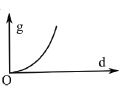
B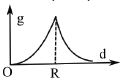
C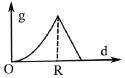
D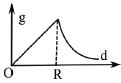
Solution
(D) The variation of acceleration due to gravity $g$ with distance $d$ from the center of the earth is given by:
$1$. Inside the earth $(d < R)$:
$g = \frac{GM}{R^3} d$
Since $G, M,$ and $R$ are constants,$g \propto d$. This represents a straight line passing through the origin.
$2$. At the surface of the earth $(d = R)$:
$g = \frac{GM}{R^2} = g_s$ (maximum value).
$3$. Outside the earth $(d > R)$:
$g = \frac{GM}{d^2}$
Here,$g \propto \frac{1}{d^2}$. This represents a rectangular hyperbola.
Combining these,the graph shows a linear increase from the center to the surface,followed by a hyperbolic decrease as distance increases beyond the surface. This matches the graph in option $D$.
$1$. Inside the earth $(d < R)$:
$g = \frac{GM}{R^3} d$
Since $G, M,$ and $R$ are constants,$g \propto d$. This represents a straight line passing through the origin.
$2$. At the surface of the earth $(d = R)$:
$g = \frac{GM}{R^2} = g_s$ (maximum value).
$3$. Outside the earth $(d > R)$:
$g = \frac{GM}{d^2}$
Here,$g \propto \frac{1}{d^2}$. This represents a rectangular hyperbola.
Combining these,the graph shows a linear increase from the center to the surface,followed by a hyperbolic decrease as distance increases beyond the surface. This matches the graph in option $D$.
0 likesView Solution
45
PhysicsMediumMCQNEET · 2016
To get an output $Y = 1$ in the given circuit,which of the following inputs will be correct?
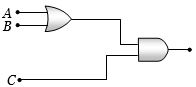
A
$A = 0, B = 1, C = 0$
B
$A = 1, B = 0, C = 0$
C
$A = 1, B = 0, C = 1$
D
$A = 1, B = 1, C = 0$
Solution
(C) The given circuit consists of an $OR$ gate followed by an $AND$ gate. The output of the $OR$ gate is $(A + B)$. This output is then fed into an $AND$ gate along with input $C$. Thus,the final Boolean expression for the output $Y$ is $Y = (A + B) \cdot C$.
To get an output $Y = 1$,both inputs to the $AND$ gate must be $1$. This means $(A + B) = 1$ and $C = 1$.
For $(A + B) = 1$,at least one of $A$ or $B$ must be $1$.
Checking the options:
- For option $A$: $A=0, B=1, C=0 \implies Y = (0+1) \cdot 0 = 0$.
- For option $B$: $A=1, B=0, C=0 \implies Y = (1+0) \cdot 0 = 0$.
- For option $C$: $A=1, B=0, C=1 \implies Y = (1+0) \cdot 1 = 1$.
- For option $D$: $A=1, B=1, C=0 \implies Y = (1+1) \cdot 0 = 0$.
Thus,the correct input is $A = 1, B = 0, C = 1$.
To get an output $Y = 1$,both inputs to the $AND$ gate must be $1$. This means $(A + B) = 1$ and $C = 1$.
For $(A + B) = 1$,at least one of $A$ or $B$ must be $1$.
Checking the options:
- For option $A$: $A=0, B=1, C=0 \implies Y = (0+1) \cdot 0 = 0$.
- For option $B$: $A=1, B=0, C=0 \implies Y = (1+0) \cdot 0 = 0$.
- For option $C$: $A=1, B=0, C=1 \implies Y = (1+0) \cdot 1 = 1$.
- For option $D$: $A=1, B=1, C=0 \implies Y = (1+1) \cdot 0 = 0$.
Thus,the correct input is $A = 1, B = 0, C = 1$.
0 likesView Solution
46
PhysicsMediumMCQNEET · 2016
$A$ parallel-plate capacitor of area $A,$ plate separation $d$ and capacitance $C$ is filled with four dielectric materials having dielectric constants $K_1, K_2, K_3$ and $K_4$ as shown in the figure. If a single dielectric material is to be used to have the same capacitance $C$ in this capacitor,then its dielectric constant $K$ is given by
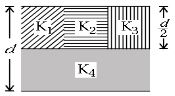
A
$\frac{2}{K} = \frac{3}{K_1 + K_2 + K_3} + \frac{1}{K_4}$
B
$\frac{1}{K} = \frac{1}{K_1} + \frac{1}{K_2} + \frac{1}{K_3} + \frac{3}{2K_4}$
C
$K = K_1 + K_2 + K_3 + 3K_4$
D
$K = \frac{2}{3}[K_1 + K_2 + K_3] + 2K_4$
Solution
(A) The capacitor can be modeled as a combination of four smaller capacitors. The top portion of thickness $d/2$ is divided into three parts,each of area $A/3$. These three capacitors $(C_1, C_2, C_3)$ are in parallel.
$C_1 = \frac{\epsilon_0 K_1 (A/3)}{d/2} = \frac{2\epsilon_0 K_1 A}{3d}$
$C_2 = \frac{2\epsilon_0 K_2 A}{3d}$
$C_3 = \frac{2\epsilon_0 K_3 A}{3d}$
Their equivalent capacitance $C_p = C_1 + C_2 + C_3 = \frac{2\epsilon_0 A}{3d}(K_1 + K_2 + K_3)$.
This parallel combination is in series with the bottom capacitor $C_4$ of thickness $d/2$ and area $A$.
$C_4 = \frac{\epsilon_0 K_4 A}{d/2} = \frac{2\epsilon_0 K_4 A}{d}$.
The total equivalent capacitance $C$ is given by $\frac{1}{C} = \frac{1}{C_p} + \frac{1}{C_4}$.
Substituting the values: $\frac{1}{C} = \frac{3d}{2\epsilon_0 A(K_1 + K_2 + K_3)} + \frac{d}{2\epsilon_0 K_4 A}$.
For a single dielectric $K$,$C = \frac{K\epsilon_0 A}{d}$,so $\frac{1}{C} = \frac{d}{K\epsilon_0 A}$.
Equating the two: $\frac{d}{K\epsilon_0 A} = \frac{d}{\epsilon_0 A} [\frac{3}{2(K_1 + K_2 + K_3)} + \frac{1}{2K_4}]$.
$\frac{1}{K} = \frac{3}{2(K_1 + K_2 + K_3)} + \frac{1}{2K_4}$.
Multiplying by $2$: $\frac{2}{K} = \frac{3}{K_1 + K_2 + K_3} + \frac{1}{K_4}$.
$C_1 = \frac{\epsilon_0 K_1 (A/3)}{d/2} = \frac{2\epsilon_0 K_1 A}{3d}$
$C_2 = \frac{2\epsilon_0 K_2 A}{3d}$
$C_3 = \frac{2\epsilon_0 K_3 A}{3d}$
Their equivalent capacitance $C_p = C_1 + C_2 + C_3 = \frac{2\epsilon_0 A}{3d}(K_1 + K_2 + K_3)$.
This parallel combination is in series with the bottom capacitor $C_4$ of thickness $d/2$ and area $A$.
$C_4 = \frac{\epsilon_0 K_4 A}{d/2} = \frac{2\epsilon_0 K_4 A}{d}$.
The total equivalent capacitance $C$ is given by $\frac{1}{C} = \frac{1}{C_p} + \frac{1}{C_4}$.
Substituting the values: $\frac{1}{C} = \frac{3d}{2\epsilon_0 A(K_1 + K_2 + K_3)} + \frac{d}{2\epsilon_0 K_4 A}$.
For a single dielectric $K$,$C = \frac{K\epsilon_0 A}{d}$,so $\frac{1}{C} = \frac{d}{K\epsilon_0 A}$.
Equating the two: $\frac{d}{K\epsilon_0 A} = \frac{d}{\epsilon_0 A} [\frac{3}{2(K_1 + K_2 + K_3)} + \frac{1}{2K_4}]$.
$\frac{1}{K} = \frac{3}{2(K_1 + K_2 + K_3)} + \frac{1}{2K_4}$.
Multiplying by $2$: $\frac{2}{K} = \frac{3}{K_1 + K_2 + K_3} + \frac{1}{K_4}$.
0 likesView Solution
47
PhysicsMediumMCQNEET · 2016
An electric dipole is placed at an angle of $30^\circ$ with an electric field intensity of $2 \times 10^5 \, \text{NC}^{-1}$. It experiences a torque equal to $4 \, \text{Nm}$. The charge on the dipole,if the dipole length is $2 \, \text{cm}$,is:
A
$5 \, \text{mC}$
B
$7 \, \mu\text{C}$
C
$8 \, \text{mC}$
D
$2 \, \text{mC}$
Solution
(D) Given: $\theta = 30^\circ$,$E = 2 \times 10^5 \, \text{NC}^{-1}$,$\tau = 4 \, \text{Nm}$,and $l = 2 \, \text{cm} = 0.02 \, \text{m}$.
The torque experienced by an electric dipole in an electric field is given by the formula: $\tau = pE \sin \theta$,where $p = ql$.
Substituting $p = ql$ into the torque equation: $\tau = qlE \sin \theta$.
Rearranging to solve for $q$: $q = \frac{\tau}{El \sin \theta}$.
Substituting the given values: $q = \frac{4}{2 \times 10^5 \times 0.02 \times \sin(30^\circ)}$.
Since $\sin(30^\circ) = 0.5$: $q = \frac{4}{2 \times 10^5 \times 0.02 \times 0.5} = \frac{4}{2 \times 10^3} = 2 \times 10^{-3} \, \text{C}$.
Therefore,$q = 2 \, \text{mC}$.
The torque experienced by an electric dipole in an electric field is given by the formula: $\tau = pE \sin \theta$,where $p = ql$.
Substituting $p = ql$ into the torque equation: $\tau = qlE \sin \theta$.
Rearranging to solve for $q$: $q = \frac{\tau}{El \sin \theta}$.
Substituting the given values: $q = \frac{4}{2 \times 10^5 \times 0.02 \times \sin(30^\circ)}$.
Since $\sin(30^\circ) = 0.5$: $q = \frac{4}{2 \times 10^5 \times 0.02 \times 0.5} = \frac{4}{2 \times 10^3} = 2 \times 10^{-3} \, \text{C}$.
Therefore,$q = 2 \, \text{mC}$.
0 likesView Solution
48
PhysicsDifficultMCQNEET · 2016
Two identical charged spheres suspended from a common point by two massless strings of lengths $l$ are initially at a distance $d$ $(d << l)$ apart because of their mutual repulsion. The charges begin to leak from both the spheres at a constant rate. As a result,the spheres approach each other with a velocity $v$. Then $v$ varies as a function of the distance $x$ between the spheres,as:
A
$v \propto x$
B
$v \propto x^{-1/2}$
C
$v \propto x^{-1}$
D
$v \propto x^{1/2}$
Solution
(B) From the equilibrium condition of the spheres,the forces acting are tension $T$,weight $mg$,and electrostatic repulsion $F_e = \frac{kq^2}{x^2}$.
Resolving forces: $T \cos \theta = mg$ and $T \sin \theta = \frac{kq^2}{x^2}$.
Dividing the equations,we get $\tan \theta = \frac{kq^2}{x^2 mg}$.
Since $\theta$ is small,$\tan \theta \approx \sin \theta = \frac{x/2}{l} = \frac{x}{2l}$.
Equating the two expressions for $\tan \theta$: $\frac{x}{2l} = \frac{kq^2}{x^2 mg} \implies q^2 = \frac{mg}{2lk} x^3 \implies q \propto x^{3/2}$.
Differentiating with respect to time $t$: $\frac{dq}{dt} \propto \frac{3}{2} x^{1/2} \frac{dx}{dt}$.
Given that $\frac{dq}{dt}$ is constant,we have $1 \propto x^{1/2} v$,which implies $v \propto x^{-1/2}$.
Resolving forces: $T \cos \theta = mg$ and $T \sin \theta = \frac{kq^2}{x^2}$.
Dividing the equations,we get $\tan \theta = \frac{kq^2}{x^2 mg}$.
Since $\theta$ is small,$\tan \theta \approx \sin \theta = \frac{x/2}{l} = \frac{x}{2l}$.
Equating the two expressions for $\tan \theta$: $\frac{x}{2l} = \frac{kq^2}{x^2 mg} \implies q^2 = \frac{mg}{2lk} x^3 \implies q \propto x^{3/2}$.
Differentiating with respect to time $t$: $\frac{dq}{dt} \propto \frac{3}{2} x^{1/2} \frac{dx}{dt}$.
Given that $\frac{dq}{dt}$ is constant,we have $1 \propto x^{1/2} v$,which implies $v \propto x^{-1/2}$.
0 likesView Solution
49
PhysicsDifficultMCQNEET · 2016
$A$ capacitor of $2\,\mu F$ is charged as shown in the diagram. When the switch $S$ is turned to position $2,$ the percentage of its stored energy dissipated is ......$\%$
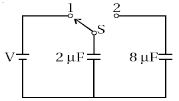
A
$20$
B
$75$
C
$80$
D
$0$
Solution
(C) Initially,the energy stored in the $2\,\mu F$ capacitor is:
$U_{i} = \frac{1}{2} C V^{2} = \frac{1}{2} (2 \times 10^{-6}) V^{2} = V^{2} \times 10^{-6} \, J$
Initially,the charge stored in the $2\,\mu F$ capacitor is:
$Q_{i} = C V = (2 \times 10^{-6}) V = 2V \times 10^{-6} \, C$
When the switch $S$ is turned to position $2,$ the charge flows and both capacitors share charges until a common potential $V_{c}$ is reached.
$V_{c} = \frac{\text{Total Charge}}{\text{Total Capacitance}} = \frac{2V \times 10^{-6}}{(2 + 8) \times 10^{-6}} = \frac{V}{5} \, V$
Finally,the energy stored in both capacitors is:
$U_{f} = \frac{1}{2} (C_{1} + C_{2}) V_{c}^{2} = \frac{1}{2} (10 \times 10^{-6}) \left(\frac{V}{5}\right)^{2} = 5 \times 10^{-6} \times \frac{V^{2}}{25} = \frac{V^{2}}{5} \times 10^{-6} \, J$
Percentage loss of energy is given by:
$\Delta U \% = \frac{U_{i} - U_{f}}{U_{i}} \times 100 \%$
$\Delta U \% = \frac{V^{2} \times 10^{-6} - \frac{V^{2}}{5} \times 10^{-6}}{V^{2} \times 10^{-6}} \times 100 \% = \left(1 - \frac{1}{5}\right) \times 100 \% = \frac{4}{5} \times 100 \% = 80 \%$
$U_{i} = \frac{1}{2} C V^{2} = \frac{1}{2} (2 \times 10^{-6}) V^{2} = V^{2} \times 10^{-6} \, J$
Initially,the charge stored in the $2\,\mu F$ capacitor is:
$Q_{i} = C V = (2 \times 10^{-6}) V = 2V \times 10^{-6} \, C$
When the switch $S$ is turned to position $2,$ the charge flows and both capacitors share charges until a common potential $V_{c}$ is reached.
$V_{c} = \frac{\text{Total Charge}}{\text{Total Capacitance}} = \frac{2V \times 10^{-6}}{(2 + 8) \times 10^{-6}} = \frac{V}{5} \, V$
Finally,the energy stored in both capacitors is:
$U_{f} = \frac{1}{2} (C_{1} + C_{2}) V_{c}^{2} = \frac{1}{2} (10 \times 10^{-6}) \left(\frac{V}{5}\right)^{2} = 5 \times 10^{-6} \times \frac{V^{2}}{25} = \frac{V^{2}}{5} \times 10^{-6} \, J$
Percentage loss of energy is given by:
$\Delta U \% = \frac{U_{i} - U_{f}}{U_{i}} \times 100 \%$
$\Delta U \% = \frac{V^{2} \times 10^{-6} - \frac{V^{2}}{5} \times 10^{-6}}{V^{2} \times 10^{-6}} \times 100 \% = \left(1 - \frac{1}{5}\right) \times 100 \% = \frac{4}{5} \times 100 \% = 80 \%$
0 likesView Solution
50
PhysicsEasyMCQNEET · 2016
The potential difference $(V_A - V_B)$ between the points $A$ and $B$ in the given figure is ............ $V$.
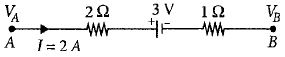
A
$+6$
B
$+9$
C
$-3$
D
$+3$
Solution
(B) To find the potential difference $(V_A - V_B)$,we apply Kirchhoff's voltage law along the path from $A$ to $B$.
Starting from point $A$ and moving towards $B$ in the direction of the current $I = 2 \, A$:
$V_A - I R_1 - E - I R_2 = V_B$
Where $R_1 = 2 \, \Omega$,$E = 3 \, V$,and $R_2 = 1 \, \Omega$.
Substituting the values:
$V_A - (2 \, A \times 2 \, \Omega) - 3 \, V - (2 \, A \times 1 \, \Omega) = V_B$
$V_A - 4 \, V - 3 \, V - 2 \, V = V_B$
$V_A - 9 \, V = V_B$
Therefore,$V_A - V_B = 9 \, V$.
Starting from point $A$ and moving towards $B$ in the direction of the current $I = 2 \, A$:
$V_A - I R_1 - E - I R_2 = V_B$
Where $R_1 = 2 \, \Omega$,$E = 3 \, V$,and $R_2 = 1 \, \Omega$.
Substituting the values:
$V_A - (2 \, A \times 2 \, \Omega) - 3 \, V - (2 \, A \times 1 \, \Omega) = V_B$
$V_A - 4 \, V - 3 \, V - 2 \, V = V_B$
$V_A - 9 \, V = V_B$
Therefore,$V_A - V_B = 9 \, V$.

0 likesView Solution
51
PhysicsMediumMCQNEET · 2016
$A$ filament bulb $(500 \,W, 100 \,V)$ is to be used in a $230 \,V$ main supply. When a resistance $R$ is connected in series,it works perfectly and the bulb consumes $500 \,W$. The value of $R$ is .................. $\Omega$.
A
$26$
B
$13$
C
$230$
D
$46$
Solution
(A) First,calculate the resistance of the bulb $(R_B)$:
$R_B = \frac{V^2}{P} = \frac{(100)^2}{500} = \frac{10000}{500} = 20 \, \Omega$.
Next,calculate the current $(I)$ flowing through the bulb when it operates at its rated power:
$I = \frac{P}{V} = \frac{500}{100} = 5 \, A$.
Since the bulb and resistor $R$ are in series,the same current $I = 5 \, A$ flows through the resistor $R$. The voltage drop across the resistor $(V_R)$ is the difference between the supply voltage and the bulb's rated voltage:
$V_R = V_{supply} - V_{bulb} = 230 \, V - 100 \, V = 130 \, V$.
Using Ohm's law for the resistor $R$:
$V_R = I \times R$
$130 = 5 \times R$
$R = \frac{130}{5} = 26 \, \Omega$.
$R_B = \frac{V^2}{P} = \frac{(100)^2}{500} = \frac{10000}{500} = 20 \, \Omega$.
Next,calculate the current $(I)$ flowing through the bulb when it operates at its rated power:
$I = \frac{P}{V} = \frac{500}{100} = 5 \, A$.
Since the bulb and resistor $R$ are in series,the same current $I = 5 \, A$ flows through the resistor $R$. The voltage drop across the resistor $(V_R)$ is the difference between the supply voltage and the bulb's rated voltage:
$V_R = V_{supply} - V_{bulb} = 230 \, V - 100 \, V = 130 \, V$.
Using Ohm's law for the resistor $R$:
$V_R = I \times R$
$130 = 5 \times R$
$R = \frac{130}{5} = 26 \, \Omega$.
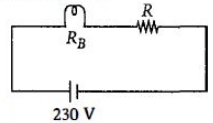
0 likesView Solution
52
PhysicsMediumMCQNEET · 2016
$A$ potentiometer wire is $100 \, cm$ long and a constant potential difference is maintained across it. Two cells are connected in series first to support one another and then in opposite direction. The balance points are obtained at $50 \, cm$ and $10 \, cm$ from the positive end of the wire in the two cases. The ratio of emfs is:
A
$5:4$
B
$3:4$
C
$3:2$
D
$5:1$
Solution
(C) Let the emfs of the two cells be $\varepsilon_{1}$ and $\varepsilon_{2}$ (where $\varepsilon_{1} > \varepsilon_{2}$).
Let $k$ be the potential gradient (potential difference per unit length) of the potentiometer wire.
When the cells are connected in series to support each other,the total emf is $\varepsilon_{1} + \varepsilon_{2}$. The balance point is at $l_{1} = 50 \, cm$.
So,$\varepsilon_{1} + \varepsilon_{2} = k \cdot l_{1} = 50k$ .....$(i)$
When the cells are connected in opposite directions,the total emf is $\varepsilon_{1} - \varepsilon_{2}$. The balance point is at $l_{2} = 10 \, cm$.
So,$\varepsilon_{1} - \varepsilon_{2} = k \cdot l_{2} = 10k$ .....$(ii)$
Adding equations $(i)$ and $(ii)$:
$2\varepsilon_{1} = 60k \Rightarrow \varepsilon_{1} = 30k$
Subtracting equation $(ii)$ from $(i)$:
$2\varepsilon_{2} = 40k \Rightarrow \varepsilon_{2} = 20k$
The ratio of the emfs is $\frac{\varepsilon_{1}}{\varepsilon_{2}} = \frac{30k}{20k} = \frac{3}{2}$.
Let $k$ be the potential gradient (potential difference per unit length) of the potentiometer wire.
When the cells are connected in series to support each other,the total emf is $\varepsilon_{1} + \varepsilon_{2}$. The balance point is at $l_{1} = 50 \, cm$.
So,$\varepsilon_{1} + \varepsilon_{2} = k \cdot l_{1} = 50k$ .....$(i)$
When the cells are connected in opposite directions,the total emf is $\varepsilon_{1} - \varepsilon_{2}$. The balance point is at $l_{2} = 10 \, cm$.
So,$\varepsilon_{1} - \varepsilon_{2} = k \cdot l_{2} = 10k$ .....$(ii)$
Adding equations $(i)$ and $(ii)$:
$2\varepsilon_{1} = 60k \Rightarrow \varepsilon_{1} = 30k$
Subtracting equation $(ii)$ from $(i)$:
$2\varepsilon_{2} = 40k \Rightarrow \varepsilon_{2} = 20k$
The ratio of the emfs is $\frac{\varepsilon_{1}}{\varepsilon_{2}} = \frac{30k}{20k} = \frac{3}{2}$.
1 likesView Solution
53
PhysicsDifficultMCQNEET · 2016
The charge flowing through a resistance $R$ varies with time $t$ as $Q = at - bt^2$,where $a$ and $b$ are positive constants. The total heat produced in $R$ is
A
$\frac{a^3 R}{3b}$
B
$\frac{a^3 R}{2b}$
C
$\frac{a^3 R}{b}$
D
$\frac{a^3 R}{6b}$
Solution
(D) Given,$Q = at - bt^2$.
The current $I$ is given by $I = \frac{dQ}{dt} = a - 2bt$.
The current becomes zero when $a - 2bt = 0$,which gives $t = \frac{a}{2b}$.
The total heat $H$ produced in the resistance $R$ is given by $H = \int_0^{a/2b} I^2 R dt$.
Substituting $I = a - 2bt$:
$H = R \int_0^{a/2b} (a - 2bt)^2 dt = R \int_0^{a/2b} (a^2 + 4b^2 t^2 - 4abt) dt$.
Integrating with respect to $t$:
$H = R \left[ a^2 t + \frac{4b^2 t^3}{3} - 2abt^2 \right]_0^{a/2b}$.
Substituting the limits:
$H = R \left[ a^2 \left( \frac{a}{2b} \right) + \frac{4b^2}{3} \left( \frac{a^3}{8b^3} \right) - 2ab \left( \frac{a^2}{4b^2} \right) \right]$.
$H = R \left[ \frac{a^3}{2b} + \frac{a^3}{6b} - \frac{a^3}{2b} \right] = \frac{a^3 R}{6b}$.
The current $I$ is given by $I = \frac{dQ}{dt} = a - 2bt$.
The current becomes zero when $a - 2bt = 0$,which gives $t = \frac{a}{2b}$.
The total heat $H$ produced in the resistance $R$ is given by $H = \int_0^{a/2b} I^2 R dt$.
Substituting $I = a - 2bt$:
$H = R \int_0^{a/2b} (a - 2bt)^2 dt = R \int_0^{a/2b} (a^2 + 4b^2 t^2 - 4abt) dt$.
Integrating with respect to $t$:
$H = R \left[ a^2 t + \frac{4b^2 t^3}{3} - 2abt^2 \right]_0^{a/2b}$.
Substituting the limits:
$H = R \left[ a^2 \left( \frac{a}{2b} \right) + \frac{4b^2}{3} \left( \frac{a^3}{8b^3} \right) - 2ab \left( \frac{a^2}{4b^2} \right) \right]$.
$H = R \left[ \frac{a^3}{2b} + \frac{a^3}{6b} - \frac{a^3}{2b} \right] = \frac{a^3 R}{6b}$.
0 likesView Solution
54
PhysicsMediumMCQNEET · 2016
An electron is moving in a circular path under the influence of a transverse magnetic field of $3.57 \times 10^{-2} \, T$. If the value of $e/m$ is $1.76 \times 10^{11} \, C/kg$,the frequency of revolution of the electron is
A
$62.8 \, MHz$
B
$6.28 \, MHz$
C
$1 \, GHz$
D
$100 \, MHz$
Solution
(C) Given: Magnetic field $B = 3.57 \times 10^{-2} \, T$ and specific charge $\frac{e}{m} = 1.76 \times 10^{11} \, C/kg$.
The frequency of revolution $f$ of a charged particle in a magnetic field is given by the formula:
$f = \frac{1}{T} = \frac{qB}{2 \pi m}$
Substituting the given values:
$f = \frac{1}{2 \times 3.14} \times (1.76 \times 10^{11}) \times (3.57 \times 10^{-2})$
$f = \frac{1}{6.28} \times 6.2832 \times 10^9$
$f \approx 1 \times 10^9 \, Hz = 1 \, GHz$.
The frequency of revolution $f$ of a charged particle in a magnetic field is given by the formula:
$f = \frac{1}{T} = \frac{qB}{2 \pi m}$
Substituting the given values:
$f = \frac{1}{2 \times 3.14} \times (1.76 \times 10^{11}) \times (3.57 \times 10^{-2})$
$f = \frac{1}{6.28} \times 6.2832 \times 10^9$
$f \approx 1 \times 10^9 \, Hz = 1 \, GHz$.
0 likesView Solution
55
PhysicsMediumMCQNEET · 2016
$A$ square loop $ABCD$ of side length $L$ carrying a current $i$ is placed near and coplanar with a long straight conductor $XY$ carrying a current $I$. The distance between the wire $XY$ and the nearest side of the loop is $L/2$. The net force on the loop will be:
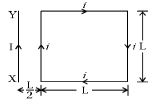
A
$\frac{{\mu _0}Ii}{{2\pi }}$
B
$\frac{{2{\mu _0}Ii}}{{3\pi }}$
C
$\frac{{{\mu _0}IiL}}{{2\pi }}$
D
$\frac{{{\mu _0}Ii}}{{3\pi }}$
Solution
(B) The force on a current-carrying wire near a long straight conductor is given by $F = \frac{{\mu _0}IiL}{2\pi r}$.
For the side of the loop nearest to the wire (distance $r_1 = L/2$),the current flows in the same direction as the wire $XY$. The force $F_1$ is attractive:
$F_1 = \frac{{\mu _0}IiL}{2\pi (L/2)} = \frac{{\mu _0}Ii}{\pi}$.
For the side of the loop farthest from the wire (distance $r_2 = L/2 + L = 3L/2$),the current flows in the opposite direction to the wire $XY$. The force $F_2$ is repulsive:
$F_2 = \frac{{\mu _0}IiL}{2\pi (3L/2)} = \frac{{\mu _0}Ii}{3\pi}$.
The forces on the top and bottom sides of the loop are equal and opposite,so they cancel out.
The net force is $F_{net} = F_1 - F_2 = \frac{{\mu _0}Ii}{\pi} - \frac{{\mu _0}Ii}{3\pi} = \frac{{\mu _0}Ii}{\pi} (1 - 1/3) = \frac{2{\mu _0}Ii}{3\pi}$.
For the side of the loop nearest to the wire (distance $r_1 = L/2$),the current flows in the same direction as the wire $XY$. The force $F_1$ is attractive:
$F_1 = \frac{{\mu _0}IiL}{2\pi (L/2)} = \frac{{\mu _0}Ii}{\pi}$.
For the side of the loop farthest from the wire (distance $r_2 = L/2 + L = 3L/2$),the current flows in the opposite direction to the wire $XY$. The force $F_2$ is repulsive:
$F_2 = \frac{{\mu _0}IiL}{2\pi (3L/2)} = \frac{{\mu _0}Ii}{3\pi}$.
The forces on the top and bottom sides of the loop are equal and opposite,so they cancel out.
The net force is $F_{net} = F_1 - F_2 = \frac{{\mu _0}Ii}{\pi} - \frac{{\mu _0}Ii}{3\pi} = \frac{{\mu _0}Ii}{\pi} (1 - 1/3) = \frac{2{\mu _0}Ii}{3\pi}$.
0 likesView Solution
56
PhysicsMediumMCQNEET · 2016
$A$ long straight wire of radius $a$ carries a steady current $I$. The current is uniformly distributed over its cross-section. The ratio of the magnetic fields $B$ and $B'$,at radial distances $\frac{a}{2}$ and $2a$ respectively,from the axis of the wire is
A
$1/2$
B
$1$
C
$4$
D
$1/4$
Solution
(B) For a long straight wire of radius $a$ carrying a steady current $I$ uniformly distributed over its cross-section:
$1$. The magnetic field $B$ at a distance $r$ inside the wire $(r < a)$ is given by $B = \frac{\mu_0 I r}{2 \pi a^2}$.
For $r = \frac{a}{2}$,we have $B = \frac{\mu_0 I (a/2)}{2 \pi a^2} = \frac{\mu_0 I}{4 \pi a}$.
$2$. The magnetic field $B'$ at a distance $r$ outside the wire $(r > a)$ is given by $B' = \frac{\mu_0 I}{2 \pi r}$.
For $r = 2a$,we have $B' = \frac{\mu_0 I}{2 \pi (2a)} = \frac{\mu_0 I}{4 \pi a}$.
$3$. The ratio of the magnetic fields is $\frac{B}{B'} = \frac{\frac{\mu_0 I}{4 \pi a}}{\frac{\mu_0 I}{4 \pi a}} = 1$.
$1$. The magnetic field $B$ at a distance $r$ inside the wire $(r < a)$ is given by $B = \frac{\mu_0 I r}{2 \pi a^2}$.
For $r = \frac{a}{2}$,we have $B = \frac{\mu_0 I (a/2)}{2 \pi a^2} = \frac{\mu_0 I}{4 \pi a}$.
$2$. The magnetic field $B'$ at a distance $r$ outside the wire $(r > a)$ is given by $B' = \frac{\mu_0 I}{2 \pi r}$.
For $r = 2a$,we have $B' = \frac{\mu_0 I}{2 \pi (2a)} = \frac{\mu_0 I}{4 \pi a}$.
$3$. The ratio of the magnetic fields is $\frac{B}{B'} = \frac{\frac{\mu_0 I}{4 \pi a}}{\frac{\mu_0 I}{4 \pi a}} = 1$.
0 likesView Solution
57
PhysicsMediumMCQNEET · 2016
$A$ bar magnet is hung by a thin cotton thread in a uniform horizontal magnetic field and is in equilibrium state. The energy required to rotate it by $60^{\circ}$ is $W$. Now,the torque required to keep the magnet in this new position is
A
$\frac{\sqrt{3} W}{2}$
B
$\frac{2W}{\sqrt{3}}$
C
$\frac{W}{\sqrt{3}}$
D
$\sqrt{3} W$
Solution
(D) At equilibrium,the initial potential energy of the dipole is $U_{i} = -MB_{H} \cos 0^{\circ} = -MB_{H}$.
The final potential energy of the dipole after rotating by $60^{\circ}$ is $U_{f} = -MB_{H} \cos 60^{\circ} = -\frac{MB_{H}}{2}$.
The work done $W$ is the change in potential energy: $W = U_{f} - U_{i} = -\frac{MB_{H}}{2} - (-MB_{H}) = \frac{MB_{H}}{2}$.
From this,we get $MB_{H} = 2W$.
The torque required to keep the magnet in this new position is $\tau = MB_{H} \sin 60^{\circ}$.
Substituting $MB_{H} = 2W$,we get $\tau = (2W) \times \frac{\sqrt{3}}{2} = \sqrt{3} W$.
The final potential energy of the dipole after rotating by $60^{\circ}$ is $U_{f} = -MB_{H} \cos 60^{\circ} = -\frac{MB_{H}}{2}$.
The work done $W$ is the change in potential energy: $W = U_{f} - U_{i} = -\frac{MB_{H}}{2} - (-MB_{H}) = \frac{MB_{H}}{2}$.
From this,we get $MB_{H} = 2W$.
The torque required to keep the magnet in this new position is $\tau = MB_{H} \sin 60^{\circ}$.
Substituting $MB_{H} = 2W$,we get $\tau = (2W) \times \frac{\sqrt{3}}{2} = \sqrt{3} W$.
0 likesView Solution
58
PhysicsEasyMCQNEET · 2016
The magnetic susceptibility is negative for
A
paramagnetic material only
B
ferromagnetic material only
C
paramagnetic and ferromagnetic materials
D
diamagnetic material only
Solution
(D) Magnetic susceptibility,denoted by $\chi$,is a measure of how much a material will become magnetized in an applied magnetic field.
For diamagnetic materials,the magnetic susceptibility $\chi$ is always negative,which means they are weakly repelled by a magnetic field.
For paramagnetic materials,$\chi$ is small and positive.
For ferromagnetic materials,$\chi$ is large and positive.
Therefore,the magnetic susceptibility is negative only for diamagnetic materials.
For diamagnetic materials,the magnetic susceptibility $\chi$ is always negative,which means they are weakly repelled by a magnetic field.
For paramagnetic materials,$\chi$ is small and positive.
For ferromagnetic materials,$\chi$ is large and positive.
Therefore,the magnetic susceptibility is negative only for diamagnetic materials.
0 likesView Solution
59
PhysicsMediumMCQNEET · 2016
The angle of incidence for a ray of light at a refracting surface of a prism is $45^o$. The angle of the prism is $60^o$. If the ray suffers minimum deviation through the prism,the angle of minimum deviation and the refractive index of the material of the prism,respectively,are:
A
$30^o, \sqrt{2}$
B
$45^o, \sqrt{2}$
C
$30^o, \frac{1}{\sqrt{2}}$
D
$45^o, \frac{1}{\sqrt{2}}$
Solution
(A) Given: Angle of incidence $i = 45^o$,Angle of prism $A = 60^o$.
Since the ray undergoes minimum deviation,the angle of emergence $e$ is equal to the angle of incidence $i$,so $e = 45^o$.
The angle of minimum deviation $\delta_m$ is given by the formula: $\delta_m = i + e - A$.
Substituting the values: $\delta_m = 45^o + 45^o - 60^o = 30^o$.
The refractive index $\mu$ is given by: $\mu = \frac{\sin((A + \delta_m)/2)}{\sin(A/2)}$.
Substituting the values: $\mu = \frac{\sin((60^o + 30^o)/2)}{\sin(60^o/2)} = \frac{\sin(45^o)}{\sin(30^o)}$.
Calculating the values: $\mu = \frac{1/\sqrt{2}}{1/2} = \frac{2}{\sqrt{2}} = \sqrt{2}$.
Thus,the angle of minimum deviation is $30^o$ and the refractive index is $\sqrt{2}$.
Since the ray undergoes minimum deviation,the angle of emergence $e$ is equal to the angle of incidence $i$,so $e = 45^o$.
The angle of minimum deviation $\delta_m$ is given by the formula: $\delta_m = i + e - A$.
Substituting the values: $\delta_m = 45^o + 45^o - 60^o = 30^o$.
The refractive index $\mu$ is given by: $\mu = \frac{\sin((A + \delta_m)/2)}{\sin(A/2)}$.
Substituting the values: $\mu = \frac{\sin((60^o + 30^o)/2)}{\sin(60^o/2)} = \frac{\sin(45^o)}{\sin(30^o)}$.
Calculating the values: $\mu = \frac{1/\sqrt{2}}{1/2} = \frac{2}{\sqrt{2}} = \sqrt{2}$.
Thus,the angle of minimum deviation is $30^o$ and the refractive index is $\sqrt{2}$.
1 likesView Solution
60
PhysicsMediumMCQNEET · 2016
An astronomical telescope has an objective and an eyepiece of focal lengths $40\, cm$ and $4\, cm$ respectively. To view an object $200\, cm$ away from the objective,the lenses must be separated by a distance of.....$cm$.
A
$46$
B
$50$
C
$54$
D
$37.3$
Solution
(C) Given: Focal length of objective $f_o = 40\, cm$,focal length of eyepiece $f_e = 4\, cm$,and object distance $u_o = -200\, cm$.
For the objective lens,using the lens formula $\frac{1}{v_o} - \frac{1}{u_o} = \frac{1}{f_o}$:
$\frac{1}{v_o} - \frac{1}{-200} = \frac{1}{40}$
$\frac{1}{v_o} = \frac{1}{40} - \frac{1}{200} = \frac{5-1}{200} = \frac{4}{200} = \frac{1}{50}$
Thus,$v_o = 50\, cm$.
For the final image to be formed at infinity (normal adjustment),the image formed by the objective must lie at the principal focus of the eyepiece. Therefore,the distance between the lenses is $l = v_o + f_e$.
$l = 50\, cm + 4\, cm = 54\, cm$.
For the objective lens,using the lens formula $\frac{1}{v_o} - \frac{1}{u_o} = \frac{1}{f_o}$:
$\frac{1}{v_o} - \frac{1}{-200} = \frac{1}{40}$
$\frac{1}{v_o} = \frac{1}{40} - \frac{1}{200} = \frac{5-1}{200} = \frac{4}{200} = \frac{1}{50}$
Thus,$v_o = 50\, cm$.
For the final image to be formed at infinity (normal adjustment),the image formed by the objective must lie at the principal focus of the eyepiece. Therefore,the distance between the lenses is $l = v_o + f_e$.
$l = 50\, cm + 4\, cm = 54\, cm$.
0 likesView Solution
61
PhysicsMediumMCQNEET · 2016
Match the corresponding entries of Column-$I$ with Column-$II$. [Where $m$ is the magnification produced by the mirror]
| Column-$I$ | Column-$II$ |
| $1$. $m = -2$ | a. Convex mirror |
| $2$. $m = -1/2$ | b. Concave mirror |
| $3$. $m = +2$ | c. Real image |
| $4$. $m = +1/2$ | d. Virtual image |
A
$(1-a, c), (2-a, d), (3-a, b), (4-c, d)$
B
$(1-a, d), (2-b, c), (3-b, d), (4-b, c)$
C
$(1-c, d), (2-b, d), (3-b, c), (4-a, d)$
D
$(1-b, c), (2-b, c), (3-b, d), (4-a, d)$
Solution
(D) The magnification for a spherical mirror is given by $m = -v/u$.
$1$. For $m = -2$: Since $m$ is negative,the image is real. $A$ real image is always inverted and formed by a concave mirror. Thus,$(1-b, c)$.
$2$. For $m = -1/2$: Since $m$ is negative,the image is real. $A$ real image is formed by a concave mirror. Thus,$(2-b, c)$.
$3$. For $m = +2$: Since $m$ is positive,the image is virtual. $A$ virtual image with magnification greater than $1$ is formed by a concave mirror. Thus,$(3-b, d)$.
$4$. For $m = +1/2$: Since $m$ is positive,the image is virtual. $A$ virtual image with magnification less than $1$ is formed by a convex mirror. Thus,$(4-a, d)$.
Therefore,the correct matching is $(1-b, c), (2-b, c), (3-b, d), (4-a, d)$.
$1$. For $m = -2$: Since $m$ is negative,the image is real. $A$ real image is always inverted and formed by a concave mirror. Thus,$(1-b, c)$.
$2$. For $m = -1/2$: Since $m$ is negative,the image is real. $A$ real image is formed by a concave mirror. Thus,$(2-b, c)$.
$3$. For $m = +2$: Since $m$ is positive,the image is virtual. $A$ virtual image with magnification greater than $1$ is formed by a concave mirror. Thus,$(3-b, d)$.
$4$. For $m = +1/2$: Since $m$ is positive,the image is virtual. $A$ virtual image with magnification less than $1$ is formed by a convex mirror. Thus,$(4-a, d)$.
Therefore,the correct matching is $(1-b, c), (2-b, c), (3-b, d), (4-a, d)$.
0 likesView Solution
62
PhysicsDifficultMCQNEET · 2016
Two identical glass $(\mu_g = 3/2)$ equiconvex lenses of focal length $f$ each are kept in contact. The space between the two lenses is filled with water $(\mu_w = 4/3).$ The focal length of the combination is
A
$\frac{4f}{3}$
B
$\frac{3f}{4}$
C
$\frac{f}{3}$
D
$f$
Solution
(B) Given: Refractive index of glass $\mu_g = 3/2$,refractive index of water $\mu_w = 4/3$.
The focal length $f$ of an equiconvex glass lens is given by the lens maker's formula:
$\frac{1}{f} = (\mu_g - 1) \left( \frac{1}{R} - \frac{1}{-R} \right) = (\frac{3}{2} - 1) \frac{2}{R} = \frac{1}{2} \cdot \frac{2}{R} = \frac{1}{R}$.
Thus,$f = R$.
The water lens formed between the two convex lenses is a biconcave lens with radii of curvature $R$. Its focal length $f_w$ is given by:
$\frac{1}{f_w} = (\mu_w - 1) \left( -\frac{1}{R} - \frac{1}{R} \right) = (\frac{4}{3} - 1) \left( -\frac{2}{R} \right) = \frac{1}{3} \cdot (-\frac{2}{R}) = -\frac{2}{3R}$.
Since $R = f$,we have $\frac{1}{f_w} = -\frac{2}{3f}$.
The combination consists of two convex lenses and one concave water lens in contact. The equivalent focal length $f_{eq}$ is:
$\frac{1}{f_{eq}} = \frac{1}{f} + \frac{1}{f_w} + \frac{1}{f} = \frac{1}{f} - \frac{2}{3f} + \frac{1}{f} = \frac{3 - 2 + 3}{3f} = \frac{4}{3f}$.
Therefore,$f_{eq} = \frac{3f}{4}$.
The focal length $f$ of an equiconvex glass lens is given by the lens maker's formula:
$\frac{1}{f} = (\mu_g - 1) \left( \frac{1}{R} - \frac{1}{-R} \right) = (\frac{3}{2} - 1) \frac{2}{R} = \frac{1}{2} \cdot \frac{2}{R} = \frac{1}{R}$.
Thus,$f = R$.
The water lens formed between the two convex lenses is a biconcave lens with radii of curvature $R$. Its focal length $f_w$ is given by:
$\frac{1}{f_w} = (\mu_w - 1) \left( -\frac{1}{R} - \frac{1}{R} \right) = (\frac{4}{3} - 1) \left( -\frac{2}{R} \right) = \frac{1}{3} \cdot (-\frac{2}{R}) = -\frac{2}{3R}$.
Since $R = f$,we have $\frac{1}{f_w} = -\frac{2}{3f}$.
The combination consists of two convex lenses and one concave water lens in contact. The equivalent focal length $f_{eq}$ is:
$\frac{1}{f_{eq}} = \frac{1}{f} + \frac{1}{f_w} + \frac{1}{f} = \frac{1}{f} - \frac{2}{3f} + \frac{1}{f} = \frac{3 - 2 + 3}{3f} = \frac{4}{3f}$.
Therefore,$f_{eq} = \frac{3f}{4}$.
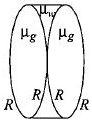
0 likesView Solution
63
PhysicsMediumMCQNEET · 2016
An air bubble in a glass slab with refractive index $1.5$ (near normal incidence) is $5\, cm$ deep when viewed from one surface and $3\, cm$ deep when viewed from the opposite face. The thickness (in $cm$) of the slab is
A
$12$
B
$16$
C
$8$
D
$10$
Solution
(A) Let the thickness of the glass slab be $t$.
Let the air bubble be at a distance $x$ from one surface. Then its distance from the opposite surface is $(t - x)$.
Given the refractive index of the glass slab is $\mu = 1.5$.
The apparent depth of the bubble from the first surface is $d_1 = \frac{x}{\mu} = 5\, cm$.
So,$x = 5 \times 1.5 = 7.5\, cm$.
The apparent depth of the bubble from the second surface is $d_2 = \frac{t - x}{\mu} = 3\, cm$.
So,$t - x = 3 \times 1.5 = 4.5\, cm$.
Adding the two equations: $x + (t - x) = 7.5 + 4.5$.
$t = 12\, cm$.
Alternatively,the sum of apparent depths is $\frac{x}{\mu} + \frac{t - x}{\mu} = \frac{t}{\mu} = 5 + 3 = 8$.
Therefore,$t = 8 \times 1.5 = 12\, cm$.
Let the air bubble be at a distance $x$ from one surface. Then its distance from the opposite surface is $(t - x)$.
Given the refractive index of the glass slab is $\mu = 1.5$.
The apparent depth of the bubble from the first surface is $d_1 = \frac{x}{\mu} = 5\, cm$.
So,$x = 5 \times 1.5 = 7.5\, cm$.
The apparent depth of the bubble from the second surface is $d_2 = \frac{t - x}{\mu} = 3\, cm$.
So,$t - x = 3 \times 1.5 = 4.5\, cm$.
Adding the two equations: $x + (t - x) = 7.5 + 4.5$.
$t = 12\, cm$.
Alternatively,the sum of apparent depths is $\frac{x}{\mu} + \frac{t - x}{\mu} = \frac{t}{\mu} = 5 + 3 = 8$.
Therefore,$t = 8 \times 1.5 = 12\, cm$.
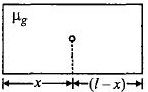
0 likesView Solution
64
PhysicsMediumMCQNEET · 2016
$A$ person can see objects clearly only when they lie between $50\, cm$ and $400\, cm$ from his eyes. In order to increase the maximum distance of distinct vision to infinity, the type and power of the correcting lens the person has to use will be
A
concave, $-0.25$ diopter
B
convex, $+0.15$ diopter
C
convex, $+2.25$ diopter
D
concave, $-0.2$ diopter
Solution
(A) The person suffers from myopia (nearsightedness) because they cannot see objects beyond $400\, cm$.
To correct this, we need to place a lens such that an object at infinity $(\infty)$ forms a virtual image at the person's far point $(400\, cm)$.
Given: Object distance $u = -\infty$, Image distance $v = -400\, cm = -4\, m$.
Using the lens formula: $\frac{1}{f} = \frac{1}{v} - \frac{1}{u}$.
Substituting the values: $\frac{1}{f} = \frac{1}{-4} - \frac{1}{-\infty} = -0.25\, m^{-1}$.
Since the focal length $f$ is negative, the lens must be concave.
The power of the lens $P = \frac{1}{f} = -0.25\, D$.
To correct this, we need to place a lens such that an object at infinity $(\infty)$ forms a virtual image at the person's far point $(400\, cm)$.
Given: Object distance $u = -\infty$, Image distance $v = -400\, cm = -4\, m$.
Using the lens formula: $\frac{1}{f} = \frac{1}{v} - \frac{1}{u}$.
Substituting the values: $\frac{1}{f} = \frac{1}{-4} - \frac{1}{-\infty} = -0.25\, m^{-1}$.
Since the focal length $f$ is negative, the lens must be concave.
The power of the lens $P = \frac{1}{f} = -0.25\, D$.
0 likesView Solution
65
PhysicsMediumMCQNEET · 2016
Electrons of mass $m$ with de-Broglie wavelength $\lambda$ fall on the target in an $X$-ray tube. The cutoff wavelength $(\lambda_0)$ of the emitted $X$-ray is
A
$\lambda_0 = \frac{2m^2c^2\lambda^3}{h^2}$
B
$\lambda_0 = \lambda$
C
$\lambda_0 = \frac{2mc\lambda^2}{h}$
D
$\lambda_0 = \frac{2h}{mc}$
Solution
(C) The kinetic energy $K$ of an electron with de-Broglie wavelength $\lambda$ is given by $K = \frac{p^2}{2m}$.
Since $p = \frac{h}{\lambda}$,we have $K = \frac{(h/\lambda)^2}{2m} = \frac{h^2}{2m\lambda^2}$.
In an $X$-ray tube,the maximum energy of an emitted $X$-ray photon is equal to the kinetic energy of the incident electron.
Therefore,$\frac{hc}{\lambda_0} = K = \frac{h^2}{2m\lambda^2}$.
Solving for $\lambda_0$,we get $\lambda_0 = \frac{hc \cdot 2m\lambda^2}{h^2} = \frac{2mc\lambda^2}{h}$.
Since $p = \frac{h}{\lambda}$,we have $K = \frac{(h/\lambda)^2}{2m} = \frac{h^2}{2m\lambda^2}$.
In an $X$-ray tube,the maximum energy of an emitted $X$-ray photon is equal to the kinetic energy of the incident electron.
Therefore,$\frac{hc}{\lambda_0} = K = \frac{h^2}{2m\lambda^2}$.
Solving for $\lambda_0$,we get $\lambda_0 = \frac{hc \cdot 2m\lambda^2}{h^2} = \frac{2mc\lambda^2}{h}$.
0 likesView Solution
66
PhysicsMediumMCQNEET · 2016
Photons with energy $5\, eV$ are incident on a cathode $C$ in a photoelectric cell. The maximum energy of emitted photoelectrons is $2\, eV.$ When photons of energy $6\, eV$ are incident on $C,$ no photoelectrons will reach the anode $A,$ if the stopping potential of $A$ relative to $C$ is ............ $V$.
A
$-1$
B
$-3$
C
$+3$
D
$+4$
Solution
(B) According to Einstein's photoelectric equation,the maximum kinetic energy of photoelectrons is given by:
$KE_{\max} = E - \phi$
For the first case,$E = 5\, eV$ and $KE_{\max} = 2\, eV$:
$2 = 5 - \phi \implies \phi = 3\, eV$
When photons of energy $E' = 6\, eV$ are incident,the new maximum kinetic energy is:
$KE'_{\max} = E' - \phi = 6 - 3 = 3\, eV$
For no photoelectrons to reach the anode $A,$ the potential of the anode relative to the cathode $(V_A - V_C)$ must be equal to the negative of the stopping potential $(V_s)$.
The stopping potential $V_s$ is defined by $e V_s = KE'_{\max} = 3\, eV,$ so $V_s = 3\, V$.
Since the anode must be at a negative potential relative to the cathode to stop the electrons,the potential difference $V_A - V_C = -3\, V$.
$KE_{\max} = E - \phi$
For the first case,$E = 5\, eV$ and $KE_{\max} = 2\, eV$:
$2 = 5 - \phi \implies \phi = 3\, eV$
When photons of energy $E' = 6\, eV$ are incident,the new maximum kinetic energy is:
$KE'_{\max} = E' - \phi = 6 - 3 = 3\, eV$
For no photoelectrons to reach the anode $A,$ the potential of the anode relative to the cathode $(V_A - V_C)$ must be equal to the negative of the stopping potential $(V_s)$.
The stopping potential $V_s$ is defined by $e V_s = KE'_{\max} = 3\, eV,$ so $V_s = 3\, V$.
Since the anode must be at a negative potential relative to the cathode to stop the electrons,the potential difference $V_A - V_C = -3\, V$.
0 likesView Solution
67
PhysicsMediumMCQNEET · 2016
An electron of mass $m$ and a photon have the same energy $E$. The ratio of the de-Broglie wavelengths associated with them is:
A
$(\frac{E}{2m})^{1/2}$
B
$C(2mE)^{1/2}$
C
$\frac{1}{C}(\frac{2m}{E})^{1/2}$
D
$\frac{1}{C}(\frac{E}{2m})^{1/2}$
Solution
(D) For an electron of energy $E$,the de-Broglie wavelength is given by $\lambda_{e} = \frac{h}{p} = \frac{h}{\sqrt{2mE}}$.
For a photon of energy $E$,the relation is $E = \frac{hc}{\lambda_{p}}$,which implies $\lambda_{p} = \frac{hc}{E}$.
Taking the ratio of the wavelengths:
$\frac{\lambda_{e}}{\lambda_{p}} = \frac{h}{\sqrt{2mE}} \times \frac{E}{hc} = \frac{1}{c} \times \frac{E^{1}}{\sqrt{E}} \times \frac{1}{\sqrt{2m}} = \frac{1}{c} \sqrt{\frac{E}{2m}} = \frac{1}{C}(\frac{E}{2m})^{1/2}$.
For a photon of energy $E$,the relation is $E = \frac{hc}{\lambda_{p}}$,which implies $\lambda_{p} = \frac{hc}{E}$.
Taking the ratio of the wavelengths:
$\frac{\lambda_{e}}{\lambda_{p}} = \frac{h}{\sqrt{2mE}} \times \frac{E}{hc} = \frac{1}{c} \times \frac{E^{1}}{\sqrt{E}} \times \frac{1}{\sqrt{2m}} = \frac{1}{c} \sqrt{\frac{E}{2m}} = \frac{1}{C}(\frac{E}{2m})^{1/2}$.
0 likesView Solution
68
PhysicsMediumMCQNEET · 2016
When a metallic surface is illuminated with radiation of wavelength $\lambda$,the stopping potential is $V$. If the same surface is illuminated with radiation of wavelength $2\lambda$,the stopping potential is $\frac{V}{4}$. The threshold wavelength for the metallic surface is:
A
$5\lambda$
B
$\frac{5}{2}\lambda$
C
$3\lambda$
D
$4\lambda$
Solution
(C) According to Einstein's photoelectric equation,the stopping potential $V_s$ is given by:
$e V_s = \frac{hc}{\lambda} - \frac{hc}{\lambda_0}$
where $\lambda_0$ is the threshold wavelength.
For the first case:
$eV = \frac{hc}{\lambda} - \frac{hc}{\lambda_0}$ ..... $(i)$
For the second case:
$e(\frac{V}{4}) = \frac{hc}{2\lambda} - \frac{hc}{\lambda_0}$ ..... $(ii)$
Multiply equation $(ii)$ by $4$:
$eV = \frac{4hc}{2\lambda} - \frac{4hc}{\lambda_0} = \frac{2hc}{\lambda} - \frac{4hc}{\lambda_0}$ ..... $(iii)$
Equating $(i)$ and $(iii)$:
$\frac{hc}{\lambda} - \frac{hc}{\lambda_0} = \frac{2hc}{\lambda} - \frac{4hc}{\lambda_0}$
$\frac{4hc}{\lambda_0} - \frac{hc}{\lambda_0} = \frac{2hc}{\lambda} - \frac{hc}{\lambda}$
$\frac{3hc}{\lambda_0} = \frac{hc}{\lambda}$
$\lambda_0 = 3\lambda$
$e V_s = \frac{hc}{\lambda} - \frac{hc}{\lambda_0}$
where $\lambda_0$ is the threshold wavelength.
For the first case:
$eV = \frac{hc}{\lambda} - \frac{hc}{\lambda_0}$ ..... $(i)$
For the second case:
$e(\frac{V}{4}) = \frac{hc}{2\lambda} - \frac{hc}{\lambda_0}$ ..... $(ii)$
Multiply equation $(ii)$ by $4$:
$eV = \frac{4hc}{2\lambda} - \frac{4hc}{\lambda_0} = \frac{2hc}{\lambda} - \frac{4hc}{\lambda_0}$ ..... $(iii)$
Equating $(i)$ and $(iii)$:
$\frac{hc}{\lambda} - \frac{hc}{\lambda_0} = \frac{2hc}{\lambda} - \frac{4hc}{\lambda_0}$
$\frac{4hc}{\lambda_0} - \frac{hc}{\lambda_0} = \frac{2hc}{\lambda} - \frac{hc}{\lambda}$
$\frac{3hc}{\lambda_0} = \frac{hc}{\lambda}$
$\lambda_0 = 3\lambda$
0 likesView Solution
69
PhysicsMediumMCQNEET · 2016
$A$ long solenoid has $1000$ turns. When a current of $4\, A$ flows through it,the magnetic flux linked with each turn of the solenoid is $4 \times 10^{-3}\, Wb$. The self-inductance of the solenoid is......$H$
A
$3$
B
$2$
C
$1$
D
$4$
Solution
(C) Given: Number of turns $N = 1000$,Current $I = 4\, A$,Magnetic flux per turn $\phi_{0} = 4 \times 10^{-3}\, Wb$.
The total magnetic flux $\phi$ linked with the solenoid is given by $\phi = N \phi_{0}$.
Substituting the values,$\phi = 1000 \times 4 \times 10^{-3}\, Wb = 4\, Wb$.
We know that the relation between flux and self-inductance $L$ is $\phi = L I$.
Therefore,the self-inductance $L = \frac{\phi}{I} = \frac{4\, Wb}{4\, A} = 1\, H$.
The total magnetic flux $\phi$ linked with the solenoid is given by $\phi = N \phi_{0}$.
Substituting the values,$\phi = 1000 \times 4 \times 10^{-3}\, Wb = 4\, Wb$.
We know that the relation between flux and self-inductance $L$ is $\phi = L I$.
Therefore,the self-inductance $L = \frac{\phi}{I} = \frac{4\, Wb}{4\, A} = 1\, H$.
0 likesView Solution
70
PhysicsMediumMCQNEET · 2016
$A$ uniform magnetic field is restricted within a region of radius $r$. The magnetic field changes with time at a rate $\frac{d\vec{B}}{dt}$. Loop $1$ of radius $R > r$ encloses the region,and loop $2$ of radius $R$ is outside the region of the magnetic field as shown in the figure. Then the $e.m.f.$ generated is:
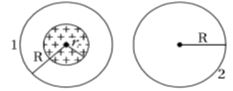
A
$-\frac{d\vec{B}}{dt}\pi R^2$ in loop $1$ and zero in loop $2$
B
$-\frac{d\vec{B}}{dt}\pi r^2$ in loop $1$ and $0$ in loop $2$
C
zero in loop $1$ and zero in loop $2$
D
$-\frac{d\vec{B}}{dt}\pi r^2$ in loop $1$ and $-\frac{d\vec{B}}{dt}\pi r^2$ in loop $2$
Solution
(B) According to Faraday's law of electromagnetic induction,the induced $e.m.f.$ is given by $\varepsilon = -\frac{d\phi}{dt}$.
For loop $1$ (radius $R > r$): The magnetic flux $\phi_1$ is linked only with the region of radius $r$ where the magnetic field exists. Thus,$\phi_1 = B \cdot A = B(\pi r^2)$.
The induced $e.m.f.$ is $\varepsilon_1 = -\frac{d}{dt}(B \pi r^2) = -\pi r^2 \frac{dB}{dt}$.
For loop $2$ (radius $R$): The loop is completely outside the region where the magnetic field exists. Therefore,the magnetic flux linked with loop $2$ is $\phi_2 = 0$.
The induced $e.m.f.$ is $\varepsilon_2 = -\frac{d\phi_2}{dt} = 0$.
For loop $1$ (radius $R > r$): The magnetic flux $\phi_1$ is linked only with the region of radius $r$ where the magnetic field exists. Thus,$\phi_1 = B \cdot A = B(\pi r^2)$.
The induced $e.m.f.$ is $\varepsilon_1 = -\frac{d}{dt}(B \pi r^2) = -\pi r^2 \frac{dB}{dt}$.
For loop $2$ (radius $R$): The loop is completely outside the region where the magnetic field exists. Therefore,the magnetic flux linked with loop $2$ is $\phi_2 = 0$.
The induced $e.m.f.$ is $\varepsilon_2 = -\frac{d\phi_2}{dt} = 0$.
0 likesView Solution
71
PhysicsMediumMCQNEET · 2016
The potential differences across the resistance,capacitance,and inductance are $80 \, V$,$40 \, V$,and $100 \, V$ respectively in an $L-C-R$ circuit. The power factor of this circuit is:
A
$0.8$
B
$1$
C
$0.4$
D
$0.5$
Solution
(A) Given: $V_{R} = 80 \, V$,$V_{C} = 40 \, V$,$V_{L} = 100 \, V$.
The power factor of an $L-C-R$ circuit is given by $\cos \phi = \frac{R}{Z}$.
Since $V = IZ$ and $V_{R} = IR$,we can write $\cos \phi = \frac{V_{R}}{V}$.
The total voltage $V$ in an $L-C-R$ circuit is $V = \sqrt{V_{R}^{2} + (V_{L} - V_{C})^{2}}$.
Substituting the given values:
$V = \sqrt{80^{2} + (100 - 40)^{2}}$
$V = \sqrt{80^{2} + 60^{2}}$
$V = \sqrt{6400 + 3600} = \sqrt{10000} = 100 \, V$.
Now,calculate the power factor:
$\cos \phi = \frac{V_{R}}{V} = \frac{80}{100} = 0.8$.
The power factor of an $L-C-R$ circuit is given by $\cos \phi = \frac{R}{Z}$.
Since $V = IZ$ and $V_{R} = IR$,we can write $\cos \phi = \frac{V_{R}}{V}$.
The total voltage $V$ in an $L-C-R$ circuit is $V = \sqrt{V_{R}^{2} + (V_{L} - V_{C})^{2}}$.
Substituting the given values:
$V = \sqrt{80^{2} + (100 - 40)^{2}}$
$V = \sqrt{80^{2} + 60^{2}}$
$V = \sqrt{6400 + 3600} = \sqrt{10000} = 100 \, V$.
Now,calculate the power factor:
$\cos \phi = \frac{V_{R}}{V} = \frac{80}{100} = 0.8$.
0 likesView Solution
72
PhysicsEasyMCQNEET · 2016
$A$ small signal voltage $V(t) = V_0 \sin(\omega t)$ is applied across an ideal capacitor $C$. Which of the following statements is correct?
A
Over a full cycle,the capacitor $C$ does not consume any energy from the voltage source.
B
Current $I(t)$ is in phase with voltage $V(t)$.
C
Current $I(t)$ leads voltage $V(t)$ by $180^\circ$.
D
Current $I(t)$ lags voltage $V(t)$ by $90^\circ$.
Solution
(A) When an ideal capacitor is connected to an $AC$ voltage source,the current $I(t)$ leads the voltage $V(t)$ by a phase angle of $90^\circ$.
Since the energy stored in the capacitor during the charging phase is returned to the circuit during the discharging phase,the net energy consumed by an ideal capacitor over a complete cycle is zero.
Therefore,statement $A$ is the correct statement.
Since the energy stored in the capacitor during the charging phase is returned to the circuit during the discharging phase,the net energy consumed by an ideal capacitor over a complete cycle is zero.
Therefore,statement $A$ is the correct statement.
0 likesView Solution
73
PhysicsDifficultMCQNEET · 2016
An inductor $20 \, mH$,a capacitor $50 \, \mu F$ and a resistor $40 \, \Omega$ are connected in series across a source of emf $V = 10 \, \sin \, 340t$. The power loss in the $A.C.$ circuit is ...... $W$.
A
$0.67$
B
$0.76$
C
$0.89$
D
$0.46$
Solution
(D) Given: $L = 20 \, mH = 20 \times 10^{-3} \, H$,$C = 50 \, \mu F = 50 \times 10^{-6} \, F$,$R = 40 \, \Omega$,$V = 10 \, \sin \, 340t$.
Comparing with $V = V_0 \sin \omega t$,we get $V_0 = 10 \, V$ and $\omega = 340 \, rad/s$.
Inductive reactance $X_L = \omega L = 340 \times 20 \times 10^{-3} = 6.8 \, \Omega$.
Capacitive reactance $X_C = \frac{1}{\omega C} = \frac{1}{340 \times 50 \times 10^{-6}} = \frac{10^6}{17000} \approx 58.82 \, \Omega$.
Impedance $Z = \sqrt{R^2 + (X_C - X_L)^2} = \sqrt{40^2 + (58.82 - 6.8)^2} = \sqrt{1600 + (52.02)^2} = \sqrt{1600 + 2706.08} = \sqrt{4306.08} \approx 65.62 \, \Omega$.
Peak current $I_0 = \frac{V_0}{Z} = \frac{10}{65.62} \, A$.
Power factor $\cos \phi = \frac{R}{Z} = \frac{40}{65.62}$.
Power loss $P = V_{rms} I_{rms} \cos \phi = \frac{1}{2} V_0 I_0 \cos \phi = \frac{1}{2} \times 10 \times \frac{10}{65.62} \times \frac{40}{65.62} = \frac{2000}{4306} \approx 0.46 \, W$.
Comparing with $V = V_0 \sin \omega t$,we get $V_0 = 10 \, V$ and $\omega = 340 \, rad/s$.
Inductive reactance $X_L = \omega L = 340 \times 20 \times 10^{-3} = 6.8 \, \Omega$.
Capacitive reactance $X_C = \frac{1}{\omega C} = \frac{1}{340 \times 50 \times 10^{-6}} = \frac{10^6}{17000} \approx 58.82 \, \Omega$.
Impedance $Z = \sqrt{R^2 + (X_C - X_L)^2} = \sqrt{40^2 + (58.82 - 6.8)^2} = \sqrt{1600 + (52.02)^2} = \sqrt{1600 + 2706.08} = \sqrt{4306.08} \approx 65.62 \, \Omega$.
Peak current $I_0 = \frac{V_0}{Z} = \frac{10}{65.62} \, A$.
Power factor $\cos \phi = \frac{R}{Z} = \frac{40}{65.62}$.
Power loss $P = V_{rms} I_{rms} \cos \phi = \frac{1}{2} V_0 I_0 \cos \phi = \frac{1}{2} \times 10 \times \frac{10}{65.62} \times \frac{40}{65.62} = \frac{2000}{4306} \approx 0.46 \, W$.
0 likesView Solution
74
PhysicsMediumMCQNEET · 2016
$A$ $100 \, \Omega$ resistance and a capacitor of $100 \, \Omega$ reactance are connected in series across a $220 \, V$ source. When the capacitor is $50\%$ charged,the peak value of the displacement current is.....$A$
A
$4.4$
B
$11\sqrt{2}$
C
$2.2$
D
$11$
Solution
(C) Given: Resistance $R = 100 \, \Omega$,Capacitive reactance $X_C = 100 \, \Omega$,and $RMS$ voltage $V_{rms} = 220 \, V$.
The total impedance of the $RC$ series circuit is $Z = \sqrt{R^2 + X_C^2} = \sqrt{100^2 + 100^2} = 100\sqrt{2} \, \Omega$.
The peak voltage of the source is $V_0 = V_{rms} \sqrt{2} = 220\sqrt{2} \, V$.
The peak conduction current in the circuit is $I_0 = \frac{V_0}{Z} = \frac{220\sqrt{2}}{100\sqrt{2}} = 2.2 \, A$.
According to Maxwell's modification of Ampere's law,the displacement current $I_d$ between the plates of a capacitor is equal to the conduction current $I_c$ in the connecting wires.
Therefore,the peak value of the displacement current is equal to the peak value of the conduction current,which is $2.2 \, A$.
The total impedance of the $RC$ series circuit is $Z = \sqrt{R^2 + X_C^2} = \sqrt{100^2 + 100^2} = 100\sqrt{2} \, \Omega$.
The peak voltage of the source is $V_0 = V_{rms} \sqrt{2} = 220\sqrt{2} \, V$.
The peak conduction current in the circuit is $I_0 = \frac{V_0}{Z} = \frac{220\sqrt{2}}{100\sqrt{2}} = 2.2 \, A$.
According to Maxwell's modification of Ampere's law,the displacement current $I_d$ between the plates of a capacitor is equal to the conduction current $I_c$ in the connecting wires.
Therefore,the peak value of the displacement current is equal to the peak value of the conduction current,which is $2.2 \, A$.
0 likesView Solution
75
PhysicsEasyMCQNEET · 2016
Out of the following options,which one can be used to produce a propagating electromagnetic wave?
A
$A$ stationary charge
B
$A$ chargeless particle
C
An accelerating charge
D
$A$ charge moving at constant velocity
Solution
(C) According to Maxwell's theory,an accelerating charge produces time-varying electric and magnetic fields. These oscillating fields propagate through space as an electromagnetic wave. $A$ stationary charge produces only a static electric field,and a charge moving at a constant velocity produces a steady magnetic field along with an electric field,but neither generates a propagating electromagnetic wave.
0 likesView Solution
76
PhysicsMediumMCQNEET · 2016
$A$ linear aperture whose width is $0.02\, cm$ is placed immediately in front of a lens of focal length $60\, cm.$ The aperture is illuminated normally by a parallel beam of wavelength $5 \times 10^{-5}\, cm.$ The distance of the first dark band of the diffraction pattern from the centre of the screen is .....$cm$
A
$0.20$
B
$0.15$
C
$0.10$
D
$0.25$
Solution
(B) Given:
Width of aperture $a = 0.02\, cm = 2 \times 10^{-4}\, m$
Wavelength $\lambda = 5 \times 10^{-5}\, cm = 5 \times 10^{-7}\, m$
Focal length of lens $f = 60\, cm = 0.6\, m$. Since the screen is at the focal plane,the distance $D = f = 0.6\, m$.
For Fraunhofer diffraction at a single slit,the condition for the $n^{th}$ dark band (minima) is given by $a \sin \theta = n\lambda$.
For the first dark band,$n = 1$,so $\sin \theta \approx \theta = \frac{\lambda}{a}$.
The distance from the centre of the screen is $y_1 = D \theta = \frac{D\lambda}{a}$.
Substituting the values:
$y_1 = \frac{0.6 \times 5 \times 10^{-7}}{2 \times 10^{-4}} = \frac{3 \times 10^{-7}}{2 \times 10^{-4}} = 1.5 \times 10^{-3}\, m = 0.15\, cm$.
Width of aperture $a = 0.02\, cm = 2 \times 10^{-4}\, m$
Wavelength $\lambda = 5 \times 10^{-5}\, cm = 5 \times 10^{-7}\, m$
Focal length of lens $f = 60\, cm = 0.6\, m$. Since the screen is at the focal plane,the distance $D = f = 0.6\, m$.
For Fraunhofer diffraction at a single slit,the condition for the $n^{th}$ dark band (minima) is given by $a \sin \theta = n\lambda$.
For the first dark band,$n = 1$,so $\sin \theta \approx \theta = \frac{\lambda}{a}$.
The distance from the centre of the screen is $y_1 = D \theta = \frac{D\lambda}{a}$.
Substituting the values:
$y_1 = \frac{0.6 \times 5 \times 10^{-7}}{2 \times 10^{-4}} = \frac{3 \times 10^{-7}}{2 \times 10^{-4}} = 1.5 \times 10^{-3}\, m = 0.15\, cm$.
0 likesView Solution
77
PhysicsMediumMCQNEET · 2016
In a diffraction pattern due to a single slit of width $a$,the first minimum is observed at an angle $30^{\circ}$ when light of wavelength $5000 \; \mathring{A}$ is incident on the slit. The first secondary maximum is observed at an angle of
A
$sin^{-1} \left( \frac{2}{3} \right)$
B
$sin^{-1} \left( \frac{1}{2} \right)$
C
$sin^{-1} \left( \frac{3}{4} \right)$
D
$sin^{-1} \left( \frac{1}{4} \right)$
Solution
(C) For the first minimum in a single slit diffraction pattern,the condition is given by $a \sin \theta = n \lambda$. For the first minimum,$n = 1$,so $a \sin \theta = \lambda$.
Given $\theta = 30^{\circ}$,we have $\sin 30^{\circ} = \frac{1}{2}$.
Thus,$a (\frac{1}{2}) = \lambda$,which implies $a = 2 \lambda$ ..... $(i)$.
For the first secondary maximum,the condition is $a \sin \theta' = (n + \frac{1}{2}) \lambda$ where $n = 1$. So,$a \sin \theta' = \frac{3}{2} \lambda$.
Substituting $a = 2 \lambda$ from equation $(i)$ into this expression:
$(2 \lambda) \sin \theta' = \frac{3}{2} \lambda$.
Dividing both sides by $2 \lambda$,we get $\sin \theta' = \frac{3}{4}$.
Therefore,$\theta' = \sin^{-1} \left( \frac{3}{4} \right)$.
Given $\theta = 30^{\circ}$,we have $\sin 30^{\circ} = \frac{1}{2}$.
Thus,$a (\frac{1}{2}) = \lambda$,which implies $a = 2 \lambda$ ..... $(i)$.
For the first secondary maximum,the condition is $a \sin \theta' = (n + \frac{1}{2}) \lambda$ where $n = 1$. So,$a \sin \theta' = \frac{3}{2} \lambda$.
Substituting $a = 2 \lambda$ from equation $(i)$ into this expression:
$(2 \lambda) \sin \theta' = \frac{3}{2} \lambda$.
Dividing both sides by $2 \lambda$,we get $\sin \theta' = \frac{3}{4}$.
Therefore,$\theta' = \sin^{-1} \left( \frac{3}{4} \right)$.
0 likesView Solution
78
PhysicsDifficultMCQNEET · 2016
The intensity at the maximum in a Young's double slit experiment is $I_0$. The distance between two slits is $d = 5\lambda$,where $\lambda$ is the wavelength of light used in the experiment. What will be the intensity in front of one of the slits on the screen placed at a distance $D = 10d$?
A
$\frac{I_0}{4}$
B
$\frac{3}{4}I_0$
C
$\frac{I_0}{2}$
D
$I_0$
Solution
(C) Given: $d = 5\lambda$,$D = 10d$,and the position in front of one slit is $y = \frac{d}{2}$.
The path difference $\Delta x$ at position $y$ is given by $\Delta x = d \sin \theta \approx d \tan \theta = d \left( \frac{y}{D} \right)$.
Substituting the values: $\Delta x = d \left( \frac{d/2}{10d} \right) = \frac{d}{20} = \frac{5\lambda}{20} = \frac{\lambda}{4}$.
The phase difference $\phi$ is $\phi = \frac{2\pi}{\lambda} \Delta x = \frac{2\pi}{\lambda} \left( \frac{\lambda}{4} \right) = \frac{\pi}{2}$.
In a Young's double slit experiment,the resultant intensity $I_y$ is given by $I_y = I_1 + I_2 + 2\sqrt{I_1 I_2} \cos \phi$.
Since $I_1 = I_2 = I$,we have $I_{max} = I + I + 2\sqrt{I^2} = 4I = I_0$,so $I = \frac{I_0}{4}$.
Substituting $\phi = \frac{\pi}{2}$ into the intensity formula:
$I_y = I + I + 2I \cos(\frac{\pi}{2}) = 2I + 0 = 2I$.
Since $I = \frac{I_0}{4}$,the intensity $I_y = 2 \left( \frac{I_0}{4} \right) = \frac{I_0}{2}$.
The path difference $\Delta x$ at position $y$ is given by $\Delta x = d \sin \theta \approx d \tan \theta = d \left( \frac{y}{D} \right)$.
Substituting the values: $\Delta x = d \left( \frac{d/2}{10d} \right) = \frac{d}{20} = \frac{5\lambda}{20} = \frac{\lambda}{4}$.
The phase difference $\phi$ is $\phi = \frac{2\pi}{\lambda} \Delta x = \frac{2\pi}{\lambda} \left( \frac{\lambda}{4} \right) = \frac{\pi}{2}$.
In a Young's double slit experiment,the resultant intensity $I_y$ is given by $I_y = I_1 + I_2 + 2\sqrt{I_1 I_2} \cos \phi$.
Since $I_1 = I_2 = I$,we have $I_{max} = I + I + 2\sqrt{I^2} = 4I = I_0$,so $I = \frac{I_0}{4}$.
Substituting $\phi = \frac{\pi}{2}$ into the intensity formula:
$I_y = I + I + 2I \cos(\frac{\pi}{2}) = 2I + 0 = 2I$.
Since $I = \frac{I_0}{4}$,the intensity $I_y = 2 \left( \frac{I_0}{4} \right) = \frac{I_0}{2}$.
0 likesView Solution
79
PhysicsMediumMCQNEET · 2016
Two coherent sources of intensity ratio $\alpha$ interfere. The value of $\frac{I_{max} - I_{min}}{I_{max} + I_{min}}$ is
A
$\frac{2\sqrt{\alpha}}{1 + \alpha}$
B
$\frac{1 + \alpha}{2\sqrt{\alpha}}$
C
$\frac{1 + \alpha}{1 - \alpha}$
D
$2\sqrt{\frac{\alpha}{1 + \alpha}}$
Solution
(A) Let the intensities of the two sources be $I_1$ and $I_2$ such that $\frac{I_1}{I_2} = \alpha$. Since $I \propto A^2$,we have $\frac{A_1}{A_2} = \sqrt{\alpha}$.
The maximum and minimum intensities in an interference pattern are given by $I_{max} = (A_1 + A_2)^2$ and $I_{min} = (A_1 - A_2)^2$.
We need to calculate the value of $\frac{I_{max} - I_{min}}{I_{max} + I_{min}}$.
Substituting the expressions for $I_{max}$ and $I_{min}$:
$\frac{I_{max} - I_{min}}{I_{max} + I_{min}} = \frac{(A_1 + A_2)^2 - (A_1 - A_2)^2}{(A_1 + A_2)^2 + (A_1 - A_2)^2}$
Expanding the squares:
$= \frac{(A_1^2 + A_2^2 + 2A_1A_2) - (A_1^2 + A_2^2 - 2A_1A_2)}{(A_1^2 + A_2^2 + 2A_1A_2) + (A_1^2 + A_2^2 - 2A_1A_2)}$
$= \frac{4A_1A_2}{2(A_1^2 + A_2^2)} = \frac{2A_1A_2}{A_1^2 + A_2^2}$
Dividing the numerator and denominator by $A_2^2$:
$= \frac{2(A_1/A_2)}{(A_1/A_2)^2 + 1}$
Since $\frac{A_1}{A_2} = \sqrt{\alpha}$,we substitute this into the expression:
$= \frac{2\sqrt{\alpha}}{(\sqrt{\alpha})^2 + 1} = \frac{2\sqrt{\alpha}}{\alpha + 1}$.
The maximum and minimum intensities in an interference pattern are given by $I_{max} = (A_1 + A_2)^2$ and $I_{min} = (A_1 - A_2)^2$.
We need to calculate the value of $\frac{I_{max} - I_{min}}{I_{max} + I_{min}}$.
Substituting the expressions for $I_{max}$ and $I_{min}$:
$\frac{I_{max} - I_{min}}{I_{max} + I_{min}} = \frac{(A_1 + A_2)^2 - (A_1 - A_2)^2}{(A_1 + A_2)^2 + (A_1 - A_2)^2}$
Expanding the squares:
$= \frac{(A_1^2 + A_2^2 + 2A_1A_2) - (A_1^2 + A_2^2 - 2A_1A_2)}{(A_1^2 + A_2^2 + 2A_1A_2) + (A_1^2 + A_2^2 - 2A_1A_2)}$
$= \frac{4A_1A_2}{2(A_1^2 + A_2^2)} = \frac{2A_1A_2}{A_1^2 + A_2^2}$
Dividing the numerator and denominator by $A_2^2$:
$= \frac{2(A_1/A_2)}{(A_1/A_2)^2 + 1}$
Since $\frac{A_1}{A_2} = \sqrt{\alpha}$,we substitute this into the expression:
$= \frac{2\sqrt{\alpha}}{(\sqrt{\alpha})^2 + 1} = \frac{2\sqrt{\alpha}}{\alpha + 1}$.
0 likesView Solution
80
PhysicsMediumMCQNEET · 2016
Given the value of Rydberg constant is $10^7 \, m^{-1}$,the wave number of the last line of the Balmer series in the hydrogen spectrum will be:
A
$0.5 \times 10^7 \, m^{-1}$
B
$0.25 \times 10^7 \, m^{-1}$
C
$2.5 \times 10^7 \, m^{-1}$
D
$0.025 \times 10^4 \, m^{-1}$
Solution
(B) The wave number $\bar{\nu}$ for the hydrogen spectrum is given by the Rydberg formula: $\bar{\nu} = R \left( \frac{1}{n_1^2} - \frac{1}{n_2^2} \right)$.
For the Balmer series,the transition ends at $n_1 = 2$.
The last line of the Balmer series corresponds to the transition from $n_2 = \infty$ to $n_1 = 2$.
Given $R = 10^7 \, m^{-1}$,we substitute the values:
$\bar{\nu} = 10^7 \left( \frac{1}{2^2} - \frac{1}{\infty^2} \right) = 10^7 \left( \frac{1}{4} - 0 \right) = \frac{10^7}{4} = 0.25 \times 10^7 \, m^{-1}$.
For the Balmer series,the transition ends at $n_1 = 2$.
The last line of the Balmer series corresponds to the transition from $n_2 = \infty$ to $n_1 = 2$.
Given $R = 10^7 \, m^{-1}$,we substitute the values:
$\bar{\nu} = 10^7 \left( \frac{1}{2^2} - \frac{1}{\infty^2} \right) = 10^7 \left( \frac{1}{4} - 0 \right) = \frac{10^7}{4} = 0.25 \times 10^7 \, m^{-1}$.
0 likesView Solution
81
PhysicsMediumMCQNEET · 2016
If an electron in a hydrogen atom jumps from the $3^{rd}$ orbit to the $2^{nd}$ orbit,it emits a photon of wavelength $\lambda$. When it jumps from the $4^{th}$ orbit to the $3^{rd}$ orbit,the corresponding wavelength of the photon will be
A
$\frac{20}{7}\lambda$
B
$\frac{20}{13}\lambda$
C
$\frac{16}{25}\lambda$
D
$\frac{9}{16}\lambda$
Solution
(A) The Rydberg formula for the wavelength of emitted radiation is given by $\frac{1}{\lambda} = R \left( \frac{1}{n_{f}^{2}} - \frac{1}{n_{i}^{2}} \right)$.
For the transition from $n_i = 3$ to $n_f = 2$:
$\frac{1}{\lambda} = R \left( \frac{1}{2^{2}} - \frac{1}{3^{2}} \right) = R \left( \frac{1}{4} - \frac{1}{9} \right) = R \left( \frac{9-4}{36} \right) = \frac{5R}{36}$.
For the transition from $n_i = 4$ to $n_f = 3$:
$\frac{1}{\lambda'} = R \left( \frac{1}{3^{2}} - \frac{1}{4^{2}} \right) = R \left( \frac{1}{9} - \frac{1}{16} \right) = R \left( \frac{16-9}{144} \right) = \frac{7R}{144}$.
Taking the ratio of the two equations:
$\frac{\lambda'}{\lambda} = \frac{5R/36}{7R/144} = \frac{5}{36} \times \frac{144}{7} = \frac{5 \times 4}{7} = \frac{20}{7}$.
Therefore,$\lambda' = \frac{20}{7}\lambda$.
For the transition from $n_i = 3$ to $n_f = 2$:
$\frac{1}{\lambda} = R \left( \frac{1}{2^{2}} - \frac{1}{3^{2}} \right) = R \left( \frac{1}{4} - \frac{1}{9} \right) = R \left( \frac{9-4}{36} \right) = \frac{5R}{36}$.
For the transition from $n_i = 4$ to $n_f = 3$:
$\frac{1}{\lambda'} = R \left( \frac{1}{3^{2}} - \frac{1}{4^{2}} \right) = R \left( \frac{1}{9} - \frac{1}{16} \right) = R \left( \frac{16-9}{144} \right) = \frac{7R}{144}$.
Taking the ratio of the two equations:
$\frac{\lambda'}{\lambda} = \frac{5R/36}{7R/144} = \frac{5}{36} \times \frac{144}{7} = \frac{5 \times 4}{7} = \frac{20}{7}$.
Therefore,$\lambda' = \frac{20}{7}\lambda$.
0 likesView Solution
82
PhysicsMediumMCQNEET · 2016
When an $\alpha$-particle of mass $m$ moving with velocity $v$ bombards a heavy nucleus of charge $Ze$,its distance of closest approach from the nucleus depends on $m$ as
A
$1/m^2$
B
$m$
C
$1/m$
D
$1/\sqrt{m}$
Solution
(C) The distance of closest approach $(r_0)$ is the distance at which the initial kinetic energy of the $\alpha$-particle is completely converted into electrostatic potential energy.
Equating kinetic energy to potential energy:
$\frac{1}{2}mv^2 = \frac{1}{4\pi\varepsilon_0} \cdot \frac{(Ze)(2e)}{r_0}$
Solving for $r_0$:
$r_0 = \frac{2Ze^2}{4\pi\varepsilon_0 \cdot \frac{1}{2}mv^2} = \frac{Ze^2}{\pi\varepsilon_0 mv^2}$
Since $Z$,$e$,$\varepsilon_0$,and $v$ are constants for a given experiment,we have:
$r_0 \propto \frac{1}{m}$
Equating kinetic energy to potential energy:
$\frac{1}{2}mv^2 = \frac{1}{4\pi\varepsilon_0} \cdot \frac{(Ze)(2e)}{r_0}$
Solving for $r_0$:
$r_0 = \frac{2Ze^2}{4\pi\varepsilon_0 \cdot \frac{1}{2}mv^2} = \frac{Ze^2}{\pi\varepsilon_0 mv^2}$
Since $Z$,$e$,$\varepsilon_0$,and $v$ are constants for a given experiment,we have:
$r_0 \propto \frac{1}{m}$
0 likesView Solution
83
PhysicsMediumMCQNEET · 2016
The half-life of a radioactive substance is $30$ minutes. The time (in minutes) taken between $40\%$ decay and $85\%$ decay of the same radioactive substance is
A
$45$
B
$60$
C
$15$
D
$30$
Solution
(B) Let $N_{0}$ be the initial number of nuclei at time $t=0$.
$N_{1}$ is the number of remaining nuclei after $40\%$ decay:
$N_{1} = (1 - 0.40) N_{0} = 0.6 N_{0}$
$N_{2}$ is the number of remaining nuclei after $85\%$ decay:
$N_{2} = (1 - 0.85) N_{0} = 0.15 N_{0}$
Now,find the ratio of remaining nuclei:
$\frac{N_{2}}{N_{1}} = \frac{0.15 N_{0}}{0.6 N_{0}} = \frac{1}{4} = \left(\frac{1}{2}\right)^{2}$
Since $\frac{N_{2}}{N_{1}} = \left(\frac{1}{2}\right)^{n}$,where $n$ is the number of half-lives,we have $n = 2$.
Therefore,the time taken is $t = n \times T_{1/2} = 2 \times 30 \text{ minutes} = 60 \text{ minutes}$.
$N_{1}$ is the number of remaining nuclei after $40\%$ decay:
$N_{1} = (1 - 0.40) N_{0} = 0.6 N_{0}$
$N_{2}$ is the number of remaining nuclei after $85\%$ decay:
$N_{2} = (1 - 0.85) N_{0} = 0.15 N_{0}$
Now,find the ratio of remaining nuclei:
$\frac{N_{2}}{N_{1}} = \frac{0.15 N_{0}}{0.6 N_{0}} = \frac{1}{4} = \left(\frac{1}{2}\right)^{2}$
Since $\frac{N_{2}}{N_{1}} = \left(\frac{1}{2}\right)^{n}$,where $n$ is the number of half-lives,we have $n = 2$.
Therefore,the time taken is $t = n \times T_{1/2} = 2 \times 30 \text{ minutes} = 60 \text{ minutes}$.
0 likesView Solution
84
PhysicsMediumMCQNEET · 2016
For a $CE$ transistor amplifier,the audio signal voltage across the collector resistance of $2 \, k\Omega$ is $4 \, V$. If the current amplification factor $(\beta)$ of the transistor is $100$ and the base resistance is $1 \, k\Omega$,then the input signal voltage is ....... $mV$.
A
$30$
B
$15$
C
$10$
D
$20$
Solution
(D) Given: Collector resistance $R_C = 2 \, k\Omega = 2000 \, \Omega$,Output voltage $V_0 = 4 \, V$,Current amplification factor $\beta = 100$,Base resistance $R_B = 1 \, k\Omega = 1000 \, \Omega$.
The voltage gain $A_v$ of a $CE$ amplifier is given by the formula: $A_v = \beta \times \frac{R_C}{R_B}$.
Substituting the values: $A_v = 100 \times \frac{2000}{1000} = 200$.
We know that voltage gain $A_v = \frac{V_0}{V_i}$,where $V_i$ is the input signal voltage.
Therefore,$V_i = \frac{V_0}{A_v} = \frac{4 \, V}{200} = 0.02 \, V$.
Converting to millivolts $(mV)$: $V_i = 0.02 \times 1000 \, mV = 20 \, mV$.
The voltage gain $A_v$ of a $CE$ amplifier is given by the formula: $A_v = \beta \times \frac{R_C}{R_B}$.
Substituting the values: $A_v = 100 \times \frac{2000}{1000} = 200$.
We know that voltage gain $A_v = \frac{V_0}{V_i}$,where $V_i$ is the input signal voltage.
Therefore,$V_i = \frac{V_0}{A_v} = \frac{4 \, V}{200} = 0.02 \, V$.
Converting to millivolts $(mV)$: $V_i = 0.02 \times 1000 \, mV = 20 \, mV$.
0 likesView Solution
85
PhysicsMediumMCQNEET · 2016
The given circuit has two ideal diodes connected as shown in the figure. The current flowing through the resistance $R_1$ will be.....$ A$
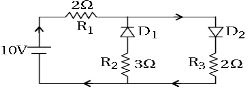
A
$1.43$
B
$3.13$
C
$2.5$
D
$10$
Solution
(C) In the given circuit,diode $D_1$ is reverse biased because its p-terminal is at a lower potential than its n-terminal,so it acts as an open circuit and blocks the current.
Diode $D_2$ is forward biased because its p-terminal is at a higher potential than its n-terminal,so it acts as a closed switch (ideal diode).
Hence,the equivalent circuit consists of the $10 \ V$ battery,resistance $R_1 = 2 \ \Omega$,and resistance $R_3 = 2 \ \Omega$ in series.
The total resistance of the circuit is $R_{eq} = R_1 + R_3 = 2 \ \Omega + 2 \ \Omega = 4 \ \Omega$.
The current flowing through the resistance $R_1$ is given by $I = \frac{V}{R_{eq}} = \frac{10 \ V}{4 \ \Omega} = 2.5 \ A$.
Diode $D_2$ is forward biased because its p-terminal is at a higher potential than its n-terminal,so it acts as a closed switch (ideal diode).
Hence,the equivalent circuit consists of the $10 \ V$ battery,resistance $R_1 = 2 \ \Omega$,and resistance $R_3 = 2 \ \Omega$ in series.
The total resistance of the circuit is $R_{eq} = R_1 + R_3 = 2 \ \Omega + 2 \ \Omega = 4 \ \Omega$.
The current flowing through the resistance $R_1$ is given by $I = \frac{V}{R_{eq}} = \frac{10 \ V}{4 \ \Omega} = 2.5 \ A$.
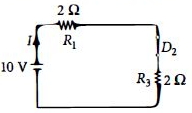
0 likesView Solution
86
PhysicsEasyMCQNEET · 2016
Consider the junction diode as ideal. The value of current flowing through $AB$ is
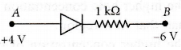
A
$10^{-2}\;A$
B
$10^{-1}\;A$
C
$10^{-3}\;A$
D
$0\;A$
Solution
(A) The $p-n$ junction diode is forward biased because the $p$-terminal is at a higher potential $(+4\;V)$ than the $n$-terminal $(-6\;V)$.
An ideal diode in forward bias acts as a short circuit (zero resistance).
Therefore,the current $I_{AB}$ flowing through the circuit is given by Ohm's law:
$I_{AB} = \frac{V_A - V_B}{R} = \frac{4\;V - (-6\;V)}{1\;k\Omega} = \frac{10\;V}{1000\;\Omega} = 10^{-2}\;A$.
An ideal diode in forward bias acts as a short circuit (zero resistance).
Therefore,the current $I_{AB}$ flowing through the circuit is given by Ohm's law:
$I_{AB} = \frac{V_A - V_B}{R} = \frac{4\;V - (-6\;V)}{1\;k\Omega} = \frac{10\;V}{1000\;\Omega} = 10^{-2}\;A$.
0 likesView Solution
87
PhysicsMediumMCQNEET · 2016
$A$ $npn$ transistor is connected in common emitter configuration in a given amplifier. $A$ load resistance of $800 \,\,\Omega$ is connected in the collector circuit and the voltage drop across it is $0.8 \,\, V$. If the current amplification factor is $0.96$ and the input resistance of the circuit is $192 \,\,\Omega$,the voltage gain and the power gain of the amplifier will respectively be
A
$3.69, 3.84$
B
$4, 4$
C
$4, 3.69$
D
$4, 3.84$
Solution
(D) Given: Load resistance $R_L = 800 \,\,\Omega$,Input resistance $R_i = 192 \,\,\Omega$,Current amplification factor $\beta = 0.96$.
The voltage gain $(A_v)$ for a common emitter amplifier is given by the formula:
$A_v = \beta \times \frac{R_L}{R_i}$
Substituting the values:
$A_v = 0.96 \times \frac{800}{192} = 0.96 \times 4.166... = 4$.
The power gain $(A_p)$ is given by the product of current gain and voltage gain:
$A_p = \beta \times A_v$
Substituting the values:
$A_p = 0.96 \times 4 = 3.84$.
Thus,the voltage gain is $4$ and the power gain is $3.84$.
The voltage gain $(A_v)$ for a common emitter amplifier is given by the formula:
$A_v = \beta \times \frac{R_L}{R_i}$
Substituting the values:
$A_v = 0.96 \times \frac{800}{192} = 0.96 \times 4.166... = 4$.
The power gain $(A_p)$ is given by the product of current gain and voltage gain:
$A_p = \beta \times A_v$
Substituting the values:
$A_p = 0.96 \times 4 = 3.84$.
Thus,the voltage gain is $4$ and the power gain is $3.84$.
0 likesView Solution
88
PhysicsEasyMCQNEET · 2016
What is the output $Y$ in the following circuit, when all the three inputs $A, B, C$ are first '$0$' and then '$1$'?
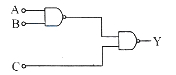
A
$0, 0$
B
$0, 1$
C
$1, 0$
D
$1, 1$
Solution
(C) The given circuit consists of two $NAND$ gates. Let the output of the first $NAND$ gate be $X$. The inputs to this gate are $A$ and $B$. Thus, $X = \overline{A \cdot B}$.
The second $NAND$ gate takes $X$ and $C$ as inputs. Thus, the final output $Y = \overline{X \cdot C} = \overline{(\overline{A \cdot B}) \cdot C}$.
Case $1$: When $A = 0, B = 0, C = 0$:
$X = \overline{0 \cdot 0} = \overline{0} = 1$.
$Y = \overline{1 \cdot 0} = \overline{0} = 1$.
Case $2$: When $A = 1, B = 1, C = 1$:
$X = \overline{1 \cdot 1} = \overline{1} = 0$.
$Y = \overline{0 \cdot 1} = \overline{0} = 1$.
Wait, re-evaluating the circuit diagram: The first gate is a $NAND$ gate, and the second gate is also a $NAND$ gate. Let's re-check the logic.
For $A=0, B=0, C=0$: $X = \overline{0 \cdot 0} = 1$. Then $Y = \overline{1 \cdot 0} = 1$.
For $A=1, B=1, C=1$: $X = \overline{1 \cdot 1} = 0$. Then $Y = \overline{0 \cdot 1} = 1$.
Looking at the provided solution image, the first gate is actually an $AND$ gate. Let's re-read the diagram. The first gate is an $AND$ gate, and the second is a $NAND$ gate.
If first is $AND$: $X = A \cdot B$. Then $Y = \overline{X \cdot C} = \overline{(A \cdot B) \cdot C}$.
Case $1$: $A=0, B=0, C=0 \implies X = 0 \cdot 0 = 0 \implies Y = \overline{0 \cdot 0} = 1$.
Case $2$: $A=1, B=1, C=1 \implies X = 1 \cdot 1 = 1 \implies Y = \overline{1 \cdot 1} = 0$.
Thus, the outputs are $1, 0$. The correct option is $C$.
The second $NAND$ gate takes $X$ and $C$ as inputs. Thus, the final output $Y = \overline{X \cdot C} = \overline{(\overline{A \cdot B}) \cdot C}$.
Case $1$: When $A = 0, B = 0, C = 0$:
$X = \overline{0 \cdot 0} = \overline{0} = 1$.
$Y = \overline{1 \cdot 0} = \overline{0} = 1$.
Case $2$: When $A = 1, B = 1, C = 1$:
$X = \overline{1 \cdot 1} = \overline{1} = 0$.
$Y = \overline{0 \cdot 1} = \overline{0} = 1$.
Wait, re-evaluating the circuit diagram: The first gate is a $NAND$ gate, and the second gate is also a $NAND$ gate. Let's re-check the logic.
For $A=0, B=0, C=0$: $X = \overline{0 \cdot 0} = 1$. Then $Y = \overline{1 \cdot 0} = 1$.
For $A=1, B=1, C=1$: $X = \overline{1 \cdot 1} = 0$. Then $Y = \overline{0 \cdot 1} = 1$.
Looking at the provided solution image, the first gate is actually an $AND$ gate. Let's re-read the diagram. The first gate is an $AND$ gate, and the second is a $NAND$ gate.
If first is $AND$: $X = A \cdot B$. Then $Y = \overline{X \cdot C} = \overline{(A \cdot B) \cdot C}$.
Case $1$: $A=0, B=0, C=0 \implies X = 0 \cdot 0 = 0 \implies Y = \overline{0 \cdot 0} = 1$.
Case $2$: $A=1, B=1, C=1 \implies X = 1 \cdot 1 = 1 \implies Y = \overline{1 \cdot 1} = 0$.
Thus, the outputs are $1, 0$. The correct option is $C$.
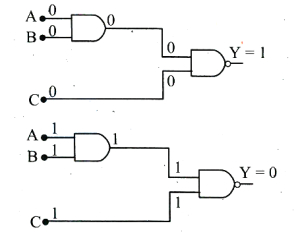
0 likesView Solution
89
PhysicsEasyMCQNEET · 2016
Which of the following combinations should be selected for better tuning of an $L-C-R$ circuit used for communication?
A
$R=20 \Omega, L=1.5 \text{ H}, C=35 \mu\text{F}$
B
$R=25 \Omega, L=2.5 \text{ H}, C=45 \mu\text{F}$
C
$R=25 \Omega, L=1.5 \text{ H}, C=45 \mu\text{F}$
D
$R=15 \Omega, L=3.5 \text{ H}, C=30 \mu\text{F}$
Solution
(D) For better tuning of an $L-C-R$ circuit used in communication,the quality factor $Q$ must be high.
The formula for the quality factor is $Q = \frac{1}{R} \sqrt{\frac{L}{C}}$.
To maximize $Q$,we need a small resistance $R$,a large inductance $L$,and a small capacitance $C$.
Comparing the given options:
$A: R=20, L=1.5, C=35$
$B: R=25, L=2.5, C=45$
$C: R=25, L=1.5, C=45$
$D: R=15, L=3.5, C=30$
Option $D$ has the minimum resistance $(15 \Omega)$,the maximum inductance $(3.5 \text{ H})$,and the minimum capacitance $(30 \mu\text{F})$.
Therefore,the combination in option $D$ provides the highest quality factor,resulting in better tuning.
The formula for the quality factor is $Q = \frac{1}{R} \sqrt{\frac{L}{C}}$.
To maximize $Q$,we need a small resistance $R$,a large inductance $L$,and a small capacitance $C$.
Comparing the given options:
$A: R=20, L=1.5, C=35$
$B: R=25, L=2.5, C=45$
$C: R=25, L=1.5, C=45$
$D: R=15, L=3.5, C=30$
Option $D$ has the minimum resistance $(15 \Omega)$,the maximum inductance $(3.5 \text{ H})$,and the minimum capacitance $(30 \mu\text{F})$.
Therefore,the combination in option $D$ provides the highest quality factor,resulting in better tuning.
0 likesView Solution
Vedclass Products
For Students
Vedclass Test Series
Mock tests in real NEET style covering Physics with performance analysis. 5-day free trial.
Start Free TrialFor Teachers
Exam Paper Generator
Generate Set A/B/C/D Physics papers from 7.5L+ questions in 2 minutes. 3 chapters free.
Try FreeFor Institutes
Online Exam Module
Run live NEET mock exams with unlimited students, 360° analytics & white-label branding.
See DemoFrequently Asked Questions
How many Physics questions are in NEET 2016?
There are 89 Physics questions from the NEET 2016 paper on Vedclass, each with a detailed step-by-step solution in English.
Are NEET 2016 Physics solutions available in English?
Yes. All solutions on this page are in English. You can also switch to English or Hindi using the language buttons above the questions.
Can I practice NEET 2016 Physics as a timed test?
Yes. Use the Vedclass Test Series to attempt a full NEET mock test covering Physics with time limits and instant score analysis.
Can teachers create Physics papers from NEET previous year questions?
Yes. The Vedclass Exam Paper Generator lets teachers mix NEET Physics questions and generate Set A/B/C/D papers in minutes.
For Teachers & Institutes
Build a Custom Physics Paper
Pick NEET 2016 Physics questions, set difficulty, and generate Set A/B/C/D in 2 minutes.