
BiologyQ1–100 of 201 questions
Page 1 of 3 · English
1
BiologyEasyMCQNEET · 2016
The label of a herbarium sheet does not carry information on
A
date of collection
B
name of collector
C
local names
D
height of the plant
Solution
(D) The correct answer is $(d)$. $A$ herbarium is a collection of dried,pressed,and preserved plant specimens mounted on sheets,which are identified and classified according to an accepted system.
$A$ standard herbarium sheet label $(7 \ cm \times 12 \ cm)$ is fixed on the lower right corner,which typically includes the following information:
$(i)$ Scientific name of the plant
$(ii)$ Common or vernacular name
$(iii)$ Family
$(iv)$ Locality
$(v)$ Date of collection
$(vi)$ Collection number
$(vii)$ Name of the collector
$(viii)$ Name of the institution.
The height of the plant is not a standard piece of information recorded on the herbarium sheet label.
$A$ standard herbarium sheet label $(7 \ cm \times 12 \ cm)$ is fixed on the lower right corner,which typically includes the following information:
$(i)$ Scientific name of the plant
$(ii)$ Common or vernacular name
$(iii)$ Family
$(iv)$ Locality
$(v)$ Date of collection
$(vi)$ Collection number
$(vii)$ Name of the collector
$(viii)$ Name of the institution.
The height of the plant is not a standard piece of information recorded on the herbarium sheet label.
0 likesView Solution
2
BiologyMediumMCQNEET · 2016
Match column $I$ with column $II$ for housefly classification and select the correct option using the codes given below.
| Column-$I$ | Column-$II$ |
|---|---|
| $(A)$ Family | $(i)$ Diptera |
| $(B)$ Order | $(ii)$ Arthropoda |
| $(C)$ Class | $(iii)$ Muscidae |
| $(D)$ Phylum | $(iv)$ Insecta |
A
$A-(iii), B-(i), C-(iv), D-(ii)$
B
$A-(iii), B-(ii), C-(iv), D-(i)$
C
$A-(iv), B-(iii), C-(ii), D-(i)$
D
$A-(iv), B-(ii), C-(i), D-(iii)$
Solution
(A) The taxonomic classification of the housefly (Musca domestica) is as follows:
$1$. Family: Muscidae
$2$. Order: Diptera
$3$. Class: Insecta
$4$. Phylum: Arthropoda
Matching these with the given columns:
$(A)$ Family corresponds to $(iii)$ Muscidae.
$(B)$ Order corresponds to $(i)$ Diptera.
$(C)$ Class corresponds to $(iv)$ Insecta.
$(D)$ Phylum corresponds to $(ii)$ Arthropoda.
Therefore,the correct sequence is $A-(iii), B-(i), C-(iv), D-(ii)$.
$1$. Family: Muscidae
$2$. Order: Diptera
$3$. Class: Insecta
$4$. Phylum: Arthropoda
Matching these with the given columns:
$(A)$ Family corresponds to $(iii)$ Muscidae.
$(B)$ Order corresponds to $(i)$ Diptera.
$(C)$ Class corresponds to $(iv)$ Insecta.
$(D)$ Phylum corresponds to $(ii)$ Arthropoda.
Therefore,the correct sequence is $A-(iii), B-(i), C-(iv), D-(ii)$.
0 likesView Solution
3
BiologyMediumMCQNEET · 2016
Study the four statements $(A-D)$ given below and select the two correct ones out of them.
$A.$ Definition of biological species was given by Ernst Mayr.
$B.$ Photoperiod does not affect reproduction in plants.
$C.$ Binomial nomenclature system was given by $R$.$H$. Whittaker.
$D.$ In unicellular organisms,reproduction is synonymous with growth.
The two correct statements are:
$A.$ Definition of biological species was given by Ernst Mayr.
$B.$ Photoperiod does not affect reproduction in plants.
$C.$ Binomial nomenclature system was given by $R$.$H$. Whittaker.
$D.$ In unicellular organisms,reproduction is synonymous with growth.
The two correct statements are:
A
$B$ and $C$
B
$C$ and $D$
C
$A$ and $D$
D
$A$ and $B$
Solution
(C) Statement $A$ is correct: Ernst Mayr defined biological species.
Statement $B$ is incorrect: Photoperiod affects reproduction in seasonal breeders,both plants and animals.
Statement $C$ is incorrect: Binomial nomenclature was given by Carolus Linnaeus,not $R$.$H$. Whittaker.
Statement $D$ is correct: In unicellular organisms like bacteria,algae,and amoeba,reproduction is synonymous with growth as it involves an increase in the number of cells.
Therefore,statements $A$ and $D$ are correct.
Statement $B$ is incorrect: Photoperiod affects reproduction in seasonal breeders,both plants and animals.
Statement $C$ is incorrect: Binomial nomenclature was given by Carolus Linnaeus,not $R$.$H$. Whittaker.
Statement $D$ is correct: In unicellular organisms like bacteria,algae,and amoeba,reproduction is synonymous with growth as it involves an increase in the number of cells.
Therefore,statements $A$ and $D$ are correct.
0 likesView Solution
4
BiologyMediumMCQNEET · 2016
Nomenclature is governed by certain universal rules. Which one of the following is contrary to the rules of nomenclature?
A
The names are written in Latin and are italicised.
B
When written by hand the names are to be underlined.
C
Biological names can be written in any language.
D
The first word in a biological name represents the genus name and the second is a specific epithet.
Solution
(C) : Biological names are derived from Latin or are Latinised. This is because Latin is a dead language,and therefore,its form or spellings do not change with the passage of time. Writing them in any other language is contrary to the universal rules of nomenclature.
0 likesView Solution
5
BiologyMediumMCQNEET · 2016
Which one of the following is wrong for fungi?
A
They are eukaryotic.
B
All fungi possess a purely cellulosic cell wall.
C
They are heterotrophic.
D
They are both unicellular and multicellular.
Solution
(B) The correct answer is $B$. Fungi are eukaryotic,heterotrophic organisms that can be unicellular (e.g.,yeast) or multicellular. The cell wall of fungi is primarily composed of $Chitin$,which is a complex polysaccharide of $N$-acetyl-$D$-glucosamine,not cellulose. Cellulose is the primary component of the cell wall in plants.
0 likesView Solution
6
BiologyMediumMCQNEET · 2016
Methanogens belong to
A
eubacteria
B
archaebacteria
C
dinoflagellates
D
slime moulds
Solution
(B) $Methanogens$ belong to $Archaebacteria$.
They include methane-producing genera such as $Methanobacillus$ and $Methanothrix$.
$Methanogens$ are obligate anaerobes found in oxygen-deficient environments,such as marshes,swamps,sludge (formed during sewage treatment),and the digestive systems of ruminants.
Mostly,they obtain their energy by reducing carbon dioxide $(CO_2)$ and oxidising hydrogen $(H_2)$,with the production of methane $(CH_4)$.
They include methane-producing genera such as $Methanobacillus$ and $Methanothrix$.
$Methanogens$ are obligate anaerobes found in oxygen-deficient environments,such as marshes,swamps,sludge (formed during sewage treatment),and the digestive systems of ruminants.
Mostly,they obtain their energy by reducing carbon dioxide $(CO_2)$ and oxidising hydrogen $(H_2)$,with the production of methane $(CH_4)$.
0 likesView Solution
7
BiologyMediumMCQNEET · 2016
Select the wrong statement.
A
The walls of diatoms are easily destructible.
B
'Diatomaceous earth' is formed by the cell walls of diatoms.
C
Diatoms are chief producers in the oceans.
D
Diatoms are microscopic and float passively in water.
Solution
(A) : The cell walls of diatoms are composed of silica,which makes them indestructible and resistant to decay.
Because of this,they accumulate over billions of years to form 'diatomaceous earth'.
Therefore,the statement that the walls of diatoms are easily destructible is incorrect.
Because of this,they accumulate over billions of years to form 'diatomaceous earth'.
Therefore,the statement that the walls of diatoms are easily destructible is incorrect.
0 likesView Solution
8
BiologyMediumMCQNEET · 2016
Which one of the following statements is wrong?
A
Eubacteria are also called false bacteria.
B
Phycomycetes are also called algal fungi.
C
Cyanobacteria are also called blue-green algae.
D
Golden algae are also called desmids.
Solution
(A) The correct answer is $A$.
$A$: Eubacteria are known as 'true bacteria',not 'false bacteria'. Therefore,this statement is incorrect.
$B$: Phycomycetes are commonly referred to as 'algal fungi' because their mycelium is aseptate and coenocytic,resembling algae.
$C$: Cyanobacteria are photosynthetic prokaryotes commonly known as 'blue-green algae'.
$D$: Golden algae (Chrysophytes) include diatoms and desmids.
$A$: Eubacteria are known as 'true bacteria',not 'false bacteria'. Therefore,this statement is incorrect.
$B$: Phycomycetes are commonly referred to as 'algal fungi' because their mycelium is aseptate and coenocytic,resembling algae.
$C$: Cyanobacteria are photosynthetic prokaryotes commonly known as 'blue-green algae'.
$D$: Golden algae (Chrysophytes) include diatoms and desmids.
0 likesView Solution
9
BiologyMediumMCQNEET · 2016
Which of the following statements is wrong for viroids?
A
They cause infections.
B
Their $RNA$ is of high molecular weight.
C
They lack a protein coat.
D
They are smaller than viruses.
Solution
(B) The correct answer is $B$. Viroids are infectious agents that consist only of a short strand of circular single-stranded $RNA$ without a protein coat. $A$ key characteristic of viroid $RNA$ is that it has a low molecular weight compared to the $RNA$ found in viruses. Therefore,the statement that their $RNA$ is of high molecular weight is incorrect.
0 likesView Solution
10
BiologyMediumMCQNEET · 2016
One of the major components of the cell wall of most fungi is
A
cellulose
B
hemicellulose
C
chitin
D
peptidoglycan
Solution
(C) The correct answer is $C$. The cell wall of most fungi is primarily composed of $chitin$,which is a complex polysaccharide made of $N$-acetylglucosamine units. In addition to $chitin$,the fungal cell wall may also contain other polysaccharides,proteins,lipids,and various other substances.
0 likesView Solution
11
BiologyMediumMCQNEET · 2016
Chrysophytes,Euglenoids,Dinoflagellates and Slime moulds are included in the Kingdom
A
Fungi
B
Animalia
C
Monera
D
Protista
Solution
(D) The correct answer is $D$.
Kingdom $Protista$ includes all unicellular eukaryotic organisms.
This group consists of photosynthetic protists such as chrysophytes,dinoflagellates,and euglenoids,as well as saprophytic protists like slime moulds and various protozoan protists.
Kingdom $Protista$ includes all unicellular eukaryotic organisms.
This group consists of photosynthetic protists such as chrysophytes,dinoflagellates,and euglenoids,as well as saprophytic protists like slime moulds and various protozoan protists.
0 likesView Solution
12
BiologyMediumMCQNEET · 2016
Conifers are adapted to tolerate extreme environmental conditions because of
A
broad hardy leaves
B
superficial stomata
C
thick cuticle
D
presence of vessels
Solution
(C) Conifers are gymnosperms that exhibit xerophytic adaptations to survive in harsh,cold,or dry environments.
These adaptations include needle-like leaves,a thick waxy cuticle,and sunken stomata,which help in reducing the rate of transpiration and preventing water loss.
Therefore,the presence of a thick cuticle is a key adaptation for tolerating extreme environmental conditions.
These adaptations include needle-like leaves,a thick waxy cuticle,and sunken stomata,which help in reducing the rate of transpiration and preventing water loss.
Therefore,the presence of a thick cuticle is a key adaptation for tolerating extreme environmental conditions.
0 likesView Solution
13
BiologyMediumMCQNEET · 2016
Which one of the following statements is wrong?
A
Algae increase the level of dissolved oxygen in the immediate environment.
B
Algin is obtained from red algae,and carrageenan from brown algae.
C
Agar-agar is obtained from Gelidium and Gracilaria.
D
Laminaria and Sargassum are used as food.
Solution
(B) is the incorrect statement. Algin (alginic acid) is obtained from the cell walls of brown algae (Phaeophyceae),while carrageenan is obtained from red algae (Rhodophyceae). Therefore,the statement claiming Algin is from red algae and carrageenan from brown algae is false.
0 likesView Solution
14
BiologyMediumMCQNEET · 2016
Select the correct statement.
A
Sequoia is one of the tallest trees.
B
The leaves of gymnosperms are not well adapted to extremes of climate.
C
Gymnosperms are both homosporous and heterosporous.
D
Salvinia, Ginkgo and Pinus all are gymnosperms.
Solution
(A) : $Sequoia \text{ } sempervirens$ is the tallest gymnosperm.
$B$: The leaves of gymnosperms are well adapted to extremes of climate (e.g., needle-like leaves, thick cuticle, and sunken stomata), which helps them survive in harsh conditions.
$C$: Gymnosperms are heterosporous, meaning they produce two different kinds of spores: microspores and megaspores.
$D$: $Salvinia$ is an aquatic pteridophyte, not a gymnosperm. $Ginkgo$ and $Pinus$ are gymnosperms.
$B$: The leaves of gymnosperms are well adapted to extremes of climate (e.g., needle-like leaves, thick cuticle, and sunken stomata), which helps them survive in harsh conditions.
$C$: Gymnosperms are heterosporous, meaning they produce two different kinds of spores: microspores and megaspores.
$D$: $Salvinia$ is an aquatic pteridophyte, not a gymnosperm. $Ginkgo$ and $Pinus$ are gymnosperms.
0 likesView Solution
15
BiologyEasyMCQNEET · 2016
In bryophytes and pteridophytes,transport of male gametes requires
A
birds
B
water
C
wind
D
insects
Solution
(B) The correct answer is $B$.
In bryophytes and pteridophytes,the male gametes (antherozoids) are flagellated and motile.
They require an external medium,specifically water,to swim and reach the female reproductive organ,the archegonium,for fertilization.
Therefore,water is essential for the transport of male gametes in these plant groups.
In bryophytes and pteridophytes,the male gametes (antherozoids) are flagellated and motile.
They require an external medium,specifically water,to swim and reach the female reproductive organ,the archegonium,for fertilization.
Therefore,water is essential for the transport of male gametes in these plant groups.
0 likesView Solution
16
BiologyMediumMCQNEET · 2016
Choose the correct statement.
A
All mammals are viviparous.
B
All cyclostomes do not possess jaws and paired fins.
C
All reptiles have a three-chambered heart.
D
All pisces have gills covered by an operculum.
Solution
(B) The correct statement is $B$.
$A$: Incorrect,because some mammals like $Ornithorhynchus$ (platypus) and $Tachyglossus$ (echidna (echidna) are oviparous.
$B$: Correct,all cyclostomes are characterized by the absence of jaws and paired fins.
$C$: Incorrect,because crocodiles are reptiles that possess a four-chambered heart.
$D$: Incorrect,because in cartilaginous fish (Chondrichthyes),gills are not covered by an operculum,except in $Chimaera$.
$A$: Incorrect,because some mammals like $Ornithorhynchus$ (platypus) and $Tachyglossus$ (echidna (echidna) are oviparous.
$B$: Correct,all cyclostomes are characterized by the absence of jaws and paired fins.
$C$: Incorrect,because crocodiles are reptiles that possess a four-chambered heart.
$D$: Incorrect,because in cartilaginous fish (Chondrichthyes),gills are not covered by an operculum,except in $Chimaera$.
0 likesView Solution
17
BiologyMediumMCQNEET · 2016
Which one of the following characteristics is not shared by birds and mammals?
A
Viviparity
B
Warm-blooded nature
C
Ossified endoskeleton
D
Breathing using lungs
Solution
(A) : Viviparity is not a shared characteristic.
All birds are oviparous (egg-laying),whereas most mammals are viviparous (giving birth to young ones).
Exceptions among mammals include monotremes like $Ornithorhynchus$ (duck-billed platypus) and $Tachyglossus$ (spiny anteater),which are oviparous.
However,since the majority of mammals are viviparous and all birds are oviparous,viviparity is not a common trait shared by both groups.
All birds are oviparous (egg-laying),whereas most mammals are viviparous (giving birth to young ones).
Exceptions among mammals include monotremes like $Ornithorhynchus$ (duck-billed platypus) and $Tachyglossus$ (spiny anteater),which are oviparous.
However,since the majority of mammals are viviparous and all birds are oviparous,viviparity is not a common trait shared by both groups.
0 likesView Solution
18
BiologyMediumMCQNEET · 2016
Which of the following characteristic features always holds true for the corresponding group of animals?
A
Possess a mouth with an upper and a lower jaw $\implies$ Chordata
B
$3$-chambered heart with one incompletely divided ventricle $\implies$ Reptilia
C
Cartilaginous endoskeleton $\implies$ Chondrichthyes
D
Viviparous $\implies$ Mammalia
Solution
(C) is the correct answer.
$1$. Phylum Chordata includes both jawless vertebrates (Agnatha) and jawed vertebrates (Gnathostomata). Therefore,not all chordates possess jaws.
$2$. Most reptiles have a $3$-chambered heart with one incompletely divided ventricle,but crocodiles have a $4$-chambered heart.
$3$. Class Chondrichthyes consists of cartilaginous fishes,which always possess a cartilaginous endoskeleton.
$4$. While most mammals are viviparous,some like the duck-billed platypus and spiny anteater are oviparous.
$1$. Phylum Chordata includes both jawless vertebrates (Agnatha) and jawed vertebrates (Gnathostomata). Therefore,not all chordates possess jaws.
$2$. Most reptiles have a $3$-chambered heart with one incompletely divided ventricle,but crocodiles have a $4$-chambered heart.
$3$. Class Chondrichthyes consists of cartilaginous fishes,which always possess a cartilaginous endoskeleton.
$4$. While most mammals are viviparous,some like the duck-billed platypus and spiny anteater are oviparous.
0 likesView Solution
19
BiologyMediumMCQNEET · 2016
Which of the following features is not present in the Phylum Arthropoda?
A
Parapodia
B
Jointed appendages
C
Chitinous exoskeleton
D
Metameric segmentation
Solution
(A) : Parapodia are flattened,fleshy,lateral outgrowths of the body wall found in $Annelida$. These are not present in $Arthropoda$. $Arthropoda$ are characterized by jointed appendages,a chitinous exoskeleton,and metameric segmentation. Parapodia serve the purpose of locomotion and respiration in annelids like $Nereis$.
0 likesView Solution
20
BiologyEasyMCQNEET · 2016
The term 'polyadelphous' is related to
A
gynoecium
B
androecium
C
corolla
D
calyx
Solution
(B) The term 'polyadelphous' refers to the cohesion of stamens.
In this condition,the filaments of the stamens are fused together to form more than two bundles or groups,while the anthers remain free.
Since stamens constitute the androecium of a flower,this term is related to the androecium.
An example of this condition is found in $Citrus$.
In this condition,the filaments of the stamens are fused together to form more than two bundles or groups,while the anthers remain free.
Since stamens constitute the androecium of a flower,this term is related to the androecium.
An example of this condition is found in $Citrus$.
0 likesView Solution
21
BiologyMediumMCQNEET · 2016
How many plants among $Indigofera$,$Sesbania$,$Salvia$,$Allium$,$Aloe$,mustard,groundnut,radish,gram,and turnip have stamens with different lengths in their flowers?
A
Three
B
Four
C
Five
D
Six
Solution
(B) The plants listed are $Indigofera$,$Sesbania$,$Salvia$,$Allium$,$Aloe$,mustard,groundnut,radish,gram,and turnip.
Stamens with different lengths in flowers are characteristic of specific families:
$1$. $Salvia$ (Family $Lamiaceae$): Exhibits didynamous condition (two long and two short stamens).
$2$. Mustard ($Brassica$ $campestris$): Exhibits tetradynamous condition (four long and two short stamens).
$3$. Radish ($Raphanus$ $sativus$): Exhibits tetradynamous condition (four long and two short stamens).
$4$. Turnip ($Brassica$ $rapa$): Exhibits tetradynamous condition (four long and two short stamens).
$Indigofera$,$Sesbania$,$gram$,and $groundnut$ (Family $Fabaceae$) have diadelphous stamens but generally uniform lengths.
$Allium$ and $Aloe$ (Family $Liliaceae$) have stamens of similar lengths.
Therefore,there are $4$ plants ($Salvia$,mustard,radish,and turnip) that have stamens with different lengths.
Stamens with different lengths in flowers are characteristic of specific families:
$1$. $Salvia$ (Family $Lamiaceae$): Exhibits didynamous condition (two long and two short stamens).
$2$. Mustard ($Brassica$ $campestris$): Exhibits tetradynamous condition (four long and two short stamens).
$3$. Radish ($Raphanus$ $sativus$): Exhibits tetradynamous condition (four long and two short stamens).
$4$. Turnip ($Brassica$ $rapa$): Exhibits tetradynamous condition (four long and two short stamens).
$Indigofera$,$Sesbania$,$gram$,and $groundnut$ (Family $Fabaceae$) have diadelphous stamens but generally uniform lengths.
$Allium$ and $Aloe$ (Family $Liliaceae$) have stamens of similar lengths.
Therefore,there are $4$ plants ($Salvia$,mustard,radish,and turnip) that have stamens with different lengths.
0 likesView Solution
22
BiologyMediumMCQNEET · 2016
Radial symmetry (actinomorphic) is found in the flowers of:
A
Brassica
B
Trifolium
C
Pisum
D
Cassia
Solution
(A) Radial symmetry,also known as actinomorphic symmetry,occurs when a flower can be divided into two equal radial halves in any radial plane passing through the center.
In the given options,$Brassica$ (mustard) exhibits actinomorphic (radial) symmetry.
In contrast,$Trifolium$,$Pisum$ (pea),and $Cassia$ exhibit zygomorphic (bilateral) symmetry,where the flower can be divided into two similar halves only in one particular vertical plane.
In the given options,$Brassica$ (mustard) exhibits actinomorphic (radial) symmetry.
In contrast,$Trifolium$,$Pisum$ (pea),and $Cassia$ exhibit zygomorphic (bilateral) symmetry,where the flower can be divided into two similar halves only in one particular vertical plane.
1 likesView Solution
23
BiologyMediumMCQNEET · 2016
Free-central placentation is found in
A
Dianthus
B
Argemone
C
Brassica
D
Citrus
Solution
(A) The correct answer is $A$.
Free-central placentation occurs when the ovules are borne on a central axis and septa are absent.
This type of placentation is characteristic of plants like $Dianthus$ and $Primula$.
In contrast,$Argemone$ and $Brassica$ exhibit parietal placentation,where ovules develop on the inner wall of the ovary.
$Citrus$ exhibits axile placentation,where the placenta is axial and the ovules are attached to it in a multilocular ovary.
Free-central placentation occurs when the ovules are borne on a central axis and septa are absent.
This type of placentation is characteristic of plants like $Dianthus$ and $Primula$.
In contrast,$Argemone$ and $Brassica$ exhibit parietal placentation,where ovules develop on the inner wall of the ovary.
$Citrus$ exhibits axile placentation,where the placenta is axial and the ovules are attached to it in a multilocular ovary.
0 likesView Solution
24
BiologyMediumMCQNEET · 2016
Which of the following is not a stem modification?
A
Tendrils of cucumber
B
Flattened structures of Opuntia
C
Pitcher of Nepenthes
D
Thorns of citrus
Solution
(C) The correct answer is $C$.
$1$. The pitcher of $Nepenthes$ (pitcher plant) is a modification of the leaf.
$2$. In $Nepenthes$,the leaf lamina is modified into a pitcher-like structure to trap and digest insects.
$3$. The leaf apex forms a lid to cover the pitcher,and the leaf base often becomes leaf-like (phyllode).
$4$. Tendrils of cucumber,flattened structures of $Opuntia$ (phylloclade),and thorns of citrus are all examples of stem modifications.
$1$. The pitcher of $Nepenthes$ (pitcher plant) is a modification of the leaf.
$2$. In $Nepenthes$,the leaf lamina is modified into a pitcher-like structure to trap and digest insects.
$3$. The leaf apex forms a lid to cover the pitcher,and the leaf base often becomes leaf-like (phyllode).
$4$. Tendrils of cucumber,flattened structures of $Opuntia$ (phylloclade),and thorns of citrus are all examples of stem modifications.
0 likesView Solution
25
BiologyMediumMCQNEET · 2016
Stems modified into flat green organs performing the functions of leaves are known as
A
phylloclades
B
scales
C
cladodes
D
phyllodes
Solution
(A) : Phylloclades are flattened green stems that have taken over the function of photosynthesis.
Cladodes are branches of the stem that are modified to perform the function of leaves.
Cladodes may not always be flattened; for example, in $Ruscus aculeatus$, cladodes are leaf-like with a spiny tip, whereas in $Asparagus$, they are slightly flattened, fleshy, straight, or curved pointed structures that develop in clusters in the axil of scale leaves.
Phyllodes are modified petioles or rachis of leaves that become green and flattened to perform photosynthesis.
Cladodes are branches of the stem that are modified to perform the function of leaves.
Cladodes may not always be flattened; for example, in $Ruscus aculeatus$, cladodes are leaf-like with a spiny tip, whereas in $Asparagus$, they are slightly flattened, fleshy, straight, or curved pointed structures that develop in clusters in the axil of scale leaves.
Phyllodes are modified petioles or rachis of leaves that become green and flattened to perform photosynthesis.
1 likesView Solution
26
BiologyMediumMCQNEET · 2016
The cotyledon of a maize grain is called:
A
coleoptile
B
scutellum
C
plumule
D
coleorhiza
Solution
(B) In monocotyledonous seeds like maize, the embryo consists of a single large shield-shaped cotyledon known as the $scutellum$.
$Coleoptile$ is the protective sheath covering the plumule.
$Plumule$ is the embryonic shoot.
$Coleorhiza$ is the protective sheath covering the radicle.
Therefore, the correct option is $B$.
$Coleoptile$ is the protective sheath covering the plumule.
$Plumule$ is the embryonic shoot.
$Coleorhiza$ is the protective sheath covering the radicle.
Therefore, the correct option is $B$.
0 likesView Solution
27
BiologyEasyMCQNEET · 2016
Tricarpellary,syncarpous gynoecium is found in flowers of
A
Fabaceae
B
Poaceae
C
Liliaceae
D
Solanaceae
Solution
(C) The correct answer is $C$.
Members of the family $Liliaceae$ are characterized by a tricarpellary (three carpels),syncarpous (fused carpels) gynoecium.
The ovary is superior and trilocular,containing two to many ovules in each loculus with axile placentation.
Members of the family $Liliaceae$ are characterized by a tricarpellary (three carpels),syncarpous (fused carpels) gynoecium.
The ovary is superior and trilocular,containing two to many ovules in each loculus with axile placentation.
0 likesView Solution
28
BiologyMediumMCQNEET · 2016
The standard petal of a papilionaceous corolla is also called
A
vexillum
B
corona
C
carina
D
pappus
Solution
(A) : The posterior large bilobed petal of a papilionaceous corolla is called the standard or vexillum. It overlaps the two smaller lateral petals known as wings or alae.
1 likesView Solution
29
BiologyMediumMCQNEET · 2016
Cortex is the region found between
A
epidermis and stele
B
pericycle and endodermis
C
endodermis and pith
D
endodermis and vascular bundle
Solution
(A) In the anatomy of dicotyledonous stems and roots,the cortex is the ground tissue located between the epidermis (the outermost layer) and the stele (the central part of the stem or root,which includes the pericycle,vascular bundles,and pith).
Therefore,the cortex acts as the layer between the epidermis and the stele.
Therefore,the cortex acts as the layer between the epidermis and the stele.
0 likesView Solution
30
BiologyMediumMCQNEET · 2016
The balloon-shaped structures called $tyloses$:
A
originate in the lumen of vessels.
B
characterise the sapwood.
C
are extensions of $xylem$ $parenchyma$ cells into vessels.
D
are linked to the ascent of sap through $xylem$ vessels.
Solution
(C) : $Tyloses$ are balloon-like extensions of $parenchyma$ cells that protrude into the lumen of a neighbouring $xylem$ vessel or $tracheid$ through a pit in the cell wall.
$Tyloses$ form most commonly in older woody tissue,possibly in response to injury; they may eventually block the vessels and thus help prevent the spread of fungi and other pathogens within the plant.
$Tyloses$ may become filled with tannins,gums,pigments,etc.,giving $heartwood$ its dark colour,and their walls can remain thin or become lignified.
$Tyloses$ form most commonly in older woody tissue,possibly in response to injury; they may eventually block the vessels and thus help prevent the spread of fungi and other pathogens within the plant.
$Tyloses$ may become filled with tannins,gums,pigments,etc.,giving $heartwood$ its dark colour,and their walls can remain thin or become lignified.
0 likesView Solution
31
BiologyEasyMCQNEET · 2016
Specialised epidermal cells surrounding the guard cells are called
A
bulliform cells
B
lenticels
C
complementary cells
D
subsidiary cells
Solution
(D) The epidermis of plant leaves and stems is covered with pores called $stomata$.
Each $stomata$ is surrounded by a pair of specialised epidermal cells known as $guard$ $cells$.
In many cases,these $guard$ $cells$ are further surrounded by another category of less modified epidermal cells known as $subsidiary$ $cells$ (or accessory cells),which provide structural and functional support to the $guard$ $cells$.
Each $stomata$ is surrounded by a pair of specialised epidermal cells known as $guard$ $cells$.
In many cases,these $guard$ $cells$ are further surrounded by another category of less modified epidermal cells known as $subsidiary$ $cells$ (or accessory cells),which provide structural and functional support to the $guard$ $cells$.
0 likesView Solution
32
BiologyMediumMCQNEET · 2016
In male cockroaches,sperms are stored in which part of the reproductive system?
A
Seminal vesicles
B
Mushroom glands
C
Testes
D
Vas deferens
Solution
(A) The correct answer is $A$.
In male cockroaches,the reproductive system includes a pair of testes,vasa deferentia,an ejaculatory duct,and accessory glands.
Seminal vesicles are numerous small sacs located on the ventral surface of the anterior part of the ejaculatory duct.
These structures are responsible for storing sperms in the form of bundles called spermatophores.
In male cockroaches,the reproductive system includes a pair of testes,vasa deferentia,an ejaculatory duct,and accessory glands.
Seminal vesicles are numerous small sacs located on the ventral surface of the anterior part of the ejaculatory duct.
These structures are responsible for storing sperms in the form of bundles called spermatophores.
0 likesView Solution
33
BiologyMediumMCQNEET · 2016
Smooth muscles are
A
involuntary,fusiform,non-striated
B
voluntary,multinucleate,cylindrical
C
involuntary,cylindrical,striated
D
voluntary,spindle-shaped,uninucleate
Solution
(A) : Smooth muscle fibres are elongated and spindle-shaped (fusiform).
Each fibre contains a single oval nucleus surrounded by cytoplasm (sarcoplasm).
In the cytoplasm,myofibrils are arranged longitudinally.
These fibres lack striations and are involuntary in nature,meaning they are not under conscious control.
Each fibre contains a single oval nucleus surrounded by cytoplasm (sarcoplasm).
In the cytoplasm,myofibrils are arranged longitudinally.
These fibres lack striations and are involuntary in nature,meaning they are not under conscious control.
0 likesView Solution
34
BiologyMediumMCQNEET · 2016
Which type of tissue correctly matches with its location?
| Tissue | Location |
| $(a)$ Transitional epithelium | Tip of nose |
| $(b)$ Cuboidal epithelium | Lining of stomach |
| $(c)$ Smooth muscle | Wall of intestine |
| $(d)$ Areolar tissue | Tendons |
A
$(a)$
B
$(b)$
C
$(c)$
D
$(d)$
Solution
(C) The correct match is $(c)$ Smooth muscle - Wall of intestine.
$1$. Transitional epithelium is found in the urinary bladder and ureters, not the tip of the nose. The tip of the nose consists of elastic cartilage.
$2$. The lining of the stomach is composed of simple columnar epithelium, not cuboidal epithelium.
$3$. Smooth muscles are found in the walls of internal organs like the stomach, intestine, and blood vessels. They are responsible for involuntary movements like peristalsis in the intestine.
$4$. Tendons are composed of dense regular connective tissue, specifically white fibrous connective tissue, not areolar tissue.
$1$. Transitional epithelium is found in the urinary bladder and ureters, not the tip of the nose. The tip of the nose consists of elastic cartilage.
$2$. The lining of the stomach is composed of simple columnar epithelium, not cuboidal epithelium.
$3$. Smooth muscles are found in the walls of internal organs like the stomach, intestine, and blood vessels. They are responsible for involuntary movements like peristalsis in the intestine.
$4$. Tendons are composed of dense regular connective tissue, specifically white fibrous connective tissue, not areolar tissue.
0 likesView Solution
35
BiologyMediumMCQNEET · 2016
Which of the following features is not present in $Periplaneta$ $americana$?
A
Exoskeleton composed of $N$-acetylglucosamine
B
Metamerically segmented body
C
Schizocoelom as body cavity
D
Indeterminate and radial cleavage during embryonic development
Solution
(D) $Periplaneta$ $americana$ (cockroach) belongs to the phylum $Arthropoda$.
In insects,the cleavage during embryonic development is superficial,not radial or indeterminate.
Radial and indeterminate cleavage are characteristic features of deuterostomes (e.g.,echinoderms and chordates).
Therefore,option $D$ is the correct answer as it is not a feature of $Periplaneta$ $americana$.
In insects,the cleavage during embryonic development is superficial,not radial or indeterminate.
Radial and indeterminate cleavage are characteristic features of deuterostomes (e.g.,echinoderms and chordates).
Therefore,option $D$ is the correct answer as it is not a feature of $Periplaneta$ $americana$.
0 likesView Solution
36
BiologyMediumMCQNEET · 2016
Select the mismatch.
A
Gas vacuoles - Green bacteria
B
Large central vacuoles - Animal cells
C
Protists - Eukaryotes
D
Methanogens - Prokaryotes
Solution
(B) is the correct answer because a large central vacuole is a characteristic feature of plant cells. Animal cells typically contain many small,scattered vacuoles or lack them entirely.
0 likesView Solution
37
BiologyMediumMCQNEET · 2016
Select the wrong statement.
A
Bacterial cell wall is made up of peptidoglycan.
B
Pili and fimbriae are mainly involved in motility of bacterial cells.
C
Cyanobacteria lack flagellated cells.
D
Mycoplasma is a wall-less microorganism.
Solution
(B) is the wrong statement. Pili and fimbriae are bacterial surface appendages that are not involved in locomotion.
$1$. Pili are elongated,tubular structures made of a special protein called pilin. They are involved in the formation of conjugation tubes for the transfer of genetic material.
$2$. Fimbriae are small,bristle-like fibers sprouting out of the cell. They are primarily involved in attaching bacteria to rocks in streams and also to the host tissues.
$3$. Bacterial motility is primarily facilitated by flagella,not pili or fimbriae.
$1$. Pili are elongated,tubular structures made of a special protein called pilin. They are involved in the formation of conjugation tubes for the transfer of genetic material.
$2$. Fimbriae are small,bristle-like fibers sprouting out of the cell. They are primarily involved in attaching bacteria to rocks in streams and also to the host tissues.
$3$. Bacterial motility is primarily facilitated by flagella,not pili or fimbriae.
0 likesView Solution
38
BiologyMediumMCQNEET · 2016
$A$ cell organelle containing hydrolytic enzymes is
A
lysosome
B
microsome
C
ribosome
D
mesosome
Solution
(A) : Lysosomes are small vesicles bounded by a single membrane that contain hydrolytic enzymes in the form of minute crystalline or semicrystalline granules of $5-8 \ nm$.
About $50$ enzymes have been recorded to occur in them.
All the enzymes do not occur in the same lysosome,but there are different sets of enzymes in different types of lysosomes.
The important enzymes include acid phosphatases,sulphatases,proteases,peptidases,nucleases,lipases,and carbohydrases.
They are also called acid hydrolases because these digestive enzymes usually function in an acidic medium with a $pH$ of $4-5$.
About $50$ enzymes have been recorded to occur in them.
All the enzymes do not occur in the same lysosome,but there are different sets of enzymes in different types of lysosomes.
The important enzymes include acid phosphatases,sulphatases,proteases,peptidases,nucleases,lipases,and carbohydrases.
They are also called acid hydrolases because these digestive enzymes usually function in an acidic medium with a $pH$ of $4-5$.
0 likesView Solution
39
BiologyMediumMCQNEET · 2016
Mitochondria and chloroplast are
$(A)$ semi-autonomous organelles
$(B)$ formed by division of pre-existing organelles and they contain $DNA$ but lack protein synthesising machinery.
Which one of the following options is correct?
$(A)$ semi-autonomous organelles
$(B)$ formed by division of pre-existing organelles and they contain $DNA$ but lack protein synthesising machinery.
Which one of the following options is correct?
A
$(A)$ is true but $(B)$ is false.
B
Both $(A)$ and $(B)$ are false.
C
Both $(A)$ and $(B)$ are correct.
D
$(B)$ is true but $(A)$ is false.
Solution
(A) Statement $(A)$ is true: Mitochondria and chloroplasts are known as semi-autonomous organelles because they possess their own genetic material $(DNA)$ and ribosomes.
Statement $(B)$ is false: While these organelles are formed by the division of pre-existing organelles,they do not lack protein-synthesizing machinery. They contain their own $DNA$,$mRNA$,$tRNA$,$rRNA$,and ribosomes,which allow them to synthesize some of their own proteins.
Therefore,$(A)$ is true but $(B)$ is false.
Statement $(B)$ is false: While these organelles are formed by the division of pre-existing organelles,they do not lack protein-synthesizing machinery. They contain their own $DNA$,$mRNA$,$tRNA$,$rRNA$,and ribosomes,which allow them to synthesize some of their own proteins.
Therefore,$(A)$ is true but $(B)$ is false.
0 likesView Solution
40
BiologyMediumMCQNEET · 2016
Microtubules are the constituents of
A
centrioles,spindle fibres and chromatin
B
centrosome,nucleosome and centrioles
C
cilia,flagella and peroxisomes
D
spindle fibres,centrioles and cilia
Solution
(D) Microtubules are unbranched,hollow,submicroscopic tubules composed of the protein $tubulin$. They are dynamic structures that can undergo rapid growth or dissolution at their ends through the assembly or disassembly of monomers. Microtubules are essential components of the cytoskeleton and are found in various specialized structures,including $centrioles$,$basal$ $bodies$,$cilia$,$flagella$,$spindle$ $fibres$,and $chromosome$ $fibres$. Therefore,option $D$ is the correct answer.
0 likesView Solution
41
BiologyEasyMCQNEET · 2016
Which one of the following cell organelles is enclosed by a single membrane?
A
Lysosomes
B
Nuclei
C
Mitochondria
D
Chloroplasts
Solution
(A) : Lysosomes are small vesicles bounded by a single membrane and contain hydrolytic enzymes.
Nucleus,mitochondria,and chloroplasts are double-membrane-bound cell organelles.
Nucleus,mitochondria,and chloroplasts are double-membrane-bound cell organelles.
0 likesView Solution
42
BiologyEasyMCQNEET · 2016
$A$ non-proteinaceous enzyme is
A
lysozyme
B
ribozyme
C
ligase
D
deoxyribonuclease
Solution
(B) : $A$ ribozyme is a ribonucleic acid $(RNA)$ enzyme that catalyses a chemical reaction in a similar way to that of a protein enzyme.
These are found in ribosomes and are also called catalytic $RNAs.$
These are found in ribosomes and are also called catalytic $RNAs.$
0 likesView Solution
43
BiologyMediumMCQNEET · 2016
Which of the following is the least likely to be involved in stabilising the three-dimensional folding of most proteins?
A
Hydrogen bonds
B
Electrostatic interaction
C
Hydrophobic interaction
D
Ester bonds
Solution
(D) The tertiary structure or three-dimensional folding of a protein is stabilized by various types of interactions,including hydrogen bonds,electrostatic (ionic) interactions,van der Waals forces,and hydrophobic interactions.
Ester bonds are typically found in lipids (between fatty acids and glycerol) or in nucleic acids,but they are not standard structural components involved in the stabilization of the three-dimensional folding of most globular proteins.
Therefore,ester bonds are the least likely to be involved in this process.
Ester bonds are typically found in lipids (between fatty acids and glycerol) or in nucleic acids,but they are not standard structural components involved in the stabilization of the three-dimensional folding of most globular proteins.
Therefore,ester bonds are the least likely to be involved in this process.
0 likesView Solution
44
BiologyMediumMCQNEET · 2016
Which of the following describes the given graph correctly?
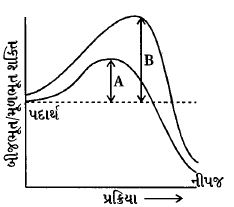
A
Endothermic reaction with energy $A$ in presence of enzyme and $B$ in absence of enzyme.
B
Exothermic reaction with energy $A$ in presence of enzyme and $B$ in absence of enzyme.
C
Endothermic reaction with energy $A$ in absence of enzyme and $B$ in presence of enzyme.
D
Exothermic reaction with energy $A$ in absence of enzyme and $B$ in presence of enzyme.
Solution
(B) The graph shows the energy levels of reactants and products during a chemical reaction.
Since the energy level of the product is lower than that of the reactant,the reaction is exothermic.
Enzymes lower the activation energy of a reaction.
In the graph,$A$ represents the activation energy in the presence of an enzyme (lower peak),and $B$ represents the activation energy in the absence of an enzyme (higher peak).
Therefore,the correct description is an exothermic reaction with energy $A$ in the presence of an enzyme and $B$ in the absence of an enzyme.
Since the energy level of the product is lower than that of the reactant,the reaction is exothermic.
Enzymes lower the activation energy of a reaction.
In the graph,$A$ represents the activation energy in the presence of an enzyme (lower peak),and $B$ represents the activation energy in the absence of an enzyme (higher peak).
Therefore,the correct description is an exothermic reaction with energy $A$ in the presence of an enzyme and $B$ in the absence of an enzyme.
0 likesView Solution
45
BiologyMediumMCQNEET · 2016
$A$ typical fat molecule is made up of
A
one glycerol and one fatty acid molecule
B
three glycerol and three fatty acid molecules
C
three glycerol molecules and one fatty acid molecule
D
one glycerol and three fatty acid molecules
Solution
(D) : Neutral or true fats are triglycerides. They are formed by the esterification of three molecules of fatty acids with one molecule of trihydric alcohol,known as glycerol (glycerine or $1,2,3$-trihydroxypropane).
0 likesView Solution
46
BiologyMediumMCQNEET · 2016
Which one of the following statements is wrong?
A
Uracil is a pyrimidine.
B
Glycine is a sulphur containing amino acid.
C
Sucrose is a disaccharide.
D
Cellulose is a polysaccharide.
Solution
(B) is the correct answer because the statement is wrong.
Glycine is the simplest amino acid with a hydrogen atom as its side chain $(R = H)$.
It does not contain sulphur.
Cysteine and methionine are the amino acids that contain sulphur in their side chains.
Glycine is the simplest amino acid with a hydrogen atom as its side chain $(R = H)$.
It does not contain sulphur.
Cysteine and methionine are the amino acids that contain sulphur in their side chains.
0 likesView Solution
47
BiologyEasyMCQNEET · 2016
During cell growth,$DNA$ synthesis takes place on
A
$S$-phase
B
$G_1$-phase
C
$G_2$-phase
D
$M$-phase
Solution
(A) : In the $S$-phase (synthetic phase) of the cell cycle,chromosomes replicate. For this,their $DNA$ molecules function as templates and form carbon copies. The $DNA$ content doubles,i.e.,from $1C$ to $2C$ for haploid cells and from $2C$ to $4C$ for diploid cells. As a result,duplicate sets of genes are formed. Along with the replication of $DNA$,new chromatin fibers are formed which remain attached in pairs,and the number of chromosomes does not increase. Since chromatin fibers are elongated chromosomes,each chromosome comes to have two chromatin threads or sister chromatids which remain attached at a common point called the centromere.
0 likesView Solution
48
BiologyMediumMCQNEET · 2016
When a cell has a stalled $DNA$ replication fork,which checkpoint should be predominantly activated?
A
$G_1/S$
B
$G_2/M$
C
$M$
D
Both $G_2/M$ and $M$
Solution
(B) The correct answer is $B$.
When a cell has a stalled $DNA$ replication fork,it indicates that the cell is currently in the $S$ phase of the cell cycle,where $DNA$ synthesis is occurring.
The $G_2/M$ checkpoint is the primary mechanism that monitors the completion of $DNA$ replication before the cell enters mitosis.
If $DNA$ replication is incomplete or stalled,the cell cycle is arrested at the $G_2/M$ transition to prevent the segregation of damaged or incomplete chromosomes.
When a cell has a stalled $DNA$ replication fork,it indicates that the cell is currently in the $S$ phase of the cell cycle,where $DNA$ synthesis is occurring.
The $G_2/M$ checkpoint is the primary mechanism that monitors the completion of $DNA$ replication before the cell enters mitosis.
If $DNA$ replication is incomplete or stalled,the cell cycle is arrested at the $G_2/M$ transition to prevent the segregation of damaged or incomplete chromosomes.
0 likesView Solution
49
BiologyMediumMCQNEET · 2016
Match the stages of meiosis in Column-$I$ to their characteristic features in Column-$II$ and select the correct option using the codes given below.
| Column-$I$ | Column-$II$ |
| $(A)$ Pachytene | $(i)$ Pairing of homologous chromosomes |
| $(B)$ Metaphase-$I$ | $(ii)$ Terminalisation of chiasmata |
| $(C)$ Diakinesis | $(iii)$ Crossing-over takes place |
| $(D)$ Zygotene | $(iv)$ Chromosomes align at equatorial plate |
A
$A-(iii), B-(iv), C-(ii), D-(i)$
B
$A-(i), B-(iv), C-(ii), D-(iii)$
C
$A-(ii), B-(iv), C-(iii), D-(i)$
D
$A-(iv), B-(iii), C-(ii), D-(i)$
Solution
(A) The correct matching is as follows:
$(A)$ Pachytene: During this stage, crossing-over occurs between non-sister chromatids of homologous chromosomes $(iii)$.
$(B)$ Metaphase-$I$: During this stage, the bivalent chromosomes align at the equatorial plate $(iv)$.
$(C)$ Diakinesis: This is the final stage of meiotic prophase-$I$, characterized by the terminalisation of chiasmata $(ii)$.
$(D)$ Zygotene: During this stage, the pairing of homologous chromosomes occurs, known as synapsis $(i)$.
Thus, the correct sequence is $A-(iii), B-(iv), C-(ii), D-(i)$.
$(A)$ Pachytene: During this stage, crossing-over occurs between non-sister chromatids of homologous chromosomes $(iii)$.
$(B)$ Metaphase-$I$: During this stage, the bivalent chromosomes align at the equatorial plate $(iv)$.
$(C)$ Diakinesis: This is the final stage of meiotic prophase-$I$, characterized by the terminalisation of chiasmata $(ii)$.
$(D)$ Zygotene: During this stage, the pairing of homologous chromosomes occurs, known as synapsis $(i)$.
Thus, the correct sequence is $A-(iii), B-(iv), C-(ii), D-(i)$.
0 likesView Solution
50
BiologyEasyMCQNEET · 2016
Spindle fibres attach on to
A
centromere of the chromosome
B
kinetosome of the chromosome
C
telomere of the chromosome
D
kinetochore of the chromosome
Solution
(D) The correct answer is $D$.
Small disc-shaped structures present on the surface of the centromeres are called kinetochores.
These structures serve as the sites of attachment for spindle fibres to the chromosomes,which are then moved into position at the centre of the cell during cell division.
While the centromere is the primary constriction of the chromosome,the kinetochore is the specific protein complex where the microtubules of the spindle apparatus attach.
Small disc-shaped structures present on the surface of the centromeres are called kinetochores.
These structures serve as the sites of attachment for spindle fibres to the chromosomes,which are then moved into position at the centre of the cell during cell division.
While the centromere is the primary constriction of the chromosome,the kinetochore is the specific protein complex where the microtubules of the spindle apparatus attach.
0 likesView Solution
51
BiologyMediumMCQNEET · 2016
The primitive prokaryotes responsible for the production of biogas from the dung of ruminant animals include the:
A
methanogens
B
eubacteria
C
halophiles
D
thermoacidophiles
Solution
(A) : Methanogens belong to the domain Archaebacteria. They include methane-producing genera such as $Methanobacillus$ and $Methanothrix$.
Methanogens are obligate anaerobes found in oxygen-deficient environments,such as marshes,swamps,sludge (formed during sewage treatment),and the digestive systems of ruminants.
They obtain their energy primarily by reducing carbon dioxide $(CO_2)$ and oxidizing hydrogen $(H_2)$,resulting in the production of methane $(CH_4)$.
Methanogens are obligate anaerobes found in oxygen-deficient environments,such as marshes,swamps,sludge (formed during sewage treatment),and the digestive systems of ruminants.
They obtain their energy primarily by reducing carbon dioxide $(CO_2)$ and oxidizing hydrogen $(H_2)$,resulting in the production of methane $(CH_4)$.
0 likesView Solution
52
BiologyMediumMCQNEET · 2016
Which one of the following statements is not correct?
A
Offspring produced by asexual reproduction are called clones.
B
Microscopic,motile,asexual reproductive structures are called zoospores.
C
In potato,banana,and ginger,the plantlets arise from the internodes present in the modified stem.
D
Water hyacinth,growing in standing water,drains oxygen from water,which leads to the death of fishes.
Solution
(C) is the incorrect statement.
In potato,banana,and ginger,the new plantlets arise from the nodes (eyes) present in the modified stems,not from the internodes.
Potato propagates via tubers,which possess buds on their nodes (eyes).
Banana and ginger propagate via rhizomes,which also bear buds on their nodes to facilitate the formation of new plantlets.
In potato,banana,and ginger,the new plantlets arise from the nodes (eyes) present in the modified stems,not from the internodes.
Potato propagates via tubers,which possess buds on their nodes (eyes).
Banana and ginger propagate via rhizomes,which also bear buds on their nodes to facilitate the formation of new plantlets.
0 likesView Solution
53
BiologyMediumMCQNEET · 2016
Which one of the following generates new genetic combinations leading to variation?
A
Vegetative reproduction
B
Parthenogenesis
C
Sexual reproduction
D
Nucellar polyembryony
Solution
(C) : Sexual reproduction involves the formation and fusion of male and female gametes.
Gamete formation is accomplished through meiotic cell division,which involves crossing over between non-sister chromatids of homologous chromosomes,leading to new genetic recombination in gametes.
Random fusion of these male and female gametes leads to genetic variability in the offspring,which,although resembling their parents,also exhibit new traits of their own.
Gamete formation is accomplished through meiotic cell division,which involves crossing over between non-sister chromatids of homologous chromosomes,leading to new genetic recombination in gametes.
Random fusion of these male and female gametes leads to genetic variability in the offspring,which,although resembling their parents,also exhibit new traits of their own.
0 likesView Solution
54
BiologyEasyMCQNEET · 2016
Match column $I$ with column $II$ and select the correct option using the codes given below.
| Column-$I$ | Column-$II$ |
| $(A)$ Pistils fused together | $(i)$ Gametogenesis |
| $(B)$ Formation of gametes | $(ii)$ Pistillate |
| $(C)$ Hyphae of higher Ascomycetes | $(iii)$ Syncarpous |
| $(D)$ Unisexual female flower | $(iv)$ Dikaryotic |
A
$A-(iv), B-(iii), C-(i), D-(ii)$
B
$A-(ii), B-(i), C-(iv), D-(iii)$
C
$A-(i), B-(ii), C-(iv), D-(iii)$
D
$A-(iii), B-(i), C-(iv), D-(ii)$
Solution
(D) The correct matches are as follows:
$(A)$ Pistils fused together are termed as $\text{Syncarpous}$ $(iii)$.
$(B)$ The process of formation of gametes is known as $\text{Gametogenesis}$ $(i)$.
$(C)$ The hyphae of higher $\text{Ascomycetes}$ undergo a $\text{Dikaryotic}$ phase $(iv)$.
$(D)$ $A$ unisexual female flower is referred to as $\text{Pistillate}$ $(ii)$.
Therefore, the correct sequence is $A-(iii), B-(i), C-(iv), D-(ii)$.
$(A)$ Pistils fused together are termed as $\text{Syncarpous}$ $(iii)$.
$(B)$ The process of formation of gametes is known as $\text{Gametogenesis}$ $(i)$.
$(C)$ The hyphae of higher $\text{Ascomycetes}$ undergo a $\text{Dikaryotic}$ phase $(iv)$.
$(D)$ $A$ unisexual female flower is referred to as $\text{Pistillate}$ $(ii)$.
Therefore, the correct sequence is $A-(iii), B-(i), C-(iv), D-(ii)$.
0 likesView Solution
55
BiologyMediumMCQNEET · 2016
In the majority of angiosperms,
A
the egg has a filiform apparatus.
B
there are numerous antipodal cells.
C
reduction division occurs in the megaspore mother cells.
D
a small central cell is present in the embryo sac.
Solution
(C) In the majority of angiosperms,the process of megasporogenesis involves the differentiation of a single megaspore mother cell $(MMC)$ within the nucellus of the ovule.
This $MMC$ undergoes meiosis,which is a reduction division,to produce four haploid megaspores.
Therefore,option $(C)$ is correct.
- Filiform apparatus is found in synergids,not the egg cell.
- There are typically only three antipodal cells.
- The central cell is usually the largest cell in the embryo sac.
This $MMC$ undergoes meiosis,which is a reduction division,to produce four haploid megaspores.
Therefore,option $(C)$ is correct.
- Filiform apparatus is found in synergids,not the egg cell.
- There are typically only three antipodal cells.
- The central cell is usually the largest cell in the embryo sac.
0 likesView Solution
56
BiologyMediumMCQNEET · 2016
Pollination in water hyacinth and water lily is brought about by the agency of
A
water
B
insects or wind
C
birds
D
bats
Solution
(B) The correct answer is $B$. In many aquatic plants,such as water hyacinth $(Eichhornia)$ and water lily $(Nymphaea)$,the flowers emerge above the level of water. Because these flowers are not submerged,pollination is not carried out by water. Instead,these plants are pollinated by insects or wind,similar to most land plants.
0 likesView Solution
57
BiologyMediumMCQNEET · 2016
The ovule of an angiosperm is technically equivalent to
A
megasporangium
B
megasporophyll
C
megaspore mother cell
D
megaspore
Solution
(A) The ovule of an angiosperm is technically equivalent to an integumented megasporangium.
In angiosperms,the megasporangium is protected by one or two protective envelopes called integuments,which together with the nucellus and embryo sac constitute the ovule.
In angiosperms,the megasporangium is protected by one or two protective envelopes called integuments,which together with the nucellus and embryo sac constitute the ovule.
0 likesView Solution
58
BiologyMediumMCQNEET · 2016
The coconut water from tender coconut represents
A
free nuclear proembryo
B
free nuclear endosperm
C
endocarp
D
fleshy mesocarp
Solution
(B) The correct answer is $B$.
Coconut water is a classic example of free-nuclear endosperm.
In the development of coconut endosperm,the primary endosperm nucleus undergoes successive nuclear divisions without cytokinesis,resulting in the formation of a large number of free nuclei.
This liquid containing free nuclei is known as coconut water.
Later,cellularization occurs in the peripheral part,forming the solid coconut meat (cellular endosperm).
Coconut water is a classic example of free-nuclear endosperm.
In the development of coconut endosperm,the primary endosperm nucleus undergoes successive nuclear divisions without cytokinesis,resulting in the formation of a large number of free nuclei.
This liquid containing free nuclei is known as coconut water.
Later,cellularization occurs in the peripheral part,forming the solid coconut meat (cellular endosperm).
0 likesView Solution
59
BiologyMediumMCQNEET · 2016
Which one of the following statements is not true?
A
Pollen grains of many species cause severe allergies.
B
Stored pollen in liquid nitrogen can be used in the crop breeding programmes.
C
Tapetum helps in the dehiscence of anther.
D
Exine of pollen grains is made up of sporopollenin.
Solution
(C) : The statement that "Tapetum helps in the dehiscence of anther" is incorrect.
$1$. Tapetum is the innermost layer of the microsporangium wall, which provides nourishment to the developing pollen grains.
$2$. The dehiscence of the anther is primarily facilitated by the endothecium layer, which develops fibrous thickenings of $\alpha$-cellulose that help in the release of pollen grains.
$3$. Pollen grains of many species (e.g., Parthenium) cause severe allergies.
$4$. Pollen grains can be stored for years in liquid nitrogen $(-196^{\circ}C)$ for use in crop breeding programmes.
$5$. The exine of pollen grains is composed of sporopollenin, which is one of the most resistant organic materials known.
$1$. Tapetum is the innermost layer of the microsporangium wall, which provides nourishment to the developing pollen grains.
$2$. The dehiscence of the anther is primarily facilitated by the endothecium layer, which develops fibrous thickenings of $\alpha$-cellulose that help in the release of pollen grains.
$3$. Pollen grains of many species (e.g., Parthenium) cause severe allergies.
$4$. Pollen grains can be stored for years in liquid nitrogen $(-196^{\circ}C)$ for use in crop breeding programmes.
$5$. The exine of pollen grains is composed of sporopollenin, which is one of the most resistant organic materials known.
0 likesView Solution
60
BiologyMediumMCQNEET · 2016
Seed formation without fertilisation in flowering plants involves the process of
A
somatic hybridisation
B
apomixis
C
sporulation
D
budding
Solution
(B) : Apomixis is a form of asexual reproduction that mimics sexual reproduction. In apomictic flowering plants,seeds are formed without the process of fertilisation. The embryos develop directly from the cells of the ovule without the fusion of male and female gametes.
0 likesView Solution
61
BiologyMediumMCQNEET · 2016
Which of the following statements is not correct?
A
Pollen germination and pollen tube growth are regulated by chemical components of pollen interacting with those of the pistil.
B
Some reptiles have also been reported as pollinators in some plant species.
C
Pollen grains of many species can germinate on the stigma of a flower,but only one pollen tube of the same species grows into the style.
D
Insects that consume pollen or nectar without bringing about pollination are called pollen/nectar robbers.
Solution
(C) is the incorrect statement. Pollen-pistil interaction is a dynamic process involving chemical dialogue between the pollen grain and the stigma. Only compatible pollen grains are allowed to germinate and grow their pollen tubes through the style to reach the ovule. Incompatible pollen grains are rejected and their growth is inhibited at the stigmatic surface or within the style. The statement in option $C$ is incorrect because pollen grains of many species cannot germinate on the stigma of a flower; only compatible pollen grains of the same species (or specific related species) can germinate.
0 likesView Solution
62
BiologyMediumMCQNEET · 2016
The proximal end of the filament of a stamen is attached to the:
A
placenta
B
connective
C
anther
D
thalamus or petal
Solution
(D) The stamen consists of two parts: the anther and the filament. The distal end of the filament is attached to the anther,while the proximal end of the filament is attached to the thalamus or the petal of the flower. Therefore,the correct option is $D$.
0 likesView Solution
63
BiologyMediumMCQNEET · 2016
Which of the following depicts the correct pathway of transport of sperms?
A
Rete testis $\to$ Efferent ductules $\to$ Epididymis $\to$ Vas deferens
B
Rete testis $\to$ Epididymis $\to$ Efferent ductules $\to$ Vas deferens
C
Rete testis $\to$ Vas deferens $\to$ Efferent ductules $\to$ Epididymis
D
Efferent ductules $\to$ Rete testis $\to$ Vas deferens $\to$ Epididymis
Solution
(A) The correct pathway of sperm transport in the male reproductive system is as follows:
$1$. Sperms are produced in the seminiferous tubules.
$2$. They move into the Rete testis.
$3$. From the Rete testis,they pass through the Efferent ductules.
$4$. They then enter the Epididymis for maturation and storage.
$5$. Finally,they are transported through the Vas deferens.
Therefore,the correct sequence is: Rete testis $\to$ Efferent ductules $\to$ Epididymis $\to$ Vas deferens.
$1$. Sperms are produced in the seminiferous tubules.
$2$. They move into the Rete testis.
$3$. From the Rete testis,they pass through the Efferent ductules.
$4$. They then enter the Epididymis for maturation and storage.
$5$. Finally,they are transported through the Vas deferens.
Therefore,the correct sequence is: Rete testis $\to$ Efferent ductules $\to$ Epididymis $\to$ Vas deferens.
0 likesView Solution
64
BiologyMediumMCQNEET · 2016
Match column-$I$ with column-$II$ and select the correct option using the codes given below.
| Column-$I$ | Column-$II$ |
|---|---|
| $(A)$ Mons pubis | $(i)$ Embryo formation |
| $(B)$ Antrum | $(ii)$ Sperm |
| $(C)$ Trophectoderm | $(iii)$ Female external genitalia |
| $(D)$ Nebenkern | $(iv)$ Graafian follicle |
A
$A-(iii), B-(iv), C-(ii), D-(i)$
B
$A-(iii), B-(iv), C-(i), D-(ii)$
C
$A-(iii), B-(i), C-(iv), D-(ii)$
D
$A-(i), B-(iv), C-(iii), D-(ii)$
Solution
(B) The correct matches are as follows:
$(A)$ Mons pubis is a part of the female external genitalia.
$(B)$ Antrum is the fluid-filled cavity present in a mature Graafian follicle.
$(C)$ Trophectoderm is the outer layer of the blastocyst that helps in embryo formation and implantation.
$(D)$ Nebenkern is a structure formed by the aggregation of mitochondria in the middle piece of a sperm.
Therefore,the correct sequence is $A-(iii), B-(iv), C-(i), D-(ii)$.
$(A)$ Mons pubis is a part of the female external genitalia.
$(B)$ Antrum is the fluid-filled cavity present in a mature Graafian follicle.
$(C)$ Trophectoderm is the outer layer of the blastocyst that helps in embryo formation and implantation.
$(D)$ Nebenkern is a structure formed by the aggregation of mitochondria in the middle piece of a sperm.
Therefore,the correct sequence is $A-(iii), B-(iv), C-(i), D-(ii)$.
0 likesView Solution
65
BiologyMediumMCQNEET · 2016
Several hormones like $hCG, hPL$,estrogen,and progesterone are produced by:
A
ovary
B
placenta
C
Fallopian tube
D
pituitary
Solution
(B) The correct answer is $B$. During pregnancy,the placenta acts as a temporary endocrine gland. It produces several essential hormones,including human chorionic gonadotropin $(hCG)$,human placental lactogen $(hPL)$,estrogens,and progestogens,which are necessary for the maintenance of pregnancy and fetal development.
0 likesView Solution
66
BiologyMediumMCQNEET · 2016
Changes in $GnRH$ pulse frequency in females are controlled by circulating levels of
A
progesterone only
B
progesterone and inhibin
C
estrogen and progesterone
D
estrogen and inhibin
Solution
(C) $GnRH$ is secreted by the hypothalamus,which stimulates the anterior lobe of the pituitary gland to secrete luteinizing hormone $(LH)$ and follicle-stimulating hormone $(FSH)$.
$FSH$ stimulates the growth of ovarian follicles and the production of estrogens.
$LH$ stimulates the corpus luteum to secrete progesterone.
Rising levels of progesterone and estrogen exert negative feedback on the hypothalamus and anterior pituitary,inhibiting the release of $GnRH$,which in turn inhibits the production of $FSH$ and $LH$.
$FSH$ stimulates the growth of ovarian follicles and the production of estrogens.
$LH$ stimulates the corpus luteum to secrete progesterone.
Rising levels of progesterone and estrogen exert negative feedback on the hypothalamus and anterior pituitary,inhibiting the release of $GnRH$,which in turn inhibits the production of $FSH$ and $LH$.
0 likesView Solution
67
BiologyMediumMCQNEET · 2016
Fertilisation in humans is practically feasible only if
A
the ovum and sperms are transported simultaneously to ampullary-isthmic junction of the cervix
B
the sperms are transported into cervix within $48$ hrs of release of ovum in uterus
C
the sperms are transported into vagina just after the release of ovum in Fallopian tube
D
the ovum and sperms are transported simultaneously to ampullary-isthmic junction of the Fallopian tube.
Solution
(D) : The fusion of a haploid male gamete (sperm) and a haploid female gamete (ovum) to form a diploid zygote is called fertilisation.
In human beings,fertilisation takes place only when the ovum and sperms are transported simultaneously to the ampullary-isthmic junction of the Fallopian tube (oviduct).
In human beings,fertilisation takes place only when the ovum and sperms are transported simultaneously to the ampullary-isthmic junction of the Fallopian tube (oviduct).
0 likesView Solution
68
BiologyMediumMCQNEET · 2016
Select the incorrect statement.
A
$LH$ and $FSH$ decrease gradually during the follicular phase.
B
$LH$ triggers secretion of androgens from the Leydig cells.
C
$FSH$ stimulates the Sertoli cells which help in spermiogenesis.
D
$LH$ triggers ovulation in ovary.
Solution
(A) : During the follicular phase,$FSH$ secretion increases.
Follicular phase (proliferative phase) usually includes cycle days $6-13$ or $14$ in a $28$-day cycle.
The follicle-stimulating hormone $(FSH)$ secreted by the anterior lobe of the pituitary gland stimulates the ovarian follicle to secrete estrogens.
Follicular phase (proliferative phase) usually includes cycle days $6-13$ or $14$ in a $28$-day cycle.
The follicle-stimulating hormone $(FSH)$ secreted by the anterior lobe of the pituitary gland stimulates the ovarian follicle to secrete estrogens.
0 likesView Solution
69
BiologyMediumMCQNEET · 2016
Identify the correct statement on 'inhibin'.
A
Is produced by granulosa cells in ovary and inhibits the secretion of $LH$.
B
Is produced by nurse cells in testes and inhibits the secretion of $LH$.
C
Inhibits the secretion of $LH, FSH$ and prolactin.
D
Is produced by granulosa cells in ovary and inhibits the secretion of $FSH$.
Solution
(D) Inhibin is a peptide hormone produced by the granulosa cells of the ovarian follicles in females and by the Sertoli cells (nurse cells) in the testes of males.
Its primary physiological function is to provide negative feedback to the anterior pituitary gland.
Specifically,inhibin selectively inhibits the secretion of $FSH$ (Follicle Stimulating Hormone) without significantly affecting the secretion of $LH$ (Luteinizing Hormone).
Therefore,the statement that it is produced by granulosa cells in the ovary and inhibits the secretion of $FSH$ is correct.
Its primary physiological function is to provide negative feedback to the anterior pituitary gland.
Specifically,inhibin selectively inhibits the secretion of $FSH$ (Follicle Stimulating Hormone) without significantly affecting the secretion of $LH$ (Luteinizing Hormone).
Therefore,the statement that it is produced by granulosa cells in the ovary and inhibits the secretion of $FSH$ is correct.
0 likesView Solution
70
BiologyMediumMCQNEET · 2016
Which of the following is a hormone-releasing $IUD$?
A
$LNG-20$
B
Multiload $375$
C
Lippes loop
D
$Cu7$
Solution
(A) $LNG-20$ is a hormone-releasing $IUD$.
Multiload $375$ and $Cu7$ are copper-releasing $IUDs$.
Lippes loop is a non-medicated $IUD$.
Multiload $375$ and $Cu7$ are copper-releasing $IUDs$.
Lippes loop is a non-medicated $IUD$.
0 likesView Solution
71
BiologyMediumMCQNEET · 2016
Which of the following is incorrect regarding vasectomy?
A
No sperm occurs in seminal fluid
B
No sperm occurs in epididymis
C
Vasa deferentia is cut and tied
D
Irreversible sterility
Solution
(B) : Vasectomy is a surgical contraception method performed in males. In vasectomy,a small part of the vas deferens is removed or tied up through a small cut on the scrotum. This prevents sperm transport. Vasectomy has a poor reversibility. There is no effect on libido and erectile functioning. Seminal vesicles are one pair of sac-like structures which join vasa deferentia to form the ejaculatory duct. They secrete seminal fluid which contains fructose,prostaglandins,and clotting proteins,but no sperms. In a male who has undergone vasectomy,the ejaculatory duct will receive seminal fluid,but due to the cut in vasa deferentia,sperms will not be transported from the epididymis; hence,the semen will lack sperms.
0 likesView Solution
72
BiologyMediumMCQNEET · 2016
Embryo with more than $16$ blastomeres formed due to in vitro fertilisation is transferred into
A
uterus
B
Fallopian tube
C
fimbriae
D
cervix
Solution
(A) In assisted reproductive technologies,embryos are transferred based on their developmental stage.
If the embryo has reached a stage with more than $16$ blastomeres,it is referred to as a morula or blastocyst stage.
According to the $IUT$ (Intra-Uterine Transfer) technique,embryos with more than $8$ blastomeres are transferred directly into the uterus to complete their further development.
Therefore,the correct option is $A$.
If the embryo has reached a stage with more than $16$ blastomeres,it is referred to as a morula or blastocyst stage.
According to the $IUT$ (Intra-Uterine Transfer) technique,embryos with more than $8$ blastomeres are transferred directly into the uterus to complete their further development.
Therefore,the correct option is $A$.
0 likesView Solution
73
BiologyMediumMCQNEET · 2016
Which of the following approaches does not give the defined action of contraceptive?
A
Hormonal contraceptives $-$ Prevent/retard entry of sperms,prevent ovulation and fertilisation
B
Vasectomy $-$ Prevents spermatogenesis
C
Barrier methods $-$ Prevents fertilisation
D
Intra uterine devices $-$ Increases phagocytosis of sperms,suppress sperm motility and fertilising capacity of sperms
Solution
(B) : Vasectomy is a surgical sterilisation technique for males in which a small part of the $vas \ deferens$ is removed or tied up through a small incision on the scrotum to prevent the transport of sperms.
Spermatogenesis is the biological process of sperm production occurring within the seminiferous tubules of the testes,which is not affected by vasectomy.
Spermatogenesis is the biological process of sperm production occurring within the seminiferous tubules of the testes,which is not affected by vasectomy.
0 likesView Solution
74
BiologyMediumMCQNEET · 2016
In the context of amniocentesis,which of the following statements is incorrect?
A
It can be used for detection of Down's syndrome.
B
It can be used for detection of cleft palate.
C
It is usually done when a woman is between $14-16$ weeks pregnant.
D
It is used for prenatal sex determination.
Solution
(B) : Amniocentesis is a prenatal diagnostic technique used to determine fetal sex and detect chromosomal disorders based on the chromosomal pattern in the amniotic fluid surrounding the developing embryo.
It can be used to determine the sex of the fetus,identify abnormalities in the number of chromosomes (like Down's syndrome),and detect certain biochemical or enzymatic abnormalities.
It is usually performed when a woman is between $14-16$ weeks pregnant.
Cleft palate is a structural deformity that is typically detected through ultrasound imaging,not through amniocentesis.
It can be used to determine the sex of the fetus,identify abnormalities in the number of chromosomes (like Down's syndrome),and detect certain biochemical or enzymatic abnormalities.
It is usually performed when a woman is between $14-16$ weeks pregnant.
Cleft palate is a structural deformity that is typically detected through ultrasound imaging,not through amniocentesis.
0 likesView Solution
75
BiologyMediumMCQNEET · 2016
The mechanism that causes a gene to move from one linkage group to another is called
A
inversion
B
duplication
C
translocation
D
crossing-over
Solution
(C) $(C) :$ Translocation is a chromosomal abnormality caused by the rearrangement of segments between non-homologous chromosomes.
This process can result in a gene moving from one linkage group to another,as the chromosomal segment containing the gene is transferred to a different chromosome.
This process can result in a gene moving from one linkage group to another,as the chromosomal segment containing the gene is transferred to a different chromosome.
0 likesView Solution
76
BiologyMediumMCQNEET · 2016
If a colour-blind man marries a woman who is homozygous for normal colour vision,the probability of their son being colour-blind is
A
$0$
B
$0.5$
C
$0.75$
D
$1$
Solution
(A) The genotype of a colour-blind man is $X^c Y$,where $X^c$ represents the $X$-linked recessive allele for colour blindness.
The genotype of a woman homozygous for normal colour vision is $XX$.
When these parents produce offspring,the possible genotypes are:
- Daughters: $X^c X$ (carriers with normal vision)
- Sons: $XY$ (normal vision)
Since the son receives his $Y$ chromosome from the father and his $X$ chromosome from the mother (who is homozygous normal),all sons will have normal vision.
Therefore,the probability of their son being colour-blind is $0$.
The genotype of a woman homozygous for normal colour vision is $XX$.
When these parents produce offspring,the possible genotypes are:
- Daughters: $X^c X$ (carriers with normal vision)
- Sons: $XY$ (normal vision)
Since the son receives his $Y$ chromosome from the father and his $X$ chromosome from the mother (who is homozygous normal),all sons will have normal vision.
Therefore,the probability of their son being colour-blind is $0$.
0 likesView Solution
77
BiologyMediumMCQNEET · 2016
Pick out the correct statements.
$(1)$ Haemophilia is a sex-linked recessive disease.
$(2)$ Down's syndrome is due to aneuploidy.
$(3)$ Phenylketonuria is an autosomal recessive gene disorder.
$(4)$ Sickle cell anaemia is an $X$-linked recessive gene disorder.
$(1)$ Haemophilia is a sex-linked recessive disease.
$(2)$ Down's syndrome is due to aneuploidy.
$(3)$ Phenylketonuria is an autosomal recessive gene disorder.
$(4)$ Sickle cell anaemia is an $X$-linked recessive gene disorder.
A
$(1), (3)$ and $(4)$ are correct.
B
$(1), (2)$ and $(3)$ are correct.
C
$(1)$ and $(4)$ are correct.
D
$(2)$ and $(4)$ are correct.
Solution
(B) The correct statements are $(1), (2),$ and $(3)$.
$(1)$ Haemophilia is a sex-linked recessive disease,which shows its transmission from unaffected carrier female to some of the male progeny.
$(2)$ Down's syndrome is a chromosomal disorder caused by the presence of an additional copy of chromosome number $21$ (trisomy of $21$),which is a type of aneuploidy.
$(3)$ Phenylketonuria is an inborn error of metabolism that is inherited as an autosomal recessive trait.
$(4)$ Sickle cell anaemia is an autosomal recessive trait that can be transmitted from parents to the offspring when both the partners are carriers of the gene (or heterozygous). Therefore,statement $(4)$ is incorrect.
$(1)$ Haemophilia is a sex-linked recessive disease,which shows its transmission from unaffected carrier female to some of the male progeny.
$(2)$ Down's syndrome is a chromosomal disorder caused by the presence of an additional copy of chromosome number $21$ (trisomy of $21$),which is a type of aneuploidy.
$(3)$ Phenylketonuria is an inborn error of metabolism that is inherited as an autosomal recessive trait.
$(4)$ Sickle cell anaemia is an autosomal recessive trait that can be transmitted from parents to the offspring when both the partners are carriers of the gene (or heterozygous). Therefore,statement $(4)$ is incorrect.
0 likesView Solution
78
BiologyMediumMCQNEET · 2016
$A$ tall true-breeding garden pea plant is crossed with a dwarf true-breeding garden pea plant. When the $F_1$ plants were selfed,the resulting genotypes were in the ratio of:
A
$3 : 1$ (Tall : Dwarf)
B
$3 : 1$ (Dwarf : Tall)
C
$1 : 2 : 1$ (Tall homozygous : Tall heterozygous : Dwarf)
D
$1 : 2 : 1$ (Tall heterozygous : Tall homozygous : Dwarf)
Solution
(C) When a tall true-breeding plant $(TT)$ is crossed with a dwarf true-breeding plant $(tt)$,the $F_1$ generation consists of all tall heterozygous plants $(Tt)$.
When $F_1$ plants $(Tt)$ are selfed $(Tt \times Tt)$,the resulting genotypes in the $F_2$ generation are:
$TT$ (Tall homozygous) : $Tt$ (Tall heterozygous) : $tt$ (Dwarf).
The ratio is $1 : 2 : 1$.
When $F_1$ plants $(Tt)$ are selfed $(Tt \times Tt)$,the resulting genotypes in the $F_2$ generation are:
$TT$ (Tall homozygous) : $Tt$ (Tall heterozygous) : $tt$ (Dwarf).
The ratio is $1 : 2 : 1$.
0 likesView Solution
79
BiologyMediumMCQNEET · 2016
Match the terms in column-$I$ with their description in column-$II$ and choose the correct option.
| Column-$I$ | Column-$II$ |
|---|---|
| $(A)$ Dominance | $(i)$ Many genes govern a single character |
| $(B)$ Codominance | $(ii)$ In a heterozygous organism only one allele expresses itself |
| $(C)$ Pleiotropy | $(iii)$ In a heterozygous organism both alleles express themselves fully |
| $(D)$ Polygenic inheritance | $(iv)$ $A$ single gene influences many characters |
A
$A-(iv), B-(i), C-(ii), D-(iii)$
B
$A-(iv), B-(iii), C-(i), D-(ii)$
C
$A-(ii), B-(i), C-(iv), D-(iii)$
D
$A-(ii), B-(iii), C-(iv), D-(i)$
Solution
(D) The correct matches are as follows:
$(A)$ Dominance: In a heterozygous organism,only one allele expresses itself,masking the effect of the other allele. Thus,$(A)-(ii)$.
$(B)$ Codominance: In a heterozygous organism,both alleles express themselves fully,such as in $AB$ blood group inheritance. Thus,$(B)-(iii)$.
$(C)$ Pleiotropy: This occurs when a single gene influences multiple phenotypic characters. Thus,$(C)-(iv)$.
$(D)$ Polygenic inheritance: This occurs when many genes govern a single character,such as human skin color or height. Thus,$(D)-(i)$.
Therefore,the correct sequence is $A-(ii), B-(iii), C-(iv), D-(i)$,which corresponds to option $(D)$.
$(A)$ Dominance: In a heterozygous organism,only one allele expresses itself,masking the effect of the other allele. Thus,$(A)-(ii)$.
$(B)$ Codominance: In a heterozygous organism,both alleles express themselves fully,such as in $AB$ blood group inheritance. Thus,$(B)-(iii)$.
$(C)$ Pleiotropy: This occurs when a single gene influences multiple phenotypic characters. Thus,$(C)-(iv)$.
$(D)$ Polygenic inheritance: This occurs when many genes govern a single character,such as human skin color or height. Thus,$(D)-(i)$.
Therefore,the correct sequence is $A-(ii), B-(iii), C-(iv), D-(i)$,which corresponds to option $(D)$.
0 likesView Solution
80
BiologyMediumMCQNEET · 2016
In a test cross involving $F_1$ dihybrid flies,more parental-type offspring were produced than the recombinant-type offspring. This indicates
A
the two genes are linked and present on the same chromosome
B
both of the characters are controlled by more than one gene
C
the two genes are located on two different chromosomes
D
chromosomes failed to separate during meiosis.
Solution
(A) : If in a dihybrid test cross,more parental combinations appear compared to the recombinants in the $F_2$ generation,it is indicative of the involvement of linkage.
Linkage is the tendency of two different genes on the same chromosome to remain together during the separation of homologous chromosomes at meiosis.
During complete linkage,no recombinants are formed,whereas in incomplete linkage,a few recombinants are produced along with parental combinations.
Linkage is the tendency of two different genes on the same chromosome to remain together during the separation of homologous chromosomes at meiosis.
During complete linkage,no recombinants are formed,whereas in incomplete linkage,a few recombinants are produced along with parental combinations.
0 likesView Solution
81
BiologyMediumMCQNEET · 2016
Which of the following most appropriately describes haemophilia?
A
Chromosomal disorder
B
Dominant gene disorder
C
Recessive gene disorder
D
$X$-linked recessive gene disorder
Solution
(D) Haemophilia is a sex-linked genetic disorder.
It is caused by a mutation in the genes responsible for the production of blood clotting factors.
Specifically,it is an $X$-linked recessive disorder,meaning the defective gene is located on the $X$ chromosome.
Since it is recessive,males (who have only one $X$ chromosome) are more frequently affected than females,as they only need one copy of the defective gene to express the disease.
It is caused by a mutation in the genes responsible for the production of blood clotting factors.
Specifically,it is an $X$-linked recessive disorder,meaning the defective gene is located on the $X$ chromosome.
Since it is recessive,males (who have only one $X$ chromosome) are more frequently affected than females,as they only need one copy of the defective gene to express the disease.
0 likesView Solution
82
BiologyMediumMCQNEET · 2016
Taylor conducted the experiments to prove the semi-conservative mode of chromosome replication on:
A
Vinca rosea
B
Vicia faba
C
Drosophila melanogaster
D
$E$. coli
Solution
(B) : Taylor et al. $(1957)$ conducted experiments on $Vicia$ $faba$ (broad bean) to prove the semi-conservative replication of $DNA$.
He fed dividing cells of the root tips of $Vicia$ $faba$ with radioactive $^3H$-thymidine instead of normal thymine and found that all the chromosomes became radioactive.
Labelled thymine was then replaced with normal thymine.
The next generation showed radioactivity in one of the two chromatids of each chromosome,while in the subsequent generation,radioactivity was present in $50\%$ of the chromosomes.
This is possible only if,out of the two strands of a chromosome,one is formed afresh while the other is conserved at each replication.
He fed dividing cells of the root tips of $Vicia$ $faba$ with radioactive $^3H$-thymidine instead of normal thymine and found that all the chromosomes became radioactive.
Labelled thymine was then replaced with normal thymine.
The next generation showed radioactivity in one of the two chromatids of each chromosome,while in the subsequent generation,radioactivity was present in $50\%$ of the chromosomes.
This is possible only if,out of the two strands of a chromosome,one is formed afresh while the other is conserved at each replication.
0 likesView Solution
83
BiologyMediumMCQNEET · 2016
The equivalent of a structural gene is
A
muton
B
cistron
C
operon
D
recon
Solution
(B) : $A$ cistron (or gene) is a segment of $DNA$ that contains the information for coding a specific polypeptide chain or a functional $RNA$ molecule (i.e.,transfer $RNA$ or ribosomal $RNA$).
Hence,a cistron is considered a unit of function.
In modern genetics,such a gene is referred to as a structural gene.
Hence,a cistron is considered a unit of function.
In modern genetics,such a gene is referred to as a structural gene.
0 likesView Solution
84
BiologyMediumMCQNEET · 2016
Which of the following $rRNAs$ acts as structural $RNA$ as well as ribozyme in bacteria (in $S\ rRNA$)?
A
$5$
B
$18$
C
$23$
D
$5.8$
Solution
(C) The correct answer is $C$.
In bacteria,the $23S\ rRNA$ is a component of the large ribosomal subunit $(50S)$.
It functions as a structural component of the ribosome and also acts as a ribozyme (specifically,it possesses peptidyl transferase activity) which catalyzes the formation of peptide bonds between amino acids during protein synthesis.
In bacteria,the $23S\ rRNA$ is a component of the large ribosomal subunit $(50S)$.
It functions as a structural component of the ribosome and also acts as a ribozyme (specifically,it possesses peptidyl transferase activity) which catalyzes the formation of peptide bonds between amino acids during protein synthesis.
0 likesView Solution
85
BiologyMediumMCQNEET · 2016
$A$ molecule that can act as a genetic material must fulfill the traits given below,except:
A
It should be able to express itself in the form of 'Mendelian characters'.
B
It should be able to generate its replica.
C
It should be unstable structurally and chemically.
D
It should provide the scope for slow changes that are required for evolution.
Solution
(C) The correct answer is $C$. $A$ molecule that acts as genetic material must be stable both structurally and chemically. If the genetic material were unstable,it would lead to the loss of metabolic functions and genetic information over time. Therefore,the requirement that it should be 'unstable' is incorrect.
0 likesView Solution
86
BiologyMediumMCQNEET · 2016
$DNA$-dependent $RNA$ polymerase catalyses transcription on one strand of the $DNA$ which is called the
A
template strand
B
coding strand
C
alpha strand
D
antistrand
Solution
(A) : The strand of $DNA$ on which $RNA$ polymerase binds to catalyse transcription is called the template strand.
It is also known as the master or antisense strand.
It has the polarity of $3' \rightarrow 5'$.
It is also known as the master or antisense strand.
It has the polarity of $3' \rightarrow 5'$.
0 likesView Solution
87
BiologyMediumMCQNEET · 2016
Which one of the following is the starter codon?
A
$UAA$
B
$UAG$
C
$AUG$
D
$UGA$
Solution
(C) The correct answer is $C$.
Polypeptide synthesis is initiated by specific start codons.
The primary start codon is $AUG$,which codes for the amino acid methionine.
In some rare cases,$GUG$ (which codes for valine) can also act as a start codon.
The other options ($UAA$,$UAG$,and $UGA$) are stop codons (also known as termination codons) that signal the end of protein synthesis.
Polypeptide synthesis is initiated by specific start codons.
The primary start codon is $AUG$,which codes for the amino acid methionine.
In some rare cases,$GUG$ (which codes for valine) can also act as a start codon.
The other options ($UAA$,$UAG$,and $UGA$) are stop codons (also known as termination codons) that signal the end of protein synthesis.
0 likesView Solution
88
BiologyMediumMCQNEET · 2016
Which of the following is required as inducer$(s)$ for the expression of $Lac$ operon?
A
Lactose
B
Lactose and Galactose
C
Glucose
D
Galactose
Solution
(A) The correct answer is $A$.
In the $Lac$ operon,lactose acts as an inducer.
When lactose is present in the medium,it enters the cell and is converted into allolactose,which acts as the actual inducer.
This inducer binds to the repressor protein,causing a conformational change that prevents the repressor from binding to the operator site.
As a result,$RNA$ polymerase can access the promoter region,and transcription of the structural genes proceeds.
In the $Lac$ operon,lactose acts as an inducer.
When lactose is present in the medium,it enters the cell and is converted into allolactose,which acts as the actual inducer.
This inducer binds to the repressor protein,causing a conformational change that prevents the repressor from binding to the operator site.
As a result,$RNA$ polymerase can access the promoter region,and transcription of the structural genes proceeds.
0 likesView Solution
89
BiologyEasyMCQNEET · 2016
$A$ complex of ribosomes attached to a single strand of $RNA$ is known as
A
polypeptide
B
Okazaki fragment
C
polysome
D
polymer
Solution
(C) During the process of translation,multiple ribosomes can attach to a single $mRNA$ molecule to synthesize multiple copies of the same polypeptide chain simultaneously. This structure,consisting of a single $mRNA$ strand with several ribosomes attached to it,is called a polyribosome or polysome.
0 likesView Solution
90
BiologyMediumMCQNEET · 2016
Genetic drift operates in
A
small isolated population
B
large isolated population
C
non-reproductive population
D
slow reproductive population
Solution
(A) Genetic drift refers to the random changes in allele frequencies within a population that occur due to chance events rather than natural selection.
While genetic drift can occur in populations of any size,its effects are most significant and pronounced in small,isolated populations.
In such small groups,chance events can lead to the rapid loss or fixation of alleles,which significantly alters the genetic makeup of the population over time.
This phenomenon is also known as the $Sewall \ Wright$ effect.
While genetic drift can occur in populations of any size,its effects are most significant and pronounced in small,isolated populations.
In such small groups,chance events can lead to the rapid loss or fixation of alleles,which significantly alters the genetic makeup of the population over time.
This phenomenon is also known as the $Sewall \ Wright$ effect.
0 likesView Solution
91
BiologyMediumMCQNEET · 2016
In the Hardy-Weinberg equation,the frequency of heterozygous individuals is represented by:
A
$p^2$
B
$2pq$
C
$pq$
D
$q^2$
Solution
(B) The correct answer is $2pq$.
In a stable population,for a gene with two alleles,'$A$' (dominant) and '$a$' (recessive),if the frequency of '$A$' is $p$ and the frequency of '$a$' is $q$,then the frequencies of the three possible genotypes ($AA$,$Aa$,and $aa$) are expressed by the Hardy-Weinberg equation:
$p^2 + 2pq + q^2 = 1$
Where:
$p^2$ = Frequency of $AA$ (homozygous dominant) individuals.
$q^2$ = Frequency of $aa$ (homozygous recessive) individuals.
$2pq$ = Frequency of $Aa$ (heterozygous) individuals.
In a stable population,for a gene with two alleles,'$A$' (dominant) and '$a$' (recessive),if the frequency of '$A$' is $p$ and the frequency of '$a$' is $q$,then the frequencies of the three possible genotypes ($AA$,$Aa$,and $aa$) are expressed by the Hardy-Weinberg equation:
$p^2 + 2pq + q^2 = 1$
Where:
$p^2$ = Frequency of $AA$ (homozygous dominant) individuals.
$q^2$ = Frequency of $aa$ (homozygous recessive) individuals.
$2pq$ = Frequency of $Aa$ (heterozygous) individuals.
0 likesView Solution
92
BiologyMediumMCQNEET · 2016
The chronological order of human evolution from early to the recent is:
A
$Australopithecus \to Ramapithecus \to Homo \text{ } habilis \to Homo \text{ } erectus$
B
$Ramapithecus \to Australopithecus \to Homo \text{ } habilis \to Homo \text{ } erectus$
C
$Ramapithecus \to Homo \text{ } habilis \to Australopithecus \to Homo \text{ } erectus$
D
$Australopithecus \to Homo \text{ } habilis \to Ramapithecus \to Homo \text{ } erectus$
Solution
(B) The correct chronological order of human evolution is as follows:
$1$. $Ramapithecus$: Lived about $14-15$ million years ago.
$2$. $Australopithecus$: Lived about $2-5$ million years ago.
$3$. $Homo \text{ } habilis$: Lived about $2$ million years ago (the first human-like hominid).
$4$. $Homo \text{ } erectus$: Lived about $1.5$ million years ago.
Therefore,the sequence is $Ramapithecus \to Australopithecus \to Homo \text{ } habilis \to Homo \text{ } erectus$.
$1$. $Ramapithecus$: Lived about $14-15$ million years ago.
$2$. $Australopithecus$: Lived about $2-5$ million years ago.
$3$. $Homo \text{ } habilis$: Lived about $2$ million years ago (the first human-like hominid).
$4$. $Homo \text{ } erectus$: Lived about $1.5$ million years ago.
Therefore,the sequence is $Ramapithecus \to Australopithecus \to Homo \text{ } habilis \to Homo \text{ } erectus$.
0 likesView Solution
93
BiologyMediumMCQNEET · 2016
Which of the following is the correct sequence of events in the origin of life?
$I.$ Formation of protobionts
$II.$ Synthesis of organic monomers
$III.$ Synthesis of organic polymers
$IV.$ Formation of $DNA$-based genetic systems
$I.$ Formation of protobionts
$II.$ Synthesis of organic monomers
$III.$ Synthesis of organic polymers
$IV.$ Formation of $DNA$-based genetic systems
A
$I, II, III, IV$
B
$I, III, II, IV$
C
$II, III, I, IV$
D
$II, III, IV, I$
Solution
(C) The correct sequence of events in the origin of life according to the chemical evolution theory (Oparin-Haldane hypothesis) is:
$1$. Synthesis of organic monomers $(II)$: Simple molecules like amino acids and nucleotides were formed from inorganic precursors.
$2$. Synthesis of organic polymers $(III)$: Monomers polymerized to form complex molecules like proteins and nucleic acids.
$3$. Formation of protobionts $(I)$: These polymers aggregated to form membrane-bound structures called protobionts.
$4$. Formation of $DNA$-based genetic systems $(IV)$: Eventually,these systems evolved into self-replicating $DNA$-based genetic systems.
Therefore,the correct sequence is $II, III, I, IV$.
$1$. Synthesis of organic monomers $(II)$: Simple molecules like amino acids and nucleotides were formed from inorganic precursors.
$2$. Synthesis of organic polymers $(III)$: Monomers polymerized to form complex molecules like proteins and nucleic acids.
$3$. Formation of protobionts $(I)$: These polymers aggregated to form membrane-bound structures called protobionts.
$4$. Formation of $DNA$-based genetic systems $(IV)$: Eventually,these systems evolved into self-replicating $DNA$-based genetic systems.
Therefore,the correct sequence is $II, III, I, IV$.
0 likesView Solution
94
BiologyMediumMCQNEET · 2016
Which of the following structures is homologous to the wing of a bird?
A
Hindlimb of rabbit
B
Flipper of whale
C
Dorsal fin of a shark
D
Wing of a moth
Solution
(B) : Homologous organs are those that share a common ancestral origin and fundamental anatomical structure,even if they perform different functions.
The wing of a bird and the flipper of a whale are both modified forelimbs.
Both structures contain the same skeletal elements,including the humerus,radius-ulna,carpals,metacarpals,and digits.
While the bird's wing is adapted for flight,the whale's flipper is adapted for swimming,demonstrating divergent evolution.
The wing of a bird and the flipper of a whale are both modified forelimbs.
Both structures contain the same skeletal elements,including the humerus,radius-ulna,carpals,metacarpals,and digits.
While the bird's wing is adapted for flight,the whale's flipper is adapted for swimming,demonstrating divergent evolution.
0 likesView Solution
95
BiologyMediumMCQNEET · 2016
Analogous structures are a result of
A
shared ancestry
B
stabilising selection
C
divergent evolution
D
convergent evolution
Solution
(D) Analogous structures are organs that perform similar functions but have different structural origins and developmental patterns.
These structures arise when different species evolve similar traits independently to adapt to similar environmental pressures.
This process is known as convergent evolution.
These structures arise when different species evolve similar traits independently to adapt to similar environmental pressures.
This process is known as convergent evolution.
0 likesView Solution
96
BiologyMediumMCQNEET · 2016
Following are the two statements regarding the origin of life.
$(A)$ The earliest organisms that appeared on the earth were non-green and presumably anaerobes.
$(B)$ The first autotrophic organisms were the chemoautotrophs that never released oxygen.
Of the above statements,which one of the following options is correct?
$(A)$ The earliest organisms that appeared on the earth were non-green and presumably anaerobes.
$(B)$ The first autotrophic organisms were the chemoautotrophs that never released oxygen.
Of the above statements,which one of the following options is correct?
A
Both $(A)$ and $(B)$ are correct.
B
Both $(A)$ and $(B)$ are false.
C
$(A)$ is correct but $(B)$ is false.
D
$(B)$ is correct but $(A)$ is false.
Solution
(A) Statement $(A)$ is correct: The earliest life forms on Earth were simple,non-green,and anaerobic because the primitive atmosphere was reducing and lacked free oxygen.
Statement $(B)$ is correct: The first autotrophs were chemoautotrophs (like methanogens) that obtained energy from inorganic chemical reactions and did not release oxygen as a byproduct. Oxygenic photosynthesis evolved much later with the appearance of cyanobacteria.
Statement $(B)$ is correct: The first autotrophs were chemoautotrophs (like methanogens) that obtained energy from inorganic chemical reactions and did not release oxygen as a byproduct. Oxygenic photosynthesis evolved much later with the appearance of cyanobacteria.
0 likesView Solution
97
BiologyEasyMCQNEET · 2016
Which of the following sets of diseases is caused by bacteria?
A
Cholera and tetanus
B
Typhoid and smallpox
C
Tetanus and mumps
D
Herpes and influenza
Solution
(A) $Cholera$ is caused by the bacterium $Vibrio \text{ } cholerae$.
$Tetanus$ is caused by the bacterium $Clostridium \text{ } tetani$.
$Typhoid$ is caused by the bacterium $Salmonella \text{ } typhi$.
$Smallpox$ is caused by the $Variola$ virus.
$Mumps$ is caused by the $Paramyxovirus$.
$Herpes$ is caused by the $Herpes \text{ } simplex$ virus.
$Influenza$ is caused by the $Orthomyxovirus$.
Therefore, the set containing only bacterial diseases is $Cholera$ and $Tetanus$.
$Tetanus$ is caused by the bacterium $Clostridium \text{ } tetani$.
$Typhoid$ is caused by the bacterium $Salmonella \text{ } typhi$.
$Smallpox$ is caused by the $Variola$ virus.
$Mumps$ is caused by the $Paramyxovirus$.
$Herpes$ is caused by the $Herpes \text{ } simplex$ virus.
$Influenza$ is caused by the $Orthomyxovirus$.
Therefore, the set containing only bacterial diseases is $Cholera$ and $Tetanus$.
0 likesView Solution
98
BiologyMediumMCQNEET · 2016
Which of the following is correct regarding $AIDS$ causative agent $HIV$?
A
$HIV$ is an enveloped virus containing one molecule of single-stranded $RNA$ and one molecule of reverse transcriptase.
B
$HIV$ is an enveloped virus that contains two identical molecules of single-stranded $RNA$ and two molecules of reverse transcriptase.
C
$HIV$ does not escape but attacks the acquired immune response.
D
Both $(b)$ and $(c)$.
Solution
(D) $HIV$ is a spherical virus with a diameter of about $90-120 \ nm$.
Its genome consists of two identical molecules of single-stranded $RNA$ and is associated with reverse transcriptase enzymes.
The envelope consists of a lipid bilayer derived from the host cell membrane with projecting glycoprotein spikes.
$HIV$ is a retrovirus that specifically attacks helper $T$ cells ($CD4^+$ cells).
By destroying these cells,it cripples the acquired immune response,as the immune system cannot signal $B$ cells to produce antibodies effectively.
This leads to a state of immune deficiency known as $AIDS$ (Acquired Immuno Deficiency Syndrome).
Its genome consists of two identical molecules of single-stranded $RNA$ and is associated with reverse transcriptase enzymes.
The envelope consists of a lipid bilayer derived from the host cell membrane with projecting glycoprotein spikes.
$HIV$ is a retrovirus that specifically attacks helper $T$ cells ($CD4^+$ cells).
By destroying these cells,it cripples the acquired immune response,as the immune system cannot signal $B$ cells to produce antibodies effectively.
This leads to a state of immune deficiency known as $AIDS$ (Acquired Immuno Deficiency Syndrome).
0 likesView Solution
99
BiologyMediumMCQNEET · 2016
Antivenom injection contains preformed antibodies,while polio drops that are administered into the body contain:
A
gamma globulin
B
attenuated pathogens
C
activated pathogens
D
harvested antibodies
Solution
(B) The correct answer is $B$. Antivenom provides passive immunity by introducing preformed antibodies directly into the body. In contrast,polio drops (oral polio vaccine) contain attenuated (weakened) pathogens. When these weakened pathogens enter the body,they stimulate the immune system to produce specific antibodies,thereby providing active immunity.
0 likesView Solution
100
BiologyMediumMCQNEET · 2016
Which of the following statements is not true for cancer cells in relation to mutations?
A
Mutations inactivate the cell control.
B
Mutations inhibit production of telomerase.
C
Mutations in proto-oncogenes accelerate the cell cycle.
D
Mutations destroy telomerase inhibitor.
Solution
(B) Cancer cells exhibit uncontrolled division due to various genetic mutations.
$(a)$ Mutations often inactivate tumor suppressor genes,which are responsible for cell cycle control,leading to unchecked growth.
$(b)$ Cancer cells typically show increased telomerase activity,which allows them to divide indefinitely. Mutations do not inhibit telomerase; rather,they often lead to its overexpression or activation. Therefore,this statement is false.
$(c)$ Mutations in proto-oncogenes convert them into oncogenes,which promote and accelerate the cell cycle.
$(d)$ Mutations can destroy or inactivate telomerase inhibitors,further contributing to the immortal nature of cancer cells.
Thus,the statement that is not true is $(b)$.
$(a)$ Mutations often inactivate tumor suppressor genes,which are responsible for cell cycle control,leading to unchecked growth.
$(b)$ Cancer cells typically show increased telomerase activity,which allows them to divide indefinitely. Mutations do not inhibit telomerase; rather,they often lead to its overexpression or activation. Therefore,this statement is false.
$(c)$ Mutations in proto-oncogenes convert them into oncogenes,which promote and accelerate the cell cycle.
$(d)$ Mutations can destroy or inactivate telomerase inhibitors,further contributing to the immortal nature of cancer cells.
Thus,the statement that is not true is $(b)$.
0 likesView Solution
Vedclass Products
For Students
Vedclass Test Series
Mock tests in real NEET style covering Biology with performance analysis. 5-day free trial.
Start Free TrialFor Teachers
Exam Paper Generator
Generate Set A/B/C/D Biology papers from 7.5L+ questions in 2 minutes. 3 chapters free.
Try FreeFor Institutes
Online Exam Module
Run live NEET mock exams with unlimited students, 360° analytics & white-label branding.
See DemoFrequently Asked Questions
How many Biology questions are in NEET 2016?
There are 201 Biology questions from the NEET 2016 paper on Vedclass, each with a detailed step-by-step solution in English.
Are NEET 2016 Biology solutions available in English?
Yes. All solutions on this page are in English. You can also switch to English or Hindi using the language buttons above the questions.
Can I practice NEET 2016 Biology as a timed test?
Yes. Use the Vedclass Test Series to attempt a full NEET mock test covering Biology with time limits and instant score analysis.
Can teachers create Biology papers from NEET previous year questions?
Yes. The Vedclass Exam Paper Generator lets teachers mix NEET Biology questions and generate Set A/B/C/D papers in minutes.
For Teachers & Institutes
Build a Custom Biology Paper
Pick NEET 2016 Biology questions, set difficulty, and generate Set A/B/C/D in 2 minutes.