
ChemistryQ51–98 of 148 questions
Page 2 of 2 · English
51
ChemistryMCQNEET · 2016
The partial pressure of oxygen in the alveoli of the lungs is
A
equal to that in the blood
B
more than that in the blood
C
less than that in the blood
D
less than that of carbon dioxide
Solution
(B) The exchange of gases occurs by simple diffusion based on pressure gradients.
In the alveoli,the partial pressure of oxygen $(pO_2)$ is approximately $104 \ mmHg$,while in the deoxygenated blood arriving at the lungs,the $pO_2$ is approximately $40 \ mmHg$.
Since the $pO_2$ in the alveoli $(104 \ mmHg)$ is significantly higher than the $pO_2$ in the blood $(40 \ mmHg)$,oxygen diffuses from the alveoli into the blood.
Therefore,the partial pressure of oxygen in the alveoli is more than that in the blood.
In the alveoli,the partial pressure of oxygen $(pO_2)$ is approximately $104 \ mmHg$,while in the deoxygenated blood arriving at the lungs,the $pO_2$ is approximately $40 \ mmHg$.
Since the $pO_2$ in the alveoli $(104 \ mmHg)$ is significantly higher than the $pO_2$ in the blood $(40 \ mmHg)$,oxygen diffuses from the alveoli into the blood.
Therefore,the partial pressure of oxygen in the alveoli is more than that in the blood.
0 likesView Solution
52
ChemistryMCQNEET · 2016
Lungs do not collapse between breaths and some air always remains in the lungs which can never be expelled because
A
there is a negative pressure in the lungs
B
there is a negative intrapleural pressure pulling at the lung walls
C
there is a positive intrapleural pressure
D
pressure in the lungs in higher than the atmospheric pressure
Solution
(B) The lungs are surrounded by the pleural membranes. The space between these membranes,known as the intrapleural space,contains a thin layer of fluid.
This space maintains a negative pressure (sub-atmospheric pressure) relative to the pressure inside the lungs (intrapulmonary pressure).
This negative intrapleural pressure acts like a suction force that pulls the lung walls outward against the chest wall,preventing the lungs from collapsing even after a forced expiration.
Consequently,a volume of air,known as the residual volume,always remains in the lungs.
This space maintains a negative pressure (sub-atmospheric pressure) relative to the pressure inside the lungs (intrapulmonary pressure).
This negative intrapleural pressure acts like a suction force that pulls the lung walls outward against the chest wall,preventing the lungs from collapsing even after a forced expiration.
Consequently,a volume of air,known as the residual volume,always remains in the lungs.
0 likesView Solution
53
ChemistryMCQNEET · 2016
Reduction in $pH$ of blood will
A
Decrease the affinity of hemoglobin with oxygen
B
release bicarbonate ions by the liver
C
reduce the rate of heart beat
D
reduce the blood supply to the brain
Solution
(A) reduction in the $pH$ of blood indicates an increase in hydrogen ion concentration $(H^+)$ and often an increase in $CO_2$ levels,which is known as the Bohr effect.
According to the Bohr effect,a decrease in $pH$ (acidic environment) shifts the oxygen-hemoglobin dissociation curve to the right.
This shift indicates a decrease in the affinity of hemoglobin for oxygen,facilitating the release of oxygen to the tissues where it is needed for cellular respiration.
According to the Bohr effect,a decrease in $pH$ (acidic environment) shifts the oxygen-hemoglobin dissociation curve to the right.
This shift indicates a decrease in the affinity of hemoglobin for oxygen,facilitating the release of oxygen to the tissues where it is needed for cellular respiration.
0 likesView Solution
54
ChemistryMCQNEET · 2016
Name the chronic respiratory disorder caused mainly by cigarette smoking.
A
Respiratory acidosis
B
Respiratory alkalosis
C
Emphysema
D
Asthma
Solution
(C) Emphysema is a chronic disorder in which alveolar walls are damaged due to which respiratory surface is decreased. Cigarette smoking is a major cause of this disease.
0 likesView Solution
55
ChemistryMCQNEET · 2016
Name the blood cells,whose reduction in number can cause clotting disorder,leading to excessive loss of blood from the body.
A
Erythrocytes
B
Leucocytes
C
Neutrophils
D
Thrombocytes
Solution
(D) Thrombocytes,also known as blood platelets,are cell fragments produced from megakaryocytes in the bone marrow.
They play a crucial role in the process of blood coagulation (clotting).
$A$ reduction in the number of thrombocytes (a condition known as thrombocytopenia) impairs the blood's ability to clot effectively.
Consequently,this can lead to excessive bleeding or hemorrhage from the body even after minor injuries.
They play a crucial role in the process of blood coagulation (clotting).
$A$ reduction in the number of thrombocytes (a condition known as thrombocytopenia) impairs the blood's ability to clot effectively.
Consequently,this can lead to excessive bleeding or hemorrhage from the body even after minor injuries.
0 likesView Solution
56
ChemistryMCQNEET · 2016
Serum differs from blood in
A
Lacking globulins
B
Lacking albumins
C
Lacking clotting factors
D
Lacking antibodies
Solution
(C) Blood is a fluid connective tissue consisting of plasma and formed elements.
Plasma is the straw-colored,viscous fluid matrix of blood,which contains water,proteins (like fibrinogen,globulins,and albumins),and various solutes.
When blood is allowed to clot,the protein fibrinogen is converted into fibrin,which forms a mesh to trap blood cells.
Serum is defined as the clear,yellowish fluid that remains after the blood has clotted.
Therefore,serum is essentially plasma from which the clotting factors (specifically fibrinogen) have been removed.
Plasma is the straw-colored,viscous fluid matrix of blood,which contains water,proteins (like fibrinogen,globulins,and albumins),and various solutes.
When blood is allowed to clot,the protein fibrinogen is converted into fibrin,which forms a mesh to trap blood cells.
Serum is defined as the clear,yellowish fluid that remains after the blood has clotted.
Therefore,serum is essentially plasma from which the clotting factors (specifically fibrinogen) have been removed.
0 likesView Solution
57
ChemistryMCQNEET · 2016
Blood pressure in the pulmonary artery is
A
more than that in the pulmonary vein
B
less than that in the venae cavae.
C
same as that in the aorta
D
more than that in the carotid
Solution
(A) The pulmonary artery carries deoxygenated blood from the right ventricle to the lungs.
Although the pressure in the pulmonary artery is significantly lower than that in the systemic aorta (because the lungs offer less resistance than the entire systemic circulation),it is still higher than the pressure in the pulmonary veins,which return oxygenated blood to the left atrium at a very low pressure.
Therefore,the blood pressure in the pulmonary artery is higher than in the pulmonary vein.
Although the pressure in the pulmonary artery is significantly lower than that in the systemic aorta (because the lungs offer less resistance than the entire systemic circulation),it is still higher than the pressure in the pulmonary veins,which return oxygenated blood to the left atrium at a very low pressure.
Therefore,the blood pressure in the pulmonary artery is higher than in the pulmonary vein.
0 likesView Solution
58
ChemistryMCQNEET · 2016
The part of the nephron involved in the active reabsorption of sodium is
A
Distal convoluted tubule
B
Proximal convoluted tubule
C
Bowman's capsule
D
Descending limb of Henle's loop
Solution
(B) The $Proximal \text{ } Convoluted \text{ } Tubule$ $(PCT)$ is the primary site for the reabsorption of electrolytes and water.
Approximately $70-80\%$ of electrolytes like sodium $(Na^+)$ and water are reabsorbed in the $PCT$ through active transport mechanisms.
While the $Distal \text{ } Convoluted \text{ } Tubule$ $(DCT)$ also performs conditional reabsorption of sodium under the influence of aldosterone, the $PCT$ is the main site for the bulk active reabsorption of sodium.
Approximately $70-80\%$ of electrolytes like sodium $(Na^+)$ and water are reabsorbed in the $PCT$ through active transport mechanisms.
While the $Distal \text{ } Convoluted \text{ } Tubule$ $(DCT)$ also performs conditional reabsorption of sodium under the influence of aldosterone, the $PCT$ is the main site for the bulk active reabsorption of sodium.
0 likesView Solution
59
ChemistryMCQNEET · 2016
Name the ion responsible for unmasking of active sites for myosin for cross-bridge activity during muscle contraction.
A
Calcium
B
Magnesium
C
Sodium
D
Potassium
Solution
(A) During muscle contraction,the signal for contraction is initiated by an action potential that travels along the sarcolemma and reaches the sarcoplasmic reticulum.
This triggers the release of $Ca^{2+}$ ions into the sarcoplasm.
These $Ca^{2+}$ ions bind to the troponin complex on the actin filaments.
This binding causes a conformational change in the troponin-tropomyosin complex,which shifts the tropomyosin away from the active sites on the actin filament.
By unmasking these active sites,the myosin heads can bind to actin to form cross-bridges,leading to muscle contraction.
This triggers the release of $Ca^{2+}$ ions into the sarcoplasm.
These $Ca^{2+}$ ions bind to the troponin complex on the actin filaments.
This binding causes a conformational change in the troponin-tropomyosin complex,which shifts the tropomyosin away from the active sites on the actin filament.
By unmasking these active sites,the myosin heads can bind to actin to form cross-bridges,leading to muscle contraction.
0 likesView Solution
60
ChemistryMCQNEET · 2016
Nomenclature is governed by certain universal rules. Which one of the following is contrary to the rules of nomenclature?
A
The names are written in Latin and are italicized.
B
When written by hand,the names are to be underlined.
C
Biological names can be written in any language.
D
The first word in a biological name represents the genus name,and the second is a specific epithet.
Solution
(C) According to the universal rules of nomenclature (Binomial Nomenclature):
$1$. Biological names are generally in Latin and written in italics. When handwritten,they are separately underlined to indicate their Latin origin.
$2$. The first word represents the genus,and the second word represents the specific epithet.
$3$. Therefore,the statement that 'Biological names can be written in any language' is incorrect and contrary to the rules,as they must be derived from Latin or Latinized regardless of their origin.
$1$. Biological names are generally in Latin and written in italics. When handwritten,they are separately underlined to indicate their Latin origin.
$2$. The first word represents the genus,and the second word represents the specific epithet.
$3$. Therefore,the statement that 'Biological names can be written in any language' is incorrect and contrary to the rules,as they must be derived from Latin or Latinized regardless of their origin.
0 likesView Solution
61
ChemistryMCQNEET · 2016
The primitive prokaryotes responsible for the production of biogas from the dung of ruminant animals include the:
A
Methanogens
B
Eubacteria
C
Halophiles
D
Thermoacidophiles
Solution
(A) Methanogens are a group of primitive prokaryotes belonging to the domain Archaea.
They are strictly anaerobic organisms found in the gut of several ruminant animals such as cows and buffaloes.
These bacteria help in the breakdown of cellulose in the digestive tract of these animals.
They produce methane $(CH_4)$,commonly known as biogas,from the dung of these ruminants.
They are strictly anaerobic organisms found in the gut of several ruminant animals such as cows and buffaloes.
These bacteria help in the breakdown of cellulose in the digestive tract of these animals.
They produce methane $(CH_4)$,commonly known as biogas,from the dung of these ruminants.
0 likesView Solution
62
ChemistryMCQNEET · 2016
Which one of the following statements is wrong?
A
Eubacteria are also called false bacteria
B
Phycomycetes are also called algal fungi
C
Cyanobacteria are also called blue-green algae
D
Golden algae are also called desmids
Solution
(A) The correct answer is $A$.
$1$. Eubacteria are known as 'true bacteria',not 'false bacteria'. They are characterized by the presence of a rigid cell wall and,if motile,a flagellum.
$2$. Phycomycetes are commonly known as 'algal fungi' because their mycelium is aseptate and coenocytic,resembling some algae.
$3$. Cyanobacteria are photosynthetic autotrophs and are commonly referred to as 'blue-green algae'.
$4$. Golden algae,which include diatoms and desmids,are collectively known as Chrysophytes.
$1$. Eubacteria are known as 'true bacteria',not 'false bacteria'. They are characterized by the presence of a rigid cell wall and,if motile,a flagellum.
$2$. Phycomycetes are commonly known as 'algal fungi' because their mycelium is aseptate and coenocytic,resembling some algae.
$3$. Cyanobacteria are photosynthetic autotrophs and are commonly referred to as 'blue-green algae'.
$4$. Golden algae,which include diatoms and desmids,are collectively known as Chrysophytes.
0 likesView Solution
63
ChemistryMCQNEET · 2016
Which of the following statements is wrong for viroids?
A
They cause infections
B
Their $RNA$ is of high molecular weight
C
They lack a protein coat
D
They are smaller than viruses
Solution
(B) Viroids were discovered by $T.O. Diener$ in $1971$ as a new infectious agent.
They are smaller than viruses.
They consist of a free low molecular weight $RNA$ and lack a protein coat that is found in viruses.
Therefore,the statement that their $RNA$ is of high molecular weight is incorrect.
They are smaller than viruses.
They consist of a free low molecular weight $RNA$ and lack a protein coat that is found in viruses.
Therefore,the statement that their $RNA$ is of high molecular weight is incorrect.
0 likesView Solution
64
ChemistryMCQNEET · 2016
One of the major components of the cell wall of most fungi is
A
Cellulose
B
Hemicellulose
C
Chitin
D
Peptidoglycan
Solution
(C) The cell wall of most fungi is primarily composed of $Chitin$.
$Chitin$ is a complex polysaccharide,specifically a polymer of $N$-acetylglucosamine.
$Cellulose$ is the primary component of plant cell walls.
$Peptidoglycan$ is a characteristic component of the bacterial cell wall.
Therefore,the correct option is $C$.
$Chitin$ is a complex polysaccharide,specifically a polymer of $N$-acetylglucosamine.
$Cellulose$ is the primary component of plant cell walls.
$Peptidoglycan$ is a characteristic component of the bacterial cell wall.
Therefore,the correct option is $C$.
0 likesView Solution
65
ChemistryMCQNEET · 2016
Chrysophytes,Euglenoids,Dinoflagellates,and Slime moulds are included in the kingdom:
A
Fungi
B
Animalia
C
Monera
D
Protista
Solution
(D) According to the $5$-kingdom classification system proposed by $R.H. Whittaker$,the kingdom $Protista$ includes all single-celled eukaryotes.
Chrysophytes (diatoms and golden algae),Dinoflagellates,Euglenoids,Slime moulds,and Protozoans are the main groups classified under the kingdom $Protista$.
These organisms are primarily aquatic and possess a well-defined nucleus and membrane-bound organelles.
Chrysophytes (diatoms and golden algae),Dinoflagellates,Euglenoids,Slime moulds,and Protozoans are the main groups classified under the kingdom $Protista$.
These organisms are primarily aquatic and possess a well-defined nucleus and membrane-bound organelles.
0 likesView Solution
66
ChemistryMCQNEET · 2016
Which one of the following is wrong for fungi?
A
They are eukaryotic
B
All fungi possess a purely cellulosic cell wall
C
They are heterotrophic
D
They are both unicellular and multicellular
Solution
(B) Fungi are eukaryotic organisms that are heterotrophic in nature. They can be unicellular (e.g.,yeast) or multicellular (e.g.,mushrooms,molds). The cell wall of fungi is primarily composed of chitin,not cellulose. Therefore,the statement that all fungi possess a purely cellulosic cell wall is incorrect.
0 likesView Solution
67
ChemistryMCQNEET · 2016
Methanogens belong to:
A
Eubacteria
B
Archaebacteria
C
Dinoflagellates
D
Slime moulds
Solution
(B) Methanogens are a group of microorganisms that produce methane as a metabolic byproduct in hypoxic conditions.
They belong to the domain $Archaea$ and specifically to the group $Archaebacteria$.
These organisms are found in extreme environments such as marshy areas and the gut of several ruminant animals (like cows and buffaloes),where they are responsible for the production of methane (biogas) from the dung of these animals.
They belong to the domain $Archaea$ and specifically to the group $Archaebacteria$.
These organisms are found in extreme environments such as marshy areas and the gut of several ruminant animals (like cows and buffaloes),where they are responsible for the production of methane (biogas) from the dung of these animals.
0 likesView Solution
68
ChemistryMCQNEET · 2016
Select the wrong statement.
A
The walls of diatoms are easily destructible.
B
Diatomaceous earth is formed by the cell walls of diatoms.
C
Diatoms are chief producers in the oceans.
D
Diatoms are microscopic and float passively in water.
Solution
(A) Diatoms have cell walls that form two thin overlapping shells,which fit together as in a soap box.
These walls are embedded with silica and thus are indestructible.
Therefore,the statement that the walls of diatoms are easily destructible is incorrect.
Diatomaceous earth is the accumulation of these indestructible cell walls over billions of years.
Diatoms are the chief producers in the oceans and are microscopic organisms that float passively in water currents (plankton).
These walls are embedded with silica and thus are indestructible.
Therefore,the statement that the walls of diatoms are easily destructible is incorrect.
Diatomaceous earth is the accumulation of these indestructible cell walls over billions of years.
Diatoms are the chief producers in the oceans and are microscopic organisms that float passively in water currents (plankton).
0 likesView Solution
69
ChemistryMCQNEET · 2016
Select the correct statement.
A
$Sequoia$ is one of the tallest trees.
B
The leaves of gymnosperms are not well adapted to extremes of climate.
C
Gymnosperms are both homosporous and heterosporous.
D
$Salvinia$,$Ginkgo$ and $Pinus$ all are gymnosperms.
Solution
(A) $1$. $Sequoia$ (redwood tree) is one of the tallest tree species known,making statement $A$ correct.
$2$. The leaves of gymnosperms are well adapted to withstand extremes of temperature,humidity,and wind (e.g.,needle-like leaves,thick cuticle,sunken stomata),making statement $B$ incorrect.
$3$. Gymnosperms are heterosporous,meaning they produce two types of spores (microspores and megaspores),making statement $C$ incorrect.
$4$. $Salvinia$ is a pteridophyte (fern),while $Ginkgo$ and $Pinus$ are gymnosperms,making statement $D$ incorrect.
$2$. The leaves of gymnosperms are well adapted to withstand extremes of temperature,humidity,and wind (e.g.,needle-like leaves,thick cuticle,sunken stomata),making statement $B$ incorrect.
$3$. Gymnosperms are heterosporous,meaning they produce two types of spores (microspores and megaspores),making statement $C$ incorrect.
$4$. $Salvinia$ is a pteridophyte (fern),while $Ginkgo$ and $Pinus$ are gymnosperms,making statement $D$ incorrect.
0 likesView Solution
70
ChemistryMCQNEET · 2016
In bryophytes and pteridophytes,transport of male gametes requires:
A
Birds
B
Water
C
Wind
D
Insects
Solution
(B) In both bryophytes and pteridophytes,the male gametes (antherozoids) are flagellated and motile.
These gametes require an external medium,which is water,to swim and reach the female gamete (egg) present in the archegonium.
Therefore,water is essential for the process of fertilization in these plant groups.
These gametes require an external medium,which is water,to swim and reach the female gamete (egg) present in the archegonium.
Therefore,water is essential for the process of fertilization in these plant groups.
0 likesView Solution
71
ChemistryMCQNEET · 2016
Which one of the following statements is wrong?
A
Algae increase the level of dissolved oxygen in the immediate environment.
B
Algin is obtained from red algae and carrageenan from brown algae.
C
Agar-Agar is obtained from Gelidium and Gracilaria.
D
Laminaria and Sargassum are used as food.
Solution
(B) The statement in option $B$ is wrong because Algin is obtained from brown algae (Phaeophyceae) and carrageenan is obtained from red algae (Rhodophyceae).
$1$. Algae perform photosynthesis,which releases oxygen into the water,thereby increasing the level of dissolved oxygen.
$2$. Agar-Agar is a commercial product obtained from red algae like $Gelidium$ and $Gracilaria$,which is used to grow microbes and in preparations of ice creams and jellies.
$3$. Many species of marine algae such as $Laminaria$ and $Sargassum$ are among the $70$ species of marine algae used as food.
$1$. Algae perform photosynthesis,which releases oxygen into the water,thereby increasing the level of dissolved oxygen.
$2$. Agar-Agar is a commercial product obtained from red algae like $Gelidium$ and $Gracilaria$,which is used to grow microbes and in preparations of ice creams and jellies.
$3$. Many species of marine algae such as $Laminaria$ and $Sargassum$ are among the $70$ species of marine algae used as food.
0 likesView Solution
72
ChemistryMCQNEET · 2016
Methanogens belong to $..........$.
A
Eubacteria
B
Archaebacteria
C
Dinoflagellates
D
Slime moulds
Solution
(B) Methanogens are a group of specialized bacteria that produce methane as a metabolic byproduct in hypoxic conditions.
They belong to the domain Archaea,specifically the group Archaebacteria.
These organisms are found in extreme environments such as marshy areas and the gut of several ruminant animals (like cows and buffaloes) where they help in the production of biogas.
They belong to the domain Archaea,specifically the group Archaebacteria.
These organisms are found in extreme environments such as marshy areas and the gut of several ruminant animals (like cows and buffaloes) where they help in the production of biogas.
0 likesView Solution
73
ChemistryMCQNEET · 2016
Which of the following national parks is the home of the famous musk deer or Hangul?
A
Eaglenest Wildlife Sanctuary (Arunachal Pradesh)
B
Dachigam National Park (Jammu and Kashmir)
C
Keibul Lamjao National Park (Manipur)
D
Bandhavgarh National Park (Madhya Pradesh)
Solution
(B) The Hangul,also known as the Kashmir stag,is a subspecies of the Central Asian red deer. It is the state animal of Jammu and Kashmir. Dachigam National Park,located in the Srinagar district of Jammu and Kashmir,is the primary habitat and conservation site for the Hangul. Therefore,the correct option is $B$.
0 likesView Solution
74
ChemistryMCQNEET · 2016
Which of the following is correctly matched?
A
Parthenium hysterophorus - Threat to biodiversity
B
Stratification - Population
C
Aerenchyma - Opuntia
D
Age pyramids - Biome
Solution
(A) The correct match is $A$. $Parthenium hysterophorus$ (carrot grass) is an invasive alien species that poses a significant threat to native biodiversity by outcompeting indigenous flora.
$Stratification$ is a characteristic of communities or ecosystems, not populations.
$Aerenchyma$ is a tissue found in hydrophytes (aquatic plants) to provide buoyancy, whereas $Opuntia$ is a xerophyte (desert plant).
$Age pyramids$ are used to represent the age distribution of a population, not a biome.
$Stratification$ is a characteristic of communities or ecosystems, not populations.
$Aerenchyma$ is a tissue found in hydrophytes (aquatic plants) to provide buoyancy, whereas $Opuntia$ is a xerophyte (desert plant).
$Age pyramids$ are used to represent the age distribution of a population, not a biome.
0 likesView Solution
75
ChemistryMCQNEET · 2016
In context with beryllium,which one of the following statements is incorrect?
A
Its salts rarely hydrolyse.
B
Its hydride is electron-deficient and polymeric.
C
It is rendered passive by nitric acid.
D
It forms $Be_2C$.
Solution
(A) $Be$ salts are covalent in nature and have a high charge density,which makes them easily hydrolysed in water. Therefore,the statement that its salts rarely hydrolyse is incorrect.
0 likesView Solution
76
ChemistryMCQNEET · 2016
The pressure of $H_{2}$ required to make the potential of $H_{2}$ electrode zero in pure water at $298 \ K$ is
A
$10^{-14} \ atm$
B
$10^{-12} \ atm$
C
$10^{-10} \ atm$
D
$10^{-4} \ atm$
Solution
(A) The electrode reaction is: $2H^{+}_{(aq)} + 2e^{-} \rightarrow H_{2(g)}$
Using the Nernst equation: $E = E^{0} - \frac{0.0591}{2} \log \frac{P_{H_{2}}}{[H^{+}]^{2}}$
Given $E = 0$,$E^{0} = 0$,and in pure water $[H^{+}] = 10^{-7} \ M$:
$0 = 0 - 0.0295 \log \frac{P_{H_{2}}}{(10^{-7})^{2}}$
$0 = \log \frac{P_{H_{2}}}{10^{-14}}$
Taking the antilog: $1 = \frac{P_{H_{2}}}{10^{-14}}$
Therefore,$P_{H_{2}} = 10^{-14} \ atm$.
Using the Nernst equation: $E = E^{0} - \frac{0.0591}{2} \log \frac{P_{H_{2}}}{[H^{+}]^{2}}$
Given $E = 0$,$E^{0} = 0$,and in pure water $[H^{+}] = 10^{-7} \ M$:
$0 = 0 - 0.0295 \log \frac{P_{H_{2}}}{(10^{-7})^{2}}$
$0 = \log \frac{P_{H_{2}}}{10^{-14}}$
Taking the antilog: $1 = \frac{P_{H_{2}}}{10^{-14}}$
Therefore,$P_{H_{2}} = 10^{-14} \ atm$.
0 likesView Solution
77
ChemistryMCQNEET · 2016
Fog is a colloidal solution of
A
Liquid in gas
B
Gas in liquid
C
Solid in gas
D
Gas in gas
Solution
(A) Fog is a type of aerosol where liquid droplets are dispersed in a gas (air).
0 likesView Solution
78
ChemistryMCQNEET · 2016
How many electrons can fit in the orbital for which $n = 3$ and $l = 1$?
A
$10$
B
$14$
C
$2$
D
$6$
Solution
(C) The quantum numbers $n = 3$ and $l = 1$ correspond to the $3p$ subshell.
An orbital is defined by a specific set of quantum numbers $(n, l, m_l)$.
According to the Pauli Exclusion Principle,any single orbital can hold a maximum of $2$ electrons with opposite spins.
Therefore,the number of electrons that can fit in a single $3p$ orbital is $2$.
An orbital is defined by a specific set of quantum numbers $(n, l, m_l)$.
According to the Pauli Exclusion Principle,any single orbital can hold a maximum of $2$ electrons with opposite spins.
Therefore,the number of electrons that can fit in a single $3p$ orbital is $2$.
0 likesView Solution
79
ChemistryMCQNEET · 2016
For a sample of a perfect gas,when its pressure is changed isothermally from $p_i$ to $p_f$,the entropy change is given by:
A
$\Delta S = nRT \ln \left( \frac{p_f}{p_i} \right)$
B
$\Delta S = RT \ln \left( \frac{p_i}{p_f} \right)$
C
$\Delta S = nR \ln \left( \frac{p_f}{p_i} \right)$
D
$\Delta S = nR \ln \left( \frac{p_i}{p_f} \right)$
Solution
(D) The general expression for entropy change of an ideal gas is $\Delta S = nC_{p,m} \ln \left( \frac{T_f}{T_i} \right) + nR \ln \left( \frac{p_i}{p_f} \right)$.
For an isothermal process,the temperature remains constant,so $T_i = T_f$,which implies $\ln \left( \frac{T_f}{T_i} \right) = \ln(1) = 0$.
Substituting this into the equation,we get $\Delta S = 0 + nR \ln \left( \frac{p_i}{p_f} \right)$.
Therefore,the entropy change is $\Delta S = nR \ln \left( \frac{p_i}{p_f} \right)$.
For an isothermal process,the temperature remains constant,so $T_i = T_f$,which implies $\ln \left( \frac{T_f}{T_i} \right) = \ln(1) = 0$.
Substituting this into the equation,we get $\Delta S = 0 + nR \ln \left( \frac{p_i}{p_f} \right)$.
Therefore,the entropy change is $\Delta S = nR \ln \left( \frac{p_i}{p_f} \right)$.
0 likesView Solution
80
ChemistryMCQNEET · 2016
Boric acid is an acid because its molecule
A
accepts $OH^{-}$ from water
B
combines with proton from water molecule
C
contains replaceable $H^{+}$ ion
D
gives up a proton
Solution
(A) Boric acid,$B(OH)_3$,is a weak monobasic Lewis acid.
It acts as an acid by accepting a lone pair of electrons from the $OH^{-}$ ion provided by water molecules.
The reaction is: $B(OH)_3 + 2H_2O \to [B(OH)_4]^- + H_3O^{+}$.
It acts as an acid by accepting a lone pair of electrons from the $OH^{-}$ ion provided by water molecules.
The reaction is: $B(OH)_3 + 2H_2O \to [B(OH)_4]^- + H_3O^{+}$.
0 likesView Solution
81
ChemistryMCQNEET · 2016
The suspension of slaked lime in water is known as
A
milk of lime
B
aqueous solution of slaked lime
C
limewater
D
quicklime
Solution
(A) The suspension of slaked lime in water is known as milk of lime,which is a suspension of $Ca(OH)_2$ in water.
Slaked lime is chemically $Ca(OH)_2$.
Limewater is the clear,filtered aqueous solution of $Ca(OH)_2$.
Quicklime is $CaO$.
The reaction for the formation of slaked lime is: $CaO + H_2O \rightarrow Ca(OH)_2$.
Slaked lime is chemically $Ca(OH)_2$.
Limewater is the clear,filtered aqueous solution of $Ca(OH)_2$.
Quicklime is $CaO$.
The reaction for the formation of slaked lime is: $CaO + H_2O \rightarrow Ca(OH)_2$.
0 likesView Solution
82
ChemistryMCQNEET · 2016
Which of the following has the longest $C-O$ bond length? (Free $C-O$ bond length in $CO$ is $1.128 \ \mathring{A}$)
A
$[Ni(CO)_4]$
B
$[Co(CO)_4]^-$
C
$[Fe(CO)_4]^{2-}$
D
$[Mn(CO)_6]^+$
Solution
(C) The $C-O$ bond length in metal carbonyls is inversely proportional to the extent of back-bonding from the metal to the $CO$ ligand.
Greater negative charge on the metal complex increases the electron density on the metal,which enhances the back-donation of electrons into the $\pi^*$ antibonding orbitals of $CO$.
This weakens the $C-O$ bond,thereby increasing its bond length.
The order of negative charge is $[Fe(CO)_4]^{2-} > [Co(CO)_4]^- > [Ni(CO)_4] > [Mn(CO)_6]^+$.
Therefore,$[Fe(CO)_4]^{2-}$ has the highest electron density on the metal,resulting in the strongest back-bonding and the longest $C-O$ bond length.
Greater negative charge on the metal complex increases the electron density on the metal,which enhances the back-donation of electrons into the $\pi^*$ antibonding orbitals of $CO$.
This weakens the $C-O$ bond,thereby increasing its bond length.
The order of negative charge is $[Fe(CO)_4]^{2-} > [Co(CO)_4]^- > [Ni(CO)_4] > [Mn(CO)_6]^+$.
Therefore,$[Fe(CO)_4]^{2-}$ has the highest electron density on the metal,resulting in the strongest back-bonding and the longest $C-O$ bond length.
0 likesView Solution
83
ChemistryMCQNEET · 2016
Which one of the following orders is correct for the bond dissociation enthalpy of halogen molecules?
A
$I_2 > Br_2 > Cl_2 > F_2$
B
$Cl_2 > Br_2 > F_2 > I_2$
C
$Br_2 > I_2 > F_2 > Cl_2$
D
$F_2 > Cl_2 > Br_2 > I_2$
Solution
(B) The bond dissociation enthalpy generally decreases down the group as the atomic size increases,which leads to a longer and weaker bond.
However,$F_2$ has an exceptionally low bond dissociation enthalpy due to the high inter-electronic repulsion between the lone pairs of the small $F$ atoms.
Thus,the correct order of bond dissociation enthalpy is $Cl_2 > Br_2 > F_2 > I_2$.
However,$F_2$ has an exceptionally low bond dissociation enthalpy due to the high inter-electronic repulsion between the lone pairs of the small $F$ atoms.
Thus,the correct order of bond dissociation enthalpy is $Cl_2 > Br_2 > F_2 > I_2$.
0 likesView Solution
84
ChemistryMCQNEET · 2016
The electronic configurations of $Eu$ (Atomic No $63$),$Gd$ (Atomic No $64$) and $Tb$ (Atomic No $65$) are
A
$[Xe]4f^7\,6s^2, [Xe]4f^8\,6s^2$ and $[Xe]4f^8\,5d^1\,6s^2$
B
$[Xe]4f^7\,5d^1\,6s^2, [Xe]4f^7\,5d^1\,6s^2$ and $[Xe]4f^9\,6s^2$
C
$[Xe]4f^6\,5d^1\,6s^2, [Xe]4f^7\,5d^1\,6s^2$ and $[Xe]4f^8\,5d^1\,6s^2$
D
$[Xe]4f^7\,6s^2, [Xe]4f^7\,5d^1\,6s^2$ and $[Xe]4f^9\,6s^2$
Solution
(D) The electronic configuration of Lanthanoids follows the general pattern $[Xe]4f^{n}5d^{0-1}6s^2$.
For $Eu$ $(Z=63)$: The configuration is $[Xe]4f^7 6s^2$.
For $Gd$ $(Z=64)$: The configuration is $[Xe]4f^7 5d^1 6s^2$ because the $4f^7$ subshell is half-filled,which provides extra stability.
For $Tb$ $(Z=65)$: The configuration is $[Xe]4f^9 6s^2$.
Thus,the correct option is $D$.
For $Eu$ $(Z=63)$: The configuration is $[Xe]4f^7 6s^2$.
For $Gd$ $(Z=64)$: The configuration is $[Xe]4f^7 5d^1 6s^2$ because the $4f^7$ subshell is half-filled,which provides extra stability.
For $Tb$ $(Z=65)$: The configuration is $[Xe]4f^9 6s^2$.
Thus,the correct option is $D$.
0 likesView Solution
85
ChemistryMCQNEET · 2016
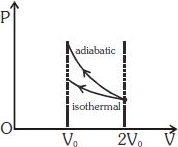
$A$ gas is compressed isothermally to half its initial volume. The same gas is compressed separately through an adiabatic process until its volume is again reduced to half. Then
A
Compressing the gas isothermally will require more work to be done.
B
Compressing the gas through adiabatic process will require more work to be done.
C
Compressing the gas isothermally or adiabatically will require the same amount of work.
D
Which of the case (whether compression through isothermal or through adiabatic process) requires more work will depend upon the atomicity of the gas.
Solution
(B) The work done on a gas during compression is equal to the area under the $P-V$ curve with respect to the volume axis.
For a given change in volume from $V_i$ to $V_f$ (where $V_f < V_i$),the adiabatic curve is steeper than the isothermal curve because the adiabatic bulk modulus is $\gamma$ times the isothermal bulk modulus.
Since the adiabatic curve lies above the isothermal curve for the same compression,the area under the adiabatic curve is greater than the area under the isothermal curve.
Therefore,the work done on the gas is greater for the adiabatic process: $W_{\text{adiabatic}} > W_{\text{isothermal}}$.
For a given change in volume from $V_i$ to $V_f$ (where $V_f < V_i$),the adiabatic curve is steeper than the isothermal curve because the adiabatic bulk modulus is $\gamma$ times the isothermal bulk modulus.
Since the adiabatic curve lies above the isothermal curve for the same compression,the area under the adiabatic curve is greater than the area under the isothermal curve.
Therefore,the work done on the gas is greater for the adiabatic process: $W_{\text{adiabatic}} > W_{\text{isothermal}}$.
0 likesView Solution
86
ChemistryMCQNEET · 2016
$A$ uniform rope of length $L$ and mass $m_1$ hangs vertically from a rigid support. $A$ block of mass $m_2$ is attached to the free end of the rope. $A$ transverse pulse of wavelength $\lambda_1$ is produced at the lower end of the rope. The wavelength of the pulse when it reaches the top of the rope is $\lambda_2$. The ratio $\lambda_2/\lambda_1$ is
A
$\sqrt{\frac{m_1}{m_2}}$
B
$\sqrt{\frac{m_1 + m_2}{m_2}}$
C
$\sqrt{\frac{m_2}{m_1}}$
D
$\sqrt{\frac{m_1 + m_2}{m_1}}$
Solution
(B) The speed of a transverse wave on a string is given by $V = \sqrt{\frac{T}{\mu}}$,where $T$ is the tension and $\mu$ is the mass per unit length.
Since the frequency $f$ of the pulse remains constant,the wavelength $\lambda$ is proportional to the wave speed $V$ $(\lambda = V/f)$.
At the lower end of the rope,the tension $T_1$ is due to the mass $m_2$ only: $T_1 = m_2 g$.
At the top of the rope,the tension $T_2$ is due to the combined mass of the rope and the block: $T_2 = (m_1 + m_2) g$.
The ratio of wavelengths is $\frac{\lambda_2}{\lambda_1} = \frac{V_2}{V_1} = \sqrt{\frac{T_2}{T_1}}$.
Substituting the values,we get $\frac{\lambda_2}{\lambda_1} = \sqrt{\frac{(m_1 + m_2) g}{m_2 g}} = \sqrt{\frac{m_1 + m_2}{m_2}}$.
Since the frequency $f$ of the pulse remains constant,the wavelength $\lambda$ is proportional to the wave speed $V$ $(\lambda = V/f)$.
At the lower end of the rope,the tension $T_1$ is due to the mass $m_2$ only: $T_1 = m_2 g$.
At the top of the rope,the tension $T_2$ is due to the combined mass of the rope and the block: $T_2 = (m_1 + m_2) g$.
The ratio of wavelengths is $\frac{\lambda_2}{\lambda_1} = \frac{V_2}{V_1} = \sqrt{\frac{T_2}{T_1}}$.
Substituting the values,we get $\frac{\lambda_2}{\lambda_1} = \sqrt{\frac{(m_1 + m_2) g}{m_2 g}} = \sqrt{\frac{m_1 + m_2}{m_2}}$.
0 likesView Solution
87
ChemistryMCQNEET · 2016
$A$ bullet of mass $10\,g$ moving horizontally with a velocity of $400\,m/s$ strikes a wooden block of mass $2\,kg$ which is suspended by a light inextensible string of length $5\,m$. As a result,the centre of gravity of the block is found to rise a vertical distance of $10\,cm$. The speed of the bullet after it emerges out horizontally from the block will be ............... $m/s$.
A
$120$
B
$160$
C
$100$
D
$80$
Solution
(A) Let $m = 10\,g = 0.01\,kg$ be the mass of the bullet,$u = 400\,m/s$ be its initial velocity,$M = 2\,kg$ be the mass of the block,and $h = 10\,cm = 0.1\,m$ be the vertical rise.
By the law of conservation of linear momentum during the collision: $mu = Mv + mV'$,where $v$ is the velocity of the block immediately after impact and $V'$ is the final velocity of the bullet.
When the block rises to height $h$,its kinetic energy is converted into potential energy: $\frac{1}{2}Mv^2 = Mgh \Rightarrow v = \sqrt{2gh}$.
Using $g = 10\,m/s^2$,$v = \sqrt{2 \times 10 \times 0.1} = \sqrt{2} \approx 1.414\,m/s$.
Substituting values into the momentum equation: $(0.01)(400) = (2)(\sqrt{2}) + (0.01)V'$.
$4 = 2.828 + 0.01V' \Rightarrow 0.01V' = 1.172$.
$V' = 117.2\,m/s$. Rounding to the nearest provided option,$V' \approx 120\,m/s$.
By the law of conservation of linear momentum during the collision: $mu = Mv + mV'$,where $v$ is the velocity of the block immediately after impact and $V'$ is the final velocity of the bullet.
When the block rises to height $h$,its kinetic energy is converted into potential energy: $\frac{1}{2}Mv^2 = Mgh \Rightarrow v = \sqrt{2gh}$.
Using $g = 10\,m/s^2$,$v = \sqrt{2 \times 10 \times 0.1} = \sqrt{2} \approx 1.414\,m/s$.
Substituting values into the momentum equation: $(0.01)(400) = (2)(\sqrt{2}) + (0.01)V'$.
$4 = 2.828 + 0.01V' \Rightarrow 0.01V' = 1.172$.
$V' = 117.2\,m/s$. Rounding to the nearest provided option,$V' \approx 120\,m/s$.
0 likesView Solution
88
ChemistryMCQNEET · 2016
$A$ uniform rope of length $L$ and mass $m_1$ hangs vertically from a rigid support. $A$ block of mass $m_2$ is attached to the free end of the rope. $A$ transverse pulse of wavelength $\lambda_1$ is produced at the lower end of the rope. The wavelength of the pulse when it reaches the top of the rope is $\lambda_2$. The ratio $\lambda_2/\lambda_1$ is
A
$\sqrt{\frac{m_1}{m_2}}$
B
$\sqrt{\frac{m_1 + m_2}{m_2}}$
C
$\sqrt{\frac{m_2}{m_1}}$
D
$\sqrt{\frac{m_1 + m_2}{m_1}}$
Solution
(B) The speed of a transverse wave on a string is given by $v = \sqrt{\frac{T}{\mu}}$,where $T$ is the tension and $\mu$ is the linear mass density.
Since the frequency $f$ of the pulse remains constant as it travels,the wavelength $\lambda = v/f$ is directly proportional to the wave speed $v$.
Therefore,$\frac{\lambda_2}{\lambda_1} = \frac{v_2}{v_1} = \sqrt{\frac{T_2}{T_1}}$.
At the lower end (bottom),the tension $T_1$ is due to the block of mass $m_2$ only: $T_1 = m_2 g$.
At the upper end (top),the tension $T_2$ is due to the weight of both the rope and the block: $T_2 = (m_1 + m_2) g$.
Substituting these values into the ratio:
$\frac{\lambda_2}{\lambda_1} = \sqrt{\frac{(m_1 + m_2)g}{m_2 g}} = \sqrt{\frac{m_1 + m_2}{m_2}}$.
Since the frequency $f$ of the pulse remains constant as it travels,the wavelength $\lambda = v/f$ is directly proportional to the wave speed $v$.
Therefore,$\frac{\lambda_2}{\lambda_1} = \frac{v_2}{v_1} = \sqrt{\frac{T_2}{T_1}}$.
At the lower end (bottom),the tension $T_1$ is due to the block of mass $m_2$ only: $T_1 = m_2 g$.
At the upper end (top),the tension $T_2$ is due to the weight of both the rope and the block: $T_2 = (m_1 + m_2) g$.
Substituting these values into the ratio:
$\frac{\lambda_2}{\lambda_1} = \sqrt{\frac{(m_1 + m_2)g}{m_2 g}} = \sqrt{\frac{m_1 + m_2}{m_2}}$.
0 likesView Solution
89
ChemistryMCQNEET · 2016
Two rotating bodies $A$ and $B$ of masses $m$ and $2m$ with moments of inertia $I_A$ and $I_B$ $(I_B > I_A)$ have equal kinetic energy of rotation. If $L_A$ and $L_B$ are their angular momenta respectively,then:
A
$L_A = \frac{L_B}{2}$
B
$L_A = 2L_B$
C
$L_B > L_A$
D
$L_A > L_B$
Solution
(C) The rotational kinetic energy $K$ is related to angular momentum $L$ and moment of inertia $I$ by the formula $K = \frac{L^2}{2I}$.
Rearranging this for angular momentum,we get $L = \sqrt{2IK}$.
Since both bodies have equal kinetic energy $(K_A = K_B = K)$,the angular momentum is directly proportional to the square root of the moment of inertia: $L \propto \sqrt{I}$.
Given that $I_B > I_A$,it follows that $\sqrt{I_B} > \sqrt{I_A}$.
Therefore,$L_B > L_A$.
Rearranging this for angular momentum,we get $L = \sqrt{2IK}$.
Since both bodies have equal kinetic energy $(K_A = K_B = K)$,the angular momentum is directly proportional to the square root of the moment of inertia: $L \propto \sqrt{I}$.
Given that $I_B > I_A$,it follows that $\sqrt{I_B} > \sqrt{I_A}$.
Therefore,$L_B > L_A$.
0 likesView Solution
90
ChemistryMCQNEET · 2016
In male cockroaches,sperms are stored in which part of the reproductive system?
A
Seminal vesicles
B
Mushroom glands
C
Testes
D
Vas deferens
Solution
(A) In the male reproductive system of cockroaches,the sperms produced by the testes are stored in the seminal vesicles. These vesicles are associated with the mushroom-shaped gland and serve as storage organs for the sperms until they are formed into spermatophores.
0 likesView Solution
91
ChemistryMCQNEET · 2016
Smooth muscles are:
A
Involuntary,fusiform,non-striated
B
Voluntary,multinucleate,cylindrical
C
Involuntary,cylindrical,striated
D
Voluntary,spindle-shaped,uninucleate
Solution
(A) Smooth muscles are involuntary,meaning they are not under conscious control. They are fusiform (spindle-shaped) in structure,with a single nucleus in the center,and they lack the striations (bands) seen in skeletal or cardiac muscles. Therefore,they are described as involuntary,fusiform,and non-striated.
0 likesView Solution
92
ChemistryMCQNEET · 2016
In male cockroaches,sperms are stored in which part of the reproductive system?
A
Seminal vesicles
B
Mushroom glands
C
Testes
D
Vas deferens
Solution
(A) In male cockroaches,the testes are located in the $4^{th}-6^{th}$ abdominal segments. The sperms produced in the testes are transported through the vasa deferentia to the seminal vesicles,where they are stored and glued together in the form of bundles called spermatophores.
0 likesView Solution
93
ChemistryMCQNEET · 2016
Which one of the following cell organelles is enclosed by a single membrane?
A
Mitochondria
B
Chloroplasts
C
Lysosomes
D
Nuclei
Solution
(C) The cell organelles are classified based on the number of membranes surrounding them:
$1$. Double membrane-bound organelles: Mitochondria,Chloroplasts,and Nucleus.
$2$. Single membrane-bound organelles: Lysosomes,Vacuoles,Golgi apparatus,and Endoplasmic reticulum.
$3$. Non-membrane-bound organelles: Ribosomes and Centrosomes.
Therefore,Lysosomes are enclosed by a single membrane.
$1$. Double membrane-bound organelles: Mitochondria,Chloroplasts,and Nucleus.
$2$. Single membrane-bound organelles: Lysosomes,Vacuoles,Golgi apparatus,and Endoplasmic reticulum.
$3$. Non-membrane-bound organelles: Ribosomes and Centrosomes.
Therefore,Lysosomes are enclosed by a single membrane.
0 likesView Solution
94
ChemistryMCQNEET · 2016
Which of the following is the most important cause driving animals and plants to extinction?
A
Alien species invasions
B
Co-extinctions
C
Habitat loss and fragmentation
D
Over-exploitation
Solution
(C) The most important cause driving animals and plants to extinction is habitat loss and fragmentation. This is often referred to as the 'Evil Quartet' of biodiversity loss,where habitat loss and fragmentation is considered the primary and most significant factor globally.
0 likesView Solution
95
ChemistryMCQNEET · 2016
Two identical bodies are made of a material for which the heat capacity increases with temperature. One of these is held at a temperature of $100^{\circ} C$,while the other one is kept at $0^{\circ} C$. If the two are brought into contact,then assuming no heat loss to the environment,the final temperature that they will reach is
A
$50^{\circ} C$
B
more than $50^{\circ} C$
C
less than $50^{\circ} C$
D
$0^{\circ} C$
Solution
(B) Let the heat capacity of the body at $100^{\circ} C$ be $C_1$ and the heat capacity of the body at $0^{\circ} C$ be $C_2$.
Since the heat capacity increases with temperature,the body at $100^{\circ} C$ has a higher heat capacity than the body at $0^{\circ} C$,i.e.,$C_1 > C_2$.
When the two bodies are brought into contact,heat flows from the hotter body to the colder body until they reach a common final temperature $T$.
Assuming no heat loss to the environment,the heat lost by the hotter body equals the heat gained by the colder body:
$C_1(100 - T) = C_2(T - 0)$
$100 C_1 - C_1 T = C_2 T$
$100 C_1 = T(C_1 + C_2)$
$T = 100 \cdot \frac{C_1}{C_1 + C_2}$
Since $C_1 > C_2$,the ratio $\frac{C_1}{C_1 + C_2} > \frac{1}{2}$.
Therefore,$T > 100 \cdot \frac{1}{2} = 50^{\circ} C$.
Thus,the final temperature is more than $50^{\circ} C$.
Since the heat capacity increases with temperature,the body at $100^{\circ} C$ has a higher heat capacity than the body at $0^{\circ} C$,i.e.,$C_1 > C_2$.
When the two bodies are brought into contact,heat flows from the hotter body to the colder body until they reach a common final temperature $T$.
Assuming no heat loss to the environment,the heat lost by the hotter body equals the heat gained by the colder body:
$C_1(100 - T) = C_2(T - 0)$
$100 C_1 - C_1 T = C_2 T$
$100 C_1 = T(C_1 + C_2)$
$T = 100 \cdot \frac{C_1}{C_1 + C_2}$
Since $C_1 > C_2$,the ratio $\frac{C_1}{C_1 + C_2} > \frac{1}{2}$.
Therefore,$T > 100 \cdot \frac{1}{2} = 50^{\circ} C$.
Thus,the final temperature is more than $50^{\circ} C$.
0 likesView Solution
96
ChemistryMCQNEET · 2016
$A$ molecule that can act as a genetic material must fulfill the traits given below,except.
A
It should be able to express itself in the form of 'Mendelian characters'.
B
It should be able to generate its replica.
C
It should be unstable structurally and chemically.
D
It should provide the scope for slow changes that are required for evolution.
Solution
(C) molecule that acts as genetic material must fulfill the following criteria:
$1$. It should be able to generate its replica (replication).
$2$. It should be chemically and structurally stable.
$3$. It should provide the scope for slow changes (mutation) that are required for evolution.
$4$. It should be able to express itself in the form of 'Mendelian characters'.
Option $C$ states that it should be unstable,which is incorrect because genetic material must be stable to store and transmit information accurately across generations.
$1$. It should be able to generate its replica (replication).
$2$. It should be chemically and structurally stable.
$3$. It should provide the scope for slow changes (mutation) that are required for evolution.
$4$. It should be able to express itself in the form of 'Mendelian characters'.
Option $C$ states that it should be unstable,which is incorrect because genetic material must be stable to store and transmit information accurately across generations.
0 likesView Solution
97
ChemistryMCQNEET · 2016
If '$+$' sign is assigned to beneficial interaction,'$-$' sign to detrimental and '$O$' sign to neutral interaction,then the population interaction represented by '$+$,$-$' refers to:
A
Mutualism
B
Amensalism
C
Commensalism
D
Parasitism
Solution
(D) In population interactions,the signs '$+$','$-$',and '$O$' represent beneficial,detrimental,and neutral effects,respectively.
$1$. Mutualism $(+, +)$: Both species benefit.
$2$. Competition $(-, -)$: Both species are harmed.
$3$. Predation $(+, -)$: One species (predator) benefits,and the other (prey) is harmed.
$4$. Parasitism $(+, -)$: One species (parasite) benefits,and the other (host) is harmed.
$5$. Commensalism $(+, O)$: One species benefits,and the other is unaffected.
$6$. Amensalism $(-, O)$: One species is harmed,and the other is unaffected.
Since the interaction '$+, -$' represents a scenario where one species benefits and the other is harmed,it corresponds to both Predation and Parasitism. Given the options provided,Parasitism is the correct classification.
$1$. Mutualism $(+, +)$: Both species benefit.
$2$. Competition $(-, -)$: Both species are harmed.
$3$. Predation $(+, -)$: One species (predator) benefits,and the other (prey) is harmed.
$4$. Parasitism $(+, -)$: One species (parasite) benefits,and the other (host) is harmed.
$5$. Commensalism $(+, O)$: One species benefits,and the other is unaffected.
$6$. Amensalism $(-, O)$: One species is harmed,and the other is unaffected.
Since the interaction '$+, -$' represents a scenario where one species benefits and the other is harmed,it corresponds to both Predation and Parasitism. Given the options provided,Parasitism is the correct classification.
0 likesView Solution
98
ChemistryMCQNEET · 2016
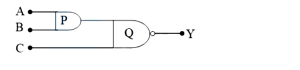
What is the output $Y$ in the following circuit,when all the three inputs $A, B, C$ are first $0$ then $1$?
A
$0,0$
B
$0,1$
C
$1,1$
D
$1,0$
Solution
(D) The circuit consists of an $AND$ gate $P$ followed by a $NAND$ gate $Q$.
Let the output of the $AND$ gate $P$ be $X = A \cdot B$.
The final output $Y$ of the $NAND$ gate $Q$ is given by $Y = \overline{X \cdot C} = \overline{(A \cdot B) \cdot C} = \overline{A \cdot B \cdot C}$.
Case $1$: When $A = B = C = 0$,the output is $Y_0 = \overline{0 \cdot 0 \cdot 0} = \overline{0} = 1$.
Case $2$: When $A = B = C = 1$,the output is $Y_1 = \overline{1 \cdot 1 \cdot 1} = \overline{1} = 0$.
Thus,the outputs are $1, 0$.
Let the output of the $AND$ gate $P$ be $X = A \cdot B$.
The final output $Y$ of the $NAND$ gate $Q$ is given by $Y = \overline{X \cdot C} = \overline{(A \cdot B) \cdot C} = \overline{A \cdot B \cdot C}$.
Case $1$: When $A = B = C = 0$,the output is $Y_0 = \overline{0 \cdot 0 \cdot 0} = \overline{0} = 1$.
Case $2$: When $A = B = C = 1$,the output is $Y_1 = \overline{1 \cdot 1 \cdot 1} = \overline{1} = 0$.
Thus,the outputs are $1, 0$.
0 likesView Solution
Vedclass Products
For Students
Vedclass Test Series
Mock tests in real NEET style covering Chemistry with performance analysis. 5-day free trial.
Start Free TrialFor Teachers
Exam Paper Generator
Generate Set A/B/C/D Chemistry papers from 7.5L+ questions in 2 minutes. 3 chapters free.
Try FreeFor Institutes
Online Exam Module
Run live NEET mock exams with unlimited students, 360° analytics & white-label branding.
See DemoFrequently Asked Questions
How many Chemistry questions are in NEET 2016?
There are 148 Chemistry questions from the NEET 2016 paper on Vedclass, each with a detailed step-by-step solution in English.
Are NEET 2016 Chemistry solutions available in English?
Yes. All solutions on this page are in English. You can also switch to English or Hindi using the language buttons above the questions.
Can I practice NEET 2016 Chemistry as a timed test?
Yes. Use the Vedclass Test Series to attempt a full NEET mock test covering Chemistry with time limits and instant score analysis.
Can teachers create Chemistry papers from NEET previous year questions?
Yes. The Vedclass Exam Paper Generator lets teachers mix NEET Chemistry questions and generate Set A/B/C/D papers in minutes.
For Teachers & Institutes
Build a Custom Chemistry Paper
Pick NEET 2016 Chemistry questions, set difficulty, and generate Set A/B/C/D in 2 minutes.